OCTOBER 2026 WWW.ESEMAG.COM
Standardizing the definition of ‘flushable’ wipes
Why large buildings need a drinking water sampling strategy
Designing sewage pumping station backup control systems
Understanding wet-weather impacts on collection systems PM40065446
Smart Conveying Technology
Easy Maintenance Pumps
Open Hopper Pumps
WHEN WINTER HITS, RELIABILITY MATTERS. Engineered for Canada’s toughest operating conditions.
When winter temperatures drop, wastewater operations can’t afford disruption. SEEPEX progressive cavity pumps and digital solutions help municipalities and industrial facilities maintain dependable performance through seasonal challenges, from sludge transfer and polymer dosing to dewatering applications. YEAR-ROUND RELIABILITY
FIND THE NEAREST AUTHORIZED DISTRIBUTOR.
y Engineered for dependable operation in demanding Canadian environments and seasonal conditions REDUCED DOWNTIME y Simple maintenance and robust performance help keep critical processes running year-round LOCAL SUPPORT
SEEPEX Inc. sales.us@seepex.com www.seepex.com
y Access authorized SEEPEX distributors across Canada for responsive service, application expertise, and parts support
Solutions for WASTEWATER TREATMENT ONLINE AND PORTABLE INSTRUMENTATION Multi Parameter Single – Dual – Multi-Channel-Wireless Optical Fluorescence Dissolved Oxygen Near Infra Red Total Suspended Solids pH, ORP Microwave Density Ultrasonic Interface Level Spectrophotometric Online
FLOWMETERING Ultrasonic Doppler – Transit Time Insertion/Immersion/Clamp-On Venture/Flume Partially Filled Conduit Non Contact Radar
WASTEWATER SAMPLERS Indoor or Outdoor Refrigerated or Non-Refrigerated Portable or Stationary
SEPTAGE RECEIVING SYSTEMS Fully Automated Control and Data Collection Integrated Billing System
ADDITIONAL SOLUTIONS FOR: Flow – Level – System Integration – SCADA – Field Service
Mississauga, Ontario Montreal, Québec
800-595-0514 www.cancoppas.com controls@cancoppas.com
CONTENTS
October 2026 • Vol. 39 No. 5 • ISSN-0835-605X
Editor and Publisher STEVE DAVEY steve@esemag.com Managing Editor PETER DAVEY peter@esemag.com Contributing Editor DAVID NESSETH david@esemag.com Sales Director PENNY DAVEY penny@esemag.com Sales Representative DENISE SIMPSON denise@esemag.com Accounting SANDRA DAVEY sandra@esemag.com Design & Production MIGUEL AGAWIN miguel@esemag.com Circulation BRIAN GILLETT ese@mysubscription.ca
TECHNICAL ADVISORY BOARD Archis Ambulkar, Toledo Technology Academy of Engineering Patrick Coleman, Stantec Bill De Angelis, Metrolinx Mohammed Elenany, Urban Systems William Fernandes, City of Toronto Tony Petrucci, Black & Veatch Environmental Science & Engineering is a bi‑monthly business publication of Environmental Science & Engineering Publications Inc. An all Canadian publication, ES&E provides authoritative editorial coverage of Canada’s municipal and industrial environmental control systems and drinking water treatment and distribution. Readers include consulting engineers, industrial plant managers and engineers, key municipal, provincial and federal environmental officials, water and wastewater plant operators and contractors. Information contained in ES&E has been compiled from sources believed to be correct. ES&E cannot be responsible for the accuracy of articles or other editorial matter. Articles in this magazine are intended to provide information rather than give legal or other professional advice. Canadian Publications Mail Sales Second Class Mail Product Agreement No. 40065446 Registration No. 7750 Subscription Changes? Please email reader subscription changes to ese@mysubscription.ca, or call 705-502-0024. ADVERTISING Penny Davey Sales Director 416-807-3812 penny@esemag.com
Denise Simpson Sales Representative 905-960-4064 denise@esemag.com
Environmental Science & Engineering 220 Industrial Pkwy. S., Unit 30 Aurora, Ontario L4G 3V6 Tel: (905) 727-4666 www.esemag.com
12 FEATURES 6 The alarming findings of Canada’s latest Changing Climate Report 8 Improving odour reporting at Toronto’s Ashbridges Bay WWTP 9 Yale researchers propose low-cost PFAS cleanup method for contaminated soil 10 Paris wastewater plant to test removal of tire wear particles 12 Why large buildings need a drinking water sampling strategy 17 Halifax Water seeks steep increase in water connection charges 18 Using PVDF piping to minimize struvite deposits in digesters 20 New guidebook offers roadmap for AI and machine learning 22 How lightweight membrane covers are changing treatment basin protection 24 A second life for a 60-year-old WWTP oxidation ditch 26 Understanding wet-weather impacts on collection systems 30 Fast-tracking an Alberta wastewater treatment plant expansion 32 Advanced wastewater screening systems can reduce risk and costs 34 Construction begins on Cranbrook’s new UV disinfection facility 36 Partnering efforts help accelerate disaster recovery at Denare Beach 37 Manitoba commits $500M to final phase of North End WWTP upgrade Digital Edition Sponsored by
4 | October 2026
45
38 Using InSAR to detect ground and structural movement 41 Federal, provincial funding backs 17 Newfoundland water projects 42 Engineering sludge dewatering systems for reliable performance 45 Solving a grease challenge at a Quebec duck processing plant 46 Designing sewage pumping station backup control systems 48 Alberta signs $510M water infrastructure agreement with Ottawa 49 Toronto moves ahead with a 600-MLD wet weather treatment facility 50 Working to standardize the definition of 'flushable' 52 Designing for the operator is key to WWTP reliability 54 Removing salt and recovering metals from industrial wastewater 56 Creating fish habitat to compensate for bridge project impacts 60 AWWA’s incoming president reflects on his experiences 62 Digital water investment set to double
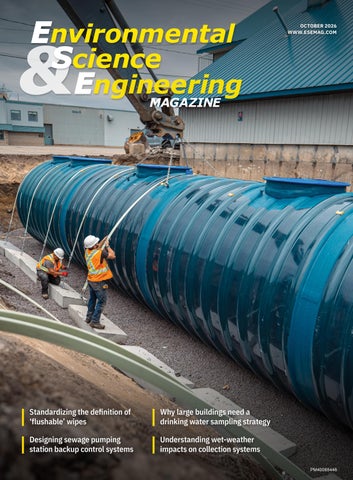
DEPARTMENTS Product Showcase...........................57 Professional Cards...........................61 Ad Index...........................................62 Cover photo courtesy of Granby Composites.
Process Equipment for Wastewater, Biosolids & Biogas Pro Aqua, Inc. carries a complete range of market leading and innovative products. Let us show you We Are The Exclusive Suppliers For: Let's Solve Water
Providing treatment solutions for more than 30 years. • Archimedes Screw Pumps • Screens – Multi-Rake, Perf Plate, Drum, Travelling Band, Step, Climber, Vertical Pump Station Screens, Screenings Washer /Compactors • Grit Separation, Washing & Dewatering • Conveyors – Shafted & Shaftless Screw, Belt • Blowers – Rotary Screw, Rotary Lobe, Single Stage and Multistage Centrifugal, Turbo, Integrally Geared, Advance Control, Rebuilds • Aeration – Surface, Membrane & Ceramic, Fine & Coarse Bubble, Gas & Liquid Cleaning, DO Control, AlphaMeter • Mixers – Anoxic & Swing Zones, Sludge Holding, Digester; Mechanical, Hydraulic and Gas Bubble • Tank Components – Decanters, Swivel Joints, Telescoping Covers, Watertight Doors •
• Rotary Lobe Pumps & Grinders • Disinfection – UV, Ozone • Tertiary Filters – Travelling Bridge, Disk, Membrane • Sludge Thickening & Dewatering – Disk Thickener, Gravity Thickener, Filter Press, Screw Press, Centrifuge • Anaerobic Digesters – Sludge Conditioning, In-line Screening, Degritting, Membrane Gas Holders, Liquid Mixing, Nutrient Recovery • Sludge Drying – Belt, Fluid Bed and Solar • Septage Receiving – Screens, Dump Stations, Truck Access & ID, data gathering & equipment control • Sludge Treatment, Transport & Storage – Cake Pumps, Silos, Sliding Frames, Live Bottom Hoppers, Push Floors, Truck Loading, Alkaline Stabilization • Odour Control – Tank Covers, Chemical & Biological Treatment, Activated Carbon • CSO, Stormwater & Pump Stations – Tipping Buckets, Bending Weirs, Flushing Gates, Flow Regulating, Vortex Valves, Storm Screens
Primary & Secondary, Circular, Chain & Flight, Inclined Plate Settlers, Weir Washing • • Biological – SBR, MBR, RBC, MBBR, MABR, Oxidation Ditch, BioMag, CoMag • Polymer – Liquid and Dry Systems
Digester Gas – Gas Holders, Gas Conditioning: chilling; compressing; and removal of moisture, sulphur, carbon dioxide and siloxane, complete Co-Generation facilities
T: (905) 864-9311 F: (905) 864-8469 www.proaquasales.com 7-264 Bronte St. S., Milton, ON L9T 5A3 04.16
EDITORIAL COMMENT BY STEVE DAVEY
The alarming findings of Canada’s latest Changing Climate Report
H
istory has shown that the environment usually takes a back seat during economic and politically difficult times. In her September 15 newspaper column, the Toronto Star’s Althia Raj lamented that over the past year Prime Minister Carney “has scrapped the oil and gas cap, eliminated the electric vehicle mandate and shown himself willing to override B.C.’s long-standing oil tanker ban. In the spring, he delayed methane regulations, abandoned clean electricity regulations and lowered industrial carbon pricing targets.” These actions seem to be at odds with what is needed to counter the findings of the federal government’s latest Changing Climate Report. It says that due to emissions of greenhouse gases from human activities over the past 75 years, Canada as a whole has warmed by 2.0°C, while the North has warmed by 2.6°C. The report also predicts that even under the best-case scenario of achieving global net-zero emissions by 2075, the average temperature increase across Canada by 2081– 2100, compared with 1850–1900, will be 3.5°C. If there are no changes to current global emissions policies, the increase will be 5.0°C. If global emissions increase because of weakened control measures, the average temperature increase could be as much as 6.9°C. The report says that with Canada having already warmed by 2.0°C over the past 75 years, the country is experiencing more extreme heat, less extreme cold, longer growing seasons, longer fire seasons, earlier peak stream flow, shorter snow and ice cover seasons, thinning glaciers, thawing permafrost, warming oceans, and rising sea levels. This summer has again seen record-breaking forest fires in Can-
6 | October 2026
This summer the water level of Lake Mead dropped to its lowest level since the Hoover Dam was completed in 1936, putting the water supply for millions of people in doubt. Credit: bob, stock.adobe.com
ada and Europe and drought and record-low water levels in rivers and water reservoirs. For example, this summer the water level of Lake Mead, near Las Vegas, dropped to its lowest level since the Hoover Dam was completed in 1936, putting the water supply for millions of people across Arizona, California, Nevada, and Mexico in doubt. In Germany, water levels on the Rhine River at Kaub dropped to record lows, making it unnavigable for cruise ships and limiting cargo vessel loads. Over the years, Environmental Science & Engineering Magazine has covered the considerable financial commitments the water, wastewater and industrial sectors have made to reduce energy consumption and carbon emissions. Additionally, a 2025 Fraser Institute study estimates that the federal government and Canada’s four largest provinces spent or forewent $158 billion through green economy programs and tax credits over the past decade.
To go beyond that and achieve netzero emissions in Canada, a 2021 report from RBC put the total cost at around $2 trillion over three decades. Globally, estimates for reaching netzero carbon emissions have ranged from $100 trillion to $120 trillion USD, according to figures cited by the Stanford Institute for Economic Policy Research. Given the current emphasis on economic concerns over environmental ones, and global challenges to prosperity, it seems very unlikely that Canada and other countries will commit to working towards net-zero emissions, despite the evidence of what has happened to our climate already. Are we now the proverbial frog in a pot of hot water, not recognizing the danger and jumping out before it comes to a boil? Steve Davey is the editor and publisher of ES&E Magazine. Email: steve@esemag.com
Environmental Science & Engineering Magazine
Optimum Performance
DIAMOND SPONSOR 2026 BOOTHS 4252 & 719
Chemical Dosing Pumps & Skid Systems
FLEXFLO® M3 PERISTALTIC METERING PUMP
CHEM-FEED® COMPLETE METERING SYSTEMS
Fully equipped and assembled systems for drop in place install and fast startup. One, two or three pump models.
Smooth, consistent chemical dosing with no vapour lock and no loss of prime.
ENHANCED CHEM-FEED® MD1
Dual diaphragm design with hyper drive technology for unequalled performance. Pressure rating 12.4 Bar. Output capability 13.2 to 26.5 LPH.
Fluid Metering Solutions Made Simple® Learn about our Skid Systems, M3 and MD1 at www.blue-white.com
WASTEWATER
Toronto approves plan to improve odour reporting for Ashbridges Bay WWTP By ES&E Staff
T
oronto city council has approved a plan aimed at improving how residents report, track and receive updates about odour complaints related to its Ashbridges Bay Wastewater Treatment Plant (WWTP), following a series of complaints from east-end residents earlier this year. Council adopted a motion from Toronto–Danforth Councillor Paula Fletcher directing Toronto Water and the city’s Communications and Customer Experience division, which oversees 311 Toronto, to develop an action plan to improve reporting, tracking and communication around odour issues at the wastewater treatment facility. The motion comes after residents living near the plant reported a strong odour, prompting numerous calls to 311 and emails to Fletcher’s office. Fletcher said some residents found the city’s reporting system confusing, because complaints about the treatment plant were not distinguished from general sewer odour reports. A mechanical breakdown in one of the plant’s holding tanks, which contributed to the odour problems, has since been repaired. Under the approved motion, Toronto Water will implement a dedicated 311 service request code to allow residents to specifically report odours from the Ashbridges Bay WWTP through all 311 channels, rather than under a general sewer odour category. The city will also develop a community notification protocol to ensure nearby residents and Fletcher’s office are informed quickly when odour issues occur at the plant. Staff will establish a separate process for notifying the councillor’s office, so it can provide updates to residents. In addition, Toronto Water has been directed to confirm that refurbishment of the plant’s primary treatment tanks will begin in 2028. Staff will also provide 8 | October 2026
Toronto’s Ashbridges Bay WWTP is one of Canada’s largest and oldest wastewater treatment facilities. Credit: desertsands, stock.adobe.com
an updated timeline for the installation of a planned odour control station on Coxwell Avenue. “Residents who live in the immediate airshed of the main sewage treatment plant require an improved communications protocol for issues arising from the operations, as well as a clearer portal that captures and tracks all service requests related to operations,” Fletcher wrote in a report to Toronto’s Infrastructure and Environment Committee. The City of Toronto notes that odours near wastewater treatment plants are relatively common and are typically short-lived. Similar temporary odours can also originate from local and trunk sewers, while weather conditions such as wind direction, temperature and humidity can make treatment-related odours more noticeable. Since 2012, Toronto has invested more than $305 million in its Odour Reduction Program at the Ashbridges Bay WWTP. The program included six state-of-good-repair projects designed
to reduce odours at and beyond the facility, all of which have been completed and are now operational. Further infrastructure upgrades are planned between 2028 and 2031, when the city will refurbish six primary treatment tanks and replace their mechanical and electrical equipment. Toronto Water says the work is intended to modernize aging infrastructure, maintain uninterrupted wastewater treatment operations and reduce the risk of equipment failures that could contribute to odour events. Located on a 94-hectare site at 9 Leslie St. in Toronto’s east end, the Ashbridges Bay WWTP is one of Canada’s largest and oldest wastewater treatment facilities. Originally opened in 1913 as the Main Sewage Treatment Plant with a treatment capacity of 150 million litres per day, it now serves nearly 1.4 million people and can process up to 818 million litres of wastewater daily. For more information, email: editor@esemag.com Environmental Science & Engineering Magazine
PFAS & BIOSOLIDS
Yale researchers propose low-cost PFAS cleanup method for contaminated soil By ES&E Staff
A
team of Yale University researchers has developed a lower-cost method for removing PFAS from contaminated farmland, while also capturing carbon dioxide from the atmosphere. The approach, detailed in a new study published in Proceedings of the National Academy of Sciences, combines soil treatment with carbon removal technologies to address two environmental challenges at once. Researchers say the process could allow contaminated farmland to remain in agricultural use during remediation. The research is based on data from agricultural sites in Maine, where PFAS contamination linked to the historical use of sewage sludge as fertilizer has affected farms. “There is an obvious need for new tools to help farmers affected by ‘forever chemicals’ contamination,” said Noah Planavsky, a professor of Earth and planetary science at Yale University and principal investigator of the study, in a statement. “We outline a path that allows farmers to continue to work their land while restoring soil health.” Current options for remediating PFAS-contaminated farmland are both disruptive and expensive, the researchers noted. Excavating contaminated soil or using high-temperature treatment can cost between $800,000 and $1.6 million per hectare. The proposed alternative begins by applying a thin layer of crushed alkaline rock to contaminated fields. Raising the soil’s pH accelerates the uptake of one of the most common PFAS compounds, perfluorooctanesulfonic acid (PFOS), by plants growing on the site. The harvested plant material is then converted into biochar, a charcoal-like material produced by heating biomass under controlled conditions. According to the researchers, this process destroys both PFOS and another widely studied www.esemag.com
Current options for remediating PFAScontaminated farmland are both disruptive and expensive. Credit: kannapat, stock.adobe.com
PFAS compound, perfluorooctanoic acid (PFOA). The team estimates the treatment would cost about $1,460 per hectare each year. Repeated annually for up to 20 years, the total remediation cost
would exceed only $29,000 per hectare, including compensation for farmers’ lost income during treatment. Researchers also say the system offers climate benefits. Enhanced weathering from the crushed rock, combined with biochar production, removes carbon dioxide from the atmosphere. On a national scale, the approach could remove an estimated 10.5 million metric tonnes of carbon dioxide annually. “Though this study is U.S.-focused, based on the available data, PFAS are a challenge globally,” says Jake Thompson, a postdoctoral researcher in Yale’s Department of Earth and Planetary Sciences and the study’s lead author. For more information, email: editor@esemag.com
October 2026 | 9
STORMWATER
Paris wastewater plant to test removal of tire wear particles By ES&E Staff
A
pilot project at one of Europe’s largest wastewater treatment plants will examine how effectively municipal treatment processes remove tire and road wear particles (TRWP). These are a growing environmental concern, linked to road runoff and particulate pollution. Led by the Tire Industry Project (TIP), in partnership with the Greater Paris Sanitation Authority (SIAAP) and sustainability consultancy ERM, the study is underway at SIAAP’s Valenton wastewater treatment plant near Paris. The facility is the second-largest wastewater treatment plant in Europe and was selected because its treatment processes are broadly representative of modern municipal facilities. “This pilot is an important step in going beyond understanding the subject in the laboratory to field-based evidence,” according to Larisa Kryachkova, executive director of TIP. “We expect to identify best practices that can be applied far beyond this project, supporting TIP’s ambition to support science-based mitigation.” Researchers will collect samples throughout the treatment process, until the end of 2026, to determine how much TRWP is removed before treated wastewater is discharged. The project is intended to address a gap in scientific knowledge, as limited data currently exists on how wastewater treatment plants capture these particles. In many urban areas, stormwater and road runoff enter combined sewer systems before being treated and released into rivers and other waterways. Understanding the fate of tire wear particles during treatment could help utilities assess whether wastewater infrastructure can play a role in reducing their release into the environment. The project also marks the first real10 | October 2026
The Greater Paris Sanitation Authority is also involved in water quality initiatives including restoration of the Seine River. Credit: rh2010, stock.adobe.com
world evaluation of one of nine priority mitigation measures identified in TIP’s 2024 white paper, Commitment to Addressing Tire and Road Wear Particles. That report reviewed more than 50 potential approaches for reducing TRWP and identified nine priority measures spanning prevention, containment and removal. However, it concluded that none had yet been demonstrated to be effective under real-world conditions. TIP says that the Valenton study represents its first effort to validate wastewater treatment as a potential mitigation strategy outside the laboratory. Sabrina Guérin, head of innovation at SIAAP, said the public utility expects the research to improve understanding of how tire wear particles move through wastewater systems. “By taking part in this TIP study, we will gain an early, science-based view of TRWP movement in solid waste,” she said. “The findings can help inform and accompany future treatment planning and readiness for
upcoming regulatory requirements.” TRWP are generated through the abrasion of tires against road surfaces. They are considered a complex class of environmental contaminants, because they vary in size, composition and how they move through air, soil and water. SIAAP operates six wastewater treatment plants, approximately 481 kilometres of sewer lines and eight stormwater basins across the Paris region, and treats about 2.5 million cubic metres of wastewater daily. The utility is also involved in water quality initiatives, including restoration of the Seine River and programs focused on sludge reuse and biogas production. For more information, email: editor@esemag.com
Environmental Science & Engineering Magazine
WATER
Why large buildings need a drinking water sampling strategy for premise plumbing
Ted Bailey
F
Brittany Savoie
or most commercial, industrial and institutional buildings in Canada, drinking water arrives with an important assumption. If the municipality or water supplier is meeting stringent regulatory requirements, then the water inside the building must also be safe. But that assumption can leave an important gap. Municipal compliance does not guarantee that water quality remains unchanged, once water enters a building. Internal plumbing conditions, stagnation, temperature, fixture materials, low disinfectant residuals, and maintenance practices can all affect the water that ultimately reaches occupants. The quality of water entering a property is only one part of the story. Once water passes through a service connection and into a building, it enters a very different environment. This includes long pipe runs, low-use branches, storage tanks, pressure zones, fountains, bottle-fill stations, kitchenettes, fixtures, valves, backflow devices and sometimes point-of-use treatment equipment. In large buildings, water may sit for hours, days or longer before it is consumed. Health Canada’s federal guidance recognizes this practical reality. It notes that large building plumbing can be long and complex, with variable flow, and that municipal responsibility generally ends at the curb, or where water enters the building's plumbing system. Drinking water regulations are typically focused on treatment plants and distribution systems. They are not always designed to confirm the quality of water at every tap inside office towers, industrial facilities, courthouses, rail yards, warehouses, campuses or leased commercial spaces. 12 | October 2026
In large buildings, water may sit for hours, days or longer before it is consumed, therefore a strong drinking water management program is needed to keep it safe. Credit: eskystudio, stock.adobe.com
At the federal level, the responsibility is more clearly defined. The Canada Occupational Health and Safety Regulations require every employer to provide potable water for drinking, personal washing and food preparation that conforms to the Guidelines for Canadian Drinking Water Quality. Health Canada’s federal guidance also states that some departments are responsible for water from the source through to the tap, while others are responsible for water after it enters a federal building or facility until it reaches the consumer. For provincially regulated commercial and industrial buildings, the requirements are often less prescriptive. A building may receive fully compliant municipal water, yet have no routine requirement to verify how water quality changes inside the building. This is different from schools and child care centres in Ontario, where specific rules require flushing and lead testing. Many office, commercial and industrial buildings do not have a comparable fixture-by-fixture requirement, even though they may contain older plumb-
ing, low-flow areas, drinking fountains and kitchen taps used every day by occupants. The result is not necessarily unsafe water, but it is an uncertainty and an unmanaged blind spot. WHY WATER CAN CHANGE INSIDE A BUILDING
Water is not static. Its chemistry continues to interact with plumbing materials after it enters a building. Lead and copper are two of the most common examples, because they are often associated with corrosion or leaching from plumbing components. Health Canada’s lead guideline sets a maximum acceptable concentration of 0.005 mg/L, based on a tap sample collected using the appropriate protocol for the building type. However, the same building can produce very different results at different taps for lead. One fountain may be low, while another on a quiet corridor may be elevated. A kitchenette tap may differ from a water fountain. A point-ofentry sample may look excellent, while a rarely used fixture, dead end or low-flow continued overleaf…
Environmental Science & Engineering Magazine
VANTON THERMOPLASTIC PUMPS
It’s What’s Inside that Counts Every Vanton pump limits fluid contact to component parts that are injection molded or fabricated of chemically inert, homogeneous thermoplastics, or other non-metallic materials selected for your specific application.
CGM-ANSI MAG DRIVE
Vanton’s thick-sectioned, stand-alone thermoplastic components offer a broader range of corrosion and abrasion resistance than those constructed of stainless steel or fiber-reinforced plastics. And, our thermoplastic pump construction eliminates corrosion concerns often associated with the handling of acids, caustics, mixed or unknown liquids, plant effluents, and waste streams as well as reagent grade chemicals and ultrapure water.
PUMP & EQUIPMENT CORPORATION
vanton.com Chem Action Inc. 4559 Boul Métropolitain E Saint-Léonard, QC H1R 1Z4 514-593-1515
Vissers Sales Corp. 20-220 Industrial Parkway South Aurora, ON L4G 3V6 905-841-4073
SUMP-GARD®
CGA-ANSI
WATER branch tells a different story. This is why sampling in large buildings is not simply a matter of “take a bottle and fill it from a tap.” The sample result is only meaningful if the sampling objective, tap selection, stagnation period, flushing procedure, tap preparation, bottle type, preservative, sample volume, field notes and laboratory handling all match the question being asked. THE SAMPLING PROCEDURE CAN CHANGE THE ANSWER
One of the most common problems in building drinking water programs is that people are borrowing sampling procedures from other contexts. A protocol designed for a municipal distribution system may not answer the same question as a protocol intended to identify a problematic fixture. A first-draw stagnation sample may identify worst-case leaching from a fixture or branch line. A flushed sample may help distinguish whether the fixture, nearby plumbing, service line, or incoming water is the more likely contributor. A random daytime sample may better reflect typical occupant exposure in some settings. For building owners, this can be confusing. Should taps be flushed or not flushed? Should aerators be removed? Which taps count as potable? Are washroom taps included? Should hot water ever be sampled? How long should the building be stagnant? What happens if a cleaner used a sink during the stagnation window? What is the response if one fixture exceeds an applicable guideline, standard or action threshold, but the rest of the building does not? Without a written plan, different samplers may make different decisions. That can make results inaccurate, difficult to compare, and even harder to explain.
more fixtures, local plumbing materials, stagnation conditions, or use patterns require further investigation. However, the human response to a result can be more difficult to manage than the technical issue. Few building issues create concern as quickly as drinking water. Lead, in particular, is a word that can trigger fear, confusion and mistrust. If occupants first hear about a result through rumour, a poorly worded notice, or an unexplained “do not drink” sign, the narrative may be set, before the building owner has completed the investigation. An exceedance does not automatically mean that an entire building requires a drinking water advisory or bottled water program. It does mean that the result must be understood and managed. Is the exceedance confirmed? Was the correct protocol followed? Was the result from a drinking water outlet, or from a fixture not intended for consumption? Was the sample first-draw, flushed or random daytime? Is the issue isolated to one tap, one branch, one floor, one THE RISK OF POOR DATA IS NOT JUST TECHNICAL building or the incoming service? What In our experience sampling more than interim controls are appropriate, while 200 buildings across Canada, approxi- the investigation continues? These questions should not be answered mately one in seven buildings has had at least one lead or copper result above an for the first time during a public concern. applicable guideline, standard or action threshold. In most cases, this does not WHAT A DEFENSIBLE BUILDING mean that the municipal water supply PROGRAM SHOULD INCLUDE has failed. It often means that one or A practical program starts with a fix14 | October 2026
ture inventory. Building owners should identify all potable water outlets, including drinking fountains, bottle-fill stations, kitchenette cold taps, food preparation taps and any other taps that occupants may reasonably use for drinking. In some facilities, washroom taps may need to be considered, because occupants use them to fill bottles even when that was not the design intent. The inventory should include fixture type, location, use, plumbing age where known, presence of aerators or filters, proximity to point of entry, low-use areas, dead ends, tenant spaces, vulnerable populations, and any historical complaints or results. Health Canada’s federal guidance recommends that facilities understand municipal water quality entering the building, conduct sanitary surveys, review plumbing condition and materials, and maintain an understanding of water quality risks inside the building. The next step is a sampling schedule. There is no single number of samples that is right for every building. Too few samples can miss localized problems. Too many samples collected without a clear plan can create confusion and unnecessary response actions, as well as being costly. A good schedule is risk-based. It includes point-of-entry samples to continued overleaf…
Environmental Science & Engineering Magazine
WATER understand incoming water, high-priority drinking outlets, representative taps on different floors or branches, low-use or high-risk areas, and repeat sampling where results, renovations or occupancy changes justify it. Procedures should be written before sampling begins. They should define tap selection, pre-sampling communication, stagnation requirements, flushing times, whether aerators are removed, what to do if a tap is leaking or inaccessible, bottle handling, sample identification, chain of custody, photographs, field notes, deviations and notification timelines. Health Canada’s federal guidance recommends accredited laboratories for most water testing and notes that laboratories are accredited for specific tests. Training is equally important. Sampling staff should understand not only how to collect the bottle, but why the protocol matters. A sampler who casually flushes a tap, removes an aerator inconsistently, samples the wrong outlet, misses a stagnation breach, or records an unclear location can undermine the value of the entire program. PLAN THE EXCEEDANCE RESPONSE BEFORE THE EXCEEDANCE
Every owner who samples enough buildings and enough taps should expect some elevated results eventually. This should not be viewed as failure. It is the reason the program exists.
16 | October 2026
An exceedance response plan should include immediate review of the laboratory report, confirmation of units and applicable criteria, review of field notes and sampling protocol, notification to responsible staff, interim control options, follow-up sampling, occupant communication, and longer-term corrective measures. Depending on the result, interim steps may include taking a fixture out of service, posting a clear notice, directing occupants to an alternate drinking water source, cleaning or replacing an aerator, replacing a fixture, flushing, installing certified point-of-use treatment, or conducting targeted re-sampling. More extensive measures, such as bottled water or largescale plumbing replacement, should be based on the scope and severity of the issue rather than assumed automatically. Communication should be plain, factual and proportionate. Occupants should be told what was sampled, what was found, what it means, what action is being taken, what water sources remain available, and when follow-up information will be provided. The message should neither minimize a legitimate concern, nor imply that a localized fixture result means all building water is unsafe.
sampling inside premise plumbing is not driven by a simple regulatory checklist. It is driven by due diligence, occupant trust, operational risk and the recognition that the property line is an administrative boundary, not a water quality barrier. Building owners do not need to become municipal water utilities. But they do need a defensible way to answer a basic question from occupants, regulators, employers or tenants: “How do you know the water at this tap is safe to drink?” A well-designed sampling program helps answer that question before there is a complaint, a media issue, a tenant dispute, or a costly overreaction. It provides historical data, identifies localized problems, supports proportionate corrective action, and builds confidence that drinking water is being managed from the water main to the actual point of use. A strong drinking water management program is valuable before issues occur, when exceedances are already being identified, or when a building owner simply needs a clearer understanding of risk. The goal is not only to prevent problems, but to create a consistent process for monitoring, interpreting results, responding to exceedances, and documenting corrective actions.
FROM COMPLIANCE GAP TO RISK MANAGEMENT
Ted Bailey and Brittany Savoie are with Aureus Solutions Inc. Email: ted@aureuswater.ca, brittany@aureuswater.ca
For many commercial, industrial and institutional buildings, drinking water
Environmental Science & Engineering Magazine
WATER
Halifax Water seeks steep charge increase for construction By ES&E Staff
H
alifax Water is seeking regulatory approval for a substantial increase in the regional development charges paid by new developments to connect to the municipality’s water and wastewater systems. The Halifax Regional Water Commission has filed an application with the Nova Scotia Regulatory and Appeals Board requesting approval of revised Regional Development Charges (RDCs) for water and wastewater infrastructure, along with amendments to its Schedule of Rates, Rules and Regulations. A public hearing is scheduled to begin in December. If approved, the water RDC for a new single-unit dwelling, townhouse or row house would increase from $1,921.82 to $14,417 per unit. The wastewater charge for the same type of development would rise from $6,126.84 to $22,388 per unit. The utility attributes the proposed development charge increases to growing demand on local infrastructure, noting
If approved, the water RDC charge for a new single-unit dwelling, townhouse or row house in Halifax would increase roughly 650%. Credit: jduquette, stock.adobe.com
the RDC hasn’t had a major update since 2019. In addition to a growing population, Halifax Water has also cited the spike in the costs of fuel, materials and labour. The proposed increases would also affect multi-unit residential developments. Water charges would increase from $1,290.77 to $9,683 per unit, while wastewater charges would rise from $4,115.04 to $15,037 per unit. For non-residential construction, Halifax Water is proposing to replace the current per-square-metre charges with higher rates expressed on a per-square-foot basis. Proposed water charges would be $4.25 per square foot for industrial developments, $7.58 for commercial buildings and $11.56 for institutional projects.
Wastewater charges would be set at $6.61, $11.77 and $17.95 per square foot, respectively. In addition to the fee increases, the utility is proposing to change when the charges are collected. Rather than requiring payment when a development permit is issued, Halifax Water wants to collect the RDCs at the time of meter connection. The Nova Scotia Regulatory and Appeals Board noted that, following its review, it may approve the application as submitted, increase the proposed rates, or reduce them. For more information, email: editor@esemag.com
RELIABLE FLUID HANDLING HANDING SOLUTIONS SOLUTIONSFOR FOR DEMANDING WASTEWATER APPLICATIONS. Enhance efficiency and reduce downtime with Boerger Rotary Lobe Pumps and Macerating Technology. + Space-Saving Solutions + For Sludge, Biosolids, Grease, Sewage, Scum, Slurries, Polymers, etc
+ Maintenance In Place (MIP®) Municipal Representatives: More information visit boerger.com
www.esemag.com
October 2026 | 17
WASTEWATER
Using PVDF piping to minimize struvite deposits in anaerobic digesters
By Josh Goldberg
I
f conditions are just right, a mineral called struvite can form in the plumbing of anaerobic digester systems. It can accumulate inside pipes, valves, and pumps to cause blockages that restrict and eventually halt flow altogether. Struvite forms when there is a 1:1:1 ratio of ammonia, magnesium, and phosphate, which precipitate to a hydrated crystal. There are a few ways to control struvite formation in the anaerobic digestion process. Certain chemicals, like ferric chloride, can be added to bind with the phosphates, causing them to precipitate out of the water. Another effective method of reducing struvite is to crystallize and pre-harvest the material for use as a fertilizer. Piping materials also play a role.
(Left) If not controlled, struvite buildup in piping can eventually halt flow altogether. (Right) Struvite found in the test PVDF piping was easy to remove.
hand, found some struvite formation around the weld beads. This was easily removed with a pressure hose. The study showed that the CPVC piping had to be completely replaced every year or two (and as often as every six months in some areas). The 110 mm PVDF piping has been running in the system for nine years, and the 160 mm PVDF has been running for six years. TESTING PIPING MATERIALS The facility considers the PVDF porIn 2016, work began to update wastewater plant anaerobic digesters in Gree- tion of its piping to be very low-mainley, Colorado. As part of the updates, the tenance and is looking for additional engineering team tested polyvinylidene ways to further incorporate the matedifluoride (PVDF) piping, which is rial into the system, including outdoor commonly used in semiconductor and applications. PVDF is a fluoropolymer, so it is naturally UV-resistant and does pharmaceutical manufacturing. A section of Asahi/America Super not require treatment for intense outProline PVDF pipe was installed coming door UV exposure. Additionally, it has out of a pump, along with some valves, a broad temperature range of −40 °C to with parallel lines in chlorinated poly- 135 °C, making it suitable for most outvinyl chloride pipe (CPVC). The PVDF door seasonal temperature variations. lines were 110 mm in diameter, so beadless welding was utilized. A couple of WHY DOES PVDF MINIMIZE years later, some 160 mm PVDF pipe was STRUVITE BUILDUP? installed on a different part of the system. PVDF piping has some unique propDuring routine maintenance and erties. Firstly, the interior surface is very inspections, the 110 mm PVDF was smooth, with an average roughness found to be consistently clean through value of Ra = 0.15 μm. For scale, that is the length of the pipe, with struvite about the size of a coronavirus particle. formations growing directly from the This smoothness reduces turbidity and pumps and valves into the pipe. Inspec- limits nucleation sites along the pipe, tion of the 160 mm pipes, on the other where struvite can build up.
®
18 | October 2026
Another property of PVDF is its low surface energy and zero net charge. The material's low polarity comes from the staggered arrangement of the fluorine atoms along the polymer backbone. This makes the non-stick surface unattractive to the charged ions that make up struvite. It is also why the material that does form plaque buildup on the pipe walls flakes away easily during cleaning. The final property that makes PVDF work well for this application is that it is a relatively hard plastic. It generally measures around 80 on the Shore D polymer hardness test, comparable to PVC and CPVC, and harder than other pipe materials like HDPE (Shore D 60) or polypropylene (Shore D 70). Struvite is a relatively soft mineral, similar to talc or gypsum. On pipes with harder surfaces, like PVDF, it has difficulty abrading the surface. This helps maintain the smooth surface that prevents nucleation, which is how deposits get started. In summary, PVDF piping is a cost-effective long-term solution for struvite issues in anaerobic digester systems, because of its durability and unique properties. Josh Goldberg is with Asahi/America Inc. For more information, visit: www.asahi-america.com. Environmental Science & Engineering Magazine
MYERS
HERE TO HELP STREAMLINE YOUR WASTEWATER OPERATION Learn how one Public Works team wins against modern flushables
When a Public Works Department in Texas needed a new solution in their most challenging lift station, dealing with debris from multiple hotels and businesses, they installed a Pentair Myers® MNG Series Next-Gen Submersible Pump. Six months later, the crew nearly forgot it was even there because they didn’t need to unclog it.
How can Myers MNG Series Pumps help protect your municipality?
READ THE CASE STUDY
Learn more at pentair.com/pasadena
All indicated Pentair trademarks and logos are property of Pentair. Third party registered and unregistered trademarks and logos are the property of their respective owners. ©2025 Pentair. All Rights Reserved.
HYD25025 MY25225 (04-09-25) (10-29-25)
WATER
New guidebook offers roadmap for AI, machine learning in potable reuse By ES&E Staff
A
new guidebook is offering water utilities a practical roadmap for introducing artificial intelligence and machine learning into potable reuse operations, while warning that successful adoption will depend as much on data quality, cybersecurity and workforce readiness as on the technology itself. The AI & Machine Learning Guidebook for Potable Reuse was developed through a U.S. Bureau of Reclamation-funded research project led by Carollo Engineers, in collaboration with Yokogawa, the National Water Research Institute (NWRI) and Baylor University. The free guidebook is intended to help utilities move from identifying potential artificial intelligence (AI) and machine learning (ML) applications through model development, pilot testing, fullscale deployment and long-term maintenance. Although focused on potable reuse, its authors say many of the principles can also be applied to conventional drinking water and wastewater treatment. The guidebook comes as utilities generate growing volumes of operational data through supervisory control and data acquisition (SCADA), metering and Internet of Things sensors, but often lack the staff, systems or expertise to turn that information into operational insights. The report notes that meaningful ML adoption can require investments in sensors, data management, model development and ongoing retraining, while the benefits can be highly site-specific.
The report recommends a phased approach in which models are initially deployed in controlled settings, such as a pilot or parallel treatment train. Credit: pickup, stock.adobe.com
those approaches have already been tested. In one Water Research Foundation project, supervised ML was used to identify industrial contamination spikes entering a potable reuse system. Compared with conventional fixed-threshold alarms, the ML approach detected events sooner and generated fewer false positives. Another case study describes a fullscale digital twin developed by Carollo and Yokogawa for a water reclamation facility upstream of a potable reuse demonstration facility. The system calculated an ideal dissolved oxygen setpoint and provided hourly recommendations to operators. During a HIGHLIGHTING REAL-WORLD three-week trial, aeration energy use per WATER APPLICATIONS kilogram of influent ammonia was 23% Potential applications identified in the lower than during adjacent weeks. guidebook include multivariate water The guidebook also describes an quality alerts, “soft sensors” that use ML model used to forecast flows from available data to estimate parameters a membrane bioreactor feeding three that may not be measured continuously, reverse osmosis trains. Predictions water quality and flow forecasting, pre- remained accurate for up to 48 hours dictive maintenance and digital twins. and were used to develop a proactive Several case studies demonstrate how schedule for starting and stopping RO 20 | October 2026
trains, helping the utility work toward an annual reclamation target of approximately 492,100 cubic metres. Other research highlighted in the document includes the use of unsupervised ML to analyze California PFAS data. Researchers found distinct patterns in biosolids data that could potentially help identify PFAS sources, including a cluster associated with wastewater treatment plants located closer to landfills. DATA MANAGEMENT AND CYBERSECURITY
The guidebook emphasizes that utilities should not begin with AI technology itself, but with a clearly defined operational problem and an assessment of whether ML is the appropriate tool. Its implementation framework begins with problem definition before moving through data collection, model development and eventual scale-up. Data management is identified as one of the most important foundations for successful deployment. The report recommends breaking down data silos Environmental Science & Engineering Magazine
between operations, laboratory and maintenance departments and connecting sources such as SCADA and laboratory information management systems into unified data pipelines. Models should then be validated against new field data and monitored for declining performance or “model drift.” Cybersecurity also needs to be incorporated from the beginning of an AI or ML project, according to the guidebook. Connecting models with sensors, SCADA, programmable logic controllers and operational technology can create new points of vulnerability during data collection, model training, deployment, retraining and ongoing operation. The report recommends a phased approach in which models are initially deployed in controlled settings, such as a pilot or parallel treatment train. Utilities should quantify benefits such as reductions in energy use, water loss, operator hours or chemical consumption before expanding a system. Existing control systems should also remain available as
AI adoption depends on more than technology— it requires data, security and a ready workforce.
backups as AI or ML applications move toward full-scale use.
operations engineers remain uncommon at water utilities. This means many systems may need to rely on consultants, LONG-TERM STAFFING technology vendors, universities or Keeping an ML system operating over regional partnerships for more sophistidecades could prove more difficult than cated applications. developing the initial model, the report Operator participation will also be cautions. Seasonal changes, equipment critical. The guidebook recommends upgrades, staff turnover and changing involving operators early in system operational priorities can all affect per- design, establishing formal feedback formance. Long-term success there- mechanisms and ensuring that AI and fore depends on organizational capacity, ML tools supplement rather than simply workforce readiness and strategic plan- replace human judgment. ning in addition to model accuracy. Staffing presents a particular chal- For more information, email: lenge. The guidebook notes that special- editor@esemag.com ized roles such as data scientists and ML
CONTROL CONFIDENTLY
IQ SensorNet Process Monitoring
Worry less with AlarmAgent.info
®
Remotely and Securely Monitor critical Infrastructure. Int Integrate real-time data from AlarmAgent.com with control syst systems and other third-party applications. It’s a cost-effective solu solution for individual and corporate users, and the perfect tool for OEMs to create their own HMI/SCADA applications.
RACO OPC Client
AlarmAgent.com Server
AlarmAgent.info Cloud Server
HMI / SCADA Applications
RACO OPC Client
Reliable ISE sensors with individually replaceable electrodes
OPC Client RACO
Features & Benefits 1 Supports OPC connectivity for fast, reliable data transfer 2 Allows for data sharing with third-party OPC clients/servers over WAN or LAN 3 Displays real-time data on a convenient dashboard
Improve nutrient removal with continuous online measurements of BOD, COD, ammonium, nitrate, nitrite, UVT, and more.
Accurate UV/VIS sensors with built-in ultrasonic cleaning
YSI.com/IQSN
4 Monitor your facilities and receive voice, text, and email notification 5 Make configuration changes from anywhere.
3230B American Drive Mississauga, ON, L4V 1B3 1-800-811-2811 | info@SPDSales.com www.spdsales.com
www.esemag.com
Official Distributor
905.678.2882 | spdsales.com © 2022 Xylem Inc.
October 2026 | 21
WATER & WASTEWATER
How lightweight membrane covers are changing treatment basin protection
By Claude Le Bel
W
ater and wastewater utilities are under constant pressure to extend asset life, improve operational reliability, and reduce capital expenditures. One area receiving increased attention is the protection of treatment basins from environmental exposure. While conventional rigid covers remain widely used, tensioned membrane systems have emerged as an alternative solution. They offer significant advantages in retrofit applications where structural limitations, installation constraints, and project costs are key considerations. WHY BASIN PROTECTION MATTERS
Open basins play a vital role throughout drinking water and wastewater treatment processes. They serve as storage reservoirs, treatment cells, settling areas, and filtration units. However, exposure to outdoor conditions can create several operational concerns. Facilities commonly encounter the accumulation of leaves, dirt, and windblown debris, increased algae development due to sunlight exposure, evaporation losses, introduction of airborne contaminants, direct impact from rain and snowfall and safety concerns associated with open-water structures. Historically, owners have addressed these challenges either by leaving basins uncovered, or by constructing permanent rigid enclosures, using steel, aluminum, or concrete. Although effective in many cases, these solutions may require substantial structural modifications and can significantly increase project budgets. When infrastructure owners started to look for more efficient alternatives, 22 | October 2026
A key aspect of the membrane system is its ability to create a protective barrier, while maintaining interaction between the basin and the surrounding atmosphere.
lightweight membrane systems became an increasingly attractive option. In response, Sollertia Architecture Textile, a Canadian company, developed ones specifically for water and wastewater treatment applications. Rather than adapting products originally designed for industrial or recreational applications, these systems were engineered around the specific operational requirements of treatment facilities. This includes high-humidity operating environments, snow and wind loading conditions, access needs for inspection and maintenance, preservation of existing infrastructure and efficient installation procedures. Sollertia’s original design has continued to evolve over the years, as performance data and operational feedback from installed projects helped refine anchorage systems, installation methods, and snow-management strategies. A key aspect of the system is its ability to create a protective barrier, while maintaining interaction between the basin and the surrounding atmosphere. Unlike fully enclosed covers, the technical membrane incorporates an openness factor of approximately 28 percent. This allows ongoing air exchange, while reducing the introduction of unwanted debris and contaminants. By limiting a significant portion of incoming ultraviolet radiation, the membrane helps reduce conditions that encourage algae growth. At the same time, it acts
as a barrier against leaves, dust, and other airborne materials. Another practical advantage is that rainfall passes through the membrane, preventing standing water from accumulating on the cover surface. ADVANTAGES OF LIGHTWEIGHT CONSTRUCTION
One of the most important considerations in rehabilitation projects is the capacity of existing infrastructure. When rigid covers are added to an existing basin, engineers often encounter challenges. These can include structural reinforcement requirements, additional foundations, expanded civil works and increased construction complexity. Membrane systems offer a different approach. Their exceptionally low weight places significantly less demand on supporting structures. This reduction in dead load can provide several benefits, such as lower forces transferred to existing infrastructure, simplified support and anchorage systems, reduced transportation and mobilization requirements and faster project execution. For many municipalities, avoiding extensive structural modifications can make the difference between a feasible project and one that exceeds available budgets. INSTALLATION DESIGNED AROUND PLANT OPERATIONS
Construction activities within active treatment facilities are often subject to Environmental Science & Engineering Magazine
strict operational constraints. Utilities typically seek solutions that minimize disruption to treatment processes and reduce the footprint of on-site construction activities. Because membrane covers are lightweight, installation generally requires fewer resources than traditional covering systems. Depending on basin dimensions and site conditions, installation is frequently completed within a single working day. This streamlined approach helps control project costs while reducing impacts on daily facility operations.
Perhaps most importantly, the project has generated long-term field data that extend well beyond laboratory testing and theoretical design calculations. This operational history has helped validate design assumptions and has contributed directly to improvements incorporated into subsequent projects. Since Sollertia’s original Kingston installation, similar systems have been
deployed at numerous facilities across Canada and the United States. Applications have included filtration basins, treatment basins, storage reservoirs, municipal installations and industrial treatment facilities Claude Le Bel is the president of Sollertia Architecture Textile. For more information, visit: www.sollertia.ca.
ADDRESSING WINTER CONDITIONS
Membrane cover systems generally address snow loads through one of two engineering strategies. Certain configurations rely on membrane geometry and tensioning to facilitate gradual snow shedding. Where basin contents remain warmer than ambient temperatures, heat rising from the process can also contribute to snow melt and limit long-term accumulation. In other applications, systems are engineered to resist snow loads specified by applicable design codes. Membranes, cables, and anchorage components are sized to accommodate anticipated environmental forces. The selected approach depends on several factors, including regional climate conditions, basin configuration, regulatory requirements, owner preferences and operational objectives.
A LONG-TERM PERFORMANCE BENCHMARK
A Kingston, Ontario WWTP installation commissioned in 2011 remains one of the most significant reference projects for Sollertia’s technology. As the first project to use this basin-cover concept, it has provided an opportunity to evaluate real-world performance over an extended period. After more than fifteen years of operation, observations indicate the following: • Continued functional performance; • Stable anchorage systems; • Minimal maintenance demands; • Reliable operation through repeated winter seasons; • No significant deterioration attributable to climatic loading. www.esemag.com
October 2026 | 23
WASTEWATER
Aerial view of the upgraded oxidation ditch installation.
A second life for a 60-yearold WWTP oxidation ditch
A
By Max Rao
t many wastewater plants, the concrete lasts longer than the equipment mounted above it. At one wastewater plant, a large, shallow oxidation ditch was modernized without replacing any tanks. The result was a more controllable process, lower energy use, far less maintenance, a quieter working environment and strong nitrification, through variable hydraulic and organic loading. This WWTP serves a growing municipal catchment and has been progressively upgraded to meet both current demand and projected 2035 requirements. Its four oxidation ditch lanes, with a combined working volume of roughly 9,800 m³, were more than 60 years old. The civil structures remained fundamentally sound, but the original surface aeration equipment had reached the point where keeping it running was becoming an operational risk. Each ditch lane had historically relied on horizontal brush aerators that supplied both oxygen transfer and circu24 | October 2026
lation. By the time the upgrade was assessed, only five of the original twelve units remained operational. Gearbox failures, bearing wear, structural corrosion, damaged rotor blades, and deterioration of covers and support steelwork had all become recurring issues. To stay compliant, the plant had also brought in temporary surface aerators and aspirating turbine units, increasing system complexity, power demand, and maintenance exposure. The cost of continuing with the legacy arrangement was visible in both operations and energy. Before the retrofit, the oxidation ditches were estimated to consume about 9,240 kWh/day, or more than 3.3 GWh/year, with a specific energy consumption of roughly 83 kWh/population equivalent (PE)/year. The old setup also coupled aeration and mixing together. Operators could not independently manage dissolved oxygen, circulation, and aerobic or anoxic zone length. This meant the plant often had to run conservatively at high power to protect nitrification during peak load periods. WHY REPLACEMENT WAS NOT THE BEST ANSWER
A like-for-like replacement would have restored mechanical reliability, but it would not have resolved the control problem at the heart of the ditch process.
Fine-bubble diffused aeration was also ruled out, because the tanks were shallow and not well suited to that geometry. The selected approach instead separated oxygen transfer from bulk circulation by pairing surface-based vortex aeration units from Vortech Water Solutions with dedicated low-speed mixers from Xylem. In practical terms, that meant the site could reuse the existing tanks, while gaining far more process flexibility. Each lane received two aeration units and two mixers. The mixers maintained ditch velocity and solids suspension, while the aeration equipment could be controlled against dissolved oxygen demand. That decoupling changed how the ditch behaved. Instead of one piece of equipment having to do everything at once, oxygen transfer and circulation could finally be matched to real-time process conditions. During detailed design, the retrofit was checked using multiphase computational fluid dynamics (CFD) to confirm equipment placement, solids resuspension, and minimum bulk velocity. That step mattered because the project was not simply a mechanical swap. It was a hydraulic re-think of how to get more performance out of an existing basin. The design team also used prefabricated access platforms and a lane-bylane installation sequence so treatment could continue throughout construction, with no intrusive work in the wetted zone of the tanks. WHAT THE OPERATING DATA SHOWED
The most important test of any oxidation ditch upgrade is not how it looks on paper, but how it behaves when the site is under stress. Since commissioning, the plant has had to deal with wider site commissioning effects, combined sewer variability, industrial effluent shocks, and uneven flow splitting between secondary treatment streams. Even under those conditions, the upgraded ditches remained stable, with final effluent reportedly maintained within compliance limits. In 2025, the oxidation ditch stream saw BOD5 loads of up to about 5,300 kg/day, with average loads around 2,600 Environmental Science & Engineering Magazine
kg/day. Influent ammonia concentrations at the works inlet exceeded 100 mg/L at times. During high-resolution commissioning tests in mid-2024, the four lanes achieved ammonium removal efficiencies of 99.3%, 98.2%, 99.8%, and 98.5%, while average effluent COD was 28 mg/L. Independent laboratory BOD5 results were in the range of 0 to 5 mg/L. A full 2025 dataset then showed that compliant operation was sustained before and after dissolved oxygen setpoint optimization. Those operating results are what make the retrofit interesting beyond this single site. The plant was not delivering efficiency at light load. It was maintaining nitrification and carbon removal through variable and sometimes elevated conditions, which is where control- Vortex aeration in operation in one of the retrofitted ditch lanes. lability matters most. In that context, the reported 13% capacity increase matters as the site was not simply saving energy on an unchanged duty, but doing so while creating additional treatment headroom. ENERGY, MAINTENANCE AND WHOLE-LIFE VALUE
Once the overall plant reached steadier operation, site staff optimized dissolved oxygen setpoints and the energy picture improved further. Annual aeration energy fell from about 2.69 GWh/year to 2.18 GWh/year. Using the report’s assumptions, annual carbon emissions fell from roughly 477 to 387 tCO2e/year. The resulting specific energy consumption consistently dropped into a range of about 20 to 40 kWh/PE/year after optimization. Set against the reported 13% increase in capacity, those lower energy figures become more striking, because they were achieved alongside extra treatment capability rather than by reducing duty. Maintenance may be the even stronger story. The upgrade removed several recurring failure points associated with aging surface aerators and their drive components. From the end of 2023 to the end of 2025, the installed aeration and mixing equipment reportedly required no corrective maintenance. Annual maintenance demand fell from 717 hours to 83 hours, while annual maintenance costs dropped from about $58,000 to $6,800. That translated into fewer emergency www.esemag.com
Specific energy consumption before and after dissolved oxygen setpoint optimization.
interventions, less work over open tanks, tion ditches and an average reduction and less dependence on temporary equip- of around 7 dB across all locations. For ment to cover failures. operators, that means a better working environment. For utilities, it means a A QUIETER, CALMER OPERATING smaller acoustic footprint without relyENVIRONMENT ing on additional attenuation measures. One of the more visible differences between older surface aeration systems Max Rao is with Aquafy Water and a calmer retrofit approach is what Technologies Inc., which represents happens above the waterline. The report Vortech Water Solutions in Canada. noted a substantial reduction in spray Email: max.rao@aquafy-wt.com and aerosol formation, with less splashing and less buildup on nearby structures. That improves day-to-day operability, and it reduces nuisance risks in and around the treatment area. Measured sound levels fell at most of the site’s seven monitoring locations, with reductions of about 10 to 14 dB at the noisiest points nearest the oxidaOctober 2026 | 25
STORMWATER
Credit: lance,stock.adobe.com
Why understanding wet-weather impacts on collection systems has never mattered more By Greg Johnston
F
or the engineers and operators responsible for sanitary and combined collection systems, storms and flooding are more than climate news. They are an operating reality. Storms that once fell outside historical design assumptions are now routine visitors, and the gap between what a system was built for and what it is being asked to handle is widening. Understanding that gap, event by event, is the foundation of asset management, regulatory compliance, and public trust. The numbers tell a stark story. Data from the Insurance Bureau of Canada (IBC) shows that, since 2019, the number of personal property damage claims in Canada is up 115%, and the cost of repairing and replacing personal property damaged by severe weather is up 485%. 26 | October 2026
In 2024, insured damage from severe weather reached $8.5 billion, making it the costliest year on record in Canada. By placing rainfall intensity, duration, and accumulation data directly alongside system response data (depth, velocity, flow, and capacity status) in a single view, infinitii flowworks lets engineers see cause and effect in the same frame. Rather than reconciling two disconnected data sets after the fact, teams can watch a storm unfold and see, in near real time, exactly how their infrastructure performed. Observations were recorded between May and July 2026 from four storm events experienced by a single monitored trunk sanitary sewer in a southern Ontario collection system. On July 18, 2026, a fast-moving convective cell delivered 21 mm of rain
within one hour, peaking at an instantaneous rate of 53.5 mm/h. The side-by-side display showed the rain gauge trace spike almost vertically, while the paired depth and velocity sensors tracked the response within the same hour. Depth at the monitored manhole rose from a pre-storm 372 mm to 698 mm. This was the highest level recorded at the site all year. Peak depth arrived 55 minutes after peak hourly rainfall. Over the event, the site carried 15,414 m³ of wet-weather flow above its dry-weather baseline. All this from just 21 mm of rain. The operational lesson is compressed timelines. A catchment that concentrates an hour of rain into a single peak leaves under an hour of usable warning. Reviewed a week later from separate rainEnvironmental Science & Engineering Magazine
fall and flow spreadsheets, that response time would be an academic number. Watched live, it is a dispatch decision. On May 23, 2026, a slow-moving frontal system delivered 40.8 mm over 21.9 hours. It averaged just 1.9 mm/h, with a peak hour of only 8.3 mm. This meant a lower intensity, but comparable volume to the July storm. The paired storm-and-response view showed an entirely different signature: a delayed, sustained rise rather than a spike. Flow rose from 190 to 499 L/s, which is 2.6 times the expected dryweather flow. The site carried 16,098 m³ above baseline, which was slightly more than the intense July cell, spread across four times the duration. Peak depth came 70 minutes after peak rainfall, and depth remained elevated for more than 24 hours after the rain stopped. Critically, the site’s capacity ratio peaked at 0.87. This meant it never surcharged, despite receiving nearly twice the rainfall of the July event. That contrast is the finding. This event
www.esemag.com
is a classic infiltration and inflow signature. Rainfall that enters the system slowly, over hours, through defective laterals and manhole covers, drains away just as slowly. It is a rehabilitation problem, not a capacity problem. This is very hard to isolate from rainfall and flow data reviewed separately after the fact. On June 17 and 18, 2026, the same site was hit by the largest storm of the year to date. It received 54.9 mm total rainfall, with 23.6 mm falling in a single hour and instantaneous rates reaching 45.5 mm/h. This time the system ran out of room. Depth rose from 296 mm to 689 mm. Flow rose from a pre-storm 187 L/s to 702 L/s, which is 6.8 times the flow the system would have carried at that hour on a dry day. The platform’s capacity ratio crossed 1.0 and stayed above it for 185 continuous minutes. It peaked at 1.15, which is 15% beyond the pipe’s rated capacity. This meant the surcharge flag was raised for that period of time. Peak surcharge occurred 40 minutes after peak hourly rainfall. Total wet-
weather volume above dry-weather baseline was 22,044 m3. Across the wider monitored network, every one of the thirteen instrumented sites recorded their highest peaking factor of the year during this storm. This was between 2.2 and 3.6 times normal. But only this one exceeded capacity. That single fact, which was visible immediately rather than after a month of analysis, is what separates a network-wide weather event from a site-specific infrastructure deficiency. Eight days before that storm, on June 10, 2026, the same gauge recorded 9.8 mm in 50 minutes at a peak instantaneous rate of 40.2 mm/h. This was very nearly the intensity of the 18 June storm that pushed the site past capacity. The system barely noticed. Capacity ratio peaked at 0.63. No surcharge. Flow rose to roughly the level of an ordinary weekday peak, and total wet-weather volume was 3,507 m³, which was about one-sixth of the June extreme. continued overleaf…
October 2026 | 27
STORMWATER It is not the instant that matters, but the hour. The June 10 and June 17 storms peaked at almost the same instantaneous rate (40.2 against 45.5 mm/h). However, one was a non-event and the other held the pipe over capacity for three hours. What separated them was the peak hour (9.8 mm against 23.6 mm). Across all 32 catalogued storms at this site there is no exception. Every storm that put the pipe over capacity delivered at least 11.4 mm in its heaviest hour, and every storm that did not stayed at or below 10.5 mm. Total rainfall does not separate them. The May storm delivered 40.8 mm without surcharging, while a 20.5 mm storm did. This is the single most useful finding in the four-storm set. It is invisible in any analysis that ranks storms by intensity alone, or that treats every heavy-rainfall warning as an equivalent operational threat. TURNING EVENTS INTO PRIORITIES
Individually, each of these events tells an operational story. Collectively, and
over time, they tell a planning story. When storm and response data are consistently captured and visualized side by side, across dozens or hundreds of events, patterns emerge that a single event report never could. In this network, a screen of 32 catalogued storms against 13 monitored sites produced a clear ranking. One site exceeded capacity on four separate storms. A second reached 89% of capacity but never crossed it, and a third reached 74%. The remaining ten never exceeded 46%. That the order barely moved from storm to storm is what makes it a defensible basis for capital planning. The ranking is measuring the condition of the infrastructure, not the severity of any one storm. Certain sites exceed capacity disproportionately relative to storm intensity, signaling undersized pipe or blocked infrastructure. Others respond predictably to volume, but not intensity, pointing to infiltration and inflow, rather than capacity. Still others perform well under historical storm intensities, but begin to
fail as the same rainfall depths arrive in shorter windows. This is where reporting and visualization earn their keep. A collection system is a portfolio of thousands of assets, and no municipality has the capital budget to upgrade all of them at once. Engineers need a defensible way to rank which sections of pipe, which flow control structures, and which pump stations most urgently require intervention. By reviewing capacity-exceedance history against classified storm severity, teams can distinguish infrastructure that failed under a genuinely extreme, low-probability event from infrastructure that is failing under increasingly common storms. The latter is the clearer candidate for near-term capital investment. That ranking, grounded in actual system behaviour, rather than assumption, is what allows limited rehabilitation and upsizing dollars to be directed where they will reduce the most risk in the fastest timeframe. It also gives engineers a credible narrative to bring to municipal
π SPEC-TACULAR SELECTION SAFETY GLASSES IN STOCK
ORDER BY 6 PM FOR SAME DAY SHIPPING
28 | October 2026
1-800-295-5510
uline.ca
Environmental Science & Engineering Magazine
politicians and the public. Not simply sors or separate platform to manage. shift geographically, the municipalities that a storm caused a problem, but preFor municipalities watching storm best positioned to protect their infracisely how the system responded, where severity indices climb and emergency dec- structure and their communities will be it held, and where it didn’t. larations become more frequent across the ones that can see, in real time, exactly the country, visibility during the event, how their collection systems respond to FROM VISIBILITY TO ACTION classification of its severity, and audit- changing weather events. Seeing the problem clearly is the first ready documentation afterward can turn step. Responding to it quickly, and prov- a growing climate risk into a manageable, Greg Johnston is president of infinitii ai inc. Email: greg@infinitii.ai ing that response after the fact, is the defensible engineering program. next one. Infinitii flowworks can help As storms continue to intensify and with wet-weather management. During a major storm event, every minute without actionable information is a minute an operations team is working blind, and capacity exceedances carry real consequences. These include regulatory exposure, environmental harm, and costly post-event investigations. Historically, achieving real-time visibility, fast response, and defensible documentation simultaneously, using existing staff and existing data, has been out of reach for most municipalities. Infinitii flowworks closes that gap. A live, colourcoded GIS map shows every monitored site across the network at a glance, with consistent threshold logic (green, yellow, orange, red), so severity is never a matter of interpretation. Selecting any site opens a drilldown with live depth, velocity, flow, and 24-hour rainfall readings, alongside pipe fill graphics and a rolling 30-day event history. Beneath that view sits a modelling layer that matters just as much. Alongside every measured channel, the platform can also display modelled depth and flow, an expected dry-weather flow profile, and a decomposition of the wetweather signal into groundwater infiltration and rainfall-derived inflow. The figures quoted in the above-mentioned storm events are not raw flow totals. They are measured flow, minus Reaching a sustainable future is demanding in many ways. Obstacles and change must be well anticipated what the system would have carried on a to make the right decisions. We are ready to tackle dry day, which is the number that actuthese challenges with you! We will help you to improve ally drives rehabilitation decisions. The your processes to meet your ESG goals, operational same layer flags depth, flow, and velocoptimization and sustainable manufacturing efforts. ity anomalies automatically. This means Let’s team up to improve! a failing sensor is caught in hours, rather than surfacing a month later as an unexplained gap in an annual report. Critically, this capability is built on the data infrastructure most utilities Do you want to learn more? already have. It works with existing raw www.ca.endress.com and final channel data, rain gauges, and GIS asset layers, requiring no new sen-
Reaching a sustainable future is like kayaking. With a skilled partner, you can make the right decisions.
www.esemag.com
October 2026 | 29
WASTEWATER
Fast-tracking a wastewater treatment plant expansion in Alberta
A
By Rob McAnally
RROW Utilities is a Capital Region Commission, that was known as the Alberta Capital Region Wastewater Commission until recently. It provides wastewater transmission and treatment services to over 400,000 residents, businesses and industries in 13 municipalities. To meet future growth, ARROW needed to expand its existing wastewater treatment plant in Strathcona County, by adding a fourth secondary treatment train (Train 4). ARROW chose PCL Construction (PCL) to deliver this advanced project under a Construction Management at Risk (CMAR) model. A major milestone in the project was the installation of the membrane bioreactor (MBR) system, which is the largest in Western Canada. While traditional secondary trains incorporate a gravity settling system to remove solids, followed by disinfection to manage remaining bacteria, MBR technology combines biological treatment with membrane filtration to produce high-quality effluent. It can achieve up to 99% removal of bacteria and viruses, while also removing any remaining solids. With the global supply chain experiencing delays, and recognizing the potential for long lead times, the PCL, Associated Engineering and ARROW teams collaborated to achieve early approval on critical equipment, like the membrane filtration components, while detailed design was underway. This allowed the procurement team to order and secure the MBR cassettes six months early to avoid any delays. The PCL team also travelled to the fabrication shop in Hungary to support quality assurance and arrange for stor30 | October 2026
The ARROW Train 4 Expansion increased wastewater treatment capacity, from approximately 75 million litres/day to 145 million litres/day.
age, until the cassettes were ready to be installed. This proactive planning approach ensured the installation proceeded without schedule impacts, helped control costs and supported the project’s accelerated delivery requirements. PCL’s detailed scheduling and proactive management ensured the teams hit all major milestones and that the facility was ready for full startup in January 2026. As construction manager, PCL addressed project complexity, including the fast-track schedule, supply chain challenges and extreme climate impacts, through a highly collaborative and integrated “one-team” approach. This was coordinated with ARROW, Associated Engineering, and other specialized contractors at the earliest stages of preconstruction, to define a clear roadmap to project success. PCL’s advanced approach to preconstruction guided the project from concept and through design development, engaging key trades and suppliers in design optimization, constructability assess-
ments, sequencing and proactive risk management. This early alignment informed a transparent definition of the GMP (guaranteed maximum price) and secured commitment to an accelerated schedule. This ensured the project’s design, budget and schedule were well defined and aligned with ARROW’s goals before construction began. Early trade partner involvement proved critical. Integrating the electrical and mechanical subcontractors from the start forged a unified approach to project success. Regular joint coordination meetings helped resolve anticipated design changes efficiently, minimizing rework and keeping the project on schedule. OVERCOMING PROJECT COMPLEXITY WITH INNOVATIVE SOLUTIONS
The team encountered harsh winter weather and groundwater issues during excavation and structural work. Excavation pits experienced significant water intake, due to their close proximity to the river. To address these conditions, Environmental Science & Engineering Magazine
crews set up a perimeter well-point dewatering system, combined with a thermal blanket concept over excavation areas. This involved enclosing sections of the site with insulated tarps and glycol heating lines to control the environment inside, despite the sub −30°C temperatures outside. This allowed the team to successfully pour complex structures, like the primary effluent pump station and the membrane tanks. The work involved highly complex formwork designs, huge concrete pours, and dense rebar. Forming and pouring large volumes of concrete required detailed planning, especially when dealing with groundwater removal and freezing temperatures. To protect raft slabs from freezing, the team installed glycol heating lines to maintain stable thermal conditions surrounding the concrete slab. Job Site Insights sensors provided real-time temperature monitoring. Ground conditions on site also created access challenges, with natural plant
®
Train 4 nearly doubles treatment capacity, strengthening the region’s long-term water resilience and readiness for growth.
drainage running through the Train 4 site. In response, the team worked with the client to build a permanent ring road around the site, ensuring uninterrupted deliveries throughout the two-year project. The team also erected two tower cranes early in the project, facilitating rapid material movement around the site and minimizing downtime due to snow, ice, or muddy conditions. Together, these solutions were critical to maintaining momentum and meeting key milestones. LASTING VALUE FOR THE REGION
lion litres/day, and enables industrial water reuse. This will reduce demand on the potable water system and increase the readiness of the region to support continued growth. It also strengthens long-term water resilience for the region. Delivered on time, under the guaranteed maximum price and with zero losttime incidents, this project demonstrates how collaborative delivery and innovative construction can support environmental stewardship and long-term community resilience.
Adding Train 4 has increased waste- Rob McAnally is with PCL Construction. water treatment capacity, from approx- Email: rwmcanally@pcl.com imately 75 million litres/day to 145 mil-
ENERGY MOVES US
HRS Heat Exchangers operates at the forefront of thermal technology, offering innovative and effective heat transfer products worldwide, focusing on managing energy efficiently. Wastewater
Industrial Effluent
Sludge
Agricultural Waste
Digestate
Product Recovery
HRS Heat Exchangers info@us.hrs-he.com | +1 (770) 726 3540 www.hrs-heatexchangers.com/us
www.esemag.com
October 2026 | 31
WASTEWATER
How advanced wastewater screening systems reduce risk, hassle and costs
C
By Mark Hickok
anadian wastewater treatment facilities are very familiar with seasonal snowmelt events that drive substantial increases in wet weather flows and inflow and infiltration. These can quickly push wastewater systems beyond their design limits by introducing sudden surges of debris, grit and ragging materials that overwhelm headworks and destabilize pump station performance. High flows caused by spring snowmelt introduce elevated loads of coarse debris, inorganic grit and ragging materials into wastewater systems. These transient conditions can result in screen clogging and impaired pump station performance if not addressed immediately. When headworks screening becomes overwhelmed, or blinded by debris, solids can bypass capture and accumulate within the wet well. This leads to reduced hydraulic capacity and increased wear on mechanical components. In severe cases, this can trigger pump trips and elevate the risk of upstream backups, or sanitary sewer overflows. Conventional approaches to managing debris surges during snowmelt are often reactive and labour-intensive. Operators may rely on manual debris removal at headworks screens, or within wet wells, to restore flow when clogging occurs, particularly during peak events. While effective in the moment, this approach exposes staff to hazardous conditions, including confined spaces, slippery surfaces and direct contact with contaminated materials. These increase safety risks during 32 | October 2026
Modern screening technologies eliminate the need for manual debris removal.
already high-stress operating periods. It also requires rapid response and sustained effort, making it difficult to maintain consistent performance over extended high-flow events. In-line grinders are also commonly used to reduce solids size and mitigate ragging. Under heavy loading, however, they can struggle with high volumes of fibrous debris. While size reduction may alleviate immediate blockages, ground material remains in the system. Shredded rags can recombine with fats, oils and grease downstream. This contributes to the formation of persistent accumulations that create new maintenance challenges and potential restrictions further along in the collection system. Inorganic grit likewise passes through untreated, accelerating wear on pumps and other mechanical components. Some utilities may increase pump cycling, adjust setpoints or temporarily take equipment offline to manage loads, while others deploy bypass screening or vacuum trucks as stopgap measures. While these strategies can provide short-term relief, they increase operational burdens and can expose systems to greater wear, unplanned downtime and overflow risk during sustained highflow conditions.
USING MODERN SCREENING TECHNOLOGIES
Operators now have access to advanced screening technologies, like Duperon’s FlexRake IQ system, which is engineered to maintain consistent solids capture under highly variable conditions. Rather than relying on intermittent operation or manual intervention, these systems are designed for continuous, automated cleaning. Debris can be removed from the flow stream as it arrives, even during peak wet weather events. This approach minimizes the risk of screen blinding and upstream accumulation, which are common failure points during snowmelt-driven surges. In addition to mechanical design improvements, modern systems incorporate adaptive controls that automatically modulate operation based on realtime flow conditions and debris loading. By dynamically adjusting cleaning frequency and speed, these systems maintain optimal performance without overloading equipment, or requiring constant operator oversight. This improves reliability during transient events and reduces unnecessary wear and energy consumption during lower-flow conditions. Equally important is the ability of these technologies to effectively manage a broad spectrum of solids, from fibrous ragging materials to abrasive grit and coarse debris. Robust component design and debris handling capabilities allow for the conveyance and removal of materials that would otherwise damage equipment, or pass downstream. By targeting true solids removal (rather than size reduction), these approaches help protect pumps and downstream processes, reduce maintenance demands and improve overall system resilience. The result is a shift from a reactive, risky response to controlled, reliable operation during high-flow events.
®
Mark Hickok is with Duperon Corporation, which are represented in Ontario by ACG‑Envirocan. For more information, visit: www.acg-envirocan.ca
Environmental Science & Engineering Magazine
THE
DICE
THE EVOLUTION OF THE CHEMICAL METERING SYSTEM BEFORE
complex. cluttered.
AFTER simple. intuitive.
Made in Canada!
Up to 50% reduction in mechanical room space required 90% fewer joints = 90% less risk of leakage Simple, consolidated operation
Support Canadian Industry - Buy DICE #20 – 220 Industrial Parkway S. Aurora, Ontario L4G 3V6 Tel: 1 (905) 841-4073 Fax: 1 (905) 841-4018
www.VissersSales.com
WATER
Construction begins on UV treatment facility for Cranbrook’s water system By ES&E Staff
C
onstruction is officially underway on a new $12.9-million drinking water disinfection facility that will introduce ultraviolet (UV) treatment to the City of Cranbrook’s water system and bring the municipality into compliance with British Columbia’s Drinking Water Treatment Objectives for Surface Water. The new facility will add UV disinfection and a sodium hypochlorite treatment system to the city’s existing water treatment process, creating a dual-barrier approach designed to improve public health protection, enhance operational safety and strengthen long-term system resilience. Cranbrook’s water supply is sourced from surface water, which, under provincial Drinking Water Treatment Objectives (DWTO) requires two treatment processes to protect
Interior schematic of the UV building. Credit: City of Cranbrook
against waterborne pathogens. The city’s current treatment system relies on chlorine gas disinfection, a process that has been in operation since the 1970s, with upgrades completed in the early 2000s. The new facility will be constructed downstream of Phillips Dam and the existing treatment infrastructure. Once operational, it will replace chlorine gas treatment with UV disinfection and liquid chlorine generated on site. According to the city, the transition will eliminate operational risks associated with handling chlorine gas while improving protection against pathogens that are resistant to
Engineering that understands communities. Water, wastewater, and environmental services that deliver infrastructure from Fort McMurray #468 First Nation, Community Water Infrastructure Project.
34 | October 2026
Scan to explore our services:
Environmental Science & Engineering Magazine
conventional chlorination. “Transitioning to liquid chlorine that is generated on site will eliminate the operational safety concerns associated with handling chlorine gas,” the city noted in project materials. “The DWTO requires two treatment processes to ensure water quality as certain microbiological agents are resistant to certain forms of treatment,” the city noted in a statement. “For example, Cryptosporidium is an extremely chlorine-tolerant parasite that can be effectively inactivated with UV treatment.” Municipal officials say the project is being driven not only by regulatory requirements, but also by the need to improve resilience against changing environmental conditions. Extreme weather events can increase turbidity and introduce additional contaminants into source water, creating greater treatment challenges for utilities that rely on surface water supplies. The facility is expected to provide
ment approach, while adding a second treatment barrier, Cranbrook can avoid construction of a new filtration facility that could exceed $100 million in capital costs and carry substantially higher long-term operating expenses. Funding for the project was announced in March 2024 through the Investing in Canada Infrastructure Program’s Environmental Quality Stream. The federal and provincial governments committed Construction is expected to continue through 2027, with the Phillips Reservoir UV Disinfection a combined $9.5 million toward the project, while the City of Cranbrook is conFacility anticipated to be fully operational by the fall of that year. Credit: City of Cranbrook tributing approximately $3.4 million. Construction is expected to continue through 2027, with the Phillips Reserenhanced treatment capacity and reli- voir UV Disinfection Facility anticiability for Cranbrook’s growing pop- pated to be fully operational by the fall ulation of more than 20,000 residents of that year. while supporting projected community For more information, email: growth over the next 75 years. City officials also noted that the editor@esemag.com investment will help defer the need for a significantly more costly filtration plant. By maintaining the current treat-
Sustainable by Design
It’s in our DNA.
Intelligent linking of Positive Displacement Blowers, Hybrid, and Turbo with aeration systems Up to 55% energy saving potential in the biological wastewater treatment process Minimizing CO2 footprint by 65% to achieve your common climate goals Perfect interaction between innovative blower technology, tailored aeration solutions and smart control systems
www.aerzen.com/canada
ad wastewater 7x4.875 zoll.indd 1
www.esemag.com
31.08.2026 08:51:30
October 2026 | 35
INFRASTRUCTURE
Partnering efforts help accelerate disaster recovery at Denare Beach By Ryan McDowell
I
n June 2025, a devastating wildfire swept through the Northern Village of Denare Beach and Peter Ballantyne First Nation in northern Saskatchewan, destroying more than 200 homes and buildings and leaving behind extensive damage to municipal infrastructure. Faced with the enormous challenge of recovery, the community required immediate technical expertise, strategic coordination, and innovative engineering solutions to rebuild safely and efficiently. Through the Provincial Disaster Assistance Program (PDAP), funding was provided to support recovery efforts. The Northern Village of Denare Beach retained Associated Engineering to lead the engineering assessment of damage to the municipal infrastructure. The comprehensive work involved evaluating the condition of the water treatment plant, water distribution system, sanitary collection and treatment facilities, roadways, drainage infrastructure, urban forest, landfill, and municipal buildings. The assessment required the coordination of multi-disciplinary engineering professionals, specialty subconsultants, and other engineering firms, to identify damages, establish remediation requirements, and determine where further investigation was necessary. Alongside the assessment work, critical restoration activities demanded immediate action. Our affiliate, ATAP Infrastructure Management, supported the restoration of essential municipal systems, helping to ensure the continuity and recovery of vital services. Our partner AECOM coordinated debris cleanup efforts and oversaw landfill improvements required to manage the unprecedented volume of wildfire-generated waste. Associated Engineering also provided engineering support for lot servicing for the temporary housing, enabling displaced residents to begin returning to the community as quickly as possible. The project team undertook an extraordinary engineering challenge. Widespread infrastructure damage had to be assessed, essential municipal systems restored, and a debris management strategy developed to handle the equivalent of two decades’ worth of waste while meeting stringent environmental requirements. Innovative separation and recycling processes for concrete, metal, and timber significantly reduced landfill demands and established a new benchmark for environmental stewardship and efficiency in post-wildfire recovery. The recovery effort brought together professionals from numerous disciplines, including structural, municipal, chemical, mechanical, electrical, geotechnical, and environmental engineering, as well as soil scientists, foresters, and hydrogeologists. Team members collaborated to assess and certify soil, air, and water quality; oversee hazardous waste removal; coordi36 | October 2026
A devastating wildfire swept through the Northern Village of Denare Beach and Peter Ballantyne First Nation in northern Saskatchewan.
nate landfill expansion; restore water and wastewater services; and certify infrastructure for provincial and federal disaster-relief programs. Beyond the technical complexity, the project required unprecedented coordination among municipal and provincial governments, insurance agencies, contractors, regulators, and community stakeholders. All work was completed under intense time pressures to provide critical support to a community working to recover from disaster. The team’s ability to adapt, collaborate, and deliver effective technical solutions under challenging circumstances was instrumental in accelerating the Village’s recovery. Today, debris cleanup has been completed, hazardous waste has been removed, municipal utilities are operating safely, and home building has resumed at a pace rarely seen following comparable Canadian wildfire events. Through their expertise, dedication, and commitment to the communities they served, the project team helped Denare Beach continue to “build back better”, while establishing a national example of compassionate and technically rigorous disaster recovery. In recognition of these exceptional engineering achievements and the lasting impact of their work, the team from Associated Engineering, ATAP Infrastructure Management, and AECOM were awarded the 2026 APEGS Exceptional Engineering/Geoscience Project Award. Ryan McDowell is with Associated Engineering. Email: mcdowellr@ae.ca
Environmental Science & Engineering Magazine
WASTEWATER
Manitoba commits $500M to final phase of North End wastewater plant upgrade By ES&E Staff
T
he Manitoba government has committed $500 million toward the third and final phase of Winnipeg’s North End Sewage Treatment Plant upgrade, bringing the city closer to completing its largest-ever infrastructure project. While no official funding announcement has been made, Manitoba Premier Wab Kinew confirmed the provincial contribution with several Manitoba media outlets, saying the project is needed to support housing construction, economic growth and improved wastewater treatment. Phase three focuses on building a $1.57-billion nutrient removal facility, designed to significantly reduce nutrients in treated wastewater, before it is discharged to the Red River. Reducing the amount of nitrogen and phosphorus discharged from the plant is considered an important part of efforts to limit nutrient loading into Lake Winnipeg, where excess nutrients contribute to harmful algal blooms. The City of Winnipeg has been seeking contributions of $500 million each from the provincial and federal governments for the third phase, with the city planning to cover approximately $500 million of the remaining cost. With Manitoba now committing its share, attention is turning to Ottawa. “We’ve been doing the negotiations with the feds to get them there for their share,” Kinew told CTV News. “We just want to make sure that the city delivers this thing on budget now.” Winnipeg Mayor Scott Gillingham welcomed the provincial commitment, saying completion of the plant is necessary to accommodate growth and improve environmental protection. The three-phase North End upgrade is expected to cost nearly $3.1 billion in total. The first phase was completed earlier this year, while work on the second phase is expected to begin during the latter half of 2026. Construction on the third phase is currently scheduled to begin in 2028. The final phase is particularly important. A city report, released last November, warned that the city could run out of sewage treatment capacity needed to accommodate new homes and businesses by 2032, if the overall project is not completed. The report also estimated that, without funding assistance from other levels of government, the average household’s annual water and sewer bill could increase by more than $1,000 by 2027. Once the full upgrade is complete, the North End plant is expected to have sufficient capacity to serve a Winnipeg population of more than one million. City estimates have also suggested the additional capacity could enable economic growth of approximately 16.4%. Gillingham said securing the remaining federal contribution in the coming months is important, because the three phases are interconnected. Federal funding discussions are continuing. Winnipeg South MP Terry Duguid said the fedwww.esemag.com
Constructing a new biosolids handling facility is part of the North End Sewage Treatment Plant upgrade. Credit: City of Winnipeg
eral housing and infrastructure minister remains involved in negotiations and noted Ottawa provided significant funding for the first two phases. For more information, email: editor@esemag.com
Sienna Geodynamics www.sienna-geo.com
Modernizing Geochemical Simulators From equilibrium to disequilibrium, built for complex reactive systems
Evaporation of Seawater (Mediterranean Sea)
Sym8.EQ equilibrium speciation
available now as freeware batch-kinetic simulation
Sym8.BK in final development
October 2026 | 37
INSTRUMENTATION
Using InSAR to detect ground and structural movement enables costeffective monitoring
I
By Ben Conway-Jones
n Toronto’s Yonge and Eglinton corridor, dozens of new high-rise towers sit directly above a new subway extension and alongside buildings that are decades old. Across the city, tunnels are bored beneath existing foundations, and new high-rise construction is altering ground conditions block by block. Knowing whether the ground beneath their structure is moving is a question that infrastructure owners, construction firms, and municipalities increasingly cannot afford to leave unanswered. Ground-based instrumentation has long been the standard approach. Tiltmeters, settlement markers, and survey prisms are deployed across a project corridor to track movement. These systems work well where they are placed, but they are expensive to install, require ongoing site access, and leave gaps in coverage. In dense urban environments, full sensor networks capable of monitoring every structure in a construction influence zone are rarely practical or economical. Engineers are increasingly turning to satellite radar monitoring to complement conventional instrumentation and extend deformation monitoring across entire urban corridors. A Synthetic Aperture Radar (SAR) satellite illuminates the Earth’s surface with pulses of microwave energy and records the signals reflected back. These returning signals carry information about both the strength and phase of the reflection, where the phase encodes the relative distance from the 38 | October 2026
UrbanSAR measurement points distributed across building façades in Toronto’s Yonge-Eglinton corridor. The density of three-dimensional points across the region illustrates how city-scale coverage and storey-by-storey structural insight are delivered simultaneously.
target to the satellite. Interferometric SAR (InSAR) builds on this by comparing two passes of the satellite over the same area. Any surface movement between the two passes shows up as a measurable shift in the returning signal. InSAR is capable of monitoring deformation across vast areas continuously and remotely, with millimetric accuracy. It is a valuable tool for infrastructure monitoring. UrbanSAR extends these established capabilities into dense urban environments, where conventional techniques have been challenged by tall buildings.
originate in three-dimensional space. The result is noisy displacement readings that are incorrectly attributed to the surrounding ground or adjacent structures, rather than the building surfaces they actually came from. A PURPOSE-BUILT PROCESSING PIPELINE
To address these problems, software developer CATALYST introduced UrbanSAR, a solution developed to provide risk identification and monitoring specifically for large metropolitan areas with complex underground infrastructure. This technique targets the key THE URBAN PROBLEM sources of error that limit the effectiveAccurate InSAR measurements require ness of standard InSAR approaches. a precise understanding of the surface The first step is improving the way radar topography, and this is where dense urban images over the same area are aligned to environments present a challenge. Tall ensure pixels perfectly match from image buildings reflect radar signals from multi- to image, a technique known as co-regple elevations and surfaces simultaneously, istration. Poor co-registration degrades making it more difficult to precisely deter- measurement quality and reduces the mine where individual measurements density of usable data points. Ultimately, Environmental Science & Engineering Magazine
this limits the detail and confidence end-users can draw from results. By improving this alignment, UrbanSAR preserves more measurement points in complex urban areas, where standard processing would discard them. The most important step is accurate point-location, ensuring each measurement point is assigned an accurate three-dimensional position, accounting for the true elevation and geometry of the structures in the scene. Without this step, errors in the assumed topography corrupt the phase signal, as well as causing displacement readings to be incorrectly attributed to the surrounding ground or adjacent structures. The solution provides a dataset of fully three-dimensional displacement measurements, rather than a single averaged value per ground location, where each measurement point is precisely positioned in 3D space. In practice, this analysis enables end-users to visualise how deformation varies not just from building to building, but floor by floor. Results reveal uneven settlement, structural leaning, and differences in movement between lower and upper storeys. These are details that remain hidden with ground-level monitoring. APPLICATIONS FOR CANADIAN INFRASTRUCTURE PROJECTS
Three-dimensional UrbanSAR measurements were taken across a building
Toronto is one of Canada’s most active construction envi- façade in downtown Toronto. Credit: pavelcheiko, stock.adobe.com. ronments. New subway extensions have been bored beneath established neighbourhoods. Aging mid-rise buildings sit alongside a new generation of high-rise towers with deep foundations. Decades of accumulated infrastructure run below ground that is under constant and evolving stress. In downtown Toronto, new high-rise buildings in established urban areas place stress on adjacent structures and existing foundations in ways that are difficult to capture with pointbased sensors alone. UrbanSAR mapped this in three dimensions, distributing measurement points across building façades so that differential movement becomes visible in the data. Engineers can identify structures behaving anomalously relative to their surroundings early, before movement reaches a threshold that triggers more costly intervention. Many major works in Toronto, including major subway tunnel construction projects, require the use of tunnel boring machines (TBMs), which generate patterns of surface settlement as the machine advances. Satellite-based monitoring provides independent displacement data during active tunnelling, supplementing in-situ instruments and expanding coverage to structures outside sensor networks. The implications of ground movement are most severely felt by Canada’s aging municipal infrastructure. Unfortunately, the scale of the asset base makes comprehensive physical inspection impractical. UrbanSAR offers a way to change how that problem is approached, by monitoring entire asset portfolios continuously from satellite data. It can then flag structures exhibiting anomalous displacement for priority inspection. This approach will provide confidence in deprioritizing stable continued overleaf…
www.esemag.com
October 2026 | 39
INSTRUMENTATION instruments more targeted and productive. In-situ sensors offer higher temporal resolution, while satellite monitoring provides broader spatial coverage, historical look-back capability, and independence from site access constraints. UrbanSAR requires no physical infrastructure, no installation, and no ongoing maintenance. LOOKING AHEAD
Canada’s major cities are in a period of sustained growth. New transit corridors, densification along established arterials, and aging infrastructure in need of rehabilitation all create conditions where reliable, cost-effective monitoring has clear value. As requirements for pre-construction Engineers are increasingly turning to satellite radar monitoring to complement conventional baselines and independent monitoring instrumentation and extend deformation monitoring across entire urban corridors. Credit: edb3_16, stock.adobe.com evidence become more common in Canadian project frameworks, the ability to draw on satellite archives without physical assets. Rather than inspecting on a cal- COMPLEMENTING GROUND‑BASED installation becomes increasingly valuable. endarized schedule, teams can inspect INSTRUMENTATION UrbanSAR delivers this at city scale, with on condition-based evidence. Satellite monitoring and ground- accurate, three-dimensional displacement In addition to active monitoring, sat- based instrumentation are most effec- data that complements and strengthens ellite imagery archives allow pre-con- tive when used together, and UrbanSAR existing monitoring methods. struction baselines to be established data can inform how that instrumenretrospectively. Project teams can use tation is deployed. By identifying areas Ben Conway-Jones is an InSAR InSAR archives to retrieve historical dis- of active movement and areas that are scientist with CATALYST. Email: placement data from the satellite record stable, project teams can target sensors ben@catalyst.earth and characterise ground conditions where they are genuinely needed and prior to construction. This is invaluable avoid installing them where the data information for future insurance and shows they would be redundant. legal purposes. This proactive approach reduces instrumentation costs and makes deployed
Announcing New Leadership
Quinn Crosina Division Manager, Water
Jonathan Musser Manager, Urban Water
Michelle Maynard Supervisor, Water
Sylvia Woolley Manager, Regional Water
Brad Winchell Manager, Project Delivery
Louis De Lange Manager, Power & Automation
Associated Engineering’s Water Division develops solutions that reflect the unique challenges faced by communities of every size. We are a proudly Canadian, employee-owned consulting company specializing in planning, engineering, environmental science, and asset management. We are passionate about building vibrant, healthy, and resilient communities that support economic growth. Working together, we are shaping a better future for all of us. www.ae.ca
40 | October 2026
Environmental Science & Engineering Magazine
WATER & WASTEWATER
Federal, provincial funding backs 17 Newfoundland water projects to support housing By ES&E Staff
M
ore than $32.3 million in joint federal, provincial and municipal funding will support 17 water and wastewater infrastructure projects across Newfoundland and Labrador, with upgrades aimed at improving municipal services, while creating capacity for new housing. The projects, announced under the Canada Housing Infrastructure Fund (CHIF), include new water treatment infrastructure in Torbay, expanded water storage in Grand Falls-Windsor, and a range of watermain, sewer and lift station upgrades in communities across the province. The federal government is contributing just over $13.1 million, while Newfoundland and Labrador is investing nearly $12.9 million. Municipal governments will provide approximately $6.3 million. One of the largest investments is more than $5 million for Grand Falls-Windsor, where a new water storage tank will be built and an existing standpipe rehabilitated. The project is expected to increase water system capacity and enable additional residential development. In Torbay, more than $4.4 million in combined funding will support the third phase of the North Pond Water Treatment Plant project, including the installation of treatment equipment and commissioning of a new water storage tank to improve drinking water quality and reliability. The remaining 15 projects will replace aging water and sewer infrastructure, upgrade wastewater lift stations, improve treatment systems and expand water and wastewater capacity in communities across eastern and central Newfoundland. Several projects are also intended to preserve existing housing by replacing deteriorating infrastructure, while enabling future residential growth. In Gander, two separate projects will www.esemag.com
replace aging drinking water, stormwater and sanitary sewer infrastructure. One of the projects is expected to preserve 38 housing units, while creating capacity for another 41 homes. Lumsden will receive funding to replace its existing water treatment plant, while communities including Whitbourne, St. Lawrence, Winterton and Lewin’s Cove will undertake water and sewer upgrades. Other projects include lift station improvements in Glovertown and Old Perlican, watermain replacements in Summerford, Hickman’s Harbour-Robinson Bight and Newman’s Cove, and water system improvements in Bishop’s
Federal officials said the investments in Newfoundland are intended to address infrastructure constraints and improve the reliability and resilience of municipal water and wastewater systems. Credit: douggordon, stock.adobe.com
Falls and Hare Bay. Federal officials said the investments are intended to address infrastructure constraints that can limit housing development, while improving the reliability and resilience of municipal water and wastewater systems. For more information, email: editor@esemag.com
October 2026 | 41
WASTEWATER
Engineering sludge dewatering systems for more reliable performance
Dominik Breuherr
Michael Nettinger
Daniel Lakovic
S
ewage sludge dewatering is not defined by a single performance target. A facility must consider throughput, liquid clarification, solids handling, energy demand, polymer consumption, equipment availability and the characteristics of the discharged solids. These objectives are connected, which means a change intended to improve one part of the process can affect another. The challenge becomes more significant when the material entering the dewatering system changes. Equipment selected around one ideal operating condition may later be expected to handle different feed characteristics or production requirements. Operators need a stable, understandable process, while maintenance personnel need equipment they can inspect and service efficiently. This is changing the way engineers evaluate decanter centrifuges. High speed or throughput remains important, but neither tells the full story. A more useful question is whether the machine provides enough performance capacity, adjustability and operational support to remain effective across the facility’s expected range of conditions. Modern decanter design addresses that question in several ways. Higher bowl speed and torque provide a stronger performance foundation. Configurable geometry helps match the centrifuge to
42 | October 2026
Flottweg’s FW400 can operate at higher rotational speeds to increase separation performance and throughput capacity.
among feed rate, clarification and solids discharge. That balance matters because dewatering is rarely improved by pursuing one value in isolation. Higher throughput has limited benefit, if the required separation result cannot be maintained. Likewise, a change that affects the discharged solids may also influence liquid clarification, or the load on the scroll. Evaluating A WIDER OPERATING RANGE A decanter uses centrifugal force to the complete operating range provides separate suspended solids from the liq- a more realistic picture than comparing uid phase. As the bowl rotates, solids maximum equipment ratings alone. collect against the bowl wall and a scroll conveys them toward the discharge. FLEXIBILITY BEGINS WITH Newer designs, like the Flottweg FW400, MACHINE CONFIGURATION can operate at higher rotational speeds Reliable operation begins before the to increase separation performance and decanter is installed. The internal geomthroughput capacity. Higher torque etry must suit the nature of the solids capability supports the scroll as it trans- and the process objective. A moduports separated material. lar decanter platform gives engineers For wastewater facilities, however, the choices, such as normal, or deep-pond practical value lies in how those capabil- geometry, different cone angles and ities work together. Additional perfor- application-specific scroll designs. These mance capacity gives the machine more are not simply interchangeable options. room to respond when the dewatering Each helps define how material moves need becomes demanding. It also gives through the machine and where clarifiengineers a stronger foundation on cation and solids drying take place. which to establish the required balance A deeper pond increases the liqthe material. Adjustable process settings allow operating conditions inside the machine to be refined, while modular and operator-focused features support future adaptation and equipment availability. The result is not a machine that eliminates sludge variability, but a system designed to manage it more deliberately.
Environmental Science & Engineering Magazine
uid volume available for clarification, reduces energy consumption and can support high performance density. The cone angle shapes the conical section through which the solids travel, while the scroll design determines how deposited material is conveyed. Selecting an appropriate combination gives the operating team a sound starting point. Adjustable controls can refine a well-matched configuration, but they cannot fully correct a machine whose basic geometry does not suit the application. Modularity also allows the centrifuge to be configured around the plant rather than forcing the plant to accommodate one standard arrangement. Defined interfaces and a compact footprint can simplify integration, where space and existing connections are important constraints. The objective is to align the equipment with the real separation task and the facility in which it must operate. SMARTER CONTROL SUPPORTS CONSISTENT OPERATION
Once the machine is operating, plant personnel need practical ways to respond when conditions move away from the original design point. Several internal settings influence the process, but operators do not need to treat them as unrelated mechanical details. Together, they determine how long solids remain in the bowl, how quickly they are conveyed and how the liquid and solids move toward their respective discharges. One of the most important variables is the slight speed difference between the bowl and scroll. Adjusting this differential speed changes the rate at which solids move through the centrifuge and influences their retention and compaction. Torque-responsive drive control can regulate that speed difference, in relation to the load developing on the scroll. The liquid discharge and pond conditions provide another means of adapting the separation environment to the process requirement. These adjustments give the operating team a wider range of response than a machine with fixed internal conditions. Automation can add repeatability by making selected adjustments in a controlled manner. It does not replace correct setup, representative testing or www.esemag.com
As a centrifuge’s bowl rotates, solids collect against the bowl wall and a scroll conveys them toward the discharge.
operator judgment. Instead, it turns the machine’s mechanical flexibility into a more usable operating strategy.
and maintain operating speed, while the drive manages the scroll and its load. A deep-pond design can provide high performance density with reduced energy ENERGY MUST BE EVALUATED consumption. However, the actual balWITH PERFORMANCE ance depends on the application and the Energy use is inseparable from dewa- result the facility needs to achieve. tering performance. The bowl must reach continued overleaf…
October 2026 | 43
WASTEWATER Energy-recovery technology offers another opportunity. Liquid leaving a rotating bowl carries energy that would otherwise be lost. A mechanical recovery system can reclaim part of that rotational energy and assist the main drive. Potential energy reductions of approximately 10% to 20%, depending on the application, can be achieved. Any projected savings in sewage sludge service would need to be confirmed using the facility’s material, operating hours, selected configuration and performance requirements. This qualification is essential. A lower power figure is not meaningful if it requires reduced throughput or a compromised separation objective. The better measure is the energy required to produce the specified result reliably across the expected operating range.
ing environment need to be evaluated, alongside speed, torque and energy use. A machine that is easier to inspect and service can help maintenance personnel complete planned work more efficiently. A folding belt guard provides access for maintenance and repair, while an improved housing seal protects the surrounding environment. Lower operating noise can improve conditions around the equipment. These features do not change the centrifugal force inside the bowl, but they affect the everyday experience of keeping the machine in operating condition. This operator-focused perspective is particularly important when facilities are expected to accomplish more with limited staff resources. Mechanical performance and human-centered design should reinforce one another. Accessible components, fewer obstacles RELIABILITY DEPENDS ON OPERATOR EXPERIENCE during service and a more manageable Separation capability is only available working environment support the peowhen the centrifuge is working. Main- ple responsible for sustaining reliability tenance access, sealing and the work- over the equipment’s life.
Serving Canada Since 1986
The Name You Trust, The Quality You Expect. Expertise of a National Leader. Service of a Local Partner. 1-866-299-3009 info@greatario.com WWW.GREATARIO.COM
SPECIFY FOR REAL CONDITIONS, NOT ONE DESIGN POINT
The strongest dewatering specification begins with the range of conditions the centrifuge is expected to manage. Engineers should define required throughput, separation objectives, operating schedules, available space, automation needs and maintenance constraints. They should distinguish normal conditions from the more demanding limits of the intended duty, rather than relying only on one average feed description. Representative testing connects those requirements with an appropriate machine configuration. Trials using the actual material can help establish the geometry, pond setting, differential-speed strategy and other parameters needed for the application. They can also show which variables operators will need to monitor and provide a more responsible basis for performance expectations. The specification process should also consider how the equipment may need to evolve. Engineers should identify which components are fixed, which settings can change during operation and which capabilities can be retrofitted. Modularity creates value when it preserves useful options for future adaptation, not when it simply increases the number of features purchased on day one. For wastewater facilities, reliable dewatering ultimately comes from viewing the centrifuge as a complete operating system. Performance capacity provides room to handle a demanding separation task. Configurable geometry matches the equipment to the material. Adjustable controls help operators respond when conditions change. Energy-conscious and operator-focused features support economical, sustainable operation. When these elements are evaluated together, a dewatering system can be selected for more than one ideal design point. It can be engineered to remain controllable, maintainable and useful as sludge conditions and plant requirements evolve. Dominik Breuherr, Michael Nettinger and Daniel Lakovic are with Flottweg. For more information, email: dlakovic@flottweg.net.
44 | October 2026
Environmental Science & Engineering Magazine
INDUSTRIAL WASTEWATER
Municipal discharge standards for oil and grease were satisfied, without cleaning or maintenance interrupting daily operations.
This underground fibreglass grease interceptor tank serves as the core of the facility’s wastewater management system.
Custom fibreglass grease interceptor tank solves wastewater challenge at Quebec duck processing plant
By Étienne Racine
W
hen Le Canard Goulu, a duck processing facility in Quebec, set out to manage its industrial wastewater, the project team faced a discharge stream that standard equipment is not built for. This includes high volumes of grease, combined with the wastewater generated during duck slaughtering operations. With a conventional grease interceptor, water slows down, grease rises to the surface, and clarified water is discharged into the municipal system. This process works under normal conditions, but it can fall short when grease loads www.esemag.com
production schedule. Installing the tank underground preserved surface space at the facility, while keeping its one-piece fibreglass structure intact. This design choice limits the risk of environmental leaks, compared to multi-piece assemblies. The tank material’s non-porous surface also reduces the buildup of bacteria and residue, typical of biological effluent in food processing. It also avoids the corrosion risk steel would face, or the porosity concerns with a concrete tank under constant moisture. The results meet the plant’s core requirement. Municipal discharge standards for oil and grease were satisfied, without cleaning or maintenance interrupting daily operations. For a facility generating continuous, high-grease wastewater, that balance is essential to keeping production on schedule. Le Canard Goulu’s project illustrates a broader challenge facing food processors. Wastewater streams with heavy or concentrated grease loads can exceed the performance ability of standard grease interceptor designs. For plants processing poultry, meat, or other complex products, a properly sized grease interceptor system, matched to actual production volumes, can prevent pipeline blockages, fines, and downtime.
are heavier and more concentrated than a conventional system can handle. For Le Canard Goulu, that gap created a risk of clogged pipelines, backflow, and non-compliance with municipal discharge requirements. Granby Composites was contracted to design and install a 131,000-litre underground fibreglass grease interceptor tank, measuring 18 metres in length and three metres in diameter. It serves as the core of the facility’s wastewater management system. At the discharge end of the tank, a dedicated filtration stage conditions the wastewater before it is released into the municipal sewer network. Only clarified water, meeting municipal discharge requirements, leaves the system. Grease Étienne Racine is with Granby separated within the tank is retained for Composites. For more information, visit: www.granbycomposites.com. removal. Five access manholes allow the maintenance team to inspect and clear the system, without disrupting the plant’s
October 2026 | 45
PUMPING
Designing sewage pumping station backup control systems to ensure reliability
Mehran Bagherian
A
sewage pumping station comprises adequately sized wells to collect wastewater, pumps to transfer sewage to the treatment plant, and a reliable instrumentation and control system to measure values and control the process. Sewage is stored in a wet well until it reaches a certain level. Once the level reaches a predetermined point, a pump is activated to lift the sewage through a pressurized pipe system, where it is discharged into a gravity sewer. This cycle repeats until the sewage reaches its destination, usually a treatment plant. Ensuring the wet well sewage level is lower than the required setpoint is the most important control function of a pumping station control system. This is to ensure that the sewage flows to the treatment plant and never gets back to the residences, or commercial/industrial facilities from where it originated.
(Left) Level floats inside a wet well. (Centre) Front view of a backup panel. (Right) Inside view of a backup panel.
pump starter circuit. Once the pumps are running in float backup control, they continue running until the float system stop condition is reached. A backup float stop request is generated once the start float returns to the normal (hanging) state and remains hanging for a pre-set period (determined by a hardwired adjustable on-delay timer). Pump two is then commanded to stop through the hardwired circuitry between the float control panel and MCC. OPTION ONE If the level remains below the float for For option one, a PLC controls wet well an extended period, pump one is comTYPES OF BACKUP operations by a level instrument trans- manded to stop. A bypass/backup active CONTROL SYSTEMS mitter (LIT). If this system fails, a backup selector switch may be provided on the A backup control system in a sewage float can control the process. It starts the float backup control panel. pumping station is a secondary or par- first pump and then a second one via a allel control system, which is deployed timer. Using timers, this same float will OPTION TWO to take over control functions when the then stop the pumps in reverse order. Option two goes one step further, by main control system fails. These systems Normally, the PLC would operate the having one high level float dedicated may include secondary programmable pumps and maintain the wet well level, to each pump. If the level rises high logic controllers (PLCs), or safety PLCs, within setpoints, using LIT-measured val- enough and activates the high-level float depending on the situation, or they can ues as feedback. In case the PLC or level for sewage pump one, then it will start. be relay-based control systems that are transmitter fails, the float backup control Once the float switch is off for a preindependent from any PLC. takes over the sewage pump operation. set period per pump (adjustable from They are connected directly to motor The level floats are intended to act only the physical timer located in the pump control centre (MCC) starters to control in the event of a failure of the electronic starter) the pump stops. the pumps and ensure that sewage han- equipment (typically the PLC or level Similar floats are installed for sewdling is performed seamlessly. transmitters), or under unusually high age pumps two, three and four, but at a station flow conditions. These floats are slightly higher elevation than the float FEATURES OF A BACKUP wired to the backup float control panel, for sewage pump one. CONTROL SYSTEM which will generate hardwired start/ Another option is to use one float for A sewage pumping station backup stop commands based on timers to each each pump to start, and just one float to 46 | October 2026
control system requires reliable sensing and instrumentation, a reliable controller, a reliable power supply, reliable communication and monitoring, and adequate protection from environmental factors. It also needs redundancy, resilience, and maintainability, ensuring that if one layer fails (control, sensors, power, or communications), another immediately takes over without service interruption. There are different options for implementing backup control.
Environmental Science & Engineering Magazine
stop all pumps. Many operators prefer this variant. OPTION THREE
Under option three, the PLC also controls the wet well operations by LIT. In the event of PLC failure, the LIT can control the pumps directly. If the LIT also fails, the backup float starts all pumps, which are stopped using a timer. The hardwired backup control system circuitry utilizes low and high-level LIT relays along with low- and highlevel float switches to back up the PLC control in the event it fails. The LIT and float backup control help prevent a station overflow. If the wet well level rises above the LIT backup system high level relay setpoint, the LIT high-level relay will close, and the LIT backup system will become active. This will cause the first sewage lift pump to start. This system will start the second pump if the level continues rising, and the next pump if also needed. The LIT backup will stop the pumps when the level falls below the above-mentioned setpoints. Backup system floats are physically hung at levels outside of the PLC start and stop setpoints, and LIT relay start and stop setpoints. This ensures that the float backup system does not interfere with normal PLC control of the sewage lift pump(s), or the LIT relay backup system. If the wet well level rises and tips the high-level float for a pre-set period continuously, the float backup system will activate and will start all the sewage lift pumps in the cell. The float backup system remains active until released by the dropping of the low-level float, or by manual operation of the backup control remote interrupt. Another variant of this option controls the pumps by having a few different setpoints for the LIT relays outside of the PLC control boundary, as well as multiple floats installed at different levels, all outside of both PLC and LIT relays.
SCADA system whenever the pump station is operating in backup control mode. When one layer of Whenever this alarm is active, the control fails, another PLC will be inhibited from controlling must take over any of the pumps and therefore it will not initiate any start or stop commands without service regardless of the wet-well level. This interruption. backup system also has a high-level float for alarming purposes. Sewage pumping stations are an important part of modern infrastructure, ensuring that wastewater is safely conveyed to treatment plants, especially in using the relays of a secondary LIT, to areas where gravity flow is not possible. activate the pumps. Because they operate continuously Each pump is provided with a start and serve large populations, any interand stop relay that provides both the ini- ruption can cause sewage backups, envitial command to transfer to backup con- ronmental pollution, and serious public trol and to control the individual pump health risks. This is why reliable pumping stations in this mode. When either the start or stop hard- are considered an essential safeguard in wired level relay for any pump is tripped, wastewater handling system design. an input to the PLC is activated and maintained until the operator pushes the Mehran Bagherian is with RV hardwired reset button. A backup sys- Anderson Associates. Email: tem active alarm will be generated on the mbagherian@rvanderson.com
OPTION FOUR
As with the first three options, the wet well level is controlled by the PLC using an ultrasonic LIT (or another type of LIT). If selected by the operator, the backup control will take over the control, www.esemag.com
October 2026 | 47
WATER
Alberta signs $510M water infrastructure agreement with Ottawa to support housing growth By ES&E Staff
T
he federal and Alberta governments have signed an agreement that will provide more than $510 million, over the next eight years, for municipal water infrastructure projects aimed at accelerating housing construction across the province. The funding will be delivered through the Canada Housing Infrastructure Fund (CHIF) and support drinking water, wastewater, stormwater and solid waste projects that enable new residential development. The agreement comes as Alberta works toward its goal of adding 25,000 affordable homes by 2031, amid continued pop-
Alberta is working toward its goal of adding 25,000 affordable homes by 2031. Credit: elenathewise, stock.adobe.com
ulation growth and increasing pressure on municipal infrastructure. Under the agreement, Alberta will contribute at least onethird of eligible project costs for municipally led projects. At least $100 million in funding will be directed to projects in rural and Indigenous communities, representing approximately 20% of the total allocation. The announcement follows rapid population growth in Alberta, where the province has added more than 600,000 residents over the past five years. Provincial officials said the increase has placed significant pressure on housing supply, public services and municipal infrastructure. Thus, creating the need to expand essential servicing to support continued residential development. “Our government knows that by investing in essential systems like drinking water, wastewater, stormwater, and solid waste infrastructure, this agreement will help communities across Alberta unlock new housing opportunities, support growing populations, and build the foundations needed for long-term prosperity,” said Eleanor Olszewski, Minister of Emergency Management and Community Resilience and Minister responsible for Prairies Economic Development Canada. According to the federal government, many municipalities have aging or capacity-constrained water and wastewater systems. These have become barriers to new housing development. The investments are intended to expand or upgrade critical infrastructure needed to accommodate population growth and new residential construction. The Alberta government said it negotiated an agreement that aligns with existing provincial water infrastructure programs, while maintaining provincial authority over project selection. Alberta will retain responsibility for identifying and prioritizing projects based on regional needs and growth pressures. The province will submit projects representing at least $25 million in federal funding for approval this year, with all remaining projects to be submitted by March 31, 2030. For more information, email: editor@esemag.com
48 | October 2026
Environmental Science & Engineering Magazine
STORMWATER
Toronto moves ahead with a 600-MLD wet weather treatment facility By ES&E Staff
T
he City of Toronto has selected Stantec to provide design and construction administration services for a new high-rate treatment facility aimed at reducing combined sewer overflows into the Don River and Toronto’s waterfront. The 600-million-litre-per-day High Rate Treatment Facility (HRTF) will be constructed on the new landform at the Ashbridges Bay Wastewater Treatment Plant. It will provide primary treatment for excess flows collected during wet weather events before they are discharged. The HRTF is part of Toronto’s Don River and Central Waterfront Wet Weather Flow System. This is a major network of tunnels and other infrastructure being constructed to capture and man-
bert@north-vault.ca
www.esemag.com
age combined sewage and stormwater that would otherwise overflow into local waterways during heavy rainfall. According to Stantec, the HRTF will be one of the final major components of the broader wet weather program and is intended to improve water quality in the Lower Don River, Taylor-Massey Creek and Toronto’s Inner Harbour. The system is designed to reduce the volume of untreated combined sewer overflows entering waterways during wet weather, improving environmental conditions and recreational opportunities. It will also help the city adapt its wastewater infrastructure to handle increasingly severe rainfall events. Stantec said it will work with the city and construction team using a Construc-
tion Manager at Risk (CMAR) delivery model. Under this approach, the construction manager becomes involved during design to provide input on constructability, scheduling and cost management before construction begins. The project is currently in the design and engineering phase, with construction scheduled to be completed in 2036. Stantec has previously worked with Toronto on several major infrastructure initiatives, including phases of the city’s Basement Flooding Protection Program and sections of the Gardiner Expressway Rehabilitation Project. For more information, email: editor@esemag.com
519-709-0681
October 2026 | 49
WASTEWATER
Canadian organizations asking for help to standardize the definition of ‘flushable’ wipes
Robert Haller
‘T
Jennifer Leno
Barry Orr
o flush, or not to flush, that is the question.” Now, thanks to the Canadian Standards Association (CSA), Canadian Water and Wastewater Association (CWWA) and the Municipal Enforcement Sewer Use Group of Canada (MESUG), the definition of “flushable' is going to be standardized. The CWWA has recently entered into a contract with the CSA to develop this critical, much-needed standard and needs to raise at least $250,000 to complete this national project. The CSA fee itself is estimated to be over $200,000. Then, there will be the expenses of the technical experts, who will be required to attend at least one multi-day meeting as part of the standard development process. Any remaining funds collected will be used to promote the new standard and support its implementation nationally. We are therefore asking Canadian wastewater utilities, and private sector partners to contribute to a common fund, led by CWWA, to finance the development, adoption and implementation of this Canadian standard for “flushability.” Contributing to this fund is a preventative investment to reduce the impact and cost of dealing with wipes, which is estimated to be over $250 million annually in Canada. The negative impacts of inappropriately labelled items on wastewater collection systems include: • exacerbating fats/oils/grease problems; • promoting toilets as garbage cans; • causing costly clogs and damage to equipment; • requiring additional staffing resources; • threatening impacts to the local environment. It is clear that a lot of people are confused as to what is flushable. Many municipalities have been auditing the screenings at wastewater treatment plants for years. They find items like wipes, tampon applicators, floss, menstrual hygiene products, condoms, paper towels, gloves, razor blade heads, Lego blocks, goldfish, toys, hair, vape cartridges, stickers, toothbrushes and more. To create “smart, green cities” new models are needed to account for the increase in solid materials entering systems because of changing flushing behaviours. Items such as personal wipes are being flushed, disrupting flow patterns and causing 50 | October 2026
Many municipalities have been auditing the screenings at wastewater treatment plants for years.
higher depositional rates with lower mean settling velocities. Municipalities must manage the influx of non-flushable materials into sewers before a critical system failure occurs. Across Canada, reports of higher and higher screenings weights are being collected. It has been reported that municipalities are seeing non-flushable screenings averaging 3–5 kilograms per person. That is a lot of items that are making it into the toilet instead of a garbage can. How can that be? The primary cause is confusion. Therefore, the standard will address new “Do Not Flush” and “Flushable” logos from the International Organization for Standardization (ISO) for all products within a bathroom setting, or with a high potential of being flushed down a toilet. Understanding moisture retention is important, because non-flushable material will get caught by wastewater equipment and ultimately be collected for disposal at landfills where it will contribute to leachate volumes. The moisture test data indicates Environmental Science & Engineering Magazine
that cellulose-based fibres retain extra moisture within a flushed product. If the product is dispersible, it will break into small pieces and become part of the biosolids. If it is not dispersible, it will become part of the screening material and end up within a solid waste collection facility. Due to health, safety and nuisance concerns, non-flushable items must be landfilled as controlled waste. We used to say that nothing was flushable except the 3 Ps (pee, poop, paper). However, a number of manufacturers have developed innovative products that actually break down like toilet paper. These have been determined by global wastewater experts to be safe to flush into municipal systems. So, our task now is to make an officially recognized standard that clarifies what can and what cannot be flushed. WHAT IS THE VALUE OF A FLUSHABILITY STANDARD?
Such a standard can be immediately
Disposable vape cartridges removed from a sewer main.
used by any municipality as the basis for an effective sewer-use bylaw. They will be able to cite a nationally recognized standard of what customers can flush, or even what retailers can sell within a community. Then, our hope is to take this to provincial and federal governments, so that they will develop enforceable legislation
and regulations. These would be similar to regulations concerning other consumer product claims and labelling. This has taken over 16 years of international collaboration, but we are now very close to having an effective standard for Canada. Please consider how your municipal utility can contribute to this project as an investment to reduce the impact of non-flushable products in our communities. Financial contributions can be made directly to the Canadian Water and Wastewater Association’s flushability fund. Robert Haller is the Executive Director of the Canadian Water and Wastewater Association (CWWA). Jennifer Leno is with the Municipal Enforcement Sewer Use Group of Canada (MESUG) and is the CWWA Flushable Committee Chairperson. Barry Orr is a MESUG spokesperson. For more information, email: rhaller@cwwa.ca.
WATER WEEK 2026 CONFERENCE OCTOBER 27 - 30, 2026 EDMONTON, AB
YOUR DIRECT RESOURCE FOR:
www.esemag.com
REGISTRATION IS OPEN! VISIT AWWOA.CA
October 2026 | 51
WASTEWATER
Designing for the operator is key to WWTP reliability
Eli Tuttle
E
Alicia Kadar
very piece of rotating equipment in a wastewater treatment plant will eventually require service. Wear components degrade, seals fail, and adjustments become necessary over time. Reliability is not simply a measure of how long equipment operates before maintenance is required, it is also defined by what happens when maintenance begins. Maintenance challenges are often compounded by aging infrastructure with limited access and tight layouts, seasonal extremes, limited redundancy in smaller municipal systems and geographic isolation in northern or rural communities. The gap between theoretical performance and real-world maintainability is becoming more apparent, as municipalities expand capacity within existing footprints. While facilities are growing more complex, maintenance teams often do not scale up at the same rate. As a result, there is increasing emphasis on equipment designs that minimize service complexity, while maximizing accessibility. For example, conventional pump designs often require removal of discharge piping and extensive disassembly, before accessing key wear components such as rotors and stators. These processes can be time-consuming and labour-intensive under normal conditions and even more challenging in cold or confined environments. However, maintain-in-place designs offer a practical solution by allowing operators to access and replace wear parts, without removing connected piping. This approach reduces total maintenance time, labour requirements and exposure to difficult working conditions
52 | October 2026
Facilities that succeed in the long term will be those that recognize operators as essential contributors to system performance and not just end users. Credit: avatar023, stock.adobe.com
For facilities with limited redundancy, even modest reductions in service duration can prevent cascading disruptions across treatment processes. More importantly, streamlined maintenance procedures reduce the burden on operators, who have to manage multiple critical systems simultaneously.
significant hazards during maintenance. Operators may find themselves working in awkward positions, without adequate room for lifting equipment, or safe component removal. As such, maintainability and safety considerations must be integrated early in the design process. Increasingly, municipalities, consulting engineers, and equipDESIGNING FOR SAFER ment suppliers are collaborating during MAINTENANCE preliminary design phases to evaluate serMaintenance safety is also a concern, vice access requirements, lifting and hanshaped by stringent occupational health dling considerations, equipment placeand safety standards at both provincial ment/orientation and clearance for mainand federal levels. As wastewater equip- tenance activities. ment sizes increase to accommodate These early-stage discussions help growing populations, so too do the risks ensure that installations are not only associated with servicing them. Larger compliant, but practical and safe to mainassemblies involve heavier components, tain over the long term. tighter tolerances, and more complex handling procedures. These risks are SIMPLICITY IMPROVES RELIABILITY In theory, highly engineered sysoften intensified by seasonal conditions. Many safety challenges are not the tems can deliver improved performance. result of equipment failure, but of design However, in practice excessive complexdecisions made during early project ity often creates avoidable operational stages. For example, equipment installed challenges, particularly in facilities with with insufficient clearance may function limited staffing or specialized expertise. effectively during operation, but create Municipalities, especially smaller ones, Environmental Science & Engineering Magazine
frequently rely on lean teams responsible for managing multiple aspects of plant operation. In some cases, operators must cover a wide range of responsibilities, from process control to mechanical maintenance and compliance reporting. In these environments, overly complex equipment can slow down maintenance, increase the likelihood of errors, and extend downtime. Operators benefit from designs that require minimal specialized tools, use accessible and standardized components, follow intuitive, repeatable maintenance procedures and can be serviced efficiently in varying environmental conditions. Simplicity does not imply reduced performance. Rather, it reflects thoughtful engineering that prioritizes usability, alongside technical capability. DESIGNING WITH THE OPERATOR IN MIND
project teams can identify potential issues before they become long-term operational constraints. These discussions may lead to adjustments in equipment configuration, piping arrangements, or spatial layout to improve service accessibility. For municipalities expanding within existing sites, this proactive approach is essential. Designing with maintenance in mind from the outset helps avoid costly retrofits and operational compromises later. RELIABILITY CAN BE PSYCHOLOGICAL
Beyond mechanical performance, reliability also has a human dimension. Operators develop perceptions of equipment based on their maintenance experiences. Systems that are difficult to service, or associated with prolonged downtime, often become sources of frustration and hesitation. In contrast, equipment that is accessible, predictable, and straightforward builds trust.
A notable shift within Canada’s wastewater sector is the growing recognition that operators must be considered key Eli Tuttle and Alicia Kadar are with SEEPEX. For more stakeholders in system design. Operators bring valuable information, visit: www.irco.com insights into system design. These include real-world maintenance challenges, access limitations within existing facilities, recurring service inefficiencies and practical considerations for day-to-day operation. By incorporating this knowledge early in the design process,
YOUR RELIABLE CHOICE FOR DRINKING WATER & WASTEWATER STORAGE Granby Composites fiberglass water tanks deliver proven longevity and minimal maintenance, making them a smart investment for decades to come. They are expertly engineered and tailored to meet your specific drinking water & wastewater storage requirements. They hold up to 42,000 gallons (157,000 liters).
BUILT TO LAST, READY FOR THE FUTURE
granbycomposites.com
www.esemag.com
October 2026 | 53
WASTEWATER
Shihong Lin. Credit: Rice University
Researchers say that by preventing target metals from entering mixed brine streams, the process could reduce downstream purification requirements. Credit: reewungjunerr, stock.adobe.com
Researchers develop system to remove salt and recover metals from industrial wastewater By ES&E Staff
R
esearchers at Rice University and Vanderbilt University have developed an electrochemical wastewater treatment technology that simultaneously removes salt and recovers valuable metals. This approach could reduce treatment costs and improve water reuse in industrial sectors, such as electronics manufacturing and metal processing. The new approach, described in the journal Nature Water, uses a process known as electrochemical ion pumping (EIP) to address high salinity and dissolved toxic metals. Existing treatment systems typically handle these contaminants separately, often requiring multiple treatment steps and producing hazardous brines, or metal-laden sludge. The research team, led by Shihong Lin, associate professor of civil and environmental engineering at Rice University, demonstrated that EIP can be programmed to desalinate wastewater, while selectively recovering dissolved metals such as copper. “Conventional desalination technologies such as reverse osmosis can remove salts, but they do not selectively separate 54 | October 2026
centrated brine. Researchers also tested the process using a more complex wastewater containing copper, nickel and sodium. By adjusting the electrode voltage in a five-electrode EIP stack, they selectively captured copper, while allowing nickel and sodium to continue through the desalination pathway. After four hours of operation, researchers said the system removed 85% of the dissolved salt and more than 92% of both copper and nickel from the wastewater. Nearly all of the copper remained on the electrode, while almost all of the nickel was transferred into the receiving stream. The recovered copper reached approximately 96% purity, relative to nickel. Results showed that EIP can be tuned to decide where different ions go during treatment. Some metals can be captured on the electrode, while salts and other ions can continue through the normal desalination pathway”. The researchers say the technology could be particularly valuable for industries seeking to recycle water, while recovering commercially valuable metals. By preventing target metals from entering mixed brine streams, the process could reduce downstream purification requirements and hazardous waste generation, while producing concentrated metal recovery streams after electrode regeneration. The latest study builds on the research team’s earlier work establishing the electrochemical ion pumping concept and advancing its desalination capabilities. This allows the technology to perform simultaneous desalination and selective metal recovery within a single electrochemical platform.
valuable or toxic metal ions from background salts,” Lin said in a statement. “Meanwhile, chemical precipitation can remove metals, but it relies on added chemicals and often produces hazardous sludge.” The system relies on electrically controlled electrodes, that temporarily capture ions from wastewater before releasing them into a separate receiving stream. By carefully adjusting the electrode voltage, researchers can determine whether specific metal ions are transferred into the receiving stream, or remain trapped on the electrode for later recovery. Unlike conventional electrosorption systems that require switching between adsorption and regeneration stages, the new process changes only the electrical circuit, allowing ions to move continuously through the system, without interrupting operation. Laboratory testing with synthetic wastewater containing sodium and copper showed the technology removed 90% of dissolved salt, while retaining nearly all of the copper on the electrode, For more information, email: instead of allowing it to enter the con- editor@esemag.com
Environmental Science & Engineering Magazine
November 25–26, 2026
Holiday Inn & Suites Calgary South Conference Centre, Calgary, AB
“CANECT West was a fantastic experience and a valuable networking opportunity. I look forward to attending again.” — SENIOR REGULATORY ADVISOR, ALLUM ENERGY ADVISORY SERVICE LTD.
Course Line-up NOVEMBER 25 NOVEMBER 19
Environmental Compliance in an Era of Rapid Regulatory Change A practical, case study-driven examination of current and emerging issues in environmental regulation, compliance, and enforcement.
COURSE CHAIR
Sharon Singh McMillan LLP
NOVEMBER 26 NOVEMBER 19
Managing Environmental Risk and Liability
COURSE CHAIR
Anand Srivastava
Explore the key principles of identifying, assessing, and managing environmental risks throughout the lifecycle of a project or operation.
SAVE 15%
Willms & Shier Environmental Lawyers LLP
Save 15% by registering with PROMO CODE: ESE26! Register Today:
CANECT.Net
HABITAT PROTECTION
Innovative approach used to create fish habitat to compensate for bridge project impacts By Richard Simpson
U
nder Canada’s Fisheries Act, any activity that causes fish mortality or harmful alteration, disruption, or destruction of fish habitat requires a Fisheries Act Authorization (FAA) obtained from Fisheries and Oceans Canada. Securing an FAA is often unpredictable and time-consuming, creating significant risks for project schedules and budgets. Offsetting, which involves restoring or creating fish habitat to compensate for project impacts, is one of the most complex components of the FAA process. Traditional approaches require contractors, or consultants, to identify suitable sites, design and construct restoration measures, and manage longterm monitoring and maintenance. This process is resource-intensive, highly uncertain, and often results in delays, cost overruns, and inconsistent ecological outcomes. To address these challenges, Alberta Transportation and Economic Corridors (ATEC) and Associated Engineering (AE) introduced an innovative third-party offsetting model. This approach was successfully implemented on the Stu Hart Memorial Bridge replacement on the West Calgary Ring Road and the Ivor Strong Bridge twinning, as part of Deerfoot Trail Improvements. Instead of consultants and contractors managing offsetting obligations, ATEC and AE partnered with Freshwater Conservation Canada (FCC), an environmental non-governmental organization (ENGO) specializing in aquatic restoration. FCC assumed full responsibility for all aspects of the offsetting. This included identifying offsetting sites, designing and implementing restoration measures, negotiating regulatory approvals, and conducting long-term monitoring and maintenance. On the Stu Hart Memorial Bridge replacement project, the work required large temporary construction berms within the Elbow River at a critical habitat location for bull trout, which is a federally listed threatened species. As a design-bid-build project, AE was responsible for obtaining permits, and the contractor would traditionally be responsible for following the conditions set out in those permits, including offsetting. However, FCC used their catalogue of potential offsetting locations, developed a comprehensive offsetting plan and negotiated its approval with Fisheries and Oceans Canada. Once accepted, the offsetting plan was included in the Fisheries Act Authorization application. Therefore, the contractor had no obligations to be involved in any part of the project offsetting requirements. The third-party offsetting model is designed for seamless integration into current transportation systems and offers 56 | October 2026
An innovative third-party offsetting model was successfully implemented on the Ivor Strong Bridge twinning project.
exceptional flexibility for future applications. With successful implementation across two distinct procurement models, design-bid-build and design-build, the model demonstrates adaptability to diverse project delivery frameworks. Climate resilience and sustainability are increasingly central to infrastructure planning, and this model addresses both by prioritizing ecological integrity and reducing carbon-intensive activities associated with traditional offsetting. By leveraging Freshwater Conservation Canada’s expertise and restoration sites, the model streamlined regulatory reviews, reduced costs, reduced risk, and delivered superior ecological outcomes. The model’s scalability further enhances its future applicability. It can be deployed across regions and project types, from bridge replacements to water intakes, without significant modification. Financial predictability and risk reduction make it attractive for public agencies seeking cost-effective solutions under tightening budgets. The model also accommodates changing regulatory requirements and societal expectations for environmental stewardship. As conservation priorities evolve, ENGOs can adjust restoration strategies, without imposing additional burdens on project owners or contractors. This adaptability ensures that offsetting remains effective and relevant in the face of emerging challenges, such as climate change, habitat fragmentation, and protecting species at risk. Richard Simpson is with Associated Engineering. Email: simpsonr@ae.ca
Environmental Science & Engineering Magazine
PRODUCT & SERVICE SHOWCASE
SEWAGE GRINDER FOR HIGH FLOW AND EASY SERVICE
The Channel Monster FLEX is a modular, high flow sewage grinder engineered to capture and shred tough solids, while protecting pumps and downstream equipment. Its separate FLEX grinder and solids diverter allow easy field replacement, while the Exacta Lock adjuster ensures precise performance. Designed for demanding pump stations and headworks applications. Represented by ACG-Envirocan T: 905-856-1414 E: sales@acg-envirocan.ca W: www.acg-envirocan.ca Sulzer Pumps Solutions Inc. W: www.sulzer.com
PROGRESSIVE STEP SCREENING AND SOLIDS SEPARATION
The MevaScreen® RSM Monster is a self-cleaning progressive-step fine screen for facilities with high screening loads, or difficult operating conditions. The unique patented design offers a high degree of solids separation, easy maintenance, prevention of sand and grit blockages, and can be tailored to specific application requirements. It is ideal for protecting downstream equipment in sewage and industrial water treatment applications. Represented by ACG-Envirocan T: 905-856-1414 E: sales@acg-envirocan.ca W: www.acg-envirocan.ca Sulzer Pumps Solutions Inc. W: www.sulzer.com www.esemag.com
MAXIMIZE AERATION PERFORMANCE
Aeration is typically the largest energy consumer in a wastewater treatment plant. AERZEN’s turbo, hybrid, and positive displacement blower technologies precisely adapt airflow to fluctuating biological loads, maintaining optimal dissolved oxygen levels while minimizing energy use. The result is improved process reliability, lower operating costs, and more sustainable wastewater treatment across municipal and industrial applications. AERZEN CANADA INC. T: 450-424-3966 (Montreal) T: 437-703-7630 (Ancaster) T: 587-316-0155 (Calgary) E: sales-ca@aerzen.com W: www.aerzen.com/canada
MULTI-DIAPHRAGM METERING PUMP
The CHEM-FEED MD1 multi-diaphragm metering pump has an enhanced pumphead and drive components that deliver greater durability, improved sealing, and consistent performance under demanding conditions. Reliability is strengthened with double ball checks, while maintenance is simplified with a new unibody cartridge valve and installation errors are reduced with new unidirectional valve ports. Blue-White Industries T: 714-893-8529 E: info@blue-white.com W: www.blue-white.com
THERMOPLASTIC BUTTERFLY VALVES
Asahi/America’s Type-57LIS butterfly valves are quarter turn valves that provide moderate flow control and conform to ISO 5752 short pattern face-to-face dimensions. This allows the Type-57LIS to directly replace metal valves conforming to the same standard. Available as ANSI B16.5 wafer or ANSI B16.5 lug models with 316SS drop-in inserts. Type-57LIS butterfly valves can be pneumatically, or electrically actuated. Asahi/America T: 800-343-3618 F: 800-787-6861 E: asahi@asahi-america.com W: www.asahi-america.com
HANDLING CRITICAL METERING OPERATIONS
When your operation demands accuracy, durability, and ease of use, FLEXFLO M3 peristaltic metering pumps deliver without the hassle of valves, seals, or complicated maintenance. Let M3 be your solution to high-pressure dosing, system integration, and harsh environments. Blue-White Industries T: 714-893-8529 E: info@blue-white.com W: www.blue-white.com October 2026 | 57
PRODUCT & SERVICE SHOWCASE
CONTROL VALVES FOR FERRIC/FERROUS CHLORIDE FEED SYSTEMS
Chemline electrically actuated characterized control valves provide precise control for ferric/ferrous chloride feed systems used in wastewater phosphorus removal. Construction is corrosion-resistant thermoplastic. A PTFE bellows stem seal provides long cycling life and negligible friction. Seats/plugs are available with a choice of Cv values. Installed in a number of wastewater treatment plants, the valves perform well with little or no maintenance. Chemline Plastics T: 800-930-CHEM (2436) F: 905-889-8553 E: request@chemline.com W: www.chemline.com
ACCURATE CHEMICAL MONITORING
Force Flow’s CHEM-SCALE™ and TOTE BIN SCALE™ provide accurate chemical monitoring for sodium hypochlorite, polymer, fluoride, and other chemicals stored and fed from day tanks and IBC totes. These systems help operators track chemical usage and inventory, identify over and underfeed conditions, and document the amount of chemical fed for improved process control. Force Flow T: 925-686-6700, or 800-893-6723 F: 925-686-6713 E: info@forceflow.com W: www.forceflowscales.com 58 | October 2026
EMERGENCY SHUTOFF FOR CHLORINE CONTAINERS AND CYLINDERS
Halogen Valve Systems Inc. provides rapid emergency shutoff for chlorine ton containers and cylinders, automatically closing the valve within seconds of leak detection. The actuator mounts quickly without tools, while still allowing manual valve operation. Torque confirmation verifies that the valve has been properly closed to Chlorine Institute recommended standards, providing added confidence during an emergency shutdown. Halogen Valve Systems T: 949-261-5030 F: 949-261-5033 W: www.halogenvalve.com
OGS/HYDRODYNAMIC SEPARATOR
The new Stormceptor® EF is an oil grit separator (OGS)/hydrodynamic separator that effectively targets sediment (TSS), free oils, gross pollutants and other pollutants that attach to particles, such as nutrients and metals. The Stormceptor EF has been verified through the ISO 14034 Environmental Management – Environmental Technology Verification (ETV). Imbrium Systems T: 800-565-4801 E: info@imbriumsystems.com W: www.imbriumsystems.com
QUALITY STORMWATER TREATMENT
Inspection and maintenance are fundamental to the long-term performance of any stormwater quality treatment device. The Stormceptor EF/EFO design makes inspections and maintenance an easy and inexpensive process conducted at grade. Once serviced, the Stormceptor EF/EFO is functionally restored as designed, with full pollutant capture capacity. Learn more at: www.imbriumsystems.com Imbrium Systems T: 800-565-4801 E: info@imbriumsystems.com W: www.imbriumsystems.com
STAINLESS STEEL DAVIT CRANE
Built for demanding environments, the Stainless Davit crane from OZ Lifting Products combines corrosion resistance with dependable lifting performance. Constructed from electropolished 304 stainless steel, it features 850 and 1500 lb. capacities, 360-degree rotation, toolfree assembly, and multiple base and winch configurations. Ideal for wastewater, food processing, chemical, and hygienic washdown applications. OZ Lifting Products T: 800-749-1064 E: sales@ozliftingproducts.com W: www.ozliftingproducts.com Environmental Science & Engineering Magazine
PRODUCT & SERVICE SHOWCASE
WATERTIGHT DOORS
HUBER, a proven German manufacturer, now provides watertight doors that allow safe access to tanks for construction and/or maintenance. Doors can be provided as round or rectangular for installation onto existing concrete surfaces, or cast-in-place in new concrete. They can handle heads up to 30 m and hold pressure in seating and unseating directions. HUBER’s watertight doors can greatly reduce construction and maintenance costs and dramatically improve safety/access. Pro Aqua, Inc. T: 647-923-8244 E: aron@proaquasales.com W: www.proaquasales.com
HYPERBOLOID MIXERS
Invent Environment is the manufacturer of hyperboloid mixers, which have revolutionized anoxic and swing zone mixing. Invent provides low-shear, efficient mixers with no submerged motors or gear boxes for easy access for maintenance. They have now released the Hyperclassic Mixer Evo 7, which has increased the number of motion fins and adjusted the geometry of the mixer to maximize its efficiency, reducing operation costs even further. Pro Aqua, Inc. T: 647-923-8244 E: aron@proaquasales.com W: www.proaquasales.com www.esemag.com
PRE-ENGINEERED SUBMERSIBLE TURBINE PUMP
The Goulds Water Technology 5–11” Pre-Engineered Submersible Turbine Pump from Xylem delivers reliable performance for deep-well water supply where line shaft pumps are impractical. Installed underground for quiet, space-saving operation, it offers high-efficiency hydraulics, rugged construction, and continuous-duty capability. With minimal maintenance requirements and multiple discharge options, it’s a cost-effective solution for municipal, agricultural, and industrial water applications. Summit Water T: 800-265-9355 E: sales@summitwater.ca W: www.summitwater.ca
VERTICAL SUMP PUMP WITH RUN-DRY CAPABILITY
Vanton cantilevered vertical thermoplastic SGK pumps are engineered for the dependable handling of corrosive process fluids, plant effluents and wastewater, over broad pH ranges. Available in polypropylene, PVC, CPVC or PVDF, these rugged pumps are widely used across various manufacturing industries and water treatment facilities. Every Vanton pump is performance tested to the specified service condition intended. Vanton Pump & Equipment Corporation T: 908-688-4216 F: 908-686-9314 E: mkt@vanton.com W: www.vanton.com
VERTICAL THERMOPLASTIC SUMP PUMPS
Vanton’s vertical thermoplastic sump pumps are engineered for the dependable handling of corrosive, abrasive, and ultra-pure process fluids, plant effluents and wastewater, over broad temperature and pH ranges. These rugged pumps are widely used by various manufacturing industries and water treatment facilities. They are available in polypropylene, PVC, CPVC, or PVDF. Every Vanton pump is performance tested to the specified service condition intended. Vanton Pump & Equipment Corporation T: 908-688-4216 F: 908-686-9314 E: mkt@vanton.com W: www.vanton.com
CONTROL CONTAMINATED GROUNDWATER OR SOIL GASES
Waterloo Barrier® is a containment wall for the control of contaminated groundwater or soil gases. Formed of steel sheet piling with interlocking joints that are sealed in-place in the ground, the Barrier offers a long service life, exceptionally low hydraulic conductivity, and documentable construction QA/QC. Installation is clean and rapid, with minimal site disturbance. Waterloo Barrier Inc. T: 519-856-1352 E: info@waterloo-barrier.com W: www.waterloo-barrier.com October 2026 | 59
WATER
Bringing a technology-provider perspective to AWWA leadership in 2027 As he prepares to become president, T.J. Stroebl reflects on the experiences that shaped an unconventional path to the AWWA’s top volunteer role
By David Nesseth
W
hen he begins his presidential term next June, T.J. Stroebl will be the rare American Water Works Association (AWWA) president whose career was built outside a utility, or consulting engineering firm. He ran for president-elect at the start of 2026 and won at AWWA’s winter board meeting in Vancouver. His path to the role has been shaped by technical work, sales, association leadership and a career involving both municipal and industrial water treatment. Stroebl’s presidency will follow that of current president Brent Tippey, who took over in June at AWWA’s 2026 Annual Conference and Exposition in Washington, D.C.
A DIFFERENT ROUTE TO THE PRESIDENCY
After graduating from the University of Minnesota in 2005 with a degree in chemical engineering, Stroebl began his career as an applications engineer at Tonka Water. But mentors soon encouraged him to consider sales, a move that initially felt unfamiliar. “I didn’t know anything about sales, or really what that was. I was entrusting the mentors I’ve had over the years and took the risk,” Stroebl told Environmental Science & Engineering Magazine. “They knew I had technical capabilities, but that I could also talk to people too.” Those mentors also saw the reliability and work ethic that would later draw him deeper into AWWA. Stroebl previously served three terms on AWWA’s Manufacturers/Associates Council (MAC), as 60 | October 2026
Stroebl previously served three terms on AWWA’s Manufacturers/Associates Council as vicechair and council chair.
vice-chair and council chair. The council serves as a bridge between commercial service providers and other water professionals, representing consulting engineers, manufacturers, distributors, contractors and other industry partners. His background makes Stroebl an uncommon choice for the association’s top volunteer position, as he brings the perspective of a technology and service provider. “I think that in itself is an important message to be sent. And I’m proud to represent that community,” he said. Stroebl believes that perspective is increasingly valuable as utilities work more closely with manufacturers and technology companies to tackle issues, such as PFAS, water reuse, digitalization and industrial water management. His experience spans both process engineering and drinking water treatment, exposing him to municipal utilities and industrial operations. He is currently Market Development Leader at Kurita America, where he explores opportunities in industrial and municipal markets for technologies, such as PFAS treatment and water reuse. Before committing to the AWWA role, Stroebl worked with Kurita to determine how he could balance the added
workload, which he estimates could account for roughly 30% of his time. Part of that discussion involved making the case that AWWA’s work is not limited to municipal drinking water systems, but that it reaches across the broader water sector. “I had to create the case that this is all our verticals,” says Stroebl, noting that some people “silo” AWWA as solely municipal. “The reality is that around 80–85% of our industrial customers are using water from public utilities, or they’re sending their wastewater to a publicly-owned treatment works. So, there is an interconnection.” That interconnection between public utilities and industrial users is a theme Stroebl returns to often. It also helps explain why he believes AWWA’s leadership role is growing more complex. KEEPING CANADIAN MEMBERS CONNECTED
While the Canadian membership is less than 10% of AWWA’s overall membership, member utilities serve over 50% of Canadian residents. The first Canadian Section was established in 1916, and today there are five AWWA Sections across Canada. Canadian memEnvironmental Science & Engineering Magazine
bers serve throughout the association’s presidency, he says issues such as cli- water sector. Stroebl hopes this will leadership structure, councils and com- mate resiliency, infrastructure funding broaden the conversation as he prepares mittees. A Canadian Affairs Committee gaps and cybersecurity will also remain to lead AWWA into its next chapter. helps ensure Canadian perspectives are priorities. But his industrial experience represented and heard. has also sharpened his view of how fast David Nesseth is a contributing In 2025, Stroebl wrote about the Build water demands are changing for utilities. editor with Environmental Science America, Buy America Act, a domestic It’s a perspective shaped by two & Engineering Magazine. Email: procurement preference for federally decades working on both sides of the david@esemag.com. funded infrastructure projects in the U.S. He says such policies can have consequences beyond the U.S. border. Market leader in System Integration “That can have an impact on Canadian members, whether they need to SCADA | Instrumentation Automation Solutions | 24/7/365 Support reshore manufacturing, or bring manufacturing here,” he said. Stroebl pointed to several AWWA Scan for our Solutions & efforts designed to strengthen engageServices for Water/Wastewater ment with Canadian members, including the Ontario Water Works Association's NextWave Conference held in Niagara Falls in May 2026. Delivering Clean Water Solutions For More Than Six Decades Treatment • Collection • Distribution • Storage
NAVIGATING THE PFAS ERA
In his role at Kurita, Stroebl is also watching how PFAS treatment markets continue to evolve. He says municipal PFAS treatment has been driven largely by regulation, but he expects industrial users will increasingly face similar pressure as regulators and utilities look further upstream. “As municipal wastewater plants come under greater scrutiny, we expect to see more upstream tracing of PFAS sources and stricter limits placed on industrial dischargers. For customers, that means the market is moving quickly, and our role is to help them understand what is coming, reduce uncertainty, and prepare for the next wave of requirements.” Kurita recently received the Distinction Award for Water Technology Company of the Year at the Global Water Awards 2026, hosted by Global Water Intelligence, with recognition tied in part to its PFAS collaborations. At the same time, PFAS has become a major policy file for AWWA. The association is directly involved in a petition for judicial review of the U.S. Environmental Protection Agency’s PFAS drinking water rule. Despite the litigation, Stroebl says part of AWWA’s role is to continue providing utilities with tools and guidance, since they still need to work toward rule compliance. As Stroebl looks ahead to his AWWA www.esemag.com
AINLEYGROUP.COM
B a rri e • B e l l e v i l l e • C o l l i n gw o o d • M i s s i s s a u ga • K i n gs t o n • O tt awa
Sustainable, Resilient Solutions
www.ae.ca
October 2026 | 61
Advertiser INDEX
WATER & WASTEWATER
Get listed in ES&E Magazine’s
Consultants, Products & Services Guide Register your company at esemag.com/get-listed
COMPANY
Credit: Bluefield Research
PAGE
ACG-Envirocan........................................ 63 ACO Systems ........................................... 27 AERZEN.................................................... 35 Asahi/America......................................... 39 Associated Engineering.......................... 40 AWWOA.................................................... 51 Blue-White..................................................7 Boerger.................................................... 17 Can-Am Instruments.................................9 CANECT West........................................... 55 CB Shield................................................. 11 Chemline Plastics................................... 16 Endress + Hauser..................................... 29 Force Flow............................................... 41 Granby Composites................................ 53 Greatario................................................. 44 H2Flow Equipment................................. 15 Halogen Valve Systems........................... 47 Harmsco.................................................. 43 HRS Heat Exchangers............................. 31 Imbrium Systems.................................... 64 McElhanney Consulting Services........... 34 Metropolitan Pump................................. 51 NorthVault Tanks.................................... 49 OZ Lifting................................................. 23 Pentair..................................................... 19 Pro Aqua.....................................................5 Rinker Materials...................................... 64 SEEPEX........................................................2 Sienna Geodynamics.............................. 37 SPD Sales................................................. 21 Summit Water......................................... 31 Uline Canada........................................... 28 Vanton Pump & Equipment.................... 13 Vissers Sales ........................................... 33 Walkerton Clean Water Centre............... 48 62 | October 2026
U.S. and Canada digital water forecast, 2026–2036 compound annual growth rate.
Digital water investment set to double as utilities move toward system-wide deployment By ES&E Staff
M
unicipal water utilities across the U.S. and Canada are accelerating investments in digital infrastructure as aging assets, climate pressures and stricter regulations reshape the sector, according to a new report from Bluefield Research. The firm projects spending on digital water solutions will grow from US$14.4 billion in 2026 to US$28.6 billion by 2036, with cumulative investment reaching US$230 billion over the next decade. Bluefield’s report, “U.S. and Canada Digital Water Landscape: Trends and Growth Forecasts, 2026–2036,” found utilities are moving beyond early-stage technology adoption toward system-wide deployment of connected infrastructure, analytics and automation tools. “Digital technology is reshaping every corner of the economy, and municipal water infrastructure is no exception,” said Leigh Ramsey, senior analyst at Bluefield Research, in a statement. “It is important to note, however, that the pace of adoption varies significantly by system size, local pressures, and regulatory environment,” Ramsey added. The report found advanced metering infrastructure to be among the fastest-growing segments, with smart meter adoption projected to grow at a 9.7% compound annual growth rate, as utilities seek real-time network visibility, leak detection and demand management capabilities. Asset management is also expected to expand from US$2.3 billion to US$5.5
billion by 2036, as utilities increasingly adopt drones, inspection technologies and predictive maintenance tools to prioritize infrastructure investment. The report states that leak detection spending is forecast to nearly quadruple over the next decade, as utilities confront water loss, drought conditions and population growth pressures. Wastewater monitoring and digital resilience tools are gaining momentum following major sewer overflow events and mounting concerns over aging infrastructure. Bluefield also projects cybersecurity spending will nearly double as utilities deploy more connected infrastructure and comply with emerging regulatory requirements. The report adds that utilities face growing pressure from aging systems, workforce shortages, climate impacts and tightening regulations related to lead, PFAS, water loss and cybersecurity, while operating under constrained budgets. According to Bluefield, the next phase of digital water investment will focus less on isolated technology deployments and more on integrating systems across utility operations, to improve efficiency, resilience and long-term infrastructure planning. For more information, email: editor@esemag.com
Environmental Science & Engineering Magazine
The New Progressive Step-Screening Solution is Here. Now the industry’s original Meva step screen has been re-engineered for today’s demanding applications and high removal requirements. The new MevaScreen RSM Monster is a selfcleaning, progressive-step fine screen and solids separation system that delivers leading performance in many of the most difficult operating conditions.
• Designed for channel installations with widths up to 1.98 meters • Higher screenings capture and removal rate than traditional bar screens • Customizable system, fine screen with no rotating brushes or spray bars • Progressive motion ensures uniform slot width over entire screening surface, minimizing water in rush • Patented pulse operation and enhanced solids removal result in fewer running hours, reduced energy consumption and less mechanical wear • Covered lower bars minimize solids pass-through, eliminating risk of blockage by sand, stones, etc.
To discover how the revolutionary MevaScreen® RSM Monster can help you, contact ACG-Envirocan, today.
L E ADE R S I N I N N OVAT I O N & S U S TA I NA B I L I T Y
Ontario Pollution Control Equipment Association
CALL 905.856.1414 • 131 Whitmore Rd., Unit 7, Woodbridge, ON L4L 6E3
www.acg-envirocan.ca
TWO LEVELS OF STORMWATER TREATMENT Imbrium® has been synonymous with stormwater treatment in Canada for decades. With the Stormceptor® EF oil-grit separator and the Jellyfish® Filter membrane filtration system, Imbrium® provides engineers and regulators options for all levels of stormwater treatment.
Performance Claim Verified by the Canadian ETV Program
EFO
Filter
The most complete oil-grit separator on the market • High flow sediment removal • Scour prevention of collected sediment during high flow • 99% oil/hydrocarbon retention during high flow • Canada ISO 14034 Environmental Technology Verification (ETV)
PRODUCT RECOMMENDATIONS
The highest level of sediment and nutrient removal using membrane filtration • Removal of 90% TSS and 77% TP • Low driving head of 457mm • Lightweight, rinseable and reusable cartridges • Canada ISO 14034 Environmental Technology Verification (ETV)
SIZING & DESIGN ASSISTANCE
INSTALLATION SUPPORT
MAINTENANCE SUPPORT
www.imbriumsystems.com (800) 565-4801 Imbrium products provided by:
Alberta, British Columbia, Manitoba, Saskatchewan
Quebec
Ontario
New Brunswick, Nova Scotia