Design & Production MIGUEL AGAWIN miguel@esemag.com
Circulation BRIAN GILLETT ese@mysubscription.ca
TECHNICAL ADVISORY BOARD
Archis Ambulkar, Toledo Technology Academy of Engineering
Patrick Coleman, Stantec
Bill De Angelis, Metrolinx
Mohammed Elenany, Urban Systems
William Fernandes, City of Toronto
Tony Petrucci, Black & Veatch
Environmental Science & Engineering is a bi‑monthly business publication of Environmental Science & Engineering Publications Inc. An all Canadian publication, ES&E provides authoritative editorial coverage of Canada’s municipal and industrial environmental control systems and drinking water treatment and distribution.
Readers include consulting engineers, industrial plant managers and engineers, key municipal, provincial and federal environmental officials, water and wastewater plant operators and contractors.
Information contained in ES&E has been compiled from sources believed to be correct. ES&E cannot be responsible for the accuracy of articles or other editorial matter. Articles in this magazine are intended to provide information rather than give legal or other professional advice.
Canadian Publications Mail Sales Second Class Mail
• Biological – SBR, MBR, RBC, MBBR, MABR, Oxidation Ditch, BioMag, CoMag Polymer – Liquid and Dry Systems
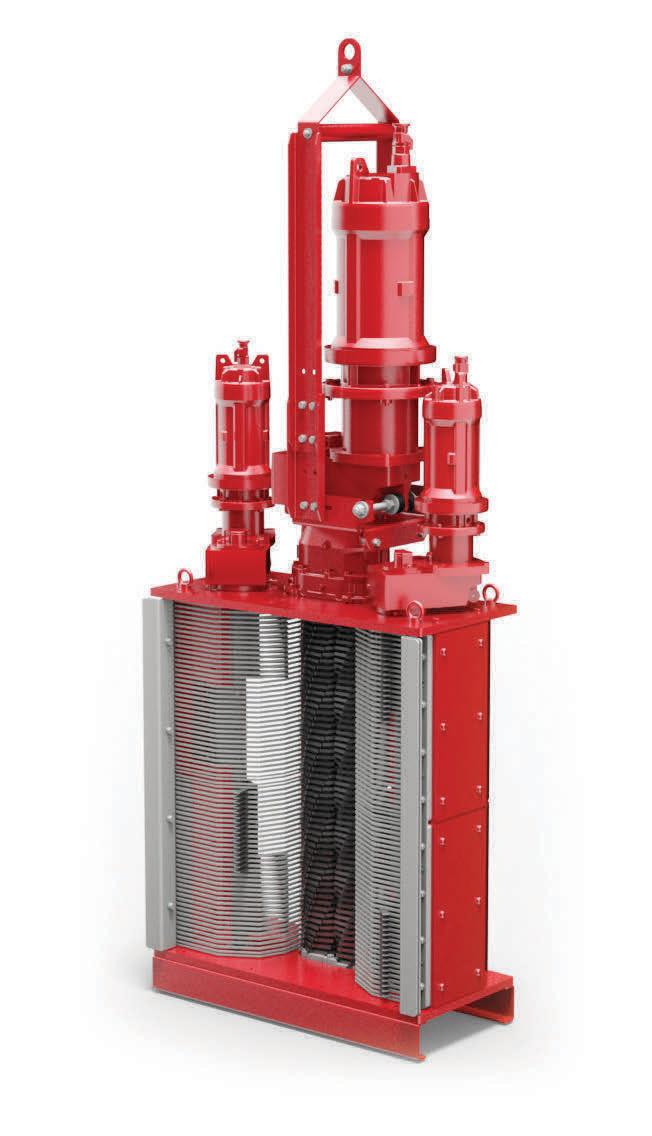
• Rotary Lobe Pumps & Grinders
• Digester Gas – Gas Holders, Gas Conditioning: chilling; compressing; and removal of moisture, sulphur, carbon dioxide and siloxane, complete Co-Generation facilities
Let's Solve Water
New Orleans set to host WEFTEC 2026
By Steve Davey
Since its formation in 1928, the Water Environment Federation has been holding annual WEFTECs to provide a forum for knowledge and technology exchange within the water and wastewater fields.
I attended my first WEFTEC in 1987 and was almost overwhelmed at the number of exhibitors and the variety of products on display.
That year also marked the inaugural Canadian Icebreaker, organized by the Water Environment Association of Ontario (WEAO).
WEFTEC 2026, will be held at the Ernest N. Morial Convention Center in New Orleans from September 26–30 and is expected to attract over 23,000 water professionals from more than 100 countries.
The technical program highlights progress toward a circular water economy, digital water solutions and resilient infrastructure. Attendees can earn continuing education credits through technical sessions, workshops, and educational opportunities in the exhibit hall.
This year’s Operations Challenge will once again test the skills of wastewater treatment operations teams from across North America as they compete in a series of timed events.
Facility tours and local activities available to registered participants will provide unique opportunities to gain firsthand insight into key water and wastewater facilities and initiatives in the New Orleans area.
Among the tours is the Down by the River Bike Ride, a 10-kilometre guided bike ride along the Mississippi River levee in St. Charles Parish, part of the stretch of river known as “Cancer Alley.” It is said to be an exploration that con-
nects America’s largest slave revolt up to today’s work for environmental justice, weaving Black history, present-day organizing and storytelling.
CANADA AT WEFTEC
The WEFTEC exhibition will feature more than 950 companies, along with special pavilions covering advanced technology, the circular water economy, innovation and workforce development.
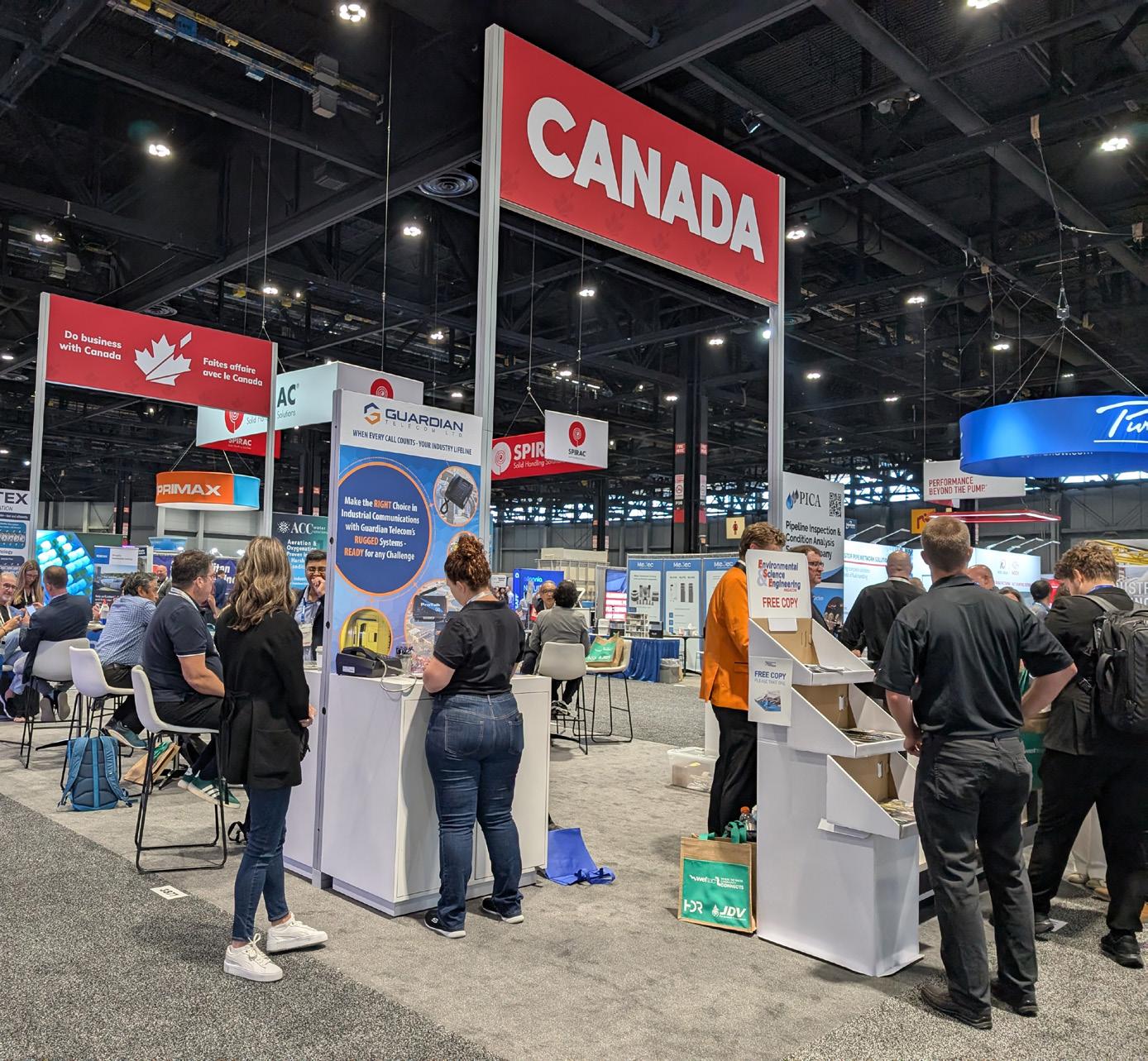
ES&E Magazine will exhibit as part of the Ontario pavilion (booth 4009), near the show’s Global Hub area, and is proud to support the Alberta pavilion (booth 4510). These pavilions provide Canadian water technology companies with an excellent opportunity to reach thousands of potential customers from around the world. I encourage you to stop by and say hello to our team and pavilion neighbours.
Canadian companies exhibiting at WEFTEC also benefit from the hard work of provincial and federal trade representatives, who help connect them with buyers and prospective customers at the show.
As always, the Canadian Icebreaker Reception is a great way to kick off a trip to WEFTEC. Organized by WEAO (www.weao.com), this event brings everyone together for a casual, fun-filled evening that sets the stage for the next few days.
I hope organizations will encourage their staff, especially young professionals, to attend. WEFTEC provides an opportunity to see the importance and scale of the wastewater industry globally. For more information, visit www.weftec.org.
Steve Davey is the editor and publisher of ES&E Magazine.
WEFTEC 2026 attendees will find many Canadian companies on the exhibition floor, including those participating in pavilions organized by Alberta and Ontario. Credit: Peter Davey
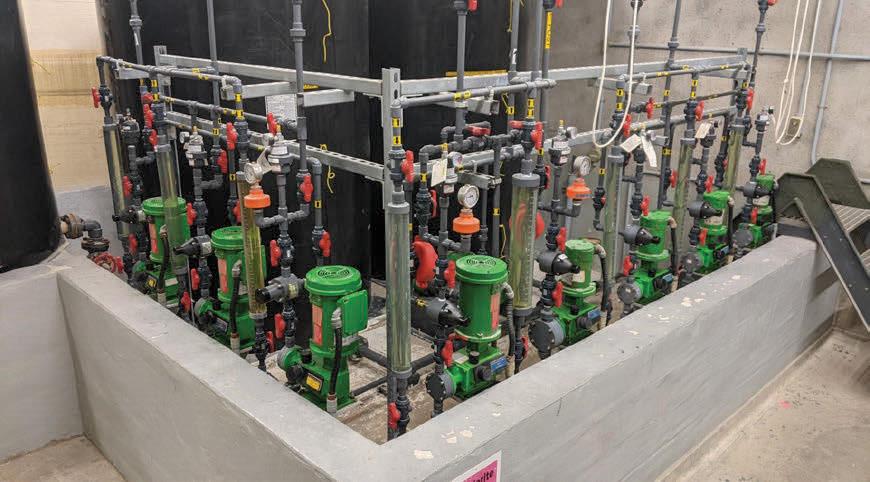
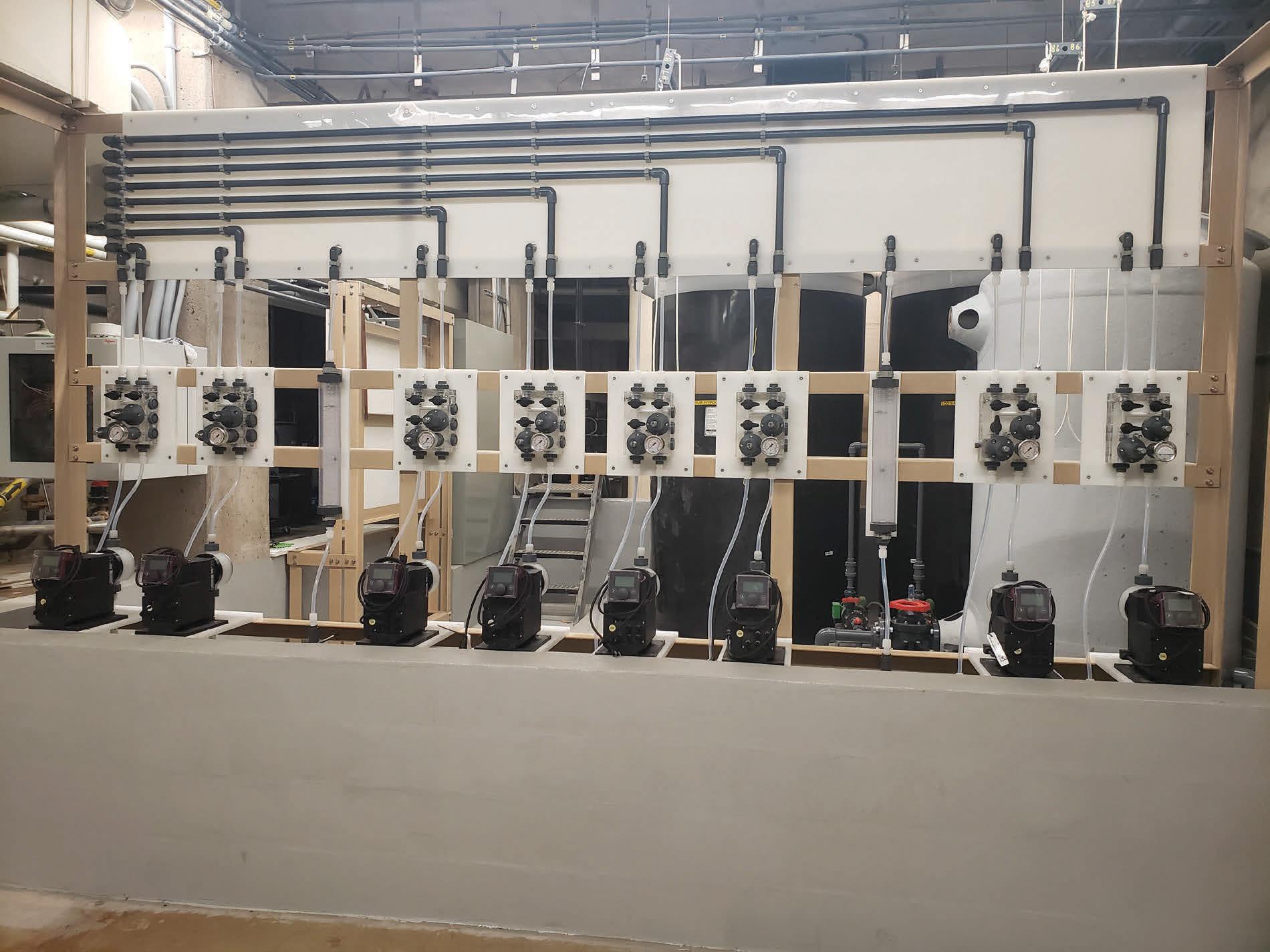
Optimum Performance Chemical Dosing Pumps & Skid Systems
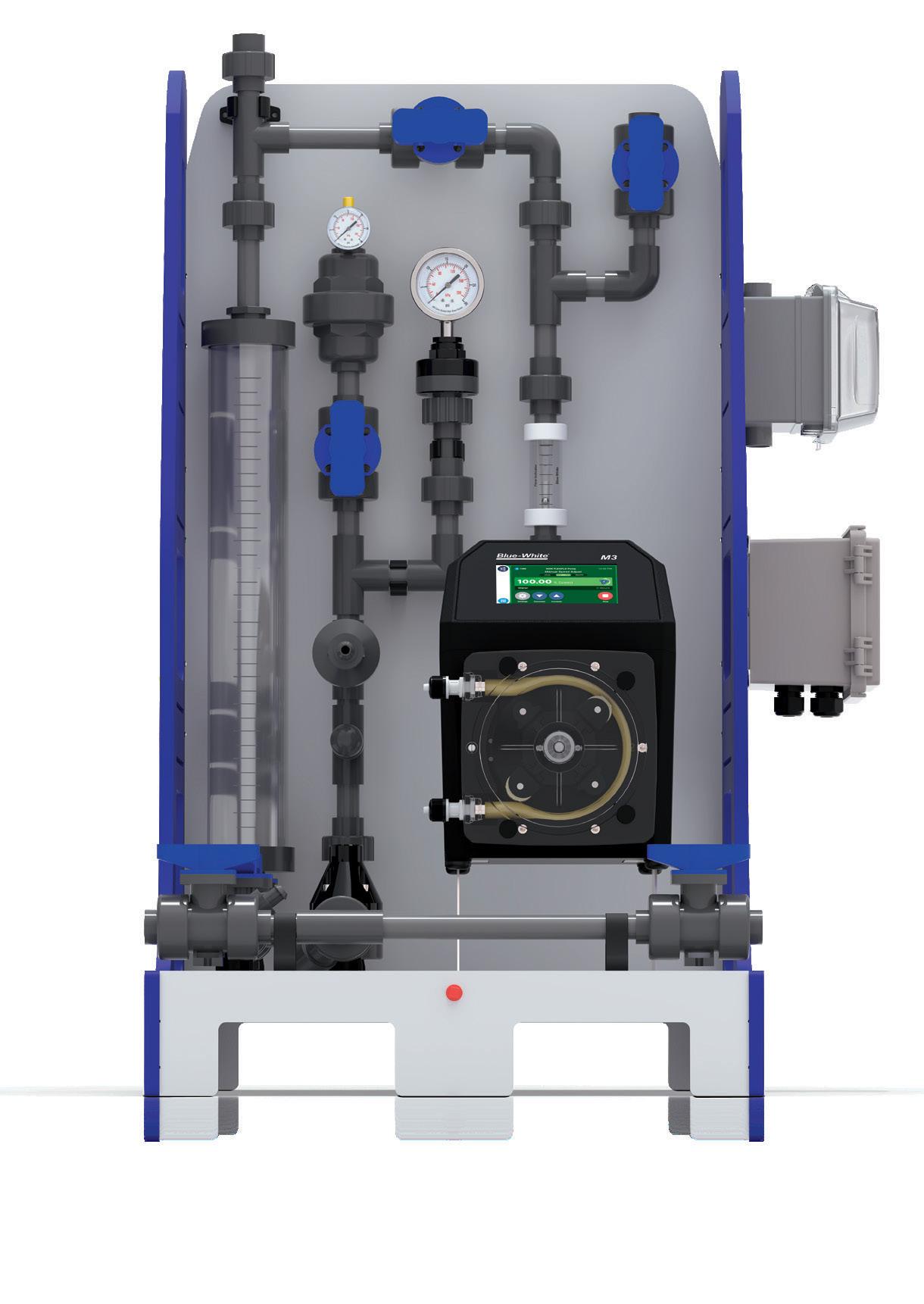
CHEM-FEED® COMPLETE METERING S YS TEMS
Fully equipped and assembled systems for drop in place install and fast startup. One, two or three pump models.
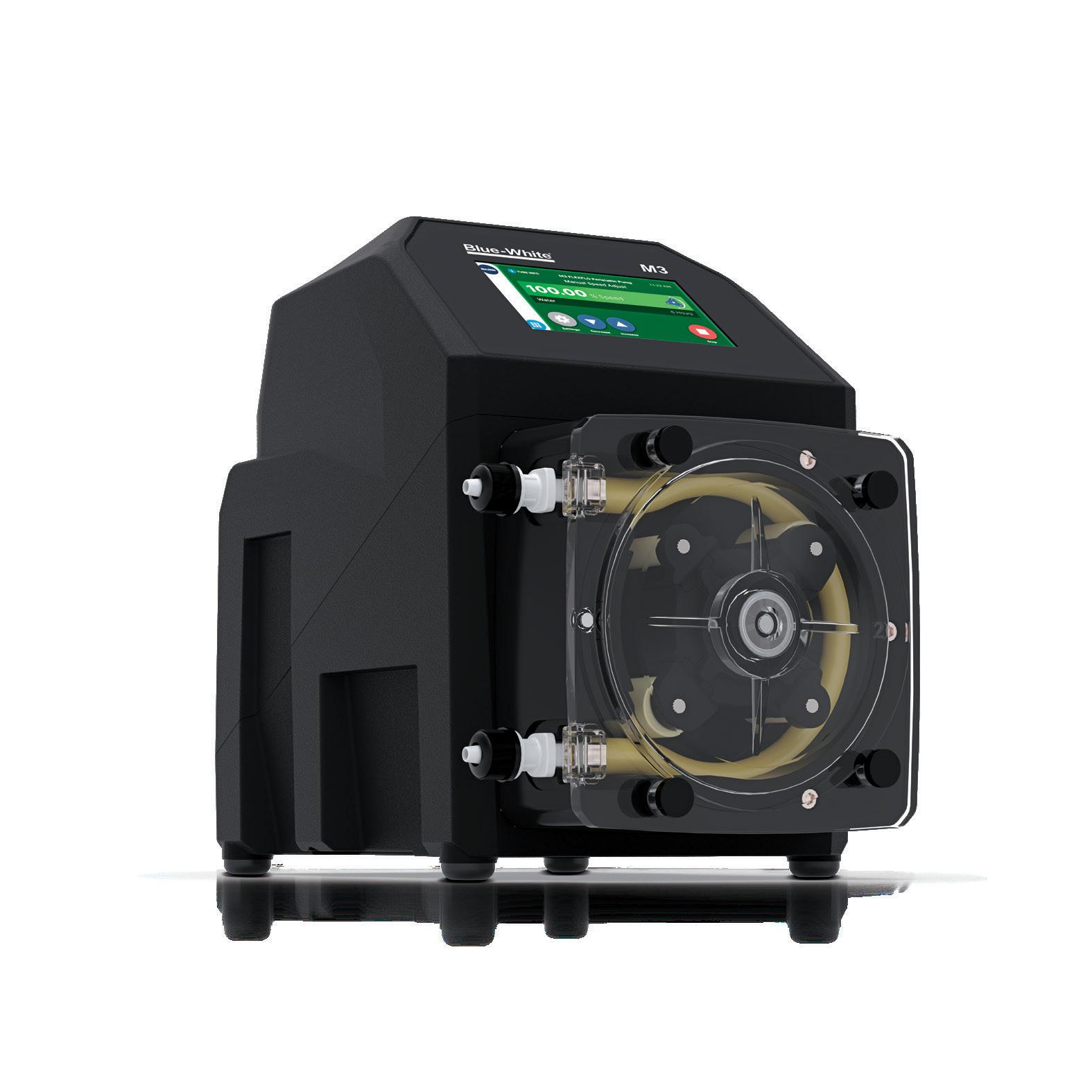
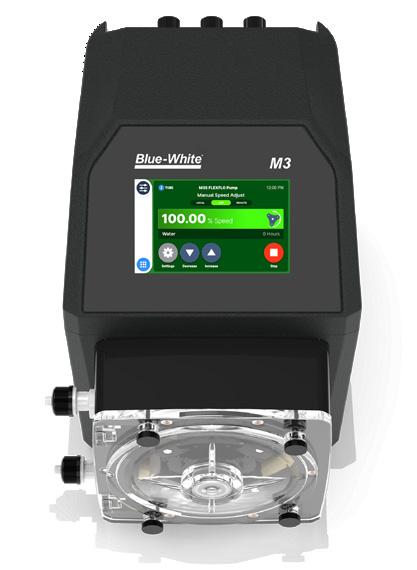
FLEXFLO® M3 PERISTALTIC METERING PUMP
Smooth, consistent chemical dosing with no vapour lock and no loss of prime.
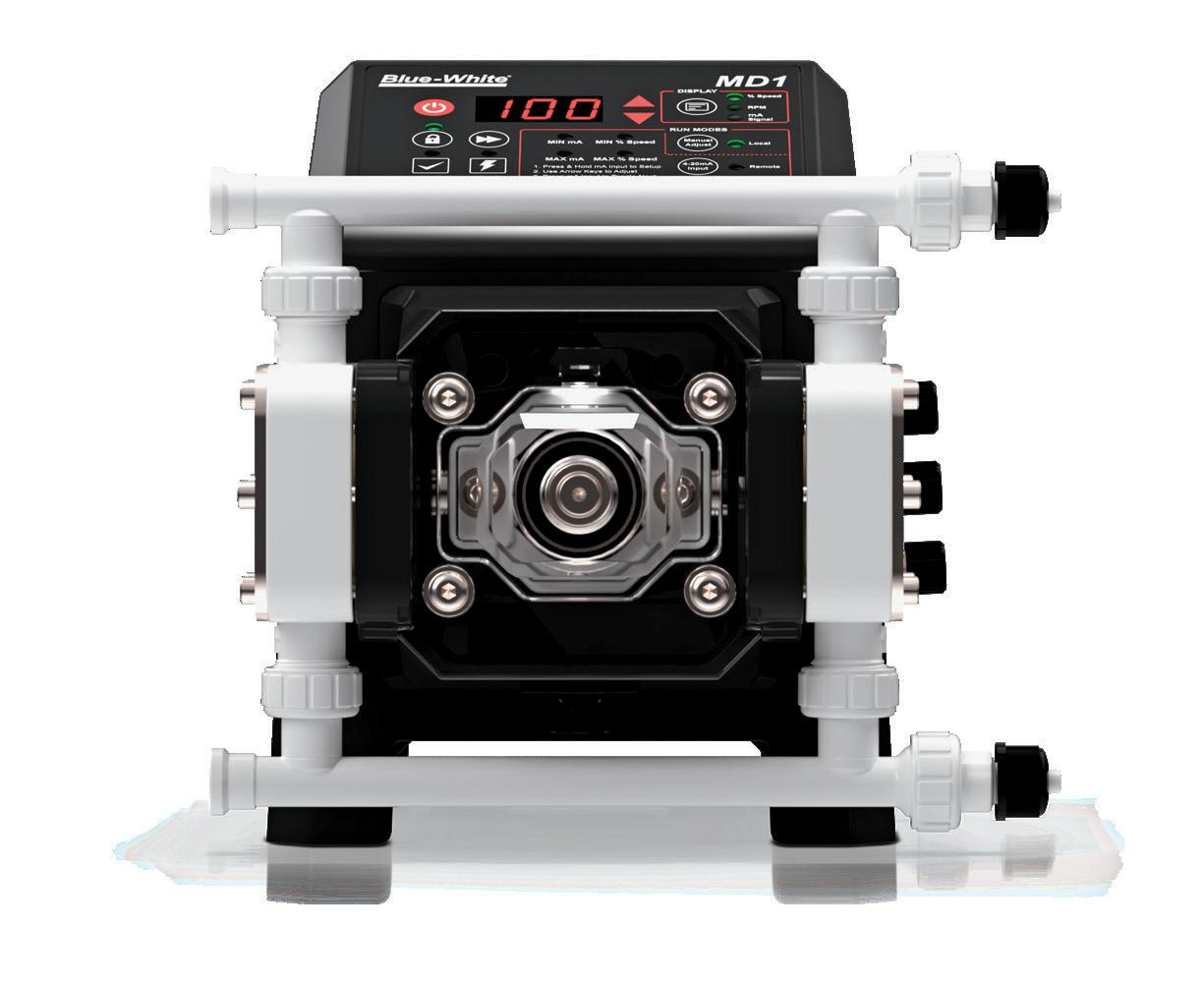
ENHANCED CHEM-FEED® MD1
Dual diaphragm design with hyper drive technology for unequalled performance. Pressure rating 12.4 Bar. Output capability 13.2 to 26.5 LPH.
Peel Region develops a Wastewater Integrated Management System
By Sarah Vella
Since 2018, Peel Region has undertaken a progressive and internally driven journey to design, implement and maintain a Wastewater Integrated Management System (WWIMS) across its wastewater operations. Peel owns the wastewater collection and treatment system that serves its 1.6 million residents, as well as local businesses.
The WWIMS initiative marked a deliberate move toward formalizing environmental protection and quality assurance practices in a sector where such systems are not mandated in the same way as drinking water. By aligning with globally recognized frameworks, such as ISO 14001 and ISO 9001, Peel established a structured, risk-based management system that emphasizes consistency, accountability, and continuous improvement.
The WWIMS was developed entirely in-house by Peel staff, reflecting a high level of technical capability, operational knowledge, and organizational ownership. In response, program resources added two additional staff, who now form part of Peel’s water and wastewater regulatory compliance team.
From its early stages, the program has been supported at senior levels, with Regional Council informed of its implementation and ongoing operation. Importantly, the system has been formally endorsed by the public works commissioner, the general manager and directors and council, which reinforces its legitimacy and ensures alignment with broader organizational priorities. This leadership commitment has been
essential in advancing a program that is not regulatory-driven, but instead rooted in best practice and due diligence.
A dedicated team of approximately seven staff currently manage both the WWIMS and the Drinking Water Quality Management System (DWQMS). Over time, these programs have become increasingly integrated, including the implementation of a single internal audit process that evaluates both systems simultaneously.
This integration has strengthened cross-functional collaboration, improved operational efficiency, as well as reduced cost and duplication. It also ensures consistent governance across water and wastewater services.
Peel Region has also laid the groundwork and expectations for the Ontario Clean Water Agency to adopt a similar WWIMS framework, as this agency operates the Region’s Clarkson and G.E. Booth Water Resource Recovery Facilities. This alignment ensures that contracted operations will uphold Peel’s standards for quality, environmental
protection, and continuous improvement. Ultimately, this will create a more unified and consistent service delivery model across all wastewater assets.
A key strength of Peel’s WWIMS is its clearly defined commitment to environmental protection, operational excellence, and stakeholder engagement. At its core, the system reflects the commitment to protecting the environment by proactively managing risks associated with wastewater collection and treatment.
This includes identifying potential threats to receiving waters and implementing preventative controls to mitigate impacts before they occur. The program also emphasizes the importance of quickly addressing issues that pose a risk to environmental or public health. Through structured incident response processes and continuous monitoring, Peel ensures that emerging risks are identified early and managed effectively.
In addition, Peel maintains a strong commitment to regulatory compliance. While the WWIMS itself is not mandated, it supports and reinforces adher-
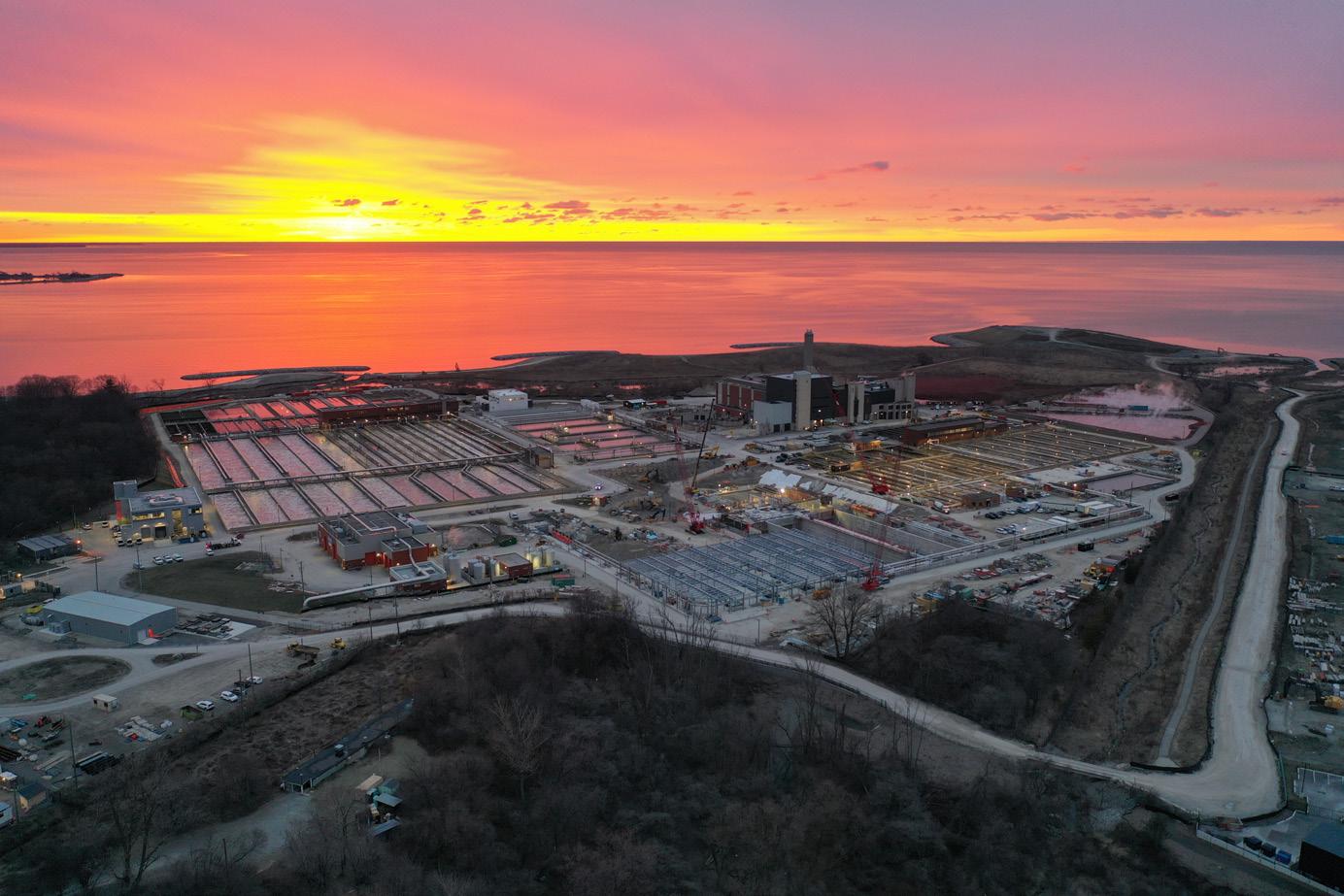
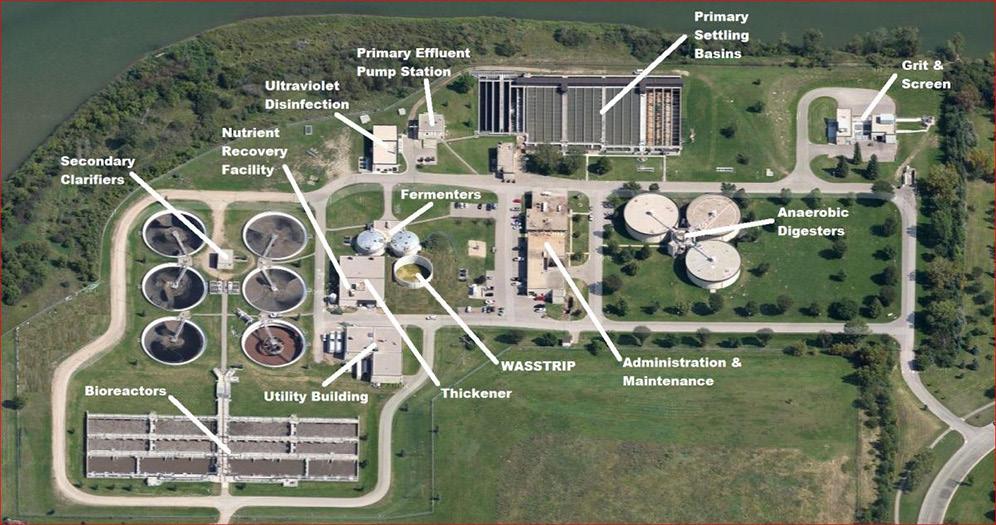
The Region of Peel’s G.E. Booth Wastewater Treatment Plant serves over 1.6 million people. Photos courtesy of the Region of Peel.
ence to all applicable legislation, approvals, and environmental obligations. This ensures that operations consistently meet, or extend, beyond regulatory expectations. This commitment is complemented by a collaborative approach to stakeholder engagement, involving internal staff, contractors, regulators and the public. Engagement and communication are recognized as critical components of successful wastewater management, particularly in building trust and maintaining transparency.
Continuous improvement is a fundamental element of the WWIMS. Through regular audits, management reviews, and performance evaluations, Peel actively identifies opportunities to enhance processes, infrastructure, and service delivery. This commitment ensures that the system remains dynamic and adaptive to changing conditions, emerging risks, and evolving industry practices.
CHALLENGES
Despite its successes, the development and implementation journey has not been without challenges. One of the primary obstacles was introducing a voluntary (non-mandated) management system into an operational environment already subject to extensive regulatory oversight. Building internal buy-in required demonstrating the value of WWIMS in terms of risk reduction, promoting operational consistency, and long-term sustainability.
Another significant challenge involved developing and maintaining comprehensive document control across all aspects of the system. This was needed to ensure that procedures, records, and operational documents were accurate, accessible, and consistently applied, which required effort and coordination.
Differing perspectives also emerged throughout the development process, particularly around system scope, implementation strategies, and the appropriate level of formality required. Additionally, Peel faced a strategic decision regarding whether to pursue third-party certification to ISO standards, or to self-declare conformity. This decision involved factors such as cost, adminis-
The Region of Peel’s WWIMS was developed entirely in-house and formally endorsed by the public works commissioner, general manager, directors and regional council.
trative effort, and the level of external validation required.
LOOKING FORWARD
The introduction of CSA W217:25, Ontario wastewater management system, is not expected to significantly impact Peel’s WWIMS. The principles outlined in this standard closely align with the existing framework under ISO 14001 and ISO 9001. This puts Peel in a good position and will minimize the need for system adjustments.
The current scope of Peel’s WWIMS begins at the commissioning stage of wastewater assets and does not formally include capital planning and construction phases. This approach has enabled a strong focus on operational performance and system reliability.
Although this aligns well with the scope of the new CSA standard’s focus on wastewater operations, Peel is working toward expanding the range of the WWIMS to encompass system upgrades planning and construction. This evolution will support a more comprehensive lifecycle management approach, strengthen risk mitigation from project inception through to operations, and further enhance consistency across wastewater services.
In doing so, Peel’s framework may
extend beyond the scope outlined in CSA W217:25, reflecting the Region’s commitment to continuous improvement and leadership in wastewater management.
CONCLUSION
Peel Region’s Wastewater Integrated Management System journey demonstrates leadership, innovation, and a strong commitment to environmental stewardship. By proactively implementing a structured management system, Peel has strengthened its ability to protect the environment, manage and respond to risks, comply with regulations, collaborate with stakeholders, and continuously improve wastewater service delivery.
Sarah Vella is Supervisor, Water & Wastewater Programs Quality Assurance at the Region of Peel. For more information, email: sarah.vella@peelregion.ca
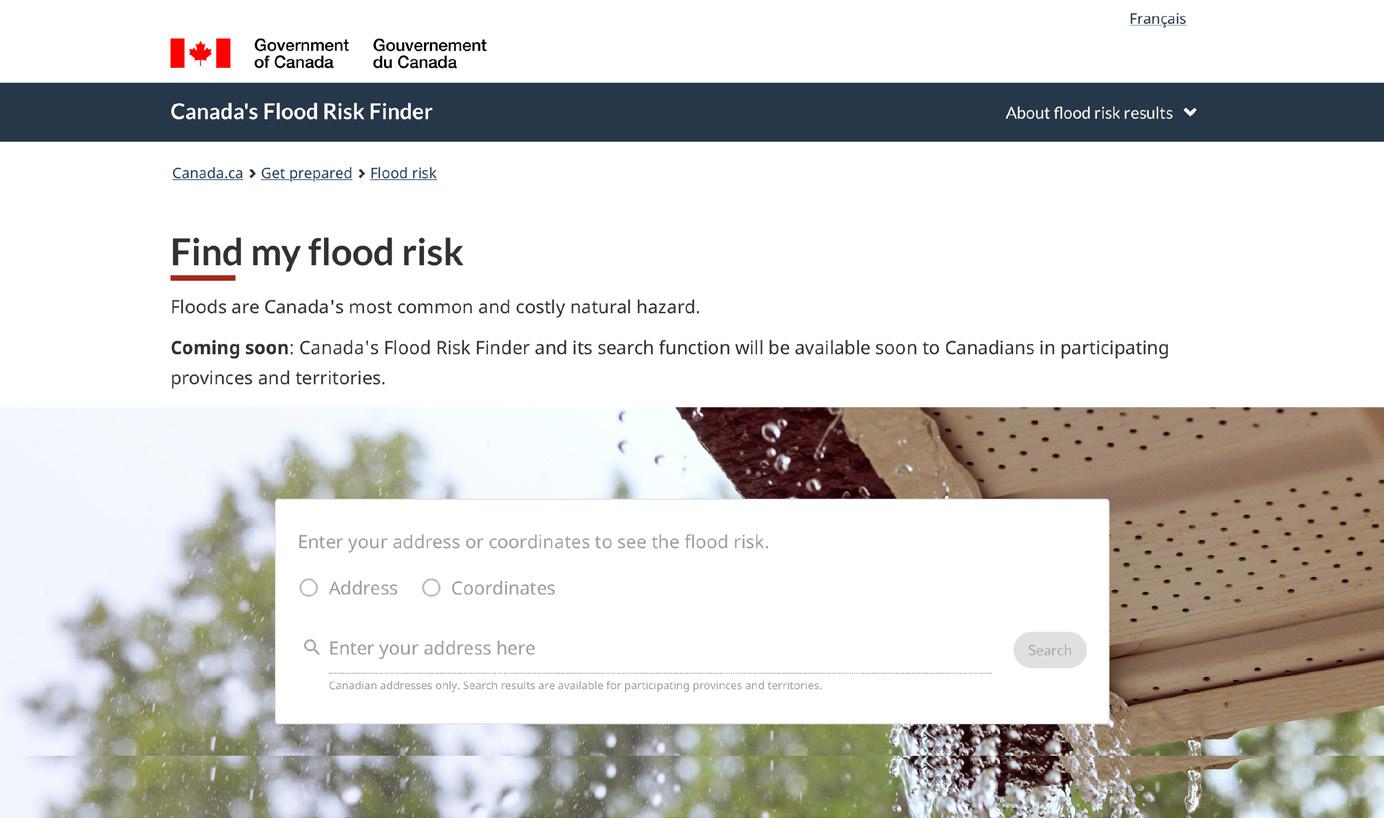
Municipal leaders urge collaboration as Ottawa unveils national Flood Risk Finder
By ES&E Staff
Anew federal flood mapping tool is being positioned as a catalyst for national collaboration, with municipal leaders stressing that its success will depend on strong, transparent data and coordination across all levels of government.
“Municipalities are the first to respond and the first to see the growing impacts of climate change every day, and we welcome the federal government’s update on Canada’s Flood Risk Finder to strengthen flood awareness and preparedness,” said Rebecca Bligh, president of the Federation of Canadian Municipalities. “Reducing exposure to flooding will take sustained collaboration across all orders of government.”
Bligh said the online tool will build on the resilience measures municipalities already have underway. The Flood Risk Finder is designed to give Canadians a clearer, more consistent picture of flood risks across the country. Using a simple address search, users will be able to view their local flood risk on a four-point scale ranging from low to extreme. There is also information on the types of flooding that may occur, including coastal, riverine and rainfall-related events.
Funding provided by the Flood Hazard Identification and Mapping program enabled the procurement and development of Federally Identified Flood Risk Areas datasets, which provide the underlying data for Canada’s Flood Risk Finder. Federal officials say the new platform is intended to close long-standing gaps in access to flood risk data, which have often varied widely between jurisdictions and have not always been easy for the public to interpret.
However, the availability of local data will depend on whether provinces and territories choose to participate. While the federal government has built the platform, jurisdictional responsibility
for flood management means regional governments must opt in for their data to be included and made searchable. Public Safety Canada said it will work with provinces and territories to support participation, with public rollout to occur as jurisdictions join the platform.
The initiative brings together expertise from multiple federal departments, including Natural Resources Canada, Statistics Canada and Public Safety Canada, combining data development, mapping and usability testing to create what officials describe as a user-friendly and authoritative source of information.
Beyond improving public awareness, the tool is also expected to support emergency management planning and encourage property owners to take preventative action. “Clear, accessible information empowers homeowners and renters to make more informed decisions and take practical steps to mitigate their risk,” according to Liam McGuinty, vice-president of federal affairs at the Insurance Bureau of Canada.
Flooding remains Canada’s most com-
mon and costly natural disaster, with average annual damages exceeding $2 billion. As climate change intensifies the frequency and severity of extreme weather events, federal officials say improving access to risk information is a key component of broader efforts to strengthen national resilience.
The federal government is encouraging Canadians to use the new platform alongside existing provincial and local resources, emphasizing that proactive risk reduction is significantly more cost-effective than post-disaster recovery.
Minister of Emergency Management and Community Resilience, Eleanor Olszewski, said the Flood Risk Finder is intended to support conversations between governments, communities and individuals on how to better prepare for future flood events. She added that the tool is part of a wider shift toward more coordinated and preventative climate adaptation strategies.
For more information, email: editor@esemag.com
Federal officials say the new platform is intended to close long-standing gaps in access to flood risk data. Credit: Public Safety Canada
A proactive approach to wildfire management in Canada
By Emily Miranda
The 2023 fire season exposed a growing mismatch between Canada’s wildfire preparedness and rapidly evolving risk. Longer, more volatile seasons and more extreme fire behaviour are colliding with governance and capacity constraints, slowing the adoption of proven tools.
Wildfire risk is changing not only how often fires occur, but how they behave. This means response systems built for episodic events are strained by faster spread and cascading impacts, such as smoke and post-fire flooding.
The path forward is to operationalize readiness, so it can scale across jurisdictions and still function under strain. Readiness is a maintained capability, supported by ongoing risk intelligence, scenarios and exercises, and pre-defined decision triggers that enable faster, more coordinated action.
IDENTIFYING POTENTIAL IMPLEMENTATION GAPS
During the 2024 Jasper wildfires, responders and infrastructure operators struggled to access a shared, real-time picture of fire spread, water availability, and grid vulnerabilities. The information existed, but was in separate systems and could not be combined quickly enough to guide decisions. The result was delayed actions and compounded impacts, illustrating how preparedness can falter, not for lack of effort, but for lack of integration.
Effective wildfire preparation requires procurement and contracting that can move proven tools into operations within a single fire season. When assessment and contracting take months, agencies
enter peak season without the best tools, rely on interim options, and postpone testing and integration. This is a decision that often slips into the following season, especially when funding supports short pilots, but not multi-year licensing, security clearance, and integration.
Standards and data-sharing enable coordination when they are designed for reuse across jurisdictions. Tools can be brought together into a common operating picture, when agencies align on a few essentials, like shared definitions and practical, pre-agreed ways to share information.
Where this alignment is established in advance, and made reusable, integration becomes faster and more reliable. This kind of interoperability is increasingly achievable, and it is essential for supporting coordinated decision-making during a multi-jurisdictional fire season.
Readiness varies by context and improves when systems are designed for local realities. Indigenous fire stewardship is widely acknowledged, and it is most effectively embedded in permitting, mitigation, and recovery when roles are
clear, stewardship is resourced, and governance mechanisms are durable.
Meanwhile, fly-in and winter-road communities face basic constraints (i.e., intermittent cellular coverage, seasonal supply chains, limited evacuation options) that many preparedness models implicitly assume.
Planning assumptions need to be updated more frequently, as historic baselines are overtaken by changing fire behaviour. Longer seasons, far-reaching smoke, and rising secondary risks (i.e., post-fire flooding) are increasingly common. In practice, readiness depends on forecasting and modelling services that keep plans current.
This includes predictive fire-weather and ignition modelling, seasonal smoke outlooks, and scenario analysis that stresstests cascading hazards for communities and infrastructure. Used routinely, these services translate emerging conditions into specific updates, which will trigger pre-positioning resources, opening clean air shelters, and adjusting evacuation thresholds, before peak season.
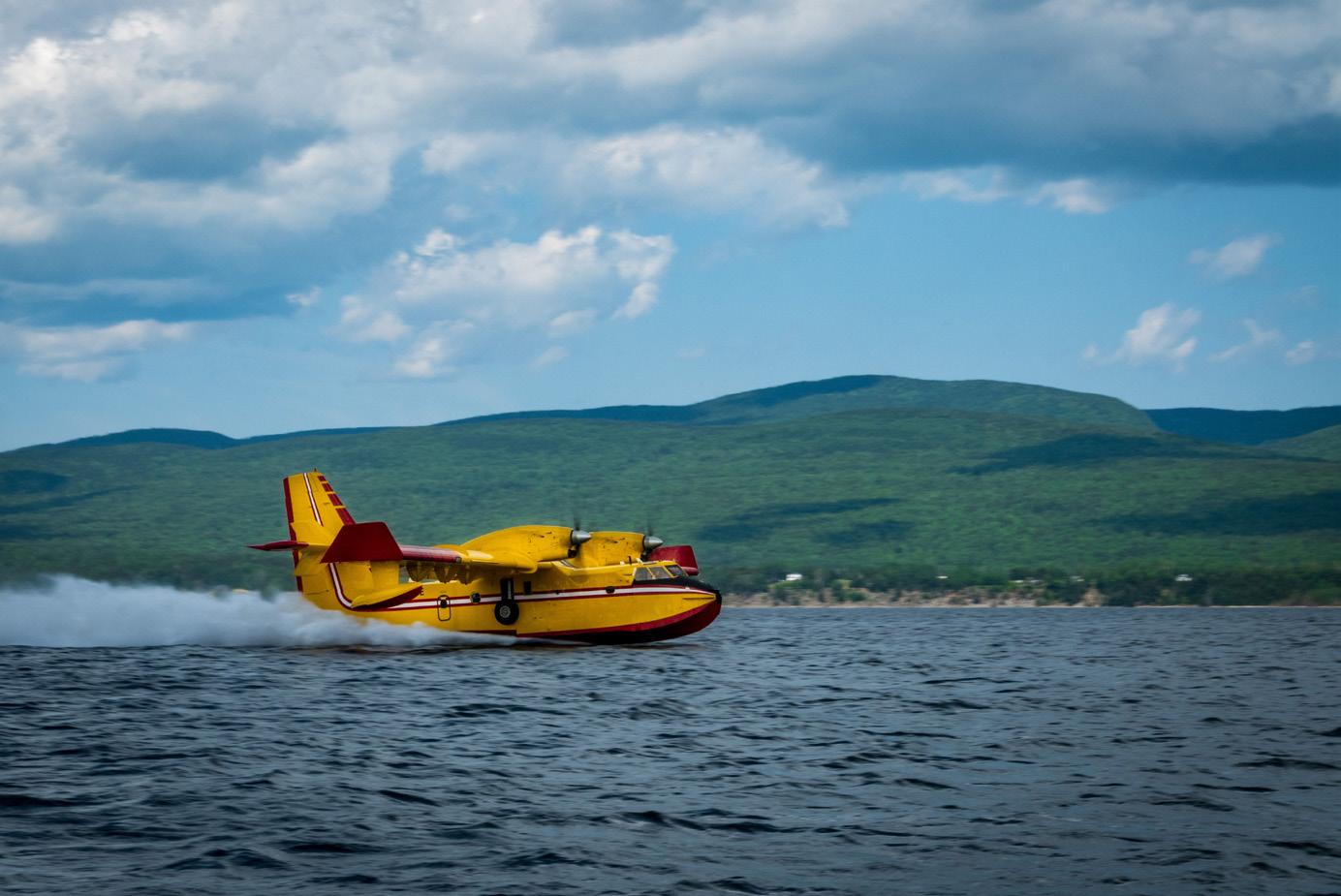
A Canadair CL-415 water bomber drawing lake water to extinguish a forest fire in eastern Quebec. Credit: deniscomeau, stock.adobe.com
WATER CYCLE
ABB supports every stage of the water lifecycle—from abstraction and treatment to distribution and management—with a robust suite of measurement and analytical technologies, services, and solutions designed to meet the most demanding customer requirements. abb.com/measurement Contact us at instrumentation@ca.abb.com
MAKING READINESS DEPENDABLE
The next step is to design readiness around known failure modes, so capabilities still work under strain. Canada has strong assets, from FireSmart measures, to hazard maps and dashboards.
However, fast-moving incidents expose weak points when connectivity drops and staff are stretched, or authority is fragmented. In these circumstances, situational awareness lags and decisions, such as evacuation timing, road closures, and resource deployment are delayed,
allowing fires to outpace response. This increases the risk to people and critical infrastructure.
Designing for success means establishing resilient data platforms and preagreed roles so information stays shared, decisions stay timely, and actions can be implemented quickly.
Firstly, readiness improves when local, provincial, and federal data can be combined through shared standards, rather than rebuilt through one-off integrations each season. This requires up front
actions, such as negotiating data sharing terms on access, cadence, and security, aligning mapping services so layers line up and standardizing key definitions, such as what counts as an ‘active perimeter’. The payoff is a trusted, shared picture of perimeter, smoke, and air quality that supports coordinated decisions and consistent public warnings.
Secondly, public warning systems work when they are interoperable and authority is clear. Communities benefit when multi-channel alerting systems are in place (cell broadcast, radio, sirens, and door-to-door protocols). They also benefit when systems are paired with pre-agreed roles. Who issues which alerts? How should messages escalate when coverage is unreliable? What alerts trigger transport, sheltering and re-entry? With governance in place, technology can support timely decisions across jurisdictions.
Thirdly, emergency operations capacity improves when it is maintained yearround, not recreated each season. For many smaller municipalities, this means surge staff can step into roles using clear playbooks, repeatable training, and credentialing that lets outside support plug in quickly.
Mutual aid can move faster because they define types of resources liability and reimbursement, and practical logistics like staffing, lodging, communica-
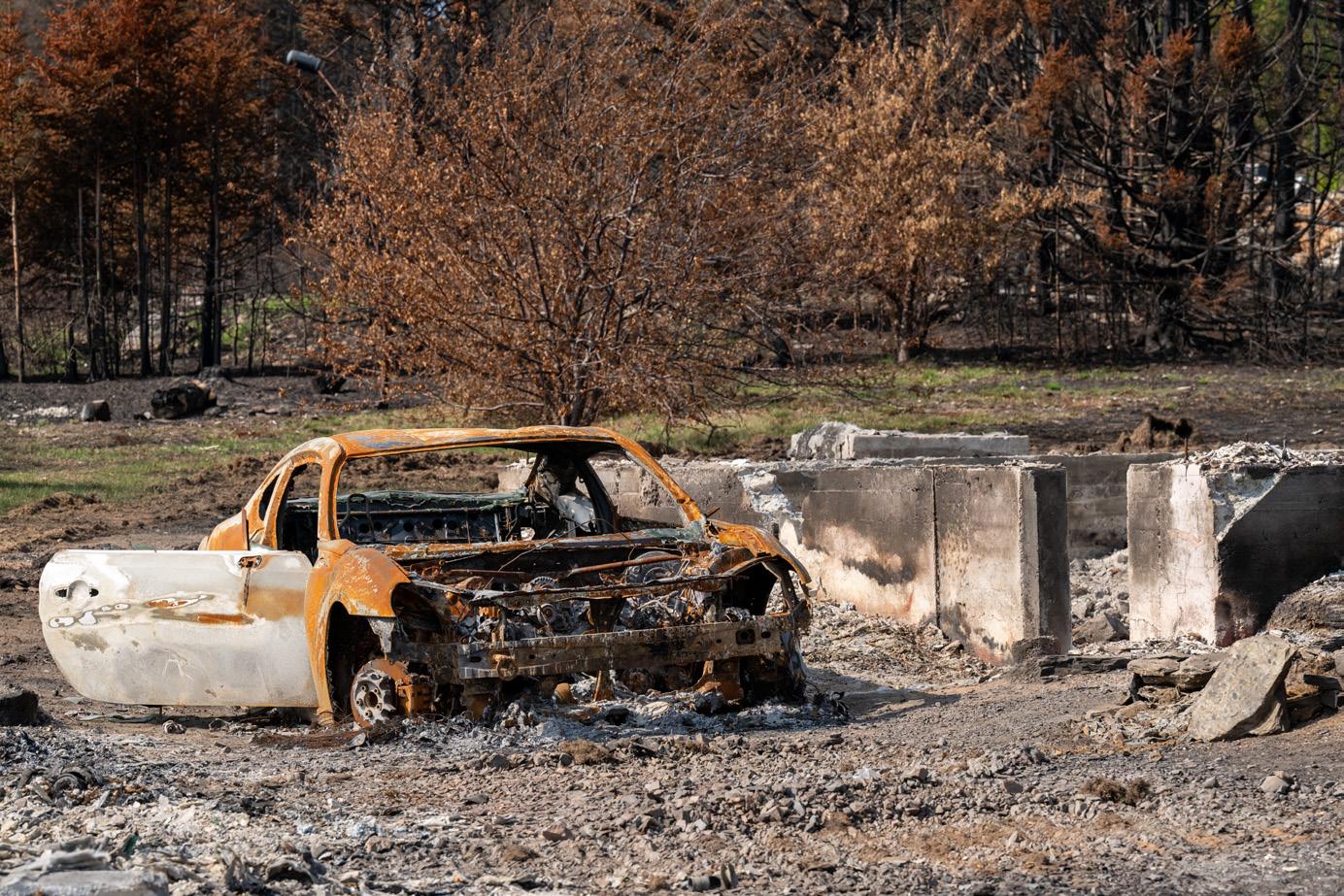
The charred remnants of a burnt residential house after a wildfire. Credit: doloresharvey, stock.adobe.com continued overleaf…
tions. Simulation-based training can reinforce readiness by letting teams rehearse decisions against realistic wildfire scenarios before peak season.
Finally, preparedness is strongest when it is embedded in routine land-use and asset decisions and not just treated as a public-awareness campaign. FireSmart measures, such as defensible space, ember-resistant design, and vegetation management are most effective when normalized through:
• Bylaws and permitting that make defensible space and ember-resistant choices routine;
• Building and retrofit guidance tied to local exposure, not generic hazard categories;
• Capital plans that fund buffers, access routes, water availability, and sheltering spaces;
• Community training cycles that show households what to prepare, when to evacuate, and how to respond to smoke in alignment with local evacuation and smoke plans.
These actions create built-in, long-term wildfire readiness, rather than creative reactive processes, that only have shortterm impacts.
SCALING FOR READINESS
Canada is rich in promising wildfire management innovations. The recurring bottleneck is the pathway from pilot to practice. Tools are demonstrated, but they do not become routine across ministries, municipalities, and Indigenous partners. Successful, sustained adoption requires three conditions:
1. Governance readiness: procurement pathways, data-sharing agreements, and decision authority;
2. Operational capacity: trained staff, resilient communication, and exercised protocols;
3. Technical maturity: data and models integrated into real workflows.
When one element lags, even strong tools fail to influence decisions. For example, a province may publish wildfire and smoke mapping layers, but if municipalities, public health, and transportation authorities cannot access them in real-time, the data won't shape evacuation timing, road closures, or clear-air shelter activation. The issue is rarely the tool itself. Rather, it is whether governance, operations, and data integration are aligned to permit information to drive coordinated action.
BUILDING LONG-TERM RESILIENCE
Damage caused by ember storms depends on decisions made well before a fire starts. In the wildland–urban interface, land use patterns, access, and vegetation management determine whether embers ignite isolated structures, or cascade into neighbourhood-scale loss.
Many municipalities lack clear triggers, such as exposure-based building requirements and retrofit thresholds tied to local risk, that translate wildfire exposure into everyday planning decisions. Improved ember and fire-spread modelling can make these triggers explicit, enabling systematic risk reduction, rather than post-event rebuilding.
Resilience starts with anticipating smoke and heat exposure. Predictive modelling provides a repeatable, updatable picture of exposure risk, allowing jurisdictions to plan and resource
clean air sheltering, filtration, and continuity of water and power, ahead of the season.
Capacity follows incentives as short budget cycles and project-by-project grants undermine workforce retention and sustained exercises. Multi-year funding, pooled programs, and standing service arrangements underpin the core services required for readiness. This includes forecasting, smoke modelling, training, and scenario cycles, which enables routine interpretation of indicators and coordinated action across jurisdictions.
THE INHERENT VALUE OF STRATEGIC FORESIGHT
Strategic foresight matters when it changes real-world actions, such as when to evacuate, staff response, and when to shut down vulnerable infrastructure. In wildfire management, this translates into a repeatable cycle of monitoring signals, updating scenarios, and pre-authorizing decisions, so thresholds and roles are set before communities are under pressure.
Foresight functions as infrastructure, when it is embedded in governance and exercised routinely, not activated only during crises. This includes:
• Shared signals and indicators delivered through a common platform, combining fire weather, smoke, and infrastructure stress models, with agreed stewardship and update cadence.
• Scenario and exercise cycles, supported by modelling and simulations, that let agencies rehearse severe fire seasons and update playbooks and decision triggers before peak season.
• Trigger points and pre-authorized decisions embedded in a shared modelling environment or digital twin, can enable evacuation, re-entry, asset shutdown, and mutual aid actions to be tested and rehearsed in advance.
In practice, this can take the form of a shared wildfire and smoke modelling platform that allows agencies to test scenarios, agree on evacuation and re-entry thresholds, and pre-authorize actions before a season begins. In such scenarios, decisions are triggered by conditions, not improvised under pressure.
Canada’s wildfire challenge is structural as much as it is environmental. Resilience will depend on removing frictions that hinder collective action, slow procurement, brittle data sharing, inconsistent standards, unexercised playbooks, and unclear decision authority.
A foresight driven posture can be delivered through repeatable services, including predictive models, scenario and simulation platforms, and governance frameworks that set triggers and decisions in advance. These capabilities turn response capacity into maintained readiness, and readiness into longterm resilience by reducing risk before peak season.
Emily Miranda is the national program manager of Future Ready® at WSP in Canada. For more information, visit: www.wsp.com
For over a century, engineers, contractors, builders, and developers have trusted Barnes wastewater pumps and pressure sewer systems for their reliability and durability. Offering everything from sump pumps to powerful grinder and chopper pumps, Barnes provides innovative, cost-effective solutions with industry-leading delivery times.
Saskatoon moves to tighten industrial wastewater ammonia limits as treatment costs rise
By ES&E Staff
Rising ammonia concentrations in Saskatoon’s wastewater system and the prospect of stricter provincial regulations are prompting the city to introduce tougher controls on industrial discharges.
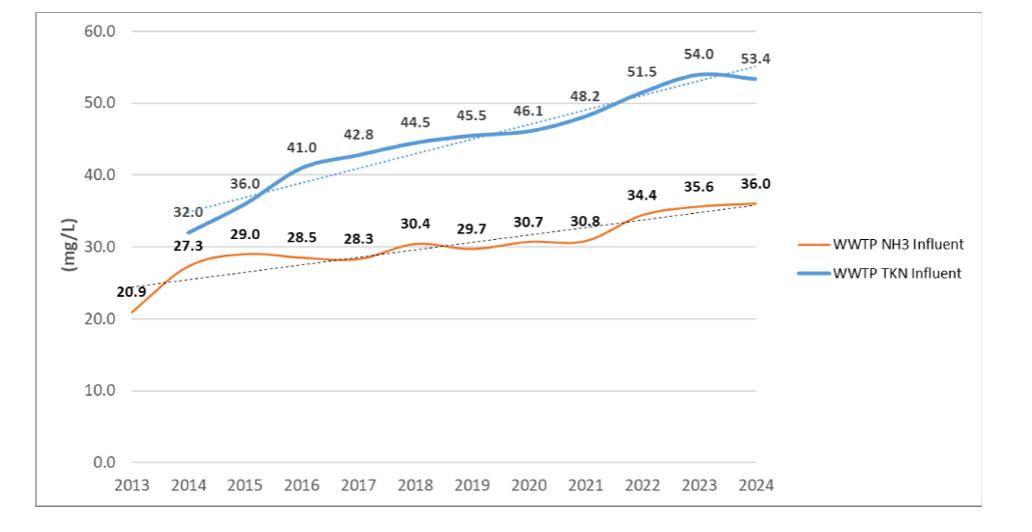
According to a report presented to the city’s Standing Committee on the Environment, ammonia concentrations at Saskatoon’s wastewater treatment plant (WWTP) influent have increased by more than 65% over the past decade. This is driving up treatment costs and creating new compliance challenges.
Mike Sadowski, manager of Saskatoon’s wastewater treatment plant, told a public meeting that it cost the city approximately $726,000 in 2024 to remove total Kjeldahl nitrogen (TKN). TKN is a standard industry measure of nitrogen in wastewater, that includes ammonia and other compounds that can convert to ammonia.
The move comes as the provincial Water Security Agency (WSA) prepares to introduce more stringent ammonia discharge limits aimed at protecting the South Saskatchewan River and surrounding aquatic ecosystems.
Current limits in the plant’s Permit to Operate allow ammonia concentrations of 17 milligrams per litre from October 1 to June 30 and six milligrams per litre from July 1 to September 30. City administration expects future requirements to impose a year-round limit below six milligrams per litre.
While the Saskatoon WWTP currently meets its regulatory permit requirements, the committee report noted that the city has adopted stricter environmental performance targets intended to better protect aquatic life. Ammonia concentrations can occasionally exceed those internal targets during winter months, when colder temperatures reduce the activity of the bacteria responsible for removing ammonia during treatment.
To address increasing treatment costs and prepare for future regulatory requirements, Saskatoon plans to reduce the allowable ammonia concentration in industrial wastewater discharges from 100 milligrams per litre to 50 milligrams per litre. The city also intends to introduce a surcharge for companies that exceed the new threshold.
The proposed changes, expected to take effect in 2028, are designed to encourage industries to either invest in on-site treatment systems, or contribute financially to the city’s costs of removing excess ammonia before treated effluent is discharged to the river. Currently, those treatment costs are borne by all wastewater ratepayers.
The committee report notes that Saskatoon’s approach aligns with practices adopted elsewhere in Canada. A review of sewer use bylaws in 13 major Canadian municipalities found that all currently regulate TKN concentrations in industrial discharges. Eight municipalities already apply surcharges for exceedances, while three others are preparing to implement similar fee structures.
City officials say the changes will help ensure that industrial users contribute more directly to the costs associated with treating high-strength wastewater, while supporting compliance with anticipated future environmental regulations.
For more information, email: editor@esemag.com
Annual measurement of TKN and NH3 in Saskatoon’s WWTP influent. Credit: City of Saskatoon
Ammonia concentrations in Saskatoon’s wastewater treatment plant (WWTP) influent have increased by more than 65% over the past decade. Credit: City of Saskatoon
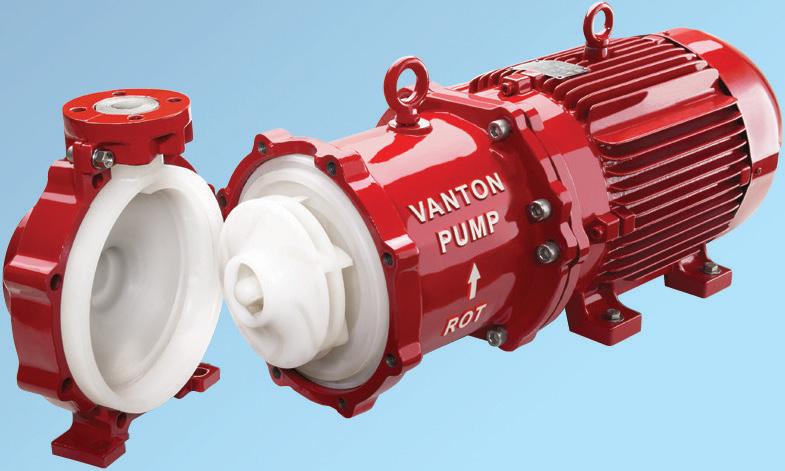
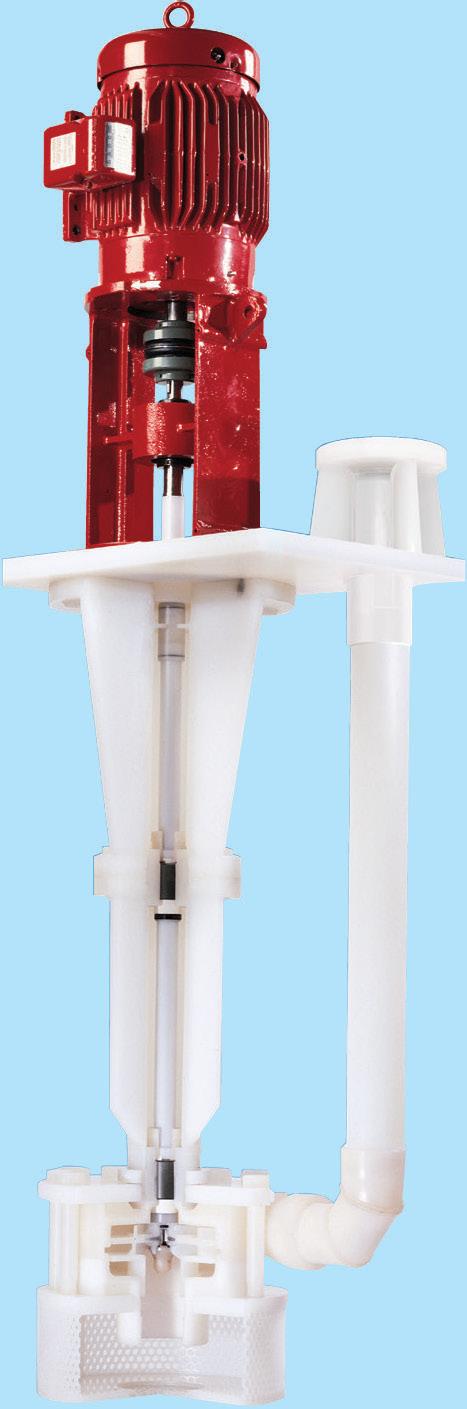
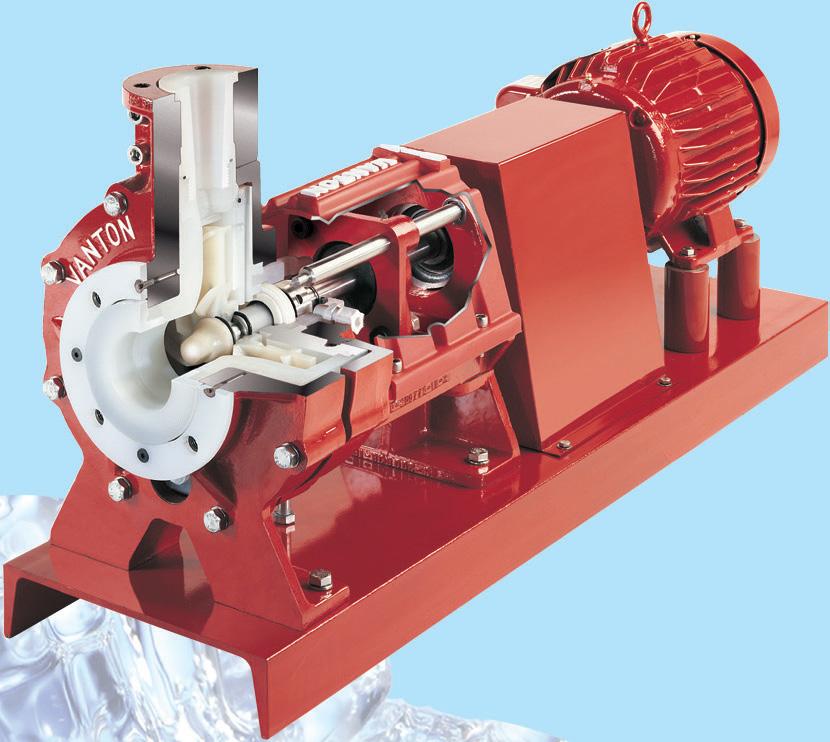
VANTON THERMOPLASTIC PUMPS
It’s What’s Inside that Counts
Every Vanton pump limits fluid contact to component parts that are injection molded or fabricated of chemically inert, homogeneous thermoplastics, or other non-metallic materials selected for your specific application.
Vanton’s thick-sectioned, stand-alone thermoplastic components offer a broader range of corrosion and abrasion resistance than those constructed of stainless steel or fiber-reinforced plastics. And, our thermoplastic pump construction eliminates corrosion concerns often associated with the handling of acids, caustics, mixed or unknown liquids, plant effluents, and waste streams as well as reagent grade chemicals and ultrapure water.
Chem Action Inc.
4559 Boul Métropolitain E Saint-Léonard, QC H1R 1Z4 514-593-1515
Vissers Sales Corp. 20-220 Industrial Parkway South Aurora, ON L4G 3V6 905-841-4073
Clarington to upgrade its Bowmanville stormwater outlet
By ES&E Staff
Construction began this summer on a stormwater infrastructure upgrade in Clarington that aims to improve water quality in Bowmanville Creek, strengthen environmental protection and support future residential growth in the Ontario community of more than 113,500 residents.
The Hetherington Drive Stormwater Outlet Improvement Project, located within the Bowmanville Valley Conservation Area, will modernize a stormwater outlet originally built in 1972. The project received funding from Ontario’s Municipal Housing Infrastructure Program’s Housing-Enabling Water Systems Fund, helping to cover costs.
The work is designed to improve how
stormwater runoff is treated before it enters Bowmanville Creek, reducing pollutants and protecting aquatic habitat, as development continues in the surrounding area.
“Upgrading the stormwater system means cleaner water flowing into the Bowmanville Creek,” said Clarington Mayor Adrian Foster in a statement. “Improving the stormwater outlet is an environmentally responsible way to better manage runoff in this growing neighbourhood.”
The project includes installing a new oil grit separator to capture contaminants, such as oil, sediment and debris, before stormwater is discharged. The existing outlet swale will also be upgraded to slow runoff, improve natural filtration and fur-
ther reduce pollutants entering the creek.
Alongside the stormwater improvements, the Region of Durham will relocate approximately 20 metres of watermain. This will help ensure the long-term reliability and stability of the municipal water system.
The municipality says the combined infrastructure improvements will enhance stormwater management, while supporting future housing development and helping protect the ecological health of the Bowmanville Valley Conservation Area.
For more information, email: editor@esemag.com
New groundwater source online for Ontario’s North Dundas
By ES&E Staff
The Township of North Dundas has officially opened Wellfield No. 8, bringing a new groundwater source online that will provide a reliable water supply of 20 litres per second for the Ontario municipality’s drinking water system.
Local officials said that the project is intended to help meet existing water servicing demands, while supporting future residential and commercial growth in the villages of Winchester and Chesterville.
North Dundas’s drinking water system is supplied by eight groundwater production wells located throughout the municipality, which has about 12,800 residents. The new wellfield project was completed in partnership with Louis W. Bray Construction, the Ontario Clean Water Agency and J.L. Richards & Associates.
The township noted that while its eight drinking water wells have a combined rated capacity of 102.75 L/s, drought conditions in 2025 reduced the total combined capacity to 56.8 L/s, highlighting the need for additional and more resilient water infrastructure.
“Bringing this new water source online is a major step in meeting our current servicing demand, while preparing for our future water demand,” North Dundas officials said in a statement. “This project is one of the many infrastructure upgrades that we have completed to future-proof the Township of North Dundas, opening the door for new commercial and residential developments.”
The municipality’s drinking water system includes sodium hypochlorite disinfection systems at five pump houses, two storage reservoirs, two elevated tanks and approximately 51 kilometres of distribution piping.
The Wellfield No. 8 project included construction of a new disinfection building, with process piping, electrical equipment, instrumentation, control panels and chemical storage and dosing systems. Work also included installation of well pumps and pitless adapters in Wells 8A and 8B, new hydrants and valves on the transmission main, buried watermain piping, and a standby diesel generator.
Additional project components included overland discharge piping for process water, buried conduits for power and controls, concrete housekeeping pads and apron slabs, chain-link fencing and gates, a new access road and site grading works.
The project received funding through the Investing in Canada Infrastructure Program, a joint federal and provincial ini-
tiative. The federal government contributed $1.9 million, while the provincial government provided $1.6 million. The remaining project costs will be funded through water rates and future capital connection charges in Winchester and Chesterville.
For more information, email: editor@esemag.com
The Wellfield No. 8 project included construction of a new disinfection building with process piping, electrical equipment, instrumentation, control panels and chemical storage and dosing systems. Credit: North Dundas
Operators Without Borders’ Nepal assessment shows that safe water depends on many factors
By Mike Hewitt
Adrinking-water system does not become safe when construction ends. It stays safe only when a board approves repairs, an operator verifies chlorine residual at the end of the network, a sampler protects sample integrity during transport, and a utility collects enough revenue to buy chemicals, test water, and maintain assets. Repeated every day, those decisions protect public health.
That operating reality shaped a 2026 Nepal assessment by Operators Without Borders (OWB). Working with Partnership for Sustainable Development Nepal (PSDN), the team assessed participating utilities in Lumbini Province. Its members included founder and past chair Valerie Jenkinson, Operational Technical Services president Rhonda Harris, and myself.
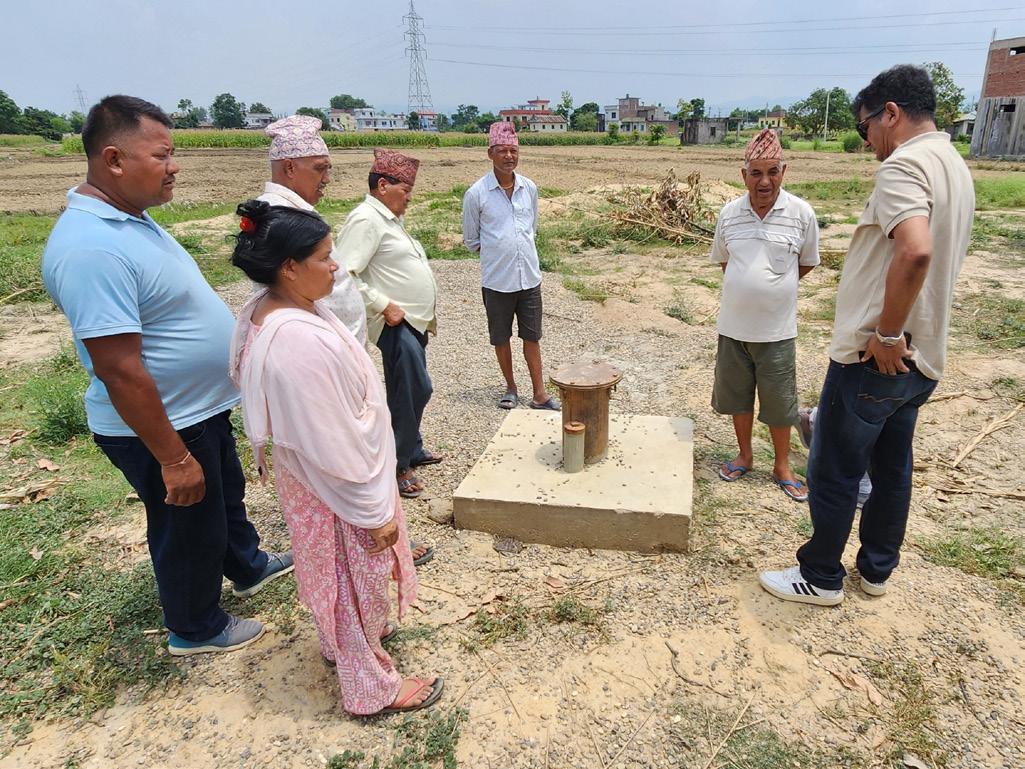
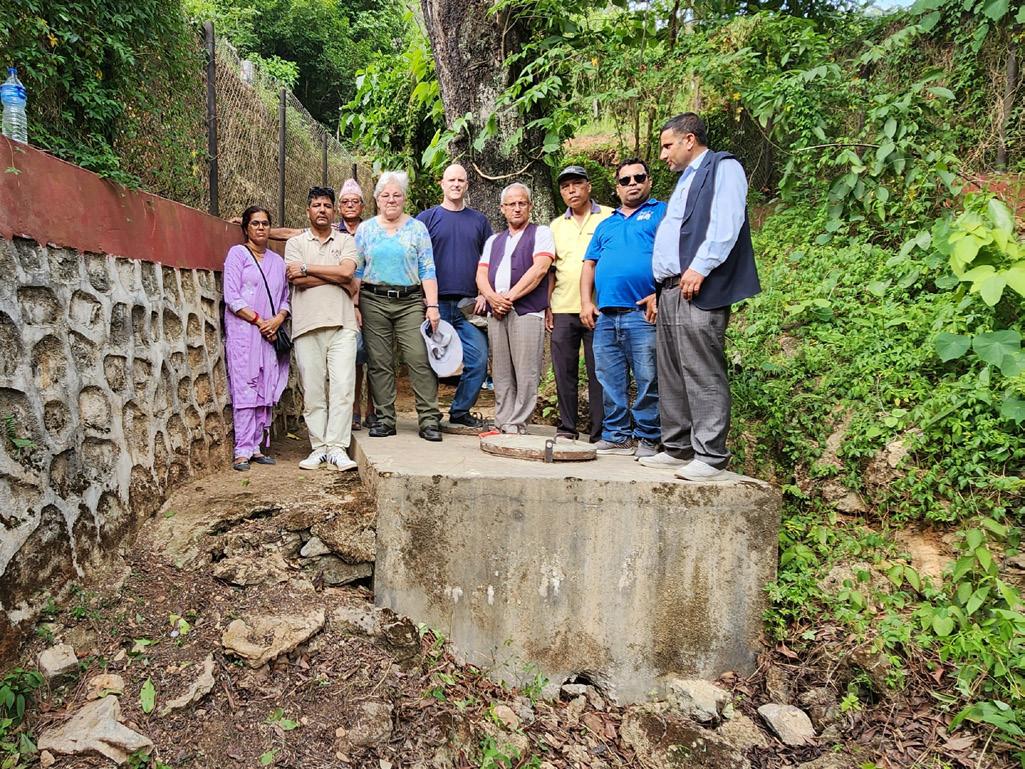
Board members, operators, municipal leaders, sector representatives, and community partners in Lamahi, Phalkapur, Pragatinagar, Gadhawa, and Sandhikharka shared their operating realities and walked their systems with the team. The review covered wells, reservoirs, tanks, treatment sites, hydrants, distribution networks, and routes used to move samples to laboratories.
LOCAL LEADERSHIP TURNS INFRASTRUCTURE INTO SERVICE
Infrastructure protects public health only when a utility can operate, finance, and govern it. Wells, pumps, tanks, and distribution mains deliver reliable service, when operators control process
risks, boards fund recurring work, customers trust results, and local governments support action before small failures become emergencies.
Volunteer executive boards carry public accountability, while balancing affordability, community expectations, and scarce resources. Operators respond to leaks, changing source conditions, tank cleaning, outages, and customer complaints, often with limited equipment, constrained budgets, and uneven laboratory access. This assessment treated that local effort as its starting point.
Boards and operators need evidence that drives action. Clear water, or a chlorine odour, cannot confirm quality. Chlorine residual, turbidity, pH measurements, sample maps, logbook entries, verified meters, leak records, chain-of-custody forms, tariff memos, and board dashboards turn field knowledge into repeatable decisions that oper-
ators can act on and leaders can defend. Risk moves through a water system as a chain. Monsoon conditions can change source quality, raise turbidity, increase chlorine demand, and expose distribution weaknesses. A line break can introduce contamination risk, while a delayed laboratory result may arrive too late to guide response. Defined field controls, records, and decision thresholds make local action faster, more consistent, and less dependent on one person’s memory.
A PRACTICAL PATH FOR EACH UTILITY
The assessment started with each utility’s existing assets and operating practices. It then identified steps that boards could phase, fund, and monitor. Table 1 connects each system’s existing situation with practical next steps needed.
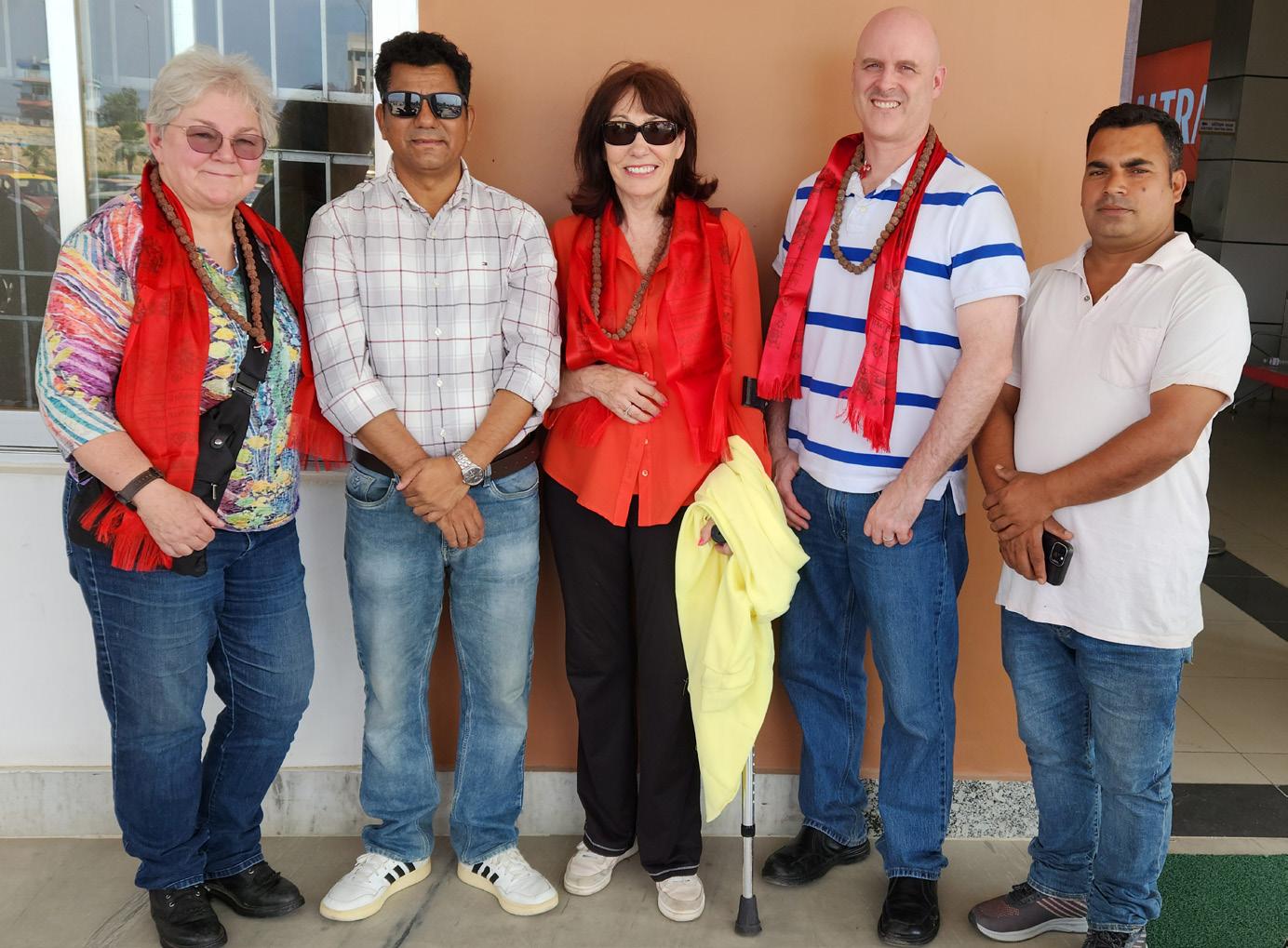
(left to right) OWB volunteers Rhonda Harris, Valerie Jenkinson, and Mike Hewitt (wearing a striped shirt and scarf) meet PSDN partners before beginning utility assessments in Nepal.
Congratulations to Our Project Teams
Kudos to our project teams whose projects were recognized with the following awards:
• Bearspaw Feeder Main Repair:
• Award of Excellence from the Alberta Chapter of the American Concrete Institute
• Saskatoon Water Treatment Plant Transfer Pumping and Electrical Upgrades:
• Pinnacle Award and Award of Excellence from the Association of Consulting Engineering Companies of Saskatchewan
• 99 Avenue Sanitary Trunk Rehabilitation:
• Award of Excellence and Award of Merit from the Consulting Engineers of Alberta
•
• Minister’s Award for Transportation Innovation from the Alberta Transportation & Economic Corridors
Associated Engineering is a proudly Canadian, employee-owned consulting company specializing in planning, engineering, environmental science, landscape architecture, and asset management. We are passionate about building vibrant, healthy, and resilient communities that support economic growth. Working together, we are shaping a better future for all of us.
Utility Existing System and Operating Context
Lamahi Established utility serving roughly 35,000 people at about 1.6 megalitres per day, with priorities related to metering, tariffs, staff capacity, and governance.
Phalkapur Active maintenance program, including tank cleaning; no continuous disinfection before storage or distribution; tariffs unchanged for eight years.
Pragatinagar Deep tube wells, slow-sand treatment, chlorination, and a broad distribution network serving roughly 2,400 households.
Practical Next Steps
Use its scale to demonstrate measured chlorination, dosing reviews linked to flow and meter data, leak tracking, operator checklists, and concise board dashboards.
Add controlled chlorination, field residual testing, pH and turbidity logs, source and tank inspections, operator training, and a transparent tariff review.
Formalize standard operating procedures (SOPs), chemical-solution preparation tables, feedrate calculations, outlet and pump-meter checks, monthly water balances, and a non-revenue water baseline.
Pragatinagar already has deep tube wells, slow-sand treatment, chlorination, and a broad distribution network. Its next step is to formalize existing work through approved SOPs, chemical-solution preparation tables, feed-rate calculations, outlet metering, pump-meter checks, monthly water balances, and non-revenue water tracking.
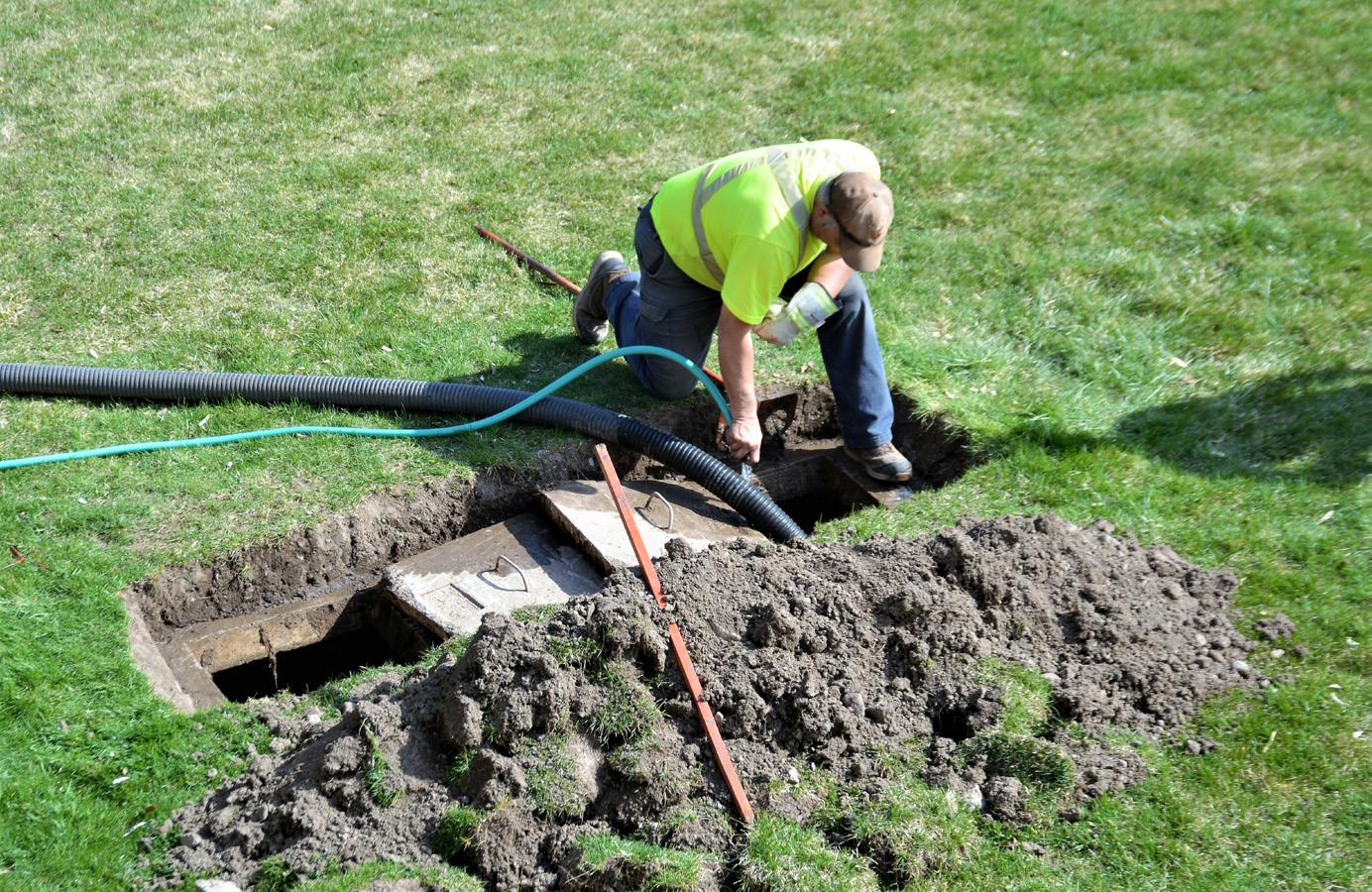
Gadhawa operates where drinking-water protection and septage management intersect below ground. Informal septage disposal can move contaminants through fields, drains, and groundwater, creating risks that no water utility can manage alone.
Gadhawa Community water service operating where drinkingwater protection intersects with septage-management risk.
Sandhikharka Mixed-source utility serving about 20,000 people through more than 2,000 connections, with seasonal turbidity, line breaks, limited testing, and incomplete records.
Establish continuous disinfection and assess a controlled septagemanagement route before piloting any lagoon or pond.
Use hydrogeology, test drilling, pump testing, water-quality confirmation, operating-cost estimates, and decommissioning plans as decision gates for any deep well.
Table 1. Existing utility conditions and practical next steps identified during OWB’s Nepal assessment.
Lamahi offers a practical demonstration site, as its board, staff, and scale can support trials that other utilities can adapt. The model would focus on:
• Measuring chlorine residuals at defined network points;
• Linking dosing reviews to flow and meter data;
• Tracking leaks and repairs;
• Using short operator checklists; and
• Reporting water quality, production, meter status, repairs, complaints, and cost pressures through one board dashboard. Phalkapur’s tank-cleaning work showed that staff already act on maintenance
needs. OWB recommended adding controlled chlorination before storage or distribution, supported by field testing, operating limits, and defined corrective actions.
For a volunteer board, disinfection is more than a technical choice. It requires a dosing point, field kits, reagents, operator time, procedures, and a tariff path that customers can understand and afford. A utility cannot test, dose, repair, and train without sufficient revenue. A board should not have to defend higher costs, without evidence of service need and performance.
A treatment lagoon or pond may form part of the solution, but pre-feasibility work should come first. That work should quantify septage volumes, document hauler practices, screen sites, assess odour and groundwater risks, set operating and monitoring rules, define fees and enforcement, and plan public communication. Phased decisions give local leaders evidence, before they commit public funds to an asset that available revenue and staffing may not support.
Sandhikharka manages a complex mixed-source system of shallow wells, springs and streams, serving more than 2,000 connections. Seasonal turbidity, line breaks, limited local testing, and incomplete records reflect the demands of that service area.
A deep well may form part of the solution, but procurement should follow hydrogeological review, test drilling, pump testing, water-quality confirmation, operating-cost analysis, and a decommissioning plan. These decision gates protect the board, staff, and customers from investing in an asset that may not solve the underlying problem.
TESTING THAT SUPPORTS TIMELY DECISIONS
A water-quality program is not simply access to a laboratory. It is a sampling route, a clock, a bottle, a cooler, a chainof-custody record, a trained sampler, a valid method, a result, and clear authority to act. Every step should help operators make a timely decision, not merely
Engineered for long-term financial confidence
Engineers know the importance of a solid foundation. That’s why the Engineers Canada-sponsored Group Savings and Retirement Program offers tailored financial solutions to help you build and grow your savings. Whether you’re saving for that next trip or planning for a confident retirement, build on what you’ve earned with a financial approach as intentional and forward-thinking as you are.
Why join the plan?
• Lower-than-retail fees* mean you pay less and keep more, helping your savings go further
• Access to a variety of plan options including a registered retirement savings plan (RRSP), tax-free savings account (TFSA), non-registered savings plan (NRSP), registered retirement income fund (RRIF) and life income fund (LIF)
• Free personalized guidance from licensed advisors who understand your goals and help you stay on track
• Retirement support from a dedicated licensed consultant offering expert, non-commissioned advice to help you understand your options and retire with confidence
• Easy plan management from anywhere through My Canada Life at WorkTM, Canada Life’s intuitive member site and mobile app
A plan built just for you.
The Engineers Canada-sponsored Group Savings and Retirement Program is exclusive to engineers, geoscientists, students and their families across Canada.
produce an official number.
Residual chlorine, pH, and turbidity should be measured in the field, as close to collection time as practical. Microbiological samples require short holding times, controlled transport, suitable bottles, documented custody, and a response plan. Long-distance transport can make results less useful for operations, even when testing meets formal requirements.
OWB therefore recommended a layered model that keeps day-to-day control, with utility operators and defines supporting roles for boards, laboratories, and public-health partners:
• Field control by trained utility operators;
• Cluster- or district-level laboratory confirmation;
• Reference-laboratory verification; and
• Independent public-health surveillance.
FUND THE SERVICE, NOT JUST THE ASSET
Safe drinking water requires recurring revenue, not just capital funding and goodwill. Chemicals, testing, reagents,
repairs, meters, spare parts, trained operators, emergency response, and asset replacement all carry ongoing costs. When revenue falls short, utilities defer maintenance, weaken monitoring, run equipment to failure, and lose public trust.
Boards face a hard balancing act of keeping service affordable, while collecting enough revenue to ensure safety. Treating tariff resistance as simple unwillingness ignores that reality. Cost-of-service data, targeted support for lower-income households, and small, predictable adjustments give boards a stronger path, than a large increase after years of deferred costs.
Operational evidence helps local leaders explain those choices. Residual logs show whether disinfectant protection reaches the ends of a distribution network. Leak logs explain repair spending. Meter registers reveal where water is lost. Tariff dashboards connect service outcomes with operating costs. Municipal governments, public-health agencies, donors, and sector partners share responsibility for training, laboratory access, capital upgrades, and affordability measures. Volunteer boards and utilities cannot carry that load alone.
PARTNERSHIP THAT STRENGTHENS LOCAL AUTHORITY
OWB’s model rests on operators helping operators. Volunteers bring practical utility experience, while local boards and staff retain authority over their systems. The team works with those responsible for service, inspects assets, reviews records, asks direct questions, and helps convert field knowledge into routines that remain after the visit.
The work matters when it shows up in the next day’s logbook, or a sampling map, a calibrated field kit, an SOP, a meter check, a water balance, a defined laboratory route, a tariff memo, a board dashboard, and an operator who knows what to do when a result crosses a limit. It matters just as much when a board can defend a decision with evidence, rather than carry the argument alone.
Nepal’s lesson is not that volunteer boards, or community utilities, lack commitment. It is that they carry complex public-health duties with limited tools, constrained revenue, and difficult trade-offs. Practical controls, reliable evidence, training, and sustainable funding turn local commitment into consistent service. The tap is the final test, but an entire chain of decisions determines whether a system passes.
HOW TO SUPPORT OWB
OWB relies on volunteers with relevant utility experience and on donations that cover project costs, including volunteer travel and accommodation. Membership fees contribute directly to OWB programs. To volunteer, join, or donate, visit www.operatorswithoutborders.org or email info@operatorswithoutborders.org.
Mike Hewitt is with Almaquin Enterprises Limited and volunteers with Operators Without Borders. Email: mike@almaquin.com
Phalkapur Water Utility staff and OWB volunteers review well operations, disinfection, maintenance, and cost recovery.
Sandhikharka utility staff and OWB volunteers inspect a protected spring source supplying community water.
Understanding the benefits of integrating chemical metering pumps into SCADA
By Patrick Murphy
Water treatment plant operators often dedicate substantial time and manpower to manual tasks, such as verifying chemical metering pump activity, logging residuals and other routine checks. Beyond the added labour burden, this approach can leave a critical blind spot in plant operations. For example, between manual checks, a pump can drift from its setpoint, lose prime, or fail entirely. This may go undetected for hours, until
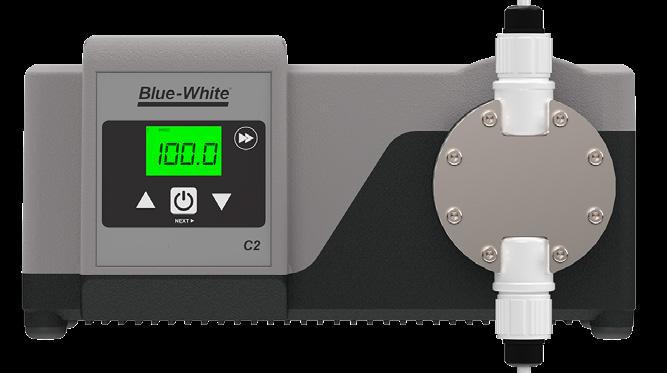
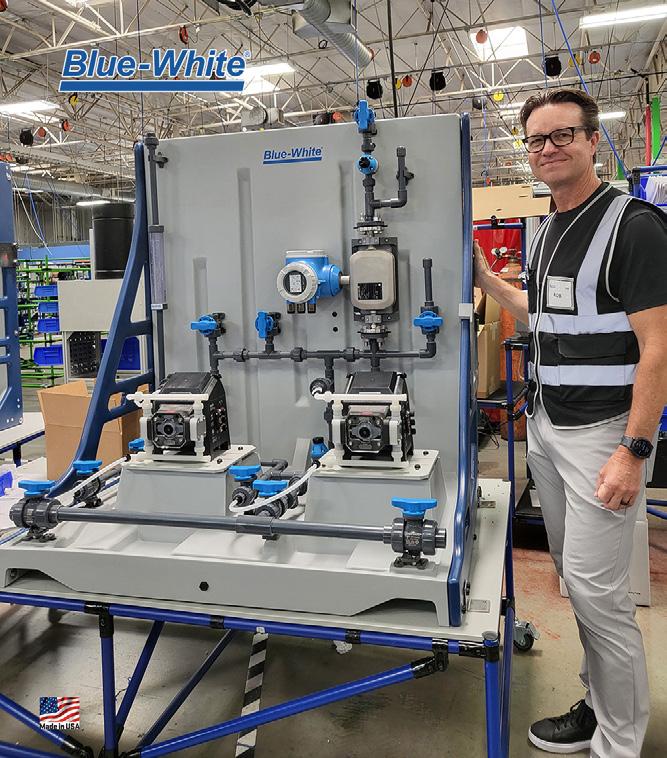
As plants upgrade, they can replace aging units with integration-ready pumps, such as Blue-White’s FLEXFLO.
a downstream problem, such as a spike or drop in chlorine or pH finally signals that something has gone wrong. Integrating metering pumps into a
SCADA system offers real-time visibility and direct control over chemical feed processes. When a pump is connected, operators can monitor what it is being told to do and what it is actually doing. They can then take corrective action as needed, without ever having to leave the central control room.
SCADA connectivity yields three major benefits. Firstly, operators no longer need to perform manual rounds for simple status checks or manual logging. This frees up staff for more critical maintenance tasks and eliminates time spent travelling between sites.
Secondly, precise integration allows the system to inject exactly what is needed, based on real-time demand, preventing costly chemical over-dosing.
Finally, instead of relying on tedious manual logs, that can be lost or inconsistently used, SCADA provides a continuous, auditable record of dosing performance. This data serves as supporting evidence for inspectors that the plant has remained within regulatory limits at all times.
NAVIGATING AGING EQUIPMENT
One of the most common misconceptions is that a plant must undergo a massive capital project to begin SCADA integration. In reality, integration can be a phased process. Most treatment plants manage a mix of legacy and modern equipment. Even older pumps often feature a 4–20 mA input for basic speed control.
As plants upgrade, they can replace aging units with integration-ready pumps, such as Blue-White’s FLEXFLO® peristaltic, or CHEM-FEED® diaphragm lines. These smart pumps ship with native support for both analog and digital protocols. If a SCADA system is already in place, connecting a new pump is often more about wiring and configuration than custom engineering.
CONTROL LOOPS
To maximize the value of an inte-
grated pump, it is essential to understand the different types of control loops that SCADA enables:
Open loop – This is the simplest level, where an operator sets the pump’s speed, and it runs at that speed, regardless of external factors.
Flow-paced (closed loop) – In this scenario, a flow meter sends data to the SCADA system, which then automatically adjusts pump speed to match the flow rate in the pipe. This is a more immediate and responsive way to manage dosing.
Compound loop – This represents the highest level of integration. It uses a secondary check, such as an ORP or pH analyzer, to provide feedback. If the flow rate increases, but the analyzer detects the residual is already too high, the system will self-correct and slow the pump down to prevent over-dosing.
CHOOSING SIGNALS AND DATA POINTS
Deciding how to connect a pump depends on the desired level of control and budget. Analog signals like 4–20 mA are simple to wire, but are limited in the data they can provide.
For deeper insights, industrial protocols such as Modbus RTU/TCP or EtherNet/IP are preferred. While these require a more complicated initial setup, they provide high-speed, noise-resistant communication. These digital connections allow operators to track critical data points beyond just flow rate, such as totalized volume, tube/diaphragm wear data, and leak detection.
PROACTIVE MAINTENANCE AND LONG-TERM VALUE
Integrating chemical metering pumps into a SCADA system changes the fundamental approach to maintenance from reactive to proactive. By utilizing realtime data, operators can catch problems like a tube failure early by monitoring revolution alarms and wear indicators. This prevents emergency maintenance and unscheduled downtime.
Beyond daily operations, data gathered by SCADA is invaluable for future capital planning. Plant managers can use historical performance data to jus-
tify budget requests for new equipment, showing exactly how much chemical has been saved, or how many staff hours have been reclaimed through automation.
While the transition from manual to connected systems requires an upfront investment in time and training, the return on investment is significant. By leveraging modern metering pumps and SCADA integration, treatment plant
operators can eliminate reliance on institutional knowledge. Instead, they will have real-time monitoring and automated alerts, ensuring consistent operations regardless of who is on shift.
Patrick Murphy is VP of Operations at Blue-White Industries Ltd. For more information, email: sales@blue-white.com
Understanding why WWTPs may or may not choose to accept septage
By Christopher French
In the Town of Midland, Ontario, the thorny subject of accepting septage fuelled heated debate a few years ago, which resulted in a ban on external municipalities using its wastewater treatment facility. This was after reporting showed that 88% of the intake was from outside the town. By far, the biggest traffic (59%) came from nearby Tiny Township, which had no wastewater facility of its own.
Midland officials felt that local residents should not have to subsidize the needs of residents from other municipalities. Refusing out-of-town septage would save a million dollars, as the town could avoid having to upgrade its WWTP process equipment.
This situation was ultimately resolved when Tiny Township received a $3.61 million grant from the Ministry of Infrastructure for a brand-new septage receiving station at the Midland wastewater treatment plant. Also, the Town of Midland received $30 million from the Housing-Enabling Water Systems Fund to upgrade its water, wastewater and stormwater infrastructure.
Many WWTPs can’t handle septage, as they are already close to capacity. Septage places added strain on treatment equipment, and the biological oxygen demand levels it creates can be up to twelve times greater than normal influent loading.
But where then does this leave hauling companies whose livelihood depends on emptying a large number of septic tanks and transporting the septage to a treatment centre? They have little choice but to increase what they charge customers for the increased distances that they have to travel to safely dispose of septage.
Rethinking septage as a commodity underlined its value, rather than seeing it as a thoroughly difficult and unpleasant nuisance to avoid.
waste can be sold for pipe bedding, concrete blocks and tree planting projects.
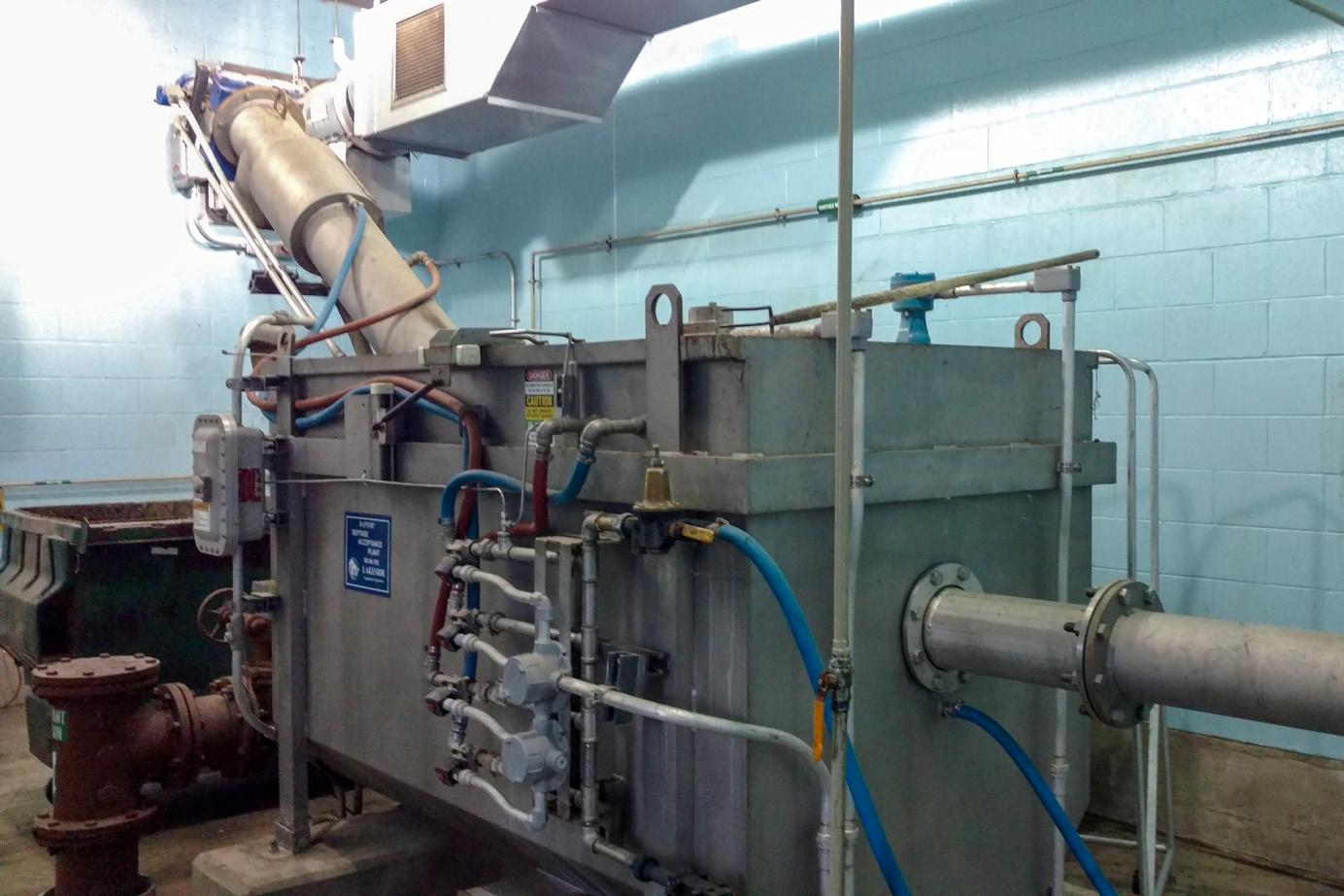
A large septage hauler in Florida invested in Lakeside Equipment Corporation’s fully automated Raptor Septage Complete Plant, which is a self-contained unit with a grit chamber, and a fine screen that eliminates unwanted material that comes with septage.
In England’s hugely popular southwest holiday destination of the County of Cornwall, haulers have had to come to terms with greatly increased journeys due to restrictions. Fed up with the costly situation and determined to protect its long-standing family business, septage hauler Pellows decided to install its own treatment plant.
The company invested in an all-inone septage, fats, oils and grease, sludge screening system. It also recently introduced a grit clarifier and a slurry press. The treated end-product from collected
Circulation keeps organic solid material in suspension and allows the sand and other inorganic materials to settle to the tank floor, regardless of any variation in flow capacity. Screened material removed from the screening basket is then spray-washed to return organics to the waste flow. It is then transported up the unit’s central screw conveyor to storage containers.
During transport, screened material is washed a second time, then compacted and dewatered to a solids content of up to 40%. The screen’s rotating rake teeth fully penetrate the cylindrical screen bars, which prevents plugging and blinding.
Regulatory requirements also play a strong part in the septage situation. Increasingly, WWTPs, that were once
A Raptor Septage Complete Plant.
working to Class B Biosolids requirements, have been pushed into higher levels of treatment to reduce the impact of nutrients on the local environment. Achieving and maintaining Class A Biosolids means firmly reducing pathogens and the density levels of fecal coliform and salmonella.
If biosolids are to be sold, or given away in bags or bulk, for lawn or home garden application, Class A requirements must be met. This means an already under pressure WWTP is going to take a long, hard look at whether it can accept additional septage.
To address this issue, the Kishwaukee Water Reclamation District in Dekalb, Illinois invested in a Lakeside Septage Acceptance Plant. It uses a full-penetration rake-head to remove debris and inorganic solids that typically pass through a conventional bar screen.
Revenue received from accepting septage has played a significant positive role in the successful running of the facility. The system paid for itself in only four-
teen months. So in this case, rethinking septage as a commodity underlined its value, rather than seeing it as a thoroughly difficult and unpleasant nuisance to avoid.
Christopher French is an independent PR consultant, who specializes in writing about water, wastewater and environmental topics. For more information, visit: www.lakeside-equipment.com
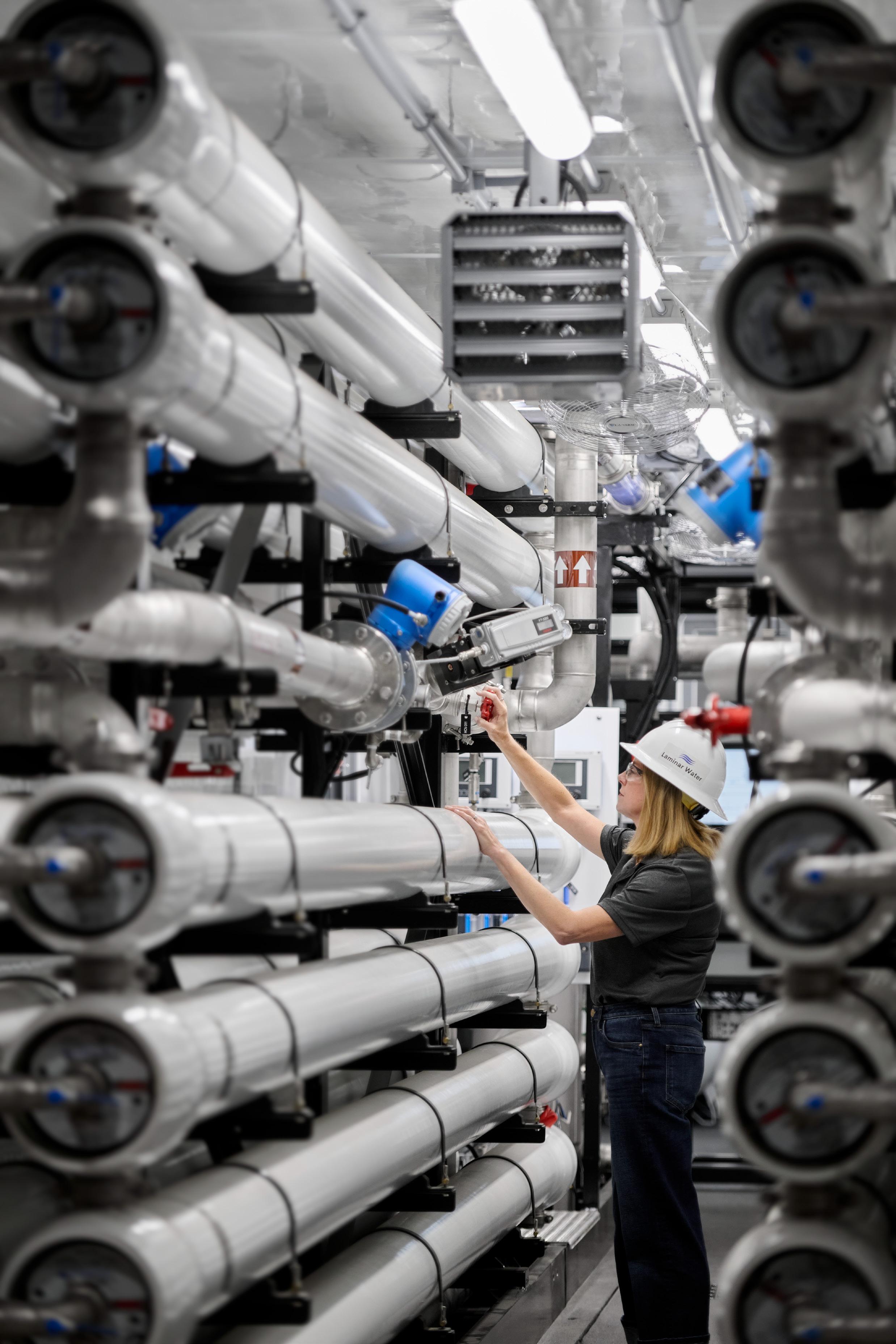
Laminar Water is betting that modular, configurable treatment systems can help respond faster to changing water quality challenges while giving operators greater flexibility
What was once brown, discoloured drinking water is now running clear in one Alberta First Nation. Since installing a mobile water treatment system from Cambridge, Ontario-based Laminar Water earlier this year, iron and manganese concentrations have dropped to nearly zero, bringing an end to years of customer complaints from some of the 370 homes on the reserve.
“Not so many phone calls anymore,” says Shane Buffalo, infrastructure supervisor for the Louis Bull Tribe in the Maskwacis-Wetaskiwin area of Alberta, and one of three operators of the single Laminar Water mobile treatment container that was delivered in early 2026. “We now have what looks like town water in our area,” Buffalo added.
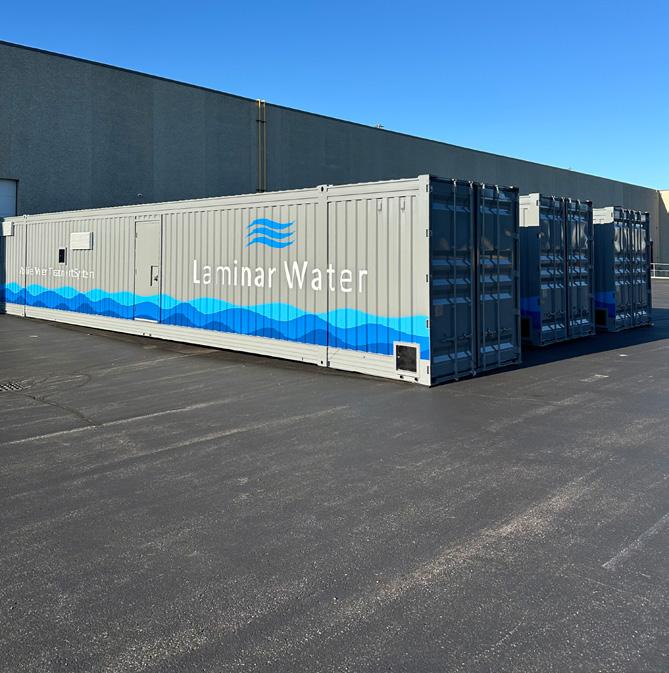
The First Nation community expects to connect to the Red Deer–Edmonton regional waterline extension by 2030, but until then needed a replacement for an aging treatment system that had become increasingly unreliable. A single Laminar Water 53-foot long, 100,000-pound mobile treatment trailer, using greensand filtration, has filled that gap.
The container houses two treatment trains, each with eight filters, allowing one side to be backwashed, while the other continues producing water. “That’s an important part
because we have high demand but not much capacity,” says Buffalo. “Falling behind and playing catch up would be difficult.”
The project reflects the approach Laminar Water has taken since launching operations. This is to build modular treatment systems that can be rapidly configured for specific water quality challenges, while remaining straightforward for operators to use.
Versatility is a hallmark of the company’s quick success, buoyed by CEO Fraser Kent, who was looking to write a new chapter, after an already established career in the water and wastewater industry. “There is sort of an excitement in the culture here,” Kent says. “You get that feel when you walk in the door. We are very much entrepreneurial and an allhands-on-deck kind of company.”
adaptable treatment systems.
Founded by professional engineers, with more than 50 years of combined experience in water treatment, Laminar Water brings together a team with backgrounds spanning engineering, operations and water technology. Kent founded the company after a long career, starting at Zenon Environmental and recently leading the sales team at H2O Innovation. After working as a consultant for a year, he saw an opportunity to build a company around faster, more
Kent says Laminar Water represents an opportunity to rethink how mobile treatment systems are designed and delivered. The company’s management team is rounded out by brand-new Operations Manager Christopher Peace and Engineering Manager Marc Graziani, who Kent has known for 25 years. “He is like a brother and one of the smartest guys I know,” Kent says. “If he had said no, this would never have happened.”
Even the company’s name reflects its engineering roots. Kent says “Laminar” refers to laminar flow, which evokes images of seemingly still, smooth, uninterrupted movement of water. This represents the company’s drive and ambition, as well as its goal of delivering
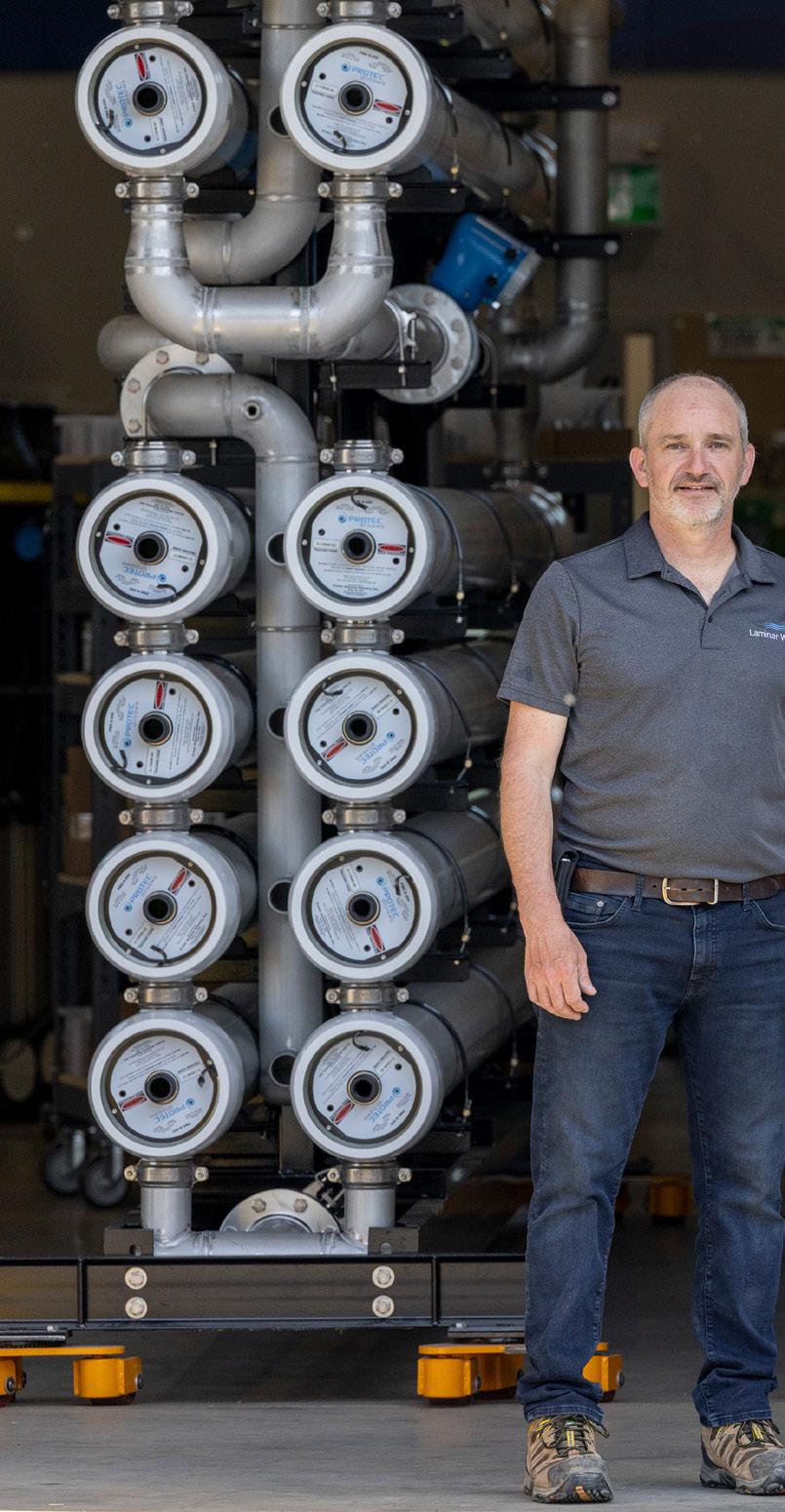
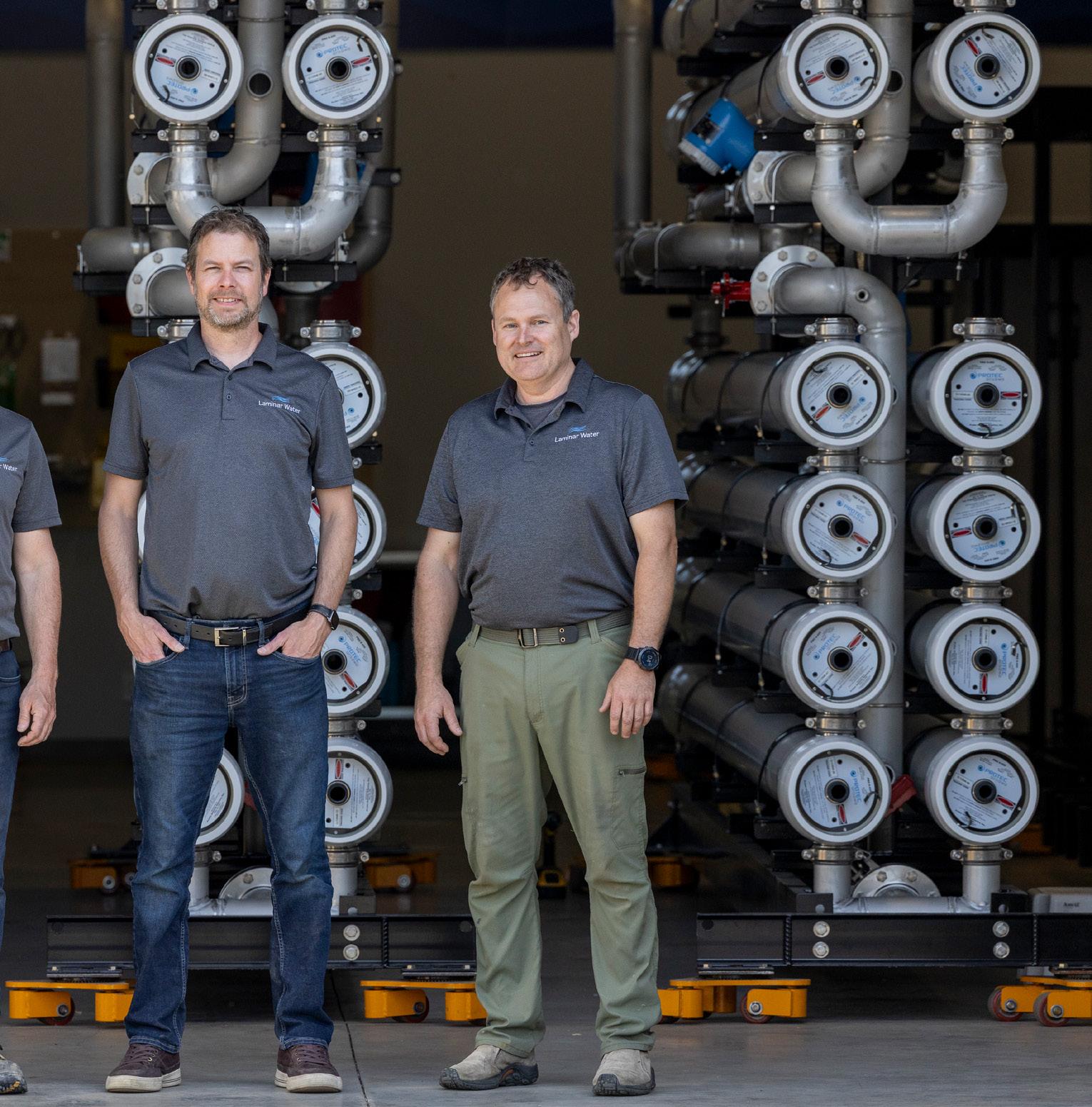
CEO of Laminar Water, Fraser Kent (centre), with Engineering Manager Marc Graziani (left) and Operations Manager Christopher Peace (right).
treatment systems that are equally streamlined and efficient. “Laminar flow sparingly exists in reality, so it is about striving for perfection, or the ideal flow,” Kent says.
The modular mobile water treatment technology includes RO, UF, NF, MMF, GSF, and GAC systems. The containers are designed to accommodate two complementary vendor technologies side-by-side within the same infrastructure. Reverse osmosis, for instance, could be in one slot, while media filtration is in the other. “It’s configurable,” Kent says.“ You can slide in different technologies in two slots. That is our secret sauce. We can build in advance and rapidly deploy to the site.”
That flexibility is now being put to use in municipalities preparing for future infrastructure investments.
We can use these trailers not only to address today’s nitrate issue, but also to pilot the technology for our future full-scale system.
The company is currently preparing four reverse osmosis filtration containers for the City of Brantford, Ontario. Set for delivery prior to 2027, they will tackle elevated nitrates in the Grand River over the winter season, when biological activity in the river slows down.
The trailer systems will be on site fairly long term, as Brantford begins to approach design for a full-scale filtration plant in the next five to ten years. That design will be positively informed by what they learn from the Laminar Water system, explains the City of Brantford’s Manager of Water Operations, Lindsay Chapin.
“Because they build the containers as they go, we have been able to have a lot of input into what will benefit the city overall in the long term,” Chapin says. “We can use these trailers from Laminar Water to not only take care of the nitrate issue that we are facing, but also pilot different membranes and different technologies for the development of the full-scale system onsite.”
While the city has rented mobile RO units before, owning the Laminar Water trailers gives them much more flexibility to run experiments and find out exactly what they need moving forward.
Operator usability has become one of the company’s defining design priorities. Chapin says Laminar’s containers are built and designed to suit an operator and the staff working in them. “They are very user-friendly and the sophisticated technology is compatible with our systems,” she says. “There’s an ease of operation in these containers that allows operators to be a lot more hands-on and move around freely within them. They are not restricted in any way and the equipment is accessible, not only for operations, but for maintenance if
continued overleaf…
there’s the need for repairs, on-thespot testing, or reconfiguration.”
Chapin says part of the benefit of the partnership with Laminar Water is that their headquarters are in Cambridge, Ontario, which is a fairly short drive away.
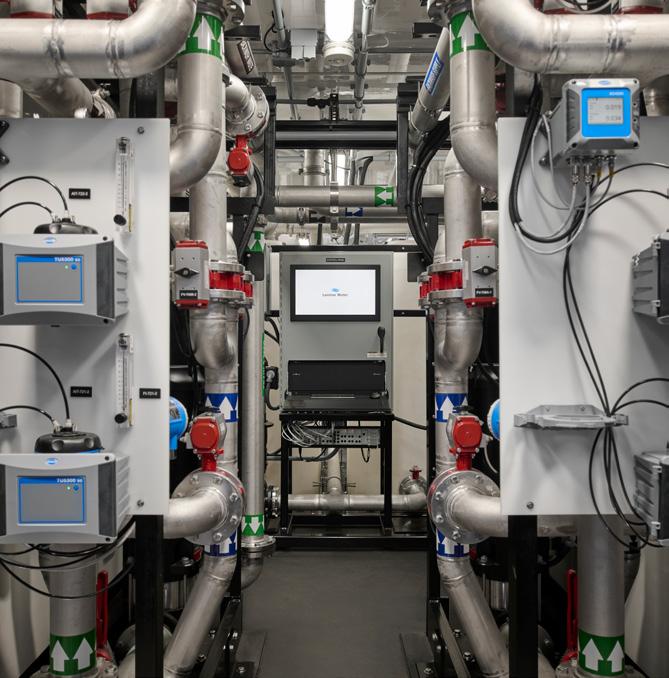
Laminar Water’s mobile treatment system is designed for remote assistance. The containers are equipped with cameras to allow the company to help operators via video if needed, and for operators to keep an eye on the unit when away.
Some of the other display screens also offer educational and instructional information about the system’s components. Kent calls it a conduit for all the information about the design. The controls design is another point of pride for the whole
team, Kent says. “We wanted the biggest high-quality screen we could fit and the best industrial computer we could find, because operators have to live and breathe with this terminal.”
Canadian-made quality
Kent says Laminar Water places an emphasis on premium materials and domestic manufacturing. The company’s modular treatment systems are built entirely from 316 stainless steel, with more than 80% of the system components sourced from Canadian manufacturers. Every unit is designed, fabricated and assembled at Laminar Water’s facility in Cambridge, rather than being outsourced.
The trailers also incorporate several design features intended to
improve durability and day-to-day operation. There are door sensors and enhanced floor drainage to help manage spills. The wooden container floors have been replaced with polyurethane-coated steel, similar to the protective lining used in heavy-duty truck beds. Clear sections of overhead piping are positioned above the doorways to give operators a clear view of water flow, making it easier to identify potential issues during operation.
Laminar Water made headlines earlier this year with its contract in the Region of Waterloo, Ontario. The first ultrafiltration (UF) unit ordered is designed to treat water drawn from the Grand River using advanced membrane technology, capable of filtering extremely fine particles. It will add up to 50 litres per second of new treatment capacity by the end of 2026.
Kent added that the Region requested a customized coagulation/ flocculation system that will allow them to optimize hydraulic retention time in advance of the UF treatment.
Regional officials say the units are intended to temporarily bypass aging infrastructure at the Mannheim Water Treatment Plant, which is limiting treatment capacity. The mobile systems will allow upgrades to proceed without significantly affecting water flow to customers.
“The Mannheim side stream project is a great example of that creativity and collaboration in action,” says Waterloo Regional Chair Karen Redman. “By leveraging new treatment technologies, including Laminar Water’s filtration system, we are finding practical ways to increase available water capacity more quickly, while longer-term solutions continue to advance.”
Laminar Water is headquartered in Cambridge, Ontario. For more information, visit: www.laminarwater.ca
Every Laminar Water unit is designed, fabricated and assembled in Cambridge, Ontario.
More than 80% of system components are sourced from Canadian manufacturers.
November 25–26, 2026
Holiday Inn & Suites Calgary
South Conference Centre, Calgary, AB
Course Line-up
Environmental Compliance in an Era of Rapid Regulatory Change
A practical, case study-driven examination of current and emerging issues in environmental regulation, compliance, and enforcement.
Managing Environmental Risk and Liability
Explore the key principles of identifying, assessing, and managing environmental risks throughout the lifecycle of a project or operation.
Communication protocols integrate critical assets, from primary treatment and aeration systems, to remote pumping stations. Credit: tarikvision, stock.adobe.com
Understanding the different types of industrial communication protocols
By Parth Bosmia
There are different types of industrial communication protocols. These are the standardized set of rules that decide how data is formatted, transmitted, and received across networks that enable different devices to communicate. Simply put, they are the rules that define the syntax, semantics, and error handling for reliable data exchange.
Industrial communication relies on a core set of widely adopted protocols. The
adoption of Modbus, PROFINET, Ethernet/IP, and PROFIBUS is essential for the digital transformation of water and wastewater treatment, enabling real-time data exchange for operational efficiency in both municipal and industrial environments. These protocols integrate critical assets, from primary treatment and aeration systems, to remote pumping stations. This ensures regulatory compliance and environmental protection through seamless automation. These are also the most used protocols in the water and wastewater industry.
MODBUS
Modbus Remote Terminal Unit (RTU) is a compact binary protocol designed for serial lines (RS485/232), while Transmission Control Protocol (TCP)
encapsulates the same data inside Ethernet packets. RTU relies on slave IDs and cyclic redundancy checks (CRC), whereas TCP uses IP (Internet Protocol) addresses and packet error handling.
Modbus RTU is ideal for legacy, short-distance, and low-cost systems, while Modbus TCP provides high-speed, scalable connectivity for modern Ethernet-based systems.
PROFINET
PROFINET (Process Field Net) is a leading open industrial Ethernet standard for automation, designed by PROFIBUS & PROFINET International (PI), to exchange data between controllers (PLCs) and devices in real time.
It enables real-time communication by supporting both standard TCP/IP for non-time-critical data and a dedicated, high-speed channel for time-critical motion control. As a vendor-independent solution, it ensures interoperability among devices from various manufacturers.
Furthermore, PROFINET offers advanced diagnostics to maintain high uptime in factory and process automation. It is used extensively in automotive, packaging, and factory automation systems to enhance efficiency and enable digital transformation.
When it comes to compatibility, PROFINET uses standard Siemens Ethernet cables, allowing other protocols to coexist on the same wire. It is flexible enough to support diverse network topologies such as star, tree, and ring, and enables wireless or fibre-optic connections. PROFINET typically operates at speeds of 100 Mbps to 1 Gbps, with standard Ethernet distance of up to 100 metres per cable segment.
One may choose to go with PROFINET if the application:
• Needs high-speed synchronization for robotics or CNC machines.
• Requires integrated safety (e.g., emergency stops) over the same network.
• System is large-scale and requires a detailed remote diagnosis for fast troubleshooting.
One may choose to go with Modbus TCP/IP if the application:
• Has a tight budget and simple performance needs.
continued overleaf…
Ethernet/IP
Performance Provides strong, reliable performance suitable for general factory automation, but is considered lower performance than PROFINET in high-speed, synchronized systems.
Architecture and Topology
Data support
Excels at integrating IT and industrial networks, often utilizing standard commercial-off-the-shelf (COTS) switches. It also supports ring, line and star topologies.
Uses TCP/IP and UDP/IP, relying on CIP for device communication, which prioritizes interoperability.
Configuration Uses EDS files
Application
Ideal for applications requiring broad device compatibility, seamless integration with existing Rockwell automation systems, and enterprise-level IT networking.
PROFINET
Offers faster, more precise, and deterministic control for motion applications.
Supports flexible network structure, including ring, line and star topologies, and is optimized for quick, deterministic data exchange.
Uses standard Ethernet but skips TCP/UDP for its fastest real-time communication to increase speed.
Uses GSDML files
Ideal for applications demanding highprecision, rapid synchronization, such as multi-axis robotics, complex servo systems, and high-speed production lines.
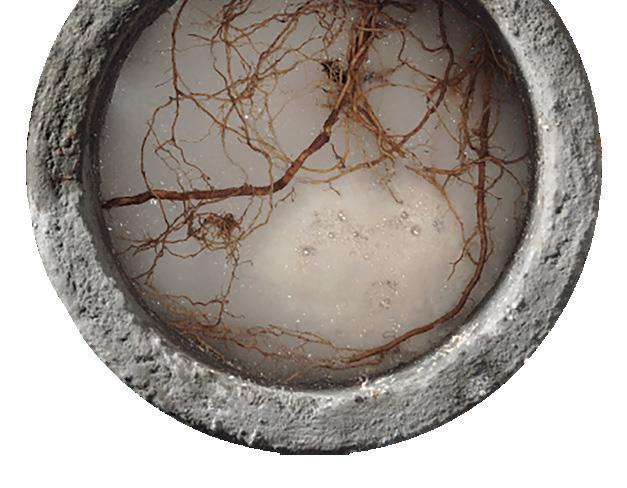
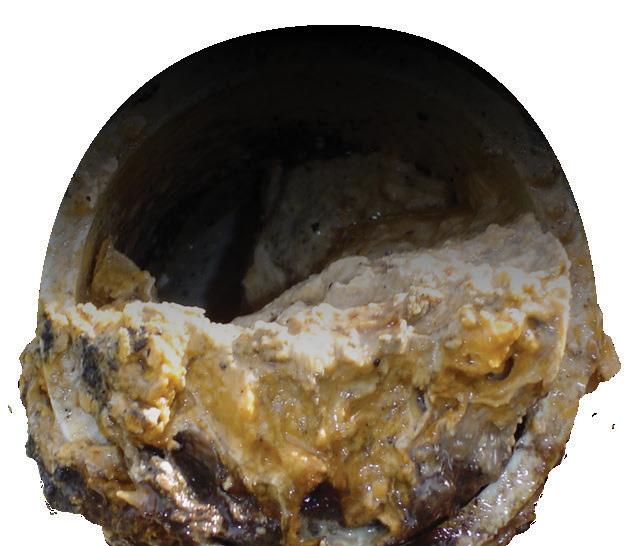
With both RootX® and Grease-X® in your toolkit, F.R.O.G. doesn’t stand a chance.
Used by municipalities, plumbers and contractors throughout the U.S. and Canada, RootX® has the products to help you keep municipal lines and laterals clear and flowing, guaranteed.
To purchase RootX®, or to learn more, visit www.RootX.com, or talk to your RootX® representative at 1-800-844-4974.
Table 1.
• Is integrating legacy devices or thirdparty instruments that only support Modbus.
• Needs an easy-to-commission solution for a standalone machine.
• Requires remote monitoring only over modems or long distances where timing is not critical.
ETHERNET/IP
Ethernet/IP is an application-layer industrial networking protocol that uses standard Ethernet technology (IEEE 802.3) and the Common Industrial Protocol (CIP) to communicate between industrial devices like PLCs, controllers, and sensors. It supports real-time I/O messaging, via User Datagram Protocol (UDP) for implicit (real-time, cyclic I/O data) messaging and configuration data via TCP/IP for explicit (configuration, parameter) messaging. It uses CIP for upper layers, allowing standard message formats across different network types (e.g. ControlNet, DeviceNet).
Running on standard Ethernet physical layers (cabling, switches, fibre) and standard Internet Protocols (IP), Ethernet/IP enables seamless integration between factory automation devices, including control, safety, and motion systems.
Furthermore, Ethernet/IP supports standard star, line, or ring topologies, including Device Level Ring (DLR) for high fault tolerance. It is commonly applied across a range of industrial functions, including process automation — where it connects sensors, actuators, and controllers. It is also applied across control systems where it manages motor drives, robotics, and safety I/O.
Ethernet/IP also plays a key role in data integration, enabling communication between factory floor machinery and higher-level IT systems.
Given its broad capabilities, Ethernet/ IP is often compared with the Modbus protocol in many ways and found more favourable. However, it is essential to know the difference between Ethernet/
IP and PROFINET, as outlined in Table 1.
PROFIBUS (PROCESS FIELD BUS)
PROFIBUS is a widely used, vendor-independent industrial networking standard for high-speed data communication between automation systems (PLC/DCS) and field devices (sensors, drives, I/O). It operates mainly via RS-485 twisted-pair cables at speeds up to 12 Mbps, offering a robust, reliable, and cost-effective communication network. It is an open standard, ensuring interoperability between devices from different manufacturers.
PROFIBUS DP (Decentralized Periphery) is the standard version optimized for high-speed (12 Mbps), cost-effective data exchange between controllers and distributed I/O, sensors, and actuators.
PROFIBUS PA (Process Automation) is used in process industries. It powers and communicates with sensors/actuators, via an intrinsically safe network designed for hazardous process environ-
ments. It is a low-speed method (31.25 Kbps), allowing power and data over the same cable to instruments.
As part of its communication mechanism, PROFIBUS uses a master-slave token-passing protocol. A Class 1 master (PLC) handles cyclic I/O data, while a Class 2 master (engineering tool) handles diagnostics and configuration. For the physical layer, PROFIBUS uses a violet-coloured shielded twisted-pair cable (RS485) and 9-pin sub-D connectors. It supports up to 126 devices on a single network (with repeaters), with maximum speed decreasing as cable length increases.
PA systems are typically connected to a DP backbone using a DP/PA coupler or link, which converts the signals. PROFIBUS has limited applications and is not often in comparison with Ethernet/IP, Modbus, and PROFINET.
It is important to note that the water and wastewater industry has generalized a few communication protocols based on the preferences of the end users. For example, some owners prefer
to have Allen-Bradley PLC (Ethernet/ IP), while others prefer to have Siemens PLC (PROFINET).
CONCLUSION
As water and wastewater infrastructure becomes increasingly digitized, the choice between Modbus, PROFINET, and Ethernet/IP is no longer just a technical detail, it is a strategic decision. By standardizing these communication layers, facilities can unlock real-time diagnostics, reduce downtime, and ensure long-term scalability.
Whether you are upgrading a legacy lift station, or designing a new treatment plant, understanding these protocols is the first step toward a more resilient and data-driven environmental strategy.
Some of the third-party equipment suppliers prefer to provide their equipment with certain fixed protocols, and end users use Gateway devices to convert the communication protocols to the preferred protocol. For example, the generator supplier commonly provides Modbus TCP/IP, which then gets converted to either Ethernet TCP/IP or PROFINET based on the overall network protocol at the site.
Parth Bosmia is a senior instrumentation & control project engineer with R.V. Anderson Associates Limited. Email: pbosmia@rvanderson.com
Winnipeg recommends awarding $815M contract for next phase of North End WWTP
By ES&E Staff
Winnipeg’s Public Service is recommending that council approve an $815.5 million contract to Red River Biosolids Partners to construct new biosolids facilities at the North End Water Pollution Control Centre (NEWPCC). This is after a nearly two-year collaborative design process, that city officials say identified significant cost-saving engineering changes without sacrificing performance.
The Biosolids Facilities project is one of three major capital projects to modernize the North End plant, which treats about 70% of Winnipeg’s wastewater and all sludge generated at the city’s three wastewater treatment plants. These upgrades are intended to replace aging infrastructure, increase treatment capacity to accommodate population growth and bring the facility into compliance with provincial environmental regulations.
The new facilities will receive sludge from Winnipeg’s wastewater treatment plants and process it into reusable biosolids.
Red River Biosolids Partners was selected as the project’s development partner in July 2024, after council approved the progressive design-build (PDB) delivery model the previous year. Since September 2024, the consortium has worked with the city’s project team to finalize the design, construction schedule and pricing, before negotiating the design-build agreement now before council.
The PDB model divides the project into three phases, allowing the owner and contractor to work together during the design stage, before proceeding to construction.
According to city officials, this collaborative approach identified several oppor-
phases in the overall NEWPCC modernization program. Construction of a new headworks and power supply facility began in 2021, and is expected to be completed this year.
The third and largest phase is the Nutrient Removal Facilities project, which carries an estimated cost of approximately $1.5 billion. That project remains in procurement, with three teams shortlisted to compete for the contract. Construction is expected to begin in 2028.
The PDB model divides the project into three phases, allowing the owner and contractor to work together.
tunities to reduce costs, while maintaining the project’s performance and regulatory requirements. Among the changes were replacing the originally proposed thermal hydrolysis process with thermophilic digestion, consolidating several smaller buildings into larger structures, constructing taller buildings instead of excavating basements, and using steel rather than concrete for portions of the structural framework.
The contract will be funded through the city’s approved capital budgets for the Biosolids Facilities and Nutrient Removal Facilities projects. The biosolids project is the second of three major
An economic impact analysis estimates the project will contribute approximately $620.8 million to Manitoba’s gross domestic product and support 3,770 person-years of employment, while generating additional economic activity across Canada.
The project will also be the first city construction project to implement Winnipeg’s 2022 social procurement directive, which aims to increase participation by Indigenous peoples and other under-represented groups in the construction workforce.
City officials said the procurement process complied with purchasing policies and applicable trade agreements and represents the next stage of an established competitive procurement process, rather than a sole-source contract award.
For more information, email: editor@esemag.com
The North End Wastewater Treatment Plant biosolids facilities buildings. Credit: City of Winnipeg
THE DICE
THE EVOLUTION OF THE CHEMICAL
BEFORE complex. cluttered.
AFTER simple. intuitive. Made in Canada!
Up to 50% reduction in mechanical room space required 90% fewer joints = 90% less risk of leakage
Simple, consolidated operation
Support Canadian Industry - Buy DICE
What you need to know now about ‘shadow AI’
By Jesse Ross
Imagine that your team is now using a clever new AI tool to make a task more efficient. Maybe it’s auto-generating schedules, analyzing material orders, or flagging potential delays. You haven’t approved it and you might not even know that it is being used at all. That is what’s called shadow AI.
Shadow AI is the use of artificial intelligence tools within an organization without executive awareness, or formal approval. When employees independently experiment or adopt AI with the best intentions, leadership lacks the visibility to respond to the risk it introduces to the organization. Sometimes not until the consequences are unavoidable.
From unverified project forecasts, to unsanctioned subcontractor extras, shadow AI can create blind spots in decision-making. These can be expensive, dangerous, and surprisingly easy to overlook. In construction, where timelines, safety and budgets are tightly intertwined, these “helpful” AI tools can quietly become high-stakes risks.
You might think that this is just a problem for the IT department. What many organizations are overlooking is that shadow AI is a strategic business issue, which needs executive-level governance. Its effects can cascade through budgets, compliance obligations, reputational exposure, etc., long before they come into view.
WHY CONSTRUCTION IS ESPECIALLY VULNERABLE TO SHADOW AI
The use of sensors, predictive maintenance, digital twins, and drone-assisted site inspections means that AI is embedded everywhere, often behind the scenes. When executives are not aware of AI use,
risk compounds. An unverified predictive model could misestimate load-bearing requirements. An unsanctioned AI tool might automatically adjust task priorities or timelines, creating conflicts with approved schedules and causing delays. Also, contractors and subcontractors might be using AI tools independently, feeding your systems unvetted inputs.
WHEN INNOVATION OUTPACES OVERSIGHT
Shadow AI rarely announces itself, and often the face of it is harmless. It could be someone using an AI-based scheduling app, a junior engineer experimenting with a chatbot for calculations, or a contractor automating report generation. But every untracked instance is a potential hazard.
The Organization for Economic Co-operation and Development’s (OECD) 2026 Trends in AI Incidents and Hazards Report underscores that AI-related risks are proliferating faster than governance frameworks can keep up. The report catalogues hundreds of media-reported incidents, ranging from privacy violations to operational mishaps. The patterns reveal that unapproved AI use creates blind spots that can escalate quickly.
Many executives assume AI adoption is centrally managed, but in reality, employees frequently experiment with AI tools independently. A recent Canadian report noted that businesses are at risk when employees deploy unauthorized AI tools at work. This often leaves critical data exposed to cloud platforms, with minimal oversight.
CONSTRUCTION EXPERTS WEIGH IN
The current consensus is that construction leaders in Canada are starting to notice, but not fast enough. Experts quoted in a ConstructConnect article point out that AI adoption in the sector is accelerating without commensurate governance. Predictive tools, drone imaging, and modelling software are now common, but oversight lags behind. As a result, there are layers of AI making decisions quietly, with no accountability chains, no audit trails, and no executive visibility.
For example, a site manager uses an
From unverified project forecasts, to unsanctioned subcontractor extras, shadow AI can create blind spots in decision-making. Credit: designpics, stock.adobe.com
AI tool to optimize subcontractor scheduling. It shifts labour hours, reorders materials, and flags tasks as critical. The tool works mostly, but suppose it missed a regulatory compliance requirement, misread site data, or ignored safety requirements. Suddenly, the delivery timeline slips, costs rise, regulatory reporting, and even safety is compromised. That’s shadow AI in action.
EXECUTIVE STRATEGIES FOR MANAGING SHADOW AI
Whether you like it or not, shadow AI is quietly shaping decisions on your projects. Employees are experimenting, contractors are innovating, and AI tools are getting smarter. On the bright side, leaders don’t have to sacrifice innovation to get shadow AI under control. With the right approach and meaningful steps to move from awareness to action, you can turn hidden AI risks into manageable challenges:
Firstly, find out which teams, or contractors, are using AI. Then ask for what purposes and what the high-risk areas are. Next, create a governance framework tailored to decision-makers. Define which AI tools are approved, what data they can access, and who is accountable for their outputs. Especially now, with increasingly powerful AI tools, include shadow AI monitoring as a routine agenda item in leadership meetings as a strategic discussion to manage operational, regulatory, and financial risk.
Not every AI experiment is dangerous. Focus on areas where errors or misinterpretations could affect budgets, schedules, safety, or compliance. This risk-based approach helps execu tives allocate attention efficiently, preventing resources from being wasted chasing low-stakes experiments.
Staff may fear being open and transparent with their AI usage, and shadow AI thrives in secrecy. To counter this, start building a culture that normalizes transparency. Explain that reporting AI use helps protect the project, the company, and the team’s credibility.
Subcontractors are part of your world. Require disclosure of any AI tools they use, since you want to know what tools could influence project outcomes. Include AI governance clauses in contracts, and set clear expectations for accountability. That way, you are not just managing internal risk, you are extending oversight to your entire project chain.
Human oversight protects both your project outcomes and your leadership credibility. For high-stakes projects, establish
Treat shadow AI like hidden debt. It's not inherently bad, but ignoring it is risky. Map it, monitor it, govern it, and educate your teams.
STAYING AHEAD OF SHADOW AI
AI tools are increasingly smarter, cheaper, and more accessible. It makes sense for contractors, engineers, and staff to be eager to leverage AI to save time and reduce errors. The question is whether executives can balance innovation with oversight. Treat shadow AI like hidden debt. It’s not inherently bad, but ignoring it is risky. Map it, monitor it, govern it, and educate your teams. That way, AI becomes an efficient tool, rather than silently adding to your risk levels. Bringing shadow AI into view, understanding its influence, and acting deliberately helps leaders guide their teams safely through the next wave of AI-driven construction innovation.
Jesse Ross is with Birmingham Consulting. For more information, visit: www.birminghamconsulting.net
Squamish completes $12.8M WWTP expansion to support growth and resiliency
By ES&E Staff
The British Columbia District of Squamish has completed a $12.8-million expansion of its Mamquam WWTP, increasing treatment capacity and improving the facility’s ability to withstand natural disasters.
“In addition to increased treatment capacity, these upgrades will also increase seismic and flood resiliency, so it can better withstand potential natural disasters,” says Squamish Mayor Armand Hurford.
The project was undertaken as the facility, which was originally built in 1973, approached its treatment capacity
and faced the need to meet future population growth projections and regulatory redundancy requirements. Several existing treatment units were also nearing the end of their service life and no longer met current seismic and flood protection standards.
Major improvements included construction of a new concentric ring bioreactor/clarifier, contained in a 40m diameter concrete tank. It is equipped with aeration and a sludge-removal machine to enhance treatment capacity. Overall plant capacity was previously about 14,000 m³ per day.
Upgrades also included a new septage receiving station. A redundant secondary clarifier was converted into a primary clarifier, extending the useful life of this asset.
District officials said the upgrades will also enhance effluent quality, reduce carbon emissions, and help mitigate future operating cost increases.
The new circular clarifier and bioreactor were designed as post-disaster infrastructure, capable of remaining operational during major seismic and flood events.
An upgrade in 1996 expanded the original Mamquam WWTP. A further expansion was undertaken in 2006 to create a double train of process units. This allowed all flows from South Squamish to be diverted to the Mamquam WWTP, so that its southern WWTP could be decommissioned.
Construction of the latest expansion began in 2023, with substantial completion achieved in October 2025. The new
treatment units and septage receiving station are now operational. The facility can now treat approximately 3.4 billion litres of wastewater annually. The upgrades should sustain population growth until approximately 2040.
The District of Squamish received $7.39 million in funding through the Government of Canada’s Investing in Canada
Infrastructure Program. The federal government provided $4.03 million to the project and the B.C. government provided $3.36 million.
For more information, email: editor@esemag.com
(Left) MP Patrick Weiler and Squamish Mayor Armand Hurford at the ribbon-cutting ceremony. Credit: District of Squamish (Right) Improvements included construction of a new concentric ring bioreactor/clarifier. Credit: District of Squamish/Tritech Group Ltd.
Expanded water supply infrastructure needed in northeast Vaughan
By Andrew Moreton and Cian McDermott
The Regional Municipality of York (York Region) in southern Ontario supplies drinking water in the City of Vaughan through the York Water System. With a population over 366,000, the northeast section of the city is one of the designated “white belt” areas within York Region for accommodating provincially-approved population growth projections.
Currently, the existing water and wastewater systems are unable to accommodate the needs of the projected population growth in both residential and commercial developments. As a result, water and wastewater servicing areas were established to aid in identifying the required water and wastewater infrastructure needed to service the anticipated development in northeast Vaughan until 2051.
Associated Engineering (AE) is serving as the prime consultant for the ten-year water program, currently in its sixth year. It is delivering studies, preliminary and detailed design, and construction administration services, supported by 16 subconsultants and contractors.
The city’s water system is divided into several hydraulically-independent zones, known as pressure districts (PD), which are based on the prevailing ground elevations. Phase 1 of the project includes a new PD8 water pumping station with a 42 million litres per day pumping capacity connecting to the existing 1800-mm York-Peel feedermain on Teston Road that will supply water to the new system.
The existing 1800-mm concrete pressure pipe York-Peel feeder main delivers a significant proportion of water into the York Water System. AE conducted a risk analysis during the preliminary design and, as a result, revised the proposed methodology. The final design is a more secure connection and a more operationally flexible arrangement.
Phase 1 of the work also includes a new 8.6 million litre PD8 elevated water storage tank and PD9 water pumping station on Jane Street, with a 5.4 million litres per day pumping capacity, creating a combined facility located on the same site. The watermain on Jane Street provides interconnectivity between the new Teston Road pumping station and the Jane Street site.
The project’s second phase includes a new 8.5 million litre PD8 elevated water storage tank (King Vaughan elevated tank). The watermain on Jane Street and King Vaughan Road will provide interconnectivity between the Jane Street and King Vaughan Road locations.
Phase 1 is currently in construction. The work is being completed under two separate construction contracts. The first one includes the two pumping stations and the connecting feedermain works. The second contract includes the elevated tank. Both contracts are progressing toward the testing and
commissioning phase of the construction.
Work completed to date includes over a dozen studies on hydraulic analysis, energy management, and constructability review, permits and approvals, an addendum to the Municipal Class Environmental Assessment, and utility coordination. Also completed so far are the preliminary and detailed design of the Phase 2 works, including the King Vaughan elevated tank and the feedermain and YorkNet conduit (north).
AE had to develop solutions to issues related to working within a developing area. These challenges have resulted in scheduling conflicts, difficulties in securing property, and extensive stakeholder coordination. It also completed a climate change adaptation study and delivered a report detailing qualitative measures of the various components’ environmental impacts and their climate resiliency. The scope of the study focused on adaptation/resilience and mitigation.
Ongoing work includes the Phase 1 construction that is split into two contracts. Phase 2 detailed design and the related pair of contracts is also underway. The general contractor for the first contract is Maple Reinders, with the linear works being completed by Memme Infrastructure Contractors.
The elevated tank is being constructed by Landmark Structures. Future work includes the Phase 2 tender and construction. Primary subconsultant support has been provided by ETO Engineering, SLR, Brown and Storey, and HydraTek.
Andrew Moreton and Cian McDermott are with Associated Engineering. For more information, visit: www.ae.ca
The project’s second phase includes a new 8.5 million litre PD8 elevated water storage tank.
Russian hackers breached Quebec water treatment plant
By ES&E Staff
ARussian cybercriminal group claimed to have gained unauthorized access to a Quebec water treatment plant last October. They briefly obtained the ability to manipulate critical operational systems, before the intrusion was detected and mitigated, according to a new federal cybersecurity report.
The incident, disclosed in the Communications Security Establishment Canada’s (CSE) 2025-2026 annual report, occurred when the Russian hacktivist group NoName allegedly infiltrated the plant’s industrial control systems.
According to the report, the attackers claimed they had the ability to covertly access controls for pumps, chlorine dosing, pressure settings and monitoring and alert systems at the unidentified plant.
The breach was identified after the plant received a warning from Computer Security Incident Response Teams, which is managed by the Organization of American States.
“This timely intelligence allowed the Cyber Centre to rapidly assess the threat and work with partners to coordinate miti gation efforts, helping to reduce the risk to public safety,” the report states. It does not identify the municipality, or indicate whether the attackers were able to alter water treatment oper ations, before the breach was contained.
Within a month of the 2025 attack, in collaboration with the Royal Canadian Mounted Police, the Cyber Centre pub licly noted that it had received multiple reports of inter net-connected industrial control systems across Canada. One involved tampering with municipal water pressure values that degraded service for the community.
The Quebec incident comes as federal officials warn that Canada’s water and wastewater systems are becoming increas ingly attractive targets for cybercriminals and state-linked actors. While water utilities have traditionally focused on pro tecting physical infrastructure, the growing use of digital con trol systems, remote monitoring and networked operational technology has expanded the potential attack surface for mali cious actors.
The agency warned that many water systems now face risks that they were not originally designed to withstand. These dis ruptions could have cascading effects on other critical infra structure sectors.
To help utilities strengthen their defences, the Canadian Centre for Cyber Security recently published a cyber threat assessment focused specifically on Canada’s water sector.
For more information, email: editor@esemag.com
Credit: whoisdanny, stock.adobe.com
Cyber threats are growing in scale and complexity, and adversaries are increasingly targeting systems and essential services.
Canadian company brings German tank technology to Ontario
For 30 years, Bert and Elaine Knip have owned and operated Make-Way Environmental Technologies Inc. As long-time leaders in Ontario's onsite wastewater industry, they recognized an important gap in the market. While precast concrete tanks were available in a wide range of sizes and smaller plastic septic tanks were already being manufactured, there was no Canadian manufacturer producing large-capacity plastic septic tanks beyond 6,800 litres.
Together with their daughter and son-in-law, Alison and Sam Vreugdenhil, they began the process of bringing German-engineered RIKUTEC AT204 dual-wall tank technology to Canada.
The design combines exceptional strength with low weight, making it well suited for demanding installations, where transportation and handling can be challenging.
To bring the technology to mar-
ket, the family established NorthVault Tanks Inc. Based near Bayfield, Ontario, the company is capable of manufacturing double-wall polyethylene tanks with capacities up to 52,500 litres.
NorthVault Tanks Inc. has recently received CSA B66 certification for septic tanks, holding tanks, and pump chambers with capacities up to 34,000 litres.
Despite their lightweight construction, the tanks were successfully tested for burial depths of up to 1.85 metres, making them ideal for Canadian climates, where frost depths can exceed 1.5 metres.
There was also recognition of the potential for these large-capacity tanks in fire suppression applications. They are particularly useful for cottages, rural properties, and island construction projects, where transporting heavy concrete tanks is difficult, or impractical.
The tanks also offer a practical solution for remote northern communities that rely on seasonal ice roads, where minimizing transportation weight can significantly reduce logistical challenges.
With CSA B66 certification in place, NorthVault plans to begin distributing its tanks across Canada in the coming months.
October 6-8, 2026
Interest has already been generated from Vancouver Island, northern British Columbia, Alberta, Nova Scotia, Prince Edward Island, and communities throughout Ontario, reflecting growing demand for lightweight, high-capacity tank solutions.
For more information, visit: north‑vault.ca
ES&E ANNUAL GUIDE TO:
ASSOCIATIONS
ABORIGINAL WATER & WASTEWATER ASSOCIATION OF ONTARIO
PO Box 20001, Riverview Postal Outlet, Dryden, ON P8N 0A1
Sara Campbell info@awwao.org
T: 807-216-8085
www.awwao.org
The Aboriginal Water and Wastewater Association of Ontario’s (AWWAO) goal is to attain assurance that First Nations water and wastewater treatment plant operators are confident, efficient and effective in managing the purification of the water and the treatment of wastewater in their community.
The Alberta Water and Wastewater Operators Association is a memberrun source for expert information and training designed for Alberta’s 2,700 utility system operators. AWWOA is dedicated to providing the essentials in education, networking, promotion and ongoing
support that operators need to proudly supply Alberta communities with safe drinking water and a protected environment.
AMERICAN CONCRETE PIPE ASSOCIATION
340-5605 N MacArthur Blvd, Irving, TX 75038
Steve Hawkins shawkins@concretepipe.org
T: 972-506-7216 www.concretepipe.org
AMERICAN INSTITUTE OF CHEMICAL ENGINEERS
Fl23-120 Wall St, New York, NY 10005-4020
T: 203-702-7660
www.aiche.org
AMERICAN PUBLIC WORKS ASSOCIATION
1400-1200 Main St, Kansas City, MO 64105
Scott Grayson sgrayson@apwa.net
T: 816-472-6100 www.apwa.net
AMERICAN SOCIETY OF CIVIL ENGINEERS
1801 Alexander Bell Dr, Reston, VA 20191
T: 703-295-6300 www.asce.org
AMERICAN WATER WORKS ASSOCIATION
6666 W Quincy Ave, Denver, CO 80235
T: 303-794-7711
www.awwa.org
The American Water Works Association is an international, nonprofit, scientific and educational society dedicated to providing total water solutions assuring the effective management of water. Founded in 1881, the Association is the largest organization of water supply professionals in the world.
ASSOCIATED ENVIRONMENTAL SITE ASSESSORS OF CANADA INC. PO Box 8551, Revelstoke, BC V0E 2S2 info@aesac.ca T: 877-512-3722 www.aesac.ca
ASSOCIATION OF CONSULTING ENGINEERING COMPANIES CANADA PO Box 4369 Stn E, Ottawa, ON K1S 5B3
John Gamble jgamble@acec.ca T: 613-236-0569 www.acec.ca
ASSOCIATION OF CONSULTING ENGINEERING COMPANIES – ONTARIO 501-77 City Centre Drive, Mississauga, ON L5B 1M5 T: 416-620-1400 www.acecontario.ca
ASSOCIATION OF MUNICIPALITIES OF ONTARIO 800-155 University Ave, Toronto, ON M5H 3B7 Lindsay Jones ljones@amo.on.ca T: 416-971-9856 Ext. 362 www.amo.on.ca
ASSOCIATION OF ONTARIO LAND SURVEYORS 1043 McNicoll Ave, Toronto, ON M1W 3W6 Alnashir Jeraj T: 416-491-9020 www.aols.org
ASSOCIATION OF POWER PRODUCERS OF ONTARIO PO Box 756, Toronto, ON M5C 2K1
Colin Anderson colin.anderson@appro.org T: 905-483-0285 www.appro.org
ATLANTIC CANADA WATER & WASTEWATER ASSOCIATION (ACWWA) PO Box 28141, Dartmouth, NS B2W 6E2
Clara Shea contact@acwwa.ca
T: 902-434-6002
www.acwwa.ca
ACWWA is a section of the American Water Works Association (AWWA) and a Member Association of Water Environment Federation (WEF). With more than 500 water and wastewater professionals from Atlantic Canada, the ACWWA provides training and information that keeps members current in the rapidly advancing water and wastewater profession.
AUDITING ASSOCIATION OF CANADA 6 Wigston Private, Ottawa, ON K1Y 1K9 admin@auditingcanada.com T: 866-582-9595 www.auditingcanada.com
BRITISH COLUMBIA ENVIRONMENTAL INDUSTRY ASSOCIATION info@bceia.com www.bceia.com
BRITISH COLUMBIA GROUND WATER ASSOCIATION 6500 Beechwood Place, Sooke, BC V9Z 0Y7
Laura Eby accounts@bcgwa.org
T: 604-530-8934 www.bcgwa.org
BRITISH COLUMBIA WATER & WASTE ASSOCIATION
215-4259 Canada Way, Burnaby, BC V5G 1H1
Lee Coonfer
lcoonfer@bcwwa.org
T: 604-433-4389
www.bcwwa.org
The BC Water & Waste Association is a not-for-profit organization that represents around 4,000 water professionals. The Association delivers professional development, certification, and advocacy programs and services to ensure that our water systems continue to protect public health and the environment.
CANADIAN ASSOCIATION FOR LABORATORY ACCREDITATION INC.
102-2934 Baseline Rd, Ottawa, ON K2H 1B2
Kevin McKinley
kmckinley@cala.ca
www.cala.ca
CANADIAN ASSOCIATION OF PETROLEUM PRODUCERS
421 7 Ave SW #2800, Calgary, AB T2P 4K9
Lisa Baiton
T: 403-267-1100
www.capp.ca
CANADIAN ASSOCIATION OF RECYCLING INDUSTRIES
1101 Upper Middle Rd E, Unit C3, Oakville, ON L6H 5Z9
The CBN has developed strategic alliances with environmental industry associations and organizations across Canada that have a vested interest in brownfields redevelopment, in order to create a truly national Canadian network.
CANADIAN CENTRE FOR OCCUPATIONAL HEALTH & SAFETY
135 Hunter St E, Hamilton, ON L8N 1M5
Anne Tennier
T: 905-572-2981
www.ccohs.ca
CANADIAN CONCRETE PIPE & PRECAST ASSOCIATION
1575 John Counter Blvd, Kingston, ON K7M 3L5 admin@ccppa.ca
T: 519-489-4488 www.ccppa.ca
CANADIAN COUNCIL OF INDEPENDENT LABORATORIES (CCIL)
PO Box 41027, Ottawa, ON K1G 5K9
Mark Charbonneau
T: 613-746-3919 www.ccil.com
CANADIAN NETWORK OF ASSET MANAGERS
70 Taunton Road E Whitby, ON L1R 3L5 executivedirector@cnam.ca
T: 416-335-0171 www.cnam.ca
CANADIAN PUBLIC WORKS ASSOCIATION
T: 800-848-2792 www.cpwa.net
CANADIAN RENEWABLE ENERGY ASSOCIATION
211-110 Didsbury Rd, Ottawa, ON K2T 0C2
Vittoria Bellissimo info@renewablesassociation.ca
T: 613-552-8589 www.renewablesassociation.ca
CANADIAN SOCIETY FOR CIVIL ENGINEERING
2167 166 St, Surrey, BC V3Z 0V6 admin@csce.ca
T: 514-933-2634 Ext. 2 www.csce.ca
THE CANADIAN UNDERGROUND INFRASTRUCTURE INNOVATION CENTRE 9211 116th St NW, Edmonton, AB T6G 1H9
T: 780-492-5106 cuiic@ualberta.ca www.cuiic.ca
CANADIAN WATER & WASTEWATER ASSOCIATION 11-1010 Polytek St, Ottawa, ON K1J 9H9
Robert Haller rhaller@cwwa.ca
T: 613-747-0524 www.cwwa.ca
The CWWA is a non-profit national body representing the common interests of Canada’s public sector municipal water and wastewater services and their private sector suppliers and partners. CWWA is recognized by the federal government and national bodies as the national voice of this public service sector.
COMPOST COUNCIL OF CANADA 16 Northumberland St, Toronto, ON M6H 1P7 info@compost.org T: 416-535-0240 www.compost.org
COPPER DEVELOPMENT ASSOCIATION INC. 1660 International Dr, Ste 600, McLean, VA 22102
Adam Estelle adam.estelle@copperalliance.us T: 416-391-5599 www.copper.org
CORRUGATED STEEL PIPE INSTITUTE
PO Box 20104, Kitchener, ON N2P 1B4 Ray Wilcock rjwilcock@cspi.ca T: 519-650-8080 www.cspi.ca
CSA GROUP www.csagroup.org
DUCTILE IRON PIPE RESEARCH ASSOCIATION
PO Box 19306, Birmingham, AL 35219
David Cole dcole@dipra.org
T: 205-402-8700 www.dipra.org
ECO CANADA
400-105 12th Ave SE, Calgary, AB T2G 1A1 info@eco.ca T: 403-233-0748 www.eco.ca
ECONEXT: ACCELERATING CLEAN GROWTH IN NEWFOUNDLAND & LABRADOR Suite 200 – 235 Water St, St. John’s, NL A1C 1B6
Colin Heffernan, Manager, Industry and Community Engagement heffernan@econext.ca www.econext.ca
ENVIRONMENTAL SERVICES ASSOCIATION OF ALBERTA 16319 130 Avenue NW, Edmonton, AB T5V 1K5 Erin Ciezki info@esaa.org T: 780-429-6363 Ext. 224 www.esaa.org
The Environmental Services Association of Alberta (ESAA) was established in 1987, and with over two hundred member organizations it has grown to become one of Canada’s leading environment industry associations.
ENVIRONMENTAL SERVICES ASSOCIATION MARITIMES
Penny Allen contact@esamaritimes.ca www.esamaritimes.ca
Box 1600, Portage La Prairie, MB R1N 3P1 office@mwwa.net
T: 866-396-2549
www.mwwa.net
The association is dedicated to environmental stewardship, protection of public health and advancement of water and wastewater professionals through training and educational opportunities.
NORTH AMERICAN HAZARDOUS MATERIALS MANAGEMENT ASSOCIATION
360 Oak Ave Suite 140, Eaton, CO 80615
T: 303-451-5945
www.nahmma.org
NORTHERN TERRITORIES WATER & WASTE ASSOCIATION
201-4817 49th St, Yellowknife, NT X1A 3S7 info@ntwwa.com
T: 867-873-4325
www.ntwwa.com
The Northern Territories Water & Waste Association is a not-for-profit with the purpose of supporting the professional development of all personnel engaged in the provision of water and sanitation services to the Northwest Territories and Nunavut public.
NORTHWESTERN ONTARIO MUNICIPAL ASSOCIATION
PO Box 10308, Thunder Bay, ON P7B 6T8
Jason Veltri admin@noma.on.ca
T: 807-683-6662
www.noma.on.ca
ONTARIO ASSOCIATION OF CERTIFIED ENGINEERING TECHNICIANS & TECHNOLOGISTS
700-10 Four Seasons Place, Etobicoke, ON M9B 6H7
Cheryl Farrow cfarrow@oacett.org
T: 416-621-9621
www.oacett.org
The Ontario Association of Certified Engineering Technicians and Technologists (OACETT) is a nonprofit, self-governing, professional association of over 21,000 members. OACETT promotes the interests of engineering and applied science technicians and technologists in industry, educational institutions, the public and government.
Michael Fagan info@oneia.ca T: 416-531-7884 www.oneia.ca
Established in 1991, ONEIA is the business association representing the interests of the environment industry in Ontario.
ONTARIO GROUND WATER ASSOCIATION
PO Box 22105, Elmwood Square, St. Thomas, ON N5R 6A1 admin@ogwa.ca
T: 519-245-7194 www.ogwa.ca
ONTARIO MUNICIPAL WATER ASSOCIATION
Ed Houghton admin@omwa.org
T: 705-443-8472 www.omwa.org
ONTARIO ONSITE WASTEWATER ASSOCIATION
PO Box 2336, Peterborough, ON K9J 7Y8 info@oowa.org
T: 855-905-6692 www.oowa.org
The Ontario Onsite Wastewater Association is a provincial not-forprofit association dedicated to promoting the benefit and value of onsite and decentralized wastewater management through education, improved standards of practice, and advocacy for sound policies.
ONTARIO POLLUTION CONTROL EQUIPMENT ASSOCIATION (OPCEA) 1192 Andrade Lane, Innisfil, ON L9S 4X6 opcea@opcea.com
T: 416-524-8988 www.opcea.com
Originally founded in 1970, OPCEA has over 120 member companies whose fields encompass a broad spectrum of equipment and services for the air and water pollution control marketplace.
ONTARIO PUBLIC WORKS ASSOCIATION chapterservices@apwa.org T: 647-726-0167 ontario.apwa.org
ONTARIO RURAL WASTEWATER CENTRE University Of Guelph, School Of Engineering, Guelph, ON N1G 2W1 Bassim Abbassi babbassi@uoguelph.ca T: 519-731-3122 www.ontarioruralwastewatercentre.ca
ONTARIO SEWER & WATERMAIN CONSTRUCTION ASSOCIATION
400-5045 Orbitor Dr, Unit 12, Mississauga, ON L4W 4Y4 info@oswca.org
T: 905-629-7766 www.oswca.org
ONTARIO SOCIETY OF PROFESSIONAL ENGINEERS 701-5000 Yonge St, North York, ON M2N 7E9 info@ospe.on.ca
T: 866-763-1654 www.ospe.on.ca
ONTARIO WATERPOWER ASSOCIATION
5-550 Braidwood Ave, Peterborough, ON K9J 1W1
Paul Norris info@owa.ca
T: 866-743-1500
www.owa.ca
ONTARIO WATER WORKS ASSOCIATION
215-507 Lakeshore Rd E, Mississauga, ON L5G 1H9 Michele Grenier mgrenier@owwa.ca
T: 416-231-1555 www.owwa.ca
OWWA, with the support of its parent organization, the American Water Works Association (AWWA), is at the forefront of research, technology and policy development with respect to safe, sufficient, and sustainable drinking water.
PLASTICS PIPE INSTITUTE 825-105 Decker Court, Irving, TX 75062
T: 469-499-1044 www.plasticpipe.org
PROFESSIONAL ENGINEERS ONTARIO 101-40 Sheppard Ave W, Toronto, ON M2N 6K9 T: 416-224-1100 www.peo.on.ca
PUBLIC WORKS ASSOCIATION OF BRITISH COLUMBIA executivedirector@pwabc.ca www.pwabc.ca
PULP & PAPER TECHNICAL ASSOCIATION OF CANADA 440-6300 Ave Auteuil, Brossard, QC J4Z 3P2 Greg Hay ghay@paptac.ca T: 514-392-0265 www.paptac.ca
RÉSEAU ENVIRONNEMENT 295 Place d’Youville, Montréal, QC H2Y 2B5 info@reseau-environnement.com
T: 514-270-7110
www.reseau-environnement.com
SASKATCHEWAN ENVIRONMENTAL & INDUSTRY MANAGERS ASSOCIATION
PO Box 22009 RPO, Wildwood, Saskatoon, SK S7H 5P1 info@seima.sk.ca
T: 844-801-6233 www.seima.sk.ca
SASKATCHEWAN ONSITE WASTEWATER MANAGEMENT ASSOCIATION
449 Haviland Cr, Saskatoon, SK S7L 5B3
Lesley Desjardins lesley@wcowma.com
T: 306-988-2102
www.sowma.ca
SASKATCHEWAN WATER & WASTEWATER ASSOCIATION
PO Box 7831 Stn Main, Saskatoon, SK S7K 4R5
T: 306-668-1278
www.swwa.ca
The Saskatchewan Water and Wastewater Association is an organization made up of persons involved in the operation, maintenance and troubleshooting of water and wastewater systems and its components.
SOLID WASTE ASSOCIATION OF NORTH AMERICA
230-8484 Georgia Avenue, Silver Spring, MD 20910
Amy Lestition Burke membership@swana.org
T: 800-467-9262
www.swana.org
STEEL TANK INSTITUTE/STEEL PLATE FABRICATORS ASSOCIATION
944 Donata Ct, Lake Zurich, IL 60047
T: 847-438-8265
www.stispfa.org
THE GREEN BUILDING INITIATIVE
67 Oak St., McAdam, NB E6J 1N3
Vicki Worden canada@thegbi.org
T: 503-274-0448 Ext. 300 www.thegbi.org
WASTE TO RESOURCE ONTARIO 580-170 Attwell Dr, Etobicoke, ON M9W 5Z5
Ashley De Souza adesouza@w2ro.org T: 905-674-1542 www.w2ro.org
WATER RESEARCH FOUNDATION 6666 West Quincy Ave, Denver, CO 80235
Peter Grevatt pgrevatt@waterrf.org T: 303-347-6100 www.waterrf.org
WATER & WASTEWATER EQUIPMENT MANUFACTURERS ASSOCIATION, INC. 510-1801 Alexander Bell Dr, Reston, VA 20191
310-6711 Mississauga Road, Mississauga, ON L5N 2W3
Mary Beth Holmes, Executive Director marybeth@weao.org T: 416-410-6933 www.weao.org
WATER ENVIRONMENT FEDERATION
601 Wythe St, Alexandria, VA 22314 csc@wef.org T: 800-666-0206 www.wef.org
WATER FOR PEOPLE – CANADA
1 Hunter St E, Hamilton, ON L8N 3W1 T: 905-777-7908 canada.waterforpeople.org
Water For People – Canada is a charitable nonprofit international humanitarian organization, dedicated to the development and delivery of clean, safe water and sanitation solutions in developing nations.
WATER SUPPLY ASSOCIATION OF B.C. Box 21013 Orchard Park, Kelowna, BC V1Y 8N9 watersupply@wsabc.ca T: 250-809-8548 www.wsabc.ca
WESTERN CANADA ONSITE WASTEWATER MANAGEMENT ASSOCIATION
Manitoba Environment and Climate Change T: 204-944-4888
NEW BRUNSWICK www2.gnb.ca
MINISTRY OF ENVIRONMENT AND LOCAL GOVERNMENT
Head Office
Marysville Pl, PO Box 6000 Stn A, Fredericton, NB E3B 5H1
T: 506-453-2690
E: elg/egl-info@gnb.ca
ENVIRONMENTAL EMERGENCY
24-HOUR SERVICE
Department of Environment and Climate Change Office T: 800-565-1633
ENVIRONMENTAL SCIENCE & PROTECTION (DIVISION)
Marysville Pl, PO Box 6000 STN A, Fredericton, NB E3B 5H1
T: 506-444-5382
E: elg/egl-info@gnb.ca www.gnb.ca/environment
CLIMATE CHANGE SECRETARIAT
T: 506-453-3700
climatechangeNB changementsclimatiques@gnb.ca
WATERCOURSE AND WETLAND ALTERATION APPLICATIONS 20 McGloin St, Fredericton, NB E3B 5H1
T: 506-457-4850
E: wawa@gnb.ca
NEWFOUNDLAND AND LABRADOR www.gov.nl.ca
Climate Change Branch PO Box 8700
St. John’s, NL A1B 4J6
T: 1-709-729-3016
E: ECCInfo@gov.nl.ca
Environmental Assessment Division
E: EAProjectComments@gov.nl.ca
WATER RESOURCES MANAGEMENT DIVISION – ST. JOHN’S (HQ)
Department of Environment, Conservation and Climate Change PO Box 8700, 4th Floor, West Block Confederation Bldg St. John’s, NL A1B 4J6 T: 709-729-2563
water@gov.nl.ca
WATER RESOURCES MANAGEMENT DIVISION – GRAND FALLSWINDSOR – REGIONAL OFFICE
Department of Environment, Conservation and Climate Change 3 Cromer Avenue
Grand Falls-Windsor, NL A2A 1W9 T: 709-292-4997
WATER RESOURCES MANAGEMENT DIVISION – CORNER BROOK – REGIONAL OFFICE
Department of Environment, Conservation and Climate Change 9th Floor, Sir Richard Squires Building 84 Mount Bernard Avenue P.O. Box 2006 Corner Brook, NL A2H 5G2
T: 709-637-2035
POLLUTION PREVENTION –ST. JOHN’S HEAD OFFICE
Department of Environment, Conservation and Climate Change PO Box 8700, 4th Floor, West Block Confederation Bldg
St. John’s, NL A1B 4J6
T: 709-729-2556
POLLUTION PREVENTION – GRAND FALLS-WINDSOR –CENTRAL REGIONAL OFFICE
Water Resources Management Division 4th Floor, Provincial Building 3 Cromer Avenue
Grand Falls-Windsor, NL A2A 1W9 T: 709-292-4220
POLLUTION PREVENTION –CORNER BROOK – WESTERN REGIONAL OFFICE
Water Resources Management Division
84 Mount Bernard Avenue, 9th Floor, Sir Richard Squires Building, P.O. Box 2006 Corner Brook, NL A2H 6J8
T: 709-637-2528
POLLUTION PREVENTION – HAPPY VALLEY-GOOSE BAY – REGIONAL OFFICE
Water Resources Management Division
163 Hamilton River Road, Bursey Building
Happy Valley – Goose Bay, NL A0P 1E0 T: 709-896-7981
ENVIRONMENTAL EMERGENCY 24-HOUR SERVICE
Newfoundland and Labrador Regional Office T: 709-772-2083
Toll Free: 800-563-9089
NORTHWEST TERRITORIES www.gov.nt.ca
ENVIRONMENT AND CLIMATE CHANGE
PO Box 1320 Yellowknife, NT X1A 2L9 T: 867-767-9055 www.gov.nt.ca/ecc/en 24-HOUR SPILL REPORT LINE
Department of Environment and Climate Change Government of the Northwest Territories T: 867-920-8130
NUNAVUT www.gov.nu.ca
DEPARTMENT OF ENVIRONMENT AND WILDLIFE
PO Box 1000, STN 200, Iqaluit, NU X0A 0H0 T: 867-975-7700
Foster Bldg 5th Flr, 40 St Clair Ave W, Toronto, ON M4V 1M2
COMPLIANCE AND REGIONAL TECHNICAL SERVICES DIVISION
40 St Clair Ave W, Toronto, ON M4V 1M2
ENVIRONMENT, CONSERVATION AND PARKS
North Tower 5th Flr, 300 Water St, PO Box 7000, Peterborough, ON K9J 3C7
ENVIRONMENTAL ASSESSMENT AND PERMISSIONS DIVISION 135 St Clair Ave W Toronto, ON M4V 1P5
T: 416-314-8001
enviropermissions@ontario.ca
ENVIRONMENTAL SCIENCES & STANDARDS DIVISION
Sudbury MECP District Suite 1101, 199 Larch St. Sudbury, ON P1A 4K3
T: 800-890-8516
NORTH BAY MECP AREA, TIMMINS MECP DISTRICT
Unit 16 & 17, 191 Booth Rd North Bay, ON P1A 4K3
T: 800-609-5553
SARNIA MECP DISTRICT 1094 London Rd.
Sarnia, ON N7S 1P1
T: 800-387-7784
ENVIRONMENTAL EMERGENCY
24-HOUR SERVICE
Spills Action Centre
T: 800-268-6060
POLLUTION REPORTING HOTLINE
T: 866-663-8477
www.ontario.ca/page/reportpollution-and-spills
ADVISORY COUNCIL ON DRINKING WATER QUALITY & TESTING STANDARDS
7th Floor, 40 St Clair Ave W Toronto, ON M4V 1M2
T: 647-999-4955
ONTARIO CLEAN WATER AGENCY (OCWA)
500-2085 Hurontario St Mississauga, ON L5A 4G1
T: 905-491-4000 ocwa@ocwa.com www.ocwa.com
WALKERTON CLEAN WATER CENTRE
20 Ontario Rd, PO Box 160 Walkerton, ON N0G 2V0
T: 519-881-2003, 866-515-0550
inquiry@wcwc.ca
www.wcwc.ca
The WCWC is an operational service agency, which was established in 2004, to ensure clean and safe drinking water for the entire province. It provides education, training and information to drinking water system owners, operators and operating authorities, and the public.
LABORATORY SERVICES BRANCH
125 Resources Rd, Toronto, ON M9P 3V6
T: 416-235-5743
TECHNICAL ASSESSMENT AND STANDARDS DEVELOPMENT BRANCH
Foster Bldg 7th Flr – 40 St Clair Ave W Toronto, ON M4V 1M2
T: 647-999-4955
ONTARIO LAND TRIBUNAL
1500-655 Bay St, Toronto, ON M5G 1E5
T: 416-212-6349
OLT.General.Inquiry@ontario.ca
PRINCE EDWARD ISLAND www.princeedwardisland.ca
DEPARTMENT OF ENVIRONMENT, ENERGY AND CLIMATE ACTION
Floor 4 – Jones Bldg, 11 Kent St, PO Box 2000, Charlottetown, PEI C1A 7N8
T: 902-368-5044, 866-368-5044
ENVIRONMENTAL EMERGENCY RESPONSE
Environment Canada Pollution Reporting Centre T: 800-565-1633
QUEBEC www.quebec.ca
ENVIRONMENTAL EMERGENCY 24-HOUR SERVICE
Urgence Environnement Québec T: 866-694-5454
THE ENVIRONMENTAL EMERGENCY SERVICE (QUEBEC) T: 418-643-4595, 866-694-5454
ENVIRONMENTAL PROTECTION AND CLIMATE CHANGE OFFICES Abitibi-Témiscamingue Rouyn-Noranda 819-763-3333
WATER SCIENCE AND STEWARDSHIP Box 2703 (V-310) Whitehorse, YT Y1A 2C6 T: 867-667-3171 waterscience@yukon.ca
FEDERAL
ENVIRONMENT AND CLIMATE CHANGE CANADA
National Contact Information Place Vincent Massey Building 351 Saint-Joseph Boulevard Gatineau QC K1A 0H3 T: 1-800-668-6767 enviroinfo@ec.gc.ca www.canada.ca/en/environmentclimate-change
Atlantic Region 45 Alderney Dr Dartmouth, NS B2Y 2N6 Ontario 867 Lakeshore Rd Burlington, ON L7S 1A1 Pacific, Prairies and the North 401 Burrard Street Vancouver, BC V6C 3R2 9250 49 Street NW Edmonton, AB T6B 1K5 510-234 Donald Street Winnipeg MB R3C 1M8 91782 Alaska Hwy Whitehorse, YT Y1A 5X7 1550 d’Estimauville Ave
Québec, QC G1J 0C3
The vital role land surveying plays in Ontario’s infrastructure projects
By Christopher Fox
Ontario is experiencing unprecedented investments to support its growing population and economy. Expansive transit networks, critical water systems, and enhanced transportation and energy infrastructure, are highly visible symbols of progress.
Beneath the steel, concrete, and asphalt, however, lies a hidden foundation that makes all of this possible. It is the precise, meticulous, and essential work of Ontario Land Surveyors (OLS). This foundation provides structure — not in the sense of concrete, but rather an unseen structure of boundaries that define ownership, easements and other property rights.
The Association of Ontario Land Surveyors (AOLS) has maintained the land surveying profession since its establishment in 1892. Land surveying is the critical first step in any successful infrastructure development, ensuring safety, efficiency, and the protection of the public interest.
THE BEDROCK OF MODERN INFRASTRUCTURE
The sheer scale of Ontario’s current infrastructure ambitions is staggering. The provincial government has committed over $200 billion over the next decade to build and maintain critical infrastructure. This includes a massive $70 billion investment in transit expansion, the largest of its kind in North America, encompassing projects like the Ontario Line subway and extensive GO Transit improvements.
These initiatives are designed to connect ever-growing communities, reduce congestion, and stimulate economic growth. Yet, before a single shovel breaks ground, or a single blueprint is finalized, land surveyors must map the terrain, establish boundaries, and provide the crucial data that engineers and architects rely upon.
Land surveying is the science and art of making all essential measurements to determine the relative position of points or physical and cultural details above, on, or beneath the surface of the Earth, also known as geospatial data.
In the context of infrastructure, this means translating complex legal and physical realities into actionable data that can be trusted. Without the accurate topographic maps and boundary surveys provided by OLS, infrastructure projects would be fraught with errors, delays, and potentially disastrous safety issues. The precision required to align a tunnel or ensure the structural integrity of a new bridge cannot be achieved without the foundational work of the land surveying profession.
TECHNOLOGICAL ADVANCEMENTS IN LAND SURVEYING
The tools of the land surveying profession have evolved dramatically since the early days of the AOLS. While the fun-
Land surveying is the science and art of making all essential measurements to determine the relative position of points or physical and cultural details above, on, or beneath the surface of the Earth.
damental principles of geometry and measurement remain, modern surveyors leverage current technology to achieve unprecedented levels of accuracy and efficiency. This technological revolution has impacted the entire land surveying profession, but has been particularly impactful in the realm of large-scale infrastructure projects.
These technologies allow surveyors to collect vast amounts of data more quickly and safely than ever before. For example, when planning a new highway interchange, LiDAR can be used to capture the exact topography of the site, including the location of existing above-ground utilities, vegetation, and structures.
In collaboration with Subsurface Utility Mapping, a complete product is provided to the design consultants. This data is then used by engineers to design an interchange that minimizes environmental impact, avoids costly utility relocations, and ensures safe traffic flow. The integration of these advanced tools has cemented the land surveyor’s role as a critical data manager and spatial analyst in the modern construction lifecycle.
PROTECTING THE PUBLIC INTEREST
Beyond the technical aspects of measurement and mapping, the surveying profession plays a vital role in protecting public interest. This is the core mandate of the AOLS, a self-governing body that regulates the practice of professional surveying in Ontario under the authority of the Surveyors Act, R.S.O. 1990, c. S.29. The AOLS ensures that its members adhere to strict standards of practice, ethics, and continuous professional development.
In infrastructure development, protecting public interest means ensuring that projects are built within legal boundaries, respecting the property rights of adjacent landowners. It means identifying and mapping critical utilities to prevent accidental damage during construction, which could lead to service disruptions or safety hazards.
Furthermore, surveyors are responsible for establishing the legal framework for complex developments, such as the creation of easements for transmission lines, the establishment of right-of-way boundaries for public highways or rail corridors, or the subdivision of land for new housing initiatives.
The recent modernization of the Surveyors Act highlights the ongoing efforts and evolution of the profession to meet the changing needs of the province, industry, and the public. By streamlining processes, the AOLS and its members are better positioned to support the rapid pace of housing and infrastructure development required for Ontario’s future
growth, while maintaining the rigorous standards that protect the public.
THE LIFECYCLE OF AN INFRASTRUCTURE PROJECT
The involvement of land surveyors is not limited to the initial planning stages, as it spans the entire lifecycle of an infrastructure project.
Planning and design – This phase relies heavily on topographic and cadastral boundary surveys. Land surveyors provide the base mapping that engineers use to design the project, ensuring that the proposed infrastructure fits within the physical and legal constraints of the site.
Construction layout – Once the design is finalized, land surveyors are responsible for translating the digital plans into physical marks on the ground. This “layout” process ensures that contractors build the infrastructure exactly where it was designed to be. This maintains critical alignments and elevations with control points, while ensuring the integrity of Ontario’s legal boundary fabric.
PRODUCT & SERVICE SHOWCASE
ZENITH OZONE GENERATOR
The Zenith Ozone Generator from Pinnacle Ozone Solutions delivers high-capacity ozone production with exceptional energy efficiency and reliability. Built on Pinnacle’s advanced QuadBlock® technology, the Zenith provides precise turndown control and scalable performance for municipal and industrial water treatment. Its robust design and advanced controls ensure dependable operation while minimizing operating costs and maximizing treatment performance.
MULTI-RAKE, SELF- CLEANING FINE SCREEN
The MevaScreen® RSM Monster is a multi-rake, self-cleaning fine screen for facilities with high screening loads, or difficult operating conditions. The unique patented design offers a high degree of solids separation, easy maintenance, sand and grit blockage prevention and can be tailored to the specific application. Ideal to protect downstream equipment for sewage and industrial water treatment.
Monitoring and quality control –During construction, land surveyors continuously monitor the project to ensure it is being built according to the specifications. They may also monitor adjacent structures, such as highways, buildings or railways, for any signs of movement or settlement caused by ongoing construction activities.
As-built surveys – Upon completion of the project, land surveyors conduct as-built surveys to document the final location and dimensions of the constructed infrastructure. This information is crucial for future maintenance, operations, and any subsequent modifications, as well as often being required for final conditions and closure of permits.
For more information on the Association of Ontario Land Surveyors, please visit www.aols.org.
Christopher Fox is with J.D. Barnes Limited.
Represented by ACG-Envirocan T: 905-856-1414
E: sales@acg-envirocan.ca
W: www.acg-envirocan.ca
Pinnacle Ozone Solutions
T: 321-205-1717
E: info@pinnacleozone.com
W: www.pinnacleozone.com
Represented by ACG-Envirocan T: 905-856-1414
E: sales@acg-envirocan.ca
W: www.acg-envirocan.ca
Sulzer Pumps Solutions Inc.
W: www.sulzer.com
SUSTAINABLE AERATION EXCELLENCE
Optimize your facility’s carbon footprint with AERZEN’s Delta
Hybrid. Engineered for wastewater treatment, its unique 3+4 rotor profile delivers up to 37% energy savings and 100% oil-free, PFAS-free air. This compact, belt-driven solution ensures maximum reliability and environmental compliance, significantly reducing lifecycle costs while providing a versatile pressure range for the most demanding industrial aeration environments.
AERZEN Canada Inc.
T: 450-424-3966 Montreal – East
T: 437-703-7630 Ancaster – Central
T: 587-316-0155 Calgary – West
E: sales-ca@aerzen.com
W: www.aerzen.com/canada
QUARTER-TURN AND MULTITURN ELECTRIC ACTUATORS
Asahi/America’s Series 19 electric actuators offer multi-voltage capability, visual position indicators, LED lights, auxiliary contacts, and QR codes for user manuals. A corrosion-resistant NEMA 4X resin enclosure and stainless steel trim protect the brushless DC motor and steel gear train. Available in various configurations, ensuring reliable, precise control.
Asahi/America
T: 800-343-3618
F: 800-787-6861
E: asahi@asahi-america.com
W: https://www.asahi-america.com
CRITICAL METERING AND TRANSFER APPLICATIONS
The FLEXFLO M4 Peristaltic Metering Pump combines accurate metering at discharge pressures up to 125 PSI. It has intuitive icon-based touchscreen controls and IP-rated M12 connection ports that protect against moisture, dust, vibration, and temperature changes. The remote signal options include Pulse, 4-20mA, Modbus TCP, EtherNet/IP, and PROFIBUS for enhanced supervision and automation for critical chemical metering applications.
Blue-White Industries
T: 714-893-8529
E: info@blue-white.com
W: www.blue-white.com
PRECISION DIAPHRAGM METERING PUMP
Deliver precise chemical feed quietly and efficiently, even under high system pressures. Featuring an easy-to-read LCD interface and optional pulse/ frequency/4-20 mA input and output capabilities, the C2 pump combines superior chemical resistance with reliable performance, giving users complete control of the fluid management process.
Blue-White Industries
T: 714-893-8529
E: info@blue-white.com
W: www.blue-white.com
CUSTOM CHEMICAL FEED SKID SYSTEMS
Blue-White Industries now offers custom-engineered chemical feed skid systems for municipal and industrial applications. Customers specify the configuration and components. Our engineers assemble the unit into a single, ready-to-install system built around the customer's requirements.
Blue-White Industries
T: 714-893-8529
E: info@blue-white.com
W: www.blue-white.com
SLUDGE EVAPORATION
The HRS Unicus Series of reciprocating scraped surface heat exchangers is ideal for a range of waste and sludge applications. The scraping mechanism minimizes fouling by keeping the tube wall clean and creates turbulence within the product. Taken together, these increase heat transfer in the material, creating a highly efficient process for extremely viscous and high fouling products.
HRS Heat Exchangers
T: 770-726-3540
E: info@us.hrs-he.com
W: hrs-heatexchangers.com
OGS/HYDRODYNAMIC SEPARATOR
The new Stormceptor® EF is an oil grit separator (OGS)/ hydrodynamic separator that effectively targets sediment (TSS), free oils, gross pollutants and other pollutants that attach to particles, such as nutrients and metals. The Stormceptor EF has been verified through the ISO 14034 Environmental Management – Environmental Technology Verification (ETV)
Imbrium Systems
T: 800-565-4801
E: info@imbriumsystems.com
W: www.imbriumsystems.com
QUALITY STORMWATER TREATMENT
Inspection and maintenance are fundamental to the long-term performance of any stormwater quality treatment device. The Stormceptor EF/EFO design makes inspections and maintenance an easy and inexpensive process conducted at grade. Once serviced, the Stormceptor EF/EFO is functionally restored as designed, with full pollutant capture capacity. Learn more at: www.imbriumsystems.com
Imbrium Systems
T: 800-565-4801
E: info@imbriumsystems.com
W: www.imbriumsystems.com
STAINLESS DAVIT CRANE
Built for demanding environments, the Stainless Davit crane from OZ Lifting Products combines corrosion resistance with dependable lifting performance. Constructed from electropolished 304 stainless steel, it features 850 and 1500 lb. capacities, 360-degree rotation, toolfree assembly, and multiple base and winch configurations. Ideal for wastewater, food processing, chemical, and hygienic washdown applications.
OZ Lifting Products
T: 800-749-1064
E: sales@ozliftingproducts.com
W: www.ozliftingproducts.com
SOLIDS HANDLING PUMP
XRW solids handling pumps feature patented Xcentric™ technology – an innovative impeller design that eliminates traditional vane edges, significantly reducing clogging. Decreased vibration and capacity drift result in lower energy consumption. Available in vertical or horizontal configurations, the XRW can handle flows up to 49,000 LPM and heads up to 90 metres, making it ideal for a wide range of wastewater applications.
Pentair
T: 913-371-5000
W: pentair.com/xrwpumps
WATERTIGHT DOORS
HUBER, a proven German manufacturer, now provides watertight doors that allow safe access to tanks for construction and/or maintenance. Doors can be provided as round or rectangular for installation onto existing concrete surfaces, or cast-in-place in new concrete. They can handle heads up to 30 m and hold pressure in seating and unseating directions. HUBER’s watertight doors can greatly reduce construction and maintenance costs and dramatically improve safety/access.
Pro Aqua, Inc.
T: 647-923-8244
E: aron@proaquasales.com
W: www.proaquasales.com
HYPERBOLOID MIXERS
Invent Environment is the manufacturer of hyperboloid mixers, which have revolutionized anoxic and swing zone mixing. Invent provides low-shear, efficient mixers with no submerged motors or gear boxes for easy access for maintenance. They have now released the Hyperclassic Mixer Evo 7, which has increased the number of motion fins and adjusted the geometry of the mixer to maximize its efficiency, reducing operation costs even further.
Pro Aqua, Inc.
T: 647-923-8244
E: aron@proaquasales.com
W: www.proaquasales.com
PRE-ENGINEERED SUBMERSIBLE TURBINE PUMP
The Goulds Water Technology 5–11”
Pre-Engineered Submersible Turbine Pump from Xylem delivers reliable performance for deep-well water supply where line shaft pumps are impractical. Installed underground for quiet, space-saving operation, it offers high-efficiency hydraulics, rugged construction, and continuous-duty capability. With minimal maintenance requirements and multiple discharge options, it’s a cost-effective solution for municipal, agricultural, and industrial water applications.
Summit Water
T: 800-265-9355
E: sales@summitwater.ca
W: www.summitwater.ca
Choosing the right mixing and agitation system for polyethylene chemical storage tanks
By Marshall Lampson
Chemical separation inside a high-density cross-linked polyethylene (HDXLPE) storage tank isn’t just an operational inconvenience. Rather, it is a genuine threat to product quality, process efficiency, and system longevity. When chemicals stratify, settle, or lose homogeneity, the downstream effects range from inconsistent dosing and reduced treatment effectiveness to accelerated tank degradation and costly unplanned downtime.
Not all chemicals behave the same way in bulk storage. Some remain stable in solution without intervention. Others will separate, stratify, or settle over time, particularly in larger tanks where liquid depth creates natural concentration gradients. Heavy solids-laden chemicals accumulate sediment at the tank bottom. Multi-component chemicals separate into distinct layers. Temperature-sensitive substances can develop concentration pockets that affect reactivity or effectiveness.
Mixing and agitation restore chemical homogeneity, ensuring that fluid drawn from the tank accurately represents the bulk composition. This matters enormously for automated dosing systems and wastewater treatment programs where chemical consistency is directly tied to treatment performance and regulatory compliance.
Mixing also protects tank service life. Stagnant zones inside a tank can create localized chemical concentrations that exceed the compatibility rating of the
tank material and fittings. Maintaining uniform agitation throughout the tank volume helps guard against the localized chemical attack that shortens service life and increases the risk of tank failure.
MECHANICAL MIXER SYSTEMS
Mechanical mixer systems are among the most widely used agitation solutions in industrial chemical storage. A motordriven agitator shaft and impeller mount above the tank and extend into the liquid, creating the circulation needed to keep chemicals in suspension, or solution.
Several mounting configurations are available to match different tank sizes and mixer weights. These include compact freestanding supports for small open-top tanks, up to heavy-duty mixer bridges for large vertical tanks.
Proper mounting is essential. An improperly supported mixer can introduce mechanical stress into the tank structure, cause vibration-related fatigue at fitting connection points, and compromise both mixer and tank integrity. Mixer shaft penetrations can be facto-
ry-drilled with complete dimensional specifications provided in advance.
The primary trade-off with mechanical systems is chemical compatibility. Mixer shafts and impellers are almost always fabricated from metal, and these components can be attacked by oxidizing chemicals, such as sodium hypochlorite, sulfuric acid, and hydrogen peroxide.
LARGE BUBBLE MIXING
For applications where metal compatibility is a concern, or where minimizing footprint and maintenance is a priority, large bubble mixing is an alternative option. It achieves thorough, uniform agitation without any moving parts inside the tank. A compressed-air, or inert-gas supply delivers precisely timed pulses through accumulator plates secured to the tank floor.
When a pulse is released, it travels laterally beneath the plate, accumulates into a large rising bubble, and creates a localized vacuum that draws liquid upward from the tank bottom. As the bubble rises, it pushes liquid outward toward the tank perimeter, producing a circulation pattern that folds bottom fluid into the upper volume and distributes chemicals uniformly throughout.
The result is comprehensive mixing that addresses stratification, prevents sediment accumulation, and maintains chemical homogeneity. From an operational standpoint, large-bubble mixing delivers a reduced maintenance burden, lower life-cycle costs, and fewer unplanned downtime events.
PUMP MIXING WITH IN-TANK EDUCTORS
A third approach leverages existing pump infrastructure to achieve agitation without a separate mechanical drive or compressed gas supply. Pump mixing routes the fluid from the tank through an external pump and returns it through a specially designed in-tank eductor nozzle, typically mounted on the tank dome. This is similar to a fish tank or swimming pool circulation system.
The eductor accelerates the returning fluid stream into a high-velocity jet that entrains surrounding fluid, creat-
Make sure you design your chemical storage tank with your mixing needs in mind.
ing a directed, high-energy flow pattern throughout the tank volume. Nozzle angle and pump discharge rate are calibrated to the specific chemical application and tank geometry to ensure effective mixing coverage.
In some configurations, adequate mixing can be achieved using a pump discharge fitting alone, without a dedicated eductor. However, consulting a pump sizing expert is always recommended, to confirm whether this simplified approach is appropriate.
Because pump mixing relies on the same infrastructure used for chemical transfer and dosing, it can be cost-effective for facilities with existing pump systems. The trade-off is that effectiveness depends heavily on eductor placement, pump sizing, and flow geometry. This all must be carefully engineered for the specific tank configuration.
CHEMICAL COMPATIBILITY IS THE FOUNDATION
Regardless of which mixing approach fits operational requirements, chemical compatibility must be the starting point for every component decision. A mixing system that isn’t fully compatible with the stored chemical will degrade, contaminate the product, and ultimately fail.
The tank, fittings, integrally molded flanged outlet (IMFO®) system (if applicable), mixer mount, agitator components, and pump and eductor materials must all be evaluated together against the specific chemical being stored. A single incompatible component, in an otherwise well-designed system, is enough to compromise the entire installation.
For oxidizing chemicals, the Poly Processing OR-1000™ system provides an additional layer of protection, through an engineered oxidation-resistant inner surface applied to the HDXLPE tank wall. When a mixing system is introduced into a tank storing oxidizing chemicals, confirming OR-1000 compatibility and ensuring all wetted mixer components are appropriately rated is essential.
GET THE DESIGN RIGHT FROM THE START
Make sure you design your chemical
storage tank with your mixing needs in mind. Mixing system designs are very difficult to effectively retrofit after the fact. Mixer shaft penetration locations, accumulator plate placement, eductor nozzle position, and pump connection fittings all need to be integrated into the
tank design before fabrication begins.
Marshall Lampson is with Poly Processing Company. For more information, email: mlampson@polyprocessing.com, or visit: www.polyprocessing.com
Market leader in System Integration
Scan for our Solutions & Services for Water/Wastewater
Delivering Clean Water Solutions For More Than Six Decades
Study finds global wastewater emissions underreported by up to 27%
By ES&E Staff
Arecent study from Princeton University suggests that countries around the world are significantly underreporting greenhouse gas emissions from wastewater systems, raising concerns about gaps in climate data and policy planning.
Published in February in the journal Nature Climate Change, the research finds national inventories may underestimate emissions of methane and nitrous oxide by between 19% to 27%. The discrepancy is largely attributed to outdated accounting methods and the omission of sources, such as latrines and untreated sewage.
Researchers point to continued reliance on 2006 guidelines from the Intergovernmental Panel on Climate Change (IPCC), rather than updated methodologies introduced in a 2019 refinement, as a key factor behind the undercount.
Z. Jason Ren, a civil and environmental engineering professor at Princeton who led the study, said more accurate data is critical for both public reporting and effective climate action.
“If you don’t know exactly how much emissions you have, then it’s really difficult to make effective policies, or choose technologies and methods to reduce the emissions,” Ren said in an article published by Princeton Engineering.
Wastewater systems are a major but often overlooked source of greenhouse gases, particularly methane and nitrous oxide, which have significantly higher global warming potential than carbon dioxide. On a CO2 equivalent basis, emissions from the sector are comparable to those from industries such as aviation and commercial shipping.
Despite their impact, wastewater emissions have received less attention than sectors like transportation and power generation, where carbon dioxide reduction strategies have been studied for decades. Ren says that wastewater systems could
Wastewater systems are a major but often overlooked source of greenhouse gases, particularly methane and nitrous oxide, which have significantly higher global warming potential than carbon dioxide.
Credit: Dana.S, stock.adobe.com
offer substantial emissions reductions, if they were better understood and managed.
The study analyzed data from 38 countries, including Canada, across five continents, and examined both developed and emerging economies. Researchers compared national reports with updated estimation techniques and found that key emission sources were frequently excluded.
As a result, an estimated 94 to 150 million metric tons of carbon dioxide equivalent may be missing from global emissions totals each year, due to gaps in wastewater accounting, the research warns.
The findings are accompanied by a policy paper urging governments and the IPCC to adopt more accurate standards when compiling national inventories. Ren emphasized that improving emissions estimates is not just a technical issue, but a long-term investment in climate decision-making.
Wastewater infrastructure, he noted, is built to last for decades, meaning today’s design and technology choices will shape emissions well into the future.
“If you don’t have an accurate accounting, it’s hard to make good and right decisions, yet such decisions can have long-lasting impacts,” Ren said.
EFO
The most complete oil-grit separator on the market
• High flow sediment removal
• Scour prevention of collected sediment during high flow
• 99% oil/hydrocarbon retention during high flow
• Canada ISO 14034 Environmental Technology Verification (ETV)
PRODUCT RECOMMENDATIONS
SIZING & DESIGN ASSISTANCE
TWO LEVELS OF STORMWATER TREATMENT
Imbrium® has been synonymous with stormwater treatment in Canada for decades. With the Stormceptor® EF oil-grit separator and the Jellyfish® Filter membrane filtration system, Imbrium® provides engineers and regulators options for all levels of stormwater treatment.
Filter
The highest level of sediment and nutrient removal using membrane filtration
• Removal of 90% TSS and 77% TP
• Low driving head of 457mm
• Lightweight, rinseable and reusable cartridges
• Canada ISO 14034 Environmental Technology Verification (ETV)
Imbrium products provided by: Ontario Alberta, British Columbia, Manitoba, Saskatchewan Quebec New Brunswick, Nova Scotia