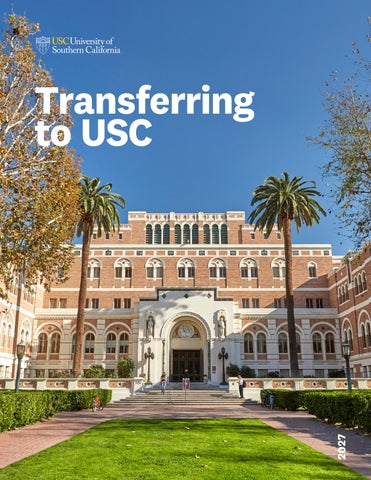
2027
Transferring to USC
1
Founded in 1880, the University of Southern California is a top-tier, private research institution located in the heart of a dynamic world center. As a transfer student at USC, you will enjoy unparalleled opportunities inside and outside the classroom. From access to world-class faculty and the ability to conduct your own original research, to acquiring real-world experience through service-learning and internship programs, the possibilities are endless. Transfer admission to USC remains highly competitive, and we look for students with outstanding academic records, talents and leadership skills. This brochure will introduce you to our admission policies, academic requirements and the courses you will need to successfully transfer to USC. We hope you find this information helpful, and we look forward to working with you in the future.
Fight On!
Table of Contents USC at a Glance
2
Application Process
3
Majors
4
Planning Your Transfer
6
Prepare to Apply
6
Planning Your Coursework
8
Helpful Resources
9
Transfer Planning Worksheet
10
General Education Courses
11
Additional Coursework by Major
12
Transfer Credit Policies
16
Resources Financial Aid
18
18
Campus Support Centers
19
Frequently Asked Questions
20
US C at a Glance
USC at a Glance 1880 FOUNDED
2026 Transfer Student Profile *
Our Transfer Students Come From...*
11,500
56%
LOCATION
APPLICATIONS
CALIFORNIA COMMUNITY COLLEGES
229
2,700
Los Angeles
SIZE OF CAMPUS IN ACRES
FALL ADMISSION OFFERS
21,000
1,400
UNDERGRADUATES ENROLLED
SIZE OF ENROLLED CLASS
25,000
3.80
GRADUATE AND PROFESSIONAL STUDENTS ENROLLED
9:1
AVERAGE COLLEGE GPA
26% FIRST-GENERATION
26% U.S. COLLEGES OUTSIDE CALIFORNIA
10% CALIFORNIA STATE UNIVERSITY UNIVERSITY OF CALIFORNIA
5% CALIFORNIA PRIVATE COLLEGES AND UNIVERSITIES
STUDENT-TO-FACULTY RATIO
25 AVERAGE CLASS SIZE
500,000+ ALUMNI WORLDWIDE
2
3% *AS OF JULY 2026
INTERNATIONAL COLLEGES
A p p li c ati on Pro ce ss
Application Process The Common Application Submit at admission.usc.edu/commonapp. We do not require the Common Application College Report.
Additional Application Materials Official College Transcripts Make arrangements to provide USC with official transcripts from all colleges you have ever attended. The transcripts should show coursework completed through the most recent fall. (Electronic transcripts should be sent directly from the school — not from the student — to uetrans@usc.edu.) Failure to submit a transcript from any school you have attended may be viewed as a breach of academic integrity, which could result in revocation of admission and/or dismissal. Official High School Transcripts Submit official, final high school transcripts that show your date of graduation or leaving status. Students who did not earn a diploma should also submit a copy of a completion certificate, such as a GED or CAHSEE, and may include a note of explanation if they wish. Students who completed secondary school outside the U.S. may submit a copy of a diploma or leaving certificate instead. Major-Related Requirements Some majors also require an audition, portfolio, professional résumé, letters of recommendation or additional writing samples. Details can be found on the website for your program of interest. AT or ACT Scores (Optional) S Transfer applicants for the 2027-2028 academic year may choose to submit official SAT or ACT scores if they have completed fewer than 30 semester units of college coursework through the end of the spring term. SAT or ACT scores are not considered for students applying with more than 30 transferable semester units.
International students* Financial Statement of Personal or Family Support English Language Proficiency Test International students whose native language is not English must submit an English proficiency exam. A full list of acceptable scores and exams can be found in the Expectations for English Proficiency section on our International Students page, indicated below. *DACA and undocumented students are not considered international applicants. Learn more: admission.usc.edu/international
Transfer Information Sessions Led by an admission counselor, these virtual or in-person one-hour sessions are intended for students interested in learning about the process of transferring to USC.
Dates and Deadlines December 1, 2026 Transfer deadline for all: · BFA Cinematic Arts programs. · BFA Dramatic Arts programs. · All programs in the Kaufman School of Dance and the Thornton School of Music. February 15, 2027 Final transfer deadline for all other programs. Students who apply for admission by these deadlines will be considered for available scholarships. Admission Notification Timeline Applicants who submit complete applications by the appropriate deadline will receive either an admission decision or a request for springterm grades by the end of May 2027. Students who receive requests for spring grades will receive an admission decision by mid-July.
3
M a j ors
Choose From 150+ Majors USC offers undergraduates a wide array of majors and encourages students to customize their own programs of study through double majors or unique combinations of majors and minors. Students are challenged across a broad range of disciplines, within the curriculum and outside the classroom. The following majors apply to prospective transfer students only. Dornsife College of Letters, Arts and Sciences American Popular Culture American Studies and Ethnicity African American Studies American Studies Asian American Studies Chicano/Latino Studies Anthropology Applied and Computational Mathematics Archaeology and Heritage Studies Art History Astronomy Behavioral Economics and Psychology Biochemistry Biological Sciences Biophysics Central European Studies Chemistry Classics Cognitive Science Comparative Literature Computational Neuroscience Contemporary Latino and Latin American Studies Creative Writing Earth Sciences East Asian Area Studies East Asian Languages and Cultures (Chinese, Japanese, Korean) Economics Economics and Data Science Economics/Mathematics English Environmental Science and Health Environmental Studies French Gender and Sexuality Studies GeoDesign
4
Geological Sciences Global Geodesign Global Studies Health and Human Sciences History Human Biology Human Security and Geospatial Intelligence Intelligence and Cyber Operations International Relations International Relations (Global Business) International Relations and the Global Economy Italian Jewish Studies Latin American and Iberian Cultures, Media and Politics Law, History and Culture Linguistics Mathematics Middle East Studies Narrative Studies Neuroscience Non-Governmental Organizations and Social Change Philosophy Philosophy, Politics and Economics Philosophy, Politics and Law Physics Physics/Computer Science Political Economy Political Science Psychology Quantitative Biology Religion Russian Sociology Spanish
USC School of Architecture Architecture, B.ARCH
Iovine and Young Academy Arts, Technology and the Business of Innovation, B.S. Business of Innovation, B.S. Human Technology Interaction, B.S.
Roski School of Art & Design Art, B.A. Design, BFA Fine Arts, BFA
Marshall School of Business Accounting Business Administration
USC School of Cinematic Arts Animation + Digital Arts, BFA Cinema and Media Studies, B.A. Film and Television Production, B.A. Game Art, BFA Game Development and Interactive Design, BFA Media Arts + Practice, B.A. Themed Entertainment, BFA Writing for Screen & Television, BFA
Annenberg School for Communication and Journalism Communication Journalism Public Relations and Advertising
Kaufman School of Dance Dance, BFA
USC School of Dramatic Arts
Davis School of Gerontology
Acting, Stage and Screen, BFA Dramatic Arts, B.A. Musical Theatre, BFA Sound Design, BFA Stage Management, BFA Theatrical Design, BFA
Human Development and Aging Lifespan Health
Viterbi School of Engineering
Keck School of Medicine
Aerospace Engineering Astronautical Engineering Biomedical Engineering Biomedical (Electrical) Biomedical (Mechanical) Biomedical (Molecular-Cellular) Chemical Engineering Chemical (Biological and Pharmaceutical) Chemical (Energy and Sustainability) Chemical (Materials) Chemical (Petroleum) Civil Engineering Civil (Building Science) Civil (Construction Engineering and Management) Civil (Structural) Computer Engineering and Computer Science Computer Science Computer Science Games Computer Science/Business Administration Electrical and Computer Engineering Environmental Engineering Industrial and Systems Engineering Mechanical Engineering
Gould School of Law Legal Studies
Global Health Health Promotion and Disease Prevention Studies
Thornton School of Music Bachelor of Music degrees: Choral Music Composition, Classical Jazz Studies (instrumental and vocal) Music Production Popular Music Performance Classical Performance Bassoon Cello Clarinet Double Bass Flute French Horn Guitar Harp Oboe
Percussion Piano Saxophone Trombone Trumpet Tuba Viola Violin Vocal Arts
Bachelor of Science degree: Music Industry
Mann School of Pharmacy and Pharmaceutical Sciences Biopharmaceutical Sciences Pharmacology and Drug Development
Chan Division of Occupational Science and Occupational Therapy Occupational Therapy
Price School of Public Policy Public Policy Real Estate Development Urban Studies and Planning
Professional Emphases These represent advisement tracks only. They cannot be declared as majors. Pre-Dentistry Pre-Law Pre-Medicine Pre-Occupational Therapy Pre-Pharmacy Pre-Physical Therapy Pre-Physician Assistant Practice Pre-Teaching
Please refer to the USC Catalogue at catalogue.usc.edu for a full list of undergraduate degrees, including additional majors (such as Data Science) and emphases to which you can apply once at USC.
5
P l anni ng Your Transfer
Prepare to Apply We seek successful students who will make positive contributions to the USC community. The next few pages will help you plan your coursework to stay on track and maximize your chances of admission. The key to a successful transfer is good planning. Students who achieve at a high level and make good progress toward their intended degree will have the best chance of a successful application and on-time graduation. We offer this planning guide to help you realize your goal of transferring to USC. All students must complete General Education requirements to earn a bachelor’s degree, so we expect transfer students to satisfy several of these before admission. Although we do not require a specific number, a good rule of thumb is one or two GE courses per term. The pages that follow describe the requirements and provide tools to help you identify courses at your institution that are likely to count toward USC’s General Education program. 6
You should also familiarize yourself with the requirements for your intended degree and make good progress toward fulfilling them. Foreign language is a graduation requirement for many programs, including all Dornsife majors and several majors in other schools. Additionally, many programs — especially those in science and engineering — strongly recommend completing introductory, lower-division courses before transferring. If you are still in high school, you should remain so and consider applying as a first-year candidate. Competitive transfer applicants complete high school graduation requirements and earn a high school diploma. USC discourages students from leaving high school merely with the intention of starting college early.
Successful Transfer Applicants Typically: • Present strong academic performance. In 2026, the average college GPA of admitted transfer students was 3.80. • Show consistent progress toward a degree with at least one year of rigorous, full-time academic coursework. Competitive candidates typically take 14-16 units per term. • Complete the equivalent of USC’s writing/ composition requirement, Writing 130. • Meet our minimum math requirement by demonstrating a mastery up through Algebra II in high school or Intermediate Algebra in college with a grade of C or better. Many majors require more math, as detailed on pages 12-15. • Make satisfactory progress toward meeting USC General Education requirements. • Complete additional lower-division courses required by their intended major, if applicable. Refer to pages 12-15 to see if your intended major requires or recommends lower-division courses that should be completed before you transfer. This is especially important for students pursuing degrees in science, engineering, real estate development, architecture or business.
Due to the competitive nature of our admission process, meeting these typical academic expectations does not guarantee admission.
7
P l anni ng Your Transfer
Planning Your Coursework When to Transfer
Transfer Units
USC accepts both sophomore and junior transfer students.
USC does not require a minimum number of transfer units. However, if you will have earned fewer than 30 transferable semester units by the end of the spring term, we will base our decision in part on your high school record and SAT or ACT scores (if you submit them).
By transferring as soon as your sophomore year, you can take more of your General Education and elective courses at USC. You will be part of the USC community for a longer time and have more opportunities to get involved with campus life and make the connections that can help you after graduation. If your academic record in high school fell short of USC expectations, however, you may be able to position yourself as a stronger candidate if you complete two years of solid undergraduate coursework at another institution before applying to transfer. Additionally, if you complete most of your General Education requirements before transferring, you will have more time to pursue a double major, a major-minor combination or a unit-heavy major while you are enrolled at USC.
Still in High School? If you are still in high school, USC considers you a first-year applicant, regardless of the number of college units completed prior to high school graduation. If you have questions about your class standing, please call the USC Office of Admission at (213) 740-1111.
8
Remedial Coursework Placement exams offered at your current college will determine your need for any remedial coursework in writing and mathematics prior to your admission to USC. Remedial courses are not transferable.
Pass/No Pass Courses In general, competitive applicants will take the vast majority of their courses for a letter grade, if offered by their institution. As many as 24 semester units may be taken on a Pass/No Pass basis for USC graduation. Only one GE Core Literacy course may be taken on a Pass/No Pass basis. Both GE Global Perspectives courses (Categories G-H) may be taken on a Pass/No Pass basis. Please note that writing courses taken on a Pass/No Pass basis will not fulfill USC’s lower-division writing/composition requirement.
Helpful Resources Several resources are available to help you determine which courses and credits will transfer to USC. As a general rule, most courses that transfer to the University of California system will transfer to USC, although not all will fulfill the same requirements or offer the same equivalency. Feel free to contact your USC admission counselor if you have any questions or concerns. To find your counselor, please visit admission.usc.edu/find-your-counselor.
Transfer Planning Worksheet Beginning on the next page, the Transfer Planning Worksheet lays out USC’s General Education requirements, and provides an overview of what writing/ composition and math courses are required for admission. You may also use this worksheet to help you keep track of the transferable GE courses you have completed and what courses are still in progress. Following the worksheet, you will find any lowerdivision, introductory coursework that may be recommended or required for your intended major.
Articulation Agreements Transferring from a California community college: USC works with many of California’s community colleges to develop lists
of courses that will be accepted for transfer credit. Known as articulation agreements, these lists indicate the courses that fulfill General Education and other requirements, as well as equivalents to lower-division courses at USC. Articulation agreements are available online at darsweb.usc. edu/articagrmt/artic.aspx. Transferring from out-of-state community colleges: Although USC does not have articulation agreements with outof-state community colleges, most courses that will transfer to the flagship four-year public institutions in your state will transfer to USC.
satisfy USC’s General Education requirements, as well as the lowerdivision coursework required for your intended major. Visit darsweb.usc.edu/TPG, then select your college and major to generate a course list for the current academic year. Scan the QR code to access our articulation histories and agreements.
Transfer Planning Guide Intended primarily for students at California community colleges, this online resource will help you determine which undergraduate courses at other institutions will
9
P l anni ng Your Transfer
Courses Required for Admission Writing and math are required for all transfer students. Students intending to study science, business, engineering, real estate development or architecture are required to complete additional courses before transferring. Refer to pages 12-15 for details. Strong transfer candidates will enroll full time and complete 14-16 units, typically comprising four transferable courses, per term.
Transfer Planning Worksheet General Education USC’s General Education program is designed to introduce you to a breadth of knowledge that will help you succeed in the 21st century. We require eight courses within the six Core Literacies: one course each in The Arts, Life Sciences, Physical Sciences, and Quantitative Reasoning; and two courses each in Humanistic Inquiry and Social Analysis.
Graduation Requirements •T ransfer students must complete at least two GE courses in residence at USC Dornsife College from among the six Core Literacy categories. •O nce enrolled at USC, students must complete all remaining GE Core Literacy requirements at USC. •W e require two courses in Global Perspectives: one in Equity in a Diverse World and one in Traditions and Historical Foundations. •S ome Global Perspectives courses will satisfy requirements in the Core Literacies as well. A single course can satisfy one Global Perspectives and one Core Literacy requirement at most. •T ransfer students are not required to complete the General Education Seminar (GESM) required of firstyear students. • A course taken at another institution must be at least 3 semester units or 4 quarter units to be eligible for GE credit.
10
Writing/Composition Strong writing skills are essential for success at USC. All undergraduates are required to take two writing courses: one lower-division course and one upper-division course. The upper-division course must be taken at USC. However, successful transfer applicants will complete a course equivalent to the lower-division requirement, WRIT 130, before transferring to USC. Typically the second course in a college composition sequence satisfies this requirement. If your school does not offer a course equivalent to WRIT 130, you should take the strongest composition course available. This course may not be taken on a Pass/No Pass basis. Professional, technical, creative and remedial writing courses will not satisfy this requirement. If you are unsure whether your writing course is equivalent to WRIT 130, and it does not appear in our articulation agreements or histories, please keep the syllabus and papers for later review by USC. Course
Completed
In progress
Minimum Math You are expected to have earned strong grades in at least three years of high school mathematics, including Advanced Algebra (Algebra II) or Intermediate Algebra at the college level with a grade of C or better. Majors in the natural and social sciences, business, real estate development, engineering, and architecture at USC require specific mathematics courses and achievement beyond this level. If lower-division mathematics courses are required by your major, we advise you to complete them early in your college studies, prior to applying to USC. Please refer to “Additional Coursework by Major” on pages 12-15 to find out if your intended program of study requires additional coursework. Course
Completed
In progress
General Education Courses CORE LITERACIES GE–A
GE–B
The Arts
Courses that meet this requirement enable students to engage with the arts by teaching them to analyze and engage with works of art, understanding the context of their creations and their connections to cultural issues. Examples of acceptable courses: Art History (must include cultural context), Intro to Film, Art Appreciation (Great Works), History of Architecture (must include cultural context), History of Music, History of Dance, History of Photography, Intro to Theatre, Modern Art, Contemporary Art, Music Appreciation, History of Jazz, History of Rock and Roll, Dramatic Literature (plays from all eras). Not acceptable: Studio, performance, theory or pre-professional courses.
Course or Exam Completed In progress To be completed at USC
Humanistic Inquiry (2 Courses)
Courses that meet this requirement help students cultivate a critical appreciation for various forms of human expression by teaching them to evaluate works of literature, philosophy and the arts, and to think critically and formulate informed opinions about ideas and values.
GE–C
Social Analysis (2 Courses)
Courses that meet this requirement explore the causes and consequences of social phenomena by teaching students to apply the quantitative and qualitative methods of the social sciences to understand how people behave and influence the world through institutions and other cultural forms.
Examples of acceptable courses: Western Civilization, World Civilization, Intro to Philosophy, American Literature or English Literature, U.S. History, Intro to Religions, Eastern Religion, Western Religion, World Religions, Old Testament, New Testament, Mythology (Greek/Roman/World).
Examples of acceptable courses: Cultural Anthropology, Intro to Environmental Studies (people and policy focused), Intro to Sociology, Intro to Political Science, Intro to American Government, Intro to Gender Studies, Intro to Women’s Studies, Intro to LGBTQ+ Studies, Intro to International Relations, Intro to Peace and Conflict Studies, Language and Society.
Course
GE-E
The Physical Sciences
To be completed at USC
Completed In progress To be completed at USC
Course Completed In progress To be completed at USC
Course Completed In progress To be completed at USC
In progress
Courses that meet this requirement analyze natural phenomena through quantitative description and synthesis, teaching students to solve scientific problems and to understand the processes by which scientific knowledge is obtained, evaluated and placed in the context of societal relevance.
Examples of acceptable courses: General Biology, Physical Anthropology, Environmental Biology, Marine Biology.
Examples of acceptable courses: General Chemistry, Chemistry for Allied Health, General Physics, Oceanography, Elementary Astronomy, Physical Geography, Historical Geology, Physical Geology.
Courses must include an in-person lab component. Online or hybrid labs are not acceptable. Not acceptable: Botany, Intro to Psychology, Zoology.
Courses must include an in-person lab component. Online or hybrid labs are not acceptable.
GE-H Global Perspectives II
Courses that meet this requirement enhance understanding of citizenship and moral agency in today’s increasingly global society by teaching students to identify social, political, economic and cultural forces that bear on human experience in the U.S. and around the world.
Courses that meet this requirement examine the historical and cultural foundations of contemporary societies over a substantial period of time by teaching students to understand the enduring influence of literary, political, economic, philosophical, legal, ethical and religious traditions.
Examples of acceptable courses: Intro to International Relations, Intro to Peace and Conflict Studies, Contemporary Moral Issues.
Examples of acceptable courses: Art History (must include cultural context), History of Architecture (must include cultural context), Music History, History of Religion, History of [a particular region], History of Theatre, Western Civilization, World Civilization, U.S. History, Old Testament, New Testament, Mythology (Greek/Roman/World). Not acceptable: Intro to Religion (general); modern or contemporary history courses focused on the 20th century or later
Course or Exam
Course or Exam To be completed at USC
Course or Exam Completed In progress To be completed at USC
Course or Exam Completed In progress To be completed at USC
FOREIGN LANGUAGE GE–H
Completed In progress
Many degree programs require the thirdlevel course of a foreign language. See the “Foreign Lang.” column next to your intended major on pages 12-15. Students are encouraged to begin, if not finish, this requirement before transferring. Once at USC, transfers needing additional studies in foreign language must complete a placement exam before being allowed to register for courses. Students attending schools on the quarter system must complete the fifth-level course of a foreign language to satisfy this requirement. At some semester schools, a fourth-level course is equivalent to the third level at USC. A score of 4 or higher on an AP foreign language exam (other than Latin) can fulfill this requirement.
Quantitative Reasoning
Courses that meet this requirement teach students to use a set of formal tools, such as logical or statistical inference, probability, or mathematical analysis to pose and evaluate hypotheses, claims, questions, or problems within a formal mode of thought. Examples of acceptable courses: Microeconomics, Macroeconomics, Pre-Calculus, College Algebra, Statistics, Finite Math, Calculus, Math for Liberal Arts, Calculus for Business. Meeting this requirement with math placement test scores: Students may meet this requirement by earning a score of 22 on the USC Mathematics Placement Exam under certain conditions. Visit dornsife.usc.edu/ ge/policies for more information.
Course or Exam Completed In progress To be completed at USC
MAJOR-RELATED COURSES Use this space to record courses for your intended major listed on pages 12-15. Course or Exam Completed
In progress
Course or Exam Completed
In progress
Course or Exam Completed
In progress
Language courses taken fully or partially online do not satisfy this requirement. Course or Exam Completed
Completed In progress
In progress
Course or Exam
Course or Exam To be completed at USC
GE–F
Courses that meet this requirement provide a scientific understanding of a full range of living systems, from molecules to ecosystems, by teaching students to understand how data is generated, presented and interpreted, and how scientific discovery spurs technological growth and impacts society.
Course
Completed
GE-G Global Perspectives I
Completed In progress
The Life Sciences
Not acceptable: Preparatory Chemistry.
GLOBAL PERSPECTIVES GE–G
GE–D
To be completed at USC
Completed
In progress
P l a n n i ng Your Transfer
Additional Coursework by Major The course numbers listed below are USC course numbers. Please visit arr.usc.edu/transfer-credit-services to find an equivalent course at the college you attend. Majors that require a third-level foreign language for graduation are indicated with a checkmark in the “FOREIGN LANG.” column. Dornsife College of Letters, Arts and Sciences / dornsife.usc.edu MAJOR
FOREIGN LANG.
Astronomy
✓
Biological Sciences, Biochemistry
✓
RECOMMENDED PREPARATION
MATH 125 (Calculus I); MATH 126 (Calculus II); MATH 226 (Calculus III); MATH 245 (Mathematics of Physics and Engineering I); PHYS 151 (Fundamentals of Physics I: Mechanics and Thermodynamics); PHYS 152 (Fundamentals of Physics II: Electricity and Magnetism); PHYS 153 (Fundamentals of Physics III: Optics and Modern Physics). BISC 120 (General Biology: Organismal Biology and Evolution);. BISC 220 (General Biology: Cell Biology and Physiology); CHEM 105ab (General Chemistry I and II); PHYS 135a (Physics for the Life Sciences I) or PHYS 151 (Fundamentals of Physics I: Mechanics and Thermodynamics); PHYS 135b (Physics for the Life Sciences II) or PHYS 152 (Fundamentals of Physics II: Electricity and Magnetism); MATH 125 (Calculus I). Biochemistry also recommends: MATH 126 (Calculus II).
Biophysics, Chemistry, Physics
✓
MATH 125 (Calculus I); MATH 126 (Calculus II); MATH 226 (Calculus III); CHEM 105ab (General Chemistry I and II); PHYS 151 (Fundamentals of Physics I: Mechanics and Thermodynamics); PHYS 152 (Fundamentals of Physics II: Electricity and Magnetism); PHYS 153 (Fundamentals of Physics III: Optics and Modern Physics). Biophysics also recommends: BISC 120 (General Biology: Organismal Biology and Evolution); BISC 220 (General Biology: Cell Biology and Physiology); MATH 245 (Mathematics of Physics and Engineering I). Physics also recommends: MATH 245 (Mathematics of Physics and Engineering I).
Computational Neuroscience
✓
BISC 220 (General Biology: Cell Biology and Physiology); CHEM 105a (General Chemistry I); PSYC 100 (Introduction to Psychology); MATH 125 (Calculus I); MATH 126 (Calculus II); PHYS 135ab (Physics for the Life Sciences I and II).
Earth Sciences
✓
GEOL 105 (Planet Earth) or GEOL 107 (Oceanography); CHEM 105a (General Chemistry I); MATH 118 (Fundamental Principles of the Calculus) or MATH 125 (Calculus I); BISC 120 (General Biology: Organismal Biology and Evolution); CHEM 105b (General Chemistry II) or PHYS 135a (Physics for the Life Sciences I).
Economics
✓
ECON 203 (Principles of Microeconomics); ECON 205 (Principles of Macroeconomics); MATH 118 (Fundamental Principles of the Calculus) or MATH 125 (Calculus I).
Economics/ Mathematics
✓
ECON 203 (Principles of Microeconomics); ECON 205 (Principles of Macroeconomics); MATH 126 (Calculus II); MATH 225 (Linear Algebra and Linear Differential Equations) or MATH 245 (Mathematics of Physics and Engineering I); MATH 226 (Calculus III).
Environmental Science and Health
✓
BISC 120 (General Biology: Organismal Biology and Evolution); BISC 220 (General Biology: Cell Biology and Physiology); CHEM 105ab (General Chemistry I and II). For details regarding other course requirements visit dornsife.usc.edu/environmental-studies/environmental-science-andhealth-major.
Geological Sciences
✓
CHEM 105ab (General Chemistry I and II); GEOL 105 (Planet Earth); MATH 125 (Calculus I); MATH 126 (Calculus II); PHYS 135a (Physics for the Life Sciences I) or PHYS 151 (Fundamentals of Physics I: Mechanics and Thermodynamics) or BISC 120 (General Biology: Organismal Biology and Evolution); PHYS 135b (Physics for the Life Sciences II) or PHYS 152 (Fundamentals of Physics II: Electricity and Magnetism) or BISC 220 (General Biology: Cell Biology and Physiology).
Health and Human Sciences
✓
BISC 220 (General Biology: Cell Biology and Physiology); CHEM 105a (General Chemistry I).
Human Biology
✓
BISC 120 (General Biology: Organismal Biology and Evolution); BISC 220 (General Biology: Cell Biology and Physiology); CHEM 105ab (General Chemistry I and II);* MATH 108 (Contemporary Precalculus); MATH 125 (Calculus I);* PHYS 135a (Physics for the Life Sciences I) or PHYS 151 (Fundamentals of Physics I: Mechanics and Thermodynamics).* *Not required for the B.A.
International Relations
✓
Requires a fourth-level course of foreign language for degree completion.
International Relations (Global Business)
✓
Both Programs: ECON 203 (Principles of Microeconomics); ECON 205 (Principles of Macroeconomics); MATH 118 (Fundamental Principles of the Calculus).
International Relations & the Global Economy
✓
Dornsife College of Letters, Arts and Sciences / dornsife.usc.edu MAJOR
FOREIGN LANG.
RECOMMENDED PREPARATION
Mathematics, Applied and Computational Mathematics
✓
MATH 125 (Calculus I); MATH 126 (Calculus II); MATH 225 (Linear Algebra and Linear Differential Equations); MATH 226 (Calculus III).
Neuroscience
✓
BISC 220 (General Biology: Cell Biology and Physiology); CHEM 105a (General Chemistry I); PSYC 100 (Introduction to Psychology); MATH 125 (Calculus I). The B.S. program in Neuroscience also requires CHEM 105b and PHYS 135ab for degree completion.
Physics/Computer Science
✓
MATH 125 (Calculus I); MATH 126 (Calculus II); MATH 225 (Linear Algebra and Linear Differential Equations); MATH 226 (Calculus III); MATH 245 (Mathematics of Physics and Engineering I); PHYS 151 (Fundamentals of Physics I: Mechanics and Thermodynamics); PHYS 152 (Fundamentals of Physics II: Electricity and Magnetism).
Political Science
✓
POSC 100 (Theory and Practice of American Democracy); POSC 120 (Comparative Politics).
Psychology
✓
PSYC 100 (Introduction to Psychology); MATH 114 (Foundation of Statistics).
Sociology
✓
SOCI 200 (Introduction to Sociology).
All other majors
✓
Courses vary. Visit dornsife.usc.edu/majors.
Iovine and Young Academy / iovine-young.usc.edu MAJOR
FOREIGN LANG.
RECOMMENDED PREPARATION
Arts, Technology and the Business of Innovation (B.S.)
Required for admission: In addition to the Common Application, applicants are required to submit a portfolio of their work. Select candidates will be invited to a virtual admission interview.
Business of Innovation (B.S.)
Required for admission: The Business of Innovation major requires MATH 118 (Fundamental Principles of the Calculus) or MATH 125 (Calculus I). The calculus course must be completed by the end of the spring semester for admission consideration. Fall completion is preferred.
Human Technology Interaction (B.S.)
Required for admission: The Human Technology Interaction major requires two courses of calculus (or higher-level math beyond calculus) after high school with a minimum of MATH 126 (Calculus II) in progress at the time of application.
Please note the Academy curriculum is sequential and may require three to four years at USC to complete, depending on how many General Education courses are satisfied prior to transfer.
Applicants to any Iovine and Young Academy degree program are strongly encouraged to review the detailed instructions regarding the transfer admission process at iovine-young.usc.edu/apply/undergraduate.
USC School of Architecture / arch.usc.edu MAJOR
FOREIGN LANG.
RECOMMENDED PREPARATION
Architecture B.ARCH
Required for admission: The B.ARCH program requires MATH 108 (Contemporary Precalculus).
Architecture and Inventive Technologies (B.S.)
Required for admission: Architecture and Inventive Technologies requires MATH 125 (Calculus I). Recommended course for both programs: PHYS 125 (Physics for Architects) or PHYS 135ab (Physics for the Life Sciences I & II). The five-year Bachelor of Architecture program is a professional degree accredited by the National Architecture Accrediting Board (NAAB). Placement level and the amount of time to complete the studio sequence are dependent on skill level, not unit count. Submit a recommendation from a college/university instructor or your college academic advisor via Slideroom. Letters from high school teachers or counselors will not be accepted. When selecting General Education courses, please focus on Categories B, C, D, G and H. If you are admitted to the B.Arch program, Categories A, E and F will be fulfilled by major requirements. All transfer applicants must submit a portfolio directly to the School of Architecture via uscarch.slideroom.com. Consult the School of Architecture program website for instructions.
Roski School of Art and Design / roski.usc.edu MAJOR
Art (B.A.) Design (BFA) Fine Arts (BFA)
FOREIGN LANG.
✓
RECOMMENDED PREPARATION
All Programs: Submit two letters of recommendation from current or former art instructors via Slideroom. When selecting General Education courses, please focus on Categories C, D, E or F. Categories A, B, G and H will be fulfilled by major requirements. All studio courses taken outside USC are subject to an online portfolio review by Roski faculty prior to granting credit for them. For this reason, if you are admitted, prepare to submit additional portfolios of appropriate artwork and syllabi for each art or design course taken. All transfer applicants must upload a portfolio of 10-15 images of recent artwork (completed within the past two years), the prompt-based artist essay, and a list of creative accomplishments to roski.slideroom.com. See Roski website for more details.
Marshall School of Business & Leventhal School of Accounting / marshall.usc.edu MAJOR
Business & Accounting
FOREIGN RECOMMENDED PREPARATION LANG.
Required for admission: MATH 118 (Fundamental Principles of the Calculus) or MATH 125 (Calculus I). The calculus course must be completed by the end of the spring semester for admission consideration. Fall completion is preferred. All upper-division business core courses and major electives must be taken at USC. Business courses completed at another college or university may earn general elective credit. Recommended for admission: Students are encouraged to enroll in available General Education courses.
Majors that require a third-level foreign language for graduation are indicated with a checkmark in the “FOREIGN LANG.” column.
USC School of Cinematic Arts / cinema.usc.edu MAJOR
FOREIGN LANG.
RECOMMENDED PREPARATION
Animation + Digital Arts applicants: These courses of study will require four years to complete, regardless of the number of units transferred.
Animation + Digital Arts (BFA) Cinema & Media Studies (B.A.)
✓
Please visit cinema.usc.edu for program details.
Film & Television Production (B.A.)
✓
Film & Television Production applicants: Applicants must complete at least 48 transferable semester units through the spring term, not including courses or exam credit completed during high school.
Game Art (BFA)
Game Art applicants: This program will require three years to complete, regardless of the number of units transferred.
Game Development and Interactive Design (BFA)
Game Development and Interactive Design applicants: These programs will require three years to complete, regardless of the number of units transferred.
Media Arts + Practice (B.A.)
✓
Media Arts + Practice applicants: This program will require three years to complete, regardless of the number of units transferred.
Themed Entertainment (BFA)
Themed Entertainment applicants: This program will require three years to complete, regardless of the number of units transferred.
Writing for Screen & Television (BFA)
Writing for Screen & Television applicants: These programs will require four years to complete, regardless of the number of units transferred.
In addition to the general math and writing requirements, applicants to Cinematic Arts majors are encouraged to complete as many General Education requirements as possible before transferring. In addition to the Common App, all undergraduate applicants must submit a SlideRoom application at usccinema.slideroom.com. The application deadline for BFA programs is December 1, 2026. Visit cinema.usc.edu/admissions/apply.cfm for details.
Annenberg School for Communication and Journalism / annenberg.usc.edu MAJOR
FOREIGN LANG.
RECOMMENDED PREPARATION
Communication
✓
Communication applicants: Communication courses taken at another college or university will not count toward the Communication major.
Journalism
✓
Journalism and Public Relations applicants: You may transfer in a maximum of 12 units of advertising, journalism and public relations courses for elective credit only.
Public Relations and Advertising
✓
Please visit annenberg.usc.edu/admissions/undergraduate-applicants for detailed information.
The best preparation for an Annenberg major is progress toward completing the USC General Education program and having completed at least one level of a foreign language. In addition: A letter of recommendation is optional.
Kaufman School of Dance / kaufman.usc.edu MAJOR
FOREIGN LANG.
RECOMMENDED PREPARATION
Applicants should focus on GE Core Literacy categories B, C, E, and F. The BFA core fulfills A, D, one B course, and both Global Perspectives categories (G and H).
Dance (BFA)
Select students will be invited to audition. Please note that the BFA program requires four years to complete at USC. In addition to the Common Application, all applicants are required to submit the USC Kaufman Portfolio, which includes pre-screening videos, a dance résumé and photographs, via uscdance.slideroom.com. Please visit kaufman.usc.edu/apply for complete details.
USC School of Dramatic Arts / dramaticarts.usc.edu MAJOR
FOREIGN LANG.
Dramatic Arts (B.A.)
✓
Dramatic Arts (BFA)
RECOMMENDED PREPARATION
There is no audition or portfolio review component for B.A. applicants. The B.A. deadline for transfer applicants is February 15, 2027. BFA applicants to programs in Acting, Musical Theatre, Sound Design, Theatrical Design and Stage Management are required to submit pre-screen materials or a portfolio via uscdramaticarts.slideroom.com. A select number of applicants will be invited for a second round of review. The BFA deadline for all applicants is December 1, 2026. Please visit dramaticarts.usc.edu/programs/undergraduate/apply for complete details.
Viterbi School Of Engineering / viterbiadmission.usc.edu/transfer MAJOR
FOREIGN LANG.
Engineering & Computer Science (all majors)
RECOMMENDED PREPARATION
Applicants to any engineering or computer science degree program are strongly encouraged to review the detailed instructions and transfer course plans at viterbiadmission.usc.edu/transfer. Specific instructions and counseling vary by degree program. Required for admission: Two courses of calculus (or higher-level math beyond calculus) after high school with a minimum of MATH 126 (Calculus II) in progress at the time of application. Science or Computer Programming courses: All applicants must complete lab-based science or computer programming courses as determined by their desired major at USC. Please see the Viterbi School transfer website at viterbiadmission.usc.edu/transfer for specific course advisement.
Davis School Of Gerontology / gero.usc.edu MAJOR
FOREIGN LANG.
RECOMMENDED PREPARATION
Recommended courses for the Health Science track: BISC 120 (General Biology: Organismal Biology and Evolution); BISC 220 (General Biology: Cell Biology and Physiology); CHEM 105ab (General Chemistry I and II); MATH 125 (Calculus I); PHYS 135ab (Physics for the Life Sciences I and II); CHEM 322ab (Organic Chemistry I and II). There is no foreign language requirement for the Health Science track.
Human Development and Aging (Health Science track) Human Development and Aging (Social Science track)
✓
Lifespan Health
✓
Students pursuing Human Development and Aging (Social Science track) or Lifespan Health degrees must meet a foreign language or computer programming requirement.
Gould School of Law / gould.usc.edu MAJOR
FOREIGN LANG.
Legal Studies (B.S.)
RECOMMENDED PREPARATION
There are no specific required preparatory courses. However, classes taken in the following fields will be valuable to entering students: writing, history, political science, and English, along with social sciences and humanities-related classes.
Keck School of Medicine / keck.usc.edu | pphs.usc.edu MAJOR
FOREIGN LANG.
RECOMMENDED PREPARATION
Global Health
✓
Global Health: BISC 220 (General Biology: Cell Biology and Physiology); CHEM 105a (General Chemistry); ECON 203 (Principles of Microeconomics); MATH 108 (Contemporary Precalculus) or MATH 125 (Calculus I).
Health Promotion and Disease Prevention
✓
HPDP: BISC 120 (General Biology: Organismal Biology and Evolution); BISC 220 (General Biology: Cell Biology and Physiology); CHEM 105a (General Chemistry); MATH 108 (Contemporary Precalculus) or MATH 125 (Calculus I)*; PSYC 100 (Introduction to Psychology). *Required for pre-health students.
Thornton School of Music / music.usc.edu MAJOR
FOREIGN LANG.
Music Industry (B.S.)
RECOMMENDED PREPARATION
The B.S. in Music Industry requires four units of Economics coursework, which can be satisfied with any ECON course number 100-499. This program also requires an accounting course that covers managerial and financial accounting. Course(s) that cover both topics can satisfy this requirement. During orientation, incoming transfer students will be required to provide their academic advisor with a syllabus to confirm that their accounting course(s) covered both topics. In addition to the Common Application, all undergraduate applicants must submit a Thornton SlideRoom Portfolio via uscmusic.slideroom.com. The transfer application deadline for all Thornton programs is December 1, 2026. Visit music.usc.edu/admission for detailed information about how to apply and required supplemental materials. Visit music.usc.edu/admission/transfer for more information about transferring to the Thornton School.
ALL MUSIC PROGRAMS
Chan Division of Occupational Science and Occupational Therapy / chan.usc.edu/education/bs-to-otd Occupational Therapy (B.S. to OTD)
For details, please visit the USC Chan website listed above.
Mann School of Pharmacy and Pharmaceutical Sciences / mann.usc.edu MAJOR
FOREIGN LANG.
Biopharmaceutical Sciences (B.S.) Pharmacology and Drug Development (B.S.)
RECOMMENDED PREPARATION
MATH 108 (Contemporary Precalculus) or MATH 118 (Fundamental Principles of the Calculus) or MATH 125 (Calculus I);* BISC 120 (General Biology: Organismal Biology and Evolution);* BISC 220 (General Biology: Cell Biology and Physiology); CHEM 105ab (General Chemistry). *Required for pre-pharmacy students.
Price School of Public Policy / priceschool.usc.edu MAJOR
FOREIGN LANG.
RECOMMENDED PREPARATION
Public Policy
Required for admission: Public Policy, and Urban Studies and Planning, both require MATH 117 (Introduction to Mathematics for Business and Economics) and ECON 203 (Principles of Microeconomics) for degree completion.
Real Estate Development
Required for admission: The Real Estate Development major requires ECON 203 (Principles of Microeconomics) and one of the following: MATH 108 (Contemporary Precalculus); MATH 117 (Introduction to Mathematics for Business and Economics), MATH 118 (Fundamental Principles of the Calculus) or MATH 125 (Calculus I).
Urban Studies and Planning
P l anni ng Your Transfer
Transfer Credit Policies nits That Must Be U Earned at USC With a few exceptions, transfer students must complete a minimum of 64 units in residence at USC, or half the units typically required for graduation. While in residence at USC, you are also expected to: • Complete all upper-division units for your major and minor. • Complete WRIT 340, a minimum of two Core Literacy GE courses from a Dornsife College department, and any remaining General Education courses not taken before entering USC. • Take all your fall- and springsemester courses for credit at USC. Courses may be taken at other institutions only during summer sessions, with limitations. Exceptions: • Engineering 3+2 Program: Students must complete a minimum of 48 units in residence at USC. At least two out of three years of any transferable coursework must be completed at one of USC’s four-year partner institutions. • Bachelor of Architecture: Students must earn at least 80 units at USC. A maximum of 70 of the transferable units for this program may be earned elsewhere.
16
Transfer Unit Limits SC limits the transfer of credit U in certain categories. You may transfer up to: • Four (4) units each of English as a Second Language, physical education activity courses and music ensemble courses. • Eight (8) units of dance. • Twelve (12) units of physical education theory courses. • Sixteen (16) units of individual instruction in music. • Other studio and performing arts classes are also limited. Please keep copies of your syllabi and all major-related coursework (exams and papers) in case you need to petition for credit.
ourses/Units That Will C Transfer Accredited courses: Coursework completed at, or degrees from, U.S. institutions accredited by the six regional accrediting agencies are generally accepted. Coursework completed at international postsecondary institutions approved by the local Ministry of Education as degree-granting institutions may also transfer. Advanced Placement (AP), International Baccalaureate (IB), A-level and other standardized examinations: We accept a maximum of 32 units for standardized examinations.
Please visit arr.usc.edu/ transfercredit for a list of standardized exams and the course requirements they fulfill. College courses taken during high school: We accept a maximum of 16 units, which are included in the 32-unit combined maximum for exam credits. These courses must be part of the regular college curriculum, taught by college faculty and open to all full-time students at that college. They can fulfill General Education requirements, but they cannot fulfill the writing or foreign language requirements nor receive equivalence to USC courses.
Courses/Units That May Transfer Nontraditional formats/time frames: Distance-learning, online courses, concentrated “intensive” sessions, special weekend modules and other nontraditional course formats and time frames will be considered by petition, and credit is granted on a case-by-case basis. Be sure to keep copies of course syllabi, exams and papers, as we may ask for these in making our determination. Please note that elective units only — not equivalence to USC courses or fulfillment of requirements — are granted for foreign language and laboratory science courses taught via distance learning, TV, or in an online or correspondence course. Exceptions MAY be made for foreign language or laboratory science courses taken before fall 2022 if they were intended to be completed in person but were moved online due to COVID-19.
Determining Your Transfer GPA USC calculates your transfer GPA on the basis of your grades in all USC-transferable courses, including grades of D and below. Plus and minus grading is taken into account. Expired incompletes, unofficial withdrawals and missing grades are treated as an F. Credit/No Credit and Pass/No Pass marks are not included in the transfer GPA.
Courses/Units That Will Not Transfer Unaccredited institutions: Coursework or degrees completed at institutions without U.S. regional accreditation. Low grades: Courses in which your grade was lower than C– (1.7). No degree credit: College extension courses and courses taken at international institutions not credited toward a degree at that college. Courses in areas of study not offered by USC: These include agriculture, business office procedures, hotel management, food services, industrial mechanics, interior design, fire science, forestry, police academy, and similar professional and technical programs. Duplicated material: Standardized exams or college courses covering the same material.
Life and work experience: Including portfolio work, continuing education, equivalency examination units, and courses offered by business and governmental agencies (even if evaluated by the American Council on Education). Placement exams: Courses and/ or unit credits awarded by another institution for placement exams or credit by exam. Remedial/college prep/ personal development: Including mathematics courses below the level of college-level algebra. (Intermediate Algebra, USC’s minimum math requirement for admission, is not transferable.) Nontraditional formats at two-year colleges: Including independent study, directed study, correspondence courses, internships and travel courses.
USC does not honor other colleges’s academic “renewal” or “forgiveness” programs that permit students to improve a substandard grade. If you repeat a transferable course for which you earned a grade of D+ or lower, both grades will be included in your transfer GPA. If the grade on the first course was a C- or higher, only the first grade is included. Your transfer GPA is different from the GPA earned in courses you take at USC. The transfer GPA and your USC GPA are kept separate until it is time to determine if you are eligible to graduate and earn graduation honors, as described in the USC Catalogue.
Academic Standards and Requirements The USC Catalogue is the document of authority on policy matters, and it changes from time to time. It provides complete information about academic standards governing coursework taken at other colleges, as well as specific requirements for your major field. Please visit catalogue.usc.edu for the most current version.
Graduate-level courses: Graduate-level coursework taken by undergraduate students.
17
Re s ou rc e s
Financial Aid Administering one of the nation’s largest financial aid programs, USC works in close partnership with families to make a USC education attainable, bridging the gap between the cost of attendance and each family’s USC-determined financial need. Undergraduate applicants must satisfy all eligibility requirements and meet all deadlines.
2026-2027 Estimated Cost of Attendance The following are estimated two-semester costs for a full-time USC undergraduate (taking 12-18 units each semester) living in university housing: Tuition Fees Housing Food Books and supplies Personal and miscellaneous Transportation
$75,384 $1,952 $13,510 $8,442 $670 $2,016 $1,188
Total
$103,162
(Add $450 New Student Fee for your first semester.)
Undergraduate financial aid includes federal, state and university need-based grants; merit scholarships; and Federal Work-Study and loans for students and parents.
Financial Aid Calculators financialaid.usc.edu/calculators Receive an initial estimate of any needbased financial aid you may qualify for. Designed specifically for transfer students, the MyinTuition Quick Cost Calculator does not require detailed financial information and takes only a few minutes to use.
More than two-thirds of USC undergraduates receive some form of financial aid. In 2024-2025, nearly 80 percent of that aid was in the form of grants and scholarships. Merit scholarships and need-based grants are awarded on the basis of academic merit and/or demonstrated need, respectively, and do not need to be repaid. To apply for financial aid, you must submit the Free Application for Federal Student Aid (FAFSA) and the CSS Profile. Transfer students must apply by March 2, 2027, to be considered for all available funding and to ensure timely notification of their financial aid eligibility. The USC Payment Plan and other payment options are also available. Please visit sfs.usc.edu for more information. USC Scholarships are administered consistent with the University’s Notice of Non-Discrimination. Recipients are chosen without regard to race, color, national origin, sex, sexual orientation, or any other prohibited characteristic.
18
Campus Support Centers A number of resources are available for transfer students — including housing, the Veterans Resource Center, and Academic Counseling Services — which can help ease the transition to life at USC.
Housing Most USC students prefer to live near campus. Although university-owned housing may be available, housing for transfer students is not guaranteed, and many students choose to rent privately owned apartments nearby, many of which have been vetted by the university. housing.usc.edu
USC Veterans Resource Center Through an array of affiliated services and programs, the USC Veterans Resource Center helps ease the transition to USC for military veterans. Services range from academic and career counseling, to financial aid and veteran benefits information, to religious life. vrc.usc.edu
First Generation Plus Success Center The First Generation Plus Success Center (FG+SC) serves as a resource hub for current first-generation, undocumented, former foster youth and transfer students as they navigate campus. The center’s mission is to create a culture of belonging that will facilitate the transition into college life. firstgenplussc.usc.edu
Student Culture and Community Centers USC Student Life runs our Student Culture and Community centers, which focus on belonging and well-being and help students connect with the resources and support they need. youbelong.usc.edu
Meet Us Detailed information about events can be found at admission.usc.edu/meet-us. Transfer Information Sessions An admission counselor will discuss how courses transfer to USC and what makes for a competitive transfer application. Virtual and in-person options are available. Campus Tours Experience our campus and learn about all that USC has to offer. Academic Information Sessions Hear from department representatives about your specific major and the opportunities available in your program of interest. Virtual and inperson options are available. These programs are open to all eligible individuals. The USC Office of Undergraduate Admission operates all of its programs and activities consistent with the University’s Notice of Non-Discrimination. Eligibility is not determined based on race, sex, ethnicity, sexual orientation, or any other prohibited factor. 19
FAQ
Frequently Asked Questions Are USC’s admission requirements different for students transferring from outside California?
Will it be difficult to transfer to USC’s semester schedule if I’m at a quartersystem school?
No. Admission requirements are the same for all students, regardless of their state of residence. Also, because USC is a private university, all students are charged the same tuition and fees.
No. Quarter-system schools are usually compatible with USC’s fall and spring-semester start dates. To determine their semester equivalent, divide quarter units earned by 1.5 (for example, 45 quarter units equal 30 semester units). Courses must be at least 4 quarter units to earn equivalence or General Education credit at USC.
If my college grades are excellent, but my high school record was just average, could that affect my admission to USC?
I f you complete at least 30 transferable college semester units in a strong academic program, our decision focuses primarily on that work. If you have earned fewer than 30 units at the college level, however, your admission will depend on a combination of your high school record, results of any (optional) SAT or ACT tests taken during high school, and college courses completed to date. What if I did not graduate high school?
If there are special or extenuating circumstances that prevented you from graduating high school, please submit your GED or similar leaving certificate with a statement of explanation. We also require transcripts listing any high school work you did complete. USC discourages students from leaving high school merely with the intention of starting college earlier. International applicants are also expected to earn the equivalent of a full high school diploma in their home country. If your high school record indicates weak preparation for a rigorous college-level curriculum, we will expect to see a strong turnaround in your college coursework.
20
Does USC have a math requirement?
USC expects students to have mastered the equivalent of Intermediate Algebra with at least a C grade. Some programs require students to take a higher level math course before applying to USC. Students who did not complete Algebra I, Geometry, and Algebra II in high school with a C or better each semester should plan to take Intermediate Algebra or a more advanced course at the college level. Students will be required to complete the General Education program to meet degree requirements. Refer to the “Planning Your Coursework” section of this guide for more detailed information. Due to disruptions caused by COVID-19, exceptions may apply to courses taken before fall 2022. Please note, however, that transfer applicants must still meet the minimum math requirement by earning a C or better in the required math courses. How can I be sure of the exact requirements for my intended major?
The USC Catalogue provides official lists of degree programs and their graduation requirements. Visit catalogue.usc.edu for the most current version. Admission requirements can be found on pages 12-15 of this brochure.
When will I get my admission decision?
You will receive either an admission decision or a request for more information, such as spring grades, by the end of May. If we require more information, you may not receive a decision until mid-July. Can you evaluate my credits before I apply to USC?
Credit evaluations are initiated only for admitted students who have committed to enrolling at USC. For help before you apply, access our Transfer Planning Guide at darsweb. usc.edu/TPG. (See page 9 for more details.) Additionally, your college transfer counselors can help you review our articulation agreements and histories, as well as our admission policies. Does the competitiveness of my intended major affect my chances of admission?
I n addition to the intended major, we consider every applicant’s second-choice major. Even so, we cannot always find spaces for the many capable students who are not recommended for their intended fields of study. Can I transfer classes taken Pass/ No Pass or Credit/No Credit?
In general, we discourage students from taking required courses on a Pass/No Pass basis when letter grading is available, as this may negatively affect an admission decision. Transfer students can, however, take as many as 24 semester units on a Pass/No Pass basis, including up to four units of GE Core Literacy requirements for graduation. Exceptions: • Composition courses cannot be taken as Pass/No Pass. • If a course is offered only as Pass/ No Pass, these limits do not apply.
Does USC consider the rigor of my college or university?
We are primarily concerned with the specific coursework you chose and the grades you earned. We then evaluate your work within the context of your institution. oes USC accept courses used D to fulfill the IGETC?
USC has its own distinct General Education requirements. The Intersegmental General Education Transfer Curriculum (IGETC) was developed for the University of California and California State University systems, and coursework within IGETC does not automatically fulfill our GE requirements. However, courses used to fulfill the IGETC are generally transferable to USC. Can I afford to attend?
Because we are committed to making a USC education affordable, the university works to meet the USCdetermined financial need of all eligible admitted undergraduate students. USC also offers a payment plan and other financing options. How can I find out about scholarships?
All students who submit a complete application for admission by February 15, 2027, will be automatically considered for available scholarships offered by the Office of Admission. Visit admission.usc.edu/scholarships for additional scholarships you may be eligible for. Be sure to pay close attention to deadlines.
Is it possible to attend USC part-time?
Yes, but it is not common. Part-time students pay the per-unit tuition rate rather than the flat fee, and you must be enrolled at least half-time to qualify for financial aid. Most undergraduate students attend USC on a full-time basis. Undergraduate coursework at USC may not be completed through evening-only or fully online programs. Can I complete my degree at USC by taking evening classes only?
Probably not. Although some night courses are offered each semester, most of the courses you will need to complete your degree will be offered only during the day. May I apply for the spring semester?
We do not accept applications for spring admission, but all applicants who apply for fall admission are considered for a place in the following spring-semester class. What are the admission requirements for international students?
In addition to the Common App and supporting materials listed on page 3, international students are required to provide a financial statement. If your native language is not English, you will be required to provide proof of English proficiency. Note that DACA and undocumented students are not considered international applicants. Details can be found at admission. usc.edu/international. How can I receive the USC Catalogue?
Many agencies, foundations and corporations also offer scholarships. Check with the financial aid office or transfer center at your current college, search online or visit a public library for books that list funding sources.
The most current version of the USC Catalogue is available online at catalogue.usc.edu.
Visit financialaid.usc.edu for information about some of these online sources.
Many of your questions — and some you may not have even thought about — will be answered during a Transfer Information Session (see the Meet Us section on page 19 for details).
If I have more questions, where can I find answers?
We encourage you to check out admission.usc.edu/ transfer for a wealth of information, or visit admission. usc.edu/contact to contact the Office of Admission. You can also find the USC admission counselor for your current school at admission.usc.edu/ find-your-counselor.
The University of Southern California prohibits discrimination and harassment on the basis of actual or perceived race, color, ethnicity, religion, creed, sex, age, marital status, national origin, citizenship status, employment status, income status, shared ancestry and ethnic characteristics, partnership status, medical condition (including pregnancy and related medical conditions), disability, political belief or affiliation, domestic violence victim status, military or veteran status, sexual orientation, gender, gender identity, gender expression, genetic information, and any other class of individuals protected from discrimination under federal, state, or local law, regulation, or ordinance in any of the University’s educational programs and activities. For questions about compliance with the notice of non-discrimination, please contact the Office of Civil Rights Compliance at https://ocrc.usc.edu or email ocrc@usc. edu. For disability-related questions, the University has also designated an ADA/ Section 504 Coordinator, Christine Street, Associate Vice President, Disability Access and ADA Compliance, who can be reached at streetc@usc.edu, (213) 821-4658, 3601 Trousdale Parkway, Bldg. #89, Los Angeles, California 90089.
21
NON-PROFIT ORGANIZATION
U.S. POSTAGE PAID
Office of Admission University of Southern California Los Angeles, CA 90089-0911 admission.usc.edu
Gain tips, advice and insights into our admission process, directly from our counselors, at www.admissionblog.usc.edu.
@uscadmission
UNIVERSITY OF SOUTHERN CALIFORNIA