044 048 052 056 058

044 048 052 056 058
Image Credit: Erika Lindsay
Intrigued by remnants of the past and inspired by possibilities for the future, Erika Lindsay is an architectural researcher, educator, interdisciplinary designer, photographer, and maker. She is founder of Umbrella, a media-infused research and design practice which embraces collaboration and curiosity through creating at many scales. Her recent work documents the reappropriation of monuments in former Yugoslavia as part of her ongoing research into memorial elasticity. Lindsay has master’s degrees from the University of Michigan in architecture and architectural conservation, and a bachelor’s degree in fine arts with a concentration in digital cinema from the College for Creative Studies.
This research into former Yugoslavia’s spomenik (monuments) explores the critical relationship between a series of material memorials, their mediatized representations and their most recent appropriation in order to underscore the transformative nature of historic signification as both a built and symbolic continuum. Erected over the span of twenty years before Josip Tito’s death and just prior to Yugoslavia’s disintegration, the spomenik currently epitomize a gradient of decay, some fixed while others are in rapid flux at a critical point for conservation efforts. In each instance, however, their contemporary condition in stark juxtaposition to an original intended meaning points to the persistent power and allegorical potential of counter-monumentality. Tracing the modes in which these contradictory and semantically charged sites operate in response to or in spite of contemporary preservation efforts, allows for reflection upon both authoritative and informal cooption of singular cultural connotation and speculation about the power of memorial elasticity.
Spomenik were built by a regime set on moving forward and forgetting wartime atrocities committed on all sides by commemorating partisan victories over the axis powers. During World War II, many battles were fought on Yugoslavian soil. At the same time, the region was enmeshed in a civil war, which resulted in the formation of the Republic of Yugoslavia, comprised of six republics. In the post-war years this gave the Yugoslav people something to unite around. Anti-religious propaganda of the postwar era unified Yugoslavia and attempts at ritualizing the act of remembrance around World War II anti-fascist struggles were done in an effort to seek this unity and focus on what the peoples of the newly formed republic had in common. Josip Tito, leader of the partisan resistance during the war years, had constructed a collective memory upon which to build the new Yugoslavia from the end of the war in 1945, when he came to power until his death in 1980, at which time, Yugoslavia remained at peace. Spomenik comprised a large part of this new Yugoslavian nationalism under Tito’s leadership. When communist states began to fall in the late 1980s in neighboring eastern Europe, the republic began to separate, focusing instead on its differences rather than what it had in common—the battles of the Second World War, mere stories of their grandparent’s generation. The new generation was interested in an attempt at re-discovering the cultural heritage that generations before had been expected to leave behind. Ethnic and religious tensions
were heightened as each group sought to find an identity that was relinquished or forgotten in order to live as one united Yugoslavia under Tito. Within a decade after his death, the Yugoslav Wars ensued, and with it the disintegration of the republic, as those who inhabited geographies of opposing ideologies, ethnicities and doctrine attempted to make territorial claims and proclaim independence.
The abstract form of the spomenik provoked collective forgetting in an effort to create a far-reaching, productive amnesia capable of galvanizing groups once pitted against one another. Productive gaps produced by abstract monuments allow the viewer to situate their own narrative within the form which can hold the possibility of universal signification, capable of becoming all things to all people. This stands in opposition to the man on the horse as a traditional and figural form of monument which has been used to commemorate significant human achievements for hundreds of years. In the abstract forms of partisan spomenik, signification is varied and fluid, rather than specific and rigid. Operating through pure signification, many partisan monuments did not use existing symbology such as that of the red star, or hammer and sickle indicative of many communist memorials, nor did they use religious symbology, opting instead to create their own symbology for each site, as part of the branding of the new Yugoslavian republic. This variability allows for multivalent reads, which is what has ultimately lead to their continued relevance today. [10]
Partisan spomenik standing today can do little more than represent a failed regime. Through acts of vandalism, natural forces and neglect, monumental decay writes a counter-narrative for the spomenik, which have come to stand in opposition to what they originally signified. [9] It is in this moment that the spomenik are rendered in their present state to be dialogic, that is, in dialogue with the ghosts of their former glory.
Ilinden Monument, space age in form, commemorates the anti-fascist liberation of Macedonia after World War II as well as the Illinden uprising against the Turkish occupation of 1903. Both events have been pivotal to the creation of present day Macedonia.
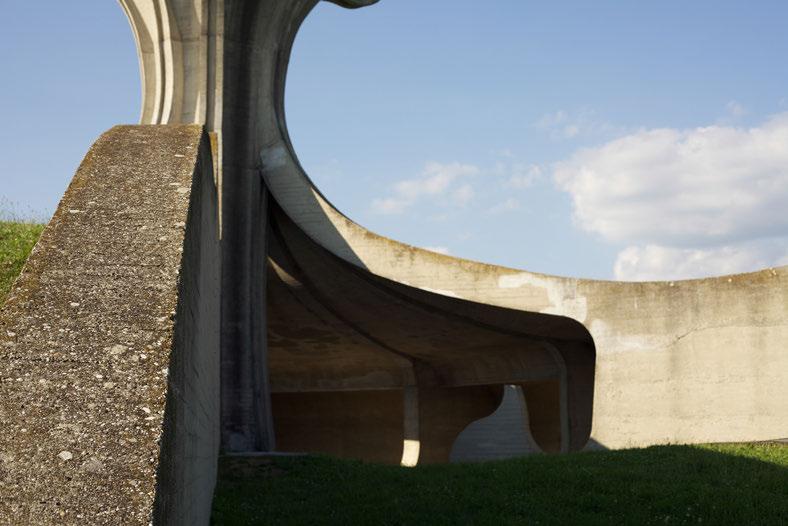
Along the conservation gradient, the Illinden Monument has been well-conserved, due to its alignment with the nationalist narrative of Macedonia. This monument has endured through the parasitic linking of partisan endeavor to the long-standing local commemorative practice of Ilinden. Its added significance comes from the entombment of a local hero. The site recently saw the equivalent of 350,000 US dollars of investment for renovations in 2003, just in time to mark the 100th anniversary of the uprising. Each year on the day of the republic, also known as Illinden Day, memorial reenactment celebrations take place. It is due to this commemorative use that the monument continues to have cultural significance. Known to some as the Makedonium and others as Ilinden—the monument, which is not formally tied to one or the other can exist to commemorate both. [4] There have been multiple attempts by the Macedonian government to keep the site relevant to the nationalist narrative. In 1990, 85 years after his death, Nikola Karaev, the schoolteacher who led the uprising in 1903, was entombed in the memorial. This worked as a means to further strengthen the local narrative while at the same time,
solidifying its role in the greater national narrative. In 1993, renovations were made for celebration of the 90th anniversary of the uprising and ten years later, further investment was made in the site, marking the 100th anniversary of the uprising, which also marked a televised memorial event. [2]
This imposed significance on the part of the state began at the inception of the memorial in 1974, with the negation of the rich local heritage associated with the site. Instead, favoring the nationalist Macedonian narrative of Illinden as the beginning of a Macedonian state as well as the formation of the current Macedonian state by way of the influence of those within the Anti-Fascist Assembly for the National Liberation of Macedonia (ASNOM). ASNOM was the group which determined the parameters of the People’s Republic of Macedonia, as part of the Yugoslavian republic. In keeping
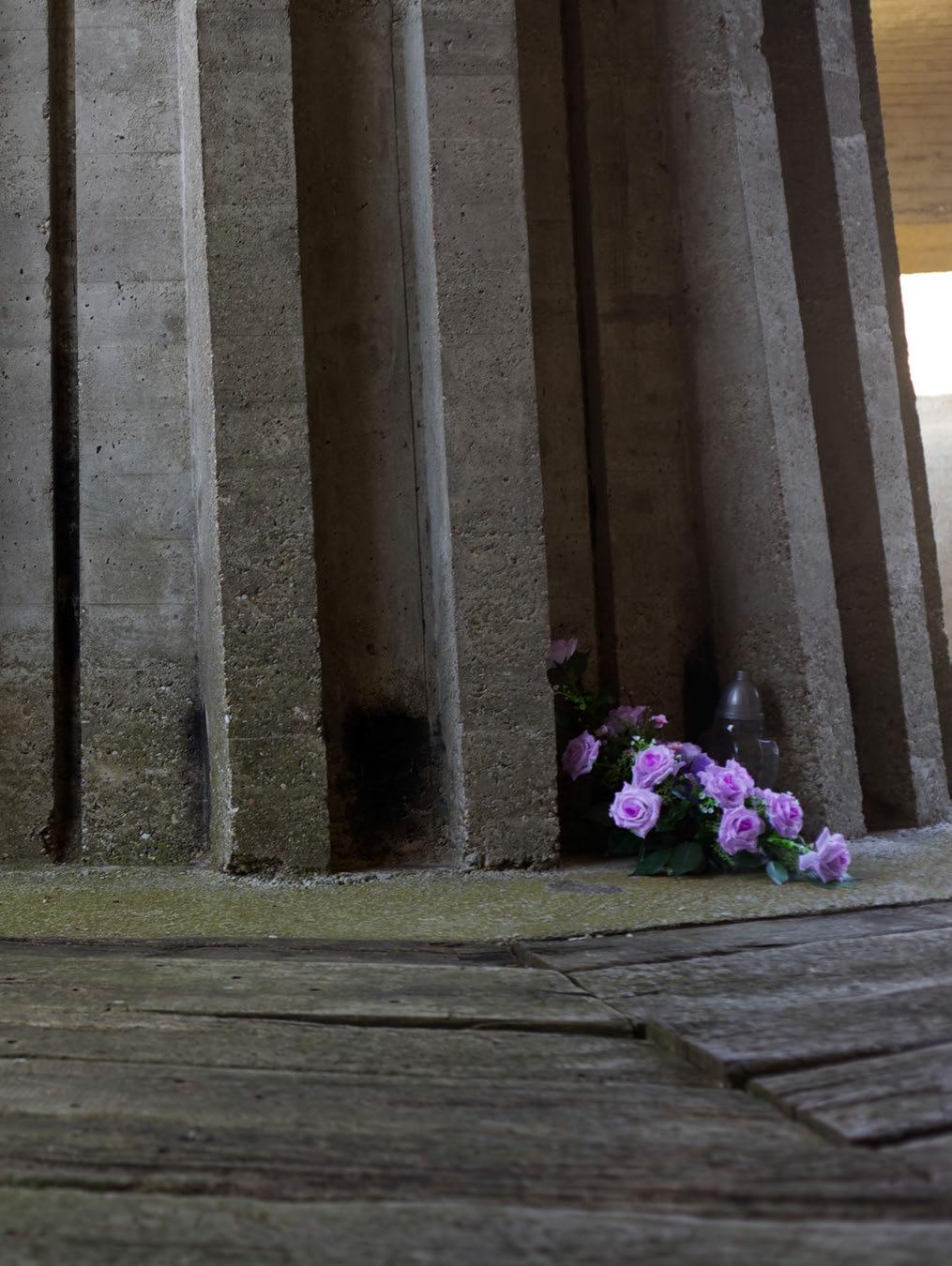
with their Yugoslavian nationalist agenda, the anti-fascists, now in power, with partisan war hero, Josip Broz Tito at the helm, were interested in making monuments to partisan war achievements, as a way of reifying their power. They did so by building numerous spomenik across the landscape, as both a means of celebrating the partisan victories of World War II and honoring those who were causalities of war. With each successive move, history was being rewritten by the victors, and with it an erasure of the idiosyncrasies of the many cultures represented in the region. A ritualization through indoctrination, as an attempt at making the memorials meaningful to new generations, came to surround the spomenik, as schoolchildren were bussed to the sites for state-mandated visits. In this case, the authoritative power of the state has been used to co-opt the memorial, imbuing it with a multitude of significance and turning it into a site of heritage consumption. It made the transition from Yugoslav to Post-Yugoslav memory with relative ease, due to its alignment with the Macedonian nationalist narrative, only further amplified by the Macedonian state after the disintegration of the Yugoslav republic through the entombment of Karaev, acting in ways that a standard conservation practice could not.
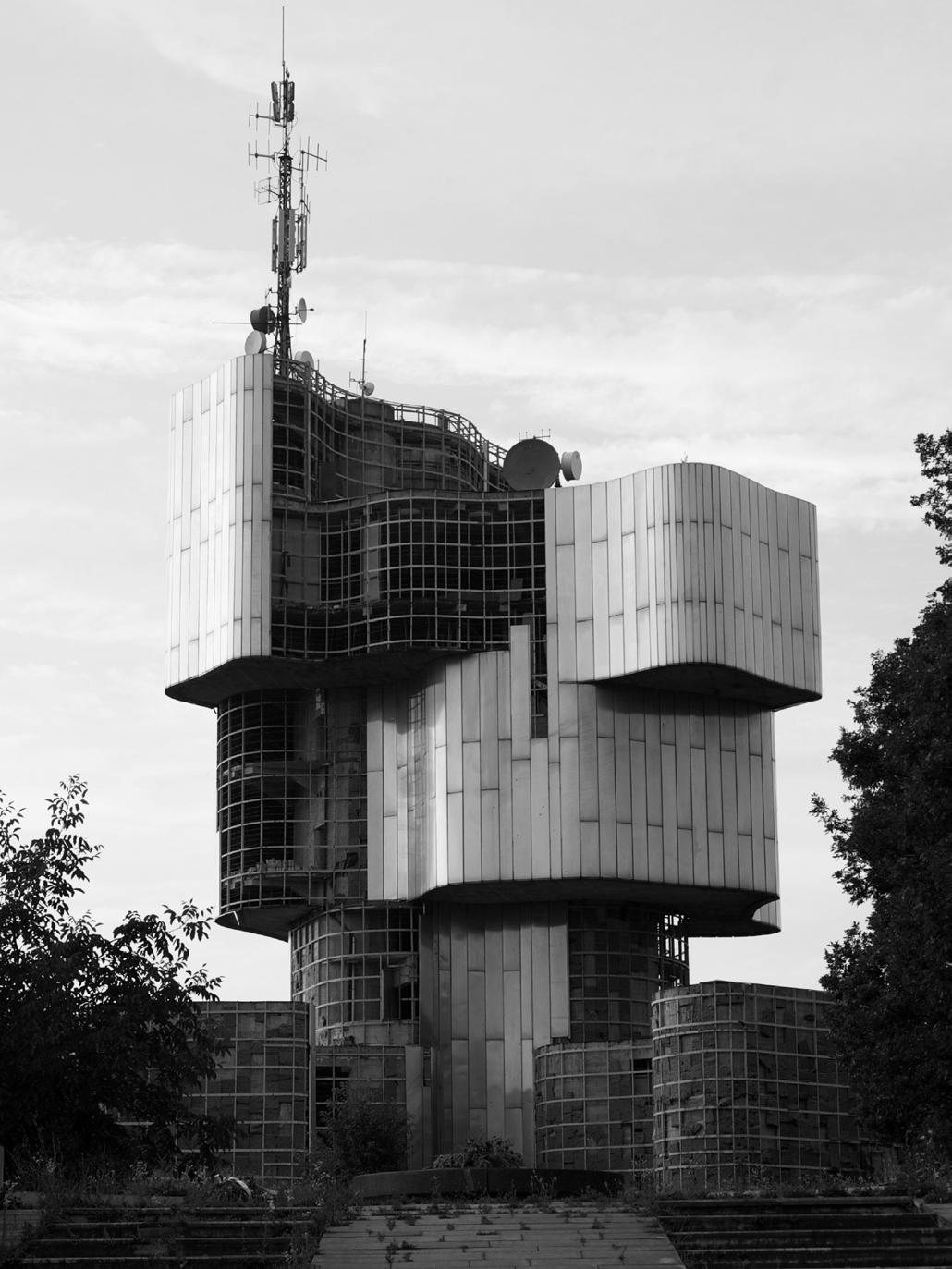
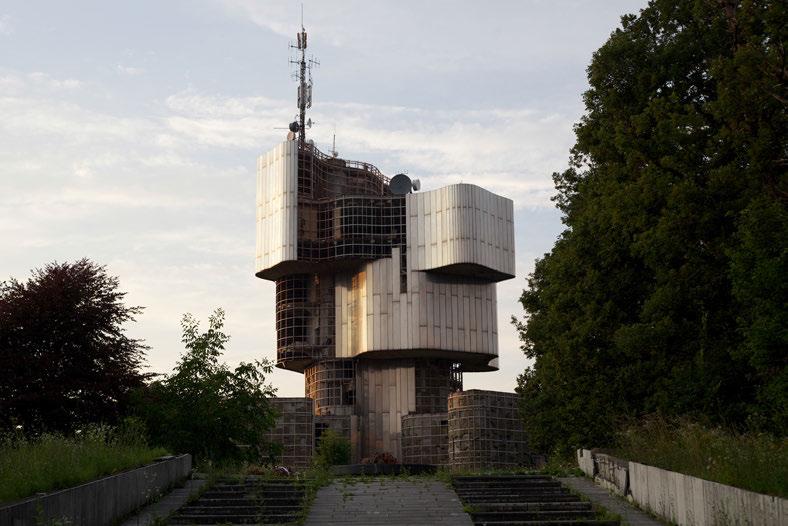
In a bold gesture, the monument sits perched atop the highest point of the Petrova Gora mountain range, built as an anti-fascist monument to commemorate the underground partisan field hospital operating on site during World War II. Monumental in size, Petrova Gora stands at 37M, an eight-story tall inhabitable structure with a form reminiscent of curvilinear late modernism. The monument was designed in 1970, and due to financial difficulties, it was finally built over the course of eight years, beginning in 1981. Following its completion in 1989, it stood as an empty signifier, representative of a lost ideology, marking the demise of the Yugoslav Republic. In an ironic turn of a events, the structure itself is said to have been used as a field hospital during the Croatian War for Independence in the 1990s, shortly after it opened. Today, its visitors include those interested in its formal qualities as well as its place in the current context of Croatian identity politics. Forgotten by its people and neglected by the state, Petrova Gora succumbs to a slow disintegration, as a site of active material extraction, opportunistic use (note the telecom antennas which have sprouted) and natural decay. [3]
Petrova Gora is enmeshed in the kind of circumstances that produce a ruin. At its core, a hulking mass of cast concrete makes the structure impervious to demolition. A lack of existing documents for the building and its site, has rendered any opportunity for security and protection of the monument impossible. There is little interest in the ideologies of the past or partisan spomenik and fewer people feel that they signify anything about the Second World War worth remembering. Sections of stainless steel cladding remain, though the vast majority has gone missing, appropriated by locals with whom the ideologies that made such an icon possible no longer resonate. [6]
Built on the highest point on top of Mt. Makljen in Bosnia and Herzegovinia, this Spomenik was a gesture toward political unity. Mak ljen Monument is one of many
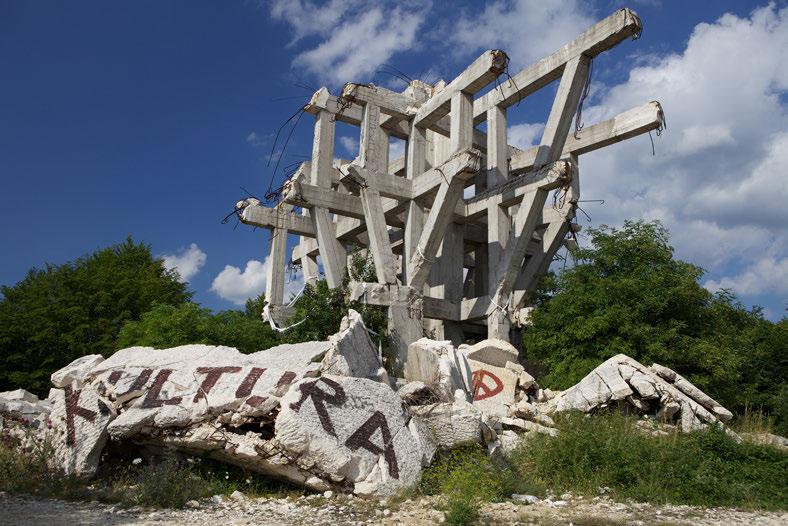
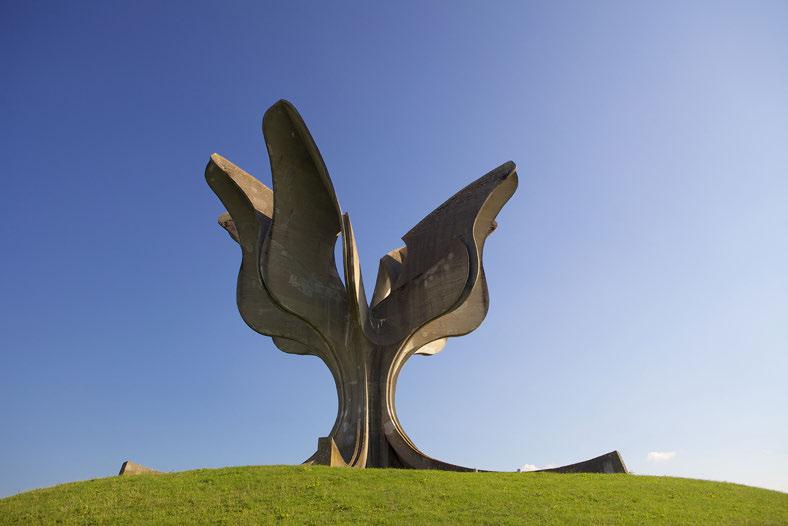
anti-fascist memorials commissioned by the state to commemorate the triumph of the partisans over the Axis powers. Opened to the public in 1978, on the anniversary of the Battle for the Wounded, which had happened in 1943 on this site, Makljen Monument was one of many anti-fascist War of Liberation memorials commissioned by the state and designed by renowned sculptor, Boko Kućanski. It bears an uncanny resemblance to a fist, and Makljen has not been able to shake the associated narrative of being “Tito’s Fist.”
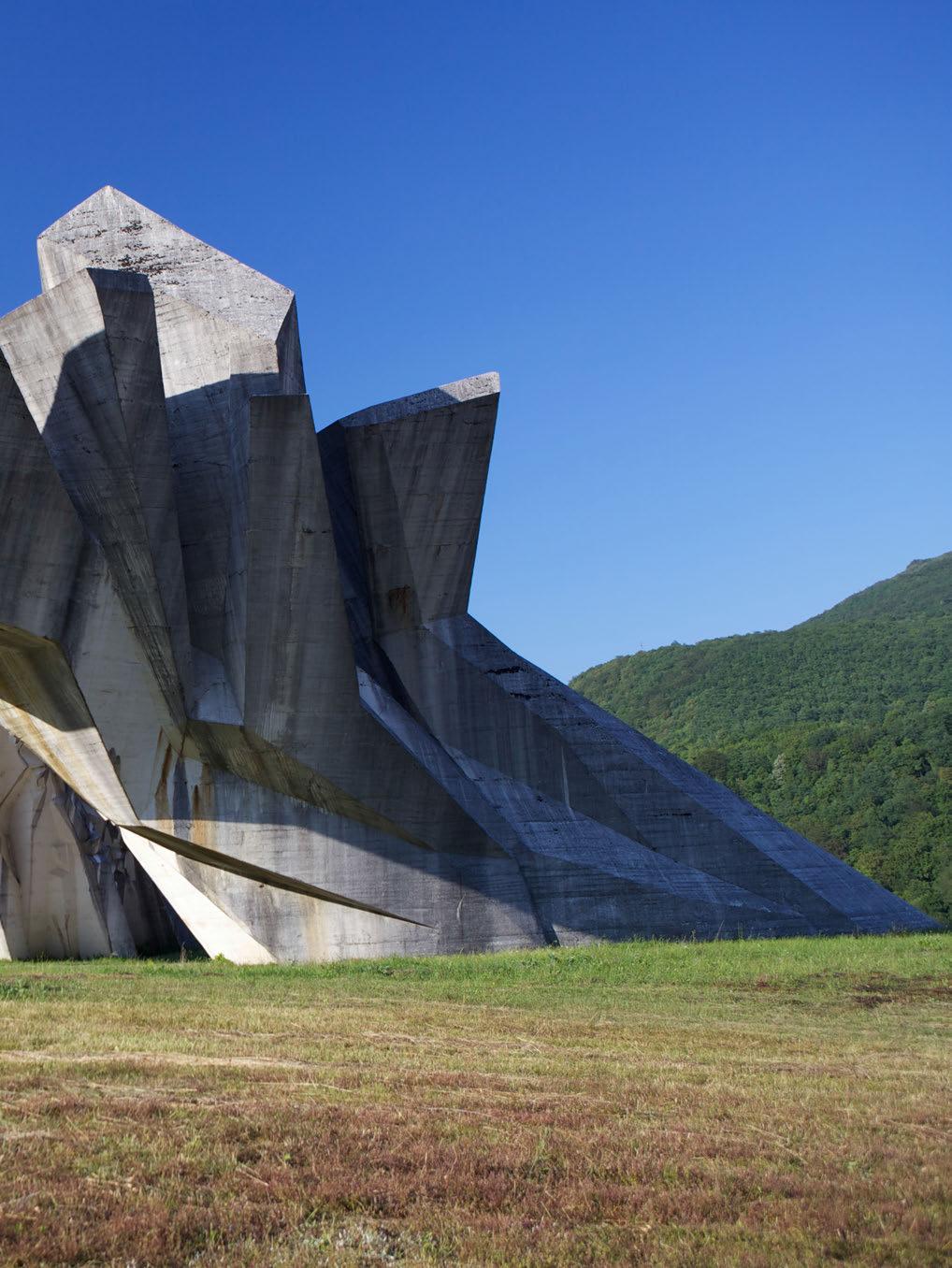
On November 13, 2000, the same date as the battle which the monument commemorates and only five years after the end of the Yugoslav wars, there was an attempted erasure of the monument via explosives. It was not entirely successful in its aim, having made the monument more visible. The blast had exposed the skeletal remains of the flower’s heavy concrete beams, while its concrete skin lay crumbling at its feet. Though the form may have been lost, the monument gained new significance from this iconoclastic act. One could argue that it holds greater
commemorative value, and therefore functions as a stronger monument, in its ruined state than it did when pristine. In the attempt to render invisible, the act of iconoclastic ruination made what had already been rendered invisible with apathy and time quite visible. It was not until after the monument was re-rendered visible through destruction that it became protected through a petition to the Commission to Preserve National Monuments in 2010. It now stands, protected as a National Monument in its skeletal form, the ruin of a monument, perhaps having gained new significance. [2]
It is perhaps through their corroded patina, showing signs of wear, that the aura of time is rendered visible. Some spomenik are still in use, visited annually to commemorate a national holiday, such as Illinden, in the case of the Makedonium, which has received facelifts for the past two decades, just prior to both its 90th and 100th anniversary celebrations. Petrova Gora and Makljen are being reappropriated as sites of intrigue in their ruined state, a product of resource extraction, and iconoclastic actions made against each of them, respectively. It is with their newly minted patina that these spomenik find cultural relevance today.
Built of materials meant to stand the test of time, these material remnants often outlast the regimes that commission them, leaving their fate to the next generation, heir to a forgotten past. Once sites of commemoration, cultural memory, and significance, at worst they become sites of neglect, disuse, and abandonment; at best, they lose significance and become invisible, blending into the landscape or being removed all together. Often, we are met with these immense pieces of the past, signifying a specific ideology no longer in favor. Designated at a specific time and place, they have trouble standing the test of time as relevant cultural signifiers. As meanings change and interest fades, the spomenik are relegated to the backdrop, little more than a place to picnic. Many have problematized the notion that once a memorial is made prosthetic, memory fades. No longer necessary to remember, the material form does the memory-work for us. [7]
Can a monument transform its signification if the cultural signification, commemorative use and perceptions encircling it change? In post-war Yugoslavia,
spomenik were built in an attempt to unify a region divided. What do spomenik signify as they stand within the landscape of a fractured past and present?
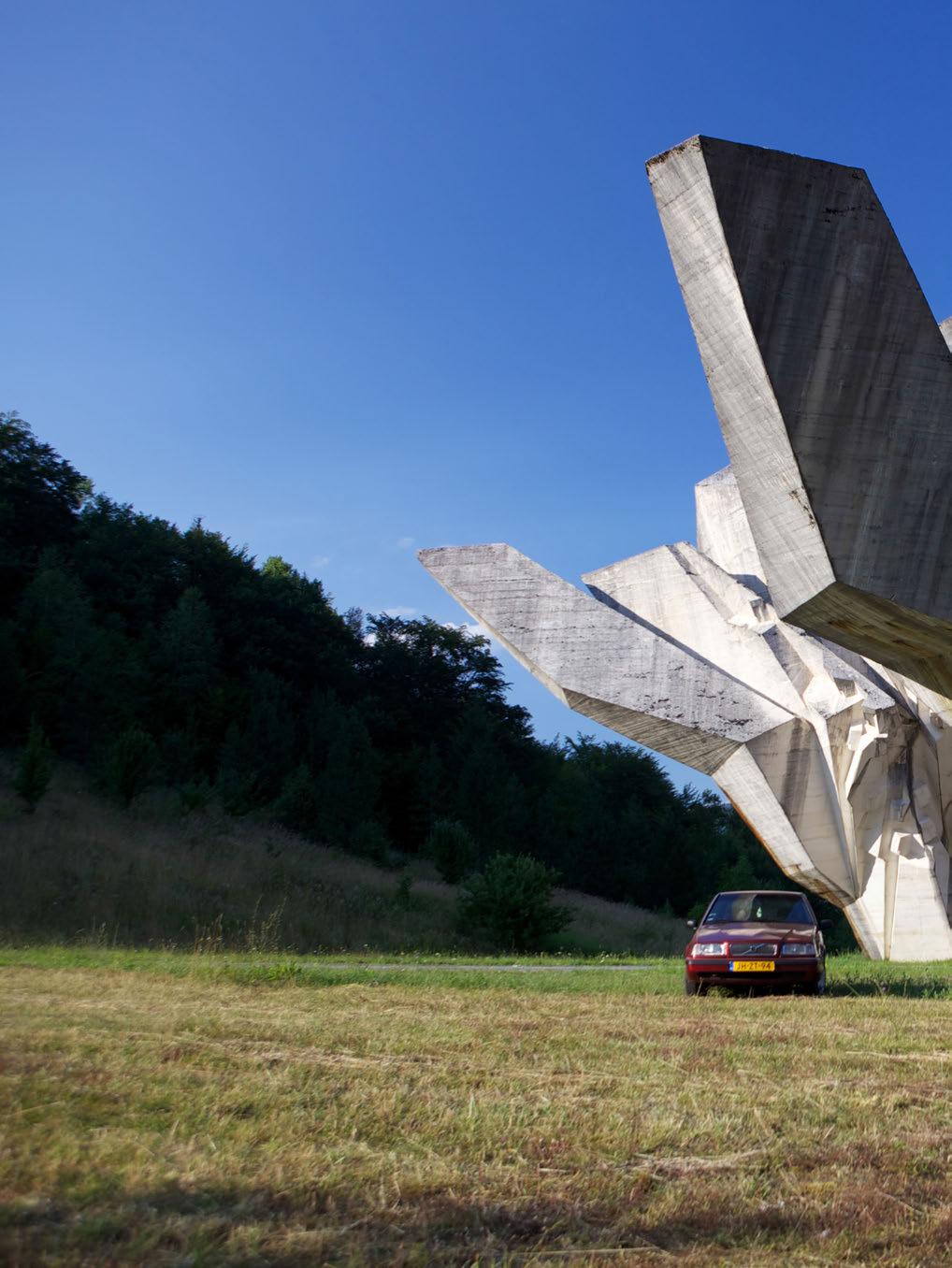
From the fully restored, to the unlocked, overgrown and reappropriated, these spomenik operate through a gradient of conservation efforts, both sanctioned and illicit. While the majority of preservation groups remain focused on much older histories of civilization found in this region, it is the recent past that is most at risk. Spomenik sit in varied states of disrepair, neglected by newly formed democratic governments who do not wish to align themselves with the past and all but forgotten about by those who have inherited them. [5]
Sites in southeast Europe which tend to garner conservation attention do not belong to a shared national heritage or recent past. Instead, ICCROM and other preservation-minded entities, are focused on preservation of much older, heritage sites deemed “at risk” within the region, rendered as the fallout of wartime atrocities. These sites are often sacred spaces, aligned with the post-Yugoslav narrative which places importance on independent nationhood based on ethnic and religious difference. With a focus on the differences of the peoples of the former republic, priority has been given to preserve the contrasts, rather than the unifying principles of the former socialist regime. Today, this practice finds resonance within people of the smaller ethnic populations of Croatia, Bosnia-Herzegovina, Macedonia, Serbia, Slovenia and Montenegro.
To this end, World War II partisan monuments are not considered “at risk” as part of the Bosnia and Herzegovina Commission to Preserve National Monuments and are therefore not protected from illicit building, inexpert construction or lack of maintenance. The Commission acts as a watchdog group that monitors activities relating to national monuments. Few spomenik are protected as national monuments. [1] These monuments, transformed by time, sit in relation to their original context, becoming monuments counter to, yet in dialogue with the memory of their past life as partisan monuments. It is this dialogue which allows them to remain relevant long beyond the disintegration of Yugoslavia.
[1] Bosnia and Herzegovina Commission to Preserve National Monuments. Decisions on Designation of Properties as National Monuments. 26 October 2010. Web: www.kons.gov.ba/main.php?id_struct=50&lang=4&action=view&id=3313
[2] BROWN, K.S. Archaeology under fire: nationalism, politics and heritage in the Eastern Mediterranean and Middle East L. MESKELL ed., 2nd ed. London ;New York: Routledge, 1998 Ch 3: Contests of Heritage and the Politics of Preservation in the Former Yugoslav Republic of Macedonia, pp. 68-86. ISBN 0415196558.
[3] BRUMUND, Daniel, and PFEIFER, Christian. Ed. MONUMENTI: promenljivo lice sećanja. (Translated by MORINA, Luan, et al). Belgrade: Forum Ziviler Friedensdienst, 2012. 96 p. ISBN 9788691556709.
[4] Culture. Republic of Macedonia. 100 Years Illinden. Intensive Preparations for Celebration of 100th Anniversary of Ilinden Uprising - Interventions on Monument “Ilinden” in Krusevo begin. Web: http://www.culture.in.mk/story.asp?id=6792&rub=69
[5] KEMPENAERS, J. and NEUTELINGS, W.J. Spomenik #1-26. Amsterdam: Roma Publications, 2010 ISBN 9077459502.
[6] LINKE, A., JOVANOVI WEISS, S. and BEZZOLA, T. Socialist Architecture: The Vanishing Act. Zürich: Codax :Distributed by JRP/Ringier, 2012 Tagged Format. ISBN 3037642459.
[7] MUSIL, Robert. Monuments. In Posthumous Papers of a Living Author. (Translated by WORTSMAN, Peter) 3a ed. Brooklyn: Archipelago Books, 2006, p. 64-68. ISBN 0976395045.
[8] Oris. 77. Zagreb, Croatia: Oris d.o.o., 1999-2013. Denegri, Jesa. The Sculptural and Architectural in Organic Unity . http://www.oris.hr/casopis_opsirnije.php? ln=en&d=nb&cas_ID=34&ID=439
[9] YOUNG, J.E. The texture of memory: Holocaust memorials and meaning in Europe, Israel, and America. New Haven: Yale University Press, 1993 Introduction: The Texture of Memory, pp. 1-15. ISBN 0300053835.
[10] The Journal of Architecture. 17. London: Routledge. 2012. STEVENS, Quentin, FRANCK, Karen A., FAZAKERLEY, Ruth. Counter-monuments: the anti-monumental and the dialogic.