In this issue: Hospital Updates Fall Symposium Ophthalmology/ER Updates
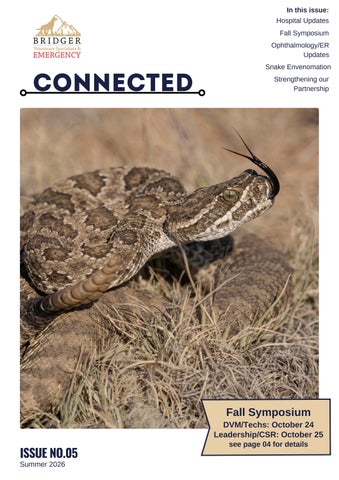
Snake Envenomation
CONNECTED
Strengthening our Partnership
Fall Symposium DVM/Techs: October 24 Leadership/CSR: October 25
ISSUE NO.05 Summer 2026
see page 04 for details
TABLE OF CONTENTS 03
HOSPITAL UPDATE Learn about all of BVS’ latest developments from Josh Jackson
04
FALL SYMPOSIUM Join the ultimate CE event in Bozeman, Montana- NEW CSR Session!
05
OPHTHALMOLOGY/ER ICU UPDATES Updates on ophthalmology and meet the ER/ICU team
06
SNAKE ENVENOMATION
Care guidelines from our criticalist, Dr. Chele Lathroum, DVM, DACVECC 11
PARTNERING FOR SEAMLESS PATIENT CARE Referral Guidelines
02
HOSPITAL UPDATES I hope you have all had a great summer so far. It’s nice that it is finally cooling off and we appear to have a reprieve from the smoke, at least for now! I just did the Bridger Ridge Run and am too sore to move, so seemed like a good time to sit down and do an update. Some new faces and additions to the BVS team: Dr. John Hanlon has joined surgery. He completed his residency at the University of Florida. Like the rest of the surgery team, John has interest in soft tissue, orthopedics and surgical oncology. John has done extensive research on interlocking nails for trauma and has developed a new locking bolt to improve biomechanics. We are excited to start using his invention. Dr. Mo Ramras will be joining the critical care team in September. Mo finished her critical care residency at Cornell and has a special interest in renal and respiratory critical cases. With her addition, we look forward to expanding critical care coverage to 6 days a week. Dr. Patrick Khalife, DACVIM-Oncology completed his residency in medical oncology in San Diego and will join Dr. Burke and the oncology team in September. Patrick has diverse interests in all things oncology. He looks forward to handling all your chemotherapy patients with compassion and kindness. He will be a great addition to the team. In this issue of Connected, Dr. Chele Lathroum will be giving an update on snake bites. Hopefully you’ll find some pearls to take away as we approach the end of the rattlesnake season. Lastly, save the date for our next symposium. It will give you a chance to meet our new specialists and hear them speak. October 24th we’ll offer both DVM and technician sessions and the 25th will be practice management and, new for this meeting, a Client Service session! Hopefully something useful for your whole team. Thank you for all of your support of BVS over the years. We will never take your referrals for granted. We are always open to ways we can do better at serving you, your clients and this community.
03
Dr. Joshua Jackson, DVM, DACVS
A LEARNING ADVENTURE AWAITS YOU Bridger Veterinary Specialists & Emergency invites you to our Fall Symposium on October 24 & 25, 2026. NEW LOCATION - Best Western and GranTree Inn at 1375 N 7th Avenue in Bozeman. This event brings together veterinary professionals, specialists, technicians, and thought leaders to explore advancements in veterinary medicine while fostering professional well-being. New this meeting is a CSR Session. Education for your entire team!
🐾 Tech Symposium: October 24, 2026 🩺 Doctor Symposium: October 24, 2026 🌟 Leadership Symposium: October 25, 2026 CSR Symposium: October 25, 2026
🕣 Time (all days): 8:30 AM – 4:00 PM 📍 Location: Best Western and GranTree Inn, Bozeman 📚 RACE Pending CE Approval 🍽️ Meeting and Lunch Complimentary Our expert speakers will cover a variety of topics such as: Emergency Medicine Surgery Oncology Dentistry Leadership Customer Service
🚨 🩺 🌟
Stay tuned as the dates approach for exciting details about each day’s sessions and events 04
Save Your Spot Today! https://bridgervetspecialists.typeform.com/Fall26symposium
BVS UPDATES Ophthalmology Update Dr. Crystal Eng will no longer be seeing patients at Bridger Veterinary Specialists & Emergency. We are grateful for the care she has provided to our patients and clients, and we wish her all the best in her future endeavors. For patients in need of ophthalmology care, please consider referring them to Dr. John Warren at Animal Eye Associates of Montana. Their office can be reached at 406-629-2020. Your paragraph text
Emergency/ICU Service Update
We have gathered a great team of emergency doctors! We provide Emergency care 24/7, 365 days a year. Jane Mittelsteadt and Dan Thomsen are co-medical directors of the ER/ICU service. If you have questions or concerns about an ER case, please reach out to Jane, jane@bvspets.com or Dan, dan@bvspets.com.
05
Our ER/ICU veterinarian team includes: Gina Clouse Jenee Daws Claire DiLeo Jennifer Higgins Hilary Jackson Travis Kamm
Dawn McDonald Christine Meiners Jennifer Keithly Lizzy Reichlinger Mitch Vutrapongvatana
Review of Snake Envenomation in Canine and Feline Patients
Your paragraph text
Chele Lathroum, DVM, DACVECC Venomous snakes are found throughout much of the United States. In the Rocky Mountain region, venomous snakes are primarily rattlesnakes. In Montana, the prairie rattlesnake (Crotalus viridis viridis) is the only native venomous snake and is widespread throughout the state. Snake envenomation in pets can be fatal, emphasizing the importance of rapid recognition and treatment. Your paragraph text
Pathophysiology and Clinical Presentation Snake venom contains numerous proteins and enzymes that facilitate prey digestion and produce the clinical manifestations of envenomation. Dogs appear more susceptible to pit viper envenomation than cats, although cats can develop severe disease. Severity is influenced by patient factors, including size, age, bite location, activity following the bite, medications, and concurrent disease, as well as snake-related factors such as species, age, season, venom load, and whether the bite was defensive or offensive. Clinical signs may develop within minutes to 18 hours following a bite. Common bite locations include the muzzle and distal limbs, with two fang punctures often visible. Local pain, swelling, bruising, and hemorrhage may develop rapidly. Pit vipers can control venom delivery and may therefore produce a "dry bite." Lack of local or systemic clinical signs during the first several hours makes significant envenomation less likely but does not eliminate the need for veterinary evaluation following a witnessed bite. The major effects of pit viper venom include local tissue injury, hematologic and coagulation abnormalities, cardiovascular compromise, gastrointestinal signs, respiratory dysfunction, and neurologic abnormalities. The Snakebite Severity Score (SSS) provides a standardized method for assessing disease severity and monitoring response to treatment. 06
Initial Management and Diagnostic Evaluation Owners should seek veterinary care immediately following a suspected snakebite. If possible, a photograph of the snake can assist with identification; however, owners should never attempt to capture or handle the snake, including a recently deceased snake. Handling the snake can put humans at risk for envenomation. Tourniquets, compression, and venom-extraction devices are not recommended in veterinary patients because they may worsen local tissue injury, and extraction devices are unlikely to be effective through animal fur. During transport, patients should be kept calm and activity restricted to minimize venom distribution. Initial veterinary assessment should include rapid triage, cardiovascular evaluation, pain assessment, and careful evaluation of the bite wound. The wound should be monitored for progression of swelling and ecchymosis. After analgesia and/or antivenom administration, clipping the affected area and marking the margin of ecchymosis can facilitate monitoring. Your paragraph text
Your paragraph text
Treatment Treatment consists of hospitalization, supportive care, antivenom, analgesia, and serial monitoring. Patients with a suspected dry bite and no evidence of envenomation should generally be monitored for a minimum of 8 hours because clinical signs and laboratory abnormalities may be delayed. Patients with confirmed envenomation should generally be monitored for longer, with the duration determined by severity, clinical progression, laboratory abnormalities, response to antivenom, and the presence of complications. Clinically significant envenomation commonly warrants at least 24 hours of hospitalization and serial reassessment.
07
Antivenom Antivenom is the gold standard treatment for snake envenomation as it can neutralize circulating pit viper venom minimizing local and systemic damage. It should be readily available in veterinary emergency hospitals serving regions where venomous snakes are present. Patients with progressive, moderate, or severe envenomation should receive antivenom therapy. Antivenom therapy is most effective when administered as soon as possible following envenomation but may still provide clinical benefit when administered up to 24 hours or more after envenomation, particularly when evidence of ongoing venom effects are present. Indications include progressive local tissue injury, significant or progressive coagulopathy or thrombocytopenia, systemic signs such as hypotension or cardiovascular compromise, significant neurologic or respiratory abnormalities, or other evidence of clinically important envenomation. Common products include Antivenin Crotalidae Polyvalent (ACP), an equine-derived whole immunoglobulin product, and CroFab, an ovine-derived polyvalent immune Fab product. F(ab)-based antivenoms generally have a lower risk of acute and delayed hypersensitivity reactions than whole-immunoglobulin products but have a shorter halflife, which may necessitate repeat administration. There is no universally established antivenom dose for veterinary patients. Initial treatment commonly consists of 1–2 vials or bags, with additional treatment based on clinical response, progression of the SSS, persistent or worsening coagulopathy, continued progression of local tissue injury, or ongoing systemic disease. Antivenom primarily prevents or reverses systemic effects of circulating venom and has a more limited effect on established local tissue injury. The principal adverse effect of antivenom is an acute hypersensitivity reaction, including anaphylaxis. Patients should be closely monitored during administration, with treatment including epinephrine and supportive care when indicated. Diphenhydramine may be used as adjunctive therapy but should not delay or replace epinephrine in patients with anaphylaxis. Corticosteroids are not routinely required to prevent acute antivenom reactions but may be considered in selected patients based on clinical circumstances. Delayed type III hypersensitivity reactions (serum sickness) can occur several weeks after treatment and may be more common with whole-immunoglobulin products such as ACP.
08
Analgesia and Supportive Therapies Antivenom is an important component of controlling venom-associated pain, but additional analgesia is frequently required. Opioids are commonly used, and lidocaine CRI may be considered in selected patients. Morphine, due to its potential to promote histamine release, is not typically recommended. Routine NSAID therapy is not recommended because of the potential for increased hemorrhage from inhibition of platelet adhesion and adverse renal effects in patients with coagulopathy, hypovolemia, or renal compromise. Routine corticosteroid therapy is not recommended for treatment of uncomplicated envenomation. Corticosteroids have inconsistent effects on venom toxicity and are better reserved for specific indications, such as treatment of selected hypersensitivity reactions or other concurrent disease processes. Synthetic colloids are generally avoided or used cautiously because of concerns regarding vascular leakage, coagulopathy, and organ dysfunction. Plasma and other blood products should generally be reserved for life-threatening hemorrhage or persistent clinically significant coagulopathy despite appropriate venom neutralization and supportive care. Because many venom-associated coagulopathies improve following adequate antivenom therapy, blood products should generally not be administered solely to correct laboratory abnormalities in the absence of clinically significant bleeding or other indications. Plasma products also have limited effect because as a major cause of hemorrhage in venom-induced consumptive coagulopathy is the inability to form working clots due to increased fibrinogenolytic activity by the venom.
Routine antibiotic administration remains controversial. Although bacteria have been isolated from snake oral flora, clinically important wound infection following pit viper envenomation appears to be uncommon. Antibiotics are best reserved for patients with evidence or strong suspicion of infection, particularly in the presence of significant tissue necrosis, rather than administered routinely. 09
Prognosis Prognosis depends primarily on venom dose, snake species, patient factors, severity of clinical disease, and time to treatment. Reported mortality in dogs ranges from 1–30%, but survival is generally favorable when clinically significant envenomation is recognized and treated promptly. Newer studies show potential improved survivability of 98%, likely due to the higher use of antivenom. Key Clinical Takeaways Treat suspected snakebites as emergencies and encourage immediate veterinary evaluation. Keep patients calm and restrict activity during transport and hospitalization. Perform a complete physical examination and baseline CBC, chemistry, blood smear, and coagulation testing. Serial monitoring of these tests may be needed to assess treatment response. Administer antivenom for clinically significant or progressive envenomation. Monitor suspected dry bites for at least 8 hours and monitor confirmed envenomation longer, with clinically significant cases generally requiring approximately 24 hours or more of hospitalization depending on disease severity and response to treatment. Perform serial examinations and laboratory testing because coagulopathy and thrombocytopenia may progress after initial presentation and may recur or develop several days after treatment. Avoid routine NSAIDs, corticosteroids, colloids, and antibiotics unless specifically indicated. Antivenom neutralizes circulating venom but does not reverse established tissue injury. Provide appropriate discharge instructions and consider follow-up CBC and coagulation testing after clinically significant envenomation because delayed or recurrent coagulopathy can occur. With prompt recognition, appropriate antivenom therapy, supportive care, and monitoring, most canine and feline patients have a favorable outcome. 10
REFERRALS & TRANSFERS | A QUICK GUIDE FOR OUR VETERINARY PARTNERS
PARTNERING FOR SEAMLESS PATIENT CARE HELPING US CONTINUE THE CARE YOU’VE ALREADY STARTED
EMERGENCY & URGENT TRANSFERS A quick call helps us prepare for your patient’s arrival. Whenever possible, we appreciate a call before an urgent or emergent patient is sent our way. This allows the referring veterinarian and BVS attending veterinarian to connect and helps our team prepare for arrival. We know things move quickly in practice. If the veterinarian can’t step away, another team member is always welcome to call us and advise that the patient is on the way.
11
Please send relevant medical records and diagnostics, particularly anything completed that day or leading up to the transfer. Don’t have the complete record yet? That’s okay. Send the most pertinent diagnostics and treatment information first, and additional records can follow. For urgent and emergent cases, a quick phone call in addition to emailed records helps our team prepare while the patient is on the way.
SPECIALTY REFERRALS
THE MORE WE KNOW, THE BETTER WE CAN PREPARE
We’re happy to partner with Providing records and diagnostics you on your patient’s next with the initial referral gives our steps. specialty team an opportunity to Specialty referrals can be submitted through our BVS Referral Portal. Please complete the required fields and include relevant medical records and diagnostics whenever possible. SUBMIT A REFERRAL
NEED A SURGICAL OPINION? Have a radiograph you’d like our surgeons to review, or questions about potential surgical costs for your client?
Our surgical team is happy to help — at no cost to your practice. Send your images and questions to info@bvspets.com. We’re happy to provide guidance so you and your client have more information before deciding on the next step.
12
understand the patient’s history and helps us coordinate their next steps as smoothly and efficiently as possible. If everything isn’t available right away, please still reach out. Send what you have, and we can work together from there.
One Patient. One Team. We truly value the relationships we have with our referring veterinary community. You know your patients and clients best, and our goal is to build upon the care and trust you’ve already established. Whether you're calling about an emergency transfer, submitting a specialty referral, or simply wondering about the best next step, we're here as an extension of your care team.
Questions? Unsure where a case fits? Give us a call at 406-548-4226. We’re always happy to talk it through. Thank you for trusting Bridger Veterinary Specialists to partner with you in caring for your patients.
13