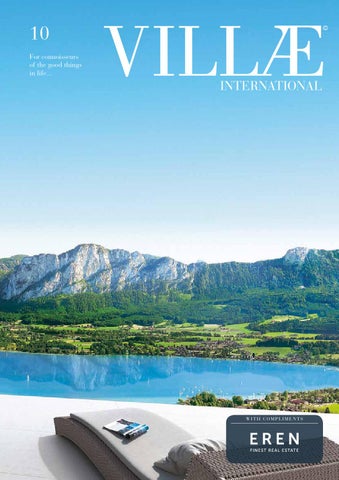
10 For connoisseurs of the good things in life...
INTERNATIONAL
WITH COMPLIMENTS
VILLÆ 1
Unus pro omnibus, omnes pro uno Einer für alle, alle für einen un pour tous, tous pour un Uno per tutti, tutti per uno In per tuts, tuts per in Todos para uno y uno para todos The strength of the Pack is the Wolf and the strength of the Wolf is the Pack E pluribus unum Unus pro omnibus, omnes pro uno Einer für alle, alle für einen un pour tous, tous pour un Uno per tutti, tutti per uno In per tuts, tuts per in Todos para uno y uno para todos The strength of the Pack is the Wolf and the strength of the Wolf is the Pack E pluribus unum Unus pro omnibus, omnes pro uno Einer für alle, alle für einen un pour tous, tous pour un Uno per tutti, tutti per uno In per tuts, tuts per in Todos para uno y uno para todos www.europeanrealestate.org The strength of the Pack is the Wolf VILLÆ 2
Dear reader, We would like to welcome you to the tenth edition of the Villae International Magazine, a publication that has earned its stripes and garnered respect for the quality of content, imagery and design. Villae International reflects the dedication to quality, attention to detail and commitment to achieving excellence that is at the heart of EREN - the European Real Estate Network. Ours is a network of leading European real estate companies dedicated to the luxury sector, and as such we pride ourselves on providing the highest standards of professionalism and service, as well as expert local market knowledge and truly international resources that come from longstanding cross-continent relationships. José Ribes Bas
EREN Director
In this edition we would like to regain the spirit that brought together this group of professionals - now friends - who constitute EREN. In this one of the lessons in Rudyard Kipling’s “The Jungle book” come to mind: “The strength of the Pack is the Wolf and the strength of the Wolf is the Pack ”. This is the spirit that got us united and working for a common goal: providing the best service to our customers across Europe through the union of common efforts and the sharing of knowledge. This concept is also at the heart of classic French writer Alexandre Dumas’ tales of The Three Musketeers, and encapsulated in their famous motto: “All for one and one for all”. In this Dumas drew on a sentiment that goes back to Roman times and in Latin is called: “Unus pro omnibus, omnes pro uno”. It can be found in the interior dome of the Swiss Federal Palace in Bern, a country whose unity is built out of the harmony that exists between its different linguistic groups. It is this sense of strength through unity of purpose - also entrenched “E pluribus unum” within the seal of the United States of America - that draws us together in the organisation we call the European Real Estate Network. The continued evolution and development of EREN is confirmed by the fact that we have the pleasure of welcoming Karin Gornik and his team at Gornik Immobilien, from Kitzbühel in Austria, and of confirming Zabel Immobilien of Berlin and Walde and Partner of Zurich as shareholders members. A steadily growing organisation like this has evolving needs, and the appointment of Eric Bryn as Executive Managing Director of EREN ensures this growth is guided in the most professional manner possible. Eric is a seasoned specialist in real estate marketing with a track record that confirms his credentials as someone at the forefront of this fast evolving and technology-driven field. His skill set emphasises the multidisciplinary nature of today’s marketing environment, and with people of his calibre on board we are confident of maintaining the leadership position we have strived hard to achieve. Eric describes the latest developments in modern real estate marketing in his opening interview on page six, and in addition to business and economic articles this edition also features our customary focus on the finest in international real estate, but also in travel, gastronomy, lifestyle and those works of artistry that take human creativity to its highest peaks. I hope you enjoy this landmark tenth edition of Villae International Magazine, a publication which like the organisation it represents is evolving all the time. Enjoy your reading.
José Ribes Bas. Publisher VILLÆ 3
INTERNATIONAL
VILLÆ INTERNATIONAL is a publication of:
10
European Real Estate Network, Ltd., 35 Catherine Place London SW1E 6DY T. +44 0203 178 6154 F. +44 0203 178 6155 www.europeanrealestate.org info@europeanrealestate.org EREN Board of Directors Ueli Schnorf Giancarlo Bracco José Ribes Bas bod@europeanrealestate.org EREN Executive Director Eric Bryn eric@europeanrealestate.org Original Concept by Benedetta Viganò, Diana Morales & José Ribes Bas Editor and writer Michel Cruz MANIFESTO DESIGN s.l., Marbella info@manifestodesign.com (+34) 952 880 923 Art director and Design Modesto Granados ESTUDIO MODESTO, Valencia modesto@estudiomodesto.com (+34) 667 208 071 Photo credits Shutterstock Jelle Mollema Thomas Dressler Illustration Sara Belles Advertising ads@europeanrealestate.org Publisher José Ribes Bas Printing and distribution controlled by PGD D.L.: V-757-2006
VILLÆ 4
ON THE COVER SkyLounge. Lake Mondsee, Salzburg Area (Austria). It is hard to believe that in today’s time of architectural profusion one new development truly stands out by articulating a new superlative of luxury: SkyLounge Mondsee. Lavish, light-flooded living space, crystal-clear mountain air, and picture-perfect alpine and lake views right on the doorstep of Salzburg, the world’s cultural and music capital. For a chosen few, a rare chance is offered to savour life on the top. An exceptional opportunity proposed by Marschall Real Estate.
CONTENTS 18
60 42
06 ERIC BRYN Introducing EREN’s new Managing Director 08 EREN ANNUAL MEETING 2014 The tenth edition of the Annual Meeting held in Berlin 14 A NEW SCIENCE Marketing in the digital age 15 KITZBÜHEL The latest luxury location in EREN 16 JÜRGEN BARTELS Interview with the former CEO of the Starwood Hotels & Resorts Group 18 HOTEL VENUES WITH A DIFFERENCE Discovering luxury in unusual places 24 POLO The sport of kings 28 OKAVANGO Nature’s wetland in a desert
42 THE RISE OF THE BEACH CLUB Opulence on the edge of the sea 50 ON A COLD WINTER’S NIGHT Savouring the warm delights of whisky 52 KEEP IT TRIMMED The return of the beard 60 CRYSTAL ESSENCE Nature’s beauty encapsulated 62 THE LEGEND OF THE PRANCING HORSE From racing team to motoring legend 68 THE 6TH KONDRATIEV Long economic cycles explained 70 PROPERTY SECTION Luxury homes selection 94 SUCCESSFUL INTERNATIONAL COOPERATION The fruits of working together
38 JACQUES COUSTEAU The man who opened up the oceans
VILLÆ 5
A
qualified lawyer, Chicago-born Eric Bryn’s career led him into real estate, where he has since become an authority in integrated, digital and luxury marketing strategies. In this fast moving and ever evolving field where yesterday’s certainties are rapidly superseded by today’s new realities, he tracks the latest developments and trends to develop strategies and initiatives that respond to and optimise new technological platforms and consumer behaviour. It is a world in which SEO, SEM, CRM, social media, multiplatform communication, brand building, mobile marketing, blogging, database analytics and legal/risk management all have to come together in a single, integrated growth strategy. Where do you begin?
INTRODUCING
Eric, how did you become an online strategist, and one specialised in real estate? During the first dot com boom I became intrigued with how the Internet can improve consumer and client experiences within businesses. As social networking and mobile connectivity ascended in popularity, I continued to research and apply digital and mobile marketing strategies and solutions for a variety of companies. I became involved in real estate after working with several stellar firms, including EREN members Rimontgó and Wetag, while employed at Leading Real Estate Companies of the World. Real estate brokerage is a complex business requiring elegant solutions that will enhance the client experience. Constantly striving to reach this ideal is what keeps me motivated.
EREN’S MANAGING DIRECTOR
What does your role with EREN entail, and how do you feel about applying your knowledge and expertise to the European luxury real estate market? My role at EREN is multifaceted and encompasses helping the EREN Board of Directors grow the network, issuing strategic guidance reports relating to global digital and mobile marketing trends, and how these trends relate to luxury real estate practices. I will also be working closely with the EREN IT Director to ensure that the EREN digital and mobile presence remains world-class.
ERIC BRYN
The newly appointed Managing Director of EREN not only has earned his stripes within luxury real estate, he also brings valuable expertise in the multi-faceted world of digital marketing to the organisation
VILLÆ 6
Where is Europe in relation to the US when it comes to online marketing strategies? Europe ‘trailing’ the US is a common misconception. In certain ways the US leads Europe, and in other ways Europe leads the US. Several EREN member firms are at the top of their digital and mobile marketing strategies globally, from leveraging the Google AdWords platform, to Search Engine Optimization best practices, to integrating world-class Client Relationship Management platforms that rival the best in the US. One area where European firms clearly excel is the focus on the ‘relationship’ with the client. European real estate professionals have long realised that no technical solution can replace a great client experience and relationship.
Would you agree that the luxury (RE) market is becoming increasingly global – and how will this affect an already highly fluid marketing environment that has changed greatly in recent years and continues to do so? As more wealth concentrates within the top 5-10% of earners across the globe, luxury real estate will naturally function as a robust investment opportunity for this sector. According to Euromonitor International, the luxury market looks healthy for the next several years, especially regarding housing. Indeed, during a business roundtable at the recent EREN 10th Anniversary meeting in Berlin, many firms reported seeing an increase in buyers from several nations. Of course, Chinese investors are a primary driver of this, but on any given day these firms are dealing with second and third-home buyers from across the globe. One of the reasons many EREN firms have these opportunities is because they have re-created their websites and digital marketing efforts into several different languages, translated by a human with knowledge of cultural nuances and colloquialisms. Firms that try to ‘fake it to make it’ with machine-translations of their websites and marketing will almost certainly fail to impress a global luxury real estate investor. In a highly competitive field where subtle differences in what you do and how you do it make a lot of difference, what makes a successful all-round strategy? As mentioned above, focusing on the client relationship, and aligning one’s digital marketing and web infrastructure to support this relationship. Luxury clients expect top brands to have a strong digital brand presence. These same clients expect personalised, concierge service too, especially within real estate. And, of course, you earn their loyalty by consistently delivering professional service of the highest calibre. What is more important – SEO or customer engagement? i.e. technical marketing or brand marketing? Client engagement is the most important. SEO is merely a tactic that one uses to increase the odds of being found via a web or even social search. Once a client discovers your brand, the next step is to ensure that the design of the user interface and user experience makes it easy for the visitor to navigate, understand and contact you. What are your priorities at EREN – what are the things you want to implement and develop most urgently? I am working closely with the Board of Directors to increase the reach and depth of the EREN membership. Additionally, I am working closely with the EREN IT Director to ensure that the digital and mobile presence is commensurate with the best global brands. How do you see marketing in luxury RE evolving in the coming years?
Currently, we’re experiencing a visual marketing renaissance. Full-bleed photos seamlessly integrated into scrolling websites that perform well and look great across desktop, laptop, tablet, and smartphone devices are becoming the norm. Mobile and social commerce platforms offer fully integrated web and mobile solutions that are beautifully designed and used by millions of small companies across the globe. Thus, they can essentially deliver an experience that was once the province of the top luxury brands. So how does one stand out? Information design and video. The nuance of language will elevate a brand’s perception with luxury clientele, and novel uses of quality short and long-form video will also differentiate a luxury real estate brand. Finally, luxury firms that focus on designing an exceedingly excellent experience—within
“Real estate brokerage is a complex business requiring elegant solutions that will enhance the client experience” web, mobile, and real life environments—will increase their odds of resonating with luxury clientele. What is the biggest challenge for realtors and organisations like EREN in the years ahead? Of course, global economic factors will naturally affect (either positively or negatively) real estate professionals and real estate organisations. From a digital and technical perspective, real estate professionals should focus their efforts on implementing infrastructure and software that will enhance their online and mobile efforts at personalisation. Consumers—especially luxury clientele—expect a high degree of personalisation and specification. The need to meet this is compounded by the luxury consumers’ adoption of mobile devices to support their global lifestyle – so it is a coming together of modern technology and old-fashioned personal service that will make the difference. VILLÆ 7
EREN ANNUAL GENERAL MEETING BERLIN 2014 www.europeanrealestate.org VILLÆ 8
“It was a great event and I believe we can look back on a successful tenth EREN conference,” Peter Rabitz Director of Premier Real Estate at the Zabel Property Group.
T
he annual conference of the European Real Estate network is an event that brings together prestigious companies and top luxury real estate specialists from across the continent. Each year the conference is hosted by one of the EREN members, and in 2014 that honour fell to the Zabel Property Group in Berlin. From 11th to 13th September, therefore, EREN members gathered in this fascinating city to reconnect, exchange information and confer on business in a discreet, one-on-one basis. It is also an occasion to discuss the progress of the organisation, new initiatives and to vote on matters of importance. Ignacio Artagoitia of Inmobiliaria Rimontgò in Valencia and the IT expert of EREN, presented an analysis of the statistics of the network’s website, providing also useful suggestions on how members can make more use of its capabilities. The future growth of the network was also discussed, along with strategies aimed at achieving it whilst safeguarding the exclusivity of EREN.
10th anniversary The 2014 edition of the conference also marked the tenth anniversary of EREN, an occasion that saw the welcoming of new Austrian members Gornik Immobilien from Kitzbühel, and the inclusion of Walde & Partner from Zürich and hosts Zabel Property Group as shareholders. VILLÆ 9
EREN ANNUAL GENERAL MEETING BERLIN 2014
VILLÆ 10
The board members also voted on the appointment of Eric Bryn as the network’s new Managing Director. The Chicago-born real estate professional, who is an authority in the fields of online marketing and consumer trends, will play a pivotal role in the continued growth and development of our organisation. He is introduced in an interview feature on page six of the magazine. But, as always, the conference is not only about work and meetings; it also offers a great opportunity for the principals of all EREN member companies to meet in person in one place and update one another on their respective market areas. “It was a great event and I believe we can look back on a successful tenth EREN conference,” says Peter Rabitz, Director of Premier Real Estate at the Zabel Property Group. “In addition to a full agenda of new initiatives and members, as well as the introduction of Eric Bryn, we also managed to show our colleagues from across Europe some of the charm and excitement of our city, Berlin, including a visit to one of its most spectacular new developments, Living Levels. It is exactly with the close bonds we maintain through EREN and the organisation’s reach that we can market such landmark projects on a global scale, something which this anniversary conference served to remind us once more as we head into the future with confidence and renewed purpose.”
www.europeanrealestate.org
VILLÆ 11
VILLÆ 12
VILLÆ 13
EREN NEWS
The technical side to marketing Ignacio Artagoitia, IT Director of EREN Could you briefly describe the main changes in (online) marketing, SEO and SEM? SEM is in constant change. Within it there are more and more possibilities as it is one of the most advanced Google tools. As to SEO, the algorithms are constantly changing. Unique content is probably now more important than ever, but linking also works very differently; things that worked before no longer do so. All the big algorithm changes that Google has developed over the past years are evolving and adapting faster than ever: Panda, Penguin, Pigeon, Pirate, etc. Panda for instance has had over 27 different updates since it was launched. Penguin has had more than seven – it is all moving very fast, so both off-site and on-site optimisation are a bigger challenge than ever. How does this new marketing environment change strategies and how are forward-thinking organisations like EREN responding? EREN is completely developed in-house and we have our own Framework. Currently we are finishing very important changes in it with three aims: one is to provide users/visitors with a fantastic browsing experience. The second is to enable our IT team to be able to quickly implement any new need in regards to SEO – thus being able to keep up with the pace of algorithmic changes. And the third is to combine a Search Engine friendly approach with a nice-looking site, as EREN needs. All of this, combined with the multi-lingual approach that we have, plus maintaining all the underlying systems is a truly enormous task. It is both exhausting and fascinating at the same time, but I am very passionate about it, as is the team I manage, so we are constantly adapting in order to give EREN an edge.
VILLÆ 14
Gornik Immobilien of Kitzbühel joins EREN The luxury real estate specialists from the beautiful alpine resort of Kitzbühel are the latest new members of EREN, and share with its existing members and founding principals a longstanding dedication to quality, service, expertise and integrity. The company enjoys an enviable reputation in this renowned ski resort, where it offers superb properties that are outstanding for their location, characteristics, luxuries and aesthetics. As such, Karin Gornik is the owner of one of the leading companies of its kind in the Austrian Tyrol, where EREN is proud to say it now has first-class representation. The appeal of this famous resort lies in its setting amid stunning alpine scenery, which this exclusive little town does great justice to with its architecture and iconic charm – making this an internationally renowned elite resort to vacation and also to own property in.
VILLÆ 15
By Michel Cruz
“Luxury is a European brand” Jürgen Bartels former CEO of Starwood Hotels and Resorts Group The man who witnessed, and took an active part in the growth and evolution of the hotel industry over the past 50 years shares his thoughts on the prospects for long-term European growth and prosperity.
Illustration by Sara Belles VILLÆ 16
B
orn in wartime Germany, Jürgen Bartels embodies the generation that created the Wirtschaftswunder – the post-war rebuilding of a broken nation into a successful, prosperous and productive country. With this unique background and experience in mind, it is people such as Mr. Bartels that can provide valuable insights at a time when Europe faces challenging questions about its long-term development and prosperity. “I was a war baby, typical at the time for the fact that my mother was a war widow left to look after two sons by herself. Conditions after the war were tough, but the German work ethic kicked in and bit-by-bit the country picked itself up and rebuilt its future. On a personal level, however, we were all just trying to get by as best as possible, and my mother’s resolve, which was to set the course for my life, was a rather unique example of this.” Keenly aware that education was at the heart of her gifted son’s future prospects, she approached his teacher and negotiated with him that Jürgen be seated by himself at the front of the class – so that he wouldn’t be distracted by classmates. Later Jürgen himself negotiated that he needn’t copy down lengthy questions but merely write the answers, and go off to play football once he was done. Such unilateral treatment is hard to imagine today, but it showed the resolve that makes the few stand out amongst the many. The gifted student, who was also a talented football player with local first league team Hanover 96, found a placement in a prestigious German hotel and was set to become one of the people to shape the industry in the decades to come. “It wasn’t long before my ambition took me to the United States,” says Jürgen. “There still weren’t any large hotel groups in Germany, so the opportunities clearly lay in the world’s leading hotel market, the country that through people like Conrad Hilton had created the modern tourist industry.”
with a $1 billion expansion programme. “What’s more, they simply applied the formula that had worked for us, so faced with competition from a company with greater means than our own that was shadowing our every move, our room for movement was rather limited.” What’s more, as the largest food supplier Pillsbury also had greater margins to play with in their pricing, so Jürgen found the solution not in production, costing, advertising or location, but in human psychology. “Research had hinted at the fact that people subconsciously don’t enjoy it when a waiter stands over them while taking their order. At a very deep level it is a little threatening, so I asked our staff – who were young, often tall people – to go down on one knee instead. People thought I was crazy, but it worked!” The practice was not only practical, but also endearing, enabling staff to up-sell and earn better tips, while TGI Friday’s reclaimed its position as leader of the casual dining sector. Known for such unconventional successes, as well as a very direct and demanding approach with regard to his executives and management cadre, the CEO would fly into locations around the world to inspect hotels and sights for himself, or address thousands of gathered staff or industry colleagues. Eventually he made the move to become CEO of Starwood Hotels and Resorts Group, where he was in charge not just of brands such as Sheraton, Westin, W and St Regis, but in so doing also of 285,000 rooms in 950 hotels in 80 countries, with a total of 170,000 employees. “The figures are big, I know, but all large hotel groups manage or franchise the bulk of the hotels and resorts for a fee, so you work with a concept that you apply and adapt to many different locations and submarkets.” Having retired some years ago and bought properties in Andorra and Marbella’s La Zagaleta country club, he retains a keen interest and accurately predicted the revival of the tourist sector in 2012 in key markets within Europe.
Managing 170,000 people Having risen to the top at Ramada Hotels, where he founded the Ramada Renaissance brand (later bought by Marriott Hotels for $950 million), the rising star in the corporate hotel world then became CEO of the Carlson Hospitality Group. Working closely with its founder, Curt Carlson, he oversaw the expansion and development of Carlson’s, Radisson Hotels, Country Inns and TGI Fridays, building on a travel and marketing arm recognised as a US leader in the field. “Curt was a colourful person, a typical self-made man who was tough but fair. We didn’t always agree but we had a lot of respect for each other.” It was during this period that Jürgen helped the company expand from 21 to 600 hotels, as well as taking on the challenge when Pillsbury entered the food retail branch and threatened the position of TGI Friday’s
“With so much manufacturing moving to cheaper cost centres in Asia and automation set to replace employees in production, retail and logistics, tourism forms one of the main potential growth sectors in Europe. But it is a diversifying market in which the lower end is increasingly catered for through private rooms and small hostels that you can book online, so for the corporate sector the emphasis has to be luxury. In a world of growing polarisation between haves and have-nots, this is where the growth lies, and given our history and traditions of globally revered brands, Europe has a true competitive advantage in this field. Add the growing wealth in regions such as Asia, and the potential for the luxury sectors of Europe is clear. If well nurtured and marketed, this is where much of our future growth and prosperity will come from.” VILLÆ 17
By Michel Cruz
Pousada de Obidos, Portugal VILLÆ 18
Hotel venues with a difference If you’re a seasoned traveller and you feel like you’ve seen it all before, why not book yourself into one of these hotels and get rid of that frequent flyer fatigue?
VILLÆ 19
The Liberty Hotel, Boston It is not without a sense of humour – and irony – that this hotel in downtown Boston was named. While it’s imposing classical architecture at first glance confirms its status as a luxurious hotel, this grand building was for a long time known as the Charles Street jail. It may be a sobering thought to find you have booked into a former prison, but as an ‘inmate’ of this particular establishment you can expect nothing less than five-star comfort, style and treatment. Indeed, the place that was once designed to be decidedly inhospitable has done a volte-face to become a haven of hospitality and bonhomie. In addition to 298 luxurious guestrooms set within former prison accommodation, guests at the Liberty Hotel can choose from such charmingly named restaurants and bars as the Clink, Alibi, Scampo and the Liberty Bar. What’s more, this historic building also enjoys a privileged central location at the foot of Boston’s Beacon Hill, meaning that the city centre of one of America’s most ‘European’ cities is right on your doorstep.
www.libertyhotel.com VILLÆ 20
Four Seasons, Istanbul If the idea of an American jail is not quite exotic enough there is always the Four Seasons in Istanbul. Yes, it’s part of the well-known Four Seasons group, but this particular hotel has got to be their most unusual venue of all, for it too is housed within a former jail. The fact that is was an Ottoman Turkish prison makes it all the more oneof-a-kind. Set within Istanbul’s bustling and beautiful Old City, this amazing luxury hotel has marvels such as the Hagia Sophia, the Topkapi Palace and the Blue Mosque on its doorstep. Known officially as the Four Seasons Hotel Istanbul at Sultanahmet, it could hardly be further removed from the austerity and menace you would expect to emanate from a former Ottoman prison. In fact, if someone suggested it was all a mistake and this was in reality a former palace, you would be more inclined to believe them, but the truth is that this elegant ochre-coloured palatial building now houses guests who stay here entirely of their own volition. And gladly so, for its classically tasteful rooms, lounges and bars, coupled with first-class service and proximity to the heart of Istanbul make this a hotel to remember for more reasons than one. www.fourseasons.com/istanbul VILLÆ 21
Sextantio Grotte della Civita, Matera You can easily see why Matera, a spellbinding historic town in southern Italy, was chosen for the filming of The Passion of the Christ. Haunting is another word you could use for this town hewn out of the rocks above ancient pastures, and on moody days it can take on an ambience that adds to the medieval appeal of the setting. On clear days, when it basks in the sun and the late afternoon is aglow with soft, golden light, it becomes nothing less than beautiful and mesmerising. Within this honeycomb town of rooftops, passageways and unexpected little piazzas there is a hotel that personifies what is special about Matera. Made up of a series of caves tastefully restored into private suites and apartments that are luxurious yet offer an authentic ambience, the Sextantio takes you to another time and place as you enjoy first-class service and comforts amid classic Italian gastronomic pleasures.
www.welcomebeyond.com VILLÆ 22
Pousada de Obidos, Portugal Though it never served as a prison, the castle of Obidos has seen a great deal of action over the centuries. A magnificent defensive structure built to protect the pretty little town of Obidos, a little over an hour’s drive north of Lisbon, the castle has witnessed battles in the reconquest of Portugal from the Moors, the Napoleonic Wars and also served as a Templar fortress. Today it is a luxury hotel housed within the imposing spaces of a real life castle, complete with grand suites, elegant lounge areas, sunny terraces and fine dining restaurants. The Pousada forms part of a chain of hotels set within historic buildings, much like the Paradors in Spain, and in addition to overlooking gorgeous greenery stretching out to the nearby Atlantic beaches it has the atmospheric village of Obidos at its feet. Car-free and still entirely encircled by its medieval walls, this is an ideal place to enjoy the authentic ambience of historic Europe.
www.pousadas.pt VILLÆ 23
By Michel Cruz
VILLÆ 24
POLO THE SPORT OF KINGS Known as the Sport of Kings, polo is today associated with royalty, aristocracy and privilege, yet this refined sport actually has its origins on the battlefield – and sometimes it shows.
By Michel Cruz VILLÆ 25
VILLÆ 26
O
ne of the world’s oldest team sports, polo originated in Persia as early as the 6th century BC, where it was developed primarily to train cavalry units. Later it was taken up in India and China, where it became so popular during the Tang dynasty that it is depicted in the artwork of that era. The regional spread of this crude precursor of today’s sport is visible in the suggestion that its name is derived from the Tibetan word pulu, which means ball. In its early form, however, pulu is reputed to have been played with skulls, not balls.
“In its early form polo is reputed to have been played with skulls, not balls.” New frontiers
The modern game, however, is far more civilised and can be ascribed to the British presence in India where, in a dusty garrison town called Manipur, colonials saw pulu being played and took up the sport themselves. By 1834 the first modern polo club was established in Silchar, a town in Assam.
An exciting recent variant has seen the sport enjoying a warm renaissance in the cold. For the longest time the snow-bound tournaments organised by the St. Moritz Polo Club since 1983 seemed a quaint eccentricity, but in the past few years the idea has caught on in a big way, inspiring exciting offshoots of winter polo, most notably in such arctic capitals as Moscow.
Having caught the bug, during the late 19th and early 20th centuries the British succeeded in spreading this new sport to many countries throughout the world, which is perhaps the reason that it now enjoys such popularity in the United States of America, Brazil, Chile, Mexico and Argentina, where it attracts a following almost as fanatical as football. Many Argentinean girls display pictures of polo players on their bedroom walls along with posters of Lionel Messi or the latest music sensation.
Winter polo events are now de rigueur, attracting many of Russia’s top politicians, businessmen and media personalities to glamorous trackside hospitality venues that include vodka ice bars, champagne, caviar and enough distractions to make you miss the sport altogether. That would be a pity, though, as regardless of whether it’s played in the summer sun or in the snow at -15°C, polo is a sport with a unique ambience whose appeal is built on a heady mix of tradition, glamour, horsemanship and almost martial competition.
Polo posh These days polo remains above all a popular sport among the independently wealthy and the upper classes. As a result polo clubs have acquired an air of exclusivity, played within an ambience that is still decidedly privileged and aristocratic, with teams crossing the continents to participate in competitions in polo hotbeds such as Argentina, the UAE, US, Britain, France and Spain. Since the mid 1960s, when the field of La Playa was created to host matches, Sotogrande has been the home of the game in Spain, joining prestigious venues such as Guards Polo Club, Egham in the UK, Deauville and Chantilly in France, Palm Beach and the Hamptons in the USA, Buenos Aires in Argentina and Dubai in the UAE. During the long summer months Sotogrande’s Santa María Polo Club is the place to be, where the many polo tournaments attract members of European royal families and international celebrities. It has already hosted corporate events for prestigious marques such as Bentley, Cartier, Deutsche Bank, Lexus, Chrysler and Bang & Olufsen. Alternating such venues with those in the southern hemisphere, polo can count on an ongoing summer season of fierce Olympian competition in the most glamorous of settings and social backdrops, yet don’t imagine that it’s limited to warm climates only!
VILLÆ 27
Cape Buffalo herd seen from up high at the Gomoti River, followed by Cattle Egrets (Bubulcus ibis) amid wide views of this inland basin.
OKAVANGO DELTA BOTSWANA
FROM DESERT TO WETLAND
VILLÆ 29
African Elephant (Loxodonta africana). A breeding herd roaming in a freshwater marsh seen from the VILLÆ 30 Okavango Delta, Moremi Game Reserve, Botswana air in the
A world of water on the edge of desert, the Okavango is a mysterious and beautiful labyrinth of channels, marshes, lakes and islands. A shallow inland basin, the water that drains into it doesn’t reach the sea but forms a marshland delta during the wet season that gradually evaporates to leave but a few traces of its former self – until the coming of the next season.
Much loved by tourists, this giant watering hole is a protected nature reserve that attracts thousands of wild animals. Thomas Dressler, a seasoned photographer with great experience in Africa has been capturing the wonders of the Okavango for many years. Officially listed as one of the Seven Natural Wonders of Africa, this wetland delta covers an area similar to Northern Ireland.
Herd of Cape Buffalo in a freshwater marsh. VILLÆ 31
African Elephant (Loxodonta africana). A breeding herd roaming in a freshwater marsh seen from the air in the Okavango Delta, Moremi Game Reserve, Botswana
Burchell’s Zebra (Equus quagga burchelli) splashing through the wetlands of Moremi Game Reserve, Botswana. VILLÆ 32
Red Lechwe seen in full flight.
Southern Giraffe (Giraffa camelopardalis giraffa) walking through the freshwater marshland that makes up much of the Okavango Delta. VILLÆ 33
VILLÆ 34
VILLÆ 35
The photographer Thomas Dressler is an accomplished photographer who has perfected the art of capturing the multifaceted geometry of the world’s most amazing landscapes. Also known for his evocative imagery of the people and animals that inhabit such regions, Thomas’ work is characterised by its sensitivity and artistry.
www.thomasdressler.net VILLÆ 36
VILLÆ 37
Illustration by Sara Belles VILLÆ 38
By Michel Cruz
JACQUES COUSTEAU OPENING A WINDOW TO NEW WORLDS
VILLÆ 39
W
hole generations grew up with the images brought to us by marine explorer Jacques Cousteau, as he introduced new worlds to a global audience. Today his work and legacy live on in the Cousteau Society. It is fair to say that Jacques Cousteau’s was a life fascinated by and dedicated to the sea. A naval officer, explorer, conservationist, scientist and filmmaker, he captured the beauty of the oceans for us, achieving in person what Jules Verne’s futuristic imagination had his character Captain Nemo do in one of classical literature’s most bewitching tales of the sea. Like Nemo, Cousteau’s domain was the ocean, a world whose immense and mysterious depths he plumbed and laid bare for all to see. A scientist, conservationist and educator at heart, this remarkable man chose to share the exploration of earth’s last remaining uncharted wilderness with the broader public, rather than keep it shrouded in the mists of scientific academia.
Drawn to the sea at a young age, he qualified from the École Navale as a gunnery officer before serving at the headquarters of the French Mediterranean Fleet in Toulon. It was here that he began to experiment with diving techniques and equipment, and eventually became the co-inventor of the Aqua Lung. It would be the precursor of many years spent below the water’s surface, and the moment that opened the oceans up to detailed exploration. By the time he was thirty Cousteau was an expert diver, assimilating vast amounts of knowledge both official and learned at first-hand. Working with other marine experts he gradually expanded his focus and began to document his underwater research, thus becoming the first man to film the mysterious world beneath the waves. The scope of his work was extremely broad, encompassing the study of aquatic animal life, ecological systems and the geography and geology of the seas and oceans, as well as researching shipwrecks and underwater archaeology. In the process he uncovered HMS Britannic and the 17th century French battleship La Therese. Having left the navy in 1950, he founded the French Oceanographic Campaigns and leased the Calypso, the
VILLÆ 40
“The sea, the great unifier, is man’s only hope. Now, as never before, the old phrase has a literal meaning: We are all in the same boat.” Jacques-Yves Cousteau
research ship that would become famous as an icon of his exploration and conversation work. The ship became a floating laboratory and film studio that drew scientists, researchers and millions of viewers the world over, as The Undersea World of Jacques Cousteau became a popular TV series. Involved in the pioneering development of many of the tools of his trade, including diving equipment and submersibles that could withstand the intense pressure of the ocean deep, Jacques Cousteau also made a name for his scientific observations – such as the accurate deduction that porpoises have sonar-like positioning abilities. But his love of this powerful but also fragile world he came to know so well brought out the conservationist and campaigner in him, as when he raised public awareness of the French atomic commission’s intention to dump nuclear waste in the sea and helped to stop this practice in its tracks. In his books and in such organisations as the Confédération Mondiale des Activités Subaquatiques and the Cousteau Society for the Protection of Ocean Life, his love of the seas was clear to see, and Cousteau was to become a lifelong advocate of respect for one of our most important natural resources and international cooperation in its successful management.
The work and mission of Jacques-Yves Cousteau live on in the Cousteau Society, which has over 300,000 members and whose strap line Custodians of the Sea since 1943 says it all. Their activities range from expeditions and the raising of public awareness to conservation projects aimed at protecting endangered animal species, replanting on islands, supporting the creation of marine protected areas and addressing man’s ever-growing pollution problem. One of those larger than life characters that come along only so often, Jacques-Yves Cousteau had it in him to be an author, documentary-maker, explorer, scientist, conservationist, educator and even a war hero who received military decorations for his actions against the Axis forces in the Mediterranean. And yet, perhaps his most important legacy is the way in which he inspired others to study, love and nurture the very oceans without which we cannot live.
www.cousteau.org
VILLÆ 41
By Michel Cruz
VILLÆ 42
The rise of the Beach Club
VILLÆ 43
VILLÆ 44
VILLÆ 45
VILLÆ 46
G
lamorous, luxurious and trendy, the open-air nightclub-cum-lounge bar phenomenon known as the beach club has taken the world by storm.
Indeed, during the summer season you will find the glamorous set gathered at these large beachside odes to opulence, hedonism and some say, decadence. Like a poolside nightclub where DJs spin that summer’s club tunes, the young and beautiful lounge on beach beds sipping champagne and cocktails or smoking shisha pipes, and high-heeled waitresses and muscled barmen wade through go-go dancers to attend to your every whim, the beach club has become the ultimate expression of fashionable, in-trend style. Though the concept has rather classical members club connotations that first evolved along private stretches of the French Riviera, US country clubs and colonial outposts, its modern incarnation is associated with such destinations as Marbella, Miami and Ibiza, out of whose 1980s club scene it was born. As Ibiza became the summer destination of choice for trendy young things from across Europe, so the desire to club-around-the-clock took the dance vibes out of the nightclub and into the daytime, where the party continues at poolside and beachside venues writhing with young bodies intent on making it a 24-hour holiday experience. Famous Ibiza nightclubs such as Pasha therefore began to mix the nighttime indoor and daytime outdoor themes, often merging the two in one huge, semi-open club complete with dance floors, swimming pools and cocktail bars right by the beach. In time such complexes became increasingly self-contained, and grew into resorts with their own on-site accommodation that offered a complete party package to the scores of revellers arriving from Northern Europe. A similar trend was under way in the Spring Break resorts of Florida, where large crowds of students and young professionals would gather to let off steam in an annual summer bash of imposing proportions. By the late 1990s the offering was becoming increasingly slick and branded, evolving into a more mature, upmarket beachside club that blended elements of a nightclub, lounge bar and in many cases the sophisticated spirit of the original, classical beach club. Add the cocktail and champagne bar aesthetic of our times, along with Thai-inspired spa offerings including massages and beauty treatments, not to mention a la carte dining and a long list of outrageously hedonistic events, and the scene is set for today’s ultimate place to see and be seen in summer.
VILLÆ 47
VILLÆ 48
Branded glamour Among the first brands to develop a recognisable identity and capitalise on this new trend was Nikki Beach, a name that carries all the classic connotations of the modern beach club. Founded in Miami in the late 1990s, its sleek white branding converts chosen beachside locations into a suave oasis of luxury and modern refinement where you can not only soak up the sun with the jet-set but also wine, dine and party in style. From Miami Beach, the concept has expanded to St Barth in the French West Indies, Cabo San Lucas in Mexico, Marrakech, Bali, Phuket and Koh Samui in Thailand, Porto Heli (Greece), Mallorca, Marbella and Ibiza, as well as St Tropez, thus ensuring a presence in two of the genre’s spiritual homes. Here the trendy set spend their days relaxing as they languidly sip on a cocktail, dine with their feet touching soft, white sand, and partake in conspicuous consumption as they spray one another during heady champagne parties. It may not be to everyone’s taste, but the glamorous revelry has captured today’s sense of good living and the kind of glamour once reserved for James Bond. As in any industry where brand and image are of prime importance, the competition in this sector is intense. Behind the relaxed party atmosphere are teams of designers, caterers and marketing and media experts working hard to ensure that their venue is this season’s hot place to be. Beach clubs trade very much on their cool, trendy image, so décor, sleek branding and a constantly updated offering of fine food, almost Roman poolside opulence and raucous entertainment are at the heart of success. Famous DJs are hired to attach their vibes – and their name – to venues such as Marbella’s Ocean Club, where spray parties, dancers, artists and themed opening and closing parties draw the young, the beautiful and a generous helping of celebrities. Sportsmen, pop stars, tycoons and wannabe starlets rub shoulders under the sun in venues where it is all about seeing and being seen before the heat, music and cocktails sweep the crowd up in a climactic finale to another sizzling summer season. In a world of branding, image and media exposure, few things encapsulate the zeitgeist as well as the beach club phenomenon has done, expanding from the shores of the Mediterranean and Caribbean to the former hippy and surfer hot spots of Asia and Australia in the process. Photos Nikki Beach
VILLÆ 49
VILLÆ 50
By Michel Cruz
On a cold winter’s night On a cold winter’s night there are few pleasures more intensely savoured than to sit before a fire and sip a good glass of scotch. Though it is irrevocably associated with Scotland, whisky is also very much a part of the distilling traditions of Ireland, Canada and the USA. Today it is not only enjoyed around the world but also produced by international distillers who are making a name for whiskies from as far and wide as Australia, Sweden and Japan. Originally developed largely for ‘medicinal’ purposes by monks, the art of distilling alcohol spread across Europe in the middle ages, where locally available resources formed the basis of what were to become many of the national and regional spirits we know today. It seems that the beverage we now call whiskey has its origins in the cloisters of 15th century Scotland and Ireland; using grain as the base material, increasingly refined versions were produced over time to arrive at the cask-aged spirit that is so beloved in our age. It was the starting point that launched one of the world’s most famous beverages, and would see it grow and evolve into distinct variations around the world. Though the drink was to take on the nickname ‘scotch’ the oldest existing whisky distillery in the world is not in Scotland
but in Country Antrim, Northern Ireland. British colonists took it to the Americas, where corn and rye-based versions developed into Bourbon and Rye respectively. The continued expansion of the British Empire saw whisky introduced to the Indian subcontinent, where local distilleries soon followed, as in Canada and Australia. The 19th century also saw the development of blended varieties, and today consumers can choose from single malts, blended malts and the more mass-produced blended whiskies. In more recent times the popularity of this luxury beverage has seen production started in Germany, Scandinavia, Japan and Spain, where the DYC brand is made for local consumption. Japanese whiskies such as Nikka have gone one better, not only winning over the local market with their award-winning creation, but also becoming major international exporters. Today the quintessentially Scottish spirit is a truly global drink associated with comfort, relaxation and the enjoyment of a quality product. Its sales continue to rank among the UK’s top-five exports, supporting over 30.000 workers primarily within Scotland. Added to its iconic luxury brands such as Glenfiddich, Famous Grouse and specialised ones such as the smoky Hebridean Caol Ila now are the award winning Karuizawa of Japan, Sullivans Cove of Tasmania and up-and-coming Scotch brand Cù Bòcan – ensuring that the future of whisky is a healthy one indeed.
VILLÆ 51
keep B Y M I C H E L C RU Z • P H O T O S J E L L E M O L L E M A
it
trimmed In an earlier edition of Villae International Magazine we spoke of the revival of the Gentleman. In this issue we relate the return of another classic phenomenon: the beard
VILLÆ 52
VILLÆ 53
VILLÆ 54
VILLÆ 55
VILLÆ 56
VILLÆ 57
VILLÆ 58
Y
ou might have noted a subtle change on the street recently. Yes, we have become accustomed to face furniture in the form of tattoos and various types of studs and rings, but over the past year or so an altogether more natural form of grooming has made a comeback too. At first it was a fringe movement, part of a love affair with all things retro that saw men want to look more like men again and affirm their masculinity through the growing of beards. Before long, however, it became a major fashion that drew millions in to follow the trend. Like hair styling in general, beards come in many shapes and forms, from well-manicured ones close on the jaw to increasingly long affairs that take one back to another era; and in keeping with other forms of personal grooming the effect can either be very scruffy and unsightly or neat and becoming. In an age where men are no longer always sure of their role in society and not always encouraged to celebrate their masculinity, it is encouraging to see that so many have shunned the look of the ‘eternal boy’ in favour of a more manly posture.
“A Gentleman is one who puts more into the world than he takes out” George Bernard Shaw Women too have noticed the new-look generation of men, welcoming the transition to this particular form of personal grooming. Though individual preferences may favour different styles and looks, a lot of ladies like the idea that a man who wears a beard pays attention to himself and is essentially well groomed. This retro trend not only accompanies a similar movement in men’s and women’s fashion but has also given rise to a whole new range of retro-styled barber shops such as Schorem in Rotterdam, a specialist in the field. Increasingly, barber shops of this kind are attaining cult status as they provide a new generation with a break from styles that have been around for too long. The fact that people spontaneously look back to retro fashions when searching for something new may well reflect the desire to return to a simpler, gentler and less contemplated way of life. For now, the return of beards has produced not only a change in fashion but also reinvigorated the move from boy culture to a more grownup masculine ideal – and dare we hope, promoted the return of the gentleman. www.schorembarbier.nl VILLÆ 59
Crystal essence L
ike a rainbow of colour captured in liquid stone, gemstones reflect the beauty of our planet in tones, textures and forms that have beguiled the eye since the earliest of times. Hewn from the earth for millennia, gemstones represent the ultimate in luxury and beauty. Their lustre and sparkle is enough to entrance the eye and entrap the soul, just as the colour and detail captured within these precious pieces of rock and crystal tell a story that takes us right back to the creation of our planet. The beauty of gemstones has been hotly desired since the dawn of civilisation, from the Babylonians and Assyrians who used onyx, agate and lapis lazuli to the turquoise of the Persians, Egyptians and Aztecs, the rubies of India and the jade so prized in Chinese culture.
Today diamonds are the most valuable precious stone, loved for the sheer brilliance of their ‘colourless’ perfection capable of refracting all the colours of the prism, yet emeralds, sapphires, topaz and opal also rank among the gems used to produce the most sought-after pieces of jewellery in the modern world.
VILLÆ 60
Among the precious stones that most captured the imagination were the Star of Africa, a 47,69 carat white diamond found in the Cape Province in 1869, and the Cullinan Diamond, which was offered to the British monarch by South Africa in 1905. The largest gem quality diamond ever found, it weighs in at 3106,75 carats – or over half a kilo of priceless commodity. The Cullinan diamond was subsequently cut into nine separate stones that found their way into the British Crown Jewels.
“Today diamonds are the most valuable precious stone”
Nature’s prize meets man’s artistry In the 19th and early 20th centuries the Fabergé name rose to fame as makers of unique pieces using materials such as pink jade, agate and ruby, which became collectibles not only among the Russian nobility but also among the wealthy of the world. The British royal family has some 250 pieces in its collection, while the creations of Tiffany & Co. were associated with the detailed artistry of the Art Nouveau period. Louis Comfort Tiffany became known for creating pieces of supreme elegance through the combination of platinum with gems such as turquoise, opal, carnelian and moonstones. Aquamarine tones became a signature for a jeweller who was to challenge the predominance of renowned names such as Boucheron and Cartier. The latter was already established as the maker of jewels for the kings, maharajahs, tycoons and socialites of the day, producing such classics as the Mackay emerald and diamond necklace, the Santos wristwatch (named in honour of aviator Santos-Dumont) and the Bismarck sapphire necklace. Today the fascination with these liquid pools of light, colour and texture lives on in a world still mesmerised by the crystalline beauty of polished gemstones cut to perfection and placed within pieces that signify the artistic abilities of mankind. VILLÆ 61
The legend of the Prancing Horse
By Michel Cruz
VILLÆ 62
VILLÆ 63
VILLÆ 64
F
or decades now the gleaming red machines marked with the symbol of the prancing horse have been the stuff dreams are made of – synonymous with speed, quality and wealth.
Many luxurious car makes have come and gone over the years, and some, like Bugatti and Rolls Royce, have acquired legendary status, yet few have gripped the imagination as much as the most glamorous of all brands: Ferrari. The combination of raw speed, power and luxury is a heady one that stands at the core of Ferrari’s enduring appeal. Generations of boys have dreamed of them, wealthy men acquired them and women associate such men with success and power. As such, Ferrari is a symbol of many things, not least of which is a projection of virility in an age where such things are no longer expounded through dashing deeds of horsemanship and duelling. Today’s cavalier is the mechanical beast with the famous prancing horse on the bonnet, and in excess of 400 horses beneath it. His saddle is a handcrafted leather fauteuil and his vengeance the fury that the average Ferrari can unleash upon the road. Typically red in the most primal of sports traditions, this most classic of racing cars also appeals to our sense of refinement and opulence, with sumptuous tan-coloured leather offset against black dashboards and steering wheels meant to be controlled by knowing hands.
VILLÆ 65
VILLÆ 66
A RACING TRADITION Much of the allure of Ferrari is built upon its racing tradition – a proud heritage of virtually uninterrupted competition that stretches back to the brand’s foundations in 1928. It is this, above all, that the reputation is built upon, for where Aston Martin, Bugatti, Bentley and Porsche have all come and gone over the years, Ferrari has been a constant presence in world racing, giving us many of the legendary moments and figures of motor sport. And yet, Ferrari had been in existence for over a decade before it began to produce any sports cars of its own. Few people are aware of this today, but for the first years of its existence Enzo Ferrari’s Scuderia was just that, a racing team that produced competition winners out of the racing cars produced by the likes of Alfa Romeo, in those days the big guns of competition alongside Bentley, Bugatti and Auto Union. It was only in 1940 that the first racing car manufactured by Ferrari, the elegant Tipo 815, met the tarmac. It would be the first of many successful models that would rack up successes in competition upon competition, followed in 1947 by Ferrari’s first-ever road car, the 125 S. Amazingly, it had never really been Enzo Ferrari’s intention to make and sell cars, and had he not needed the funds thus acquired to sponsor his racing teams, the famous make may never have left the track at all. As it was, Scuderia Ferrari was still in its infancy, overshadowed by the likes of Alfa Romeo, Maserati and Mercedes both in competition and on the driveways of the rich and famous. Yet gradually the unbending drive and perfectionism of Enzo Ferrari won through, and by the latter 1950s the prancing horse was making its presence felt with some of the finest motor vehicles ever created. The Rosso Corsa (Italian racing colours) now became synonymous with Ferrari and its many successes in the World Sportscar Championship, the 24 Hours of Le Mans and Formula One, which owes much of its air of glamour to its most iconic racing team. Among the legendary names that have battled in Ferrari colours are Novulari, Fangio, Ascari, Ickx, Lauda, Villeneuve, Prost, Schumacher and Alonso, poster boys for a brand whose gleaming sports cars and opulent grand routiers continue to beguile us. Even when Ferrari became a part of the Fiat group in 1969 it retained an identity that captures the imagination the world over and continues to build on the spirit of the Prancing Horse – an image inspired by the wartime air ace Count Francesco Baracca and as powerful now as it was 100 years ago.
VILLÆ 67
The 6th Kondratiev It
sounds like an adventure story and it is, only this is an epic not experienced by Harry Potter but the backdrop against which our lives are being played out. Nikolai Kondratiev, a far-sighted Russian economist, was executed by Stalin for proposing a view of how economies work that was in conflict with Marxist doctrine. Today, however, Kondratiev’s theories have once again been put in the limelight by the financial crisis of 2008 and its legacy. When looking back, Nikolai Kondratiev observed a long-term pattern within which the shorter cycles played themselves out over a period of 40 to 60 years. Named in his honour by Schumpeter, these K-Waves describe a cycle of ascent, climax and descent triggered initially by the accumulation of technological breakthroughs that together act as a catalyst for a whole new phase of growth and development.
Words by Michel Cruz
and resources rather than real innovation and demand propel growth. Prices bubble, supply overshoots demand, leading in turn to over-production, intense competition and an inefficient use of capital and other resources, as well as lower returns and cheap credit.
3. Recession
According to my own understanding, this initial spark leads to increasing investment, innovation, economic growth, output, earnings and eventually inflation. Interest rates rise too during this period of real dynamic growth, which eventually gives way to a phase that has been described as ‘frenzy’ by economist Carlota Perez.
Essentially the reserves built up during the first phase are pumped into the second one. However, they only serve to stave off the inevitable, and in doing so intensify the ensuing collapse and resulting recession or even depression. The dramatic event usually takes the form of a stock collapse and/or financial crisis such as those of 1929 and 2008, and the resultant downturn is far more intense than the shorter cyclical ‘breathers’ we’ve become accustomed to. One of the results of the second period’s spending spree that becomes strongly manifested now is chronic indebtedness. Once the bubble bursts and the music stops playing the dire state of things suddenly becomes clear. Production, employment, earnings and investment drop sharply, consumer confidence melts away and people begin hoarding their cash as the flow of money slows down further. Low inflation (or even deflation) is offset by even lower interest rates to produce negative real interest rates as governments attempt to bring their debt under control and restore confidence.
2. Frenzy
4. Recovery
This part of the cycle is characterised by a ‘heating up’ of the economy during which huge inputs of capital
It has by now become clear that the former drivers of the economy have matured, so these sectors are
1. Growth
VILLÆ 68
scaled down, receiving far smaller resource inputs amid a painful but necessary restructuring that sees supply brought in line with a demand that is low but building up pent-up energy. Tight financial control and debt reduction combine with cheap credit and lower cost levels to create the conditions for gradual recovery. I believe this is the stage we are in now. A lot of business and public sectors are putting their house in order. Confidence in the core mechanisms of our economies is slowly returning, releasing unsatisfied demand and investment, and thus stimulating the circulation of money. What’s more, financial repression is forcing those with savings to make their money work for them, and so the conditions for a resumption of moderate growth are set.
years in the 2000s. If we’ve just seen the implosion of the 5th Kondratiev and are still struggling to emerge from its debris, then surely the 6th Kondratiev is about to begin? Theoretically yes, and while electronics still has a long way to go before it runs out of innovation potential, it is believed that the next great technological catalyst will be linked to our need to balance our needs with the world we are developing and damaging at a faster rate than ever before. Population growth combined with increasing per capita consumption is nullifying the more moderate gains in efficiency, so in the coming decades we will need quantum leap advances in how we manage precious resources ranging from fuel, energy and land to the very air we breathe. Now this could be a Kondratiev to look forward to…
5. Growth? The big question, however, is whether we are about to hit the beginning of another big growth cycle. According to Kondratiev’s theory we should be, and this would mean the beginning of a whole new innovation-led boom that should last for some time. The first five Kondratievs identified so far describe modern economic history from the steam and textiledriven industrial revolution of the late 18th century (1) to the steel and railway booms of the mid-19th century (2), the electrical and chemical engineering boom of the early 1900s (3), the post-war era of the petrol-driven automobile (4) and the electronic and IT boom that peaked in the 1990s and had its frenzy VILLÆ 69
VILLÆ 70
Property section
VILLÆ 71
SKYLOUNGE. Lake Mondsee, near Salzburg. AUSTRIA Luxury apartments with breathtaking view Price provided upon request VILLÆ 72
Property section. Austria
Modern Penthouse, Vienna / AUSTRIA With roof garden, Living area 277 m2, Terraces 133 m2, garages Price provided upon request. Ref. MI 1029
Luxury Estate, Southern of Vienna/AUSTRIA At the golf resort Fontana Living area 338 m2, Plot 894 m2 Price provided upon request. Ref. MI 1090
Designer villa, Close to Vienna/AUSTRIA Total area 296 m2, Plot 1.099 m2. Pool terrace, garage Price provided upon request. Ref. MI 1085
Outstanding Mansion, Vienna City Center/AUSTRIA Unique historical ensemble Living area 394 m2 Price provided upon request. Ref. MI 1139
Marschall Immobilen GmbH +43 1 533 20 30 office@marschall.at www.marschall.at
VILLÆ 73
A property for aficionados Country estate in unique location Kitzbühel, Tyrol, AUSTRIA. This stately home in a unique location with stunning views to the surrounding mountains was built originally 300 years ago and renovated and enlarged 2008. A hideaway with special idyll ! The two buildings, a spacious main house and a guest house connected through the wellness area, appear in top form offering contemporary living with traditional elements by old craftsmanship. The property offers two spacious living rooms with open fireplace, a large dining room with stove. 9 bedrooms, 6 bathrooms, indoor pool, sauna, gym and a bar. House: 850m², land: 2.400m² Price: € 5,970,000. Ref.: GM163
VILLÆ 74
Property section. Austria
Extraordinary “Residence Kitz”. Kitzbühel, Tyrol, AUSTRIA 5 bedrooms, 5 baths, House: 800m². Land: 1,210m² Price provided upon request. Ref.: GM 19
Extravagant mansion in dreamlike location. Kitzbühel Bichlam, AUSTRIA 5 bedrooms, 4 bathrooms, House: 850m². Land: 1,531m² Price provided upon request. Ref.: GM 898
Gornik Immobilien +43 5356 72160 office@immobilien-kitz.com www.immobilien-kitz.com
VILLÆ 75
Paris 7th. FRANCE 2 bedrooms, 2 bathrooms. Apartment : 195 m² Price: € 6,200,000. Contact : +33 (0) 1 53 23 81 81. Ref: 7455738
Property section. France
Paris 7th. FRANCE 4 bedrs, 3 bathrs. Apartment: 206 m² Price: € 3,450,000. Contact: +33 (0) 1 53 23 81 81. Ref: 10086817
Paris 8th. FRANCE 6 bedrs, 5 bathrs. Apartment: 260 m² Price: € 5,400,000. Contact: +33 (0) 1 53 23 81 81. Ref: 7008834
Paris 6th. FRANCE 5 bedrs, 5 bathrs. Triplex apartment: 298 m² Price provided upon request: Contact: +33 (0) 1 44 07 30 00 Ref: 10680187
Rosa Bonheur. FRANCE 8 bedrs, 3 bathrs. Castle: 400 m², land: 3 ha. Price provided upon request. Contact: +33 (0) 1 53 23 80 47. Ref: 9942154
Belles demeures de France +33 (0) 1 53 23 81 81 bellesdemeuresdefrance@bdfrance.fr www.paris-fineresidences.com
VILLÆ 77
Artful Penthouse in Central Location. Berlin - Mitte, GERMANY 3 bedrs, 4 bathrs. Penthouse: 252m² Price: € 6,250,000. Ref. BCI-4663
Collectors Dream – Penthouse on Kurfürstendamm Berlin – Charlottenburg, GERMANY 3 bedrs, 3 bathrs. Apartment: 266m² Price: € 2,950,000. Ref. BCI-6370
VILLÆ 78
Property section. Germany
New York Style Living in Berlin. Berlin, Potsdamer Platz, GERMANY 2 bedrs, 2 bathrs. Apartment: 130m² Price: € 1,105,000. Ref. BCI-6170
Sophisticated Living - Penthouse by David Chipperfield Berlin – Mitte, GERMANY 2 bedrs, 3 bathrs. Apartment: 382m² Price: € 4,750,000. BCI-6070
The Charleston Penthouse. Berlin – Potsdamer Platz, GERMANY 3 bedrs, 3.5 bathrs. Apartment: 304m² Price provided upon request. Ref. BCI-6417
Penthouse with a 360° skyline view. Berlin – Friedrichshain, GERMANY 4 bedrs, 5 bathrs. Apartment: 498m² Price: € 6,000,000. Ref. BCI-6306
Zabel Property Group +49 (0) 30 52 00 97 00 request@zabel.com www.zabel.com VILLÆ 79
Stunning waterfront villa. Costa Smeralda, Punta Capaccia, Sardinia, ITALY Magnificent property, direct beach access, sought after location in Costa Smeralda, 6 bedrs, 5 bathrs, 5.000 m2 garden, staff quarter, project Arch. Schneck Price provided upon request. Ref. IMS CS354
Property section. Italy
Piazza del Principe Residences. Porto Cervo, Sardinia, ITALY Stunning residences and penthouses, project signed Arch. Lesuisse, beautiful views on the Marina, swimming pool, gardens, whirlpool areas, all year round bespoke services. 1 to 5 bedrs, from 100 sqm to 250 Prices from 900.000 â‚Ź. Ref. IMS CS336 Villa Bianca. Porto Rafael, Sardinia, ITALY Spectacular estate, 2 independent villas, incomparable sea view, lush pristine garden, a short walk from Piazzetta and beach, 5 bedrs. 5 bathrs Price provided upon request. Ref. IMS PRF011
Immobilsarda Srl + 39 0789 909000 portocervo@immobilsarda.com www.immobilsarda.com
VILLÆ 81
Apartment with garden in the Parioli District. Rome, ITALY Restored; 2 bedrs; 2 bathrs; Formal Room; Laundry; House: 140 m2 Garden: 90 m2 Price provided upon request. Ref. LC184
Apartment with view on Piazza Navona. Rome, ITALY 4 windows on Piazza Navona; Formal Room; 4 bedrs; 2 bathrs House: 190 m2 Price provided upon request. Ref. LC163
Suggestive Penthouse in the EUR district. Rome, ITALY Outdoor whirlpool bath; Formal Room; 4 bedrs; 3 bathrs House: 205 m2; Terrace: 180 m2 Price provided upon request. Ref. LC180
Apartment with view on Piazza di Spagna. Rome, ITALY 5 windows on Piazza di Spagna and the Spanish Steps Formal Room; 3 bedrs; 3 bathrs House: 210 m2; Terrace: 13 m2 Price provided upon request. Ref. LC178
VILLÆ 82
Property section. Italy
Exclusive Villa in the Olgiata District. Rome, ITALY Outdoor Swimming Pool; Formal Rooms; 6 bedrs; 5 bathrs House: 1,000 m2; Garden: 5,000 m2 Price provided upon request. Ref. LC186
Modern Villa in Grottaferrata. Near Rome, ITALY Outdoor Swimming Pool; Formal Room; 5 bedrs; 5 bathrs; House: 300 m2; Garden: 800 m2 Price provided upon request. Ref. LC181
Duplex Penthouse in the Parioli District. Rome, ITALY Restored; Formal Room; 3 bedrs; 4 bathrs; House: 210 m2 Terrace: 60 m2 Price provided upon request. Ref. LC173
Maidalchina, Viterbo, ITALY XVII Century Ancient Villa. Ancient Frescoes Formal Rooms; 10 bedrs; House: 820 m2; Land: 2 hectares Price provided upon request. Ref. LC243
La Commerciale Srl (+39) 06 3200 613 lacommerciale@lacommerciale.org www.italiannetworkrealty.com
VILLÆ 83
La Zagaleta, Benahavis, SPAIN 3 bedrs, 3 bathrs. 941 m2 Built. 6,417 m2 Plot Price on Application. Ref: DM3476
Marbella Club Golf Resort, Benahavis, SPAIN 5 bedrs, 5 bathrs. 915 m2 Built. 5189 m2 Plot Price on Application. Ref: DM3556
VILLÆ 84
Property section. Spain
La Zagaleta, Benahavis, SPAIN 5 bedrs, 5 bathrs. 950 m2 Built. 7,293 m2 Plot Price on Application. Ref: DM3561
El MadroĂąal, Benahavis, SPAIN 5 bedrs, 4 bathrs. 506 m2 Built. 9,357 m2 Plot Price on Application. Ref: DM3516
Sierra Blanca, Marbella, SPAIN 3 bedrs, 3 bathrs. 504 m2 Interior. 319 m2 Terrace Price on Application. Ref: DM3435
Los Naranjos Golf, Marbella, SPAIN 6 bedrs, 6 bathrs. 670m2 Built. 1,037 m2 Plot Price on Application. Ref: DM3526
Diana Morales Properties +34 952 76 51 38 enquiries@dmproperties.com www.dmproperties.com
VILLÆ 85
Panoramic views of the Mediterranean Very private, luxury villa facing the sea in Dénia Dénia, Costa Blanca, SPAIN. A privileged enclave in front of the Mediterranean coast in the charming town of Dénia, Alicante, is the location of this elegant designer villa with direct access to the sea. A property with state-of-the-art design surrounded by a lush garden that includes two swimming pools, a fitness room, a tennis court and a conference hall. 12 bedrs, 16 bathrs, house: 1,637 m2, land: 10,609 m2. Possibility to purchase 10,330 m2 of surroundings Price provided upon request. Ref: RMG4762
VILLÆ 86
Property section. Spain
Rimontgó +34 965 791 035 rimontgo@rimontgo.es www.rimontgo.com
VILLÆ 87
Perle du Lac in Geneva, SWISS Luxuriously renovated with taste and refinement is this magnificent 5 rooms apartment. Surface area of 147 sq.m (excluding the balconies), it offers 2 bedrooms, and is an ideal home for lovers of character and charm, comfort and city life. Sell price CHF 2,400,000. Ref. V0330GE. Contact +4122 809 08 11
VILLÆ 88
Property section. Switzerland
Contemporary Penthouse in Vesenaz, Geneva, SWISS Flat 190m², terrace/garden 175 m², 4 bedrs Price upon request. Ref: 23385. Contact +4122 809 08 02
Magnificent property in Bellevue, Geneva, SWISS Beginning of the XXth century. House 250 m², land 3,400 m² Price provided upon request. Ref: 23807. Contact +4122 809 08 05
CGi Immobilier +41 22 809 08 09 ventes@cgi.ch www.cgi.ch
VILLÆ 89
Exclusive living taken to a new dimension Unique, first occupation villa with lake views Herrliberg, SWITZERLAND. Impressive, modern villa that meets the most demanding of standards. Premium furnishings, a beautiful swimming pool and fantastic lake views on Herrliberg’s “sun terrace”. First occupation. 10.5 rooms. Main villa: 800 m2, guest house: 50 m2, plot: 2’784 m2 Price provided upon request. Ref: LA 35065
VILLÆ 90
Property section. Switzerland
Villa, Küsnacht, SWITZERLAND 10.5 rooms. Living area: 485 m2, plot: 1’569 m2 Price provided upon request. Ref: FP 35096
Double-Villa, Zürich, SWITZERLAND 15 rooms. Main villa 580 m2, small villa 315 m2, plot: 3’300 m2 Price provided upon request. Ref: FP 20737
Villa with over 40m long direct lake access, Zollikon, SWITZERLAND 14 rooms. Living area: 620 m2, plot: 2’071 m2 Price provided upon request. Ref: MW 35046
Villa, Zürich. SWITZERLAND 12 rooms. Living area: 550 m2, plot: 652 m2 Price provided upon request. Ref: FP 35076
Walde & Partner Immobilien AG +41 44 396 60 66 eren@walde.ch www.walde.ch
VILLÆ 91
Villa Moritz, Castagnola, Lake Lugano, Ticino, SWITZERLAND House 594 m2. 260 m2 terraces Price provided under request. Contact : +41 (0)91 751 3106 VILLÆ 92
Property section. Switzerland
Comano, Lake Lugano, SWITZERLAND 3 bedrs. 3 bathrs. House: 310 m², land 23,073 m² Price upon request. Ref.: 1358
Ascona, Lake Maggiore, SWITZERLAND 4 bedrs, 7 bathrs. House 293 m2. 90,6 m2 terraces Price upon request. Ref: 88230
Vernate, Lake Lugano, SWITZERLAND 5 bedrs. 3 bathrs. House 589 m², land 3,457 m² Price upon request. Ref: 1343
Porto Ronco. Lake Maggiore, SWITZERLAND 6 bedrs, 4 bathrs. House 400 m2, land: 692 m2 + 176 m2 Price upon request. Ref: 1330
Wetag Consulting +41 (0) 91 751 3106 info@wetag.ch www.wetag.ch
VILLÆ 93
www.europeanrealestate.org
successful international cooperation “The reward for work well done is the opportunity to do more,” Dr. J.E. Salk EREN professional websites promoting luxury real estate in five languages perform ever better, year after year, and consolidate a dominant position within the international market. The philosophy behind the founding of EREN was to create an organisation that brought together the leading luxury real estate agents in Europe, so that we could work together, exchange knowledge and ideas, and encourage one another to achieve new heights of success as measured in terms of service, professionalism, marketing strength and business results. As the organisation matured and settled into its role it has begun to show its benefits in all these respects, with communication, trust and shared values at the heart of an increase in business interaction between our various offices, be they in Milan, Vienna or London. We are independent companies, but we work closely together and have created highly streamlined and efficient ways of exchanging information between ourselves and dealing with international enquiries in a way that is increasingly bringing buyers and sellers from highly diverse geographical locations together to conclude a mutually beneficial property transaction. Some examples that are a direct result of this trend are displayed in the coming pages. We hope you will enjoy this issue’s captivating stories.
VILLÆ 94
ZABEL PROPERTY GROUP SERVICES A US CLIENT TO PURCHASE EXCLUSIVE PROPERTY IN BERLIN Zabel Property Group recently utilized its exclusive international affiliation to help one if its partners by handling their client to purchase three residential units at a new development in Berlin.
”When talking to the agent, the client expressed his interest in investing in several locations around the globe.”
A San Diego based brokerage referred a client to Zabel Property Group in Berlin. The client, a retired SVP of one of the world’s leading logistic firms, living in various places around the world, had been looking in the greater San Diego market to invest in a luxury mansion in the sunny south of California. When talking to the agent, the client expressed his interest in investing in several locations around the globe with Berlin being one of those destinations, as his son is studying in Berlin. As a result, the US broker referred the client to Zabel Property Group in order to assist the client. One of the native English speaking agents at Zabel Property Group immediately took over the client and consulted him on his planned purchase. That client, according to the US brokerage business development manager, was extremely happy with the service he received from Zabel Property Group. Ultimately, the client purchased three units (worth over €1.1million) in the prestigious “Guardian” condominium complex in the heart of Berlin’s historic Newspaper District. The family will use two of the units as an investment. The third one was bought by the client’s daughter, a successful London based lawyer, for personal use, allowing Berlin to become a place for family get-togethers. VILLÆ 95
MEMBERS OF EREN 2015
AUSTRIA MARSCHALL IMMOBILIEN. Wien A modern, dynamic company that combines its technical know-how and knowledge of the local property market with a customer-orientated service. Providing a key brokerage and surveying service to private buyers and investors, embassies, trusts and foundations, the firm offers a portfolio of upmarket residential properties, commercial real estate and industrial premises. Währinger Straße 2-4 1090 Wien – Austria Tel: +43 – 1 – 533 20 30 Fax : +43 – 1- 533 20 30 30 office@marschall.at www.marschall.at
GORNIK IMMOBILIEN, Kitzbühel For more than 20 years a well established real estate agency primary specializing in premium properties in Kitzbühel. The clients trust our professional and reliable consultation as well as our absolute discretion. The company also offers legal advice and after sale services with local authorities, craftsmen and property management. Aschbachfeld 5 A-6370 Kitzbühel - Austria Tel.: +43 5356 72160 Fax: +43 5356 62032 office@immobilien-kitz.com www.immobilien-kitz.com
FRANCE BELLES DEMEURES DE FRANCE. Paris Located at the heart of Paris’s most prestigious neighborhood, Belles demeures de France is the meeting point for the finest real estate and the most demanding international customers. Belles demeures de France, in partnership with Daniel Féau, accounts for over 30% of the market over 1.5 million euros in the best districts of Paris. 30 avenue Pierre 1er de Serbie 75008 Paris - France Tel: + 33 (0)1 53 23 81 82 Fax: + 33 (0)1 53 23 81 89 bellesdemeuresdefrance@bdfrance.fr www.paris-fineresidences.com
VILLÆ 96
GERMANY
SPAIN
SWITZERLAND
ZABEL PROPERTY GROUP. Berlin A leading property firm in the heart of the German capital, Zabel Property Group services clients from all corners of the globe in the selling and buying of high-end residential projects exclusively in central Berlin. Zabel Property Group is a reputed property consultancy for developers, and is deeply involved in the project planning, individual marketing and sales strategies of its development projects.
DM PROPERTIES. Marbella As one of the longest-established and most highly respected real estate agencies in Marbella, DM Properties attracts a highly selective clientele of vendors and buyers. Specialising in luxury homes, the firm has built up a name for integrity, professionalism and know-how that is sought by those in the high end of the market.
CGi IMMOBILIER, Genève, Lausanne. With almost sixty years’ experience and boasting around seventy-five employees, CGi offers a wide range of property services, with a down-to-earth approach ensuring a contact tailored to clients’ needs. With offices in Geneva and Lausanne, CGi covers all the Lake Geneva area and neighbouring Swiss Alps.
Friedrichstrasse 60 10117 Berlin, Germany +49 (0) 30 52 00 97 00 info@zabel.com www.zabel.com
Av Canovas del Castillo 4 1st Floor Office 3 29601 Marbella - Spain Tel: +34 952 765 138 Fax: +34 952 771 871 enquiries@dmproperties.com www.dmproperties.com
ITALY LA COMMERCIALE. Rome This property specialist for Rome and the surrounding province of Lazio is a leading brokerage, accredited by the Chamber of Commerce to operate with the Real Estate Stock Exchange of Rome, and entrusted with the sale of luxury city properties, large historical country estates and commercial real estate. Lungotevere dei Mellini 44. 00193 Rome - Italy Tel: +39 06 3200613. Fax: +39 06 3218100 lacommerciale@lacommerciale.org www.italiannetworkrealty.com
IMMOBILSARDA. Sardinia - Porto Cervo. Leading high-end real estate specialist in Sardinia – Costa Smeralda for over 35 years. Providing brokerage and surveying services as well as project management and valuations. Immobilsarda guarantees an invaluable local knowledge and an extensive portfolio of high quality properties for sale and rent, seafront villas and estates, luxury golf resort projects, championing sustainable developments. Via Nazionale 28. 07028 Santa Teresa di Gallura - Italy Tel: +39-0789-754500 Fax: +39-0789-754371 Piazzetta degli Archi, 2 07020 Porto Cervo - (OT) - Italy Tel. +39-0789-909000 Fax. + 39-0789-909022 immobilsarda@immobilsarda.com www.immobilsarda.com
RIMONTGÓ. Valencia, Jávea Specialising in Valencia and northern Costa Blanca regions, Rimontgó is a wellestablished family business that has been building, marketing and selling quality villas and apartments since 1959. Rimontgó’s multilingual team offers a full range of residential and commercial property services, ensuring the company’s success in a vibrant region of Spain. Avda. Cristo del Mar, 21 03730 Jávea (Alicante) - Spain Tel. +34 965 791 035 Fax. +34 965 795 129 Po. Amanecer, bl 9, local 10 03730 Jávea (Alicante) - Spain Tel. +34 966 470 983 Fax. + 34 966 470 983 Gran Vía Marqués del Turia, 62 46005 Valencia - Spain Tel.+34 963 504 444 Fax. +34 963 504 445 rimontgo@rimontgo.es www.rimontgo.com
UK EREN HEADQUARTERS London 35, Catherine place London SW1E 6DY - United Kingdom bod@europeanrealestate.org www.europeanrealestate.org
Rue des Bains, 35 CP 242 - CH-1211 Genève 8 - Switzerland Tel. +41 22 809 08 09 vente@cgi.ch • www cgi.ch
WALDE & PARTNER IMMOBILIEN AG Zurich, Lucerne. Walde & Partner Immobilien are the leading independent real estate agents for prime, exclusive properties in the Germanspeaking region of Switzerland. Founded in 1985, Walde & Partner operates with a staff of 50 at its four offices in and around Lake Zurich and Lucerne. The Brand Walde & Partner Immobilien stands for quality, professionalism and the highest level of customer satisfaction. Alte Landstrasse 107 CH-8702 Zollikon - Switzerland Tel. +41 44 396 60 60 Fax. +41 44 396 60 90 eren@walde.ch • www.walde.ch
WETAG. Locarno, Ascona, Lugano A leading specialist in high-end real estate in the Ticino region of Switzerland since the 1970s, Wetag is also the exclusive representative of leading international real estate organisations such as EREN and The Leading Real Estate Companies of the World. Via della Pace 1 a CH-6601 Locarno - Switzerland Tel: +41-91-751 31 06 Fax: +41-91-751 96 38 Via Beato Berno, 10 CH-6612 Ascona - Switzerland Tel: +41-91-791 29 20 Fax: +41-91-791 77 66 Riva Antonio Caccia, 3 CH-6900 Lugano - Switzerland Tel: +41-91-994 68 51 Fax: +41-91 -994 68 52 info@wetag.ch www.wetag.ch
VILLÆ 97
NOW this is the Law of the Jungle — as old and as true as the sky; And the Wolf that shall keep it may prosper, but the Wolf that shall break it must die. As the creeper that girdles the tree-trunk the Law runneth forward and back — For the strength of the Pack is the Wolf, and the strength of the Wolf is the Pack. Rudyard Kipling
VILLÆ 99
LONDON GENEVA BERLIN ROME VALENCIA MARBELLA BARCELONA ZÜRICH KITZBÜHEL TUSCANY PARIS LISBON JAVEA VENICE MADRID LUGANO VERONA MILAN SARDINIA VIENNA
EREN HEADQUARTERS 35, Catherine place London SW1E 6DY - United Kingdom
www.europeanrealestate.org VILLÆ 100