Edition 28
Spring 2026
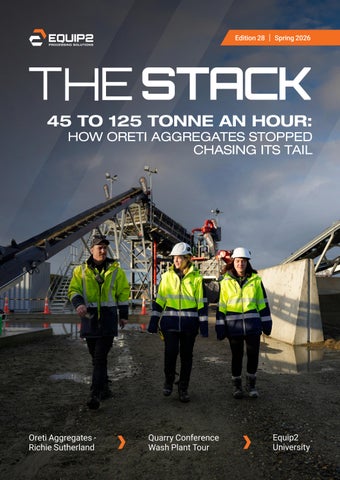
45 TO 125 TONNE AN HOUR: HOW ORETI AGGREGATES STOPPED CHASING ITS TAIL
Oreti Aggregates Richie Sutherland
Quarry Conference Wash Plant Tour
Equip2 University
OPINION
THE BASICS BEFORE THE BOOM Coming out of this year’s Quarry Conference, one message stuck with me: before chasing big improvements, get the basics right. I’m seeing a real lift in the industry, particularly in Southland, where a number of projects are about to start. The larger cities still seem slower, but I was recently told that New Zealand tends to grow back from the south. Whether that pattern repeats or not, what I’m seeing ahead looks encouraging. It reminds me a little of the period after COVID. The work started coming, but finding enough good operators quickly became the bottleneck. I think we could see that again - not just a shortage of people, but of properly trained ones.
The same thinking applies across the quarry. It’s easy to spend energy hunting the next major change while walking past the basics. Fix the skirting rubber. Adjust the scraper. Clear the spillage. Tidy the work area. Ten minutes today saves hours later. We practise this ourselves at Equip2 through our 2 Second Lean programme. Every day we aim to put an improvement suggestion on the scoreboard and complete one. Two seconds doesn’t sound transformational. Repeated every day, across a whole team, it adds up quickly. The opportunity is coming. The question for all of us is whether we’re getting the basics right today so we’re ready when it arrives.
That’s one of the reasons we’ve launched Equip2 University. Putting someone in the seat and showing them which buttons to push isn’t enough - operators need to understand what 'good' looks like. Simple KPIs make that practical: tonnes per day, daily machine-check scores etc. I’m a big believer in lead measures over lag measures. Once you know yesterday’s production result, you can’t change it. But you can influence tomorrow’s. A thorough machine check catches the problem before it becomes downtime.
Bert Hart General Manager
Edition 27 Winter Win 202 ter52026
WE'VE GONE DIGITAL!
FROM S TOCKP ILE LIAB TO REV ILITY ENUE S Case Study TREAM : Winstone Aggre gates
Click here to view previous stack editions online RS15 Stacke Walkthroug r h
C&D Waste Demo Day
Craig Lee Winstone Aggregates
PROJECTS ON THE GO! Tag us on Facebook, Instagram or LinkedIn if you are working on a project and using Equip2 equipment.
@equip2solutions
#equip2
SILVA Group R3h 2D making 30-16mm, 16-0mm
Kuru K5, R3h, S3 - Crushing it!
Wilson Contracting K3
AFT Thompson - K4
Urban Quarry Crushing Concrete to 40mm
GAIN CLARITY ON COMMON INDUSTRY QUESTIONS Click the QR code to watch our how to videos
CASE STUDY: ORETI AGGREGATES
45 TO 125 TONNE AN HOUR: HOW ORETI AGGREGATES STOPPED CHASING ITS TAIL A new modular wash plant has nearly tripled throughput at the Invercargill quarry - and turned in-spec sand from a daily battle into a switch-on-and-run job.
“It's been a massive change in the mentality of the team out here.”
- Richie Sutherland
A Plant that had Run its Course Oreti Beach doesn't make life easy for a wash plant. Sand is in the ground, in the feed, in the air - the raw feed at the local site runs as high as 65% sand, one of the toughest washing duties in the country. Richie Sutherland is Quarry and Operations Manager for International Speciality Aggregates and Oreti Aggregates, HW Richardson Group businesses in the contracting division alongside SouthRoads, SouthRail, SouthDrill, Coal Pit Aggregates and Kilmog Quarries. Two sites at Oreti Beach, a couple of kilometres apart, do very different jobs: one feeds the export trade; the other keeps Invercargill supplied with gravel and concrete aggregate, with Allied Concrete chief among the customers at the end of the conveyor.
The plant serving the local site was a genuine performer in its day - an award winner at the Quarry Conference when new. But after 18 years of hard running in that feed, it had simply run its course, and washing technology had moved a long way on. "We took over the site almost 24 months ago. Once we got a handle on operations and the plant, we identified we were really struggling with water pressure, so naturally we struggled with the washing side, with our sand spec - and actually struggled just to keep up," Sutherland says. Push the plant too hard and it broke, so the team ran it gently just to keep something moving off site each day. Meanwhile, demand kept climbing. "The local companies were taking out more than we could produce in a day." The gap between what Southland needed and what Oreti Aggregates could produce was widening by the month.
Designed Around the Site, Not the Brochure Once the business case was settled, the search began for a partner who could do more than sell steel. "In the early stages, we contacted a couple of companies about working on the quoting and design side of this," Sutherland says. Equip2 separated itself quickly. "They got right in-depth and detailed on the strategic side. We sat down, liaised with them on what we actually wanted to achieve, what our raw material was, the problems we were having with our current plant setup, and what we were hoping to get out of the new build." That thinking shows in the finished plant: a high-grade marine paint finish to stay ahead of the salt air, with a lower-half repaint already pencilled in for five to ten years' time; a deliberately angled position worked out around truck flow and the weighbridge; and a design stress-tested with the manufacturer before any steel was ordered - no surprises on site.
The Results The old plant managed 45 tonnes an hour on a good day. The new one runs at 125 - throughput has nearly tripled. With a feed this sand-heavy, nobody was entirely sure what the new plant would deliver until it was in the ground and running, which makes the number land even harder. Just as important is what comes off the belt: consistent, in-spec sand, day after day. If the feed changes, screen media can be swapped in around ten minutes, so the team can correct the sand's fineness modulus on the spot instead of working around whatever the plant produced that day. For concrete customers, that consistency is the product - it's what turns tonnage into sellable value.
“We worked with them on design, layout, on location, on site - traffic management and positioning on site in relation to the weighbridge. Equip2 were fantastic on the strategic side.” - Richie Sutherland
Running it is now the easy part. "Our ability to now turn the plant on, actually get some material through it, get something out into stockpiles and load up trucks to help the Southland infrastructure - something we've really struggled with in the past - to be able to have those numbers and the return on that side is fantastic," Sutherland says. But talk to Sutherland for long and the tonnage isn't the headline. The plant has handed his team back the ability to plan rather than react: maintenance is scheduled instead of forced, and attention has shifted to extraction - running deliberate campaigns to build feed stockpiles, then switching the plant on and letting it work. That's the real change at Oreti Beach - not just what the plant produces, but what it has freed the team to do. "It's definitely something we're proud of to put into action for our business."
The bottom line 45 to 125 tonnes an hour, in-spec sand every day, a plant you switch on and let run. Oreti stopped surviving and started producing.
CASE STUDY: ORETI AGGREGATES
Click here to watch the full interview
“We can actually have productive days, rather than feel like we're chasing our tail every day.”
- Richie Sutherland
QUARRY CONFERENCE - WASH PLANT TOUR
INSIDE THE WASH PLANT SWAP THAT COST ZERO DAYS OF SUPPLY Equip2's modular wash plant is doing 125 tonnes an hour at Oreti Aggregates, Invercargill - built without a single day of lost supply, and the standout stop at this year's Quarry Conference.
When the Quarry Conference wash plant tour pulled up at Oreti Beach this year, delegates saw something rarer than it should be: a brand-new wash plant in full production not a concept, not a brochure render. Here's how it came together, and why the details matter to anyone weighing up their next plant.
The maths that ruled out mobile gear With at least 20 years of quarry life ahead, mobile gear didn't stack up - most operations would replace it at least twice over that span. A fixed modular plant won on whole-of-life cost and gave operators a far easier plant to maintain. And rather than squeezing the new build into the old plant's footprint, Equip2 and Oreti Aggregates started with a clean slate, designing the w ash plant's layout around site traffic flow and long-term management.
One feed in, five products out Feed runs up a conveyor onto a three-deck screen, cutting three aggregate splits. The 0–7mm underflow drops to a split-deck dewatering screen: one side screens the aggregate fraction, while the 0–4mm is pumped through a hydrocyclone to strip out silts. The recovered sand lands back on the dewatering screen - pulled down to around 9% moisture - before a radial stacker carries it out to the stockpile. The sand circuit runs at roughly 80 tonnes an hour of the plant’s 125 total. The product range spans P-gravel (5–7mm) through 13mm, 19mm and a Reject grade, with fines running at 50–60% natural sand yield. Early hours are already tracking ahead of expectations.
QUARRY CONFERENCE - WASH PLANT TOUR
The unglamorous details that decide year ten Equip2's scope ran from the concrete up, while Oreti Aggregates and SouthRoads covered the infrastructure and functionality of the build: hardstands and bins to prevent cross-contamination, and graded drainage engineered to keep salt water away from clean product. Wash-down hoses and drainage that actually goes somewhere - the kind of detail that makes daily operation easier for the life of the plant.
The changeover customers never noticed Rather than demolish the old plant and lose supply through the rebuild, the team kept it running while the new wash plant went up alongside. The changeover took about three weeks - pulling the conveyor from under the old feeder bin, swapping the chute and drive direction, and completing final engineering including water connections and power supply. Zero days of lost supply.
Cleaner water, cleaner ponds Feed water is drawn from a pond roughly 200 metres away, with waste water discharged to a settling pond. The circulating system runs at approximately 55 litres per second - and noticeably less silt is reaching the ponds now that saleable sand isn’t ending up in the waste stream.
A two-person crew runs the lot Day to day, the wash plant is run predominantly by two women - Aliesha, several years into the industry and working toward her B-Grade, and Tayla, two years in - both taking full ownership of running the site.
Proof you can walk around The build doubles as a proof point for Equip2’s turnkey capability - civils through to commissioning, delivered as one job. For everyone who made the trip out, the wash plant showed what a well-executed modular build looks like in practice: no supply interruption, a plant designed around the people running it, and results already ahead of expectations.
Click to watch the Site Visit at Quarry Conference
SILVA GROUP - EQUIP2 AFTERSALES SUPPORT
SILVA GROUP SAMOA TRAINING SETUP Training took place with the SILVA Group team following delivery of a Keestrack R3h double-deck screener to their Samoa operation. Rather than starting cold, SILVA's operators had already completed Equip2 University arriving with real tools and real knowledge already in hand, instead of learning their new machine from scratch. That's exactly the outcome we're aiming for. A machine like the Keestrack R3h represents a serious investment for owners, and the training that happens before an operator ever sets foot on site plays a huge role in determining the return they get from that investment. Operators who understand the fundamentals ahead of time get more out of every hour of hands-on instruction, ask sharper questions, and are better equipped to run their equipment safely and efficiently from day one. Robin Stolte, Senior Technician at Equip2, working alongside the SILVA Group team in Samoa is a great example of this approach paying off - well-prepared trainees, a productive week of training, and operators walking away genuinely equipped to get the most out of their new double-deck screener.
Click here to watch the Keestrack R3h running in Samoa
Equip2 University Getting new operators up to speed shouldn't mean sacrificing safety or slowing down your team. That's the thinking behind Equip2 University, our online training course designed to give operators a strong foundation before they ever set foot in hands-on induction training. The course is built to be simple and accessible: short, easy-to-follow videos paired with a multiple-choice quiz to check understanding along the way. There's no need for classrooms or scheduling headaches - operators can work through it at their own pace, wherever they are. By covering the essential tools and knowledge upfront, Equip2 University means operators arrive at induction training already prepared, making the hands-on component more effective and efficient for everyone involved.
Find out what previous Equip2 University Students have to say
Testimonials KIERAN OLIVER CONTRACTING
CAMERONS QUARRIES
Derek Woodley - Quarry Supervisor
Jimmy Conway - General Manager
Interested in Equip2 University for yourself or your team? Get in touch with us today to find out more.
Paul Thompson: 027 404 4430
Bert Hart: 021 244 5797
$285,000
+GST (or near offer)
FOR SALE: PORTAFILL MS-3 + DW80
MS-3 + DW80 SCREEN IT. WASH IT. STACK IT.
The MS-3's triple conveyor setup handles multiple products at once, with an aggressive screening action built for high yield - and it converts easily to wet screening, feeding straight into the DW80 for clean, stockpiled sand. Only 200+/- hours on the clock and ready to go straight to work.
0800 100 684 equip2.com