EQUINE AND CANINE NEWS


Scan Here to Find an LMF Dealer Near You!!
EQUINE AND CANINE NEWS
Created and Published by Lucky Ink Media,
Nola Johnson, Publisher
Jessica Segal, Publisher
GRAPHIC DESIGN
Iron Dog Media, LLc
Please feel free to contact us with any comments or suggestions
Nola Johnson
Phone: (805) 680-8599 njohnson@equineandcaninenews.com
Jessica Segal
Phone: (805) 451-1684 jsegal@equineandcaninenews.com
Mailing Address: 283 Heather Court - 10-D Templeton, CA 93465
The EQUINE AND CANINE NEWS
is a Quarterly Publication with distribution in San Luis Obispo, Santa Barbara, Ventura Counties and the San Fernando Valley. The publication is FREE to the public and is distributed to local tack and feed stores, veterinary offices, events at Paso Robles Horsepark, Paso Robles Event Center, Santa Maria Fairpark, Santa Ynez Equestrian Center, Earl Warren Showgrounds, Ventura County Fairgrounds and the Los Angeles Equestrian Center. Also, pet supply retailers, pet boutiques, dog groomers, horse shows, dog shows and events.
Email Nola Johnson about your event: njohnson@equineandcaninenews.com
Please include event date, time and location. Include all your contact information; name, phone, email address. www. equineandcaninenews.com
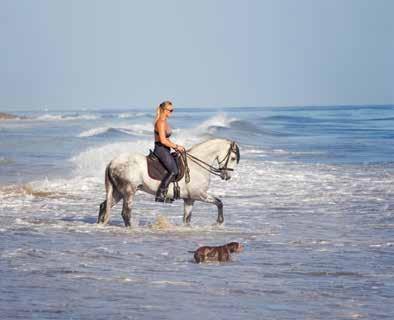
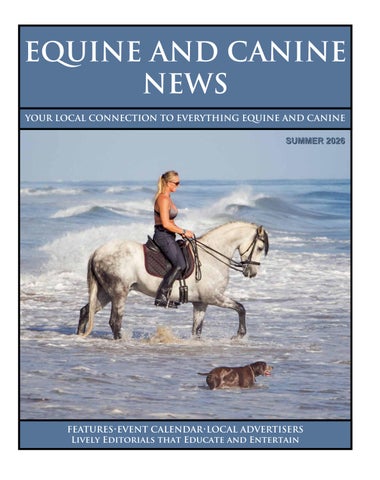
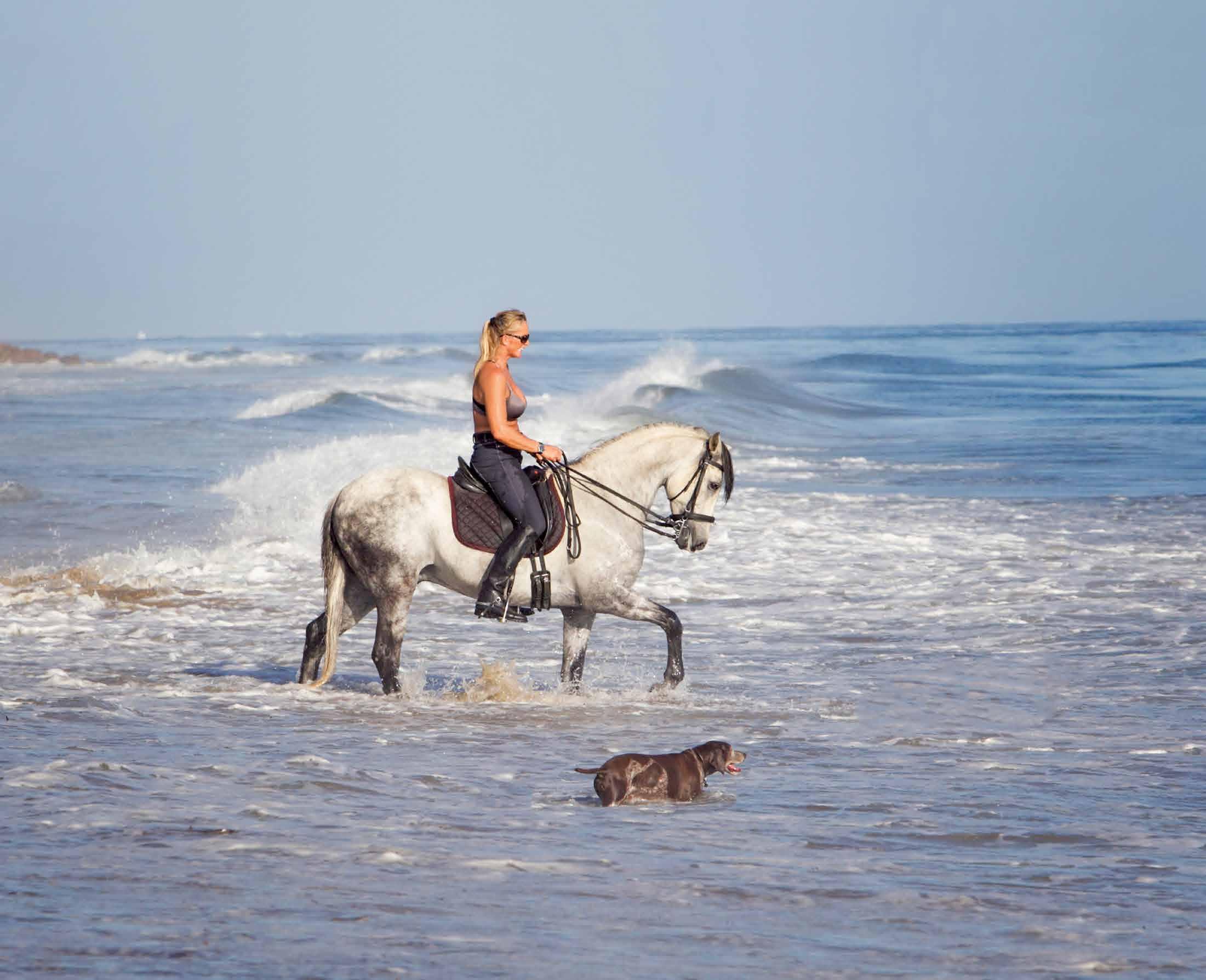
A perfect summer picture for our cover taken at Summerland Beach by our friend and photographer Lynne Glazer. Rider is Sabine NiederberghausLesavoy on the 10 year old love of her life, Lusitano gelding “Regalo”, accompanied by Nike, a German Shorthair. Sabine is a
horse trainer and dog lover.



$5 Local Delivery Wednesdays & Fridays (Minimum $25 order)
LISTENING TO WHAT YOUR HORSE HAS TO SAY — INCLUDING WHEN GETTING READY FOR A SHOW
Written by Carolyn Osborn
Are you an avid and devoted horse person? Would you do anything for your horse, and is their care your biggest concern?
The Bond You Have with Your Horse
Horses, like humans, are complex creatures with their own thoughts, feelings, aches, pains, joys and desires. The hardest part is understanding what they are trying to tell you. Sometimes it is clear what they are communicating but other times it is frustrating trying to decipher what is going on with them. On the flip side, your horse usually has a good idea of what is going on with you and who you are on a deeper level. They can feel and sense you literally a mile away, reading your energy clearly.
Behaviors you perceive as annoying cause doubts like these: that they are doing them on purpose, that they are being difficult, but they may often be their attempt to communicate a deeper message to you about your life. Horses know what is going on inside you – your pain, frustration, fear, anxiety, what you are thinking – and they just want you to better understand the Soul Level Lesson they are trying to convey. It is up to you to pay attention and really listen to their message.
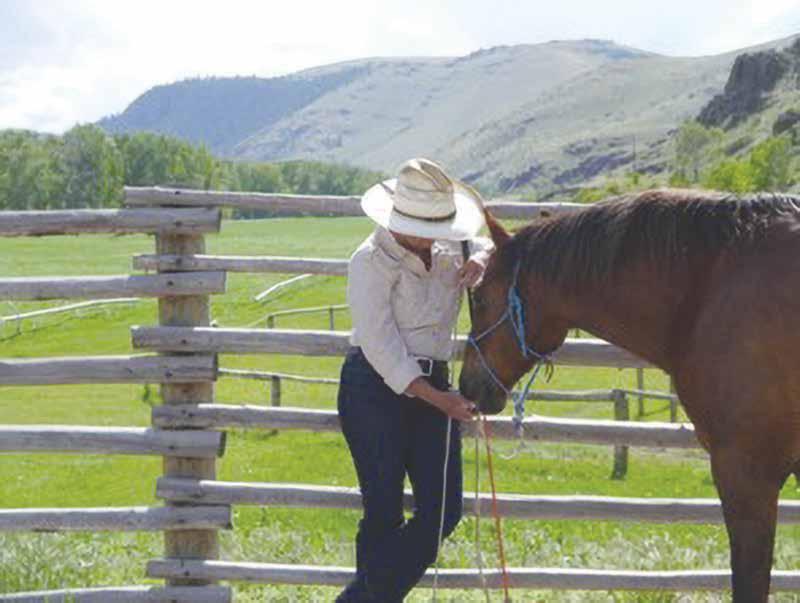
One of my clients, Dorothy, has a horse, Sarah, who was being resistant, clenching her jaw and grinding her teeth when Dorothy asked her to go forward. I gave them a Soul Level Animal Communication reading and Dorothy asked the question, “What are you telling me?” Sarah responded that Dorothy needed to move, breathe, relax,
be adjustable and trust her more to give Sarah the freedom, space and confidence to do what was being asked of her. In this case, the Soul Level Lesson was for Dorothy to trust Sarah and herself on Sarah. I am happy to say they are much more in sync and happier, especially in the Show Ring!
In the World of Horse Shows
One thing to be aware of next time you are showing, is how your emotions –nerves, anxiety, fear, frustration – are affecting your horse’s performance and how you are riding differently from at home. Your horse may have an answer for how you can be calmer and better able to handle your nerves.
Here are some possible behaviors that may indicate that your horse is trying to convey a Soul Level Message to you:
1. Spooking at odd moments
2. More resistant or hesitant to moving forward
3. Throwing their head or pinning back their ears (after you have ruled out any physical issues)
4. Okay with your trainer but not with you – not responding to cues you know they know
5. Won’t stand still
6. Gets nippy
7. Acting stubborn
These are some common possibilities, but it can be any kind of behavior that is not appropriate or good. This is when a Soul Level Animal Communication® reading can be very informative and helpful for you both. One thing I have learned in talking with animals is they have a lot to share with us, and they are here to help you specifically work on your lessons. They want to help you understand that they are only doing said behavior so you can see things from their perspective and become a better person and rider.
Animal Communication and You
This type of animal communication also
Winning Spirit. Winning Focus.
works with any pet in your family. Each has a unique purpose and lesson to bring to your attention to help you become a better and healthier person.
One message I hear from different animals through various behaviors is that they are here to help ground and anchor their person. I also hear that the person needs to be more aware of what they are thinking or feeling around their animal as it can be overwhelming. Scattered energy keeps the person from being clear and focused, and ultimately calmer. For example, animals may show anger and rage through their behaviors to convey the lesson that the person needs to manage their own anger and rage, acknowledge it and find a way to release it in a healthier manner.
Some behaviors in dogs and cats that may come up are:
1. Peeing or pooping inappropriately
2. Excessive barking or meowing
3. Aggression
4. Hiding, and/or showing fear or anxiety
5. Biting inappropriately
6. Interrupting your work
Animals that have crossed over can also have a Soul Level message for you, helping you from the other side. Their messages can often go into a deeper spiritual level for you. Again, they have your best interests and growth at heart!
So how does a Soul Level Animal Communication work? It is done over Zoom or the phone. I generally only need to know their name, species, male or female, and if they are alive or crossed over. I connect with your animal, and I listen to them. They will tell me about
their personality and essence, then their view of your personality. Next, I check their body to find out what they want me to know about how they are feeling physically by feeling it in my own body. At this point you can ask them one question. Whatever your words, trust that your animal will know what you need answered. And finally, we get to the deeper layer of discovering the Soul Level Lesson your animal has for you.
For many of you, your animal is your
soulmate, and they mean everything to you. Being able to talk with and hear from your animal is satisfying and often confirms what you already know or feel. Especially if they have passed, this reading can give you closure and their love. They always have your best interests at heart and love being able to talk with you as well!
Reach out if you have any questions. Let’s talk with your animal today to feel and hear their love for you!
If you want to discuss more about your animals and how they can help you, reach out to me at either www.ChironEnergyMedicine.com, info@chironenergymedicine.com, or my new sister site, www.CarolynOsbornIntuitive.com, info@carolynosbornintuitive.com
EQUINE ANGELS
I want a donkey!
THE TRUTH ABOUT COMPANIONSHIP, COMMITMENT, AND SANCTUARY
Written By Jim Eckford
“I want a donkey”, is a common request we get at Rancho Burro Donkey Sanctuary.
Most often, good intentions are based on a misunderstanding of what it takes to care for one. Just having space is not good enough. Donkeys are social animals, so they need companionship. They will get lonely if they are kept by themselves. We always insist that if someone is going to make a commitment to keeping a donkey, they need to have two or more. An equally important part of donkey ownership is the ability to afford the expenses that are a part of this undertaking. In many cases, the inquiry comes from the notion that donkeys can exist with pasture space and water alone. Donkeys are NOT pasture animals. The ideal feeding protocol centers on a highfiber, low-sugar diet consisting mainly of barley straw and smaller portions of grass hay. A donkey will become fat and extremely unhealthy, and can even experience total system failure, if allowed to graze on pasture grass all day. A great source for feeding instructions can be found on the website of The Donkey Sanctuary UK.
There are many other important things to consider for responsible donkey ownership, including shelter, farrier care, and veterinary expenses. Furthermore, an investment of time is not to be underestimated; keeping their stalls clean, providing fresh water, and spending time with them are all important aspects of having happy and healthy donkeys
Donkeys are not like horses. Donkeys are like dogs in some ways.
They thrive on companionship and activity. It’s important to spend time with your donkeys by taking them for walks and just hanging out with them. Though often mislabeled as stubborn, donkeys are actually highly intelligent animals who simply take time to analyze situations for safety and self-interest. Once their trust is gained, their capacity for learning allows them to excel at a wide range of trained activities. In fact, Meredith Hodges, an expert in mule and donkey training and owner of the Lucky Three Ranch in Colorado, trained a donkey to compete in mule events. That donkey, Little Jack Horner, set a jumping record and excelled in numerous other events.
Rancho Burro beginnings
Rancho Burro Donkey Sanctuary’s roots came into being 20 years ago when Carlen and Jim Eckford adopted two mammoth donkeys, Lulu and Lolita. Mammoth donkeys, a classification used for any donkey standing taller than 54 inches at the withers. The other basic size categories include standard and miniature donkeys. The sanctuary received its 501c3 non-profit status in 2016. Today Rancho Burro has 28 donkeys and 3 mules in its care.
Rancho Burro’s mission is to rescue, rehabilitate, and provide a forever home for donkeys that have been abused, abandoned, or have somehow fallen on hard times. Most rescued donkeys require medical and emotional rehabilitation. The facility has an extensive medical area equipped with medicines and devices specific to caring for its residents. None of this effort would be possible without a wonderful team of dedicated employees and volunteers. Anyone interested in volunteering can apply through the Rancho Burro Donkey Sanctuary website.
Another important pillar of the Rancho Burro mission is fostering community involvement as a central focus. The sanctuary loves bringing people together by hosting events that connect our community with the herd; one such event is hosting specialized group
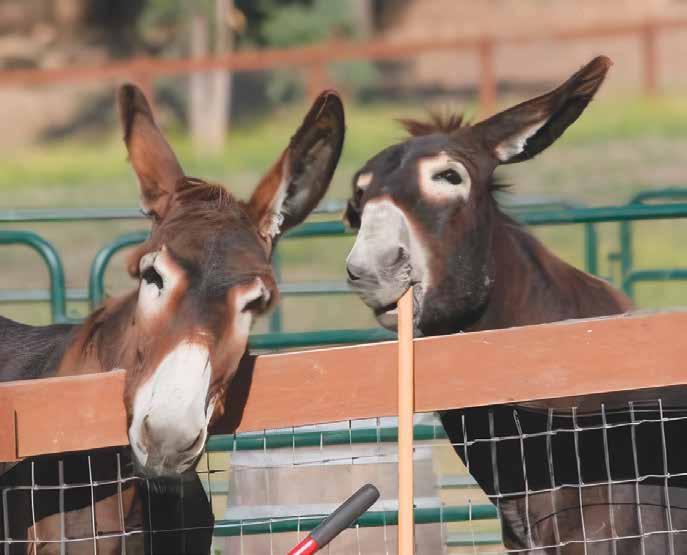
visits for individuals with disabilities. At the sanctuary, we constantly see the profound joy these interactions bring. In fact, during a recent visit, a non-verbal boy surprised everyone by speaking aloud the name of the donkey he liked.
Examples of Rancho Burro rescues
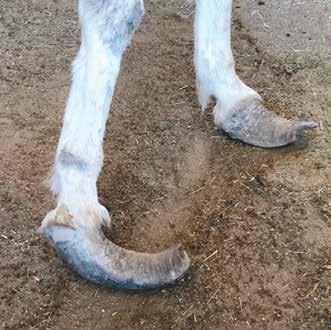
Gracie and Henry, two standard donkeys, were rescued from a situation where they had received no care for roughly 15 years. This neglect resulted in severely overgrown hooves, causing poor body composition and chronic pain.
Unfortunately, it took a year to repair their hooves, though hoof issues remain Rancho Burro’s biggest rehabilitation challenge. In short, maintaining a strict, routine farrier schedule is a fundamental responsibility for every owner.
Wookie, a mini donkey (less than 36 inches), was hauled from Texas in a stock trailer with larger equines when rescued. Since Wookie is so little compared to his counterparts, he is lucky to be alive after that travel. Furthermore, he was battling valley fever—a serious fungal lung infection—and he continues to require ongoing care for the chronic condition today.
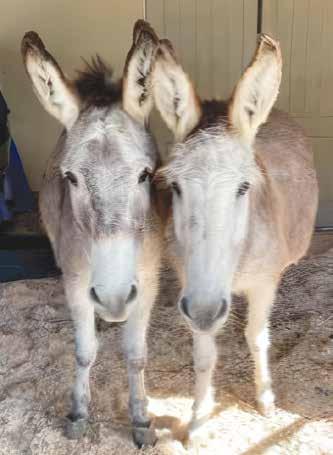
He receives nebulizer treatments twice daily to manage his respiratory symptoms. Wookie also arrived overweight, so he is on a corrective diet. Ultimately, it’s important for every owner to keep an eye on their donkey’s weight and overall health.
Ed, a severely underweight and overworked draft mule, was rescued just before being sent from an auction in Texas to slaughter in Mexico.
Apparently, he could no longer work;
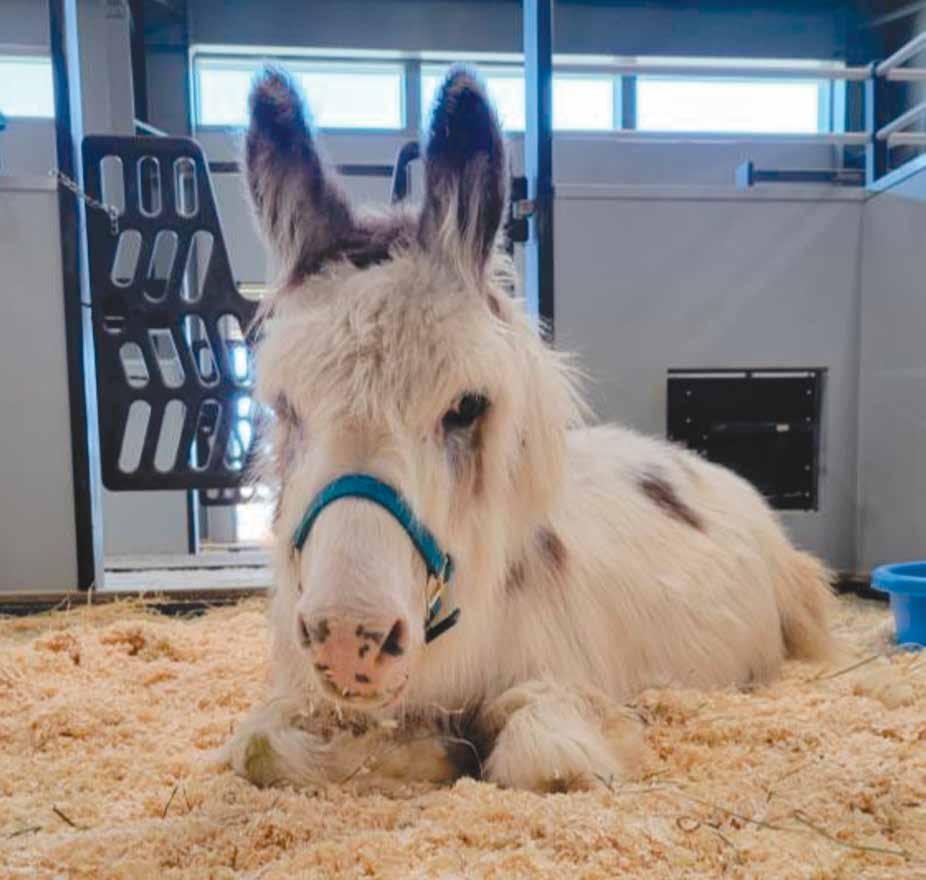
however, once rescued, his weight recovery got underway, and he received many vet visits as well. He is now a healthy, gentle giant. One thing he is still battling is horrible teeth conformation,
which means he can’t eat like a regular mule; he can only eat pellets—and that is roughly over 30 lbs of pellets a day. To that end, owners should maintain their equine’s annual routine maintenance, like dentals, to help them stay at peak performance and not ignore animal health.
At Rancho Burro, we are dedicated to uniting our community through the healing presence of these incredible animals, but we cannot do it alone. We rely completely on donations and local events to fund our sanctuary operations. We invite you to partner with us in this mission of compassion—click here to make a donation and directly impact a rescue donkey’s future.
Jim Eckford Rancho Burro Donkey Sanctuary 4855 Righetti Road, San Luis Obispo, Ca. 93401 Ranchoburrodonkeysanctuary.org




CHOOSING CONNECTION OVER PERFECTION IN A VERY NOISY WORLD
By Stephanie Barger, Certified Separation Anxiety Trainer (CSAT), Certified Behavior Consultant Canine (CBCC-KA)
We live in a world that asks a lot of dogs.
They are expected to calmly walk through crowded stores, settle quietly at outdoor patios, welcome unfamiliar visitors into the home, remain composed around constant activity, and adapt quickly to changing routines and environments. At the same time, social media feeds are filled with polished videos of dogs behaving flawlessly in carefully curated moments. It becomes easy to believe that “good dogs” should always be calm, social, flexible, and easy.
But real dogs are not robots. They are living, breathing, emotional beings trying to navigate a human world that often moves far faster than they comfortably can.
For many guardians, this creates quiet pressure. If their dog struggles with barking, reactivity, fearfulness, separation anxiety, or overstimulation, it can feel isolating. Guardians may begin wondering whether they are doing something wrong or whether their dog is somehow failing.
Many dogs are simply overwhelmed.
When Expectations Outpace Capacity
Behavior challenges often make more sense when we stop viewing dogs through the lens of obedience and start looking at emotional capacity instead.
Just like people, dogs have limits. Stress,
lack of rest, environmental changes, social pressure, physical discomfort, and previous experiences all influence how well a dog can cope in each moment. A dog who can comfortably handle one situation on Tuesday may struggle with the same situation on Friday after a stressful week or poor sleep.
That does not make the dog stubborn, dramatic, manipulative, or “bad.” It makes them alive. Too often, behavior is judged without considering what the dog may be experiencing internally. Barking may be rooted in uncertainty. Lunging may reflect discomfort or fear. Avoidance may be communication rather than defiance. Even highly energetic behavior can sometimes be a sign of emotional overload rather than excitement alone.
When we shift from asking, “How do I stop this behavior?” to “What is my dog trying to communicate?” we often uncover a very different story.
The Comparison Trap
Modern dog culture can unintentionally make this harder.
We see videos of dogs calmly lying under restaurant tables or hiking off leash through busy environments, and it becomes easy to assume that every dog should eventually reach that point. But behavior is not one-size-fits-all. Dogs have individual personalities, sensitivities, genetics, learning histories, and emotional thresholds.
Some dogs genuinely enjoy highly social environments. Others feel safest in quieter, more predictable settings. Neither is wrong.
There is also an important truth we rarely discuss openly: many training videos capture only a tiny moment in time. They often do not show the management, preparation, decompression, or gradual learning that happened behind the scenes. They also do not show the dogs who are struggling off camera.
This matters because comparison can quietly shift our focus away from the
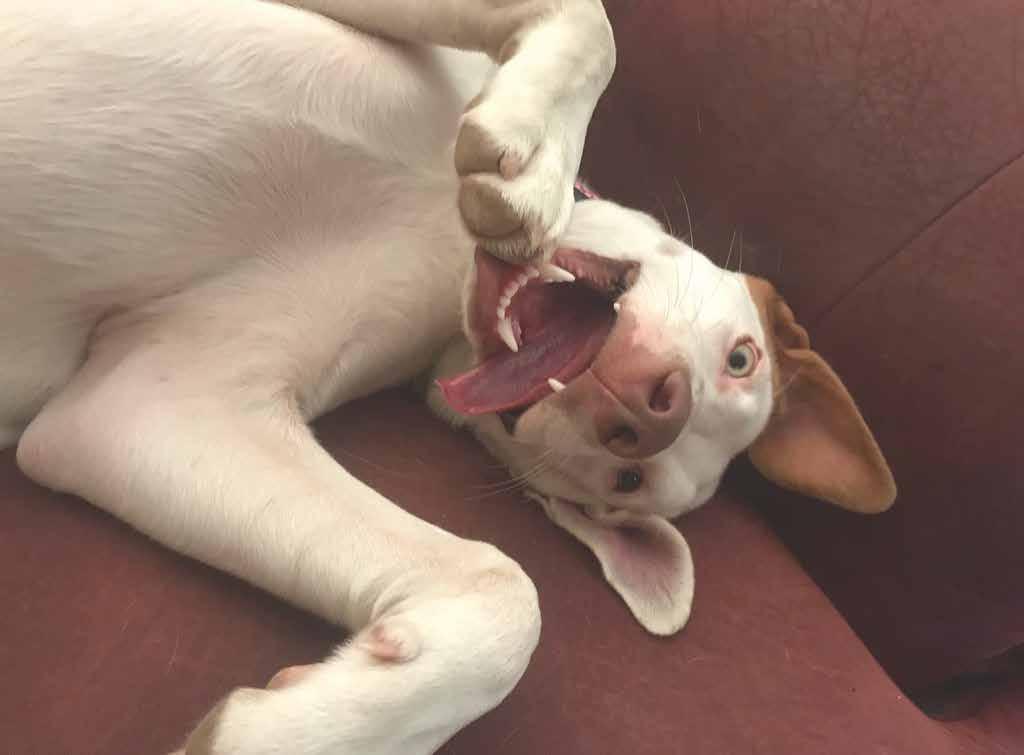
relationship in front of us. Instead of noticing what our own dogs need, we begin chasing an imagined version of what a dog “should” be.
But meaningful progress is often far less flashy.
Sometimes progress looks like a dog recovering more quickly after hearing a loud sound. Sometimes it is choosing to look at their guardian instead of reacting immediately. Sometimes it is simply feeling safe enough to rest.
These quieter victories deserve recognition too.
Dogs are not failing because they struggle. Many are simply trying to cope in environments that ask more of them than they are currently able to handle.
Supporting the Dog You Have
One of the most compassionate things we can do as guardians is let go of the idea that success must look the same for every dog.
For some dogs, success may mean confidently navigating busy public spaces. For others, success may mean learning that the world feels a little less scary than it once did. Some dogs thrive socially. Others prefer smaller circles and calmer routines.
Our role is not to force dogs into a specific mold. It is to support them as individuals while helping them build skills, confidence, and emotional resilience at a pace they can handle.
“Dogs are not failing because they struggle. Many are simply trying to cope in environments that ask more of them than they are currently able to handle.”
That support often starts with small adjustments:
• creating more predictable routines
• allowing decompression time after stressful events
• recognizing early signs of overwhelm
• giving dogs more choice and space
• celebrating progress instead of perfection
These changes may seem simple, but they can dramatically influence how safe and supported a dog feels in daily life.
Progress is not measured by how closely a dog matches social expectations. It is measured by increased safety, trust, communication, and emotional wellbeing.
Choosing Compassion Over Perfection
The truth is, there is no universally “perfect” dog. There are only individual dogs doing their best within the environments and experiences they have been given. And there are guardians trying to support them while navigating an overwhelming amount of conflicting advice and pressure.
“Progress
is not measured by how closely a dog matches social expectations. It is measured by increased safety, trust, communication, and emotional wellbeing.”
The goal should never be perfection. The goal is understanding. When we approach behavior with curiosity instead of frustration, we create space for learning, trust, and connection to grow. We begin listening more carefully to what our dogs are communicating
Calm the Chaos
rather than focusing only on how their behavior appears to others.
Sometimes the most meaningful transformation is not simply changing the dog’s behavior. It is changing the relationship between dog and guardian. That is where calmer, more harmonious homes begin.
At Canine Zen, I help guardians better understand and support their dogs through compassionate, personalized virtual training focused on behavior modification and separation anxiety. No matter where you and your dog are starting from, progress is possible when we replace pressure with understanding and perfection with connection.
Stephanie Barger, (505) 657-3346
Certified Separation Anxiety Trainer (CSAT), Certified Behavior Consultant Canine-Knowledge Assessed (CBCC-KA), Certified Professional Dog TrainerKnowledge Assessed (CPDT-KA), Fear Free Certified Professional (FFCP Trainer) CanineZen.com
(505) 657-3346 CanineZen.com
Is your dog struggling with separation anxiety, fear, or reactive behavior? Fear isn’t just about running away, it can also show up as barking, lunging, or even aggression. I specialize in helping dogs and their guardians bring calm and harmony to their lives using gentle, science-based techniques, no matter where you are.
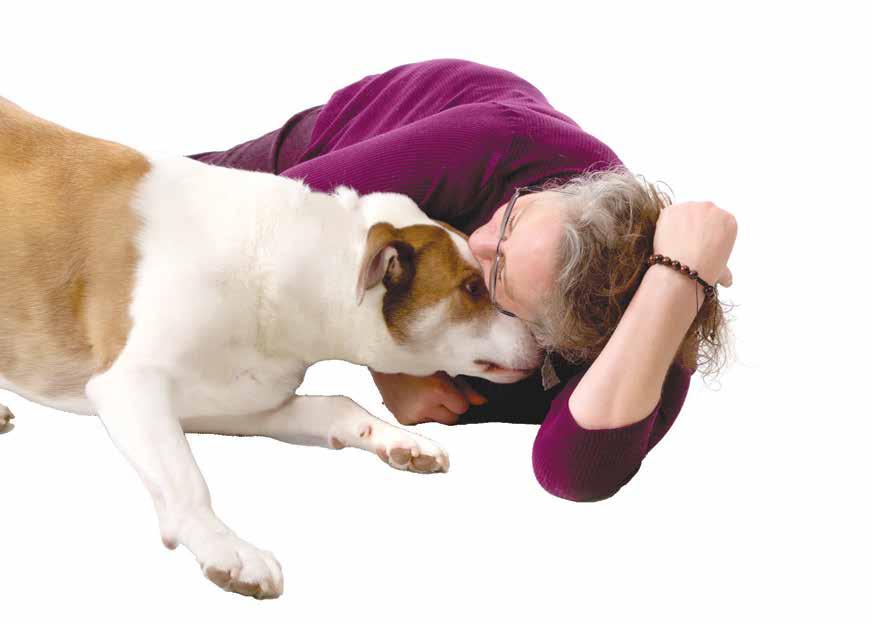
Here’s How I Can Help
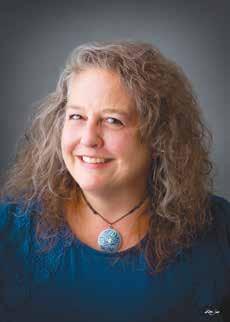
Stephanie Barger
• Remote Weekly Training & Coaching
• Separation Anxiety & Behavior Modification
• Ongoing guidance between appointments via video review and messaging to ensure consistent progress
Certified Separation Anxiety Trainer (CSAT)
Certified Behavior Consultant Canine-Knowledge Assessed (CBCC-KA)
Certified Professional Dog Trainer-Knowledge Assessed (CPDT-KA) Fear Free Certified Professional (FFCP Trainer)
Create a balanced, peaceful home where you & your dog can thrive together.

BRIDGING THE GAP: WHY HAY AND PASTURE AREN’T A COMPLETE MEAL
Written by: Lindsey Close, PAS Professional Animal Scientist Director of Operations and Sales Manager
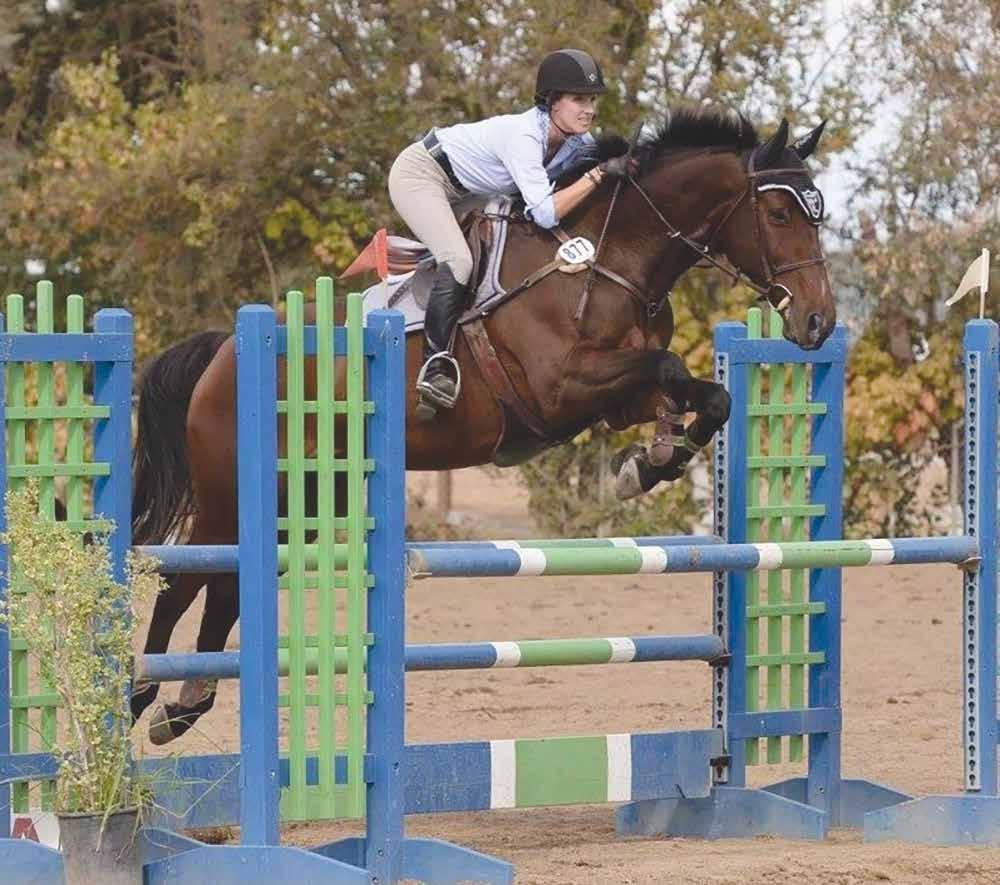
For many horse owners, the sight of a horse grazing peacefully on green pasture or contentedly munching on high-quality hay represents the pinnacle of equine health. It feels natural, wholesome, and sufficient. However, a common misconception in equine husbandry is that forage alone provides every nutrient a horse requires to thrive. In reality, even the most beautiful fields and quality hay often contain significant nutritional gaps. This is where the ration balancer enters the picture: not as an unnecessary “grain” or a source of unwanted energy, but as the essential bridge in a forage-based diet.
The Myth of Forage Completeness
While forage is the foundation of any equine diet, it is rarely a complete nutritional package. Soil depletion and regional mineral deficiencies often leave gaps in vital micronutrients. For instance, many forages are naturally low in copper, zinc, and selenium — minerals critical for immune function, coat health, and hoof integrity. Furthermore, hay has significantly altered vitamin content once harvested; while it provides essential fiber, the curing process and storage time cause a rapid decline in vital vitamins.
A horse relying solely on pasture or hay is essentially eating a diet that may satisfy their caloric needs but leaves them lacking foundational micronutrients. A ration balancer acts as a concentrated daily multivitamin, specifically designed to be fed at low rates — typically just 1-2 pounds per day — to ensure
comprehensive support without adding unnecessary calories.
Addressing the “Grain” and “Hot” Horse Fear
One of the primary reasons owners hesitate to add a balancer is the fear of feeding “grain”. In the horse world, grain is often synonymous with high sugar, high starch, and the dreaded “hot” behavior. It is crucial to distinguish a ration balancer from a performance feed.
• Low Sugar and Starch: Because balancers are fed in such small quantities, their contribution to the total sugar and starch intake is not substantial.
• The Protein Misconception: While a balancer might list a high protein percentage (often around 30%), the actual amount consumed in a single pound does not significantly alter the diet; rather, it complements the existing forage.
• Behavioral Clarity: Excitability is usually the result of an energy surplus—feeding more calories than the horse uses or needs. A balancer provides nutrients, not calories, meaning it supports well-being without making the horse “hot”.
The Ideal Solution for “Easy Keepers”
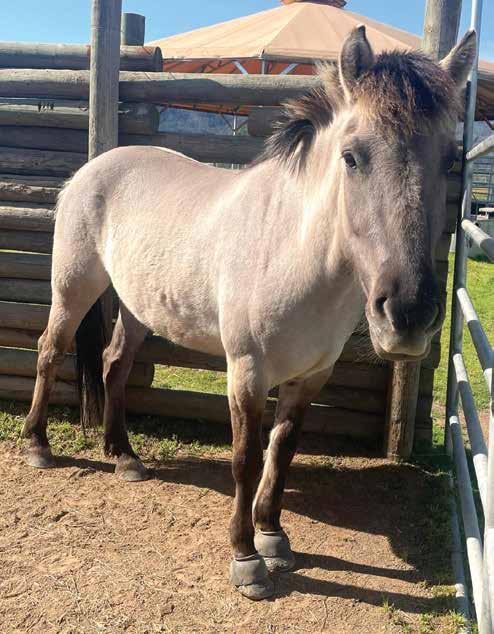
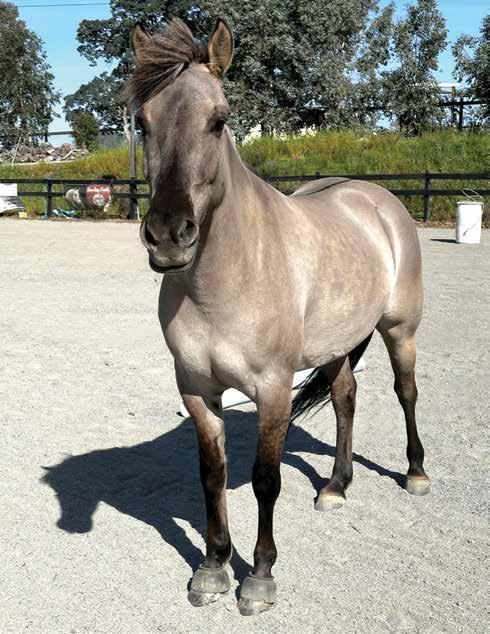
Ration balancers are the unsung heroes for “easy keepers” (those horses who maintain their weight effortlessly). These horses often cannot handle the caloric load of traditional grain, yet still require a full spectrum of vitamins and minerals. By using a balancer, you can provide comprehensive nutrition, reducing the risk of obesity or metabolic upset.
Precision Nutrition: Stable MAX™ Ultra Mate
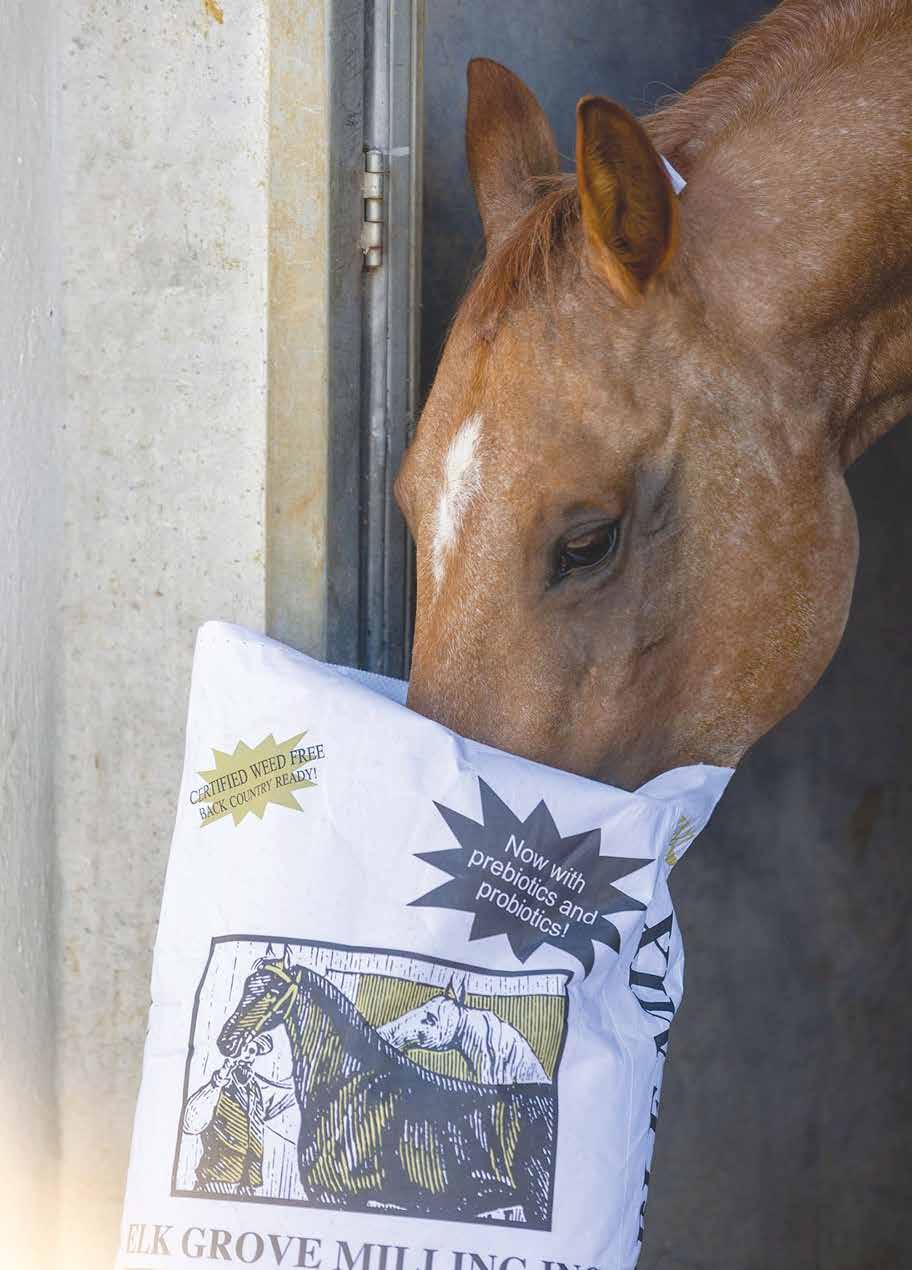
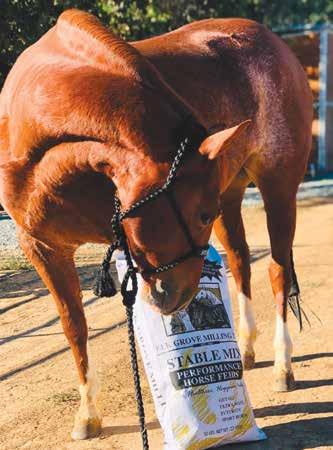
When choosing a tool to close these nutritional gaps, precision and bioavailability matter. Stable MAX™ Ultra Mate from Elk Grove Milling, Inc. is a comprehensive option designed to elevate the standard of care. Unlike many national brands, Ultra Mate focuses on science-backed ingredients and gut health:
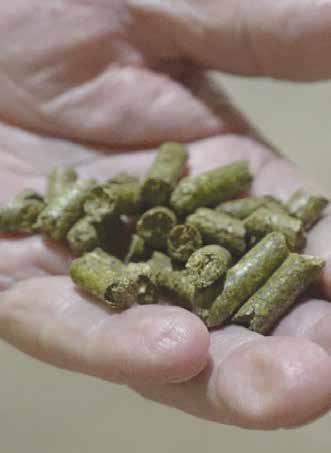
• Total Organic Minerals: Uses organic minerals for better absorption compared to inorganic sources.
• Digestive Support: Includes probiotics, prebiotics, enzymes, and toxin binders to ensure the horse actually utilizes the nutrients provided.
• LifeFORCE Formula: This Alltechbacked formula targets immune
support, hoof integrity, healthy skin, and reproductive function.
Conclusion
By recognizing that hay and pasture are a base rather than a complete solution, we can use ration balancers to provide the targeted nutrition our horses deserve. It is a small daily addition with a significant impact, ensuring your horse isn’t just surviving on forage, but truly thriving from the inside out.
Elk Grove Milling, Inc. Phone: 916-684-2056 Email: lindsey@elkgrovemilling.com
Website: www.elkgrovemilling.com
Social: https://www.facebook.com/ CloseEquineNutritionConsulting


CANINE SPECIAL EVENT
Written By Ky Ladd
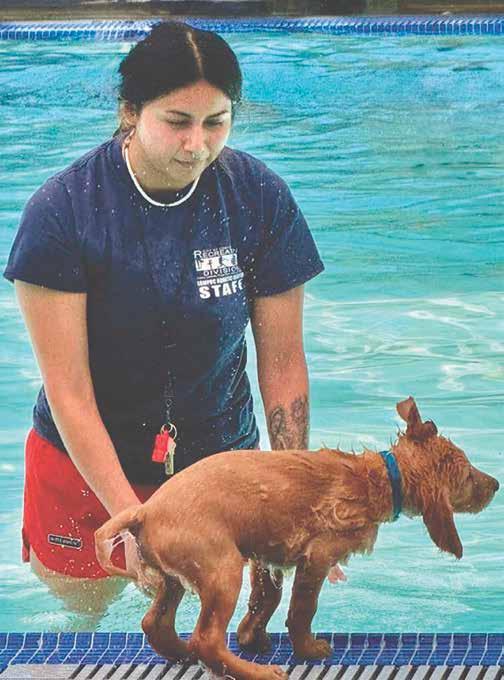
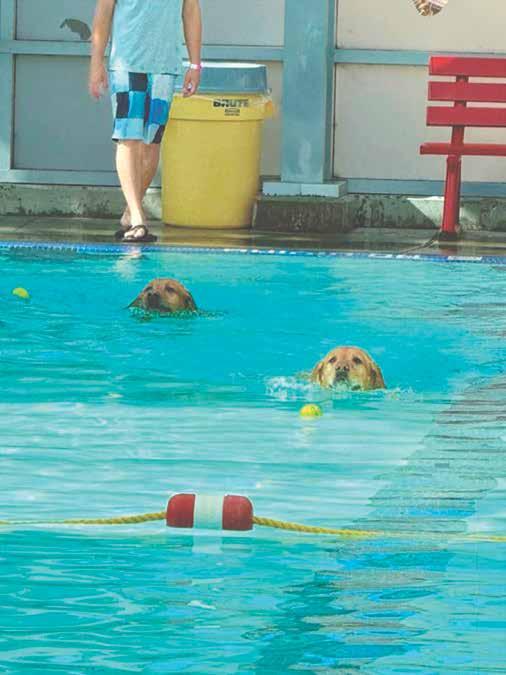
If you’ve ever wondered what pure, unfiltered joy looks like, mark your calendar for August 16 and December 20 between 3:30 p.m. and 5 p.m. at the Lompoc Aquatic Center. The annual Pooch Plunge turns our state-of-the-art pools into a canine water-park paradise — and trust us, no one dives into summer fun quite like the dogs of our community.
Picture this: happy chaos. Wagging tails. Flying droplets. The thunderous slap of paws hitting water. A symphony of barks echoing off the pool deck. For one magical afternoon, the Aquatic Center transforms into the most wholesome party in town — a splash bash where every dog is the guest of honor.
It’s a Dog Day
Afternoon — Literally
It’s no secret that dogs love water. Even pups who claim they “don’t swim” suddenly discover their inner waterdog the moment they see another dog paddling proudly by. That’s the spell of the Pooch Plunge: even the shy ones get swept up in the excitement.
A full spectrum of canine swimmers
There’s the Retriever Brigade, who treat the event like the Olympics of Fetch. There are the Dainty Dippers, who gently wade in, paws first, as if checking whether the water fits their vibe. And then, of course, we have the Cannonball Champions — those fearless fluffballs who sprint, launch, and splash in with zero hesitation and infinite enthusiasm.
Every year brings unexpected moments that make the event unforgettable — a Great Dane doing his best impression of a submarine, a tiny terrier dragging a pool noodle twice his size, or the annual debate over which dog will shake water onto the most unsuspecting humans. (The correct answer is: all of them.)
Sure, the event is open to both dogs and their humans, but anyone who has attended knows the truth: this is the
dogs’ world. We just carry their towels.
But that’s part of the charm. People gather around the pools, beaming proudly like parents at a school play, only wetter. The Pooch Plunge has become one of Lompoc’s warmest community gatherings, bringing together dog lovers, families, and anyone who enjoys a good laugh and a great time. There’s no judgment, no pressure, no competition—just a joyful celebration of furry friendship and summer fun.
By the end of the event, you’ll know every dog’s name, favorite toy, and funniest quirk.
Safety First, Shenanigans Second
Even with all the fun, the Lompoc Aquatic Center staff keeps everything running smoothly. Lifeguards and trained team members line the pools, ensuring that every dog—from seasoned swimmer to hesitant newcomer—stays safe while having a blast. Their enthusiasm is contagious, and their patience is truly
heroic, especially when drying off after being caught in a post-swim shake-zone.
Owners should bring towels, their pups’ favorite floating toys, and maybe an extra treat or two for braving new adventures. Whether your dog is a doggy-paddle master or still figuring out what water even is, the event is designed to make everyone feel comfortable and welcome.
Why the Pooch Plunge Matters More Than Ever
Events like this aren’t just cute photo ops—though yes, the photos are adorable enough to melt your heart on the spot. They help build community, offering a space where people can laugh together, talk together, and celebrate the animals who bring so much joy to our daily lives.
There’s something profoundly uplifting about seeing dogs so genuinely delighted. It reminds us to slow down, take a breath, and maybe even take a cue from them: jump in with both feet, shake off the stress, and play a little more. So pack your towel, grab your leash, and prepare for an unforgettable afternoon at the Pooch Plunge, August 16th, 3:30 p.m.–5:00 p.m., at the Lompoc Aquatic Center. All dogs and their humans are welcome to dive into the fun.
Your dog will love it. You’ll love watching your dog love it. And together, you’ll make summer memories that stick with you long after the water dries.
See you at the pool where every splash tells a story, and every story smells slightly like wet dog!
Ky Ladd
Lompoc Aquatic Center 805 875 2703 K_Ladd@CI.Lompoc.CA.US https://www.cityoflompoc.com
13 Minutes from Cachuma Lake




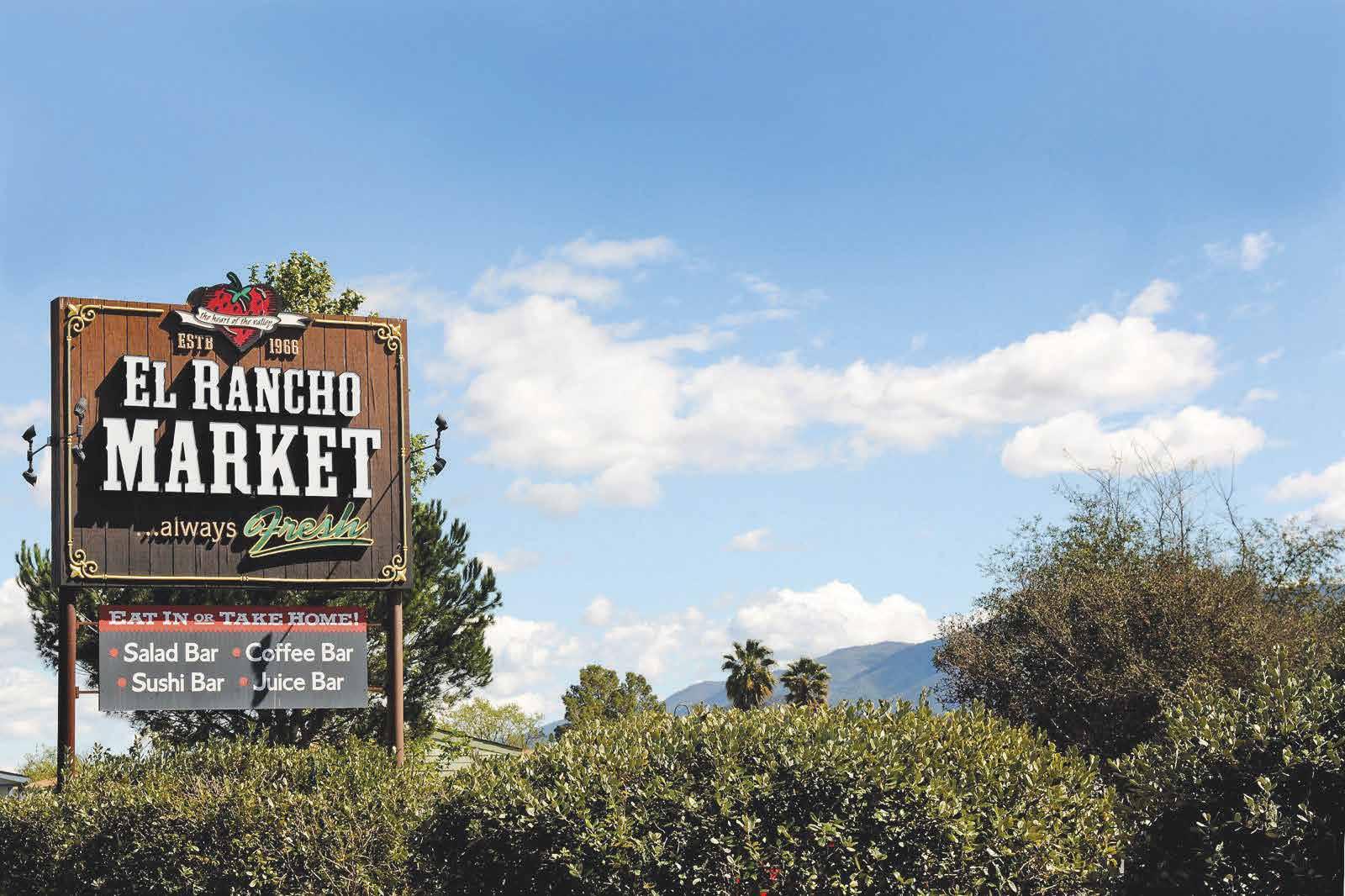
U S D A Choic e & P r im e B e e f
P r e miu m W ag y u B e e f
Fin e W in e & Sp i r i t s
Dom e sti c , I m p o r t , & C r af t Be e r
Full-S e r vi c e D el i & Cat e r i n g
Full-S e r vic e Ba k e r y
S p e cialt y M e at s & Go u r me t Che e s e
P iz z a • S u s h i B a r
F r e s h S ou p & Sala d B a r
Full-S e r vic e Coff e e B a r O rg ani c J uic e B a r • O rg ani c P r o d u c e
Where the Horses Still Run
DISCOVERING THE MAGIC OF THE LOS ANGELES EQUESTRIAN CENTER
Written by Jennie Nevin
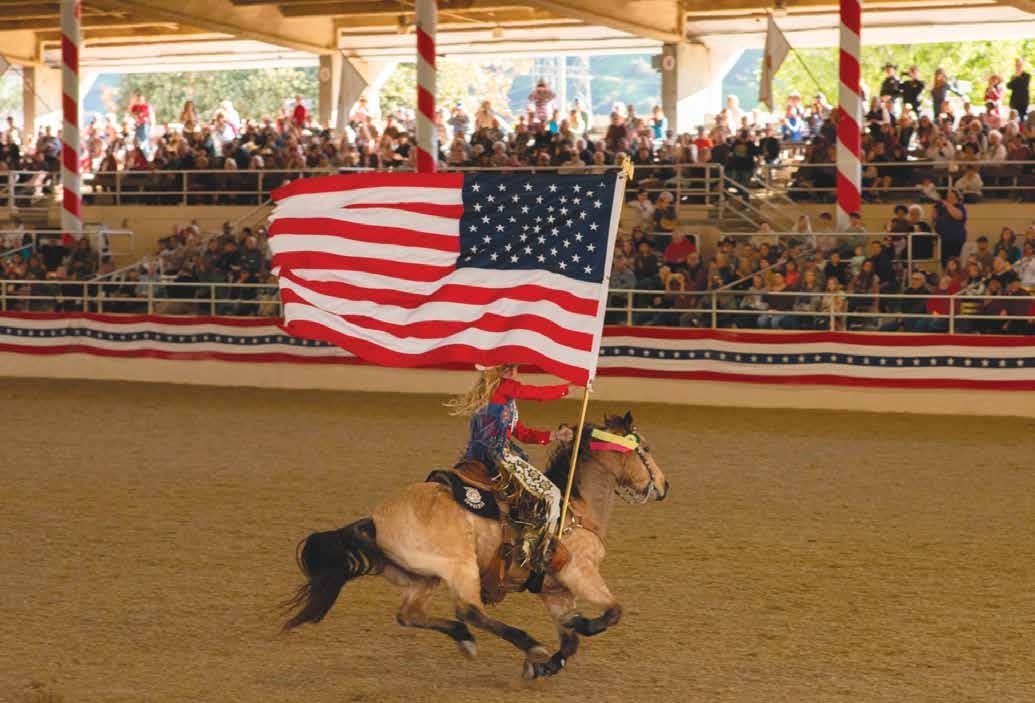
Tucked beneath the rolling hills and oak-lined edges of Griffith Park, the Los Angeles Equestrian Center feels like a hidden world inside the city — one where horses still move through the morning light, sunsets stretch across open arenas, and every weekend tells a different story.
In the quiet hours of early morning, riders walk the barns with coffee in hand while the scent of hay and citrus blossoms drifts through the air. By evening, the same grounds may glow with string lights, music, wedding celebrations, horse shows, or film crews preparing for the next scene.
It’s a place where Los Angeles still feels connected to its roots — where the spirit of old California, horses, and open land continues to exist in the middle of one of the world’s busiest cities.
Poet Leland Hickman captured the feeling of Griffith Park perfectly.
“The Great Park, twice the size of Central, fills the hills between the Valley and the basin, where the old land keeps its distance from the suburbs. Here, among the chaparral and sage, the coyote slips like shadow, quail coveys scurry across paths, a golden eagle wings through the silent air. The city below is forgotten, its noise muffled by distance and the
dense stand of oaks. Griffith Park keeps the faith of wildness, a last holdout of California’s fierce heart, where the land remembers itself, remembers the deer trails, remembers the people who knew the rivers, the river that now lies in concrete, and the horses, always the
horses, who have never forgotten to run.”
That spirit still lives here every day.
Some visitors arrive for a horse show and discover an entirely new side of Los Angeles. Others come for a wedding,
Equestfest
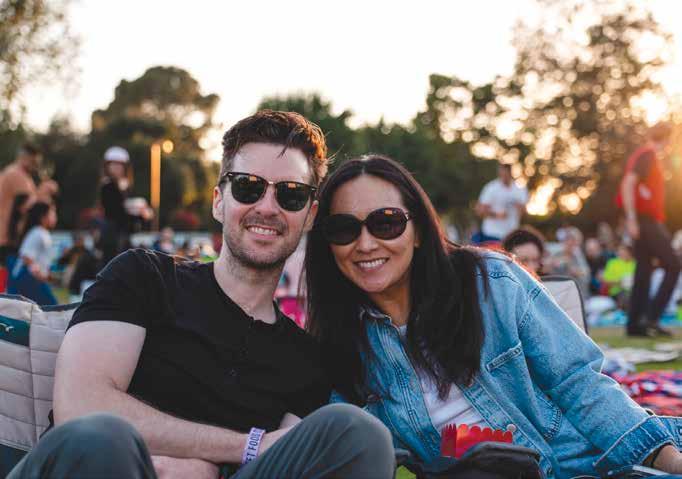
Movies and Romance Under the Stars
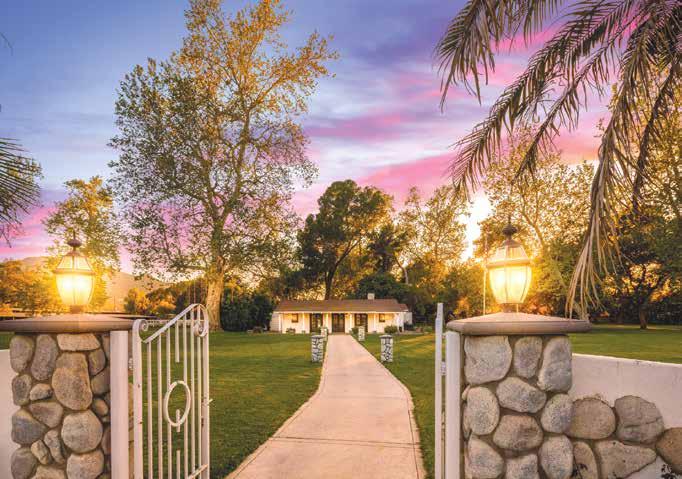
Hunt Field and Little White House at Sunset
gala, concert, or production shoot and suddenly realize places like this still exist — authentic, creative, open, and alive.
One weekend may bring elite equestrian competition with riders from across the country. Another might feature a candlelit wedding beneath the stars, a family celebrating a quinceañera, or guests gathered together for a movie night or festival.
Throughout the year, the property becomes a backdrop for unforgettable moments. A bride walking through the gardens before sunset. Friends laughing together during a cocktail party under glowing lights. A child meeting a horse for the very first time.
Guests wander pathways lined with barns and gardens while horses graze nearby. Sunsets spill across the hillsides. The surrounding landscape creates a sense of escape that feels worlds away from the city.
Perhaps the best way to understand LAEC is through the people who experience it. “It felt like we left Los Angeles without ever leaving Los Angeles.”
“There’s an energy here you can’t explain until you experience it yourself.” “The horses, the lights, the atmosphere — it felt like something out of a movie.”
The Los Angeles Equestrian Center is more than an event venue. It’s a gathering place where horses, community, entertainment, and celebration still come together in a way that feels magical.
This summer, whether you’re attending a horse show, planning a wedding, scouting a production location, hosting a gala, or simply looking for somewhere memorable to spend the day, LAEC invites you to come experience it for yourself.
Come discover one of Los Angeles’ most unforgettable places.
Jennie Nevin, Executive Director, Business Development & Communications Los Angeles Equestrian Center jnevin@equestrianla.com www.thelaec.com 818-840-9063
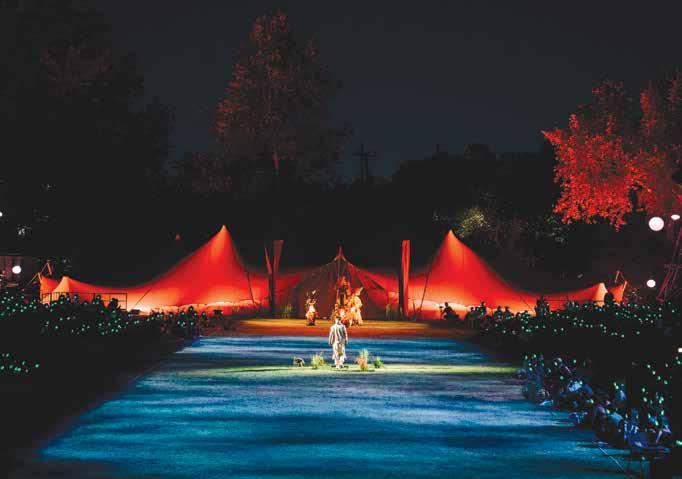
William Shatner’s Hollywood Charity Horse Show
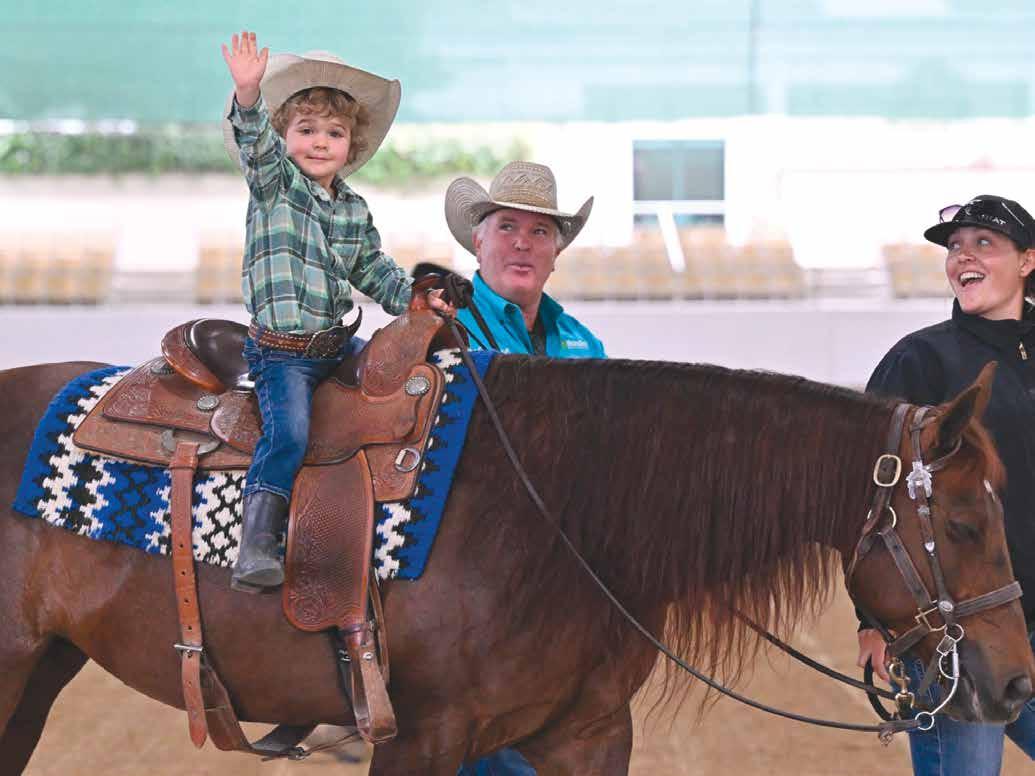
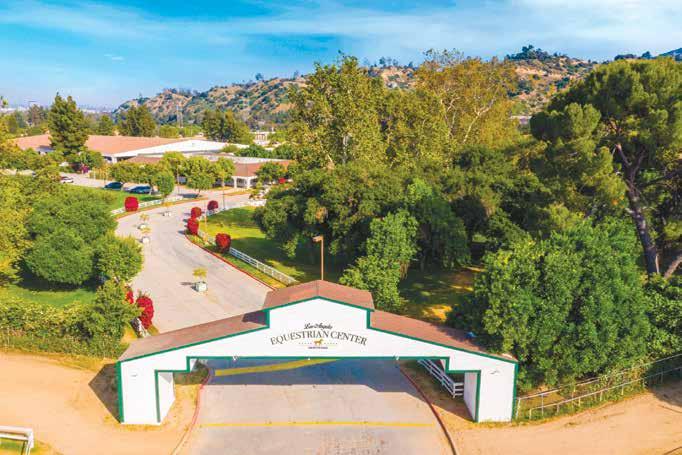
Welcome to the Los Angeles Equestrian Center
The Cortege on Cricket Field
THE MAN, THE MYTH, THE LEGEND . . . WALT “POP’S” STALLINGS
Written by Elizabeth Kaye McCall
“This is getting ridiculous!” laughed Walt “Pops” Stallings rolling his eyes when asked his age on a short break from the stream of customers at his flagship Pop’s One Stop Repair Shop in Camarillo, when the brainstorm for his Man, Myth, Legend birthday (86!) Meets Christmas in July party got hatched. Slated for Saturday, July 25, at Pop’s Santa Barbara, which son Jason manages, a four-hour fest of tall tales, snacks, surprises, and entertainment will set the stage for evernew Santa Barbara horse lore.
With a last name like Stallings, Walt’s life seemed destined for a connection with horses, despite his “wanna be a lifeguard” phase after earning a Junior Life Saving Swimming Award in1955. “My real life started in Taft, California where I had a shoe shine stand—a 2-seater which was pretty big in those days,” said Walt, who was born in Long Beach. “I’ve been fixing shoes since I was 13 years old. I shined shoes throughout high school, helped the family, came to Santa Monica and worked for Bill Windham, a custom shoe repair fellow, eventually got married and came to Camarillo in 1972. Walt and his late Scottish wife Sandra had two sons and a daughter (who made him a grandpa).
Originally, offering shoe and sewing machine repair, Walt’s grown the trade he learned from the master shoemaker craftsman to a specialty in all things leather. Now helming the Camarillo store in its 55th year, Walt’s son Jason Stallings manages Pop’s Santa Barbara, inside a landmark De La Vina Street address, once home to Jedlicka’s Western Wear. (Pop’s did years of leather repair work for Jedlicka’s long before its Santa Barbara store closed .)
“Years ago, we did a reconditioning for Adolfo Camarillo’s white horses with the saddles that are now displayed in the Ranch House. We did the silver polishing … the whole bit,” remarked Walt. With a legacy that includes US Congressional Recognition for invaluable community service, honorary title of “Don” from Pleasant Valley Historical Society, and more, son Jason is actively growing Pop’s clientele and reputation.
“When Jedlicka’s Santa Barbara closed, I told them to leave everything that didn’t go to the Carriage Museum. We have what I call the museum wall. We’ve got photos from the Vistadores Rancheros, Gringos, even [then] Prince Charles when he was doing the fox hunt here with Si Jenkins. And, lots of people walk in saying, ‘Oh!! You kept the horse!’”
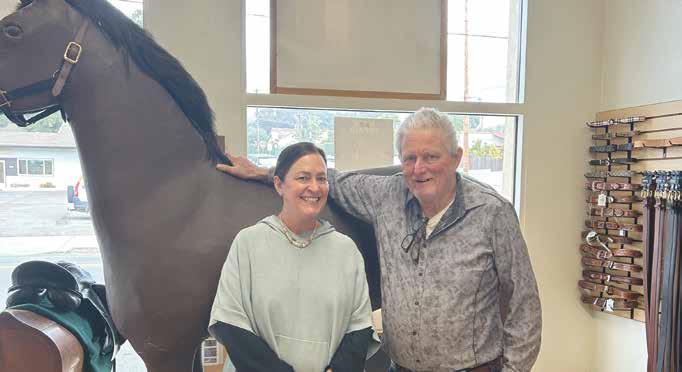
The iconic Jeclicka horse statue that stood outside the De La Vina location for 85 years lives on—indoors. “They brought him inside during the remodel. The city didn’t approve our 10 ft. door, so he’s now stuck indoors,” explained Jason, who’s made “Bondo” a story-telling centerpiece and selfie spot inside Pop’s Santa Barbara.
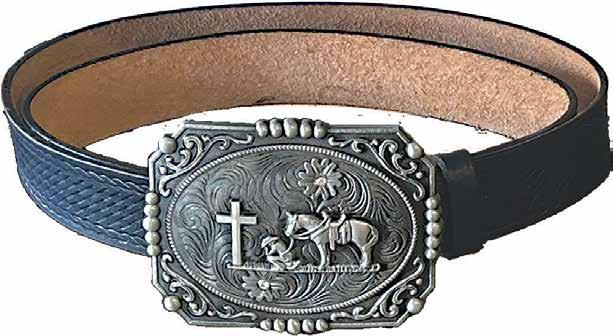
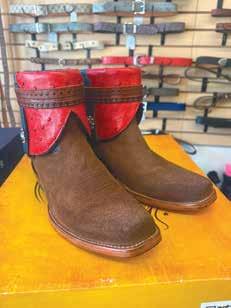
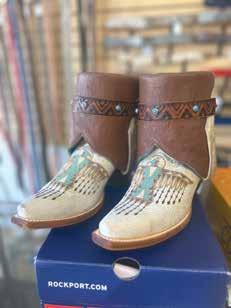
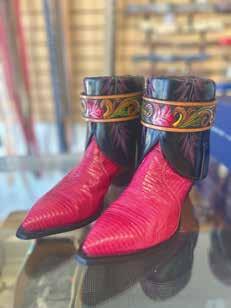
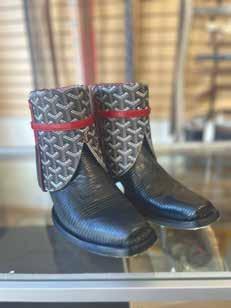
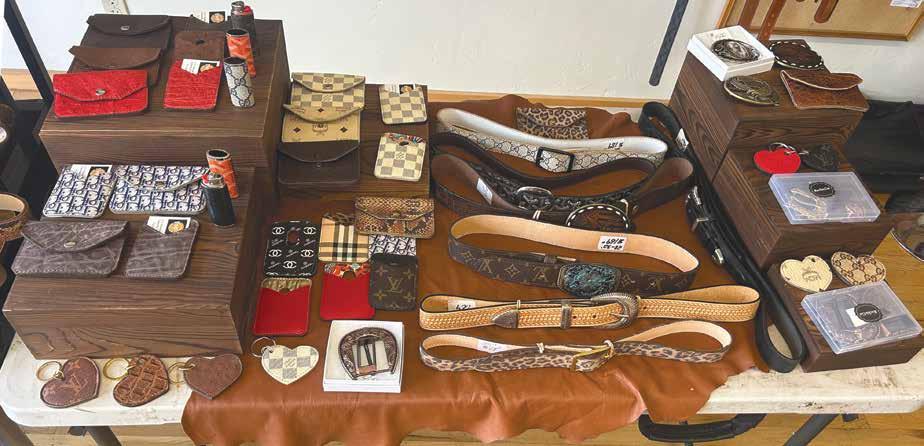
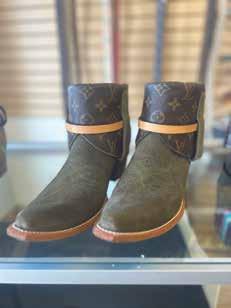
From saddles to award-winning boot repairs, to custom handmade belts (think “biker belts”) to designer handbag and footwear fixes, Pop’s is equated with high-end work. Walt explained, “Because of our reputation, which has given us experience other folks don’t get—it seems the harder the job, we get those. One of the hardest is when leather is crustated, or dried out. Sometimes, we have to replace whole panels, particularly in riding boots if the shaft is disintegrated. Sometimes when the welt on bottom of the boots is torn away, we can replace the entire bottom. It’s very difficult but we do it with alacrity, because we’ve got enough experience.” A keen word connoisseur, Walt smiled at a listener’s reaction.
“We often get nice boots that no longer fit because a leg shape has changed. We’ve developed methods
“We’re pretty well known, not just for equestrian, but Western, bridle work, that sort of thing,” said Walt. Countless customers from Calabassas to Santa Ynez, include noteworthy names like Fox Canyon’s Kim Kulesa and dressage legend Hilda Gurney in Moorpark, to Sunnybrook Riding Club’s Rebecca Bruce Glynn in Carpenteria, plus scores of private stables, and recreational riders along the Central Coast.
saddles to award-winning boot repairs, from custom handmade
(even “biker
to designer handbag and footwear
25, noon-4
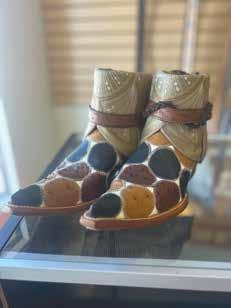
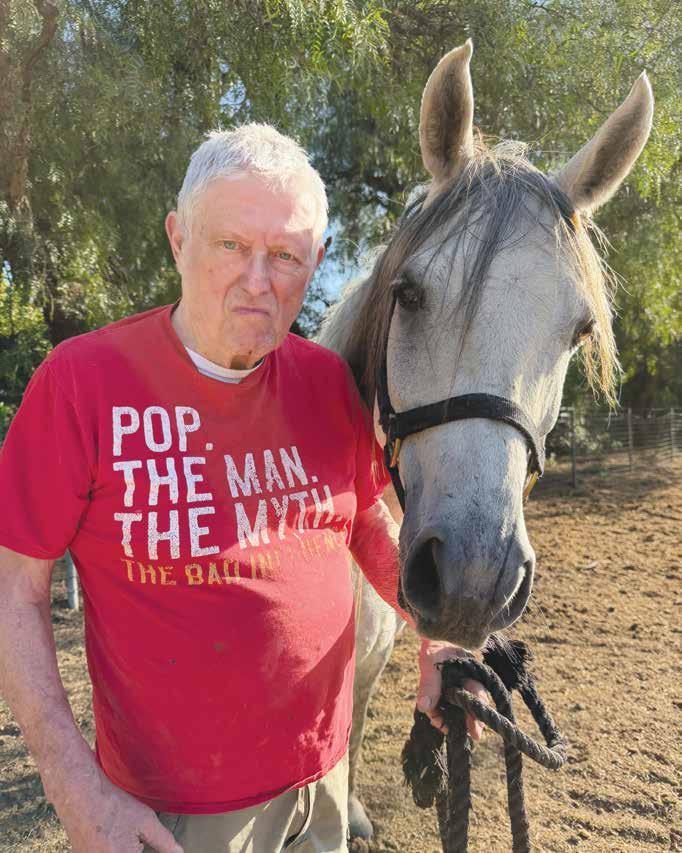
Equine endorsed! Egyptian Arabian AAI Mikaail appears amused by the bottom line on Pop’s shirt. Does it really say, The Bad Influence?! Apparently there are FIVE versions of the shirt. See them all at Pop’s Man, Myth & Legend birthday & Christmas in July party at Santa Barbara store, July 25.
From
belts
belts”)
fixes, Pop’s One Stop Shoe Repair in Santa Barbara, honors its historic De La Vina Street location with the iconic Jedlicka Horse now “stabled” inside. Meet Walt “Pops” Stallings in person July,
pm for The Man, the Myth & Legend’s 86th birthday party meets Xmas in July. Storytelling, entertainment, and more.
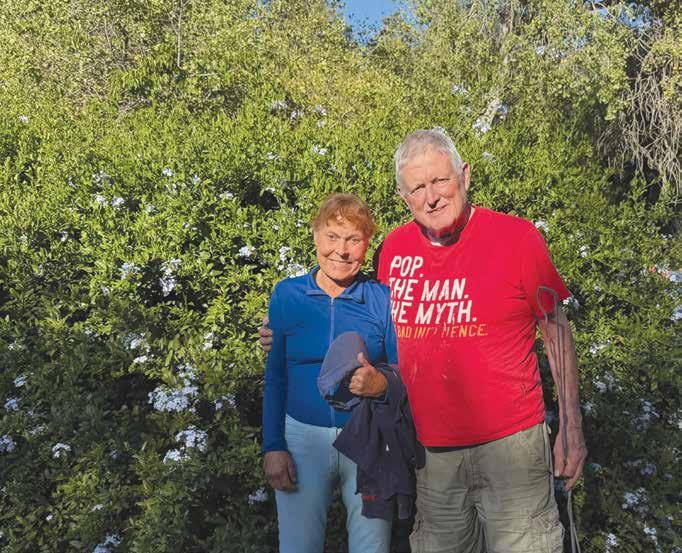
Among thousands of noted customers from Calabassas to the Central Coast, is longtime client, dressage legend and 2-time Olympian is Hilda Gurney. “Hilda’s been a customer and friend for God knows how long,” says Walt (Pops) Stallings. The last saddle she brought in was all torn up. Instead of replacing the entire seat, we have a way of replacing just half. It works out very well. When she came to pick it up, I had the saddle on a chair in the front of the store. I had several people here, was kind of busy, and said I’d take it out in a minute. Hilda says, ‘Get out of the way,’ picks it up, walks out the door with a heavy saddle, threw it in her pickup and took off. Everyone was asking ‘Who the heck was that?’ I said, ‘Well that’s Hilda!’” (Walt “Pop’s”pictured with Hilda Gurney at her Keenridge Farm in Moorpark.)
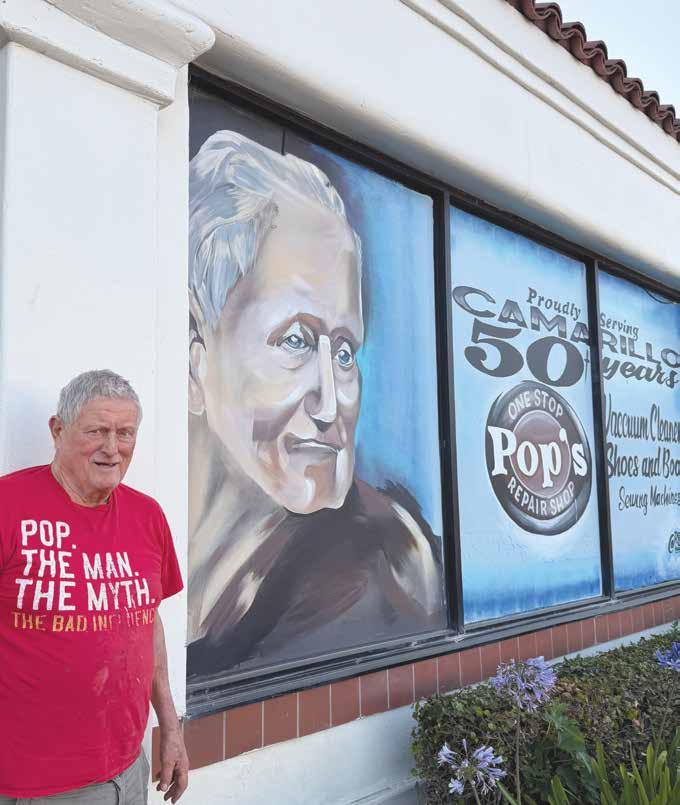
Awarded Special US Congressional Recognition for invaluable service to the community,
Historical Society, and scores more, Walt (Pops) Stallings established Pop’s One Stop Repair Shop in Camarillo in 1972. (Walt pictured outside longtime Camarillo location.)
Walt remarked.
New items marred by unintended mishaps land at Pop’s too, like the “fix-of-a-fix” one distraught customer brought Jason, after a conspicuous tear from her first ride in new Italian DeNiro boots, got poorly repaired elsewhere with a diagonal brown patch (on black boots). “We pulled off the patch, fixed the outside, patched inside, and made it invisible,” described Jason.
boss once told me once, ‘You can’t solve everybody’s problem, but the harder you try, the more people you’re going to satisfy.’ I kept those two things in mind. The philosophy of the whole Pop’s idea is just that—do it a little bit better than anybody else.”
Meet Walt “Pops” Stallings in person at The Man, Myth, Legend Birthday Party Meets Christmas in July at Pop’s Santa Barbara, July, 25, Noon - 4 pm.
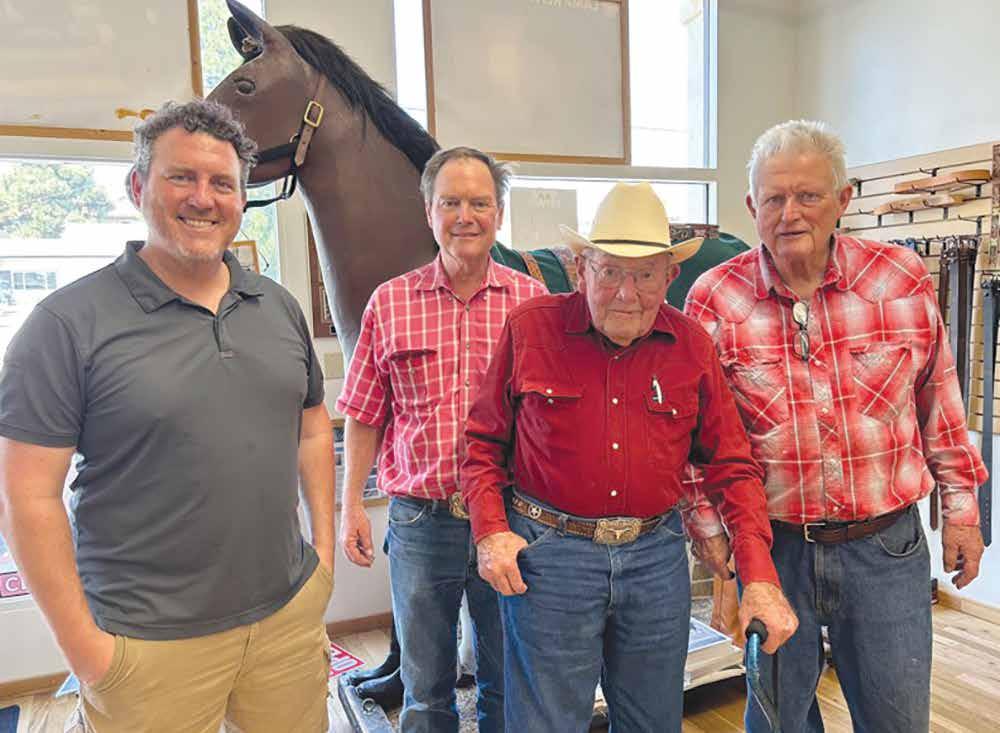
(L to R) Jason Stallings, Josiah Jenkins, the late Si Jenkins, and Walt “Pops” Stallings with the iconic Jecklicka’s horse now “stabled” inside POP’S Santa Barbara One Stop Repair Shop at the
De La Vina Street address that the
called home for decades. Jason manages Pop’s Santa Barbara, while dad Walt (aka Pops) runs the Camarillo operation, now in its 55th year.
to do shaft stretching up to a certain amount—top, middle, whatever. We have ways to put panels in the back.”
Pop’s expertise with shaft reduction helps clients with expensive boots and thin legs. “ We’ve gotten pretty good at that,”
Local fashionistas are privy to one of Pop’s lesser known specialties—reviving the famous red bottoms of Christian Louboutin designer shoes, often scratched the first time out. Pops has a fix to keep the red from changing that’s earned high satisfaction marks.
“I’ll never forget my dad saying, ‘I don’t care what you do, but do it better than anybody else,’” reflected Walt. “Another
See all 5 T-shirt versions of The Man, Myth, Legend.. including “the bad influence!”
Pop’s One Stop Repair Shop • 2131 Pickwick Drive • Camarillo • (805) 388-0700
Pop’s One Stop Repair Shop • 2605 De La Vina Street • Santa Barbara (805) 843-7483
honorary title of “Don” from Pleasant Valley
landmark
horse
HEAT STRESS IN PERFORMANCE HORSES: MORE THAN JUST HOT WEATHER
Written by Dr Tania Cubitt & Dr Stephen Duren – Performance Horse Nutrition & LMF Feeds
California horse owners know that summer brings more than sunshine. From the dry heat of inland valleys to the humidity of coastal regions, rising temperatures can challenge a horse’s ability to stay comfortable, hydrated, and performing at its best. Add in long trailer rides, competition schedules, and even wildfire smoke, and the demands on the equine athlete can increase significantly.
While most horse owners recognize the importance of providing water and shade during hot weather, heat stress is about much more than preventing overheating. It affects hydration, electrolyte balance, energy metabolism, recovery, and overall performance.
How Horses Handle Heat
Unlike humans, horses generate a tremendous amount of heat during exercise. In fact, as much as 75–80% of the energy produced by working muscles is released as heat rather than being converted into movement. To prevent body temperature from rising to dangerous levels, horses rely primarily on sweating.
Sweating is an incredibly effective cooling mechanism, but it comes at a cost. Along with water, horses lose substantial amounts of electrolytes, including sodium, chloride, potassium, calcium, and magnesium. During intense exercise or prolonged exposure to high temperatures, these losses can become significant.
When fluid and electrolyte losses are not adequately replaced, horses may show signs of dehydration, fatigue, slower
recovery, reduced appetite, or decreased performance. In severe cases, heat exhaustion and heat stroke can occur.
Recognizing the Signs
Heat stress doesn’t always present as a dramatic emergency. Often, the first signs are subtle.
Horse owners may notice:
• Increased respiratory rate after exercise
• Prolonged sweating or, conversely, reduced sweating
• Elevated heart rate during recovery
• Reduced energy or willingness to work
• Longer recovery times between workouts
• Decreased water consumption
• Reduced feed intake
Monitoring recovery after exercise can provide valuable insight. A horse whose breathing and heart rate remain elevated long after work may be struggling to dissipate heat effectively.
California Challenges
California presents unique environmental stressors for horses. Summer temperatures regularly exceed 100°F in many inland areas, while wildfire season can create poor air quality that places additional stress on the respiratory system.
Transportation is another factor. Many horses travel long distances to competitions, clinics, or trail destinations. Hauling itself is a recognized stressor that can increase fluid losses and contribute to dehydration, even before a horse begins exercising.
In these situations, proactive management becomes essential.
Supporting Hydration and Recovery
The foundation of any heat-stress management program begins with water.
Fresh, clean water should always be
available, and horse owners should encourage drinking before, during, and after exercise whenever possible. Horses often drink more readily when water is familiar, which is why some owners bring water from home when traveling.
Electrolyte supplementation may be beneficial for horses that sweat heavily or work regularly in hot conditions. Replacing the electrolytes lost through sweat helps support hydration and normal muscle function.
Forage also plays an important role. High-quality forage provides a reservoir of water within the digestive tract
and supports healthy gastrointestinal function. Maintaining consistent forage intake is especially important during periods of heat stress.
Management practices such as exercising during cooler parts of the day, providing shade, maximizing airflow, and using cold-water cooling after exercise can further support a horse’s ability to regulate body temperature.
The Metabolic Side of Heat Stress
One aspect of heat stress that often receives less attention is its effect on energy metabolism.
When horses are exposed to environmental and exercise-related stress, their bodies must work harder to maintain normal physiological function. Efficient utilization of glucose becomes increasingly important because glucose serves as a primary fuel source for working muscles.
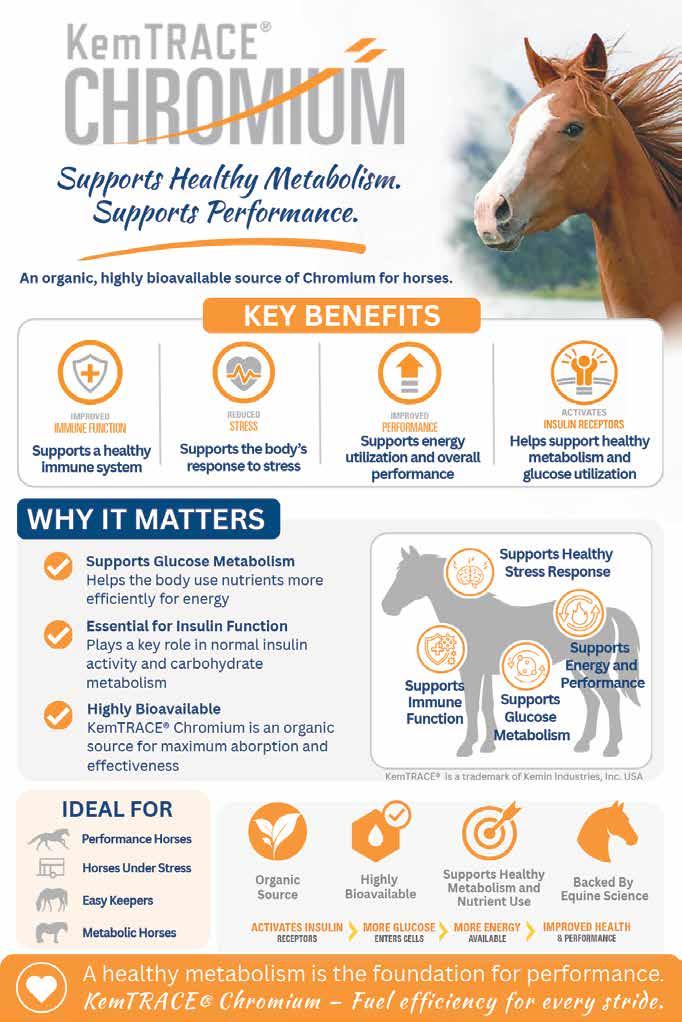
Chromium is a trace mineral involved in supporting normal insulin function. Insulin helps move glucose from the bloodstream into cells where it can be used for energy production.
Research has shown that supplemental chromium may help support glucose utilization and metabolic efficiency during periods of physical stress. This may be particularly valuable for performance horses, horses in training, A Complete Summer eliminate the effects of heat stress. Successful management requires a comprehensive approach that
combines proper nutrition, hydration, electrolyte replacement, and thoughtful management practices.
By providing horses with abundant fresh water, quality forage, balanced nutrition, and appropriate support for energy metabolism, owners can help their horses remain comfortable and resilient throughout the summer months.
As temperatures climb, remember that heat stress begins long before a horse appears overheated. Recognizing the early signs and implementing proactive management strategies can help support health, recovery, and performance all season long.
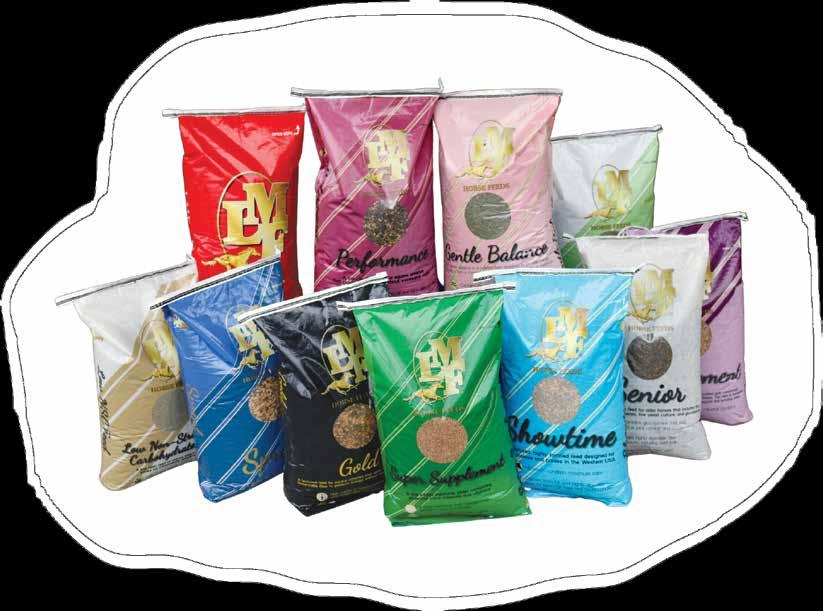
All LMF Feeds contain Kemtrace Chromium, the ONLY FDA approved chromium for use in horses.
Image by Aislinn Brander from Pixabay
LET’S RODEO AT THE 30TH EVER CRESTON CLASSIC RODEO!
Written By Tom J. Bordonaro, Jr.

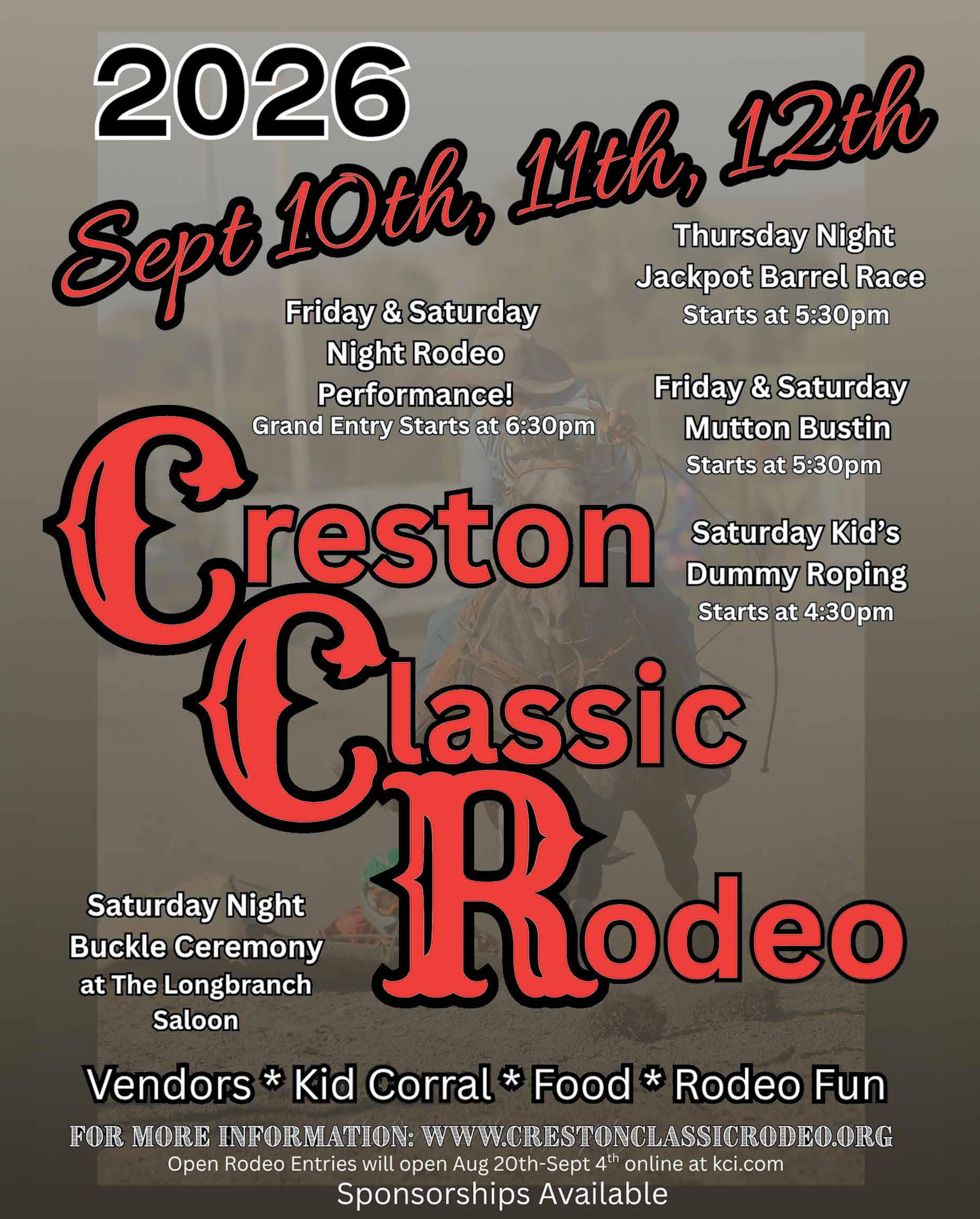
The 30th Annual Creston Classic Rodeo (CCR) is fast approaching! Join us September 10–12 at the Creston Classic Rodeo Grounds in Creston, California, for the best homegrown ranch rodeo in the West.
The first Creston Classic Rodeo was held September 1996 in the quaint town of Creston. Though only nine square blocks and home to fewer than 100 residents, Creston embodies the spirit of smalltown America. The town features two bar-restaurants, a general store and deli, a western store, a church, and a post office. Visitors can enjoy a great steak at the Loading Chute or a delicious burger at the Long Branch Saloon before heading across the street to the rodeo grounds at the corner of Webster Road and Swayze Street. Creston is also home to an elementary school, community pool, and community center—the latter two supported annually through proceeds from the Creston Classic Rodeo.
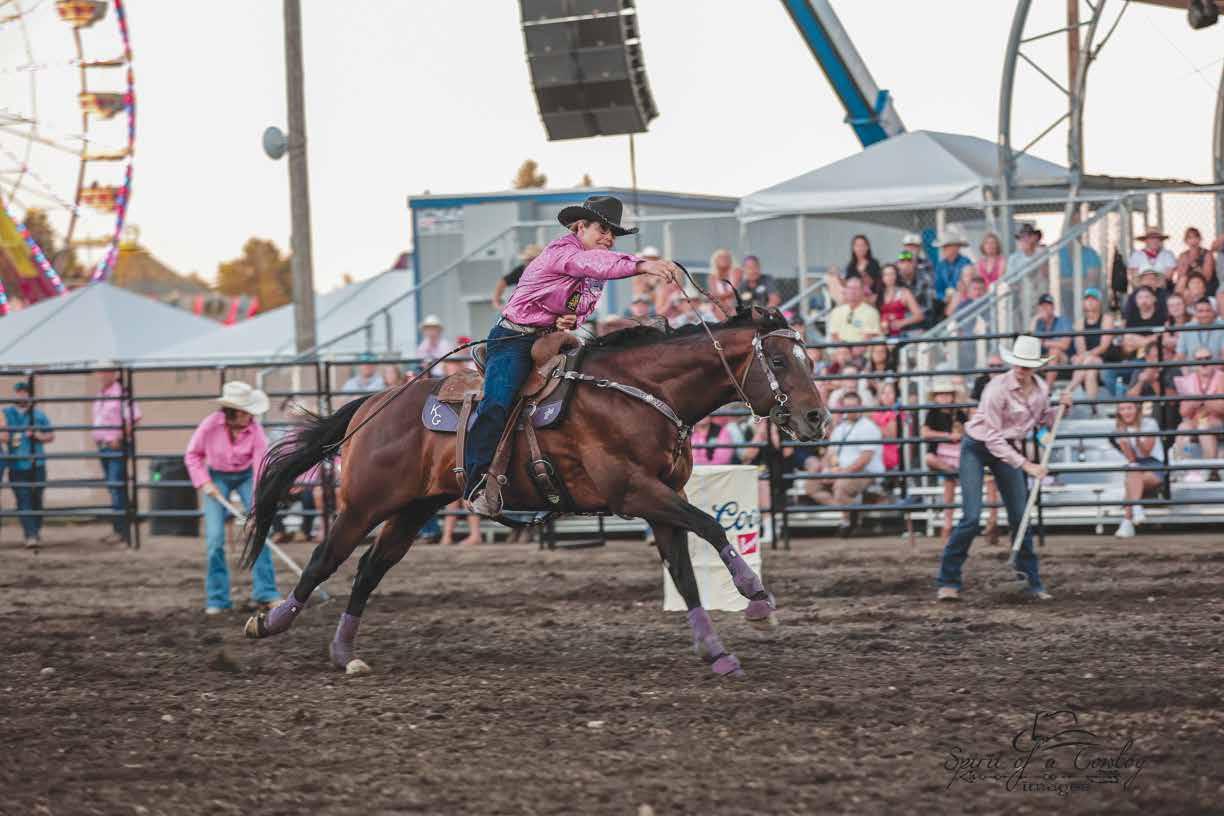
The festivities kick off on Thursday, September 10, with Jackpot Barrel Racing beginning at 5:30 p.m. Watch barrel racers of all ages compete for the fastest time around the barrels. The Main Rodeo Performance begins Friday, September 11, at 6:30 p.m. and continues Saturday evening at 6:30 p.m.
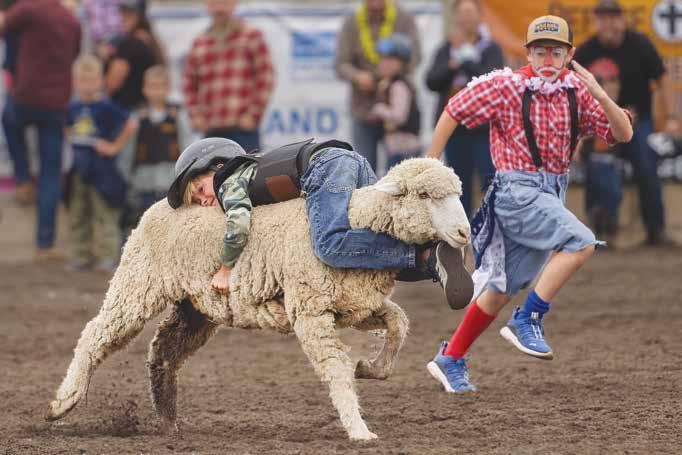
The ever-popular Mutton Bustin’ takes place both Friday and Saturday evenings at 5:30 p.m., where future cowboys and cowgirls ages 3–6 earn their rodeo spurs. On Saturday, children up to age 12 can test their skills in dummy roping beginning at 4:30 p.m.
The vendor area continues to grow each year! Browse unique merchandise, enjoy delicious food from local vendors, and shop for everything from western gear and apparel to jewelry, farm art, and more.
Creston Classic Rodeo is a 501(c)(3)
tax-deductible charitable organization whose mission is to support, promote, and sustain programs that directly benefit the Creston community.
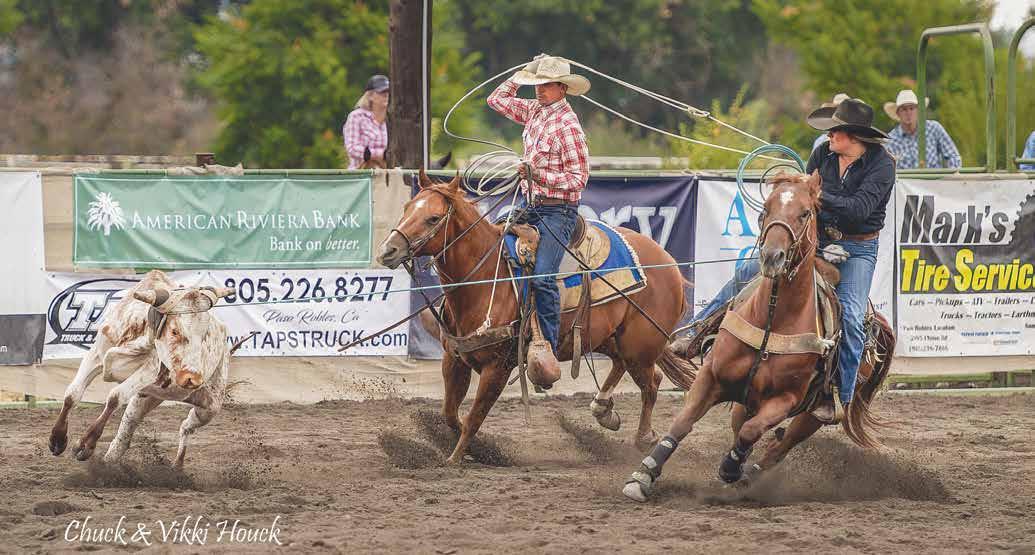
CCR is an all-volunteer rodeo held annually each September at the Rodeo Grounds at Jail Flats Ranch in Creston. The event maintains a traditional ranch rodeo atmosphere rather than that of a professional rodeo. Competitors are primarily local ranchers and riders who come together in friendly competition to showcase their ranching skills. From team roping and steer riding to barrel racing and mutton bustin’, there is something for everyone to enjoy.
Recently, the Creston Classic Rodeo donated needed funds to local charitable organizations that provide valuable services to the community. All profits from CCR are donated locally in keeping with its philosophy of “Creston Helping Creston.”
One of the primary beneficiaries is the Creston Community Center. For decades, CCR has supported efforts to convert and improve the former Fire Station 43 into a gathering place for local residents and organizations. Most recently, rodeo funds helped provide much-needed heating and air conditioning for the facility.
Another important recipient is the Creston Pool. Donations help maintain the community pool and keep it open and free for local youth. For more than 60 years, Crestonians have built, maintained, and supported a pool for the town’s children, and CCR is proud to help continue this tradition.
“Creston Classic Rodeo is pleased to dedicate all profits to supporting local efforts that meet the needs of the Creston community,” said CCR President Tom Bordonaro. “These funds will go a long way toward improving our community center and continuing the more than
60-year tradition of providing a pool for Creston’s children.”
Sponsors, volunteers, and vendors can learn more and sign up to help at CrestonClassicRodeo.org, by emailing CrestonClassicRodeo@yahoo.com, or by writing to P.O. Box 121, Creston, CA 93432. Competitors may register between August 20 and September 5 through the website. Follow us on Facebook and Instagram.
Please join us this September and experience this unique Creston tradition!
THE SPIRIT OF PASO AT THE PASO ROBLES HORSE PARK
Written By Amanda Diefenderfer
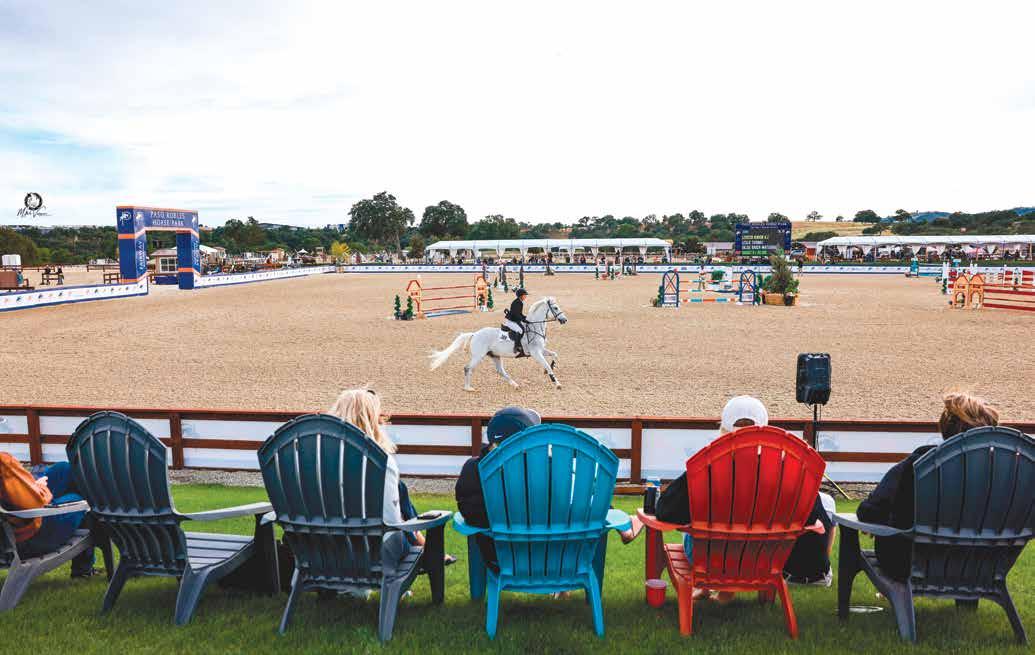
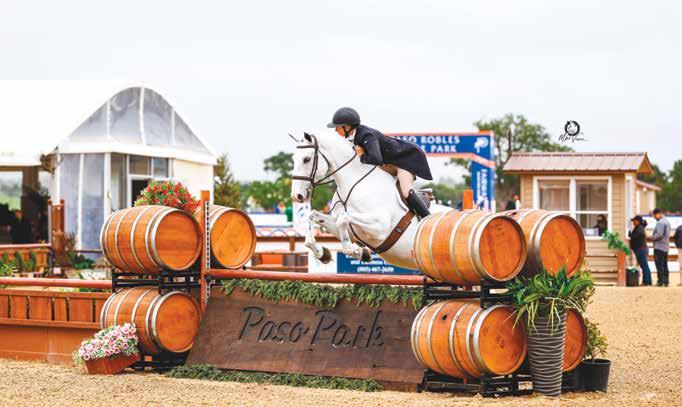
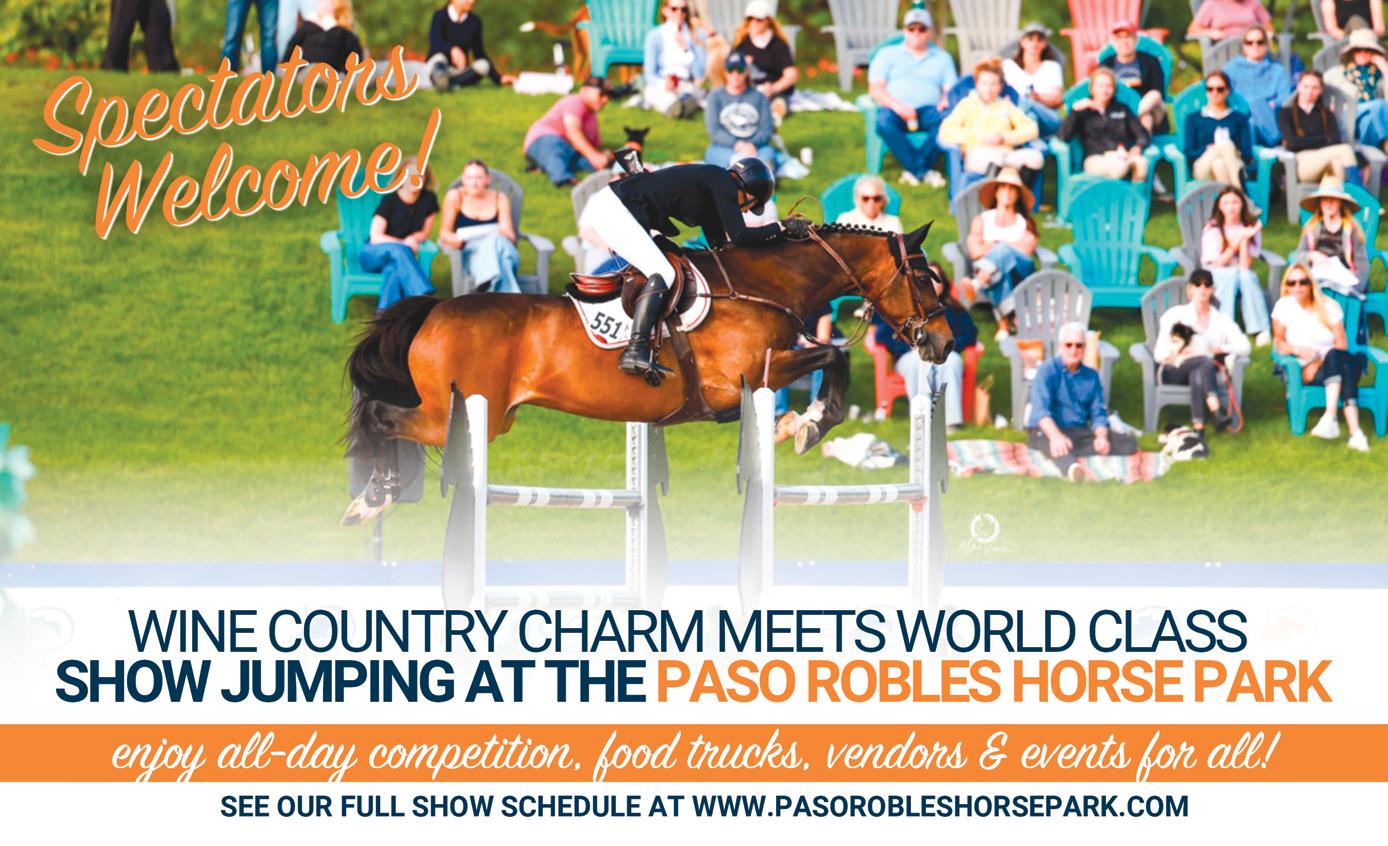
For many, Paso Robles is defined by vineyards, oak trees, and open space. Over the past decade, however, another part of the region’s identity has steadily taken shape at the Paso Robles Horse Park. Idyllic scenes of spectators enjoy local food and wine while gathering along the arenas, and horses moving through a landscape that feels unmistakably tied to the Central Coast. Through the competitions, the Paso Horse Park has become a place where equestrian tradition, community, and the character of Paso Robles come together in a way that many may not fully appreciate until they experience it firsthand.
From the beginning, the horse park was designed to embrace the spirit of the region. When founder Linda Starkman first envisioned bringing a world-class equestrian facility to Paso Robles, she saw the potential for something that reflected both the landscape and the personality of Paso. After decades in the horse world, Starkman recognized that the Central Coast offered something many major equestrian destinations could not: space, accessibility, natural beauty, and a strong sense of community.
Her vision became reality in 2015 when the Paso Robles Horse Park officially opened on a 67-acre property framed by oak trees and rolling hills. More than a decade later, the facility has grown into one of California’s leading hunter/jumper destinations while still maintaining the atmosphere that makes it feel distinctly Paso Robles.
At the same time, the Paso Park has continued expanding its role within the community. Operated by the Paso Park Foundation, a nonprofit organization, the facility supports programs aimed
at increasing accessibility to equestrian sport and preserving the relevance of horses in today’s world. Through
Schooling and Pathway shows offered at more accessible price points, the Park Foundation works to create
opportunities for riders who may not otherwise have access to show jumping competition. The organization also
supports charitable and educational initiatives. The Paso Robles Horse Park events are free to the public, and much of the work happening behind the scenes is centered around education, outreach, and community involvement.
For those who have never visited during an event, the experience is welcoming and fun. You do not need a background in horses to enjoy an afternoon at the Paso Park. Spectators can walk the grounds, watch riders compete at every level, and experience a side of Paso Robles that feels both relaxed and elevated at the same time. There is a sense of openness that makes the venue feel accessible rather than intimidating. Being at the Park, away from the busier pace of everyday life, makes it easy to slow down and appreciate the landscape around you.
The facility also continues to evolve.
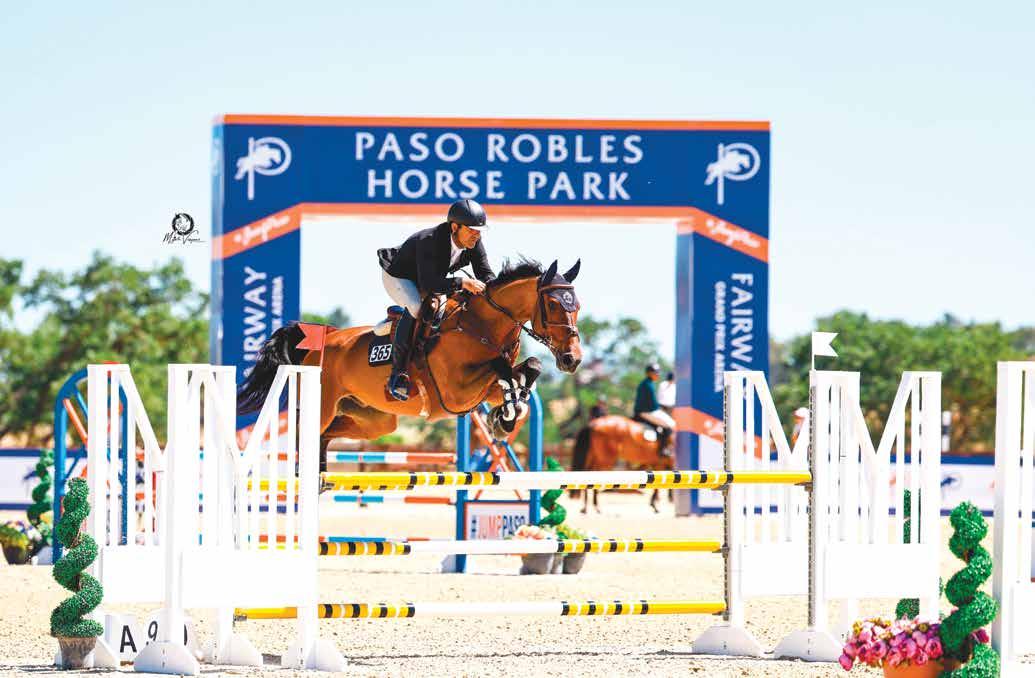
One of its newest additions, the Fairway Grand Prix Arena, represents another step forward for the venue and for Paso Robles as an emerging equestrian destination. The expansive new arena creates a space with a presence for premier competition while reinforcing the Park’s growing reputation within the sport.
What makes the Paso Robles Horse Park stand out is not only the level of competition it attracts, but the way it remains connected to the community and landscape around it. In a region known for wine, agriculture, and open space, the Paso Park has added another layer to the identity of Paso Robles, one rooted in horses, community, and shared experience. For those who have yet to attend an event, there may be no better time to discover what has quietly become one of the Central Coast’s most unique gathering places.
Amanda Diefenderfer (805) 369-1323
info@pasorobleshorsepark.com
pasorobleshorsepark.com
SANTA YNEZ VALLEY CUTTERS CELEBRATES BRAND NEW CUTTING PEN!
Established as a non-profit organization in 1995, the Santa Ynez Valley Equestrian Center has grown throughout the years into a treasured local resource for the California equestrian community. Located on nearly 30 acres in the heart of Santa Ynez Valley horse & wine country, the Center stays busy throughout the year serving a wide variety of equestrian community needs. It is the home of both Santa Ynez Therapeutic Riding as well as the Santa Barbara County Sheriff’s Posse in addition to serving as a home arena for many local members. Pony Club sponsors several Dressage & Hunter Jumper Schooling shows throughout the year, 4H sponsors a variety of activities, the Equestrian Center sponsors several Youth Gymkhanas, and Santa Ynez Valley Penners holds Sorting or Penning events nearly every month.
Two years ago, a dedicated group of volunteers formed Santa Ynez Valley Cutters, with a view to holding high quality Club Cutting and Reined Cow Horse events as well as clinics and reining practices. Capitalizing on the beautiful location, featuring excellent footing, top tier judges & clinicians along with quality cattle, these events have attracted a large and enthusiastic following, ranging from nationally successful trainers & their clients to beginning exhibitors venturing into their first show. Lisa Lyons, Nancy Hunsicker, Karyn Stevens and Mary Stevenson put in countless hours dedicated to making every event a terrific experience for both exhibitors as well as viewing audiences. Strongly supported by generous sponsors as well as other community organizations such as Solvang and Santa Ynez Rotary, every show is catered, featuring both breakfast and lunch, after-show wine tasting, comfortable shaded seating in our VIP area [thank you Iron Horse Auto Body and the Raimondi family!] along with shopping opportunities provided by local vendors. The goal is to provide a high quality, yet affordable competitive experience in a friendly and relaxed environment; highly useful to elite competitors gearing up for national level shows—yet welcoming, competitive and fun for beginning as well as mid-level riders and their younger horses.
Our event profits support Equestrian
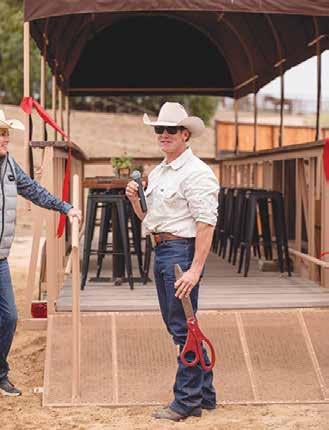
Center repairs and infrastructure improvements—in May we celebrated our brand new, permanently installed
Cutting Pen with a ribbon cutting, Cutting Show & Clinic! Huge thanks to Southwest Fence & Supply, Chris &
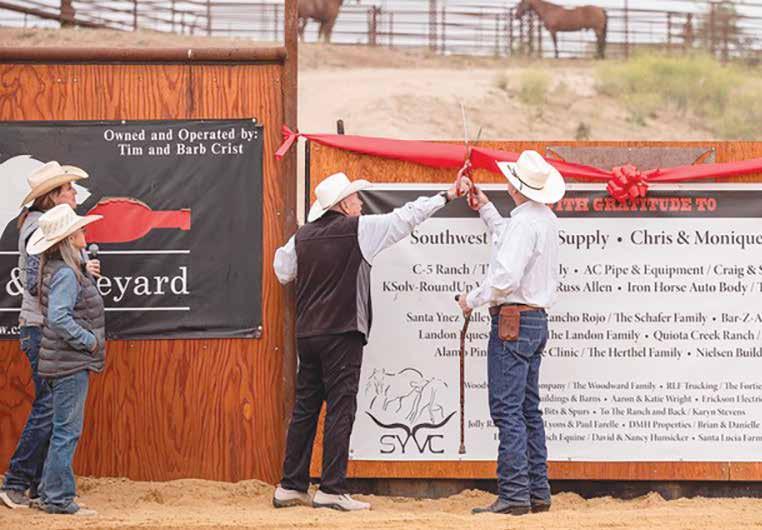
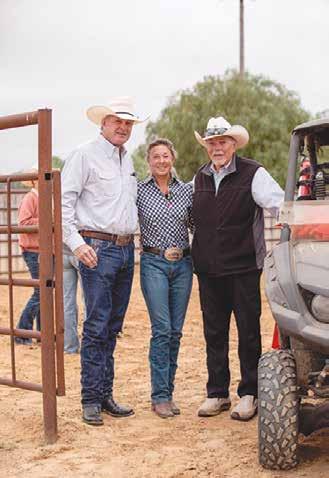
Monique Hanneken along with our many generous donors, for making our dream a reality! We welcome and appreciate sponsors—we couldn’t do this without a great deal of generous support—please contact Nancy Hunsicker 805-8951924 nlehunsicker@gmail.com for sponsorship opportunities.
Make your plans to join us this summer for our June Cutting Show & Reined Cow Horse practice & our Fiesta Stock Horse show, Sort N Rope, BBQ & Silent Auction, Cake Auction plus Youth Gymkhana in August! For Youth Gymkhana information please contact Tracy Woodward 805-5501424. For Cutting & Reined Cow event information, follow Santa Ynez Valley Cutters and Santa Ynez Valley Equestrian Association on social media, visit www. syvea.org event calendar, or contact Lisa Lyons 805-708-4772 lisalyons1205@ gmail.com
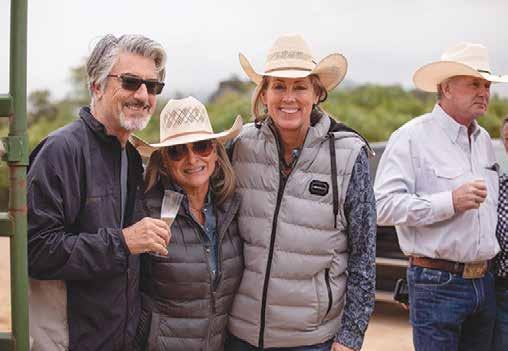
Chris and Monique Hanneken with David Hunsicker.
Chris Raimondi celebrating the Ribbon Cutting of the Iron Horse Auto Body VIP trailer he created for Santa Ynez Cutters.
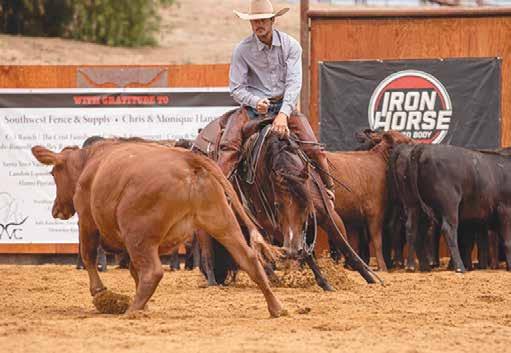
John Love getting down to business in our new pen.
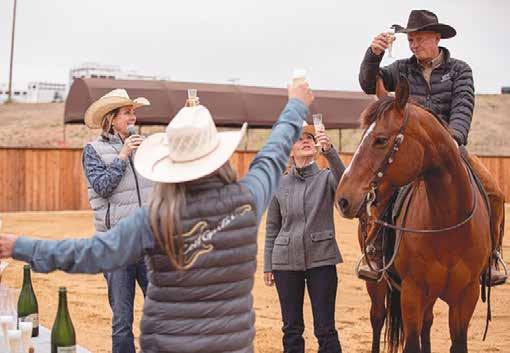
Toasting Rex & Charlene Rossell who have put in countless hours to help us grow Santa Ynez Cutters.
SYVEA President David Hunsicker cutting the ribbon with Chris Hanneken of Southwest Fence & Supply.
Paul Farelle, Lisa Lyons and Nancy Hunsicker at the ribbon cutting.

National and International Horse show events with full Cross Country Courses with water complexes, dressage and jumping arenas, river trail riding, 200 stalls for overnight stabling, 500 acres of enjoyable open space. Large covered 150 X 300 arena.
Feb 27 - Mar 1 Winter Horse Trials
Apr10-12 Spring Horse Trials
Jun 26-28 Summer Horse Trials
Sept 18-20 Fall Horse Trials
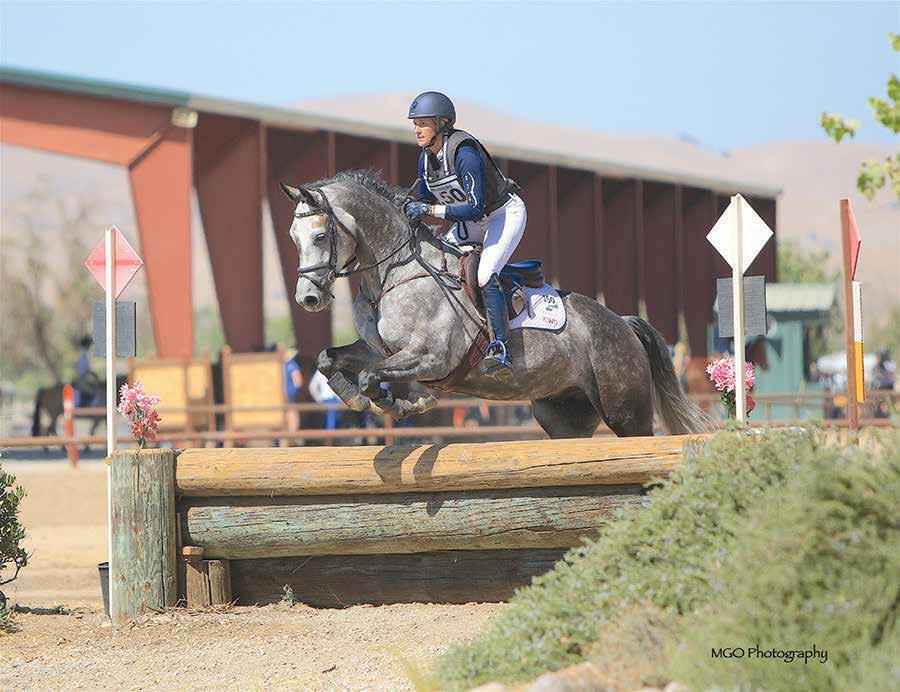
Oct 27 - Nov 1 Young Event Horse Championships & Halloween One Day
Where: Heritage Square Park & Rotary Bandstand 205 Nelson Street, Arroyo Grande
When: Saturday, July 25th 10:00 am to 1:00 pm
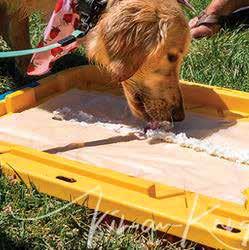
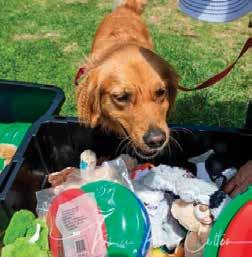
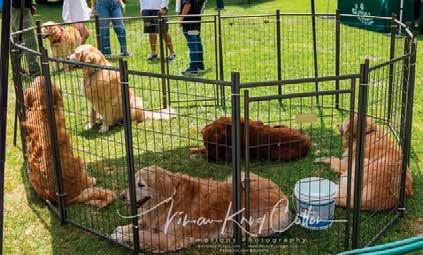
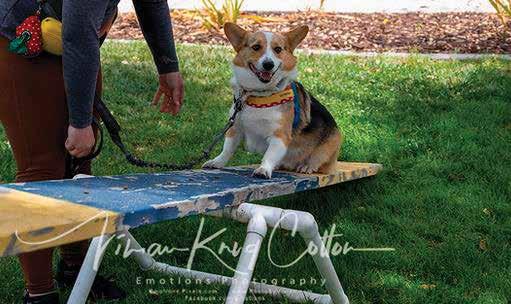
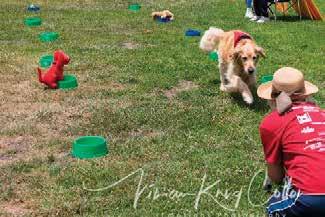
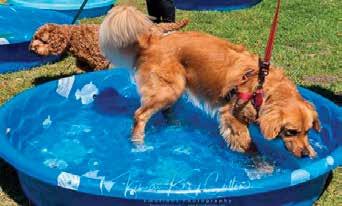



Golden Dance Parade Vendors Dog Pools Agility Course Dog Games Petting Zoo Prizes
EQUINE EVENT CALENDAR
July 1-5
Pacific Ridge Summer 2 (National)
Los Angeles Equestrian Center-Burbank Contact: Phone: (818) 840-9063
Jul 1-12
Santa Barbara National Horse Show
7:00 AM-5:00 PM
For 100 years, the Santa Barbara National Horse Show has been a grand tradition in the gorgeous, picturesque city of Santa Barbara, California. Earl Warren ShowgroundsSanta Barbara Contact: (805) 687-0766
July 12
VPA Sorting/Upper Arena
Santa Ynez Equestrian Center Contact: syveaoffice@gmail.com
July 17–19
SYV Cutters/Reined Cow
Santa Ynez Equestrian Center Contact: syveaoffice@gmail.com
July 17-18
Fever Presents - Candlelight Concerts
6pm-10PM
(Two shows, one night!)
Los Angeles Equestrian Center-Burbank Contact: Phone: (818) 840-9063
July 25
The Man, Myth, Legend Birthday Party (86!) meets Christmas in July
Everyone is Invited to Celebrate! Bring a friend!
Noon - 4:00 PM
July Pop’s One Stop Repair Shop 2605 De La Vina Street • Santa Barbara Meet Walt “Pops” Stallings, Storytelling (aka tall tales) ‘round the famous Jedlicka horse, now stalled inside longtime landmark. Entertainment, Snacks, Surprises, Cool Xmas in July stuff & Foto/Selfie Ops galore! Contact: (805) 843-7483
July 26
Vpa Fiesta Penning Practice/ Upper Arenas
Santa Ynez Equestrian Center Contact: syveaoffice@gmail.com
July 31 & August 2
Santa Barbara Rodeo
Event Hours - Fri./Sat. 5PM - 11PM (Rodeo 7PM), Sun. 11AM - 5PM (Rodeo 1PM)
Earl Warren Showgrounds Rodeo, Food, Drinks, Music, Vendors and More! Contact: (805) 687-0766
July 31
Fever Presents - Candlelight Concerts
6:15 PM-10:00 PM
(Two shows, one night!)
Los Angeles Equestrian Center-Burbank Contact: Phone: (818) 840-9063
July 31-August 2
Gold Coast Horse Show Hunter/Jumper – Aloha!
Hansen Dam Horse Park
These three-day shows offer a wide variety of classes for all levels of hunter/ jumper riders. The shows are rated by USEF, USHJA Outreach, PCHA, and LAHJA. Exhibitors automatically earn points toward the Gold Coast Series Awards presented at the Gold Coast Gala during Gold Coast Finale. Visit our website: https://goldcoasthorseshows. com/ or email us for more information: show@goldcoasthorseshows.com
August 1
Fever Presents - Candlelight Concerts
6:00 PM-10:00 PM
(Two shows, one night!)
Los Angeles Equestrian Center
Contact: Phone: (818) 840-9063
August 6-9
Pacific Ridge Summer 3 (Regional)
8:00 AM - 5:00 PM
Los Angeles Equestrian Center Contact: Phone: (818) 840-9063
August 7–9
SY Fiesta Stock Horse Show & Youth Gymhkana
Santa Ynez Equestrian Center Contact: syveaoffice@gmail.com
Equine and Canine News is a Proud Sponsor
August 11-15
Clements Cutting Club Summer Bash
Paso Robles Event Center
Contact: Phone: (818) 840-9063 OR Carine Schlesinger (405)760-5561 zoellnergirl@hotmail.com
August 13-16
LA Summer Classic-Hunter/ Jumper
8:00 AM-5:00 PM
Los Angeles Equestrian Center Contact: Phone: (818) 840-9063
August 14-16
USEA Area VI Adult Riders Horse & Rider Immersion Workshop
Twin Rivers Ranch - Paso Robles Focus on improving horsemanship and riding skills, while building competency using the new skills and tools via guided practice from clinicians: Bec Braitling and Andrea Baxter.
Contact Nikki Lloyd: nikkitauschlloyd@ yahoo.com.
August 21-22
Cool August Nights
8:00 AM-5:00PM
Los Angeles Equestrian Center
Contact: Phone: (818) 840-9063
August 16
VPA Sorting/Upper Arenas
Santa Ynez Equestrian Center Contact: syveaoffice@gmail.com
August 19 & August 28
Fever Presents - Candlelight Concerts
6:15 PM 10:00 PM
(Two shows, one night!)
Los Angeles Equestrian Center Contact: Phone: (818) 840-9063
August 21-22
Cool August Nights 8:00 AM-5:00PM
Los Angeles Equestrian Center Contact: Phone: (818) 840-9063
August 29
Central Coast Challenge Series PBR
7PM at Paso Robles Event Center Get Tickets Here: visionquestevents. rodeoticket.com/rodeos/central-coastchallenge/2026/tickets
August 28-30
Gold Coast Labor Day Hunter/Jumper
These three-day shows offer a wide variety of classes for all levels of hunter/ jumper riders. The shows are rated by USEF, USHJA Outreach, PCHA, and LAHJA. Exhibitors automatically earn points toward the Gold Coast Series Awards presented at the Gold Coast Gala during Gold Coast Finale. LAHJA Copper & Silver Medal Finals and USHJA Outreach […]
August 29-30
Harvest Special Schooling Show
Entries Close August 14
Paso Robles Horse Park Contact: (805) 369-1323 info@pasorobleshorsepark.com
EQUINE EVENT CALENDAR
Sept 2-6
California Championship
Paso Robles Event Center
Join us for the California Championship horse show! Whether you’re a seasoned competitor or a curious newcomer, there are classes for everyone. Located at the picturesque Paso Robles Event Center, this show is one you don’t want to miss.
Contact: Show Secretary Heidi Lane (719) 320-6355
September 2-6
Pacific Ridge Labor Day (National)
Los Angeles Equestrian Center
Contact: Phone: (818) 840-9063
September 4-6
Fever Presents - Candlelight Concerts
Los Angeles Equestrian CenterBurbank
Contact: Phone: (818) 840-9063
September 10-12
Creston Classic Rodeo At the Creston Rodeo GroundsCreston
Contact: (805) 441-9641
Equine and Canine News is a Proud Sponsor
September 12-13
Fall Fun Schooling Show Entries Close August 28
Paso Robles Horse Park
Contact: (805) 369-1323
Email: info@pasorobleshorsepark.com
September 17-20
Twin Rivers Ranch Fall International CCI4/3/2/1*S; Advanced-Grasshopper & YEH; Opening Date: August 4; Closing Date: September 1! Omnibus Listing/Prize List Add/Change/Scratch Request Form Horse Vaccination Upload Message from USEF regarding Safe Sport and Minor Athlete Abuse Prevention Policies Andrea@twinrivershorsepark.com Phone: 805.235.0412, venmo: andrea-baxter-2
CANINE EVENT CALENDAR
July 3-4
Live Music & Good Vibes Seaside
12:00 PM
Ventura Harbor Village in Ventura Very Dog Friendly Event
Celebrate Independence Day weekend with Fido with an afternoon of live music, coastal views, and familyfriendly fun along the harbor. Guests can relax by the water while enjoying hours of live entertainment, waterfront dining, shopping, and outdoor activities. Contact: call (805) 477-0470 or email marketing@venturaharbor.com for more information.
July 4
Avila Beach 4th of July Doggie Parade
11AM
Avila Beach Promenade in Avila Beach Admission is $5 per dog and benefits the Avila Beach Civic Association. Contact: call (805) 627-1997 or email avilabeachcc@gmail.com for more information.
July 18-19
Dog Agility Club of Ventura Breeds Eligible: All AKC-Recognized Breeds All American Dogs
Camarillo Community Center Park 1605 East Burnley Street Camarillo, CA 93010
Contact: Margie Hanlon 805.523.2734 9140 Worth Way Camarillo, CA
July 25
Goldens in the Park 10AM-1PM Heritage Square ParkArroyo Grande Dog and Family Friendly-Admission is FREE Fundraiser for C.A.R.E. 4PAWS Contact: (805) 472-4396
Equine and Canine News is a Proud Sponsor
August 16
Pooch Plunge Anderson Rec Center-The Rush Aquatic Park, 125 W. Walnut Ave., Lompoc Dogs under 50 lbs may register to participate from 5:30-6:30 p.m. Dogs over 50lbs+ may register to participate from 6:45-7:45 p.m. PRE-REGISTRATION IS REQUIRED. Contact: Ky Ladd Lompoc Aquatic Center (805)875 2703 K_Ladd@CI.Lompoc.CA.US https://www.cityoflompoc.com
September 20
Fever Presents - Candlelight Concerts
Los Angeles Equestrian Center
Contact Phone: (818) 840-9063
September 23-27
California ACTRA Finals
Paso Robles Event Center
Contact: Daphne VanStavern 559-702-1959
August 26
National Dog Day is celebrated annually on August 26.
Observance of National Dog Day began in 2004 thanks to animal behaviorist Colleen Paige, who wanted to bring attention to animal abuse and assist animal charities.
September 11-13
Corgi National Vacation Pismo Beach FREE, Open to All! Wine Tastings, Corg’cuterie & Sunset Pawty (VIP only) Sunday Brunch (VIP only)
Corgi Nation Vacation VIP Tote & Goodies ($100 Value)
Go to website for more information and tickets: www.socalcorgienation.com
September 18 - September 20
Cara Callaway Dog Agility Hansen Dam Horse Park Grand Prix Arena
Contact: Michelle Delgadillo info@hdhorsepark.com (818)896-6514