![]()


As we celebrate another year of progress, I’m reminded that while much around us continues to shift, our purpose at Equilibrium remains as steady as ever: to make people’s lives better through clarity, confidence and long-term thinking.
The past twelve months have brought meaningful developments across the business, from welcoming new senior leaders, to strengthening our financial foundations, to expanding the services we can offer clients and their families. At the same time, our core values have remained firmly in place. Your adviser relationships, the quality of our planning, and our evidence-based investment approach continue to be the bedrock of everything we do.
This edition of Equinox reflects that blend of continuity and evolution. Inside, you’ll find insights on navigating volatile markets, the realities of financial planning across the generations, how technology is reshaping our industry, and the growing impact of our charitable initiatives. Whatever the future brings, one thing is certain: we will keep adapting, innovating and investing in the areas that matter most to you. As always, if you have any feedback on this edition, I’d love to hear from you.
Colin Lawson CEO
Laura Stewart


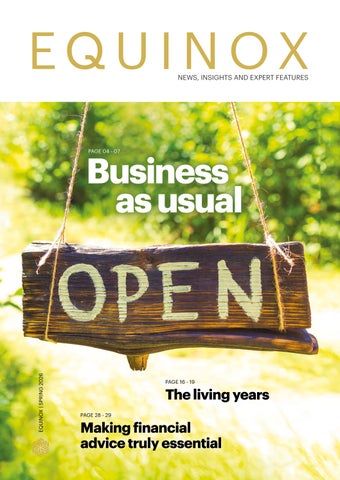
Chief of Staff, Debbie Jukes, reflects on what has – and hasn’t – changed since partnering with Sovereign Capital Partners.
Behind the scenes an enormous amount has been happening”

When we announced our partnership with Sovereign Capital Partners back in October, we made a clear promise to our clients: nothing would change in terms of the service you receive, your adviser relationships, or the way we work with you. Six months on, I’m pleased to report that promise has been absolutely kept. Your adviser remains the same. Your portfolios remain the same. Your fees remain the same. The personal, relationshipled service that has defined Equilibrium for three decades continues unchanged.
Behind the scenes, an enormous amount has been happening. We’ve been building the foundations for national growth while ensuring that our existing clients continue to receive the same level of service you’ve come to expect. It’s been an intensive period, but one that has reinforced our belief that we made the right decision for the long-term future of the firm.
Let me start with what matters most to the Equilibrium team. Sovereign has honoured its commitment to be completely hands-off when it comes to how we look after clients. They haven’t interfered with our investment approach, our fee structure, or our team. The senior leadership remains in place within the business, and the broader team has shown remarkable stability and enthusiasm. In fact, when we offered all employees the opportunity to invest in the business alongside the management team, the take-up far exceeded our expectations. That internal vote of confidence speaks volumes about how the team views our future.
The experience has been, and will continue to be, exactly as it always has for our clients, but with improvements as we continue to invest in technology and systems to streamline our proposition. That personal approach will remain, and your adviser will focus on what is relevant to you, whether that’s retirement planning, inheritance tax planning, or your investment strategy. More to the point, that’s
helping you to live the life you want, to look after those that you love, and to leave a powerful legacy. We are determined to protect the core of what we do well while building capacity for growth around it.
While client-facing operations have remained consistent, we’ve been hard at work building the infrastructure needed to deliver on our vision. This means putting in place the governance, the people, and the processes that will allow us to scale responsibly.
We’ve appointed a new Chair (see page 8 for more details) who brings significant experience in both the financial services sector and in navigating growth in professional services firms. His role is to provide independent oversight and ensure we maintain the highest standards as we expand. We’ve also recruited a new Chief Financial Officer (profiled on page 9) who is strengthening our financial controls and reporting capabilities - crucial when you’re planning to double in size. These are strategic appointments that bring the necessary expertise we need at this stage of our journey.
Over time, you’ll benefit from the technology improvements and service enhancements that growth makes possible”

The rhythm of the business has changed in ways you probably won’t see from the outside, but which matter hugely. We have monthly board meetings with our investors to ensure effective governance and accountability. We have weekly calls focused specifically on our acquisition strategy. We’ve created dedicated resource to manage the merger and acquisition process, with a new M&A Director joining us in April. This is all designed to ensure that when we acquire other firms, it’s done properly - and that the existing Equilibrium team remains totally focused on looking after you.
Which brings me to the most tangible evidence of progress. At the time of writing, we have made offers for two firms. By the time you read this, one or both (or maybe none!) could well be progressing through the due diligence process and further details will no doubt emerge if a deal is successful. In the meantime, I can tell you that both firms meet our strict criteria for cultural fit and quality.
Our approach to acquisition is deliberately rigorous. We’re not
interested in buying any firm simply to hit growth targets. We’re looking for businesses that share our values, that put clients first, and that will benefit from adopting Equilibrium’s systems and operating model. We want firms where the advisers are excited about joining a larger, more resourced platform while maintaining the personal service their clients value.
This is why we’re building a dedicated acquisition team. We need people whose full-time job is to identify the right firms, conduct thorough due diligence, and manage the integration process. That way, the rest of the team can stay focused on what they do best which is looking after our clients and running the business day-to-day.
The goal over the next few years is ambitious. We’re aiming to bring Equilibrium’s relationshipdriven approach to more people across the UK, expanding from our North West base into new regions. But we’ll only do this if we can maintain the quality and personal touch that has always characterised our proposition.
So, what does all this mean for you? In the short term, very little. You’ll continue to work with the same adviser and the same client management team. You’ll continue to receive the same quality of communication and the same level of expertise and attention to your financial planning needs.
Over time, however, you should see benefits from the investment we’re making. We’re looking at how we can enhance our technology to improve your experience with better reporting tools, more intuitive client portals and more efficient processes that free up adviser time for the conversations that really matter. We’re exploring how we can expand our investment capabilities and broaden our service offering. We’re also thinking about how we continue to innovate in a fast-changing financial services market.
Of course, none of this will happen overnight. But the financial backing and strategic support from Sovereign means we can make these investments with confidence, knowing that we have the resources to do them properly.

I know some of you will have questions, and I want to address a few of the most common ones we heard from our Client Advisory Group.
What will happen in the future?
Private equity firms do eventually exit their investments – that’s the nature of the model. But Sovereign’s approach is to build sustainable, valuable businesses, not to strip them for short-term gain. The structure we’ve put in place ensures that the management team retains significant influence and that any future transition will be managed in the best interests of clients and our team.
What does it mean for local clients when you go national?
Nothing changes. The Handforth office remains our headquarters. The team you work with remains in place. As we acquire firms in other regions, those clients will be served by their existing advisers in their locations. We’re not consolidating everything into one office, we’re creating a
national network of local teams, all operating to the same high standards.
How will this benefit clients?
In the immediate term, it provides continuity and security. You can be confident that Equilibrium will be here, strong and stable, for decades to come. Over time, you’ll benefit from the technology improvements and service enhancements that growth makes possible. You may also find that if you have family or friends in other parts of the country who need financial advice, we’ll be able to assist them more effectively through our expanding network.
It’s been an interesting 12 months. Balancing business as usual with the demands of transformation including the due diligence process, the reporting requirements, and the strategic planning has required focus and discipline from the entire leadership team.
However, we’re doing this because we believe it’s the right thing for the long-term potential of Equilibrium and, by extension, for you as
clients. We’re not responding to crisis or distress. We’re seizing an opportunity to secure our future with a solid succession plan, allowing us to take our model to a wider audience.
As you are no doubt aware, the wealth management landscape is changing. Regulation is increasing, technology is evolving, and client expectations are rising. Firms that don’t invest and don’t scale will struggle. We’ve chosen to be proactive rather than reactive, to position ourselves as one of the winners in a consolidating market rather than risk being left behind.
We’re doing this in a way that protects what our clients value most, such as the personal relationships, the attention to detail, the consistency of advice and the commitment to acting in your best interests.
So yes, everything has changed in terms of ownership structure, governance and strategic ambition. But nothing has changed in terms of what you experience as a client. That’s the balance we’ve struck, and it’s the balance we’ll maintain as we move forward.
Meet the two newly appointed senior members of the Equilibrium team, whose roles are central to guiding the company’s growth and strategic direction.


David
Campbell, Chair
What inspired you to take on this role?
I was first approached by Sovereign Capital five years ago for a similar role that wasn’t quite right for me at the time, but they got in touch again last summer with an opportunity to meet the team at Equilibrium. The initial discussions piqued my interest, I liked the team and ultimately agreed to take the role as Chair. I have quite a lot of financial services experience in large firms (JPM and Deutsche) where at one point, I ran fixed income trading and more recently, in three smaller private equity ventures as both CEO (Tilney/ now Evelyn) and a couple of other investor/ Chair roles in short-term lending and foreign exchange businesses. Given my background, I felt I could help the team on the next stage of their and the firm’s development. The non-executive role offers the opportunity for influence (to be earned!) without specific day-to-day executive responsibility and demands a good rapport with both the private equity sponsor and the Equilibrium team. So far, I have really enjoyed that interaction.
Where do you see the biggest opportunities for Equilibrium in the next five years?
Equilibrium is well-positioned for growth over the next five years, thanks to strong support from Sovereign that enables us to expand and leverage interesting opportunities. Growing the business organically and integrating talented professionals through both hiring and company acquisitions will enhance and
deepen the pool of expertise and should help deliver more value to clients. Adding scale will also help us to reduce external platform and investment costs for clients as well as extend our service proposition. However, these things take time and individual and company ‘fit’ are important constraints in that process. That said we are making good progress on several ideas in this regard.
will you ensure the business continues to put clients’ wellbeing at the heart of its strategy?
We are a service-led business, and our priority must always be on delivering the highest standards of client care. This is achieved by investing in support infrastructure and ensuring our teams are well staffed, comprising qualified professionals with the appropriate expertise and experience, so clients consistently benefit from high-quality service and continuity of coverage. We actively encourage staff development and growth opportunities, which not only enhances their skills but also helps maintain long-term relationships with our clients. None of that focus, which is a huge part of the current Equilibrium DNA, will change.
What role does culture play in driving success, and how will you nurture it?
Culture, as just noted above, has been fundamental to Equilibrium’s success and it’s fair to say the tone has been set from the top. Debbie and Colin have set a high bar in terms of values and standards, creating a strong ethos for the entire organisation. Growth will challenge that but having an acute awareness of this will help maintain the status quo and there are a lot of very capable, grounded people who like working here for this very reason.


David Chennell, Chief Financial Officer
What private equity experience have you had previously, and what does success look like to you?
As a Chartered Accountant by trade I have worked for many companies across multiple industries and spent the past nine years working in a range of private equity-backed companies, where I specialised in buyand-build strategies and scaling businesses through acquisitions, having successfully integrated over 50 companies to date.
My recent transition into the financial services sector has been particularly rewarding, allowing me to apply my experience in driving growth, enhancing integration, and leveraging established infrastructure for cost efficiencies and improved service. I see tremendous opportunity to continue acquiring complementary businesses while also focusing on organic growth through innovative marketing and digital initiatives, paving the way for future success and continued value for our clients.
There’s rarely a “typical” day in my role as each one brings fresh opportunities and challenges. My focus is on using data and insights to set long-term goals, while driving strategy to attract new clients and expand our reach.
Financial reporting and planning play a big part, as I hold teams accountable and guide progress. Acquisitions are a way to strengthen our business, not just grow it. The investment from Sovereign highlights our strong proposition and potential to reach a wider market. I’m really excited by the journey ahead and proud to help shape the future of the business.
What significant changes can we expect
In terms of the buy and build strategy, there’s an element of unpredictability as these opportunities can be like buses. We’re currently pursuing two promising offers and I’m eager to see them both succeed. By next year, I hope we will have acquired at least one, if not both, of these companies.
I believe the discussions we are having now are crucial. Maintaining open dialogue is essential, as a business that isn’t ready to move forward today may well be in a position to do so in a couple of years, and the relationships we foster now could ultimately bear fruit in the future.
Clients will not experience any change and can expect the same high quality and level of service they have come to expect from us. As the company grows, there is every likelihood that clients will benefit from increased investment and an even stronger proposition. For employees, this growth will bring new opportunities, enhanced onboarding, and measured integration into an expanding organisation.

Almost constantly throughout my nearly four decades in investments, commentators have complained the markets “have never been so difficult to call” or “the most uncertain they have ever been”.
It’s a bit like TV shows that always declare the next contest “is the toughest challenge yet” – it rarely is, it’s just different. In markets, there are always things to challenge investors, and so we need to constantly adapt to deal with new or changed circumstances.
Who knows what 2026 will throw at us; Venezuela and Greenland have been early out of the blocks, but it is likely that bigger issues for investors will arise as the year unfolds.
As evidence-based investors, we care less about year-ahead outlook forecasts or prognostications in the media than underlying valuations. To remind myself of this, I keep on my desk The Economist Outlook Edition for 2020 which said the “worst-case scenario is that the trade war turns inflationary”.1 Less than two weeks into the year, China announced the first death from Covid.
Investing is not only about analysing the direct implications of local and global events but also understanding market trends.
For example, let’s look at how UK investors have actually traded in recent years to get a handle on what assets might be overbought or oversold. You might think with globalisation that UK investors are small fry, but total assets under management in the UK are still around £10 trillion, which is
about 11% of the world’s investment capital – we are still a mid-sized fish!
Table one shows the net value of investments (all the purchases minus the sales) by UK investors in and out of the different assets (notable outflows highlighted in pink). A key notable trend has been the ten consecutive years of selling of UK shares.
There are a multitude of reasons for this, not least the globalisation of capital over the decade, in particular the rise of the US stock market which now constitutes around 70% of the value of all the world’s shares.
To try to stem this outflow, the London Stock Exchange has belatedly tried to reduce the red tape and cost of listing in this country.
Equally, the government has struggled to encourage investors to boost holdings in UK shares to emulate overseas pensions that generally have much higher domestic holdings.
We find this interesting as it probably reflects that much of the selling of UK shares has probably been completed now. The UK stock market was around 8% of the value of the global stock market a decade ago and is now down to around 3.5%, less than half the weighting.
A second key takeaway from the table is the seven consecutive years of property investment sales. Again, there are good reasons behind this, not least uncertainty caused by Brexit in 2016; the cooling of the industrial market as demand for distribution warehouses abated in the late 2010s; the significant impact on office demand due to the pandemic in 2020, then followed by the ramp up in interest rates in 2022 which quashed any hope of new (debtladen) property developments.
Again, this is interesting.
For all these reasons, supply has dried up whilst at the same time the economy has continued to

grow. Real estate company Knight Frank believes that the supply shortage in London is such that the vacancy rate for quality office space will fall to zero by 2028 and remain there until the end of the decade. 2
Not necessarily ideas for this week, month or even this year, but this is the sort of real-world evidence we use to inform our decision-making. It is interesting, for example, to reflect on the fact that the UK’s FTSE 100 Index returned nearly 26% in 2025, beating four of the high-flying US Magnificent Seven technology stocks….imagine what it would have done if UK investors were buying too.
Events ebb and flow, and there are times when there are so many changes going on that it is easy to be bamboozled. We seem to lurch from one crisis to another with the occasional ‘polycrisis’ where multiple, interconnected crises occur at the same time.
In the modern world, the word ‘crisis’ usually implies some form of heightened uncertainty or potential disaster. The Greek origin of the word is ‘krisis’ which means a point of decision or judgement. This is an altogether more measured approach we prefer to take; a calm assessment of the facts and rational decisions will hopefully carry us through the many more ‘toughest challenges’ ahead.
This article is intended as an information piece and does not constitute investment advice.
If you have any further questions, please don’t hesitate to get in touch with us on 0161 383 3335 or by reaching out to your usual Equilibrium contact.
(1) T he Economist, The World in 2020 (2) Financial Times, “London office shortage forces big companies to stay put”, 6 January 2026
Following the sale of his business in 2022, Equilibrium client Richard Coope sought advice from financial planner Andy Baker to optimise tax efficiencies, investments, and overall financial strategy. This support helped to develop his latest venture of creating an innovative B2B software platform.
In 2022, after more than 20 years building Point Progress, we sold the business to Civica. Point Progress was a B2B software company focused on expenses management, helping organisations control, process and audit staff expenses more effectively. It had been part of our daily rhythm for two decades. Letting go was less about completing a transaction and more about recognising that the time felt right to move on.
We had received approaches over the years, some informal and some more serious. Most were easy

to dismiss. But when Civica approached us, we were interested enough to open a dialogue. They were UK based, with local offices and a culture that appeared compatible with ours. After meeting in London and spending time understanding their intentions, we felt the business would have a good home and, importantly, that the team would have real opportunities within a larger organisation.
The structure of the deal mattered. There was no earn out, which gave clarity and avoided the uncertainty
that can arise when performance depends on decisions made after a sale. Our only commitment was to remain for a minimum period as good leavers. I stayed for six months. Louise (Coope) remained for around 18 months to help the team integrate and to ensure continuity. Staff retention was important to us. Even finance, which in many acquisitions can be rationalised quickly, was integrated into the wider group.
After more than two decades in the same market, there was also a natural sense that we had completed that journey. We had navigated growth, recession, Covid and the everyday pressures of running a technology business. Waking up without the constant background concern of staffing issues, cash flow and long-term planning was an adjustment. Initially it was simply a relief. Over time, it created space to reflect.
I did not miss the pressure straight away. In fact, the absence of it was welcome. But it became clear that I still needed something to build. I explored becoming a Business Angel and reviewed several early-stage opportunities. What I realised was that, while investing in other people’s ideas is appealing in theory, I prefer being directly involved. There is a different level of accountability and energy when you are shaping something yourself.

Richard Coope CEO, Zeropath w: zeropath.eco
The move into Zeropath has therefore been less about starting again from scratch and more about applying long accumulated experience to new problems.
During our years at Point Progress, two patterns repeatedly stood out.
The first was sustainability Increasingly, organisations were being asked to report on their carbon footprint in tenders and annual disclosures. For many SMEs, this felt daunting. The tools available were often disconnected from the financial systems they relied on every day.
Zeropath Carbon was built around a simple idea: start with data that businesses already trust. By integrating directly with accounting platforms such as Xero, it uses transaction data as the basis for emissions calculations. The aim is to make carbon reporting practical and defensible, rather than abstract or intimidating. Instead of creating parallel processes, it works within existing workflows.
The second pattern was sales efficiency. Across many organisations, talented sales teams were spending disproportionate time researching accounts and deciding where to focus, rather than speaking to customers. Data was plentiful but scattered. Insight required manual effort.
Zeropath Agent addresses that challenge. Using AI, it analyses available information and surfaces clear priorities, helping teams concentrate on the accounts most likely to generate value. It is not a generic CRM addition. It is designed to act as an assistant, reducing research time and sharpening focus.
Although Carbon and Agent serve different purposes, the underlying philosophy is consistent with what we learned over 20 years building a B2B software business. Skilled professionals are often constrained by low value tasks. Well-designed software should remove friction and allow people to focus on judgement, relationships and decision making.
This time, we are building deliberately lean. Automation and scalability are being designed in from the outset, shaped by lessons learned in earlier years around performance and growth. Expansion will come, but efficiency and resilience are central principles.
The sale of Point Progress gave us freedom and optionality. Zeropath reflects both continuity and change. The values remain the same. The problems we are addressing are different. That balance feels right for this stage.
Expansion will come, but efficiency and resilience are central principles”


Carly Wise, Director of DOVE Interior Design Ltd, discusses how simple changes within your home can transform how you live and feel.
Spring is in the air, energies are rising, and the time for change is here. While estate agents prepare for their busiest season, homeowners are debating whether to move or improve.
I’ve been an interior designer serving the UK property market for over 20 years and have seen how trends have evolved over time; I’ve also borne witness to the mistakes people make in their homes time and time again.
If you love where you live but not how you live, making considered changes can be transformative. Here are some ways to blow away the cobwebs and breathe fresh air into your home:
Our lifestyles constantly evolve, yet many floorplans remain frozen in time. As routines shift and homes become fuller, layouts that once worked can begin to feel restrictive.
• Put your paint brush away. Before you ‘re-decorate’ one room at a time consider the house as a whole. Continuous flooring and a cohesive colour palette opens up your home, creating beautiful flows from one space to the next.
• Dig out your floor plan. Often easily accessible on Rightmove. Ask yourself, does the layout work for you? Open-plan living is often beneficial for younger families, but with growth comes change. Adding walls can create privacy for older children, home offices, or adult spaces like golf simulator rooms.
• Are there any overlooked and unused areas? Large hallways with small WC’s? Reduce the size of the hallway and introduce a boot room. Corridors, corners, and nooks can become reading spots, wine ‘cellars’, saunas, or highly functional micro-spaces
• Flipping the swing of a door. A minor tweak that can free up wall space, improve circulation, and make rooms more functional, with no structural work.
• Consider larger scale conversions. Utilising areas such as garages, lofts and basements and introducing garden buildings can provide endless possibilities; luxury spa areas, beautiful workspaces/ studios, cinema rooms and gyms etc.
We install smart technology into almost every new build property, or large-scale renovation we work on. If you’re not ready for a large project, reimagining a room is the perfect opportunity to introduce this into your home little by little.
• Plaster-in speakers. Flush speakers disappear into walls or ceilings, delivering high-quality audio without clutter allowing invisible tech to work in any style of room.
• Integrated lighting systems. Scene lighting creates moods for work, relaxation, or entertaining resulting in instant layered lighting for every occasion. It can also enhance security by mimicking your daily life whilst you are absent from the property.

• Motorised and recessed window treatments. Automated blinds or curtains are a fabulous solution for the elderly/ disabled or people who are away from home. Recessing them into a ceiling creates a seamless and modern feel.
• C oncealed media solutions. Recessed or mirrored TVs, like Samsung Frame TVs, double as art reducing the enormity of a large black screen dominating a room. Similarly, adding acoustic fabric to a media wall discreetly hides speakers, creating an extra layer of warmth.
3. A change is as good as a holiday
Even small décor updates can have an enormous impact on how you feel at home but always start with the basics.

Where will coats, muddy shoes, or tall vases live?”

• Functional analysis. One of the most crucial steps in any home design. Where will coats, muddy shoes, or tall vases live? Is there a spot to hang towels and dry clothes near a shower? Planning for function upfront prevents small frustrations once the room is complete and ensures every detail has a solution.
• Lighting and power. This is nearly always overlooked but so important. Create a lighting and power plan, do you have enough mood, functional and task lighting? Install 5 Amp sockets so lamps can be switched on and off at the wall and use faceplates from companies like Dowsing & Reynolds, offering beautiful alternatives to white plastic or chrome!
• I nspiration and expertise. Instagram and Pinterest are excellent for ideas, and Pinterest’s
mood board tool can help visualise your vision. If you’re struggling with time or confidence, guidance from a reputable interior designer may be beneficial. Check the BIID (British Institute of Interior Design) website to ensure professionalism and experience.
• Light and orientation. Colours appear differently in north or south-facing rooms. Peel andstick options from companies such as COAT Paint are a great way to see the effect before committing. They even section their range into North (S/E&W) facing ranges! Make sure to place your sample on each wall.
A well-designed home isn’t just somewhere to live, it’s a space that supports your lifestyle, uplifts your mood, and makes every day feel a little extraordinary.
Based in Cheshire, our registered British Institute of Interior Design professionals create stylish, functional spaces across Cheshire, Knutsford, Alderley Edge, Wilmslow, Warrington, the North West, and throughout the UK.
e: carly@doveinteriors.co.uk
w: dovearchitecture.co.uk

BY MARK BARLOW

Mark Barlow, explores how different generations approach financial planning in reality.
“Every generation blames the one before”, sang Mike & the Mechanics in 1988, but when it comes to financial planning, we should surely learn from the experiences of our elders.
Over the years, financial planning has not so much evolved as it has changed shape, often driven by whatever tax wrapper happened to be flavour of the month. It’s a reminder of how quickly the landscape moves. If you were to ask someone today who is in their twenties what an endowment mortgage is, you will likely get a blank stare. Yet less than 40 years ago, more than 80% of new UK mortgages were built on exactly that structure.1
Times change, planning tools change… and so does our understanding of what “good planning” looks like.
So, with a team spanning five decades, who better to ask than our own staff to discover not only the lessons learned over the years, but also what their current and future plan entails.
To keep things simple and true to our values, we asked everyone the same questions, aiming to capture a quick snapshot of how different generations view and approach financial planning today. The questions below were based not on a technical framework, but more of a focus on the human reality side of financial planning:
• W hich tax wrappers matter to you most right now?
• H ow are you currently investing?
• W hat are your priorities over the next ten years?
• W hat advice would you give your younger self?
• W hat, if any, is your realistic dream purchase in the n ext 10 years?
Seb Finlay, Client Manager: Letting time do the work

Seb, the youngest participant and a recent addition to Equilibrium, already understands that time is his greatest financial asset. His approach to planning is impressively practical, with a sixmonth emergency fund firmly in place to provide a vital safety net.
Like many in their 20s, one of Seb’s biggest challenges is saving for his first home. He is tackling this head on by consistently contributing to a Lifetime ISA, making full use of the valuable government incentive along the way.


Grace Burgin, Financial Planner: Making space for life happening
Grace, only slightly further down the road than Seb, is already showing how a financial plan needs to adapt as life evolves. With her wedding on the horizon, she’s keeping more money in cash ISAs than usual, prioritising short-term certainty over potential growth.
Beyond this, her approach is deliberately layered. The medium term is focused on steadily building her stocks and shares ISA over the next decade, while the longer term centres on disciplined saving into her
Alongside his Lifetime ISA, Seb also invests through a government incentivised stocks and shares ISA and makes regular contributions to his pension. His portfolio is heavily weighted towards global equities, which reflects his long-term investment horizon. Around 20% is allocated to lower risk assets, providing flexibility to invest during market downturns and ensuring accessible funds remain available for emergencies. This approach fits neatly with his core principle: buy when others are fearful, and sell when others are greedy.
With such a grounded attitude towards shaping his future, Seb also allows himself to dream a little, with longer term ambitions that include a first-class trip to the Maldives, or perhaps a Rolex to mark the journey.
workplace pension. One standout lesson for Grace (and reassuring news for Seb) is just how instrumental her Lifetime ISA was in helping her buy her first home.
A tip Grace shares with younger clients and follows herself is the importance of setting up regular monthly contributions. By ring fencing part of her salary for savings and investments, and taking a higher risk approach within her pension to benefit from pound-cost averaging while retirement is still decades away, she has built strong habits early on.
By establishing this savings discipline in her early years, Grace is giving herself the best possible chance of continuing to climb the housing ladder in the future.

Rob Douglas, Systems Manager: Climbing the next mountain
Having recently purchased his first home, Rob is feeling the squeeze on cash after spending the best part of the last decade diligently building a sizeable deposit.
The next ten years will be a three pronged effort: rebuilding his cash reserves, increasing tax efficient

Jon Brusell, Associate Financial
Planner: Family focus
With two young children, Jon’s short term financial planning has naturally centred on family priorities in recent years.
As a Chartered Financial Planner, Jon understands the importance of good planning, but he is equally aware of the everyday pressures and competing demands that come with raising a young family.

Ryan MacDonald, Senior Client Manager: Looming further education costs
Ryan and his family have only just emerged from the disruption of upsizing their home, yet another major milestone is already approaching: university costs. With his daughter Starla hoping to start university in September, both the timing and scale of the expense are firmly in focus.

Mark Barlow, Marketing: The light at the end of the tunnel
With much of the heavy lifting around university planning now behind him, and his daughter Ella coming to the end of her first year, Mark’s focus has shifted.
Attention is now focused on funding Ella’s remaining years, while his son Jake’s plans to start university in 2027 are firmly on the horizon. At the same time, Mark is beginning to lay the foundations for his children’s future property purchases.
pension contributions, and using stocks and shares ISAs for medium term investing, with the longer term aim of potentially funding a house extension.
Equity funds continue to play a central role in Rob’s portfolio, particularly within his pension. However, as the value of his stocks and shares ISA grows and the prospect of a house extension moves closer, he plans to gradually take some risk off the table by diversifying across a wider range of asset classes, helping to reduce short term volatility.
He maintains long term discipline by following the “pay yourself first” philosophy, making monthly pension contributions before any other expenses so that saving happens automatically rather than as an afterthought.
Jon invests heavily in his pension, taking a higher risk approach through a Global Equity fund, reflecting a long investment horizon of more than 30 years.
In the nearer term, his focus is on starting Junior ISA contributions for his children, rebuilding the family emergency fund, and, once those foundations are in place, planning a memorable luxury family holiday for everyone to enjoy.

Ryan has responded cautiously, increasing cash holdings to protect against short-term market volatility while maintaining a clear, structured plan for funding education. Reducing personal debt also plays a key role, reflecting the reality that borrowing costs often outweigh cash returns, while still keeping enough liquidity for life’s unexpected moments.
Looking further ahead, the next decade is about steadily reducing the mortgage and, if all goes to plan, finally delivering a long-held ambition: a truly “whopper” home extension.
After inheriting funds a decade ago, Ella and Jake benefited from a 120% gain through investment in the Equilibrium Global Equity fund. Now that Ella is 18, £4,000 is sold each year using her capital gains tax allowance, with proceeds redirected into a Lifetime ISA to capture the 25% government bonus, alongside a more balanced approach to risk.
Rather than relying on a single mortgage, Mark spreads borrowing across multiple fixed-rate mortgages to manage interest-rate risk. Built-in overpayment flexibility also provides an accessible family emergency fund. By holding a balanced portfolio that lets him sleep soundly, Mark hopes future returns will help fund a long-held dream: travelling through South America watching football, ending with a pilgrimage to Boca Juniors.

Catherine Dooley, Transformation Manager: Slowing down the pace
Catherine’s experience is that by the time you reach your 50s, the financial conversation begins to shift. The focus moves away from general accumulation and towards retirement, with greater emphasis on certainty and control to ensure the next phase of life feels secure, balanced and well planned.
Having spent most of her career in financial services, Catherine brings valuable perspective and understands the importance of consolidating what she has already built, rather than chasing unnecessary growth in

Neal Foundly, Portfolio Manager: Enjoying the fruits of your labour
For Neal, the focus has now shifted decisively from growth to stability. The priority is ensuring he can fund a comfortable and well deserved retirement, while also supporting family with further education costs along the way.
When it comes to investing, Neal prefers to let compounding do the heavy lifting rather than trying to time unpredictable markets. That said, he
individual stocks. With access to pensions approaching over the next few years, maximising contributions while earnings are at their peak has become a clear priority.
This stage of life also brings added complexity. Alongside pensions, Catherine now manages a broader mix of assets, including rental property. Her approach remains disciplined: monitoring finances closely, sticking to effective budgets, maximising employer pension contributions and favouring diversified funds through regular saving and pound- cost averaging.
Looking ahead, the next decade is about balancing sound financial planning with enjoying life alongside family, with plans including moving house to a more rural setting, a family trip to Canada, and fulfilling a long-held ambition of a solo ranch trip.

recognises that when surplus capital is available, periods of significant market falls can present sensible opportunities to invest.
These lessons are ones Neal has been keen to pass on. By setting up a small trading account for his son, he has helped him learn the real truths of investing: getting rich quickly is rare (despite what social media might suggest), and losses are an inevitable part of the journey.
Content with life and everything he has experienced so far, Neal is now looking ahead to a calmer pace in retirement, travelling more and for longer. Being able to pair those trips with Formula 1 Grand Prix weekends would be the icing on the cake.
One simple truth stands out: good planning isn’t about predicting the future, it’s about being prepared for it. That’s why we always use Voyant, a lifetime cashflow planning tool that gives a clear picture of your finances now and as life evolves - a work in progress rather than a finished piece of art!
Every decade brings its own pressures, opportunities, and priorities, yet clarity, consistency and a willingness to adapt will always outshine any attempt to second guess the market.
The tools may change, tax wrappers may shift, and life will always throw in a few surprises, but the principles remain unchanged. Build steadily, review often, stay honest about your goals, and give your plan the space to grow alongside you. After all, the living years aren’t something to chase - they’re something to shape.
This article is intended as an informative piece and should not be construed as advice. If you have any further questions, call us on 0161 383 3335 or by reaching out to your usual Equilibrium contact. (1)
BY HARRY TOPPING

Harry Topping, Portfolio Manager, explores where the real value may emerge in the age of AI.
In recent years, Artificial Intelligence (AI) has become a key driver of markets and one of the hottest topics across the globe. Since the launch of ChatGPT in 2022, the world’s biggest companies have scrambled to acquire the microchips and computing power to put themselves at the cutting edge of this transformative technology. But what exactly do we mean when we talk about AI? How does it work and what are the applications? And how can we try to gain exposure to this theme within the Equilibrium funds?
In its simplest form, AI works by recognising patterns in old data to help us answer questions and solve problems in the present. This can be in the form of recognising patterns to help us forecast data, or even how ideas and words fit together in order to give us human-like text and voice responses to queries. Today we have access to ‘Narrow AI’ – systems designed to perform specific tasks. ‘General AI’, capable of performing any task that would
usually require human intelligence, remains only theoretical.
If we follow through the idea of recognising patterns, we can identify some areas where AI is most prevalent today. The first, and most often used, is the ever-frustrating AI chatbots used by companies to deal with complaints. If the AI can recognise patterns in how common issues have been solved in the past, it can point complainants toward the answers they require. Companies now claim 85% of complaints can be handled with no human intervention. Another less recognised area is journalism – 50% of newly published articles in 2025 were written by AI. This might seem like a sector insulated from technology, but most articles are relatively predictable collections of facts and prose, lending themselves to imitation through pattern recognition.
From an economic perspective, the great hope for AI is that it can reignite productivity growth in the developed world, or growth in output per worker. Chart one shows productivity in the UK between 1990 and 2025. From 1990 to 2008, productivity grew at 1.8% per annum, which compares to just 0.86% from 2009-19 and -0.28% from 2022-25. This is certainly a source of economic woes as nations have relied on increasing the number of workers for growth rather than improving their output. On the bright side, there is real hope that AI can help automate tasks and allow workers to provide more value to the economy in the coming decades.
Potentially transformative technologies always present both investment risks and opportunities. One way to gain investment exposure is through the ‘Hyperscalers’ – large US tech companies supplying the computing power needed to run AI models via the cloud. Microsoft, Google and Amazon are prime examples, who also have access to proprietary data for training bespoke models. Then there are semiconductor companies producing the chips needed to train and run AI models. Nvidia is currently the world’s largest company with a near-monopoly in designing best-in-class chips, while Taiwan Semiconductor Manufacturing Company (TSMC) dominates highend manufacturing. While earnings


have grown strongly, valuations have become expensive – some might claim these companies are now ‘priced for perfection’. Recent deepening ties between AI-related companies also give cause for concern. Chart two above gives a flavour of how interlinked some of these companies have become. OpenAI, the parent company of ChatGPT, has pledged approximately $1.5 trillion in future expenditures, despite currently generating only $14 billion in annual revenue.
History would recommend approaching these lofty valuations and interconnectedness with caution. There are, however, other ways to access this theme at more reasonable prices. One is through companies supplying data centres with the huge amount of power they need – the largest facilities under construction will have consumption comparable to San Francisco. Another is providers of cooling systems that allow data centres to maintain constant temperatures regardless of demand. Finally, if we see the promised productivity

gains, it will likely be new companies with AI at their core that displace incumbents and become the winners of tomorrow. Consider that the World Wide Web emerged in 1989, but Amazon wasn’t founded until 1994 and Facebook only in 2004.
We are in the foothills of this new technology, which will undoubtedly change the economy in ways we can’t yet understand, but we must remember that transformative technology doesn’t translate into investment returns for all. We will continue to be evidence-based investors, applying a healthy level of scepticism in trying to identify where future investment returns might accrue.
This blog is intended as an information piece and does not constitute investment advice.
If you have any further questions, please don’t hesitate to get in touch with us on 0161 383 3335 or by reaching out to your usual Equilibrium contact.
BY AMANDA JACKSON


Cyber Essentials Plus:Your security, our promise. Technology Manager Amanda Jackson highlights the impact of this latest accreditation.
We’re pleased to share some important news about how we protect your financial and personal information. Equilibrium has recently achieved Cyber Essentials Plus certification - a rigorous, government-backed standard that independently verifies the strength of our cyber security controls. This certification reinforces our commitment to keeping your data safe, secure, and private at all times.
What is Cyber Essentials Plus?
Think of Cyber Essentials Plus as a comprehensive health check for our IT systems, but performed by qualified, independent specialists.
Trust is central to our relationship with you”

While the basic Cyber Essentials certification we’ve held since November 2022, involves a selfassessment, Cyber Essentials Plus goes significantly further. External cyber security experts conduct an in-depth review of our systems, testing our defences in real time to ensure they meet strict governmentapproved criteria. It’s the difference between taking your own blood pressure at home and receiving a full clinical assessment by a medical professional.
This assessment was carried out in partnership with Axon, our IT managed service provider, who work closely with us to maintain and protect our technology infrastructure. Together, we ensure every part of our systems from the cloud platforms that store your information, to the laptops and devices our team uses every day meets high, independently verified security standards.
Your information is personal, sensitive, and valuable - and protecting it is a responsibility we take extremely seriously.
The certification confirms that our controls are robust across five key areas:
1. Secure internet connections
2. Proper configuration of devices and systems
3. Strict access controls
4. Protection against malware and malicious software
5. Keeping all systems updated and patched
In practical terms, this means that when you share details of your investments, pension arrangements, estate planning, or personal information, it’s stored and accessed within systems that meet stringent security standards. Every device, connection point, and system we use has been tested and validated as secure.
Cyber threats continue to evolve, with phishing emails, ransomware attacks and data breaches becoming more sophisticated. You may have seen examples in the news affecting retailers, large manufacturers, and even government departments.
Our Cyber Essentials Plus certification demonstrates that we have appropriate, modern controls in place to protect against these common risks. This includes:
• Technology that blocks suspicious or malicious emails before they reach our team.
• Regular staff training so we can quickly spot potential threats.
• Secure, encrypted backups of all critical information.
• Continuous updates and security patches for all software.
• Tight controls over who can access your information.
• Multifactor authentication, and single sign on across our systems.
Together, these measures significantly reduce the risk of cyber-attacks and ensure your data remains protected.
Our partnership with Axon means we always have specialist cyber security expertise on hand. They monitor our systems continuously, respond quickly to potential issues, and help ensure we remain protected as new threats emerge.
Their support was invaluable throughout the assessment process, providing the independent assessor with detailed evidence of how we maintain and secure our systems every day.
Cyber Essentials Plus is not something we achieve once and forget about. We need to maintain the same high standards throughout the year and undergo re-certification annually. Cyber security changes rapidly, and so do we. Our team stays informed about emerging risks and best practices, and Axon ensures our technical defences remain effective and up to date.
While we work hard to protect your information within our systems, you can help protect yourself too.
• Be cautious of unsolicited emails, texts, or calls requesting personal information.
• If in doubt, contact us directly - we’re always happy to verify anything that seems unusual.
• Remember: we will never ask for passwords or sensitive information by email.
• Whenever possible, please use our Client Portal, which provides secure, end-to-end encrypted communication.
• If you haven’t done so already, please attend our Cyber Security Masterclass where you can find out more information.
Trust is central to our relationship with you. Achieving Cyber Essentials Plus certification is one way we show that your trust is well placed, and that protecting your information isand always will be - a top priority for us.
Gain confidence in navigating the online realm. Scan the QR code to book your place on our next masterclass.
BY JEREMY COLE

Thinking of selling your business? Here are six key questions to ask yourself…
Equilibrium trusted partner and guest speaker Jeremy Cole, of Manchester- b ased Cole Associates Corporate Finance, sets out six key questions to ask yourself when considering a business sale.
I like to use Rudyard Kipling’s “six honest serving men” to set the scene when I’m talking to business owners for whom the sale of their business is probably the most significant business transaction they will undertake in their life.
WHY am I thinking of selling my business?
WHO will want to buy my business (and why)?
HOW much is my business worth?
WHAT does the sale process look like?
WHEN is the best time to sell (and why?)
WHERE do I stand after completion of the sale?
Let’s delve into each of those questions:
Consider the reasons you are contemplating the sale of your business and your objectives for the sale process. To what extent are the drivers ‘away from’ or ‘towards’? Are they internallydriven? (e.g. retirement, owner fatigue) or externally driven? (e.g. market conditions, technological advances).
Treat non-financial reasons as potentially equally relevant as financial reasons.
M ake sure you are taking a measured, long-term perspective, not a short-term knee-jerk reaction to recent circumstances.
Discuss the decision with your family, especially if more than one family member is involved in the business.
Take professional advice early from an experienced corporate finance adviser. Obtain an impartial, external perspective.
The most likely potential buyers of your business will comprise of a(n):
Trade buyer
M anagement buy-out (MBO)
Private equity firm
Employee Ownership Trust
Each buyer type has its advantages and disadvantages; your advisers will help you weigh financial and non-financial factors. For instance, an MBO offers greater confidentiality than a trade sale but is less likely to achieve a premium price from potential synergies.
This is naturally the question at the top of most business-owners’ lists. There’s a lot of misinformation and mystique around business valuations. I often say, only slightly tongue in cheek, that there are three views on a business’s value:
Academic valuation - what your accountant thinks your business is worth.
M ate down the pub valuation –there’s often someone in your local pub or at the golf club who claims to have just sold their business for 20 times profits.
Real valuation – This is the only valuation that matters. It’s the ultimate truth; your business is worth what someone is prepared to pay for it
You’ll have heard about the different approaches to valuation such as price/earnings multiples, discounted cash flow and net assets basis. In this article it’s not possible to explain them fully. If you would like to contact me to discuss the value of your business, I’m always happy to provide a view (after gathering some information), without charge.
One aspect of valuation and deal negotiation that often leads selling shareholders, who are poorly-advised, to leave value on the table, is the distinction between enterprise value (cashfree, debt-free) and equity value (inclusive of cash and debt). To the extent there is net surplus cash in the business at completion, this should be added to the proceeds received by the selling shareholders.
You should allow 9-12 months for the full-blown sale process. In the event it starts with an unsolicited approach and you decide not to involve other potential buyers, the timescale should be slightly shorter; 6-7 months.
We run the sale process in three phases – the Preparation phase, the Go-To-Market phase and the Due Diligence and Legal Contracts phase. The main objective of your corporate finance adviser is to create negotiating leverage by having as many good quality buyers as possible vying to acquire your business.
The best time to sell is generally when your business still has plenty of growth potential – don’t sell at the crest of the wave, leave some easy wins for the buyer.
If the business is dependent on you as the CEO/Managing Director, work on getting a competent senior leadership team in place before the sale process starts; owner-dependency is one of the biggest valuation killers for a privately-owned business.
Following legal completion of the sale, if you work in the business, the buyer is likely to want you to carry on for a handover period of 3-12 months (possibly part time). If part of the sale terms include an earnout (i.e. part of the price is linked to future performance), it can be in your interests to retain an involvement in the business.

You can find interviews on the sales process, including MBOs at: w: cole-group.co.uk/corporate-finance-videos-and-guides
For any questions or to arrange a complimentary meeting or call, please get in touch via:
t: 0161 832 9945
m: 07711 435814
e: jeremycole@cole-group.co.uk


As a trusted provider to Equilibrium, TIME Investments’ Business Development Director Bob Nicoll, explains how good planning can help you navigate the upcoming IHT changes successfully.
Although many pensions were already outside the estate for IHT purposes, the 2015 pension freedoms transformed how easily unused pension pots could be passed to beneficiaries free of IHT. That advantage is about to disappear.
From 2027, most unused pensions will be pulled back into your estate for IHT purposes. Worse still, if you are over 75, your beneficiaries won’t just face a 40% IHT charge they’ll also pay income tax at their marginal rate when they access the pension. For many families, this means an effective tax hit of well over 65%. This is alongside the possible loss of valuable reliefs such as the Residence Nil Rate Band (RNRB).
Since the pension freedom rules were introduced in 2015, it often made sense to leave your pension untouched and spend other assets instead. The idea was simple: pensions could usually be passed on to loved ones tax efficiently.
That approach now needs a fresh look. Changes announced in October 2024 mean that many more people will be affected by IHT, and strategies that once worked well may no longer deliver the same results. This makes it especially important to review any existing estate planning arrangements, check that your Will is up to date, and ensure your pension beneficiary (expression of wish) forms still reflect your intentions.
The good news is that IHT has long been described as a “voluntary tax”. As former Chancellor Roy Jenkins famously put it: “Inheritance tax is a voluntary levy, paid by those who distrust their heirs more than they dislike the tax man.” With the right planning and timely advice, much can still be done to reduce its impact and keep more of your wealth in the hands of your familywhere most people want it to go.
So, what can you do to reduce the tax bill and leave more to your loved ones? One simple way to
Insurance doesn’t reduce the tax itself, but it can provide a lump sum to cover the bill”
think about your options is the acronym SIING:
S – Spend it. Money you spend isn’t taxed later, so if you’ve been putting off that holiday or big experience, now might be the time to enjoy it.
I – Insure it. Insurance doesn’t reduce the tax itself, but it can provide a lump sum to cover the bill. Policies are usually written in trust so the money goes straight to your beneficiaries.
I – Invest it. Some investments qualify for valuable tax reliefs, such as Business Relief, which can reduce or even remove IHT if certain conditions are met.
N – Nothing. Doing nothing is still a choice, but it means accepting the tax bill and leaving a smaller legacy behind.
G – Give it away. Gifts made during your lifetime can fall outside your estate if you live for seven years after making them.
The right solution will depend on your personal circumstances including your health, family situation, and whether you need ongoing access to income or capital. It also comes down to how quickly you want the planning to take effect, and how comfortable you are with giving money away and giving up control.
At TIME Investments, we specialise in investments that can qualify for Business Relief (BR), with over 30 years’ experience of helping clients
A specialist investment manager focused on delivering long-term investments that seek consistent returns. w: time-investments.com

reduce Inheritance Tax. When held for two years and still owned at death, qualifying investments can reduce IHT by 50% or even 100%, depending on the rules.
BR, first introduced in 1976, was designed to support UK businesses and remains well established and widely used. Recent changes mean up to £2.5m per person (or £5m for a couple) can benefit from full relief, with amounts above this still receiving partial relief.
We work with advisers and their clients who want to plan ahead without giving up access or control of their money. Our flagship solution, TIME Advance, has been running since 2013 and now looks after around £1.6bn of client assets, targeting returns of 3–4.5% p.a. after tax and charges.
With more people now facing IHT due to rising asset values and rule changes, regular reviews of your financial circumstances are more important than ever especially if you’d rather leave your wealth to your family than the taxman.
This article is intended as an information piece and does not constitute investment advice.
TIME Investments is one of our selected providers for Business Relief investments. Please note, our recommendations are bespoke to your specific needs and circumstances. For any queries, please contact us at 0161 383 3335 or get in touch with your usual Equilibrium representative.

BY

How
all.
In late 2023, Equilibrium quietly launched a new service, staying true to our motto of “Making People’s Lives Better.” However, what started with little fanfare has quickly become a game changer for clients who want high-quality financial advice, without the barriers so common in the profession.
In 2024, the average client portfolio size in the UK of those who took financial advice was a staggering £369,689.1 Nonetheless, on reflection, this should not seem surprising, as some financial advice firms set the bar high, requiring at least £250,000 in investable assets just to start a conversation. This has left a huge advice gap for those with less complex portfolios who still need expert guidance.
Since 2011, we have sought to bridge this gap by offering clients the opportunity for their children, and in some cases grandchildren, who may be at a different stage of their financial journey to become clients in their own right as part of a family offering. This approach creates synergy between generations, ensuring that everyone’s financial journey is supported, and sometimes uncovering surprises such as a child’s education being covered by a grandparent’s trust when the parents were already saving for the same goal!
Over time, it became clear that this generational approach revealed a broader challenge: many people and not just client’s family members, were still unable to access traditional financial advice. As demand grew for clear, approachable guidance, Equilibrium Essentials emerged as a solution by removing the high portfolio barriers and making high-quality advice available to those who had previously been overlooked.
By removing restrictive minimum portfolio sizes and opening Essentials up to the wider marketnot just existing clients - we’ve made professional financial planning accesible by tailoring the costs, relative to what clients need. It means anyone ready to take charge of their financial future now has a straightforward, supportive way to get started.
Ben Harrison, a Chartered Financial Planner at Equilibrium and a recent honouree in the Citywire Top
Essentials clients enjoy a level of service that we believe offers exceptional value for money.
Dedicated financial planner
Ad hoc telephone queries
Secure portal communications

Financial, tax and investment advice
Cashflow modelling
Pension planning and income withdrawal advice
Access to core portfolio funds
Daily updated online valuations
Regular market and fund performance commentary
Tailored content for what you want to see
Annual meeting agenda designed for you
Can meet face-to-face or online
Scheduled around your day for convenience
Post-meeting, we’ll confirm any actions
In a world where it’s hard to get a real person on the phone with any service queries, having someone you can trust who knows your financial situation, and can answer your questions quickly, is invaluable.
35 NextGen Advisers, is the driving force behind the initiative.
With recent personal experience as a first-time homebuyer and someone newly engaged, Ben understands the challenges facing clients at the start of their financial journey. “It’s often those at the early stages or with simple needs where you can make the biggest impact,” Ben says. “A small change in your 20s or 30s, like tweaking your pension, could mean retiring years earlier or with a much larger fund.”
While AI and robo-advisers offer quick, low-cost investment options, they often miss the bigger picture. Essentials is different. We take the time to understand your full financial landscape both now and for the future. There’s no pressure and no financial commitment in the initial meetings as we get to know you, explain simply where we can
add value, and build a longterm plan together. It is only when everyone’s comfortable that we move forward.
When you’re ready to proceed, we deliver a detailed report and clear recommendations and then help you put your strategy into action.
The response to Essentials over the past two years has been truly remarkable, with more than 300 clients now benefiting from the service. This incredible momentum has driven the expansion of our adviser team: Grace Burgin brings fresh expertise, combining her experience as an adviser and as a new business Client Manager at Equilibrium. Alongside Ben and Grace, we’ve also begun recruiting a third adviser to ensure we maintain the exceptional
Scan the QR to see our dedicated Essentials webpage.
standard of service our clients expect.
Equilibrium Essentials is more than a financial planning package; it’s our commitment to making expert advice truly inclusive and refreshingly simple. With annual reviews, access to advisers, and clear, transparent fees, Essentials empowers you to take charge of your financial future without the burden of complexity truly making lives better.
To find out more about the Essentials service, please call us on 0161 383 3335 or reach out to your usual Equilibrium contact.
(1) NextWealth study 2024
Many of us reach a point in life where our financial plans are well in hand, our families are secure, and we find ourselves asking: “What next?”
For a growing number of Equilibrium clients, the answer lies in leaving a lasting legacy - not just for those they love, but for the world around them.
That’s where our Equilibrium Donor Advised Fund (DAF) comes in: a simple, flexible and tax-efficient way to make your philanthropy truly count. In effect, the DAF is an ‘umbrella’ within which you can create your own charitable account.
More than just giving
There’s a meaningful difference between writing a cheque to a worthy cause and pursuing philanthropy with real intent. The former is a generous impulse; the latter is a strategy. As the authors of Advising Philanthropists put it: “earning money is one thing - giving it away with intelligence and consideration is altogether more challenging”.1
This is where the Equilibrium DAF sets itself apart. Rather than leaving you to navigate the charitable landscape alone, we provide access to our dedicated philanthropy adviser, who will
Philanthropy can also be a wonderful way to bring the generations together”
work with you to identify the sector or causes closest to your heartwhether that’s education, health, the arts, animal welfare or any number of other areas. Crucially, they won’t just point you in a direction; they’ll research the organisations within your chosen field to identify where your money will genuinely make the greatest difference, selecting bestin-class charities where your grant will have the most impact.
One of the most compelling features of the Equilibrium DAF is what happens as more clients choose to give in this way. When multiple donors share a passion for the same cause, their contributions can be pooled together - creating grants of a scale that no single donor could achieve alone. The result is a level of philanthropic impact that goes far beyond what any individual gift might accomplish. This is philanthropy at its most powerful.
The Equilibrium DAF is designed to fit around your life and your wishes. You can make donations into your DAF during your lifetime, choosing when and to whom the money is distributed. This means you can watch your giving make a difference in real time - and there’s something profoundly rewarding about that. You’ll receive an annual statement showing both the value of your DAF account and the grants that have been made, so you’re always fully informed about the impact you’re having.
Equally, if you’d prefer your philanthropic legacy to begin after your lifetime, we can help you to include a gift to the DAF in your will. To make this as straightforward as possible, we can assist with a simple codicil (where appropriate)a short addition to your existing will - so there’s no need to rewrite the whole document.
Philanthropy can also be a wonderful way to bring the generations together. The Equilibrium DAF gives you the opportunity to involve your children or grandchildren in decisions about which causes to support - sharing your values, sparking meaningful conversations, and creating a sense of shared purpose that can endure long after you’re gone.
When you establish your DAF, we’ll work with you from the outset to agree an investment strategy that reflects how you want to use the fund. Whether you’d like to make grants sustainably over many decades - perhaps in perpetuity - or prefer to distribute the funds more quickly over a defined period, the approach will be tailored to your objectives and reviewed as part of your annual planning meeting.
For those who have considered setting up their own charitable foundation, the Equilibrium DAF offers all the meaningful benefits
but without the complexity. Creating and running a private foundation involves significant administrative, legal and governance responsibilities that can quickly become burdensome. The DAF removes all of that. It is free to set up for Equilibrium clients, and the Equilibrium Charitable Trust (the registered charity name of the DAF) handles all ongoing administration, reporting and due diligence on your behalf. Your account can be established immediately, named after your family or your chosen cause, and you can begin advising on donations straight away.
If you’ve ever thought about making a lasting difference - to a cause you care about, to your community, or to the world your grandchildren will inherit - we’d love to have that conversation with you.
Speak to your Equilibrium financial planner or contact us on 0161 486 2250 to find out how the Equilibrium Donor Advised Fund could become one of the most meaningful parts of your financial plan.
Please note: Once a donation has been made to the Equilibrium Charitable Trust, it is irrevocable and cannot be returned to you or your family. You should consider carefully before making your gift. The Equilibrium Charitable Trust is a registered charity, Charity Commission number 1200657.
(1) Advising philanthropists: Principles and practice, Beeston and Breeze, 2023

In a world that continues to evolve at pace, one thing remains constant: our commitment to bringing people together. Events have always been at the heart of what we do, and they will continue to be.
For us, they are not just dates in the diary. They are opportunities to connect and strengthen the relationships that matter most. Client-centric experiences are not an “add-on” to our work; they are a priority and a defining part of who we are.
Our events are a cornerstone of something bigger: the Equilibrium community.
Equilibrium is more than a name - it represents balance, clarity, and long-term thinking. But it also represents people. A growing network of individuals, families, and professionals who value insight, connection, and shared ambition.
It was a really fun event with tuition, friendly competition, great lunch, photography and a great way to get to know fellow clients and EQ staff, as well as get some exercise!”
Rana Das
At the centre of every gathering we host is a simple principle: our clients come first.
We put thought into every event, making sure there’s useful content, good conversation, and a welcoming atmosphere. Whether it’s an investment talk, a masterclass, a sports day, or dinner, we want our proposition to offer more than just financial advice.

We believe real partnerships are built on trust and the experiences we create are a great way to make that happen.
Our sporting activities continue to be a highlight for many of our clients. From the camaraderie of our annual Golf Day to the fastpaced action at our recent Padel Day, these occasions offer a relaxed setting for building relationships and enjoying friendly competition. Looking ahead, we’re excited to introduce Crown Green Bowling to our calendar, providing yet another opportunity for clients to connect and unwind in good company.


In September 2023, what began as a friendly meet up with some of our Southern based clients, has now become a second hub for our gatherings.
Twice a year, we host our flagship Investment Insights at The Shard, with London’s stunning skyline as the backdrop. We also continue to expand our offering with social and dinner get togethers around the city.
Our commitment to hosting highquality, client-focused events is unwavering. In fact, we’re investing more energy than ever into growing them thoughtfully and sustainably.
Whether you’re new to Equilibrium or a long-standing client, we look forward to seeing you soon!

BY LAURA STEWART


Did you miss one of our recent masterclasses or you’re time poor, but still want to stay informed? Recordings are now available to watch at your convenience. Each session features our in-house experts addressing key issues such as care planning, powers of attorney, and cyber security.
With longevity rising, care planning has become one of the most complex areas of financial advice. This session is the ideal starting point if you are beginning to consider a care plan for yourself or a loved one.

Setting up Powers of Attorney is a crucial step at any stage of life. Our expert outlines when an attorney can represent you and when they can’t as well as providing simple instructions for creating your own.

Cybercrime is evolving rapidly, and scammers show no signs of abating. This masterclass explores the latest threats, how to respond in the event of an attack and practical steps you can take to strengthen your personal cyber security.

Leave us a Google review and you’ll be entered into our prize draw to win a bottle of champagne.
Your feedback means a lot and it helps others gain insight into the unique experience Equilibrium offers.

Scan the QR code or visit equilibrium.link/give-a-google-review
Share your Equilibrium experience during the last 12 months