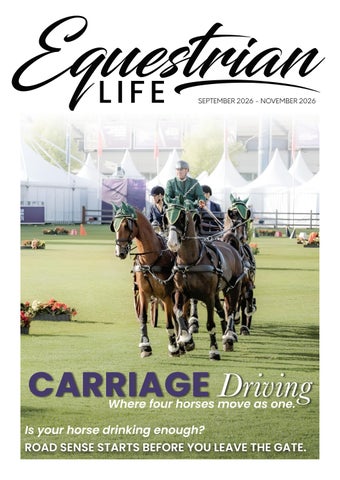
SEPTEMBER 2026 - NOVEMBER 2026
CARRIAGE Driving Where four horses move as one.
Is your horse drinking enough?
ROAD SENSE STARTS BEFORE YOU LEAVE THE GATE.
CONTENTS
COVER 4 CARRIAGE DRIVING
Where four horses move as one 12 When horses become a career 18 Pony Club: Road Sense 22 The SA Warmblood
24 Tent Pegging Wardrobe 26 Cutting Corners
18
28 SAEF 32 DSA 34 Is your horse drinking enough 36 Personal Space 38 The Gear Guide 40 Digital Feature 44 Product Spotlight
34 48
46 Fitness 47 Kids Corner
46
48 Tack Room Confessional PUBLISHER Equestrian House EDITOR Charlene Carroll charlene@equestrianlife.co.za DESIGN & LAYOUT Kirsten Bowyer
SALES & MARKETING Kirsten Bowyer kirsten@equestrianhouse.co.za ADDRESS 216 Zinnia Road, Kyalami AH, Midrand, Gauteng. (010) 006 2022
Disclaimer: Equestrian Life Magazine The content presented in Equestrian Life Magazine, including articles, advertisements, and other material, is intended for informational purposes only. The opinions expressed by contributors and advertisers are their own and do not necessarily reflect those of the magazine, its editors, or its publishers. While we strive to ensure the accuracy of the information published, we cannot guarantee its completeness or timeliness. Readers should consult professional experts or conduct their own research before acting on any information provided. Equestrian Life Magazine and its affiliates are not liable for any loss or damage arising from the use of the information contained within this publication. All content is protected by copyright laws and may not be reproduced without the express permission of the publisher. FEB - MARCH 2026 SEPTEMBER - NOVEMBER 2026
1
1
2
SEPTEMBER - NOVEMBER 2026
EDITOR’S NOTE Spring is in the air There is something about the first real hint of spring that makes everything in the horse world feel a little more possible. The mornings are lighter, the grass is beginning to think about turning green again, rugs are slowly being packed away, and suddenly those riding goals that felt very far off in the middle of winter seem worth dusting off. Of course, spring also brings flies, mud, pollen, unpredictable weather and horses who occasionally appear to have discovered an entirely new gear, but we will take it. This issue feels particularly suited to the season because so much of it is about movement, progress and looking at horses from a slightly different angle. Our cover feature takes us into the world of carriage driving, a discipline many of us have watched without ever really understanding just how technical, demanding and exhilarating it is. We also look at tentpegging through the lens of the rider’s wardrobe, head out with Pony Club Road Riders, and tackle one of those deceptively simple riding problems that can unravel an otherwise lovely round: cutting your corners. There is plenty to think about back at the yard too. Biosecurity might not be the most glamorous subject in the tack room, but it is one of the most important, particularly as horses travel more frequently between yards, shows and clinics. We also ask whether your horse is actually drinking enough, unpack breastplates and martingales in our Gear Guide, and look at the very practical business of teaching a horse to respect your personal space. This issue also ventures beyond the traditional riding lesson. We explore what happens when horses become a career, from the opportunities available to the realities behind turning a lifelong passion into a profession. Our Digital feature takes on the unnerving confidence of AI, while The Tack Room Confessional returns with another look at what equestrians perhaps think more often than we admit. And, because this is Equestrian Life, there is room for a little fun too. Kid’s Corner is back, Product Spotlight has a fresh collection of things that caught our eye, and we have exercises for stronger wrists and softer hands as we all attempt to emerge from winter riding a little better than we entered it. Spring always feels like permission to start again. Not dramatically. Not with an entirely new horse, new saddle, new fitness regime and five competition entries booked before breakfast. Just with a little more daylight, a little more motivation and perhaps one thing you would like to do better. Here’s to longer afternoons, greener paddocks and a new season with our horses.
Charlene Carroll
Charlene Carroll charlene@equestrianlife.co.za
SEPTEMBER - NOVEMBER 2026
3
Where four horses move as one.
By: Charlene Carroll
It is fast, technical and far tougher than it looks. Meet the sport of carriage driving and the South African preparing to take on Aachen.
C
arriage driving demands the precision of dressage, the nerve of cross country and the accuracy of showjumping, except the athlete has four horses, a carriage and a team to manage. This August, Wayne van Niekerk will take South African carriage driving onto one of the biggest stages in equestrian sport at the FEI World Championships in Aachen. There is a moment in marathon carriage driving when everything seems to happen at once. Four horses are committed to a line.
4
AUGUST--SEPTEMBER SEPTEMBER2026 2026 AUGUST
A substantial carriage is following at speed. A hazard is approaching that looks barely wide enough to accommodate any of them. The driver has multiple reins in his hands, the grooms behind him are shifting their weight to help balance the carriage, and somewhere in the controlled chaos somebody is already thinking about the next gate. There is noise. There is mud. Sometimes there is water flying over everybody involved. And there is absolutely no room for indecision.
Images: Supplied by the Carriage Driving Association of South Africa
WELCOME TO CARRIAGE DRIVING.
Sunday outings. The horses head out onto a long course incorporating a For riders accustomed to watching an series of hazards. At Aachen this year, elegant horse and carriage trot around the championship marathon course a show ring, international combined through the Soers stretched between driving can come as something of a seven and nine kilometres. Within the shock. This is not simply genteel hazards, drivers negotiated horsemanship conducted from a numbered gates correctly while comfortable seat. At its highest level, hunting for the quickest possible route. driving is fast, technical and immensely demanding of both horse This is Wayne’s favourite part. and human. “The marathon is the really exciting The FEI describes Driving as a threespeed part,” he says. “You have to phase sport consisting of dressage, keep your horses in balance, but at marathon and cones, with the overall the same time you have to choose competition following a format the right direction, know exactly inspired by eventing. Scores and where you are going and try to do it penalties accumulate across the as quickly as you can. Some of those phases, so success requires much hazards can be very intimidating. more than being brilliant at one thing. It’s the adrenaline surge part of the sport.” It is a sport of control and courage, and in August, South Africa’s Wayne van Anyone watching from the sidelines will Niekerk took four horses and a lifeunderstand exactly what he means. A time’s worth of learning into that pres- four-horse team entering a tight sure cooker at the FEI World Champihazard at speed is an impressive onships Aachen 2026. amount of horseflesh, harness, wheels and momentum to place accurately. THREE VERY DIFFERENT TESTS The easiest way for a rider to The final phase is cones. Pairs of cones understand combined driving is to topped with easily dislodged balls form think of eventing. a twisting course that tests accuracy, obedience and speed. Clip one and First comes dressage. The carriage the penalties matter. After the intensity enters an arena and the horses of marathon, the driver must return to perform a prescribed test, with the precision. At Aachen, Sunday judges looking for rhythm, suppleness, morning’s cones will decide the final impulsion, accuracy, ease of championship medals. movement and, importantly when several horses are working Dressage asks if you can produce together, harmony and unison. Voice harmony. Marathon asks if you can commands are permitted, but the think at speed. Cones asks if, after driver does not have the seat and legs everything that has gone before, you a rider can use to communicate with can still drive accurately. That the horse. combination is what makes the sport so compelling. Then everything changes. YOU DON’T NEED A SPECIAL KIND OF Marathon is where carriage driving HORSE sheds any lingering image of leisurely There is another misconception Wayne SEPTEMBER - NOVEMBER 2026
5
Images: Supplied by the Carriage Driving Association of South Africa
is quick to dismantle. Carriage driving does not belong exclusively to magnificent matching teams of enormous European warmbloods. Almost any suitable horse or pony can learn to drive. “Certain breeds are more adapted to it than others, but it really comes down to temperament,” Wayne explains. “A carriage horse has to have a good, calm temperament. It must be able to stop when it has to stop, go when it has to go and not be overly panicky.” That last point is the clincher. A ridden horse has its human above it. A driving horse has a vehicle following behind, harness around its body and a driver communicating from several metres away. The language is therefore slightly different. “Our commands are really not that different from those of a rider, but we don’t have the rider’s weight or leg,” Wayne explains. “We have the reins, the whip and the voice. The whip, used correctly, replaces the leg. If you place it against the horse, you can ask it to soften around it in much the same way
a rider would use a leg aid. They also learn verbal commands quickly.” Beginners do not start by hitching four horses to a carriage and hoping for the best. South African newcomers generally begin with a single horse. As their skill and experience develop, they may move into pairs and, for the comparatively rare driver wanting to progress all the way, eventually into a team of four. The horses themselves can be just as varied. Ponies compete. Warmbloods compete. Friesians are driven, as are traditional carriage breeds and heavier horses, although Wayne notes that the stamina demands of marathon can make some heavier types less suited to the fastest levels of the sport. Temperament, trainability, soundness and the willingness to work are ultimately worth far more than a fashionable label. A SPORT REBUILDING AT HOME Carriage driving in South Africa is small, but that does not mean it is disappearing. In fact, Wayne believes
- JULY 2026 SEPTEMBERJUNE - NOVEMBER 2026
7
the opposite is beginning to happen. “A couple of years ago it was a reasonably big sport,” he says. “COVID put a bit of a damper on things, and a lot of the older drivers retired. There have been challenges for new drivers to step up because with carriage driving you’ve got horses and you’ve got carriages, and when you go to competitions you have to transport everything. Cost is one thing, but the logistics are also a challenge.” It is not difficult to see the problem. Taking one competition horse away for a weekend can already resemble a minor military campaign. Add a carriage, harness, equipment and, potentially, multiple horses, and the operation becomes considerably larger. Yet new drivers are appearing. “Over the last couple of years we’ve had a lot of new drivers join. Carriage driving in South Africa has almost started again at the grassroots level, and we’ve now got quite a few drivers establishing themselves, moving from novice to open. It’s still small, but it is growing, and the interest is definitely increasing.” Much of the current competitive activity takes place at Wayne’s Quantum Stud in Gauteng, where dedicated facilities include a dressage arena, cones arena and eight marathon hazards, allowing the complete competition to be staged at one venue. Locally, the three phases are often condensed into a single day to make participation more manageable. Internationally, championship competition spans several days. The Western Cape also has a long tradition of driving and experienced trainers, although regular competition there has been more difficult to sus8
SEPTEMBER - NOVEMBER 2026
tain. Carriage Driving South Africa is now fielding enquiries from additional provinces, with vice president Christian De Jager playing an active role in helping newcomers and emerging regional structures find their feet. For a discipline rebuilding its base, every new driver counts. And perhaps Wayne’s next chapter could not come at a better time. THE CHANCE ENCOUNTER THAT CHANGED EVERYTHING His own introduction to the sport was remarkably uncomplicated. Wayne had previously show jumped, but the growing demands of his medical career eventually made riding competitively difficult. He continued working with horses from the ground and had always been intrigued by driving. There was only one fairly substantial problem. He didn’t know anybody who did it. Then, at a dressage competition, he spotted a man driving a pair of horses. Wayne went looking for him. The driver was Rodney Forster, then one of the great custodians of South African carriage driving, whom Wayne persuaded to teach him. That simple encounter started a journey neither of them could have predicted. “At that stage we had quite a lot of competitions locally, so I managed to get a good amount of experience,” Wayne recalls. “Then Rodney wanted to go and drive overseas for the last time in his career, and I had horses that we’d bought overseas but hadn’t brought home yet.” A plan was born. Or, Wayne describes it rather wonderfully as a “mad scheme”. The scheme eventually took them to Australian driver Boyd Exell, who was then based in England. Forster would
Images: Supplied by the Carriage Driving Association of South Africa
gain the opportunity for one final international campaign, and Wayne would learn. Instead, Wayne found himself being absorbed into the orbit of one of the greatest carriage drivers the sport has produced. While Rodney eventually retired. Wayne didn’t. Today, Exell is the reigning seven-time individual four-in-hand World Champion and was ranked number one in the FEI four-in-hand world rankings in July 2026, and he remains Wayne’s trainer. “I’ve had a wealth of experience and training from the greatest driver the world has ever seen,” says Wayne. “It has been a huge benefit to me.” COMPETING ACROSS TWO CONTINENTS The arrangement required to compete internationally across two continents tells you plenty about Wayne’s commitment. His international horses are
based in Valkenswaard in the Netherlands, where Wayne also has a home. They remain in training with Exell when Wayne is not there, allowing him to return to Europe ahead of competitions and pick up the preparation with horses that have remained in consistent work. Wayne then flies into Europe ahead of a competition, joins the horses and his team, prepares for roughly a week and heads to the show. It is hardly the preparation enjoyed by the full-time European professionals he competes against. Wayne, in typical South African fashion, still has a day job. And it is hardly an undemanding one. He is a radiation oncologist in private practice, specialising in prostate cancer. Carriage driving, extraordinary as his international record may be, remains his hobby. The FEI records 33 international Driving starts for him since 2010, including a start at the 2025 World Championship for Pairs at Beekbergen. Wayne says SEPTEMBER - NOVEMBER 2026
9
Aachen followed four previous World Championship appearances representing South Africa in pairs.
Images: Supplied by the Carriage Driving Association of South Africa
This time, however, there are twice as many horses in front of him. Aachen was his first World Championship campaign with a four-horse team and, according to Wayne, it also marked the first occasion South Africa was represented in four-in-hand driving at this championship level. NOBODY DOES THIS ALONE There is one thing Wayne would particularly like people to understand before watching him compete. Carriage driving might list one driver’s name in the results, but this is absolutely a team sport. “The people who stand on the back of the carriage are vitally important,” he says. “They’re not just there to add weight. In the marathon, they navigate. My navigator overseas knows the course like the back of his hand and knows the rules. With a team, we have two people on the back, and they are an integral part of what we do. “When we’re out there, it isn’t just me. I’ve got four horses and two partners on that carriage.”
Seven athletes, four equine and two humans alongside the driver, have to make a series of decisions look almost instantaneous. Perhaps that is the real magic of carriage driving. From outside, we see the spectacle. The flying mud. The beautiful horses. The carriage appearing to defy physics as it whips around a hazard. Underneath it all, though, is trust. Trust between horses. Trust between horse and driver. Trust in the people standing behind you when the line gets tight, and the stopwatch is running. For Wayne van Niekerk, the road from seeing a stranger driving a pair at a local dressage show to lining up four horses at Aachen was a long one. For South African carriage driving, it might just open another. Carriage Driving South Africa can be found on Facebook for anyone interested in learning more about the discipline or getting involved. New and prospective drivers can also contact CDSA Vice President Christian De Jager at xtian.dejager@ gmail.com. E
The FEI describes those grooms as active members of a four-in-hand team, helping with navigation and using their own body weight to balance the carriage through tight turns. Watch a top team negotiate a marathon hazard and their contribution becomes obvious. As the carriage changes direction, bodies move. Somebody is already looking towards the next gate. The horses must stay together. The driver must feel what is happening through the reins while processing information arriving from behind him. SEPTEMBER - NOVEMBER 2026
11
WHEN HORSES BECOME A CAREER.
From the classroom to the stable yard, Beaulieu is giving young equestrians the knowledge and experience to build a future with horses.
F
or many young riders, the dream is simple: build a life around horses. At Beaulieu College and the Beaulieu Equestrian Academy, that passion can begin as part of a school education and, for those who want to take it further, develop into the knowledge and practical experience needed for a professional future in the equine industry. It is a pathway that turns “something with horses” into a much more tangible possibility. Ask a horse-mad child what they want to do when they grow up and “something with horses” is often enough of an answer. Perhaps they imagine teaching, riding professionally, managing a yard or working on a stud, but what they usually know with certainty is that they would rather spend their working life around horses than leave them behind when school ends.
12
SEPTEMBER - NOVEMBER 2026
Loving horses and building a career around them are not quite the same thing. The industry needs knowledgeable people who can manage horses safely, understand how they are fed and cared for, recognise when something is changing, and make sensible decisions when no instructor is standing beside them telling them what to do. Beaulieu has created two distinct routes for that learning. Beaulieu College offers Equine Studies as a school subject from Grade 8 through to Grade 12, while the Beaulieu Equestrian Academy, both headed by Kim Hughes, offers a separate full-time programme for students wanting to take their equestrian education into a professional setting. “Most people who come into equestrian education are already passionate about horses, but that cannot be the only thing you bring to the job,” says Hughes. “If you want to work professionally with horses, you need knowledge, practical ability, judgement and a willingness to keep learning. We want students to understand the whole horse and the responsibility that comes with having horses and riders in their care.” STARTING IN THE CLASSROOM Offering Equine Studies from Grade 8 changes the way a young horse person can think about their sport. Instead of horses belonging only to afternoons, weekends and competition days, they become something to study seriously, with
the academic side of horsemanship given the same attention as the practical side. Even experienced young riders can know a great deal about their own horse without necessarily understanding the broader principles behind what they do every day. Formal study encourages them to look beyond routine and ask why management decisions are made, how one horse’s needs may differ from another’s and what good horsemanship requires beyond the saddle. For pupils who already suspect that horses may play a role in their future, it is also an early opportunity to discover whether their interest extends beyond riding. The equestrian industry is much wider than the competition arena, with careers spanning coaching, riding, breeding, yard management and specialist services. External pupils can also access Equine Studies, giving serious young equestrians outside Beaulieu College another route into structured learning before the bigger decisions that follow Grade 12. TAKING THE NEXT STEP The Beaulieu Equestrian Academy’s fulltime course is separate from the College subject and runs from the beginning of January until the end of September. Lectures take place mainly in the mornings, partly because some students teach and ride in the afternoons, allowing them to continue gaining practical experience while they study. The programme covers EQASA Modules 1 to 5, plus an Introduction to Stud Management and Breeding course and a First Aid course, as coaches must hold a valid First Aid certificate. Beaulieu Equestrian Academy is the training provider, preparing students for the external EQASA examinations, while the exams themselves are organised independently. That distinction matters. Students are not simply completing an internal course and receiving a Beaulieu qualification at the 14
SEPTEMBER - NOVEMBER 2026
end. They are being prepared to meet an external standard and demonstrate that the knowledge and practical skills they have developed can stand up beyond the classroom. The learning reaches far beyond riding. Anyone who has spent enough time on a yard knows how much informal knowledge horse people absorb without realising it. You learn which horse can open a stable door, which pony becomes suspiciously attentive when the feed room is unlocked and which dramatic set of pinned ears is mostly theatre. The Academy takes that everyday horse sense further by asking students to understand the reasons behind good management and develop the judgement needed when the answer is not obvious. “Being around horses teaches you a lot, but there is a difference between knowing a routine and understanding why that routine exists,” Hughes says. “We want students to think about what they are seeing, why a horse is managed in a particular way and what they would do if something changed. That is how you begin to develop confident, capable horse people.” LEARNING WHERE THE INDUSTRY WORKS Much of that confidence can only be built by getting out
into the industry, which is why the Academy combines lectures and practical work with work experience at professional yards in the area. Students also spend time on the simulator and visit different equestrian establishments, giving them the chance to see a range of working environments. The aim is to expose them to as many equestrian career possibilities as possible. Coaches and professional riders may be among the most visible people in the sport, but behind them sits a much wider network of people caring for horses, managing yards, breeding, teaching and providing specialist services. Work experience also brings some healthy realism. A professional horse career is not eight hours a day of riding beautifully schooled horses in perfect weather. There are early mornings, muddy days, anxious owners, tack to clean, yards to organise and countless small decisions that determine whether horses are well managed. The work can be enormously rewarding, but it asks for consistency and responsibility long after the novelty has worn off. “We try to expose the students to as much of the industry as possible because they need to see what different careers actually look like,” Hughes says. “Very often they arrive with one idea of what they want to do and then discover an area they had never considered before. The more en-
16
SEPTEMBER - NOVEMBER 2026
vironments they experience, the better equipped they are to work out where their own strengths and interests might take them.” FINDING A PLACE IN THE HORSE WORLD Not every pupil who chooses Equine Studies at Beaulieu College will make horses their profession. For many, the subject can simply deepen their understanding of the animals and sport they already love, knowledge they will carry with them long after school. For others, the combination of schoolbased Equine Studies and the separate Equestrian Academy creates a clearer route from enthusiasm to employment. It gives them the chance to test the dream against the realities of the industry, develop practical competence and begin seeing the range of possibilities beyond the familiar roles of rider and instructor. That may be the most useful thing Beaulieu can offer the teenager who says they want to do “something with horses”. Rather than expecting them to have their future mapped out at 15 or 16, it gives them the opportunity to learn more, see more and gradually work out where they belong. Passion may start the journey, but knowledge, experience and good horsemanship are what give it somewhere to go. E
EQUESTRIAN LEATHERWARE
Experience the exceptional quality of Kurden tack.
ROAD SENSE STARTS BEFORE YOU LEAVE THE GATE Pony Club insists its members get road “licensed” and we can’t say that’s a bad idea.
R
iding on the road asks for far more than a quiet horse. From making yourself visible to signalling clearly, choosing the correct position and constantly watching what is happening around you, good roadcraft is a skill every rider should learn. Cars, bicycles, trucks, dogs, roadworks, strange objects, blind corners and unexpected noises can turn an otherwise peaceful ride into a challenging situation remarkably quickly. And while having a sensible horse certainly helps, Pony Club makes an important point in its Road Rider Certificate material. There is no such thing as a bombproof horse or pony. Safe road riding therefore cannot depend entirely on what your horse will or will not do. It depends just as much on the rider developing good roadcraft, remaining observant and learning to make sensible decisions before a situation becomes
18
SEPTEMBER - NOVEMBER 2026
dangerous. Pony Club takes this so seriously that road riding competence is built into its Standards of Efficiency. Members cannot simply progress through the levels without it. They begin with the Mini Road Rider Badge, move on to the Road Rider Achievement Badge and, as they advance, tackle the full Road Rider Certificate. In practical terms, roadcraft is treated as an essential part of becoming a competent, responsible rider, rather than an optional bit of knowledge picked up somewhere along the way. And, to be fair, we think that is a splendid idea. If you are going to share the road with cars, trucks, cyclists and pedestrians while sitting on half a tonne of independently thinking horse, knowing what you are doing should probably be non-negotiable.
BE SEEN TO BE SAFE One of the simplest things riders can do is also one of the most important. Make yourself visible. Pony Club’s Road Rider training repeatedly reinforces the message “Be Seen to Be Safe”. The Road Rider Achievement Badge recommends high visibility clothing for the
SAFETY BEGINS BEFORE YOU GET ON THE ROAD Good road riding starts before a hoof touches the tarmac. Pony Club teaches riders to carry out the necessary checks before going onto the road and ensures that both horse and rider are appropriately equipped. At Road Rider Certificate level, the tack and turnout inspection is specifically described as a safety inspection, rather than a show inspection. Your riding hat should be correctly fitted and secured. Tack needs to be safe, comfortable and in good condition. Hi-visibility equipment should be properly attached, rather than flapping around where it could irritate or frighten the horse.
rider as well as visible items on the horse, with the syllabus specifically referring to a high visibility jacket or tabard and leg bands on the horse. It may not be the most glamorous hacking outfit you own, but this is one occasion when being impossible to miss is exactly the point.
You should also consider the horse beneath you. Is this horse genuinely suitable for the road you intend to ride on? What traffic are you likely to meet? Are there blind bends, narrow sections, building sites, livestock, roadworks or other potential problems along the route? The Pony Club Certificate guidance asks coaches to think about precisely these issues and emphasises that road conditions can be difficult to control. Weather, the width and type of road, nearby activities and even something as ordinary as hedge cutting can change the level of risk.
Visibility matters even on apparently quiet roads. A driver approaching around a bend, coming over a rise or travelling through changing light needs enough time to recognise that there is a horse ahead and respond accordingly. And remember that what feels conspicuous from the saddle may look very different through a windscreen.
SEPTEMBER - NOVEMBER 2026
19
RIDE LIKE ANOTHER ROAD USER Perhaps one of the biggest mistakes riders can make is thinking only about staying out of the way of cars. Safe riding is more deliberate than that. Pony Club Road Rider training teaches observation, road positioning, recognition of common road signs and the correct use of signals. Riders practise negotiating junctions, turning left and right, responding to Stop and Give Way signs and dealing with hazards. The rider needs to communicate clearly enough that other road users have some idea of what is about to happen. Before signalling, Pony Club teaches the sequence Look, Signal, Look Again, with that final check described as the “Life Saver Look”. That last glance matters because the road environment changes constantly. A vehicle that was nowhere near you several seconds ago may suddenly be approaching from behind. A cyclist may have moved alongside you. Another car may be turning into the road.
20
SEPTEMBER - NOVEMBER 2026
Never assume that because you looked once, the situation remains unchanged. REMEMBER THAT YOUR HORSE IS STILL A HORSE You may have hacked the same road a hundred times without incident. That does not guarantee ride number 101 will be uneventful. A plastic bag may blow across the verge. A dog could appear behind a gate. Machinery may be operating where yesterday there was silence. Pony Club’s guidance specifically recognises that seemingly ordinary roadside sights and sounds can cause horses to shy or become agitated. This is another reason riders need to remain active participants rather than passengers. You should be able to stop and control your horse, maintain an appropriate road position and cope with hazards without losing awareness of the traffic around you. And sometimes the safest decision is not to continue. What you should be doing is assess whether taking a particular pony onto a
particular road is appropriate at all. That same thinking should apply every time we hack. There is no prize for proving that you can ride a nervous horse past something dangerous. COURTESY COUNTS TOO Road safety is not only about rules and signals. Relationships between riders and other road users matter. Knowing how to say thank you may seem like a small detail, but it is worth remembering. When somebody slows down, waits patiently or gives your horse plenty of room, acknowledging them helps reinforce the behaviour riders want motorists to repeat. A smile, nod, or raised hand, when it is safe to do so, takes seconds.
as seriously as learning a correct jumping position, riding a dressage test or understanding your horse’s sequence of footfalls. Because on the road, knowing where to position yourself, when to look, how to signal and when not to proceed can matter far more than how beautifully you ride. The safest rider is not necessarily the bravest one. It is the rider who keeps thinking. E
Of course, courtesy works both ways. Riders also need to behave predictably, avoid unnecessarily obstructing traffic and communicate their intentions clearly. We share the road. ROAD RIDING IS A SKILL Riding on the road is something that many equestrians do badly. It is a skill, and it deserves to be taught, practised and taken SEPTEMBER - NOVEMBER 2026
21
BREEDERS CORNER:
The South African Warmblood By: Charlene Carroll
Bred for sport, shaped at home and ready to perform
E
legant, athletic and increasingly familiar in South African competition arenas, the South African Warmblood (SAW) is a horse with a very specific job description. It was developed to perform. Yet, unlike breeds whose histories stretch back hundreds or even thousands of years, the SA Warmblood is a comparatively modern creation, born from the pursuit of a better sport horse for South African riders.
22
APRIL - MAY 2026
WHERE IT ALL BEGAN The South African Warmblood story gathered momentum in the 1960s, as European Warmbloods began arriving in the country. These imported horses were crossed with local horses, particularly Thoroughbreds, combining European sport horse breeding with the athleticism and refinement already available locally. The South African Warmblood Horse Society was founded in 1989,
formalising a breeding programme with a clear objective. Breeders wanted a larger, healthy and athletic horse capable of competing successfully in the three Olympic equestrian disciplines of showjumping, dressage and eventing. Over the decades, imported genetics have continued to influence breeding programmes, but generations of horses have now been bred right here in South Africa.
draw on international genetics while making breeding decisions suited to the horses and sport produced here. South Africa’s place in international sport horse breeding received significant recognition in 2025 when the South African Warmblood Horse Society hosted the World Breeding Federation for Sport Horses Annual Meetings and General Assembly in KwaZulu-Natal. It was the first time the meetings had been held in South Africa.
WHAT DEFINES A SOUTH AFRICAN WARMBLOOD This is where things get interesting because a Warmblood is not defined by one particular colour, marking or instantly recognisable silhouette.
WHO ARE THEY SUITED TO There is no single South African Warmblood personality. Bloodline, breeding, training, and the individual horse all play a role, making matching horse and rider particularly important.
The emphasis is on producing a functional sport horse. Correct conformation, soundness, athletic ability, movement and performance all matter. The South African Warmblood Horse Society places particular importance on conformational correctness because of its relationship with soundness and longevity in sport.
Broadly speaking, these horses suit riders looking for an athletic partner with the ability to progress in competitive sport. Some are powerful, sensitive horses intended for experienced competitors, while others have the temperament to suit ambitious amateurs.
Depending on their breeding and intended discipline, individual horses can look quite different. A dressagebred horse may be selected for expressive, elastic movement, while a jumping-bred horse needs power, scope and careful technique over a fence. In other words, this is a horse bred with a career in mind.
As with any sport horse, the trick is finding the individual whose ability and brain match your own. MORE THAN AN IMPORTED IDEA Perhaps the most interesting thing about the South African Warmblood is that it challenges the assumption that serious sport horse breeding happens somewhere else.
BORN FOR SPORT South African Warmbloods can be found competing across dressage, showjumping and eventing, from developing young horses through to the higher levels of competition.
South African breeders have spent decades selecting, refining and producing horses for the demands of modern equestrian sport. The bloodlines may have international roots, but increasingly, the horses carrying them have a proudly South African story.
Their pedigrees may contain some very familiar European Warmblood bloodlines, alongside generations of South African breeding. This combination allows local breeders to
And when one of them enters the arena, it is worth remembering that you may be watching generations of that story come together in a single horse. E SEPTEMBER - NOVEMBER 2026
23
The Ten Ward
HELMET When you are galloping at speed with one hand occupied by a sword or lance, head protection matters. A correctly fitted riding helmet needs to remain secure without interfering with the rider’s vision or freedom of movement.
COMPETITION SHIRT Tentpegging shirts bring much of the colour to the sport. Team and provincial colours make riders instantly recognisable, while the shirt itself needs to be comfortable and allow plenty of movement through the shoulders and arms.
DRESSED FOR A GALLOP W
There is nothing unders ging. Horse and rider thu speed while the rider at peg, collect a ring or slice wardrobe therefore nee movement and some rat In South Africa, where th competitive tradition, goo horsemanship and a he By: Charlene Carroll
BREECHES OR JODHPURS Designed for comfort, grip and unrestricted movement in the saddle, breeches or jodhpurs need to cope with a riding position that can change dramatically as the rider reaches down towards a peg or stretches for an overhead target.
RIDING BOOTS A secure lower leg is vital when the upper body is doing something decidedly unconventional. Riding boots provide protection and support while allowing the rider to maintain a stable position at speed.
24
SEPTEMBER - NOVEMBER 2026
ntpegging drobe
WITH A WEAPON IN HAND.
stated about tentpegunder down the track at ttempts to spear a tiny e an overhead target. The eds to cope with speed, ther unusual accessories. he discipline has a long od turnout meets serious ealthy dose of courage.
THE PRICKER One of the more unusual pieces of kit, the balloon pricker appears in Skill at Arms. Measuring between 500 mm and 600 mm, it has a sharp metal point and is used to burst balloon targets during the first leg of the course.
THE SWORD Not merely there to make the rider look impressively dramatic, the sword is used for both ground and overhead targets. Senior blades measure between 750 mm and 900 mm, with specific regulations governing their construction.
THE LANCE Now things get interesting. The South African senior competition lance must measure between 2.4 m and 2.7 m, while junior lances may range from 1.7 m to 2.7 m. Riders use it to strike pegs in the ground and collect suspended rings, all while travelling at speed. GLOVES Here, grip means more than keeping hold of the reins. The rider also has a sword or lance to control, making comfortable, wellfitting gloves an important part of the kit.
SEPTEMBER - NOVEMBER 2026
25
STOP CUTTING
Your Corners.
By: Charlene Carroll
Because every good movement starts with how you ride the turn before it.
A
well-ridden corner is far more than a change of direction. Get it right, and you improve balance, bend and preparation for whatever comes next. Get it wrong and the whole movement can unravel before it has even begun. Corners are everywhere. We ride through them so often that it is easy to stop thinking about them altogether. Yet a corner is actually a small gymnastic exercise. Correctly ridden, it asks the horse to stay in rhythm, bend around the rider’s inside leg, remain connected into the outside rein and keep the hind legs following the path of the forelegs. It can also help rebalance the horse and prepare him for the next exercise. In other words, that little bit of arena you have been casually steering through deserves considerably more attention. 1. PREPARE BEFORE THE CORNER The corner starts before you reach it. As you approach, check that your horse is travelling in a steady rhythm and responding to your leg. Then use a subtle half-halt to rebalance him and, in effect, say that something is about to happen. The important word here is subtle. A half halt is not a pull on the reins. It combines seat, leg and a momentary containing contact before the hand softens again.
26 SEPTEMBER - NOVEMBER 2026
If you wait until you are already in the corner before organising everything, you are late. 2. THINK QUARTER CIRCLE A corner is not a ninety-degree handbrake turn. Think of it as riding one quarter of a circle. The horse should gradually follow the curve rather than travelling straight towards the fence and suddenly being hauled around it. The depth of that curve must also suit the horse’s level of training and balance. A young or inexperienced horse should not be forced impossibly deep into a corner simply because the boards are there. As the horse becomes stronger and more balanced, you can ask for a more accurately ridden corner. 3. TURN FROM YOUR LEG, NOT YOUR INSIDE REIN Here lies perhaps the biggest corner crime of all. Rider sees corner. Rider pulls inside rein. Horse bends his neck, falls onto his inside shoulder and somehow exits the corner travelling in an entirely different shape. Instead, your inside leg at the girth creates and maintains the bend. Your outside rein helps control the shoulder and the size of the turn, while the outside leg guards the quarters from swinging out. USDF guidance specifically warns against trying to manufacture a corner with the hands because it can cause the horse to fall through the outside shoulder. 4. DO NOT THROW YOUR OWN BODY AROUND IT The horse is not the only one who needs to stay balanced. Keep your
upper body tall rather than leaning into the turn as though you are negotiating a motorcycle bend. Your weight can be subtly towards the inside seat bone, but you should remain centred over your horse. Also watch your shoulders. If your body twists dramatically around the corner, your hands and seat are likely to follow, giving your horse a rather muddled set of instructions. Quiet riding usually creates a quieter corner. 5. RIDE OUT OF IT One of the easiest mistakes is to concentrate so hard on getting into the corner that you forget there is another side. Maintain the rhythm throughout and straighten your horse as you leave the bend. British Dressage specifically notes that the tempo should remain consistent through a corner rather than the horse speeding up or slowing down. Then ride positively forward. This is particularly useful when a transition, diagonal, circle or other movement follows. A good corner can give you those precious few strides to rebalance and organise before the next question arrives. British Dressage trainer Charlie Hutton even uses corners as an exercise for developing greater balance and control before asking horses to travel deeper into them. And perhaps that is the best way to think about corners. They are not the annoying bits of arena between the important movements. They are part of the movement. E
SEPTEMBER - NOVEMBER 2026
27
Importance of Biosecurity
Why is Biosecurity So Important in Our Equestrian Industry?
Biosecurity can sound like a technical term, but its importance becomes very real when infectious disease enters an equestrian community. In 2021, an outbreak of Equine Herpesvirus 1 (EHV1) linked to the Spring Tour in Valencia, Spain, resulted in the deaths of 17 horses and the cancellation of international competitions across 12 European countries. It became one of the most serious equine disease outbreaks Europe had faced in decades and led to much stricter biosecurity measures across the sport.
It is against this backdrop that the SAEF recently hosted three FEI Biosecurity Education Programmes in Gauteng, KwaZulu-Natal and the Western Cape. The programmes brought together 47 veterinarians, representatives from show-holding bodies, stewards and other officials to strengthen knowledge and preparedness around equine biosecurity. The courses were presented by FEI Biosecurity Expert Camille Vercken and made possible through FEI Solidarity.
WHY BIOSECURITY? South Africa is not immune to this risk. Biosecurity is essential to the equesThe local equine industry experienced trian industry because it helps prevent the devastating effects of a major dis- the introduction and spread of infecease outbreak in 1986, disrupting oper- tious diseases that can affect horses, ations for a considerable period. Events disrupt competitions, cause significant such as these are a reminder of how financial losses, and damage the repquickly an infectious disease can afutation of equestrian sport. fect far more than an individual yard or competition venue. Horse movement, At competitions, where horses from competition schedules and the wider many different locations come into equestrian economy can all be affect- close contact, the risk of disease transed. mission is particularly high.
28
SEPTEMBER - NOVEMBER 2026
SOME OF THE KEY REASONS BIOSECURITY IS SO IMPORTANT INCLUDE: 1. Protecting Horse Health and Welfare Diseases such as equine influenza, equine herpesvirus (EHV-1 and EHV-4), strangles, and African horse sickness (where applicable) can spread rapidly among horses. Good biosecurity reduces the risk of infection and protects the health and welfare of every horse attending an event. 2. Preventing Disease Outbreaks A single infected horse can expose hundreds of others at a competition. Effective biosecurity measures, such as health declarations, vaccination requirements, temperature monitoring, isolation of sick horses, and proper hygiene, help detect and contain disease before it spreads. 3. Protecting the Equine Industry Disease outbreaks can have severe economic consequences, including: Cancellation of competitions and events. Restrictions on horse movement. Veterinary treatment costs. Loss of breeding and sales opportunities. Reduced tourism and associated business income. The financial impact can extend well beyond the affected horses to organisers, venues, sponsors, veterinarians, transport companies, and local businesses.
4. Maintaining Fair Competition Healthy horses can compete on an equal footing. Disease outbreaks can force competitors to withdraw, disrupt competition schedules, and compromise the integrity of events. 5. Ensuring International Participation Many countries require strict health certification and vaccination records before allowing horses to enter. Strong national biosecurity standards demonstrate responsible disease management and help maintain international confidence in a country’s equine health status. 6. Protecting Human Safety Although most equine diseases do not infect humans, some infectious agents can be transmitted between animals and people (zoonotic diseases). Good hygiene practices help protect veterinarians, grooms, officials, volunteers, and spectators. 7. Safeguarding the Reputation of the Sport Well-managed biosecurity demonstrates professionalism and responsible governance. Competitors, owners, sponsors, and the public are more likely to support organisations that prioritise horse welfare and disease prevention.
SEPTEMBER - NOVEMBER 2026
SEPTEMBER - NOVEMBER 2026
29
ESSENTIAL BIOSECURITY MEASURES AT COMPETITIONS Competition organisers, officials, and participants should implement practical measures such as: • Requiring up-to-date vaccinations where applicable. • Verifying horse identification and health documentation. • Conducting health checks on arrival. • Isolating any horse showing signs of illness. • Providing hand-washing and sanitising facilities. • Cleaning and disinfecting stables between occupants. • Preventing horses from sharing water buckets, feed containers, or tack. • Encouraging participants to bring their own equipment. • Promptly reporting suspected infectious diseases to event veterinarians. • Having an outbreak response and communication plan.
SHARED RESPONSIBILITY Biosecurity is not solely the responsibility of event organisers. It requires cooperation from everyone involved in the equestrian community: Owners and riders should only bring healthy horses to competitions and comply with vaccination and health requirements. Veterinarians should promptly diagnose and report infectious diseases and advise on disease prevention. Officials and organisers should implement and enforce biosecurity protocols. Grooms and support staff should maintain high standards of hygiene and minimise unnecessary horse-tohorse contact. BIOSECURITY STARTS WITH ALL OF US Biosecurity is fundamental to the success and sustainability of the equestrian industry. By preventing the spread of infectious diseases, it protects horse welfare, supports fair competition, reduces economic losses, maintains public confidence, and ensures that equestrian events can continue safely. Effective biosecurity is a shared responsibility that benefits every participant in the sport.
30
SEPTEMBER - NOVEMBER 2026
Amerigo combines traditional craftsmanship with innovation to create saddles and accessories that prioritize rider comfort and horse well-being.
083 6611 543 | 010 006 2022 www.equestrianhouse.co.za
By Debbie Hunt, Dressage SA
WHAT DRESSAGE JUDGES
Really look for.
A Guide for Amateur Riders from Training to Elementary Level Stepping into a dressage arena can feel like entering a quiet conversation between you, your horse, and the judge seated at C. For amateur riders, especially when facing visiting judges, it helps enormously to understand what the judge is actually looking for. The good news is that judges are not hunting for perfection. Instead, they are assessing clarity, correctness, and the horse’s overall way of going appropriate to the level. Below is a straightforward, rider-friendly explanation of what judges expect at Training, Novice, and Elementary Level, written to help you prepare confidently for your next competition. TRAINING LEVEL: ESTABLISHING THE BASICS Training Level is all about the foundations. Judges want to see a horse that moves freely forward, stays relaxed, and maintains a clear rhythm in walk, trot, and canter. At this stage, the horse is not expected to show power or advanced balance, just a steady, willing way of going. Accuracy plays a surprisingly large role. A round 20-metre circle, a straight centre line, and a well-prepared transition tell the judge that the rider is organised and the horse is attentive. The free walk is often the highest-scoring movement, and judges look closely at how confidently the horse stretches over its back. For amateur riders, the best preparation is simple: practise calm transitions, ride your figures precisely, and aim for a relaxed, harmonious picture. A horse that stays steady and attentive will always be rewarded at this level.
32
SEPTEMBER - NOVEMBER 2026
NOVICE LEVEL: DEVELOPING BALANCE AND CONSISTENCY At Novice Level, judges expect to see a horse that is beginning to develop more balance and connection. The rhythm should remain clear, but the horse should now show more consistent contact and a greater ability to adjust its stride. Movements such as 15-metre circles, lengthened strides, and rein-back reveal how well the horse listens to the rider. Judges look for transitions within the gait that show a real difference. Not rushing, but lengthening with reach and elasticity. Straightness becomes more important, especially on centre lines and in transitions. For riders, preparation should focus on improving balance and adjustability. Transitions every few strides help develop engagement, while careful schooling of lengthened paces builds confidence. Judges appreciate a horse that looks rideable and attentive, even if it is not flashy.
ELEMENTARY LEVEL: INTRODUCING LATERAL WORK AND EARLY COLLECTION Elementary Level is where the work becomes more sophisticated. Judges now expect to see the beginnings of collection and the introduction of lateral work such as shoulder-in and travers. These movements show the horse’s suppleness and the rider’s ability to influence the horse’s body. In shoulder-in, judges look for correct bend, a steady angle, and a clear stepping-under of the inside hind leg. Travers requires even more coordination, and judges watch closely for balance and clarity. Transitions between collected and medium paces should be smooth and well prepared, showing that the horse can shorten and lengthen without tension. Elementary Level is also where judges begin to notice the rider’s preparation. A well-timed half-halt, a supportive outside rein, and a quiet inside leg all contribute to a controlled, harmonious picture. The goal is not dramatic expression but correctness, balance, and clear communication between horse and rider.
For amateur riders, patience is key. Lateral work should be developed gradually, starting with correct bending and suppleness. Simple changes must be calm and balanced. Judges reward clarity and correctness far more than exaggerated angles or forced expression.
SEPTEMBER - NOVEMBER 2026
33
IS YOUR HORSE DRINKING ENOUGH?
Five simple ways to encourage better hydration before the summer heat arrives You can feel the season beginning to turn. The mornings still have a bite to them, but rugs are coming off earlier, afternoons are warmer and horses are starting to come back from a schooling session with the first signs of sweat under the saddle. We may not be in the full heat of a South African summer yet, but our horses are already adjusting to warmer days, increasing workloads and changing grazing. And somewhere between filling haynets, mixing feeds and getting horses worked before dark, there is one very ordinary bucket that deserves a little more attention. Water. Most of us become hydration obsessed when temperatures soar, yet horses can fall behind on their water intake well before the height of summer. The problem is that you cannot simply tell a horse to drink more. You can, however, make drinking easier, more appealing and part of the way you manage them every day. 1. LEARN WHAT NORMAL LOOKS LIKE There is no single amount of water that every horse should drink. Size, diet, workload, weather, pregnancy and lactation can all affect requirements. That makes knowing your horse particularly important. If they are stabled, note roughly how much remains in their buckets each morning. In the paddock, watch how regularly they visit the trough. A sudden change in drinking habits can be more useful to spot than obsessing over an exact number of litres.
34
SEPTEMBER - NOVEMBER 2026
2. MAKE THE WATER WORTH DRINKING We wouldn’t particularly fancy drinking from a bucket containing yesterday’s feed, hay and mysterious floating objects, yet horse water buckets can become grubby remarkably quickly. Provide fresh, clean water at all times and scrub buckets and troughs regularly. Check automatic drinkers too. Just because there is a water supply doesn’t necessarily mean it is flowing properly. Some horses also have surprisingly strong opinions about their water, particularly
when travelling. If you know yours is fussy, plan accordingly rather than discovering at a show that your horse has decided the local water is unacceptable. 3. PUT WATER ON THE MENU Drinking doesn’t have to be the only way horses take in water. Where appropriate, adding water to suitable feeds can help increase overall intake. Certain fibre feeds are designed to be soaked, making them another useful source of moisture in the diet. Always follow the manufacturer’s soaking and feeding instructions rather than turning every meal into soup simply for the sake of it. This can be particularly useful for horses that aren’t enthusiastic drinkers or after exercise, although it never replaces free access to clean drinking water. 4. THINK CAREFULLY ABOUT SALT AND ELECTROLYTES Salt and electrolytes play an important role in hydration, particularly as horses begin sweating more during exercise and in warmer weather. However, more is not automatically better. A horse’s requirements depend on factors including diet, workload, and how much they sweat. If you’re unsure whether your horse needs additional electrolytes, speak
to your vet or equine nutritionist. Most importantly, a horse receiving additional salt or electrolytes must have unrestricted access to fresh water. Electrolytes cannot compensate for inadequate drinking. 5. PAY ATTENTION BEFORE THEY LOOK THIRSTY Don’t wait for a dramatically dehydrated horse before you start thinking about water. Changes in drinking, appetite, manure consistency, urination, energy levels or general demeanour deserve attention. Owners sometimes use gum moisture and skin tenting as rough checks for hydration, but these are not foolproof diagnostic tools. If your horse seems unwell, is refusing water, or you are concerned about dehydration, call your vet. As the days grow warmer, start watching the water bucket as closely as the feed bucket. Hydration isn’t simply a midsummer problem or something to think about after a hard competition. We notice an unfinished feed immediately. Perhaps it is time we paid just as much attention to the water left behind.
SEPTEMBER - NOVEMBER 2026
35
WHAT PERSONAL By: Charlene Carroll
Space?
Five tips to teach your horse to respect your space
3636 JUNE - JULY 2026 SEPTEMBER - NOVEMBER 2026
T
here is affectionate, and then there is 500kg of horse standing on your foot while lovingly searching your pockets for carrots. Horses have very different ideas about personal space. Some naturally keep a polite distance, while others crowd, lean, barge through gates or walk straight over their handler when something more interesting appears. It can be tempting to dismiss this as cheekiness, but good groundwork manners are an important part of safe horse handling. The aim is not to make your horse afraid to come near you. It is to teach him that you can invite him into your space, but he should also move away when asked. TIP ONE: DECIDE WHERE YOUR BUBBLE IS You cannot expect your horse to understand a boundary that constantly changes. If he is allowed to push into you one minute but corrected for doing exactly the same thing the next, the message becomes confusing. Start by becoming conscious of where you want your horse to be when leading or standing. You should be able to move around him without being crowded, pushed or trapped. Think of yourself as having an invisible bubble around you that he only enters when invited. TIP TWO: TEACH HIM TO YIELD TO LIGHT PRESSURE A useful groundwork skill is teaching the horse to move away from a gentle cue. Start somewhere safe and familiar and ask for something small, such as moving the shoulder or hindquarters one step away. Begin with the lightest clear cue you can and increase it gradually only if necessary. The instant your horse makes an attempt in the correct direction, soften or release the pressure. This principle is also emphasised in the lunging notes, where the horse is given the opportunity to respond to the lowest level of pressure before it is increased. TIP THREE: DON’T LET LEADING BECOME TOWING Leading is groundwork, even if you are only walking from the stable to the paddock.
Practise transitions as you go. Walk, halt, change pace and occasionally ask for a step backwards. Your horse should notice when you change your speed rather than continuing forwards and expecting you to catch up. The goal is not to keep jerking the lead rein every time he gets ahead. You want him to start paying attention to your movement and responding to increasingly subtle cues. TIP FOUR: MOVE THE HORSE, NOT YOURSELF Watch what happens when your horse moves into your space. Do you immediately step backwards? If the answer is yes, you may inadvertently be teaching him that moving towards you makes you move away. Instead, practise calmly asking him to reposition himself. This becomes particularly useful around stable doors, gates, feed bins and other tight spaces where barging can become dangerous. Never turn it into a confrontation. You are looking for a quiet response to a clear request, not a battle over who can push harder. TIP FIVE: REWARD THE QUIET MOMENTS Groundwork is not only about correcting unwanted behaviour. Notice when your horse gets it right. If he stands quietly beside you, maintains an appropriate distance or moves away from a light cue, leave him alone for a moment. That release is part of the reward. Horses learn through consistency, and repeatedly showing him where you would like him to be makes the correct answer easier to find. Good personal space does not mean creating distance between you and your horse. Quite the opposite. A horse that understands boundaries is safer and easier to handle, and there is far more room for scratches and cuddles when nobody is being flattened in the process. E
SEPTEMBER - NOVEMBER 2026
37
GEAR GUIDE:
By: Charlene Carroll
Breastplates and Martingales Similar looking tack with very different jobs
T
hey are often buckled together, frequently spotted in the jumping arena and sometimes mistaken for one piece of equipment. But breastplates and martingales have very different jobs, and knowing which does what matters. There is something undeniably smart about a horse kitted out in a beautiful leather breastplate. Add a martingale, and suddenly the whole ensemble looks rather serious. But these aren’t accessories designed simply to complete the picture. A breastplate is primarily there to help prevent the saddle from slipping backwards. A martingale, on the other hand, influences or limits the movement of the horse’s head and neck. They can be used together, and often are, but understanding their individual purposes is important before adding either to your tack room. FIRST THINGS FIRST, THEY ARE NOT THE SAME THING The breastplate attaches to the saddle and passes around the horse’s chest, helping to stabilise the saddle when movement, terrain or the horse’s conformation encourages it to slide backwards. This makes breastplates particularly common in showjumping, eventing, hunting and cross country, where horses are galloping, jumping and
38
APRIL - MAY-2026 SEPTEMBER NOVEMBER 2026
negotiating changes in terrain. There are several styles. Traditional hunting breastplates have a relatively simple construction, while threepoint breastplates attach at three locations for additional stability. Fivepoint breastplates distribute the contact across more attachment points and are particularly familiar sights in eventing and showjumping. Breastgirths offer another variation on the same basic principle. More straps, however, don’t automatically mean better. The right choice depends on your horse, saddle and discipline. AND THEN THERE IS THE MARTINGALE Martingales have a completely different job. The running martingale has two straps ending in rings through which the reins pass. When correctly fitted, it only comes into play if the horse raises its head beyond a certain point, creating a downward influence through the reins. When the horse carries its head normally, the reins should be able to function freely. A standing martingale works differently. Rather than acting through the reins, it attaches to the noseband and limits how far the horse can raise its head. Because these pieces of equipment influence the horse differently, their suitability and permitted use vary between
disciplines. Always check the relevant competition rules rather than assuming that because you’ve seen one in one arena, you can use it in another. THOSE LITTLE RUBBER RINGS MATTER If you’re using a running martingale, those small rubber or leather stops on the reins are not there for decoration.
Most importantly, a martingale isn’t a shortcut for brakes, schooling or solving a horse that consistently throws its head in the air. If there is an ongoing problem, investigate why it is happening rather than simply adding another strap. TACK WITH A PURPOSE Breastplates and martingales are useful pieces of equipment when there is a genuine reason for using them. And that’s perhaps the most important Gear Guide lesson of all.
They help prevent the martingale rings from travelling too far up the reins and potentially becoming caught on the rein buckles or other fittings. It is a tiny detail with an important safety function, so don’t be tempted to leave them Your favourite event horse might off. charge out of the start box wearing a magnificent five-point breastplate and running martingale. That doesn’t mean Seuntjie needs the same setup for his Wednesday afternoon schooling session. Good tack isn’t about how much you can put on your horse. It’s about knowing why every piece is there. E
FIT IT, DON’T FIGHT IT Neither a breastplate nor a martingale should restrict normal movement. A breastplate needs to be secure enough to stabilise the saddle without pulling tightly across the shoulders or chest. The horse must still be able to stretch, jump and move freely. A martingale must also be adjusted correctly. Fitted too tightly, it can interfere unnecessarily with the horse’s natural head and neck movement and the rider’s rein aids. APRIL - MAY 2026 SEPTEMBER - NOVEMBER 2026
39 39
YOUR AI IS VERY CONFIDENT. IT CAN ALSO BE VERY WRONG AI can be an incredibly useful extra pair of hands, but only if you know when to trust it, when to question it and when to put the phone down and call a real expert. By: Charlene Carroll
A
rtificial intelligence (AI) has slipped into everyday life remarkably quickly. We ask it to write emails, plan holidays, explain things we do not understand and settle arguments around the dinner table. Inevitably, it has found its way into the stable yard too.
hacks? Fitness means something very different in each situation.
Need a packing list for a three day show? AI can create one. Want a simple explanation of a dressage term? Ask away. Need help wording an advert for a horse or putting together a weekly schooling plan? It can certainly give you somewhere to start.
The same applies outside the stable. “Plan my holiday” is unlikely to produce something particularly useful. “Help me plan a four day family holiday in Cape Town with two children and a limited budget” gives it considerably more to work with.
The problem is that AI has one rather unnerving characteristic. It can sound equally confident whether it is right or completely wrong.
Think of AI as the new groom at the yard. If you simply shout, “Sort the horse out!” you cannot be terribly surprised if they do not do things exactly the way you wanted.
Using AI well, therefore, is not really about becoming more technical. It is about becoming a better questioner. GIVE IT SOMETHING TO WORK WITH Ask an AI tool, “How do I get my horse fitter?” and you have given it very little useful information. Is your horse a six-year-old Thoroughbred coming back into work, a schoolmaster competing every weekend or a 22-year-old pony who mostly 40
SEPTEMBER - NOVEMBER 2026
The more relevant context you provide, the more useful the response is likely to be. Tell it what you are trying to achieve, what you already know and what limitations matter.
DON’T ACCEPT THE FIRST ANSWER This is perhaps one of the most misunderstood aspects of using AI. You are allowed to argue with it. If the answer is too complicated, ask for a simpler explanation. If something does not sound right, ask why it reached that conclusion. Tell it what it has misunderstood and ask it to try again.
You can even ask, “What assumptions are you making?” or “What could be wrong with this answer?” The first response should often be the beginning of the conversation rather than the end of it.
fitting, nutrition and training problems where horse welfare or rider safety is involved. AI lacks the physical examination, professional judgement and complete context that a qualified person brings.
NEVER CONFUSE INFORMATION WITH EXPERTISE This is where horse owners need to be particularly careful. AI can explain what colic is. It can help you understand terminology your vet has used. It might help you prepare questions to ask at your horse’s next appointment.
A description such as “my horse is slightly lame on the left rein” might feel very specific to you. To an AI system, there are still enormous pieces of the puzzle missing.
It cannot examine your horse. The same applies to veterinary treatment, medication, farriery, saddle
Use it to become better informed, not to replace the people whose expertise protects you and your horse. CHECK BEFORE YOU ACT AI can produce incorrect information, sometimes called a “hallucination”, SEPTEMBER - NOVEMBER 2026
41
that sounds entirely plausible. It may misquote a rule, muddle dates, invent a source or confidently tell you something that simply is not true. This matters enormously when the information affects a decision. If you ask about an SAEF or FEI rule, check the current rulebook. If you are researching a poisonous plant, confirm the information with a reputable veterinary or scientific source. If it gives you competition requirements, withdrawal periods or other important information, verify them before acting. One useful habit is to ask AI where its information comes from, then actually check those sources yourself. A convincing answer is not the same thing as a verified answer. BE CAREFUL WHAT YOU SHARE AI feels conversational, and that can make it surprisingly easy to forget that you are using an online service. Avoid entering passwords, banking information, identity numbers or other highly sensitive personal information. The same consideration should apply to information belonging to other people. If you run a yard, riding school or equestrian business, think carefully before uploading customer databases, contracts, employee information or confidential veterinary records simply because you want AI to summarise them. A good rule is remarkably simple. If you would be uncomfortable accidentally sending the information to the wrong WhatsApp group, think carefully before putting it into an AI tool. LEARN TO RECOGNISE WHEN YOU DON’T KNOW ENOUGH There is another, subtler risk with AI. It 42
SEPTEMBER - NOVEMBER 2026
can make us feel knowledgeable very quickly. Read a polished explanation of saddle fitting, and five minutes later, it is tempting to feel that you understand it. You probably don’t. AI is excellent at helping us explore unfamiliar subjects, but reading an explanation is not the same as acquiring experience. Horses have a particularly effective way of demonstrating that distinction. When the consequences of getting something wrong involve money, safety, health or welfare, use AI as the starting point for learning rather than the final authority. Use AI to think with you, not for you Perhaps the best way to manage AI is to stop thinking of it as an oracle and start treating it as a very capable assistant. Ask it to brainstorm. Get it to organise your thoughts. Let it explain something complicated in plain English. Use it to create checklists, compare ideas, suggest questions you have not considered or help you work through a problem. Then bring your own knowledge, experience and judgement back into the conversation. AI can be remarkably clever. It can also misunderstand you, miss context and occasionally produce complete nonsense with breathtaking confidence. Rather like receiving unsolicited advice beside the warm up arena, the sensible approach is to listen, consider it carefully and remember that you don’t actually have to do what it says. E
Italian Design. SUPERIOR QUALITY.
083 6611 543 or (010) 006 2022 www.equestrianhouse.co.za JUNE - JULY 2026
43
PRODUCT Spotlight By: Charlene Carroll
This issue’s Product Spotlight is all about things that have caught our eye, made us curious or earned a place on the wish list. There’s a seven-seater SUV ready for family adventures and for equestrians, beautiful technical breeches bring style to the saddle, and a helmet visor helps you evade the sun, while LEGO has given horse lovers a wonderfully unexpected building project. And when it’s finally time to put your feet up, Jim Collins offers something altogether different: a book that asks us to think about what we’re making of the life we’re living.
LEGO GALLOPING HORSES CANVAS Horse lovers may have just found their next rainy-day project. The LEGO Galloping Horses Canvas transforms a traditional brush painting into a striking 1,650-piece build-and-display model celebrating the strength and spirit of the horse. Four brick-built horses appear to gallop straight out of a printed canvas depicting another four, with the eight horses together symbolising good fortune. Better still, this isn’t simply a static display. Pose the horses’ legs and turn the handle on the side to set them galloping, bringing the artwork to life. Created as part of LEGO’s Spring Festival collection, the finished piece measures around 30 cm wide and 23 cm high and includes two minifigures. It’s part LEGO project, part kinetic artwork and a rather fabulous addition to any horse lover’s home. Retail price: R1,999.00 DADA SPORT NEW KIT BREECHES BALTIQUE The Dada Sport New Kit Breeches bring a distinctly feminine approach to technical riding wear, combining a flattering high-waisted silhouette with the performance needed in the saddle. Crafted from breathable Italian microfibre, the sculpting fabric offers support and freedom of movement, while the reduced number of seams helps minimise friction against the saddle and stirrup leathers. Full Seat grip extends from the knees through to the seat for added stability, without compromising the breeches’ sleek appearance. Finished in sophisticated Baltique blue, with signature braided detailing on the two front pockets, the New Kit combines thoughtful technical design with the effortless style Dada Sport is known for. Retail price: R8,372.00
44
SEPTEMBER - NOVEMBER 2026
CHERY TIGGO 8 PRO MAX Big families need big thinking, and the Chery Tiggo 8 Pro Max packs plenty into its seven-seat SUV package. Under the bonnet, a 2.0-litre turbocharged petrol engine produces 187 kW and 390 Nm, paired with a seven-speed dual-clutch transmission, with both front-wheel and all-wheel-drive models available. Inside, the emphasis shifts firmly towards comfort, with dual 12.3-inch screens, a panoramic sunroof, heated and ventilated front seats, 50W wireless charging and an eight-speaker Sony sound system. There’s plenty of technology watching your back too, including a 360-degree camera, nine airbags and 15 advanced driver assistance functions. Spacious, powerful and impressively equipped, it makes a compelling case for families who want their practicality served with a generous helping of luxury. Retail price: From R609,900 to R679,900
DADA SPORT GAIA HELMET VISOR For riders who spend hours under the South African sun, the Dada Sport Gaia Helmet Visor brings a little glamour to a very practical problem. Designed to be worn over your riding helmet, the elegant wide-brimmed visor offers UPF 50+ sun protection while adding an unmistakably chic finishing touch to your riding look. A DADA-branded grip band helps keep it securely in place, while adjustable Velcro straps allow you to tailor the fit to your helmet. Finished in black with a gold Dada Sport plaque, the Gaia proves that protecting yourself from the sun doesn’t have to mean sacrificing style. One size fits all and it is designed to work across helmet brands. Retail price: R3,229.00 WHAT TO MAKE OF A LIFE BY JIM COLLINS What happens when life doesn’t follow the plan? In What to Make of a Life, bestselling Good to Great author Jim Collins turns his famously rigorous approach away from companies and towards a much bigger subject: us. The result of a decade of research, the book explores the “cliffs” that can suddenly change the course of a life, the “fog” of uncertainty that follows, and how we keep our inner fire burning through it all. Collins examines everything from luck and personal momentum to self-knowledge and finding the one pursuit that gives our lives energy and purpose. Part research, part personal reflection and part guide for navigating change, it’s an intriguing read for anyone wondering not simply what to do next, but what they want to make of the life ahead. Retail price: R620.00
SEPTEMBER - NOVEMBER 2026
45
YOUR RIDER’S Workout Toolkit By: Charlene Carroll
Strong wrists for softer hands Small muscles, big job. Why stronger wrists can help create quieter, more responsive hands Your wrists might be small, but they sit right in the middle of one of the most important communication chains in riding. Your shoulders, elbows, wrists, hands and fingers all work together to maintain a consistent connection with your horse. When the wrists lack strength or tire, they can start to collapse inwards or become rigid. Riders may compensate by gripping the reins, stiffening their forearms or carrying tension higher up the arm. Strong wrists are not about developing stronger hands or being able to hold onto your horse. Quite the opposite. Good wrist strength and mobility allow the hand to remain stable without becoming fixed, so the fingers can stay soft and the elbows can continue to follow the horse’s movement. And, unlike many rider fitness exercises, you can work on your wrists almost anywhere. Wrist curls Sit with your forearm supported on your thigh and your hand extending beyond your knee, palm facing upwards. Holding a very light dumbbell or water bottle, slowly curl your wrist upwards before lowering it again. Keep the movement controlled. Start light because these relatively small muscles do not need heavy weights to work effectively. Reverse wrist curls Turn your palm towards the floor and repeat the exercise. This targets the muscles on the opposite side of the forearm and helps develop balanced strength around the wrist rather than concentrating only on grip. The towel twist Grab a small towel with both hands and twist it as though you are wringing out water. Twist one way, release, then reverse direction. It is remarkably simple but works the hands, wrists and forearms together, making it a useful endurance exercise for riders. Figure eights Hold your arms comfortably in front of you and make relaxed fists. Slowly draw figure eights with your hands, making the movement as smooth as possible. Change direction after several repetitions. This is less about brute strength and more about maintaining mobility and control through the wrist. Farmer’s carry Hold a moderately weighted object in each hand and walk for 30 to 60 seconds. Keep your shoulders down, arms relaxed and posture tall. Your hands, wrists and forearms must maintain the load without excessive squeezing, building useful endurance along the way. Strong wrists should never mean hard hands. The goal is stability without stiffness, giving you the strength to maintain your position and the softness to keep listening to your horse.
46
SEPTEMBER - NOVEMBER 2026
Kids Corner By: Charlene Carroll
Barnyard Banter
What do you call an alligator wearing a waistcoat? An investigator! Why are fish so clever? Because they live in schools! What do you call a rabbit who tells great jokes? A funny bunny! Why did the banana go to the doctor? Because it wasn’t peeling well! What do you call a dinosaur that is sleeping? A dino-snore!
Bridle Brain Word Search
Find these hidden words: SHAMPOO · SPONGE · COMB · WATER · TOWEL · PICK · CLIPPERS · FLYSPRAY · BUCKET · COAT
Meet the Job: Guide Horse We all know about guide dogs, but did you know that miniature horses can also be trained to help people who are blind or have limited vision? These clever little horses can learn to guide their handler safely around obstacles and through everyday life. Small but mighty Miniature horses are small enough to work alongside people while still being strong and sturdy. Clever navigators They can learn to stop at kerbs, avoid obstacles and help their handler move safely through busy spaces. Calm customers A good guide horse needs to be gentle, confident and able to concentrate when there are distractions around. Long lived partners Horses can live for many years, which means a guide horse may be able to work with its handler for a long time. Still a horse When the working gear comes off, guide horses still need proper horse care, exercise, companionship and time to relax. Tiny hooves, an enormous responsibility and one seriously clever horse.
NOV 2025 - JAN 2026
47
Tack Room Confessional. The Head Groom has spent enough time in tack rooms, warm-up arenas and SANESAs to know that what’s said out loud and what’s actually true are rarely the same thing. This is where the unpolished truths live. By: The Head Groom
But Mum I Rode Better. At the beginning of the year, the horse couldn’t leg yield. Not “the leg yield needed polishing”. Not “there was insufficient crossing”. The horse genuinely did not understand why its rider had suddenly developed the bizarre idea that forward and sideways should happen simultaneously. So they went home and worked. For eight months. The child learned to coordinate legs, hands, seat, and direction. The horse learned what was being asked. There were arguments. There were breakthroughs. There were probably several moments when both parties would happily have abandoned dressage in favour of mounted games. But eventually, there it was. A leg yield. An actual, recognisable, reasonably respectable leg yield. Back they go to competition. The horse is stronger. The rider is riding better. The movement that barely existed in January now exists. The score? Ten percent lower. Excellent. Now please explain progress to the child. This is the peculiar emotional mathematics 48
SEPTEMBER - NOVEMBER 2026
of subjective equestrian sport. We tell young riders that the ribbon isn’t important. We tell them to focus on improvement. We tell them that competing is about riding against yourself and becoming better than you were yesterday. Then we hand them a piece of paper with a number indicating they have apparently spent eight months getting considerably worse. And before the judges start sharpening their pencils in my direction, this is not an attack on judging. Different judges see different things. Tests change. Expectations rise. One judge may reward something another considers a weakness. A better leg yield does not magically erase every other mark on the sheet. Showing is even more complicated because your beautifully improved pony is still being compared with whoever happens to walk into the ring that day. And in their case, even if they get half the working riding test wrong but look fabulous doing it, they are going to trump your little snookums and their Merry Legs. I understand all of that. I’m just suggesting you try explaining it to a ten-year-old holding a 56% test sheet after she received 66% when neither she nor Merry Legs had the faintest idea how to travel sideways. Preferably without gin.
WHEN BETTER DOESN’T SCORE BETTER This is where subjective disciplines can become particularly difficult for children. In jumping, the feedback is gloriously brutal. The pole is either up or it isn’t. You went clear, or you didn’t. The stopwatch is unlikely to reconsider your round because Mercury is in retrograde or it preferred the rhythm of the previous competitor. Dressage and showing ask young riders to understand something far more complicated. Improvement is real, but it may not be reflected in the result. A pony can be more balanced than it was six months ago. A rider can have quieter hands, a stronger position and better control. The pair can produce movements they simply could not perform before and still come home with a lower percentage or no ribbon. As adults, we can understand why. Mostly. After a glass of wine and a detailed forensic examination of the test sheet. Children see something simpler. “I rode better.” “You did.” “My pony went better.” “Absolutely.” “My mark went down.” “Yes.” “So I did worse.” “No.” And there, dear reader, is where you discover just how good you are at explaining nuance. So what are we actually measuring? Perhaps the problem is not subjective judging itself. It is allowing the result to become the only evidence of progress. A percentage tells you what one judge saw, in one test, on one day. A showing result tells you where one judge placed that horse against that particular group of horses on that particular day.
instructor who remembers January can. The child who can now ride the movement can. And, most importantly, the horse underneath them can. That does not mean scores should be ignored. Feedback matters. Constructive criticism matters. Learning how to accept disappointing results without immediately deciding the judge is blind, corrupt or personally opposed to your pony is also a useful life skill. But perhaps we need to be equally careful about the opposite. We should not allow a disappointing score to erase progress that is plainly there. Because children are listening to us. If every journey home becomes a post mortem of percentages, placings and who beat whom, we should hardly be surprised when they begin to believe those numbers are the point. KEEP THE SHEET BUT LOOK AT THE HORSE So keep the dressage sheets. Read the comments. Listen to the coach. Watch the videos. Look honestly at what still needs work. Then look at where that combination started. Can they do something today that they couldn’t do in January? Is the horse stronger? Is the rider more confident? Are the aids clearer? Did they recover from a mistake instead of dissolving into tears somewhere around B? That is progress too. Sometimes it comes with 70% and a red rosette. Sometimes, apparently, it comes with 56% and a parental crisis in the lorry park. Welcome to subjective sport. We have rosettes, opinions and absolutely no intention of making this easy. E
Neither can tell you the whole story of the preceding eight months. The video can. The
SEPTEMBER - NOVEMBER 2026
49
HORSE BOX EQUESTRIAN
083 6611 543 or (010) 006 2022 www.equestrianhouse.co.za
011 465 1411 www.hbequestrian.co.za