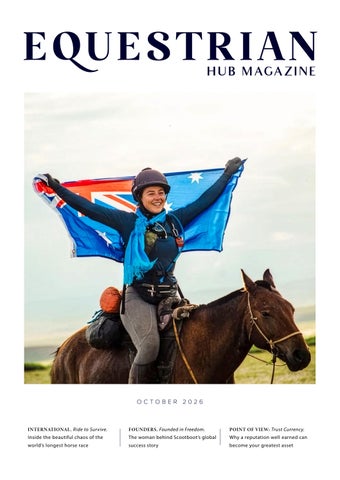
OCTOBER 2026
INTERNATIONAL. Ride to Survive.
FOUNDER S. Founded in Freedom.
POINT OF VIEW: Trust Currency.
Inside the beautiful chaos of the
The woman behind Scootboot’s global
Why a reputation well earned can
world’s longest horse race
success story
become your greatest asset
2 | E Q U E S T R I A N H U B OCTOBER 2 0 2 6
HIGH FIBRE COOL ENERGY FEED
HARNESSING THE POWER OF SUNFLOWER SEEDS, AN ALL NATURAL SUPERFOO D
Omega Feeds has formulated a palatable, high fibre, low starch feed that contains a balanced blend of vitamins and minerals to ensure optimum health and vitality. No-Grain Gold is suitable for ponies, spellers and horses in light to medium work. High Fibre: For gut health and cool energy. Non Pelleted: Horses spend more time chewing which stimulates saliva production and in turn buffers the stomach and protects it from ulceration. Low Starch: Reduced risk of digestive upsets and metabolic conditions. Balanced blend of vitamins and minerals: For optimum health and vitality.
100% Australian, proudly supporting Australian farmers omegafeeds.com.au | SUPERFOODS FOR BRILLIANT RESULTS
Need nutritional advice? Visit our EQ Health Hub and ask our expert. E Q U E S T R I A N H U B . C O M . AU | 3
What's Inside O C TO B E R 2 0 2 6
EDUCATION
Knowledge for better horsemanship. 40 72 76 78
The Evolution of Horsemanship Caring for Your Foal in the Early Months Tech Talk - Orra Systems Horses in the Heat
INSPIRATION Stories that move us. 12 44
Young Rider - Harlow McDonald Point of View - Trust Currency
CONNECTION
Strengthening our equestrian community. 10 16 22
Education: It Goes Both Ways The Art of Side Saddle Founders - Annette Kaitinis
EVENTS
Celebrating equestrian sport at every level.
30 50 60
The Mongol Derby: Ride to Survive World Cup Qualifier Racing Victoria’s Off The Track Carnival
LIFESTYLE
Life beyond the saddle. 70 83 84
Ride Fit - Hot to Trot What We're Loving - Safety Stirrups Property
Equestrian Hub is published by Ecurie & Atelier. While every effort is made to ensure the accuracy of information published in this magazine, the publisher accepts no responsibility for errors, omissions or any consequences arising from the use of information contained within these pages. The views and opinions expressed by contributors are their own and do not necessarily reflect those of the publisher, its employees or representatives. The content of advertisements is the sole responsibility of the advertiser and does not constitute endorsement by Equestrian Hub. All content is published in good faith and is intended for general information purposes only. Readers should seek professional advice where appropriate before acting on any information contained in this publication. © 2026 Equestrian Hub. All rights reserved. No part of this publication may be reproduced, stored or transmitted in any form without the prior written permission of the publisher, except as permitted under applicable copyright law. Information, event details and credits are believed to be correct at the time of publication but may be subject to change. Unless otherwise stated, all editorial content, photography and design are copyright Equestrian Hub.
4 | E Q U E S T R I A N H U B OCTOBER 2 0 2 6
The People Behind the Issue Every issue of Equestrian Hub is shaped by the generosity, knowledge and passion of the people featured here. Together, they help us educate, inspire and connect Australia's equestrian community. We're incredibly grateful to all our contributors for helping make this publication what it is today.
EQUESTRIAN HUB SCENIC RIM, QLD Editor AMANDA MCWHINNIE amanda@equestrianhub.com.au Publisher & Partnerships SAM CAVALLO hello@equestriennemagazine.com Advertising BELINDA NICHOLS belinda@equestrianhub.com.au Podcast CHARLIE BRISTER bluegumperformance@gmail.com HOLLY HALL PERRIN kennallywood@coleychellefarm.com.au E-mail INFO@EQUESTRIANHUB.COM.AU Website EQUESTRIANHUB.COM.AU Social Media @EQUESTHUB Cover MICHELLE J PHOTOGRAPHY TULGAA SKIZZ After theGrace bushRogers fires - the iconic6th Australian claimed Kiandra Brumbies place in the Grey Mongol Derby, the longest horse race on earth.
E Q U E S T R I A N H U B . C O M . AU | 5
O U R C O N T R I B U TO R S
Jacquie Johnstone The co-founder of newly rebranded Evergem Media House, Jacquie has over a decade of experience in equestrian media. Often found with a camera and oat latte in hand, she is proud of how synonymous the studio has become with Australia's Equestrian media scene. Along with studio co-founder Liza Harvey, Jacquie recently covered the 4CYTE™ CSI1*-W World Cup Qualifier at last month's Jumping@Willinga.
Dr Andrew McLean Andrew is the CEO of Equitation Science International. An Honorary Fellow of the International Society for Equitation Science, he's a member of the FEI's Equine Welfare Advisory Group and Ethical Training Methods Expert Consultative Group. In Part 2 of our conversation with Andrew, he concludes his excellent analysis of the development of contemporary English disciplines.
Paul Dopper Founder of Team Dark Horse, Paul is known for helping equestrians better understand their horses and become more knowledgeable, confident horsemen and women. He has been involved in breeding, training, and showing horses at both Royal and National level, and In this issue explains why having your horse professionally trained is great, but the benefit is greater when both ends of the reins are educated.
Dr Jennifer Stewart B.V.Sc., B.Sc., Ph.D. With over 40 years’ experience as a veterinarian in mixed and equine practice, Jennifer’s special interest is equine nutrition. She was a Senior Veterinary Officer with the Australian Department of Agriculture, Water and the Environment for 10 years, and a Biosecurity Veterinarian with the ACT Government for two years. This month, she offers expert advice on helping our horses through summer's heat.
Mel Gould A Melbourne based photographer, Mel has more than 10 years' experience in commercial and portrait photography. But after growing up around horses, her passion for them and for imagery eventually combined when she launched Equisoul Photography in 2019. She has since covered everything from grass roots competitions to international events, including Racing Victoria's recent OTT Carnival.
Anne-Marie Lasserre Anne-Marie is a Miss World and Miss Universe Figure Champion. She’s an AOR dressage rider, and a specialist coach in aesthetics, sports performance and nutrition. Dedicated to empowering equestrians to achieve peak fitness and personal transformation, she explores why strength, confidence and staying in the saddle might matter more than chasing the body you had at 25.
6 | E Q U E S T R I A N H U B OCTOBER 2 0 2 6
Stacey Rusic Stacey owns and operates Same Side Equestrian and is an avid side saddle rider, competitor, instructor and judge. She has been involved in the discipline for over 13 years, and in 2025 was awarded a Churchill Fellowship, allowing her to travel overseas to further her knowledge and skills. Stacey is the first dual qualified side saddle instructor in Australia, and in this issue shares her fascinating story.
Annette Kaitinis In 2015, Annette’s passion for horses motivated her to launch Scootboot with co-founder and farrier Dave McDonald. Her vision is to advance the barefoot movement globally as she continues to disrupt the 2000-yearold tradition of nail-on shoes. Now selling equine hoof boots to customers in more than 110 countries, Scootboot is one of Tasmania’s largest exporters - and we feature Annette in this month's Founders.
O U R C O N T R I B U TO R S
Grace Fariello Grace is the founder of Orra, an automation and intelligence company. Orra’s primary focus is equestrian sport, where essential work still depends on whiteboards, scattered messages and human memory. Orra automates analogue work and gives teams a clearer picture of what's happening, what needs attention, and what comes next. Grace goes into depth in this month's Tech Talk.
Harlow McDonald Although Harlow has only been riding for three years, she has already been selected to compete for Queensland and has her sights firmly set on a dressage career in Europe. This month's Young Rider, she talks to us about her ponies Bug and Stormee, her dreams for the future, and her belief in the importance of always being a good person who encourages others.
Candice Sparre Candice is an Australian horse trainer, coach and co-founder of Hooves Got Talent alongside Louise Crosbie. She has been part of the Mongol Derby team for six years, working in media and communications and bringing the stories, personalities and inevitable chaos of the world’s longest and toughest horse race to those following along from home. Don't miss her Derby report in this issue.
Dr. Imilla Dunn BSc (Vet Bio) DVM Imilla is a member of the Rivers Equine Vets team located in Murwillumbah NSW. She is passionate about all aspects of equine vetting, with a special interest in dentistry (she has completed Levels 1, 2 & 3 of Dr Oliver Liyou's EVDS dental courses), welfare, minis and foals. She enjoys building a strong rapport with clients and their horses, and in this issue explores caring for foals in their first months.
Tulgaa Skizz After graduating in graphic design from Mongolia's International University, Tulgaa's passion for photography initially focused on everyday life in Mongolia. His work has since taken him onto the Mongolian steppe, where he has become a regular member of the media team covering the Mongol Derby. We feature his evocative images in the Derby report in this issue.
Sam Cavallo Sam is the publisher of Equestrian Hub and Equestrienne Magazine. She has a keen interest in international events and a passion for equestrian culture and lifestyle, with a focus on community, authentic storytelling, and the people behind the sport. In this month's Point of View, she looks at the currency of trust and how, when nurtured, its significance can extend far beyond its original value.
Christa Poulter Christa is a writer and content specialist based on the NSW South Coast. She works across editorial, digital and brand storytelling, creating clear, engaging content shaped by people, place and experience. Her writing brings warmth and purpose to every story, helping ideas connect naturally with readers and audiences. In this issue, she covers Jumping@ Willinga and the 4CYTE™ CSI1*-W World Cup Qualifier.
Amanda Mac Horse obsessed from an early age, Amanda read every pony book she could find until eventually her dream came true in the shape of a Connemara pony. She later studied for her BHSAI at the renowned Benenden Riding School in the UK. With her equestrian career now reluctantly behind her, she lives the horsey life vicariously as editor of Equestrian Hub Magazine. E Q U E S T R I A N H U B . C O M . AU | 7
Apiam’s equine veterinary credentials are well-founded with a growing number of purpose-built dedicated Equine Vet Clinics and Referral Hospitals located in Victoria, New South Wales and Queensland, working alongside our network of mixed practice clinics in delivering quality equine veterinary care. Scenic Rim Veterinary Service Beaudesert QLD Agnes Banks Equine Clinic Agnes Banks NSW Hunter Equine Centre Scone NSW Victorian Equine Group Bendigo VIC Gippsland Equine Hospital Maffra VIC Southwest Equine Veterinary Group Warrnambool VIC
Find out more by visiting the Apiam Animal Health website & view the equine product range on Country Vet Animal Supplies COUNTRYVET.COM.AU
Healthy animals – happy people
APIAM.COM.AU 8 | E Q U E S T R I A N H U B OCTOBER 2 0 2 6
APIAM.COM.AU
Hello, I recently watched internationally
In our fabulous October issue, Dr Andrew
acclaimed mindset coach Annette Paterakis
McLean concludes his analysis of the
interview dressage superstar Jessica von
development of contemporary English
Bredow-Werndl – one of many inspiring
disciplines - and by the way, if you thought
conversations Annette has recorded with elite
riding side saddle was a dying art, think
equestrian athletes (you'll find them here).
again! Stacey Rusic, a Churchill Fellowship
After getting over my Jessica fangirl moment, I was particularly struck by Annette’s core
recipient and proponent of the discipline, shares her recent adventures in the UK.
philosophy: results follow connection – and
Congratulations to Josh Collins and Cornel,
by that she means connection to yourself, to
who claimed a World Cup Qualifier win at
your horse, and to the present moment.
last month's Jumping@Willinga - we bring
If you need any proof of the effectiveness of that philosophy, the interview with Jessica should convince you. When, after her success as a younger rider, Jessica moved up into senior classes, her confidence deserted her to the point where she considered giving up competitive riding altogether. But instead, with the help of a coach, she faced her fears, reconnected with her deep passion for dressage, and became one of the world's most celebrated equestrian athletes. But as Annette points out, connection doesn't mean an end to fear, it means that fear no longer controls you - and isn't that where true freedom really lies? And just think, if
you a report and photo gallery from the event, which boasted over 1,000 starts. We also cover Racing Victoria's second Off The Track Carnival. With capped entry fees plus a prize pool of over $260,00, it's not hard to see why the event is hugely popular. Then, why not dive into our Mongol Derby feature? The Derby, a 1,000km trek across open country, is where 'ride for your life' becomes so much more than a cliché! Keeping our horses healthy is paramount, and Dr Jennifer Stewart has some essential advice on getting them safely through the summer heat, while Dr Imilla Dunn goes deep into the care of foals in those vital early months.
become one of Tasmania's most successful - and you can read the full story in this month's Founders. Plus, on the technology front, Grace Fariello introduces Orra, intelligent technology designed to lighten the operational load of a running a yard. And what's your take on trust? It's certainly a foundation for healthy relationships personal and professional - and in Point of View, Sam Cavallo explains why, in her experience, it's one of the most valuable currencies we can earn. Our featured Young Rider, 11-year-old Harlow McDonald, has only been riding for three years, yet she has already been selected to compete for Queensland and has her sights set on furthering her career in Europe. I think that's called focus! Meanwhile, Paul Dopper explains why he believes education at both ends of the reins is vital for progress - and after an AOR 4.2 Medium win with Montango Lodge Comet, plus a 2nd in the AOR Prix St Georges with Valhalla 1, Anne-Marie Lasserre returns to ask if riding can actually keep you young.
Jessica hadn’t had the courage to make peace
When Scootboot creator and designer Dave
with her insecurities, we would never have
Macdonald crossed paths with commercial
In What We Love, we look at the safety stirrup, one of the most important innovations in equestrian sport, and this
had the pleasure of watching her dancing
barrister and equestrian Annette Kaitinis,
month's property is an absolute showstopper!
with Dalera. Something to ponder.
it was the beginning of a business that has
Enjoy.
AMANDA MAC EDITOR, EQUESTRIAN HUB
E Q U E S T R I A N H U B . C O M . AU | 9
why I believe good horsemanship isn’t just about training the horse, it’s about
TRAINING
Education: It Goes Both Ways
educating both ends of the reins.
It Takes Two Sending a horse away to a professional trainer can be one of the best investments you make in your horse’s future. A knowledgeable trainer can give a young or inexperienced horse a solid foundation, work through problems,
Having your horse professionally trained is great, but as PAUL DOPPER explains, the benefit is much greater when both ends of the reins are educated.
W
listen. She’s pushy. He’s too strong. She won’t stand still. He keeps doing the
our horse behaves.
wrong thing. But here’s the question we
A trainer can make a huge difference
with our horse, it’s easy to blame the horse. He won’t
sometimes forget to ask: What are we teaching the horse?
to a horse. But if the owner doesn’t understand what the trainer has done -
Horses learn from us every single
or how to continue that training at home
time we handle or ride them - whether
- old problems can quickly return. That’s
10 | E Q U E S T R I A N H U B OCTOBER 2 0 2 6
skills needed to make the horse safer and more enjoyable to handle and ride. But there is a problem I see far too often. We send the horse away to be educated
we realise it or not. The way we communicate, use pressure and release, reward the right response and correct unwanted behaviour all influence how
hen something goes wrong
improve confidence and establish the
- while forgetting that the owner needs educating too. A horse might spend six weeks, three months or even longer with a professional trainer. During that time, the trainer works with the horse regularly. Then one day the owner arrives, loads the horse onto the float and takes them home. The horse has changed. But has the owner? Training your horse is a conversation
TRAINING
between both the horse and the rider.
greater experience and asking for help
horse. Also consider whether this
Every time we handle a horse, we are
can be a very responsible decision. But
person can teach you how to continue
communicating something. The way we
professional training should not replace
the training. A good trainer should be
hold the lead, where we stand, how we
owner education.
able to explain what they are doing and
use our body, when we apply pressure and how quickly we release it can mean something to the horse. A good trainer develops consistency in this communication so the horse learns that when they feel this, they should do that. But when the horse returns home, the signals may suddenly change. The owner’s timing may be different. The pressure may be different. The release may come too early, too late or not at all. The owner may unknowingly ask for one thing with their hands and something
Ideally, the trainer isn’t just producing a better-educated horse. They are helping create a better-educated partnership.
Understand the Language Before your horse comes home, you should understand the language your horse has been taught: the system, tools and exercises the trainer has used. If possible, have lessons with your horse before they come home. Don’t just watch the trainer ride. You need to get on and ride. Don’t just watch
different with their body.
the groundwork. Take the lead and do it
So when you think: He never did this
is standing beside you and can help
at the trainer’s, you may be right. But it doesn’t necessarily mean the trainer failed to properly instil the lessons they taught your horse, or that there is something wrong with the horse – they may simply be responding to a different person communicating in a different way.
yourself. Make mistakes while the trainer
"One of the most important concepts in horsemanship is understanding pressure and release."
Learning from Release
why, and you should feel comfortable asking questions. Ideally, there should be a transition period where the trainer begins stepping back and you start to take over. First, you watch. Then you participate. Then you perform the exercises while the trainer coaches you. Eventually, you should be able to reproduce the basics yourself – and that is when the training becomes transferable. Nobody is saying every horse owner needs to become a professional trainer. You don’t. But you do need enough knowledge to maintain the education your horse has received. The professional trainer may work with your horse for six weeks or six months, but you might be working with that horse for the next twenty years. That makes your education every bit as important as your horse’s.
Educate Both Ends of the Reins
One of the most important concepts in
you correct them. Training doesn’t finish
Sending a horse to a good trainer can
horsemanship is understanding pressure
when the professional trainer hands you
give it an excellent start. But the greatest
and release. Whether we are asking a
back the reins.
results happen when the owner goes on
horse to move its hindquarters, back up,
If you are prepared to spend thousands
that journey too.
yield to a leg, or simply to stand quietly,
of dollars sending your horse away to
the release helps tell the horse when it
get educated, consider investing some
So don’t just ask your trainer to make
has found the correct answer.
of that money and time into your own
That makes timing incredibly important.
education. Take lessons, ask questions,
This is why simply watching a trainer work your horse isn’t enough. You need to develop your own feel and timing and that comes through practice. A professional trainer may achieve
and gain an understanding of how horses think and learn. Develop better feel and timing. Learn how to control your horse’s feet safely from the ground and learn emergency skills under saddle.
your horse softer - learn how to be softer yourself. Don’t ask them to make your horse more responsive - learn how to ask more clearly yourself. Don’t just ask them to make your horse safer - learn the skills that help you keep both you and your horse safe. The goal shouldn’t simply be to send
remarkable changes with a horse
Most importantly, don’t be embarrassed
because they have spent years
about what you don’t know. Good
developing their skills. But if we want
horsemanship isn’t about proving how
the training to continue when the horse
much you know. It is about continually
comes home, some of that knowledge
learning.
has to be transferred to the owner.
Choosing the Right Trainer
continue to develop together. Because
There is absolutely nothing wrong
When choosing someone to educate
in the end, good horsemanship isn’t just
with sending a horse to a professional.
your horse, don’t just ask yourself
about educating the horse - it’s about
Recognising that someone else has
whether this person can train your
educating both ends of the reins.
away an uneducated horse and get back one who has been educated. The goal should be to bring home a horse you understand better, armed with the knowledge and skills you need to
E Q U E S T R I A N H U B . C O M . AU | 11
12 | E Q U E S T R I A N H U B OCTOBER 2 0 2 6
YO U N G R I D E R
Harlow McDonald She has only been riding for three years, but HARLOW McDONALD has already been selected to compete for Queensland and has her sights firmly set on Europe. EH: Tell us a little about yourself! How
and wanted to be like them. I love the
HM: I definitely get nervous, but I find
old are you, where are you based, and
discipline in dressage and learning to
singing to myself and deep breaths
how did your love of horses begin?
get better in every aspect of my riding.
always help calm me. Bug loves when I
HM: My name is Harlow, I’m 11 years
EH: What has been your proudest
sing to him! Knowing my tests inside out,
old and I’m based in the Scenic Rim.
riding achievement so far?
I’ve loved horses since I was a little girl,
HM: Definitely making it to Nationals
always begging mum to ride the ponies at the markets. I started taking lessons in 2023 when I was eight, and my parents got me my first pony at the end of that year. It’s been the best journey ever since.
EH: We’d love to meet Bug and Stormee. What are their personalities like, and what’s something funny or special we should know about them?
HM: My pony Bug is so special to me, I’ve owned him for two years now. His personality is the perfect mix of gentleman and spunk. He absolutely loves a red frog after a comp or a cheeky party mix lolly. He takes the best care of me and tries his heart out. Stormee is my newer, bigger pony, and my next step up from Buggy. I’ve owned her since the start of the year when we picked her up from the Arab show at Willinga Park. We instantly clicked! She is the sweetest girl and so willing to
and competing for Queensland. I’ve only been riding for three years and am so proud of how far we’ve come. Competing Novice has been a huge achievement for us, as only last year we
them with mum before we head into the arena are all ways I prepare to put my best foot forward.
EH: What do you like to do with your ponies when you’re not riding and what is your favourite part about looking
started at Prep.
after them?
EH: You’ve qualified for IQ Nationals
HM: I love giving my ponies a spa
and will be competing as part of the
day! Bathing them, plaiting their manes,
QLD State team – congratulations! Tell
putting glitter on them and finally a good
us a bit about that journey and what
hot oil. There is nothing better than just
you’re most looking forward to about
being with your pony, they’re so calming.
the experience?
EH: Is there a rider you really look up
HM: Thank you! I am so excited! I feel
to? What do you admire about them?
very lucky to be on the team, it was my
HM: Yes! I really admire Kate Kyros.
biggest goal for this year, a dream come
I absolutely love the way she rides.
true. I am taking Buggy and will be doing
She’s so kind with her horses and you
the Primary Novice and CT50. I’m most
can see the bond she has with them.
looking forward to the experience, and
It’s my dream to go to Europe and be
getting to cheer on all my friends. The riding part is so fun but getting to spend time with my horse friends and doing what we love is super special.
please, she’s only five, so we are taking
EH: What are some of your favourite
our time to get to know each other. She
training exercises or movements?
loves scratches and always calls out to
using my white board and going over
HM: I love leg yielding, sit trot and
a dressage rider, so to follow in her footsteps would be a dream come true. I also love following Harlow Luna White, watching her YouTube videos taught me so much in the beginning. I love how she rides and how hard she works.
EH: What would you say to another
you from her paddock.
stretchy trot, I feel like they all help to
EH: What do you love most about
get my ponies moving well.
dressage, and how did you first get
EH: Even confident riders get nervous
compete?
sometimes. Do you ever get show-
LEFT: Harlow and Bug have been together for two years and have formed a special bond.
interested in the discipline?
HM: I was always inspired by the
day nerves, and what helps you focus
incredible dressage riders I would watch
before you go into the arena?
young rider who loves horses but is feeling nervous about starting to
E Q U E S T R I A N H U B . C O M . AU | 13
YO U N G R I D E R
14 | E Q U E S T R I A N H U B OCTOBER 2 0 2 6
YO U N G R I D E R
ABOVE: Harlow and Bug competing at the Interschool Darling Downs Regionals (Image Braid Up Photography). LEFT: Riding the Novice test in the Caboolture Dressage Group series (Image RowanW Photo).
HM: You have to believe in yourself
EH: What’s your biggest riding dream
What treats do you keep in your
and your partnership with your pony
or goal for the future?
pocket? Liquorice and Red Frogs.
or horse. Competing is so much fun
HM: To be an Olympic dressage rider
Go-to comp day outfit? Anything pink!
and you can’t let fear get in the way! Competing has helped me meet so many amazing friends and people that have helped me along the way.
EH: Being a sponsored rider comes
and go over to Europe to ride. I’d love to train in Europe and experience the lifestyle and culture over there.
EH: Finally, describe your perfect day
I love the Samshield shirts, a LeMieux sparkly jacket and a pretty KEP. It’s so fun when you get to wear something other than black or navy. What’s something that’s always in your
with your ponies. Where would you go,
grooming bag? Anything Hairy Pony,
what would you do, and who would
their brushes and hot oil are the best!
come along?
Dream equestrian event to attend
competitions and in what you share
HM: It would start at Tamborine
either as a rider or spectator? I’m
online?
Equestrian Group or Que Sera Farm
desperate to go to HOYS, it looks so fun
HM: I love working with brands, I’m
with my bestie Sophie. Have a little ride
to go and experience a white Christmas,
in the dressage arena, a jump and then
meet Harlow Luna White and watch all
hit the water in the cross country field.
the equestrian events!
Followed by a beach ride with all my
Best advice someone has given you?
friends and my mummy and a picnic with
Never give up. There’s been so many
lots of red frogs for Bug!
times where I’ve felt frustrated or stuck
to always be a good person and
Quick 6
in this sport. Taking time to breathe,
encourage others, I just translate that
Favourite event to compete at? I
into what I share and how I greet people
love competing at QSEC, I recently
at competitions, to make sure I’m doing
competed at the CDG Series and it was
the brand proud.
a wonderful event!
with responsibilities beyond riding. What does being a good representative of a brand mean to you, both at
incredibly lucky to be sponsored by Opulent Equestrian. I absolutely love their brand and really adore their pieces. This has been my second year representing them. I think it’s important
reset and keep trying always works out in the end. You can follow Harlow's adventures at Team Harlow Equestrian. E Q U E S T R I A N H U B . C O M . AU | 15
16 | E Q U E S T R I A N H U B OCTOBER 2 0 2 6
F E AT U R E STAC E Y R U S I C | C H U R C H I L L F E L LOW S H I P
The Art of Side Saddle Carrying History Forward
W
hen I first read about side
riding assessed and it gave me a much
Early Days
saddle in an old issue of
stronger foundation for both riding and
When I started competing side
HorseWyse magazine, I had
teaching.
saddle in 2013 there were very few
no idea that a passing curiosity would eventually take me halfway around the world and to the highest levels of the discipline.
In a bid to introduce more Australian riders to the discipline, over the following years I built Same Side Equestrian, a niche business
opportunities to do so. For years, I was often the only side saddle rider competing against astride riders, or when the rare dedicated class was offered, competing against myself!
What began with buying my first
encompassing just about anything to
side saddle in 2013, accompanied
do with side saddle, and taught - a
It became very clear that if I wanted
by a crash course instruction to just
large part of which has been through
to see the discipline grow, simply
“keep your right shoulder back,” has
Pony Club, including more than 60
turning up to compete wasn't enough.
grown into more than a decade of
clubs across Victoria and southern
I needed to address some of the
riding, competing, instructing and
NSW.
practical barriers stopping people from
more importantly, trying to create opportunities for others to discover this amazing discipline. For much of that journey, I was largely self-taught. There simply wasn’t the opportunity to easily access experienced instruction locally so I
"Over the years I have advocated for rule changes allowing riders to compete side saddle within existing equestrian competition."
read, researched, watched videos, rode and experimented. There was
More recently, we have seen the
completely captured by side saddle
development of Side Saddle Australia
and determined to learn as much as I
(SSA), an association working towards
could.
growing the discipline nationally, while
begin my grade exams with the New Zealand Side Saddle Association. These exams are designed to test your knowledge and are the stepping
Equipment was one of them. Buying a specialised saddle before you even know whether you enjoy riding side saddle is a significant commitment, so I began building a collection of saddles and related equipment that I could hire out.
plenty of trial and error, but I was
In 2016 I travelled to New Zealand to
participating.
improving access to equipment and instruction, advocating for competition opportunities, and connecting a community of riders spread across the country.
stones to instructor qualifications.
All of this has reinforced something I
I sat for Grade 1 and 2 under the
feel very strongly about: side saddle
guidance of Sally Austin-Pearcey
may have an extraordinary history but
and Roger Philpot, a name globally
it does not have to remain a historical
synonymous with the discipline. It
curiosity. It can be a modern, evolving,
was my first experience of having my
equestrian discipline.
Knowledge was another barrier. A side saddle must be correctly fitted, and position and instruction matter enormously for both horse and rider. Having experienced first-hand how difficult it was to learn without that support, I was determined to make the path easier for those coming after me. There also needs to be somewhere to compete. Over the years I have advocated for rule changes allowing
LEFT: A lap of honour on Mumtaz Begum at the 2026 National Side Saddle Show (Image KB Photography). E Q U E S T R I A N H U B . C O M . AU | 17
F E AT U R E
ABOVE: Stacey rode Jade Craig's powerhouse Lakeland Balla to victory in the Overseas Intermediate Equitation class at the 2026 National Side Saddle Show (Image KB Photography). riders to compete side saddle within
take part. Standing there and seeing
from experts and bring that knowledge
existing equestrian competition.
that field of riders was truly incredible.
home for the benefit of their field and
One change I am particularly proud
I remembered the years when I had
the wider Australian community – and
of was successfully advocating for
turned up as the only side saddle
that was exactly the opportunity I
side saddles to be permitted under
competitor and now there were 19
needed.
Equestrian Australia dressage rules.
riders standing beside me. It showed
It might sound like a small change but for a developing discipline, it mattered. Riders could now take the
me what was possible but it also made me think seriously about the next stage of development.
It wasn't simply about travelling overseas to become a better side saddle rider. It was an opportunity to immerse myself in countries where the
horses they already owned, attend
The Churchill Fellowship
discipline has a much larger and better
competitions already being held, and
By 2025 I felt that I had exhausted all
established community, learn directly
choose to ride side saddle. For me,
the opportunities available in Australia.
from experienced riders, instructors
that’s what evolving the discipline
If I wanted to continue making a
and organisations, and ask a very
looks like: respecting its traditions
meaningful contribution to the future
practical question: what can I learn
while removing unnecessary barriers
of side saddle in this country, I needed
here that could help us continue to
to taking part.
to broaden my knowledge and
develop side saddle in Australia?
Perhaps the clearest indication of how far things had come was at Equitana 2024, where I ran the largest side
experience beyond what was available at home, which led me to apply for a Churchill Fellowship.
The application process was intense and of the 1,200 applicants across every area of interest you could
saddle event Australia had seen in
Churchill Fellowships give Australians
imagine, I was lucky to be one of 100
decades. Twenty competitors travelled
the opportunity to travel overseas to
awarded a Fellowship, which took me
from Victoria, NSW, and Queensland to
investigate an area of interest, learn
to the UK and Ireland.
18 | E Q U E S T R I A N H U B OCTOBER 2 0 2 6
F E AT U R E
ABOVE: As one of the successful applicants, Stacey was invited to speak about her project at the Churchill Fellowship Presentation Night (Image courtesy Stacey Rusic). I arrived with seriously ambitious
and help create a pathway for more
myself, it was incredibly valuable to
goals: further develop my riding, learn
Australian riders and instructors to
have my riding analysed by someone
from some of the best people in the
follow.
with her depth of knowledge.
I also wanted to look beyond my own
We worked relentlessly towards my
riding and understand how side saddle
Grade 3 and 4 exams. Passing both of
is taught and assessed, how horses
these was a very proud moment, yet
are developed, and how riders are
the feedback was perhaps even more
The SSA’s grade exams and instructor
encouraged to progress. I also wanted
valuable than the results. After years of
qualifications are widely regarded as
to understand how a long-established
developing my knowledge and ability
the gold standard within the global
association operates and what
through experience, it was reassuring
side saddle community, providing
elements of that structure could be
to have that recognised and to know
the most comprehensive and
applied through the SSA to continue
the foundations I had worked so hard
internationally recognised pathways
developing the discipline in Australia.
to build were fundamentally sound.
for developing and assessing riders
A Significant Influence
A Dream Come True
discipline, complete my grade exams, obtain my instructor qualifications and compete at the National Side Saddle Show.
and instructors.
I was very fortunate to be based with
Then came an experience I had dreamed about for years: the National
With only one other SSA qualified
Lucinda Sims, who became the most
instructor in Australia at the time,
significant influence on my time in the
gaining these qualifications was about
UK. She was enormously supportive
far more than adding credentials to
and encouraging but she also did what
my name. It was an opportunity to
great instructors do: she kept tweaking
bring another recognised standard
and perfecting my riding. Having spent
The scale, standard and depth of
of knowledge and instruction home
so much of my early journey teaching
knowledge surrounding me gave
Side Saddle Show. Australia really has nothing like it and seeing so many side saddle riders and horses together was extraordinary.
E Q U E S T R I A N H U B . C O M . AU | 19
F E AT U R E
The Kinsella family kindly loaned Stacey Killaloe Lance to ride at the Tinahely Show in Ireland (Image Between The Ears Equine Media).
20 | E Q U E S T R I A N H U B OCTOBER 2 0 2 6
F E AT U R E
me a glimpse of what the discipline
dual qualified side saddle instructor,
and putting children on them might
can become when there is a strong
holding qualifications with the Side
seem a world away from competing
community with an established pathway
Saddle Association (UK) and the
at the National Side Saddle Show but
behind it.
International Side Saddle Organization
to me, they are closely connected. If
(US).
a discipline is going to have a future,
Fellow Australian Susie Flook entrusted me with her wonderful mare Mumtaz
My Churchill Fellowship travels also
Begum (Ginny) while Jade Craig
took me to Ireland, where I had the
gave me the ride on the powerhouse
opportunity to compete at a local show
Lakeland Balla (Eamonn). There is
and watch the famous Ladies Side
something quite extraordinary about
Saddle Class at the Dublin Horse Show.
travelling to the other side of the world,
Tradition and Elegance
climbing aboard horses that aren't your own, in gear that isn’t yours and riding into the ring at an event representing the pinnacle of your discipline. Then somehow, to find yourself winning not once, but four times! The highlight was winning the Emma Gann Memorial class on Ginny. It is a moment I will remember for the rest of my life. It was one of those rare occasions when I could stop and appreciate just how far my side saddle journey had taken me and yes, I did shed a tear or two! More than the results, the National Show highlighted the strong community surrounding side saddle in the UK. It
Side saddle's history is part of what makes it special. The saddles, traditions and elegance are undeniably part of its appeal but preserving side saddle does not mean freezing it in time. The riders I met were training,
"There is something quite extraordinary about travelling to the other side of the world ... and riding into the ring at an event representing the pinnacle of your discipline."
reinforced something that became
competing, teaching and developing
increasingly clear throughout my
horses. They were respecting the
Fellowship: disciplines survive because
history while actively creating the
people invest in them.
discipline's future, which is the version
From there, I progressed to my instructor qualifications. I had already
what they were doing well, identify areas
riders, but the past decade has shown
for development, and communicate
me that enthusiasm needs direction.
appropriate instruction clearly and
The real value of my Fellowship is in
effectively?
what happens next. I have a much
I had spent so many years building could be passed on to others and perhaps help the next generation avoid
Perhaps one of them will become a competitor, instructor or an advocate themselves. One of the biggest lessons from my Fellowship and perhaps from my entire journey is that you do not need to begin with all the answers, or have every opportunity available - but you do have to be prepared to put in the hard yards. You have to educate yourself, seek out people who know more than you, be willing to listen and accept correction, and take every opportunity to learn. And sometimes you have to travel further, ask more questions and create the opportunities yourself. I know the discipline can grow - we’ve already shown that! The next question is: how far can we take it? Side saddle has a wonderfully rich history so understanding and respecting that is important - I don't believe its greatest days are behind it.
and connections gained through my
and growing community of side saddle
gave me confidence that the knowledge
might become fascinated just as I did.
Australia.
I assess another rider's ability, recognise
huge achievement. More importantly, it
enjoy the novelty of trying it, others
If the knowledge, qualifications, skills
Australia already has an enthusiastic
qualification, the highest level, was a
discover it. Some riders will simply
of side saddle I want to encourage in
demonstrated that I could ride but could
Successfully passing the 'A' Instructor
people first need an opportunity to
greater understanding of how to teach
Fellowship allow me to create more opportunities for Australian riders, and to develop horses and future instructors while making side saddle more accessible, then this journey will have achieved far more than anything I could have dreamed to accomplish.
side saddle effectively, develop horses
For me, the Fellowship was never about
specifically for the discipline, support
preserving side saddle as something
riders through a structured grading
from the past, but rather learning how
system and ultimately, help develop the
we can carry it forward.
riders and instructors who will carry the discipline forward.
some of the steep learning curves I’d
I’ll also continue working at grassroots
experienced. I am now Australia’s first
level. Taking side saddles to Pony Clubs
If you are interested in learning more about riding side saddle, visit Stacey at Same Side Equestrian, or Side Saddle Australia, the discipline's peak body in Australia. E Q U E S T R I A N H U B . C O M . AU | 21
22 | E Q U E S T R I A N H U B OCTOBER 2 0 2 6
FOUNDERS
Founded in Freedom Over the years, Tasmanian-based ANNETTE KAITINIS has been a driving force in helping make Scootboot a global success. EH: For readers meeting you for the
through the nearby forests, which was
I’m always striving to learn more about
first time, tell us a little about yourself -
probably where my real love of horses
horses and understand the way they
where did your love of horses begin?
developed, not just the competition, but
think. The more I learn, the better I can
AK: My love affair with horses began
the freedom of being on a horse with
understand what they are feeling and
nothing but bush, trails and time ahead
respond to what they are trying to tell me.
horse-mad and spent years dreaming
of you.
EH: Before Scootboot, you were
about having a pony of my very own.
Our show jumping eventually
both an equestrian and a commercial
When my cousin was given a pony, I
progressed to jumps of around 1.2
barrister. What did each of those
suddenly had the perfect opportunity. I
metres, which, looking back now,
experiences teach you, and which
rode her most weekends because, as it
seems rather enormous! At the time
skills best prepared you to become a
turned out, my cousin wasn't particularly
I don't remember thinking they were
founder?
interested in riding. I was more than
particularly big. Youth has a wonderful
happy to fill that void!
ability to make you feel invincible!
AK: The two sides of my background
After years of relentlessly lobbying
Sadly, our show jumping career came to
we started Scootboot. My equestrian
my parents for a horse, I finally wore
an end when my heart horse damaged
experience gave me an understanding
them down and, at around 13, I got
a suspensory ligament. But the bond we
of horses, hoof health and, importantly,
when I was very young. I was absolutely
my first horse. I knew very little about
"I’m always striving to learn more about horses and understand the way they think."
looking after horses at the time, and what we bought was a very old, fleabitten grey mare. She certainly wasn't the glamorous pony of my childhood dreams, but she was adorable, and I loved her dearly. She was my first horse, and I'll never forget her. In my late teens, I bought a very young Clydesdale x Thoroughbred, and that was when our show jumping journey began where I competed in large agricultural shows around Tasmania. He became my heart horse, and I was incredibly lucky to have him for 25 years. Looking back, I realise we had something very special. It was that almost indescribable connection with a horse that so many people spend a lifetime hoping to find. With him, it simply happened. We understood each other without having to try very hard. I spent countless hours riding alone
shared stayed with me for the rest of my life.
came together remarkably well when
the needs of the market. My legal background gave me the commercial knowledge to navigate the complexities of building an international e-commerce business and operating across different markets and jurisdictions. Before becoming a barrister, I was a commercial litigator, so I also had a strong understanding of what can
Fast-forward several decades and I
go wrong in business and, more
now have a very cheeky Friesian x
importantly, how to protect against
Warmblood, who keeps me thoroughly
those risks. That experience has been
entertained and mostly keeps me out on
invaluable in everything from negotiating
the many forest trails around my area.
arrangements to drafting and reviewing
These days, I’m far less interested in how high we can jump and much more
our agreements. Much of that work is still done in-house.
interested in developing the kind of
I’ve always found that it can take as
connection I had with my heart horse.
much time to brief a solicitor and explain
We dabble in liberty training and a little
the commercial context as it does to
dressage, not only because it’s enjoyable,
draft an agreement myself. My litigation
but because it helps us both become more supple, balanced and educated; qualities that are just as important when we’re out exploring the trails together.
LEFT: Annette and her Friesian Warmblood cross enjoy the freedom of the forest trails (Image Yaleena Bridges). E Q U E S T R I A N H U B . C O M . AU | 23
FOUNDERS
ABOVE: Annette (middle) riding in a Scootboot shoot in South Africa (Image Merlynn Trickhardt Photography). experience also gave me a very practical
unexpectedly when I reconnected with
weren't just building a business for the
understanding of the ‘back end’ of
my former farrier Dave Macdonald,
Australian market, there was a global
disputes, which has been incredibly
Scootboot’s creator and designer, who
appetite for what we were developing.
useful on the ‘front end’ of business,
was then in the R&D stage of developing
anticipating problems and putting the
Scootboot.
right protections in place before they arise.
I knew Scootboot would eventually become an international business, but
By the time I became involved, the
what I didn’t anticipate was just how
patents and trademarks had already
quickly that would happen. From the
Ultimately, I think the combination of
been filed, so Scootboot was very
very first day we launched, we were
my equestrian knowledge and legal
much at the beginning of its journey. I
selling internationally. Looking back, it
and commercial experience gave me a
could see the potential in the product,
really was a global business from day
unique skill set for building Scootboot.
and the combination of my equestrian
one, which we bootstrapped ourselves.
EH: How did the idea for Scootboot
background and commercial experience
EH: Creating something new often
come about, and when did you realise
made it a natural fit for me to become
means questioning practices that have
it had the potential to become a global
involved.
been accepted for generations. In
business?
In the six months leading up to our
the early days, did you feel you were
AK: It actually wasn’t my idea. I had
launch, we built a social media following
wanted to start my own e-commerce
that was already reaching people in
business for many years, but the
different regions around the world. That
opportunity came about quite
was when I started to realise that we
24 | E Q U E S T R I A N H U B OCTOBER 2 0 2 6
simply introducing a better product - or challenging an entire way of thinking about hoof care?
AK: We were doing both. But you’re
FOUNDERS
right, we were also challenging an entire
they can make choices based on what
AK: There were several non-
way of thinking about hoof care.
is best for their individual horse rather
negotiables from the very beginning.
Europe has been ahead of the rest of
than simply following practices that have
The boot had to be a one-piece module,
the world in embracing barefoot for
been handed down for generations.
with no unnecessary components
many years, and the barefoot movement
The barefoot movement is gaining
has been gaining momentum there for a
momentum around the world, and one
long time.
of my goals in my lifetime is to see
Australia is only now beginning to
barefoot become the norm for hoof care
recognise that there is another option
rather than steel. That would be the best
when it comes to caring for our horses’
legacy for Scootboot. And of course to
hooves.
continue to be the market leader of hoof
For us, it has never been simply about
care globally.
selling a product. We want to create an
EH: Scootboots are visually distinctive,
environment where horse owners start
but their simplicity conceals a great
asking questions: Is there a better way?
help minimise the build-up of bacteria
deal of problem-solving. What were
Do we really need to nail steel onto
and moisture. Importantly, there is no
the non-negotiables that shaped the
the end of our horses’ hooves? What
pressure placed on the heel bulbs,
original design, and what did you
healthier alternatives are available?
which are used by many other hoof boot
refuse to compromise as the product
designs as a means of securing the
When owners become better informed,
developed?
boot. The open toe and opening let the
that could break, fail or compromise its structural integrity. It had to be exceptionally robust, but also flexible enough to move with the horse rather than restrict the natural movement of the hoof. The design also had to allow the hoof to breathe. The open toe, open heel bulbs and ground-parallel vents provide airflow through the boot and
E Q U E S T R I A N H U B . C O M . AU | 25
FOUNDERS
ABOVE: Cameron Shield, Senior Director of Building Tasmania, presented Annette with Scootboot's Creative, Lifestyle and Design category winner's award during the recent 32nd Tasmanian Export Awards ceremony. hoof to sit where it should, eliminating
to the end of your shoe. How difficult
There have been many iterations of the
any toe pressure, and allowing optimum
would that be? Yet that is essentially
Scootboot over the years as we have
breakover.
what we have expected horses to do
continually refined and improved the
for generations. We wanted to create
product. It is easy to look at the finished
something that allowed the hoof to
boot but there was so much testing,
function more naturally, while still giving
problem-solving and development that
the horse the protection and traction it
went into getting it there.
horse’s foot.
needs.
One of our biggest challenges has
One of the things I find most interesting
EH: Founders are often celebrated
been preparing the business for scale.
about the design is what happens when
once an idea succeeds, while the
a horse moves over difficult terrain.
uncertainty and imperfect early
When a horse is wearing a steel shoe,
versions just become part of the
the hoof has very little opportunity to
story. Have there been setbacks,
flex or adapt to the surface beneath it.
challenges or moments of doubt
Scootboot is designed to flex and move
that fundamentally changed either
with the hoof and the terrain, much
the product or the way you led the
like a running shoe does for us, while
business?
its sole is modelled on the functional
AK: There are always challenges in
next stage of growth.
business, and we’ve certainly had our
Another important lesson was the
share, but none that has fundamentally
relationship between our wholesale
And that brings it back to something
changed the product or the way we
and retail businesses. In the early
very simple. Imagine running over
lead the business. What has changed is
days, we didn’t always get that balance
rocks, hard ground and uneven
our understanding of what the business
right, and there were times when our
surfaces wearing a piece of steel fixed
needed in order to grow.
own retail business could be seen as
Scootboot hugs the hoof wall, anchored by the shank that sits between the heel bulbs. And because it is lightweight, it doesn’t add unnecessary weight to the
shape and characteristics of a mustang or brumby hoof.
26 | E Q U E S T R I A N H U B OCTOBER 2 0 2 6
Over the past few years, we have spent considerable time restructuring the business and putting the right systems and structure in place to support its continued growth. Looking back, if I were starting again, I would do that much earlier. But that is the reality of building a business, you don’t always know what you need until you reach the
FOUNDERS
ABOVE: Scootboot's new MultiPurpose Gaiters provide protection and additional security for the Scootboot range (Image Merlynn Trickhardt Photography). competing with the very retailers who
AK: I think it became real quite early
We weren’t simply a small Tasmanian
were supporting us.
on because we were making money
business selling overseas, we had
from the beginning. We’ve always
become an exporter in our own right.
We recognised that we needed to change that. Our wholesale partners are now absolutely paramount to the business, and we have worked hard to create a genuine synergy between our
maintained positive cash flow and reinvested that capital back into the business to fund our growth. Scootboot has been completely bootstrapped, with no outside capital, so every stage
wholesale and retail channels rather
of our expansion has been funded by
than having them compete with one
the business itself.
another.
But there have also been moments
While the Scootboot itself has
when the scale of what we had created
evolved through many iterations, the
really hit home. Winning awards was
greater evolution has been in the
one of them. We’ve been incredibly
understanding that creating a great
fortunate to receive recognition
product is only the beginning.
including the Tasmanian Telstra
Building the right business around it, and creating the structure to support its growth, is just as important.
And perhaps that is what makes me most proud. We started in a small shed in Tasmania, and from there built a business that now reaches horse owners in more than 110 countries around the world, all without outside capital. That still feels pretty extraordinary. But Dave and I wouldn't have been able to achieve this without my sister Milda and nephew Tiri who have been with us from the start and have been
Business of the Year, the National
instrumental in the success of the
Telstra Emerging and Energised Award,
business right up until today. As well as
eight Tasmanian Export Awards in our
our amazing Scootboot team.
category, and the National E-Commerce
EH: Congratulations on your
EH: Scootboot originated in Tasmania
Export Award.
and has become a brand used in more
Those awards were important to us
launch of the Global Barefoot Awards!
than 110 countries around the world. At
because they validated that what
What inspired you to create awards
what point did the scale of what you
we had built in Tasmania was being
recognising the broader hoof-care
had created become real to you?
recognised on a much bigger stage.
community, and why was it important to
Tasmanian Export Awards win and the
E Q U E S T R I A N H U B . C O M . AU | 27
FOUNDERS
Annette ticked off a bucket list experience when she joined a Globetrotting ride around Tanzania's Mount Kilimanjaro (Image Josie Romer-Lee).
28 | E Q U E S T R I A N H U B OCTOBER 2 0 2 6
FOUNDERS
ups commercialise ideas and grow.
the impact we’ve had on horses.
And if your idea is genuinely innovative,
I hope Scootboot’s lasting legacy will
AK: The Global Barefoot Awards were
think carefully about protecting it before
be that we have helped thousands
actually our CEO Cheryl Gray’s idea.
you put it into the marketplace. I would
and hopefully, one day, millions of
She wanted to find a meaningful way
strongly recommend speaking to a
horses transition out of a life of steel,
to recognise the wholesalers, barefoot
patent attorney or other intellectual
and helped horses that are barefoot
advocates, professionals and horse
property specialist early in the process.
stay barefoot. If we can contribute to
owners who have been instrumental
Once an idea is out in the public domain,
changing the way the world thinks about
in helping Scootboot reach so many
protecting it can become much more
hoof care and give horse owners a
countries and, more importantly, in
difficult.
healthier alternative, then that will be a
helping more horses transition to
Most importantly, don’t be afraid to
legacy I’ll be incredibly proud of.
barefoot.
start. You don’t need to have everything worked out on day one. Be prepared to
QUICK SIX
These people are out there every day
celebrate people working beyond your own brand?
educating horse owners, challenging traditional thinking and advocating for healthier alternatives in hoof care. We wanted to celebrate the contribution
learn, adapt and ask for help. Building a business is a journey, and some of the most valuable lessons come from the things you didn’t know when you started.
celebrating our own brand. Of course, it has also been a wonderful brand-awareness initiative, but the motivation behind it was much bigger than that. As I always say, we’re not just
overseas? Overseas: In June, I did a Globetrotting ride in Tanzania around Mount Kilimanjaro, which was very much a bucket-list experience for me. It was every bit as challenging as it was
they are making to the broader barefoot movement, rather than simply
Favourite place to ride in Australia or
"As I always say, we’re not just about selling a product. Scootboot is part of a much bigger movement."
about selling a product. Scootboot is
spectacular. Some days we rode up to 50kms to reach our next campsite, so it was certainly not an easy ride, but riding through that incredible landscape and wildlife and experiencing it from horseback was unforgettable. It has definitely left me wanting more, and I can’t wait to do another one.
part of a much bigger movement. We
EH: When you reflect on what you’ve
want to be able to equip horse owners
built with Scootboot, what makes you
At home in Hobart, Tasmania: I’m
with as much knowledge as we can and
most proud - and what do you hope its
incredibly lucky to have the best of both
expand the barefoot movement across
lasting legacy will be?
worlds on my doorstep, with beautiful
the globe. The Global Barefoot Awards
AK: I still find it hard to believe that
beaches and hundreds of kilometres of
are a way of recognising the people who
I’m part of a business whose product
are helping make that happen.
is being used and loved by so many
EH: What advice would you give
horse owners all around the world. The
someone in the equestrian world who
Scootboot brand is now recognised
sees a problem and has an idea to
globally, and that is something I’m
solve it, but isn’t sure how to turn that
incredibly proud of.
idea into a business?
What still makes me smile, though, is
AK: My advice would be to research as
when I tell people here in Tasmania
forest trails around where I live. This is where I do most of my riding, and I never take for granted how fortunate I am to have such incredible riding country so close to home. One quality every founder needs? Passion. What’s your favourite Scootboot
much as you possibly can before you
that I’m one of the owners of Scootboot
colour? Fuscia.
take the leap. Talk to people who have
and they assume I must simply have
Favourite book or one you're currently
already built businesses and learn from
a business in Tasmania where I’m
reading? Elsa Sinclair's Taming Wild
their experience. Find a business owner
representing the company as a stockist.
which I’m half way through.
or founder who is willing to mentor you,
They’re often surprised when I tell
because having someone who has been
them that we export to more than 110
through the journey can be invaluable.
countries. It’s a wonderful reminder of
There are also excellent government resources available. Organisations such
just how far this little Tasmanian business has travelled.
as AusIndustry provide advice and,
But ultimately, the thing I’m most proud
in some cases, grant funding to help
of is not the number of countries we
innovative small businesses and start-
export to or the awards we’ve won. It’s
Best way to celebrate success? Whenever we hit a goal the Scooty team heads to the local brewery. Words to live by? Just do it. To find out which Scootboot is right for your horse and to explore their product range, visit the Scootboot website. E Q U E S T R I A N H U B . C O M . AU | 29
30 | E Q U E S T R I A N H U B OCTOBER 2 0 2 6
I N T E R N AT I O N A L
The Mongol Derby: Ride to Survive A report on the 2026 Mongol Derby by CANDICE SPARRE - abridged and arranged with permission from her original 2026 Mongol Derby race coverage. Images by TULGAA SKIZZ.
O
n Wednesday 5 August 2026,
has spanned station work, competitive
Unlike many horses around the world,
43 riders and several hundred
show jumping, barrel racing, retraining
Mongolian horses don't spend the night
Mongolian horses will turn a
racehorses and solo remote trekking
waiting politely in stables. They roam
quiet patch of grassland into the start of
– from a six-year-old's first lesson to
freely across vast family herds, so each
the world's longest horse race. Ten days
the world's toughest race. Mia Lawler,
morning the horse managers ride out to
of live dots, late night refreshing, and
also from Australia and raised on a
collect them.
improbable alliances are nearly upon us.
farm, wants the outdoors, adventure
The riders have spent months, some of them years, preparing; shortly all that
and horses all in one slightly terrifying package.
Over the next 1,000 kilometres, riders will rely on GPS units, satellite trackers and topographical maps to guide them
work will meet 1,000km of open country,
Joe Byrne has taken the express route
between horse stations scattered across
self-navigation and a fresh horse every
to Mongolia: Gaucho Derby Academy
40km or so (1,500 horses are vetted and
the Mongolian wilderness. Riding ability
in January 2025, the Gaucho Derby
on selection throughout the duration of
may get you onto the course, but finding
itself in February 2026, and the Mongol
the next horse station is entirely your
the race). Before the flag drops, it seems sensible to find out who has voluntarily put themselves in this position. This year's field includes ranchers, vets, dressage riders, endurance racers, doctors, a fisherman, an Olympian, a
"Out here, taking a wrong turn doesn't usually end with Google politely asking you to make a U-turn."
tax-lawyer-turned-koi-pond-builder and
own responsibility. Out here, taking a wrong turn doesn't usually end with Google politely asking you to make a U-turn. Joe Byrne spent several minutes trying to convince his GPS to switch on before discovering the batteries were the wrong way around. A reassuring reminder that even seasoned
enough cowgirls to staff a small frontier
only five months later. His son's 2019
adventurers occasionally lose to basic
town. They share serious horsemanship
Derby was what first put the race on his
physics.
and a taste for decisions that make their
radar; now Joe gets to carry the family
families nervous. Beyond that, no two
name across the steppe. He's played
Horses Before Humans
routes to Mongolia look remotely alike.
polocrosse, rides campdrafting, used
Thirty-six women and seven men are
to be a racehorse trainer and once
due on the start line. The US supplies
broke in 350 horses a year: a pretty
roughly half the field, with Australia and
handy combination when the lottery
the UK next in numbers and Norway
of the horse line serves up something
sending a notably hardy northern
opinionated.
contingent.
Start Camp
Jessica Radel is a born-and-bred
At Start Camp, Mongolian Horse
Aussie cowgirl who grew up on a cattle
Managers Munkh-Erdene, Enkhmunkh
property and has worked some of the
and Davaadorj had already disappeared
largest and most isolated cattle stations
onto the steppe to gather the morning's
in northern Australia. Grace Rogers
training horses.
The Mongol Derby has always operated under one simple principle: horses before humans. At every horse station throughout the race, every horse is thoroughly assessed by the veterinary team before riders are allowed to continue. Heart rates, hydration, gut sounds and soundness all take priority over finishing times. LEFT: After more than a few challenges, Australian competitor Grace Rogers claimed 6th place in the longest horse race on earth. E Q U E S T R I A N H U B . C O M . AU | 31
I N T E R N AT I O N A L
ABOVE: With Start Camp quickly fading into the distance, 43 riders and their horses launched themselves into Day 1 of the Out on the training ride, riders finally experienced what makes the Mongol Derby unlike anything else on Earth. These compact little horses may not be large, but they're incredibly athletic, wonderfully sure-footed and more than capable of making their opinions known. Some partnerships settled immediately, while others required a little more negotiation.
across the Mongolian steppe. The waiting is over. Forty-three riders have officially launched themselves
she'd ever made, but Paige calmly rode through it, quickly won it over and blasted off to rejoin Alison Smith.
into the Mongolian steppe, swapping
Perhaps nobody had a tougher opening
the comforts of Start Camp for semi-
day than Amy McCraken. Her first
wild horses, split-second decisions and
horse clearly hadn't read the memo
1,000 kilometres of adventure.
about cooperation. Amy managed to
Race Director Tom Morgan once again risked life and limb standing in front of 43 nervous riders and equally
tack him up before being spectacularly launched back to earth during two mounting attempts, damaging part of her prosthetic in the process. Undeterred,
Alison Smith probably lost count of
enthusiastic horses for the traditional
how many times she reported "bucked
countdown. Tom survived his annual
off, loose horse" back to HQ after
game of Derby chicken and, in the blink
her particularly enthusiastic mount
of an eye, the field disappeared into the
repeatedly embraced its feral heritage.
Mongolian steppe.
After another energetic exchange, a
Unscheduled Dismounts
Behind the early leaders, however, the
before Amy climbed aboard once more.
Grace Rogers also had an unscheduled
real story of Day 1 quickly became the
This time she stayed on and continued
dismount from her steed during the
Mongolian horse lottery. Some riders
her Derby. Tough doesn't quite cover it.
navigation ride. Fortunately, both horse
struck gold. Others ... drew absolute
and rider emerged unscathed, adding
dragons.
another story to the ever-growing collection of Derby moments that will no doubt become funnier with time.
she drew another horse ... which also had some very strong opinions.
Tough Doesn't Cover It helpful herder demonstrated the horse
Later in the day, Markus Ingi Karlsson showed exactly what this race is all
Paige Rylander appears to have
about. Riding with the lead group, he
developed an uncanny knack for finding
saw Amy McCraken come off behind
the spiciest horses on the steppe.
him. Without hesitation he turned
Forty-three riders. Twenty-eight horse
Her opening mount danced, spun and
around, caught her loose horse, helped
changes. One thousand kilometres
generally questioned every decision
get her safely remounted, and still made
32 | E Q U E S T R I A N H U B OCTOBER 2 0 2 6
I N T E R N AT I O N A L
1,000km-long Mangolian Derby. it into Horse Station 2 with the front
also experienced the extraordinary
about to wait around. She saddled up at
runners.
hospitality that has become synonymous
first light and struck out alone, taking full
with the Mongol Derby. Their host family
advantage of the opportunity to move
prepared dinner, helped care for the
into the race lead.
horses and even watered the riders'
A navigational oops later in the day left
Catriona Iverson summed up Day 1 perfectly after arriving right on the 7pm riding cut-off. “I feel broken ... but I'm here.”
A Derby With Teeth Three days in, and the Mongol Derby is beginning to show its teeth. Laura van Laar continues to lead the charge across the Mongolian steppe, with Rangna Roux refusing to let her out of sight. But if the leading pair thought they might enjoy a quiet day out front, they were mistaken. Lindsay Woods has steadily begun reeling them in. Grace Rogers earned the approval of an appreciative crowd of Mongolian herders while tacking up her new horse at Horse Station 5. Under the watchful eyes of the locals, she calmly prepared
mounts the following morning, allowing them a few extra precious minutes of
the race leader quite literally bogged. Rather than forcing the issue, Rangna
sleep before another demanding day in
showed exactly the horsemanship this
the saddle.
race demands, carefully extracting both
Joe Byrne also enjoyed mixed fortunes
herself and her horse from the bog
today. His horse breezed through the veterinary inspection at Horse Station 5. Joe, on the other hand, looked like he'd
before walking the final kilometres into Horse Station 10 with her tack slung over her shoulder.
have happily accepted a few minutes in
Into Day Five
the recovery pen himself.
Five days into the Mongol Derby and the
As temperatures climbed towards 33°C, Race HQ made the decision to implement a temporary race hold during the hottest part of the afternoon. Riding paused from 2:30 pm until 4:30 pm before resuming later in the evening.
field is well and truly scattered across the Mongolian steppe. The front-runners are pushing on, navigation is producing some increasingly interesting lines, bodies are creaking, belongings are breaking and somewhere out there a Mongolian dog has ensured one rider
her new mount before receiving an
The decision was a simple one. Horse
will never look at a bush poo quite
enthusiastic thumbs up and a chorus of
welfare comes first. Always.
the same way again. In other words,
“good job” from her audience. Lauren Mansky and Chloe Casale
With Laura van Laar serving a lameness penalty overnight, Rangna Roux wasn't
business as usual at the Mongol Derby. Amy McCraken and Joe Byrne emerged E Q U E S T R I A N H U B . C O M . AU | 33
I N T E R N AT I O N A L
ABOVE: Although horses are generally considered the province of Mongolian men, women also have an extensive knowledge of horsemanship and in more recent times, both women and men milk the mares. from a rather character-building night
whole performance unscathed, and
Soggy Campouts
between Horse Stations 8 and 9. The
thankfully her mount appeared equally
Amy McCraken has sadly had to bring
pair had spent the night out on the
unfazed by his unexpected gymnastics.
her competitive Derby to an end after a
As Vet Brad rather dryly observed
knee injury left her unable to continue
open steppe in rain and wind, with the local mosquito population apparently delighted by the arrival of fresh international cuisine. Their solution was wonderfully Mongolian: light some dried dung and use the smoke to keep the mosquitoes away.
The Oldest Riders
afterwards, “He looks pretty relaxed for a
riding.
horse that just somersaulted.”
Amy has already proven herself to be
Grace Rogers, however, may have
one seriously tough customer throughout
produced the story of the morning without the assistance of a horse at all. Heading out onto the steppe in search of a little privacy and a number two, Grace had barely got down to business when
this Derby. She told the crew she hasn’t taken a single painkiller the entire race and, even with a knee bad enough to stop her riding, still politely declined the offer. A beer, however, she was willing to accept.
As two of the oldest riders in this year's
the herder family's dog wandered over
field, Amy and Joe continue to prove
to investigate. Apparently deciding she
that age really is just a number. Rain,
Joe Byrne was still smiling as he retold
looked like an excellent new friend, the
wind, mosquitoes and a night sleeping
the story of his rather soggy campout
dog proceeded to start humping her back
with Amy McCracken a few nights ago.
while she was still mid-performance.
The pair had settled into a corral for
exposed on the steppe? Crack on. Jessica Radel also decided a conventional arrival into a horse station was overrated, providing a rather dramatic entrance into Horse Station 11 when her horse managed a full somersault on the way in. Somehow, Jessica emerged from the 34 | E Q U E S T R I A N H U B OCTOBER 2 0 2 6
There are vulnerable moments in the Mongol Derby, and then there is trying to finish a bush poo while being
the night when, at around 3:30am, the heavens opened, and didn’t let up until they rode out.
enthusiastically mounted by a Mongolian
Thankfully, a sunny afternoon gave Joe
herder's dog. Some stories you bring
the chance to turn the steppe into one
home from the Derby. Others follow you
giant washing line and dry everything
for life.
out.
I N T E R N AT I O N A L
ABOVE: Each rider carries a GPS tracker, allowing supporters from around the world to follow their progress as a moving dot on a live map. Further back, we’re not entirely sure
And emerging at the front was Laura
what sort of dinner, sleep or suspiciously
van Laar. At Horse Station 19, Laura put
effective Mongolian breakfast Laura
her horsewoman hat firmly on when she
Smith, Jessica Radel, Grace Rogers and
noticed her first draw had an old cut
Mia Lawler had last night, but whatever it
beneath the saddle area. Rather than
was, it worked.
risk aggravating it, she made the call to
The four came out firing on Day 6,
redraw. And what a redraw it turned out
steadily eating into the gap ahead. At
to be.
this stage of the Derby, tired legs are
A gorgeous little grey sauntered off
supposed to be setting in. Apparently
the line, stood like a professional to be
nobody passed that memo along.
tacked up and then rocketed out of the
An SOS
station.
Late yesterday, Lindsay Woods became
Eight days of racing were firmly in the
unwell on the steppe and activated her
legs, sleep was becoming increasingly
SOS. The medical team responded, with
theoretical, kit was beginning to show
Lindsay subsequently treated for heat
the strain, and apparently some riders
stroke. Unfortunately, the heat-related
were now continuing the Derby in their
illness has brought her competitive
dreams.
Derby to an end.
At the sharp end, Laura van Laar had
mood to waste any more time doing it. Joe Byrne was concentrating on slightly more domestic matters. Spotted on the steppe with his socks laid out across the back of his saddle, he was making excellent use of Mongolia’s natural tumble dryer.
The Benefits of Teamwork There was also a rather lovely bit of teamwork further down the field from Jessica Radel, Laura Smith and Mia Lawler. When Mia’s slower horse had left her around 30 minutes behind her teammates, Jessica hadn’t hesitated: “We’ve ridden this far together, we finish together.” Day 9, however, had other ideas. At Horse Station 28, Jessica was required to sit a 3 hour 23 minute penalty, while
Between penalties, veterinary checks
one thing firmly in her sights: the finish
and a temporary race hold, the sharp
line. Behind her, Doniga Feliz Markegard
end of the field looked considerably
and Ella Greenslade were still hunting as
After days of riding together, this was
different when racing got back
a pair, while Rangna Roux had ground to
where they had to separate. There were
underway.
make up and appeared in absolutely no
hugs, a few emotions, and then Laura
Laura Smith was clear to continue.
E Q U E S T R I A N H U B . C O M . AU | 35
I N T E R N AT I O N A L
It might be a race, but companionship on a 1,000km trek through the vastness of the Mongolian steppe never goes astray.
36 | E Q U E S T R I A N H U B OCTOBER 2 0 2 6
I N T E R N AT I O N A L
had to do something she hadn’t planned
and joined Hannah Cliffe, Joe Byrne and
on doing quite yet, ride on without
Lauren De Vincentis for the final leg.
her teammate. Sometimes the Derby decides the plan for you.
At approximately 9:00am, the four came thundering across the finish line
Follow the Blue Dot
together, bringing 1,000 kilometres,
At approximately 3:50pm, after nine
countless horse changes and ten days
days of racing across the Mongolian
on the steppe to an end.
steppe, the blue dot we’d been watching all day finally appeared among the sand dunes.
Hannah Cliffe, Joe Byrne, Lauren De Vincentis and Jessica Radel had claimed equal eighth place in the 2026
Laura van Laar was coming home. But
Mongol Derby. Next to come home
as every Derby rider knows, crossing
were Alison Smith, Iliana Bates and Mia
those flags is only part of the job. There
Lawler.
was still one final vet check to clear. And
Ten Days and 1,000 kilometres
she did.
After ten days and 1,000 kilometres
Laura van Laar had officially won the
across Mongolia, the three rode into
2026 Mongol Derby. Ella Greenslade
Finish Camp together and crossed
and Doniga Feliz Markegard had taken
those flags side by side. All three
joint second place, Rangna Roux fourth
cleared, making it official: Alison Smith,
and Gianna Aycock fifth. And then came
Iliana Bates and Mia Lawler had claimed
Grace Rogers. Earlier in the day, Grace
equal 13th place in the 2026 Mongol Derby.
had made her intentions very clear: “I’m gonna go get me that beer!” She’d served her penalty, appealed to the higher powers and successfully avoided any further advances from
"Laura van Laar was coming home. But as every Derby rider knows, crossing those flags is only part of the job."
final vet check, Grace Rogers officially took sixth place in the 2026 Mongol Derby. Somebody get that woman her beer. And once Laura Smith’s penalty had been accounted for, her result was official: Laura Smith had taken seventh place in the 2026 Mongol Derby. Day 10 of the Mongol Derby had arrived and for the 19 riders still out on the steppe, this was it. Get up. Draw a horse. And get yourself to that finish line. Jessica Radel had spent the night at Horse Station 28 serving out the remainder of her 3 hour 23 minute penalty, but when the clock struck 7:00am, she was cleared to continue
Andre De Souza Neves was the final rider still making his way towards Finish Camp. For Andre, those finish flags had been a long time coming. After a pre-race
the horse station dog. And she got there. After clearing her
And then there was one.
training fall and broken collarbone ended his 2024 Derby before it had even begun, he returned two years later with some unfinished business. This time, he got his finish. The winners had been crowned, the placings decided and the celebrations were already underway, but this race is never over until the last rider crosses those flags. The riders were home. The horses were back with their herders. The dots had stopped moving. It’s been a pleasure, dot watchers. I’m clocking off before somebody gives me another update. If your spirit of adventure is fired up and ready to go, details of the 2027 Derby are on the Equestrianists website. E Q U E S T R I A N H U B . C O M . AU | 37
I N T E R N AT I O N A L
ABOVE: After extracting herself and her horse from a bog, Rangna Roux walked the final kilometres to Horse Station 10 carrying her tack. BELOW: Some riders struck gold in the horse lottery, others drew dragons.
38 | E Q U E S T R I A N H U B OCTOBER 2 0 2 6
I N T E R N AT I O N A L
ABOVE: Inspired by his son's 2019 Derby, it was Joe Byrne's turn to carry the family name across the steppe. BELOW: Grace Rogers earned the approval of the Mongolian herders while tacking up her new horse.
E Q U E S T R I A N H U B . C O M . AU | 39
F E AT U R E
The Evolution of Horsemanship In Part 2 of our conversation with DR ANDREW McLEAN, he concludes his analysis of the development of contemporary English disciplines. EH: You've touched on the horse
around welfare has continued to evolve,
consistent internationally, I think the whole
welfare issues associated with dressage.
particularly through the FEI's work. I
sport will benefit.
Has there been an improvement?
honestly believe dressage is now moving
AM: As painful as that process has been
in a much better direction. There's still
EH: Fair to say then, that until judging
for many dressage riders, I do think it's
room for improvement - I would still like to
driven genuine improvements. For a while
see greater emphasis on true self-carriage
we believed things were moving in the
- but overall, I think the sport is healthier
right direction, particularly through riders
than it was.
like Charlotte Dujardin. Then, of course, everything changed when the footage emerged showing her striking a horse in a completely unnecessary and unacceptable way. That was deeply disappointing. At the same time, the wider discussion 40 | E Q U E S T R I A N H U B OCTOBER 2 0 2 6
The judging system, however, still needs attention. I've said for many years that dressage needs a genuine think tank - a group prepared to step back and ask fundamental questions about exactly what
changes there's little incentive for riders and trainers to change?
AM: Exactly. My involvement with the FEI’s Equine Welfare Advisory Group has been fascinating. From the outside, people often wonder why progress seems so slow, and I understand that frustration. The reality, though, is that a great deal is happening behind the scenes.
judges are rewarding. If we can make
We're developing some genuinely
judging more objective and more
important initiatives that I believe will
ABOVE: Dr Andrew McLean's Equitation Science International offers a number of horse training qualifications. LEFT: A highly regarded expert in his field, Dr Andrew McLean is a member of the FEI's Equine Welfare Advisory Group. make equestrian sport far more
competitions found that tightness peaked
Personally, I think every horse would
sustainable in the future. The difficulty is
at something like 1,200 millimetres of
benefit from that education – racehorses
that every proposed change has to pass
mercury, that’s four times higher than the
included.
through an extraordinary number of
pressure a human can withstand from a
committees representing the various
tourniquet.
sports, veterinary panels, consultation
Now we're finally seeing nosebands
swing their hindquarters away when they
becoming looser, and that's undoubtedly
don’t want to load – and then of course
a positive development. Fortunately, the
they bang themselves against the railings,
sport is moving away from that, and I think
become frightened, and very quickly,
People like Göran Åkerström, who chairs
that's another important welfare
you've created a negative behaviour
our welfare group and also represents the
improvement.
pattern. If those horses had been taught to
veterinary side of the FEI, are genuinely
EH: In many ways, reducing the
yield their hindquarters properly in basic
processes, and other essential stages before finally being ratified. Despite that long process, I remain optimistic.
committed to improving horse welfare.
reliance on equipment means riders
Their goal isn't to undermine equestrian
must become more skilled.
sport; it's to ensure sport horses have the
AM: Yes, that's right, and I think the
best lives possible while still allowing
In my experience of loading racehorses into starting gates, I’ve seen many of them
flatwork and in-hand work, many of those problems could be avoided. There's another benefit as well. Around
fundamentals of basic dressage are
85% of a Thoroughbred's life is spent after
competition to flourish. I have a great deal
essential for all horse sports. No matter
retirement from racing. Teaching the basic
of confidence in that direction.
whether you're involved in dressage, show
handling and schooling skills early makes
EH: You previously mentioned the
jumping, eventing, racing or anything else
horses much easier to retrain and rehome
problem of overly tight nosebands.
- the basics are exactly the same.
once they leave the track. It’s good to see
Could you elaborate on that?
Novice dressage tests are really about
AM: The tightening of nosebands really
stop, go, turn, yield the hindquarters,
that there’s more emphasis on pretraining these days – it’s a really positive development.
became part of the whole rollkur era.
lengthen and shorten the stride, good
European studies measuring noseband
transitions, circles with the correct bend,
EH: You have mentioned European
pressures at major international
and lateral work. Those are universal skills.
dressage evolved differently to the E Q U E S T R I A N H U B . C O M . AU | 41
F E AT U R E
42 | E Q U E S T R I A N H U B OCTOBER 2 0 2 6
F E AT U R E
British approach. How did dressage
Baucher: he wasn’t from nobility or the
apply to eventers?
develop in Britain?
military, he was the son of a circus trainer,
AM: It does. Event horses used to be
AM: After WWII, particularly throughout
and he was French – and thanks to the
mostly Thoroughbreds because of their
Franco-Prussian wars, they were pretty
staying power. They had the endurance
suspicious of each other. Additionally, at
needed for roads and tracks, steeple-
that time the Prussians were developing
chase and long-format cross country.
the concepts of looseness and through-
Stayers are usually long-backed with a
became increasingly influential around
ness, and it was all about softer training.
long stride, and then of course as
the world, and so did German horse
In Baucher’s earlier work, he frequently
breeding. That influence spread to
used hands and legs together, often
Britain.
reinforced with the spur, to create
What's fascinating, though, is that when
extremely animated movement. Later in
you look further back into British military
life, however, his philosophy changed
In the past, if you found a Thoroughbred
history, particularly to the Army School of
dramatically. He developed what became
that was naturally careful over a fence
Equitation at Weedon, you find that the
known as his Second Manner, built
and had expressive movement, you had
British Army had actually adopted many
around the principle of ‘hands without
something very special. Those horses
elements of the French system. I became
legs, legs without hands’. The accepted
certainly existed, but they were relatively
interested in this while researching the
story behind this change is that he
uncommon – and that’s still the case.
book on Tom Roberts that I co-authored
suffered a terrible accident when a
the 1950s and 1960s, Germany began overtaking Sweden as the dominant nation in international dressage. As that happened, German training philosophies
with Nicki Stuart, because Roberts himself trained at Weedon. For example, they taught indirect turns, turns from the outside rein, as an important aid in turning and controlling the forequarters of the horse. Interestingly, although German riders routinely use exactly the same aid today, they rarely describe or
beyond with the removal of roads and tracks and the steeplechase phase, the ideal horse changed as well.
Now it's much harder to find a Thoroughbred good enough to compete
"Event horses used to be mostly Thoroughbreds because of their staying power."
against the modern Warmblood. That said, when you do find an exceptional Thoroughbred, I still believe that they remain a truly remarkable event horse - and I recall a few years ago that Andrew Hoy remarked to me that there's nothing better for eventing than an
teach it in those terms. Eventually Britain moved away from the
eventing changed during the 1980s and
chandelier fell onto him while he was
outstanding Thoroughbred.
riding in an indoor arena. He was badly
The difference is that today's event
injured, the horse was reportedly killed,
horse is generally more compact than
and while he was convalescing over
the long-backed Thoroughbred. Riders
internationally, so naturally British riders
many months, he rethought his approach.
look for horses who are shorter-coupled,
increasingly looked towards German
I've always questioned that story. When I
methods.
researched Baucher while I was at the
The history becomes even more
National Sporting Library and Museum in
interesting when you look back even
Virginia, I couldn’t find any evidence that
further to François Baucher, the French
the chandelier incident actually
riding master. By all accounts, he was an
happened. My own suspicion - and it's
extraordinary horseman. He famously
only a personal theory - is that the
Modern eventing places much greater
demonstrated feats such as cantering a
accident wasn't caused by a falling
emphasis on agility and technical
horse backwards down the Champs-
chandelier at all. I think it's more likely
accuracy, and as a result, the horses
Élysées, and his technical skill was widely
that Baucher was using his earlier
themselves have changed. Personally I
admired. But when he travelled to the
methods, applying strong rein and leg
think many of them, especially at lower
then Prussia [Germany} to demonstrate
aids simultaneously with the spur, and
and mid levels, are carrying too much
French training methods, the reception
that the horse flipped over on top of him
weight - but perhaps that's another
was far from enthusiastic. His techniques
– although Baucher supporters are not
discussion altogether.
were considered unnecessarily severe.
at all happy with this theory!
Although there could have been other
EH: You mentioned an evolution in
available through Equitation Science
reasons for the Prussian rejection of
dressage horse types – does the same
International.
French system as they became more obsessed with the sport. Germany was emerging as the dominant force
quicker in the stride and naturally more adjustable. They no longer need the long, economical stride that was so valuable when roads and tracks and the steeplechase demanded stamina over long distances.
Dr. McLean's excellent courses are
E Q U E S T R I A N H U B . C O M . AU | 43
44 | E Q U E S T R I A N H U B OCTOBER 2 0 2 6
POINT OF VIEW
Trust Currency In an industry built on relationships, reputation can be worth more than any marketing budget. Trust is earned, invested and, when nurtured, compounds over time. Its value extends far beyond the original transaction, writes SAM CAVALLO.
T
here is a particular kind of
that you know what you’re doing. People
But what I am good at is relationships.
currency that doesn’t appear
are much the same.
I’m genuinely interested in people, and
on a balance sheet but, in my
experience, is one of the most valuable things we can earn. Unlike money, it cannot be borrowed, bargained or begged for. I’m talking about trust. In the horse industry, we understand its value perhaps better than most. We trust trainers with our horses’ development, vets with their health, feed
We can tell someone that we’re reliable, honest and capable, but those words mean little until our actions give them
In my own work, opportunities have frequently emerged through the
symbiosis, the strongest professional
ordinary business of simply showing up:
relationships are built the same way.
photographing horses, attending events,
Trust cannot be hurried. It is built
nutrition, farriers with their soundness
when things become difficult and
and transporters with their safety. We
strengthened each time we rise to the
trust the people who sell horses to be
occasion.
cared for. The most important expression of trust, of course, is that between us and our
lack.
between horse and rider develops in
through ordinary moments, tested
them to ensure they are treated well and
makes up for some of the other skills I
runs on the board. And just as trust
manufacturers and farmers with their
truthful about them, and those who buy
I like to think a healthy dose of curiosity
working well alongside others, taking an interest in their lives, celebrating their wins ringside with enthusiasm and offering comfort at the truck when things haven’t gone to plan. Credibility is earned on long, hot days
“ Your reputation often enters the chat long before you do.”
horses. We trust them with our lives,
and cold, rainy ones - leaving home in the dark and staying until the last class of the day, even when Friday peak-hour traffic awaits, or giving up a weekend to cover an event for a good client. In the dust and wind, over-caffeinated and
and with the people we love most.
The Value of Reputation
There’s possibly no greater trust than
I’m terrible at networking in a traditional
that a parent places in the pony they’ve
sense. I never carry business cards. I
chosen to carry their child. (Sometimes
don’t particularly like talking about my
there might be a few prayers required
businesses unless it comes up naturally
A relationship that begins with
also.)
in conversation. I’d much rather ask
someone purchasing one photo can
We understand what it means to place
someone about what they do or where
develop into years of collaboration.
something precious in another’s care,
they’re from than talk about myself.
A casual conversation can lead to a
and how much responsibility comes with
Sometimes I wish I was better at
being worthy of that confidence.
those things, but the truth is, I kind of
often dehydrated, feeling like you’d honestly rather be anywhere but at a horse show… but there you are anyway!
recommendation to someone you’ve never even met. Someone who initially knows you for one particular skill may
Just like our relationships with horses,
struggle to take myself that seriously.
trust takes time. You cannot simply tell
Is there a way to tell people I’m a
a horse to trust you. You have to prove
commercial photographer, publisher
that you’re worthy of their trust. That
of two independent magazines and
These things rarely happen because we
confidence develops through patience
an equestrian whose work sits at the
have identified the potential value of a
and consistency over months and years,
intersection of horses, culture, travel
connection and set about extracting it.
not days. A horse learns whether you
and visual storytelling without sounding
We become known through our actions
are someone it can rely on through its
absolutely insufferable!? Unfortunately,
and interactions, not simply through self-
experiences with you, not your belief
there isn’t.
promotion.
eventually trust you with something far more significant.
E Q U E S T R I A N H U B . C O M . AU | 45
POINT OF VIEW
ABOVE: What an honour to be recognised in the Duncan Equine Community Impact Award at this year's ETBA Summit. How we conduct ourselves, how we
There will always be people who just
treat others and whether our work
don’t ‘get’ us, disagree with us or simply
consistently reflects our words all matter
aren’t ‘our people’. We cannot build our
deeply. Your reputation often enters the
lives around managing every external
chat long before you do.
opinion, nor should our sense of worth
In the horse industry, that reputation extends well beyond your own clients or followers. A trainer recommends
be determined by one. What we can determine are the standards we hold ourselves to, particularly when there is
doesn’t require perfection. Trust built over time can buy us a little grace when we inevitably get things wrong. A single mistake need not undo years of credibility, but trust isn’t an unlimited resource either. How we respond to mistakes - and whether they become patterns - can say far more
a photographer. A competitor
no audience to hold us accountable.
recommends a coach. An owner asks a
The real test of integrity is what remains
when everything is going beautifully.
friend which vet to use.
when nobody else is keeping score. It’s how we care for a horse when nobody
Likewise, knowing the limits of our
When someone recommends you, they are doing more than passing along your
is there to see it, whether we speak as
contact details. They are lending you a
respectfully about someone when they
equipped to help doesn’t diminish our
portion of their own credibility.
leave the room as we did while they
value. Sometimes it demonstrates far
were in it, and whether we still do what
better judgement than pretending to
we said we would when it would be
have an answer we don’t.
That is not something to take lightly. You have a responsibility not only to do right by the person they’ve sent your
easier not to.
about our integrity than how we behave
own expertise is a form of integrity. Recommending someone better
Trust Compounds
way, but also to protect the reputation of
Doing the right thing cannot depend
the person who put their name behind
entirely on being seen doing it. It has
its value often grows in ways we cannot
yours.
to come from within, independent of
anticipate.
But First, Integrity
recognition, reward or someone else’s
Reputation, however, is not the same thing as integrity. Reputation exists in the minds of other people. Integrity begins with us. 46 | E Q U E S T R I A N H U B OCTOBER 2 0 2 6
approval. That is the difference between presenting ourselves as trustworthy and actually being trustworthy. Integrity, I think, precedes trust. But it
The interesting thing about trust is that
A client who trusts you with one assignment may invite you to another. A relationship formed within the equestrian community may lead to work outside it. An owner who trusts a trainer
POINT OF VIEW
ABOVE: Invited by the ADTC to represent Australian equestrian media and to attend the 2025 President Cup. with one horse may return with another
The commercial opportunities that
The person you meet in passing today
or recommend them to a friend.
followed were not the purpose of those
may become a colleague, client,
relationships. They were, in many ways,
collaborator or friend many years from
a consequence of them.
now. Or they may not.
There’s a difference between
You cannot know where every
recognising the value that can grow
relationship will lead, and sometimes
from a relationship and approaching one
the answer is nowhere. You cannot
This is where trust begins to resemble currency. Its value can extend well beyond the original exchange. But genuine collaboration requires confidence in both directions.
solely for what we hope to gain from it.
When a client entrusts me with their
The best professional relationships, in
business, brand and reputation, I take
my experience, are those where both
that responsibility seriously. Equally, I
people appreciate what the other brings
trust them to respect my expertise, value
to the table - and neither takes that for
my time and give me the freedom to do
granted.
my best work.
The Best Investment
Trust is not simply something we earn
Reputation deserves to be taken
from others. It is something we extend
seriously, but it should never be
to them, too. And relationships should
confused with visibility. You do not need
be valued for more than their potential
the largest following, access to the most
commercial return.
influential people or mastery of the hard
control how others receive you or how they choose to behave, but you can control what you bring to the interaction. Approach people with humility, openness and genuine interest and, more often than not, you’ll find those qualities are returned. And if they aren’t, well, there’s a lesson in that too! In an industry where so much depends on the confidence we place in one another, trust is part of the foundation on
sell to build something meaningful.
which good business is built.
relationships in my professional life have
Be genuinely interested in others.
And perhaps the most valuable
developed because I genuinely liked
Follow through on your commitments,
thing about trust currency is this: we
the people involved, enjoyed the work
acknowledge what you don’t know, give
accumulate it not by calculating what
we were doing and wanted to reflect
credit generously and treat people with
people might be worth to us, but by
the very best version of them back to
the same consideration regardless of
consistently demonstrating what our
themselves.
what they might be able to offer you.
word is worth to them.
Some of the most rewarding
E Q U E S T R I A N H U B . C O M . AU | 47
48 | E Q U E S T R I A N H U B OCTOBER 2 0 2 6
50 | E Q U E S T R I A N H U B OCTOBER 2 0 2 6
EVENT
Josh Collins and Cornel Claim the World Cup Qualifier CHRISTA POULTER reports on last month's Jumping@ Willinga, where over a thousand starts vied for position over a spectacular five days of competition. All images by EVERGEM MEDIA HOUSE.
J
osh Collins and Cornel have claimed the 4CYTE™ CSI1*-W
third. Collins and Cornel and Mooney
World Cup Qualifier. The result
two combinations to finish the class
headlined five days of competition at Willinga Park, where 1,156 starts were recorded across two arenas from the 9th through to the 13th September. Classes ranged from 80cm to 1.55m and included Senior and Young Rider Trans-Tasman Tests, individual Junior and Young Rider classes, Developing Horse divisions and six Sunday Spectacular finals.
The 4CYTEWorld Cup Qualifier The feature class was contested by 29 combinations into the Grandstand Arena. Only four finished the first round without penalty. Josh Collins and the 15-year-old grey stallion Cornel crossed in 79.05 seconds, only 0.95 seconds inside the time allowed.
and KPH Cavatina were the only
Dor and Emma Collins and Oaks Abracadabra supplied the other clear rounds. The leading 12 returned for the
Australia Green led after round one on four penalties, one ahead of New
without penalty.
Zealand. Australia Gold carried 21
Collins and Cornel first joined the
penalties into the second round.
Australian World Cup qualifying circuit
New Zealand then added only four
at Werribee in 2021. They won the 4CYTE™ Grand Prix Spectacular at Willinga in 2022 and returned in 2025 to place fifth in the Willinga World Cup after two penalty-free rounds.
to finish on nine. Josh Collins and Cornel completed both rounds without penalty, Sam Whale and Fleur DeLacour followed four penalties in the opener with a clear, and Jake Lambert and Gloria Massuere added four after one time penalty in round
"Classes ... included Senior and Young Rider Trans-Tasman Tests, individual Junior and Young Rider classes, Developing Horse divisions and Sunday Spectacular finals."
one. Katie Meredith and Sapphire SSNZ's score was discarded in both rounds. Australia Green added eight penalties in round two to finish second on 12. Phillip Lever and Billionaire NZHP completed both rounds without penalty. Rhys Stones and Ballentyne, Jack Barker and Cornets Prinzess,
James Mooney and KPH Cavatina, Victoria Stuckey and Jaybee Ballon
counting in each round.
and Sam Williams and Cavalli Park Saturday's victory added the World
Ciara each carried four penalties in
Cup title to an established record at
the second round, with one of those
Willinga Park.
scores discarded. Collins and Cornel
New Zealand Wins the Senior Test
and Lever and Billionaire NZHP were the only double clears in the class.
second round, where Mooney and
Thursday’s Senior Trans-Tasman
KPH Cavatina set the first double clear
Teams was the second Test of the
Australia Gold placed third on 33
in 53.81 seconds. Collins and Cornel
2026 series after Australia Green
penalties, with Alexander Jang and
answered with a clear in 49.34, taking
won the opening contest at Waratah
4.47 seconds from the target to win.
in August. New Zealand, Australia
Rhys Stones and Riverton Kanntador
Green and Australia Gold each fielded
were faster again in 47.12, but four
four combinations over two rounds
penalties from round one left them
at 1.45m, with the best three scores
Parallax SCF producing a clear in the second round after four penalties in the first. The result left New Zealand LEFT: Josh Collins and Cornel claimed the 4CYTE™ World Cup Qualifier. E Q U E S T R I A N H U B . C O M . AU | 51
EVENT
ABOVE: Lane Clarke and James Bugatti took the win in the Denison Park 1.40m, with Chris Chugg and Christallina in 2nd place, and Jack Barker and Cornets Prinzessin 3rd. and Australia with one Senior Test
the combined Anzacs team on 20.
Wednesday by winning the Ironstone
victory each across the two events.
Johanna Wylaars and Demietta were
Black Angus Young Rider 1.30m in
Young Rider Series
double clear for New Zealand, while
33.54 seconds. Charlie Magnier and
Liam Rutland and Glenara Chartelle M
I'm Here headed seven double clears
incurred only one time penalty across
in Thursday's 37-combination King
the two rounds.
Ranch Equestrian Young Rider 1.35m,
Friday’s Doolan Family Young Rider Trans-Tasman Teams Final brought five teams and 20 combinations into the
winning in 33.90.
Grandstand Arena. New Zealand had
With one Test victory to each nation,
won the opening Test at Waratah, but
the series bonus points left Australia
Ruby Rao and Ruby JK won Friday's
Australia Young Rider Green answered
and New Zealand level and sent the
Yandoo Equestrian Services Young
at Willinga by finishing both rounds
Young Rider title to a deciding jump-
Rider 1.35m in 74.14 seconds, nine
with zero counting penalties.
off. Rutland and Glenara Chartelle M
hundredths ahead of Millicent Quigley-
Hannah Doolan and Tulara Lady
went first for New Zealand, finishing
Smith and Tulara Calliado. Only three
Zirocca, Emily Lang-McMahon and
in 36.95 seconds with four penalties
of the 19 combinations finished without
Ellisimo and Charlie Magnier and I’m
at fence 11. Magnier and I’m Here
penalty. On Sunday, Molly Moffatt and
Here each jumped double clear. Zara
followed for Australia and jumped clear
Onessa MVNZ won the 39-combination
Young and Cornet Indiana recorded
in 36.67 seconds to secure the series.
Oreana Property Group Young Rider
four penalties in round one and
Individual Young Rider Honours
Spectacular in 48.16. Emily Lang-
eight in round two, with their score discarded in each round.
Across Wednesday, Thursday, Friday and Sunday, the individual Young
McMahon and Ellisimo were the only other double clear in 49.05.
New Zealand finished second on
Rider classes produced four different
Lang-McMahon and Honolulu
nine penalties, ahead of Australia
winners. Emily Lang-McMahon and
Elkee Lang-McMahon and Yandoo
Blue on 15, Australia Gold on 17 and
Ellisimo opened the division on
Honolulu started three Junior classes
52 | E Q U E S T R I A N H U B OCTOBER 2 0 2 6
EVENT
ABOVE: Sam Williams aboard Bellatrix VP won Wednesday’s Chuggy Equestrian Young Horse 1.30m, Chris Chugg and CF Freestyle came 2nd with Frida Lindgren and Sovereigns Nightwish in 3rd place. on three separate competition days
Young Rider 1.30m after matching
Thursday's R & L Haulage Medium
and won all three without adding
Charlee Dobbin and Deedle on 35.09.
Tour 1.05m, Friday's GeoPro Footing
a penalty. They opened the run on
She also guided K.S Dylan to second
Medium Tour 1.10m and Saturday's
Wednesday in the Wanderlust Farm
in Saturday's Turyia Farms Ruby
Netier Medium Tour 1.10m.
Junior 1.20m, where a clear special
Spectacular Young Horse Section.
two-phase round with a second-phase
Repeat Winners Emerge
Thursday's Takapoto Estate Ruby Open
Lang-McMahon was one of nine riders
1.30m and Saturday's Redleaf Lodge
time of 30.65 seconds put them at the head of the result.
Frida Lindgren and JEP Diadora won
to win more than one individual class
Ruby Spectacular Open Section. Sasha
They returned on Friday for the
across the five days. Evie Magnier
Manning and Rotherfield Areeva took
40-combination Wanderlust Farm
recorded the most victories with four
Thursday's Double C Farms Large Tour
Junior 1.20m and again finished
across three horses. Quinn Z carried
1.15m and Saturday's Canberra Airport
double clear, this time in 37.11 seconds.
her to wins in Thursday's MRX Group
Large Tour 1.20m, while Alexa Kong
Sunday’s Coolmore Junior Spectacular
Medium Tour Junior 1.05m and Friday's
and Sherbet Wizz Fizz won Thursday's
brought 36 combinations into the
MRX Group Medium Tour Junior 1.10m.
Kallaroo Park Equestrian Centre 95cm
final. Eight reached the jump-off
She also won The Rider's Boutique
Junior and Saturday's McEvoy Family
and five completed a second clear.
Small Tour Junior 1.00m on Friday
Small Tour Junior 1.00m. Chris Chugg,
Lang-McMahon and Honolulu won in
with Master Stevie G and Saturday's
James Arkins and Lane Clarke each
30.90, finishing 2.46 seconds ahead of
Wanderlust Farm Medium Tour Junior
recorded two victories with different
Tanner Robinson and Maghiwi MSNZ.
1.10m with Oganella.
horses.
In separate classes, Lang-McMahon
Melissa Turner and Rosthwaite Zanti
Focus on Developing Horses
and K.S Thomas shared second in
were unbeaten in the three Adult
Saturday featured the Futurity and
Wednesday's Ironstone Black Angus
Medium Tour classes. They won
Ruby Spectaculars for developing E Q U E S T R I A N H U B . C O M . AU | 53
EVENT
ABOVE: Josh Collins and Cornel on their way to victory in the 4CYTE™ CSI1*-W World Cup Qualifier. BELOW: Charlie Mag horses following the earlier qualifying
Liam Rutland and CP Diorissimo won
the Karaka Park & GPI Racing Amateur
classes. Four horses completed
the 13-combination Liz Watson 1.20m
Spectacular with a double clear in
both rounds of the 25-combination
5- and 6-Year-Old Spectacular in
36.59 seconds. Tyla Smith and Game
Construction Control Futurity
37.22 seconds, finishing 4.20 ahead
Player supplied the clear round in the
of Tess McInerney and Ziella. The first
Kolora Lodge TB Spectacular to win in
five combinations all completed both
74.77. Chloe Bell and Chio MS were the
rounds without penalty.
faster of two double clears in the MRX
Six Spectacular Winners
Group Children's Spectacular, stopping
Spectacular without penalty. Chris Chugg and CF Carlotta won in 36.43 seconds, only 0.16 ahead of Emma Collins and Diamond B Chatterbox. The Ruby Spectacular was divided into Young Horse and Open sections. Only three of 20 combinations reached the jump-off in the Turyia
The Grandstand Arena staged three
the clock at 33.26.
finals on Sunday. Alexander Jang and
With 228 riders and 362 horses
Parallax SCF won the 32-combination
competing across Jumping@Willinga,
Hisway Mini Prix Spectacular with
the field reflected the full progression
a double clear in 38.82 seconds,
of the sport across the five-day
Farms Ruby Spectacular Young Horse
finishing 2.61 ahead of Amber
Section. James Arkins and Rosthwaite
Fuller and Balian DN Hop Z. Molly
Morpheus won with a second clear in
Moffatt and Onessa MVNZ won the
43.48 seconds, finishing 1.92 ahead
Oreana Property Group Young Rider
of Lang-McMahon and K.S Dylan. The
Spectacular and Elkee Lang-McMahon
Redleaf Lodge Ruby Spectacular Open
and Yandoo Honolulu took the
Section sent eight combinations to
Coolmore Junior Spectacular.
the jump-off and produced six double
Ring 2 carried the Amateur,
clears. Frida Lindgren and JEP Diadora
Thoroughbred and Children's finals.
Full results from Jumping@Willinga
won in 41.25.
Teigan Matthews and Baloubell won
2026 can be found online at Equipe.
54 | E Q U E S T R I A N H U B OCTOBER 2 0 2 6
program. Developing horses stepped into feature arenas, Juniors and Young Riders rode under championship and team pressure, and established combinations took on a World Cup under lights.
EVENT
gnier congratulates I’m Here on their King Ranch Equestrian Young Rider win.
E Q U E S T R I A N H U B . C O M . AU | 55
EVENT
Elkee Lang-McMahon and Yandoo Honolulu won the Coolmore Junior Spectacular against a strong field.
56 | E Q U E S T R I A N H U B OCTOBER 2 0 2 6
EVENT
ABOVE: Teigan Matthews and Baloubell race home to win the Karaka Park & GPI Racing Amateur Spectacular. BELOW: Emily Lang-McMahon and Ellisimo (left) won Wednesday’s Ironstone Black Angus Young Rider 1.30m, with Elkee Lang-McMahon riding K.S Thomas and Charlee Dobbin aboard Deedle in joint 2nd place.
E Q U E S T R I A N H U B . C O M . AU | 57
EVENT
ABOVE: Australia's Young Rider Green Team. BELOW: Chris Chugg and CF Carlotta won the Construction Control Futurity Spectacular with just 0.16 seconds to spare. RIGHT: Frida Lindgren rode JEP Diadora into 1st place in the Redleaf Lodge Ruby Spectacular Open.
58 | E Q U E S T R I A N H U B OCTOBER 2 0 2 6
EVENT
E Q U E S T R I A N H U B . C O M . AU | 59
EVENT
Thoroughbreds Take Centre Stage RACING VICTORIA'S OFF THE TRACK CARNIVAL: showcasing the versatility of Thoroughbreds beyond racing. All images by EQUISOUL PHOTOGRAPHY.
R
acing Victoria’s Off The Track Carnival once again highlighted the extraordinary versatility of Thoroughbreds beyond racing, with hundreds of horse and rider combinations demonstrating the strength of the breed and the enduring appeal of life after the track. Following a hugely successful inaugural year, the Carnival returned to Boneo Park Equestrian Centre last month. Open to Thoroughbreds from across the country, entry fees were capped to ensure the event remained accessible. The prize pool, which had risen to more than $260,000 this year, included $5,000 for each of the 23 championship winners, with an additional $500 for the highest-placed Masters (45 years and over), Next Generation (18 years and under), and Racing Industry (licensed, registered or acknowledged by Racing Victoria) competitors in each championship class. While prize money was certainly a welcome incentive, the Carnival’s focus on inclusivity was a significant drawcard for the many competitors eager to showcase the unique partnerships they had built with their Thoroughbreds. A new addition to this year’s schedule, Rising Star classes were offered across multiple disciplines. Designed for horses just embarking on their second careers, the classes (open to Australian Stud Book-registered Thoroughbreds who had raced or trialled within two years of the Carnival) gave an exciting glimpse into a wealth of emerging talent.
Age is Just a Number From dressage and combined training to show jumping and show horse classes, the Thoroughbred’s athleticism and adaptability was on full display - and while every horse there shared a history of being bred for a career on the track, no two stories were the same. For Lorraine Hall and Von Trap, the Carnival marked the 23-year-old gelding’s competition swan song. Lorraine, 67, bred Von Trap herself, and while never raced, she has ridden him since he was four years old. After almost two decades of competition, and with a combined age of 90, the pair captured the hearts of spectators during the Carnival’s Elementary Dressage tests. Competing alongside them was Olympian Amanda Ross and her eight-yearold gelding Valkyon, a partnership that has gone from strength to strength. Demonstrating just how versatile OTTs can be, Amanda and ‘Hank’ claimed the championships in both the Dressage Elementary and Combined Training 115cm. In 1992 Delwyn Ogilvy, aboard a Thoroughbred, was a reserve rider for Australia’s Barcelona Olympics eventing team, and she is as passionate about the breed RIGHT: Delwyn Ogilvy and Wairua (Bonny Ezra) were crowned Novice Dressage Champions. 60 | E Q U E S T R I A N H U B OCTOBER 2 0 2 6
E Q U E S T R I A N H U B . C O M . AU | 61
EVENT
Amanda Ross and Valkyon were one of three combinations in the victorious MRC Foundation Celebrity Challenge Equestrian Team, pipping the Jockey and Trainers Teams to the post.
62 | E Q U E S T R I A N H U B OCTOBER 2 0 2 6
EVENT
ABOVE: The KIDS Foundation was chosen as the Carnival’s official charity partner. as ever. After a neck injury limited her jumping, she turned her focus to dressage, and partnered with her beloved Wairua (Bonny Ezra) claimed the Carnival’s Dressage Novice Championship. Prior to finding a new home and career with Delwyn, Racing Victoria Acknowledged Retrainer Jen Duffy had retrained the extensively raced Wairua. At last year’s Carnival, Del and Wairua were successful in the Preliminary classes, and after producing two polished and consistent tests in the highly competitive Novice field, have clearly stepped up over the past 12 months. Next Generation competitor Penny Mawhinney and twenty-year-old Sail On By were 105cm show jumping champions. Sail On By was retrained and competed by Racing Victoria Acknowledged Retrainer Louise Abey in both eventing and show jumping, and is now helping to teach daughter Penny the ropes. Another Next Generation division
competitor, Charlie Sheers was crowned 60cm show jumping champion aboard Lord Boulevard. Charlie's achievement was particularly notable as the young rider, who is on the autism spectrum, took over the ride from mum Nicole, who competed the gelding in the Preliminary classes. Not only are Charlie and 'Bob' formidable in the jumping arena, they are also very obviously the best of mates.
than $6.6 million in prize money
Star Gallopers Switch Stride
Rising Star Preliminary classes.
While many OTTs competing at the Carnival enjoyed modest racing careers, several former stars of the track also attended. Group 1 winner Communist, trained during his racing career by Michael Freedman, is now owned and ridden by the stable’s racing manager Sophie Johnson. Not long retired from the track, the gelding contested the Preliminary classes, Rising Star Combined Training 80cm and Show Jumping 90cm.
The 2026 Off The Track Carnival
Former Doomben 10,000 and Galaxy winner Eduardo, who amassed more
during his racing career, returned to Boneo for another year with Rachel Fiala in the saddle. The pair made the most of the event, competing in the Preliminary classes and 60cm Combined Training and Show Jumping. Former Geelong Cup winner and Melbourne Cup runnerup Emissary was also in action, partnering Mariah Kaminski in the
once again showcased the remarkable versatility, trainability and heart of the Thoroughbred beyond racing – and from young riders to Olympians, former Group 1 stars to lifelong partners enjoying a final lap of honour, the event celebrated every stage of the off the track journey. For information on all things off the track including news, stories, resources, events, horses for sale and more, visit the OTT Community website. E Q U E S T R I A N H U B . C O M . AU | 63
EVENT
64 | E Q U E S T R I A N H U B OCTOBER 2 0 2 6
EVENT
E Q U E S T R I A N H U B . C O M . AU | 65
EVENT
ABOVE: From 60 to 120cms, there were jumping classes for horses and riders across all divisions. BELOW: Lara McNally and Tenacious Red took home the Combined Training 105cm Championship.
66 | E Q U E S T R I A N H U B OCTOBER 2 0 2 6
EVENT
A lap of honour for Preliminary Dressage Division A Champions Vanda Morgan and Sir Gunsen.
E Q U E S T R I A N H U B . C O M . AU | 67
Regina Knobel partnered by Hillview Park Standing Ovation (Tuscante) were the Combined Training 80cm champions.
68 | E Q U E S T R I A N H U B OCTOBER 2 0 2 6
E Q U E S T R I A N H U B . C O M . AU | 69
70 | E Q U E S T R I A N H U B OCTOBER 2 0 2 6
RIDE FIT
Hot to Trot Can riding actually keep you young? Personal trainer and dressage rider ANNE-MARIE LASSERRE explores why strength, confidence and staying in the saddle might matter more than chasing the body you had at 25. Because getting older doesn’t mean getting off.
A
t what age does a woman stop
mobility, concentration and a healthy
you discover religion. Either way, you get
asking, “Do I look good on a
dose of nerve. It also requires you to
back on, you hold on and, with the right
horse?” and start wondering,
be completely present. A horse knows
amount of core activation and respiratory
“Can I still get off one without making
when you're distracted. They know when
response, you can get through it.
a noise?” I’m asking because lately my
you're tense. They know when you're
body and I have been having something
pretending to be confident.
of a disagreement.
Perhaps that's why riding feels so relevant to women as we age. It doesn't
And yet, I think women often get the
I’m a personal trainer, a dressage rider
ask us to pretend we're 25. It asks us to
fitness equation backwards as we get
and a lady entered into that 50s age
older. We become obsessed with getting
be capable now.
group. Until recently, I thought I had a
smaller when we should be thinking
pretty good understanding of my body.
about becoming stronger. We chase the
hormones may be rewriting the script.
I knew how to train it, push it, stretch
body we had at 25 instead of building
My body may occasionally feel like it
it, strengthen it and, when necessary,
the body that will carry us brilliantly
belongs to someone who has been
punish it with a particularly enthusiastic
through 45, 55, 65 and beyond.
secretly swapping the instruction manual
hill session.
Riding has taught me that strength is
My thyroid may be misbehaving. My
overnight with a dodgy air fryer, but I don't want to spend the next chapter of
Then my thyroid decided to throw itself
not necessarily about looking muscular.
into the conversation. Suddenly, the
Sometimes it is the ability to sit quietly,
body I had spent years training wasn't
stay balanced and absorb movement
behaving quite as expected. Energy
without fighting it. The same could
levels, recovery, weight, sleep and
probably be said for midlife. But here's
am becoming.
hormones all seemed to have developed
the controversial bit: riding alone isn't
And perhaps that’s what years in the
their own opinions. And isn't that the
enough. Yes, I said it.
saddle really teach you. The more you
Your horse might be providing the
learn to trust yourself, the less you need
horsepower, but you still need to bring
everything around you to go perfectly.
the fitness. You can spend hours in the
You learn to listen, adapt and find your
Which got me thinking: can riding
saddle and still need to work on your
rhythm again when things go slightly
actually keep a woman young? Not
own fitness. If you want to become
sideways - because sometimes the most
literally, of course. No horse is going
a stronger, more effective rider, you
beautiful partnerships are created not by
to gallop past the biological clock and
need to train away from the horse too.
demanding perfection, but by learning
knock ten years off your birth certificate.
Strength work, mobility, cardiovascular
how to move together. Growing older is
But there is something about riding
fitness and recovery all matter.
inevitable. Growing weaker is optional.
great joke of getting older? Just when you finally understand your body, it changes the rules.
that keeps you physically and mentally engaged in a way few other sports do.
my life trying to become the woman I used to be. I want to become stronger, fitter and more confident in the woman I
And there is another benefit that doesn't
The trick is to trust yourself, find your
show up on a fitness tracker. Confidence.
rhythm and stay in the saddle.
You aren't simply moving your own
There is something wonderfully
body. You're communicating with
ridiculous about being a grown woman,
another living, breathing, occasionally
climbing onto a 600-kilo animal and
dramatic creature who has absolutely
thinking, I've got this. Sometimes you
no interest in your five-year plan. That
do. Sometimes your horse sees a plastic
requires balance, coordination, strength,
bag and decides that today is the day
Learn about rider fitness, strength training, and building longevity in the saddle. Email Anne-Marie Lasserre for personalised coaching and rider performance support, and follow her on Instagram. E Q U E S T R I A N H U B . C O M . AU | 71
VET VIBES
Caring for Your Foal in the Early Months
good hygiene and early veterinary intervention when something doesn’t look right.
The First Few Hours It’s important to know what normal looks like, and we’ll begin as soon as the foal hits the ground. First, you should be familiar with the 3-2-1 rule: 1) Standing: Foals will first be in sternal
Who among us can resist a foal? But their early care requires some careful thought, writes DR IMILLA DUNN.
T
While a healthy foal can appear
watching a foal take its first
surprisingly independent within hours
wobbly steps, discover its legs
of birth, the neonatal period is one of
and begin exploring the world. As vets,
the most vulnerable stages of a horse’s
it is a special bond we develop from
life. Problems can progress rapidly, and
foal mature throughout its life, especially if we’ve first known the dam. The initial months of life are an important
within one hour. If it takes longer than two hours, call the vet. 2) Suckling: Foals should be suckling within two hours. If it takes longer than
here is something special about
being present at birth to watching the
recumbency, then should be standing
subtle changes in nursing, behaviour or energy levels can be the first indication that something is wrong.
three hours, call your vet. 3) Defecation: Foals should pass their first faecal pile within three hours. If greater than three hours, administer a Fleet enema, under veterinary advice. If there’s no defecation within 15 minutes of treatment, a vet will likely need to attend. The second rule is U & U:
period for establishing good health,
Good foal care is therefore a
Urination: First urination for colts, up
development and behaviour that can
combination of close observation,
to 6 hours, and for fillies, 10 hours.
benefit a horse for years to come.
nutrition, preventative healthcare,
Umbilicus: Do not cut the umbilicus, this
72 | E Q U E S T R I A N H U B OCTOBER 2 0 2 6
VET VIBES
will break naturally at birth. The umbilical
Umbilical Care and Hygiene
Feeding and Growth
stump should be treated topically 2-3
The umbilical stump should gradually
For the first months of life, mare’s milk
times daily for five days with 1% iodine.
dry and shrink. Swelling, heat, discharge,
is the foal’s primary source of nutrition.
Normal Foal Values
persistent moisture, bleeding or an
It is normal for foals to mimic their
If you are able, it's a good idea
enlarged structure around the umbilicus
dams and begin sampling solid feed
to purchase a thermometer and
should prompt veterinary assessment.
well before weaning. Creep feeding
stethoscope and teach yourself how to
Infection around the umbilicus can
is recommended if a foal specific
take vital signs:
spread internally and contribute to
concentrate is on offer.
Heart Rate - After delivery 40-80bpm;
systemic infection or septic arthritis.
attempting to stand 130-150bpm; first
Keep the foaling environment clean and
through excessive concentrate intake,
few days 70-100bpm (greater if active)
Overfeeding energy, particularly
dry, change bedding daily, and avoid
is undesirable in growing horses. A
Respiratory Rate - First hour 60-80bpm;
unnecessary exposure to large numbers
balanced feeding program should take
after first hour 20-40bpm
of other horses during the vulnerable
into account the mare’s milk production,
neonatal period.
pasture quality, the foal’s growth
Observation is Everything
rate and body condition, breed and
Temperature - 37.2C – 38.9C Australian welfare guidelines recommend that foals are closely monitored during the first 24 hours to ensure that adequate colostrum intake has occurred. A retained placenta in the mare is an emergency requiring
The first week is not the time to assume that a foal is fine because it looked fine yesterday. Neonatal infections can progress extremely rapidly. A foal with
"While a healthy foal can appear surprisingly independent within hours of birth, the neonatal period is one of the most vulnerable stages of a horse’s life."
also be examined after it has passed to ensure it is complete.
Colostrum: Essential Protection Colostrum, the foal’s first line of essential protection, is an integral component of the mare’s first milk. It contains immunoglobulin G antibodies essential for immunity. Failure of passive transfer can occur if the foal
sepsis may initially show only vague
has inadequate colostrum intake within
signs such as depression, weakness,
the first 6-8 hours following birth.
poor nursing or failure to thrive.
with uptake and absorption after this timeframe.
nutritionist for a feeding plan tailored to the individual foal.
nurse adequately, seek veterinary advice. Artificial rearing requires careful attention to milk type, feeding frequency, hygiene, hydration and growth.
Start Early, Keep it Positive The first few weeks provide an excellent opportunity to introduce a foal to basic handling. Gentle, consistent handling can teach a foal that humans are predictable and safe. Experiences might include being touched over the body,
Spend time watching the foal rather
having the ears and face handled, briefly
than simply checking that it is physically
lifting each foot and learning to lead
present. A healthy foal should be
beside the mare.
If your vet suspects failure of passive
bright, responsive and increasingly
transfer, they will likely perform a stall-
coordinated. It should nurse regularly,
side snap IgG test. This is often a routine
rest comfortably and gradually become
part of a post foaling check. If IgG levels
more energetic and curious.
are inadequate and finances allow, the
contacting a vet backed equine
If a foal is orphaned or unable to
veterinary attention. The placenta should
The gastrointestinal tract struggles
expected mature size. We recommend
The objective is not to intensively train a young foal. Instead, the aim is to establish calm, predictable interactions that will make future vet
Call your vet promptly if your foal:
visits, farriery, dentistry, transport and
plasma intravenously.
•
Develops diarrhoea, particularly if it is depressed or dehydrated
general management easier. Short,
Foals that are premature or dysmature,
•
Has difficulty breathing
have experienced a difficult birth, have
•
Develops lameness, swollen or painful joints
to mares with inadequate or poor-
•
Has a swollen or draining umbilicus
quality colostrum are at increased risk of
•
Shows neurological abnormalities
inadequate passive immunity (the mare’s
•
Appears to be in pain or repeatedly rolls or lies down
•
Fails to gain weight or thrive.
vet will likely administer 1-2 litres of
failed to nurse adequately or are born
colostrum quality can be assessed using a refractometer).
positive sessions are preferable to prolonged or stressful handling. For further information, equine behaviourist Dr Gemma Pearson provides excellent resources.
Don't Ignore Abnormalities Foals change rapidly, and some degree of limb laxity or angular variation can E Q U E S T R I A N H U B . C O M . AU | 73
VET VIBES
ABOVE: Performing a newborn exam in readiness to administer plasma. be seen during early development.
Where a significant conformation or limb
be performed post weaning around
However, this is also a period
abnormality is present, veterinary and
7-8 months. Your vet will advise
when developmental orthopaedic
farriery management should ideally be
which treatment to use. Pradectin
abnormalities can become apparent.
coordinated. Your vet will perform an
(moxidectin and praziquantel) should be
initial exam with imaging and determine
administered at 12 months.
Watch the foal moving freely. Contact your vet if you notice: obvious or
if surgical referral is indicated.
Because resistance is an increasing
worsening angular deviation; persistent
Parasite Control
toe dragging; marked laxity or instability;
Parascaris spp. are particularly
parasite control program rather than
an unusually upright or contracted limb;
important in young horses. The
simply following a calendar based
joint swelling; lameness; reluctance
Australian Veterinary Association
worming schedule.
to move; an abnormal gait that is
notes that the prepatent period
Vaccination and Disease Risks
becoming worse.
is approximately 10-12 weeks and
Early assessment can be particularly
before two months of age generally
valuable because some developmental abnormalities are more amenable to management while the foal is young.
recommends that treatment of foals should not be undertaken unless Strongyloides westeri is a concern. First treatment with active ingredient
problem, speak with your vet about a
Vaccination should be planned according to the foal’s age, the mare’s vaccination history, geographic location and intended use. The mare’s vaccination status before foaling is important because antibodies
Regular hoof assessment should also
benzamidazole (Equinox) is advised
begin early. The aim isn’t necessarily
at three months. Second treatment
to perform aggressive trimming on
is recommended to be with
every foal, but rather to monitor hoof
benzamidazole or benzimidazole
growth and limb alignment and identify
+ pyrantel (Strat T). A faecal egg
Tetanus is an important consideration
problems early.
count (under a microscope) should
for Australian horses because infection
74 | E Q U E S T R I A N H U B OCTOBER 2 0 2 6
transferred through colostrum contribute to the foal’s early passive immunity.
VET VIBES
is potentially fatal and exposure can
Before weaning, the foal should be
occur through wounds. If a mare has
confidently eating forage and any
already received a tetanus or tetanus/
supplementary feed they require,
strangles starter course, then a booster
drinking independently and maintaining
should be administered one month prior
appropriate growth. Avoid combining
to parturition.
weaning with other stressors where
Equine Herpes Virus can result in abortion storms, respiratory infection, neonatal death and equine herpesviral myeloencephalopathy. It is recommended the mare is vaccinated at
possible. Moving to a new property, changing diet, separating from the mare and beginning intensive training all at once can create an unnecessarily stressful period.
5, 7 and 9 months of pregnancy.
Final Thoughts
Hendra Virus
Ideally develop a good rapport with your
South East Queensland and Northern New South Wales are considered hot spots for Hendra. Foals born to unvaccinated mares can receive their first vaccine at 4 months of age. Foals born to vaccinated mares should receive
Brush up on your knowledge with these resources Agriculture Victoria: Code of Practice for the Welfare of Horses. Victorian Government. Section G17: Foals. University of Sydney Veterinary Teaching Hospital: Equine Centre. Foal Health Assessments. Guidance on newborn foal examination, passive transfer, infection risk and developmental assessment.
contact details; colostrum and IgG
University of Sydney Veterinary Teaching Hospital: Emergency Equine On-Farm Services. Guidance on foaling emergencies and clinical situations requiring urgent veterinary assessment.
testing; vaccination; parasite control;
Agriculture Victoria: Basic Horse
local vet before foaling, and notify them if you have a mare ready to foal down. Discuss your foaling plan; emergency
farriery; nutrition; and basic supplies to
Care. Victorian Government guidance covering horse welfare, nutrition, water, fencing, exercise and general healthcare.
their primary course at 6 months of age.
have on hand
Owners should reduce opportunities for
Raising a healthy foal isn’t about doing
horses to interact with bats and flying
something complicated every day. It
foxes. This includes avoiding placing
is about recognising normal, noticing
Australian Veterinary Association:
feed and water underneath trees,
change early and getting veterinary help
particularly when trees are flowering or
promptly when something doesn’t look
fruiting.
right.
If a horse develops rapidly progressive
For Australian horse owners,
illness, particularly with fever,
preventative care also means
Use of Anthelmintics in Equine Practice. Updated December 2025. Australian guidance on responsible equine parasite control, including specific recommendations for young horses and Parascaris spp.
depression, respiratory or neurological
considering our unique disease
Australian Government Department
signs, do not move the horse. Contact
environment - including the humidity of
your vet and follow their instructions
tropical climates, freezing temperatures
regarding isolation and biosecurity.
with mud, and regional Hendra virus
Suspect Hendra cases are nationally
risk - alongside the more universal
notifiable and can be reported through
challenges of neonatal infection,
the Emergency Animal Disease Hotline
inadequate passive transfer, nutrition
of Agriculture, Fisheries and Forestry: Hendra Virus. Current Australian information regarding Hendra virus risk, vaccination, flying-fox exposure, biosecurity and management of suspect cases.
on 1800 675 888.
and developmental problems.
Agriculture Victoria: Caring for
Weaning: Don't Rush It
A foal that receives a strong start
Weaning is a significant physical and
with adequate colostrum, a clean
psychological transition. There is no
environment, good nutrition,
single ideal method for every mare and
preventative healthcare and plenty of
foal, but weaning should only occur
appropriate movement, has a much
once the foal is developmentally and
better foundation for the years ahead.
nutritionally ready.
If your foal seems different from
Australian welfare guidance provides a
yesterday, don’t wait for it to become
useful minimum benchmark: foals should
obviously sick before seeking your vet's
not be weaned before four months and
advice.
should be weaned before nine months - and only once foals have reached an appropriate proportion of their expected mature body weight.
Dr Imilla Dunn is one of The Rivers Equine Vets team. Visit their website for information on their services.
Horses During Winter – Wean Your Foals. Victorian Government guidance regarding age, growth and readiness for weaning. Australian Veterinary Association: Hendra Virus Policy. Australian Veterinary Association position and guidance regarding Hendra vaccination, biosecurity and occupational health risks. Australian Veterinary Journal: Australian guidelines for equine internal parasite management. Vol 103, No. 4, April 2025.
E Q U E S T R I A N H U B . C O M . AU | 75
being told. An invoice goes to the wrong owner. A supplement goes in the wrong bucket. The trailer is an hour early and nothing is ready. People are not bad operators. People are exceptional at caring for horses. The issue is that we are asking them to care for the horses and do everything else. Human beings are being used for work that does not require unique human capabilities, reducing their capacity for the work that does.
When Knowledge Lives with People Barns are highly complicated ecosystems. Each one runs a little differently. When things are in sync, it is a bit like a ballet. Everyone knows what they are doing, where they need to be, what needs to happen and how to do it. But when someone misses a step, things get out of sync very quickly. And there is no backup system.
T E C H TA L K
Keeping it Moving
Equestrian operations have developed an institutional-level dependence on human memory, availability and manual coordination. That was my hypothesis when I started Orra. Equestrian sport has tried to innovate,
Equestrian sport is built on tradition - but the systems behind it don’t have to be. Orra founder GRACE FARIELLO explores how intelligent technology could take some of the operational load, leaving people to focus on the work only they can do.
T
Advancements fail when every new tool creates friction and adds another disconnected system. The sport is not a collection of isolated nodes; it is a network of interdependent ones. Everything connects to everything. Why would you need one tool to
he world is moving faster than
In show jumping, people need to
equestrian sport. Equestrian sport
remember what has to happen. People
is rooted in tradition, history and
move information between vets,
prestige.
riders, owners, grooms, transporters,
The problem arises when we extend
accountants and braiders. People notice
reverence for tradition to operating
the missing paperwork. People update
systems that fundamentally do not
the to-do list. People manage the Excel
deserve protecting. Whiteboards.
but largely through isolated solutions.
sheet.
handle horse records and another to bill the client? That was illogical to me. Operations are connected to finance. What happens in the physical operation needs a digital counterpart - a digital model of reality. At its core, Orra digitises the physical world of equestrian sport.
A System of Work I started with barns to test where the
WhatsApp. Fragmented records.
This system works - until an email gets
model could apply. Intelligence that helps
Knowledge trapped inside individual
missed. A hock injection gets overlooked.
run equestrian operations can sound
minds.
A lesson gets cancelled without the client
abstract. Most software is a system of
76 | E Q U E S T R I A N H U B OCTOBER 2 0 2 6
N TE UC TH R I TA T I OL N K
ABOVE: Orra agents turn messages, records, and schedules into coordinated action for the people caring for each horse. data updates no longer rely on people;
Knowing who did what, when, what was
they happen through Orra agents.
spent, what feed changes were made
groom. They don’t need to ask, “What
Expectations Have Changed
and which treatments were given creates
tack does this horse flat in?” They don’t
Perhaps the old model worked 20 years
need to check a whiteboard and stand
ago. Perhaps even 10. If we stretch it,
there trying to figure out what to do.
perhaps even five. But today there are
record. Orra is a system of work. Take a simple example: you hire a new
They don’t start from zero; they start from one. They already know what horse they’re assigned to, where that horse is in the barn, what that horse is supposed to do that day and when. They can just do their job. Fewer
an accurate digital record of the horse’s history. That creates greater transparency when horses change hands. Medication can be tracked and relevant competition restrictions surfaced before they become
"Hand-offs and data updates no longer rely on people; they happen through Orra agents."
a problem. The systems catch things - so people don’t have to.
Where the Sport is Going Today we use software by opening an application and telling it what to do. That is not tomorrow. Tomorrow,
questions. Fewer mistakes. The ballet continues along. Orra lives in your
more stakeholders, more communication
intelligent systems will increasingly
group chat - it answers questions faster
channels, more records, more rules, more
act autonomously. Intelligence should
than the rest of your team does. Orra
regulatory scrutiny, more travel and more
monitor, understand, reason, learn,
contextualises information, reasons
financial complexity.
prepare, remind, route and execute.
through it, and moves the work forward.
Immediacy and accuracy are assumed in
None of this reduces the importance
No one has to dig.
modern society. If I’m a client and I can
of humans. We are simply reallocating
A required vaccination is set to lapse
see everything from my step count to the
tasks and workload. The point is to
exact location of my friends 24/7, why
stop spending human energy on tasks
before an international trip. Orra calls it out and helps coordinate a vet appointment. The vet updates the record and sends the bill. Transport gets synced with the updated documentation.
can I not see who rode my horse today? If I’m a trainer, why am I still manually coordinating between the showgrounds
machines can complete. Traditional sport does not lose its soul if technology keeps it moving underneath.
and home when I have staff at each? If I’m a groom and I call out sick, why are
One horse, one record, visible to
people still ringing me to ask what bit to
everyone who needs it. Hand-offs and
use?
One horse, one global digital identity. Explore the potential of Orra - visit their website, or follow them on Instagram. E Q U E S T R I A N H U B . C O M . AU | 77
(the body’s processes for maintaining
NUTRITION
Horses in the Heat
a stable internal temperature despite external environmental changes) intensifies. In horses, this is influenced by factors such as ambient temperature, humidity, exercise, and coat condition – and their body temperature is regulated mainly through sweating, increased blood flow to the skin, and changes in
With summer fast approaching, now is a good time to refresh our understanding of the impact of hot weather on our horses. DR JENNIFER STEWART explains.
T
here's a relationship between
within which they neither shiver nor
environmental temperature and
sweat to maintain body temperature - is
body size. Size is important for
between 5°C and 25°C. In humans it
metabolic rate. The ability to thermoregulate varies with breed, body condition score, age, and temperament (including nervousness). Various skin-related factors such as sweating rate, skin thickness, blood vessel density, hair coat characteristics, clipping, coat colour and anhidrosis
heat exchange with the environment and
is 20°C to 30°C, meaning we feel the
is inversely proportional to body surface
cold long before horses and they can
area (BSA), meaning that the rate of heat
overheat long before we do. The TNZ is
exchange per unit of body mass (BM)
further influenced by the number of days
is biggest in the smallest animal. When
a horse has had to acclimatise to their
compared to humans, the BSA to BM
environment, along with variables such
ratio is 50% less in a 500kg horse, and
as age, breed, skin, hair thickness, body
their sweating rates are up to three times
condition, diet and living conditions
higher than in humans.
(indoor or outdoor).
Additionally, a horse’s thermoneutral
In all mammals, once the upper limit of
cooler surrounding air. Sweating adds
zone (TNZ) - the temperature range
the TNZ is reached, thermoregulation
an extra layer of protection, allowing
78 | E Q U E S T R I A N H U B OCTOBER 2 0 2 6
all influence the efficiency of sweat evaporation and cooling.
How Horses Cool Themselves In mild to warm weather, horses can cool themselves efficiently. When the temperature ranges between 20–25°C and the humidity remains low, blood is diverted to the blood vessels in the skin, where heat naturally dissipates into the
NUTRITION
evaporation to pull heat out of the body.
horse’s usual behaviour is vital, as small
hottest weather a horse in a paddock
However, this system depends on two
deviations may be the earliest warning
probably isn’t going to sweat enough to
crucial factors: the surrounding air must
that something is wrong.
upset their electrolyte levels - with the
be cooler than the horse’s body, and
Reducing the Impact
exception of older horses with Cushing’s
humidity must be low to allow moisture to evaporate from the sweat. When the outside temperature rises to
There are a number of approaches we can use to help reduce the impact of
disease. Daily salt and a cooling bath can help these horses, but over the longer term they generally need
32°C or higher, the gradient allowing
the summer heat on our horses. Electrolytes - Sodium, Chloride,
heat to move from the skin to the air
Potassium and Magnesium: Horses
disappears, no matter how much blood
lose a lot more salt (electrolytes) in their
reaches the skin. At this point, the
sweat than humans. The BSA:BM is
horse must rely almost exclusively on
lower and high sweating rates will result
sweating, but sweating can only help if
in dehydration when effective electrolyte
conditions they also need extra salt.
the moisture evaporates. High humidity
supplementation is not provided.
For non-exercised horses, voluntary
halts evaporation, creating a perilous
During three hours of steady trotting
intake from salt/mineral blocks is
situation where the horse continues to
in 21°C and 45% humidity, a horse can
usually enough but in exercising horses,
generate heat internally while losing
lose 25kg in sweat and 250g (eight
voluntary salt intake is highly variable.
the ability to cool themselves externally.
tablespoons) of electrolytes. Electrolyte
In one study, the intake of four out of
The result is a rapid and potentially life-
pastes before and during prolonged
six horses was well below even the
threatening heat load. Understanding
exercise is safe and efficacious. In one
maintenance requirement. To replace
this delicate balance is essential
study, Arabian horses were given either
losses from hard work, horses need to
because even a fit, well-trained horse
water or an electrolyte paste before and
consume 50g a day from a salt block
can quickly become overwhelmed. If the humidity rises, the vapor gradient between skin and its environment impairs the evaporation of sweat, resulting in sweat dripping off the skin (over sweating) - a waste of fluid as dripping only removes approximately 10% of the heat compared to evaporation.
"Heat stress often begins subtly. A horse may sweat heavily or, just as concerning, may begin sweating less or only in patches."
medication and body clipping. And don’t forget your lactating mares who, during the first three months of lactation need 45–60g of salt/day. Many horses do not drink during transit, and in hot/humid
- you can weigh blocks regularly to determine intake. So, certainly have a salt block in the stable, feed bin, yard or paddock, but monitor consumption and add extra salt to the feed. Adding salt to drinking water should be done sensibly and with great care. Trials found horses had an abrupt 1550% reduction in water intake the first
Heat stress often begins subtly. A horse
during 60km exercise divided into four
day high sodium water was given. Feed
may sweat heavily or, just as concerning,
15km stretches. Ninety minutes before
intake dropped 25% in some horses
may begin sweating less or only in
exercise, the horses were given 75g of
and they lost weight for three weeks.
patches. Breathing becomes more
a mix made of 50g of sodium chloride
Water intake, appetite and weight gain
rapid, and the nostrils flare noticeably.
(NaCl) and 25g of potassium chloride
returned to normal when their water
Some horses show agitation or dullness,
(KCl) with free access to plain water,
supply reverted to low salt water. Do not
while others seem unusually fatigued
and 45g of the mix between the 15km
exceed 30g of salt per 5 litres of water
or uncoordinated. As the condition
legs. The horses drank twice as much
and always provide separate plain water.
progresses, heart rate remains high
water, lost less than a third the amount
even after exercise stops, and the gums
of bodyweight, maintained higher
may become tacky, dry, or slow to refill
blood sodium and chloride levels and
with colour.
recovered faster than unsupplemented
Because these signs overlap with simple tiredness, they are easy to dismiss, especially during summer when sweating and heavy breathing
horses. If water is freely available and your horse doesn’t have stomach ulcers, take a few syringes of electrolytes to give them during a ride.
Even on cool days transport results in sweating, and electrolytes should be given during the hour before loading to help ensure sweat losses are offset by water and electrolyte absorption from the gastrointestinal tract into the body. When done well, the horse will have minimal or no dehydration for up to two
seem normal. But once a horse’s
It’s not just elite athletes and high
hours after loading. If transport exceeds
body temperature exceeds 40°C, the
performance horses who are losing
two hours, then rest breaks coupled
risk of collapse, heat stroke, or organ
electrolytes – pleasure, trail and show
with electrolyte supplements should be
damage rises sharply. Knowing your
horses are at the same risk. Even in the
provided. E Q U E S T R I A N H U B . C O M . AU | 79
NUTRITION
ABOVE: Polo's short powerful turns cause large muscle groups to generate significant heat. Once training or a competition is over,
endurance, futurity, cutting, racing and
and heat load rises, there’s a tug-of-
supplementation should continue.
eventing - reduces heat production
war between the skin and the muscles.
Horses may sweat for an hour or more
and the weight handicap from gut fill,
The horse diverts more and more
following cessation of the activity,
and can delay fatigue caused by falling
blood away from the working muscles
resulting in the loss of up to 15 litres of
blood glucose levels.
and sends it to the skin for sweating, a
fluid. And because transport will further dehydrate an already dehydrated horse, post-exercise dehydration should be corrected prior to loading. Long duration exercise includes events with rest periods such as the cross country phase of eventing and endurance rides. Postcross country rehydration is crucial when jumping is scheduled for later in that day or the following day. Oil: A practical way to reduce internal heat production is through dietary management. A high oil diet (250– 750ml linseed oil per day) can decrease the heat generated during digestion and reduce heat produced by the
Oil provides a cool and steady supply of energy - allowing horses to preserve blood glucose levels. Feeding oils has been shown to increase blood and muscle glucose and minimise heat production. The glucose-sparing effect of oils delays the onset of fatigue, so while horses cannot increase their maximum effort they can maintain it for longer. Adapting to an oil-supplemented diet can occur within 14 days, but it takes up to 11 weeks for the muscles to efficiently use oils for energy production - so oil supplementation should begin well before a strenuous event.
further factor in causing fatigue. When horses are given a feed with added oil, they retain a higher percentage of absorbed water than when they are fed a high-hay diet. Further, packed cell volumes were lower and even in the face of high sweat losses, horses on oil-rich diets had a greater reserve of extracellular water protecting against dehydration. Cooling: Fans help cool core body temperature but not as effectively as cold water cooling. However, instead of applying water and repeatedly scraping it off, simply continue hosing or pouring cold water over the entire body, focusing
muscles during exercise, thus delaying
Adding oil reduces total body heat
on the large veins of the neck, inner
the onset of fatigue by lessening the
load. Approximately 75% of the energy
thighs, and lower limbs. As fresh cold
body’s heat load and need to sweat. The
utilised for movement is lost as heat –
water replaces the water warming on
addition of 500-1,000mls of oil to the
giving the working horse an efficiency of
the skin, heat is steadily drawn away.
diets of performance horses - including
around 25%. As exercise time increases
Removing tack immediately, walking the
80 | E Q U E S T R I A N H U B OCTOBER 2 0 2 6
NUTRITION
horse slowly, and offering small drinks of cool water all help support recovery. Avoid towels, coolers, or any fabric that traps heat against the skin. Shade and airflow are also essential. Reducing unnecessary tack, clipping heavy coats, using fly protection to minimise energy lost to stomping or pacing are all strategies that matter. Rides should also be scheduled for the cooler parts of the day - unless you'll be competing in the heat, in which case it's important to exercise your horse in similar conditions so they can adapt.
Fatigue Fatigue is frequently attributed to running out of energy – however, performance depends on muscle mass. The fastest car is not the one with the biggest fuel tank, it’s the one with the biggest engine - and in the horse, muscle is the engine. Muscle building requires protein but excess or unusable protein increases body heat. Because complete feeds provide protein, energy, oil and minerals in one feedstuff, it’s not possible to adjust the amount or timing of protein or energy without altering other nutrients. Using a correctly formulated balancer allows for the amount and timing of protein, energy, oil and electrolytes to be adjusted individually, a significant advantage in fine-tuning the diet for every horse and each discipline. Each sport presents a different challenge for thermoregulation. During a 160km endurance competition (14-26 kph), sweat loss can approach 15–20 litres/hour in cool dry conditions and up to 30 litres in warm humid conditions; body temperature can increase by up to 5°C and metabolic disorders often coincide with electrolyte disturbances
ABOVE: Cold water is a particularly effective cooling method. In moderate to high intensity exercise
recovery from hard exercise and
(eventing, racing, trotting, western riding
preparation for the next work
and polo), intensity and duration vary.
session can be hastened by feeding
In racehorses and eventers, a speed of
management.
58kph raises body temperature by 1°C
Nutritional strategies must include
per minute. Eventing horses may suffer
protein to facilitate quick recovery
from heat stress after the cross country
because it is during recovery that
phase. Jumping and dressage vary
protein works hardest, repairing rips
from submaximal to intense exercise.
and tears that occur during training,
Isometric dressage exercise (collected
increasing muscle fibre size and creating
canter and piaffe) are especially
new red cells and blood capillaries.
demanding. Although competition is
Adding oil and adjusting energy and
under 10 minutes, warming-up before a
electrolyte intakes help manage heat
test adds to the heat load. Polo requires
load and enable us to better support our
repeated acceleration and deceleration
horses.
and short powerful turns during which
Dr Jennifer Stewart BVSc BSc PhD is an equine veterinarian, a member of the Australian Veterinary Association and Equine Veterinarians Australia, CEO of Jenquine and a consultant nutritionist in Equine Clinical Nutrition.
large muscle groups perform strenuous exercise and generate significant heat.
and heat stress. Sweating rate is highest
No matter how balanced the diet,
throughout the first two to three hours
exercise causes a disruption to
over a distance of approximately 32 km
normal cellular processes and body
into a 160 km ride. The horses’ anxiety
heat regulation, creating a need for
and temperament can also cause
specific nutritional support. Nutrition
increased sweat loss during the first
is a powerful tool when used properly.
endurance loop.
Performance, thermoregulation,
All content provided in this article is for general use and information only and does not constitute advice or a veterinary opinion. It is not intended as specific medical advice or opinion and should not be relied on in place of consultation with your equine veterinarian. E Q U E S T R I A N H U B . C O M . AU | 81
82 | E Q U E S T R I A N H U B OCTOBER 2 0 2 6
W H AT W E ' R E LOV I N G
A Safer Step One of the most important innovations in equestrian sport, safety stirrups are a 'must have' for riders of every discipline.
A.
B.
C.
D.
E.
for women, and offer optimal shock absorption, exceptional stability, and unmatched comfort. The stirrup’s extra-wide ergonomic footbed and rounded, studded rear edge reduces pressure points on the arch of the foot. C. Escape Smart Rider Breakaway Stirrups are proudly Australian in invention, design, development and manufacture. Made from a A. Acavallo Arena's AluPro Safety Stirrups are perfect for riders who prioritise safety without sacrificing comfort. Made from a durable polyamide material, they feature a unique stress-actuated locking and release mechanism, with reliable oneclick re-engagement.
revolutionary high-tech material, the innovative two-part system disengages when the rider is in danger. Available in an array of colours. D. Tech Stirrups’ Venice Plus Evo design offers a wide opening with four shock absorbers at the corners of the bench that respond to foot pressure and help reduce ankle and
B. Created by renowned Italian
knee fatigue. A variety of colours are
designer Pininfarina, Freejump’s
available, and if crystals are your thing,
Soft’Up Classic+ stirrups are crafted
there are plenty to choose from.
E. FlexOn SafeOn Stirrups have flexible, retractable outer arms that release and are easy to reattach, enhancing rider safety. Built from environmentally sourced polyamide combined with flexible steel reinforcement for durability and safety, they support stability and optimal leg positioning to improve rider control and comfort. They come in a variety of colours, with the option to add magnetic inserts. E Q U E S T R I A N H U B . C O M . AU | 83
PROPERTY
World-Class Equestrian Estate, Timeless European Elegance Located at 137 Currey Road, Wongawallan QLD, this is where lifestyle and luxury blend effortlessly.
T
his extraordinary estate is where lifestyle, luxury, and equestrian pursuits entwine. Tucked away
in tranquillity at the base of the Scenic
it's a grand yet graceful escape just 30
Four generous bedrooms and a spacious
minutes from golden beaches.
master with walk-in dressing room, library
An arched sandstone portico and pillars
and study benefit from the comfort of the home's ducted climate-controlled reverse-
Rim, the estate sprawls across a lush
combine with a full-width copper veranda,
7.6-acres bordering Wongawallan Creek.
wrought iron double doors and Welsh
From the stately tree-lined driveway to
slate roof. Timeless interiors feature
the magnificent French Country home,
tumbled limestone floors laid in a classic
superior equestrian amenities, and a
French pattern, and soaring vaulted
alfresco area with built-in BBQ bar make
professionally designed recording studio,
ceilings with exposed beams.
entertaining an absolute pleasure.
84 | E Q U E S T R I A N H U B OCTOBER 2 0 2 6
cycle air conditioning. A sparkling saltwater swimming pool, sandstone patio, sun deck, trampoline, air-conditioned games room, and
The equestrian facilities are no less
pasture paddocks - all with hardwood
It's rare that a residence of this calibre
extraordinary. An Olympic-size dressage
oiled fencing and two with loose boxes
becomes available within one of the
arena with all-weather surface and
- remain lush and green thanks to an
Northern Gold Coast's most tightly held
adjacent viewing room; a grandly
irrigation system fed by a freshwater creek
lifestyle destinations, and a walk-around
proportioned hardwood barn including
and a permanent spring-fed water supply.
inspection is essential to fully appreciate
a stallion box, provision for four loose
Additional outbuildings include a double
boxes, a feed room, wash bay, tack room,
carport and double garage, a fully lined
mezzanine and retreat; and an adjoining
workshop with mezzanine, and a three-
float/truck port are included in the carefully
bay equipment storage area with triple
planned design, while four premium
hardwood barn doors.
the craftsmanship, quality and scale of this premier estate. View the property online or call James Weir on 0402 878 022, or Steve Weir, 0435 774 846 E Q U E S T R I A N H U B . C O M . AU | 85
86 | E Q U E S T R I A N H U B OCTOBER 2 0 2 6