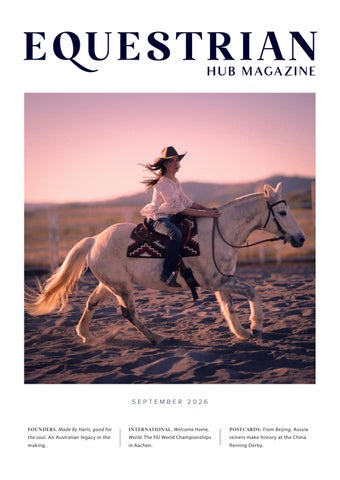
SEPTEMBER 2026
FOUNDER S. Made By Harls, good for
INTERNATIONAL. Welcome Home,
POSTCARDS: From Beijing. Aussie
the soul. An Australian legacy in the
World. The FEI World Championships
reiners make history at the China
making. .
in Aachen.
Reining Derby.
2 | E Q U E S T R I A N H U B SEPTEMBER 2 0 2 6
Find the educator who moves you forward. Arena Link connects Australian riders with the educators and clinicians who can move them forward, across every discipline, in every state.
Some riders are ready for the next level. Some educators are ready to take them there. Arena Link is where they find each other. NOW LIVE. BE FIRST THROUGH THE GATE.
arenalink.com.au E Q U E S T R I A N H U B . C O M . AU | 3
O U R C O N T R I B U TO R S
Kirsty Pasto Based in Europe, Kirsty is an equestrian media specialist with 15 years' experience in journalism and photography. She produces features and visual content from some of the sport’s leading events for the FEI, international magazines, and equestrian federations. This month, she reports from the equestrian community's premier event, the FEI World Championships in Aachen, Germany.
Dr Andrew McLean Andrew is the CEO of Equitation Science International. An Honorary Fellow of the International Society for Equitation Science, he's a member of the FEI's Equine Welfare Advisory Group and Ethical Training Methods Expert Consultative Group. In this issue, we feature the first of a two-part series in which Andrew delivers a glimpse into the history and development of contemporary English disciplines.
Dr Anushka von Oppen Anushka is the founder of Core Equine Biomechanics, an equine veterinary practice based in the Yarra Valley and servicing greater Melbourne. Her focus is on lameness, poor performance, musculoskeletal health and helping horses maintain comfort, soundness, and performance longevity. In this issue she addresses the ongoing debate around ECVM.
Dr Jennifer Stewart B.V.Sc., B.Sc., Ph.D. With over 40 years’ experience as a veterinarian in mixed and equine practice, Jennifer’s special interest is equine nutrition. She was a Senior Veterinary Officer with the Australian Department of Agriculture, Water and the Environment for 10 years, and a Biosecurity Veterinarian with the ACT Government for two years. This month, she delves into weight management – and it’s all about the sugar!
Averil Crebbin Growing up around horses meant the horse bug bit Averil early! Her eldest daughter was also horse-crazy, and capturing moments of her training at home or at dressage competitions led to a passion for equine photography that spread to multiple disciplines and to Averil's successful studio. You'll find her work in our Gala Equine and Springs Equestrian AOR National Championships event coverage.
Anne-Marie Lasserre Anne-Marie is a Miss World and Miss Universe Figure Champion. She’s an AOR dressage rider, a specialist coach in aesthetics, sports performance and nutrition, and is dedicated to empowering equestrians to achieve peak fitness and personal transformation. Not surprisingly, it's rare for us to think about our pelvic floor - but Anne-Marie explains why she thinks we should. 4 | E Q U E S T R I A N H U B SEPTEMBER 2 0 2 6
Riley Lyall Riley, who hails from WA, grew up watching his mother Cindy Lyall ride to 4* on her talented off the track Thoroughbred GI Joe. He credits travelling across the Nullarbor with Cindy and watching her compete at Adelaide for kick-starting his equestrian career. Now with successful OTTs of his own, he competes to 4* and has represented Australia. We talk to Riley in our popular Life After Racing feature.
Steph Dunnachie This month's Postcards comes from China, where Steph was recently at a reining championship. She is a horsewoman, educator and professional trainer whose career has been built around developing confident, capable horse and rider partnerships. She is the owner of Lancefield Bloodstock and brings a unique depth of experience across multiple sectors of the horse industry.
O U R C O N T R I B U TO R S
Lisa Gordon Lisa is one of Australia’s most recognised equestrian photographers, renowned for capturing the heart behind the competition. With decades of experience across Royals, state titles and grassroots events, her work blends technical precision with emotional storytelling preserving the fleeting, authentic moments that define our sport. Lisa was kept busy at last month's Ekka, and we feature her work in our event report.
Sun Ning A professional photographer specialising in documentary-style candid shots, Sun covers competitions, events, motorsport and fashion, from Classic and Sports Car magazine rallies to China International Fashion Week, Harper's Bazaar, and Weibo Night. Amid dynamic live scenes he captures authentic, powerful moments, and his work is featured in this month's Postcards.
Mishel Metcalf The Operations Manager and Equine Nutritionist at Hi Form, Mishel has a Diploma in Equine Nutrition and is also an equine veterinary nurse. She specialises in finding the right balance to supplement when grass is nutrient and NSC dense, helping owners with a diet plan to compliment roughage intake and fill any gaps in nutritional value. Don't miss her article on all things pasture.
Naomi Hill Naomi is a positive psychologist and well-being coach who never grew out of the horse phase. Specialising in transforming positive psychology research into practical learning programs and resources that make a measurable impact, she’s passionate about helping society shed the stigma around mental health struggles. You'll love her Nourish article on riding and the science of hope.
Harls McIlveen Harls is a wife, mum, friend, small business owner, colleague and weekend warrior campdrafter. Combining her love of horses, campdrafting and all things handmade, she launched her own brand, Made By Harls, and offers a range of distinctively styled saddle pads and boutique tack that she crafts at WH Pastoral, her farm in Manilla, NSW. We feature her in this month's Founders.
Michael McInally Pick up a copy of your preferred horse racing magazine, and there's every chance Michael was the photographer behind the cover shot. Partnered with Magic Millions, Queensland Racing, the Brisbane Racing Club and Australian Pacing Gold, he was recently at the Ekka capturing OTT horses excelling in their new careers. We feature his images in our Ekka report.
Anita Barton BVSc (Hons) A veterinarian with a PhD in Equine Veterinary Sports Medicine, Anita is also a Grand Prix dressage competitor and judge, and has had extensive involvement in event management, including the Brisbane CDI, Australian Amateur Dressage Championships and QLD Youth Dressage Championships. In this issue she reports on last month's Gala Equine and Springs Equestrian AOR National Championship.
Amanda Mac Horse obsessed from an early age, Amanda read every pony book she could find until eventually her dream came true in the shape of a Connemara pony. She later studied for her BHSAI at Benenden Riding School in the UK. With her equestrian career now reluctantly behind her, she lives the horsey life vicariously as editor of Equestrian Hub Magazine. E Q U E S T R I A N H U B . C O M . AU | 5
What's Inside SEPTEMBER 2026
EDUCATION
Knowledge for better horsemanship.
10 52 28 86
The Evolution of Horsemanship The Great ECVM Debate Evaluation and Improvement of Pasture for Horses It's All About the Sugar
INSPIRATION Stories that move us.
14 44
Postcards - From Beijing Founders - Made By Harls
CONNECTION
Strengthening our equestrian community.
24 64
Nourish - Riding and the Science of Hope Life After Racing - A Wealth of Potential
EVENTS
Celebrating equestrian sport at every level. 32 68 74 78
Welcome Home, World Down to the Wire at Willinga Amateur Owner Rider National Championships The Ekka: Celebrating 150 Years
LIFESTYLE
Life beyond the saddle. 20 58 90 93
Property - An Iconic 22.5 Acre Harkaway Estate The Other Stirrups Property - Ridgmont Farm: A Turn-Key Masterpiece What We Love - Good Jeans
Equestrian Hub is published by Ecurie & Atelier. While every effort is made to ensure the accuracy of information published in this magazine, the publisher accepts no responsibility for errors, omissions or any consequences arising from the use of information contained within these pages. The views and opinions expressed by contributors are their own and do not necessarily reflect those of the publisher, its employees or representatives. The content of advertisements is the sole responsibility of the advertiser and does not constitute endorsement by Equestrian Hub. All content is published in good faith and is intended for general information purposes only. Readers should seek professional advice where appropriate before acting on any information contained in this publication. © 2026 Equestrian Hub. All rights reserved. No part of this publication may be reproduced, stored or transmitted in any form without the prior written permission of the publisher, except as permitted under applicable copyright law. Information, event details and credits are believed to be correct at the time of publication but may be subject to change. Unless otherwise stated, all editorial content, photography and design are copyright Equestrian Hub.
6 | E Q U E S T R I A N H U B SEPTEMBER 2 0 2 6
The People Behind the Issue Every issue of Equestrian Hub is shaped by the generosity, knowledge and passion of the people featured here. Together, they help us educate, inspire and connect Australia's equestrian community. We're incredibly grateful to all our contributors for helping make this publication what it is today.
EQUESTRIAN HUB SCENIC RIM, QLD Editor AMANDA MCWHINNIE amanda@equestrianhub.com.au Publisher & Partnerships SAM CAVALLO hello@equestriennemagazine.com Advertising BELINDA NICHOLS belinda@equestrianhub.com.au Podcast CHARLIE BRISTER bluegumperformance@gmail.com HOLLY HALL PERRIN kennallywood@coleychellefarm.com.au E-mail INFO@EQUESTRIANHUB.COM.AU Website EQUESTRIANHUB.COM.AU Social Media @EQUESTHUB Cover MICHELLE J PHOTOGRAPHY PHOTO BY HARLS After the bush fires - theriding iconic Harl's daughter Poppy Brumbies inKiandra a MadeGrey By Harls saddle
E Q U E S T R I A N H U B . C O M . AU | 7
HIGH FIBRE COOL ENERGY FEED
HARNESSING THE POWER OF SUNFLOWER SEEDS, AN ALL NATURAL SUPERFOO D
Omega Feeds has formulated a palatable, high fibre, low starch feed that contains a balanced blend of vitamins and minerals to ensure optimum health and vitality. No-Grain Gold is suitable for ponies, spellers and horses in light to medium work. High Fibre: For gut health and cool energy. Non Pelleted: Horses spend more time chewing which stimulates saliva production and in turn buffers the stomach and protects it from ulceration. Low Starch: Reduced risk of digestive upsets and metabolic conditions. Balanced blend of vitamins and minerals: For optimum health and vitality.
100% Australian, proudly supporting Australian farmers omegafeeds.com.au | SUPERFOODS FOR BRILLIANT RESULTS 8 | E Q U E S T R I A N H U B SEPTEMBER 2 0 2 6
Need nutritional advice? Visit our EQ Health Hub and ask our expert.
Hello, There is something wonderfully optimistic
competition season kicks up a notch or two,
who is busy carving out an equestrian
about spring. Almost overnight, the grass
performance horses will often have more
career of his own, while at the same
seems greener, early mornings feel a little
demanding nutritional requirements. And
time keeping up the family tradition of
less daunting, and the days are longer.
what better time, if you haven’t already, to
showcasing the immense talent of OTT
Life is stirring wherever you look - and
check those summer sheets and fly masks,
Thoroughbreds.
suddenly I'm thinking of exuberant foals
making sure they'll give your horse all the
executing heart-stopping zoomies around
protection they need from the heat, sun,
the paddock just for the sheer joy of it!
and annoying insects.
But while we celebrate the new season,
Have you got over the excitement of
spring also asks us to be a little more
Aachen? Barely? Then turn to Kirsty
thoughtful. That lush new grass may look
Pasto's coverage of this spectacular event
irresistible - and for your horse you can
to relive some of the key moments. We also
guarantee it is - but it brings its own set of
have a roundup of the Ekka, which last
challenges, particularly for horses prone to
month celebrated 150 years of bringing the
weight gain or pasture-related problems.
country to the city; we drop in on the Gala
So gradually introducing richer paddocks,
Equine and Springs Equestrian Amateur
managing grazing, and keeping a watchful
Owner Rider National Championships;
eye on condition are all essentials at this
plus we report on Willinga at Juandah
time of year.
Plains where the competition was fierce -
What does it mean to hope? How is it defined? And can we have more of it in our lives? Naomi Hill believes we can, and she explains how. Meanwhile, the Hub's resident fitness guru Anne-Marie Lasserre takes on the topic of the pelvic floor - ladies, this is not one you should miss. And our congratulations to Stephanie Dunnachie, Amanda Halliday and Matt Charles, who have just made Australian reining history by qualifying for the 2027 World Reining Championships. Stephanie reports on their triumphant trip to China
hardly a surprise when the richest Maiden
in this month's Postcards.
campdraft purse in Australia was on offer!
Our Founder is the unstoppable Harls
Metcalf takes a deep dive into pasture and
Dr Andrew McLean, one of our much-
McIlveen, whose business Made By Harls
grasses, and Dr Jennifer Stuart addresses
loved contributors, offers the first in a two-
sugar, body condition, and offers expert
part series delivering a glimpse into the
saddle pad in the colours she needed -
advice on how to successfully manage your
history and development of contemporary
proof that necessity really is the mother of
horse's weight.
English disciplines, and we welcome
invention!
On that note, we have you covered with two informative articles: Hi Form's Mishel
And as an aside, spring is also the season when you'll be wanting to reassess feed. As
aboard Dr Anushka von Oppen with the latest on the great ECVM debate.
was birthed when she couldn't find a
Finally, we have not one, but two dreamy properties to fire up your imagination, and
pasture quality improves, some horses may
This month's Life After Racing features
for this month's What We Love, we slip
need less supplementary feed, while as the
Riley Lyall, son of 4* eventer Cindy Lyall,
into some wickedly stylish riding jeans.
AMANDA MAC EDITOR, EQUESTRIAN HUB
E Q U E S T R I A N H U B . C O M . AU | 9
F E AT U R E
The Evolution of Horsemanship In Part 1 of our conversation with DR ANDREW McLEAN, he delivers a glimpse into the history and development of contemporary English disciplines. EH: Grand Prix dressage and dressage
in 2014. I spent a month living on the
that Germany doesn't have the centuries-
in eventing both have an interesting
grounds of the National Sporting Library
old national history that’s implied when
history.
and Museum in Virginia, USA, where they
you speak about ‘classical German
AM: They certainly do, because in the
have an extensive collection of old texts.
dressage’. There was no national
19th century they were both military
What I really wanted to explore was what
pursuits, but with very different aims. The
people actually meant by 'classical riding'.
English military’s approach was to
In the end, I discovered that classical
develop bold horses through hunting. The
means something different in every
French approach evolved through riding
country because each nation developed
school training, and the Swedes and
its own traditions, although François
Prussians followed a similar path in which
Baucher and François Robichon de la
the horse was educated to be very
Guérinière, who are regularly quoted as
obedient. So, from the beginning there
representative of the French school, differ
were two distinctly different philosophies.
significantly in their approach!
I became fascinated by all of this while
The Prussians developed their own
Biotop). I suspect that's because while
researching the history of horsemanship
philosophy, what is often overlooked is
traditional German training methods
10 | E Q U E S T R I A N H U B SEPTEMBER 2 0 2 6
approach to training until Prussia unified the German states in the late 1890s. What the Prussians did develop, however, was arguably the finest cavalry in the world. They used their Trakehner horses extensively for cavalry riding, which I find interesting because when I was working in Europe a couple of decades ago, very few Germans were actually riding Trakehners in elite level dressage (with the exception of Reiner Klimke and
F E AT U R E
looked nice, they were still pretty harsh
a series of tragic rider and horse fatalities
adoption of rollkur in dressage. Event
and the sensitive Trakehners didn't cope
in the late 1990s.
riders embraced aspects of that system
particularly well. German dressage really evolved through changes in breeding. They began with the heavier horses originally bred to pull artillery, which were later refined by introducing Thoroughbred bloodlines from Hanovarians like Pik Bube (whose grandsire was a Thoroughbred), and
I experienced that personally during an event in Tasmania, when one of my horses jumped a rail fence with a ditch immediately behind it. The obstacle was positioned on an uphill approach, and beyond the ditch was a section of road surfaced with blue metal. In those days there was no requirement to cover roads
because they believed it would improve their dressage scores. They didn't generally train with the same extreme degree of hyperflexion as some of the Dutch riders, but they certainly adopted much deeper head and neck positions. The problem is that once you teach a horse to respond to rein pressure by
Thoroughbred stallion Ladykiller -
with sand.
simply shortening their neck and giving at
influential sires that contributed
My horse caught a leg over the rail,
movement, athleticism and refinement,
somersaulted into the ditch and struck the
conflicting meanings. Instead of the rein
although they also brought a hotter
road. He broke his neck and died almost
temperament.
instantly. I was very sad and didn't want to
EH: How did German dressage develop
ride anymore, and I certainly didn't want
from that point on?
to event. What stayed with me, though,
AM: German dressage during the era of
was the reaction of the other advanced
Reiner Klimke was looking really very nice
riders. Out of respect, every one of them
in terms of self-carriage. You might argue
withdrew from the competition.
that the movements weren't quite as technically precise - pirouettes, for example – but essentially, I think it was a better era for the horses. Then, during the ’80s and ’90s, dressage went through that period of hyperflexion, or rollkur,
"German dressage during the era of Reiner Klimke was looking really very nice in terms of self-carriage."
which became enormously controversial.
the poll, the bit begins to have two saying ‘slow down’, it starts to mean shorten your neck. Many eventing horses trained to shorten their necks via rein pressure would then be less adjustable and therefore gallop too long in the stride and hollow in the back toward a solid obstacle causing a rotational fall. Whenever a horse accelerates, it naturally lengthens its stride and becomes hollow, which is precisely what you don't want. A longer stridelength with a hollow back reduces the horse's take-off options and often leaves the forelegs too close to the base of the fence, making a rotational fall more likely.
Ironically, it was incredibly successful in
That tragedy and others like it led to
competition. I was presenting at a global
change: that particular type of obstacle
dressage forum and sitting beside Kyra
was banned shortly after, and putting sand
Kyrklund (who was openly critical of
over road crossings to improve safety
hyperflexion) and Dutch dressage
became a requirement. The long-format
champion Anky van Grunsven. Kyra asked
event gradually changed, roads and tracks
Anky why she used rollkur when she’d be
were reduced and eventually removed
just as successful without it. Anky's
altogether as was the steeplechase phase,
answer was remarkably candid: "No, I
and frangible pins were introduced to help
wouldn't. Hyperflexion is what made the
stop rotational falls.
difference for me and for our team."
Lucinda Green has a very plausible theory
the older style of competitive dressage.
But eventually attitudes began to change
as to what caused that upsurge in
I also prefer to watch a harmonious show
as welfare concerns were recognised –
fatalities in the late ’90s, which centres on
jumping round, such as many of the top
and yet at the same time, nosebands
the introduction of mechanical post-hole
event riders, over much of the pure show
became progressively tighter, causing
diggers. She believes that when fence
jumping with a few exceptions.
dressage to come under increased
posts were dug by hand, they weren't set
scrutiny for both its equipment and
as deeply into the ground. Once
training methods.
mechanical diggers became common,
EH: Why is that? AM: Well, first I am very biased toward
EH: And what was happening in the
fences became more rigid with less give,
eventing world around that time?
so when horses hit them, rotational falls
AM: It followed a rather different path. I
became more likely.
think eventing has been ahead of the
My own view is slightly different. The late
curve when it comes to welfare, following
1990s also coincided with the widespread
EH: And how are these two disciplines progressing now?
AM: More recently, the concept of social licence has driven change. I think modern dressage is beginning to look better again, and I think eventing, in many respects, has led the way. Event horses are trained more comprehensively. Their dressage looks more natural, more functional and, to my eye, much closer to
eventing! Another reason is that event horses generally compete in much simpler equipment then the elaborate ABOVE: A highly regarded expert in his field, Dr Andrew McLean is the CEO of Equitation Science International. E Q U E S T R I A N H U B . C O M . AU | 11
F E AT U R E
12 | E Q U E S T R I A N H U B SEPTEMBER 2 0 2 6
F E AT U R E
headgear you see in specialist show jumping. I think show jumping was in a much healthier place during the 1970s and 1980s, when plenty of horses competed successfully in ordinary snaffles, and riders placed a much greater emphasis on training. Over time the sport has changed. Today's horses are extraordinary athletes. They're bred to be incredibly careful over a fence, so riders can now rely more on horses with an enormous amount of natural ability. They're so careful that many of them actually strike themselves on the chest during the bascule, which is why chest protectors have become
pressure meant lowering the head and becoming round, they often found themselves needing increasingly strong bits because the reins no longer had a single, clear meaning. You'll often hear lower-level jumping riders talking about collecting the horse around the corner before a fence, but the reality is that no horse actually jumps a fence in that compressed outline. If the horse remained in that posture at takeoff it
constantly adjusting the horse with the
" I think show jumping has adopted some of dressage’s narrative ..."
the same level of examination yet - but I
reins, they probably wouldn't need the increasingly severe bits, leverage bridles, and restrictive nosebands that have become so common. Show jumping has largely escaped the level of public scrutiny that dressage has experienced over recent years. Dressage has been forced to confront difficult questions around horse welfare and social licence. Show jumping hasn't faced suspect that day is coming.
EH: Have some changes in show jumping been driven by the huge prize purses available internationally?
commonplace.
would either hit the fence, lose balance,
AM: The financial incentives are
I think show jumping has adopted some
or be unable to see the obstacle properly.
enormous. I'd like to see young riders
of dressage’s narrative regarding getting
One person whose approach I admire is
horses round over the back and into deeper outlines, which I don't believe is
Albert Voorn, the Dutch Olympic gold medallist. He says show jumping training
taught correct position, correct horsemanship and to ride horses in simple snaffles, which develops much better fundamentals, before they move
necessary, especially when it is achieved
really comes down to three things:
by the hands.. A show jumper needs
teaching the horse to accelerate; teaching
rhythm, balance and adjustability, not an
them to decelerate; and teaching them to
artificially compressed frame.
turn. Everything else builds on those
I also think the influence of hyperflexion has filtered into show jumping. Once riders began teaching horses that rein
fundamentals. I think there's a great deal
Dr. McLean's excellent courses are
of wisdom in that. If riders concentrated
available through Equitation Science
more on systematic training and less on
International. (Image Helen Cruden).
into the higher levels. I think that's essential if the sport is going to remain sustainable over the long term.
E Q U E S T R I A N H U B . C O M . AU | 13
14 | E Q U E S T R I A N H U B SEPTEMBER 2 0 2 6
P O S TC A R D S
From Beijing From Tatura to the world stage - three Australian riders, one international opportunity, and a new chapter for Australian reining. STEPHANIE DUNNACHIE reports. Images by SUN NING.
I
t started at the gate. Three Australian riders stood together, watching and cheering as Amanda Halliday walked
into the arena at the China Reining Derby in Beijing, China. None of them knew it yet, but they were about to make Australian reining history. Amanda, a long-time non-professional rider from Victoria, had travelled to China to gain international experience and develop her riding through the International Reining Academy. She walked into the Non Pro arena on A Lil Cash N Guns and produced a score of 70 - the qualifying score required for the 2027 World Reining Championships.
show, Stephanie had far less preparation time than many of the other riders. She had the opportunity to ride two horses during the event, but knew that Chen’s stallion, Whizkey N Blonde, was the horse that could potentially give her the score she needed.
weeks in China running the International
There was no room for a second chance. “I’d never been so nervous before a reining run,” Stephanie recalls. “I knew I’d incurred a penalty during my run, and I wasn’t sure we’d done enough.” But the horse was exceptional. The scoreboard showed 71. She had done it. Three Australian riders had now achieved the qualifying scores
horses, develop correct horsemanship
the first Australian rider to achieve the qualifying score.
Team Celebration From the gate, Stephanie Dunnachie and Matt Charles watched on,
"The Academy provides riders from around the world with the opportunity to experience reining on highly trained horse ..."
celebrating with her. Then it was Matt’s
in New South Wales, Matt was the first rider out in the Open. Riding Shiney Electra, he produced a 71, achieving the qualifying score required for the Open. Another Australian had done it. Matt would go on to achieve a second qualifying score of 71.5 in the Open Derby, while Amanda would also achieve another qualifying score of 70 in the Open.
Horses and China Reining. The Academy provides riders from around the world with the opportunity to experience reining on highly trained and gain international experience, while helping grow the sport beyond its traditional strongholds in the United States and Europe. Amanda, who has been involved in reining for many years, travelled to China to challenge herself, ride more She was accompanied by her daughter, May Shaw, who also competed and experienced a tremendous period of growth during their time in China, showing to an extremely high standard throughout the event. Stephanie also took her nonprofessional client, Nicole Evison, who
turn. A professional trainer and owner of Sliding Lodge Performance Horses
between Sliding Lodge Performance
horses and broaden her experience.
She had done it. Not only had Amanda won the Non Pro, she had become
Reining Academy, a program developed
required for the 2027 World Reining Championships.
travelled with the expectation of gaining
An Opportunuty that Brought Them Together
more advanced horses and enjoying
Although their paths to China were different, all three riders were there because of a desire to develop their skills and experience reining on an international stage. Matt had established the initial relationship with China Reining
international experience, learning on the opportunity. Although Nicole didn’t achieve a qualifying score, she returned home with a renewed outlook and confidence, having performed to an extremely high standard. For Stephanie, seeing that development was one of the highlights of the trip.
Finally came Stephanie. She was the
year to conduct a clinic and compete,
Horses that Made the Opportunity Possible
last rider in the Open. Having arrived in
where he won the Open class on Shiney
The competition presented another
China only two days before the horse
Electra. He subsequently spent seven
unique challenge: the riders weren’t
after travelling to China earlier in the
E Q U E S T R I A N H U B . C O M . AU | 15
P O S TC A R D S
competing on horses they had spent months or years developing themselves. Their horses had been imported from America by China Reining and were highly trained, talented athletes. The riders had to adapt quickly, developing a partnership with horses they had only recently met before stepping into the arena. Amanda achieved two qualifying scores on A Lil Cash N Guns - 70 in the Non Pro and 70 in the Open. Matt achieved two on Shiney Electra - 71 in the Open and 71.5 in the Open Derby. Stephanie achieved her 71 in the Open on Whizkey N Blonde. The results demonstrated not only the quality of the horses, but the riders’ ability to adapt, communicate and perform under pressure. At the centre of the experience were their hosts, Tiecheng Chen and his wife and partner, Xiaoou Liu, who ABOVE: Amanda Halliday with Cocktails at Sunset. BELOW: Stepanie Dunnachie aboard Whizkey N Blonde.
owned the horses and welcomed the Australian riders to China. The opportunity they provided went far beyond simply providing horses to compete on. It allowed the riders to experience reining in another country, learn from a different international community and discover what they were capable of. Their generosity and hospitality will be remembered for a lifetime. And after Amanda became the first Australian to achieve the qualifying score, followed by Matt and then Stephanie, Chen arrived with beers to celebrate. Delivered in plastic containers - a very Chinese solution - the beers became part of a moment none of them will forget. Three Australians. Two professional trainers and one non-professional rider. All members of the Goulburn Valley Reining Horse Association in Tatura, Victoria. And all now with qualifying scores for the 2027 World Reining Championships.
16 | E Q U E S T R I A N H U B SEPTEMBER 2 0 2 6
P O S TC A R D S
ABOVE: Time to celebrate, and with very good reason.
The Road to Switzerland and Beyond
may consider hosting qualifying
never thought I would be of a calibre
events in Australia, creating a
to potentially represent our country,”
For now, the road to Switzerland
pathway for more Australian riders to
is still being mapped out. The riders have achieved the required qualifying scores and were awarded qualification rosettes at the China Reining Derby, although the results still need to progress through the formal channels before the pathway to the World Reining Championships is confirmed. What is clear is that the experience has opened a door that has never previously been open to Australian reining riders. There are further qualifying events internationally, providing opportunities for riders around the world to chase their own qualifying
experience international competition and potentially earn the opportunity to compete on the world stage.
"If you believe in yourself and keep chasing what you want out of life, there’s no reason you can’t achieve things you once thought were impossible." For Stephanie, the experience has been a reminder that the boundaries
she says. “But if you believe in yourself and keep chasing what you want out of life, there’s no reason you can’t achieve things you once thought were impossible.” It is a sentiment that captures the experience of all three riders. What began as an opportunity to gain international experience in China has opened the door to something none of them had imagined - the possibility of competing for Australia at a World Championship. Now, the road leads from Tatura to CS Ranch in Switzerland in July 2027. And whether it is these three riders, or the Australian riders who follow them, they hope this is only the
scores. The riders also hope
people place around themselves can
beginning of a much bigger international
Australian clubs and organisations
often be their greatest limitations. “I
future for Australian reining. E Q U E S T R I A N H U B . C O M . AU | 17
P O S TC A R D S
18 | E Q U E S T R I A N H U B SEPTEMBER 2 0 2 6
P O S TC A R D S
ABOVE: Stephanie achieved 71 in the Open with Whizkey N Blonde. BELOW: The three Australian riders who qualified, and Chen, who qualified for China. LEFT: Matt Charles and Shiney Elektra.
E Q U E S T R I A N H U B . C O M . AU | 19
PROPERTY
An Iconic 22.5 Acre Harkaway Estate Just minutes to Haileybury Berwick, St Margarets, Berwick Grammar, Southside Racing Cranbourne and Pakenham tracks, this property is the pinnacle of perfection.
T
he pinnacle of perfection, this
Set amidst beautifully landscaped
These include a 50 x 30 metre jumping
premier rural lifestyle property
gardens and manicured lawns, the
arena, quality stables, and secure
sophisticated country homestead is
paddocks. With sweeping views of the
surrounded by magnificent exotic
nearby ranges and across to Western
specimen trees, expansive entertaining
Port Bay, this is a setting of rare beauty.
the ideal balance of country living with
spaces, and first-class equestrian
The residence features five bedrooms,
convenient access to urban amenities.
facilities.
four bathrooms, and multiple living
is undoubtedly one of the finest
in Melbourne’s leafy South East. King Road, Harkaway, is renowned for its exceptional lifestyle holdings and offers
20 | E Q U E S T R I A N H U B SEPTEMBER 2 0 2 6
areas, all showcasing premium finishes
The property is secured by advanced
the offering. Irreplaceable in both
befitting a home of this calibre.
security systems, supported by an
quality and character, this remarkable
irrigation dam and extensive water
estate reflects decades of care, vision,
storage that ensure near drought-proof
and attention from its devoted owners.
A fully tiled resort-style swimming pool, alfresco terrace, floodlit tennis court, and inground trampoline provide
reliability.
View this property online, or email Sales
endless opportunities for relaxation and
Extensive shedding and outbuildings,
Consultant Rachael Cavallaro from Jellis
recreation.
plus parking for ten cars complement
Craig or call on 0448 221 236. E Q U E S T R I A N H U B . C O M . AU | 21
Harkaway Estate is 22.5 acres of pure perfection.
22 | E Q U E S T R I A N H U B SEPTEMBER 2 0 2 6
E Q U E S T R I A N H U B . C O M . AU | 23
NOURISH
Horse Riding and the Science of Hope There’s more to life with horses than just the time we spend with them. NAOMI HILL explores the science of hope and how our connection with horses can help us build it.
W
What Hope Means
saddle after a lengthy and frustrating
With each of us having as many stories and struggles as there are speckles of sand in an arena, hope has likely appeared and eluded us in deeply personal ways throughout our lives. Sometimes we have it, sometimes we don’t. But why? Is it possible to train ourselves - as humans and horse riders to become more hopeful? Is it even safe to do so in this risky business we call
physical injury.
living?
down what hope means to you (sh*tty
hen do you feel the most hopeful? Take a moment to really think. Perhaps it’s
before a big competition you’ve been training for. Or watching a friend achieve their personal best on a dressage routine (‘If she can do it - why not me?’). Maybe it’s slinging yourself back in the
24 | E Q U E S T R I A N H U B SEPTEMBER 2 0 2 6
How would you define hope? Don’t worry, we’ll discuss and detangle the concept below, but just for a moment … Stop. Breathe. Trust that you’ve lived on this earth enough years to have formed your own ideas about what hope might be. Feeling brave? If you have a journal, or any sheet of paper will do, write
NOURISH
LEFT: Socialising can help our brains produce bonding chemicals like oxytocin, as well as providing a sense of support and accountability that helps us to get back in the saddle even amidst life’s struggles. ABOVE: Horses can be calming, empathetic, and even therapeutic creatures. first drafts and spelling mistakes are
In other words, hope happens when we
or brushing our horse – our muscles
encouraged!).
believe in our abilities. And how do we
release chemicals that can increase
build belief in our abilities? We do the
neuroplasticity, boost our mood, and
thing that matters to us - even when we
improve our brain’s capacity to deal
don’t feel like it.
with stress and difficult emotions.
scientists have as many definitions for
Hope Springs Empirical
Scientists call the hormones that your
hope as our readers do, they do tend to
I know what you’re thinking: Great,
muscles secrete into your bloodstream
align on one element: hope is an active,
another person telling me to work
that make your brain more resilient to
participatory process – in other words,
harder/smarter/faster! But I promise
stress and depression ‘hope molecules’.
it only works when you do.
(i.e. hope) this is where it gets exciting
Think of it like having a feel-good
and, admittedly, a little nerdy. You see,
pharmacy in your muscles, and the only
as well as being a cognitive practice
way you can access it is by contracting
we engage in, hope is also an emotion;
them through movement.
Now I hope that you took the time to jot something down, because it makes my next point rather brilliantly. Though
Professor John Parsi, Director of ASU’s Hope Centre, says it best: “Hope is an active process. Dreams and optimism are just belief structures,” he explains. “When you’re an optimistic person, you believe things in the world will turn
a feeling created in response to a complex cocktail of neurochemicals within the body.
While any kind of movement is a good thing, Kelly explains that when we engage in activities we love, our brains
out just fine, no matter what happens.
In fact, researchers like Professor Kelly
release specific neurotransmitters
Optimistic people see the glass as half
McGonigal, have found that when
associated with pleasure and reward.
full, but hopeful people ask how they
we move in a continuous way – such
With horse riding being more of a
can fill the glass full.”
as walking, riding, or even lunging
‘calling’ for regular riders than a E Q U E S T R I A N H U B . C O M . AU | 25
YO U N G R I D E R
26 | E Q U E S T R I A N H U B SEPTEMBER 2 0 2 6
NOURISH
soulless cardio workout, it’s far more
impactful to our wellbeing than ways
to try something that gets the heart
likely to tickle our pleasure centres.
we choose to move.
rate up and requires persistence or
But the benefits of saddling up don’t
Far from hoping to shed a few kilos, or
stop there. In fact, research has found
fit into a fancy dress, when we move in
This means engaging your core like
multiple ways horse riding sets the
the name of building our confidence,
your coach told you to, activating your
stage for the production of hope-
facing our fears, appreciating our
baby’s topline, and keeping the gait
inducing hormones.
natural environs, forging like-minded
above a trot for more than five minutes.
The Hopeful Chemistry of Horses
friendships, or even for the deeply
To be sufficient, it also needs to be
spiritual experience of bonding with
ongoing, rather than a one-off exertion.
such a majestic, powerful animal, we
Like I annoyingly said before - it only
begin to build our life around this
works if you do.
pursuit.
Meaningful Movement: I don’t want
It’s not just something we do - it
to beat the dead … whatever … But it
becomes a central part of who we are.
really does matter that your activities,
When we show up, not only for our
well, matter. We already know that we
Let’s be honest, very few of us began or continue to ride purely for physical fitness. We ride because we love those big, beautiful, majestic (and sometimes infuriating) animals. Horses can be (note - I said ‘can be’) calming, empathetic, and even therapeutic creatures. What’s more, as prey animals, they’ve evolved be to innately intuitive and hyper-aware of their environment and other beings within it. This may be why they’re so well-suited for those of us living with anxiety, PTSD, or other neurodevelopmental differences. In fact, a study published in the Journal of Traumatic Stress found that after just six weeks of equineassisted therapy, participants displayed fewer symptoms of anxiety and depression, and less severe emotional
own wellbeing, but to care for another
live and breathe horse riding, so this
"The fact is, research has found that we tend to give up on exercise, not because it's too hard, but because it's not meaningful ... over our lifetime, the ‘why’ behind our chosen forms of exercise can be far more impactful to our wellbeing than ways we choose to move."
and mindful. As you’re putting on your
responses. Throw in the added benefits of fresh air, exposure to nature, and socialisation that so often accompany this sport, and we can begin to see why horse riding is
endurance.
creature on this earth (come rain, hail, or shine), we build so much more than physical fitness - we develop mental toughness, perspective and courage.
is where it’s time to get more granular boots, consider why and how you’re showing up: what strengths might you draw upon today? What would you like to experience? What would you like to learn? How would you like to feel? Equally, as you peel off your sweaty jodhpurs post-ride, reflect on what went well, what you learned, and what you might like to try next. Want bonus points? Invite your fellow riders to join in on the reflection. The best things in life are shared. Moving Together: While we’re on the topic of our fellow two-legged friends, research continually reflects that moving with others can enhance all of the intrinsic benefits of exercise. Want
Making Mounted Up Time More Meaning ful
to go for a trail ride? Invite a friend and
When it comes to helping our bodies
some skills? Split the costs of a coach
produce these precious ‘hope
by joining or organising a group lesson.
molecules’, Kelly encourages us to make
Not only does socialising help our
Year’s fitness goal you’ve not achieved.
sure that our riding experiences meet at
brains produce bonding chemicals like
Come on. Don’t leave me on my own
least two of these three categories.
oxytocin, but it can provide a sense of
here. This is a safe, hopeful space.
Maximised Movement: While gentle
support and accountability that helps
The fact is, research has found that
activity, such as a slow walk around a
we tend to give up on exercise, not
paddock or a half-hearted grooming
because it's too hard, but because
session, may feel better in the short
it's not meaningful. In fact, over our
term, priming our brain for optimal
lifetime, the ‘why’ behind our chosen
hormonal production is going to require
forms of exercise can be far more
a little more exertion. Instead, we need
uniquely placed to be highly beneficial to our physical and mental wellbeing.
Why Meaning ful Movement Matters Hands up if you’ve ever set a New
make a day of it. Need to brush up on
us to get back in the saddle even amidst life’s struggles - and what’s more hopeful than that? Naomi Hill (MAPP) is a positive psychologist, wellbeing coach and word-weaver who never grew out of the horse phase. E Q U E S T R I A N H U B . C O M . AU | 27
excessive quantities to deliver any
NUTRITION
Evaluation and Improvement of Pasture for Horses
benefit? As our collective knowledge grows, purchasing decisions shift toward natural, whole-food options rather than heavily processed feeds laden with by-products.
The Value of Pasture Yet one critical component of the equine diet is frequently overlooked or placed
Good pasture and hay are the most cost effective and powerful nutritional tools for your horse, says equine nutritionist and pasture management consultant MISHEL METCALF.
M
in the too-hard basket: pasture and hay. Together, these should constitute the majority of a horse’s intake and therefore deserve the most careful consideration.
ost horse owners now
cereals and assorted hulls. The term
Diversity in pasture species underpins
recognise the risks of high-
'by-product' denotes material left over
sound gut health; roughage and fibre
starch, high-sugar diets. The
from another process – beet pulp and
drive the metabolism, fermentation
stock-feed industry in Australia remains
molasses from sugar refining, wheat
and synthesis that occur within the
unregulated, and bag labelling often
bran and middlings from flour milling, or
hindgut. Put simply, a healthy gut
reflects creative marketing rather than
soybean meal and hulls from vegetable-
produces a healthy, well-behaved
genuine suitability for equines.
oil pressing.
horse. But pasture improvement need
Many multinational manufacturers
Informed owners also scrutinise vitamin
not be overwhelming. Start with a
prioritise low-cost formulations
and mineral quality: are these nutrients
clear assessment, address the most
with high profit margins, relying on
bioavailable, or are they closer to
pressing issues first, and build diversity
ingredients such as millrun, stabilisers,
fertiliser-grade compounds that require
incrementally. Your horse’s gut – and
28 | E Q U E S T R I A N H U B SEPTEMBER 2 0 2 6
NUTRITION
High in Oxalates
High in NSC
Buffel Grass
Perennial Rye Grass
Setaria
Tall Fescue
Pangola Grass
Kentucky Bluegrass
Kikuyu
Italian Rye Grass
Para Grass
Cocksfoot (certain conditions)
behaviour – will reflect the investment.
grasses are almost inevitable.
disruptive than a complete renovation.
Identifying grasses: Numerous
Begin by conducting a thorough
Considerations
apps and field guides can help you
paddock assessment. Document the
Appropriate seed for your area: Get
name what is growing. Many equine
grasses present, identify weeds, note
help from local farmers or agronomists
properties were originally established
wet or boggy zones, locate overgrazed
for sheep or cattle – enterprises that
and heavily trafficked areas, check
favour high sugar pastures designed
manure distribution, and confirm
to fatten animals destined for short,
equipment access.
rapid-growth lives. This is the opposite
Practical Pasture Management
of what horses require.
Timing: Usually Spring or Autumn sowing is best Pest and Diseases: Pesticide use may be required after germination
Wet areas: Section off boggy zones
Waterlogging, soil acidity & nutrient
Reading the weeds: Determine
during winter to prevent deep rutting.
deficiencies: Soil test before sowing to
whether any weeds are toxic and
Potholes that dry out in warmer months
reduce crop failure
require immediate removal, or
pose a serious injury risk to fast moving
whether they signal overgrazing or soil
Manure Management: Best practice
horses. If grass is left ungrazed through
compaction.
is to collect manure, compost it until
the wet season, these areas can be
the high nitrogen content has leached
Dock, for example, sends a deep
opened later to provide additional feed
and stabilised, then spread it back as
taproot into compacted ground to break
during drier periods. Waterlogging
a natural fertiliser. Where composting
it up – weeds are often communicating
reduces the quantity and quality of
equipment is unavailable, harrow the
a soil deficiency. In modest quantities,
pasture. Weeds such as Yorkshire fog,
paddock and rest it for a minimum
certain ‘weeds’ benefit both horse and
Paspalum and Toadrush will dominate
of six weeks. This boosts microbial
soil.
wet pastures.
populations in the soil and helps reduce
Plantain supplies calcium, selenium
Grazing behaviour: Horses are
parasite burdens.
and zinc while soothing the digestive
selective grazers. They will repeatedly
Suitable Grass Choices
and respiratory tracts. Dandelion,
consume preferred species while
Native Australian grasses are ideal for
problematic in excess, offers vitamins
ignoring others, which grow long and
horses. They are naturally low in starch
A, C and K plus iron and potassium and
rank. Once favourites are exhausted,
and sugar, allowing safer, longer grazing
supports liver function when present at
horses move to the next preference
periods. The trade-off is cost – native
very low densities. Diverse fibre sources
down the list. Smaller paddocks allow
seed is significantly more expensive
strengthen the gut microbiome.
you to graze an area evenly, then
and persistence; natives are readily
Assessing What's in Your Paddock
rest it so all species recover – a far
outcompeted by aggressive cultivars
better outcome than a large paddock
such as ryegrass. If you are lucky enough
patchworked with overgrazed and
to have natives growing on your property,
undergrazed zones.
treasure them. Grasses that pop up
tend toward grasses higher in oxalates,
Overseeding: When you are ready to
without you sowing them are naturalised
while those in Victoria are more likely to
introduce greater diversity, overseed
grasses, not necessarily natives.
carry elevated levels of non-structural
into the existing swart rather than
Native Varieties
carbohydrates (NSC). Unless a property
spraying out all pasture and starting
Kangaroo Grass: Themeda triandra
has been purposely managed with
from bare ground. Improving what
equine health in mind, problematic
you have is more sustainable and less
is naturally low in NSC and suited to dry weather
Depending on your location in Australia, pasture will present inherent challenges. Properties in Queensland, for instance,
E Q U E S T R I A N H U B . C O M . AU | 29
Are you feeding for good gut health? Fresh clean water Diverse range of fibre Small meals Nothing artificial Slow transitions
30 | E Q U E S T R I A N H U B SEPTEMBER 2 0 2 6
NUTRITION
Wallaby Grass: Rytidosperma species is low in NSC and is highly resilient in poor soils.
Weeping Grass: Microlaena stipoides is low in NSC and grows well in temperate climates
Red Grass: Bothriochloa macra low in NSC but doesn’t handle heavy grazing
Windmill Grass: Chloris truncata is low in fructans When established and managed correctly, use varieties that can have lower sugar and starch profiles without inherent toxicity concerns.
Improved: Warm season varieties are lower in NSC, not suitable for sowing in cool climates
Browntop Bent: Agrostis capilaris cool season NSC can fluctuate; suits cool climates
Rhodes Grass: Chloris gayana low in NSC thrives in tropical and warm climates
Broome Grass: Bromus Cool season grass that can fluctuate up to 18% in NSC, will be less dominant in the paddock. Grazing management required for laminitic horse: Teff Grass: is a warm climate grass that is usually under 10% NSC Seeding a paddock means it will be taken out of rotation for some time. Depending on climate, you may have to wait up to twelve months before the new grass is strong enough to graze. You can test by pulling on the grass, mimicking grazing and check if the grass snaps or comes out by the roots. Light footed animals such as sheep are best to graze the new crop before putting horses on the pasture. Grazing young plants must be timed so that the root system is established enough to hold the plant in the ground.
Mishel Metcalf is the Equine Nutritionist and Pasture Management Consultant for Hi Form Australia. E Q U E S T R I A N H U B . C O M . AU | 31
32 | E Q U E S T R I A N H U B SEPTEMBER 2 0 2 6
I N T E R N AT I O N A L
Welcome Home, World Reporting from the heart of international equestrian sport, KIRSTY PASTO delivers a wrap-up of the 2006 FEI World Equestrian Games in Aachen, Germany.
W
elcome Home. The message
move between disciplines with equal
Glamourdale successfully defended
was impossible to miss. It
enthusiasm.
both individual titles, Australia’s
stretched across banners,
flashed around arenas and greeted spectators at almost every turn as a sold-out Aachen once again became the centre of international equestrian sport.
There was more than World Championship glory at stake.
standout story belonged to Pearce and Will Marq.
Dressage, eventing, jumping and para
The 10-year-old stallion's journey was
dressage offered the first qualification
almost as unlikely as what followed.
opportunities on the road to the Los
Bred on the Spanish island of Menorca,
From 11 to 23 August, the Soers
Angeles 2028 Olympic and Paralympic
Will Marq was contesting only his sixth
welcomed the world back for two
Games, adding another layer of
Grand Prix start when he cantered down
extraordinary weeks of competition, 20
pressure to performances already
the first centreline. “He’s gone from
years after the city last staged an FEI
carrying the weight of a world title.
the island in Spain where I think they have two arenas on the whole island to
World Championship at the celebrated 2006 World Equestrian Games. Across the fortnight, 689 athletes and 819 horses from 67 nations contested six FEI World Championships, with Australia among just 14 nations represented in every discipline. It was not, however, another FEI World Equestrian Games. With the final Games held in Tryon in 2018 and Endurance staged separately, Aachen instead brought six individual World Championships together, making it the largest FEI event in eight years and the seventh World Championship hosted by the German venue. Its vast Main Stadium can hold 40,000 people, yet even that does little to prepare you for the atmosphere when the grandstands are full and the roar of the crowd becomes almost deafening. Flags line the walkways, horses seem to appear around every corner and knowledgeable spectators
"Its vast Main Stadium can hold 40,000 people, yet even that does little to prepare you for the atmosphere when the grandstands are full."
Aachen,” Pearce explained. “He's just a young horse, and it's his first season of Grand Prix, and he handled it so well and he was so brave. I couldn't have asked any more.” A score of 72.391% put the pair 16th in the Grand Prix and safely through to the Grand Prix Special. Pearce admitted afterwards that she had hardly dared
For Australia, the fortnight delivered championship debutants, iconic veterans, Olympic qualification, heartbreaking near-misses and hardearned medals.
imagine getting that far. They then finished 12th in the Special and suddenly there was another problem. "I didn't prepare a freestyle because I didn't think I'd make the
Dancing on the World Stage
Special," she laughed. "Yesterday we
Australia’s four-strong team of Mary
went to another stable and borrowed
Hanna and Ivanhoe, William Matthew
a horse to ride some lines, and my
and Faye 43, Warwick McLean and Le
freestyle guy fixed something for me
Special, and Simone Pearce with Will
last night."
Marq finished 13th overall, securing the nation’s place at the Los Angeles 2028 Olympic Games. While Great Britain’s Charlotte Fry and
LEFT: Simone Pearce and Will Marq in the Grand Prix Team Final & Individual Qualifier (Image FEI / Leanjo de Koster). E Q U E S T R I A N H U B . C O M . AU | 33
I N T E R N AT I O N A L
ABOVE: Andrew Hoy aboard Vassily de Lassos on the cross country (Image FEI / Leanjo de Koster).
Somehow, the hastily assembled plan
from opposite ends of the championship
horses is developing the relationship
worked. Pearce and Will Marq returned
spectrum.
with the horse, and then going out and
for their third test in four days finishing 16th on 75.646%.
At 67, Andrew Hoy returned to the same venue where he had helped Australia
working through the challenges of the cross country, the dressage test and the jumping course,” he said. “I really love
Only a year earlier, Will Marq had found
win team bronze at the 2006 World
the atmosphere of major competitions
Equestrian Games. This time he was
overwhelming. “If you look back, we had
making his eighth World Championship
to retire a few times last year because
and his 20th global championship
Hoy was quick to direct the credit back
he was so overwhelmed and shy,”
appearance, yet there was little
to Vassily. "Every time I come out into
Pearce said. “To come in here, he was
sense that familiarity had dulled his
the competition arena, he just tries
just listening and waiting. He was so
competitive fire.
his heart out. He's a very, very special
brave. I just can’t stop crying because I’m so proud of him. He just gave me his all, and it was more than I could have
Partnered once again by the extraordinary Vassily de Lassos,
being at the pointy end of whatever I do, and that’s what keeps me going.”
horse, and I describe it as a privilege to ride a horse as good as he is."
Hoy began with the pair’s personal-
While Hoy added another chapter to
best dressage score of 26.9 before
one of the longest careers in the sport,
Opposite Ends of the Journey
negotiating Aachen's relentless cross
Sophia Hill was writing the first of hers.
If dressage offered one Australian story
country track and jumping clear on the
Making her senior World Championship
about a partnership still discovering how
final afternoon to finish sixth individually.
debut aboard Australian Thoroughbred
far it could go, eventing delivered two
“What really excites me about riding
Humble Glory, known at home as
asked for.”
34 | E Q U E S T R I A N H U B SEPTEMBER 2 0 2 6
I N T E R N AT I O N A L
ABOVE: Tjibbe B to be ridden by Dianne Barnes at the first horse inspection (Image FEI / Liz Gregg).
provided two very different highlights.
Hughie, Hill sat 68th after dressage. By
a while now, and to come here and do
Sunday afternoon she had climbed all
my absolute best in each phase is just
the way to 14th.
incredible," she said.
Cross country was the catalyst. Hill
For anyone inclined to believe the
remarkable 18-year-old fischerChipmunk
and Hughie were one of only six
modern sport has outgrown the
FRH, the German claimed a record fifth
combinations to complete Giuseppe
Thoroughbred, Hill had an answer
individual global title on home soil,
Della Chiesa's 5,600-metre course clear
for that too. “I think Thoroughbreds
while Great Britain broke the global
and inside the optimum time. Another
absolutely have a place at the top
championship team record to take gold.
clear in the Main Stadium left them on
of the sport. You only have to look
their dressage score.
at the horses here at the World
Across the Soers
Only four combinations achieved that feat: newly crowned World Champion Michael Jung and fischerChipmunk FRH, silver medallists Ros Canter and Lordships Graffalo, American
At the head of the field, Michael Jung made history of his own. Riding the
Beyond the Main Stadium and cross
Championships and at every 5*.
country, an entirely different discipline
There’re two Australian Thoroughbreds
was unfolding in the vaulting arena.
here and a New Zealand Thoroughbred. If you pick the right one, you’ve got an amazing horse.”
Australia was represented by Ginger Kennett and Bronagh Miskelly individually, as well as a six-member
Will Coleman with Diabolo, formerly
Australia finished 12th as a team and
squad. Miskelly finished 26th in the
ridden by Gemma Tinney, and Hill with
missed one of the seven Olympic
Individual Female Championship
Hughie. "I've been aiming at making a
qualification places available, but
and Kennett 33rd, while the squad of
senior championship appearance for
Andrew Hoy’s sixth and Hill's 14th
Eliza Wark-Chapman, Ivy Sykes, Nicki E Q U E S T R I A N H U B . C O M . AU | 35
Becky Moody and Jagerbomb competing in the FEI Dressage World Championship Grand Prix Freestyle (Image: FEI / Benjamin Clark).
36 | E Q U E S T R I A N H U B SEPTEMBER 2 0 2 6
E Q U E S T R I A N H U B . C O M . AU | 37
I N T E R N AT I O N A L
38 | E Q U E S T R I A N H U B SEPTEMBER 2 0 2 6
I N T E R N AT I O N A L
ABOVE: Gold medallist Boyd Exell in the marathon phase of the Four-in-Hand Driving competition (Image FEI / Wilco van Driessen). LEFT: Sophia Hill with Humble Glory at the first horse inspection (Image FEI / Liz Gregg). Coleman, Erin Ryan, Miskelly and Tegan
Mietta Innes-Irons and Sir Helmut
miscalculation can turn a championship
Davis finished 13th.
produced Australia’s best Para
upside down.
The second week also marked a first for Aachen as para dressage joined its World Championship programme. Australia's campaign suffered a
Dressage result, becoming the only Australian combination to qualify for a Freestyle final. They saved one of their strongest performances for last, scoring
By Sunday afternoon, he had done it again. Last to enter a near-capacity Stadium
heartbreaking setback before
74.425% to finish sixth.
2 for the cones, Exell guided his
competition began when Bridget
Eight and Counting
penalties to finish on 142.64 and secure
Murphy became unwell and was
experienced team through for just 0.30
If the first half of the fortnight had
admitted to hospital. Thankfully she was
World Championship number eight
produced Australian stories of potential,
okay, but medical advice meant she was
with a cherished team of horses who
perseverance and heartbreak, driving
have shared so much of his remarkable
brought something else entirely:
career. "I feel relief," he admitted
Her withdrawal left Dianne Barnes, Lisa
another chapter in Boyd Exell’s
afterwards. “I brought my favourite old
Martin and Mietta Innes-Irons competing
extraordinary reign.
horse Checkmate and he’s so good in
not discharged in time to compete.
individually and, because of the para classification requirements for a team score, ended Australia's team campaign before it had begun. There was still plenty to celebrate.
Exell began the championship chasing an eighth consecutive individual world title, an achievement difficult to comprehend in a sport where three phases, four horses and the smallest
dressage and cones,” Exell said. “He’s 19, so he gave me a lot of confidence to be strong for the Aachen World Championship.” However, there was more Australian E Q U E S T R I A N H U B . C O M . AU | 39
I N T E R N AT I O N A L
ABOVE: Individual gold medallist Steve Guerdat riding Dynamix du Belheme (Image FEI / Leanjo de Koster). silverware to come. With only Exell
remained at the centre of it.
Switzerland's Steve Guerdat.
and Tor van den Berge carrying the
The Closing Act
Guerdat and Dynamix de Belheme
That was equally true when jumping
did not knock a single fence across
brought the Championships towards
five demanding World Championship
their final crescendo. Australia fielded
rounds. In doing so, Guerdat became
a four-member team of Edwina Tops-
Switzerland's first individual Jumping
Alexander and Fellow Castlefield, Tom
World Champion and completed an
McDermott and Oaks Ventriloquist,
extraordinary personal collection that
Rowan Willis and Handsome, and Jamie
already included Olympic, European
Winning-Kermond with the Australian-
and World Cup Final titles.
team score and therefore no discard available, every penalty mattered. The pair finished on 317.25, just 2.12 points, less than a single cone, behind the Netherlands to claim team silver and improve on their 2024 World Championship bronze in Szilvásvárad. "Tor and I have been working together and practising for this occasion," Exell said, “and that's paid off."
bred Tulara Wat Colblensky.
Belgium's Thibeau Spits took silver,
The team ultimately finished 15th and
while Britain's Harry Charles completed
It was an extraordinary achievement,
missed both the team final and one of
one of the week's most remarkable
but perhaps the most revealing moment
the first Olympic qualification places for
comebacks to claim bronze.
came before Exell had even left the
Los Angeles, but there were impressive
arena. With another World title secured,
performances along the way with clear
he handed the reins to long-time groom
rounds over Frank Rothenberger's
Emma Olsson, jumped from the carriage
tough tracks.
and went straight to hug his horses.
For readers on the other side of the world, there was an intriguing Antipodean connection behind that final medal. Charles had only been
Germany gave the 40,000-strong home
riding LT Holst Freda for around three
For all the numbers, medals and
crowd the team gold they craved,
months when he stepped into the
records surrounding Aachen, the horses
but the final afternoon belonged to
Aachen stadium. The 12-year-old grey
40 | E Q U E S T R I A N H U B SEPTEMBER 2 0 2 6
I N T E R N AT I O N A L
ABOVE: On the podium, jumping owners alonside riders (Image FEI / Benjamin Clark). mare was bred in New Zealand by Ewen
individual final in 23rd. Two clear
The celebrations also extended well
Mackintosh of LT Holst Sporthorses and
rounds, when only three combinations
beyond the athletes themselves.
produced through the ranks there by
managed the feat, launched them all the
Throughout the Championships, grooms
Julie Davey before making the journey
way to bronze.
and owners were welcomed onto the
One person in particular had made
podiums, recognising the teams behind
to Europe. The combination began almost by
the journey to Aachen to watch her.
every medal.
chance. Freda had originally been
Mackintosh had flown from New
Eventually the ceremonies ended, the
considered for Charles wife, Eve, but
Zealand to see the mare he bred
horses began their journeys home and
when the opportunity arose to see the
compete on the biggest stage of her
the flags that had coloured Aachen for
mare, Charles and his father travelled
career, while Charles joked that Freda
two weeks started to disappear. Twenty
to the Netherlands. ‘We just stood
now attracts plenty of Kiwi support
years after the equestrian world last
looking at her in the cross ties and I
wherever she goes.
gathered for a Championship occasion,
said, “I don’t think you even need to
Home
Aachen had opened its gates once
By the final Sunday, six FEI World
again and proved that its slogan was far
Championships had produced history in
more than clever branding.
almost every direction.
For two unforgettable weeks, the
Boyd Exell had claimed an eighth
equestrian world had indeed come
It was a remarkable ascent. Charles
consecutive world crown, Michael
home.
and Freda had slipped as low as 59th
Jung a record fifth global title, and
during the opening stages of the
Steve Guerdat had completed his
Championship and entered Sunday's
extraordinary championship collection.
Based in Nice, France, you can enjoy more of Kirsty's work at Kirsty Pasto Media, or follow her on Instagram.
try this horse.” I was so in love with her already,” he recalled. Three months later they were standing on a World Championship podium.
E Q U E S T R I A N H U B . C O M . AU | 41
Apiam’s equine veterinary credentials are well-founded with a growing number of purpose-built dedicated Equine Vet Clinics and Referral Hospitals located in Victoria, New South Wales and Queensland, working alongside our network of mixed practice clinics in delivering quality equine veterinary care. Scenic Rim Veterinary Service Beaudesert QLD Agnes Banks Equine Clinic Agnes Banks NSW Hunter Equine Centre Scone NSW Victorian Equine Group Bendigo VIC Gippsland Equine Hospital Maffra VIC Southwest Equine Veterinary Group Warrnambool VIC
Find out more by visiting the Apiam Animal Health website & view the equine product range on Country Vet Animal Supplies COUNTRYVET.COM.AU
APIAM.COM.AU
Healthy animals – happy people
APIAM.COM.AU 42 | E Q U E S T R I A N H U B SEPTEMBER 2 0 2 6
Individual gold medallist Steve Guerdat riding Dynamix du Belheme (Image FEI / Leanjo de Koster).
Andrew Hoy and Vassily de Lassos framed by the iconic Welcome Home cross country arch (Image FEI / Leanjo de Koster).
E Q U E S T R I A N H U B . C O M . AU | 43
44 | E Q U E S T R I A N H U B SEPTEMBER 2 0 2 6
FOUNDERS
Made By Harls When HARLS McILVEEN couldn't find the saddle pad she wanted, she decided to make her own - and that was the start of something big. EH: For those who haven't met you
asking where I’d bought them. On the drive home, I sponsored my first event, set a launch date, and from that moment, the machine hasn’t stopped. In those early days, I wasn’t sure if anyone would like my work - let alone buy it - but it took off from there.
needed it most as not long after I started
saddles, saddle pads, bridles, and
EH: You’ve spoken about reluctantly
resigned. I had no plan B - it was now or
other goodies for campdraft riders (and
learning to sew from your mum, who ran her own boutique seamstress business, and finding yourself years later building a business around many of those same skills. There’s something quite beautiful about the things we inherit without realising their significance at the time. Do you see Made By Harls as part of a
before, tell us a little about yourself and what you do.
HM: Well, I’m a wife, mum, friend, weekend warrior campdrafter - and the face behind Made By Harls. I live in country NSW and design and make
anyone else who’s caught the bug or loves the style of my products).
EH: You describe the beginnings of Made By Harls as not being able to find something that you wanted to buy, so “I did as all country mums tend to do. I made it myself.” Tell us about that first saddle pad and how making something yourself ultimately became a business.
HM: The first three saddle pads I ever made were for the teams draft at Willinga Park in 2023. I thought finding one pad to fit three completely different horses and saddles - in our exact colours would be relatively easy. Spoiler: it wasn’t. Two weeks before the event, over a glass of wine, I decided I’d try making them myself. How hard could it be, right? My old dad was living with us at the time and quickly joined in the brainstorming. The very next day, he ordered my first industrial sewing machine as an early birthday surprise - six months early, in fact. That was just his way: if he thought you needed something and were capable of making it work, he’d make it happen. The machine arrived four days before we left for Willinga, and the rest, as they say, is history. The pads performed and so did the horses in them, and I had people
"I sponsored my first event, set a launch date, and from that moment, the machine hasn’t stopped."
Made By Harls, Dad was diagnosed with cancer too. At the time, I was working as a policy advisor in education. Working from home, a good salary, and weekends to myself was a great perk but when I realised time wasn’t on our side, I never. So, MBH started with Mum’s skills, Dad’s first machine, and a whole lot of latenight ideas. Luckily, my husband Wade has always been on board with my 2 a.m. brainwaves - and now he’s joined MBH full-time. It’s officially a family affair, and that makes it even more special. One day, I hope to pass the torch to my kids - or at least the spirit behind it: do what you love, don’t take no for an answer, find your tribe, and make it happen.
EH: Every Made By Harls pad is cut and made by hand at your farm in
creative legacy passed from your mum to you - and perhaps, one day, from you to the next generation?
HM: My mum was a creative genius. She never bought a pattern - every design was hand-drawn, cut, and sewn. Her dresses were masterpieces and every client received the same care and attention, no matter who they were or what they could spend.
Manilla, with many commissioned as trophies, gifts or pieces marking a particular occasion or achievement. In a world of mass production, there seems to be something increasingly special about receiving an object that has been made by one person, specifically for you. Why do you think we still attach such meaning to handmade things — and what does it mean to you knowing that something you've made may
Mum passed away from cancer when I was 25. Time moved on, but I kept her machines tucked away in the cupboard. Her button jar, though, stayed on my shelf - a quiet reminder of her.
become part of someone else's story?
Looking back, I think the universe gently steered me back to her legacy when I
something no machine can ever capture
HM: Handmade has a beauty of its own. It’s the opposite of cookie-cutter - it’s knowing that the product carries the maker’s time, skill and journey and that’s or replicate. E Q U E S T R I A N H U B . C O M . AU | 45
FOUNDERS
ABOVE: Handmade means every piece tells its own story. RIGHT: Harls made Rowdy a saddle featuring saltwater crocodile skin, a tangible link to the past. Every person has a story, and being
precision. But I’m a perfectionist at heart
HM: Proud. Grateful. Humbled. I have
invited into it, in even a small way, is an
- so nothing leaves my studio unless I
always loved campdrafting: the dust
honour. There is nothing I am prouder
love it.
rising in the arena, the thrill of tight pegs
of than seeing someone on their horse, with a piece of my gear. That moment is humbling because in a world full of choices, knowing someone has chosen Made By Harls means more to me than words can really say.
My patterns were born from hours of trial, error, and the lessons learned from the horses in my own paddocks. I’ve tapped into the knowledge of riders all over Australia to design gear that works hard - whether you’re chasing a beast in
and a good gate, the quiet moments between runs. From the first draft I ever went to, I’ve looked up to riders whose skill seemed effortless and the clubs and organisations that make the events happen. I never imagined that one day my work would stand alongside them.
EH: There’s an incredible attention
the arena or putting in a day’s work on
to detail in your work — from sourcing
the land. I also use Australian suppliers
Knowing the gear I create carries the
materials and pattern matching to
wherever I can, and I choose materials
brands of those very riders and events
choosing leathers — yet no two pieces
for their quality, not their profit margin.
I once dreamed of being part of is
will ever be precisely the same. Would
My rule is simple: if it’s not good enough
something I am so proud of. Knowing
you describe yourself as a perfectionist,
for my horses, it’s not good enough for
that it will be part of someone’s story - a
and how do you reconcile that
yours.
run in the arena, a win hard-earned, a
pursuit of precision with the natural
EH: Your work is commissioned as
irregularities and unique character of the materials you work with? Ultimately, what determines what leaves your workshop — and what stays on the cutting room floor?
trophy pads for some of Australia’s most coveted events and recognised through your appointment as an AQHA Preferred Saddle Pad Maker. When you think back to making that first pad simply because
memory that lasts a lifetime is pretty darn special. It’s a privilege to belong to a community I love, and I like to give back when I can, to help this sport grow, and to ensure that the spirit of campdrafting - its grit, its grace, its sense of family - continues to
HM: Handmade means every piece tells
you couldn’t find what you wanted,
its own story. Leather holds the life of the
what does it mean to now see your
animal in its grain, and woven blankets
work associated with some of the most
EH: Of all the pads you’ve created, is
rely on the maker’s eye, not a machine’s
significant achievements in the sport?
there one that holds particular meaning
46 | E Q U E S T R I A N H U B SEPTEMBER 2 0 2 6
thrive.
FOUNDERS
E Q U E S T R I A N H U B . C O M . AU | 47
FOUNDERS
ABOVE: Harls has always loved the feel of close contact when competing, and in her camp, each horse has their own pad. for you? And have you ever finished one, looked at it and thought, I’m not sure I can let this one go?
HM: It’s hard to choose just one, but the first pad I ever sold - a pink and navy kersey – stands out in my mind. A friend bought it, and I remember wondering if she truly loved it or was simply being kind. That pad has since seen every corner of their farm, worked client breakers, been to horse sales, and carried them to draft wins. It’s still going strong today, and every time I think of it, I’m reminded that the people in your corner are there for a reason. As for the ones I couldn’t let go, my mum always said the best gift is something you’d love to keep yourself. There have been a few I’ve been tempted to tuck away for myself, but the real joy comes from letting them go - seeing them in someone else’s truck, becoming part of their wins, their work, and their memories.
EH: You’re a self-confessed “weekend warrior” campdrafter yourself. How
much has Made By Harls been shaped by riding and competing your own horses - and knowing exactly what you want between you and your horse?
HM: I’m not a pro rider, but I am particular - those close to me might say pedantic - about what I use on my own horses. I’ve always loved the feel of close contact when competing, and in my camp, each horse has their own pad. For me, it’s about balance - the way your gear works together. It’s not a one-sizefits-all world, and sometimes the smallest tweak can change everything. That’s the magic I chase – something that fits and feels good to both horse and rider.
EH: You’ve recently taken another significant step, learning the traditional craft of saddle making under the guidance of some highly respected Australian saddlers. Your daughter was the first to ride in the first saddle you completed, and you’ve described hoping it might be the beginning of a legacy. What drew you to this next chapter, what has it meant to
48 | E Q U E S T R I A N H U B SEPTEMBER 2 0 2 6
have others so generously pass their knowledge on to you, and what do you hope you might ultimately pass on in return?
HM: I’ve always wanted to move into saddlery. The saddle I rode in as a kid was handmade by one of Mum’s relatives, and from that moment, I developed a deep appreciation for a well-crafted saddle. Over the years, the art of saddle building became something I was truly fascinated by. I loved picking the brains of saddlers at events like Nutrien, learning from their experience and insight. Having ridden in countless saddles myself, I began to notice the details - what I liked, what I’d change - and making saddle pads only deepened that curiosity. Eventually, the idea of building my own saddle began to take shape, and I started sketching out a design. I decided to take a chance and messaged Dan Baker and Peter Brophy. Both masters in every sense of saddlery,
FOUNDERS
and two of Australia’s most respected
sport I love and turning it into something
down as they swing into the saddle and
builders.
tangible. I guess it’s where the chaos of
pick up the reins?
The trees I use are built by Peter whose expertise, honed over years of tree and
everyday life meets the quiet satisfaction of creating something I’m proud of.
HM: I work from the most beautiful little studio - a space that holds a lot of
saddle building, ensures a foundation for
EH: Your new releases are highly
each saddle that just works; and in a one-
anticipated, pieces can sell out within
on our property, so every time I open the
on-one school, Dan taught me patterning,
minutes and your custom work carries
door, it feels like stepping into a place
the reasoning behind every design
a long-waitlist - all wonderful measures
filled with warmth and good energy.
choice, and the nuts and bolts of building
of how deeply people value what you
a saddle from the ground up.
create. But success rarely tells the whole
To have both Dan and Peter as mentors is more than a privilege - it’s one of the greatest honours. My daughter Poppy gave the very first saddle built its maiden voyage, and amongst others I’ve since crafted another for our five-year-old cowboy, Rowdy. Sharing the journey is a big part of MBH, so Rowdy’s saddle features saltwater crocodile skin, a nod to the trip to
story. What has been one of the more difficult chapters in building Made By Harls, and what has that challenge
decent problem solver, so most business hurdles haven’t shaken me too much. But the loss of my dad last year was a low point.
"Whatever is good for your soul, do that. Life is short ..."
you’re juggling home, kids, horses, work and a growing business - while
heartbeat. It was an honour, but also
somehow trying to find a little time for
one of the hardest things I’ve ever
yourself, too. What does it look like for
done. Smiling through the ache of
you, and how do you make Made By
losing someone you love, while trying
Harls fit in with everything else that
to keep momentum in life and work,
matters in your life?
is a challenge you can’t prepare for -
HM: With kids ranging from almost
balancing grief with the need to keep
nineteen down to five, life is definitely
moving forward.
a juggle! Like so many families, we’re
That time cemented my ‘why’. Why I show
busier now than ever before and it
up. Why I’m here for the long haul. Why
does get hard to fit everything in. There
I tell the stories behind each product,
are days where I can’t ride my horses,
celebrate the wins, and keep creating. It’s
where dinner is a good old BBQ chook
my chicken soup for the soul. That’s why.
and coleslaw from IGA, and when the
EH: Take us inside your workshop for
washing is tomorrow’s problem, just like everyone. I don’t do all-nighters like I did when I first started though – I did have to find balance or you’d burn out - but it definitely makes the long days feel worthwhile when the to-do list feels endless.
leave its mark on every piece. That’s
too long, and I needed a new pad, so I
course. I’m a fairly resilient person and a
sick - something I would do again in a
EH: Like so many of our Founders,
time, but I do always let my creative side
HM: There have been challenges, of
build saddles. It’s more than just a piece
will be told for years to come.
patterns and processes I’ve honed over
actually how the engraving started. I went
I cared for him at home while he was
present, and future, and a story I hope
I’m pretty methodical in how I work, with
taught you about yourself as a founder?
Rockhampton where Mum first learned to of gear - it’s a tangible link between past,
meaning for me. It’s where my dad lived
a moment. What does your creative process look like when you begin a new piece - are you methodical in the way you work, or is there room for spontaneity along the way? You often stamp motivational quotes onto the top of your pads, visible only to the rider.
For me, MBH isn’t just my business
Where did that idea come from - it’s
though; it’s my creative space, my way
brilliant! - and what do you hope those
of blending my love for horses, the
words mean each time a rider looks
through a stage where my reins were engraved a little reminder on the wither - just for me, where no one else could see it. I posted a picture of it and people loved it!! I’ve had so many messages from people who it’s made a difference to. Since then, I’ve heard from so many riders who say it’s given them a boost of confidence in the saddle. It’s proof that sometimes, the smallest touches carry the most meaning. QUICK SIX Favourite pattern or colour to work with? I’m a sucker for chocolate brown! Favourite campdraft to attend? Any. As long as there’s cattle, a campfire and good company - I’m in! What does your perfect day at home look like? As long as they start with coffee, the day is usually a winner. Dream event to attend - in Australia or overseas? Not so much a single event, but I’d love to do a run for a few months. Load the truck and just head from draft to draft! What’s playing in the workshop while you work? A campdraft livestream if there’s one on! Best piece of advice you’ve ever received - or words you live by? Whatever is good for your soul, do that. Life is short and nobody is promised tomorrow, so find your passion and follow it. Catch up with Harls on Instagram and Facebook. E Q U E S T R I A N H U B . C O M . AU | 49
FOUNDERS
50 | E Q U E S T R I A N H U B SEPTEMBER 2 0 2 6
FOUNDERS
E Q U E S T R I A N H U B . C O M . AU | 51
52 | E Q U E S T R I A N H U B SEPTEMBER 2 0 2 6
VET VIBES
The Great ECVM Debate Few topics in the equine world currently generate as much discussion with conflicting opinions as ECVM. DR ANUSHKA VON OPPEN explains.
E
CVM sits at the centre of a
worldwide have subsequently identified
Horses with ECVM don't follow a single
genuine debate spanning
similar changes across Warmbloods,
clinical pattern. The presenting problem
veterinary practice, research,
Quarter Horses, and Arabians. This
may be behavioural, subtly performance
foundational work is grounded in
related, or lameness. They may present
breeding, and the wider equine community, with real evidence and strongly held views on both sides. There are horses whose long, puzzling
post-mortem dissection, and those specimens tend to reflect horses at the
finally make sense once this region is assessed. There are also horses carrying the same radiographic findings who compete at the highest level without apparent consequence, or are successfully managed. Both experiences are real, both have supporting evidence, and the truth for any individual horse often lies somewhere in between. ECVM, or Equine Complex Vertebral Malformation, refers to a developmental malformation of the caudal cervical region involving the sixth and seventh cervical vertebrae, the first and second sternal ribs, and the associated soft tissue structures. A related but more specific term, ECCMV (Equine Caudal Cervical Morphological Variation),
contact, tense or stiff muscles through the base of the neck, clumsiness or poor limb awareness, or a variable lameness
histories of poor performance, behaviour change, or subtle asymmetry
with; difficulty bending, resistance to
Clinical signs that can be related to ECVM/ECCMV
• Reluctance or difficulty bending the
frequently only apparent under saddle. As many of these signs are vague, they are easily attributed to training gaps
neck (during mobilisations or under
or temperament, which is part of why
saddle)
the condition can go unidentified for
• Tense & stiff muscles at the base of the neck
• Reluctance to accept the contact during ridden work or defensiveness with collection
• Grithiness or discomfort during saddling
• Variable performance history with no frank lameness
• Subtle behavioural changes under saddle: tension, resistance, or reactivity that persists
• Variable lameness present during ridden work
• Clumsy, lack of awareness limb position, frequent tripping
extended periods. At a structural level, the malformation involves absence of the caudal ventral tubercle of C6, which may be unilateral or bilateral, with variable transposition on to C7. These landmarks are the attachment sites for the longus colli, a deep cervical muscle critical to stabilising the base of the neck and relaying positional information to the brain. Altered bony architecture is thought to shift these attachments, destabilising the neck, increasing joint stress, and disturbing positional feedback. Dissection studies have also shown that soft tissue changes in this region are far more extensive than plain
describes the morphological variation of C6 specifically, the consistent vertebral
end of complex clinical histories, often
radiographs reveal, with alterations to
anomaly that features across all
with multiple concurrent pathologies.
local musculature, blood supply, and
presentations.
Translating post-mortem findings into the
nerve structures that standard imaging
Australian equine anatomist Sharon
clinical picture of the living horse is not
May-Davis was first to bring these
always linear, which is why it is equally
Advanced imaging with CT of the base
variations into mainstream clinical
important to take the whole presentation
of the neck and the thoracic inlet is
awareness through extensive peer-
into account when determining the
reviewed dissection work. Researchers
significance of any imaging findings.
LEFT: Ultrasound of the base of the neck.
cannot capture.
E Q U E S T R I A N H U B . C O M . AU | 53
VET VIBES
study of 200 pre-purchase Warmbloods found the variant in approximately one third, with no meaningful difference in competition performance between affected and unaffected horses. A 2025 study of 223 Warmbloods found cervical variants were actually less common in horses presenting with neurological signs, neck pain, or neck-related lameness than in controls. What it did find was that joint changes (arthritis) at C6-C7 and C7-T1 were significantly more common in clinical cases. The congenital variant alone did not predict disease, but significant structural change at the cervicothoracic junction did. These findings are not in direct conflict. The variant can exist in horses who ABOVE: Bone specimens showing the caudal cervico-thoracic region, highlighting the caudal ventral tubercle.
perform well for their entire careers, and it can also exist in horses where concurrent structural and inflammatory
adding to our understanding of the
changes at this junction contribute to
What a full workup involves
clinical picture, revealing structural
the clinical picture. The challenge is
• Clinical examination in-hand and
changes that have traditionally been
interpreting where on the spectrum the
under saddle
more difficult to diagnose. However,
individual horse sits, and what other
for many horse owners, the process is
concurrent lesions may be present.
cranial ribs
cost-prohibitive, and as such diagnosis
• Cervical radiographs including the • Ultrasound of the articular process joints
• CT of the cervicothoracic junction and thoracic inlet (where accessible)
• Response to trial treatment as part of the diagnostic process. Management and support options
• Manual therapy and cervical mobilisation
• Targeted exercises to strengthen the thoracic sling
• Management of active joint inflammation through joint and nerve root injections
• Shockwave and mesotherapy as adjunctive treatments
• Saddle fit assessment • Adjusting ridden work demands and expectations
• In-hand work, liberty training, or
revolves around the combination of X-ray and ultrasound, interpreted in context of the full clinical picture of the horse.
Understanding what is happening at the cervicothoracic junction requires looking beyond the bony variant. Alongside C6 and C7 changes, there may be associated changes in the cranial
Clinical opinions on the significance
thoracic vertebrae, the sternal ribs, or
of ECVM findings have been variable.
the articular process joints at C6-C7
Research examining horses presenting
and C7-T1, unilaterally or bilaterally. In
for cervical radiography found that those
this biomechanically demanding region,
with an anomalous C6 were significantly
horses with ECVM frequently show
more likely to have cervical pain, even
changes at these facet joints resulting
without radiographic signs of arthritis,
in joint or nerve-related discomfort.
suggesting much of what this condition
Ultrasound identifies active inflammation
produces is subtle and not visible
that radiographs cannot. CT provides
on plain X-rays. Separate research
considerably more detail about nerve
found that associated discomfort can
roots, exit spaces, and the true extent
be difficult to detect in-hand and may
of structural change, and continues to
only become apparent under saddle,
refine how we understand and manage
at speed, or over jumps, which helps
the condition in individual horses.
explain why the condition so often goes unrecognised on standard examination.
Equally important is what imaging cannot tell you. A horse's history matters
low-impact alternatives where
Larger population studies raise
as much as their X-rays: when changes
appropriate.
important questions about whether the
began, what has been tried, how the
variant itself drives the problem. A 2026
horse behaves in the paddock versus
54 | E Q U E S T R I A N H U B SEPTEMBER 2 0 2 6
VET VIBES
under saddle, and whether concurrent problems exist elsewhere. Horses managing long-term discomfort may have developed chronic sensitisation and compensatory patterns that add a further layer, independent of any single radiographic finding. A horse showing subtle behavioural changes at rest is a different clinical situation from one that is content in the paddock but struggles under saddle, and they call for different conversations. Where the clinical picture warrants it, trialling treatment is a valuable next step that allows us to make a plan prognostically. Any medical treatment should always be accompanied by physiotherapeutic management as well as managing any other compensatory factors. Manual therapy, cervical mobilisation, targeted exercises to strengthen the thoracic sling, and management of active joint inflammation can make a meaningful difference, particularly before compensatory changes become entrenched. Evidence suggests that compromised lower cervical stability may worsen with age, reinforcing the value of early identification and management where the clinical picture supports it. How horses are ridden also matters: the demands of collected work, the rider's position and symmetry, strength of the thoracic sling as well as the core, and the overall training environment all influence what is being asked of a region that may already be under stress. Where conventional ridden work is not appropriate, in-hand work, liberty training, or low-impact movement are worth considering. Neurological signs require their own careful assessment, and the conversation around ridden work becomes considerably more serious. A horse less aware of where their feet are in space poses a genuine safety risk. Where some ridden work may remain appropriate, it should be in
TOP: Normal base of C6 (green and purple arrows show the left and right CVTs), yellow arrows show mild enlargement of the C6-C7 facets. MIDDLE: Unilateral ECCMV (red arrows) with translocation of the tubercle to C7 (pink arrows). BOTTOM: Bilateral ECCMV (red arrows) with marked enlargement of the C6-C7 joints (blue arrows). E Q U E S T R I A N H U B . C O M . AU | 55
VET VIBES
56 | E Q U E S T R I A N H U B SEPTEMBER 2 0 2 6
VET VIBES
LEFT: Chiropractic mobilisation of the base of the neck. RIGHT: Performing an ultrasound guided injection of the left C6-C7 joint. BELOW: Comparison oblique radiographs of a horse with unilateral ECCMV - green arrows on the left highlight a normal CVT, red arrows on the right highlight an absent CVT. experienced hands only, after thorough
uncertainty is exactly why individual
are best served by a thorough individual
assessment and a period of treatment.
assessment, full clinical picture, targeted
assessment, open communication about
Others present with neurological signs
imaging, and response to treatment
what we know and what we don't, and
significant enough that ridden work is
matter so much. Assessing the whole
a treatment plan that keeps the whole
not in the horse's or rider's best interest.
clinical picture is key, as well as the
horse in view.
ECVM is a real and documented structural condition. In some horses it is part of a clinically meaningful picture warranting careful management; in
ability to provide longitudinal monitoring over time, that enables us to detect any early changes in performance or range of function.
Dr Anushka von Oppen is the founder of Core Equine Biomechanics, an equine veterinary practice based in the Yarra Valley and servicing greater Melbourne.
others it is present without apparent
The evidence around ECVM will
She has a focus on lameness, poor
consequence. The current evidence
continue to grow, and so will our ability
performance, musculoskeletal health
does not allow us to predict with
to interpret it. In the meantime, the
and helping horses maintain comfort,
certainty which is which, and that
horses in the middle of this conversation
soundness and performance longevity.
E Q U E S T R I A N H U B . C O M . AU | 57
58 | E Q U E S T R I A N H U B SEPTEMBER 2 0 2 6
RIDE FIT
The Other Stirrups Not surprisingly, it's rare for us to think about our pelvic floor - but ANNE-MARIE LASSERRE believes we should.
B
y the time you’ve negotiated a
properly. It also needs to relax. Because
Like so many things in fitness, context
half-halt, a flying change and a
here’s the thing nobody tells you when
matters. Your age, pregnancy history,
horse who has suddenly decided
they first discover pelvic-floor exercises:
hormonal changes, fitness level, pelvic
more squeezing isn't necessarily better.
floor function, riding discipline, training
the corner is haunted, the last thing you’re probably thinking about is your pelvic floor.
Your pelvic floor isn't supposed to spend its entire existence clenched like
But perhaps you should be. Not in a
you’ve just spotted your ex across the
dramatic, cancel the lesson, swap the
cocktail bar. It needs to contract when
saddle for a speculum, and put your feet
appropriate, relax when appropriate and
up in a different set of stirrups kind of
respond to movement and pressure.
way. More in a Darling, have we been
Which brings us rather neatly to riding.
neglecting something? kind of way.
Your pelvic floor isn't supposed to spend
Because while we equestrians are wonderfully committed to analysing our horses from nose to tail - topline, hindquarters, core, suppleness, straightness, impulsion - we can be surprisingly casual about the very body that is sitting on top of the horse. And that body, ladies, needs a little attention too. Especially the pelvic floor. Yes – that pelvic floor. The mysterious group of muscles nobody really talks
its entire existence clenched like you’ve just spotted your ex across the cocktail bar.
at an inconvenient moment.
What Exactly is the Pelvic Floor? Think of the pelvic floor as a muscular hammock sitting at the base of your pelvis. It supports your bladder, bowel and reproductive organs, helps with bladder and bowel control, contributes to sexual function and works with the muscles of your trunk to help stabilise your pelvis.
play a part. And if you experience pelvicfloor symptoms, they’re worth paying attention to rather than simply filing them under ‘Well, I’m a woman, apparently this is my life now’. Because it doesn't have to be.
It's Not All About the Squeeze You’ve probably heard of Kegels? The basic idea is to contract the pelvic-floor muscles - think of the muscles you would use to stop yourself from passing wind
"Your pelvic floor isn't supposed to spend its entire existence clenched like you’ve just spotted your ex across the cocktail bar."
about until something starts leaking, aching, bulging or behaving rather badly
load and individual biomechanics can all
or urine - and then release them. Simple, right? Well … sort of. The pelvic floor isn't a one-trick pony. It needs strength, endurance, coordination and relaxation. It also needs to work alongside your breathing, abdominals, diaphragm, hips, glutes and back. Your pelvic floor should not be your entire
Is Riding Bad for the Pelvic Floor? The short answer? Not necessarily. Horse riding places considerable demands on the pelvis. You’re responding to movement, stabilising yourself, absorbing forces and coordinating your pelvis, spine, core and legs while communicating with a beastie that weighs several hundred kilograms and occasionally has very strong feelings
workout.
Built From the Ground Up Strong riders are built from the ground up. As a personal trainer, I’m a little obsessed with strength. And not just because I enjoy watching women discover they can lift significantly heavier things than they thought possible. Strength matters. For riders, it matters enormously.
about where it would rather be. So no,
Your pelvic floor is part of a much
In other words, it has a fairly impressive
being in the saddle isn’t automatically the
bigger system. If your hips, glutes, legs,
job description. And like any other
villain. Riding is simply another activity
trunk and upper body aren't strong
muscle, it needs to be strong,
that asks your pelvic floor to work - and
and coordinated, asking one tiny area
coordinated and able to do its job
every body responds differently.
to do all the stabilising is rather like E Q U E S T R I A N H U B . C O M . AU | 59
RIDE FIT
ABOVE: Your routine defines you. asking your horse to jump a Grand Prix
one getting the expensive saddle, the
Because sometimes the strongest
course while wearing one boot. It might
massage, the physio, the supplements
muscle is the one that knows when not
technically be possible. But why make
and the meticulously curated Instagram
life harder?
account.
Glute Bridges are a great place to start.
Riding requires strength. Not just the
Lie on your back with your knees bent.
strength to sit beautifully in the saddle,
Gently engage your pelvic floor, breathe
but the strength to mount, dismount,
the same attention we give our
normally, squeeze your glutes and lift
carry feed buckets, lift saddles, drag
horses. Get a health check-up/fitness
your hips. Lower with control. Then there
hoses, climb stairs, recover from an
assessment; get a strength program;
are Squats. As you lower, allow yourself
unexpected movement and stay
train the glutes; strengthen the legs;
to breathe and move naturally. As you
balanced when your horse suddenly
stand, exhale and gently engage your
decides that the plastic bag in the
pelvic floor. You're strengthening your
distance is a sign of the apocalypse.
legs, glutes and trunk while practising coordination.
And strength becomes even more
to squeeze. Which, when you think about it, is pretty good life advice too. So perhaps it’s time we gave ourselves
challenge the core; build the upper body; work on mobility; and yes, give that pelvic floor some love
important as we age. Muscle mass and
Because your horse may be the star of
Try Bird Dogs too. From all fours, extend
strength naturally decline with age
the show - but you’re the one doing the
the opposite arm and leg while keeping
unless we actively work to maintain
riding. And if we're going to sit on several
your trunk steady. It sounds innocent
them. Resistance training can help us preserve muscle, improve strength
hundred kilos of muscle and attitude
enough, but your core quickly discovers that it has been invited to the party. And
and support bone health, balance and
Side Planks are excellent for challenging
everyday function. So yes, train your
the muscles around your trunk and pelvis
pelvic floor. But train your whole body.
own body is up to the job.
to stabilise while you breathe.
Know When to Call in the Experts
Your horse gets a training program.
The goal isn't to turn every workout into
If you experience leaking when you
Your saddle gets fitted. Your boots
Pelvic Floor Olympics. It’s to build a body
cough, sneeze, jump or ride, pelvic
get cleaned. You are the athlete. Start
that can move, stabilise, absorb load and
pressure or heaviness, pain, difficulty
produce force.
training like one.
emptying your bladder or bowel, or other
Not Just a Passenger
pelvic-floor symptoms, don't just shrug
You are not just a passenger! This is the
and carry on.
bit I really want riders to remember. You
And please don't assume that the answer
are an athlete. Even if your horse is the
is automatically to do more Kegels.
60 | E Q U E S T R I A N H U B SEPTEMBER 2 0 2 6
while attempting to look effortlessly elegant, we might as well make sure our
Learn about rider fitness, strength training, and building longevity in the saddle. Email Anne-Marie Lasserre for personalised coaching and rider performance support, and follow her on Instagram.
E Q U E S T R I A N H U B . C O M . AU | 61
62 | E Q U E S T R I A N H U B SEPTEMBER 2 0 2 6
E Q U E S T R I A N H U B . C O M . AU | 63
64 | E Q U E S T R I A N H U B SEPTEMBER 2 0 2 6
L I F E A F T E R R AC I N G
A Wealth of Potential From off the track to 4* eventing, RILEY LYALL has first-hand experience of what an ex-racehorse can become when given the chance.
I
t shouldn’t come as any surprise that
week we were supposed to fly out, so
because he has the very good fortune to
WA eventer Riley Lyall is sold on off the
we decided to stay.”
have a mother who is an accomplished
track Thoroughbreds. Growing up, he
saw his mother, Cindy Lyall, ride to 4* on the talented GI Joe (Joello).
But what was initially a disappointing outcome turned into a positive when Riley took the opportunity to be coached
Riley, who was eight when Joe arrived in
by Andrew Barnett, one of Australia’s
the Lyall's yard, had learned to ride on
most respected eventers, during a three
Higgins, the family pony, but he credits
month stay in the NSW's Hunter Valley.
travelling across the Nullarbor with Cindy
“That really improved both Arnie and
and watching her compete at Adelaide
me,” Riley says. “We've always worked
for kick-starting his equestrian career.
well with Andrew - he understands
Having seen at first hand the huge
Thoroughbreds and he has always
potential of off the track horses when
helped me out.”
given the right training, patience, and partnership, Riley got his first Thoroughbred fresh from the track when he was 13. “We got a call from one of the trainers saying they'd got this horse and asking if we wanted him." Cindy and Riley went to look at the then rising four-year-old GI War Machine (Out Of Line), known affectionately as Arnie, and were
"... although the training is a lot of hard work, it’s the outcome and what you can achieve at the end of the day that’s so much more enjoyable."
eventer. “We do go show jumping a bit, but it’s the cross country and working to get the Thoroughbreds to be very good at all three phases, that’s just the pinnacle of it I think. You've got to be good at dressage, show jumping and cross country. Thoroughbreds are true athletes and for me, although the training is a lot of hard work, it’s the outcome and what you can achieve at the end of the day that’s so much more enjoyable.” War Machine is a good example of that philosophy. Although initially a bit hot in dressage, Riley says he has made very good progress - even at Adelaide, which was not Arnie’s preferred event, although he always did quite well at Melbourne. Disappointingly, reaping the rewards of the horse's improved dressage performance has been put on hold for
impressed with what they saw.
According to Riley, War Machine is aptly
the foreseeable future. Although Riley
Riley trained Arnie himself and after a
named: “He's a machine in the cross
was looking forward to the next 12
country,” he says, "one of the best I've
months of competition with him, an injury
ever ridden in that phase. He was my
has forced them to take a step back
both the 3* class at the 2021 Swan River
Young Rider horse who I learned the
while Arnie recovers.
CCI and the 2.5* class at 2022 Capel
ropes on and got to travel the country with, which was great fun. He's done a
Order is Restored (Bandit) is another of
CCN; plus a second at the Murray CCN in the 3* class – they were invited to join
few Adelaides and four Melbournes now,
showing huge potential. “He's looking for
the 2022 Oceania Championships Young
as well as being on the 2022 Oceana
every fence. He's always got his ears
Rider Team.
Team.” Add to that winning the 2025 WA
pricked, and even when it's hard, he just
Off the Track Horse of the Year, and for
digs his heels in and says ‘Yep, that's
the past few years competing at 3* and
where we've got to go.’” Although still
string of successes – a win in the 2* at the 2021 Gidgegannup CCN; third in
They were also selected for the 2023 Championships, but terrible weather in New Zealand put an end to the event.
Riley’s off the track horses who is
4*, and who would disagree?
“There was a massive flood in Taupo. We
Eventing has always been Riley's
had already driven to Sydney in the
discipline of choice – and not just
LEFT: Riley and GI War Machine competing at Equestrian in the Park (Image Waylib Photography). E Q U E S T R I A N H U B . C O M . AU | 65
L I F E A F T E R R AC I N G
ABOVE: The talented Order is Restored at Brigadoon CCI (Image Waylib Photography). relatively green, Bandit finished in sixth place in the CCI2*-L at this year’s Melbourne International, and Riley has high hopes for him. Now an eight-year-old, Bandit's enthusiasm is matched by a growing ability on the flat. His dressage is already producing scores around the 31 mark, and Riley believes there is plenty more to come as the horse matures, with six or seven marks he can improve on now, before slowly working away at getting a bit more throughout.
eventing, is their stamina - and Bandit has already demonstrated just how much he has in reserve. At Melbourne, he completed the long-format competition and finished with a heart rate of just 80. “That was a hard track, and he didn't even puff,” Riley comments. It's this blend of athleticism and stamina that makes the Thoroughbred such an appealing eventing prospect. “They want to do well for you, and that’s exactly what you need in this sport,"
Quite the personality, Bandit has always been a little bit cheeky, but he has also recognised the benefit of doing the job asked of him - settling in and working is rewarded with a return to the paddock. "Its work for an hour and then have the next 23 hours off to eat grass," Riley laughs. A great example of one of the Thoroughbred's greatest strengths - a good brain and an aptitude for learning!
Riley says. "We've always found the
Another standout attribute, particularly in
bigger than necessary, particularly when
Warmbloods are a bit trickier in that sense, whereas the Thoroughbreds are brilliant for the whole cross country course. Their gallop is amazing, and they don't tire. It's their grit and determination - that's why we love them." Combine that with their formidable work ethic, and in his opinion, their potential is limitless. Although Bandit is still inclined to jump
66 | E Q U E S T R I A N H U B SEPTEMBER 2 0 2 6
he is unsure of something, Riley sees that as part of his development rather than a problem. “He does not like touching anything, and if he has a rail down, he gets angry and then he jumps bigger. It's not a bad trait to have!” Both Riley and Cindy have always bought their Thoroughbreds directly from the track, giving the horses time to decompress before introducing them to their new career, some reaching 1* and 2* level before being sold on. For Riley, there is no reason an exracehorse should automatically be regarded as difficult or hot-headed, an outdated stereotype for sure. He believes they are all manageable if you’re prepared to work with them – and he's quick to point out that every horse, regardless of breed, has their own peculiarities. What matters is understanding the individual horse and giving them the opportunity to learn. Once a horse has settled into a new
L I F E A F T E R R AC I N G
ABOVE: Arnie at Melbourne International (Image on left by Australian team photographer, on right by Cresendo Clips). routine away from racing, many
couple more runs to finish the season,
Thoroughbreds adapt surprisingly
followed by the 3*-L at Adelaide in April
quickly. “When you get them home and
next year. “Then we’ll possibly stay on
you start working with them, they realise
for Melbourne, and hopefully step up to
that the intensity and the stress of being
4* midway through the year," he adds.
at the track isn't there anymore, and a lot
And beyond that lies the bigger goal of
of them relax very quickly,” he explains,
selection for an Oceania team, but as he
adding that after being started as
says, it's a case of just taking things as
two- and three-year-olds at the track,
they come.
they love work and genuinely enjoy their job.
To anyone considering a retired racehorse, Riley's message is simple:
Along with his Thoroughbreds, Riley also
“We would never turn down an
has a couple of Warmbloods, and his
opportunity to get a Thoroughbred, and I
take on the differences between the two
don't think anyone should, because
breeds is interesting: "Thoroughbreds
they're so talented.” Certainly Cindy is
are so much easier. If I compare Bandit
very much of that opinion. She is always
to my 4* Warmblood GI Caramba, as
on the lookout for the next superstar
soon as I put the bridle on Bandit he
Thoroughbred.
knows it's work time. Whereas Caramba is an over thinker and gets frustrated, which can sometimes make training slower than I’d like."
And as Riley points out, there are a lot of very good off the track horses out there. Springing immediately to mind are two combinations who represented their
Riley’s plan going forward is to continue
respective countries at last month's FEI
competing with Bandit at 3*, with a
World Championships in Aachen: Monica
Spencer and Artist, and Sophia Hill with Humble Glory (who put in a noteworthy debut World Championships performance) - and of course, there's Shenae Lowings and Bold Venture who represented Australia at the 2022 World Championships and, although initially a reserve, stepped up for the Australian team in the show jumping phase at the 2024 Paris Olympics. Although Cindy lends Riley an expert hand by riding some of his horses, his days are still long. A stonemason by trade, he has worked in the family business for six years. So how does he fit it all in? "With lights," he laughs, "I ride under lights every day," But while the work is definitely hard and the hours are demanding, for Riley the enjoyment of seeing his off the track horses go from strength to strength makes every last minute worthwhile. You can follow Riley and GI Eventing on Facebook and Instagram. E Q U E S T R I A N H U B . C O M . AU | 67
68 | E Q U E S T R I A N H U B SEPTEMBER 2 0 2 6
EVENT
Down to the Wire at Willinga Four days, more than 2,000 head of cattle, a $220,000 Open and Australia’s richest Maiden purse. WILLINGA AT JUANDAH PLAINS returned to Wandoan in August, where big fields, and the narrowest of margins made every run count. Images by GRACE MARY MEDIA CO.
W
illinga at Juandah Plains
By the time the field had been reduced
Cut-Out was awarded to the highest
returned to Wandoan in
to 37 combinations for the Final, Ben
aggregate cut-out rider across the Open,
August with four days of
Hall and Tarmaroo Jackson led on
with Buttsworth and Branchvale Metal
campdrafting built around some serious
180, with Peter O’Neill and Flutter, and
Alloy finishing on top.
numbers. The program ranged from
Mat Holz aboard Pink And Yellow one
the three-round Power Contracting
point behind on 179. Hall and Tarmaroo
& Farming + Power Energy Open
Jackson added 88.5 for 268.5.
Campdraft to clean-slate finals, feature
The result carried the $5,000 aggregate prize, a Made By Harls saddle pad and the perpetual Quart Pot Bronze
Three runs later, O’Neill and Flutter
Trophy, expertly crafted by renowned
answered with another 90, taking their
horseman and craftsman Jaye Hall.
three-round total to 269. Then came the
Presented by Ned Strachan, the trophy
wait. Holz and Pink And Yellow were
added another personal connection
At the centre of it all was a $220,000
drawn at 28 and posted 89 late in the
to an award carrying Tom Strachan’s
Open, while the $75,000 ADG
Final, finishing on 268.
name. For Buttsworth, the presentation
Contracting Maiden brought another
That left Peter O’Neill and Flutter with the
clearly held a different significance to the
2026 Open by half a point from Hall and
other results across the event. Speaking
Tarmaroo Jackson, with Holz and Pink
afterwards, he reflected on Tom as a
And Yellow third another half point away.
special mate and on what it meant to win
O’Neill collected the $50,000 first prize
the Memorial.
More than 2,000 head of cattle were
from the $220,000 purse, which paid through to 15th place.
Australia's Richest Maiden
prepared for the event and every draft winner received a Ridetuff buckle and a
A Memorial Win
brought 260 combinations into Round
Mark Buttsworth had a particularly busy
One, with 15 places paid and a custom
four days, qualifying four horses for the
trophy saddle for the winner. Andrew
Open Final and featuring repeatedly
Turvey, General Manager of Willinga
cutouts and two aggregate awards rewarding consistency across multiple runs.
national point of interest after Willinga Pastoral Co General Manager Andrew Turvey confirmed it as the richest Maiden campdraft prize purse in Australia.
Made By Harls saddle pad, with feature prizes attached to several of the major events. And despite the scale of the competition, some of the biggest results
The $75,000 ADG Contracting Maiden
in the cutout results. Among them
Pastoral, confirmed the purse as the
ultimately came down to the smallest of
was Nonda Southern Cross, known as
biggest offered for a Maiden campdraft
margins.
Denzel, who returned to competition
in Australia — a sizeable step up from the
Half a Point
after 22 months away. Buttsworth and
$50,000 Maiden offered at Willinga at
Denzel progressed through to the Final
Juandah Plains in 2025.
The Power Contracting & Farming + Power Energy Open Campdraft began
alongside Branchvale Metal Alloy, One
Matthew Moffat riding Somerset One
with 494 runs in Round One. John Turvey
Stylish Madonna and Vivid Storm.
riding Fable and Clayton Hoch riding
Peps Double Rey also delivered three
Round One score of 92 at draw 204,
LD Whitching Hour shared the round
cutout wins across the four days, taking
with 56 combinations still to come. Zeb
win on 90.5, while a score of 83 or
the cutout in both Open rounds before
Pearce and Super Tuff Kitty qualified for
better was needed to progress, leaving
adding the Henry Earthmoving Restricted
the 40-horse Final on 88 before lifting to
231 combinations for Round Two. Mark
Open Campdraft cutout on Saturday. The
Buttsworth and Branchvale Metal Alloy
Rural Property & Livestock and Smithfield
took Round Two outright with 91.
Cattle Co Tom Strachan Memorial
Time Devine produced the winning
Peter O’Neill and Flutter won the 2026 Open by half a point. E Q U E S T R I A N H U B . C O M . AU | 69
EVENT
ABOVE: In a hard fought final, Zeb Pearce & Super Tuff Kitty, winners of Australia’s richest Maiden. 92 to finish on a combined 180. Daniel Lithgow and One Time Design were already on the same total after matching 90s in Round One and the Final. Australia’s richest Maiden would need a runoff.
The Henry Earthmoving Restricted
won the Dulverton Angus Ladies
Open started with 169 runs and sent 35
Shootout with 91, breaking a four-way
combinations into the Final. Ben Hall and
deadlock late in the competition. Teah
Halls Acclaim produced 92, with 23 for
Beak and One Time Jewel took the
the cutout, 65 for horsework and four
Highest Cutout after a three-way runoff.
for the course. Added to an opening 89,
Andrew Turvey riding Willinga Park’s
the run took Hall to 181 and gave him
Bad In Black won the Outstation Water
Pearce and Super Tuff Kitty returned to
the HEM Restricted Open Campdraft
score 86. Lithgow and One Time Design
outright. It was Hall’s first Willinga Park
followed on 82.5, giving Pearce the ADG
buckle. Asked afterwards what it had
Contracting Maiden and the $20,000
taken to finally get one, his answer was
winner’s cheque. The custom trophy
Constructions & Transform Painting
simple: “Keep turning up.”
Queensland Maiden 4 Maiden with 88.5,
Halls Acclaim is homebred, by Acres
earning $1,250 in first-place prizemoney.
Destiny and out of Bling, and Hall has
Both horse and rider left the event as
brought the horse through from the
Novices.
beginning. Hall also described Willinga
There was another win attached to the
at Juandah Plains as a benchmark for
result: Andrew Turvey had purchased
campdrafting, saying events of this
the Cody Kirk and Itty Bitty ticket in the
Standing and his wife Jackie have
scale help set a standard for other drafts
previous evening’s Calcutta, returning
supported Willinga at Juandah Plains
through the facilities, prizemoney and
$5,075 when the combination won. The
since the inaugural event, giving the
cattle presented to competitors.
Calcutta also raised $4,350 for Taroom
Maiden a prize that will be made
Across the Arena
Palliative Care.
saddle will be made by Terry Standing of T-J Saddles in the Taroom region, working with Dave Smith of Saltbush Saddles. It will be built on a John Brekelmans tree and made in either a flap or fender style to suit Pearce.
specifically for the rider who earned it.
Keep Turning Up
Novice Shootout with 90 and collected $2,500 in first-place prizemoney. Cody Kirk and Itty Bitty won the Hayden Green
Elsewhere across the four-day program,
Seven Scores, Two Opens
Kerry Turner and Turners Stud Controller
The Longyard Hotel Aggregate
70 | E Q U E S T R I A N H U B SEPTEMBER 2 0 2 6
EVENT
ABOVE: Spectators were never in short supply. BELOW: Winners of the Highest Aggregate Horse and Rider Combination, Mark Buttsworth and Branchvale Metal Alloy.
E Q U E S T R I A N H U B . C O M . AU | 71
EVENT
ABOVE: The Willinga Park buckle. Trophy demanded a different kind of
Behind the Draft
2026 was the Wandoan Post Office
performance. Beginning at the Gold
Producing four days of campdrafting on
Cutouts & Cocktails, bringing ten
Buckle Campdraft Championship at
this scale also required a considerable
competitors, $1,500 in prizemoney and
Willinga Park in July and finishing at
cattle operation. A total of 2,010 head
fancy dress to Thursday afternoon. The
Juandah Plains, the competition carried
from Willinga Pastoral Co. were prepared
Arkle Farms Sponsor Marquee provided
scores across two major Opens, with
for the event, with 1,660 from Karalee
a base for sponsors and supporters,
a custom Chucka Cow Trailer valued
Plains and 350 from Juandah Plains.
Joseph Maloney performed on Friday
The cattle changed with the program
night and David Fogarty on Saturday,
at $46,200 waiting for the highest aggregate.
rather than one mob being used across
while the Longyard Hotel bar and trade
Pete Comiskey and Soda Blue Exotic
every draft. The first round of the Open
stalls kept competitors, families and
arrived in front after scoring 87, 89,
used Hereford/Santa, Hereford and
supporters around the grounds once the
89 and 90 through the Gold Buckle,
Hereford-Angus steers bred at Juandah
drafting eased off.
results which also delivered Comiskey
Plains and Greenacres, while Round
his fourth Gold Buckle title. At Wandoan
Two moved to Angus steers purchased
Across four days, Willinga at Juandah
they added 90 in Round One and 89.5
through northern Victorian weaner sales.
in Round Two. Soda Blue Exotic’s Final
The ADG Contracting Maiden heifers
score of 81.5 took the combination to a
came through Willinga Pastoral Co’s
seven-score aggregate of 616, enough
AI program using Injemira Beef Robert
to secure the Longyard Hotel Aggregate
Redford genetics, while other cattle used
Trophy.
across the program provided further links
It was a result built not around one
Plains brought together significant prizemoney, quality cattle, large fields and a program extending well beyond the major results. Just as importantly, it brought competitors, sponsors and the wider Wandoan community together.
to the breeding programs behind the event.
Full replays from the 2026 Willinga at
every stage of two major Opens held
But the four days weren't confined to
Juandah Plains Campdraft are available
several weeks apart.
competition. New to the program in
on the Willinga Park YouTube Channel.
standout run, but consistency across
72 | E Q U E S T R I A N H U B SEPTEMBER 2 0 2 6
EVENT
ABOVE: Ben Hall and Halls Acclaim won the HEM Restricted Open Campdraft outright, along with Hall's first Willinga Park buckle. BELOW: BELOW: Teah Beak and One Time Jewel took the Highest Cutout after a three-way runoff.
E Q U E S T R I A N H U B . C O M . AU | 73
EVENT
Gala Equine and Springs Equestrian Amateur Owner Rider National Championships Riders from across Australia for three exciting days of dressage competition. ANITA BARTON reports.
T
he Gala Equine and Springs Equestrian Amateur Owner Rider National Championships, featuring the Queensland Para Equestrian and Young Rider Championships, brought together riders from across Australia for three exciting days of dressage competition. A total of 134 riders and 148 horses took part across the event, competing in classes from Preliminary through to Grand Prix. The Championships showcased an impressive depth of talent across Amateur Owner Rider, Para Equestrian and Young Rider divisions, while also providing opportunities for combinations at all levels to compete on a national and state championship stage. Across the three days, riders produced many strong and memorable performances, with championship titles decided across a wide range of levels and divisions. The event highlighted not only the quality of dressage being produced across the country, but also the enthusiasm, sportsmanship and camaraderie that make these championships such an important part of the Australian dressage calendar. The inclusion of the Queensland Para Equestrian Championships and Queensland Young Rider Championships added another important dimension to the event, celebrating both the development of our next generation of riders and the achievements of Para Equestrian competitors. An event of this scale is only possible with the support of an enormous team. We extend our sincere thanks to our judges, officials, stewards, scorers, scribes, volunteers, arena crew and organising committee, whose time and commitment ensured the Championships ran smoothly across all three days. We are also extremely grateful to our naming rights sponsors, Gala Equine and Springs Equestrian, and to all of the businesses and individuals who supported the event through sponsorship, prizes and services. Their contribution enables us to continue delivering quality championship events and recognising the achievements of riders across every level. Thank you also to every rider, owner, groom, supporter and spectator who attended and contributed to the atmosphere of the Championships. The event was a wonderful celebration of Australian dressage and the diverse community within our sport. Congratulations to all of our champions, placegetters and competitors, and thank you to everyone who helped make the Gala Equine and Springs Equestrian Amateur Owner Rider National Championships, Queensland Para Equestrian Championships and Queensland Young Rider Championships such a successful three days of competition. RIGHT: Morgan Lyall took 2nd place in the Young Rider Medium 4.3.
Images courtesy of Averil Crebbin 74 | E Q U E S T R I A N H U B OCTOBER 2 0 2 5
E Q U E S T R I A N H U B . C O M . AU | 75
EVENT
ABOVE: Tamika Donald and Call Me Maybe scored 69.054% in the Young Rider Medium 4.3. BELOW: Finishing their U25 FEI International II test on a score of 68.775, Bridget Dalmau and Bon Jovi MH.
76 | E Q U E S T R I A N H U B SEPTEMBER 2 0 2 6
EVENT
ABOVE: A score of 70.260% for Amber Hamilton and Pennant Apache in the AOR Novice Pony 2.2. BELOW: In the AOR 3.2 Kaz Roe and Carool Frederick scored 67.958%.
E Q U E S T R I A N H U B . C O M . AU | 77
EVENT
Celebrating 150 Years With a tradition to be proud of, this year's Royal Queensland Show marked 150 years of bringing the best of the country to the heart of the city.
T
he Royal Queensland Show, better known as the Ekka, celebrated a remarkable milestone this year, marking its 150th anniversary with nine days of competition, entertainment and a strong showcase of Queensland agriculture. Held at the Brisbane Showgrounds from 8 to 16 August, the historic event continued its tradition of bringing country and city together. The Ekka showcases the very best of Queensland agriculture with thousands of animals and more than 21,000 competition entries, rewarding excellence and setting benchmarks across livestock and produce. Since the very first show in 1876, more than 35 million people have walked through the gates to experience the magic of the Ekka. Horses remain one of the show's major attractions, with numerous entries representing a diversity of breeds in ridden, led and harness turnout classes, a riders with disabilities event, and all the excitement of the hotly contested show jumping competitions. Designed to highlight the talents of retired racehorses, the Queensland Off The Track Showjumping Showcase is always a standout. A strong field of 22 combinations vied for position in the 1.20m class with nine progressing to a jump off. Sixteen-year-old Kadell Sykes and her palomino Thoroughbred Rocket Of Gold produced a blistering clear round to take the title and a $10,000 first prize. Natalie Siiankoski and Curwood came second, with the 2023 winner Emily Patterson and Star Struck in third place. Tony and Jane Gollan are used to all eyes being on their horses on the track, but it was in the Ekka’s main arena where a former stable star received plenty of attention. A multiple Group 1 winner and two-time Queensland Horse of the Year, Antino took the first steps in his post-racing career during the Thoroughbred and Standardbred Day, making his debut in the Best Presented Horse and Handler class. The son of Redwood also competed in the Gelding 3 Years Old and Over, a class open only to horses who had started a race in the current calendar year, finishing second behind the Tony and Maddy Sears-trained Yellow Brick, another Group winner.
RIGHT: Kadell Sykes and Rocket Of Gold on their way to delivering a decisive victory (Image Michael McInally Photography).
78 | E Q U E S T R I A N H U B OCTOBER 2 0 2 5
E Q U E S T R I A N H U B . C O M . AU | 79
EVENT
ABOVE: Debbie King with Happy Life took 1st place in the Standardbred Harness Turnout Class. BELOW: LJ Sears and Michael Myers with Supreme Champion Thoroughbred Maserati Lady (Images Michael McInally).
80 | E Q U E S T R I A N H U B SEPTEMBER 2 0 2 6
EVENT
Ali and Michael Kent's Loco won the Best Novice, the Highbury Memorial Cup and the Queensland Champion Hack.
E Q U E S T R I A N H U B . C O M . AU | 81
EVENT
Multiple Group 1 winner Antino made his off the track debut led by Jane Gollan (Image Michael McInally Photography).
82 | E Q U E S T R I A N H U B SEPTEMBER 2 0 2 6
EVENT
ABOVE: Natalie Siiankoski on Curwood took 2nd in the 120cm (Image Michael McInally Photography). BELOW: MCP Madam Secretary, owned by Leah Walsh and SJM Equine won Queensland Champion Galloway Hack (Lisa Gordon Equinet Media).
E Q U E S T R I A N H U B . C O M . AU | 83
EVENT
ABOVE: McArthurparc Aphrodite, the Supreme Champion Riding Pony Led - owned and produced to perfection by Gaye and Leanna Scott. BELOW: Macy Crane aboard Hanley Park Coronation, Queensland's Champion Novice Show Hunter Galloway (Images Lisa Gordon Equinet Media).
84 | E Q U E S T R I A N H U B SEPTEMBER 2 0 2 6
EVENT
Leanne Jones with O'Thunder the Champion Thoroughbred Stallion (Image Michael McInally Photography).
E Q U E S T R I A N H U B . C O M . AU | 85
Sugar and starch-rich feeds have been implicated in a variety of common veterinary clinical conditions and diseases (Table 1). Some of these conditions may not seem worrying, but depending on severity, all of them can be life threatening and treatment may require a large amount of money and time - and cause a lot of heartache. As a rule of thumb, a horse with an ideal body condition score will have ribs and hip bones that are easy to feel but not obviously visible. In horses with a high body condition score the ribs are hard to find, a crest develops along the top of the horse's neck and the rump develops a characteristic apple shape. Body condition scoring helps assess fat mass – although it provides no information on muscle mass, which needs to be preserved during weight loss management. Horse owners differ in their perception of what constitutes an abnormal amount of fat. A horse that one person considers fat or even obese, another
F E AT U R E
It's All About the Sugar
would call pleasantly plump. Body fat can also be almost indiscernible from body shape, leading to terms such as chunky, well-fleshed, show-conditioned, stocky and apple bum. However, there are some very good resources (World Horse Welfare; How to Fat Score; How to
Our horses love sweet treats - but too much of a good thing is definitely not a good thing, writes DR JENNIFER STEWART.
S
ugar by any other name would
Some horses gain weight easily, even
taste just as sweet! Horses
under conditions where other horses
love sugar and can become
lose weight. Called ‘easy keepers’ and
Know if Your Horse is the Right Weight, Condition Scoring) to help you decide more objectively whether or not your horse is at a healthy weight. As is mostly true for all species, weight loss occurs only if the horse uses more energy than they eat. So where does energy come from, what is sugar, what
overweight when they eat more calories
’good-doers’, they are a joy to own
than they use. While their ancestors
because it takes less feed to keep them
survived in deserts, through ice-ages,
in good condition. Many overweight
and on mountain sides with little food
horses and ponies appear happy and
Plants use sunlight to turn water and
and pursued by all sorts of predators,
healthy and continue to work at the level
carbon dioxide into sugar and oxygen -
today’s horses often enjoy a life of luxury
we require from them despite being
the photosynthesis we all learned about
with a constant supply of nutritious plants
overweight. However, the dangers of
in school. They use these simple sugars
and minimal need to flee predators. It's
obesity are a real concern for health and
to fuel their cells and to combine with
quite understandable that obesity is a
are being increasingly recognised as a
minerals to make proteins. They also bind
massive problem in our horses.
serious welfare issue.
thousands of glucose molecules tightly
86 | E Q U E S T R I A N H U B SEPTEMBER 2 0 2 6
are carbs and how can we reduce them in our horses’ diets?
F E AT U R E
together to form rigid cellulose for plant wall structural fibre. Any excess sugar is linked together in chains to form flexible coils of glucose called starch, for energy storage. Sugar, starch and fibre are all types of carbohydrate and all are made from carbon, hydrogen and oxygen – hence the name carbohydrate. Cellulose is a structural fibre carbohydrate, and starch and sugar are non-structural carbohydrates (NSC). During digestion in the small intestine, horses break simple plant sugars and starch into glucose, which is transported throughout the body to provide fuel for our cells. Rising blood sugar triggers the pancreas to release insulin, which enables cells to take up glucose for immediate fuel.
Table 1: Equine veterinary conditions associated with starch and sugar
• Arthritis: Increased load on joints • Behaviour problems: Anxiety, reactivity, flight responses via gut-brain axis • Colic: Impaction, spasmodic, gaseous, displacements • Free faecal water syndrome: Water passed after formed manure • Gastric ulcers: Glandular and squamous • Gestational diabetes: Pregnancy-associated laminitis • Growth abnormalities: DOD, OCD, bone cysts • Gut dysbiosis: Acidosis, disruption and destruction of normal flora • Heat stress: Reduced thermoregulation • Hyperlipidaemia: High blood fat levels • Increased sweating: Dehydration, electrolyte loss • Inflammatory bowel diseases: Diet must be high fibre and low in NSC • Insulin dysregulation: EMS, PPID • Intestinal ulcers: In upper small intestine • Laminitis: Subclinical laminitis, common and difficult to detect • Leaky gut syndrome: Related to starch-induced hindgut dysbiosis and acidosis • Lipoma: Balls of fat on stalks that wrap around the intestines • Liver disease: Similar to fatty liver syndrome in obese humans • Muscle conditions: Tying-up, PSSM • Poor/reduced performance: Low power-to-weight ratio • Reduced exercise tolerance: Blood diverted from muscles to skin for cooling • Stereotypies: Crib-biting, wind-sucking, wood-chewing
Any extra glucose is packed into shortterm storage units (called glycogen) in
when the sun is shining, meaning grass
Many other variables can affect pasture
the liver and muscles. When the capacity
sugar and starch levels will be highest at
sugar levels and there's plenty of
to store glycogen is full, the liver turns
sunset and for a few hours afterwards,
information on risk factors at Safer
leftover sugar through a multi-step
and lowest at sunrise. Restricting
Grass; and on Australian native grasses
process into fatty acids which are then
pasture access to the hours between
at Natural Horse World; as well as
bundled together to form triglycerides
sunrise and lunchtime reduces the
research on low sugar grass species to
and moved to fat cells for long-term
amount of NSC horses can eat.
help reduce the risk of laminitis.
storage. In this way, excess sugar and
Table 2: Terms, ingredients, processing methods that flag caution for horses needing to lose weight
starch (NSC) increases body weight by increasing the amount of fat. Grain Free
Generally means no whole grains but check ingredients for grain-byproducts such as bran and pollard, hominy meal, millrun, mill-mix, cereal by-products, cereal co-products.
Nutrient list - check manufacturers website
Wheat bran or middlings, pollard, millrun, grain by-products - any manufactured feed containing these are generally too high in starch and feeding can be risky.
Low GI
Generally no research to support - check with manufacturer for published studies.
bacteria to produce energy. When on
Low NSC
Less than 12% is current recommendation.
a roughage-based diet, the majority of
Low Starch
Less than 4% is current recommendation.
Nutrition analysis
Needs to list sugar (ESC) AND starch, if not likely unsafe.
Cool Feed
Could be misleading - contact the manufacturer for details of published, peerreviewed research and evidence re the effect on blood glucose.
Rice bran (low fibre < 4%)
Average 42% starch.
Micronised
The feed is 'cooked' making it more digestible and dramatically increasing the availability of glucose - which can cause a profound increase in blood sugar, insulin and the glycaemic response.
Extruded
Also not be a good choice because extrusion increases starch digestibility making it easily converted to glucose and absorbed. Easy-keepers often gain too much weight on an extruded feed. Horses with metabolic issues may not be able to handle the starch and sugar content of extruded feeds.
But not all plant carbohydrates are equal. The glucose molecules bound together to form plant cellulose fibre cannot be digested in the small intestine – and hence they don’t affect insulin levels. Instead, they pass to the hindgut where they are fermented by
energy is supplied by fibre or structural carbohydrate fermentation. For most horses at low to moderate activity levels, forage alone can supply all of their energy needs. However, the forage component of equine diets can also be very high in NSCs, particularly where pasture improvement increases the NSC content and the quantity of grass available for grazing. Photosynthesis can only occur
E Q U E S T R I A N H U B . C O M . AU | 87
88 | E Q U E S T R I A N H U B SEPTEMBER 2 0 2 6
F E AT U R E
A reduction in carbohydrate intake can
Weight loss strategies include energy
be achieved by reducing pasture intake
restriction and increased exercise when
with the use of grazing muzzles or
possible, but care must be taken neither
restricted grazing methods and testing
to overstress an unfit, obese horse, nor
hay NSC levels. Choosing lower NSC
to starve them. Strict feed restriction
hays such as teff or Rhodes hay or straw
may increase the risk of hyperlipidaemia,
and soaking hays to leach carbohydrates
colic, gastric ulcers, the onset of
and other nutrients out, can also reduce
wood chewing behaviour and/or the
NSC intake. Soaking also leaches amino
consumption of bedding.
acids and minerals and a low starch, correctly formulated vitamin/mineral/ amino acid balancer must be provided. Other sources of energy and calories include protein and fat. Careful attention to the quality (the essential amino acid profile) of the protein will ensure unusable and excess protein is not contributing to the energy level of the feed. There is no magic one-size-fits-all diet that will suit every horse. Weight loss requires hard work and a complete routine change for you and your horse and if there's one thing horses dislike, it’s less food and a change of routine.
Controlled exercise not only increases energy expenditure, but also results in more pronounced improvements on insulin dynamics. Light, moderate and heavier exercise protocols have resulted in improvements in insulin sensitivity, with greater benefits along with fat loss being associated with higher workloads. Simply turning the horse out in a paddock or pasture will not necessarily increase their exercise because most horses prefer to just stand when not walking around grazing. If time for riding or driving the horse is limited, even encouraging the horse to run in
Table 3: Healthy horse treats
• Apple and pear peel • Celery • Cucumber • Empty snow or sugar pea pods • Green beans • Lettuce • Peanut shells • Pumpkin seeds • Squash • Unsweetened yoghurt • Water or other melon rind • Zucchini Low-Starch Apple Cinnamon Treats
• 450g ground flaxseed meal • ½ cup unsweetened applesauce (no added sugars)
• 2 tablespoons cinnamon • 2 cups hot water Mix together and press onto a tray lined with baking paper - the thinner you spread the mixture, the crunchier the treats will be. So they snap apart easily, score the dough into small squares before baking. Cook at 175°C for 60 to 75 minutes. Cool in oven and store in fridge or freezer for up to four weeks.
the paddock or turnout area for 10 to 15
Getting your horse’s weight just right can
minutes once or twice a day will help
muscles and internal organs leading to
be tricky - some horses are genetically
with the weight reduction process.
tissue wasting and weakening.
Controlled exercise should be increased
If the hair coat starts to lose condition,
gradually to avoid metabolic problems
extra protein and minerals may also be
associated with exhaustion and heat
needed. Soybean meal - a ¼ to ½ cup
stress. Monitor the horse’s heart rate
per feeding - provides good quality
after exercise. If it recovers to less than
protein without adding a lot of calories
60 beats per minute within 10 minutes
or affecting insulin levels. Iodised table
or less after cessation of work, increase
salt fed at 30-60g/day (depending on
predisposed to weight gain while others lose weight too easily. Insulin is a powerful anabolic hormone and feed decisions need to include strategies that not only decrease fat mass but also minimise blood glucose and insulin levels. Finding the right horse weightloss feed can be difficult. Avoiding feeds with ingredients that affect blood sugar levels is the cornerstone of weight loss.
the speed or duration of exercise the next time out. If, however, it requires 20
Reading label ingredients is important
to 30 minutes to recover to 60 beats per
(Table 2).
minute, hold the horse at that level of
Studies show that horses fed extra treats are at a higher risk of obesity. Commercial treats are often high in
work for a few more days. If it takes more than 30 minutes for the horse to recover, back down to a lower level of work.
molasses, sugar and starch and supply
The challenge of diet management is
extra calories that overweight horses
meeting nutritional requirements while
don’t need. Fruits and some vegetables
avoiding obesity. It’s really important
can also contain excess sugar and should
to keep in mind that when horses lose
be avoided and just two pieces of bread
weight, they lose muscle as well as fat.
increases the intestinal uptake of sugar
Without adequate protein, horses on
and hormones associated with blood
weight loss diets can suffer protein and
glucose regulation (for healthier options,
mineral malnutrition. When the body is
refer to Table 3).
starved of protein, it will break down
sweating) and vitamin E (1000–2000iu/ day for a 400-500kg horse) for horses without access to fresh forage is recommended, as is a low starch vitamin/ mineral balancer.
Dr Jennifer Stewart BVSc BSc PhD is an equine veterinarian, a member of the Australian Veterinary Association and Equine Veterinarians Australia, CEO of Jenquine and a consultant nutritionist in Equine Clinical Nutrition. All content provided in this article is for general use and information only and does not constitute advice or a veterinary opinion. It is not intended as specific medical advice or opinion and should not be relied on in place of consultation with your equine veterinarian. E Q U E S T R I A N H U B . C O M . AU | 89
PROPERTY
Ridgmont Farm: A Turn-Key Masterpiece Located at 101 Segenhoe Road, Segenhoe NSW, Ridgmont Farm is positioned in the heart of Australia's equine Golden Triangle.
P
ositioned in the heart of Australia’s famed ‘Golden Triangle’ of elite stud farms,
Ridgmont Farm is a masterfully
package: premium soils, exceptional water, first-class infrastructure, and a coveted Segenhoe Valley address.
developed breeding nursery offering
The property spans nearly 200
scale, sophistication, and strategic
hectares of beautifully balanced
value. Surrounded by world-class
country, with alluvial flats transitioning
operations including Darley, Newgate,
to basalt grazing slopes. Land use is
Vinery, Kia Ora and Segenhoe Stud, this
optimised across irrigated pasture,
turn-key holding delivers the complete
arable grazing, and hill country,
90 | E Q U E S T R I A N H U B SEPTEMBER 2 0 2 6
supported by a robust water system that includes 722 ML across multiple Water Access Licences. Two equipped bores, Hunter River pump site, gravityfed tanks, and upgraded 10-inch mains service the farm’s extensive irrigation footprint, ensuring year-round productivity. Ridgmont’s residential offering includes a renovated homestead with four
bedrooms, two bathrooms, and a pool, alongside two staff cottages and two transportable 1-bed accommodation. A modern reception office, constructed in 2020, anchors the commercial infrastructure with administration space, entertaining areas, and a viewing deck overlooking a horse parade ring.
to support every stage of the breeding
The equine facilities, which are extensive and purpose-built, designed
Equine fencing (as new) across the
cycle, include vet, yearling and broodmare barns; a custom-built world class foaling area with associated yards and foaling hut; enclosed horse walker and sand roll; two yearling parade rings; quarantine zones; a dedicated arrivals and departures area; and Duncan majority of the farm.
Farm infrastructure includes a feed barn, hay sheds, workshop, nursery shed, fuel shed, bore and pump sheds, cattle yards with loading ramp, and a 60-tonne silo. The property is fenced into approximately 30 main paddocks ranging from 1.3 to 27 hectares, plus over 70 smaller holding yards. You can view the property online or call Clint Donovan on 0421 944 985. E Q U E S T R I A N H U B . C O M . AU | 91
UP TO 50% OFF 92 | E Q U E S T R I A N H U B SEPTEMBER 2 0 2 6
LIMITED PIECES
W H AT W E ' R E LOV I N G
Good Jeans In the saddle, around the yard, or just on the go, jeans keep you looking effortlessly put together from dawn feeds to a coffee break with friends.
A.
A. The Bella Trouser Flare Navy Stitch performance stretch riding jeans are made in Los Angeles, California, from premium ring spun denim
B.
B. Ariat's Women’s Perfect Rise Adalynne Boot Cut Jeans in Barryessa are an everyday essential, combining a universally flattering fit with classic Western style.
C.
D.
E.
C. Peter Williams stretch white denim riding jeans are designed for the stock horse discipline - but feel free to think outside the square! D. From the H&H Core Range comes the Ultra High Rise Tan Stitch jean for the most flattering fit yet. Sitting up over the hip they give great coverage. E. Kimes Ranch Zoey is a light wash, ultra high rise, stovepipe wide leg jean that sits just under the belly button, and a little higher at the back. E Q U E S T R I A N H U B . C O M . AU | 93
94 | E Q U E S T R I A N H U B SEPTEMBER 2 0 2 6