

The University of Bristol's Award Winning Independent Student Newspaper


Page 5

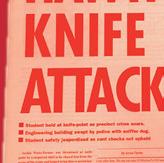
Bristol rocked by wave of teenage knife crime p.5
AI 'deepfakes' are the newest and most dangerous form of celebrity scandal p.7
OPINION

FEATURES

The misuse of study drugs at UoB p.12















35 years of Epigram
Amelia Jacob Co-Editor-in-Chief
Today, March 7th 2024, Epigram, the University of Bristol’s independent student newspaper, marks its 35th anniversary.
'It's time to take the right steps forward': In conversation with the cast of Boarders p.17
MUSIC
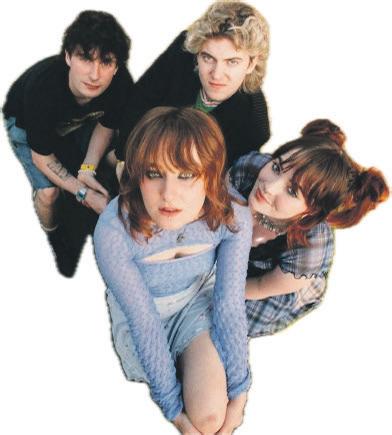
NewDad: shoegaze and gothic revival p.19
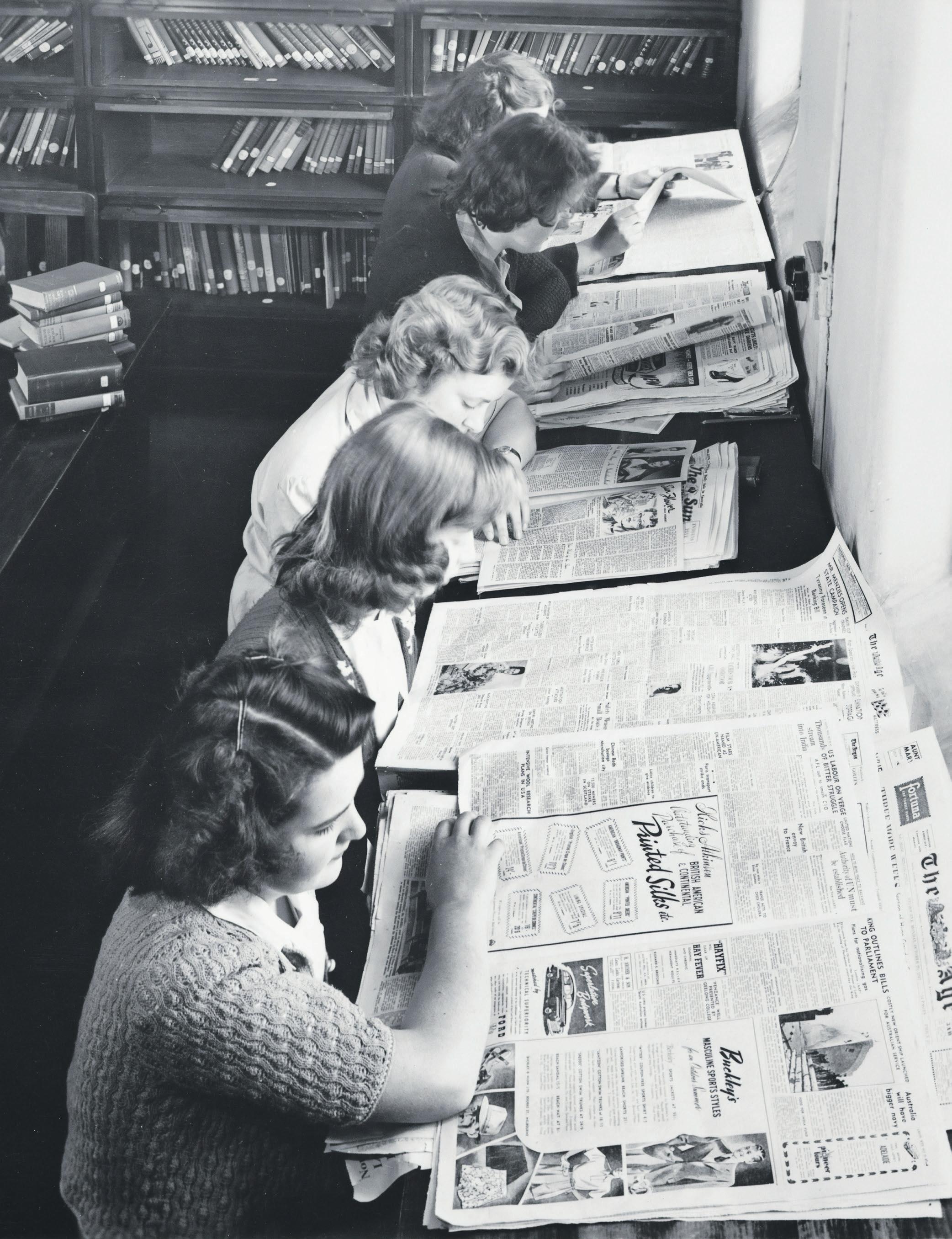
Before Epigram was created, there were several iterations of a student newspaper at Bristol, including The Magnet, which was founded in 1898 at University College Bristol – 10 years before the University officially formed.
In 1908 staff members created The Bristol University College Gazette, and in 1910 the Nonesuch was formed, Bristol’s first student publication as a University. The term “Nonesuch” refers to the floral emblem of Bristol, which gives its red colour to the University’s academic hoods. This publication was printed once a term, but now refers to the University of Bristol’s alumni magazine.
In 1945 a group of students set up Nonesuch News, but the publication made only £7 in sales. The next iteration of a student newspaper at Bristol was Bacus, the first publication to be printed weekly. However, it
stopped production in 1989 after the Student’s Union withdrew funding and set up its own newspaper – Epigram.
James Landale, the BBC’s Diplomatic Correspondent, was Epigram’s first Editor-in-Chief. In a statement to Nonesuch magazine for Epigram’s 25th anniversary, he commented:
‘I would hand-deliver the final disc [containing the newspaper] to the printers, who would chuck it on their to-do pile between the freesheets and smutty magazines.’
‘Early editions were strewn with my own caprice. The humour is too arch, the copy in need of subbing and the pictures ropey. But there are some good stories, the listings are comprehensive and the sum is greater than the parts.’
‘The task I set Epigram was to interest and inform students, and make them aware of what they could find and do outside of the library. I hope it will keep working at the same task. At a university, as in society, newspapers can play an important role.’
Since Landale’s tenure, several high profile journalists have emerged from Epigram, including Susanna Reid, TV presenter and journalist for ITV; Kris-
si Murison, the current Deputy Editor of The Sunday Times; and Peter Hyman, who was Tony Blair’s chief speech writer.
Epigram was the first student newspaper in Europe to go online and the first student newspaper in the country to be printed in colour.
In the early noughties, Epigram took a tabloid approach. This was initiated by Craig Woodhouse (Editor-in-Chief 2003/4) who is now the Head of Communications at Williams Racing. Infamous stories during this time include 18-yearold student Rosie Reid, who chose to sell her virginity online to repay her debts.
In recent years, Epigram has moved its focus to providing a voice for students, and has reduced its print run in an attempt to mitigate its environmental impact. The landscape of journalism has shifted, with an increased focus on digital journalism and social media.
This year, Epigram has printed six physical editions, and we have published hundreds of articles on our website. At the end of February, we celebrated our 35th anniversary with a ball at Goldney Hall. As Epigram looks to the future, we hope interest in student journalism at Bristol continues to evolve.
David Miller was wrongfully dismissed from the University of Bristol, tribunal rules
Roya Shahidi Co-Editor-in-Chief
The Bristol Employment Tribunal has ruled in favour of David Miller's claim that he was unfairly and wrongfully dis-
missed from the University of Bristol.
The judgment concludes David Miller's claim against the University of Bristol following the termination of his position as a Sociology professor on 1 October 2021.
His dismissal in 2021 was due to backlash against comments he made
regarding Israel and Jewish students at the University of Bristol.
The judgment ruled in favour of David Miller's claim that his 'anti-Zionist beliefs qualified as a philosophical belief... •
For the rest of this article please go to page 5.
EPIGRAM
01.03.24 Issue no. 377 Est. 1989 FREE NEWS BETWEEN THE SHEETS FILM
TV Instagram - @epigrampaper_ Website - https://epigram.org.uk Twitter - @EpigramPaper TikTok - @EpigramPaper Editorial News Opinion Features Wit & Wisdom Arts Film & TV Music Sci-Tech Sport CONTENTS P2 P4 P7 P10 P13 P14 P16 P18 P21 P23
&
Editorial
 Amelia Jacob and Roya Shahidi Co-Editors-in-Chief
Hello and welcome to our last print edition of the year… yes, we can’t believe it either! Our final year has passed so quickly, but it’s been a joy to edit Epigram and showcase everything Bristol students have to offer the city, and what the city has to offer us in return.
At the heart of our paper is our fantastic team, which consists entirely of student volunteers. Our editors have
dedicated hundreds of hours to make this paper the best it can be, and we want to thank everyone for their work and for supporting student journalism at Bristol this year. We hope that you, our readers, have found our reporting engaging, expansive & relevant to the issues that affect you day-to-day.
On a separate note, there have been several hard-hitting news stories this month, including the tragic spate of teenage knife crime that continues to take place in the city, and an update on the ongoing legal case between the University and the family of Nastasha Abrahart.
Our Features team have also commissioned several fascinating articles this month, including a piece on the abuse of study drugs at Bristol and a deep-dive into the experience of medical students at University, including their anxieties towards a future healthcare career in the UK. These articles are extremely thought-provoking, and well-worth a read.
Other, lighter highlights for this month’s edition include a wealth of music, film and book reviews, as well as our monthly comic on page 13.
By the time you read this, we will have celebrated our
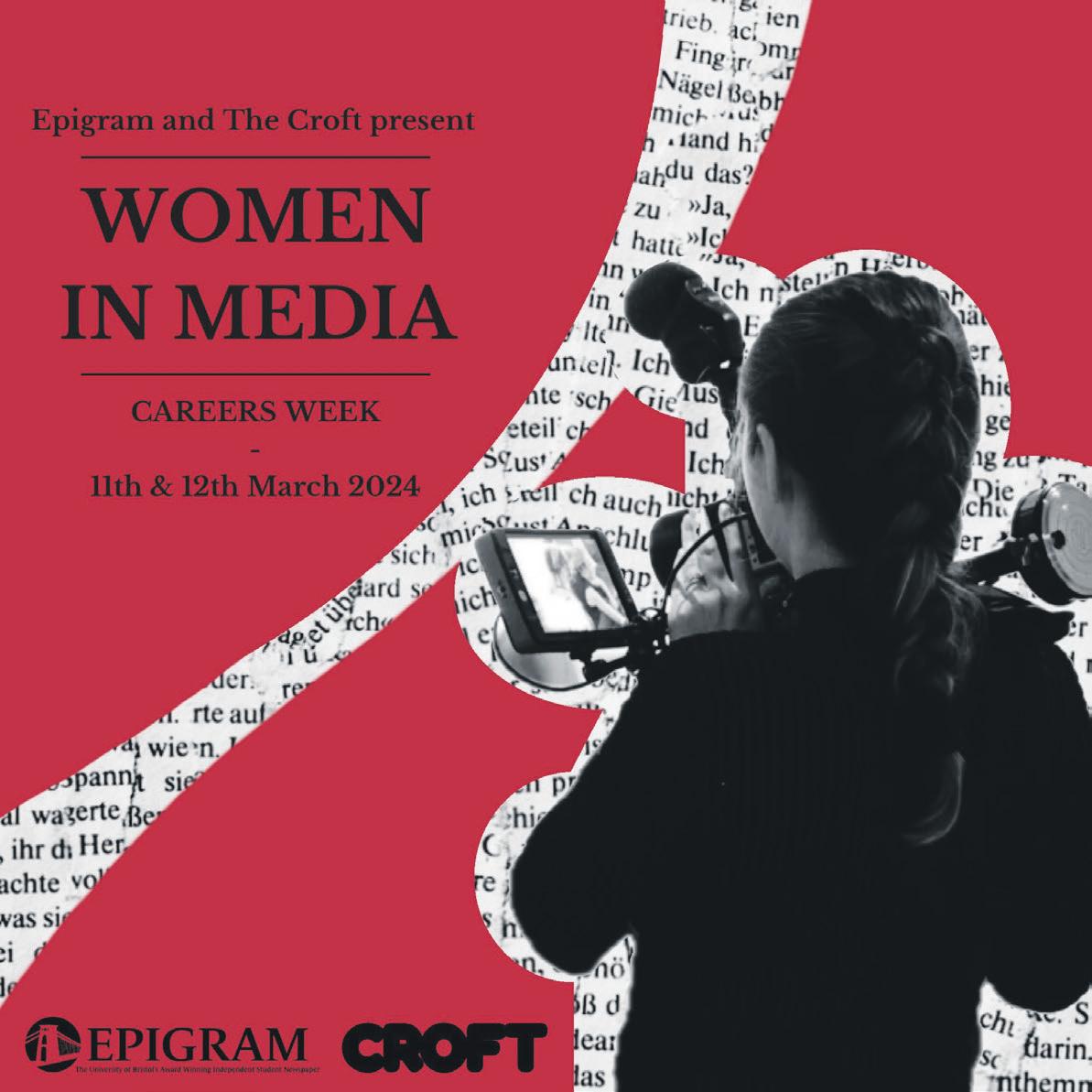
35th anniversary at Goldney Hall with our editors, writers, illustrators & readers alike. We also have our Women in Media careers event coming up, which will run on the 11th and 12th March at Will’s Memorial Building.
The event includes several exciting speakers such as: Nikki Waldron (Producer at the BBC) Ellie Jacobs (Journalist at BBC Newsnight) and Helena Wadia (Freelance Journalist). Tickets are available on the Bristol SU website, so make sure to grab tickets while they’re still available – we suspect they won’t be for long!
In the meantime, if you’re interested in writing for Epigram, simply join the Writer’s Groups on the ‘Get Involved’ section of https://epigram. org.uk, scan the QR code on the next page, or contact us through our social media.
• Even though this is our last print of the 2023/24 academic year, as always, if you have any questions about Epigram, you can contact us via email at editor.epigram@gmail.com.
Have a lovely rest of the year, and good luck for any upcoming exams and coursework!
Editorial Team 2023/24
Co-Editors-in-Chief
Amelia Jacob and Roya Shahidi
Deputy Editors
Milan Perera and Ella Woszczyk
News
Editor: Will Standring
Deputy Editor: Amelia Shaw
Digital Editor: Maud Humphries
Investigations Editor: Ellyssa Ashley Rozahan
News Reporter: Lottie Leigh
Opinion Editor: Amaan Ali
Co-Deputy Editors: George Jones and India Noon
Digital Editor: Georgia Rowe
Subeditor: Megan Ioannides
Features
Editor: Aidan Szabo-Hall
Co-Deputy Editors: Dan Hutton and Nel Roden
Digital Editor: Annie McNamee
Subeditor: Ellicia Metcalfe
Arts Editor: Rachel Bronnert
Co-Deputy Editors: Ella Carroll and Isabel Williams
Digital Editor: Phoebe Caine
Film & TV
Editor: Arron Kennon
Co-Deputy Editors: Lauren Durose and Sofia Webster
Digital Editor: Sienna Thompson
Subeditor: Victor Bennett
Music
Editor: Jake Paterson
Co-Deputy Editors: Benji Chapman and Dylan McNally
Digital Editor: Cara Hene
Subeditor: Susie Long
Sci-Tech
Editor: Dhristi Agarwal
Deputy Editor: Lucas Mockeridge
Digital Editor: Aarya Sagar Patil
Subeditor: Will Kelly
Sport
Editor: Oscar Coupal
Deputy Editor: Kieran Warren
Social Media Managers
Anouk Griffiths
Phoebe Livingstone
Proofreaders
Zoë Blake-James Bobbi Carsley
George Dean Imogen Rance














































to write for us? Join our Facebook writer's groups! Go to www.epigram.org.uk and click the "Get Involved" icon on the top right-hand side of the
you can access all our
our
welcome
we'd
Want
page. From there,
writer's groups, including those for
lifestyle magazine, The Croft. Each group posts commissions on the first of every month, for the print and online. We
all writers regardless of academic background, and
love to hear from you.
News
High Court rules that Bristol Uni ‘contributed towards’ death of student Natasha Abrahart
The judge upheld the orignial ruling that UoB discriminated against student by failing to adjust how she was assessed before her suicide in 2018.
Seb Davies
Third Year, Philosophy
An appeal against the judgment that the University of Bristol contributed towards Natasha Abrahart’s death has been rejected by a High Court decision.
Natasha Abrahart took her own life in 2018, the day she was meant to give a group presentation. The second year Physics student had suffered with chronic social anxiety since childhood.
In March of 2022, Natasha's parents brought legal action against the University under the Equality Act, arguing that the University contributed to Natasha's death as a result of discrimination against her disability.
In 2022, a judge ruled that the University of Bristol discriminated against Natasha in failing to accommodate her mental health disability, with the judgement stating that ‘there can be no doubt that there was direct discrimination’. The University was ordered to pay £50,000 in damages.
plication of the Equality Act when staff do not know a student has a disability, or when it has yet to be diagnosed.’
Today, in a 62-page judgement, Mr Justice Linden found that the University had failed on all seven of its grounds of appeal.
Medical experts said that the primary cause of Natasha’s depressive illness was oral assessment.
Justice Linden ruled that the University had failed in its argument that ‘the assessment of a student’s ability to explain laboratory work orally, to defend it and to answer questions on it’ was a ‘core competency of a professional scientist.'
Judge Ralton found that the University had breached its duty to make reasonable adjustments to the way it assessed Natasha. He also noted that ‘it was accepted by the medical experts that the primary stressor and cause of Natasha’s depressive illness was oral assessment.’
In October 2022, the University of Bristol announced it was launching an appeal against the decision to the High Court. Regarding the choice to appeal the decision, a spokesperson for the University said: ‘in appealing, we are seeking absolute clarity for the higher education sector around the ap-
Having dismissed the appeal, Justice Linden stated that it was ‘not necessary’ for him to ‘express any view, one way or the other’ with regard to whether universities owe their students a duty of care.
On the day in which Natasha was found, she had been due to complete a presentation in front of more than 40 students and staff, in a lecture theatre seating 329 people.
Prior to this, in February 2018, Natasha had emailed a university staff member regarding her mental health, stating that ‘I’ve been having suicidal thoughts, and to a certain degree have attempted it.’
Following the decision Dr
Abrahart, Natasha’s father, said: ‘The University of Bristol failed our daughter, broke the law, and contributed to her death’, adding that ‘it is now for the University of Bristol, and higher education institutions across the country, to get their houses in order.’
Natasha’s mother, Margaret Abrahart, said: ‘We have been able to get some measure of justice for Natasha because she was disabled and therefore covered by the Equality Act. But what about students
who aren’t disabled? They need a statutory duty of care.’
Following the High Court decision, Professor Evelyn Welch, Vice-Chancellor and President of the University of Bristol, said: ‘Natasha’s death is a tragedy - I am deeply sorry for the Abrahart family’s loss.’
'At Bristol, we care profoundly for all our students and their mental health and wellbeing is a priority and is at the heart of everything we do. We continue to develop and improve our services and safeguards to support our students who need help.’
‘In appealing, we were seeking clarity for the Higher Education sector around the application of the Equality Act when staff do not know a student has a disability, or when it has yet to be diagnosed. We will work with colleagues across the sector as we consider the judgment.’
On the day that Natasha was found, she had been due to present to more than 40 students.
‘I am grateful to our dedicated colleagues who work tirelessly to support all our students and to those who specifically supported Natasha which included a referral to the NHS. Higher Education staff across the country share our deep concern about the increase of mental health issues amongst young people, and
with that rise comes the increasing importance that staff, students, and their families are clear on what support universities can and should provide, and that students receive appropriate specialist care under the NHS should they need it.’
‘In 2022 Bristol became one of the first universities to receive the University Mental Health Charter Award, which recognises the continued hard
work of our staff and students in terms of taking a strong, structured approach towards improving mental health and wellbeing across our university. We know there is always more to do, and we will keep working to achieve the best for everyone in our community.’
Editor Deputy Editor Digital Editor News Investigations Editor News Reporter Will Standring
Amelia Shaw Maud Humphries
Ellyssa Ashley Rozahan Lottie Leigh
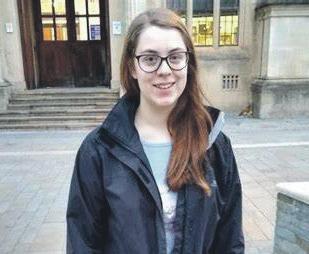
Natasha Abrahart - Image courtesy of Abrahart family
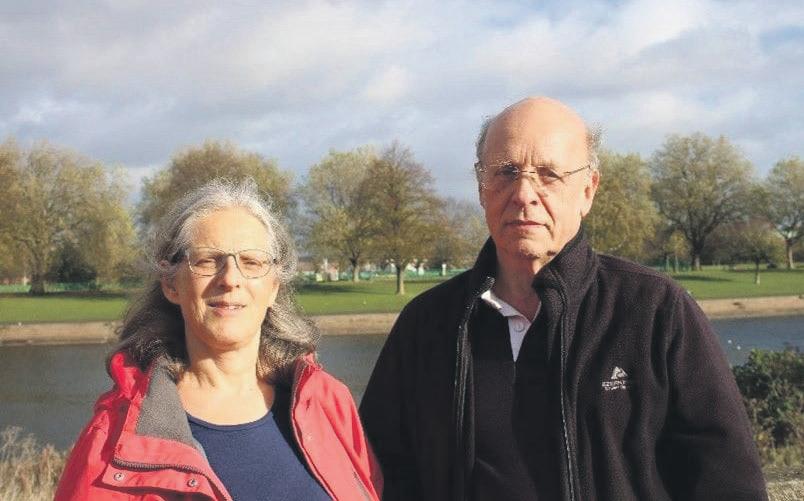
Natasha's parents - Image courtesy of Abrahart family
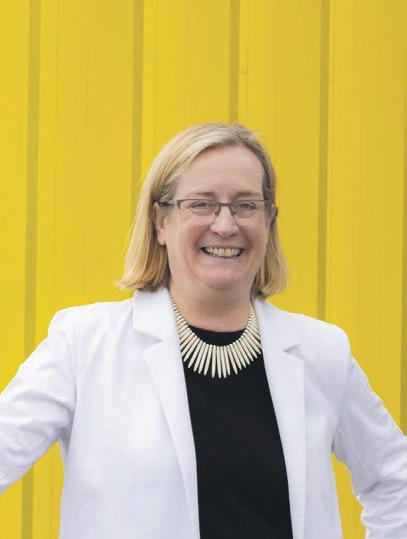
Evelyn Welch - Image courtesy of University of Bristol
Bristol rocked by wave of teenage knife crime: three killed in three weeks
Three teenagers aged under 16 have been killed in the last month after four serious stabbing incidents in Bristol.
Will Standring News Editor
Bristol communities are mourning the deaths of three teenagers after four separate stabbings in three weeks. The police have responded by introducing enhanced stop-and-search powers and launching a new operation targeting youth violence.
Max Dixon, 16, and Mason Rist, 15, were fatally stabbed on Ilminster Avenue, Knowle West, around 11pm on Saturday 25th January. The boys were attacked by a group who escaped in a car. Both boys died in hospital in the early hours of Sunday morning after an ambulance arrived on the scene within minutes. A fundraiser was launched for the boys’ families and has so far raised over £15,000. A
(continued from the front page) and as a protected characteristic' under Section 10 of the Equality Act 2010.
He also succeeded in his claim against the University for 'unfair dismissal' and 'wrongful dismissal (failure to pay notice).' His claims for indirect and direct discrimination failed.
In a statement following the ruling, David Miller commented: '[...] Before I took my case, it was unclear whether a belief in the idea that Zionism is a racist, imperialist, and colonial ideology could be protected under the Equality Act 2010 as a philosophical belief.
'I’m proud to say that, with this case, we have proven that anti-Zionist beliefs, of the sort that I articulated, should be protected.'
The Union of Jewish Students has released a statement expressing their disappointment towards the judgment:
'UJS is disappointed by the Employment Tribunal's judgment in relation to David Miller. UJS believes this may set a dangerous precedent about what can be lawfully said
vigil was held in the area the night after the stabbing with over 200 people present.
The policy inquiry has so far arrested 13 people in connection with the incident. Five are appearing in court on 26th April on murder charges. They are aged 14, 15, 16, 17 and 44. Two men, aged 22 and 26, will appear on charges of assisting an offender.
Max’s sister Kayleigh posted a tribute to her brother on Facebook on Sunday reading:
set, shine bright lil’ bro.’
A 14-year-old was taken to hospital on Sunday 4th February after being stabbed while playing football near St Pauls. He has since been released from hospital and returned home.
The boy was approached by two teenagers on bikes, one of whom stabbed the victim.
Enhanced stop-andsearch powers have been introduced in City Centre, St Pauls, Easton, Temple and Fishponds.
‘My baby brother… one of a kind you are. You sleep tight. A beautiful, kind soul gone. Just taken 16 years so young and innocent oh my heart is broken.
‘I really hope you know how much we love you. How much I love you. You will be missed kiddo I’ll always look out for you in every sun-
on campus about Jewish students and the societies at the centre of their social life.' They added that it 'will ultimately make Jewish students feel less safe.'
A University of Bristol spokesperson said: 'The University of Bristol acknowledges the judgment of the Employment Tribunal but is disappointed with its findings.
'After a full investigation and careful deliberation, the University concluded that Dr Miller did not meet the standards of behaviour we expect from our staff in relation to comments he made in February 2021 about students and student societies linked to the University. As a result and con-
with the event though they have not yet been charged.
anyone without needing reasonable grounds for suspicion.
A 14-year-old has been arrested on suspicion of wounding with intent. The other teenager is suspected to have been 16 or 17.
A third stabbing then took place in the McDonald's on the Horsefair at 8pm on Thursday 9th February, leaving a 16-year-old in hospital in critical condition.
19-year-old Joel Binnings has been charged with attempted murder. Three others were arrested in connection
Darrien Williams, 16, was then stabbed to death in Rawnsley Park, Easton, at around 6pm on Wednesday 14th February, taking the number of teenage fatalities to three in as many weeks. He was attacked by two masked individuals on bikes.
A fundraiser launched for Max's and Mason's (16 & 15) families has raised over £15,000.
Two boys, both 15, were charged on suspicion of murder on Sunday 18th February.
Avon and Somerset Police have responded to the incidents by increasing stop-andsearch powers in parts of Bristol and stepping up patrols near schools. A new proactive police operation targeting youth violence has been launched with a specific focus on hotspot areas.
The enhanced stop-andsearch powers apply to Bristol city centre, St Pauls, Easton, Temple and Fishponds; they leave officers able to search
Temporary Assistant Chief Constable Peter Warren said: ‘Children and young people are being seriously injured and killed on the streets of Bristol and this needs to stop.’
‘Knife crime is a national problem and not something policing can solve on its own but we recognise there is an ongoing issue in our city which we need to put significant resources into to address.
‘The two people who carried out the attack in St Philip's last night wore masks and by authorising the use of enhanced stop and search powers we are empowering officers to ask people who are within designated areas of the city to remove their masks, without having to have reasonable grounds for suspicion they may be involved in criminality.’
sidering our responsibilities to our students and the wider University community, his employment was terminated.
'We recognise that these matters have caused deep concern for many, and that members of our community hold very different views from one anoth-
er. We would, therefore, encourage everyone to respond in a responsible and sensitive way in the current climate.
'The University of Bristol remains committed to fostering a positive working and learning environment that enriches lives and where the
essential principles of academic freedom are preserved.
'The University is reviewing the tribunal’s lengthy judgment carefully and in light of that review, it would not be appropriate to comment further.'
epigram 01.03.24
5
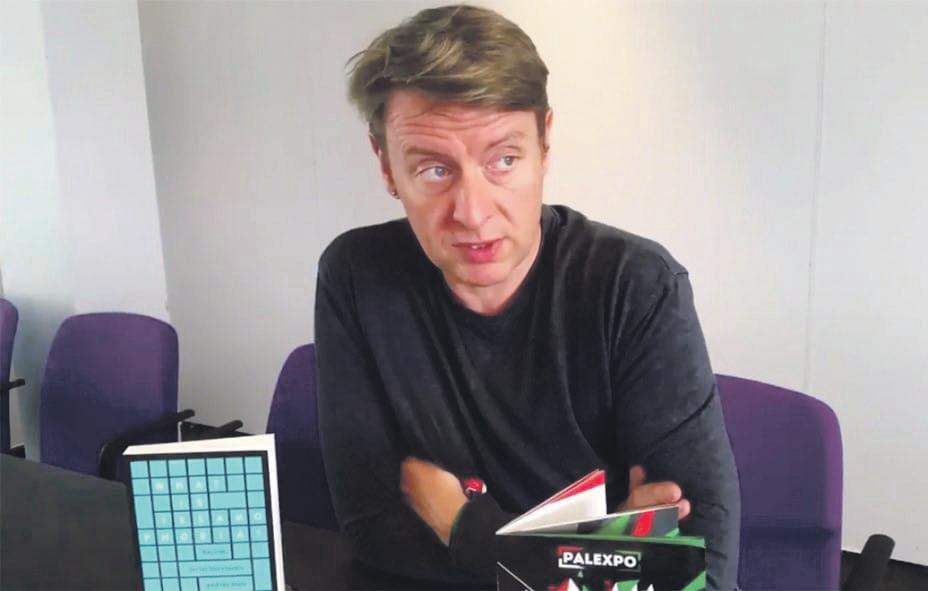
David Miller - Image courtesy of Jewish News
Colston statue set for return to public view
After being out of public view for two years, the controversial Colston statue may return to its previous temporary home.
Maud Humphries News Digital Editor
The statue of Edward Colston, the Transatlantic slave trader, is set to return to the M-Shed museum, pending council approval.
The Colston statue was pulled down in a Black Lives Matter protest on Bristol Harbourside in Summer 2020.
Following this, it was temporarily moved to M-shed before being out of public view for the last two years.
However, a survey conducted within Bristol by the We Are Bristol History Commission found that 80 per cent of the city agreed with the statue being placed in a museum.
The We Are Bristol History Commission feels that the planned move represents the ‘many diverse opinions’ and ‘the complexity of feelings associated with the statue’; this is demonstrated in their report, which includes the survey results.
City Mayor Marvin Rees believes ‘the best place for the statue is the museum.'
The application for the move of the Grade II listed statue has been submitted for Council Devel-
opment Control Committee approval on 21st February.
The Commission is glad to see that the council has acted upon the survey results and the overwhelming consensus of the city.
Professor Tim Cole, chair of the We Are Bristol History Commission, spoke exclusively to Epigram:
'The survey revealed that most people in the city and beyond shared a sense that the statue is historically important - all the more so since its removal - and so should be preserved.'
'However, most recognised that its complex and problematic history requires more than a single plaque and so
museum display is appropriate to contextualise this object.'
'Two other issues emerged in the comments people made that were important.
'Firstly, the vast majority of those who commented on display, wanted to see the statue displayed lying down and in its damaged and graffitied state. In short, they wanted the toppling to be made visible in museum display as this is a critical part of this object's story and significance.
'Secondly, there were some who didn't want the statue displayed in the museum, and either wanted the statue back on the plinth, or thrown back in the harbour. Their voices - although a minori-
ty - are important to consider. The plan is to display the statue in such a way that visitors to M-Shed can choose whether they see the statue in its new setting in a museum.'
The Council Development Control Committee's report affirms support for the moving of the Colston statue to M-Shed, and the plinth to remain on Colston Avenue, with a new plaque proposed. The statue would feature as part of a new upcoming exhibition in M-Shed around the theme of 'protests' which is set to open in March.
SU Annual Members Meeting 2024 Results
All 10 motions on the slate at the 2024 AMM passed with clear majorities.
Maud Humphries & Will Standring News Digital Editor & News Editor
This year’s Annual Members' Meeting (AMM) was held on Thursday 1st February in the Richmond Building. The AMM occurs every year as an opportunity to pass policy and hold SU officers to account. Motions
which pass become active SU policies for three years.
All students are able to attend and vote at the event. This year the SU tried a new digital voting system using Slido to make participation easier.
10 motions were on the slate, all of which passed with significant majorities.
Three motions which passed in 2021 were up for renewal:
1. Harm Reduction Approach to Alcohol and Other Drugs. This motion would continue to provide expert advice and harm reduction resources that are available for students.
2. Championing a Cul-
ture of Consent at Bristol SU. This motion would continue to promote awareness and knowledge of consent by producing a document for society reps.
3. Supporting Sex Workers. This motion would continue to challenge the stigma around sex workers and ensure the appropriate support exists. Seven new motions were then also approved by students:
1. Restructuring the annual student bus pass. This motion intends to align the academic year with the student Bus Pass.
2. Campus Space Usage. This motion aims to increase the number of study spaces for students and extend the opening hours of these spaces.
3. Include 'Latino/a/x' as an option for data collection. This motion would allow for this option on surveys related to Student Ethnic Background.
4. Subsidized Dental Care Access for Students. This would occur through UOB Dental School to help students locate accessible dentist services.
5. SU Car Rental for Student Events. This motion aims to help students with
logistics and travel for events through a car rental service.
6. Our Voices Matter: Initiating Systematic Measures to Promote Student Voter Registration. With two important elections in Bristol during 2024, and University of Bristol students and staff making up 10% of Bristol's population, this motion intends to increase voter registration to make our voices heard.
7. Liberating the Structure. This motion proposes a representation review of the democratic structures for the students.
Four universities announce joint pledge to tackle sexual violence and harassment
UoB, Bath Spa Uni, UWE and Bath Uni have pledged to tackle sexual violence and harassment collectively.
Cara Hene Music Digital Editor
The University of Bristol has joined other universities in South West England to commit to tackling and preventing sexual violence and harassment in a 10-point plan.
On Monday 5th February, the University of Bristol, Bath Spa University, UWE and the University of
Bath released their ‘joint commitment’ to deal with sexual violence and harassment to help affected students.
The move came in line with Sexual Violence Awareness Week.
One of the first pledges reads: ‘Sexual violence and harassment will not be tolerated by the Universities or Students’ Unions.'
Subsequent pledges include supporting the reporting of sexual violence and harassment by creating ‘clear reporting channels’, helping students ‘understand consent’ and a commitment to working together across the signatory
universities where individuals from more than one of these institutions are implicated.
They also pledged to take a people-centred approach, promising that, ‘You will be heard, listened to, and supported by your University and Students’ Union.'
The commitment was signed by Evelyn Welch, Vice-Chancellor and President of the University of Bristol, and Bristol’s Student Union, along with the other universities’ respective Vice-Chancellors and SUs.
The universities and students’ unions also released
a joint press release to accompany the plan. They said:
‘We believe that all students should feel safe at university, so that they can reach their academic potential and fully immerse themselves in campus life.’
‘Today, we are sending a clear message that sexual violence and harassment is simply not acceptable. It’s sometimes hard to talk about inappropriate behaviour and that’s why we’re bringing it out in the open.’
‘We also want to make clear to all our students that help and support is available.
Thank you to everyone who has been involved in this pledge and who continues to support this important work.'
Evelyn Welch discussed the joint commitment’s role in bringing these issues out in the open with Bristol SU, stating that the end goal was to eradicate sexual violence and harassment across all of our campuses. She also highlighted the University of Bristol’s Sexual Liaison Officers, who students can go to at any time to discuss their experiences and get guidance.
epigram 01.03.24 6
Opinion | AI ‘deepfakes’ are the newest and most dangerous form of celebrity scandal
Ai generated 'deepfakes' are becoming increasingly advanced. In this growing age of misinformation AI is causing a new wave of scandal.
Eliza Densham
Third year, English and German
Recent AI-created explicit images (also known as ‘deepfakes’) of Taylor Swift caused former Twitter platform X to block the searching of her name on the site. But will AI really be the dangerous monster it threatens to become, or will it be kept at bay? Eliza Densham discusses this new threat, while calling on social media platforms to take action.
party needs to physically meet and record advertisements or campaigns, essentially cutting out the middle man and making the process of advertising much more efficient.
The negative connotations with 'deepfakes' stem from its misuse. It can be a dangerous and exploitable tool due to the constant public need for celebrity scandal.
The rise of Artificial Intelligence is not a newly emerging topic. As students, we are aware of the dangers and risks that come with relying heavily on such technology and yet we increasingly find ourselves reaching for AI tools such as ChatGPT to help summarise long and tricky readings. But one concern about this emerging technology, that isn’t necessarily reaching us all on a personal level, is the rise of ‘deepfakes’ – images and videos that digitally manipulate the voice and likeness of a person (often a celebrity) to show someone doing something that he or she did not do. However, it mustn’t be overlooked that, when used in a certain, 'correct' manner, AI is an incredibly helpful tool. With consent, using 'deepfakes' can save both money and time for the celebrity and company involved. Neither
A shocking 2019 figure recorded that 96 per cent of 'deepfakes' on the internet were pornographic.
The negative connotations with 'deepfakes' stem from its misuse. It can be a dangerous and exploitable tool due to the constant public need for celebrity scandal. This is a big step from the exaggerated headlines of the 2000s magazines and they can feel somehow reliable due to the video format – if we can see it happened in a video, surely it must be real? It is only when AI starts to recreate real life beyond human recognition (as it begins to show signs of doing so) that it will have succeeded and really be a danger to celebrity culture and what we know to be ‘real.’ A shocking 2019 figure recorded that 96 per cent of 'deepfakes' on the internet were pornographic. A recent addition to this statistic is the invasive AI Taylor Swift content that was shared on X. It was recognised quickly as 'deepfake' technology, and celebrities are very aware of privacy and scandal so anything that seems over the top or out of character can often be deduced as fake. While the viral videos and photos on X may have been shared widely, and there can be no denial that this type of content is unequivocally outrageous, it ultimately will not have damaged Swift’s reputation. Ironically, one of the main scandals of her career involved an edited phone call with Kim Kardashian, so perhaps audio sources are more convincing or harder to detect than the current level of 'deepfakes' (although that was 2016 and the credibility standards for celebrity scandal has completely changed). But ultimately the more videos and photos there are of these celebrities online, the more
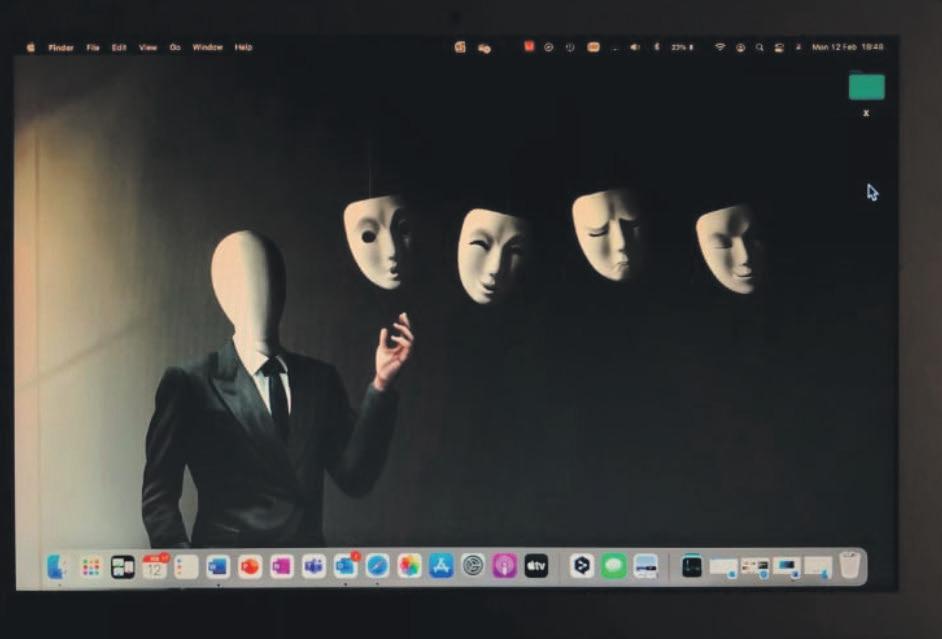
convincing the 'deepfake' will be and the more important it will be to prevent them before they can even be posted.
While Swift, TIME magazine’s 2023 person of the year and a highly successful business woman, is seemingly a preferable target, there is a potential for civilians to be impersonated too - often to commit financial fraud or crimes with this same technology. Of course, the stakes are much higher when it comes to exposing a celebrity but the principal remains the same - if someone has a rep-
utation or money to lose and this technology is in the wrong hands, it can be taken too far.
So what can we do? If we are aware of the dangers we are ultimately better equipped to face them. These 'deepfakes' aren’t going anywhere and neither is AI, so the responsibility to regulate the usage lies in those who facilitate, promote and allow it on their platforms. Google and Meta along with other tech giants are trying to combat the issue by banning the use of false 'deepfakes' and detecting the tech-
nology more quickly. But as we know, AI technology is often a step ahead and perhaps we're a little too late. For example, in the case of the Taylor Swift videos, her name became a ‘trending’ topic at the time of the 'deepfake' sharing, meaning X algorithmically boosted the ability to share the videos. Social media platforms need to take more responsibility and more content regulations are going to be needed in order to prevent this happening more frequently in the future.

Opinion
Editor Co-Deputy Editor Co-Deputy Editor Digital Editor Subeditor Amaan Ali George Jones India Noon Georgia Rowe Megan Ioannides
Image courtesy of Eliza Densham
Image Courtesy of Rubaitul Azad / Unsplash
Opinion | Class identity remains on the minds of young people at university
'Working class cosplaying' has become an increasingly problematic issue that is pushing the class identity debate to the forefront of student minds.
Emily Brewster
Third Year, History
Class is, and has always been, a uniquely British obsession and anxiety. Whilst playing up one’s social class had always been the instinct of Britons, youngsters around the time around Beatlemania, uncoincidentally, began to associate a ‘coolness’ with being working-class, socialist, or Northern. In the younger generations of Britain’s middle class, eager to downplay privilege and appear self-made like their idols, a class dysphoria emerged which continues to manifest itself at universities like Bristol today, demonstrating the clear discomfort we still have with class identity in Britain. Love it or hate it, Saltburn testifies to a persistence of Britain’s obsession with class which has defined us for centuries. The film screams with references to Evelyn Waugh’s Brideshead Revisited, a novel written in 1945 about a motherless middle-class Oxford University student, adopted by an eccentric aristocrat and brought to his lavish stately home and dysfunctional, repressed family. The twist in Saltburn, (massive spoiler alert), is that Oliver’s story of abusive addict parents and a deprived working-class upbringing in Prescot (cue Rosamund Pike’s perfect representation of Southerners talking about the North) is exposed as a total fiction. His ‘working class cosplaying’ is a case of the extreme and frankly psychotic, but at its core emulates a tangible tendency of the British middle class

We form our own class identities from that of our ancestors, leads many demonstrably middleclass Britons to view themselves ‘by blood’ as working class.
A tangible tendency of the British middle class today to play down their privilege and fabricate a humbler personal history..
today to play down their privilege and fabricate a humbler personal history. The common basis for this may be how we understand our class – is it hereditary? Is it where you live? What your parents do for work? The socalled ‘grandparent effect’, which states that we form our own class identities from that of our ancestors, leads many demonstrably middle-class Britons to view themselves ‘by blood’ as working class. Before falling into my own trap, disclosure of my own privilege is pertinent; I come from a white, Southern, distinctly middle-class background, with two medic parents who have worked hideously hard to enable an excessively comfortable upbringing for my sister and I. For me to identify as otherwise would frankly be delusional, showing the problematic nature of the ‘grandparent effect’. However, to humour my reasoning, considering my maternal ancestors as the archetypal British working-class family would indeed entitle my claim to this identity. Born in Stoke, home of England’s pottery industry in the West Midlands, as the daughter of an electrician and a secretary, my mum was one of few from her secondary school to take A-levels, and even fewer to attend a Russell Group university – the University of Bristol, in fact. Having spoken widely to my acutely middle-class social pool, I realised this story of ancestral social mobility was not unique; several friends are proud to acknowledge their parents’ less privileged backgrounds,
though thankfully without claiming these to be their own. Despite fitting the ‘grandfather effect’ brief perfectly to identify as working class, it would precisely be ‘working class cosplay’ for me to express myself as such. Comparing my experiences as a current student at Bristol with that of my mother’s 30 years earlier with these class distinctions in mind exposes their pervasiveness and magnifies the privileged position I had entering halls of residence, as a middle class southerner. It is no coincidence that the West Midlands accent she was raised with had all but vanished when she finished her medical degree. Wanting to fit in with the overwhelmingly Southern, privately educated cohort at Bristol in the late 1980s and evade their persistent teasing of her regional accent and dialect, my mother adopted the Queen’s English of her middle to upper class peers to mitigate the perceptible class difference she felt. How much change the university has undertaken since then is dubious; from a poll on Epigram’s Instagram account, almost ¾ of respond-
It is no coincidence that the West Midlands accent she was raised with had all but vanished when she finished her medical degree.
ents self-identified as middle class, whilst only 17 per cent described themselves as working class. Similar conclusions can be drawn when considering my flat in my halls of residence – notorious as Stoke Bishop is as a public-school stomping ground. Of 22 students, most had attended private schools and not one could be identified as working class. Given these statistics suggesting the privileged class still occupying the majority of university places at Bristol, why is it we see middle class students coming to top universities portraying themselves as ‘hard done by’? My reckoning is that in the age of ‘check your privilege’, where nepotism is still powerful, but distinctly un-cool, the middle and upper classes are feeling increasingly inadequate. Gone are the days where people were clapped on the back for getting the prestigious job, even if their father had ‘put in a word’. Instead, the first question you hear, asked in hushed tones, is ‘do you think they pulled the nepo-card?’. This ‘fetishisation of meritocracy’, as the Guardian coined it, causes students to disas-
sociate with their privilege and present the ‘self-made’ image of themselves instead. We see this in the behaviour of our peers and ourselves; thrift-shopping not from economic necessity but to fit an aesthetic and altering a quintessential Queen’s English accent with a strange ‘roadman’ twang totally incongruous with everything else about them. We all know these people, and I’m ashamed to say, it’s probably sometimes me too. As shown in the viral clip of Victoria Beckham being told to ‘be honest’ by her husband after telling her interviewer she grew up ‘very working class’, then reluctantly admitting her father drove a Rolls Royce, it is apparent that ‘working class cosplaying’ is peppered across the privileged classes in Britain. Though sometimes amusing to see, the highly visible aestheticisation of working-class identity by Bristol’s middle-class students reinforces the class snobbery which working class students like my mother have experienced and felt isolated by. At the end of the day, it’s always pretty transparent when you pretend to be something you’re not, unless of course, you’re some sort of Saltburn psychopath.
Image courtesy of Dhristi Agarwal
8
epigram 01.03.24
Opinion | Gen Z would fail to fill the boots of conscription
Gen Z are not ready for mandatory conscription and would fail to meet the conditions due to the growing culture of sensitivity.
Daniel Rose
First Year, History
After 80 years of complacency in Britain, the notion of a conflict requiring the conscription of a generation belongs to a bygone era, unthinkable today. Yet recent comments from UK General Sir Patrick Sanders, calling for the implementation of a ‘citizen’s army’, have propelled the idea of 21st-century conscription into the headlines. Although this appears necessary in the face of growing tensions, conscripting Generation Z to fight for their country is unlikely to prove successful and here is why. As a general military rule, relying on strategies of previous conflicts is rarely a good idea.
A
Conscription, a practice that was essential in Britain’s efforts in the First and Second World Wars cannot be effectively reproduced in today’s Britain, with a recent poll finding that only 14 per cent of Brits aged 18-24 would willingly fight if conscripted. Conscription in the two World Wars was enforced on people who had, naturally, grown
is simply too weak for war.
up in the first half of the 20th century. Born and raised in pre-war communities, limited to pre-war technology, holding pre-war conceptions of duty, sacrifice, and death for one’s country, conscription was enforced onto a youth fundamentally different to today’s. A prevalent narrative spread by the generationally resentful is that Generation Z is simply too weak for war. The ‘snowflake’ generation, with their microaggressions, pronouns and sensitivity, form a generation ‘Too Woke to Serve’, as TalkTV puts it. This is the story that the British army themselves appeared to believe, launching a series of campaigns targeting this mentality: ‘snowflakes, your army needs you and your compassion’, a 2019 spin of the First World War Kitchener poster reads. Alternatively, you may be led to believe that new forms of entertainment are to blame, with TimesRadio suggesting that it may be because ‘they’re all used to playing WarZone’. The decline of a multi-century core sense of purpose, framed as a result of video games.
Regardless of which side of the culture war you fall on, no amount of ‘wokeness’ or video game playing can render an entire generation ineffective at serving their country.
Rather than the culprit lying in an aura of sensitivity, Gen-


eration Z lacks patriotism, a sense of duty and, by extension, conscription, has always relied on: community. Growing up disconnected from each other, spending childhoods on the internet and entering a globalised world in which moving around the country for job opportunities has become the norm, our identities have been built on fickle foundations. A recent study showed that 43 per cent of Brits feel disconnected from their communities with 18-24 year olds feeling significantly more disconnected than those of older generations. Past generations grew up in distinct communities of towns and villages, spending the majority, if not all their lives, living and working in these areas. Their identity was formed by where they came from. To them, serving their country was an extension of serving and defending their communities. If their friends, whom they had grown up with, went to war, so did they. Compelled by community camaraderie and a desire to be part of the group they viewed themselves as an extension of, the idea of backing away from
'Regardless of which side of the culture war you fall on, no amount of ‘wokeness’ or video game playing can render an entire generation ineffective at serving their country.
service was inconceivable. The shame placed upon their reputation in the eyes of their community for failing to join their fellow conscripts would be far worse than any fear of danger that came with going to war. Generation Z has no substitute for this. Most of us, including myself, speak to our neighbours only a handful of times per year, and beyond the families next door, have little to no knowledge of who lives on our roads and in our ‘communities’. We have no sense of belonging to any kind of residential area and are by consequence, driven by little other than service to ourselves. This is not to say we are selfish – many of us are more socially conscious and driven to effect good in the world than our generational predecessors – but the kind of community-driven euphoria in which excitement to go off and serve with those you grew up with, with names like the ‘North Somerset Yeomanry’, is simply not possible in today’s UK. If I were to serve in the ‘Oxfordshire Light Infantry’ – the regiment of the area I grew up in, I wouldn’t know a single other person there. I would feel no loyalty to the regiment and - past the basic instinct to survive - would feel no desire to serve with them. To add to this, the enhanced and more realistic sense of death we have gained through
the spread of the internet where news reports bombard us with graphic clips of the latest war-related catastrophes - videos of terrified soldiers being killed by remotely controlled drone strikes - it is not difficult to see why the fantasy of a romantic death in battle is scarcely believed by today’s prospective soldiers. With the reality of war conveyed to us not through word of mouth, legends or propagandistic spins, in which we can witness for ourselves the undignified deaths of the participants of conflict, the narrative from which so much conscription drew – that war is an adventure – is not well received by Generation Z. Most of Generation Z, devoid of community pride and unwilling to entertain a romantic notion of war, would simply choose to conscientiously object to serving; something that was already an issue in the First World War, but, without the same community drive to serve, would likely spiral into a mass boycott of conscription, rendering the army’s proposed measures ineffective. For conscription to work it must be imposed on a population that feels some level of attachment to the community they’re being forced to risk their life for. This is absent among today’s youth.
9
epigram 01.03.24
Image courtesy of Stijn Swinnen // Unsplash
Image courtesy of Unsplash
prevalent narrative spread by the generationally resentful is that Generation Z
Features
‘It can be very isolating without that familial support’:
Navigating university life as an estranged student
Being a university student can come with many challenges; from reaching deadlines and keeping track of your monthly spending, to familiarising yourself with campus life. For many students, the Christmas holidays can’t come around quickly enough. A time for reuniting with family members, eating familiar homecooked meals and enjoying the general comforts of being back in your hometown; this period, for most, signifies relaxation and reset. However, for estranged students, this can be far from the reality.
Generally, estrangement refers to a student who has little or no contact with their parents, with their situation being unlikely to change. Many factors can play into family estrangement, however, perhaps the most notable causes are emotional abuse, familial alienation or marital conflict. Often experienced by LGBTQ+ students who have been rejected or disowned by family members, estrangement may be the result of mismatched values and expectations. Despite the fact that many estranged young people (EYP) have experienced abuse, are coping with the trauma of family breakdown, and have had to navigate financial independence, the struggles they face are largely invisible.

For many students living away from their families, the concept of ‘home’ is emotionally loaded and complex.
Speaking to Alex O’Driscoll, a Student Inclusion Team Manager at the University of Bristol, he explained that ‘It can be very isolating coming to university without that familial support.
Make sure that there is enough space mentally for you to take on the struggles of university.
I think a lot of students take it for granted that they have someone there who can help them financially and emotionally; a home during the holidays and somewhere to go back to.
In 2022, Buttle UK, a children’s charity providing grants to children and young people who have gone through crisis, estimated that there are between 93,000 and 206,000 EYP’s aged 16 to 20 in the UK. This staggering number signifies how widespread familial estrangement truly is, despite it being so readily unacknowledged.
‘As an estranged student, you don’t necessarily have those things. It might be that they move to university and that city is now their home, whereas, for other students, university is simply a place they stay during term time.’
In a conversation with an estranged student taking Engineering Maths, he explained: ‘You get a few weird glances when you tell people
you are staying here for the holidays. It’s a conversation that I am used to having, but a conversation that never really gets easy. Even though I have come to terms with my life now being in Bristol and living here independently, the conversations get easier, but they never get easy.’
Whilst certain universities may allow estranged students to stay in halls over the holidays, many will be dealing with private landlords who may be less considerate and open to delaying the payment of bills or rent. That being said, if you are living in private accommodation and need a guarantor but don’t have anyone to ask, many universities and colleges, including the University of Bristol, can help bypass this requirement. Through the University of Bristol’s relationship with Housing Hand, a company that offers a fully comprehensive guarantor service to all students, private accommodation is no longer limited solely to those who have guarantors from their household.
Many other initiatives are
also being implemented here in Bristol to support estranged students to ensure that they feel safe, supported and able to reach their potential. On a mission to diversify the student body at the University of Bristol, the Widening Participation team supports prospective students from underrepresented backgrounds – including estranged students – with accessing university, offering support through the complex university application process.
Once enrolled, the estranged student team is dedicated to offering trustworthy and accessible support to all those who need it. Maria Tottle, the Student Inclusion Officer and dedicated estranged student contact, works with undergraduate students, providing them with invaluable resources, aid and guidance. As Alex explained, ‘It can be really difficult if there’s lots of different routes and terminology that you need to get to the bottom of, so it’s great that Maria can help with signposting the support that students could
and should be eligible for.’
Furthermore, The Bristol SU Care Leavers and Estranged Students’ Network (CLES), provides a safe space for estranged students with shared backgrounds and experiences to connect and support one another through relaxed and inclusive social events.
In conversation with a second-year Law student and member of the CLES network, she explained: ‘It’s so nice to sit down and talk about your situation with people who can relate. You can bond in a unique way [because] a lot of things can go unspoken; you don’t have to explain things because these people already understand.’
Whilst research by Stand Alone has shown that 9000 UK students have no contact or relationship with their families and that these students are three times more likely to drop out of university, there are many organisations offering financial support to ensure that being estranged doesn’t mean that you are left behind.
Jess Cohen
Second Year, Sociology
Editor Co-Deputy Editor Co-Deputy Editor Digital Editor Subeditor Aidan Szabo-Hall Dan Hutton Nel Roden Annie McNamee Ellicia Metcalfe
Jess Cohen learns about the experience of estranged students at university.
Image courtesy of Unsplash
‘It’s troubling seeing the quality of life that often comes after you graduate’: The reality of being a medical student
Sagal Khalif speaks to two medical students about their experiences.
Sagal Khalif First Year, Law
Medicine is one of the most oversubscribed courses across British universities, with an average of 25,000 students applying every year.
Since nurses went on strike for the first time in late 2022 — contesting poor pay and unsafe staffing levels — industrial action has become increasingly prevalent within the health sector.
Following a protracted standoff between the government and the British Medical association (BMA), junior doctors will stage a four-day walkout between the 24th and the 28th of February.
Since March 2023, it is the 10th time that junior doctors have undertaken industrial action, striking against the steady erosion of pay since 2010 and unsustainable conditions within the NHS.
After more than a year of industrial action within the health sector, the failure of the BMA and the government to reach a resolution has produced stark ramifications: more than 1.4 million appointments and procedures have been delayed, straining a health service which currently holds a backlog of over 6 million patients.
would have been resolved by now, Grace said that ‘I did not expect the strikes to last this long, as I thought that doctors' requests for higher pay would be respected sooner by the government.’
Similarly, noting the inability of the government to reach a settlement, Harry said that ‘I don't think I ever had faith in the government to bring the strikes to an end, and I don't think I necessarily predicted they would have handled it this badly.’
These sentiments are seemingly echoed by the general public: a September 2023 YouGov poll found that voters blamed the government more than the BMA by a margin of 45 per cent to 21 per cent.
'It’s going to be hard to stay motivated - a lot of other jobs start out on a much higher salary, and with a lot less stress'
Epigram spoke to two fifth-year medics, Harry and Grace*, to hear their views on the strikes, the impact they have had on their studies and whether they believe industrial action will deter the next generation of medical students.
Despite witnessing the steady disintegration of the NHS, both Harry and Grace emphasised that they still enjoy working with patients. Harry stressed the importance of ‘Separating the politics from the work.’
Grace said that: ‘Although I believe the government does not have my interests at heart, I don't see myself doing another career.’
When asked whether they thought industrial action
When asked whether she believed that ongoing strike action, the underfunding of the NHS and the stagnation of wages within the health sector would potentially deter future students from pursuing medicine, Grace said that ‘I definitely foresee a drop in students pursuing medicine, if not a drop in the number of students staying to practise in the UK.’
Contrastingly, Harry discusses how the health sector will continue to attract graduate doctors: 'Regardless of whether the NHS continues or not, there is still going to be work in being a doctor. People will recognise that, people will go into medicine but for slightly less compassionate reasons.’
Expanding on this, Harry said: ‘We will see people who want to go into private practice or non-medical, clinical facilities. We will also see a lot more people who want to go abroad after they graduate, do two years in the NHS and then go to Canada or Australia.
‘If all that fails, you will always have international stu-
dents who want to come and study at good institutions and then head back home highly respected. I don't think we will see a drop in the number of doctors produced but more so where they end up working and the reasons they study.’
Similarly noting the allure of moving abroad to pursue work in the health sector, Grace said that ‘I foresee a drop of students staying to practise in the UK. The majority of my friends are going to move to Australia to work and I am also thinking of doing this.’
This is reflective of a broader trend among junior doctors and nurses: a study published in BMJ Open found that one in three medical students plans to quit the NHS within two years of graduating, allured by the better pay and working conditions that countries such as Australia and Canada offer.
Touching on the difficulties that would come with potentially remaining with the NHS, Grace said ‘I recognise it’s going to be hard to stay motivated because a lot of other jobs start out on a much higher salary, and with a lot less stress.'
Unsustainable and strained workforce conditions have also contributed to a mental health crisis within the NHS: as of 2022, doctors and nurses had taken an accumulated total of 23,000 years off for mental health problems since 2017.
Describing his apprehension at entering a workforce in which these problems are so prevalent, Harry said:
‘You see the pressure people are under, you've been there for six years and have sacrificed quite a lot of time earning this degree to get into this profession. It’s troubling seeing the quality of life that often comes after you graduate, and the figures for the number of junior doctors who are experiencing burnout.’
A 2022 General Medical Council (GMC) Survey revealed that 39 per cent of junior doctors had experienced burnout to a high or very high degree.
Fund, said: ‘While the announcement includes a welcome commitment to boost staff training places, we are yet to see much of the detail on the measures to retain current NHS staff, or to improve the culture and working environment of the health service.'
'It’s troubling seeing the figures for the number of junior doctors who are experiencing burnout'
A recent introduction of a medical doctor degree apprenticeship, under the NHS Long Term Workforce Plan, may be an answer to providing an alternative pathway to medical school and boosting the number of doctors and nurses in the health service.
However, this scheme, which aims to tackle the backlog of over 6 million patients and attract more doctors to the NHS, has faced criticism.
In response to the announcement of this new workforce plan, Richard Murray, chief executive of The King’s
In spite of the legitimate reasons many have for undertaking industrial action, Harry describes how junior doctors are acutely conscious of their duty of care towards patients: ‘A lot of junior doctors that I speak with at the moment say the same thing, that it becomes more and more difficult to renew the strikes yourself when you see the waiting lists go up. People aren't striking because they don’t care about the patients.
‘I was speaking to another doctor who I met on Monday and I worked with at Bath, and she said she has been on every junior doctor’s strike. It’s really difficult for me to get myself out on the picket line because I know my patients are suffering — but I know they are going to suffer just as much if I don’t strike.’
*names have been changed for anonymity.
11
epigram 01.03.24
Image courtesy of Dan Hutton
‘I felt like there was no need to stop’: The misuse of study drugs at UoB
Maddy Richards speaks to two students to learn about their experience of using study drugs.
Maddy Richards Second Year, Politics
A2016 YouGov survey found that 77% of all students reported a fear of failure which was fundamentally driven by the stress from university studies.
At elite UK universities, students are faced with copious amounts of pressure to perform. Coupled with an increasingly competitive job market and the burden of high student debts, students have been turning to prescribed ‘study drugs’ — such as Adderall, Ritalin and Dexedrine — to help maximise their academic performance.
The period from 2012-2017 saw a sharp rise in the number of students using these substances, with a 2017 study revealing that 10-15 per cent of students have attempted to enhance their academic performance with study drugs.
In 2014, Oxford University came top in a survey sent out by The Tab on the use of study drugs across the UK, with one English student claiming that she took ‘slow-release Adderall and worked overnight for around 16 hours.’ The student reported an irregular heartbeat and was ‘Convinced I was having a heart attack’.
Although recreational drugs are no new phenomenon, a new strand of drug abuse seems to have emerged with consumption no longer being centred around hedonism.
Epigram spoke to first year Bristol University students, Natalie Turner and James Matthews* who both talked about how the pressure of exams and inability to focus led to a dependency on study drugs throughout the course of their academic careers.
When asked about the initial reason for turning to study drugs — specifically pro-plus pills as a revision aid — Natalie discussed how the perception that she ‘Was always con-
sidered intelligent came with huge expectations, not just from my teachers, but from my peers, let alone my family.’
These pressures were further fuelled by her brother’s in getting into grammar school, thereby solidifying an intellectual insecurity that has persisted past adolescence and into Natalie’s 20s — an anxiety which has, perhaps, been exacerbated by the increased expectations of university.
Pro plus caffeine pills — which are essentially instant coffee tablets — are used to help people remain focused and awake. Their packaging boasts ‘Cult status in universities and the workplace, relieving the temporary tiredness of studying students.’
A single pill contains 50mg of caffeine, the same as a strong cup of coffee. However, when washed down with a red bull or diet coke, the caffeine intake will be multiplied — potentially risking exceeding the recommended intake of pills.
James revealed that he in-
stead relies on Elevense to work, using two 20 mg pills a day which he says provide him with a feeling of ‘An inherent need to study’, which he cannot conjure up without the pills.
Typically used to treat those with ADHD, Elevense pills help the consumer to focus — an intended outcome echoed by both students who claim to be unable to work as effectively without any form of pills.
Natalie recounts her January exam season by revealing how the pro-plus tablets ensured that ‘I was never tired – it made me completely in control of when I was awake and when I was asleep’. Consequently, she felt as if ‘There was no no need to stop.’ Natalie also noted the pills’ ability to eradicate her need to sleep, allowing herself to work until four or five am.
Students in England will now owe an average of £44,000 per head by the time they graduate, in comparison to an average debt of £2,690 for those who graduated in 1999/2000.
In just 24 years, the average
student debt has multiplied by approximately 16 times.
This financial pressure will inevitably be a factor as to why students feel they need to use study drugs to ensure they attain the best academic results.
When asked about her ability to work independently from the pills, Natalie said ‘I struggle to function without some form of stimulant whilst I’m studying, and I just don’t want to ever work without them.
‘I know that there is a certainty that if I do take them I will work and will work better. It allows me to work less often, but when I do, for a longer, more intense and effective period.’
Despite the short-term cognitive benefits that come with using study drugs, experts have warned against the longterm effects triggered by the use of stronger substances,
• To read the rest of this article, please visit: www. epigram.org.uk
The hidden fight: Coping with learning disabilities at the University of Bristol
Emilia Driver explores the challenges faced by students with learning disabilities at the University of Bristol
Emilia Driver
Third Year, Politics & German
A2021 government survey revealed that around 5% of University students in England reported having a cognitive or learning difference, such as ADHD or dyslexia.
Diagnoses of ADHD have been on a consistent upwards trajectory over the last two decades. In response to this trend, educational institutions must ensure that there are systems in place that allow those with learning disabilities to have the same opportunities as those who benefit from current teaching systems, which are modelled on neurotypical learning styles.
The development of apparatus to identify and aid educational equality is especially important in institutions of higher education. Epigram
interviewed three students with learning disabilities to learn about their experiences at the University of Bristol.
One student said that ‘Most people I know [with a learning disability] have been diagnosed since coming to university.’
'The focus should be on removing disabling barriers rather than thinking that the ‘problem’ is caused by the student’s condition.’
Disability Rights UK emphasises the prevalence of barriers within the education system, and the importance of dismantling them:
‘It should be borne in mind that ‘disability’ only arises when students have to interact with inaccessible courses and education institutions. The focus should be on removing disabling barriers rather than thinking that the ‘problem’ is caused by the student’s condition.’
This idea of catering to learning differences rather than making exceptions for them is in direct contrast to the UK education system’s ‘one size fits all’ approach.
At the University of Bristol, efforts are made to support
students with learning disabilities through study support plans provided by the Disability Support Services. These services are an encouraging indicator of the university’s flexible and inclusive approach towards learning disabilities.
However, some students have reported instances where services are lacking. One student — who was interviewed by Epigram — was diagnosed with a learning disability four weeks prior to their exams, but was told they would not be able to receive a study support plan due to late notice and instead had to undergo the process of applying for extenuating circumstances.
The university has also recently changed the circumstances under which students can apply for extensions, now requiring the request to be submitted more than 48 hours before the deadline.
The students interviewed by Epigram stated that this indicates a lack of support for students with learning disabilities such as ADHD, which affects time perception and executive function, and fails to account for the needs of
these students who are unable to adhere to strict deadlines.
Despite these shortcomings in the university system, students have praised the support provided on an individual level by Bristol university tutors and lecturers, with one student stating that ‘Once I told my tutors about my ADHD the support has been amazing.’
Whilst this praise demonstrates a positive shift for students with learning disabilities, they continue to encounter numerous additional challenges in comparison with their neurotypical classmates. When in discussion with Epigram, many neurodivergent students reported academic insecurity due to outdated stereotypes and misconceptions of learning disabilities being inherently linked to intelligence. These stereotypes come from a lack of education about learning disabilities and a subsequent lack of understanding. One student explained: ‘People don’t understand what ADHD actually is, especially what it means for girls.’
Gender disparities in diagnosis further compound these challenges, with men being
diagnosed more frequently and earlier in life. Earlier diagnosis often allows men to establish better coping mechanisms, which in turn means they may find university comparatively easier than women who are newly diagnosed and struggling to come to terms with having a learning difficulty. Thus there is a pressing need for more aid for women in terms of identifying, and supporting those with these conditions.
At the University of Bristol, support systems such as UOB Disability and Accessibility Network and the UOB Neurodiversity Society aim to provide students with such support and improve learning systems within the university community.
These initiatives are positive steps towards creating a more inclusive and supportive environment for students with learning disabilities, although there remains much to be done.
epigram 01.03.24
12
Wit & Wisdom
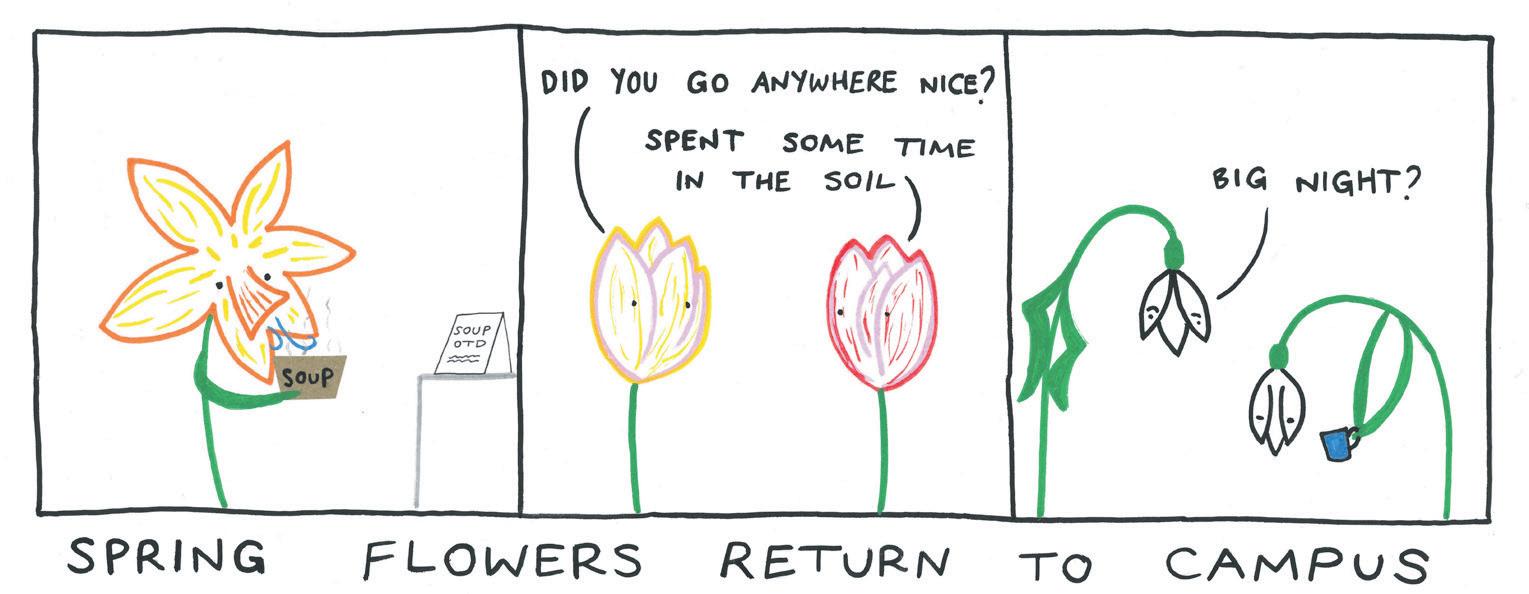
Artwork by Miranda Mercer, Third Year, Veterinary Medicine
Graduate Corner
Tanvi Virmani, from Bristol Old Vic’s graduating class of 2022, shares her experience as an emerging actor on the scene and breaking into the world of London’s West End.
Mansi Virmani Third Year, Economics

Q: You studied at Bristol Old Vic Theatre School (BOVTS). How did you know that drama school in Bristol was the place for you?
A: It was actually my top choice, Bristol Old Vic, I just
liked that it was away from London. I love the quaintness of it, I could just block out the noise and focus on developing my skills. Also, the alumni, Olivia Coleman, Daniel Day Lewis, Josh O’Connor, Theo James, Erin Dougherty. I like that there’s been actors from there who are doing amazing things.
Q: Whilst studying at Bristol Old Vic, was there any particular performance you felt was a turning point in your acting journey?
A: The Seagull, by Chekhov, in my second year. It was during a lockdown, so we had to do our scenes two feet apart. It was really unusual because we couldn’t rely on physical distance, so we had to work harder to establish a connection with the other person. It taught me a lot about the importance of touch; if touch and physical distance aren’t there, there are still ways to make a physical connection.
Q: You went straight into your professional debut at the Theatre Royal Bath when you were finishing up university. What was the biggest lesson that you took from BOVTS into your early performances?
A: I think to take risks to figure out what works and what doesn’t. It’s fine if you make a bad choice and things don’t work out in a rehearsal room. My year were so close and understanding. Their reactions made it a safe space to mess up and fail, that’s what I try to take with me.
Q: Are there any roles you gravitated more towards auditioning for or is it more like audition for everything?
A: I haven’t really auditioned for many roles older than about 23, most of my auditions are for people between the ages of 15 to 20, probably because I look quite young. BOVTS kind of trained me and gave me loads of different roles which guided me towards my niche.
Q: What’s your method for tapping into a new character?
A: Well, I read the script about 3 times before rehearsals start. The first time I read it, I make a note of any instincts that I have about the character. The second time I read it, I do a list of facts about the character: what the character says about people, what people say about the character, what the character says about themselves. I create a rough backstory but it’s very rough and then in the rehearsal I just go in with my instincts. I don’t really like to go in with many
preconceived ideas, I like to work it out in rehearsal.
Q: Do you ever look for aspectsofyourselfincharacters?
A: I always try to, that’s something that I’ve learnt since leaving Bristol, it’s more honest is if you bring the performance inwards and add a bit of yourself to it. If not myself then someone else I’ve seen, even just a person on the street. Or if a character reminds me of someone I know, I’ll try to bring in part of their personality.
Q: Your first West End show was Life of Pi, shortly after graduating, where you played Rani and cover Pi. You were the youngest in the cast. What was it like working with professionals who’d been in the industry for many years?
A: I was pushed to not use inexperience as an excuse. It was tricky at times, you know, imposter syndrome creeps
in, but the cast were all really lovely and very supportive.
Q: Do you have any pre-show rituals? Do you still get nervous?
A: I’d say I get nervous for about 70 per cent of the shows. I like to listen to music before shows and I try to channel it in the right way depending on the character.
Q: There’s a big assumption about acting that you need to be a nepo baby or have connections in the industry to start out. We have no actors in our family, that’s the same for a lot of aspiring actors. What’s your opinion of the stereotype? What advice would you give to those who want to act?
A: Watch as many shows as you can, take part in workshops. Look at your favourite actors and see how they’ve come up through the ranks. There are a lot of nepo babies, but equally there are a lot who aren’t. Look at drama schools as an option, they have contacts with really cool agents and a wide range of them, which is tricky to get on your own.
Q: What is coming up for Tanvi Virmani next?
A: I’m in a show called Minority Report, David Haig has written an amazing script for it. I’m playing an AI robot. It’s very high tech, they’ll be using lighting to give me the appearance of a hologram. It’s a type of character I’ve never played before, so I’m really thankful for the opportunity to try something new again.

THE EPIGRAFT
Thank you to everyone who took part in our blind date series this year!
Four blind dates, eight willing participants, only one second date... it's hard to play Cupid, but here's our editors' verdict on the best places to be romanced in Bristol.
“Hope and Anchor. Love the idea of being tucked away outdoors on a cool night, surrounded by nature. The fairy lights make it really romantic for a date. They've great food and it's not too noisy -- perfect to relax and have a chat!”
Image courtesy of Dujonna Gift
“Watershed, always. The cinema is the perfect first date.”
“The Vittoria. Small and cosy, really the perfect vibes for a date, plus £5 cocktails. What more do you want?”
“The Highbury Vaults is a classic for a reason...”
'Veganism is about challenging our normality': In Conversation with Ed Winters
After the release of his new book, Rachel Bronnert interviews best selling author and activist Ed Winters .
Rachel Bronnert Arts Editor
Ed Winters, better known as Earthling Ed, is a bestselling author, vegan activist, content creator, debater, and public speaker.
After the release of his second book How to Argue With a Meat Eater, Epigram spoke to Ed to discuss everything from, his journey in activism, the dangers of the meat industry, is any activism too far and are we all obligated to be vegan? As we began the interview, I asked Ed about how his journey in activism began and what inspired him to dedicate his career to raising awareness about veganism. Ed explained:
‘I went vegan in 2015 and then about nine months later I went to an event in London with vegan speakers, youtubers and campaigners from different organisations. I was really inspired by it and by people taking the next steps, in not just being vegan but advocating for it. I studied film at university so I had a camera, and I knew how to edit videos, so in early 2016 I started making online content. It was a desire to encourage other people to think about this issue. I think most people aren’t against the principle of veganism, but they have never had the opportunity to think about it in a meaningful way.’
Following the publication of How To Argue With a Meat Eater, Ed describes the goal behind his second book, ‘the first book was positioned more towards non-vegans and this second book is positioned

more towards vegans, but not just vegan activists. By being vegan people will just talk to you about it. It is such a divisive and interesting conversation. The idea is to equip vegans with the knowledge and skills to have more effective and respectful conversations. That so often descends into arguments and judgement. The title is naturally an eyebrow raiser as it draws people in. I’ve been invited onto different platforms to speak about it because the title encourages that. When people read it hopefully, they realize its more nuanced and inciteful.’
Moving on to the heart of the debate behind his career and the second book I questioned Ed on the key reasons behind his veganism, he expresses that ‘the number one thing for me has always been animals. At its core veganism is a movement for animals. Within that there are huge benefits that come to us and our environment. A plantbased diet has been shown to be the most sustainable diet that we can consume, it’s the diet that removes antibiotics from our food system, it removes the risk of bird flu and swine flu from spilling over and becoming serious infectious diseases. A healthy wholefood plantbased diet can also help from a chronic disease perspective.’
I suggested to Ed that many of us feel a dissociation between animals we see on farms and the animal products we see in supermarkets.
Diving into why this may be the case, Ed suggested that: ‘We are so separated from the process of what happens to animals that we don’t think about bacon coming from a pig, who was most likely farmed very intensively and most likely killed in a gas chamber. We aren’t necessarily aware of the realities of what happens to animals and as it happens far away there is this detachment. The other factor is marketing. When you go into a supermarket you see pictures of happy animals, or you see an advert on tv all about how what we do to animals is amazing. We are fed so much misinformation and propaganda. Veganism is about challenging our normality and thinking more critically about our choices and challenging us to dig a little bit
deeper away from the narrative that we are sold through marketing. I think veganism can encourage us to be more critical thinkers and think beyond the surface level narrative that is presented to us about these issues.’
In terms of the meat industry itself, about half of the land mass in the UK is used for animal farming and the UK is in the bottom 10% in terms of biodiversity globally. Discussing the dangers of the meat industry, Ed notes: ‘habitat loss, biodiversity loss, deforestation and as a consequence species extinction, globally animal farming is the biggest driver of all of these things.’ Following this, ‘by year 2050
the number killed by antibiotic resistant bacteria will be equal to the number of people who currently die from cancer each year. The biggest use globally of antibiotics is on farm animals. It makes no sense that we use them to keep animals alive just long enough that we can make the most amount of money from them. It’s squandering the miracle of modern medicine on cheap meat.’
Following recent discourse on the scrutiny of processed vegan foods, I followed this up by asking Ed what he thought about this issue. ‘It doesn’t concern me as it’s not meant to be an objectively healthy food. Vegan sausages aren’t meant to be a kale and chickpea salad. It is meant to be an alter-
native to a product that by its nature is already processed. What the evidence shows is that a plant-based alternative isn’t the healthiest food you can consume, it is healthier than the foods its replicating.
As it stands there is this dangerous narrative being created which is that plant-based alternatives are the big enemy and like poison for you. This is not only antiscientific but it’s dangerous as the idea behind these foods isn’t to be a superfood but to be a nice replacement that you can enjoy for the flavour and texture.’
• To catch up on the rest of Epigram's conversation with Ed, head to www.epigram. org.uk
Arts
Editor Co-Deputy Editor Co-Deputy Editor Digital Editor Rachel Bronnert Ella Carroll Isabel Williams Phoebe Caine
Images courtesy of Ed Winters
The problematic nature of Dark Romance novels
Ruby Smith discusses the popularity of dark romance novels and how they influence us.
Ruby Smith
Second Year, English
Young adult novels’ is a term many readers are familiar with. Books within this genre are written for a teenage audience, covering themes of coming-of-age, politics, identity, friendships and relationships. A loosely defined but easily recognisable genre. The term ‘Dark Romance’ is a more modern phrase, a genre made popular through internet trends and social media crazes such as those on BookTok.
Dark Romance’ is best described through its tropes. Often associated with the fantastical, the genre covers mature and sexually explicit romances, notable for their extreme power imbalances and question-
able morals. Tropes of large age gaps, enemies-to-lovers and kidnappings are common in these books, setting the scene for forbidden romances.
These two genres seem contradictory. A genre designed for young people with semi-educational and relatable plot lines compared to a category that romanticises the unhealthy, and sometimes illegal, kinds of romance. However, with Publishers Weekly reporting that YA books had the biggest increase in sale over a year (30.7%), the success of the genre speaks for itself.
In some ways, young people’s appeal to these romances is understandable. A Bristol University student who considers herself to be a fan of the genre described how these novels are a ‘complete fantasy’; that you are ‘never going to come across this a person like this in real life’ so a romance with them feels like a ‘powerful and sexy escape from reality’. She described
how the male characters are often ‘horrible and evil’ characters, like fantasy kings or powerful Mafia bosses, but you always end up ‘loving them’ and ‘ignoring the fact they are actually evil’.
Power imbalances in these books are clear. Perhaps the most infamous of the YA dark Romance is Stephanie Meyer’s Twilight series. Portraying a romance between 17-yearold Bella and 104-year-old Edward, Meyer gets around this uncomfortable and illegal age gap with the fact Edward is a vampire, making his appearance forever at 21.
The reader I spoke to was aware of these influences on young people, insisting that these books ‘should not be read by young teens’. Being 20 herself, she explained that personal experiences of sex and romance taught her ‘correct boundaries and what is right from wrong’. This is in contrast with young readers, for whom these books are
often their first introduction to sex, including reading graphic scenes of a violent and intense nature. It is clear that whilst older readers know enough to differentiate fantasy from real life, young people who haven’t yet experienced this cannot make this same separation.
Sarah J. Mass’s A Court of Thorns and Roses was first published under the YA category. Telling the story of Feyre entering the world of the Fae, the book experienced major commercial success, but also faced criticism of its sexual content and unhealthy relationships. The book sold over 13 million copies and was popular beyond a teenage audience. Many older readers encouraged the sexual nature of the successive books in the series, something rejected by parents of younger readers. This complicates what is considered acceptable in YA books, as writers are left to cater to the commercial sale of their books, whilst
also dealing with accusations of impropriety that may isolate potential readers.
As this discussion becomes more publicised, many readers have suggested books of similar themes that are more appropriate for young readers. Leigh Bardugo’s Shadow and Bone series has been praised for its rejection of unhealthy relationships, despite fan pressure. Bardugo rejects the notion of the antagonist as a love interest, for the understandable reason that he is evil and far too old. Victoria Averyard’s Red Queen series follows a similar path and explores the complication of romance and betrayal in way that doesn’t romanticise the toxic.
While ‘Dark Romance’ offers a fun escape from dayto-day reality, these books are best left to read by an older audience, calling to publishers to market their books toward appropriate readerships.
Social media doesn't have to be all mindless content - it can be art, too
Eve Davis speaks to creative people on the art of social media.
Eve Davis
First Year, English
In 2024, it is rare to find someone who does not use social media. As we navigate this era of interconnectedness, social media platforms have evolved beyond mere communication tools and become fertile grounds for artistic expression. Instagram and TikTok have transformed into digital portfolios. I spoke to several young creatives and delved into how social media facilitates their artistic endeavours. My journey with social media has been complex, shaped by the era in which I grew up. I found myself navigating the internet long before it was perhaps appropriate.

What began as logging into my Mum’s old laptop to play online games like Club Penguin evolved into Instagram and Snapchat. My relationship with social media platforms was often marked by self-consciousness, especially regarding body image, and I empathise with those who view them as contributors to declining mental health. However, my perspective on social media has undergone a transformation. I recently embraced social media as a space for creativity. I see my Instagram page as a compilation of things I enjoy, and I follow individuals who inspire me creatively. By making my profile public and curating content that reflects my interests, I use Instagram as a canvas for self-expression. I found that others feel similarly. Aditi (@aditixh) enjoys Pinterest and Instagram, using the latter to develop her modelling portfolio. Amidst snapshots of outings with friends, she integrates music and photos from her modelling shoots. While she crafts a distinct 1970s aesthetic through her posts, Aditi reflects, ‘There is a level of reality to my posts as the photos capture the best times of my life so far.’ Sophie (@sophstorey) uses colours and images to express her artistic side on social media. Her Instagram is a mixture
written work, she expressed concern about self-censorship and fears that the pursuit of a particular online aesthetic might hinder her from platforming certain ideas. Much like other forms of artistic expression the inclination to prioritise specific elements can lead to creative stagnation. I was particularly intrigued by the shift in Roxy's use of social media since her recent move to London. Both of us hail from a small town in South Wales, where the internet served as insight into the glamorous world of affluent city influencers. Reflecting on her experience, she noted: ‘Social media often felt like looking out of a window, but not being able to leave the room.’ Interestingly, she has observed a decrease in her reliance on social media since relocating to the city. I share a similar sentiment.
Living in Bristol has undoubtedly influenced my attitude towards social media, making me more laissez-faire about its role in my life. The vibrant city, brimming with culture and artistic hubs, has significantly shaped my approach to posting. Regrettably, I don't believe I would have the same freedom to experiment with social media as a creative space if I were in my home-
town. Despite its drawbacks, viewing social media as a tool for creative expression has enriched my online experience. Embracing a more detached, artistic approach to social media – rather than an overly invested, personal one – may offer a healthier and more fulfilling engagement with these platforms in the long run.
15
epigram 01.03.24
@roxymoonnn @aditxh
Film & TV
Film and fashion: dopamine dressing to dark academia
The timeless tango of trends and style at the intersection of film and fashion.
Lauren Durose
Film & TV Co-Deputy Editor
The relationship between film and fashion has long been intertwined; the replication of iconic characters and aesthetics has been attempted time and again. Certain eras and decades have had long-lasting impact, whilst other styles have seen themselves ruled impractical leading to reinvention.
Characters like Elle Woods influenced fashion not in specific styles but in the embracing of bright colours, particularly in the professional setting. Her unwillingness to compromise her authenticity results in an array of pink outfits, one of which makes its way to the courtroom. In doing so, Woods spread the message that professional women, even those at the top of their fields who assume positions that so regularly go to men named John, should allow
themselves to wear clothes and colours that suit their style and personality. An empowering message, highlighted by a love and understanding of fashion, enabled a change in professional attire.
Much like Legally Blonde (2001), the movies La La Land (2017) and Barbie (2023) saw an active rise in dopamine dressing. The trend encourages participants to wear bright colours and statement pieces to make the day-to-day a happier experience. Many who enjoy the vibrant style have taken inspiration from Emma Stone’s yellow dress or Barbie’s overwhelmingly pink world.
Of course, it's easy to argue that film’s impact on fashion is often more aligned with the quick kind. Notable pieces like Jennifer Garner’s 13 Going on 30 (2004) multi-coloured (but mainly teal) dress, have found their way into mainstream styling, as fast fashion brands seize the opportunity to ride the wave of a film's popularity before swiftly moving on to the next monetizable trend. This doesn’t suggest that the movie had any actual effect on the fash-

ion industry – particularly at the high-end side of the scale – but rather displays how fast fashion corporations capitalise on signature pieces, replicating them to feed consumerism. We see this most in relation to film genres like rom-coms and chick flicks, notably those that typically appeal to the demographic of young women.
When it comes to day-today fashion, both the 90s and noughties were consistently influenced by what was on their screens. Both Friends (19942004) and Sex and the City (1998-2004) were huge in their impact. With audiences sat at home working out
which character they identified with most – were they a Miranda or Carrie? Rachel or Phoebe? – fans began dressing like certain characters, the replication of recognisable silhouettes becoming noticeable.
With cult classics like Clueless (1995) and Mean Girls (2004) also being released at this time, one could argue that it was really fashion that was impacting film. The consistent referencing of high fashion brands like Vivienne Westwood or Ralph Lauren displays that the relationship between film and fashion can run both ways.
We see this relationship between media and personal style develop not singularly with characters and outfits but in specific aesthetics that are popularised and assumed. Take dark academia: often associated with the
Gray (2009) or Dead Poets Society (1989), the neutral colour scheme and scholarly attire has become a favourite for many in its stylistic choice. It sees a significant amount of knitwear, tartan A-line skirts, blazers and knee-high socks, all supposedly inspired by the idea of the romantic and dimly lit movie that they attempt to replicate. The relevance of period productions like Bridgerton, Persuasion (2022) and Emma (2020) reinvigorated trends much like the corset. Despite its historical significance to female fashion and its ability to squish and shift organs, the association of romance and period drama have married together to invite torturous pieces of clothing back into mainstream fashion – although in far more practical and wearable forms
now! In similar measure to the corset, floral maxi summer dresses saw a rise in popularity upon the release of Bridgerton, often with capped sleeves and square necklines that were very reminiscent of the evening gowns worn in the 1800s – the century in which all of the aforementioned period pieces were set.
The recurring theme seems evident. Film is highly influential over fast fashion, as corporations rush to replicate whichever character is gracing people’s Pinterest boards that month. In contrast, it seems that fashion in its high-end brands and top names reappear continuously in both film and television to the extent that these iconic brands are parodied or reinvented in shows like Emily in Paris (2020-) as representations of luxury. Either way, the two are intertwined in an enjoyable and notable way.
As younger generations grow up and discover the movies that have established themselves as classics for their decade and genre, we see how fashion trends reappear over time: currently, we may look towards the low-rise jeans of the 90s, or the questionable skirt over jean trend that took over the red carpet in the noughties. Regardless, film and fashion will continue in their relationship to popularise trends and aesthetics, both new and recycled, as they remain integrally connected.
Editor Co-Deputy Editor Co-Deputy Editor Digital Editor Subeditor Arron Kennon Lauren Durose Sofia Webster Sienna Thompson Victor Bennett
Harry Potter franchise, Dorian
Legally Blonde (2001)
Bridgerton (2020-)
Mean Girls (2004)
All images courtesy of IMDb
'It's time to take the right steps forward': in conversation with the cast of Boarders
Meet the cast of the BBC's latest hard-hitting coming of age drama.
Arron Kennon Film & TV Editor
Welcome to the uproarious world of Boarders (2024), a dynamic and captivating series that seamlessly blends high-energy comedy with poignant coming-of-age drama. Set against the backdrop of the British public school system, Boarders chronicles the adventures of five exceptionally talented black inner-city teenagers: Jaheim (Josh Teduku), Leah (Jodie Campbell), Omar (Myles Kamwendo), Toby (Sekou Diaby) and Femi (Aruna Jalloh). Their lives take an unexpected turn when a viral video lands them in the spotlight, leading to an offer of sixth-form scholarships at St Gilbert’s, one of the nation’s most prestigious schools. Suddenly thrust into a realm reminiscent of something out of Harry Potter, they must navigate the labyrinthine corridors of privilege, lush playing fields, and arcane social codes, all while grappling with their own identities and the stark realities of living alongside the elite one percent.
As much of the series was
shot in Bristol, I sat down with the lead cast of Boarders and delved into their experiences of the city, insights into acting, and the unique blend of comedy and raw realism that defines the show.
‘The nature of it is beautiful. Like the Downs, we were walking there all the time. The sunsets were hitting because we were filming in summer [...] they hit every day. It was like, wow, beautiful,’ remarked Jodie, reflecting on the unexpected beauty the city unveiled during filming. Aruna chimed in on his experience at Forwards Festival, ‘You guys brought me closer to my future wife, um, Erykah Badu, and I’m forever grateful for that.’
However, beyond the scenic backdrop lies the heart of Boarders – a narrative unafraid to confront pressing societal issues head-on. Josh emphasized the show's authenticity, stating, ‘This doesn't pull any punches or try to be preachy about it. It just shows you what it's really like.’
In an era where conversations surrounding institutionalized racism and societal inequalities are reaching new heights, Boarders emerges as a poignant reflection of the times, igniting dialogue and fostering empathy. Josh continued,
‘it's not nice, is it? But yeah it’s there.’ His words resonate with a profound honesty, emphasizing the importance of unfiltered storytelling in addressing societal challenges.
The integration of comedy within such weighty themes is fundamental to the show's effectiveness. Aruna astutely noted how humour often serves as a gateway to discussing uncomfortable truths. ‘Comedians joke about stuff because they're anxious about it. It's the only way that they can really talk about it [...] it's a great lead into talking about uncomfortable things,’ he concluded, encapsulating the essence of comedy as a means of encouraging dialogue.
Drawing from personal experiences while embodying new characters proved to be a transformative process for the cast. Myles shared his journey, stating, 'I went to school where I was the minority, you know, so I was able to draw from that experience and bring that to the table which was very helpful. But then again, we're creating new characters [...] it was a melding of those two things.' His insights underscore the intricate balance between personal history and artistic creation, highlighting the depth and complexity of the char-

acters portrayed in Boarders
Reflecting upon what can be learned from fusing personal and fictional experiences, Jodie remarked, ‘it's really different ways to tackle political situations [...] I think the way Leah handles experiences is very different from how Jodie would [...] I feel like I’ve learned a lot from that.’
As the conversation shifted towards the future, the cast expressed a collective desire to continue exploring diverse narratives that transcend conventional boundaries. Josh articulated his aspirations, envisioning a future where black stories encompass a myriad of experiences beyond historical tropes. ‘There are only a few things I really don't want to do and that's the things that have already constantly been told in the black community.’
‘I feel like we are at a stage
where it's time to take the right steps forward, where black people can finally just tell stories instead of them having to be stories from the past where we're slaves or stories where we're fighting, and then there’s violence and all that and that's the only way we can get people engaged now. We've got so much more to tell, so much more creativity.' After such an illuminating discussion with the cast, it became clear how Boarders has emerged as more than just a television series. It is a testament to the power of storytelling in fostering understanding and driving social change. Through its candid portrayal of life's complexities, the show invites viewers to confront uncomfortable truths with compassion and humour.
One Day: a coming of age rom-com for those who crave epic love
Nicole Taylor's rollercoaster of intimacy and missed connections.
Gabriella Adaway
First Year, Theatre and Performance Studies
Love, friendship and not getting things quite right–Netflix's One Day (2024) doesn’t fall short when creating an all-around sublime series. Nicole Taylor adapts both a heartwarming and heart-wrenching tale of two people who just keep missing each other. We follow Em and Dex's relationship from their drunken night
together on graduation day in Edinburgh, 1988, over the following two decades throughout 14 episodes.
Dexter is your classically charming English posh boy whose face, flirtation and desirability only get him so far in life. Emma, on the other hand, is truthful, self-doubting and occasionally bitter, and her literary ambitions shift her down different paths. The audience gets to watch two people who come from vastly different backgrounds grow up together in what can best be described as an engrossing coming-of-age story. Love, travel, money, terrible dates, the unknown, bad friendships and even worse relationships,
this story doesn’t fall short on delivery or binge-ability. It’s important to praise the representations of different characters within the show, something the 2011 adaption fell short in. Emma Morely’s ethnicity is only briefly touched on, in the opening episode where Dexter clumsily asks why she wouldn't sleep with him, whether if it was because of religion to which Emma states: 'Well my Mum is Hindu and my Dad is a lapsed Roman Catholic, so no, God was not involved', and from thereon in it is not mentioned again. If anything, there is far more of a point being made about her being from
Leeds than anything else. I would argue that the simple presence of a leading woman of colour in a rom-com creates a new opportunity for brown women to see themselves on screen as beloved characters, without needing to justify or point it out.
Of course, with any TV show, One Day has its flaws. It is often hard to understand why Emma falls for a man like Dexter and why she attempts to sustain their friendship. Aside from his charm (and I would argue) good looks, I often felt confused at how he got her to stick around for as long as he did. It is not hard to understand her initial attraction to him and
his to her, but it isn't until around episode seven that we finally get to see Emma push back. Annoyingly, Dexter just continutes to end up disappointing people.
Whilst the TV show echoes the 2011 film adaptation (including the posters) and may feel unnecessary for the previous audience, this series is for those who want more: more Tilly, more Ian, more of their lives and of course more Em and Dex. Even the more painful moments are still drenched in love and friendship. Be warned, whether you know the story or not, tissues will be needed.
epigram 01.03.24
17
Image Courtesy of BBC Drama
On their fifth album, the Bristol icons cement the tent of love in stone.
Bethany Strand
Third Year, English
If you’re honest and love something enough and you put it on record, then people will see that love. Whether they like it or not is not your f***king problem.’ IDLES frontman Joe Talbot tells NME. Reading this, I can only assume he doesn’t care much for opinionated music reviews.
Having said that, the honesty and love he speaks of certainly has made its way into IDLES’ newest record, TANGK The band has an affinity for this kind of guttural utterance – ‘LOVE IS THE FING’ has been the promotional catchphrase for the new album, an encapsulation of its ethos of interiority, identity, and quite simply love, presented to the listener in a caps-lock explosion that asserts its affection with tender ferocity. Each song on the band’s 5th album is a ‘particle of punch drunk love’, to quote the lead single, ‘Dancer’. IDLES get right up in your face, but proceed give you a kiss on the cheek, rather than a thump in the head.
The band are identifiable by their lyrics of righteous anger, humour, and satire that sometimes border on self-parody. But they show that thrashy, punky and angsty sounds aren’t always reflective of hostile or aggressive masculinities – IDLES’ sound is passionate, and deeply feeling. The band’s poetic sensibilities have never been higher than they are in ‘TANGK’ – Talbot’s guttural cries celebrate ‘Gratitude’, ‘Grace’, life’s gifts, joy. There is a notable shift toward sentimentality and honesty, a perhaps more useful repurposing of their previous angst and rage.
Love,
The opening track, ‘IDEA 01’, is unlike any previous IDLES song, bearing the imprint of newly recruited Nigel Godrich (Radiohead, U2, Arcade Fire, R.E.M.) It’s a plunge into isolation, alone with Talbot’s vocals which are, for once, almost delicate – only a soft piano melody twinkles behind him. It is a slow burn that doesn’t reach a quintessential IDLES roar; this is delayed until Track 2, ‘Gift Horse’, which takes on
IDLES return with TANGK
this task with galloping gusto. Lyrically the track embodies the theme of the album – love, but still Talbot can’t resist vocalising his scorn for today's British state. IDLES’ socially conscious and left-wing ethos is important to their identity, despite occasionally com-
Talbot sings about ‘Freudenfreude’, the act of taking pleasure in someone else’s joy or success, an apt description of my experience watching them launch their 5th studio album. The accumulative lyrics of ‘joy on joy’ don’t find a mirror in the song’s cadence,
aggressive primality, but one that arises out of love and passion, not anger and hate. In ‘Roy’, Talbot explores this precarious balancing act between his softer side and his more primal impulses:– ‘I am baby’s breath, I dance with death’.
‘Hall and Oates’ is anoth-

ing across a little sloganized and reductive. Singing about his daughter, Talbot melodises: ‘My baby is beautiful / All is love and love is all’ Before shouting, ‘F**k the king, he ain’t the king, she’s the king!’, as another explosive chorus ensues. Previously, IDLES’ social commentary has been defined by satire and ironic detachment. Now, Talbot aims to explore injustice in Britain through love, rather than hate. Yes, he says, there is a king, someone worthy of my reverence and worship – and it’s my family. Track 3, ‘POP POP POP’, is my personal favourite track.
which is deadpan and dreadful (in the literal sense). The punchy, relentless repetitiveness of the song, reflected in its onomatopoeic title, reminds us to keep going, day by day, to keep loving through the darker times – as Talbot reminds us in the final refrain, ultimately, ‘love is the fing’.
The most empowering track on the album for me is ‘Dancer’, which commands the listener to let go. Talbot says himself: ‘there’s something deeply primal about dancing, particularly when doing it with a group of people.’ The song brings its listeners ‘hip to hip, cheek to cheek’, ‘sweat’ dripping from every line. Accompanied by Talbot’s signature growl, ‘Dancer’ is gritty and instinctual. IDLES encourage an
outward political diatribe, moving inwards to explore sensations and emotions over arguments and ideas. TANGK hones in on the unique, and frequently disorienting, experience of owning a body and a heart and the joy that ensues from sharing these things with other people. The band’s political engagement is still core to their ethos, though –for this very joy, one might say, is an act of resistance.
Matilda Sunnercrantz-Carter Third Year, Music
With punk carrying anti-government and anti-establishment ideologies, IDLES are a breath of fresh air in the sub-genre neo-punk by combining the punk spirit with lyricism touching on a wide range of taboo topics. We can see an example of this is in their song 'Samaritans' of their 2018 LP 'Joy as an Act of Resistance', where Talbot sings about toxic masculinity and the expectations men are fed by society.
There’s no surprise IDLES fan base is so tightknit. In the documentary Don’t Go Gentle, Talbot is seen spending time with fans, getting to know them personally. What IDLES and their community have created together is a rare sight in the music industry today and speaks volumes about their character. From playing at local Bristol venues to being known across the globe they haven’t lost touch with what has meant the most to them from the start, community.
er direct, hearty and to-thepoint ode to love, this time to male friendship and the emotional vulnerability it can offer: ‘I love my man, I love’ Talbot chants, singing to Bristol-based singer-songwriter Willie J Healey, whom he felt like he was ‘falling in love’ with as they supported each other through the pandemic. Talbot tells NME that he wants IDLES ‘to be infectious in a way that makes people feel, not think.’ TANGK, is visceral and bodily, excreting blood, sweat and tears from start to finish. It represents a step back from
In the 2021 documentary Don’t Go Gentle: A Film About Idles by Mark Archer we get a look into how the band was born. In 2009, lead singer Joe Talbot found himself immersed in the Bristol music scene. Bassist Adam Devonshire
Talbot aims to explore injustice in Britain through love, rather than hate.
“Dev” had started working at The Golden Lion on Gloucester Road, where they came to be a part of a beautiful community, passionate about a similar music scene. Talbot describes this time as very valuable, giving him meaningful friendships that many of would lead to IDLES becoming the band they are today. So why not grab a pint at The Golden Lion, take a listen to some of their tunes, let out some rage and get pumped up for their new album?
Music Editor Co-Deputy Editor Co-Deputy Editor Digital Editor Subeditor Jake Paterson Benji Chapman Dylan McNally Cara Hene Susie Long
Images courtesy of Partisan Records
presented to the listener in a caps-lock explosion that asserts its affection with tender ferocity.
NewDad: Shoegaze and gothic revival
As part of our Rising series, George Dean showcases NewDad on the release of their new record Madra.
George Dean Proofreader
In their 20th January interview with Genuine Irish, sixdays prior to the release of their debut album, NewDad’s lead singer Julie Dawson proclaimed Madra (2024) “A very big step up from what we’ve done”; she assuredfans “but it’s still us”, whilst gleefully affirming that “it’s a rock album”. Lead guitarist Sean O’Dowd weighed in, commenting that “We’ve had enough of indie […] we’ve had enough of it as a society […] now we wanna rock”. NewDad overlaid the mechanisms of shoegaze onto a canvas of gently melancholic indie-pop in their EPs Waves (2021) and Banshee (2022). Their harnessing of shoegaze has become emboldened in Madra, as the quartet have gutsily manoeuvred towards gothic rock. Madra’s soundscape plays in black and white, in torn rags and feathers; whilst Waves and Banshee evoked teenage angst and naivety, the overriding tones of Madra are eerie and twisted, numbed
by self-loathing and yearning, tinged with the dark forces of the supernatural and celestial. This is NewDad at their most tragic and vulnerable.
Madra’s opening track ‘Angel’ (which featured in Epigram Music’s Top 100 Songs of 2023) is a valiant statement of intent for the album as a whole; in a manner akin to The Stone Roses’ 'I Wanna Be Adored', it is an epitomising exhibition of NewDad’s expansive qualities within the record. I am eagerly anticipating seeing NewDad play at Trinity Centre in Bristol on 3rd March. As the venue is a re-purposed 19th century church building, built with Bath stone in the gothic Perpendicular style, it should provide a sufficiently haunting space for NewDad to fill.
The thematic elements established in ‘Angel’ are built upon in the lyricism of the album’s second runner ‘Sickly Sweet’, which pulsates with ill desire through evoking Original Sin – “A shiny thing, I want to pick / Take a bite and spit you out”. There is an intense, whirling physicality connected to the song’s title – “Now I’m nauseous and I don’t even like you”.
Rishi Shah (Kerrang!) has captured Madra’s culmination of musical influences
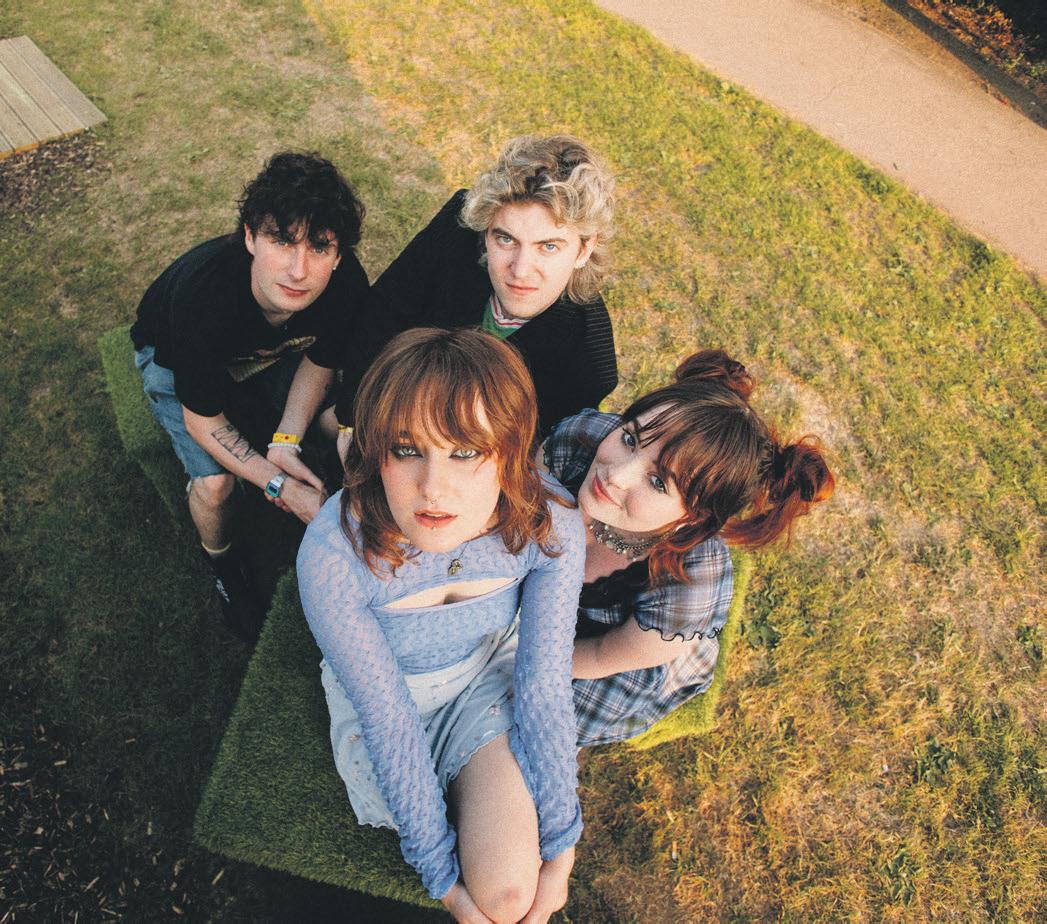
under the term “atmospheric dream-rock”, highlighted by the involvement of Alan Moulder in production (The Smashing Pumpkins). However, Madra does fall back upon the indie-pop hooks which defined NewDad’s EPs; I could not help but crave that the band would lean further into the heavier, grungier potentialities of the gothic soundscape. Comparisons to The Cure and My Bloody Valentine have been by no means unfounded, but
even from the fact that there is simply no song which goes above four and a half minutes in the album, Madra is clearly no Disintegration (1989).
‘In My Head’ contains a catchy opening through its subtle jangly guitar riffs, but it is a largely futile track which adds little to NewDad’s project – it felt as if the band were going through the motions.
Having said that, NewDad may have felt that if they had abandoned indie-pop altogether, they would have
lost the commercial appeal they developed in Waves and Banshee. The tenderness of ‘Change My Mind’ bridges the gap between Madra and the EPs; its gracefully executed hook and accompanying lyrics have rung around in my head for some time: “Your eyes, they look like mine / So, I can see you feel confined”.
NewDad’s gothic fusion is less successful in ‘Let Go’, a predictably noisy track with an incurious climax in the chorus, marked by the clichéd lyrics “I can’t let go”.
When talking to 10 Magazine, lead singer Dawson confessed that she wanted NewDad fans to feel “relief” when listening to the album. This comment most prominently brings to mind ‘Nosebleed’: comforting in its heaviness and fatigue, which are harnessed to conceive a majestically misty atmosphere. The 10-second hum of synth-y bass at the beginning of the track reminded me of Radiohead’s ‘All I Need’. A wavy ballad, I found ‘Nosebleed’ the most emotionally impactful chapter of Madra, as it cathartically recalls lost loves which the listener has been compelled to let go of, for the sake of their own peace. Dawson’s pain is deep and primal.
Lankum take on Bristol Beacon
Bruno Bridger reviews one of the Beacon's displays of rising acts this month, Irish folk legends Lankum.
Bruno Bridger
Second Year, English and Philosophy
Lankum have made a name for themselves by occupying an unusual space in the alternative mainstream: christened by Rough Trade, Cillian Murphy and the Mercury Awards as a force to be reckoned with. Their sound is equal parts majestic and terrifying, somehow hopeful despite their eerie 'doom folk' sound. Live, the band mustered up a direct, primitive engagement from the audience who were captivated by the group's authority over the soundscape of Beacon Hall.
I was speaking with a friend the other day about our experiences of seeing Lankum live over the years. Before this discussion I had found it hard to accurately summarise the experience, something between a primal fear and some sort of pagan ecstasy, though
I think we had finally hit the nail on the head. ‘The show begins and it’s like some sort of ritual sacrifice is going to be performed at any moment’.
This statement was only emphasised when I had the chance to catch them at the newly re-opened Bristol Beacon on a rainy weeknight. Before we get into the details of Lankum’s set, it is worth also noting the spectacular support from fellow Dublin-based musician Rachael Lavelle, who provided modernist, synth-laden soundscapes before Lankum assembled their traditional reeds, drums and fiddles on the Beacon stage.
Ian Lynch and Radie Peat, the groups primary vocalists, often operated without instrumental backing throughout the set, an affectation that only emphasised the haunting, ghostly atmospheres being generated in the concert hall. Early in the set, Lankum play 'The Young People', a spellbinding original off 2019’s The Livelong Day, a performance which cut through the doom-folk instrumentation, and seem to claw out of its for-

gotten past a hidden reverie, which soon filled the room.
The band’s reputation as masters of folkloric re-interpretation was also demonstrated fully. Closing the set with one of 2022’s best tracks 'Go Dig My Grave', off the Mercury Prize Nominated False Lankum, itself a reinterpretation of a centuries old bur-
ial song, bordered on the cathartic, with the blood orange lights on stage ebbing and flowing alongside the tracks violently churning rhythms.
Upon leaving the Beacon, in a sense I felt I had witnessed a ritual of some sorts, that there had been something mystical akin to occult magic at play. The band had
dragged me back into the past and slowly as the set ended, spat me back into our troubled present, as I stood on a rainy Park Street, the ancient reeds were still ringing in my ears. While I fumbled for change for a kebab I was left in the liminal. Between ancient melody and the shock of the new.
Critics have tended to somewhat lazily liken Lankum to The Pogues - presumably a result of their mutual synthesis of traditional Irish folk with a punkish bombast - but their coalescence of folk storytelling with dread-inducing sonic drones might more accurately recall something along the lines of Planxty by way of latter-day Scott Walker or Sun O))). Yet, to compare Lankum at all to other artists does them a huge disservice. What their arresting show proves above anything else is how peerless they truly are. As one Bristol audience member shouts as a retort to the mention of a recent coronation we supposedly had here in the U.K., Long Live Lankum!
19 epigram 01.03.24
Featured Image: Zayanya Lorenzo
Featured Image: Benji Chapman
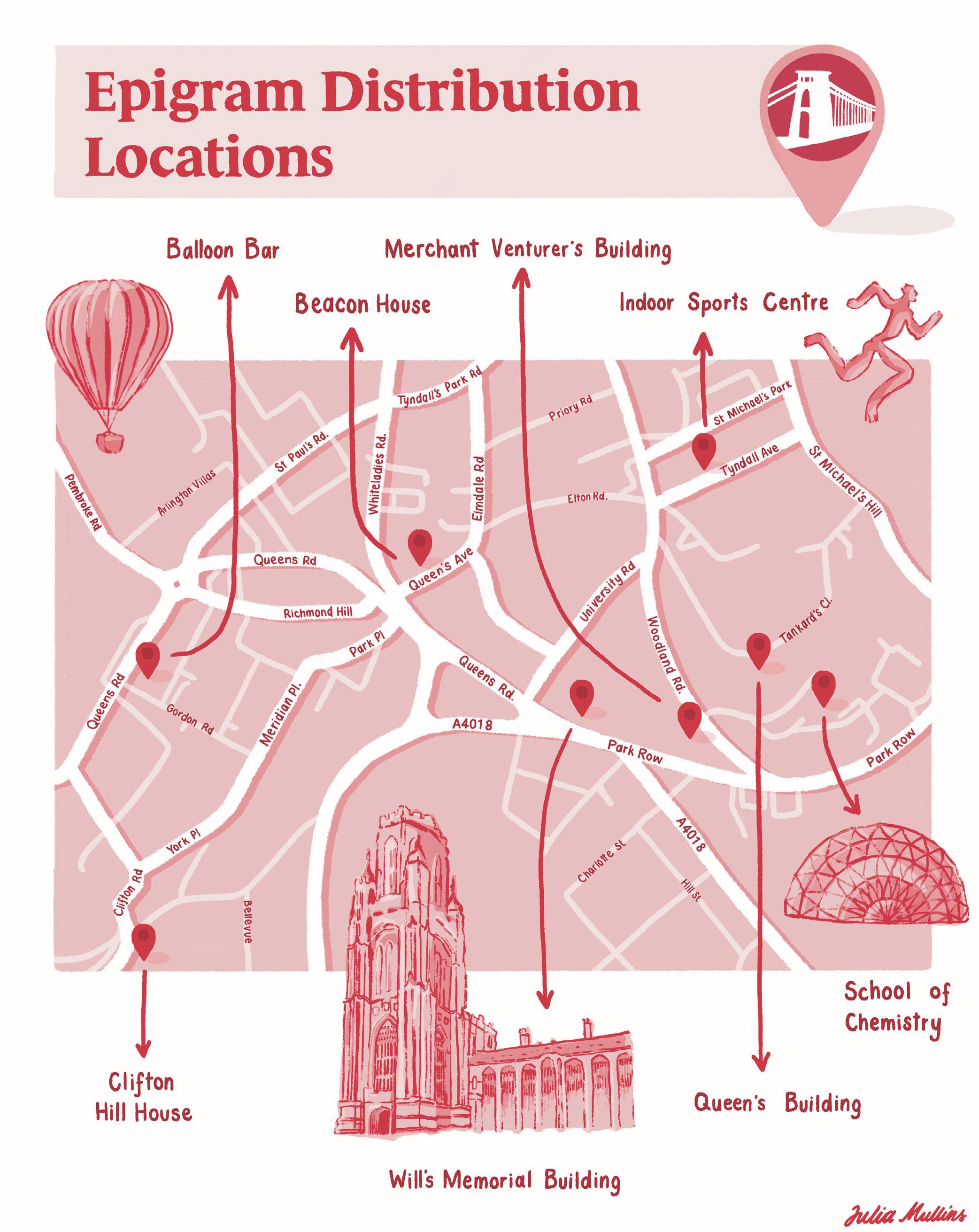
Debunking common neuromyths
Scitech explores brain myths and their impact on education and policy and rebutes these claims
William Watts
PhD candidate, Translational Health Sciences
The oldest recorded surgical procedure, known as trepanning, involved drilling a hole into the human skull to release trapped evil spirits. Since then, our understanding of the brain has fortunately advanced, yet public misconceptions persist. These ‘neuromyths’ are often harmless, only raising an eyebrow from a pedant, but certain myths hold significant sway over education and policy interventions. In this article, we delve into the most pernicious of these brain myths: 'We only use 10 per cent of our brain.'
The origin of this myth is unclear, but it has led to several misguided attempts at 'brain training' and at least two questionable Hollywood blockbusters.
First, evolution would not permit such inefficiency, especially considering that the brain is energetically expensive. Despite constituting only 2 per cent of the body’s weight, the brain consumes around 20 per cent of its metabolic energy.
Second, brain scans persis-

tently reveal activity across all brain regions, even at rest. While some areas are more active during specific tasks, no area is truly silent unless impaired by serious injury.
On the other hand, using 100 per cent of the brain simultaneously would be a recipe for disaster. Indeed, in the film Lucy, it is more likely that the main character would have triggered an epileptic seizure rather than master time travel.
'Students have preferred learning styles.' It is commonly accepted that we are either visual, auditory or tactile learners. However, this claim suffers from a total lack of evidence. Multiple studies have reported no significant difference in learning between those who learnt with their ‘preferred style’ and those who did not. Instead, the tenacity of this myth instead points to our proclivity to place
people into discrete categories.
This myth is harmful to both teacher and pupil. For the teacher, it wastes precious time and resources in planning lessons that cover each style. For the pupil, it can create a self-fulfilling prophecy where they perceive that they are not suited to certain learning techniques, so forgo them even if these techniques are more effective.
'Right-brained people are creative.' During my first A-level Chemistry lesson, I remember my teacher announcing that most of us were leftbrained for to choose science was to reveal a penchant for analytical and logical thinking. Presumably, the people who chose the humanities were right-brained, those of an irrational and intuitive bend. Sadly, my teacher was guilty of an oversimplification.
The left/right brain myth originates from experiments per-
formed by the Nobel laureate Roger Sperry. Sperry studied patients that had undergone surgery severing their corpus callosum, the nerve tract that connects the two cerebral hemispheres. These patients had brain hemispheres that acted independently of each other, a so-called ‘split brain’. Since information from the left eye is processed by the right hemisphere and vice versa, Sperry controlled the visual information processed by each hemisphere by changing what was in either eye’s field of view. In this way, he observed that the left hemisphere performed better in language articulation and understanding; the patient could remember and speak a word seen with the right eye. Conversely, the right hemisphere could understand rudimentary language but not articulate it; the patient could not speak any words seen with the left eye, but they could draw pictures of some words.
While Sperry’s work is undoubtedly interesting, mapping it onto ideas of left/right brain dominance has several issues. Most glaringly, healthy people do not have a severed corpus callosum, so their hemispheres operate together. In fact, all cognitive skills use both hemispheres and there is no correlation between supposed left/right brain traits and hemispheric activity. This misconception can lead to similar problems as the previous myth where people
‘pigeonhole’ themselves into certain traits i.e. by believing a logical ‘left-brained’ individual cannot be creative.
'The adult brain does not grow new neurons.' You may have encountered variants of this myth, such as the notion that each is born with a fixed number of neurons or that brain development ceases at 25. But, as ever, the maxim holds true: the brain is always more complicated than one might assume. Neurogenesis, the process of generating new brain cells, continues throughout one’s life.
This is especially pronounced in the hippocampus, where adult neurogenesis is believed to play a role in learning and memory processes. Additionally, brain maturity is quite a murky concept. It is difficult to pinpoint a definitive end in brain development given the variability between individual brains and the fact that structural changes continue after your 20s.
While it is true that sensitive periods exist for learning certain skills, such as language acquisition, learning continues throughout life, accompanied by the ability to form rich neural representations of new environmental stimuli. For instance, London taxi drivers show drastic structural changes in brain regions implicated in spatial representation. So, in fact, you can teach an old dog new tricks.
Environmental benefits of UK's vape ban
Scitech examines the recent UK disposable vape ban and its' environmental benefits, offering insights into the implica-
Alice Bullard
Fourth Year, MSci Biological Sciences
The ban on selling disposable vapes in the UK, announced in late January 2024, is expected to improve public health, while also reducing plastic and chemical pollution.
In the UK it is estimated that around 4.5 million people regularly use disposable vapes, also known as e-cigarettes. These handheld electrical de-
vices are available in tempting flavours and enticing colours, encouraging use by underage individuals despite sale to children being illegal.
Disposable vapes are also more affordable than rechargeable alternatives, increasing their appeal to young people. Just under 10 per cent of 11–15-year-olds use vapes regularly, a number that has tripled over the past 3 years according to the Office of National Statistics. In response to this issue, a press release given on the 29th January 2024 by the UK government detailed the ban of disposable vapes to lessen the increase of adolescent vaping and reduce undesirable health effects.
The Prime Minister, Rishi Sunak, said: 'One of the most worrying trends at the moment is the rise in vaping among children, and so we must act before it becomes endemic. The long-term impacts of vaping are unknown and the nicotine within them can be highly addictive, so while vaping can be a useful tool to help smokers quit, marketing vapes to children is not acceptable.' We can also expect to see environmental benefits of the ban along with benefits to health. Disposable vapes primarily harm the environment through plastic pollution after improper disposal. Though vapes can often be returned to the retailer for disposal or
recycled as their constituent parts – this is not a simple or accessible disposal method for most. It is estimated that a staggering five million disposable vapes are thrown away weekly in the UK, a weekly increase of 25 per cent compared to last year. They are often recycled incorrectly, put into landfill, or discarded in public places. Plastic pollution harms wildlife after ingestion, releases harmful chemicals in soil and water, and aids the movement of other pollutants across around the world’s waterways.
Disposable vapes are not refillable or rechargeable, meaning they contain a single-use lithium battery. Disposal of vapes in domestic black bins
has been seen to cause chaos through the spontaneous ignition of batteries in waste lorries and landfill sites, endangering waste-workers’ lives and the environment.
On top of this, harmful chemicals are released from vapes such as heavy metals and acids when they are improperly disposed of that go on to contaminate soil and water sources – eventually leading back to human consumption.
• For the rest of this article please visit www.epigram. org.uk
SciTech
Editor Deputy Editor Digital Editor Subeditor Dhristi Agarwal Lucas Mockeridge Aarya Patil Will Kelly
Image courtesy of macrovector/ Freepik
Major lunar mystery finally solved
SciTech introduces lunar geology, focusing on rock formations on the moon that defy conventional understanding.
Miles Gilroy
First Year, Astrophysics
Lunar geology is the study of rock formations on the moon with the aim of understanding how the moon formed and evolved and how it will continue to change throughout its life. As with any field of science, seemingly impossible mysteries arise that can stump scientists for years or even decades.
One such mystery that has been evading scientists since as early as the Apollo missions in the 60s and 70s is the existence of a specific rock type on the lunar surface that, based on countless past experiments, shouldn’t exist, at least on the surface.
However, the joy of science is that there is always an answer, no matter how baffling the problem, and the answer to this enigma has recently been solved by a team led by the University of Bristol and the University of Münster in Germany.
The problem involves a specific rock type that is scattered all over the lunar surface, known as ‘high-Ti basalt’ due to its high titanium content. High-Ti basalt was first discovered during the Apollo missions when rock samples were brought from the moon back to Earth to be studied. Since then we have made great strides in understanding the process leading to the generation of these rocks except for one critical part: how they exist on the surface.
Ilmenite-bearing cumulates (clumps of a titanium-iron oxide mineral) are often named
as the source of high-Ti basalts. But, experiments performed back on Earth to simulate the generation of high-Ti basalts this way, yield products which are not compositional matches to high-Ti and are too dense to have possibly been erupted to the surface, hence the confusion surrounding their existence there.
The ground-breaking research performed by the team that solved this problem identified a reaction critical to controlling the composition of high-Ti basalts and allowing them to exist on the surface. This reaction would have occurred in the lunar interior around 3.5 billion years ago leading to the creation of high-Ti magma in the mantle that would have been sufficiently low in density to have been able to erupt to the surface back in the moon’s volcanically active phase, be-
coming basalt once it cooled. Since the lunar mantle is rich in many different elements, rocks that form there are composed of several different elements and compounds which each have different melting points, making them susceptible to partial melting.
Attempts to recreate highTi basalts have previously assumed a process of equilibrium partial melting, which occurs when the melted parts of the rock remain in contact with the solid parts and can therefore react. In the case of the production of high-Ti magma in the lunar mantle, this reaction involves the exchange of iron in the magma with magnesium in the solid olivine and orthopyroxene (magnesium rich minerals) rocks surrounding it. Hence, equilibrium partial melting would result in magma with a high magnesium content.
However, the team led by professor Tim Elliot of UoB and Dr Martijn Klaver of the University of Münster used high-precision isotopic analyses to find that the magnesium content in high-Ti basalt is too low to be consistent with equilibrium partial melting.
This discovery lead to the conclusion that the process that occurred in the lunar mantle over 3.5 billion years ago actually followed a kinetic isotope fractionation model meaning the magma was separated from the solid rocks, reducing the capacity for the Fe-Mg exchange, a reaction that increases the density of the magma.
This new understanding of the process behind the generation of high-Ti basalts explains their previously unexplainable low density, and therefore their presence on the lunar surface. The mystery of highTi basalts has been solved.
Impact of biotechnology and gene editing
Scitech investigates the impact of biotechnology and gene editing, exploring their ethical implications.
Aisling Rawlinson
Third Year, Geography
As science and technology continue to develop in the modern day, the emergence and application of biotechnology has become increasingly prevalent, with gene editing providing beneficial applications whilst also raising ethical and moral concerns too. Biotechnology involves the manipulation of living organisms, cells, and biological systems to develop products and applications – gene editing has a range of applications that have the capacity to benefit humankind in various ways.
Whilst gene editing has the ability to transform the lives of individuals and societies as a whole, we must maintain a balance between innovation, and responsible and ethical use, to ensure technology is harnessed for the greater good without compromising ethical standards or creating unforeseen consequences.
Gene editing technologies present a wide range of applications and benefits to improve lives across the
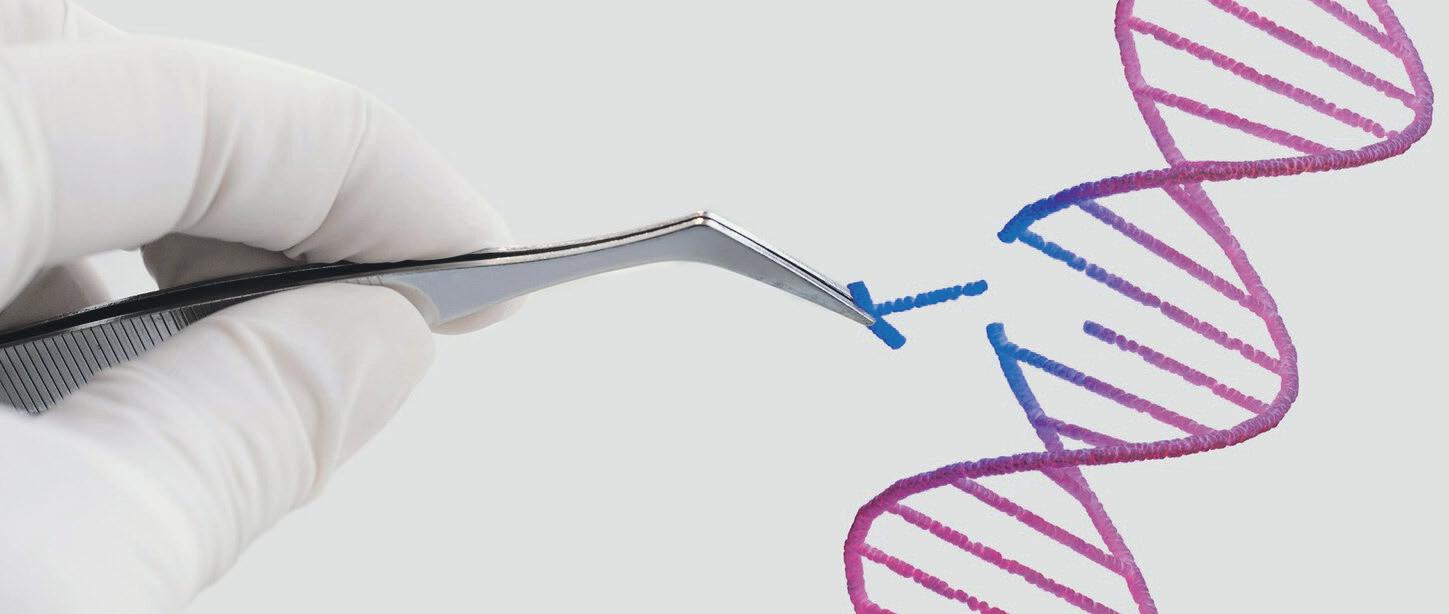 Freepik
world. One of the key benefits of gene editing technologies is their application in medical advancements such as disease treatment, vaccine production, and stem cell research. Gene therapies have the ability to treat genetic disorders such as cystic fibrosis at the root, vastly improving the lives of many individuals.
Gene editing technologies enable enhanced efficiency of vaccine development and production, allowing a quicker response to global pandemics and the safeguarding of health on a global scale.
Overall, biotechnologies such as gene editing have the capacity to extend the human lifespan by reduc-
ing the likelihood of disease and mitigating the impacts of ageing on individuals.
Agricultural development can be enhanced by gene editing technologies, as plants and livestock can be genetically modified and improved to their resistance to pests and disease, as well as their overall resilience, in particular to varying climates, which become ever more prominent in the warming world.
Gene editing in this way has the capacity to increase global food security, providing more people around the world with sufficient and healthy diets.
It is clear therefore that gene editing technologies can provide a range of benefits for the
world and its citizens, leading to healthier, longer lives, with reduced risk of disease.
However, whilst the benefits associated with gene editing are undeniable, their use also raises moral and ethical concerns, and so we must be mindful of both the promise and the perils too that these biotechnologies may create.
Gene editing may have unintended side effects or consequences for individuals being treated for genetic diseases – long-term effects of these technologies must be properly researched with conclusive evidence.
Questions around the accessibility of these treatments are also prominent, as
unequal access to biotechnologies can exacerbate existing social and economic disparities. Fears around gene editing and modification arise when we begin to consider the possibility of ‘designer babies’, wherein expecting parents may choose the characteristics of their baby. This raises significant moral questions about the nature of human enhancement, and to what extent this is acceptable. This also raises more concerns around the eugenics and discrimination based on genetic makeup.
It is clear that gene editing biotechnologies can have significant benefits for individuals and societies as a whole. However, the unnatural modification of genes within humans, plants, and livestock, calls into question the ethics and morality of the technology.
Therefore, we must consistently reflect on these issues, and champion for responsible use. Companies developing these biotechnologies must maintain transparent dialogue with the public, fostering inclusive dialogue, and robust regulatory frameworks should be put in place in order to outline what is ethically and morally correct. Furthermore, continued research is needed into the long-term effects of gene editing to be certain of their safety.
epigram 01.03.24
22
Image courtesy of
Below 5°C: Ice swimming, the Olympic quest
Epigram navigates chills and thrills: the pursuit of ice swimming's place on the Olympic stage.
Laura Nesbitt Sport Investigations Editor
Ice swimming, a sport where individuals swim in water temperatures of 5°C (41°F) or lower, has been gaining momentum as a new extreme sport. Originating from traditions in Eastern European and Nordic countries, the International Winter Swimming Association (IWSA) was established in 2006 to foster the chilly pursuit of racing in short distances from 50 metres to 450 metres and team relays. International Ice Swimming Association (IISA) was established in 2009 with the difference of offering the chance to race in the one kilometre – ice swimming’s hallmark event. Outside of competition IISA also offers swimmers the opportunity to swim the Ice Mile, a distance of 1609.3m. The Ice Mile stands as the ultimate test, often compared by IISA founder Ram Barkai to scaling Mount
Everest. To swim, swimmers don traditional costumes, goggles and a cap, without any additional aid. As IISA has evolved, the introduction of new challenges has continued to present swimmers with the opportunity to push the limits of what is possible. IISA introduced the Ice 7s (an Ice Mile on every continent), Ice Zero (one-mile swim in water temperatures below 1°C) and Extreme Ice Mile (one or more of the following conditions: water temperature at or below 2°C, wind chill at or below -15°C, a swim distance of two kilometres or longer, or the swim being performed at an altitude of 2,440 metres or higher). IISA organises the Ice Championships, the latter occurring annually, with the World Championships every other year. Due to the risks involved, only those with experience in cold-water races are permitted to compete in longer distances. Health precautions are stringent, requiring competitors to submit an annual medical assessment and electrocardiogram (ECG) – a mandate extended even to short-distance swimmers by the Great British Ice Team. Despite the appeal of these icy
exploits, there is an inherent risk. The shock of cold water can induce hyperventilation and a spike in blood pressure, whilst prolonged exposure may lead to hypothermia or even death. The IWSA and IISA differ in their approach to safety, with the IWSA capping race distances at 450 metres. Under IISA, swimmers sign a waiver to accept the personal risks associated with each swim. Beyond the thrill and personal accomplishment, there is a hope that ice swimming will one day be recognised as an Olympic sport. In 2023, the IISA and the French Swimming Federation (FFN) became affiliated during the World Championships held in Samoëns, France. The partnership aimed to develop the discipline of ice swimming within Europe, by focusing on organising events, promotion and awareness. In January 2024, IISA achieved a milestone by incorporating itself in Switzerland – the headquarters of Olympic sport – as an international sports federation, marking another step in its journey towards global recognition and, perhaps one day, Olympic glory. Nonetheless, significant

advancements in safety and governance are necessary for the sport's continued growth. As ice swimming gains international traction, with IISA holding events in 46 countries and boasting membership from 73 nations, the push for Olympic inclusion continues. However, the sport's enthrallment must be balanced with safety and ethical considerations, particularly as it steps onto larger platforms like the Olympics. There are huge
gaps in cold water, specifically ice water, research. More education is needed to manage the expectations of the sports ambitions globally, but also for swimmers entering the sport for the first time. Safety must be everyone’s priority.
• For the rest of this article please visit www.epigram.org. uk
Shutdown to showdown: Korfball’s revival from Covid
Epigram takes a closer look at how the korfball society has recovered from the Covid pandemic and the reasons for the recent boom in popularity.
Kieran Warren Deputy Sport Editor
Before the Covid-19 pandemic swept the nation, korfball was a prominent and popular sport at the University of Bristol, providing home to one of the strongest university teams within the UK. When the pandemic hit, however, demand for playing korfball, alongside all other sports, plummeted due to lack of on-campus attendance. Korfball is a hybrid of basketball and netball; it consists of two teams of eight players, with four attackers and four defenders, two boys and two girls will play defence and anoth-
er two boys and girls will play offense on the other side of the court, players switch roles every three points. the aim of the game is to score as many points as possible by shooting into a netless basket. The team prior to Covid and after were strong participants within BUC’s which has ten teams in each sector which is separated by geographical location. The top placing teams progress to the championship rounds. Before the pandemic, the University of Bristol displayed skill and confidence within the sport, reaching international tournaments in consecutive seasons and even boasting players who represented their country international- ly. The damage that Covid-19 had done to the team was evident

when I joined the ranks in the 2021/22 season. The club had struggled to field its original two teams, resulting in the abolition of the second team in its entirety, a few months into the season. Seemingly on a downward trajectory, the club resorted to drafting alumni to help boost the quality of the first team. With a total of thirteen players, alumni excluded, the club showed fight within the domestic leagues and was invited to play in the Attila tournament in Eindhoven. This was a major achievement for the club, considering its sheer lack of numbers. The following 2022/23 season would be marked by the revitalisation of the University of Bristol’s korfball scene: there came an influx of stu-
dents eager to play the traditionally Dutch sport. The rise in interest allowed the club to field two teams for the British Universities and Colleges Sport (BUCS) leagues. A series of impressive performances was evidenced by the club’s first team, who finished second place in the league, qualifying for a shot at the championship, whilst the club’s second team came in a respectful seventh place. Alongside the club’s achievements, the BUCS korfball team also succeeded on an individual front, with players Alice Lomas and Lizzie Tighe earning the joint-female ‘Most Valuable Player’ (MVP) award for the first rounds. In addition to this, Jonny Potter finished as the joint-male top goal scorer. Interest for playing korfball at the University of Bristol continued to rise heading into the 2023/24
season with another wave of fresh-faced students eager to play the sport, both at intramural and competitive levels. The quality of the BUCS squad has improved season upon season; this year the first team have won the BUCS preliminary rounds, whilst the second team came sixth in their respective league. The Bristol squad was yet again successful in winning the individual awards, taking home the joint-female MVP in Amy Bennett and Lizzie Tighe, who also won the joint-top female goal scorer. For the korfball scene at the University of Bristol, the prospect of recovery in the aftermath of the pandemic seemed dull and gloomy...
• For the rest of this article please visit www.epigram.org. uk
epigram 01.03.24
23
Image courtesy of Laura Nesbitt / Team GB, IISA 1st European Championship
Korfball crest/ Image via Bristol SU website
Sport Tackling perceptions: in conversation with UBWRFC
Epigram speaks to members of UBWRFC to understand more about the challenges that women in rugby face off the pitch.
Adam Mountain
Second Year, History
It is damning that one of the greatest challenges women in rugby face is off the pitch, rather than on it. Overcoming prejudices continues to be the crux for women in sport and this is none more so prevalent than in rugby. Epigram sat down with the inspiring University of Bristol Women’s Rugby Club (UBWRFC) to discuss the club's role in tackling the stigmatic narratives that hamper women in rugby. Club Captain, Skye Ayling (Second Year, Physiological Science), Club Secretary, Felita Beasley (Second Year, International, Social and Public Policy) and 1st XV player, Lieske Oomen (Second Year, Neuroscience), all joined Epigram for an interview to reflect on their experiences of difficulty as young girls in rugby, how these have compared since joining UBWRFC and what the next steps should be to elevate the club further. Rugby is deeply ingrained in this trio, who all started playing in primary school before quickly moving to higher performance-level clubs. Yet despite an undeniable love for the sport, their childhood and teen experiences of rugby are tainted by abuse, sexism, homophobia, unequal treatment compared
to the male teams and difficulties with body image. Talking on this, Lieske commented: ‘Growing up, you would be given the worst pitches, on the worst time-slots, while only lending the men’s equipment.’ Lieske then discussed her mother, who was one of the only female coaches in the club: ‘Most weeks she had to deal with all of the sexism and everything that could be thrown at her […]. It was very conflicting, because rugby is both empowering but also exacerbates difficulties of being different in sport through gender.’
Skye also made note that in women’s sport, rugby in particular suffers from sexist stigmatisms: ‘I think that women’s rugby is currently a couple of steps behind the rest of women’s sport. There will always be something pulling it back because of the physicality. Stereotypically, women are not meant to be physical.’ These difficulties are far from gone, but there has been a widespread effort over the last few years in changing the perceptions of women’s rugby. With growing anticipation for the World Cup in 2025, England Rugby launched its ‘Love Rugby’ campaign last year with the aims of increasing female engagement and removing the difficulties that women such as Skye, Lieske and Felita have all experienced as rugby players, even at a grassroots level. Therefore, creating a safe and inclusive culture is at the heart of what makes UBWRFC one of the biggest and
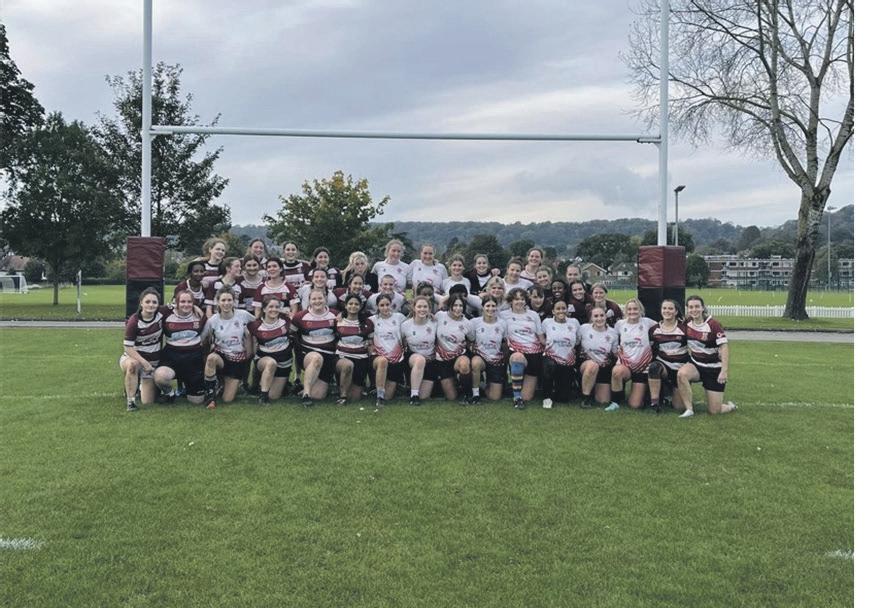
most successful women’s university sport clubs in the country, which Felita reflected on: ‘I remember in my first season, being in strength and conditioning, and looking at everyone’s different body types and thinking that this is so good. I fit here and love that there’s a collection of differences here.’
The club is certainly on an upwards trajectory; the partnership, starting in September last year with the Bristol Bears, has inspired the club to reach new heights. On the impacts of the partnership, Skye said: ‘It has been massive in both gaining bigger engagement from new players, while also enhancing the performance teams.’ She particularly sang the praises
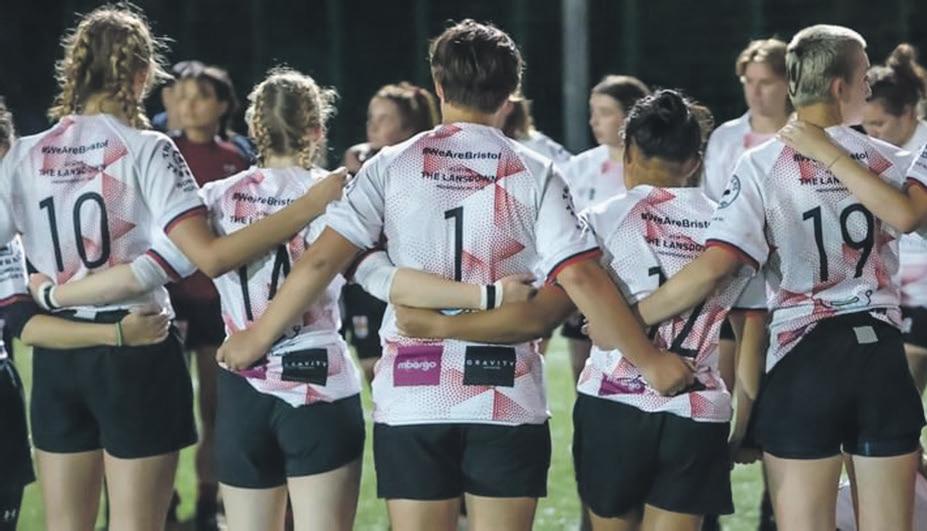
of Holly Phillips, who joined UBWRFC from the Bears as Assistant Head Coach and Forwards Coach for the performance team. ‘There is something really fantastic about having a female coach for our performance side: someone who has had an amazing experience playing premiership rugby.’ Felita continued this by advocating for the importance of having more female coaches in rugby: ‘Often, the female coaches can understand us better […]. This is not to take away from the men, but there is a connection driven from of us collectively being women in sport that allows us to elevate each other.’ The Bristol Bears partnership stands as a fantastic example of the efforts made by UBWRFC to raise the bar of what it means to be a university sports club. However, the work is not yet complete and when asked why she ran for Club Captain, Skye elaborated on what she feels the next steps are for UBWRFC. ‘We’re in a position at the university where we have the women’s rugby team and the rugby team. It’s not just women’s rugby as some sort of sub-category of the sport. We’re not separate, it’s the same sport. Now it’s just a case of breaking down those traditions. We need to be getting more of the men’s team supporting us and equally us supporting them, but that crossover isn’t quite there yet.’ For Lieske, con-
fronting these traditions that disparage women’s rugby ultimately requires a change in how the women’s game is perceived at every level: ‘we need more men and women being a part of women’s rugby, that don’t perceive us as merely a stepping-stone to the men, but actually see us as where they want to end up. Society, as a whole, often doesn’t like seeing strong, powerful women that know what they want and have a voice, but when you’re on that pitch, you’re with other people who are all fighting for the same goal, as a team and a family.’ It can only be hoped that with initiatives such as ‘Love Rugby’, a successful World Cup next year and a club as driven for change as UBWRFC, that soon we will begin to witness women’s rugby truly thrive. Yet, attacking the heart and mind of a sport that has long been defined by its masculinity will always be difficult. Sexist, dismissive attitudes remain a common issue within all women’s sport, for which rugby takes the brunt of it. That being said, it does feel as though UBWRFC has reached a watershed moment. The likes of Skye, Felita and Lieske serve as inspirations for any woman in sport and they speak on behalf of a club which remains absolutely resolute in defying the odds.
Editor Deputy Editor Sport Investigation Editor Oscar Coupal Kieran Warren Laura Nesbitt
Image courtesy of Lieske Oomen
Image courtesy of SmifSports Photography
