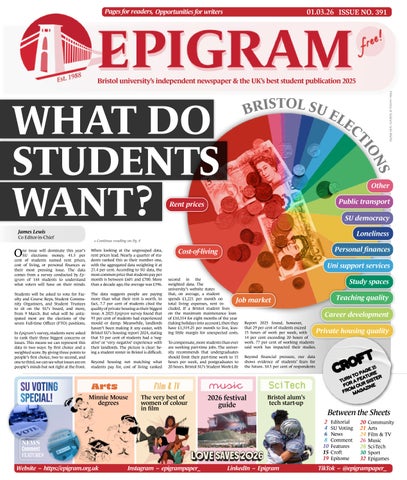

WHAT DO STUDENTS WANT?
> Continue reading on Pg. 4
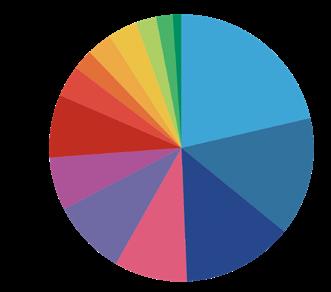
One issue will dominate this year's SU elections: money. 41.3 per cent of students named rent prices, cost of living, or personal finances as their most pressing issue. The data comes from a survey conducted by Epigram of 144 students to understand what voters will have on their minds.
Students will be asked to vote for Faculty and Course Reps, Student Community Organisers, and Student Trustees to sit on the SU's board, and more, from 9 March. But what will be anticipated most are the elections of the seven Full-time Officer (FTO) positions.
In Epigram's survey, students were asked to rank their three biggest concerns or issues. This means we can represent this data in two ways: by first choice and a weighted score. By giving three points to people's first choice, two to second, and one to third, we can see what issues are on people's minds but not right at the front.


When looking at the ungrouped data, rent prices lead. Nearly a quarter of students ranked this as their number one, with the aggregated data weighting it at 21.4 per cent. According to SU data, the most common price that students pay per month is between £601 and £700. More than a decade ago, the average was £396.
The data suggests people are paying more than what their rent is worth. In fact, 7.7 per cent of students cited the quality of private housing as their biggest issue. A 2025 Epigram survey found that 93 per cent of students had experienced mould or damp. Meanwhile, landlords haven't been making it any easier, with Bristol SU's housing report 2024, stating that 53 per cent of students had a ‘negative’ or ‘very negative’ experience with their landlords. The picture is clear: being a student renter in Bristol is difficult.
second in the weighted data. The university's website states that, on average, a student spends £1,221 per month on total living expenses, rent included. If a Bristol student lives on the maximum maintenance loan of £10,554 for eight months of the year (taking holidays into account), then they have £1,319.25 per month to live, leaving little margin for unexpected costs.

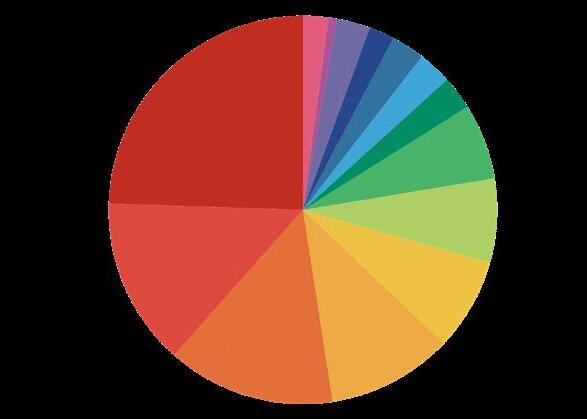
Beyond housing not matching what students pay for, cost of living ranked



To compensate, more students than ever are working part-time jobs. The university recommends that undergraduates should limit their part-time work to 15 hours per week, and postgraduates to 20 hours. Bristol SU's Student Work-Life
Report 2025 found, however, that 29 per cent of students exceed 15 hours of work per week, with 14 per cent exceeding 20 hours of work. 77 per cent of working students said work has impacted their studies.
Beyond financial pressure, our data shows evidence of students’ fears for the future. 10.5 per cent of respondents








James Lewis
Co Editor-in-Chief
Talking about the weather is the easy way in to one of these, so I'm not going to do it. But, honestly, the weather we've had has been cataclysmically crummy. Don't you think? Someone told me that since New Year, not a day has gone by where somewhere in the UK hasn't been rained on. I raise you, and suggest not a day has gone by since it hasn't rained in Bristol.
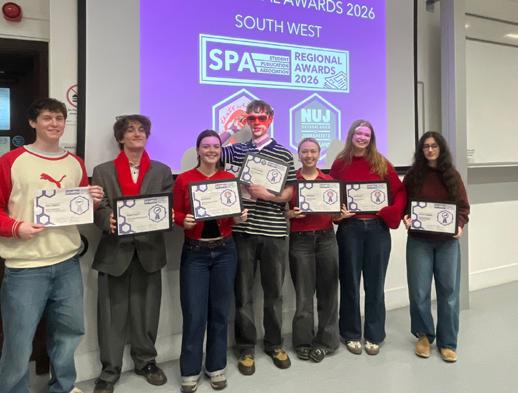
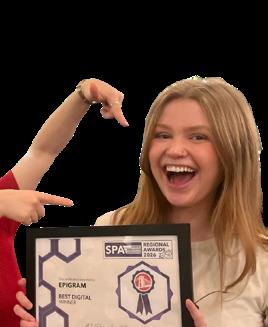
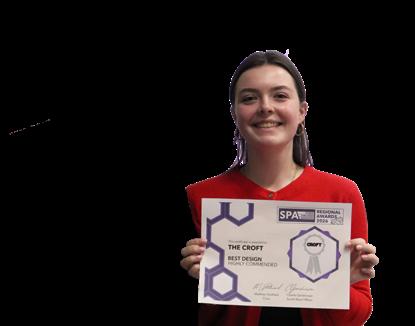
Despite the rain, February has been a great month at Epigram. I hope it was for you too. At the beginning of the month were the Student Publication Association's (SPA) regional awards. Epigram picked up eight –eight! – nods. Best publication, design, and digital for the paper. Our deputy editor, Sofia, snagged Outstanding Commitment. Tom Foley was recognised as best photographer too. I won best journalist, which was great. Thank you, readers and contributors alike, because without you there would be no Epigram. I would name people to thank, but in interest of space, and my notorious
ability to forget important people (as Julia duly noted last month), I'll leave it at that.
Looking to March, we've got lots in the works.
As you'll notice by the slightly heavier paper, we have extra pages this month. Exciting, I know. Inside you'll see pages from our sister publication The Croft, for the first time in who knows how long. Did you know The Croft actually began life as a supplementary pullout?
We hope that the new pages will nicely complement your usual Epigram content.
We also have a very snazzy looking double page spread all about Bristol SU elections. Voting opens soon, and we're looking forward to seeing all the creative canvassing candidates will get up to. Before that, though I hope you enjoy the election theme that runs through the paper. Personally, I can't wait to pick up my annual SU supplied thyme plant and, probably, kill this one too.
By the time the next issue of Epigram rolls around, we might have some more success to show you. The national versions of what happened in February are at the



end of this month. Out of superstition, I decline to comment further at this time.
But shit, how's it March already? At the start of this year I told myself you better enjoy this; it'll go so quick. Honestly, though, I didn't quite believe myself. Now I'm here, it's March, and I think now is the appropriate time to start panicking. No, I jest. Don't panic. The diss will get done, no matter how far down the to do list it is: everything always gets done. That's good advice, until it isn't.
Besides the impending sense of doom March brings, at least it means we're one step closer to being done and dusted (just don't address the fact that might mean forever yet). By the end of this month it's likely you will have spent at least one afternoon in the grass of Brandon Hill. You'll probably have kidded yourself as to how warm that sunny afternoon is, so make sure to wrap up warm. But nothing beats a can of cider and sharing crisps from a shoddily torn bag. For every passing rainy day spent catastrophising in the ASS hopefully means a sunny, carefree day on the other side of coursework-a-geddon.




We've teamed up with Overhead at UoB to give you exclusive quotes across campus and beyond. Follow them on Instagram: @overheardatu0b



‘Can I borrow your ruler?’
‘I don't have one, I just use my mum's American Express card’

‘Spoons breakfast is like church –it's a very soulful experience’
‘We have a grand piano and a cinema room, but no kettle’ ‘I went into overdraft yesterday – might have to do a car boot sale’


‘With what car mate?’

We are looking for photographers to contribute on an ad-hoc basis. Your role would consist of taking high-quality photographs that we can use both in print and online. Join the WhatsApp chat & email editor.epigram@gmail.com with

Or are you an illustrator?
We are always looking for illustrators and graphic designers to create art for both print and online Join the WhatsApp chat & email editor.epigram@gmail.com with
1) Your name, course and year group 2) A simple portfolio of your work or illustrate something for an existing Epigram article of your choosing

1) Your name, course and year group 2) A simple portfolio of your work

• Be the first to hear breaking news on campus and student analysis on a wide variety of issues at university and nationally.
• Contibute to Epigram's agony aunt column, exclusive to the print & take part in interviews for our features articles!
• Keep up with our editorial team behind the scenes.
• See details of our socials, upcoming formals and paper distribution days.



SU VOTING special!
WHAT DO STUDENTS WANT?
James Lewis Co Editor-in-Chief
Feature
Beyond financial pressure, our data shows evidence of students' fears for the future. 10.5 per cent of respondents ranked fees as their biggest concern. Raised to £9,535 this year, fees are only set to increase, rising with inflation from next year. Recent coverage of the loans system has called it a regressive tax. Those who can afford it now are usually financially comfortable, but those who take loans –most home students – can't afford it in a lump sum
“Loneliness is something nearly everyone feels at university but is conspicuously missing in conversation
and end up paying more than their wealthier peers when interest kicks in. The Bristol SU FTO team lobbied for this policy change at the time, saying the proposed increases ‘double down on a broken tuition fee model that has driven the sector into a crisis.’
Concerns about the cost of living and job market rank joint second at 14 per cent for the
“In the last two years, the number of advertised graduate positions has fallen by 70 per cent
outright biggest issue. This illustrates the double tension students face, as an expensive education isn't neatly translating into a well-paid career.
In the last two years, the number of advertised graduate positions has fallen by 70 per cent, according to the recruiter Reed. With fewer roles, and AI making it easier than ever to hammer
“
The number of applicants per vacancy is 140. 20 years ago, there were just 38.
out a cover letter, the number of applicants per vacancy is 140. 20 years ago, there were just 38.
Teo Guez, a third-year Economics and Politics student, and this year's Arts, Social Sciences and Law Faculty Rep, told Epigram that career development and guidance had been a focus this year. He said, ‘[t]he main thing we hear from students is that
Continued from front page
they feel overly funnelled to specific branches of their field [...] and aren't empowered to explore the variety of careers their course has to offer. Combined with a bleak job market and little guidance on how [and] with whom to network, many students understandably feel underequipped.’
Beyond practical support, some students said that the SU could offer more reassurance to a student body facing a bleak graduate job market. Julia Banaczkowska, a second-year Law student, said that by ‘simply acknowledging that a fear of the future for many students exists’ would be helpful, and help students ‘feel like they aren't alone in these concerns.’
The SU doesn't have a careers service, but instead lobbies and advocates for students to make the university's service work best. However, Teo said that while there are ‘innovative ideas floating around at the SU,’ for careers guidance, it was difficult to get ‘scattered’ Faculty Reps and FTOs coordinated when they have such a short mandate. Add to that having to deal with ‘painfully slow university bureaucracy,’ it is difficult to effect meaningful change in this area. Teo suggests that ‘the SU should look into how Reps' efforts can be combined into a longer, sustained campaign for careers support.’
While concerns over money and the future are concrete, something less definite recurred in people's answers: loneliness. Though few named it their biggest issue, it rose when second and third choices were considered. Loneliness is something nearly everyone feels at university but is conspicuously missing in conversation. With everyone looking like they're having the time of their lives, it's difficult to be that person. A 2023 government study found that 93 per cent of students experience loneliness at least once while at university, but it also discovered that 43 per cent of students felt they would be judged if they admitted to feeling lonely.
Second-year law student, Julia Banaczkowska, told Epigram that while she appreciates the SU does a lot of work in this area, she feels ‘there is [...] room to reconsider how loneliness itself is framed. [...] University messaging often suggests that the solution to loneliness is simply to socialise more,’ and she wonders if there was scope to see this in a different way.
Many of the issues students face are the results of policies far beyond the SU's influence. But when it comes time to vote, it's more than just what people promise. Credibility, empathy, and passion are as important, because it's ultimately down to whether or not students trust them to keep on going, even when change is slow.

The most boring form of government?
Comment
In March, you will receive the inevitable flood of emails asking you to vote for your SU representatives. You might even find a dressed up candidate in your lecture theatre, begging for your vote. It feels ridiculous, but it matters.
Our Students' Union has elections coming up in March. I very much doubt that, upon first hearing of this, anyone leapt from their seat in joy and Stanley Davies First year, Maths & Philosophy
reasons why you should ‘just care more.’ I have no intention of lecturing you, but I shall nevertheless question why voting has this unfortunate reputation.
This time last year, an article was written for this paper on the same subject, and was written in response to the ever-present question ‘why does it even matter?’ As it happens, there are myriad reasons - beyond the terribly noble principle of democracy, which I don't doubt we all hold very dear in our hearts, the SU does actually do stuff, and some of it is quite good stuff. Indeed, this was the position of last year's article - just think about it, and you'll realise.
Nevertheless, last year's elections had a turnout of less than a third (though this was lauded as a triumphant high).
One reading of this could be that the student electorate is a herd of undemocratic fools who need to see reason and get voting. I find this something of an unsympathetic reading, however. No matter how good the reasons to do so, lots of students likely won't vote this year either. So why is that?
Returning to that opening question, there is undoubtedly a sense that voting really doesn't matter all that much. Not that it won't have any impact, but rather that any impacts will be merely triv-
News
From March 9 until March 12, all students will be able to vote in a referendum to decide whether to continue or end affiliation.
Aden Saeed, a final-year Aerospace Engineering undergraduate, has come forward during the Student Council's Annual Members' Meeting (AMM) to lead the campaign for Bristol SU to disaffiliate with the National Union of Students (NUS UK).
In the upcoming referendum, a vote for ‘Yes’ is a vote for continuing affiliation, while a vote for ‘No’ is a vote for disaffiliation. Currently, no students have come forward to lead the ‘Yes’ campaign.
ial. In a sense, some people see voting like other people I know see attending lectures and seminars: they could go, and going would not be inconsequential, but they just don't see the point.
This feeling exists beyond Bristol too. The 2024 general election was discussed beforehand like the second coming of Christ – a critical turning point in our nation's history – and yet the voter turnout was the third lowest in over a century. Consequences or not, people just aren't feeling it.
It often feels as though democracy is all about voting for people, not ideas. Not even necessarily voting for them for ‘the right reasons’, but for their personality. This is not to suggest that direct democracy (loosely: voting directly on particular issues, rather than for representatives to do so) would be better, or even feasible, for the nation or the SU. Nevertheless, our kind of democracy can make the actual power of one's vote feel very distant and indirect.
Indeed, the elected representative could always do something their electors don't like – ‘that isn't why I voted for them.’ In fact, I can think of one or two politicians who have been accused of precisely that. To realise that your
own vote ultimately contributed to giving a person the power to do unpleasant things seems to me a very reasonable basis for feeling disillusionment.
Though, in the case of the SU, this indirection isn't even entirely true. Alongside the March elections, there will be a referendum on membership in the National Union of Students, and all this comes shortly after the annual members' meeting – in which any student can go along to debate motions and bring ideas to life in the student union.
Nevertheless, it has an impact. Perhaps, then, another aspect of the problem is just how confusing voting can be. To take the SU, for example: are you immediately clear on the difference between your academic and faculty representatives? What about a member of the student council as opposed to a student trustee? What does a full-time officer do that their colleagues don't? What power do attendees of the annual members' meeting have? And what does the non-elected, non-student CEO do?
All of these questions do have answers, answers which can be dug into on the SU website. However, digging for answers isn't a very cheerful way to spend an evening (or any other period of the day; for that matter, it just so happens that I, very foolishly, opted to do my own digging of an evening). Inundated with so many other things to fill our minds, trying to make sense of SU bureaucracy is not only a less than tempting endeavour, but a bit annoying.
I am sure they (though who precisely ‘they’ is I am not sure, such is the way of things) could roll out some good reason for it all being so complicated (though ‘they’ may well argue that it is all very simple, really), but even so, it is much eas-
ier to get frustrated and give up. The SU can keep their secrets, and I can be part of the over 70 per cent who don't vote.
The right decision? I could hardly say, but no doubt a forgivable one, if not.
I have come such a long way without rolling out that classic epigram ‘your voice matters.’ I will conclude by noting, then, that it really does, and now more than ever. Not because of lofty democratic ideals, but because the lower the voter turnout, the higher the statistical significance of each individual vote. Perhaps the feeling of power is not a very morally righteous reason to vote, but it has statistical grounding, so if it gets you to the polling station (or, more accurately, polling website - not very alluring) then that's no bad thing.
If that isn't enough for you (pernickety, but no matter) then keep in mind that, for better or for worse, both the government and the SU do actually do stuff. The SU website elucidates their current and past campaigns in good depth, and the government's antics are plastered all over the internet.
Admittedly, the internet is not always accurate as pertains to government antics, but there are good sources. Check out the recent votes in Parliament, see what side your MP took, and what, if any, were their spoken contributions. After all, they are doing it by your mandate.
So I repeat: democracy, and playing your part in it, isn't very fun, and isn't trying to become any more fun. Nevertheless, it has an impact. Maybe one you may not notice, but maybe one that somebody else really will. So, without trying to be too repetitive, I say again that democracy is worth the trawl. Then again, there's always ‘next time’, most likely.
AMM confirms campaign leader for SU's disaffiliation from NUS UK
Bristol SU is currently a member of both NUS UK and NUS Charity, with only the membership of the former being contested. NUS UK is a limited company. It elects officers to represent students nationally and campaigns on student issues. Bristol SU pays £30,000 per year for NUS UK membership.
Meanwhile, NUS Charity is a registered charity responsible for providing Students' Unions across the country with services such as shops and food venues. Bristol SU pays £7,500 for NUS Charity membership.
NUS UK's recent campaigns include petitions to reverse the freeze on student loan repayment thresholds and reform interest rates to ease the pressure
on students repaying debt. They take campaigns to Parliament to lobby on behalf of students nationally, such as at the All-Party Parliamentary Group for Students event last November.
NUS UK has come under scrutiny in recent years. In 2022, NUS president Shaima Dallali was dismissed on claims of anti-Semitism after a tweet she made in 2012 came to light. Subsequently, the Federation of Student Islamic Societies defended Dallali, claiming ‘institutional Islamophobia’ existed within the NUS.
More recently, controversy arose after around 200 student leaders and societies across the country signed an open letter last year to NUS UK as part of the ‘Not My NUS’ campaign.
The letter criticised NUS UK's silence on the ongoing violence in Gaza, which has been widely described as a genocide by human rights groups and charities including Amnesty International.
‘Not My NUS’ also accused NUS UK of disregarding anti-Palestinian racism and Islamophobia, as well as failing to support pro-Palestinian student protesters after they faced condemnation and suspension by their universities.
After the open letter, NUS UK threatened to ban its signatories from NUS events. This prompted Cambridge SU to disaffiliate from NUS UK after a referendum, with Cardiff SU also voting against renewing affiliation.
Speaking to Epigram, Aden Saeed said that in Bristol, ‘we stand up for equality, regardless of the time,’ adding that ‘we are very much going to continue that now, whether it be for purposes of our Muslim friends or our Jewish friends, for everyone, we want equality.’
On March 6, there will be a debate, chaired by Epigram, between the ‘Yes’ and ‘No’ campaigns in the Balloon Bar from 5:30-6:30 pm
This will be held alongside the SU Elections Press Day, which will feature interviews from candidates for each Full-Time Officer (FTO) role. Voting for SU officers and other roles will be held in the same week as the referendum.
Lenny Osler News Reporter
Photo courtesy of: Epigram / Sophie Maclaren
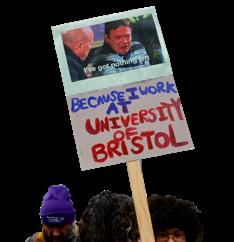
University of Bristol staff strike over ‘insulting’ pay offer
Robinson, Cara Hene, Lenny Osler & Sofia Lambis News Reporter, News Editor, News Reporter & Deputy Editor
‘We are the people who make it possible for those students to study here. We are the University.’
OnFebruary 10, UNISON’s Bristol branch began five days of national action over pay which coincided with the University of Bristol’s winter graduations.
Strikes are also taking place today and Thursday February 12, which will coincide with the Workplace Day of Action for Palestine.
According to a press release from UNISON, one of the UK’s largest trade unions, those striking are professional services staff, which includes administrators, library staff, IT services, and student support.
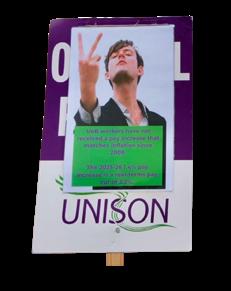
Action was sparked after the Universities and Colleges Employers' Association (UCEA) imposed a 1.4 per cent pay point increase, which was branded ‘insulting’ by UNISON and described as a ‘real terms pay cut of at least 2.5 per cent.’
Regarding the 1.4% UCEA increase, a University of Bristol spokesperson said, ‘We cannot
unilaterally change this award.’
UNISON balloted their members in November 2025 - on a 60 per cent turnout, the Bristol branch voted by 92 per cent to strike. That was the second highest percentage across all British universities, according to UNISON co-Branch Secretary Nathan Street.
By 9.00am there were more than 30 UNISON members outside the ASSL, and around 50 staff and students outside Wills Memorial Building at 11:30am.
Many strikers remained outside Wills Memorial Building until late afternoon, disrupting the photograph opportunity of those graduating that day.
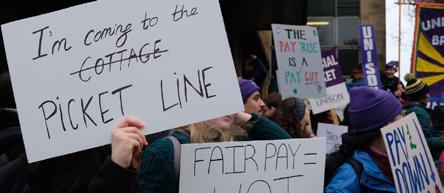
The first day of action culminated in a rally held between 12.00pm and 1.00pm outside Senate House, with over 100 attendees and speakers from UNISON, Unite, UCU, staff, and student representatives, including the Socialist Society.
Rachel, a Student Administrator, said to Epigram that ‘It’s a shame that we’ve got to this point, but I’m proud to be striking today.’
Co-Branch Secretaries Nathan Street and Alexander Kidd said, ‘We have
been asked to work too hard for too long with workloads rising as wages drop… Enough is enough.’
For Abbi Dayre, a senior student administrator in the Business School and UNISON workplace representative, this point came when she realised that it would be cheaper for her to quit her job than put her child in nursery full-time.
Dayre said to the crowd outside
“Throughout the day, strikers handed out flyers titled ‘a real pay rise for staff’ issuing their demands:
‘An increase on all pay points of at least RPI (as of August 2025) + 3.5 per cent, or a flat rate increase on each employee spine point of at least £2,500 – whichever is greater.’
Epigram spoke to a member of the Wellbeing team who said:
UNISON claims Vice-Chancellor Evelyn Welch’s salary is 847 per cent higher than the average staff salary
Senate House, ‘We are admin, support staff, timetabling, library services… We are the people who make it possible for those students to study here. We are the University.’
Street said that while he acknowledged the UCEA pay award cannot be changed, other universities such as the University of Oxford and those located in London offer staff an additional ‘weighting.’
This could be a way for the University of Bristol to ‘get around’ the national pay offer, Street suggested.
Alexander Kidd also spoke at the rally. ‘Well done for deciding to take the power back into your own hands to defend your own rights,’ he said.
‘We've gone through three restructures over five years. Staff need to have security in their jobs so that we can provide security for students as well.’
One striker outside Senate House lamented the fact that to cover striking staff, the University had brought in a third party security company to the ASSL who were not library trained.
“She added that ‘the money always seems to go to you and new developments like Mumbai and Temple Quarter - not the staff, who are the backbone of this university.’
our staff’s wellbeing but ultimately, we can’t be well if we can’t pay the bills.’
A Student Administrator told Epigram their message to students would be: ‘We are doing our best to support you […] so you have an amazing experience throughout your degree, but we can’t do that if we are sick and worried about how we are going to afford our rent. We need better pay to support our students better.’
Speaking to Epigram about the remainder of the week, Alison, a Student Administrator, claimed ‘The ViceChancellor has said this shouldn’t cause too much disruption but I think we’re here to show just how much it can cause.’
Further action is also scheduled for March 10 and March 11, the latter of the two dates coinciding with the University of Bristol’s Post-Graduate Open Day.
A real terms pay cut of at least 2.5 per cent.
UNISON claims Vice-Chancellor
Evelyn Welch’s salary is 847 per cent higher than the average staff salary, adding that senior leadership ‘consistently responds to financial pressure through realterms pay cuts, recruitment freezes, and restructures resulting in job losses and increased staff workloads.’
Strikers spoke to Epigram about their wellbeing, with a
A University of Bristol spokesperson said:
‘We respect the rights of our staff to act where they feel strongly about issues which affect them, but are disappointed that colleagues represented by Unison have voted to take part in this industrial action. The action relates to the 2025-2026 national pay award negotiated by the Universities and Colleges Employers Association (UCEA) on behalf of all participating institutions. We cannot unilaterally change this award.’
‘While these are challenging financial times for the University and wider sector, we recognise that investing in our staff is a priority. We therefore ensure that staff pay continues to be as competitive as possible within the sector and continue to pay the Real Living Wage.’
‘Mindful of the importance of supporting our students' learning and wider experience, we have robust plans in place to ensure our support services continue to operate and be accessible. We do not anticipate this strike action will impact teaching and assessment.’
Beth

Fire engines called to University of Bristol’s Goldney Hall
A fire broke out on the grounds of the accommodation in the early hours of February 4 in a building used for private events.
Natalie Payne & Stella Phipps News Reporters
The University of Bristol says it is working to identify the cause.
The fire service, police and ambulances all arrived at the Clifton hall of residence, home to 261 undergraduate students, between 1.55am and 3.06am on February 4.
Fire services arrived on the scene at 1.55am to put out the blaze, which started on the ground floor of the building and spread to the loft area, according to a spokesperson for Avon Fire and Rescue.
All persons were evacuated safely, and the service said the cause of the fire was ruled as accidental.
The building in question is located adjacent to Goldney Hall’s grounds, behind Clifton Hill Cottage, and runs externally to the accommodation itself.
It was left with visible damage to the roof and guttering.
A resident of Goldney Hall, Lottie, said to Epigram that around 1.30am to 2.00am there was a strong burning smell apparent even with her windows closed, while smoke could be seen rising from the building.
Another Goldney resident, Maddie, described the building as blackened on the inside.
To read more about the incident, go to epigram.org.uk
Editor ...................................................... Cara Hene
Deputy Editor Aimee Anderson
Subeditor............................................ Katy Goodall
Subeditor Ellen Landale
Subeditor Keira Guy

University of Bristol asks Humanities and Languages staff to voluntarily quit
guages and School of Humanities were invited to attend separately.
Certain departments are being run into a ‘managed decline’, says Bristol UCU's co-President, as a new Voluntary Severance Scheme is announced.
Sofia Lambis & Cara Hene Deputy Editor, News Editor
TheUniversity and College Union’s (UCU) Bristol branch says the move marks a further step in the targeting of specific Schools at the University of Bristol.
If they choose to take up the Voluntary Severance Scheme, open to all academic staff in the School of Humanities and the School of Modern Languages, staff essentially make themselves redundant in return for a good pay-out.
This particular severance scheme offers 9 months’ pay, and staff members have three weeks to express their interest.
The scheme was presented to all staff in the two Schools on February 6. The day before, University HR had met with Faculty leadership, the two Heads of School, and unions to explain the content of the scheme and how it was to work, Epigram understands.
‘The calculation they themselves have come up with is what makes this necessary’ In response, the Bristol branch of the UCU, which represents over 120,000 members nationally, said:
‘Since this time last year, we have warned that the University of Bristol’s approach to the crisis in Higher Education funding will have an uneven effect across the institution. Such cuts started in 2025 and are accelerating in 2026. Shit is getting real.’
The scheme was flagged as upcoming in two separate January 28 meetings, at which all academic staff for the School of Modern Lan-

A senior Modern Languages staff member who Epigram spoke to described department morale as 'quite low' in the wake of these meetings. Staff felt ‘unsupported’ by the University and feared that the next step could be compulsory redundancies.
The newest Voluntary Severance Scheme has not come out of the blue.
In March 2025, Bristol UCU leadership wrote that the University of Bristol had embarked on a ‘death spiral’ following the ‘50 per cent surplus’ scheme, which says Schools must make a 50 per cent operating surplus.
Epigram spoke to Oscar Berglund, Bristol UCU co-President and Senior Lecturer in International Public and Social Policy, and co-author of the March 2025 piece.
He told Epigram the Voluntary Severance Scheme marks a continuation of the ‘50 per cent surplus’ policy, which he said unfairly impacts certain Schools at the University of Bristol.
While the ‘50 per cent surplus’ equation does include employees as a factor, it does not take into account factors such as buildings and equipment, Berglund says.
This means that non-STEM Schools, which as a percentage spend comparatively much more on staffing (as opposed to expensive laboratory equipment, for instance) than their science-y neighbours, will face more pressure from the University.
And this pressure has now come in the form of Voluntary Severance.
Both Berglund and the senior Modern Languages staff member Epigram spoke to argue that those Schools with the lowest intake of overseas students, which are, again, the Humanities and Modern Languages Schools, are further impacted by the ‘50 per cent surplus’
policy because they bring in less fees.
All of this amounts to a ‘managed decline’ of certain parts of the University, according to Berglund.
‘This is a choice that the University are making. They are choosing to shrink these schools. They don’t have to do that. The calculation they themselves have come up with is what makes this necessary.’
However, Berglund does say voluntary severance is preferable to compulsory redundancies - they give staff who are already thinking about leaving the chance to do so, rather than firing indiscriminately.
‘Some students will suddenly see units disappear from their curriculum because staff aren’t here to run them’
At the January 28 Modern Languages School meeting it was also announced the School had a new goal of achieving £1 million savings by August 2026 and £3 million by 2028. The senior Modern Languages staff member told Epigram that colleagues doubted whether either the August savings or the ‘50 per cent surplus’ were possible for the School to achieve.
They were also ‘unsurprised’ by the Voluntary Severance Scheme itself, as they felt it was coming, but were ‘stunned’ by its speed and timing. They felt staff were given a very short window to decide, and that the severance package itself was ‘not particularly generous.’
The scheme’s introduction during TB2, when many students are choosing next term’s units, is also significant: ‘We don’t know what units are going to run next [academic] year… some students will suddenly see units disappear from their curriculum, because staff aren’t here to run them.’
However, Bristol is not alone in its cost saving efforts; universities across the UK are finding it increasingly difficult to operate amidst financial pressures.
In April 2025, the Russell Group issued a joint call for more government
To read more of our news coverage go to epigram.org.uk


support, warning that ‘the scale of the deficits we’re facing are so large that efficiency measures alone are not going to be able to address them.’
If compulsory redundancies were to be put in place, Bristol UCU says it will do ‘what we successfully did last year in CALD’: call for strike action.
The branch claims that ‘these voluntary means are brought in to avoid the strike action that compulsory redundancies would lead to.’
A University of Bristol spokesperson said:
‘We value having a broad range of modern foreign languages at Bristol and are equally committed to supporting disciplines within the School of Humanities. These are key contributors to our University’s comprehensive, disciplinary portfolio and our overall strategy and ambitions.
‘As part of a prudent, measured approach to managing our finances, we routinely take planned and focussed actions where necessary due to changing student demand and reducing research income streams, while routinely seeking opportunities to deliver our services more effectively and efficiently. This includes identifying ways to reduce our non-pay spending.
‘The School of Humanities and the School of Modern Languages have launched a voluntary severance process where eligible staff can apply for the opportunity to leave the organisation. The aim is to ensure that we continue to deliver high-calibre education, conduct high-quality high-impact research and maintain the health of our academic disciplines in these Schools.
‘The University is in constant dialogue with our Trade Unions about any proposal that may affect staff. We are committed to working with them to find ways of delivering any necessary staffing changes through voluntary means where possible, and to supporting our staff.’
‘Woman, Life, Freedom’: Bristol’s Kurdish community calls for support from Council as violence continues in Syria Lenny Osler News Reporter
The demonstration numbered over 100 people and included speeches, singing and dancing, and children's activities.
University of Bristol, Epigram / Annabel Bienfait, Epigram / Lenny Osler
Photos courtesy of (left to right):
From the Archives...
Sexism
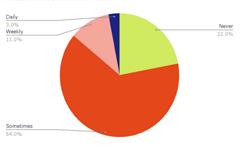
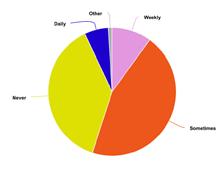
In 2013, a special report from Epigram revealed that 62 per cent of students had experienced sexism or sexual harassment. In a survey conducted this week, results found that 68 per cent of students said they had experienced or witnessed sexual harassment as a student at the University of Bristol.
‘Stay away from him once he's had a few bevs.’ A sentence, or similar to one, that you may have heard with alarming frequency. The emphasis is always placed on women to support each other, ensuring they are in the ‘know’ about the perpetrators of sexual assault and harassment. Rarely, however, are men encouraged to turn around and point fingers. Why, when almost everyone notices this behaviour, is the instinct always to turn our heads? Is it fair to blame the bystander?
How can we even begin to deal with this problem? I have often asked myself this question when hearing of mutual friends who have been known to speak or act in inappropriate ways. We all have the ability to help stop the spread of rape culture amongst out peers. However, misogyny and harassment are deeply embedded into societal structures, including the education system and thus University more broadly.
Comparing the 2013 article to today, blatant accounts of misogyny prevail. Students clearly still feel threatened by sexual harassment and 56 per cent of the 2026 survey regarded misogyny as being part of a wider culture at Bristol and Universities more broadly.
In 2013 , students reported experiencing ‘stalking, being taken advantage of when drunk’ and ‘threats of rape.’ Alarmingly, but perhaps unsurprisingly, examples of this were also shared in the survey Epigram conducted this week. One response shared how ‘there was culture of misogyny and sexual harassment exposed in the men's hockey team,’ highlighting how rape culture is often left to fester and grow within sports societies and male only spaces. The response also shared the horrific incident
Decolonisation
In2020, Epigram covered student campaigners who argued that buildings named after Wills Overton Henry III implicitly honoured wealth tied to slavery and exploitation.
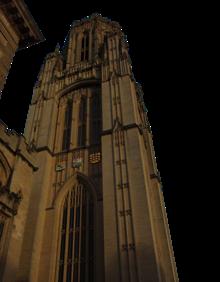
At the heart of the story was a tension between remembrance and celebration. Petitioners stressed that their aim was not to erase history but to ‘correct the record.’ They argued that keeping the name without context risks overlooking uncomfortable truths, rather than learning from them.
Today, this conversation is still relevant. The University of Bristol carried out a major consultation on whether seven buildings with historic links to the transatlantic slave trade should be renamed. The names were retainedincluding the Wills Memorial Building - because rather than removing reminders of colonial legacies, the university is trying to embed historical context, paired with a long-term initiative called the Reparative Futures Program.
On the 26th of February 2024, the university launched its refreshed logo, removing Edward Colston's dolphin emblem and replacing it with an illustration of a
Editor's Choice:
In 2026, the University of Bristol is celebrating its 150 year anniversary. So we set up a mini-series, tasking writers to sift through the Epigram archives and give us their take on how issues have changed. From questionable opinion pieces to forgotten news stories, trust me, there's a lot to talk about. Here are some of my personal favourties.
of a ‘rape case being brought to court.’
Another response from this week shared the lack of understanding from men about ‘the nuance of consent,’ explaining also that ‘porn in particular has affected how men view and therefore treat women with misogyny.’ Other responses cited how dating apps have ‘issues of misogyny,’ which when paired with the normalisation of hookup cul-
ture, examines how the pressure for students to engage in casual sexual acts is undeniable, also increasingly occurring under the influence of alcohol or drugs.
Speaking out, no matter the nature of the incident, is vital. Misogynistic or sexist comments are almost always the byproduct of a much more severe belief system. Whilst it is important to ensure you and those around you are active in
book. The symbolism of this change highlights why institutional symbols matter more than they appear. A university logo is not neutral.
The shift from a person-linked emblem to a book asks whether this is an attempt to reframe the university's identity around education rather than its benefactors. Does it depoliticise the issue, or does it meaningfully reset institutional values?
In 2023, Ebube Enweani, president of the African and Caribbean society, told the BBC it's important the university acknowledge its past because ‘you cannot pretend links to the slave trade do not exist.’ However, removing Colston's dolphin was comparatively ‘easier’ as there is no donor legacy to untangle. Renaming buildings or removing benefactor symbols - like the sun or the horse - risks backlash, donor relations, and traditions. So the university's approach may be pragmatic, not necessarily inconsistent.
Decolonisation is not a one-time fix, but an ongoing process shaped by continuous reflection and dialogue. While the university has taken visible steps towards addressing its colonial legacies, its significance rests on how students experience these changes in practice. The conversation, much like the process itself, remains open - and that openness may be its most important measure of progress.
Ascombatting misogyny, it is still impossible for the individual to dismantle a culture clearly recognised as part of a widespread, societal issue. Universities and wider structures have a responsibility to ensure students are safe.
Should Bristol University be taking more action to ensure misogyny and harassment are not only tackled when they occur, but before they do?
On average, how often have you experienced sexual

we approach six years since the first Covid restrictions hit Brit ain, the gloomy days of January serve as a stark reminder of our collective hibernation. The 23rd of March 2020 marked Boris Johnson's infamous ‘you must stay at home’ broadcast, and modern life as we knew it changed drastically. This was after weeks of hysteria among university students and debates surrounding closures.
Early evidence suggests that 80 per cent of Covid related deaths were among people over the age of 65. Therefore, unless you had pre-existing health issues, or were in the minority of mature students, you were arguably more vulnerable to anxiety and depression - with rates doubling pre-pandemic levels - than physical health issues. I think students should therefore have had the option to continue in-person studies, albeit under Covid safe protocols.
I don't disagree with the nationwide lockdowns. Scientific data suggests
that the country's hesitation to lockdown resulted in an estimated 23,000 deaths. However, I think students should have had the option to continue in-person studies and extracurricular activities, both because of being at lower risk, but also due to what they were paying for. University is often sold as a package deal experience. Opportunities for interpersonal development are sold through societies, workshops and other events which were made impossible under the restrictions.
Moving onto tuition fees: in 2023/2024, 44 per cent of fees were spent on nonstaff running costs. Paying for maintenance, buildings and IT equipment seems unjust given students never felt the benefit whilst being locked in their rooms. The issue led to many deciding to engage in ‘cut the rent’ protests, due to being fixed to contracts while not receiving the ‘blended learning’ or adequate pastoral care that the university had promised.
Questioning lockdowns is a sensitive topic, especially to those who lost loved ones during the pandemic. But I think students and professors alike should have had the opportunity to decide themselves whether they chose to participate in lockdowns when preventative measures were available.
Jenna Baker
Third Year, Film and English
Anis Fazidin Second Year, Aerospace Engineering
Photo courtesy of: Epigram / Sophie Maclaren
Issie Berg Rust Second Year, History
On average. how often have you experienced or witnessed sexual harassment as a student in Bristol?
The results of Epigram's 2013 study | Image courtesy of: Sam Couriel
harassment as a student in Bristol?
The results of Epigram's 2026 study | Image courtesy of: Jenna Baker 2026
Photo courtesy of: Unsplash / Justin Schwartfigure
Editor ................................................... Sam Couriel
Deputy Editor .................................... Amelie Patel
Deputy Editor Lindsay Shimizu
Subeditor................................. Amaya Lewis-Patel
Subeditor Lilja Nassar

Should we reafilliate with the NUS?
So it's been three years, and the University of Bristol is once again holding a referendum to decide whether we should reaffiliate with the National Union of Students (NUS). Each university gets the opportunity to decide whether they want to stay connected to the national organisation, with this being a once-per-degree change to make your voice heard on a national issue. We need 5 per cent of all students to vote for the result to be valid, so I am here to argue that we should remain affiliated with the NUS!
As a student, it's incredibly easy to forget (or not even realise) that we have a union. Like trade unions that support workers across various industries, the NUS is a collective of student unions across the UK. Around 600 student unions are currently signed up, giving the NUS the biggest student voice in UK society. The NUS website states ‘we believe that education should be accessible and enjoyable for all,’ as they work on several campaigns aiming to improve and expand the student experience. People will tell you that the NUS does nothing, but that's a hard case to make when they've worked on improving student housing, expanded routes for graduate visas, and campaigned to increase maintenance loans.
experience, not only for yourself, but for countless students that follow, it's crucial to pay attention to the world around you. Whether that's rent increases, tuition fees, or the loneliness epidemic, the NUS is here to help. It's important to stay connected to local political culture, so that when we start voting on bigger, more national issues (like the local elections coming up in May), we know how to inform ourselves.
The NUS has been subject to controversies in recent years, with the UK Government severing all ties due to allegations of antisemitism. After an independent investigation was carried out, the NUS committed to implementing the recommendations of the investigation's report. Although any kind of discriminatory behaviour is clearly intolerable, it's encouraging to see a national organisation take criticism on board so readily, and be ready to learn and grow from these experiences. Having a national body that is able to accept its shortcomings is so important, and is another reason why we should reaffiliate with the NUS.

But, hang on a second. Why should you care? The student life can often seem like endless years of fun and partying, but at the end of the day, everyone (hopefully) walks out of here with a degree. There are countless headlines about the struggles that students face on a day-to-day basis, and the NUS can help make a change that actually means something. More than petitioning the SU for more soup in the Hawthorns (although I'm a huge fan of the newly reopened SU Hatch), being represented by a national union allows students to make national-level changes on issues that matter to us. If you care about improving the student
As a student, it's lovely to feel supported by the student community, both at uni and in the wider world. The NUS supports initiatives like TOTUM, which is a studentexclusive discount card (and who doesn't love a discount card?), as well as environmental programmes such as Green Impact and Student Switch Off. The NUS has also achieved a 3.1 per cent increase to maintenance loans in England, £115m in extra university student hardship funding, and a 43 per cent increase to the apprentice minimum wage across the UK. Campaigning on national issues isn't just relegated to student issues though - the campaign for votes at 16 has now been picked up by the Labour party, who have made an official press release saying that 16 year olds will be given the right to vote in all UK elections.
So, there you have your reasons as to why you should vote ‘YES’ in the NUS Reaffiliation Referendum. As a student, it's so important to use our voices to make sure we have representatives that reflect our wants and needs, and the NUS does exactly that.
The National Union of Students (NUS) is an organisation that co-ordinates various student unions (sounds boring, but it's important, I promise). Soon, we will all get to vote on whether we stick with it or disaffiliate. Cambridge is the most recent to leave among others, and there's rumours Bristol could be next.
So Epigram is here to give you both sides of the argument and all the information you need to make your vote!
How do I vote!
The leaders of the Yes and No campaigns will be elected at the Annual Members' Meeting on Thursday the 19th of February. All students are welcome to come along. A debate will run on the 6th of March in the Balloon Bar. The official referendum will be open from 9am on Monday the 9th of March, closing on 9pm on Thursday the 12th of March.

Soon enough you're going to hear whispers of the NUS and heated on-campus debate of people screeching ‘yes’, ‘no’, ‘we must disbar!’. Let me bring you into the loop. The National Union of Students (NUS) represents around 95 per cent of university pupils across the UK. In theory, they are a powerful body; able to organise students' voices into a collective and amplify their voices nationally. In reality, they've faced an unprecedented number of financial and political issues in the past 10 years, leading a growing number of universities to question whether the organisation still delivers meaningful benefit - a question Bristol should be asking too.
The infrastructure of the NUS is fundamentally weak, since in 2018 they announced a three million deficit. As a result the union had to significantly downsize, with 22 full time officers scaled down to six, and far fewer resources. Then, in 2022, the Conservative government suspended their relationship with the body because of antisemitic investigation outcomes. With the removal of NUS reps from government education boards, it is much harder for the organisation to contribute to policy change, minimizing their contributions to grass-roots level. Factoring in their financial woes, their capacity to effectively advocate for over seven million students is clearly inadequate.
their annual conference lineup included the British rapper Lowkey, who had recently shed controversial views on neo-Nazism and Zionism. When members of the UJS (Union for Jewish students) expressed concerns about the booking, they were told that they could move to a ‘safe space’ while the event took place, before the NUS ultimately cancelled Lowkey's appearance. Then, in 2023, investigations found that the NUS failed to target antisemitism across its departments, despite previous enquiries. It now has an antisemitic action plan in place, though it feels like too little, too late.
Last year, Cambridge disaffiliated due to the NUS' lack of support for Palestine campaigns, though more widely in the past decade disaffiliation motions have cited issues ranging from Islamophobia to Antisemitism for their withdrawal. The NUS has had ample time to address and reform itself in response to these worryingly blatant counts of racism, and has failed. If the institution cannot adapt and rework itself in response to its failures, it has no meaningful value. The university, by failing to disenroll, risks promoting the organisation's prejudices by association.

For many years the NUS has faced allegations of failing to represent a majority of students. In 2016 the student NUS representative from Durham, Tom Harwood said ‘It's run by a very narrow group of people who come from an even narrower spectrum of opinion.’ Others accuse it of being an access route to Westminster for Labour politicians; the current Health Secretary Wes Streeting was previously president of the NUS. As such, some argue its annual conferences have become opportunities for political fanfare rather than focused calls for action. These perceptions have deteriorated trust in the organization, whether fair or not.
Their most damning failure has been an inability to target antisemitism. In 2022
A strained organisation now devoting resources to necessary ethical reviews and action plans is completely unable to support students in a currently turbulent socio-economic climate. A former NUS employee told the BBC in 2022 that issues like the cost of living appeared ‘sidelined’ while the NUS has been grappling with the fallout of their review. With students facing huge obstacles like rising student loans and high post-graduate unemployment levels, many are debating the merits of getting a degree in the first place. If the NUS cannot prioritise these issues, or communicate directly with policy makers on these issues, its purpose comes into question.
Whilst the NUS may still carry out valuable student-based research, or raise awareness on important issues, it has lost the crux of its power: legitimacy. No longer worth the annual investment or negative reputational associations, it is time to disaffiliate. Crucially, disaffiliation is not permanent, and the university can always choose to rejoin if meaningful reform takes place. For now, stepping away may be the most responsible choice.
Photos courtesy of: Epigram / Sophie Maclaren
Amelie Patel Comment Deputy Editor
Sophie Lee Third Year, English
What is the NUS?
Illustrations courtesy of: Gina Nevin
Features
Why has grotty student housing become the norm?
Editor's Choice:
Daniel Rafferty First Year, Maths and Philosophy
My editor's choice this month is close to home, both in the literal sense with its focus on shoddy student housing and because it features a horror story from one of my own housemates. After surviving three winters in student houses, we have seen our fair share of damp walls and lived alongside many thriving populations of black mould, which have almost become more of a familiar friend than foe. It gets to a point where living in horrible conditions becomes commonplacesomething we as students just accept as unavoidable. Daniel's article takes a broader look at the systemic frameworks behind this crisis, and if you are currently battling with your own clan of mould, then look out for Epigram's upcoming revival of the Break the Mould campaign...
WhenLuka, a fourth-year Medical Biochemistry student, discovered a growth of black mould behind his pinboard, he thought that it would be an easy fix. What followed was a lengthy war of attrition with his landlord over what seemed to be as simple as a dehumidifier. Trying to find affordable, high-quality student housing in Bristol has become an unwinnable battle – in the most expensive UK housing market outside of London, 75 per cent of students have experienced mould, 20 per cent have had a ‘very negative’ experience with landlords, and 31 per cent say that the condition of their housing has had a ‘significant negative impact’ on their university life. Max Whielton, writing for the Intergenerational Foundation, claims to have paid ‘£8,400 for a miceinfested, six-person flat and £9,000 for a room in a mouldy, crumbling house.’
This specific issue reflects a wider, deeply political one – housing markets in the UK are in a state of turmoil. The demand for housing in urban areas such as Bristol far outstrips the supply, forcing students and young people to accept overpriced, undermaintained accommodation, often miles away from their places of study and work. The past couple of decades specifically have seen the situation shift from bad to worse – so who's to blame?
Zack Polanski, speaking to Laura Kuenssberg, seems to believe the fault is with the landlords and is in favour of rent controls to limit their power. Nigel Farage, ironically, is deeply suspicious of any kind of rent reform, calling Labour's Renter's Rights Bill a ‘huge mistake’ – he instead blames the ‘exploding’ UK population. Luka's landlord seems to blame student incompetence, sending him, Bristol City Council's guide to damp and mould in a rented home, and denying the need for any action on his part. To what extent is this true? The guide he sent certainly has productive advice,
and it would be unrealistic to say that students are incapable of solving these problems themselves. If you don't throw away your food, you get rats. If you leave your wet clothes inside, you get mould. A lazy tenant equals a lazy house - students need to be better educated on their own responsibilities.
However, Marlowe, a first-year Philosophy student, believes that this is the university's responsibility, not our own. On this point, the university itself has faced a lot of criticism for both its lack of information provision and over-enrolment of students. The latter issue seems to be the most profound - since the 1980s, universities across the UK have become increasingly marketised, with the introduction of tuition fees in 1998 and the removal of enrolment caps in 2015. Profit now seems to be the primary driver of the
modern university, and with it what a 2025 study calls the ‘financialisation of housing.’ As university accommodation is now provided through ‘increasingly private actors,’ measures are taken to squeeze every ounce of profit out of a house. Living rooms are converted into bedrooms, repairs are put off, and mould is left unaddressed. Whilst some would argue that marketisation gives students, as consumers, greater sovereignty, this only seems to apply to those with the cash to spare. Investors will move toward the money, thus recent years have seen an explosion in ultraexpensive, ultra-luxurious purpose-built student accommodation which, whilst providing an easy solution to some, serves to drive up prices and reduce the availability of cheaper options. 7 per cent of students report having experienced homelessness – too many students and too little cheap housing
create a dysfunctional market in which your right to have a roof over your head is predicated on class, not genuine need.
What is the government doing about this? Maintenance loans have consistently not kept up with inflation whilst the price of housing has skyrocketed. The new Renter's Rights Bill, which takes effect on the 1st of March, will introduce a ‘Decent Homes Standard’ to the private sector, allowing local councils to impose penalties on landlords that do not maintain their properties. London and Manchester Mayors Andy Burnham and Sadiq Khan, in the style of Zohran Mamdani's incredibly popular ‘Freeze the Rent’ campaign, have both called for rent caps to be introduced, a move which seems to be popular across wider Britain (78 per cent support, according to a recent YouGov poll). Could the political tide be shifting in students' favour?
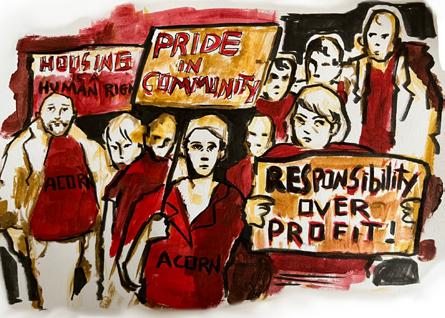

Of course, the issue is not so simple as to be solved completely by capping rents or imposing sanctions on poor landlords. Depending on what constitutes a ‘Decent Home’ for a Bristol student, the bill will either lead to little change or uncertainty and excessive and expensive litigation. Many critics of rent caps point to the situation in Berlin, where they have caused landlords to reduce the supply of housing, making the student homelessness problem worse, not better.
As the economic reality becomes more complex, the discussion becomes increasingly depressing and fatalistic. You begin to wish for a world in which Luka's landlord is right, and the issue really is as simple as moving your washing outside. After all, if ignorant students really are to blame, then all it takes is educated students to find a solution. Is this all just wishful thinking, however? In fact, Luka did eventually find a solution to his dispute by following the advice given to him by Acorn, a housing union. The 2025 study referenced earlier recommends the state fostering of student power and notes the past success of student-wide organisations in resolving housing issues. Epigram has our own studentled campaign, Break the Mould, which combats low-quality housing and poor deals for students. Whilst one student cannot do more than maintain a clean house, a group can exert serious pressure on dysfunctional systems.
Between students, the university, landlords, and the government, the list of those who can be blamed for our situation stretches long and far. Whilst the question of blame perhaps cannot be fully answered or pinned on specific failures of action or policy, this does not nullify the question of responsibility.
What can be done now to prevent the student housing crisis deepening is a question that must be answered soon and cannot be ignored by – especially ourselves.
Editor .............................................. Anna Dodd
Deputy Editor Ellie Barnes
Deputy Editor ........................ Charlotte Kerby
Subeditor....................................... Maya Tailor
Subeditor Hannah Corcoran

Does anyone use condoms anymore?

dom's existence, but on unwillingness to use one – he weighs up whether the sex is worth it if his penis is sentenced to a latex incarceration – but finally, sighing, rifles through his drawers, softening by the second. He unearths a crumpled plastic packet (one of the ones GPs give you) and begins to tear it open. Frustrated and fiddling around with the slimy rubber, he tells me he hasn't had to put one of these on in years. I lie naked, trying my best to look appealing, but the sexual tension (minimal to begin with) has undeniably evaporated by the time he's successfully donned the prophylactic.
A few minutes later, the condom is filled, tied up, and flung into a bin by his desk: a limp, lifeless souvenir of mediocrity, destined to spark little to no feeling when he's taking out the rubbish that week. We feign intimacy for a bit in mechanical mimicry of movie romance, and I totter through the dark, inhospitable streets back to the comfort of my room, unsatiated except in the reminder that sex really isn't a particularly necessary or pleasurable part of my existence.
But as I lament the unroman tic nature of my encounter,
feel like I'm being uptight for not wanting to risk pregnancy and/or STIs?
This episode (in some form) is so common to my roman tic encounters that it's begun to feel inevitable, but it can't be just me. Is this a growing phenomenon? Why do men fear the condom? Does sex really feel that bad for men with this flimsy latex barrier? I investigated to find out how much this is happening

“sex without a condom?’ Six responded ‘no’, five were unsure, and two chose N/A. When asked ‘Have you ever not used a condom during sex when you would have preferred to?’, 72 per cent responded yes. 81 per cent said that they have been scared that they were pregnant or had an STI after not using a condom during sex.
When asked to expand, I received responses including ‘a guy took the condom off during w/o me knowing, laughed it off but felt violated / anxious about [pregnancy];’ ‘kept asking me to take the condom off, kept saying no, was annoying & ruined the sex’ and some which detailed drunkenness (which often blurs both sexual boundaries and memories and leads to unprotected sex). The reasons listed for which these girls had unprotected sex were the mentioned drunkenness, that ‘the guy said it felt better without’ (a recurring response), and in one case a suspicious ‘loss’ of freshly bought condoms on the way back from the shop, amongst others.
Why do I feel like I'm being uptight for not wanting to risk pregnancy and/or STIs?
at the University of Bristol and why. I conducted a survey of female friends in Bristol (though of course this is not an issue restricted to women's lives) and learnt that I was not alone in this experience. Out of 33 people, 20 (60 per cent) answered ‘yes’ to the question ‘Have you ever felt pressured by a man to have

The issue brings up questions of consent that should have long been resolved, but as it is seems to get brushed under the rug – perhaps because (as we have seen) women generally give in to their sexual partners in order to avoid ‘ruining the moment’. It is not a revolutionary statement that at the very least offering to wear a condom should be standard protocol among men, especially when they're having sex for the first time and boundar ies haven't yet been verbalised.
References to condoms have filled the media for decades (think of The Inbetweeners; Barney's con dom collection in How I Met Your Mother; or Ross discovering the condom failure rate in Friends), but recently these references (at least in my media watching) seem to have declined. Is the condom fading from our cultural consciousness as a positive symbol of sexuality? It seems we've said goodbye to the chipper ‘I've got a johnny in my wallet in case I get lucky tonight’ and welcomed in the whining
orchestra of ‘it just doesn't feel as good,’ ‘I haven't put one of these on in years’ or simply ‘I don't have one.’ (Is that true? Is that really true?) What has changed in our culture that has turned the condom – once the ulti mate symbol of sexual liberation – into an unsexual object; a symbol of male subjection to displeasure? It's a concer ning regression that's a perfect example of the more insidious and unspoken mi sogyny that filters into the lives of fema le students at our university (and more generally of women across the world).
Statistics confirm my suspicions: Durex's 2024 Global Sex Survey found the UK to

“What has [...] turned the condom – once the ultimate symbol of sexual liberation – into an unsexual object; a symbol of male subjection to displeasure?
rank 33rd out of the 36 countries surveyed for condom purchases, with only 15 per cent of British people buying condoms last year, and 41 per cent not using any contraceptive methods at all.
The WHO's statistics show a decline in adolescent condom use in Europe: ‘the proportion of sexually active adolescents who used a condom at last intercourse fell from 70 per cent to 61 per cent
To those women who have been convinced it feels better without a condom, I say: let's not waste our lives in pious devotion to the sexual whims of men –being manipulated into compromising your principles and risking your health is as disrespectful as it is unromantic.
My message for straight male students at the University of Bristol is this: the next time the words ‘it doesn't feel as good’ or ‘do we have to?’ hover on your lips, please remember that it's actually not a problem for us if you last ten minutes instead of the usual two.

Mind the...Gap
‘It's not every walk, but it's some’
Navigating the journey home alone...
Continuing our ‘Out After Dark’ series, this piece illustrates how fear and unease are too often part of an isolated walk home
Beth Nunget
Third Year, Film and Television
It's late, you have a 9 am tomorrow, and the thumping tunes of La Rocca aren't fun anymore; they're just giving you a headache. Your friends, however, are still having the time of their lives, and you don't want to be the one to ruin that for them. You tell them you're going home; it's not too late, you'll be fine, and assure them you'll message them when you get home…
You exit the club and smile at the bouncers who bid you goodnight, adding a ‘sweetheart’ or a ‘darling’ after their farewell. It's innocent, surely, no bad intentions, just a familiar goodbye. But still...
You begin to walk faster than usual because it's cold, and this really isn't your idea of a good time. Of course, there are the initial mathematical equations to start your journey. How long is the walk usually? How fast can I walk without looking suspicious? If I take the shortcut, I can get home quicker, but I might have to sacrifice a bit of lighting. No, stick to the usual path.
Luckily, tonight you brought a jacket, and inside the pocket are your headphones. You put them both in until you remember you should probably only have one in, to keep being aware of your surroundings. You start your playlist and quickly check that your live location is working. Just in case.
You reach the Kebab van and quickly assess the customers, just making sure there aren't any who are drunk enough to start something. But it's just students like you making their way home from a night out.
As you walk by, someone starts
Columnists Maddy Richards & Yezou Aymero

This month's piece for the March edition continues the story of women ‘Out After Dark’ with a creative piece that explores the emotions inscribed in navigating the commute home. It tells a tale of the paranoia and anxieties that many a Bristol student has encountered when leaving a night out alone. Stitching together a tapestry of experiences, stories and realities, this writer delves deeply into just how scary a nighttime walk can be. Getting home safe, shutting the door and texting your friends that you are home does not mean you didn't spend your whole commute looking over your shoulder and pacing quickly through low-lit alleyways. This is a very real emotional burden for many female students at Bristol that ‘Mind the Gap’ feels is crucial to platform.
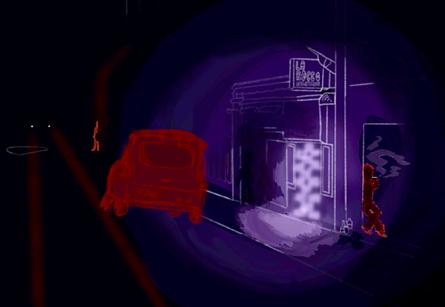
shouting, and your heart spikes; your limbs turn cold and heavy as your brain tries to catch up with what's happening. You spin around looking for the male voice and find it's just two friends getting a little rowdy. They aren't even looking in your direction. You speed up just enough to clear the crowd and head down Whiteladies.
You always hate this bit, the part where there's low lighting and it feels like no one is around. You'd prefer the busy crowds over the quiet streets any day. So, you stick your other headphone in, you know you shouldn't, but the silence is driving you crazy. You keep your head down and walk spurred on by the music blasting in your ears. You can pretend you're in a movie.
Then a group of people walk past you; they're loud, and they are allowed to be. It's a Saturday night; they’re just having fun. But something in the back of your mind whispers that what if they are saying something about you? What if the man to whom you gave a tight smile said
something, and you couldn't hear it because of the headphones? What if those footsteps you feel behind you are him coming back because you didn't respond? What if?
You rip the headphone out to be met with the distant sound of the group as they keep travelling towards the triangle. There's no one behind you. You take the turning to begin down your road and take a breath; it's the worst part. No street lighting, just you and your iPhone torch. You take your phone out and message your friends, nearly home!
Unbidden, the memory of one of your friends' late-night horror stories forces itself to the front of your brain. She was in this area when a man followed her home, shouting disgusting things. She was okay, thankfully, she had her friends with her then, but it scared her out of walking home at night for a good few weeks.
What if this man comes back? And this time you're on your own? You remember that one serial killer interview where they said they like it when women
have ponytails because it makes them easier to grab. You let your hair down and keep your keys handy. Just in case.
You queue up the upbeat pop music to stop your brain from going to the worst-case scenario. As you hurry down your street, you keep wondering, what if? What if someone grabbed you? What if you were cornered? What if someone is behind you right now?
You're at your door, you shove the key in, turn it, and slam the door behind you, a part of your brain expecting to see some crazed masked killer in the shadows. But there's nothing. Your heart is racing,but nothing happened. You walked home, and you're safe.
But there's a part of you that knows this is not always the case. You've been catcalled before, followed, shouted at. You've heard your friends talk about their awful experiences.
It's not every walk, but it's some, and some is enough to turn palms sweaty and hearts racing.
No one should feel scared to walk home on
However, it is a reality that is baked into many women's everyday routines and realities. We thought it helpful to provide a list of resources pertaining to women's safety below to accompany this piece.
University of Bristol Security (non-emergency)0117 9287848, 24/7
University of Bristol Security (emergency only)0117 3311223, 24/7
Strut Safe - 0333 3350026, open 7pm to 3am (1am on Sundays)
The Hollie Guard safety app – holding down the hexagon button on your phone starts a recording on camera sends an alert to your designated emergency contacts. (£7.99/ month).
As useful as these resources may be, here at Mind the Gap we believe that safeguarding students against violence and harrasment is a systemic and cultural issue that needs to be tackled at its root.
Editor .............................................. Anna Dodd
Deputy Editor Ellie Barnes

What have the SU officers done this year?


Jessie Yeung International Students Officer
Lobbying Parliament for international students' welfare
Jessie went to Parliament twice for the All-Party Parliamentary Group (APPG) to lobby for the welfare of international students. Here, she also focused on students from sanctuary backgrounds (such as students from Gaza and Ukraine) and shed light on the challenges they face. She led the SU consultation submission for the international student levy and earned settlement, guided by the notion that migration is a right and an aim to create a welcoming environment for all migrants.
Challenging racism and anti-migrants narratives

Lucy Pears Student Living Officer
Shifting cultural narratives
Following the attack on a Chinese student in October 2025, which was believed to be a racially motivated assault, the SU is keen to challenge rising anti-immigrant narratives. Jessie explains that ‘we do not want international students to be scapegoated as the solution to decreasing net migration numbers, as we know colloquially that this harms the wellbeing of international students significantly.’ She wrote to Carla Denyer regarding the issue and is now leading a campaign to ask fellow students to do the same.
Secured more English as an additional language (EAL) support
Deputy Editor ........................ Charlotte Kerby
Subeditor....................................... Maya Tailor
Subeditor Hannah Corcoran
Anna Dodd Features Editor

Instead of perceiving students as merely ‘experiencing the cost of living crisis’, Lucy has shifted the narrative towards it being understood as ‘Student Poverty’. The number of students using food banks has doubled since 2022, and more students are spending time on part-time jobs, leaving less time for studying and socialising. This change in perspective has facilitated some amazing work to mitigate the harms of this issue.

Increasing the three tiers of the Financial Assistance Fund
Exams bus service
From talking to students directly, through to a research and pilot phase, and now in its second year of operation, this has been a full journey officer project for Lucy. Arranging transport to the exam hall at Coome Dingle can add both stress and significant costs to an already tough time for students (research suggested students were spending £6k a term to get to exams), but the new bus service takes them there for free (or £1 depending on the term). 99.1 per cent of students surveyed said that they would use this service again.
As an international student, Jessie noticed limited and inaccessible offerings for EAL support at the university. This year, she convinced the university to hire a four-man team to provide EAL support, ensuring it is a part of their key strategy and plan for supporting international students in the next few years. You can now book free one-to-one EAL tutorials with study skills and/or join an upcoming weeklong program for English support, which can be an asset for employability and LinkedIn.
This means students in financial hardship are provided with immediate monetary support in the short term whilst getting longer-term support from the Student Money Advice Team. This year the tiers have been adjusted to provide more financial support to students (from £250 now to £300, £500 now to £600 and £750 now to £900).
Building the postgraduate community
Bringing rent prices down
What once seemed like an impossible job in the second most expensive city in the UK has been actualised this year - Lucy has been able to go through line by line with the accommodation manager to help set the rent prices. They managed to match and exceed the student demand to the number of beds available in that price range. Lucy elaborated, ‘before this, there wasn't enough accommodation stock to ensure that students had a room that matched their budget[…] Moving forwards this shouldn't be the case, and I think the impact that this will have on our incoming students will be profound!’

Before this academic year, the SU didn’t consistently offer PG events due to low turnout. However, this year Sharan has established monthly PG meet-ups at the Beckford and biweekly PG yoga. She has additionally sought to boost PG presence in societies and has plans for an upcoming workshop to reach less engaged students (PGs and international students) during Committee Fest this summer.
Expansion of Bristol Mentors Scheme
Traditionally for undergraduates, this expansion gives PGT students a chance to receive 1:1 guidance from alumni professionals in various
We are steadily approaching SU election season, where campus will soon be adorned with candidate manifesto flyers, and university buildings will be bustling with applicants hoping to connect with students and secure their place as a Full Time Officer (FTO). But what do these FTOs actually get up to once they’ve been voted into their roles, and what kinds of changes have been implemented in the past academic year? The effectiveness and importance of the SU officer team can often be overlooked by students. reached out to the current group of FTOs to hear about their experience working for the SU and the three achievements they’re most proud of.


Linlu Ye
Liberation, & Access Officer
Reopening of the SU Hawthorns Hatch
The much-loved hatch at the Hawthorns reopened this term, bringing more affordable plant-based food to campus. Whilst soup and hot meals were an option at Source cafes previously, Katie lowered the price of these back down to £1 and £2 respectively.
Opening the SU basement for activity space
This bookable society room is open from Monday to Thursday in lower ground Hawthorns, a huge space for all kinds of activities, giving many societies greater opportunity to host events and workshops.
Society Forums and trialling a society ambassador structure
Katie trialled new structures to improve society representation. Bringing societies in the same category together allows them to identify common issues earlier, help committees learn from each other, and strengthen the link between societies themselves as well as their relationship with the SU.


Free period products on campus
Beginning in January, the university has agreed to pilot a three-month trial of providing free period products in the main buildings. They are currently in the following bathrooms:
Senate House - LGF & 4th floor
Beacon House - LGF rear of study centre
Wills Memorial Buildingmain w/cs by entrance Richmond Building - Balloon Bar
ASSL - Ground floor Gender Expression Fund
Launched in 2024, Linlu secured funds to keep the Gender Expression Fund going into this academic year. This allows students who are trans, non-binary, intersex, or otherwise gender diverse to apply for up to £100 for gender-affirming products and/or necessary travel.
New wellbeing system

Injury Support Group (ISG)
Ella established this in her first year as officer, with the aim of bringing injured students together to create a community, knowing herself how hard and isolating a sports injury can be. Over the past two years, she has sourced extra funding, and the ISG now runs two free sessions a week in term time, which has been positively received by members.
Students can now book online or in-person appointments with an adviser to discuss challenges. It can be accessed through the ‘Useful Links’ section on Blackboard.
Developing Derby Day
Now an embedded event in the university sporting calendar, Ella has brought in more sports clubs to participate in Derby Day, which is growing bigger every year. This day brings together many exciting competitive local rivalries and is a great chance for final years to enjoy one final match.
Wellbeing Champions
Ella introduced this as a mandatory role in all student group committees, bringing wellbeing to the forefront of societies and making sure all members are looked after.
Implementing a university-wide assessment feedback project
Working closely with university colleagues, this ensures that every school has a student partner to work with in improving feedback practices. Receiving good-quality assessment feedback gives students a more inspiring and fulfilling academic experience.
Earlier release of teaching tables
This was successfully lobbied by Mia and will be implemented next term to allow students to view teaching tables further in advance.
Accessing marking criteria
Mia worked with the university to improve students' access to marking criteria, allowing them to perform better in assessments and to understand what their schools are looking for.

The FTOs have evidently had a busy but very successful year in their respective roles. Their suggestions for improvement/things they wish they could’ve done more of include additional support for students in parttime work, increasing the presence of politics and lobbying in International Students Week, and addressing educational inequalities. All the FTOs emphasised their enjoyment in the role, and how interesting it was to go behind the scenes to learn more about how much the SU actually offers for students and its importance in shaping and improving student life. Look out for the upcoming chance to vote and have your say in who represents student voices to not only the university, but also the city’s local community and government. The FTOs actively represent the student community and collectively seek to make students’ experiences at Bristol easier and more enjoyable, from addressing the cost-of-living crisis to ensuring academic fulfilment.

Equality,
Katie Poyner Union Affairs Officer
Sharan Khemlani Postgraduate Education Officer
Mia Stevens Undergraduate Education Officer
Ella Lovibond Sport & Student Development Officer





Epitome
New ‘Norse Village’ accommodation opening in 2026
This article is satire. It is intended for entertainment, and any resemblance to factual events is purely coincidental.
New ‘ideally located’ Bristol accommodation to open in Outer Hebrides next year.
Unite Students announced earlier this week their plans to open the new ‘Norse Village’ which will be open to students in September 2026.
Described on their website as a ‘ideally located accommodation, built with students who prefer the quieter side of university living in mind,’ the 1000bed complex is set to span the length of Eilean Mhealasta, a small but not insignificant island on the northern edge of the archipelago measuring ~1km in diameter.
‘A short 681 miles to central campus (or 700 miles to Langford), this accommodation allows students to enjoy the tranquillity of the British countryside whilst still giving them the ability to experience all Bristol has to offer.’
The new complex boasts two squash courts, a cinema room, a karaoke room, and 1000 complimentary kettles in case of a hot water outage. However, due to council by-laws, only five parking spaces are available for student to use in 15-minute intervals. The U1 bus pass is not included in this accommodation package.
Unite Students were granted special permits by the university to build Norse Village after students voiced concerns that the university had been ‘insufficient’ in its attempts to deal with the Bristol housing crisis. However, critics argue that they don't really have any idea how this is going to help at all.
It's clear Unite Students hopes that Norse Village will stand on the shoulders of giants, but sceptics argue that these foundations may already be crumbing…
Greetings from Epitome! We're now well into TB2, which means assignments, deadlines, and counting down the weeks until Easter. But don't let that stop you from going out and enjoying what's on offer across Bristol. Read ahead to find out the best events the attend this month!
Zed Law & Jed Dixon Epitome Curators
RONALD LANGESTRAAT + MARTHA ROSE + SPOOKY J
Strange Brew, The Centre 08/03, £15
Ronald Langestraat, famous for his contributions to Amsterdam's 80s jazz scene, has fused his jazz roots with spacey soul and salsa sounds, resulting in a unique cosmic pop. Martha Rose brings sounds from the Berlin underground, with Spooky J topping off the bill blending solo drumming with live effects manipulation.
Early March 1st-15th
Spanish/English Language Exchange
(The Canteen, Stoke's Croft, free) Every Wednesday Practice your Spanish or English in a friendly environment, with any levels welcome.
Croft Purchase Celebration
(The Croft, Stoke's Croft, £6) 1/3
Celebrate The Croft becoming community owned with a live soundtrack of independent Bristol artists. There will also be talks from those overseeing the process offering a fascinating insight into a model that will hopefully become more widespread.
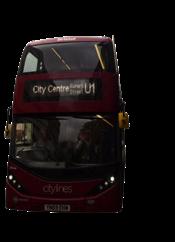
Whats the story, Mourning Glory?
(Hamilton House, Stoke's Croft, £8) 5/3
A stand-up comedy night brimming with up-and-coming comedians from UoB and beyond. All proceeds are in aid of Grief Encounter. Plus, its BYOB!
A Little Sound ‘A Whole Lotta Noise’
(Electric, £21) 6/3
A Little Sound is back in Bristol with her unique blend of mixing and live vocal performance, accompanied by Bladerunner, Esme Banks, and more.
RITUAL UNION 2026
Various Venues 28/03, £30

Ritual Union returns bringing a stacked, rock-forward lineup of bands to Bristol city centre. Taking place between Strange Brew, Electric, and Rough Trade, this is the easiest multivenue to traverse meaning you won't miss a thing. Lineup highlights include Keo, a rising rock group widely likened to Wunderhorse, performing alongside Bristol favourites Nobody's Dad and Thistle.
Sounds of Soviet Underground (The Lanes, free) 7/3
A historic music journey through the Soviet-era underground music scene, featuring covers of cult classics from nonconformist Soviet heroes.
Portrait Ya Bestie! (Small Bar, £14) 8/3
Do your best (or worst) to paint and be painted by a friend, with all materials provided and a fun, friendly atmosphere.
EAB Presents: Surface Air and Horsefair (The Gallimaufry, free) 11/3
The best rhyming name dual headline of Bristol bands going. Horsefair (a personal favourite) are steeped in gothic alt rock –think GYBE with St Vincent as a frontwoman. See them for free while you still can.
Canvas Presents: Fez The Kid (Lakota, Stokes Croft, £7.50) 13/3
New generation junglist Fez The Kid delivers a vinyl/digital hybrid show all night long. Highly recommended for fans of 90s jungle.
El Búho | Dengue Dengue Dengue | Coco María | Bushbby | AUKA (Sawmills, £22.50) 14/3
The Latin American club scene touches down at Bristol's exciting new venue. Be ready to dance to tropical grooves from across the South American continent.
ETN: Mitsubishi Suicide, Betrayers (Moor Beer Co, £10) 14/3
Mitsubishi Suicide blend visceral skramz, post rock-y interludes and a playful approach to emo/hardcore, with support from ‘feral doom & grind’ group Betrayers.
16th March onwards
Lime Garden (The Louisiana, Wapping Wharf, £15) 16/3
Hotly tipped festival favourites Lime Garden return to Bristol with their sax infused indie pop. Tickets will go fast – if you miss out, they're back at Electric later this year.
Lyra Bristol Poetry Slam (Arnolfini, £3) 21/3
Lyra Bristol Slam returns on international poetry day for the qualifiers for their grand final. Vote for your favourites and experience the best slam poetry the city has to offer.
Mandidextrous Bristol (Electric, £13.50) 21/3
Underground veteran Mandidextrous (your favourite DJ's favourite DJ) is back in Bristol, bringing their high energy blend of DnB, Techno, and Jungletek.
28/03, Free
The Robin Hood turns back time to 1848 for an immersive theatre experience. Full of interactive actors, live folk music, dramatised Bristol history and much much more, this promises to be a night like no other. Costumes encouraged but not mandatory.
Parfitt + Anwen (Cafe
£5) 24/3 Folk
Bar Italia (The Trinity Centre, Old Market, £19.50) 25/3
Bar Italia certainly have an air of underground mystique surrounding them, but this certainly hasn't held them back in over 160 intimate and chaotic tour shows over the past few years. Come for the vibe, stay for the energy.
Thirty-Six View of a Haiku (East Bristol Books, Old Market, £12) 26/3
Learn about the haiku as a form, discuss varying translations, and try your hand at your own version. Recommended for anyone with an interest in translated literature, with no prior Japanese language experience required.
Clock Factory Presents: Window Kid (Clock Factory, £10) 28/3 UK based MC Window Kid brings award winning bars to Bristol.
The Mount Alldayer (The Mount Without, £12) 29/3 A full day of northern soul and funk-based DJs – great value for money.
St Patrick's Indie Club @ The Fleece
Expect The Cranberries, Sinead O'Connor, and more
Illustrations courtesy of: Romina Trevino Santa Cruz
Eva
Kino, Stoke's Croft,
jazz fusion from Eva Parfitt who brings a menagerie of Bristol based musicians into a newly formed band.
Sam Brace & Eddie Matthews Second Year, Mathematics
Image courtesy of: Sophie Mclaren
Community
Editor Annabel Bienfait
Deputy Editor ................................ Rachel Shortall
Deputy Editor ..................................... Ivor Starkey
Subeditor Cordell Punter
Subeditor.............................. Alannah Mylechreest
Society Spotlight | GigSoc
If there's one thing Bristol does well, it's live music. With a constantly evolving soundtrack and over 90 live music venues, it comes as no surprise that the city has a reputation as one of the UK's music hotspots. Which brings us neatly to the University of Bristol's very own Gigsoc: a student's tool for navigating the labyrinth of genres that Bristol unconditionally celebrates – and where expressing love for a band isn't met with the familiar and feared follow-up, ‘name three songs.’ Instead, a group of music lovers united through a pursuit of that unrivalled live-music rush – or simply a casual chat about a new album over a glass of the infamous Old Bristolian.
To investigate this society, we became members for the week, throwing ourselves into the socials, events, and day-to-day functions to answer one question: what does life in Bristol's Gig Society actually look like?
Monday: ‘Apple Monday’
We're sat under the amber light of the Apple Boat, its 8pm on a Monday night and it's freezing. Opposite us sits society president, Joel, accompanied with a hat in the shape of a Goose (a nod to the band Geese) who briefly outlines GigSoc: ‘It's a society for anyone interested in playing, listening to, talking about music, like any kind of genre. It's pretty all-encompassing.’
Tables from us, are GigSoc members who, armed with Old Bristolian ciders, seem to be engaged in conversation – the atmosphere is friendly and welcoming, and various people greet Joel whilst we chat with him. Apple Mondays seem a great way for music fans to meet new people, as Joel reflects on his own experiences: ‘I think the third Apple Monday of last year I just met loads of people. It was like straight after Freshers' Fair and it's just really nice seeing so many people here.’
Rest assured, you don't have to en-
Kate Gaskill
First Year,
BA Modern Languages
gage with socials right at the beginning of term to enjoy all the perks!
Tuesday: Club Night @ Basement 45
Bjork, Brockhampton, Tears for Fears Three artists I never expected to hear in the same night. Upon arriving at the doors and scanning my ticket, I'm asked to ‘sing for entry’ to which my (albeit slightly tipsy) brain goes blank. Scouring my mind, I settle for a ‘la la la’ and they let us in. Phew!
We head to the cloakroom and are greeted with the highest volume of leather jackets I have ever seen in a club's cloakroom. It's like a performative male contest, only with people who actually care for the music. With the visual of band t-shirts in abundance, flashing lights, and the sonic landscape of DJ B.I.B, we were in for a great night.
Wednesday - Saturday:
GigSoc also operates digitally, via Whatsapp. There are various discussion channels, including one for ‘ticket-exchange’, which allows members to find gig tickets at last minute for lower prices in venues across England.
When asked about membership options, Joel reveals various online perks for paying members. Gigsoc produces weekly themed playlists, to encourage members to discover new genres. For example, one week, members could add songs to ‘your favourite bass line in a song’, then discuss their top picks. One of the channels also included a band-member spreadsheet, so aspiring musicians can connect easily over similar music tastes.
Sunday: Gig Night @ The Old England
Bringing the week to a close, we attended a four-artist gig at The Old England, one of Bristol's many music-loving pubs, and a self-proclaimed ‘scruffy gem’ of the city's grassroot music scene. The night's lineup showcased up-and-coming UK student bands from Bristol and London, including Tamara Hendin, Cloud Surf, Adachi Anon, and The Havocks.
The night opened with Tamara Hendin, an indie-folk acoustic artist who captured the gentle yet fiery sounds of singers such as Fiona Apple, Holly Humberstone, Maggie Rogers, and Phoebe Bridgers. Her song ‘lip service’ particularly stood out to me as a fel-
low songwriter, as she captured the difficulties of writing in an ironic yet beautiful way. ‘You get up on stage for the applause / run away from the cause’.
Next up for us was Cloud Surf, a band currently playing gigs across Bristol and London, and becoming a name to watch. Considering a quick exit for a top up on my drink, I was immediately captured by an incredible cover of Wolf Alice's ‘White Horses’, with a beautiful blend of harmonies that (dare I say) rivalled the original. The drink could wait. Their sound was a unique one, with a new wave vibe similar to that of Duran Duran or The Police, an urgency and grit of punk and rock, topped off by a lead vocal that could easily be mistaken for Mazzy Star. Tickets were immediately booked for their London gig.
As Adachi, Anon took the stage, initial sceptism set in – each member seemed to have an excessive number of instruments, and most notably the flute. But it all made perfect sense as they came together to produce a multi-influenced blend of genres with an energy and rhythm unmatched. Closing their set with a near tenminute track may have been a bold move, but it paid off; I was completely immersed.
Last, but certainly not least, were the Havocks. Living up to their name, the band brought an energy to the stage that was unrelenting and purely feminist. Hailing from London, the all-female group delivered

punchy and cathartic punk that drew comparisons to Amyl and the Sniffers and Blondie. I left the night on a high, grateful for the momentary escape from exams and winter darkness.
What's on?
Every Monday: Pub Social @ The Apple, Kings Street
Come along to join a community of music-lovers and gig-enthusiasts!
Membership:
£3 for the year
Access to discounted gig tickets, GigSoc members groupchats, and early access to GigSoc events.
Contact:
Instagram: @brisgigsoc
WhatsApp: Join the GigSoc WhatsApp chat to talk about music, and access discounts and other opportunities.


Bunsik review: ‘Unfussy, down-and-dirty street food’
Setting off on a miserable Thursday evening, I bump into my flatmate laden with goodies from Bunsik. This is a good omen, as it's the very restaurant I was on my way to review.
In fact, since the London-born Korean street-food chain opened in the city in September last year, the gaudy yellow-and-blue packaging can be seen all over the place. It's not unusual to see people huddled in the street, hunched over their oozing corndogs.
Arriving in Cabot Circus, my friend and I basked for a moment in the yellow neon glow of Bunsik's shopfront. Literally ‘food made from flour’, bunsik are inexpensive dishes available at bunsikjeom or bunsikjip snack restaurants in Korea. Their migration here rides the wave of K-mania that
first broke on these shores a few years back, from the hip-hop dancepop stylings of BTS and Blackpink to Squid Game and premium skincare.
Founded in Soho, Bunsik is the brainchild of restaurateur Jae Cho. It was inspired by nostalgic childhood memories of tteokbokki, a kind of rice cake simmered in a spicy sauce, and Korean corndogs. Cho claims they sell one of these every twenty seconds during busy periods in their London locations. He describes the food as ‘playful’ – and, well, at seven p.m., the place was positively heaving with students, school kids, and adults alike, ready to join in the fun.
The menu is compact but varied, offering anything from the aforementioned fare to burgers and kimbap (seaweed
rice roll), with succulent fried chicken thrown in for good measure. You order on a screen lit up with adverts for the newest menu items. On the recommendation of the charming staff, we kicked off with the traditional Korean soda Milkis, which is not only fizzy and sweet but also milky. This combination was refreshing, if perplexing.
Bunsik leans heavily on the ‘fast’ in fast food, evidenced by the constant in-house traffic of delivery drivers and fidgety teens clutching receipts. That buzz pretty much sees off any semblance of ambience, but that's not what Bunsik is trying to do here. The bright blue banquettes are comfortable and somehow add to a communal atmosphere that's in keeping with the chain's roots in
unfussy, down-and-dirty street food. You don't so much visit as join in.
I'd never eaten a corndog before, nor indeed most of the items on the menu. However, I was not disappointed by the golden zeppelin that arrived artfully streaked with our requested ketchup and buldak mayo. With no other means of attack, I gripped the wooden stick, did my best to dislocate my jaw, and hoped for the best. I was rewarded with the soft crunch of a robust batter, followed by a steaming seam of mozzarella cheese and juicy chicken sausage.
To read the rest of the review, visit epigram.org.uk
Olivia Hunt Second Year, English & Jessica Frizzell First Year, Geography
Photo courtesy of: Harry Davies
Arts
Editor Ella Heathcote
Deputy Editor .................................... Grace Knight
Deputy Editor Amelia McCabe
Subeditor.................................. Tylah Hendrickson
Subeditor............................................... Eloise Nicol

Minnie Mouse degrees: Women in the arts and degree elitism
Juniper Gardner examines the correlation between women's education choices and perceived ‘Mickey Mouse’ degrees
Juniper Gardner
Second Year Philosophy and Politics
Catching up with loved ones is always important when taking a break from the stress of university. However, there seems to be one exchange I have with any given relative at least a handful of times every time I go back home, a conversation that haunts every non-STEM student just trying to enjoy the break from their studies.
‘Oh, you're studying X? What job can you actually get with that?’
Less of an actual question, more of a cautionary reminder: ‘you do realise what you are doing, don't you?’ is what they're really getting at, disguised with feigned interest and curiosity. This is, of course, followed by a rush of anecdotes about their own children's university careers, and how they are so unbelievably proud that they chose to pursue Law, or Medicine. Without say
ing it outright, how relieved they are that they chose a real degree. If the current job market doesn't already keep you up at night, now you know that your aunts and uncles are just as unsure about your career prospects as you are.
This is, of course, untrue. Someone's pursuit of a University education in English or Fine Art should hold as much value as if they were studying Medicine or Law. Why, then, does this feel controversial to say? Some may retort that lawyers and GPs make a much more tangible impact on the world around them, which
“
We can respect the choices of these people retroactively, after their success is proven
leads to a bigger issue: what does it mean that the degrees mentioned in the former, ones seen as not having a real-world impact, are also ones that are female-dominated?
As termed by Margaret Hodge, what happens when these ‘Mickey Mouse’ degrees and the low-level employment they are seen to result in targets a massive percentage of female graduates? Are current views on humanities-based degrees burying a shallow grave for women after university education? What led us to believe that a degree in the arts or humanities inherently held less worth in the first place? What has tricked us into thinking that there is something unprofessional about, say, someone devoting themselves to the study of film, one of the most documented forms of emotive human expression? Why do we not recognise the intelligence of someone studying anthropology, who has their finger on the pulse of the human experience? When all of these fields are discarded as useless, what is left for the women of the arts?

Firstly, it's important to recognise that success has never tru-
ly been unreachable for those with non-STEM degrees. Fashion icon Vera Wang, who graduated from Sarah Lawrence College in 1971 with an Art History degree, found immense success when her groundbreaking approach to wedding gowns transformed bridal fashion forever. Before becoming the powerhouse actress we know her to be today, Meryl Streep studied Drama at Yale. Martin Scorsese studied English before his work broke out into cinemas around the world. You would be hard-pressed to find someone willing to chastise these titans of their fields for their choice of degree. What, then, makes their choices, but not ours, respectable? There is an unfortunate answer to this question, which comes in the form of an understanding that we can respect the choices of these people retroactively, after their success is proven. This respect is seldom extended to current cohorts of undergraduate students. This is worsened further by AI's steamrolling of tasks in creative industries, furthering the idea that we as humans are better than engaging in menial creative activities. The writer and artist are being displaced by the machine and the manufac turer. This poses a great worry for the future of the women of these industries, who make up the ma jority of students across these de gree subjects. What is worse, this struggle is not a new phenomenon. Pam Skelton, in her article ‘Wom en in Art Education’ (1986), sur veyed female art students about their overall thoughts and feelings about their current education in the arts. She identifies the prod uct of complex discrimination of female students as the ‘confidence crisis’, which keeps women from thriving within creative spaces, despite having a higher education in creative subjects, due to feeling like they are unable to achieve that success. This documented subduing of female creativity through rigorous criticism is something that may resound with many to

day, with no real solution in sight.
Coming back to university after visiting home, there is a significant bruise to your confidence that you carry when you're a woman with a ‘useless’ degree. You don't want all of this to be for nothing, but this is hard to honour when you
“The value of a degree in the arts [...] is found in conversation with others, in creation, in debate
male flatmates gushing over a new piece of media they had the chance to produce as a part of their film module, or brooding over a written classic they've had to analyse for English. You start to remember that this is the value of a degree in the arts. It may not be as easily found in a surgical theatre or courtroom, but it is found in conversation with others, in creation, in debate. As long as there are women in these fields, there are also women to share its value. Ultimately, there is value in it yet. We must create the spaces

Photo courtesy of: Ella Heathcote Illustrations
Why you have to visit Spike Island's latest exhibitions
Oli May reviews the two new shows at Spike Island and argues the importance of visiting this Bristol institution
Oli May
MA Liberal Arts with French
From Afro-diasporic sound to sculptural ruin, Spike Island's latest exhibitions invite us to listen, linger, and rethink how art holds history and meaning. As a student fascinated by the critical power of visual art and cinema, I jumped at the chance to attend the press preview of Spike Island's latest exhibitions - partly out of curiosity, partly because it felt like a necessary rite of passage for a Liberal Arts scholar. On Thursday 29 January, I had the pleasure to experience Feedback by Olukemi Lijadu and RAIN/ RUIN by Phillip Lai: the former an immersive film installation, the latter a collection of sculptural works. This article traces what these exhibitions imparted to me - intellectually, sensorially, and politically - and reflects on why they are worth your time. More than a review, it is an invitation: to engage not only with these exhibitions, but with Spike Island itself, as a site for contemporary art, critical thought, and aesthetic encounter.
Feedback
Olukemi Lijadu
Nigerian-British artist, filmmaker and DJ Olukemi Lijadu makes a striking institutional debut at Spike Island
with Feedback, a film that reclaims the Afro-diasporic origins of electronic and house music. Developed through research across Chicago, Detroit, Lagos and Bristol, the work is firmly rooted in what Paul Gilroy terms the Black Atlantic - a framework Lijadu cites as foundational. Tracing sonic echoes across continents and generations, Feedback dismantles the persistent myth that Black communities were peripheral to electronic music, instead restoring rhythm, drums and repetition as its core. Here, rhythm becomes more than sound: it is a method of remembering, a carrier of history, and a technology of connection and survival.
After an introductory talk, we were ushered into the exhibition: a vast, darkened room that immediately dissolved any sense of conventional spectatorship. We were invited to sit wherever we wished. I chose the floor, leaning against a long, plush beanbag, watching from a low vantage point. It felt deliberate - grounded, communal. The film unfolded across a split screen, images diverging and converging, occasionally stretching across both frames. Paired with surround sound, whose frequencies and tones felt soothing, the effect was profoundly immersive, enveloping the body as much as the eye. The viewing conditions mattered. Sitting among other writers, bodies gathered loosely on the floor, the space itself seemed to enact the film's logic of togetherness or shared presence.
Three elements, in particular, left a lasting impression. First: the drum. Operating both as a physical instrument and a symbolic language, it emerges as a technology of communication. Lijadu explained that drums historically transmitted messages

- especially during enslavementfunctioning as a covert language when speech was forbidden. This reframed my experience of the film entirely. Watching Feedback felt transcendental, as though I had entered a different mode of knowing, communicating, and being. African house music is presented as communal and sacred, structured around call-and-response, with rhythm acting as a binding force. Repeated loops of bodies dancingexhilarated, joyful - embody connection through sound and movement.
Equally striking was the work's intimacy. Lijadu described the project's genesis as beginning in her living room in Lagos, listening to music with her father. One image shows the pair seated before a futuristic, altar-like sound system, positioning speakers and sound as conduits for diasporic connection. This autobiographical thread deepens through original camcorder footage filmed when Lijadu was sixteen,
“Watching

Feedback felt transcendental, as though I had entered a different mode of knowing, communicating, and being
grounding the work in lived memory. Formally, Lijadu employs sampling, looping, distortion and echo, likening feedback to waves that travel, mutate and return home. Temporality is nonlinear, hovering outside past and future, evoking an Afro-diasporic sense of time. Feedback does not simply represent history; it moves through it, reverberating across bodies, spaces and generations. The installation incorporates a sound system built by Bristolbased Ramsham Hi-Fi, paying tribute to the city's sound system culture. Functioning both practically and symbolically, it amplifies histories, voices and vibrations. The exhibition unfolds as a dynamic environment of film and soundscape and will culminate in Lijadu's live performance at Spike Island on 23 April - an expanded cinematic experience in every sense, and one that embodies the ‘expansiveness’ Lijadu hopes audiences will carry with them.
RAIN / RUIN
Philip Lai
RAIN / RUIN is Phillip Lai's most significant institutional exhibition to date, bringing together ten new sculptural commissions that extend his long-standing investigation into
materiality, use, and erosion. Born in Kuala Lumpur in 1969 and based in London since childhood, Lai's practice is defined by an intense attentiveness to how everyday objects are made, handled, and ultimately exhausted. His sculptures do not represent the world so much as recast it, producing parallel versions of reality, stripped of function yet saturated with meaning. Lai works with ubiquitous objects - trays, bowls, basins, beds, cages - forms associated with containment, sustenance, and care. Yet these objects are rendered unusable. Their familiar ‘grammar’ is quietly dismantled through subtle distortions, misalignments, and material substitutions. What remains is a state of suspension: objects caught between use and ruin, presence and absence. Lai's sculptures are evidently the result of slow, meticulous processes, often involving repeated casting and remaking. This labourintensive approach contrasts sharply with the apparent simplicity of the final forms. The sculptures feel anonymous and transient - located in a temporal and spatial ‘elsewhere’ where utility has drained away, but beauty lingers.
Most sculptures are low-lying and horizontally oriented, amplifying a sense of exposure within the vast white gallery. Objects are often placed on tarpaulins or isolated within open space, reinforcing their displacement from everyday contexts.
Dominating the central gallery is a large, elevated metal cage, suspended high above the floor. Embedded within it is a speaker emitting a looping soundscape: somewhere between rainfall and demolition. This sonic
layer seems to give the exhibition its title, RAIN / RUIN, collapsing environmental cycles and industrial decay into a single rhythm. The cage governs the room not through spectacle but through atmosphere, producing a state of peripheral alertness - felt rather than consciously registered.
Lai's work does not offer narrative or symbolism in any direct sense. Instead, it operates through material relations - how objects absorb time, labour, erosion, and history. By rendering objects unusable, Lai does not strip them of meaning; he exposes their latent beauty, their vulnerability, and their dependence on systems we rarely question. The work recalls Kant's idea of purposiveness without purpose: once function falls away, beauty is finally allowed to surface.
Though deeply interior and introspective, the work engages outwardly - with infrastructure, urban space, and ecological precarity - positioning sculpture as an interzone: a site of passage rather than resolution.
Beyond the exhibitions themselves, Spike Island stood out to me as an institution. Housed in a vast former industrial building on Bristol's harbourside, it is far more than a gallery space: Spike Island supports over 70 subsidised studios and is home to hundreds of artists and creative businesses, fostering a vibrant, close-knit creative community. The atmosphere feels welcoming rather than imposing, shaped by an affable curatorial team and a genuine commitment to access and inclusivity. Crucially, Spike Island's ambitious exhibition programme is largely free to the public, opening contemporary art to audiences from all backgrounds. As the organisation marks 50 years since its inception, 2026 is set to be a celebratory milestone. Spike Island is, without question, well worth a visit.
Photo courtesy of: Epigram / Oli May
Feedback and RAIN/RUIN run until 10 May 2026.
Columnists .................. Alexandra Boersma &
Ruby Wright
Editor Ella Heathcote
Deputy Editor .................................... Grace Knight
Deputy Editor Amelia McCabe
Subeditor Tylah Hendrickson
Subeditor............................................... Eloise Nicol
Where to begin with Greek mythology
Emma Coleman curates a list of Greek Mythology books for those who might find the genre inaccessible or daunting
Emma Coleman Film & TV subeditor
As a lover of literature and someone that possesses the (some would say useless) ability to recall all the Greek gods and a lot of the myths, I am here to provide you with a list of my favourite mythical reads. I've got some beginner friendly books, some forgotten gems and the classics. So after you leave today, I hope you enter into the vast and magical world of Greek mythology with your next read (and I promise you will never leave).
Mythos by Stephen Fry (2017)
I think if you've never read a mythological text or simply want a refresher of the tales the best place to start is Mythos. Fry retells many of the great myths in such a captivating but simplistic way. It really starts at the beginning (as in the creation of the universe beginning), to Kronos (Cronus) and the titans, to the birth of the Olympians. It avoids the dull ‘get me out of here’ feeling that can creep in when you're try-
ing to learn something new, his tone is humorous and it feels entirely modern and new. If you liked this, then don't fear, this is a four book series! Heroes (2018) moves onto the demigods like Heracles, Troy (2020) unsurprisingly looks at the Trojan War and finally Odyssey (2024) retells the journey of Odysseus (I haven't actually read this last one yet but I'm sure it's great!). I recommend reading this in chronological order – unlike me who accidently brought Heroes on holiday instead of Mythos
A Thousand Ships by Natalie Haynes (2019)
Moving onto a modern retelling of the Trojan War, Haynes provides a feminist tale from the perspective of women and goddesses who were affected by the war. Penelope is also a key character in this tale, with the narration beginning with Calliope (one of nine Muses) but moving onto other central female characters. Haynes was inspired to write this after watching a documentary about the Rwandan genocide, to explore the impact on women who have suffered during war time, resulting in a far deeper message within the mythical tale.
Percy Jackson & the Olympians by Rick Riordan (2005 - 2009)
Whilst Percy Jackson is not as renowned as some of these other texts (mainly due to the fact it's aimed at children), Ri-
ordan's stories of Camp HalfBlood will never get old. This series has led to two films and a new show, so he is clearly doing something right. Focusing on the characters Percy Jackson, Annabeth Chase and Grover Underwood, two demigod children and a satyr, they go on endless quests, face hardships, fall in love, face their godly parents and more. There is no shortage of Riordan's tales with four spinoff-series, so you truly will get lost in his mythical world.
Circe by Madeline Miller (2018)
This book retells the tragic myth of the goddess Circe who, for reasons I won't mention (no spoilers here), was banished from Olympus to her famous island. The feminist lens through which Miller retells this story sets it apart from much other Greek mythology literature, placing the forgotten goddess at the centre of her own story. She encounters figures like Scylla, Hermes, the Minotaur, Medea, Athena and so many more! There is romance, adventure, punishment, loss –it truly is a whirlwind of emotions where you end up feeling pretty sorry for Circe, who has often been presented as a villain in traditional myths. Compared to her presentation in Homer's Odyssey it is an extremely refreshing retelling.
This is one of my favourites and retells Homer's The Odyssey with a focus on Penelope's rule over Ithaca whilst Odysseus was at war. North chose to have the goddess Hera narrate Penelope's story, who begins cold and objective then starts to truly care for Penelope and want to help her. She faces endless struggles such as suitors pursuing her and the presumed loss of her husband. Again, if you like this one don't worry there are two more books in the series!
Arts recommends
Looking for something cultural to do on the weekends? Many galleries have new shows on for the spring season, so now's the time to go! And, as always, there are many less publicised events - run by independent bookshops, cafes, students and more!
Mounira Al Solh: A land as big as her skin
Arnolfini's newest exhibition is a multidisciplinary show which takes its audience on a journey between Middle Eastern mythology to the present day.
The Last Resort by Martin Parr
In honour of beloved Bristol photographer Martin Parr's passing in December 2025, the Martin Parr Foundation is exhibiting several of his works in this show near Arno's Vale.
The Everyworld Season
Exciting multimedia exhibition by father and daughter duo Andrew and Eden Kötting. Their short films are also shown at Watershed.
Infringed Poetry
A spoken poetry event run monthly, hosted by UoB student Charis Owen - though not limited to student poets!
Ithaca by Claire North (2022)
Photo courtesy of:
Epigram / Emma Coleman
Homer's The Odyssey (right where it all started)
The Women of Artemis and Daughter of Olympus by Hannah Lynn
Bad Girls of Ancient Greece by Lizzy Tiffin.
Student Democracy in film: The Candidate Bristol's entertainment alumni
Editor's Choice:
Crystal Rattray Calo Second Year, Politics
Happy SU election month! With so much student democracy, campaigning, and politics bubbling around campus have a look at how silver screen has dealt with elections. Are there some key lessons we should take with us when casting our vote from the 9th of March? Do you see any comparisons to the Bristol experience?
Elections are a go to mechanism used across society to measure if a candidate is fit for leadership. Recently, the elections of Trump and Johnson has raised questions on voter judgement. However, there is a viable explanation for this that extends further than just the ballot box. This can be attributed to how humans respond to the presence of certain personality traits. Through analysis of Robert Redford's 1972 classic The Candidate, I will be explaining how the power of a charisma can give you leverage over others in any setting, especially university.
The Candidate follows young lawyer Bill McKay, who campaigns to become the senator for the state of California. He is motivated to push personal incentives. McKay is initially moulded into a politically neutral and socially digestible public figure by his campaign manager, Marvin Lucas.
However, upon learning he was predicted to lose, McKay changes the focus of his campaign. He later prioritises delivering emotive speeches on criticising the establishment over modifying his manifesto. The film closes with McKay unexpectedly winning his election.
The Candidate was never intended to focus on political substance but on human behavior. The early 1970s was rife with political turmoil in the
US. The 1970 Kent State shootings, the 1972 Watergate scandal, and the leak of the Pentagon papers had contributed to a Machiavellian interpretation of politicians. Redford was criticised by a minority that much of the potential political substance that could have been integrated in the film was compromised for style.
However, I interpret the hollowness of The Candidate as well intentioned. The film reflects how emotive campaigning styles are successful – and shouldn't be. McKay, admitting to not voting from the mid sixties, is an illegible candidate. Nonetheless, this shows that how you present yourself, is equally if not more important than the message you wish to deliver. This can be already seen interpersonally as listeners are more attentive to body cues than words in conversation.
In the film's form, Redford ensures that McKays personability compensates for his lack of political knowledge. The frequent camera close ups on McKays face throughout the film mean we are more fixated on his mannerisms and facial expressions rather than the content of his words. In our discomfort, we are forced to part from our rationale and acknowledge McKay's personability.
Camera angling and lighting is used to emphasise McKay's overwhelming mediocrity. In scenes where
Mckay is among his campaign team, shots of his face are brief in the face of his support. Showing how his image is not independently curated. Dull lighting used during his speeches undermines his perception as divine or talented. Despite Mckay having a strong hold on others as a revolutionary of the Californian people. Redford reminds us McKay is not special. This ironically shows that anyone can cultivate charisma, and that McKay does not hold an inherent power.
Sociological theory supports the cruciality of charisma in McKay's success. Max Weber coined the term ‘Charismatic authority.’ This is described as collective submission to a political figure because that figure has portrayed themself as special. This is a more interpersonal method of gaining power as it exploits people's reward of good social skills to overlook a leader's competence. Studies support charisma's success as a 2016 study showed that leaders are more likely to be trusted if they were charismatic.
Charisma is a central part of McKay's campaign. As the election looms, McKay finds himself addressing crowds rather than touching individuals at small gatherings. McKay's team maximises larger spaces as charisma is only powerful when others validate the person. This looks like a tactic to use emotional tools as more effective than arguments embedded in logic. However, emphasis on this campaign shows that emotive uses of power are more sensitive and have to be maintained. McKay transitions from being a flawed individual to the public to a flawless product that is consumed.
University and any social environments take precedence in rewarding perceived strength of character. I am not trying to scout future politicians. I am drawing attention to the fact every environment holds a political basis. Appealing to people around you can be as simple as open body language and good eye contact. As shown by McKay, we can all take benefits from presenting ourselves with confidence, warmth, and integrity.
As the University of Bristol celebrates 150 years since opening its college doors in 1876, we can look back at some Bristol graduates with notable careers in the Film and Television industry, who is not just Simon Pegg.
Jason Isaacs (Law LLB)

After growing up in Liverpool, Jason Isaacs came to the University of Bristol to study Law. However, his passion turned instead to producing, directing, and appearing in many theatre productions as a student, at the National Student Theatre Festival.
After graduating in 1985, he went on to attend the Royal Central School of Speech and Drama in London. Isaacs has had many notable roles, and for many of us he was quite a prominent villain in our childhood entertainment through his dual role of Captain Hook and Mr George Darling in P.J. Hogan's Peter Pan (2003)
However, perhaps we best recognise him as the stern, very blond father of Draco Malfoy, Lucius Malfoy, whom he played from 2001 to 2011.
Jamie Demetriou (Film, Television and Theatre BA)

Having grown up in North London (a biased choice on my part), Jamie Demetriou was born in Barnet, London, and attended Bristol to study Film, TV and Theatre. His student revue show ‘Bristol Revunions’ received critical acclaim from 2009 to 2011 at the Edinburgh Fringe Festival.
Since then, he has appeared in numerous comedy television shows as well as having written for many, including the Channel 4 sitcom Stath Lets Flats (2018-2021), which got him nominated for two BAFTA awards in 2019.
Emily Watson (English Literature BA)

Emily Watson was raised in London before attending Bristol to study English Literature and went on to apply for Drama school. She took a position at the Royal Shakespeare Company in 1992 and began her career doing stage work.
Landing her first screen role as Bess McNeill in Breaking the Waves (1996), Watson was shortly after nominated for an Academy Award. Her first popular film in the United States was The Boxer (1997), where she played a love interest alongside Daniel Day-Lewis. Emily Watson's status as a leading actress in major productions was established in various roles, but most prominently while playing Lena Leonard in Paul Thomas Anderson's Punch-Drunk Love (2002)
Joe Alwyn (English Literature and Theatre BA)

Born in Kent and raised in London, Joseph Alwyn came to Bristol to Study English and Theatre, acting in two student productions at the Edinburgh Fringe Festival.
In 2018, he played the supporting role of British nobleman Samuel Masham in Yorgos Lanthimos' The Favourite (2018), alongside actors such as Olivia Coleman, Emma Stone, and Rachel Weisz. The film won best ensemble in both the Florida Film Critics Circle Awards. 2018, and the 2019 Satellite Awards.
Katerina Ralli | First Year, English and Philosophy
Editor Felix Glanville
Deputy Editor ..............................Eleanor Bate
Deputy Editor Max Graham
Subeditor................................ Emma Coleman
Subeditor................................... Olivia Howard

The very best of women of colour in film
As we enter March and step closer to International Women's Day on March 8th, Sophie Lee spotlights the inspiring women of colour making an impact on the big screen.
Third Year, English
March is a fantastic time of year to be thinking about all the incredible women in your life, with International Women of Colour Day on the 1st March and International Women's Day (IWD) on the 8th March.
This year's IWD theme is Give to Gain, focusing on forging gender equality through abundant giving. Epigram is here to bring you a list of some inspiring women of colour in film and TV to inspire you this March!
Zendaya
American actress and singer Zendaya Coleman got her start on Disney Channel's Shake It Up (2010), cast alongside Bella Thorne. Since then Zendaya has gone from strength to strength, not only becoming mononymous, but doing so while starring in some of the biggest franchises of all time.
Born to an African-American father and a German-Scottish mother, Zendaya's name derives from the Shona word Tendai, meaning ‘to give thanks’ (and tying in perfectly to this year's IWD theme!).
Activism has been at the heart of many of her performances, from when she was six performing a play in honour of Black History Month, to her portrayal of Ronnie Spector in the upcoming biopic Be My Baby. Zendaya continues to be a role model for young Black and mixed-race women alike.
Yerin Ha
Ha has recently burst onto our screens portraying Sophie Baek in the fourth season of Netflix's smash hit Bridgerton (2020-). While it's easy to get swept up in the world of masquerade balls, forbidden love stories, and oh-so-many billowy white shirts, it's important not to forget the incredible work Bridgerton is putting in for race representation.
Although originally written as a white character, Netflix's decision to cast Ha, a Korean-Australian actress, in the role of Sophie highlights the

Flick Picks: How mould took over the movies


This Oscar-winning film follows the journey of the Kim family who live in a basement home plagued by recurring instances of over-flooding or bug infestation given the poor conditions in which they are forced to live. This remarkable movie uses the persistent mould and mildew as a thematic device providing powerful social commentary reflecting that the best quality of homes are accessible to the few and not the many. It achieves this through masterful portrayals of how the inhabitable conditions of their housing absorb every aspect of their life.
A gripping short film by Amnesty International UK which centers on the human cost which hides behind the facade of the ‘perfect home’. It focuses on the story of a mother who pursues a lawsuit to get justice for the death of her infant caused by the hideous amount of black mould in her temporary house.
It would be painstakingly familiar to the ones who have undergone great struggles to find a home just to live in conditions which disregard their safety in every respect.
multicultural face of romantic storylines, proving that romantic leads aren't limited to leggy blondes.
Given the relative lack of Asian representation on Australian television, Ha moved to South Korea at the age of 15 to attend full-time drama training, only returning to Australia three years later.
For one, this Epigram writer cannot WAIT for the next instalment of Bridgerton season 4 to come out, in no small part due to Ha's excellent performance!
Shonda Rhimes
Staying firmly within the Bridgerton cinematic universe, Shonda Rhimes is not only the executive producer of the romance show, but is the founder of production company Shondaland, and has become the first woman to create three television dramas that have achieved the 100 episode milestone.
Named by Time as one of the 100 most influential people in the world in 2007, 2013, and 2021, Rhimes is one of the richest women entertainers in America. She passionately supports arts, education, and activism through the Rhimes Family Foundation, trying to improve access to creative sectors for school-aged children.
An inspiring story for us all, Rhimes shows the importance of forging ahead with your career path no matter what.
Cynthia Erivo
Best known for her star turn as Jon M. Chu's Elphaba in both Wicked (2024) and Wicked: For Good (2025), Erivo has been a trailblazer for women of colour in the entertainment industry. Born in the UK, she is an accomplished actress, singer, and songwriter, making her name on stage before transitioning onto the big screen.
Her breakout theatre role was Celie in The Colour Purple (2023) which won her a Tony Award, a Grammy Award, and an Emmy, making her 3/4 of the way to becoming an EGOT recipient! Much of her work has centred around the struggles of women of colour, from Celie herself to Harriet Tubman in Harriet (2019), and finally Elphaba. By becoming one of


This dark-comedy horror focuses on a depressed Ian Folivor (Adrian DiGiovanni) whose mental state deteriorates when he begins perceiving the mould in his home as his self-help guru, which seems to instruct him to improve his life. Given his depression, he is unable to leave the dreadful conditions in which he lives. This causes him to be stuck in a constant loop of extreme regret, self-doubt and worthlessness. This is a particularly unsettling look into how the deplorable quality of one's home and surroundings can cause the complete derailment of one's psyche.
The story is based on a mother and daughter who move into a new apartment and how at first a supposedly small mould consumes their lives. A poignant look into how housing problems are a symbol of the growing pains which multiply only as time goes on with no end in sight. A relatable tale for those who feel trapped rather than relieved in their homes given the poorly maintained facilities. The growing pains of a destitute home as seen in Dark Water provides a realisation that the struggle that we face as students continue to plague us in our pursuit of a
Photos courtesy of: Amnesty International /
Sophie Lee
Photo courtesy of: IMDb
Editor's Choice:
The music team are suffering from festival fever big time this month. Between Loves Saves' initial lineup being released, FORWARDS festival coming out with a new sister concert series starring Lorde, and Siren Festival celebrating a big anniversary on the Harbourside, we've never wanted to hit fast-forward on the term to whisk us away to summer more. Take a look at what you can look forward to after those pesky assignments are submitted soon!

Love Saves The Day announce 2026 lineup
Sammy Virji, Sub Focus, Confidence Man DJs, Rizzle Kicks, Eve and Hedex lead the first wave of names for Bristol's flagship festival.
Anastasia Baker Music Subeditor
Love Saves The Day returns to Ashton Court on Saturday 23rd and Sunday 24th May 2026, with the first major names confirmed for the May Bank Holiday weekend.
Kicking off the festival season, Bristol's most iconic event brings together standout live acts, nextgen DJs and some of the UK's most exciting names in electronic music. With a lineup that's bold and high-energy, LSTD 2026 is shaping up to be one of its most forward-facing editions yet. Among the headline names
is DJ Sammy Virji. His genrehopping sets have taken him from underground favourite to global festival closer; he'll be delivering a high-energy finale on Sunday night.
Rizzle Kicks, a blast from the past reuniting to bring their signature bounce and charisma to the main stage, will also perform on Sunday 24th May.
On Saturday, Sub Focus - one of the most recognisable names in UK drum & bass - returns to the LSTD stage with an allnew audiovisual live experience.
Saturday's main stage will also bring standout moments from the 90s and 00s hip-hop star Eve. Her set promises razor-sharp lyrics, legendary tracks and main stage presence. Katy B also takes to the main stage. Expect low-end pressure, big hooks and hands-in-theair from the start.

Other confirmed DJ acts include Confidence Man, Girls Don't Sync and Hamdi.
From the underground up, LSTD 2026 continues to champion forward-thinking electronic music. House and techno heads are covered by the likes of Max Dean, Enzo Siragusa, Reeshy and Laidlaw, while 4AM Kru deliver a full live jungle set packed with nostalgia and new-school energy. Basslayerz return with heavyweight D&B.
Tom Paine, Festival Director at Love Saves The Day, said: ‘We've always built Love Saves The Day around community, good music and starting the summer in the right way - and this year's no different. There's a lot in this first wave we're proud of: a mix of returning favourites, long-overdue bookings and artists who've been on fire over the past year. We can't wait.’
Will you be grabbing tickets

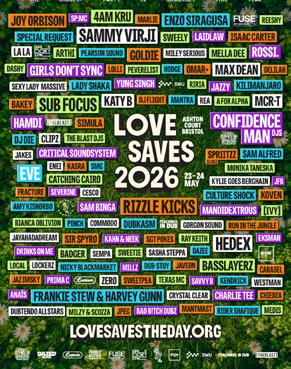

Photos courtesy of:
Plaster, Epigram Benji Champman

Editor Sophie Scannell
Deputy Editor Aditi Hrisheekesh
Deputy Editor ..................................Eve Davies
Subeditor Anastasia Baker
Subeditor Arianna Balsamo

Lorde and Djo to headline ‘FORWARDS Presents’
Lorde, Djo, and more make the inaugural lineup for a new concert series that pre-empts the much-loved FORWARDS festival.
Set to take place on Friday 28th August, ‘FORWARDS Presents’ has been announced today, an event ticketed and marketed as separate from the familiar two-day FORWARDS festival. Taking place the evening before the festival as a ‘standalone concert series’, this new one-night concert could change the game for FORWARDS as we know it.
An announcement teaser was
released on Friday via the festival's Instagram, sending fans of the festival, and indeed Lorde, into a speculative frenzy as the design of the post bore a striking resemblance to the New Zealand artist's 2025 album, Virgin
This will be Lorde's first time ever performing in Bristol. Tom Paine, co-founder of ‘Team Love’ that manage and produce the FORWARDS initiative, has stated:
‘Welcoming Lorde to the city feels like the perfect way to begin, she's an extraordinary artist, and this promises to be a truly special night for Bristol.’
Alongside the ‘Royals’ singer will be Stranger Things' star
and indie rock heartthrob, Joe Keery, under his musical moniker ‘Djo’. Joining the already star-studded lineup for the evening is a dynamic bill of global artists including Audrey Hobert, Rose Gray, Esha Tewari and Grove.
In keeping with last year, the concert and FORWARDS festival itself will
take to Clifton Downs over the August bank holiday weekend –perfectly timed as a summer sendoff, or to see in your next year of study as September soon begins. If this is the calibre of talent that will precede the FORWARDS weekend, the upcoming lineup
for the festival can only be a guaranteed showstopper this year.

Siren Festival announce HOSPITAL30 ON THE HARBOUR as part of their 2026 summer series
Don't let the heat dampen your spirits, as this July, Siren Festival returns to transform this dreary summer into an unforgettable symphony.
Set against the breathtaking backdrop of Bristol's waterfront, the Harbourside. The main stage will once again take its place in front of the Lloyds Amphitheatre, graced by a myriad of artists ranging from the rulers of D&B experiences to new skool artists and upcoming names in the UK music scene.
HOSPITAL30 ON THE HARBOUR returns in a smashing comeback on the 25th of July, featuring their iconic brand ‘Hospitality’. This would mark the 30-year anniversary of Hospital Records. Since its founding in 1996 by Tony Colman
and Chris Goss, Hospital Records has grown into the world's largest independent drum & bass label, shining on account of their distinct vision and community-led events, building up a universal reputation for top-notch D&B experiences.
For this special anniversary edition, Hospitality will spotlight a vibrant spectrum of drum & bass talent from across the arena, celebrating the label's timeless identity spanning three decades. The main stage will bear the soul of the true Hospitality sound, featuring outstanding performances from Hybrid Minds, High Contrast, Fred V, Hoax, Pola & Bryson, Ryda and special guests DJ Marky, along with Metrik and Lens, who will set the stage ablaze.
Area 2 will be hosted by Nu:Tone's newest venture, The Deep End, a contrasting, more intimate space curated for true heads and curious newcomers alike.
It's a zone built for intense connection, self-discovery and unrestrained musical exploration. Stand-out sets from pioneers London Elektricity, Bryan Gee, Nu:Tone & Makoto set the stage emboldened by new skool flavours from Winslow, Gabriella Bongo and Bassi b2b Charli Brix, whilst on hosting duties across both stages are Dynamite, Ayah Marar, Texas, Ruthless and PVC.

The excitement continues to simmer with the highly anticipated return of The Maccabees, who play on Thursday the 23rd of July, They are set to add a reverberating tone of melodic, guitar-driven indie rock to the festival. Also, another major event is still to be announced.
Alongside the music, the site will host street-food traders, hang-out spots and festival pop-ups, including the Hospital Shop,
adding to Hospitality's inclusive atmosphere that brings together lifelong supporters and newcomers.
With a long history of sell-out shows in Bristol alongside Bristol's renowned bass music rave curators, The Blast, this 2026 edition is set to bring thousands together for a sun-soaked celebration at one of the city's most iconic music venues.

Photo
Photo
Disha Angadi First Year, Law
Sophie Scannell Music Editor
SciTech
A convo about Okomfo
Gabriele Battistella on founding a tech start-up
Miles Gilroy chats with Bristol alum and entrepreneur, Gabriele Battistella, to learn more about his tech start-up and to get his top tips for founding a new business.
Miles Gilroy Senior Print Editor
What does it take to start a business? What skills do I need and how can I develop them? Founding a business is a daunting prospect. With so many open questions and seemingly infinite things to do, where should you start and what should you be doing now to set yourself up to become the next Jeff Bezos?
I sat down with Gabriele Battistella, co-founder and COO of Okomfo, and University of Bristol alum, to discuss his path to entrepreneurship and to discover what advice he had for making the most out of university and successfully navigating the start-up space.
But first, some context. Gabriele stud-
American football for the university's team, the Bristol Barracuda. It was at a Barracuda Give-it-a-Go that Gabriele met his good friend, and now business partner, Emile Agbeko who he went on to play further with for the Aztecs, Bristol's national league team. Gabriele now plays American football in a professional capacity in Germany alongside running his start-up, Okomfo, and working for multiple sports management firms.
Okomfo is an AI-native operating system improving efficiency in the transport industry. Emile discovered the necessity for such a system whilst working for a bus operator in Aylesbury:
‘He realized that his colleagues had this big problem, which was fragmented systems and a lot of Excel spreadsheets, a lot of laborious and manual processes that were slow, ineffective, prone to error.’
Emile designed a system to help improve the efficiency of his employer's operations and asked Gabriele to perform market research in an attempt to gain an understanding of the demand for his creation. Gabriele found that, in the transport industry, ‘the entirety of the UK has this issue in their back office,’ so they decided to turn

Given his success, I was curious to hear Gabriele's tips on starting a business and how to run a successful startup. During our chat, we discussed Gabriele's top three pieces of advice that he had picked up along the way.
‘Speed defies gravity’
Gabriele's ‘number one’ piece of advice is to be fast. Don't overthink, don't wait – learn as you go.
‘If you want to do something and you know you need to talk to someone or you know you need to build something, whatever it is, just do it. Don't think too much – thinking kills.’
‘Make something that works. Put it out there and then fix it.’
‘Closed
mouths don't eat’
A phrase that Emile and Gabriele recite to each other often, the second piece of advice is to ask questions.
‘If you don't ask, you'll never know.’
Asking questions is the only way to understand the world, and people - generally - love answering them (it's a great excuse for them to show off and an easy way to be a good person). So, don't be afraid to ask. Closed mouths don't eat.
‘Do
things that don't scale’
Gabriele, through this quote from Paul Graham, emphasises the importance of tailoring your approach to everything.
‘Don't just spray and pray.’
Sending emails to potential clients? Do a deep dive –find out who they are, what they're like, what they're after. ‘It's a longer process, but the success rate is much higher.’
His experience playing American football, especially with Emile, is another thing Gabriele has found invaluable in the world of business.
‘It's changed who I am, the way I work. So much discipline and mostly just self-confidence because American football is a violent sport and you need to have a certain mentality to be able to go on the field and get involved with that sort of game.’
But it's not just his personal development that Gabriele attributes to the sport – he thanks American football for enabling him to form such a deep and rich relationship with Emile.
‘I think American football is as close as you can get to going to war without actually going to war. [...] There's a sort of respect and trust you have with these people that you've gone into battle with. [...] We've developed a strong bond because of the nature of the sport.’
‘I consider [Emile] basically my brother.’
Crucially, much like American foot ball, Gabriele compares working on his start-up to going into war.
‘We rely on each other. We have to fight because building a startup isn't like going for coffee. It's something that takes a lot of planning, a lot of doing.’
‘Every day is a big game and we do it together.’
Sport aside, Gabriele looks back on his time at the Univer sity of Bristol with a great fondness in his tone.
‘Bristol is just a cool place.
[...] Having that as a part of my roots, it's amazing and it's useful.’
He directs his gratitude towards the people he met at univer sity and the resources he had available to him:
‘One thing I am grate ful for, which might be slightly overlooked, is just being an alum of UOB. It's the peo
ple I met along the way, professors as well, but mostly other students.
[...] These are people that I'm still in touch with on a day-to-day basis.’
‘It's a top university in the UK, but I really felt that because of the resources that I had, and there's just a high quality of teaching.’
Despite having a rather successful university experience, Gabriele still feels he could have made better use of the opportunities the university has to offer. He wishes he had done ‘more societies [...] because there's so much that the university offers.’ With such a vast array of societies and activities available at the university, this is not surprising. So, take it from Gabriele, get out there and try something new.
Gabriele and Emile have filled a distinct and gaping hole in the market with Okomfo. With talks of going international already on the table, Gabriele Battistella, Emile Agbeko, and Okomfo are all names to look out for. And, who knows, if you're heading up to Coombe Dingle to watch a Barracuda game any time soon, you may even spot him there, cheering from the sidelines for the team that ‘changed [his] life.’

Editor ............................................ Corin Hadley
Deputy Editor Alice Guskov
Deputy Editor Sanya Saxena
Deputy Editor Jemima Choi

Hysteria, homeopathy, and failing systems
Many women are turing towards alternative medicine. What is driving them away from the clinical mainstream, and are these good options?
Tess Rayner Third Year, Biochemistry
Last summer, sat between my parents and a few too many glasses of wine, I listened as they argued over
my mother's conviction in the strength of a magic mushroom-based cure.
The unconventional approach my mum was defending is a type of complementary and alternative medicine (CAM), a loose collection of practices that fall outside mainstream healthcare. CAM is widely regarded as holistic, treating the individual's physical and psychological experience of illness, rather than the disease alone.
Think acupuncture, herbal remedies, and traditional Chinese medicine, among


care. Women are consistently more likely to use CAM than men, a difference in attitudes that may well stem from a feeling of being sidelined by traditional medicine. Throughout history, female anatomy has been misunderstood, feared and pathologised. In ancient Greece, physicians claimed the hystera (womb) could wander throughout the body and press on organs, causing irrational behaviour and physical illness, a diagnosis they called ‘hysteria’.
For centuries, female sex organs provided the explanatory source of almost any disorder, from depression to kleptomania. Some physicians thought a build up of sexual fluids and menstrual blood incited lewd or lascivious behaviour in women. The solution sought to expel this corrupting
fluid: married women were prescribed regular intercourse with husbands, whose semen allegedly wielded healing properties, while unmarried patients were ‘treated’ by midwives. This logic continued into the 17th century in the guise of the ‘uterine massage’, in which trained professionals stimulated female patients to a ‘paroxysmal convulsion’.
In plain English, the cure for nymphomania and other conveniently feminine disorders was a doctor-ordered orgasm.
Black women in Antebellum South faced gross mistreatment in the realm of mainstream gynaecological practices. Physician J. Marian Sims famously found the cure to fistulas (an abnormal internal opening arising post-childbirth that causes debilitating incontinence) through his brutal and relentless experimentation of enslaved women. Convinced Black women had a naturally higher tolerance for pain than White patients, Sims refused to administer anaesthesia whilst operating. Sims' pioneering surgeries earned him the title ‘father of gynaecology’, a status built on the exploitation of Black women.
Yet misogyny in medicine, and its intersection with racism, did not end with Sims. In the UK, as recently as the mid 2010s, studies found that Black women were around five times more likely than White women to die from pregnancy and childbirth complications. Today, the ongoing neglect of women
in healthcare is often referred to as the Gender Pain Gap. The term describes the social phenomenon in which womens' pain is still taken less seriously than mens', leading to longer diagnostic delays and the need for multiple GP appointments before being referred for conditions like heavy periods and endometriosis. These repeated invalidations have led to some women reporting that they stopped seeking further care after feeling unheard, highlighting a dangerous social flaw in which serious conditions may go untreated, and women's health and wellbeing are put at significant risk.
Beyond the everyday dismissals, there also exists a fundamental lack of research into women's health that means doctors may not be equipped to recognise female-specific symptoms to begin with. Women make up more than half the country's population, yet only two per cent of medical funding in the UK is directed to maternal and reproductive female health, and for decades men were the default in clinical trials.
Take heart disease, the leading cause of death in both men and women, yet heart attacks in women are still more likely to be missed or mismanaged. Even when presenting with typical chest pain, doctors are often working within male-oriented models, so women are diagnosed later, prescribed
less aggressive treatment and are around three times more likely to die as a result. When medicine has long treated womens' concerns as dismissible, it is hardly surprising that many look for alternative care.
While the effectiveness of CAM is questioned by scientists (and my dad), a 2023 review cites clinical hypnosis as a viable alternative to hormone therapy for menopausal hot flashes and night sweats. When women are not compatible with mainstream treatment, whether due to complicating health conditions or personal preference, CAM can offer a different avenue that seeks to treat the whole lived experience of illness and do so without judgement.
That is not to say that a cup of green tea rivals a GP appointment, but the attitude among many that CAM is a fraudulent or completely ineffectual practice is harmful and may stop doctors from recommending potentially helpful options to women who are not fit for traditional treatments. Neither a single social nor personal factor can determine the reason women turn to CAM.

From ancient society to present day, mainstream medicine has repeatedly failed to listen to, represent, and treat women equally, thus the search for unorthodox care becomes less laughable and a more necessary means of survival.
sells sea shells: The story of Mary Anning
Coast’. Her family struggled financially, but they were skilled at recognising and recovering fossils, which they sold to local townspeople. Many of their finds were ammonites – shelled cephalopods that died out roughly 66 million years ago.
Mary did not have an easy start to life; she and her brother were the only children in the family to survive to adulthood, and her father died when she was around eleven years old, leaving them in greater debt than ever before.
Mary Anning, a revolutionary palaeontologist and devoted fossil collector, is believed to have inspired this famous tongue twister. Ironically, she remained outside of the spotlight for many years because she was poor and a woman.
Born in 1799 in Lyme Regis, Dorset, Mary grew up collecting fossils with her father and brother on what is now the ‘Jurassic
When Mary was 14, and the theory of extinction had only recently been introduced, she uncovered a five metre long skeleton of a marine reptile that lived between 201 and 194 million years ago. Her discovery
was later referred to as an Ichthyosaurs, meaning ‘fish lizard’, and was the first ichthyosaur to be scientifically revised in literature. Male contemporaries failed to credit Anning for her discovery.

Mary's lack of acknowledgement within the scientific community, despite corresponding with many leading geologists, did not kill her passion. Mary was able to read, although could not afford to attend school regularly. She taught herself geology, anatomy, and scientific illustration, and continued to unearth fossils, bones and entire skeletons throughout her life that proved pivotal to our understanding of evolutionary biology.
In 1847, at the age of only
47, Mary died from breast cancer, unrecognised and unwealthy. Although credited in the work of two famous scientists of the time, discrimination against her gender meant that she remained in financial strain.
Only recently has the scientific community fully recognised the scale of her contributions. Today, many of Mary's most spectacular finds are displayed in London's Natural History Museum, but her legacy extends far beyond that. Mary had close ties to the Bristol Institution, which played a major role in early palaeontology. In 2024, Bristol Museum & Art Gallery launched ‘Making Waves’, an exhibition centred on her ichthyosaur discovery. The museum, located beside the Wills Memorial Building, is open six days a week and free to enter. For those

less drawn to museums, the 2020 , starring Kate Winslet and Saoirse Ronan, offers a powerful portrayal of Mary Anning - recognised by the Royal Society as one of the ten most influential women scientists in British history.
It is easy to forget how privileged we are currently to live in a society where education is accessible for all, and revelations from people of different genders and ethnicities are celebrated. I, as a STEM student, am proud to be part of a cohort with such a significant proportion of women. I believe passion is driven by inspiration and curiosity, and guiding figures like Mary Anning are crucial to the scientists of our future.
Millie Carter Third Year, Vet Medicine fossil discoveries.
‘It turned my life upside down’ Bristol Barracuda's star alumnus Gabriele Battistella
Gabriele Battistella has established himself as an international American Football player, despite his humble beginnings at Bristol Barracudas.
Epigram Sports Editor
Emma Griffiths speaks to him about his journey, mindset and motivations.
Emma Griffiths Sports Editor
Since picking up American Football at university with the Bristol Barracuda, Gabriele Battistella has gone from strength to strength, becoming the first Bristol alumnus to forge a full time career in the European professional leagues, as well as being recently called up to represent his country on a national squad.
Battistella's journey was not one of those set in stone, a tale of learning to throw an American football before being able to walk. Instead, it wasn't until he went to a Give-it-a-Go session in freshers week for the Bristol Barracuda, the University of Bristol American Football team, that ‘my life changed completely. Like completely upside
down since I started - it's been insane.’
As Battistella explains, after learning the basics during his freshers year, second year heralded the first time that he started getting game time, which he credits for opening up crucial doors for his career's progression.
‘Thanks to the coaches putting that trust into me, that then gave me a door into the premiership, the top men's league in the UK.’ When describing his process, Gabriele's deeply methodical check list stands out to me. To him, nothing is out of reach - it's simply a matter of what steps need to be put in place in order to access these opportunity.
After graduating from the University of Bristol in 2023, Battistella explains that next on his step-by-step plan was to just ‘think about the next best thing - which was to play for the Bristol Aztecs in 2023 summer. I worked my way up to starting on that team, and that really forged me because I had to adapt to playing at a high level with the responsibility of a starting role.’
Bristol is a hotspot for American Football, as Gabriele explains to me. With ten teams across the city, these include two university sides - Bristol Barracuda, and the UWE Bullets. Not only does this mean that there is a real feeling of community and tight knit allyship
throughout the different clubs, but it also allowed the calibre played to be extremely high, with the UWE Bullets having the ‘best American football program in the UK, there's no doubt.’
And, in line with Gabriele's step-by-step approach to success, joining his third Bristol side was the logical next move.
‘I think probably the most important moment in helping me make it to the pro leagues was when I got to UWE. I became the starting corner, despite the odds being stacked against me on paper, and I managed to start every game on that team.
‘But the real development came in practice because practicing a mainly American offence two to three times a week, and being in the gym with them, witnessing their mentality and seeing how the elite do it - it really made me take twenty steps more.’
‘It was honestly an amazing experience - and the beautiful thing was that I got to stay in Bristol. Three teams, one city.’ However, staying put in one location forever was not on Battistella's masterplan, and once he left the UWE master's program, he finally achieved what he had been working towards since his second year of university: playing in the European professional league.
Speaking about the first time that he walked out into the stadium in Milan, where he was signed, Gabriele recounted how ‘I remember walking down the tunnel for the first time and hearing the crowd - it was just pure adrenaline. It was actually insane.’
His career, which had already enjoyed a continuously upwards trajectory since
the very first time he donned the Barracuda's kit, began to explode in ways that even Battistella hadn't anticipated.
‘I graduated UoB in 2023, and by 2024 I was playing in the European pro football league - that's probably one of the wildest things that has ever happened in my life.’
But, as with anyone with such all-consuming motivation, the work wasn't over now that he had achieved his goal of playing in the European proleagues. Instead, he set his sights even higher: the Italian national team.
‘Like I said it's a step by step thing, and since I've been a kid it's been my dream to play for the national team.’
Battistella transferred to Germany for his second pro league contract, playing for IFM Razorbacks Ravensburg in ‘the best domestic pro league in Europe’ throughout 2024.
‘It was a very cool experience, it's a small town, Ravensburg, in the southwest of Germany but we're competing against big cities with big budgets. At one point we were the second lowest ranked team, and we managed to become south German champions, and go all the way to the national semi-finals - we missed out by one score, but we really did shock the league.’ It was from this impressive year that Battistella received the elusive text from the Italian coaches, inviting him to a training camp in Tuscany.
‘It was such a crazy thing. I'm yet to play a game with the Italian national team - the season's ended - but now I'm in the loop, now they know who I am, now I'm in the organisation.’
Ever two steps ahead of his current reality, Gabriele immediately follows with his plan for the next year.
‘The next step is to have an even better year in Germany, because I'm going back, and then to be in the national team loop starting at the beginning of 2026, so I can play games with them.’
Battistella is the ultimate example of how far self-belief and taking every opportunity available can take you. However, he is quick to stress that it was not a solitary journey.
‘The people that I've had around me, they simplify, give me direction and guidance - I'm one athletes but it doesn't feel like something I did on my own, it's really a whole community. We support each other, we help each other grow.’
As we wrap up the interview, I ask Gabriele what he would tell someone just starting out - as he was just a few years ago. His answer, just as his approach to success is, is simple.
‘Be hungry. You have all the resources you need to succeed around you at Bristol. You need to have a clear vision of what you want to achieve, and how you want to get there - it's not rocket science. You need to be hungry everywhere, you need to take every opportunity that comes your way - and good things will happen.’ After all:
‘It definitely changed my life, just going to that Give-it-a-Go session at Bristol Barracudas.’
If you are interested in seeing what the Bristol Barracudas are all about for yourself, you can check out their Instagram @bristolcuda.
Photos courtesy of: @anschana, Andy Watts
Rugby fans' weekends are booked and busy for the next six weeks as the Guiness Six Nations returns. Epigram explores how to make the most of the tournament in the city.
Rose Mendham Second Year, English Literature
With the 2026 Guinness Men's Six Nations upon us, you may be wanting to join the crowds of students heading to pubs and bars each weekend to take in the games. But what if you're currently clueless as to what on earth the tournament involves? Join me as I take you through the basics of this year's competition, as well as key tips on where and how to watch.
For many people, the month of February might mean Valentines Day planning, pancake day celebrations, or even just the relief that we made it through another January. For the rugby fans amongst us, however, all the attention turns to something more specific. Five weekends across February and March become reserved for packed pubs, group outings, and the inevitable consequences of fantasy league failure. This, of course, is all due to the Guinness Six Nations.
Each year, the men's national rugby union teams of England, Wales, Scotland, Ireland, France and Italy
Editor .............................................. Emma Griffiths
Deputy Editor Ava Featon
Deputy Editor Benjy Howard
Subeditor....................................... Weronika Lecka
Subeditor Edward Wallace

The ultimate 2026 Guinness Six Nations guide
battle it out to establish a dominant European rugby force. But how does a team achieve this victory? Each side plays one another once, alternating every year between home and away fixtures. This means that every single game matters. Each win equates to four points, a draw is two, and a loss zero, with bonus points available when a team scores four or more tries, or when they lose by less than seven. This may seem slightly complex, but all you really need to know is: most wins = most likely to become tournament champions. The competition ultimately comes to a head on ‘Super Saturday’, when every game of the final round is played on the same fateful day (queue an unbearable amount of brown leather brogues paired with blue jeans at your local pub).
This year, France are the favourites to win, with Antoine Dupont, their star player, looking to carry the team to a Grand Slam (zero losses). Wales enter the tournament following several difficult seasons with many key players retiring, hoping not to get the ‘Wooden Spoon’ (zero victories!). Ireland, as always, will prove a strong

presence within the tournament, although perhaps won't retain their usual high position this year due to many aging players. Scotland and Italy will most likely remain in the mid-table, but we can never fully rule out an unexpected win or two!
Coming off the back of a successful Autumn Nations campaign, the England rugby team are in a strong position to do well this tournament. Steve Borthwick, the England head coach, has assembled a squad with a brilliant mix of reliable experience, and young, exciting players. Crucially, England's matchup against Ireland is a home fixture this year, increasing the likelihood of a victory against one of the tougher sides. It's the final game against France that is going to prove difficult. Facing the favourites of the tournament in Paris will not be an easy feat. Let's hope they can do it.
Now, where can we, as Bristol dwellers, enjoy the tournament this year?
There are numerous hotspots around the city televising the games each weekend. A great option for students is Steam:
located just next to Clifton Down train station, the student-favourite is televising all the games – just make sure to book a table early! The White Harte just off Park Street is showing each match on big screens and is a good one if you're looking for a fun, busy atmosphere. If you're located in Clifton, you might choose to view the games at Racks Bar and Kitchen (but be wary of expensive pints!). Ashton Gate, the home of Bristol Bears, is also televising the games at their huge sports bar – making it very well suited to large matchday crowds! Other great options include Bambalam, Bristol Beer Factory, King Street Brew House, The Old Fish Market, New Bristol Brewery and The Whitmore Tap.
On the other hand, if you're more of a homebody, you can easily watch each game from the comfort of your own sofa. ITV1 and BBC One are broadcasting all the matches between them this year, which luckily means free viewing for us!
No matter how you choose to watch the games this year, make sure that you do - or at least see if you enjoy them. The Six Nations unites rugby fans all over the country each year, and it's a brilliant excuse to get out and socialise, form cheeky rivalries between friends,
Spotlight on: U B Baseball Club
installation of Epigram Sport's monthly column.
Baseball often isn't the first sport most British students think about when starting out at university. Most people are aware of the sport but have never been given the opportunity to try it for themselves. This is what is so special about the University of Bristol Baseball Club, it gives people this platform. Whether you're a complete beginner or the next Shohei Ohtani, there is always an opportunity for you to play.
Jamie Haytel, the club president, came over to show me how to hold the glove. ‘Baseball isn't a big deal in the UK,’ he said, ‘so we focus on fundamentals first.’
And you could see it in every drill. Beginners were guided gently, tips given without making you feel stupid, while more experienced players got the challenges they needed. Mistakes weren't judged, they were used as an opportunity for more advanced players to support other members. People clapped for even small successes. It felt welcoming in a way that some bigger sports societies cannot replicate.
At first, the idea of joining the University of Bristol Baseball Club may feel intimidating. I'd never played baseball, I didn't know the rules. But the club runs training twice a week in a way that immediately makes you feel included. Wednesdays are on The Downs, focusing on infield practice. Drills are scaled depending on your experience. Beginners like me can start slowly, working on catching, throwing and positioning, while more experienced players are still challenged enough to keep improving. Sessions usually end with a wind-ball game, which mixes

competition and fun perfectly. Players of all level have the opportunity to play together, sharing tips and memories.
Saturdays are batting practice at the Keynsham Baseball Club diamond, with players moving between stations and facing balls at different speeds depending on their ability. The new nets this year make everything run more smoothly, but the atmosphere is still relaxed. Even when mistakes are made, there is never any judgement, instead an unconditional support from all of the members. You'll never have to walk to first base alone (unless in match). It makes learning feel achievable and enjoyable, even if you have zero experience.
Socially, the club is a home-run. Jamie Haytel calls it close-knit, and it's obvious when people gather for watch parties, casual meet-ups or themed events like Mario Super Sluggers on the 18th of March. International students add energy and diversity, which makes every session lively and welcoming. The up -
coming World Baseball Classic, staring on the 5th of March, also gets everyone excited, providing another reason to bond outside practice at the watch-alongs.
Competitively, there are plenty of opportunities. This season, matches are scheduled against Cardiff, Swansea, Southampton, a local Bristol team, and of course, the big Bath derby. BUCS is planned for next year. Leadership roles let members help run sessions, mentor newcomers, and organise matches, providing skills that go far beyond baseball.
Official caps and jerseys were introduced this year. Something small, but it makes a difference, suddenly, everyone feels part of a team, part of a community. I tried a session myself, missed balls, swung wildly and yet felt

supported the whole way. By the end, I wasn't just learning baseball, I felt like I belonged. In a big university, that's rare. This club combines sport, socialising, and personal growth in a way that makes you want to keep coming back. Everyone is included, encouraged, and noticed, which is what makes the club feel like home.
The club is simple in what it offers: sport, socialising and development. You don't need prior experience or fancy equipment. You just show up, try, make mistakes and get better. And you'll make friends. You'll feel part of something. For me, the University of Bristol Baseball Club isn't just a society, it's a place where you can be surrounded by a supportive, diverse group of people who really are rooting for you to hit it out the park.
Ed Wallace Sports Subeditor
Ed Wallace explores the world of baseball at in Bristol in the next
Photo courtesy of: @uobbaseball
Photo courtesy of:
EPI-GAMES
CRYPTIC CROSSWORD
by Eriksson
HOW TO CRYPTIC
Daunted by the looks of these strange tricky clues? Don't be - the effort to decode is considerable, but the satisfaction of getting one right far outweighs it! For readers who are new to cryptic crosswords, this is what we're working with:
CLUE STRUCTURE
Each clue in a cryptic crossword contains a DEFINITION of the final answer as well as some wordplay. Within this wordplay we have INDICATORS which tell us what to do with the words we are manipulating (we call these words FODDER). Sounds confusing? Don't worry, we will work through an example to clarify what this means and get you on your way
EXAMPLE
Let's analyse what is going on in 6-down, for instance:
Columnist is sequestered in Brunel's onion
Here, 'sequestered in' is our indicator - it seems to be telling us to look for a hidden word within the rest of the clue. What we have left then is 'columnist' and 'Brunel's onion' - one of these is our definition, and the other is our fodder which is hiding a hidden word which matches said definition. Looking at Brunel's onion, this looks unlikely to be our definition - what would that mean? It seems much more likely that 'columnist' is the defintion here and we must look inside 'Brunel's onion' - our fodder - for a word which matches this description. Inside 'Brunel's onion' we find Nelson - of London landmark Nelson's Column fame - and with that we can give ourselves a big pat on the back and smug intellectual grin; we have our answer.
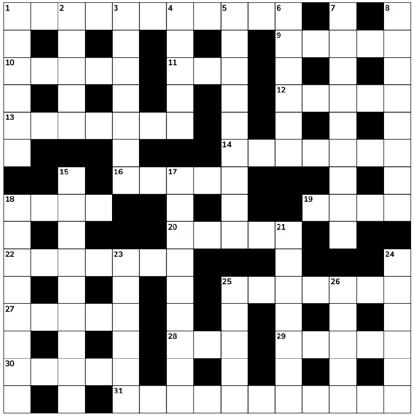
ACROSS
1. Weird, a Sir Alan can't take Henry V as an example (11)
9. Father Rory covers up blunder (5)
10. Trunk of tree's heading periodically for Rostov (5)
11. Pinch and restrain revolutionary (3)
12. Broken, lost Henry is slow mover (5)
13. Inaction as interstate freewheeling train gains energy (7)
14. State of violence: a lunatic captures leader of Aberystwyth University (7)
16. After two Novembers in Europe, I found boredom (5)
18. Hill of soft feathers (4)
19. Pen explosion firstly causes eye injury (4)
20. Sort of colander? (5)
22. Version of a tirade about me: beyond violent (7)
25. Corrupt people egg religious leader (4,3)
27. Endures finals (5)
28. Leader of Greenland's ‘silver silence’ (3)
29 & 30. ‘Call over hero!’ announced drummer (5,5)
30. see 29
31. Mental effect of ice gust carrying drizzle and a hint of fog (11)
DOWN
1. State of liquid at Evian uncovered (5)
2. Pluck head of Ribena to infiltrate leaderless 7up (5)
3. Initially all beam, including St Paul, for example (7)
4. A bit of heat on Gandhi's country (5)
5. Ad lib setter's show about Indians (9)
6. Columnist is sequestered in Brunel's onion (6)
7. Jason's lads deliver canned tuna to shop (9)
8. Ferdinand, for one, hacked our broadcast (8)
15. Fencer's strange remark is Manx essentially (9)
17. Gin: a last resort to protect love and sentimentality (9)
18. Satanic, abominable, vile dish (8)
21. One who rules as per Rome's constituents (7)
23. Soak up a big cry about Romeo (6)
24. Blue moon almost entirely concealing red sun? First sign of eclipse! (6)
25. Pan's endless age is idolatrous (5)
26. Thrust broken leg around sawn-off gun (5)
What kind of indicators might we be looking for? As well as ones like 'sequestered in' which signify hidden words, anagram indicators are common - things like 'weird' or 'broken' *cough, cough* might imply that you have to anagram some of what follows. Selection indicators like 'firstly' might tell you you only need the first letter of the word they refer to, and sometimes you might have to substitute a word for another which means the same (I wonder if there's another word for pen in 19-across for instance that couples with the first letter of explosion to give an eye injury...). Give it a go - the clues are clever and rewarding and you can always use the answers and explanations on epigram.org.uk for help.
by
Rachel Shortall
Can you find these hidden words as well as the mystery theme word which links them?
REGULAR SUDOKU
by Alice Guskov