

eoe journal
eoe journal
April/May 2026
Teachers play one of the most important roles in shaping individuals and society, yet their efforts are often overlooked. Every day they dedicate their time and energy to helping students learn, grow, and succeed— not just academically, but personally. They prepare lessons, adapt to different learning styles, and find ways to make complex ideas understandable. This work requires patience, creativity, and a genuine passion for helping others, all of which deserve recognition and appreciation.
Beyond academics, teachers act as mentors, role models, and sources of support. Many students rely on teachers for encouragement during difficult times, guidance when making decisions, and motivation to keep going when things feel overwhelming. Teachers often go beyond their job descriptions, offering extra help after class, listening to students’ concerns, and celebrating their achievements. These contributions can have a lasting impact on a student’s confidence and future.
Despite the challenges they face, such as long hours, limited resources, and high expectations, teachers continue to show up and give their best. Their hard work helps build stronger communities and a better future for everyone. By appreciating teachers, we acknowledge not only the effort they put into their profession but also the meaningful difference they make in countless lives every single day.
Lisa Petty, Editor Equal Opportunity Employment Journal
The eoejournal is published bimonthly by EOEJournal, Inc. The ownership and management of EOEJ fully and actively support equal opportunity for and advancement of all people without regard to race, color, religion, gender, national origin, sex, pregnancy, citizenship, ancestry, veteran status, marital status, physical disability, mental disability, medical condition, age, gender identity, and sexual orientation or any other characteristic protected by state or federal law.
Advertising and Editorial mailing address:
7000 N. 16th Street Suite 120-315 Phoenix, AZ 85020
Phone: 602-604-9133 EOEJ

The Phoenix Union High School District is searching for the best-qualified applicants in all fields , but particularly in mathematics , science , special education , and ELD (English Language Development) .
Come join one of the most progressive portfolio districts in the country. Fill out an application on our website at phoenixunion.org or contact us at (602)764-1101.

The Phoenix Union High School District is an Equal Opportunity Employer.
EDUCATION CAREERS: Guide to Career Paths for Students



Educators help shape the minds, develop the skills, and nurture the hearts of students. Parents entrust their children to teachers and other school personnel, so it is essential that they fulfill their roles. The education industry provides professionals with an array of benefits, such as job stability, personal growth, and making an impact on students’ lives. But those with education careers also face challenges, including heavy workloads, administrative demands, and changing educational policies. To help aspiring educators, I, a career-planning expert with over a decade of professional experience, created this guide to the different career paths in the field of education. I also discuss academic requirements, job outlook, and alternative opportunities for educational professionals.
Key things you should know about starting a career in education:
• With a degree from an accredited institution, several education careers can be available to you. These may include becoming an elementary school teacher, a high school teacher, or a postsecondary teacher. You can also venture into non-teaching roles, such as an educational consultant, a career counselor, or a librarian.


• The median annual wage of elementary school teachers in the United States (US) was $62,340. High school teachers ear ned $64,580, while postsecondary teachers yielded $81,600.
• Through 2034, employment for elementary and high school teachers has been projected to drop by -2%. In contrast, postsecondary teachers have a job growth rate of 5.9% during the same period.
What are the most rewarding aspects of teaching?
Education is one of the best majors aspiring professionals can choose, especially as teaching is a pr ofession that can be fulfilling in more ways than just earning a paycheck. I have found that the following ar e three of the most rewarding aspects of the job:
• Impacting Lives. Witnessing students grow academically and personally, knowing that your guidance played a role in their development, is immensely gratifying.
• Building Relationships. Forming meaningful connections with students fosters a supportive learning environment. Seeing students trust you with their struggles and successes creates a sense of fulfillment beyond measure.
• Lear ning for Life. Teaching is a two-way street; educators learn from their students just as much as students lear n from them. Embracing new perspectives and ideas keeps the profession dynamic and enriching, ensuring personal and professional growth.

HOW DO I BECOME A TEACHER? What skills are essential to become a teacher?
The journey toward successful education careers involves several routes and steps. You must earn an education degree in the specialization of your choice to gain the knowledge and develop the skills necessary for you to become an effective teacher or non-teaching professional in the academic community. In my research, I have found that the following skills are crucial for teachers:
• Subject Knowledge. The primary role of teachers is to impart knowledge to their students. That said, they should possess immense knowledge of a subject matter. They can do this b y attending conferences and pursuing a relevant master’s degree.
• Classroom Management. This skill refers to a teacher’s ability to keep students focused and attentive in class. Classroom management often includes minimizing disruptions, engaging students in the lesson, and maintaining classroom authority.
• Curriculum Planning. It is essential that teachers can plan appropriate and engaging instructions for their students. These include developing lesson plans that can make their students excited to lear n.
• Effective Lecturing. Lectures are often associated with one-way communication and visual aids. However, an
effective teacher should know various lecturing approaches to enrich their students’ learning experience. This can include the use of virtual reality in education .
• Creativity. Creativity is vital for teachers, enabling them to design engaging lesson plans, adapt to diverse student needs, and foster a dynamic learning environment. Pursuing a graphic design degree online can enhance educators’ creative abilities and instructional practices. Individuals with fewer resources can explore free online courses or tutorials on creativity and design.
What are the educational requirements for earning teaching certification, including degree programs and coursework?
To obtain teaching certification in the US, individuals must fulfill specific educational prerequisites. These typically include the following requirements:
• Bachelor’s Degree. Aspiring teachers must complete a degree in education at the bachelor’s level from an accredited institution. A bachelor’s degree provides foundational knowledge in education theory, pedagogy, and subject matter expertise.
• Completion of Approved Teacher Preparation Program. Candidates must complete an approved teacher preparation program. These programs provide hands-on classroom experience and training in instructional methods and classroom management.
• Coursework in Educat ion. Coursework typically covers different topics, such as child development, educational

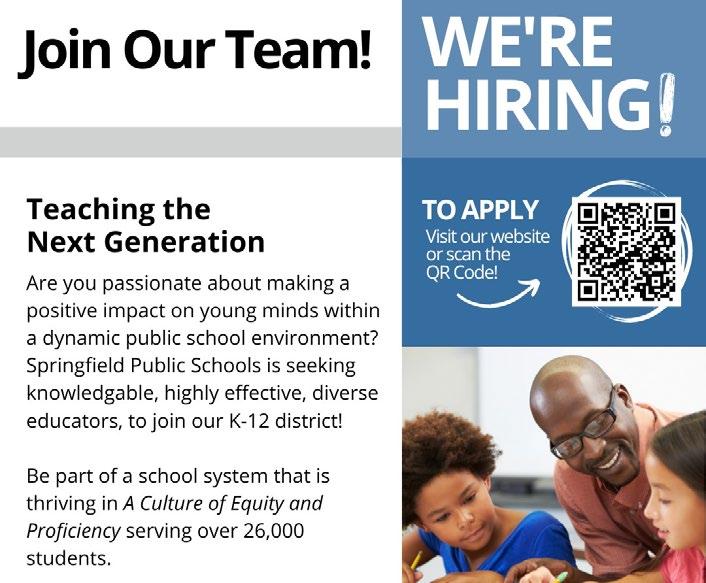
Teaching the Next Generation
Are you passionate about making a positive impact on young minds within a dynamic public school environment?
Springfield Public Schools is seeking knowledgable, highly effective, diverse educators, to join our K-12 district!
psychology, curriculum design, and assessment. These courses equip future educators with the necessary knowledge and skills to teach diverse student populations effectively.
• Field Experience or Student Teaching. Prospective teachers must complete a supervised student-teaching or field-experience component. This hands-on experience allows individuals to apply theoretical knowledge in real classroom settings under the guidance of experienced educators.
• Passing State Cert ification Exams. Candidates must pass state-specific certification exams, such as the Praxis series. These exams assess candidates’ knowledge of subject matter content, pedagogy, and teaching skills, ensuring they meet state standards for educator proficiency.
Are there specific skills educators need to effectively integrate technology?
Educators require specific skills to incorporate technology into their teaching practices successfully. Among these include the following:
• Digital Literacy Technology has changed the way schools provide education. Some students will look for good degrees to get online so they can study anywhere and at their own pace. This is where having the necessary computer skills to navigate a learning management system (LMS) can be helpful. Proficiency in using digital tools
EDUCATION continued on page 8

Be part of a school system that is thriving in Educating to Empower serving over 26,000 students. Valley View School District 365U and the Board of Education, in partnership with the diverse community we serve, will maintain a safe environment for students and staff by providing encouragement for engaged learning opportunities that result in continuous improvement for all students.

To view and apply for open positions, visit our website at www.vvsd.org/jobs





and platforms enhances instruction and facilitates student learning. Educators must be adept at navigating software applications and online resources relevant to their subject areas.
• Pedagogical Knowledge. Educators must understand how to leverage technology to support diverse learning styles and instructional strategies. Many educational technologies are designed to seamlessly support virtual classes, school activities, and student discussion forums to enhance student engagement and comprehension.
• Adaptability. Teachers must develop the ability to embrace change and continuously learn and adapt to new technologies and educational trends. They must remain flexible and open-minded, willing to explore innovative ways to incorporate technology into their teaching practices to meet the evolving needs of students and the educational landscape.
What are the different career paths in education?
Education careers are diverse, providing aspiring professionals with several roles other than teaching positions. During my research, I have found the following teaching and non-teaching careers that are available to graduates of education degree programs:
• Elementary School Teachers. Elementary school teachers are tasked with nurturing young minds, delivering engaging lessons across various subjects, and assessing student progress. They also foster a supportive classroom environment and collaborate with colleagues and parents to promote student success. Elementary school teachers in the US had a median annual wage of $62,340.
Postsecondary teachers in the US had a median annual wage of $81,600.
• Academic Coach. An academic coach provides individualized assistance to help students achieve academic excellence. What they do is evaluate a student’s abilities before devising tailored strategies. For instance, they can coach English majors while working on a capstone project that demonstrates the student’s skills.
• Corporate Trainer. Corporations often hire corporate trainers to help employees upskill or get familiar with new roles. Hence, corporate trainers can choose to work full-time for a specific company or part-time teaching particular skill sets to employees of various organizations.
• Career Counselor. Career counselors help students choose careers where they can leverage their skills and strengths. They often work in secondary schools, since this is usually when students consider what college courses to take.

As education continues to evolve, new roles and opportunities are emerging for educators who are ready to adapt and innovate.
• High School Teachers. High school teachers are responsible for instructing students in specific subjects, preparing them for standardized tests, and facilitating discussions. They also grade assignments, provide feedback, and guide students towards academic and personal growth. High school teachers in the US had a median annual wage of $64,580.
• Postsecondary Teachers. Postsecondary teachers, also known as college or university professors, deliver lectures, facilitate discussions, and conduct research. They also publish scholarly works, mentor students, grade assignments, and contribute to the academic community through service and professional development.
What are the emerging roles and trends for educators?
As education continues to evolve, new roles and opportunities are emerging for educators who are ready to adapt and innovate. With the increasing integration of technology, shifts in societal needs, and reforms in educational policies, the landscape of teaching is changing. Here are some of the key trends and emerging roles in education that may shape the future:
EdTech Specialists
The integration of technology into the classroom is no longer optional—it’s essential. Educators with expertise in educational technology are increasingly in demand. This includes roles such as EdTech trainers, who help teachers effectively use digital tools, and learning platform managers, who design and maintain online platforms for schools or educational companies. As virtual and hybrid learning environments become more common, EdTech specialists will play a critical role in shaping the future of education. Aspirants can pursue the cheapest online EdD programs that have accreditation to save on education without compromising quality.
Key Skills: Technical proficiency, understanding of digital learning tools, and the ability to train and support educators in technology use.
Learning Analytics Expert
The use of data to inform teaching practices is on the rise. Learning analytics experts analyze student performance data to identify patterns, predict outcomes, and recommend strategies to improve teaching effectiveness. These roles often

Join a Global Leader in Flavors & Fragrances Be Challenged. Be Rewarded. Be Part of a Great Experience!
Takasago is a major global leader and producer of flavors and fragrances providing innovative solutions in flavors, fragrances, aroma ingredients, and fine chemicals.
For over 100 years, Takasago has invested heavily in research and development to remain at the forefront of innovation in flavors and fragrances. We are committed to sustainability, focusing on natural and environmentally friendly ingredients. Takasago’s corporate culture is shaped by its core values of innovation, customer focus, sustainability, and respect for diversity. The company promotes a collaborative, inclusive environment where employees are encouraged to think creatively while maintaining high ethical standards.
Join Our Growing Team
Takasago is actively seeking motivated individuals to join us in the exciting world of flavors, fragrances, and fine chemicals. Whether you're just starting your career or seeking a leadership role, we have opportunities for you.
Open positions include:
Material Handlers • Compounders • Lab Technicians • Flavor Technologists • Flavorists • Account Managers • Manager roles
Explore Opportunities and Apply Today!
Click the link below to view all the exciting open positions and stay updated with new opportunities: Takasago Career Center
Connect with Takasago and Experience the Difference!

Seven Reasons Why You’ll Love a Career in Healthcare
Here are just a few reasons why you could thrive with a career in Healtcare:

1. Rewarding Work
A career in healthcare is a fantastic opportunity to connect with your community and make a real difference in the lives of others. The care you offer doesn’t just help patients, it also filters through to their families and the wider community. Seeing the positive impact of your work is truly one of the most rewarding parts of working in healthcare.
2. Flexible Hours
Whether you’ve got family obligations, or you’re ready to dedicate some solid hours towards your career, healthcare is one industry that’ll grant you the flexibility you need in your life. You can work in all kinds of facilities including hospitals, clinics, doctors’ offices, schools or even prisons. That means there’s a variety of shift times to choose from – daytime, evening or overnight, and there are plenty of roles that’ll give you the option to work full or part time.
3. Innovation
Being part of something exciting that’s larger than themselves is one of the biggest reasons why healthcare professionals get into the industry. It’s a field where new ideas are always being developed and introduced. Being a part of that in some small way can be extremely exciting, because it puts you at the edge of an impor-

The
CHANGE LIVES WITH PEOPLE WHO WILL CHANGE YOURS.
CHANGE LIVES WITH PEOPLE WHO WILL CHANGE YOURS.
JOIN ONE OF THE BEST TEAMS IN THE NATION.
JOIN ONE OF THE BEST CARE TEAMS IN THE NATION.
MaineHealth team members care for each other as much as they care for our communities. Every day, we help and support one another in our life-changing work. And with a focus on continuing education and training, MaineHealth is helping people grow their careers to become the best version of themselves.
MaineHealth team members care for each other as much as they care for our communities. Every day, we help and support one another in our life-changing work. And with a focus on continuing education and training, MaineHealth is helping people grow their careers to become the best version of themselves.
Do you share our calling?
For a complete listing of MaineHealth locations and current openings visit www.careersatmainehealth.org/
Do you share our calling? Learn more about joining the most dedicated and collaborative team in health care.
For a complete listing of MaineHealth locations and current openings visit careersatmainehealth.org

tant change to patients’ wellbeing and care. Whether you’re helping to implement a new technology or medical imaging technique, you’ll be in the ranks of one of society’s most important fields.
4.Continued Education and Growth
Next to constant innovation, comes the requirement to keep up with it. For many, this is a hugely desired part of the role, as you’ll never find yourself stagnating. With each leap and bound in technology, processes and care, your knowledge will expand. As it’s such a competitive field, you’ll also be naturally pushed to grow and advance in your career as far as you want to take it, standing out tall amongst your peers.
5.Upwards Mobility
When it comes to how far you can go in the field, the sky’s the limit! If you’re ready to throw yourself into learning and improving, you can reach wherever you want to go. You may need extra education and training depending on the role you’re going for, but once you’ve got your foot in the door, it’s just a matter of willpower!
6.Fast-paced and Dynamic
Ever felt stuck in an idle job that made you watch the clock all day? Not in this industry! The working lives of healthcare professionals run at a stimulating and dynamic tempo. New situations can unfold in unpredictable ways, which keeps the job super exciting. You’ll be helping patients with all types of illnesses and injuries every day, and from time to time, you’ll need to adapt with some creative thinking. In healthcare, you can look forward to a career where boredom is left at the door.


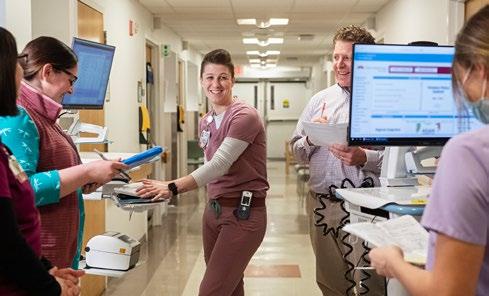
The working lives of healthcare professionals run at a stimulating and dynamic tempo.
7.Amazing Job Security
According to the Australian Government’s ‘ Labour Market Insights ’, the healthcare assistance sector is expected to grow by 15.8% between 2021 and 2026, which means around 301,000 new healthcare assistants will be needed. There’s no doubt that healthcare is one industry that won’t disappear, so you can expect loads of opportunities and the ability to plan your future in this career.
Does it sound like you? If you think a career in Health Services could be what you’re made for contact of our friendly Careers Advisors today at www.foundationeducation.edu.au to discuss your future in the healthcare industry.
the leading healthcare provider and largest employer in a 10-county area, Unity Health and its more than 2,300 associates work to provide high-quality compassionate care. Unity Health is recognized as a top diverse workforce.

Nursing Career Pathways
Nursing is a dynamic, rewarding profession with plenty of room for personal and professional growth. The demand for nurses is high and projected to grow as the baby boomer generation ages, promising excellent job security and earning potential. Are you wondering where to start your nursing career, or have you already started one? We’ll show you available nursing career options and how to develop a career plan for the future.



NURSING CAREERS: GETTING STARTED
Each nursing career path offers unique advantages and may require additional training or degrees. Establishing your goals upfront makes choosing the right nursing pathway easier. Fortunately, the nursing field provides ample opportunity for professional development. Keep in mind that many nurses change specialties or work environments throughout their careers, so whatever you initially decide isn’t set in stone.
1.Earn Your Degree
No matter what nursing career you choose, your first step is to earn a post-secondary degree. The main options to consider on your path to becoming a nurse are: Licensed practical nurse program: If you want to start working as soon as possible, a certificate program to become a licensed practical nurse (LPN) is your fastest option — you can complete one in about a year. Bridge programs can help you transition from an LPN to a registered nurse (RN) later if you decide to advance your career.
Nursing diploma: A nursing diploma is a fast and often more affordable path to becoming an RN. This type of program is most often based in a hospital. They aren’t as common as degree programs, but if your state has one, you may be able to start working as an RN in less than two years. However, a nursing diploma doesn’t provide college credits, so your training won’t count toward a degree if you plan to further your career later. You may also earn a lower salary than you would with a college degree. However, with an RN-to-BSN program, you can fast-track your four-year degree later if you want to pursue opportunities that require a Bachelor of Science in Nursing (BSN). Associate degree: Earning an Associate Degree in Nursing (ADN) usually takes two to three years. Like a four-year degree, an ADN prepares you to become an RN. Depending on the nursing career pathway you want to pursue, you may need to get a BSN degree later. However, the advantage of an ADN compared to a nursing diploma is that your credits may transfer to your BSN program, making it easier and cheaper to continue your education down the road.
Bachelor’s degree: Compared to other ways to become an entry-level registered nurse, a BSN takes more time and may be more expensive. It usually takes about four years to get a BSN, but having one can make it possible to pursue other nursing career paths that aren’t possible with a diploma or ADN alone. For that reason, a BSN is an investment that offers greater earning potential and more opportunities for professional growth throughout your career. Many hospitals and other health care employers now require new hires to have at least a BSN. And most advanced certification and post-graduate programs also require applicants to have one. Getting a BSN is the best option if you’re planning a long-term nursing career or pursuing the RN career path with the highest earning potential.
2.Get Your License
Whichever nursing degree or program you decide to pursue, you need to get licensed before you can work as a licensed practical nurse or registered nurse. You must pass a licensure exam called the National Council Licensure Examination (NCLEX for registered nurses or NCLEX-PN for LPNs). This test verifies that you have the knowledge and skills to begin working safely and confidently as an entry-level nurse. Once you pass the exam, you’ll receive licensure from your state and can start your nursing career.
3.Secure a Nursing Job
Once you’re licensed, you’re ready to look for your first nursing job. The median salary for an RN is more than $77,000,




NURSING continued from page 12
but nurses starting out can also expect a decent wage — only about 10% of registered nurses earn less than $60,000 per year. LPNs make, on average, about two thirds as much as an RN — $48,000 per year according to the Bureau of Labor Statistics .
4.Pursue Advanced Certification
Many nurses are content working as RNs or LPNs. But if you’re interested in a nursing specialty or becoming a certified nurse practitioner , you have some terrific options. Some specialties require additional training or certifications from bodies like the American Nurses Credentialing Center (ANCC).
Some specialties require post-graduate degrees, such as a Master of Science in Nursing (MSN) or Doctor of Nursing Practice (DNP). Most MSN and DNP programs require a bachelor’s degree before applying. If you start out with a diploma or an associate degree, you’ll need to finish your BSN before pursuing nursing career pathways that require advanced degrees. Although it takes extra time and expense to get a post-g raduate degree, nurses who obtain an advanced specialization have more options for career development and are among the top earners in the nursing profession. Certified Registered Nurse Anesthetists (CRNAs) make the most, earning over $165,000 on average.

More Career Options for Nurses
With all the different nursing paths, titles, advanced certifications, and specialties, a nursing career provides more flexibility than many other professions. You can choose the environment you want to work in, such as a school, hospital, outpatient doctor’s office, travel nursing , long-term care, or occupational health setting.
Want even more flexibility? Depending on the nursing career path you choose, the degrees or certifications you earn and the experience you acquire, you can even work in a role that doesn’t involve day-to-day patient care, such as medical consulting on legal cases, nursing research , or nursing technology and informatics. And if you have a post-graduate degree, you can pursue an advanced clinical position or a leadership role like a nurse educator, nurse administrator , or director of nursing .
This flexibility is essential for job satisfaction and to avoid one of the most significant issues: nursing burnout . When job stress leads to a lack of motivation, reduced performance, and dissatisfaction, it poses a serious safety risk to nurses and their patients. Having the freedom to pivot your career, change your environment, or move into another nursing specialty can prevent burnout and lead to a fulfilling career.
Lear n about the different types of nurses and what nursing school is like as you consider if a career in nursing is right for you.



A passion
for INCLUSION AND EMPOWERMENT
At UCLA Health, it takes people from all backgrounds and varied perspectives to make our world-renowned care possible. That’s why we foster a culture where all are welcome, valued, and inspired to be their authentic selves. We’re proud to be one of U.S. News & World Report’s top hospitals in the country.
If you’d like to contribute to a world-class health provider within a setting that inspires and empowers great achievements, explore our openings in:
• Nursing
• Allied Health
• Research
• Nutrition
• Administrative/Clerical/Float Pool
• Managerial/Executive
• Hospital & Facilities Support
• IT
To learn more and apply online, visit us at UCLAHealthCareers.org
FAQs: Stress Management for Healthcare Professionals
1) I only get a few minutes between patients—what actually helps?
Just one minute of deep breathing can deliver a much-needed reset. Dedicate one minute to box breathing or try a physiological sigh, which involves a double inhale and an extended exhale. Add five-sense grounding exercises to encourage mindfulness.
2) How can I protect sleep on rotating shifts?
Anchor a consistent block of sleep and continue to adhere to this during off days. Add bright lights to wake-up routines and blackout curtains to sleep environments. Limit caffeine six hours prior to sleeping.

3) I feel morally distressed after some cases. What should I do?
Begin by naming the feeling or experience to help reduce the intensity. Reflect on your thoughts by journaling or share your concerns with a professional mentor or other trusted individual. Clarify value alignment and consider how your work
serves a larger purpose. Seek counseling or professional support if moral distress impedes workplace performance or daily functioning.
4) How do I set boundaries without letting my team down?
Use pre-prepared scripts and respectful language to convey your limits. Reframe breaks as necessities for safeguarding patients. Offer compromises, but do not allow these to jeopardize patient safety or your own well-being.
5) What if I try these strategies and still feel burned out?
Seek peer support in healthcare, such as through employee assistance programs. You can also work with your supervisor to adjust your schedule as needed. Burnout is a systemic issue, so don't hesitate to seek support or advocate for change.
Article provided by www.indwes.edu




Our compassionate care nurtures lasting connections
Redeemer Health provides compassionate care across every stage of life.
Rooted in the tradition of the Sisters of the Redeemer, our mission to Care, Comfort, and Heal can only be achieved through our dedicated, compassionate employees. Each of us is the product of our experiences and here you will find a place that welcomes you, celebrates your success, and challenges you to do your very best.
How Veterans Turn Military Experience into Civilian Career Success
by Aaron Kassraie
For veterans, looking for a civilian job can feel like stepping into a foreign country. The language, culture and hierarchy are often completely different when transitioning from the military to the private sector.
The good news is that you already have the skills employers want. The challenge is communicating those skills in a way that makes sense to civilians. Here’s how to translate your experience, tap into resources and use your network to land the job you deserve.
1.Demilitarize the Language
While the veterans unemployment rate has remained low — holding steady at 3.1 percent in August 2025 (even as the national rate climbed) — many veterans struggle to find work that matches their skills. One-third of veterans are in jobs that don’t match their education or experience, nearly 16 percent more than their civilian counterparts, according to a LinkedIn report. This often stems from difficulty translating military skills into civilian terms, employer bias and a lack of civilian professional networks.
Of course, you should still list your title and rank in your résumé. But assume recruiters aren’t veterans and steer clear of acronyms and other military-specific terms.
Fortunately, there are several tools to help align your military role with civilian positions. Some online places to get started include Career One’s Stop Civilian-to-Military Occupation Translator and My Next Move: Find Careers Like Your Military Job
2. Focus on Skills
Describe the skills gained from your role in the military, not just the assigned responsibilities. For example, a member of the infantry who patrolled a base and engaged in combat must demonstrate how that experience is relevant to a nonmilitary environment. “Don’t say you patrolled. Say you created a safe working environment for 300 people,” says Terry Howell, senior director of strategic alliances at Military.com, a website loaded with information about how veterans can find jobs.
“Don’t say you shot at people. Talk about working under
CHARLES GEORGE VA MEDICAL CENTER

pressure and constantly assessing situations,” says Howell, who served in the Coast Guard for 20 years.
3. Brag a Little
Boast about your individual accomplishments. Bragging isn’t encouraged in the team-focused military. And while civilian companies definitely value individuals who work productively with others, employers are considering whether they should hire you. Emphasize your specific contributions to the team’s success.
4. Keep it Short
Limit your résumé to two pages or less. Many civilians don’t understand how the military operates (and may even have negative stereotypes about veterans). But your résumé is not the place to provide a detailed explanation of military practices and procedures. Stick to your experience, check the document for spelling and grammar and tailor each résumé to the specific position you are seeking.
5. Use All Your Options
Your status as a veteran gives you access to personalized career guidance. Every branch of the military offers transition training through the Transition Assistance Program , or TAP. The federal Department of Veterans Affairs (VA) and Department of Labor (DOL) offer tools to ease the road to a civilian career, as do many private employers:
• Office of Transition and Economic Development : Supports service members and families through key initiatives.
• VA Transition Assistance Program :
> Prepares service members for civilian life.
> Covers VA benefits, health care, education and employment resources.
> Available starting one year before separation or two years before retirement.
• VA Solid Start :
> Contacts veterans three times in their first year post-separation.
> Ensures access to benefits and resources.
• Warrior Training Advancement Course :
> SkillBridge-aligned program.
> Trains service members for VA claims processor careers.
> Offers potential federal employment opportunities.
• DOL Veterans’ Employment and Training Service (VETS)
• AARP’s Veterans and Military Spouses Job Center
AARP created this center to help alleviate unemployment and underemployment in the veteran community. It offers a suite of free resources to help veterans and military spouses find jobs, explore new career fields, get advice and take job training courses. Key resources include:
> Veterans Career Advantage Course : Free online class offered through MindEdge Learning that covers résumés, networking, personal branding and common challenges.
> Veterans and Military Families Job Search Toolkit : Guides veterans on translating military service, skills and experience into the civilian workforce.
Some former military members don’t consider themselves veterans if they didn’t see combat, so they harbor misgivings about taking advantage of these services, says Brian Kropp, a former HR practice leader at Gartner who developed


The Boise VA Medical Center proudly serves veterans in the Boise, Idaho area, in its main medical center, and in five community-based outpatient clinics.
www.va.gov/boise-health-care/work-with-us/ to view and apply for current open positions.

strategies to recruit veterans. He encourages veterans to use every program at their disposal.
Finding companies that are hiring veterans and talking to the people who are hiring them is a great way to find a job. However, this idea might make some veterans feel uncomfortable, he says. “For veterans, that can be like breaking the chain of command,” Kropp says.
Military.com lists companies that want to hire veterans. Other sources are Veteran Jobs Mission and Hire Heroes USA
6. Find a Mentor
Look for another former military member who has made the switch to a career that interests you. That person can help guide you through the process and discuss successful strategies for making the change.
Need help getting started? American Corporate Partners and Post-Veterati are nonprofits that connect eligible veterans and their spouses with professionals who offer career guidance and mentorship.
7. Speak Freely
Be aware that communications in the civilian world are more relaxed than they are in the military, says Carol Pugh, a professor at the University of Arkansas Grantham who served in the Army for seven years.
About half the students at the school are former military members, and she runs a program to teach corporations about the benefits of hiring veterans. During interviews, veterans should feel free to ask questions and highlight their achievements, she says.
“The mission of the Tioga County Department of Human Services is to protect, serve and improve the quality of life for Tioga County’s citizens by effectively managing the County’s human services programs and resources.”
8. Plan Ahead
Don’t wait until your discharge to think about your next move. Explore the many educational opportunities the military offers its members. Consider taking classes, especially if you want to pursue a career that requires a different skill set than the one you developed in your military role. Volunteering for organizations that are related to your next career goal is another way to prepare for the transition.

9. Embrace the Gig Economy
For some veterans, the structure of traditional employment may not be the right fit. Gig jobs are flexible and often involve freelance work through online marketplaces where workers typically operate as independent contractors rather than fulltime employees. These roles offer flexibility and the opportunity to be your own boss.
Platforms like Upwork, Taskrabbit and Fiverr enable veterans to market their skills on their own terms. And for those with an entrepreneurial spirit, organizations like the Small Business Administration’s Office of Veterans Business Development provide resources and support for starting a business.
Article provided by www.aarp.org
Aaron Kassraie writes about issues important to military veterans and their families for AARP. He also serves as a general assignment reporter. Kassraie previously covered U.S. foreign policy as a correspondent for the Kuwait News Agency’s Washington bureau and worked in news gathering for USA Today and Al Jazeera English.


DEVELOPING EMOTIONAL INTELLIGENCE: Key to IT Career Growth
by Nathan Eddy
ITprofessionals are increasingly navigating not only complex systems but also heightened stress, change fatigue and team dynamics.
For IT workers operating in fast-moving, high-pressure environments, developing emotional intelligence — such as communication, self-awareness and collaboration — is an increasingly important career skill alongside technical expertise.
As IT shifts from maintaining hardware to managing complex, interconnected cloud ecosystems, the primary bottlenecks are no longer technical — they’re human.
Emotional intelligence allows professionals to navigate change fatigue and shifting priorities without losing focus. It helps teams stay adaptable, manage stress and collaborate effectively when the stakes are high.
Mike Arrowsmith, chief trust officer at NinjaOne, says successful IT teams deeply understand and have empathy for their organization’s challenges.
“Building trust and self-awareness across teams is what separates IT leaders who drive success from those who don’t,” he explains.
He says leaders who develop these qualities make better decisions under pressure and are better equipped to manage complexity across their teams with empathy.
“Emotional intelligence helps create healthier team dynamics that reduce that pressure,” he explains.
In DevOps environments, it supports a blameless postmortem culture, where teams feel safe acknowledging mistakes and learning from them, which ultimately leads to faster problem-solving.
In security teams, emotional intelligence allows practitioners to move beyond the reputation of being the “Department of No” and become collaborative partners across the organization.

“People-first leadership is critical in high-pressure IT environments,”
“People-first leadership is critical in high-pressure IT environments,” Arrowsmith notes. “When leaders prioritize trust and well-being, teams are better positioned to perform consistently and sustainably.”
As Sean Falconer, head of AI at Confluent, puts it, emotional intelligence is the ability to stay calm when everything’s on fire, read the room, build trust and rally a team around a direction.
“During a major incident, I’d take the person who keeps everyone focused and communicating clearly over the person who just knows the most commands,” he says.
Emotional Intelligence as Shock Absorber
In many ways, emotional intelligence acts as the “shock absorber” for the modern tech stack.
“The era of the ‘siloed genius’ is over,” says Ike Bennion, vice president of product management and data platform at Visier.
He explains that in roles like DevOps or cybersecurity, the “always-on” nature of the work can quickly lead to burnout.
“By recognizing the emotional cues of burnout in themselves and their peers, teams can rebalance workloads and address stress before it turns into disengagement or attrition,” Bennion says.
Falconer explains burnout almost never comes from the technical difficulty; it comes from feeling unsupported, unheard or trapped in a never-ending reactive cycle.
“Leaders with emotional intelligence pick up on the warning signs before someone quietly updates their LinkedIn and starts interviewing,” he says.
They build environments where people feel safe saying “this timeline is unrealistic” or “I need help” — Falconer says that’s what keeps good teams intact.
“AI is making individual technical output less of a differentiator, which means the people who make everyone around them better are the ones you can’t afford to lose,” he says. “No CI/CD pipeline fixes a culture problem.”
Scouting for Emotional Intelligence
Bennion points out hiring managers increasingly look for signals of emotional intelligence during interviews, especially how candidates respond to stress, collaboration and growth.
One common indicator is the “I versus We” test — does the candidate take sole credit for a project, or do they acknowledge the team? Hiring managers are looking for a balance.
“They need to see someone who understands their individual impact while recognizing success and failure as a team effort,” he says.
Conflict resolution is another key signal: When asked about disagreements with stakeholders or challenges to a technical roadmap, strong candidates demonstrate empathy and
negotiation rather than simply insisting they were right.
“They’re also looking for examples of genuine conflict, the candidate’s self-awareness of their role in that conflict and how it was ultimately resolved,” Bennion adds.
Managers also pay attention to coachability, such as how a candidate handles constructive feedback during code reviews or interview exercises.
Peter Hesse, partner at 10Pearls, says one question he always asks when interviewing IT candidates is the skill they consider most essential for the role.
“It’s kind of a trick question because the answer I’m always looking for is communication,” he explains.
Hesse says the days of technological prowess or development skills as singular deal-breakers for separating a candidate from the pack are long gone.
“Today’s advancements in AI mean that almost anyone can become better at the technical parts of their job,” he says. “IT professionals who are also excellent communicators, though, will always stand out.”
He adds that measuring someone’s communication skills is not how well they write a report or can speak in a meeting; listening and comprehension, to truly understand the context and meaning, matter just as much.“It’s also a great indicator of emotional intelligence, which is the key to becoming a successful communicator because it allows you to adapt your message to your audience and respond to what people mean, not just what they say,” Hesse says.
He notes the professional world has changed massively in the last few years, with AI now writing emails and generating code.


“It’s that human edge, which lies in connection and communication driven by emotional intelligence, that will be the biggest differentiator,” Hesse explains.
Building Emotional Intelligence
Arrowsmith says IT workers can build emotional intelligence by actively seeking feedback, practicing active listening and reflecting on how they respond under pressure.
“Investing in mentorship and leadership training can help strengthen self-awareness, empathy and communication skills alongside technical growth,” he adds.
Falconer advises IT pros to start small.
“After your next meeting or incident, take two minutes and just ask yourself: How did I show up? Did I listen, or was I just waiting to talk? Did I make things clearer or more confusing?” he says.
From Falconer’s perspective, that habit of honest selfreflection is the foundation for everything else.
Then, he advises IT pros to start volunteering for the stuff most engineers actively avoid, like presenting to non-technical teams, running a postmortem or mentoring someone junior.
Those situations force you to listen more, adapt how you communicate and actually think about what the other person needs instead of just what you want to say.
“Emotional intelligence isn’t some soft, fuzzy personality trait you either have or you don’t,” Falconer says. “It’s a skill, and like any skill, you get better at it by doing the reps in uncomfortable situations.”
Article provided by www.Dice.com
Nathan Eddy is a business technology writer and a graduate of Northwestern University’s Medill School of Journalism. He has written for FierceMarkets, Popular Science, eWeek and other publications.





MAKE AN IMPACT
Future of Talent Retention: Understanding Why Employees Leave and Why They Stay
Retention and turnover are among the trends discussed in iHire’s 2025 Talent Retention Report, which surveyed over 2,000 U.S. workers and employers. Below are the key findings HR leaders need to know.
Why Employees Leave: Pay Isn’t the Top Concern
The #1 reason employees choose to leave a job, selected by 32.4% of employees who quit their job this year, is a toxic or negative work environment, followed by poor company leadership (30.3%) and dissatisfaction with one’s manager or supervisor (27.7%). Surprisingly, unsatisfactory pay ranks sixth (20.5%), just behind poor work/life balance (20.8%).

#1 reason employees will quit their job this year is a toxic or negative work environment.
This suggests that employees often prioritize a healthy work environment, strong leadership, and positive relationships with managers over salary. HR leaders need to continue prioritizing company culture and work/life balance.
Employer vs. Employee Views on Why Employees Leave: A Significant Gap
While 32.4% of employees who left their job cited a toxic work environment as the top reason, only 15.3% of employers noted it as a factor. This highlights a substantial disconnect between employers’ perceptions and employees’ experiences.
When employers who had experienced turnover were asked why their employees left, the top three reasons they selected were personal reasons (51.4%), a role better aligned with career goals (42.0%), and unsatisfactory pay (36.3%) as the primary reasons given by departing staff. HR leaders can ensure exit interviews are a standard practice at their organizations to better understand the reasons behind employee turnover.
Why Employees Stay: Balance and Culture Over Pay
When surveyed on workplace culture, a significant majority (83.4%) of employees valued a positive work environment, while 68.1% indicated they were more likely to stay if their employer prioritized work/life balance. Additionally, when asked about workplace flexibility, 54.7% reported they’d be more inclined to remain with an employer offering flextime.
Employees prioritized health insurance (68.1%) and retirement plans (59.9%) as key retention benefits, with many also
desiring career growth opportunities such as professional development (60.6%) and promotion pathways (56.3%). This indicates HR leaders need to continue prioritizing company benefits packages to retain workers.
Employees Willing to Trade Pay for Balance, Culture, and Flexibility
When asked which perks might lead them to accept a lower salary, 50.9% of employees indicated they’d do so for better work/life balance, while 44.6% would consider it for an improved work environment or company culture. Additionally, 40.8% said they’d accept lower pay in exchange for greater work flexibility.
This highlights a growing preference for nonmonetary benefits in employee retention strategies, signaling that HR leaders must prioritize holistic well-being initiatives, foster meaningful work experiences, and offer flexible workplace options to enhance employee satisfaction and loyalty.
4 Strategies for HR Leaders to Enhance Employee Retention
Based on the employee retention statistics, here are actionable strategies for HR leaders to engage and retain top talent:
1. Don’t rely solely on salary as a retention tool. HR leaders should adopt comprehensive retention strategies that emphasize flexibility and foster a positive work environment, such as flextime or hybrid work options.
2. Prioritize work/life balance and flexibility. Respect employee boundaries by avoiding after-hours communication and by encouraging employees to block off personal time on their calendars to prevent burnout.
3. Foster a positive environment and an inclusive culture. Ensure your organization’s vision, mission, and all of your companies values statements are in alignment.
4. Offer advancement and growth opportunities. Provide professional development workshops and access to e-learning courses for remote employees.

At Segal, our mission is to provide trusted advice that improves lives. How? With expert teams delivering innovative solutions that help organizations provide health and financial peace of mind to their people. Our differences make us stronger
We’re one of the largest independent human resources and employee benefits consulting firms today. We’re team-oriented with deeply held values, proud to be making a difference in the lives of so many.
Become a part of something bigger
Segal is actively recruiting top talent. See our job openings on LinkedIn. And visit us at segalco.com/about-us/careers to learn how you can become a part of our team. segalco.com
involve using software and tools to track and visualize data, allowing schools to make data-driven decisions for individualized learning.
Key Skills: Data analysis, software proficiency, and the ability to interpret and apply educational data.
Specialized Support Roles in Inclusive Education
As inclusive education continues to be a focus, specialized roles in supporting students with disabilities or diverse needs are expanding. These roles include assistive technology specialists, who provide tools and training to help students with disabilities succeed, and behavioral specialists, who support students with social-emotional or behavioral challenges.
Key Skills: Knowledge of special education policies, understanding of diverse learning needs, and expertise in adaptive technologies.
Online Course Developer
With the growth of online education platforms, the demand for skilled online course developers is soaring. Educators with a background in instructional design are creating engaging, interactive, and effective online learning experiences for students of all ages. These professionals often work for universities and ed-tech companies or even create independent courses on platforms like Udemy or Coursera.
Key Skills: Basic understanding of AI and machine learning, data-driven decision-making, and adapting these technologies to the educational context.
What training is required to work in special education?
Individuals seeking to work in special education must undergo comprehensive training to support students with diverse learning needs effectively. The following credentials and experiences may be required:
• Special Education Degree. Aspiring special education teachers are required to complete a bachelor’s or master’s degree program in special education or a related field. These programs provide specialized coursework in areas such as disability studies, assessment, intervention strategies, and legal regulations. Individuals looking for affordable and accessible alternatives can explore online degree in special education programs.
As inclusive education continues to be a focus, specialized roles in supporting students with disabilities or diverse needs are expanding.
Key Skills: Instructional design, multimedia production, and the ability to adapt content for online learners.
Global Education Consultant
As education becomes increasingly global, educators are needed to help schools and institutions navigate international standards, adapt curricula, and work with culturally diverse student populations. Global education consultants advise on everything from program design and policy development to cultural competency training for educators.
Key Skills: Cultural awareness, international education policy knowledge, and strong communication skills.
Social-Emotional Learning (SEL) Facilitator
With growing recognition of the importance of mental health and emotional well-being in education, SEL facilitators are becoming vital in school systems. These educators are trained to implement programs that help students develop skills in emotional regulation, resilience, empathy, and social skills, all of which are critical for success in school and life.
Key Skills: Emotional intelligence, counseling, and the ability to create safe, supportive learning environments.
AI and Machine Learning in Education
The future of education also involves the integration of artificial intelligence (AI) and machine learning into teaching and learning processes. Educators skilled in AI will be needed to help design and implement adaptive learning technologies that can tailor education to each student’s needs, pace, and learning style.
• Field Experience. Practical experience is also necessary through internships, student teaching, or practicum placements in special education settings. Field experiences allow prospective special education professionals to apply theoretical knowledge in real-world contexts, develop practical skills, and gain insights into working with diverse student populations.
• Certification or Licensure. To become a special education teacher, you must earn state certification or licensure. Certification requirements vary by state but typically include passing examinations, completing training in special educa tion laws and regulations, and demonstrating proficiency in teaching students with disabilities.
• Continuing Education. To maintain and develop your knowledge and skills in the field, you will be required to undergo professional development and training on best practices, research, and emerging trends in special education. Special education professionals must engage in lifelong learning to enhance their skills, expand their knowledge, and meet the evolving needs of students with disabilities.
What is the job outlook for educators in the next decade?
There is a prevalent certified teacher shortage across the US, with 48 states reporting vacancies in special education, science, and math and a total of 45,582 unfilled positions across 31 states and the District of Columbia. This also indicates a growing demand for students pursuing education careers. In fact, the US Department of Education has a database of teacher shortage areas , highlighting specific staffing needs per state. This includes teacher shortages by subject areas, disciplines, and grade levels.
Notably, employment for elementary, middle, high school and special education teachers will decline by 2034, indicating that systemic efforts must be pursued to strengthen the teaching pipeline.
Here in the First National family (First National Bank Texas, First Convenience Bank, First Heroes National Bank, First Community Mortgage and First Community Services), we are fiercely proud of our past and excited about our bright future. Independently owned, with more than 300 locations in Texas, Arizona, Arkansas and New Mexico, we offer growth and advancement in a fun and fast-paced environment. Our company provides and educational atmosphere, enabling employees to achieve their highest career potential. We are pleased you have considered advancing your career with us.
WHY CHOOSE US?
Here in the First Nationalfamily (First National Bank Texas, First Convenience Ba nk, First Heroes NationalBank, First Community Mo rtgage and First Community Servi ces), we are fiercely proud of our past and excited about our bright future. Independently owned, with more than 300 locations in Texas, Arizona,Arkansas and New Mexico, we offer growth and advancement ina fun andfast-pacedenvironment. Our company provides an educational atmosphere, enabling employees to achieve their highest career potential. We are pleased you have considered advancing your career with us.
No matter what your specialty is, chances are there is a position for you with the First National family. Positions range from front-line sales to customer service, clerical, support services and managerial positions. Our account holders are very diverse, and we are proud to accommodate them with a diverse workforce that includes bilingual employees.





Come join our team of almost 2,000 collaborative, purposedriven professionals who are creating the clean energy system of the future. Together, we can lead the transition to a carbon-free, economically vibrant New York through customer partnerships, innovative energy solutions and the responsible supply of affordable, clean and reliable electricity. Think big, do good and help create a clean energy future!
At the New York Power Authority (NYPA), we work for the greater good and a stronger, sustainable New York.