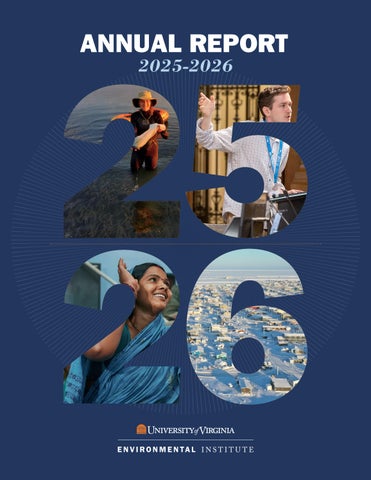
ANNUAL REPORT 2025-2026
TABLE of CONTENTS About....................................................3 Letter from Director..................................6
Mission RESEARCH TO ACTION The UVA Environmental Institute supports research and training at the intersection of environmental change and human well-being with a focus on: •
Interdisciplinary teams to catalyze innovative ideas and connect work across the university
•
Partnerships with stakeholders to co-create solutions and connect research with real-world experiences
•
Training for the next generation in solutionsoriented interdisciplinary research
•
A collaborative community to build and sustain relationships to tackle tough environmental challenges
Impact Spotlights......................................8 Climate Collaboratives................................12 Virginia Climate Restoration Initiative ............16 Practitioner Fellows ..................................17 Seed Funding...........................................18 Events....................................................20 Climate Fellows........................................22 Student Programs.....................................24 Finance..................................................26
The Institute creates solutions for a more resilient and sustainable future.
2 UVA ENVIRONMENTAL INSTITUTE
ABOUT The pace and extent of environmental change are now greater than any other time in human history. A better future can be built through collaboration and innovation. Established in 2017 as the “Environmental Resilience Institute,” the UVA Environmental Institute links research to action to advance environmental solutions. In June 2022, the University of Virginia announced a $60 million investment in Environmental Resilience and Sustainability. Tasked with shepherding $19.5 million of the investment, the Institute debuted with a new name and an expanded mission in May 2023.
2025-2026 ANNUAL REPORT 3
ABOUT > THE EI APPROACH
EI Approach & Programs Catalyzing Solutionsfocused Research » Climate Collaboratives » Seed Funding » Research Interest Groups
Building Partnerships » Industry, non-profit, government » Project partners & intern hosts » UVA partnerships
Training the Next Generation
Creating a Collaborative Community
» Post-doctoral Climate Fellows » Graduate Environmental Futures Fellows » Undergraduate summer & J-term internships
» Events, seminars, workshops, newsletters » Practitioner Fellows » Collaborative space in EI Office » Recruit & integrate new faculty
ABOUT > RESEARCH PROJECT MAP
4 UVA ENVIRONMENTAL INSTITUTE
Number of Projects 2-4 9-12 5-8
1
ABOUT > PEOPLE
Leadership Karen McGlathery | Director Karen is the Sherrell J. Aston Professor of Environmental Sciences at the University of Virginia (UVA), and the Founder and Director of UVA’s Environmental Institute. She has led interdisciplinary and multi-institute projects for over 20 years, including the NSF-funded Virginia Coast Reserve Long Term Ecological Research (LTER) project, and the Coasts and People (CoPe) project. Her research focuses on changes to coastal ecosystems and communities, and nature-based solutions for climate resilience.
Andres Clarens | Associate Director Andres is a Professor of Civil and Environmental Engineering, the lead of the Virginia Environmentally Sustainable Technologies Laboratory, and recently served in the White House under President Biden. His research is focused broadly on how carbon is manipulated, reused, and sequestered in engineered systems, and on developing strategies for mitigating the emissions that are driving climate change.
Leon Szeptycki | Associate Director Leon joined the UVA law faculty in 2019 after serving as a professor of practice and executive director of Water in the West at the Woods Institute for the Environment at Stanford University, where he oversaw an interdisciplinary research program focused on water management in the American West. Prior to joining the Woods Institute, he served as the director of the UVA Law School’s Environmental Law and Conservation Clinic, and as general counsel of Trout Unlimited, a national conservation organization.
Staff Amelie Berger Program Manager for Climate Collaboratives and Coasts and People
Jonah Fogel Program Manager for Research Development and Education
Henry Boachi Program Manager for Postdocs and Practitioner Fellows
Julie Lasseter Finance and Operations Manager
Allison Barrett Carter Communications Director
Carrie McGowan Business Manager 2025-2026 ANNUAL REPORT 5
LETTER from the DIRECTOR
In April, I led a UVA Cavalier Travels trip to Botswana. There, our team navigated the largest rainfall bringing water to the Okavango Delta in more than a decade. And in June, flying into DC through the smoke from the Canadian wildfires, I got a glimpse of the extreme challenges that communities are facing in the U.S. and Europe this year. These kinds of extreme events are becoming more frequent and more common. They underscore the need for an all-in approach to predict when extreme events will happen, where they will happen, and their severity. We need to use our knowledge to strengthen the resilience of communities as well as the infrastructure and ecosystems they depend on. Extreme event prediction is just one example of the work featured in this report. As the hub for UVA’s interdisciplinary environmental research, the Environmental Institute (EI) catalyzes collaborations across Grounds and builds partnerships with stakeholders. Now almost a decade since the institute was first established, we’ve created a collaborative framework that leverages and amplifies the work of individual schools. Teams are integrating environmental science, engineering, social science, economics, artificial intelligence, and more, to create knowledge, tools, and decision frameworks that put research into action. What stands out among our researchers is their commitment to crossing disciplinary boundaries and to working across sectors to translate their discoveries into solutions that are now so urgently needed. Their energy and optimism were evident in our annual Climate Collaborative symposium that brought together over 60 researchers and practitioners from 10 teams, where they shared experiences and insights on how they are working together on strategies for climate adaptation and mitigation. We continue to attract world-class researchers with eight new faculty members joining five UVA schools and all now part of EI teams turning scholarship into impact.
KAREN McGLATHERY DIRECTOR 6 UVA ENVIRONMENTAL INSTITUTE
The interdisciplinary work highlighted in this report – of faculty, postdoctoral fellows, students, and staff affiliated with the institute – is truly transformative. It is both frontier discovery and real-world action. By providing researchers with the resources and networks they need to explore novel ideas, EI is creating opportunities that accelerate outcomes and have meaningful impact for people and places across the globe.
BY the NUMBERS Total faculty funded
180
SINCE INCEPTION
Schools represented
11
Trainees (undergraduate interns, graduate fellows, post-doctoral fellows)
$84M
58 Publications
198
288
Extramural funding to EI supported teams
Departments, centers, institutes represented
&
Presentations
222
Extramural proposals from EI teams
177 | $164.5M
THEMATIC AREAS Environment + AI As artificial intelligence (AI) has grown exponentially in both ability and accessibility in recent years, the Environmental Institute catalyzes research probing two questions: how AI can help advance discoveries, and how the creation of large-scale data centers to accommodate growing demand is affecting the environment.
Coastal Resilience From the tropics to the poles, half the world’s population lives
on coasts or depend on coastal resources where the impacts of a changing climate are most intense. The Environmental Institute focuses on interactions between people, infrastructure, and the changing environment in these areas. Teams work to restore ecosystems, understand and design resilient coasts, and inform policy and decision-making.
Energy + Infrastructure The Environmental Institute brings researchers together from across disciplines and schools to look for sustainable infrastructure solutions and strategies for carbon removal and climate mitigation. This research includes renewable energy technologies, nature-based solutions for climate resilience, bioeconomy and low-carbon materials, negative emissions strategies, and behavioral change for climate action.
Extreme Events As climate change accelerates, extreme events are displacing people
and disrupting lives throughout the world at unprecedented rates. The Environmental Institute supports projects in both the prediction of extreme events and the strategies to lower risk and increase resilience. This research includes work on increased flooding, wildfires, more intense storms, temperature extremes, and more. 2025-2026 ANNUAL REPORT 7
IMPACT SPOTLIGHT UVA Researchers Use AI to Reveal the Hidden Reach of Coastal Forest Loss (original reporting by: Russ Bahorsky) UVA environmental scientist Xi Yang and his Ph.D. student Henry Yeung have mapped coastal forests in unprecedented detail, revealing nearly 6 million dead trees across low-lying areas from Maine to South Carolina that are vulnerable to flooding. The research, published in Nature Sustainability, featured in Science, and the basis of a Washington Post article in January 2026, uses artificial intelligence and satellite data to pinpoint individual dead trees and identify the environmental forces behind their decline. The project began with seed funding from the UVA Environmental Institute through its Water Futures Initiative, which helped Yang and collaborators at Duke University explore where ghost forests were emerging. With additional funding from the UVA Environmental Institute’s CoLab program, NASA, National Science Foundation, and Department of Forestry, the team was able to take the project even further. Driving along the Atlantic coast (past North Carolina’s Outer Banks or Virginia’s Eastern Shore) there are stands of pale, lifeless trees rising from wetlands. Some call them ghost forests, and while their haunting appearance is easy to spot, the scale of the phenomenon has been largely invisible until now. 8 UVA ENVIRONMENTAL INSTITUTE
Photo by James Dinneen Using UVA’s Rivanna supercomputing system, the team trained a deep-learning model to detect individual dead trees within the forests with the help of highresolution satellite imagery. The findings revealed that saltwater intrusion and sea level rise are transforming the coast far beyond where scientists once thought ghost forests existed. For Yang and Yeung, the implications of this work extend from science to public well-being. Like a canary in a coal mine, ghost forests are an ecological warning sign, but they also foreshadow economic and cultural losses for coastal communities. The researchers hope the data can help local planners, policy makers and insurance companies anticipate and adapt to these extreme event changes and increase coastal resilience.
IMPACT SPOTLIGHT
Research Lays the Groundwork for More Effective Hurricane Evacuation Policies A team of UVA researchers, supported by the Environmental Institute through the Rapid and the CoLab programs, released the first-ever database of hurricane evacuation orders in the United States. By examining what has worked (and hasn’t) in the face of extreme events such as oncoming hurricanes, the database allows leaders and government officials to increase community resilience, create better policies and, ultimately, reduce loss of life. The project teamed Majid Shafiee-Jood and Negin Alemazkoor (UVA Engineering faculty members) and Harsh Anand (Engineering doctoral candidate). The trio gathered nationwide public-facing evacuation orders and created a database to measure the effectiveness of hurricane evacuation policies: the HEvOD (Hurricane Evacuation Order Database). The database includes evacuation orders issued by official state and local agencies in response to hurricanes that impacted the United States between 2014 and 2022 (25 hurricane events in total). The
researchers were driven by the recognition that while evacuation orders are crucial for public safety during hurricanes, there was no database of historical hurricane evacuation orders and their effectiveness. As communities move into more intense hurricane seasons due to climate change, helping them understand what works when it comes to protecting themselves in the face of incoming hurricanes is valuable. HEvOD is publicly accessible through LibraData, the University of Virginia’s open-access repository, and can also be accessed from the project’s website www.hurrevacorder.info. Research resulting from this work was published in Nature Scientific Data and is under review in Bulletin of American Meteorological Society. Shafiee-Jood is also part of a team including researchers at Texas A&M University that received a grant from National Oceanic and Atmospheric Administration’s Weather Program Office in 2025 to continue this work.
2025-2026 ANNUAL REPORT 9
IMPACT SPOTLIGHT
A Community-Driven Tool Is Helping Virginia’s Eastern Shore Prepare for Climate Change (Based on original reporting by McGregor McCance and Russ Bahorsky) When the National Science Foundation called for bold solutions to environmental challenges facing the nation’s coastlines, Environmental Institute Director Karen McGlathery recognized that the University of Virginia was uniquely positioned to respond.
To launch the work, the Environmental Institute awarded seed funding to Barbara Brown Wilson (School of Architecture) and Michele Claibourn (Center for Community Partnerships) for a project titled “Building a Climate Equity Atlas on the Eastern Shore.” Their project created a collaborative platform for elevating community knowledge and supporting equitable decision making. Building on the relationships and momentum of the Coastal Futures Hub, UVA was awarded $5 million through the National Science Foundation’s Coasts and People (CoPe) program. Today, the initiative brings together more than 13 UVA faculty members and seven students working alongside Eastern Shore communities to address a wide range of environmental challenges.
The Virginia’s Eastern Shore is one of Virginia’s most environmentally vulnerable regions, facing increasingly frequent flooding, sea level rise, saltwater intrusion, and other climate-related extreme events. Yet rural communities like these are often overlooked by traditional research efforts. Through its Coastal Futures Hub, an initiative launched by the Environmental Institute, UVA set out to change that. The Hub relied on a model for community-engaged research, where local knowledge shaped scientific discovery from the very beginning. UVA researchers partnered with Eastern Shore residents, community organizations, and local leaders to identify the challenges that mattered most to the people living there. Together, they sought to generate the data, tools, and partnerships needed to develop practical solutions that would strengthen the region’s resilience. 10 UVA ENVIRONMENTAL INSTITUTE
One lasting outcome is the Livability Hub (esvalivabilityhub.org), an online resource co-created with community partners that features interactive story maps, oral histories, and practical planning tools. Following a refresh in April 2026, the site attracted more than 1,200 page views from 256 visitors in its first month. The work continues to generate new research opportunities driven directly by residents’ priorities. One notable example is the increasing failure of septic systems caused by sea level rise and inland flooding. In response, a UVA faculty member on the project recently secured support from the National Oceanic and Atmospheric Administration and UVA’s Climate Collaborative to develop solutions. What began as a modest seed investment has grown into a nationally funded research partnership that is helping Eastern Shore communities adapt to climate change while creating a model for community-centered environmental research across the country.
Meghan Blumstein Architecture and Environmental Sciences
Antonios Mamalakis Data Science and Environmental Sciences
NEW HIRES BUILDING COMMUNITY The UVA Environmental Institute attracts world-class faculty and leverages the work of schools and units to create a collaborative framework that supports both new and existing faculty. This past year, the Institute coordinated a cluster hire of eight new faculty in five schools, who are all engaged in the Environmental Institute programs and work. This academic year, the cohort has produced five joint research proposals, three are Climate Fellow mentors, and three are Climate Collaborative team members.
Fred Cheng Environmental Sciences
Nickolay Gatchev Commerce
Andrew Wilson Public Policy and Economics
Huilin Hang Environmental Sciences
Majid Shafiee-Jood Engineering
Dan Driscoll Sociology 2025-2026 ANNUAL REPORT 11
CLIMATE COLLABORATIVES CATALYZING SOLUTIONSFOCUSED RESEARCH
BUILDING PARTNERSHIPS
In 2023, UVA’s Environmental Institute announced the first Climate Collaborative awards. These large, interdisciplinary research teams can receive between $300,000 to $1.5 million for two to four years. Implementing a place-based, communityengaged research model, these teams, which span the globe, co-create adaptation and mitigation strategies to climate-related challenges with impacted communities.
By the numbers
7 new Climate Collaborative projects total projects
in Virginia (Southwest, Central, 10 Located Eastern Shore, and Northern), Alaska, Puerto Rico, Lesotho, Mozambique/Zimbabwe, India
40 total faculty engaged 6 total postdocs engaged 31 total grad students engaged 10 total undergrads engaged $7.7M awarded total community members engaged 3 incumbent Climate 1,500+ byCollaborative projects 12 UVA ENVIRONMENTAL INSTITUTE
New Climate Collaborative teams In Fall 2025, the Environmental Institute expanded the Climate Collaborative cohort. The Institute funded seven new teams, working in diverse locations that span across the globe. Today, ten teams include researchers from 21 academic departments and institutions and work directly with community members to provide tools needed to meet climate challenges.
New Climate Collaboratives 2025-2026 1. Living With Data Centers: Co-Producing A Framework For Climate, Community, And Infrastructure Resilience in Loudoun County, Virginia Loudoun County, Virginia, which has the world’s densest concentration of data centers, offers a critical case study for examining how the rapid expansion of digital energy and infrastructure intersects with climate resilience. As artificial intelligence (AI) drives unprecedented demand for computational power and digital infrastructure, data centers are consuming ever greater amounts of electricity and water, placing high demands on regional grids, extending fossil-fuel generation, and transforming land usage of Northern Virginia. 2. Promoting Climate Resilient Agriculture Through Ecosystem Management in Virginia (Charlottesville) Virginia’s rural residents and economy are particularly vulnerable to a changing climate with changing weather patterns, degrading natural resources, biodiversity loss, and extreme events. With over 90% of the state comprising agricultural and forested lands, Virginia’s communities and ecosystems are experiencing changing precipitation patterns, increased storm intensity, and shifting growing seasons. This project aims to leverage a mixed agricultural site (Morven Sustainability Lab) to identify potential scenarios where diverse needs can be met through innovative land management. 3. Unveiling Health Risks from Indoor Exposures Following Climate-Enhanced Flooding in Puerto Rico In Puerto Rico’s Caño Martín Peña district (an urban flood corridor home to 11,000 residents), chronic humidity, recurrent flooding, and power outages create conditions for the persistence of harmful pollutants that threaten health long after floodwaters recede during extreme events. To address these risks, this project focuses on four classes of indoor contaminants from flooding that are poorly regulated in residential settings and represent an urgent, yet understudied, dimension of environmental health.
2025-2026 ANNUAL REPORT 13
CLIMATE COLLABORATIVE > NEW CLIMATE COLLABORATIVES
4. A Social-Ecological Approach for Just Climate, Biodiversity, And Well-Being Outcomes in the Miombo Woodlands of Africa Tropical dry forests, such as the Miombo woodlands (the largest dryland forest), play a pivotal role in rural livelihoods, particularly for the forest-dependent communities. Spanning more than 1 million square kilometers across seven southern African countries, Miombo woodlands harbor diverse and multifunctional landscapes and are inextricably linked to the lives of more than 300 million people. This project will work with a network of local partners in two countries (Mozambique and Zimbabwe) to co-design solutions to address climate adaptation, biodiversity conservation, and human well-being in the face of extreme events and environmental change. 5. Co-Producing Climate-Resilient Solutions To Septic System Failures on the Eastern Shore of Virginia Decentralized septic systems that were once considered a reliable and affordable form of household wastewater management are increasingly failing under the combined pressures of age, saturated soils from more intense rainfall and storm flooding, and the impacts of sea-level rise on groundwater levels. Without intervention, these stressors will continue to expand the impact of septic failures, transforming what has long been treated as a private household problem into a systemic coastal resilience challenge for entire regions. 14 UVA ENVIRONMENTAL INSTITUTE
6. Building Climate-Optimized Affordable Neighborhoods in Northern Virginia Climate-related energy and infrastructure challenges are emerging against a major housing shortage in the United States (estimated to be on the order of 3-5 million units). But current approaches to housing development treat housing supply, carbon pollution reduction, and climate resilience as competing priorities, leading to suboptimal outcomes. This project will assess how regulation and financing affect what is built (building form and material choices) and the impacts on embodied carbon, operational energy consumption, climate resilience, and affordable housing supply. 7. Using AI To Improve Agricultural Extension for Climate Resilience in Lesotho, Africa Lesotho’s landscapes have suffered significant degradation due to unsustainable land use, poor water resource management, and increasing vulnerability to climate change. This has led to soil erosion, reduced agricultural productivity, and loss of ecosystem services. Smallholder farmers in the region have limited resources to adapt to environmental changes, yet 70% of the Lesotho people depend on agriculture for both their food and income. This project harnesses artificial intelligence (AI) to strengthen extension services by delivering precise, localized, and practical guidance for farmers.
CLIMATE COLLABORATIVE > INCUMBENT CLIMATE COLLABORATIVES UPDATES SNOWPAC (Snow, Water, and Permafrost in Arctic Communities) Utqiagvik, Alaska This Climate Collaborative team, announced in 2024, works with community members in the Arctic to develop strategies that address how thawing permafrost is destabilizing infrastructure like buildings, power lines, and water pipes, including the management of snow and ice. Twenty UVA students visited and worked alongside community members as part of the design studio. Some of findings from SNOWPAC informed North Slope Borough Public Works Department’s drainage and maintenance planning by developing a watershed map and surface flow analysis using GIS and field data, identifying culvert locations, drainage bottlenecks, and snow storage areas.
community, the Climate Collaborative developed voice and leadership training to help strengthen elected women representatives. This team trained over 512 women in advocacy skills for solutions to water challenges faced in their communities.
Resilient Appalachia Carroll and Dickenson counties, Virginia This team, announced in 2023, focuses on the capacity for renewable energy in Southwest Virginia, including the economic and societal implications on communities and the environment. They have led multiple meetings in Carroll and Dickenson counties, working with community members and residents to find ways to make their regions more resilient. Using an established collaborative process called the Resilience Adaptability Feasibility Tool (RAFT), the team helped both counties identify five to six priority actions.
MEGHA Climate Collaborative Bihar, India An international team, announced in 2023 and led by UVA researchers, developed models of the river and watershed system in the region to understand increasing flood risk and plan for more resilient water-supply infrastructure. With their work in the
Climate Collaborative Symposium On May 1, 2026, 60 participants gathered for the Annual Climate Collaborative Symposium. Building on the success of the first Symposium in 2025, the full cohort of Climate Collaborative team members came to share best practices in community engagement approaches. Researchers focused on building trust with community partners and managing the co-production process with transparency, authenticity, and flexibility to allow for community concerns to inform the research and co-produce outcomes. In a team science workshop participants thought through scenarios and then worked with peers from other stakeholder roles and disciplines to sharpen approaches. The entire Symposium strengthened the efficacy of research in an interdisciplinary team environment, where multiple workstreams and voices must come together to produce an impactful project. 2025-2026 ANNUAL REPORT 15
VIRGINIA CLIMATE restoration INITIATIVE
CATALYZING SOLUTIONSFOCUSED RESEARCH The UVA Environmental Institute announced the launch of a new publicly available tool in Spring 2026 based on interdisciplinary research: the Virginia Climate Restoration Initiative. For Virginia to get to net zero carbon emissions by 2050, various carbon dioxide removal strategies will be needed to address legacy pollution and keep the costs of climate action low for consumers and businesses. The research team considered three elements of a carbon removal industry in Virginia: nature, technology, and policy. This platform will accelerate multi-sector collaboration, and real-world action on carbon pollution and its impact on the Commonwealth of Virginia’s energy and infrastructure plans. Available at vcri.environment.virginia.edu, a central hub for Virginia-focused climate research efforts, offering accessible insights, data, and tools to support decision-makers, researchers, and communities. 16 UVA ENVIRONMENTAL INSTITUTE
PRACTITIONER FELLOWS BUILDING PARTNERSHIPS The Institute’s Environmental Sustainability and Resilience Practitioner Fellows Program supports fellowships at the University for non-academic practitioners to be in residence and to participate in sustainability research, teaching, engagement, and other activities at UVA. These Fellows enhance research and teaching, elevate the University’s stature in the field of environmental resilience and sustainability, and better link the results of research to the world of practice.
Robin Dunbar Dunbar joined the Environmental Institute as a fellow in summer 2025 from her career as deputy director of education for the Elizabeth River Project, an organization working on coastal resilience and tasked with cleaning up one of the most polluted rivers along the Chesapeake Bay. She was formerly the developer of the Learning Barge (a floating classroom to educate students about river sustainability). At UVA, Dunbar worked to capture the lessons learned through a curated archive, research on marine debris, teaching, and seminars.
Michael Geffel Geffel returned to his alma mater to help Morven Sustainability Lab create a framework for their future land management. Geffel is the founding principal of LND LAB, a landscape architecture practice that redirects maintenance and operations to regenerate fallow landscapes for social good, and the research director at Portland Botanical Gardens. At Morven, he works with diverse stakeholders to develop an adaptive management plan for the property’s conversion to regenerative agriculture and extreme event resilience research.
Chris Mooney Former Washington Post Pulitzer-Prize winning journalist Chris Mooney joined the UVA Environmental Institute in 2024 for two years as a Practitioner Fellow and Professor of Practice. Mooney taught courses cross-listed by the Media Studies and Environmental Science departments and geared toward students studying in any scientific or social scientific field interesting in data-based environmental journalism. During the second year of his fellowship, Mooney launched a new Substack publication on climate and science data journalism, wrote for CNN, and mentored students.
2025-2026 ANNUAL REPORT 17
SEED FUNDING and RESEARCH By the numbers
12
projects funded in 2025-26
6 COLAB
$780K
2
awarded
SPARK
27
4
faculty engaged
RAPID
18 UVA ENVIRONMENTAL INSTITUTE
The CoLab program catalyzes novel interdisciplinary panUniversity collaborations focused on environmental research with high potential for societal impact. The program facilitates the interdisciplinary connections needed to form sustainable research and multi-sector collaborations that serve the public good.
The Spark Grant program offers seed funding to help launch new interdisciplinary research teams. These teams focus on innovative, solutions-driven research tackling sustainability and resilience challenges.
Rapid grants serve as an opportunity fund with grants awarded on an ongoing basis to support time-sensitive research.
LIST OF NEW PROJECTS COLAB
MONA SLOANE, ANTONIOS MAMALAKIS, CHIRAG AGARWAL, AASHKA DAVE
Community Climate Knowledge and Multimodal Climate Artificial Intelligence
COLAB
SHEETAL SEKHRI, CHIRAG AGARWAL, ANDREW WILSON
Interpretable Artificial Intelligence for Climate Monitoring: High-Resolution Detection of Agricultural Residue Burning in Punjab, India
COLAB
GEOFFREY GEISE, ANDRES CLARENS, OSMAN OZBULUT, EHSAN BAHARLOU
Functional Biochar-Enhanced Concrete: Unlocking Multifunctional Properties for a Carbon-Negative Built Environment for Advanced Materials
RAPID
SOMAYEH ASADI
Assessing Flood-Related Event Environmental Exposures in Rural Alaska Through Paired Preand Post-Event Data
RAPID
MOOL GUPTA
Translation of Solar Waste Recycling Research to Commercial Application
RAPID
PETER BERG
Free-Falling Eddy Lander for Monitoring Deep Ocean Floor Carbon Cycling
SPARK
LAURA BARNES, LUCY BASSETT, RAJESH BALKRISHNAN, SARAH SUN
Climate Action for and by the Most Affected: Children Monitoring Air Quality with Wearables
SPARK
JOSH COLSTON, KYLE ENFIELD, RAJESH BALKRISHNAN, SOMAYEH ASADI
Interdisciplinary Research Collaborative to Address Severe Pollution Effects on Population Health in the Kathmandu Valley, Nepal
COLAB
RICH NGUYEN, STEPHAN DE WEKKER
Beyond Pattern Recognition: Physics-Informed Embedding Models for Scalable Flood Forecasting
COLAB
HUILIN HUANG, SHENG LI, XI YANG
Next-Generation Forest Fire Modeling Leveraging Very-High-Resolution Remote Sensing and Deep Learning
COLAB
AARON REUBEN, HONGRU DU, HUILIN HUANG, MAJID SHAFIEE-JOOD
From Prediction to Practice: A High-Resolution Fire-Response Framework to Enhance Community Resilience
RAPID
VANESSA GUERRA
Community-Led Water Resilience in San Cristóbal: Participatory Mapping for Adaptive Infrastructure Planning in the Galápagos
Artificial intelligence
Coastal Resilience
Extreme Events
Energy + Infrastructure 2025-2026 ANNUAL REPORT 19
EVENTS BUILDING COMMUNITY »
Energy and Infrastructure Research Interest Group (monthly)
»
Environment and Artificial Intelligence Research Interest Group (monthly)
»
LND LAB (Case Studies in the Establishment of an Experimental Landscape with Michael Geffel)
»
Virginia Carbon Removal Symposium (Virginia’s Energy and Infrastructure Future)
»
Pro-Nature Design Challenge
»
Virginia’s Path to a Carbon-Neutral Future (a Batten School Presentation and Discussion)
»
Op-Ed Writing Workshop for Post-Docs
»
Climate Collaborative Symposium
»
AI + the Environment Symposium (in partnership with UVA Biocomplexity Institute)
»
Career Transitions Panel for Climate Fellows
»
Wildfire Research Workshop
»
»
Climate Fellows Writing Retreat (four sessions)
Seed Funding Information Sessions (two)
»
Environmental Futures Forum
COMMUNITY EVENTS BUILDING PARTNERSHIPS
»
In the Shadow of a Cloud: Reimagining the Technical Landscapes of Northern Virginia (a UVA School of Architecture MIST Lab gallery talk and exhibit)
»
Virginia Film Festival
»
Adjudication of Lightning Talks for the 2026 UVA Postdoc Symposium
»
Morven Mixer: An Earth Month Celebration (a signature UVA Sustainability event)
20 UVA ENVIRONMENTAL INSTITUTE
Environmental Futures Forum 2025
BUILDING COMMUNITY
October 6th and 7th The two-day Forum convened 160 people for day one and 240 people for day two on Grounds at UVA. Over 50 researchers from UVA (including graduate students, postdoctoral fellows, and UVA faculty) presented their research projects in poster sessions.
DAY 2 Energy and Infrastructure, featuring Dave Turk, Distinguished Visiting Fellow at the Center on Global Energy Policy at Columbia University and previously Deputy Secretary of the U.S. Department of Energy. Moderated by the Environmental Institute’s Associate Director Andres Clarens (Engineering, UVA), Turk was joined by Moira O’Neill (University of California - San Francisco) and Christine Mahoney (Public Policy and Politics, UVA).
DAY 1 Community-Engaged Research, moderated by Leon Szeptycki (Associate Director of the Environmental Institute and a professor at the School of Law) who was joined by Daniel Driscoll (Sociology, UVA), Caitlin Wylie (Engineering & Society, UVA), and Amanda Hall (Community Engagement, UVA Wise). A Conversation with Jane Lubchenco, Distinguished Professor of Integrative Biology and Valley Professor of Marine Biology at Oregon State University. Dr. Lubchenco discussed environment and policy issues with Environmental Institute Director, Karen McGlathery. Dr. Lubchenco has served multiple times in the U.S. government and has been nominated by a U.S. president and confirmed by the Senate three times. Most recently, she led the Climate and Environment team at the White House Office of Science and Technology Policy.
Environment and Artificial Intelligence (AI), featuring Costa Samaras, Director of Carnegie Mellon University’s Scott Institute for Energy Innovation and former Principal Assistant Director for Energy, OSTP Chief Advisor for Energy Policy, and then OSTP Chief Advisor for the Clean Energy Transition in the White House Office of Science and Technology Policy (OSTP). Moderated by Scott Doney (Environmental Sciences, UVA), Samaras was joined by Antonios Mamalakis (Data Science and Environmental Sciences) and Joao Ferreira (Weldon Cooper Center). Coastal Resilience, featuring Admiral Ann C. Phillips (U.S. Navy, Ret.) who most recently served as the 20th Administrator for the U.S. Department of Transportation Maritime Administration and formerly served as the first Special Assistant to the Governor of Virginia for Coastal Adaptation and Protection. Moderated by Institute Director Karen McGlathery (Environmental Science), Phillips was joined by Jon Goodall (Engineering, UVA) and Elizabeth Andrews (Institute for Engagement and Negotiation, UVA). 2025-2026 ANNUAL REPORT 21
CLIMATE FELLOWS TRAINING THE NEXT GENERATION Climate Fellows are postdoctoral researchers across multiple discipline and schools who are focused on sustainability and the environment, climate impacts on people and communities, and solutions for climate adaptation and mitigation. Climate Fellows work with and are mentored by cross-disciplinary teams of at least two UVA faculty mentors who come from 16 departments in eight schools. Fellows also receive professional training, technical support, and computational infrastructure tailored to the program.
22 UVA ENVIRONMENTAL INSTITUTE
By the numbers
$45.1M
in external grant applications
2
patents filed
71
scholarly works by Climate Fellows and affiliated faculty
32
1
scientific journal articles
book chapter
34
4
conference presentations & invited talks
dataset contributions
Climate Fellows Placements Dong Cheng Dong Cheng worked with UVA Faculty Mentors Arsalan Heydarian and Brad Campbell. Chen took an assistant professor position at the Department of Agricultural and Biological Engineering, Mississippi State University.
Nassif Hossain Nassif Hossain worked with Josh Colston, Samarth Swarup and Margaret Kosek on a project quantifying the impacts of climate change on health outcomes through advanced statistical modeling. Hossain took a position as Lecturer in Statistics at Pabna University of Science and Technology in Bangladesh.
Daniel Rau Daniel Rau worked with Liheng Cai and Sen Zhang to develop new materials for 3D printing. Rau took a position as assistant professor, Mechanical Engineering at the University of Wyoming.
Fangfang Yao Fangfang Yao worked with Lawrence Band and Jon Goodall on mapping the world’s lakes and recording capacity. Yao took a position of assistant professor, School of Geosciences, University of South Florida.
Yulu Zhang Yulu Zhang worked with Sen Zhang and Liheng Cai on catalytic performance of carbonized metal materials for electrochemical applications. After one year as a visiting assistant professor at Gettysburg College, Zhang joined the University of Jamestown as an assistant professor.
Devin Zuckerman Devin Zuckerman worked with Michael Sheehy and Matthew Seibert to design transdisciplinary research projects that study human cultural and contemplative practices of sensing and sense-making in the natural world. Zuckerman is an assistant professor in the Religious Studies Department at UVA.
Sergio Armando Barbosa Casas Sergio Armando Barbosa Casas worked with UVA faculty mentors Jon Goodall and Lawrence Band to grow the understanding of changes in mean
hydroclimate. Casas is a postdoctoral research associate in Computational Hydrology at the Department of Energy’s Oak Ridge National Lab, in Oak Ridge, Tennessee.
Swatah Borkotoky Swatah Borkotoky brought expertise in reconstructing records of tree-ring chronologies, examining the multidecadal fluctuations of hydro-climate into his work with Kevin Grise and Kathleen Schiro. Borkotoky took a position as a research associate at the Department of Atmospheric Sciences at Cornell University.
Shahryar Ramezani Shahryar Ramezani worked with faculty mentors Liheng Cai and Sen Zhang to explore new approaches for potential carbon capture technologies. Ramezani is now a Digital Ink Chemist in the Research & Development Division at Nazdar Ink Technologies.
Logan Stundal Logan Stundal worked with David Leblang and Madhav Marathe on issues concerning climate- and conflictinduced migration. Stundal joined the Department of Homeland Security in a research role.
Valentina Ekimova Valentina Ekimova worked with faculty mentors Howard Epstein and Matthew Jull on the Arctic Cities project. Ekimova now works on the Environmental Institute’s “Understanding and Managing Impacts of Snow and Water on Permafrost in Arctic Communities” Climate Collaborative Project.
Aleksandra (Sasha) Durova Aleksandra (Sasha) Durova worked with Matthew Jull and Howard Epstein on the Arctic Cities project. Durova accepted a position in the UVA School of Architecture.
Mary Asare-Addo Mary Asare-Addo supported efforts to bridge community engagement with technical Energy Transitions projects, alongside Eric Loth and Christine Mahoney. She took a position as an energy projects specialist for a California-based business and project development company. 2025-2026 ANNUAL REPORT 23
STUDENT PROGRAMS
Heather Christensen, a 2024 Environmental Futures Fellow, won the 2026 Distinguished Graduate University Teaching Award
TRAINING THE NEXT GENERATION BUILDING PARTNERSHIPS
Environmental Futures Fellows 2025 Fellows Every summer the Environmental Institute supports interdisciplinary graduate fellowships. The Environmental Futures Fellows program helps foster a community of students engaged in the science, politics, economics, culture, and ethics of environmental change. Participants are engaged in an interdisciplinary research project and advised by faculty members from two different disciplines.
2025 Environmental Futures Fellows: Zanko Zandsalimi Zandsalimi worked on a tool to help cities better manage rainwater, particularly during storms when water could flood streets and buildings. His focus was on using nature-based solutions such as green roofs and special sidewalks that absorb rainfall and flooding waters. This tool used artificial intelligence (AI) to quickly test different ideas and determine the best and most economical mix of these solutions to reduce flooding risk. Kamiar Khayambashi Khayambashi was the recipient of the UVA Link Lab 2026 Spring Distinguished Research Award and the 2026 Department of Civil and Environmental Engineering Outstanding Graduate Teaching Award Khayambashi focused on developing intelligent, datadriven methods to improve the resilience of electricity distribution networks against extreme events. As climate 24 UVA ENVIRONMENTAL INSTITUTE
Kamiar Khayambashi, a 2025 Environmental Futures Fellow change caused stronger and more frequent hurricanes, it could disable power grids in cities, making it difficult for people to get the help they need. This project developed a method to help cities and towns restore power quickly after an outage using a computer system (called G-MAPPO) that helped guide repair crews to fix power outages faster and in the best order. Sixuan Zhang Zhang used advanced computing technologies to study air pollution, specifically nitrogen dioxide, which was emitted from sources such as cars and factories. With the new, improved data platform, researchers could look closely at how nitrogen dioxide has changed in different neighborhoods since 2006. His work explored whether some neighborhoods had cleaner air than others and the reasons for any differences.
Interns The Environmental Institute provides opportunities for students in all areas of studies and at all points on their educational journey to engage with cutting-edge research and environmental solutions. For example, undergraduate classes attended the Environmental Futures Forum, students traveled with the Arctic Cities team, the Institute hosted an event at the Frank Batten School of Leadership and Public Policy, and research supported by the Institute appears in curriculum across the university. In addition, the Institute provided internships for 11 students during the academic year. These internships are opportunities for undergraduate students to explore career opportunities and engage in real-world applications of environmental research, many working with organizations engaging UVA alumni. Partner Organizations in 2025-2026: »
The Nature Conservancy
»
Calyx Group
»
Virginia Institute of Marine Science
»
Chesapeake Bay Foundation
»
Green Fin
»
Renewable Energy Wildlife Institute
»
Environmental Defense Fund
»
Backwater
»
Prime Coalition
»
World Bank
Internship Applicants
of Arts 195 College & Sciences
48
School of Engineering & Applied Science
37
Frank Batten School of Leadership and Public Policy
of Data 30 School Science of 25 School Architecture School 13 McIntire of Commerce of 6 School Education of 2 School Medicine 1 School of Nursing School 1 Darden of Business
358 Total applications
received in 2025-2026 2025-2026 ANNUAL REPORT 25
BUDGET and FINANCE FY26 TOTAL SOURCES OF REVENUE
$8.6M
$8.3M
University Grand Challenge and General Funds
$228K Industry Funds
FY26 TOTAL EXPENSES
$8.1M
FY26 Research Award Commitments | $3.2M Climate Collaboratives | $1.6M Postdoctoral Climate Fellows Salary and Support | $962K Faculty, Admin, and Program Salary | $955K Seed Funding | $417K Practitioner Fellows | $330K General Operations | $314K Industry Research | $185K Student Internships | $113K Faculty Startup| $47K Decarbonization Research | $3K 26 UVA ENVIRONMENTAL INSTITUTE
$60K Gifts
SUPPORT the ENVIRONMENTAL INSTITUTE
CONTACT THE ENVIRONMENTAL INSTITUTE @environmentuva
@uvaenvironmentalinstitute
linkedin.com/school/environmentuva/
@UVAEnvironment
To support the Environmental Institute’s research and training programs for actionable solutions for communities in Virginia and throughout the world, email environment@virginia.edu or go to environment.virginia.edu and click “Donate.” Your support helps the Institute fund ongoing discoveries, student programs, and outreach events.
Location: 201 West Main Street, Charlottesville, VA 22902 Mailing Address: PO Box 800318, Charlottesville, VA 22902 environment@virginia.edu 434-982-3100
Subscribe to our newsletter
environment.virginia.edu 2025-2026 ANNUAL REPORT 27