A LIFE WELL COLLECTED/
Brigitta Spinocchia Freund on objects, memory, art and interiors P.48
THE SPACE TO CREATE/
Why London needs its creative community P.12
CUT FROM A DIFFERENT CLOTH/
Priya Ahluwalia reflects on creativity, culture, and commerce P.90
www.entrepreneur.com September 2026 United Kingdom Edition
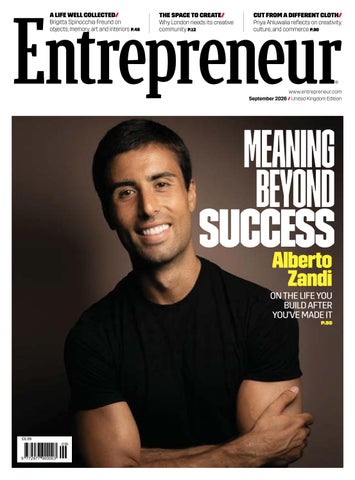
MEANING BEYOND SUCCESS Alberto Zandi
ON THE LIFE YOU BUILD AFTER YOU’VE MADE IT P.56
£6.99 £6.99
E V E R Y T H I N G T H AT O N E C O U L D I M AG I N E FOR EXTRAORDINARY LIFE
Eywa Way of Water is a state-of-the-art residential community with only 65 exceptional waterfront residences, with a holistic wellness ecosystem, curating authentic experiences and best-in-class amenities few have dreamed of.
Contact us today: +971 54 308 6000 I
sales@byrevolution.com
E Y W A . A E
ODE TO BAG END Limited Edition
Make every epic writing journey a cosy one. Hobbiton handcraft from the makers of the world’s most magical pens.
© ™
Contents/
September 2026
FEATURES P.56
MEANING BEYOND SUCCESS
ALBERTO ZANDI ON THE LIFE YOU BUILD AFTER YOU’VE MADE IT
September 2026 / E N T R E P R E N E U R . C O M / 5
Under the Patronage of
CONNECT WITH UK–GCC DECISION-MAKERS
The Business Year presents a high-level forum convening a select group of senior UK and Gulf government and business leaders to discuss shared economic priorities and the next phase of UK-GCC cooperation.
More details
October 20, 2026
Guildhall, London
Contents /
September 2026
FEATURES EDITOR Patricia Cullen patricia.cullen@bncb2b.com
CEO Wissam Younane wissam@bncpublishing.net MANAGING DIRECTOR Rabih Najm rabih@bncpublishing.net ART DIRECTOR Simona El Khoury EDITORIAL TEAM
Tamara Pupic, Aalia Mehreen Ahmed MEDIA SALES MANAGER
Olha Kovalova olha.kovalova@bncb2b.com CONTENT MANAGER
Viktoria Walkowiak viktoria@bncb2b.com REGIONAL DIRECTOR Andy B. CONTRIBUTING EDITOR
↑ Gail Rebuck is a British publisher and
Omar Hamdi
chair of Penguin Random House UK
BUSINESS UNUSUAL
STARTUP SPOTLIGHT
CONTRIBUTING WRITERS
Marine Tanguy, Ann Summerhayes and Lauren Templeton
90 Cut From a Different Cloth 38 Rooted, but restless PANDORA SYKES and the art of belonging
44 The Human Side of Innovation SAUL KLEIN on technology’s creative future
‘TREPONOMICS 71 What Does Creativity Need to Survive? MARCEL BAETTIG talks about space, sustainability and creative futures
PRIYA AHLUWALIA on creativity, culture, commerce
IN THE LOOP 12 The Space to Create JUSTINE SIMONS OBE on championing London’s global creative economy
16 The Man Behind the Fireworks
SUBSCRIBE
Contact subscriptions@bncb2b.com to receive Entrepreneur United Kingdom every issue.
COMMERCIAL ENQUIRIES sales@bncb2b.com
WWW.ENTREPRENEUR.COM/EN-GB Access fresh content daily on our website
entrepreneurMediaUK
entrepreneurmedia-uk
entrepreneurUK
entrepreneurmedia.uk
The art of making things happen 20 Wenlock Road, London, N1 7GU
24 The World of Possibilities Publisher GAIL REBUCK on shaping the UK’s cultural landscape
74 The Art of Transformation
30 The business of art
Turning Qatar’s past into contemporary art
How art’s outsider became its global connector
All Rights Reserved 2026. Opinions expressed are solely those of the contributors. Entrepreneur United Kingdom is officially licensed exclusively to BNC B2B In United Kingdom by Entrepreneur Media Inc. No part of this magazine may be reproduced or transmitted in any form or by any means without written permission of the publisher. Images used in Entrepreneur United Kingdom are credited when necessary. Attributed use of copyrighted images with permission. All images not credited otherwise Shutterstock.
September 2026 / E N T R E P R E N E U R . C O M / 7
Editor’s Note / WHERE CREATIVITY MEETS COMMERCE Entrepreneur United Kingdom
T
here was a time when creativity was considered a category of its own: art over here, business over there. The distance between the two now feels increasingly difficult to defend. Art is becoming an asset. Design is shaping technology. Culture can determine the fortunes of a brand. And entrepreneurs are discovering that some of the qualities most difficult to measure taste, imagination, originality, instinct - can also be among the most valuable. For this special edition of Entrepreneur UK, we wanted to explore what happens at that meeting point between creativity and enterprise. Marine Tanguy, the French-British art entrepreneur and founder of MTArt Agency, has helped us curate the issue. Her career has been built around recognising creative talent and understanding its wider value, and she has brought together a distinctive group of voices from art, culture, design and entrepreneurship.
8 / E N T R E P R E N E U R . C O M / September 2026
Among them are Justine Simons, Deputy Mayor for Culture and the Creative Industries; Jonathan Reekie CBE, Director of Somerset House Trust; and British publisher Gail Rebuck. In this issue, we also speak with Alberto Zandi, co-founder of the Emerald Hospitality Group about success, fulfilment and growth and Priya Ahluwalia, designer, founder and creative force behind Ahluwalia, whose work sits at the intersection of fashion, identity and culture. Their worlds are different, but a shared question runs through them all: what is creativity worth now? It is an especially interesting question at a moment when technology is making it easier to produce, replicate and distribute almost anything. If information is abundant, perhaps the scarce things are elsewhere: a point of view, an original idea, a particular way of seeing. That has consequences far beyond the arts. It changes how companies are built, how brands earn attention and how investors think about value. It also changes our understanding of leadership. The entrepreneur may need not only the ability to execute, but the ability to imagine; not simply to identify a market, but to recognise a cultural shift before it becomes one. Across these pages, we meet people working precisely in that space - where commerce meets culture, and where creative thinking becomes a form of enterprise. Creativity has always had economic power. We are simply getting better at recognising it. The most valuable idea may still be the one no algorithm saw coming. Enjoy the read!
Patricia Cullen Features Editor, Entrepreneur United Kingdom
7 OCT 2026 RIVIERA LONDON
IS BACK LIMITED SPACES
RSVP: viktoria@bncb2b.com
10 / E N T R E P R E N E U R . C O M / September 2026
THE CREATIVE ISSUE A note from Guest Curator,
Marine Tanguy, founder and CEO of MTArt Agency
T
he creative industries are among Britain’s largest sectors: £140bn in revenue, and 60% growth between 2010 and 2025 against 24% for the economy as a whole. They are also our most fluent diplomats, a soft power that so many embassies would envy. I think of the blockbuster exhibitions we have crated up and sent abroad; the novels that come home wearing thirty different jackets; the films that shaped how a generation sees the world. I am deeply proud to be a creative in this country. And yet, in the language of business, the sector is still discussed as a mere ornament. So I spent the summer with the people who built this sector, who sustain it, and who keep reinventing it. Their CVs are formidable but I didn’t want to serve you another interview with high achievers. I wanted these interviews to be painted portraits and they delivered. We travel from Italy to Turkey to Qatar; from the dining room of their parents’ houses to the artworks they would run into a burning building to save; through the books that made them who they are. I felt lucky to sit as a small witness to the brilliance of these minds: the minds that make the United Kingdom one of the most exhilarating places on earth to be a creative or to build a creative business. This is an ode to all creatives in the UK, and to their tirelessness. I loved these conversations, and they will stay with me for a long time. I hope some of that survives the journey onto the page and that you’ll pull up a chair with us in one of the many beautiful offices and homes I was let into. September 2026 / E N T R E P R E N E U R . C O M / 11
In the Loop / → Justine
Simons OBE, championing London’s global creative economy
The Space to Create Why London needs its creative community
I n t e r v i e w b y M A R I N E TA N G U Y | E d i t e d b y PAT R I C I A C U L L E N
12 / E N T R E P R E N E U R . C O M / September 2026
L
ong before Justine Simons was thinking about planning policy, creative economies or the future of London, there was a house in Stoke-on-Trent where culture arrived through the front door. Simons’s father was a professional musician and Musical Director at a major live and cabaret venue in Stoke. Her mother was a social worker and self-taught dressmaker who would make herself evening gowns for performances, often from Vogue patterns, tracking down all kinds of interesting and affordable fabrics. The glamorous world of the stage sat alongside an ordinary family life in which music, creativity and an open door were simply part of the landscape. “Our house was always open, lots of kids gravitated to the good energy the moment you walked through the door, my dad would offer you grilled oatcakes and cheese (a Stoke speciality). It wasn’t precious or pressurised and there was zero academic snobbery in our house, my parents just wanted us to do things that made us happy. Which I realise with hindsight was a huge gift.” It is an unusually vivid origin story for someone who has spent more than two decades operating at the intersection of culture, government, property and economic development. Simons has worked for all three London mayors and played a central role in projects including the Fourth Plinth and the London 2012 cultural programme. She was appointed Deputy Mayor for Culture and the Creative Industries by Sadiq Khan in 2016. But before London, there was Stoke. “I’m very proud of my hometown, Stoke-on-Trent. As a global centre of ceramics, the city made a big impact on the world, pioneering new techniques and spearheading the industrial revolution.”
The Potteries is a fitting place to begin a career devoted to the economic and social power of creativity. Stoke was built around making things: ceramics, design, manufacturing and craftsmanship. Its history is one of skilled people turning ideas and raw materials into objects that travelled far beyond the city. “As with many industrial cities, the changing world brought many challenges, but at its heart Stoke is a city that is built on the talent and creativity of generations of craftspeople; shaped by skilled artisans and makers. There is a renewed sense of pride and passion in the Potteries and it was recently designated a World Craft City for Ceramics.” Simons found her own creative route through dance. “My own creative journey growing up was through dance. I joined a youth dance group and it was transformative. Dancing built my confidence and gave me so many fundamental skills; working as a team, forming my own ideas and communicating them, resolving conflict with other humans – all the things I depend on as Deputy Mayor today.” It is perhaps the most revealing thing she says about the importance of culture. For Simons, creativity is not simply about producing art. It is about developing the confidence to have an idea, the ability to work with others and the resilience to turn an idea into something real. “It’s why I am so passionate about all young people having access to a creative education. Whatever your background, creativity can help you reach your potential.” That conviction has stayed with her as London has become the focus of her professional life. “I’m hugely proud to have worked for all three London mayors and have seen so many changes over the years. From helping to establish the Fourth Plinth as a landmark public sculpture prize to delivering the largest cultural festival the capital had staged when we hosted the London Olympics and Paralympics in 2012.” The scale of the work has
“ → Justine Simons,
London’s Deputy Mayor for Culture and the Creative Industries, with Sir Sadiq Khan, Mayor of London
changed dramatically. But so has the political understanding of what culture is for. “We’ve achieved a huge amount, but Sadiq is the first Mayor to make culture a core priority and that has allowed us to think big and be bold. He really understands the power of culture and needs no persuading about the role it can play in driving our economy and the value it brings to our communities.” That ambition is visible in East Bank, the cultural and education district in Stratford developed as part of the legacy of the 2012 Olympics. It now brings together institutions including V&A East, Sadler’s Wells East, UAL London College of Fashion, the BBC and UCL East. City Hall describes the East Bank
“ IT’S WHY I AM SO PASSIONATE ABOUT ALL YOUNG PEOPLE HAVING ACCESS TO A CREATIVE EDUCATION. WHATEVER YOUR BACKGROUND, CREATIVITY CAN HELP YOU REACH YOUR POTENTIAL” September 2026 / E N T R E P R E N E U R . C O M / 13
In the Loop /
as a £1bn cultural and education district. “Since he became Mayor, there has been a step change in ambition. From establishing East
Bank, London’s newest cultural and education district as a legacy of the London 2012 Olympics. Stratford is now home to some of
“ CULTURE IS IN OUR DNA. IT’S OUR IDENTITY AS A
CITY AND HAS HELPED TO DEFINE OUR STORY THROUGH THE DECADES. TODAY LONDON’S CREATIVE ECONOMY IS WORTH £64 BILLION A YEAR”
14 / E N T R E P R E N E U R . C O M / September 2026
the country’s most important cultural spaces including V&A East, Sadler’s Wells East, UAL London College of Fashion, BBC and UCL East. The new London Museum will open later this year in historic Smithfield in the heart of the City. Our investment in London’s creative economy has delivered almost £12 billion in economic growth and our London Borough of Culture has celebrated local culture and taken creativity to doorsteps all across the capital.” But the bigger challenge facing London's creative economy is not simply how to build new cultural institutions. It is how to keep the people who make London creative in the city. “Culture is in our DNA. It’s our identity as a city and has helped to define our story through the decades. Today London’s creative economy is worth £64 billion a year and one in every five jobs is a creative one, it’s also the reason most people visit our city. But we can’t take it for granted.” Behind those numbers sits a less glamorous reality: artists, musicians, designers and other creative workers need somewhere affordable to work. “Behind this great success story our creative community is working really hard – the artists and designers, the musicians and the choreographers. Like many big cities around the world, building a career as a creative requires grit and determination and one of the things creatives most need is affordable permanent space.” This is where Simons's phrase “hardwiring culture” becomes more than a piece of policy language. The idea is that culture should not be an afterthought once the planning, property and economic decisions have already been made. It needs to be considered part of the city's infrastructure. “Much of my work has been about making sure that as London grows and develops creativity is locked in for the long term. We need to move away from
the cycle of artists being continually pushed out of areas as land values rise. That’s why I use the phrase ‘hardwiring culture’ – it means recognising the role culture plays in our city, valuing it in the system so that it is protected.” The practical implications are significant. “In practice this means protecting artist studios, grassroots music venues and clubs in London’s planning system for the first time and establishing a Creative Land Trust, a social investment charity that buys buildings for use as affordable studios. We also established the first Culture and Communities at Risk Office, which I like to call ‘the bat phone’, it is a frontline support service giving advice and help to venues and creative spaces.” It is an approach that treats creative space as economic infrastructure. A studio may not look like an economic asset in the same way as an office block, but without studios, rehearsal rooms, venues and workshops, the creative economy begins to lose the conditions that allow it to flourish. The Creative Enterprise Zones take that thinking further. “The fact is, artists need London, just as much as London needs artists. They are the lifeblood of our creative industries and help to drive the economy, but they need space to do their work.” The programme was born out of concern about the rapid loss of artists' workspaces as property prices rose and neighbourhoods changed. “When Sadiq Khan became Mayor of London in 2016, London was in the midst of a significant loss of artist workspaces due to rising property prices and redevelopment. We started collecting the data on creative workspaces and realised we were about to drop off a cliff. So, we set about designing solutions and experimenting with new ideas. One of which was Creative Enterprise Zones; areas that provide permanent affordable creative space, so artists can put down roots in areas they have long contributed to.”
“ THE FACT IS, ARTISTS NEED LONDON, JUST AS MUCH AS LONDON NEEDS ARTISTS. THEY ARE THE LIFEBLOOD OF OUR CREATIVE INDUSTRIES AND HELP TO DRIVE THE ECONOMY, BUT THEY NEED SPACE TO DO THEIR WORK” There are now 12 Creative Enterprise Zones across London, together they are on target to deliver 80,000 square metres of permanent new affordable workspace. The programme is explicitly designed to help artists and creative businesses put down roots rather than being displaced as areas develop. Simons sees signs that the strategy is working. “And the good news is it's working. While challenges remain, I’m proud that the number of artists’ workspace sites in London remained stable last year. So that’s why hardwiring culture is our mantra – so it’s not just an add on, but understood as core to our success as a global capital.” The other side of the argument is access. “Free museums and galleries are a real flagship policy and one that is renowned and revered around the world. This year marks 25 years since the Government made the transformative decision to make museums free. It opens our museums and galleries to millions and has become a fundamental part of London life.” For Simons, this is not simply a question of visitor numbers or tourism. It is about who gets to participate in the cultural life of a city. “Access to art and culture is a right, not a privilege and something we must
never take for granted.” That idea reflects the way she experienced culture growing up. Her own introduction to creativity did not come through an elite cultural education. It came through everyday life and a youth dance group that gave her confidence. Today, the scale is very different. She is dealing with a £64bn creative economy, major cultural institutions, planning policy and the future of London's creative workforce. But the underlying idea remains remarkably simple. Culture does not happen by accident. People need opportunities to make things. They need places to work. Young people need access to creativity before they know where it might take them. And cities need to recognise that the people making them interesting are also helping to make them prosperous. Perhaps that is what Simons has been trying to hardwire into London all along: the idea that culture is not decoration around the business of a city. It is part of the business. Her story began in Stoke, a city shaped by makers. She found dance and discovered what creativity could give a young person. Now, from City Hall, her job is to make sure London remains a place where the next generation can find the space to make something of its own.
September 2026 / E N T R E P R E N E U R . C O M / 15
THE
MAN BEHIND THE FIREWORKS The art of making things happen
I n t e r v i e w b y M A R I N E TA N G U Y E d i t e d b y PAT R I C I A C U L L E N
16 / E N T R E P R E N E U R . C O M / September 2026
→ Jonathan Reekie CBE, Director of
Somerset House Trust
PHOTO CREDIT: GARETH CATTERMOLE
J
Jonathan Reekie has spent a career making creative projects possible for artists. It all started at six in the morning with an olive grove near a monastery on a hill outside Batignano, in the Tuscan countryside. Inside, and around it, some of Britain’s finest opera singers, conductors, musicians and directors had gathered for a summer of music. It was part monastery, part student commune, part operatic fever dream. Jonathan Reekie was 20. He had no qualifications for any of this. He had, however, managed to blag his way in. When they told him there was no accommodation, he said: “Don’t worry. I’ve got a tent.” The tent proved to be less romantic than planned. Camping in Tuscany in summer is, as he discovered then, “absolute hell”.
September 2026 / E N T R E P R E N E U R . C O M / 17
→ Tai Shani
PHOTO CREDIT: TIM BOWDITCH
The Spell or the Dream 2025
B
ut he stayed. His first production was directed by Richard Jones, and was an opera by Antonio Salieri. In the middle of the olive grove was a concrete well. A scaffolding platform had been built at the bottom, six inches above the water. Reekie’s job was to sit there all evening with a score. He was waiting for his cue. “At the right moment,” he says, he had to “set fireworks off that would come out of the well as the wizard appeared”. He also had another job. He was the car-park attendant. “I don’t recommend trying to be a car park attendant in Italy,” he says. “They don’t do what you tell them to do.” This story contains almost the whole philosophy of Reekie’s working life. More than three decades later, Reekie is Director of Somerset House Trust, a position he has held since 2014. Before that came a career through opera and theatre, including the Almeida 18 / E N T R E P R E N E U R . C O M / September 2026
“ If you have a belief in artists and the work that they make, and you believe the importance of it, then having a part in bringing that to life is a really wonderful and privileged thing to be able to do”
Theatre, where he founded Almeida Opera, and 16 years leading Aldeburgh Music. At Somerset House, he has helped shape one of London’s more unusual cultural institutions: neither museum nor gallery, theatre nor conventional arts centre, but a sprawling combination of exhibitions,
own activities, partnerships, philanthropy and other income. But the most revealing way to understand Reekie is not through the size of the budgets or the prestige of the institutions. It is through the artists. Because Reekie has spent his career trying to make their artistic projects a possibility.
At Glyndebourne, Reekie began by making tea and typing schedules “even though my typing is not very good” and encountered contemporary opera for the first time. Nigel Osborne’s Electrification of the Soviet Union, directed by the American director Peter Sellars, stopped him in his tracks. “It was literally a
producing theatre under Jonathan Kent and Ian McDiarmid. Reekie saw an opportunity. He had a theatre. He had discovered contemporary opera. He had an institution with a history of new music. So why not create a contemporary opera festival? A couple of philanthropists helped significantly in the
“If you have a belief in artists and the work that they make, and you believe the importance of it, then having a part in bringing that to life is a really wonderful and privileged thing to be able to do.”
light bulb moment for me,” he says. “It was just the most unbelievably exciting thing I’d ever seen.” It opened up a world he had not known existed. Soon he was at the Almeida Theatre, which had just become a
early days. The festival continued for more than a decade and produced close to 40 contemporary operas, many of them commissions. One of those works was Thomas Adès’s Powder Her Face, which has since
→ Somerset
House, London
performances, artists’ studios, creative businesses and public spaces. Its model is unusual, too. It does not receive regular state subsidy and has to generate tens of millions of pounds a year through its
September 2026 / E N T R E P R E N E U R . C O M / 19
In the Loop / become a modern classic. ‘’The reason why contemporary opera is important is because you’ve got to keep renewing the repertoire to keep the artform alive for future generations,” Reekie says. It is a philosophy that became particularly important at Aldeburgh. When Reekie arrived there, the organisation was
at a critical moment in its history: caught between the generation that had known Benjamin Britten and the generation that would have to decide what his legacy meant in today’s world. It was the familiar problem of institutions created by extraordinary individuals. Was Aldeburgh going to become a museum to its founder? Or could it remain a
→ The 55 fountains in
Somerset House’s historic courtyard, London
“ A key feature of the Somerset House model isn’t just a bunch of people like me or a curator sitting on high going, ‘Oh, well, let’s do a show about this and let’s do a show about that,’ ideas can bubble up from below” 20 / E N T R E P R E N E U R . C O M / September 2026
living institution? “It needed to be a living breathing modern reflection of what the founder believed in,” Reekie says. The answer required a particular kind of historical intelligence. Reekie began looking backwards, not to preserve the past but to understand it and work out how to articulate in the present. Britten, he realised, was far more radical than the museum version of Britten might suggest. He had centred worked with young people and commu-
SO IF YOU GIVE OXYGEN TO A STORY THAT HAS HISTORICALLY BEEN MARGINALISED, YOU WILL BRING DIFFERENT AUDIENCES INTO THE BUILDING”
nity. He collaborated with writers, directors and designers and was interested in other art forms. He commissioned other composers and he sometimes invited artists whose work he did not necessarily like because he felt was important. He was building a canon. “It was very contemporary.” This became the basis of Reekie’s approach. “If we go back to what Britten’s ethos was, it’s actually very contemporary and relevant.” The way
to honour Britten, therefore, was to recover Britten’s appetite for the new. “Not the world as it was when he was alive.” That distinction sounds obvious until you consider how many cultural institutions are trapped by the reputations that made them. Founders become brands. Traditions become obligations. Sarah Lucas could sit within a classical music festival. Punchdrunk could respond to Britten. The artists did not resemble Britten. That was precisely the point.
The philosophy travels naturally to Somerset House. It was not built as a public cultural building; from the outside, Reekie says, it can feel like a place that was designed to keep people out rather than draw them in. “From the outside it’s quite an intimidating space to enter,” he says. “There isn’t an obvious front door.” Perhaps that is why Somerset House has spent so much time trying to become something more than a building. It has become an ecosystem. There are
→ Tai Shani: The
Spell or The Dream
September 2026 / E N T R E P R E N E U R . C O M / 21
In the Loop / → PJ Harvey
- Recording in Progress
exhibitions and performances, but also studios, creative businesses, designers, musicians and artists. The distinction between the person who makes art and the person who works somewhere in the wider creative economy is deliberately blurred. For Reekie, this proximity matters. It changes how the institution thinks. “A key feature of the Somerset House model isn’t just a bunch of people like me or a curator sitting on high going, ‘Oh, well, let’s do a show about this and let’s do a show about that,’ ideas can bubble up from below”.
That phrase may be one of the clearest descriptions of his leadership. Reekie is not interested in the director as an omniscient programmer. The director’s job is partly to make the institution porous enough to notice what is happening. He describes artists as “a kind of societal early warning system.” Sometimes, he says, they are “canaries in the coal mine”. CUTE, Somerset House’s hugely successful exhibition exploring the aesthetics and politics of cuteness, is a good example of this philosophy. The germ of the idea came from senior curator
22 / E N T R E P R E N E U R . C O M / September 2026
Claire Catterall observing an artist connected to Somerset House Studios and noticing something larger happening around them. The aesthetic was spreading through online culture, fashion and popular imagery. It became Somerset House’s most visited exhibition with more than 80% of the audience visiting the building for the first time. “The key is to start with the work,” Reekie says. That is an unusually strong position at a time when cultural organisations are under intense pressure to demonstrate audience growth. The danger is that
audiences become a market to be captured rather than a public to be expanded. Reekie’s instinct is almost the reverse. Change the work - and the range of stories it tells - and audiences can change with it. The Missing Thread, for example, explored the untold story of Black British fashion. “So if you give oxygen to a story that has historically been marginalised , you will bring different audiences into the building.” That philosophy also explains why Somerset House can accommodate something as improbable as PJ Harvey recording an
album inside a glass box. The project came through Michael Morris at Artangel, who had been talking with Harvey and developing the idea. Reekie already knew Morris. When he arrived at Somerset House, he showed him some of the spaces that were still derelict. The resulting image - PJ Harvey making music while the public watched - remains a core memory of the London cultural scene. But making things possible requires money. And here the romance of the enabler collides with the less romantic reality of institutional survival. Somerset House receives no regular state subsidy and has to generate its own income through a mixture of commercial activity, partnerships, philanthropy, ticketing and other sources. Reekie has spoken of the scale of the operation as requiring tens of millions of pounds a year. The advantage, he says, is freedom. “It does create freedom.” There is freedom from “filling out long forms, justifying yourself ”. There is also a particular freedom in Somerset House’s lack of an obvious institutional category. “We’re not quite an arts center. We’re not a museum. We’re not an art gallery.” That ambiguity can be artistically liberating. It can also be commercially
useful. If no one quite knows what Somerset House is, there is more room to decide what it might become. But independence is not the same thing as ease. Corporate partnerships matter deeply in this context. Virgin, for example, has been a partner for several years. “So basically you’ve got more levers to pull,” Reekie says. “So when things are difficult, you’ve got more options.” Then comes the qualification: “The bad news is it’s hard work.” It is one of his best lines because it punctures the romance of institutional independence. “You’ve got to have a belief in artists,” Reekie says. Trust them. Give them room. Find the money. Take the risk. And then, when the moment comes, get out of the way. Which brings us back to the well. A 20-year-old Reekie is sitting six inches above the water in an Italian olive grove, a score in his hands, waiting for his cue. Above him, the opera is unfolding. The audience is watching the artists. Nobody has come to see the man in the well. Then the moment arrives. The wizard appears. The fireworks go off. And for a second, the machinery disappears entirely. That is the trick. The best enabler is almost invisible until the fireworks.
→ CUTE, Somerset
House, London, 2024
September 2026 / E N T R E P R E N E U R . C O M / 23
→ Baroness Gail
Rebuck, Chair of Penguin Random House UK
THE WORLD OF POSSIBILITIES I n t e r v i e w b y M A R I N E TA N G U Y
24 / E N T R E P R E N E U R . C O M / September 2026
E
very Saturday morning when she was a child, British publisher Gail Rebuck went to the library with her mother and brother. “I would walk up and down these musty shelves and discover all these books,” she says. “The only thing that worried me was what would I do if I had finished all the books before I went back the next Saturday.” The limit was seven books. Each book was an opening to a new world of possibilities and a stretch of her imagination. “It was a gateway to the world.”
T
oday, Rebuck is one of the most influential figures in British publishing. She led Random House UK as chair and chief executive for more than two decades before becoming chair of Penguin Random House UK following its creation in 2013. She was also the founder of World Book Day in the UK, helping turn the simple act of choosing a book into a national celebration. I am a big believer as a woman that we rest on the shoulders of the women who wanted to have more to
life than they had. I feel that Gail’s story is one of those. Her parents had both left school at 13. Her mother came from poverty; her father left school to work in the family business. Her paternal grandfather, a refugee from Eastern Europe, arrived in Britain at 15, unable to speak English. He was a tailor and remained illiterate throughout his life. Her mother understood the frustration of stifled ambition. Women of her generation had aspirations, Rebuck says, but few avenues through which to pursue them. “So they were constantly thwarted.” She wanted something different for her daughter, although even her own horizons were shaped by the world she had known. Rebuck was sent to a French school, partly because her mother had always regretted not speaking another language. She learned to read and write in French, absorbed Molière and Stendhal, and encountered history from a perspective other than the British one which shall be a requirement in the education of our kids. Gail first hand had the knowledge that history was written by a few people for a specific audience and one could challenge that. Her first job was with a children’s book packaging company, producing illustrated books for publishers. From there she moved to Robert Nicholson Publications, one of the small publishing houses that characterised the industry she entered in the late 1970s. She was
given responsibility before she had acquired the confidence that was supposed to accompany it. “I knew nothing from nothing, to be honest,” she says. “And I was just kind of left on my own.” She considers this less a flaw than an education. “In many ways it was the best way to learn. No one told me what to do and I just had to kind of figure it out myself.” Publishing was then a less regimented business. A young person might encounter several parts of it rather than being placed immediately inside one narrow professional lane. That breadth would shape the way Rebuck later thought about talent. At Random House, young employees would occasionally tell her they wanted to become commissioning editors. Her renowned response was: “Well, go and commission something then.” If someone had a strong proposition, she believed they should pursue it, regardless of their position in the hierarchy. “If you have a good idea, then what’s stopping you developing that idea and bringing it to a publishing meeting?” she asks. “The worst that can happen is that you’re told no.” The modern corporate structure, she believes, can sometimes make people wait for permission. In 1982, Rebuck became one of the founders of Century. She had to contribute £6,000, a substantial sum at the time and remortgaged her home to find it. She and
September 2026 / E N T R E P R E N E U R . C O M / 25
Anthony Cheetham began in a rented room in Marylebone, buying books before the business had properly established how it would pay for them. “We were buying all these books. How on earth are we going to pay for them?” It was publishing in start- up mode: small, exposed, entrepreneurial. Century’s first list appeared in 1983; by the time the company merged with Hutchinson, there were only about 22 employees. The industry around it was changing rapidly. Hardback and paperback publishing, once largely separate businesses, began to converge. Rights became increasingly central. Supermarkets entered the market with aggressive discounting. American ownership brought a new scale and a more international outlook. Then came Amazon, e-books and the Kindle. Rebuck watched publishing move from a collection of relatively independent houses towards the concentrated global industry it is today. When she became CEO of Random House UK in 1991, women were still conspicuously rare in senior positions. The press had its own way of registering the novelty. Private Eye once described her as a “Barbie doll who crunches diamonds between her teeth”. 2026 would spend multiple essays unpacking this sentence with the sheer amount of biases it carries for a female leader. Rebuck took the line home to her four-year-old daughter, Grace who loved Barbie deeply. “Guess what, Grace? I’ve been described as a Barbie doll who crunches diamonds between her teeth.” Her daughter looked at her. “Mummy, you’re nothing like a Barbie doll.” “I just loved that,” Rebuck says. Rebuck’s
response was less to dwell on the caricature than to get on with the work. World Book Day launched in Britain in 1998. Rebuck approached the government with an unusually simple proposition: publishers would make a £1 book voucher available to every child aged five to 18 in full-time education if the government would help distribute them through schools. The idea was to put a bookshop within reach of every child. Then came the question of the extra pound. What about children who did not have it? Rebuck’s answer was to produce a book that could be redeemed for the value of the voucher alone. More than a million copies were printed and distributed to bookshops. A child did not need to come from a family of readers or know what they were looking for, especially as we know that if a parent is nervous to read a book so will be his/ her own children. The reach of World Book Day is extraordinary. Rebuck still meets adults who remember it not simply as a school event, but as an introduction to books. “World Book Day was the first time I met an author who came into my school, the first time I had a book in my hand.” “I mean, honestly, it’s very, very moving.” As someone who doesn’t come from a house filled with a book, I felt deeply moved by the impact of Gail. I so remember the first joy of holding my first book and a promise that perhaps, I too could escape the world I came from. During a lecture, Rebuck mentioned that around 11m adults in Britain had poor functional literacy. Afterwards, people came up to her. “What
26 / E N T R E P R E N E U R . C O M / September 2026
“ THE ONLY
THING THAT WORRIED ME WAS WHAT WOULD I DO IF I HAD FINISHED ALL THE BOOKS BEFORE I WENT BACK THE NEXT SATURDAY. IT WAS A KIND OF GATEWAY TO THE WORLD”
September 2026 / E N T R E P R E N E U R . C O M / 27
→ River Terrace,
PHOTO CREDIT: KEVIN MEREDITH
Somerset House
are you going to do about it?” “So I thought, ‘Here we go again.’” Quick Reads was the answer. Publishers approached established authors and asked them to write short, compelling books - no more than 20,000 words - across different genres. They had to be accessible without feeling childish. Before the scheme began, Rebuck visited literacy recovery groups. What she encountered there changed her understanding of the readers’ publishing was failing to reach. There was a mother and daughter, a successful plumber, pensioners, someone for whom English was not a first language, someone who was dyslexic. “What kinds of books might interest you?” she asked. “Every genre,” she says. “Crime, romance, science fiction. Honestly, all of life was there.” The appetite was there. What was missing was access to books that 28 / E N T R E P R E N E U R . C O M / September 2026
treated adults as adults. Those who struggled with reading were often left with children’s books, which could bring its own humiliation. “They had to read children’s books, which was plain embarrassing and shaming for them.” Quick Reads offered something more important than a shorter book, written in very accessible language. It offered an adult reader the possibility of seeing themselves as a reader. Over time, Rebuck began hearing from people who had concealed their literacy difficulties at work. After reading a Quick Read, they had acquired enough confidence to ask for training or help. A small book had changed the terms of the conversation. That conviction now informs her work around the National Year of Reading in 2026, at a moment when reading for pleasure among children and young people is in serious decline.
Rebuck is wary of treating this simply as a literacy problem. Reading, she argues, is the foundation of imagination and imagination matters far beyond the page. “The fundamental building block of any creative industry” is how she describes it. This is where her argument becomes less about publishing and more about the kind of country Britain wants to be. For years, she says, education policy has been caught in an artificial contest between science and the arts: STEM subjects on one side, the humanities on the other. The mistake is to assume that the future belongs exclusively to technical knowledge. Innovation, she argues, happens where the two meet. “It’s the STEAM.” The arrival of artificial intelligence makes the argument more urgent, not less. If
“WE PRODUCE THIS CREATIVE TALENT BUT WE DON’T SCALE IT” machines become increasingly capable of generating text, analysing information and producing answers, what becomes valuable is not simply knowing more, but knowing which questions to ask, being able to recognise what matters, and having the imagination to approach a problem from an unexpected direction. Rebuck points to the changing requirements of employers and the renewed interest in humanities graduates: people trained in history, philosophy and literature, disciplines that teach interpretation, judgement and curiosity alongside knowledge. She has watched extraordinary talent emerge from the Royal College of Art,
from Somerset House, both organisations she chaired, and from publishing. Britain produces writers, artists, designers, games companies and ideas of global quality. What it struggles to do is keep them. “We produce this creative talent but we don’t scale it.” A successful British gaming company reaches a certain size, she says, and may then be sold to the highest bidder, often outside Britain. The talent remains; the ownership migrates. For Rebuck, that is a problem of economics. The UK has become very good at producing the raw material of a creative economy and punches above its weight, but less good at building the conditions that allow it to grow substantially. Her argument about education follows the
same principle. What she resists is the assumption that the humanities are an indulgence: history, philosophy, literature - disciplines that teach people how to interpret a world rather than merely operate within it. “They’re the kinds of brains and imaginations who will be a fundamental part of our digital future.” Decades later, after running one of the world’s great publishing companies, taking risks on books that other publishers rejected, watching Fat Is a Feminist Issue, the first book she commissioned, sell millions of copies and Fifty Shades of Grey become a global phenomenon (both books written by female authors that she took huge financial risks on), and putting books into the hands of children and adults who had been left outside the culture of confident reading, Rebuck keeps returning to her life mission: access can alter the course of a life. One must leave the door ajar and let people discover for themselves how far it leads. Keep the gateway open. And make sure everyone knows they are allowed through it.
PHOTO CREDIT: LUKE WALKER
→ Somerset House
September 2026 / E N T R E P R E N E U R . C O M / 29
In the Loop / ↓ Julia Halperin (Art Journalist) and our Conference Chair in conversation with Charles Stewart, CEO of Sotheby’s at the New York Art Business Conference in May 2026
The business of art How art’s outsider became its global connector
I n t e r v i e w b y M A R I N E TA N G U Y | E d i t e d b y PAT R I C I A C U L L E N
30 / E N T R E P R E N E U R . C O M / September 2026
“I THINK MY MOTIVATION FOR HOSTING THE CONFERENCE IN THE FIRST PLACE WAS THINKING HOW ARE THESE SMALL BUSINESSES MANAGING THIS GLOBALISATION OF THE ART MARKET AND SURELY THERE SHOULD BE A WAY TO DISCUSS THE OPERATIONAL STRATEGY AROUND RUNNING AN ART BUSINESS”
L
ouise Hamlin was 17 when a school trip to Florence changed the way she thought about art. She had always done art at school, but she was not, by her own admission, an especially gifted practitioner. Once she visited the city’s chapels and churches, she found herself looking at the Renaissance differently. In the Brancacci Chapel, Masaccio’s frescoes appeared to tell one story: biblical narratives of Adam and Eve, sin and expulsion. Among the religious imagery were the merchants and bankers who had commissioned and supported the work. “It blew my mind that we were looking at frescoes created in the 1400s, but actually there was a whole lot more going on than just pretty pictures.” It was, she says, her ‘penny drop moment.’ What caught Hamlin’s imagination was not simply the art itself, but everything that came with it: patronage, commerce, politics, religion,
personalities and power. The fresco was an image, but it was also the product of a transaction. Centuries before the contemporary art fair, the gallery or the auction house, artists and patrons were negotiating commissions, materials, prices and deadlines. It was nothing new. The art world, Hamlin realised, had always had a business side. Since that trip, she has spent three decades watching the art world transform from a network of insiders into a global industry. That early fascination now has an almost perfect symmetry with her career. Hamlin is the CEO of The Art Business Conferences, an international platform bringing together the people who make the art market function: galleries, auction houses, advisers, institutions and other professionals. Her subject is not the romance of the art world, but the machinery behind it. And over the past 30 years, she has watched that machinery change almost beyond recognition.
September 2026 / E N T R E P R E N E U R . C O M / 31
In the Loop / → Bonnie
Brennan (Christie’s CEO) speaking at The Art Business Conference in New York, 2025
The outsider Hamlin entered the art world without the connections that have traditionally opened doors. After studying art history at the Courtauld Institute of Art, she found herself in a sector where there was little obvious professional route into the commercial side of art. “I knew nobody in the art world. I didn’t have family or friend connections.” In 1998, the art market was a very different proposition to what it is today. For
graduates interested in art, the established paths tended towards further academic study, research or postgraduate education. The art market was still a relatively underdeveloped professional sector, with few clear career paths. So Hamlin went into recruitment instead. She learnt how to sell, become commercially confident, and gained an understanding of how business worked. “I thought to myself, I’m going to go out and do something
32 / E N T R E P R E N E U R . C O M / September 2026
completely different, and get a different skill set under my belt that I can then go back to the art world with.” It was a decision that would serve her well. In 2000, she answered a Guardian job advertisement and joined The Art Newspaper, working in advertising sales. She arrived just as the art world was beginning another transformation: the internet was changing the way businesses communicated, while the
market itself was becoming increasingly international. She remembers proposing print advertising to digital companies during the dotcom boom. “We were pitching digital companies to take print ads,” she remembers. The irony was not lost on her. Companies such as Artnet were building the digital infrastructure of a new art market while still being sold traditional print advertising. Then came the dotcom crash. Over the following decade, the art
world would become much more international. Art Basel’s international editions, including Miami Beach and Hong Kong, helped create a circuit in which galleries, collectors and advisers could move between. Art publications expanded too, developing new international editions. It really marked a shift away from the original big cities. London and New York were still strong markets, but suddenly there were all these global art fairs emerging. Hamlin was watching the art world become more international and more complicated. But there was nowhere for the people running these businesses to come together and talk about how to deal with it. The missing room The idea for The Art Business
“I FEEL ANY BUSINESS PLAN THAT IS PRESENTED TO ME NOW, QUITE POSSIBLY MIGHT NEED TO BE RIPPED UP IN 18 MONTHS TIME JUST BECAUSE OF EVERYTHING THAT’S HAPPENING WITH THE MARKET WITH AI” Conferences began with a simple question. Why was there no conference about the art market? Hamlin had no experience in events. Her partner did, but she had never organised a conference
herself. She began talking to people across the sector. What she heard convinced her that there was a genuine gap. The art market was globalising, but many of its businesses were still relatively small.
↓ Water2 is one of the fastest-growing brands in the UK
September 2026 / E N T R E P R E N E U R . C O M / 33
In the Loop /
“ THAT’S THE SCARY PART: YOU’RE THREE OR SIX MONTHS IN WITHOUT INCOME, AND YOU’RE NOT SURE YOU’RE GOING TO RUN THAT BUSINESS AGAIN” 34 / E N T R E P R E N E U R . C O M / September 2026
They were having to deal with new technology, international expansion, regulation and operational challenges without necessarily having a place to discuss those changes collectively. “I think my motivation for hosting the Conference in the first place was thinking how are these small businesses managing this globalisation of the art market? Surely there should be a way to discuss the operational strategy around running an art business.” The first Conference was a considerable personal risk. Hamlin and her family put up the money and she gave herself a year to fill the conference. “It was the equivalent of a year’s salary. or in
creating something that meant sense for, and was missing in the art world. That idea is still at the heart of the conference today. From competition to collaboration Bringing competitors into the same room was not an easy sell at first. Some dealers questioned why they should attend a conference at all. What could they learn from other people doing the same thing? And why share ideas? For Hamlin, it was never about sharing confidential business information. It was about understanding the direction of the market. “Over the last decade or so, we’ve seen much greater collaboration alongside professionalisation.” For Hamlin, the two things go hand in hand. As the art market has grown more sophisticated, businesses have had to deal with issues that affect everyone: regulation, international markets, technology, data, compliance, changing collecting habits and a more complicated geopolitical landscape. “You will get people that are in competing entities, but we haven’t had to call security yet.” The joke disguises a serious point. The old assumption that competition requires secrecy is becoming less useful in a global industry where everyone is dealing with many of the same structural challenges. “The big difference is that it is a leadership programme.” The conference therefore asks a different kind of question. ot how do you run your business, but where is the industry going and what does good leadership look like within it? and what does good leadership look like within it? That shift-from network to sector, from individual expertise to shared knowledge - is one of the most important changes Hamlin has witnessed.
my case probably a year’s child care.” Then came the fear that comes with starting something from scratch. “There’s nothing like sheer fear to get you started in anything, this is how progress manifests in life,” she said. What she did have however, was support from people in the industry. Georgina Adam, then art market editor at The Art Newspaper, was one of them. Hamlin also spoke to trade associations, auction houses and galleries, including Pierre Valentin, then chair of PAIAM. “I think when you get three or four people behind you that say ‘actually yeah I think this can work,’ it really helps.” In some ways it helped that she hadn’t organised a conference before. “I think not having any event experience in a way was a benefit because I’m creating something that I think is going to work for art market professionals rather than having a template.” She wasn’t trying to copy an existing conference model. She was
The art market’s bad reputation Professionalisation matters too because the art trade has never had an uncomplicated public image. Stories about opaque deals, money laundering, fraud and scandal tend to get far more attention than stories about good governance. “There’s bad rep, isn’t there?” Therefore, Hamlin has deliberately made best practice part of the conference’s agenda, looking at issues such as due diligence, anti-money-laundering requirements, data protection and the practical consequences of regulation. Her argument is not that bad actors do not exist. They do. The problem is allowing those stories to become a portrait of the entire industry. “There are always bad players. The problem is those bad players are then sensationalised into films, documentaries for the wider world to then condemn.” As the market becomes more professional, Hamlin believes its important to separate the industry itself from the actions of individual businesses or people. It is another reason she thinks collaboration matters. Bringing different parts of the art world together means they listen to each other. This is reflected in how she puts the conference together. She calls it a “360” perspective: bringing advisers, galleries, auction houses and other market participants into conversations September 2026 / E N T R E P R E N E U R . C O M / 35
In the Loop /
↑ The Intelligence Report: Mid-Year Review 2025
that would otherwise happen in silos. Some subjects are global. Wealth management, art finance and technology increasingly cross borders. Others require local knowledge. A conversation in New York will not necessarily be the same as one in Hong Kong. Different markets are at different stages of development, with different regulatory and geopolitical contexts. The programme has become international because the art market itself has. The art market that Hamlin entered in 2000 was already globalising. Today, there is no single centre to the art world. The shiny business For all the changes in the art world, Hamlin still sees a surprisingly simple problem: people entering the art business without understanding that it is a business. From the outside, the art world can look seductive - beautiful 36 / E N T R E P R E N E U R . C O M / September 2026
objects, wealthy collectors, fairs in glamorous cities, cultural prestige. But the aesthetic appeal can disguise the hard economics underneath. “I’m concerned that too many people enter into the art business because on the outside it looks very shiny and very sexy, but they don’t have a cast iron business plan.” Her advice is practical. Write the business plan. Have other people interrogate it. Know the competition. Understand the market. Define the USP. Conduct the SWOT analysis. And do not mistake a wealthy client for a business model. “We know and we’ve seen that if you’re setting up a very traditional art business, you can have an ultra high net worth collector as a client, that’s not necessarily a business.” It is advice that feels increasingly relevant as technology changes the way the creative industries work. Hamlin is the first to admit she doesn’t know exactly what the art market will look like in the future. “I feel any
business plan that is presented to me now, quite possibly might need to be ripped up in 18 months time just because of everything that’s happening with the market with AI.” The art itself may last for centuries, but the business around it is changing quickly. The year everything stopped Hamlin’s own test came in 2020. By then, The Art Business Conferences had expanded into the US and developed a strategic partnership with Christie’s. Six months of preparation had gone into the New York conference. Then Covid arrived. “I watched six months of work disappear.” With live events suddenly impossible, the problem was not simply the loss of months of preparation. It was the disappearance of the income that supported the business - and Hamlin’s family. “We ended up with zero income.” At first, it was about getting through it. But after three or six months, she started to wonder: what if live events never came back? “That’s the scary part when you’re three or six months in without income and then you’re not sure actually you’re going to run that business again,” she adds. Hamlin took the government support
available to the company, as well as the Covid loan. She went back to budgeting and planning and focused on keeping the business
business herself. Now she had to start building a team around it. “I probably needed more help, more support,” she admits. That realisation
“I’M CONCERNED THAT TOO MANY PEOPLE ENTER INTO THE ART BUSINESS BECAUSE ON THE OUTSIDE IT LOOKS VERY SHINY AND VERY SEXY, BUT THEY DON’T HAVE A CAST IRON BUSINESS PLAN.” going. The New York event could be postponed rather than lost. When events finally returned, she was ready. She never seriously considered not coming back. Knowing when to build a bigger company After Covid, invitations came from TEFAF and Art Dubai. The conferences began taking place in more locations, and the business was growing beyond what Hamlin could run on her own. That brought a new challenge. She had spent years building the
eventually led to discussions with ArtNova and a move towards greater organisational support. For Hamlin, the attraction was not simply capital or scale. It was access to people with different expertise, a wider network and operational depth. “I think for me, reflecting on the last three years, it’s been great because I have that level of support if I need it.” It was a lesson Hamlin had been talking about for years: a business can only grow so far around one person. At some
point, you need other people around you. For Hamlin, collaboration has always been part of that. What the fresco taught her Hamlin’s career can be traced back to that afternoon in Florence when she stopped seeing Renaissance art as simply a sequence of beautiful images. The fresco contained a network. There was the artist, the patron, the commission, the money, the politics, the institution and the audience. The image was the visible result of a much larger system. Three decades later, Hamlin is still looking at that system. Only now the merchants and bankers of Renaissance Florence have become galleries, auction houses, advisers, collectors, technology companies, regulators and international institutions. The commissions have become global transactions. The local market has become a network of cities connected by fairs, platforms and capital. And the question that first captivated her remains relevant. What happens around the art? For Hamlin, that question has become a career - and eventually a business of its own. The romantic story of the art world is about objects, artists and collectors. The more interesting story may be about everything that makes those things possible. The contracts were there in Florence. The business was there too.
September 2026 / E N T R E P R E N E U R . C O M / 37
B/
xxxxx
Rooted, but restless Pandora Sykes on home, motherhood and culture b y M A R I N E TA N G U Y
P
andora Sykes has lived in the same house with her husband and family for the last nine years. When I sat down to interview her, she is surrounded by galloping horses on a pink background by a
where she grew up in, in the countryside, surrounded by fields with cows in the distance and a river at the end of the garden. Her brother built her a treehouse. It was, she says, an extraordinary place to be imaginative. Now she watches her own children play there. “I feel
“ I FEEL SO CONNECTED
TO MY PARENTS’ HOUSE BECAUSE IT’S THE LOCATION OF MY ENTIRE FAMILY BUT IT’S ALSO MY WHOLE CHILDHOOD ENCOMPASSED WITHIN IT”
French artist while her six year old son is lying next to the bed. There is a peace, deep joy and creative chaos to her. Her attachment to a physical place goes back to childhood. Her parents still live in the house
so connected to my parents’ house because it’s the location of my entire family but it’s also my whole childhood encompassed within it”. As someone who also watched my kids playing in the garden of my
38 / E N T R E P R E N E U R . C O M / September 2026
grand-mother in Ile de Re, I know how special this feels to watch the different chapters of your life woven into the same place. Pandora’s career is a testament to the evolution of how we consume cultural content. She has written columns with major newspapers like The Sunday Times, made podcasts listened to by millions and major documentaries with BBC, interviewed bestselling authors and built a substantial audience through Substack. She has understood early in her career that what matters is the power of a conversation and a well articulated idea to as wide of an audience as possible, irrelevant of its format. In a cultural space that is full of snobbery, she has never approached a single medium with a sense of hierarchy, a Sunday Times journalist can indeed start a podcast or post about fashion online. She has explored so many facets of what it means to be a cultural commentator today and what is rare - she has excelled with every single medium.
Her eventual route into culture came through podcasting. A culture podcast she had been developing as a kind of experiment, The High Low made with Dolly Alderton, the podcast remained the UK’s No.1 podcast for women throughout its four-year tenure, reaching 1.2m listeners. She has never been interested in pretending to be an expert on everything she discusses. “I’m an enthusiast,” she says. It is an important distinction. Sykes’s authority seems to come less from claiming mastery than from being genuinely interested. She is a great reader, but does not call herself a book critic. She can interview an expert without needing to become the expert herself. She is comfortable saying she does not understand something, or has not read something, or needs someone else to explain it. In a culture that increasingly rewards the performance of omniscience, this feels so refreshing. “I’m really okay with saying, ‘I don’t know about that news story. Can you fill me in?’” The willingness to say “I don’t know” has
↑ Pandora Sykes, CREDIT: ALOHA SHAW FOR TOAST
September 2026 / E N T R E P R E N E U R . C O M / 39
B/
xxxxx
↑ Pandora Sykes,
writer, broadcaster and creator of Books + Bits; CREDIT: ALICIA WAITE
40 / E N T R E P R E N E U R . C O M / September 2026
become central to the way she thinks about culture and I have a feeling that this is how she was able to democratise her space. Her BBC documentary Pieces of Britney, which became a No.1 documentary, began, in part, with a reckoning with her own relationship to the 90s. Sykes remembers watching the footage of Spears attacking a paparazzi car with an umbrella. Like many people of her generation, she absorbed the image as entertainment. Looking back, Sykes was struck by something more uncomfortable than the cruelty of the coverage. She had been part of the audience. “I just had no idea that things I enjoyed could have ramifications on the people making it.” The temptation is to tell ourselves that we would never do that now. Sykes doesn’t quite believe it. “I don’t think anything has changed except that we can have more nuanced conversations about it.” That realisation is at the centre of what makes her work so essential in today’s cultural landscape: she is adding nuance, multiple perspectives and is embracing our own complexities. The question she keeps returning to is not simply how we consume cultural content, but how we consume people that shapes our culture. That question has personal resonance for anyone
who has built a career in public, myself included. When the podcast she made with Dolly Alderton reached more than a million listeners, she found herself trying to process what everyone thought of everything she did. The effect, she says, was to make her sense of self feel “really diluted, really weak, really fragile”. She has since become much more protective of her boundaries. Everyone is entitled to an opinion but she does not owe everyone a response. Her responsibility is to her family, close friends, collaborators, editors,
things. She goes to the wrong place. She forgets chargers and keys. She has had to accept a capacity for chaos that she did not previously possess. There is humour in this, but also an idea about creativity that I love and dare I say - a poetry to it too. The “gains and loss” of a well-led life is a concept she explored in her 2019 essay collection, How Do We Know We’re Doing It Right? The same brain that can work for 14 hours making a documentary about Britney Spears is the brain that cannot reliably remember where it left its passport. That the ‘gains and loss’ of
the perfectly balanced career, the perfectly organised mother, the perfectly informed citizen, the perfectly coherent self. Perhaps the freedom to move intellectually comes from having somewhere secure to stand on. A stable home does not have to produce a fixed mind. A rooted life can make room for uncertainty. And perhaps the most interesting thing about Sykes is not that she has changed careers, built audiences or developed new ways of talking about culture. It is that she seems increasingly comfortable with the idea that a good
I DON’T THINK ANYTHING HAS CHANGED EXCEPT THAT WE CAN HAVE MORE NUANCED CONVERSATIONS ABOUT IT”
producers and community and to making the best work she can. Building an audience and being available to an audience are not the same thing. She loves live events because they create the possibility of genuinely good conversations and over the years she has interviewed an extraordinary range of people on stage, from Booker Prize-winning authors including Margaret Atwood, David Szalay and Bernardine Evaristo to figures such as Malala Yousafzai, Jacinda Ardern and Kate Winslet. But she has learnt that an audience cannot become the authority on your own identity. Substack has given her a different relationship with readers. She started writing Books + Bits (which now has over 100,000 readers) while seven months pregnant. Now it occupies a substantial part of her working life and income. Again, the trajectory is characteristic of her approach. She followed curiosity, made something, discovered that people wanted it and built from there. Motherhood has made Sykes more chaotic, not less. She is late. She loses
her own brain, she calls it. She has stopped expecting every part of herself to improve simultaneously. Perhaps this is why she is so resistant to neat cultural narratives. She has become suspicious of the idea that there is always a correct way to live:
life is not one in which everything fits. It is one in which there is enough stability to admit when it doesn’t. The house stays the same. The children grow. The work changes. The culture changes. And, if Sykes has her way, so does the mind.
↓ Pandora Sykes interviewing Malala Yousafzai earlier this year for How To Academy
September 2026 / E N T R E P R E N E U R . C O M / 41
B/
xxxxx
The New Creative Process How AI is changing design and retail b y E N T R E P R E N E U R U K S TA F F
I
n this Entrepreneur UK interview, Sreeraman Mohan Girija, founder of Fynd, a retail technology company, talks about how AI is changing retail, from design and production to the way customers discover products, and why human judgement still matters.
What problem did Fynd set out to solve? We started in 2012 as Shopsense, with a fairly simple question: could technology make retail work better for the customer and the retailer at the same time? Back then a store in Mumbai could only serve the person standing at its door. Someone searching in Delhi or Bengaluru
→ Sreeraman Mohan Girija, founder, Fynd
42 / E N T R E P R E N E U R . C O M / September 2026
couldn’t see any of it. The inventory existed. The demand existed. What was missing was the connection between them. So the early work focused on discovery and engagement inside the store: helping a customer find what was actually available, and helping the retailer convert the footfall it already had. Solving that surfaced the bigger problem. Inventory, stores, orders and later the digital channels were all running in systems that didn’t talk to each other. Retail wasn’t short of technology. It was fragmented. Everything we’ve built since has been about closing that gap. We kept moving up the chain: inventory integration for Reliance Brands, then endless aisle, then marketplace fulfilment, then unified commerce. The real problem we’ve been solving for fourteen years is fragmentation. Every step of a retailer’s journey had a different vendor, and none of the data talked. Fynd exists so a brand can get design, catalogue, inventory, storefront, payments and delivery
under one umbrella without replatforming what it already runs.
Why is the UK the right market for Fynd at this stage of its global expansion? Because the UK is already past the point where digital is a side bet. More than 60% of retail sales happen online, one of the highest shares in Europe, so when something in your operations is slow, it’s not an IT issue, it’s a revenue issue. That’s the door we come in through. There’s also a very specific gap here. 80% of UK shoppers are already using AI tools to shop, and 68% can’t name a single AI shopping experience worth remembering. Everyone’s shown up and nobody’s impressed. That tells us there is still room to get the experience right. The technology in itself is not the constraint, but whether retailers have the right infrastructure to make it work. Only a fraction of retailers have the setup or the expertise to deploy AI end-to-end. I walked more than 100
stores in London recently and a lot of what I saw felt a decade old. We don’t think that should come down to deep pockets or a big in-house data team, so we come in as an AI-native layer on top of what a retailer already runs — fragmented, ad hoc systems to integrated, real-time operations, without replatforming. We’ve run this playbook at scale before, in India, the Gulf, Africa, Southeast Asia. For us, the UK is a natural next step and, scale what we’ve already built and proven in other markets.
What are UK retailers asking for now that they weren’t asking for two years ago? Two years ago it was “what should we pilot.” Now it’s “what does this do to my numbers.” That shift happened fast. But the more interesting change is what part of the business they’re asking about. It used to be the front end - the storefront, the assistant, the recommendation engine. Now
“ AI LETS ALL OF
THEM COMPRESS TIMELINES AND MOVE FROM IDEA TO PRODUCTION, BUT DECIDING WHAT TO MAKE, FOR WHOM, AND WHY STILL REQUIRES HUMAN INGENUITY”
they’re asking about the plumbing. Is my product data good enough? Is my stock accurate right now? Can an agent actually trust what my catalogue says? We had a deployment on a marketplace app with over 100 million downloads where someone searched for a black T-shirt and got a purple one back, because the word “black” was sitting in the wrong field. The catalogue beats whatever logic you train the agent on, every time. Nobody was asking us about that two years ago. It’s the first thing on the table now.
Fynd Create connects trend intelligence, design, sourcing and production. How does that change the creative process? Think about how it works today. Trends in one tool, design in another, tech pack goes over the wall to sourcing, and three weeks later somebody comes back and says the fabric doesn’t work at that price. Start again. Every handoff loses something. What Fynd Create does is put all of it in one place. The platform is reading social signals, runway, competitor moves, the brand’s own data, and a designer can generate it off a prompt like “resort wear” while already seeing which of our 800-odd vendors and mills can actually make it, at what cost, by when. Fynd Snap handles the imagery so you’re not waiting on a photoshoot to fill the catalogue. The creativity doesn’t change. What changes is that the constraints show up at the beginning instead of the end. Your early deployments show up to 60% greater design productivity. What is driving that improvement? Very little of it is AI making pictures.
Most of it is dead time we took out. Concept work that used to take a week now takes an afternoon, so a team can look at ten directions instead of two. Tech packs and catalogue assets come off the design instead of being rebuilt by hand. Sourcing feasibility is visible while you’re still designing, so fewer ideas fall apart when you’re too far into the process. And nobody re-keys the same product into four systems, which sounds like a small thing and isn’t — ask any design team how much of their week goes on admin that only exists because the tools don’t talk to each other. We haven’t made anyone design faster. We’ve given them back hours they should never have been spending.
As AI moves deeper into retail, where do you see human creativity becoming more valuable, not less? With AI, it’s become really easy for anyone to generate output. In fact, I believe we are drowning in a sea of AI-generated options, and what’s become even more important is taste. The ability to really look at an output and decide whether it should exist at all. Taste, unfortunately, cannot be outsourced to AI. It is something that you cultivate over many years of looking at things carefully. And this isn’t just limited to design; a marketer deciding what a brand stands for, a buyer who can predict changes in trends, all those become even more valuable in an AI world. AI lets all of them compress timelines and move from idea to production, but deciding what to make, for whom, and why still requires human ingenuity.
September 2026 / E N T R E P R E N E U R . C O M / 43
B/
Funding
The Human Side of Innovation
Saul Klein on why creativity, culture and human connection will shape the next era of technology. b y E N T R E P R E N E U R U K S TA F F
T
↑ Saul Klein, entrepreneur and
investor, shaping the future of technology and creativity
44 / E N T R E P R E N E U R . C O M / September 2026
o understand Saul Klein, a prominent British venture capitalist, serial entrepreneur, and tech policy adviser known for his massive impact on the UK and European technology ecosystems, we need to go back to his early childhood in South Africa. South Africa, as one the most economically unequal countries in the world, is where he learnt the importance of fairness. He returned regularly as a teenager during the height of the anti-apartheid movement to visit his grandparents. He was bound to the land and his heritage, yet repelled by its dominant ideology, expressing that being South African, his own identity, was not something he was particularly comfortable with as a teenager living in London. Fostered by his juxtaposing lived environment, this social awareness would continue to shape the community, grassroots focused events he would host at Phoenix Court. Collaboratively, and cross-culturally building new connections, conversations and ways of working as ‘good neighbours’ to local communities. “Unfairness is something you feel acutely,” Klein reflects, looking back on those formative visits. That early realisation that systems can appear functional or comfortable on the surface while remaining fundamentally broken underneath became his foundation. It instilled a conviction that has directed his career ever since: innovation cannot be an abstract engine of capital accumulation; it has a nonnegotiable obligation to act as a “good neighbour” and operate with basic human fairness.
“ HUMANIST FIELDS TEACH THAT MULTIPLE INTERPRETATIONS CAN EXIST SIMULTANEOUSLY WITHOUT DIMINISHING THE CORE TRUTH, A VITAL SKILL IN AN INNOVATION ECONOMY WHERE THERE IS RARELY A SINGLE “RIGHT” ANSWER”
K
lein’s path into technology did not follow the standard engineering blueprint. At university, he produced plays, read literature, and immersed himself in a humanist education. Klein continues to advocate for the importance of a humanist
education, crediting its role in developing critical thinking skillsets, remaining curious, and developing empathy. In an asset class driven by binary metrics, Klein’s humanist background allows him to navigate complexity. Citing concepts like quantum uncertainty and the play Copenhagen, he argues
that the best investors learn to hold “strong ideas, weakly held”. Humanist fields teach that multiple interpretations can exist simultaneously without diminishing the core truth, a vital skill in an innovation economy where there is rarely a single “right” answer. I am a big believer that
success also relies on being there at the right time in the right place. Saul Klein has been in that place quite a few times. In October 1994, at age 24, Klein launched the Daily Telegraph online for the largest internet service provider ‘Demon’ (with a mere 10,000 subscribers) just a week before }}
September 2026 / E N T R E P R E N E U R . C O M / 45
B/
Funding
→ Saul Klein’s
office in Somers Town
“ IT EXPOSED A DEEP SOLIPSISM AT THE HEART OF BIG TECH: AN INSULAR CULTURE WHERE LEADERS LITERALLY COULD NOT THINK BEYOND THEIR CORPORATE CAMPUSES, VIEWING THE OUTSIDE WORLD, USER PRIVACY, AND SOCIETAL IMPACT AS MERE ‘REGULATORY FINES TO BE PAID’” 46 / E N T R E P R E N E U R . C O M / September 2026
California’s San Jose Mercury News. The spark had come months earlier when Klein read an article in an early issue of Wired about Marc Andreessen and the browser that would become Netscape. Recognizing that something seismic was happening, Klein pitched his bosses, flew to New York for vodka martinis at the Royalton, and headed west to University Avenue in Palo Alto to meet Netscape co-founder Jim Clark. Walking into a room where 20 people sat silently mesmerized by glowing screens, he felt the intense, raw energy of early internet culture. It led him straight into the belly of the beast: Redmond, Washington, during Microsoft’s monopolistic peak. Klein went on to build a portfolio of entre-
MIRRORING CENTURIES-OLD EUROPEAN STEWARD MODELS LIKE LEGO OR NOVO NORDISK, PHOENIX COURT TIES ITS COMMERCIAL SUCCESS DIRECTLY TO ITS FOUNDATION, DIRECTING 80% OF ITS GRANTS WITHIN A SINGLE MILE OF THE OFFICE TO LOCAL PRIMARY SCHOOLS, YOUTH CENTRES, AND SOCIAL ENTERPRISES”
preneurial ventures that would help shape the UK and European technology landscape. He co-founded Lovefilm, serving as CEO before its acquisition by Amazon, as well as Seedcamp, Platoon, which was acquired by Apple, and Zinc, the social enterprise incubator. These experiences as a founder and operator would later inform his approach to backing entrepreneurs and building the ecosystems around them. Inside Microsoft, Klein found himself operating as an oddity. He invented the role of Chief Privacy Officer, traveling to Washington D.C. to accept the “Big Brother Award” on the company’s behalf while defending the industry against federal oversight. But the defining moment came during a conversation with Bill Gates regarding open web standards and internet governance. When Klein suggested attending an early ICANN meeting in Singapore to open up the browser, Gates dismissed the organisation’s chair for being too socialist and naively asked if Microsoft could simply “buy .ID”, unbothered that .id belonged to the sovereign nation of Indonesia. For Klein, the penny dropped. It exposed a deep solipsism at the heart of Big Tech: an insular culture where leaders literally could not think beyond their corporate campuses, viewing the outside world, user privacy, and societal impact as mere “regulatory fines to be paid”. It is precisely this Valley solipsism that Klein is now attempting to
counter. Klein and his father, Robin, began seed investing in 1999, backing early-stage founders long before LocalGlobe was formally established in the mid-2000s. LocalGlobe went on to become one of Europe’s leading seed investors, operating today under the Phoenix Court Group. Operating under the umbrella of the Phoenix Court Group, the London-based firm specializes in pre-seed and seed-stage investments and was ranked by DealRoom as the #1 investor in EMEA (and among the top 0.01% globally) for its unmatched ability to spot and back future unicorns at their earliest stages. Klein comments on the brazen approach and monolithic influence of the Bay Area Big Tech hub, offering up the “new Palo Alto” as a rival at close second, covering the five-hour transit supercluster connecting London, Paris, Amsterdam, and Edinburgh. He argues that this regional ecosystem represents the second most powerful innovation cluster on the planet, possessing strengths that Silicon Valley fundamentally lacks: centuries of history, deep social capital, interdisciplinary breadth, and cultural heterogeneity. Where the Bay Area operates on an isolated “win-at-all-costs” ethos, Klein is betting that the next era of technology will require navigating complex, dense human societies. After all, 60 years of dominance is not a long time in an innovation cycle. This philosophy isn’t just an abstract thesis; it has dictated
how Phoenix Court operates and defines Klein’s personal values as an investor. The firm’s office sits deliberately in Somers Town, one of the most historically deprived neighbourhoods in Britain, where life expectancy is 15 years lower than in nearby Highgate. That commitment is also reflected through Phoenix Court Works, the foundation supporting the firm’s work with local communities and social enterprises. Drawing on the Japanese manufacturing principle of gemba, the idea of going directly to the “front line” where reality happens, Klein refuses to sit in an insulated tower. Mirroring centuries-old European steward models like LEGO or Novo Nordisk, Phoenix Court ties its commercial success directly to its foundation, directing 80% of its grants within a single mile of the office to local primary schools, youth centres, and social enterprises. It is a grounded perspective he keeps in mind as a father and has taken from his own. While he strives to pass down agency, curiosity, and a sense of fairness to his children, he harbours no romantic illusions about the startup world, acutely aware of the gruelling toll that founder life can exact. Bringing his journey full circle back to his South African origins, he is proving that wealth creation and neighbourly obligation do not have to be mutually exclusive, and that technology’s future may well belong to those who remember how to live in the real world. September 2026 / E N T R E P R E N E U R . C O M / 47
→ Brigitta
Spinocchia Freund - founder of Spinocchia Freund
48 / E N T R E P R E N E U R . C O M / September 2026
PHOTO BY KATE MARTIN
A LIFE WELL COLLECTED BRIGITTA SPINOCCHIA FREUND ON OBJECTS, MEMORY, ART AND INTERIORS.
B
I n t e r v i e w b y M A R I N E TA N G U Y | E d i t e d b y PAT R I C I A C U L L E N
T
ake me back to your parents’ shops. What do you remember about them? My parents had an antique shop called Bukhara. It began in Turkey and later moved to Dorset. My father also imported and exported Italian furniture, so there were always things arriving from somewhere. I remember the Turkish shop being incredibly full. There were ceramics, textiles, brass, furniture, rugs. You would pick something up and then notice something else behind it. I loved that. There was a real mix of people }}
→ Spinocchia Freund
PHOTO BY JULIAN ABRAMS
rigitta Spinocchia Freund is the founder of Spinocchia Freund, the international interior design practice behind richly layered, highly personal spaces. Here, she speaks to Marine Tanguy about growing up surrounded by antiques, the objects she treasures, the artists who continue to inspire her and why the best rooms are ultimately made to be lived in.
September 2026 / E N T R E P R E N E U R . C O M / 49
PHOTO BY FELIX SPELLER
MY OWN INTERIORS BECAME MUCH CALMER AS I GOT OLDER. I THINK THAT CAME FROM HAVING GROWN UP WITH SO MUCH AROUND ME. I BECAME VERY INTERESTED IN SPACE AND PROPORTION AND IN GIVING PARTICULAR THINGS ROOM TO BREATHE. BUT I STILL LOVE A ROOM THAT IS COLLECTED AND LAYERED.
coming through the shop. Some knew exactly what they were looking for and others would just come in and start looking. My parents were always very welcoming, and there was usually a lot of conversation. I remember the smell of old wood and textiles, and the feeling of being surrounded by things that had already had a life.
There was always something being moved, unpacked or looked at. I spent a lot of time there as a child, so I suppose looking at objects became very natural to me.
You’ve said your parents would speak to the makers, ask about techniques, haggle, and dig out the story behind
50 / E N T R E P R E N E U R . C O M / September 2026
each piece. What did you learn from watching them? My parents were very hands on with everything they bought. They wanted to know who had made something, how it had been made and what the material was. They would talk to the makers and ask very detailed questions. They would haggle too, of
course. I watched all of that. I think I learnt to look at things in the same way. I still pick something up and turn it over in my hands. You notice the weight, the surface, the little irregularities. With a ceramic, it might be the glaze or the shape of the rim. With silver, it might be the way it has been handled over many years. Those are the
You’ve described your childhood home as “curated chaos.” How much of that, and of your Greek heritage, do you think has stayed with you in the way you design? Our house was definitely full. There were lots of things, lots of books, lots of colour and lots of people coming and going. My Greek heritage has always been a very instinctive part of the way I look at objects. In Greece, ceramics are part of everyday life. You see terracotta pots, painted plates, jugs and bowls being used
all the time. They can be incredibly simple, but there is something beautiful about the hand that has made them. The Mediterranean also taught me not to be frightened of colour. Cobalt blue, turquoise, terracotta, chalky white, the colours of old plaster and stone. They are all very much part of my visual memory. My own interiors became much calmer as I got older. I think that came from having grown up with so much around me. I became very interested in space and proportion and in giving particular things room to breathe. But I still love a room that is collected and layered. I like an old Greek pot beside a contemporary ceramic, or an antique rug under something very modern. That mixture feels very natural to me.
PHOTO BY FELIX SPELLER
I THINK I LEARNT TO LOOK AT THINGS IN THE SAME WAY. I STILL PICK SOMETHING UP AND TURN IT OVER IN MY HANDS. YOU NOTICE THE WEIGHT, THE SURFACE, THE LITTLE IRREGULARITIES.
details I respond to. There was always a story attached to things. My parents would remember where they had found something, who they had bought it from or what had happened on a particular trip. That was part of the pleasure.
September 2026 / E N T R E P R E N E U R . C O M / 51
B/
Disruption
What pieces from your childhood do you still live with? I have lots of my mother’s silver, including pieces that came from the shop. I use it all the time. Silver pots, serving dishes, little bowls, candlesticks. I particularly love setting a table with things that belonged to her. I also have some beautiful antique Turkish silk rugs. They have softened so beautifully with age. The colours change depending on the light and the silk has that wonderful quality of catching the light as you walk across it. Then there are my grandfather’s cameras. He was a photographer for the British Army and was posted in India, so they are incredibly special to me. He also brought things back from India, including some beautiful
Who was your first client? I actually helped start a property development and interior design business in 1999, working with two very successful developers. It became a very international practice and we worked on some exceptional projects. It was what I would describe as on the job training. I was on site every day, utterly committed to every inch of the design process, from the architectural build, working alongside my principal, builders and contractors, through to all the interior finishes. The practice became an international phenomenon, all achieved in under a decade. By 2009, I already had a great deal of experience behind me designing international homes, yachts and planes. I then decided it was time
STARTING YOUR OWN PRACTICE IS ALWAYS A BIG STEP, BUT I HAD ALREADY LEARNT SO MUCH FROM THOSE EARLIER YEARS AND KNEW VERY CLEARLY WHAT I WANTED MY PRACTICE TO BE.
hand painted tea sets. They have extraordinary colours and tiny details that you can keep looking at. I love having those things around me. They remind me of my family, but they also remind me of the places they came from.
You started your own practice in 2009, just as the financial crisis hit.
to start my own practice. My first client was a client who suggested I design their chalet in Switzerland. They lived there for two or three months of the year and wanted it to feel meaningful to them, but it also needed to appeal to the luxury rental market. They were something of a dream client because they were incredibly open to ideas
52 / E N T R E P R E N E U R . C O M / September 2026
and excited by the process. They gave me the freedom to explore the architecture, the art and the furniture, and that was a wonderful way to begin. I’ve now been working in interior design for nearly thirty years, and it has been quite a journey. Starting your own practice is always a big step, but I had already learnt so much from those earlier years and knew
very clearly what I wanted my practice to be.
Walk me through a first meeting with a new client. What are you actually looking for? I’m trying to understand how they live. I want to know what they love, where they travel, what they collect and what they have inherited. I ask about their children, their friends, how they entertain and what they do on the weekend. I’m also listening to the little details. Sometimes somebody will mention a piece of furniture they have had since they were young, or a place they love
PHOTO BY FELIX SPELLER
going to, and that can tell you a great deal. Then I want to understand the architecture. The light, the views, how the rooms connect and where people naturally gather. You are
“ I LOVE THAT ABOUT ART.
YOU CAN BUY SOMETHING BECAUSE YOU RESPOND TO IT, AND THEN YOUR OWN LIFE BECOMES PART OF THE MEANING OF THE PIECE”
really trying to put all of those things together in your head before you start designing.
You built a domed ceiling around an Abel Macías painting. How did that idea come about? It was for a London client who was very open to ideas and wanted something exceptional for a room that was used on a sunny day. We often investigate an existing space from the architectural perspective. In this case, parts of the room had been boxed in, so we opened it up and started thinking about the architecture and how we could bring more creativity into the space. I wanted the ceiling to become part of the room, so we created the dome and worked with Abel Macias. I love the warmth and looseness of his work. It has a wonderful sense of movement and imagination. We then carried his designs through other parts of the room. We worked with Hand & Lock to embroider elements of his artwork onto stools and outdoor cushions using UV specific threads. It became a lovely collaboration between the artist, the architecture and the craftsmanship. What is it about the things you keep that makes them meaningful to you? No object is ever just an object. I think that comes from growing up in an antique shop. I can look at a piece of silver and wonder who used it, or pick up a ceramic and think about the person who made it. I have my mother’s silver, my grandfather’s cameras and things he brought back from India. They all have a very strong connection to particular people in my life. Then there are things I have bought myself. A piece you find on a trip can take you straight back to that place years later. I think that is why I love collecting. The things around you gradually become connected to your own life. You have a Jaume Plensa Hands figure that you and your husband bought when you were pregnant with your first child. Tell me about it. I had loved Jaume Plensa’s work for years. I had seen his outdoor installations and was always very moved by the figures and the feeling they created within a landscape. My husband and I bought the small bronze Hands when I was pregnant with our first child. It was such a special time. There was so much anticipation and excitement, and that sculpture has remained very connected to that feeling for me. I love that about art. You can buy something because you respond to it, and then your own life becomes part of the meaning of the piece. Books were your first source of inspiration, and you’ve moved from design anthologies to art and cultural theory. What are you reading now? I have just finished Peggy Guggenheim’s autobiography, which I loved. Her life was extraordinary and I find her September 2026 / E N T R E P R E N E U R . C O M / 53
quite a lot around that. Then my evening book is Graydon Carter’s When the Going Was Good, which is about his adventures during the last golden age of magazines. I love moving between completely different subjects. You never quite know where an idea is going to come from.
PHOTO BY FELIX SPELLER
independence fascinating. I’m reading the new Shocking about Elsa Schiaparelli, which I’m really enjoying. I’m halfway through Surreal, and I’m also reading The Extraordinary Life of Gala Dalí by Michèle Gerber Klein. I’m working on a little art project for Wylder at the moment, so I’ve been reading
54 / E N T R E P R E N E U R . C O M / September 2026
You’ve mentioned Gio Ponti, Gaetano Pesce and Charlotte Perriand. What do you like about their work? I love that they are so different. Gio Ponti had this extraordinary elegance, but he also brought art, architecture and everyday life together in a very joyful way. Pesce was much more instinctive. There is colour, humour and so much personality in his work. He allowed things to be irregular and expressive. And
PHOTO BY JULIAN ABRAMS
Charlotte Perriand had such clarity. Everything feels so natural in her work. She understood materials, proportion and the way people live, and somehow made all of that feel incredibly effortless. I find all three inspiring for different reasons. They each had a very strong visual language, and you can recognise their work immediately.
You said Elsa Schiaparelli’s independence of spirit inspired you. Tell me more… I love the fact that she followed her own ideas so completely. She was incredibly independent and had a very strong creative instinct. She surrounded herself with artists and writers and brought those influences into fashion in such an extraordinary way. She understood that fashion could be art, sculpture, humour and storytelling all at once. I’m very drawn to people who move between different creative worlds. I think you find some of the most interesting ideas in those connections.
Goldstein. The work was Above Horizon. I remember being completely absorbed by the light and by the way it worked with Lautner’s architecture. You became very aware of the sky and the space around you. I also remember Mirosław Bałka’s How It Is at Tate Modern very vividly. You walked into this darkness and suddenly became incredibly aware of your own body, of sound and of the people around you. It was incredibly physical. And then there is Ando at Naoshima, particularly the Chichu Art Museum. The concrete, the light, the landscape and the sea all become part of the
“STARTING YOUR OWN PRACTICE IS ALWAYS A BIG STEP, BUT I HAD ALREADY LEARNT SO MUCH FROM THOSE EARLIER YEARS AND KNEW VERY CLEARLY WHAT I WANTED MY PRACTICE TO BE” You’ve mentioned James Turrell, Mirosław Bałka and Tadao Ando. What is it about their work that stays with you? I experienced Turrell in Los Angeles in 2005 at the Sheats Goldstein Residence, John Lautner’s extraordinary house for James
experience. I think about those experiences when I am designing. Light can completely change a room. So can a view, a doorway or the relationship between two spaces. Sometimes you walk into a room and immediately feel something. That is the part of architec-
ture and interiors that I find most fascinating
Your country house is full of white and cream, but you have three children and three dogs. How does that work? The house in Sussex came after the pandemic because I wanted to be close to one of my best friends, and it has become such an important family home for us. I love white and cream because they make a room feel incredibly calm. I bring in lots of texture, though. Linen, wool, old wood, rugs, baskets, ceramics, books and flowers. I also like colours that feel slightly faded. Olive, tobacco, terracotta and old blue all sit beautifully with cream. And then there are the children and the dogs, so the room is constantly being lived in. There are books everywhere, throws, dog beds and all the things that come with family life. I use fabrics that can be washed and furniture that becomes more beautiful with use. I love an old wooden table that already has marks on it and a rug with lots of variation in the colour. For me, the loveliest country rooms have that sense of ease. Everything is there to be used. You can sit down, put your feet up, have a glass of wine, the dogs can curl up beside you and the children can come running through. That is what I want from a family home. It should feel beautiful, but it should also feel completely comfortable.
September 2026 / E N T R E P R E N E U R . C O M / 55
MEANING BEYOND
SUCCESS b y V I K T O R I A WA L K O W I A K
56 / E N T R E P R E N E U R . C O M / September 2026
→ Alberto Zandi, co-founder of Emerald Group
T I
he entrepreneur behind Emerald Hospitality Group, one of the UK’s fastest growing companies, and Thriving Minds, one of Europe’s most prominent podcasts, on building high eight figure businesses, the limits of external success, and why the most important thing any of us can build is ourselves. At 25, Alberto Zandi became very successful. It was supposed to feel like an arrival. The money was there, the cars were there, and so was much of the lifestyle he had associated with success. What was missing was the feeling he had assumed would come with all of it.
n my early twenties I had embraced the definition of success we are constantly being fed by social media, films and television. I thought once I achieved those things, everything would make sense. I would feel enough. I would be happy.” He did not. In hindsight, Alberto had confused evidence of success with the experience of fulfilment. It was an uncomfortable realisation, but also one of the most important of his life. Because if achieving the things you have spent years
chasing does not fundamentally change how you feel inside, you are forced to ask a much deeper question: what actually does? Five years later, that question sits underneath almost everything Alberto is building. Today, at 30, he leads Emerald Hospitality Group, one of the UK’s fastest growing private companies, alongside his twin brother, Arian. Together they have built a portfolio of multiple hospitality concepts, employ more than 400 people and generate eight figure revenues, with further expansion planned across the UK }}
→ Alberto Zandi with Marine Tanguy
September 2026 / E N T R E P R E N E U R . C O M / 57
→ Brothers Alberto
and Arian Zandi, co-founders of Emerald Group
“ Culture is not the values you write on a
and internationally. Alongside Emerald, Alberto is the founder and host of Thriving Minds, which has grown to more than 1.5m subscribers and become one of Europe’s most prominent personal growth podcasts. It is an unusual combination of business, media, culture, psychology, and personal growth. To Alberto, however, the connection is obvious. They are all ultimately about understanding people and life. The numbers demonstrate that he knows how to build businesses. What interests him increasingly is the harder question of what makes something worth building in the first place. His approach to business begins with two forces he once thought were separate: logic and emotion. “In hospitality, I normally begin logically. I look for a genuine gap in the market. I analyse multiple factors like location, demographics, competition, spending behaviour, footfall and where the area is going.” Only once the commercial opportunity makes sense does the creative process begin. Then the questions change. What deserves to exist there? What is missing? What could genuinely add value? What would make somebody come for the first time and, more importantly, what would make them come back? It is a distinction that captures much of Alberto’s thinking. The numbers tell him whether an opportunity exists. Creativity determines what to build. The strongest concepts, he believes, exist where the financial case and the emotional reason to care meet. “Long term, healthy hospitality exists at the intersection between business and art.”
wall. It is how you communicate, how you A treat people, how you make decisions and how you behave when things become difficult”
restaurant has to make money. Without that, there is no business. But a spreadsheet cannot create atmosphere. It cannot make somebody fall in love with a room, remember a dinner ten years later or decide that a particular table should become part of a family tradition. That comes from hundreds of decisions that are individually almost invisible: the music, the
58 / E N T R E P R E N E U R . C O M / September 2026
lighting, the smell, the people around you, the way somebody welcomes you, the energy at lunch compared with midnight, the menu, the uniforms, the architecture and the feeling you have when you leave. “You can build something beautiful, but beauty alone is not enough. People have to feel something.” Perhaps that is also why Alberto is sceptical of businesses built entirely around trends. “By definition, a trend has to arrive, peak and eventually disappear.” His ambition is to create classics instead, places that feel relevant without feeling temporary, and restaurants that become more valuable as people attach memories to them.
H
is fascination with Club 55 in Saint Tropez makes sense in that context. He has spoken openly about wanting to acquire the institution one day, not because it is new, but because it is almost impossible to recreate. Its real value has accumulated over generations through people returning, families growing up around it, friendships forming and
“IF EVERY IMPORTANT DECISION STILL DEPENDS ON THE Y FOUNDER BEING IN THE ROOM, YOU HAVE NOT CREATED A SCALABLE ORGANISATION”
no longer simply selling what it produces. At its best, it represents something about how people want to live and who they believe themselves to be.
summers being remembered. “You can design a beautiful room. You cannot manufacture history.” History has to be earned. Ultimately, people create it. This belief runs through Alberto’s wider view of consumer culture. “People are increasingly buying identity rather than products.” A restaurant, hotel, fashion brand or members club is
et Alberto is wary of the opposite extreme, creating spaces that make people feel they have to perform in order to belong. If somebody wants to dress beautifully, they should. If they do not, they should still feel welcome. “The strongest brands have a clear identity without forcing that identity onto the customer.” That balance between conviction and openness also defines the culture he is trying to build inside Emerald. As the company has grown, Alberto has become increasingly convinced that culture cannot be delegated. “Culture starts at the top. If I expect a certain behaviour from somebody working in our company, I have to live according to those same values. My directors have to do the same. Then our managers, and so on. It has to flow through the entire organisation.” Training can }} → At Sunday
Times Hundred
September 2026 / E N T R E P R E N E U R . C O M / 59
realised that being outsiders could become an advantage. They brought what they understood from the technology and strategy consulting sector into an industry that was often still highly fragmented. The restaurant stopped being viewed simply as a venue and started being treated as an organisation. Operations, finance, marketing, data, people and systems became interconnected. The businesses greatly improved.
T
↑ Alberto Zandi with British model David Gandy
“ WE ARE NEVER FINISHED. THE MOMENT YOU THINK YOU HAVE FIGURED EVERYTHING OUT IS PROBABLY THE MOMENT YOU STOP GROWING” reinforce culture. Systems can protect it. But leadership creates it. “Culture is not the values you write on a wall. It is how you communicate, how you treat people, how you make decisions and how you behave when things become difficult.” That understanding came gradually. Alberto and Arian entered hospitality at 22 without the traditional background many operators spend their careers acquiring. Their first six months were difficult. Initially, they tried to operate like everybody else. Eventually, they 60 / E N T R E P R E N E U R . C O M / September 2026
hen Covid arrived. Hospitality stopped almost overnight. Restaurants closed, employees went home and an industry built around bringing people together suddenly could not bring people together at all. While much of the market was retreating, Alberto and Arian began acquiring restaurants. Emerald doubled in size during the pandemic. It sounds, retrospectively, like the kind of fearless decision entrepreneurship tends to celebrate. Alberto sees it differently. “Risk becomes dangerous when it comes from ego. But when it comes from conviction, preparation and a willingness to accept the consequences, that is often where the biggest growth happens.” The experience taught him that courage and recklessness are not the same thing. That distinction matters more now. When you are 22 and building your first business, the consequences of being wrong have a relatively limited ripple effect, because the person most directly impacted is you. Now, with more than 400 people working across our company, every decision carries a different weight. Behind the numbers are employees, families, suppliers and shareholders. Success has therefore made Alberto more ambitious, but also more responsible. It has changed the way he thinks about data too. Earlier in his career, he trusted numbers almost completely. Today, he gives instinct a seat at the table. “Numbers describe what has happened and, to some extent, help us predict what might happen next. But the world we live in today is changing constantly. Historical data cannot always tell us what the future will look like.” Entrepreneurial instinct plays a different role. “Instinct is trying to imagine what could happen next.” He is careful not to romanticise it. “The danger is when you use instinct as an excuse to ignore facts. If the
numbers fundamentally do not work, you have to listen.” But genuinely new ideas rarely arrive with years of evidence proving they will succeed. Some of Alberto’s strongest decisions began as ideas historical data could not fully justify. “That is the real skill. Knowing when the numbers are warning you and when they are simply unable to see the future yet.”
A
s Emerald has grown, another challenge has emerged, learning not to be needed everywhere. “If every important decision still depends on the founder being in the room, you have not created a scalable organisation.” For somebody naturally obsessive about detail, that has required a different type of discipline. Building capable teams and processes. Giving people real authority and agency. Allowing somebody else to arrive at a different answer. Protecting time not only to manage what exists, but to think about what should exist next. Leadership, Alberto has learned, is not simply about becoming more capable yourself. It is about creating an environment in which other people become more capable too. His closest business relationship makes that particularly
personal. Arian is not simply his business partner. He is his twin brother. “There is very little pretending when you build a company with somebody who has known you your entire life.” They disagree, sometimes strongly. But they have learned something Alberto considers fundamental: disagreement does not have to threaten loyalty. “You can completely disagree about a decision and still know that the relationship underneath it is unquestionable.” When things become genuinely difficult, that trust becomes difficult to replicate.
B
ut not every project that shaped Alberto began in hospitality. His famous podcast, Thriving Minds started with curiosity. “I was fascinated by people thriving in their fields. I wanted to understand how extraordinary people think, what they sacrifice, what they fear and what sits behind the version of success the public sees.” The deeper the conversations went, the more the subject changed. “The conversations were not really about success. They were about being human.” Love, insecurity, grief, ambition, health, identity, relationships, failure and purpose. The things that affect somebody with nothing and somebody with everything. Building businesses gives Alberto enormous satisfaction. Thriving Minds gives him something different: the possibility of impact at scale. Thousands of messages arrive every week from people saying that a conversation changed the way they saw their life, helped them through something difficult or gave them the confidence to change direction. “There is not enough money in the world to make me feel what some of those messages make me feel.” Today, Thriving Minds has a clear mission: to help people unlock the best version of themselves. Alberto wants it to become the number one personal growth podcast in the world. He says that with conviction, but what matters is what comes immediately afterwards. “I am confident we can get there because my team and I are obsessed with improving September 2026 / E N T R E P R E N E U R . C O M / 61
“NOTHING EXTERNAL CAN FILL YOUR HEART” the show, with the smallest details and, above everything else, with genuinely adding value to the audience. But I do not just want Thriving Minds to become one of the biggest personal growth platforms in the world. I want it to become one of the most meaningful.” Meaning is a word that appears increasingly often when Alberto talks about his life, 62 / E N T R E P R E N E U R . C O M / September 2026
because his understanding of success has changed. At 25, success was about arriving. At 30, it is about becoming. He no longer believes there is a final version of yourself that you one day reach. “The best version of yourself is not a destination. I think it is a direction.” To him, growth is the willingness to keep learning, questioning, changing and confronting the
distance between who you are and who you are capable of becoming. “We are never finished. The moment you think you have figured everything out is probably the moment you stop growing.” His ambition has not disappeared. It has become more examined. “In my twenties, I was ambitious for the sake of being ambitious. Now I am still incredibly ambitious, but I ask myself what that ambition is actually for.”
T
hat question has led Alberto towards a conclusion that is surprisingly simple. External success can improve your life enormously. It can give you freedom, choice, security and experiences. It can allow you to create, employ people, support the people you love and build things that otherwise
YOUR HEART HAS TO BE FILLED BY OTHER THINGS. LOVE. RELATIONSHIPS. PURPOSE. UNDERSTANDING YOURSELF. BEING USEFUL TO OTHER PEOPLE. BECOMING SOMEBODY YOU RESPECT WHEN NOBODY ELSE IS WATCHING.”
love them, but none of those things can love you back.”
P
eople can. That distinction now sits beneath Alberto’s definition of a meaningful life. The family that knew him before the success. The brother building beside him. The friends who do not care what the revenue number is. The people he loves. The team whose lives are connected to the decisions he makes. And the relationship he has with himself when nobody is watching. Purpose, in that sense, is not about becoming less ambitious. It is about giving ambition somewhere worthwhile to go. Alberto still wants to build extraordinary things. More restaurants. More cities. More businesses. More conversations. A global Thriving Minds platform. Businesses that endure beyond the founders who created them. But the destination matters less to him than it once did. The person he becomes while getting there matters more. Perhaps that is why the same question appears across everything Alberto builds: why do people come back?
I would not have been possible. But it has emotional limits. Money can improve your circumstances. It cannot tell you who you are. Recognition can validate your work. It cannot make you feel loved. Scale can prove what you are capable of building. It cannot give your life meaning. “Nothing external can fill your heart.” For Alberto, that is not a rejection of success. It is an understanding of what success can and cannot do. “Your heart has to be filled by other things. Love. Relationships. Purpose. Understanding yourself. Being useful to other people. Becoming somebody you respect when nobody else is watching.” The danger begins when achievement becomes identity. Businesses can fail. Money can disappear. Awards are eventually forgotten. Audiences move on. “The problem is when you identify yourself completely with those things. You end up in a one way relationship with them. You can
n hospitality, they might initially come for the food, the room or the reputation, but they return because of how the place made them feel. With Thriving Minds, somebody may discover an episode because of the guest, but they return because something in the conversation made them understand themselves differently. And in life, perhaps we return to people for much the same reason. Not because they are perfect. Not because they are successful. But because, around them, we feel something real. Alberto has spent the first chapter of his career proving that he can build. The next seems to be about understanding why he is building. He does not want to stop achieving. He wants achievement to mean something. To build better businesses. To become a better leader. To have deeper conversations. To love people better. To understand himself more deeply. And to keep becoming the person he knows he is capable of being. Because perhaps success was never the destination. Perhaps the real measure of a life is who you become on the way there, who you bring with you, and whether the things you create leave people with something more meaningful than what they arrived with. September 2026 / E N T R E P R E N E U R . C O M / 63
B/
Culture
The Work of Art
The Hepworth Wakefield on artists, audiences and Yorkshire b y PAT R I C I A C U L L E N
O
livia Colling, Executive Director of The Hepworth, talks about running a major gallery outside London, from supporting artists and attracting new audiences to finding new ways to keep the arts going.
What first drew you to the business of culture? At school, the subjects I enjoyed most, and was good at, were creative ones. I went on to do a degree in Art History and Theatre Studies, so although I had no planned career path, I was always going to do something in the creative industries. I was lucky to land a job early on in my career at Tate, which I instantly loved. Having the opportunity to work with such creative thinkers and access outstanding art every day was incredibly inspiring and eye opening for me and I knew I had found my place. I’ve worked in museums ever since. Can culture be commercially successful without compromising its purpose? Absolutely! The exhibitions that are genuinely inspiring are the ones where you can’t leave without buying the accompanying book or a handful of postcards so that you can spend more time with the work. Many artists presented in our exhibition programme work with us to create a limitededition artwork to sell. Sometimes this will be the first time the artist has worked in a new medium, so we mentor them through the process and this can lead to exciting new artistic outputs that the artist wants to further explore. For our visitors it is one of the best ways to start your own collection as you can buy an artwork, by a leading artist, at a more affordable price than trying to get hold of an original. We also support local artists by giving them selling shows in our café or collaborating with us on merchandise for our shop – this gives us unique, beautiful items to sell that you can’t get anywhere else, and provides a platform for the artist to build their profile and customer base. What makes The Hepworth Wakefield different from other major galleries? I think we are very clear about our purpose and values – we aim to be the very best place to experience modern and contemporary art, whilst making sure we are rooted locally and that every visitor is welcomed and has a great time. The first time you come across our David Chipperfield building rising directly out of the River Calder, it is like no other building you’ll ever experience. That specialness inspires everything else we provide – so you can enjoy outstanding art
64 / E N T R E P R E N E U R . C O M / September 2026
have two Art Fund Museum of the Year winners, with The Hepworth Wakefield and Yorkshire Sculpture Park. Together with the National Coal Mining Museum; the Georgian house, gardens and parkland of National Trust property Nostell; the smallest surviving Frank Matcham theatre; as well as an array of castles and live music venues across the district, we really do have an exceptional visitor offer.
→ Olivia Colling,
Executive Director at The Hepworth
aided (if you wish) by our knowledgeable gallery hosts, have the tastiest lunch in our café or bring a picnic to have in our beautiful Tom StuartSmith garden, take part in a creative workshop devised by local artists and soon, younger visitors will be able to burn off some energy in the playground we are building. We understand that different people use and explore The Hepworth Wakefield in many different ways and for many different reasons, and we work hard to make everyone feel comfortable and confident that this is a place for them. Can Wakefield and Yorkshire become a leading cultural destination? I think we are well on our way! Wakefield was home
to two of Britain’s most important artists of the 20th century - Barbara Hepworth and Henry Moore. This sculptural legacy has led to Yorkshire Sculpture International, a partnership between four of Yorkshire’s leading arts organisations, helping to strengthen both Wakefield’s reputation as the UK’s Capital of Sculpture and West Yorkshire’s position as a leading destination for art and culture. It’s a major festival held every three years, and the next one is 2027. We also have a solid track record for nurturing and providing opportunities for contemporary artists through the ecosystem of arts universities, creative studios and galleries that exist here in West Yorkshire. Wakefield is the only place outside of London to
“A broader understanding of the true value of the arts, both to the health and wellbeing of the nation and to the economy, is an urgent message to get across”
What’s the biggest opportunity in the arts that others are missing? I genuinely believe that people working in regional art galleries are some of the most creative and resourceful people I have ever met, delivering incredible programmes with dwindling public funding and coming up with ever more entrepreneurial ways to fill the funding gap. Partnership working across the sector has to be a priority to share resources, ideas and develop a more sustainable pipeline of funding, particularly for those outside of the capital. An attitude that allows us to try new things and not be afraid if they fail is important. Finding ways to embrace digital developments in an authentic way to be more efficient and enable more people to connect with us and the collections we are responsible for is also an exciting opportunity, if
handled responsibly. A broader understanding of the true value of the arts, both to the health and wellbeing of the nation and to the economy, is an urgent message to get across.
September 2026 / E N T R E P R E N E U R . C O M / 65
S/
Property
The Next Real Estate Race Isn’t About Luxury. It’s About Intelligence b y E N T R E P R E N E U R U K S TA F F
F
or years, the real estate industry’s conversation around artificial intelligence has focused on marketing. Better renderings. Smarter advertising. Faster sales. Ali Al Gebely believes the industry has been asking the wrong question. Rather than using AI to sell buildings, he argues AI should determine how a building is priced, designed, operated, and maintained. In his view, the next generation of property developers won’t compete on location alone, but on the intelligence embedded into every stage of an asset’s lifecycle. It’s a philosophy that sits at the heart of ONE Development, the UAE-based developer he founded, and one that is beginning to attract attention well beyond the Gulf. Al Gebely is also the Managing Director of EHC Investment and the second-generation leader of Al Gebely Holding (AGH) - a 44-year-old family conglomerate with 24 subsidiaries spanning energy, construction, technology, hospitality, and infrastructure. Among its
66 / E N T R E P R E N E U R . C O M / September 2026
assets is Al Fanar Gas Group, Abu Dhabi’s largest LPG distributor. It is a lineage that European readers might not immediately recognize, but it provides the essential backbone for ONE Development’s playbook: deep, heavy-asset infrastructure experience paired with a software-first approach to physical space. That combination is what Al Gebely brought to the World Economic Forum in Davos earlier this year, joining Gulf business leaders outlining how technology and sustainability will reshape urban development over the next decade. BUILDING WITH INTELLIGENCE
Many developers describe their projects as “smart.” Few build technology into the foundations of the business itself. At ONE Development,
artificial intelligence is intended to influence decisions long before residents receive their keys. Through the company’s proprietary platform, ONE AI, data informs everything from land analysis and pricing strategy to operational performance after handover. Predictive maintenance, energy optimisation and resident behaviour all become continuous feedback loops, allowing buildings to evolve rather than simply age. The idea is straightforward: treat a building less like a finished product and more like a living system. That philosophy is most visible at Laguna Residence in Dubai, where planning decisions - from amenity placement to community layouts - were guided by behavioural insights instead of conventional master-planning assumptions. Rather than designing around how architects think people should live, the development was designed around how residents actually use shared spaces. It’s a subtle distinction, but one Al Gebely believes will define the next era of urban development. A PLATFORM FOR FUTURE CITIES
The company’s ambitions extend beyond software. Its latest project, ONE Residence on Abu Dhabi’s Al Reem Island, includes infrastructure designed to support electric vertical take-off and landing (eVTOL) aircraft,
“ Rather than designing around how architects think people should live, the development was designed around how residents actually use shared spaces”
reflecting a belief that tomorrow’s mobility systems should be considered long before they become mainstream. Whether aerial mobility arrives at scale remains to be seen. But the broader principle is clear: developments should be flexible enough to accommodate technologies that don’t yet exist in everyday life. That mindset reflects a wider
shift taking place across the Gulf, where governments and developers have often moved more quickly than their Western counterparts in adopting emerging technologies. A DIFFERENT EXPORT FROM THE GULF
For many international audiences, Gulf real estate is still associated with ambitious skylines and landmark architecture.
ONE Development is attempting to export something different. Its proposition is that the region’s real competitive advantage isn’t simply the pace at which it builds, but its willingness to rethink how buildings are created and managed in the first place. Al Gebely has consistently argued that intelligence should be designed into an asset from day one rather than layered on once construction is complete. If that premise proves transferable beyond the Gulf, the company’s future expansion may have less to do with exporting buildings and more to do with exporting a new operating model for real estate. Whether that approach resonates in London, Athens or New York remains to be seen. But as artificial intelligence moves from novelty to infrastructure, developers everywhere may soon face the same question Al Gebely has been asking from the beginning: if buildings are expected to last for generations, shouldn’t they be designed to learn for just as long?
September 2026 / E N T R E P R E N E U R . C O M / 67
‘T/
Ecommerce
How Do Creative Ideas Become Global Brands?
Ecomcy’s founder, Vincenzo Toscano giving us an inside on his entrepreneurial journey to using technology, know-how and strategic thinking to scale ambitious brands towards multi million dollars revenue globally. b y PAT R I C I A C U L L E N
F
or ambitious brands, going global can feel both exciting, yet overwhelming. The challenge is no longer simply reaching new customers, but understanding who are the customers, the markets they come from, how they shop and what are their true needs. For Ecomcy founder & CEO, Vincenzo Toscano, the future of international growth lies in combining technology with cultural intelligence: knowing what can travel, and what must be reimagined.
Y
ou’ve built Ecomcy around helping brands expand globally. What gap did you see in the market that inspired you to start the company? When I started Ecomcy, I noticed that most brands treated international expansion as an afterthought rather than a core growth strategy. Agencies were either purely domestic specialists or generic “global” shops that didn’t understand the nuances of each marketplace. I wanted to build something different: a team that could genuinely operate inside Amazon, Walmart, and TikTok Shop across the US, UK, and Europe with the same depth of expertise in every market, not just a US playbook copied and pasted elsewhere. That’s grown into a team of over 80 specialists having worked with over 1,000 brands, and today
68 / E N T R E P R E N E U R . C O M / September 2026
→ Vincenzo Toscano, founder & CEO, Ecomcy
RELYING ON A SINGLE MARKET CONCENTRATES ALL OF YOUR RISK IN ONE PLACE: ONE ALGORITHM CHANGE, ONE REGULATORY SHIFT, ONE ECONOMIC DOWNTURN, AND YOUR ENTIRE REVENUE IS EXPOSED”
we manage over $500m in revenue across all our brands. Having lived and worked across different countries, how has your international background shaped your approach to building a business? Working across both US and Europe, in countries such as the UK, Italy and many more, has taught me early on that we cannot simply translate the needs of one marketplace into another, whether we’re talking about consumer
behavior, marketplace algorithms, or even how you build trust with a client. It made me build Ecomcy as global digital agency, where both the team and the clients are from all over the world and all backgrounds, rather than a single physical headquarters. We are communicating with our clients in English, Italian and Spanish and we’re proud of our multicultural approach. Many businesses still rely heavily on one market. Why
do you believe having a global growth mindset is becoming increasingly important for entrepreneurs today? Relying on a single market concentrates all of your risk in one place: one algorithm change, one regulatory shift, one economic downturn, and your entire revenue is exposed. I’ve seen brands that were completely dependent on one Amazon marketplace suddenly need to diversify overnight. Beyond risk, the upside is enormous: the tools to sell
internationally have never been more accessible, whether that’s Amazon’s global infrastructure, TikTok Shop’s rapid international rollout, or marketplaces like Walmart and Target opening up. Entrepreneurs who build global thinking into their strategy from day one, rather than bolting it on later, end up with far more resilient and scalable businesses. For a founder looking to take their business online or enter new markets, what are the biggest mistakes they should avoid? The most common mistake is assuming that a strategy that works for a specific marketplace, or for launching a product into a marketplace will automati-
September 2026 / E N T R E P R E N E U R . C O M / 69
‘T/
Ecommerce
cally translate to a new market. Pricing, compliance, logistics, even the tone of your listing copy all need to be localized properly, not just translated. Second is underestimating operational complexity: things like account structure, tax, and fulfilment need to be right from day one, because unwinding mistakes later is expensive and slow. And third is trying to do everything at once. I always advise founders to prove the model in one or two markets with real data before spreading themselves thin across ten. E-commerce has made it possible for smaller brands to reach customers worldwide. What separates the businesses that successfully scale from those that struggle? The brands that scale are treating e-commerce as a full ecosystem, not a side channel. They invest properly in advertising strategy, whether that’s PPC, DSP, or AMC-level data analysis, and they use that data to make decisions rather than guessing. They also build the right team or partner around them early, instead of trying to manage twelve marketplaces with one generalist. The businesses that struggle usually spread themselves too thin, under-invest in the operational and advertising fundamentals, and don’t adapt fast enough to 70 / E N T R E P R E N E U R . C O M / September 2026
how quickly each platform changes. Technology and AI are rapidly changing how brands operate online. How do you see these developments shaping the future of e-commerce? AI is moving e-commerce from reactive to predictive. We’re already using AI and tools like Amazon Marketing Cloud to understand customer journeys in far more depth than manual analysis ever allowed, and that’s only going to accelerate. At Ecomcy we’ve positioned ourselves as a genuinely data-driven agency built around these capabilities, because the brands that win over the next few years will be the ones using AI to personalize, forecast, and optimize faster than their competitors, not just the ones with the biggest ad budgets. What’s next for Ecomcy? We’re developing two large directions at the same time. One is expanding powerfully across new channels, especially TikTok Shop, where we’re strengthening our partnerships across US, UK, Mexico and Europe. The second is pursuing a wider M&A strategy under the Ecomcy Group, bringing together strong E-commerce agencies & AI solutions to build something bigger to support all our clients globally. It’s an exciting stage for our business!
PHOTO - ROB HARRIS
→ Bow Arts East London Art Prize 2025 at the Nunnery Gallery, Artist Darcey Fleming.
What Does Creativity Need to Survive? Marcel Baettig on space, sustainability and creative futures. b y PAT R I C I A C U L L E N
F
or three decades, Bow Arts has worked at the intersection of art, property and community, helping artists secure something increasingly precious in London: the space and stability to make work. As founder and CEO Marcel Baettig argues, supporting artists means thinking far beyond exhibitions and opportunities. It means creating the infrastructure that allows creative careers -and the communities around them - to endure. What has 30 years of supporting artists taught you about what they really need to thrive? Artists are naturally resilient people, with diverse needs. With access to support and income, they are able to create connections and contribute to their communities and local economy in a way that benefits others as well as
themselves. Two of the ways Bow Arts supports artists in London is with the provision of affordable live and workspaces, and with access to professional opportunities. As a service provider, Bow Arts strives to create and advocate for conditions for artists to thrive in. What artists need to thrive is bigger than just us: we also need a national policy framework that treats affordable creative workspace and housing as essential social and economic infrastructure. Targeted funding, planning protections, investment incentives and support for community-led ownership models that secure creative spaces in perpetuity all have roles to play. How has Bow Arts evolved as London’s creative landscape has changed? Bow Arts is a charitable social enterprise. It therefore has September 2026 / E N T R E P R E N E U R . C O M / 71
‘T/
Infrastructure
→ Royal Albert
PHOTO - ALBERTO ROMANO
Wharf Open 2025 Bow Arts
a business model that allows it to adapt to changing circumstances. We are an outward looking organisation. In order to work, we look outside ourselves into the world, which allows us to connect with others and create long-lasting, working partnerships with housing associations, local councils and other bodies. These partnerships keep us connected and allow us to maintain a responsive and dynamic attitude. These last few years have been crucial. The city’s creative landscape is constantly evolving, as
“ ARTISTS ARE NATURALLY RESILIENT PEOPLE, WITH DIVERSE NEEDS. WITH ACCESS TO SUPPORT AND INCOME, THEY ARE ABLE TO CREATE CONNECTIONS AND CONTRIBUTE TO THEIR COMMUNITIES AND LOCAL ECONOMY IN A WAY THAT BENEFITS OTHERS AS WELL AS THEMSELVES” the needs of different areas and the people living there shift and change – and to ensure that the artists we serve
72 / E N T R E P R E N E U R . C O M / September 2026
can continue to access stable, sustainable spaces to live and work at affordable rates, we have now managed to
purchase five of our buildings: Three Waters and Magnolia House, the Lakeside Centre, our Hackney Wick studios split across two buildings, and we are in the process of purchasing Bow Road and the Nunnery Gallery. These properties are held in trust and will allow us to provide long term support to artists and communities in perpetuity. Why is affordable workspace so critical to the future of the creative economy? Workspace is essential infrastructure for artists
to exist in cities. Affordable studio spaces give artists the security to take risks, start projects, and create new work. This makes them invaluable within their communities; they create businesses and share their knowledge. Artists and creative practitioners are like the research and development arms of a large organisation – they are innovators, working and testing ideas. But without the support of an institution or an employer, artists have to fund that research and development themselves, upfront. The value of the work going into that research is huge. By the time an artist is commissioned, it’s not just the ten hours they are contracted for; it’s the last ten years of research and expertise contributing to the project that artist has invested in already. Supporting the development of expertise is one pathway towards creating world-class professionals. Bow Arts have one of the longest and most well-established creative land trusts in London. Our mission is to purchase and hold property for the long-term benefit in perpetuity for the support of artists in communities. As a leading and growing organisation, generosity is implicit in how we operate and support the broader arts sector. What have you learned about turning creative potential into sustainable careers? There is a tendency for arts systems to focus on events – an exhibition, a workshop, an opportunity. To be an artist with a career spanning 30-40 years, you need a huge number of opportunities. We create sustainable careers through ongoing and sustained input that delivers positive change, and develops opportunities for artists to work. What can other cities learn from Bow Arts’ approach to building creative communities? I wouldn’t dream of telling another city what they need to learn. Though
BY THE TIME AN ARTIST IS COMMISSIONED, IT’S NOT JUST THE TEN HOURS THEY ARE CONTRACTED FOR; IT’S THE LAST TEN YEARS OF RESEARCH AND EXPERTISE CONTRIBUTING TO THE PROJECT THAT ARTIST HAS INVESTED IN ALREADY”
↑ Bowfest Open Studios 2025 PHOTO - BETHANY PARKINSON
← Marcel Baettig, founder and
CEO, Bow Arts
I can say it is certainly not a tick-box exercise, don’t focus on keeping the right spread of arts organisations happy. Focus on what will bring and keep artists in your city and what will help them thrive. Affordable workers’ housing and workspace are key to the growth of our cities.
Where do you see the biggest opportunities for the creative economy over the next decade? I see the structure of arts funding changing with an emphasis towards partnerships. And I see the understanding by some of our larger housing associations, local authorities and developers and institutions changing as these organisations realise the value of culture and that clear reciprocity is how you deliver sustainable positive change. For Bow Arts, this would mean continuing to work with forward thinking organisations, local and regional authorities to implement realistic and comprehensive tools that support the sustainable development of the culture within our local communities. September 2026 / E N T R E P R E N E U R . C O M / 73
‘T/
Transformation
The Art of Transformation Turning Qatar’s past into contemporary art b y PAT R I C I A C U L L E N
A
fter 22 years abroad, the self-taught Qatari artist Shua’a Ali returned to a Doha transformed by rapid development. Now she is turning construction debris, desert cairns, stone and paint into a contemporary language for memory, identity and change. There are cities that preserve their past in museums, and there are cities where the past survives in less obvious places: in the materials of old buildings, in paths marked across the desert, in objects that have outlived the purpose for which they were made. For Shua’a Ali, those fragments have become a kind of vocabulary.
T
↑ BOUCHERON wall installation
74 / E N T R E P R E N E U R . C O M / September 2026
he Qatari artist returned to Doha after 22 years abroad to find a city transformed. The skyline had changed, new districts had emerged and the pace of development had accelerated. Yet beneath the physical transformation she recognised the traditions, landscapes and memories that had shaped her childhood. She began to look more closely at what was being overlooked. “I became increasingly aware that many ordinary objects, construction materials, traditional practices, and landscapes were quietly disappearing or being overlooked,” she says. Her response was not to preserve them as museum pieces, or to reproduce the past literally, but to reinterpret them through contemporary art. That instinct has become central to her
↑ Raffles hotel Doha
practice—and, increasingly, to the way she has built a creative career. Ali did not take the conventional route into art. She studied computer science and developed her artistic practice independently. But she describes creativity as something that was always present in the way she observed the world. “Art became the language through which I could express ideas that couldn’t be communicated through words or numbers alone.” Being self-taught, she says, gave her freedom from established rules and encouraged her to begin with curiosity rather than technique. “Instead of beginning with technique, I began with curiosity and exploration.” Her early experiences had already given her an unusual perspective on identity. She grew up across Somalia, Iraq, Austria, Tunisia and London, moving between different cultures and ways of seeing the world. Those years taught her to observe how identity is expressed through
→
ART BECAME THE LANGUAGE THROUGH WHICH I COULD EXPRESS IDEAS THAT COULDN’T BE COMMUNICATED THROUGH WORDS OR NUMBERS ALONE”
architecture, traditions, landscapes and everyday objects. Living abroad also gave her a deeper appreciation of Qatar. “Ironically, living abroad gave me a deeper appreciation for my own heritage.” Returning to Doha, she began to see familiar traditions and landscapes with fresh eyes. What might once have seemed ordinary became material for questions about memory, belonging and change. The result is a practice that sits between the personal and the civic. Ali’s work is rooted in Qatar, but its concerns identity, memory, belonging and transformation - are not confined to one country. That distinction matters. In an increasingly international creative economy, cultural specificity
can be a form of creative differentiation. For Ali, looking closely at her own surroundings has become a way of making work that can travel beyond them. “The more deeply I have explored my own heritage, stories, and memories, the more I have found that they give my work a distinctive voice that can connect with audiences beyond Qatar.” Making a changing city visible In 2022, Ali’s public sculptures Milestones and Tawazun were installed in Doha as part of Qatar’s expanding public-art landscape. Milestones stands at Grand Hamad Plaza, while Tawazun is located in }} September 2026 / E N T R E P R E N E U R . C O M / 75
‘T/
Transformation
“THE STARTING POINT IS ALWAYS THE SAME FOR ME: AN
IDEA, A STORY, OR A FEELING THAT I WANT TO EXPLORE”
↑ Shua’a Ali, Milestones, 2022
Msheireb Downtown Doha. The commissions placed her work outside the traditional gallery environment and into the daily life of the city. “Public art becomes part of the daily lives of the people who encounter it,” she says. “For me, Milestones and Tawazun were an opportunity to tell stories about Qatar’s identity through
contemporary sculpture.” The two works approach that story differently. Milestones looks at Qatar’s economic transformation through material. Rope wraps around the sculpture as a reference to the country’s pearl-diving heritage, while gold stone represents wealth and the transformation of Grand Hamad Street into the
76 / E N T R E P R E N E U R . C O M / September 2026
financial district and gold souq. The symbolism could easily have become literal. Ali instead wanted the materials themselves to carry the history. “For me, every material carries a story, so the process always begins with the concept rather than the form.” The rope references the rhythm and endurance of pearl diving. Two wraps
represent the traditional two-month dive, while four represent the 40-day dive. The gold stone becomes a marker of the country’s economic transformation. The sculpture turns an economic history into something physical. It is also characteristic of Ali’s approach to commissions: rather than treating a site or brief as a constraint,
she looks for the story already contained within it. With Tawazun, that story is found in the relationship between construction debris and neshan—location marks or cairns found in both urban and desert environments. “I have always been drawn to materials that carry stories. For me, found and overlooked materials are not simply remnants; they are fragments of memory that reflect human effort, time, and transformation.” The work brings traditional and modern elements into conversation, reflecting the relationship
between Qatar’s heritage and its rapidly changing built environment. Its balanced, geometric form also carries a more specific historical resonance, referencing the challenges Qatar faced during the 2017 blockade and the stability that followed. Bringing these materials together creates a conversation between the city and the desert, between progress and heritage. It is a useful description of the wider proposition behind Ali’s work. She is not arguing that Qatar should resist change. Instead, she is
interested in what can remain visible within it. From public art to private collaboration The ability to move between contexts has become another part of Ali’s practice. A public sculpture, a painting and a collaboration with a luxury brand may appear to demand different approaches. For Ali, however, the starting point remains consistent. “The starting point is always the same for me: an idea, a story, or a feeling that I want to explore.” A commission introduces
additional considerations - architecture, environment, institutional identity, audience and scale - she sees these as part of the creative process rather than limitations. “I don’t see these as completely different processes. Even in a commission, I want to find a genuine connection between the brief and my own artistic language.” The balance is important. An artist who works with brands and institutions risks becoming defined by the brief. Ali’s ambition is different: to make work that responds to a client or place while retaining its
THERE IS A GENUINE OPENNESS TO NEW IDEAS, AND AN INCREASING NUMBER OF INSTITUTIONS, MUSEUMS, CULTURAL INITIATIVES, AND INTERNATIONAL COLLABORATIONS ARE CREATING OPPORTUNITIES FOR ARTISTS TO CONTRIBUTE TO THAT DEVELOPMENT”
↑ Rosewood Doha
own identity. “Ultimately, I try not to create something that simply fits a space. I want the work to have its own identity while also feeling as though it belongs there.” That philosophy is evident in her collaboration with Boucheron at the French jewellery house’s new Lagoona Mall boutique in Doha, where her work is presented alongside that of French artist Myriam Hubert. The starting material was leftover marble from the boutique’s interior-design project. For Ali, the opportunity was less about creating art for a luxury environment than about changing the fate of a material that had already served one purpose. “Rather than allowing the }}
is explicit in Ali’s painting. She has spoken of “overlapping layers and strokes of paint” as a metaphor for the way fragments of experience build an identity. In her work, the metaphor is also a physical process. “The idea of layering is very literal in my practice, both in my paintings and my sculptures.” Paint is built up in layers. Stones are arranged into compositions. Individual elements remain distinct while contributing to something larger. “Each layer carries a trace of what came before it.” It is difficult not to see the same process in Ali’s own career. Computer science. Five countries and cities of childhood. Twenty-two years abroad. A return to Doha. Public sculpture. Museums. Cultural institutions. Luxury collaboration. Each experience has added another layer without erasing the previous one. That may explain why her material to become waste, the intention was to transform it into an artwork that would become part of the space and carry a new meaning.” The collaboration neatly overlaps with the concerns that have shaped her independent practice: material memory, sustainability, transformation and the possibility of finding value in what might otherwise be discarded. It also illustrates something increasingly important to
“FOR ME, MILESTONES AND TAWAZUN
WERE AN OPPORTUNITY TO TELL STORIES ABOUT QATAR’S IDENTITY THROUGH CONTEMPORARY SCULPTURE.”
contemporary creative careers: the ability to collaborate across disciplines without losing a recognisable point of view. Ali’s practice can move between art, architecture, public space, cultural
78 / E N T R E P R E N E U R . C O M / September 2026
institutions and luxury, but the underlying question remains the same - what story can this material, place or object tell? Layers of a life The idea of accumulation
work is so concerned with balance. “I see this process as a reflection of how we build our own identities. We are shaped by places we have experienced, stories we inherit, and
memories we collect over time.” The idea also offers a useful way of understanding creative entrepreneurship. A distinctive practice is rarely built from a single breakthrough. It develops through accumulated experiences, relationships, experiments and opportunities - provided the artist can recognise the thread connecting them. For Ali, that thread is transformation. Knowledge, memory and permanence The same concern appears in Sayyidah Al Hurra, a 2023 public-art sculpture at Qatar Foundation. Where Milestones considers economic transformation and Tawazun explores the relationship between heritage and development, Sayyidah Al Hurra turns towards knowledge and the role of women in history. The carved stone book represents education, wisdom and the preservation of knowledge across generations. Stone, for Ali, becomes a material of permanence. The work broadens her definition of heritage. It is not only something found in buildings, landscapes or objects. It can also exist in the ideas and achievements that are passed from one generation to the next. That idea connects the sculpture to her paintings, where accumulated layers become a way of thinking about memory and identity.
Building from Doha The cultural landscape in which Ali is working is changing almost as quickly as the city itself. She sees that change as an opportunity rather than simply a backdrop. Doha’s expanding network of museums, cultural initiatives and international collaborations is creating new possibilities for artists who can work locally while engaging with a wider audience. “There is a genuine openness to new ideas, and an increasing number of institutions, museums, cultural initiatives, and international collaborations are creating opportunities for artists to contribute to that development.” Her advice to creatives building careers in Doha is strikingly simple: look closer, rather than necessarily looking further. “Understand your own identity, be curious about your surroundings, and don’t overlook the stories and materials that are closest to you.” For an international, entrepreneurially minded audience, there is a larger lesson in that approach. Ali’s career has not been built by separating local identity from international ambition. It has been built by making the two reinforce one another. The more specific the source material becomes - the pearl-diving economy, the desert cairn, the construction fragment, the inherited story - the more distinctive the resulting work can become. Her next ambition is to contribute to one of Doha’s new cultural destinations with a substantial public artwork: something site-specific that responds to its architecture and environment while drawing on local stories, materials and memory. But scale is not the real objective. “I would like the work to feel rooted in Doha, but at the same time be contemporary and open to an international audience.” Ultimately, she wants to make something that becomes part of the cultural memory of the city. “My dream would not simply be to make a large or prominent sculpture. It would be to create something meaningful enough that people encounter it years later and still feel a connection to the place, the story, and the moment in which it was created.” That ambition brings her practice back to where it began: with attention to what is already there. A piece of rope can carry an economic history. Construction debris can become a record of urban transformation. A desert cairn can become part of a contemporary sculpture. Marble left over from a luxury interior can acquire another life. Ali’s achievement is to recognise that these are not merely materials. They are evidence. Evidence of where a place has been, how it has changed and what it chooses to remember. In a city being transformed at extraordinary speed, perhaps that is the most useful role an artist can play: not to stop change, but to make sure that something of what came before remains visible within it. September 2026 / E N T R E P R E N E U R . C O M / 79
‘T/
Balance
Commercial vs purpose? That’s outdated thinking b y A N N S U M M E R H AY E S
here is still a perception that businesses have to choose between commercial success and social impact. It’s just not true. We are a film production company and a social enterprise. We work with organisations to produce high-quality films, but we also use our skills, experience and commercial work to create opportunities for people who can find themselves excluded from the creative industries. That dual purpose has never meant compromising on the work we produce. A client commissioning a film from a social enterprise still expects creativity, professionalism and a brilliant end product. Social impact cannot be used as an excuse for delivering something second best. I actually think being purpose-led can make a creative business better at what it does. Film is about people and stories. Working with people with different experiences and perspectives brings different voices into the industry and into the creative process. Our Production Trainee programmes are a good example. Through partnerships with organisations including Rethink Mental Illness, we have created paid opportunities for people to develop practical production and content skills. Our Suicide and Self-Harm Prevention
T
80 / E N T R E P R E N E U R . C O M / September 2026
Film Unit at HMP Wandsworth uses film to increase understanding and engagement around mental health and suicide in a prison environment. It requires exactly the same skills any commercial client expects from a production company. You have to understand an audience, communicate difficult ideas clearly, work sensitively with contributors and create something people genuinely want to watch. More recently, we have been developing Unlocking Potential with the CIPD Trust, which uses short documentary films to share the experiences of employers and employees around hiring prison leavers. The idea is to use storytelling to challenge some of the assumptions that can prevent people with convictions from accessing employment and help employers learn from organisations already doing it. What connects projects like these is that the creative work and the social purpose are not separate activities. The same skills that allow a production company to make a strong commercial film can be used to give people opportunities, bring overlooked experiences to a wider audience or help change perceptions. Social Enterprise UK’s latest State of Social Enterprise research found that 48% of social enterprises increased their turnover over the previous year, 12 percentage points higher than other forms of business. Half had introduced a new product or service, suggesting that social purpose can sit alongside commercial growth and innovation. Being able to deliver excellent creative work while generating social value can therefore be a genuine point of difference. But it only works if the quality is there. Purpose might make someone interested in working with you, but it will not compensate for poor work, missed deadlines or an underwhelming end product. Creative businesses have a particular opportunity because what we make influences what people see, hear and think. When commercial success creates the means to broaden whose voices are heard and who gets to build a career in the industry, growth and social impact can reinforce each other. Ann Summerhayes, CEO of Inside Job Productions
‘T/
Branding
Is Branding the New Language of Art?
→ British contemporary artist Endless
PHOTO - JAMES HOLE
by ENDLESS
September 2026 / E N T R E P R E N E U R . C O M / 81
‘T/
PHOTO - NOEL SHELLEY
Branding
→ Karl Lagerfeld Endless
“ Working with such an established name in fashion introduced my work to an entirely new audience. But for me, the most important aspect was that the collaboration felt seamless” 82 / E N T R E P R E N E U R . C O M / September 2026
W
hen we think about branding, we think of our favourite brands, their logos and, perhaps most importantly, the feelings they create within us. Often attached to a product or service being sold, branding has become a language we have grown accustomed to over the last few decades of consumerism. As humans, it seems to resonate deeply with the way our brains work. We like to categorise things. We like familiarity. We like to feel emotionally engaged, uplifted and safe before we invest our time, attention or money into something.
W
hen we think about the art world, we might like to imagine that it exists outside of these conventions: freer, more fluid and less concerned with categorisation. And, to an extent, it can be. But often the art we
remember most, or the movements that have defined entire generations, follow surprisingly similar principles to branding. Think about Pop Art or Surrealism. These movements developed distinctive visual
languages, recognisable identities and ideas that could be understood, discussed and ultimately categorised. When something new appears, perhaps an artwork appearing on the street purely for the sake of art, without a product to
“ MY WORK HAD EXPLORED THE INFLUENCE OF FAME, FASHION AND BRANDING, AND SUDDENLY A FIGURE FROM THAT VERY WORLD WAS ORGANICALLY PARTICIPATING IN THE CYCLE. THE ARTWORK WAS COMMENTING ON BRANDING WHILE SIMULTANEOUSLY BEING PROPELLED BY IT”
sell,the human mind immediately wants to understand it. We ask: What is this? Who made it? What does it mean? Before long, we categorised it as “street art”, giving it a name, an identity and a place within the wider art world. Yet art was always supposed to play outside the box. It was supposed to challenge boundaries, question conventions and find new ways of communicating. Perhaps it still does. But are we now entering an age where the artist and the art itself has become a brand? The rise of social media and the personal brand has dramatically changed the relationship between artist, audience and culture. It is now possible to become famous through the internet, to collaborate with fashion houses, sports brands and global corporations, and to use celebrity and social influence to accelerate an artist’s reach. Fame has become a form of currency. My own journey began with six years of studying art before I started using the streets of London as a place to show my work, initially identifying it as “street art”. That journey eventually took me into collaborations with galleries, brands, celebrities and museums around the world. One of the most significant collaborations was with Karl Lagerfeld. Fashion and art collaborations can sometimes feel forced. There is a danger that the commercial brand takes over the creative direction, or that the collaboration exists primarily because it makes business sense rather than because there is a genuine understanding and appreciation of creativity on both sides. My experience with Karl
Lagerfeld was very different. Long before the collaboration happened, I had been creating a series of artworks based around the idea that fashion and branding had become our new religion. In this world, models had become saints and fashion designers had become gods. I called the series Brand Worship. For several months, I pasted these works throughout London and Amsterdam, deliberately blurring the boundaries between advertising, commerce and fine art. The imagery existed within the visual language of advertising, but it was being presented outside of the commercial environment, on the streets, where people could encounter it unexpectedly. Eventually, the Karl Lagerfeld team noticed the work on the streets and showed it to Karl. This led to a clothing collaboration, followed by a number of other collaborations over the years. Working with such an established name in fashion introduced my work to an entirely new audience. But for me, the most important aspect was that the collaboration felt seamless. There was a shared understanding of each other’s ethos and creative language. The aesthetic, the process and the eventual outcome came together in a way that felt natural rather than manufactured. That, to me, is when branding and art can become genuinely interesting. Over the years, I have also worked with celebrities, often incorporating their images into my artwork. Some collaborations have felt more successful than others. For me, it has never really been about fame alone. I am more interested in who someone is, what they represent and what they stand for. A good example is my work
September 2026 / E N T R E P R E N E U R . C O M / 83
PHOTO - NOEL SHELLEY
→ LUKE EVENS
84 / E N T R E P R E N E U R . C O M / September 2026
with actor Luke Evans. I met Luke at the opening of a Gilbert & George exhibition at White Cube in London. Luke is a true creative. Alongside his acting career, he has developed his own fashion and lifestyle brand and has a genuine appreciation for art and design. I developed the idea of using elements of his face to create a unique portrait, accompanied by the message “Creativity Matters”. Luke was more than happy to be involved, and the project eventually resulted in a giant mural on the side of Indelible Fine Art in Brighton, UK. What made that portrait work for me was the relationship behind it. The artwork came from a genuine place. Although Luke is a recognisable celebrity, the work was not simply about exploiting his fame. It was about the person behind the public image and the connection I was able to build with him. That relationship gave the artwork its power. I have experienced the reverse dynamic too, where celebrities have discovered my work, purchased it and then used their own personal brands to promote it. Italian fashion designer Elisabetta Franchi purchased several of my artworks after seeing them at the Italian gallery Cris Contini Contemporary. She subsequently became a fan of the work and shared photographs of the pieces within her home. There is something fascinating about this. My work had explored the influence of fame, fashion and branding, and suddenly a figure from that very world was organically participating in the cycle. The artwork was commenting on branding while simultaneously being propelled by it. In a sense, it became a full-circle moment. Perhaps this is where the boundaries between art and branding become most interesting, not when one replaces the other, but when they begin to influence each other. In my latest work, I have started experimenting with removing the obvious celebrity face altogether. Instead, I collage and glitch the image, creating fragmented and disjointed portraits where imperfection becomes the new
perfection. I am interested in taking away the gloss and glamour traditionally associated with fame and branding and replacing it with something more fractured and human. The recognisable face becomes distorted. The perfect image breaks apart. What remains is a fragmented reality. In many ways, this reflects the world we live in. We are surrounded by carefully constructed identities. Brands curate how they look, celebrities curate how they appear and, increasingly, individuals curate their own identities through social media. We have all become participants in branding ourselves. Perhaps artists are simply responding to the same cultural shift. Art has always absorbed the language of its time. From religious iconography to portraiture, advertising, photography and mass media, artists have continually taken the dominant visual languages of society and transformed them into something new. Today, branding is one of the most powerful visual languages we have. The question is not whether artists should embrace it or reject it. Perhaps the more interesting question is what they can do with it. Can branding become a new artistic language rather than simply a commercial tool? Can an artist use the mechanisms of fame, advertising and consumer culture to question the very systems that created them? I believe they can.
“Can branding become a new artistic language rather than simply a commercial tool? Can an artist use the mechanisms of fame, advertising and consumer culture to question the very systems that created them?”
London-based artist Endless blends street and contemporary art. After six years at Cambridge School of Art, specialising in fine art and screen printing, he moved to London and began creating street art. His work explores fashion, advertising, consumerism, brand worship and celebrity culture. His recurring “CHAPEL” motif reimagines Chanel No. 5, presenting brands as modern deities, shops as churches and celebrities as gods including Karl Lagerfeld, Naomi Campbell and Kate Moss. September 2026 / E N T R E P R E N E U R . C O M / 85
S/
3D
When Everything Can Be Recreated, What Becomes Rare? b y V I K T O R I A WA L K O W I A K
M
→ Massimo Moretti, co-founder of Solaya
86 / E N T R E P R E N E U R . C O M / September 2026
assimo Moretti is betting that the future of 3D creation fits in the palm of your hand. As AI makes sophisticated production faster and more accessible, the Solaya co-founder believes the technology will make human creativity more valuable. Pick up a handbag, a chair, a pair of trainers, almost anything around you, and imagine turning it into a detailed 3D model with your smartphone. That is the idea behind Solaya. The French deeptech company, founded by Massimo Moretti and Mariem Farhat, is building technology that turns physical products into high fidelity 3D assets. The pitch is simple : “We want to make high quality 3D as simple as taking a photo.” For Moretti, the idea came from seeing how much work goes into creating content for major brands. Before Solaya, he and Farhat worked on strategy, technology and content projects for global names including LVMH, Richemont, Calvin Klein, L’Oréal and Mercedes Benz. They saw brands spending heavily on photography, video, campaigns and 3D assets, and saw an opportunity to rethink how that content was created. Around three years ago, they
were asked to explore what AI might mean for content production in the world of high-end brands. Image generation tools were advancing rapidly, but high quality 3D remained expensive, technically demanding and slow. Their response was to build a different kind of tool. When Everyone Has The Same Tools, What Wins? This is where the conversation moves beyond 3D. If AI and new creative tools become available to everyone, simply having access to them won’t make a brand distinctive. For Moretti, the answer is creativity. “Creators, artists & designers are more important than ever,” he says. “Quality, « savoirfaire », ArtThinking, Culture & creativity” will be the differentiators, alongside the experience and judgement of the person using the technology. Since Ai is very generalistic and not really trained on top quality content. That has a practical implication for creative teams. A 3D designer working across hundreds or thousands of products may spend a huge amount of time doing repetitive work. Automating some of it leaves more room for the decisions that actually require a creative eye. As Moretti puts it: “If you have hundreds or thousands of products, it’s sometimes boring.” That is the opportunity he sees in AI and 3D: not replacing the creative process, but
giving people more time to do the part that matters. One Scan. More Possibilities 3D isn’t new. It has been used for years across fashion, film, gaming, architecture, manufacturing and product design. What is changing is access. Solaya allows a physical product to be scanned with a smartphone and turned into a digital asset that can
robotics as areas where accurate digital representations of physical objects could become increasingly important. Major clients include LVMH, Mattel, and Karl Lagerfeld. Products such as handbags and toys that once required days of studio work can now be scanned in minutes, generating a high-quality visual digital twin ready for content creation. A digital twin is more than a
“WE WANT TO MAKE HIGH QUALITY 3D AS SIMPLE AS TAKING A PHOTO” be reused across different applications. Moretti calls it “one scan, unlimited use cases.” For a luxury brand, a digital version of a handbag, watch or shoe could be used across e-commerce, social media, campaigns and interactive experiences. For an artist or designer, a physical creation can become something that can be explored and adapted digitally. Then there are the applications that consumers may not see yet. Moretti points to digital twins, 3D printing and
photograph. It is a detailed digital representation of an object that can carry information about its form and characteristics. For a business, that means one digital asset could potentially be used to create different forms of content without repeatedly starting with the physical product. The result is less about making another image and more about giving a product a digital life. The Power Of Imperfection Moretti’s view becomes
particularly interesting when the conversation turns to luxury. With French and Italian influences shaping his outlook, he sees craftsmanship as something technology should support rather than erase. “Craftsmanship will never disappear,” he says. Then comes the line that says a lot about his approach: “Perfection is boring.” For Moretti, the point of better technology isn’t to make every product look flawless or every creative process identical. It is to give designers more freedom to experiment and push an idea further. That distinction matters as AI makes polished imagery increasingly easy to produce. When everyone can create something technically impressive, technical ability becomes less of a differentiator. Taste matters. So does originality. The Next Screen Could Be On Your Face Moretti is already looking beyond smartphones. Today, the smartphone is the main interface between people and digital content. Tomorrow, much of that interaction could happen through smart glasses, AR headsets, and other wearable devices. But these devices need to understand and display the physical world in 3D. Imagine seeing additional information about a piece of art while standing in front of it. Or viewing a dish in 3D before ordering it. Or speaking to someone in another language while technology translates the }}
September 2026 / E N T R E P R E N E U R . C O M / 87
S/
3D
→ Massimo Moretti, NYC, TechWeek at Betaworks office
conversation in real time. The possibilities are exciting, but Moretti acknowledges that some of the technology can also feel unsettling. “The glasses are scary,” he says. He is quick to acknowledge the other side of the conversation, particularly around how people will adapt to increasingly immersive technology and how much of it they will ultimately want in their everyday lives. That leads the conversation somewhere unexpected: to the value of switching off. The Value Of Switching Off Ask Moretti about some of his favourite experiences
and the answer isn’t necessarily futuristic. He talks about a hotel in Salina, Sicily, where the appeal is its natural, old-school atmosphere. He mentions Azulik in Tulum, an experience designed around stepping away from many of the conveniences of modern life. For someone building a company around digitising physical objects, it might sound like a contradiction. It isn’t. Moretti’s argument is that technology should make life and work more capable, not make every moment more digital. In cities such as London, Paris, Milan, and New York, convenience has
88 / E N T R E P R E N E U R . C O M / September 2026
become almost invisible. Food can arrive at your door. A car is a few taps away. Almost anything can be ordered online. But when everything is available instantly, availability itself becomes less interesting. “Sometimes people need challenges,” Moretti says. One of the reasons he decided to build a deeptech company. He sees that as part of the enduring appeal of luxury. “The fact that something or someone is not accessible makes this unique.” A handmade object. A remote hotel. A restaurant you have to wait for. Somewhere without a phone signal.
The challenge is how you keep the human touch at the centre of any experience”
The less effort something requires to access, the more valuable an experience can become when it asks something of you. And that is where Moretti’s view of technology becomes particularly interesting. He isn’t trying to replace the physical world. He is trying to give people more ways to experience it.
Automate the repetitive work. Experiment faster. Give creators more room to think. Then keep the human part. “The challenge is how you keep the human touch at the centre of any experience,” Moretti says. It is perhaps the most important point he makes. Because the future he describes isn’t one where technology replaces creativity. It is one where technology takes care of more of the work around creativity, leaving people to make the decisions machines still struggle to make: what is beautiful, what is original, what is worth seeing and what is worth remembering. The opportunity isn’t to make everything virtual. It’s to make technology powerful enough to give us more freedom to be human.
The Reality Of Building Something New Of course, none of this makes building a technology company easy. Funding was one of Solaya’s first challenges. Early business angels from NVIDIA, Adobe invested €10,000, €20,000 and €30,000 while the company was still largely an idea. Moretti remembers how much those early believers mattered. Then came the setbacks. One major project fell through at the last minute after months of work. Moretti and Farhat were understandably frustrated, but the reaction was short lived. They carried on. “Building a company is the art of turning uncertainty into momentum.” Moretti says. An employee receives an offer from a bigger company. A client changes direction. Cash flow becomes difficult. A project that looked certain suddenly isn’t. It is not the glamorous side of entrepreneurship, but it is the reality of it. And resilience, Moretti says, is essential. The Human Advantage Moretti expects 3D to become increasingly accessible, with applications extending into manufacturing, robotics and the way we interact with products. He is particularly interested in physical AI, where robots need vast amounts of data to understand and interact with the objects around them. Before being digital the world is physical and we need a high fidelity representation of the world both for objects and spaces. But his argument ultimately goes beyond the technology itself. Use the tools. September 2026 / E N T R E P R E N E U R . C O M / 89
S/
Fashion
Cut From a Different Cloth Priya Ahluwalia on creativity, culture, commerce b y PAT R I C I A C U L L E N
→ Priya Ahluwalia - designer, founder and creative force behind Ahluwalia
90 / E N T R E P R E N E U R . C O M / September 2026
P
riya Ahluwalia did not set out to become an entrepreneur in the conventional sense. Her business emerged almost as quickly as the attention surrounding her work. When she presented her MA collection at the University of Westminster’s graduate fashion show during London Fashion Week in 2018, she was still immersed in the creative process of developing the ideas that had occupied her throughout her studies. Within days, however, the industry was responding. Press enquiries arrived. Projects followed. Within a week, she had secured her first stockist. “I had quite a unique start as a business owner as everything happened extremely fast,” Ahluwalia recalls. “I don’t think I had time to really reflect on turning my creative ideas into a business.” Instead, she had to learn by doing.
“I had to hit the ground running,” she says. “I was just so happy that people believed in the ethos I had worked on developing over the course of my MA and which I have been developing since.” That ethos has become the foundation of Ahluwalia’s creative practice: a world where fashion exists alongside film, music, photography, archival research and questions of cultural identity. Her work draws from personal history without being confined by it, creating a visual and intellectual language that feels both deeply specific and internationally resonant. For Ahluwalia, however, the personal has never meant total exposure. “I am a pretty private person,” she says. “I didn’t ever go into fashion thinking I would be ‘seen’, I had always imagined myself as a
“ The way I make it work is by not giving everything away, not every creative decision or emotion is explained”
behind the scenes person, which I hold on to where I can.” That distinction is increasingly significant in an industry where the designer is often expected to become part of the product. Ahluwalia has instead maintained a degree of distance between herself and the work. “The way I make it work is by not giving everything away, not every creative decision or emotion is explained.” It is a philosophy that allows the work to retain ambiguity, while giving her room to evolve. But
running a creative business inevitably introduces another set of questions. How much should the creative vision bend to the demands of production, customers and commercial growth? For Ahluwalia, the answer is not to reject those realities but to engage with them intelligently. “Sometimes being able to surrender to the needs of the business” is part of the process, she explains. Her responsibility is to find the point where creative satisfaction and commercial practicality
can coexist. “I am still learning every day but I very much enjoy this ‘problem solving’ part of my job.” That willingness to embrace the business side of creativity has become increasingly important as Ahluwalia’s practice has expanded. She does not define herself solely through fashion. Instead, she describes three interconnected roles. “I would say I have three main jobs; Designer, Creative Director and Film Director.” For Ahluwalia, those disciplines are not separate career paths.
September 2026 / E N T R E P R E N E U R . C O M / 91
S/
Fashion
They are part of the same creative ecosystem. “All three of those roles blend into each other and push me to consider new things,” she says. “I’m lucky to have these roles as I love doing them, but it also allows me to work with and learn from a huge range of people and clients which is invaluable.” That interdisciplinary approach also informs her understanding of what makes a creative business valuable. In an industry increasingly obsessed with individual metrics - product, brand awareness, storytelling, cultural relevance - Ahluwalia sees the strength in making all of them work together. “I think it’s a healthy balance between all of these points. I think it’s like an eco system where these things have to co-exist.” The analogy is revealing. Rather than treating creativity, brand and commerce as competing priorities, Ahluwalia views them as mutually dependent. The idea needs the product. The product needs the story. The story needs a brand capable of sustaining it. “I know personally I am drawn to some areas more than others and I sometimes have to remind myself that I have to keep pushing all cylinders.” That balance becomes particularly complex when sustainability enters the equation. For Ahluwalia, environmental and social responsibility have never been simply a marketing position. They are embedded in the ethos of the business and therefore influence the decisions she makes. “It helps that working in positive ways for people and the planet has always been a part of my ethos, so it’s a natural factor when making decisions.” But she is equally frank about the realities 92 / E N T R E P R E N E U R . C O M / September 2026
“ WHERE I THINK THINGS ARE A BIT STRANGE IS THE IDEA THAT TECHNOLOGY CAN BE AN ALTERNATIVE TO HUMAN CREATIVITY. WE ARE ALL HUMAN BEINGS WITH COMPLETELY UNIQUE STORIES AND THOUGHTS, WHY WOULD WE NEED ART AND CULTURE THAT IS CREATED BY PROGRAMMES AND ALGORITHMS?” facing sustainable fashion. The wider industry’s attention has shifted, and with it some of the commercial incentives that once surrounded sustainability. “We have seen a decline in interest from everyone on the topic, from press to clients and customers,” she says. The consequences go beyond communications or consumer sentiment. A decrease in demand for more responsible practices can affect the infra-
structure required to support them. “That decline in interest does affect things like supply chains so it’s not a straightforward commitment but it’s one that I am still dedicated to.” It is perhaps this combination of conviction and pragmatism that best characterises Ahluwalia’s approach to entrepreneurship. She is idealistic about what creative businesses can contribute, but realistic about the systems in which they operate. The same principle applies to cultural identity. Ahluwalia’s work has consistently drawn on histories and identities that have not always occupied the centre of mainstream fashion. Yet rather than treating cultural specificity as a limitation, she sees it as a source of creative strength. “To create things that resonate globally, you have to think globally,” she says. For her, thinking globally is not synonymous with making work generic. It means remaining genuinely curious about the world beyond your own experience. “You have to be open to other cultures, ideas and customs and to be honest, you have to have genuine interest in them. Culture and representation has always been important to me.” In a global creative economy where audiences can encounter a designer’s work from anywhere in the world, that perspective feels particularly pertinent. Cultural specificity can become a form of international language when it is approached with depth rather than simply used as aesthetic shorthand. Technology presents another frontier for creative businesses, and Ahluwalia’s position is nuanced. She is not resistant to technological progress. She has worked with technological platforms and sees clear opportunities for innovation, particularly where it can address some of fashion’s environmental challenges. “I think there is a place in creative industries for things like reducing waste or using less water.”
What she questions is the growing assumption that technology should eventually replace the human act of creation. “Where I think things are a bit strange is the idea that technology can be an alternative to human creativity.” Her argument is ultimately about what makes culture valuable in the first place. “We are all human beings with completely unique stories and thoughts, why would we need art and culture that is created by programmes and algorithms?” She sees technology as valuable when it expands what creatives can do, rather than when it attempts to eliminate the creative human from the equation. “I of course see the benefits of it, but as a tool, not as a replacement.” And then, with characteristic clarity, she distils the argument into a single sentence: “There is nothing like art created by a human mind.” It is a statement that could equally serve as a manifesto for Ahluwalia’s wider approach to creative entrepreneurship. At a time when fashion businesses are increasingly expected to be brands, media platforms, cultural commentators and technology companies all at once, Ahluwalia’s work suggests that the most important asset remains the thing that cannot easily be replicated: a genuinely individual point of view. Her business grew quickly, but the ambition behind it has been more considered. Fashion may have been the entry point, but the larger project is about creating a creative language capable of moving between disciplines, cultures and mediums without losing its identity. The commercial challenge, then, is not simply to sell the work. It is to build the conditions in which the work can continue to exist, evolve and matter. For Ahluwalia, entrepreneurship is ultimately another form of creative practice: a continual process of balancing conviction with compromise, experimentation with structure, and cultural heritage with a vision of where creativity can go next. September 2026 / E N T R E P R E N E U R . C O M / 93
S/
Legacy
B
efore Qatar became a global destination, before Doha’s skyline and museums became well-known landmarks, life looked very different. The country depended largely on the sea, with pearl diving and trade shaping everyday life. Families were close knit, but opportunities were limited, and education was still developing. Hassan Al-Ibrahim’s father belonged to the generation that helped change that. He came of age at a moment when scarcity was still part of everyday life and the future was uncertain. He would become one of the early figures in the building of Qatar’s education system, part of a generation that helped lay the foundations of the country’s future “They helped to turn the scarcity into abundance,” Al-Ibrahim says.
A
THE QATAR WE INHERIT
Hassan Al-Ibrahim on the country his father helped build, the culture it is creating, and the Qatar his children will inherit I n t e r v i e w b y M A R I N E TA N G U Y | E d i t e d b y PAT R I C I A C U L L E N
94 / E N T R E P R E N E U R . C O M / September 2026
l-Ibrahim grew up in the 1980s and 1990s, in the middle of the transformation his father’s generation had helped set in motion. Qatar was moving from the legacy of pearls and trade towards an economy powered by hydrocarbons, infrastructure and increasingly global connections. Yet the transformation was not, he remembers, simply about becoming richer or more modern. “Physically, the country was shifting from the legacy of pearl diving and trade into an energy-driven and hydrocarbon-driven and globally connected economy,” he says. “There was still a sense of scarcity in terms of infrastructure, in terms of options. But an emerging abundance of opportunity and vision was surfacing.” What stayed with him was something less visible. “What did not change was how close people felt to one another.” In a country changing so quickly, that closeness was important. Families lived near one another. Neighbours knew one another. Children could move between homes. Conversations happened face to face, often through the majlis, where ideas were exchanged and relationships maintained. “Social intimacy helped us to protect and preserve our identity and our social cohesion,” he says. For Al-Ibrahim, this is the deeper story of how Qatar changed. The country did not simply move from pearls to gas. It also had to find a way to grow while keeping the traditions and relationships that held the society together. “This transition from the pearls to gas was not just economic,” he says. “It was a test of
“ PHYSICALLY, THE COUNTRY
WAS SHIFTING FROM THE LEGACY OF PEARL DIVING AND TRADE INTO AN ENERGY-DRIVEN AND HYDROCARBON-DRIVEN AND GLOBALLY CONNECTED ECONOMY”
whether we can grow outward without losing our inner fabric as a society.” AlIbrahim says this balance was shaped by the vision of H.H. Sheikh Hamad bin Khalifa Al Thani and remains uniquely sustained today under H.H. Sheikh Tamim bin Hamad Al Thani, with Qua=tar’s growth still closely tied to its sense of community and national identity. That tension - between openness and identity, modernity and memory, global ambition and local intimacy has been part of h Al-Ibrahim’s life as well. His career has taken him through many of the areas that have shaped Qatar today. He trained as a computer engineer, worked in the energy sector, moved into tourism and public service, and later into academia and the private sector. On paper, the journey looks varied, but to him, it makes perfect sense. “We never really choose between government and business,” he says. “We choose the space where they meet.” Public service appealed to him because it offered the possibility of shaping the conditions in which others could succeed. “Public
service offered a chance to help design the rules of the game, not just to play it.” It is an idea that reflects both his generations and his fathers. His
father’s generation focused on building the basic institutions Qatar needed. Al-Ibrahim’s generation has had to think about how those institutions should grow as the country changed. Institutions. Tourism. International exchange. Culture. Education. Creative industries. And increasingly, how Qatar presents itself to the rest of the world. As Qatar began opening up to international visitors, Al-Ibrahim saw the country’s visa reforms as more than a way to attract tourists. For him, they were also about making it easier for people, ideas and talent to come into Qatar. “We were challenged by a new normal where we had to accelerate the openness of Qatar,” he recalls. The reforms, he argues, carried a message beyond the paperwork. “These visa reforms were not just technical changes,” he says. “They signalled that Qatar is ready to welcome talent, welcome visitors, welcome ideas.” There was another message beneath that one, too: that hospitality was not being invented for tourists. It was already there. “I did not differentiate between being a host
→ Hassan Al-Ibrahim builds, mentors, and innovates, transforming visionary strategies into sustainable solutions
September 2026 / E N T R E P R E N E U R . C O M / 95
S/
Legacy
“THERE WAS STILL A
SENSE OF SCARCITY IN TERMS OF INFRASTRUCTURE, IN TERMS OF OPTIONS. BUT AN EMERGING ABUNDANCE OF OPPORTUNITY AND VISION WAS SURFACING”
96 / E N T R E P R E N E U R . C O M / September 2026
and then leading a tourism entity,” he says. “To me they were the same.” Then he puts it even more simply: “By default, by nature, we are a hospitable nation. This comes as part of our DNA.” After years of working in tourism, Al-Ibrahim has come to see that welcoming visitors is not just about showing them Qatar’s major attractions. It also means helping them understand the everyday customs and ways of life that may seem obvious to Qataris “What feels normal at home is often invisible or misunderstood abroad.” He believes this is one reason travel should not be about trying to recreate what visitors already know. People travel to experience something different and to understand how other people live. Qatar’s particular story is one of contrasts: extraordinary modernisation alongside
strong social bonds; global visibility alongside intimate community; a small population hosting some of the world’s largest international events. The 2022 FIFA World Cup made that contrast impossible to ignore. From the outside, it was a global spectacle. From inside, Al-Ibrahim experienced something different. “The World Cup felt less like a single event and more like a comprehensive test of our institutions, our identity, our capacity to host the World Cup.” Suddenly, everyday decisions were being seen by the entire world. But what he remembers most is not the scale of the event. It is the fact that ordinary life continues underneath it. “What struck me most was how ordinary life continued.” Children went to school. People went to work. Families continued their routines. “The children went to schools, the people went to work, while the world enjoyed watching the World Cup.” He attended almost every match. Yet what remained with him was the peculiar duality of the experience: a country under unprecedented international scrutiny while its own daily rhythms remained remarkably intact. For Al-Ibrahim, the World Cup showed how Qatar’s leadership had used a major global event to push the country forward. He sees the vision of H.H. Sheikh Hamad bin Khalifa Al Thani continuing under H.H. Sheikh Tamim bin Hamad Al Thani, particularly in the development of infrastructure and in showing the world more of Qatar’s culture and identity.
The experience left Qatar with something that could not be counted in stadium capacity or visitor numbers. “It gave people a new confidence in what their country can handle and what they as people and nation can handle.” The World Cup became, in his words, an exercise in resilience - a discovery that a country could be tested on a scale far beyond anything it had previously experienced and emerge with a stronger sense of itself. That confidence has also shaped Qatar’s cultural ambitions. Over the past two decades, the country has invested heavily in museums, galleries, residencies, exhibitions and public art. But Al-Ibrahim is careful about the distinction between constructing cultural buildings and creating a culture. Around the world, he says,
“ IF YOU COME TO QATAR, YOU CAN
FEEL IT’S AN OPEN-AIR MUSEUM. IT’S AN OPEN-AIR ART GALLERY. ART IS EVERYWHERE”
countries have built museums with the hope that the buildings themselves would become destinations. “Many destinations around the world in the last three or four decades were building white elephants.” The lesson, he believes, is that art cannot live only behind museum walls. “You need to do more about art and not just put it between four walls.” His description of Qatar is almost deliberately simple. “If you come to Qatar, you can feel it’s an open-air museum. It’s an open-air
art gallery. Art is everywhere.” You notice the change in the music, the airport, the public art and the streets. But for Al-Ibrahim, the more important change is among young Qataris themselves. They are beginning to see their culture as part of everyday life, rather than something that belongs only to the past. “You go to schools in Qatar, you see these talented kids. You go to universities in Qatar, you see them passionate about art.” Then comes the line that perhaps matters
most: “It became something that is part of the social fabric.” For Al-Ibrahim, that is when culture becomes something more powerful than a tourism strategy. It becomes an identity. And eventually, the economy. “Once you have that culture, from an economic perspective, it’s no longer just about taste and culture and trying to drive tourism to a destination,” he says. “It helps you to build a creative economy. And by default, the market will be created on the back of a creative economy.” His view of Qatar is modern, but it is still based on the importance of people and relationships. This also comes through in his research on civic engagement. He found that Qatar can appear to have limited citizen participation when judged by Western measures, but those measures do not tell the whole story. In Qatar, people may engage with society and government in less formal ways. Here, conversation is itself an institution. The majlis remains a place where people meet, test ideas, challenge assumptions and speak
September 2026 / E N T R E P R E N E U R . C O M / 97
S/
Legacy
directly with decisionmakers. “The majlis culture in our part of the world has helped to keep this social fabric intact.” He compares it to the private clubs of Britain, but with a crucial distinction. “Every citizen can be a member of that social or private club and can have a say and can rub shoulders with decision makers here.” For Al-Ibrahim, the future is not about replacing this culture with a Western model of participation. It is about connecting the old
and the new: ensuring that conversations that happen informally can increasingly find their way into modern systems of governance. Again, it is the same question. How do you modernise without erasing? How do you build something new without dismantling what already works? Perhaps that is why Al-Ibrahim is wary of simplistic interpretations of Qatar from abroad. He does not reject criticism, but he does resist narratives that reduce the country’s trajectory to
resources alone. “There is a tendency to see our trajectory as either purely resource-driven rather than strategically driven,” he says. The point is that Qatar’s development is more complicated than it can appear from the outside. It involves decisions about education, culture, tourism, security and the relationship between the state and its people. He believes it is more useful to look at those things together rather than reduce the country’s
ONCE YOU HAVE THAT CULTURE, FROM AN ECONOMIC PERSPECTIVE, IT’S NO LONGER JUST ABOUT TASTE AND CULTURE AND TRYING TO DRIVE TOURISM TO A DESTINATION. IT HELPS YOU TO BUILD A CREATIVE ECONOMY
98 / E N T R E P R E N E U R . C O M / September 2026
development to a simple story. “More nuanced, evidence-based conversations.” It is a fitting philosophy for a country that has become increasingly difficult to describe with a single narrative. Qatar is no longer only the story of hydrocarbons. Nor is it simply the story of extraordinary architecture or the World Cup. It is not only a tourism destination, a diplomatic actor, a financial centre or an emerging cultural capital. It is all of these things at once. And beneath them is a smaller, quieter story: a country trying to become more global without becoming less itself. For Al-Ibrahim, the meaning of that work
became most personal when he thought about his children. His doctorate was partly inspired by his father, but his children gave him another reason to finish it. He spent long days and nights working on the research, sometimes 17 or 18 hours in front of a screen. His children would ask why he was always reading or typing. He knows how much work went into completing it. “Work and education have taken so much time away from my children and from my family,” he says. The doctorate, he hopes, will show them something about perseverance and purpose. But he is conscious of the limits of example. “Being an example will never replace being present and sharing ordinary days and becoming part of their personal memories.” And then comes perhaps the most intimate sentence of the entire conversation. “You need to be that ghost that they remember,” he says. “When you’re gone, you need to be part of their daily memories.” The thought changes the scale of the story. For all the discussion of nations, institutions, museums, tourism strategies and global events, the future of Qatar is ultimately being carried through ordinary lives. Children growing up in homes where grandparents are nearby. Neighbours who still look after one another. Young people encounter art in schools and universities. Families gathering in majalis. A new generation learning what it means to be Qatari in a country that now welcomes the world. AlIbrahim speaks with particular affection about that family network. Even when work took him away from home, he says, the wider community provided a kind of safety net. Children could move between relatives and neighbours. The family extended beyond the immediate household. That support system is part of the inheritance too. His father taught him to see
education as a responsibility. Much of Al-Ibrahim’s own career has followed that same idea: building institutions and creating opportunities for people who came after him. Now he thinks about what he will pass on to his children. Not just in terms of what he can give them, but what they will know about where they come from. His family’s story follows the changes Qatar has gone through. His father knew the country before the wealth of oil and gas had transformed it. Al-Ibrahim grew up as that change was taking place and went on to work in many of the institutions that shaped the country as it developed. His children are growing up in a very different Qatar, one where international connections, culture and new opportunities are part of everyday life. The country will keep changing. For Al-Ibrahim, the question is what should remain as it does. The close relationships between families, the sense of community and the connection to Qatar’s culture are things he does not want progress to leave behind. For Al-Ibrahim, much of this comes back to a simple idea. Build
institutions, but keep people at their centre. Open the doors, but know what is inside the house. Create museums, but let culture escape into the streets. Modernise, but preserve the majlis. Invite the world in, but remain curious about what makes your own society distinct. Above all, remember that every generation is only temporarily holding the country it has inherited. His father helped build the foundations of modern Qatar. Al-Ibrahim has spent his life navigating what those foundations became. His children will decide what happens next. Perhaps that is the real craft of becoming Qatar: not abandoning the past in pursuit of the future, but learning how to weave the two together. A country can change its economy, its skyline and its place in the world. The challenge is to change those things without losing the things that give the country its identity. And that, ultimately, is what Al-Ibrahim means when he speaks of the fabric of Qatar. It is not something preserved in a museum. It is something passed from one generation to the next. September 2026 / E N T R E P R E N E U R . C O M / 99
S/
Arts
What Does It Take to Turn a Creative Passion Into a Sustainable Business?
by LAUREN TEMPLETON
no idea what it was actually going to take. And if I’m honest, the gap between “creative passion” and “sustainable business” is where most people quietly give up. Here’s what I wish someone had told me.
C
reative people are often far more capable business owners than they realise. The same qualities that make someone a brilliant teacher, performer, or artist attention to detail, high standards, the ability to inspire - translate directly into building something exceptional. The gap is never talent. It is simply that nobody taught them the rest. Drama school teaches you to act. Dance school teaches you to move. Conservatoires teach you to play, to sing, to perform at the highest level. What none of them teach you is how to build a business around it - how to turn a lifetime of training into something that pays staff, generates revenue, and actually works when you’re not in the room. In 2019, I started Select School of Performing Arts in one rented studio with one class. I had no investors, no business plan, no roadmap. What I had was a genuine passion for performing arts education and a belief that I could build something special. Seven years later, Select is the UK’s largest independent performing arts school - 1,200 students attending every week, a team of over 50, and a seven-figure business built entirely without a franchise model or external funding. But the version of me who started that first class had
100 / E N T R E P R E N E U R . C O M / September 2026
Passion is the starting point, not the business model The performing arts world is full of incredibly talented people running businesses that are barely surviving. Not because they lack skill, often they’re exceptional at what they do but because passion and profit require completely different skill sets. When you build a business around something you love, there’s a natural temptation to stay in the creative part. It’s where you feel most capable, most confident, most yourself. But the moment you take on your first member of staff, your first venue, your first set of proper overheads, you are no longer just a creative person. You are a business owner. And business ownership requires things that performing arts school never covered: financial management, team leadership, customer service, systems, sales, and marketing strategy. The ability to make commercial decisions that sometimes feel uncomfortable, the sooner
you accept this as part of the role, the better your chances of building something that lasts. The system is what sets you free One of the most damaging myths in creative entrepreneurship is that structure kills creativity. I used to believe it too. I thought that building processes and systems would somehow drain the soul out of what I was doing. The opposite is true. When I started building proper systems into Select - for enrolment, for teacher management, for communications, for financial tracking, something unexpected happened. I got my creativity back. Because I wasn’t spending every waking hour firefighting, I could actually think about the bigger picture. I could focus on the experience we were delivering, on the culture we were building, on the difference we were making to every student who walked through our doors. Systems don’t kill creativity. They protect it. They give it room to breathe. You must be willing to outgrow the role you started in At some point, if your business is going to scale, you will probably have to step back from the creative work itself. For me, that meant gradually reducing the number of classes I taught. For someone else it might mean handing over the creative direction, or the client work, or the thing they originally built the business to do. It is a shift, not a sacrifice. I still loved teaching. But I loved what I was building even more and I recognised that the business needed me to lead it, not just to deliver within it. Those are two very different roles. The moment I stopped trying to do both at full capacity, everything accelerated. Stepping back from teaching was not the end of my creative journey. It was the moment I gave the whole school permission to grow. The creative business owners who scale are the ones who
“ONE OF THE MOST DAMAGING MYTHS IN CREATIVE ENTREPRENEURSHIP IS THAT STRUCTURE KILLS CREATIVITY. I USED TO BELIEVE IT TOO. I THOUGHT THAT BUILDING PROCESSES AND SYSTEMS WOULD SOMEHOW DRAIN THE SOUL OUT OF WHAT I WAS DOING” can make this shift - from technician to entrepreneur. From doing the work to building the business that does the work. Commercial decisions are not a compromise of your values There is still a strange stigma in the creative industries, an unspoken idea that arts businesses should not be too commercial, that profitability somehow compromises the service. It is an outdated and frankly unhelpful attitude. If you want your child to receive the best possible performing arts education exceptional teachers, structured progression, professional facilities, real opportunities then the school delivering it needs to be financially healthy. When Select became profitable, we could invest in building a sustainable business model - experienced managers, heads of departments, a senior management team so that every part of the school was systemised, held to high standards, and no longer dependent on me being at the centre of it. The commercial success did not dilute the creative mission. It funded it. Charging what your work is worth, building revenue streams that scale, making strategic decisions about growth - these are not things that conflict with your passion. They are the things that allow you to deliver a better service, a better experience, and a better outcome for every single person who walks through your door.
What it actually takes So what does it take? In my experience, it takes three things that nobody tells you when you start. It takes the willingness to become a business owner as well as a creative - to actively seek out and learn the skills that your training never covered. It takes discipline to build systems and structures, even when it feels counterintuitive, and to hire people who are better than you in areas where you are weak. And it takes the courage to keep going through the stages that are genuinely hard - the quiet months, the difficult decisions, the moments where the gap between where you are and where you want to be feels impossibly wide. I started with one rented studio and one class. I had no idea what I was doing. I made every mistake you can make, and quite a few that I didn’t know were mistakes until much later. But I built it anyway. And the thing that made the difference was not how talented I was. It was that I was willing to learn how to be a business owner and to keep going when it was harder than I expected. Lauren is a performing arts entrepreneur and coach who founded Select School of Performing Arts at 25, with no outside investment and no franchise model. By 2025 it had grown into the UK’s largest independent performing arts school and a 7-figure business.
September 2026 / E N T R E P R E N E U R . C O M / 101
S/
Podcast
Building a Better Future From TV triumph to design entrepreneurs: Lia Gold and Jonni Knight b y PAT R I C I A C U L L E N
→ The podcast
PHOTO - ANTHONY LEARY WHITE
hosts with Dominic Skinner
What made you take the leap from your previous careers into design? Lia: I was stuck in an Excel based desk job and desperately needed a creative outlet. I used to sit at my desk and create mood boards for imaginary rooms in my head! I needed somewhere to put all that energy, so I asked if I could redesign the staff rooms at our stores, and they said yes! Seeing firsthand the difference it made to the staff was literally the best feeling. I knew right then I had to take the leap and do it full time. Jonni: When I left the performing industry, I realised I had a creative void in my life and still really needed to find a new passion. Interior design quickly became that new passion for me. I’d always loved interiors as a child, then I bought my first place and redid the whole thing, and eventually decided to stop treating it as something I just enjoyed and actually take the plunge and make it my life. Interior Design Masters gave me the confidence to believe that I really could do this, and now there’s no stopping me! 102 / E N T R E P R E N E U R . C O M / September 2026
What did winning Interior Design Masters teach you about your creative voice? Lia: The biggest thing it taught me was to trust my creative voice! I doubt myself internally a lot and really build things up in my head. I’m a true perfectionist and was always scared of making mistakes, but that’s literally how we grow as designers. Even since winning, I’ve gone on to create rooms that are so different from my first ever designs. I’m really proud of how far I’ve come already! How are you turning your design style into a lasting brand? Both of us have launched our own interior design studios, which was a huge step, and soon after that we jumped straight into launching the podcast. The aim has always been to build something that feels bigger than just individual projects, somewhere our personalities, opinions and approach to design can really come through. The podcast gives us a space to share advice, have a laugh and bring
in brilliant industry guests, so there really is something for everyone. Lia has also launched a Supper Club moving between London and Glasgow, serving up her favourite Italian meals the good ole fashioned way. What have you learned about creativity and commercial opportunity? That they don’t have to compete with each other, the magic happens when they overlap! Creative risk taking is what makes a design stand out, but understanding the practical side is what turns a great idea into a sustainable business. Running our own studios and hosting the podcast has shown us that being commercially savvy actually gives you more freedom to be creative. When you know how to talk to clients, pitch ideas, or spot a gap in the market, your creativity finds an audience instead of just staying on a mood How do you make bold design accessible to a wider audience? Great design is accessible to everyone! It’s just hard knowing where to start sometimes, which is why we break it down and talk about it so much on our podcast. Bold design doesn’t have to mean luxury or high price tags; there are so many ways to achieve the look you want on any budget. We would highly recommend tuning in to the podcast to hear all our secret tips and trade tricks! What does the future of the interior design industry look like? So exciting! It’s probably the most dynamic industry out there, and so many retailers are tapping into it now. Who doesn’t want a beautiful home? More people are focusing on finding happiness in their spaces, including people who might not have cared about design before. Plus, with all the new technology coming out to support designers, the industry is truly booming and we’re thrilled to be a part of it!
September 2026 / E N T R E P R E N E U R . C O M / 103
Everybody sits.
Sit your best.