Make ever y epic writing journey a cosy one Hobbiton handcraft from the makers of the world’s most magical pens.
Nestled by the coast of Lusail sits the splendor of Raf es and Fairmont Doha, where luxury is rooted in even the smallest details. Open the doors to mesmerizing hospitality and make memories in a world of sophistication.
Everybody sits.
Sit
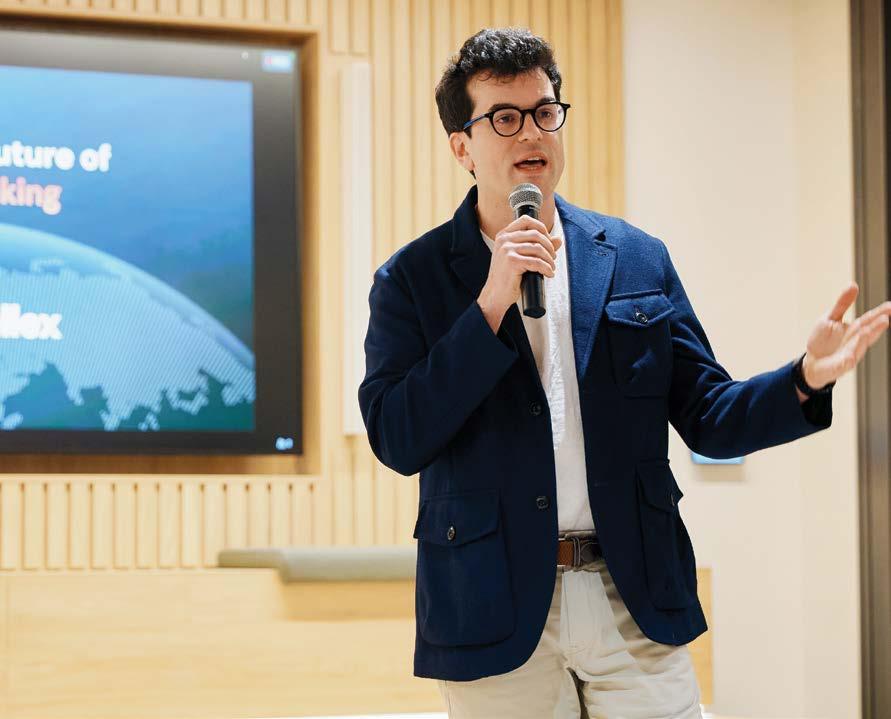
→ Alex Brownsell, co-founder and Creative Director of Bleach London
BUSINESS UNUSUAL
68 Expand or Expire
Entrepreneur UK talks to four founders
72 Five questions if struggling to scale Entrepreneurs face unpredictable global business conditions
74 Making Tax Digital
The hidden enabler of growth for UK SMEs
82 Navigating Trade Disruption
Scaling internationally amid global uncertainty
STARTUP SPOTLIGHT
Amy
FEATURES EDITOR Patricia Cullen patricia.cullen@bncb2b.com
CEO Wissam Younane wissam@bncpublishing.net
MANAGING DIRECTOR Rabih Najm rabih@bncpublishing.net
ART DIRECTOR Simona El Khoury
EDITORIAL TEAM
Tamara Pupic, Aalia Mehreen Ahmed
MEDIA SALES MANAGER Olha Kovalova olha.kovalova@bncb2b.com
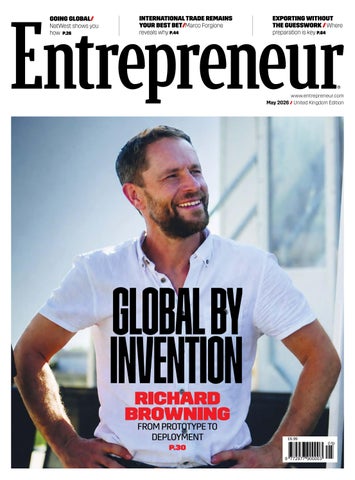
The May issue arrives at an awkward moment for British business. The case for expanding overseas is clear. The path to doing so is not. Across this edition, the focus is on how UK companies are navigating that gap. Not in theory, but in practice - where decisions are made with incomplete information and imperfect timing. Gravity Industries, led by Richard Browning, is a useful example. Its Jet Suit is now operating across more than 50 countries, in settings ranging from defence to emergency response. Yet its main challenge has not been engineering. It has been placement - understanding where a product like this belongs, and who is willing to use it.
That uncertainty is not unusual. As Jenny Edwards of NatWest points out, founders are rarely short of international options. The difficulty lies in choosing between them. Marco Forgione of The Chartered Institute of Export & International Trade goes further: in a fragmented global economy, trading internationally is becoming less discretionary. Execution, then, matters more than intent. Also in this issue, Ram Charan, the world-renowned business advisor argues that competitive advantage now sits with those able to adapt quickly across markets. Shefaly Yogendra, who has been advising boards on how to go global for the last 3 decades, makes a similar point: scale today is less about replication and more about adjustment. There are constraints. Measures of entrepreneurial confidence in the UK suggest a growing reluctance to take risks, particularly where failure is visible. That carries a cost. Companies that delay expansion often find the opportunity has moved on. And yet, the mood among founders themselves is more pragmatic than cautious. At a recent Entrepreneur UK Women in Entrepreneurship gathering at MR PORTER Restaurant, Bar & Lounge, the emphasis was not on whether to expand, but on how to keep moving when conditions are unclear. That is the thread running through this issue: growth pursued without certainty, and often in spite of it.
Thanks for reading,
Patricia Cullen Features Editor, Entrepreneur United Kingdom
In the Loop /
The New Rules of Global Competition
Scale, speed and state power are reshaping markets - leaving British firms to rethink how, and where, they compete by
PATRICIA CULLEN
Global expansion is no longer simply an opportunity; it is a strategic necessity shaped by shifting economic power. As China redraws the terms of competition through scale, cost and control of supply chains, entrepreneurs based in the UK face a more complex path to growth. In this Entrepreneur UK
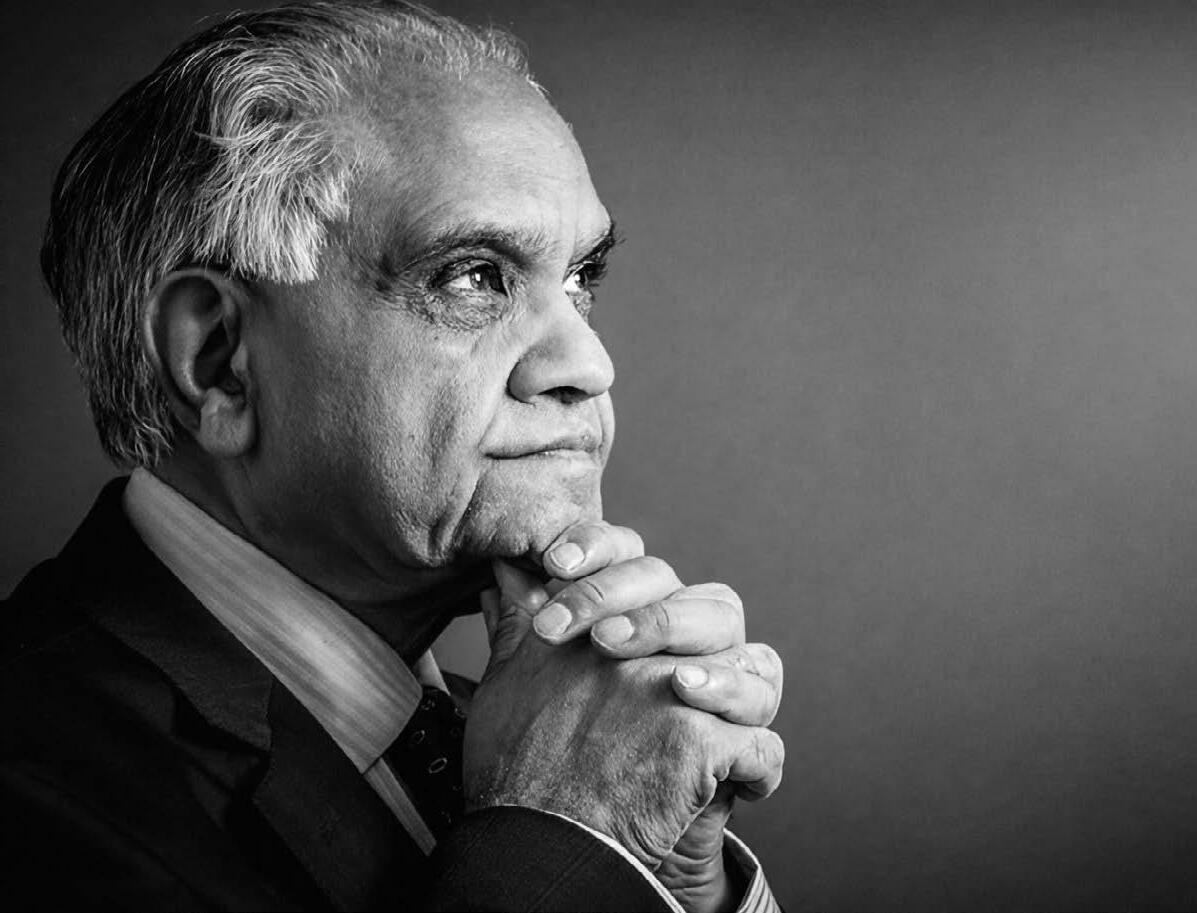
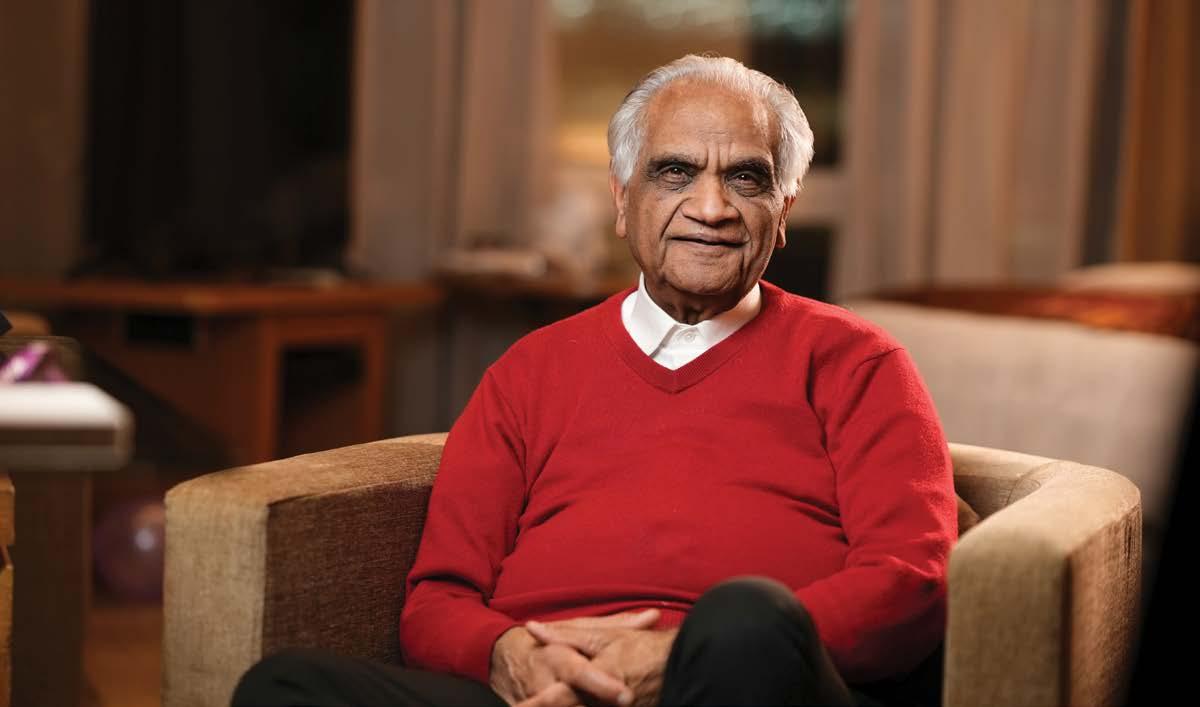
interview, Dr Ram Charan - who has advised senior leaders at major global companies including Toyota, Bank of America, Key Bank, ICICI Bank, the Aditya Birla Group, Novartis, UST Global, Uniqlo, Humana and Matrix - sets out a stark assessment of the global landscape and what it will take to compete within it.
→ Ram Charan is a world-renowned business advisor, author, and speaker
In China’s 90% Model, you explain how China builds excess capacity to dominate markets. What key insights from the book should UK entrepreneurs keep in mind?
Cost is lower. Therefore pricing is lower and competitiveness is higher. Chinese exports have increased dramatically. They have also increased quality and productivity. You are unable to compete. Here is what you must understand. China produces at marginal cost. Marginal cost means the cost to produce one more unit when your factory is already built, your workers are already trained, and your supply chains are already running. China has built such massive overcapacity that they can sell at marginal cost and still keep the factory running. You cannot match that pricing. No UK entrepreneur can. But it is worse than the price. China controls critical inputs. Rare earth elements. Specialty chemicals. If they choose to stop supplying the UK economy, they can do it at will. This is why your Prime Minister has gone to China to work out a solution. You have not fully experienced this threat yet because UK manufacturing has been declining for decades. You are getting cheaper, inexpensive imports from China. But those imports are attacking what remains of UK industry. And when those industries disappear, you will feel it.
Your book highlights China’s sector-by-sector strategy. Which industries in the UK are most at risk from this model?
Almost all manufacturing industries are at risk. The exception is aerospace and aircraft engines. Service industries are less vulnerable. But you must be careful. Even in industries that seem safe, you are not fully protected. The inputs to these industries in the value chain are still controlled by Chinese companies. Take aerospace. The UK has Rolls-Royce. World-class aircraft engines. But rare earths?
China controls them. Specialty chemicals needed in aerospace manufacturing? China controls them. You do not control the inputs. Depending on political negotiations, China may decide to exercise that control or not. The steel industry, for example. An entrepreneur is not likely to suffer immediately unless they are using inputs in certain industries that have been blocked. But here is what UK entrepreneurs must watch. China has destroyed or marginalised 20 industries globally, 10 of those under its Made in China 2025 plan. These include: electric vehicles, renewables, bio-pharma, aerospace, artificial intelligence, robotics, maritime equipment, advanced rail, new materials, advanced agriculture. If you are in any of those sectors or supply to those sectors, you are in the crosshairs. The UK must protect the intellectual property of industries such as Rolls-Royce. Once that IP is
that depend on trust, relationships, language, and local knowledge. The UK has strengths China cannot replicate. Financial services. Professional services. Life sciences research. Creative industries. Legal and accounting expertise. These are your natural advantages. Use them. But if you are in manufacturing, here is what you must do:
First, look for the gaps China cannot fill. Bespoke manufacturing. Rapid prototyping where you work directly with customers to customize products. Last-mile customization. Technical support that requires deep customer relationships and local presence. Short production runs where flexibility beats scale. These are your opportunities. Chinese factories are optimized for volume. You cannot beat them on volume. But you can beat them on speed, customization, and service. Second, protect your IP ruthlessly. If you have proprietary technology, keep it in the UK or within trusted partners in Europe and the American Sphere. Do not transfer
“THE UK HAS STRENGTHS CHINA CANNOT REPLICATE. FINANCIAL SERVICES. PROFESSIONAL SERVICES. LIFE SCIENCES RESEARCH. CREATIVE INDUSTRIES. LEGAL AND ACCOUNTING EXPERTISE. THESE ARE YOUR NATURAL ADVANTAGES. USE THEM”
gone, it does not come back.
How should UK startups and scale-ups adapt their strategies in sectors where China’s pricing and capacity tactics create pressure? The key is service industries. Wherever there are services, they will be somewhat protected. China cannot easily replicate high-value services
it to China. Do not form joint ventures that require technology sharing. Once China has your IP, they will scale it, subsidize it, and undercut you globally. Third, diversify your supply chains within the American Sphere. The American Sphere means the UK, US, EU, Japan, South Korea, Israel, Canada, Australia, India. Build your supply chains within that network. Yes, costs will be higher initially.
In the Loop /
But you gain resilience. And as volumes build across the Sphere, costs will come down.
Fourth, build partnerships. Small companies cannot
Low-cost loans for companies relocating production. Regulatory fast-tracking for strategic industries. Use these programs. They exist to help you.
annually. Since 2009, they have accumulated $7.5tn in hard cash from global trade. That money is used for political influence. They are building ports, railways, and
AI IS CENTRAL TO HYPER-SCALING, LOWERING COSTS, AND GAINING AGILITY. CHINESE COMPANIES ARE USING AI TO DRIVE PRODUCTIVITY GAINS THAT COMPOUND EVERY QUARTER. IF YOU ARE NOT USING AI, YOU ARE ALREADY BEHIND”
fight this alone. Partner with other UK firms. Work with your industry associations. Lobby the UK government for support. The government is negotiating with Europe and the US right now. Make sure your voice is heard. Look at what the UK government has already started. Tax incentives for domestic manufacturing.
Your op-ed argues China’s trade surplus is a tool of influence. What does this mean for UK entrepreneurs exporting goods or services?
To small companies, it may not make much immediate difference. It depends on which countries you are exporting to. China’s trade surplus is now over $1trn
logistics infrastructure across the world through the Belt and Road Initiative. They are subsidizing their exports. What does that mean for you? Your exports become uncompetitive. If you are trying to sell into markets where Chinese competitors are operating, they can undercut your price because their government
subsidizes them. You cannot compete with a governmentbacked pricing model. This is why partnerships with the UK government and with Europe and the US matter. Individual entrepreneurs cannot solve this alone.
Are there lessons from China’s approach - speed, scale, or efficiency - that UK founders could ethically adopt to grow their businesses?
Despite China’s control of economies and industries, there are three lessons every entrepreneur must learn. First, scale as fast as you can. Hyper-scale gives you lower costs and you can compete against Chinese exports and local manufacturing. Do not stay small if your industry allows scale. Scale fast. But understand what scale
means for a UK entrepreneur. You cannot scale to Chinese factory volumes. That is not the game. Scale means: serve multiple markets quickly, build repeatable processes, use technology to multiply your impact. For example, if you are in software or services, scale by serving customers across Europe, not just the UK. If you are in manufacturing, scale by standardizing your production process so you can handle larger orders efficiently. Second, use artificial intelligence. AI is central to hyper-scaling, lowering costs, and gaining agility. Chinese companies are using AI to drive productivity gains that compound every quarter. If you are not using AI, you are already behind. Let me be specific. Use AI to optimize your supply chain. Predict demand. Reduce inventory costs. Use AI to automate customer service so you can compete on speed without hiring dozens of people. Use AI in product design to cut your development cycle from months to weeks. AI tools are now accessible. You do not need to be a technology company to use them. Start with one process. Automate it. Learn. Then move to the next. Third, learn about currency exchange rates. Understand how they influence the price of your products. You need full value chain analysis on the basis of adjusted currency. China has devalued its currency by 52% since 1990. That is how they keep exports cheap. You must factor currency into every pricing decision. Brexit has already made this more complex for UK
“The question is: will UK entrepreneurs be part of that future? Or will you be left behind? Speed matters now. Not next year. Now”
businesses. Sterling volatility affects your competitiveness. If you export to the EU, you are exposed to Euro movements. If you source from Asia, you are exposed to Dollar and Yuan movements. Build currency analysis into your financial planning. Hedge your exposure where it makes sense. You must also match the quality and productivity of Chinese products. They are no longer low-quality. The quality gap has closed dramatically in the last seven years. If you assume Chinese products are inferior, you will lose.
Looking ahead, how should UK entrepreneurs position themselves to thrive if China’s economic influence continues to expand globally?
A large part of this equation is the partnership between entrepreneurs and the UK government. You cannot do it alone. The government cannot do it alone. The UK government must work with Europe and the US. All these negotiations at government level are happening now.
Read them. Watch them. Understand where they are going. These negotiations could go on for a decade. My thinking may sound negative to you. But so far, China has not used anything overtly negative against the UK specifically. However, they are doing it in Europe. Look at the automotive and EV sectors in Germany and France. Chinese brands are gaining market share, opening showrooms, undercutting legacy players. That pressure will come to the UK eventually. The negotiations between governments will need to happen. Entrepreneurs should continue on their path.
Here is what you must do:
}Go for exports. Do not limit yourself to the UK market. Post-Brexit, you need multiple markets. Export to the EU. Export to the US. Export to the Commonwealth. Diversification is resilience.
}Create scale fast. Build your business to scale. Small is vulnerable. You need volume to drive down costs
and gain negotiating power with suppliers }Use AI aggressively. Increase productivity and improve pricing through artificial intelligence. This is not optional. This is survival.
}Build resilience in your supply chains. Do not depend on China for critical inputs. Map your value chain. Identify where China controls a component or material. Find alternatives. Yes, it will cost more initially. But when China decides to exercise control, you will still be operating while your competitors are scrambling.
}Play to UK strengths. The UK has world-class universities. Deep capital markets in London. English language advantage in global business. A legal system that is trusted internationally. A culture of innovation and entrepreneurship. You have assets China cannot replicate. Use them. But use them fast. The window is closing. The UK still has time to act. But it requires entrepreneurs and the government working together. The US is moving. Europe is waking up. Japan and South Korea are diversifying. India is building manufacturing capacity. The American Sphere is forming. The question is: will UK entrepreneurs be part of that future? Or will you be left behind? Speed matters now. Not next year. Now.
Charan’s book, China’s 90% Model: China Has America by the Throat – Here’s How to Fight Back and Win, examines how China has built a system designed to dominate global markets sector by sector.
In the Loop /
The Export Paradox
Inside Santander’s trade insights by PATRICIA CULLEN
For UK businesses looking beyond domestic borders, the promise of international growth is compelling - but so are the risks. While global expansion is often framed as a natural next step for ambitious companies, the reality is far more complex. From navigating unfamiliar markets to managing financial exposure, the path outward is rarely straightforward. Yet, as John Carroll, CEO of Navigator Global, a digital platform designed as a single, structured gateway for businesses to access end-to-end trade support by Santander, makes clear, the rewards can outweigh the challenges - if businesses are prepared. “Companies that trade internationally
tend to be more optimistic and perform better,” he says. “That’s been consistent over several years of data.” Carroll is referring to Santander’s longrunning Trade Barometer, which tracks the outlook of nearly 1,000 UK businesses with international ambitions. Around 70% are already trading overseas, with a further 12% planning to do so within the next year. What stands out is not just participation, but mindset: those engaging internationally are consistently more growthfocused. In a low-growth domestic environment - where UK growth hovers around 1% - that outward focus is becoming less optional and more essential.
→ John Carroll, CEO of Navigator Global by Santander
The five barriers businesses face Despite the optimism, the obstacles to international expansion remain persistent. According to Carroll, they tend to fall into five core areas. The first is market access: understanding who will buy a product overseas and how to reach them. “It’s relatively easy to identify customers if you’re selling in Manchester from Leeds,” he says. “It’s a very different challenge when you’re looking at Tokyo or Mumbai.” Second comes regulation. Each market brings its own compliance requirements, often with significant variation. A food product that meets UK standards may require entirely different certifications in Japan or the Middle East. Third is logistics - particularly for companies dealing in physical goods. Global supply chains introduce new vulnerabilities, from
THERE’S STRONG EMPIRICAL EVIDENCE THAT COMPANIES TRADING INTERNATIONALLY TEND TO BE MORE INNOVATIVE. IT’S A KEY TRAIT OF BUSINESSES THAT SCALE”
disrupted shipping routes to geopolitical tensions affecting key trade corridors. The fourth challenge is payment. Without established trust between buyer and seller, securing reliable payment mechanisms becomes more complex - a point Mark Ling, Head of Trade at Santander UK, sees frequently. Finally, there is the question of presence. Many contracts, particularly in large-scale projects, require some form of local footprint. For smaller businesses, establishing that presence cost-effectively can be a major hurdle. “These challenges are consistent,” Ling notes. “They may shift in order slightly, but
they’re always there.”
Why exporters outperform
If the barriers are well known, so too are the advantages. Exporting businesses are not only more optimistic - they are often more innovative.“There’s strong empirical evidence that companies trading internationally tend to be more innovative,” says Ling. “It’s a key trait of businesses that scale.” Carroll frames it more simply. Competing globally forces improvement. “If you’re running 100 metres in a local race, you can perform at one level,” he says. “But if you’re competing globally, you
have to raise your game. That’s what drives innovation.” There is also a resilience factor. Businesses operating across multiple markets are less exposed to downturns in any single economy. Diversification, in this sense, becomes a form of risk management. But that resilience comes at a cost: complexity.
The financing gap
One of the most common mistakes businesses make is leaving financial planning too late. “Companies often secure a contract and then come to the bank asking how to fund it,” Ling explains. “At that point, it can already be too late.” International trade introduces layers of
In the Loop /
Technology allows smaller businesses to do things that previously required large teams”
financial risk that don’t exist domestically. Banks must assess not only the exporting company, but also the overseas buyer, the terms of trade, and the broader country risk.
“There are multiple mechanisms in trade finance,” Ling says. “Each comes with a different balance of risk between importer and exporter. Understanding that riskand mitigating it - takes time.” This is where early engagement becomes critical. Businesses that involve financial partners at the planning stage are far better positioned to structure deals that are
both viable and sustainable.
What signals readiness to expand?
In uncertain economic conditions, many businesses hesitate to expand internationally. But there are clear indicators that a company may be ready. The first is saturation in the domestic market. “If growth opportunities at home are limited, businesses start looking outward,” Ling says. The second is external demand. In an increasingly connected world, overseas interest can emerge quickly. A strong product or service may attract
international attention before a company has actively pursued it. The third factor is structural change - most notably Brexit. For many UK firms, increased friction in European trade has prompted a reassessment of global opportunities. “Companies are starting to look beyond traditional markets,” Ling notes. “That shift is significant.” While opportunity is abundant, execution remains the differentiator. Banks, Carroll emphasises, are fundamentally assessing credibility. “If your business plan is solid, the bank is more likely to back
→ Mark Ling, Head of Trade, Santander UK
you,” he says. That plan must account not only for opportunity, but for the realities of operating in unfamiliar markets.
Regulatory compliance, logistics, cultural differences and financial exposure all need to be understood in advance.
“There’s greater upside in international trade,” Carroll says. “But there’s also a greater challenge.” When things go wrong, the causes tend to fall into two broad categories. The first is excessive caution. Some businesses are deterred by perceived complexity and never take the first step. The second is overconfidence.
“Assuming international trade is the same as domestic trade is a mistake,” Carroll says.
Ling points to well-known examples like Marks & Spencer. “When they first took their designs into Asia, they didn’t work. People are a different size in Asia, so there’s a fundamental mismatch.”
Retailers that failed to adapt products to local markets have struggled, while others that invested in research and localisation have succeeded. “And then you’ll see somebody else that’s gone into a market overseas and really, really done the research properly. So Zara, for instance, a huge Spanish multinational apparel business, has done an amazing job going international.” From a financial perspective, the risks can be more immediate. Contracts may be structured in ways that
favour the buyer, or require levels of working capital that the exporter cannot sustain. “These are avoidable issues,” Ling says. “but only if they’re addressed early.”
The importance of human capital
Beyond strategy and finance, one factor underpins every stage of international expansion: people. “Access to the right skills is one of the biggest challenges,” Ling says.
essential. Historically, international expansion often depended on personal networks. Success was driven by who a business knew, rather than what systems it had in place. That model is changing. “What we’ve done is industrialise and professionalise that support,” Ling says. “It’s no longer just about individual relationships - it’s scalable.” This shift is being accelerated by technology. Digital tools
Trade isn’t unknown. The challenges are there - but so are the solutions” “
“Language, cultural understanding, local networks - it all matters.”
For smaller businesses, this can be particularly difficult. Unlike large multinationals, they rarely have dedicated teams for each market. Instead, existing staff must adapt quickly to new demands. Carroll highlights the strain this can place on organisations. “You might have someone who’s comfortable dealing with France,” he says, “then suddenly they’re working with Japan. The skill set required is completely different.” Building that capability - whether internally or through external partners - is
are making it easier to assess market demand, learn from past mistakes, and streamline processes that were once paperbased. Carroll sees this as a democratising force. “Technology allows smaller businesses to do things that previously required large teams,” he says. For Santander, supporting international expansion comes down to three core areas: market selection, planning, and connections. Choosing the right market is the first step. Not every product suits every geography, and identifying where demand exists is critical. Planning follows. Businesses must understand the practical
steps involved - from regulatory requirements to logistics and financing. Finally, there are connections. Trust remains a central issue in international trade, and identifying reliable partners is often the hardest part. “Knowing who to trust overseas is crucial,” Carroll says.
A long-standing system - still evolving
Despite the complexity, global trade is not uncharted territory. The frameworks governing it have been in place for decades. “There are well-established rules and systems,” Ling says. “They’re designed to support trade and manage risk.” But in a shifting geopolitical environment, those systems are under pressure. Trade patterns are evolving, and businesses must remain adaptable. For UK businesses, the case for international expansion is clear. Growth, innovation and resilience are all stronger among companies that look beyond domestic markets. But success is not automatic. It requires preparation, early engagement with specialists, and a willingness to confront complexity head-on. It also requires investment - in people, in knowledge, and in the systems that support global operations. As Carroll puts it, “Trade isn’t unknown. The challenges are there - but so are the solutions.” The difference lies in knowing how to navigate them.
In the Loop /
What Does It Take to Scale Globally Today?
The realities, risks and decisions shaping global growth today
by PATRICIA CULLEN
The difference between companies that scale globally and those that remain domestically constrained begins, Shefaly Yogendra, an experienced independent board director argues, with something deceptively simple: the operating model. “The nature of the business itself,” she says, shapes almost everything that follows. Some models, she notes, are inherently easier to scale than others. Physical goods businesses, for example, must contend with supply chains, logistics and increasingly geopolitics. Service businesses operating online face a different set of constraints.
Hospitality, although also a service sector, brings in real estate and physical infrastructure, making global expansion more resourceintensive again.
Across all of them, one factor “looms large regardless”: supply chains, and the structural complexity they introduce when businesses move across borders. But the question of scale is not only structural. It is also financial. Global expansion, she says, is “resource-intensive”, and success depends on whether founders can raise the capital required to sustain it. That challenge is closely tied to the underlying business model itself - what it demands, how quickly it can grow, and what kind of infrastructure it needs to do so.
Regulation adds another layer of friction. “A further aspect is whether a business is regulated,” she explains, because requirements differ across jurisdictions, and licensing can affect both timelines and cost in ways founders often underestimate. Even shifting policy environments - including changes to UK listing rules - demand a level of organisational agility that many early-stage companies do not yet possess. Underlying all of this, she suggests, is something less tangible but just as decisive: leadership mindset.
Foundations before scale
For Yogendra, one of the most persistent mistakes founders make is delaying the unglamorous work of structurebuilding. “I have always advised founders to build the foundations right because when the business is growing rapidly and it is all exciting stuff, nobody wants to come back and do the boring job of fixing the uneven foundations, and
→ Shefaly M Yogendra, a portfolio board director, FTSE 250 Board Member and former FTSE100 Women to Watch
the risk of weak or uneven foundations is that growth can be upended by them,” she says, because rapid growth has a way of disguising weak internal systems - until those weaknesses become expensive
“THE BRAND IS THE INNOVATION ENGINE OF A BUSINESS”
to fix. The warning is blunt And yet, she argues, that is precisely what often happens when companies scale internationally without first establishing clear
governance, policies and accountability structures.
She points to early-stage businesses that find themselves unprepared when internal challenges emerge. In one example, a
young founding team faced an employee misconduct issue without having basic HR policies in place. What began as an internal misunderstanding
escalated into legal advice and formal remediation. “The lesson?” she says. “Give shape to some essential policies before you hire your first employee.” Legal advice,
In the Loop /
she adds, is not optional in such scenarios: “paying lawyers to disentangle messes costs a lot more.” As businesses grow, the nature of governance must evolve with them. Early-stage companies may not require formal boards, but they do benefit from structured review processes and clear accountability. Once external investors enter, however, formal governance becomes essential. “A founder facing a board with several investor directors
would be wise to choose an independent chair,” she notes, describing the chair as both sounding board and buffer between competing priorities. Risk management, too, becomes more formalised over time. Clarity on risk appetite is essential when operating internationally, particularly in regulated sectors where formal structures are expected. “In a regulated sector,” she says, these frameworks are often non-negotiable. And in a more volatile geopolitical
environment, risk cannot be considered in purely domestic terms. Founders must account for shifting trade relationships, tariffs and political uncertainty when planning international expansion.
The overlooked constraint: culture
If structure and governance define the internal foundations of scale, cultural intelligence determines what happens externally. One of the most overlooked weaknesses in international expansion, she argues, is a lack of cultural understanding. “(Lack of) cultural intelligence is easily one of the most overlooked strategic weaknesses,” she says. She gives the example of British companies entering the US market and assuming linguistic similarity equates to cultural alignment - a mistake that can obscure important regional differences. The same issue arises in India, where English-language fluency can mask deep cultural and linguistic diversity that, if properly understood, would open entirely new opportunities. Branding strategy is another frequent blind spot. “The brand is the innovation engine of a business,” she says, but also a key mechanism for establishing credibility in new markets. Poorly developed branding strategies can undermine expansion efforts before they begin. Even practical considerations, such as intellectual property, vary significantly across jurisdictions. Trademarking a brand internationally is not always straightforward, and in some markets requires local legal expertise to navigate administrative systems.
Leadership as alignment
that often come into tension. “Clarity on this dilemma,” she says, helps define the realistic scope of international ambition. Equally important is alignment on risk appetite - understanding when to take risks, and when to pull back. Shared values and clear parameters, she argues, provide the “guardrails” needed to make consistent decisions across multiple markets.
The structural decision that matters most
If there is one decision that has outsized impact on global expansion, she suggests, it is the choice of legal structure and location at the outset. “Location and structure of the company,” she says, is the single most important early decision. From Delaware to Wyoming in the US, or across Switzerland’s 26 cantons, different jurisdictions offer different tax regimes, filing requirements and strategic advantages. But the calculation is no longer purely financial. Increasingly, founders must consider geopolitical alignment, trade blocs and regulatory exposure when choosing where to base their business. “Emergent trade blocs and frameworks can influence sourcing, production, crossborder trade and regulatory alignment,” she notes, and ultimately shape a company’s international competitiveness.
“I HAVE ALWAYS ADVISED FOUNDERS TO BUILD THE FOUNDATIONS RIGHT BECAUSE WHEN THE BUSINESS IS GROWING RAPIDLY AND IT IS ALL EXCITING STUFF, NOBODY WANTS TO COME BACK AND DO THE BORING JOB OF FIXING THE UNEVEN FOUNDATIONS”
Ultimately, Yogendra returns to leadership as the binding force between structure, strategy and scale. “A founder or founding team must have shared values,” she says - not only for international expansion, but for the long-term sustainability of the business itself. She also highlights what she calls the “rich-versus-king dilemma”, a concept articulated by Noam Wasserman. In simple terms, founders must decide whether to prioritise growth and value creation, or control and ownership - two objectives
No shortcuts to scale
Taken together, Yogendra’s argument is clear: global expansion is not simply a question of ambition, but of architecture. The businesses that scale successfully are not necessarily those that move fastest, but those that build the most resilient foundations, understand their external environments, and align leadership around clear principles of growth and risk. Or as she puts it, more simply: the difference begins long before a company becomes global. It begins in how it is built in the first place.
GOING GLOBAL
How founders know when to expand, where to go, and what determines success abroad
by PATRICIA CULLEN
Expanding internationally has become a defining ambition for many UK startups - but knowing when and how to take that leap remains one of the most complex decisions founders face. For Jenny Edwards, Head of Venture Banking at NatWest, global expansion is less about a single signal and more about a combination of readiness, discipline, and evidence.
On what it takes to know when a company is ready to scale beyond the UK, Edwards is clear that there is no one trigger. “There isn’t a single signal, it’s usually a combination of factors coming together. Strong product market fit and a repeatable commercial model in the UK are important foundations, but just as critical is evidence that the problem you’re solving exists beyond your home market. We also look for operational readiness, whether the team, infrastructure, and capital are in place to support expansion, and a clear sense of where and why the business can win internationally.”
But even when the timing feels right, international expansion is often where founders make critical mistakes - particularly around how well they understand new markets. “Underestimating localisation. Founders often assume what worked in the UK will translate overseas, but differences in regulation, culture, pricing expectations, and distribution channels can be significant. The biggest mistake is expanding too quickly without deeply understanding the new market - or without local expertise on the ground.”
Despite the risks, many UK founders are increasingly thinking globally from the outset. However, Edwards notes that the most successful companies strike a careful balance between ambition and discipline. “Many founders we work with have a global mindset from day one. Designing products, teams, and infrastructure that can scale internationally. At the same time, there’s a healthy level of caution in the current environment with many founders being more deliberate about when and where they expand. The most effective approach sits somewhere in the middle: being ‘global by design’ in how you build the business, while staying disciplined about timing, expanding when there’s clear evidence you can win.”
“Many founders we work with have a global mindset from day one”
INCREASINGLY, OUR ROLE IS TO ACT AS A CONNECTOR, HELPING FOUNDERS DE-RISK
→ Jenny Edwards, Head of Venture Banking at NatWest
At NatWest, she says, several clear trends are emerging among companies that are actively expanding abroad - particularly around capital efficiency, market selection, and partnership-driven growth. “Three trends stand out. First, a shift towards capital-efficient expansion - founders are being more disciplined about when and where they scale. Second, increased focus on nearby or culturally aligned markets as stepping stones, particularly across Europe. Third, a growing use of partnerships—whether distribution, strategic, or financial - to reduce risk when entering new regions. Alongside this, there’s a quiet but growing emphasis on building resilience into international growth plans, particularly across supply chains, with more founders investing in the talent and technology needed to improve forecasting, manage uncertainty, and scale sustainably.”
Beyond funding, she emphasises that NatWest’s role is increasingly about enabling connections and reducing friction for founders entering new markets.
“We support founders beyond just capital. That includes access to international banking infrastructure, trade and FX expertise, and local market insights, as well as introductions - to investors, partners, and advisors in the UK and in key regions internationally. Increasingly, our role is to act as a connector, helping founders de-risk expansion by tapping into trusted networks and making practical commercial connections, including to local businesses through organisations such as the British Chambers of Commerce and programmes like the NatWest Accelerator.”
She also highlights the role of international partnerships in helping UK companies enter highly competitive markets such as the United States.
“NatWest Venture Banking is also leveraging its IBOS partnership to streamline US expansion with Silicon Valley Bank, A First Citizens Company, enabling clients to tap into the US Innovation Economy ecosystem through seamless onboarding, valuable networks, and tailored support to scale with confidence.”
So what separates companies that succeed globally from those that stall? “Clarity and discipline. The companies that succeed are laser-focused on where they can win - and just as importantly, where they won’t compete yet. They invest early in the right leadership, particularly locally, and they maintain financial discipline as they scale. Those that stall often spread themselves too thin or underestimate the operational complexity of managing multiple markets.” Capital, she adds, does not determine the outcome- but it fundamentally changes the way companies can approach risk. “Capital doesn’t
guarantee success, but it buys optionality. It allows companies to invest ahead of revenue in new markets - whether in hiring, marketing, or infrastructure. Crucially, it also provides resilience. International expansion rarely goes exactly to plan, so having the financial headroom to adapt is often what separates success from retreat.”
Yet even with funding and strategy in place, one factor consistently determines whether expansion succeeds or fails. “Hiring the right local leadership. You can have a strong product and a well-funded strategy, but without people who truly understand the market, its customers, nuances, and networks, execution will fall short. It’s often the difference between traction and stagnation.” And for founders feeling pressure to scale quickly, her final reflection cuts against the instinct to move fast at all costs. “Slower can be faster. There’s often pressure to expand quickly to signal growth, but premature expansion can destroy value. Taking the time to deeply understand one or two markets - and getting them right - often leads to stronger, more sustainable global growth than trying to scale everywhere at once.”
“There’s often pressure to expand quickly to signal growth, but premature expansion can destroy value. Taking the time to deeply understand one or two markets - and getting them right - often leads to stronger, more sustainable global growth than trying to scale everywhere at once”
GLOBAL
BY INVENTION
From prototype to deployment by PATRICIA
CULLEN
Across maritime waters, desert terrain and defence exercises in more than 50 countries, one question follows Gravity Industries’ Jet Suit - a wearable propulsion system that allows a person to fly: where does it belong? It no longer sits between invention and demonstration. It is being tested, assessed and increasingly deployed across defence, rescue and commercial environments. But before any of that, it has to be understood. For its founder, Richard Browning, that has always been the harder task.
THE CATEGORY PROBLEM
The challenge begins not with scale, but with recognition. “Scaling a business itself is a fascinating charge. In many cases, you have an entrepreneur who is defying convention and more often than not faces ongoing skepticism, to bring something new to the world that was previously thought impossible,” says founder Richard Browning. Very quickly, the inventor must become a communicator and leader, able to carry an idea beyond its origin to a wider audience. That task is constantly evolving, and becomes harder still when the product does not fit existing public or regulatory categories. “In Gravity’s case, we have had to work very hard to create a definition of what our company is and how it fits into the aviation world. And as far as defence is concerned, it is an entirely new platform that fits somewhere between an all-terrain vehicle and a personal helicopter.” The problem is not rejection. It is classification.
THE BUY-IN GAP
In established industries, improvement is incremental. In new categories, even comprehension has to be built from scratch.
“If we take the defence market as an example, the biggest hurdle to seeing the Jet Suit become part of most allied militaries capability is exactly the challenge that it does not fit into an existing category. If we were delivering a slightly better
pair of boots or a slightly better rifle, then it’s relatively easy. But when you are delivering a capability that wasn’t even part of the strategic review, or even thought possible, then you start from scratch when it comes to the buy-in.” The
friction is not technical. It is conceptual
FROM DEMONSTRATION TO DEPLOYMENT
Gravity Industries launched in 2017 with immediate attention. But attention is not infrastructure. “We launched in 2017
and commercial interest has been there from the beginning. As the world’s first patented Jet Suit, the product will always naturally have that ‘wow’ factor, but in showcasing our flights across the world, we’ve also caught the attention of organisa-
Scaling a business itself is a fascinating charge. In many cases, you have an entrepreneur who is defying convention and more often than not faces ongoing skepticism, to bring something new to the world that was previously thought impossible”
tions who may not have even dreamed an invention like ours could help until they saw it in action. For example, our over-water and multterrain training sessions have demonstrated the Jet Suit’s capabilities and robustness. This has in turn caught the attention of organisations - both military and charity - operating in environments
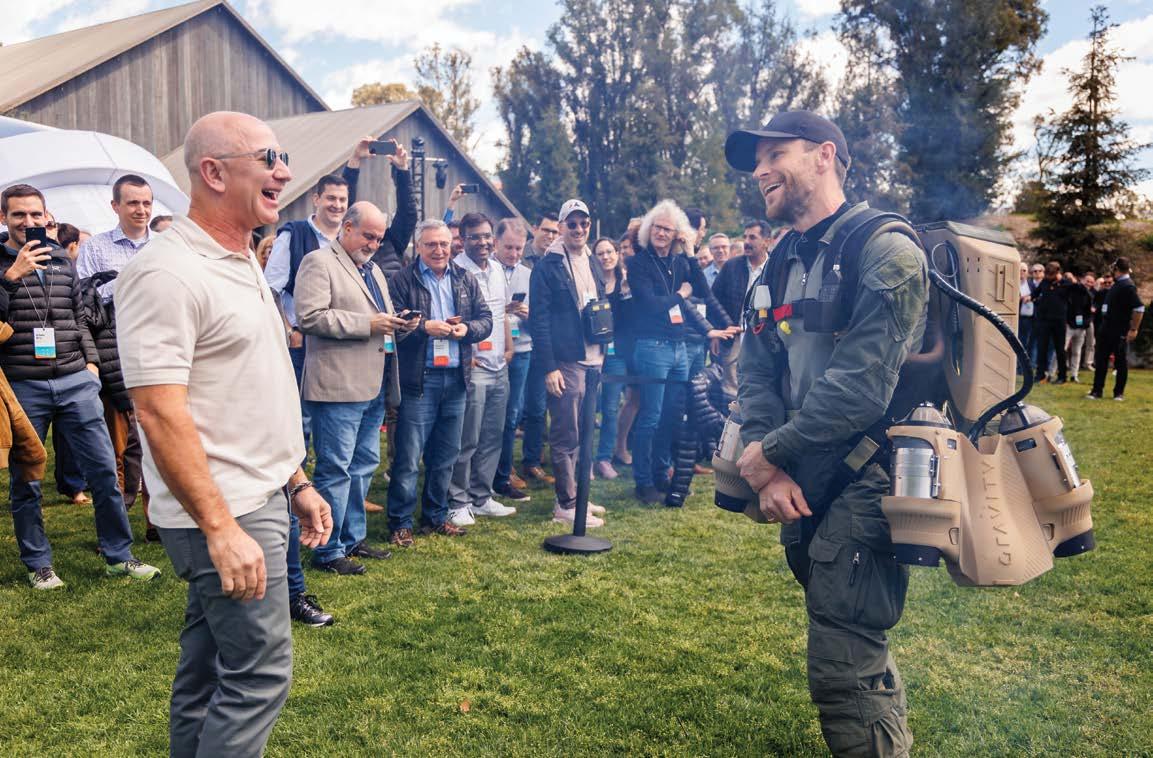
← Founder, Richard Browning with Jeff Bezos
which are traditionally slow or difficult to reach, including mountain rescue, ship boarding and coastal operations. Only last month, we have undertaken trials with maritime organisations including the Royal Navy and NATO’s Maritime Interdiction Operations Training Centre.” What began as demonstration has shifted into operational testing. “We are seeing a clear step-change in how Gravity and our technology is perceived. We’ve moved from a predominantly entertainment-led operation to the professional deployment of our technology across areas such as ship boarding, coast guard operations, medic response and frontline units. The conversation has moved well beyond curiosity into serious evaluation of where our Jet Suits can provide genuine operational advantages and we’ve secured a number of highly significant, albeit confidential, defence contracts.” Over the past year, their priority has been to ensure the technology is robust, reliable, and ready for deployment in professional environments. They will continue testing and training across varied terrains in the months ahead, including maritime, alpine, and desert conditions.
GLOBAL MOMENTUM
The shift is no longer isolated. “We’ve recently reported a strong year of growth underpinned by rising global defence interest which reflect our transition from experimental innovation and commercial entertainment flights to
professional deployment. We have delivered operational exercises and demonstrations in more than 52 countries worldwide, and we are attracting growing interest
from Special Forces and emergency response organisations requiring specialist mobility and rapid-deployment to support missions where time, terrain and access are critical factors. Over the next 12 months, we have plans to continue our international expansion, particularly in the United States, while also establishing
FOUNDERS MUST REMEMBER THAT CONSISTENTLY AND CAREFULLY TAKING RISKS IS THE KEY TO GROWTH AND UNLOCKING THE ‘ENTREPRENEURIAL SPIRIT’ THAT IS SO OFTEN LOST”
→The Gravity Industries Jet Suit
our dedicated Medic Response Charity to support emergency response capabilities,” says Browning. The next phase is expansion across domains, not just geographies. What does global growth look like for Gravity Industries over the next five years? “Over the next five years, we are on target to scale the military division of a company enabling allied forces to operate over any terrain with an unprecedented degree of freedom, speed and surprise. We also expect to expand our medic response charity arm focusing on the critical care first-responder role, where a trained operator in our Jet Suit can reach an individual in harm’s way and provide care while waiting for backup response, which may require helicopter or lifeboat support. In our commercial division, we are also looking to expand our Global Race Series, which launched in Dubai,” he says. Gravity Industries hope it inspires millions and shows
what humans and machines can achieve together in sports entertainment. What began as what once seemed an impossible dream has become something far larger - the sky is not the limit.
COMMERCIALISING THE UNKNOWN
The transition from curiosity to adoption is rarely linear. How do you approach commercialising something the world hasn’t seen before? “We are seeing a clear step-change in how Gravity Industries and our technology is perceived. We’ve moved from a predominantly entertainment-led operation to the professional deployment of our technology across areas such as ship boarding, coast guard operations, medic response and frontline units.” The conversation has moved forward into serious assessment of where our Jet Suits can deliver real operational
“
AS A COMPANY
WHICH HAS BUILT THE WORLD’S FIRST JET SUIT, WE HAVE TAKEN ONE OF HUMANITY’S OLDEST DREAMS OF FLYING AND TURNED IT INTO AN EIGHTFIGURE GLOBALLY RECOGNISED PHENOMENON”
advantage, and they have secured a number of significant, though confidential, defence contracts. “Over the past 12 months, our focus has been on ensuring the technology is robust, reliable and deployable within these professional operating environments, and we will continue to train and test across a wide range of terrains in the coming months, including maritime, alpine and desert conditions.” The product has not changed. The context around it has.
WHAT GROWTH ACTUALLY REQUIRES
Behind the systems, contracts and expansion sits a more fundamental view of entrepreneurship. What have you learned about growth that traditional founders might not expect? “As a company which has built the world’s first Jet Suit, we have taken one of humanity’s oldest dreams of flying and turned it into an eight-figure globally recognised phenomenon. This hasn’t been easy, but it resulted from consistently taking risks and learning from inevitable, recoverable failures.” This mindset, the backbone of innovation and entrepreneurship, is often lost in the start-up world, where the daily demands of running a business can begin to take precedence. “Founders must remember that consistently and carefully taking risks is the key to growth and unlocking the ‘entrepreneurial spirit’ that is so often lost,” he adds. Gravity Industries does not simply build technology for existing markets. It builds capability into spaces that have not yet been named. Its challenge is no longer proving what the Jet Suit can do, but defining its place on a global stage.
WHY THIS ROOM MATTERED
Inside a gathering of 70 female founders at MR PORTER Restaurant, Bar & Lounge
by PATRICIA CULLEN
On 16 April, at an Entrepreneur UK Women in Entrepreneurship event hosted at MR PORTER Restaurant, Bar and Lounge in London the room was already active before the formal start.
Approximately 70 female founders and businesswomen attended, though “attended” feels too static for what was, in practice, a constant undercurrent of conversation. There
was no attempt to stage the atmosphere. Guests spoke in the shorthand of working constraints - time, funding cycles, hiring pressure, and uneven growth. It felt less like networking and more like proximity - people building in parallel, under similar conditions, with very different outcomes. Not a format you come across often. Three female founders spoke over the course of the evening, each approaching the
DID YOU GET LUCKY, OR DID YOU CREATE THE CONDITIONS FOR LUCK?”
realities of building and sustaining a business from a different angle. “What if you fail? But what if you fly?”
These were the words of Karolina Pelc, author of Her Play, who opened the evening by pushing back against one of the more persistent simplifications attached to entrepreneurial success.
“People said I got lucky,” she said. “But my success was 20 years in the making.” She did not frame it as rebuttal, more as correction. “Nothing about it was luck,” she added. “I did the homework - strategically, legally, commercially.” The phrasing remained deliberately plain. It sat against the familiar tendency to narrate exits after the fact - compressed into timing, stripped of everything that
→ Karolina Pelc, Author of Her Play: Make Your Own Luck and Lara Acosta, co-founder of Kleo
‘T/Connection
“
I LOVE THE OPTIMISM OF SOMEONE TRYING TO DO SOMETHING THAT FEELS IMPOSSIBLE”
led up to them. “Did you get lucky,” she asked the room, which was notably full, “or did you create the conditions for luck?” The question was not developed further. It did not need to be. Pelc’s own trajectory, as she outlined it, resisted any clean linear reading. “I’m tired of the same narrative of success,” she said. “Mine started dealing cards in postcommunist Poland.” She relocated on multiple occasions. “Every time I moved countries, it was because I wanted more. It wasn’t easy - but it was necessary.” She said she’s likely made more mistakes than she has done things right, but what matters is how she’s handled them. Her final point was direct “Don’t let the b***ards grind you down.” Lara Acosta, a LinkedIn growth strategist and personal branding expert, followed. “I think everything I’ve done
Faye Allen, Regional Director at Rimkis
WHAT IF YOU FAIL? BUT WHAT IF YOU FLY?”
comes down to being audacious - and a little bit delusional,” she said. “What stopped me wasn’t opportunity,” she added. “It was imposter syndrome.” There was no elaboration. “Women have the energy. We create things. We just don’t always back ourselves. I focused on my skills until I became undeniably good.” Acosta’s network didn’t simply open doors; it changed how her work was received, and the scale at which she could operate. The room itself resisted any clear separation between speaker and audience. Next up was Marine Tanguy, founder of MTArt Agency. She widened the frame without shifting its register. “I love the optimism of someone trying to do something that feels impossible,” she said, “and yet only 2% of investment goes to female founders.” The two statements were left unresolved, with no attempt to reconcile them. Her reference points came less from abstraction than from long exposure to structural imbalance. “I’ve been in the art world for 18
years,” she said. “It was— and often still is—maledominated.” Her time in Los Angeles surfaced briefly, for context. “In LA, as a woman, you’re expected to present yourself in a certain way,” she said. “At 23, I found that slightly soul-crushing.” However there were positives to this. “But LA removes hesitation. Everyone pushes themselves forward - so you learn to do the same. I’m very direct,” she said. “It’s not always considered ‘feminine’- but it’s necessary.” What gradually emerged from the speakers was not a shared message but a shared condition: building under uncertainty,
→ Marine Tanguy, founder of MTArt Agency; Lara Acosta, co-founder of Kleo; and Karolina Pelc, author of Her Play: Make Your Own Luck
operating with incomplete information, moving between visibility and invisibility depending on stage and scale. By the time the formal part of the evening had ended, there was no clear transition out of it. Conversations simply continued for drinks and canapes at MR PORTER Restaurant, Bar & Lounge. There was no closing statement. No summary of events at the Women in Entrepreneurship evening. The room stayed, in motion, conversations continuing, dispersing, re-forming elsewhere. The evening held different realities, described side by side in real time - something to be there for, rather than read about. Keep an eye out for future Entrepreneur UK events
→ Marco Forgione, Director General, The Chartered Institute of Export & International Trade
INTERNATIONAL TRADE REMAINS YOUR BEST BET
by MARCO FORGIONE
The geopolitical turmoil roiling supply chains might seem like a daunting prospect if you’re considering selling internationally. In fact, there’s never been a better time to sell your goods abroad. We know that businesses that trade their goods internationally are more successful, more resilient and employ more people. In these difficult economic times, selling abroad is not only a key part of growing your business; it’s also part-and-parcel of ensuring your business can survive and thrive in periods of geopolitical uncertainty. New markets mean new consumers. Consumers who might be willing to pay top-dollar for your products, while those in your domestic market look to cut back on spending. In my time as director general at the Chartered Institute of Export & International Trade, I have seen that Brand Britain remains a powerful asset for exporters. Consumers in Europe, the Americas and Asia are still willing to pay a premium for UK-made goods and services. Businesses that choose to export to new and growing markets are best placed to take advantage of a growing middle class that wants to spend more money on premium, British products. There are millions of buyers across the globe, waiting for the opportunity to purchase your products.
GETTING ‘EXPORT READY’
As business leaders, you should be looking to get your company as ‘export ready’ as possible if you want to expand into international markets. This requires a considered plan and investment of both time and money. An ‘export-ready’ company is one that has the right people, systems and skills in place to support your business in foreign markets. While this requires some resources, it is easier than you might think and will deliver a significant return on investment in the long run. For those with an entrepreneurial spirit, it is well worth considering. Amid all the noise, focus on two exporting foundations:
Building a corps of well-trained and trusted staff
Knowing your market
There are, of course, other considerations, but years of listening to British trade success stories have taught me that these two aspects are essential when it comes to growing a company’s exporting capacity.
STAFF
As business leaders, you understand the importance of reliable, capable staff to your company. With international trade, the value of a good team goes from ‘important’ to ‘crucial’. Export controls and sanctions, customs processes, freight and delivery, new regulations, compliance issues, export finance… these are difficult topics for any business to navigate. A confident and knowledgeable team, able to spot problems before they arise and protect your bottom line, is fundamental to getting your company export ready. This team should know how your supply chain works, understand immediate regulatory compliance challenges and be prepared for changes just over the horizon. They should also be empowered to make decisions quickly, with the confidence to know they are taking the right course of action. Empowering your existing staff with the right knowledge is a
“
IN THESE DIFFICULT ECONOMIC TIMES, SELLING ABROAD IS NOT ONLY A KEY PART OF GROWING YOUR BUSINESS; IT’S ALSO PART-AND-PARCEL OF ENSURING YOUR BUSINESS CAN SURVIVE AND THRIVE IN PERIODS OF GEOPOLITICAL UNCERTAINTY”
good first step. In-house expertise can be shaped in a way that suits your business. Formal qualifications, training courses and webinars are good options for any business leader looking to upskill their staff. AI, while a useful tool, will never replace the expertise that a human being can bring to a business, and it remains cost-effective to train your in-house talent. The ideal business model will blend a well-trained staff and the latest technology. Global trade and
customs is still professionalising. Many operators are still using knowledge scraped together on the job, rather than learning the basics from day one. Sometimes even experienced operators would do better with a fundamental grounding in the day-to-day concepts, rather than relying on knowledge learned several decades ago. As a result, entering with a fully trained and accredited staff can be a competitive advantage, even over rivals that have been operating internationally for years.
GETTING TO KNOW YOUR MARKET
The second aspect to becoming export ready is learning about the markets you want to trade with. Whether that’s EU members, the US or developing markets in continents like Africa or Asia, the basics still apply. Having a clear idea of the buyers, sellers and supply chains in your market is basic business practice. When selling internationally, this is even more important. If you, for example, want to sell food and drink products into Middle Eastern markets, understanding the marketing potential of your goods – as well as your best avenues for moving those goods and the customs procedures that can make life easier – is important to becoming export ready. I’ve heard from our members that consumers in the Gulf region are particularly keen to buy Britishbranded meat and drinks products,
INTERNATIONAL TRADE IS
AN
INVESTMENT. PUTTING
THE MONEY INTO THE
RIGHT STAFF AND SYSTEMS WILL PAY OFF WITH BETTER COMPLIANCE AND REDUCED RISK”
while Asian consumers are starting to develop a taste for Scottish whisky and Welsh lamb. UK fashion, culture and technology are valued the world over, while service providers benefit from the stability of the UK business environment.
Understanding why these products are appreciated, and how you can take advantage of this powerful desire for ‘Brand Britain’, will help you to successfully position your goods in international markets. Overseas partners can support you to understand more about your new markets. These partners can be customs brokers, freight forwarders or intermediaries that you might already be familiar with, or marketing agencies, supply chain operators and selling
platforms. Some markets are essentially impossible to operate in without a trusted local partner, as certain business cultures frown upon working with foreign sellers without a local actor who is willing to vouch for them. Selling goods abroad is not just about the product, it’s also about understanding the business culture and how to navigate it. For this purpose, trade shows are a lifeline for all kinds of businesses. While the Department for Business and Trade (DBT) has sadly withdrawn funding for UK businesses to go to overseas trade shows and conferences, there are still cost-effective ways of exploring your potential markets and meeting new partners. Don’t see these trips as an expense, see them as an investment.
ONLINE SELLING
It would be remiss of me to not mention e-commerce as an export avenue. While many of you know that brick-andmortar shops have their value, selling your goods online can be costeffective. Taking a ‘digital first’ approach to exporting can pay dividends and I would encourage you to take this into account when planning your strategy, Platforms like Amazon, Etsy and Shopify are renowned internationally. However, some markets rely on e-commerce that are used widely by the population but aren’t well known beyond. Mercado Libre is one of the leading platforms for South America, while most of New Zealand uses TradeMe. Bol.com is the
leading ecommerce platform for the Netherlands and Belgium, while India’s Myntra is a good option for fashion businesses. Each of these is different but offers unique advantages for the right business. In some cultures consumers prefer to buy only from their chosen marketplaces rather than individual websites. We’ve seen that some growing markets in Africa are digital-first and mobile-first, so the right app is crucial to expanding into these markets and reaching their growing number of young consumers. Understanding which of these routes suits your business best is an undervalued quality, in my view, and goes back to the idea of knowing your market inside and out.
This should be factored into your initial research and feature in discussions with prospective partners. A good partner will know what product sells well and on which platform, rather than taking a blanket approach.
MISTAKES
Despite the many, many benefits to trading internationally, there are costs to making mistakes. Businesses often come to us after something has gone wrong, so we’ve seen a variety of issues arise in our 90 years of empowering global trade. One of the most common issues we’ve seen is falling foul of customs regulations. Each country, even within the EU, has different rules and practices. Each country also takes a separate approach to enforcement, with some taking a more robust approach than others. We’ve always advocated to make processes easier for traders and various governments are now starting to take this message seriously. The EU’s simplification agenda and the UK government’s free trade negotiations are proof of this. However, falling foul of these regulations is still a real concern for many businesses, and the risks include fines, reputational damage and delays across your supply chain. With a whirlwind of information, updates and new events, it can be off-putting for many businesses looking to expand into new markets. There are tools
out there to help your staff deal with this. I’ve already highlighted the need to find the right training programme for your business. It should create a staff that is well equipped to deal with problems arising in your supply chain. A continuous stream of new software solutions are also coming onto the market. These offer cost-effective
years have given us unforeseen challenges, like Brexit, the Red Sea Crisis and the ongoing war in the Middle East, we can still prepare for some upcoming supply chain disruption. I can think of countless examples of successful entrepreneurs or founders who have built on their successes by preparing better than their competitors. From
ways of monitoring your business’ supply chain and mitigating risk. To take one example, tools like MyCustomsInfo can empower your business to identify overpayments and underpayments in customs duty payments. The right tool should be able to analyse your historical data, flag issues as they arise and help your staff to streamline your business processes.
HORIZON SCANNING
Export-ready businesses should also have a clear idea of what is coming up next in international trade. While the last few
speaking to the Chartered Institute’s advisory services experts, I can tell you that regulations like the EU and UK’s separate Carbon Border Adjustment Mechanisms (CBAM), and evergrowing sanctions and export controls regimes, are some of the most important developments you should be keeping an eye on. Additionally, UK taxes on plastic packaging, the EU’s Digital Product Passport regulation and the EU Deforestation Regulation are other rules and regimes that need to be fully understood. Each one presents an
opportunity for businesses to prepare and get ahead of the competition. Part of this comes back to having a well-trained staff that can spot these problems and understand your target market.
CBAM
When it comes to CBAM, this legislation is set to continue reshaping supply lines for many years to come. In order to export your goods to Europe, or import them into the UK, understanding how CBAM works is important. CBAM is effectively a border tax on carbon emissions during production. Businesses that produce or import carbon-intensive goods, like steel, aluminium and cement, need to understand and track their emissions. The EU and UK versions are different, and could become more distinct from one another as time goes by. Although both Westminster and Brussels look to be playing well together at the moment, regulatory divergence is still a risk. The EU’s version is still in its early stages, with the first costs for businesses due next year, when carbon certificates are due to be surrendered. The UK has yet to announce its version, but more details are expected soon. Although the initial legislation only looks at six product categories, this list could grow in the future. Already, glass and ceramics are being discussed as the next set of goods to be included in CBAM.
ENFORCEMENT
Something worth being aware of is that the UK government has strengthened its enforcement of customs regulations. This should inform your business strategy. HMRC announced earlier this year that it will be hiring 5,500 new compliance officers. We’re also hearing directly from businesses that the government is carrying out more checks on customs processes, with more remote, ‘desk audits’ taking place, as well as an increase in on-site visits. Our members and customs experts have both reported an increase in audits, with a heightened focus on providing evidence to illustrate customs procedures are being followed correctly.
BEING PREPARED
International trade is an investment. Putting the money into the right staff and systems will pay off with better compliance and reduced risk. While we advocate for the government to make trade smoother on a daily basis, we also encourage the business community to put the proper resources into ensuring strong compliance. Being export ready as a company leader means making sure your entire team is prepared for new regulations. Entrepreneurs work best when they are thinking of creative ways to protect and expand their businesses. Changes like CBAM and new export controls reflect a shifting environment for international trade, away from ‘free trade’ to a more controlled, cautious approach to global supply chains. For the foreseeable, governments are more likely to take a hands-on approach, as powerful geopolitical trade blocks look to protect their value chains and rivalries continue to develop between them.The has signed free trade agreements with trusted partners like India, Australia and New Zealand, plus the Comprehensive and Progressive Agreement for TransPacific Partnership (CPTPP) bloc of
nations. Some of these are slowly coming online as we speak, while other agreements are being negotiated in the background. If you’re considering which market to invest in, explore the deals the UK has negotiated or is negotiating currently. Tariff-free access to emerging markets is a key priority for many traders and being an early adopter in a newly liberalised marketplace carries its own rewards.
ADVICE
My advice to the entrepreneurs reading this is twofold. Firstly, examine what you already have in place. Talk to your key staff. Find out what skills you already have, what skills you can develop in-house and what you need to bring in. Understanding your business’ strengths and weaknesses is just as important as researching your market. Secondly, look at the trade shows running in your target markets and start identifying opportunities to attend. Finding partners and building a presence in your chosen markets is as vital as training your staff, and requires less investment. If you can identify, say, a freight forwarder who specialises in Eastern Europe that you can trust with compliance issues, that’s less money you need to spend training your staff. The network of people you create will be invaluable. International trade is a people business as much as it is about the product, and trusted trade is a vital part of the future of the global economy.
DIFFICULT BUT NECESSARY
This all leads to the obvious point that the last few years have been difficult for businesses. As head of a leading trade body, I regularly speak to policymakers and officials who highlight the ongoing difficulties within our supply chains. As the global trading order fragments, the world looks less secure and more volatile than ever. I appreciate this
can be an unsettling time for business and investors. But, as director general of the Chartered Institute, I’ve seen exporters still thrive in these times. You may initially feel daunted at the prospect of becoming ‘export ready’, but the rewards speak for themselves. Once your business is prepared to expand internationally, with the right staff and knowledge about your target market, you can start reaping those benefits. I will never tire of telling people about the value of ‘Brand Britain’. A growing middle class exists across the world, continents full of people who are looking to purchase high-value and well-made goods that the UK provides in abundance. While satisfying these markets requires both serious thought and investment, both in your staff and business strategy, the rewards are well worth the initial price.
“
A GROWING MIDDLE CLASS EXISTS ACROSS THE WORLD, CONTINENTS FULL OF PEOPLE WHO ARE LOOKING TO PURCHASE HIGH-VALUE AND WELLMADE GOODS THAT THE UK PROVIDES IN ABUNDANCE”
The voice of entrepreneurship around the world
→Yossi Eliyahoo, Co owner & founder of MR PORTER Restaurant Bar and Lounge London
A Contemporary Classic YOSSI ELIYAHOO ON THE ART OF GOING OUT
by PATRICIA CULLEN
Ayear in, MR PORTER Restaurant Bar and Lounge on Park Lane is pulling a crowd - and not by accident. The room has its own rhythm: low light, packed tables, a steady hum that doesn’t dip. It arrived with a buzz and has kept it. Yossi Eliyahoo, co-owner and founder of THE ENTOURAGE GROUP, builds movements across hospitality. People aren’t meant to sit still here. A round bar anchors the space, an open kitchen keeps everything in view, sightlines doing as much work as service. As the London site approaches its first anniversary, Yossi reflects on spaces designed to blur the line between dining, drinking and staying a little longer than planned.
What inspired you to create MR PORTER Restaurant, Bar & Lounge and what did you dream it could become?
The inspiration was to create a contemporary, modern steakhouse, elegant and welcoming, designed to feel more femalefriendly and less like the traditional, masculine New York steakhouse. In many ways, it was about doing the opposite of that classic model. MR PORTER is very much about a full experience - not just the food, but the setting, the design, and the way people act in the space. The menu reflects that too. It’s not a classic steakhouse offering; there’s a strong Mediterranean influence, alongside innovative and signature dishes. It’s a modern steakhouse not only in its look, but in how people eat. There’s a focus on vegetables, fish, and seafood, and the idea naturally moves towards
“
I DON’T BELIEVE IN COPY AND PASTE. EVERY CITY, EVERY COUNTRY HAS ITS OWN HABITS, ITS OWN LIKES AND DISLIKES”
sharing - rather than the old model of a one-kilo T-bone for one person. Instead, dishes are shared between four, five, sometimes six people, creating a more balanced way of dining. A bit of everything, in a way that feels lighter and more contemporary.
What gave you the confidence to take that first big step and turn the vision into reality?
I didn’t invent the grill or the steakhouse, but the execution and the details behind it - I tailor-made it to my taste, the way I see it, my vision. I’ve done a lot of different cuisines and concepts over the years, from contemporary Japanese, to South of France, to Pan-Asian, even burger concepts. So this is another interpretation of a steakhouse, but filtered through my perspective - how I balance the menu, the drinking culture, the lifestyle, the full experience. I always say I’m not creating
LONDON, FOR ME, IS THE CAPITAL OF THE WORLD - HOSPITALITY, SPORT, FASHION, MUSIC, EVERYTHING”
restaurants, I’m creating full experiences. People don’t go out only for food anymore. You can order at home, you can do casual dining, you can get take away. When you go somewhere high-end, you want more than that - you want cocktails and drinks you wouldn’t have at home, you want chefs with the skill to create dishes that aren’t ordinary. They can be classics, but the execution has to be precise. For me, it’s all about detail. Details are everything. I choose every spoon, every piece of glasswarenothing is flat, everything has depth. From graphics to design, it all connects. Aesthetics matter, but so does the operation behind it. I design the menus with the chefs, and then execute it with an amazing team I bring in to turn the vision into reality.
What kind of feeling do you hope every guest walks away with after experiencing MR PORTER?
It all starts with the full guest journey - when someone walks through the door, what they see, how they move through the space, from the restaurant areas to the bar, and through every section in between. I think about the experience at every point. That’s why we often work with a 360-degree bar, and why I try to design tables so they face outwards rather than into walls. I don’t want people sitting for two hours looking at a wall or at bottles. When people go out, it’s to see and be seen - to look at others, to notice what people are wearing, to interact. Otherwise, you stay at home on the sofa. So when you do go out, you want to see the staff in motion too - it becomes part of the experience. It’s showtime. Cocktails being made, drinks being prepared, an open kitchen where everything is visible. You see people in action and you understand that everything is made from scratch, just for you. You’re not just served something and that’s it - you’re part of the process. You see how much effort goes into it, from start to finish.
As a founder, how have you navigated working across different cultures and shifting expectations, and what have you learned from that process?
First of all, I don’t believe in copy and paste. Every city, every country has its own habits, its own likes and dislikes. So for me, that approach doesn’t work. I need to create different experiences everywhere. But of course, when it’s a concept, you keep the DNA
→ MR PORTER Amsterdam
- you just interpret it differently in each location. We opened nearly 11 years ago in Amsterdam with MR PORTER. It’s still, for its size, one of the most successful restaurants in Holland - fully booked seven days a week. Then we went to Barcelona, which is a completely different culture, different habits, different energy. That became one of the hottest spots in the city. And then we
BUT MY MAIN ADVICE WOULD BE: LEARN EVERYTHING. YOU CAN’T RELY ONLY ON OTHER PEOPLE TO KNOW IT FOR YOU” “
opened MR PORTER London, in the middle of Mayfair on Park Lane, just a year ago. I can’t believe how quickly it’s gone. It wasn’t an easy ride - this is the capital, huge competition - but it made a statement. People know it. It’s over 700 square metres, with a late licence, a big bar and lounge, and DJs every night. It’s become a real social space - almost a hub of drinking and interaction. The bar sits at the centre, everything radiates from it. People see each other, make eye contact, and engage. I love the idea of people actually looking at each other again. I always design open spacesyou go out to see people, to see what’s happening. Not to sit somewhere and wonder what you’re missing elsewhere. Everything is open here, even the staircase becomes a kind of catwalkpeople coming and going, being seen, seeing others. There’s a sense of movement through the space. It’s elegant, a bit theatrical, and very social. From the ceiling details to the bar finishes in copper and rose gold, everything is considered. That’s important to me - creating something that feels welcoming, not heavy. From the food to the bathrooms, everything is designed with that in mind.
What do you think sets London apart from the other cities you’ve worked in across your hotels and restaurants?
London, for me, is the capital of the world - hospitality, sport, fashion, music, everything. I’ve been here for 25 years now, so I’m very much part of it. I lived here for years, and although I’m now based in Amsterdam, I’m back in London every week - especially over the last couple of years with the restaurant here. I’m here to open, to operate, to lead the team. What makes London different is the level. It’s glamorous, yes, but it’s also tough. The competition is like the Champions League of hospitality. There’s no room for mistakes. The market is full of options, so you can’t just be good - you need to perform. It’s a city where you either operate in casual dining at volume, or you’re at the high end, where expectations are very clear. And if you’re at that level, people expect value for money, consistency, a fresh experience, innovation, a reason to come back. Getting people to come once is one thing. Getting them to returnthat’s the real test. That’s when you know you’ve built something. When it becomes a habit, a place people actively choose again and again.
It’s 2026 in the UK, and the economic outlook feels pretty tough. For someone starting out or trying to build something of their own, what would your advice bebased on your own experience as an entrepreneur? Hospitality is a very tough industry - it’s high risk, even if you have experience, even if you understand the market, even if you have a strong location. There are still so many moving parts. And I think if you don’t have a lot of experience, or you don’t really know what you’re doing step by step - operation, service, everything that sits behind the scenes - you’re putting yourself at an even higher risk. For me, I love it. My passion is hospitality. I love the social
WE’RE NOW COMING UP TO THE FIRST ANNIVERSARY. I CAN’T BELIEVE HOW QUICKLY IT’S GONE. IT WASN’T AN EASY RIDETHIS IS THE CAPITAL, HUGE COMPETITION - BUT IT MADE A STATEMENT”
energy, the sense of showtime, the interaction - with the team, with guests, everything that happens in the room. But my main advice would be: learn everything. You can’t rely only on other people to know it for you. You need to understand it yourself - because otherwise you don’t know what to expect from your team, how to lead them properly, or even what your customers really need and want. The same goes for design, or service, or operation. If there’s a gap in knowledge, it increases the risk significantly. The more you understand, the more control you have over what you’re building.
Can you talk a little about what’s next for here, and more broadly for THE ENTOURAGE GROUP?
THE ENTOURAGE GROUP is now close to 20 years old. We launched it in
Amsterdam years ago, and over time it’s grown into a portfolio of brands across different levels of hospitality - high-end concepts, casual dining, fast-casual, nightlife, clubs and bars. Everything has been created and founded by us over the years, across all of those layers. That’s quite unique, because a lot of companies focus on one lane - either casual dining, or burgers, or Japanese, or fine dining. We’ve always worked across all of it. High-end concepts, casual concepts, even faster food formats. That breadth has really shaped who we are. We started in Amsterdam, then expanded into Spain - Barcelona, Ibiza - then Germany, places like Munich, Hamburg, Berlin, and now we’re back in the UK with London. And I want to grow further here. I think we’re already established, but there’s a lot more to do in this market.
Of course, the environment right now is challenging - everywhere is cyclical. There are ups and downs, global pressures, uncertainty. But that’s always been the case in one form or another. It moves. Still, the focus is clear. We want to continue developing MR PORTER - take it into bigger cities like Milan, Madrid, Miami. We also want to grow further in London and the wider UK. Alongside that, I want to scale THE BUTCHER, our high-end burger concept, which has become very strong. At the moment we have around 12 sites, with more in the pipeline, and the direction is global expansion - structured growth, including franchising. So the focus now is really about building MR PORTER and THE BUTCHER into international brands.
What is Super Benji, and how does it help businesses grow?
Having a steady stream of new clients is key for any business to grow, but it’s hard work. Super Benji is a very smart AI, who wants to be a dog. He’s constantly sniffing out relevant prospects, digging deep to research each person, developing a messaging strategy that opens up conversations, and then automatically reaches out
to people through your email & linkedin. He sends hundreds of ultra-personalised messages a week, with automatic follow-up, without you having to lift a paw (or finger).
How is this different from other lead generation and outreach tools?
There are three big differences:
1/This is about quality, over quantity. We send a relatively low number of messages, to people who
The early stages of customer acquisition are often the least efficient. One new system seeks to automate how businesses find and approach potential leads. Entrepreneur UK talks to Jermey Basset founder of Super Benji to find out more…
→ Jermey Basset founder of Super Benji
Streamlining customer acquisition with AI by ENTREPRENEUR UK STAFF
have hit specific triggers. Each message is not just personalised, it’s personable, resulting in a reply rate that is 100X higher than high-volume approaches.
2/Benji opens up relationships, you do the selling. Email & LinkedIn are not good tools for selling, but they are very powerful for helping to open up conversations with the right person, at the right time. Benji bowls you the ball, you smash it for a six.
3/Fully automated and very affordable. Set-up is easy (about 30 mins), and prices start from £99 per month. Most clients see positive replies in the first few days (often hours), and there’s no long-term commitment.
For founders looking to scale, how can Super Benji help?
Super Benji is a powerful ally to founders, allowing you to have more calls with potential customers, without having to do the very tedious work involved in outreach. For some founders, this means you can delay recruiting a sales person. For businesses with established sales teams, this allows your sales team to focus
“
SUPER BENJI IS A POWERFUL ALLY TO FOUNDERS, ALLOWING YOU TO HAVE MORE CALLS WITH POTENTIAL CUSTOMERS, WITHOUT HAVING TO DO THE VERY TEDIOUS WORK INVOLVED IN OUTREACH”
more on high-value interactions and client meetings, rather than being stuck in the inbox pumping out messages. Regardless of whether you have a proven product that is scaling globally, or you’re still experimenting with a new solution, Benji can open up conversations with the right people who are actively interested in solutions like yours.
Looking ahead, how do you see Super Benji transforming the way businesses connect globally?
The biggest challenge founders, scale-ups and the economy has, is growth. With Google, LinkedIn and Meta driving up the cost of acquiring new clients, growth is expensive, and we see this as a tax on innovation. At Super Benji, we’re on a mission to make growth more accessible, more affordable, and more relational. By helping founders open up conversations with the right people, at the right time, using a relational approach, we’re bringing growth to business, and the economy.
Can I try it for free?
Yes! We’re passionate about helping entrepreneurs to scale their business. Simply drop your work email into the blue box on our website. You’ll automatically be sent a free lead and fully drafted email sequence, giving you an example of the work Benji does. However, for the next month, readers of The Entrepreneur can put Benji to work entirely for free (up to £629 in value!), via our self-serve platform (we’ve just launched the Beta version). Use the promo code ENTREPRENEUR to try any Benji product for free for the next month and see how Benji helps you bring in new leads.
Try Benji now!
Simply drop your email into the blue box here, and Benji will send you a free lead, together with a fully drafted personalised email sequence.
Art of the Restart
From collapse to comeback - and the BMW that refused to disappear by
PATRICIA CULLEN
Outside Andrew Scott’s office, an old BMW sits restored. Not a collector’s piece, nor a car that demands attention. It has been damaged, written off, rebuilt - and put back on the road. For Scott, it is a quiet reminder of a pattern he knows well: things break, sometimes completely, and can be built again, often stronger than before. He has built and lost companies, scaled others into a group spanning media, marketing, software and events, and later sold one of his best-known ventures, Business Leader, to Sir Richard Harpin. But he resists telling his story in terms of growth alone. Instead, he returns to something more fundamental: environment - and how it determines what survives.
BritishFounder of Ascot Group, which spans marketing, software and property through Purplex and Insight Data, and Knightstone property, and previously owned Business Leader, Scott believes that the people, places and conditions around a person determine how far they can go. It is a principle that underpins both his approach to business and his view of life. He sees it reflected in his own journey: from growing up in Belfast during the Troubles, to building and scaling multiple companies, to losing everything in a failed acquisition - and rebuilding again from scratch.
Today, Scott runs a group of companies across media, marketing, data and events, built as an ecosystem where each part reinforces the others. But it is not the structure he returns to most often. It is the environments that shaped him - and the ones he has since learned to choose. Outside his office, an old BMW sits restored. Not pristine in the way of a collector’s car, but carrying a different kind of polish -one earned through damage, loss, repair and time. He doesn’t describe it as nostalgia. “It acts as a reminder that things get better, no matter how bad they seem at the time. Tomorrow’s a new day,” he says. For Scott, the car reflects a
belief that runs through everything: environment shapes outcomes, failure is rarely final, and what breaks can be rebuilt - sometimes more than once.
Scott grew up in Belfast during the Troubles, an experience that continues to shape how he understands outcomes. “My entire youth was defined really by violence and hatred,” he says. At four years old, he survived the Abercorn restaurant bombingan event that left a lasting imprint on both the city and his early life. “I was four at the time… I was rebuilt over the next five years,” he says. He describes his childhood less as a continuous story than as a process of reconstruction. School, he says, did not suit him. He was introverted, disengaged, struggling to connect within traditional structures. The turning point came not through education, but through relocation. At 18, his mother made a decision that would alter the trajectory of his life. “She bought me a one-way ticket to England,” he says. “To London. When I was 18.” The move was not optional. It was an environmental shift - and the beginning of something different. “I didn’t know anybody. I had no money, no connections, no qualifications.” What he did have was a willingness to work - and to stay where others would step back. “I went door
→ Andrew Scott, founder of Ascot Group
knocking until I got a job, until I found somewhere to live.” That period became the foundation of a belief that would later underpin his entrepreneurial thinking: environment is not background, but determinant. “I think for me, the defining moment was understanding how your environment shapes and influences what you do,” he says. From that principle, Scott has built both a business model and a philosophy.
The business model consists of a group of companies spanning media, publishing, events, marketing and data. Rather than operating as separate entities, he describes them as an interconnected system. “I’ve always had this vision for an ecosystem,” he says. The logic is deliberately interdependent. Each business reinforces the others. The marketing company Purplex supports the media arm. The data business improves targeting and audience intelligence. The media platform feeds visibility back into the rest of the group. “Each business fuelled the other,” he said of the structure. The benefit, in his view, is not only growth but resilience. “If one of them is having a bad month… the other businesses would pick up the slack,” he says. “It’s like a chair with four legs. If one of the legs gets knocked, it wobbles but doesn’t fall over.”
But the structure also introduced complexity.
→ Andrew Scott is an entrepreneur with experience across business and media
Running multiple businesses simultaneously required constant switching between roles and responsibilities. “As an entrepreneur you need to be able to swap hats,” he says. “When you run multiple companies, you’re doing that times two, times three, times four.” Still, he argues the trade-off is necessary. The alternative, he suggests, is fragility. “There’s a risk if you build one company and everything depends on it,” he says. “One bad period and everything’s at risk.” Scott’s thinking extends beyond structure into people and relationships into a philosophy he frames this through a concept he calls ‘weights and wings’. “There’s some people that
will weigh you down,” he says. “And some people will give you wings to fly.” It is a binary worldview that he applies deliberately.
“Everybody I meet will either give me wings to fly and help me on my journey or they’ll hold me back.”
That thinking extends into how he mentors entrepreneurs today. Much of his mentoring, he says, is focused not on tactics, but on psychology and persistence. “Self-doubt has killed more businesses than cash flow every day,” he says. What he sees most often is not technical failure, but emotional retreat. “Some entrepreneurs give up too early,” he says. “Their self-doubt gets in the way.” Purpose, in his view, is what stabilises
founders through uncertainty. “The founders who’ve got absolute purpose, they will overcome any challenges and any hurdles,” he says. “They will deviate, they’ll go around, they’ll go over, they’ll go under, they’ll go through - they’ll find a way.”
Scott’s own career has included both rapid scale and severe collapse. He recalls an early success in turning around a distressed business, growing it from around £1m to £12m annual revenue in three years, before it was sold to a US Fortune 500 company. But a later acquisition proved far more damaging. “Ego got in the way and I didn’t do enough due diligence,” he says. The acquisition was completed in May 2001. The timing could hardly have been worse. Within months, 9/11 occurred. “The whole world came to a standstill,” he says. The impact on the business was immediate and severe. “The phone stopped ringing,” he says. “What we needed was sales, and the tap went off.” The business eventually failed. The personal consequences were significant.
“I lost absolutely everything,” he says. “My home, my investments, the business, and I was over a hundred thousand pounds in credit card debt.” He describes a period of collapse marked by both financial and personal dislocation - but also a moment of decision.. “I remember sitting on the
beach in Weston-super-Mare,” he says. “I had to make a decision.” He had two young children at the time. “I had to be a role model for them,” he says. “I had to provide for them.” He worked as a consultant, travelling constantly. His only vehicle was an old BMW. “That old BMW… I managed to rack up 250,000 miles driving around the country,” he says. “Until it eventually gave up the ghost.”
Years later, in an unexpected twist, the BMW reappeared - rebuilt by someone who had purchased it from a salvage yard and restored it. “I saw that car driving down the road,” he says. “I couldn’t believe it.” He eventually tracked down the owner and bought it back, restoring it fully. Today, it remains outside his office.
He now uses the story as a teaching tool for distressed entrepreneurs. “We literally sit them in that car, tell the story,” he says. The message is not motivational in tone, but experiential: collapse is not always permanent. Across his work, Scott repeatedly returns to environment - physical, social and psychological - as the primary driver of outcomes. “It’s the rooms that you’re in,” he says. “The people you associate with.” His own approach is structured around time allocation. He spends one day per week in each business, one day on strategy, and the remainder on investment, mentoring and acquisitions. “I’m still very much hands on,” he says. “I always will be.”
Looking forward, Scott’s focus is on continuing to scale his group,
THE FOUNDERS WHO’VE GOT ABSOLUTE PURPOSE, THEY WILL OVERCOME ANY CHALLENGES AND ANY HURDLES. THEY WILL DEVIATE, THEY’LL GO AROUND, THEY’LL GO OVER, THEY’LL GO UNDER, THEY’LL GO THROUGH - THEY’LL FIND A WAY”
expanding property investments, and increasing his work with young entrepreneurs. He also works with schools, introducing students to entrepreneurship early. “They don’t teach you about entrepreneurship in schools,” he says. That gap, he believes, shapes outcomes long before adulthoodreinforcing his wider view that environment plays a defining role in what people go on to build. And yet, for all the structure, systems and strategy, Scott returns most often to something simpler: persistence through change. The BMW remains outside his office - not as a symbol, but as a record. A reminder that environments can destroy or enable, that failure can be total and still reversible, and that what breaks does not always stay broken.
Exporting Without the Guesswork
From hidden risks to funding gaps, most UK businesses hesitate at the border. Amy Clarke, Head of Short Term Business at UK Export Finance explains how SMEs can unlock global growth with the right backing. by
PATRICIA CULLEN
For many UK SMEs, exporting feels less like an opportunity and more like a maze - full of unknown risks, complex financing, and decisions that carry real financial weight. Yet behind the scenes, a government-backed system is working to make international trade more accessible than most founders realise. Amy Clarke, Head of Short Term Business at UK Export Finance (UKEF), sits at the centre of that effort - helping businesses navigate everything from cashflow constraints to geopolitical uncertainty. In this conversation, she breaks down where first-time exporters should start, the mistakes that can quietly derail growth, and why preparing early can be the difference between winning and losing overseas contracts.
Many UK SMEs want to export but aren’t sure where to start. What UKEF tools or programmes are most helpful for first-time exporters?
If you don’t know where to start, reach out to your local Export Finance Manager at UKEF. They are local points of contact for exporters and businesses with export potential and can provide information on payment methods and risks, the types of finance available, trade finance (pre and post-export), credit insurance, foreign exchange risks. Speaking to an Export Finance Manager will help you get a better understanding of your export finance requirements and, where possible, they’ll identify an appropriate solution to support your export transactions.
→ Amy Clarke Head of Short Term Business at UK Export Finance
Exporting comes with hidden risks. What are the most common pitfalls UK businesses face, and how can UKEF help them navigate these safely?
SMEs should pay close attention to political and economic stability in target markets, currency fluctuations and potential supply chain disruptions. It’s also important to understand the regulatory environment and any trade barriers that may apply. That said, risk shouldn’t be a reason to avoid exporting. UKEF’s export insurance products are specifically designed to protect businesses against certain risks. We encourage SMEs to take a
Access to finance is often a barrier to scaling abroad. How does UKEF help SMEs secure funding or guarantees to compete confidently in international markets?
Access to finance can be a genuine barrier for small businesses as cashflow and certainty of funds is needed in order to win overseas contracts. UKEF products are designed to work alongside commercial lenders to unlock finance opportunities that might otherwise be unavailable. The key is encouraging businesses to have the conversation early to determine which of our products may work best
“Risk shouldn’t be a reason to avoid exporting. UKEF’s export insurance products are specifically designed to protect businesses against certain risks. We encourage SMEs to take a balanced view by assessing the risks, but also recognising the opportunities that international trade can bring”
balanced view by assessing the risks, but also recognising the opportunities that international trade can bring.
increase their credit insurance limit incrementally from an initial credit limit of up to £25,000, up to a maximum credit limit of £100,000.
General Export Facility –provides working capital support to help SMEs fulfil export contracts.
Export Insurance
Policy – protects businesses against the risk of not being paid by overseas buyers, covering both commercial and political risks.
Bond Support Scheme –helps businesses that need to provide contract bonds to overseas buyers by providing a government-backed guarantee to their bank, freeing up working capital.
We’ve also recently announced an £11bn lending package with the five biggest banks to support small business growth, particularly for small and mid-sized enterprises. These products and many others are designed to be accessible, and we work directly with businesses and their banks to structure support that fits their individual needs.
Beyond finance, what practical guidance or resources does UKEF provide to help businesses prepare operationally and strategically for export success?
move quickly, but by exploring your options ahead of time, you’ll be better prepared to act when opportunities arise.
Looking ahead, what emerging trends or opportunities should UK businesses be preparing for in international markets over the next 3–5 years, and how is UKEF evolving to support them?
The world is a complex place and part of our role is to help simplify it for exporters. In terms of opportunities, we’re seeing sustained interest in established markets such as Europe, while at the same time, there’s growing interest in international markets such as Africa, where infrastructure investment and sustainable economic growth are creating new opportunities for UK exporters.
The government set out which sectors it thinks will deliver the most growth in the industrial strategy last year. The key industries are.
• Advanced Manufacturing
• Clean Energy Industries
• Creative Industries
• Defence
• Digital and Technologies
• Financial Services
• Life Sciences
for their particular circumstances. For SMEs, our most relevant products include:
Small Export Builder – allows businesses to
Start the conversation early. Get in touch with UKEF or your local export support network before you need finance in place. Many businesses only think about export finance when they’ve already won a contract and need to
• Professional and Business Services You can find out more on all of them here: www.gov.uk/government/ publications/industrialstrategy/industrialstrategy-sector-definitionslist
Building Bridges that Last
Saudi Arabia’s history is best understood through commerce and trade. From the frankincense routes that gave rise to desert cities to the port of Jeddah, which for centuries connected global flows of goods and services, the Kingdom has long been a crossroads of economic exchange, well before its vast energy resources reshaped the modern global economy. Today, under the ambitious Vision 2030 reform programme, Saudi Arabia is undergoing rapid economic and social transformation at a pace rarely seen today. Technology sits at the centre of this shift. The Kingdom’s digital economy has already reached an estimated $495bn, contributing around 15% of GDP (GCC Business Watch), underlining the scale and speed of this transition. Sectors such as fintech and e-commerce are expanding rapidly, while deeptech and artificial intelligence are receiving sustained institutional backing. In fintech alone, there are now over 220 active companies, supported by more than $1.8bn in venture investment (Equivator and Kassas), signalling both an increased depth and growing maturity of the ecosystem. Demand for innovative solutions continues to grow, driven by a young, digitally savvy population, as well as regulatory reforms that have opened previously closed sectors to competition and innovation. As a result, international founders and investors are increasingly drawn to the Kingdom’s dynamic investment landscape, strong government backing, and significant greenfield opportunity.
A NEW GEOGRAPHY OF AMBITION
Since the launch of Vision 2030 in 2016, Saudi Arabia’s economic strategy has been widely understood as a move away from oil dependence. Less appreciated is how deeply technology has been embedded across that agenda, not as a sector, but as infrastructure. Fintech, logistics, healthcare and education are all being reshaped simultaneously, with state-backed capital flowing into each. Institutions such as the Public Investment Fund and Saudi Venture Capital Company are not passive investors; they are actively directing market formation, deploying capital in ways that compress the time typically required for ecosystems to mature. This
Opportunities for UK start-ups scaling for the long term in Saudi Arabia by CORDELIA BEGBIE
“
Saudi Arabia’s start-up ecosystem is no longer emerging, it is establishing itself as a global centre of gravity for venture, innovation, and technology led growth”
creates a markedly different environment from London or Silicon Valley. In those markets, startups scale within ecosystems that evolved over decades. In Saudi Arabia, the ecosystem itself is being built in parallel with the companies entering it. For entrepreneurs, this creates access to a rapidly scaling market alongside a local population of over 35m. Crucially, Saudi Arabia’s startup ecosystem is not just growing - it is accelerating at pace. In 2025 alone, start-ups in the Kingdom raised $1.72bn across 257 deals, a 145% year-on-year increase (Arab News and El-Shaeri). This growth builds on a longer trajectory: venture funding has expanded dramatically from just tens of millions in 2018 to over $3bn raised since 2023 and continued capital commitments flowing into the ecosystem. At the same time, ecosystem quality is improving. Riyadh has climbed rapidly in global rankings, rising 60 places in three years to rank 23rd globally as a start-up hub (Invest Saudi), highlighting the increasing
competitiveness of the market on the world stage.
CLOSING THE ACCESS GAP
The challenges in Saudi Arabia don't lie in demand but in access. The Gulf remains a relationship-driven market where trust is built over time through local presence, institutional credibility, and sustained engagement. Without these networks, even strong propositions can struggle to gain traction. For British founders, this is precisely the gap addressed by the Saudi British Joint Business Council (SBJBC). As a private sector convener, facilitator, and advisor - with over 200 corporate members and offices in London and Riyadh, the Council operates at the intersection of government and business across both countries. Its role is particularly important in a market that is scaling as quickly as Saudi Arabia’s. While capital availability and demand is strong, navigating institutional stakeholders, aligning with national priorities, and building trusted relationships remain critical to success. This is especially evident in the technology sector. Since 2022, the Council has taken over eighty British fintech companies to Saudi Arabia, while also leading initiatives in cleantech, healthtech and emerging areas such as deeptech, the development of which ecosystem is a strategic priority for the Kingdom. The Council’s approach prioritises founders that genuinely understand Saudi Arabia’s market needs and have proven traction in their home market, ensuring that the Kingdom is approached as a strategic growth opportunity. A key part of the Council's role is also to help founders discern genuine market demand, partnerships will then be both commercially viable and strategically relevant.
ENABLING LONG-TERM SUCCESS
Success for founders looking at expanding into Saudi Arabia, requires significant research and patience. The market can be complex for new entrants, particularly those more familiar with European or American business environments. Recognising this, the Council adopts a multi-layered, sectorspecific approach. Rather than positioning UK firms as external vendors,
it embeds them within local ecosystems. In fintech, for example, SBJBC works directly with Saudi financial institutions to shape delegation composition and ensure alignment with end-user needs. This reflects a broader shift in the Kingdom’s ecosystem, from transactional engagement to long-term partnership. This long-term orientation is mirrored at the macro level. Saudi Arabia is not only attracting capital but retaining it: policy direction is increasingly focused on building domestic ecosystems, with major institutions prioritising local investment and sector development as part of the next phase of Vision 2030. The Council’s UK-based programming reinforces this approach. Its flagship events regularly attract ministerial participation and senior Saudi delegations, forming a key part of the bilateral business calendar. These engagements are not standalone moments, but components of an ongoing effort to build durable, highquality partnerships between the UK and Saudi Arabia.
A PARTNERSHIP BUILT FOR SCALE
Saudi Arabia’s start-up ecosystem is no longer emerging, it is establishing itself as a global centre of gravity for venture, innovation, and technology led growth. With record funding, rapidly improving global rankings, and deep institutional support, the Kingdom offers a compelling platform for international expansion. For UK founders, the implication is clear. The opportunity is substantial, but success will require more than just market entry. It demands commitment to long-term partnership, strategic alignment, and trusted local networks. This is where institutions such as the Saudi British Joint Business Council play a defining role: not simply opening doors, but helping to build the frameworks, relationships, and ecosystems that allow UK founders to scale sustainably, successfully and over the long term.
Cordelia Begbie, CEO, SBJBC and Matthew Jones, Tech and Financial Services, SBJBC www.sbjbc.org
Expand or Expire
by PATRICIA CULLEN
For much of the past two decades, “going global” was treated as a milestone in itself - a marker of ambition, validation and commercial maturity. It sat at the end of a familiar sequence: establish at home, prove demand, then expand abroad. That sequence no longer holds. Across sectors, international expansion is increasingly less a choice than a condition imposed by markets, technology and volatility. Domestic growth constraints, fragmented demand and digital distribution have altered the logic of scale. What was once strategic optionality is now operational necessity.
As Emma Campbell, Chief Banking Officer at ONE.io, a full-suite financial services solution puts it, “The transition from ambitious expansion to operational necessity for UK businesses was sparked by a perfect storm of digital evolution and macroeconomic shifts driven by structural changes in markets, payments infrastructure and the rapid digitisation of financial systems.” The consequence is not simply that businesses go global earlier. It is that they do so under pressure.
FROM AMBITION TO STRUCTURAL NECESSITY
For Campbell, the shift away from domestic anchoring is the result of cumulative shocks rather than a single inflection point: post-2008 stagnation, digital platform acceleration and recent geopolitical disruption. She is explicit about the implication. “We’ve seen that global diversification is the only hedge against domestic
→ Emma Campbell, Chief Banking Officer at ONE.io
economic volatility,” she says. At the same time, Campbell notes that the barriers to entry have fallen. “Technology has made it easier to reach customers, partners and talent across borders, so the barrier to international expansion is lower than it once was,” she says. But she is equally clear that lower barriers do not imply lower complexity. Instead, they create a more demanding environment in which businesses must operate across multiple regulatory and infrastructural systems simultaneously.
BUSINESSES OFTEN ASSUME THAT IF SOMETHING WORKS WELL IN THE UK, IT WILL TRANSLATE NEATLY ELSEWHERE. IN REALITY, EVERY MARKET HAS ITS OWN COMMERCIAL RHYTHM, CULTURAL EXPECTATIONS AND BUYING BEHAVIOUR”
THE ILLUSION OF TRANSFERABILITY
If global expansion is more accessible, it is also more frequently misjudged. The dominant error remains the
→ Emma Parkinson, Chief Executive of International Energy Products
assumption that domestic success translates directly into international viability. Emma Parkinson, Chief Executive of International Energy
Products, is clear on where this breaks down. “What is much harder to shortcut is the local context: how decisions are made, how trust is built, what customers actually value, and how quickly markets move,” she says. She adds that while regulation and operations can be managed through systems, behaviour cannot. “Businesses often assume that if something works well in the UK, it will translate neatly elsewhere. In reality, every market has its own commercial rhythm, cultural expectations and buying behaviour.” This gap between system and behaviour is where expansion most often stalls.
INFRASTRUCTURE FIRST, PRODUCT SECOND
For Campbell, the hierarchy of global expansion has shifted decisively. “The financial businesses that succeed globally will be those that prioritise robust connectivity layers like APIs, embedded finance and multi-asset settlement layers before they even consider the final product,” she says. In her view, infrastructure is now the precondition for product viability, not the other way around. Compliance, too, has moved upstream. “Compliance must be part of the foundational architecture,” Campbell says. She adds that fragmented regulatory strategy is increasingly unsustainable, particularly as digital assets become embedded in mainstream financial systems. “Those who fail to integrate with modern infrastructure providers today will find themselves too far behind to build their own solutions tomorrow.”
OPERATIONS AS EXPOSURE, NOT EXECUTION
For Chantelle-Shakila Tiagi, founder of TIAGI, a creative production
Expansion/‘T
IF YOUR OPERATIONS DON’T RUN SMOOTHLY IN ONE MARKET, THEY WON’T IMPROVE BY ADDING MORE,” SHE SAYS. “SCALING WILL EXPOSE ANY GAPS VERY QUICKLY”
agency, expansion is best understood as a stress test rather than a growth mechanism. “If your operations don’t run smoothly in one market, they won’t improve by adding more,” she says. “Scaling will expose any gaps very quickly.” She argues that readiness is defined not by ambition but by repeatability. “A business is
ready when delivery is consistent, margins are understood, and it doesn’t rely entirely on the founder to keep things moving.” Her central warning is simple: “Scaling globally doesn’t fix problems, it magnifies them.” That distinction reframes expansion as exposure rather than resolution.
LOCAL NETWORKS AS HIDDEN INFRASTRUCTURE
Tiagi also emphasises the importance of informal systems in enabling formal growth. “Expanding without that insight is where most problems start,” she says, referring to local knowledge, networks and representation. She is explicit that absence of local infrastructure increases cost and delays execution. “You need clarity on logistics, legal requirements and who is representing you locally,” she says. For Tiagi, these networks function as an invisible layer of operational infrastructure — one that determines whether entry succeeds or stalls.
WHEN GLOBAL DEMAND COMES FIRST
For Alex Brownsell, co-founder and Creative Director of Bleach London, a UK hair dye and haircare brand, expansion was not initiated by strategy but by demand. “We were getting a global audience long before we were ready to launch internationally,” she says. This creates a structural mismatch: visibility precedes capability. In her case, entering new markets required significant adaptation, including changes to naming and packaging after misunderstandings in the US market. “It became very clear people thought if it said Bleach on the box it was bleach in the box,” she explains. “We ended up rebranding our permanent colours as ‘No Bleach London’.” What initially looked like a constraint became a commercial advantage. “Adaptation was more important than branding,” she says. Brownsell frames global expansion as a tension between identity and accessibility. “There’s a glass ceiling to what can be achieved commercially at home,” she says. “We’d rather build our niche globally than dilute our offering.” But
→ ChantelleShakila Tiagi, Founder of TIAGI
she is clear that identity must flex under international pressure. Brand consistency, she argues, is less important than market comprehension.
THE DISCIPLINE OF CONSTRAINT
Across founders, a consistent theme emerges: scale does not eliminate problems - it exposes them. Tiagi is direct on this point. “The biggest mistake is assuming one approach will work everywhere,” she says, citing differences between the US and India in pace, trust and decision-making. She adds: “Scaling globally doesn’t fix problems, it magnifies them.” Parkinson echoes this from a corporate perspective. “Being present in more markets does not automatically make a business stronger. In many cases, it simply adds cost and complexity.” Her conclusion is more selective than expansive. “The winners will be the businesses that expand with precision, invest in local understanding early, and see global growth not as scale for its own sake, but as a smarter way to build lasting value.”
SCALE AS STRESS TEST
Taken together, the perspectives of Emma Campbell, Emma Parkinson, Alex Brownsell and Chantelle Tiagi suggest a redefinition of global growth. It is no longer a linear process of replication. It is a constant negotiation between
“
THERE’S A GLASS CEILING TO WHAT CAN BE ACHIEVED COMMERCIALLY AT HOME. WE’D RATHER BUILD OUR NICHE GLOBALLY THAN DILUTE OUR OFFERING”
→ Alex Brownsell, co-founder and Creative Director of Bleach London
infrastructure, behaviour, operations and demand. Campbell frames the systemic foundation. Parkinson defines the strategic discipline. Brownsell exposes the cultural friction. Tiagi grounds the operational
constraint. The result is a more demanding model of expansion - one in which globalisation is no longer defined by reach alone, but by adaptability under pressure. The businesses that succeed will be those that scale with care, as
Parkinson explains. In that sense, globalisation has not disappeared. But its meaning has changed. It is no longer about how far a business can go. It is about how accurately it can survive once it gets there.
Five questions to ask yourself if you’re struggling to scale your company
by JULIAN LIGHTON
Being an entrepreneur today means dealing with a business landscape that is highly unpredictable-– tariffs, geopolitical turmoil, AI uncertainty, rising costs – all these uncontrollable factors make it harder than ever to successfully launch, grow and scale your business. However, as my old boss at Cisco, John Chambers,
used to say “Concentrate on what you can control, not on what you can’t”. I have spent the last fifteen years working with over a hundred VC or Private Equity backed startups through scaleups, and based on this experience there are five questions the senior leadership team must answer, no matter your industry or business model, in order to grow successfully:
1/Are you clear about your focus or are people confused? As an organisation grows and scales, the board, leaders and teams often lose sight of their core objectives. Many leaders fall into the trap of chasing too many opportunities or reacting to the latest market noise. Without radical focus, energy and resources are watered down, leading to confusion, misalignment, and diluted motivation. When leaders or employees are unclear why they are doing what they’re doing, their engagement and performance drop. Scaling requires discipline - knowing exactly what you want, why it matters, and how you’ll get there, and then saying “no” to distractions. Regularly and ruthlessly prioritise. Be explicit about what you want.
2/Are you measuring what matters?
Don’t mistake activity for progress and progression. In many scaling organisations, it’s common for teams to operate without clear, shared metrics for success. Ask yourself, are you tracking the few right metrics, measuring outcomes, and iterating based on what you learn as a team? If you’re not measuring execution at a granular level, you risk burning out while making little real progress. Do you have predictive rather than rear view mirror analytics? Without visible progress markers and regular check-ins, accountability wanes. This makes it easy for priorities to drift and for mediocrity to creep in. Celebrate small wins to fuel momentum.
3/Have you got the right team in place?
Scaling an organisation always exposes weaknesses in
SCALING REQUIRES DISCIPLINE - KNOWING EXACTLY WHAT YOU WANT, WHY IT MATTERS, AND HOW YOU’LL GET THERE, AND THEN SAYING “NO” TO DISTRACTIONS”
leadership, skills and team coordination: employees who worked when your organisation was smaller often don’t when you try to scale. It might seem harsh, but no amount of ambition or friendship can compensate for the wrong team members with incorrect skills or a lack of alignment. Ask yourself: do you have the right people in the right seats for this stage of growth? Invest in hiring and developing talent density in your teams. Ensure people’s incentives (care why) and goals are in sync with the business’s direction (know why).
4/Do you have clarity about roles and structures?
New people, changing structures and evolving roles are all byproducts of scaling. However, without clear definition and explicit communication about who is responsible for what, teams become inefficient, drop balls and experience internal friction. Lack of clarity and explicit communication often
undermine team and individual performance. In fact, a study by Columbia Business School found that when you change more than 20% of a team’s members, clarity about priorities and values get diluted, and team cohesion and psychological safety can break down. And when people don’t feel safe to speak up, take risks, or admit mistakes, trust erodes and collaboration suffers. This leads to siloed behavior, bad decision making and poor learning. Make sure you are clear, focused and explicit about what you want people to be doing to ensure your employees are contributing to growth, not stifling it.
5/Will what got you here, get you there?
What worked when your company was smaller, flexible and emergent, often breaks when you try to scale. As complexity increases, teams often lack robust ways of processing information, making decisions, and
solving problems. If these old, informal methods persist, teams get bogged down in confusion, judgment, and finger-pointing rather than curiosity and shared learning. Focus on a few core processes and systems that underpin growth to support the next stage of scale.
Getting the plan: Execution ratio right Successful scaling is all about focus, decision making and clear explicit communication in these five areas that make growth sustainable. Take time to step back and diagnose. Often, the real obstacle is not just one thing, but a combination that needs action. As I’ve seen time and again, a brilliant plan or product can’t scale successfully unless these five things are all aligned. The plan is 10%; the execution is 90%.
Julian Lighton is regarded as one of Silicon Valley’s leading strategy practitioners and business coaches. He is the former Chief Strategy Officer at four separate billion-dollar revenue, publicly quoted technology companies. He’s the author of Navigating Your Next: Discover the Career You Want and the Path to Get There (out 28th April US/11th June 2026 UK, Forbes Advantage Books).
Making Tax Digital: The Hidden Enabler of Growth for UK SMEs
by NICOLAS VRILLAUD
For many of the UK’s 3.2m sole traders, tax has traditionally been something to deal with once a year: gather receipts, complete the return, pay what’s owed and move on. However, as of April 2026, HMRC’s Making Tax Digital for Income Tax Self Assessment (MTD ITSA) has changed that rhythm, requiring those earning over £50,000 to keep digital records and submit quarterly updates using compatible software. Whilst much of the rhetoric around MTD has framed it as another compliance burden for SMEs, this position ultimately misses the larger opportunity at hand. For sole traders willing to engage with the change, MTD can act as a catalyst for building stronger financial habits, improving visibility over tax liabilities and creating a more stable foundation for growth, eventually enabling expansion into new markets.
WHY DIGITAL COMPLIANCE IS KEY TO GROWTH FOR SMES
This shift matters because many sole traders are still operating without a clear financial baseline. A striking 33% of UK sole traders still rely on pen and paper to manage their finances - for these businesses, tax season often means reconstructing months of activity from receipts, bank statements and incomplete records, creating unnecessary pressure and inefficiency. Without an accurate, up to date picture of income, costs and liabilities, sole traders are effectively operating without full oversight of their business. They may be generating revenue, but lack the clarity needed to assess profitability or plan ahead with confidence. Technology can play a key role in bridging this gap, enabling SMEs to operate with a level of organisation and financial visibility once reserved for larger businesses. In this context, the move to digital compliance is not just a regulatory requirement, but the first step in building the financial foundation needed for sustainable growth.
FROM ANNUAL PRESSURE TO CONSISTENT VISIBILITY
Once that foundation begins to take shape, the benefits become more tangible in day-to-day operations. Under the new rules, sole traders will need to record income and expenses digitally and send summary updates to HMRC four times a year. This sounds like more work, but in practice it replaces one large, stressful task with four smaller, more manageable ones. More importantly, this shift introduces a regular cadence of financial review. By ensuring SMEs review their numbers every quarter, it encourages pattern recognition: which months are strongest, where costs are creeping up, whether pricing is delivering the expected margins. This is the kind of insight that larger businesses take for granted, but that sole traders rarely have access to, as their financial data has often not been
organised well enough to reveal it. Over time, moving from annual retrospection to ongoing visibility supports more informed decisionmaking and stronger overall financial performance.
REDUCING TAX COMPLEXITY
With greater visibility comes a clearer ability to manage compliance itself. Unlike larger organisations with dedicated finance teams and external advisors, smaller businesses must manage compliance alongside day to day operations. This often creates a trade-off between focusing on growth and ensuring regulatory accuracy. The risk of errors, missed deadlines or misinterpretation of regulations can hinder both domestic and international growth. However, the move towards digital record-keeping helps reduce this burden and overall risk. By replacing manual processes with structured, real-time systems, businesses can minimise common errors such as lost receipts or incomplete records, while improving the consistency and accuracy of their
“Expanding globally is a significant step for any business and requires more than simply meeting regulatory requirements ”
“
As businesses grow, having that level of financial clarity makes it far easier to manage complexity, invest with confidence and, over time, explore opportunities beyond the domestic market”
data. Over time, this creates a clearer understanding of financial position and tax liability. Rather than estimating what is owed at year end, sole traders can track obligations as they build, making it easier to plan and manage cash flow more effectively, while also freeing up capacity for more confident and strategic decision-making.
THE ROLE OF FINTECH
As these processes become more digital, the tools businesses use start to play a more central role. The transition to digital compliance is part of a broader shift in how financial services are delivered to small businesses, with fintech platforms increasingly embedding compliance into everyday workflows, reducing the need for separate systems or specialist knowledge. Provid-
ers such as SumUp are extending beyond payment processing to support wider business needs, including tools that simplify financial management and tax reporting. This approach reflects a broader trend towards consolidation; income from card payments and invoices can be recorded automatically, expenses categorised in real time, and receipts stored alongside transactions. By bringing these functions into a single environment, compliance becomes less of a standalone task and more a natural extension of running a business. Crucially, these tools are designed with accessibility in mind. Rather than requiring detailed accounting knowledge, they aim to reduce complexity and support better financial habits without adding friction. Beyond improving efficiency, fintech can also support better timing of expansion decisions. Financial and strategic planning can be based on live trading performance rather than historical records, while integrated reporting tools allow businesses to monitor financial health and make more informed decisions.
PRACTICAL STEPS FOR UK SMES TO BUILD FINANCIAL RESILIENCE
With these foundations in place, businesses are in a stronger position to think about growth more broadly. Expanding globally is a significant step for any business and requires more than simply meeting regulatory requirements. It involves building a financial and operational framework that can support growth across borders. The first step
is to ensure that financial records are accurate, up to date and well organised. A clear and reliable view of income, costs and liabilities is essential for informed decision-making, risk management and establishing credibility in new markets. Secondly, businesses must develop a clear understanding of tax obligations in their target markets. While digital tools can simplify reporting, SMEs still need a strong grasp of local requirements and how they apply in practice. As businesses grow, platforms that consolidate financial data in one place make it easier to manage increasing complexity. Once these fundamentals are in place, SMEs should then look to strengthen their use of digital tools and infrastructure. Integrating payment systems, accounting software and banking services into a unified ecosystem becomes increasingly important as businesses scale across multiple markets and currencies. Finally, businesses should make active use of the data generated through these systems. Insights into cash flow, profitability and customer behaviour can help identify viable markets, refine pricing strategies and allocate resources more effectively.
FROM COMPLIANCE TO CONFIDENCE
Taken together, these changes point to a broader shift in how sole traders manage and grow their businesses. The narrative around Making Tax Digital
has largely centred on disruption, but that overlooks what is actually changing in practice. At its core, MTD is pushing sole traders towards a more structured and transparent way of managing their finances, one that is far better suited to how modern businesses operate. As record-keeping becomes more consistent and less reliant on manual processes, businesses start to build habits that support long-term stability. Decisions are no longer based on rough estimates or year-end guesswork, but on accurate, up to date information that reflects
how the business is really performing. This matters not just for day-to-day operations, but for what comes next. As businesses grow, having that level of financial clarity makes it far easier to manage complexity, invest with confidence and, over time, explore opportunities beyond the domestic market. For those with ambitions to scale internationally, these foundations are not a luxury, but a prerequisite. In the immediate term, however, the benefit is more straightforward. By embedding compliance into everyday workflows, MTD removes much of the
friction traditionally associated with tax, giving sole traders greater visibility, control and confidence in how they run their business.
Nicolas Vrillaud, Growth Lead Europe at London-based fintech, SumUp. Nicolas brings 15 years of consulting, banking and start-up experience, with a focus on driving revenue growth through innovation. At SumUp he leads Growth across product, sales and marketing for its European banking business (1m+ customers).
Christos Chamberlain,
The Weight of Growth
As UK start-ups expand into multiple markets earlier than ever, hidden operational friction is emerging as the real constraint on international growth.
by PATRICIA CULLEN
For a generation of UK start-ups, international expansion is no longer a future milestone but an immediate expectation. Yet according to Christos Chamberlain, General Manager UK & Europe at Airwallex, the biggest barrier is no longer access to markets - it is the friction within the systems meant to connect them. Entrepreneur UK sits down with Chamberlain to find out more…
Can you briefly share your background and experience in fintech, and what led you to your current role driving growth across the UK and Europe at Airwallex?
My route into fintech was slightly different than most. Before joining Airwallex, I worked at high-growth, global scale-ups like HelloFresh and Flexport. At Flexport, I worked closely with SMEs across the UK and Europe as they navigated the friction of global supply chains while expanding into new markets. I saw firsthand that for these businesses, the physical movement of goods was only half the battle; the financial complexity of expanding globally was a real pain point. That perspective is what drew me
to Airwallex. Today, most businesses are international by default, hiring across borders, selling into new markets and managing global supply chains, but their financial systems haven’t caught up. My role across the UK and Europe is to drive Airwallex’s growth across EMEA, while helping businesses in the region close that gap - equipping them with the infrastructure to move money quickly, manage FX exposure and operate globally with greater control.
What are the biggest barriers UK entrepreneurs face when trying to scale globally, and how does that vary by sector?
We recently commissioned research with TechNation for their Scaleup Playbook, which looked at how startups across the UK and Europe are navigating growth. What it highlighted very clearly was that operational complexity is becoming one of the biggest barriers to international expansion. The research found that nearly a third (32%) of founders say forecasting or cash runway missteps have disrupted their growth, and a quarter (25%) say cross-border payments have slowed expansion. In practice, that translates into very tangible issues - FX volatility eroding margins, delayed international transfers affecting supplier relationships, and finance teams trying to piece together their cash position across multiple disconnected systems. From a sector perspective,
→
General Manager UK & Europe at Airwallex
e-commerce and marketplaces feel it earliest because payments and FX are core to the business model. SaaS companies can scale faster initially, but still run into challenges around billing, collections and localisation. For more regulated sectors, compliance becomes a gating factor. But across the board, the common thread is the sameoperational complexity increases faster than the systems designed to manage it.
Where do you see UK startups losing momentum when expanding into international markets?
From conversations I have with our customers, start-ups tend to lose momentum just after entering a new market. Many startups can land customers in a new market but the struggle comes when they try to scale globally with insufficient operational infrastructure to back their ambitions. Momentum is typically lost in the transition from initial traction to repeatable growth - when businesses need to manage multiple markets, currencies and entities at once. The Playbook data highlights this gap clearly, finding that a quarter of founders are planning international expansion, but only 5% are upgrading their financial systems to support it. That mismatch means growth becomes harder to sustain, not because demand isn’t there, but because the
IN A MORE VOLATILE, FRAGMENTED ENVIRONMENT, THE ABILITY TO MOVE MONEY QUICKLY AND RESPOND TO CHANGE IS A GENUINE COMPETITIVE ADVANTAGE” “
underlying operations can’t keep up.
How important is financial infrastructure (payments, FX, compliance) in determining whether a UK business can scale globally?
It’s fundamental. It determines execution speed and, in a global environment, the ability to move quickly is a real competitive advantage. If you can move money between markets in hours instead of days, maintain real-time visibility over cash and manage FX exposure proactively, you operate very differently. If you can’t, you’re constantly reacting, often after costs have already been incurred or margins have already been impacted. There’s still a tendency to think of this as back-office, but it directly affects growth and efficiency. The companies that scale fastest aren’t necessarily the best funded, they’re the ones that have connected their financial infrastructure so they can execute without friction.
What changes are you seeing in how UK founders approach international expansion compared to five years ago?
The biggest shift is that global exposure is now the default. Startups are setting their sights on international expansion
from the outset. But where ambition is plenty, operational robustness is lacking. At the same time, the environment has become more volatile, FX can move several percentage points in a day, and trade conditions are shifting more frequently, so finance teams are under increasing pressure to manage that complexity in real time. That means the cost of getting it wrong is higher and the importance of getting the operational foundations right is much greater than it was a few years ago.
What markets outside the UK currently offer the most opportunity for early-stage British companies, and why?
The US remains a key market because of its scale and maturity, particularly for B2B and fintech businesses. Europe is still a natural next step as well, given proximity, talent and customer demand, even with the added operational complexity. We’re also seeing growing interest in hubs like APAC and the UAE, which can act as gateways into broader regions. They offer strong infrastructure and access to fast-growing markets, which makes them attractive for companies thinking globally from an early stage. Ultimately, though, opportunity needs to be balanced with
execution. The best market on paper can quickly become the most challenging if the underlying infrastructure isn’t there to support it.
If you were advising a UK entrepreneur preparing for global expansion today, what would be the first three things you’d tell them to get right?
First, build your financial infrastructure early. Don’t wait until you’re operating across multiple markets to think about payments, FX and cash visibility, by then you’re reacting to problems rather than preventing them.
Second, prioritise visibility and control. You need a clear, real-time view of where your cash sits and what your exposures are across markets. Without that, it’s very difficult to scale confidently. Third, optimise for execution speed. In a more volatile, fragmented environment, the ability to move money quickly and respond to change is a genuine competitive advantage. The companies that succeed are the ones that can turn complexity into something they can operate through, not something that slows them down.
How Do You Build for Global Scale?
by PATRICIA CULLEN
As start-ups set their sights beyond domestic markets, the challenge is shifting from ambition to architecture. International expansion is no longer a later-stage decision, but a design principle embedded from inception - determining whether a company can scale seamlessly across borders, or struggle to adapt when it arrives there. Dr Sonia Szamocki, founder & CEO of Balderton Capital-backed AI healthtech start-up 32Co, reveals the foundations required to build a business that can expand across international markets.
What’s your top strategy for scaling a UK start-up internationally? It’s crucial to consider early whether you are building a truly location-agonistic product, or not. In
“
healthcare, which is highly regulated, this is even more important. It doesn’t mean committing to a build which serves the whole planet from day 1, but it’s considering carefully whether you are building in a way that scales seamlessly, or whether it’s going to be
Building networks takes time and effort, and asking people for help only works if you’re clear on what you need. Broad “exposure” is far less useful than targeted access to the 5–10 people who actually unlock a market”
painful to undo earlier work.
We knew early on that our business model and architecture would be built to support international scale, allowing us to make key decisions around things like regulations and compliance early on.
Which tools or platforms helped you scale fastest?
The temptation when entering a new market is to immediately start marketing activities - you feel that your lack of brand awareness has to be counteracted by spend. But when entering a large market, like the US, that can get expensive quickly. So in our experience, it’s better to start experimenting in small regions or within specific personas, using a variety of tools whether its platforms like Google or Meta, or AI sales tools which automate outbounding. Once you get traction, you can double down. For us, growing into a tight-knit community of doctors, reputation is everything. Word of mouth does the rest. We’ve focused heavily on delivering the best experience for dentists regardless of age, experience, or geography. We’ve noticed that the highest quality scaling has occurred through channels we don’t directly control, like private Facebook groups and communities with special interest.
What role do accelerators or networks play in international growth?
I’ve been fortunate to access networks which have
→ Dr Sonia Szamocki, founder & CEO of AI healthtech start-up 32Co
allowed us to shortcut learnings it would otherwise have taken years to build. For example, access to trusted local operators to give early feedback, faster understanding of nuanced market dynamics, and early distribution partnerships. However, building networks takes time and effort, and asking people for help only works if you’re clear on what you need. Broad “exposure” is far less useful than targeted access to the 5–10 people who actually unlock a market. For us, specialist healthcare networks and
operator communities have been more valuable than general startup accelerators.
How do you tackle regulatory differences across countries?
If you are operating in a regulatory space, take the requirements seriously early on. Most companies building in healthcare will be familiar with this, and will know which approvals they need to serve a new market. There is lengthy administration work required to support this, whether it’s filing with
regulatory authorities or updating your terms and conditions - and it can feel painful, time consuming and expensive. For us, our customers are themselves licensed, regulated doctors, and our suppliers are additionally licensed to supply countries. We sit in the middle and provide the infrastructure connecting all parties seamlessly.
What’s the biggest mistake UK startups make when going global?
Having spoken to many founders and operators about this, the main pitfalls are typically: not spending enough time on the ground in your new market to understand the nuances, and assuming that the challenges you solved in your home market will translate directly. Small things like using British English spelling in your product will feel odd to an American user, and it can be enough to make the product feel unfamiliar. When looking to launch your product in a new market, it can be difficult to hear feedback from potential new customers that your product isn’t quite right for them in its current form, particularly if there is investor pressure to expand geographically. It means making tough decisions about whether to develop the product with the new market in mind, or whether to continue building for your home market. But facing up to that strategic question and being deliberate, instead of sitting on the fence and trying to do both, is essential.
Navigating Trade Disruption While Scaling Internationally
Export conditions are tightening, costs are rising and geopolitical risk is increasingly shaping day-to-day business decisions. New data from the British Chambers of Commerce underlines the pressure. Just 25% UK businesses reported export growth in Q1 2026, down from 31% in Q2 2018. Against this backdrop, the ability to navigate customs, compliance and supply chain risk is a brand-new hat entrepreneurs are wearing. For many, it is becoming a determining factor in whether international trade remains viable at all.
Practical Advice for Entrepreneurs
Post-pandemic research shows 78% of UK exporting SMEs were forced into drastic supply-chain changes, with those slow to adapt more likely to see
revenues fall. The most resilient businesses prioritise visibility and preparation. That means understanding how goods move through the supply chain, where regulatory touchpoints sit and which dependencies pose the greatest risk. Customs processes, documentation accuracy and classification are often overlooked, yet they are the first areas to break down under pressure. Findings from Customs Support Group’s Strategic Radar Survey reinforce this. 44% of businesses say customs and trade compliance has become more strategic, but many remain reactive. Around half have never conducted a formal classification review, leaving themselves exposed to unexpected duties, delays and audits. Entrepreneurs should also reassess whether their trade models still reflect reality.
What Trade Deal Uncertainty Means for Exporters
Shifts in tariff regimes, the removal of exemptions and more stringent enforcement are increasing the complexity of cross-border trade. The impact is uneven. Microexporters and early-stage businesses often rely on low-volume, high-frequency shipments or test orders to enter new markets. These models are especially exposed to increased documentation requirements, clearance fees and unexpected duties. What were once manageable costs can quickly erode margins or make certain markets commercially unviable. For exporters, the key message is caution without retreat. Market diversification, flexible sourcing strategies and a clear understanding of applicable trade rules can reduce exposure. As pressure at the border increases, the margin for error narrows. Correctly classifying goods, understanding origin rules and anticipating regulatory change are now critical to maintaining predictable costs and timelines. Research continues to show that many businesses underestimate their exposure. Misclassification, outdated processes or reliance on incomplete data can lead to unexpected
duties, audits or shipment delays. For entrepreneurs operating on tight margins, these risks are often absorbed directly by the business. Importantly, compliance is not just a legal obligation; it is a commercial safeguard.
Steps Businesses Should Take Now to Protect Supply Chains
First, businesses should review their customs data and classification accuracy. Second, supply chains should be mapped with a focus on regulatory dependencies rather than just logistics. Understanding where customs clearance, documentation or licensing applies provides clarity when disruption occurs. Finally, partnering with experienced customs and trade specialists allows entrepreneurs to access up-to-date guidance, digital tools and regulatory insight without committing to permanent overhead. In a disrupted trade environment, resilience is rarely built overnight but taking proactive steps now can mean the difference between scaling internationally and retreating from export markets altogether.
Keiron Myall, Managing Director for Customs Support UK & Ireland
→ Keiron Myall is the Managing Director for Customs Support UK & Ireland