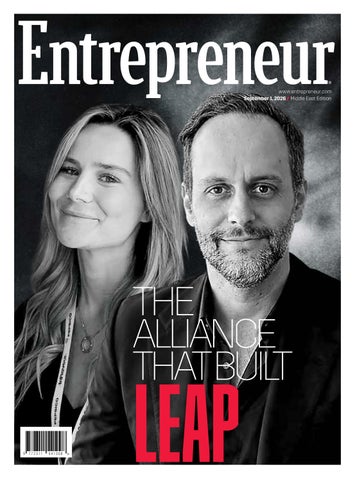
www.entrepreneur.com September 1, 2026 Middle East Edition
THE ALLIANCE THATBUILT
LEAP
Contents
September 1, 2026
CEO Wissam Younane wissam@bncpublishing.net MANAGING DIRECTOR Rabih Najm rabih@bncpublishing.net ART DIRECTOR Simona El Khoury EDITOR IN CHIEF Tamara Pupic tamara@bncpublishing.net EDITOR AT LARGE Anil Bhoyrul anil@bncpublishing.net SENIOR FEATURES EDITOR Aalia Mehreen Ahmed aalia@bncpublishing.net JUNIOR EDITORIAL ASSISTANT Kristine Erika Agustin kristine@bncpublishing.net DIRECTOR OF INNOVATION
Sarah Saddouk sarah@bncpublishing.net
↑ HRH Princess Lamia bint Majid Al Saud
8 The Alliance That Built LEAP
MIKE CHAMPION and ANNABELLE MANDER on building LEAP into a
global stage for AI, investment, and innovation.
23 RAWAN ALFAR, co-founder and Technical Director, Nomadroid Studio 24 NADEEM BAKHSH , co-founder and CEO, webook.com 25 JONATHAN SIDDHARTH , founder
HEAD OF PARTNERSHIPS
Samir Glor Samir@bncpublishing.net
32 ALEX ZHAVORONKOV, founder and CEO, Insilico Medicine 33 HRH PRINCESS LAMIA BINT MAJID AL SAUD, Secretary General,
Alwaleed Philanthropies
34 DR. LISA SU, Chair and CEO,
37 MOHITJOSHI, CEO and Managing Director, TECH MAHINDRA
CEO, cardoO
29 AMAN MERCHANT , founder and
38 QASAR YOUNIS, co-founder and CEO, Applied Intuition 39 JF GAUTHIER, founder and CEO, Startup Genome
General Partner, ReimaginED Collective
40 AMAL DOKHAN, Managing Partner, MENA 500 Global
30 AMIT JAIN , co-founder and
41 DANNY TANG , co-founder and
CEO, Luma AI
31 ESTHER WONG , co-founder and CEO, 3C AGI Partners
COUNTRY MANAGER KSA
Amjad Fakhouri amjad@bncpublishing.net
Chief AI Officer, Accenture
26 OMAR TAHBOUB , co-founder and CEO, Engagesoft
28 AHMED ADEL , founder and
COMMERCIAL LEAD
Anna Chipala anna@bncpublishing.net
35 ABIR HABBAL, Middle East 36 TAREQ AMIN, CEO, HUMAIN
CEO, Salla
BUSINESS DEVELOPMENT DIRECTOR
Andy Soulahian andy.soulahian@bncpublishing.net
AMD
and CEO, Turing
27 NAWAF HAREERI, founder and
GROUP SALES DIRECTOR – B2B GROUP Joaquim D’Costa jo@bncpublishing.net
CEO, Hero Esports
42 RAYAN ALAQL , CEO, NHC
Innovation
2 / E N T R E P R E N E U R . C O M / September 1, 2026
SUBSCRIBE
Contact subscriptions@bncpublishing.net to receive Entrepreneur Middle East every issue
COMMERCIAL ENQUIRIES sales@bncpublishing.net
ENTREPRENEUR.COM
Access fresh content daily on our website
EntMagazineME
Entrepreneur-me
PO BOX 502511 DUBAI, UAE P +971 4 4200 506
All Rights Reserved 2026. Opinions expressed are solely those of the contributors. Entrepreneur Middle East and all subsidiary publications in the MENA region are officially licensed exclusively to BNC Publishing in the MENA region by Entrepreneur Media Inc. No part of this magazine may be reproduced or transmitted in any form or by any means without written permission of the publisher. Images used in Entrepreneur Middle East are credited when necessary. Attributed use of copyrighted images with permission. All images not credited otherwise Shutterstock. Printed by United Printing and Publishing.
PROPERTIES solproperties.ae 800-765-1
Learn More
Welcome to LEAP 2026/
E
ntrepreneur Middle East is proud to support LEAP 2026, one of the world’s largest technology conferences, returning to Riyadh, Saudi Arabia from August 31 to September 3, 2026, at RECC Malham. Launched in 2022, LEAP has grown at a pace few events in any industry can match, now drawing hundreds of thousands of attendees, global tech brands, investors, and speakers to a single stage for four days of conversation on artificial intelligence, digital transformation, startups, and the technologies shaping what comes next. This year marks LEAP’s fifth edition, and with it, a deeper claim on its place as the definitive meeting point between Saudi Arabia’s ambitions and the world’s technology industry. This special edition is our way of marking that moment. At its center is an in-depth profile of Mike Champion and Annabelle Mander, co-founders of LEAP and the driving force behind Tahaluf, the joint venture between Informa PLC, the Saudi Federation for Cybersecurity, Programming and Drones (SAFCSP), and the Events Investment Fund (EIF) that built LEAP from the ground up. We trace how a five-person startup became a 300-strong global operation in the span of a few years, and what that growth says about Saudi Arabia’s broader economic trajectory, one increasingly defined by its ability to attract capital, talent, and technology at scale. Champion and Mander’s story is, in many ways, a case study in how conviction and timing can turn a bold idea into national infrastructure. Beyond that, we spotlight 20 of the most interesting entrepreneurs and speakers taking the stage at LEAP this year, founders and voices working across AI, fintech, cybersecurity, and beyond, each offering a different lens on where the region’s technology ecosystem is headed. As Riyadh once again becomes the meeting point for founders, investors, and innovators from across the globe, we hope this edition captures not just the scale of LEAP, but the substance behind it.
4 / E N T R E P R E N E U R . C O M / September 1, 2026
6 / E N T R E P R E N E U R . C O M / September 1, 2026
September 1, 2026 / E N T R E P R E N E U R . C O M / 7
→ LEAP 2025 , a meeting place for visionaries, creators and pioneers in technology. In 2025, more than 201,000 people from around the world came together in Saudi Arabia to push boundaries and reimagine what’s possible.
THE ALLIANCE THATBUILT
LEAP
MIKE CHAMPION AND ANNABELLE MANDER ON BUILDING LEAP INTO A GLOBAL STAGE FOR AI, INVESTMENT AND INNOVATION b y TA M A R A P U P I C
8 / E N T R E P R E N E U R . C O M / September 1, 2026
September 1, 2026 / E N T R E P R E N E U R . C O M / 9
F
rom August 31 to September 3, 2026, RECC Malham in Riyadh will once again host the world’s biggest names in AI, investment and innovation. Behind the keynotes and the crowds are the people who turned an idea into the world’s most attended technology event: LEAP co-founders Mike Champion and Annabelle Mander, alongside their partners at the Ministry of Communications and Information Technology (MCIT) and the Saudi Federation for Cyber Security, Programming and Drones (SAFCSP). Under the vision of His Excellency The Minister of Communications and Information Technology Eng. Abdullah Alswaha, this partnership has driven Tahaluf, a joint venture between Informa PLC, SAFCSP and the Events Investment Fund (EIF), from a five-person startup in 2022 into a 300-strong global operation generating over US$250 million in revenue, with 35% growth in 2025 alone. Along the way, the partnership didn’t just build LEAP. It built Money 20/20, BH, DeepFest and LEAP — four category-defining events in under five years. “Across 2023 to 2025 our events generated US$17.6 billion of economic impact, and that is a deliberately conservative number,” says Champion. “Most organizers use a multiplier of five. We use two. We still added more than US$10 billion of property transactions completed on the show floor itself, and well over a quarter of a million jobs created through our activity over those three years.
“Put US$17.6 billion in context. The FIFA World Cup in Qatar was around US$17 billion and the Paris Olympics around US$11 billion. Those are single moments that then move on. What we are building stays, and it recurs. That is the real measure.” For this special edition, Entrepreneur Middle East sat down with Champion and Mander to go behind the scenes of a five-year sprint, and what it means for Saudi Arabia’s economic future. Back in 2022, when Champion and Mander began sketching out LEAP, they weren’t newcomers placing a bet on an unproven market. Before co-founding LEAP, Champion had worked in the events industry since 2010, starting his career at IQPC, a global producer of more than 1,500 events annually. A British business leader and international events strategist educated at King’s College London, he went on to lead Informa’s Saudi operations, where he grew annual revenue from US$2 million to US$180 million in four years, or US$265 million in five years —groundwork that positioned him to co-create LEAP in 2022.
M
ander’s path to Tahaluf began early: she credits a planned two-day stopover in Dubai at 21, which turned into more than a decade in the region, for her introduction to the Middle East business world. She entered the industry through roles as Sales Manager at Dubai World Trade Centre and later Group Director at Informa Markets, before steadily rising through the ranks at Tahaluf. She stepped into her first significant leadership role at the outset of the COVID-19
10 / E N T R E P R E N E U R . C O M / September 1, 2026
→ Mike Champion Founding Chief
Executive Officer of Tahaluf and co-founder of LEAP.
“ ACROSS 2023 TO 2025 OUR EVENTS GENERATED US$17.6 BILLION OF ECONOMIC IMPACT, AND THAT IS A DELIBERATELY CONSERVATIVE NUMBER,” SAYS CHAMPION. pandemic in early 2020, when she had to convince internal stakeholders that it was the right time to scale operations in Saudi Arabia despite the global slowdown—a bet that laid the foundation for LEAP’s 2022 launch. It started with a read on the market that few others in the global events industry had made. “Quite simply, we saw the opportunity. I have 15 years’ experience working on events in this region and I have never seen a market upscale as quickly as Saudi Arabia,” Champion says. “His Excellency The Minister of Communications and
Information Technology Eng. Abdullah Alswaha asked us to build a world-class event for the Kingdom, and we could have built something safe. Instead, we agreed to build something with immediate global impact. The opportunity nobody else had spotted was simple. If a government is prepared to move at the speed Saudi Arabia was prepared to move, you can compress 20 or 30 years of growth into one or two. Mander adds, “From the earliest conversations, we wanted to connect the Kingdom directly to global capital, companies, talent and ideas. What
by ABY SAM THOMAS
was extraordinary was the alignment and willingness to think at scale from day one. There wasn’t a blueprint to follow, so collectively we built one. Five years later, seeing that Saudi-created platform expand internationally through LEAP East is something I’m incredibly proud of.” For Champion, the case for Saudi Arabia as the next global destination for world-class business events was never about the money. It was about alignment. “When we set out the blueprint for LEAP, the government did not just listen to our private-sector advice, it
doubled down on it. It was the first time in my career I had worked with a government that behaved like a partner rather than a regulator,” he explains. “Once I saw that, the destination question answered itself. Give a place that kind of coordination and it does not just become a good market - it becomes the market.” Another technology conference was never the goal. From day one, Mander wanted LEAP to have consequence. “Scale is impressive, but scale without outcomes is ultimately just a large event,” she says. “We wanted companies to enter the Saudi market, founders to raise
September 1, 2026 / E N T R E P R E N E U R . C O M / 11
“I’m enormously proud of what LEAP has become, but perhaps more proud that the original principle has survived the growth: everything we build has to create measurable value for the Kingdom, the industry and the people who put their trust in us.”
→ Annabelle Mander Executive Vice President of Tahaluf and co-founder of LEAP.
12 / E N T R E P R E N E U R . C O M / September 1, 2026
“ WE GIVE T PEOPLE REAL RESPONSIBILITY, PERMISSION TO CHALLENGE US AND SPACE TO MAKE DECISIONS. INNOVATION BECOMES VERY DIFFICULT WHEN EVERYTHING REQUIRES PERMISSION FROM THE TOP,” capital, investors to find opportunities and partnerships to exist because LEAP happened. That thinking shaped the original proposition we built with MCIT and SAFCSP, and it still shapes our decisions today.
“
I’m enormously proud of what LEAP has become, but perhaps more proud that the original principle has survived the growth: everything we build has to create measurable value for the Kingdom, the industry and the people who put their trust in us.”
he partnership behind LEAP didn’t begin with Tahaluf—it started years earlier. Champion had already worked alongside Mander for around five years before the company’s founding, and had seen enough to recognize a great leader with the potential to become an exceptional one. Bringing that kind of talent into Tahaluf, he knew, would be one of the most important moves he could make in the company’s earliest stages. “What Annabelle brings to Tahaluf is somebody that I can trust to build an exceptional and kind culture in which people are rewarded well and fairly, as well as being recognized and enfranchised,” he says. “And once you have those sorts of conditions in the business, you’re able to foster a team that is motivated because they have a sense of purpose…. Annabelle is exceptionally good at creating this and when you have this type of person in your team, you can focus yourself on different aspects of the business in order to grow it faster.” Mander’s philosophy is simple: happy, empowered teams do their best work. But that doesn’t mean easing off on standards. For her, it’s about building an environment where people genuinely love what they do, while still holding the bar exceptionally high. “We give people real responsibility, permission to challenge us and space to make decisions. Innovation becomes very difficult when everything requires permission from the top,” she says. “Mike has always encouraged me to take bigger risks, but equally to remain authentic in how I lead. What makes me proudest today is
September 1, 2026 / E N T R E P R E N E U R . C O M / 13
that so many of the ideas changing LEAP don’t come from Mike or me. They come from people across our team who feel genuine ownership of what we’re building.” Every strong partnership has its share of healthy disagreement, and asked how the two of them challenge each other to make LEAP better each year, Champion points to trust. “Friendship and trust are key,” he says. “When you trust somebody, you are able to let them get on with their work, knowing the output will be the best that can possibly be delivered.” That trust, he explains, extends across Tahaluf as a whole; the autonomy it creates within different parts of the business is what allows multiple streams to grow quickly and simultaneously, rather than one at a time.
“ IF YOU WANT TO LEAD, INNOVATE AND
M
ander agrees that challenge is essential, not optional. “We absolutely challenge each other, and I think we have to,” she says. “If you want to lead, innovate and remain at the forefront of an industry, you
14 / E N T R E P R E N E U R . C O M / September 1, 2026
REMAIN AT THE FOREFRONT OF AN INDUSTRY, YOU CANNOT SURROUND YOURSELF WITH PEOPLE WHO SIMPLY AGREE WITH YOU.”
cannot surround yourself with people who simply agree with you.” For her, real challenge only comes from mutual respect—and she has plenty of it for Champion. “I welcome his challenges, and equally I will push back when I believe it’s needed. But ultimately, we’re on the same team.” What unites them, she adds, goes beyond the business itself: “We care deeply about what we’re building, and even more about the people building it with us.” Both, she says, work hard to create opportunities for their team,
support their success, and make sure they’re proud to be part of what they’re building. If Champion is responsible for the “why” behind LEAP and Mander for much of the “how,” the two insist their roles overlap in one crucial place: standards. “The overlap is standards,” Champion says. “I care about why we are doing something and Annabelle cares about how, but we are identical on how good it has to be. Neither of us will ship something ordinary. That shared line is where the partnership lives.”
M
ander sees it the same way. “We have different strengths, but ultimately we’re trying to achieve the same thing,” she says. Beyond the ambition for what they’re building, she points to an equal ambition for the people building it—a shared belief in developing talent, creating opportunities, and building teams that are happy, empowered and successful. “We’ll fight incredibly hard to do the right thing by our teams and our partners.” And where it matters most, she adds, their characters align too: “We’re loyal, determined, we care enormously about the people
around us and, when we commit to something, we’ll find a way to get it done. The strengths may be different, but the values and the end goal are very aligned.” LEAP has become one of the fastest-growing technology events in history, but Champion insists the scale was never accidental. “It was always the plan that LEAP should scale way beyond just one conference,” he says. “It was always going to be multiple conferences, with at least 100,000 attendance, and we were always trying to make it the largest debut tech event in history.”
September 1, 2026 / E N T R E P R E N E U R . C O M / 15
T
he real turning point, though, came sooner than expected. On the second day of the very first LEAP, Champion and Mander were invited to the Royal Court and told that what they’d built was exactly what the Kingdom wanted to replicate across other sectors. They were offered two paths: continue as they were, or build a joint venture with the government. “There was only one answer,” Champion says. After a year of negotiation, Tahaluf was born in January 2023. “That was the moment LEAP stopped being an event and became a blueprint.” Today, he notes, more than a third of the events named in cabinet meetings chaired by the King or the Crown Prince belong to Tahaluf—a position no organizer has held before. LEAP is often praised for the experience it creates, and Mander says that’s no accident either. “It is deliberately both,” she explains. “We are obsessive
16 / E N T R E P R E N E U R . C O M / September 1, 2026
about designing the environment, but increasingly our community tells us what needs to exist inside it.” Founders, investors, governments and technology leaders each experience LEAP differently, she says, and it’s Tahaluf ’s job to listen to all of them. “That’s how you evolve from an event into an ecosystem.” In 2026, that evolution takes shape as 16 stages, more than 20 tracks, live technology through the Tech Arena, and an increasingly sophisticated investor and founder program. Her team, she adds, constantly challenges what they did the year before: “Good design creates an impressive event; listening creates one that people feel genuinely belongs to them.” Behind that growth, Champion points to a less glamorous but critical factor: staff retention. “Staff retention is Tahaluf ’s most important driver of growth,” he says. He’s seen the alternative firsthand,
having worked at companies where few people stayed on the same event from one year to the next. “I have seen firsthand how this stultifies growth, because you are always having to relearn the same lessons.” At Tahaluf, he says, retaining top talent over many years has come down to insisting on a strong culture, where people feel empowered and recognized. The payoff compounds over time. “Any mistakes made five years ago are repeated much less, and that is a massive contributor to the growth of the events we have.”
L
EAP has become synonymous with Saudi Arabia’s technology ambitions, and for Champion, the relationship with Vision 2030 runs deeper than parallel timelines. “They are not parallel, they are intertwined,” he says. Tahaluf only runs events that drive a strategic national priority, which means LEAP moves in step with the Kingdom’s own priorities—when Saudi Arabia leans into AI, DeepFest grows alongside LEAP; when it leans into sport, a sports technology
track appears. “We see our events as sitting at the intersection of commerce, diplomacy and politics, which is exactly where a national transformation gets done.” Mander agrees, and traces that alignment back to the vision driving it. “H.E. Eng. Abdullah Alswaha’s vision has always been much bigger than creating a successful technology event,” she says. “It is about building talent, attracting investment and positioning Saudi Arabia as a creator and leader in the global technology economy.” LEAP, in her view, became one platform through which that ambition
September 1, 2026 / E N T R E P R E N E U R . C O M / 17
“ WHEN GOVERNMENT, INVESTORS, GLOBAL
COMPANIES AND ENTREPRENEURS UNDERSTAND THE SAME AMBITION AND CAN ACCESS EACH OTHER DIRECTLY, INNOVATION STOPS BEING THEORETICAL. IT BECOMES EXECUTABLE.” could be accelerated—helped by a rare kind of partnership. MCIT and SAFCSP, she notes, have never behaved like conventional clients; they’ve built alongside Tahaluf as genuine partners, with Faisal Al Khamisi, Chairman of SAFCSP and Co-Chairman of Tahaluf, and Muteb Al Qani, CEO of SAFCSP, central to that journey. “Today you can physically see Vision 2030 happening across LEAP: capital meeting talent, businesses entering the Kingdom and ideas becoming investments.”
H
aving worked extensively with government entities, investors and regulators, Mander points to a specific combination behind Saudi Arabia’s ability to accelerate innovation: alignment, access and speed. “Saudi Arabia has an unusual ability to put the people defining policy, deploying capital and building companies into the same conversation,” she says. “I’ve seen ideas here move from discussion to decision at a pace that would be difficult in many other markets.” LEAP itself, she adds, is a product of that model—MCIT and SAFCSP have worked alongside Tahaluf as partners, not simply stakeholders, and that collaboration has been fundamental to what they’ve built. “When government, investors, global companies and entrepreneurs understand
18 / E N T R E P R E N E U R . C O M / September 1, 2026
the same ambition and can access each other directly, innovation stops being theoretical. It becomes executable.” Mander and Champion launched the Rocket Fuel start-up competition at LEAP with a US$1 million prize fund—at the time, the largest of its kind in the world—and Mander says what excites her most now is the generation of founders it was built for. “Their frame of reference is global,” she says. “The new generation of Saudi founders doesn’t ask whether an idea can succeed here; they ask whether it can lead its category anywhere.” Rocket Fuel, she explains, was built around that belief—giving founders meaningful capital and global visibility without taking equity, because the goal was to accelerate their businesses, not extract value from them. What excites her today is watching the ecosystem mature around that talent, as government, capital, customers and international markets grow increasingly connected. “Saudi Arabia isn’t simply creating more entrepreneurs. It is creating founders with the confidence, capability and support to build globally significant companies from the Kingdom.”
Champion, meanwhile, has watched some of the world’s most prominent CEOs and public figures pass through LEAP, from the leaders of Huawei, HPE, Nokia and Ericsson to names like Thierry Henry, Anthony Joshua and will.i.am.
W
hat surprises them most about the Kingdom, he says, is access. “How open the door is, as most find that the people who can actually say yes are in the room.” Visitors are struck by the
pace and scale of what’s been built in just a few years—and by how much they enjoy being there. “They leave as advocates,” Champion says. More than 145,000 unique business tourists have flown in since Tahaluf was founded, many experiencing Saudi Arabia for the first time. “They go home and tell the real story, which is worth more than any campaign we could run.” Asked how important it is that LEAP creates opportunities not just for global technology giants but for local entrepreneurs,
HARD-WON WISDOM Champion and Mander on the biggest lesson learned about building something extraordinary from the ground up.
}Champion, "The biggest lesson I’ve learned about building something extraordinary is that success is never a solitary achievement. It takes good colleagues, trusted friends and steadfast partners. Anyone who tells you they built something extraordinary singlehandedly is blessed with either an excellent imagination or a remarkably convenient memory!” }Mander, "The biggest lesson I’ve learned about leading innovation is to set the ambition higher than feels comfortable, surround yourself with brilliant people, and create an environment where they feel happy, trusted and empowered enough to build something better than you could have built yourself."
“ OF COURSE, I’M PROUD WHEN THE WORLD’S BIGGEST TECHNOLOGY COMPANIES CHOOSE LEAP, BUT I’M EQUALLY PROUD WHEN A SAUDI FOUNDER SHARES THAT FLOOR, MEETS AN INVESTOR AND LEAVES WITH A CUSTOMER OR FUNDING.”
September 1, 2026 / E N T R E P R E N E U R . C O M / 19
The Tahaluf Team And Partners At LEAP East 2026,
held July 8–10, 2026, at the Hong Kong Convention and Exhibition Centre. The event marked the first time LEAP expanded beyond Saudi Arabia, launching its inaugural Asia edition in partnership with Hong Kong’s Innovation, Technology and Industry Bureau (ITIB) and Saudi Arabia’s Ministry of Communications and Information Technology (MCIT). Organized jointly with the Saudi Federation for Cybersecurity, Programming and Drones (SAFCSP) and backed by entities including STC, NTDP, NHC, PIF and ELM, LEAP East drew more than
25,000 attendees 340 speakers 450 exhibitors from 30 countries and
regions across three days.
20 / E N T R E P R E N E U R . C O M / September 1, 2026
September 1, 2026 / E N T R E P R E N E U R . C O M / 21
Mander calls it fundamental. “Of course, I’m proud when the world’s biggest technology companies choose LEAP, but I’m equally proud when a Saudi founder shares that floor, meets an investor and leaves with a customer or funding.”
T
he real value, she says, lies in bringing those worlds
together—a vision shared by MCIT, SAFCSP and the Tahaluf team from the start. “Global companies bring capital, capability and access; local founders bring ideas, talent and the businesses that will define the Kingdom’s next chapter. If LEAP only attracted famous logos, we would have built a successful exhibition. Creating opportunity between
22 / E N T R E P R E N E U R . C O M / September 1, 2026
those communities is what makes it an ecosystem.” Champion sees it less as separate categories than as one interconnected whole. “I believe that large international businesses, small startups, accelerators, investors and universities are all in many cases intertwined, tethered and interdependent,” he says, “and as a result, only having one part of
the tapestry there leaves an incomplete picture.” What matters most, he adds, is that Tahaluf ’s events reshape the market and create a new gravitational centre—one aligned with the Saudi government’s priority of turning the Kingdom’s startups into unicorns. “We all know the mantra that today’s startup is tomorrow’s multinational company, and LEAP exists to facilitate this.” Tahaluf now oversees a portfolio of world-leading events spanning technology, cybersecurity, healthcare, fintech and real estate, and for Champion, one philosophy runs through all of them. “Tahaluf is in the business of doing large scale, international, strategic events which have the potential to reshape the market,” he says. Each becomes an anchor point where the global community gathers to determine how the year ahead will change their sector—which is why Tahaluf only operates in areas genuinely strategic and aligned with Vision 2030. “We are in the business of bringing hundreds of thousands of people together around subjects that reshape a market—technology with LEAP, fintech with Money20/20 Middle East, healthcare with Global Health Exhibition, real estate with Cityscape Global.” By the end of 2025, that had produced 21 brands, with five more launching in 2026. “Different sectors, same philosophy. If an event does not move something that matters, we do not run it.” For Mander, the lessons carried across the portfolio all trace back to LEAP itself. “LEAP taught us that the most valuable thing you can
build is an ecosystem, not an event,” she says. “Bring government, capital, founders, customers and global industry together, then design deliberately for the outcomes you want them to create.” That philosophy now runs through Money20/20 Middle East, Black Hat MEA and DeepFest—but LEAP East, she says, holds a particular significance. Taking something built in Riyadh and launching its first international edition in Hong Kong marked a defining moment. “We aren’t exporting a copy of a Saudi event; we’re taking a Saudi-created model into another global market and adapting it intelligently.” Watching an idea born in the Kingdom become internationally relevant, she adds, is a source of real pride in her partners and her team.
L
ooking ahead, both Champion and Mander measure success less in numbers than in what those numbers leave behind. Asked what he’d want to define Tahaluf ’s legacy a decade from now, Champion keeps it simple: “I’d like our Saudi government partners to believe we’ve achieved our mission of bringing world class events to the Kingdom and making it a global events hub. And I’d like the colleagues I’ve worked alongside to think of me personally as a good leader and someone they’ve enjoyed working with.” For Mander, LEAP East is proof that legacy is already taking shape. “It represents the next chapter of something we created from the beginning in Saudi
Arabia,” she says. Taking that intellectual property into Hong Kong shows something bigger: that the Kingdom can export globally relevant platforms and ideas, not simply host them. Her approach is to protect the philosophy rather than replicate the format—preserving the DNA that made LEAP work: ambition, ecosystem, commercial outcomes and exceptionally high standards. “Global expansion isn’t about becoming less Saudi. It is about demonstrating that something created here can have relevance and impact anywhere in the world.” And what comes next, both agree, will be judged by a different measure altogether. As content becomes instant and infinite, Mander says, the value of physical events lies in what only happens when people share a room: a founder meets capital, a government attracts investment, a technology is experienced rather than described. “The next
generation of events won’t simply inform an industry,” she says. “They will be judged by the businesses created, capital deployed, relationships formed and decisions made because that community came together.” That, in the end, is the real measure of what Champion and Mander built - a blueprint, born in Riyadh, that the rest of the world is now watching.
WHAT'S POSSIBLE Champion and Mander on what they want every LEAP visitor to walk away believing about Saudi Arabia and the future of technology.
}Champion, ”I hope they leave believing the door is open. That Saudi Arabia is not a story they were told but a place they have now seen move faster than anywhere else on earth. If they arrived wondering whether the ambition was real, I want them to leave certain it is and slightly annoyed they did not come sooner." }Mander, "I hope they leave believing that world-class ideas can be created here and exported from here. H.E. Eng. Abdullah Alswaha gave us an extraordinary ambition at the beginning: create something worthy of where Saudi Arabia intended to go, not simply where it was at the time. Together with MCIT, SAFCSP and an incredible team, we built against that ambition. Five years later, more than 200,000 people come together around LEAP and the platform has expanded from Riyadh to Hong Kong. I’m incredibly proud to have been part of creating it, but prouder of the people who have built it. If LEAP demonstrates what’s possible when vision, partnership and empowered teams come together, that’s a legacy worth building."
September 1, 2026 / E N T R E P R E N E U R . C O M / 23
T H E N E X T I N T E L PAG E S A R E B R O U G H T TO YO U BY
FIND OUT MORE ON
LUCIDITYINSIGHTS.COM 24 / E N T R E P R E N E U R . C O M / September 1, 2026
T H I S F U L L R E PO RT W I L L B E C O M I N G O U T
IN AUTUMN 2026
SPECIAL REPORT 2026
THE STATE OF UNICORNS
SAUDI ARABIA Mapping the Rise of KSA’s $20Bn+ Unicorn Economy
LucidityInsights.com
September 1, 2026 / E N T R E P R E N E U R . C O M / 25
SAUDI ARABIA’S UNICORNS Saudi Arabia’s eight unicorns represent more than a set of high-growth companies. They reflect the emergence of a system where capital, regulation, and market demand are aligned to enable rapid scaling . Together, these companies illustrate a shift from isolated success stories to a more structured model of company building. Their evolution provides insight into how scale is achieved in the Kingdom, and how the foundations of a repeatable startup ecosystem are beginning to take shape.
26 / E N T R E P R E N E U R . C O M / September 1, 2026
Startup Name HQ Location
Noon Riyadh, Saudi Arabia
STC BANK Riyadh, Saudi Arabia
JAHEZ Riyadh, Saudi Arabia
Almosafer Riyadh, Saudi Arabia
Tabby Riyadh, Saudi Arabia
Tamara Riyadh, Saudi Arabia
Rasan Riyadh, Saudi Arabia
Ninja Riyadh, Saudi Arabia
Founding HQ
Current HQ
Decacorn
UAE
KSA
Transplant-in 0.4 years
Unicorn
KSA
KSA
Homegrown
3.6 years
Alumni
KSA
KSA
Homegrown
5.6 years
Alumni
KSA
KSA
Homegrown
10.2 years Sep 13, 2022
Unicorn
UAE
KSA
Transplant-in 4.3 years
Nov 1, 2023
Unicorn
KSA
KSA
Homegrown
3.5 years
Alumni
KSA
KSA
Homegrown
Unicorn
KSA
KSA
Homegrown
Status
HQ Journey
Time to Unicorn
Became a Unicorn on
Total Fundraised
Last Reported Lates Known Stage Valuation
Valuation as of
Nov 13, 2016
$3.2B
PE Round
$10.0B
Dec 15, 2025
Nov 22, 2020 $306M
Private
$721M
Nov 23, 2020
Feb 5, 2022
IPO
$2.4B
Feb 5, 2022
undisclosed Acquired
$1.0B
Sep 13, 2022
$1.9B
Series E
$3.3B
Feb 12, 2025
Dec 18, 2023
$3.2B
Debt Financing
$1.0B
Dec 18, 2023
9.0 years
Jun 13, 2024
$24M
IPO
$1.2B
Jul 9, 2024
3.0 years
Jul 2, 2025
$284M
Pre-IPO
$1.5B
Jul 2, 2025
$77M
September 1, 2026 / E N T R E P R E N E U R . C O M / 27
A SPECIAL REPORT / THE STATE OF UNICORNS: SAUDI ARABIA
HOW SAUDI ARABIA ENGINEERED ITS OWN UNICORN BOOM Saudi Arabia’s unicorn ecosystem did not emerge by chance; it was constructed with intent.
Collectively, these eight companies have raised nearly US $10 billion and command a combined valuation of approximately US $21.4 billion at the time of publishing. These figures are significant, but they are not what makes Saudi Arabia’s ecosystem noteworthy. The distinction lies in how these outcomes were achieved. Unlike more mature ecosystems,
In less than a decade, the Kingdom has produced six verified homegrown unicorns, alongside two regional transplants alongside two regional transplants that relocated their headquarters from Dubai to Riyadh.
where startups scale through cycles of iteration, failure, and capital accumulation, Saudi Arabia’s model compresses that timeline. Capital, regulation, infrastructure, and demand have been deployed in parallel rather than sequentially. The result is an ecosystem where scale is accelerated through design rather than discovered over time.
SAUDI ARABIA’S UNICORNS, BY BIRTH YEAR
8 UnicornS Born
$10.0B
$1B
(e-Commerce)
(Fintech)
2016
2017
2018
2019
2020
2021
$1.5B
$1.2B
$1.0B
$3.3B
$1B
$2.4B
(Q-Commerce)
(Insurtech)
(Fintech)
(Fintech)
(Traveltech)
(Foodtech)
2025
2024
2023
2023
2022
2022
Source: Lucidity Insights Regional Unicorn Tracker Note: stc pay became STC Bank in 2025
28 / E N T R E P R E N E U R . C O M / September 1, 2026
A SPECIAL REPORT / THE STATE OF UNICORNS: SAUDI ARABIA
Engineered, Not Emerged Saudi Arabia’s startup ecosystem is best understood as a coordinated system rather than an organic evolution. The launch of Vision 2030 in 2016 marked a structural inflection point, triggering a synchronized buildout of institutional capital, regulatory frameworks, digital infrastructure, and demand. Entities such as the Saudi Venture Capital Company, Jada Fund of Funds, Public Investment Fund, and Sanabil Investments ensured capital was available across the startup lifecycle from day one.
In parallel, regulators including the Saudi Central Bank and Capital Market Authority Saudi Arabia introduced sandboxes, licensing frameworks, and updated company laws that reduced friction for startup formation. This was matched by rapid digital infrastructure expansion. Saudi Arabia was among the earliest countries to deploy 5G at scale, beginning in 2019, positioning the Kingdom at the forefront of next-generation connectivity. Today, internet penetration exceeds 98%, and Saudi Arabia is among the world’s most mobile-connected societies, with mobile penetration reaching 140% in 2025, and near universal smarphone adoption estimated to be between 95–98% among adults. With more than 60% of the population under 35, and 85% of the country urbanized and living in a handful of big cities including Riyadh (>8M), Jeddah (>5M), Dammam (2.8M), and Makkah (2.2M), Saudi Arabia has one of the most tech-native consumer bases globally.
September 1, 2026 / E N T R E P R E N E U R . C O M / 29
A SPECIAL REPORT / THE STATE OF UNICORNS: SAUDI ARABIA
VISION 2030: THE ENGINE OF SAUDI ARABIA’S STARTUP ECOSYSTEM Saudi Arabia’s Startup Ecosystem Is Policy-Orchestrated, With Capital, Regulation, And Demand Aligned Simultaneously
30 / E N T R E P R E N E U R . C O M / September 1, 2026
A SPECIAL REPORT / THE STATE OF UNICORNS: SAUDI ARABIA
CAPITAL FORMATION
REGULATORY INFRASTRUCTURE
• Saudi Venture Capital Company (SVC) • Jada FoF (~$1B mandate) • Public Investment Fund (PIF) • Sanabil Investments
• Fintech Sandbox (SAMA) • CMA Fintech Lab • Companies Law (2022) • Payment Service Provider regulations
• Anchored early-stage and growth capital availability
• Reduced barriers to entry and enabled experimentation
National transformation agenda driving entrepreneurship and innovation
DIGITAL INFRASTRUCTURE • Internet penetration above 90% • Cloud infrastructure expansion • Digital payments ecosystem • Logistics and mobility investments
MARKET DEMAND • Young population with majority under 35 • High consumption economy • Rapid smartphone adoption • Shift toward digital services • Large, ready domestic market for platform scaling
• Created scalable digital backbone for startups
ECOSYSTEM OUTPUTS STARTUP FORMATION
$3.21B
$3.2B
VC FUNDING GROWTH (~$1.7B)
UNICORN EMERGENCE
SECTOR CONCENTRATION
SAUDI ARABIA’S MOST FUNDED STARTUPS TO DATE (H1 2026)
$2.2B $1.85B $775M
Fintech
E-commerce
Aviation
$721M $628M
Logistics
Q-commerce
$440M $284M $212M $208M $186M
Grocery on Demand
Foodtech SaaS
$176M
Flower Delivery
Source: Lucidity Insights research and analysis, Vision 2030, company disclosures
September 1, 2026 / E N T R E P R E N E U R . C O M / 31
This readiness is reflected in behaviour. Saudi Arabia ranks among the top YouTube markets globally by watch time per capita, with over 90% of internet users active on the platform. Social media usage exceeds 80%, reinforcing a mobile-first, content-driven economy where engagement is both habitual and highfrequency. These indicators place Saudi Arabia on par with developed digital markets and provide a strong foundation for digital-first business models. However, financial system maturity remains comparatively lower. According to the World Bank Global Findex, approximately 79% of the Saudi population is banked, while digital payments adoption has grown quickly in recent years with 85% of total retail payment transactions in 2025 having been digital (up from 79% in 2024). This is a remarkable feat, as Saudi Arabia’s Vision 2030 had set-out to hit the 80% of all transactions in the Kingdom to be cashless by 2030, and they achieved this target five years ahead of schedule. The implication is clear. Market readiness enabled adoption, but it did not drive the speed of unicorn creation. That acceleration came from coordination. These dynamics did not evolve independently. They were orchestrated under Vision 2030, aligning infrastructure, policy, and demand simultaneously, creating a system where connectivity, consumption,
32 / E N T R E P R E N E U R . C O M / September 1, 2026
SAUDI ARABIA’S DIGITAL PAYMENTS ADOPTION HAS REACHED GLOBAL-LEADING LEVELS 90%
85% 79%
80%
70%
70% 60%
57%
62%
50% 40% 30% 20% 10% 0%
2021
2022
2023
2024
2025
Share of Retail Transactions Conducted Electronically
Source: SAMA data, Lucidity Insights Research
and capital reinforce one another—enabling not just digital adoption, but sustained scaling at speed. By 2022, this coordinated approach translated into tangible outcomes, with venture funding surpassing US $1 billion annually. By 2025, funding reached approximately US $1.7 billion across more than 250 deals, positioning Saudi Arabia as the largest venture capital (equity) market in MENA for the 3rd year in a row. This is not the result of gradual ecosystem maturity; it is the outcome of deliberate system design.
Capital & Maturity Drives Speed In most markets, capital follows traction; in Saudi Arabia, it precedes it. The Kingdom’s unicorns reach scale at a materially faster pace than both regional and global peers. The average time to unicorn in Saudi Arabia is approximately 4.8 years, placing it ahead of more mature emerging ecosystems such as the United Arab Emirates (5.9 years) and significantly faster than India (7.7 years), Israel (7.9 years), and Turkey (8.5 years). Admittedly, the pace of birthing unicorns has sped up over the past few years, and is only expected to
accelerate with the introduction of artificial intelligence and machine learning in the development of startups and their product offerings. Thus, it makes sense that Saudi Arabia’s unicorns are amongst the fastest unicorn producers, being one of the newest startup ecosystem hubs. Though Noon was birthed in 2016, and STCbank (formerly STCpay) in 2020, Saudi Arabia’s first traditional homegrown startup unicorn was born in 2022 (Jahez), just three and half years ago. Compare that to the UAE, that birthed its first unicorn in 2010 (Network International Payment), and its first traditional homegrown startup unicorn in 2016 (Souq.com). India’s
first unicorn, InMobi, was birthed in 2011, while Turkey’s first unicorn, Peak Games, was birthed in 2020.
AVERAGE TIME TO UNICORN BY COUNTRY
12 yrs
130 109
10 yrs
100 7.7
8 yrs
7.9
8.5 80
5.9
6 yrs
60
4.8 40
4 yrs 27 17
2 yrs
20
8
8
KSA
Turkey
0 yrs
0 UAE
India
Avg. years to unicorn
Israel No. of unicorns
Source: Lucidity Insights’ Regional Unicorn Tracker (data extracted 25 May 2026)
September 1, 2026 / E N T R E P R E N E U R . C O M / 33
This dynamic becomes clearer when examining distribution. Approximately 70% of Saudi unicorns reach the US $1 billion threshold within five years, compared to roughly 30% in Turkey and an even smaller share in longercycle ecosystems such as India. The implication is structural. In Saudi
Efficiency Still Diverging Speed, however, has introduced variability in capital efficiency. Despite a relatively small cohort, Saudi Arabia’s unicorns display a wide dispersion in how effectively capital is converted into enterprise value. At one end of the spectrum, Noon represents a capital-intensive model, where funding levels approach or exceed
This stands in contrast to Turkey, where unicorns tend to cluster more tightly around capital-efficient models, regardless of what sector the company is building in. Saudi Arabia, by comparison, remains in an exploratory phase, where different scaling strategies are still being tested in parallel.
VENTURE CAPITAL FUNDING, 2020-2025 ACROSS KSA, UAE, TURKEY, AND EGYPT 2021
2020
#of txns
211
309
302 254
301
127
75
140
134
4,366
97
2022
143
100
192
2023
209
200
2024
65
120
59
507
502 424
16
19
2025 YTD Aug
27
29
29
7
21
11
4,306
3,842
2,953
1,910 1,545
1,791
1,351
1,640
1,155 808
654
488
354 87 2020
2021 2022 2023 2024 2025*
2020
2021
UAE
2022
2023 2024 2025*
KSA
2020
2021
2022 2023
2024 2025*
EGY
Source: Lucidity Insights Data & Analysis
Arabia, speed is enabled through coordinated capital deployment and system design, rather than emerging organically through prolonged iteration.
initial valuation, supported by deep institutional backing. At the other end, Jahez demonstrates a more efficient pathway, achieving scale and public market access with comparatively modest capital deployment.
At the company level, this pattern holds. Noon entered the market at scale, supported by sovereign-backed capital from inception. Ninja reached unicorn status in roughly two years, reflecting both demand and capital availability. Even longer-cycle cases, such as Rasan at approximately seven years, remain competitive when benchmarked against ecosystems like India, where time-to-scale is structurally longer. Saudi Arabia does not wait for startups to grow into scale; it funds them into it.
Between these extremes, companies such as Tabby and Tamara operate within capital-heavy fintech models (Buy-NowPay-Later), where growth is driven by lending and balance sheet expansion, while Ninja (quick-commerce) and Rasan (insurtech) occupy a more balanced middle ground. This spread suggests that the ecosystem has not yet converged on a dominant scaling model. Instead, it is simultaneously supporting multiple approaches, prioritising speed and market capture over capital discipline.
34 / E N T R E P R E N E U R . C O M / September 1, 2026
657 10
10
7
78
2020
2021 2022 2023 2024 2025*
MOR
24
35 2020
123 2021
CAPITAL EFFICIENCY DISTRIBUTION Number of unicorns per capital efficiency tier, by country - from capital-intensive to extreme efficiency
8
7
Number of Unicorns
7 6
5
5 4
3
3
2
2
2
3 2
2
2 1
1 0
1
0
0
0
Capital Intensive
Capital Heavy
Balanced
Capital Efficient
0
Extreme Efficiency
Source: Lucidity Insights Research and Analysis
Sector Focus Persists Saudi Arabia’s unicorn landscape is highly concentrated, reflecting a demand-led approach to scaling. Fintech accounts for approximately half of all unicorns, driven largely by the rapid adoption of buy-now-paylater platforms such as Tabby and Tamara, and telecom-backed digital payments player STC bank (formerly STCpay). The remaining companies are concentrated in e-commerce, food delivery, logistics, and insurtech, each representing dominant players within their respective verticals. These sectors share a common characteristic: high transaction frequency and immediate revenue visibility, making them well suited to capital-driven scaling. While this concentration has enabled rapid growth, it has also limited diversification. Compared to ecosystems such as Turkey, where unicorns span gaming, SaaS, fintech, and marketplaces, Saudi Arabia remains
heavily skewed toward consumptiondriven models. The current pipeline reinforces this trend, with late-stage startups clustering in the same sectors
as existing unicorns. This suggests that the system is replicating proven models rather than expanding into new domains, at least in the near term.
September 1, 2026 / E N T R E P R E N E U R . C O M / 35
Exits Lag Creation Saudi Arabia’s startup ecosystem is beginning to produce what every emerging technology market ultimately needs to validate itself: exits. Not just funding rounds or unicorn valuations on paper, but real liquidity events that recycle capital, create founder wealth, and prove that venture-backed companies in the Kingdom can mature into public-market businesses. That transition is now underway. Saudi Arabia is also no longer theorizing about tech IPOs. It is producing them. Between 2020 and 2025, the Kingdom generated four venture-backed technology IPOs: Jahez (2022), Solutions by STC (2021), Rasan (2024), and Nice One (2025). Together, they represent a broad cross-section of Saudi Arabia’s digital economy, spanning food delivery, enterprise technology infrastructure, fintech, insuretech, and e-commerce. Jahez, in particular, marked a watershed moment when it became the first Saudi-born technology startup to list publicly in 2022, with its IPO reportedly oversubscribed 38.8 times. In 2024 alone, the Kingdom hosted 42 of the GCC’s 53 IPOs — nearly 79% of all Gulf listings by volume. While the UAE led the region in total IPO proceeds, driven by a handful of large-cap listings, Saudi Arabia’s dominance in listing count reflects both the depth of its SME pipeline and the broadening base of its public markets. Meanwhile, Nomu, Saudi Arabia’s parallel market for SMEs and high-growth companies, has expanded from just seven listed firms in 2017 to approximately 125 by the end of 2025, creating an increasingly important bridge between venture capital and public markets. Saudi Arabia emerged as one of the fastest-growing stock markets in the world in 2024, and The Saudi Exchange now ranks among the top 10 largest in the world, with a market capitalization of US $2.56 trillion, comparable to the Toronto and Taiwan Stock Exchanges.
36 / E N T R E P R E N E U R . C O M / September 1, 2026
According to a 2026 Endeavor and SVC survey of 30 Saudi-based scale-up founders, 77% are actively considering going public, with 74% targeting an IPO by or before 2028. Even more notably, 91% said they would prefer to list on Tadawul rather than foreign exchanges like Nasdaq or the NYSE, signaling growing confidence in Saudi capital markets as a credible destination for highgrowth technology companies. What makes Saudi Arabia particularly notable is not just the emergence of IPOs, but the scale at which they are occurring. According to Endeavor’s analysis, Saudi Arabia recorded the highest median preIPO valuation among peer emerging markets at approximately $545 million, more than 2.5x the peergroup median. Yet the report also makes clear that important gaps remain. While founder enthusiasm for IPOs is strong, many Saudi startups are still underprepared operationally for life as public companies, particularly around governance, investor relations, enterprise risk management, and equity storytelling. Still, the broader signal is unmistakable: Saudi Arabia’s startup ecosystem is moving beyond the era of startup creation and entering the era of institutional scale. A Replicable System? Saudi Arabia has now demonstrated something few emerging markets can claim: the deliberate construction of a unicorn-producing ecosystem from near-scratch, within a single decade. The architecture is visible — sovereign capital deployed ahead of demand, regulatory reform running in parallel with infrastructure buildout, and a digitally native population ready to absorb what was being built. The results speak for themselves.
Six homegrown unicorns and two transplants – attracted by the exit opportunities Saudi Arabia has on offer, compared to neighboring countries; nearly US $10 billion raised by these 8 unicorns alone, resulting in a combined valuation of US $21.4 billion; and an average time-to-unicorn that outpaces India, Israel, Turkey, and the UAE. But the more consequential question is not whether the system works, but whether it will deepen. The first generation of Saudi unicorns succeeded by addressing the most obvious gaps in a rapidly modernising economy: food delivery, payments, buy-now-pay-later, insurtech. These were high-frequency, high-visibility verticals where capital-driven scaling and strong domestic demand created near-perfect conditions for rapid growth. The model was, by design, replicable — and it was replicated. What comes next is harder. Sustaining an ecosystem requires more than producing unicorns. It requires those companies to endure as institutions — generating founder wealth that recycles back into early-stage capital, developing management depth that can navigate public markets, and expanding into sectors where competitive advantage is built on intellectual property and proprietary technology, not just capital intensity and market timing. Saudi Arabia is beginning that transition. Looking ahead, the IPO pipeline is real, founder confidence in Tadawul is growing, and the infrastructure for exits is increasingly credible. What the Kingdom has built is not a shortcut. It is a scaffold — one that has already proven capable of lifting companies to scale at remarkable speed. Whether that scaffold can now support a broader, more durable structure is the defining challenge of Saudi Arabia’s next decade of innovation.
A SPECIAL REPORT / THE STATE OF UNICORNS: SAUDI ARABIA
September 1, 2026 / E N T R E P R E N E U R . C O M / 37
A SPECIAL REPORT / THE STATE OF UNICORNS: SAUDI ARABIA
SAUDI ARABIA
38 / E N T R E P R E N E U R . C O M / September 1, 2026
• Saudi Arabia becomes the largest venture capital market in MENA for the 3rd year in a row, with approximately US $1.72 billion raised across 257 deals. • Ninja reaches unicorn status following a US $250 million funding round at a US $1.5 billion valuation. • Tabby raises a Series E round that values the company at approximately US $3.3 billion, cementing its position as the most valuable fintech company in MENA. • NiceOne IPOs, listing on Tadawul’s main market in January 2025. • Saudi-backed Scopely acquires Niantic’s gaming business, including Pokémon Go, for US $3.5 billion, reinforcing the Kingdom’s position as a global consolidator in gaming and digital entertainment. • HUMAIN, a full-stack AI infrastructure company and subsidiary of PIF, announces landmark partnerships with NVIDIA, AMD, AWS and xAI – committing to deploy hundreds of thousands of GPUs across Saudi Arabia and the United States. • Jahez transitions from Nomu to the Tadawul Main Market, and acquires 77% stake in Qatari platform Snoonu for US $245M, marking its first cross-border acquisition.
2018
• Amazon acquires UAE’s Souq.com (with significant operations in Saudi Arabia) for approximately US $580 million, marking the region’s first major technology exit and accelerating e-commerce adoption across Saudi Arabia. • Delivery Hero acquires a majority stake in HungerStation, one of Saudi Arabia’s earliest food delivery platforms, in a deal estimated at over US $100 million – one of the Kingdom’s first meaningful startup liquidity events. • The Capital Market Authority (CMA) launches its Fintech Lab, its first structured testing environment for capital market-focused fintech firms. • Nomu, Saudi Arabia’s parallel equity market for SMEs and growth-stage companies, launches with seven listed companies.
2024
• Saudi Arabia's Cabinet formally declares 2026 the Year of Artificial Intelligence in March, elevating AI from a sector priority to a national transformation mandate. • HUMAIN expands its global AI infrastructure footprint, announcing new multi-gigawatt data centre partnerships with Amazon, AMD, xAI, and Global AI — alongside plans to deploy up to 600,000 NVIDIA GPUs across Saudi Arabia and the United States over the next three years. • LEAP 5, held in April in Riyadh, draws over 200,000 attendees, 1,900 investors, and more than 600 startups, with the 2025 edition having catalysed US $14.9 billion in deals and announcements. • Saudi Arabia's Capital Market Authority formally implements the abolition of the Qualified Foreign Investor regime in February, removing the last structural barrier to full foreign participation in Tadawul.
2017
• Vision 2030 launches, establishing the national blueprint for economic diversification, SME growth, and digital transformation. • Monsha’at, the Small and Medium Enterprises General Authority, is established the same year, formalising Saudi Arabia’s SME support architecture. • Noon is announced with US $1 billion in backing from Saudi Arabia’s Public Investment Fund (PIF) and the UAE’s Mohamed Alabbar, entering both Saudi Arabia and the UAE with immediate scale. • Saudi Arabia’s annual startup funding at this point is estimated at less than US $10 million – a baseline that makes the decade ahead all the more significant.
2025
H1 2026 (YTD)
2016
STARTUP ECOSYSTEM KEY MILESTONES • Jada Fund of Funds is launched by PIF with approximately US $1 billion in capital to seed venture and private equity funds. • Fintech Saudi is co-launched by SAMA (Saudi’s Central Bank) and CMA, creating the Kingdom’s first dedicated fintech industry body • SAMA simultaneously introduces its own regulatory sandbox, inviting fintech companies to test new business models in a live market environment. • Saudi Venture Capital Company (SVC) is established as a subsidiary of the SME Bank and the National Development Fund, completing the early institutional capital stack. • The Saudi Venture Capital and Private Equity Association is also founded in 2018, beginning the formalisation of the Kingdom’s investment community
• Funding moderates to approximately US $750 million in line with global venture trends. • Rasan lists on the Saudi Exchange – Tadawul Main Market, marking a significant step forward for public market participation. • Tamara raises a cumulative total exceeding US $500 million, becoming one of the most capitalized private fintech companies in MENA. • Crown Prince Mohammed bin Salman announced the launch of Alat, a US $100 billion PIF-owned sustainable manufacturing and technology company targeting semiconductors, smart devices, AI infrastructure and advanced industrials. • AWS commits US $5.3 billion and plans to develop a new AWS infrastructure region in Saudi Arabia, scheduled for completion in 2026.
• Saudi startup funding reaches approximately US $1.34 billion. • UAE’s Tabby becomes a unicorn after raising at a valuation exceeding US $1.5 billion, and moves it’s Headquarters to Riyadh to prepare for an IPO. • Saudi’s BNPL player Tamara also reaches the coveted US $1 billion valuation. • Noon acquires Namshi for approximately US $335 million, reinforcing regional e-commerce consolidation. • Savvy Games Group, backed by the Public Investment Fund, acquires Scopely for US $4.9 billion, marking Saudi Arabia’s transition from ecosystem builder to global acquirer. • LEAP 2023 draws over 100,000 attendees and sees US $2.4 billion in fund commitments announced • The NEOM Investment Fund makes its first disclosed international technology investment, committing $100 million into Pony.ai, a global autonomous driving company.
2021
• Saudi startup funding reaches approximately US $152 million, despite global pandemic conditions – representing a roughly 20-fold increase from pre-Vision 2030 levels. • Western Union invests up to US $200 million for a 15 percent stake in STCpay, valuing the company at approximately US $1.3 billion and creating Saudi Arabia’s first fintech unicorn. • Payment Service Provider regulations are introduced by SAMA, accelerating the development of licensed digital financial services. • SAMA publishes its Open Banking Policy, signalling the beginning of a framework to enable secure, API-driven financial data-sharing. • Two digital bank licenses are granted to STC Bank and Saudi Digital Bank, marking the beginning of a fully licensed neobank sector.
2022
2020
• Uber acquires UAE’s Careem for US $3.1 billion, the largest technology exit in the MENA region at the time. While UAE-founded, Saudi Arabia was Careem’s largest market, making this a catalytic moment for investor confidence, founder recycling, and mobility sector innovation across the Kingdom. • SAMA accepts its first cohort into the Regulatory Sandbox, formally opening the door for licensed fintech experimentation. • Saudi Payments Company is launched to manage national digital payments infrastructure • The Saudi E-commerce Law is issued, providing the first regulatory framework governing digital commerce in the Kingdom.
2023
2019
A SPECIAL REPORT / THE STATE OF UNICORNS: SAUDI ARABIA
• Venture funding accelerates sharply to approximately US $598 million, driven by increased regional participation and the emergence of growth-stage rounds. Saudi startups begin transitioning from early formation to early scale, particularly across fintech, food delivery, and e-commerce. • The first LEAP Technology conference is held in Riyadh, rapidly establishing itself as the region’s flagship innovation event. • SAMA issues its formal Open Banking Framework, setting out licensing rules, standardized APIs, and consent protocols for a new era of embedded finance. • Solutions STC lists on Tadawul’s Main Market, becoming the first IT and enterprise technology company to go publish in Saudi Arabia.
• Saudi startup funding surpasses US $1 billion for the first time, reaching approximately US $1.02 billion. • Jahez lists on Nomu with a market capitalisation of approximately US $2.4 billion – 38.8 times oversubscribed – becoming the first Saudi-born, venture-backed technology startup to list on a public exchange. • SAMA launches its Open Banking Lab, a dedicated sandbox environment for testing live open banking products. • Foodics raises US $170 million in one of MENA’s largest SaaS funding rounds, to date. • Lean Technologies raises US $33 million led by Sequoia Capital India – the firm’s first-ever MENA investment – signalling growing international institutional interest in Saudi Arabia technology companies. • Jahez acquires The Chefz for approximately $173M, marking one of the first major domestic consolidation plays in the Saudi tech ecosystem. • PIF signs a term sheet to invest in Almosafer at an implied valuation of approximately US $1 billion, marking its transition into a unicorn-scale platform (despite the deal not completing).
September 1, 2026 / E N T R E P R E N E U R . C O M / 39
A SPECIAL REPORT / THE STATE OF UNICORNS: SAUDI ARABIA
TRACKING THE RISE OF THE REGION’S UNICORNS If you’re interested in learning more about the rise of unicorns in the Middle East, Africa, India, Pakistan and Turkey - go to lucidityinsights.com and check out the Lucidity Insight’s Regional Unicorn Tracker: the first live database tracking billion-dollar startups, their founders, fundraising, valuations and exits, across the region.
150+ Unicorns
$500B+ Combined Value
1 LIVE Platform
Tracked across the MEAIPT region
And growing rapidly
Funding • Valuations • Founders • Exits
40 / E N T R E P R E N E U R . C O M / September 1, 2026
A SPECIAL REPORT / THE STATE OF UNICORNS: SAUDI ARABIA
Emerging markets are producing the next generation of global technology companies. Yet much of the data on these ecosystems remains fragmented or overlooked. The Lucidity Insights Unicorn Tracker was built to change that — providing a live, data-driven view of the region’s most valuable startups and the ecosystems behind them.
WHAT YOU CAN EXPLORE Unicorn Companies Funding & Valuation Milestones Fastest Companies to Unicorn Status Regional Startup Ecosystems Emerging Sector Trends Founder Networks & Investor Activity
EXPLORE THE REGION’S UNICORN ECONOMYL SCAN TO ACCESS THE LIVE TRACKER
lucidityinsights.com/unicorn-tracker
September 1, 2026 / E N T R E P R E N E U R . C O M / 41
A SPECIAL REPORT / THE STATE OF UNICORNS: SAUDI ARABIA
#4 TURKEY
8
UNICORNS
#7 EGYPT
1
UNICORN
#6 NIGERIA
6
UNICORNS
#8 SENEGAL
1
UNICORN
AS OF MARCH 6, 2026
42 / E N T R E P R E N E U R . C O M / September 1, 2026
A SPECIAL REPORT / THE STATE OF UNICORNS: SAUDI ARABIA
EXPLORE OUR REGIONAL UNICORN TRACKER ONLINE
#2 ISRAEL
28
UNICORNS
#3 UAE
17
UNICORNS
#1 INDIA
116
UNICORNS
#5 SAUDI ARABIA
8
UNICORNS
#9 SEYCHELLES
1
UNICORN September 1, 2026 / E N T R E P R E N E U R . C O M / 43
THE VOICES SHAPING
LEAP 2026
A
s Riyadh prepares to welcome the world’s technology elite once more, LEAP has always been as much about the people on stage as the platform itself. On the following pages, we spotlight 20 of the most compelling entrepreneurs and speakers set to take part in LEAP 2026 — founders, operators, and thought leaders working across artificial intelligence, fintech, cybersecurity, and beyond. Each brings a distinct vantage point on where the region’s technology ecosystem is heading. Together, they form a portrait of an industry in motion, where breakthroughs in machine learning sit alongside bold experiments in digital finance, and where founders are building not just companies, but entire categories. What unites this group isn’t sector or scale, but a shared conviction that the Middle East is no longer catching up to global technology trends, but actively setting them. Some are already redefining their markets; others are earlier in their journey but already commanding attention. Turn the page to meet them.
44 / E N T R E P R E N E U R . C O M / September 1, 2026
SAUDI ARABIA edge with aspiring game developers. Since 2022, she has been an instructor at DigiPen Academy, teaching game design and programming to students at different levels. Her teaching approach incorporates the Socratic method, encouraging students to develop their own ideas, ask questions and work through problems independently. This work has given her experience in both developing technology and helping others build the skills needed to work in the industry.
RAWAN
Alfar
Co-founder and Technical Director/ NOMADROID STUDIO
RAWAN ALFAR IS THE CO-FOUNDER AND TECHNICAL DIRECTOR OF NOMADROID STUDIO, AN AWARD-WINNING INDIE GAME DEVELOPMENT STUDIO ESTABLISHED IN LATE 2021, AND ONE OF THE FIRST PC AND CONSOLE STUDIOS IN SAUDI ARABIA. ALFAR LEADS THE STUDIO IN CREATING GAMES THAT DRAW ON SAUDI CULTURE AND VALUES WHILE BEING DEVELOPED FOR AUDIENCES BEYOND THE KINGDOM.
ALFAR HAS BUILT A CAREER AROUND TECHNOLOGY AND INNOVATION. HER EXPERIENCE SPANS SOFTWARE DEVELOPMENT, GAME PROGRAMMING, PRODUCT DEVELOPMENT AND ENTREPRENEURSHIP
A
lfar holds a bachelor’s degree in Computer Science from King Saud University and a game programming certificate from DigiPen Institute of Technology. She also completed a full-stack development track through Udacity, expanding her technical experience into web development. In 2026, she earned a master’s degree in innovation and entrepreneurship from Midocean University, complementing her technical training with an academic focus on building and developing ventures. At Nomadroid, Alfar is responsible for leading research and development and translating ideas into functional game products. She oversees the technical direction of its projects and working with Unity and C# to develop interactive gaming experiences. Her work also involves technical planning, programming, and collaboration across the development process, while also contributing to the studio’s direction as a founder. Through Nomadroid, she is part of Saudi Arabia’s expanding gaming sector, where technology and creative development increasingly intersect.
Her involvement in the gaming ecosystem also includes participation and mentorship at industry events and initiatives. Alfar has taken part in programs and events including Global Game Jam, Gameathon and Gamers8, where she has worked alongside developers and emerging teams. These experiences have allowed her to engage with different aspects of game development and contribute technical knowledge to the wider developer community. Beyond her work at Nomadroid and in education, Alfar supports startups as a technical mentor, providing guidance to founders and teams working within the emerging gaming sector. Her mentorship work adds another dimension to her role in the ecosystem, allowing her to support other entrepreneurs as they develop technology-focused businesses and products. Across her work as a founder, developer, educator and mentor, Alfar has built a career around technology and innovation. Her experience spans software development, game programming, product development and entrepreneurship, positioning her within a generation of Saudi technology founders contributing to the growth of the Kingdom’s gaming and digital economy.
Alfar also works in education, sharing her technical knowlSeptember 1, 2026 / E N T R E P R E N E U R . C O M / 45
SAUDI ARABIA He previously served as Senior Vice President (EGM) for Digital & Innovation at Mobily and was schooled in England, building his career across technology, business and entrepreneurship. He holds a Private Equity and Venture Capital, Finance, General certification from Harvard Business School and earned a Master of Science with Distinction in Electronic Technology for Business from the University of Sunderland. As a leader, he advocates for high-performing, multidisciplinary teams that use a lean, scientific approach to innovation. His methodology centers on building, measuring, and learning, allowing teams to test ideas, understand user behavior, and continuously improve products and experiences. He believes emerging technologies, including artificial intelligence, can create greater value when thoughtfully integrated with insights from disciplines such as psychology and economics.
NADEEM
Bakhsh Co-founder and CEO/ WEBOOK.COM
NADEEM BAKHSH IS THE CO-FOUNDER AND CEO OF WEBOOK.COM, A RIYADH-BASED ALL-IN-ONE SOCIAL ENGAGEMENT PLATFORM FOR BOOKING EXPERIENCES, EVENT TICKETS, AND ACTIVITIES ACROSS THE MIDDLE EAST AND BEYOND. THROUGH WEBOOK.COM, BAKHSH IS HELPING TRANSFORM HOW PEOPLE DISCOVER AND ENGAGE WITH ENTERTAINMENT, TOURISM AND SPORTS EXPERIENCES BY COMBINING TECHNOLOGY, INNOVATION AND USER-CENTRIC DESIGN.
A
technology and innovation leader with an international professional and academic background, Bakhsh brings expertise spanning leadership, business, product strategy, digital transformation, user experience, and technology. His approach is grounded in a simple principle: “The Experience Matters.” He is focused on making technology more intuitive and the world more user-friendly by creating experiences that are simple, engaging and accessible.
46 / E N T R E P R E N E U R . C O M / September 1, 2026
At webook.com, this philosophy is reflected in the company’s ambition to create a seamless platform where users can discover and access a wide range of experiences through technology. The platform brings together entertainment, tourism and sports offerings, with a focus on making the process of finding and booking experiences more convenient and engaging. Bakhsh’s role involves shaping the company’s vision and strategy while driving innovation across its products and technology. His experience also covers user research, UX strategy, UX design, usability, process engineering and software development processes. He has worked across business, design, and technical challenges, using rapid and cost-effective approaches to develop solutions and improve digital experiences. His multidisciplinary perspective extends beyond traditional technology and business disciplines. Drawing on interests in psychology, economics and biology, Bakhsh approaches innovation through different lenses, seeking to understand not only what technology can do, but also how people interact with it and what makes an experience meaningful. Through webook.com, he is applying that experience to the Middle East’s growing digital experiences sector, developing technology designed to connect consumers with entertainment, tourism and sports opportunities through a single platform.
SAUDI ARABIA SIDDHARTH COMBINES TECHNICAL EXPERTISE IN MACHINE LEARNING WITH EXPERIENCE BUILDING AND SCALING TECHNOLOGY COMPANIES.
JONATHAN
Siddharth Founder and CEO/ TURING
A
n engineer, serial entrepreneur, and former Stanford AI researcher, Siddharth combines technical expertise in machine learning with experience building and scaling technology companies. His work spans AI research, natural language search, enterprise technology and entrepreneurship, with a focus on turning advances in AI into practical applications. At Turing, Siddharth leads the company’s work across the AI development ecosystem. Turing works with major frontier AI labs to improve capabilities in areas including thinking, reasoning, coding, agentic behavior, multimodality, multilinguality, STEM and frontier knowledge. The company also applies these advances to build and deploy AI systems for enterprises, creating a connection between frontier research and real-world business needs. A key part of Turing’s infrastructure is its talent cloud, an AI-vetted network of more than 4 million software engineers, data scientists, and STEM experts who contribute to model training and AI application development. Turing’s AI-powered platform, ALAN, helps match and manage talent while supporting the generation of human and synthetic data, model and agent evaluations, supervised fine-tuning, reinforcement learning, benchmarking and other processes involved in developing and improving AI systems. Siddharth has described this relationship between frontier AI research and enterprise deployment as the “Superintelligence Loop.” Through real-world deployments, Turing identifies areas where AI models fall short and uses those insights to generate better data and improve model performance, helping create a feedback loop between research, development, and practical applications. Before founding Turing, Siddharth helped pioneer natural language search at Powerset, which was later acquired by Microsoft. He subsequently worked on large-scale AI platforms at Rover, a content discovery engine that was acquired by Revcontent.
JONATHAN SIDDHARTH IS THE CO-FOUNDER AND CEO OF TURING, ONE OF THE WORLD’S FASTEST-GROWING ARTIFICIAL INTELLIGENCE COMPANIES, WHICH IS FOCUSED ON ACCELERATING THE ADVANCEMENT AND DEPLOYMENT OF POWERFUL AI SYSTEMS. BASED IN SAN FRANCISCO, TURING WORKS WITH LEADING AI LABS TO ADVANCE FRONTIER MODEL CAPABILITIES WHILE HELPING COMPANIES DEPLOY AI SYSTEMS TO ADDRESS MISSION-CRITICAL PRIORITIES. 48 / E N T R E P R E N E U R . C O M / September 1, 2026
Siddharth earned a master’s degree in computer science from Stanford University, where he conducted research in machine learning for web search. He received the Christopher Stephenson Memorial Award for Best Master’s Research in Stanford’s Computer Science Department. Beyond his work at Turing, Siddharth is also an angel investor and mentor at Stanford’s StartX startup accelerator, supporting entrepreneurs and earlystage companies
Presented by
MIDDLE EAST
INNOVATION
Forum & Awards
2026
September 17|2026
Al Habtoor Palace Dubai
Recognizing Vision, Leadership, and Innovation in Technology
N O M I N AT I O N S ARE NOW OPEN
September 1, 2026 / E N T R E P R E N E U R . C O M / 49
SAUDI ARABIA
OMAR
TAHBOUB Co-founder and CEO/ ENGAGESOFT
OMAR TAHBOUB IS THE CO-FOUNDER AND CEO OF ENGAGESOFT, A RIYADHHEADQUARTERED AI DATA-DRIVEN EMPLOYEE ENGAGEMENT PLATFORM FOCUSED ON HELPING ORGANIZATIONS RETAIN TALENT AND IMPROVE WORKPLACE PERFORMANCE. ENGAGESOFT CAPTURES EMPLOYEE FEEDBACK IN REAL-TIME VIA QUESTIONNAIRES, AND EMPLOYS PROPRIETARY AI AND STATISTICAL MODELING TO REVEAL PERSONALIZED AND PREDICTIVE INSIGHTS, HELPING ORGANIZATIONS UNDERSTAND EMPLOYEE PERSPECTIVES AND TURN FEEDBACK INTO ACTIONABLE STRATEGIES FOR LASTING CULTURAL AND ORGANIZATIONAL CHANGE.
T
ahboub is an experienced general manager and technology executive with more than 30 years of experience across the information technology and services industry. His career spans engineering, product development and commercial operations, with experience working across both business-to-business and business-toconsumer companies. Before co-founding Engagesoft with his brother Tareq Tahboub in 2021, Tahboub held leadership roles at companies including Oracle, Bayt.com and Sayarah. Over the course of his career, he has led engineering, product and commercial organizations, overseeing teams and operations across different stages of business growth. Throughout his career, Tahboub has helped companies launch operations, new product lines, and pursue growth across technology-driven businesses. His experience covers both technical and commercial functions, allowing him to work across product strategy, engineering, operations and business development. At Engagesoft, Tahboub brings this experience to the workplace technology sector, with a focus on using employee feedback, AI and data analysis to
50 / E N T R E P R E N E U R . C O M / September 1, 2026
help organizations address workforce challenges. With a mission to enable its clients to bring out the best in their employees, the company empowers leaders to build cultures centered on employee voice to drive higher retention, productivity, and sustainable success. Since its establishment, it has surveyed more than 54,000 employees across more than 15 countries and operates across three offices in Jordan, Saudi Arabia, and Egypt. In 2025, Engagesoft raised US$3.5 million in a pre-Series A round led by Silicon Badia, marking its second investment. With more than three decades of experience managing product, engineering and commercial operations, Tahboub has built his career around developing technology businesses, leading multidisciplinary teams, and translating technology into practical business solutions.
NAWAF
Hareeri Founder and CEO/ SALLA
NAWAF HAREERI IS THE FOUNDER AND CHIEF EXECUTIVE OFFICER OF SALLA, A LEADING COMMERCE PLATFORM IN THE GCC, BUILT IN SAUDI ARABIA TO SUPPORT BUSINESSES AND ENTREPRENEURS AT EVERY STAGE OF GROWTH. THROUGH ITS PLATFORM, SALLA PROVIDES MERCHANTS WITH THE TOOLS, SERVICES, AND ECOSYSTEM NEEDED TO BUILD ONLINE STORES, MANAGE OPERATIONS, AND REACH CUSTOMERS.
F
ounded with a focus on simplicity, reliability, and a deep understanding of the local market, Salla aims to help businesses establish and grow lasting brands while creating more seamless commerce experiences for both merchants and shoppers. Under Hareeri’s leadership since 2016, the company has focused on developing technology tailored to the needs of businesses in the region, particularly entrepreneurs navigating the rapidly evolving digital commerce landscape. Hareeri is also the founder of Masareef, a personal finance application designed for users across the Middle East and North Africa. The app turns bank SMS into a clear view of users’ spending and uses artificial intelligence to help them manage their budgets. Available in both Arabic and English, Masareef is designed to make personal financial management more accessible while maintaining a focus on privacy and ease of use. Founded in 2011, the application now has more than 2 million downloads. Across both ventures, Hareeri has focused on building digital products that address practical, everyday needs. His approach centers on simplifying complex processes and
creating technology that is accessible to a broad range of users. At Salla, this means giving entrepreneurs and businesses the infrastructure to establish and manage their digital commerce operations. At Masareef, it means helping individuals better understand their spending and make more informed financial decisions. Hareeri’s work reflects his broader interest in innovation and human-centered technology. He believes simplicity is a foundation of effective digital products and that technology should make tasks easier rather than add unnecessary complexity. As an entrepreneur operating across commerce and financial technology, Hareeri is focused on developing digital platforms that can serve the needs of users in the region while supporting the continued growth of the Middle East’s technology ecosystem. Through his vision and leadership, Hareeri is contributing to the advancement of the Kingdom’s digital economy by building technology that supports entrepreneurs, businesses and consumers, while helping shape a more accessible and innovative digital ecosystem. September 1, 2026 / E N T R E P R E N E U R . C O M / 51
SAUDI ARABIA
AHMED
Adel Founder and CEO/ CARDOO
AHMED ADEL IS THE FOUNDER AND CEO OF CARDOO, A CONSUMER INTERNET OF THINGS (IOT) AND ELECTRONICS BRAND FOCUSED ON MAKING SMART TECHNOLOGY MORE ACCESSIBLE ACROSS THE MENA REGION. A TECHNOLOGY ENTREPRENEUR AND INNOVATOR, ADEL LEADS THE COMPANY’S EFFORTS TO DEVELOP USER-FRIENDLY SMART DEVICES TAILORED TO THE NEEDS OF CONSUMERS IN THE REGION.
U
nder Adel’s leadership, CardoO has emerged as a growing player in the MENA technology market, developing smart gadgets and wearables that combine accessible pricing, localized product development and practical design. The company’s portfolio includes smartwatches, earbuds and other connected devices designed to bring IoT technology into consumers’ everyday lives.
build strategic partnerships and expand across the region. His broader goal is to make connected
Adel oversees CardoO’s overall vision and strategy, product development, growth initiatives, marketing, financial planning and relationships with investors, partners and suppliers. He also leads teams across product development, marketing, sales and customer support, guiding the company’s efforts to launch new products, 52 / E N T R E P R E N E U R . C O M / September 1, 2026
devices and smart solutions more accessible to middle-class consumers in emerging markets while building a competitive regional technology brand. With more than a decade of experience in the technology sector, Adel brings a combination of technical and business expertise to his work. His background spans computer science, quality control, full-stack development, product management, marketing and IoT development. He holds a Master of Business Administration from the Agora Naguib Sawiris School of Business and a Nanodegree in Full Stack Development from Udacity, complementing
his experience in hardware, software and consumer technology. Adel was recognized in Forbes’ 30 Under 30 list for his work as an innovator and technology entrepreneur. Beyond CardoO, he is the co-founder and CEO of The Media, a Cairo-based media production services provider, expanding his entrepreneurial work into media and content. His experience across technology and media reflects his interest in building products and businesses that connect innovation with consumer experiences. Adel is also active in the technology ecosystem as an industry speaker, mentor and advocate for innovation. He shares his experience in entrepreneurship, IoT and consumer electronics while engaging with the broader technology community on the development and adoption of emerging technologies in the region. Driven by an interest in smart technology and human-centered innovation, Adel focuses on developing products that address everyday needs and reflect the demand of regional consumers. Through CardoO and his broader entrepreneurial work, he continues to contribute to the growth of the MENA technology and consumer electronics ecosystem, with an emphasis on making innovation practical, accessible, and relevant to everyday users.
AMAN
Merchant Founder and General Partner/ REIMAGINED COLLECTIVE
M
erchant is the founder and general partner of ReimaginED Collective, MENA’s first ecosystem builder focused on the future of learning and work. The company supports founders and investors through community building, platform design, and angel investing in education technology and Future of Work startups. His work in the sector focuses on bringing together capital, talent and networks to support new approaches to education and workforce development. He is also the Chief Provocateur at Radicle, a strategic innovation lab, where he works with leaders and institutions on moonshot strategies addressing challenges in education, health, and climate. Through Radicle, Merchant applies artificial intelligence, systems thinking and coalition building to help organizations develop strategies for long-term impact. He also advises foundations, family offices, and governments on philanthropic architecture, including endowments, capital vehicles, and giving strategies.
As Managing Director for MENA at 10Pearls, a global AI consultancy with more than 1,400 experts across four continents, Merchant works with enterprises seeking to move from AI experimentation to scalable implementation. His work spans agentic AI, digital transformation and helping organizations translate AI ambitions into practical business outcomes. Alongside his entrepreneurial and
AMAN MERCHANT IS A DUBAI-BASED SERIAL ENTREPRENEUR, FUTURIST, CEO COACH, BOARD ADVISER AND ECOSYSTEM BUILDER WITH MORE THAN 30 YEARS OF EXPERIENCE WORKING AT THE INTERSECTION OF ARTIFICIAL INTELLIGENCE, EDUCATION, INNOVATION AND PHILANTHROPY. ACROSS 12 VENTURES, MERCHANT HAS BUILT AND ADVISED ORGANIZATIONS FOCUSED ON SHAPING THE FUTURE OF LEARNING, WORK AND SOCIETY, WORKING WITH GOVERNMENTS, PHILANTHROPIC INSTITUTIONS, INVESTORS AND FOUNDERS TO TURN EMERGING IDEAS INTO SCALABLE INITIATIVES.
advisory work, Merchant is a CEO coach who works with founders and leadership teams on strategy, performance, and organizational effectiveness. His Entrepreneur Flight Deck framework combines neuroscience, flow science, and high-performance strategy and has been applied through organizations including NYU Abu Dhabi, Maven and the Flow Genome Project. Merchant’s career has included collaborations with organizations such as Dubai Cares, Expo 2020 Dubai, the End Fund and the Abu Dhabi Early Childhood Authority, as well as institutions including Stanford University, Columbia University, the University of Michigan and the Center for Creative Leadership. He has served on the SDG4 Global Council and the XPRIZE Brain Trust and was a member of the investment committee of the US$100 million Expo Live Innovation Fund. He was MENA’s first AVPN Impact Investing Fellow and has also been a fellow of the Material Change Institute and On Deck. He mentors entrepreneurs through London Business School, Techstars, and Founder Institute. Merchant also co-founded Impact Hub Dubai, the UAE’s first social entrepreneurship hub, and has curated more than 50 global events, including Abundance 360, RewirED, and GITEX. He holds a master’s degree in Politics, Philosophy, and Economics
from the University of Oxford and has completed executive education at Stanford Graduate School of Business, London School of Economics, and Harvard University through the YPO Presidents Program. September 1, 2026 / E N T R E P R E N E U R . C O M / 53
SAUDI ARABIA
AMIT JAIN Co-founder and CEO/ LUMA AI
AMIT JAIN IS THE CO-FOUNDER AND CEO OF LUMA AI, A RESEARCH LAB DEVELOPING MULTIMODAL ARTIFICIAL INTELLIGENCE CAPABLE OF GENERATING, UNDERSTANDING, AND OPERATING IN THE PHYSICAL WORLD. SINCE COFOUNDING THE COMPANY IN 2021, JAIN HAS HELPED STEER LUMA FROM AN EARLY FOCUS ON 3D CAPTURE AND COMPUTER VISION INTO ONE OF THE PROMINENT COMPANIES IN GENERATIVE VIDEO AND VISUAL INTELLIGENCE. ITS MODELS, INCLUDING DREAM MACHINE AND THE RAY FAMILY, ARE DESIGNED TO GIVE AI A DEEPER UNDERSTANDING OF MOTION, PHYSICS, VISUAL DETAIL AND THE REAL WORLD.
B
efore Luma, Jain worked across several early-stage technology companies, including Product Hunt and Circle Medical. He subsequently joined Apple in 2017, where he worked as a systems and machine learning engineer in computer vision and camera technologies. At Apple, he was involved in the development of the Passthrough experience for Apple Vision Pro and helped advance the integration of LiDAR technology into the iPhone. His work at the intersection of computer vision, machine learning, cameras, and spatial computing would later inform his approach to building AI systems capable of representing and simulating reality. Jain founded Luma after becoming convinced that advances in machine learning could fundamentally change how computers represent the world and how people create. The company initially developed 3D generative technology before expanding into video. Its Dream Machine platform brought Luma to a much wider audience, allowing users to
54 / E N T R E P R E N E U R . C O M / September 1, 2026
JAIN CONTINUES TO POSITION LUMA AT THE INTERSECTION OF AI, VISUAL COMPUTING AND CREATIVITY, WHILE PUSHING TOWARD APPLICATIONS THAT EXTEND BEYOND MEDIA GENERATION.
generate realistic video from text and image prompts. The company subsequently developed its Ray models, which move beyond simple generation toward video systems capable of reasoning about scenes, motion and visual consistency. In November 2025, the company announced a US$900 million Series C led by HUMAIN, with participation from AMD Ventures and existing investors Andreessen Horowitz, Amplify Partners, and Matrix Partners. The investment was accompanied by a partnership around Project Halo, a planned 2-gigawatt AI supercluster in Saudi Arabia intended to provide the computing infrastructure needed to train and deploy next-generation world models. Jain continues to position Luma at the intersection of AI, visual computing and creativity, while pushing toward applications that extend beyond media generation. His broader vision is for AI systems that do not merely produce convincing images or videos, but develop increasingly sophisticated representations of reality—an approach he believes could eventually transform creative industries, robotics, simulation and the way people interact with intelligent machines.
investment activities have extended beyond core AI software into areas where AI can transform established industries, including robotics, autonomous driving, healthcare, and remote sensing.
WONG IS ALSO A WALL STREET VETERAN WHO HAS HELPED COMPANIES RAISE MORE THAN US$100 BILLION ACROSS THE TMT SECTOR.
ESTHER
Wong CEO and Co-Founder/ 3 C A G I PA R T N E R S
ESTHER WONG IS THE FOUNDER AND CEO OF 3C AGI PARTNERS, AN AIFOCUSED VENTURE CAPITAL FIRM BASED IN HONG KONG THAT TARGETS GLOBAL OPPORTUNITIES IN ARTIFICIAL INTELLIGENCE. THE FIRM FOCUSES PARTICULARLY ON AI INFRASTRUCTURE AND FOUNDATIONAL TECHNOLOGIES THAT IT VIEWS AS THE BUILDING BLOCKS OF THE NEXT PHASE OF THE AI INDUSTRY.
W
ong’s path into AI followed more than two decades in finance and investment banking. Before moving into technology, she held leadership roles at Cazenove, which was acquired by J.P. Morgan, where she became the first Chinese and first woman to serve as head of sales and trading in New York. She also worked in CICC, Barclays and BOCOM International. Wong is also a Wall Street veteran who has helped companies raise more than US$100 billion across the TMT sector
Her transition into artificial intelligence came through SenseTime, where she was among the company’s founding members. Wong joined the company during its early growth and became managing director overseeing strategic investment and capital markets. She led investments and strategic partnerships at SenseTime, helping expand its ecosystem and raise more than US$6 billion in capital. Wong was also an early investor in artificial intelligence, entering the sector before the current wave of mainstream interest in the technology. Her
Her career has also involved building and supporting companies beyond SenseTime. Wong has been involved in the incubation of more than 50 AI startups and has participated in the successful exits of more than 100 companies over the course of her investment career. These investments have included businesses and technologies that contributed to the broader development of today’s AI ecosystem. Wong subsequently turned her attention to venture investing, establishing 3C AGI Partners. The firm’s investment approach centers on the infrastructure and foundational technologies needed to support increasingly capable AI systems. She holds an Executive MBA from the University of Chicago Booth School of Business, and has remained active in Hong Kong’s youth and education ecosystem.
September 1, 2026 / E N T R E P R E N E U R . C O M / 55
SAUDI ARABIA
ALEX Zhavoronkov Founder and CEO/ I N S I L I C O M E D I C I N E
ALEX ZHAVORONKOV, PHD, IS THE FOUNDER, CEO, AND CHIEF BUSINESS OFFICER OF INSILICO MEDICINE, A CLINICAL-STAGE BIOTECHNOLOGY COMPANY DEVELOPING GENERATIVE ARTIFICIAL INTELLIGENCE AND AUTOMATION PLATFORMS FOR DRUG DISCOVERY. HE FOUNDED INSILICO MEDICINE IN 2014 AND HAS WORKED AT THE INTERSECTION OF ARTIFICIAL INTELLIGENCE, BIOTECHNOLOGY, AND AGING RESEARCH.
U
nder Zhavoronkov’s leadership, Insilico has raised more than US$530 million from biotechnology, healthcare, and financial investors, established R&D centers across eight countries and regions, and formed collaborations with pharmaceutical, biotechnology, and academic organizations. Since 2021, the company has nominated more than 22 preclinical candidates, with 10 advancing to clinical development. One of its programs, targeting idiopathic pulmonary fibrosis, completed Phase IIa with favorable safety and tolerability results and encouraging dose-dependent efficacy. Zhavoronkov has also contributed to the development of AI applications for drug discovery, including generative artificial intelligence and reinforcement learning technologies for generating novel molecular structures with desired properties. Insilico’s Pharma.AI platform includes PandaOmics for target discovery, Chemistry42 for generative molecular design, and InClinico for clinical trial outcome prediction.
56 / E N T R E P R E N E U R . C O M / September 1, 2026
Beyond Insilico Medicine, Zhavoronkov has served as a scientific advisor to Haut.AI, an AI company specializing in skincare and longevity. In this role, he provided scientific advice and guidance on machine vision for skincare research, particularly in the context of aging and longevity. Since 2012, Zhavoronkov has published more than 310 peer-reviewed research papers and three books. He serves on advisory or editorial boards for publications including Trends in Molecular Medicine, Aging Research Reviews, Aging, and Frontiers in Genetics. He also founded and co-chairs the Annual Aging Research and Drug Discovery conference and is an adjunct professor of artificial intelligence at the Buck Institute for Research on Aging. Zhavoronkov holds a PhD in Physics from Lomonosov Moscow State University and a Master of Science in Biotechnology from The Johns Hopkins University.
HRH PRINCESS LAMIA
BINT MAJID AL SAUD Secretary General/ A LWA L E E D P H I L A N T H R O P I E S
HER ROYAL HIGHNESS PRINCESS LAMIA BINT MAJED SAUD ALSAUD HAS SPENT MORE THAN TWO DECADES WORKING AT THE INTERSECTION OF PHILANTHROPY, MEDIA, SUSTAINABLE DEVELOPMENT, AND, INCREASINGLY, TECHNOLOGY-LED INNOVATION. AS SECRETARY GENERAL AND A MEMBER OF THE BOARD OF TRUSTEES AT ALWALEED PHILANTHROPIES, SHE HAS CHAMPIONED AN APPROACH TO SOCIAL IMPACT THAT COMBINES COLLABORATION AND HUMAN-CENTERED LEADERSHIP WITH DATA, TECHNOLOGY, AND MEASURABLE OUTCOMES.
P
rincess Lamia was appointed Secretary General of Alwaleed Philanthropies in April 2016, following her tenure as the organization’s Executive Manager of Media and Communication. Her background in media has remained an important part of her leadership approach, particularly in her emphasis on storytelling as a tool for shifting
perspectives, building awareness, and mobilizing communities around social and development challenges. Today, however, that approach is also firmly rooted in the potential of innovation. Princess Lamia has described her leadership philosophy as one grounded in “data, innovation, and impact,” with a focus on creating inclusive ecosystems in which technology and purpose
can work together to deliver sustainable change. Rather than viewing technology as an end in itself, her work has focused on how new tools and approaches can be applied to some of society’s most pressing challenges. This is particularly evident in her work with UN-Habitat. In 2020, Princess Lamia became the organization’s first Goodwill Ambassador for the Arab States, a role to which she was reappointed for a third term for 20252026. Her advocacy has encompassed safe, sustainable, and resilient cities, as well as gender and youth inclusion and innovationdriven urban development. Across her tenure, Princess Lamia has supported efforts to mobilize resources for crisis response, help communities rebuild following conflict, and expand access to adequate housing. For her latest term, a key priority is the integration of innovation into efforts to enhance environmental sustainability and urban resilience. This includes promoting the role that new ideas, technologies, and cross-sector partnerships
can play in addressing increasingly complex urban challenges. Her international experience extends across a number of organizations and initiatives. In addition to her UN-Habitat role, Princess Lamia has served as a member of UNICEF’s Generation Unlimited Champion Committee and as a Global Champion for gender equality with UN Women. These positions have broadened her experience across areas including youth empowerment, gender equity, sustainable development, and international collaboration. Across these roles, Princess Lamia’s expertise lies not in technology in isolation, but in understanding how innovation can be embedded into broader development strategies. By bringing together data-led decisionmaking, communications expertise, international partnerships, and technology-driven solutions, she continues to advocate for a model of innovation in which progress is measured by the tangible difference it makes in people’s lives.
September 1, 2026 / E N T R E P R E N E U R . C O M / 57
SAUDI ARABIA
DR. LISA SU Chair and CEO/ AMD
DR. LISA SU IS ONE OF THE SEMICONDUCTOR INDUSTRY’S MOST PROMINENT TECHNOLOGY LEADERS, WITH A CAREER SPANNING MORE THAN THREE DECADES ACROSS SEMICONDUCTOR ENGINEERING, RESEARCH AND DEVELOPMENT, COMPUTING, AND BUSINESS LEADERSHIP. AS CHAIR AND CEO OF AMD, SHE HAS LED THE COMPANY’S TRANSFORMATION INTO A MAJOR PLAYER IN HIGHPERFORMANCE AND ADAPTIVE COMPUTING, WITH ITS TECHNOLOGIES INCREASINGLY UNDERPINNING ADVANCES IN ARTIFICIAL INTELLIGENCE, DATA CENTERS, CLOUD COMPUTING, AND OTHER COMPUTE-INTENSIVE APPLICATIONS.
S
u joined AMD in 2012 as Senior Vice President and General Manager of Global Business Units, overseeing the end-to-end execution of its products and solutions. She later became Chief Operating Officer, integrating AMD’s business units, sales, global operations, and infrastructure teams while overseeing product strategy and execution. Since becoming CEO in 2014, she has spearheaded a technology-focused turnaround centered on developing high-performance computing products and pursuing leading-edge semiconductor technologies. She subsequently became Chair of AMD in 2022.
engineering and business leadership roles, including as Vice President of the Semiconductor Research and Development Center. There, she was responsible for the strategic direction of IBM’s silicon technolo-
Her expertise, however, was built long before her tenure at AMD. Su spent 13 years at IBM in 58 / E N T R E P R E N E U R . C O M / September 1, 2026
gies, semiconductor R&D operations, and joint development alliances. Earlier in her career, she worked at Texas Instruments’ Semiconductor Process and Device Center. Before joining AMD, Su also served as Chief Technology Officer at Freescale Semiconductor, where she led the company’s technology roadmap and R&D efforts. She later became Senior Vice President and General Manager of its Networking and Multimedia business, overseeing global strategy, marketing, and engineering for embedded communications and application processors. This combination of engineering expertise and commercial leadership has become a defining feature of her career. Under Su’s leadership,
AMD has positioned next-generation computing and AI as central pillars of its growth. Her approach has emphasized ambitious technology bets backed by disciplined execution. As she puts it: “AMD is at our best when we are taking bold, calculated risks and aggressively pursuing the leading-edge technologies that change the world.” Su’s influence also extends to the wider technology ecosystem. She is Chair of the Semiconductor Industry Association’s Board of Directors and in 2026 was appointed to the U.S. President’s Council of Advisors on Science and Technology. Her contributions have earned some of the technology industry’s highest honors. TIME named her its 2024 CEO of the Year and included her among its 100 Most Influential People in AI in 2024 and TIME100 in 2025. She has also received IEEE’s Robert N. Noyce Medal, the Global Semiconductor Association’s Dr. Morris Chang Exemplary Leadership Award, and the inaugural SEMI Silicon Medal in 2025. A member of both the National Academy of Engineering and American Academy of Arts & Sciences, Su has built a career that bridges deep semiconductor expertise with the strategic leadership shaping the next era of AI and computing.
A ABIR
HABBAL Middle East Chief AI Officer/ ACCENTURE
key area of Habbal’s expertise is helping governments establish the foundations required to turn data into a strategic asset. Across the GCC and wider Middle East, she has contributed to the development of data regulatory frameworks, governance policies, and standards covering areas including data privacy, classification and sharing, open data, revenue generation, freedom of information, and AI ethics. Her work has also focused on encouraging AI adoption in ways that are responsible, ethical, and aligned with wider national priorities. Habbal has led several multi-year national programs spanning National Data Governance, AI Centers of Excellence, Smart Nations, and Proactive Government initiatives. These projects have involved working closely with senior government executives and decision-makers, while bringing together wider ecosystems of public and private-sector stakeholders. Her experience consequently extends beyond individual technology implementations to designing the governance structures, operating models, and capabilities required to deploy data and AI at scale. Her broader consulting experience has also seen her help organizations develop digital transformation agendas, design new operating models, and strengthen enterprise functions including finance, supply chain, procurement, and human resources. She has additionally applied analytics to specific business and societal challenges, including public transport route optimization, and advised on investment decisions in areas such as applied research.
ABIR HABBAL IS MIDDLE EAST CHIEF AI OFFICER AND MANAGING DIRECTOR AT ACCENTURE, WITH EXTENSIVE EXPERIENCE DEVELOPING AND EXECUTING NATIONAL-LEVEL DATA, ARTIFICIAL INTELLIGENCE, AND DIGITAL TRANSFORMATION STRATEGIES. HAVING BEEN WITH ACCENTURE SINCE 2010, HABBAL HAS WORKED ACROSS GOVERNMENT, HEALTHCARE, ENERGY, MOBILITY, AVIATION, AND OTHER SECTORS, WITH MUCH OF HER CAREER FOCUSED ON USING DATA AND EMERGING TECHNOLOGIES TO IMPROVE ECONOMIC DEVELOPMENT, GOVERNMENT SERVICES, AND CITIZEN OUTCOMES.
Innovation management is another central component of her work. Habbal has used approaches such as design thinking and co-creation to help organizations rethink existing challenges, while building internal capabilities that enable teams to continuously experiment and innovate. Her experience governing programs at both national and organizational levels has further given her insight into translating ambitious technology strategies into structured, long-term implementation. Alongside her technical and strategic expertise, Habbal places considerable emphasis on people and organizational culture. She sees bringing multidisciplinary teams together and creating environments in which new ideas can emerge as integral to successful transformation. With AI adoption accelerating across the Middle East, Habbal’s experience sits at the intersection of technology, policy, governance, and implementation. Her work has centered not only on identifying how organizations and governments can use AI and data, but also on establishing the policies, institutional capabilities, and responsible governance frameworks needed to ensure those technologies create meaningful economic and societal value. September 1, 2026 / E N T R E P R E N E U R . C O M / 59
SAUDI ARABIA
TAREQ AMIN CEO/ H U M A I N
TAREQ AMIN IS A TECHNOLOGIST AND BUSINESS LEADER WITH MORE THAN TWO DECADES OF EXPERIENCE SPANNING TELECOMMUNICATIONS, DIGITAL INFRASTRUCTURE, AUTOMATION, AND ARTIFICIAL INTELLIGENCE. AS CEO OF HUMAIN, SAUDI ARABIA’S PUBLIC INVESTMENT FUNDOWNED AI COMPANY, HE IS NOW LEADING ONE OF THE KINGDOM’S MOST AMBITIOUS EFFORTS TO ESTABLISH ITSELF AS A GLOBAL FORCE IN AI.
A
min was appointed CEO of HUMAIN when the company launched in May 2025. Under his leadership, HUMAIN is building a full-stack AI business spanning four integrated layers: AI infrastructure, AI cloud, data and models, and applications and solutions. Its ambitions include developing large-scale data centers in Saudi Arabia, building domestic technology capabilities, and establishing the Kingdom as a competitive hub for AI training and inference. HUMAIN has moved quickly to build an international technology ecosystem. Shortly after its launch, it announced agreements with companies including Nvidia, AMD, AWS, and Qualcomm, reportedly worth approximately US$23 billion. The company has also partnered with AI chip company Groq, deploying its inference technology within Saudi data centers. These partnerships reflect Amin’s strategy of combining global technologies with Saudi Arabia’s infrastructure investment and growing domestic capabilities. Before HUMAIN, Amin served as CEO of Aramco Digital, the technology subsidiary of Saudi Aramco, where he led initiatives aimed at accelerating digital transformation and strategic technology development across Saudi Arabia. His earlier career was heavily rooted in transforming 60 / E N T R E P R E N E U R . C O M / September 1, 2026
telecommunications infrastructure. In 2021, Amin launched Rakuten Symphony under Japan’s Rakuten Group, developing an automation-driven technology platform for telecom operators. As its CEO, he worked to converge telecom and IT infrastructure and expand the platform internationally. He was subsequently appointed CEO of Rakuten Mobile in 2022, combining leadership of the Japanese mobile operation with his global responsibilities. Prior to Rakuten, Amin held senior technology roles across some of the telecom industry’s biggest players. At Reliance Jio, he served as Senior Vice President of Technology Development and Automation and contributed to the operator’s large-scale transformation of India’s mobile market. His career has also included senior positions at Huawei and T-Mobile, spanning carrier solutions, network planning, and performance. Amin holds a bachelor’s degree in Electrical Engineering and Physics from Portland State University in Oregon. His career has evolved from building and automating telecom networks to developing the infrastructure required for the AI era. At HUMAIN, that experience now underpins an ambitious mandate: creating the computing capacity, cloud platforms, models, and applications needed to turn Saudi Arabia into a major participant in the global AI economy.
J MOHIT
Joshi
CEO and Managing Director/ TECH MAHINDRA
oshi joined Tech Mahindra in 2023 to lead the company through its next phase of growth. He is also a member of the Mahindra Group Executive Board. At Tech Mahindra, his role places him at the forefront of developments in areas such as artificial intelligence, cloud computing, digital engineering, and enterprise modernization as organizations rethink their operations and business models around new technologies. His technology leadership is backed by extensive experience working with major global corporations. Before joining Tech Mahindra, Joshi spent more than two decades at Infosys, where he held several senior leadership roles and ultimately served as President. His responsibilities spanned major areas of the technology services business, and he worked with clients across industries on digital transformation and enterprise technology initiatives. Joshi also served as Chairperson of EdgeVerve Systems, an Infosys subsidiary focused on enterprise software products and platforms. EdgeVerve’s portfolio spans technologies used by global businesses to improve and automate operations, giving Joshi experience at the intersection of IT services, software platforms, and enterprise innovation. Earlier in his Infosys career, he served as CEO of the company’s Mexico business. His professional experience spans Asia, Europe, and the Americas, providing him with a global perspective on how enterprises adopt technology across different markets and regulatory environments. Before moving into technology consulting, Joshi began his career in financial services with ABN AMRO and ANZ.
MOHIT JOSHI IS CEO AND MANAGING DIRECTOR OF TECH MAHINDRA, WHERE HE LEADS THE GLOBAL IT SERVICES AND CONSULTING COMPANY AS IT HELPS ENTERPRISES NAVIGATE DIGITAL TRANSFORMATION AND THE ADOPTION OF EMERGING TECHNOLOGIES. WITH MORE THAN TWO DECADES OF EXPERIENCE ACROSS ENTERPRISE TECHNOLOGY, SOFTWARE, CONSULTING, AND FINANCIAL SERVICES, JOSHI HAS BUILT HIS CAREER AROUND APPLYING TECHNOLOGY TO LARGE-SCALE BUSINESS TRANSFORMATION.
As a leader, Joshi has emphasized creating environments that encourage teams to think beyond established approaches, experiment with new ideas, and continually develop their capabilities. He is also an active commentator on emerging technologies and their potential to reshape industries, frequently sharing perspectives on how businesses can incorporate technological change into their broader transformation strategies. Beyond Tech Mahindra, Joshi serves as a Non-Executive Director at Aviva Plc and as a Board Member of the Tech Mahindra Foundation. He was named a Young Global Leader by the World Economic Forum in 2014 and has remained engaged with the organization. Joshi holds an MBA from the Faculty of Management Studies at Delhi University and has completed executive leadership programs at Harvard Kennedy School and Harvard Business School. His combination of enterprise technology expertise and global leadership experience positions him at the center of Tech Mahindra’s efforts to translate rapidly evolving technologies into practical business transformation.. September 1, 2026 / E N T R E P R E N E U R . C O M / 61
SAUDI ARABIA
QASAR
Younis Co-Founder and CEO/ APPLIED INTUITION
While initially closely associated with autonomous vehicles and advanced driver-assistance systems, Applied Intuition has expanded its technology across automotive, trucking, defense, agriculture, construction, and mining. Its broader mission is to accelerate the adoption of safe and intelligent machines, placing the company at the intersection of artificial intelligence, software, and physical systems.
QASAR YOUNIS IS THE CO-FOUNDER AND CEO OF APPLIED INTUITION, A SILICON VALLEY TECHNOLOGY COMPANY DEVELOPING AI-POWERED SOFTWARE FOR AUTONOMOUS VEHICLES AND INTELLIGENT MACHINES. WITH A BACKGROUND SPANNING AUTOMOTIVE ENGINEERING, SOFTWARE, ENTREPRENEURSHIP, PRODUCT DEVELOPMENT, AND VENTURE BUILDING, YOUNIS HAS EMERGED AS A PROMINENT FIGURE IN THE GROWING FIELD OF PHYSICAL AI.
Younis’ expertise in the space is underpinned by an early career in automotive engineering. After earning a bachelor’s degree in mechanical engineering from Kettering University, formerly known as the General Motors Institute, he worked at General Motors and Bosch. That experience gave him first-hand exposure to the engineering and development of physical systems long before AI became central to the automotive industry.
F
He subsequently moved into technology entrepreneurship, founding a company that was later acquired by Google. At Google, Younis worked as a Group Product Manager for Google Maps, further expanding his experience in developing and scaling complex technology products.
ounded by Younis and Peter Ludwig in 2017, Applied Intuition develops software and simulation tools that enable companies to build, test, and deploy autonomous systems safely and efficiently. Its technology allows manufacturers to simulate complex environments and scenarios before autonomous machines encounter them in the real world, helping accelerate development while improving safety.
Younis later joined Silicon Valley startup accelerator Y Combinator, where he served as Chief Operating Officer and Group Partner. Working within one of the world’s most prominent startup ecosystems gave him experience supporting founders, evaluating emerging technologies, and scaling young companies—expertise he would later bring to Applied Intuition. Under his leadership, Applied Intuition has grown from an autonomous-driving software startup into a global technology company with more than 1,000 employees as of 2025. Younis has also emphasized an entrepreneurial culture within the organization, recruiting numerous former founders to its team. His work increasingly centers on Physical AI: applying artificial intelligence to vehicles and machines capable of operating and making decisions in real-world environments. By combining his foundations in mechanical and automotive engineering with experience in software, product management, and company building, Younis has positioned Applied Intuition at the forefront of this emerging field. Younis also holds an MBA from Harvard Business School. In 2026, his alma mater Kettering University announced that it would award him an honorary Doctor of Engineering degree in recognition of his contributions to technology and engineering.
62 / E N T R E P R E N E U R . C O M / September 1, 2026
JF
Gauthier
and data covering over one million companies across approximately 150 cities.
Founder and CEO/
Under Gauthier’s leadership, Startup Genome has worked with more than 100 clients across dozens of countries. Its research has also incorporated insights from more than 10,000 entrepreneurs and hundreds of local partner organizations, providing a broad dataset through which the organization examines why certain startup ecosystems and companies scale more successfully than others.
S TA R T U P G E N O M E
F GAUTHIER IS A SILICON VALLEY SERIAL ENTREPRENEUR, INVESTOR, AND STARTUP ECOSYSTEM STRATEGIST WHOSE CAREER HAS FOCUSED ON UNDERSTANDING HOW INNOVATION CAN BE SYSTEMATICALLY FOSTERED AND SCALED. AS FOUNDER AND CEO OF STARTUP GENOME, HE HAS BECOME A PROMINENT VOICE IN STARTUP ECOSYSTEM DEVELOPMENT, ADVISING GOVERNMENTS AND ORGANIZATIONS AROUND THE WORLD ON EVIDENCE-BASED STRATEGIES FOR STRENGTHENING ENTREPRENEURSHIP AND TECHNOLOGY-DRIVEN ECONOMIC GROWTH.
G
authier’s expertise combines firsthand entrepreneurial experience with extensive research into the conditions that allow startups to succeed. He has founded five businesses and led companies across two continents and three sectors: technology, life sciences, and cleantech. His background also includes corporate innovation, where he has advised some of the world’s largest technology companies, as well as angel
investing in emerging ventures. Through Startup Genome, Gauthier has translated that experience into a data-led approach to ecosystem development. The organization works with public and private agencies to assess startup environments, identify barriers to growth, and develop strategies and action plans aimed at improving their competitiveness. Its work draws upon more than a decade of independent research
This emphasis on evidence has become central to Gauthier’s work. Rather than approaching entrepreneurship policy solely through individual success stories or replicating the Silicon Valley model, his focus has been on identifying measurable patterns and translating them into practical frameworks that governments and ecosystem leaders can adapt to their own economic and technological environments. His entrepreneurial background also extends into emerging technolo-
gies. Gauthier is a co-founder of Exit Reality, a company focused on virtual reality, reflecting his broader experience in identifying and building businesses around new technology opportunities. Alongside entrepreneurship, his experience as an angel investor and advisor has given him exposure to innovation from multiple perspectives: as a founder building companies, an investor assessing their potential, and a strategist examining the wider environments required for them to thrive. Gauthier holds an MBA from Harvard Business School. Today, his work sits at the intersection of technology, entrepreneurship, data, and public policy, with a particular emphasis on helping cities and countries turn innovation into sustainable economic growth. Through Startup Genome, he continues to apply large-scale research and entrepreneurial experience to one central question: what enables startup ecosystems to consistently produce and scale successful technology companies?
September 1, 2026 / E N T R E P R E N E U R . C O M / 63
SAUDI ARABIA
AMAL DOKHAN Managing Partner/M E N A 5 0 0 G L O B A L
AMAL DOKHAN IS MANAGING PARTNER FOR THE MIDDLE EAST AND NORTH AFRICA AT 500 GLOBAL, WHERE SHE LEADS ONE OF THE REGION’S MOST ACTIVE EARLY-STAGE VENTURE PLATFORMS. WITH EXPERIENCE SPANNING VENTURE CAPITAL, ANGEL INVESTING, ENTREPRENEURSHIP PROGRAMS, AND CORPORATE INNOVATION, DOKHAN HAS BUILT HER CAREER AROUND SUPPORTING FOUNDERS AND STRENGTHENING THE WIDER ECOSYSTEMS REQUIRED FOR TECHNOLOGY STARTUPS TO SCALE.
D
okhan joined 500 Global to lead the Riyadh-based Sanabil 500 MENA Seed Accelerator Fund, which backs pre-seed and seed-stage companies across the Middle East and North Africa. The initiative combines investment with an intensive accelerator program designed to help early-stage founders strengthen their businesses and prepare for growth. In May 2024, she became Managing Partner for MENA, expanding her role in shaping 500 Global’s investment activities and engagement with founders across the region.
Her work comes amid a significant shift in the MENA venture landscape. While the region historically developed more slowly than emerging startup markets such as Latin America and Southeast Asia, Dokhan has highlighted the speed at which that gap is now narrowing. The GCC in particular has evolved beyond being predominantly a source of international capital, with expanding startup ecosystems, institutional investment, and technology ambitions helping position it as an investment destination in its own right. Dokhan’s expertise extends beyond deploying venture capital. Prior to her work with 500 Global, she was deeply involved in Saudi Arabia’s entrepreneurship ecosystem, overseeing programs aimed at developing founders and supporting innovation. She has also worked across corporate innovation, helping organizations engage with entrepreneurial thinking and emerging business models, while her experience as an angel investor has given her direct exposure to assessing and backing young companies. 64 / E N T R E P R E N E U R . C O M / September 1, 2026
This combination of investing and ecosystem development has shaped her approach to venture capital. Her work has involved stakeholders across startups, universities, corporations, and governments, giving her a broad perspective on how talent, capital, policy, and institutional support must come together to create sustainable innovation ecosystems. Since June 2024, Dokhan has also served as a Board Member of the Middle East Venture Capital Association, further contributing to efforts to develop the region’s private capital industry and strengthen connections across its investment community. Beyond investing, Dokhan is a speaker and commentator on entrepreneurship and innovation. She has spoken at platforms including the World Economic Forum in Davos and TEDx and has contributed as a columnist for Leaders Magazine. Today, her role at 500 Global places her at the intersection of two of MENA’s most important economic trends: the rapid growth of technology entrepreneurship and the maturation of its private markets. By combining early-stage investment with years of ecosystem-building experience, Dokhan is helping identify and support the founders shaping the region’s next generation of technology companies.
DANNY
Tang Co-founder and CEO/ HERO ESPORTS
DANNY TANG IS THE CO-FOUNDER AND CEO OF HERO ESPORTS, WHERE SHE HAS HELPED BUILD ONE OF ASIA’S LARGEST ESPORTS COMPANIES AT THE INTERSECTION OF GAMING, TECHNOLOGY, DIGITAL ENTERTAINMENT, AND LIVE EVENT PRODUCTION. UNDER HER LEADERSHIP, HERO ESPORTS ORGANIZES MORE THAN 7,000 MATCHES ANNUALLY AND REACHES AN ONLINE FAN BASE OF MORE THAN 800 MILLION.
T
ang co-founded Hero Esports in 2016 with the early conviction that esports would become an increasingly important part of the wider sports industry, with mobile gaming accelerating its adoption. She has since served as the company’s Chief Financial Officer and Head of Global Strategy before becoming CEO, giving her experience spanning investment, technology strategy, operations, and international expansion. Her leadership has increasingly focused on how emerging technologies can transform esports production and engagement. Tang has introduced AI models, including DeepSeek, into Hero Esports’ operations to improve outside broadcast services for large-scale events and automate aspects of production. Her approach centers on using AI to improve efficiency while allowing the company’s approximately 1,200 employees to dedicate more time to creative and higher-value work. At the same time, Tang has emphasized that the expansion of generative AI does not diminish the importance of human creativity. As technology lowers barriers to areas such as game creation, she has advocated for combining
technical capabilities with storytelling and expertise from the humanities—particularly as gaming develops into a broader creator economy. Tang also sees the convergence of physical and virtual experiences as a major driver of esports’ future. She has argued that greater integration between these worlds will accelerate esports adoption, while positioning competitive gaming as a technology-enabled platform capable of connecting communities across cultures. That vision has accompanied Hero Esports’ expansion into international competitions and partnerships. The company has been involved in esports initiatives across Asia, Europe, and North America, as well as events connected to the Asian Games and Olympic Esports Week. Tang has also played a role in strengthening the company’s relationship with Saudi Arabia’s rapidly developing gaming and esports ecosystem, including collaborations with the Saudi Esports Federation and Savvy. Her approach is also strongly data-driven. At the Cannes Lions International Festival of Creativity, Tang presented research examining esports’ growing global influence, including findings from a study of 8,000 Gen Z consumers across eight markets. The research estimated that approximately 400 million Gen Z consumers regularly engage with competitive gaming. Before entering esports, Tang worked in investment, including roles at KKR and China Development Bank Financial. She holds a bachelor’s degree in Economics and Mathematics from Bryn Mawr College and a Master of Science in Management from Stanford Graduate School of Business. Combining investment expertise with an understanding of AI, digital platforms, and technology-enabled entertainment, Tang is helping shape esports as an increasingly sophisticated global technology and media industry. September 1, 2026 / E N T R E P R E N E U R . C O M / 65
SAUDI ARABIA
RAYAN
Alaql CEO/ N H C I N N O VAT I O N
RAYAN ALAQL IS THE CEO OF NHC INNOVATION, THE INNOVATION AND DIGITAL ARM OF SAUDI ARABIA’S NHC, WHERE HE LEADS THE DEVELOPMENT OF TECHNOLOGYDRIVEN SOLUTIONS AIMED AT TRANSFORMING THE KINGDOM’S REAL ESTATE ECOSYSTEM. COMBINING A BACKGROUND IN COMPUTER ENGINEERING WITH EXECUTIVE MANAGEMENT EXPERIENCE, ALAQL’S EXPERTISE SPANS DIGITAL TRANSFORMATION, PROPTECH, AUTOMATION, DATA-DRIVEN SERVICES, AND SMART SOLUTIONS.
A
t NHC Innovation, Alaql oversees large-scale digital initiatives designed to change how citizens, investors, developers, and government stakeholders interact with real estate and municipal services. Central to this work is the development and operation of digital platforms that simplify property-related processes while improving efficiency and accessibility across the sector.
NHC Innovation oversees a portfolio of major real estate and municipal platforms, including Sakani, Ejar, Idle Lands, Balady+, and Aqari. Together, these platforms support services ranging from housing and rental processes to property and municipal transactions, serving millions of users across Saudi Arabia. Under Alaql’s leadership, the organization is applying automation and data-led decision-making to integrate and streamline these digital experiences. His work reflects the growing role of PropTech in Saudi Arabia’s wider digital transformation. Rather than simply digitizing existing processes, Alaql has focused on building connected technology ecosystems capable of improving service delivery and creating new opportunities for consumers and businesses. This approach also extends into financial technology. During LEAP 2025 in Riyadh, Alaql announced the establishment of a fintech company in partnership with Saudi Azm. The venture was created to stream66 / E N T R E P R E N E U R . C O M / September 1, 2026
line financing processes for customers across NHC’s platforms, illustrating how NHC Innovation is bringing together real estate technology and financial services to reduce friction across the property journey. Strategic partnerships form another key component of Alaql’s approach. By collaborating with technology companies and other ecosystem participants, NHC Innovation aims to accelerate the adoption of emerging solutions while developing new digital capabilities within the Kingdom. Before joining NHC Innovation, Alaql served as CEO of Nahil Integrated Solutions, a Saudi technology and smart solutions company. During his tenure, he led the company through a period of significant growth while strengthening its position in technology-enabled solutions. That experience provided him with a foundation in scaling technology businesses and translating technical capabilities into commercial and operational outcomes. Today, Alaql’s work sits at the intersection of real estate, technology, data, and financial services. Through NHC Innovation, he is helping develop the digital infrastructure underpinning Saudi Arabia’s evolving property sector, with a focus on using automation, integrated platforms, and data to make real estate services more efficient, accessible, and connected.
| Entrepreneur.com
| Entrepreneuralarabiya.com
LEADERSHIP A W A R D S IN PARTNERSHIP WITH
2026
| DECEMBER 2026
> Nominate now < www.ent-awards.com
PARTNERS
September 1, 2026 / E N T R E P R E N E U R . C O M / 67