POWERING GROWTH/ Ghazanfar Naqvi,
Head of Business Banking, Emirates Islamic P.49
ISLAMIC WEALTH/ Standard Chartered's Ali Allawala P.54
THE JUGGLER/ Gary Waynerchuk P.40
www.entrepreneur.com September 1, 2026 Middle East Edition
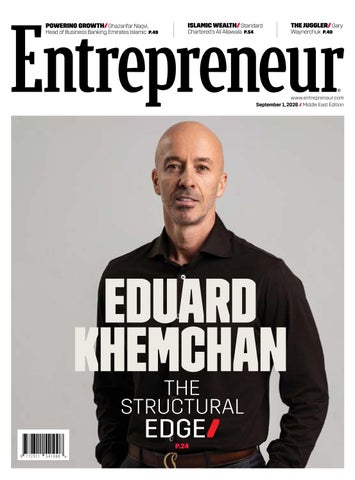
EDUARD KHEMCHAN THE STRUCTURAL
EDGE/ P.24
E V E R Y T H I N G T H AT O N E C O U L D I M AG I N E FOR EXTRAORDINARY LIFE
Eywa Way of Water is a state-of-the-art residential community with only 65 exceptional waterfront residences, with a holistic wellness ecosystem, curating authentic experiences and best-in-class amenities few have dreamed of.
Contact us today: +971 54 308 6000 I
sales@byrevolution.com
E Y W A . A E
The Mirra® 2 Chair is turning heads again
The Mirra 2 Chair just keeps getting better. How? We updated the chair so it’s 30 percent lighter than the original Mirra - and the chair’s nylon base and spine are now 100 percent recycled content. We also gave it a fresh, inspired colour palette so it can look professional, casual, or sporty. One thing that hasn’t changed is the flexible yet supportive design that allows your body to move naturally and freely - the way it was meant to move.
hermanmiller.com
© 2026 Herman Miller
Contents/
September 1, 2026
FEATURES P.24
Structured Growth
How EDUARD KHEMCHAN’S approach to money, markets, AI, and emerging infrastructure puts long-term structure ahead of short-term momentum.
P.34
Design Legacy
How OBEGI Home has helped shape the UAE’s luxury interiors landscape over the past 20 years.
P.40
Beyond Labels
GARY VAYNERCHUK on why entrepreneurs don’t need to limit themselves to doing just one thing.
September 1, 2026 / E N T R E P R E N E U R . C O M / 5
EXTRAORDINARY PR IVATE PO O LS | 30+ AM EN ITI ES | PRI M E LO CATI O N S
Escape to a home where urban sophistication meets resort tranquility.
BU I LT FO R M O M E NTS THAT MAT TE R 800-SAMANA | WWW.SAMANADEVELOPERS.COM
D I S C OVER REFINED
living
*Ranking as per the H2025 1 sales volume data of property monitor for Dubai
Make growth your next stop Corporate & Investment Banking. Global Markets. Global Banking. Transaction Services. Now is your time sc.com/cib
Dub New York
Johannesburg Standard Chartered Bank UAE is licensed by the Central Bank of the UAE
Shanghai
bai London
Singapore
Contents /
September 1, 2026
CEO Wissam Younane wissam@bncpublishing.net MANAGING DIRECTOR Rabih Najm rabih@bncpublishing.net ART DIRECTOR Simona El Khoury EDITOR IN CHIEF Tamara Pupic tamara@bncpublishing.net EDITOR AT LARGE Anil Bhoyrul anil@bncpublishing.net SENIOR FEATURES EDITOR Aalia Mehreen Ahmed aalia@bncpublishing.net JUNIOR EDITORIAL ASSISTANT Kristine Erika Agustin kristine@bncpublishing.net DIRECTOR OF INNOVATION
Sarah Saddouk sarah@bncpublishing.net GROUP SALES DIRECTOR – B2B GROUP Joaquim D’Costa jo@bncpublishing.net
BUSINESS UNUSUAL
STARTUP SPOTLIGHT
P.15 Assembling The Next Chapter
P.59 Connected Health
How MEFCC’S LOY PINHEIRO is building the region’s largest pop culture festival for its next chapter.
P.20 What Happens When Google and AI Become Your First Impression?
SASHIN GOVENDER built CREDIBILITYX to
shape the answer.
TREPONOMICS P.49 SME Growth
How EMIRATES ISLAMIC is helping UAE entrepreneurs access finance, manage risk, and scale sustainably.
P.54 Purpose-Led Growth ALI ALLAWALA, Head, Islamic
Banking - UAE, and Head, Group Islamic Wealth and Retail, Standard Chartered, on connecting values, capital, and global opportunity in the next chapter of Islamic wealth.
How QUINTON VAN DER BURGH’S AVERCARE is using AI to bring fragmented healthcare services into one ecosystem.
P.64 Market Outlook
MANPREET GILL, Chief Investment Officer
for MEA and Europe at Standard Chartered’s Wealth Solutions Unit, on the shifting investment landscape and what could define the second half of 2026.
HEAD OF PARTNERSHIPS
Samir Glor Samir@bncpublishing.net BUSINESS DEVELOPMENT DIRECTOR
Andy Soulahian andy.soulahian@bncpublishing.net COMMERCIAL LEAD
Anna Chipala anna@bncpublishing.net COUNTRY MANAGER KSA
Amjad Fakhouri amjad@bncpublishing.net COLUMNIST Tamara Clarke CONTRIBUTING WRITERS
Ali Allawala, Manpreet Gill, and Fida Chaaban.
SUBSCRIBE
Contact subscriptions@bncpublishing.net to receive Entrepreneur Middle East every issue
COMMERCIAL ENQUIRIES sales@bncpublishing.net
IN THE LOOP P.66 Business Briefing
What UAE businesses need to know about new VAT refund rules, TONY ROBBINS’ Dubai event, and extended small business tax relief.
P.70 Tech Honors
Nominations are now open for Entrepreneur Middle East’s 2026 Tech Innovation Awards.
10 / E N T R E P R E N E U R . C O M / September 1, 2026
ENTREPRENEUR.COM
Access fresh content daily on our website
EntMagazineME
Entrepreneur-me
PO BOX 502511 DUBAI, UAE P +971 4 4200 506
All Rights Reserved 2026. Opinions expressed are solely those of the contributors. Entrepreneur Middle East and all subsidiary publications in the MENA region are officially licensed exclusively to BNC Publishing in the MENA region by Entrepreneur Media Inc. No part of this magazine may be reproduced or transmitted in any form or by any means without written permission of the publisher. Images used in Entrepreneur Middle East are credited when necessary. Attributed use of copyrighted images with permission. All images not credited otherwise Shutterstock. Printed by United Printing and Publishing.
PROPERTIES solproperties.ae 800-765-1
Learn More
Editor’s Note/ SOME BATTLES STILL MATTER
I
’ve been debating whether to write about this for a long time, because AI-generated content is now everywhere, so what’s the point in resisting it? At the same time, I know that there are still people who take enormous pride in their own work and who understand that having something worth saying has to be “your something worth saying,” not AI’s. At Entrepreneur Middle East, we receive submissions from entrepreneurs, executives and so-called thought leaders whose entire professional value proposition rests on their expertise. These are people who advise others, sell their knowledge and, in many cases, charge a considerable premium for it. So, I’m always shocked by the ease with which they send us an AI-generated article with their name on it. I do find it embarrassing, but now that it has become commonplace, I am certain that we will lose this war eventually… Yet, let’s at least not lose the next battle, and perhaps the one after that, and so on. Like the one that our colleagues at the Financial Times are also fighting. They recently added a disclaimer note to an opinion piece by a Harvard economics professor after readers spotted AI-inflected phrasing and complained on social media. Meanwhile, our colleagues at The Wall Street Journal seem to have given up, defending the publication of an AI-assisted op-ed by a billionaire investor by saying that the commentary still reflected his authentic views. The Journal’s editorial page editor explained that AI is now a “fact of modern life.” For now, I am glad that our original brand publication, Entrepreneur US, does have an explicit AI clause in the ELN Writer Guidelines under “Things that cannot be included in your article,” which states: “We do not accept articles that feature AI-generated text. Articles are run through an AI detector to identify such articles and will be flagged accordingly.” It seems that people treat AI like a pen, just a tool to express their opinions, even though the words on the page are not theirs. What’s your take on this?
Tamara Pupic Editor in Chief | Entrepreneur Middle East
12 / E N T R E P R E N E U R . C O M / September 1, 2026
67 OCT2026 A D N EC C E N T R E
WHERE THE WORLD CONVENES IN
NEW INTELLIGENCE 350+
WORLD'S LEADING AI SHOW UNITING INFLUENTIAL GOVERNMENTS, ENTERPRISES, INVESTORS & STARTUPS
Meet the leaders building the next generation of intelligent economies. From breakthrough research to nation-scale deployments and outcomes-led talks, experience the AI applications reshaping industries.
AI BIG TECH & AWARD-WINNING STARTUPS
100+
WORLD- RENOWNED SPEAKERS
80+
COUNTRIES
200+
CAPITAL PARTNERS
GET INVOLVED
aieverythingabudhabi.com sales@aieverythingabudhabi.com
#AiEverythingAbuDhabi
→ Loy Pinheiro is the
Show Director of the Middle East Film and Comic Con, the region’s largest pop culture convention.
Assembling The Next Chapter
With the 14th edition of the Middle East Film and Comic Con set to take place this month, Show Director Loy Pinheiro reflects on what it has taken to build the region’s largest pop culture festival (and why the event may not be far from hosting its own version of SDCC’s iconic Hall H someday). b y A A L I A M E H R E E N A H M E D
September 1, 2026 / E N T R E P R E N E U R . C O M / 15
B/
Culture
“That feeling of ‘these are my people,’ is what MEFCC means today, and I think that’s what my team and I are most proud of. I’m also incredibly proud that we’ve grown from that first edition to become the Middle East’s largest pop culture festival, with over 46,000 attendees, and that we’re recognized as a premier destination for fans and industry alike.”
I
speak with Loy Pinheiro on the Monday that immediately follows the opening weekend of Marvel Studios’ latest cinema release, Spider-Man: Brand New Day – a fitting day for an interview with the Show Director of the Middle East Film and Comic Con (MEFCC), the region’s largest pop culture convention. At the time of this conversation, the 2026 edition of MEFCC is a little over 30 days away. The excitement and nerves that precede such a mammoth event are evident on Pinheiro’s visage even through the slightly grainy Zoom window — after all, the festival saw recordbreaking numbers last year with over 46,000 visitors attending over three days; a statistic those behind the event will hope to outmatch. For Pinheiro, the numbers are a direct reflection of how MEFCC has become something of a safe ↓ From celebrity encounters and cosplay to gaming and comics,
MEFCC brings together a wide spectrum of pop culture communities under one roof. PICTURED BELOW [L → R]: Wilson Bethel, Andrew Garfield, Grant Gustin, and Charlie Cox.
haven for fans and enthusiasts of genre entertainment, from superhero franchises and fantasy series to anime, manga, and gaming. “Speaking as a member of the pop culture community first and foremost, for many fans, MEFCC represents acceptance and belonging – it’s a place where being passionate about comics, film, anime, art or gaming isn’t just accepted, it’s truly celebrated,” he says. “Where dressing up as your favorite character isn’t unusual, it’s encouraged. Where you can geek out about the latest Marvel or DC film, or debate which Final Fantasy game is the best, without judgment. And that sense of community, that feeling of ‘these are my people,’ is what MEFCC means today, and I think that’s what my team and I are most proud of. I’m also incredibly proud that we’ve grown from that first edition to become the Middle East’s largest pop culture festival, with over 46,000 attendees, and that we’re recognized as a premier destination for fans and industry alike.” Launched in 2012 in the UAE, MEFCC has gone onto cement itself as one of the most anticipated comic cons not just in the Middle East but also internationally – a title that until a few years ago might have been reserved only for the likes of the San Diego Comic-Con (SDCC), with its famed Hall H movie and cast announcements, in the US; or the fan-driven comics and pop culture convention Comiket (Comic Market) in Japan. In recent years, MEFCC’s reputation has continued to grow, owing to the participation of renowned celebrities such as Andrew Garfield (Academy Award nominee of Spider-Man fame), Oscar Isaac (Moon Knight, Star Wars and Frankenstein), Matt Smith (Doctor Who, The Crown, Morbius and House of the Dragon), Wilson Bethel (Daredevil and Hart of Dixie), Grant Gustin (The Flash and Glee), and Charlie Cox (Daredevil and The Defenders). But this year’s edition of MEFCC comes with an added goal: to ensure that the event’s postponement (because of geopolitical shifts earlier in the year) from April 2026 to the following September does not compromise the standard of entertainment now synonymous with the festival. “When we made the difficult decision to move the dates to September, my first priority was our fans, exhibitors and wider stakeholder network,” Pinheiro says. “These are real people who had been counting down the days to MEFCC, who had made travel plans and spent months preparing their cosplay costumes. That uncertainty was difficult for everyone, and as a team, we felt that weight very deeply. But what got us through it was transparent communication and an unwavering commitment to our community. We stayed connected with our fans, kept them informed and made it clear that this was a postponement, not a cancellation — that MEFCC would return and it would be worth the wait. The September dates were carefully selected to deliver the best possible experience for our
16 / E N T R E P R E N E U R . C O M / September 1, 2026
fans, exhibitors, celebrity guests and partners. The new dates also provided greater flexibility for international participation while allowing us to bring together an exciting lineup of guests, comic creators and exhibitors, and deliver MEFCC to the standards our fan base has come to expect.” Indeed, in the days that followed my interview with Pinheiro, up until the time this feature was written, MEFCC confirmed the attendance of some stellar celebrity guests: John Cena, the American actor and former professional wrestler; Simu Liu, known for Shang-Chi and the Legend of the Ten Rings, Kim’s Convenience and Barbie, and set to appear in Avengers: Doomsday; French actress Pom Klementieff, best known for playing Mantis in Marvel’s Guardians of the Galaxy and Avengers films, and for acting opposite Tom Cruise in the Mission: Impossible franchise; Arden Cho, best known for playing Kira Yukimura in Teen Wolf, and voicing Rumi in Netflix’s acclaimed animated film KPop Demon Hunters ; One Piece stars Mackenyu (Roronoa Zoro; also known for manga adaptations including Rurouni Kenshin), Charithra Chandran (Miss Wednesday; also known for Bridgerton and Alex Rider), and Jacob Romero Gibson (Usopp); and Joonas Suotamo, the Finnish actor behind the iconic Star Wars character Chewbacca, who has also starred in the Netflix series Wednesday. MEFCC 2026 will also see popular comic-book artists joining its Comic Creators Club, with confirmed names including Jim Cheung, Federico Vicentini, Brett Breeding, Francesco Mobili, Mike Choi and Jimbo Salgado, whose collective work spans iconic heroes and storylines across Marvel, DC, Image Comics and IDW. Mobili is known for his work on Old Man Hawkeye, X-Men and Daredevil, and is currently the main artist for Marvel’s Doomquest, while Choi
is recognized for his work on X-Men and for helping establish the popularity of X-23. Salgado’s credits include titles such as Batman: Arkham Unhinged and Transformers: More Than Meets the Eye, while the wider line-up has worked across titles including The Avengers, The Amazing Spider-Man, Wolverine and The Death of Superman. “Delivering an event of this scale always involves close collaboration with partners around the world, and we’re incredibly grateful for the support we received,” Pinheiro reveals. “We would never want to run a smaller or lighter version of MEFCC. Whether we move the dates or not, it has to be a world-class event and an exceptional celebration of pop culture — the kind our fans have come to expect. And that’s exactly what they can expect when they walk through the doors this year.” To cater to a growing base of customers with varying pop culture interests, MEFCC’s offerings span celebrity interactions and live entertainment, cosplay, anime and Asian pop culture, video and tabletop gaming, trading card games, books and comics. While Cosplay Central serves as the home for cosplayers, with competitions, catwalks, parades, meetups and appearances by professional cosplayers; Festival Plaza combines live music, dance performances, outdoor activities and food offerings; and the Main Stage hosts celebrity panels, interviews, fan Q&As, industry discussions and community meetups. The Gaming Arena covers the broader gaming community, while Tabletop Zone caters to board games and increasingly specialized roleplaying game (RPG) players. Additionally, a TCG Arena has been set up to serve the growing community around games such as Pokémon, One Piece, and Magic: The Gathering; September 1, 2026 / E N T R E P R E N E U R . C O M / 17
B/
Culture → Middle East Film &
while the Bookworm Lounge brings together comics, graphic novels, fantasy, sci-fi and other genres, alongside book swaps and interactive literary activities. “We’ve gone from having one fan competition, the cosplay competition, to now having four. We’ve launched a TCG tournament, a short film competition and a student art competition, all with the aim of giving these different sub-communities a platform,” Pinheiro says. “These decisions are based on data, but they’re not just about numbers. They represent investment, confidence and our commitment to growing the community while delivering a top quality experience.” The increase in the number of dedicated zones has been yet another indicator of MEFCC’s growing popularity, he adds. “When the event first launched in 2012, I believe we had something like three or four feature areas. We had an area for comic-book creators, a celebrity autograph and photograph zone, an Artist Alley and an entertainment stage. Now
“ THESE DECISIONS ARE
BASED ON DATA, BUT THEY’RE NOT JUST ABOUT NUMBERS. THEY REPRESENT INVESTMENT, CONFIDENCE AND OUR COMMITMENT TO GROWING THE COMMUNITY WHILE DELIVERING A TOP QUALITY EXPERIENCE.”
18 / E N T R E P R E N E U R . C O M / September 1, 2026
Comic Con has grown into the region’s largest pop culture festival, bringing together tens of thousands of fans each year.
we have more than 12 features. We still have all the things we had in 2012, but we’ve built on them so much that when a fan turns up to the event, no matter what subsegment of pop culture they’re into, it’s very easy for them to find a place where they belong. That’s been the biggest shift for us over the years: following the development and specialization of fan tastes and reflecting that in the event. MEFCC is a large-scale, world-class convention, but at its grassroots, we really think about it as a community event. The event has evolved to reflect the tastes of the community it serves, and that’s something we will continue to do.” Here, Pinheiro adds that that commitment to continuing a community-led festival has been at the forefront of all the decisionmaking that goes on behind the scenes — even the primarily commercial ones. “What I’ve
learned is that when you put the fans first, the business typically follows,” he says. “We’re often making decisions like: Do we invest in bringing this intellectual property (IP) experience? Do we bring this publisher or industry guest? Because we see the potential for these investments to generate a deeper impact within our creative community. Sometimes we’ll bring a comic-book artist who might be extremely popular, like Jim Lee, Jorge Jiménez, Rafael Grampá or Nick Dragotta. And sometimes we’ll bring someone a little different, like InHyuk Lee, because we know they’re an educator, they do portfolio reviews and can bring value to artists in our region who aspire to work in that industry. We think the same way about IP experiences.” Such an approach has enabled MEFCC to not only bring in the big Hollywood names, revered comicbook artists, and beloved voice
EVENTS LIKE OURS AREN’T JUST ENTERTAINMENT; THEY’RE CULTURAL INFRASTRUCTURE THAT DRIVES TOURISM, SUPPORTS CREATIVE INDUSTRIES AND POSITIONS ABU DHABI ON THE GLOBAL STAGE.”
actors, but also over 500 brands and exhibitors. There’s also the aforementioned 46,000 guests the event welcomed last year — a number that Pinheiro reveals is still shy of the halfway mark of MEFCC’s goal of 100,000 guests for the coming editions. As such, it comes as very little surprise that Pinheiro gives an assertive “it is 100% a possibility!” when asked if MEFCC could someday be on par with the SDCC and its 6,500-seater Hall H panel room which has seen some of the most memorable announcements in pop culture entertainment. “That’s the vision that we have: to one day have our own Hall H with our own set of previews for our region. But the key, really, when it comes to any goal or decision is that we never compromise on the fan experience to chase revenue. Every commercial decision we make starts with one question: Does this make MEFCC better for our fans?” MEFCC’s overall model, of course, goes beyond entertainment and aligns with the UAE’s wider ambitions to become a global cultural hub. In April 2025, the Department of Culture and Tourism – Abu Dhabi (DCT Abu Dhabi) and UAE-based exhibitions company Informa announced a partnership extension that will see Middle East Film & Comic Con (MEFCC) held in Abu Dhabi through to 2027. “I think that partnership, under the leadership of H.E. Mohamed Khalifa Al Mubarak, Chairman of DCT Abu Dhabi, was a
pivotal turning point for the brand,” Pinheiro notes. “That’s been transformational in helping us overcome past obstacles and challenges and develop a grander, long-term vision, because their vision for Abu Dhabi as a global cultural and creative hub aligns perfectly with what we’re building with MEFCC. They understand that events like ours aren’t just entertainment; they’re cultural infrastructure that drives tourism, supports creative industries and positions Abu Dhabi on the global stage. That validation, paired with the common thread of authenticity and putting the fans first is, I think, what has gotten us this far and will continue to take us into our next chapter as we look to grow the event towards 100,000-plus attendees.” For now, however, Pinheiro’s sights are set on ensuring the upcoming 14th edition of MEFCC fulfils the promise with which the event was conceptualized over a decade ago. “The most important word for me is authenticity,” Pinheiro says. “The people behind MEFCC aren’t just event professionals; most of us are fans ourselves, and we’re genuinely part of this community. That has been true since our earliest days in 2012, and it remains true as the event continues to grow. When people feel valued and heard, they return year after year, bring their friends and families and become your strongest advocates. That authenticity has carried us from our humble beginnings to where we are today, and I believe it’s what will carry us into whatever comes next.” September 1, 2026 / E N T R E P R E N E U R . C O M / 19
B/
Branding
What Happens When Google and AI Become Your First Impression? Sashin Govender Built CredibilityX to Help Shape the Answer
There was a time when a first impression happened in a room. It was a handshake, an introduction, a recommendation from someone trusted, or the opening minutes of a meeting. Today, that first impression is increasingly happening before two people ever meet.
A
n investor considering a founder can search their name before taking the meeting. A customer can research a company before responding to its salesperson. A potential partner can ask an artificial intelligence platform who someone is, what they are known for, whether their company is credible, and what has been written about them. Within seconds, an opinion can begin to form from search results, media coverage, websites, social profiles, reviews, and information scattered across the internet. The person being researched is not in the room to provide context. Their digital reputation is speaking for them. For media mogul, Sashin Govender, founder of CredibilityX, that shift represents one of the most consequential changes taking place in modern business. He believes entrepreneurs have entered an era in which reputation is no longer shaped only by what people say about themselves, but increasingly by what search engines, media ecosystems, and artificial intelligence can discover about them. It is what could be described as the algorithmic first impression. From Personal Branding to Digital Reputation For more than a decade, Govender has operated across entrepreneurship, media, marketing, personal branding, and reputation. During that period, he has watched the definition of influence change repeatedly.
20 / E N T R E P R E N E U R . C O M / September 1, 2026
→ Sashin Govender is the founder of CredibilityX, a Dubaibased agency specializing in building trust and authority for entrepreneurs and companies.
Social media initially gave entrepreneurs unprecedented control over distribution. Personal branding turned founders into media properties of their own. Search engines made reputation searchable. Now artificial intelligence is introducing another layer: reputation is becoming summarizable. That distinction matters. A polished Instagram account can tell people how someone wants to be perceived. A company website can explain what a business wants customers to know. But when someone searches independently, reads third party coverage, or asks an AI platform about a
person or company, they are looking for something different: external context. Govender believes that gap between what you say about yourself and what the internet can independently verify about you will become increasingly important. “You can spend years building a great business, but when someone searches you, the internet may only have a few seconds to explain who you are,” he says. “The question entrepreneurs need to start asking is whether that digital version accurately represents the real version.” That question became increasingly central to the
development of CredibilityX. Building Infrastructure Around Credibility Rather than positioning itself simply as another public relations agency, CredibilityX has been built around a broader idea: helping individuals and companies strengthen the ecosystem of credible information that exists around their names.
Its work spans media distribution, public relations, reputation management, personal branding, digital content, websites, social media, and other components of online authority. Behind those services is a wholesale media model designed to connect brands,
entrepreneurs, agencies, and media opportunities at scale. Govender describes the philosophy behind the business as closer to infrastructure than traditional agency work. Just as technology platforms reorganized fragmented industries by creating networks between supply and demand, CredibilityX has spent years building relationships across the media landscape and creating an ecosystem through which campaigns can be executed internationally. That infrastructure now extends across more than 1,500 publication relationships and a global network of agencies and partners,
September 1, 2026 / E N T R E P R E N E U R . C O M / 21
B/
Branding
SOCIAL MEDIA INITIALLY GAVE ENTREPRENEURS UNPRECEDENTED CONTROL OVER DISTRIBUTION. NOW AI IS INTRODUCING ANOTHER LAYER: REPUTATION IS BECOMING SUMMARIZABLE. THAT DISTINCTION MATTERS.”
according to the company. But Govender argues that the number of publications is less important than the problem the infrastructure is being built to address. The internet has become the world’s largest
background check. And artificial intelligence may make that background check even faster. Dubai’s Next Competition May Be Credibility Nowhere is this shift more visible than in markets
such as Dubai. The city has become a magnet for entrepreneurs, investors, family offices, executives, creators, financial firms, technology companies, and international brands. That concentration of ambition has created extraordinary opportunities, but it has also created intense competition for attention. In such an environment, simply appearing successful becomes less differentiating. The harder question is whether success can be verified. Govender believes that as Dubai continues developing into a global centre for entrepreneurship and wealth, one of the next major competitions will be over credibility. When thousands of founders are competing for investors, customers, partnerships, talent, and attention, reputation becomes economic infrastructure. Two businesses may offer similar products. Two founders may tell equally compelling stories. The advantage can shift toward the person whose authority is easier to understand and independently validate. “Visibility can get you seen,” Govender says.
22 / E N T R E P R E N E U R . C O M / September 1, 2026
“Credibility gets you chosen.” That principle sits at the centre of how he sees the next generation of personal branding. When Reputation Becomes Machine Readable The arrival of generative AI makes the subject more complicated.
For years, reputation management largely focused on what appeared when somebody typed a name into Google. Search remains enormously important, but AI platforms are changing how information is consumed. Instead of reviewing ten different links, a user can ask a question and receive a synthesized answer. This creates an important distinction for entrepreneurs. No company can legitimately promise complete control over what independent search engines or artificial intelligence platforms say. Their algorithms, sources, ranking systems, and outputs remain outside the control of any individual agency. What businesses can influence is the quality, consistency, relevance, and authority of the informa-
tion they contribute to the digital ecosystem. That means publishing substantive information, earning credible third party coverage, maintaining accurate digital properties, addressing reputation problems, building expertise around relevant subjects, and creating a body of information that helps both humans and machines better understand who a person or company actually is. In Govender’s view, this will gradually move personal branding away from a competition for followers and toward a competition for authority. His prediction is provocative: within the next decade, an entrepreneur’s AI reputation could become more valuable than the size of their social media following. The Five Minute Reputation Test The implications are surprisingly easy to experience. Govender encourages entrepreneurs to conduct a simple exercise. Search your full name. Search your company. Search your name alongside the industry in which you want to be considered an authority. Look beyond your own social media accounts and websites. Then open several leading AI platforms. Ask who you are. Ask what your company does. Ask what you are known for. Ask what distinguishes your business from its competitors. The most important question comes afterward: Is the person or company being described online an accurate representation of what you have actually built? For established entrepreneurs, the answer can sometimes be uncomfortable. A business may have significant revenue, customers, employees, intellectual property, or industry experience while possessing remarkably little authoritative information online. Another entrepreneur with fewer accomplishments may have built a far stronger digital footprint. The internet does not automatically know what you have achieved. It knows what it can find. The New Economics of Trust That reality creates both a problem and an opportunity.
Never before have entrepreneurs had so much access to global distribution. A founder in Dubai, Durban, Riyadh, Lagos, London, or Mumbai can build an audience far beyond their physical location. A small company can publish internationally. An unknown entrepreneur can become globally discoverable. But democratized distribution has also created extraordi-
“THE QUESTION
ENTREPRENEURS NEED TO START ASKING IS WHETHER THAT DIGITAL VERSION ACCURATELY REPRESENTS THE REAL VERSION.”
nary noise. Everyone can post. Everyone can create content. Everyone can call themselves an expert. Artificial intelligence can now produce more content in minutes than many companies once created in months. In that environment, the scarcity is no longer information. It is trust. That is the larger opportunity Govender believes CredibilityX is positioned to pursue. The company’s future, in his view, is not simply about generating publicity. It is about helping build the digital evidence surrounding people and businesses whose real world accomplishments may be greater than their online reputations suggest. For entrepreneurs, that changes the purpose of personal branding itself. The objective is no longer simply to become famous. It is to become understandable, discoverable, credible, and associated with something meaningful. The next important introduction in business may therefore happen long before someone enters the room. An investor may search your name. A customer may research your company. A journalist may examine your history. A potential partner may ask an AI platform whether you are someone worth meeting. You will not be there to answer. But your reputation will. For Govender, that is the future CredibilityX is being built around. In a world where Google and artificial intelligence increasingly influence first impressions, the companies and entrepreneurs that understand how to build genuine digital authority may possess one of the most important competitive advantages of the next decade. Because the question is no longer only what you say about yourself. It is what the world finds when it goes looking for the answer. September 1, 2026 / E N T R E P R E N E U R . C O M / 23
24 / E N T R E P R E N E U R . C O M / September 1, 2026
EDUARD KHEMCHAN’S
Structural Approach to Money, Markets and the Future FROM DELIVERING NEWSPAPERS AT 13 TO BUILDING BUSINESSES AND ALLOCATING CAPITAL ACROSS TECHNOLOGY, FINANCIAL MARKETS, AI AND EMERGING INFRASTRUCTURE, EDUARD KHEMCHAN HAS SPENT A LIFETIME LEARNING ONE FUNDAMENTAL LESSON: MOMENTUM MAY ATTRACT ATTENTION, BUT STRUCTURE DETERMINES WHAT SURVIVES./ by WISSAM YOUNANE
BUILDING TO LAST
At 13 years old, Eduard Khemchan was delivering newspapers. There were no conversations about artificial intelligence, capital allocation or the future of global financial infrastructure. There were routes to complete, responsibilities to meet and a very straightforward economic equation: if he did not show up, he did not get paid. His family had immigrated from Georgia to the United States, and Khemchan found himself adapting to a new country while learning something about money that would stay with him long after the newspaper route disappeared from his life. Money, he discovered early, represented time, effort and responsibility. It did not simply appear. That seemingly modest beginning offers perhaps the clearest way to understand the philosophy that would later guide him through entrepreneurship, construction, financial markets and investment. “My ambition was never only about having more,” Khemchan says. “I became interested in independence.” What followed was less a conventional career path than an evolution in how he understood value: first earning money through his own labor, then building businesses, then participating in financial markets and eventually asking a much bigger question—what can capital itself build? It is a progression he describes simply: worker, operator, market participant, allocator.
And through every stage, one idea has remained constant. Build the foundation first.
THE CONSTRUCTION SITE THAT BECAME A BUSINESS SCHOOL
By 21, Khemchan had started a construction company. He does not describe the decision with the mythology that often accompanies stories of young entrepreneurs. There was no singular moment in which he suddenly felt prepared to become a founder. “I am not sure I ever had a moment when I decided I was suddenly ‘ready,’” he says.
“ I AM NOT SURE I EVER HAD A MOMENT WHEN I DECIDED I WAS SUDDENLY ‘READY,’” HE SAYS. “ENTREPRENEURSHIP OFTEN BEGINS BEFORE YOU FEEL COMPLETELY PREPARED.” September 1, 2026 / E N T R E P R E N E U R . C O M / 25
“Entrepreneurship often begins before you feel completely prepared.” By then, he had already spent years working, and starting a company felt like a natural progression from being responsible for his own labor to becoming responsible for an entire operation. Construction would become one of the most important business classrooms of his life. Unlike theory, construction is unforgiving. Materials arrive or they do not. Cash flow works or it does not. Deadlines are met or missed. A project cannot be talked into completion.
“ AT SOME POINT, THE MOST IMPORTANT QUESTION WAS NO LONGER SIMPLY, ‘HOW MUCH CAN I EARN?’” KHEMCHAN SAYS. “IT BECAME, ‘WHERE SHOULD CAPITAL BE POSITIONED, AND WHAT CAN THAT CAPITAL BUILD OR ENABLE OVER TIME?’” 26 / E N T R E P R E N E U R . C O M / September 1, 2026
And perhaps most importantly, everything has to happen in the right order. “You cannot install the roof before you create the foundation,” Khemchan says. “Business works in much the same way.” It is a lesson that still influences the way he evaluates companies today. Behind the pitch deck, the valuation and the excitement surrounding a company, Khemchan wants to understand what is holding the entire thing up.
What generates revenue? Where are the dependencies? How strong is management? Where is the risk? What happens when financing becomes more expensive? And can the structure continue supporting the company when growth inevitably becomes more difficult? Construction taught him, he says, “not to confuse something that looks impressive with something that is structurally sound.” That distinction has become central to his investment philosophy.
IN FAVORABLE MARKETS, WEAKNESSES CAN REMAIN HIDDEN. REVENUE CLIMBS. FINANCING REMAINS ACCESSIBLE. VALUATIONS INCREASE. MOMENTUM ITSELF CAN BEGIN TO LOOK LIKE VALIDATION.
FROM MAKING MONEY TO MAKING CAPITAL WORK The next evolution came through financial markets. As finance became increasingly digitized, Khemchan began participating in online markets in the late 1990s. What interested him was not simply the opportunity to trade. He was watching the infrastructure of finance change in real time. Information was becoming more accessible. Execution was becoming faster. Markets historically dominated by institutions were opening to individuals. And that changed his relationship with money again. For a worker, the equation is largely linear: time and effort are exchanged for income. Entrepreneurship introduces leverage through employees, systems, processes and equipment. Capital introduces another dimension entirely. “At some point, the most important question was no longer simply, ‘How much can I earn?’” Khemchan says. “It became, ‘Where should capital be positioned, and what can that capital build or enable over time?’” That shift is significant.
Making money can encourage a focus on the next transaction. Allocating capital requires thinking about opportunity cost, liquidity, downside, timing and duration. Every dollar placed in one opportunity is a dollar that cannot simultaneously be placed somewhere else. And every long-term investment is, in effect, an argument
Khemchan, it is structure. “Structure is what remains when enthusiasm disappears,” he says. It is a particularly relevant philosophy at a time when entire sectors can be propelled by enormous amounts of capital, attention and narrative. In favorable markets, weaknesses can remain hidden. Revenue climbs.
“TODAY,” HE SAYS, “I AM MUCH MORE INTERESTED IN WHAT CAPITAL CAN BUILD THAN SIMPLY WHAT A TRANSACTION CAN EARN.” about what the future might look like. “Today,” he says, “I am much more interested in what capital can build than simply what a transaction can earn.”
STRUCTURE OVER MOMENTUM
If one word repeatedly surfaces when speaking with
Financing remains accessible. Valuations increase. Momentum itself can begin to look like validation. Khemchan wants to know what happens after that environment changes. His approach is almost forensic. How does the company actually make money? How dependent is it on
outside financing? What happens if growth slows? What happens if regulation changes? Where is risk concentrated? Does management have the discipline required to navigate difficult conditions? And when evaluating technology, there is another question: Does it solve an economic problem, or does it merely attract attention? That distinction becomes particularly important with artificial intelligence. Khemchan is unequivocally optimistic about AI—but optimism about the technology, he argues, should not translate into indiscriminate optimism about every company using the term. The question is not whether a company can call itself an AI business. The question is what AI actually changes. Does it lower costs? Increase productivity? Improve accuracy? Allow a smaller workforce to accomplish substantially more? Improve risk analysis? Make logistics more efficient? Reduce healthcare administration? Help highly
September 1, 2026 / E N T R E P R E N E U R . C O M / 27
“ I AM EXTREMELY
OPTIMISTIC ABOUT AI. BUT OPTIMISM ABOUT A TECHNOLOGY DOES NOT REQUIRE OPTIMISM ABOUT EVERY COMPANY USING ITS NAME.”
skilled people become dramatically more productive? That is where he believes durable value will emerge. “I believe the largest value from AI will ultimately come from integration rather than novelty,” he says. For Khemchan, the most consequential outcome may occur when AI stops being treated as a standalone category and becomes an invisible layer running through thousands of businesses. Finance. Healthcare. Cybersecurity. Enterprise software. Logistics. Research. The real transformation begins when intelligence becomes infrastructure. “The hype is where valuation becomes disconnected from utility,” he says. Having an AI interface or connecting a product to an existing model does not automatically create a defensible company. Over time, he expects capital to distinguish between businesses benefiting from the AI narrative and businesses in which AI produces measurable economic improvement. His conclusion is characteristically measured: “I am extremely optimistic about AI. But optimism about a technology does not require optimism about every company using its name.” 28 / E N T R E P R E N E U R . C O M / September 1, 2026
LOOKING BENEATH THE MARKET
Khemchan’s interest in infrastructure extends beyond AI. One of the most formative structural changes he witnessed was the digitization of financial markets. What mattered, in his view, was not a particular stock price or market movement. It was the fact that the underlying system was changing. Access changed. Information moved differently. Execution became faster. New participants entered. And once infrastructure changed, behavior followed. “Price eventually tells a story,” he says. “Infrastructure often begins writing that story earlier.” It is the same framework through which he views blockchain. For blockchain to become genuinely consequential, Khemchan believes something almost paradoxical needs to happen: people need to stop talking about blockchain.
ments in user experience, regulation, scalability and economic utility allow the technology to operate beneath financial activity without requiring users to understand what is happening behind the interface. Tokenization, programmable settlement, crossborder transfers and verifiable ownership are among the areas he sees as potentially meaningful. But the real milestone will be institutional integration. When blockchain becomes part of how assets are issued, transferred, verified and settled—and the end user barely notices—it will have crossed the line from market narrative to economic infrastructure.
CONVICTION WITHOUT CERTAINTY
Despite his interest in transformational technologies, Khemchan’s investment philosophy is built around risk. “Conviction and certainty
comprehensible regulatory environment and ideally a structural trend capable of surviving beyond a single market cycle. Position size should reflect the quality of that alignment. Interestingly, volatility itself is not necessarily what causes him to retreat from an investment. A changing thesis does. If management loses discipline, leverage becomes excessive, customer behavior fundamentally shifts, regulation alters the economics of the business, technology loses its differentiation or new evidence proves the original assumptions wrong, Khemchan believes the investment must be reconsidered. The dangerous alternative is emotional attachment. “The objective is not to defend your original decision forever,” he says. “The objective is to protect capital while allowing strong ideas enough time to develop.”
FOR BLOCKCHAIN TO BECOME GENUINELY CONSEQUENTIAL, KHEMCHAN BELIEVES SOMETHING ALMOST PARADOXICAL NEEDS TO HAPPEN: PEOPLE NEED TO STOP TALKING ABOUT BLOCKCHAIN.
“The technology should eventually disappear behind the utility,” he says. Consumers do not think about protocols when sending an email or the technological infrastructure processing a card payment. They care that the product works. Blockchain, he argues, will reach a similar point of maturity when improve-
are not the same thing,” he says. Waiting for complete certainty, he argues, can mean waiting until an opportunity has already been fully priced. Instead, conviction grows as independent factors begin aligning: real demand, strong economics, capable management, sensible capital structure, a
The same thinking shapes his view of diversification. Owning 20 investments does not necessarily mean owning 20 different risks. Those assets may ultimately depend upon the same liquidity conditions, economic cycle or market psychology—and during periods of stress, those hidden correlations can suddenly become obvious.
September 1, 2026 / E N T R E P R E N E U R . C O M / 29
30 / E N T R E P R E N E U R . C O M / September 1, 2026
“If ten investments all fail under the same scenario, owning ten of them has not necessarily diversified your risk,” he says. But excessive diversification creates another problem: an investor can spread capital so broadly that the portfolio no longer meaningfully benefits from its best ideas. The objective, therefore, is not quantity. It is balance.
different effect. That is why he sees considerable potential at the intersection of AI, diagnostics, biotechnology, data and preventative healthcare. Unlike investment trends that can emerge and disappear within a few years, demographics move slowly and then exert pressure for decades. They are, in Khemchan’s language, structural.
THE LONGEVITY ECONOMY
WHY THE MIDDLE EAST MATTERS
Some of the structural shifts Khemchan follows are technological. Others are demographic. One in particular stands out: people are living longer. Longevity is usually discussed as a medical issue. Khemchan sees a much larger economic question. What happens to pensions and retirement systems? Insurance? Healthcare spending? Housing? Employment? Productivity? And perhaps most importantly: how do people remain economically productive for longer? The distinction between lifespan and healthspan is particularly important to him. Simply adding years to life without adding healthy and productive years creates enormous pressure on healthcare systems and economies. Technologies capable of extending the period during which people remain healthy and economically active could have a dramatically
It is perhaps unsurprising, then, that Khemchan
“ WHAT I THINK SOME INTERNATIONAL OBSERVERS STILL MISUNDERSTAND IS THAT THE REGION IS NOT SIMPLY TRYING TO ATTRACT BUSINESSES FROM ELSEWHERE,” HE SAYS. “IT IS TRYING TO CREATE INFRASTRUCTURE THAT MAKES THE MIDDLE EAST ONE OF THE PLACES WHERE THE NEXT GENERATION OF GLOBAL BUSINESSES CAN ACTUALLY BE BUILT.”
is paying close attention to the Middle East. His interest in the UAE and Saudi Arabia is not based simply on the capital available in the region. It is the way capital is increasingly being combined with infrastructure, policy, technology and speed. “What interests me about the Middle East is the speed at which ambition is being converted into infrastructure,” he says. Many countries announce ambitious visions. Khemchan believes the UAE and Saudi Arabia are increasingly distinguishing themselves by putting institutional capacity and capital behind those ambitions. AI illustrates the point. Creating a genuine AI economy requires far more than investing in software companies. It requires energy, data centers, semiconductors, connectivity, talent, regulation and significant amounts of patient capital. “The region increasingly understands that entire stack,” he says. He points to Abu Dhabi’s activity around AI infrastructure, Dubai’s integration of AI into government and enterprise, and Saudi Arabia’s development of AI capabilities alongside the broader economic transformation envisioned under Vision 2030. But there is a larger story developing. For decades, the Middle East was viewed internationally as an important source of
capital. Khemchan believes it is increasingly becoming a destination for it. Technology, intellectual property, advanced infrastructure and entrepreneurship are becoming central components of the region’s economic proposition. “What I think some international observers still misunderstand is that the region is not simply trying to attract businesses from elsewhere,” he says. “It is trying to create infrastructure that makes the Middle East one of the places where the next generation of global businesses can actually be built.” Speed is another advantage. When leadership, capital and national economic strategy are aligned, Khemchan argues, ideas can move from concept to execution much faster than in environments where regulation, infrastructure and investment operate independently. For an investor obsessed with structure, that alignment is difficult to ignore.
OPPORTUNITY WITHOUT ILLUSION
Khemchan remains optimistic about global markets, particularly where technology changes the economics of established industries. AI infrastructure and enterprise applications sit high on that list, as
September 1, 2026 / E N T R E P R E N E U R . C O M / 31
does the convergence of AI and healthcare. Financial infrastructure—from payments and settlement to private credit, digital ownership and technologyenabled financial services—is another area he continues to watch. But opportunity creates its own risks. Transformational sectors inevitably attract excessive amounts of capital. And no matter how exciting the technology becomes, Khemchan rejects the idea that technological progress somehow repeals financial discipline. “A company can operate in the most important industry in the world and still be a poor investment at the wrong valuation or with the wrong capital structure,” he says. Liquidity remains another concern. So does leverage. Debt reduces optionality, particularly when businesses assume refinancing will remain permanently available on favorable terms. Geopolitical fragmentation adds another layer of complexity as technology, capital, data and supply chains become increasingly connected to national security. The result is an investment environment filled simultaneously with extraordinary possibility and substantial risk. His response to that contradiction is simple: Optimism should never replace risk management.
LET THE WORK COME FIRST
For someone operating across markets, entrepreneurship and emerging technologies, Khemchan has historically maintained a relatively measured public profile. That has been deliberate. “For much of my career, I was more interested in building than being visible,” he says. He never believed publicity could substitute for substance. In fact, he preferred the work to develop before the story around it did. But he also recognizes that the environment has changed. Reputation and communication increasingly influence access to partnerships, talent, opportunities and capital. And as investors and entrepreneurs navigate increasingly complicated technological and economic transitions, there is value in explaining not only what you believe, but why. Khemchan therefore expects to become more visible— but selectively. He has little interest in commenting on every market movement simply to remain in the conversation. Instead, he wants to speak about the areas in which experience has given him something substantive to contribute: entrepreneurship, markets, AI, technology infrastructure, risk and capital allocation.
32 / E N T R E P R E N E U R . C O M / September 1, 2026
And perhaps, importantly, failure. Social media can make entrepreneurship look like an uninterrupted sequence of victories. Khemchan sees a much messier reality—one involving uncertainty, bad decisions, difficult cycles and constant recalibration. “I want the public profile to follow the work,” he says, “not replace it.”
WHAT COMES NEXT
The distance between a 13-year-old delivering newspapers and an investor thinking about AI infrastructure, financial systems and longevity appears enormous. Khemchan sees more continuity than contradiction. At 13, the objective was independence: creating stability through his own effort. Today, the scale of the question has changed. What becomes possible when capital, technology, people and ideas are properly aligned? Khemchan is increasingly interested in building an ecosystem of companies rather than accumulating a collection of disconnected investments. AI, fintech, digital infrastructure and human longevity might appear to occupy separate worlds, but he believes those worlds are converging. Artificial intelligence changes how companies make decisions. Financial infrastructure determines how capital moves. Technology changes access and scale. Longevity changes how people live, work and participate in economies. The intersections between those forces are where Khemchan wants to build. And when he thinks about success a decade from now, the measurement is not simply the size of the portfolio. It is durability. He wants to see companies and systems that became meaningful institutions, solved genuine problems, created economic value and survived beyond the market cycle in which they were conceived. He wants to know whether opportunities were created, leaders developed and entrepreneurs enabled to build companies that might otherwise never have existed. And he wants to retain perhaps the most valuable asset of all: the freedom to allocate his own time toward the problems and opportunities he finds meaningful. There is a neat symmetry to it. Khemchan began his working life carrying something physical from house to house every morning. Today, his ambition is to help build systems capable of creating value across industries and borders. The scale has changed dramatically. The underlying principle has not: Build something useful. Build it with discipline. And build it to last.
FIND HOMES, SECURE INVESTMENTS. CITYSCAPE GLOBAL 2026
September 1, 2026 / E N T R E P R E N E U R . C O M / 33
→ OBEGI Home is a UAE-based regional luxury interiors destination specializing in contemporary furniture, customized systems and globally renowned design brands.
LEGACY BY DESIGN 20 years since OBEGI Home was launched in the UAE, CEO Karine Obegi looks back on how the company’s pioneering endeavors in introducing contemporary luxury furniture have enabled it to both witness and play a role in shaping the evolution of the nation’s interiors landscape. b y A A L I A M E H R E E N A H M E D
S
ince time immemorial, the decor and furniture in a house has silently mirrored the tastes and personalities of the people who reside within it. And like any other creative space, the interior design industry too has evolved over the decades to incorporate and reflect different cultural trends, consumer demands, and industrial innovations. In the UAE, the rapid proliferation of branded residences, high-end real estate and innumerable hospitality launches has inadvertently contributed towards the growth of the nation’s interior design industry - a report by Mordor Intelligence notes that by 2031 the sector is expected to reach a whopping US$3.11 billion. Karine Obegi, who along with her husband Yordan launched the luxury interior and furniture brand OBEGI Home in the UAE in 2006, has been able to witness this growth firsthand.
34 / E N T R E P R E N E U R . C O M / September 1, 2026
→ Karine Obegi is with Gaia Spinelli of Poliform"
“ WHILE THE MARKET
WAS STILL LARGELY FOCUSED ON CLASSIC FURNITURE IN 2006, WE ANTICIPATED THAT GLOBALIZATION AND GREATER EXPOSURE TO INTERNATIONAL DESIGN WOULD GRADUALLY SHIFT TASTES TOWARDS A MORE CONTEMPORARY AESTHETIC.” Founded on the ambition of becoming the ultimate destination for contemporary, refined interiors, the company celebrates its twentieth anniversary in the UAE this year. “Our vision for OBEGI Home was always to create a design destination that is a source of inspiration for homeowners and professionals alike, bringing the global design scene to them by ensuring that all the latest news and trends reach the UAE,” Obegi, who serves as the company’s CEO, says. “We achieved that by introducing some of the world’s most prominent furniture brands and combining them with our team’s curation expertise and a high touch service. That vision remains true today, but what has evolved over the years was our work with developers. 20 years ago, we could not have imagined that the UAE’s developers would seek branded systems and furniture as a standard, but
→ Karine Obegi is the CEO of OBEGI Home, who has spearheaded the luxury interiors company’s UAE and regional growth since 2006.
today we see that almost all the ultraluxury developers incorporate branded elements as a core part of their product strategy. This has been one of the key developments that has stretched and grown our team and skillset on all levels from design to execution.” The company’s efforts to stay true to its founding vision are perhaps best reflected
in the sophisticated selection of brands that fall within its portfolio, both for fine furniture and customizable systems such as kitchens, wardrobes, bathrooms, doors and more. “The style of the brands we selected ultimately set the trajectory for our business,” Obegi notes. “While the market was still largely focused on classic furniture in 2006, we anticipated that globalization and
greater exposure to international design would gradually shift tastes towards a more contemporary aesthetic. We therefore began with classic contemporary brands that bridged the gap between classic and contemporary design before progressively introducing more contemporary collections over time. Today, our portfolio is firmly contemporary, and this is the design aesthetic
September 1, 2026 / E N T R E P R E N E U R . C O M / 35
↓ OBEGI Home offers high-end furniture alongside customizable systems spanning kitchens, wardrobes, bathrooms, doors and more. Its portfolio brings together internationally renowned furniture and interior design brands from Europe and beyond.
for which we are known.” Indeed, with its monobrand showroom for Poliform showcasing the Italian contemporary brand’s total-look philosophy and its OBEGI Home multibrand showroom housing globally recognized names from Europe and beyond such as Antoniolupi, Bulthaup, Flexform, Lualdi, Porada Tribù, and more, the company has created a top-ofmind destination for design professionals and enthusiasts alike. There is, however, more in store for OBEGI Home’s portfolio. “Two more monobrand showrooms for our brands Flexform [Italian contemporary furniture]
and Lualdi [Italian interior doors, partitions and architectural systems] are underway in the same area, totaling four retail spaces in Dubai,” Obegi reveals. “OBEGI Home was actually the first furniture showroom to open on Jumeirah Beach Road ten years ago, and today the street has become the undisputed district for high-end design brands. We are currently expanding in KSA as well, with showrooms beginning to open this summer in Riyadh’s design center at the King Abdallah Financial District (KAFD). Obegi also shares that her focus for the next 18 months is on the aforementioned regional expansion as well as
36 / E N T R E P R E N E U R . C O M / September 1, 2026
“increased digitization across all our departments and customer experience.” But even as OBEGI Home enters its next phase of growth, the principles that have guided its past two decades remain firmly in place. “Our clients expect speed, reliability, and consistent communication above all, whether it’s for their own home or a project,” she adds. “What has also contributed to maintaining our market position is the fact that we listen and advocate for our clients. Our role as a design-driven furniture retailer is not only to dictate to the market what is on trend abroad, but also to listen to the region’s needs and
communicate them back to our manufacturers. Our strong relationships with our manufacturers allow us to have open conversations about changes that need to be made to their collections to best serve the region, and due to the high potential of our markets, they are open to those changes.” The company’s culture to look beyond trends and quick wins has perhaps never held more value to its future growth trajectory. The influx of ultra-high-net-worth individuals (UNHWIs) in the UAE, coupled with the previously stated premium residential, commercial, and hospitality projects, has driven greater demand for sophisticated furniture and bespoke interiors in the region — a welcome yet challenging shift for OBEGI Home. “The UAE is unlike almost any other luxury market because its UNHWI population comes from every corner of the world,” Obegi elaborates. “That diversity creates a sophisticated client base with broad design references, high expectations, and an appreciation for a wide range of aesthetics. Rather than following a single regional design language, our clients are influenced by global trends and experiences. One of the defining characteristics of high-end consumers in the UAE is how well traveled they are. They regularly draw inspiration from the world's leading hotels, resorts, restaurants, and private clubs, and increasingly want to recreate those experiences
at home. Today's upscale residence is expected to deliver the same sense of comfort, refinement, and effortless living that they experience in exceptional hospitality destinations. I predict this will continue at an even faster pace with the explosive rise of branded residences across the UAE. At the same time, clients expect exceptional quality, but they also expect it to be delivered within increasingly ambitious timelines. Maintaining a high level of design and service at the
speed at which it has been demanded has become one of the industry's greatest challenges.” To keep up with such a dynamic industry, OBEGI Home has expanded how it collaborates with the design firms in the country in a quest to create a more coherent and connected
“OUR VISION FOR OBEGI HOME WAS ALWAYS TO CREATE A DESIGN DESTINATION THAT IS A SOURCE OF INSPIRATION FOR PROPERTY OWNERS AND PROFESSIONALS ALIKE, BRINGING THE GLOBAL DESIGN SCENE TO THEM BY ENSURING THAT ALL THE LATEST NEWS AND TRENDS REACH THE UAE. ”
pipeline of services. “As the interior design market continues to rise, design firms are taking on more comprehensive roles in the realization of projects,” Obegi says. “In the past, firms would deliver beautiful concepts developed into detailed design, but their role would generally end there.
Today, they not only supervise the execution of their design intent, but they are also developing new service lines such as procurement that involve them more deeply into each project. This can add intense pressure if the reliable ecosystem to deliver these services is not in place. One of our key
September 1, 2026 / E N T R E P R E N E U R . C O M / 37
OBEGI HOME CEO Karine Obegi on what it takes for a brand to earn a place in the OBEGI portfolio “Selecting the brands we represent is one of the most important decisions we make, and it is never taken lightly. Over the past two decades, we have built strong relationships and earned the trust of many of the world's leading furniture brands. Every potential partnership is evaluated against four key criteria: quality, design, vision, and people.”
} Quality “We only represent brands that demonstrate exceptional craftsmanship and manufacturing standards. Visiting the factory is an essential part of our evaluation process, as it allows us to understand the level of precision, the materials being used, and the care that goes into every product.”
} Design “OBEGI Home has established itself as a destination for contemporary interiors, so every new brand must complement our existing portfolio while offering something distinctive. We look for collections that resonate with the evolving lifestyles of our clients and reflect where design is heading rather than where it has been.”
} Vision “We want to understand the philosophy behind the brand, its creative direction, and its ambitions for the future. We seek partners that continue to innovate and evolve, ensuring we can consistently introduce fresh ideas and meaningful solutions that anticipate our clients' needs.”
} People “This is ultimately the most decisive factor. Ours is a relationship-driven business built on trust, integrity, and shared values, and so connecting with the people behind the brand is crucial. As a family-owned company, we believe lasting partnerships are created through mutual respect and genuine collaboration, and these qualities have been the foundation of many of our supplier relationships over the years.”
roles in the industry is supporting the design firms in the realization of their projects, particularly when it comes to selection and procurement. We work closely with top-tier firms across the region on their projects, workshopping and developing their designs carefully into tangible selections. This collaboration allows teams within design studios to work much more quickly, as our familiarity with the products and brands enables us to work in tandem with them at speed.” For an industry so driven by, and dependent on, deadlines and timelines, Obegi and her team faced some hurdles when the onset
38 / E N T R E P R E N E U R . C O M / September 1, 2026
“ WHILE PRESTIGIOUS BRANDS WILL ALWAYS CARRY WEIGHT, CLIENTS ARE BECOMING AS INTERESTED IN THE STORY BEHIND A PIECE AS THE NAME ATTACHED TO IT. THEY WANT PIECES WITH A COMPELLING NARRATIVE THAT SPARK CONVERSATION.” of the ongoing geopolitical crisis earlier this year led to unexpected halts. “The main challenge we faced during the regional crisis was logistics,” she says. “We had numerous shipments on the way
that were disrupted and other orders waiting to be picked up in Italy. Our logistics department worked tirelessly to locate the ships that had been redirected, create alternative routes to get the goods to the
UAE safely, and to make a plan for all the upcoming orders. Our suppliers also supported us greatly by offering complimentary storage of goods in their warehouses until we were able to find solutions for the shipments. In addition to the unpredictability of the routes, shipping prices also increased exponentially which impacted every project.” But as was evident for other businesses across the UAE, OBEGI Home too adopted a resilient approach to keep things afloat. “Transparent communication was the key to navigating this situation, so we focused on communicating with
our clients openly to keep them updated,” she says. “Previous crises such as the pandemic taught us to work with agility, and we applied that to this situation as well. Our entire team was able to work remotely when required, and we were still able to service clients through presentations and virtual meetings. We reopened our showrooms quite quickly, however, and clients were pleased to be able to visit us in person again within just a few days of the start of the conflict.” As Obegi now looks back on what has been a 20-year-long tale of success for OBEGI Home, she believes that
purpose-led design will define the next chapter of interiors in the UAE. “Looking ahead, we will see a continued shift towards more meaningful luxury,” she says. “While prestigious brands will always carry weight, clients are becoming as interested in the story behind a piece as the name attached to it. They want pieces with a compelling narrative that spark
conversation. I expect this appreciation for authenticity and storytelling to become even more influential over the next five to ten years.”
↓ For over 15 years, OBEGI Home has worked on branded and ultra-luxury developments such as the Lana by Dorchester and Mr. C Residences Downtown, both pictured here.
September 1, 2026 / E N T R E P R E N E U R . C O M / 39
40 / E N T R E P R E N E U R . C O M / September 1, 2026
THE
Do you feel trapped doing just one thing?
GARY VAYNERCHUK understands. And he has the solution. by JASON FEIFER
PHOTOS © NIGEL PARRY
September 1, 2026 / E N T R E P R E N E U R . C O M / 41
I
f you want to see the future of work, just look at Gary Vaynerchuk’s DMs. He’s spent his career pushing people toward action— telling them to build something, to own something, to take control of their lives and financial destinies. Now, millions of entrepreneurs and career-builders turn to him for advice, DMing him their most pressing and personal questions. The patterns of their anxieties tell a story: Here’s what people need now. Here’s what bothers them the most. Today, Vaynerchuk is seeing something new and interesting: “They’re feeling trapped,” Vaynerchuk tells me. “They’re starving out there.” Why? Because they have one main job or company, but they want more. Maybe their economic anxiety is pushing them to make more money or to find more lines of revenue. Maybe they’re watching the rise of AI, seeing how it can make their lives more efficient, and wondering what else they can do with their time. Whatever it is, they want to expand. But they don’t think they’re allowed to. Entrepreneurs and professionals have been told a very specific story: Success requires relentless focus. Pour everything you have into one thing. Commit yourself to it fully. As David Packard (of Hewlett-Packard) famously wrote: “More businesses die from indigestion than starvation.” In other words, the greatest risk to your business isn’t doing too little. It’s doing too much. Vaynerchuk agrees, to a point. Many people thrive with focus. And a business requires dedicated operators who think nonstop about its needs and opportunities. But many people are built differently, he says. They are the creative thinkers. The restless builders. The ideas people. They have boundless energy and ambition, and it drives them to start new businesses or seek new accomplishments outside their day jobs. And here’s the most important part: For these kinds of people, doing one thing is stifling. It drains their energy and makes them less productive. But when they’re let loose, everything they do thrives. So if you want more, Vaynerchuk says, you should get more. “More” means more personal and professional satisfaction.
42 / E N T R E P R E N E U R . C O M / September 1, 2026
You’ll create more opportunities for your team, and have more energy and enthusiasm and ideas for everything that you do. “For literally more than 50% of you reading this,” he says, “you need this for your soul.” But it requires know-how to make this happen. Because “more” requires strategy and intention—or else, yes, everything you do really will fall apart. Vaynerchuk offers himself as living proof of how it can work. He may be known for his social media output, but he’s equally prolific as a builder of companies—having founded the ad agency VaynerMedia, production company Eva Nosidam, media publisher Gallery Media Group, marketing agencies Tamara Group and ChukMedia, corporate barter and trading company Tingley Lane Trading, thought leadership platform Marketing for the Now, VeeFriends, VeeCon, a speaking agency, sports agency, food and hospitality group, original content, and…well, more. And if he didn’t do these things? “I’d be burned out,” Vaynerchuk says, “because I wouldn’t be happy enough.” If you feel the same, then he wants to show you a path forward.
wanted to mentor me. We began having monthly calls. But every time we talked, the billionaire would press me on the same point: You’re doing too much, the billionaire would say. Pick one thing and focus. Make a list of all the things you’ll stop doing. This tore at me. Here was a wildly successful person, known and admired by many, and he was showing me his pathway to success. But deep in my gut, what he said felt wrong for me. I didn’t want to pick one thing. It felt limiting and stifling. So instead, I stopped scheduling calls with the billionaire. It’s been a few years now. I still wonder if that was a mistake. Then, a few months ago, Vaynerchuk called me and suggested this article. He said he wanted to talk about being a “juggler”— because that’s what he thinks of himself as, and he wants to give others permission to do the same. And he knew I’d relate. We first met in 2009, just as he was launching VaynerMedia and I was entering national magazines, and our careers grew in parallel frenetic ways. So I arrived at Vaynerchuk’s office—the one his fans are familiar with, with the
“If you only do one thing, you’re only exposed to one set of experiences. If you do more, your network and experience expand.”
I
am sharing Vaynerchuk’s philosophy here because I think he’s right. But also because I’ve struggled with this question too. I job-hopped my way through my career—because I’d get bored and miserable after about two years of working anywhere. I’m too curious. I crave newness. The same would have been true at Entrepreneur, where I’ve been the editor in chief for 10 years...except that here, I learned how to transform myself into an entrepreneur. While running this magazine, I now juggle many outside projects: I start companies, join advisory boards, and make my own media. Every day is different. A few years ago, I met a billionaire who
shelves full of sports and pop-culture paraphernalia, which serves as the backdrop for so much of his social content. And as we talked about this, he predicted that, five years from now, someone who read this article will approach him about it. He narrates the future conversation: “Gary,” they’ll say. “I read your Entrepreneur article five years ago, I listened, and now I actually make less money.” “Oh?” Vaynerchuk will reply. “Yeah. I used to make $530,000 as a lawyer. Now I’m a lawyer and I own a beer garden, and I make $330,000.” “But are you happier?” Vaynerchuk asks the imaginary person. He feels sure the answer will be yes.
September 1, 2026 / E N T R E P R E N E U R . C O M / 43
44 / E N T R E P R E N E U R . C O M / September 1, 2026
This feels orienting to me. Because it cuts to the heart of a question that every entrepreneur must ask themselves: What do I want from my work? Your answer is what you should optimize for. Vaynerchuk knows his answer: “I’m doing all of this for myself,” he says. “I want to see how good of an entrepreneur I am.” His goal isn’t to build one specific company. His goal is just to build. It is to take that specific action, and embrace that challenge, and live life as a builder, because that is his core. And that means one company will never do. This made me think of the billionaire who mentored me. What is that man’s goal? Well, he’d told me: His goal is to build companies toward massive exits. He measures his success by the creation of extreme wealth. And if that’s the case, then of course he wants to focus on one thing! He pours everything into one company, because that’s his pathway to selling it. He’s done it many times. But me? And maybe you? Money is not what drives me. And that’s why the billionaire and I didn’t understand each other. Yes, I like making money, but I don’t need mountains of it. I primarily want to live a life of my own choosing, free from the demands and restrictions of bosses and corporate life. I want full autonomy of my time. I want to explore unexpected paths, and to push the boundaries of my talents and usefulness. So I ask Vaynerchuk: How do you do it? How do you become a juggler?
V
aynerchuk stands up. He plants both feet on the ground, next to each other. Then he takes a halfstep to the right. This is the visual he wants you to consider. Your weight was fully planted in one place. Now you’re shifting that weight— potentially destabilizing where you started, while also needing to build a solid foundation for your other foot to land on. Before you step, you must do an audit on yourself. Ask: What are you excellent at, and what excellence do you need from others? Start with yourself. Vaynerchuk remembers when everyone doubted his ability to start VaynerMedia. He was just a guy making YouTube videos out of his parents’ wine store, and then he launched an advertising agency. It seemed unserious at the time. Today it operates as the flagship of a diverse portfolio of brands under parent holding company VaynerX, a nearly
$400million business. So how did he do that? And how, today, can he start a production company that’s creating TV shows for Hulu and the History Channel? And how can he sell eight figures’ worth of assets through VeeFriends? And how can he open a members-only club, Flyfish Club, in Manhattan? The answer to these questions is the same: “Because we’re good at marketing,” he says. “If I start a doughnut shop or a nuclear power plant or a SaaS business, my competitive advantage is the ability to outmarket anyone and everyone in every sector.” That’s it. One skill, transferable across industries. He can drive viewers to the TV show, drive excitement to VeeFriends, and drive members to a club. The guy just knows how to market. And in this way, a seemingly incoherent collection of
Speakers with Zach Nadler, who was his speaking agent at CAA for six years. He built Wine Library with Brandon Warnke, his best friend since age 14. These are relationships he never has to question. Then you must get comfortable with not being the person who does everything. That’s a hard adjustment for entrepreneurs, especially if you’ve been laserfocused on one thing for a long time. We come to believe that we are integral to our companies’ success—as if everything must be done by us or else it won’t get done right. But Vaynerchuk has some tough news for you: “Most things don’t matter,” he says. Not only do entrepreneurs inflate their own sense of value, but they also inflate the importance of the things they’re devoting their time to—which means you’re often putting valuable time into things that just don’t require it. “There’s 15
“It requires humility to let people shine outside of you, even if you are the reason they are shining.” businesses has an internal logic. It is tied together by a core discipline. “And other people have disciplines too,” he says. Maybe you’re great at finances, or team building, or partnerships, or sales. “Someone could be a great operator—and they could go into a private equity firm, or a flyer shop, and either way they could look at the P&L and say, ‘God, they’re wasting $2 million a year.’” Whatever it is, you must know this about yourself. Recognize what your transferable value is. Because in this way, every new thing you do is just a new expression of your core skill set. Next, let’s look at what other people in your orbit are excellent at—because if you’re going to divide your time and energy, other people will need to rise in your place. “It requires humility to let people shine outside of you, even if you are the reason they are shining,” Vaynerchuk says. At the highest levels, Vaynerchuk has always leaned on people he trusts deeply. He’s built VaynerMedia and VaynerSports with his brother, A.J. He built Vayner-
people in your company that can do it,” Vaynerchuk says, “and most people’s B’s and C’s are actually better than your A’s, because the overall impact on this thing isn’t big enough.” Whenever there’s a new initiative, Vaynerchuk likes to operate with what he calls the 15-80-5 rule: “I need to be involved in the 15% up front, to really synthesize the idea,” he says. “I’m the offensive coordinator. Then my direct report and their team go away and do 80% of it. And then I get involved in the last 5% to put a cherry on the sundae, and we move on.” He pulls up his calendar to show me what this looks like. We’re staring at Google Calendar on his monitor, and it is a dense, color-coded wall of appointments. Most of them are just 15 minutes long, which he says is plenty of time to make important decisions. “Hourlong meetings are just 15 minutes of meat anyway,” he says. Once you start structuring your days like this and empowering your team to operate without you, something September 1, 2026 / E N T R E P R E N E U R . C O M / 45
tremendous happens: You create more optionality for your top performers, because you now have more opportunities for them to pursue. He offers an example: One of his employees has been at VaynerMedia for nine years. She’s a superstar, but was somewhat frozen in place because the person above her wasn’t leaving. This is often why companies lose great talent; there’s just no more room for advancement. But in this case, the VaynerMedia employee was just able to shift to a more senior executive role at another one of his companies. “So not only does this create optionality for me,” he says, “but it creates optionality for everyone.” Because Vaynerchuk knows: He isn’t the only guy at his company who wants to do more. By thinking so ambitiously, he’s attracting and retaining exactly that kind of person.
I
f I ran all this by the billionaire who mentored me, he would probably offer the following counterpoint: If you only commit a fraction of your energy to one project, you’ll only see a fraction of the rewards. Companies grow slower when you spread yourself thin.
we’re burned out or exhausted, not because we’re doing too much, but we’re doing too little of the things that make us come alive,” he says. Vaynerchuk loves that. And he wants you to consider an important final question: What happens when you do the things that make you come alive? The answer is: Everything you do benefits. And you could prove that billionaire wrong. He lays out a scenario: Imagine you run a PR firm, and you also dream of owning a coffee shop. “You haven’t opened the coffee shop in your town because everyone told you to focus,” Vaynerchuk says. But without that coffee shop, your days are feeling sluggish. So you open it. And at first, your PR firm shrinks a little. You’ve diverted your energy elsewhere. But then…wait. The coffee shop energizes you. It also puts you in touch with more people, who become PR clients. It gives you new ideas about how to reach people and to communicate brand stories, and you become better at PR as a result, and your PR company grows. “It gave you the escape you needed,” he says. I am living proof of this. People are often surprised at how supportive Entrepreneur is
“I’m doing all of this for myself. I want to see how good of an entrepreneur I am.” I share that with Vaynerchuk, and he concedes the point. Yes, if he focused exclusively on VaynerMedia, it would be pulling in significantly more. If he focused solely on his production company, it might have 50 shows on TV now instead of the 10 in development. But he’d feel trapped inside that success. It wouldn’t feel satisfying. And that would be even worse for his company. Again, he says, it’s a question of what you’re optimizing for. Is it growth? Or happiness? Which do you need more? To him, expansion is happiness. And a happy half-time Vaynerchuk is vastly more productive than an unhappy full-time one. I’m reminded of the way brain coach Jim Kwik talks about burnout: “Sometimes
46 / E N T R E P R E N E U R . C O M / September 1, 2026
of my own personal entrepreneurship. But Entrepreneur is not foolish; the company directly benefits from my external pursuits. First of all, I’m happier—which is why I’ve stayed in this role so long. But also, I’m constantly meeting people, learning things, and encountering ideas that I then bring back to Entrepreneur. My personal connections often become my employer’s partners and sources. This shouldn’t be shocking. If you only do one thing, you’re only exposed to one set of contacts and experiences. If you do more, your network and experience expand. You become a source of collective wisdom and experience.Vaynerchuk sees it himself— how he learns something through one of his companies, and then benefits from that
learning at another. “I have an unbelievable depth of knowledge,” he says. “I’m fucking unstoppable in every meeting. I have too much context.”
V
aynerchuk doesn’t unplug for vacation often. But when he does, he goes all out. “I have no interest in seeing a sight. Do not get me a tour guide,” he says. “I don’t want to do anything.” Most recently, he went to Turks and Caicos. He pulled up a chair on the pristine beach, plugged in some headphones, and listened to Lil Wayne, Jay-Z, and Biggie for nine hours straight. And as he stared out into the great blue nothingness, he also started to watch a little kid nearby, who was building the most immaculate sandcastle Vaynerchuk had ever seen. From maybe 8 a.m. to 5 p.m., this kid worked and sculpted. His attention to detail could rival the architects of medieval cathedrals. It was a masterpiece. Then, as evening approached, the kid’s mom called him in for dinner. “I watched this kid look at his castle,” Vaynerchuk says. “Then he smashed it. And he left. And I sat there and thought, ‘Oh, my God, I’m this kid.’” Why do entrepreneurs build? For some, it’s about belonging. We build something to identify with, and to occupy us, and to immerse ourselves inside. For some, it’s about outcome. We build toward an exit to make a ton of cash, and to enjoy those spoils. For others, like Vaynerchuk, and the sandcastle kid, and me—and maybe you—we build for some of those reasons. We love our work, and we want to be rewarded. But mostly, we’re building for ourselves. Because it’s how we explore the world around us. Because one thing will never satisfy us. Because it makes us happy. Because we want to see the boundaries of our potential. So if you want to build, build. Don’t let someone else’s definition of success hold you back. Build until it’s time to smash it to the ground and walk away. The act of building was always the part that mattered most.
Jason Feifer is the editor in chief of Entrepreneur magazine.
September 1, 2026 / E N T R E P R E N E U R . C O M / 47
INTO NEW WORLDS YOU’RE ONE LEAP AWAY From 31 Aug - 3 Sept 2026 Riyadh Exhibition and Convention Center - Malham, Saudi Arabia
SECURE YOUR PASS NOW
48 / E N T R E P R E N E U R . C O M / September 1, 2026
→ Ghazanfar Naqvi is the Head of Business Banking at Emirates Islamic.
How Emirates Islamic Is Powering the UAE’s Entrepreneurs
As the UAE builds the next chapter of its entrepreneurial economy, Ghazanfar Naqvi, Head of Business Banking at Emirates Islamic, reveals how Shariah-compliant finance, digital innovation and strategic banking partnerships can help SMEs seize new opportunities, manage risk and scale sustainably. b y TA M A R A P U P I C
September 1, 2026 / E N T R E P R E N E U R . C O M / 49
A
s the UAE continues to strengthen its position as a global hub for entrepreneurship, its banking sector plays a critical role in helping businesses start, scale and succeed. While our conversation with Ghazanfar Naqvi, Head of Business Banking at Emirates Islamic, explores how the bank supports SMEs throughout their growth journey with Shariah-compliant financing, digital solutions and tailored banking services, Naqvi begins by taking a step further, highlighting the opportunities entrepreneurs can seize when equipped with the right financial tools and support. "The strongest opportunities are not always found in nascent industries,” he says. "They may emerge where established sectors are undergoing digital transformation. Construction technology, health technology, smart mobility, sustainable packaging and digitally enabled trade are examples of innovation developing within traditional areas of the economy. "Alongside this broader digital
50 / E N T R E P R E N E U R . C O M / September 1, 2026
shift, there is a clear demand for modern, Shariah-compliant financial solutions. Whether it is seamless digital business banking for SMEs, trade finance automation, or ethical wealth management, integrating Islamic financial principles with cutting-edge technology allows businesses to scale with transparency, equity and resilience. "However, entrepreneurs should avoid expanding into a new sector unless it addresses more important questions including whether the business solves a
“ We encourage businesses to build a relationship with their bank much before a financing need arises. This gives the bank enough time to understand the business, its operating cycle and its growth ambitions, ultimately allowing it to develop financial solutions that better reflect the company’s needs.”
THERE IS A CLEAR DEMAND FOR MODERN, SHARIAH-COMPLIANT FINANCIAL SOLUTIONS. WHETHER IT IS SEAMLESS DIGITAL BUSINESS BANKING FOR SMES, TRADE FINANCE AUTOMATION, OR ETHICAL WEALTH MANAGEMENT, INTEGRATING ISLAMIC FINANCIAL PRINCIPLES WITH CUTTING-EDGE TECHNOLOGY ALLOWS BUSINESSES TO SCALE WITH TRANSPARENCY, EQUITY AND RESILIENCE."
genuine problem, has a defendable model, possesses the right management capability and can manage cash flow during its growth phase.” Having given entrepreneurs a lighthouse by which to navigate the UAE’s emerging opportunities, Naqvi turns to one of the more difficult realities of the entrepreneurial journey: securing capital. And here, he challenges a common assumption that strong revenue growth or a compelling business idea will, on their own, unlock funding. “Banks assess a broader picture: the consistency and quality of cash flows, financial discipline, transparency of reporting, account conduct and the strength of the underlying business model are important considerations to access funding,” Naqvi explains. For entrepreneurs, that means becoming funding-ready well before capital is actually needed. Clean financial records, a clear separation between personal and business finances, consistent transaction
history, disciplined management of receivables and payables, and realistic cash-flow forecasts all strengthen a company’s position. Equally important, Naqvi argues, is building a banking relationship early. “We encourage businesses to build a relationship with their bank much before a financing need arises,” he says. “This gives the bank enough time to understand the business, its operating cycle and its growth ambitions, ultimately allowing it to develop financial solutions that better reflect the company’s needs." That distinction between being able to access capital and being truly ready for it leads to another fundamental question: what separates SMEs that successfully scale from those that struggle despite growing revenues? For Naqvi, much of the answer comes down to financial discipline. “The strongest businesses understand the distinction between revenue and cash flow as well as growth and profitability,” he says, pointing to disciplined
oversight of receivables, supplier obligations, payroll, inventory and tax commitments. Rather than simply watching the balance in their bank account, successful entrepreneurs regularly review and forecast their cash flow. “More resilient SMEs establish facilities, documentation and banking relationships before the need becomes urgent,” Naqvi says. "Successful entrepreneurs also monitor customer concentration. A company can appear profitable but remain vulnerable if most of its revenue comes from one or two buyers with extended payment terms. "Finally, they invest in governance and financial discipline. Clear approval structures, accurate accounts, timely regulatory filings and transparent ownership information make a business easier to finance, partner with and eventually scale.” As the conversation turns to international expansion, and the financial tools and services businesses need to support it, Naqvi draws attention
TREP TALK Ghazanfar Naqvi, Head of Business Banking, Emirates Islamic, Advises Entrepreneurs Navigating Today's FastChanging Economy
} "Entrepreneurs cannot control every movement in interest rates, technology, regulation, consumer behavior or global trade. What they can do is strengthen their operational resilience and business continuity planning to support long-term stability. "That means maintaining adequate liquidity, avoiding excessive customer concentration, understanding the true economics of each product or service and investing in systems that provide timely financial information. Growth should be ambitious without being overextended, supported by realistic cash flow planning, appropriate funding and management capacity. A business that grows faster than its controls, people or liquidity can support may become more vulnerable rather than more valuable. "At the same time, entrepreneurs should remain close to their customers. In a changing market, the companies that succeed are often those that recognize shifts early and respond quickly. "At Emirates Islamic, we continually encourage our business partners to build organizations that can pivot when market dynamics demand it, without losing their financial footing. True resilience is not the opposite of ambition; rather, it is the essential safeguard that allows ambition to navigate uncertainty and achieve lasting success."
September 1, 2026 / E N T R E P R E N E U R . C O M / 51
‘T/
Investment
to the other side of the equation: risk. "Businesses need to ensure strong cash flow visibility, knowing when they will be paid, when obligations fall due and how much liquidity is available across currencies and markets,” he says. "Next, they require access to appropriate trade-finance instruments that help manage performance and payment risk while supporting commercial relationships with overseas suppliers and buyers including letters of credit, guarantees, documentary collections and import or export financing. "Finally, businesses require an effective foreign-exchange strategy. Currency movements can materially affect margins, particularly for SMEs operating with tighter buffers and should be treated as part of commercial planning rather than as an administrative transaction completed after a deal is agreed.” Naqvi adds that digital transaction platforms, reliable international payments and specialist advisory support are equally critical, helping businesses navigate unfamiliar payment structures, settlement practices and workingcapital cycles. "The bank’s role is to connect these capabilities—trade, FX, payments, liquidity and relationship expertise— into a coherent solution that allows the customer to expand with greater confidence and control,” he explains.
“ The future of Islamic
business banking will be defined by the integration of principles, intelligence and connectivity."
Turning to digital transformation, Naqvi says the biggest shift in business banking is the removal of friction—from
52 / E N T R E P R E N E U R . C O M / September 1, 2026
digital onboarding and automated verification to real-time payments and self-service capabilities. With these foundations
already reshaping the client experience, he identifies three developments that will define the next phase. "First, artificial intelligence will help banks provide more relevant insights, identify service requirements earlier and improve the speed of customer support,” he says. "Secondly, Data Analytics will allow businesses to understand cash flow, payment behavior and liquidity needs more clearly. Thirdly, Open Finance will enable customer-consented data and transaction capabilities to connect securely across financial institutions and approved providers. "The UAE Central Bank’s Open Finance framework is designed around secure data sharing and service initiation, supported by customer consent and
regulated infrastructure. "The future will be digitally enabled and humanly supported—with technology handling routine activities while relationship managers and specialists focus on more complex business decisions.” The evolution of technology, however, does not diminish the importance of the relationship itself. As business owners increasingly expect more than transactional banking, Naqvi says Emirates Islamic is positioning itself as a strategic growth partner by first understanding how each client’s business actually works. "This requires relationship managers to understand how the business operates, including generating revenue, where working capital gets tied up, the supply chain structure, its expansion roadmap and any risks that could constrain growth,” he says. "We combine relationship-led support with digital banking, account propositions, cash-management, payroll, trade finance and specialist solutions intended to address different stages of the business journey. "As a trusted partner, we are able to connect our customers with wider ecosystems involving government entities, business councils, guarantee programs, industry platforms and other organizations that can support access to markets or financing. "Guided by ethical, Islamic principles of risk-sharing and transparency, often we engage in client advisory to restructure its working-capital cycles, improve collections, manage excess liquidity or build financial discipline in order to expand. "Thus the relationship evolves from delivering individual products to helping the customer make better-informed financial decisions."
Within this broader strategic support for clients’ growth, Emirates Islamic is also seeing sustainability move higher up the business agenda. Naqvi points out that ESG considerations are becoming increasingly relevant for SMEs, particularly those supplying major organizations or expanding internationally, where sustainability standards can directly influence access to new contracts and markets. "Islamic Finance has a natural alignment with responsible economic activity, but the opportunity is to make that alignment practical,” he says. "For SMEs, sustainability should not be presented only as a reporting obligation. It should be framed as a way to reduce costs, strengthen competitiveness and build businesses capable of succeeding over the long term. "A bank can support this transition by helping businesses understand that sustainability is connected to efficiency, resilience, reputation and access to future opportunities. "Financing requirements are also linked to productive and responsible investment, for example, energy-efficient equipment, cleaner production processes, improved logistics or technology that reduce waste. Any such financing must remain subject to the bank’s applicable product, credit and Shariah requirements. "Banks can also enable ecosystem collaboration by bringing customers together with government entities, specialist providers and business-support platforms that help them improve their capabilities.” Zooming in on the principles underpinning Emirates Islamic’s approach, Naqvi explains how the traditional values of ethical and responsible Islamic finance are being translated into practical solutions for modern businesses. "The future of Islamic business banking will be defined by the integration of principles, intelligence and connectivity,” he explains. "Artificial intelligence will help banks move to more predictive support by identifying potential liquidity pressures, recognizing transaction patterns and presenting customers with timely, relevant information. "Embedded finance will place banking capabilities within the platforms businesses already use, including accounting systems, marketplaces, supply-chain platforms and enterprise software. Payments, collections and potentially financing journeys will become increasingly integrated into the customer’s operating environment. "Open finance will give customers greater control over consented financial data and allow approved providers to develop more connected services. The UAE’s regulatory framework envisages an API-based ecosystem for secure data sharing and transaction initiation across financial products." That is how, Naqvi concludes, Emirates Islamic continues to drive meaningful progress through disciplined innovation, purposeful growth and a deep commitment to its customers and communities. September 1, 2026 / E N T R E P R E N E U R . C O M / 53
‘T/
Banking
The Next Chapter of Islamic Wealth:
Connecting Values, Capital and Global Opportunity by A L I A L L AWA L A
F
or decades, Islamic wealth management has been associated primarily with providing Shariahcompliant financial solutions for Muslim investors. While that foundation remains unchanged, the market around it has evolved significantly. Today, Islamic wealth is increasingly part of a much broader global conversation around responsible investing, international diversification and the longterm creation and preservation of wealth.
54 / E N T R E P R E N E U R . C O M / September 1, 2026
T
his shift is being driven by changing investor expectations. Across the UAE and wider GCC, a younger generation of entrepreneurs, professionals, family business leaders and globally mobile investors is taking a more strategic approach to managing wealth. They are digitally connected, internationally minded and increasingly focused on preserving wealth across generations. Just as importantly, they want their investments to reflect both their financial objectives and their values.
matters. Many of the principles that have long defined Islamic finance — transparency, prudent risk-sharing, responsible capital allocation and investment linked to real economic activity — increasingly resonate with investors beyond its traditional client base. Around the world, investors are seeking greater clarity over where their money is invested, stronger governance and strategies focused on sustainable, long-term value creation.
This evolution is taking place against a much broader transformation in Islamic finance. Standard Chartered’s latest report, The Islamic Finance Connector Era, estimates that Islamic finance now represents approximately US$6 trillion in assets across nearly 100 jurisdictions. But scale alone tells only part of the story. Islamic finance is increasingly connecting pools of capital with investment opportunities across markets, reflecting its evolution from a predominantly country or regional proposition into a more globally connected financial ecosystem. For wealth investors, this
Clients are no longer simply asking whether an investment is Shariah-compliant. They want to understand how their portfolios can withstand market volatility, how they can diversify internationally, how technology can improve investment decisions and how they can build lasting legacies for future generations. Entrepreneurs and business owners increasingly expect more than investment products. They are looking for trusted advisers who understand cross-border wealth, international investment opportunities, philanthropy and succession planning. Wealth management has therefore become
A changing wealth proposition This is also changing the profile of today’s Islamic wealth client.
significantly more holistic. Recent periods of geopolitical uncertainty and market volatility have also reinforced the importance of diversification. Concentrating wealth within a single market or asset class can create unnecessary risk. International diversification is no longer simply an optional enhancement to a portfolio; it has become an important component of long-term wealth preservation. The opportunity itself is becoming more international. Our latest research points to increasingly important investment and trade corridors centred around the GCC, China and the Middle East–Türkiye axis. For investors, these evolving connections reinforce the value of being able to access opportunities across markets, currencies and asset classes while maintaining a consistent investment philosophy. Today’s investors can seek exposure across global equities, sukuk, commodities, funds, structured products and other asset classes, allowing them to participate in long-term growth while building diversified portfolios aligned with their investment principles. This is where international connectivity becomes particularly valuable. Investors increasingly want global access combined with local expertise and trusted advice. Institutions that can bring together deep regional understanding with an international investment platform are therefore well positioned to serve the next generation of Islamic wealth clients. At Standard Chartered, this philosophy is reflected in our Chief Investment Office’s disciplined multi-asset approach, combining strategic asset allocation with tactical investment insights to help clients navigate changing market conditions. Our Signature CIO Islamic Funds provide diversified exposure across global asset classes while remaining aligned with Shariah principles, recognising that
successful investing is ultimately about portfolio construction rather than individual product selection. Technology with a human dimension Technology is also transforming the wealth experience. Digital capabilities are making sophisticated investment solutions and insights more accessible and allowing investors to monitor portfolios and engage with advisers more seamlessly. Yet technology has not diminished the importance of trusted human advice. If anything, it has elevated it. As investors gain access to more information and more investment choices, advisers have an increasingly important role in helping them interpret that information and make decisions consistent with their individual objectives, risk appetite and values. The UAE’s opportunity The UAE is particularly well positioned to help shape this next chapter. Over the past two decades, it has established itself as one of the world’s leading financial centres, connecting capital between the GCC, Asia, Africa and international markets. Its regulatory framework, financial infrastructure and openness to innovation continue to attract investors, entrepreneurs and financial institutions from around the world. This ambition is now reinforced by the UAE Strategy for Islamic Finance and Halal Industry, which seeks to strengthen the country’s position as a
global Islamic finance hub. Among its 2031 targets are more than doubling Islamic banking assets to AED2.56 trillion and significantly expanding both local sukuk issuance and international sukuk listings in the UAE. That creates an opportunity extending well beyond financial institutions. For entrepreneurs, family businesses, family offices and individual investors, a deeper Islamic financial ecosystem can create greater choice, innovation and connectivity to international capital and investment opportunities. Perhaps the biggest misconception that remains is that Islamic wealth management is relevant only to Muslim investors. Its underlying principles — transparency, responsible allocation of capital, disciplined investing and long-term stewardship — have much wider relevance. The next chapter of Islamic wealth will therefore be defined not simply by how large the industry becomes, but by how effectively it connects values with opportunity, and local wealth with global markets. Institutions that can combine international investment expertise, digital innovation, trusted advice and enduring values will be best placed to support the next generation of investors as they build wealth with confidence, resilience and purpose. Ali Allawala, Head, Islamic Banking UAE, and Head, Group Islamic Wealth and Retail, Standard Chartered
“ The next chapter of Islamic wealth will be defined not simply by how large the industry becomes, but by how effectively it connects values with opportunity, and local wealth with global markets.” September 1, 2026 / E N T R E P R E N E U R . C O M / 55
B/
Gear
The Executive Selection
→
Lacoste Slam Break
Lacoste has unveiled the Slam Break, a new sneaker rooted in the House's tennis heritage. Following the Arthur Fils-fronted Slam Break Premium, the design translates court codes into an everyday shoe, blending suede overlays, perforations, a ghillie eyestay and embroidered crocodile detailing with a stretch-knit lining for comfort. It features Lacoste's Absorption De Shock (ADS) technology, originally developed for 2000s performance tennis footwear, for lightness and support. The sneaker launches in two versions: a refined leather style in cream, white and grass green, and a textile version in ripstop mesh, suede and chocolate brown for a retro-inspired look. www.lacoste.com
56 / E N T R E P R E N E U R . C O M / September 1, 2026
From better goods to better wardrobe bests, every issue, we choose a few items that make the approved executive selection list. In this edition, our picks are from Lacoste and Harvey Nichols
Harvey Nichols Dubai:
→
Back to Office 2026
Harvey Nichols Dubai unveils its Back to Office 2026 collections, with accessories taking centre stage. The edit spotlights statement bags, sunglasses and jewellery designed to elevate workwear and make an impact this season.
September 1, 2026 / E N T R E P R E N E U R . C O M / 57
→ Quinton van der Burgh is the founder and CEO of AverCare.
Health, Connected: Quinton van der Burgh’s Vision for AverCare
After his own health struggles exposed the fragmentation of healthcare, the serial entrepreneur set out to build an AI-powered platform that brings health guidance, monitoring, and professional support into one ecosystem. by K R I ST I N E E R I K A AG U ST I N
September 1, 2026 / E N T R E P R E N E U R . C O M / 59
S/
Health
O
f all the businesses Quinton van der Burgh has built across various industries, his entry into health tech was the most personal. The South African-born and Dubai-based serial entrepreneur began his career at 21 by launching a telecommunications venture before going on to lead an engineering business in the UK that operated across several international markets. He later moved into media and television production, expanded into commodities, built
businesses in emerging markets, and developed a broad investment portfolio within those sectors. But nearly two decades into his entrepreneurial career, Van der Burgh found himself confronting a challenge that could not be approached like another business problem: his own health. The experience gave him a different perspective on an industry he had never planned to enter and led him to found AverCare, a global health tech company, in Dubai in 2021.
I
address individual symptoms, and I was happy for them to do so because it allowed me to continue operating,” he says. “But over time, that approach took a significant toll on me mentally and, even more so, physically.” “What I was experiencing was burnout combined with a number of physical health issues that had
had spent years building businesses and operating at a relentless pace, and when my own health began to deteriorate, I discovered just how fragmented healthcare could be, even when you have access to excellent doctors and resources. That experience fundamentally changed the way I looked at health, technology, and impact,”
he recalls. Six years ago, Van der Burgh was dealing with prostatitis, chronic insomnia, chronic pain, and nerve-related issues at the same time, while he was maintaining an extremely demanding schedule, moving between meetings, flights and other business commitments. “The specialists could
→ AverFit Band
60 / E N T R E P R E N E U R . C O M / September 1, 2026
accumulated over time,” he admits. “I thought that I was living a healthy lifestyle: I trained every day and was extremely disciplined about it. Yet, I had very little understanding of preventative medicine, recovery, biohacking, biomarkers or the importance of continuously managing the underlying drivers of health.”
← An exhibition stand put together by the Curveball team at GITEX Global.
Despite having access to highly qualified doctors and specialists, Van der Burgh still felt that the overall experience remained fragmented. What he came to realize was that the problem was not necessarily a lack of medical expertise, but the absence of a system capable of bringing together different aspects of a patient’s health. It was during this period that he met Dr. Werner Voster, a medical innovator who later became AverCare’s co-founder and head of research and development. Van der Burgh saw an opportunity to combine Voster’s technology with his own experience in building and scaling businesses, and the two spent the following years developing technology around healthcare. “Healthcare has become incredibly specialized, which has created extraordinary expertise, but also fragmentation. AverCare was born from the belief that technology, particularly AI, can help connect those dots and give people a more complete, proactive understanding of their health, while keeping qualified medical professionals at the center of clinical care,” he explains. Founded with a mission to democratize healthcare, the company is developing an AI-powered health and longevity app that combines AI-driven insights, medication and allergy tracking, chronic condition support, 24/7 telemedicine, multilingual access, and wearable technology into a single platform. Rather
than focusing on one aspect of health, the platform brings together functions that would typically sit across separate applications. At its center is Aver, an AI health and wellness coach that works alongside a
interpret health information. “We are powered by AI, but driven by some of the world’s best specialists,” he says. “The technology gives us scale; the medical and wellness expertise gives the platform depth, context
dietitians and physiotherapists. It is intended to complement a patient’s existing healthcare relationships, including through reports that can be shared with their healthcare providers. For Van der Burgh, the
WE WANT TO BUILD A WORLD-CLASS PREMIUM PRODUCT FOR PEOPLE WHO WANT THE FULL HEALTH, LONGEVITY AND CONNECTED-DEVICE ECOSYSTEM, BUT WE ALSO WANT THE UNDERLYING TECHNOLOGY TO CREATE ACCESS FOR PEOPLE WHO CANNOT AFFORD BASIC MEDICAL AND HEALTHCARE SUPPORT.”
smart calendar and management system. The technology is designed not only to provide personalized health guidance, but also to help users incorporate it into their daily routines. By working with a user’s schedule, for example, Aver can identify practical windows for activities related to their health and wellness goals. The platform is also being developed alongside connected wearable technology, creating a flow of health information that can be used to identify trends and provide more personalized insights over time. The technology is supported by a network of more than 20 physicians and experts across conventional, integrative and regenerative medicine, longevity and wellness. For Van der Burgh, keeping that medical expertise behind the platform is particularly important as AI assumes a greater role in how people access and
and credibility.” AverCare has built a large language model supported by compressed health data, as well as an on-device scanning capability designed to assess 32 biomarkers. The aim is to provide users with an initial layer of health information and guidance, helping them understand patterns, organize their health data and recognize when professional input may be appropriate. The technology can also help translate complex medical information into more accessible language, track medications and allergies, identify trends and support everyday health routines. Diagnosis, prescribing and clinical treatment decisions, however, remain the responsibility of licensed medical professionals. To maintain that distinction, AverCare is designed to provide virtual access to general practitioners, specialists, mental health professionals,
ability to provide an initial layer of health guidance becomes particularly relevant in communities where immediate access to physicians or specialists is limited. “If AI can responsibly give those individuals a useful first layer of information, help them identify when they need care and create a pathway to appropriate professional support, that can be enormously meaningful,” he says. Advanced testing, specialist treatments, supplements and connected health technologies have become increasingly prominent as interest in healthier aging grows. Yet many remain prohibitively expensive, placing them beyond the reach of much of the population, another gap Van der Burgh wants AverCare to help close. “It is relatively easy to build a longevity platform for people who already have access to the best doctors, testing and treatments. That is not the goal for me,”
September 1, 2026 / E N T R E P R E N E U R . C O M / 61
S/
Health
Van der Burgh says. “Longevity and biohacking can become very sophisticated and very expensive, but the fundamentals of better health do not always have to be,” he adds. “If someone has a clear program to follow — covering basics such as sleep, movement, nutrition, recovery, stress management and appropriate preventative screening — there are meaningful steps within their own control that can improve healthspan and potentially add years of healthier life.” The broader objective, he says, is to give people a framework that helps them take greater control of the factors affecting their health. AverCare’s business model spans consumer, business and government channels. For individual users, the company plans to offer subscription-based access to its health and wellness ecosystem alongside connected devices. Its broader strategy includes partnerships with employers and institutions, as well as government programs that could deploy parts of the technology across larger populations. While AverCare is being built to serve consumers seeking a comprehensive health, longevity, and connected-device ecosystem, he also sees the potential for its underlying
technology to support populations with more limited access to healthcare. “Our mission is therefore deliberately two-sided,” Van der Burgh says. “We want to build a world-class premium product for people who want the full health, longevity and connected-device ecosystem, but we also want the underlying technology to create access for people who cannot afford basic medical and healthcare support.” Today, AverCare is operating through a waitlist as it prepares for a wider rollout. The company plans to open the platform and make its first wearable, AverFit, available to a broader user base in November 2026. “We have funded the development with a long-term view: build the underlying technology and ecosystem properly first, then scale it through multiple channels rather than treating AverCare as a single-product application,” Van der Burgh explains, adding that AverCare has been built deliberately rather than rushed to market. “We have funded the development with a long-term view: build the underlying technology and ecosystem properly first, then scale it through multiple channels rather than
62 / E N T R E P R E N E U R . C O M / September 1, 2026
treating AverCare as a singleproduct application,” he explains, adding that AverCare took a deliberate approach to development rather than rushing the platform to market. AverCare is entering the sector as demand for healthier ageing continues to grow globally. The World Health
Organization projects that the number of people aged 60 and older will double to 2.1 billion by 2050, placing greater pressure on countries to rethink how healthcare systems support longer lives. In the UAE, the longevity market is projected to reach US$32 billion in 2026.
→ Aver is the platform’s AI health and wellness coach.
“ WE ARE POWERED BY AI, BUT DRIVEN BY SOME OF THE WORLD’S BEST SPECIALISTS.” As AverCare looks to expand its reach, the Middle East is among its key areas of focus, with Van der Burgh saying Dubai offers a strategic base for the company’s growth. “Dubai sits at the intersection of East and West, with a genuinely multicultural and multilingual population. That is exactly the type of environment you want when you are building a platform intended to work across countries, cultures and healthcare systems,” he explains. “It is also a place that understands ambition, technology and speed. The UAE has created an environment in which emerging technologies, AI, longevity and new models of healthcare can be discussed and developed at a global level.” Moreover, in June this year, Dubai reaffirmed its
commitment to the sector by establishing the Dubai Longevity Authority, aiming to position the emirate as a global hub for regulated longevity, wellness, and advanced healthcare. For an entrepreneur whose previous businesses have spanned telecommunications, commodities, media and emerging markets, healthcare has also introduced a different way of thinking about scale and success. “Building businesses in telecommunications, commodities, media and emerging markets was always interesting and, frankly, a lot of fun. But in each of those sectors, you are ultimately dealing with one part of an economy or one defined market,” Van der Burgh says. “Healthcare is different because health touches everybody,” he adds. “It
does not matter where you live, what industry you work in or what stage of life you are in. That makes the opportunity much broader, but it also makes the responsibility far greater.” Van der Burgh believes advances in AI, combined with widespread smartphone adoption, are creating new possibilities for delivering health information and support at scale. But building AverCare has also changed what he considers a meaningful measure of that scale. In his previous ventures, growth, market expansion, and commercial performance were often the primary benchmarks. With AverCare, he says commercial success remains important, but it is no longer the ultimate measure. “For me, the real measure of success is how many people we can help live healthier lives and how much access we can create for people who have historically been excluded from high-quality health
support,” he says. His advice to other entrepreneurs looking to enter health tech: “Don’t start with the technology. Start with the problem, ideally one you understand deeply, and then determine where technology can genuinely improve the outcome,” Van der Burgh says. “AI is incredibly powerful, but simply adding AI to an existing process does not automatically make that process better. In healthcare, especially, you have to understand the human problem, the clinical boundaries, the user’s daily reality and the trust required before deciding what the technology should do.” “The technology became the means to solve that fragmentation; it was never the reason for building the company,” he says. “People do not need another widget or another isolated health app. They need systems that understand context, reduce complexity and help them take meaningful action.”
September 1, 2026 / E N T R E P R E N E U R . C O M / 63
S/
Investing
NAVIGATING SHIFTING SANDS Tracing the Fault Lines of H2 2026
The market’s surface resilience masks an underlying shift. As H1’s easy gains give way to a trickier H2, active discipline will separate winners from the crowd. b y M A N P R E E T G I L L
G
lobal equities have delivered returns in excess of 10% year to date – a performance that, on the surface, belies the considerable headwinds markets have absorbed. Geopolitical tensions in the Middle East, elevated oil prices, rising bond yields and a strengthening US dollar (USD) have all, at various points, threatened to derail the rally. Yet a combination of artificial intelligence-driven optimism and sustained corporate earnings growth has proven more than sufficient to maintain upward momentum through H1 2026. The question now confronting investors is not whether the bull case remains intact – in our view, it does – but whether the conditions that made H1 relatively straightforward will persist into H2 2026. In our view, H2 presents a more complex operating environment, one defined by four structural pivot points that will separate disciplined, forward-looking investors from those who mistake recent momentum for a guarantee of future returns.
64 / E N T R E P R E N E U R . C O M / September 1, 2026
Hormuz – a permanent respite or a fleeting relief? The shifting sands are most visible in the volatile energy markets, which remain the most immediate variable. The recent US-Iran interim agreement has introduced a degree of welcome relief, with the prospective reopening of the Strait of Hormuz expected to gradually unlock oil and gas supply. However, it is prudent to temper expectations. The agreement remains interim for now, and the physical resumption of oil and gas supply – constrained by damaged infrastructure and logistical complexities – will unfold over several weeks, with certain facilities potentially requiring years to return to full capacity. Simultaneously, many nations will seek to rebuild depleted strategic reserves, sustaining demand-side pressure. The net effect is a softening of energy prices, but not a return to pre-crisis levels. Positioning, policy and the path ahead Beyond the energy landscape, equity supply dynamics present a second, arguably underappreciated risk. A substantial US initial public offering (IPO) pipeline
raises the prospect of short-term oversupply and, more structurally, a potential reversal of the long-running trend of declining equity floats – a trend that has quietly underpinned price appreciation for years. While the orderly completion of at least one significant IPO sets an encouraging precedent – and robust pipelines historically have not impeded performance in major non-US markets – the risk of a near-term supply glut remains real. The sheer scale of the upcoming IPO pipeline could easily trigger a temporary liquidity crunch, warranting close monitoring in the months ahead. The shifting supplydemand dynamic directly intersects with investor positioning, which constitutes the third area of vulnerability. As we enter H2, a relatively optimistic sentiment is making markets susceptible to a nearterm pullback. This is not, in itself, a reason to reduce equity exposure. Short-term models and reversal indicators remain constructive, and any temporary weakness should be viewed as an opportunity to add positions at more attractive levels. What it does demand, however, is discipline and a willingness to act counter-cyclically rather than follow the crowd. The final piece of the H2 puzzle rests with
monetary authorities. Central bank policy remains a source of meaningful uncertainty. Easing energy prices should alleviate pressure on most central banks to tighten further, offering a positive backdrop for risky assets. However, some central banks, such as the US Federal Reserve, will have to balance this with the risk of continued strength in the US labour market. On balance, we expect policy to remain sufficiently supportive to avoid a significant rise in
investment case remains constructive in H2 2026. We remain Overweight global equities, with the US market remaining preferred. However, broadening exposure beyond narrow pockets, such as semiconductors, remains key to the sustainability of the rally. We also raise Asia ex-Japan (AxJ) to Overweight – with India, China and Taiwan representing the primary regional market convictions – given the region’s equities should benefit disproportionately from
" IN OUR VIEW, H2 PRESENTS A MORE COMPLEX OPERATING ENVIRONMENT, ONE DEFINED BY FOUR STRUCTURAL PIVOT POINTS THAT WILL SEPARATE DISCIPLINED, FORWARD-LOOKING INVESTORS FROM THOSE WHO MISTAKE RECENT MOMENTUM FOR A GUARANTEE OF FUTURE RETURNS." bond yields, but it is quite likely that worries about inflation and the risk of higher bond yields will surface from time to time. Positioning for structural rewards Against the current backdrop of complex macro transitions, we are of the view that the
a moderation in oil price risk. Within bonds, we see an attractive opportunity to lock in a yield at current levels. In our view, the US 10-year yield should ease modestly into the 4.25-4.50% range over the next twelve months. Emerging market (EM) USD-denominated government bonds
remain a preferred fixed income asset class, offering attractive yields, relatively limited commodity price sensitivity and the absence of direct EM currency risk. We also retain an Overweight view on gold. Long-term diversification demand from emerging market central banks remains structurally intact, in our view, and gold continues to serve as an effective hedge against tail risks such as stagflation. The transition from H1 to H2 2026 marks the end of a period where investors could easily traverse a rocky landscape. They must now balance the relief from the US-Iran interim deal against shifting sands across energy price, equity supply and central bank policy, as well as an over-optimistic market sentiment. True discipline – whether unlocking value in broader equity pockets such as AxJ or hedging with gold – is what will separate those who merely coasted on H1’s momentum from those who will successfully navigate H2’s shifting terrain and capture its structural rewards. Manpreet Gill is Chief Investment Officer for Africa, Middle East and Europe at Standard Chartered Bank’s Wealth Solutions unit.
September 1, 2026 / E N T R E P R E N E U R . C O M / 65
In The Loop/
UAE Businesses Face VAT Refund Freeze From October 2026 if Suppliers Are Linked to Tax Evasion New Federal Tax Authority rules mean companies can no longer take a supplier's invoice at face value.
S
tarting October 1, 2026, unpaid VAT anywhere in the supply chain could cost businesses their own refund.
UAE companies have a new incentive to scrutinize their suppliers: starting October 1, 2026, the Federal Tax Authority (FTA) gains the power to withhold VAT refunds from businesses whose purchases are tied, at any point in the supply chain, to tax evasion. Value-added tax, the 5% levy applied to most goods and services since its 2018 introduction, has traditionally favored businesses, allowing them to reclaim what they paid on their purchases as a matter of course. That will no longer be automatic.
66 / E N T R E P R E N E U R . C O M / September 1, 2026
Under the incoming rules, a refund claim can be denied if the underlying transaction is found to connect back to evasion elsewhere in the chain, even if the business itself did nothing wrong. The obligations businesses must meet are laid out in FTA Decision No. 13 of 2026, which spells out the due diligence steps required under Article 54 bis of the VAT Law- a clause inserted by Federal Decree-Law No. 16 of 2025. With the decision taking effect on October 1, 2026, businesses have only a short runway to get their compliance in order.
Tony Robbins' BREAKTHROUGH Event Lands in Dubai, Targets Entrepreneurs
B
usiness strategist Tony Robbins will bring his BREAKTHROUGH experience to Coca-Cola Arena in Dubai on April 24, 2027, aiming to draw the region's entrepreneur community.
"Dubai is home to some of the most ambitious entrepreneurs and leaders in the world," Robbins said. "I'm excited to bring BREAKTHROUGH to the UAE and connect with leaders and entrepreneurs who are ready to challenge their limits and create the next level of impact in their lives and businesses." The four-hour event, presented by Locker Room Events, focuses on leadership, business growth and personal performance. Robbins is a #1 New York Times bestselling author and chairman of a holding company comprising over 110 privately held businesses with combined annual revenues exceeding $9 billion. He has advised entrepreneurs including Salesforce founder Marc Benioff, alongside athletes and entertainers, over a four-decade career spanning more than 100 million participants across 195 countries. September 1, 2026 / E N T R E P R E N E U R . C O M / 67
UAE Extends Small Business Tax Relief Through 2029
T
he UAE Ministry of Finance recently announced that Ministerial Decision No. 131 of 2026 extends the Small Business Relief program under the Corporate Tax regime to tax periods ending on or before December 31, 2029, pushing back the original December 31, 2026 sunset date by three years. The relief allows eligible businesses with annual revenue up to AED3 million (US$816,882) to elect to be treated as having no taxable income for the relevant tax period, effectively reducing their corporate tax liability to zero. That revenue threshold, first set under Ministerial Decision No. 73 of 2023, remains unchanged; only the timeline has been extended. The relief isn't automatic. Businesses must actively elect for it when filing their Corporate
68 / E N T R E P R E N E U R . C O M / September 1, 2026
Tax return and continue to meet all applicable conditions, including registration, filing, and record-keeping requirements. Certain categories remain excluded regardless of revenue, including Qualifying Free Zone Persons and members of larger multinational enterprise groups. The Ministry framed the extension as part of a broader push to support entrepreneurs and small businesses, strengthen the UAE's competitive tax environment, and reinforce the country's appeal as a global investment hub. It builds on the corporate tax framework introduced for financial years beginning on or after June 1, 2023, under which a standard 9% rate applies to taxable income above AED375,000.
RIYADH EXHIBITION & CONVENTION CENTER, MALHAM
THE FASTEST
Hosted by:
Co-organised by:
September 1, 2026 / E N T R E P R E N E U R . C O M / 69
In The Loop/
Nominations Open for the 2026 Tech Innovation Awards by Entrepreneur Middle East The deadline for nominations is September 7, 2026.
A
s a celebration of the MENA region’s tech and innovation ecosystem, the Tech Innovations Awards will be staged by Entrepreneur Middle East on September 17, 2026 with the event spotlighting the individuals and enterprises that are shaping the future of this dynamic industry. The Tech Innovation Awards will be highlighting the individuals and enterprises that are shaping the future of this dynamic industry. The event will see industry leaders come together for a gala ceremony celebrating individual and industry achievements. The deadline for nominations is September 7, 2026, and they can be submitted on the Tech Innovation Awards website in the following categories: • Best Digital Transformation • Logistics Company of the Year • Best Fintech Innovation • Healthtech Company of the Year
70 / E N T R E P R E N E U R . C O M / September 1, 2026
• Construction Innovation • Entertainment Platform of the Year • Best Tech Solution Provider • HR Software of the Year • Digital Bank of the Year • Proptech Solution of the Year • Foodtech Company of the Year • Blockchain Innovation of the Year • Eco-System Enabler of the Year • Best Agritech Innovation • Best Use of Generative AI • AI Innovation of the Year • Best Cybersecurity Solution • Best Data Analytics Solution • AR/VR Breakthrough • Best E-commerce Innovation • Best Edtech Solution • Clean Tech Solution of the Year • Smart City Solution of the Year • Best Innovation in Gaming • Biotech Pioneer of the Year • Legal Tech Company of the Year • Best Legal Advisory Firm • Fastest Growth • Investor of the Year • Disruptor of the Year • Most Innovative Tech Solution • SME Tech Company of the Year • Entrepreneur of the Year • Best E-Government Solution • Best Payment Solution • Best Innovation in Sports • Best Ride Hailing Platform • Best Digital Transformation in Hospitality • Hospitality App of the Year • Startup of the Year • Smart Home Solution of the Year • Mobile App of the Year • Smart Mobility Solution of the Year • Tech Leader of the Year • Best Marketplace Award of the Year • Digital Solution Provider of the Year
FROM INDUSTRIAL TO AI IGNITING INTELLIGENT ECONOMIES 500+
70+
150+
100+
Tech & Startup Exhibitors
Speakers
Countries Represented
Investors GET INVOLVED
# GITEXAITURKIYE www.gitexturkiye.com sales@gitexturkiye.com September 1, 2026 / E N T R E P R E N E U R . C O M / 71