SUSTAINABILITY INNOVATION/
Forum and Awards 2026 P.29
PIONEERING PROGRESS/
MENA DEBT MARKETS/ Salman Ansari, Standard Chartered P.49
Chief Engineer Jake Dyson P.15
www.entrepreneur.com September 15, 2026 Middle East Edition
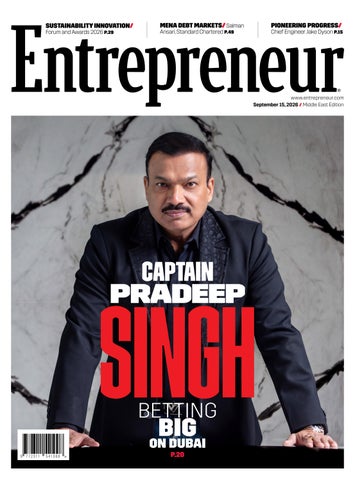
CAPTAIN PRADEEP
SINGH BETTING
BIG ON DUBAI P.20
E V E R Y T H I N G T H AT O N E C O U L D I M AG I N E FOR EXTRAORDINARY LIFE
Eywa Way of Water is a state-of-the-art residential community with only 65 exceptional waterfront residences, with a holistic wellness ecosystem, curating authentic experiences and best-in-class amenities few have dreamed of.
Contact us today: +971 54 308 6000 I
sales@byrevolution.com
E Y W A . A E
The Mirra® 2 Chair is turning heads again
The Mirra 2 Chair just keeps getting better. How? We updated the chair so it’s 30 percent lighter than the original Mirra - and the chair’s nylon base and spine are now 100 percent recycled content. We also gave it a fresh, inspired colour palette so it can look professional, casual, or sporty. One thing that hasn’t changed is the flexible yet supportive design that allows your body to move naturally and freely - the way it was meant to move.
hermanmiller.com
© 2026 Herman Miller
Contents/
September 15, 2026
FEATURES p.20
Captain Pradeep Singh Betting Big On Dubai P. 29
Driving the Sustainability Agenda Industry leaders gather in Dubai for the SUSTAINABILITY INNOVATION FORUM AND AWARDS 2026
P.15
Engineering the Future
How JAKE DYSON is leading a new era of innovation
P.46
Building Lebanon’s Next F&B Powerhouse KHALIL KHAMIS on growing Brain
Bites SAL, beginning with Pinkberry’s return
September 15, 2026 / E N T R E P R E N E U R . C O M / 5
EXTRAORDINARY PR IVATE PO O LS | 30+ AM EN ITI ES | PRI M E LO CATI O N S
Escape to a home where urban sophistication meets resort tranquility.
BU I LT FO R M O M E NTS THAT MAT TE R 800-SAMANA | WWW.SAMANADEVELOPERS.COM
D I S C OVER REFINED
living
*Ranking as per the H2025 1 sales volume data of property monitor for Dubai
Make growth your next stop Corporate & Investment Banking. Global Markets. Global Banking. Transaction Services. Now is your time sc.com/cib
Dub New York
Johannesburg Standard Chartered Bank UAE is licensed by the Central Bank of the UAE
Shanghai
bai London
Singapore
Contents /
September 15, 2026
CEO Wissam Younane wissam@bncpublishing.net MANAGING DIRECTOR Rabih Najm rabih@bncpublishing.net ART DIRECTOR Simona El Khoury EDITOR IN CHIEF Tamara Pupic tamara@bncpublishing.net EDITOR AT LARGE Anil Bhoyrul anil@bncpublishing.net SENIOR FEATURES EDITOR Aalia Mehreen Ahmed aalia@bncpublishing.net JUNIOR EDITORIAL ASSISTANT Kristine Erika Agustin kristine@bncpublishing.net DIRECTOR OF INNOVATION
Sarah Saddouk sarah@bncpublishing.net GROUP SALES DIRECTOR – B2B GROUP Joaquim D’Costa jo@bncpublishing.net
↑ Muneeb Mushtaq is the founder and
Chairman of AIRZAI.
INNOVATOR P.40 The Human Capital Question
Insights from DR. IOANNIS SPANOS , VIJAY BAINS, and EVGENY GARANIN at Sustainability Innovation Forum 2026
HEAD OF PARTNERSHIPS
STARTUP SPOTLIGHT
P.49 The Optionality Advantage Standard Chartered’s SALMAN
ANSARI on how MENA issuers are
diversifying their funding strategies
P.63 The Next Layer of Smart Spaces
MUNEEB MUSHTAQ on scent, AI, and the
future of responsive environments
Why owning a slice of the world's growth is better than chasing a single winning stock
Anna Chipala anna@bncpublishing.net COUNTRY MANAGER KSA
Amjad Fakhouri amjad@bncpublishing.net COLUMNIST Tamara Clarke CONTRIBUTING WRITERS
Salman Ansari
IN THE LOOP MOHAMED ALABBAR on navigating
SUBSCRIBE
Contact subscriptions@bncpublishing.net to receive Entrepreneur Middle East every issue
COMMERCIAL ENQUIRIES sales@bncpublishing.net
uncertainty at AIM Congress 2026
P. 68
AIM 2026 explores the new geography
of global investment P. 70 UAE-BRICS non-oil trade surpasses US$312 billion
P.71
VIRTUZONE launches E-Commerce
Accelerator Programme
P.52 Basket Case
BUSINESS DEVELOPMENT DIRECTOR
Andy Soulahian andy.soulahian@bncpublishing.net COMMERCIAL LEAD
P. 66
TREPONOMICS
Samir Glor Samir@bncpublishing.net
P. 72
FAKHRUDDIN PROPERTIES unveils
Tréppan Vision
P. 74
DUBAI FUTURE FINANCE WEEK to host 85+
events
10 / E N T R E P R E N E U R . C O M / September 15, 2026
ENTREPRENEUR.COM
Access fresh content daily on our website
EntMagazineME
Entrepreneur-me
PO BOX 502511 DUBAI, UAE P +971 4 4200 506
All Rights Reserved 2026. Opinions expressed are solely those of the contributors. Entrepreneur Middle East and all subsidiary publications in the MENA region are officially licensed exclusively to BNC Publishing in the MENA region by Entrepreneur Media Inc. No part of this magazine may be reproduced or transmitted in any form or by any means without written permission of the publisher. Images used in Entrepreneur Middle East are credited when necessary. Attributed use of copyrighted images with permission. All images not credited otherwise Shutterstock. Printed by United Printing and Publishing.
PROPERTIES solproperties.ae 800-765-1
Learn More
Editor’s Note/ THE MONEY WE KEEP
On saving, investing, and turning income into wealth.
T
here I would have liked to continue this month with the subject of AI-generated content and how artificial intelligence is increasingly revealing the natural stupidity of some of our “new authors.” Judging by the amount of reaction my last Editor’s Note generated, many of you would probably have liked me to continue too.
But another subject has forced itself upon me: financial discipline and financial literacy. For years, research into personal finances in the UAE has pointed to an interesting contradiction. People may earn well (not all!) and save more (not all!), yet significant gaps remain when it comes to financial planning, investing and building long-term wealth. That appears to be changing. A new Toluna survey suggests that financial discipline (or saving) among UAE residents, which hovered around the 50% mark in 2023 and 2024, surged in 2025. The survey expected it to remain strong into 2026, but given the challenges this year that have affected people’s incomes, I fear many may have had to dip into their emergency savings. Yet it is often in the darkest hours that we should plan for better times, and this might be one of them. It may be a good moment to think seriously about your future savings and investment plan. Conversations about money have also become more open, and one reason for that is that more successful individuals are choosing to share what they have learned about saving, investing and building wealth.
Our cover star this month, Aethon Group and Karma Developers founder Captain Pradeep Singh, is one of them. “I believe that many professionals, even CFAs and people who come to work in the Gulf, have this mentality that their money will last forever. They don’t focus on capturing value or investing their money. And that is why, when they retire or go back home, they often leave with very little,” he said. His advice is simple: “Invest early. Create another you- one who is saving and investing. That is when you start to see your wealth grow.” There are other free resources that can help you get started, such as SimplyFI, a 42,000-member volunteer community on Facebook that serves as the UAE’s official Bogleheads and ChooseFI chapter. It can help you take those first steps: create an emergency fund, become better at
12 / E N T R E P R E N E U R . C O M / September 15, 2026
tracking your expenses and saving, and, eventually, invest that money in your first ETF - because it is never too late. More on this on page 52
Tamara Pupic Editor in Chief | Entrepreneur Middle East
WHERE THE WORLD CONVENES IN NEW INTELLIGENCE THE YEAR’S LARGEST APPLIED AI SHOWCASE IN THE NEW INTELLIGENCE CAPITAL
350+
AI BIG TECH & STARTUPS
180+
INTERNATIONAL EXPERTS ON STAGE
GET INVOLVED
60+
COUNTRIES PARTICIPATING
GLOBAL INVESTORS
AI UNICORNS
Meet the world’s leading AI enterprises building the infrastructure, frontier new models and full-stack AI solutions that will reshape industries altogether – from breakthrough research to powerful business use-cases aieverythingabudhabi.com
#AiEverythingAbuDhabi
200+ 20+
sales@aieverythingabudhabi.com
→ Jake
Dyson is the Chief Engineer at Dyson.
Engineering the Future
Jake Dyson tells Entrepreneur Middle East how he’s leading a new era of innovation at Dyson. b y TA M A R A C L A R K E
September 15, 2026 / E N T R E P R E N E U R . C O M / 15
B/
AI
→ Jake Dyson with
“
his father James Dyson, founder and Chairman of Dyson.
16 / E N T R E P R E N E U R . C O M / September 15, 2026
B/
Innovation
“ I think most ideas we think about now, we wouldn't think of unless there was something interesting in it that people would find valuable or useful. So most of the things we think about, we put into products. I think more now than we would have done four or five years ago.”
D
yson has become the ultimate disruptor by focusing on mechanical and physical enhancements to drive innovation. Best known for inventing the bagless cyclonic vacuum cleaner, which uses high-speed centrifugal force to collect dust and debris instead of a traditional bag, the company single-handedly revolutionized the floor care sector. Then came luxury styling tools, such as the Supersonic hairdryer and Airwrap multi-styler, which set new standards in hair care. According to Chief Engineer, Jake Dyson, dental care is up next with the launch of CameraJet, the only toothbrush equipped with a camera and powered by a proprietary algorithm to floss teeth while brushing. He said, “It’s our investment in core technologies that enables us to diversify and disrupt various categories. That’s why we invested 10 years into developing the smallest digital motors to transform vacuum cleaners and hairdryers. Our breakthroughs have come about through mechanical engineering, but it's our research in robotics and the use of cameras and vision systems that have shifted our approach and opened up new ways to innovate and improve our products.” “We’re now using artificial intelligence, vision systems and machine learning to allow the machines to understand the environment they are operating in. The approach is the same whether it's operating in your mouth, on your hair or in your home.” A new era of innovation Working closely with his father, James Dyson, founder and Chairman of Dyson, Jake leads teams across the UK and Singapore to bring new products to market.
Speaking about their dynamic, he said: “He's very focused on engineering and designing the products we create now, and the efficiency of the business. I'm very focused on how we shape that for the future and what we drive towards, and it works very well”. While the old guard is still engaged and impactful, Jake is ushering in a new wave of product development that focuses on software connectivity and future technology. He admits that while the company continues to trailblaze, it does require a bit of negotiating. “When it comes to connectivity and what you can do through software and intelligence and machine learning, when you have 70-year-old board members who are sitting around the table, they just don't quite understand it. But, you can see it. You can see the possibility, and it's fine because sometimes it's taken like a year for them to say, "Ooh, ooh, maybe we should do that” - I said that a year ago. But they recognize that, and now it's a lot more immediate. I say we need to do this, and they say, ‘Okay. We're doing it.’” As Dyson’s list of groundbreaking rollouts continues to grow, Jake reflects on the achievement he’s most proud of. “This is pretty incredible”, he said, gesturing to the recently launched CameraJet, positioned on the table as a centerpiece. “I think our intelligence going on in the background to measure and see every machine when it's connected is remarkable. And, it's because we have a lot of sensors in our machines to make sure that the batteries talk to the motor and everything's performing to peak performance. So those sensors are already in there and to be able to get that information back out into a dashboard is very advanced and fantastic. I think that what we're doing with vision systems in the background is also amazing.” “And, I'm very, very proud of our research teams. We’re the type of business where we give them freedom to go and search things - to explore - but what they discover is mind-blowing, really, really mind-blowing…research and our scientists are absolutely fundamental to future innovation.” Pioneering progress For decades, oral care routines have remained the same with separate steps for brushing, flossing and rinsing. According to Dyson’s Oral Care Usage and Attitudes Study commissioned in 2017, nine out of ten people do not floss as regularly as they should and people spend an September 15, 2026 / E N T R E P R E N E U R . C O M / 17
B/
Innovation
18 / E N T R E P R E N E U R . C O M / September 15, 2026
average of 45 seconds brushing their teeth, which is well below the recommended two minutes. Furthermore, the World Health Organization’s 2025 Oral Health Status Report confirmed that nearly 3.7 billion people are estimated to be affected by oral disease globally. Meanwhile, brushing technology remained unchanged since the 1980s. Dyson engineers saw this as a real problem to solve, so they fixated on the idea of training a camera to target gaps and fire a jet to floss teeth.
value, but actually it really, really was. And other companies have gone ahead and done things that we did six years ago, but we didn't put into the market, and we kicked ourselves. And it's very difficult because you can't really go out there and get customer feedback because they see what you're doing. I think that we've gone through a phase of being quite conservative, and now we're coming out of it, where if anything's interesting and it's good, then we should do it.”
“I thought, if you can get it that accurate and it hits the right point between the gap, it will floss your teeth. We've also designed all these bristles around the curvature of the tooth to have better cleaning action on your teeth, so that's why it's more than a toothbrush. We reconsidered everything about it, even the vibration and oscillation and how that cleans your teeth. I mean, you have to because if you do a camera jet floss and your toothbrush is not as good as someone else's, you know, it fails. So it all has to be better - the whole system.”
“I think most ideas we think about now, we wouldn't think of unless there was something interesting in it that people would find valuable or useful. So most of the things we think about, we put into products. I think more now than we would have done four or five years ago.”
The Dyson CameraJet rolls all of the oral care steps into one. It is the only toothbrush with a camera powered by Gap Optical Targeting to identify gaps between teeth and precision-floss while you brush. An integrated 100,000 pixel macro lens camera powered by machine learning detects, tracks and predicts gaps between teeth in real time, triggering a precision jet burst of mouth rinse exactly where it is needed. It is the result of six years of research, development and engineering, challenging every aspect of conventional oral care. Paving the way forward Including the CameraJet, Dyson recently launched six new products built around this emerging concept of intelligence. While this is cause for celebration, it’s also an opportune time to refine internal processes as the company shifts from being conservative to more experimental. Jake Dyson asserts that it’s important to strike a balance between product iteration and market readiness. He discussed the downside of being fixated on launching products that work perfectly, mentioning a missed opportunity two years ago.
“We have made mistakes before where we thought that [a product or feature] was not of
He offers the same advice to entrepreneurs who build products, as opposed to delivering services. “If you have a breakthrough idea, then go for it. Don't stop and don't give up and get it out there as fast as possible. But don't just have one thing because there'll be a copy of it in the market in three months at half the price.” “We've been working on CameraJet for about six years. In the last two years, machine learning started to work very well, and the training with AI made it remarkably good.” “We won't launch a product unless it really works and is better than anyone else's. But it has to really work. Our company is about honesty, and when we tell you what a product is going to do for you, it has to be honest and true.” Tamara Clarke, a former software development professional, is the tech and lifestyle enthusiast behind The Global Gazette, one of the most active blogs in the Middle East. The Global Gazette has been welcomed and lauded by some of the most influential tech brands in the region. Clarke's goal is to inform about technology and how it supports our lifestyles. See her work both in print regional publications and online on her blog where she discusses everything from how a new gadget improves day-to-day life to how to coordinate your smartphone accessories. September 15, 2026 / E N T R E P R E N E U R . C O M / 19
20 / E N T R E P R E N E U R . C O M / September 15, 2026
CAPTAIN PRADEEP
SINGH ON DUBAI BECOMING A GLOBAL HUB FOR INTELLECTUAL CAPITAL
From shipping and real estate to technology, education and investment, Aethon Group and Karma Developers founder Captain Pradeep Singh reflects on more than two decades of building businesses from Dubai, and the lessons in timing, risk, resilience and reinvention that shaped his journey. b y TA M A R A P U P I C
September 15, 2026 / E N T R E P R E N E U R . C O M / 21
22 / E N T R E P R E N E U R . C O M / September 15, 2026
I
have been witnessing Dubai’s evolution for more than two decades. Dubai’s shift from attracting people looking for employment to people building businesses including entrepreneurs, investors, highly qualified professionals and global business leaders who now come here not only for business but to live.” says Captain (Dr.) Pradeep Singh, founder and Chairman of real estate venture Karma Developers, global shipping company Aethon Group, and technology consulting and training group Spectrum Networks, to name just a few of his largest businesses. As we talk at the headquarters of Karma Developers, on the 25th floor of Binary Tower in Business Bay, with the Dubai skyline stretching behind him, there is little reason to doubt him when he says he plans to "bet more and more aggressively on Dubai." Captain Singh explains, "When the market goes up, we are cautious. When the market is down, we see opportunities. Right now, the market is not down, but it is not overheated either, meaning people no longer expect unrealistic valuations."
"That is why people who understand business are coming to Dubai and investing. Dubai has repeatedly demonstrated its ability to recover, adapt and move forward quickly." A glance at Captain Singh's biography suggests that he speaks confidently about the calibre of business leaders Dubai now attracts because he moves in those circles himself. Singh is a Harvard Business School alumnus through its prestigious Owner President Management program---his most recent milestone in a lifelong commitment to learning. He is a graduate of T.S. Chanakya, one of India's leading maritime academies, and holds an MBA from Alliance Manchester Business School, an MSc in Finance from the University of Northampton and an LLM from Northumbria University. He also holds CPA, CMA and CGMA qualifications and has undertaken doctoral research at UCAM in Spain. For Singh education is not about collecting labels but it is about testing his assumptions leading towards more growth in the next stages.
I HAVE BEEN WITNESSING DUBAI’S EVOLUTION FOR MORE THAN TWO DECADES. DUBAI’S SHIFT FROM ATTRACTING PEOPLE LOOKING FOR EMPLOYMENT TO PEOPLE BUILDING BUSINESSES INCLUDING ENTREPRENEURS, INVESTORS, HIGHLY QUALIFIED PROFESSIONALS AND GLOBAL BUSINESS LEADERS WHO NOW COME HERE NOT ONLY FOR BUSINESS BUT TO LIVE.”
September 15, 2026 / E N T R E P R E N E U R . C O M /
WHEN YOU ARE A CHILD, STUDYING CAN FEEL LIKE A BURDEN BECAUSE SOMEBODY ELSE IS DIRECTING YOU. THE EDUCATION I PURSUED LATER IN LIFE WAS ENTIRELY BY CHOICE.” His current plan includes joining OPM Ignite in Dubai. This event brings together leading entrepreneurs from across the world, OPM alumni and Harvard Business School professors on one platform. For Singh, OPM’s setting in Dubai is in itself a sign of this city’s growth and value to be a global centre for enterprise, leadership and intellectual capital. Singh has been recognized by multiple prestigious organisations across the world over the years including Forbes, ET NOW and Thinkers360, along with getting features in prominent regional and international power lists. Singh is also an author of one of the bestselling and awardwinning books, including No Map, Just Vision and The Asset Play. His journey has also been recognized in a biography “Storms to Skylines: The Voyage of Captain Pradeep Singh” by Binay Singh. On a wider level he holds honorary doctorates and two knighthoods, one from the historic Parte Guelfa in Florence and another from the Order of St John in the Netherlands. Singh has been recently, appointed a 24 / E N T R E P R E N E U R . C O M / September 15, 2026
Senator of Parte Guelfa, which he sees as an opportunity and a chance to contribute at a wider level rather than a mere recognition. "When you are a child, studying can feel like a burden because somebody else is directing you," Captain Singh says. "The education I pursued later in life was entirely by choice." Captain Singh's story in business starts with a decision to carve his own path in the maritime industry. "Mine is not a rags-to-riches story," he says. "I came from a decent and respected family." His grandfather was an influential businessman and landlord, while his father was a bureaucrat who was frequently posted away from home. His grandfather's influence played an important role in shaping his independence, confidence and determination to build something of his own. One of the lasting influences on Singh has been of his mother. A lesson he learned from her that stayed till now with him “if you want to make your line bigger, do
" I CONSIDER THE OCEAN A LEADERSHIP ACADEMY. THE OCEAN TEACHES YOU LIFE SKILLS THAT NO OTHER SCHOOL CAN. YOU HAVE A SMALL TEAM, AND IN THE MIDDLE OF THE OCEAN NOBODY IS DISPENSABLE. YOU NEED EVERYBODY. IF TWO PEOPLE ARE IN CONFLICT, YOU NEED TO BRING THEM TOGETHER."
not erase someone else's line; draw a bigger line beside it.” A lesson that he acquired early in ambition without a sense of comparison and this lesson instilled a sense of self achievement in him based on no one else’s downfall. He chose a profession built around hierarchy and then rose through it extraordinarily quickly. At 27, he became a Captain. "The moment I stepped out of college and joined a ship, I wanted faster promotions, so I was very practical in my approach," Captain Singh explains. "On a ship, academic achievement alone does not determine success. It is a demanding life, and practical judgement, resilience and the ability to work with people matter enormously." "I consider the ocean a leadership academy. The ocean teaches you life skills that no other school can. You have a small team, and in the middle of the ocean nobody is dispensable. You need everybody. If two people are in conflict, you need to bring them together." "Everything depends on that team. The ship and its cargo might represent hundreds of millions of dollars in assets, and if something goes wrong, the damage can run into the billions. September 15, 2026 / E N T R E P R E N E U R . C O M / 25
At a young age, I carried that responsibility with a very small team." Before long, Captain Singh decided it was time for a new path. He moved to Dubai and worked with some of the region's leading oil and shipping companies, including ENOC and Bahri. The 2008 global financial crisis became an important period of learning. Singh learned that how abruptly market conditions can shift. This taught him the importance of preserving capital staying resilient for the uncertain times. That exposure gave him the confidence and perspective to bet on himself, and in 2010 he founded Aethon Marine Services. Aethon began as a specialist marine inspection provider and has since developed into a broader maritime services and risk-management platform. "I saw a gap in the industry. Supertankers carrying oil operate around the world, and international bodies work to reduce the risk of pollution and other serious incidents. But specialist inspection capability did not always reach difficult and remote locations in Africa, South America and Asia," Captain Singh explains. "I created a company that could take this capability wherever it was needed." Aethon became a top marine inspection and risk-management company, known for working in tough, remote spots. From there, they branched out: owning ships, running them, chartering, marine services, and eventually ship demolition and recycling. By 2013, Captain Singh had lived in Dubai long enough to witness the city's real estate growth firsthand and become fascinated by it. Together with his partner Navneet Mandhani, he founded Karma Developers.
"We bought a property in Deira. It was the only freehold property there, and we sold out in four hours," Captain Singh says. Since then, Karma Developers has carved out a distinct position in the UAE real estate market through a design-led approach centred on quality, value, sustainability and disciplined capital allocation. While the UAE remains its core market, the company has built a wider international footprint spanning Cyprus, the UK and Romania, delivering more than 2,000 keys globally. Today, Karma Developers has approximately five million sq. ft. under development across residential and commercial projects. Its next major launch is Latitude 25, a commercial tower in Dubai designed for the next generation of companies, entrepreneurs and investors choosing the city as their base. Singh sees Latitude 25 as more than just a development. It's Karma's belief Dubai will keep drawing global business and smart people. They're not slowing down; they'll boost their Dubai work, finding more chances and building more projects. He said they plan to focus way more on Dubai. The opportunity there isn't shrinking. Dubai keeps attracting businesses, money, and skilled people. Karma Developers wants a big part in that next growth phase. "Shipping and real estate are very similar. You need to seize opportunities when the timing is good, but more importantly, you need to preserve your capital for the moment when the right opportunity appears," Captain Singh says. "I always say it is about the freight and the rent. Freight from a ship and rent from a property generate income, but the asset play creates real wealth."
26 / E N T R E P R E N E U R . C O M / September 15, 2026
"If you buy an apartment when conditions are weak and sell it a few years later when the market is strong, that is where you can achieve the greatest return on your capital. We learned the same principle in shipping." "When shipping markets weaken, rates fall and the value of a US\$100 million ship may drop substantially. If you buy at the right time and the market recovers, the movement in value can be considerable. The principle is to understand the cycle and enter at the right point." Remaining active in operating businesses is crucial to this approach because it keeps Singh close to new opportunities. One such opportunity presented itself when he acquired Spectrum Networks, expanding his business interests into technology consulting and professional training. "People often think that whatever is performing well will continue doing well forever. I do not believe that. When things are going well, you should prepare for more difficult periods. Markets move in cycles," he says. "That was the story with Spectrum." "I already knew the business and held a small investment in it. When it faced difficulties, I took over the group and streamlined its operations. We separated it into focused companies, brought in chief executives and aligned their interests with the long-term success of each business." Run by Captain Singh's wife, Mridula Singh, Spectrum Networks is today known for delivering high-impact skilling and transformation programs, from national AI and cloud academies aligned with
government digital agendas and Vision 2030 initiatives to large-scale telecom migration projects in India. Its work also spans cloud and modern workplace programs for government authorities, as well as data and AI bootcamps producing certification-ready, job-linked graduates. Spectrum Networks eventually led Captain Singh to make more early-stage technology investments, but it also inspired him to support others through financial education. Over time, he embraced financial literacy as a social cause alongside initiatives supporting children's education and disadvantaged families in India. "Even highly qualified professionals can underestimate how quickly accumulated wealth can disappear without disciplined saving and investment. People may assume that their income and savings will last forever, but without a plan they can reach retirement with far less financial security than they expected." "I do not believe only in one-time charity, where you simply give something and forget about it. I believe in supporting causes that can create a lasting impact." "When you support a child's education, you are not supporting only one child. You may help uplift an entire family. We therefore support initiatives around children's education, women's empowerment and disadvantaged families in rural India." "I have also taken on financial literacy and financial education as a social cause. That is why I wrote The Asset Play. I am creating a Financial Freedom series online, and I regularly write blogs and LinkedIn articles to encourage people to invest responsibly." "As income and status grow, expenses often grow with them. I always say: invest early. Create another version of yourself, one that is consistently saving and investing. That is when you begin to build lasting wealth." When asked what advice he would give other entrepreneurs, particularly those running diversified businesses like his own, Captain Singh says that since something will almost always be going wrong somewhere, they should deliberately think of one good thing before going to sleep. "Otherwise, there will always be a problem waiting to occupy the night," he says. Singh, 53, likes being "comfortably uncomfortable." He's thankful for his work but always learning, evolving, or chasing new goals. Success isn't an end point for him. It's just a place to start over. September 15, 2026 / E N T R E P R E N E U R . C O M / 27
Invests In Entrepreneurs What Are You Building?
Learn more at entrepreneur.vc
28 / E N T R E P R E N E U R . C O M / September 15, 2026
SUSTAINABILITY Innovation Forum& Awards
2026
Cross-sector conversations on the future of sustainable business and development followed by an evening celebrating the region’s standout projects, solutions and leaders.
T
heSustainability Innovation Forum and Awards 2026 brought together leaders from construction, energy, finance, hospitality, design and sustainability at Sofitel The Palm, Dubai, on September 1, 2026. Across a day of industry discussions followed by an evening awards ceremony, the event explored the ideas, people and solutions shaping a more sustainable future across the region. The event was supported by Gold Sponsors Numai Real Estate and Herman Miller, and Category Sponsor Hansgrohe Group.
September 15, 2026 / E N T R E P R E N E U R . C O M / 29
SUSTAINABILITY Innovation Forum& Awards
2026
Sustainability Innovation Forum 2026
Wissam Younane CEO, BNC PUBLISHING
T
he Sustainability Innovation Forum 2026 convened construction pioneers, entrepreneurs, hospitality leaders and sustainability professionals for discussions centered on turning sustainability ambitions into practical action. Across three panels, speakers explored some of the challenges increasingly influencing sustainable development: the growing relationship between energy infrastructure and construction, the role of people and organizational culture in delivering sustainability strategies, and the evolution of sustainable design within the hospitality sector. Through real-world perspectives and cross-industry conversations, the forum examined how businesses can embed sustainability across projects, operations and decision-making while responding to changing economic, environmental and societal demands.
Vibha Mehta, EDITOR IN CHIEF, CONSTRUCTION BUSINESS NEWS MIDDLE EAST
PANEL 1: Power Before Concrete: Why Energy Now Sets the Pace of Construction The opening panel examined how access to power is becoming an increasingly important factor in determining the pace of construction and development across the Gulf. As electricity demand grows, particularly alongside the expansion of AI and data centers, the discussion looked at how grid connection timelines, substations, transformers and transmission infrastructure can influence when projects become operational. The speakers also explored the growing need to consider energy access from the earliest stages of land acquisition and masterplanning, as well as the importance of aligning power infrastructure with industrial zones, data centers and mixed-use developments.
SPEAKERS VINEET KUMAR SHARMA
Head of Sustainability & ESG Arabian Gulf Steel Industries LLC
MODERATOR
30 / E N T R E P R E N E U R . C O M / September 15, 2026
DR. MUHAMMAD TAYAB Sustainability Director NMDC Group
KASUN ILLANKOON
Editor - Special Projects BNC Media Group
LAURENT LONGUET
Chief Operations Officer Positive Zero
YOUSEF ALAAALDEEN
Energy Manager ENGIE Solutions
MR. VIPULKUMAR SHANTILAL MEHTA Cement Operations Director Cemex UAE Moderator
SUSTAINABILITY Innovation Forum& Awards
2026
PANEL 2: Can Businesses Achieve Sustainability Goals Without Investing in People? Moving the conversation from infrastructure to human capital, the second panel examined a question that is becoming increasingly relevant as sustainability strategies mature: can organizations meet their ambitions without simultaneously ?investing in their people The discussion explored the relationship between sustainability, talent and business growth, including the skills organizations need to turn sustainability strategies into measurable outcomes. Speakers considered how leaders can identify and address sustainability skills gaps, embed sustainability into workplace culture and everyday decision-making, and prepare their workforces for changing business .requirements The conversation also looked at the relationship in reverse: how strong sustainability strategies can help organizations attract and retain talent, strengthen culture, encourage innovation .and build long-term competitive advantage
SPEAKERS DR. IOANNIS SPANOS
Vice President – Sustainability Expo City Dubai
VIJAY BAINS
Chief Sustainability Officer and Group Head of ESG Emirates NBD
EVGENY GARANIN
Associate Director of Sustainability DMCC
MODERATOR
AALIA MEHREEN AHMED
Senior Features Editor Entrepreneur Middle East
PANEL 3: Built for Guests, Designed for Good The final panel turned to hospitality, examining how hotels and hospitality developments can deliver memorable guest experiences while reducing their environmental impact and preparing their properties for the future. Speakers explored what purposeful, sustainable design means for today’s hospitality sector, including how luxury, functionality and environmental responsibility can coexist without compromising guest expectations or operational performance. The conversation also covered sustainable approaches to renovations, the shared responsibility of architects, interior designers and hotel operators, and the role of technology and adaptable spaces in creating properties that remain relevant over the long term.
SPEAKERS MARISKA STOFFEL
RACHID BAKAS
Director of Design & Development R.Evolution
General Manager Anantara Retreat Santorini Abu Dhabi
MODERATOR
DR. NAIM MAADAD
SEJAL PATEL Senior Design Director Kristina Zanic Consultants
HENRIQUE DIAS Principal & Middle East Hospitality & Mixed-Use Director DLR Group
MAIKEL COOKE
Commercial Manager JM Foods LLC Moderator
CEO and Founder Gates Hospitality
September 15, 2026 / E N T R E P R E N E U R . C O M / 31
SUSTAINABILITY Innovation Forum& Awards
Sustainability Innovation Awards 2026
2026
T
Later that night, the focus shifted from discussion to recognition with the Sustainability Innovation Awards 2026, also held at Sofitel The Palm, Dubai. Organized by BNC Media Group, the awards recognized 20 winners across sustainability, construction, hospitality, technology, manufacturing, energy and leadership. The evening highlighted organizations, projects, solutions and individuals contributing to more sustainable practices and innovation across the region. The event was supported by Gold Sponsors Numai Real Estate and Herman Miller, and Category Sponsor Hansgrohe Group.
WINNERS of the Sustainability Innovation Awards 2026
32 / E N T R E P R E N E U R . C O M / September 15, 2026
THE SUSTAINABILITY INNOVATION AWARDS 2026 WINNERS WERE: SUSTAINABLE HOTEL GROUP OF THE YEAR/ RADISSON HOTEL GROUP SUSTAINABLE FUTURE PROJECT OF THE YEAR /AL AIN OASIS PRESERVATION PROJECT BY AL AIN CITY MUNICIPALITY CORPORATE EXCELLENCE AWARD/NMDC GROUP SUSTAINABLE MANUFACTURING EXCELLENCE AWARD/ARAB BASALT FIBER COMPANY SUSTAINABLE START-UP OF THE YEAR/SUREFLOW SUSTAINABLE COMMERCIAL PROJECT OF THE YEAR/ACROSS H BY HUNA BY A.R.M. HOLDING SUSTAINABLE FIT-OUT FIRM OF THE YEAR/SUMMERTOWN INTERIORS SUSTAINABLE CONTRACTOR OF THE YEAR/DOUGLAS OHI SUSTAINABLE INITIATIVE OF THE YEAR/ERTQAA ( )ءاقتراINITIATIVE BY THE MINISTRY OF CLIMATE CHANGE AND ENVIRONMENT, UNITED ARAB EMIRATES EV CHARGING STATION PROVIDER OF THE YEAR/EMARAT EV CHARGING STATIONS COMPANY P.J.S.C. (UAEV) SUSTAINABLE WATER SOLUTION OF THE YEAR/CLOSED-LOOP BOTTLING SYSTEM BY SPRUDEL EXCELLENCE IN WORKFORCE SOLUTIONS AWARD/TALENTONE SUSTAINABLE HOTEL OF THE YEAR/MÖVENPICK HOTEL JUMEIRAH BEACH SUSTAINABLE BATHROOM BRAND OF THE YEAR/HANSGROHE GROUP SUSTAINABLE INNOVATION OF THE YEAR/PALM STRAND BOARD (PSB®) BY DESERTBOARD SUSTAINABLE TECHNOLOGY OF THE YEAR/AUTONOMOUS DISTRICT COOLING OPERATIONS PLATFORM BY TABREED SUSTAINABLE HOMEGROWN BRAND OF THE YEAR/CANAMA ENTREPRENEUR OF THE YEAR/MOHAMMED BADER FROM DIVISION INTERNATIONAL ENGINEERING CONSULTANTS ENERGY TRANSITION LEADER OF THE YEAR – EMERGING MARKETS/ALI ALSHIMMARI FROM GLOBAL SOUTH UTILITIES (GSU) Wissam Younane CEO, BNC PUBLISHING
SUSTAINABILITY INNOVATION LEADER OF THE YEAR AWARD/DR. ABDULAZIZ ALJODAI FROM SAUDI RESEARCH DEVELOPMENT AND INNOVATION AUTHORITY
September 15, 2026 / E N T R E P R E N E U R . C O M / 33
SUSTAINABILITY Innovation Forum& Awards
2026
Wissam Younane with the event emcee, Tom Urquhart
SUSTAINABLE HOTEL GROUP OF THE YEAR
Radisson Hotel Group
SUSTAINABLE MANUFACTURING EXCELLENCE AWARD SUSTAINABLE START-UP OF THE YEAR
Arab Basalt Fiber Company
SureFlow
CORPORATE EXCELLENCE AWARD SUSTAINABLE FUTURE PROJECT OF THE YEAR
Al Ain Oasis Preservation Project by Al Ain City Municipality
34 / E N T R E P R E N E U R . C O M / September 15, 2026
NMDC Group
SUSTAINABILITY Innovation Forum& Awards
2026
SUSTAINABILITY INNOVATION LEADER OF THE YEAR AWARD
SUSTAINABLE CONTRACTOR OF THE YEAR
Douglas OHI
Dr. Abdulaziz Aljodai from Saudi Research Development and Innovation Authority
SUSTAINABLE FIT-OUT FIRM OF THE YEAR
Summertown Interiors
SUSTAINABLE COMMERCIAL PROJECT OF THE YEAR
Across H by Huna by A.R.M. Holding
September September15, 15,2026 2026 / E N T R E P R E N E U R . C O M / 35
SUSTAINABILITY Innovation Forum& Awards
2026
SUSTAINABLE WATER SOLUTION OF THE YEAR
Closed-loop bottling system by Sprudel
SUSTAINABLE INITIATIVE OF THE YEAR
ERTQAA ( )ارتقــاءInitiative by the Ministry of Climate Change and Environment, United Arab Emirates
EV CHARGING STATION PROVIDER OF THE YEAR
Emarat EV Charging Stations Company P.J.S.C. (UAEV)
36 / E N T R E P R E N E U R . C O M / September 15, 2026
EXCELLENCE IN WORKFORCE SOLUTIONS AWARD
TalentOne
SUSTAINABILITY Innovation Forum& Awards
2026
ENERGY TRANSITION LEADER OF THE YEAR – EMERGING MARKETS
Ali Alshimmari from Global South Utilities (GSU)
SUSTAINABLE HOTEL OF THE YEAR
Mövenpick Hotel Jumeirah Beach
SUSTAINABLE BATHROOM BRAND OF THE YEAR
SUSTAINABLE TECHNOLOGY OF THE YEAR
Hansgrohe Group
Autonomous District Cooling Operations Platform by Tabreed)
SUSTAINABLE INNOVATION OF THE YEAR
Palm Strand Board (PSB®) by Desertboard
September 15, 2026 / E N T R E P R E N E U R . C O M / 37
SUSTAINABILITY Innovation Forum& Awards
2026
SUSTAINABLE HOMEGROWN BRAND OF THE YEAR
Canama
ENTREPRENEUR OF THE YEAR
Mohammed Bader from Division International Engineering Consultants
38 / E N T R E P R E N E U R . C O M / September 15, 2026
September September15, 15,2026 2026 / E N T R E P R E N E U R . C O M / 39
/Sustainability
The Human Capital Question: Can Businesses Achieve Sustainability Goals Without Investing In People? INSIGHTS FROM THE SUSTAINABILITY INNOVATION FORUM 2026. by AALIA MEHREEN AHMED IMAGES COURTESY: © BNC PUBLISHING/FAROOQ SALIK
40 / E N T R E P R E N E U R . C O M / September 15, 2026
A
s sustainability becomes embedded deeper into business strategy, the skills needed to deliver it are moving well beyond dedicated environmental, social, and governance (ESG) teams. LinkedIn's Global Green Skills Report 2025 found that, for the first time, people with green skills working in non-green job titles accounted for 53% of all green hires. It is a shift that reflects a wider rethink of the relationship between sustainability and human capital, with a 2023 report by Deloitte describing human capital as “a central determinant of both productivity and sustainability.” The report further argued that human awareness, creativity and social innovation ultimately determine how other forms of capital are used, linking a successful human-enabled sustainability transition with competitive advantage, stronger corporate reputation and lower systemic risk.
↑ [L->R]: Evgeny Garanin, Associate Director of Sustainability, DMCC; Vijay
Bains, Chief Sustainability Officer and Group Head of ESG, Emirates NBD; and Dr. Ioannis Spanos, Vice President – Sustainability, Expo City Dubai
↑ Aalia Mehreen Ahmed, Senior Features Editor,
Entrepreneur Middle East
How [can] a strategy be implemented unless the people understand what they have to do? And that’s why we’re thinking that training and information exchange and knowledge sharing must be not only within the organization, but upstream and downstream. Dr. Ioannis Spanos Vice President – Sustainability, Expo City Dubai
A
s such, at the fifth edition of the annual Sustainability Innovation Forum by BNC Publishing [the media house behind Entrepreneur Middle East], held on September 1, 2026 at Sofitel Dubai The Palm, one of the panels (moderated by the author of this piece) raised a simple yet profound question: Can Businesses Achieve Sustainability Goals Without Investing In People? Sharing their insights on the topic were three industry experts, namely Dr. Ioannis Spanos, Vice President – Sustainability at Expo City Dubai; Vijay Bains, Chief Sustainability Officer and Group Head of ESG at Emirates NBD; and Evgeny Garanin, Associate Director of Sustainability at DMCC.
Opening the conversation, Dr. Spanos noted that sustainability must combine environmental, social and economic value; otherwise, it risks becoming just another concept or strategy on paper. “A strategy is developed, but [if ] the strategy is not implemented within the whole organization, the stakeholders, it’s just paper,” Dr. Spanos said. “How [can] a strategy be implemented unless the people understand what they have to do? And that’s why we’re thinking that training and information exchange and knowledge sharing must be not only within the organization, but upstream and downstream.” That emphasis on people is already visible in Expo City Dubai’s own sustainability efforts. According to its Sustainability Report 2025, the organization delivered more than 1,600 hours of
September 15, 2026 / E N T R E P R E N E U R . C O M / 41
/Sustainability LOOKING AHEAD:
WHAT SUSTAINABLE BUSINESSES NEED NEXT
Dr. Ioannis Spanos On Why Curiosity Drives Innovation
} “IN ORDER TO PROGRESS AND INNOVATE, YOU MUST INCLUDE CURIOSITY AND INCLUSIVITY WITHIN YOUR DECISIONS. FROM WHERE YOU’RE EXPECTING TO HAVE A BACKLASH, ACTUALLY YOU HAVE THE GREATEST IDEAS—AND CURIOSITY, IN A PROFESSIONAL MANNER, CAN BE VERY INNOVATION-DRIVEN.”
related to what they’re doing,” he said. “At the same time, we’re looking at the upstream, our supply chain.” Dr. Spanos then pointed to Expo City’s work with its events supply chain, F&B operators and commercial tenants as examples of this approach, adding that F&B businesses, for → Evgeny
Garanin, Associate Director of Sustainability, DMCC
→ Dr. Ioannis
Spanos, Vice President – Sustainability, Expo City Dubai
LOOKING AHEAD:
WHAT SUSTAINABLE BUSINESSES NEED NEXT
Evgeny Garanin On The Skill That Comes Before Green Skills
} “THE REAL SKILL BEFORE ANY GREEN SKILL IS TEACHING YOUR EMPLOYEES— AND OURSELVES—BEFORE WE MAKE A DECISION, WHEN WE SEE ANY DATA, TO THINK FOR 30 SECONDS AND ASK OURSELVES: ‘WHAT CAUSED IT?’”
environmental and social sustainability training during the year, while recording a 32.4% year-on-year reduction in operational emissions. Its efforts have since expanded further through initiatives such as the Green Innovation District, launched with the UAE Ministry of Economy and Tourism in October 2025 as a hub for clean-tech innovation, circular economy solutions and decarbonization, as well as the UAE’s first Green License, launched earlier this year.
instance, received dedicated training on waste and the circular economy, as well as energy and water, while commercial tenants were provided with a learning management suite to better understand Expo City’s sustainability objectives.
But for Dr. Spanos, embedding sustainability also means ensuring that learning extends beyond Expo City’s own workforce and into its wider ecosystem. “We’re targeting about 75% of our people to be retrained every year, on aspects
That idea of taking sustainability beyond a dedicated department was echoed by Bains, who argued that making it an organization-wide responsibility also requires embedding it into the structures through which
42 / E N T R E P R E N E U R . C O M / September 15, 2026
The idea here to address that gap would be not to run a skills audit; it would be to run a decisions audit, ask one question: when last year your Scope 3 number changed, did anyone outside of the ESG team notice? If not, that’s not a reporting problem, that’s the understanding problem—and that’s basically your gap. Evgeny Garanin, Associate Director of Sustainability, DMCC Emirates NBD
employees are trained, evaluated and ultimately progress within a business. “It’s not just in the sustainability department, it’s a responsibility of everyone,” he said. “All of our staff need to do their mandatory training, which includes sustainability, climate risk, transition risk, financing, and they need to understand as well how it affects their job roles.” At Emirates NBD, that approach extends beyond mandatory
training, Bains shared, with sustainability having been incorporated into bonus structures and leadership KPIs, while executives are required to attend at least one sustainability training session each year. Bains also revealed that 25% of leadership role responsibilities are now dedicated to sustainability, connecting sustainability performance with career progression. And while the bank's dedicated sustainability department comprises around 40 people, he estimated that approximately 2,500 employees across Emirates NBD are involved in sustainability-related projects. “The second part is our staff see a career path for themselves in sustainability,” Bains said. “So, also my role is building it out into our leadership KPIs, not just the bonuses, but also for promotions.”
LOOKING AHEAD:
WHAT SUSTAINABLE BUSINESSES NEED NEXT
→ Vijay Bains,
Chief Sustainability Officer and Group Head of ESG, Emirates NBD
Vijay Bains On The Skill Businesses Will Need For The Next Decade
} “BE CURIOUS AND ALWAYS CHALLENGE YOURSELF. SUSTAINABILITY IS ALWAYS EVOLVING, SO BE OPEN, ENGAGE WITH YOUR COUNTERPARTS ACROSS THE BUSINESS, AND ALWAYS TIE IT TO THE VALUE OF YOUR BUSINESS.”
The need to develop such capabilities is only becoming more pronounced as the green transition reshapes both businesses and the jobs within them. The World Economic Forum’s Future of Jobs Report 2025 identified the green transition as one of five major forces expected to shape and transform the global labor market by 2030.
The training that we had a few years ago was on principles of climate change, principles of transition. Actually, that’s quite well understood by, I think, everyone in the global markets. Now, it’s how do you help the client who is as skilled, if not, no doubt, more skilled than you as well? How do you understand their business requirements? Vijay Bains, Chief Sustainability Officer and Group Head of ESG, Emirates NBD
For Emirates NBD, those workforce capabilities also intersect with the bank’s expanding sustainable and transition finance activities. In August 2026, the bank launched the UAE’s first dedicated Transition Finance Framework, designed to direct financing towards credible decarbonization efforts in high-emitting and hard-to-abate sectors. Beyond helping businesses move towards lower-carbon models, the framework also creates a need for employees to develop increasingly specialized knowledge—moving beyond an understanding of the basic principles of climate change to being able to understand individual businesses and support clients through their respective transition journeys. “The training that we had a few years ago was on principles of climate change, principles of transition,” Bains added. “Actually, that’s quite well understood by, I think, everyone in the global markets. Now, it’s how do you help the client who is
as skilled, if not, no doubt, more skilled than you as well? How do you understand their business requirements?” But as sustainability capabilities become relevant to an ever-wider range of business functions, the question becomes not simply whether organizations need more green skills, but what the apparent “skills gap” actually represents. Indeed, Garanin raised the idea that the sustainability skills problem cannot simply be described as a “gap” to be filled by hiring, training or certifying more specialists. For him, the more consequential divide is between knowing about sustainability, understanding what it means for a particular business function, and translating that understanding into action. “The difference is not between knowing and not knowing. It is between understanding and knowing, and between understanding and acting,” Garanin said.
September 15, 2026 / E N T R E P R E N E U R . C O M / 43
/Sustainability That distinction becomes particularly significant when sustainability decisions increasingly sit outside dedicated ESG teams. At DMCC, for example, more than 70% of the emissions identified through its carbon footprint assessment fell within Scope 3 Category 2, predominantly linked to building and infrastructure activities. As Garanin pointed out, this means many of the organization’s most consequential climate decisions are made by departments outside the sustainability function. It also brings the conversation back to the aforementioned LinkedIn finding. For Garanin, rather than simply being an interesting labor-market statistic, the figure reflects a more fundamental shift in how sustainability is becoming embedded into ordinary business roles. “This is the labor market identifying what any honest Scope 3 carbon emission assessment already knows—that sustainability has spread into the ordinary roles,” he said. DMCC has sought to respond to this internally through measures including the establishment of a top-level leadership sustainability committee in 2019 and a greenhouse gas management system designed to ensure that relevant roles across the organization are involved in implementing its sustainability strategy. But Garanin argued that organizations should be careful about how they respond to this shift. Rather than trying to turn sustainability specialists into experts in every other business discipline, companies can equip people who already understand functions such as procurement or finance with the sustainability knowledge needed to make better decisions within those roles. And that, he suggested, requires organizations to look beyond a conventional skills audit. “The idea here to address that gap would be not to run a skills audit; it would be to run a decisions audit,” Garanin said. “Ask one question: when last year your Scope 3 number changed, did anyone outside of the ESG team notice? If not, that’s not a reporting problem, that’s the understanding problem—and that’s basically your gap.” As the conversation then moved towards what building that internal capability looks like in practice, each speaker offered examples from within their respective organizations. At Expo City Dubai, Dr. Spanos pointed to the use of “transformation agents” across departments—employees who are encouraged not simply to follow its sustainability strategy, but to challenge and improve it. One example came from the security team itself. “Our security people came within one of the meetings and they told us, ‘We have produced a ten-slide presentation to tell you how all staff in security now will become environmental auditors
44 / E N T R E P R E N E U R . C O M / September 15, 2026
outside because they have free time,’” Dr. Spanos recalled. “That will not come out unless we let them know what their needs are and let them innovate based on what they’re doing.” At Emirates NBD, Bains highlighted how sustainability knowledge can help employees identify commercial value within their existing areas of expertise. “When they looked at green buildings, they realized certain green buildings are 15% more efficient than others,” he said. “What that then means is the asset value goes up because actually, if you’re selling a hotel or resort and it’s more efficient to run, that’s more cost effective [and] your return income is far better.” Bains also pointed to the bank’s economists incorporating climate risks into economic analysis, demonstrating how existing expertise can be strengthened through a sustainability lens. Garanin, meanwhile, warned against “rented understanding”, which, in simple terms, adheres to outsourcing sustainability work without developing the knowledge internally. “It is when a company develops a strategy and only a third party knows it; when it’s calculated at Scope 3 and only the platform really produces these numbers,” he explained. “This is not an argument against advisors or AI. It is about what to buy from them, which should be investing into capability and capacity.” He recalled how one company within DMCC’s ecosystem restructured a consultancy engagement so its employees did the work themselves, with the consultant providing advisory support. “In two years, that company has a team with knowledge and resources, and they became the supplier to two large European corporations,” Garanin said. Together, the examples underscored the central premise of the discussion: building sustainable businesses ultimately requires building the capabilities of the people behind them.
As per Linkedin’s Global Green Skills Report 2025, human awareness, creativity and social innovation ultimately determine how other forms of capital are used, linking a successful humanenabled sustainability transition with competitive advantage, stronger corporate reputation and lower systemic risk.
FIND HOMES, SECURE INVESTMENTS. CITYSCAPE GLOBAL 2026
September 15, 2026 / E N T R E P R E N E U R . C O M / 45
/Lebanon
The Man Who Brought Pinkberry Back to Lebanon
Brain Bites SAL Managing Partner Khalil Khamis on Building an F&B Powerhouse
Khalil Khamis, Managing Partner of Brain Bites SAL, discusses the company’s ambitions to build a new-generation F&B platform in Lebanon, beginning with the return of Pinkberry. b y W I S S A M Y O U N A N E
F
ounded in 2024, Brain Bites SAL entered Lebanon’s food and beverage sector with an ambitious proposition: to build a modern F&B operator capable of bringing established international concepts to the market while developing a platform for sustained growth. Its first major move was securing the master franchise for Pinkberry in Lebanon and relaunching the frozen yogurt brand in the country. For Managing Partner Khalil Khamis, however, Pinkberry represents the starting point rather than the destination. "I was a loyal Pinkberry customer long before I was a franchisee. When the brand closed in Lebanon during the economic crisis, I genuinely missed it, and that personal craving turned into a professional pursuit,”Khamis says. "I came into the F&B industry with zero prior experience, so earning Pinkberry's trust to operate the brand here wasn't easy. What got me there was persistence, showing them the passion I had for the brand and proving I wouldn't give up until it happened.
46 / E N T R E P R E N E U R . C O M / September 15, 2026
“And then, we’re a young, ambitious and dynamic team with a clear goal: to become the leading F&B operator in the country,” Khamis adds. He relaunched Pinkberry in 2024, during a period of conflict in Lebanon, and describes the experience as "one of the hardest things you can do in this industry." "We relaunched during one period of conflict, then opened three more locations during a second,” Khamis says. "Living and building a business in a country that's this unstable teaches you something important: when you believe in the brand, in yourself, and in your country, you don't stop. "Managing through periods of conflict means constantly reassessing costs, protecting margins, and most importantly, making sure every one of our employees is safe. That discipline has become part of how we operate day to day, not just in a crisis." "And when you succeed despite the conditions, it means something bigger than the business itself. "Lebanese people live on edge, and giving them a positive, consistent experience, even in small moments, helps them forget that for a while." For Khamis, the most rewarding part of building Brain Bites has been seeing the response to Pinkberry’s return to Lebanon, particularly from customers who had missed the brand for years. “Watching the reaction the first time someone tastes Pinkberry again after years of missing it — that’s the moment that makes it all worth it,” he says. With the brand now operating across nine locations, he adds that creating something people genuinely look forward to, and delivering that experience consistently, has been “the most rewarding part of this whole journey.” With that foundation in place, Brain Bites is now looking beyond the launch of individual concepts toward
building a broader portfolio, and positioning itself for the next phase of Lebanon’s evolving F&B landscape. "I think in terms of a portfolio, not a single brand,” Khamis says when asked on how he evaluates a new franchise brand to bring into Lebanon. "The ambition is to build a complete food court experience -coffee, lunch, dessert, everything- under one roof. So when I evaluate a new brand, I'm looking for something I genuinely believe in and that fits an operating model we can execute at a high standard.” Brain Bites now operates nine locations across Lebanon, but Khamis says the company’s headquarters and systems have been designed from the outset to support multiple brands, allowing the team to open new locations or introduce new franchises quickly and reliably. Yet, he points out that the speedis not intended to come at the expense of the customer experience. “Consistency starts with the system, not the storefront,” he says. “Whether it’s our first location or our ninth, we hold every store to the same standard, so customers get the exact same Pinkberry experience wherever they walk in. That’s what lets us grow fast without ever cutting corners.” Looking ahead, Brain Bites is continuing to expand Pinkberry while already exploring its next move, with discussions underway to bring a second franchise to the Lebanese market. “Growth doesn’t pause for us; we keep building, even in difficult periods,” Khamis says. While opportunities beyond Lebanon remain on his radar, his immediate priority is firmly at home. “Right now, my focus is on my country. But I see myself not just as an operator, but as a partner and representative of every brand I bring in — their success is my success. That mindset naturally extends outward, and exploring other markets is always in the back of my mind.” Ultimately, however, Khamis’ ambitions extend beyond building a
portfolio of successful F&B brands. They are rooted in a broader vision for what Lebanon itself can offer consumers in the country and across the region. “I don’t want Lebanese people to have to travel to experience the world’s best franchises. I want to bring those experiences here, because we deserve them. And beyond that, I want the region around us to come to Lebanon to try these brands first.” It is this belief in Lebanon’s potential that also shapes Khamis’ advice to other entrepreneurs looking to enter the F&B franchise space. “Be ambitious, and have the resolve to pursue what you believe in, even in a country where instability is the norm. Take the first step anyway, and always keep looking forward,” he says. And for Khamis, that optimism extends well beyond Brain Bites itself. “I believe Lebanon has a bright future ahead, and it’s on us, as Lebanese, to keep working toward it.”
“ BE AMBITIOUS, AND HAVE THE RESOLVE TO PURSUE WHAT YOU BELIEVE IN, EVEN IN A COUNTRY WHERE INSTABILITY IS THE NORM. TAKE THE FIRST STEP ANYWAY, AND ALWAYS KEEP LOOKING FORWARD” June 1, 2025 / E N T R E P R E N E U R . C O M / 47
Gold Sponsors
Silver Sponsor
| SEPTEMBER, 25TH | SOFITEL DUBAI THE PALM Where big moves get big applause — celebrating the builders behind the region’s boldest real estate
Nominate Now
FOR EDITORIAL
FOR SPONSORSHIP OPPORTUNITIES
VIBHA MEHTA +971 58 6314145
JOAQUIM D’COSTA +971 50 440 2706 jo@bncpublishing.net
vibha@bncpublishing.net
FACEBOOK.COM/CBNME
@CBNME
48 / E N T R E P R E N E U R . C O M / September 15, 2026
ANDREA MOCAY +971 54 502 7927 andrea@bncpublishing.net
CONSTRUCTION BUSINESS NEWS ME
WWW.CBNME.COM
MENA Debt Markets: The Strategic Advantage of Optionality September 15, 2026 / E N T R E P R E N E U R . C O M / 49
‘T/
Finance
I
n a year defined by geopolitical volatility, MENA issuers are turning funding optionality into a strategic advantage. Rather than approaching each financing through a single market or instrument, they are drawing on public benchmarks, sukuk, different currencies and private markets, intelligently diversifying funding avenues at a time when optionality matters most. This diversification strategy has given regional borrowers greater freedom to respond as conditions evolve and to direct funding where outcomes can best be achieved at any given moment.
The reopening of the market after the regional disruption was not uniform: public issuance windows remained selective, execution periods were compressed and traditional funding routes were not always available on acceptable terms. This required issuers and their advisers to adopt a more flexible and solutions-oriented approach — and during periods when conventional public markets were constrained, tailored funding solutions provided greater certainty, speed and access to alternative pools of capital. This was particularly evident in the private placement market, which continued to develop as a meaningful regional funding
50 / E N T R E P R E N E U R . C O M / September 15, 2026
“ THE REAL ADVANTAGE IS NOT HAVING MORE ROUTES TO CAPITAL — IT IS KNOWING WHICH ONE TO USE, AND BEING READY TO EXECUTE WHEN IT MATTERS.” channel. These transactions were not positioned merely as substitutes for public issuance, but as strategic financing instruments capable of addressing specific funding objectives in challenging market conditions; since the onset of the conflict, Standard Chartered has arranged more than US$10.0 billion equivalent of private placements for regional borrowers, more than any other Bookrunner. The same emphasis on innovation by issuers was evident in the growing use of Section 4(a)(2) structures and sustainable-finance formats, which have broadened direct access to sophisticated institutional capital for GCC issuers seeking to align strategic funding requirements with clearly defined objectives. Of course public benchmark bonds remain central to regional funding strategies, but they are increasingly complemented by these alternative formats and by transactions directed towards specific investor pools. In the region in particular, Sukuk continues to be a structural pillar of that mix: over US$35
billion has priced year-todate — more than a quarter of all regional supply — with anticipated supply expected to rise in the coming months as demand remains robust. Diversification across multi-currency liquidity pools has also been evident: non-dollar issuance accounts for roughly 13 per cent of regional supply this year, with some US$16 billion equivalent pricing across a dozen currencies, with Standard Chartered's own non-dollar volumes more than quadrupling over the same period last year — showcasing the value of a global platform in driving investor diversification at a crucial time. The relative attractiveness of these routes rarely moves in parallel. Investor appetite can strengthen in one region while moderating in another; currency economics shift, maturities move in and out of favour, and different structures can offer materially different outcomes at the same point in time. But optionality only has value if it is executable — which is why continuous and active investor engagement through market volatility is critical. Regular roadshows and engagement across markets keep different pools of capital engaged, deepen investor understanding of the credit, and reveal markedly different conditions across investor communities in Asia, Europe, the Middle East and the United States — so that
when the funding decision is made, that visibility becomes actionable and issuers can compare live demand, relative economics and execution conditions rather than rely on assumptions about where liquidity should be available. Making those comparisons requires visibility across markets, not simply access to a single pool of capital — and an effective debt capital markets platform therefore has a dual responsibility: advising issuers on how and when
to approach the market, while ensuring international investors have the context required to assess the region appropriately. Delivering on both sides of that responsibility is where Standard Chartered has concentrated its efforts, with end-to-end capabilities across structuring, engagement, distribution and execution. This
“IN THE CURRENT MARKET, COMPETITIVE ADVANTAGE IS NO LONGER DEFINED SIMPLY BY ACCESS TO CAPITAL: IT IS DEFINED BY THE ABILITY TO UNDERSTAND THE MARKET, SHAPE DEMAND AND EXECUTE WITH CONFIDENCE IN THE FACE OF UNCERTAINTY. ”
leadership is reflected in the Bank's number-one ranking in the MENA G3 bond and sukuk league tables, having led over 85 transactions year-to-date — a performance recognised through several leading industry awards. The principal lesson from this period is that successful execution no longer depends on waiting for
uncertainty to recede. The strongest outcomes were achieved by issuers that had prepared well in advance, maintained clarity around their funding objectives, preserved flexibility across products and currencies, and sustained continuous investor engagement. The real advantage is not having more routes to capital — it is knowing which one to use, and being ready to execute when it matters. In the current market, competitive advantage is no longer defined simply by access to capital: it is defined by the ability to understand the market, shape demand and execute with confidence in the face of uncertainty.
Chartered.
Salman Ansari is Global Head of Capital Markets at Standard
September 15, 2026 / E N T R E P R E N E U R . C O M / 51
T/
Investing
Basket Case: How ETFs Won Over the GCC Investor With global ETF assets past US$23 trillion, we speak to five experts on why owning a slice of the world's growth is better than chasing a single winning stock. by TA M A R A P U P I C
Maurice Gravier, Group Chief Investment Officer, EmiratesNBD
"From a generational point of view, the massive change with ETFs is the ability to build a globally diversified portfolio with any amount, even very modest, which was much more difficult in the past. This is great for financial democratization and even literacy,” says Maurice Gravier, Group Chief Investment Officer, EmiratesNBD. In the UAE, investors are undergoing a meaningful shift in mindset as ETFs move from niche to mainstream, explains Olga de Tapia, Managing Director, Global Head of ETF and Indexing Sales at HSBC Asset Management. "Where local investors once favored active risk-taking and paying for managers to chase outperformance or income, there is growing recognition, echoing a realization European investors reached earlier, that active funds have not always justified their fees,” de Tapia explains.
A
t Entrepreneur Middle East, we champion entrepreneurship in all its forms, but building a company from scratch isn't for everyone. Fortunately, there's another way to own a piece of the action: owning a slice of thousands of companies at once, and riding their collective highs and lows as a shareholder. Exchange-traded funds (ETFs), one of modern finance's most elegant
52 / E N T R E P R E N E U R . C O M / September 15, 2026
inventions, represent a single basket of stocks, or bonds, or commodities, that delivers low-cost diversification, easy trading, and true set-it-andforget-it investing. Since the Toronto Stock Exchange launched the world's first ETF in 1990, the asset class has snowballed into a global phenomenon: global ETF industry assets reached a record US$23.11 trillion by the end of July 2026 (ETFGI), while J.P. Morgan reports that there are nearly 17,000 ETFs now listed worldwide.
"As a result, passive products are no longer just a 'passive plus add-on' for tactical positioning; investors increasingly see them as core portfolio building blocks. That shift changes the conversation entirely: from asking whether a fund can beat the market to asking what role a given exposure should play in the broader portfolio." This shift is being powered by new access points, such as the global robo-advisory market that is set to grow from US$14.25 billion in 2025 to US$18.7 billion in 2026, with ETFs
and index funds making up roughly 65% of robo-advisory portfolios as per Fortune Business Insights. Locally, as digital banks and robo-advisors lower the barrier to entry, they are steering the increasing number of investors — just in 2024 alone, the Dubai Financial Market onboarded 138,262 new investors, a 120.5% jump from 2023 — toward exactly the kind of transparent, diversified, low-cost building blocks that ETFs were built to be. Akshay Iyer, Senior Wealth Advisor at Dubai-based digital wealth platform Sarwa, says the growth has played out clearly in-house. "When we first launched, explaining what an ETF even was took up much of every client conversation, and that conversation looks completely different today,” he says. Sarwa has since crossed US$1 billion in assets under management, with a meaningful share sitting in ETFs. "Now I’m seeing real portfolio thinking: country-specific ETFs, sector plays, bond and income strategies,” Iyer adds. "The one that genuinely surprised me was commodities. When gold and silver were running, their respective ETFs became our top traded assets for a few consecutive months,
and this is something that had never happened before; individual stocks always dominated. "What made it interesting is that UAE investors historically love physical hard assets. Gold jewelry, physical bullion because it’s deeply embedded here. Watching that demand shift to commodity ETFs instead just shows you how investor behavior is changing.”
Olga de Tapia, Managing Director, Global Head of ETF and Indexing Sales at HSBC Asset Management
Iyer also points out that younger investors have taken to ETFs naturally: they want things simple, transparent, and accessible, and ETFs fit that bill. "But what I find more interesting is how
“ FROM A GENERATIONAL POINT OF VIEW, THE MASSIVE CHANGE WITH ETFS IS THE ABILITY TO BUILD A GLOBALLY DIVERSIFIED PORTFOLIO WITH ANY AMOUNT, EVEN VERY MODEST, WHICH WAS MUCH MORE DIFFICULT IN THE PAST. THIS IS GREAT FOR FINANCIAL DEMOCRATIZATION AND EVEN LITERACY” behavior has evolved across the board," he says. "It used to be ETFs as a passive default. Now clients are using them deliberately: thematic strategies, active ETFs. That's a very different investor than who we were seeing a few years ago, and it's happened faster than I expected. I think access played a big role- once the friction of investing was
removed, more people became comfortable going beyond the basics.” Gravier echoes that sentiment, noting that the typical UAE investor is open, global, and unafraid of taking risks with an eye on future trends, which is a mindset that maps naturally onto how ETFs get used. "ETFs are mostly used for volatile assets,
from stocks to commodities, while direct holdings and active managers are preferred for fixed income," he says. "Equity sectors and themes, as well as some systematic strategies, are currently in favor, with very smart moves across the AI value chain, from nuclear energy to robotics, and of course semiconductors." Blair Hoover, founder of Choose Your Own Finance and a board member of SimplyFI, a 42,000-member volunteer community serving as the UAE's official Bogleheads and ChooseFI chapter, has a front-row seat to how the UAE's retail investors actually behave. Guided by an 18-person steering committee,
September 15, 2026 / E N T R E P R E N E U R . C O M / 53
T/
Investing
"Our getting-started guide walks beginners through the jargon and the groundwork, like building an emergency fund and clearing credit card debt, before they put money in. We also have Facebook guides on the basics: opening a brokerage account, converting currency, placing trades.
Akshay Iyer, Senior Wealth Advisor, Sarwa
"Once people do start, the most common mistake is tinkering, adding ETFs, trying to time the market, when the whole point is to stay hands-off. The more active you are, the worse your returns tend to be. Keep it simple and stick to the plan.
SimplyFI teaches passive index investing and financial independence (FIRE) to a varied demographic: from "those just starting out in their 20s to others already in retirement, executives alongside service workers, all of whom want to improve their financial lives."
gaps: index funds only gained real traction in the late 1990s, decades after they first appeared, meaning "our parents and grandparents mostly didn't have access to them, so they couldn't teach us. That's part of why so many expats still default to property — it's what their parents knew."
Drawing on this crosssection of local retail investors, Hoover starts by explaining that, in the region, financial literacy is at an all-time high, "but that's not saying much given how bad it used to be." She traces some of this back to generational
So before asking about ETFs specifically, I start by asking how everyday people take their first steps into investing. "Getting started is by far the hardest part, most people are scared to even look at their finances, let alone invest,” Hoover explains.
54 / E N T R E P R E N E U R . C O M / September 15, 2026
"A successful first year just means having an emergency fund, making your first trade, and setting up a system to keep investing without getting rattled by the market. What your portfolio is worth in six months doesn't matter. What it's worth in 10, 20, or 30 years, when you're living off it, does.” DeadSimpleSaving.com founder and also a SimplyFI Board Member Steve Cronin adds that SimplyFI was founded to give people an alternative to commission-based financial advice or high-fee products. He explains, "The whole market is offering long-term savings plans, offshore bonds and whole life insurance, then stuffing them with actively-managed funds and structured notes.
“ What made it interesting is that UAE investors historically love physical hard assets. Gold jewelry, physical bullion because it’s deeply embedded here. Watching that demand shift to commodity ETFs instead just shows you how investor behavior is changing.” "Once you realize there is an alternative, where you can invest cheaply by yourself, you can’t stop talking about it and wanting to help others." He opines that individual stocks carry a volatility, such as Apple falling 83% in 2000-2023, or Meta falling 77% in 2022, that most people cannot handle psychologically. "Many stocks don’t bounce back after a fall either, so you’re
EQUITY SECTORS AND THEMES, AS WELL AS SOME SYSTEMATIC STRATEGIES, ARE CURRENTLY IN FAVOR, WITH VERY SMART MOVES ACROSS THE AI VALUE CHAIN, FROM NUCLEAR ENERGY TO ROBOTICS, AND OF COURSE SEMICONDUCTORS."
stuck with a loss,” he says. "ETF investing is different and much less volatile. Indices like the S&P 500 and the FTSE All-World Index always recover eventually.
Steve Cronin, founder of DeadSimpleSaving. com and board member of SimplyFI
"It’s not possible to successfully pick stocks over the long term. Even the professionals can’t do it reliably, with all their
Beginner’s Playbook: SimplyFI Board Member Steve Cronin on How to Start Investing
} "For someone starting out with investing, SimplyFI is a great place to begin. There’s lots of information and a supportive community to stop you from feeling alone and, most importantly, to stop you from panic-selling during a crash.
"For the same transaction cost and same few minutes it takes to buy a stock on a brokerage, you can buy a globally-diversified stock ETF containing 4,000 stocks across 50 countries. If you stay in the market for the long term, you’re going to get your 7%-10% annual return, which means you’re likely to double your money in under 10 years.” His experience suggests that many people arrive at SimplyFI having already dabbled in a random assortment of individual stocks, picked up from friends' recommendations, influencers, or articles. They often spend a disproportionate amount of time tracking and second-guessing these picks, only to find overall performance flat or down which, as Cronin explains, is often enough to put them off investing altogether.
BEGINNER'S PLAYBOOK:
"Learn the basics of stocks, bonds, passive investing, ETFs and brokerages. It doesn’t take long. Open an international brokerage account and practice buying one ETF share per day for two weeks until making a trade becomes easy. Then, you’ll feel more comfortable investing larger sums every month. "Sensible investing really does take just five minutes per month. It’s incredibly easy, and I’d take it over being a landlord any day."
access to CEOs and infinite computing power, so why should we be able to at home?” Cronin says. "I worry that individual stocks take up space in your brain when you should be thinking about other things. I don’t want pilots and surgeons worrying about stock prices when they should be concentrating.” Drawing on real-life
examples, Cronin adds that building up large positions in an employer's stock also carries risks, as he has seen people lose their job and a significant chunk of their investment portfolio when their company hit financial trouble. Another example is people holding onto underperforming company stock for years out of loyalty. He himself has gone through a similar experience: while working
for an S&P 500 company, its share price fell 52% in three days and took a decade to recover which was a relatively fortunate outcome, Cronin says, since many stocks never regain their peak. That is why Cronin sees having an international brokerage account and investing in ETFs as the secret sauce of expat investing. "ETFs have weathered the
September 15, 2026 / E N T R E P R E N E U R . C O M / 55
T/
Investing
BEGINNER'S PLAYBOOK: SimplyFI Board Member Blair Hoover on How to Start Investing
}"False belief: I need to wait for a dip to invest–Time in the market beats timing the market. When you show me the crystal ball that can predict the future, then it will make sense to wait until the market drops before investing, or to keep cash on the side for a buying opportunity, or to stop investing because we’re at an all time high and a crash is coming. These are all examples of trying to time the market, and it’s a futile exercise. Instead of trying to find the perfect time to invest, just start today and keep investing as often as you can while you’re still earning money.
}"False belief: It’s too late to start investing–Your investing horizon doesn’t stop the day you retire, it stops the day you die. Yes, investing is a long term game. The stock market is volatile over the short term, but there’s never been a 20 year time period in history that resulted at a loss. So if you’re 60 and you want to retire in 5 years, you still have 15-30+ years of investing ahead of you. You never sell your entire portfolio to cash and then just keep the cash in a bank account. You live off of a small percentage of your assets each year, typically around 4%.
[financial] crashes of 2001, 2008 and 2020 without problems,” Cronin says. "They work as well for stocks as for bonds. Unlike mutual funds, you can access them easily as an expat (via a brokerage) and get a price at any time when the market is open. "So ETFs aren’t going anywhere. There are a dizzying number of different ETFs and most
you should just ignore. The future of sensible, globally-diversified ETFs will evolve slowly and incrementally. New ETFs might appear that have lower fees or greater diversification, but that’s about it. "This is why I believe learning ETF investing gives you a skill for life, that will be as useful when you are 80 as now. There
first exchange in the Arab world to cross-list two NYSE-domiciled ETFs, together representing approximately US$10 billion in assets under management. And as investor interest in ETFs continues to grow across the region, so too do the questions surrounding them. We examine some of the most common misconceptions
Blair Hoover, founder of Choose Your Own Finance and a board member of SimplyFI
}"False belief: Investing is risky like gambling–ACTIVE investing is very much like gambling. If you’re trying to predict the future of which stock will go up and which will go down, it’s basically roulette. But if you’re a long term buy and hold passive investor like we are, that’s not gambling. That’s simply riding the wave of the entire world’s economy over time. It’s much safer, more ethical (since active trading is a zero-sum game where your gain requires someone else's loss), and more profitable over the long term. It’s also far easier than active investing."
56 / E N T R E P R E N E U R . C O M / September 15, 2026
will always be market crashes, complicated products and people trying to rip you off." The UAE now has a firmly established locally listed ETF market, although still relatively small and less liquid than its global counterparts- as of August 2026, 24 ETFs are listed on the Abu Dhabi Securities Exchange (ADX), alongside two ETF share classes on the Dubai Financial Market (DFM). ADX has also become the
about ETF investing. "The most common one is still conflating ETFs with mutual funds; both are pooled vehicles, but they're structurally different in cost, liquidity and how they actually trade," says Iyer. "A related confusion is between the index and the instrument; you can access the same index through an ETF or a mutual fund and end up with a meaningfully different experience.”
“ A successful first year just means
having an emergency fund, making your first trade, and setting up a system to keep investing without getting rattled by the market. What your portfolio is worth in six months doesn't matter. What it's worth in 10, 20, or 30 years, when you're living off it, does.”
For de Tapia, the deeper misconception is treating passive and active investing as opposites. "ETFs can be extremely dynamic tools for asset allocation," she says. "An investor can express a view on a geography, sector, factor or theme without making an individual security-selection decision. I don't see passive and active as mutually exclusive, they’re complementary." That distinction matters particularly in the UAE, she notes, "where investors have traditionally placed a relatively high value on active management and manager relationships." A newer frontier, she adds, is the rise of active ETFs as vehicles that "retain many of the structural advantages of an ETF while allowing the portfolio manager to take active positions," offering a potential middle ground between high-conviction active management and pure indexing. Islamic ETFs, de Tapia continues, are shedding their niche status too. "The ETF proposition fits naturally with what many Shariah-compliant investors are looking for: transparent rules, clear screening methodologies, diversification and efficient access to global markets." HSBC's own Islamic Global Equity Index Fund has operated since 2001 and held roughly US$2.9 billion in assets as of June 2026, part of a broader toolkit spanning equity ETFs, Sukuk and multiasset solutions. "The evolution isn't simply about more money going into Islamic ETFs, but it's about a broader acceptance of indexing as an investment architecture," she says. Looking ahead five years, the consensus among our interviewees is that the role of ETFs in everyday portfolios is only set to deepen. "ETFs have already reached maturity and taken the lion's share of global wealth management assets in public markets over the last two decades," says Gravier. "The next massive evolution in terms of vehicle is probably tokenization rather than the ETF structure itself." That said, he is watching some newer innovations
warily.”We're a bit concerned when ETFs promise liquid exposure to illiquid underlying assets, or embed excessive leverage,” he says. "They’re so easy to trade that some investors may not fully understand the risks they're taking. Advisors are here to help." Iyer expects ETFs to simply become the default. "What I'd like to see is traditional providers -legacy banks and insurance companies- move in this direction. A lot of what's still distributed through those channels can be more expensive and less flexible than an equivalent ETF solution. As the next generation of UAE investors becomes more cost- and access-conscious, I expect ETFs to be a bigger part of what they look for.” De Tapia identifies five trends likely to shape the next phase of ETF investing. “First, ETFs will increasingly become portfolio building blocks,” she says, as the UAE moves towards more sophisticated asset allocation, with investors combining passive exposures, active strategies and alternatives for diversification, liquidity management and tactical positioning. Second, she expects Shariah-compliant investing to expand well beyond equity ETFs into Sukuk, commodities, real estate, private equity, hedge-fund strategies and private credit. “The opportunity is therefore not simply to create ‘more Islamic ETFs’; it is to create a much broader Shariahcompliant investment toolkit.” Third, the distinction between active and passive investing will continue to blur as active, factor, thematic and systematic ETFs gain ground. “Investors increasingly care less about the label and more about the outcome: what exposure am I getting, what risk am I taking and what am I paying for it?” Fourth, digital distribution will accelerate adoption, particularly in a market such as the UAE, and fifth - de Tapia expects investors to demand increasingly precise and personalized exposures. " That means more thematic, factor, income, sustainability and outcome-oriented strategies, alongside increasingly sophisticated asset-allocation solutions, all in a Shariah compliant format,” she says. "For Shariah investors specifically, I think this is particularly exciting because the market is moving from a relatively narrow question, 'Which investments are permissible?'towards a much broader one, 'How do I construct an efficient, diversified, globally invested portfolio that is Shariah compliant?’ That is a much bigger opportunity.” Ultimately, the experts agree that ETFs have evolved from standalone investment products into the infrastructure upon which portfolios are built. September 15, 2026 / E N T R E P R E N E U R . C O M / 57
B/
Tech
The Executive Selection
© A L L I M A G E S C O U R T E S Y O F F I C I A L A P P L E W E B S I T E / W W W. A P P L E . C O M
Apple has unveiled its latest generation of devices, led by the iPhone 18 Pro and iPhone 18 Pro Max, alongside its first-ever foldable smartphone, the iPhone Duo. The company’s September 9 launch also introduced the Apple Watch Series 12 and AirPods 5, while artificial intelligence emerged as a common thread across much of the new hardware and software. The announcements also mark one of Apple’s most significant pushes into AI-enabled consumer devices yet. The iPhone 18 Pro lineup arrives with the new A20 Pro chip and Siri AI, while the Apple Watch Series 12 introduces AI-powered features designed to analyze health data and even summarize conversations. Here is a closer look at Apple’s latest launches.
iPhone 18 Pro and iPhone 18 Pro Max → Apple’s new flagship smartphones, the iPhone 18 Pro and iPhone 18 Pro Max, place particular emphasis on camera technology, performance, battery life and AI. One of their biggest upgrades is a new 48MP Fusion Main camera with variable aperture — a first for the iPhone. The system uses six laser-cut blades to move between different apertures, automatically adapting depth of field and lighting while also giving users greater manual control. A new Pro controls interface allows photographers to adjust settings including aperture, shutter speed and white balance, as well as view a histogram to assess exposure. Apple has also upgraded Photographic Styles with texture and grain controls, while video users can apply Cinematic effects after capturing footage at up to 60 frames per second. Time-lapse videos can now be recorded in 4K with Dolby Vision HDR.
Another notable camera addition is Apple Reference Image, which is designed to help verify the authenticity of photographs. When Reference mode is used, the camera sensor signs image data at pixel level, with Private Cloud Compute subsequently creating an unalterable reference image. This can be viewed alongside the final photograph to determine whether changes have been made — essentially providing a digital negative of what the camera originally captured. Apple is also adding image metadata and upcoming support for the SynthID standard to help identify AI-generated or edited imagery. Powering the phones is Apple’s A20 Pro, manufactured using a 2-nanometer process. It includes a six-core CPU, seven-core GPU and a new Dual 16-core Neural Engine with 32 cores in total, which Apple says provides twice the AI processing power of the A19 Pro. The GPU, meanwhile, offers up to 40% greater performance compared with its predecessor, while memory bandwidth has increased by 50%. Apple has also redesigned the phones’ thermal architecture, connecting the A20 Pro directly to a next-generation vapor chamber with three times the surface area of the previous generation. According to the company, the system enables up to a 40% improvement in sustained performance. Battery life has received a significant upgrade too. Apple says eSIMonly versions can provide up to 36 hours of video playback on the iPhone 18 Pro and 45 hours on the iPhone 18 Pro Max. The latter represents what the company describes as the largest increase in battery life in iPhone history. Both phones also support faster charging, with the iPhone 18 Pro capable of reaching 50% charge in around 15 minutes using a wired connection. The devices run iOS 27 and introduce Siri AI, a new version of Apple’s voice assistant that can draw upon personal context from messages, emails, photos and other content. Other iOS 27 features include AI-powered photo tools, web-page monitoring in Safari and iPhone Handoff, which allows supported users to move the same phone number between two iPhones. Apple said the iPhone 18 Pro and iPhone 18 Pro Max will open for pre-order in the UAE on September 12 and go on sale on September 18, starting at AED5,099 and AED5,499 respectively.
September 15, 2026 / E N T R E P R E N E U R . C O M / 59
B/
Tech
iPhone Duo → Perhaps the biggest departure from Apple’s traditional iPhone design is the iPhone Duo, the company’s first foldable smartphone. The device is approximately the size of a passport when folded and incorporates both an external screen and a 7.6-inch internal display. Apple says the outer screen offers around 90% of the display area of an iPhone 18 Pro, allowing the Duo to function as a conventional smartphone without needing to be unfolded. When opened, the larger display supports multitasking with two applications running simultaneously. Apple has also redesigned elements of iOS specifically for the dual-screen format, including repositioning buttons and controls, while the device supports Apple Pencil. Rather than Face ID, the iPhone Duo uses a fingerprint sensor incorporated into its side button for authentication. Its enclosure is made from titanium. The Duo also uses Apple’s new C2 cellular modem, the company’s second-generation in-house modem system. Apple says C2 is 50% faster than its previous modem, uses 15% less energy and incorporates AI algorithms designed to improve cellular reliability, including faster reconnection in areas with weak coverage.
Apple’s first foldable smartphone, the iPhone Duo, is available in the UAE in four storage configurations: 256GB for AED8,499, 512GB for AED9,349, 1TB for AED11,049, and 2TB for AED13,599. Pre-orders open on October 16, 2026, with general availability starting October 23, 2026.
→
Apple Watch Series 12
AI also plays a prominent role in the Apple Watch Series 12, particularly through a new feature called Audio Intelligence. The feature uses the watch’s microphone to help users revisit and summarize conversations. Live Rewind allows users to go back 15 seconds if they miss something that was just said, while Siri Recap uses ambient listening to generate high-level notes from conversations, such as meetings or parent-teacher conferences. These can include AI-generated titles, summaries and key points. Apple says the system has been designed with privacy in mind and does not store audio recordings or share them with the company. The Audio Intelligence features are expected to arrive in beta later in 2026. Apple is also expanding the Watch’s health capabilities with AI-powered coaching. Each morning, the device will analyze recent activity, vital signs and sleep information to produce a score indicating the user’s capacity for the day. Apple Watch Series 12 starts at AED1,599 in the UAE, according to Apple’s official UAE store.
60 / E N T R E P R E N E U R . C O M / September 15, 2026
→
Apple Watch Ultra 4
Apple also introduced the Apple Watch Ultra 4, the latest generation of its premium smartwatch designed for outdoor, sports and adventure use. The new model joins the Apple Watch Series 12 in Apple’s updated wearable lineup and continues the Ultra range’s focus on durability, performance and activity tracking. Apple Watch Ultra 4 starts at AED3,199, on sale September 18, 2026.
→
AirPods 5
Rounding out Apple’s latest hardware announcements are the AirPods 5. The fifth-generation AirPods introduce longer battery life and bring active noise cancellation to Apple’s entry-level AirPods range for the first time, expanding a feature previously associated with more expensive models. AirPods 5 in the UAE start at AED539 for the standard version and AED629 for the version with a Wireless Charging Case. Taken together, Apple’s September launches span
some of its most familiar product categories while also pushing the company into new territory. The iPhone 18 Pro lineup focuses on camera, battery and AI upgrades; the Apple Watch Series 12 extends AI into health and everyday conversations; and AirPods 5 bring higher-end features further down the range. But the biggest structural change comes with the iPhone Duo, which marks Apple’s long-awaited entry into the foldable smartphone category and represents one of the most significant changes to the physical form of the iPhone since its introduction.
September 15, 2026 / E N T R E P R E N E U R . C O M / 61
Arabic as Infrastructure
Identity, Knowledge and Economic Power in the Digital Age
26 20 SEPTEMBER 20
MANARAT AL SAADIYAT
REGISTER NOW
CongressACI.com
→ Muneeb Mushtaq is the founder and Chairman of AIRZAI.
How AIRZAI’s Muneeb Mushtaq Envisions Scent and AI Shaping More Responsive Spaces
Scent is becoming smarter and more personalized as AI finds its way into homes, hotels, and wellness spaces. by K R I ST I N E E R I K A AG U ST I N
September 15, 2026 / E N T R E P R E N E U R . C O M / 63
S/
Wellness
P
icture arriving in Dubai after a long flight and stepping into a room that begins adapting to you before you have even touched a switch. As you settle in, the lighting begins to change, the temperature adjusts, the soundscape softens, and scent helps ease the transition from travel to recovery. Hours later, the same room shifts again to create conditions for sleep, before changing the following morning around energy and focus. It is the kind of environment Muneeb Mushtaq, founder and Chairman of AIRZAI, a tech-fragrance company headquartered in Canada with operations in the MENA region, wants to help build. But he also believes that turning an ambitious vision into a viable business requires a much more focused starting point. For AIRZAI, that is scent. After years in which consumers have been
encouraged to monitor themselves through watches, rings, apps, sleep scores, and other health metrics, he believes there may be another opportunity in making the spaces around people more responsive to their needs. “That's the future that excites me. I believe we spent the last decade building technology that became extraordinarily good at measuring ‘the human,’” Mushtaq says. “The next opportunity is to make the environment around ‘the human’ more intelligent.” This comes as the wellness industry explores a broader shift toward technology embedded within the environments people occupy. The Global Wellness Institute's Touchless Wellness Initiative Trends for 2026 identifies “ambient wellness” and adaptive, individualized environments among emerging trends, pointing to
64 / E N T R E P R E N E U R . C O M / September 15, 2026
intelligent systems and immersive spaces designed to support wellbeing with less direct intervention from the individual. In a smart home, lighting, temperature, security, music and appliances could already be controlled through technology, but Mushtaq saw that scent had largely been left behind. “We started by asking: why can’t scent be intelligent, programmable and connected too?” he says. Founded in 2019, AIRZAI's answer was a connected, waterless diffuser that uses fragrance pods designed around functional scents, including energy, focus, meditation, and sleep. The device connects to an app, while AI is used to learn users' scent preferences and schedules over time. But as AIRZAI went deeper into scent, neuroscience, and human behavior, the question began to change, Mushtaq recalls. What started as an attempt
to make fragrance programmable became an exploration of whether the environment itself could contribute to how a person feels or performs. With that, AIRZAI has used technologies including electroencephalography (EEG), galvanic skin response, and eye tracking to examine how scent relates to attention, arousal and emotional response, with some of its work independently studied at the University of Geneva in Switzerland. “We didn't want scent to be a nice idea, we wanted it to be measurable,” Mushtaq says. “AI is where it gets bigger. Most ‘smart’ environments don't actually understand the person in them – a thermostat follows a setting; a diffuser follows a schedule.” “We're building the intelligence layer that connects context, preferences, and human signals to the environment itself. The goal is a space that doesn't just take our commands, but understands the outcome we’re trying to reach and helps create the conditions for it,” he explains. Today, AIRZAI is looking beyond connected devices to consumer technology and scent applications for hotels and wellness spaces. Drawing on his experience developing commercial partnerships across technology, entertainment, consumer brands and hospitality, including with Google and TripAdvisor, Mushtaq is applying the same partnership-led
approach to AIRZAI’s growth. “We're working with hospitality and wellness partners and developing collaborations with branded hotel groups that we expect to announce as they become public,” he shares. “That is an important form of traction because the real test isn't whether we can make another connected device. It's whether sophisticated hospitality and wellness operators see sensory technology as valuable enough to integrate into the experiences they create for their customers.” As AIRZAI has grown, Mushtaq's role has evolved to focus more on bringing together the people and organizations needed to move the company forward. “Some of our biggest opportunities have come from bringing together the right designers, researchers, investors, brands, cultural figures and commercial partners around one idea,” he says. “I've increasingly realized that one of my strongest roles as a founder is creating that alignment and turning it into something commercially meaningful.” One example was bringing in industrial designer Fred Bould as AIRZAI’s chief designer. Bould's work includes the Nest Thermostat, developed by Nest Labs, which Google acquired for US$3.2 billion. He helped shape AIRZAI's scent system and brought together engineers with experience at Apple, Google, GoPro and Fitbit. The company has since
drawn backing from people across various industries, recently raising US$2 million from investors including artist-entrepreneur Drake and therapist and author Marisa Peer. “We've been fortunate to attract capital and people from very different worlds,
Minister of the UAE and Ruler of Dubai, seeks to position the emirate as a global hub for regulated longevity, wellness, and advanced health care. “Dubai gives us access to some of the world's most ambitious hotel groups, developers, wellness
“ FOUNDERS OFTEN SEE TEN YEARS INTO THE FUTURE AND WANT TO BUILD ALL OF IT IMMEDIATELY. BUT CUSTOMERS DON'T BUY A TEN-YEAR VISION. THEY NEED A CLEAR REASON TO CARE TODAY.” including entertainment, technology, wellness and human performance,” Mushtaq says. “That diversity has always been as important as the capital itself.” The funding is now going toward AIRZAI's next stage, including technology and product development, further research, deployments across hospitality and wellness. Strategic partnerships are another priority as the company looks to bring its technology into hotels, clinics, residences, and other spaces. Its expansion into Dubai brings many of those potential applications into a single market, particularly as the Dubai Longevity Authority, established by H.H. Sheikh Mohammed bin Rashid Al Maktoum, UAE Vice President, Prime
concepts and longevity clinics,” he shares. “It gives us an opportunity not just to talk about the future of intelligent environments, but to begin bringing those experiences into real physical spaces,” Mushtaq adds. As AIRZAI moves into its next phase, Mushtaq is conscious of the gap between what he ultimately wants the company to become and what it can realistically build today. “The biggest lesson is that your vision can be broad, but your execution has to be focused,” he says. “Founders often see ten years into the future and want to build all of it immediately. But customers don't buy a ten-year vision. They need a clear reason to care today.” For AIRZAI, that means continuing to build from
scent while working toward the more responsive environments Mushtaq envisions. “Personally, success would be knowing that I helped bring together the technology, partnerships, people and capital required to turn that idea into something people can actually experience.”
TREP TALK Muneeb Mushtaq, Founder and Chairman of AIRZAI, on Building a Business in Wellness
} Start with the human outcome, not the trend. “Don't build something simply because AI, longevity or wellness is popular. Be very clear about what you actually want to improve for someone.” }Have a huge vision but a narrow entry point. “AIRZAI didn't begin by trying to reinvent the entire environment. We started with one missing part of the smart home: scent.” }Build ecosystems, not just products. “Wellness increasingly intersects with science, technology, hospitality, culture and human behavior. The biggest opportunities often come from bringing the right people and organizations together around a shared objective rather than trying to own every piece yourself.”
September 15, 2026 / E N T R E P R E N E U R . C O M / 65
In The Loop/
MOHAMED ALABBAR
to Businesses Navigating Uncertainty: “Don’t Be a Child”
b y TA M A R A P U P I C
A
t AIM 2026, the fireside conversation “The Tycoon in the Storm: How the World’s Most Consequential Capital Holders Navigate 2026” featured Mohamed Alabbar, founder and Managing Director of Emaar Properties, for a candid discussion on where he sees opportunity amid global volatility.
The moderator started by asking whether investors are hesitant to enter the UAE and regional markets now. Alabbar said, “In November 2025, we had 700 unit cancellations, but sold 2,500 per month. And when the war started this year, in March 2026, we had 1,100 cancellations, and after the ceasefire, the number of cancellations came down to 150.” “So, indications are really good,” he continued. “I’ll be honest, there is a war in the area, but then again, we had years of crazy growth, crazy margins, crazy profits. We can wait a little bit. It’s okay. Maybe it’s time for us to reorganize our companies, as growing 30-40% a year is too much. Now we can slow down and look at it with more time and focus.” Offering advice to the business community, he said, “I don’t see any difference from the Ukraine war or what is happening in our region. If you look at history, we have had crises all the time. If you are
66 / E N T R E P R E N E U R . C O M / September 15, 2026
intelligent, you know that it is never stable. I think, as businessmen, we build businesses for the long term, so you should know that something will be coming all the time. Don’t be a child. Do you have enough capital, no debt, good people? Are you honest with your customers and society?” “You have to do this every second of your life, not in your business quarters, but all the time,” Alabbar added. Speaking about the importance of continuity in leadership for the growth of the private sector and investment, Alabbar said: “We all want this world to progress, from Russia and China to the US, and the US is 40% of the global economy. That is why I love my Chinese friends. They compete with the US, but say, ‘We need to make sure that the US is healthy.’” “So, everywhere, stability of leadership is important, and in my country, the UAE,
H.E. Ohood Al Roumi, UAE Minister of State for Government Development and the Future
“ WE BUILD BUSINESSES FOR THE LONG TERM, SO YOU SHOULD KNOW THAT SOMETHING WILL BE COMING ALL THE TIME. DON’T BE A CHILD. DO YOU HAVE ENOUGH CAPITAL, NO DEBT, AND GOOD PEOPLE? ARE YOU HONEST WITH YOUR CUSTOMERS AND SOCIETY? YOU HAVE TO DO THIS EVERY SECOND OF YOUR LIFE – NOT IN YOUR BUSINESS QUARTERS, BUT ALL THE TIME.” our leadership uses every crisis to check and improve further. That makes them special.” Concluding by reaffirming that he is betting on Dubai now more than ever, Alabbar said, “We all know that every crisis lasts two to three years, and it stops, so we have to be ready for that. “Right now, we have developers who give 15-20% discounts, but we do not do that. This place, Dubai and the UAE, will grow even more after this.”
September 15, 2026 / E N T R E P R E N E U R . C O M / 67
→ Mishal Hamad
Ali Mohamed Kanoo, Chairman, The Kanoo Group
AIM 2026 Explores the New Geography of Global Investment
How global capital is redrawing the investment map in 2026 by TA M A R A P U P I C
→ Yusuff Ali M.A.,
Chairman, LuLu Group International
A
t AIM 2026, the panel “Capital Without Borders — The New Investment Geography: The Great Transition” brought together Mishal Hamad Ali Mohamed Kanoo, Chairman of The Kanoo Group, Yusuff Ali M.A., Chairman of LuLu Group International, and Salman Mahdi, Global VC, Private Bank Deutsche Bank, to examine where money is moving and why. Sharing his insights on where capital is flowing today, Salman Mahdi, Global VC, Private Bank, Deutsche Bank, said: “The GCC is truly the centre point of the world today; you can see the intersection of capital flows. One of the biggest trends that we will see is the intergenerational wealth transition, US$85 trillion, much of it in the
68 / E N T R E P R E N E U R . C O M / September 15, 2026
GCC. Then, one of the biggest capital pools that has emerged is family office capital, and 60% of it is in the GCC and Asia. Lastly, there is sovereign capital, and 18% of the world’s sovereign capital is in the GCC and Asia. “So, the capital is moving to places where there is certainty of regulation,
talent, transparency, and the ability to execute, and we have that in the GCC.” “This is the most competitive world we have ever lived in,” Mahdi added. “Everything you did in the past might not work in the future.” Before the next generation takes on wealth and begins allocating capital to areas such as AI, Kanoo advised them to focus first on people. “One of the important things when joining an organization is that you need to know why. If you are joining an organization that is caring, wants to do good for society, and any business that builds in care within,” said Kanoo. “The whole purpose of investment is not to make bankers happy, but to build up people and communities and give them better chances in life.
“ THE GCC IS TRULY THE CENTRE POINT OF THE WORLD TODAY; YOU CAN SEE THE INTERSECTION OF CAPITAL FLOWS. ONE OF THE BIGGEST TRENDS THAT WE WILL SEE IS THE INTERGENERATIONAL WEALTH TRANSITION, US$85 TRILLION, MUCH OF IT IN THE GCC.” → Salman Mahdi,
Global VC, Private Bank Deutsche Bank
“That is why I look at how businesses handled employees when COVID hit, and the situation we had was similar to COVID. They had to see whether there is a sustainable business post-crisis. Most people thought about cutting costs first, and honestly, I think that was the stupidest decision they could have made.”
September 15, 2026 / E N T R E P R E N E U R . C O M / 69
In The Loop/ ← Dr. Thani bin Ahmed Al Zeyoudi,
Minister of Foreign Trade (Image courtesy WAM)
T
he UAE’s non-oil trade with BRICS countries exceeded US$312 billion in 2025, an increase of 28.5% from 2024, according to Dr. Thani bin Ahmed Al Zeyoudi, Minister of Foreign Trade.
The figure accounted for more than 30% of the UAE’s total non-oil trade, Al Zeyoudi said in a statement through WAM. The UAE participated in the 18th BRICS Summit in New Delhi, India, with a delegation headed by H.H. Sheikh Khaled bin Mohamed bin Zayed Al Nahyan, Crown Prince of Abu Dhabi. Al Zeyoudi said the country’s participation reflected its commitment to strengthening international cooperation and supporting development and peace efforts.
UAE Non-Oil Trade With BRICS Countries Grows 28.5% to Over US$312 Billion The UAE participated in the 18th BRICS Summit in New Delhi, India, with a delegation headed by H.H. Sheikh Khaled bin Mohamed bin Zayed Al Nahyan, Crown Prince of Abu Dhabi.
70 / E N T R E P R E N E U R . C O M / September 15, 2026
He highlighted the bilateral discussions held on the sidelines of the summit, saying that growing trade indicators reflect further opportunities for economic cooperation with BRICS countries, citing their large markets, young populations, expanding economies and advanced industrial bases. Al Zeyoudi also stressed the role of technology and innovation in BRICS economies, saying advances in technological applications and major companies could support knowledge exchange and cooperation in future-focused sectors. He added that the UAE seeks to use the summit’s discussions to facilitate trade and expand its free trade agreements and comprehensive economic partnerships.
Virtuzone Launches Accelerator Program to Support E-Commerce Entrepreneurs
The program brings together the expertise of Virtuzone and its partners, Sourcing with Kian and Titan Network.
V
irtuzone, a UAE-based business setup consultancy, has launched its E-commerce Accelerator Programme to help aspiring entrepreneurs establish and grow online businesses in the UAE. The program will provide specialized support and mentorship in company formation, product sourcing, compliance, marketing and marketplace management as the UAE’s e-commerce sector is projected to exceed AED50.6 billion by 2029. “Virtuzone has extensive experience assisting entrepreneurs with securing the correct trade license, establishing the optimal legal structure, and ensuring they meet UAE regulatory requirements,” Paul Bryson, Managing Director at Virtuzone, said. “We also provide the corporate services they need after incorporation, from accounting to business bank account opening.” “In addition to combining these essential services, the E-commerce Accelerator Programme builds on the UAE government’s investment in digital infrastructure, logistics and business-friendly regulation, which have
positioned the country as a global hub for e-commerce,” Bryson adds. The program brings together the expertise of Virtuzone and its partners, Sourcing with Kian and Titan Network. Kian Golzari, founder of Sourcing with Kian, will contribute expertise gained from sourcing more than 2,500 products, visiting over 500 factories, and attending more than 28 Canton Fairs. Meanwhile, Dan Ashburn, co-founder of Titan Network, will provide guidance on launching and growing businesses through Amazon, TikTok Shop, and independent online stores, as well as Meta advertising and visibility in AI-powered search. Titan Network represents more than 700 vetted brand owners selling across online marketplaces and their own stores. Branding and digital marketing guidance will be provided by Fadi Khoury, founder and managing partner of CFK Consultancy. The company has helped develop more than 150 brands and brand strategies and has delivered over 50 marketing and advertising campaigns
September 15, 2026 / E N T R E P R E N E U R . C O M / 71
In The Loop/ ← Yousuf Fakhruddin, CEO and
Managing Partner of Fakhruddin Properties
Fakhruddin Properties Unveils AED700 Million RoboticsDriven Development in Dubai Unveiled at IPS 2026, Tréppan Vision will integrate eight specialized robotic services alongside AI-enabled homes, wellness technologies, adaptable residences and sustainability systems within a single mixed-use community.
F
akhruddin Properties has unveiled Tréppan Vision, an AED700 million mixed-use development in Dubai designed around a building-wide robotics ecosystem. Announced at the International Property Show (IPS) 2026, the project aims to take the concept of the smart home a step further by integrating robotics and artificial intelligence across the wider development, with technology designed to support residents beyond the walls of their individual homes.
72 / E N T R E P R E N E U R . C O M / September 15, 2026
The concept brings together eight specialized robotic services alongside wellness, sustainability and adaptable living solutions within one connected community. Inside each residence, AI-enabled automation will connect lighting, climate control, motorized curtains and smart access through a centralized digital ecosystem. At the heart of this experience is HomeSoul, Fakhruddin Properties’ AI-native platform, through which residents will be able to manage their homes, access services, interact with amenities and connect with the community more seamlessly. But Tréppan Vision is designed to take intelligence beyond the apartment door. Robotic systems will support multiple aspects of building operations and resident services, creating an interconnected
layer of assistance across the community. One of the development’s most distinctive concepts is Smart Care, a robotics-enabled service being developed in partnership with a leading healthcare provider. The service is designed to bring selected healthcare and wellness support closer to residents through robotic systems capable of assisting with basic vital checks, facilitating tele-consultations, delivering medication and conducting wellness rounds. The technology is also intended to enable remote family presence, creating another layer of connection for residents and their loved ones. “Technology becomes meaningful when it solves a genuine human need,” added Fakhruddin. “Whether that means making healthcare
support more accessible, delivering something to a resident, creating a healthier indoor environment or allowing a home to evolve with a growing family, every innovation needs to have a purpose.” Tréppan Vision represents the next evolution of Fakhruddin Properties’ Tréppan Living philosophy, which brings together intelligent technology, sustainability and wellness in the design and operation of residential environments. The project was unveiled during Fakhruddin Properties’ participation as Titanium Sponsor of IPS 2026, reinforcing the company’s ambition to contribute to Dubai’s position as a global centre for future-focused real estate and urban innovation. Tréppan Vision is scheduled for completion in Q4 2029.
September 15, 2026 / E N T R E P R E N E U R . C O M / 73
In The Loop/
Dubai Future Finance Week to Host 85+ Events Across 14 Stages in November Dubai International Financial Centre (DIFC) has announced the program for the inaugural Dubai Future Finance Week, set to take place from November 2-6, 2026, bringing together global financial institutions, investors, policymakers, regulators and industry leaders.
H
eld under the directives and patronage of H.H. Sheikh Maktoum bin Mohammed bin Rashid Al Maktoum, First Deputy Ruler of Dubai, Deputy Prime Minister and Minister of Finance, and President of DIFC, the event will feature more than 850 speakers across over 85 events, including 12 signature forums held across 14 stages in Dubai.
74 / E N T R E P R E N E U R . C O M / September 15, 2026
Under the theme “Finance Reimagined: Where Innovation Meets Policy and Purpose,” discussions will focus on six areas: FinTech, tokenization, Islamic finance, family wealth, sustainable finance and private capital. The event also supports the Dubai Economic Agenda D33 and its goal of positioning Dubai among the world’s top four financial centers. Essa Kazim, Governor of DIFC, said, “The global financial ecosystem is undergoing a structural evolution, and Dubai is shaping its next chapter through Dubai Future Finance Week. By bringing together the world’s most influential financial decision-makers to align policy with progress, this event unites the entire financial spectrum under a single, cohesive platform to drive the ambitions of the Dubai Economic Agenda D33.” The Dubai FinTech Summit, taking place on November 2 and 3, will serve as the week’s anchor event, focusing on developments across banking, capital markets and financial technology. Confirmed speakers include Nicolas Moreau, Chief Executive Officer of HSBC Asset Management; Noel Quinn, Chairman of the Board of Directors at Julius Baer; Dr Shanu S.P. Hinduja, Chair of S.P. Hinduja Banque Privée; and Fatih Karahan, Governor of the Central Bank of the Republic of Türkiye. Arif Amiri, Chief Executive Officer of DIFC Authority, commented, “DIFC has built the region’s most advanced financial ecosystem, and Dubai Future Finance Week is an extension of that network. From the expanded scale of the Dubai Fintech Summit to specialised forums for digital assets and family wealth, we are providing the physical and intellectual infrastructure to reimagine and build the future of finance with resilience and sustainability.” Other events during the week include the Future Sustainability Forum on November 3, focused on sustainable finance and green capital; the MENA Banking Excellence Awards and private capital event IPEM Future 2026 on the same day; and the Future Islamic Finance Forum and Deal Catalyst Fixed Income Alternatives Conference on November 4. On November 5, the Dubai Family Wealth Summit will address succession, governance and long-term capital allocation, while the Investment Leaders Exchange will bring together institutional investment leaders. The Future Tokenisation Forum will focus on tokenized markets and next-generation financial infrastructure. Additional programs include the Capital Exchange CIO Investment Leadership Programme on November 2 and 3, Gulf Transition and Sustainable Finance 2026 on November 2, and GAIP InsureTek Dubai on November 4 and 5. The inaugural Dubai Future Finance Week will bring the events under a single program spanning topics including financial technology, digital assets, sustainable finance, private markets, Islamic finance, insurance and institutional investment.
RIYADH EXHIBITION & CONVENTION CENTER, MALHAM
THE FASTEST
Hosted by:
Co-organised by: