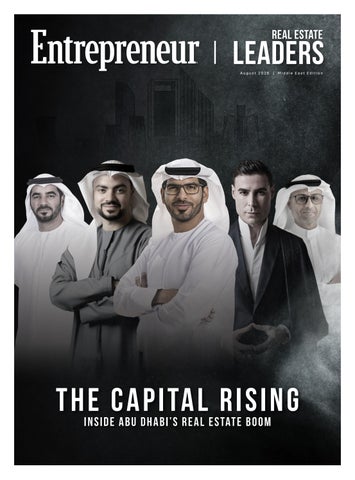
REAL ESTATE
LEADERS August 2026 | Middle East Edition
THE CAPITAL RISING Inside Abu Dhabi’s Real Estate Boom
E V E R Y T H I N G T H AT O N E C O U L D I M AG I N E FOR EXTRAORDINARY LIFE
Eywa Way of Water is a state-of-the-art residential community with only 65 exceptional waterfront residences, with a holistic wellness ecosystem, curating authentic experiences and best-in-class amenities few have dreamed of.
Contact us today: +971 54 308 6000 I
sales@byrevolution.com
E Y W A . A E
Real Estate Leaders
Entrepreneur Middle East
10
The Capital Rising Inside Abu Dhabi’s Real Estate Boom
60
The Gulf rewrites the rules of luxury interiors Gold and gloss are giving way to texture and calm, as branded residences multiply and the region’s populations swells
68
The products and materials reshaping Gulf real estate
76
Inside the Gulf’s proptech surge In May 2025, the Dubai Land Department did something no property registry had done before
E ntrep reneu r.co m
|
Au g u st 2026
From the lowest-carbon cement the UAE has ever made to 3D-printed towers, these are the materials rebuilding the region
84
The Gulf’s race to a sustainable future From mandatory green codes to billion-dollar green bonds, the region is building its way to net zero
92
Kigali is building a property story to rival Singapore Rwanda’s capital is emerging as one of Africa’s most compelling real estate stories
4
100
News
108
Editor’s Note
ODE TO BAG END Limited Edition
Make every epic writing journey a cosy one. Hobbiton handcraft from the makers of the world’s most magical pens.
© ™
Make growth your next stop Corporate & Investment Banking. Global Markets. Global Banking. Transaction Services. Now is your time sc.com/cib
Dub New York
Johannesburg Standard Chartered Bank UAE is licensed by the Central Bank of the UAE
Shanghai
bai London
Singapore
Sheikh Mohammed bin Rashid Al Maktoum
Au g u st 2026 E ntrep reneu r.co m
|
The race for excellence has no finish line.
9
Real Estate Leaders
Entrepreneur Middle East
THE CAPITAL RISING Au g u st 2026
INSIDE ABU DHABI’S REAL ESTATE BOOM
E ntrep reneu r.co m
|
As transactions and investment surge to record levels, four of the emirate’s boldest developers reveal how they are building the future of the capital.
10
A
bu Dhabi’s real estate market is not simply growing — it is accelerating. In the first half of 2026 alone, the emirate recorded AED117 billion in property transactions, a remarkable 112 per cent leap in value on the same period a year earlier, alongside a 61.7 per cent rise in the number of deals. Foreign capital has poured in at an even faster clip: foreign direct investment reached AED13.8 billion, up more than 300 per cent, drawn from a record 116 nationalities, while the emirate’s investment zones attracted AED75 billion on their own. It is the clearest signal yet that Abu Dhabi has arrived as a global destination for capital, talent and long-term living.
Fahid Island to Yas, evolving from housebuilder into a diversified investment powerhouse. Bloom Holding’s Carlos Wakim makes the case for “Curated Community Living” — places designed to remain liveable and valuable for generations, not just launch weekends. Miral, the force behind Yas Island’s 38 million annual visits, is preparing its most audacious act yet in Disneyland Abu Dhabi, the region’s first Disney resort. And Ohana Development’s Husein Salem is rewriting the rules of luxury, pairing ELIE SAAB, Jacob & Co. and Manchester City with a philosophy of belonging — a formula that sold AED6 billion of homes in just 72 hours.
In this special edition, we meet four of the leaders turning that momentum into landmarks. Aldar, the emirate’s largest developer, delivered its strongest year on record and is reshaping the coastline from
Four very different visions, one shared conviction: that Abu Dhabi’s best chapter is still being written. Together, their stories map an emirate building not just for the boom, but for the decades beyond it.
The Capital Rising | Inside Abu Dhabi’s Real Estate Boom
11
Real Estate Leaders
Entrepreneur Middle East
THE COMPANY BUILDING ABU DHABI’S NEXT CHAPTER With an order book of over $10bn, and a pipeline stretching from Saadiyat Island to Dubai, Talal Al Dhiyebi has turned Abu Dhabi’s largest developer into a barometer of the emirate’s own ambitions.
For most of the past two decades, the story of Abu Dhabi’s rise could be read in its skyline, and much of that skyline was built by a single company. From Yas Island and Al Raha Beach to the cultural quarter of Saadiyat and the towers of the capital’s commercial core, Aldar’s developments have doubled as milestones in the emirate’s transformation from an oil economy into a diversified global hub. Today, that company is becoming something considerably larger than a property developer — and its trajectory has become difficult to separate from the emirate’s own. Under Group Chief Executive Talal Al Dhiyebi, Aldar has expanded into a diversified investment platform spanning residential development, commercial real estate, logistics, hospitality, education, asset management and investment funds. As Abu Dhabi positions itself as a destination for global talent, capital and innovation, Aldar has appointed itself the builder of the physical infrastructure that ambition requires.
The financial results give the strategy its clearest expression. In 2025, Aldar delivered the strongest year in its history, with net profit rising 36 per cent to a record Dh8.8 billion and revenue climbing 47 per cent to Dh33.8 billion. Group-wide sales reached Dh40.6 billion, up 21 per cent, while the development revenue backlog — a measure of income already contracted but not yet booked — swelled to Dh71.7 billion. Perhaps most telling for a company once seen as a purely domestic play, international and foreignresident buyers accounted for Dh27.4 billion of sales, roughly three-quarters of its UAE total. Yet the numbers are only half the account. Behind them lies a deliberate reinvention: the transformation of Aldar from a developer of individual projects into a long-term creator of cities, communities and investment ecosystems. To understand Aldar’s momentum, it helps to understand the market beneath it, because rarely has a company been so well matched to its moment. Abu Dhabi’s real estate market has been running hot. Transactions across the emirate reached Dh142 billion in 2025, a 48 per cent jump in value on the previous year, spread across almost 42,800 deals — a 52 per cent surge in volume. Sales and purchases alone accounted for Dh99.4 billion, with mortgage lending making up the balance. Buyers came from more than 100 nationalities, and within the emirate’s designated investment zones foreign investment made up nearly three-quarters of all real estate activity. Much of that appetite has been unlocked by reform. Successive moves to widen freehold ownership, streamline residency through long-term Golden Visas and open designated investment zones to overseas buyers have turned Abu Dhabi from a market that international investors watched into one they now buy into directly. Foreign direct investment into the emirate’s property sector reached Dh8.2 billion in 2025, up 13 per cent, while investment-zone activity alone topped Dh54 billion.
12
E ntrep reneu r.co m
|
Au g u st 2026
The Capital Rising | Inside Abu Dhabi’s Real Estate Boom
13
Real Estate Leaders
Entrepreneur Middle East
That property boom is not an isolated phenomenon but a symptom of a wider economic acceleration. Abu Dhabi’s economy expanded 7.7 per cent year on year in the third quarter of 2025 to a record quarterly value of Dh325.7 billion, with the non-oil sector — now 54 per cent of total output — growing at a comparable pace. Construction and real estate were among the fastestexpanding sectors of all. Underpinning the demand is people: the emirate’s population climbed 7.5 per cent in a single year to reach 4.14 million, swelled by the multinationals, financial institutions, entrepreneurs and family offices that have relocated to the capital in unprecedented numbers.
E ntrep reneu r.co m
|
Au g u st 2026
Each of those arrivals needs somewhere to live, work,
14
learn and invest. That, in essence, is the market Aldar has spent the past two years building for — and few developers anywhere have been positioned to capture a boom quite so completely. Al Dhiyebi rarely describes Aldar’s purpose in the language of construction. The company’s role, he has argued consistently, extends beyond erecting buildings to creating places where people genuinely want to live, work, invest and raise families. That philosophy has become visible in the shape of the portfolio. Rather than concentrating on a single flagship, Aldar has moved on several fronts at once — launching luxury waterfront destinations, family-
The Capital Rising | Inside Abu Dhabi’s Real Estate Boom
Au g u st 2026
What distinguishes it is the design brief. Where earlier waterfront schemes led with glamour, Fahid Island has been conceived around wellbeing, with 30 per cent of its land set aside for natural landscapes and a network of parks, cycling routes, walking trails and beachfront experiences intended to fold wellness into daily life. “Our plans for Fahid Island support a thriving real estate market in Abu Dhabi,” Al Dhiyebi said at the launch, calling it one of the largest mixeduse masterplans ever introduced in the emirate. The market agreed: the first releases, Fahid Beach Residences and The Beach House, generated billions of dirhams in sales, drawing heavy demand from UAE residents and overseas investors alike.
|
Nowhere is that ambition clearer than at Fahid Island, unveiled in June 2025. Positioned between Yas Island and Saadiyat, the Dh40 billion masterplan ranks among the largest mixed-use residential developments ever launched in the emirate. Spanning roughly 2.7 million square metres with an 11-kilometre coastline, the island will eventually hold more than 6,000 homes
alongside hospitality, retail, education and wellness facilities.
E ntrep reneu r.co m
oriented communities, branded residences, valuefocused housing and large-scale infrastructure more or less simultaneously. Each targets a different buyer; together they advance a single objective, which is to make Abu Dhabi one of the most attractive cities in the world to settle in.
15
E ntrep reneu r.co m
|
Au g u st 2026
Real Estate Leaders
16
Entrepreneur Middle East
The Capital Rising | Inside Abu Dhabi’s Real Estate Boom
“If Fahid Island represents Abu Dhabi’s future, Yas Island demonstrates Aldar’s talent for reinventing places it has already built.
If Fahid Island represents Abu Dhabi’s future, Yas Island demonstrates Aldar’s talent for reinventing places it has already built. Once known chiefly for Formula 1, Ferrari World and Yas Mall, the island is being remade into one of the country’s most sought-after residential addresses. Over eighteen months Aldar steadily thickened its offering there — through Waldorf Astoria Residences Yas, Yas Living, Yas Riva Residences, Yas Park Place and, most recently, Yas Point, a Dh6 billion waterfront masterplan announced in July 2026. Planned across some 600,000 square metres, Yas Point will bring around 1,600 branded residences, a five-star resort, an international school and waterfront retail, ultimately housing about 5,000 people. Its position near the planned Sphere Abu Dhabi and Disneyland Abu Dhabi ties it to the island’s next wave of attractions. The logic is consistent: rather than leaning on entertainment alone, Aldar is engineering a permanent community where residents can live year-round, not merely visit. The same intent runs through Saadiyat Island, which remains the centrepiece of the group’s luxury strategy. In the past year and a half Aldar expanded there through Manarat Living III, The Row Saadiyat, Baccarat Residences Saadiyat and further releases at Mamsha Gardens — projects that sit alongside the Louvre Abu Dhabi, the coming Guggenheim Abu Dhabi and the Zayed National Museum to position the island among the world’s emerging cultural districts. International institutions are taking note: in 2025, Hong Kong’s
Gaw Capital acquired an entire residential building at Mamsha Gardens, one of the first major institutional residential investments on Saadiyat and a marker of growing overseas confidence in the emirate’s top end. For all its association with premium waterfront living, Al Dhiyebi has been candid that durable urban growth depends on serving a far broader population than buyers of branded residences. That conviction shows in a quieter set of projects — Al Deem Townhomes, Al Ghadeer Gardens and a substantial partnership with Abu Dhabi’s Department of Municipalities and Transport to deliver 9,000 value-oriented rental homes. Al Ghadeer Gardens, launched in 2026 along the Abu Dhabi–Dubai corridor, sold out at launch, evidence of appetite for accessible family housing positioned between the country’s two largest cities. The 9,000-unit rental programme, meanwhile, adds ballast to Aldar’s long-term investment portfolio while helping the emirate absorb its expanding workforce. The mix is deliberate. Rather than depending on the cyclical swings of property sales, Aldar has kept enlarging its base of recurringincome assets — the rental homes, malls, offices and logistics space that generate stable cash flow across decades. Its investment arm alone now manages Dh49 billion in assets and produced Dh8.1 billion of revenue in 2025, up 16 per cent. Abu Dhabi remains Aldar’s foundation, but the company is no longer confined to it. A strategic partnership with Dubai Holding has carried its development philosophy across the emirate border through The Wilds and The Wilds Residences — schemes that pair luxury villas and apartments with extensive landscaping and biodiversity features — and further land acquisitions under the alliance will eventually accommodate roughly 14,000 additional homes. The expansion reflects a company increasingly comfortable describing itself as a national developer rather than a local one.
17
Real Estate Leaders
18
Entrepreneur Middle East
The Capital Rising | Inside Abu Dhabi’s Real Estate Boom
That breadth is what makes the company such a useful proxy for the emirate. Its pipeline is now larger and more varied than at any point in its history — from the wellness-led vision of Fahid Island to the year-round community at Yas Point, from branded residences on Saadiyat to rental homes, schools and logistics hubs. For Al Dhiyebi, the measure of it all is no longer square metres delivered or units sold, but whether the developments make Abu Dhabi a more competitive global city.
| E ntrep reneu r.co m
Ask Al Dhiyebi to define success and the answer rarely settles on sales figures. His public remarks return instead to sustainability, liveability, economic diversification and long-term value — themes that map closely onto Abu Dhabi’s own development strategy. The emirate is drawing corporations, financiers and skilled professionals at a remarkable clip, and accommodating them demands far more than iconic towers. It requires integrated communities, international schools, commercial districts, logistics networks, hospitality assets and credible investment opportunities. Aldar, increasingly, is building all of them.
Au g u st 2026
The diversification runs deeper still. Property development remains the largest business, but Aldar has invested heavily across logistics, commercial offices, hospitality and education, relocating and expanding Cranleigh Abu Dhabi’s campus on Saadiyat and reinforcing Aldar Education’s standing as one of the region’s leading private schooling platforms. The most consequential move may be the creation of Aldar Capital, an investment platform established with Mubadala Capital to channel international institutional money into real estate across the UAE and the wider Gulf — a step that recasts Aldar, at least in part, from developer to investment manager, and opens a new pipe for global capital into the region.
On the evidence of a record year, a Dh40 billion sales book and the confidence of investors from more than 100 countries, that question is increasingly answering itself. Aldar has bet that its own fortunes and the emirate’s are one and the same — and for now, both are rising together.
19
Real Estate Leaders
Entrepreneur Middle East
THE INTELLIGENT ADDRESS
ONE DEVELOPMENT IS BUILDING ABU DHABI’S SMARTEST COMMUNITY
E ntrep reneu r.co m
|
Au g u st 2026
Founder and chairman Ali Al Gebely explains the thinking behind one of Abu Dhabi’s most futuristic developments.
When ONE Development entered Abu Dhabi, it was not simply expanding into a new market. It was placing a bet on where cities themselves are heading. The company’s debut in the capital, ONE Residence on Al Reem Island, is a statement of that conviction rendered in glass and steel — a 31-storey waterfront tower designed around technologies that are only beginning to enter the mainstream conversation about how we live. Alongside AI-powered building operations, the project incorporates infrastructure for electric vertical take-off and landing aircraft and drone-enabled logistics, delivered through partnerships with the Advanced Mobility Hub and VertiHub. It is, in effect, a building designed not only for how people live today but for
how they may move and connect a decade from now. For Founder and Chairman Ali Al Gebely, however, the hardware is only part of the story. The ambition runs deeper than novelty. “The future of real estate lies in creating communities that grow more intelligent over time, with technology seamlessly integrated into everyday living,” he says. It is a subtle but important distinction. The goal is not a building studded with gadgets, but a home that learns — one that becomes more responsive, more efficient and more attuned to its residents the longer they live in it. In an industry that has traditionally treated a completed building as a finished product, that is a quietly radical idea.
“The future of real estate lies in creating communities that grow more intelligent over time, with technology seamlessly integrated into everyday living.
20
The Capital Rising | Inside Abu Dhabi’s Real Estate Boom
E ntrep reneu r.co m
|
Au g u st 2026
Real Estate Leaders
22
Entrepreneur Middle East
The Capital Rising | Inside Abu Dhabi’s Real Estate Boom
| E ntrep reneu r.co m
Although ONE Development is one of the UAE’s newer names, its foundations reach back considerably further. The company is part of Al Gebely Holding, a family-owned group with a 44-year history spanning construction, energy, technology, hospitality and investment. That heritage has given the developer the ballast of an established business while leaving it free to approach real estate with a distinctly modern outlook. For Al Gebely, whose own background blends economics, engineering and business, property has never been simply a matter of construction. He sees it instead as the meeting point of infrastructure, technology and long-term operational performance — a philosophy that has shaped the company’s growth from the very beginning.
Au g u st 2026
The inclusion of infrastructure for flying taxis and drone logistics is the most eye-catching expression of that forward orientation. It would be easy to dismiss as futurism, but the logic is grounded: the region is investing heavily in advanced air mobility, and a building conceived today will still be standing when those networks mature. By designing for eVTOL landing and drone-enabled delivery from the outset, ONE Residence positions itself to plug into that future rather than scramble to retrofit for it later — a small illustration of the company’s wider habit of building for the market that is coming rather than only the one that exists. For residents, the promise is tangible: a home ready for a world in which the journey to work, or the arrival of a parcel, may one day take to the air.
That thinking first drew attention not in Abu Dhabi but in Dubai, where ONE Development made its mark with Laguna Residence, a project whose initial release sold out within weeks. Crucially, the company resisted the temptation to treat artificial intelligence as a marketing slogan. Instead it embedded intelligence throughout the development process — from planning and pricing through to predictive maintenance and energy optimisation after handover. Resident behaviour informed everything from the choice of amenities to the design of shared spaces, producing an environment intended to evolve alongside the people using it. The success of Laguna validated the premise, and it is precisely that philosophy which ONE Residence now carries into the capital, adapted to Abu Dhabi’s own ambitions around innovation, sustainability and future mobility.
23
Entrepreneur Middle East
E ntrep reneu r.co m
|
Au g u st 2026
Real Estate Leaders
The choice of Abu Dhabi, and the timing of it, is no accident. The emirate’s real estate market has entered a new phase, propelled by population growth, sustained investment and a sharpening focus on long-term quality. Demand is shifting decisively away from standalone residential towers and towards integrated communities, as buyers place ever greater value on walkability, wellness, connected amenities and neighbourhoods designed around the texture of everyday life. Al Gebely sees in that evolution an opening to rethink how developments are conceived in the first place. “The UAE is entering a defining chapter in its real estate journey,” he says. “Every emirate is contributing to a vision built on innovation, long-term value and creating better places to live.” Locating ONE Residence on Al Reem Island — a fast-maturing waterfront district within easy reach of the capital’s business core — is a considered expression of confidence in Abu Dhabi as one of the region’s most important long-term growth markets. What ties the whole approach together is the company’s proprietary ONE AI platform, which it regards less as a
24
feature than as a foundation. The system applies artificial intelligence across the entire lifecycle of a project — from the initial analysis of land and the setting of prices, through to predictive maintenance, energy management and operational performance once residents have moved in. Rather than treating AI as an add-on to be advertised, ONE Development positions it as the operating system running quietly beneath every community it builds. It is the mechanism by which Al Gebely’s vision of a home that grows more intelligent over time becomes something concrete: a building that monitors its own systems, anticipates its own needs and optimises itself continuously, long after the last resident has collected their keys. That emphasis on performance over time speaks to a broader shift in how the best developers are beginning to define success. ONE Residence marks the company’s first chapter in Abu Dhabi, but it is explicitly not intended to be its last. ONE Development has set out plans to expand further across the UAE while growing its presence in Egypt and other international markets, pursued through a
The Capital Rising | Inside Abu Dhabi’s Real Estate Boom
disciplined, long-term strategy rather than a race for scale. For Al Gebely, expansion is not measured by the number of projects delivered. The real test, he believes, will be whether the communities the company builds continue to improve in the years after they are completed — whether they perform, adapt and appreciate rather than simply age.
“The UAE is entering a defining chapter in its real estate journey. Every emirate is contributing to a vision built on innovation, long-term value and creating better places to live.
E ntrep reneu r.co m
|
Au g u st 2026
It is a standard that neatly captures where urban living itself appears to be heading. As expectations evolve, developers will increasingly be judged not only by what they build but by how well those places function over time — by liveability, intelligence and endurance rather than the spectacle of a launch. That is the challenge ONE Development has set for itself on Al Reem Island, and the one it intends to carry into every market that follows. In a capital already reimagining what a city can be, it is a proposition with a certain elegant logic: build homes clever enough to keep getting better, and let time make the case.
25
E ntrep reneu r.co m
|
Au g u st 2026
Real Estate Leaders
26
Entrepreneur Middle East
The Capital Rising | Inside Abu Dhabi’s Real Estate Boom
HOW OHANA DEVELOPMENT TURNED ATTAINABLE LUXURY INTO ABU DHABI’S FASTEST SELL-OUT
Salem is careful, though, not to mistake the headline for the whole story. That AED 6 billion figure, he says, is less significant for its size than for what it signifies — “indicating how strongly Abu Dhabi is now positioned as an international destination for luxury living and how much confidence buyers place in wellplanned, design-led communities.” It is a characteristic reframing. Across a wide-ranging conversation, Salem returns to the idea that numbers are the consequence of getting something more fundamental right, rather than the goal in themselves. To understand what that something is, it helps to go back to the beginning. When Ohana Development was founded, the aim was not simply to add more homes to a fast-moving market. “The ambition was to create a different form of luxury, defined by design, location, and craftsmanship,” he says. From the outset, in other words, the company set out to compete on distinctiveness rather than volume, a positioning that has since hardened into strategy. Underpinning that ambition is a conviction about where a developer’s real work begins. For Salem, the handover of keys is not the end of the relationship but the start of the one that matters. “We believed then, as we do now, that a developer’s true legacy lies in
That thinking is embedded, quite literally, in the company’s name. Ohana is the Hawaiian word for family, and Salem treats it less as branding than as an operating instruction. The philosophy of family and belonging, he explains, shapes “how we design, engage with our clients, and think about the communities we create.” The point, he adds, is “creating living places where residents feel a sense of belonging which resonate with families, while being valued for generations.” It is a lens that quietly reframes every project the company undertakes — not as a collection of units to be sold, but as a community to be joined.
|
the relationship it builds with homeowners long after handover,” he says. “A home should carry emotional value, support the way people live, and remain meaningful for generations.” It is a notion that sounds almost sentimental, but it maps neatly onto the company’s commercial logic: homes that people love, and keep loving, hold their value and seed the demand for whatever the developer builds next.
E ntrep reneu r.co m
There is a number that has come to define Ohana Development’s remarkable ascent, and it is worth pausing on. When the company launched Manchester City Yas Residences by Ohana — the football club’s first branded residential project in the world — it recorded AED 6 billion in sales within 72 hours. Not over a quarter, not over a launch season, but in three days. It was a new sales record for Abu Dhabi in March, and for a developer that has risen to prominence in a remarkably short space of time, it was proof of a thesis that its chief executive, Husein Salem, has been advancing since the company’s earliest days: that in the right market, with the right partners, design-led luxury can move at extraordinary speed.
Au g u st 2026
Ohana Development CEO Husein Salem has become the master of branded residences. He explains why he believes true luxury is about belonging, not status symbols.
If the philosophy is constant, the timing has been fortunate — though Salem would argue it is anything but accidental. Ohana has grown up alongside an Abu Dhabi luxury market experiencing what can only be described as a surge, with the emirate drawing global capital and international buyers at a pace that would have seemed improbable only a few years ago. Real estate transactions across the emirate reached AED 142 billion in 2025, up nearly half on the previous year, and the momentum has carried into 2026. For Salem, this is not a bubble but the predictable outcome of a deliberate national model. Abu Dhabi’s growth, he says, “has been built on strong fundamentals, with the emirate consistently ranked among the safest and most liveable cities in the world, supported by a visionary wise leadership, clear government regulations, long-term planning, and an economy that continues to diversify. This creates confidence for residents and investors alike.”
27
Real Estate Leaders
Entrepreneur Middle East
That confidence, he argues, is compounding. As Abu Dhabi launches world-class developments, cultural landmarks and infrastructure, and as a growing number of international businesses and skilled professionals relocate to the emirate, the market is increasingly attracting buyers who want to put down roots rather than simply park capital. Ohana’s self-appointed role is to serve that ambition at the top end. “Our role is to contribute to this evolution with communities that reflect international standards while remaining rooted in Abu Dhabi,” Salem says — and the vehicle for that contribution has been a string of partnerships with some of the most recognisable names in global luxury. Those partnerships are the most visible expression of Ohana’s strategy, and also the most easily misunderstood. In a market where a famous logo can be bolted onto almost anything, Salem is insistent that a brand name is a starting point, not a shortcut. “We choose brands because they share our values and genuinely enhance the living experience we want to create,” he says. Each collaboration, in his telling, has to bring something specific to the resident’s experience. “ELIE SAAB reflects timeless elegance and refined design; Jacob & Co. is known for bold creativity
28
and craftsmanship; while Manchester City represents excellence, well-being, discipline and a strong sense of community. These qualities are reflected throughout the developments, from the architecture and interiors to the amenities and overall lifestyle.” The first of those names to take physical form was ELIE SAAB Waterfront by Ohana, on Al Reem Island — a single soaring tower, which was the first branded residence in Abu Dhabi. Here the Lebanese couturier’s aesthetic of understated glamour runs from the lobby to the penthouses, an attempt to translate the discipline of haute couture into the language of interiors. It is, in miniature, the whole Ohana proposition: a globally resonant name, a design-led product, and a price ladder that stretches from the merely aspirational to the genuinely rarefied. The partnership with Jacob & Co. pushes the concept further still. Jacob & Co. Beachfront Living by Ohana, a coastal development valued at AED 4.7 billion, is the first project of its kind to marry high-end beachfront living with the design language of fine watchmaking and jewellery. From the Jacob & Co. Social Club to duplex sky mansions with panoramic views, the development embodies the brands’ shared commitment to craftsmanship, exclusivity and refined living. For Salem, the collaboration was intuitive rather than opportunistic. “The partnership with Jacob & Co. was a natural fit because our approach to craftsmanship and attention to detail complements its exceptional timepieces admired around the world,” he says. The logic is that the obsessiveness a watchmaker brings to a movement and the care a developer brings to a home are, at some level, the same instinct expressed in different materials.
The Capital Rising | Inside Abu Dhabi’s Real Estate Boom
It is tempting to see all this as evidence that branded residences are simply the flavour of the moment. Salem believes they are more than that — but only under conditions. Asked whether lifestyle-driven, brand-led developments are the future of luxury real estate, his answer is an emphatic but qualified yes. “This will continue to play a bigger role in the real estate market, just as long as the partnership is authentic and adds real value,” he says. “A brand name alone is not enough.” What buyers are actually reaching for, in his analysis, is something no logo can supply on its own. “Today’s buyers want a sense of belonging and a home that reflects their aspirations, which is why well-being is the new luxury.” It is a striking formulation from a developer operating at the most expensive end of the market: that the ultimate premium is not only reflected in the material we use, but the feeling of being well, and being at home. Nowhere is the strategy’s ambition — or its stakes — clearer than in the Manchester City project. Launched in early 2026 with a value of around USD 4.1 billion, Manchester City Yas Residences by Ohana sprawls across 1.67 million square metres along the Yas Canal, close to Ferrari World and SeaWorld, and is planned to hold more than 2,000 homes ranging from apartments to waterfront penthouses and clusters of villas. More than half the masterplan is given over to landscaped gardens and green space, and the development folds in a Manchester City Training Academy and football pitches, crystal lagoon, canal sports lounge,
canal promenade for retail and dining. That the club chose Abu Dhabi for its first branded homes anywhere is not something Salem takes lightly. “Manchester City Yas Residences by Ohana is the club’s first branded residential project in the world, and that carries a responsibility,” he says. The collaboration, he is quick to point out, grew from soil that was already tilled. Manchester City has had a presence in the emirate for years through its football schools, youth programmes and community work, which made a residential partnership feel less like a leap than a logical next step. But the deal also carries a larger significance for Salem, and for the wider story of Abu Dhabi’s real estate sector. It demonstrates, he says, that “a UAE-based developer can deliver projects of international relevance while remaining deeply rooted in Abu Dhabi’s vision, identity, and long-term growth.” For a homegrown company partnering with one of the most valuable brands in world sport, it is both a point of pride and a statement of arrival — evidence that the flow of prestige need not run only from West to East. The market’s response, that AED 6 billion in 72 hours, split roughly a third to Emirati buyers and two-thirds to international ones, suggested the confidence was widely shared.
JACOB&CO BEACHFRONT LIVING BY OHANA
29
Real Estate Leaders
Entrepreneur Middle East
“A home should carry emotional value, support the way people live, and remain meaningful for generations.”
E ntrep reneu r.co m
|
Au g u st 2026
Husein Salem, CEO, Ohana Development
30
E ntrep reneu r.co m
|
Au g u st 2026
The Capital Rising | Inside Abu Dhabi’s Real Estate Boom
31
Real Estate Leaders
Entrepreneur Middle East
Beneath the prestigious names and record launches, however, Salem is keen to keep the company anchored to its founding idea: that this is a business about people and places, not badges and transactions. It is why he describes Ohana’s model as one of “attainable luxury,” reached through “exceptional design, thoughtful planning, and refined living experiences that are accessible to buyers and investors without compromising on quality” — a phrase that does real work, positioning the company slightly apart from pure ultra-prime rivals and widening the pool of people who might one day call an Ohana address home. Ask him how he would like all of it to be remembered, and the answer arrives without a flicker of interest in square footage or sales velocity. “Buildings can always be
32
replaced, but creating places where people genuinely enjoy living, raising families, and building memories is much more meaningful,” he says. His hope is that Ohana Development is remembered for creating “timeless communities,” and that his own contribution is measured in something more durable than a project count. “Success is not measured by the number of projects you complete, but by the positive impact those projects continue to have years later,” he says. “If people still value our communities decades from now, then I believe we will have made a lasting impact on the sector.” It is a notably patient measure of success for a company that has just proved it can sell six billion dirhams of real estate in three days. But that, perhaps, is the paradox at the centre of Ohana’s rise. In a market moving as fast as Abu Dhabi’s, he is quietly building for the long stay.
E ntrep reneu r.co m
|
Au g u st 2026
The Capital Rising | Inside Abu Dhabi’s Real Estate Boom
33
E ntrep reneu r.co m
|
Au g u st 2026
Real Estate Leaders
34
Entrepreneur Middle East
The Capital Rising | Inside Abu Dhabi’s Real Estate Boom
INSIDE MODON’S BLUEPRINT FOR THE INTEGRATED CITY Chairman H.E. Jassem Mohamed Bu Ataba Al Zaabi and his leadership team explain the plans behind one of the region’s most ambitious developments.
Today, Modon is not simply constructing residential communities. It is designing complete ecosystems that fold housing, hospitality, sport, entertainment, retail, mobility, education and public space into
Au g u st 2026
To understand what makes the company distinctive, it helps to understand how the world’s most influential developers now think. Real estate has traditionally been measured by the number of buildings a company constructs. The most successful players do something else entirely: they create destinations. Cities such as Singapore, Copenhagen, Dubai and Sydney have shown that great urban planning is about making places where people genuinely want to live, rather than simply supplying residential inventory — that walkability, waterfront experiences, integrated transport, green space, healthcare, education and cultural infrastructure are what generate lasting value. Modon has embraced this philosophy from the outset, planning each community as an interconnected environment where residents can work, exercise, socialise, raise families and enjoy leisure without sacrificing convenience. It is placemaking, not property development.
|
Abu Dhabi understands this shift better than most. Over the past two decades, the UAE capital has undergone one of the world’s most remarkable urban transformations, evolving from the administrative heart of the Emirates into a diversified global destination powered by advanced industry, tourism, financial services, renewable energy, culture and world-class real estate. That transformation has been driven by a number of visionary organisations, but few have emerged as rapidly, or as strategically, as Modon.
integrated destinations that are reshaping the capital’s future. Its developments are becoming symbols of Abu Dhabi’s long-term ambition — communities engineered to be economically resilient, environmentally sustainable and globally competitive. As international investors continue to increase their exposure to the emirate’s property market, Modon has positioned itself squarely at the centre of one of the region’s most compelling development narratives.
E ntrep reneu r.co m
The global competition between cities has never been more intense. Around the world, governments are pouring billions into the pursuit of international businesses, entrepreneurs, investors, tourists and skilled professionals, and the terms of that contest have quietly changed. Success is no longer measured solely by GDP growth or infrastructure spending; it is increasingly determined by the quality of urban life. The cities that win are those that combine innovation, sustainability, culture, connectivity and exceptional places to live into a single, coherent proposition — and in doing so become magnets for global talent and capital.
35
Real Estate Leaders
Entrepreneur Middle East
That approach mirrors a broader evolution within Abu Dhabi itself. As the emirate diversifies beyond hydrocarbons, urban development has become a strategic economic tool rather than merely a construction activity. High-quality communities attract international companies, skilled professionals, entrepreneurs and institutional investors while raising the quality of life for residents, and the effect compounds well beyond the initial property sales. Restaurants and retail follow the residents; hospitality, sport and entertainment grow up around them; employment rises, tourism strengthens and new businesses emerge, until entire local economies have formed around a single master-planned community. This economic multiplier is precisely the model Modon is helping the capital build.
E ntrep reneu r.co m
|
Au g u st 2026
The company’s structure is built to capture that multiplier. Rather than focusing narrowly on residential construction,
36
Modon operates across real estate, hospitality, tourism, infrastructure, sport, events and asset management — a diversified platform that gives it a significant advantage over traditional developers whose fortunes rise and fall with property sales alone. Through hotels, entertainment venues, retail districts, sporting facilities and tourism attractions, the group creates assets capable of generating recurring economic activity long after a community is complete. Its events and exhibitions arm, ADNEC Group, alone delivered billions of dirhams in economic impact over the past year. The result is stronger long-term value for shareholders and a deeper contribution to Abu Dhabi’s economic ambitions at the same time. That breadth is already visible across the group’s portfolio, which reaches well beyond its Abu Dhabi heartland. Alongside Hudayriyat, Modon’s developments and destinations include the
The Capital Rising | Inside Abu Dhabi’s Real Estate Boom
Au g u st 2026
For the Chairman, the figures mark a deliberate change of gear rather than a lucky cycle. “2025 marked a new phase of accelerated strategic transformation for Modon, mobilising an integrated business platform aligned across development, investment, and asset management,” Al Zaabi said. It is a telling framing. Where many developers describe themselves through the projects they build,
|
Under Group Chief Executive Bill O’Regan, who took the helm at the start of 2024, and with Chairman H.E. Jassem Mohamed Bu Ataba Al Zaabi setting its strategic direction, Modon has consistently placed sustainable value creation above short-term growth — and the numbers have followed. The group closed 2025 with revenue of AED 13.8 billion,
more than double the previous year, and net profit of AED 3.9 billion, alongside record real estate sales of AED 36.3 billion and a revenue backlog of some AED 46 billion, one of the largest in the UAE. “2025 was a year of delivery for Modon,” O’Regan said on the release of those results, noting that the group was now “well-positioned to build on this momentum, with a disciplined focus on delivery, value creation, and long-term growth.”
E ntrep reneu r.co m
Bab Al Nojoum hospitality resorts, the Circuit X adventure hub, the Marsana waterfront destination and the 321 Sports facility, as well as national housing work further afield in Riyadh — a spread that reflects the company’s ambition to be a creator of experiences and destinations rather than a builder of any single asset class. It is a portfolio deliberately assembled to generate value at every stage of a community’s life, from the homes people buy to the events, leisure and hospitality they return for.
37
Real Estate Leaders
Entrepreneur Middle East
E ntrep reneu r.co m
|
Au g u st 2026
Al Zaabi describes Modon through the platform it has assembled — a machine designed to create value across the full life of a community, from the first land sale to the running of the hotels, arenas and attractions that give a place its pulse. Behind every successful developer, though, lies one essential ingredient: market confidence. Investors ultimately judge developers not by their marketing but by execution, financial strength and the ability to deliver projects that hold their value, and on that measure the market has responded emphatically to Modon. Several recent launches have sold out within days, some within hours, revealing an appetite among local and international buyers alike for integrated lifestyle destinations. That demand reflects a set of powerful structural trends reshaping Abu Dhabi’s residential market: a growing population, foreignownership reforms that have widened international participation, institutional investors expanding their exposure to residential assets, and high-net-worth individuals increasingly treating the emirate as a secure long-term home for their capital. The rapid growth of Abu Dhabi’s financial ecosystem, and of ADGM in particular, has added a steady stream of international professionals seeking quality housing close to where they work. Modon has positioned its communities to benefit from every one of these currents. Nowhere is that positioning clearer than on Hudayriyat Island. Every great city has a defining development — Palm Jumeirah for Dubai, Marina Bay for Singapore — and for Abu Dhabi, Hudayriyat may well become that project. Rather than building another luxury neighbourhood, Modon is creating what could become one of the Middle East’s most comprehensive lifestyle destinations. Stretching across an expansive island connected directly to the capital and barely twenty minutes from downtown, Hudayriyat weaves waterfront living, premium residential communities, hospitality, leisure, sport, education, beaches, cycling networks, marinas and retail into a single integrated masterplan. Its ambition reaches far beyond housing: the island has been conceived as a destination capable of drawing tourists, hosting international sporting events, nurturing entrepreneurship in hospitality and leisure, and generating economic activity all 38
year round. It already hosts internationally recognised attractions, among them Surf Abu Dhabi — one of the world’s most advanced wave parks — alongside extensive cycling infrastructure, public beaches and elite sporting facilities, with luxury hotels, schools, healthcare and mixed-use districts to follow. The clearest verdict on that vision came with the launch of Hudayriyat Golf Estates in July 2026. The project generated more than AED 13 billion in sales within days — the highest publicly recorded figure for a single residential launch in the UAE’s history — as some 1,700 golf mansions, villas and townhouses found buyers almost immediately. Arranged in an Andalusian-inspired design around a 95-hectare golf course, and threaded together by a 2.3-kilometre green spine linking a clubhouse, wellness facilities, retail, co-working spaces and a school, the community was built to the integrated template that has become Modon’s signature. Tellingly, 81 per cent of the buyers were new to Modon, and around 15 per cent were based outside the UAE — evidence of a widening, increasingly international customer base.
For the Chairman, the response spoke to something larger than a single successful release. “This strong demand reflects growing global confidence in Abu Dhabi and the UAE,” Al Zaabi said. His Group CEO located it in the changing expectations of buyers themselves. “Buyers increasingly seek communities combining quality homes with lifestyle, wellbeing and connectivity,” O’Regan noted — precisely the combination Modon has spent years learning to deliver. Ibrahim Al Maghribi, the group’s Real Estate CEO, put it more plainly still, saying the reaction “reflects the appeal of the community and strength of demand for thoughtfully planned homes.” Numbers of this scale, in other words, are not the product of a marketing campaign; they are a measure of trust — in Abu Dhabi’s long-term prospects, and in Modon’s ability to execute projects that retain their value over time. That distinction matters, because today’s luxury buyers are more discerning than ever. They assess developers on infrastructure quality, community planning, longterm maintenance, sustainability credentials and future appreciation, and strong early demand suggests many now believe Modon’s
communities meet that bar. For investors, such confidence carries its own momentum: robust launch sales tend to signal sustained liquidity, healthy pricing and continued appetite for future phases — a virtuous circle that a developer with one of the country’s largest backlogs is well placed to sustain.
E ntrep reneu r.co m
|
“wellpositioned to build on this momentum, with a disciplined focus on delivery, value creation, and long-term growth.
Au g u st 2026
The Capital Rising | Inside Abu Dhabi’s Real Estate Boom
Ultimately, Al Zaabi is careful to frame all of it within a purpose larger than the balance sheet. Modon, he says, “continues to ensure its strategy supports the emirate’s broader economic development objectives, with a focus on deepening the developmental impact of its projects” — a sentiment echoed by Group Managing Director H.E. Abdulla Al Sahi, who described the 2025 results as “a clear step in delivering its long-term strategy” as the group expanded and diversified through what he called a pivotal year of transition. It is a vision in which commercial success and national ambition are treated as one and the same. That, in the end, is what sets this chapter of Abu Dhabi’s growth apart. Modon is not merely selling homes; it is building the integrated, experience-rich, economically productive cities that a competitive global capital now demands — and, in the process, helping to write the next chapter of the emirate’s remarkable transformation. On the evidence of a record-breaking year and an island fast becoming a destination in its own right, that chapter is only beginning.
39
Real Estate Leaders
Entrepreneur Middle East
BLOOM HOLDING BUILDING COMMUNITIES THAT LAST FOR GENERATIONS Bloom Holding CEO Carlos Wakim explains why “curated community living” is more than a slogan, and what it takes to build places that still matter decades from now.
E ntrep reneu r.co m
|
Au g u st 2026
There is a particular kind of confidence on display in Abu Dhabi right now, and it is not the noisy sort. It is the quiet assurance of a market that knows where it is going. While much of the world contends with uncertainty, the emirate’s real estate sector has been posting record after record: in the first half of 2026 alone, Abu Dhabi recorded AED117 billion in real estate transactions, and foreign direct investment surpassed the total for all of 2025 in just six months. For a developer, it is an enviable moment. It is also, Carlos Wakim would argue, precisely the moment to think hardest about the long term.
40
Wakim has led Bloom Holding as chief executive since 2021, arriving with more than two decades in the region’s real estate sector behind him, including senior
roles at AMAALA, TDIC, Emaar Properties and Zabeel Properties. Through his extensive industry experience, Wakim adds significant value to Bloom Holding by leading the delivery of the company’s strategic mandate to expand its portfolio and strengthen its position as a master developer spanning real estate, education, hospitality, landscaping, and facilities management. Ask Wakim about Bloom’s role in the emirate’s next chapter of growth, and his focus is clear: lasting impact over rapid expansion. “As Bloom enters its next phase of growth, our success will not be measured by the number of homes we deliver, but by the quality, resilience, and long-term impact of the communities we create,” he says. “We believe the future belongs to
The Capital Rising | Inside Abu Dhabi’s Real Estate Boom
developments that are integrated, connected, and designed around people’s evolving lifestyles. This is the philosophy behind our Curated Community Living approach.” A phrase the company uses consistently, which is more than a tagline. For Wakim, it is the philosophy that shapes every Bloom development. “Our objective is to create complete ecosystems where people can live, learn, work, connect, and thrive. By bringing together homes, education, wellness, hospitality, retail, green spaces, and essential services, we create destinations that strengthen social connections, enhance liveability, and deliver longterm economic and community value.” The distinction he is drawing is between building homes and building places — between handing over a set of keys and taking responsibility for the daily life that unfolds afterwards. That responsibility, in Bloom’s case, is meant literally. “Our responsibility extends well beyond handover,” Wakim says. “Through our integrated operating model, including inhouse facilities management, landscaping, and community management, we remain actively involved throughout the lifecycle of our developments. This long-term commitment enables us to preserve quality, enhance the
resident experience, protect asset values, and ensure our communities continue to evolve alongside the changing needs of those who live there.” It is a simple idea with significant implications: a developer that intends to still be tending the gardens a decade after the last unit sells has to design very differently from one that plans to move on. The clearest expression of the philosophy is Bloom Living, the company’s flagship community in Zayed City. Spanning some 2.2 million square metres and planned for more than 4,500 homes, it is conceived as a fully integrated community, wrapped in a MediterraneanAndalusian design language and organised into distinct neighbourhoods with names borrowed from Spain — Cordoba, Toledo, Casares, Granada, Seville, Olvera, Almeria, Carmona, Marbella, Malaga, Alhambra. At its heart sits a central lake ringed by trails; around it are interconnected parks, pedestrian pathways, cycling and running routes, international schools, places of worship, retail and wellness facilities. Wakim describes it as “one of Abu Dhabi’s most sought-after integrated communities, designed around quality of life, connectivity, and long-term liveability,” and the market appears to agree: more than 96 per cent of the homes released to date have sold.
41
Entrepreneur Middle East
E ntrep reneu r.co m
|
Au g u st 2026
Real Estate Leaders
If Bloom Living demonstrates the commercial side of the philosophy, another project shows its civic dimension. Al Metlaa, developed in partnership with the Abu Dhabi Housing Authority and the Abu Dhabi Projects and Infrastructure Centre, is aimed at Emirati families, and “demonstrates how thoughtful community planning can support the emirate’s national housing priorities while reflecting the aspirations, culture, and identity of Emirati families,” Wakim says. Projects such as Al Metlaa illustrate how Bloom’s developments are designed to support wider social and economic priorities alongside residential growth “Our role,” he adds, “is to help shape the next generation of communities that contribute to Abu Dhabi’s long-term vision — communities that are economically resilient, socially connected, and designed to create lasting value for generations to come.” That confidence in the emirate’s trajectory is not blind optimism, and Wakim is quick to locate its source in the way Abu Dhabi is governed and planned. Asked what the market’s current momentum says about the UAE, he frames it as the harvest of a deliberate model. “The confidence we are seeing in Abu Dhabi today is the outcome of a long-term development model built on strategic planning, strong governance and a clear commitment to developing in line with the
42
E ntrep reneu r.co m
|
Au g u st 2026
The Capital Rising | Inside Abu Dhabi’s Real Estate Boom
emirate’s long-term vision,” he says. What sets the emirate apart, in his reading, is coherence. “What distinguishes the emirate is the alignment between infrastructure, real estate, economic policy and social development. Projects are not pursued reactively or in isolation; they form part of a coordinated strategy supported by clear priorities, transparent frameworks and strong collaboration between the public and private sectors. That consistency gives businesses, residents and investors the confidence to plan for the long term.” What most encourages him, though, is the composition of that demand rather than merely its scale. “Another defining strength of the market is that it is underpinned by genuine end-user demand alongside sustained investor interest,” he says. “Abu Dhabi is attracting people who want to build their lives here, while also drawing long-term capital. That balance creates a healthier and more resilient real estate ecosystem.” A market inflated by speculation is fragile; one anchored by people who actually intend to live in the homes they buy has ballast. “Resilience is measured not by how a market performs during periods of stability, but by its ability to maintain direction during periods of uncertainty,” he says. “Abu Dhabi has demonstrated that long-term vision, consistent execution and a relentless focus on quality create the trust that residents, businesses and investors value most.”
43
Real Estate Leaders
Entrepreneur Middle East
E ntrep reneu r.co m
|
Au g u st 2026
For a chief executive operating in such a buoyant market, the temptation to simply build faster must be considerable. Wakim’s answer to how he balances growth against longevity is revealing precisely because it treats the tension as real rather than rhetorical. “As one of Abu Dhabi’s leading master developers, our responsibility extends well beyond delivering homes,” he says. “It is about curating communities that continue to perform, adapt and create value long after they are built. Growth is an important part of that journey, but it must always be underpinned by quality, long-term thinking and a commitment to creating places where people genuinely want to live.”
44
In practice, he explains, that discipline begins with restraint about timing. “That starts with thoughtful phasing. We align new launches with genuine market demand and ensure that homes, infrastructure, amenities and services evolve in a coordinated manner. This enables us to respond to a growing market without compromising the integrity of the masterplan or the quality of delivery.” The more striking part of his answer is how far into the future he insists on looking before committing. “We also plan around the full lifecycle of a community,” he says. “Before making a development decision, we consider not only how a project will perform at launch, but how it will function five, ten or twenty
years later. Will it remain relevant to changing family structures? Can its homes and public spaces adapt? Will the landscaping, facilities and services continue to operate at the standard residents expect? These questions are just as important as construction timelines or sales performance.” Such talk would be easy to dismiss as aspirational were it not paired with a record of delivery. Wakim points to the first phase of Bloom Living, completed ahead of schedule, as evidence that ambition and execution need not be at odds. “Delivering the first phase of Bloom Living ahead of schedule demonstrated that pace and quality can coexist when planning, strong partnerships and accountability come together,” he says. “But our responsibility does not end when residents receive their keys. Through our integrated facilities management and landscaping capabilities, we remain invested in how our communities perform over time.” Leadership in the sector, for him, ultimately comes down to “making decisions that will still stand the test of time years from now.” Underlying much of Bloom’s strategy is a conviction that the customer has fundamentally changed — that the buyer who once wanted a well-built house now wants something larger and less tangible, a life arranged around them. Wakim is careful, though, to distinguish what
The Capital Rising | Inside Abu Dhabi’s Real Estate Boom
has changed from what has not. “Buyer expectations have certainly evolved, but our belief that successful developments begin with the community rather than the individual home has remained constant,” he says. “What has changed is the depth and breadth of what people now expect from the places they choose to call home.” Those expectations, as he describes them, amount to a wholesale redefinition of what a home is for. “Today’s buyers expect more than a well-designed home. They are looking for convenience, wellbeing, connection and a genuine sense of belonging. They want schools, green spaces, retail, healthcare, wellness facilities and places to connect with others within easy reach, alongside homes that offer privacy and functionality within a vibrant community.” Bloom Living was designed around exactly these priorities. Its central lake, interconnected parks, trails, schools, places of worship and retail “are not standalone amenities; they are integral components of one connected resident experience,” while the mix of apartments, townhouses, villas and mansions “enables the community to serve different generations, family structures and stages of life.” For Wakim, the fact that more than 96 per cent of Bloom Living has been sold is evidence that this approach aligns with what today’s
buyers are looking for. “A successful development is no longer defined by the quality of its homes alone, but by the quality of life it creates,” he says. “It is the strength of the community, the connections it fosters and the everyday experiences it enables that determine its long-term value.” That belief has a direct bearing on how Bloom talks to investors, and here Wakim is clear about what actually earns confidence in a market where every developer promises the world. “The most important signal is proof rather than promise,” he says. “Investors want to see a credible track record of delivery, visible construction progress, realistic timelines and consistency between what was presented at launch and what is ultimately delivered. Meeting commitments, and, where possible, exceeding them, is the strongest way to build trust.” Transparency, he adds, has to run the length of the customer relationship rather than being switched on at the point of sale. “Buyers should have clear information, responsive communication and meaningful visibility into project progress, payments, services and community management. Digital platforms can strengthen this by making interactions more efficient and information more accessible, but technology must support a genuine culture of accountability.”
45
E ntrep reneu r.co m
|
Au g u st 2026
Real Estate Leaders
Entrepreneur Middle East
He is equally insistent that investor returns and resident satisfaction are, in the long run, the same thing viewed from different angles. “Developers must also demonstrate that their projects are supported by real demand,” he says. “Long-term investment performance is closely linked to whether people genuinely want to live in a community. Healthy occupancy, strong enduser appeal, quality infrastructure and a complete lifestyle proposition provide greater resilience than a development driven primarily by short-term transactions.” And the commitment, he stresses, cannot lapse at handover. “Trust is earned over time. It is built through every design decision, every update, every milestone and every post-handover interaction.” If trust is the currency, the buyers extending it are an increasingly varied group, and Bloom has had to become
fluent in speaking to all of them at once. Abu Dhabi’s appeal, Wakim notes, now spans Emirati nationals, long-term residents and international investors, each drawn by an overlapping but distinct set of motivations. “Demand is being driven by a combination of economic stability, world-class infrastructure, an exceptional quality of life, and confidence in Abu Dhabi’s long-term vision,” he says. For residents, the draw is “security, connectivity, high-quality services, and an increasingly sophisticated lifestyle proposition”; for UAE nationals, “strong demand for communities that support family life, reflect cultural identity, and remain adaptable across generations”; for international investors, “transparent market frameworks, high-quality assets, strong infrastructure, and the prospect of sustainable longterm returns.” What unites these audiences, in Wakim’s analysis, is a single underlying demand. “While these groups have different priorities, they all share one fundamental expectation: confidence,” he says. “They want to know that the community is thoughtfully planned, the developer will deliver on its promises, and the investment will continue to create value over time.” Bloom’s response is not a one-size-fits-all product but communities elastic enough to accommodate very different lives — Bloom Living catering to a broad spectrum of buyers through its mix of unit types, Al Metlaa answering the aspirations of Emirati families. The resulting customer base is telling: UAE nationals make up more than half of Bloom’s buyers, complemented by a diverse international clientele — a blend Wakim reads as a sign of market health. “We are not trying to offer the same proposition to every customer,” he says. “Our focus is on creating communities that are sufficiently diverse and adaptable to respond to different lifestyles,
46
The Capital Rising | Inside Abu Dhabi’s Real Estate Boom
aspirations and evolving needs, ensuring that every resident can find lasting value.” For all his emphasis on delivery today, Wakim spends a good deal of his time thinking about a market that does not yet exist. Leadership in real estate, he suggests, increasingly demands the ability to read the future of cities, lifestyles and capital — and he is candid about the shifts he is steering Bloom to meet over the next five to ten years. “The real estate sector is entering a new phase where success will be defined not only by what we build, but by how well our communities respond to the way people will live, work and connect in the future,” he says. The first of those shifts is the one Bloom has arguably already bet its identity on: the rise of the fully integrated,
mixed-use community. “Residents increasingly expect education, wellness, retail, hospitality, green spaces and essential services to be part of everyday life rather than destinations they need to travel to,” Wakim says. “Creating these connected ecosystems will become the new benchmark for community development.” Close behind is a growing insistence on wellbeing and environmental quality — the walkability, access to nature, shaded public spaces and active-living infrastructure that he says are “no longer lifestyle enhancements” but “fundamental elements of communities that deliver a higher quality of life and stronger long-term value.” Demographics are moving just as quickly, with multigenerational households, greater international mobility and changing work patterns all demanding “more flexible homes and communities that can adapt alongside the people who live in them.”
47
Real Estate Leaders
Entrepreneur Middle East
Technology threads through all of it, and Wakim is keen to stress that for Bloom digital integration is already under way rather than a distant aspiration. “Through our integrated digital platforms serving brokers, homeowners and residents, we are creating a more connected ecosystem that enhances transparency, streamlines customer engagement and supports the long-term operational excellence of our communities,” he says. The final shift is in capital itself, which he describes as becoming “increasingly selective” — investors “looking beyond short-term market momentum towards developments that demonstrate real end-user demand, operational excellence, strong governance and long-term resilience.” It is a trend that, conveniently or otherwise, rewards precisely the disciplined, lifecycle-minded approach Bloom has built its business around.
48
The Capital Rising | Inside Abu Dhabi’s Real Estate Boom
That approach is only possible, Wakim explains, because of the way the group is structured. Bloom’s reach across real estate, education, hospitality, landscaping and facilities management is not a collection of unrelated ventures but a single apparatus pointed at the same goal. “Our integrated structure allows us to think about a community as one living ecosystem rather than a collection of separate assets,” he says, and he breaks the logic down piece by piece. “Real estate establishes the physical environment. Education anchors families and contributes to the social fabric of the community. Hospitality enhances destination appeal and brings a strong service culture. Landscaping shapes the public realm and influences how people experience the community every day. Facilities management protects quality, operational reliability and longterm asset performance.” The advantage of housing all of this under one roof, he explains, is that operational realities inform decisions long before ground is broken. “Because these capabilities operate within one integrated platform, decisions made during planning and design are informed by long-term operational considerations from the outset. We are not designing a
community and then asking someone else how it should be maintained.” Just as valuable is the feedback loop it creates: “Our operational teams understand how residents use spaces, which services matter most and where improvements can be made. Those insights help shape future developments.” The result, he says, is “a seamless and consistently high-quality living experience” for residents and protection of “the enduring value of their investment” for backers. It is the machinery that makes Curated Community Living more than a phrase — the reason Bloom can credibly promise to remain present in its communities long after the last handover. What, in the end, does Wakim hope all of this adds up to? Asked how he would like Bloom’s contribution to this chapter of Abu Dhabi’s evolution to be remembered, Wakim measures success by a different standard. “I believe Bloom Holding’s contribution will be defined not by the communities we build alone, but by the positive impact they have on people’s lives,” he says. “For us, success has never been about developing real estate alone; it has always been about creating places that bring people together, enhance quality of life, and continue to create value long after they are delivered.” Running through his final reflections is a conviction that commerce and social value need not pull in opposite directions. “Our ambition is to create communities that raise the standard of living, strengthen human connection, and demonstrate that commercial success and social value can, and should, go hand in hand,” he says. “Ultimately, the true measure of any development is not its architecture alone, but the lives it enables and the sense of belonging it creates.” He returns, too, to the theme of partnership with the emirate — the sense that Bloom’s fortunes are tied to Abu Dhabi’s, and that its purpose is to help carry the capital’s development journey forward through “thoughtfully planned, future-ready communities that respond to genuine market needs and national priorities.” The measure of success he sets himself is, fittingly, a patient one. “Our contribution should not be measured by the number of homes we deliver, but by whether our communities continue to be liveable, resilient and desirable for generations to come,” he says, “whether they continue to attract families, talent and investment, and whether they make a meaningful contribution to Abu Dhabi’s long-term prosperity.” It brings him back, inevitably, to the phrase that frames everything Bloom does. “That, to me, is the true meaning of Curated Community Living: creating communities that continue to evolve with the people who live in them, enriching everyday life and creating lasting value for generations to come.” In a market moving as fast as Abu Dhabi’s, Wakim’s perspective remains firmly rooted in the long term. For Bloom, the measure of success is not simply what is built today, but the enduring value those communities create for the people who live, learn, work and connect within them for generations to come.
49
E ntrep reneu r.co m
|
Au g u st 2026
Real Estate Leaders
50
Entrepreneur Middle East
The Capital Rising | Inside Abu Dhabi’s Real Estate Boom
HOW MIRAL TURNED A STRIP OF LAND INTO A GLOBAL STAGE Miral has transformed Yas Island from an empty stretch of Abu Dhabi’s coastline int one of the most visited leisure destinations on earth. Thanks to Group CEO Dr Mohamed Abdalla Zaabi, it is now reaching for its most audacious act.
Au g u st 2026 |
“This marks a historic milestone,” said Dr Mohamed Abdalla Al Zaabi, Miral’s Group CEO, of the Disney deal, framing it as another step in Yas Island’s ascent to the front rank of global destinations while supporting Abu Dhabi’s sustained economic growth. The restraint of the language is characteristic. Under Al Zaabi, one of the emirate’s most quietly influential executives and a fixture on regional power lists, Miral has tended to let the numbers, and the crowds, do the talking.
Perhaps most telling is where the visitors are coming from. Arrivals to Yas Island’s theme parks from India rose 44 per cent in 2024; from the United Kingdom, 40 per cent; from Russia, 29 per cent; and from China, an extraordinary 81 per cent. This is not a destination leaning on a single feeder market or the goodwill of its immediate neighbours. It is one that has become a genuine draw for long-haul travellers, the demographic every tourism economy covets and few manage to capture. The recognition has followed the footfall: across 2024, Miral’s destinations collected more than 190 industry awards.
E ntrep reneu r.co m
When Disney chose the location for its first new resort in more than a decade, it did not pick Tokyo, London or São Paulo. It picked Yas Island. The announcement, made in May 2025, that The Walt Disney Company and Miral would build Disneyland Abu Dhabi — Disney’s seventh resort destination anywhere in the world — was the kind of validation that money alone cannot buy. For Miral, the Abu Dhabi company that has spent the past decade and a half turning a bare sandbank into a global entertainment address, it was less a beginning than a coronation.
Those numbers have become difficult to ignore. In 2024, Yas Island drew more than 38 million visits, a 10 per cent increase on the previous year and a figure that places it comfortably among the busiest leisure destinations on the planet. Saadiyat Island, whose destination management strategy Miral also oversees, grew by a matching 10 per cent. Visitation to the island’s theme parks and its CLYMB adventure hub climbed 20 per cent, with international guests up 40 per cent and visitors from elsewhere in the Gulf rising by a striking 56 per cent. The island’s hotels ran at an annual average occupancy of 82 per cent, peaking at 90 per cent in August, while average room rates rose 17 per cent — the kind of pricing power that signals genuine, sustained demand rather than a discount-driven rush.
51
Au g u st 2026 | E ntrep reneu r.co m
To understand how a company assembled all of this on what was, within living memory, largely empty coastline, it helps to understand what Miral actually is. It describes itself as the leading creator of immersive destinations and experiences in Abu Dhabi, and the phrasing is deliberate. Miral does not merely build attractions; it conceives, develops, operates and manages them, and then keeps managing the wider destination around them. The group is organised into three arms — Miral Destinations, which markets and promotes the islands; Miral Experiences, which runs the portfolio of theme parks and attractions; and Yas Asset Management, which operates the food and beverage, retail, marina and hospitality estate that gives the island its texture between the headline rides. That integration is the quiet engine of the whole enterprise: a single organisation responsible for the roller coasters, the
52
restaurants, the hotels and the marketing that fills them. The build-out has been methodical, almost patient, considering the scale of ambition. Ferrari World Abu Dhabi opened in 2010 as the island’s first anchor, a statement of intent wrapped in a vast red roof and home to some of the fastest roller coasters ever built. Yas Waterworld followed in 2013, drawing on the UAE’s pearl-diving heritage for its theming and quickly becoming one of the region’s most decorated water parks, with more than 65 industry accolades to its name over the years that followed. In 2018 came Warner Bros. World Abu Dhabi, a fully indoor, roughly billion-dollar theme park with 29 rides and attractions that let Gotham City and Cartoon Network share a climate-controlled roof — no small consideration in an Abu Dhabi summer. Then, in 2023, SeaWorld Yas
The Capital Rising | Inside Abu Dhabi’s Real Estate Boom
Island opened as a new-generation marine-life park built around research and conservation rather than orca shows, anchored by one of the largest aquariums in the world. Around these anchors, Miral has layered the connective tissue that turns a cluster of attractions into a place people want to linger. Yas Marina and the Yas Bay Waterfront have given the island a social and cultural heart, the latter home to Etihad Arena, the UAE’s largest indoor multi-purpose venue and the stage for concerts, award shows and championship fights that draw their own crowds. The Yas Marina Circuit, host of the season-closing Abu Dhabi Grand Prix, lends the island a global broadcast moment every year that no marketing budget could replicate. What began as a theme-park destination has, in other words, matured into something closer to a selfcontained leisure city.
Al Zaabi’s own framing of the company’s purpose is instructive. Miral, in his telling, exists to attract global visitors while “creating lasting joyful moments” — a phrase that could sound like boilerplate were it not backed by such relentless reinvestment in the actual experience. The philosophy is that a destination is never finished; it must keep giving its audience a reason to return. That belief explains why, even in a record year, Miral has kept opening. In April 2024 it unveiled teamLab Phenomena Abu Dhabi, a 17,000-square-metre home for the Japanese art collective’s boundary-dissolving digital installations on the Saadiyat Cultural District — a signal that the group’s ambitions now extend well beyond adrenaline and into art, culture and the harder-todefine territory of wonder.
53
Real Estate Leaders
Entrepreneur Middle East
The momentum has carried into the pipeline. This summer, Yas Waterworld opened a major expansion adding 12 new rides and slides and taking the park past 57 attractions in total, wrapped in a new “Lost City” storyline that extends its original pearl-diving mythology. The expansion was designed with unusual attention to younger guests, introducing what Miral bills as the world’s first blaster ride for children — a scaled-down version of the park’s iconic Dawwama tornado slide — alongside junior versions of its boomerango and racer attractions. “These 12 new rides and slides will offer our guests unparalleled aquatic adventures, creating joyful and lasting memories for families and thrill-seekers alike,” Al Zaabi said of the expansion, tying it, as he almost always does, back to the larger goal: positioning Yas Island as a top global entertainment destination and supporting Abu Dhabi’s tourism vision and economic diversification. Elsewhere on the island and across the emirate, the group is developing the Natural History Museum Abu Dhabi, a major scientific and cultural institution, and a Harry Potterthemed land within Warner Bros. World — the sort of globally recognised intellectual property that turns a strong regional park into a bucket-list destination. Each addition follows the same logic: broaden the audience, deepen the reason to stay, and give returning visitors something they have not seen before. Miral has also been careful not to leave the lucrative business-events market to chance. In 2024 the company produced a six-part podcast series with the Digital Tourism Think Tank, “Crafting the MICE Experience,” making an explicit
54
pitch for Yas Island as a destination for meetings, incentives, conferences and exhibitions. It is an unglamorous but strategically important segment: business travellers fill hotel rooms midweek and out of season, smoothing the peaks and troughs that plague purely leisure-driven destinations, and Yas Island’s combination of Etihad Arena, hotels, connectivity and ready-made entertainment makes it a natural fit. The initiative, developed in partnership with the Department of Culture and Tourism – Abu Dhabi, reflects a company thinking about occupancy and yield across the whole calendar, not just the school holidays. All of it feeds a larger national project. Abu Dhabi has staked a significant part of its post-oil future on tourism and the experience economy, and the emirate as a whole welcomed a record 4.8 million hotel guests in 2024. Miral is, in effect, one of the primary instruments of that strategy — the entity charged with building the reasons for people to come, and then the infrastructure to hold them once they arrive. The relationship is symbiotic: as Abu Dhabi invests in connectivity and openness, Miral supplies the experiences that convert a growing catchment into actual arrivals. And the catchment is formidable. The UAE sits within a four-hour flight of roughly a third of the world’s population, while Abu Dhabi and Dubai’s airports together handle some 120 million passengers a year — a gravitational pull that helps explain why a company like Disney would see Yas Island not as a frontier but as a hub. That geographic logic is precisely what makes the Disneyland Abu Dhabi project so significant, and so revealing about Miral’s evolution. Under the arrangement, Miral will fully develop, build
The Capital Rising | Inside Abu Dhabi’s Real Estate Boom
“Under Al Zaabi, one of the emirate’s most quietly influential executives and a fixture on regional power lists, Miral has tended to let the numbers, and the crowds, do the talking. and ultimately operate the resort, while Disney’s Imagineers lead the creative design and provide operational oversight — a division of labour that speaks volumes about the confidence Disney places in Miral’s ability to deliver and run a park to the most exacting standards in the industry. The resort, planned for a waterfront site, is billed as “authentically Disney and distinctly Emirati,” in the words of Disney chief executive Robert Iger, blending the company’s storytelling with Abu Dhabi’s own contemporary, forward-looking identity. For Miral, being chosen as Disney’s operating partner is a status that only a handful of organisations on earth can claim, and it validates fifteen years of steadily accumulated expertise in a single stroke.
55
Real Estate Leaders
Entrepreneur Middle East
E ntrep reneu r.co m
|
Au g u st 2026
It is tempting to read Miral’s story as one of spectacular attractions, and the attractions are indeed spectacular. But the more durable achievement is structural. Miral has demonstrated that a destination can be manufactured — not faked, but genuinely built from the ground up — through patient sequencing, heavy reinvestment and an obsessive focus on the visitor’s experience across every touchpoint from the ride queue to the marina restaurant. The 38 million visits, the surging long-haul markets, the near-full hotels and the Disney imprimatur are not lucky breaks; they are the compounding return on a strategy executed consistently over a decade and a half. Al Zaabi tends to deflect credit for that strategy toward his teams, and toward the emirate’s leadership, whose long-term vision gave a company like Miral the runway to think in decades rather than quarters. But the throughline is unmistakable. In an industry where destinations rise and fade on the strength of their newest ride, Miral has built something that keeps renewing itself — an island that reinvents its offer faster than its audience can exhaust it. Ferrari World announced its arrival; SeaWorld deepened its credibility; teamLab broadened its cultural reach; and Disney, when it comes, will place Yas Island in the most exclusive club in global tourism. For a stretch of coastline that was, not so long ago, mostly sand and ambition, it is a remarkable second act — and, with Disney’s towers still to rise, the sense on Yas Island is that the most memorable moments are the ones still to come.
“For a stretch of coastline that was, not so long ago, mostly sand and ambition, it is a remarkable second act — and, with Disney’s towers still to rise, the sense on Yas Island is that the most memorable moments are the ones still to come.
56
E ntrep reneu r.co m
|
Au g u st 2026
The Capital Rising | Inside Abu Dhabi’s Real Estate Boom
57
Au g u st 2026 | E ntrep reneu r.co m
Wealth is not money. Wealth lies in men. This is where true power lies, the power we value.
Sheikh Zayed bin Sultan Al Nahyan
59
Real Estate Leaders
Entrepreneur Middle East
THE GULF
REWRITES
THE RULES OF LUXURY INTERIORS
E ntrep reneu r.co m
|
Au g u st 2026
Gold and gloss are giving way to texture and calm, as branded residences multiply and the region’s populations swells.
F
or years, the shorthand for Gulf luxury was gold. Gold taps, gold trim, mirrored surfaces and chandeliers the size of small cars — an aesthetic of unmistakable, unapologetic excess. Walk through the region’s newest premium developments today, however, and the mood has shifted. The gold has been replaced by bookmatched marble and honeyed onyx; the gloss by hand-troweled plaster and raw timber; the noise by something closer to a hush. The Middle East’s most expensive interiors have discovered restraint, and in doing so have quietly rewritten the rules of what luxury looks like in this part of the world. The industry underneath that shift is substantial and growing fast. The GCC interior design services market was worth an estimated USD 13.8 billion in 2025 and is forecast to reach more than USD 21 billion by the start of the next decade, expanding at a compound rate of around seven and a half per cent a year — with the UAE among the fastest-moving markets of all. Residential work accounts for close to 60 per cent of that activity, and within it the premium and luxury tier is growing quickest. This is not a cosmetic business operating at the margins of real estate; it has become one of the primary battlegrounds on which developers compete. The dominant aesthetic of that competition is what the fashion world would call quiet luxury, and it has migrated wholesale into Gulf homes. The reference points are no longer the palaces of the past but the private residences of the design houses now lending their names to towers — spaces defined by proportion, material honesty and craftsmanship rather than ornament. Armani Beach Residences in Ras Al Khaimah, the first villas to carry Giorgio Armani’s name, are built explicitly around the designer’s own credo of understated elegance and sophisticated simplicity. Where a previous generation of buyers wanted their wealth announced, today’s want it implied. The new status symbols are a wall of seamlessly matched stone, a bespoke joinery detail, a palette of soft neutrals and natural woods that photographs as calm rather than opulent.
60
The Gulf rewrites the rules of luxury interiors
61
E ntrep reneu r.co m
|
Au g u st 2026
Real Estate Leaders
62
Entrepreneur Middle East
If restraint is the mood, branded residences are the engine driving it. The Middle East, and Dubai in particular, has become the global capital of the branded home, and the roll-call of names now attached to residential projects reads like a directory of luxury itself. Bulgari has its Lighthouse on Jumeira Bay; Baccarat is bringing its crystalline signature to a Shamal Holding tower; Bugatti has lent its FrenchRiviera sensibility and literal car lifts to a Binghatti project in Business Bay; Roberto Cavalli’s jungleinflected glamour animates Damac’s Couture and Damac Bay; and Karl Lagerfeld’s first residential interiors anywhere in the world are rising in Meydan. Each brings a distinct interior signature, from the ten-metre ceiling timepiece planned for a Jacob & Co. development to the couture-inspired detailing of homes carrying the ELIE SAAB name. For developers, the appeal is arithmetic as much as aesthetic: branded residences command price premiums of up to 30 per cent over comparable unbranded homes, and in a market where more than 60 per cent of sales are off-plan, a designer interior is often the single most powerful thing a buyer can be shown before a building exists. The materials palette tells the same story of restraint pursued at enormous expense. Where a previous era reached for the reflective and the shiny, today’s specifications favour the tactile and the imperfect: hand-applied lime plaster and micro-cement, brushed and fluted timber, terrazzo and travertine, unlacquered
metals allowed to age, and bookmatched slabs of marble and onyx treated as art rather than surface. It is a look that reads as effortless and is anything but; the craft required to make a wall of matched stone or a run of seamless joinery appear simple is precisely what commands the premium. That emphasis on craftsmanship has, in turn, revived a market for artisanal and bespoke work — custom furniture, commissioned lighting, handmade tiles — that sits at odds with the region’s reputation for speed and scale, and marks how far the top of the market has travelled. It is also worth remembering that not all of this work involves new buildings. Renovation and refit account for roughly half of the region’s interiors activity, as an ageing generation of trophy apartments and villas is stripped back and reimagined for buyers whose tastes have moved on from the finishes of ten or fifteen years ago. For the fit-out contractors and studios, this second-life market is increasingly lucrative: the same quiet-luxury logic that governs new branded residences is now being applied, floor by floor, to the towers that defined the last cycle. What makes this moment distinctive, though, is not simply the import of foreign glamour but the emergence of a regional design identity to sit alongside it. For much of the past two decades, Gulf luxury borrowed its vocabulary wholesale from Europe. That is changing. A maturing generation of designers and developers is reaching instead for the region’s own architectural
The Gulf rewrites the rules of luxury interiors
Increasingly, that answer is framed around wellbeing rather than pure display, and here the interiors story converges with a deeper change in what affluent buyers actually want. Wellness has moved from an amenity to an organising principle, embedded at the architectural stage rather than bolted on afterwards. Spa-grade bathrooms, private gyms, meditation and recovery rooms, circadian lighting that shifts with the day, and air and water filtration are becoming standard expectations at the top of the market. Damac’s Chelsea Residences integrate
Au g u st 2026
The forces feeding all of this are demographic as much as cultural. The UAE has become the world’s leading destination for migrating millionaires, its high-net-worth population reaching an estimated 130,000-plus and climbing, with thousands more expected to relocate. These are buyers arriving from London, Mumbai, Moscow and Hong Kong with exacting, internationally calibrated tastes and the means to indulge them; Dubai’s sales of homes worth more than USD 10 million reached USD 4.3 billion in a single recent year, surpassing London, Paris and New York. A booming visitor economy compounds the effect, with the design language of five-star hospitality — the spa bathroom, the concierge lobby, the hotel-grade finish — bleeding steadily into the residential realm. When a buyer’s frame of reference is the suite they last stayed in at a Bulgari or an Edition, the home has to answer in the same register.
|
That confidence is well earned, and it is increasingly recognised beyond the region. The homegrown studios that once played supporting roles to imported names now sit among the most sought-after in the world. Roar, Bishop Design, LW Design, H2R Design, XBD Collective and a cohort of others have built international reputations, while large-scale fit-out contractors such as Depa and ALEC Fitout deliver hospitality and residential interiors of a standard that draws global brands to work with them rather than around them. The regional design calendar reflects the same maturation. Downtown Design, held each November within Dubai Design District, has become the Middle East’s leading fair for contemporary design, and the wider Dubai Design Week now gathers a thousand designers, brands and institutions across
the city — no small statement for a place that is now a UNESCO Creative City of Design.
E ntrep reneu r.co m
heritage — the mashrabiya screen, the majlis, the geometry of Islamic pattern, the forms and palettes of the desert — and reinterpreting them for contemporary living. The Bulgari Resort and Mansions taking shape in Abu Dhabi are a study in exactly this fusion, marrying high Italian style with Arabian influence, their architecture conceived as glass and gold emerging from desert dunes. Pallavi Dean, founder of the Dubai studio Roar and one of the region’s most prominent design voices, has captured the shift neatly, arguing that Dubai has found its design voice and moved on from wanting to build the biggest and boldest towards a more contextually conscious architecture that respects the country’s heritage and invites the local community to engage with it.
63
Real Estate Leaders
Entrepreneur Middle East
E ntrep reneu r.co m
|
Au g u st 2026
fitness and wellness throughout; branded projects routinely bundle spa and recovery facilities as part of the offer. Running alongside it is a pronounced turn towards biophilic design — living green walls, internal gardens, water features and a careful orchestration of natural light — that answers both a psychological desire for calm and a practical push towards greener, better-certified buildings. In a city with more than a thousand LEED-certified buildings, the specification of an interior is now an environmental decision as well as an aesthetic one. Technology threads quietly through the whole picture, though the most sophisticated examples are the ones you never see. Integrated systems governing lighting, climate, shading, security and entertainment are now assumed in premium homes, but the design instinct has shifted from showcasing the technology to concealing it. The luxury is in the seamlessness — a home that responds without a visible control panel in sight, where a single gesture adjusts the mood of a room and the hardware disappears into the joinery. Paired with a growing appetite for sustainable, natural and locally considered materials, the result is an interior that feels analogue and warm even as it runs on an invisible digital nervous system. None of this means the appetite for spectacle has vanished; this is still a region that builds boldly and sells on ambition. But the spectacle has grown more sophisticated. Statement stone has replaced statement gold as the primary signal of wealth. Indoor-outdoor living — sky gardens, infinity edges, terraces that dissolve the boundary between a home and its view — has become the way glamour is expressed at the highest end, a climate-adapted luxury that makes a virtue of the region’s light and its waterfronts. The maximalism that remains is more curated, more personal, more likely to reference a couture house or a heritage motif than a generic idea of opulence. Taken together, these threads describe an interiors culture that has grown up. A decade ago, the Gulf imported its idea of luxury more or less intact and rendered it in gold. Today it sets trends that the rest of the world watches: quiet luxury delivered with regional specificity, wellness treated as the ultimate premium, branded interiors as a distinct residential category, and a generation of local designers confident enough to reinterpret their own heritage for a global clientele. Pallavi Dean’s observation that regional artists are now best in class on a global stage, and that this is precisely why international brands want to work
64
with them, would have sounded aspirational not long ago. It now sounds like a description of the market. The whisper, in other words, has turned out to be louder than the roar. In an emirate — and a region — that once measured luxury by how much it could show, the most expensive rooms are increasingly the ones that show the least and feel the most. For an industry heading towards USD 21 billion, that quiet confidence is proving to be very good business indeed.
The Gulf rewrites the rules of luxury interiors
“If restraint is the mood, branded residences are the engine driving it. The Middle East, and Dubai in particular, has become the global capital of the branded home, and the roll-call of names now attached to residential projects reads like a directory of luxury itself.
65
Nelson Mandela
Au g u st 2026 E ntrep reneu r.co m
|
It always seems impossible until it’s done.
67
E ntrep reneu r.co m
|
Au g u st 2026
Real Estate Leaders
68
Entrepreneur Middle East
The products and materials reshaping Gulf real estate
From the lowest-carbon cement the UAE has ever made to 3D-printed towers, these are the materials rebuilding the region.
Every great building story in the Gulf eventually comes back to the same number: 45 degrees, and rising. The region’s defining architectural challenge is not height or spectacle but heat, and almost every meaningful innovation in the products and materials going into its buildings can be read, at root, as an answer to it. Keeping people cool in one of the hottest inhabited places on earth, while an entire construction industry races to decarbonise, has turned the unglamorous world of cement, glass, insulation and cladding into one of the most dynamic corners of Middle Eastern real estate.
|
Gulf Real Estate
E ntrep reneu r.co m
RESHAPING
Au g u st 2026
The products and materials
The scale of the underlying market explains the intensity of the competition. The GCC construction sector was valued at more than USD 150 billion in 2025 and is on course to approach USD 235 billion within a decade. The green building materials market alone is growing at better than 10 per cent a year and could roughly triple to touch USD 29 billion by the mid-2030s, while the region’s smart-home market is expanding at a similar clip. These are not niche categories bolted onto construction as an afterthought; they are where a great deal of the sector’s growth, and its regulatory pressure, is now concentrated.
69
Real Estate Leaders
Entrepreneur Middle East
Nowhere is the shift clearer than in the most basic material of all. Concrete and cement are among the largest sources of embodied carbon in any building, and the Gulf’s producers have begun to attack the problem directly. In the UAE, the building-materials group Holcim has launched ECOPlanet, billed as the lowest-carbon cement the country has ever produced — roughly 30 per cent lower in carbon than conventional cement, and pointedly made in the Emirates from locally sourced materials. Regional ready-mix producers such as Conmix have already begun deploying it, and carbon-mineralisation specialists like CarbonCure have entered the market, injecting captured CO2 into concrete as it cures. The broader industry is moving towards blended cements that substitute clinker with by-products such as ground granulated blast-furnace slag and fly ash, a technique that can cut concrete’s carbon footprint by a third or more and that has precedent in flagship projects like Masdar City. What was once a commodity bought purely on price is fast becoming a material bought on its carbon credentials. Concrete is only half of the heavy-materials equation. Steel, the other great carbon-intensive staple of construction, is coming under the same scrutiny, with producers and specifiers beginning to look at electric-arc-furnace steel made from recycled scrap, which can carry a footprint dramatically lower than conventional blast-furnace production. Together, concrete and steel account for the bulk of a typical building’s embodied carbon — the emissions locked in before a single light is switched on — and the Gulf’s dawning focus on that hidden number marks a significant shift in how the industry keeps score. For years, a building’s green credentials were measured almost entirely by how efficiently it ran; increasingly, they are being measured by what it cost the planet to build in the first place.
70
The products and materials reshaping Gulf real estate
| E ntrep reneu r.co m
That same hunger for speed and quality control is driving a parallel boom in modular and off-site construction. The logic is straightforward: build the components in a controlled factory environment, then assemble them on site, and you gain precision, reduce waste and shorten timelines all at once. The demand is being supercharged by Saudi Arabia’s giga-projects — NEOM, the Red Sea developments, Qiddiya, Diriyah — whose sheer scale and deadlines make traditional stick-build methods impractical. Regional manufacturers such as Gulf Precast in the UAE and a growing cohort of Saudi prefabrication players are scaling up to meet it, and the wider Middle East prefabricated-construction market is being explicitly propelled by Vision 2030 and the megaproject pipeline. Off-site construction, long treated with suspicion as a cheaper alternative, is being recast as a premium, high-precision method.
Au g u st 2026
If low-carbon concrete is the quiet revolution, 3D printing is the loud one. Dubai set the pace with a strategy targeting a quarter of all new buildings to incorporate 3D printing by 2030, and the region has since produced a string of world-firsts. The twostorey Dubai Municipality building, printed on site by Apis Cor, was recognised as the largest 3D-printed structure of its kind, and Saudi Arabia has since gone taller, with developer Dar Al Arkan and Danish specialist COBOD completing what was billed as the world’s tallest on-site 3D-printed building in Riyadh. The appeal is not novelty but economics: printing slashes labour requirements, compresses construction schedules and allows complex, curving forms to be produced without costly formwork, using concrete mixes tuned for desert conditions. In a region building at extraordinary speed and grappling with construction-labour pressures, a technology that can raise a structure in days rather than months has obvious pull.
71
Real Estate Leaders
Entrepreneur Middle East
For all the innovation happening in structure, it is the building’s skin that does the hardest work in this climate, and the region has developed a particular mastery of the facade. Glass-reinforced concrete, thin and mouldable, has become a signature Gulf material, ideal for the intricate geometric screens and sun-shading elements that both nod to Islamic design tradition and perform a serious thermal function, filtering the sun before it ever reaches the glass. Manufacturers such as Gulf Precast and Speedhouse in the UAE, and a cluster of specialists around Riyadh, have built substantial businesses around it. Glass itself is growing smarter: electrochromic or dynamic glazing, which tints automatically in response to sunlight, is moving from novelty to specification, with SaintGobain’s SageGlass installed at the Mohammed Bin Rashid Library in Dubai among the region’s showcase examples. Highperformance low-emissivity and triple-glazed units, advanced envelope insulation and reflective cool-roof systems complete a facade toolkit that exists, fundamentally, to keep the heat out and the cooling bills down. Insulation and cool-roof products are, unsurprisingly, among the fastest-growing green-material categories in the region. Behind these products sits a policy engine that gives them their momentum. Green-building codes across the Gulf have
72
shifted sustainability from choice to obligation: Abu Dhabi’s Estidama Pearl Rating System and Dubai’s Al Sa’fat code set mandatory environmental baselines for new construction, so that low-carbon and high-performance materials are increasingly not a premium option but a condition of approval. Overlaid on that is a powerful localisation drive. Saudi Arabia’s Vision 2030, with its emphasis on local content and in-country value, and the UAE’s Make it in the Emirates campaign are pushing the domestic manufacture of cement, steel, ceramics, glass and finishes, reducing reliance on imports and, as a happy by-product, trimming the transport carbon embedded in every shipment. Holcim’s framing of ECOPlanet as made in the Emirates from Emirati materials is emblematic of how neatly the low-carbon and localisation agendas now align. The region’s building-materials champions, among them Ras Al Khaimah’s RAK Ceramics — one of the world’s largest ceramics manufacturers, now publishing detailed sustainability reporting — increasingly compete on both fronts at once. There is a luxury dimension to the products story, too, that runs in parallel to the sustainability one. As the region’s premium and branded residences proliferate, the fittings that go into them have become a competitive category in their own right. Designer kitchens, spa-grade sanitaryware, imported stone,
The products and materials reshaping Gulf real estate
statement lighting and high-specification appliances are increasingly the details on which off-plan buyers judge a home, and developers now court European fittings houses and appliance brands the way they once courted architects. The result is a bifurcated market in which the same tower may pair the most advanced low-carbon structure with the most indulgent finishes money can buy — efficiency in the bones, extravagance in the surfaces. Water, the region’s other great scarcity, is shaping products as surely as heat. Low-flow fittings, greywater recycling systems, smart irrigation and drought-tolerant landscaping are moving into the mainstream of Gulf development, driven by the same mix of regulation and cost that governs energy. And at the leading edge, attention is turning to the harder problems the industry has so far largely deferred: the embodied carbon locked into structural materials, and the question of what happens to buildings at the end of their lives. Circular approaches — designing for disassembly, reusing materials, diverting construction waste from landfill, as Masdar City has done at scale — remain nascent, but they represent the next horizon for a sector that has largely conquered the easier wins of operational efficiency.
That, ultimately, is the throughline binding this entire story together. Whether it is a bag of cement engineered to emit a third less carbon, a facade panel shaped to throw shade, a pane of glass that tints itself, or a villa that manages its own climate, each innovation is in some sense a response to the same environmental reality. The Gulf is being forced by its climate, and encouraged by its regulators, to build better — and in doing so it is turning constraint into advantage, developing products and methods that a warming world beyond its borders will increasingly need to learn from. The heat, it turns out, is not just a problem to be solved. It is becoming the region’s most productive source of invention.
The final frontier is inside the home, where products are becoming as much about intelligence as about substance. Smart-home and building-automation systems are moving rapidly from luxury add-on to standard specification in premium Gulf villas and apartments. The open KNX standard has become the backbone of high-end automation in the UAE, alongside proprietary systems from the likes of Crestron, Control4, Savant and Lutron, integrating lighting, climate, shading, security and energy management into a single controllable whole. Global infrastructure players such as Johnson Controls, Schneider Electric and Honeywell supply the building-management systems that make larger developments efficient, and a growing ecosystem of local integrators now markets whole-villa automation as a default feature of luxury projects rather than a bespoke indulgence. Crucially, much of this technology also serves the climate agenda: a home that senses occupancy, tunes its own cooling and manages its energy draw is not merely convenient but measurably more efficient in a region where cooling can account for the majority of a building’s power consumption. The place to see all of these currents converge is the trade floor. The Big 5 Global exhibition in Dubai, which staged its 46th edition in 2025 with more than 2,800 exhibitors, remains the region’s bellwether for where products and materials are heading, while the relocation of Cityscape Global to Riyadh has underscored the gravitational shift of real-estate power towards Saudi Arabia. Walk either floor and the themes are unmistakable: everything is lower in carbon, smarter, faster to install and better suited to extreme heat than the equivalent product of five years ago.
73
Thomas Edison
Au g u st 2026 E ntrep reneu r.co m
|
There is no substitute for hard work.
75
Real Estate Leaders
Entrepreneur Middle East
Inside the Gulf’s
E ntrep reneu r.co m
|
Au g u st 2026
PROPTECH SURGE In May 2025, the Dubai Land Department did something no property registry had done before. It put a share of a real building on a blockchain, opened it to ordinary investors for as little as a couple of thousand dirhams, and watched. When the second offering went live, it sold out in one minute and fifty-eight seconds — snapped up by 149 investors from 35 nationalities, with a waiting list that stretched past ten thousand people. A government land department, not a Silicon Valley start-up, had just demonstrated that fractional, tokenized property ownership was not a futurist’s fantasy but a functioning, oversubscribed market. It was, in miniature, the story of Middle Eastern proptech: state-backed, fastmoving and several steps ahead of almost everywhere else. The wider numbers show why this matters. Across the MENA region, technology start-ups raised a record USD 7.5 billion in 2025, and proptech emerged as the second-largest sector by funding after fintech, drawing in the region of a billion dollars on its own. The activity is overwhelmingly concentrated in the Gulf, with Saudi Arabia and the UAE accounting for the lion’s share of both capital and deals. The UAE’s own proptech market, valued at around USD 600 million in 2024, is forecast to more than double to USD 1.5 billion by the end of the decade, growing at better than 17 per cent a year. After a decade in which technology reshaped how the region shops, banks and hails a taxi, it is now doing the same to its largest and most valuable asset class. The most eye-catching frontier is tokenization — the conversion of a property, or a slice of one, into digital tokens that can be owned, traded and settled on a blockchain. What makes Dubai’s approach globally distinctive is that it is being led from inside government rather than around it. The Land Department’s tokenization project, delivered through the PRYPCO Mint platform in concert with the Virtual Assets Regulatory Authority, the UAE Central Bank, the Dubai Future Foundation’s real-estate sandbox and the tokenization specialist Ctrl Alt, embeds the innovation directly into the official title-registry system. That is a profound difference from most markets, where tokenization ventures operate in a legal grey zone, disconnected from the registries that actually record who owns what. The Land Department projects that tokenized assets could account for around AED 60 billion, or roughly seven per cent of all Dubai real-estate transactions, by 2033 — a forecast that, on the evidence of those sub-two-minute sell-outs, may prove conservative.
76
E ntrep reneu r.co m
|
Au g u st 2026
Inside the Gulf’s proptech surge
77
Real Estate Leaders
Entrepreneur Middle East
The private sector is scaling the same idea from the other direction. In early 2025, the developer DAMAC signed an agreement with the blockchain network MANTRA to tokenize at least a billion dollars of UAE assets spanning real estate, hospitality and data centres — a signal that tokenization is moving beyond pilot-scale novelty and onto the balance sheets of major developers. Running alongside the blockchain experiments is a fast-maturing category of fractional and coownership investing, in which platforms let retail buyers own income-generating property in small, liquid slices. Stake, one of the pioneers, has crossed a billion dirhams in transactions across Dubai and Riyadh and raised an oversubscribed funding round backed by Mubadala and Emirates NBD; PRYPCO offers fractional investment alongside mortgage and residency
78
services. The two models — regulated blockchain tokenization and app-based fractional ownership — are steadily converging on the same promise: that property, historically the most illiquid of assets, can be bought and sold in pieces, at speed, by almost anyone. That promise rests on a foundation of digital government infrastructure that few other real-estate markets can match. Dubai’s REST application already lets owners manage title deeds, register tenancy contracts, complete transactions and access a suite of property services entirely from a phone, while the Land Department’s broader blockchain strategy aims to migrate records on-chain. In Abu Dhabi, the ADREC’s Madhmoun platform has brought transparency and regulation to listings
Inside the Gulf’s proptech surge
Au g u st 2026 |
If tokenization is the headline, the workhorses of regional proptech are the portals and platforms that most buyers actually touch. Property Finder, headquartered in Dubai and valued at around half a billion dollars, and the Dubizzle
Group’s Bayut — part of a portfolio backed by Dubai Holding and valued at more than a billion — dominate how the region searches for homes, drawing millions of visits a month. Increasingly, they are also where artificial intelligence is entering the property journey. Bayut has rolled out an AIpowered search assistant and an automated valuation tool that estimates what a home is worth from market data; Property Finder has built out mortgage and agent-facing tools. Across the market, AI is quietly taking over the tasks that once required a broker’s afternoon: instant valuations, immersive three-dimensional tours, chat-based search, and the triage of leads and paperwork. The estate agent is not disappearing, but the routine parts of the job are being automated at pace.
E ntrep reneu r.co m
and advertising, issuing tens of thousands of regulated permits, and the emirate’s financial centre, ADGM, has built out one of the region’s most developed digital-assets frameworks, launching a dedicated cluster for digital and alternative assets in 2025. Abu Dhabi has been ranked the smartest city in the MENA region, and the ambition running through all of it is the same: to make the machinery of property — registration, payment, compliance, disclosure — natively digital.
79
Real Estate Leaders
Entrepreneur Middle East
This digital layer has quietly reshaped who can buy Gulf property and how. A significant share of the region’s sales are off-plan and a growing share are to international buyers, many of whom commit to a home they will never physically visit before completion. Immersive virtual tours, detailed digital renderings and fully online reservation and payment flows have made it routine to purchase an apartment in Dubai or Abu Dhabi from London, Mumbai or Lagos with a few taps. For a market increasingly powered by global capital and migrating wealth, the ability to transact remotely and with confidence is not a convenience but a precondition of the boom itself.
E ntrep reneu r.co m
|
Au g u st 2026
The transaction itself is being digitised just as thoroughly, as proptech blurs into fintech across the buying and renting journey. Huspy, which began as a digital mortgage platform in Dubai, raised a USD 59 million round in 2025 to expand across Europe and into Saudi Arabia, part of a wave of companies making home financing an online process rather than a branch-based ordeal. Holo operates a digital mortgage marketplace; Keyper has pioneered a rent-now-pay-later model that lets tenants spread rental payments while offering landlords property-management tools. Each is chipping away at a different point of friction in a process that, until recently, involved cheques, queues and reams of paper. The cumulative effect is a transaction that is faster, more transparent and increasingly conducted end-to-end on a screen. While Dubai has grabbed the headlines, Saudi Arabia has quietly become the region’s largest source of proptech capital, and its trajectory may ultimately prove the more consequential. The kingdom’s Vision 2030 has unleashed a construction and housing programme of staggering scale — the giga-projects, an ambitious home-ownership drive, entire new cities — and with it a hunger for the digital tools to market, finance, manage and monitor it all. Platforms such as Sakan are digitising property search in a market that until recently ran largely on personal networks, while government has moved to bring transactions, registration and rental regulation online. For proptech companies, Saudi Arabia represents the rarest of things: a vast, young, digitally native population and a state actively rebuilding its property sector from close to a blank slate. It is little wonder that Gulf-born platforms increasingly treat Riyadh, not just Dubai, as the prize. The technology is also reaching upstream, into how buildings are designed, constructed and run. Construction technology — from digital project management to on-site robotics — is
80
beginning to attack the industry’s chronic delays and cost overruns, while the concept of the digital twin, a live virtual replica of a physical building or even an entire district, is moving from theory into practice across the region’s smartcity ambitions. Once a development is complete, intelligent building-management systems track energy, occupancy and maintenance in real time, turning static assets into responsive, data-rich ones. In a region building at this velocity, the ability to model, monitor and optimise a building across its whole life is becoming as valuable as the ability to sell a slice of it online. None of this has been left to chance, and the region’s regulatory posture is arguably its single greatest advantage. Rather than waiting to see how these technologies develop and then policing them, Gulf authorities have moved to build the frameworks first — coordinating across the Dubai Land Department, the Virtual Assets Regulatory Authority and Abu Dhabi’s ADGM to turn property and other assets into regulated, programmable instruments with official backing. It is a posture that treats an entire jurisdiction as a sandbox, and it is precisely what allows a land registry to sell tokenized property to thousands of retail investors without the venture collapsing into legal ambiguity. In a field where trust is everything and where fraud has dogged fractional-ownership schemes elsewhere, that regulatory scaffolding is a formidable moat. There are, of course, questions the sector has yet to fully answer. Tokenized and fractional models are largely untested through a serious market downturn; the liquidity they promise could evaporate precisely when investors want it most. Regulation, for all its sophistication, will need to keep pace with
E ntrep reneu r.co m
products that evolve faster than legislation traditionally can. And the democratisation of property investment, genuinely powerful as it is, raises its own questions about how retail investors are protected when a twothousand-dirham stake in a building is as easy to buy as a concert ticket. The early offerings have been carefully curated; the real test will come as volumes scale and the range of assets widens.
|
Au g u st 2026
Inside the Gulf’s proptech surge
Yet the direction of travel is unmistakable, and it is worth appreciating how unusual the region’s position has become. In much of the world, proptech is a story of private companies trying to drag a conservative, paper-bound industry into the digital age, often against the grain of the incumbents and the regulators. In the Gulf, it is the government registries, sovereign-backed investors and largest developers that are leading the charge, building the rails and then inviting the market onto them. That alignment of state ambition, deep capital and regulatory nerve is what has produced world-firsts like a land department selling out a tokenized building in under two minutes. The Middle East did not merely adopt proptech; it is rebuilding its property market, from the registry up, into something programmable — and the rest of the world is beginning to take notes.
81
Estée Lauder
Au g u st 2026 E ntrep reneu r.co m
|
I never dreamed about success. I worked for it.
83
Real Estate Leaders
84
Entrepreneur Middle East
The Gulf’s race to a sustainable future
The Gulf’s race to a
SUSTAINABLE FUTURE E ntrep reneu r.co m
|
Au g u st 2026
From mandatory green codes to billiondollar green bonds, the region is building its way to net zero
85
Real Estate Leaders
Entrepreneur Middle East
The scale of that challenge starts with cooling. In the UAE, buildings account for the overwhelming majority of electricity consumption, and across the Gulf, airconditioning alone can be responsible for something like two-thirds of a household’s power use and around 70 per cent of peak electricity demand in the hottest months. This single fact shapes everything. Where a green building in a temperate climate might obsess over heating and insulation against the cold, a green building in the Gulf is fundamentally a machine for keeping heat out and cool air in as efficiently as possible. Cooling is the region’s defining sustainability problem, and almost every serious intervention flows from it.
E ntrep reneu r.co m
|
Au g u st 2026
There is a paradox at the heart of the Gulf’s sustainability story, and it is worth stating plainly. This is a region that grew rich on hydrocarbons, that endures some of the most punishing summers on earth, and whose buildings consume energy at a rate few places can match — and yet it has become, in certain respects, one of the most ambitious testing grounds for sustainable real estate anywhere in the world. The contradiction is not lost on the region’s own leaders. It is precisely because the challenge is so acute here that the response has had to be so serious.
86
The most significant of those interventions is also one of the least visible. District cooling — the practice of producing chilled water at a central plant and piping
it to whole neighbourhoods rather than running individual units in every building — has become core infrastructure across the Gulf, delivered at scale by operators such as Empower and Tabreed. The efficiency gains are substantial, on the order of 40 to 50 per cent less energy per unit of cooling than conventional inbuilding air-conditioning, and the model is spreading as both a regulatory expectation and a competitive selling point. In a region where cooling can account for half of all electricity consumed over a year, shaving even a portion of that demand through shared infrastructure is among the highest-impact moves available. What gives these efficiency measures their teeth is regulation, and here the Gulf has done something unusual: it has made green building mandatory. Abu Dhabi’s Estidama Pearl Rating System sets minimum sustainability standards for new construction, requiring at least one Pearl for private buildings and more for government projects, while Dubai’s Al Sa’fat green building code establishes a mandatory baseline that every new building must meet. Internationally recognised systems such as LEED run in parallel as the prestige tier for flagship assets, but the crucial point is that in much of the Gulf, sustainability is no longer a voluntary badge a developer may choose to pursue. It is a condition of approval, written into the rules of building at all. That regulatory floor has done more to green the region’s building stock than any amount of marketing.
The Gulf’s race to a sustainable future
The showcases sit on top of that floor, and they are among the most watched urban experiments in the world. Masdar City, on the edge of Abu Dhabi, was conceived as a purposebuilt low-carbon district and continues to serve as a living laboratory, reporting substantial reductions in energy use and diverting the overwhelming majority of its construction waste from landfill. On the Dubai side, The Sustainable City pioneered a model of solar-powered villas, car-free residential clusters, greywater-fed landscaping and on-site food production that has since been echoed in a sister development in Sharjah. In Saudi Arabia, the heritage giga-project Diriyah became the first community in the Middle East to earn LEED Platinum certification for its planning and design, its narrow streets and dense form engineered to create cooler microclimates in the manner of a traditional Arabian town. These flagships deserve celebration, but honest reporting requires acknowledging the gap that can open between the brochure and the meter. The Sustainable City, marketed as a pioneer of net-zero-energy living, has been candid through its own sustainability leadership that it still consumes more energy than it produces, and an early greywater system had to be reworked after running into difficulty. The lesson is not that the ambition is hollow but that genuine sustainability
at city scale is extraordinarily hard, and that the most credible projects are the ones willing to measure and disclose their shortfalls rather than paper over them. The same scepticism should be applied to the grandest claims of all — the carbonneutral, fully renewable promises attached to some of Saudi Arabia’s largest giga-projects, several of which have been significantly scaled back or delayed, and which are best read as aspirations still to be demonstrated rather than achievements already banked. Underpinning the credibility of the whole enterprise is a quieter revolution in energy supply. The Mohammed bin Rashid Al Maktoum Solar Park in Dubai has become one of the largest single-site solar developments in the world, its operational capacity climbing past 3,800 megawatts on the way to a target of more than 7,000 megawatts by 2030, avoiding millions of tonnes of carbon emissions a year. Abu Dhabi, through Masdar, has built comparable capacity and exported the model globally. Cheap, abundant solar power changes the entire calculus of a green building: when the electricity feeding a home’s airconditioning is itself increasingly clean, the path to a genuinely low-carbon built environment becomes not just conceivable but bankable. Solar is the foundation on which the region’s netzero-energy ambitions ultimately rest.
87
Entrepreneur Middle East
The Gulf, having grown rich on the energy of the past, is racing to become fluent in the energy of the future — and its buildings are where that race is being run.
E ntrep reneu r.co m
|
Au g u st 2026
Real Estate Leaders
Those ambitions are anchored in national commitments that have cascaded, unusually quickly, from rhetoric into corporate strategy. The UAE was the first Gulf state to pledge net zero by 2050, with buildings named as a distinct sector in its decarbonisation plan; Saudi Arabia has committed to net zero by 2060 under its Green Initiative, alongside targets to source half its power from renewables and cut hundreds of millions of tonnes of emissions by 2030. What makes these pledges consequential for real estate is that the region’s largest developers have begun to adopt their own. Aldar, Abu Dhabi’s biggest listed developer, has committed to becoming a net-zero-carbon business by 2050 and has put money behind the promise, issuing green sukuk — Sharia-compliant green bonds — and channelling the proceeds into efficiency retrofits across dozens of existing properties. That points to one of the more important shifts underway: the recognition that the greenest building is often the one that already exists, and that decarbonising the vast existing stock, not just perfecting glamorous new showcases, is where much of the real work lies. Green finance has, in fact, become one of the region’s distinctive contributions to the global sustainability conversation. The pairing of Islamic finance with environmental purpose — the green sukuk — gives Gulf developers a capital instrument that ties their cost of
88
borrowing to their environmental performance, and appetite has been strong, with recent Aldar issuances heavily oversubscribed by a mix of regional and international investors. Sustainability-linked loans work on a similar principle. For developers, the message is unambiguous: capital is increasingly cheaper for those who can demonstrate credible green credentials, and more expensive for those who cannot. ESG has moved from the margins of the balance sheet to the centre of it. Cooling and carbon dominate the conversation, but water runs a close and underappreciated third. The Gulf is one of the most water-scarce regions on earth, dependent on energy-intensive desalination, and the sustainability of its buildings is inseparable from how much water they consume. The response is visible across the newest developments: low-flow fittings, greywater recycling that captures and reuses household water for irrigation, smart systems that water landscaping only when needed, and a decisive move away from thirsty imported lawns towards native, drought-tolerant planting. In a place where every litre carries an energy cost, water efficiency is quietly becoming as central to green design as the electricity meter. There is, too, a growing recognition that sustainability is not only a matter of technology but of urban form.
The most forward-looking Gulf developments are being planned to reduce the need for energy in the first place — orienting buildings and streets to throw shade, clustering amenities within walking distance to cut car journeys, and designing the dense, narrowlaned microclimates that kept traditional Arabian settlements liveable long before mechanical cooling existed. Diriyah’s heritage-inspired form and the carfree clusters of the region’s sustainable cities both draw on this logic. Layered on top is an increasingly intelligent operational skin: building-management systems that monitor and optimise energy and water in real time, sensors that tune cooling to occupancy, and the low-carbon and high-performance materials — smart glass, advanced insulation, green concrete — that let a building do more with less. Sustainability, in the most sophisticated projects, is designed in from the master plan down to the material, rather than added on at the end. The frontier now is embodied carbon — the emissions locked into the concrete, steel and glass of a building before anyone has switched on a light. Operational efficiency, through cooling, solar and smart management, is a maturing discipline in the Gulf; embodied carbon is where the knowledge and the regulation remain thinnest. Surveys of regional practitioners suggest that modelling the carbon in
materials is still uncommon, even as the tools to cut it — blended low-carbon concretes, recycled steel, timber alternatives — become available. The UAE’s net-zero roadmap has begun to introduce embodiedcarbon reduction targets on public projects, and the region’s green building councils are pushing hard on the issue, but this remains the great unfinished chapter of Gulf sustainability.
E ntrep reneu r.co m
|
Au g u st 2026
The Gulf’s race to a sustainable future
Step back, and the shape of the effort comes into focus. The Middle East is attempting something genuinely difficult: to build rapidly, luxuriously and at scale, in a climate actively hostile to energy efficiency, while bending its emissions towards zero. It is doing so with a combination of tools that few other regions can match — mandatory green codes, world-scale solar, district cooling as standard infrastructure, sovereignbacked green finance and a willingness to treat entire cities as experiments. The results are uneven, the boldest claims deserve scrutiny, and the hardest problems are still ahead. But the direction is set, and the sophistication of the response is real. In a warming world, a region that has learned to keep the desert cool without cooking the planet will have knowledge worth exporting. The Gulf, having grown rich on the energy of the past, is racing to become fluent in the energy of the future — and its buildings are where that race is being run.
89
E ntrep reneu r.co m
|
Au g u st 2026
Real Estate Leaders
90
Entrepreneur Middle East
Walt Disney
Au g u st 2026 E ntrep reneu r.co m
|
The way to get started is to quit talking and begin doing.
91
Entrepreneur Middle East
E ntrep reneu r.co m
|
Au g u st 2026
Real Estate Leaders
KIGALI
is building a property story to rival Singapore Rwanda’s capital is emerging as one of Africa’s most compelling real estate stories.
92
E ntrep reneu r.co m
|
Au g u st 2026
Kigali is building a property story to rival Singapore
93
Real Estate Leaders
Entrepreneur Middle East
Land in Kigali and the first thing that strikes you is what is missing. There is no litter on the streets, no chaos at the intersections, no haze of informality that clings to so many fast-growing cities. In its place is order: clean boulevards climbing green hillsides, enforced zoning, a monthly community clean-up that even the president takes part in, and a pervasive sense of safety that visitors remark on before almost anything else. For a landlocked nation that thirty years ago was synonymous with catastrophe, Rwanda has engineered a reputation as one of the best-governed, cleanest and safest places in Africa — and it is turning that reputation into one of the continent’s most intriguing property markets. The parallels with the Gulf are not superficial. Rwanda’s real estate confidence rests on precisely the foundation that underpins Abu Dhabi’s: sustained, rapid economic growth governed by long-horizon central planning and unusual political stability. The Rwandan economy expanded by close to nine per cent in 2024, among the fastest rates in Africa, with construction and industry growing at double digits. Like Abu Dhabi, Rwanda does not leave its development to the market’s whims; it directs it through vision documents and state institutions, channelling ambition into a deliberate, sequenced plan. The country’s guiding framework, Vision 2050, sets the goal of reaching upper-middle-income status by 2035 and high-income status by 2050, and in Kigali that abstraction becomes concrete in the form of a legally binding, zoned and phased master plan that dictates what can be built where. It is the same conviction that has served the UAE capital so well:
94
that planning and governance, not accident, are what make a place investable. The market is responding: Rwanda registered more than three billion dollars of investment commitments in 2024, up by roughly a third on the previous year and comfortably ahead of the national target, a vote of confidence that echoes the capital inflows now reshaping the Gulf. The nickname that has attached itself to Rwanda captures the ambition neatly. It is routinely described, by its boosters and increasingly by the international press, as “Africa’s Singapore” — a small, resource-light state betting everything on governance quality, cleanliness, low corruption, safety and services to become a regional hub. That is, in essence, a version of the same wager Abu Dhabi and its neighbours made: that a place without the largest population or the deepest natural endowment can still win by being the most stable, the most orderly and the most forward-looking address in its neighbourhood. Rwanda’s standing near the top of Africa, and among the higher ranks globally, on the World Bank’s latest assessment of the business environment lends the story hard credibility. Beneath the narrative sits a powerful and unambiguous demand driver: Kigali does not have enough homes. The capital’s population has roughly doubled over the past two decades, pushing towards two million, and the city needs somewhere in the order of tens of thousands of new dwellings every year to keep pace. The formal, affordable end of the market supplies only a tiny fraction of that — by some
estimates as little as three per cent of annual demand — leaving an enormous gap between what is being built and what is needed. That shortage is pushing prices and rents steadily upward and sending land values climbing in the city’s expanding periphery. For developers and investors, a structural, sustained housing deficit in a stable, growing city is close to the ideal set-up; for policymakers, it is the central challenge the whole system is racing to solve.
E ntrep reneu r.co m
|
Au g u st 2026
Kigali is building a property story to rival Singapore
The premium end of the market shows what the ambition looks like when it is realised. Vision City, a large planned residential estate developed with backing from the national social security fund, has brought modern villas and apartments to the capital at scale. Kigali Heights, a mixeduse retail and office complex sitting opposite the city’s convention centre, has become a commercial landmark, while established upmarket neighbourhoods such as Nyarutarama and Kibagabaga have filled with high-end apartments and gated estates. Around them, a hospitality sector anchored by international hotel brands has grown up to serve a rising tide of business and event visitors. These are the visible signs of a market maturing from informal sprawl towards planned, investable product.
95
Real Estate Leaders
96
Entrepreneur Middle East
Kigali is building a property story to rival Singapore
What most clearly marks Kigali as a city thinking like the Gulf, however, is its determination to build green from the outset rather than retrofit sustainability later. The Green City Kigali project, rising on Kinyinya Hill across some 600 hectares, is envisaged as a model low-carbon urban district that could eventually house well over a hundred thousand residents, developed through a special-purpose vehicle of the national green fund and social security board with international climate finance behind it. It has been billed, ambitiously, as Africa’s first green city — an echo of the same instinct that produced Masdar City on the edge of Abu Dhabi. Alongside it, Kigali Innovation City, a multi-billion-dollar technology and education hub in the capital’s special economic zone, is being positioned as an African Silicon Valley, seeding exactly the kind of knowledge-economy demand cluster — universities, offices, serviced apartments — that turns a capital into a magnet for talent. The presence of Norrsken House Kigali, one of the largest entrepreneurship hubs in East Africa, reinforces the point: Kigali wants to be where Africa’s founders and their financiers choose to base themselves.
Tourism, indeed, is one of the market’s most reliable engines, and here too the Rwandan approach rhymes with the Gulf’s. The country earned well over half a billion dollars from tourism in 2024, drawing more than a million visitors, and the sector now contributes close to a tenth of GDP. Much of that is built on a premium, low-volume model — the famed mountain-gorilla treks command some of the highest wildlife-tourism prices in the world — but a fast-growing share comes from business events, with the Kigali Convention Centre, international hotels and the striking BK Arena hosting conferences, the Basketball Africa League and continental gatherings. Rwanda has amplified all of it through the same softpower playbook the Gulf has used to such effect: the “Visit Rwanda” branding that appears on the shirts of some of Europe’s biggest football clubs is a direct cousin of Abu Dhabi’s own sports and destination marketing, buying global visibility that no tourism brochure ever could.
Crucially, the Gulf is not merely a template for Rwanda; it is increasingly an investor in it. The most consequential single project in the country’s growth story is the new Bugesera International Airport south of Kigali, a roughly two-billion-dollar development in which Qatar Airways holds a majority stake, designed to handle millions of passengers a year and to give the region an aviation spine capable of supporting hospitality, logistics and satellite real estate for decades. It is a textbook example of Gulf capital underwriting African infrastructure, and it does for Kigali something similar to what connectivity has done for the Gulf’s own hubs: it collapses distance, and with it the friction that keeps investment and visitors away. The flow of interest runs both ways, with Rwanda actively courting Emirati and wider Gulf capital across property, logistics and tourism.
97
Real Estate Leaders
Entrepreneur Middle East
E ntrep reneu r.co m
|
Au g u st 2026
The state is not blind to the affordability problem, and its response again borrows from the interventionist Gulf playbook. Government-backed affordable-housing programmes, delivered through institutions such as the housing authority and the social security board, are attempting to close the gap between what the market builds and what ordinary Rwandans can pay, while reforms to mortgage finance and the encouragement of a nascent domestic real estate investment market aim to widen the pool of capital available for housing. Kigali is also actively courting its diaspora, whose remittances and investment appetite represent a significant and growing source of demand for property back home — a dynamic familiar to any Gulf market that has learned to harness expatriate and overseas capital. The direction of policy is consistent: use the state to steer, seed and de-risk, then invite private and international money in alongside it.
98
There is a longer-term prize in view, too. Rwanda’s ambition is not simply to house its own growing population but to position Kigali as a regional headquarters city — a stable, well-connected base from which companies can serve East Africa and beyond, much as the Gulf’s hubs became the natural bridgeheads for firms operating across the Middle East, Africa and South Asia. Every element of the strategy, from the airport to the innovation city to the convention business, feeds that goal, and each in turn generates its own demand for offices, homes and hotels. It is a virtuous circle the Gulf knows well: infrastructure attracts business, business attracts people, people need real estate, and the real estate underwrites the next round of infrastructure.
None of this is to suggest the path is frictionless, and an honest account has to weigh the obstacles. The affordability gap at the heart of the housing market is severe: the formal homes being built often cost many times what a typical middle-income Rwandan can finance, and mortgage access is constrained by high interest rates and steep deposit requirements. Construction costs are inflated by duties and taxes on imported materials, and the enforcement of the master plan, while it keeps the city orderly, can displace informal housing faster than affordable alternatives are built to replace it. These are real tensions, and they temper the more breathless projections. But they are, in a sense, the problems of success — the growing pains of a city expanding faster than it can house its own people, rather than the symptoms of stagnation. For a magazine chronicling Abu Dhabi’s ascent, Kigali offers something more than a distant curiosity. It is a demonstration that the model the Gulf has perfected — stability plus planning plus vision, marketed to the world and underwritten by patient capital — is portable, and that it is being adopted, adapted and advanced thousands of kilometres away on a continent often overlooked by global investors. Rwanda is not the Gulf, and Kigali is not Abu Dhabi; the scale, the wealth and the circumstances differ enormously. But the underlying bet is the same, and it is one the Gulf understands intimately: that if you build a place people trust, and plan it well enough to keep that trust, the investment, the visitors and the growth will follow. On the evidence of its thousand green hills, Kigali is winning that bet.
Kigali is building a property story to rival Singapore
Franklin D. Roosevelt
Au g u st 2026 E ntrep reneu r.co m
|
A smooth sea never made a skilled sailor.
101
Real Estate Leaders
Entrepreneur Middle East
UAE Ranks 9th Globally for Inbound FDI, Attracts AED 177.3 Billion in Foreign Investment Inflows in 2025 The latest figures also show the UAE’s total FDI stock reaching AED1.171 trillion, reflecting sustained investor confidence in the country’s long-term economic vision and business-friendly environment. His Highness Sheikh Mohammed bin Rashid Al Maktoum, Vice President and Prime Minister of the UAE and Ruler of Dubai, said the latest UNCTAD report underscores the UAE’s growing appeal as a global hub for investment and opportunity. He highlighted that the UAE not only recorded a historic AED177.3 billion in FDI inflows during 2025 but also maintained its position as the world’s second-largest destination for greenfield investment projects for the third consecutive year, with 1,562 announced projects. Sheikh Mohammed reaffirmed the country’s long-term ambitions under the National Investment Strategy 2031, which aims to increase total FDI stock to AED2.2 trillion while raising annual FDI inflows to AED240 billion by 2031. He described the results as a reflection of the UAE’s national vision, coordinated government efforts and the confidence international investors continue to place in the country’s economy. Issued by the Ministry of Investment, the UAE Foreign Direct Investment Report 2026 attributes the country’s continued success to a resilient and increasingly sophisticated investment ecosystem, particularly at a time when global capital flows have become more selective. The report notes that the UAE’s consistent performance reflects strong economic fundamentals, forward-looking policies and regulatory frameworks aligned with the objectives of the National Investment Strategy. Mohamed Hassan Alsuwaidi, UAE Minister of Investment, said the country’s investment momentum continued to strengthen throughout 2025, with FDI inflows expanding at a compound annual growth rate of 24% between 2021 and 2025. The UAE attracted US$48.3 billion (AED177.3 billion) in foreign direct investment (FDI) during 2025, marking its fourth consecutive year of record inflows and reinforcing its position as one of the world’s leading investment destinations. According to the United Nations Conference on Trade and Development (UNCTAD) World Investment Report, the country recorded a 6% year-on-year increase in FDI inflows and climbed to ninth globally for inbound foreign investment.
102
He noted that the quality of investment has become increasingly diverse, with capital flowing into a broader range of industries and originating from a wider group of international markets. According to Alsuwaidi, the government will continue strengthening the investment environment through regulatory reforms, reduced barriers to entry and expanded international partnerships to support future growth.
News
The report highlights the growing maturity of the UAE’s investment landscape, with advanced economies accounting for many of the country’s leading investment sources. This reflects confidence in the UAE’s regulatory environment, institutional strength and expanding network of bilateral economic partnerships. Greenfield investment remained the dominant form of FDI, accounting for nearly 45% of total inflows, while mergers and acquisitions represented 8%, and reinvested earnings contributed 11.2%. The country’s startup ecosystem also recorded significant progress, with the average funding round nearly doubling to US$9.2 million (AED33.8 million) as startups increasingly transitioned from early-stage ventures to growth-focused businesses. The UAE announced 1,562 greenfield investment projects during 2025, representing a combined capital expenditure of US$34.1 billion (AED125.2 billion), equivalent to 1.8% of global greenfield investment. Manufacturing emerged as the largest recipient of greenfield investment, accounting for 30% of projects, driven by major industrial expansion initiatives. Communications followed with 29%, supported by the launch of Stargate UAE, OpenAI’s first international AI infrastructure deployment developed in Abu Dhabi in partnership with G42, alongside continued investment in digital infrastructure. Real estate ranked third with 7%, reflecting sustained demand from international investors and high-net-worth individuals relocating to the UAE. These investments generated more than 65,000 new jobs across sectors including transportation and logistics, software and information technology, business services, automotive manufacturing, financial services and communications, further supporting the UAE’s economic diversification agenda. Globally, FDI recovered in 2025 after three consecutive years of decline, reaching approximately US$1.6 trillion (AED5.9 trillion). However, the report notes that investment became increasingly concentrated in fewer countries, sectors and larger-scale projects. Within this environment, the Middle East emerged as the fastestgrowing region for greenfield investment, recording 72.4% growth, with the UAE contributing 38% of total regional greenfield capital expenditure. The report attributes the UAE’s resilience to decades of strategic policy development focused on regulatory excellence, world-class infrastructure, global connectivity, innovation and talent attraction. It also estimates Domestic Direct Investment (DDI) at between US$100 billion and US$119 billion (AED367–437 billion), representing
MOHAMED HASSAN ALSUWAIDI, UAE Minister of Investment
roughly two to two-and-a-half times annual foreign direct investment inflows. Looking ahead, the National Investment Strategy 2031 provides the roadmap for the next phase of the UAE’s investment ambitions, targeting annual FDI inflows of AED240 billion and total FDI stock of AED2.2 trillion by the end of the decade. Supporting these ambitions, the UAE Cabinet approved the establishment of the National Investment Fund in November 2025 with an initial capital of US$10 billion (AED36.7 billion) to further strengthen the country’s ability to attract strategic investment. The Ministry of Investment will continue leading national efforts to attract capital into priority sectors by working closely with federal and local government entities, investment promotion agencies, the private sector and international partners. Through these collaborations, the ministry aims to strengthen the UAE’s investment ecosystem, enhance its global competitiveness and create new opportunities for sustainable long-term economic growth.
103
Real Estate Leaders
Entrepreneur Middle East
Arada Launches Arada Capital, Targeting $5 Billion in Assets and investment opportunities through a professionally managed and independently governed structure.
Global master developer Arada has unveiled Arada Capital, a new funds management platform designed to develop and manage institutional-grade real estate investment opportunities across the Middle East and select international markets. Headquartered in Abu Dhabi Global Market (ADGM), Arada Capital has secured In-Principle Approval from ADGM’s Financial Services Regulatory Authority (FSRA) and is working towards obtaining its final licence to operate as a fund manager. Once fully licensed, the platform will provide institutional and qualified investors with access to Arada’s development pipeline and broader GCC real estate opportunities, with a target of managing US$5 billion in assets within four years. Arada Capital will be chaired by HRH Prince Khaled bin Alwaleed bin Talal, Executive Vice Chairman of Arada, and governed by an independent board. The platform is intended to offer investors a structured gateway into real estate and infrastructure investments across the GCC. HRH Prince Khaled bin Alwaleed bin Talal said the launch of Arada Capital will give institutional investors access to the company’s real estate expertise, development platform
104
The company has appointed Moustafa Fahour OAM as Chief Executive Officer and Managing Director of Arada Capital. Fahour brings more than two decades of experience spanning banking, infrastructure investment, asset management and public-private partnerships. Throughout his career, he has held senior positions at UBS, Citigroup, Macquarie Group and CIMIC Group, and most recently served as Chief Operating Officer of Plenary Middle East, where he led major social infrastructure public-private partnership projects across the UAE while continuing to advise the company in a strategic role. A board member of ALEC Holdings PJSC, recipient of the Medal of the Order of Australia (OAM), and founder of the Islamic Museum of Australia, Fahour will lead the establishment and growth of Arada Capital. The platform will initially focus on GCC real estate before expanding into infrastructure and other private market investment opportunities. Fahour said the new platform will enhance regional investment opportunities while attracting institutional capital across real estate, infrastructure and alternative asset classes. Arada Capital will debut with investment opportunities linked to Arada’s existing developments and strategic partnerships, with plans to expand across the UAE, Saudi Arabia and other regional markets. Further details regarding its funds and investment strategy will be announced in due course. Founded in 2017, Arada has launched 11 developments across the UAE and has since expanded into the UK and Australia. The company currently has a development pipeline valued at AED130 billion, comprising approximately 55,000 units across its three operating markets.
Chris Grosser
Au g u st 2026 E ntrep reneu r.co m
|
Opportunities don’t happen. You create them.
107
Real Estate Leaders
Entrepreneur Middle East
WHY THE WORLD IS WATCHING ABU DHABI The capital is rising like never before, but it is no accident. When we set out to profile the leaders shaping Abu Dhabi’s real estate boom, I expected to tell a story about buildings. What emerged instead was a story about a mindset — one that, I have become convinced, the rest of the world is now studying more closely than ever. The numbers are extraordinary, and you will find them throughout these pages. A market that recorded AED117 billion in transactions in the first half of this year alone. Foreign investment multiplying several times over. Buyers arriving from more than a hundred nations. A developer selling six billion dirhams of homes in seventy-two hours. Disney choosing this island, of all the places on earth, for its next great resort. Any one of these would be a headline. Together, they are something closer to a phenomenon. But spend time with the people behind them, as I have these past weeks, and you realise the figures are the effect, not the cause. What actually distinguishes Abu Dhabi is something less glamorous and far more durable: discipline. This is a place that plans in decades rather than quarters, that aligns its infrastructure, its regulation and its ambition into a single coherent direction, and that has the patience to let that alignment compound over time. Confidence here is not manufactured by marketing. It is earned, transaction by transaction, by a system that consistently does what it says it will. That is the real export. For years, the assumption in global real estate was that the great lessons flowed in one direction — from London, New York and Paris outward. What this edition has shown me is how completely that has changed. When a developer in Kigali talks about planning, governance and vision as the foundations of investable property, they are describing a model the Gulf has perfected. When international capital looks for stability in an unstable world, it increasingly looks here first. Abu Dhabi is no longer a market that borrows the world’s best practice; it is a market that sets it.
through consistency, transparency and a genuine commitment to quality that outlasts any single launch. The leaders in these pages understand this instinctively. Not one of them measured their success by square metres sold. Every one of them measured it by whether people would still value what they had built decades from now.
There is a lesson in that for all of us, wherever we build. Prices rise and fall, cycles turn, fashions in architecture and finance come and go. What endures is trust — and trust is built the slow way,
That, ultimately, is why the world is watching. Abu Dhabi has proved that vision and discipline, held steadily over time, can turn a stretch of desert coastline into a global destination for capital, talent and life. It is a light, and a great many places are now steering by it.
108
Anil Bhoyrul
SILVER DOUBLE WATCH WINDER www.wolf1834.com
Real Estate Leaders
Entrepreneur Middle East
REAL ESTATE
LEADERS CEO Wissam Younane wissam@bncpublishing.net MANAGING DIRECTOR Rabih Najm rabih@bncpublishing.net EDITOR IN CHIEF Tamara Pupic tamara@bncpublishing.net EDITOR AT LARGE Anil Bhoyrul anil@bncpublishing.net SENIOR FEATURES EDITOR Aalia Mehreen Ahmed aalia@bncpublishing.net JUNIOR EDITORIAL ASSISTANT Kristine Erika Agustin kristine@bncpublishing.net DIRECTOR OF INNOVATION
E ntrep reneu r.co m
|
Au g u st 2026
Sarah Saddouk sarah@bncpublishing.net GROUP SALES DIRECTOR – B2B GROUP Joaquim D’Costa jo@bncpublishing.net HEAD OF PARTNERSHIPS
Samir Glor Samir@bncpublishing.net BUSINESS DEVELOPMENT DIRECTOR
Andy Soulahian andy.soulahian@bncpublishing.net COMMERCIAL LEAD
Anna Chipala anna@bncpublishing.net COUNTRY MANAGER KSA
Amjad Fakhouri amjad@bncpublishing.net ART DIRECTOR Simona El Khoury CREATIVE LEAD Christian Harb chriss@bncpublishing.net
SUBSCRIBE
Contact subscriptions@bncpublishing.net to receive Entrepreneur Middle East every issue
COMMERCIAL ENQUIRIES sales@bncpublishing.net
ENTREPRENEUR.COM
Access fresh content daily on our website
EntMagazineME
Entrepreneur-me
PO BOX 502511 DUBAI, UAE P +971 4 4200 506
All Rights Reserved 2026. Opinions expressed are solely those of the contributors. Entrepreneur Middle East and all subsidiary publications in the MENA region are officially licensed exclusively to BNC Publishing in the MENA region by Entrepreneur Media Inc. No part of this magazine may be reproduced or transmitted in any form or by any means without written permission of the publisher. Images used in Entrepreneur Middle East are credited when necessary. Attributed use of copyrighted images with permission. All images not credited otherwise Shutterstock. Printed by United Printing and Publishing.
110
Villa Luxury, Redefined. When space and setting matter. A villa experience shaped by nature and a calm coastal environment. Thoughtful dining venues and well-appointed wellness facilities support both focused days and relaxed moments, creating a stay that feels balanced and complete. Villa stays starting from AED 3,750.
ANANTAR A MINA R AS AL KHAIMAH RESORT P.O. Box 4005, Al Huwailat St, Mina, Ras Al Khaimah, UAE | +971 720 42222 | rasalkhaimah@anantara.com ANANTAR A .COM