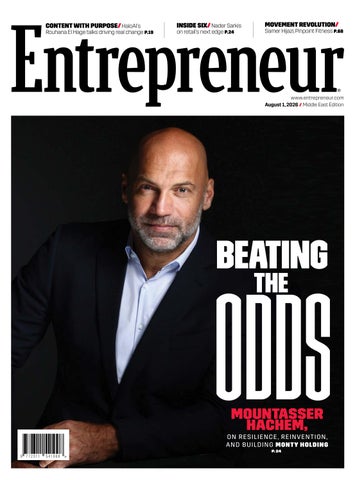
CONTENT WITH PURPOSE/ HaloAI’s Rouhana El Hage talks driving real change P.19
INSIDE SIX/ Nader Sarkis on retail’s next edge P.24
MOVEMENT REVOLUTION/
Samer Hijazi, Pinpoint Fitness P.68
www.entrepreneur.com August 1, 2026 Middle East Edition
Beating the
ODDS MOUNTASSER HACHEM,
O N R ES I L I E N C E , R E I N V E N T I O N , A N D B U I L D I N G MONTY HOLDING P. 24
2 / E N T R E P R E N E U R . C O M / November 2023
E V E R Y T H I N G T H AT O N E C O U L D I M AG I N E FOR EXTRAORDINARY LIFE
Eywa Way of Water is a state-of-the-art residential community with only 65 exceptional waterfront residences, with a holistic wellness ecosystem, curating authentic experiences and best-in-class amenities few have dreamed of.
Contact us today: +971 54 308 6000 I
sales@byrevolution.com
E Y W A . A E August 1, 2026 / E N T R E P R E N E U R . C O M / 3
The Mirra® 2 Chair is turning heads again
The Mirra 2 Chair just keeps getting better. How? We updated the chair so it’s 30 percent lighter than the original Mirra - and the chair’s nylon base and spine are now 100 percent recycled content. We also gave it a fresh, inspired colour palette so it can look professional, casual, or sporty. One thing that hasn’t changed is the flexible yet supportive design that allows your body to move naturally and freely - the way it was meant to move.
hermanmiller.com
© 2026 Herman Miller
Contents/
August 1, 2026 → Dalal Saleh Salem
FEATURES
Al Yafei is the Vice President – Human Capital at Tabreed, a UAE-based district cooling company.
P.24
Beating the Odds
Mountasser Hachem, On Resilience, Reinvention, and Building Monty Holding
P.35
The Next Chapter in the Emiratization Journey
(and what it means for UAE business leaders)
P.45
Creative Catalyst
Qatari Entrepreneur ABDULRAHMAN AL-MANA is shaping the future of Qatar’s film industry.
P.50
QSTP’s US$30 Million Tech Venture Fund Qatar’s support for deep-tech startups
August 1, 2026 / E N T R E P R E N E U R . C O M / 5
EXTRAORDINARY PR IVATE PO O LS | 30+ AM E N ITI ES | PRI M E LO CATI O N S
Escape to a home where urban sophistication meets resort tranquility.
BU I LT FO R M O M E NTS THAT MAT TE R 800-SAMANA | WWW.SAMANADEVELOPERS.COM
D I S C OVER REFINED
living
*Ranking as per the H2025 1 sales volume data of property monitor for Dubai
Make growth your next stop Corporate & Investment Banking. Global Markets. Global Banking. Transaction Services. Now is your time sc.com/cib
Dub New York
Johannesburg Standard Chartered Bank UAE is licensed by the Central Bank of the UAE
Shanghai
bai London
Singapore
Contents
August 1, 2026
CEO Wissam Younane wissam@bncpublishing.net MANAGING DIRECTOR Rabih Najm rabih@bncpublishing.net ART DIRECTOR Simona El Khoury EDITOR IN CHIEF Tamara Pupic tamara@bncpublishing.net SENIOR FEATURES EDITOR Aalia Mehreen Ahmed aalia@bncpublishing.net JUNIOR EDITORIAL ASSISTANT Kristine Erika Agustin kristine@bncpublishing.net DIRECTOR OF INNOVATION
Sarah Saddouk sarah@bncpublishing.net GROUP SALES DIRECTOR – B2B GROUP Joaquim D’Costa jo@bncpublishing.net
↑ Nader Sarkis is the founder of
SIX Concept Store, a lifestyle destination in Dbayeh.
60 Borderless Trust NEXT GENERATION EQUITY’S RIHAB SAAD on the human side of
BUSINESS UNUSUAL 14 Influence With Intention ROUHANA EL HAGE , Associate
Partner, HALO AI , on why content creators are powerful agents of change.
20 Inside SIX Concept Store
Founder NADER SARKIS is making experience retail’s greatest advantage.
investment migration.
62 AI Ambition
ROX is building an AI-driven
ecosystem to support Operation 300Bn.
64 Movement Revolution
Founder SAMER HIJAZI on how Pinpoint Fitness is taking kids’ movement global.
66 Chillblast Expands to Ras Al Khaimah
UK-based gaming PC manufacturer expands into the Middle East.
‘TREPONOMICS
STARTUP SPOTLIGHT
55 Beyond Borders
73 Startup Stories
STANDARD CHARTERED Global Private
Bank’s VINAY GANDHI on the global reach of Gulf investors.
58 Checkout Matters
VISA UAE’s SALIMA GUTIEVA explains
why checkout has become a strategic driver of business growth.
10 / E N T R E P R E N E U R . C O M / August 1, 2026
HEAD OF PARTNERSHIPS
Samir Glor Samir@bncpublishing.net BUSINESS DEVELOPMENT DIRECTOR
Andy Soulahian andy.soulahian@bncpublishing.net COMMERCIAL LEAD
Anna Chipala anna@bncpublishing.net COUNTRY MANAGER KSA
Amjad Fakhouri amjad@bncpublishing.net COLUMNIST Tamara Clarke CONTRIBUTING WRITERS
Fida Chabaan, Vinay Gandhi, Salima Gutieva
SUBSCRIBE
Contact subscriptions@bncpublishing.net to receive Entrepreneur Middle East every issue
COMMERCIAL ENQUIRIES sales@bncpublishing.net
ENTREPRENEUR.COM
Access fresh content daily on our website
EntMagazineME
Lessons from from the founders of RAWA , RECOVERY ISLAND , and CHOCOLEAF .
IN THE LOOP 76 What’s on our radar.
Entrepreneur-me
PO BOX 502511 DUBAI, UAE P +971 4 4200 506
All Rights Reserved 2026. Opinions expressed are solely those of the contributors. Entrepreneur Middle East and all subsidiary publications in the MENA region are officially licensed exclusively to BNC Publishing in the MENA region by Entrepreneur Media Inc. No part of this magazine may be reproduced or transmitted in any form or by any means without written permission of the publisher. Images used in Entrepreneur Middle East are credited when necessary. Attributed use of copyrighted images with permission. All images not credited otherwise Shutterstock. Printed by United Printing and Publishing.
PROPERTIES solproperties.ae 800-765-1
Learn More
Editor’s Note / PROGRESS, NOT REPLACEMENT
W
ith the many things happening in our already more overwhelmed-thanusual GCC region, we’d be forgiven for overlooking one particular court decision, especially as it comes from as far away as China. But today’s technology has brought us all much closer. And nowhere is that more evident than in the ongoing AI race, where countries separated by geography are now running shoulder to shoulder. So, I guess you missed it too. But it matters to all of us, wherever we are. Earlier this year, in eastern China’s Zhejiang Province, the Hangzhou Intermediate People’s Court ruled that replacing a worker with AI does not legally qualify as a “major change in objective circumstances.” Namely, the quality assurance supervisor in question was fired after refusing a demotion and a 40% pay cut when AI took over his duties. After what I assume were a few sleepless nights, finding the courage to file a case, and everything else that comes with taking on your employer, it paid off. The court not only sided with him, but it also established a critical precedent: the strategic adoption of AI is a voluntary business decision, and its financial consequences cannot be unfairly offloaded onto workers. It puts a different perspective on the splashy headlines coming from the West, where executives bluntly state that “AI agents enabled the company to reduce its customer support workforce from around 9,000 to 5,000 employees” (Salesforce), or that “increased use of AI tools and agents would lead to more corporate job cuts, particularly through automating routine tasks” (Amazon), or, more subtly, that “the cuts are part of a broader reorganization rather than direct AI replacement” (Microsoft). It is not necessary to be critical or judgmental of such decisions because, oh well, sometimes karma moves faster. For example, Australia’s Commonwealth Bank (CBA) replaced more than 40 customer service employees with an AI voice bot, only to discover that the bot couldn’t cope with customer demand. The bank reversed the layoffs and admitted it had “not adequately considered all relevant business considerations.” Or IBM, which found that AI could handle about 94% of routine HR requests but struggled with the remaining 6%, so it ended up announcing plans to triple its US entry-level hiring across all business units in 2026. Somewhere between the East and the West, the UAE is quietly charting a balanced course. Just recently, H.H. Sheikh Mohammed bin Rashid Al Maktoum, Vice President, Prime Minister of the UAE and Ruler of Dubai, approved the establishment of the Artificial Intelligence and Data Authority, which, among its many responsibilities, will help train 80,000 government employees in Agentic AI. The goal is to equip people to evolve alongside technology. Perhaps that is the true measure of progress: not how much work AI can do, but how many people it empowers to do more with it.
Tamara Pupic Editor in Chief | Entrepreneur Middle East
12 / E N T R E P R E N E U R . C O M / August 1, 2026
August 1, 2026 / E N T R E P R E N E U R . C O M / 13
Influence With Intention An innate love for filmmaking and creating impact-oriented art led Rouhana El Hage to the US$252+ billion creator economy and, later, into MENA-based creator collaboration tech platform, Halo AI. Having been promoted as the firm’s Associate Partner, El Hage shares why content creators (especially micro creators) hold the power to create meaningful change across audiences. by AALIA MEHREEN AHMED
14 / E N T R E P R E N E U R . C O M / August 1, 2026
B/
Strategy
F
resh off his appointment as Associate Partner of Halo AI, a MENA-based agentic artificial intelligence (AI) platform for creator collaborations, in April 2026, Rouhana El Hage expresses a level of sensitivity that may not always be immediately ascribed to the glamorous and frenzied online creator economy that he is a part of. Indeed, there are a couple of moments —which will be revealed later in this piece— while describing his professional journey when El Hage’s eyes clearly well up and his voice gets hoarse with emotion (“I can’t believe I’ve cried during a business interview,” El Hage quips towards the end of our Zoom call in early June).
H
aving first joined Halo AI in early 2025 as its Social and Content Lead, El Hage notes that his move into Halo AI was an almost natural extension of a career spanning more than 16 years across filmmaking, publishing, and digital media, during which he has worked with name brands such as PlayStation, Samsung, Tiffany & Co., and Bulgari while leading major content initiatives across the GCC including for global publications like Harper’s Bazaar and Cosmopolitan. “One thing I’ve learned throughout my career, working across different mediums and at different times, is how important it is to put on a producer’s hat,” he says. “When I studied film and worked in film, we had to produce a lot of things. A producer has to find solutions to everything. They need to be the person who says, ‘Yes, we can do it!’ Nothing can stop them from making the client happy, making everyone on set happy, and ultimately achieving the biggest goal, which is getting the job done. Looking back, I realized that putting on that producer’s hat became one of my greatest strengths. It taught me a lot. But another
thing it taught me was agility. One of my mentors, who worked across lifestyle, fashion, influencer marketing, and gaming publications, explained to me how important it is to be agile and not become attached to a specific medium.” The lessons El Hage accumulated throughout his career thus came to define how he approached the creator economy as well. “When I’m working with a brand or a creator, I don’t focus on which platform they’re on,” he declares. “I focus on how I can optimize them beyond the platform, because the platform could disappear tomorrow. The medium can change, be canceled, or evolve. It started with theatre, then came film, then television, then laptops, and now phones. It was never only about the medium itself. It was always about audience attention. That’s one of the most important things to understand, because today we live in a world where attention is one of the most valuable currencies.” Today, as Associate Partner at Halo AI, El Hage has a hand in anything that helps the business grow, from shaping the company’s creator-first strategy, to leading community initiatives and how Halo AI participates in culture, and ensuring the platform remains a trusted partner to creators as it expands globally. Founded in 2024 by Vito Strokov, Rami Saad, and Alex Gadalin, and with offices in Saudi Arabia, the UAE, and the US, Halo AI helps big brands turn one-off creator posts into managed communities of thousands of micro and nano creators. Discovery agents watch and understand every creator post (what’s said, what products appear, what’s brand-safe) across millions of creators, so brands always know who to work with and what’s working. Halo AI then handles the busywork: matching, monitoring trends, flagging risks, all automatically. The result: brands run creator campaigns at scale for less, and creators get more partnerships and clearer ways to earn. “I absolutely love the creative economy, and I understand where it is heading as a business,” he says. “There’s a lot of investment flowing into that space, and the global market value is projected to reach up to more than US$500 billion by 2027. So it’s a significant industry. Finding a place like Halo, a company that genuinely cares about creators, made me very happy. Personally, what drew me to Halo was the founders, Alex, Rami, and Vito. I was absolutely inspired by their backgrounds and by who they are as people. Learning from the right people makes your business journey more efficient and productive. Working with them has been August 1, 2026 / E N T R E P R E N E U R . C O M / 15
16 / E N T R E P R E N E U R . C O M / August 1, 2026
B/
Strategy
incredibly inspiring. The values Halo holds for creators and brands alike are values I genuinely care about.” The statistics El Hage shares are largely supported by industry research. A 2025 report by US-based market analysis platform Grandview Research shows that the global creator economy market size was valued at $252.3 billion in 2025 and is projected to grow from $310.4 billion in 2026 to $1,345.5 billion by 2033. Another study by India-based industry insights platform Precedence Research shows that the global creator economy is predicted to hit a whopping $2084.57 billion by 2035.
B
ut there was a time when El Hage would’ve stayed as far away as possible from business numbers and monetary returns. “If nine-year-old Rouhana were sitting next to me right now, he would never believe that I’d become a businessman working in a commercial industry that generates money,” he admits. “He would never believe that I’m no longer solely the artist I thought I would be. When I was young, I wanted to do films. I wanted to be in front of the camera, tell stories, and most importantly, create art that inspires others. As a millennial growing up, there were many topics that simply weren’t discussed in traditional media. There were certain ideas around gender and identity that felt fixed, and I always felt art could help me express myself and create change in the world.” All that changed for El Hage when he began his first full-time job at a digital company, where he recalls presenting “a very artistic idea” and receiving feedback that, at the time, questioned his core values. “I walked into that interview wearing a tank top, my dad’s Rolex, and my hair in a wild bun because, at the time, I saw myself purely as ‘an artist,’” he says, drawing air quotes. “I shared my ideas, and my manager, who later became a mentor, said, ‘Rouhana, you’re not an artist. You’re here to make us money. You’re here to be commercial.’ The job
was in digital content production, and she kept repeating, ‘Money. Say it after me—money.’ I was devastated at the time, because for someone who believes deeply in art, being called commercial feels like the biggest insult. But she was brilliant. She understood where the industry was heading. She told me digital was the future and that I’d be working with global brands. I remember thinking, ‘Yes, but I’m an artist. I want to make films that move people.’ Thankfully, I listened to her advice. The content performed incredibly well. We were reaching millions of viewers, the publication was thriving, and the numbers spoke for themselves. We were constantly receiving feedback about how much impact the content was having.” That result led to an epiphany that would ultimately define El Hage’s career trajectory from that point forth. “I realized that yes, I’m an artist, and I refuse to lose that side of myself. But if one of my goals as an artist is to create change, then making a niche film that only a small audience sees at film festivals isn’t always the most effective way to do it. Through social media and digital platforms, I could reach the masses instead of the niche. I could reach people who may never have picked up a certain book or attended a film festival, but who still needed to hear those messages. People who were being bullied, misunderstood, or pushed into harmful ways of thinking. I realized that commercial content could still move people. It could still create change. And I say this with a lot of pride because it genuinely gives me goosebumps. We received countless messages from people telling us that our content helped them accept themselves, stand up to abuse, or get through difficult moments in their lives.” It is here that El Hage begins to tear up visibly. “To me, that is art. It’s a form of art that people don’t talk about enough,” he continues. “Yes, it wasn’t a niche film or a painting in a gallery, and those things are wonderful. But my goal was always to create change. I was
fortunate enough to see that change reflected not only in the data, but in the hearts of the people consuming the content. I still create. I still film. I’m a filmmaker, and I’ll never stop being one. That artistic side of me is still very much alive. The difference is that I now understand where it belongs in my life. And that evolution is what eventually led me to another passion that I deeply care about—the creator economy.” El Hage’s vision for the creator economy, however, didn’t stay limited to ensuring meaningful stories were being told — equally important to him was who got the opportunity to tell them. That sentiment is perhaps what solidified his decision to work with Halo AI, given the platform primarily works with nano and micro-influencers. “We focus a lot on microcreators because they often don’t have the same opportunities as larger influencers, despite being known to drive strong conversions for their scale,” he explains. “Mega influencers are important for positioning and brand association, but there’s also a significant and growing need for microcreators in the market. The challenge is that many talented microcreators don’t get consistent brand deals simply because they don’t know the right people. That’s unfair. With Halo, we’re able to help create ongoing opportunities for them.” According to El Hage, one of the biggest challenges facing creators is that access to brand partnerships has traditionally depended on who they know, rather than how well they fit a particular brief — a bottleneck that Halo AI aims to address head-on. “With Halo AI’s matching technology, creators are connected to opportunities based on how well they fit the brief,” El Hage says. “We help creators get discovered by the brands they genuinely want to work with, and help brands discover creators they may never have found otherwise. Instead of wondering who to contact at a company like L’Oréal or Lipton, creators can access those opportunities directly through the platform. As creators secure more brand partnerships, they build August 1, 2026 / E N T R E P R E N E U R . C O M / 17
B/
Strategy
credibility and strengthen their personal brand, which naturally creates even more opportunities for growth.” El Hage adds that Halo AI’s work is deeply reflective of how the broader content creation industry has transformed over the last couple of decades. “There was a time when creation was controlled by a relatively small number of people in television stations and magazines,” he says. “They decided who got invited, who got opportunities, and which stories were told. Digital platforms changed that. Suddenly, we saw a shift in who gets to be seen, who gets to be heard, and who gets to shape culture. That’s one of the reasons I love the creator economy. If it’s done right, it has tremendous power to create change. That’s beneficial for people, creators, brands, and society as a whole.”
Indeed, Halo AI’s focus on empowering smaller creators is more timely than ever. Multiple studies have shown that owing to factors like more loyal audiences and greater perceived authenticity, creators with smaller followings are in demand now more than ever. A 2025 report by US-based Live Wire Weekly shows that micro creators often get 3-5x more engagement than big influencers, and that brand collaborations with them are affordable and often yield better ROI. But El Hage notes that supporting creators isn’t just about helping them secure more opportunities; it’s also about ensuring those opportunities are fair. “One of our key strengths is transparency. Clients know exactly where they’re investing their money, and creators know exactly what
18 / E N T R E P R E N E U R . C O M / August 1, 2026
percentage is being taken from their earnings. There are no hidden fees or surprises on either side. Too often in the industry, a creator might be told one thing and receive something entirely different, which ultimately hurts everyone involved. If a campaign underperforms because too much of the budget was absorbed by intermediaries, the creator often ends up taking the blame. That’s why transparency is so important to the creator economy, and it’s one of the things I love most about Halo—we’ve built that transparency into the platform.” But beyond facilitating brand deals and visibility pushes, El Hage’s endeavors within the creator economy uphold a simple yet poignant idea: remembering the human being behind the work. That philosophy, he emphasizes, must extend beyond the creator economy and into the way organizations should approach leadership itself. “I once had a high-performing team member who suddenly started underperforming. Instead of immediately focusing on the work, I wanted to understand what was happening. I’ve always tried to create an environment where people feel comfortable speaking honestly. Eventually, that person opened up about something difficult they had experienced, and it became clear that the issue had very little to do with work itself. We spoke about it, we worked through it together, and they took meaningful steps to address it. Not only did they return to being highly productive, but they
also went on to make a positive difference in other people’s lives.” “When you’re hiring people, you’re hiring human beings,” he adds. “Sometimes performance issues aren’t about capability— they’re about what someone is carrying personally. As managers, our responsibility is to support people wherever possible. If someone is giving their time, energy, and expertise to help your organization succeed, they deserve to be heard.” By remaining committed to this leadership style, as well as the artistic vision that has defined his career long before he even stepped into the creator economy, El Hage says that while he’s confident about the industry’s growth, collectively responsible efforts are required to ensure its full potential is unlocked. “The opportunity ahead is enormous, but responsibility must grow alongside it,” he declares. “We’re living in a time when misinformation, rage-bait content, and manipulated narratives can spread very quickly. That’s why internet literacy is becoming increasingly important. The creator economy has tremendous potential, and I’m excited to see how technologies like AI can help unlock even more opportunities for creators. But for that future to succeed, people also need a better understanding of how the internet works and how information is shaped online. If we can continue building with purpose, empathy, and responsibility, then I think the best days of the creator economy are still ahead of us.”
67 OCT2026 A D N EC C E N T R E
WHERE THE WORLD CONVENES IN
NEW INTELLIGENCE 350+
WORLD'S LEADING AI SHOW UNITING INFLUENTIAL GOVERNMENTS, ENTERPRISES, INVESTORS & STARTUPS
Meet the leaders building the next generation of intelligent economies. From breakthrough research to nation-scale deployments and outcomes-led talks, experience the AI applications reshaping industries.
AI BIG TECH & AWARD-WINNING STARTUPS
100+
WORLD- RENOWNED SPEAKERS
80+
COUNTRIES
200+
CAPITAL PARTNERS
GET INVOLVED
aieverythingabudhabi.com sales@aieverythingabudhabi.com
#AiEverythingAbuDhabi
B/
Lebanon
Nader Sarkis: The Entrepreneur Redefining Experiential Retail in Lebanon How the founder of SIX Concept Store is proving that in today’s retail landscape, experience—not inventory—is the ultimate competitive advantage. b y W I S S A M Y O U N A N E
I
never wanted SIX to be a store. I wanted it to become part of people’s lifestyle.” For Nader Sarkis, retail has never been about selling products. It has always been about creating places people want to return to. Long before “experiential retail” became an industry buzzword, Sarkis recognized a fundamental shift in consumer behavior. Shoppers were no longer seeking shelves filled with luxury products—they were looking for destinations that reflected their identity, inspired discovery, and fostered a sense of belonging. → Nader Sarkis is the founder of SIX Concept Store, a lifestyle
destination in Dbayeh.
20 / E N T R E P R E N E U R . C O M / August 1, 2026
long-standing journey in fashion retail, rather than simply another store opening.
“I NEVER WANTED SIX TO BE A STORE. I WANTED IT TO BECOME PART OF PEOPLE’S LIFESTYLE.”
T
hat philosophy became the foundation of SIX Concept Store, a lifestyle destination in Dbayeh that seamlessly blends international fashion,
design, wellness, dining, and culture into a single curated experience. Built on more than two decades of retail expertise across Lebanon and the GCC, SIX represents the evolution of Sarkis’
Beyond The Traditional Boutique After spending decades building and operating successful fashion businesses, Sarkis could easily have launched another luxury multi-brand retailer. Instead, he chose to challenge the conventional retail model. At SIX, shopping is only one part of the customer journey. The space has been designed as an ecosystem where fashion, lifestyle products, art, architecture, and hospitality coexist naturally. Guests can browse internationally renowned fashion labels, discover carefully selected home accessories and collectible design pieces, before extending their visit over coffee or brunch at Glow Paradise Café. The result is a destination where retail becomes an experience rather than a transaction. The Business Of Curation If there is one word that defines Sarkis’ approach, it is curation. In an industry often driven by volume and endless brand expansion, SIX has deliberately taken the opposite route. Every designer, collection, collaboration, and lifestyle product is selected with intention. The store brings together an eclectic mix of internationally recognized brands—including SelfPortrait, Coperni, Mugler, Jacquemus, Just Cavalli, Les Benjamins, and Linda
August 1, 2026 / E N T R E P R E N E U R . C O M / 21
B/
Lebanon
THE RESULT IS A DESTINATION WHERE RETAIL BECOMES AN EXPERIENCE RATHER THAN A TRANSACTION. Farrow—alongside emerging labels that introduce customers to something unexpected. For Sarkis, curation extends beyond product selection. It is about building credibility. Customers know that every item on display has passed through the same uncompromising filter of quality, originality, craftsmanship, and relevance. Over time, that consistency has transformed SIX into a trusted destination for entrepreneurs, creatives, public figures, tastemakers, and discerning shoppers seeking more than another luxury purchase. Creating A Destination, Not Just A Store Perhaps the biggest differentiator behind SIX is that visitors rarely come for a single reason. Some arrive to discover new fashion collections. Others meet friends at Glow
Paradise Café. Many attend exclusive brand launches, private previews, seasonal
22 / E N T R E P R E N E U R . C O M / August 1, 2026
activations, or community gatherings hosted throughout the year.
This multi-dimensional approach has enabled SIX to cultivate something many retailers struggle to achieve: emotional engagement. Rather than competing solely on products, Sarkis has built a business around atmosphere, discovery, and community—elements that are increasingly difficult to replicate in an era where virtually any luxury item can be purchased online. Retail Meets Brand Building The entrepreneurial mindset behind SIX extends well beyond merchandising. Drawing on more than 20 years of retail and marketing experience across Lebanon, the UAE, and the wider GCC, Sarkis applies a founder-led, 360-degree marketing strategy to every brand represented inside the store. From influencer collaborations and curated digital storytelling to immersive in-store experiences and exclusive product launches, the objective is not simply to sell collections, but to build long-term brand equity. The store’s Christmas 2025 campaign demonstrated the effectiveness of that philosophy. Combining immersive festive installations, exclusive shopping bags, influencer partnerships, loyalty initiatives, curated content, and private events, the campaign generated a digital reach exceeding 2.5 million
THAT PHILOSOPHY EXPLAINS WHY SIX CONTINUES TO ATTRACT CUSTOMERS WHO STAY LONG AFTER THEY’VE FINISHED SHOPPING, RETURNING NOT ONLY FOR THE BRANDS, BUT FOR THE ENVIRONMENT, THE CONVERSATIONS, AND THE COMMUNITY THAT HAS FORMED AROUND THE DESTINATION.
while reinforcing SIX’s position as one of Lebanon’s most distinctive lifestyle destinations. Experience As The Competitive Advantage Luxury has become increasingly accessible. What remains difficult to duplicate is taste. Sarkis believes that retailers who focus solely on products will inevitably compete on price, inventory, or convenience. Those who create memorable experiences, however, compete on something far more valuable: emotional connection. That philosophy explains why SIX continues to attract customers who stay long after they’ve finished shopping, returning not only for the brands, but for the environment, the conversations, and the community that has formed around the destination. Looking Ahead As global retail continues to evolve, Nader Sarkis represents a new generation of entrepreneurs redefining what physical retail can become. His success lies not simply in introducing premium international brands to Lebanon, but in understanding that the future of retail belongs to businesses capable of creating destinations people genuinely want to experience. For Sarkis, that was always the vision. He didn’t set out to build another successful concept store. He set out to create a place people would choose to make part of their lives. August 1, 2026 / E N T R E P R E N E U R . C O M / 23
against all
ODDS WITH EVERY DOOR CLOSED, HE FINDS A WINDOW: MEET THE MAN THAT KEEPS MOVING A C O N V E R SAT I O N W I T H
MOUNTASSER HACHEM, FO U N D E R A N D C H A I R M A N OF MONTY HOLDING
24 / E N T R E P R E N E U R . C O M / August 1, 2026
August 1, 2026 / E N T R E P R E N E U R . C O M / 25
THAT’S THE TRAP OF ANY BUSINESS THAT’S ALREADY WORKING. WHEN SOMETHING WORKS, YOU START PROTECTING IT INSTEAD OF GROWING IT. TV WAS GOOD TO US, BUT IT HAD LIMITS. IT WAS TIME FOR A CHANGE.”
Every big decision in Mountasser Hachem’s career looked wrong at the time. Leaving a stable TV business to bet on messaging. Trying to win the trust of mobile operators who had never heard of his at-the-time small company. Buying a broken phone network in a market global investors had already written off. Building his own telecom hardware instead of buying it from a giant like Huawei or Nokia. Each one of these moves could have failed. None of them did. 26 / E N T R E P R E N E U R . C O M / August 1, 2026
↑ MyMonty official
launch, marking Monty Holding’s entry into digital banking
T
his is the story of a man who has spent thirty years making decisions that looked risky on paper, and getting them right. Not once, but time and time again, across media, telecom, fintech, and now infrastructure. The thread that runs through all of it is not luck, its judgment. Knowing when to trust instinct over advice. That’s how he hit the target most people miss. Today, that judgment shows up in the numbers. Over 1,000 employees. 20 international offices. Multiple industries. But the instinct behind all of it traces back to a much smaller starting point in 1998, and a decision even his own inner circle at the time thought was a mistake.
/THE FIRST LEAP: LEAVING WHAT WORKED
In 1998, Mountasser Hachem was running a media and communications company broadcasting paid television channels across the Middle East and North Africa. He was already ahead of the game inside that business, the first in the region to bring interactive TV to air on Nilesat and Arabsat, years before most broadcasters understood what viewers would do with a remote control and a two-way signal. By the end of the decade he had built a collection of channels including ETV, ETV+, MC TV, Maraya TV, Kamar TV, Derby TV, and Hot Bird, and viewers across the region were sending SMS to their screens to play games, request horoscopes, and take part in what was airing. Before anyone was talking about interactive media, he had already built it. And it worked. But TV
“WE WERE SMALL WHEN WE STARTED, SURE, BUT I NEVER THOUGHT OF US AS A SMALL COMPANY. I JUST KNEW WE HADN’T GROWN INTO WHAT WE BELIEVED WE COULD BE YET. SO WE COMPETED THE ONLY WAY WE COULD AT THAT STAGE: ON RELIABILITY.”
was still the safe, established business of the time. It made money. It made sense. And that was exactly the problem.
You started in television, a business that was doing well. Why walk away from something that worked?
“That’s the trap of any business that’s already working. When something works, you start protecting it instead of growing it. TV was good to us, but it had limits. It was time for a change. In the early 2000s, mobile phones were changing how people talked to each other, and text messaging was exploding. Nobody in our world was taking it seriously yet. I didn’t have data to prove it would work. I just had a feeling that this was where everything was heading. And if I waited for proof, I’d be too late. Everyone else in the space thought telecom was about the network. Build towers, sign roaming deals, wait for the money to come in. There were other aspects being overlooked. I noticed that early, not because I was smarter than anyone, but because I was small and I was used to moving. When you’re small, you have to look for the gap nobody else is watching. And the big operators weren’t watching the opportunity in the messaging space. So we made the jump. In 2006, we acquired a GSM license in the Seychelles for an international travel SIM. We rebranded as Monty Mobile and started from almost nothing in a
August 1, 2026 / E N T R E P R E N E U R . C O M / 27
↑ Monty Capital
secures its Category 4 license from the Dubai Financial Services Authority (DFSA), a milestone in the group’s expansion into regulated financial advisory services
completely new industry. That’s where my real journey in telecom began.” That single decision, made without a guarantee, is the pattern that defines everything that came after.
/EARNING A SEAT AT THE TABLE
Monty Mobile did not start with contracts from major telecom operators. It started with an idea, and a small team convinced it could compete with anyone. The company was young, working out of a region the telecom world did not yet see as a hub, and unknown to the operators it needed to work with. What it lacked in size, it made up for in intent. Hachem never built Monty Mobile to stay small. He built it small because that is where every serious company starts.
You started as an outsider, a small unknown company, trying to get global mobile operators, institutions that don’t 28 / E N T R E P R E N E U R . C O M / August 1, 2026
hand out trust easily, to work with you. How did you win them over?
“We were small when we started, sure, but I never thought of us as a small company. I just knew we hadn’t grown into what we believed we could be yet. So we competed the only way we could at that stage: on reliability. I remember early on we’d agree to terms that weren’t great for us financially, just so we could prove we could actually do what we said. When you deliver once, the conversation changes. It stops being about who you are or where you started and starts being about whether you’re reliable. An operator in Europe or Asia doesn’t care where you’re from once you’ve shown up on time, done the job right, and done it again. Trust isn’t something you ask for. It’s something you earn one delivery at a time. That took years. But once a few of the big operators started working with us, the door opened much wider, and we never looked like a small company again.”
“YOU SHOULD NEVER GET INTO ANY BUSINESS IF YOU DON’T BELIEVE IN YOURSELF FIRST. AND I LIVE BY A STRONG CONVICTION: FAILURE IS ONE OF THE GREATEST ASSETS AN ENTREPRENEUR CAN HAVE. WHEN YOU LOSE, YOU LEARN. I’VE LOST FAR MORE THAN I’VE WON, AND HONESTLY, THAT’S EXACTLY WHY I’M STILL HERE. THE LESSONS THAT COME FROM LOSING ARE WORTH MORE THAN THE THRILL OF ANY WIN.” That approach, proving the work before asking anyone to trust it, became the foundation for everything Monty Mobile built next. From messaging and roaming services to the communication tools operators now rely on every day, the pattern was set at the start.
Starting off small in an uncharted space, was there a moment you thought this wasn’t going to work?
in the work so strong it was unwavering. That’s the real difference. I never let one bad quarter decide whether the whole thing was worth continuing. You separate the setback from the mission. The setback is real. You deal with it. But it doesn’t get to answer the bigger question. In the end, you keep moving forward. That has been my mantra for thirty years.”
/TWENTY-FIVE YEARS OF BETTING ON WHAT’S NEXT
Once Monty Mobile earned the trust of operators, most companies would have kept doing what worked. Hachem did the opposite. Over the next twenty-five years, he pushed the company into mobile money, into broader connectivity, and eventually into fintech. Each move was a bet that
the company’s core skill, moving information and value safely and reliably, could work in a market it had never touched before. The easy version of this story is “Monty Mobile branched into fintech and other verticals.” But that framing misses the point. It wasn’t a series of separate leaps into new industries. It was the same instinct that took him from media into telecom in the first place: find a reliable way to connect people and move value, then apply that instinct to whatever rails make sense next.
↓ Mountasser Hachem pictured with Adam Jones, Executive Vice President and Division President for West Arabia at Mastercard, during the MyMonty and Mastercard collaboration announcement.
“Listen, I always believed in my company. You should never get into any business if you don’t believe in yourself first. And I live by a strong conviction: failure is one of the greatest assets an entrepreneur can have. When you lose, you learn. I’ve lost far more than I’ve won, and honestly, that’s exactly why I’m still here. The lessons that come from losing are worth more than the thrill of any win. Were there moments that demotivated me? Of course there were. But this wasn’t built on temporary motivation. It was built on discipline, and on a belief August 1, 2026 / E N T R E P R E N E U R . C O M / 29
Fintech, mobile money, connectivity: on paper, these look like different industries. Why did you see them as one path?
“I work in technology. I always have. Monty Mobile is a telecom technology company, and what is fintech, if not financial technology? For me, this was a natural progression, not a leap. People think media, messaging, and fintech are three distinct businesses. To me they’re the same business wearing different clothes. If you can move a text message across a hundred networks without it dropping, you understand something about trust and infrastructure that transfers directly to moving money, or connecting a traveler’s phone the second they land in a new country. During that time, mobile network operators everywhere were opening digital wallets and turning into banks. We work in software. We already had the platforms to bridge telecom and finance. We already understood operators, we already understood compliance, we already had relationships in dozens of countries. Fintech companies starting from zero had to build all of that first. We were already standing on it. Monty Finance and our payment services grew out of that same foundation, not a separate one. The inspiration behind MyMonty, our digital wallet in Lebanon, came out of the 2019 financial crisis. I watched people I know lose access to their own money overnight, and I couldn’t just watch. So I built. MyMonty was my first investment in Lebanon, and it was never really about return. Sometimes you 30 / E N T R E P R E N E U R . C O M / August 1, 2026
→ Mountasser Hachem on site with the
Comium team in the Gamba during the network’s turnaround, alongside the engineers and staff who helped rebuild it
invest because home needs you to.” This is what makes Hachem’s story different from a typical growth story. He wasn’t chasing trends. He was recognizing that a single instinct, moving things people depend on, could be applied over and over, in industry after industry, without ever really changing what the company was.
Do you ever worry you are spreading yourself too thin?
“Honestly, no. It’s not jumping across industries or venturing into unrelated worlds. Everything I’ve built is linked, because the heart of every one of my businesses is technology. You have to see the market for what it is, and you have to move when you see the wave coming. Staying in one place because it’s comfortable is how companies begin to fail. On top of that, I get restless the moment a business stops teaching me something new. Starting new things, and backing the right people to run them, is what keeps me sharp. I couldn’t tell you what the next ten or twenty years will look like. But I can promise you it will be bigger and bolder than everything I’ve built so far.”
/COMIUM: THE NETWORK NOBODY WOULD SAVE
If one decision captures Hachem’s willingness to go against the room, it’s the acquisition of Comium, a struggling mobile network in The Gambia. The network was outdated. It was losing customers. Most people, inside his own company included, said it was a lost cause. But buying Comium wasn’t just an acquisition. It meant Monty Mobile went from being a company that works alongside operators to being one of them.
“WE BUILT OUR OWN TELECOM INFRASTRUCTURE HARDWARE AND ESTABLISHED MOYA OUT OF WHAT WE LEARNED. AFTER ALMOST THIRTY YEARS OF WORKING ALONGSIDE MOBILE OPERATORS, WE SUDDENLY WERE ONE. STANDING ON BOTH SIDES OF THAT FENCE GAVE US AN EDGE NOBODY ELSE IN THE SPACE HAD. IT MADE US SHARPER AS MONTY MOBILE, AND STRONGER AS COMIUM.” Walk me through Comium. What was actually broken when you took it over, and what did you see that others didn’t?
“The decision to acquire and manage Comium came from a gut feeling. People around me had doubts, and I understood why. But I saw something in that challenge that others couldn’t see. I’m built for challenges like this. Honestly, Comium felt like it was calling on me to save it. Comium wasn’t just a failing network on paper. It was hundreds of families in The Gambia who were about to lose their livelihoods, in a country where a job like that isn’t easy to replace. And the people who were still customers were paying too much for too little, because the two operators who controlled the
market had no real reason to compete on price. We rebuilt the network from 2G to 4G+ in six months. In an industry where a network upgrade like that usually takes years, it was almost unheard of. We kept the staff, and we gave them a reason to believe in the place again. Within two years, we’d taken 20 percent of the market. From 12,000 subscribers to over 1,000,000. Those numbers matter, but honestly, what I’m proudest of is walking into that office today and seeing the same people who almost lost everything, still there, still working, and doing better than they ever did before. That’s the part that made it worth every bit of doubt we faced getting there. Of course there was good business there too, and a real milestone for the group. We built our own telecom infrastructure hardware and established Moya out of what we learned. After almost thirty years of working alongside mobile operators, we suddenly were one. Standing on both sides of that fence gave us an edge nobody else in the space had. It made us sharper as Monty Mobile, and stronger as Comium.”
How much of that turnaround came through Moya, and why build your own infrastructure arm rather than just buying equipment from an established vendor like Huawei?
“Almost all of the equipment that went into that six-month upgrade came through Moya, which is our own telecom hardware and software infrastructure arm. We could have gone to Huawei or one of the other big names, and on August 1, 2026 / E N T R E P R E N E U R . C O M / 31
paper the specs would have looked similar. But that’s exactly the point, we didn’t want to just match what’s already out there, we wanted to own it. Moya wasn’t created to compete against the big players. It was created to raise the bar. In a market as saturated as telecom infrastructure, I like to walk in and force everyone to lift their game. We built infrastructure at the same level, and offered it at a lower price. No company opens its doors already at the top. You start small, you deliver, and you build your way up. That has been Moya’s trajectory from day one. Another plus was that we weren’t waiting on somebody else’s shipping schedule or roadmap. If you’re going to bet the company on speed, you can’t be dependent on a vendor’s timeline. We’d rather build it ourselves and control every part of it.” Moya had its first major international showcase at Mobile World Congress Barcelona in 2026, after three years of quiet development, another example of Hachem’s pattern: build first, prove it works, then go public.
/THE NEXT BET: AI AS INFRASTRUCTURE
If there’s one word that comes up more than any other when Hachem talks about what’s next, it’s AI. Not as a product added on top of what the company already does, but as a layer built directly into every product the company already owns.
Everyone is talking about AI right now. What does that actually mean for a telecom and infrastructure group like yours?
“AI is not optional for telecom and fintech. It is the future of both. We already act as an enabler for operators. AI is the next enabler underneath that. It makes production more efficient, decisions faster, and growth possible in places it wasn’t before. We’re heading into a world where most things connecting to a network aren’t a person holding a phone. It’s a sensor, a car, an AI agent making a decision on someone’s behalf. The infrastructure we built for people, verifying identity, moving small amounts of data instantly, keeping things secure, is exactly what these machines need. We’re not building something new for this. We’re extending what we already know how to do. For us, AI isn’t a separate business. It’s not a chatbot we plugged into a website to look current. It’s a layer we’re building into every product we already have: the network, the messaging platform, the payment rails, the tools operators use to run their day. The network already knows a lot, when traffic is about to spike, when something is about to fail, where fraud is happening. AI is what lets us act on that in real time instead of finding out after the fact. I believe so strongly in AI that a few years back we estab32 / E N T R E P R E N E U R . C O M / August 1, 2026
lished a dedicated AI department at Monty Mobile, and we run regular workshops across every vertical in the holding. It’s something we nurture, and something we bet on. I’d rather be early on the future than late to it.”
/THE SERIAL ENTREPRENEUR
What sets Hachem apart from most founders in telecom isn’t just one bold bet. It’s that he keeps making them, across completely different fields, at the same time. Alongside Monty Mobile and Moya, he has built Arkam, Monty Finance, and MontyPay to serve underbanked communities and merchants with modern payment tools. He also launched Monty Capital as an advisory arm for other companies working through their own growth, taking the same instinct that built a telecom group and applying it to finance and advisory work.
Most of the founders who started when you did are gone from this industry now, bought out, shut down, or moved on. What’s kept you in it for the past thirty years?
“I believe in the company, and I still work hard for it every single day. The truth is, you don’t survive thirty years in this business by standing still. Your company has to move with the market, not fight against it. Most companies that disappeared did so because they stayed stagnant. I refuse to stay put. Every time the market shifts, I shift with it, and often before it.”
If an operator, or a founder, is reading this and wondering whether they’re already too late to adapt, what would you actually tell them? “Nobody is ever too late, they’re just too slow to admit what’s changing. The founders who struggle aren’t the ones who started behind, they’re the ones who waited for certainty before they moved. There is no certainty in any industry. You move when you see the gap, not when someone hands you a guarantee.”
/CLOSING
Nearly thirty years after leaving a comfortable television business for an unproven idea in messaging, Mountasser Hachem is still making the same kind of call. Back your own judgment. Involve the right people. Move before the picture is fully clear. TV, telecom, fintech, infrastructure, and a handful of side ventures most people wouldn’t attempt even one of, let alone all of them. This isn’t one lucky bet. It’s a pattern, repeated for three decades, of a leader who trusts his instincts more than he trusts the status quo. He ends with saying: “In the end, you have to believe in yourself even when no one else does. Rejection is redirection. Failure teaches you far more than winning ever will. It’s what lets you grow, dream bigger, and build bigger. And if you get tired, learn to rest. Not to quit.”
INTO NEW WORLDS YOU’RE ONE LEAP AWAY From 31 Aug - 3 Sept 2026 Riyadh Exhibition and Convention Center - Malham, Saudi Arabia
SECURE YOUR PASS NOW
August 1, 2026 / E N T R E P R E N E U R . C O M / 33
34 / E N T R E P R E N E U R . C O M / August 1, 2026
BEYOND THE
QUOTA The Next Chapter in the Emiratization Journey (and What It Means for UAE Business Leaders)
As Emiratization requirements become more streamlined, how can employers balance compliance with meaningful talent development, fair hiring practices, and inclusive workplaces? Six UAE-based industry leaders and HR experts share their insights. b y A A L I A M E H R E E N A H M E D
August 1, 2026 / E N T R E P R E N E U R . C O M / 35
B/
Leadership
→ Mahesh
Shahdadpuri is the Group Chairman at TASC Outsourcing, a UAE-based staffing and recruitment agency.
T
he term ‘Emiratization’ may have become commonplace in the UAE’s business vernacular over the past half decade—particularly after the national workforce policy was made mandatory in 2022—but not everyone might know that the concept itself was introduced back in the 1990s, when the country saw a rising influx of expatriate workers. Today, with the non-Emirati population in the UAE accounting for approximately 88.5% of the nation (as per multiple 2026 studies), the Emiratization movement holds added gravitas. But for a country that has placed skilled workforces at the heart of its innovation and growth policies, Emiratization deserves to be viewed as more than just a regulatory quota to be ticked off on paper.
Mahesh Shahdadpuri, Group Chairman at TASC Outsourcing, on Hiring Beyond the Quota } Hire for ambition and learning ability alongside technical skills. Industries evolve quickly, and the strongest employees are those who continue to grow with the business.
} Embed Emiratisation into long-term workforce planning so every hire supports future leadership pipelines.
} Give every employee a clear growth journey through mentoring, structured development, and meaningful opportunities to take ownership early in their careers.
} Build relationships with universities, government initiatives, and emerging talent communities to engage future leaders before they enter the workforce.
36 / E N T R E P R E N E U R . C O M / August 1, 2026
Successful Emiratization, as I see it today, is measured in retention and progression. Any organisation can hire to meet a deadline. The harder and more meaningful work is building an environment where an Emirati employee looks up two years later and sees a future worth staying for. TASC Outsourcing’s Mahesh Shahdadpuri
STRUCTURED DEVELOPMENT PLANS, HONEST CAREER CONVERSATIONS, AND COMPENSATION THAT REFLECTS THE VALUE BEING DELIVERED. THAT IS WHAT PRODUCTIVE EMIRATIZATION LOOKS LIKE IN PRACTICE.”
In early May 2026, the UAE’s Ministry of Human Resources and Emiratization (MoHRE) announced that private sector companies with 50 or more employees must meet their first-half 2026 Emiratization target by June 30, 2026. This required a 1% increase in the number of Emiratis in skilled roles by mid-year, with another 1% increase to be achieved by December 2026 – a move that aims to bring the overall Emiratization growth rate to 2% by the end of the year. One company that has aligned its operations to look beyond these numbers is TASC Outsourcing, a UAE-based staffing and recruitment agency that has been operational for nearly two decades. In May 2025, TASC Outsourcing partnered with MoHRE to publish the third edition of its Making Emiratization a Success guidebook, providing data-driven insights to help businesses strengthen Emirati talent retention and workforce planning. “When we published the guidebook last year, 131,833 UAE Nationals were employed in the private sector,” says Mahesh
Shahdadpuri, Group Chairman at TASC Outsourcing. “That number told us the policy was working. What the number didn’t tell us was whether those people were thriving, growing, and staying. That question has occupied my thinking ever since. Successful Emiratization, as I see it today, is measured in retention and progression. Any organization can hire to meet a deadline. The harder and more meaningful work is building an environment where an Emirati employee looks up two years later and sees a future worth staying for.” Shahdadpuri adds that a number of non-tangible factors too have to be addressed when measuring the success of Emiratization. “Our 2025 data showed that satisfaction levels among UAE nationals had declined year on year,” he reveals. “That was a signal the market needed to take seriously, and I believe the organizations paying attention to that signal are the ones quietly pulling ahead. The businesses getting this right are treating their Emirati workforce the way they treat their highest-potential talent globally.” Mirroring Shahdadpuri’s sentiments is Khadija Alhirey, Human Resources (HR) Director at UAE-based integrated facilities management provider Emrill. Having taken on the role in April 2026, with a key focus on advancing Emiratization across the business and strengthening local talent development, Alhirey is widely aware of the repercussions of approaching Emiratization as merely a regulatory requirement. “A common mistake is treating Emiratization as an HR compliance task rather than a business responsibility,” Alhirey, who has over 15 years of industry experience, notes. “If organizations focus only on hiring numbers, they may meet the targets in the short term but struggle with engagement, retention and performance over time. Successful Emiratization requires organiza-
August 1, 2026 / E N T R E P R E N E U R . C O M / 37
→ Khadija Alhirey
is the Human Resources Director at Emrill, a UAE-based integrated facilities management provider.
If leaders connect Emiratization to business continuity, capability, customer confidence and national development, it becomes part of the organisation’s longterm strategy. When Emirati employees are fully integrated into the wider workforce, Emiratization becomes a driver of capability and team strength rather than a source of division. Emrill’s Khadija Alhirey 38 / E N T R E P R E N E U R . C O M / August 1, 2026
tions to move from a numbers mindset to a capability mindset. Another risk is recruiting Emirati employees without a clearly defined role, development plan or career path. This can create frustration for both the employee and the business. At Emrill, our Emiratization strategy therefore focuses on ensuring roles are clearly defined, expectations are set and managers are equipped to coach and develop national talent.” One company that has adopted a similar approach in creating a successful Emiratization plan is Al Ansari Financial Services, a Dubai-headquartered non-banking financial services provider that is operational across the GCC.
Khadija Alhirey, Human Resources Director at Emrill, on How to Hire for LongTerm Success } Use skills-based hiring that considers capability, attitude, learning agility and future potential, not only years of experience.
} Build early talent pipelines by working with universities, internships, graduate programmes and practical work placements linked to real business needs.
} Connect Emiratisation recruitment to workforce and succession planning, so hiring supports future capability rather than short-term target achievement.
} Maintain consistent selection standards for all candidates while strengthening onboarding, mentoring and manager support to improve retention and performance.
Effective communication ensures that the goals, benefits, and expectations of Emiratization are clearly articulated, helping employees understand its importance and how they fit into a diverse multicultural environment of over 34 nationalities.
pathways and opportunities that align with their ambitions and strengths. This focus ensures that our Emirati colleagues are not only occupying roles but thriving in positions that fit their skills and future aspirations. Complementing the academy, our Mehnati (—)مهنتي meaning ‘my profession’ in Arabic— program ensures each participant is paired with a mentor who is a UAE National
themselves, someone who has already navigated the organization successfully and can offer guidance through the onboarding process and beyond, supporting their development at every stage of their career. This program has already demonstrated great success among our talent, offering a sense of belonging and targeted support that helps them flourish.” “The benefits of this approach are tangible,”
Yousef adds. “When our team members are engaged and see clear opportunities for growth, we notice significant improvements in retention rates, productivity, and sustainable performance.” Beyond the performance metrics, all of the strategies mentioned so far also align with the broader goals of Emiratization, often supported and implemented by Nafis, the Emirati Talent Competitiveness
↑ Georgette Yousef is the Group Chief HR Officer at Al Ansari Financial Services, a Dubai-
headquartered non-banking financial services provider.
Al Ansari Financial Services’ Georgette Yousef
In June 2026, the company announced that it had reached 1,000 UAE national employees across its businesses. A key figure in achieving this milestone has been Georgette Yousef, Al Ansari Financial Services’ Group Chief HR Officer, who shares that education, training, and mentorship have been at the core of the company’s strategy. “Our Learning Academy, established this year, is fully dedicated to the development of UAE National talent,” Yousef explains. “Rather than taking a one-size-fits-all approach, the academy is designed to integrate Emirati professionals into areas of genuine interest within the financial sector, offering tailored learning August 1, 2026 / E N T R E P R E N E U R . C O M / 39
B/
Leadership
Tayfun Topkoc, Senior Vice President - International at PeopleStrong, on Building Stronger Teams Through Smarter Hiring } Move from vacancy-led to workforce-led hiring. Recruit against future capability needs, not just immediate vacancies, to build a stronger long-term workforce.
} Assess for skills, potential and learning agility. Prioritise capability and growth potential alongside experience to build a more resilient and future-ready workforce.
} Use AI to improve decision-making, not replace it. AI can improve hiring quality by identifying skills, reducing bias and matching talent more effectively, while keeping people at the centre of decisions.
} Measure recruitment by long-term outcomes. Success should be measured by retention, career progression and leadership development not simply the number of hires.
↑ Tayfun Topkoc is the Senior Vice President, International at PeopleStrong, a human capital
management (HCM) SaaS provider.
Sustainable talent pipelines can no longer be built through job titles or annual workforce reports alone…The practical step is skills-based workforce planning, understanding the skills you have today, identifying future gaps, and acting before they become hiring challenges. PeopleStrong’s Tayfun Topkoc 40 / E N T R E P R E N E U R . C O M / August 1, 2026
Council, whose initiatives support Emirati talent in the private sector and enhance their global competitiveness. When this federal program was officially extended to operate until 2040 in April this year, officials stated that “long-term certainty to employees, employers and the wider economy” was the underlying goal. One UAE-grown company that has recognized the longevity of the Emiratization mission is Tabreed, a district cooling company that was founded in Abu Dhabi in 1998 and recorded an impressive 44% Emiratization across its corporate operations in 2025. “The real
The real measure of success is whether Emirati professionals are building careers that deepen their expertise, broaden their responsibilities and prepare them for future leadership. That means looking beyond qualifications to consider strengths, aspirations and potential, while providing crossfunctional exposure, technical development and regular career conversations as those aspirations evolve.
→ Dalal Saleh Salem
Al Yafei is the Vice President – Human Capital at Tabreed, a UAE-based district cooling company.
Tabreed’s Dalal Saleh Salem Al Yafei
measure of success is whether Emirati professionals are building careers that deepen their expertise, broaden their responsibilities and prepare them for future leadership,” notes Tabreed’s Vice President – Human Capital, Dalal Saleh Salem Al Yafei. To ensure sustainable economic growth through Emiratization, Al Yafei notes that it is important to match individuals to the right roles starting with understanding where they can create the greatest long-term value. “That means looking beyond qualifications to consider strengths, aspirations and potential, while providing cross-functional exposure,
Dalal Saleh Salem Al Yafei, Vice President – Human Capital At Tabreed, On Building Diverse Teams While Advancing Emiratization } Recruit against the capabilities the business will need in the future, ensuring hiring decisions support workforce planning as well as immediate operational needs.
} Build sustained partnerships with universities, NAFIS and other national talent initiatives to strengthen the pipeline of Emirati professionals entering technical, operational and business roles.
} Assess potential alongside experience, recognising that capability can be developed through structured learning, mentoring and on-the-job exposure.
} Measure success through retention, internal progression, leadership readiness and employee development, rather than recruitment outcomes alone
August 1, 2026 / E N T R E P R E N E U R . C O M / 41
B/
Leadership understand existing workforce capabilities, identify emerging skills gaps and strengthen national talent pipelines. “As Emiratization mandates shift toward more specialized and higher-skilled roles, organizations need to move beyond reactive hiring to long-term workforce planning,” says Tayfun Topkoc, PeopleStrong’s Senior Vice President – International. “Sustainable talent pipelines can no longer be built through job titles or annual workforce reports alone. We’re already seeing this shift across the GCC. As per our research, 31.6% of organizations identified reskilling and upskilling as their primary response to national workforce mandates, while 29.5% prioritised building local talent pipelines. This signals a clear move towards capabilitybuilding as the foundation for long-term compliance and competitiveness. The practical step is skills-based workforce planning, understanding the skills you have today, identifying future gaps, and acting before they become hiring challenges.” Now, while much of the discussion around Emiratization has shifted toward retention and career progression, Zakaria Doleh, co-founder of Dawlati [meaning “My Nation” in Arabic], a UAE-based AI-powered platform that connects Emirati talent with privatesector employers, believes another equally important question remains: how Emirati talent is woven into the day-to-day fabric of an organization. “The real value comes when national talent is integrated into business-critical functions, not treated
↑ Zakaria Doleh is the co-founder of Dawlati, a UAE-based
AI-powered platform connecting Emirati talent with private-sector employers.
technical development and regular career conversations as those aspirations evolve,” she adds. “In specialist industries, career paths are rarely linear. Some employees develop deep technical expertise, while others progress into operational, commercial or leadership roles. Recognizing those different pathways helps organizations build deeper organizational capability while giving employees greater clarity about their future. Supporting that long-term perspective, Tabreed continues to invest in professional development, leadership capability and technical excellence.” Another UAE-based firm that has committed itself towards enabling better local skills development and long-term Emiratization strategies is PeopleStrong, a human capital management (HCM) SaaS provider which currently has over two million users across 500+ enterprises in the GCC. In June 2026, PeopleStrong launched FutureOfTalent.ai, a new workforce artificial intelligence (AI) platform designed to help organizations better
42 / E N T R E P R E N E U R . C O M / August 1, 2026
Zakaria Doleh, co-founder of Dawlati, on Building Better Emiratization Strategies } Employers need to move from reactive hiring to proactive Emirati talent pipeline building. This is exactly the gap we are trying to solve at Dawlati: giving companies earlier access to verified Emirati talent, helping them understand candidate skills and aspirations, and allowing them to match people to the right opportunities before hiring becomes urgent.
} The strongest strategies combine technology with human intent. At Dawlati, we use AI to help employers identify relevant Emirati candidates faster, but technology is only the starting point. Long-term success still depends on strong onboarding, manager readiness, mentorship, and clear career development pathways.
} Emiratisation works best when it is embedded into the wider talent strategy, not treated as a separate HR or compliance exercise. Our belief at Dawlati is that when businesses approach Emiratisation through the lens of growth, productivity, and succession planning, it becomes a competitive advantage rather than an obligation.
as a separate compliance category,” he says. “From a workforce perspective, success looks like better talent planning: hiring earlier, matching candidates more accurately to roles, reducing last-minute recruitment pressure, and building a sustainable pipeline of Emirati professionals who can progress with the company over time.” Doleh’s insights bring up a topic that has lingered silently across this piece so far: the role of leaders in ensuring Emiratization is seamlessly embedded into a business’ operations rather than existing as a standalone initiative. “Leadership sets the culture of an organization,” Emrill’s Alhirey asserts. “If leaders present Emiratization only as a government requirement, employees will see it as a compliance exercise. If leaders connect it to business continuity, capability, customer confidence and national development, it becomes part of the organization’s long-term strategy. When Emirati employees are fully integrated into the wider workforce, Emiratization becomes a driver of capability and team strength rather than a source of division.” Al Ansari Financial Services’ Yousef adds that the right leadership will help “everyone to embrace the initiative with enthusiasm.” “Effective communication ensures that the goals, benefits, and expectations of Emiratization are clearly
articulated, helping employees understand its importance and how they fit into a diverse multicultural environment of over 34 nationalities,” she adds. “A positive workplace culture that values inclusivity, collaboration, and respect makes it easier for Emiratization to become a collective goal.”
leading, and creating measurable value within the organization. The next stage of Emiratization should therefore focus on depth as much as volume.” To ensure this, Tabreed’s Al Yafei says leaders need to start focusing on building sustainable strategies beyond the recruitment point.
Emiratis differ by experience, education, ambition, location, salary expectations, and career goals, so a successful strategy requires proper matching, clear communication, and meaningful career pathways. Dawlati’s Zakaria Doleh
Dawlati’s Doleh adds that to build truly inclusive workplaces employers must avoid treating Emirati talent as a single profile. “Emiratis differ by experience, education, ambition, location, salary expectations, and career goals, so a successful strategy requires proper matching, clear communication, and meaningful career pathways,” he adds. “Hiring numbers will always matter, but they should be seen as the starting point, not the final measure of success. As the market matures, the stronger question becomes: are Emiratis staying, progressing,
“Genuine integration is shaped by what happens after someone joins the organization,” she says. “Employees build careers when they are trusted with meaningful work, exposed to different parts of the business and supported by managers who create opportunities, provide constructive feedback and help them prepare for future roles.” However, PeopleStrong’s Topkoc emphasizes that matching talent to vacancies, instead of capabilities, remains one of the biggest hiring bottlenecks business leaders currently face. “Organizations need a clear view of workforce
capabilities and use that intelligence to match people to roles where they can grow, not just where there is an immediate opening,” he says. “This is the thinking behind FutureOfTalent.ai. But technology is only an enabler. Sustainable Emiratization is built when organizations combine workforce intelligence with continuous learning, internal mobility and clear career progression.” Ultimately, however, TASC Outsourcing’s Shahdadpuri says intention and trust are paramount if leaders are to build efficient and inclusive workforces through Emiratization. “Our 2025 research made it very clear that purpose matters enormously to UAE National employees, with over 71% of those surveyed actively looking for roles with greater meaning and alignment to their values,” he says. “This tells you that Emiratis entering the private sector are looking for work that connects to something larger. Employers who understand this design their roles, onboarding, and conversations differently. Alignment therefore starts with honesty on both sides. Employers need to be transparent about what a role actually involves, what the growth trajectory looks like, and what support will be provided. The future of Emiratization depends on opportunities that match the aspirations of the people they’re designed to support.”
August 1, 2026 / E N T R E P R E N E U R . C O M / 43
→ Abdulrahman
Al-Mana is the founder and CEO of Al Mana Film Studios, a Doha-based company dedicated to film production, creative industry development, and international collaborations across the GCC.
44 / E N T R E P R E N E U R . C O M / August 1, 2026
How Qatari Entrepreneur Abdulrahman Al-Mana Is Shaping The Future Of Qatar’s Film Industry Through Al Mana Film Studios, strategic partnerships, and industry initiatives spanning the GCC, Abdulrahman Al-Mana is helping create the infrastructure needed for a thriving regional film ecosystem. b y TA M A R A P U P I C
W
hen Abdulrahman Al-Mana was studying film and television production at Keele University in the UK, his ambition was straightforward: to make films. Immersed in a mature filmmaking environment, he experienced firsthand how independent cinema, studios, film communities, and cultural institutions worked together to nurture talent and build a sustainable creative industry. Returning to Qatar, however, he recognized a different reality. While there was no shortage of passion for storytelling or aspiring filmmakers, there was still a need for stronger industry infrastructure, greater collaboration, and more opportunities to help local talent develop professionally. “I believed Qatar had the potential to become an important creative hub in
the region, especially with the country’s cultural development and growing support for the creative industries under Qatar National Vision 2030,” Al-Mana says.
“My vision has evolved from simply creating films into helping build an ecosystem.” The first step toward realizing that vision was founding Al Mana Film
Studios, a Doha-based company dedicated to film production, creative industry development, and international collaborations across the GCC. The studio draws on the experience
August 1, 2026 / E N T R E P R E N E U R . C O M / 45
B/
Qatar
→ Al-Mana’s work has
earned him recognition at the Athens International Film Festival, the Sweden International Film Festival, and the Mentor Arabia Empowerment Film and Song Competition Awards in Doha, Qatar.
I BELIEVED QATAR HAD THE POTENTIAL TO BECOME AN IMPORTANT CREATIVE HUB IN THE REGION, ESPECIALLY WITH THE COUNTRY’S CULTURAL DEVELOPMENT AND GROWING SUPPORT FOR THE CREATIVE INDUSTRIES UNDER QATAR NATIONAL VISION 2030.” 46 / E N T R E P R E N E U R . C O M / August 1, 2026
Al-Mana gained while working on landmark global events such as the 2022 FIFA World Cup and the 2024 AFC Asian Cup. ”The studio was established with the vision of becoming more than just a production company,” Al-Mana adds. “I wanted it to serve as a creative platform that supports independent filmmakers, develops original stories, facilitates international collaborations, and contributes to building a sustainable cinematic ecosystem in Qatar and the GCC region.” Today, Al-Mana’s work has earned him recognition at the Athens International Film Festival, the Sweden International Film Festival, and the Mentor Arabia Empowerment Film and Song Competition Awards in Doha, Qatar. His growing body of work reflects a commitment to telling stories that resonate both culturally and socially. Among his most notable productions is “Journey of Bisht”, a landmark Qatari film that celebrates the country’s heritage and identity through a contemporary cinematic lens. “I Know You Hear Me”, a Palestinian-Qatari production, explores the lasting emotional impact of childhood experiences in conflict zones, while “Commitment Is an Act, Not a Word” examines how resilience and personal commitment can help individuals overcome life’s challenges. From the outset, Al Mana Film Studios has been built around three core pillars: production services, original film development, and strategic partnerships. “Through our production services, we support local and
“MY VISION HAS EVOLVED FROM SIMPLY CREATING FILMS INTO HELPING BUILD AN ECOSYSTEM.” Community, event director of the Filmmakers Forum Qatar Edition, and head of the Lusail International Film Festival.
international film, media, and commercial projects with production coordination, creative development, logistics support, casting, and project management across the region,” Al-Mana says. “At the same time, we actively develop and produce original independent films and culturally driven stories that reflect regional identity while appealing to international audiences. Projects such as The Maker: A Journey of Bisht represent our vision of creating stories rooted in heritage, culture, and human connection. “Currently, our strongest revenue streams come from production services, branded content, strategic collaborations, and event partnerships, while long-term growth will increasingly focus on original IP, international co-productions, distribution, and regional expansion.” This approach has led Al-Mana to create a sustainable business model through a combination of self-financing, strategic partnerships, film funding programs, and participation in government-backed accelerators and creative initiatives.
“Our strength comes from our flexibility, regional understanding, and ability to connect creative projects with strategic partnerships and global opportunities,” he explains. “Our strategic and logistics partners include Visit Qatar, Qatar Film Community, Scale7 by Qatar Development Bank, and the Lusail International Film Festival.
“As an independent studio, we focus on sustainable growth by continuously reinvesting into productions, infrastructure, and industry development while scaling step by step. Film funds and support programs have also played an important role in helping finance selected projects we co-produce or fully produce, while providing valuable mentor-
ship, industry access, and international networking opportunities,” he says. “At the same time, we remain selective with partnerships and funding to ensure we maintain the studio’s creative identity and long-term vision.” Al-Mana has also played an active role in shaping Qatar’s film industry. He serves as a board member of the Qatar Film
“Beyond film production, we actively contribute to the creative ecosystem through festivals, community initiatives, industry networking, and international collaborations. With operations and partnerships across Qatar, Saudi Arabia, and the UAE, we are part of the new generation of GCC studios helping shape the future of independent cinema in the region. “Our goal is not only commercial growth, but also creating cultural and creative impact while establishing Al Mana Film Studios as a trusted regional partner for filmmakers, brands, festivals, and international productions.”
August 1, 2026 / E N T R E P R E N E U R . C O M / 47
B/
Qatar
→ Al-Mana serves as a
board member of the Qatar Film Community, event director of the Filmmakers Forum Qatar Edition, and head of the Lusail International Film Festival.
Today, Al Mana Film Studios operates through a growing network spanning Qatar, Saudi Arabia, and the UAE, working with an expanding ecosystem of creative collaborators and industry partners tailored to the scale and needs of each production. “Participating in global platforms such as the Cannes Film Festival, the Red Sea International Film Festival, and regional film markets has been equally transformative,” says Al-Mana. “These experiences have allowed us to expand our international network, build meaningful collaborations, and showcase the potential of filmmakers from our region.” The studio has also been selected for two of the region’s leading business development programs: the Film Business Accelerator by the Saudi Film Commission and the Scale7 accelerator by Qatar Development Bank. Together, these initiatives have supported Al Mana Film Studios’ strategic growth while strengthening its regional industry connections. Looking ahead, Al-Mana believes the GCC’s film industry is entering one of its most promising chapters. With increasing government support, private investment, streaming platforms, and international partnerships fueling growth, he sees significant opportunities for filmmakers who can balance creative excellence with commercial thinking. His advice to aspiring entrepreneurs is to focus on long-term 48 / E N T R E P R E N E U R . C O M / August 1, 2026
value, embrace collaboration, and remain committed to authentic storytelling. “The greatest opportunities will belong to those who can combine regional identity with global appeal while building businesses that are as sustainable as the stories they tell,” he says.
THE GREATEST OPPORTUNITIES WILL BELONG TO THOSE WHO CAN COMBINE REGIONAL IDENTITY WITH GLOBAL APPEAL WHILE BUILDING BUSINESSES THAT ARE AS SUSTAINABLE AS THE STORIES THEY TELL.”
RIYADH EXHIBITION & CONVENTION CENTER, MALHAM
THE FASTEST
Hosted by:
Co-organised by:
August 1, 2026 / E N T R E P R E N E U R . C O M / 49
B/
Innovation
Innovation Meets Impact: Inside QSTP’s US$30M Tech Venture Fund for Deep-Tech Startups
Ahmed Al-Enazi, Operations Director at QSTP and Director of the Tech Venture Fund, shares how Qatar is creating a launchpad for deep-tech innovation by connecting startups with capital, research capabilities, and global networks. b y K R I S T I N E E R I K A A G U S T I N
→ Ahmed Al-Enazi is the
Operations Director at QSTP and Director of Tech Venture Fund.
T
he Middle East’s startup ecosystem continues to expand, with several Gulf countries strengthening their positions as innovation hubs. According to the Global Startup Ecosystem Index 2026 published by Startup Blink, the Middle East and Africa recorded the strongest regional growth worldwide, posting a 20.2% increase in total ecosystem score, nearly double the global average of 10.3%.
A
mong the countries making progress is Qatar, climbing three places to 73rd globally after recording annual ecosystem growth of 43.5%, with an ecosystem value of US$625 million. The country entered the Middle East and Africa’s top 10 startup ecosystems for the first time, rising to 10th place, while remaining fourth within the GCC. Qatar also ranked 59th in the Innovators Business Environment Index, reflecting that business conditions are in place to support startup ecosystem growth.
As Qatar continues to invest in technology and innovation, Qatar Science & Technology Park (QSTP), a member of Qatar Foundation and the country’s hub for research, innovation, and technology development, has recently launched a US$30 million Tech Venture Fund, aimed at accelerating the growth of homegrown 50 / E N T R E P R E N E U R . C O M / August 1, 2026
deep-tech startups. Leading many of the operational initiatives behind these efforts is Ahmed Al-Enazi, Operations Director at QSTP and Director of Tech Venture Fund. Overseeing legal and compliance functions, funding programs, and the full lifecycle of facilities and services at the organization, Al-Enazi shares how the Tech Venture Fund fits into QSTP’s broader vision for strengthening Qatar’s deep-tech ecosystem, building inclusive and sustainable technologies, and supporting the next generation of innovators. “The region has experienced notable growth in early-stage funding in recent years, while deep tech continues to attract comparatively limited investment despite its long-term innovation potential,” Al-Enazi says. “QSTP is not starting from zero, with its first fund deploying over US$20 million across nearly 200 startups.”
THE QSTP TECH VENTURE FUND HAS ACTIVATED A PIPELINE OF MORE THAN 200 STARTUP PROSPECTS ACROSS 14+ SECTORS. EIGHT WORLD-CLASS LOCAL, REGIONAL, AND GLOBAL VC FUNDS ARE AMONG OUR FIRST SET OF CO-INVESTMENT PARTNERS, MAKING HUNDREDS OF MILLIONS OF DOLLARS IN DRY POWDER AVAILABLE TO OUR ECOSYSTEM. solutions with measurable social and climate impact will receive investment support. Sitting at the intersection of deep tech and impact, QSTP sees technology as a catalyst for meaningful
change, supporting solutions that improve quality of life, strengthen communities, and respond to pressing environmental challenges. The initiative also supports the objectives of Qatar’s Third
National Development Strategy (NDS3) and Qatar Foundation. “What has become increasingly important is a more tailored approach to deep tech, given its longer development cycles and higher technical risk,” he adds. “This is especially relevant now as frontier technologies like artificial intelligence (AI), advanced computing, climate tech, and health innovation are reshaping global markets.” Those priorities also align with broader global technology trends. McKinsey’s Technology Trends Outlook 2025 identifies 13 frontier technology trends across AI, compute and connectivity frontiers, and cutting-edge engineering, with AI emerging as the foundational technology driving progress across
Unlike conventional technology, which usually focuses on improving existing products, services, or business models, deep tech is built on scientific discoveries, engineering breakthroughs, and advanced research. It aims to solve complex problems and create innovations that can transform industries, economies, and societies. Through the Tech Venture Fund, early-stage deep tech startups developing August 1, 2026 / E N T R E P R E N E U R . C O M / 51
B/
Innovation
multiple sectors. Among the 13 trends, advances in AI, robotics, energy and sustainability, and bioengineering are accelerating innovation across industries.
local, regional, and global VC funds are among our first set of co-investment partners, making hundreds of millions of dollars in dry powder available to our ecosystem.”
Similarly, the Tech Venture Fund targets Qatar-headquartered startups developing technologies in AI, machine learning, robotics, biotechnology, and advanced materials. It also supports ventures across sectors including healthtech, edtech, agritech, proptech, smart infrastructure, aviation technology, and mobility, with Qatar serving as a launchpad for regional and global expansion.
“Across QSTP’s programs, we are incubating more than 400 startups, our FemTech Accelerator attracted 240 applications from 47 countries, and our talent pool consists of thousands of students and researchers,” he adds. “The fund sits at the center of an ecosystem producing real outcomes.”
“The QSTP Tech Venture Fund has activated a pipeline of more than 200 startup prospects across 14+ sectors,” Al-Enazi shares. “Eight world-class
Building a deep-tech ecosystem, however, requires more than funding alone. A report from the UNDP Global Centre for Technology, Innovation and Sustainable Development, titled Global Deep Tech Ecosystems: Catalyzing Innovation for Sustainable
Development (2025), notes that while 97% of deep tech innovations contribute to at least one Sustainable Development Goal (SDG), scaling these solutions continues to be constrained by funding gaps, shortages of technical expertise, regulatory barriers, and fragmented innovation ecosystems. With the Tech Venture Fund, QSTP aims to help bridge this gap between research and commercialization, Al-Enazi says, noting that QSTP’s commercialization program launched two spinouts from Hamad Bin Khalifa University this year, with several more under evaluation, creating a pipeline from academic research to commercially viable companies. “Another challenge is talent availability,” Al-Enazi says,
adding that QSTP’s internship and talent programs have achieved a hire-to-founder conversion rate more than triple the regional benchmark. He adds that the Tech Venture Fund strengthens QSTP’s broader innovation ecosystem by connecting startups with investors, industry partners, and commercialization opportunities. “Ultimately, QSTP’s role is to connect research, talent, capital, and industry in a way that builds a self-sustaining innovation ecosystem and supports Qatar’s transition to a knowledge-based economy,” he emphasizes. Because deep-tech startups often involve longer research and development cycles before reaching commercialization, Al-Enazi explains QSTP evaluates their progress based on the nature of the technology rather than a fixed timeline. “We don’t apply a single timeline to every company because deep tech does not work that way. A biotech company and a foundational AI company have fundamentally different development cycles,” Al-Enazi says. “What we do apply consistently is the expectation that founders can articulate a credible path to market, even when that path is long.” Through its incubation program, Al-Enazi says QSTP also offers an investor readiness track to prepare startups for
52 / E N T R E P R E N E U R . C O M / August 1, 2026
THE FUND IS PATIENT, MISSION-ALIGNED WITH QATAR FOUNDATION, COINVESTING ALONGSIDE LEADING VCS, WHICH UNLOCKS HUNDREDS OF MILLIONS OF DOLLARS AND THE COMBINED NETWORKS AND REACH OF SOME OF THE REGION’S BEST FUNDS FOR OUR ECOSYSTEM. fundraising and commercialization, while the Tech Venture Fund invests at the pre-seed and seed stages, with follow-on Series A investments for companies that continue to grow and align with its mission. To broaden founders’ access to capital and international expertise, the fund will co-invest alongside Global Ventures, Golden Gate Ventures, White Star Capital, VentureSouq, and Builders VC, with more partners to be announced. Together, the firms bring investment experience and networks spanning the WANA region, Southeast Asia, Europe, North America, and Asia, complementing QSTP’s role in supporting Qatar’s startup, research, and innovation ecosystem. “We looked for funds with genuine sector expertise, a proven track record, and alignment with our mission and thesis,” Al-Enazi explained. “Our partners span funds in Qatar Investment Authority’s Fund of Funds program, local funds with deep roots in the Qatar ecosystem, regional funds that have consistently invested in the region’s best deals, and
global funds that open doors in markets our founders are entering or will eventually need to enter.” Beyond funding, Al-Enazi says these partnerships provide startups with networks and support systems that can help reduce barriers to scaling. He noted that portfolio companies backed by QSTP and its co-investors benefit from a level of institutional support that was previously unavailable within Qatar’s deep-tech ecosystem.
creating a platform designed to accelerate innovation. This combination of resources and capabilities, Al-Enazi emphasizes, serves as a competitive advantage for QSTP and the startups within its ecosystem.
According to Al-Enazi, QSTP stands out from many startup hubs and venture investors because it does more than simply provide funding. Its focus is on developing an ecosystem around deep-tech companies that can create both significant societal impact and strong financial returns.
Asked what message the launch of the Tech Venture Fund sends to global investors, he stresses: “It signals that Qatar is not just participating in this shift, it is building the infrastructure to lead parts of it. The fund is patient, mission-aligned with Qatar Foundation, co-investing alongside leading VCs, which unlocks hundreds of millions of dollars and the combined networks and reach of some of the region’s best funds for our ecosystem.”
“At our core, we do not believe those two are mutually exclusive,” he notes, adding that QSTP’s position within Qatar Foundation provides startups with access to data, intellectual property, world-class research institutions, and strategic partnerships,
Al-Enazi believes the combination of patient capital, institutional backing, and a clear investment thesis positions Qatar as an increasingly attractive destination for investors looking to deploy capital over the next decade. August 1, 2026 / E N T R E P R E N E U R . C O M / 53
Invests In Entrepreneurs What Are You Building?
Learn more at entrepreneur.vc
54 / E N T R E P R E N E U R . C O M / August 1, 2026
Harnessing the Gulf’s Wealth Momentum: Why Global Connectivity Matters More Than Ever b y V I N AY G A N D H I
August 1, 2026 / E N T R E P R E N E U R . C O M / 55
‘T/
Wealth
T
he global wealth landscape is undergoing a quiet but profound rebalancing - and the Gulf is increasingly at the centre of it. Over the past decade, the region has evolved from a capital recipient into a dynamic engine of wealth creation. Today, the UAE and wider GCC are not only attracting international capital and talent, but also shaping how wealth is structured, invested and transferred across borders. For private banks, this marks a pivotal shift. The question is no longer where wealth resides, but how to connect it meaningfully across markets, asset classes, and generations.
A
new geography of wealth One of the defining characteristics of today’s wealth environment is its fluidity. Capital is moving more freely across jurisdictions, while investors are increasingly global in both mindset and activity. In the Gulf, this is visible in two parallel trends. Regional clients are deploying capital internationally in search of diversification and opportunity, while global investors are establishing a presence in the UAE to access a stable, well-connected financial ecosystem. This dual dynamic is reshaping the role of the region. It is no longer simply a destination for wealth, but a strategic junction in global capital flows. From access to integration As wealth becomes more complex, so too do client expectations. Access to global markets is no longer sufficient. What
56 / E N T R E P R E N E U R . C O M / August 1, 2026
clients increasingly value is the ability to integrate investments, liquidity and long-term planning across jurisdictions into a single, coherent strategy. This is where international private banking is evolving. The focus is shifting from product delivery to platform orchestration, bringing together advisory expertise, investment solutions and cross-border execution within a connected framework. The UAE’s rising influence At the heart of this transformation lies the UAE. Its appeal is multi-dimensional: a stable macro environment, a progressive regulatory framework, and strong connectivity across major financial corridors linking the GCC, Asia and Europe. For globally connected clients, this makes the UAE an effective base for managing international portfolios and long-term wealth strategies. This growing relevance reflects a deeper shift, one that is
positioning the UAE as a central node in the global wealth ecosystem. Investing in the platform for growth Capturing this opportunity requires more than geographic presence. It demands sustained investment in the capabilities that underpin modern private banking. At Standard Chartered Global Private Bank, this has translated into a substantial global investment to strengthen our wealth platform— spanning digital innovation, client centres and advisory capabilities. A core pillar of this strategy is talent. We are continuing to invest heavily in our relationship managers and specialists, with a clear focus on strengthening advisory depth across key markets. In the Gulf, this commitment is tangible. We are actively hiring relationship managers across the region and expanding our frontline private banking team in the UAE by 20% as part of our long-term growth strategy. These investments are not simply about scale. They are about ensuring clients have access to high-quality, relationshipled advice at a time when their financial needs are becoming more interconnected and sophisticated. An advisory-led future for private banking As wealth continues to evolve, so too does the role
OUR APPROACH IS CENTRED ON DELIVERING PERSONALIZED ADVICE, SUPPORTED BY GLOBAL CONNECTIVITY AND INTEGRATED SOLUTIONS THAT SPAN BOTH PERSONAL AND BUSINESS NEEDS.
of the private bank. Clients are increasingly focused on diversification, alternative investments and long-term wealth preservation. Intergenerational wealth transfer and new forms of capital allocation are also shaping how portfolios are constructed. In this environment, advisory becomes the defining differentiator. Our approach is centred on delivering personalized advice, supported by global connectivity and integrated solutions that span both personal and business needs. Technology plays an important role, enabling more tailored insights and
more responsive portfolio management, while human expertise remains essential in navigating complexity. An inflection point for the region As the Gulf ’s wealth story continues to unfold, one thing is clear: the region is no longer peripheral to global finance. It is instrumental to it. For clients, this presents significant opportunity, alongside greater complexity. Managing wealth across borders and generations requires a more integrated, forward-looking approach. For private banks, success will be defined not
by footprint alone, but by the ability to connect markets, capabilities and advice in ways that reflect the realities of a more interconnected world. In that sense, global connectivity is no longer a differentiator. It is the foundation on which the future of private banking will be built. Vinay Gandhi is the Managing Director, Global Head of South Asian Community, and the Regional Head for EMEA at Standard Chartered Bank, based in Dubai. He focuses on driving the private banking business across the bank’s key growth markets
August 1, 2026 / E N T R E P R E N E U R . C O M / 57
‘T/
Retail
Why Checkout Deserves a Place in Every Growth Strategy b y S A L I M A G U T I E VA
R
etailers have transformed almost every aspect of online shopping over the past decade. Search is more intuitive, product recommendations are more relevant, delivery is faster, and loyalty programmes are more sophisticated than ever. Yet the final stage of the purchase often feels like it belongs to an earlier era.
58 / E N T R E P R E N E U R . C O M / August 1, 2026
F
or many consumers, checkout still means searching for a wallet, entering long card numbers, switching to another app to retrieve a one-time passcode, or deciding whether they are comfortable saving payment details on another website. None of these steps is particularly difficult in isolation. Together, however, they interrupt momentum at the point where customers have already made the decision to buy.
By the time shoppers reach checkout, businesses have already invested in attracting them, helping them discover the right product and building confidence in their brand. Every additional click, repeated action or moment of uncertainty creates another opportunity for a potential sale to become an abandoned cart. Visa’s latest Checkout Friction Report shows that these challenges remain widespread in the UAE. Four in ten consumers identify security concerns as their biggest frustration when shopping online, while 37% cite the need to enter card details manually. More than half worry about storing payment credentials across multiple websites, and 42% report having experienced fraud or another security breach. These findings have direct commercial implications. Customer acquisition has become increasingly competitive and expensive. Businesses invest heavily in marketing, personalised shopping experiences, promotions and loyalty programmes to attract customers and encourage purchases. When shoppers leave at checkout, the impact extends beyond the value of a single transaction. It also reduces the return on every investment that brought customers to that point and makes repeat business harder to earn.
The expectations customers bring to checkout have also changed. Unlocking a phone with a fingerprint, approving a bank transfer with facial recognition or completing everyday digital tasks in seconds has become routine. Re-entering payment details or moving through multiple authentication steps feels increasingly out of step with the rest of their digital lives. This is why I believe checkout deserves far more strategic attention than it often receives. Businesses review marketing performance, pricing strategies and fulfilment operations because each influences commercial performance. Checkout should be viewed through the same lens. It is one of the few interactions that directly affects conversion, customer confidence and the likelihood of repeat purchases. That starts with understanding where customers hesitate. Many businesses monitor website traffic and overall conversion rates but spend less time analysing how customers move through the payment process itself. Reviewing where customers abandon purchases, how checkout performs on mobile devices and whether unnecessary fields or repeated data entry create friction can uncover opportunities that are relatively straightforward to address. It also requires recognising that convenience and security should reinforce one another rather than compete. Consumers want confidence that their payment information is protected, but they increasingly expect that protection to be built into the experience rather than achieved through additional complexity. Businesses that remove unnecessary effort while maintaining robust security standards are more likely to earn customers’ trust. The payments industry has been investing heavily in technologies that support this shift. Tokenisation replaces sensitive card information
with secure digital credentials, reducing the need for merchants to store payment data. Biometric authentication allows consumers to approve purchases using technologies they already rely on every day, making authentication both faster and more intuitive. Visa’s research suggests consumers are ready for these changes. 65% of respondents said they would welcome a single registration process that works across participating online merchants. Two-thirds said they trust biometric authentication more than traditional passwords or one-time passcodes, while 82% said they would be more likely to shop online and complete purchases if one-click checkout options were available. Two-thirds also indicated they would be likely to use a Click to Pay solution with biometrics if it were offered by
online retailers. For businesses, the next step is translating those expectations into practical action. Adopting checkout solutions that reduce manual steps without compromising security is one of the most effective ways to improve the payment experience. At Visa, we see this as one of the biggest opportunities to strengthen digital commerce because the benefits extend to both businesses and consumers. Visa’s Click to Pay was designed with exactly that objective in mind. By combining tokenisation with device-based biometric authentication where available, it enables customers to complete purchases using securely stored payment credentials without repeatedly entering card details across participating merchants. The result is a checkout experience that reflects how consumers already prefer to interact with digital services while giving businesses a practical way to reduce friction, improve conversion and reinforce customer confidence. Every improvement businesses make to checkout has a cumulative effect. Individually, each change may seem incremental, but together, they can reshape how customers perceive a brand and how consistently they choose to return. As digital commerce becomes increasingly competitive, businesses that treat checkout as a strategic part of their customer experience - rather than simply a payment process - will be better positioned to strengthen customer relationships, improve conversion and build long-term loyalty. Solutions such as Click to Pay are one practical example of how businesses can reduce friction while meeting evolving consumer expectations for both convenience and security. Salima Gutieva is the Vice President and Country Manager for Visa in the UAE August 1, 2026 / E N T R E P R E N E U R . C O M / 59
‘T/
Mobility
BUILDING TRUST ACROSS BORDERS Rihab Saad, Managing Director,
have grown significantly, with 44 countries offering RBI programs in 2022, compared with around a dozen in the 2000s. As governments strengthen regulation and due diligence, and clients become more selective, the sector is increasingly defined by credibility, governance and trusted advisory services. It is against this backdrop that Saad has led Next Generation Equity’s growth into one of the region’s leading investment migration advisory firms. Established in 2014, NGE has facilitated investment applications worth over US$250 million and is backed by a team of 110+ professionals representing over 30 nationalities and speaking 30 languages. NGE also supports confidential applications across 16 citizenship and residency programs, reflecting both its international reach and growing influence in the sector.
Next Generation Equity
As Managing Director of Next Generation Equity, Rihab Saad is helping families, entrepreneurs, and investors navigate life-changing decisions by combining commercial expertise with a deeply human approach. b y TA M A R A P U P I C
A
s the Managing Director at an Ascentium company, Next Generation Equity, that is a trusted, government-approved facilitator of citizenship and residency-by-investment applications for clients around the world, Rihab Saad has witnessed a fundamental shift in how high-net-worth individuals, entrepreneurs, and investors think about global mobility. “I believe residency-by-investment will continue to gain momentum alongside citizenship-by-investment. For many clients, residency is no longer seen as a stepping stone only; it can be part of a wider lifestyle, business or wealth-planning strategy,” she says. “That is where the industry is going. It is becoming less about a product and more about a complete global strategy.” The investment migration sector continues to evolve as more clients look at citizenship and residency as part of a wider global mobility, lifestyle and wealth-planning strategy. According to the IMF, residence-by-investment programs
60 / E N T R E P R E N E U R . C O M / August 1, 2026
Today, NGE has facilitated investment applications worth more than US$250 million, reflecting both its international reach and growing influence in the sector. “Leading Next Generation Equity has been one of the most meaningful chapters of my career because this is an industry where the impact of your work is deeply personal,” Saab says.
“You are not only advising on citizenship or residency programs; you are helping families make decisions that can shape their future, mobility, security and long-term opportunities. For Saad, investment migration is, above all, a business built on trust—something she believes cannot be earned in a single meeting. Her approach begins with listening, taking the time to understand what is truly driving each client’s decision before recommending any solution. Equally important is transparency, as she believes that honest, client-first advice is the foundation of lasting relationships and the trust on which the business is built.
TREP TALK Next Generation Equity Managing Director Rihab Saad Advises Female Executives }Trust your voice “Many women wait until they feel completely ready before they speak up, take the opportunity or make the decision. But leadership does not come from waiting until everything is perfect. It comes from learning, contributing, making mistakes, taking responsibility and growing through the process.”
“One client story that has stayed with me involved a Lebanese family of five who came to us seeking second citizenship through Antigua and Barbuda,” Saad recalls. “Their main objective was greater freedom of travel and easier international access for the whole family, but the case required extra care because one of the children needed additional support. That meant the process had to be handled with even more sensitivity, coordination and attention to detail.
}Remain authentic
“Seeing the family complete the journey successfully was a powerful reminder of why this work matters. It was not just about obtaining another passport. It was about giving their family more options and a stronger sense of security for the future.”
“Women should invest continuously in their knowledge. Confidence is not only a mindset; it is built through preparation, experience and the discipline to keep learning. Leadership will always come with difficult moments. You will have to make decisions that not everyone understands. You will have to prove yourself in rooms where you may be underestimated. But if you stay focused, keep your standards high and lead with integrity, you earn your place.”
“I would also tell the next generation of female executives not to feel pressured to copy someone else’s leadership style. You can be firm without losing empathy. You can be ambitious without losing humility. You can lead with strength and still lead with care. People trust leaders who are consistent, honest and clear about their values.”
}Invest in yourself
Saad’s leadership is defined as much by emotional intelligence and a deeply human approach as it is by her extensive industry experience. Having built her career across both Lebanon and the UAE, she brings a unique blend of empathy, cultural understanding, and commercial expertise. Her career spans senior leadership roles across international organizations, client advisory, business development, and strategic growth. Before joining NGE, she served as Associate Vice President at Arton Capital, one of the leading names in the global investment migration sector.
That mindset continues to guide her long-term vision for Next Generation Equity: to strengthen its position as one of the world’s most trusted investment migration advisory firms, helping high-net-worth individuals, families, entrepreneurs, and investors navigate an increasingly global future with confidence.
“Lebanon taught me resilience,” she says. “When you build your career in an environment that is often unpredictable, you learn to be resourceful, calm under pressure and solution-oriented. You learn that leadership is not only about having a plan; it is also about being able to adapt when the plan changes.
“We are living in a world where families and businesses no longer think within one border. Clients want flexibility. They want access. They want to know that they have options if their circumstances change, especially due to unforeseen factors,” Saab concludes.
“On the other hand, the UAE taught me the power of vision, speed and excellence. It is a market that moves quickly and thinks globally. Expectations are high, competition is strong, and there is a constant drive to improve. Working in the UAE has shaped the way I think about growth, innovation and client experience.”
“I also see a major opportunity in providing more strategic advisory, not just program selection. Clients increasingly need guidance that connects citizenship, residency, wealth planning, family succession, education, relocation, business expansion and real estate investment. My role as an advisor is to connect the program to the client’s bigger life plan.
Those experiences shaped Saad into a leader who is both pragmatic and optimistic- someone who stays grounded during challenges while always looking ahead.
“For me, sustainable growth is not about being the biggest. It is about being the firm clients trust with some of the most important decisions of their lives.” August 1, 2026 / E N T R E P R E N E U R . C O M / 61
‘T/
Tech
How ROX is Building a UAERooted AI-Driven Ecosystem to Support Operation 300Bn ROX has set a target to reach annual production capacity of 300,000 units by 2030, contributing up to 10% to the UAE’s Operation 300Bn initiative.
R
R
OX, a global AI and technology company with operations across the Middle East, has unveiled its UAE-based artificial intelligence (AI)-driven industrial ecosystem strategy. The announcement was made at Make it in the Emirates (MIITE) 2026 in Abu Dhabi, in alignment with the company’s “Made in the Emirates, Made for the World” approach which supports the UAE’s ambition to become a global hub for advanced manufacturing and export.
62 / E N T R E P R E N E U R . C O M / August 1, 2026
OX enters this phase with strong performance in the luxury new energy vehicle market. The company has delivered more than 5,000 vehicles in the UAE and over 20,000 across the MENA region. In the UAE’s luxury all-terrain sport utility vehicle (SUV) segment valued above US$80,000, ROX ranks among the top three by market share, exceeding 10%, while also recording the highest share growth in the segment. Building on this momentum, ROX continues to integrate intelligent technology, outdoor lifestyles, and user preferences into new energy vehicles designed for luxury-focused consumers. To further catalyze ROX’s UAE industrial strategy, it is bringing together UAE partners across logistics, AI, advanced materials, manufacturing, and talent development into an industrial system spanning the full value chain. ROX
FROM HERE, WE ARE ESTABLISHING A CONNECTED SYSTEM ACROSS ADVANCED MANUFACTURING, REGIONAL SERVICE, AND EXPORT, STRENGTHENING THE UAE’S ROLE AS A GLOBAL PRODUCTION AND EXPORT HUB AS ROX EXPANDS ACROSS WIDER MARKETS.”
has also set a target to reach annual production capacity of 300,000 units by 2030, contributing up to 10% to the UAE’s Operation 300Bn initiative – a national industrial strategy aiming to raise the manufacturing sector’s contribution towards gross domestic product (GDP) to AED300 billion by 2031. ROX is advancing this system through collaborations across manufacturing, materials, technology, and industrial ecosystem development, with support from the Abu Dhabi Investment Office as part of the UAE’s wider industrial development agenda. These include partnerships with Khalifa Economic Zones Abu Dhabi – KEZAD Group on the Advanced AI Manufacturing Centre and industrial integration, Borouge on advanced materials, Aleria on sovereign AI, big data and video AI for intelligent mobility, and Tahaluf Al Emarat on mobility data intelligence and smart city applications. Concurrently, ROX is expanding its design and talent development partnerships with UAE organizations. Design Commission Abu Dhabi (DCAD) will co-develop a ROX special-edition vehicle inspired by Abu Dhabi, including a colorway to be unveiled and auctioned during Abu Dhabi Car Week in November, with proceeds supporting DCAD’s automotive residency programs. The collaboration will also explore future opportunities, including the development of an automotive design residency in 2027, alongside initiatives supporting local creative talent development. In addition, ROX is working with Al Khaznah Leathers (AKL) on applying
traditional leather expertise to materials innovation, product development, and supply chains, as well as with Abu Dhabi Vocational Education and Training Institute (ADVETI) to support vocational training and long-term talent development. Additionally, ROX is partnering with Standard Chartered to support its global expansion, leveraging the bank’s international network to facilitate cross-border growth, financing and access to new markets. “This is a long-term effort we are building with our partners in the UAE, focused on connecting capabilities across the industrial value chain,” Jarvis, Founder and CEO of ROX, says. “From here, we are establishing a connected system across advanced manufacturing, regional service, and export, strengthening the UAE’s role as a global production and export hub as ROX expands across wider markets.”
ROX’s ambitions are already taking shape through recent developments. Last month, the automotive manufacturer entered into a collaboration with JINGDONG Logistics to establish a regional spare parts hub in the UAE, strengthening aftersales readiness while reinforcing the country’s role as a regional service, supply chain, and export base connecting markets across MENA and beyond. This builds on the opening of ROX’s Global Headquarters in Abu Dhabi, further embedding the UAE in the company’s global operations. ROX’s endeavors come at a time when there is an overall shift toward integrated industrial systems, where manufacturing, supply chains, technology, and talent are developed within a connected framework. Through its latest announcements, ROX aims to position its UAE-based ecosystem as both a platform for global growth and a contribution to the UAE’s ambitions in advanced manufacturing and export. August 1, 2026 / E N T R E P R E N E U R . C O M / 63
‘T/
Fitness
A lot of children’s fitness programs are built around play, entertainment, and unstructured activity. While movement and fun are important, they don’t always provide a clear pathway for skill development, measurable progress, or long-term athletic growth.
P Inside the Precision Built Franchise Taking Kids’ Movement Global 64 / E N T R E P R E N E U R . C O M / August 1, 2026
inpoint Fitness was built on a different philosophy. Founded in Dubai in 2018, the company developed a structured movement education system that teaches children how to move with greater skill, control, confidence, and athletic ability. At the heart of the program is a simple principle: accuracy before speed. The thinking has research behind it. A WHOled study found that more than four in five 11- to 17-year-olds aren’t active enough, while reviews of childhood development point to a broader decline in the fundamental movement skills — running, jumping, balancing, climbing, and coordinating movement — that form the foundation of lifelong physical activity. The growing view among experts isn’t simply that children need more activity; it’s that they need better-quality movement experiences that systematically develop competence and confidence. That distinction is the foundation of the Pinpoint method. “What we’ve built is a complete system for teaching children how to move,” says founder Samer Hijazi. “Every class follows a clearly defined structure, every skill follows a progression, and every athlete follows a pathway. The goal isn’t simply to keep children active — it’s to help them develop exceptional movement skills, confidence, and physical capability through a method that delivers measurable progress. We’ve created a framework that develops technique, skills, athletic ability, and self-belief in a way that is structured, repeatable, and scalable.” Rather than relying on repetitive drills or random activity, children work through carefully designed obstacle-based movement challenges that become progressively more demanding as their abilities develop. The sessions build agility, coordination, balance,
spatial awareness, strength, and body control while ensuring continuous improvement and learning. Every class is designed to introduce new challenges, refine technique, and help children steadily expand their capabilities through a structured curriculum and progression system. The program is also intentionally inclusive. Over the years, Pinpoint has worked with thousands of children of varying abilities, including many on the autism spectrum and with other neurodiverse needs. Unlike many programs that focus primarily on participation or recreation, Pinpoint’s approach is built around coaching, progression, skill acquisition, and meaningful development. The company has become particularly known for the results achieved by neurodiverse athletes. Through a highly structured curriculum, clear progressions, individualized coaching, and a consistent methodology, children who may struggle in traditional sporting environments are given the opportunity to develop coordination, confidence, social engagement, physical literacy, and advanced movement skills in a supportive setting. “We firmly believe that neurodiversity should never place a ceiling on a child’s potential,” says Hijazi. “Our responsibility as coaches is to find the pathway that allows each child to learn, grow, and
succeed. We hold every athlete to meaningful standards while providing the support they need to reach them.” It’s a formula that has taken the brand from a single Dubai location to five locations across Dubai, Abu Dhabi, and Nairobi, including its first
by the company’s internal training systems. Coaches are trained through the Pinpoint Coaches Academy, a dedicated platform that standardizes coaching methodology, safety procedures, teaching techniques, and class delivery across all locations.
“THE MODEL ONLY WORKS IF THE QUALITY COMES WITH IT. EVERY LOCATION FOLLOWS THE SAME CURRICULUM, THE SAME COACHING STANDARDS, THE SAME ASSESSMENT SYSTEMS, AND THE SAME PROGRESSION PATHWAYS. WE DON’T FRANCHISE A LOGO; WE FRANCHISE A METHOD, AND WE PROTECT THAT METHOD RELENTLESSLY.” international franchise launched this year in Kenya. “The model only works if the quality comes with it,” he says. “Every location follows the same curriculum, the same coaching standards, the same assessment systems, and the same progression pathways. We don’t franchise a logo; we franchise a method, and we protect that method relentlessly.” That commitment to consistency is supported
That’s also why the brand grows the way it does. New locations don’t open until the coaching team is fully trained, the curriculum is audited, and the standards are signed off. Every aspect of the operation — from coach certification and class delivery to curriculum implementation and athlete progression — is reviewed before a branch begins operating. “I’m at every opening,” Hijazi says. “You can’t protect what children get
out of this if you start letting the details slide.” Pinpoint takes a more deliberate approach to an industry that often prioritises rapid expansion. It believes the key is to build systems that can be replicated without compromising quality, ensuring every child receives the same standard of coaching and development regardless of location. Turn the method into something that can be delivered consistently rather than simply a brand name that can be licensed, and this way growth becomes sustainable. The ambition, however, is firmly global. Nairobi, the company says, is just the beginning of a wider international network. The goal is to bring the same structured movement education system to children around the world while maintaining the coaching standards and curriculum that define the brand. The Gulf remains a major focus, but expansion plans extend well beyond the region. “Abu Dhabi felt like a homecoming,” Hijazi says of the recent capital launch. “But the goal hasn’t changed. We want every child, regardless of ability or background, to have access to world-class movement education, exceptional coaching, and a place where they can develop confidence through achievement. That’s what we’re building, and that’s what we want to make accessible everywhere.”
August 1, 2026 / E N T R E P R E N E U R . C O M / 65
‘T/
Ras Al Khaimah
Why Chillblast Chose Innovation City Ras Al Khaimah for Its GCC Expansion ↓ Paul Dawalibi (LEFT), CEO of Innovation City, and Scott Brenchley, CEO of Chillblast.
U
K-based gaming PC manufacturer Chillblast is establishing its regional base at Innovation City, Ras Al Khaimah, marking the company’s entry into the GCC through local assembly of its AI and gaming systems. Products manufactured at the facility will carry the “Made in Innovation City” mark, reflecting the company’s long-term commitment to serving customers across the region.
66 / E N T R E P R E N E U R . C O M / August 1, 2026
The move brings one of the UK’s most awarded PC brands to a GCC market where demand for high-performance computing is rising, driven by the growth of artificial intelligence, gaming, content creation, and enterprise technology. Rather than serving the region solely through distributors or resellers, Chillblast will establish local operations as part of its expansion strategy. The company selected Innovation City, Ras Al Khaimah’s technologyfocused free zone, as its regional base, citing its focus on AI,
gaming, robotics, healthtech, and emerging technologies, as well as access to specialized infrastructure and a growing technology ecosystem. Built for What the Region Actually Needs Innovation City is a technologyfocused free zone built for sectors including artificial intelligence, gaming, robotics, healthtech, and emerging technology. Unlike conventional licensing environments that primarily provide business registration
services, its infrastructure was designed to support technology companies from the outset rather than being developed in response to demand. The free zone operates what it describes as the region’s first sovereign AI data center, providing businesses with on-site access to compute while ensuring workloads are processed and data is stored on UAE soil. It also hosts a growing gaming and AI community, alongside a regulatory framework designed to support fast-moving technology companies. According to Innovation City, these capabilities were among the factors that attracted Chillblast to establish its regional base in Ras Al Khaimah. “The future of technology will not be defined by where companies have historically operated, but by where the right ecosystems are being built,” said Paul Dawalibi, CEO of Innovation City. “At Innovation City, we are creating an environment where global technology leaders can establish, innovate, and scale from the region. Chillblast’s decision to build here is an example of what happens when companies have access to the infrastructure, talent, and ambition needed to shape the next era of computing.” A Brand Built on Proof, Not Promise Chillblast is the UK’s most awarded PC manufacturer, having received independent industry
recognition across performance, reliability, and service. Its systems are hand-assembled and tested for customers across sectors including motorsport, defense, gaming, research, and higher education. Its customer base includes Aston Martin, for which Chillblast produces a collection of custom, hand-finished systems; Williams Racing, where it serves as the official PC partner supplying simulation rigs in Williams livery; Red Bull for esports tournament use; and the Royal Air Force, which uses Chillblast workstations for flight simulation and VR-based training programs. The company’s systems are also used by game developers, health and biotech researchers, universities, police forces, and Hollywood makeup artists. The company says this track record will underpin its expansion into the GCC through its new manufacturing base in Innovation City.
Why Ras Al Khaimah, and Why Now Rather than entering the GCC through distributors or regional resellers, Chillblast has chosen to establish a licensed company within Innovation City, Ras Al Khaimah. Systems assembled at the facility will carry the “Made in Innovation City” mark, identifying them as locally manufactured while reflecting the company’s long-term commitment to the UAE and the wider Gulf market. Scott Brenchley, CEO of Chillblast, said the company selected Ras Al Khaimah as the base for its regional expansion because of its growing technology ecosystem. “Ras Al Khaimah gives us a base to bring British computing to a market that has been waiting for it,” he said. “We are here to build locally—assembling the high-performance systems that will help power the region’s gaming and AI ambitions, right here, for the people and organizations who need them most.”
Innovation City’s existing community of gaming studios, AI developers, and technology businesses aligns with the sectors Chillblast serves, providing the company with access to customers already operating within the ecosystem. What It Means for the Region For customers across the GCC—including gaming studios, creative businesses, and enterprise technology teams—the move will make Chillblast’s systems available through local assembly rather than imports alone. The company said every locally assembled system will carry the “Made in Innovation City” mark, reflecting both its manufacturing base in Ras Al Khaimah and its long-term presence in the region. The expansion also represents another addition to Innovation City’s technology ecosystem as it continues to attract companies operating across AI, gaming, and other emerging technology sectors.
August 1, 2026 / E N T R E P R E N E U R . C O M / 67
FUN COMES GUARANTEED YOU DECIDE WHEN THE PARTY STOPS WITH 24HR FOOD & DRINK. NOW OPEN AT DUBAI DIGITAL PARK. RADISSONHOTELS.COM/RED
B/
Gear
#TamTalksTech Gadgets and doodads that you might’ve missed out on, sourced by a tech aficionado b y TA M A R A C L A R K E
Soundcore Sleep A30 ↑
IMAGES © LOGITECH AND SOUNDCORE
Logitech Signature Comfort Plus Combo ↑ Logitech brings together a new comfort-first mouse and keyboard combination to make work days feel more manageable. The new M850 L mouse brings Logitech’s first palm cushion to help your hand feel more supported through long hours and quick in-between moments. Its sculpted right hand shape and rubber side grips have a more relaxed feel over long hours. Other features include customizable buttons, SmartWheel precision and fast scrolling. The Signature Comfort Plus Combo also includes a keyboard with deep cushioned keys, a dual-foam palm rest, and curved typing angles designed for extended desk sessions. Together, they support more comfortable hand positioning and quieter mouse clicks, with Easy-Switch across up to three devices plus customizable shortcuts, meeting controls, and AI launch access.
Rest well
Sleep A30, the world’s first AI sleep earbuds, leverage artificial intelligence, adaptive noise cancellation and precision engineering to help you get the restful sleep you deserve. Weighing in at just three grams per earbud, the ultra-flat, low-profile design ensures the earbuds rest flush against the ear canal, eliminating pressure for side sleepers. To help you achieve a personalized fit the product comes with multiple silicone and memory foam ear tips in a variety of sizes, along with flexible ear wings. With up to 9 hours of runtime per charge Sleep A30 packs enough power to get you through the night. The earbuds take about 90 minutes to reach a full charge inside their case and the charging case itself requires roughly two hours to fully recharge via UDB-C.
Get comfortable
Sleep A30’s ANC is specifically designed to reduce ambient noise by up to 30 decibels. It filters the persistent low-frequency sounds most disruptive to sleep such as AC units, city traffic, and building noises, creating a consistently quiet environment that allows the brain to fully enter and sustain deep sleep stages. Moreover, Sleep A30 goes beyond blocking noise. Its Brainwave Audio Technology uses binaural sound science like ocean waves, forest ambience, and precision-tuned audio environments to actively guide the brain into deeper states of relaxation. Through the soundcore app, AI personalizes these soundscapes to your preferences over time.
Most impressively, Sleep A30 is equipped to help you get good sleep, even when there’s a snorer nearby. Its charging case houses integrated microphones that continuously analyze the surrounding environment in real time. Over the first few nights, the system learns and identifies the specific frequency, volume, and rhythm of the snoring. The case then communicates directly with the earbuds, which emit precisely calibrated masking tones to neutralize the disruption entirely. All you have to do is place the case within 1.5 meters of the source and the system automatically handles the rest.
TAMARA CLARKE, a former software development professional, is the tech and lifestyle enthusiast behind The Global Gazette, one of the most active blogs in the Middle East. The Global Gazette has been welcomed and lauded by some of the most influential tech brands in the region. Clarke’s goal is to inform about technology and how it supports our lifestyles. Talk to her on Twitter @TAMARACLARKE. theglobalgazette.com
August 1, 2026 / E N T R E P R E N E U R . C O M / 69
B/
Lifestyle
The Executive Selection Fuel Up Before You Fly → For UAE executives on the move, smart travel starts with smart nutrition. Stock up on wholesome snacks, fresh fruit, protein bars, and electrolyte essentials before your journey to stay energized and hydrated through long flights and busy schedules. Available online and across seven stores in Dubai and Abu Dhabi. www.organicfoodsandcafe.com
70 / E N T R E P R E N E U R . C O M / August 1, 2026
From better goods to better wardrobe bests, every issue, we choose a few items that make the approved executive selection list. In this edition, our picks are from ORGANIC FOODS AND CAFE and GOLFHERO
GolfHero: Your Golf Companion, Anywhere ↓
IMAGES ©ORGANIC FOODS AND CAFE | GOLF HERO
Whether you’re playing at home or abroad, GolfHero helps keep your game on track. The free app lets golfers scan scorecards, maintain a WHS-compliant handicap, discover courses, connect with fellow players, and join events across 18 countries. Available for iOS and Android, it ensures every round counts, wherever your travels take you. www.golfheroapp.com
August 1, 2026 / E N T R E P R E N E U R . C O M / 71
From Idea To Impact As part of Entrepreneur Middle East’s support for the Entrepreneurship Resilience Fund by Sheraa, we spotlighted three ventures -RAWA, Recovery Island, and Chocoleaf- whose founders transformed bold ideas into thriving businesses. The following pages present condensed excerpts from those conversations, offering a glimpse into the entrepreneurial journeys behind each venture.
Maysoon AlShamsi
Founder, RAWA
M
aysoon AlShamsi wondered whether a wellness brand could be built around ingredients, stories, and values that felt authentically Emirati. The turning point came when she discovered the potential of date seed oil. Rich in antioxidants, essential fatty acids, and vitamin E, the ingredient offered more than skincare benefits. It represented an
opportunity to create value from something often overlooked and to rethink what sustainability could look like in practice. The discovery aligned perfectly with the vision she had been developing. Rather than relying on imported concepts or ingredients, RAWA would build around resources already embedded within the region’s identity. Date seed oil became the clearest expression of that thinking, transforming
an underutilized by-product into the foundation of a wellness brand. Today, RAWA develops concentrated wellness products including balms, soaps, lip care products, and other self-care essentials using natural ingredients and low-water formulations designed to reduce waste, packaging, and environmental impact. Building a company around her idea led her to Sheraa’s Sharjah Startup Studio (S3), where she joined a community of entrepreneurs navigating many of the same questions around growth, resilience, and scale. Through mentorship, strategic guidance, and access to a wider network, she gained new perspectives on how to grow the business while staying true to the values that inspired it from the beginning. The strategy began to pay off; Within its first two years, RAWA generated more than AED 150,000 in revenue while building a growing customer base across the
UAE. Showcasing the brand at platforms such as Global Village gave AlShamsi an opportunity to engage directly with customers, understand their needs, and validate demand for products rooted in local innovation. Interest soon extended beyond individual consumers. RAWA began securing opportunities in corporate gifting and strategic partnerships, including collaborations with organisations such as the Ministry of Economy and Arada. For AlShamsi, these partnerships signalled that businesses and institutions were increasingly looking for products that combined sustainability, quality, and cultural relevance. The brand’s progress has also been recognized through initiatives that celebrate innovation and entrepreneurship. RAWA secured first place in the Al Quoz Creative Entrepreneurship Competition and received a Ma’an Social Certificate, adding further momentum to its growth.
August 1, 2026 / E N T R E P R E N E U R . C O M / 73
S/
Sharjah
Harith AlMidfa and Hamad AlQuaiti
Co-founders, Recovery Island
R
ather than viewing recovery as something that happens after an injury, Harith AlMidfa and Hamad AlQuaiti believed it should be an integral part of an athlete’s overall performance strategy. That belief became the foundation of Recovery Island. Based in Sharjah, the venture brings performance training, physiotherapy, rehabilitation, and recovery services together under one roof. The goal is simple: help people move better, recover smarter, and sustain their
performance over the long term. “Recovery is often treated as an afterthought,” says AlMidfa. “We wanted to create a space where it becomes part of the journey from the beginning.” As Recovery Island grew, so did its connection to Sharjah’s entrepreneurial ecosystem. Through Sheraa’s events, programmes, and founder networks, AlMidfa and AlQuaiti found themselves surrounded by entrepreneurs facing similar challenges, regardless of industry or stage of growth.
74 / E N T R E P R E N E U R . C O M / August 1, 2026
The exposure provided more than networking opportunities. It offered access to different perspectives on leadership, growth, and business building, while reinforcing the mindset that continues to shape Recovery Island today: build with intention, stay adaptable, and focus on the long term. For the founders, resilience is not simply about overcoming challenges. It is about creating systems, habits, and businesses that can continue to grow despite them. Three years from now, AlMidfa and AlQuaiti hope Recovery Island will play a role in raising
the standard of sports performance, rehabilitation, and recovery across the UAE and the wider region. What began as an effort to solve a practical challenge for athletes has evolved into a broader mission: encouraging a more proactive approach to health, movement, and long-term wellbeing. In a culture where performance is often celebrated but recovery is overlooked, Recovery Island is betting that the future of athletic success will depend on both. Because sometimes, the best way to move forward is knowing when, and how, to recover.
Farida Fikri
Founder, Chocoleaf
A
fter years as a teacher in Sharjah, retirement gave Farida Fikri the opportunity to turn that passion into something more. What started in her kitchen gradually evolved into Chocoleaf, a premium handcrafted chocolate brand built around quality, creativity, and meaningful celebrations. Today, Chocoleaf offers customized handcrafted chocolate gifting for weddings, engagements, graduations, newborn celebrations, corporate events, private gatherings, and hospitality occasions. Every creation is thoughtfully designed around the occasion, reflecting the brand’s belief that memorable moments deserve equally memorable details. In a market where gifting can often feel standardized, Chocoleaf has carved out its niche by offering personalized products that combine premium craftsmanship with bespoke presentation. “The idea began with a love for chocolate and pastry making, and a desire to create something beautiful that brings joy and becomes part of people’s special moments,” Farida says. “Over time, that passion grew into a business with its own unique touch, offering complete hospitality experiences.” Like many growing businesses, Chocoleaf has also had to navigate rising costs and changing market conditions. Rather than compromise on quality, Farida has remained focused on what she believes customers value most: exceptional products, thoughtful service, and the flexibility to evolve alongside the business. For Chocoleaf, quality rests on three pillars: carefully selected premium ingredients, high standards of cleanliness and production, and a passionate team that brings creativity and craftsmanship to every piece. But Farida believes sustainable growth depends on more than product quality alone. It requires strong operational systems, a supportive team, close attention to customer feedback, and the ability to adapt as the business evolves. August 1, 2026 / E N T R E P R E N E U R . C O M / 75
In The Loop/ Mubadala Opens US$25 Billion Credit Platform to External Investors
A
bu Dhabi’s Mubadala Investment Company is opening its US$25 billion private credit platform to third-party investors for the first time, transferring management of the business to Mubadala Capital under a long-term agreement. Mubadala will also commit an additional US$4.65 billion to expand the platform, which invests across direct lending, real estate and infrastructure debt, private credit secondaries, NAV financing, technology private credit, and Asia-focused lending. The move marks the latest step in Mubadala Capital’s transformation into a global alternative asset manager. Since launching its third-party capital platform in 2017 and becoming an independent subsidiary of Mubadala Investment Company in 2021, the firm has expanded through a series of major transactions, including the acquisition of CI Financial in 2025 and GP partnerships with Silver Rock Financial, Aldar Capital, and Aquarian. Today, it oversees more than US$600 billion in assets under management, advisory, and administration. His Excellency Khaldoon Khalifa Al Mubarak, Managing Director and Group Chief Executive Officer of Mubadala, joins the Board of Mubadala Capital as Chairman, and Waleed Al Mokarrab Al Muhairi will continue to serve on the Board, as Vice Chairman. The credit platform will be led by Omar Eraiqat, President and Chief Investment Officer for Credit and Solutions, alongside Fabrizio Bocciardi, Head of Credit. Since entering private credit in 2009, Mubadala has built the business into a US$25 billion portfolio investing alongside 14 origination partners across multiple private debt strategies, positioning it to meet growing institutional demand for the asset class.
76 / E N T R E P R E N E U R . C O M / August 1, 2026
UAE Attracts US$48.24 Billion in FDI, Ranks Ninth Globally
A
bu Dhabi and Dubai continued to drive foreign investment into the UAE as the country attracted US$48.24 billion in foreign direct investment (FDI) in 2025, a 6% increase from the previous year, according to the United Nations Conference on Trade and Development’s World Investment Report 2026. The inflow ranked the UAE ninth globally and maintained its position as the largest recipient of FDI in the Middle East, ahead of Saudi Arabia, which ranked 13th worldwide. The UAE also retained second place globally for the number of announced greenfield investment projects for a third consecutive year. According to the Ministry of Investment’s UAE Foreign Direct Investment Report 2026, the country attracted 1,562 greenfield projects during 2025. The latest figures support the UAE’s National Investment Strategy 2031, which aims to increase annual FDI inflows to US$65 billion.
UAE Tops Arab Region in 2026 Environmental Performance Index
T
he United Arab Emirates ranked first among Arab countries in the 2026 Environmental Performance Index (EPI), according to the latest report, which evaluates countries across environmental health, ecosystem vitality, and climate change. The 2026 index assesses countries using 47 performance indicators across 12 issue categories and three policy objectives: Environmental Health, Ecosystem Vitality, and Climate Change. According to the report, the UAE’s performance reflects progress across several environmental indicators, supported by investments in environmental infrastructure, regulatory frameworks, and the use of technology to improve environmental data and monitoring. The UAE recorded a score of 100 for waste management, ranking first globally in that category. It also received a score of 100 for bottom trawling fisheries, indicating that bottom trawling does not occur within the country’s maritime zones. In wastewater treatment, the UAE recorded a score of 94.99, ranking 19th globally. The report also ranked the UAE first in the region and ninth globally for the protection of marine Key Biodiversity Areas (KBAs). The country placed second in the Arab region for marine habitat protection. According to the report, the UAE’s environmental strategy
includes initiatives focused on renewable energy, water security, biodiversity conservation, air quality, and the circular economy. The UAE Energy Strategy 2050 aims to triple the contribution of renewable energy while investing between AED150 billion and AED200 billion by 2030 to meet growing energy demand. The report noted that the UAE’s installed renewable energy capacity increased by 117% between 2022 and 2025, supported by projects including Noor Abu Dhabi and the Mohammed bin Rashid Al Maktoum Solar Park. It also highlighted the recently announced 5.2GW solar photovoltaic project with a 19GWh battery energy storage system near Abu Dhabi, being developed by Masdar and Emirates Water and Electricity Company (EWEC). Other initiatives referenced in the report include the UAE’s National Air Quality Agenda 2031, Circular Economy Policy 2031, and its target to plant 100 million mangrove trees by 2030. According to the Ministry of Climate Change and Environment, more than 50 million mangroves have already been planted across the country. The report also cited the UAE’s use of artificial intelligence and satellite technologies to support environmental monitoring, including mangrove planting, blue carbon tracking, air quality monitoring, and resource management.
August 1, 2026 / E N T R E P R E N E U R . C O M / 77
In The Loop/
Nominations Open for the 2026 Tech Innovation Awards by Entrepreneur Middle East The deadline for nominations is September 7, 2026.
A
s a celebration of the MENA region’s tech and innovation ecosystem, the Tech Innovations Awards will be staged by Entrepreneur Middle East on September 17, 2026 with the event spotlighting the individuals and enterprises that are shaping the future of this dynamic industry. The Tech Innovation Awards will be highlighting the individuals and enterprises that are shaping the future of this dynamic industry. The event will see industry leaders come together for a gala ceremony celebrating individual and industry achievements. The deadline for nominations is September 7, 2026, and they can be submitted on the Tech Innovation Awards website in the following categories: • Best Digital Transformation • Logistics Company of the Year • Best Fintech Innovation • Healthtech Company of the Year
78 / E N T R E P R E N E U R . C O M / August 1, 2026
• Construction Innovation • Entertainment Platform of the Year • Best Tech Solution Provider • HR Software of the Year • Digital Bank of the Year • Proptech Solution of the Year • Foodtech Company of the Year • Blockchain Innovation of the Year • Eco-System Enabler of the Year • Best Agritech Innovation • Best Use of Generative AI • AI Innovation of the Year • Best Cybersecurity Solution • Best Data Analytics Solution • AR/VR Breakthrough • Best E-commerce Innovation • Best Edtech Solution • Clean Tech Solution of the Year • Smart City Solution of the Year • Best Innovation in Gaming • Biotech Pioneer of the Year • Legal Tech Company of the Year • Best Legal Advisory Firm • Fastest Growth • Investor of the Year • Disruptor of the Year • Most Innovative Tech Solution • SME Tech Company of the Year • Entrepreneur of the Year • Best E-Government Solution • Best Payment Solution • Best Innovation in Sports • Best Ride Hailing Platform • Best Digital Transformation in Hospitality • Hospitality App of the Year • Startup of the Year • Smart Home Solution of the Year • Mobile App of the Year • Smart Mobility Solution of the Year • Tech Leader of the Year • Best Marketplace Award of the Year • Digital Solution Provider of the Year