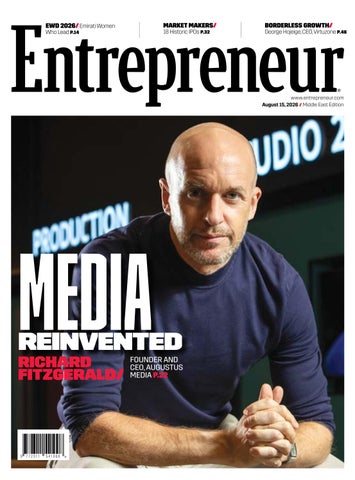
EWD 2026/ Emirati Women
Who Lead P.14
MARKET MAKERS/
18 Historic IPOs P.32
BORDERLESS GROWTH/
George Hojeige, CEO, Virtuzone P.46
www.entrepreneur.com August 15, 2026 Middle East Edition
MEDIA
REINVENTED FOUNDER AND RICHARD CEO, AUGUSTUS FITZGERALD/ MEDIA P.22
2 / E N T R E P R E N E U R . C O M / November 2023
E V E R Y T H I N G T H AT O N E C O U L D I M AG I N E FOR EXTRAORDINARY LIFE
Eywa Way of Water is a state-of-the-art residential community with only 65 exceptional waterfront residences, with a holistic wellness ecosystem, curating authentic experiences and best-in-class amenities few have dreamed of.
Contact us today: +971 54 308 6000 I
sales@byrevolution.com
E Y W A . A E
The Mirra® 2 Chair is turning heads again
The Mirra 2 Chair just keeps getting better. How? We updated the chair so it’s 30 percent lighter than the original Mirra - and the chair’s nylon base and spine are now 100 percent recycled content. We also gave it a fresh, inspired colour palette so it can look professional, casual, or sporty. One thing that hasn’t changed is the flexible yet supportive design that allows your body to move naturally and freely - the way it was meant to move.
hermanmiller.com
© 2026 Herman Miller
Contents/
August 15, 2026
FEATURES P.14
Emirati Women's Day 2026 A candid conversation marking EWD 2026.
P.22
Building MENA’s Next Media Powerhouse
How AUGUSTUS Media's founder turned a Dubai-born idea into a regional media powerhouse
P.32
From Apple to SpaceX
A look at 18 tech IPOS that have created life-changing investment opportunities
P.40
The Country That Forgot How to Scale
SIR MARTIN SORRELL on AI, ambition, and why the UK risks inventing the future for everyone else
August 15, 2026 / E N T R E P R E N E U R . C O M / 5
EXTRAORDINARY PR IVATE PO O LS | 30+ AM EN ITI ES | PRI M E LO CATI O N S
Escape to a home where urban sophistication meets resort tranquility.
BU I LT FO R M O M E NTS THAT MAT TE R 800-SAMANA | WWW.SAMANADEVELOPERS.COM
D I S C OVER REFINED
living
*Ranking as per the H2025 1 sales volume data of property monitor for Dubai
Make growth your next stop Corporate & Investment Banking. Global Markets. Global Banking. Transaction Services. Now is your time sc.com/cib
Dub New York
Johannesburg Standard Chartered Bank UAE is licensed by the Central Bank of the UAE
Shanghai
bai London
Singapore
Contents
August 15, 2026
CEO Wissam Younane wissam@bncpublishing.net MANAGING DIRECTOR Rabih Najm rabih@bncpublishing.net ART DIRECTOR Simona El Khoury EDITOR IN CHIEF Tamara Pupic tamara@bncpublishing.net EDITOR AT LARGE Anil Bhoyrul anil@bncpublishing.net SENIOR FEATURES EDITOR Aalia Mehreen Ahmed aalia@bncpublishing.net JUNIOR EDITORIAL ASSISTANT Kristine Erika Agustin kristine@bncpublishing.net DIRECTOR OF INNOVATION
Sarah Saddouk sarah@bncpublishing.net GROUP SALES DIRECTOR – B2B GROUP Joaquim D’Costa jo@bncpublishing.net HEAD OF PARTNERSHIPS
Samir Glor Samir@bncpublishing.net BUSINESS DEVELOPMENT DIRECTOR
Andy Soulahian andy.soulahian@bncpublishing.net COMMERCIAL LEAD
↑Jouslin Khairallah is an Emirati lawyer and the founder and Managing Director
of KH Legal, with more than 20 years of legal experience. She founded the firm in 2008 and has since led its growth while continuing to advise and represent corporations, business groups, and private clients in complex and high-value cases. Khairallah is also a founding member of the Legaline Platform, a UAE-based legaltech platform for claims, contract intelligence, and AI-driven legal services.
Anna Chipala anna@bncpublishing.net COUNTRY MANAGER KSA
Amjad Fakhouri amjad@bncpublishing.net COLUMNIST Tamara Clarke CONTRIBUTING WRITERS
Adam Jones, George Hojeige, John Casey Patricia Cullen
SUBSCRIBE
‘TREPONOMICS 49 Globalized Growth
How VIRTUZONE supports businesses expanding internationally
52 Clarity in Compliance
What businesses should know about the UAE’s latest FTA guidance
54 Building Cyber Resilience How MASTERCARD is strengthening digital trust across Saudi’s financial ecosystem
STARTUP SPOTLIGHT 63 Beyond Capital
Why foreign startups are building their next chapter in Abu Dhabi
IN THE LOOP 74 Tech Innovation Awards Spotlighting individuals and enterprises shaping the future of tech and innovation
10 / E N T R E P R E N E U R . C O M / August 15, 2026
Contact subscriptions@bncpublishing.net to receive Entrepreneur Middle East every issue
COMMERCIAL ENQUIRIES sales@bncpublishing.net
ENTREPRENEUR.COM
Access fresh content daily on our website
EntMagazineME
Entrepreneur-me
PO BOX 502511 DUBAI, UAE P +971 4 4200 506
All Rights Reserved 2026. Opinions expressed are solely those of the contributors. Entrepreneur Middle East and all subsidiary publications in the MENA region are officially licensed exclusively to BNC Publishing in the MENA region by Entrepreneur Media Inc. No part of this magazine may be reproduced or transmitted in any form or by any means without written permission of the publisher. Images used in Entrepreneur Middle East are credited when necessary. Attributed use of copyrighted images with permission. All images not credited otherwise Shutterstock. Printed by United Printing and Publishing.
PROPERTIES solproperties.ae 800-765-1
Learn More
Editor’s Note / EARNING IT, EVEN IN AUGUST
I
'll admit it: I've been caught in the "August slump”, that quiet dip in motivation as summer winds down and the return to routine looms. But this year it hit even though summer never really slowed down for us, let alone gave us a proper rest. In July 2026, we put out two high-profile lists -The Finance Frontier 2026 and the 100 Agents Driving UAE Property Market Resilience- both of which stirred plenty of conversation across their industries, but at the same time, brought long-overdue recognition to people who've earned it many times over. So if, like me, you need a bit of motivation this month, look no further: we feature wisdom from two extraordinary entrepreneurs who built giant businesses from nothing. On Page 40, Sir Martin Sorrell advises entrepreneurs that the competitive advantage today lies in human judgement: "the ability to know which idea, out of thousands an algorithm can produce, is actually worth backing." That's the what. On Page 22, our cover story with Richard Fitzgerald, founder of Augustus Media, supplies the how. Fitzgerald backed his own idea early -building an independent, viable, highly profitable Arab media business that aimed to build specialist media communities rather than simply accumulate audiencesand what he comes back to repeatedly is that the idea alone wasn't enough; it was disciplined execution that carried it through. He insists that the way forward (Augustus Media now operates across more than 30 cities, employs over 140 people, and has evolved into one of MENA's largest independent digital media groups) is following "the same disciplined playbook that got us here.” This month, we also look at 18 tech IPOs that changed industries, from Apple to SpaceX, moments where an idea worth backing met the public markets and reshaped entire sectors (P.32). From there, we turn to two engines of the region's ambition: we mark Emirati Women's Day 2026, celebrating the women driving the country's economic story forward (P.14), and we head to Abu Dhabi to check in on a startup scene that keeps producing founders willing to bet everything on one idea worth backing (P.63). And on the subject of ideas and people worth celebrating, save the date for September 17, 2026, when Entrepreneur Middle East hosts its Tech Innovations Awards, bringing together the most influential names across MENA's tech innovation landscape. Consider all these stories your reminder that motivation isn't something you wait for; it’s something you build, tired or not.
Tamara Pupic Editor in Chief | Entrepreneur Middle East
12 / E N T R E P R E N E U R . C O M / August 15, 2026
Emirati Women’s Day 2026
How the UAE Is Reframing the Gender Equality Debate Beyond The 'Men vs. Women' Discourse For the first time in the 11 years since Emirati Women’s Day was first celebrated, the annual event will span an entire month in 2026. This year’s theme —“Together, We Rise Stronger and Better”— puts the spotlight on the lasting partnerships and workplace policies that support and empower women in both their personal and professional lives. Four Emirati business leaders unpack how these elements go beyond the annual event to create a gender equity blueprint that has bolstered the UAE’s growth and innovation. b y A A L I A M E H R E E N A H M E D
I
n early 2026, when the UAE population was gripped by anxiety and fear as unexpected geopolitical shifts unfolded at a dizzying speed, an Emirati female minister emerged as a voice of calm and reassurance not just for people within the country, but also for their families back in their homelands. “We are confident that we will be able to continue to support our infrastructure and protect the people who live here,” H.E. Reem bint Ebrahim Al Hashimy, UAE Minister of State for International Cooperation, had said during an interview with CNN’s Becky Anderson. Across the nation and beyond, Al Hashimy’s trademark gentle voice and precise replies led to many praising the Minister for her grace and assertiveness. But equally discussed was another topic — during one of its most difficult moments, the UAE leadership was represented on a global scale by an Emirati woman. While the implications of this move can be discussed in the context of dispelling many cultural and social narratives, this particular feature uses it as a prime example of what those residing within the UAE have always known: that the nation’s growth has always been inextricably linked to the achievements and contributions of the nation’s local women.
Abu Dhabi Early Childhood Authority’s FATMAH RASHED ALKAABI on why a month-long Emirati Women’s Day celebration sends a powerful message beyond the UAE. }“Extending Emirati Women’s
↑ Fatmah Rashed Alkaabi is the Advisor at the Director General's
Office of the Abu Dhabi Early Childhood Authority and a program leader with nearly 15 years of experience across the UAE's government, semi-government, and private sectors. As Parent-friendly Label™ Program Manager, she has played an instrumental role in developing and scaling the initiative into a nationwide workplace movement.
That sentiment is perhaps best encapsulated in this year’s Emirati Women’s Day (EWD) theme: “Together, We Rise Stronger and Better.” The 2026 edition will mark a first month-long celebration of the event, with EWD 2026 set to run from August 28, 2026 (the annually ascribed date) until September 28, 2026. During the announcement last month, H.H. Sheikha Fatima bint Mubarak, “Mother of the Nation,” Chairwoman of the General Women’s Union, President of the Supreme Council for Motherhood and Childhood, and Supreme Chairwoman of the Family Development Foundation, noted that the
success of Emirati women has not happened in isolation, but has been supported by families, institutions, communities, and men who recognize that women’s progress contributes to the progress of the country as a whole. This year’s program, therefore, will celebrate not only the achievements of Emirati and resident women, but also the men who have supported them, reinforcing the idea that stronger societies are built through partnership rather than competition. For Fatmah Rashed Alkaabi, the Advisor at the Director General's Office of the Abu Dhabi Early Childhood Authority (a
Day across an entire month reinforces that the contributions of Emirati women are not defined by a single moment of recognition, but by sustained and evolving impact. Within the UAE, it reflects deep appreciation for the role women play across families, communities, government, business, education, and many other sectors. It also signals a long-term commitment to creating environments that enable Emirati women to continue contributing and leading at every stage of life. Internationally, it demonstrates that investing in women is not symbolic, but a national priority grounded in trust, shared responsibility, and collective progress. It presents a model in which empowering women goes hand in hand with supporting families and strengthening the social fabric of the nation.”
government entity established to support optimal early childhood development in the nation’s capital), this thought process is one she’s been familiar with much longer that her 15-year-long career across the UAE's government, semi-government, and private sectors. “This year’s EWD theme reflects a deeply rooted national belief that progress is never achieved in isolation,” she iterates. “The
August 15, 2026 / E N T R E P R E N E U R . C O M / 15
B/
UAE
UAE’s development has always been shaped by partnership, shared responsibility, and a strong commitment to family and community cohesion. Meaningful advancement happens when organizations, leaders, and families move forward together with a shared sense of purpose.” Alkaabi is able to best propagate this notion through her work as Program Manager at the Parent-friendly Label™ (PFL), a UAE-wide voluntary workplace award program led by the Abu Dhabi Early Childhood Authority (ECA). The program, open to organizations operating across the UAE within the semi-government, private, and third sectors, aims to shift workplace culture across the UAE toward more parent-friendly practices, recognizing the connection between supportive workplaces, stronger families,
“ THE UAE’S DEVELOPMENT HAS ALWAYS BEEN SHAPED BY PARTNERSHIP, SHARED RESPONSIBILITY, AND A STRONG COMMITMENT TO FAMILY AND COMMUNITY COHESION. MEANINGFUL ADVANCEMENT HAPPENS WHEN ORGANIZATIONS, LEADERS, AND FAMILIES MOVE FORWARD TOGETHER WITH A SHARED SENSE OF PURPOSE.” FATMAH RASHED ALKAABI Advisor at the Director General's Office of the Abu Dhabi Early Childhood Authority
ARSHYS’ ARSHIA ALAM on what meaningful partnership between men and women looks like at home, at work, and in business. }“To me, a successful partnership between men and women begins with mutual respect and equal opportunity—not necessarily doing the same things, but having equal freedom to pursue what matters to each person. Whether at home or in business, we need to move beyond stereotypes and recognise that people have different ambitions, strengths and priorities. One quality that is often overlooked is the ability to genuinely listen. A partnership becomes stronger when both perspectives are valued, even when they are different. I also believe that success should not be defined by choosing between personal and professional aspirations. The strongest partnerships are those where both people support each other’s growth and are willing to adapt as their circumstances evolve. Ultimately, it is about building each other up rather than competing with each other.”
16 / E N T R E P R E N E U R . C O M / August 15, 2026
and children's well-being. “As an Emirati woman working at the intersection of policy, leadership, and family wellbeing, my work continuously reminds me that sustainable progress begins with understanding people’s real lives,” Alkaabi says. “Supporting families through the workplace is not simply an organizational objective; it is an investment in human potential and in the long-term resilience of the nation. H.H. Sheikha Fatima bint Mubarak has long emphasized that ‘Emirati women represent the heartbeat of society and the foundation of its unity and sustainable progress.’ This vision offers a powerful reference point for how organizations should approach support for working mothers and caregivers. In practice, this requires moving beyond the existence of policies and focusing on how they are experienced day to day. Flexible work arrangements, maternity support, return-to-work pathways, and caregiving accommodations are essential foundations. Their true value, however, emerges only when they are embedded within a culture of
trust, consistency, and leadership commitment. Women thrive when caregiving responsibilities are recognized as a natural part of life, not as a barrier to ambition or leadership.” Alkaabi’s, and indeed the ECA’s endeavors, however, are not an arbitrary example of how the UAE government’s efforts have transcended theoretical women empowerment goals and created real impact. “I believe the secret to that is that UAE has approached gender balance less as a competition between men and women and more as a conversation about creating fairness, opportunity and shared progress,” says Arshia Alam, founder and Creative Director of ARSHYS, an Emirati contemporary luxury womenswear label that blends fashion, art, cultural heritage, sustainability, and social impact. “I recently attended a session with the UAE Gender
Balance Council, where representatives from the public and private sectors came together to openly discuss issues ranging from family priorities and workplace culture to skills development. What stood out to me was the focus on practical solutions and collaboration. For me, that is what makes the UAE’s approach effective: creating spaces where both men and women can contribute to the conversation. Gender balance is ultimately not about one gender succeeding at the expense of another; it is about creating an environment where everyone has the opportunity to contribute and thrive.”
↓ Arshia Alam is an entrepreneur, designer, and the founder
and Creative Director of ARSHYS, with a vision of combining commercial fashion with artistic, cultural, and social purpose. She has received recognition from UAE Minister of State for International Cooperation, H.E. Reem Al Hashimy, for her creative contribution to Dubai Expo 2020.
Indeed, the UAE Gender Balance Council Alam refers to has been one of the foundational entities in formulating the nation’s gender equity infrastructure. The federal entity's approach combines legislation, policy reform,
“ FOR ME, THAT IS WHAT MAKES THE UAE’S APPROACH EFFECTIVE: CREATING SPACES WHERE BOTH MEN AND WOMEN CAN CONTRIBUTE TO THE CONVERSATION. GENDER BALANCE IS ULTIMATELY NOT ABOUT ONE GENDER SUCCEEDING AT THE EXPENSE OF ANOTHER; IT IS ABOUT CREATING AN ENVIRONMENT WHERE EVERYONE HAS THE OPPORTUNITY TO CONTRIBUTE AND THRIVE.” ARSHIA ALAM Founder and Creative Director of ARSHYS
August 15, 2026 / E N T R E P R E N E U R . C O M / 17
B/
UAE
“ EMIRATI WOMEN’S DAY SHOULD CELEBRATE ACHIEVEMENT, BUT ALSO INSPIRE WHAT COMES NEXT. THE GREATEST TRIBUTE TO THE WOMEN WHO HELPED SHAPE THE UAE IS TO ENSURE THAT THE NEXT GENERATION HAS EVEN GREATER OPPORTUNITIES TO CONTRIBUTE, LEAD AND SUCCEED.” JOUSLIN KHAIRALLAH Founder and Managing Director of KH Legal, and Founding Member of the Legaline Platform
→ Jouslin Khairallah is
an Emirati lawyer and the founder and Managing Director of KH Legal, with more than 20 years of legal experience. She founded the firm in 2008 and has since led its growth while continuing to advise and represent corporations, business groups, and private clients in complex and high-value cases. Khairallah is also a founding member of the Legaline Platform, a UAE-based legaltech platform for claims, contract intelligence, and AI-driven legal services.
18 / E N T R E P R E N E U R . C O M / August 15, 2026
public-private collaboration, workplace initiatives, and international partnerships to embed gender balance institutionally. The Council’s results speak for themselves. The UAE ranked first in the MENA region for gender balance in the World Economic Forum's Global Gender Gap Report 2025; more than 20 national reforms have been enacted to advance gender balance, including paid paternity leave, equal-pay provisions, and workplace protections; and women currently hold approximately 63% of leadership positions in the UAE federal government, while the Council states that 70% of Emiratis working in the private sector are women.
One Emirati female leader who has been able to witness this progress from close quarters is Jouslin Khairalla, an Emirati lawyer who founded KH Legal, a UAE-based multidisciplinary legal practice, in 2008. She is also a founding member of Legaline Platform, a UAEbased LegalTech platform focused on claims, contract intelligence, and AI-driven legal services. With more than 20 years of legal experience so far, Khairalla offers a deeper insight that supports Alam’s observations. “The UAE has approached women’s empowerment as a shared national priority rather than a competition between men and women – and progress is strongest
KH Legal and Legaline Platform’s JOUSLIN KHAIRALLAH on what truly supportive workplaces for women should look like. }“Workplaces need to understand that flexibility and excellence are not mutually exclusive. Supporting working mothers and caregivers does not mean lowering professional expectations. It means creating an environment in which talented people can continue to perform, develop and lead through different stages of life. Flexible working arrangements, effective returnto-work support and access to childcare are important, but workplace culture matters just as much. Women should be able to use supportive policies without fearing that doing so will affect how their commitment or leadership potential is perceived. The goal should be to ensure women have a genuine pathway to grow, lead and succeed.”
when women and men are viewed as partners in building society, the economy and the nation,” Khairalla observes. “The UAE has supported this through leadership, legislation, education and institutional initiatives that enable women to participate meaningfully across government, business, law, science and entrepreneurship. If you ask me, equality is fundamentally about opportunity—ensuring that talent, ambition and capability have the space to succeed. When that
principle guides the conversation, the focus shifts from who gains more to what we can achieve together.” The UAE’s strides in female empowerment and gender equity come together to form an impressive standalone tale. But its progress becomes even more awe-worthy when compared with global statistics. Take, for example, some of the
sentiment increasing in 23 of the 24 countries also surveyed in 2019. The findings also point to a notable gender divide: 54% of men feel they are already doing too much to support equality, compared with 38% of women, while 52% of men believe efforts to advance women’s equality have reached a point where they discriminate against men, versus 36% of women. At the same time, there remains broad
“ NO MEANINGFUL TRANSFORMATION
HAPPENS ALONE. THE BEST OUTCOMES ARE ACHIEVED WHEN DIFFERENT PERSPECTIVES COME TOGETHER AROUND A SHARED AMBITION. THIS REFLECTS THE UAE’S APPROACH TO DIVERSITY WHERE EMIRATI WOMEN ARE GROWING FROM STRENGTH TO STRENGTH WITHIN AN ECOSYSTEM THAT BELIEVES IN OUR POTENTIAL.” MUNEERA AL MARZOOQI Vice President – Smart Mobility at Space42
jarring results that came out of Ipsos' International Women's Day 2026 survey, which was conducted in collaboration with the Global Institute for Women’s Leadership at King’s College London. Across the 29 countries surveyed, 52% of respondents believe efforts to give women equal rights with men have already gone far enough, with this
support for greater female leadership, with 60% saying governments and companies would work better if more women held positions of responsibility, including 68% of women and 53% of men. While much of the global discourse appears to still be navigating the ‘men-versus-women’ maze, the UAE, like Khairalla and Alam have
already pointed out, seems to be on a different trajectory. Agreeing with this is Muneera Al Marzooqi, Vice President of Smart Mobility at UAE-based AI-powered space technology company Space42, who notes that partnership-based outcomes go beyond gender-centric quotas and actually contribute to the economy. “Within the technology and mobility field, in particular, diversity of thought is essential to innovation,” Al Marzooqi notes. “The UAE has embedded inclusive participation into its institutions and the opportunities they extend, making it part of the country’s broader development journey rather than a standalone conversation. Success is far more than an individual achievement. At every stage of my career, I’ve been shaped by people who challenged, trusted, and believed in me—from my family, who gave me the confidence to be ambitious while staying grounded in my values, to the leaders, mentors, and colleagues, both women and men, who saw my potential and pushed me beyond my comfort zone. No meaningful transformation happens alone. The best outcomes are achieved when different perspectives come together around a shared ambition. This reflects the UAE’s approach to diversity where Emirati women are growing from strength to strength within an ecosystem that
August 15, 2026 / E N T R E P R E N E U R . C O M / 19
→ Muneera Al Marzooqi is the Vice President of Smart Mobility at Space42,
a position she has held since January 2026, where she leads the company's autonomous mobility business and its transition from pilot projects to scaled commercial deployment. A central focus of her work is making autonomous mobility commercially viable and scalable, while ensuring alignment between technology, regulation, infrastructure, and strategic partners.
Space42’s MUNEERA AL MARZOOQI on why healthy partnerships require both speaking up and listening }“Constructive disagreement is
believes in our potential. My achievements may carry my name, but the journey behind them has always been collective.” Al Marzooqi’s observations are backed by the company she represents. At Space42, women in senior management have increased from 8% to 15% in 2025, and women now chair 50% of its board committees. And according to ECA’s Alkaabi, such results across the UAE’s business ecosystem and government entities have been made possible due to a core Emirati belief that “families, communities, and organizations are strongest when each member contributes according to their role and responsibility.” “Through initiatives such as the Parent-friendly Label, organizations are
increasingly recognizing that when caregiving is valued and fathers are supported in fulfilling their responsibilities, women are better enabled to pursue professional growth with confidence,” Alkaabi adds. “By prioritizing partnership rather than division, gender equality in the UAE is positioned as a social and economic enabler. This approach reflects core Emirati values of cohesion, responsibility, and collective effort, strengthening families, workplaces, and society as a whole.” ARSHYS’s Alam offers an extended take on Alkaabi’s words when she adds that beyond government policies, the onus lies on business leaders themselves to create environments conducive to upholding such values.
20 / E N T R E P R E N E U R . C O M / August 15, 2026
a key contributor to a strong team. I believe in expressing my perspective clearly, with the humility to listen and recognize that I may not have all the answers. In business transformation and strategic partnerships, progress comes from understanding different perspectives and finding common ground. It is important to separate the idea from the individual, so that we may challenge each other while remaining focused on the desired outcome.”
“Policies are only as effective as the culture in which they are implemented,” Alam says. “Workplaces need to create an environment where women feel comfortable having open conversations about their realities, responsibilities and challenges without feeling that doing so will limit their professional opportunities. Leadership plays an important role in listening to that feedback and being willing to adapt. Flexibility should not be viewed as a concession, but as a way of creating a more productive and sustainable workplace. When organisations trust their people and focus on outcomes rather than rigid expectations, women are better positioned to grow, lead and contribute fully.”
As celebrations for Emirati Women’s Day 2026 gear up to last an entire month this year, all of the female leaders in this story acquiesce on one point: this extension is not about symbolism but rather an opportunity to highlight inspiring stories of Emirati women’s milestones. “It gives us space to celebrate achievements, while taking the time to reflect on the people and partnerships behind them,” says Space42’s Al Marzooqi. “Today, Emirati women are shaping the future across business, technology, science, and multiple emerging sectors. I hope this inspires the next generation to see even greater possibilities ahead, as one generation’s progress should become the next generation’s starting point.” KH Legal’s Khairallah offers a similar sentiment, adding: “For younger women especially, visibility is key. When they see women leading businesses, practising law, serving in government, advancing science and building companies, they can more easily see those possibilities for themselves. Emirati Women’s Day should therefore celebrate achievement, but also inspire what comes next. The greatest tribute to the women who helped shape the UAE is to ensure that the next generation has even greater opportunities to contribute, lead and succeed.”
67 OCT2026 A D N EC C E N T R E
WHERE THE WORLD CONVENES IN
NEW INTELLIGENCE 350+
WORLD'S LEADING AI SHOW UNITING INFLUENTIAL GOVERNMENTS, ENTERPRISES, INVESTORS & STARTUPS
Meet the leaders building the next generation of intelligent economies. From breakthrough research to nation-scale deployments and outcomes-led talks, experience the AI applications reshaping industries.
AI BIG TECH & AWARD-WINNING STARTUPS
100+
WORLD- RENOWNED SPEAKERS
80+
COUNTRIES
200+
CAPITAL PARTNERS
GET INVOLVED
aieverythingabudhabi.com sales@aieverythingabudhabi.com
#AiEverythingAbuDhabi
August 15, 2026 / E N T R E P R E N E U R . C O M / 21
22 / E N T R E P R E N E U R . C O M / August 15, 2026
RICHARD FITZGERALD BUILDING MENA’S NEXT
MEDIA
POWERHOUSE by WISSAM YOUNANE
August 15, 2026 / E N T R E P R E N E U R . C O M / 23
24 / E N T R E P R E N E U R . C O M / August 15, 2026
W
ITHOUT CHASING HEADLINES, VENTURE CAPITAL, OR CONVENTIONAL WISDOM - HOW AUGUSTUS MEDIA'S FOUNDER TURNED AN IDEA BORN IN DUBAI INTO ONE OF THE REGION'S FASTEST-GROWING INDEPENDENT MEDIA COMPANIES.
August 15, 2026 / E N T R E P R E N E U R . C O M / 25
26 / E N T R E P R E N E U R . C O M / August 15, 2026
“ WE'RE STILL
BUILDING AN INDEPENDENT COMPANY DRIVEN BY STRONG REGIONAL LEADERSHIP THAT KEEPS MEDIA REVENUES INSIDE THE REGION.”
W
hen Richard Fitzgerald launched Augustus Media with Lovin’ Dubai in 2015, he wasn't trying to create another publisher. He was trying to prove an entire industry wrong. At the time, conventional wisdom suggested that independent media in the Arab world simply couldn't become a serious commercial business. Publishers were expected to rely on government support, legacy structures, or endless outside investment. Fitzgerald believed something very different. "I wanted to build an independent media institution that proved those stereotypes dead wrong," he says. "A commercially viable, highly profitable Arab media business with real operational discipline." "A decade later, Augustus Media operates across more than 30 cities, employs over 140 people, and has evolved into one of MENA's largest independent digital media groups through a portfolio that includes 30 plus cities for living and 12 verticals for smashi and ODEUM. Together, the brands span news, business, lifestyle, entertainment, and sport—reflecting Augustus' ambition to build specialist media communities rather than simply accumulate audiences." Yet Fitzgerald insists that, despite
HADY HAJJAR FOUNDER & CEO Hu Management "Algorithms decide what people see, but relevance decides what people remember. Augustus Media has built its success by staying relentlessly relevant, creating conversations instead of simply publishing content. In today's crowded media landscape, that's what separates a publisher from a platform, and a platform from a brand. Their growth is a reflection of bold leadership, constant innovation, and a deep understanding of the audiences shaping the future of the Middle East."
August 15, 2026 / E N T R E P R E N E U R . C O M / 27
“ I CAME FROM A WPP
BACKGROUND," HE EXPLAINS. "I'VE ALWAYS APPROACHED AUGUSTUS WITH AN INTRAPRENEURIAL MINDSET RATHER THAN A TYPICAL STARTUP MENTALITY.” the scale, the mission has never changed. "We're still building an independent company driven by strong regional leadership that keeps media revenues inside the region." That statement says as much about Fitzgerald as it does about Augustus. Because unlike many startup founders who talk about disruption, Fitzgerald talks about discipline.
THE FOUNDER WHO NEVER THOUGHT LIKE A STARTUP FOUNDER
Ask most entrepreneurs when they became CEOs, and they'll point to a funding round, a milestone, or their first hundred employees. Richard Fitzgerald gives a different answer. "From day one." Not because Augustus was already a large company. Because he always believed businesses should behave like mature organizations, regardless of their size. He applied for annual leave. He delayed giving himself the CEO title. 28 / E N T R E P R E N E U R . C O M / August 15, 2026
KRIS FADE RADIO HOST, ENTREPRENEUR & FOUNDER Fade Fit "Every so often, you meet someone who simply gets it, and that's exactly who he is. Beyond being one of the genuinely nicest and most authentic people you'll work with, he's a visionary who has built an incredible empire through passion, innovation, and relentless hard work. He was one of the true pioneers of modern media in Dubai and across the Middle East, with an instinctive understanding of how to connect with audiences and stay ahead of the curve. He's revolutionary in his thinking, incredibly easy to work with, and leads with integrity. Success follows him because he consistently earns it, both professionally and personally."
He established governance long before investors would ever ask for it. "I viewed myself as an employee accountable to the business." That mindset continues to define Augustus today. While many startups celebrate chaos and rapid pivots, Fitzgerald built systems. Monthly leadership updates, quarterly management meetings, operational discipline. Processes that remained unchanged whether the company had two employees or more than 140. "I came from a WPP background," he explains. "I've always approached Augustus with an intrapreneurial mindset rather than a typical startup mentality."
SURVIVING WHEN EVERYTHING STOPPED
Every founder has a moment when the future becomes uncertain. For Fitzgerald, there were several. The first three years tested cash flow, market confidence, and advertiser trust. "We were living month to month." Then came March 2020, the pandemic froze advertising overnight. Campaigns disappeared, budgets stopped, and the media industry braced for collapse. Instead of cutting back editorial operations, Augustus doubled down.
"We had a choice," Fitzgerald says. "Panic and gut the business—or stay disciplined." The company kept publishing. It protected its people, it maintained its structure. When advertisers returned, so did revenue, because trust had already been earned. That experience reinforced one of Fitzgerald's strongest beliefs: Independent media isn't fragile, it's resilient. AUDIENCE FIRST. EVERYTHING ELSE SECOND. Perhaps the biggest difference between Fitzgerald and many media executives is what he believes media companies actually build. Not publications, communities.
MAHA ABOUELENEIN CEO & FOUNDER Digital & Savvy "Augustus Media sits at the center of what's now and next in culture. Richard Fitzgerald hasn't just built a media company — he's built a genuine powerhouse with its finger on the pulse of the region, delivering incredible content across business, sports, lifestyle, and entertainment. What sets them apart is how fluently they move across every format that matters today: content, digital, social, and live events. In a world drowning in noise, Augustus Media has earned the thing that's hardest to build — not just attention, but trust. That's exactly where the future of media is headed."
August 15, 2026 / E N T R E P R E N E U R . C O M / 29
ELIE HABER CO-FOUNDER AND MANAGING PARTNER Fusion 5 "What sets Augustus Media apart is their instinct for the space between information and connection. Anyone can report on news and entertainment; but Lovin Dubai and the wider Augustus portfolio understand why it matters to the people reading it. They've built a genuine feel for regional audience mindsets, tailoring tone, format, and timing so content doesn't just inform but resonates. That's a harder discipline than it looks: staying relevant without chasing noise, staying local without losing ambition. It's why their platforms have grown into trusted voices across the region, and why we back their trajectory as they continue to scale."
"Lead with the audience," he says. "Everything else follows." That philosophy became the blueprint behind Lovin's city-by-city expansion and Smashi's community-first business model. Instead of chasing platforms, Augustus builds audiences with shared identities. Lovin creates belonging, Smashi inspires ambitious professionals. The platform simply becomes the vehicle and the audience becomes the asset. "I don't think timing is everything," Fitzgerald says. "The audience must always come first."
WHY AUGUSTUS NEVER CHASED LEGACY MEDIA Many traditional publishers spent years investing millions trying to become digital businesses. Augustus never had that problem, it started digital. That meant no expensive transformation, no legacy infrastructure, no internal battles between print and online. Digital wasn't a department, it became the company. "We don't have a Head of Digital," Fitzgerald explains. "We have a Head of Content." 30 / E N T R E P R E N E U R . C O M / August 15, 2026
That focus also meant saying "no." No radio. No legacy broadcasting. Instead, Augustus invested in podcasts, streaming, social-first publishing, and eventually AI-powered production. AI ISN'T REPLACING MEDIA. IT'S REINVENTING IT. While much of the industry debates whether artificial intelligence will replace journalists, Fitzgerald views AI differently. "As a productivity tool, a content engine and eventually a business model." Long before generative AI dominated headlines, Augustus had already deployed AI-powered camera systems covering thousands of sporting events without traditional production crews. The company later earned Fast Company's recognition for innovation in AI-driven production. But Fitzgerald remains pragmatic. Consumers are still learning to trust AI-generated content. That transition, he believes, requires patience. "You have to manage the transition smartly." BUILDING A REGIONAL CHAMPION Fitzgerald believes one of the biggest misconceptions international companies make about the Middle East is assuming the region can be treated as one market. "You simply cannot speak to 22 Arabic-speaking countries with one voice."
Localization isn't an afterthought. It's the strategy. That philosophy has guided Augustus' expansion from the UAE into Saudi Arabia, Egypt, Qatar, Bahrain, Oman, Pakistan, and the Levant—building local teams before scaling local communities. That expansion increasingly extends beyond publishing. Augustus has also been investing in regional sports media rights, positioning itself not only as a digital publisher but as a broader sports media business. As premium sports content continues to reshape audience engagement across the Middle East, the company is steadily building a portfolio that reflects its long-term commitment to the sector. For Fitzgerald, protecting regional advertising spend matters as much as growing market share. Strong regional media companies, he argues, strengthen the entire ecosystem.
THE ROAD TO $100 MILLION Unlike founders obsessed with hypergrowth, Fitzgerald talks about compounding.
One publication became five. Five became twenty. Twenty became more than forty brands. Each step built on operational discipline rather than explosive expansion. His long-term ambition is clear: surpass $30 million in revenue by 2030 while creating a path toward a $100 million media company. But he doesn't believe the company needs reinvention. "We don't need to make a radical pivot." "We simply need to keep executing the same disciplined playbook that got us here."
LEADERSHIP LESSONS Throughout our conversation, one message surfaced again and again. Richard Fitzgerald isn't trying to build the MENA's biggest media company. He's trying to build one of its most enduring. In a world obsessed with algorithms, virality, and quarterly metrics, his competitive advantage may be something surprisingly old-fashioned: Consistency, operational discipline, and an unwavering belief that businesses built around real communities will always outperform those built around platforms alone. As Fitzgerald puts it: "Own your audience relationship. That's how you survive long term."
TYRONE REID GROUP CEO MMI & Emirates Leisure Retail "Augustus Media has redefined how the Middle East connects with content. Through Lovin', Smashi, and other channels, they have built platforms that speak the language of the region. What stands out most is how Richard and the team have paired authentic storytelling with disciplined, sustainable growth, expanding city by city and market by market without ever losing the local voice that made them special in the first place. As Augustus Media continues its regional expansion, I have no doubt they will keep setting the benchmark for modern, digital-first media in the Arab world. "
August 15, 2026 / E N T R E P R E N E U R . C O M / 31
FROM
APPLE TO SPACEX
18 TECH IPOS THAT RESHAPED INDUSTRIES We look at 18 tech IPOs have created life-changing investment opportunities and went on to redefine entire industries. b y TA M A R A P U P I C
O
n June 12, 2026, SpaceX entered the public markets with one of the most anticipated technology IPOs in history, signaling the return of blockbuster listings after years of subdued activity. The momentum may be far from over. With AI leaders Anthropic and OpenAI still widely expected to go public- although potentially slipping into 2027 if market conditions remain volatile- 2026 could ultimately be remembered as one of the most significant years for technology IPOs since the dot-com era. We look at 18 tech IPOs that went on to redefine entire industries.
32 / E N T R E P R E N E U R . C O M / August 15, 2026
APPLE
A
pple went public on NASDAQ on December 12, 1980, at US$22 per share. The company went on to revolutionize personal computing, smartphones, wearables, and digital services, reaching an all-time high of around US$315 in June 2026. As of August 10, 2026, its shares trade at around US$308.
MICROSOFT
I
n 1986, Microsoft went public on NASDAQ at US$21 per share. It has since become a global leader in software, cloud computing, gaming, and AI. Microsoft reached an all-time high of around US$555 in July 2025. As of August 10, 2026, its shares trade at around US$506.
ORACLE
O
racle went public on NASDAQ on March 12, 1986, at US$15 per share. The company grew into one of the world’s largest enterprise software, database, and cloud infrastructure providers. It reached an all-time high of around US$345 in September 2025. As of August 10, 2026, its shares trade at around US$151.
August 15, 2026 / E N T R E P R E N E U R . C O M / 33
DELL
D
ell Technologies went public on NASDAQ on June 22, 1988, at US$8.50 per share. It became a global leader in personal computers, servers, enterprise infrastructure, and AI hardware. Dell reached an all-time high of around US$465 in June 2026. As of August 10, 2026, its shares trade at around US$506.
AMAZON
I
n 1997, Amazon went public on NASDAQ at US$18 per share. What began as an online bookstore evolved into a global leader in e-commerce, cloud computing, AI, logistics, and digital entertainment. Amazon reached an all-time high of around US$278 in May 2025. As of August 10, 2026, its shares trade at around
US$278.
NVIDIA
I
n 1999, NVIDIA debuted on NASDAQ at US$12 per share. Initially known for gaming chips, it became one of the biggest winners of the AI boom, supplying processors behind many of today’s leading AI systems. NVIDIA reached an all-time high of around US$236 in May 2026. As of August 10, 2026, its shares trade at around US$217.
34 / E N T R E P R E N E U R . C O M / August 15, 2026
G
oogle followed on August 19, 2004, listing on NASDAQ through a Dutch auction at US$85 per share. The IPO laid the foundation for Alphabet, now one of the world’s largest technology companies. Alphabet reached an all-time high of around US$408 in May 2026. As of June 29, 2026, its shares trade at around US$355.
TESLA
T
esla listed on NASDAQ on June 29, 2010, at US$17 per share, becoming the first American automaker to go public in more than 50 years. It has since expanded into energy storage, AI, and robotics. Tesla reached an all-time high of around US$498 in December 2025. As of August 10, 2026, its shares trade at around
US$330.
F
acebook (now Meta) went public on May 18, 2012, at US$38 per share in one of history’s most anticipated IPOs. It has since grown into a technology leader spanning social media, AI, virtual reality, and digital advertising. Meta reached an all-time high of around US$796 in August 2025. As of August 10, 2026, its shares trade at around US$594.
August 15, 2026 / E N T R E P R E N E U R . C O M / 35
ALIBABA
A
libaba debuted on the New York Stock Exchange on September 19, 2014, at US$68 per share. It reached an alltime high of around US$298 in October 2020. As of August 10, 2026, its shares trade at around
US$132.
UBER
U
ber listed on the New York Stock Exchange on May 10, 2019, at US$45 per share. Uber reached an all-time high of around US$98 in October 2025. As of August 10, 2026, its shares trade at around
US$78.
PALANTIR
P
alantir entered public markets through a direct listing on the New York Stock Exchange on September 30, 2020, with a reference price of US$7.25 (US$10) per share. It has since become one of the leading enterprise AI software companies, serving governments and commercial clients worldwide. Palantir reached an all-time high of around US$207 in November 2025. As of August 10, 2026, its shares trade at around US$175.
36 / E N T R E P R E N E U R . C O M / August 15, 2026
SNOWFLAKE
S
nowflake debuted on the New York Stock Exchange on September 16, 2020, at US$120 per share. One of the largest software IPOs ever, it reflected growing demand for cloud infrastructure and enterprise AI. Snowflake reached an all-time high of around US$350 in October 2021. As of August 10, 2026, its shares trade at around US$334.
AIRBNB
A
irbnb listed on NASDAQ on December 10, 2020, at US$68 per share (the opening stock price was US$146). Its successful debut during the COVID-19 pandemic underscored investor confidence in digital travel platforms. Airbnb reached an all-time high of around US$216 in February 2021. As of June 29, 2026, its shares trade at around US$184.
NETFLIX
N
etflix listed on NASDAQ on May 23, 2002, at US$15 per share. Originally a DVD-by-mail service, it transformed the global entertainment industry through streaming and original content. Netflix reached an all-time high of around US$134 in June 2025. As of August 10, 2026, its shares trade at around US$76.
August 15, 2026 / E N T R E P R E N E U R . C O M / 37
SALESFORCE
S
alesforce went public on the New York Stock Exchange on June 23, 2004, at US$11 per share. It helped pioneer cloudbased enterprise software and remains one of the world’s leading CRM and AI platform providers. Salesforce reached an all-time high of around US$363 in December 2024. As of August 10, 2026, its shares trade at around US$197.
VISA
V
isa debuted on the New York Stock Exchange on March 19, 2008, at US$44 per share, completing one of the largest IPOs in U.S. history. Visa reached an all-time high of around US$367 in May 2025. As of August 10, 2026, its shares trade at around US$361.
SPACEX
M
ost recently, SpaceX entered public markets on June 12, 2026, at US$135 per share. It reached an all-time high of around US$210 shortly after listing. As of August 10, 2026, its shares trade at around US$138.
Looking ahead, the second half of 2026 could mark another milestone for technology IPOs. AI leaders Anthropic and OpenAI remain the most anticipated listings, although both could slip into 2027 if market conditions remain volatile. Other closely watched IPO candidates include 38 / E N T R E P R E N E U R . C O M / August 15, 2026
Databricks, Canva, and Cohere, though none has confirmed a listing date. If several of these companies reach public markets, 2026 could rank among the most significant years for technology IPOs since the dot-com era.
INTO NEW WORLDS YOU’RE ONE LEAP AWAY From 31 Aug - 3 Sept 2026 Riyadh Exhibition and Convention Center - Malham, Saudi Arabia
SECURE YOUR PASS NOW
CAN THE UK WIN AT SCALE? Sir Martin Sorrell on AI, ambition and why the UK risks inventing the future for everyone else. b y PAT R I C I A C U L L E N
40 / E N T R E P R E N E U R . C O M / August 15, 2026
→ Martin Sorrell,
advertising’s great disruptor August August 15,2026 2026 / E N T R E P R E N E U R . C O M / 41
T
he UK has never struggled to invent the future. From the Industrial Revolution to modern computing, its universities, laboratories and entrepreneurs have always produced discoveries that have transformed the world. The problem has always been turning invention into ownership. Too often, UK breakthroughs are conceived here, financed elsewhere, scaled overseas and eventually absorbed by global giants.
THE AMERICANS INNOVATE. THE CHINESE IMITATE. THE EUROPEANS REGULATE” 42 / E N T R E P R E N E U R . C O M / August 15, 2026
F
ew people have watched that pattern unfold more closely than Sir Martin Sorrell. After building WPP into the world’s largest advertising and communications group and later founding S4 Capital for the digital age, he has spent four decades tracking the movements of capital, technology and consumer behaviour before they become obvious. Now his attention is fixed on artificial intelligence (AI). For Sorrell, AI is not another technological cycle; it is the infrastructure of the next global economy. Its impact will be felt across every industry, from marketing and retail to healthcare and biotechnology, transforming how companies operate, create and compete. But he believes many businesses are approaching it backwards. “There is no point automating chaos,” he argues. The winners will not be those that simply add AI to existing systems, but those that first redesign how they work. AI is not a strategy. It is an amplifier. In healthcare and life sciences, where regulation remains essential, the principle is no different. The future belongs to
WE HAVE ALL THESE WONDERFUL UNIVERSITIES, THE SCIENTIFIC CAPABILITY IS THERE” organisations that can combine first-party data, intelligent workflows and personalisation at scale. The advantage will not come from having the biggest budgets, but from learning, adapting and executing faster than everyone else. The advertising industry has undergone a historic shift. A $1.2tn global market, it is now roughly three-quarters digital - a figure Sorrell expects to approach 80% by the end of the decade. But he challenges one of the biggest assumptions of the digital age: that media has become more fragmented. In reality, he argues, it has become more concentrated. Google, Meta, Amazon and TikTok now control an extraordinary share of global advertising spend, with algorithms increasingly determining where attention flows and how brands reach consumers. “The options are actually becoming fewer,” Sorrell says. For businesses, this changes the nature of marketing. The old model of broadcasting one message to millions is being replaced by personalised communication at unprecedented scale. AI makes it possible to create, test and optimise
thousands of variations of content in real time -something once available only to the world’s largest companies. But as access to these tools becomes universal, a new question emerges: if everyone has the same technology, where does competitive advantage come from? For Sorrell, the answer remains human. AI can accelerate creativity, but judgement, originality and strategic thinking will determine who stands apart. He recalls a conversation involving Coca-Cola’s leadership shortly after generative AI began transforming creative industries. If everyone can produce competent advertising using the same software, how does a global brand remain distinctive? The answer, Sorrell believes, is reassuringly human. AI raises the }} August 15, 2026 / E N T R E P R E N E U R . C O M / 43
“ IF YOU’RE A YOUNG ENTREPRENEUR, RUNNING A SUCCESSFUL BUSINESS, WHY WOULD YOU NECESSARILY STAY?” baseline. It improves average work. It accelerates production. It expands possibilities. It does not eliminate judgement. Taste. Curiosity. Original insight. For all AI’s astonishing capabilities, someone still has to ask the right questions, understand human behaviour and recognise an idea worth pursuing. Creativity does not disappear; it simply migrates higher up the value chain. Ironically, as machines become more capable, original human thinking may become more valuable. Sorrell acknowledges AI’s potential to transform employment, with automation likely to replace many routine roles while reducing demand for some forms of labour. Although 44 / E N T R E P R E N E U R . C O M / August August 15, 2026 2026
economists debate whether new industries will offset these losses, he remains cautious. He sees AI as a starting point, not the endpoint. Beyond it lies quantum computing - a technology he believes could surpass today’s advances and fundamentally reshape what businesses consider possible. Against this backdrop, Sorrell sees the UK’s economic debate as too focused on decline rather than growth. While other nations compete to lead emerging technologies, the UK remains absorbed by taxation, regulation and shortterm pressures instead of productivity, investment and innovation. He argues that history rewards countries willing to embrace technological change before certainty arrives. That is the challenge the UK now faces. It possesses exceptional universities. It continues to attract remarkable scientific talent. Its researchers remain among the world’s most respected. What it has yet to demonstrate, Sorrell argues, is the same determination to build enduring commercial champions around those discoveries. The country has become remarkably good at inventing the future. It has become considerably less effective at owning it. The uncomfortable truth, according to Sorrell, is that the UK’s problem has never been intelligence. It has been conviction. For decades, the country has excelled at producing breakthrough research while repeatedly failing to build the businesses that commercialise it. The names are familiar enough to have become almost folklore. Cambridge researchers develop world-changing technologies. University spinouts pioneer remarkable discoveries. Young founders create companies capable of redefining industries. Then, almost inevitably, American investors arrive with deeper pockets, larger ambitions and markets willing to reward risk rather than merely tolerate it. The technology leaves. The wealth follows. The UK congratulates itself on another brilliant invention while surrendering ownership of its future. Sorrell has watched
the cycle repeat often enough that it no longer surprises him. “We have all these wonderful universities,” he says, “the scientific capability is there.” What is missing, he argues, is everything that comes afterwards. History is littered with examples of countries that pioneered technologies only for others to capture their commercial value. Innovation alone does not create prosperity. Markets do. Capital does. Leadership does. A culture that celebrates entrepreneurial ambition rather than viewing it with suspicion does. It is here that Sorrell believes the UK has drifted off course. Sorrell believes the issue is cultural as much as economic. While America celebrates entrepreneurship, the UK often views commercial success with suspicion, influencing where talent and investment flow. Despite world-class
strengths in medical research, genetics, pharmaceuticals and AI, founders often look abroad to scale. Sorrell argues that while regulation is necessary, the UK has become better at managing risk than pursuing opportunity. He recalls the national conversation surrounding AI. While other countries debated how quickly AI could accelerate economic growth, the UK appeared more interested in how it should be regulated. He understands the argument. Powerful technologies require guardrails. AI presents genuine ethical questions around privacy, misinformation and security. Governments have responsibilities that private companies do not. Yet there is, he believes, an important distinction between regulating innovation and leading it. “The Americans innovate,” he says. “The Chinese imitate. The Europeans regulate.”
→ Martin Sorrell, from
WPP to S4 Capital
August August 15, 2026 / E N T R E P R E N E U R . C O M / 45
Sorrell maintains the UK often regulates new industries before building them, putting opportunity at risk. He extends this criticism to finance: despite vast institutional capital, too little reaches high-growth companies. Instead, investors favour safer assets such as property and government-backed investments. While logical individually, Sorrell believes this limits national economic ambition. Every pound invested in certainty is a pound not invested in tomorrow. Sorrell argues the UK celebrates entrepreneurship while its financial system rewards caution over ambition. The contradiction is measurable: London’s global financial standing has declined, major technology companies increasingly list elsewhere, and venture capital lacks the scale of Silicon Valley. For founders building global businesses, these signals matter. Capital is more than money; it is confidence, and once lost, it is hard to recover. Sorrell argues the challenge is growing because entrepreneurship itself has changed. The digital economy has removed geographic limits: founders can operate anywhere, teams and investors are global, and talent and capital are increasingly mobile. Governments, however, often still assume entrepreneurs are tied to one place. “If you’re a young entrepreneur,” Sorrell asks, “running a successful business, why would you necessarily stay?” For founders, the decision is not just about tax but the
“ THE BIG CHANGE IS SHIFTING FROM A TIME AND MATERIALS MODEL TO AN OUTPUT-BASED MODEL” wider environment: regulation, investment access and the cultural attitude towards wealth creation. Sorrell argues that as talent and capital become
46 / E N T R E P R E N E U R . C O M / August 15, 2026
more mobile, many choose to build elsewhere. He warns this matters because emerging industries - AI, quantum computing, synthetic biology, precision
medicine and advanced manufacturing - will shape global economic power. Countries that lead them will attract investment and talent; those that fall behind may become dependent on others. Yet Sorrell does not see the UK’s decline as inevitable. He sees a country with world-class universities, scientific expertise and global connections, but one that has failed to turn those strengths into greater economic success. The opportunity, particularly in healthcare, remains significant. He believes the next decade will bring major opportunities in healthcare as biotechnology, AI, personalised medicine and preventative care converge. The winners will not just create treatments but reshape how healthcare is delivered. Sorrell highlights weight-loss medicines as an example of technology with wider economic impact, potentially reducing healthcare costs and shifting focus from treating disease to prevention. But he argues opportunity will be unevenly distributed: the US will remain dominant through capital and innovation, while regions such as Latin America, the Middle East and Asia-Pacific offer significant growth potential. The message for founders is clear: competition is intensifying. Success requires more than great technology; companies must understand where capital, customers and supportive markets are emerging. “Be efficient,” Sorrell says. In the AI era, that means more than cutting costs - it means
redesigning organisations around a new operating model. This is the shift many healthcare founders have yet to fully embrace. For decades, professional services followed a simple model: more people and more hours meant more revenue. AI disrupts that equation by shifting value from effort to outcomes. Sorrell sees this already transforming marketing, where traditional agency models are being replaced by faster, more automated, output-based approaches. “The big change,” he says, “is shifting from a time and materials model to an output-based model.” The impact goes beyond pricing. Companies built around selling hours often resist efficiency, while outcome-based businesses make it central. Sorrell argues the winners will not just use AI to work faster - they will rethink why work is done that way in the first place. The UK needs more than policy changes - it needs confidence.
Building globally significant companies must become an expectation, not an exception. Technological revolutions require leadership, risk-taking and the willingness to embrace uncertainty. Sorrell points to Silicon Valley and China as examples of ecosystems built on ambition, arguing that the UK has the talent and ideas but lacks urgency. Yet he remains convinced of its potential. Countries are transformed not only by governments, but by entrepreneurs, investors and scientists willing to take risks. The challenge is creating an environment where they choose to stay. His message to healthtech and biotechnology founders is simple: think ambitiously, act despite uncertainty and do not wait for perfect conditions. The greatest companies are often built when technology, timing and determination align. Sorrell has built his career by anticipating major shifts, from
global advertising to digital media and data. Now he sees AI transforming how companies are built and operated. In this new era, speed, adaptability and creativity may matter more than size and legacy. For entrepreneurs, it is an opportunity; for governments, a warning: capital and talent move to where they are welcomed. The final question, then, is not whether the UK has the capability to compete. It does. The question is whether it has the confidence to do so. As Sorrell puts it, the raw material is there. The universities. The scientists. The entrepreneurs. The ideas. What is missing is belief. His final message to founders is simple: “Be bold.” But listening to him, it sounds less like advice for entrepreneurs than a challenge to an entire country. A reminder that the future rarely belongs to those who merely understand change. It belongs to those willing to build it.
↓ Martin Sorrell, a force in global advertising
August August 15, 2026 / E N T R E P R E N E U R . C O M / 47
FIND HOMES, SECURE INVESTMENTS. CITYSCAPE GLOBAL 2026
48 / E N T R E P R E N E U R . C O M / August 15, 2026
Globalized Growth: The UAE And GCC’s Pivotal Role In Borderless Trade And Investment
Attracting a record AED117.3 billion (US$48.3 billion) in foreign direct investment inflows in 2025, the UAE further cemented its reputation as a global FDI magnet, even outperforming European economies such as France, the Netherlands, Spain and Switzerland, based on figures published by the United Nations Conference on Trade and Development (UNCTAD). b y G E O R G E H O J E I G E
August 15, 2026 / E N T R E P R E N E U R . C O M / 49
‘T/
Growth
I
n terms of greenfield FDI, the UAE dominated the Gulf region, securing a milestone 1,533 inward FDI projects, or 19.21 times more FDI projects relative to its economy size, according to a separate report from fDI Intelligence. Business, tech and financial services accounted for over 50% of these projects, while logistics and industrial equipment also demonstrated robust year-on-year growth. The 2026 Kearney FDI Confidence Index, which ranks the most attractive investment markets worldwide, also placed the UAE ninth in investor confidence and second in emerging market performance. UAE CEPAs: Forging a stronger international trade network Complementing its healthy influx of investment, the UAE has been proactively building the groundwork for a far-reaching trade and investment network, effectively putting the country at the nexus of regional and global economic activities. Since 2021, the UAE has finalized 37 Comprehensive Economic Partnership Agreements (CEPAs), 18 of which have already been enforced and include agreements with Australia, New Zealand, Türkiye, India, Costa Rica, Malaysia and more. After recently concluding a CEPA with Canada, whose bilateral trade with the UAE reached AED15.4 billion (US$ 4.2 billion) last year, the government revealed it is currently finalizing an additional 20 economic partnership agreements, a feat that is congruent with its goal of generating AED 4 trillion (US$ 1.09 trillion) in non-oil foreign trade by 2031. The UAE recently reported that its non-oil foreign trade value hit AED1.937 trillion (US$ 527.4 billion) in the first half of 2026, signifying an annual growth of 13.1%. Furthermore, non-oil trade with CEPA partners reached AED304.3
50 / E N T R E P R E N E U R . C O M / August 15, 2026
billion (US$ 82.8 billion), with imports amounting to AED193.5 billion (US$ 52.68 billion) and exports totalling AED66.1 billion (US$ 18 billion). The Middle East emerges as a world-leading investment destination While the UAE retained the top spot for FDI inflow in the region, Saudi Arabia, Qatar and Oman also witnessed significant growth, primarily driven by the business-friendly policies and economic diversification strategies they have adopted. Saudi Arabia placed 13th in UNCTAD’s World Investment Report, with net FDI inflows of US$ 32.6 billion, reflecting a yearly growth of 53%. On the other hand, greenfield FDI in Qatar and Oman rose substantially, with the two GCC nations landing in the fifth and 14th spots of fDI Intelligence’s index, respectively. The flow of these cross-border investments highlights the irrefutable impact and influence of Gulf countries, and despite the regional uncertainty, market analysts expect GCC economies to recover by up to 8.1% in 2027. Virtuzone and Ascentium: Connecting global markets through AI-powered, human-centric corporate services When Virtuzone joined the Ascentium Group in 2025, one of the core objectives of the integration was to provide a streamlined and two-way framework for growth: UAE-based companies can tap into Ascentium’s strong international presence through Virtuzone and expand their operations to other key markets across the Middle East, Europe, Asia Pacific and even Latin America. Similarly, Ascentium clients that aim to establish a foothold in the UAE and the region can leverage Virtuzone’s local market expertise and holistic suite of business solutions.
Attracting a record AED117.3 billion (US$ 48.3 billion) in foreign direct investment inflows in 2025, the UAE further cemented its reputation as a global FDI magnet, even outperforming European economies such as France, the Netherlands, Spain and Switzerland. With a global footprint spanning 58 cities and 27 markets, and a diverse team of more than 3,000 professionals supporting 65,000 client entities, the Ascentium network offers businesses a valuable opportunity to scale operations internationally, with specialized crossborder compliance, offshore banking, fiduciary and trust services ensuring full adherence to the regulations of individual countries or jurisdictions. On another note, as the UAE and wider GCC reinforce their position at the centre of global
economic development, artificial intelligence has become another powerful instrument for connecting businesses, capital and markets. Since launching its national Artificial Intelligence Strategy in 2017, the UAE has recorded a remarkable 97% adoption of AI tools in government entities, grown its number of programmers to more than 450,000, and attracted over AED543 billion (US$ 147.8 billion) in AI-related investments. In fact, PricewaterhouseCoopers (PwC) estimates that AI could contribute AED1.175 trillion (US$ 320 billion) to the Middle East economy by 2030, with the UAE expected to witness the largest relative impact at nearly 14% of its GDP that year. For Virtuzone and Ascentium, these advances provide an opportunity to make cross-border corporate services faster, more accurate and more seamlessly connected. Integrating AI into their solutions can improve data visibility, anticipate
compliance requirements, and identify potential gaps across multiple jurisdictions. However, international expansion cannot be managed through automation alone. Decisions involving corporate structures, regulatory obligations, ownership arrangements, and market entry still require contextual understanding, professional judgment, and accountability—insights and attributes that are uniquely and intrinsically human. As such, Virtuzone and Ascentium maintain a human-centric approach to supporting entrepreneurs and businesses, while harnessing cuttingedge technology and digital infrastructures to deliver superior efficiency, precision and speed. This amalgamation of Virtuzone’s and Ascentium’s capabilities, therefore, creates an exclusive ecosystem that allows businesses to enter new markets, optimize operations and gain unrivaled international reach, essentially positioning them at the centre of
borderless commerce and facilitating seamless inbound and outbound trade." George Hojeige is CEO at Virtuzone. As CEO, Hojeige ensures the company maintains its position as one of the fastest growing business setup operators in the region. Born in Beirut, his family emigrated to Canada in 1986 where he grew up in the English-speaking suburbs of Montreal. A natural communicator and networker, Hojeige held sales positions in the telecoms industry and medical field in North America before moving to Dubai to run the family business in construction. Since then, he has taken on high-profile sales roles – including as Group Commercial Director at ITP Media Group, working on prestigious titles such as Arabian Business and Esquire Magazine. Hojeige graduated from Ecole Polytechnique de Montreal with a bachelor's degree in industrial engineering.
August 15, 2026 / E N T R E P R E N E U R . C O M / 51
‘T/
Taxes
Latest FTA Updates Bring Clarity to Designated Zone Distribution and Crypto Transactions
Few markets combine cross-border trading activity and digital-asset adoption as visibly as the UAE. b y J O H N C A S E Y
T
hat is why the Federal Tax Authority’s latest guidance matters - it gives businesses clearer rules in two areas that are especially prominent here: usage of digital currencies as a means of transaction; and global goods trading, especially out of the UAE Designated Zone
areas. Whilst the new regulations do increase the burden in terms of reporting requirements, this is easily outweighed by the benefits of having significantly more clarity in what those records need to show and the verification process of the information they contain. For entrepreneurs, finance teams and advisers, that clarity makes it easier to identify what must be documented, who should be responsible and where existing processes may need to be strengthened.
}DESIGNATED ZONE DISTRIBUTORS FACE A NEW REPORTING REQUIREMENT
For tax periods starting on or after January 1, 2026, a Qualifying Free Zone Person engaged in distributing goods or materials in or from a Designated Zone must obtain an Agreed-Upon Procedures report from an independent external auditor. The report is separate from the annual financial statement audit. It must be prepared under ISRS 4400 and may be completed by the company’s existing external auditor or another independent auditor licensed in the UAE. The auditor will assess whether customers acquire goods for resale, or process or alter them for sale or resale. Where the business imports goods into the UAE, it must also show that those goods entered through a Designated Zone. This is particularly relevant in the UAE, where many companies operate as regional distributors, wholesalers and cross-border traders. The new requirement gives those businesses a clearer view of the evidence they should retain. An internal customer classification will not be enough. Relevant evidence may include customer trade licences,
52 / E N T R E P R E N E U R . C O M / August 15, 2026
signed reseller declarations, sales agreements, invoices, purchase orders and other records showing onward supply. For imported goods, the evidence may include customs declarations, import permits, bills of lading, airway bills, inventory records, warehousing reports and goods-movement documentation. The auditor’s sample must include customers, sales agreements and imports with the highest transaction values, making documentation for major customers and high-value shipments especially important. The report must be submitted no later than 30 days after the relevant Corporate Tax return filing deadline, unless the FTA specifies another date. If it is not submitted, the relevant qualifying conditions will not be considered satisfied. The requirement does not apply to tax periods beginning before January 1, 2026, so it is not required for the 2025 Corporate Tax filings currently being prepared. However, businesses entering a 2026 tax period should begin preparing early. Missing declarations and shipping records are much easier to obtain when a transaction takes place than months later. }CRYPTO-TO-AED CONVERSION NOW FOLLOWS A PRESCRIBED VAT METHOD
The FTA has also introduced a formal method for converting digital currency into UAE dirhams for VAT reporting—an important development in a market where digital-asset businesses and companies accepting crypto payments have a visible presence. The directive applies where a taxable person supplies digital currency or receives it as payment for goods or services. The business must select three exchange platforms from the FTA’s approved list and use the same platforms for all relevant transactions throughout the calendar year. For each transaction, it must obtain the exchange rate shown by each platform at the relevant date and time, calculate the
“ THE FEDERAL TAX AUTHORITY’S LATEST GUIDANCE GIVES BUSINESSES CLEARER RULES IN TWO AREAS THAT ARE ESPECIALLY PROMINENT HERE: USAGE OF DIGITAL CURRENCIES AS A MEANS OF TRANSACTION; AND GLOBAL GOODS TRADING, ESPECIALLY OUT OF THE UAE DESIGNATED ZONE AREAS.” numerical average and use that average to convert the digital currency amount into AED. Records supporting each rate must also be retained. The approved list currently includes Binance FZE, Bybit Fintech FZE, Deribit FZE, Bitget and Payward FZCO. For businesses handling frequent digital currency transactions, the practical benefit is consistency. The
guidance replaces uncertainty around which rate to use with a defined method that can be documented and repeated. It still requires a reliable process. Someone must capture the rates at the correct time, retain the evidence, calculate the average and ensure the AED amount recorded in the accounts matches the amount disclosed for VAT purposes. Relying on a single exchange, a month-end rate or an unsupported accounting-system figure may not provide the required support. The directive specifically addresses VAT. Businesses should not automatically assume that the same method determines the Corporate Tax treatment of digital currency transactions without separately reviewing the relevant rules and any further FTA guidance. }WHAT UAE BUSINESSES SHOULD DO NOW
I recommend focusing on five practical steps: 1/ Confirm whether these changes impact your business. Review the company’s activities, where they are conducted, , the means in which the business transacts, and the type of customers the business is selling to. 2/ Build verification into onboarding of your customers. Connect with your tax agent and auditor early – ensure you are aware of what documents need to be collected, for example: trade licenses, signed confirmation that
goods are being acquired for resale or further processing 3/Connect sales, finance and logistics records. Customer declarations, invoices, customs records and shipping documents should be linked to the same transaction and easy to retrieve. 4/ Engage the auditor early. An early discussion can clarify the expected documents, testing procedures and sampling approach. 5/ Formalize the crypto-conversion process. Document the selected platforms, assign responsibility for capturing rates and apply the method consistently throughout the year at the time of transaction. }CLARITY CREATES AN OPPORTUNITY TO PREPARE
These updates give businesses a clearer understanding of what the FTA expects in two commercially important areas. For Designated Zone distributors, the priority is proving the distributor status of your customers. For businesses dealing with digital currency, it is applying and documenting a consistent conversion method. Companies that act early will be better placed to meet the requirements, respond efficiently to an FTA review and avoid reconstructing records after the event. For a tax consultation on how these updates may affect your business, visit Taxready.ae or contact corporateservices@virtuzone.com.
John Casey has two decades of experience in tax and professional services, having held senior roles in Big Four accounting firms, the banking sector and the legal industry. Originally from New Zealand, most of his professional experience has been across Australia, the Middle East and Africa—most recently in the UAE as Managing Director of Taxready.ae, a Virtuzone-Ascentium company that has helped thousands of SMEs navigate the Corporate Tax regulations. August 15, 2026 / E N T R E P R E N E U R . C O M / 53
→ Adam Jones is the EVP, Division President of West Arabia at Mastercard.
ONE YEAR ON: Adam Jones, EVP, Division President of West Arabia at Mastercard, On What The Cyber Resilience Center Has Revealed About Digital Trust In The Kingdom
W
hen Mastercard launched its Cyber Resilience Center in Riyadh in May 2025, it marked more than a new facility- it signaled a shift in how Saudi Arabia's financial sector would approach digital security, moving from isolated defenses to a shared, collaborative front against cyber threats. The center was built to bring banks, regulators, and other key players from
54 / E N T R E P R E N E U R . C O M / August 15, 2026
the Kingdom's financial ecosystem together under one roof, pooling intelligence, training, and global standards to safeguard a commerce and payments landscape that has been expanding at record pace under Vision 2030. A year in, we sit down with Adam Jones, Executive Vice President, Division President of West Arabia, Mastercard, for a Q&A interview to find out what the center has revealed about how Saudi institutions respond
under pressure, how the line between cybersecurity and fraud prevention is blurring, and what comes next as AI reshapes the region's payments infrastructure. One year after the launch of the Cyber Resilience Center, what has actually changed on the ground in Saudi Arabia's cybersecurity landscape?
Saudi Arabia is experiencing rapid growth in the digital sector, which naturally draws increased cyber threat activity. Our interactions with customers have revealed a strong focus on detection and monitoring, particularly regarding third-party connections. This emphasis is understandable, as organizations are now significantly more interconnected compared to 20 years ago, when they largely operated independently. The current hyperconnected environment forms an ecosystem in which communication and collaboration are more critical than ever. This trend represents a major shift in the market. Additionally, the
intelligence surrounding cyber threats has become a prominent topic, equipping industry leaders with relevant insights to remain informed about the prevailing cyber risks specific to the region and sector.
“ The Cyber Resilience Center is designed to strengthen the overall cyber posture of the ecosystem through targeted initiatives, including simulations, security assessments, and awareness programs.”
How does the threat intelligence and cyber insight produced by the Cyber Resilience Center help organizations prevent, detect, and respond to attacks more effectively?
With this information, organizations can gauge which threats are most likely to affect them. It’s like being aware of potential dangers in your neighborhood so you can better protect your home. At Mastercard, we acquired Recorded Future in December 2024 to boost our capabilities across threat intelligence, AI-driven analytics, fraud prevention, identity management, and operational resilience. This move benefits customers on three fronts: at the strategic level, it helps leadership anticipate evolving risks; at the technical level, it highlights issues such as exposed credentials, activity on the dark web, dangerous infrastructure, and risks from third parties; and at the organizational level, it supports connecting intelligence with governance, setting priorities, and making response decisions. Can you share an example where intelligence or
preparedness work from the Cyber Resilience Center helped an organization anticipate a threat or strengthen its readiness before impact occurred?
In one of the scenarios we built based on real threat intelligence, early indicators, such as identity misuse and unusual access patterns from third-party integrations, were detected. In cases where teams acted quickly, the attack path was effectively cut before reaching critical systems. Beyond simulations, our intelligence, especially through Recorded Future and broader strategic insights, supports customers on a daily basis in anticipating and stopping potential threats. For example, we identified
phishing campaigns targeting organizations by detecting lookalike domains and malicious infrastructure at an early stage. Using our intelligence, we provided advance warning before the campaigns scaled. This enabled security teams to take proactive actions, such as domain takedowns, customer notifications, and updating detection controls, ultimately disrupting the campaigns and reducing potential impact, while execution remained within each organization’s internal operations. What we can validate through the Cyber Resilience Center is how effectively organizations respond in such scenarios.
Through our cyber crisis simulations, we test whether early indicators actually lead to timely decisions and containment, which determines whether an attack is stopped or escalates. So, the Cyber Resilience Center contributes to prevention, detection, and response readiness. How does the Cyber Resilience Center define success in terms of improving customer readiness, decision-making, and resilience outcomes?
The Cyber Resilience Center is designed to strengthen the overall cyber posture of the ecosystem through targeted initiatives,
August 15, 2026 / E N T R E P R E N E U R . C O M / 55
‘T/
Saudi Arabia
including simulations, security assessments, and awareness programs. Executed in close collaboration with banks and leading institutions across the Kingdom, this approach ensures a coordinated and scalable impact rather than isolated interventions. Collectively, these efforts enhance decision-making capabilities and foster a more resilient workforce that is less susceptible to social engineering attacks. Partnerships focused on improving third-party risk visibility are particularly instrumental in advancing a secure and resilient digital ecosystem. While some initiatives deliver immediate impact, others mature over time, progressively reinforcing the ecosystem’s foundational resilience. What has improved over the past 12 months and by roughly how much?
What has improved most is the speed from alert to decision. That matters because during a live incident, delay gives an attacker more time for lateral movement, privilege escalation, persistence, and data staging. From what we observed in Saudi Arabia and across the region, the improvement is clearly material, even though it doesn’t lend itself to a single, uniform percentage across the market. The practical change is this: Decisions that previously took too many loops between technical teams and management are expected to happen earlier in the same incident window, with legal and compliance brought in sooner where needed. The benefits include reduced exposure time, cleaner containment, and less chance that a manageable event becomes a full crisis. Once intelligence is shared, how do organizations typically operationalize it, and where does the Cyber Resilience Center help accelerate that process? 56 / E N T R E P R E N E U R . C O M / August 15, 2026
“ The Cyber Resilience Center is
designed to strengthen the overall cyber posture of the ecosystem through targeted initiatives, including simulations, security assessments, and awareness programs.”
Responsibility sits with the institution – usually the security operations center (SOC), cyber defense, IT, fraud, risk, legal, compliance, and management, depending on the nature of the issue. What the Cyber Resilience Center is trying to address is the gap between “we know” and “we act”. That is exactly why its scope is broader than reports alone. Threat index reporting shows what is changing in the environment. Threat-casting helps institutions think ahead. Knowledge-sharing raises awareness across technical and non-technical stakeholders. Crisis simulations test the real decision path. Third-party risk work enables organizations to identify exposures outside the perimeter. Risk assessments assist in prioritizing controls and remediation. When these pieces come together, intelligence is more likely to trigger action quickly enough. Where does the process typically break down — decisionmaking, coordination, or technical execution?
Most often, it breaks down at the decision and coordination
layer, not at the tooling layer. In our cyber crisis simulation exercises we held for our customers in the Kingdom, the technical teams were often able to detect signals early. The bigger issue was whether the right people were aligned quickly enough to decide on containment, communications, regulatory handling, and business impact. This is precisely where the Cyber Resilience Center adds value to the Saudi market. It is not there only to talk about threats in theory. It is there to help institutions pressuretest their operating model, validate whether governance works under stress, improve third-party and ecosystem awareness, and make cyber intelligence usable at the executive and operational levels. That is how the market matures. In practice, how effective is collaboration between the public and private sectors?
In the Kingdom, collaboration is relatively mature by regional standards, especially in the financial sector. The regulatory framework is clear, the expectations are understood, and institutions know cyber resilience is not optional. The opportunity now is less about creating collaboration from zero and more about making it operational: faster sharing of relevant indicators, quicker translation of intelligence
into action, and stronger alignment between regulation, operational response, third-party oversight, and sector-wide preparedness. That is also where a center like ours fits well: It helps convert strategic collaboration into practical readiness through reporting, threat-casting, exercises, and assessments. Are organizations still reluctant to share breach data, and what’s holding them back?
In the Saudi financial sector, banks do report cyber incidents and breaches to the regulator as per the cybersecurity
enough internally so the reporting and response process is timely and effective. Are attackers moving faster than institutions in adopting AI, and what new types of threats are you seeing?
Attackers are moving fast with AI, especially in phishing, social engineering, and content generation. We are seeing more realistic lures, more scalable fraud attempts, and more pressure on identity as the main control plane. Our 2025 cybersecurity survey highlighted growing concern around AI-generated
“ What the Cyber Resilience Center
is trying to address is the gap between “we know” and “we act”. That is exactly why its scope is broader than reports alone. Threat index reporting shows what is changing in the environment.”
framework and incident management rulebook, including immediate reporting for certain incidents. In our cyber crisis simulation exercises, we also saw that banks were very aware of this, and legal and compliance stakeholders were brought in where necessary. The more practical challenge is ensuring that institutions assess, validate, and escalate information fast
scams, voice cloning, and deepfakes, while Recorded Future’s research has also pointed to the expanding role of infostealers, identity compromise, and even early cases of malware using AI during post-compromise activity. At the same time, defenders are also adopting AI for analytics, prioritization, and automation. This is exactly why the Cyber
Resilience Center matters: not just to identify current threats but to help institutions prepare for where threats are going next through threat intelligence, forward-looking threat-casting, knowledge-sharing, third-party monitoring, and resilience testing. The Cyber Resilience Center model is future-aware rather than static. Realistically, are we getting better at understanding cyber threats or actually stopping them?
Both, but in different ways. We are definitely getting better at understanding threats because intelligence, telemetry, and sector-wide awareness are improving. We are also getting better at limiting impact, even if it is unrealistic to claim we will stop every attack. The reality is that attackers only need to be right once, while defenders need to be right every day across people, process, and technology. That makes the defender’s job harder. Still, Saudi financial institutions, and the sector more broadly, are clearly investing in stronger identification, protection, detection, response, and recovery. We launched the Cyber Resilience Center to support exactly that effort: helping institutions move from awareness to action, and from detection to resilience.
August 15, 2026 / E N T R E P R E N E U R . C O M / 57
B/
Gear
#TamTalksTech Gadgets and doodads that you might’ve missed out on, sourced by a tech aficionado. b y TA M A R A C L A R K E
Put a ring on it → /Oura Ring 5
Oura Ring 5, the smallest smart ring in the world, is 40 percent smaller than its predecessor and crafted from lightweight, nonallergenic titanium. Thanks to its redesigned mechanical, electrical and sensing architectures, the device sports a refined silhouette that is thinner, lighter and smoother, making it more comfortable for you to wear daily. Oura Ring 5 boasts a new, extra-strong physical vapor deposition coating, which enhances scratch resistance. It’s available in sizes 6 to 13 in a variety of finishes, including two new takes: a lighter shade of Gold, more aligned to true gold and a rich, copper finish called Deep
Let it flow →
I M A G E S © O U R A | H I D R AT E S PA R K | H U AW E I
/HidrateSparke Pro 2
Hear me out ↓ /Huawei FreeClip 2
With its unique open-ear design and modern aesthetic, Huawei FreeClip 2 offers an improved C-bridge design with superior comfort and sterling quality audio. It’s 9 percent lighter and more comfortable for all-day wear compared to the first-generation FreeClip. Inside the charging case, the earbuds are now arranged in an overlapping fashion to improve space utilization, allowing the case to be 17 percent smaller. What’s more, the new space allocations accommodate a larger battery, which gives you extended battery life. Crafted with liquid silicone, its acoustic ball and bean design bring you all-day comfort. Now available in five colors — Berry Purple, Blue, White, Black and Rose Gold — the Huawei FreeClip 2 combines advanced audio technology with cutting-edge style.
Rose. The wearable is dust and waterproof to 100 meters (IP68), making it suitable for everything from workouts to travel to rest. Oura Ring 5 also brings new software experiences for members spanning activity tracking, proactive health, connected care and metabolic health. Live activity tracking lets you start a workout and follow key metrics in real time from your phone. You can also connect third-party heart rate monitors and supported devices so they can see their heart rate in real time, with lock screen widgets to track pace, distance, and connected heart rate live.
HidrateSpark PRO 2, the world’s smartest tumbler, is designed to help you stay hydrated like never before. Crafted from premium recycled stainless steel, its double-wall vacuum insulation keeps 30 ounce drinks cold for up to 24 hours. It’s powered by SipSense technology, which automatically tracks every sip and reminds you to drink with a customizable 360-degree glow and optional sound alerts. You can sync it with the HidrateSpark App via Bluetooth to monitor progress, set
personalized goals, and even find your bottle with Apple Find My. Connect to Apple Health to automatically adjust your daily hydration goal based on step count and activity. The app also logs every sip back into Apple Health, so all your wellness data stays in one place. View progress on Apple Watch and manually log any extra water intake with a tap. A large carry handle and cup-holder-friendly base make it easy to take anywhere. Plus, the smart bottle includes both chug and straw lids.
TAMARA CLARKE, a former software development professional, is the tech and lifestyle enthusiast behind The Global Gazette, one of the most active blogs in the Middle East. The Global Gazette has been welcomed and lauded by some of the most influential tech brands in the region. Clarke’s goal is to inform about technology and how it supports our lifestyles. Talk to her on Twitter @TAMARACLARKE. theglobalgazette.com
August 15, 2026 / E N T R E P R E N E U R . C O M / 59
B/
Gear
The Executive Selection From better goods to better wardrobe bests, every issue, we choose a few items that make the approved executive selection list. In this edition, our picks are from Dyson and Samsung
EWD 2026 →
Five Dyson Innovations Every Enterprising Woman Should Know Success is built on making the most of every hour, and the right technology can make everyday routines more efficient without compromising performance. Dyson’s latest innovations are engineered to help busy women save time, enhance wellbeing, and focus on what matters most. As Emirati Women’s Day celebrates the achievements of women across the UAE, these thoughtfully designed solutions offer practical support for modern leaders balancing demanding careers, travel, and life beyond the office.
www.dyson.sa/en-SA/
60 / E N T R E P R E N E U R . C O M / August 15, 2026
SAMSUNG Brings
Its Next Generation of Galaxy Devices to the UAE↓
Samsung Gulf Electronics has officially launched its latest Galaxy Z series and Galaxy Watch lineup in the UAE, bringing its newest foldable smartphones and wearable technology to consumers across the country. Available through Samsung.com, Samsung Experience Stores, and authorized retailers,
the launch has already generated strong momentum, with pre-orders for the new Galaxy Z series increasing by more than 30% compared to the previous generation— highlighting robust demand for Samsung’s latest innovations in one of the region’s most dynamic technology markets.
IMAGES COURTESY DYSON | SAMSUNG
www.samsungmobilepress.com
August 15, 2026 / E N T R E P R E N E U R . C O M / 61
RIYADH EXHIBITION & CONVENTION CENTER, MALHAM
THE FASTEST
Hosted by:
Co-organised by:
62 / E N T R E P R E N E U R . C O M / August 15, 2026
Beyond Capital:
Why Foreign Startups Are Building Their Next Chapter in Abu Dhabi Three startups. Three industries. One ecosystem. The journeys of Archireef, Vivan Therapeutics, and Inovat reveal how Abu Dhabi is attracting companies that require more than funding to move from ambition to execution. b y K R I S T I N E E R I K A A G U S T I N
August 15, 2026 / E N T R E P R E N E U R . C O M / 63
S/
Abu Dhabi
→ Deniz Tekerek is
the co-founder and CCO of Archireef.
S
tartup ecosystems around the world have long been associated with certain centers of innovation and industry: Silicon Valley for technology, London for finance, Singapore for Asia-focused expansion, and New York for global business connectivity. Yet today, the global startup landscape is expanding beyond traditional hubs, with emerging ecosystems proving that building a successful company requires more than access to capital alone.
In fact, the latest Global Startup Ecosystem Report 2026 ranked Abu Dhabi among the world's Top 50 emerging startup ecosystems, with its ecosystem value reaching US$73.4 billion, a 3,057% increase over the H2 2023– 2025 baseline period, primarily due to its globally connected innovation ecosystem. Published by Startup Genome and the Global Entrepreneurship Network, the report ranked Abu Dhabi in the #41-50 range globally, up from #51-60 in the previous year, with growth in key 64 / E N T R E P R E N E U R . C O M / August 15, 2026
sectors including AI, fintech, climatetech, Web3, and digital assets. But rankings alone cannot explain why founders choose one ecosystem over another. In our conversations with founders of foreign startups who chose to build from Abu Dhabi, a common answer emerges: the emirate’s appeal lies in how capital, talent, institutional support, and infrastructure align to help companies gain commercial traction and expand into global markets. For instance, Abu Dhabi enables 100% foreign ownership through mainland structures and free zones, while the government’s strategic priorities focus on economic diversification. Meanwhile, platforms like Hub71 connect tech startups to a wider network offering access to funding, incentives, and mentorship. Among the startups drawn to this environment is Archireef, a nature-tech company that integrates eco-engineering with coastal infrastructure to support marine biodiversity restoration. Co-founded in Hong Kong in 2020 by Vriko Yu, CEO, and Deniz Tekerek, CCO, the
company established its Abu Dhabi base in 2022, and has since expanded into Singapore and Saudi Arabia. The company established its presence in the emirate with the support of ADQ, an active sovereign investor focused on critical infra-
geographies those happen in three different rooms.” “The institutions shaping the region's coastlines are ambitious, decisive, and willing to engage with serious science-led companies on the substance of the work. A credible technical conversation can
move from introduction to real deployment without leaving the same institutional fabric, and that proximity between intent and execution is what we keep coming back for,” she adds. Indeed, for a startup operating at the intersection
“ THE INSTITUTIONS SHAPING THE REGION'S COASTLINES
ARE AMBITIOUS, DECISIVE, AND WILLING TO ENGAGE WITH SERIOUS SCIENCE-LED COMPANIES ON THE SUBSTANCE OF THE WORK. A CREDIBLE TECHNICAL CONVERSATION CAN MOVE FROM INTRODUCTION TO REAL DEPLOYMENT WITHOUT LEAVING THE SAME INSTITUTIONAL FABRIC, AND THAT PROXIMITY BETWEEN INTENT AND EXECUTION IS WHAT WE KEEP COMING BACK FOR.” VRIKO YU, CO-FOUNDER AND CEO, ARCHIREEF
of technology and nature, being in a market that understands the demands of such innovation is crucial to its growth. Abu Dhabi provides this foundation by placing environmental sustainability among its priorities. One example is the partnership between EAD and Archireef to advance coral reef restoration and marine biodiversity protection in Abu Dhabi using 3D-printed eco-engineering solutions. “Abu Dhabi is one of the few jurisdictions actively integrating nature and biodiversity into how it thinks about development — and doing so with seriousness and speed,” Yu declares. “That posture is what makes it such a productive place to build for nature tech.” This commitment extends beyond policy, Yu says, as the emirate also provides
structure and global supply chains, and Hub71, a global tech ecosystem for startups in Abu Dhabi. Early engagement with the Environment Agency – Abu Dhabi (EAD) also helped the company enter the market with greater confidence. “We chose Abu Dhabi for several reasons, including its ability to gather public and private stakeholders at the same table,” Yu explains. “Our work only makes sense when infrastructure budgets, environmental regulation, and capital share the same conversation — and in most
→ Vriko Yu is the
co-founder and CEO of Archireef.
August 15, 2026 / E N T R E P R E N E U R . C O M / 65
S/
Abu Dhabi
→ Archireef uses
3D-printed terracotta clay reef tiles to support coral reef restoration.
access to coastal infrastructure and clients willing to integrate ecological performance into projects from the outset rather than treat it as a retrofit. “For a company like ours, that combination — progressive regulation, live projects, and clients designing with biodiversity from day one — is the infrastructure that matters most,” she states. “Capital and licences are necessary, but it's this alignment between policy and project that lets us move from pilots to scale.” Recalling Archireef ’s early expansion into Abu Dhabi, Yu shared that one of the
first steps was securing the necessary industrial and commercial licenses. This allowed the company to establish its eco-engineering factory at Khalifa Economic Zones Abu Dhabi (KEZAD), the UAE’s largest operator of fully integrated economic zones, and set up its operational headquarters at Abu Dhabi Global Market (ADGM), an international financial centre and free zone, allowing them to manufacture locally. “We accessed talent here that we hadn't been able to find elsewhere. We work extensively with natural materials and aim to be best-in-class, and while
66 / E N T R E P R E N E U R . C O M / August 15, 2026
“ABU DHABI OFFERED A UNIQUELY SUPPORTIVE ENVIRONMENT FOR A DEEPTECH HEALTH COMPANY: A CLEAR REGULATORY PATHWAY THROUGH THE DEPARTMENT OF HEALTH, WORLD-CLASS CLINICAL PARTNERS AND ACCESS TO CAPITAL.” LAURA TOWART, FOUNDER, VIVAN THERAPEUTICS
we've always been fast in execution, handling a wider range of raw materials wasn't always our strongest suit,” Yu admits. “The depth of Abu Dhabi's industrial talent base was an underappreciated strength of the ecosystem for us. Whether the task was turning clay, sand, or oyster shells into construction-grade building blocks, or experimenting with materials we hadn't worked with before, the people on the ground were both deeply experienced and genuinely curious — a rare combination.” In terms of funding, Yu acknowledges that raising capital remains challenging regardless of market. While the company secured early backing from an Abu Dhabi-based sovereign wealth fund, she notes that long-term growth still depends on building investor confidence over time. For the founder, the right capital partners provide more than funding, but also the flexibility to build a new category and pursue long-term commercial opportunities. “Our focus has consistently been revenue over rounds. Within that discipline, venture capital remains the most accessible pool at our stage, and we've raised from prominent VCs in Norway and Singapore alongside our regional base,” she explains. “The capital stack matters less than its strategic fit; ours has held up because each investor adds something we can deploy commercially, not just financially.” Looking ahead, Yu believes the next phase of nature tech will be shaped by markets that elevate biodiversity performance to the same rigor applied to carbon and structural performance: measurable, specified, and designed into projects from the outset. “The UAE is moving in that direction with conviction, and that's precisely why we're building here.
→ Laura
Towart is the founder of Vivan Therapeutics.
WHAT DISTINGUISHES ABU DHABI IS THE OPPORTUNITY TO BUILD RELATIONSHIPS WITH INVESTORS WHO TAKE A LONGER-TERM VIEW AND ARE INTERESTED IN COMPANIES THAT CAN CONNECT THE UAE WITH INTERNATIONAL MARKETS,”
The upside is significant: a reference market for nature-positive infrastructure, exported globally,” she concludes. Meanwhile, Vivan Therapeutics highlights another pillar of the ecosystem: the emirate’s growing position as a destination for deeptech healthcare innovation. For Laura Towart, founder and CEO of the UK-headquartered biotech company focused on cancer treatment through personalized drug combinations targeted to an individual’s tumor genetics, the move to Abu Dhabi was driven by greater access to clinical and research infrastructure. “I lived and worked in the GCC for six years from 2011 so I already had deep familiarity with the market and a strong network of trusted friends and partners,” Towart shares. “What
ultimately drew us to Abu Dhabi was Hub71, an extraordinary local accelerator program that has been an incredible source of support, providing both investment and on-the-ground assistance.” “Beyond that, Abu Dhabi offered a uniquely supportive environment for a deep-tech health company: a clear regulatory pathway through the Department of Health, world-class clinical partners and access to capital,” she adds. The company established its regional entity at ADGM in 2025, with Towart describing the setup process as “fast and straightforward.” She also notes that access to senior decision-makers, including clinicians, investors and government officials, is far more direct than in larger markets. She sees this, along with Abu Dhabi’s focus on AI and August 15, 2026 / E N T R E P R E N E U R . C O M / 67
S/
Abu Dhabi
“COME WITH EVIDENCE
THAT YOUR PRODUCT WORKS, BE PRECISE ABOUT WHAT SUPPORT YOU NEED, AND REMAIN REALISTIC ABOUT THE TIME REQUIRED FOR REGULATED PARTNERSHIPS AND ENTERPRISE SALES.”
→ Ilya Melkumov is
the co-founder of Inovat.
ILYA MELKUMOV, CO-FOUNDER, INOVAT healthcare, as aligning with Vivan’s plans. Currently, Vivan is launching TuMatch, an AI-powered clinical decision-support engine that helps identify potential treatment options for cancer patients. The platform aims to provide clinicians with treatment recommendations, support pharmaceutical companies in identifying potential drug combinations, and help patients access tailored treatment options. As part of establishing its presence in Abu Dhabi, Vivan collaborated with Burjeel Cancer Institute on a prospective clinical registration study for TuMatch focused on personalized colorectal
cancer treatment guidance, while opening discussions with local providers, including Cleveland Clinic, as it scales its regional sales. “In Abu Dhabi, we have found the clinical and research infrastructure genuinely accessible. Burjeel provides a world-class clinical setting to run our product registration study, and our emerging partnership with others including Khalifa University opens access to tumour-genomics research, machinelearning and computing expertise, and lab-expansion capacity for rapid dataset generation,” Towart says. “The talent and institutional willingness to collaborate on frontier science are real
68 / E N T R E P R E N E U R . C O M / August 15, 2026
strengths here. Our proposed local R&D center will enable drug development partnerships further deepening that capability locally. The infrastructure to conduct serious computational and translational biology exists — and crucially, the institutions are eager to partner.” That said, Vivan is seeking growth funding to establish a robotics-driven R&D center in Masdar City, with discussions underway with sovereign wealth funds. The planned center would support the generation of local datasets across cancer, diabetes and other genetic diseases to inform future drug development. According to Towart, the company’s next stage will focus on scaling its
clinical and institutional momentum, starting with the TuMatch clinical registration study for colorectal cancer and advancing the software toward regulatory approval and reimbursement. Vivan is also expanding into other gastrointestinal cancers, lung cancer, glioblastoma and other solid tumors, while exploring applications for patients with diabetes and cancer. “The ambition and infrastructure are here; what accelerates us most is speed—in approvals, in partnerships, and in deployment—so patients benefit sooner,” Towart says, adding that continued support in regulatory pathways for AI-enabled medical devices, research
collaborations, access to growth capital, and broader clinical networks will be key to scaling further. For Inovat, entering the UAE market required careful consideration of corporate structuring, licensing, and regulatory responsibilities, particularly as the company operates across fintech, travel, and tax infrastructure. But with the help of Hub71, the company was able to build direct connections with investors, banks, potential partners, and professional advisers. “The setup process is generally efficient, although businesses operating across regulated sectors and multiple jurisdictions still need to plan carefully for licensing, banking and compliance. Abu Dhabi also provides a strong base between Europe and Asia, which is particularly relevant for Inovat as we work with financial institutions and travellers across both regions,” Ilya Melkumov, co-founder of Inovat, says. Originally founded in London by Melkumov, Sonya Baranova, and Igor Titov, the platform enables banks, insurers and travel companies to offer digital VAT refunds to international travellers. In 2023, Inovat established their base in Abu Dhabi, where it also raised its first financing round. Currently, the most accessible sources of capital have come from venture funds, strategic investors, and family offices that understand fintech infrastructure.
Investors expect clear traction, sound unit economics and a credible regulatory strategy. For Inovat, demonstrating live operations, established financial-institution partnerships, and measurable transaction volumes has been essential.” Ultimately, Inovat aims to use Abu Dhabi as a base to expand its banking and fintech partnerships across the GCC while continuing to scale its operations in Europe and Asia. The company is focused on integrating its VAT-refund infrastructure directly into banking, insurance, and travel platforms, allowing travellers to access the service through providers they already use and trust.
simply as a place to incorporate a company. “The ecosystem is highly relationship-driven, and founders should spend time understanding how their business contributes to the emirate’s strategic priorities,” he continues. “Come with evidence that your product works, be precise about what support you need, and remain realistic about the time required for regulated partnerships and enterprise sales. Programs and incentives can open doors, but founders still need to demonstrate execution, local commitment, and a clear path to sustainable growth.”
As it grows, Melkumov says it would benefit from deeper connections with regional banks, payment companies, and government stakeholders, alongside support in navigating country-specific regulatory requirements. “Our ambition is not simply to serve the UAE market, but to build a global travel-fintech infrastructure company from Abu Dhabi,” he adds.
Across nature tech, biotech, and fintech, the three startups may have represented different industries and business models, yet their experiences point to a broader shift in how startups choose where to grow. Each founder found value in different parts of Abu Dhabi’s ecosystem from research and regulation to partnerships and market access - illustrating how, as startups pursue increasingly ambitious solutions, the ecosystems supporting them must become equally dynamic.
For founders looking to enter Abu Dhabi, Melkumov believes the opportunity lies in building meaningful, long-term relationships rather than viewing the emirate
As Abu Dhabi continues to develop its innovation economy, its ability to serve as a bridge to global markets may become one of its strongest competitive advantages.
→ Sofiia
Baranova, co-founder of Inovat
“What distinguishes Abu Dhabi is the opportunity to build relationships with investors who take a longer-term view and are interested in companies that can connect the UAE with international markets,” Melkumov stresses. “That said, fundraising still requires patience and strong evidence of execution. August 15, 2026 / E N T R E P R E N E U R . C O M / 69
In The Loop/
Dubai Founders HQ, Mastercard Launch Financial Solution for Startups and SMEs The new founder finance solution provides eligible businesses with more than AED10,000 in first-year value.
D
ubai Founders HQ, an initiative of the Dubai Department of Economy and Tourism (DET) and the Dubai Chamber of Digital Economy, has partnered with Mastercard, with support from spend management platform Pemo, to launch a financial solution aimed at helping startups and SMEs manage cash flow and business spending.
The new founder finance solution provides eligible businesses with more than AED10,000 in first-year value, including cashback on eligible foreign exchange and advertising spend, access to Pemo’s expense management platform, Mastercard-powered corporate cards, and business offers.
According to the partners, the solution combines corporate cards, automated expense management, real-time spending visibility, and integrations with accounting platforms including QuickBooks, Xero, and Zoho. Businesses can also issue cards to employees, set spending limits, automate receipt collection, and monitor company expenses through a single platform. The organizations said participating businesses could recover between AED500 and AED1,200 per month in previously untracked expenditure, reduce administrative workloads through automated expense management, and shorten month-end financial closing timelines. The initiative supports the Dubai Economic Agenda (D33) and forms part of the Strategic Digital City Partnership between Mastercard and the Dubai Government.
70 / E N T R E P R E N E U R . C O M / August 15, 2026
Dubai Future Foundation, Oxa Launch Autonomous Logistics Lab Dubai Future Foundation and Oxa have launched the Autonomous Logistics Future Lab to develop, test and deploy autonomous logistics technologies in Dubai.
D
ubai Future Foundation (DFF) and autonomous vehicle technology company Oxa have launched the Autonomous Logistics Future Lab in Dubai, an initiative focused on developing, testing and deploying autonomous logistics technologies across industrial environments. Launched through a joint venture named SHIFFT under Dubai’s Research, Development and Innovation (RDI) Ecosystem, the lab aims to accelerate the commercial deployment of next-generation autonomous logistics solutions. The first phase of the initiative will focus on developing autonomous vehicle solutions for ports and airports, with the partners aiming to launch the first commercial deployment in Dubai before the end of 2027. “Through this Lab, we aim to develop new intelligent logistics
↓ Khalifa Al Qama, Chief of Dubai’s RDI Ecosystem
solutions that create economic opportunities while accelerating the adoption of advanced technologies and their practical applications,” Khalifa Al Qama, Chief of Dubai’s RDI Ecosystem, said. “The initiative reflects Dubai’s commitment to strengthening its position as a global hub for the future of logistics services by transforming promising technologies into real-world solutions that deliver tangible economic and operational impact.” SHIFFT will integrate autonomous driving technologies into a logistics platform combining autonomous operations with data collection, analysis and operational intelligence to support end-to-end deployment across industrial environments. The joint venture supports the Dubai Economic Agenda (D33), including the goal of doubling Dubai’s foreign trade by 2033. “This joint venture with
Dubai Future Foundation will accelerate the development and commercial deployment of Industrial Mobile Autonomy technologies, enabling new levels of efficiency, reliability and safety for operators of industrial vehicle fleets,” Paul Newman, Founder and Chief Executive Officer of Oxa, said. The Dubai RDI Ecosystem was established under the
directives of H.H. Sheikh Hamdan bin Mohammed bin Rashid Al Maktoum, Crown Prince of Dubai, Deputy Prime Minister, Minister of Defense of the UAE, and chairman of the Board of Trustees of Dubai Future Foundation. It serves as the framework for Dubai’s research, development and innovation initiatives across government and the private sector.
August 15, 2026 / E N T R E P R E N E U R . C O M / 71
In The Loop/
Abu Dhabi Finance Week 2026 to Return in December With a Focus on Future of Capital Allocation and Finance Organizers expect more than 35,000 participants and over 800 speakers across more than 70 events over four days.
A
bu Dhabi Finance Week (ADFW) will return for its fifth edition from December 7-10, 2026, under the patronage of H.H. Sheikh Khaled bin Mohamed bin Zayed Al Nahyan, Crown Prince of Abu Dhabi and Chairman of the Abu Dhabi Executive Council. Hosted by Abu Dhabi Global Market (ADGM), the event will be held under the theme “The Capital Community, Powered by Partnerships” and will bring together investors, financial institutions, policymakers, and business leaders to discuss the future of finance, capital allocation, and economic growth. The event will once again take place on Al Maryah Island with an expanded venue to accommodate growing demand. Organizers expect more than 35,000 participants and over 800 speakers across more than 70 events over four days. This year’s discussions will focus on topics including tokenization, private markets, artificial intelligence (AI), trade and energy, real estate, and infrastructure, examining how partnerships can help mobilize capital and support long-term economic growth.
72 / E N T R E P R E N E U R . C O M / August 15, 2026
H.E. Ahmed Jasim Al Zaabi, Chairman of ADGM, said, “This year’s theme, The Capital Community, Powered by Partnerships’, recognizes that the future of finance will be shaped not by individual institutions, but by the strength of the ecosystems that connect capital, ideas, and opportunity. As the Capital of Capital, Abu Dhabi continues to bring together global investors, financial institutions, innovators, and policymakers to drive meaningful dialogue, mobilize capital, and create lasting economic value. ADFW has become the platform where those conversations translate into partnerships that shape the global economy.”
According to ADGM, the 2025 edition attracted more than 35,000 participants, featured 819 speakers, and brought together organizations managing more than US$62 trillion in assets. The event also resulted in the signing of 82 memoranda of understanding and involved more than 69 strategic global and regional partners. ADGM said Abu Dhabi continues to strengthen its position as an international financial center, supported by more than US$1.8 trillion in sovereign wealth assets. The emirate was also ranked first regionally and 12th globally in the inaugural NYU Stern Financial Centre Competitiveness Index.
‘Dubai-It’ Award Opens Nominations
The nominations for the Dubai-it Award are open from August 10-September 10, 2026.
T
he annual award recognizes achievements across key areas of Dubai’s development, with nominations evaluated based on factors including impact, execution, speed, and the ability to turn vision into measurable results. Here’s what you need to know. The ‘Dubai-it’ initiative was launched by H.H. Sheikh Mohammed bin Rashid Al Maktoum, Vice President and Prime Minister of the UAE and Ruler of Dubai, reflecting the emirate’s philosophy of action: we say what we do, and we do what we say. The initiative reflects the principle of delivering projects with proficiency and speed, with the aim of embedding this approach across institutions, companies, and future generations. The Dubai-it Award builds on this philosophy by recognizing those who have put it into practice through
exceptional achievements. Individuals can nominate themselves or be nominated by their companies or organizations, while companies and organizations can also nominate themselves, their projects, teams or individuals involved in an achievement through www.dubai-it.ae. Nominations can be submitted across 10 fields reflecting Dubai’s development priorities: Government, Real Estate, Economy, Business, Technology, Sports, Society, Education, Services, and Health. The achievements will be recognized across three core segments: Individuals, Projects, and Institutions and Companies. For the first edition, the award will consider achievements, projects, initiatives and transformations delivered during the past four years. From the second edition onward, the eligibility window
will cover achievements made during the previous 24 months of each cycle. Eligible nominations must be submitted through the award’s digital platform and include details of the achievement, its objectives, field and the nominee’s role. Applicants must provide details about the achievement, including the challenge or opportunity, objectives, implementation process, results and impact. Supporting evidence can include performance indicators, figures, reports, photographs, media materials, certificates and other relevant documents. Nominations will undergo a review process
to verify the information and evidence. The award team may request additional documents or conduct interviews with nominees or related parties. The evaluation framework is based on the Dubai-it philosophy of achieving something extraordinary with excellence and speed. The Dubai-it Award follows an annual cycle running from September to May, with June, July, and August designated for receiving and evaluating nominations for the next edition. The cycle is intended to continuously identify, document, and celebrate achievements across Dubai.
August 15, 2026 / E N T R E P R E N E U R . C O M / 73
In The Loop/
Nominations Open for the 2026 Tech Innovation Awards by Entrepreneur Middle East The deadline for nominations is September 7, 2026.
A
s a celebration of the MENA region’s tech and innovation ecosystem, the Tech Innovations Awards will be staged by Entrepreneur Middle East on September 17, 2026 with the event spotlighting the individuals and enterprises that are shaping the future of this dynamic industry. The Tech Innovation Awards will be highlighting the individuals and enterprises that are shaping the future of this dynamic industry. The event will see industry leaders come together for a gala ceremony celebrating individual and industry achievements. The deadline for nominations is September 7, 2026, and they can be submitted on the Tech Innovation Awards website in the following categories: • Best Digital Transformation • Logistics Company of the Year • Best Fintech Innovation • Healthtech Company of the Year
74 / E N T R E P R E N E U R . C O M / August 15, 2026
• Construction Innovation • Entertainment Platform of the Year • Best Tech Solution Provider • HR Software of the Year • Digital Bank of the Year • Proptech Solution of the Year • Foodtech Company of the Year • Blockchain Innovation of the Year • Eco-System Enabler of the Year • Best Agritech Innovation • Best Use of Generative AI • AI Innovation of the Year • Best Cybersecurity Solution • Best Data Analytics Solution • AR/VR Breakthrough • Best E-commerce Innovation • Best Edtech Solution • Clean Tech Solution of the Year • Smart City Solution of the Year • Best Innovation in Gaming • Biotech Pioneer of the Year • Legal Tech Company of the Year • Best Legal Advisory Firm • Fastest Growth • Investor of the Year • Disruptor of the Year • Most Innovative Tech Solution • SME Tech Company of the Year • Entrepreneur of the Year • Best E-Government Solution • Best Payment Solution • Best Innovation in Sports • Best Ride Hailing Platform • Best Digital Transformation in Hospitality • Hospitality App of the Year • Startup of the Year • Smart Home Solution of the Year • Mobile App of the Year • Smart Mobility Solution of the Year • Tech Leader of the Year • Best Marketplace Award of the Year • Digital Solution Provider of the Year
FROM INDUSTRIAL TO AI IGNITING INTELLIGENT ECONOMIES 500+
70+
150+
100+
Tech & Startup Exhibitors
Speakers
Countries Represented
Investors GET INVOLVED
# GITEXAITURKIYE www.gitexturkiye.com sales@gitexturkiye.com