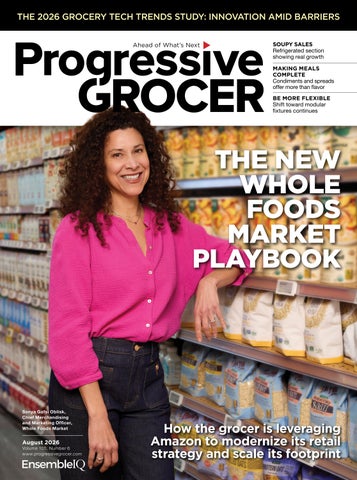
THE 2026 GROCERY TECH TRENDS STUDY: INNOVATION AMID BARRIERS SOUPY SALES Refrigerated section showing real growth MAKING MEALS COMPLETE Condiments and spreads offer more than flavor BE MORE FLEXIBLE Shift toward modular fixtures continues
THE NEW WHOLE FOODS MARKET PLAYBOOK
Sonya Gafsi Oblisk, Chief Merchandising and Marketing Offi cer, Whole Foods Market
August 2026
Volume 105, Number 6 www.progressivegrocer.com
How the grocer is leveraging Amazon to modernize its retail strategy and scale its footprint
Nov. 12, 2026 • The Hilton Chicago
How Changing Appetites Are Reshaping the Basket, the Store and Brand Growth Join a limited-access gathering for senior retail, brand, data and commerce leaders focused on how the GLP-1 shopper is changing what people buy, how retailers merchandise and where the next areas of growth will come from. This is a business summit about one of the most significant shifts affecting food, wellness and consumer shopping behavior.
Learn more at GLP1ShopperSummit.com
GET TICKET
Brought To You By:
Contents Volume 105 Issue 6
08.26
28 COVER STORY
The New Whole Foods Market Playbook: Balancing Omnichannel Operations, Value and Purpose How the grocer is leveraging Amazon to modernize its retail strategy and scale its footprint.
12 SOLUTIONS
Soup’s On
36 SOLUTIONS
16
More Than Flavor
Convenience, value, protein and occasion are driving soup sales this year.
Consumers also seek value, quality, versatility and ingredient transparency in their condiments and spreads, and smart retailers are paying attention.
16 TECHNOLOGY
The 2026 Grocery Tech Trends Study
36
Retailers tap into technology to modernize grocery shopping across channels and take AI from experimentation to implementation – but barriers remain. 26 SOLUTIONS
Seizing the Moment for Private Brands
34 TECHNOLOGY
40 EQUIPMENT & DESIGN
Being Accountable
Putting the ‘Flexible’ in Grocery Fixturing
A Daymon exec details how retailers can capitalize on the opportunities in this space.
Ottimate’s chief product officer explains how the company’s software helps grocers manage their finances more effectively.
Departments
10 MINTEL
11 ALL’S WELLNESS
Condiments
What’s Next for Plant-Based Foods?
4 EDITOR’S NOTE
Leadership Lessons From a Whole Foods Market Veteran 6 IN-STORE EVENTS CALENDAR
11
Grocery retailers shift from static shelving toward flexible, modular fixture systems.
48 EDITORS’ PICKS FOR INNOVATIVE PRODUCTS
October 2026 50 AHEAD OF WHAT’S NEXT 8 NIELSEN’S SHELF STOPPERS
Pet Supplies
Setting the Stage for More Public Grocery Stores PROGRESSIVE GROCER August 2026
3
EDITOR’S NOTE By Emily Crowe
8550 W. Bryn Mawr Ave. Ste. 225, Chicago, IL 60631 Phone: 773-992-4450 Fax: 773-992-4455
Leadership Lessons From a Whole Foods Market Veteran
F
SONYA GAFSI OBLISK EMPHASIZES FOCUSING ON PRIORITIES AND MAINTAINING ORGANIZ ATIONAL RHY THM.
or this month’s cover feature, I had the absolute pleasure of speaking with Whole Foods Market Chief Merchandising and Marketing Officer Sonya Gafsi Oblisk about the ways that the grocer is working alongside Amazon to bring more value, convenience and quality to its shoppers, as well as its continued focus on purpose-driven retail. Oblisk possesses a wealth of knowledge, and I was reminded of a somewhat different conversation I had with her almost exactly one year ago for Progressive Grocer’s Top Women in Grocery Podcast. In taking a look back at that episode, I wanted to highlight some additional wisdom that she shared with our audience regarding the balancing act of leadership:
BRAND MANAGEMENT SENIOR VICE PRESIDENT, GROUP BRAND DIRECTOR Eric Savitch esavitch@ensembleiq.com VICE PRESIDENT OF CONTENT Lisa Johnston ljohnston@ensembleiq.com EDITORIAL EDITOR-IN-CHIEF Emily Crowe ecrowe@ensembleiq.com MANAGING EDITOR Bridget Goldschmidt bgoldschmidt@ensembleiq.com SENIOR DIGITAL EDITOR Marian Zboraj mzboraj@ensembleiq.com SENIOR EDITOR Julia Tabisz jtabisz@ensembleiq.com ASSOCIATE EDITOR Samantha Schober sschober@ensembleiq.com ADVERTISING SALES & BUSINESS GROUP SALES DIRECTOR Mike Ketcham mketcham@ensembleiq.com ASSOCIATE PUBLISHER, REGIONAL SALES MANAGER Tammy Rokowski (INTERNATIONAL, SOUTHWEST, MI) 248-514-9500 trokowski@ensembleiq.com REGIONAL SALES MANAGER Theresa Kossack (MIDWEST, GA, FL) 214-226-6468 tkossack@ensembleiq.com SENIOR ACCOUNT EXECUTIVE Johanna Lupardus (CT, DE, MA, ME, RI, SC, TN, NH, VT, MD, VA, KY) 330-990-4635 jlupardus@ensembleiq.com PROJECT MANAGEMENT/PRODUCTION/ART
1. Keep a Laser Focus on Priorities One of my favorite takeaways from my previous conversation with Oblisk is that while an organization can do anything, it cannot do everything. She advises leaders to establish a clear view of business goals and customer needs to ensure that the organization makes the right progress at the right pace. This also requires organizations to be much more nimble and flexible to quickly adjust to changing consumer demands. Adopting technology and other tools to help cut down speed to market and boost relevance has been a big unlock here for Whole Foods. 2. Maintain Organizational Rhythm To avoid disconnected customer experiences or operational inefficiencies, Oblisk emphasizes the importance of keeping teams moving forward in a synchronous and complementary manner. Leaders should ensure that progress in different areas of the business stays aligned and grounded in the company’s core priorities. 3. Balance Art and Science While an organization Effective leadership involves balancing can do anything, it quantitative metrics, such as those used cannot do everything. for marketing investments and customer conversion, with the art of providing a meaningful customer experience that creates a true connection. Oblisk suggests that leaders listen broadly to customer feedback and team member observations to inform their plans, and also to ensure that their strategies connect with changing customer aspirations.
Emily Crowe Editor-in-Chief ecrowe@ensembleiq.com
4 progressivegrocer.com
www.ensembleiq.com
PRINT DESIGNER Catalina Carrasco cgonzalezcarrasco@ensembleiq.com ADVERTISING/PRODUCTION MANAGER Maria del Mar Rubio mrubio@ensembleiq.com SENIOR DIRECTOR OF MARKETING Nicola Tidbury ntidbury@ensembleiq.com SUBSCRIPTION SERVICES LIST RENTAL mbriganti@anteriad.com SUBSCRIPTION QUESTIONS contact@progressivegrocer.com
CORPORATE OFFICERS CHIEF EXECUTIVE OFFICER Jennifer Litterick CHIEF FINANCIAL OFFICER Jane Volland CHIEF OPERATING OFFICER Derek Estey CHIEF PEOPLE OFFICER Ann Jadown
PROGRESSIVE GROCER (ISSN 0033-0787, USPS 920-600) is published monthly, except for January/February, July/August and November/December, which are double issues, by EnsembleIQ, 8550 W. Bryn Mawr Ave. Ste. 225, Chicago, IL 60631. Single copy price $18.20, except selected special issues. Foreign single copy price $21.80, except selected special issues. Subscription: $134 a year; $246 for a two year supscription; Canada/Mexico $182 for a one year supscription; $249.90 for a two year supscription (Canada Post Publications Mail Agreement No. 40031729. Foreign $182 a one year supscription; $249.90 for a two year supscription (call for air mail rates). Digital Subscription: $78 one year supscription; $144 two year supscription. Periodicals postage paid at Chicago, IL 60631 and additional mailing offices. Printed in USA. POSTMASTER: Send all address changes to brand, 8550 W. Bryn Mawr Ave. Ste. 225, Chicago, IL 60631. Copyright ©2024 EnsembleIQ All rights reserved, including the rights to reproduce in whole or in part. All letters to the editors of this magazine will be treated as having been submitted for publication. The magazine reserves the right to edit and abridge them. The publication is available in microform from University Microfilms International, 300 North Zeeb Road, Ann Arbor, MI 48106. The contents of this publication may not be reproduced in whole or in part without the consent of the publisher. The publisher is not responsible for product claims and representations.
ONLY AOP TURNS GRUYÈRE INTO GOLD. AOP isn‘t just a seal, it‘s a guarantee. As a protected designation of origin, it means the Gruyère you‘re buying is the original: Made only in Switzerland, from cows grazing in local meadows. Copied around the world, but never equaled. Every wheel must meet 16 pages of strict requirements, upheld by dedicated farmers, master cheesemakers, and affineurs who‘ve been perfecting this craft since 1115. That‘s the noble character — and the gold standard — of Le Gruyère AOP.
LEARN MORE
IN-STORE EVENTS
Calendar S
10.26
M
Italian-American Heritage Month National Apple Month National Breast Cancer Awareness Month National Dental Hygiene Month
T
W
National Cyber Security Awareness Month National Pizza Month National Sausage Month National Seafood Month
T
F
S
1
2
3
National Pumpkin Seed Day. This nutritious snack should be part of any health-conscious nosher’s repertoire, either on its own or as part of a power mix.
World Farm Animals Day. If you haven’t already, install signage tracing the origins of meat and dairy products.
Frugal Fun Day. This also extends to cheap, easy meals and snacks for the whole family to enjoy.
4
5
6
7
8
9
10
11
12
13
14
15
16
17
18
19
20
21
22
23
24
25
26
27
28
29
30
31
National Cinnamon Roll Day. Create a no-fuss recipe for this beloved baked good – and don’t forget the icing.
Southern Food Heritage Day. Ask customers to send in their favorite recipes in this tradition, and make sure that you have all of the ingredients on hand.
Sweetest Day. For this observance encouraging kindness, suggest that shoppers create something sweet as a token of their affection for another.
Sourest Day. As a counterpart to Sweetest Day, have your shoppers share online their favorite tart foods to share with friends.
National Rhode Island Day. Celebrate the distinctive cuisine of this small but mighty New England state.
Indigenous Peoples’ Day. Mark this occasion with a deep dive into the foodways of local Native people through an in-store/online demo.
To kick off Pharmacy Week, highlight your health-and-wellness offerings in this key department.
National Tennessee Day. What foods and beverages is the Volunteer State known for? Spotlight them in a series of eye-catching endcaps.
6 progressivegrocer.com
World Architecture Day. If you’ve been thinking about refining your current store design and layout, now would be a good time to talk with a professional on how to accomplish those goals.
English Language Day. Arrange resources for your associates who wish to improve their English speaking and writing skills.
National Youth Confidence Day. Enable your teenage associates to learn and develop on the job so that they have a firm foundation for career success.
National American Beer Day. Organize a gathering to showcase area breweries’ best.
National LED Light Day. These energy-efficient bulbs cut electricity costs dramatically and enhance product appeal.
National Pet Obesity Awareness Day. Advise dog and cat parents on the best products to help them control their fur babies’ weight.
National Pumpkin Cheesecake Day. Hey, it’s that time of year.
National First Responders Day. These courageous and selfless folks deserve a discount in recognition of their service.
National Fluffernutter Day. This kid cuisine classic actually became the Official State Sandwich of Massachusetts in 2006.
National Grouch Day. Make a special effort to deal patiently with disgruntled customers.
National Color Day. Consider the hues used in your logo, promotional material and store décor, and whether they’re conveying the right message.
National Internet Day. Are you using your website and social media channels to their best advantage? Here’s an opportunity to reset.
World Egg Day. Any time of day, you can’t go wrong with this staple item, which can be prepared in myriad ways.
World Allergy Awareness Day. Hold a nutritionist-led tour to help shoppers with food sensitivities better navigate the store.
National iPod Day. Remember those? Have your associates and customers who do share their favorite playlists.
Frankenstein Friday. Run a contest to see who dresses most convincingly as Mary Shelley’s immortal creature.
World Homeless Day. Hold a checkout donation campaign to raise funds for organizations that help unhoused people.
Women in Military Service for America Memorial Anniversary. Remember those brave female soldiers who gave their lives for this country.
National Food Day. There’s obviously wide latitude here to spotlight a variety of dishes and cuisines through recipe cards, prep tips, demos, sampling and more throughout the store.
Halloween. Offer a seasonal treat to any young shoppers who show up in costume.
FRONT END
Shelf Stoppers
Average Unit Price
Pet Supplies Category
Dollar Sales
% Change Year Ago
Unit Sales
%% Change Year Ago
Cat Litter
$3,074,875,891
2.50%
246,082,387
0.40%
Dog Accessories
$796,818,669
-4.80%
84,915,469
-12.90%
Pet Toys
$796,628,861
4.50%
141,694,448
-10.30%
Cat Accessories
$318,048,349
-0.90%
45,307,042
-7.80%
Pet Beds
$189,098,523
-4.90%
11,280,787
0.50%
Bowls and Feeding Accessories
$188,516,366
-0.40%
38,495,846
-8.50%
Source: NIQ, Total U.S. (all outlets combined) during the 52 weeks ending June 27, 2026
$12.50
for cat litter, up 2.1% compared with a year ago
$9.38
for dog accessories, up 9.3% compared with a year ago
Index by Age of Head of Household
Pet Supplies
Bedding Accesories
Bird Accessories
Bowls and Feeding Accessories
Cat Accessories
Age 18-24
102
84
44
95
79
Age 25-34
91
175
43
101
98
Age 35-44
82
58
43
90
89
Age 45-54
106
78
64
110
104
Age 55-64
120
108
131
103
112
Age 65-74
109
116
171
107
112
Age 75 or More
86
77
166
89
85
$5.62
for pet toys, up 16.6% compared with a year ago
$7.02
for cat accessories, up 7.5% compared with a year ago
Source: Spectra
Value Per Occasion
$16.76
What is the value per occasion for cat litter versus the year-ago period per generation? Greatest Generation
Boomer
Gen X
for pet beds, down 5.4% compared with a year ago Gen Y/Gen Z
$4.90
$16.66
$15.73
$16.04
$14.95
up 15.6% compared with a year ago
up 2.3% compared with a year ago
up 3.0% compared with a year ago
up 4.6% compared with a year ago
Source: NIQ, Total U.S. (all outlets combined) during the 52 weeks ending May 23, 2026
8 progressivegrocer.com
for bowls and feeding accessories, up 8.9% compared with a year ago Source: NIQ, Total U.S. (all outlets combined) during the 52 weeks ending June 27, 2026
PET SPECIALTY
SUPPLIER PERSPECTIVES
The Power of Pet Fandom: Purina’s Partnership with U.S. Soccer Celebrates the Teammates Behind Every Team By Joe Toscano, Vice President, Trade & Industry Development at Purina Sports have always brought people together. Whether it’s gathering around the television, wearing team colors on game day, or cheering alongside family and friends, fandom creates powerful connections and shared experiences. For millions of Americans, there is one teammate who never misses a match, never questions a coaching decision, and is always there to celebrate a win or provide comfort after a tough loss: their pet. At Purina®, we believe pets and people are better together. That belief has guided our work for more than a century and continues to inspire new ways to celebrate the special role pets play in our lives. It is also what makes our partnership with U.S. Soccer such a natural fit.
Bringing Pets into the Beautiful Game As soccer continues its rapid growth in the United States and excitement builds around the sport’s biggest moments, we saw an opportunity to ensure pets are part of the experience. As the first-ever Official Pet Care Partner of U.S. Soccer, Purina is helping bring together two incredibly passionate communities: soccer fans and pet lovers. While they may seem like distinct groups, they share a lot in common. The teams we support and the pets we love become part of our identities. They create connection, community, and a sense of belonging. Together with U.S. Soccer, we’re creating new ways for fans to celebrate alongside their pets while reinforcing the powerful role animals play in our lives.
Spotlighting the Team Behind the Team One of the centerpieces of the partnership is Purina and Pro Plan’s new national campaign—For the Team Behind the Team. The campaign features U.S. Men’s National Team star Weston McKennie alongside his dogs, Lola and Sky, and celebrates the loyal companions who support us through every win, loss, and milestone. As a pet parent himself, Weston understands firsthand the role nutrition plays in helping dogs live active, healthy lives. The campaign highlights a reality familiar to pet owners everywhere—no matter how big the stage, the bond we share with our pets remains constant.
Creating Retail Excitement Through Beggin’® For retailers, one of the most exciting elements of
the partnership comes from Beggin’, the Official Dog Treat of U.S. Soccer. To celebrate the partnership, Beggin’ introduced limited-edition U.S. Soccer Crest-Shaped Dog Treats, giving pet parents a fun way to include their dogs in match-day traditions. Made with real bacon and shaped like the iconic U.S. Soccer crest, the treats tap into the growing consumer desire to share cultural moments with pets. Beggin’ also launched the Beggin’ XI Contest, a nationwide search for the ultimate roster of soccer-loving dogs. The contest invited fans to showcase their dogs’ personalities and team spirit while driving engagement around both the sport and the category. Programs like these create opportunities for retailers to connect with consumers through timely, culturally relevant moments while driving excitement at shelf.
A Portfolio-Wide Celebration But it doesn’t end with Beggin’. The partnership extends across our entire Purina portfolio. This summer, Purina introduced the first-ever National Pet Kit, allowing pets to show their support for the U.S. Men’s and Women’s National Teams alongside their families. Friskies® is bringing its new Certified Frisky platform to the pitch by celebrating cat-like
moments of soccer brilliance and rewarding fans when the U.S. Men’s National Team scores with 1 million cans of Friskies wet cat food over the course of the summer. Cat Chow® brought therapy cats to U.S. Soccer fan events, creating moments of calm and connection amid the energy of match day. Together, these activations demonstrate how pets are increasingly part of the cultural moments consumers care about most.
A Shared Opportunity Whether it’s sports, entertainment, travel, or everyday life, pet parents are looking for new ways to include their pets in the experiences that matter to them. For retailers, that presents an opportunity to connect with shoppers through meaningful moments that strengthen the human-animal bond. If you want to get more involved in helping us bring this exciting partnership to life, reach out to your Purina representative today. At Purina, we’re proud to partner with U.S. Soccer during a transformative period for the sport in America. More importantly, we’re proud to celebrate the pets who stand beside us every day as loyal companions, devoted supporters, and teammates in every sense of the word. Purina trademarks are owned by Société des Produits Nestlé S.A. Any other marks are property of their respective owners.
MINTEL CATEGORY INSIGHTS
Global New Products Database
Condiments
FOR MORE INFORMATION, VISIT WWW.MINTEL.COM OR CALL 800-932-0400
What You Need to Know
Market Outlook
Condiment sales were largely flat in 2025 – salad dressings dipped slightly amid economic uncertainty – but usage remains universal and frequent, providing a solid base for future growth.
Now (2026): slowdown: Condiment and dressing sales remain soft amid cautious consumer spending.
Consumers acknowledge the important role that condiments can play as eating habits evolve in various ways, including cuisine exploration; a shift to more healthful, nutrient-dense foods; and greater reliance on home cooking as a way to manage tight household budgets. While new products are key to maximizing consumer engagement, new ideas are just as important. New usage ideas, food pairing suggestions and ideas for combining condiments to create new personalized flavors can help to accelerate usage and repeat purchase. Retailers have an opportunity to be a source of ideas as well as products.
Next (2027-28): return to slow growth: Condiments and dressings return to their long-term pattern of slow growth, supported by the essential role they play in cuisine exploration and in enhancing the enjoyment of food. Future (2029-30): opportunities for acceleration: Brands and retailers have an opportunity to accelerate growth by facilitating trial of new condiments, providing a steady stream of new applications and encouraging creativity and personalization.
Opportunities Consumers acknowledge that condiments, toppings and dressings can play an important role in maintaining the enjoyment of food as they look to eat more healthfully. Condiment brands can play a leading role in easing this transition, not only with better-foryou versions of familiar favorites, but also with usage ideas that deliver both great taste and healthfulness. While new products play an important role in motivating trial of condiments, promoting new ways to use both new and existing condiments is key to breaking consumers out of their condiment routines and increasing frequency of use. In addition to highlighting food pairings and recipes, brands can encourage consumers to create their own personalized flavors, with ideas for mixing various condiments, toppings and dressings together. In-store browsing ranks as the most common way of learning about new condiments, surpassing recommendations from family and friends, and even social media among younger adults. Retailers can build on this advantage by elevating the condiment shopping experience beyond stock-up and routine to one that encourages exploration and discovery. Tactics such as sampling events, trial sizes, in-aisle communication of use ideas and recipes, and secondary placements that convey new food parings can build sales in the category and help retailers strengthen their culinary credentials.
10 progressivegrocer.com
ALL’S WELLNESS
By Molly Hembree, MS, RD, LD
What’s Next for Plant-Based Foods? BE PREPARED BY LE ANING INTO CUSTOMER NEEDS ACROSS DEPARTMENTS AND DAYPARTS.
T
he traction and evolution of the plant-based foods movement has captured the attention of every grocery retailer and most consumers over the past several years. According to the Plant Based Foods Association (PBFA), plant-based foods generated $7.9 billion in U.S. retail sales in 2025, more than double the sales of seven years prior, in 2018 ($3.3 billion). Further, PBFA notes that about 95%-96% of plant-based meat shoppers also purchase animal-based meat, which suggests that plantbased foods are within various eating styles and needs, while lending to bigger baskets. For 2026 and beyond, there are some key considerations regarding the plant-based category to keep in mind for best serving your customers.
Proteins
The plant-based business usually finds itself targeting protein alternatives. From eggs and dairy to poultry, meat and even fish, it seems as though most shoppers associate “plant-based” with “high-protein,” but made from plants. However, the plant-centered movement has now found itself shifting focus from processed substitutes to authentic plant-based fare with more “clean labels” and recognizable ingredient decks. There is renewed attention to the natural flavors and experience of plant-focused foods – pulling ingredients like black beans and veggies into the spotlight for a burger, rather than mock meat burgers that cause you to wonder if they’re truly sourced from plants instead of animals. Enlist the help of your dietitians to craft budget-friendly, crave-worthy meal plans and shopping lists for customers that make beans, lentils, tofu, nuts and seeds the heroes at mealtime.
are perfectly positioned for this task, as fiber is only found in plants, and energy from wholesome ingredients is at no shortage in the plant-based category. Find ways to cross-merchandise plant-based foods with the pharmacy, or devote a section of the circular to attracting new pharmacy customers to plant-based foods.
The Classics
Although the plant-based crusade has garnered excitement around plant-based product innovation, the old favorites are likely to triumph for months and years to come. Trustworthy, healthful standbys like fruits, vegetables, beans, lentils, nuts, seeds and whole grains still deserve the limelight and will be on plates for generations. We can delight customers by adding some flair to otherwise simple plant-centered foods, like turning bananas into “dessert sushi,” thin-sliced sweet potatoes into creative toasts, chickpeas into a homemade falafel, or granola into a dazzling breakfast parfait. Work with food scientists or culinary innovators within your company to determine new product launches using plant-based ingredients that customers are familiar with, or feature plantbased products that perform well in your stores in your chefs’ cooking demos. Customers are rethinking how to shop plant-based foods. Your retailer can support current trends by offering plant-based product selections while simultaneously planning for the future of this powerful category.
Although the plant-based crusade has garnered excitement around plant-based product innovation, the old favorites are likely to triumph for months and years to come.
Supporting GLP-1 Users
The boom of users on GLP-1 medications has changed the way that we deliver health care to many populations, and the way in which these individuals eat. Current statistics suggest that about 12% of U.S. adults have used GLP-1s for weight loss, while 26% of U.S. adults with diabetes have used GLP-1 medications. These medications, whose action is to mimic or enhance the body’s existing source of these natural hormones, can promote weight loss, tighter blood sugar control, increased feelings of fullness and possibly improved management of cardiovascular disease. Common side effects of GLP-1s include low appetite, constipation, nausea, vomiting and fatigue. A key ingredient in helping to control many of these issues is adequate fiber and nutrient-dense calorie consumption. Plant-based foods
Molly Hembree, MS, RD, LD, is a registered dietitian for Kroger Health.
PROGRESSIVE GROCER August 2026
11
SOLUTIONS
Soups
Soup’s On
POWERED BY
As deli offerings and shelf-stable innovations take off, soup is boiling over with new brands and rising consumer demands.
CONVENIENCE, VALUE, PROTEIN AND OCCASION ARE DRIVING SOUP SALES THIS YE AR.
W By Samantha Schober
hether as a practical meal-making option or a nostalgic cold remedy, Americans love soup. While the category makes little fuss as it dominates grocery shelf space, the U.S. soup market should hit roughly $18 billion this year, with a forecast of continued, steady growth, according to Maximize Market Research. While canned and condensed soups take home the lion’s share of that number, real movement is happening the next aisle over in the refrigerated case. As protein-forward, minimally processed options continue to grab shopper attention over their center store counterparts, the soup category is reorganizing itself around freshness, convenience and occasion. “Soup remains one of the most comforting, versatile meals in the deli, and shoppers are looking for choices that feel fresh, flavorful and substantial,” says Bob Sewall, chief customer officer and EVP of sales and marketing at Fall River, Mass.-based prepared food and soup manufacturer Blount Fine Foods. At Blount, shopper demands for “convenient meal solutions, protein, satiety and foods that deliver value beyond price alone” have become the major drivers to look out for when it comes to soup.
12 progressivegrocer.com
Key Takeaways While canned and condensed soups are still big, real movement is happening the next aisle over in the refrigerated case. Soup consumers are increasingly demanding convenient meal solutions, protein and satiety, as well as food that’s minimally processed without skimping on flavor. Niche wellness varieties like bone broth and other collagen-forward formats are stepping into the mainstream limelight.
SOLUTIONS
Soups
Souping Up the Shelf
For retailers and brands looking to get in on the action, merchandising in the soup category is splitting along familiar lines. Packaging has become a major marketing tool rather than an afterthought, especially as shoppers keep chasing clean-label products with shorter ingredient lists and higher nutrition. Protein counts have also become the new price point on packaging, a trend spotted in other categories that has finally come to conquer the soup aisle. Deli and refrigerated placement is set to do a lot of selling on its own in 2026. As consumers lean toward fresher foods, positioning soup near grab-and-co cases as well as prepared entrées puts it in front of shoppers already building a meal. As charcuterie spreads become increasingly popular as both snacks and centerpieces, soups and bisques are steadily climbing as convenient and filling meal add-ons to breads and prepared salads. Fittingly, soup is also on the rise as an occasion-setter, with seasonal varieties tailored toward holiday favorites seeing more shelf space.
Refrigerated Stocks are Rising
Americans are resonating more strongly with refrigerated soups this year, prompting brands to take a closer look. Blount reports that its retail refrigerated soup business grew more than 9% nationally over the past 52 weeks, with the company’s own brands cruising past that category-wide figure. Blount’s Clam Shack line, for example – built around New England Clam Chowder and Lobster Bisque – saw sales shoot up more than 37% in the same period. Arlington, Va.-based FMI – The Food Industry Association values the global refrigerated and frozen soup market at $3.1 billion in 2026, with projections that the category will reach $7.5 billion by 2036, effectively doubling the size of the segment over the next 10 years. Refrigerated formats specifically are expected to hold about 58% of that market.
“Soup remains one of the most comforting, versatile meals in the deli, and shoppers are looking for choices that feel fresh, flavorful and substantial.” —Bob Sewall, Blount Fine Foods
To explain these numbers, Blount points to a cluster of consumer behaviors driving that growth: demand for convenient meal solutions, a heightened focus on protein and satiety, and interest in food that’s minimally processed without skimping on flavor. GLP-1 medications have also broadened the shopper base for refrigerated soups as more households look for filling, low-calorie meals.
Ladling Out the Latest in Soup
Blount is taking the lead on 2026’s category activity this year with a packaging overhaul across its Family Kitchen line. The refresh highlights “ingredients, refrigerated quality and meaningful protein callouts,” in the last instance moving protein content from a side panel to a bold front-of-pack ribbon, a change set to roll out to select items at participating locations this fall. This roster of products includes familiar favorites like beef chili and chicken soup alongside trendy newcomers like Lasagna Soup with Italian Sausage, Cheesy Chicken Enchilada Soup, Chicken Pot Pie Soup and Organic Coconut Lentil Soup. “We know shoppers want soups that taste homemade but fit real life,” notes Todd Blount, the company’s president and CEO. “The refreshed packaging makes it easier for consumers to find the varieties they love, while reinforcing the quality, freshness and protein cues that set us apart.” Blount isn’t the only brand taking on protein-forward items, however, and innovation is happening in the center store as well. Farmington Hills, Mich.-based Zoup! Specialty Products has entered the
Refrigerated fresh options like lobster bisque are taking over supermarket shelves as shopper preferences shift away from canned staples.
14 progressivegrocer.com
POWERED BY
bone broth space with new USDA Certified Organic Chicken and Beef varieties in 14.5-ounce jars that deliver 20 grams of protein a pop. The shelf-stable line, which also advertises no use of added hormones, preservatives, sugar or GMOs, hits shelves this fall. Iconic canned-soup brand Campbell’s is also expanding on two health-forward formats at once. In June, the Camden, N.J.-based company paired up with Banza to launch its first gluten-free condensed Chicken Noodle Soup, trading traditional noodles for a chickpea pasta developed specifically to hold true to its texture in the broth. Weeks later, Campbell’s rolled out a five-flavor Protein Soup line – identified by a trademark green label – in Homestyle Chicken & Rotini, Italian-Style Wedding, Lemon Pepper Chicken, Southwest Black Bean and Mediterranean Lentil varieties. For its part, Manischewitz is celebrating occasion-based soups with the launch of a new jarred Homemade Soup Line. The roster covers Kosher for Passover varieties, Clear Chicken Broth and Chicken Matzo Ball Soup, alongside year-round flavors like Chicken Noodle, Tomato & Rice, Split Pea, Bubby’s Vegetable and Mushroom & Barley. Meanwhile, following a strong reception at the IDDBA 2026 trade show, Reser’s Fine Foods is also making a move into the category, with three refrigerated chowders in Loaded Baked Potato, New England Style Clam and Corn & Green Chile flavors.
Driven by rising demand for convenient, macrofriendly meals, the protein soup segment is experiencing rapid growth.
brands like Blount and Campbell’s are currently using to pull shoppers in. Packaging formulas built for convenience, like portable single-serve cups, pouches and microwaveable bowls, are also predicted to gain ground as on-the-go occasions become a bigger part of the category’s identity. From artisanal bone broths to global flavor profiles, modern soup brands are revamping the center aisle experience for today’s health-conscious shoppers.
Next on the Boil
Shoppers can expect to see the next wave of activity in the category pull soup further from its canned roots. Niche wellness varieties like bone broth and other collagen-forward formats are stepping into the mainstream limelight alongside the more familiar chowders and bisques, a trend that may signal increased focus on function over flavor in the coming months. Private label products have also seen a surge in popularity in other categories, and soup is no exception. As store brands grab more share from their big-name competitors, they increasingly mirror the protein-forward, minimally processed formulas that national
“We know shoppers want soups that taste homemade but fit real life. The refreshed packaging makes it easier for consumers to find the varieties they love, while reinforcing the quality, freshness and protein cues that set us apart.” —Tod Blount, Blount Fine Foods PROGRESSIVE GROCER August 2026
15
TECHNOLOGY
Research
The 2026 Grocery Tech Trends Study RETAILERS TAP INTO TECHNOLOGY TO MODERNIZE GROCERY SHOPPING ACROSS CHANNELS AND TAKE AI FROM EXPERIMENTATION TO IMPLEMENTATION – BUT BARRIERS REMAIN. By Julia Tabisz
N
early all grocery retailers expect their investments in technology to increase or stay the same this year, and nearly two-thirds will spend more on tech this year than they did last year. Progressive Grocer surveyed 70 grocery retailers in March and April to learn how they’re approaching technology in 2026. In PG’s 11th annual Grocery Tech Trends Study, we take a look at what types of technology grocers are investing in, how they’re tapping into technology to modernize the physical store, and AI’s shift from experimentation to implementation. Below, we explore these trends in depth, in addition to others uncovered in our survey, including what’s still holding grocers back as the industry hurtles into its digital future.
Surveying Grocery’s Digital Landscape
Overall, PG’s survey finds that retailers’ tech budgets are stabilizing, with 96% of respondents saying that they expect their companies to maintain or increase their spend on technology and automation this year. Sixty percent of retailers say that they’ll increase their investments in technology in 2026, with a quarter saying that they’ll spend somewhat or significantly more on technology and automation.
EXPECTED CHANGE IN 2026 TECH / AUTOMATION SPEND Significantly less
Somewhat less
Slightly more
3% 1%
36%
Decrease in spend: 4%
16 progressivegrocer.com
Slightly less
Somewhat more
About the same Significantly more
34%
Increase in spend: 60%
21%
4%
POWERED BY
BROUGHT TO YOU BY
It’s likely that a good portion of this investment in tech is going into retailers owning their digital ecosystems. According to PG’s survey, having control over the e-commerce shopping experience – as opposed to hosting e-commerce through a third party – is a top priority for grocery retailers this year. Sixty percent of retailers say that it’s either very or extremely important to have complete control over their e-commerce experience in 2026, up from 45% in 2025. This marks a shift toward grocers integrating their online and in-store experiences more seamlessly under their own brands. It makes sense, then, that e-commerce is projected to be a dominant growth driver in the near future. Along with AI, about half of retailers surveyed tell PG that it’s among the technologies they believe will drive the most growth in the grocery industry in the next 12 to 18 months. With 51% of survey respondents saying that e-commerce and online grocery ordering will drive growth and 49% saying that AI, including machine learning, will drive growth, it’s likely that digital sales and intelligent automation will fuel expansion this year.
PREDICTED INDUSTRY GROWTH DRIVERS IN THE NEXT 12-18 MONTHS E-commerce / online grocery ordering
51%
Artificial intelligence (AI), including machine learning
49%
Data analytics tools
39%
Tech to solve workforce challenges
37%
(e.g., apps for recruitment, onboarding, training)
Electronic shelf labels
29%
Retail media networks
27%
Robotics / automation in distribution centers
26%
Supply chain disruption solutions
24%
Robotics / automation
23%
Innovation in food production methods
21%
Checkout-free / cashierless stores
11%
It’s likely that a good portion of this investment in tech is going into retailers owning their digital ecosystems. According to PG’s survey, having control over the e-commerce shopping experience is a top priority for grocery retailers this year.
Within e-commerce specifically, PG’s survey found that ultra-fast delivery will be a primary growth driver, especially as it overtakes standard delivery as the top online grocery ordering method. Fifty-seven percent of grocery retailers say that delivery in 30 minutes or less will drive the most e-commerce growth in the grocery industry this year, compared with 51% who say the same of standard delivery. This shift suggests that speed is becoming a critical differentiator in the digital grocery landscape.
Modernizing Grocery Shopping in the Physical Store
PG’s survey finds that grocery retailers will also put significant tech investment toward modernizing the physical store this year. Retailers remain focused on investing in in-store back-end technology over warehouses and distribution centers, with 51% of survey respondents saying that they’re focused more on the former and 29% saying that they’re focused more on the latter. Interestingly, the industry is split on investing in customer-facing tech versus operational tech. Forty-one percent of grocery retailers say that they’re focusing most of their tech investments on customer-facing tech in the next 12 to 18 months, compared with 39% who say the same of back-end tech. Digital loyalty programs have seen a significant increase in implementation over last year, PG’s survey finds. Eighty-four percent of grocery retailers say this year that they currently use a digital loyalty program or app. Grocers’ strategic investments are also expanding into interactive infrastructure, with more than a quarter of retailers saying that they plan to implement electronic shelf labels (30%), in-store digital signage (29%) and instore QR codes (29%) in the next 12 to 18 months. Further, on the heels of the success of self-checkout (which PG’s survey finds is currently being implemented or added by 75% of grocery retailers), nearly half of survey respondents say that they are using or plan to add self-service foodservice and beverage machines (48%) and self-service touchscreen order kiosks (44%) – indicating grocers’ focus on enhancing the customer-led experience. PROGRESSIVE GROCER August 2026
17
TECHNOLOGY
BROUGHT TO YOU BY
Research
CUSTOMER-FACING TECHNOLOGIES Currently implemented
Plan to add in the next 12-18 months
Digital loyalty program / app 84%
11%
Online ordering, in-store pickup 74%
10%
Mobile app contactless payment 60%
24%
Online ordering, curbside pickup 73%
10%
Online ordering, delivery 70%
11%
In-store digital signage 51%
29%
In-store QR codes 50%
29%
Self-checkout payment kiosks 69%
6%
Automated retailing (e.g., ecoATM, Coinstar) 54%
7%
Electronic shelf labels 31%
30%
Self-serve foodservice / beverage machines 29%
19%
Self-service touchscreen order kiosks 21%
23%
Online ordering, drive-thru 24%
10%
Robots 16% 13%
Over the next 12 to 18 months, grocers tell PG that digital loyalty programs and electronic shelf labels will be their top customer-facing investments. Nearly half of survey respondents (46%) say that their digital loyalty programs or apps are their top priorities in the near future, and more than a third (36%) say the same of electronic shelf labels. On the other hand, robotics and drive-thru ordering come in toward the bottom of grocery retailers’ customer-facing priorities, with just 11% of respondents saying robots will be a top priority in the next 12 to 18 months and an even smaller amount – 1% – saying the same of drive-thru ordering. This data is indicative of a strategic shift among grocers away from hardware-heavy solutions and toward shopper engagement and pricing agility. To engage those shoppers, PG’s survey finds that grocers are prioritizing pure discounting somewhat less this year compared with last year, and instead sharpening their focus on tech-enabled experiences. Grocers tell PG that they think their customers will value digital discounts and promotions the most over the next 12 to 18 months, but significantly less so than last year: 59% of respondents say in 2026 that they think customers will value more digital discounts and promotions the most in the immediate future, down from 71% in 2025.
PG’s survey finds that grocers are prioritizing pure discounting somewhat less this year compared with last year, and instead sharpening their focus on tech-enabled experiences. 18 progressivegrocer.com
At the same time, 54% say that in the next 12 to 18 months, their customers will value a hybrid grocery experience that balances tech and in-store staff. Meanwhile, 27% say this year that their customers will value interactive online technology like shoppable video and livestreams, a significant rise from last year’s survey. This points to grocery shoppers who will increasingly value interactive engagement across both digital and in-store environments over the next year to year and a half.
WHAT WILL GROCERY CUSTOMERS VALUE MOST OVER THE NEXT 12-18 MONTHS?
59%
54%
53%
More digital discounts / promotions
A hybrid grocery experience
An improved / expanded online shopping experience
50%
43%
30%
Personalized product recommendations
Enhanced foodservice / prepared food offerings
Interactive in-store tech
(e.g., balance of tech and in-store staff)
(e.g., VR, QR codes)
27%
23%
Interactive online tech
Cashless / contactless checkout options
(e.g., shoppable video, livestreams)
T T
T C
T
CT US
T OOD
TECHNOLOGY
BROUGHT TO YOU BY
Research
Modernizing the Workforce and Operations Behind the Store
That engagement across both digital and in-store channels, along with that balance between technology and in-store staff, will require grocery retailers to have a firm handle on how tech tools will integrate into the shopping journey and the workforce that oversees the operations behind it. More than two-thirds of grocery retailers (67%) say that they already feel their companies are well positioned to succeed in the digital future of grocery. Just 17% say that they’ve already implemented both smart labeling and digital shelf technology in their stores, but 37% say that they plan to add smart labeling in the next 12 to 18 months and 31% say the same of digital shelves. Similarly, 33% say that they’re interested in learning more about smart labeling tech, and 34% say the same of digital shelves.
“OVERALL, MY COMPANY IS WELL POSITIONED TO SUCCEED IN THE DIGITAL FUTURE OF GROCERY” Strongly / Somewhat agree
67%
Strongly / Somewhat disagree
Neither agree nor disagree
23%
10%
The planned additions of these tech tools and the curiosity about them suggest that they’re poised to be rolled out in an effort to modernize physical stores. Combined with grocers feeling confident about their positioning as they move into the future of grocery, retailers are likely ready to infuse their physical infrastructure with a tech-first culture and scale their competitive advantage of a positive shopper experience through digital tools. One factor in offering a positive shopper experience is using tech solutions to manage out-of-stocks. Eighty-four percent of grocery retailers tell PG that there are tech solutions available to approach and overcome out-of-stocks, enabling grocers to tackle one of the biggest challenges in the shopper experience. When it comes to the balance between tech and the human touch that shoppers value, PG’s survey finds that, even as retailers lean into AI and machine-learning solutions, they’re simultaneously committing to human capital tools to ensure that their teams can effectively manage the complexities of a digital-first shopping environment. For instance, workforce technology for training/retention and data analytics platforms and reporting tools are grocers’ top priorities when it comes to back-end technologies, with just over a third of respondents (34%) choosing both of these as one of their top three priorities in the next 12 to 18 months. AI and machine-learning solutions follow, at 31%.
TOP PRIORITIES: BACK-END TECHNOLOGIES Workforce tech (for training, retention)
34%
Data analytics platform / reporting tools
34% 31%
AI / ML solutions Anti-theft tech
29%
Store inventory mgmt automation / robotics
27%
Data security tech
24%
Food safety tech
23%
Supply chain automation
23% 14%
Mobile devices / tablets for in-store managers
6%
Cleaning / compliance robotics
20 progressivegrocer.com
Foodservice tech for in-store kitchens
3%
CRM software
3%
None of the above
1%
STAY AHEAD IN
trays chic display
PRIVATE LABEL
Get the latest news, trends, and insights to drive innovative private brand programs
Like a model needs a stylist, beautful packages need support to look their best. Popco’s cooler trays keep packaged beauties upright and visible—ready to draw attention, to impress, to sell the goods! We’ve got options galore, and custom offerings to elevate your packaged goods to super-model status.
SIGN UP FOR THE NEWSLETTER Ooh la la, trays chic! Reach out to Popco & learn how cooler trays help rack-up-the-sales.
hang, stick & stand out
popco-usa.com 5405 Opportunity Court, Minnetonka, MN 55343 sales@popco-usa.com | 800.557.6726 | 952.352.0887
TECHNOLOGY
Research
AI Moves From Interest to Implementation
Beyond its use on the back end, PG’s survey finds that AI has moved from a phase of interest and experimentation into implementation. Nearly three-quarters of grocery retailers (73%) say that they have already implemented or plan to add AI and machine-learning solutions in the next 12 to 18 months. Just 29% of retailers have already implemented AI and machine-learning solutions, but 44% have plans to add them in the immediate future.
BACK-END TECHNOLOGIES Currently implemented
Plan to add in the next 12-18 months
Data analytics platform / reporting tools 74%
20%
Data security tech 73%
19%
Mobile devices / tablets for in-store managers 73%
17%
Workforce tech (e.g., for training, retention) 61%
20%
Food safety tech 53%
24%
Anti-theft tech 44%
30%
AI / ML solutions 29%
44%
Supply chain automation 47%
26%
CRM software 40%
29%
Store inventory mgmt automation / robotics 31%
34%
Store hygiene tech 34%
26%
Foodservice tech for in-store kitchens 23%
26%
Cleaning / compliance robotics 14% 21%
Eighty percent of grocers tell PG that they have already implemented AI-powered employee tools, plan to add them in the next 12 to 18 months or are interested in learning more. Current adoption is still low, with 17% of respondents saying that they already have AIpowered employee tools in place. However, the percentage of retailers interested in learning more about such tools is down significantly from last year, at 24% this year, while the percentage of those with plans to add the tools in the near future is up significantly to 39% this year – illustrating that shift from mere interest to implementation. It’s a similar story for AI-powered customer-facing tools. Seventy-one percent of retailers say that they have already implemented these tools, plan to do so in the next 12 to 18 months or are interested in learning more about them. Again, current adoption is low, at 13%, while the percentage of retailers interested in learning more is down significantly this year, at 24%, and the percentage of retailers with a plan to add them soon is up significantly, at 39%. Among the technologies that grocers have already implemented or plan to add in the near future, AI-powered employee tools (selected by 31% of respondents) and digital shelves (selected by 27%) are the top priorities this year, PG’s survey finds. Meanwhile, in-store robotics and smart carts come in at the bottom of the list
22 progressivegrocer.com
Among the technologies that grocers have already implemented or plan to add in the near future, AI-powered employee tools (selected by 31% of respondents) and digital shelves (selected by 27%) are the top priorities this year, PG’s survey finds. of priorities, at 6% and 4%, respectively. This highlights grocers’ preference this year for tech solutions that enhance staff productivity and modernize the physical store, over more experimental hardware. When asked whether there were any other innovative technologies that companies plan to add or invest in over the next 12 to 18 months that weren’t listed in PG’s survey, the 16% of retailers who say yes indicate a focus on AI, including agentic AI, AI-based merchandising and AI-driven site selection.
NEW / INNOVATIVE TECHNOLOGIES Currently implemented
Plan to add in the next 12-18 months
Interested in learning more
Smart labeling
17%
33%
Retail media network
41%
Digital shelves
17%
Sustainability-focused tech
21%
AI-powered demand forecasting
29%
AI-powered employee tools
17%
37% 21% 31%
17%
39%
In-store robotics
11% 19%
Micro fulfillment centers / dark stores
29%
34%
13% 34%
Smart carts
34%
31%
AI-powered customer-facing tools
Ultra-fast grocery delivery in 30 mins or less Smart vending machines that dispense prepared foods
21%
24% 24% 37%
7% 16% 36% 14% 24% 4% 13% 37% 16% 6%14%
20%
BROUGHT TO YOU BY
Tech-Related Barriers Remain
For all of the implementation of, and interest in, technology, PG’s survey finds that there are still significant barriers for grocery retailers when it comes to moving into grocery’s digital future. More than half of respondents (53%) say that their companies are only somewhat successful when it comes to keeping up with the rapid pace of change and acceleration of technology in the industry, while just over a third (36%) say that they’re either successful or very successful. This indicates that the pace of innovation in grocery might be outstripping retailers’ internal capabilities, leaving many struggling to keep up instead of taking the lead.
COMPANY SUCCESS AT KEEPING UP WITH PACE OF CHANGE / ACCELERATION OF TECHNOLOGY IN GROCERY INDUSTRY Not successful at all
Not very successful
1% 10%
Somewhat successful
53%
Successful
Very successful
26%
10%
36%
There’s good news in the high level of confidence that grocers have in their workforces and private labels in the context of digital grocery – 74% of survey respondents tell PG that they either somewhat or strongly agree that their companies’ existing front-line workforces can be trained to succeed in the digital grocery environment, and the same percentage say that they somewhat or strongly agree that their private labels are an important part of their current tech strategies. But a gap remains in grocers’ confidence that they have the right talent to succeed in grocery’s digital future. Comparatively, two-thirds of retailers (66%) tell PG that they somewhat or strongly agree their companies have the tech talent they need.
FORWARD-LOOKING STATEMENT AGREEMENT Somewhat / strongly agree
Neither agree nor disagree
Strongly / somewhat disagree
My company’s existing front-line workforce can be 75% trained to succeed in a digital grocery environment
11% 14%
My company’s private label / store brand is 75% an important part of our current tech strategy
14% 11%
My company is financially well positioned to keep up with 69% the rapid pace of change / acceleration of technology
21%
My company has the right talent to 65% succeed in the digital future of grocery
16%
10% 19%
In other words, grocers think that their workforce is coachable when it comes to tech, but recruiting specialized talent remains an obstacle – and presents a significant opportunity for future tech-related growth.
Methodology
The retailer survey portion was fielded March 12–April 5, 2026, and included responses from 70 grocery retailers. Respondents were sourced from PG’s audience and were required to be at least somewhat knowledgeable about their company’s current use of technology and/or future technology strategy. The consumer survey portion of the Grocery Trends Tech Study includes responses from 1,000 grocery shoppers who were surveyed Feb. 6–16, 2026. Representatives from multiple generations were included: Gen Z, Millennials, Gen X, Boomers and a small portion of Mature/Silent. PROGRESSIVE GROCER August 2026
23
ADVERTORIAL
3
Merchandising Trends Shaping THE FUTURE OF GROCERY RETAIL
Grocery retailing is continuously evolving, driven by shifting shopper expectations, rising energy costs and the push for more flexible store formats. In this environment, in-store merchandisers do much more than hold food — they shape product presentation, energy efficiency and ultimately the customer experience. Hussmann, a global leader in display merchandisers, explains how three trends reshaping the industry can help grocery retailers choose equipment that will keep customers shopping in-store.
1
Next-Gen Shoppers are Changing Expectations
Gen Z and Millennial consumers are not shopping the way their parents did. They’re not choosing a grocer based on location or loyalty alone. Access to health and nutrition information are attributes they consider when choosing a primary store.1 “The way next-gen consumers shop is pushing grocery retailers to rethink the way they merchandise core departments including bakery, deli and prepared foods,” says Jessica Moore, director of product management for Hussmann. Young shoppers are turning to grab-and-go foods from hot/ cold bars, as well as finding meal options from staffed counters as a substitute for dining out and eating healthier on a budget. Data also shows1 that roughly 90% of Gen Z and 86% of Millennials say grocers can help them by offering meal kits, prepared meals and sides and partially prepared options. The increased adoption of GLP-1 medications is also influencing eating habits and preferences, including demand for smaller portions, protein-forward options and convenient prepared foods. Retailers must be ready to update merchandising to serve this growing segment of customers. THE TAKEAWAY: Merchandise core departments to attract and engage next-gen shoppers to build long-term loyalty.
2
Convenience Matters Now More Than Ever
Convenience is now the top benefit shoppers look for in a store experience. Are store layouts easy to navigate and can shoppers find what they need quickly? Continuing to prioritize making grocery shopping convenient will be essential to retailer success in 2026 and beyond.
Customers want fresh prepared foods, healthy choices and easy meal solutions. Roughly 70% of shoppers visit the deli at least monthly and one-third visit weekly, with grab-and-go items leading in popularity.1 “We are seeing retailers design departments with low-profile merchandisers to improve sightlines and visibility,” Moore says. “This allows customers to discover new products easily and improves the overall shopping experience for snacks and meals — something that keeps shoppers returning to brickand-mortar in this age of online shopping.” THE TAKEAWAY: Use low-profile or spot merchandisers anywhere to improve sightlines, maximize visibility of a store’s assortment, and provide convenient, grab-and-go options. An excellent solution is the SIM case — a versatile, self-contained model ideal for any department in the store.
3
Updating Merchandisers to Support Long-Term Performance
Retailers upgrading equipment to adapt to these trends now have an opportunity to support both shopper experience and long-term store performance. That includes choosing regulatory-compliant refrigerants such as R-290, CO2 and A2Ls, as well as merchandisers built for durability and serviceability. Equipment that is easier to maintain and built to last can help reduce downtime and replacement cycles, both of which carry real operational costs. One solution is the RLN-A and RMN-A from Hussmann. This Impact® Reach-In merchandiser features the company’s proprietary Microblock™ Technology to simplify the installation process with a self-contained refrigeration system that comes pre-charged with propane (R290). THE TAKEAWAY: Consider not only the shopability and refrigerant type, but also the durability and quality of the case that will sustain daily use and last for years to come. Hussmann’s Reach-In Merchandisers with Microblock Technology are great options. 1
FMI’s 2026 U.S. Grocery Shopper Trends Report
SOLUTIONS
Private Brands
Seizing the Moment for Private Brands A DAYMON E XEC DE TAILS HOW RE TAILERS CAN CAPITALIZE ON THE OPPORTUNITIES IN THIS SPACE.
J
By Julia Tabisz ust shy of 60% of consumers say that they’re struggling to make ends meet financially this year, according to a June 2026 report from Stamford, Conn.-based private-brand agency Daymon. That percentage is up 11% over last year, Daymon’s “Private Brand Intelligence Report” finds. It’s no wonder, then, that private brands are having their moment. Daymon’s report also finds that 95% of consumers are purchasing private brands this year. Further, an even higher 98% say that they view private-brand prices as the same as or better than national brands. What’s more, nearly three-quarters of consumers are choosing to shop at certain retailers because of their private brands. Clearly, private brands represent a significant opportunity for retailers right now. To dig deeper, Progressive Grocer sat down with Christine Boenig, president of Daymon North America, to talk about where the opportunities lie in the category, what leaders in the space are doing right and what’s next for private brands. Progressive Grocer: How can retailers use private brands to keep pace with shoppers’ evolving preferences related to health and wellness? Christine Boenig: What I would say is that recently, consumers are defining healthy on their own terms, and so I really think retailers are going to have to stop and think about wellness less as one tier within their brand portfolio, but really start thinking about how health and wellness plays a role across their brand portfolio and the whole store. We’re seeing health and wellness show up in a lot of different ways. We’re seeing protein as a big part of growth in terms of attributes and interests to the consumer; fiber and probiotics are actually growing tremendously right now, at a stronger pace than protein is. And, of course, the GLP-1 adoption has accelerated the consumer’s mindset around portion control and nutrient-dense meals and products. PG: Outside of simply adding new products, where do the opportunities lie for retailers looking to strengthen the position of their private brands in today’s health-focused shopping environment? CB: I believe a lot of retailers think innovation when they’re thinking about the space, right? And we’re hearing from a lot of retailers
26 progressivegrocer.com
where they’re talking about distinctive items, unique items. But I don’t believe that’s where the real opportunity is. The real opportunity is in repositioning the SKUs that they currently have. Thinking about their benefit claims, whether it’s the attributes, whether it’s protein or whatever one of those different attributes might be, as we talked about in the last question, is simplifying their messaging on packaging, using signage across the stores, across their digital platforms and even extending it. And this could be done in store and digitally, but extending it through their recipe – and you see a lot of retailers doing this – I think that is one of the core things that’s going to make a difference.
PG: What advice do you have for retailers that want to safeguard the success of their private brands amid an evolving regulatory landscape? CB: First, don’t treat [regulation] as if it’s someone else’s job. With private brands, the retailer is the producer of record, right? Legally and financially, even when your manufacturers control the formulation, and that’s a mindset shift that has to take place across organizations. When you think about regulation, there are five core buckets that retailers should be considering. There’s the ingredients, and the bans taking place there. The packaging life cycle rules such as EPR [Extended Producer Responsibility], and then packaging and sustainability claims, which are very important. There are product quality claims. And then there is genuine product safety. And that one’s not new, but it’s definitely a part of [the] regulatory [landscape] that I think you have to be very hypersensitive to. PG: What are the leaders in the private-brand category doing differently that puts them ahead in the space? CB: This is an interesting time for private brands right now. When you think about the retailers that are winning, whether it’s one of the top three or it’s a super regional or even some of the smaller retailers, it’s discipline in the execution of just the basics, getting back to the basics. They all have their own unique formula around pricing, merchandising, e-commerce, loyalty, and they take those formulas and they execute them consistently. And I think that is the most important thing: sticking to the basic fundamentals and then executing consistently so that you continue to garner the trust of your consumers, which is what keeps them coming back time and time again. PG: How can retailers ensure that success in the private-brand category reaches across physical and digital channels? CB: Things that are important are featuring the full private-brand assortment online and making it a clear feature across the photography and providing accurate nutritionals and product claims – basics that a lot of retailers still aren’t getting right, and they’re making it muddy and harder to wade through online.
“The retailers that are winning at e-commerce are the ones that are treating their private-brand strategy as a digital-first extension of what they’re doing in the stores. They’ve got the same brand stories digitally that they have in store, and it’s not treated as an afterthought or another layer on top.” —Christine Boenig, President, Daymon North America
Beyond that, I think there’s also an opportunity to bring in-store merchandising logic online. So, filtering for private brands, if that’s what you’re interested in, force ranking in search results for private-brand items. Complementary item suggestions are another way to do this. And the retailers that are winning at e-commerce are the ones that are treating their private-brand strategy as a digital-first extension of what they’re doing in the stores. They’ve got the same brand stories digitally that they have in store, and it’s not treated as an afterthought or another layer on top. PG: What should retailers have on their radar as far as what the next big trends in private brands will be? CB: The first one I would watch is the wellness claim, and understanding that mix is shifting. Protein claims continue to grow. You can’t look at any type of media and not hear about protein being in anything, right? But fiber and probiotics, as I mentioned earlier, are growing even faster now than protein has been growing, and so that needs to stay top of mind for retailers. And I’d expect those things to continue to grow as the GLP-1 adoption expands. The second thing is what we mentioned regarding regulatory pressures: Those aren’t going away. Even as administrations change, these things should be front and center for us, and more states are expected to follow on the EPR front. Follow California, follow Oregon and follow Colorado. The ingredient scrutiny has continued to be real. I think about things such as Red Dye No. 3 and the removal of that, and how that’s been so impactful, and also, I would say, caused a lot of scrutiny from the retailer side of how they have to manage these things and the resources they put toward it and the costs to build this compliance infrastructure. And they need to be, as I mentioned earlier, proactive in this space as much as you can be. And third, I think we’ll continue seeing the concentration story play out. Growth continuing to consolidate among retailers who are really good at nailing down the fundamentals of price clarity, full store merchandising and loyalty programs. The gap between the leaders and everyone else is more likely to widen than close unless these retailers commit to getting back to the basics and doing those things really well. PROGRESSIVE GROCER August 2026
27
COVER STORY
Whole Foods Market
THE NEW WHOLE FOODS MARKET PLAYBOOK: Balancing Omnichannel Operations, Value and Purpose HOW THE GROCER IS LE VER AGING AMA ZON TO MODERNIZE ITS RE TAIL STR ATEGY AND SCALE ITS FOOTPRINT.
W By Emily Crowe
hole Foods Market, like many other food retailers today, is undergoing a strategic evolution designed to bring more value, convenience and quality to its customers. What those other food retailers don’t have, however, is the power of Amazon to bring that evolution to the next level. As VP of Amazon Worldwide Grocery Stores and CEO of Whole Foods Market Jason Buechel recently pointed out, being under Amazon’s umbrella has allowed Austin, Texas-based Whole Foods to lean even further into areas that have always made the grocer special. From providing convenience without compromise to harnessing next-generation technology, Whole Foods is actively leveraging its relationship with Amazon to create a new playbook for success. Progressive Grocer spoke with Whole Foods Chief Merchandising and Marketing Officer Sonya Gafsi Oblisk about how the grocer is enhancing convenience; shifting consumer perceptions; expanding its commitment to sustainable, purpose-driven retail; and more.
Delivering Omnichannel Convenience
When it comes to the ever-important concept of convenience, Whole Foods is approaching it from several different angles in an effort to fit seamlessly into customers’ different lifestyles. E-commerce solutions, like the Whole Foods grocery offerings available on Amazon, are a solid complement to in-store shopping, Oblisk explains, with that digital access proving to be a huge win for the retailer. “One thing that we know today across the grocery landscape: Customers are shopping at 28 progressivegrocer.com
Sonya Gafsi Oblisk, along with the Whole Foods Market Foundation team and board members, recently visited True Farmer in Ghana. True Farmer empowers smallholder farmers to overcome poverty and food insecurity by building long-term financial resilience.
multiple retailers for different occasions and need states,” she says. “As we’ve built our Whole Foods online store on Amazon, we inherently are giving customers an opportunity to be able to combine trips and do more than one shop at once, just by the nature of what we offer through our very vast assortment across Whole Foods, and also across our Amazon grocery offering.” The range of delivery speeds that Whole Foods is able to provide to its customers through its affi liation with Amazon is also a major boost. Whole Foods customers can have their groceries quickly delivered the same day, and in just 30 minutes with the Amazon Now service.
PORTABLE FLAVOR. SAME DUNKIN’ TASTE. DUNKIN’ REFRESHERS DRINK MIX IS FUELED WITH ENERGY FROM GREEN TEA AND B VITAMINS TO POWER YOU THROUGH THE DAY NO MATTER HOW YOU RUN.
MANUFACTURED BY THE JEL SERT CO. WEST CHICAGO, ILLINOIS 60186, USA. www.jelsert.com DUNKIN' is a trademark of DD IP Holder LLC, used under license. © 2026 DD IP Holder LLC. SINGLES TO GO! is a trademark of The Jel Sert Company and used with permission.
COVER STORY
Whole Foods Market The notion of convenience without compromise also extends to the Amazon returns program that’s taking place inside Whole Foods stores. “This is probably one of the best examples of a win-win with our customers,” Oblisk explains. “The level of convenience that having physical stores in prime real estate that are easy to get in and out of, where you can just go and quickly do a return, is incredible.” The program has also been a win-win for the retailer’s bottom line by driving traffic to physical stores and attracting new customers who might not have shopped there previously. Whole Foods now receives a meaningful portion of Amazon returns, and it’s only growing.
Tackling Value Perception and Pricing Strategy
exceptional growth and engagement in its promotional and everyday value items. Another key component of offering unbeatable value to its shoppers is private label, an area in which Whole Foods is expanding, and in which it has lowered prices on more than 1,000 products. The company has also found itself in a winning position to use its private brands to cater to evolving consumer trends, including a focus on health and wellness, clean ingredients, and transparent, consistent quality standards. “We’re able to offer exceptional price points and still maintain all of our quality standards,” Oblisk says of Whole Foods’ three private label brands. “All the standards that appear throughout the store, those are part of the guardrails for how we build and develop all of our private label assortment, which is a really high bar.”
It’s no secret that Whole Foods has historically been known by a subset of consumers as relatively expensive and niche, but today, the grocer is actively promising its shoppers that it will provide lower prices and great value, according to Oblisk. “We spend a lot of time and energy studying our competitors to make sure that we’re maintaining that promise to our customers,” she explains. “We also do a lot of deep dives with our own data and customer insights to understand what items are most meaningful to customers.” She continues: “Where do they actually derive the most value? What items really will be most persuasive in terms of determining where someone chooses to come and shop? Those are the items where we really focus on ensuring we have the strongest everyday value throughout the entire year.” For Oblisk, the winning combination for moving the needle on price perception at Whole Foods has been a balance of investing in those items that matter most to shoppers and offering promotions on relevant and exciting seasonal products. Proof positive: The grocer is seeing
“Where do they actually derive the most value? What items really will be most persuasive in terms of determining where someone chooses to come and shop?” —Sonya Gafsi Oblisk, Chief Merchandising and Marketing Officer, Whole Foods Market
30 progressivegrocer.com
The smaller-concept Whole Foods Market Daily Shop debuted in New York City in 2024, and has since expanded across the New York metro area, into several states and in London.
COVER STORY
Whole Foods Market Sonya Gafsi Oblisk helped plant banana trees alongside Sourced for Good supplier EARTH University in Costa Rica.
Sustainability and Purpose-Driven Sourcing
One thing that hasn’t changed under Amazon’s ownership is Whole Foods’ commitment to its original higher purpose of nourishing people and the planet. Sourced for Good is the grocer’s hallmark purpose-driven program that focuses on supporting workers, communities and environmental stewardship where its products are sourced, providing premiums that go toward improved wages, health care, student scholarships, planting trees to prevent erosion, and much more. Sourced for Good suppliers are represented widely across Whole Foods’ aisles, including in floral, produce, seafood, coffee and chocolate, with the program continuing to grow. For Oblisk, telling the stories of those suppliers and the communities the products are supporting in-store is part of connecting the dots between everyday Whole Foods shoppers and the massive international fi nancial inclusion projects that the grocer helps to undertake. “That’s a big piece of it for us on the local side,” she explains. “Being able, through outdoor marketing, through signage communications, even through demos in-store and having our founders and some of their brand ambassadors
“This connection back to the grower, the farmer, the producer, the entrepreneur, whoever it may be, is a really important part for us, and this goes back to Whole Foods really being grounded in this notion of a stakeholder model.” —Sonya Gafsi Oblisk, Chief Merchandising and Marketing Officer, Whole Foods Market
32 progressivegrocer.com
come in, to share stories is really important.” Oblisk continues: “This connection back to the grower, the farmer, the producer, the entrepreneur, whoever it may be, is a really important part for us, and this goes back to Whole Foods really being grounded in this notion of a stakeholder model.” Whole Foods stakeholders, she says, encompass customers, the environment, the grower, the farmer, the producer, the rancher and more. “So really weaving that together and using our in-store touchpoints and then all of our owned and operated channels to bring that to life is important,” she notes.
The Physical Move Forward
One fi nal way that Amazon has helped Whole Foods grow and thrive is by giving the grocer the scale it needed to meaningfully expand its footprint. Whole Foods currently has more than 550 locations worldwide, with 100 more coming in the next few years. The company launched its smaller-concept Whole Foods Market Daily Shop in New York City in 2024, and the banner has since expanded across the New York metro area, into several states and even across the pond to London. Additional Daily Shop stores are slated to open later this year. Oblisk shares that Whole Foods is actively learning, iterating and refi ning to make sure that the company is providing the best store fit for the individual communities and neighborhoods it’s moving into, and “really connecting with customers and showing up in the best way we can.” While giving no specifics as to how Whole Foods and Amazon will grow the Amazon Grocery concept, which was launched alongside a Whole Foods store in Chicago, or the storewithin-a-store experience at the Whole Foods in Plymouth Meeting, Pa., Oblisk says that the team is “excited to continue to iterate and invent and think about ways that we can make grocery shopping faster, easier and more affordable for all of our customers.”
REGISTRATION NOW OPEN
ORLANDO
NOV 4-6 2026
THE POWER OF
INSPIRING LEADERSHIP PERSPECTIVES UNMATCHED PEER NETWORKING AWARD-WINNING PROGRESS GROCERYIMPACT.COM
MADE POSSIBLE BY THE SUPPORT OF OUR 2026 SPONSORS
TECHNOLOGY
Accounts Payable Automation
Being Accountable OT TIMATE’S CHIEF PRODUCT OFFICER E XPL AINS HOW THE COMPANY’S SOF T WARE HELPS GROCERS MANAGE THEIR FINANCES MORE EFFECTIVELY.
F
By Bridget Goldschmidt
inances can be challenging for any business, but grocers face particular issues when it comes to balancing the books. To find out more about how food retailers can get their billing under control, Progressive Grocer spoke with Don Dittmar, chief product officer at San Francisco-based Ottimate, a provider of accounts payable (AP) automation AI that enables AP managers, approvers, controllers and CFOs to work through the entire invoice lifecycle. Progressive Grocer: Ottimate’s platform is noted for its mature deep-learning capabilities that analyze data down to the line-item level. How does this level of granularity specifically benefit grocers compared with standard header-level AP automation? Don Dittmar: We commonly find that our grocers are seeking ways to manage their business and profitability more granularly. But the sheer volume and dynamic nature of the inventory items they’re dealing with make
it impractical, so they tend to aggregate costs. It’s just not enough for them to “pay a bill” with their AP Automation tool; they need an AI-based tool that can analyze their inventory at the line level, connect to their inventory and cost systems and, most importantly, find those anomalies that erode margin at a micro level, versus just at the header. PG: Ottimate frequently integrates with systems like Microsoft Dynamics 365. What are the latest advancements in how your AI “writes back” to these ERP (enterprise resource planning) systems to provide real-time financial clarity for CFOs and controllers? DD: Throughout our platform, we’re constantly synchronizing invoice, cost and payment data with our customers’ core systems. And not just the line invoice data, but validating vendors to their vendor master, item SKUs and UPCs to their cost files, and inventory counts to their inventory system. More recently, we’re releasing proactive AI agents that can look for anomalies in those integrations and surface any mismatches to the customer, before they begin to impact their profitability. PG: You’ve enabled partners like DeCicco & Sons and Heritage Grocers Group to transition their AP teams from manual entry to exception management. What specific tools within your platform best support this shift toward high-level financial analysis? DD: Our Item Validation module is designed specifically for grocers to identify variances between their contracted price book and the invoice itself. For those using purchase orders for larger-ticket purchases like refrigeration or equipment, our purchase order (PO) line pairing can eliminate invoice touches entirely. And maybe most importantly, our AI-based general ledger (GL)-account predictions can code invoices effectively at an extremely rapid pace while still surfacing anything deemed risky to a knowledge worker. All of these take our customers away from data entry and free up their time for bigger-picture analysis.
Solutions from Ottimate take grocers away from data entry and free up their time for bigger-picture analysis.
34 progressivegrocer.com
PG: A major part of your work with Heritage Grocers Group was the ability to double store counts without increasing administrative overhead. How is Ottimate evolving its onboarding process to support rapid retail expansion? DD: We’ve recently launched an Onboarding Wizard, combined with self-service location management that provides our customers full control of how they manage their locations. We’ve had a few customers acquire other stores, necessitating the rapid onboarding of several locations at once, and these tools allow them to do so directly within the product. And, of course, when necessary, our experienced professional services team – pros who have worked with numerous grocers and understand the business – can augment that process with additional location setup and support if it’s needed. PG: You helped Heritage Grocers Group automate the reconciliation of DSD (direct store delivery) invoices against POs at the store back door. Are there plans to expand these automated “receiving matching” capabilities to include more complex vendor types or global suppliers? DD: We’re continually growing our capabilities in the way we interact with DSD vendors or any type of “managed inventory,” whether that be via onboarding electronic data interchange (EDI) vendors, the DSD solution you’ve mentioned or, in some cases, more traditional three-way PO matching. PG: How is Ottimate’s AI specifically evolving to help grocers identify price discrepancies and fluctuating case costs more rapidly to protect their thin margins? DD: Our Item Validation module is continually evolving to ingest more formats of data and to integrate with more inventory management systems, and our AI is continually learning context from every invoice we process to better identify opportunities to protect margins via cost recovery or pricing adjustments. PG: Your ongoing work with DeCicco & Sons includes deeper API (application programming
interface) integrations and webhooks for real-time document import. How will these technical evolutions change the day-today experience for a grocery store manager or controller in the near future? DD: It might sound a little funny, but the real outcome is that these users will stop noticing altogether. Building around the APIs – and now model context protocol (MCP) layers – not only allows for two-way communication, but, more than that, allows the communication to flow in a way that’s effortless for the user. You don’t have to manually export or import; when the transactions are ready, they flow from system to system. We’re furthering that with agentic monitoring tools so that if a user does get alerted to the integration, it’s because of something that they’ve specifically asked to see. PG: Beyond internal efficiency, how does Ottimate’s platform actively strengthen the supply chain relationship between local farmers/suppliers and grocers? DD: The visibility of invoice and payment transactions on both sides of the trading partner relationship enhances transparency and can build a better, trusted relationship between buyer and seller, both in the status and delivery of goods as well as the processing of outbound payments. Our upcoming Supplier Relationship module will further enhance these communication and supplier relationship capabilities. PG: You aim to establish a centralized “single source of truth” for AP data across multi-banner groups. How does this data centralization empower retail leadership to make more informed purchasing decisions? DD: It really changes it from a lagging indicator of the influences on purchasing to an active and predictive tool. Automation provides the base layer of value, but when automation really begins to take hold, the insight becomes the next level of value and can reveal cash flow opportunities, pricing overages, delayed goods or poor supplier relationships, and more.
“The visibility of invoice and payment transactions on both sides of the trading partner relationship enhances transparency and can build a better, trusted relationship between buyer and seller, both in the status and delivery of goods as well as the processing of outbound payments.” —Don Dittmar, Chief Product Officer, Ottimate PROGRESSIVE GROCER August 2026
35
SOLUTIONS
Condiments and Spreads
More Than Flavor CONSUMERS ALSO SEEK VALUE, QUALIT Y, VERSATILIT Y AND INGREDIENT TR ANSPARENCY IN THEIR CONDIMENTS AND SPRE ADS, AND SMART RE TAILERS ARE PAYING AT TENTION.
K By Bridget Goldschmidt
etchup on a burger. Mustard on a hot dog. This time of year, where would we be without them? Beyond grilling season, however, condiments and spreads have a key role to play in grocers’ assortments, even though condiment sales were largely flat in 2025 amid economic uncertainty, according to Chicago-based market research firm Mintel (see page 10). The company went on to note that since usage remains universal and frequent, there’s a solid base for future growth. “Consumers continue to seek products that deliver both value and flavor,” affirms Kevin Stafford, VP, center store operations at K-VA-T Food Stores Inc., the Abingdon, Va.-based operator of more than 150 Food City stores in the Southeast. “We are seeing strong interest in products that help customers create restaurant-quality meals at home, whether through premium sauces, specialty condiments, unique flavor profiles or versatile spreads that can be used across multiple meal occasions. Customers are also looking for convenience, cleaner ingredient statements and products that support emerging cooking trends such as grilling, meal customization and global flavor exploration. At the same time, value remains important, and shoppers continue to respond well to trusted national brands alongside quality private label alternatives. Food City’s merchandising and promotional plans continue to emphasize both value-oriented and meal solution-driven offerings.” In keeping with that approach, according to Stafford: “Our assortment strategy focuses on giving customers choices at every price point while also introducing innovative products that align with current flavor and meal trends. We
Food City features barbecue marinades and sauces tied to the grilling occasion.
continue to feature products tied to grilling, burgers, hot dogs, sandwiches, breakfast occasions and back-to-school meal preparation through seasonal merchandising programs and promotional events. While performance varies by product segment, these categories remain an important part of basket-building opportunities because they connect directly to meal planning and seasonal events. The continued emphasis on grilling, meal deals and promotional activity supports strong customer engagement throughout the year.”
Besides its popular preserves, Bonne Maman also makes nut and chocolate spreads.
Key Takeaways Savvy retailers like Food City give customers choices at every price point while also introducing innovative products that align with current flavor and meal trends. Merchandising strategies should help customers visualize complete meal solutions rather than viewing products as stand-alone purchases. Retail marketing should focus on driving awareness, trial and conversion through retail media, social advertising, influencer partnerships, digital content and product sampling.
36 progressivegrocer.com
SOLUTIONS
Condiments and Spreads Adding Excitement
“Today’s consumers are looking for condiments that do more than complement a meal — they want products that transform everyday cooking into something more exciting,” asserts Traci Mishner, VP of marketing and trade operations at Boca Raton, Fla.-based Tabañero, which recently expanded beyond hot sauces with a new line of chef-inspired barbecue sauces. “Whether they’re grilling, meal prepping, entertaining or elevating a weeknight dinner, shoppers are seeking bold flavor, global inspiration, sweetheat combinations and products that can serve multiple purposes as a topping, marinade, glaze, dip or cooking ingredient. “At the same time,” Mishner notes, “ingredient transparency has become increasingly important. Consumers are reading labels more closely and looking for recognizable ingredients, lower sugar and products made without unnecessary additives.” Sweet and savory spread makers are seeing many of the same trends. “Consumers today are looking for products that balance quality, convenience and indulgence,” says a company representative at Biars-sur-Cère, Francebased Bonne Maman, whose U.S. operations are in Rye, N.Y. “Across pantry staples, shoppers are increasingly prioritizing simple ingredients and premium products that deliver an elevated tasting experience. … While preserves remain the core of Bonne Maman’s heritage, consumers are also looking for greater versatility. They are seeking products that can be enjoyed across multiple occasions, from breakfast and snacking to baking, entertaining and creating desserts at home. This evolving consumer demand has inspired the brand’s continued expansion beyond preserves into new categories, including nut and chocolate spreads.” “Clean labels, recognizable ingredients and betterfor-you formulations are top priorities, but shoppers also want bold, globally inspired flavors that elevate everyday meals,” notes Aimee Tsakirellis, EVP of
“Cross-merchandising is extremely effective for these categories because customers typically purchase condiments and spreads as part of a larger meal solution.” —Kevin Stafford, K-VA-T Food Stores Inc. d/b/a Food City
38 progressivegrocer.com
The shelves at a Food City store offer condiment options across a range of prices and applications.
marketing at Haverhill, Mass.-based hummus and dip maker Cedar’s Foods. “They’re increasingly seeking versatile products that can be enjoyed as a dip, spread, sandwich topper, cooking ingredient or as an entertaining staple.”
Make it a Meal
When it comes to merchandising, Stafford has found that “cross-merchandising is extremely effective for these categories because customers typically purchase condiments and spreads as part of a larger meal solution.” Some of Food City’s most successful strategies include: Featuring condiments alongside grilling meats during summer events Merchandising peanut butter and jelly products together to simplify shopping Building secondary displays tied to burgers, hot dogs, sandwiches and tailgating occasions Leveraging seasonal and holiday themes to create larger destination displays Using promotional programs, digital offers and meal deals that encourage multiple-item purchases “These strategies work because they help customers visualize complete meal solutions rather than viewing products as standalone purchases,” Stafford explains. “Our merchandising plans throughout the summer and back-to-school periods are heavily focused on meal-based solutions and seasonal eating occasions.” “Strong shelf blocking, clear flavor descriptions, heat-level indicators, recipe inspiration and cross-merchandising alongside complementary foods all help drive trial,” Mishner notes. “Our upcoming packaging redesign is also an important merchandising tool. More prominent ingredient photography, simplified benefit callout and improved shelf readability allow shoppers to understand both the flavor profile and ingredient story from several feet away.”
She adds that “offering a range of heat levels and flavor profiles — from mild and sweet to smoky and extra hot — helps retailers appeal to a broader shopper base while maintaining a cohesive brand presentation.” “Our products perform best when they’re merchandised to showcase their versatility beyond the dip category,” Tsakirellis points out. “Cross-merchandising alongside naan breads, pita breads, bagels, artisan breads, fresh produce, deli meats, cheeses and prepared meal ingredients helps inspire consumers with multiple usage occasions, from breakfast and lunch to snacking and entertaining. Secondary placements near bakery, produce or prepared foods also reinforce Cedar’s as a convenient, wholesome option for quick meals and snacks.” She believes that showcasing the products’ various uses “can encourage shoppers to think beyond traditional entertaining occasions and incorporate Mediterranean flavors into their daily routines, ultimately driving trial, repeat purchases and increased basket size.”
In Stores and Online
To keep its condiments and spreads front and center with customers, Food City uses “a combination of weekly ads, digital promotions, digital coupons, recipe content, meal-deal programs, loyalty marketing and seasonal merchandising campaigns,” Stafford says. “We have also incorporated digital promotional events, Buy More Save More programs, digital private label flyers, loyalty rewards and recipe-driven content that helps customers discover new ways to use featured products. We have found that combining strong value messaging with meal inspiration delivers the best results.” “Our retail marketing strategy focuses on driving awareness, trial and conversion through an integrated mix of retail media, social advertising, influencer partnerships, digital content and product sampling,” Mishner notes. “Early results have shown that pairing compelling creative with retailer-specific messaging and meal inspiration increases shopper engagement and improves store-level performance.” Tabañero has added barbecue sauce to its portfolio, joining the company’s hot sauce line.
Cedar’s Foods has recently refreshed the packaging of its premium Reserve line.
“One of the most effective ways to drive trial and consumer connection is through in-person sampling,” the Bonne Maman representative says. “As a premium food brand, Bonne Maman allows shoppers to experience the quality, taste and texture of its products firsthand, helping demonstrate the difference and encouraging discovery across the portfolio.” To that end, the brand has launched a national sampling campaign to introduce shoppers to the its expanded premium spread portfolio at Walmart, Publix, Albertsons/Safeway, Kroger, Wakefern and H-E-B, among others. These programs started with the back-toschool season and are slated to run through early Q4. “To bring consumers closer to the brand, Bonne Maman continues to invest in both offline and online retail opportunities,” the representative adds. “This includes expanding sampling initiatives, connecting the omnichannel shopping experience and utilizing the various tools provided by our retail partners to introduce our products to shoppers in key markets.” Beyond refreshing the packaging of its premium Reserve Line, Cedar’s is continuing “to leverage social media, recipe inspiration and educational content that highlights ingredient transparency, authentic family recipes and the versatility of our products,” Tsakirellis says. “We also align product innovation with broader consumer trends, introducing flavors inspired by popular culinary moments while remaining true to our Mediterranean roots.”
The Shape of the Future
Several trends are likely to shape the future of condiments and spreads, according to Stafford, among them the following: Continued innovation in flavor profiles, including global and regional influences Increased demand for premium and specialty offerings Growth in better-for-you products and cleaner ingredient formulations Expanded private label opportunities that provide both value and quality More cross-category meal solution merchandising Increased digital engagement through recipes, loyalty programs and personalized offers “We also expect continued growth in products that help customers create unique food experiences at home,” he adds. “Consumers increasingly want convenient ways to elevate everyday meals, and condiments, spreads, jams and jellies are well positioned to support that trend.” PROGRESSIVE GROCER August 2026
39
EQUIPMENT & DESIGN
IN PARTNERSHIP WITH
2026 Fixturing Outlook
Putting the ‘Flexible’ in Grocery Fixturing
Seamless cross-merchandising can score impulsive buys from shoppers building their dinner plans.
GROCERY RE TAILERS SHIF T FROM STATIC SHELVING TOWARD FLE XIBLE, MODUL AR FIX TURE SYSTEMS.
F
By Samantha Schober
or a retailer outfitting a grocery store in 2026, adaptability plays a greater role in fixturing than ever before. Retailers are looking for systems that can change shape as quickly as the stores around them do – remodel budgets keep shrinking, SKU counts keep climbing and electronic shelf labels keep spreading through more departments. Together, those pressures have pushed fixturing out of the background and into the strategic planning conversation. Paul White, president of Waukegan, Ill.-based retail display hardware provider Kinter, sees the shift toward flexibility play out nearly every time he speaks with retail buyers today. “Retailers are looking for fixture solutions that can adapt quickly to changing product assortments, seasonal promotions and evolving shopper preferences without requiring a complete store reset,” White says. “At the same time, they’re balancing those needs with tighter budgets, so they’re looking for durable, modular solutions that deliver long-term value. The focus has become creating displays that can evolve alongside the business.”
40 progressivegrocer.com
ESLs and Rising SKU Counts Drive Innovation
According to Rich Wildrick, director of engineering at Wilkes-Barre, Pa.-based retail and point-of-purchase fixture maker Trion Industries, one development is revolutionizing grocery fixturing above all others: electronic shelf labels (ESLs). Meant to serve as digital
Key Takeaways Retailers are looking for systems that can change shape as quickly as the stores around them do, with thoughtful design, sustainability and durability also key. The departments seeing the most investment – and innovation – are on the perimeter. Stores need to buy fixtures in anticipation of the next five years rather than the next reset.
EQUIPMENT & DESIGN
IN PARTNERSHIP WITH
2026 Fixturing Outlook replacements for traditional paper price tags, ESLs have picked up speed at a pace that would have been unbelievable just two years ago. Wildrick says that their popularity with retailers comes down to two line items: “reducing labor cost while gaining pricing accuracy.” For the same reasons, Ryan Masek, director of engineering at Kinter, expects ESLs to become close to standard equipment within the next two to three years. As retailers try to eliminate the labor tied to manual price updates, Masek notes, a broader wave of data-driven tools is moving into stores alongside them, from shopper-behavior tracking to inventory monitoring. “Fixtures will increasingly be expected to support connected retail environments rather than simply display products,” he says. The designs of the fixtures themselves are changing to meet these new expectations already. Technology considerations now enter the process earlier than they used to, Masek explains, with manufacturers building in room for digital labels, power management and future
“Fixtures will increasingly be expected to support connected retail environments rather than simply display products.” —Ryan Masek, Kinter
42 progressivegrocer.com
“Retailers are looking for fixture solutions that can adapt quickly to changing product assortments, seasonal promotions and evolving shopper preferences without requiring a complete store reset.” —Paul White, Kinter upgrades so a fixture doesn’t need to be swapped out the moment a store adds new hardware. Rising SKU counts are also pushing grocers toward shelving that can be reshaped without a full reset. Craig Weiskerger, director of sales and marketing at Trion, cites the company’s WonderBar merchandising system, which relies on pushers and added facings to help retailers fit more products into the same footprint while making each one more visible to shoppers. A similar demand for adaptability shows up in Trion’s adjustable-width merchandising trays, according to Wildrick, including the company’s EWT and WBEWT lines. The trays let a grocer resize a slot to fit the current planogram and then reconfigure it again later as products or packaging change. This stretches a fixture’s useful life instead of sending it to the dumpster when the next reset rolls out.
As ESLs become more common in U.S. grocery stores, flexible fixtures will be key to accommodating them.
Zip up beverage profits Zip up beverage profits Zip up beverage profits
With The Most Versatile System for Grab-and-Go Beverage Sales. With The Most Versatile System for Grab-and-Go Beverage Sales. With With The The Most Most Versatile Versatile System System forfor Grab-and-Go Grab-and-Go Beverage Beverage Sales. Sales. With The Most Versatile System for Grab-and-Go Beverage Sales.
® ZIPZIP Track is a®®®cost-effective, modern merchandising system thatthat forwards ® Track isaaacost-effective, cost-effective, modern merchandising system forwards ® a ZIP ZIP ZIP Track Track Track is cost-effective, modern modern modern merchandising merchandising merchandising system system system that that that forwards forwards forwards Track isisisacost-effective, cost-effective, modern merchandising system that forwards andZIP faces its product offerings at all times. Add new facings with this easyeasy and faces its product offerings at all times. Add new facings with this and and and faces faces faces its its its product product product offerings offerings offerings at at all at all all times. times. times. Add Add Add new new new facings facings facings with with with this this this easy easy easy and faces its product offerings at all times. Add new facings with this easy to install and and adjust system. Custom spring tensions and and lanelane depths are are to install adjust system. Custom spring tensions depths toto to install toinstall install install and and and adjust adjust adjust system. system. system. Custom Custom Custom spring spring spring tensions tensions tensions and and and lane lane lane depths depths depths are are adjust Custom spring tensions and lane depths areare available to fitand any and and allsystem. shelf and product needs. available to fit any all shelf and product needs. available available available to to fit to fit any fit any any and and and all all shelf all shelf shelf and and and product product product needs. needs. needs. available to fit any and all shelf and product needs.
ZipZip it it Zip it Zip Zip it Zip it it Use actual product to set lane width from
Use actual product lane width from Use actual to set set lane width from UseUse Use actual actual product product product to set to lane lane lane width width from from 2.00” to actual 3.75”. Slide product front-to-back 2.00” to 3.75”. Slide product front-to-back 2.00” to3.75”. 3.75”. product front-to-back 2.00” 2.00” 2.00” to 3.75”. to to 3.75”. Slide Slide Slide product product product front-to-back front-to-back front-to-back to ‘ZIP’ tracks together in final position. to ‘ZIP’ tracks together final position. to‘ZIP’ ‘ZIP’ tracks in final position. to ‘ZIP’ to to ‘ZIP’ tracks tracks tracks together together together in final in infinal final position. position. position.
FillFill it itit Fill Fill Fill Fill it it it ®
ZIP Track maintains its width accurately ZIP Track maintains its width accurately ZIP Track maintains accurately ZIP ZIP ZIP Track Track Track maintains maintains maintains itsits its width itswidth width width accurately accurately accurately for the entire depth of facing without thethethe forthe the entire depth offacing facing without for entire depth of without for for the for the the entire entire entire depth depth depth of facing of of facing facing without without without thethe the needneed for a rear anchor system. need for a rear anchor system. for a rear anchor system. need need need forfor aforrear aarear rear anchor anchor anchor system. system. system. ®
®®® ®
Cross sell itit it Cross sell Cross sell Cross Cross Cross sell it it itor beverages. It’s not just sell forsell coolers
It’s not just for coolers or beverages. It’sIt’s not just forfor coolers or beverages. beverages. It’s It’s not not not just just just for for coolers coolers or or orbeverages. beverages. Use ZIP Track incoolers multiple categories toto to Use ZIP Track inmultiple multiple categories Use ZIP Track in multiple categories Use Use Use ZIP ZIP ZIP Track Track Track in multiple in in multiple categories categories categories to to to showcase many different types ofofproduct. showcase many different types of product. showcase many different types product. showcase showcase showcase many many many different different different types types types of product. of ofproduct. product. ®
® ®
® ®®
TrionTrion Industries, Inc. Inc. | TrionOnline.com/ZipTrack | info@triononline.com | |800-444-4665 | |©2026 Trion Industries, Inc. Industries, |||| TrionOnline.com/ZipTrack ©2026 TrionTrion Industries, Inc. Inc. Industries, Inc. TrionOnline.com/ZipTrack info@triononline.com || 800-444-4665 800-444-4665 ©2026 Industries, Trion Trion Trion Industries, Industries, Industries, Inc. Inc. Inc. | TrionOnline.com/ZipTrack TrionOnline.com/ZipTrack TrionOnline.com/ZipTrack | | info@triononline.com |||info@triononline.com info@triononline.com info@triononline.com | 800-444-4665 |800-444-4665 800-444-4665 | ©2019 ||| ©2019 ©2019 Trion Trion Trion Industries, Industries, Industries, Inc. Inc. Inc.
EQUIPMENT & DESIGN
IN PARTNERSHIP WITH
2026 Fixturing Outlook Sourcing Sustainable, Experience-Driven Displays
The departments seeing the most investment – and innovation – are on the perimeter. Produce, bakery and prepared foods are getting the bulk of the attention, Masek says, because those departments are where brick-and-mortar stores can still hold an edge over the ever-encroaching realm of online shopping. To that end, retailers are investing in fixtures built to feel more like a market than a warehouse. Beverage merchandising is pulling in similar interest, with chains searching for fresh ways to spotlight premium or newly launched products. “Thoughtfully designed fixtures help create engaging shopping experiences by improving product visibility, simplifying navigation and showcasing products in ways that encourage discovery,” Masek observes. “Retailers are also using fixtures to reinforce their brand identity through materials, finishes and custom merchandising solutions. The goal is to make the store more enjoyable to shop while making it easier for customers to find what they need.” On the manufacturing end, Weiskerger notes that where a fixture gets built has become almost as important as what it can do. “We’ve seen a conscious
Versatile ESL placement can be a game-changer when merchandising any department.
“We’ve seen a conscious shift toward fixtures produced in the United States. Decisions are being driven by quality, faster turnaround times and the absence of tariffs.” —Craig Weiskerger, Trion Industries
Left: Travel essentials can be positioned in mobile bins near checkout. Above: Kinter’s three-level merchandising floor bins offer removable floor grates for larger displays.
44 progressivegrocer.com
EQUIPMENT & DESIGN
2026 Fixturing Outlook Gondola bins can keep everyday grocery favorites organized, accessible and ready to buy.
he explains. “They need to review and consider all store formats prior to finalizing rollout planning.” Durability is where Weiskerger’s concern lives, along with how easily a fixture’s showroom appeal can mislead a buyer. “All too often, retailers invest in fixtures that look promising but fail in long-term reliability,” he says. Pusher systems that automatically keep products faced forward, he adds, “can help reduce the labor time shift toward fixtures produced in the United States,” he says. “Decisions are being driven by quality, faster turnaround times and the absence of tariffs.” Sustainability also factors in, but the way that retailers talk about it has changed. Environmental impact and the bottom line now get weighed together, according to White, with retailers gravitating toward durable materials, efficient manufacturing processes and designs that can be refreshed or reconfigured rather than thrown out. “Those decisions can sometimes affect costs or lead times depending on material availability, but many retailers recognize that investing in longer-lasting fixtures often reduces total lifecycle costs,” he explains. “Sustainability and long-term value increasingly go hand in hand.”
The Cost of Cheap Fixturing Because the modern grocery retail environment favors adaptability, purchasing decisions have to be made the same way: Treating a fixture as a one-time expense often backfires. Wildrick links one common misstep buyers make to consolidation. “Through a merger or acquisition, a buyer acquires some odd store fixtures that they might not consider when rolling out new merchandising projects,” These cross-merchandising fixtures make it effortless for shoppers to grab the sauces, rubs and sides needed to complete dinner in one quick stop.
46 progressivegrocer.com
needed to straighten products.” In Masek’s experience, retailers that focus purely on sticker price when it’s time to make a choice tend to pay for that decision later. “Selecting solutions based solely on initial cost can lead to higher maintenance expenses, reduced flexibility and the need for earlier
“All too often, retailers invest in fixtures that look promising but fail in long-term reliability.” —Craig Weiskerger, Trion Industries
IN PARTNERSHIP WITH
replacement,” he notes. “It’s important to consider how fixtures will perform over time and whether they’ll support future merchandising changes. The best fixture solutions are designed with both today’s needs and tomorrow’s opportunities in mind.”
Designing for 2027 and Beyond
To prepare for the next stage of retail evolution, stores need to keep tomorrow’s opportunities in mind by buying fixtures in anticipation of the next five years rather than the next reset. For Wildrick, this means doing some behind-the-scenes research to source fixtures from reputable companies with strong track records of successful store implementations to back them up. “Review their products in use in like environments with other retailers or ask about a test in your store to gauge the overall functionality for yourself prior to the purchase,” he adds. Masek expects the category to keep moving in that same direction over the next several years, with retailers continuing to chase their version of a distinct in-store experience while trying to run leaner. Fixture manufacturers, he predicts, will take on a bigger role in getting them there. “By 2027, I think we’ll see fixtures become even more adaptable, connected and shopper-focused,” he says. “Technology integration will be increasingly standard, but just as important will be the ability to quickly reconfigure merchandising without major capital investments.”
“Think beyond today’s store layout and invest with flexibility in mind — retail is evolving quickly, and the stores that adapt most successfully are the ones with fixtures that can evolve just as easily.” —Paul White, Kinter For his part, White encourages retailers to keep their fixture suppliers in the loop during their planning process to make any necessary changes before layouts are locked in. According to White, forging a partnership in a project’s early stages can help both sides identify and implement improvements to a store’s operations and its shopping experience. “Think beyond today’s store layout and invest with flexibility in mind – retail is evolving quickly, and the stores that adapt most successfully are the ones with fixtures that can evolve just as easily,” he asserts. “The right fixture strategy supports your business for years, not just your next remodel.”
THE NEW HERO FOR YOUR FROZEN AISLES Create a frozen section that’s easy to shop and stock with ShelfHero. Organized, elevated aisles come easy with this innovative on-shelf pusher system that improves stocking efficiency for staff while enhancing the customer shopping experience.
NEVER KNOW WHEN IT’S THERE. ALWAYS KNOW WHEN IT’S NOT.
REQUEST A TRIAL FOR YOUR STORE
MARMON RETAIL SOLUTIONS – BERKSHIRE HATHAWAY
800-279-5291 retailspacesolutions.com
EDITORS' PICKS
Food, Beverage & Nonfood Products
Better Butter
Flora Food Group has now introduced Red Barn Creamery Butter – a world-class U.S. Grade AA butter crafted from 100% American cream in Kansas. In contrast to the high-volume, continuous process currently used by many large-scale butter producers, Red Barn’s batch-churned method takes more time and care, helping develop its rich, creamy 84% butterfat content – among the highest available on the market. The result is a smooth texture, deep flavor and consistent performance across a wide range of culinary applications, among them searing, melting, whipping, baking and spreading. Red Barn Creamery Butter comes in salted and unsalted varieties in a distinct 8-ounce block, with one block equivalent to one cup or two standard sticks, making it easy to use in any recipe. Either block retails for a suggested $4.49. To help introduce Red Barn Creamery Butter, the brand has teamed up with best-selling author and Broma Bakery founder Sarah Fennel and award-winning Iron Chef Marc Forgione. The line is the latest addition to Flora’s portfolio of brands, which also includes Violife, Country Crock and I Can’t Believe It’s Not Butter! https://www.redbarncreamery.com/; https://www.florafoodgroup.com/
Mussel Flex
Norwegian seafood producer King Oscar, the No. 1-selling premium sardine brand in the United States, according to Circana, has now come out with Premium Smoked Mussels in Extra Virgin Olive Oil. Available in three varieties – Mussels in Extra Virgin Olive Oil, Mussels in Extra Virgin Olive Oil with Lemon and Mussels in Extra Virgin Olive Oil with Chili, the convenient ready-to-eat product is suitable for snacking, entertaining or as an easy, flavorful addition to pasta, rice, salads, tapas and more. Plus, for health-conscious consumers, they feature omega-3 fatty acids and are an excellent source of protein and iron. Aquaculture Stewardship Council-certified King Oscar mussels are naturally smoked over real wood to impart warmth and depth of flavor and then hand-packed in extra-virgin olive oil. A 4.23-ounce package of any variety has a suggested retail price range of $5.99-$6.99. King Oscar is owned by global seafood leader Thai Union. https://www.kingoscar.com/; https://www.thaiunion.com/
48 progressivegrocer.com
Fiber by the Cup
As more and more consumers reach for snacks or breakfast options that will keep them fuller longer, Icelandic skyr brand siggi’s is providing a solution: Fruit & Fiber, a yogurt line featuring 14 grams of protein and 5 grams of fiber per cup. Made with real fruit, Fruit & Fiber reflects siggi’s continued commitment to simple ingredients without artificial sweeteners, artificial flavors or preservatives. Further, the brand combines protein with fiber, a nutrient known to support longer-lasting fullness and sustained energy. The fruit-forward lineup consists of three flavors, Strawberry, Blueberry & Blackberry, and Peach, and is available in major grocery stores nationwide. A 5.3-ounce single-serve cup of any flavor retails for a suggested $1.99. https://siggis.com/
Scrambling for Breakfast
Clean-label heat-andserve meal brand Kevin’s Natural Foods is now taking on the breakfast daypart with the introduction of Scramble Starters, a first-of-its-kind frozen breakfast solution. In contrast to traditional frozen breakfasts, Scramble Starters offer both frozen convenience and restaurant-quality freshness. Each chef-crafted variety features vegetables and high-quality protein paired with popular sauces – all consumers have to do is add eggs to create a fresh, protein-rich egg scramble in minutes. The line comes in four SKUs: Denver-Style Ham & White Cheddar, applewood-smoked ham with bell peppers, onions and a creamy cheese sauce; Spinach & Bacon Florentine, crisp uncured bacon with poblano peppers, onions and a creamy parmesan cheese sauce; Tex-Mex Style Avocado Chicken, breast of chicken with poblano peppers, red bell peppers and an avocado crema; and Ranchero Sirloin Steak, featuring onions, bell peppers and a chipotle ranchero sauce. Available in 16-ounce bags containing up to four servings each, Scramble Starters have rolled out nationwide at Target, Kroger, Harris Teeter and others, with a suggested retail price of $9.99 for a package of any variety. https://www.kevinsnaturalfoods.com/
Sweet and Spicy Snacking
Sprouted snack brand Daily Crunch recently launched Cinnamon Churro Sprouted Nut Medley, a nostalgic entry in its portfolio of better-for-you sprouted nut snacks, at the Sweets & Snacks Expo 2026 last May. Using its patented four-day soak-sprout-dehydrate process, Daily Crunch transforms ordinary nuts into lighter, crunchier snacks. The warm cinnamon-sugar churro flavor balances sweet spice with Daily Crunch’s signature airy texture. Each serving provides 6 grams of protein, with only 3 grams of added sugar. The product comes in a 4-ounce bag retailing for a suggested $6.99 and a 1.2-ounce bag with a suggested retail price of $2.99. All Daily Crunch snacks are made with minimal to no oil or sugar and no additives or preservatives, as well as containing protein, fiber and healthy fats. Further, the brand’s products are vegan, keto, gluten-free and Non-GMO Project Verified. https://www.dailycrunchsnacks.com
Zero Compromise
Those looking to prepare better-for-you breakfasts now have another option: Eggo Zero, the beloved Mars Snacking brand’s first-ever waffles that contain 0 grams of added sugar but retain that signature fluffyon-the-inside, crispy-on-the-outside texture. The classic, comforting Buttermilk flavor delivers 12 grams of complete protein per serving, while sweet, fruity Blueberry offers 11 grams of complete protein per serving. Mindfully sweetened with monk fruit extract and stevia extract, both macro-friendly SKUs feature zero artificial flavors, colors or sweeteners. Eggo Zero Waffles are available nationwide at a suggested retail price of $5.99 per 8-count, 9.8-ounce box of either flavor. Eggo’s parent company, Mars Inc., produces some of the world’s best-loved brands. https://www.leggomyeggo.com/en_US/home.html; https://www.mars.com/our-brands/mars-snacking; https://www.mars.com/
A Pocketful of Nutrition
Better-for-you comfort food maker Veggies Made Great has now arrived in the frozen breakfast aisle with Fruit Pockets, a bold category expansion that brings the brand’s vegetable-forward innovation to the breakfast pastry segment. Available in Strawberry and Apple flavors, Fruit Pockets feature a baked, not fried, crust made with butternut squash as the No. 1 ingredient. Each pocket is filled with real fruit and topped with a customizable icing made with cauliflower as the first ingredient, blending indulgence with real, healthy ingredients – no artificial flavors, preservatives or synthetic colors, as well as no high-fructose corn syrup. Further, the handheld format offers a convenient, ready-in-minutes option for breakfast or anytime snacking. The product line has a suggested retail price of $5.99 per 14.2-ounce box of six individually wrapped pockets and has rolled out nationwide at select Target stores, Hy-Vee, Giant Food, The Giant Co., Stop & Shop, Wakefern Food Corp., and Harris Teeter. https://www.veggiesmadegreat.com/
Time to Sparkle
Long known for its signature fruit nectars and blue can, iconic Mexican beverage brand Jumex is now hoping to quench more thirsts with the debut of its Sparkling Soda line. The collection of carbonated drinks, inspired by the bold, tropical tastes of the brand’s native land, comes in three fruity flavors: Orange, Mango and Limeade. The Sparkling Soda line is available at select Walmart and Kroger locations throughout the United States, with a suggested retail price of 88 cents per 12-fluid-ounce can of any flavor. Grupo Jumex, founded in Mexico more than 60 years ago, is distributed in the United States by Vilore Foods. https://www.grupojumex.mx/en; https://www.vilore.com/ PROGRESSIVE GROCER August 2026
49
ALL’S WELLNESS
By Name Bridget Goldschmidt
Setting the Stage for More Public Grocery Stores
A
BIG CITIES FIND CRE ATIVE WAYS TO ER ADICATE FOOD DESERTS. recent virtual webinar, hosted by HR&A Advisors, Local Progress, Mayors for America and the Mayors Innovation Project, dove into the topic of how cities can plan for and operate public grocery stores, and the main takeaway was that there’s no single way to proceed for any municipality taking on such a project. As representatives from New York, Chicago and Atlanta attested during “The Public Grocery Playbook: What City Leaders Need to Know,” what works best will depend on local needs.
Chicago is working on developing a public market model to enhance food access.
taxes, rent, overhead, and, again, we are going to set the terms for any private operator for how our supermarket should operate, which means that all of those cost savings are going to be passed directly onto consumers in cheaper groceries.”
Market Flexibility
According to Max Budovitch, Chicago’s deputy mayor-business and neighborhood development, his city underwent a “We want to bring fresh, change in thinking from its original pursuit of a public grocery store model. healthy foods to the “Muncipally Powered Grocery” For instance, downtown Atlanta is home to “What occurred was as we neighborhoods that need Azalea Market (covered in the October 2025 socialized this idea with our various it the most, and also that edition of this column), a partnership with a community partners, we started to food has to be affordable private operator that Katie Molla, the city’s hear other ideas [that] reflected the deputy chief of staff, referred to as “municipalin order to make it easy for fact that Chicago, like many cities in ly powered grocery.” the United States, has really robust people to actually get it.” Molla noted that the partner has “an equity neighborhood-level food stakeholder —Deandra Khan, New York City Office stake in this [business,] and we provide the ecosystems,” Budovitch recounted. of the Deputy Mayor for Economic Justice lease of that store to them, as well as several “We started to hear the idea of a public other subsidies, including helping with buildout.” She added that a second gromarket percolate from the grass roots as cery store was set to open soon in another underserved area of the city, also in opposed to a public grocery, and, really, accordance with Atlanta’s preferred public-private partnership model. what that meant to us, and what we understood that that meant to our stakeholders, was being able to have a multiplier effect Fresh and Affordable Meanwhile, New York has received a lot of press regarding Mayor Zohran in a public or quasi-public space that both Mamdani’s plan to open a publicly supported grocery store in each of the city’s addressed the question and challenge of five boroughs, with La Marqueta in Manhattan’s historic Harlem neighborhood food access. … Markets, because of their and The Peninsula in the Hunts Point section of the Bronx already identified as flexibility as spaces, can be programmed in future sites. “We want to bring fresh, healthy foods to the neighborhoods that different ways to offer a great opportunity need it the most, and also that food has to be affordable in order to make it to small-scale food entrepreneurs to pop easy for people to actually get it,” explained Deandra Khan, senior advisor in, pop out, experiment and grow.” for strategic initiatives at the New York City Office of the Deputy Mayor HR&A Advisors, a mission-driven group for Economic Justice. “We wanted to … bring affordability to [these] of analysts, planners and policy experts, neighborhoods … and also, of course, think about municipal is helping shape public grocery grocery stores in the broader context of the food ecosystem that is models through its advisory work with very alive in New York City.” cities, including a Public Options for To ensure that food in these stores remains inexpensive, “we Mayors Toolkit developed with the prioritize identifying spaces and land that the city actually owns,” Economic Security Project. Khan noted, “so we have factored out the cost of rent, the cost of property taxes and, in a city as expensive as New York, that is not an insignificant thing to relieve an operator of the burden of. … For the other sites, where we are actually seeking private-property owners Bridget Goldschmidt to apply for Queens, Brooklyn and Staten Island, we’re going Managing Editor to do the same thing. We’re going to waive property bgoldschmidt@ensembleiq.com
50 progressivegrocer.com
REGISTRATION NOW OPEN
ECREMMOC
RE WRIT TEN
CHICAGO
OCT 20-21 2026
M AST E R N E W F R A M E WO R KS G a i n a c t i o n a b l e ro a d m a p s to n a v i g a te m u l t i p l y i n g c h a n n e l s .
F O R G E CO L L A B O R AT I O N C o n n e c t w i t h h i g h - c a l i b e r sa l es , m a r ket i n g , a n d a n a l y t i c s p e e rs . A N T I C I PAT E T H E S H I F T I m m e rse yo u rse l f i n t h e l a test re a l - t i m e c o n s u m e r t re n d s .
S e c u re yo u r s e a t a t c g s m s u m m i t .c o m
Nov. 10-12, 2026 The Hilton Chicago
Grocery’s Next Competitive Advantage Starts In-Store Digital influence is growing, but store conversion is harder to predict. Media, commerce marketing and loyalty teams are more connected, yet activation at the shelf is inconsistent. Brands can drive traffic and awareness, but struggle to control the final moment of decision. From smarter merchandising and retail media integration to stronger shopper engagement and conversions, InStore Ignite is an event that will explore how CPG brand and retail leaders can make the store a more powerful engine for growth.
Register at www.InstoreIgnite.com
As a valued Progressive Grocer reader, receive
Reader Offer
10% off your ticket. Use code: PGIGNITE2026
BROUGHT TO YOU BY