ETHICAL SOURCING—HOW TO BUILD TRUST AT THE SHELF • INSIDE THE SNACKING SURGE WHAT’S NEXT FOR SUSTAINABLE PACKAGING? • EXCLUSIVE! OUR 2026 GROCERY TECH TRENDS STUDY
AUGUST 2026
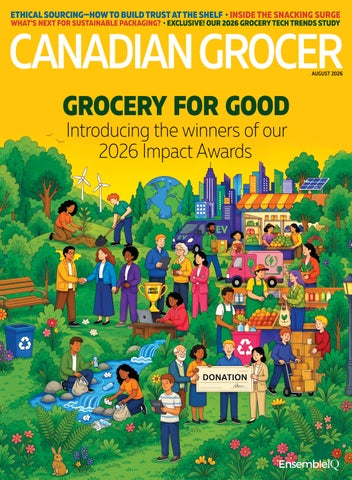
GROCERY FOR GOOD Introducing the winners of our 2026 Impact Awards
WINNER • GAGNANT
Helps to break down gluten
One pill before a meal, helps reduce the occurrence of symptoms of accidental gluten ingestion
This product must be used in conjunction with a gluten-free diet. This product may not be right for you. Always read and follow the label. GLUTEGUARD is a registered trademark of Glutagen Pty Ltd, used under licence. *33rd Annual Canadian Grand Prix New Product Awards Winner
Contents 57
August 2026 || Volume 140 - Number 5
18
8
Features
18 The Leaders
Mars Snacking Canada’s Ellen Thompson
22 Grocery for good
Introducing the 2026 Impact Award winners
51 Rethinking the whole package
egulations and sustainability R goals are prompting companies to rethink packaging
57 The tech edge
Exclusive research: Where grocers are investing in tech
FROM TOP LEFT: SHUTTERSTOCK/AI, MIKE FORD, CHRISTIE VUONG
63 Grand standings
A look at the winners of the Canadian Grand Prix New Product Awards!
Departments 5 Front Desk 7 The Buzz PEOPLE
8 The right stuff How lifelong friends built a betterfor-you breakfast brand IDEAS
How fresh departments can deliver on ethical sourcing and transparency AISLES
71 The snack shift Canada’s
11 In safe hands The
booming snack market moves toward functional health and bold flavours
13 Tech talks Pictures from
74 Seeing green Assistant
cyclospora outbreak puts food safety in focus
Canadian Grocer’s inaugural tech conference
15 Within reach Grocery
Code Office president Karen Proud on how members can raise issues COLUMNS
16 Oh, Canada? Kantar data
On the cover
FRESH
69 Mindful consumption
indicates that buying Canadian needs to be easier and better tied to value
EXPRESS LANE
professor Sadaf Mollaei on why affordability and accessibility are key to sustainability
69
Our positive impact issue Image by Shutterstock/AI August 2026 || CANADIAN GROCER 3
You could
WIN $15,000 *
TO PACK MORE THAN LUNCHES
Plus, we’ll donate $40,000 to For customer orders, contact us at 1 800 363-9496
Contest Date: August 10 to September 27
*No purchase necessary. Contest starts on August 10, 2026 (12:00:01 a.m. ET) and ends on September 27, 2026 (11:59:59 pm ET). One form of entry for your chance to win the Grand Prize is to purchase any Participating Product, submit the purchase receipt, and complete the entry form at packmorethanlunches.ca (the “Website”). Maximum of ten (10) entries per household. One (1) participating product purchased equals one (1) chance to win a Grand Prize. There is one (1) Grand Prize available to be won by random draw, consisting of $15,000 CAD. The winner must correctly answer a skill testing question. The Odds of winning depend on the number of eligible entries received. For all participating products and full rules, visit the Website. Contest is open to Canadian residents who are over the age of majority in their province/territory of residence and located in Canada at time of entry. ©2026 Lactalis Canada. All rights reserved. Trademarks owned or used under license by Lactalis Canada, Toronto ON, M9C 5J1.
New
MANGO flavour
high protein skyr yogurt
36020_Lactalis_CanadianGrocer_siggis-Mango_Final.indd 1
2026-07-27 16:36
Front desk 2300 Yonge Street, Suite 2900, Toronto, ON M4P 1E4 (877) 687-7321 Fax (888) 889-9522 www.canadiangrocer.com BRAND MANAGEMENT GROUP PUBLISHER/SVP, GROCERY & CONVENIENCE, CANADA Sandra Parente (416) 271-4706 - sparente@ensembleiq.com
EDITORIAL EDITOR-IN-CHIEF Shellee Fitzgerald sfitzgerald@ensembleiq.com
MANAGING EDITOR Kristin Laird klaird@ensembleiq.com
DIGITAL EDITOR Jillian Morgan jmorgan@ensembleiq.com
ADVERTISING SALES & BUSINESS SALES DIRECTOR Julia Sokolova
(647) 407-8236 - jsokolova@ensembleiq.com
NATIONAL ACCOUNT MANAGER Holly Power 416-910-1085 - hpower@ensembleiq.com
NATIONAL ACCOUNT MANAGER Roberta Thomson (416) 843-5534 - rthomson@ensembleiq.com
DESIGN/PRODUCTION/MARKETING CREATIVE DIRECTOR Nancy Peterman npeterman@ensembleiq.com
ART DIRECTOR Jackie Shipley jshipley@ensembleiq.com
SENIOR PRODUCTION DIRECTOR Michael Kimpton mkimpton@ensembleiq.com
MARKETING MANAGER Alexandra Voulu avoulu@ensembleiq.com
EDITORIAL ADVISORY BOARD RAY HEPWORTH, METRO BRENDA KIRK, PATTISON FOOD GROUP CHRISTY MCMULLEN, SUMMERHILL MARKET GIANCARLO TRIMARCHI, VINCE’S MARKET
SUBSCRIPTION SERVICES Subscriptions: $102.00 per year, 2 year $163.20, Outside Canada $163.20 per year, 2 year $259.20 Single Copy $14.40, Groups $73.20, Outside Canada Single Copy $19.20. Digital Subscriptions: $60.00 per year, 2 year $95.00 Category Captain: Single Copy $20.00, Outside Canada Single Copy $30.00 Fresh Report: Single Copy $20.00, Outside Canada Single Copy $30.00 Subscription Questions: contactus@canadiangrocer.com Phone: 1-877-687-7321 between 9 a.m. to 5 p.m. EST weekdays Fax: 1-888-520-3608 Online: canadiangrocer.com/subscription-centre
CORPORATE OFFICERS CHIEF EXECUTIVE OFFICER Jennifer Litterick CHIEF FINANCIAL OFFICER Jane Volland CHIEF OPERATING OFFICER Derek Estey CHIEF PEOPLE OFFICER Ann Jadown
SHUTTERSTOCK, MEGANE AD
MAIL PREFERENCES: From time to time other organizations may ask Canadian Grocer if they may send information about a product or service to some Canadian Grocer subscribers, by mail or email. If you do not wish to receive these messages, contact us in any of the ways listed above. Contents Copyright © 2026 by EnsembleIQ, may not be reprinted without permission. Canadian Grocer receives unsolicited materials (including letters to the editor, press releases, promotional items and images) from time to time. Canadian Grocer, its affiliates and assignees may use, reproduce, publish, republish, distribute, store and archive such submissions in whole or in part in any form or medium whatsoever, without compensation of any sort. ISSN# 0008-3704 PM 42940023 Canadian Grocer is Published by Stagnito Partners Canada Inc., 2300 Yonge Street, Suite 2900, Toronto, ON M4P 1E4. Printed in Canada
THANK YOU! One of the things I’ve always admired about the grocery industry is its ambition to do better. Be it pitching in to lend a hand when local communities are in need or tackling larger societal woes such as climate change, food waste and hunger. Grocers and suppliers show up every day in myriad ways. Proof of this can be found by turning to page 22 where we reveal the winners of our 2026 Impact Awards. Among this year’s winners are companies that are supporting mental health, championing kindness, making hockey accessible to kids, establishing emergency hardship funds for employees, decarbonizing their operations and alleviating food insecurity. The Awards shine a light on the very best of the grocery industry. The Canadian grocery industry is amazing and I’ll miss it. You see, I’ve decided it’s time for a new chapter and, as it turns out, a new geography (I’m heading to the East Coast!). While I’m excited for what’s ahead, the decision to leave my post as Canadian Grocer’s editor-in-chief is bittersweet. When I joined Canadian Grocer nearly 24 years ago, I never expected to stick around so long, but like so many of you, I got hooked on grocery—the stores, the innovations, the issues, the dramas and, of course, the people who make it so dynamic. If there’s one thing I’ve learned over the past two decades, it’s that grocery is never boring! It has been an absolute pleasure to have met and spoken with so many of you during my stint at Canadian Grocer. A sincere thank you to all of you for so generously sharing your time to take me
on tours of your stores, to explain your perspectives on complicated industry issues, to show me your new products and to share your incredible stories—it has been a privilege to tell them. Thanks also to the talented team at Canadian Grocer—it has been amazing to work alongside you. And, of course, thanks to our faithful readers who have helped us reach the ripe old age of 140! While I’m still going to be contributing to Canadian Grocer in another capacity, for now it’s goodbye and thank you! CG
Shellee Fitzgerald Editor-in-Chief
sfitzgerald@ensembleiq.com
Keep up to date on the latest news by signing up for our daily e-newsletter. It’s free and we’ll deliver it to your inbox each morning. Visit canadiangrocer.com to subscribe August 2026 || CANADIAN GROCER 5
x
Limited Edition
The Buzz
The latest news in the grocery biz PEOPLE
[Clockwise from left:] Loblaws City Market, Buy-Low Foods Riverside and Nature’s Fare Markets celebrate store openings
OPENINGS LOBLAWS CITY MARKET expanded its Vancouver footprint with a new 19,000-sq.-ft. store in South Granville. The banner’s fifth location in the city, it features a selection of fresh grab-and-go meals, a self-serve salad bar and full-service fresh departments alongside organic items and household staples. Reflecting regional consumer trends, the store also showcases local brands such as Bliss Balls, Berry Crispies and Peel Tea.
Spanning 24,000 square feet, NATURE’S FARE MARKETS has opened its largest-ever store. Located in Chilliwack, B.C., the store features a wellness department, local organic produce, premium meats and dairy, and better-for-you grocery staples. FRESHCO recently marked a milestone in Western Canada. The Empire-owned discount banner opened its first store on Vancouver Island, delivering fresh produce, meat and bakery items, a selection of well-loved brands, a product assortment serving the community, and weekly deals and Scene+ promotions.
LOBLAW, PATTISON FOOD GROUP
Loblaw Companies continues to expand its discount footprint with two new NO FRILLS openings. In Elmira, Ont., Jaden’s No Frills opened with community-tailored features—including horse and buggy tie-ups for the local Mennonite community—alongside fresh and local produce and bulk items. Meanwhile, Adelina’s No Frills opened in Winnipeg’s McPhillips district, a location employing 70 staff and offering a full selection of fresh produce, bakery, meat, grocery essentials and home goods.
Calgary Co-op appointed Andrew Clarke as its new chief executive officer. Clarke’s career in retail spans more than 30 years, across four continents and in more than one-dozen countries. He began his career with Marks & Spencer and has held senior roles with New Look, Pimkie and Sears Holding Corp. According to a press release, he has “a proven record of building high-performing teams and leading businesses through complex and consequential moments.”
Andrew Clarke
Brian Anderson joined Loblaw Digital as senior vice-president of e-commerce for retail pharmacy chain Brian Anderson Shoppers Drug Mart. Anderson spent the past eight years with Danish health, beauty and well-being retail company Matas Group, most recently serving as executive vice-president, group digital and loyalty. He is relocating from Copenhagen to Toronto. Jamieson Wellness promoted Kim Seet to vice-president, sales, Canada business unit. An eight-year veteran of the company, Seet spent the last three years leading the sales function for Jamieson’s international business unit and will now oversee all aspects of sales for the Canadian market. Vince’s Market appointed Thomas Ayoub as director of operations, a new position within the Ontario-based grocery chain. Ayoub brings more than 25 years of industry experience to the role, including stints with Whole Foods Market and most recently The Big Carrot. At Vince’s, Ayoub will help drive operational consistency and identify opportunities for continuous improvements across the organization.
AWARDS/RECOGNITION
The Food Industry Association of Canada has announced the recipients of the 2026 Golden Pencil Awards: Mike Lovsin, chairman at Freson Market Ltd.; Michael Graydon, chief executive officer of Food, Health and Consumer Products of Canada and Brent Cator, president and chief executive officer of Cardinal Meats. They will be celebrated at the Golden Pencil Awards ceremony following Canadian Grocer’s GroceryConnex conference in Toronto on Nov. 23.
Metro’s discount banner FOOD BASICS opened a 32,000-sq.-ft. store at Clarkson Village Shopping Centre in Mississauga, Ont. Featuring a contemporary design, the store offers Irrésistible and Selection private-label products, fresh meat, produce and fresh BBQ chicken.
News to share? Tell us about your openings, comings and reopened in SurFollowing a renovation, goings, etc. by dropping a line to rey, B.C. New features include a “Drop Zone” for deals, an expanded bulk foods section and an enhanced global food offering. klaird@ensembleiq.com BUY-LOW FOODS RIVERSIDE
August 2026 || CANADIAN GROCER 7
People
Who you need to know
Daniel Carson (top) and Daniel Schreiber
THE RIGHT STUFF
By Andrea Yu Photography by Christie Vuong
8 CANADIAN GROCER || August 2026
PHOTOCREDIT
How two lifelong friends built a better-for-you breakfast brand that’s winning over consumers, retailers and astronauts alike
I
t was in Grade 3, in 1991, that Daniel Carson and Daniel Schreiber first met at elementary school in Thornhill, Ont. The two became inseparable and their friendship continued through decades—from high school to graduating from university and starting their first careers. Schreiber joined his family business, a candle and chafing fuel company for foodservice. Carson took an entrepreneurial turn, running a character education and bullying prevention company for students before launching into experiential events and brand activations. The two also welcomed their first kids: Carson in 2015 and Schreiber in 2019. (Both would eventually grow their families to have three kids each.) After COVID hit, Carson and Schreiber found themselves at a crossroads. Schreiber had exited his family business in 2019 to focus on parenting. Operating his events company at the time, Carson watched the world grind to a halt. Both were eager for a new creative venture and the potential to start a business together. Inspiration struck in the winter of 2022. Carson, an early riser, was in charge of breakfast for his family. “I was looking for something that was quick, convenient and healthy but, more importantly, tasted really good,” he explains. This prompted him to develop an instant chia seed pudding that everyone in his family loved— his kids included. Carson brought his recipe to Schreiber and the two saw the potential to turn the chia seed formulation into a breakfast brand. They named it Goldy’s, after the well-loved fairy tale, Goldilocks and the Three Bears. With Schreiber’s experience in distribution and Carson’s affinity for storytelling and brand marketing, the duo hit the ground running. By March of 2023, they incorporated their business and partnered with District Ventures Kitchen— a shared commercial kitchen and food incubator backed by Arlene Dickinson— to develop their first line of products. They marketed them as a super seed cereal made with chia seeds, pumpkin seeds, hemp seeds and buckwheat with no added sugar. It could be made into an instant pudding, but also added into smoothies, yogurt, baked goods or eaten on its own. Meanwhile, the pair learned everything they could about running a consumer packaged goods business— something neither had done before. Schreiber worked on the venture full time while Carson continued to run his
events business part time. “During the 12 months of 2023, I describe it as going to CPG university,” Schreiber jokes. “It cost us well into the five figures to go to that university and learn the ropes.” Their perseverance paid off. By the beginning of January 2024, the duo had six super seed cereal flavours ready to hit the market, including Blueberry Ginger and Salted Cocoa. Schreiber was in charge of getting the products to store shelves. “I drove to all the grocery stores in our area, knocked on the door, introduced myself and sold it, sold it, sold it!” Schreiber explains. They also began making inroads at major grocers, which led to two national launches: Whole Foods Market at the end of 2024, and Sobeys, through its local program early the following year. While their super seed cereal was selling well, the entrepreneurs saw an opportunity to expand their lineup to include oatmeal. “There is almost no alternative choice for a truly better-for-you oatmeal on the shelf,” Schreiber explains. They formulated four flavours of instant oatmeal that were sweetened with organic date powder, along with seeds and real freeze-dried fruit. Adding a second product line further accelerated Goldy’s growth. It launched in Metro in the summer of 2025, followed by Longo’s later that year. A third product line of protein oatmeal was introduced in early 2026—the product is made using fava bean protein isolate for 10 grams of protein per serving. This past January, Carson stepped back from his events business to focus on Goldy’s full time. That leap yielded great results. The brand reached new heights, quite literally. Astronaut Jeremy Hansen selected Goldy’s as a menu item for the Artemis II mission in April. Goldy’s also launched in 400 Walmart Canada stores in August, which puts their total store count at about 1,150. Looking ahead, Goldy’s is developing new formats for healthcare and foodservice environments as well as a larger bag of conventional oats. Carson and Schreiber feel grateful to be operating Goldy’s together as best friends. “Honestly, it feels good,” Carson says. “It’s super rewarding.” Schreiber echoes Carson’s sentiments. “It’s really nice to know that the person you’re working with knows you intimately,” he adds. “They know your life and your background and your past experiences and what makes you tick. It’s invaluable.” CG
30 seconds with …
CARSON AND SCHREIBER
GOLDY’S
What do you like best about your job?
SCHREIBER: I like that it’s a healthy food and people really care about it. My wife tells me all the time that she’s so thankful I decided to get into a product line that is better for you, rather than developing a sugary snack. CARSON: For me, it’s really the creative outlet. We’re creating something people can connect with.
What’s the best business advice you’ve received?
SCHREIBER: Never operate out of fear!
Your favourite products from your lineup?
CARSON: My favourite super seed blend is the Blueberry Ginger. It makes amazing overnight chia seed pudding with a little cashew milk. Then my favourite oatmeal is our classic Banana Sunrise. It’s so good. SCHREIBER: The Maple Crunch protein oatmeal is my anytime snack—for breakfast, lunch, dinner or bedtime. And my kids won’t eat yogurt without the Banana Cinnamon Superseed Cereal on it.
What do you like to do when you’re not working?
SCHREIBER: I love camping and anything to do with the outdoors. And I’m spending a lot of time with my kids. They’re my absolute everything. CARSON: When I’m not working, I love to play with my kids. We’ll draw a lot, play outside and sing songs. I also still DJ—it’s considered work because I do make money from it. But I love playing music and making music.
August 2026 || CANADIAN GROCER 9
Ideas
RETAILERS || SUPPLIERS || SHOPPERS || INSIGHTS
FOOD SAFETY
CYCLOSPORA OUTBREAK PUTS FOOD SAFETY IN FOCUS
SHUTTERSTOCK/ANEDUARD
The recent cyclospora outbreak in the United States (linked to iceberg lettuce) has brought a lesser-known foodborne illness into the spotlight, and renewed attention to the importance of food safety practices in the fresh produce sector. Cyclospora cayetanensis is a parasite that causes cyclosporiasis, an intestinal illness spread through food or water contaminated by fecal matter. While cyclosporiasis is relatively uncommon in Canada, an average of 298 cases were reported annually between 2004 and 2024. “While we’re not in a panic here, this is a good time to review your traceability procedures, make sure you understand and can quickly determine where the products that you’re importing are coming from,” says Jeff Hall, senior director of food safety and innovation at the Canadian Produce Marketing Association (CPMA). Here are three key areas for buyers and grocers to focus on: EMPLOYEE TRAINING The good news is food safety risks are generally well understood. “It’s usually not something new that we didn’t know. That means on paper, food safety programs are all in place. It’s all written down,” says Lawrence Goodridge, professor in the department of food science at the University of Guelph and chair of the Canadian Research Institute for Food Safety. “The problem is following those [programs].” That’s why proper employee training is essential. In grocery stores, where
employee turnover can be high, Goodridge says this can be a challenge. For example, if a grocer doesn’t have a dedicated food safety person, a long-time employee might be tasked with training a new hire, he explains. Over time, important details can get lost and practices can break down. “People forget you might need a refresher,” he says. REVIEW TRACEABILITY AND RECALL PROCEDURES Businesses across the supply chain should review their traceability programs, says CPMA’s Hall, and the same applies to recall policies. “If you are at the retail level, make sure you’ve got a system in place where you can reach back to your suppliers and that you’ve got a robust system to provide that information to your stores,” he says. DO A TEMPERATURE CHECK Fresh produce coolers are another area to review. Frequently opened produce coolers during shelf stocking can push temperatures into the danger zone (between 4°C and 6°C) for bacterial growth, Goodridge warns. As the cyclospora investigation continues—and in any outbreak situation—Hall encourages the sector to rely on official sources such as the Public Health Agency of Canada and the Canadian Food Inspection Agency, as well as relevant federal agencies in the United States.—Rebecca Harris
August 2026 || CANADIAN GROCER 11
POWERED BY INNOVATION. BACKED BY VISIONARIES. Thank you to our 2026 sponsors, whose strategic partnership and vital support made the inaugural GroceryTech Canada possible. PLATINUM SPONSOR
SESSION SPONSOR
GOLD SPONSORS
KEYNOTE SPONSOR
SILVER SPONSORS
BRONZE SPONSORS
LANYARD SPONSOR
COFFEE SPONSOR
BADGE SPONSOR
INDUSTRY PARTNERS
POWERED BY
grocerytech.ca
Ideas 1
TECH TALKS
2
Canadian Grocer’s inaugural half-day GroceryTech Canada conference in Toronto in June brought together retail and technology leaders to explore how artificial intelligence, data and automation are reshaping the industry. Speakers including Nate Barnes (PwC), Eva Carron (Longo’s), Rob Fusillo (Walmart Canada), Roman Gerlicher (Loblaw) and Frédéric Legault (Metro) emphasized using technology to solve real business and customer challenges—from improving inventory management and workforce productivity to delivering more meaningful personalization.
GOLDMEDIA.CA
3
4
5
6
1. It was a packed house for Canadian Grocer’s inaugural GroceryTech Canada conference in Toronto 2. Experts from across the industry discuss the latest trends, technologies and strategies transforming grocery retail 3. Eva Carron, vice-president of informtaion technology, Longo Brothers Fruit Markets 4. Frédéric Legault, vice-president and chief information officer, Metro 5. Roman Gerlicher, senior vice-president, retail technology, Loblaw Companies Limited 6. Rob Fusillo, senior vice-president, technology operating partner, Walmart Canada
August 2026 || CANADIAN GROCER 13
The real story behind Canadian eggs By Roger Pelissero, Chair of Egg Farmers of Canada
THE FOOD WE SHARE WITH FRIENDS and serve to our families is something that matters deeply. Like you, I want to feel confident about the food I’m eating. As a Canadian egg farmer, I feel a strong responsibility to earn that trust every day through transparency, accountability, and a commitment to always levelling up. I’m not alone in that thinking. For myself and my fellow 1,295 egg farmers across the country, producing highquality eggs that Canadians can count on is not just a job; it is a passion, a collective responsibility and a promise. That promise begins with animal care.
Photos courtesy of Egg Farmers of Canada
As egg farmers, caring for our hens is at the heart of what we do. We monitor their health and behaviour every day and pay close attention to how much they drink and what they eat. For me, this information is essential for understanding how my hens are doing, ensuring they have what they need. This commitment is reinforced by the rigorous national standards for For third-generation egg farmer, animal care and food safety Roger Pelissero, accountability Canadian egg farmers are is central to his farming operation required to follow. These and the commitment he has to producing high-quality standards are grounded Canadian eggs. in science and set clear expectations for how hens are housed, monitored, handled, and cared for, supporting their health and welfare and allowing farmers to deliver the safe, high-quality eggs Canadians want. There is also the question of choice. Canadians can choose from different kinds of eggs at the store. That’s because Canadian egg farmers raise hens in a variety of ways, including enriched colony housing, free run and free range systems, so that we have access to a variety of eggs at different price points, reflecting diverse preferences. This said, high standards of animal care and food safety must be met by all regulated Canadian egg farmers, no matter the type of hen housing on their farm.
Canadian egg farmers produce a staple food item that Canadians can count on and follow rigorous national standards in animal care and food safety.
Accountability is central to the work we do. By that, I mean all egg farmers are subject to regular inspections and third-party audits to verify that they meet mandatory animal care and food safety standards. At the same time, egg farming continues to evolve. Constantly raising the bar has always been central to how Canadian egg farmers such as myself operate. The animal care programs and practices we all follow evolve as scientific research progresses. Experts—including veterinarians, researchers and other specialists— contribute their knowledge and expertise to help strengthen these programs over time. Finally, we take people’s curiosity about their food seriously. Canadians are interested in learning about how their food is produced, and as an egg farmer, I’m proud to share that story. Like many of my fellow egg farmers, I like answering questions and showing people the care and dedication that go into producing eggs every day. By having these conversations, we reinforce people’s confidence in the food they bring home to share with their friends and family, and in the very farmers—like me—who work year-round to produce high-quality Canadian eggs we can all count on.
About Roger Pelissero Roger Pelissero is a third-generation egg farmer from Ontario and Chair of Egg Farmers of Canada. Visit eggfarmers.ca to learn more about the care and commitment behind Canadian egg farming.
SPECIAL PROMOTIONAL FEATURE IN CANADIAN GROCER || August 2026
Ideas
WITHIN REACH
Grocery Code Office president Karen Proud on how members can raise issues By Danny Kucharsky
THE OFFICE OF the Grocery Sector Code of Conduct (OGSCC) recently released its first public report, giving an overview of its activities since the Canada Grocery Code was fully implemented this year. Karen Proud, president and adjudicator of the OGSCC, spoke to Canadian Grocer about the Office’s early days and the progress made so far. This interview has been edited for clarity and length.
One of the early observations from the spring report is that member organizations are reluctant to raise concerns with designated Code representatives. Why is this the case and how can this be improved? This is not at all surprising, especially if we look at the experience in the U.K.— they’ve had a Code for about a decade and in their first year of operation, nobody spoke to the office. [Our members] are engaging. It’s not huge numbers at this stage, but we are seeing engagement, so that’s positive. Based on the conversations I’ve had, there’s concern about commercial relationships and not wanting to do anything that could jeopardize those relationships. And that’s to be expected. I think there’s a need for education about how engagement with the Office works and the fact we keep things confidential.
KAREN PROUD
The Office received nine issue submissions in the first five months of 2026, with most involving supplier concerns with retailers. Were you expecting these numbers? We weren’t sure when we started whether we’d get this flood of complaints coming in. We were prepared for that, but honestly, I didn’t expect a deluge of information coming through our portal. We’re
“Our business is focused on addressing issues that are raised by the industry and we prioritize the work that we do based on the information that is shared with us” learning from having that in place what works and what doesn’t. One of the big changes we made is we’re now allowing for anonymous reporting. Before, when members would report through our portal, the Office would know who made the report. We never disclosed the information, but we would be aware who made the report. Now we’re offering an option where members can report completely anonymously. I think that may help people feel more comfortable sharing information with us.
What practical tips can you share with members who are currently reluctant to raise concerns? We’re not sitting here trying to dream up what people’s issues may be. Our business is focused on addressing issues that are raised by the industry and we prioritize the work that we do based on the information that is shared with us. My advice to members is to take advantage of that and to reach out and talk to us. We operate on strict confidence. I never disclose any conversations that I’ve had. It’s a fundamental tenet of our work.
What positive impacts have you seen since the Office began operating? Several positive things. We’ve grown our membership—it has plateaued a bit, but we have more than 200 members representing more than 90% of the total grocery business. We have at least 99% of the largest suppliers and all the large grocers have joined, so that’s all very positive. We’ve also heard from organizations that the Code language is being used in discussions amongst business partners. I’ll use independent grocers as an example: they felt they may have been shorted on a supply or prices were changed and they weren’t notified and I’ve heard they have raised these issues with their suppliers in the context of the Code, and those issues have been fixed immediately. So far, we have seen very positive trends and a willingness of the industry to take the Code seriously and to act as Code issues have been raised. CG
For more Q&A with Karen Proud visit CanadianGrocer.com
August 2026 || CANADIAN GROCER 15
RETAIL REVOLUTION || Amar Singh
Are shoppers still buying Canadian? National pride remains top of mind, but supporting homegrown brands needs to be easier and better connected to value
Shoppers are still leaning into Canadian products, but fewer are treating Canadiana as an automatic choice at any price or in every category
A YEAR AFTER “Buy Canadian” shifted from a cultural signal to a shopping behaviour, the movement is still visible in the grocery aisle. Kantar’s latest Canadian ShopperScape study shows 77% of Canadian shoppers claim they prioritize Canadian brands or products made in Canada. That is still a strong majority: 26% say they always or often prioritize them, while 51% do so sometimes. The movement has not disappeared; it has become more selective, income-sensitive and practical. Shoppers are still leaning into Canadian products, but fewer are treating Canadiana as an automatic choice at any price or in every category. Fresh categories remain the clearest point of commitment. Canadian shoppers are especially likely to prioritize domestic options in fresh fruits and vegetables, chicken and seafood, dairy products, fresh meat and frozen foods. These categories benefit from a tight connection between freshness, trust, quality and origin, with older and more affluent shoppers helping sustain preference. The generational story is more nuanced. Older Canadians continue to show the strongest attachment to buying Canadian, but the sentiment has softened among older millennials, generation X and boomers. Lower-income shoppers are also pulling back. These groups still value Canadian products, but affordability is pressing harder against patriotic intent. When household budgets are stretched, shoppers may support the idea of buying Canadian, while making the shelf decision more conditional. The youngest shoppers are not rejecting Canadian brands, but they are engaging differently. Just under
16 CANADIAN GROCER || August 2026
20% of 18-to-24-year-olds say they always prioritize Canadian brands, and infrequent prioritization has risen among this group. Gen-Z shoppers remain defiant in protesting U.S. tariffs and avoiding U.S. brands, but they are less likely to rely on packaging cues to identify Canadian origin. Instead, word of mouth plays a larger role in shaping what feels authentically Canadian. Younger millennials stand out as the exception. Their prioritization of Canadian products and brands remains steady versus last year, with no noticeable decline. They are also more likely to connect buying Canadian with environmental reasons, and they are using social media, loyalty programs and retailer newsletters to recognize Canadian brands. For this cohort, buying Canadian can signal sustainability, community alignment and values-based shopping. Support for Canadian goods and brands remains the biggest driver. However, support for local businesses has lost some momentum, especially among older millennials and boomers. This matters because the movement’s first wave was powered by an emotional story: support Canadian workers, protect local businesses, respond to tariffs and show national pride. The intensity has cooled, particularly among shoppers facing high living costs and macroeconomic uncertainty. This divide is clearest by income. Lower-income shoppers are significantly less likely than last year to say they will keep preferring Canadian products if tariffs are called off, that Canadian products are higher quality or that they are willing to pay a premium. By contrast, affluent Canadians continue to overindex on these attitudes, and their views have not noticeably changed. Implications for Canadian grocers and suppliers: • “Buy Canadian” still has equity, but it needs to be easier, clearer and better connected to value. Shoppers are paying less attention to packaging labels to determine Canadian origin, especially generation Z and younger millennials. Retailers cannot assume a maple leaf or origin statement will do all the work. Shelf tags, digital filters, loyalty content, social media and clearer brand storytelling all need to reinforce the same message. • Canadian brands still have permission to win. But the next phase of the movement will be less about symbolism and more about affordability. Shoppers need to see Canadian origin, understand why it matters and feel that choosing it still fits their budget. CG
Amar Singh is a senior director at Kantar Retail. He creates insights that inform strategic decisions about key drug, home improvement, discount, convenience, grocery and digital channels. Amar is a seasoned brand, shopper and advertising researcher.
PROUDLY CONGRATULATES
ELLEN THOMPSON General Manager, Mars Snacking Canada
For her OUTSTANDING leadership and being recognized as a 2026 Star Woman in Grocery!
Congratulations to Ellen and to all winners of the Star Women in Grocery Award!
THE LEADERS
LESSONS FROM THE TOP
ELLEN THOMPSON, GENERAL MANAGER, MARS SNACKING CANADA
How did you get your start in the business? I’ve always been interested in products and advertising. As a little kid, I used to send recommendations to companies on how they could improve their toys and advertising ideas. So, I feel it was always in me to be a CPG marketer, but I didn’t start off that way. Out of college, I began working in government consulting but I knew that wasn’t the right path for me, so I went back to business school to get an MBA in marketing and then found my way into brand management.
What is your leadership story? I started my career in CPG in marketing. Eventually, I moved over to Mars and one of the beautiful things about Mars is they encourage cross-functional learning. At one point my manager said, “Do you want to be a CMO or do you want to be a general manager?” And I said, “I think I’m more of a general manager.” And he said, “Great, you should go to sales.” And so, I took the opportunity; I went out to run the PetSmart team in the U.S. for our U.S. pet nutrition “RESILIENCY business, which was a huge shift IS A REALLY for me. It was a great experience IMPORTANT TOOL and the most pivotal point for me TO HAVE BECAUSE in my leadership journey because ONCE YOU FIGURE I had been a CPG marketer for 11 OUT THAT YOU years. I was super comfortable; I KNOW HOW TO knew what I was doing and then I HANDLE THINGS, landed in sales and I had no idea YOU’RE ABLE TO what I was doing. I thought every RIDE THE WAVES A experience with the customer was super high-stakes and it was LITTLE EASIER” very unnerving, but I had a great – ELLEN THOMPSON team and learned a lot in that experience. I then spent the next seven years growing my way up through the sales organization in the U.S. pet nutrition business and became the general manager of our global Fishcare business, which is a small business that By Shellee Fitzgerald • Photography by Mike Ford Mars has. Then, I made my way here to Canada in September of 2023 and I’ve been in this role since. 18 CANADIAN GROCER || August 2026
With all those experiences, do you feel like a well-rounded leader? I feel that as
You have a degree in psychology. How has that helped you in your roles? I think
What do you want to accomplish in your role at Mars? I think it has probably
you’re going through each experience, you don’t realize the tools and the skillset that you’re picking up. The advice I give people [coming up] is that your leadership journey usually takes a little longer than what your younger self imagines, but I do feel like all those tools and skills [I gained] really prepared me for the more senior, general manager roles.
a degree in psychology has helped a lot, especially in CPG because the consumer is the most important thing. Our consumer is the one who makes the decisions about what brands they buy and how they feel about our products. Understanding how people think and what drives them and motivates them is really important. And at the end of the day, I feel that psychology was a great degree to just teach curiosity, and I feel like that natural curiosity has served me well across my experience in CPG.
changed over the past three years. When I came in, my goal was to take a business that was already doing really well and continue to accelerate our world-class brands. But with the recent acquisition of Kellanova, my goal now is to make sure I leave a legacy of a combined Canadian business—bringing these two iconic organizations together. They’re both purpose driven and we have two strong legacies and I’d love to leave a business that feels like one, that feels like it’s much better together than it was apart and that we’re growing all of these amazing iconic brands in a truly Canadian way. CG
How do you build resilience—both personally and within your teams? That’s a tough one. Many of us, including myself, tend to be perfectionists. So, sometimes when things don’t go exactly right, it’s hard to take a step back and learn from those experiences. On our team, we always want to make sure we bring forward things that aren’t working, where we have concerns and where we have conflict, because a lot of times that’s where you get to the best discussions and learn that even if something doesn’t go right, you can always recover. Resiliency is a really important tool to have because once you figure out that you know how to handle things, you’re able to ride the waves a little easier.
What are the habits and routines that have had the biggest impact on your success? I wish I had better habits and more routines. But, one of the things I’ve learned as I’ve gotten a little older and more experienced is to be kinder to myself. When I was younger, I would rehash every experience, focus on the negatives—and that led me to not having the best self-confidence. So, one of the habits I’ve trained myself to do is focus more on the positive and not to ruminate over every negative thing that happens because normally you’re the only one remembering it.
What is one habit you’d recommend to a new leader? Take your vacations and take care of yourself, for two reasons: One, you need to give yourself time and space to disconnect, but also if you’re always connected, then your team thinks that’s the expectation when they go on vacation. So, you’re not only giving yourself time and space, but you’re also setting the tone for your team and you’re also showing them that you trust them and that you’re OK to step away—you know they’ve got it. So, when you take your vacation, give yourself that time, but also show your team that trust.
How do you lead differently today than you did, say, a decade ago? Now, I am way more comfortable in myself. And being more comfortable in myself, I’m a much more authentic leader than I was 10 years ago. Because I’m more confident, I don’t feel like I’m putting up any fronts and I’m comfortable to take criticism, I’m comfortable to be vulnerable and I’m comfortable to make sure my team understands they can come to me—that I have challenges, they have challenges and we’re going to figure it out together. And I think vulnerability builds a lot of trust and it’s made me a much stronger leader than I was 10 years ago when I felt like I had to have every answer. I felt like I had to be the smartest person in the room. Now, I’m super comfortable not being the smartest person in the room. I think the best part about being a leader is building a team around you that is way more intelligent and can be much stronger in all of their functions and can add way more to the team.
What have failures or setbacks in your career taught you? When I went to sales, I was not successful in the first year. It was really hard. I don’t think I understood all of the elements of the role, but in year two and in year three, I think those little setbacks and being uncomfortable in those situations taught me that I could learn and that I could be agile and that I could pick up new things. And even though sometimes you have a bit of a setback, a lot of times that setback is what you need to accelerate and I think it’s all about how you handle the setback. Either it becomes something that’s debilitating and it’s all you focus on or you take the feedback, you decide you can make a change and then you get those learnings and accelerate from there.
This interview has been edited for length and clarity.
FAST FOUR 1
YOUR FIRST JOB?
I was a lifeguard in the suburbs of Washington, D.C. 2
DO YOU HAVE A FAVOURITE PODCAST?
I definitely use podcasts to decompress and step away from work. My two favourites are Conan O’Brien Needs a Friend and Giggly Squad. 3
ONE PIECE OF ADVICE YOU’D GIVE YOUR YOUNGER SELF?
Don’t overthink! 4
PEOPLE WOULD BE SURPRISED TO KNOW …
I have a full house: A husband, two kids, two cats and a dog. Also, my best friend from middle school is still my best friend.
August 2026 || CANADIAN GROCER 19
Hellmann’s Canada
Rooted in tradition, ready for what’s next THEN For generations of Canadian shoppers, Hellmann’s
has been one of those quiet grocery staples: familiar on the shelf, trusted in the fridge and ready for everything from lunchbox sandwiches to potato salad. Born in New York City in 1913, Hellmann’s made its way to Canada in 1955. Since then, for more than 75 years, the mayonnaise brand has held a steady place in Canadian grocery baskets. Made in Canada since the beginning, the brand’s staying power comes down to a “simple but powerful combination” of consistency, trust, quality and local relevance, says Rameez Gulam, General Manager Foods at Unilever Canada.
“We’re made in Canada, at our Rexdale, Ontario, production facility with canola oil from the Prairies and eggs from Quebec,” says Gulam, “so that combination reinforces that local trust, that local pride.” In its earlier decades in Canada, Hellmann’s was built around everyday food moments: egg sandwiches, lunch boxes, potato salad, coleslaw, tuna, summer meals, grilling, barbecues, entertaining platters and dips—helping “make simple foods taste better,” says Gulam.
NOW Today, the core occasions for mayonnaise remain, but the
category has become broader, more flavourful and more flexible. Growth is increasingly coming from flavoured mayonnaise, plant-based options, better-for-you products and convenient formats.
“While classic mayo is still the largest and the most stable base, it’s the innovation and the expansion into different segments that are now expanding the overall mayonnaise category,” says Gulam. Hellmann’s has launched flavours such as chipotle, spicy and garlic in Canada, all made domestically, and the brand is seeing strong success in squeeze formats, particularly around summer grilling and backyard entertaining. As Hellmann’s is expanding beyond its traditional role as a sandwich spread into cooking applications it is moving from an everyday staple into more of a meal transformer. With traditional and new formats and flavours, grilling season, summer barbecues and back-to-school lunches remain key, while holiday entertaining continues to give Hellmann’s a role in leftovers and binding ingredients together. Sports and gameday occasions are also growing as Canadians take part in watch parties and celebratory gatherings, often with new flavoured mayo offerings.
NEXT With such an established category like mayonnaise, where are
the opportunities for growth? Looking ahead, Gulam says areas of focus include additional new flavours, global food trends and meeting consumers where they are. Younger shoppers, for example, are discovering the category differently, with many finding mayonnaise through viral recipes, social content, creator-led ideas, burger upgrades, dips and fusion dishes.
“For many, it’s less about tradition and more about inspiration,” he says. “Platforms like TikTok and Pinterest, in a lot of cases, are becoming the modern recipe book.” As Canada’s food culture becomes more diverse and global, Gulam says Hellmann’s has an opportunity to evolve as an ingredient across cuisines, but only if it does so authentically. “Whether it’s an Asian fusion dish or Middle Eastern cooking, mayo plays a role in many of these global cuisines, and we can help make those more accessible at home,” says Gulam. For Hellmann’s, the future is about helping consumers unlock creativity in everyday cooking through product innovation, digital-first recipe inspiration and deeper connections to cultural moments and food rituals. “In many ways, the next chapter for Hellmann’s is about expanding the category while staying rooted in the same quality and taste it was built on over the last 75 years,” says Gulam.
Preferred Partner with CANADIAN GROCER || August 2026
GROCERY FOR
Recognizing the people and companies working to make communities stronger and the industry better By Danny Kucharsky, Louise Leger, Carol Neshevich and Rosalind Stefanac
Making Canada’s favourite sport more accessible, supporting employees experiencing hardship, celebrating community kindness and fighting the growing challenge of food waste are just a few of the ways the people and companies in the Canadian grocery industry are driving meaningful change. Six years ago, Canadian Grocer launched the Impact Awards to recognize these inspiring efforts. Read on to meet our 2026 Impact Award winners and see how they’re stepping up to make a difference in their workplaces, communities and beyond.
22 CANADIAN GROCER || August 2026
2026 Impact Awards CARDINAL MEATS
COMMUNITY BIMBO CANADA
BIMBO CANADA, CARDINAL MEATS, CARLTON CARDS
Volunteering has been a foundational part of Bimbo Canada’s Nourishing A Better World strategy since the initiative was introduced in 2019. Using an internal reporting system, associates share how they give back— from working at food banks to coaching local sports teams. In 2025, participation hit a record high with 77 associates contributing 2,058 hours to their communities, a 73% increase since 2024. Bimbo Canada expands this impact by enabling teams of salaried associates to volunteer together to support causes they care about. The star of this program is Good Neighbour, in which bakers partner with local organizations to address specific needs such as food bank renovations and scholarships. “Businesses have a responsibility to create value beyond the products they make. We’ve seen the greatest impact happen when people are empowered to make a difference,” says Leslee Wills, vice-president, people and corporate affairs at Bimbo Canada. “Our purpose of Nourishing A Better World invites associates to combat food insecurity, support local causes and act in service of others.” The Impact Award serves as “a reminder that when purpose is embedded in culture and translated into action, businesses can be a powerful force for good,” Wills adds.
At Cardinal Meats, giving back starts with helping each other succeed. “This philosophy permeates all aspects of the organization, as every Cardinal staff member has accountability to help others be successful,” says Brent Cator, the company’s president and CEO. One of Cardinal’s most significant charitable contributions has been the Cator family’s $10-million donation to Trillium Health Partners Foundation, helping establish the Cator Family Diagnostic Imaging Program. The investment will expand imaging capacity by 66%, provide 24-7 access to diagnostic imaging for emergency patients, introduce AI-enabled technology and support the future Peter Gilgan Mississauga Hospital. At the same time, Cardinal continues to champion We Care, the foodservice industry’s charity of choice, helping send children with disabilities to fully accessible Easter Seals summer camps. The company also supports Parkinson Canada, recognizing
the organization’s work providing education, resources and community-based support for people and families living with Parkinson’s disease. Cardinal’s charitable efforts also extend to food banks, cancer research, support for first responders and initiatives that strengthen the communities it serves, reflecting a culture of giving that runs throughout the organization. “I believe it is the company’s familial culture that inspires our staff to give back to our community,” says Cator.
CARLTON CARDS
“When we began supporting and sponsoring mental health initiatives in Canada five years ago, we did not anticipate the overwhelming partnership from our retail community and customer support at the retail level,” says Paul Werynski, president, Carlton Cards. With support from these nationwide retail partners and customers in 2025, Carlton Cards’ Support Mental Health
Bimbo Canada team members hand over a cheque to support local community initiatives as part of the company’s Nourishing A Better World program
Driven by an internal culture of helping others succeed, Cardinal Meats associates actively support community initiatives and charitable efforts across Canada in support of food banks, first responders, cancer research and accessible summer camps
A bespoke greeting card line from Calrton Cards designed by Canadian youth in collaboration with The Grocery Foundation and Kids Help Phone
August 2026 || CANADIAN GROCER 23
2026 2026 Winner Winner
Community Community Category Category
C
M
Y
CM
MY
CY
CMY
K
Carlton CarltonCards Cardsisisdelighted delightedto toreceive receiverecognition recognitionfor forour ourcommitment commitmentto to supporting supportingmental mentalhealth healthininCanada Canadathrough throughour ourpartnerships partnershipswith with The TheCanadian CanadianMental MentalHealth HealthAssociation, Association,The TheGrocery GroceryFoundation, Foundation, and andKids KidsHelp HelpPhone. Phone.
#StayConnected #StayConnected CarltonCards CanadianGrocer_2026_ImpactAwards.pdf
1
7/28/26
3:19 PM
2026 Impact Awards
COMMUNITY CONTINUED campaign raised $205,000 for the Canadian Mental Health Association (CMHA), bringing its total contribution since 2021 to $640,000. As in previous years, throughout October, Carlton Cards donated a portion of greeting card sales to the CMHA. Newly introduced free “Thinking of You” e-cards from Blue Mountain were added, as well as connection touchpoints and reminders on its website and social media platforms, encouraging mindfulness, kindness and social connection. Carlton Cards also hosted card-writing and mental well-being activities for employees. “This year, our support expanded to include The Grocery Foundation and Kids Help Phone,” says Werynski. “We collaborated with these organizations to curate a bespoke collection of cards designed by children invited to express what Canada means to them. The collection was a remarkable showcase of the extraordinary talent of young Canadian artists and their love for our country.”
Now an annual initiative, the campaign begins on World Kindness Day (Nov. 13) and aims to recognize and reward one Canadian community that stands out above the rest as Canada’s kindest. It’s integrated into the long-standing tradition of the Coca-Cola Holiday Caravan, a cross-country tour of festively decorated Coca-Cola trucks, with Canadians able to nominate their communities at Caravan stops and participating retailers across the country. The winning community for 2025 was Peachland, B.C., with the $100,000 donation going to the Central Okanagan Foundation. “Canada’s Kindest Community was inspired by a simple local tradition: a Coke Canada Bottling employee decorating a Coca-Cola truck to spread holiday cheer,” says Chow. “It grew into a national program that celebrates kindness, brings communities together and helps our customers create meaningful connections in the neighbourhoods they serve.”
COKE CANADA BOTTLING
CONAGRA BRANDS CANADA, COKE CANADA BOTTLING, EQUIFRUIT
Because kindness is contagious, Coke Canada Bottling launched its Canada’s Kindest Community program in 2024— and building on the momentum of its inaugural year, the grand prize was doubled to $100,000 for 2025. “A highlight of the 2025 campaign was seeing our customers help turn Canada’s Kindest Community into a national shopper engagement platform, reaching more than 5,000 stores with more than 10,000 displays, inspiring participation from more than 800 communities and creating lasting pride for winning communities like Peachland, B.C.,” says Tony Chow, president, Coke Canada Bottling.
CONAGRA BRANDS CANADA
As part of an ongoing commitment to giving back, Conagra Brands Canada holds United for Change, an annual campaign that encourages employees to support charitable organizations. In the past year, employees donated $44,000 to United Way’s Community Campaign. The company also partnered with several community organizations during the year. In April, employees volunteered at the Seva Food Bank in Mississauga, Ont., while staff at the Dresden, Ont. plant teamed up with Knights of Columbus to sort and organize donated food; and Conagra and its employees also contributed more than $19,000 to support Hockey Helps the Homeless, a not-forprofit that holds pro-am and collegiate hockey tournaments. Employees also participated in events throughout the year, including cooking a special lunch for Mother’s Day at the Women’s Habitat of Etobicoke, an organization that supports women and their dependents who are survivors of violence and poverty. “Our employees care deeply about the communities where they live and work, and they continually turn that commitment into action through volunteering, charitable giving and hands-on community support,” says Mirela Gedja, HR manager at Conagra Brands Canada. “We are proud of the lasting impact they create, and grateful to our non-profit partners who help make that impact possible.”
EQUIFRUIT
Conagra Brands Canada staff team up each year for community outreach, supporting organizations including food banks and shelters
At Equifruit, every banana sold helps drive positive change. For each 40-pound case sold, the company contributes a US$1 Fairtrade Premium—paid in addition to Equifruit champions the banana industry through fair pay and ethical sourcing
Coke Canada Bottling employees present a $100,000 grand prize cheque to the Central Okanagan Foundation on behalf of Peachland, B.C., the 2025 winner of the company’s Canada’s Kindest Community program
August 2026 || CANADIAN GROCER 25
Congratulations Congratulations to Rob Sopov to Rob Sopov Congratulations
to Rob Sopov
The 2026 Canadian GrocerThe Impact 2026Award Canadian Grocer Impact Award recognizes Rob's exceptional leadership andexceptional leadership and recognizes Rob's enduring commitment to creating meaningful enduring commitment to creating meaningful impact for people, communities and future of impact forthe people, communities and the future of our industry. our industry.
The 2026 Canadian Grocer Impact Award Known for leading with authenticity purpose, Known forand leading with authenticity and purpose, recognizes Rob's exceptional andmental Rob has been instrumental in advancing mental leadership Rob has been instrumental in advancing health as aenduring business and cultural priority, while health as a business and cultural priority, while commitment to creating meaningful championing accessibility championing and inclusion accessibility across and inclusion across impact for people, communities and the future of the organization. the organization. our industry.
We’re pleased to celebrateWe’re this recognition pleased to celebrate this recognition with Rob and are proud of the lasting with Rob and are proudand of the lasting Known for leading with authenticity purpose, legacy he continues to build at he continues to build at legacy Rob hasand been instrumental advancing mental Kenvue beyond. Kenvuein and beyond.
health as a business and cultural priority, while championing accessibility and inclusion across the organization.
Rob Sopov
Chief Customer Officer, Kenvue Canada
Rob Sopov
Chief Customer Officer, Kenvue Canada
We’re pleased to celebrate this recognition Proud to support leadership Proud to support leadership with Rob and are proud of the lasting that helps shape the future that helps shape the future of grocery in Canada. grocery in Canada. legacy he continues to buildof at Kenvue and beyond.
© Kenvue Canada Inc. 2026
© Kenvue Canada Inc. 2026
Rob Sopov
Proud to support leadership that helps shape the future of grocery in Canada.
Chief Customer Officer, Kenvue Canada
© Kenvue Canada Inc. 2026
2026 Impact Awards
COMMUNITY CONTINUED the Fairtrade Minimum Price—that banana farmers and workers can invest in projects chosen by their communities. These projects range from education and medical care to climate resilience and sustainable agriculture. In 2025, Equifruit surpassed US$5.5 million in Fairtrade Premium contributions, a figure that has since grown to US$5.8 million. “Because the Fairtrade Premium is tied to volume, hitting this milestone comes down to selling more Fairtrade bananas here in Nor th America,” s ays Kim Chackal, the company’s vice-president of sales and marketing and co-owner. “That’s been a core part of our mission since Equifruit started 20 years ago, because growth is how we deliver impact for banana farmers and workers.” That growth is driven by expanding retail partnerships, including a significant expansion with Costco Wholesale Canada over the past four years and a new partnership with Pattison Food Group that has broadened Equifruit’s reach across Western Canada. “Our goal is to change the banana industry,” says Chackal.
FRESON BROS.
FRESON BROS., GENERAL MILLS CANADA, KEURIG DR PEPPER CANADA
“Heart health is vital to the well-being of every family in the communities we serve, whether in a rural town or a major city like Edmonton,” says Kerry Waldo, vice-president, retail, Freson Bros., explaining the motivation behind the Alberta grocery retailer’s annual Heart Month sponsorship. For the fourth consecutive year, Freson Bros. partnered with the Edmonton-based
In the month of February, Freson Bros. raised funds across 16 stores to help advanced cardiac care for patients of the Mazankowski Alberta Heart Institute
University Hospital Foundation to support the Mazankowski Alberta Heart Institute, which provides advanced cardiac care for patients across the province. Throughout February, customers at the independent retailer’s 16 stores were invited to donate $1 at the till as part of the “Wish for the Heart” campaign, writing messages of hope or tributes to loved ones on paper hearts that filled store walls with visible reminders of communities coming together for a common cause. “It was something our entire team and customer base built together,” explains Waldo. “When customers saw local store walls covered in personal messages, they realized their $1 donation was part of a powerful provincial effort.” The campaign reflects the grocer’s long-standing commitment to caring for its neighbours and supporting access to world-class cardiac care. “We feel obligated to be a leader in the community and we don’t expect anything back,” says Waldo. If we can support the level of cardiac care that people receive, then I think we’ve completed that part of our mission.”
GENERAL MILLS CANADA
General Mills Canada’s “G Stands for Good” initiative provides an accessible framework for employees to support local communities through volunteering, fundraising and donations. In 2025, the effort focused on food insecurity and underserved communities, supported by its impressive national employee volunteer rate of more than 85%. In that year alone, the company’s annual United Way campaign raised more than $106,000, with more than 100 employees also contributing 777 volunteer hours to food banks, shelters, seniors’ programs and The Salvation Army. During Global Volunteer Week in April, employees cleaned parks in Mississauga,
Ont. and Montreal, assembled 80 care kits for seniors at a retirement home and collected household goods and clothing for a women’s shelter. Employees also donated more than 200 pounds of food to Food Banks Mississauga for World Food Day and contributed barrels of toys to The Salvation Army holiday drive. “From our Breakfast Club of Canada partnership to our Annual Giving Campaign, Hometown Grants and volunteer events throughout the year, our employees consistently show up for our communities,” says Vince Mendes de Franca, president, General Mills Canada. “I’m incredibly proud of their generosity, their commitment and the difference they make every day.”
KEURIG DR PEPPER CANADA
Since 2022, Keurig Dr Pepper (KDP) Canada has built a focused community investment strategy centred on one of the country’s most pressing challenges: food insecurity. “We chose food insecurity because it affects every region of the country and touches families, seniors, students and working Canadians alike,” says Coralie-Jade Fournier, head of external communications and corporate philanthropy. At the hear t of the program is a national partnership with the Canadian Red Cross, through which KDP Canada
Keurig Dr Pepper Canada helps support a range of community organizations through its national partnership with the Canadian Red Cross Empowering local action: General Mills Canada employees put purpose into motion through food bank donations, volunteering and fundraising efforts as part of the company’s ongoing “G Stands for Good” initiative
August 2026 || CANADIAN GROCER 27
PROUD RECIPIENT
of The 2026 Canadian Grocer Social Impact Award
2026 Impact Awards
COMMUNITY CONTINUED and its employees donated more than $732,000 over three years—46% above its original commitment. The partnership has supported initiatives ranging from Meals on Wheels and Mobile Food Banks to emergency disaster relief efforts and community health initiatives across Canada. The company’s impact has also been amplified through a national cause marketing campaign with Walmart Canada, which generated an additional $100,000 in support of the Canadian Red Cross’s food security initiatives. Beyond this flagship partnership, KDP Canada supports a growing network of local organizations committed to fighting hunger at every level of society. The program’s success has been fuelled by KDP Canada employees: in 2024 alone, they contributed more than 4,000 volunteer hours while supporting more than 23 community organizations and food security initiatives across the country. “When an entire organization rallies behind a shared purpose, meaningful impact follows,” says Fournier.
KRUGER PRODUCTS, LACTALIS CANADA
KRUGER PRODUCTS
In its sixth year, the Kruger Big Assist continues to score for young hockey players by helping families and communities overcome the financial barriers that can keep children off the ice. Five minor hockey associations across Canada each received $25,000 to support more accessible and inclusive programming this year. Chapleau Minor Hockey Association in Northern Ontario was named the grand prize winner following a national online vote. It received an additional $75,000, bringing its total funding to $100,000. “This year, we introduced our ‘Parent Assist’ platform, inspired by the parents who work tirelessly behind the scenes to support young athletes, and aligned the program with the excitement of the 2026 Winter Games,” says Susan Irving, chief marketing officer at Kruger Products. “Through a new sponsorship of CBC’s broadcast of the Olympic Winter Games Milano Cortina 2026, the launch of our Big Assist content series featuring Canadian hockey icons, and the addition of Matthew Schaefer as a program ambassador, we expanded the program’s reach and impact in meaningful ways.” Since launching in 2020, the Kruger Big Assist has donated more than $1 million to more than 55 hockey associations.
KRUGER PRODUCTS
In its 22nd year, the Cashmere Collection once again brought Canadians together through fashion, creativity and compassion in support of breast cancer awareness, prevention and treatment. The 2025 campaign introduced Tapestry of the North, a celebration of the regions, cultures and perspectives that connect Canadians. Sixteen designers from across the nation created couture garments made entirely from Cashmere bathroom tissue, each inspired by a personal connection to the cause. “We expanded the campaign’s reach through new partnerships and brought the Cashmere Collection to Montreal, celebrating local designers and connecting with a new audience in Quebec, where Cashmere is proudly made,” says Susan Irving, chief marketing officer at Kruger Products. “We also delivered our largest runway show to date. Most importantly, Canadians responded in a remarkable way, helping us achieve the highest level of consumer engagement and voting participation in the program’s history.” The campaign culminated in Canadians casting a record 226,000 votes for their favourite designs, with Cashmere donating $1 per vote, up to $100,000. Limited-edition pink packages raised further funds, building on more than $5.5 million raised since 2004.
LACTALIS CANADA
Over the last five years, Lactalis Canada’s P’tit Québec cheese brand has invested more than $290,000 to deliver targeted, community-led improvements to municipalities across Quebec as part of its P’tits Projets pas si P’tits program. In 2025, P’tit Québec delivered its most impactful program to date, investing more than $70,000 to transform a deteriorating church basement in Saint-Léonard-de-Portneuf into a fully equipped collective kitchen and community space. The space includes a commercial-grade kitchen, renovated dining hall and infrastructure to support cooking workshops, shared meals and future initiatives, supported by an additional $10,000 donation. P’tit Québec team members worked with residents and municipal representatives, including the mayor, to deliver the project.
Lactalis Canada’s P’tits Projets pas si P’tits program invests in community-led improvements in municipalities across Quebec
Kruger drives community impact through youth sports funding and support for breast cancer awareness, prevention and treatment
August 2026 || CANADIAN GROCER 29
AT MONDELĒZ CANADA ,
we believe that making the right snacks the right way means creating a more sustainable future for our business, our communities, and the planet. We’re proud to celebrate Marina Petrusic and her Impact Champion recognition with the Canadian Grocer Impact Award. Her leadership, passion, and commitment to advancing sustainability inspire meaningful change across our business and value chain, helping reduce our environmental footprint while creating lasting impact. This recognition reflects not only Marina’s dedication, but also our shared commitment to building a more sustainable future.
AT MONDELĒZ CANADA, we’re proud to have built a workplace where
our people are proud to work. That commitment has earned us the Canadian Grocer Impact Award for Supporting Employees, recognizing our unwavering focus on creating a culture where people feel valued, supported and empowered to grow. We believe that when our people thrive, our business thrives, and that belief is at the heart of everything we do—from fostering an inclusive workplace to investing in the development, wellbeing and success of our employees every day.
2026 WINNERS
2026 Impact Awards
COMMUNITY CONTINUED The initiative is addressing food insecurity by enabling donated food to be transformed into nutritious, homecooked meals, while creating a lasting hub for connection, skills-sharing and intergenerational engagement. “Communities are built through the moments people share together. Every edition of P’tits Projets pas si P’tits begins by listening to what a community needs most, and we’re honoured to help create a space that will belong to residents for generations,” says Melanie Isaac-Taitt, senior director marketing, cheese and tablespreads at Lactalis Canada.
Stong’s Market hands over funds raised at checkout in support of Canuck Place children’s hospice in British Columbia
PEPSICO CANADA
PEPSICO CANADA, STONG’S MARKET
The PepsiCo Foundation Community Impact Awards and the PepsiCo Canada Foundation employee-nominated grants program “are rooted in a simple belief: our employees know their communities best,” says Cara Keating, CEO, PepsiCo Canada. “By giving more than 12,000 PepsiCo employees across Canada a voice in where support goes, PepsiCo Canada and the PepsiCo Foundation are helping direct resources to organizations creating impact where our employees live and work.” Over the past year, approximately $343,000 has been directed to employee-nominated Canadian charities through the two programs. The PepsiCo Foundation Community Impact Awards provide grants to employee-nominated non-profits, while the PepsiCo Canada Foundation employee-nominated grants program supports charities where employees are already actively volunteering. In 2026 alone, 23 Canadian non-profits each received US$10,000 through the Community Impact Awards, while four organizations received $5,000 employee-nominated grants. A new volunteer component also saw employees organize 15 community events involving 150 volunteers, extending the programs’ impact beyond financial support. “The strength of these programs is their proximity,” says Keating. “Our employees are closest to the need, and through these initiatives, they’re part of the solution.”
RABBA FINE FOODS
For nearly 60 years, Rabba Fine Foods has been a neighbourhood fixture across the Greater Toronto Area. Through its Rabba Roots Community Giving Program, the company continues to strengthen that role by supporting food security, healthcare and
Through PepsiCo Canada’s programs, more than $340,000 has been directed to employeenominated Canadian charities in the past year
community organizations year-round. Recent initiatives include rescuing and redistributing up to 25,000 pounds of food annually through Second Harvest, expanding support for Food Banks Mississauga and marking the 10th anniversary of its Super Bowl event at Good Shepherd Ministries with a community feast and a new 75-inch television and sound system—adding to the TVs and other equipment Rabba has already donated to the shelter. The company also made 1.3 acres of land available for five years to help facilitate construction of the new Peter Gilgan Mississauga Hospital, further demonstrating its long-term commitment to the community, while continuing to support Trillium Health Partners Foundation and directing proceeds from the annual Smile Cookie campaign at its 15 Tim Hortons restaurants to SickKids. “The generosity of other organizations at one point helped us survive,” says president Rick Rabba, referring to his family’s early years in Canada. “My father reminds me where we came from ... any way I can give back to people who need support has to be at the core of what we do.”
STONG’S MARKET
Whether it’s helping children thrive through education and sports, supporting essential local charities or championing B.C. producers, giving back has been
part of Stong’s Market’s DNA since 1931, says marketing director Tamsin Carling. Throughout the year, Stong’s selects worthwhile charities to support through checkout fundraising campaigns. During the Thanksgiving long weekend last October alone, Stong’s raised $22,560 for Canuck Place, a children’s hospice that provides care at no cost to families. In the past 12 months, Stong’s donated more than $6,900 in gift cards to Harvest Project, which supports vulnerable North Shore residents by offering client coaching, a rent bank, grocery support and assistance for workforce re-entry. Stong’s has also donated more than $5,000 in product and monetary donations to Cops for Cancer Tour de Coast, an annual event in which law enforcement and emergency services personnel cycle 800 kilometres in eight days along the B.C. coast to fundraise for childhood cancer research and support services at the Canadian Cancer Society. “Community support is at the heart of everything we do,” Carling explains. “From championing local charities to uplifting children’s programs and B.C. producers, our commitment to giving back reflects the values Stong’s Market was built on.”
August 2026 || CANADIAN GROCER 31
Keurig Dr Pepper Canada Turns Commitment into Positive Impact Helping address food insecurity is central to our commitment to Canadian communities. Through our flagship partnership with the Canadian Red Cross and other long-term collaborations, we provide financial support, product donations, and opportunities for employees to give back. Together, we support those who need it most across the country.
OUR COMMUNITY IMPACT IN NUMBERS
$780K+
760K+
IN PRODUCT DONATIONS
MEALS SUPPORTED THROUGH FOOD SECURITY INITIATIVES
$732K+
4,000+
INVESTED WITH THE CANADIAN RED CROSS
Thank you
EMPLOYEE VOLUNTEER HOURS
to our dedicated employees and partners, whose collective efforts continue to drive meaningful impact.
2026 Impact Awards
COMMUNITY CONTINUED
Vince’s Market continues its decade-long commitment to local communities, delivering more than $400,000 in charitable support
Students participate in outdoor cultural activities through The Northy Club, an after-school initiative supporting healthy habits and leadership skills in northern communities
THE NORTH WEST COMPANY, VINCE’S MARKET, UNFI CANADA
THE NORTH WEST COMPANY
The Healthy Horizons Foundation, the charitable arm of The North West Company (Northern/NorthMart), expanded its Northy Club After School Program in the last year, bringing culturally relevant youth programming to two additional northern communities. Building on a successful pilot in St. Theresa Point, Man., new clubs opened in La Loche, Sask., and Puvirnituq, Que. Together, the three clubs now welcome nearly 200 elementary and middle school students in an average week. Developed with local leaders, each club reflects its community’s priorities and culture. Young people take part in sports, indoor and outdoor activities and workshops supporting mental well-being, confidence, leadership and anti-bullying, while receiving healthy snacks from North West Company stores. “What makes all of our team members most proud is seeing the engagement and enthusiasm from youth, families and communities, says Jim Caldwell, president, Canadian retail. “It shows us that the Northy Club is more than just an after-school program—it’s an opportunity for youth to connect, learn and build lifelong healthy habits right where they feel most comfortable and supported, in their own communities.”
UNFI CANADA
Giving back to the communities it serves has long been a priority for UNFI Canada. So, to mark the company’s 50th anniversary this year, it only made sense that giving back was a key part of the
celebration. Through UNFI Canada’s 50 for 50 campaign, the company donated $50,000 to The Grocery Foundation. “The 50 for 50 campaign was inspired by our U.S. team, who launched an initiative to award 50 grants—one in each state—in celebration of UNFI’s 50th year,” says Stacey Kravitz, president, UNFI Canada. “In Canada, we adapted that concept to give back $50,000 to one grantee to honour this important milestone in a way that reflects our local impact and our belief that our role goes beyond the shelf.” With its donation to The Grocery Foundation, UNFI Canada is helping strengthen programs that improve access to nutritious food for children and families while reinforcing its commitment to creating healthier communities. “Supporting The Grocery Foundation aligns closely with our Better for All pillars and the UNFI Foundation’s priority of nourishing communities,” says Kravitz. “As part of the food system, we’re committed to helping improve access to nutritious food, and this partnership allows us to make a meaningful, local impact for children and families who need it most.”
VINCE’S MARKET
This year is the 10th anniversary of V i n c e ’s C o m m u n i t y S u p p o r t , t h e umbrella initiative through which Vince’s Market supports local charities, youth sports, food security programs, shelters and more. “Celebrating the 10th anniversary of Vince’s Community Support is an important milestone for our team. Over the past decade, Vince’s Market has contributed more than $400,000 to charities
Celebrating 50 years, UNFI Canada donates $50,000 to The Grocery Foundation as part of its 50 for 50 campaign
and community organizations across the Durham Region, York Region and Simcoe County,” says Maria Ciarlandini, manager of culture, people and community support. “Supporting the communities we serve has always been part of who we are, and we’re proud of the impact we’ve been able to make together.” A key part of that impact is the Vince’s Community Product Initiative, which directs 15% of sales from designated products to a local non-profit each year. This year ’s recipient is Easter Seals Ontario, and the proceeds will help raise funds and awareness for its programs, supports and accessible summer camp opportunities. Over the past eight years, the Community Product Initiative has contributed more than $200,000 to community organizations.
August 2026 || CANADIAN GROCER 33
BEL CANADA GROUP
OUR MISSION
OUR COMMITMENT
Providing healthier and more sustainable food for all.
Accelerating the growth of a profitable, responsible and sustainable food model, reflecting Bel Canada’s committed leadership.
PROUD WINNER OF
THE PROGRAM AIMS
TO REDUCE GHG EMISSIONS
2026
FOR OUR PARTNERSHIP
WITH LOGIAG
FOR THE LOCAL PRODUCTION OF BABYBEL®
BY 30%
(-12,000 TONS) WITHIN 5 YEARS
TO SUPPORT THE
DECARBONIZATION OF CANADIAN DAIRY
PRODUCTION
BIGGEST IMPACT INITIATIVE
$3.7 MILLION INVESTMENT OVER 5 YEARS TO SUPPORT QUEBEC DAIRY FARMERS
LEARN MORE
2026 Impact Awards
SUPPORTING EMPLOYEES GAY LEA FOODS
As a farmer-owned co-operative, Gay Lea Foods has long believed in looking after its people. In March 2026, the company strengthened that commitment with the launch of the Gerry Schafer Emergency Hardship Fund, a confidential program that provides one-time, non-repayable financial assistance to employees facing unexpected crises such as medical emergencies, natural disasters, bereavement or domestic violence. “We recognized that employees can face unexpected challenges that create real financial stress, and we wanted a fair, confidential way to help when those situations arise,” says Kelly McNamara, lead, community investment and Gay Lea Foundation. Available to more than 1,200 employees across 15 sites in Canada, the fund provides grants of up to $5,000 for essential expenses, including housing, food, transportation and recovery-related costs. To ensure privacy and fairness, applications are administered independently by Emergency Assistance Foundation Canada, allowing employees to seek help without fear of stigma. The fund is named in honour of long-time employee Gerry Schafer, whose 45 years with Gay Lea Foods were “defined by his care for others and his belief that people should never have to face difficult times alone,” says McNamara. “Supporting our employees through both good times and challenging times, at work and beyond, reflects our values and reinforces the culture of care that has been part of Gay Lea Foods for generations.”
people are our greatest competitive advantage,” says Yossef ElBromboly, people lead, Mondelēz Canada. “Building a winning culture is essential to delivering business growth, attracting and retaining top talent, driving innovation and creating an environment where employees can do their best work every day.” Recent initiatives include a formal hybrid work model, year-round Flexible Fridays, “meeting blackout” hours, workfrom-anywhere opportunities, expanded family-building benefits and workplace enhancements through the company’s “Sweeten Your Space” office refresh initiative. Employees also have greater access to leadership through coffee chats and town halls, while new development opportunities encourage cross-functional learning and career growth. “Rather than introducing isolated programs, we took a holistic approach—building an integrated employee experience that supports employees both professionally and personally while reinforcing our purpose, values and business strategy,” says ElBromboly. These initiatives were all implemented with strong input from employees, which is precisely what has made them so successful, he adds: “They were built with employees, not just for employees.”
YOPLAIT LIBERTÉ CANADA
After its acquisition by Sodiaal Cooperative in January 2025, Yoplait Liberté Canada had to quickly build a standalone
company capable of operating at full strength during a major transformation. Doing so required employee buy-in. To build trust, the company conducted several initiatives ranging from town halls to employee meetings. It invested in moments that brought people together, including a national “Day of Change” uniting plant and corporate employees for the first time. Employees played a role in shaping their workplaces, including in the design of a new Toronto office, and Yoplait improved the Saint-Hyacinthe, Que. plant experience. They also regularly participated in product tastings, consumer focus groups and innovation sessions. Yoplait’s workforce grew by 20% in one year while the voluntary turnover rate of 8.6% was well below typical levels during major transformations. By prioritizing employee support, Yoplait Liberté Canada ensured uninterrupted manufacturing, service and supply continuity. Yoplait plans to continue to build on the foundation it has developed by strengthening leadership development, investing in high-quality workplaces and using employee feedback to drive improvement. “Transformation succeeds when people come first,” says Martin Vermette, vice-president, human resources and communication at Yoplait Liberté Canada. “By creating a culture rooted in trust, collaboration and empowerment, our employees transformed uncertainty into opportunity.”
YOPLAIT LIBERTÉ CANADA
MONDELĒZ CANADA
At Mondelēz Canada, success starts with supporting employees. Over the past two years, the company has introduced a wide range of initiatives designed to give employees greater flexibility, stronger well-being support and more opportunities to learn and grow—all shaped by employee feedback. “We believe our
Putting people first: Yoplait Liberté Canada employees unite to build a culture of trust and collaboration through town halls, coffee chats and more following the company’s recent acquisition by Sodiaal Cooperative
August 2026 || CANADIAN GROCER 35
M
Y
Y
2026
PROUD
WINNER
TOGETHER, WE’RE HELPING NOURISH STRONGER COMMUNITIES.
C O M M U N I T Y C AT E G O RY
At UNFI Canada, we believe food is a powerful force for good. Through the UNFI Foundation's Feeding Communities in Canada initiative, we support organizations improving food access and community well-being. In celebration of UNFI's 50th anniversary, we donated $50,000 to The Grocery Foundation to help feed hungry children across Canada. We're committed to creating lasting impact through the power of food.
2026 Impact Awards CHA’S ORGANICS
SUSTAINABILITY BEL CANADA GROUP
BEL CANADA GROUP, CHA’S ORGANICS, DANONE CANADA
For Bel Canada Group, sustainability doesn’t stop at its own operations. Recognizing that dairy production accounts for roughly 35% of its greenhouse gas (GHG) emissions, the company launched a five-year, $3.7-million partnership with agricultural consulting firm Logiag in January to help decarbonize Canadian dairy production. “This initiative is important because it goes beyond reducing Bel Canada’s own footprint,” says Jo-Annie Tétreault, senior manager, sustainability. “It reflects a broader ambition to help accelerate the transition of the dairy sector by creating shared value across the supply chain.” The program is already underway with 34 dairy farms across Quebec through Logiag’s Dedicated Dairy Farms program. Participating farms measure their GHG emissions, receive customized decarbonization roadmaps and adopt sustainable farming practices, with results verified using a methodology validated by SustainCERT. Bel aims to reduce emissions linked to the milk used for Mini Babybel production at its Sorel-Tracy, Que. plant by approximately 30%, or 12,000 tonnes of GHG emissions—the equivalent of removing about 10,000 cars from the road annually—by 2031. “The hope is also that this kind of initiative will help influence other players in the industry to follow suit, accelerate action and contribute to a more connected and resilient value chain,” says Tétreault.
Bel Canada Group is collaborating with 34 dairy farmers across Quebec to reduce carbon emissions from milk production
Elephants hold symbolic cultural and spiritual importance in Sri Lanka, but these animals are undergoing immense pressure from widespread habitat loss and conflict with humans over resources. Cha’s Organics, which sources its products from Sri Lanka, is restoring a watershed used by wild elephants in the country. The company’s 1% donations from sales of coconut milk products helped clear an aqueduct and expand the watershed so elephants can thrive yearround. As a result, elephants no longer need to traverse dangerous train tracks to seek water. “Alongside our commitment to regenerative organic agriculture, our 1% For the Elephants fund supports wildlife conservation close to our hearts,” says Chanaka Kurera, co-founder and co-CEO of Cha’s Organics. “In Sri Lanka, elephants are sacred creatures bound to the Earth and the spiritual realm, and working with local communities to protect them is a profound gift.” Cha’s is also sourcing ancient heirloom rice varieties from Sri Lanka that use less water per acre, and no chemical insecticides or fertilizers. Farming practices used for the rice also help trap carbon and protect watersheds from pesticide contamination. Seeing the results of richer soil and thriving biodiversity in his native country “is a dream come true,” Kurera says. Cha’s Organics funds watershed restoration projects in Sri Lanka to protect wild elephant habitats through its coconut milk sales
DANONE CANADA
Danone Canada invested $9 million in its Boucherville, Que. plant last year to launch production of individual Oikos yogurt cups made from polyethylene terephthalate (PET) resin. The project, supported by key public-sector partners, aims to reduce plastic use, improve recyclability and advance more circular packaging solutions at scale. The initiative demonstrated how circular economy principles can be translated into large-scale action. The company is now exploring the idea of extending circular packaging innovation to other brands. The project has created both operational learning and proof of concept, which can inform future efforts to reduce plastic use, improve efficiency and advance packaging solutions that are closely aligned with circular economy principles. “This project is a testament to the ambition and dedication of our teams to drive sustainability at scale,” says Pascal Lachance, director, sustainability at Danone Canada. “By investing in innovative packaging solutions that improve recyclability, we’re helping advance a more circular economy while demonstrating that business performance and environmental stewardship can go hand in hand.”
FLASHFOOD
For nearly a decade, Flashfood’s app has been connecting shoppers with surplus groceries at a discount—and the company has just experienced its biggest year of growth yet. “Flashfood’s mission is to feed families, not landfills,” says Esther Cohn, vice-president of communications and public affairs. “Sustainability is built
Danone advances circular packaging with $9-million investment at its Boucherville plant in Quebec to produce recyclable yogurt cups
August 2026 || CANADIAN GROCER 37
I M PA C T A W A R D WINNER
Cha’s Organics is honoured to receive a Canadian Grocer Impact Award in the Sustainability category for our “1% for the Elephants” program, through which we donate 1% of proceeds from our fair trade organic coconut milk and cream to protect Sri Lanka’s wild elephants and preserve their natural habitats. This work reflects our broader commitment to fair trade practices and organic agroforestry-based agriculture that supports biodiversity and local communities. We are dedicated to continuing this work and expanding our impact in safeguarding these majestic animals while promoting agriculture that benefits both people and the planet.
2026 Impact Award Winner Zero Waste Initiative
Proudly giving food an extra chance, and communities a helping hand. Congratulations to all 2026 Impact Award winners!
2026 Impact Awards
SUSTAINABILITY CONTINUED into the business model, so that business success equals mission success.” In the last year, Flashfood has added more than 300 stores, expanded into new North American markets and strengthened its leadership team. Flashfood also introduced technology for retailers through its Flashfood for Partners app and launched a loyalty integration feature, helping stores manage surplus inventory more efficiently while giving shoppers even greater value. To date, Flashfood has diverted nearly 180 million pounds of food from landfills while helping shoppers save more than $400 million on groceries. Looking ahead, the company plans to continue expanding into new markets while investing in technology that helps retail partners reduce shrink and keep more food out of landfills.
GEORGIA MAIN FOOD GROUP
For Earth Month, Georgia Main Food Group brought its Fresh St. Market and IGA Stores of BC together with local conservation organizations in their communities to raise funds for these notfor-profit groups. “ These organizations are unsung heroes, and we felt Earth Month was a perfect opportunity to highlight the conservation work they do in the communities we serve,” says Tom Truchan, director, health and food safety, sustainability and logistics. “We are proud that 8,600 of our customers chose to support this initiative, raising over $20,000 for these groups.” Additionally, on Earth Day, the company’s stores took part in environmental education, encouraging sustainable habits among young learners: The retailers provided Grade 4 students with tree seedlings to take home and plant,
highlighting the vital role trees play in reducing atmospheric CO2 levels and contributing to a healthier environment. “By planting their seedlings, students had the opportunity to participate in a meaningful, hands-on activity that reinforces the importance of environmental stewardship,” adds Truchan.
KRUGER PRODUCTS
To make environmentally conscious purchasing easier, in 2022 Kruger Products launched Bonterra: a sustainability-focused line of bathroom tissue, paper towels and facial tissues. “Bonterra was inspired by a simple idea: making sustainability feel more accessible and actionable for Canadians,” says Susan Irving, Kruger’s chief marketing officer. “We know consumers want to make environmentally conscious choices, but they can sometimes feel overwhelmed by where to start or wonder whether individual actions really make a difference.” Made in Canada, Bonterra products comprise 100% recycled FSC- certified fibre, plastic-free packaging and carbon-neutral manufacturing. Every aspect of Bonterra—from sourcing and manufacturing to packaging and partnerships—is intentionally designed to reflect and advance Kruger Products’ Reimagine 2030, the company’s 10-year sustainable development strategy launched in 2021.
Through partnerships with 4ocean and veritree, Bonterra has helped remove more than 483,224 pounds of plastic from oceans while supporting the planting of 100,000 trees across Canada each year. “By connecting everyday purchases with tangible environmental action, Bonterra helps consumers play a role in positive change and demonstrates how small choices can contribute to a larger collective impact,” says Irving.
LACTALIS CANADA
As part of its climate and energy strategy, Lactalis Canada and investment platform Sofiac invested about $10 million to implement a decarbonization project at its manufacturing facilities in Victoriaville and Laverlochère, Que. Energy- saving measures were deployed at the two facilities to reduce energy consumption and GHG emissions. New electric duct heaters were installed in Laverlochère to replace propane-based heating on the dryer tower. In Victoriaville, the project included a heat recovery system using a heat pump and thermal storage to capture and reuse waste heat. The project is expected to reduce overall energy consumption by about 11% and GHG emissions by roughly 28% in the two facilities. These reductions represent the equivalent of removing 1,700 cars from the road each year.
Reimagine 2030 serves as Kruger Products’ 10-year sustainable development and environmental strategy
KRUGER PRODUCTS, LACTALIS CANADA
Lactalis has partnered on a $10-million decarbonization project at two of its facilities in Quebec
Kruger Products’ Bonterra line delivers eco-friendly paper products in plastic-free, recyclable packaging to Canadian consumers
August 2026 || CANADIAN GROCER 39
Food. Better Food. Stronger Communities. Stronger Impact. Greater Impact. At Flora Food Canada, nourishing communities extends far beyond the foods we make. Through volunteering, partnerships and our culture of giving back, we are committed to creating a positive impact where we live and work. Every great impact starts with our people. We are proud to celebrate Lina Bhardwaj, recipient of a Canadian Grocer Impact Champion Award, recognized for her inspiring leadership and commitment to our community. Lina’s passion for giving back reflects a culture shared across Flora Food Group. Whether supporting local food banks, volunteering in our communities, or helping create access to nourishing food, our team is united by our purpose: Culinary Essentials for Better Food.
PROUD WINNER OF THE 2026
2026 IMPACT CHAMPION
SUPPORTING EMPLOYEES CATEGORY
BUILDING A PEOPLE-FIRST ORGANIZATION At Yoplait Liberté Canada, we believe that transformation begins and succeeds with the most important resource: our people. When we joined the Sodiaal Cooperative in 2025, we embarked on one of the most significant transformations in our company's history. And we made one commitment from day one: our people would remain at the center of every decision. Throughout this journey, we protected what mattered most to our employees, we elevated our employer value proposition, and created an environment where people could continue to grow and to succeed. Through transparent communication, continuous listening and meaningful dialogue; employees became active
participants in shaping our culture, our values and the way we work together. This award recognizes more than a successful transformation. It celebrates the trust we built, the resilience of our people and the collective belief that when employees are empowered, extraordinary things happen. Today, that people-first philosophy continues to strengthen our culture, accelerate our performance and position Yoplait Liberté Canada for long-term success. This recognition belongs to every employee. Together, we built a stronger organization for today, and an even brighter future for tomorrow.
SUSTAINABILITY CONTINUED
2026 Impact Awards
SAVE-ON-FOODS
Save-On-Foods continued to build on its Zero Food Waste initiative in 2025, pairing strong environmental results with support for communities, charities and local farms. More than 94% of food and organic material across the company’s operations is now diverted from landfill, with more than 80% going to charitable organizations and small farms. Each year, the program helps provide more than 17 million meals, supports more than 1,700 farms and prevents at least 42,100 metric tonnes of carbon dioxide emissions. In 2025, the grocer refreshed its Giving Food an Extra Chance campaign, sharing stories from store team members, food bank partners and farmers who help give surplus food a useful second life. The initiative has continued to grow alongside the business. Despite adding more than 70 stores since 2016, Save-On-Foods has reduced annual emissions associated with unsold food by more than 14,000 metric tonnes. “Food rescue is highly localized, requiring strong relationships with charitable organizations and farms, as well as careful co-ordination by store teams,” says Kara Mitchell, senior manager, government affairs and ESG strategy, Pattison Food Group, parent of Save-OnFoods. “As our business has expanded, we have worked hard to ensure the same high standards, data tracking and food recovery processes are in place in every community we serve.”
PATTISON FOOD GROUP, SOBEYS INC.
SOBEYS INC.
Sobeys has reached a major sustainability milestone, reducing food waste across its operations by more than 50% compared with 2016 levels—all the while helping redirect millions of pounds of surplus food to Canadians in need. The company’s Feeding Families, Not Landfills initiative combines food rescue, discount programs and circular economy efforts to keep edible food out of landfills. Working with partners, including Second Harvest, Banques alimentaires du Québec and FoodHero, Sobeys donates approximately 30 million pounds of surplus food annually and has become the first retailer in Second Harvest’s history to donate more than 100 million meals. The company was also named Second Harvest’s Partner of the Year for the
Each year, Save-On-Foods supports local communities, charities and farms through its Zero Food Waste initiative
fourth consecutive year. “As Canada’s largest retailer, we have not only the reach but the responsibility to take action,” says sustainability manager Heidi Ivosevic. “Without the passion and dedication of our front-line teammates to reducing food waste, we wouldn’t have achieved those targets.” With its 50% reduction target achieved, Sobeys is now expanding its circular economy efforts by diverting food scraps to animal feed. Current pilots include Loop Resource in Alberta and FoodMesh in British Columbia, while the company continues exploring additional regional partnerships to keep unavoidable food waste out of landfill.
YORKSHIRE VALLEY FARMS
Yorkshire Valley Farms (YVF) believes the future of sustainable agriculture will be shaped by the next generation of innovators. Since 2021, the company has funded and administered the Canadian Eco-Scholar Award, providing a $10,000 annual funding pool to support students exploring ideas that could shape the future of organic regenerative agriculture. Yorkshire Valley Farms has also committed to investing $100,000 in the program by 2030. “ YVF has been involved with the Guelph Organic Conference (GOC) for many years,” explains Krysten Cooper, vice-president of corporate culture and sustainability. “As we learned more
Recognized as Second Harvest’s Partner of the Year for four straight years, Sobeys redirects millions of pounds of surplus food to Canadians in need
about the Eco-Scholar Award, which was started through the GOC, we felt it aligned so closely with our values and our commitment to building long-term resilience within the agriculture community that we wanted to get involved more with the program.” The award supports students researching innovative solutions, from reducing GHG emissions on farms to improving pollinator health and strengthening local food systems. “The students we meet through the Eco-Scholar program are working on ideas that could fundamentally shift the future of organic agriculture and the food we eat,” says Cooper. “We want to be part of supporting those ideas and encouraging those students to continue to work and explore and challenge the status quo.”
August 2026 || CANADIAN GROCER 41
LINA BHARDWAJ
Retail Team Lead – Walmart, Costco, Metro and Other Channels FLORA FOOD GROUP
Lina Bhardwaj has made giving back a cornerstone in both her professional and personal life, creating lasting impact on colleagues, charities and the communities she serves. At Flora Food Group, Bhardwaj has inspired employees to roll up their sleeves for important causes that address food insecurity and reduce food waste. For instance, she has organized multiple corporate foodsorting events with food rescue charity Second Harvest, mobilizing her
team to sort thousands of pounds of produce to ensure it reaches families and community agencies, rather than landfills. She extended similar efforts to partner with Feed the Need in Durham. Bhardwaj’s impact extends beyond fighting food insecurity. She has championed initiatives through WomenAide, an organization that provides critical items to women’s shelters across the Greater Toronto Area. Another cause that is deeply personal to Bhardwaj
HONOUR THE NEXT GENERATION OF GROCERY TALENT
is her work with Cystic Fibrosis Canada. She became a passionate advocate for the organization after her youngest daughter was diagnosed with the disease—participating in fundraising efforts and raising awareness for the organization that funds research, clinical care and advocacy for people living with cystic fibrosis. According to her colleagues at Flora Food Group, Bhardwaj’s compassion has created “a ripple effect of positive change,” that extends beyond her organization.
Canadian Grocer is accepting nominations for the 2026 Generation Next Awards, which recognize emerging leaders (under age 40) in the grocery and consumer packaged goods industries. For full details, visit: cggennext.ca
NOW ACCEPTING NOMINATIONS Deadline to enter: September 11, 2026 Presented by
Exclusive GenNext Partner
FLORA FOOD GROUP
IMPACT CHAMPIONS
2026 Impact Awards
NICOLE MCGARRELL
Senior Product Analyst LOBLAW COMPANIES LTD.
For the past six years, Nicole McGarrell has helped shape a more inclusive culture at Loblaw by championing initiatives that amplify underrepresented voices both inside the company and in the communities it serves. As co-lead of Loblaw’s partnership with the Black Business and Professional Association (BBPA), she has supported programs including the Rise Up Pitch Competition for Black women entrepreneurs and Black Men in Business, while connecting emerging entrepreneurs with
category leaders to grow their businesses and bring new products to store shelves. McGarrell has also led Black History Month programming, moderated educational panels and helped strengthen partnerships that celebrate Black excellence. “Winning this award means a great deal to me because I’ve always wanted to be the change I hoped to see—both within our organization and in the community,” she says. McGarrell believes inclusion must be viewed through
a broader lens, noting that while progress has been made, there is still work to do to improve equity not only for racialized populations but for women, especially in technology and analytics fields. Looking ahead, McGarrell plans to deepen relationships with community organizations, expand support for diverse entrepreneurs and continue bringing products from underrepresented communities to a broader market. “Everything works better when we collaborate and support one another.”
IRENE MAROK
LOBLAW COMPANIES LTD., NESTLÉ CANADA, SECOND HARVEST
Technical Services Excellence Manager NESTLÉ CANADA Sustainability has always been important to Irene Marok, who grew up in a household where nothing was wasted and much of the family’s food was grown at home. “I entered the packaging profession because I wanted to influence the packaging consumers see on shelves every day,” says Marok, who joined Nestlé Canada in 2002. Over the last five years, her teams have worked to reduce virgin plastic use and improve packaging recyclability. In 2025, 91% of Nestlé Canada’s plastic packaging was designed for recycling, and the company reduced 32% of virgin plastic from its packaging compared to its 2018 baseline. To help ensure sustainability remains integrated into everyday business decisions, Marok helped establish annual opportunity reviews, regular stakeholder engagement and standardized processes to strengthen accountability and reporting. In her latest role, Marok’s scope has expanded to include sustainability in product development along with packaging. “By designing packaging with only the materials needed and ensuring the right barrier properties to protect food quality and safety, we can reduce waste, lower environmental impact and create business value at the same time,” Marok says. “At a company like Nestlé, these improvements can be scaled across products, enabling meaningful and lasting change.”
LORI NIKKEL
CEO SECOND HARVEST For more than 25 years, Lori Nikkel has been a leading force in advancing food waste reduction. Since joining Second Harvest in 2014 and becoming CEO in 2018, she has helped make the organization a national and global leader in food loss and waste research, advocacy, standards development, training and education. Through her leadership, Second Harvest has influenced public policy, advanced industry collaboration and driven greater awareness of the impacts of food waste across the supply chain, all while
using innovation to expand food rescue efforts that redirect millions of dollars of surplus food to people who need it most. Canada’s largest food rescue organization, Second Harvest works with more than 15,000 donors and a network of 10,800 charitable food programs across the country. “I was a single parent of three sons and understood from the inside the pressure and impossible choices families facing food insecurity have to make,” says Nikkel. “That gap between surplus and food access doesn’t sit well with me, and what motivates me is knowing that these are solvable problems. We have an opportunity to build a better food system for everyone, and it starts by having a standardized understanding of food waste, how much is being lost and what we can do to reduce it.”
August 2026 || CANADIAN GROCER 43
General Mills Canada is pleased to be recognized with a 2026 Grocer Impact Award. COMMUNITY SERVICE / LOCAL IMPACT / GIVING BACK
GeneralMills_ImpactAwards26_cgAug26_HalfPageAd.indd 1
7/29/26 12:52 PM
IS THE PROUD WINNER OF THE 2026
COMMUNITY
CATEGORY
WWW.CONAGRABRANDS.CA
IMPACT CHAMPIONS
2026 Impact Awards CHRISTIEN PARROTT
Director of Sustainability MOTHER PARKERS TEA & COFFEE
EMILY O’BRIEN
CEO COMEBACK SNACKS
COMEBACK SNACKS, MOTHER PARKERS TEA & COFFEE, MONDELĒZ INTERNATIONAL
“A comeback requires two things: someone willing to change, and someone willing to see the change. This award tells me more people are choosing to see it,” says Emily O’Brien, who started Comeback Snacks as part of her “comeback” from a period of incarceration. While in prison, she remade her life and came up with the idea to start a popcorn snack company. Comeback Snacks, available at Farm Boy, Sobeys and Longo’s, has since been addressing a critical gap in the workforce: the lack of fair employment opportunities
MARINA PETRUŠIĆ
Senior Director, Sustainability and HSE MONDELĒZ INTERNATIONAL
for individuals who have criminal records. “One bad decision can be a chapter in your story, but for people with criminal records, society often treats it like the entire book. I lived that,” says O’Brien. “I know what it’s like to have doors close before you get the chance to show who you are today. We all want to be judged by our intentions, our growth and who we are now.” Since 2020, Comeback Snacks has employed two dozen individuals with criminal records. O’Brien is also a public speaker, helping employers see the value in fair-chance hiring. She also launched Comeback Catalyst, a national incubator that has supported more than 135 formerly incarcerated individuals across Canada, with 20% launching businesses, 26% gaining customers and 19% securing employment or advancing their careers.
“We have to be the change we hope to see,” says Marina Petrušić, senior director, sustainability and health, safety, environment, at Mondelēz International. “That’s what motivates me every morning—to leave people, communities and the planet a little better off because we were here.” With two decades of experience in the Canadian grocery and CPG industries, Petrušić has built her career around making health, safety and sustainability
Christien Parrott has spent the past decade at Mother Parkers Tea & Coffee, applying her experience across the coffee supply chain to advance sustainability from farm to finished product. In her current role, she leads programs focused on climate action, responsible sourcing, supply chain transparency and resilience. Among her most meaningful accomplishments is Water Wise, a five-year project completed in 2025 in partnership with CARE International in Honduras. Along with improving water conservation and stewardship, the initiative incorporated producer training, humanitarian considerations and greater participation by women and Indigenous people in coffee-growing communities. “Seeing that supply chain in action—how each little bean of coffee is harvested and somehow makes its way to our shelves—really drove my passion for sustainability,” says Parrott, who joined Mother Parkers on the commodities team, sourcing coffee and travelling to coffee-producing regions, gaining a deeper understanding of the global supply chain. Parrott also serves on the board of the Global Coffee Platform and contributes to sustainability committees with the Coffee Association of Canada and the Tea and Herbal Association of Canada, helping advance responsible sourcing across the industry.
core business priorities. In her current leadership role at Mondelēz, she has helped embed sustainability, workplace safety and employee well-being into the organization’s day-to-day operations—she’s advanced initiatives ranging from regenerative agriculture and circular packaging to energy optimization, carbon reduction and employee wellness, all while fostering collaboration across operations, engineering, HR and supply chain teams.
The result has been an organizational shift, with sustainability and well-being becoming an integrated part of the business rather than a standalone initiative. For Petrušić, that broader perspective is what drives lasting progress. “The most meaningful progress happens when thousands of everyday decisions, made by thousands of people, come together with one shared purpose,” she says. “That’s when real transformation happens.”
August 2026 || CANADIAN GROCER 45
2026 Impact Awards
IMPACT CHAMPIONS
RIMA RABBA
(formerly) Head of Marketing RABBA FINE FOODS
Growing up in her family’s neighbourhood store, Rima Rabba learned early on that grocery retail is about more than selling food—it’s about building relationships and supporting communities. That philosophy guided her work as head of marketing at Rabba Fine Foods, where she created the Rabba Roots Community Giving Program, which has grown into a network of partnerships connecting employees, suppliers, charitable
organizations and local communities. Under her leadership, Rabba Roots expanded longstanding partnerships with organizations, including Good Shepherd Ministries and Food Banks Mississauga, while supporting initiatives such as Make Happy Tummies and seasonal food donation campaigns. “What I’m most proud of isn’t any one campaign, it’s the relationships that were built along the way,”
says Rabba. “The most meaningful community initiatives are never the result of one individual or one organization.” For Rabba, true lasting impact comes from bringing community organizations, supplier partners and employees together around a shared purpose. As she puts it: “When people feel connected to a shared purpose, the results become much greater.”
LI WANG
Plant Manager, Mississauga Plant BURNBRAE FARMS
ROB SOPOV
RIMA RABBA, KENVUE, BURNBRAE FARMS
Chief Customer Officer KENVUE CANADA As a four-year sponsor and leader of the Kenvue Diverse Abilities team, Rob Sopov has played a critical role in embedding accessibility and inclusion into both the company’s culture as well as its practices. Key goals of this widereaching program are advancing women leadership in sales, Black, Indigenous, and People of Colour (BIPOC) mentoring at Toronto’s Ted Rogers School of Business and driving awareness to mental health at Kenvue and at Johnson & Johnson. At the Ted Rogers School
of Business, Sopov led the establishment of the J&J/ Kenvue BIPOC Scholarship and spearheads the BIPOC student mentorship program, directly contributing to a more diverse and futureready talent pipeline. As lead of the Kenvue Francophone integration team, Rob also has strengthened inclusion and engagement of Frenchspeaking employees. “I believe organizations thrive when every individual feels valued, included and supported,” says Sopov. “I am particularly proud to play a role in advancing inclusion, elevating mental health awareness and support and helping to develop the next generation of industry leaders through BIPOC scholarships and mentorship programs,” he adds. “I am inspired by helping people reach their full potential and become the best version of themselves.”
Since 2021, Li Wang has been leading park cleanups as part of Mississauga, Ont.’s Adopt-a-Park program. The program allows employees to give back in a hands-on, visible way by volunteering to conduct regular maintenance and cleanups in public parks. It also supports Burnbrae Farms’ environmental values by protecting green spaces, promoting environmental stewardship and ensuring families can enjoy safe, clean parks close to home. “By organizing and participating in park cleanup activities, I have helped remove litter, improve public green spaces and raise awareness about the importance of protecting our environment,” Wang says. Wang’s success in organizing volunteers has solidified the initiative as an ongoing commitment and the Mississauga team plans to continue to participate in park cleanups for years to come. “By volunteering, helping those in need and contributing to community initiatives such as park cleanups, we can all play a part in creating a more inclusive, supportive and positive environment,” Wang says. “Making a difference also allows me to give back and inspire others to get involved.” CG
August 2026 || CANADIAN GROCER 47
Proud of What We Make.
Even More Proud of What It Makes Possible. Kruger Products proudly serves Canadians through its everyday products, as well as the many community-based initiatives that make an impact beyond the shelf. Every day, employees lead programs that reach further. From increasing youth access to hockey through the Kruger Big Assist, to supporting the breast cancer cause through the Cashmere Collection, or advancing sustainability efforts through Bonterra®. For employees, these programs are a reminder that the impact of their work doesn’t stop when a product reaches the shelf. It continues in rinks, communities and causes across the country.
Expect to do something great. Visit krugerproducts.com for more information.
“It’s rewarding knowing that everything we do is connected to the same goal of supporting Canadians and strengthening the communities we call home.” Kim Lichtman, Marketing Director, Kruger Products
© 2026 ® Registered Trademarks and TM Trademarks of Kruger Products Inc. ® Registered trademark of Kimberly-Clark Worldwide, Inc., used under licence
PROUD RECIPIENT OF THREE
Supporting Canadians, Communities and the Planet. Kruger Products is honoured to be recognized with three Canadian Grocer Impact Awards. Two in the Community category for the Kruger Big Assist and the Cashmere Collection, and one in the Sustainability category for Bonterra®. Together, these initiatives reflect a broader commitment to supporting Canadians through stronger communities, important causes and environmental action that creates lasting impact.
Kruger Big Assist
Cashmere Collection
Bonterra®
$1M+ Donated since 2020
$5.5M+ Raised since 2004
100% Recycled, FSC-certified fibre
55+ Minor hockey associations supported
22 years Support of Canadian fashion designers and breast cancer cause
483,000 lbs of plastic removed from oceans
3,000+ Families helped access hockey
226,000+ Votes cast in 2025 the highest in program history
250,000 Trees supported through environmental partnerships
Eggs for Life!
®
burnbraefarms.com
Generation Next thinking
RETHINKING THE WHOLE PACKAGE
SHUTTERSTOCK, AI GENERATED
From mono-packaging to paper-based alternatives, companies are rethinking packaging design as regulations and sustainability goals drive change By Rebecca Harris VISUAL APPEAL IS everything at the shelf. Beyond protecting food and extending shelf life, packaging is a powerful tool for communicating freshness, quality and convenience—often influencing which products make it into the basket. But the story doesn’t end at the checkout. Michelle Saunders, vice-president, sustainability at Food, Health & Consumer Products of Canada (FHCP), makes it a point to show manufacturers the other side of packaging. For the past few years, Saunders has worked with recyclers to give FHCP members tours of recycling facilities. “This lets them see the scale, scope, speed and smell of the facilities, and what happens to their packaging after it has been used by consumers
and collected at curbside,” she says. She also drives that message home in presentations to CPG manufacturers, showing pictures of “ugly, dirty, used, crushed, condensed, baled packaging.” That’s in stark contrast to what usually comes to mind when thinking about packaging, says Saunders: “the beautiful, colourful, thoughtful and intentionally designed packaging on store shelves.” Looking beyond the shelf to what happens to packaging after use is becoming a central focus of companies’ sustainability efforts. With growing concerns over packaging waste, evolving regulations and heightened pressures from consumers and retailers, companies are rethinking packaging through a greener lens.
August 2026 || CANADIAN GROCER 51
A NEW ERA OF ACCOUNTABILITY
At the centre of this new packaging world is extended producer responsibility (EPR). Regulated at the provincial and territorial level, EPR shifts the cost and responsibility for the end-of-life management of products from municipalities to the companies that make and sell them. While producer responsibility policies have existed for decades, the focus on packaging has accelerated in recent years. “Within a two-year period, we had four new EPR programs for packaging commence,” notes Saunders. “We now have EPR in eight provinces and one territory. So, the level of regulatory complexity is really enhanced.” It’s a similar story in the United States, where seven states now require producers and retailers to report on and pay fees for the packaging they put into the market, notes Olga Kachook, director of the Sustainable Packaging Coalition (SPC), an environmental non-profit that’s part of the organization GreenBlue. “This is a huge change from the voluntary efforts and commitments made by brands and retailers only a few years ago,” Kachook says. “Now, for example, companies are obligated to meet certain requirements like recyclability or recycled content in their packaging.” Kachook expects key developments in sustainable packaging will continue to be driven by EPR requirements, recycled content mandates and labelling laws set out by states. “Increasingly, these policies will narrow the scope of what is considered recyclable, what materials can be used and what can be communicated to consumers to prevent greenwashing,” she says. The aim is to drive more sustainable design and, ultimately, reduce waste. “At its best, EPR is supposed to incentivize innovation and new packaging design … to improve the quality of the material going into the system and thereby improve the outcome,” Saunders says. “That’s the theory. We’re not there yet.” She points to significant cost impacts and a lack of alignment across jurisdictions as key challenges the industry is trying to work through.
RETHINKING PLASTIC PACKAGING
Across the industry, companies continue to advance packaging solutions with EPR 52 CANADIAN GROCER || August 2026
and the environment in mind. One of the biggest shifts is the move away from multi-layer packaging, which combines two or more distinct materials such as plastic, paper and aluminum, says Jonghun (Jay) Park, an associate professor and director of the Centre for Packaging Innovation and Sustainability at Toronto Metropolitan University (TMU). “These days, a lot of companies are trying to use mono-material packaging as much as possible,” he says. Made from a single type of material, mono-materials can make packaging easier to recycle and help reduce contamination. “There are limitations to making all packaging materials mono-materials, but companies are trying,” Park adds. Several of the world’s biggest CPG companies are making mono-materials a focus of their sustainable packaging efforts. For example, last July, Mars launched a mono-material pouch for its Whiskas brand in the United Kingdom and Germany. Made from mono polypropylene and designed to be recycled, the company says the pouch has reduced the packaging’s carbon footprint by 46%. Innovation can also mean rethinking familiar plastic formats. Fieldless Farms, a vertical farming company in Cornwall, Ont., developed a cardboard-based package for cut greens. The company initially used traditional clamshell packages but wanted to find a more sustainable solution. It developed a container that features a recyclable fibre base topped with a removable plastic sheet and peel-andreseal opening. “Retailers were clearly telling us they wanted an alternative to plastic clamshells in the cut greens category, and we took that challenge head on,” says Patrick Knowles, director of market development and strategy at Fieldless Farms. In developing the packaging, balancing freshness, usability and presentation was key. “Freshness is non-negotiable. If the product doesn’t stay crisp and high-quality, consumers will quickly pivot to other options,” says Knowles. “Presentation was something we spent a lot of time rethinking,” he adds. “We strategically chose an opaque cardboard bottom. Traditionally, consumers flip plastic clamshells upside down in the grocery aisle to check for soggy, soiled
leaves at the bottom. Because of how and where we grow indoors, our greens are consistently clean, dry and pristine. We don’t need to rely on clear plastic to prove our quality.”
PAPER’S NEXT CHAPTER
Long a fixture on grocery store shelves, paper-based packaging is moving into applications traditionally dominated by plastic. “We’ve seen the ‘paperization’ trend continue—brands are exploring ways to move from flexible plastic packaging to paper alternatives,” says SPC’s Kachook. “This is primarily driven by the positive sustainability associations that paper has, the fact that consumers prefer paper to plastic and because paper is often more recyclable than flexible plastic packaging.” Bonterra, Kruger Products’ household paper products brand, launched in 2022 with fully plastic-free packaging. Its paper towels and toilet paper products are wrapped in recyclable paper wrap, while facial tissue comes in recycled and recyclable cartons. “Paper-wrapped tissue remains relatively niche in Canada, but awareness is growing,” says Steven Sage, the company’s vice-president of sustainability and corporate communications. “In-store, it continues to stand out on shelf as a clear point of differentiation. We’re seeing strong engagement from sustainability-minded shoppers who are actively looking for alternatives to plastic and appreciate a format that aligns with those expectations.” Eco Guardian is bringing paper-products closer to home with its newly opened manufacturing facility in Aurora, Ont. The company produces compostable paper-based cups, plates and cutlery, along with HMR products such as bowls, sushi trays and containers, using materials such as FSC-certified paper, polylactic acid and bamboo. Over the next 12 to 18 months, Eco Guardian is expanding into takeout containers, burger boxes and french fry containers. Beyond offering eco-friendly materials, the company says its Made-in-Canada packaging helps retail and foodservice operators rely less on imported packaging—and the long lead times, freight costs and supply chain risks that come
Generation Next thinking with it. “These are all factors that are causing people to say, ‘maybe the Made in Canada source is a much better option,’” says marketing director Jon Barnes.
THE CHALLENGES BEHIND THE CHANGE
For manufacturers, it isn’t easy to bring more sustainable packaging to market. According to McKinsey & Co.’s report, Sustainable packaging 2025: Top barriers for packaging purchasers, affordability, performance and lack of alignment on the meaning of sustainability are among the biggest barriers to widespread adoption. Kachook echoes these findings, saying that while it has positive sustainability attributes, paper packaging can also be more expensive, lose some important performance functionalities and typically requires more water to produce than plastic packaging. “It’s worth exploring paper innovations, but it’s also important to confirm that a new solution is, in fact, recyclable (if paper packaging has a plastic lining or is too small, it may not be accepted in recycling programs) and that it has a lower overall footprint than the packaging it is replacing,” she says. For Fieldless Farms, packaging performance is front and centre. “Because cardboard isn’t the historical standard for cut greens, we had to approach the space with an entirely open mind,” says Knowles. “The early days involved extensive trials. We had to solve for how paperboard handles the natural humidity of the greens, how it behaves in refrigerated transport and how to get a perfect, airtight top-seal onto a non-plastic lip.” While those trials led to a successful commercial product, Knowles says there is no perfect solution. “Today’s fully compostable or 100% plastic-free barriers often struggle to maintain the strict moisture and shelf-life controls required for fresh produce or they don’t hold up well in a refrigerated supply chain,” he says. “At this moment, our hybrid cardboard-and-film option is the best, most responsible solution for both the quality of our greens and the end consumer.” For Bonterra, cost and durability, as well as manufacturing considerations, were among the key challenges. “Most tissue packaging systems were built
for plastic, so moving to paper requires equipment adaptation and significant trial work,” says Sage. “Paper formats also come with higher costs and more complexity at scale, which is why industry-wide adoption is still evolving.”
WHERE DO WE GO FROM HERE?
As sustainable packaging continues to evolve, Knowles says consumers and grocers will demand significantly higher sustainability standards. “Retailers are setting ambitious plastic-reduction goals, and they will increasingly look to forward-thinking suppliers to help them meet those targets.” This pressure, he adds, is going to spur incredible innovation in materials science. TMU’s Park expects to see more emphasis on circularity and designing packaging that’s optimized for the entire system, not just one stage of its life cycle. In addition, Park foresees more data-driven decision-making and greater collaboration
between brands, retailers, recyclers and packaging suppliers, as no single stakeholder can create these systems alone. “I also think the future is not about finding one perfect material,” Park adds. “It’s about designing packaging systems that balance environmental impact, production, convenience and safety.” The key is not to focus on sustainability in isolation, he advises. “Packaging still has to protect the product, work on existing production lines, look good on the shelf and meet consumers’ expectations in many ways,” says Park. “So, I always encourage companies to test their packaging under real distribution and consumer-use conditions before making major changes.” CG
Generation Next Thinking is an ongoing series that explores the cutting-edge topics that are impacting grocery retail today and in the future.
THE ZERO WASTE APPROACH The next wave in sustainable packaging could be avoiding single-use packaging altogether. Billed as Ontario’s first zero-waste grocery store, Nu Grocery in Ottawa offers 600 to 700 bulk products, ranging from rice and nuts to toothpaste and cleaning products. Customers bring their own containers, weigh them at a taring station and fill them using clean funnels provided by Nu. For those without containers, Nu offers free compostable paper bags and reusable jars with a deposit. Co-owner and CEO Valérie Leloup adopted a zero-waste lifestyle in 2016 and found one aspect particularly challenging: single-use packaging. “I identified a need for myself and turned it into a business,” says Leloup, who opened Nu Grocery in 2017 with business partner Sia Veeramani. While Nu has a loyal client base, Leloup says the biggest hurdle to widespread adoption is convenience. “It’s true that zero-waste shopping requires a bit of planning ahead,” she says. “But I have clients who have shopped with us since we opened and they come every week. For them, it’s not complicated. It’s just part of their routine.” Leloup expects a pilot launching in Ottawa this fall will help convey the message that zero waste is not as complicated as people might think. The Reuse City Canada Project is a city-wide reusable packaging pilot led by The Consumer Goods Forum’s Plastic Waste Coalition and Reposit. The initiative will bring together retailers and brands—including Loblaws, Walmart, Shoppers Drug Mart, Procter & Gamble, L’Oréal and Unilever—as well as solution providers. At participating stores in Ottawa, personal and home care products will be sold in durable, reusable packaging. Consumers will pay a small deposit then return the packaging once the product has been used. It will then be collected, cleaned and placed back into circulation for reuse. Leloup shares a key to success for retailers and brands: “Make it seem simple for customers: You buy, you return and you get your deposit back. “ August 2026 || CANADIAN GROCER 53
Sustainable food systems end-to-end From the farms and communities where ingredients are sourced, to factories, products and people, Ferrero is tracking its progress across several key pillars, including sourcing ingredients sustainably, protecting the environment and empowering people.
SOURCING INGREDIENTS SUSTAINABLY Why it matters: We believe that quality begins long before it reaches our products. For us, it’s about both taste and trust–knowing where our ingredients come from, how they are grown, and the people and landscapes they touch. To achieve this quality, we work to safeguard the natural resources on which our products depend, protect workers and strengthen farmers’ livelihoods.
98.6%
98%
traceable to field with 100% of palm oil volumes RSPO*-certified
traceable to farm polygon maps
PALM OIL
COCOA
97%
HAZELNUTS traceable to farmer
(*Roundtable on Sustainable Palm Oil)
PROTECTING THE ENVIRONMENT Why it matters: As climate changes place growing pressure on ecosystems, protecting natural resources is essential to strengthening our supply chain. By directing our people, skills and investments toward stronger environmental performance, we aim to build a more resilient business today while safeguarding what future generations, and Ferrero, will rely on tomorrow.
Advanced our Climate Transition Plan with a new decarbonization hub Improved supplier emissions data collection (Scope 3), covering 60% of raw materials Operational and purchased-energy emissions (Scope 1&2) fell 7.2%, with 24 plants using 100% renewable grid electricity Redesigned Ferrero Rocher boxes contributing to a 14.7% reduction in the plastic-to-product ratio versus the 2019/20 baseline, reducing plastic by 16,000 tons
EMPOWERING PEOPLE Why it matters: People are at the heart of our success. We’re dedicated to fostering a workplace where every employee feels supported, respected and empowered to reach their full potential. We prioritize creating a safe and healthy working environment and uphold fair and responsible employment practices. These commitments reflect our broader responsibility to care for our people and communities and ensure their wellbeing.
• Continued partnerships to support farming communities, including expansion of Save the Children, helping provide access to education, protection and economic opportunity for children and families, set to reach 235 cocoa-producing companies in 2030. • Delivered the Inclusion & Respect training program that reached 61 countries, with over 500 sessions delivered. • Foster a working environment built on inclusion and respect, supporting employee development, wellbeing and human rights across operations. • Kinder Joy of Moving program in partnership with Save the Children Canada, moving 500+ kids annually in Indigenous communities in Northern Ontario.
SPECIAL PROMOTIONAL FEATURE IN CANADIAN GROCER || August 2026
FERRERO
Concrete action and measurable progress Ferrero marks 80 years with a continued commitment to sustainability Ferrero is celebrating its 80th anniversary with the release of its 2025 Sustainability Report, which highlights progress across responsible sourcing, climate action, packaging, employee engagement and community programs. “Consumers are increasingly looking for brands they can trust—built on quality, good sourcing practices, careful manufacturing, and a genuine commitment to people and the planet,” says Giovanni Ferrero, president of Ferrero Group. “Ferrero’s long-term success remains closely linked to the well-being of the people and ecosystems on which our supply chain depends.” Responsible sourcing in action At the heart of the company’s responsible sourcing approach is its enhanced Ferrero Farming Values framework, which guides the sourcing of key ingredients, including cocoa, palm oil, hazelnuts and dairy. Built around supplier due diligence, traceability, certification,
farming practices and industry collaboration, this approach aims to build stronger, more resilient supply chains while helping farmers and their communities thrive. Ferrero reported 98% traceability for cocoa to farm polygon maps, which identify the boundaries of individual farms and help companies monitor where ingredients are grown. Traceability reached 98.6% for palm oil to field and 97% for hazelnuts to farmers. To track land-use changes in the areas where key ingredients are grown, Ferrero uses satellite monitoring: Its Starling system provides current, high-resolution data to help identify potential deforestation, peatland development and other changes that could threaten forests or ecosystems. Protecting the environment The company also reduced its Scope 1 and 2 greenhouse gas emissions—those produced directly by its operations and indirectly through the energy it purchases—by 7.2% year-overyear. “We understand that the largest and often most challenging emissions goals are Scope 3 (indirect supply-chain emissions). We know that as a supplier to our retail customers, we are part of Scope 3 emissions. The important work we are doing has a direct, positive impact on our retailers’ ability to meet their sustainability goals, too,” says Jeremy Laflamme, manager, sustainability, environment and energy, Ferrero Canada.
Our cocoa beans are traceable to farms
Sustainability Report 2025
From targeted
actions to mean ingful
impacts
Laflamme adds that locally, the Ferrero Brantford plant is undergoing a comprehensive decarbonization project through energy efficiency and electrification, and waste heat recovery, among other initiatives, with the goal of reducing 15,000 tonnes of CO2 annually. Meanwhile, packaging remains another area of focus. Just under 93% of its packaging was designed to be recyclable, reusable or compostable. Redesigned Ferrero Rocher boxes also helped reduce the plastic-to-product ratio by 14.7% compared with 2019/20, avoiding approximately 16,000 tonnes of plastic since September 2021. “Guided by our purpose and long-term vision, we will continue supporting initiatives related to the protection of natural resources, the support of our people, communities and partners and the creation of products that delight consumers for generations to come," says Omar Zausa, president, Ferrero Canada.
Supporting cocoa farmers and their local communities
At Ferrero, our cocoa is sourced through independently managed sustainability standards, like Rainforest Alliance and Fairtrade International. Discover more: www.ferrero.com/us/en/
SPECIAL PROMOTIONAL FEATURE IN CANADIAN GROCER || August 2026
The Checkout Line Is Drawn. Which Side Are You On?
Assess your organization’s self-service maturity across capabilities, operations, and performance.
Grocery Tech Trends Study BROUGHT TO YOU BY
THE TECH EDGE
Our exclusive research reveals where grocers are at with their tech investments and how they’re preparing for grocery’s digital future
SHUTTERSTOCK/AI GENERATED
By Shellee Fitzgerald TECHNOLOGY HAS ALWAYS helped shape the business of selling groceries—from the introduction of barcode scanners and refrigeration sensors to electronic shelf tags, inventory tracking robots and AI-powered personalization. But as the pace of innovation accelerates, where are grocery retailers prioritizing their technology
investments today? What solutions are gaining traction? And what are the obstacles facing grocers trying to future-proof their business? To answer these questions and more, we surveyed grocery retailers across Canada for our inaugural 2026 Grocery Tech Trends Study. Read on for some highlights from the study.
August 2026 || CANADIAN GROCER 57
Grocery Tech Trends Study BROUGHT TO YOU BY
INVESTING IN TECH Despite the heavy economic pressures weighing on them, grocers surveyed for our study aren’t pulling back on tech spending in 2026—they’re making it a priority. In fact, 73% said they expect to spend more on tech this year compared to 2025; among that group, 24% said they’d spend somewhat more this year and 6% indicated they’ll spend significantly more. These responses confirm that grocery retailers no longer regard investing in tech as optional, but rather as a competitive imperative. Canada’s grocers also appear to be investing more aggressively than their U.S. counterparts. According to the results of the U.S. version of this study— conducted by our sister publication Progressive Grocer—just 60% of grocers stateside said they plan to increase their tech spend this year. Grocers surveyed in Canada, however, are split on where they’ll place their tech bets. When asked where they’ll focus investments in the next 12 to 18 months, 43% said they’d be looking at customer-facing tech, with 41% focusing on back-end solutions. Regardless of where the technology sits in the business, grocers appear to be taking a disciplined approach with their investments, with most (67%) indicating they are more likely to focus on upgrading or replacing existing tech rather than adding shiny new solutions to the mix. Most grocers surveyed said they’ve already implemented customer-facing technologies in the form of delivery, mobile app payments, in-store pickup, self-checkout kiosks and in-store digital signage. To further enhance the shopping experience, grocers—who haven’t done so already—said they plan to invest in things such as self-serve touchscreen order kiosks (31%), in-store QR codes (31%) and electronic shelf labels (71%). Overall, these investments reflect an emphasis on creating more connected, convenient shopping experiences. Behind the scenes, grocers are already making tech investments to address a wide range of operational needs,
58 CANADIAN GROCER || August 2026
including tools to beef up data security, to manage food safety, devices for store managers to help them perform their jobs and analytics tools. Given the soaring rates of grocery theft in Canada, driven by economic pressure and organized retail crime, it’s not surprising that 59% of grocers surveyed indicated that antitheft tech was their top priority. Other top priorities over the next 12 to 18 months include investing in store hygiene tech (53%) and data security tech (47%). Looking ahead, we asked grocers to tell us what new/innovative technologies were important for their business in the future. Artificial intelligence (AI) dominated, with AI-powered demand forecasting named as a top priority by 61% of respondents, followed by sustainability-focused technology (59%), AI-powered customer facing tools (47%) and AI-powered employee tools (41%). Fourteen per cent of respondents indicated other areas of innovation in which they planned to invest—their verbatim responses included: •“ Alipay” • “Automated waste management systems” • “Intelligent dynamic pricing systems”
• “Advanced POS system upgrades, including faster cloud-based checkout platforms that improve transaction speed and reporting” and • “Our company is working on better staff scheduling tools to match store demand more effectively” Yet, even as investment accelerates, many grocers acknowledge they’re feeling the pressure to keep up with technology. When asked how successful their company was at keeping up with the acceleration of technology and rapid pace of change in the grocery industry, fewer than half (43%) of respondents believe their organization is successfully keeping up, and a mere 4% deemed their company “very successful.” NAVIGATING GROCERY’S DIGITAL FUTURE Despite concerns about their ability to keep up with technological change, twothirds of grocers surveyed are confident they’re well-positioned for success in the future in some key areas. For instance, nearly nine in 10 (88%) believe their existing front-line workforce can be trained to succeed in a digital grocery environment, while 71% agree their company has the right talent to succeed.
INVESTING IN TECH
Where grocers are investing in the next 12 to 18 months Focus more on tech on the left
Replacing/upgrading existing tech
67%
Back-end tech in stores
61%
Customer-facing tech
43%
Equal focus
Focus more on tech on the right
18%
14%
16%
16%
25%
41%
Implementing new tech
Back-end tech in warehouses/ distribution centres
Back-end tech
Grocery Tech Trends Study BROUGHT TO YOU BY
TOP PRIORITIES CUSTOMER-FACING TECH 63%
Mobile app contactless payment Online grocery ordering for delivery
51%
Self-checkout payment kiosks
43%
Digital loyalty program/app
41%
Online grocery ordering for in-store pickup
27%
In-store digital signage
16%
Electronic shelf labels
8%
In-store QR codes
8%
Online grocery ordering for curbside pickup
6%
Self-serve foodservice/beverage machines Automated retailing machines (ecoATM, Coinstar, etc.) Online grocery ordering for drive-thru
2%
Self-service touchscreen order kiosks
2%
None of the above
2%
4% 2%
BACK-END TECH 59%
Anti-theft tech
53%
Store hygiene tech Data security tech
47%
Mobile devices/tablets for in-store managers
37% 20%
Data analytics platform/reporting tools Workforce tech (e.g. for training, retention) Artificial intelligence/machine learning solutions
16% 16%
Food safety tech
12%
Store inventory management automation/robotics Supply chain automation CRM software
10% 4% 4%
Cleaning/compliance robotics
2%
Foodservice tech for in-store kitchens
2%
None of the above
2%
NEW/INNOVATIVE TECH 61%
AI-powered demand forecasting Sustainability-focused technology
59%
AI-powered customer-facing tools
47%
AI-powered employee tools
41% 10%
Retail media network Smart labelling
10%
Digital shelves
8%
Smart carts
4%
In-store robotics
2%
Smart vending machines that dispense prepared food
2%
Ultra-fast grocery delivery in 30 minutes or less
2%
None of the above
10%
Their confidence stems from a combination of strong teams, existing digital capabilities and a growing commitment to data-driven decision making. Here are some comments shared by survey respondents: • “We are a young, core team.” • “Our focus on data-driven insights helps us make better decisions. Additionally, technology is helping us reduce manual work.” • “ We already have digital systems, including electronic payment options and online ordering capabilities, which will help us to provide a strong base for further digital expansion.” • “ We are investing huge in online ordering, loyalty programs and mobile payments.” To better understand how grocers are thinking about e-commerce, specifically, we asked what online ordering methods they believe will drive the most growth over the next year and a half. Overwhelmingly, delivery (86%) and in-store pickup (82%) were regarded as being crucial to future e-commerce growth, while grocers were less enthusiastic about the potential of curbside pickup (20%) and ultra-fast delivery (16%). The study also highlights retailers’ desire to own the customer relationship ecosystem. In fact, 63% of grocers said it was “very” or “extremely” important for them to own and manage their online shopping experience rather than hosting it through a third-party partner such as Instacart. For these grocers, controlling the e-commerce experience means protecting profit margins, strengthening customer relationships and maximizing the value of all that first-party data. Looking ahead, grocers believe their customers will increasingly expect digital convenience and personalized experiences. According to the survey, more than eight in 10 respondents (82%) predict customers will place greater value on digital discounts/promotions, followed by cashless/contactless checkout options (69%) and personalized product recommendations (65%).
August 2026 || CANADIAN GROCER 59
Grocery Tech Trends Study BROUGHT TO YOU BY
READY FOR THE FUTURE
How well-positioned are retailers to tackle grocery’s digital era? Somewhat/strongly agree
Neither agree nor disagree
Strongly/somewhat disagree
My company’s existing front-line workforce can be trained to succeed in a digital grocery environment
88%
10%
2%
My company’s private label/store brand is an important part of our current tech strategy
84%
14%
2%
My company is financially well-positioned to keep up with the rapid pace of change/acceleration of technology
75%
20%
6%
My company has the right talent to succeed in the digital future of grocery
71%
20%
10%
Overall, my company is well-positioned to succeed in the digital future of grocery
65%
25%
10%
INDUSTRY GROWTH DRIVERS
Technologies predicted to drive the most growth in grocery 84%
Data analytics tools Artificial intelligence (AI), including machine learning
67%
E-commerce/online grocery ordering
47%
Technology to solve workforce challenges (e.g. apps for recruitment, onboarding, training) Supply chain disruption solutions
33% 29%
Checkout-free/cashierless stores
25%
Innovation in food production methods
22%
Retail media networks
16%
Robotics/automation
12%
Electronic shelf labels
6%
AREAS OF CONCERN Inflation
80%
Supply chain disruptions
69%
Economic recession
67% 55%
Price competition/lower margins Lack of customer loyalty
55%
Poor ROI on current technology investments The need to replace/upgrade current tech before investing in new tech Labour market/employee retention
45% 18% 16% 16%
Consumer reluctance to share personal data Increased industry regulation Rapidly-changing customer preferences/behaviours
12% 12%
Industry consolidation
6%
Pure play e-commerce competitors
6%
60 CANADIAN GROCER || August 2026
OBSTACLES AND OPPORTUNITIES Grocers have had to navigate some pretty choppy waters in recent years and there’s no sign of smooth sailing anytime soon. When asked what obstacles to tech investment concerned them most, inflation was cited by 80% of grocers surveyed, placing it firmly as the top perceived challenge. Other concerns were supply chain disruptions (cited by 69% of grocers), a looming recession (67%), price competition (55%), lack of customer loyalty (55%) and poor ROI on current technology investments (45%). Even so, retailers remain optimistic about technology’s ability to drive future growth. We asked grocers to predict what technologies will drive the most growth over the next year and a half. Eighty-four per cent said data analytics tools will be the biggest opportunity for grocery, followed by artificial intelligence, including machine learning (cited by 67%), e-commerce/online grocery ordering (47%), technology to solve workforce challenges (33%) and supply chain disruption solutions (29%). Respondents also see opportunities in checkout-free technologies, innovation in food production, retail media networks, robotics and automation, and electronic shelf labels. While economic headwinds remain, our study tells us that retailers in Canada aren’t slowing their digital transformation—they’re investing strategically and focusing on technologies that position their businesses for the next era of grocery retail. CG
OVERVIEW & METHODOLOGY Canadian Grocer conducted the inaugural Grocery Tech Trends Study to examine the evolution of grocery technology in the Canadian market. The survey was fielded from March 13 to April 15, 2026, with responses gathered from 51 Canadian grocery retailers. Respondents were required to be knowledgeable about their company’s current use of technology and/or future technology strategy.
2026
Register today! SEPTEMBER 24, 2026 The International Centre | Toronto
KEYNOTE SPEAKER
DEB CRAVEN
President, Longo Brothers Fruit Markets Inc.
Almost
SOLD OUT!
To register, visit starwomen.ca GOLD SPONSORS
EXCLUSIVE COFFEE SPONSOR
SILVER SPONSOR
BAG SPONSOR
SAMPLE SPONSORS
INDUSTRY SPONSORS
BRONZE SPONSOR
INDUSTRY PARTNER
PRESENTED BY
PRODUCED BY
Proud Winners of
10 Grand Prix Awards
These distinctions reflect the sustained efforts of our teams to develop products that are current, thoughtfully designed, and aligned with consumer needs.
Grand Prix Winners
GRAND STANDINGS
A look at the most notable new food and consumer goods products launched in the Canadian market in 2025 The winners are in—and they’re bringing flavour, convenience and value. From globally inspired fare and on-trend candies to fuss-free entrees and decadent desserts, the 41 winners of the Retail Council of Canada’s 33rd annual Canadian Grand Prix New
Product Awards reflect the innovation and variety driving today’s food and beverage scene. This year’s awards program also recognized products in five special categories. Here’s a look at this year’s winners:
FOOD AgriFoods International Co-operative Ltd. | Happy Planet Fruit Smoothie Café William | Mexico Coffee Demetres | Demetres Ice Cream Hardbite Potato Chips | Hardbite Potato Sticks Kraft Heinz | Heinz Mayonnaise-Style Sauce Maison Orphée | Ready-to-Bake Mixes Collection Maple Lodge Farms Ltd. | Zabiha Halal Fire Crisp Spicy Chicken Nuggets Mucci Farms | Savorries Sweet Strawberry Tomatoes OHME! | Freeze-Dried Yogurt Crunch
August 2026 || CANADIAN GROCER 63
Winner of Canadian Grand Prix New Product Awards Farmer’s Finest
Free Run Dark Yolk Eggs ■ Popular dark yolk eggs in a fast-growing 18 pack format ■ Locally produced dark yolk eggs in Alberta ■ Available now For more information, please contact your account manager: 403-285-3447
Brought to you by
PHFoods.ca
Grand Prix Winners
FOOD
continued
Ouimet-Cordon Bleu Foods | Clark Legumes in Sauce Promise Gluten Free | Gluten Free Handcrafted Sourdough
Sandwich Rolls
Saputo Dairy Products Canada G.P. | Armstrong High in
Protein Marble Cheddar Cheese
Sparks Eggs | Farmer’s Finest Free Run Dark Yolk Victory’s Kitchen Ltd. | Ladles of Love Soup
PRIVATE-LABEL FOOD
Calgary Co-op | Cal & Gary’s Chocolate Caramels Federated Co-operatives Ltd. | Co-op Gold Gouda Federated Co-operatives Ltd. | Co-op Gold Snack Mix Loblaw Companies Ltd. | President’s Choice Functional
Juice and Shots
Loblaw Companies Ltd. | President’s Choice Probiotic Yogurt for Gut Health Metro Inc. | Irrésistible Broths Metro Inc. | Irrésistible Frozen Breakfast Bowls Metro Inc. | Irrésistible Marinated Pork Tenderloin Metro Inc. | Irrésistible Pizza Dough Metro Inc. | Irrésistible Portuguese Style Custard Tarts Metro Inc. | Irrésistible Salad Toppings Metro Inc. | Irrésistible Sparkling Spring Water Pattison Food Group | Western Family Avocado & Sour Cream Squeezable Avocrema Pattison Food Group | Western Family Fully Cooked Korean Style Pork Back Ribs Sobeys Inc. | Compliments Blooming Onion Pearls Sobeys Inc. | Compliments Pop ‘n Crunch Freeze Dried Candy
NON-FOOD Cascades | Cascades Fluff Excellence Nestlé Purina Petcare Canada | Beyond WILD Prey-Inspired
Adult Dog Food
Norwell Consumer Healthcare | GluteGuard Unilever Canada | Dove x Crumbl Collection Wet & Forget, Inc. | Shower Ultra Cleaning Mist Fresh Scent
August 2026 || CANADIAN GROCER 65
Grand Prix Winners
PRIVATE-LABEL NON-FOOD
Loblaw Companies Ltd. | Life Brand Masks Loblaw Companies Ltd. | President’s Choice Flex Bake Metro Inc. | Personnelle Ergonomic Baby Nasal Aspirator Metro Inc. | Personnelle Hydrocolloid Acne Patches Metro Inc. | Selection Eco Rechargeable Batteries Pattison Food Group | Western Family Signature Digestive
Health Dog Treats
SPECIAL AWARDS All-Canadian
Federated Co-operatives Ltd. l Blueberry Sea Buckthorn
Fruit Spread
Excellence in Ethnic Products Demetres | Über Ube and Whispers
of Saffron Ice Cream
Innovation and Originality
OHME! | Freeze-Dried Yogurt Crunch
Innovative Packaging Café William I Mexico Coffee
Overall Consumer Value
Loblaw Companies Ltd. l President’s Choice Probiotic Yogurt for Gut Health
August 2026 || CANADIAN GROCER 67
WINNER! PROUDLY GLUTEN FREE • BAKED IN IRELAND
CANADA'S #1 GLUTEN FREE BREAD, TWO YEARS RUNNING PROMISEGLUTENFREE.CA
Fresh
TRENDS || TECH || MERCHANDISING || PRODUCTS
ETHICAL SOURCING
MINDFUL CONSUMPTION
How fresh departments can deliver on ethical sourcing and transparency By Rebecca Harris
SHUTTERSTOCK/ AI GENERATED
FRESH-FOOD SHOPPERS continue to seek products that are good for them. But many also want foods that are good for the planet and the people and animals behind them. According to the Canadian Health Food Association’s (CHFA) Trust, Transparency and Trade-offs study, more than one-quarter (26%) of Canadians seek ethically sourced claims, while 21% seek sustainability claims and another 21% look for fairtrade labels. While health remains a starting point, “more Canadians are also paying attention to where food comes from, how it is produced and whether it aligns with their values,” says Lynsey Walker, vice-president of marketing and communications at CHFA. EVOLVING SHOPPER NEEDS Organic remains one of the most recognized examples of ethical and sustainable food choices. “Many Canadians associate organic produce, dairy and meat with environmental sustainability, animal welfare and more responsible farming practices, which builds strong trust in the organic label and influences buying decisions,” says Tia Loftsgard, executive director at the Canada Organic Trade Association. Millennials and generation Z are shaping demand, especially as they start families. “Parenthood is often the entry point into organic, with households with young children the most willing to pay a premium for organic dairy, produce and protein due to health and safety priorities,” explains Loftsgard.
PUTTING ETHICAL SOURCING INTO PRACTICE At Pattison Food Group, responsible sourcing in fresh produce includes working with Okanagan growers on B.C. tree fruit, as well as offering a wide range of organic produce, says Justin McGregor, general manager of produce and bulk. Earlier this year, Pattison Food Group strengthened its ethical sourcing efforts through a partnership with Equifruit, a Canadian Fairtrade-certified banana importer. The program supports banana growers in Latin America through fair wages, improved working conditions and investments in farming communities. “The program aligns closely with our customers’ values and growing preference for ethically sourced foods by providing a trusted, easy-to-recognize option that supports responsible farming practices and fair treatment of growers,” says McGregor. In the meat category, the conversation around ethical sourcing is evolving as Canada recently approved sale of gene-edited pigs in food production. Quebec-based duBreton, a producer and processor of pork products, opposes gene editing in livestock production—citing ethical concerns and a lack of long-term
risk assessment—and is voluntarily placing a “Verified No Cloning or Gene Editing” claim on consumer packaging. BUILDING TRUST AT THE SHELF When making sourcing claims, credibility and transparency are critical. “Canadian consumers are a bit fatigued with greenwashing claims or products claiming to be ethical and sustainable but having nothing to back it up,” says John Marron, director of commercial relations at Fairtrade Canada. He notes the Fairtrade mark is a widely trusted, third-party, independent ethical certification that makes it easy to determine if a product is sourced in an ethical and sustainable way. For duBreton, its new on-pack claim is supported by USDA Organic and Certified Humane Raised & Handled certifications, which prohibit the use of cloning and gene-editing technologies within its pork production programs. For retailers, building trust means showcasing transparency in stores. Visible sourcing information, recognizable certifications and simple explanations of claims can go a long way in building consumer confidence, says CHFA’s Walker. CG
August 2026 || CANADIAN GROCER 69
Stock Up for Back-to-School with Piller’s Canadian shoppers are looking for convenient, protein-packed options that make lunches and snacks easy. Piller's offers a wide variety of sliced deli meats and meat snacks to help meet all your customers’ lunchbox and on-the-go needs. Get inpired at pillers.com
Aisles
PRODUCTS || STORE OPS || CUSTOMERS || TRENDS
SNACK TRENDS
THE SNACK SHIFT
Canada’s booming snack market moves toward functional health and bold flavours
SHUTTERSTOCK/AI GENERATED
By Matt Semansky FOR CANADIANS, SNACKING is as popular as ever. But it’s not what it used to be. Over the past several years, the betweenmeal eating occasion has evolved beyond sugary or salty indulgences consumed for pleasure or to quiet growling stomachs. Snacking in 2026 is a world of tasty chaos and countless choices, driven by unpredictable consumer behaviour and diverse product development. And business is
booming. According to analysis by market research firm IBISWorld, Canadian snack manufacturing is valued at $5.4 billion in 2026. Data from the 2026 edition of Innova’s Snacking Survey suggests a corresponding demand from consumers, with 92% of respondents saying they snack at least once a day and 57% doing so two times or more. The Innova survey also points to
young Canadians as the primary drivers of snacking’s ascendance, as 68% of generation Z and 66% of millennials snack at least twice a day. Both groups are also snacking more than they used to, with 43% of generation Z and 34% of millennials reporting a year-over-year increase. These youthful generations are also snacking differently. Where older consumers are more likely to grab a bite in the afternoon or evening, their younger counterparts will nosh at any time of day or night. They’re also open to new snacking experiences. “Younger consumers are willing to try new brands and innovative products, especially those with functional ingredients and strong sustainability stories,” says Joe D’Addario, non-executive chairman of Ontario grocer Nature’s Emporium. Within D’Addario’s observation about
August 2026 || CANADIAN GROCER 71
Aisles what makes younger shoppers different is a clue about how Canadians of all generations are approaching snacks in 2026. Functional health benefits are an increasingly important factor in consumer choices, as are bold, globally inspired flavours, simple ingredients and value. “Snacking has become much more intentional,” says Susan Niczowski, president of Summer Fresh Salads. “Canadians are moving beyond traditional snack foods and are looking for options that can help fuel their day.” Dave Dubreuil, director of category management - grocery, dairy, frozen & floral at Farm Boy, agrees that today’s consumers “are looking for products that do more than simply satisfy hunger between meals.” Whether it’s health, taste, value or a combination, Canadians are no longer looking at snacks as a stopgap. As D’Addario puts it, “Our customers want snacks with a purpose.” Here are a few trends that are driving purposeful snacking: SNACKING FOR HEALTH Snacking once signified a cheeky break from the shackles of well-balanced meals. But Canadians snack more responsibly now, looking for food that provides a host of health benefits. Protein remains the coin of the realm, dominating consumer demand and product health claims. According to Innova’s survey, 62% of respondents actively seek out protein in their snacks. “Protein continues to be the biggest driver, particularly as more consumers focus on healthy aging, weight management and active lifestyles,” says D’Addario. Dubreuil has seen the same trend play out at Farm Boy. “Protein consistently ranks as a top priority,” he says. “Protein-rich snacks help consumers meet their daily nutritional goals while also providing lasting satiety.” No wonder, then, that products as disparate as waffles, candy and tofu jerky are touting high levels of protein. But protein isn’t everything when it comes to healthy snacking. Innova’s research reports that 54% of Canadian snackers want fibre and 41% seek vitamins. “Fibre is gaining momentum, driven by interest in gut health, satiety
and weight management,” says Barbara Grant, vice-president, marketing – snacks North America for Lassonde. Grant’s company has responded to the demand for fibre with products such as SunRype Good Bites Superseed Oat Bars, and even in beverage formats with its Oasis Health Break line of fruit juices that offer antioxidants. Grant adds that consumers are seeking good-for-you products in smaller packages thanks, in part, to the proliferation of weight management aids. “The rise of GLP-1s has reinforced demand for smaller, more intentional portions that offer strong nutritional value,” she says. Niczowski of Summer Fresh concurs. “Consumers increasingly value snacks that are satisfying, nutrient-dense and available in portions that fit different eating occasions,” she says, highlighting her company’s line of Snack’n Go Hummus & Crackers. KEEP IT SIMPLE, SNACKERS What a snack doesn’t contain is at least as important as what it does. As consumers hunt for protein and fibre fixes in smaller portions, they are also looking carefully at the ingredient list to see just what is responsible for certain health benefits. “Protein from real ingredients is becoming important, because many products simply add protein powder to existing recipes,” says Aaron Johnstone, CEO and co-founder of Peacasa Snacks, a manufacturer of chickpea-based chips. “People are looking for cleaner and more familiar ingredients.” Johnstone says his company has taken steps to make it easier for consumers to find what they’re looking for. “We’ve revised our packaging hierarchy to better communicate that Peacasa chips are made in Canada, are high in protein and use oils like olive oil that are high in healthy monounsaturated fats.” At Summer Fresh, simple ingredients are the crux of the value proposition. “We’ve always focused on creating fresh, refrigerated foods made with real ingredients and no preservatives,” says Niczowski. “That commitment continues to lead and guide our innovation.” Echoing Johnstone, Dubreuil of Farm Boy says it’s important for manufacturers to shout their health bona fides from
the proverbial rooftop. “As consumers become more health-conscious, many are paying closer attention to front-of-package labelling, using it as a tool to make informed choices that align with their lifestyle and wellness priorities,” he says. BOLD FLAVOURS When Innova asked Canadian consumers what would interest them in a new snack product, 56% said they reached for familiar flavours. Still, more than onethird (36%) took the opposite view, opting for tastes that were new to them. Globally, Innova’s research reveals that 43% of consumers want “creative and unusual flavour experiences.” This suggests that, while there will always be room for classic favourites, there is an appetite for novelty. “Over the past few years, we’ve seen consumers become increasingly adventurous in their snacking habits, with a greater willingness to try new flavours, ingredients and emerging brands,” says Dubreuil, who notes that Farm Boy’s in-store sampling initiatives have helped pique customers’ curiosity. “We are also seeing increased interest in internationally inspired snacks, as customers look to explore new flavours and discover products from different cultures.” The snack assortment at grocery stores is a veritable smorgasbord of global food options, from Peacasa’s chips “inspired by an ancient French recipe” to Skittles Sweet Heat gummies, which channel the sugar-and-spice trend into candy form. Lassonde’s Grant credits a buzzy food culture for this blend of exploration and innovation. “Social media and the rise of online ‘foodie’ influencers have also encouraged more creativity, discovery and experimentation,” she says. Familiarity and novelty. Health and indulgence. Snack manufacturers and retailers must balance these varied— and sometimes competing—consumer demands to succeed in the snack aisles. The experts also agree it’s not enough to stick to just one lane. “The companies that will succeed are those that deliver products that are both genuinely healthy and enjoyable to eat,” says D’Addario. “Because consumers no longer believe they should have to choose between the two.”
August 2026 || CANADIAN GROCER 73
Express Lane
SEEING GREEN
Assistant professor Sadaf Mollaei: For grocers, true sustainability requires both affordability and accessibility By Kristin Laird
You helped develop the Sustainable Nutrition Environment Measures Survey to assess the consumer food environment in stores and restaurants. Tell us about that. In that research, we were trying to understand if sustainable choices are affordable and accessible for people. What I want to highlight here is when we’re thinking about sustainable food, it has different meanings. A lot of people immediately go to environmental sustainability—low carbon footprint, low greenhouse gas emissions—but that’s only part of sustainability. Food that is nutritious, healthy, affordable, accessible and something you want to eat also classifies as sustainable food. If something is very expensive, it doesn’t classify under that sustainability umbrella, even if it has low environmental impact. For example, beef has one of the highest carbon footprints and plant-based foods have lower carbon emissions—from that lens, it’s more sustainable. But if you are importing a plant-based option that is very expensive and it’s also only sold in 74 CANADIAN GROCER || August 2026
very specific locations, so not accessible to everybody, it’s not really the most sustainable choice.
Few consumers who report positive attitudes toward eco-friendly products and services follow through with their wallets. How can grocers help narrow the intention gap? Yes, exactly. I’ve done research on that. People state they want to eat healthier and they also want to eat more sustainably, but when you look at their choices, it’s usually taste and price and familiarity that are the top-ranking factors people consider when making food choices. If retailers want to promote more sustainable, nutritious, healthy eating, it’s about providing those options and making sure they’re affordable—it’s trying to present that item in a way that can compete with regular options. So, it’s not a lot more expensive, it’s presented in your mainstream shelves or it gets as much promotion as the other products.
You mentioned affordability. When household budgets are squeezed, does sustainability completely fall off the radar? Or does it pivot toward different habits such as reducing home food waste or buying imperfect produce? It depends on the point of view. When the budget is constrained, people are resilient—they come up with ways to make things work. For example, they start buying in bulk, which is usually less expensive. If you have the freezer space, the fridge space or storage space, you’re
going to keep it for a longer time and use it when you need it, which is a sustainable behaviour. Or, if we see there is a price increase on fresh produce, people shift to canned and frozen, which is great because it has the same [nutritional] benefits, it’s less perishable and it’s usually less expensive. From the other side, because you’re paying more for the sustainable products, you’re going to be paying more attention to how much food you’re wasting. And we know the majority of food waste happens at the household level. Now that you’re paying more, you’re going to try to use every piece of whatever you bought, try to make soups, broths, things like that— then it’s more sustainable.
What gives you the most optimism for Canada’s sustainable food systems? People are resilient. That doesn’t mean there shouldn’t be any support for them, but there are ways … buying in scale, budgeting, meal planning, reducing food waste—these are considered sustainable food behaviours. But, from a more systemic point of view, I think the current, at least stated support, we are seeing from the Canadian government—the grocery rebate, the National School Food Program and the National Food Security Strategy— is a step in the right direction. We need to make sure these strategies address both short- and long-term goals, make sure we are solving problems for people today and also thinking about the future. CG FOR MORE Q&A WITH SADAF MOLLAEI VISIT CANADIANGROCER.COM
UNIVERSITY OF GUELPH
GREENHOUSE GAS REDUCTIONS, ethical sourcing and eco-friendly packaging are among the claims that often spring to mind when it comes to food sustainability. But it’s about more than just environmental impact—affordability, accessibility and, ultimately, how it’s presented at retail play an important role, too. Sadaf Mollaei, assistant professor at the University of Guelph and research chair in the business of food at the Arrell Food Institute, explains. This interview has been edited for length and clarity.
KitKat Chunky RoloRolo KitKat Chunky RITZRITZ To-Go – Original & & To-Go – Original Baked withwith Whole Wheat Baked Whole Wheat
NIVEA Q10 Q10 Anti-Wrinkle NIVEA Anti-Wrinkle Specialist DualDual Action Specialist Action Serum Serum
Tostitos Loaded Nachos Tostitos Loaded Nachos Flavour Tortilla Chips Flavour Tortilla Chips Cadbury Fingers Cadbury Fingers
Colgate TotalTotal Active Colgate Active Prevention Toothpaste Prevention Toothpaste
Western Family FetaFeta & & Western Family Caramelized Onion BitesBites Caramelized Onion
OreoOreo x Selena Gomez x Selena Gomez
VOTED BYBY 4,000 CANADIANS* VOTED 4,000 CANADIANS* Heinz MayonnaiseHeinz Mayonnaisestylestyle Sauce Sauce
Logan & Cove Logan & Cove
LOOP Pro + Prebiotic LOOP Pro + Prebiotic Fresh FruitFruit Sodas Fresh Sodas
M&M’s® Peanut M&M’s® Peanut Butter Mega Butter Mega
Scotties UltraUltra SoftSoft Scotties Facial Tissue Facial Tissue
Dairyland/Neilson Chocolate Dairyland/Neilson Chocolate Protein Beverage Protein Beverage
OREO Cakesters OREO Cakesters
got2b® glued® BrowBrow got2b® glued® & Edge Gel Gel & Edge
Go Pure Energy Ball Ball Go Pure Energy in a Bar in a Bar
Crave Bowls Crave Bowls
Activia Expert Activia Expert KitchenAid 36” Temp Cook™ KitchenAid 36” Temp Cook™ Induction Cooktop withwith 5 Induction Cooktop 5 Cooking Zones Cooking Zones
DoveDove Deep Moisture Deep Moisture Body Wash Body Wash
Snuggle® Crystals BlueBlue Snuggle® Crystals Sparkle® In-Wash Scent Sparkle® In-Wash Scent Booster, Snuggle® Crystals Booster, Snuggle® Crystals Lavender Breeze Lavender Breeze In-Wash Scent Booster In-Wash Scent Booster
NIVEA MENMEN Black & & NIVEA Black White Invisible Original White Invisible Original Antiperspirant Roll-On Antiperspirant Roll-On
Oikos PROPRO HighHigh Oikos Protein Greek Yogurt Protein Greek Yogurt
Clearly Canadian Clearly Canadian Mountain Blackberry Mountain Blackberry & Clearly Canadian & Clearly Canadian WildWild Cherry Cherry
Hershey’s DarkDark Classic, Hershey’s Classic, Hershey’s DarkDark Almonds & & Hershey’s Almonds Caramel Flavour, Hershey’s Caramel Flavour, Hershey’s DarkDark Almonds & & Almonds Coffee Flavour Coffee Flavour Clif Builders LowLow Sugar Clif Builders Sugar Protein BarsBars Protein
Starburst All Pink Starburst All Pink Gummies Gummies
7 Select: Ice Cream 7 Select: Ice Cream Cookies and and Cream Cookies Cream
NIVEA MenMen Anti-AntiNIVEA Wrinkle 2in1 2in1 Power Wrinkle Power Serum Serum STEM™ Flying Insect STEM™ Flying Insect Light TrapTrap Light
Armstrong HighHigh in Protein Armstrong in Protein Marble Cheddar Cheese Marble Cheddar Cheese
SheaMoisture Coconut SheaMoisture Coconut & Hibiscus Smooth & & & Hibiscus Smooth Shine Oil Oil Shine
Philadelphia Cream Philadelphia Cream Cheese Seasonal Flavours Cheese Seasonal Flavours
Philips OneBlade Intimate Philips OneBlade Intimate
TacoTaco Bell Bell Crunchwrap Crunchwrap Supreme Supreme
GoodLeaf Intensely GoodLeaf Intensely Arugula Microgreens Arugula Microgreens
Cavendish Farms Quick Cavendish Farms Quick Crisp Crinkle Chips Crisp Crinkle Chips
*Survey of 4,000 people by Kantar *Survey of 4,000 people by Kantar
Reese’s + Nougat Bar Bar Reese’s + Nougat
Aruna Revolution Aruna Revolution Compostable Menstrual Compostable Menstrual PadsPads
ENTRIES ENTRIESCLOSE CLOSESEPTEMBER SEPTEMBER30 30
ENTER ONLINE: productoftheyear.ca innovation worthy of of thethe red seal? ENTER ONLINE: productoftheyear.ca Is your Is your innovation worthy red seal? @productoftheyear of the Year Canada @productoftheyear @productoftheyearcanada @productoftheyearcanada Product Product of the Year Canada @productoftheyearcanada @productoftheyearcanada @productoftheyr @productoftheyr
The numbers don’t lie when you add up TCO and uptime.
(r) +
(st)
Fleet performance isn’t just about purchase price: it’s about keeping your vehicles on the road. Subaru’s proven reliability, standard Symmetrical Full‑Time All‑Wheel Drive, and advanced safety technologies help support driver confidence and minimize unexpected downtime. When your fleet stays operational, productivity stays high and your total cost of ownership stays in check.
(reliability) + (safety technologies)
Let’s talk reliability ︴ subarufleet.ca