Contents
Vocabulary 1
U
1
Ca
page 4
br
m
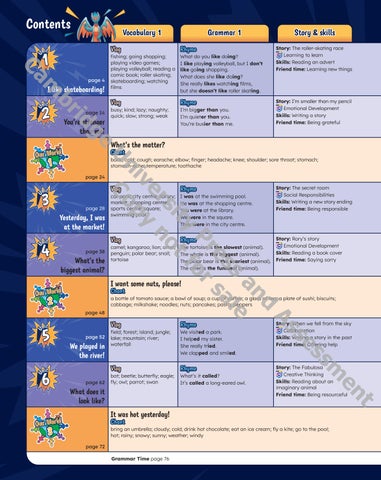
I like skateboarding!
nit
U
2
page 14
id
Story: I’m smaller than my pencil Emotional Development Skills: Writing a story Friend time: Being grateful
back; cold; cough; earache; elbow; finger; headache; knee; shoulder; sore throat; stomach; stomach-ache; temperature; toothache
page 28
Yesterday, I was at the market! nit
page 38
What’s the biggest animal?
Rhyme
car park; city centre; library; market; shopping centre; sports centre; square; swimming pool
I was at the swimming pool. He was at the shopping centre. You were at the library. We were in the square. They were in the city centre.
Story: The secret room Social Responsibilities Skills: Writing a new story ending Friend time: Being responsible
Vlog
Rhyme
Story: Rory’s story Emotional Development Skills: Reading a book cover Friend time: Saying sorry
The tortoise is the slowest (animal). The whale is the biggest (animal). The polar bear is the scariest (animal). The otter is the funniest (animal).
Chant
2
a bottle of tomato sauce; a bowl of soup; a cup of coffee; a glass of tea; a plate of sushi; biscuits; cabbage; milkshake; noodles; nuts; pancakes; pasta; peppers page 48
nit
We played in the river!
Rhyme
field; forest; island; jungle; lake; mountain; river; waterfall
We visited a park. I helped my sister. She really tried. We clapped and smiled.
Vlog
Rhyme
t
What does it look like?
What’s it called? It’s called a long-eared owl.
Story: The Fabulosa Creative Thinking Skills: Reading about an imaginary animal Friend time: Being resourceful
It was hot yesterday!
Our World
Chant
3
en
bat; beetle; butterfly; eagle; fly; owl; parrot; swan
Story: When we fell from the sky Collaboration Skills: Writing a story in the past Friend time: Offering help
m
page 62
Vlog
ss se
page 52
nit
6
camel; kangaroo; lion; otter; penguin; polar bear; snail; tortoise
I want some nuts, please!
Our World
5
I’m bigger than you. I’m quieter than you. You’re busier than me.
Chant
Co
U
Rhyme
busy; kind; lazy; naughty; quick; slow; strong; weak
Vlog
nit
3
U
Vlog
What’s the matter?
page 24
U
Story: The roller-skating race Learning to learn Skills: Reading an advert Friend time: Learning new things
As d an s le es sa Pr r y fo it t rs no ve y ni p
1
U
What do you like doing? I like playing volleyball, but I don’t like going shopping. What does she like doing? She really likes watching films, but she doesn’t like roller skating.
U
Our World
4
Rhyme
ge
You’re stronger than me!
Story & skills
fishing; going shopping; playing video games; playing volleyball; reading a comic book; roller skating; skateboarding; watching films
Vlog
nit
Grammar 1
bring an umbrella; cloudy; cold; drink hot chocolate; eat an ice cream; fly a kite; go to the pool; hot; rainy; snowy; sunny; weather; windy page 72 Grammar Time page 76
Vocabulary 2
Grammar 2
Song
Song
br
m
Ca
building things; cooking; doing my homework; fixing things; helping my friends; spelling in English
What are you good at? I’m good at spelling in English. I’m not good at cooking. What’s she good at? She’s good at building things.
Culture video
I’m more careful than David. Dad’s more boring than me. Tennis is more interesting than hockey.
Culture video
ge
id
boring; careful; clever; dangerous; interesting
Song amazing; enormous; exciting; frightening
What’s the most amazing animal in the world? The polar bear is the most amazing animal in the world.
Culture video
Giant tortoises in the Galápagos Plurilingual activity: Make a poster about an endangered animal Phonics: /ɔ:/
Make an itinerary Time to think: Planning activities Social Responsibility
Create a brochure for a wildlife park Time to think: Characteristics of a wildlife park Creative Thinking
Can I have some (pizza), please? Yes, you can. / No, you can’t.
I didn’t visit a village. She didn’t visit a town.
Culture video
What does it look like? It looks (cool). It’s (thin). It’s got (a moustache).
Culture video
Mountain living in Nepal Plurilingual activity: Play a game Phonics: /t/ /d/ /id/
Butterflies in South Korea Plurilingual activity: Sentence translation Phonics: /fl/
Create a nature map Time to think: The importance of spending time in nature Creative Thinking
Make an animal factsheet Time to think: Animal habitats Critical Thinking
en
beard; curly (hair); fat; moustache; straight (hair); thin
Markets in Morocco Plurilingual activity: Describe a picture Phonics: /ð/
m
Song
Create a Venn diagram Time to think: Identifying differences and similarities Critical Thinking
ss se
city; countryside; road; town; village
Make a hobbies and talents mind map Time to think: Comparing people’s hobbies Critical Thinking
What’s wrong with Zoe? Her (back) hurts. Zoe’s (back) hurts.
Culture video
What do you want on your pizza? I want some (meat). Do you want any (peppers)? Yes, I do. / No, I don’t. He/She doesn’t want any (vegetables).
Song
Family traditions in China Plurilingual activity: Make a mind map of family traditions Phonics: /ə/
Grace wasn’t at the library. Was she at the café? Yes, she was. / No, she wasn’t. Chloe and Tom weren’t at the bookshop. Were they in the square? Yes, they were. / No, they weren’t.
Co
above; below; near; opposite
Ice skating in the Netherlands Plurilingual activity: Make a winter activities chart Phonics: /sk/
Learning situation
As d an s le es sa Pr r y fo it t rs no ve y ni p
U
What’s the matter? You’ve got a cough. I’m sick! I’ve got a (sore throat). She’s/He’s got a (headache). Have you got a (cough)? Yes, I have. / No, I haven’t.
Song
Culture & Communication
t
What do you like doing when it’s (snowy)? When it’s (snowy), I/he/she/they like(s) (drinking hot chocolate). I don’t like (playing in the snow). When it’s (hot), do you like (going to the pool)? Yes, I do. / No, I don’t.
What was the weather like? It was (sunny). It wasn’t (rainy). Was it (hot)? Yes, it was. / No, it wasn’t.
I like skateboarding!
nit
1
U
Lesson 1
Vocabulary
ge
id
br
m
Ca
1 Watch and answer.
1
2
going shopping
3
roller skating
4
skateboarding
5
reading a comic book
6
playing video games
7
playing volleyball
8
fishing
Co
As d an s le es sa Pr r y fo it t rs no ve y ni p
watching films
Act out. Ask and answer.
What are your favourite hobbies? Ask and answer.
Vocabulary
Sports and hobbies
t
Yes! Your turn.
en
Talk Time
m
4
h
1 Listen and repeat. Match the words to the pictures.
Are you roller skating?
4
g
ss se
3
e
d
f
2
c av
U
1
b
a
Lesson 2 Grammar a
2 Look, listen and say. Then match.
1
Ca
What do you like doing at the weekend? I like skateboarding with my friends, And 2 I really like reading comic books.
1
br
m
b
1
d
e
id
But 3 I don’t like going shopping … Not at the weekend!
ge
And your friend, and your friend?
What does she like doing at the weekend? She likes playing volleyball,
U 4
c
As d an s le es sa Pr r y fo it t rs no ve y ni p
And 5 she really likes watching films.
But she doesn’t like roller skating … Not at the weekend! 6
f
Co
2
Write a new verse about you and a friend.
Language focus
What do you like doing? I like playing volleyball, but I don’t like going shopping.
What do you … at the weekend?
What does she like doing at the weekend? She really likes watching films, but she doesn’t like roller skating.
I … with my friends, And I really …
3
But I don’t … not at the weekend.
And my friend? What does … at the weekend?
ss se
He/She … really … But … not at the weekend!
m
Watch. In groups, say what you like and don’t like doing at the weekend.
and hobbies.
What do you like doing at the weekend?
about what my friends and I like doing.
2
Talk Time
t
I like fishing with my friends. But I don’t like skateboarding.
en
3
I can name sports
I can ask and answer
Grammar
5
Lesson 3 Our stories 4 Listen and read. What does Yashka like doing?
1
m
Ca id
br
inspired by Maksym, 11, Ukraine
ge
One day, all the rabbits shout, ‘There’s a roller skating race today!’ Yashka hears them. ‘I like roller skating, but I can’t skate quickly!’ he says. Yashka goes to the race, but he falls again and again. ‘I can’t do this!’ he says. After the race, a famous white rabbit comes to Yashka. She asks, ‘Would you like lessons with me?’ For a year, the other rabbits don’t see Yashka. ‘Where is he?’ they ask. ‘I don’t know!’ says the bear.
Co
As d an s le es sa Pr r y fo it t rs no ve y ni p
U
Yashka practises roller skating with the famous white rabbit. Summer comes again and the rabbits shout, ‘There’s a roller skating race today!’ Everyone’s happy to see Yashka. In the race, Yashka doesn’t fall. This time, he wins the race! ‘I can roller skate quickly now!’ he says. After the race, everyone wants to talk to Yashka. They stand near him and listen quietly. ‘I really like roller skating and I really like learning!’ Yashka says. ‘When we practise and practise, we can all learn new things.’
en
m
ss se
t
2
Talk Time
1 6
Story
Ask and answer.
What do you like about the story?
2
Which sports do you like?
3
Do you like races? Why or why not?
Learning to learn: Taking initiative to improve own learning
Lesson 4 Story and skills
1
1
4 Read or listen to the story again.
Ca
Say the sentences in order (1–5). a The famous white rabbit asks
br
m
Yashka a question.
b Yashka wins the race.
‘When we practise, we can learn new things!’ Find out which new things your friends want to learn.
ge
id
c Everyone listens to Yashka.
Friend Time
d Yashka practises and practises.
2
As d an s le es sa Pr r y fo it t rs no ve y ni p
U
e Yashka falls in the race.
5 Listen and read.
Co
What type of text is this?
Do you like roller skating?
3
Read and answer the questions.
1
What’s the advert for?
Then come and join the
2 Where is it?
Green Street Roller skating Day
3 When is it?
at Green Street Park on Saturday, 24 March at 2 o’clock.
4 What activities can you do at the event?
5 How much is it?
Try a roller skating lesson, run a race or have fun at the roller skating dance party! It’s free! (but bring money for drinks and snacks)
Which activities do you want to do at Green Street? Ask and answer. Talk Time
Skills
t
Me too! I also like roller skating.
en
I really like running races. They’re fun! And you?
m
4
ss se
Everyone’s welcome!
7
Lesson 5 Song and vocabulary
6 Look and listen. Then match. Listen again and check.
1
Ca
What are you good at? Can you tell me?
b
a
I’m good at helping my friends. 1
m
br
And I’m good at 2 spelling in English – I practise every day.
id
I’m really good at 3 doing my homework,
Even when I want to play!
d
ge
c
What’s Hana good at? Can you tell me?
U
She’s good at 4 building things.
As d an s le es sa Pr r y fo it t rs no ve y ni p
And she’s good at 5 fixing things, too.
She’s really good at cooking. 6
f
e
Co
She can make great food for you!
What kind of person are you? Answer the quiz and find out. What do you like doing after school? a
2
b
fixing things
spelling in English
c
cooking for my family
c
helping my friends
What do you like doing at the weekend? a
b
doing my homework
ss se
building things
m
b You are a motivated person.
1
a You are a creative person.
2
c You are a nice person.
Results In pairs, guess your partner’s answers from Activity 2.
You like fixing things and helping friends. You are a creative and nice person!
8
Vocabulary
Free-time activities
No, I don’t like fixing things.
t
Talk Time
en
3
Lesson 6 Grammar
1
6 Listen again. What’s Hana
Language focus
Ca
really good at?
Read the dialogue and say. In pairs, act out.
id
br
m
2
ge
What are you 1
1 7
What are you good at? I’m good at spelling in English. I’m not good at cooking. What’s she good at? She’s good at building things.
at, Amir?
U
Co
As d an s le es sa Pr r y fo it t rs no ve y ni p
I’m good 2 playing video games, but I’m 3 good at fixing things. What about you, Nora?
I’m good at roller skating, and I’m really good at 4
3
Think about you and a friend from class. Then complete. … is good …
I’m not …
… is good …
I’m really …
… is really …
Talk Time
I’m good at cooking, but I’m not good at spelling in English. My best friend Ana’s really good at skateboarding.
activities.
t
What are you and your friend good at?
I can name free-time
en
and answer.
Watch. In groups, ask
Are you good at hopping on one leg? How many times can you hop on one leg in 60 seconds?
m
3
I’m good …
Fun Time
ss se
4
my homework.
I can talk about things
me and my friends are (not) good at.
Grammar
9
Lesson 7 Culture
Ice skating in the Netherlands
Ca
4 Watch. What types of clothes are the people wearing?
2
4 Watch again. Correct the sentences.
1
id
br
m
1
Mila loves the winter because it’s warm.
ge
2 Many Dutch people don’t really like ice skating.
U
3 People go ice skating at the park.
Co
As d an s le es sa Pr r y fo it t rs no ve y ni p
4 Koek-en-zopie is a cold drink and snack.
Talk Time
3
10
Culture
Do you go ice skating? How often?
What special drinks or snacks are there in your country?
Ice skating in the Netherlands
t
2
Sometimes people in the Netherlands go ice skating on the frozen canals. Do you want to try?
en
What’s winter like where you live?
Fact Time
m
1
Ask and answer.
ss se
3
Lesson 8 Communication
1
Winter activities
Ca
In groups, say activities that people do in the winter where you live.
Make a chart of the things you like doing in winter. Share your chart with your group.
ge
2
id
br
m
1
U
Spanish
English
French
As d an s le es sa Pr r y fo it t rs no ve y ni p
patinaje sobre hielo
patinage sur glace
hacer sopa
make soup
préparer une soupe
jugar al hockey sobre hielo
play ice hockey
jouer au hockey sur glace
Co
ice skating
Flying phonics
8 Listen and say.
ss se
3
en
m
ingg isn’t atin skat Ice sk aryy when you scar super sc ol.. hool scho practise after sc
t
4
Can you find other words in the unit that have the same sound? Talk Time
Communication
Winter activities and /sk/
11
Lesson 9 Review
1
Read about Dilek and his family. Correct the sentences.
During the week I’m very busy, but after school 1 I likes like playing football with my friends. We play on a team and we’re very good! 2 I also really like cook and do my English homework. 3 My older sister doesn’t likes playing football like me, but she 4 really like go shopping with her friends. And my dad? 5 Well, he really like build and fix things!
ge
id
br
m
Ca
What do my family and I like doing?
As d an s le es sa Pr r y fo it t rs no ve y ni p
U
Read the signs and match.
Co
2 1
Kids’ skateboarding here every Wednesday 2 afternoon!
b
Quiet please! I’m doing my homework now.
3
c
en
m
ss se
Love reading comic books? Look at these!
a
12
Review
t
Quiz
3
5 Watch and do the quiz!
Lesson 10 Learning situation
1
1
Ca
You want to know more about your new classmates. Which hobbies and talents have they got? Make a hobbies and talents mind map.
br
m
2
Step 1: Think Think about your talents.
ge
•
Think about your hobbies.
id
•
Step 2: Find out
Ask a friend about their hobbies and
U
•
Step 3: Create
Co
•
Think of your friends and family and their hobbies. Are they similar? Are they different?
As d an s le es sa Pr r y fo it t rs no ve y ni p
talents. Make notes.
Time to Think
Make a mind map.
My friend’s mind map
Hobbies
Hobbies
Talents
Talents
I like …
en
I’m really good at …
m
I’m good at …
ss se
My mind map
t
3
6 Watch. Then present your mind map.
Learning situation
13
You’re stronger than me!
nit
U
2
Lesson 1
Vocabulary
ge
id
br
m
Ca
1 Watch and answer.
1
b
slow
3
strong
4
weak
5
kind
6
naughty
7
busy
8
lazy
1 Listen and repeat. Match the words to the pictures.
Which adjectives describe you and your family? Ask and answer. Talk Time
XXX XXX Vocabulary
Adjectives to describe people
t
It’s ‘lazy’!
en
14
m
Play the Opposites Game. What’s the opposite of ‘busy’?
4
h
g
ss se
3
e
d
f
2
av
2
As d an s le es sa Pr r y fo it t rs no ve y ni p
quick
c
Co
1
U
a
Lesson 2 Grammar
1
2
2 Listen and answer. Who’s busier?
Listen again and check.
Ca
Arina
m
I’m big. I’m bigger than you.
br
And I’m stronger than you, too.
That’s true! You’re strong, but I’m quicker than you.
id
And I’m quieter than you, too.
ge
That’s true! I’m loud. I’m louder than you. And I’m busier than you, too.
Jack
U
That’s true! You’re busy. You’re busier than me.
As d an s le es sa Pr r y fo it t rs no ve y ni p
And you’re kinder than me, too. But you’re kind, too.
Co
Aww. Thank you!
2
Write a new verse about you and a friend.
I’m … . I’m … than you, too.
Talk Time
m
a friend.
Watch. Describe you and
ss se
But you’re … . You’re … than me. That’s true!
2
3
I’m bigger than you. I’m quieter than you. You’re busier than me.
I’m … . I’m … than you. That’s true!
3
Language focus
en
I can describe people.
I’m stronger than you. But you’re quicker than me.
t
I can compare myself
to other people.
That’s true! Grammar
15
Lesson 3 Our stories 4 Listen and read. Why is it a special day for Ash?
1
m
Ca id
br
inspired by Ash, 10, India
ge
The sun wakes me up. I open my eyes and I look around. Everything’s different! ‘What’s happening?’ I ask. ‘Is my bedroom bigger? Or am I smaller?’
As d an s le es sa Pr r y fo it t rs no ve y ni p
U
I climb out of bed, but it isn’t easy! I’m smaller than my pencil and my bag. I go to the garden. I’m shorter than the flowers! I see my mum, dad and our cat.
Co
‘Where’s Ash?’ my mum asks. I shout, ‘Mum, Dad … Hello!’
They can’t hear me, but the cat can – it runs towards me. It’s very quick and I’m scared. What can I do? I see a tall flower and I climb it. I hide in the flower. I’m very quiet. The cat sits next to the flower for a long time. I close my eyes and go to sleep. When I wake up, I feel different. I’m taller than the flowers and the birds! I’m big again! I run to my mum and dad.
‘Happy Birthday, Ash!’ they say.
‘Thank you!’ I say. ‘I love you so much.’
en
m
ss se
t
2
Talk Time
1 16
Story
Ask and answer.
What types of dreams do you have?
2
How often do you dream?
Emotional Development: Recognising and understanding emotions
Lesson 4 Story and skills
1
4 Read or listen to the story again.
Ca
Answer the questions. 1
Where’s Ash at the start of the story?
m
2 What’s Ash smaller than?
br
3 What’s scary?
id
4 Where does Ash hide?
2
Friend Time ‘Thank you!’ I say. Why is Ash grateful? Find out what your friends are grateful for.
ge
5 What happens when Ash wakes up again?
U
Imagine you are Ash. Say new words to replace the underlined words.
I wake up in my living room. I’m smaller than the sofa. I see my parents. They’re coming in. ‘Oh no!’ I shout.
They’re very big. I hide in the bathroom and close my
1
Co
As d an s le es sa Pr r y fo it t rs no ve y ni p
2
eyes. When I open my eyes, I’m big again. I see my sister. ‘Let’s play basketball!’ I say.
4
Talk Time
In groups, share your story.
That’s a brilliant story!
en
Skills
t
I wake up in my living room. I’m smaller than the lamp …
m
Make a new story about you. Use the example from Activity 2 to help you.
ss se
3
17
Lesson 5 Song and vocabulary
5 Look and listen. Then match. Listen again and check.
1
Ca
My dad’s very 1 clever,
a
b
m
He likes reading books.
br
But my mum’s more 2 interesting, She loves skateboarding!
id
Dad says skateboarding is 3 dangerous.
c
ge
He’s more 4 careful than my mum.
Mum says books are 5 boring,
U
But Dad thinks that they’re fun!
d
As d an s le es sa Pr r y fo it t rs no ve y ni p
Co
2
e
Read and say. Use the words (1–5) from Activity 1. 1
I always wear a helmet when I ride my bike.
2 My sister’s really good at maths and English. 3 Our cat likes climbing very tall trees. 4 Tom’s got a lot of cool hobbies. 5 I don’t like watching football.
3
Talk Time
Match and say for you.
Adjectives to describe people
s ister cousin pet grandpa grandma
t
Vocabulary
brother
en
18
dad
m
My brother’s clever. He’s really good at learning new things.
mum
ss se
boring careful interesting dangerous clever
Really? My grandma is, too.
Lesson 6 Grammar
1
Language focus
5 Listen again. Who’s more
careful than Mum?
br
m
Read the blog post and say.
David’s
6
I’m more careful than David. Dad’s more boring than me. Tennis is more interesting than hockey.
Ca 2
2
id
Hi everyone,
ge
blog!
Today, we’re talking about family and friends. What are your family and friends like? Well, my brother Hugo has got a lot of
U
hobbies. He roller skates and skateboards. He always wears a careful than me. And my dad? Well, he doesn’t
As d an s le es sa Pr r y fo it t rs no ve y ni p
helmet. He’s 1
like doing much. He’s more boring 2
Hugo. But my friend
Co
Sara likes doing a lot of cool things. She reads, plays the guitar and learns languages. She’s 3
3
Look at the chart. Make sentences. Hobby
Adjective
Hobby
interesting / boring
interesting 4
all of us!
Fun Time Race! Think of words that start with each letter of the word CLEVER.
boring / dangerous
Talk Time
Tennis is more boring than football!
t
to a friend.
Watch. Say your sentences
I can describe people.
en
3
m
4
ss se
dangerous / interesting
I can compare people and hobbies. No! Tennis is more interesting than football. Grammar
19
Lesson 7 Culture
Family traditions in China
Ca
4 Watch. Who do people in China visit at Lunar New Year? 4 Watch again. Say true or false. Correct the
false sentences.
ge
id
2
br
m
1
1
People celebrate with a family dinner.
U
2 Many children receive red hats during
As d an s le es sa Pr r y fo it t rs no ve y ni p
Lunar New Year.
3 Families have got special traditions.
Co
4 Po Chun’s family sometimes takes a family photo at Lunar New Year.
Talk Time
3
20
Culture
What interesting family traditions have you got?
What are some special dances in your country? Family traditions in China
t
2
In the Chinese calendar, each year is named after one of 12 animals. Which animal are you?
en
How often do you go to big family dinners?
Fact Time
m
1
Ask and answer.
ss se
3
Lesson 8 Communication
2
Family traditions
Ca
In groups, talk about your family traditions.
Make a mind map of your family traditions. Share your mind map with your group.
ge
id
2
br
m
1
Grandma’s birthday
Co
As d an s le es sa Pr r y fo it t rs no ve y ni p
U
Día de la Madre Dia das Mães Mother’s Day
sing Happy Birthday
open presents
take photos
comer tarta de chocolate comer torta de limão
Flying phonics
ss se
3
7 Listen and say.
en
m
ther celebrate together We cele er!! famiily dinner with a fam
t
4
Can you find other words in the unit that have the same sound? Talk Time
Communication
Family traditions and /ə/
21
Lesson 9 Review
1
Look and make comparisons. Say.
br
m
Ca Mask Boy
2
big
3
interesting
4
naughty
5
careful
6
strong
1
quick
2
big
3
interesting
4
naughty
5
careful
6
strong
As d an s le es sa Pr r y fo it t rs no ve y ni p
quick
Co
1
U
2
ge
id
Star Girl
8 Listen and answer.
My sister 1 Name:
2 How old is she?
3 She is funny and
.
en
m
ss se
4 Her favourite subject at school:
22
Review
t
Quiz
3
5 Watch and do the quiz!
Lesson 10 Learning situation
1
Time to Think
You want to tell a new pupil about what you are like. Describe yourself.
m
Ca
Create a Venn diagram with information about you and a friend.
Think about you and the people you know. How are they similar? How are they different?
ge
id
br
2
2
Step 1: Think
Think about things you like and don’t like about yourself.
As d an s le es sa Pr r y fo it t rs no ve y ni p
U
•
Step 2: Find out •
Ask a friend about things they like and don’t like
Co
about themselves. •
Do you and your friend have any similarities?
Step 3: Create •
Make a Venn diagram.
Sara and Charlie’s Venn diagram strong
interesting
naughty
clever
kind
lazy
loud
en
m
ss se
slow
happy
t
3
6 Watch. Then present your Venn diagram.
Learning situation
23
What’s the matter?
Our World
Ca
1
br
m id
shoulder
3
back
4
elbow
5
finger
6
knee
7
stomach-ache
8
earache
9
toothache
ge
2
12 cough 13 temperature 14 sore throat
k
Co
11 cold
j
As d an s le es sa Pr r y fo it t rs no ve y ni p
U
10 headache
3
2 Listen and check. Say.
Close your book. How many words can you remember in one minute? Talk Time
Vocabulary
Illnesses and parts of the body
t
1 Listen and say. Match.
en
2
m
Look. Where are they? What can you see?
ss se
24
g
stomach
4
c
Can you find me?
1
1
a
b
Lesson 1 Vocabulary
1
Ca
d
m
f
h
ge
id
br
e
Co
As d an s le es sa Pr r y fo it t rs no ve y ni p
U i
l
m
n
en
m
ss se
t
Find and say
the mistakes in the picture.
25
Lesson 2 Grammar 3 Listen. What’s the matter?
1
ge
id
br
m
Ca As d an s le es sa Pr r y fo it t rs no ve y ni p
U
I’m sick. I’ve got a sore throat.
Co
Language focus
4
Oh, dear. Have you got a cough?
What’s the matter? I’m sick! I’ve got a (sore throat). You’ve got a (cough). She’s/He’s got a (headache). Have you got a (cough)? Yes, I have. / No, I haven’t.
5 Listen and number. Listen again and check. Say.
2 a
b
c
d
Look at pages 24–25. Choose an illness and act it out.
26
Grammar
No, I haven’t. I’ve got an earache.
t
What’s the matter? Have you got a cold?
en
Talk Time
m
ss se
3
Lesson 3 Grammar
1
6 Listen. What’s wrong with the children?
1
2
id
br
m
Ca
1
Zoe
Max
ge
3
U
Language focus
As d an s le es sa Pr r y fo it t rs no ve y ni p
What’s wrong with Zoe? Her (back) hurts. Zoe’s (back) hurts.
Co
2
Fred
6 Listen again. In pairs, make and say true or
false sentences.
Zoe’s Max’s Fred’s
knee
elbow
shoulder
finger
stomach
hurts.
doesn’t hurt.
In groups, act out. Ask and answer. Does his back hurt, too?
en
What’s wrong with Pepe?
m
Talk Time
back
ss se
3
7
t
His knee hurts.
No, it doesn’t.
Grammar
27
Yesterday, I was at the market!
nit
U
3
Lesson 1
Vocabulary
ge
id 2
sports centre
3
swimming pool
4
shopping centre
5
car park
6
market
7
square
8
library
f
Play the Guess Where Game.
Which places do you like going to? Ask and answer.
Vocabulary
Places in a town
t
Talk Time
It’s the sports centre!
en
28
h
1 Listen and repeat. Match the words to the pictures.
You can play volleyball here.
4
g
m
3
e
d
ss se
2
Co
city centre
c
As d an s le es sa Pr r y fo it t rs no ve y ni p
U
1
b
a
av
br
m
Ca
1 Watch and answer.
1
Lesson 2 Grammar
3
2 Listen and answer. Where was Zoe yesterday?
1
You were at the library, reading just for fun.
m
Ca
Yesterday, I was at the swimming pool, swimming in the sun.
br
Taji was at the shopping centre, shopping all day.
Zoe was at the sports centre, watching people play.
id
They were in the city centre, walking here and there.
ge
We were all together, laughing in the square!
U
Language focus
As d an s le es sa Pr r y fo it t rs no ve y ni p
I was at the swimming pool. He was at the shopping centre. You were at the library. We were in the square. They were in the city centre.
Co
2
Look and make sentences. My dad
Me
My sister and I
We …
I can name places
in a town.
en
Talk Time
m
Watch. In groups, play the Memory Game. 2
ss se
I was …
My friends
They …
He was …
3
3
t
Yesterday, I was at the library.
Yesterday, you were at the library. I was in the city centre.
I can say where people
were in the past.
Grammar
29
Lesson 3 Our stories 4 Listen and read. What’s in the old box?
1
m
Ca id
br
inspired by Aria, 10, Italy ‘I think it’s hungry,’ says Violet.
‘I’d like to read this book!’ says Jordan.
‘Let’s run!’ Jordan was scared.
He takes the book and suddenly the bookcase opens!
‘But where?’ Alex was scared, too.
ge
Violet, Alex and Jordan were at the library.
U
As d an s le es sa Pr r y fo it t rs no ve y ni p
‘Behind the door. It’s open!’ says Violet.
‘A secret room!’ says Jordan.
‘Look!’ says Violet. She finds an old box behind the door.
‘Let’s go in!’ says Alex.
Co
‘Is it safe?’ asks Violet.
‘Gold coins!’ says Jordan.
Some old books were in a dirty bookcase in the room.
‘Wow! I want to get a new skateboard,’ says Alex.
‘I can’t open the door!’ says Violet.
‘Hmm. Let’s take the coins to a grown-up,’ says Jordan.
‘Don’t worry!’ says Alex. ‘I love it here!’
‘Look! Here’s a door,’ says Violet. ‘We can go home …’
‘Look! There’s a hall,’ says Jordan. A spider with long black legs and big eyes was in the hall. ‘Agghhhh!’ they shout.
en
m
ss se
t
2
Talk Time
1 30
Story
Ask and answer.
Are you scared of spiders?
2
What things scare you?
Social responsibilities: Understanding responsibilities within a social group
Lesson 4 Story and skills
1
3
4 Read or listen to the story again.
Ca
Correct the words in bold. 1
Violet, Alex and Jordan were at
br
m
the sports centre yesterday.
2 Some old library books and a dirty
id
bookcase were in a secret car park.
ge
3 A zebra with long black legs and big
Friend Time ‘Let’s take the coins to a grown-up.’ What do you do when you find things that are not yours?
eyes was in the hall.
U
As d an s le es sa Pr r y fo it t rs no ve y ni p
4 An old shoe was behind the door.
5 Alex wants to get a new basketball.
Co
2
Copy the sentences. Change the underlined words to create a new ending to the story.
An old box was behind the door. ‘Gold coins!’ says Jordan.
5
‘Wow! I want to get a new skateboard,’ says Alex.
‘Hmm. Let’s take the coins to a grown-up,’ says Jordan. ‘Look! Here’s a door,’ says Violet. ‘We can go home …’ Talk Time
In pairs, share your new story ending.
m
What a great story!
en
And when they open the door, they see …
ss se
3
t Skills
31
Lesson 5 Song and vocabulary
5 Look and listen. Then match. Listen again and check.
1
Ca
Kitties in the city,
m
All around the town.
br
Where was Grace yesterday? Was she 1 opposite the café?
id
No, she wasn’t. Try again!
Was she near the square?
ge
2
Yes, she was. Right there!
U
All around the town.
Where were Chloe and Tom yesterday? Were they 3 below the library?
No, they weren’t. Try again!
Were they 4 above the swimming pool? Yes, they were. That’s so cool! c
As d an s le es sa Pr r y fo it t rs no ve y ni p
a
Kitties in the city
b
d
Co
2
Look and say where the cats are. Use the words (1–4) from Activity 1.
a
ss se
b
c
en
m
Talk Time
Look at the picture again. Play the Guess Where Game. Are you above the car park?
32
Vocabulary
Prepositions of place
Yes, I am.
t
3
Lesson 6 Grammar
1
5 Listen again. Was
Ca
Grace near the square? Look at the chart and make sentences.
br
m
2
ge
id
Last week
Language focus
6
Grace wasn’t at the library. Was she at the café? Yes, she was. / No, she wasn’t. Chloe and Tom weren’t at the bookshop. Were they in the square? Yes, they were. / No, they weren’t.
Friday
Saturday
Sunday
Co
As d an s le es sa Pr r y fo it t rs no ve y ni p
U
Jack
3
Sara
Fun Time
1
Jack / sports centre / last Friday
2 Sara / city centre / last Saturday
3 Jack and Sara / library / last Saturday
Make a word puzzle with a word from this unit. Swap it with a friend and guess!
4 Jack and Sara / swimming pool / last Sunday
No, he wasn’t. But he was at the market on Thursday.
I can talk about
t
Was your dad at the market last weekend?
things are.
en
Watch. In groups, talk about your family’s activities last weekend. 3
Talk Time
I can talk about where
m
4
Look at the chart in Activity 2 again. Ask and answer.
ss se
3
where people were in the past.
Grammar
33
Lesson 7 Culture
Markets in Morocco
Ca
4 Watch. What things can you buy at the market?
2
4 Watch again. Choose the correct word.
br
m
1
Hassan and his family buy spices /
id
1
ge
vegetables they need for cooking.
U
2 People use tagines for food / drinks.
As d an s le es sa Pr r y fo it t rs no ve y ni p
3 At the market, people make hats / leather shoes.
Co
4 The prices of things change / don’t change.
Talk Time
3
34
Culture
What things do you like buying at markets?
Can you buy spices, tagines or leather shoes at the markets where you live?
Markets in Morocco
t
2
Jemaa el-Fnaa is a famous market in Morocco. Do you want to go?
en
Do you like going to markets?
Fact Time
m
1
Ask and answer.
ss se
3
Lesson 8 Communication
3
Markets
Ca
What things can you buy at the markets where you live? In groups, ask and answer. Look at the picture. Describe what you see.
ge
2
id
br
m
1
Quanto custa?
Co
As d an s le es sa Pr r y fo it t rs no ve y ni p
U They’re £20.
Flying phonics
ss se
3
7 Listen and say.
m en
er leather eree any leath ther Are th e! ose! thos es?? Oh no, not th thes cloth clo
t
4
Can you find other words in the unit that have the same sound? Talk Time
Communication
Markets and /ð/
35
Lesson 9 Review
1
In pairs, read and play the game.
1 Name as
3
m
Ca
2
many places as you can from Lesson 1. Say, then check.
Go to page 32. Say where the cats were.
ge
id
br
Say where you were last weekend.
4
Guess where your partner’s family was last weekend. Ask and answer.
U
As d an s le es sa Pr r y fo it t rs no ve y ni p
8 Where was Jakub on each day? Listen and answer.
2 a
Co
Monday
c
Tuesday
Wednesday
b
d
en
m
ss se
36
Review
t
Quiz
3
5 Watch and do the quiz!
Lesson 10 Learning situation
1
A friend is coming to visit you from another country. What places can you visit where you live?
Time to Think
br
m
Ca
Plan and make an itinerary for your friend’s visit.
Why is it important to show your friend a good time? Think about what you can do to prepare for your friend’s visit.
ge
id
2
3
Step 1: Think
What things does your friend like doing?
•
Which places do they like going to?
As d an s le es sa Pr r y fo it t rs no ve y ni p
U
•
Step 2: Find out
Which activities can you do for free where you live?
•
Which activities cost money?
Co
•
Step 3: Create •
Make an itinerary.
Our itinerary Saturday
Sunday
Activity 2 – half past one Visit a famous market
Activity 3 – 2 o’clock Eat ‘paella’ for lunch
Activity 3 – 3 o’clock Go to the shopping centre
Activity 4 – half past four Take a free walking tour
Activity 4 – 5 o’clock Take a photo in the square
Activity 5 – half past seven Go home and watch films
Activity 5 – 7 o’clock Go back home
en
Activity 2 – 12 o’clock Visit the history museum
m
Activity 1 – 11 o’clock Go to the beach
ss se
Activity 1 – 10 o’clock Go to the city centre
t
3
6 Watch. Then present your itinerary.
Learning situation
37
What’s the biggest animal?
nit
U
4
Lesson 1
Vocabulary
ge
id
br
m
Ca
1 Watch and answer.
1
snail
3
tortoise
4
kangaroo
5
camel
6
polar bear
7
penguin
8
otter
1 Listen and repeat. Match the words to the pictures.
Which animals can you see in your country? Ask and answer. Talk Time
Vocabulary
Animals
t
It’s a kangaroo!
en
38
m
Describe and guess the animal. This animal is brown and has got a long tail.
4
h
g
ss se
3
e
d
f
2
av
2
Co
lion
c
As d an s le es sa Pr r y fo it t rs no ve y ni p
U
1
b
a
Lesson 2 Grammar
2 Look and listen. Then match.
1
b
Listen again and check.
Ca
Now listen closely to the clues.
m
a
4
br
Can you say which animal is who?
id
Oh! This animal is 1 the slowest – it doesn’t move very fast.
ge
And this animal is 2 the biggest – look at it walk past.
d
c
As d an s le es sa Pr r y fo it t rs no ve y ni p
U
Oh! This animal is 3 the scariest – listen to it roar.
Co
And this animal is 4 the funniest – it makes me laugh more!
2
Language focus
Look and make sentences. 1 The snail is 2 The kangaroo is
3 The polar bear is
5 The lion is
The tortoise is the slowest. The whale is the biggest. The polar bear is the scariest. The otter is the funniest.
animal in the safari park. (small) animal in Australia. (cool)
animal in the Arctic. (strong)
animal in the sea. (pretty) animal in the safari park. (loud)
3
Talk Time
The elephant is the weakest animal in the jungle.
I can describe
animals.
t
Watch. In pairs, play the Crazy Animal Game. 2
en
m
ss se
4 The penguin is
3
I can compare three
No way! It’s the strongest!
or more things.
Grammar
39
Lesson 3 Our stories 4 Listen and read. Which animals swim together?
1
m
Ca id
br
inspired by Kasia, 11, Poland The other animals are happy – they can swim!
ge
The animals on Rocky Island play together. But not the lion, Rory. One morning, Rory swims in the sea.
One day, Rory comes back. The animals hide. ‘I’m sorry,’ says Rory. ‘I wasn’t kind. I don’t want to eat you now. Let’s share the island.’
U
‘Can we swim?’ asks the tortoise.
‘Good idea!’ says the tortoise.
Co
As d an s le es sa Pr r y fo it t rs no ve y ni p
‘But Rory always tries to eat us!’ says the otter. ‘He’s the biggest and strongest animal on the island.’ The tortoise smiles and walks to the water.
So, Rory and the animals swim in the sea together. Everyone has fun. They are one big happy family.
Rory sees the tortoise. ‘You can be my lunch!’ he laughs. ‘First, listen to my story,’ the tortoise says. ‘On our island, there’s a cave and in it, there’s a room. Go in. Your family are behind the door.’ Rory thinks. He would like a family. So, he walks to the cave. He goes into the black room and closes the door.
en
m
ss se
Talk Time
1 40
Story
t
2
Ask and answer.
Do you think Rory’s family are behind the door?
2
Why do you think Rory is kind now?
Emotional Development: Showing empathy for the feelings of others
Lesson 4 Story and skills
1
4
4 Read or listen to the story again.
Ca
Say the correct word. 1
Rory’s the biggest / smallest animal on the island.
m
2 One day, the tortoise / otter tells Rory a story.
br
3 In the story, Rory’s family are behind
id
a door / cave.
Friend Time
ge
‘I’m sorry,’ says Rory. ‘I wasn’t kind.’ When do you say sorry?
4 When Rory’s in the cave, the other animals are scared / happy.
U
As d an s le es sa Pr r y fo it t rs no ve y ni p
5 When Rory comes back, the animals eat / swim together.
Co
2
Look and read the book cover. What’s the story about? Rory opens the door, but he is lost. He sees a big city. Everyone is looking at him and laughing. But then one boy comes to Rory, and everything changes …
Talk Time
Lost in the city! ‘Exciting!’
‘Fun!’
‘Beautiful!’
Read and answer the questions.
1
What’s Rory’s problem?
2 Where’s Rory?
3 What’s everyone doing? 4 What do you think happens next?
t
I love ‘Harry Potter’, too!
en
My favourite book is ‘Harry Potter’. It’s the coolest book out of all the books I like!
m
In groups, talk about your favourite book.
ss se
4
RORY:
3
Skills
41
Lesson 5 Song and vocabulary
5 Look and listen. Then say. Listen again and check.
1
Ca
amazing enormous exciting frightening
m
What’s the most 1
animal in the world?
br
The polar bear! It can swim 50 km in one day.
id
The polar bear is my favourite animal!
ge
What’s the most 2
animal in the world?
The tiger! You can hear it roar from far away.
U
The tiger is my favourite animal.
animal in the world?
As d an s le es sa Pr r y fo it t rs no ve y ni p
What’s the most 3
The whale! It can be 30 m long.
Co
The whale is my favourite animal! What’s the most 4
animal in the world?
The kangaroo! It can jump 10 m in one jump. The kangaroo is my favourite animal!
6 Listen and choose. Then listen again and check.
2 1
He doesn’t like polar bears. They’re amazing / frightening.
3 The tortoise is bigger than her cat. It’s enormous / exciting.
4 Lions work together to find food. They’re amazing / enormous.
Talk Time
In pairs, play the Beep Game.
t
I think camels are – BEEP! They can live a long time without water.
42
en
3
m
ss se
2 Freddie watched camels run. It was exciting / frightening.
Vocabulary
Adjectives
Amazing!
Lesson 6 Grammar
1
5 Listen again. What’s the most
Language focus
Ca
exciting animal in the world? Read and say.
7
What’s the most amazing animal in the world? The polar bear is the most amazing animal in the world.
Welcome to the Amazing Animals Safari Park! What’s 1 most dangerous animal in the park? It’s the hippo! Do you like monkeys? They do lots of funny things. They’re the 2 exciting animal 4 in the park. And the lions? They’re 3 frightening animal in the park. Listen to them roar! What’s your favourite animal? Explore and find out!
ge
id
br
m
2
4
Co
As d an s le es sa Pr r y fo it t rs no ve y ni p
U
3
Look and make sentences with ‘the most’. beautiful boring dangerous exciting interesting
Fun Time Who can make the most frightening face in your class?
3
Talk Time
animals.
t
What’s the most dangerous animal in the world?
I can describe
en
and answer.
Watch. In groups, ask
m
ss se
4
I think the lion is the most dangerous animal in the world. It’s got enormous teeth!
I can compare three
or more things.
Grammar
43
Lesson 7 Culture
Giant tortoises in the Galápagos
Ca
4 Watch. What does ‘Galápago’ mean?
2
4 Watch again. Say true or false. Correct the
br
m
1
There are a lot of animals in the Galápagos that live in the wild.
ge
1
id
false sentences.
2 Giant tortoises are one of the smallest land reptiles in the world.
U
As d an s le es sa Pr r y fo it t rs no ve y ni p
3 Many people on the island protect the tortoises. 4 The giant tortoises help plants grow.
Co Talk Time
3
44
Culture
What’s the biggest wild animal in your country?
Do people protect any of the animals in your country?
Giant tortoises in the Galápagos
t
2
Giant tortoises can live for a year without food or water. How long can you live without food or water?
en
Do tortoises live in the wild in your country?
Fact Time
m
1
Ask and answer.
ss se
3
Lesson 8 Communication
4
Endangered animals where I live
Ca
Work in groups. Which wild animals can you protect where you live? In pairs, choose an animal and make a poster.
ge
2
id
br
m
1
As d an s le es sa Pr r y fo it t rs no ve y ni p
U Co
Where does it live? España, Portugal
What does it eat? conejos
Iberian lynx CUT OUT
Why do we need to protect the Iberian lynx? pérdida de su hábitat natural
What can we do? proteger su hábitat natural
Flying phonics
8 Listen and say.
ss se
3
en
m
small or isess can be sma toise orto Tor s, and they are mouus, ormo enor en nt!! rtant importa all impo
t
4
Can you find other words in the unit that have the same sound? Talk Time
Communication
Endangered animalsCommunication where I live and /ɔ:/ XX
45
Lesson 9 Review
Look and make sentences with the adjectives.
1
br
m
Ca 9 years old
old
2
big
3
hungry
4
fast
5
dangerous
ge
1
1.2 m tall
eats 5–10 kg per day
1
old
2
big
3
hungry
4
5
Terry the tortoise
27 years old
103 years old
1
old
2
big
3
hungry
fast
4
fast
dangerous
5
dangerous
3.1 m tall eats 8–12 kg per day
1.3 m long eats 1–2 kg per day
Co
As d an s le es sa Pr r y fo it t rs no ve y ni p
U
2
Colin the camel
id
Lucy the lion
Choose the correct word for each sentence.
kangaroo
1
This small animal can hide inside its shell.
lion
otter
2 This animal stands on two legs and is very good at jumping.
penguin
3 This animal is big and strong and lives in the cold.
polar bear
ss se snail
en
m
46
Review
t
Quiz
3
5 Watch and do the quiz!
Lesson 10 Learning situation
1
Time to Think
m
Ca
Imagine you visit a wildlife park with your class. Why is it important to have wildlife parks? Create a brochure about a wildlife park.
What makes a good wildlife park?
id
br
2
4
ge
Step 1: Think
What information do you want in your brochure?
•
Which animals do you want to include?
U
•
•
Can you find different facts about your animals?
Co
Step 3: Create •
As d an s le es sa Pr r y fo it t rs no ve y ni p
Step 2: Find out
Make your wildlife park brochure.
O PE N LAN D
CUT OUT
en
m
Welcome to Open Land Wildlife Park! Our wildlife park protects wild animals and teaches people about them. It’s a safe home for amazing animals from around the world. Come and learn about the world’s most beautiful animals!
ss se
This is an orangutan! It’s from Borneo. These orangutans are endangered. Many are losing their homes, but we are trying to give them a safe place to live!
Wildlife Park
t
3
6 Watch. Then present your brochure.
Learning situation
47
I want some nuts, please!
Our World
Ca
2
a
br
m id
Can XXX you find me?
milkshake
2
noodles
3
pancakes
4
pasta
5
biscuits
6
nuts
7
cabbage
8
peppers
9
a bowl of soup
ge
1
Co
As d an s le es sa Pr r y fo it t rs no ve y ni p
U
10 a bottle of tomato sauce 11 a cup of coffee 12 a plate of sushi 13 a glass of tea
2 Listen and check. Say.
Close your book. How many words can you remember in one minute? Talk Time
Vocabulary
Food
t
3
en
1 Listen and say. Match.
m
2 4 48
Look. Where are they? What can you see?
ss se
1
f
Lesson 1 Vocabulary
2
b
c
id
br
m
Ca
Artist - Please keep key detail within dashed lines
e
d
ge Co
As d an s le es sa Pr r y fo it t rs no ve y ni p
U g
h
Find and name
the animals in the picture.
t
l
j
en
k
m
ss se
i
m
49
Lesson 2 Grammar 3 Listen. What does Fred want on his pizza?
1
ge
id
br
m
Ca Do you want any peppers?
U
Language focus
As d an s le es sa Pr r y fo it t rs no ve y ni p
Yes, I do.
4
Co
What do you want on your pizza? I want some (meat). Do you want any (peppers)? Yes, I do. / No, I don’t. He/She doesn’t want any (vegetables).
5 Listen and choose. Listen again and check. Say.
2 1
2
a
3
a
b
a
b
b
Choose a meal. Ask and answer.
50
Grammar
t
What do you want for lunch?
en
Talk Time
m
ss se
3
I want a salad.
Lesson 3 Grammar
2
6 Listen and read. What do the children want?
1
Ca Pizzas
Other food
ge
Ivan
id
br
m
MENU Salad Beans Fruit Biscuits
Zak
Sandwiches
Drinks
Co
Lucy
As d an s le es sa Pr r y fo it t rs no ve y ni p
U
Cheese and tomato Cheese, tomato and meat Cheese, tomato and fish Cheese, tomato and vegetables Cheese Cheese and salad Meat Egg
Water Milk Juice
Language focus
7
Can I have some (pizza), please? Yes, you can. / No, you can’t.
Read. Put the words in order. 1
some / Can / have / I / please? / fruit,
2 can. / you / Yes,
en
4 you / Sorry. / No, / can’t.
m
3 a bowl / Can / I / of / soup, / have / please?
ss se
2
t
3
In groups, make a roleplay. Act it out.
Grammar
51
We played in the river!
nit
U
5
Lesson 1
Vocabulary
mountain
3
forest
4
waterfall
5
river
6
island
7
lake
8
field
h
1 Listen and repeat. Match the words to the pictures.
Close your book. How many words can you remember in one minute? Which places are in your country? Which are your favourite places? Ask and answer. Talk Time
Vocabulary
Natural places
There are fields, lakes, forests, rivers and mountains.
That’s true! My favourite places are forests and mountains.
t
52
g
en
4
f
m
3
e
d
ss se
2
As d an s le es sa Pr r y fo it t rs no ve y ni p
2
Co
jungle
c
U
1
b
a
av
ge
id
br
m
Ca
1 Watch and answer.
1
Lesson 2 Grammar
5
2 Listen and answer. Who climbed a climbing
1
We visited a park last weekend.
m
Ca
frame? Listen again and check.
br
We walked with our family and played with our friends.
Tom climbed a climbing frame and waved to his friends.
id
Then he jumped back down and climbed it again.
ge
I helped my sister. She really tried.
U
And when she climbed the climbing frame, We clapped and smiled.
As d an s le es sa Pr r y fo it t rs no ve y ni p
We played in the river and we jumped in the lake.
Co
We all enjoyed the day. It was really great!
Language focus
2
We visited a park. I helped my sister. She really tried. We clapped and smiled.
Read and say. 1 I
a lake yesterday. (visit)
2 Laura
3
to climb a tree in the forest on Thursday. (try)
3 Omar and Sara jumped in the river last weekend. . It was really funny. (clap)
4 My family and I visited the park last month.
m
all day. It was great! (smile)
We
ss se
We all
Watch. In groups, talk about last weekend. 2
Talk Time
I visited a park and played football with my friends last weekend!
places.
t
3
en
I can name natural
I can talk about
the past.
How fun! Grammar
53
Lesson 3 Our stories
1
4 Listen and read. What does Lily do to scare
m
Ca
the snake?
ge
id
br
inspired by Luca, 10, Romania
U
Lily and I fell from the sky.
As d an s le es sa Pr r y fo it t rs no ve y ni p
‘Ouch!’ I said.
Co
Lily picked up our things. ‘Hmm. We haven’t got a phone and we haven’t got water,’ she said. Then she smiled and pointed at the mountain. ‘Let’s go!’ ‘But I’m scared … and I can’t climb!’ I said. ‘Don’t worry! I can help you,’ Lily answered.
We climbed for hours up the mountain and past a waterfall. We crossed a big river, then we walked into a dark forest. We wanted water.
Suddenly, Lily stopped. ‘Look in that tree!’ she said. ‘There’s a …’
But before Lily finished, a snake jumped on me and started to squeeze. It looked into my eyes and slowly opened its mouth.
‘Stop it!’ Lily shouted at the snake. She waved her arms.
Lily scared the snake and it crawled away into the forest.
ss se
‘Thank you!’ I said. ‘And look! There’s a café.’ ‘Water!’ Lily cried.
I laughed. ‘Don’t worry. They’ve got milkshakes, too!’
en
m
t
2
Talk Time
1 54
Story
Ask and answer.
Do you like going on adventures in the mountains?
2
Do snakes scare you? What do you do when you see a snake?
Collaboration: Engaging and supporting others
Lesson 4 Story and skills
1
5
4 Read or listen to the story again.
Correct the sentences.
Ca
Friend Time
1
Lily dropped picked up our things. 2 Then we crossed the mountain and walked into a forest. 3 Lily stopped because there was a snake in a lake. 4 The snake bounced on me. 5 I think it wanted to clean me. 6 But Lily laughed at the snake and it crawled away.
ge
id
br
m
‘Don’t worry! I can help you.’ How can you help when a friend is scared?
Co
As d an s le es sa Pr r y fo it t rs no ve y ni p
U
Imagine you fall from the sky. Answer the questions. 1
Who are you with?
2 Where are you?
3
3 What happens?
4 How does it end?
Write your story. We walked …
Then we jumped over …
I shouted at … In groups, share your story.
en
Talk Time
m
4
ss se
We climbed …
1
2
t
Hugo and I fell from the sky. We walked through the jungle. Then …
Skills
55
Lesson 5 Song and vocabulary
1
5 Look and listen. Then match.
b
a
Ca
Listen again and check.
m
Defne lived in a 1 city when she was young.
br
She didn’t like the city. Its 2 roads were busy.
c
Defne moved to a town when she was eight. 3
id
She didn’t like the town. It was small and calm.
d
ge
Defne moved to a 4 village when she was 12.
U
She loved the birds, the trees and her friend Grace.
e
Co
As d an s le es sa Pr r y fo it t rs no ve y ni p
The 5 countryside is her favourite place!
2
6 Listen. Where does each child live? Say.
Listen again and check. 1
Adam lives in a …
2 Eva lives in … 3 Sam lives … 4 Dev …
ss se
3
Choose three places. In pairs, say what you like and don’t like about them. Talk Time
Vocabulary
Places
Me too! I don’t like the countryside. It’s very quiet.
t
56
en
m
I really like going shopping in the city. It’s fun!
Lesson 6 Grammar
1
5 Can you remember? Say true
Language focus
Defne liked the city.
I didn’t visit a village. She didn’t visit a town.
Ca
or false. Listen again and check.
1
5 7
m
2 She moved to a town when she was eight.
br
3 She didn’t love the countryside.
8 Look, listen and make sentences.
ge
Beth
As d an s le es sa Pr r y fo it t rs no ve y ni p
U
1
id
2
Co
Fun Time Say a food you didn’t like when you were young.
2 Metin
3
Make sentences about what you did and didn’t do.
last weekend
last week
yesterday
I played video games yesterday.
Really? I didn’t. I helped my friend with his homework.
I can name places.
t
Watch. In pairs, say what you did and didn’t do. 3
Talk Time
en
4
last week
m
last summer
ss se
play climb visit paint help
I can talk about the past. Grammar
57
Lesson 7 Culture
Mountain living in Nepal
Ca
4 Watch. What do Apa’s parents do for work?
2
4 Watch again. Choose the correct word.
1
id
br
m
1
‘Sherpa’ means ‘people from the
ge
mountains’ / east’. the summer.
As d an s le es sa Pr r y fo it t rs no ve y ni p
U
2 Apa’s family grow potatoes / beans in 3 Yaks live / don’t live with Sherpas.
Co
4 Hikers / Farmers stay with Apa’s family.
Talk Time
3
58
Culture
How is where you live different from where Apa lives?
Where can you go hiking near your home?
Mountain living in Nepal
t
2
Mount Everest is the tallest mountain in the world. What’s the tallest mountain in your country?
en
Do you want to live where Apa lives?
Fact Time
m
1
Ask and answer.
ss se
3
Lesson 8 Communication
5
The natural world
Ca
Work in groups. Think about where you live. Say places where you can enjoy nature and the activities you can do there. In pairs, make a chart and play a game.
ge
2
id
br
m
1
Language
1 Sierra Nevada
English
Activity 2
As d an s le es sa Pr r y fo it t rs no ve y ni p
3 Bozcaada
Adjective 1 Adjective 2 Activity 1
mountain
Co
2 Lago de Sanabria
Place
U
Round
Español
lago
Türkçe
ada
tall
beautiful
hike
ski
Flying phonics
9 Listen and say.
en
m
bed We walked and climbed when we visited the beautiful mountain!
ss se
3
t
4
Can you find other words in the unit that have the same sound? Talk Time
Communication
The natural world and -ed endings: /t/ /d/ /ɪd/
59
Lesson 9 Review
1
In pairs, read and play the game.
1 Name as
3
m
Ca
2
many places as you can from Lesson 1. Say, then check.
ge
id
br
Go to page 56. Describe a place to your partner. Then guess.
4 Talk about a place outdoors that you visited.
U
Read about Jack’s day. Choose and say the correct words.
Co
As d an s le es sa Pr r y fo it t rs no ve y ni p
2
Think of five verbs in the past. Then share with your partner.
Jack lives in the city, but yesterday he 1
at home.
He visited his uncle Charlie in the countryside. Jack likes the countryside because it’s quiet. Cities are noisy with lots of cars, 2 3
and people. Jack and Uncle Charlie walked in the
didn’t stay forest
and looked at lots of beautiful trees and amazing animals.
Then, they walked next to a 4
with otters and fish in it – they were
very interesting and funny. Then, when they were home, Uncle Charlie 5
cooked
Jack’s favourite dinner and they 6
a film on TV. It was
river roads
ss se
watched
a great day!
en
m
60
Review
t
Quiz
3
5 Watch and do the quiz!
Lesson 10 Learning situation
1
m
Ca
Imagine you go on a family trip to the mountains. What fun activities can you do there? Create a nature map.
br
2
5
Time to Think Why is spending time outside important?
•
What can you include on your map?
ge
•
id
Step 1: Think How can you organise your map?
U
Step 2: Find out
What natural places can you see?
•
What can you do there? (hiking, kayaking)
•
Co
Step 3: Create
As d an s le es sa Pr r y fo it t rs no ve y ni p
•
Make a nature map of your area.
beach forest
island lake
mountain
en
m
ss se
river
t
3
6 Watch. Then present your map.
Learning situation
61
What does it look like?
nit
U
6
Lesson 1
Vocabulary
swan
3
parrot
4
owl
5
bat
6
butterfly
7
fly
8
beetle
As d an s le es sa Pr r y fo it t rs no ve y ni p
2
Co
eagle
h
g
f
Is it a bird?
No, it isn’t.
en
t
Talk Time
Yes, it is.
m
ss se
Play the Ask and Guess Game. Is it brown?
Which animal do you think is …
1
2 the most interesting?
62
e
d
1 Listen and repeat. Match the words to the pictures.
2
4
c
U
1
3
b
a
av
ge
id
br
m
Ca
1 Watch and answer.
1
Vocabulary
Flying animals
3 the coolest?
the most frightening?
Lesson 2 Grammar
6
a
2 Look, listen and say. Then match.
Listen again and check.
Look at this owl! It’s got long ears.
m
Ca
1
b
br
What’s it called?
1
id
It’s called a long-eared owl.
ge
Look at this beetle! It’s on a flower.
What’s it called? 2
U
It’s called a flower beetle. c
As d an s le es sa Pr r y fo it t rs no ve y ni p
Look at this eagle! It’s got a white tail.
What’s it called?
It’s called a white-tailed eagle.
Co
3
Language focus
2
Invent and draw an animal. Write a verse about it. Look at this … It’s got … What’s it … ?
Talk Time
t
What’s it called?
I can name animals.
en
Watch. In groups, talk about your animal. Ask and answer. 2
m
3
What’s it called? It’s called a long-eared owl.
ss se
…a…
3
It’s called a pink jungle bat!
I can ask and answer
about what things are called.
Grammar
63
Lesson 3 Our stories
1
4 Listen and read. Does Dr Aleksander take
m
Ca
a photo of the butterfly?
ge
id
br
inspired by Oleg, 10, Ukraine Dr Aleksander and Dr Anna are working in the jungle. They want to see a beautiful red, orange and gold butterfly. It’s called the ‘fabulosa’.
U
‘Do you think the fabulosa is real?’ Aleksander asks.
As d an s le es sa Pr r y fo it t rs no ve y ni p
‘Well, there are many old stories about it,’ Anna says. ‘But no photos …’ For days, the scientists walk through the jungle.
Co
‘There’s something orange!’ says Anna.
‘No. That’s a parrot, not a butterfly,’ says Aleksander sadly.
Finally, they come to an enormous waterfall. Near the water, they see an orange and gold wing. Is it the butterfly? Aleksander climbs onto a rock to take a photo, but he slips and falls into the lake.
Aleksander stands up in the water. The butterfly flies above him. He points his camera and presses its wet button. Nothing happens. The camera is broken! Aleksander and Anna watch the butterfly dancing up and up, behind the leaves of the trees. ‘The fabulosa is real!’ says Aleksander.
‘There are many stories about it,’ says Anna. ‘But still no photos …’
en
m
ss se
t
2
Talk Time
1 64
Story
Ask and answer.
What animals can you see in the jungle?
2
Do you think the jungle is safe or dangerous? Why?
Creative thinking: Exploring issues and concepts
Lesson 4 Story and skills
1
6
4 Read or listen to the story again.
Ca
Answer the questions. 1
What’s the red, orange and gold butterfly called?
m
2 How do Aleksander and Anna know
br
about the butterfly?
ge
id
3 What bird do they see in the jungle? 4 Why does Aleksander climb onto a rock?
They didn’t take a photo of the beautiful butterfly. How do you feel when you can’t do something? What do you do?
U
5 How do you think Aleksander and Anna
Friend Time
Read about an imaginary animal. Answer the questions.
1
2
Co
2
As d an s le es sa Pr r y fo it t rs no ve y ni p
feel at the end of the story?
What’s it called?
Where does it live?
The animal is called a spotted otter. The spotted otter lives underwater and swims in long rivers and big lakes. It’s a beautiful and colourful animal. The spotted otter’s head, fur and wings have got four colours: red, yellow, green and blue. It’s got a favourite food: beans! It loves eating beans on the sand near the lake. The spotted otter is a cool animal.
3
4
What does it eat?
Think and write about an imaginary animal. Use the questions from Activity 2 to help you.
4
In groups, talk about your imaginary animal. Which animal is the coolest?
m
It’s called the tiger fly!
en
t
What’s your animal called?
ss se
3
Talk Time
What colour is it?
Skills
65
Lesson 5 Song and vocabulary
1
5 Look and listen. Then choose the correct
Ca
animal. Listen again and check.
Look at that monkey! Can you see the monkey?
m
1
1
br
What does he look like? He looks amazing.
He’s got a beard. He hasn’t got a moustache.
id
He’s an amazing monkey!
Look at that dog! Can you see the dog?
ge
2
Mo
Alex
2
What does she look like? She looks cool. She’s a cool dog!
Look at that penguin! Can you see the penguin?
Co
3
As d an s le es sa Pr r y fo it t rs no ve y ni p
U
She’s got curly hair. She hasn’t got straight hair.
What does he look like? He looks beautiful.
Jess
Dev
Paul
Leo
3
He’s fat. He isn’t thin.
He’s a beautiful penguin!
2
Say the correct words that go in each category.
beard curly fat moustache straight thin
1
,
2 types of hair:
,
3 types of body:
,
3
He’s brown. He’s got a white beard.
66
Vocabulary
Describing appearance
It’s Mo!
t
Look at the photos in Activity 1 again. In pairs, describe and guess. Talk Time
en
m
ss se
hair on a face:
Lesson 6 Grammar
1
5 Listen again. What does
Language focus
Look, read and say the words.
What does it look like? It looks (cool). It’s (thin). It’s got (a moustache).
Ca
Dev look like?
m
2
6
look like?
1
ge
id
br
W hat does it
6
It
cool.
2 It
As d an s le es sa Pr r y fo it t rs no ve y ni p
U
3
curly hair. big.
4
Co
a beard.
3
Look and describe each animal.
a
b
Fun Time Who’s got the longest hair in your class?
c
Talk Time
t
It looks cool. It’s thin. It’s got two legs and two wings.
appearance.
en
What does it look like?
I can describe
m
Watch. In pairs, describe and draw an animal. Guess. 3
ss se
4
d
I can ask and answer
about what animals look like.
Is it a bat?
Yes, that’s correct! Grammar
67
Lesson 7 Culture
Butterflies in South Korea
Ca
4 Watch. Why are butterflies important?
2
4 Watch again. Answer the questions.
br
m
1
Which animals does Ji-Woo like?
id
1
ge
2 What’s a hanbok?
U
3 Where does Ji-woo go every year?
Co
As d an s le es sa Pr r y fo it t rs no ve y ni p
4 What does the festival show?
Talk Time
3
68
Culture
Can you find any animal designs on clothes or products where you live?
Are there special days or festivals that celebrate nature in your country? Butterflies in South Korea
t
2
Butterflies taste with their feet!
en
Are there any special animals in your country?
Fact Time
m
1
Ask and answer.
ss se
3
Lesson 8 Communication
6
Special animals where I live
Ca
Work in groups. Say which animals are special where you live and why they are special.
Make a sentence about a special animal where you live. Then translate it into a language you know. In groups, share your sentences.
ge
2
id
br
m
1
As d an s le es sa Pr r y fo it t rs no ve y ni p
U
Co
Where I live, elephants are special. They bring good luck.
→
German Wo ich wohne, sind Elefanten etwas Besonderes. Sie bringen Glück.
Flying phonics
7 Listen and say.
t
Can you think of other words that have the same sound?
en
4
m
erflyy Look at the butterfl s. ers. ower flow yingg above the fl flyin fl
ss se
3
Talk Time
Communication
Special animals where I live and /fl/
69
Lesson 9 Review
1
8 Look and listen. Then match.
Ca
c
a
br
m
e
id
d
ge
b
As d an s le es sa Pr r y fo it t rs no ve y ni p
U 9 Listen. Say the correct words.
Co
2
2
1
3
en
m
ss se
70
Review
t
Quiz
3
5 Watch and do the quiz!
Lesson 10 Learning situation
1
Ca
You’re investigating animals that live in your area. What types of animals can you find near you?
Time to Think Think about the different animals on our planet and where they live.
m
Make an animal factsheet.
br
2
6
•
Which animals do you want to include?
ge
•
id
Step 1: Think Do they all live in the same area? What’s special about these animals?
Step 3: Create
Complete your animal factsheet.
Co
•
As d an s le es sa Pr r y fo it t rs no ve y ni p
•
U
Step 2: Find out
Animal factsheet
Eagle
Owl
Live near me
Live near me
Special fact Some parrots can speak.
Special fact They taste with their feet.
Habitat Warm climates
Habitat Every habitat
Live near me
Live near me
en
Habitat Near lakes, rivers, and oceans
Butterfly
m
Habitat Every habit
Parrot
ss se
Special fact Most owls are active at night.
Special fact Some can fly over 3,000 metres above the ground.
t
3
6 Watch. Then present your animal factsheet.
Learning situation
71
It was hot yesterday!
Our World
Ca
3
a
b
id
br
m
Can you find me?
weather
2
rainy
3
sunny
4
cloudy
5
hot
6
cold
7
snowy
8
windy
9
bring an umbrella
ge
1
c
As d an s le es sa Pr r y fo it t rs no ve y ni p
U d
Co
10 fly a kite 11 eat an ice cream
12 drink hot chocolate 13 go to the pool
2 Listen and check. Say.
Close your book. How many words can you remember in one minute? Talk Time
Vocabulary
Weather and activities
t
3
en
1 Listen and say. Match.
m
2 4 72
Look. Where are they? What can you see?
ss se
1
e
Lesson 1 Vocabulary
3
f g
Ca
k j
m
l
ge
id
br As d an s le es sa Pr r y fo it t rs no ve y ni p
U
i
h
Find and name
Co
animals
in the picture that can fly.
en
m
ss se
t
m
73
Lesson 2 Grammar 3 Listen. What do they both like doing when it’s hot?
1
br
m
Ca ge
id
What do you like doing when it’s snowy?
When it’s snowy, I like drinking hot chocolate.
What do you like doing when it’s (snowy)? When it’s (snowy), I/he/she/they like(s) (drinking hot chocolate). I don’t like (playing in the snow). When it’s (hot), do you like (going to the pool)? Yes, I do. / No, I don’t.
Co
2
4
As d an s le es sa Pr r y fo it t rs no ve y ni p
U
Language focus
5 Listen and number. What activities do they like doing
in each type of weather? a
e
c
b
d
When it’s hot, I like playing tennis.
74
Grammar
That’s a lie!
t
Think about what you like and don’t like doing in different weather. In pairs, play the Truth or Lie Game. Talk Time
en
m
ss se
3
Lesson 3 Grammar
3
6 Listen to some friends talking about their holiday.
1
Choose the correct photos.
Ca a
b
ge
id
br
m Co
As d an s le es sa Pr r y fo it t rs no ve y ni p
U
c
Language focus
7
What was the weather like? It was (sunny). It wasn’t (rainy). Was it (hot)? Yes, it was. / No, it wasn’t.
ss se
2
6 Listen again. In pairs, answer the questions about
each holiday.
2
When was it?
3
What was the weather like?
en
Where was it?
m
1
t
3
In groups, ask and answer the questions from Activity 2 about your favourite holiday. Grammar
75
Grammar time
m
Unit 1
Ca
?
hat does she/he like W doing?
ge
id
br
?
What do you like doing?
What are you good at?
?
What’s she good at?
− I don’t like going shopping.
+ She/He (really) likes roller skating. − She/He doesn’t like roller skating.
+ I’m good at spelling in English. − I’m not good at fixing things.
+ She’s good at building things.
As d an s le es sa Pr r y fo it t rs no ve y ni p
U
?
+ I (really) like playing video games.
− She isn’t good at cooking.
Unit 2
Co
+ I’m bigger than you.
+ You’re busier than me. + My sister’s / She’s
Remember!
Short adjectives: big – bigger busy – busier strong – stronger
stronger than Alfie.
Remember!
+ I’m/You’re more careful than Jack.
We add more before long adjectives: more interesting more dangerous
+ He’s/She’s more boring than me. + Baseball’s more interesting
than hockey.
Our World 1
Have you got a (cough)?
?
What’s wrong with Zoe?
+ She’s/He’s got a (headache). + Yes, I have.
− No, I haven’t.
+ Her (back) hurts.
t
?
+ You’ve got a (cough).
en
What’s the matter?
m
ss se
76
?
+ I’ve got a (sore throat).
+ I was at the swimming pool.
− I wasn’t at the swimming pool.
+ He/She was at the shopping
− He/She wasn’t at the shopping
m
Ca
Unit 3
Grammar time
centre.
centre. − You/We/They weren’t at the library.
br
+ You/We/They were at the library.
+ Yes, she was.
id
Was Grace at the café?
?
ere Chloe and Tom in the W square?
− No, she wasn’t.
ge
?
+ Yes, they were.
As d an s le es sa Pr r y fo it t rs no ve y ni p
U
− No, they weren’t.
Co
Unit 4
Remember!
+ The snail is the slowest (animal).
+ The whale is the biggest (animal). + The otter is the prettiest (animal).
Short adjectives: slow – the slowest big – the biggest pretty – the prettiest
Remember!
+ The polar bear is the most
amazing (animal in the world).
+ The hippo is the most frightening
?
hat do you want on your W pizza?
Does he/she want any (lettuce)?
?
Can I have some (fruit), please?
− No, I don’t.
+ Yes, she does.
− No, he doesn’t.
− He/She doesn’t want any (lettuce).
t
?
+ Yes, I do.
en
Do you want any (peppers)?
− I don’t want any (peppers).
m
?
+ I want some (meat).
ss se
Our World 2
(animal in the world).
Long adjectives: the most amazing the most frightening
+ Yes, you can.
− No, you can’t.
77
Grammar time
Ca
climb – climbed try – tried clap – clapped love – loved
+ I/We/They visited a park last weekend. + She/He/It climbed a tree.
br
m
Unit 5
Remember!
ge
visit a village last week.
+ She/He played
− She/He didn’t play
tennis yesterday.
tennis yesterday.
Remember!
Unit 6
Co
+ It’s called a
long-eared owl.
+ It looks (cool).
What does it look like?
+ It’s (thin).
+ It’s got (a moustache).
?
hen it’s (hot), do you like (going W to the pool)?
Was it (hot)?
+ Yes, I do. − No, I don’t.
+ It was (sunny).
− It wasn’t (rainy).
+ Yes, it was.
− No, it wasn’t.
t
?
hat was the W weather like?
hot chocolate). − I don’t like (playing in the snow) when it’s (snowy).
en
hat do you like doing when it’s W (snowy)?
+ When it’s (snowy), I like (drinking
m
?
?
78
What’s it called?
It is – It’s It has got – It’s got
ss se
Our World 3
?
played – didn’t play painted – didn’t paint tried – didn’t try
As d an s le es sa Pr r y fo it t rs no ve y ni p
U
a village last week.
?
Remember!
− I/We/They didn’t
id
+ I/We/They visited
Talk Time
1
Asking and answering about health
Nurse: What’s
the matter wrong
Ca
?
m
Child: I’m sick. I’ve got a
br
Nurse: Have you got a
Child: No. But my
cold sore throat
?
head stomach
hurts.
ge
id
Ordering food at a café or restaurant
As d an s le es sa Pr r y fo it t rs no ve y ni p
U
2
cough temperature
.
Waiter: What do you want on your
Co
Customer: I want some
pizza salad sandwich
cheese meat tomatoes
.
Waiter: Do you want any
?
?
beans vegetables
Customer: No, thanks.
Waiter: Anything else? Customer: Can I have
, please?
an orange juice some water
Waiter: Yes, here you are.
3
Asking and answering about the weather
B: It’s
rainy snowy sunny
.
rainy snowy sunny
reading comic books skateboarding
.
B: It was
.
cold hot
A: Was it
?
rainy sunny snowy
t
A: What was the weather like yesterday?
en
B: I like
?
m
A: What do you like doing when it’s
ss se
A: What’s the weather like today?
B: No, it wasn’t.
79
Thanks and Acknowledgements The authors and publishers acknowledge the following sources of copyright material and are grateful for the permissions granted. While every effort has been made, it has not always been possible to identify the sources of all the material used, or to trace all copyright holders. If any omissions are brought to our notice, we will be happy to include the appropriate acknowledgements on reprinting and in the next update to the digital edition, as applicable.
Ca
m
The Time to Fly team would like to thank all the writers, editors, designers, producers, artists, researchers, marketers, operations colleagues, and everyone else in-house and out who brought this course to life. Your tenacity, creativity and collaboration are what give Artis her wings to fly!
id
br
Thank you especially to all the children who helped make Time to Fly by starring in our speaking videos, writing creative stories, designing funny characters and suggesting cool names for our course mascot. A special mention to Dani Lyle McElligott from Spain for naming Artis!
Ecuador:
Eliza Gonzalez
Germany:
Laura Manke
ge
Naming Competition Entrants Brazil: Mateus Camara, Sarah Mettler Moura da Silva, Zaion Pommé, Esther Rodrigues, Stella Rossi, Mariana Senna, Sophia Souza
U
Mexico:
As d an s le es sa Pr r y fo it t rs no ve y ni p
Italy: Alessio Imiola, Sebastiano Lancini, Sofia Lancini, Alessandro Moretti, Lorenzo Moretti, Luca Moretti Isabella Castillo Arriaga, Ximena Guzmán Rodríguez
Spain: Emma Díaz Morante, Dani Lyle McElligott, Erik Ordóñez Jurek, Liam Ordóñez Jurek
Co
Project Video Stars Thank you to the school children from CEIP SAN PABLO, Coslada, Madrid.
Talk Time Video Stars Thank you to the many children from all around the world who submitted videos for Talk Time. Additional writers: Sabina Gossis, Marla del Signore. Key: OW = Online Worksheet, U = Unit.
DigitalVision Vectors; simonkr/E+; asbe/E+; Werner Lang/imageBROKER; rusm/ E+; vusta/E+; Barry Davis/robertharding/Collection Mix:Subjects; Volanthevist/ Moment Open; Caroline Schiff/Stockbyte Unreleased; antonio liebana/www. antonioliebana.es/Moment; edypamungkas/RooM; Giovanni Trotta/500px; Michael Fischer/imageBROKER; Buena Vista Images/Stone; Rafael Ben-Ari/Photodisc; Emad aljumah/Moment; Anup Shah/Stone; Ibrahim Suha Derbent/Photodisc; Kevin Schafer/The Image Bank; mgstudyo/E+; Longhua Liao/Moment; OW2: fcafotodigital/ E+; SolStock/E+; Alexander Spatari/Moment; john shepherd/E+; kirin_photo/ E+; Peter Dazeley/The Image Bank; Derek E. Rothchild/Stockbyte; Cris Cantón/ Moment; BURCU ATALAY TANKUT/Moment; rudi_suardi/E+; LWA/Dann Tardif/ DigitalVision; Flashpop/DigitalVision; RLT_Images/DigitalVision Vectors; U5: James Randklev/Corbis Documentary; Jeremy/500px/500Px Plus; Allan Baxter/The Image Bank; Siegfried Layda/The Image Bank; Billy Currie Photography/Moment; Martin Harvey/The Image Bank; Schon/Moment; Dan Reynolds Photography/Moment; Scott Robertson/Moment Open; Best View Stock/Best View Stock; Maskot/Maskot; psisa/ iStock/Getty Images Plus; A Mokhtari/DigitalVision Vectors; Godong/Stockbyte; Ashley Cooper/The Image Bank; Raimund Koch/The Image Bank; Photos by Andy Le/Moment; Clive Nichols/Corbis Documentary; AerialPerspective Images/Moment; BeyondImages/E+; Marcelo Nacinovic/Moment Open; Jose A. Bernat Bacete/Moment; simonkr/E+; Westend61/Westend61; Justin Paget/DigitalVision; Aleksandr Zubkov/ Moment; pinstock/E+; John Elk III/The Image Bank; Boy_Anupong/Moment; hadynyah/E+; Kriangkrai Thitimakorn/Moment; jopstock/Moment; Rumi Fujishima/ DigitalVision Vectors; Mehmet Hilmi Barcin/E+; U6: the_burtons/Moment; Jan Markussen/500px/500px; mark hughes/Moment; Matthew Sunkin/500px/500px; Sebastian Condrea/Moment; mikroman6/Moment; sandra standbridge/Moment; Hans Lang/imageBROKER; nikpal/E+; FatCamera/E+; Nick Fox/500px/500Px Plus; UniquePhotoArts/500px/500px; Markus Guhl/Photodisc; Manuel Breva Colmeiro/ Moment; KeithSzafranski/E+; Valerijs Novickis/500px/500Px Plus; Anton Petrus/ Moment; Michael Leggero/Moment; Bence/500px/500px; 4FR/E+; GK Hart/Vikki Hart/Stone; brainmaster/E+; sarayut Thaneerat/Moment; Kinzie Riehm/Connect Images; Jacky Parker Photography/Moment; Mustafa Öztürk/500Px Plus; Westend61/ Westend61; Plan Shooting 2/Imazins/ImaZinS; Pavel Sipachev/iStock/Getty Images Plus; Avalon_Studio/E+; amtitus/DigitalVision Vectors; Petr Dolejsek/500Px Plus; Gary Chalker/Moment; James Warwick/The Image Bank; ivetavaicule/DigitalVision Vectors; Gerard Soury/The Image Bank; Albert photo/Moment Open; Cavan Images/ Cavan; photo by Anna Theodora/Moment; McDonald Wildlife Photography Inc./ Corbis; Troy Harrison/Moment; Rob Lewine/Tetra images; Sandipkumar Patel/ DigitalVision Vectors; OW3: Tuomas A. Lehtinen/Moment; Imgorthand/E+; Thai Liang Lim/E+; Nitat Termmee/Moment; ImagineGolf/E+; SolStock/E+; Angelafoto/E+; P. Broze & A. Chederros/ONOKY; simonkr/E+.
Photography The following photographs are sourced from Getty Images:
Cover photography and illustrations by Dani Llao Calvet/iStock/Getty Images Plus/ Getty Images; Vivianty Hartono.
U1: dvoevnore/iStock/Getty Images Plus; lechatnoir/E+; Rob Lewine/Tetra images; Frank Rothe/The Image Bank; kali9/E+; golero/E+; SolStock/E+; Trevor Williams/ DigitalVision; MichaelSvoboda/E+; SDI Productions/E+; Jack Hollingsworth/ DigitalVision; Imgorthand/E+; kate_sept2004/E+; susan.k./Moment; hobo_018/ E+; Igor Golovniov/500px/500Px Plus; PixelCatchers/E+; FG Trade/E+; hadynyah/ E+; South_agency/E+; shuoshu/DigitalVision Vectors; Jonatan Fernstrom/Stockbyte; brusinski/E+; Igor Alecsander/E+; Cavan Images/Cavan; lilkar/iStock/Getty Images Plus; Alex Segre/Moment Open; sankai/E+; Leo Roubos/Moment Open; bbostjan/ E+; Westend61/Westend61; francisblack/E+; JulPo/E+; Bekir inanli/E+; U2: desifoto/ DigitalVision Vectors; Maskot/Maskot; skynesher/E+; real444/E+; Westend61/ Westend61; Nathan Bilow/Photodisc; Richard Bailey/Photodisc; Peter Dazeley/ Photodisc; KALA STUDIO/Moment; LJM Photo/Design Pics; ti-ja/E+; Elena Medoks/Moment; Amir Mukhtar/Moment; Yiming Chen/Moment; SOPA Images/ Contributor/LightRocket; shuoshu/DigitalVision Vectors; gahsoon/E+; goc/E+; FangXiaNuo/E+; malamus-UK/E+; Image Professionals GmbH/Foodcollection; James Baigrie/DigitalVision; 10’000 Hours/DigitalVision; desifoto/DigitalVision Vectors; RichVintage/E+; Dominic DiSaia/Tetra images; Juanmonino/E+; Thurtell/ E+; OW1 desifoto/DigitalVision Vectors; RgStudio/E+; Maskot/Maskot; Tom Le Goff/ Photodisc; Elena Medoks/Moment; vitapix/E+; Dobrila Vignjevic/E+; supersizer/ E+; FG Trade Latin/E+; U3: Alexander Spatari/Moment; Maremagnum/Corbis Documentary; Matthew Micah Wright/The Image Bank; sanjeri/E+; pidjoe/E+; Stefano Oppo/Connect Images; Vostok/Moment; Pannonia/E+; FG Trade/E+; FatCamera/ E+; Maskot/Maskot; LordHenriVoton/E+; Jeremy Poland/E+; Ekaterina Goncharova/ Moment; PixelsEffect/E+; Christopher Hopefitch/DigitalVision; Westend61/ Westend61; Sebastian Condrea/Moment; Francesco Riccardo Iacomino/Moment; Cavan Images/Cavan; Supachai Panyaviwat/Moment; Mike Kemp/Contributor; Ika84/ E+; Jose Luis Pelaez Inc/DigitalVision; Cnythzl/DigitalVision Vectors; U4: Chris Page/500px/500Px Plus; John W. Banagan/Stone; Matthew Swinden/500px/500px; by wildestanimal/Moment; David Merron Photography/Moment; Tuul & Bruno Morandi/ The Image Bank; Paul Starosta/Stone; Teddi Yaeger Photography/Moment; Raimund Linke/Photodisc; Michael Duva/Stone; AlesVeluscek/E+; aristotoo/E+; Burazin/The Image Bank; Tatsiana Volkava/Moment; DaniloAndjus/E+; Paul Souders/Stone; Nimit Virdi/500px; gremlin/E+; Tier Und Naturfotografie J und C Sohns/Photographer’s Choice RF; StockImages_AT/E+; Nitat Termmee/Moment; JulieWeiss/DigitalVision Vectors; RobinOlimb/DigitalVision Vectors; hypergon/DigitalVision Vectors; filo/
Illustration Carl Pearce; Daniel Limon; Duc Nguyen; Pablo Gallego; Virginia Fontanabona, Vivianty Hartono. Video Project video production by RM video. Quiz animation by Antonio Cuesta.
Video production by Silversun Media Group. Audio Audio production by CityVox.
Design and Typeset EMC Design Ltd.
en
m
ss se
Songs and chants composed by Amy Webber, Jen Armstrong and Robert Lee, DibDibDub Studios.
t