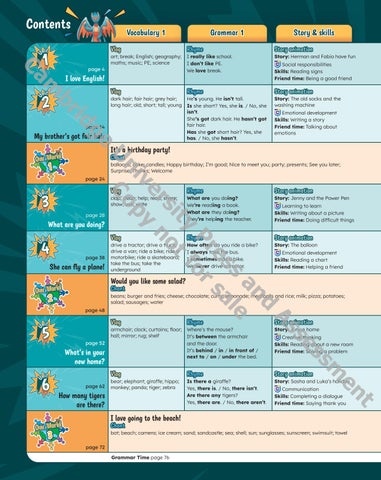
Contents Vlog
nit
1
U
Vocabulary 1
Ca
page 4
m U
2
I really like school. I don’t like PE. We love break.
Vlog
Rhyme
id
br
dark hair; fair hair; grey hair; long hair; old; short; tall; young
page 14
ge
My brother’s got fair hair
U
Vlog
page 28
nit
page 38
U
She can fly a plane!
Rhyme
clap; clean; help; read; share; show; use; write
What are you doing? We’re reading a book. What are they doing? They’re helping the teacher.
Vlog
Rhyme
drive a tractor; drive a truck; drive a van; ride a bike; ride a motorbike; ride a skateboard; take the bus; take the underground
How often do you ride a bike? I always take the bus. I sometimes ride a bike. We never drive a tractor.
Story animation
Story: Jenny and the Power Pen Learning to learn Skills: Writing about a picture Friend time: Doing difficult things
Story animation
Story: The balloon Emotional development Skills: Reading a chart Friend time: Helping a friend
beans; burger and fries; cheese; chocolate; curry; lemonade; meatballs and rice; milk; pizza; potatoes; salad; sausages; water page 48
U
Emotional development Skills: Writing a story Friend time: Talking about emotions
Chant
2
nit
Rhyme
Story animation
armchair; clock; curtains; floor; hall; mirror; rug; shelf
Where’s the mouse? It’s between the armchair and the door. It’s behind / in / in front of / next to / on / under the bed.
Story: A nice home Creative thinking Skills: Reading about a new room Friend time: Solving a problem
Vlog
Rhyme
Story animation
page 52
page 62
Story: Sasha and Luka’s holiday Communication Skills: Completing a dialogue Friend time: Saying thank you
I love going to the beach!
Our World
Chant
3
bat; beach; camera; ice cream; sand; sandcastle; sea; shell; sun; sunglasses; sunscreen; swimsuit; towel page 72 Grammar Time page 76
t
are there?
Is there a giraffe? Yes, there is. / No, there isn’t. Are there any tigers? Yes, there are. / No, there aren’t.
en
6 How many tigers
bear; elephant; giraffe; hippo; monkey; panda; tiger; zebra
m
nit
ss se
Vlog
What’s in your new home? U
Story: The old socks and the washing machine
Would you like some salad?
Our World
5
Story animation
balloons; cake; candles; Happy birthday; I’m good; Nice to meet you; party; presents; See you later; Surprise; Thanks; Welcome
What are you doing?
4
Social responsibilities Skills: Reading signs Friend time: Being a good friend
Chant
Co
3
Story: Herman and Fabio have fun
It’s a birthday party!
page 24
nit
Story animation
As d an s le es sa Pr r y fo it t rs no ve y ni p
1
He’s young. He isn’t tall. Is she short? Yes, she is. / No, she isn’t. She’s got dark hair. He hasn’t got fair hair. Has she got short hair? Yes, she has. / No, she hasn’t.
Story & skills
U
Our World
Rhyme
art; break; English; geography; maths; music; PE; science
I love English!
nit
Grammar 1
Vocabulary 2
Grammar 2
Song
m
Ca
Monday; Tuesday; Wednesday; Thursday; Friday; Saturday; Sunday; every day
Song
When have you got PE? I’ve got PE on Tuesday at 9 o’clock. We’ve got English on Friday at half past 2.
Culture video
He’s really funny! She’s a very brave girl. Is he funny? Is she a brave girl?
Culture video
ge
id
br
beautiful; brave; cool; funny; scary
fly a helicopter; fly a plane; go on a ship; sail a boat
He can drive a van. Can she fly a plane? Yes, he can. / No, she can’t.
Would you like a burger? Would you like some fries? Yes, please. / No, thank you. Here you are.
Song
Draw a portrait Time to think: Things we can learn from a portrait Creative thinking
Is this your balloon? No, it isn’t. That’s my balloon. Are these your shoes? No, they aren’t. Those are my shoes.
Culture video
Outdoor schools in Bali Plurilingual activity: Translate in a language you know Phonics: /ŋ/
Culture video
Travelling in the Philippines Plurilingual activity: Draw and describe different types of transport Phonics: /aɪ/
Critical thinking
Make a poster for Walk to School Day Time to think: How public transport helps you and your town Social responsibilities
What would you like to eat/drink? I’d like some chicken curry, please.
Culture video
How many whales are there? There’s one whale. There are two whales. There aren’t any whales.
Culture video
Houses in Norway Plurilingual activity: Make a poster about furniture in a room Phonics: /aʊ/
Whale watching in Tonga Plurilingual activity: Make an infographic about a migrating animal Phonics: /ɑː/ What can we do? First, we can fly a kite. Then, we can eat ice cream.
Design a school garden Time to think: How gardens help people and animals Social responsibilities
Make a sea animals diorama Time to think: Comparing land and sea animals Creative thinking
t
Have you/they got any flowers? Yes, I/they have. No, I/they haven’t. I/They’ve got some / a lot of / lots of flowers. I/They haven’t got any flowers.
Do you like swimming? Yes, I do. / No, I don’t. I love looking for shells. I (really) like swimming. I don’t (really) like playing football.
Make a school mind map Time to think: The importance of going to school
en
crocodile; dolphin; jellyfish; shark; whale
Learning to learn
m
Song
Games and toys in Guatemala Plurilingual activity: Make a mind map about games and toys Phonics: /eɪ/
Make a school timetable Time to think: Planning your day
ss se
carrots; flowers; garden; onions; peas; trees
School in Ethiopia Plurilingual activity: Talk about school subjects and activities Phonics: /θ/
Learning situation
As d an s le es sa Pr r y fo it t rs no ve y ni p
Song
Can I use the tablet? Can we use the computer? Yes, you can. / No, you can’t.
Co
computer; keyboard; mouse; phone; tablet
U
There’s a big cake. There are some balloons. There are a lot of people. There are lots of candles. Everyone is here!
Song
Culture & Communication
I love English!
nit
1
U
Lesson 1
Vocabulary
ge
id
br
m
Ca
1 Watch and answer.
1
science
3
maths
4
PE
5
music
6
geography
7
art
8
break
e
d
f
g
h
ss se
1 Listen and repeat. Match the words to the pictures.
3
Which subjects start with each letter of the word GAMES?
Talk Time
What’s your favourite school subject? Ask and answer.
Vocabulary
School subjects
t
4
Geography starts with G!
en
m
2
Which subject starts with G?
4
av
2
Co
English
c
As d an s le es sa Pr r y fo it t rs no ve y ni p
U
1
b
a
Lesson 2 Grammar
1
1
2 Listen and answer. What do both children really love?
Yes, I really like school!
m
Ca
My name’s Jack and I really like school.
br
I like science and I love maths, But I don’t like PE.
id
My name’s Anna and I don’t like school.
ge
No, I don’t like school!
I like music and I love art,
U
But I don’t like geography.
As d an s le es sa Pr r y fo it t rs no ve y ni p
I really like school! I don’t like school!
Co
But we really love break!
Yes, we really love break! Break is great!
2
Language focus
Make a new verse about you.
3
I really like school. I don’t like PE. We love break.
My school subjects
My name’s … and I like / don’t like school. I like … and I love … But I don’t like …
Talk Time
Watch. Act out your verse.
I can name school
subjects.
t
I like school, too! I like maths and I love music, but I don’t like art.
en
I really like school! I like English and I love science, but I don’t like music.
m
2
ss se
3
I can say what I like,
love and don’t like.
Grammar
5
Lesson 3 Our stories 3 Watch. What subjects do the boys love?
1
Ca What great colours! I love this picture!
2
ge
id
br
m
by David aged 10 from Spain
Co
As d an s le es sa Pr r y fo it t rs no ve y ni p
U
1
There’s a fair at the school today! Let’s go together!
Look, an art tent! Let’s paint rocks.
3
Great! See you later.
4
Let’s go to the science tent!
No, thanks.
OK. 5
I like art, but I love science.
I’m sorry, Fabio. I want to be a good friend.
6
en
m
ss se
That’s OK. You’re here now.
t
2
3 Watch again. In pairs, ask and answer. What do you like in the story? What don’t you like?
6
Story
Social responsibilities: Understanding responsibilities within a social group
Lesson 4 Story and skills
1
4 Listen to the story again. Read and say Herman or Fabio.
1
Ca
1
What great colours! I love this picture!
Friend Time
2 There’s a fair at the school today!
m
3 Look, an art tent! Let’s paint rocks.
br
‘I want to be a good friend.’ What makes a good friend?
id
4 It’s my turn now.
ge
5 I like art, but I love science. 6 I’m sorry. I want to be a good friend.
Read and choose the correct sign for each tent. 2 English tent
Co
1 Science tent a
3 PE tent
Come in and play the piano!
d
e
Play board games in English! Talk Time
Try table tennis today!
4 Art tent
5 Maths tent
6 Music tent
c
b
Paint rocks here! f
Look at flowers under a microscope!
5 6 3 9 7 8 42
Try our fun number games!
1
In pairs, choose two tents to visit and act out.
Hmm, I’m not sure. I don’t like table tennis. Let’s go to the music tent.
en
m
Let’s go to the PE tent! I love table tennis.
ss se
3
As d an s le es sa Pr r y fo it t rs no ve y ni p
U
2
t
OK, let’s take turns. Let’s go to the music tent and the PE tent. Skills
7
Lesson 5 Song and vocabulary
1
5 Look and listen. Then choose. Listen again and check.
Ca
School days are fun days, we’re learning every day. morning, we’ve got geography.
On 2
at 10 o’clock, we’ve got music. We sing.
m
On 1
a
Friday
On Tuesday afternoon, we’ve got science and PE.
br
b
Sunday
, we’ve got maths. We go home at half past 3.
ge
On 3
id
On Thursday, we’ve got art at half past 9 in the morning. c
Yes, school days are fun days, we’re learning every day.
Monday
we haven’t got school!
U
But on Saturday and 4
Yay, it’s the weekend!
As d an s le es sa Pr r y fo it t rs no ve y ni p
d
Wednesday
Co
2
Look at the timetable. Choose and say.
MONDAY
TUESDAY
maths
PE
music
English
I’ve got art on
.
tennis
computer club
science English
3 I’ve got PE on
.
4 I’ve got maths on
Vocabulary
Days of the week
On Friday, I’ve got science and English.
.
and
.
t
Look at Activity 2. In pairs, ask and answer. What subjects have you got on Friday?
8
maths
SUNDAY
en
Talk Time
art
geography
SATURDAY
m
2 I’ve got music on
3
science
FRIDAY
ss se
1
WEDNESDAY THURSDAY
Lesson 6 Grammar
1
Language focus
5 Listen again.
When has the girl got music and art?
6
When have you got PE? I’ve got PE on Tuesday at 9 o’clock. We’ve got English on Friday at half past 2.
m
Ca
7 Listen and choose
br
2
1
I’ve got PE on Monday at
ge
1
id
the correct time. Then listen again and check. Say. a
2 We’ve got maths today at
.
a
b
.
b
As d an s le es sa Pr r y fo it t rs no ve y ni p
U Co
3 I’ve got English on Thursday at a
3
.
4 I’ve got science today at
b
a
Make sentences for you.
I’ve got … on … at … I’ve got … on … at …
I can name days of
the week.
en
t
I’ve got maths on Friday at 10 o’clock.
m
Watch. In pairs, ask and answer about your sentences. Talk Time
When have you got maths?
Fun Time
ss se
I’ve got … on … at …
4
b
What are the scrambled words? CNEIECS DUYETAS
I’ve got … on … at …
4
.
I can ask and answer
about times.
Grammar
9
Lesson 7 Culture
School in Ethiopia
Ca
5 Watch. What’s Abay’s favourite subject?
2
5 Watch again. Choose and say.
br
m
1
Abay gets to school at half past 6 / 7.
id
1
ge
2 They sit on a chair / bench. blackboard.
As d an s le es sa Pr r y fo it t rs no ve y ni p
U
3 The teachers and children write on a whiteboard / 4 A kebero is a type of musical instrument / song.
Co Talk Time
10
Culture
Do you study the same subjects as Abay? Which subjects are different?
School in Ethiopia
t
2
Abay speaks Amharic, but there are 100 different languages in Ethiopia.
en
How is your school the same as Abay’s school? How is it different?
Fact Time
m
1
Ask and answer.
ss se
3
Lesson 8 Communication
1
School subjects and activities
Ca
Say as many school subjects and activities as you can.
In groups, talk about your favourite school subjects and activities. Make notes. Then tell another group.
ge
id
2
br
m
1
U
de teatro.
Co
As d an s le es sa Pr r y fo it t rs no ve y ni p
1 Lisa likes PE, music and club
2 Maria likes lunchtime, maths and clube de informática.
3 Artem likes science, art and Компʼютерний клуб.
Flying phonics
8 Listen and say.
en
m
s! ays! sday ursd Thur Thea loves Th Thea hs for maths She’s got mat reee hours! thre th
ss se
3
t
4
Say five other words that have the same sound. Talk Time
Communication
School subjects and activities and /θ/
11
Lesson 9 Review 9 Listen and choose. Then listen again and check. Say.
1
Wednesday / Thursday is my
2 I’ve got maths at 9 / 12 o’clock.
4 I really like / love PE.
br
Look at the posters. Choose the correct pictures.
ge
id
2
3 I’ve got geography at half past 2, then English / science.
favourite day.
m
Ca
1
1
b
c
Co
As d an s le es sa Pr r y fo it t rs no ve y ni p
U
a
The music lesson is today at half past 9! 2
a
b
c
ss se
Try science club on Tuesday at half past 4!
en
m
12
Review
t
Quiz
3
6 Watch and do the quiz!
Lesson 10 Learning situation
1
Time to Think
Design and complete a school timetable.
Why is it important to know what subjects and activities you’ve got each day?
ge
id
2
br
m
Ca
It’s the start of the school year and you’ve got a new timetable. What’s a typical week like for you?
1
Step 1: Think
What subjects have you got each day? At what time?
•
When have you got breaks?
•
Do you go to school at the weekend?
As d an s le es sa Pr r y fo it t rs no ve y ni p
U
•
Co
Step 2: Find out •
What do timetables look like?
•
What type of information goes on a timetable?
Step 3: Create •
Make a school timetable.
MY SCHOOL WEEK
TIME
MONDAY
TUESDAY
THURSDAY
music
science
geography
music
English
art
break
break
9 o’clock
maths
10 o’clock
break
half past 11
PE
break
break
science
half past 12
lunch!
maths club
lunch!
basketball club
FRIDAY
ss se
WEDNESDAY
English
en
m
lunch!
t
3
7 Watch. Then present your timetable.
Learning situation
13
My brother ’s got fair hair
nit
U
2
Lesson 1
Vocabulary
ge
id
br
m
Ca
1 Watch and answer.
1
short
3
dark hair
4
fair hair
5
young
6
old
7
long hair
8
grey hair
h
g
ss se
1 Listen and repeat. Match the words to the pictures.
Talk Time
t
4
Play the Opposites Game.
Vocabulary
Physical appearance
en
In pairs, point and say. How many words can you remember in one minute?
m
3
What’s the opposite of ‘fair hair’?
14
e
d
f
2
av
2
Co
tall
c
As d an s le es sa Pr r y fo it t rs no ve y ni p
U
1
b
a
It’s ‘dark hair’.
Lesson 2 Grammar
2
2 Listen and answer. Who’s got dark hair? Who’s tall?
1
Where’s Sam?
Has she got short dark hair?
Has he got short fair hair?
m
Ca
Where’s Maya?
No, he’s got short dark hair.
br
No, she’s got long fair hair. Is she short?
Is he old?
No, he’s young.
id
No, she’s tall.
Is he very tall?
ge
Is she very young? No, she isn’t.
No, he isn’t.
Look, he’s laughing and having fun!
U
Look, she’s the girl bouncing a ball!
As d an s le es sa Pr r y fo it t rs no ve y ni p
Language focus
3
Co
He’s young. He isn’t tall. Is she short? Yes, she is. / No, she isn’t.
She’s got dark hair. He hasn’t got fair hair. Has she got short hair? Yes, she has. / No, she hasn’t.
2 Listen again and choose. Then make sentences.
2 a
Talk Time
people look like.
t
No, she hasn’t. She’s got short hair.
I can describe what
en
Has the girl got long hair?
m
Watch. Ask and answer to guess the picture from Activity 2. 2
c
ss se
3
b
I can ask and say what
people look like.
Grammar
15
Lesson 3 Our stories 3 Watch. How does Mrs Sock feel at the end of the story?
1
Ca id
br
m
by Dilek aged 9 from Türkiye
ge
2
Co
As d an s le es sa Pr r y fo it t rs no ve y ni p
U
1
Two dirty socks!
3
I don’t like dirty socks!
Ahhh! This is easy for young socks but not for us!
4
Oh no! 5
6
I feel great! I love my stars!
ss se
I feel great, too. That washing machine isn’t so bad.
en
m
I don’t like this! I’m scared!
t
2 16
3 Watch again. Imagine you’re a sock in the
washing machine. What do you say to the other sock? Story
Emotional development: Recognising and describing emotions
Lesson 4 Story and skills
2
4 Listen to the story again. Read and say yes or no.
1
Ca
1
Mr and Mrs Sock are old.
2 Kate’s got long fair hair.
m
br
3 The washing machine’s quiet.
id
4 The socks are happy to go in the washing machine.
ge
5 They come out of the washing machine
Friend Time ‘I feel great!’ What makes you feel happy, sad and scared? What about your friends?
2
As d an s le es sa Pr r y fo it t rs no ve y ni p
U
clean and happy.
Co
Imagine you’re Kate. Copy and change the underlined words to make a story about her.
My name’s Yousef. I live in a house with my dad, my brother and my sister. I’m 10 years old. I’m tall and I’ve got short dark hair. I love music and I really like basketball, but I don’t like spiders! I feel good when I’m with my friends!
Talk Time
In pairs, tell your stories.
en
m
t
My name’s Kate. I live in an apartment with …
ss se
3
Skills
17
Lesson 5 Song and vocabulary
1
5 Look and listen. Then choose.
Ca
Listen again and check.
a
m
Welcome to the team, the superhero team. .
br
This is Jules, she’s very 1
id
I like her clothes and her moves. .
ge
Look at Sunny, he’s very 2
scary
When he talks, we smile and laugh.
b
girl.
U
This is Pearl, she’s a really 3
As d an s le es sa Pr r y fo it t rs no ve y ni p
She always tries hard, even when she’s scared. Look at Pat, he’s a 4
cat.
Co
People love his long hair, they stop and look. ?
This is Hairy. Oh my, is he 5
funny
Red eyes and big teeth! Yes, he’s really scary!
Together, they’re the team. The superhero team. e
c
d
cool
brave
beautiful
3
Talk Time
Vocabulary
Adjectives to describe people
t
Play the Chain Game. We’re cool!
18
en
Mime the adjectives. Ask and answer.
m
ss se
2
We’re cool and brave.
Lesson 6 Grammar
1
Language focus
5 Listen again. Who’s funny?
Who’s a brave girl?
6
He’s really funny! She’s a very brave girl. Is he funny? Is she a brave girl?
Ca
Make true and false sentences about the superheroes. Say.
Jules
Sunny
is
very
isn’t
really
scary. cool. funny.
Co
As d an s le es sa Pr r y fo it t rs no ve y ni p
U
Hairy
ge
id
br
m
2
2
Pearl
Jules Pat
3
is a
very
isn’t a
really
Imagine a new superhero called Super Pet. Make sentences about him/her.
beautiful
cat.
cool
boy.
brave
girl.
Fun Time Who can make a very, very funny face?
My Super Pet is a very/really … cat/dog/horse/bird.
Talk Time
people.
t
My Super Pet’s a really funny bird, but he isn’t cool.
I can describe
en
Watch. In pairs, talk about your Super Pets. 4
m
4
ss se
My cat/dog/horse/bird is very/really …
My Super Pet’s a very scary snake, but she isn’t funny.
I can ask and answer
about people.
Grammar
19
Lesson 7 Culture
Games and toys in Guatemala
Ca
5 Watch. Which toys help Rosa?
2
5 Watch again. Choose and say.
br
m
1
A traditional capirucho is made from plastic / wood.
id
1
ge
2 Rosa’s worry dolls are in a small bag / box.
U
3 A worry is a good / bad feeling about a problem.
Co
As d an s le es sa Pr r y fo it t rs no ve y ni p
4 People have worry dolls with them in the day / in the day and at night.
20
Culture
How are your games and toys different from Rosa’s?
Games and toys in Guatemala
t
2
en
Do you like Rosa’s games and toys? Why or why not?
People in Guatemala play a marbles game called ‘cincos’ or ‘fives’. If you hit your friend’s marbles out of the game, you win and keep all the marbles.
m
1
Ask and answer.
Fact Time
ss se
3
Talk Time
Lesson 8 Communication
2
Games and toys
Ca
In groups, talk about the games and toys you like.
Think about popular games and toys in your country. Make a mind map.
ge
id
2
br
m
1
Popular games/toys in Spain
Co
As d an s le es sa Pr r y fo it t rs no ve y ni p
U
el juego de la oca, board game, dos dados, old game
doll’s house / casa de muñecas, wooden toy, tell stories
rayuela, write numbers, escribir con tiza, hop
Flying phonics
7 Listen and say.
ss se
3
en
m
take a y, Ada can ta Today, Toda play.. game home to play
t
4
Say five other words that have the same sound. Talk Time
Communication
Games Communication and toys and /eɪ/ XX
21
Lesson 9 Review
Look and make sentences.
1
b
tall
short y oung old
br
m
Ca
a
ge
id
c
short/long hair dark/fair/grey hair
d
Co
2
As d an s le es sa Pr r y fo it t rs no ve y ni p
U
brave funny scary
8 Listen and choose the correct picture. a
b
c
en
m
ss se
22
Review
t
Quiz
3
6 Watch and do the quiz!
Lesson 10 Learning situation
1
m
Ca
Your school is organising a portrait competition. What type of picture is a portrait? Draw or make a portrait of a friend or family member.
Time to Think Think about things we can learn about a person from looking at a portrait.
id
br
2
2
•
ge
Step 1: Think
Who do you want to be What does this person look like?
How can you describe
Co
•
As d an s le es sa Pr r y fo it t rs no ve y ni p
•
U
in your portrait? Why?
his/her personality? Step 2: Find out •
Which famous portraits do you know?
•
What materials do you want to use for your portrait?
Step 3: Create •
Draw or make a portrait.
en
m
ss se
t
3
7 Watch. Then present your portrait.
Learning situation
23
Our World
br
m
Ca
1
It’s a birthday party!
id
Where am I?
party
2
Welcome!
3
Happy birthday!
4
Nice to meet you!
5
I’m good.
6
presents
7
balloons
8
Surprise!
9
cake
ge
1
Hi! How are you?
12 See you later!
Co
11 Thanks!
a
As d an s le es sa Pr r y fo it t rs no ve y ni p
U
10 candles
b
This is Maria.
d
c
e
2 Listen and check. Say.
Close your book. How many words can you remember in one minute? Talk Time
Vocabulary
Birthday parties
t
3
en
1 Listen and say. Match.
m
2
4 24
Look. Where are they? What can you see?
ss se
1
g
Lesson 1
Vocabulary
1
f
ge
id
br
m
Ca h
As d an s le es sa Pr r y fo it t rs no ve y ni p
U Co
Find
i
Bye!
3 animal parties
in the pictures.
en
m
ss se
l
t
k j
25
Lesson 2
Grammar
3 Listen. How old is Oscar today?
1
There’s a big cake!
ge
id
br
m
Ca
Language focus
4
There’s a big cake. There are some balloons. There are a lot of people. There are lots of candles. Everyone is here!
Co
As d an s le es sa Pr r y fo it t rs no ve y ni p
U It’s so nice! There are lots of candles.
2
5 Listen and number. Listen again and check. Describe. a
b
c
m
ss se Look at pages 24–25. In pairs, take turns to describe the pictures. Talk Time
en
3
t
There’s a living room and there are some presents.
26
Grammar
There’s a cake and there are some candles.
Lesson 3
1
6 Listen and choose.
1 a
b
2
a
b
3
ge
id
br
m
Ca
1
Grammar
a
b
7
Is this your balloon? No, it isn’t. That’s my balloon. Are these your shoes? No, they aren’t. Those are my shoes.
Co
As d an s le es sa Pr r y fo it t rs no ve y ni p
U
Language focus
In pairs, point, ask and answer. Use this, that, these and those.
3
Look at the pictures from Activity 2. In pairs, plan a birthday party for a friend. Talk Time
t
Let’s choose these balloons with animals on them!
en
m
ss se
2
No, let’s choose those balloons. I like the funny faces!
Grammar
27
What are you doing?
nit
U
3
Lesson 1
Vocabulary
ge
id
br
m
Ca
1 Watch and answer.
1
write
3
share
4
use
5
help
6
show
7
clap
8
clean
h
g
ss se
1 Listen and repeat. Match the words to the pictures.
4
Talk Time
en
Mime. Ask and answer.
m
3
Vocabulary
Actions
True! I clean the blackboard every day.
t
Play the True or False Game. Use words from Activity 1. I use pens in English.
28
e
d
f
2
av
2
Co
read
c
As d an s le es sa Pr r y fo it t rs no ve y ni p
U
1
b
a
Lesson 2 Grammar
3
2 Look, listen and match. Listen again and check.
1
a
I’m reading a book. I’m writing an answer.
m
Ca
What are you doing in the classroom?
br
I’m 1 cleaning the board. I’m helping the teacher.
What are they doing in the classroom?
id
They’re 2 using paints. They’re painting a picture.
ge
They’re 3 showing their work to the teacher. What are you doing in the classroom?
U
We’re helping our friends and we’re sharing our pens!
b
2
Co
c
As d an s le es sa Pr r y fo it t rs no ve y ni p
We’re 4 clapping along and we’re singing a song!
d
Language focus
3
What are you doing? We’re reading a book. What are they doing? They’re helping the teacher.
Make a new verse.
What are you doing in the classroom? I’m …
What are they doing in the classroom? What are we doing in the classroom? We’re … Talk Time
I can talk about what
I’m doing.
t
What are you doing in the classroom?
Watch. Act out your verse.
en
2
m
3
ss se
They’re …
I’m talking in English and I’m showing my work to my friend.
I can say what other
people are doing.
Grammar
29
Lesson 3 Our stories 3 Watch. How many times does the pen help Jenny?
1
Ca id
br
m
by Dimitrios aged 11 from Greece
ge
1
I can help you in class, too.
2
Cool!
Co
As d an s le es sa Pr r y fo it t rs no ve y ni p
U
Hello!
You can talk!
What are you doing?
3
What are you doing now?
4
I’m helping you again!
I’m writing the answer for you. 5
6
This is difficult. Help me!
Well done, Jenny!
en
m
ss se
Sorry – I can only help you two times.
t
2 30
3 Watch again. In pairs, imagine what
Jenny and the Power Pen do after school. Say. Story
Learning to learn: Taking initiative to improve own learning
Lesson 4 Story and skills
3
4 Listen to the story again. Choose and say.
1
The pen goes to school in Jenny’s bag / pencil case.
m
Ca
1
2 The pen draws / writes an answer in
br
Jenny’s notebook.
id
3 Jenny makes a poster / painting.
ge
4 The teacher asks Jenny to do a science /
Friend Time ‘This is difficult. Help me!’ Why is it important to try difficult things by yourself?
maths test.
U
What are the children doing? Look and make sentences.
Co
2
As d an s le es sa Pr r y fo it t rs no ve y ni p
5 The pen / Jenny does the test.
clean read share write
Adam and Leo
Alex and Jess
Talk Time
Jenny and the pen
ss se
Look at Activity 2. Play the Guess Who Game.
That’s Nora and Flora.
en
They’re writing their names.
m
3
Nora and Flora
t Skills
31
Lesson 5 Song and vocabulary
1
5 Look and listen. Then match. Listen again and check.
Ca
I’m at home today and I ask my dad, ‘Can I use the 1 computer?’
a
b
m
What does he say? He says, ‘Yes, you can.’
id
br
‘Can I type on the 2 keyboard?’ He says, ‘Yes, you can.’
ge
‘Can I use the 3 mouse?’ He says, ‘Yes, you can.’
As d an s le es sa Pr r y fo it t rs no ve y ni p
U
I’m at home with my brother and we ask our dad, ‘Can we draw on the 4 tablet?’
c
What does he say? He says, ‘Yes, you can.’
Co
Then we think and slowly we say, ‘Can we play on your 5 phone?’
What does he say? He says, ‘No, you can’t!’
d
e
My phone is not a game to play.’
6 Listen and say. Listen again and check.
2
keyboard mouse phone tablet
1
Kareem and his mum use a computer and a to talk to her grandma.
3 Eric uses a computer and a
How do you use the technology? Ask and answer.
How do you use a tablet?
32
Vocabulary
Technology words
I use a tablet to talk to my dad.
t
Talk Time
en
3
to listen to music.
m
4 Aya uses a
to write stories.
ss se
2 Lily uses a
to play games.
Lesson 6 Grammar
1
5 Listen again. What can’t the
Language focus
Ca
children do?
Read about Noor’s school and say.
7
Can I use the tablet? Can we use the computer? Yes, you can. / No, you can’t.
br
m
2
3
id
In my school, there are a lot of rules!
ge
1 The number one rule is: we
have a phone in school!
2 We’ve got a maths test today. We
use a computer
3 But we
As d an s le es sa Pr r y fo it t rs no ve y ni p
U
for the maths test.
use a calculator, a ruler and a rubber.
Co
4 We’ve got art today, too. We
use a tablet for drawing.
5 But we
use paper, pencils and crayons.
6 And we
use a computer, a keyboard and a mouse in computer class.
3
Imagine you’re Noor. Ask for permission to do the things from Activity 2. 1 Can I have a phone in school? 2 Can I … 3 Can I … 4 Can I … 6 Can I … 4
Talk Time
words.
No, you can’t!
t
Can I have a phone in school?
I can say technology
en
and answer.
Watch. In pairs, ask
m
4
Race! Think of words that start with each letter of the word PHONE.
ss se
5 Can I …
Fun Time
I can ask for and give
permission.
Grammar
33
Lesson 7 Culture
Outdoor schools in Bali
Ca
5 Watch. What can you say about Umar’s classroom?
2
5 Watch again. Say true or false.
br
m
1
Umar’s school is in the countryside.
ge
1
id
Correct the false sentences.
2 The children have maths lessons outside.
U As d an s le es sa Pr r y fo it t rs no ve y ni p
3 They grow trees.
4 They have science and PE lessons at the beach.
Co Talk Time
34
Culture
How is Umar’s school different from yours?
Outdoor schools in Bali
t
2
When Bali’s volcanoes erupt, rocks fly out and hit the sea. They make the sand on some beaches black!
en
Do you want to go to Umar’s school? Why or why not?
Fact Time
m
1
Ask and answer.
ss se
3
Lesson 8 Communication
3
Having fun outside
Ca
Work in groups. Say outdoor activities people do where you live.
Read and translate in a language you know. Close your books and translate back to English. Then check.
ge
2
id
br
m
1
Co
As d an s le es sa Pr r y fo it t rs no ve y ni p
U Look at me! I’m climbing a tree.
He’s playing in the garden.
They’re growing vegetables.
Flying phonics
8 Listen and say.
ss se
3
en
t
4
m
gs thinngs ing thi She’s growing song.. singiing a song and sing Say five other words that have the same sound. Talk Time
Communication
Having Communication fun outside and XX /ŋ/
35
Lesson 9 Review
1
In pairs, read and play the game.
2
3
b
c
Can you remember the five technology words from Lesson 5? Say, then check.
What are the children doing in the pictures? Say.
ge
id
br
m
Ca
1
a
Put the question words in order. share / I / your / Can / pens?
Co
As d an s le es sa Pr r y fo it t rs no ve y ni p
U 9 Listen and choose the correct answer.
2 1
a Yes, you can.
b
c
Yes, you are.
2 a I read a book every day. 3 a
b
b No, you haven’t.
Thanks!
I’m clapping.
b
c
Yes, please.
I’m reading a book.
c
No, you can’t. c
They’re writing.
Clean the classroom.
en
m
ss se
4 a
Yes, they can.
36
Review
t
Quiz
3
6 Watch and do the quiz!
Lesson 10 Learning situation
1
Time to Think
You’re researching schools in your area for homework. Are there many schools where you live?
m
Ca
Why is it important to go to school? Think about how school helps you and your friends.
Make a mind map about your school.
id
br
2
3
ge
Step 1: Think
What’s your school like?
•
Do you wear special clothes to school?
•
Are there a lot of rules?
As d an s le es sa Pr r y fo it t rs no ve y ni p
U
•
Step 2: Find out
Talk to your friends. Compare your ideas from Step 1.
Co
•
Step 3: Create •
Make a mind map.
My school mind map
I can …
What I do
Favourite things
I can’t …
en
m
I use …
ss se
I wear …
About my school
t
3
7 Watch. Then present your mind map.
Learning situation
37
She can fly a plane!
nit
U
4
Lesson 1
Vocabulary
ge
id
br
m
Ca
1 Watch and answer.
1
ride a skateboard
3
take the bus
4
take the
5
ride a motorbike
6
drive a truck
7
drive a van
8
drive a tractor
f
1 Listen and repeat. Match the words to the pictures.
What’s your favourite type of transport? Why? Ask and answer. Talk Time
Vocabulary
Transport
t
No, I’m not. Try again!
en
38
m
Mime. Ask and answer. Are you riding a skateboard?
4
h
g
ss se
3
e
d
underground
2
av
2
Co
ride a bike
c
As d an s le es sa Pr r y fo it t rs no ve y ni p
U
1
b
a
Lesson 2 Grammar
1
4
2 Look, listen and say the words. Listen again and check.
When I go to school, I 1
m
Ca
How often do you take the bus? How often do you drive a truck? take the bus.
ride a bike.
br
And when I go to football club, I 2
But I never drive a tractor and I never drive a truck.
id
When I go to school, I 3
take the underground.
ge
And when I go to tennis club, I 4
drive a tractor and we 6
But we 5
Make sentences about you and a friend. I always … I sometimes … I never … We always …
ss se
We sometimes … We never …
Talk Time
I can name types of transport.
How often do you ride a bike?
I can say what I always, sometimes and never do.
en
Watch. Talk about transport you always, sometimes and never use. 2
m
3
3
How often do you ride a bike? I always take the bus. I sometimes ride a bike. We never drive a tractor.
Co
2
Language focus
As d an s le es sa Pr r y fo it t rs no ve y ni p
sometimes never
drive a truck!
U
always
ride a skateboard.
t
I sometimes ride a bike at the weekend.
Grammar
39
Lesson 3 Our stories 3 Watch. Why do Aziz and Nadia count?
1
Ca id
br
m
by Pablo aged 9 from Spain
We sometimes take the bus and we sometimes walk.
ge
2
Co
As d an s le es sa Pr r y fo it t rs no ve y ni p
U
1
The balloon’s starting to fly!
Help! Help!
But today, we’re flying in a balloon!
3
Don’t worry! We’re coming!
4
I don’t like this! I’m scared!
Let’s count to ten together.
5
I’ve got you!
en
Yes, we’re fine.
m
ss se
Thank you!
Aziz! Nadia! Are you OK?
6
t
2 40
3 Watch again. Act out the story in groups.
Story
Emotional development: Supporting others
Lesson 4 Story and skills
1
4
4 Listen to the story again. Match the sentences to the
Ca
pictures in the story. Say.
Friend Time
a The balloon man catches the balloon with
m
the skateboard.
br
‘I’m scared!’ When your friend is sad or scared, what can you do to help?
b The balloon man asks how the children
id
go to school.
ge
c The balloon comes down. d Mum’s riding a bike and Dad’s driving a van.
U
Look at the chart about Aziz’s class. How many children use each type of transport?
Co
As d an s le es sa Pr r y fo it t rs no ve y ni p
2
How do my friends go to school? 1 ride a bike take the bus fly in a balloon walk go by car
3
4
5
6
Ask your friends how they go to school. Make a chart. Talk Time
9
en
t
I walk to school.
8
m
How do you go to school?
7
ss se
3
2
by Aziz
I go to school by car. Skills
41
Lesson 5 Song and vocabulary
1
5 Look and listen. Then match. Listen again and check.
I travel the world with my friends.
Ca
a
We go fast or we go slow.
m
b
br
I’ve got a friend. His name is Dan.
He can 1 go on a ship. He can drive a van.
id
But can he 2 fly a helicopter?
ge
Yes, he can!
We travel the world, fast or slow.
c
U
I’ve got a friend. Her name is Jane.
d
As d an s le es sa Pr r y fo it t rs no ve y ni p
She can 3 sail a boat. She can drive a train. But can she 4 fly a plane?
Co
No, she can’t!
We travel the world, fast or slow.
2
Look and say. Use the phrases from Activity 1.
a
In groups, play the Chain Game.
Vocabulary
Transport
t
Let’s go on a ship, fly a plane and drive a truck.
Let’s go on a ship and fly a plane.
en
Let’s go on a ship.
42
c
m
Talk Time
c
ss se
3
b
Lesson 6 Grammar
1
Language focus
5 Listen again. Who can fly
a helicopter?
m
Put the words in order. Say. your / a / Can / tractor? / teacher / drive
br
1
6
He can drive a van. Can she fly a plane? Yes, he can. / No, she can’t.
Ca 2
4
id
2 can. / she / Yes,
Fun Time
ge
3 she / plane? / a / fly / Can 4 No, / can’t. / she
U
Who can touch their toes? Who can touch their ears with their elbows?
As d an s le es sa Pr r y fo it t rs no ve y ni p
5 sail / brother / Can / boat? / your / a 6 he / No, / can’t.
Co
3
In pairs, say sentences about Nick and Maria. a van
a plane
a car
a tractor
a bike
a boat
a helicopter
a skateboard
4
Talk Time
False Game.
Watch. Play the True or
en
Yes, he can.
I can ask and answer about what people can do.
t
Can Nick drive a van?
False! He can’t drive a van.
I can name types of transport.
m
4
Maria
ss se
Nick
Grammar
43
Lesson 7 Culture
Travelling in the Philippines
Ca
5 Watch. What does Isa’s dad do for work?
2
5 Watch again. Say true or false.
br
m
1
People use helicopters to travel between
ge
1
id
Correct the false sentences. the islands.
U
As d an s le es sa Pr r y fo it t rs no ve y ni p
2 A bangka has got sticks on both sides. 3 Isa’s Dad takes people on his bangka.
Co
4 Isa always travels with her dad.
Talk Time
3
44
Culture
Do people use boats in your country?
Do you sometimes go on a boat? If not, do you want to?
Travelling in the Philippines
t
2
The Philippines has got 7,641 islands. People only live on 2,000 of the islands.
en
Do you like Isa’s boat? Why or why not?
Fact Time
m
1
Ask and answer.
ss se
3
Lesson 8 Communication
4
Travel and transport
Ca
What types of transport can you use to travel where you live? In pairs, ask and answer.
Draw different types of transport. Swap pictures and describe what you see.
ge
2
id
br
m
1
As d an s le es sa Pr r y fo it t rs no ve y ni p
U I can see three boats.
Co
Un bote de remos, un ferry y una canoa.
Flying phonics
7 Listen and say.
en
t
4
m
my bbiike riding my I lliike ri nightt!! at nigh
ss se
3
Say five other words that have the same sound. Talk Time
Communication
Travel and Communication transport and /aɪ/ XX
45
Lesson 9 Review
1
Make questions. In pairs, ask and answer. How often / you / ride /
?
2 Can / your teacher / drive /
?
br
m
Ca
1
3 How often / you / take /
id
ge
4 How often / you / sail /
5 Can / your teacher / fly /
U
? ?
Read and choose.
Co
2
?
As d an s le es sa Pr r y fo it t rs no ve y ni p
6 How often / you / drive /
?
Can your dad drive a truck?
No, but he sometimes rides his motorbike at the weekends.
a
b
c
en
m
ss se
46
Review
t
Quiz
3
6 Watch and do the quiz!
Lesson 10 Learning situation
1
m
Ca
It’s Walk to School Day at your school. What types of transport do you use to go to school? Make a poster for Walk to School Day.
Time to Think Think about how walking, riding a bike or using public transport can help you and your town.
id
br
2
4
ge
Step 1: Think
Can you walk, ride a bike or ride a skateboard to school?
•
Do you go to school on your own or with your family or friends?
•
What can make people want to walk to school?
As d an s le es sa Pr r y fo it t rs no ve y ni p
U
•
Step 2: Find out
Ask your friends the questions from Step 1. Make notes.
Co
•
Step 3: Create •
Make a poster with your notes.
en
m
ss se
t
3
7 Watch. Then present your poster.
Learning situation
47
Our World
a
m
Ca
2
Would you like some salad?
b
br id
Where am I?
curry
2
potatoes
3
burger and fries
4
sausages
5
beans
6
meatballs and rice
7
salad
8
cheese
9
pizza
Co
12 milk 13 lemonade
Look. Where are they? What can you see?
g
2 Listen and check. Say.
Close your book. How many words can you remember in one minute? Talk Time
Vocabulary
Food
t
3
en
1 Listen and say. Match.
m
i
2
h
ss se
48
As d an s le es sa Pr r y fo it t rs no ve y ni p
U
11 water
4
c
f
10 chocolate
1
d
ge
1
ge id
e
br m Ca
3 mistakes
in the picture.
Co
en
m ss se
As d an s le es sa Pr r y fo it t rs no ve y ni p
Find
U
l j
2 Vocabulary Lesson 1
k
t
m
49
Lesson 2
Grammar
3 Listen. What does Izzy have for lunch?
1
4
Would you like a burger? Would you like some fries? Yes, please. / No, thank you. Here you are.
ge
id
br
m
Ca
Language focus
Co
As d an s le es sa Pr r y fo it t rs no ve y ni p
U
Would you like some salad?
Yes, please.
2
5 Listen and say. What does Noah have with his burger?
a
b
c
d
Look at pages 48–49. In pairs, take turns to ask and answer. Talk Time
en
m
ss se
3
t
Would you like some lemonade?
50
Grammar
Yes, please.
Lesson 3
1
Grammar
2
6 Listen and read. What does each person choose?
Listen again and check.
br
m
Ca
Language focus
Dad
What would you like to eat/drink? I’d like some chicken curry, please.
Carl
Camila
7
id ge
Menu
As d an s le es sa Pr r y fo it t rs no ve y ni p
U Chocolate cake
Chicken curry with rice or potatoes
Fruit salad
Co
Burger and fries
Sausages and beans Cheese pizza
Milk
Vegetable pizza
Water
1
What
some chicken curry with some rice, please.
4 I
some water, please.
Talk Time
to drink?
t
you
en
3 What
m
2 I’d
you like to eat?
ss se
8 Complete the sentences. Then listen and check.
2
3
Lemonade
In groups, use the menu to make a role play. Act it out. Grammar
51
What’s in your new home?
nit
U
5
Lesson 1
Vocabulary
ge
id
br
m
Ca
1 Watch and answer.
1
floor
3
mirror
4
armchair
5
rug
6
curtains
7
clock
8
shelf
e
d
f
h
g
ss se
1 Listen and repeat. Match the words to the pictures.
3
Look around the classroom. Say what you can and can’t see.
4
Talk Time
Vocabulary
Furniture
Yes, I’ve got a clock in the kitchen.
t
Ask and answer for your home.
en
m
2
Have you got a clock in your home?
52
av
2
Co
hall
c
As d an s le es sa Pr r y fo it t rs no ve y ni p
U
1
b
a
Lesson 2 Grammar
1
5
2 Look, listen and say. Then match. a
Oh no! Where’s the mouse?
m
Ca
Mum! There’s a mouse 1 in our house.
It’s 2 next to the sofa.
b
br
It’s 3 on the floor!
id
No! It’s 4 between the armchair and the door!
ge
Oh no! Where’s the mouse? Is it in the house?
c
It’s 5 behind the curtains.
U
It’s 6 under the bed.
As d an s le es sa Pr r y fo it t rs no ve y ni p
It’s 7 in front of the mirror. It’s on my head!
f
Co
d
e
2 Listen again. Say true or false.
2 1
The mouse is under the sofa.
2 The mouse is on the floor.
3 The mouse is behind the armchair and the door. 4 The mouse is behind the curtains.
6 The mouse is under the mirror.
Talk Time
Where’s the mouse? It’s between the armchair and the door. It’s behind / in / in front of / next to / on / under the bed.
I can name furniture
en
Watch. Ask and answer about the pictures in Activity 1. 2
3
m
3
Language focus
ss se
5 The mouse is next to the bed.
g
and objects in a room.
t
Where’s the mouse in picture c?
In picture c, the mouse is in the box.
I can say where
things are.
Grammar
53
Lesson 3 Our stories 3 Watch. What do Charlie and Max do together?
1
Ca id
br
m
by So-young aged 9 from Russia
I’ve got a beautiful new rug … but do I feel happy?
ge
2
Co
As d an s le es sa Pr r y fo it t rs no ve y ni p
U
1
That’s a nice house!
Are you cold? Come in!
3
4
Would you like to share this fish?
Thank you!
Thank you! 5
Thanks for sharing the fish, Charlie. Goodbye!
6
This isn’t just nice …
ss se
en
But … please don’t go! Let’s be friends!
m
It’s fantastic!
t
2 54
3 Watch again. In pairs, say … two things you like about the story. two new things the cats can do. Story
Creative thinking: Implementing ideas and solutions
Lesson 4 Story and skills
5
4 Listen to the story again. Say the sentences in order (1–6).
1
Ca
a Max lives under a tree and he feels cold. b The two cats live together.
m
br
c Charlie asks Max to come in and eat.
id
d Charlie shares some fish with Max.
ge
e Charlie’s got a big house, but he isn’t very happy.
Charlie asks Max to be his friend.
As d an s le es sa Pr r y fo it t rs no ve y ni p
Look, read and correct the words in bold.
Co
2
‘I’ve got a beautiful new rug, but do I feel happy?’ When you’re sad, what can you do to solve the problem?
U
f
Friend Time
Hi Emma, This is my room in my new home. There’s a 1 blue armchair. My cat is 2 on the armchair. I’ve got a shelf and there’s a small clock 3 on the shelf. There are 4 pink curtains. What else? Ah, yes. I’ve got a new football. It’s 5 behind the bag. I really love my new room! I’m happy to share it with you, so please come and stay soon! Bye, Monica
Talk Time
In pairs, describe the room in the story.
m
There’s a rug on the floor.
en
This is Charlie’s living room.
ss se
3
t Skills
55
Lesson 5 Song and vocabulary
1
5 Look and listen. Then match. Listen again and check.
Have you got a 1 garden or a balcony?
Ca
a
m
Yes, I’ve got a garden, a very small garden. Have you got any 2 flowers in your garden?
br
Yes, I have. I’ve got lots of pretty flowers.
Have you got any 3 trees in your garden?
id
b
ge
No, I haven’t. I haven’t got any trees!
c
Have your friends got a garden or a balcony?
U
Yes, they have. They’ve got a garden too!
As d an s le es sa Pr r y fo it t rs no ve y ni p
Have they got any 4 carrots in their garden?
Yes, they’ve got some carrots and some 5 peas.
Co
Have they got any 6 onions in their garden?
No, they haven’t, but they’ve got a lot of bees! d
2
f
e
6 Listen. Match the descriptions to the pictures. Say. a
b
c
d
e
In pairs, describe the words from Activity 1 and guess.
56
Vocabulary
The garden
t
They’re white or purple. When my brother cooks them, he cries.
en
Talk Time
m
ss se
3
Onions!
Lesson 6 Grammar
5
5 Listen again. What haven’t the people got in their gardens?
1
Ca 2
Read the email and say.
m
br
Hi Grandma, I really like my new house and I love my
id
garden! I’ve got some trees and I climb them! I’ve also got 1
ge
I haven’t got 2
Language focus
flowers, but
carrots or peas.
U
What are you growing on your balcony,
Co
David
Imagine a garden for you. Make sentences about what you have and haven’t got.
any
a lot of lots of
bees
birds
carrots
onions
flowers trees peas toys
Yes, I have. I’ve got lots of trees.
garden.
t
Have you got any trees in your garden?
I can name things in a
en
Talk Time
What are the scrambled words? SREFWOL BLIMC
m
Watch. In pairs, ask and answer about your gardens. 4
Fun Time
ss se
some
4
carrots?
you got any peas? Write soon
and tell me. Bye!
3
Have you/they got any flowers? Yes, I/they have. No, I/they haven’t. I/They’ve got some / a lot of / lots of flowers. I/They haven’t got any flowers.
As d an s le es sa Pr r y fo it t rs no ve y ni p
Grandma? Have you got 4
3
7
I can say what I’ve got
and haven’t got.
Grammar
57
Lesson 7 Culture
Houses in Norway
Ca
5 Watch. What rooms are in Aksel’s house?
2
5 Watch again and correct the sentences.
br
m
1
Aksel goes to a rorbu in the winter holidays.
ge
1
id
One sentence is correct.
2 A rorbu is a big wooden house with a chimney.
U
As d an s le es sa Pr r y fo it t rs no ve y ni p
3 There’s a fire in the kitchen.
4 Bunk beds have got two beds and a ladder to climb.
Co Talk Time
Ask and answer.
ss se
3
m
Fact Time
58
Culture
How is your home the same as a rorbu? How is it different?
Houses in Norway
t
2
Lofoten, Norway, is near the North Pole. In the summer, you can see the sun at midnight. But in December, it’s dark all day!
en
1
What do you like about the rorbu?
Lesson 8 Communication
5
Houses inside and out
Ca
What are houses like where you live? In pairs, name furniture you find in the kitchen and the living room. Choose a room and make a poster.
ge
2
id
br
m
1
A living room in France
U
a lamp
Co
As d an s le es sa Pr r y fo it t rs no ve y ni p
un store
une cheminée
une peinture
an armchair
Flying phonics
8 Listen and say.
en
t
4
m
se in the house I love this hou n. town. ns far from tow ains ntai ount mou
ss se
3
Say five other words that have the same sound. Talk Time
Communication
Houses inside Communication and out and /aʊ/ XX
59
Lesson 9 Review
In pairs, read and play the game.
1
2
m
Ca
1 Can you
ge
id
br
remember the eight furniture words from Lesson 1? Say, then check.
Look at the picture on page 55. Ask and answer about where things are.
3
Complete the garden words. Then draw for your partner to guess. t___ f__w__ o_i__ c__r__
As d an s le es sa Pr r y fo it t rs no ve y ni p
U
2
Choose the correct word for each sentence.
Co
1
This is my grandma’s house. The house has got a
2 There’s a tree and there are
peas next garden
.
behind
flowers.
to the house.
ss se
3 Grandma’s little blue car is
any
some
en
m
60
Review
t
Quiz
3
6 Watch and do the quiz!
Lesson 10 Learning situation
1
m
Ca
You’re researching different types of gardens for homework. Has your school got a garden? Design a school garden.
br
2
Time to Think Why is it good to have a garden at your school? Think about how gardens can help people and animals.
Where’s the garden?
ge
•
id
Step 1: Think
5
What’s in the garden?
•
What can you do in the garden?
As d an s le es sa Pr r y fo it t rs no ve y ni p
U
•
Step 2: Find out •
What do school gardens look like?
Co
Step 3: Create •
Design a school garden.
en
m
ss se 7 Watch. Then present your garden design.
Learning situation
t
3
61
How many tigers are there?
nit
U
6
Lesson 1
Vocabulary
tiger
3
bear
4
panda
5
giraffe
6
zebra
7
hippo
8
monkey
2
h
1 Listen and repeat. Match the words to the pictures.
Play the Ask and Guess Game. Yes, it has.
Vocabulary
scary?
Wild animals
beautiful?
cool?
t
Which animals do you like? Why? Are they …
en
m
Talk Time
funny?
62
g
f
Has it got a long neck?
4
e
d
ss se
3
c
As d an s le es sa Pr r y fo it t rs no ve y ni p
2
Co
elephant
U
1
b
a
av
ge
id
br
m
Ca
1 Watch and answer.
1
Lesson 2 Grammar
1
6
2 Listen and answer. What animals are
We’re at a safari park.
m
Ca
there at the safari park?
br
We can see wild animals! Is there a giraffe?
id
A giraffe? Yes, there is.
ge
Is there a bear?
A bear? No, there isn’t.
U
Are there any tigers?
As d an s le es sa Pr r y fo it t rs no ve y ni p
Tigers? No, there aren’t. Are there any monkeys?
Co
Monkeys? Yes, there are. They’re flying in the air.
There are monkeys everywhere!
2
In pairs, plan your own safari park. Make a new verse.
Language focus
3
Is there a giraffe? Yes, there is. / No, there isn’t. Are there any tigers? Yes, there are. / No, there aren’t.
Is there a … ? A … ? Yes, there … Is there a … ? A … ? No, there …
Are there any … ? … ? No, there …
I can name wild animals.
I can ask and answer about what animals there are.
t
Is there an elephant?
Watch. Act out your verse.
en
Talk Time
m
3
2
ss se
Are there any … ? … ? Yes, there …
An elephant? Yes, there is.
Grammar
63
Lesson 3 Our stories 3 Watch. Is there a toy zebra in the story?
1
Ca id
br
m
by Defne aged 10 from Türkiye
ge
As d an s le es sa Pr r y fo it t rs no ve y ni p
U
1
Why is it lying down?
2
Is there a zebra here?
Co
I don’t know. Umm … Hello! Can we ride on you?
No, there isn’t a toy zebra. But look!
I love this!
3
4
Look! There are giraffes, elephants and monkeys …
It’s fantastic!
5
It’s a present! It’s for you!
6
Mum! The forest is cool. There are fantastic animals!
ss se
Thank you!
en
m
Look at this toy!
t
2 64
3 Watch again. In pairs, ask and answer. Which is your favourite picture? Story
What happens in it?
Communication: Using language appropriate for the situation
Lesson 4 Story and skills
6
4 Listen to the story again. Read and say yes or no.
1
Ca
1
The garden’s in front of the hotel.
2 The zebra sits down between Sasha and Luka.
m
br
3 The zebra’s slow.
Friend Time ‘It’s a present! It’s for you!’ When do you say ‘thank you’? In which situations?
id
4 The children see giraffes, elephants and monkeys.
ge
5 The zebra gets the present from behind a tree.
Imagine the zebra can talk. What does it say in each picture? Make sentences.
Co
2
As d an s le es sa Pr r y fo it t rs no ve y ni p
U
6 Sasha and Luka run to the garden.
Hello, my name’s Piano.
Picture 1: Hello, my name’s Piano! Picture 2: … Climb on! Picture 3: Let’s … !
Picture 4: This is the … Look at the … Picture 5: This is … Picture 6: Now … Talk Time
Act out the story. Add the zebra’s sentences.
Yes, of course! Climb on!
en
m
Can we ride on you?
ss se
3
t Skills
65
Lesson 5 Song and vocabulary
1
5 Look and listen. Then match. Listen again and check.
Ca
Look at all the animals, wild and free, count with me.
a
m
How many 1 dolphins are there in the sea?
There are four and they’re jumping in the air.
br
How many 2 sharks can you see?
id
There’s one big shark swimming near the beach.
ge
Look at all the animals, wild and free, count with me.
b
Can you count the 3 jellyfish? One, two, three!
U
How many 4 whales are there in the sea?
As d an s le es sa Pr r y fo it t rs no ve y ni p
There aren’t any whales, I can see.
How many 5 crocodiles are there on the beach?
Co
There are six and they’re all asleep!
e
d
c
2
6 Listen. Which animals do the children describe? Say.
Listen again and check. a jellyfish / a whale
3 a shark / a dolphin
2 a crocodile / a shark
4 a crocodile / a whale
1
Talk Time
ss se
3
Draw animals in water. In pairs, ask and answer.
en
m
Which animals are in your picture?
t
There are whales. There’s a big whale and a small whale.
66
Vocabulary
Sea animals
Lesson 6 Grammar
1
5 Listen again. How many dolphins,
Language focus
Ca
sharks and whales are there? Read, choose and say.
m
2
How many jellyfish there are / are there?
br
1
6 7
How many whales are there? There’s one whale. There are two whales. There aren’t any whales.
id
2 How many dolphins are there / is there?
ge
3 There’s / There are one crocodile.
Fun Time
As d an s le es sa Pr r y fo it t rs no ve y ni p
U
4 There’s / There are six sharks.
How many animals are there? Look and make sentences.
How many children are there in your class?
4
Watch. In pairs, play the Memory Game.
I can name sea
Co
3
Talk Time
animals.
en
m
ss se
4
t
How many animals are there?
There are five dolphins and one tiger.
I can ask how many
animals there are.
Grammar
67
Lesson 7 Culture
Whale watching in Tonga
Ca
5 Watch. Why do whales come to Tonga?
2
5 Watch again. Say true or false.
br
m
1
In Tonga, you can see crocodiles, whales and dolphins.
ge
1
id
Correct the false sentences.
2 Whales migrate to Tonga from May to October.
U
As d an s le es sa Pr r y fo it t rs no ve y ni p
3 People are scared of whales because they’re huge. 4 Whales can breathe underwater.
Co Talk Time
68
Culture
Are there any very big animals in your country? What do you know about them?
Whale watching in Tonga
t
2
Adult humpback whales are 15 metres long and can live for 90 years!
en
What animals would you really like to see? Can you see them in your country?
Fact Time
m
1
Ask and answer.
ss se
3
Lesson 8 Communication
6
Migrating animals
Ca
Work in groups. Talk about animals that migrate to or from your country. In pairs, choose an animal and make an infographic.
ge
2
id
br
m
1
U
Cigüeña blanca
As d an s le es sa Pr r y fo it t rs no ve y ni p
wings
pico largo
legs
Co
In Spain They live on land and water. Comen insectos y ratones.
August–September, they migrate to Africa.
January–February, they migrate to Spain.
In Africa Viven en una sabana. They look for food.
Flying phonics
8 Listen and say.
ss se
3
en
m
far dma isn’t far My grandma fishh and starfis from the star k! shark! the shar
t
4
Say five other words that have the same sound. Talk Time
Communication
Migrating Communication animals and /ɑː/ XX
69
Lesson 9 Review 9 Listen and answer the questions.
1
Ca
Listen again and check. Say. 1
How many elephants are there?
m
2 Are there any hippos?
br
3 Are there any giraffes?
id
4 How many people are there?
ge
5 Are there any crocodiles?
Choose the correct word for each sentence.
2
Co
1
As d an s le es sa Pr r y fo it t rs no ve y ni p
U
6 Are there any dolphins?
A
’s got arms and legs. It can jump between trees.
2 A
’s long, green and scary. It’s got a lot of teeth!
3 A
’s very fast. It’s orange and black.
4 A
’s grey. It lives in the sea and it can jump.
’s very tall. It’s got a long neck.
6 An
’s big, grey and it’s got a long trunk.
hippo elephant dolphin monkey giraffe panda
ss se
5 A
tiger
crocodile
en
m
70
Review
t
Quiz
3
6 Watch and do the quiz!
Lesson 10 Learning situation
1
6
Ca
You’re visiting an aquarium with your family. What animals can you find at the aquarium? Make a sea animals diorama.
m
2
br
Step 1: Think Where do these animals live?
•
id
• •
How do they move?
ge
What do they eat?
U
Step 2: Find out
What is a diorama?
•
What materials do you need?
•
Co
Step 3: Create
How are sea animals similar or different from land animals? Think about their different habitats and characteristics.
As d an s le es sa Pr r y fo it t rs no ve y ni p
•
Time to Think
Make a sea animals diorama.
en
m
ss se
t
3
7 Watch. Then present your diorama.
Learning situation
71
Our World
br
m
Ca
3
I love going to the beach!
2
sea
3
beach
4
sand
5
bat
6
sandcastle
7
shell
8
swimsuit
9
towel
ge
sun
13 ice cream
As d an s le es sa Pr r y fo it t rs no ve y ni p
12 sunscreen
e
Close your book. How many words can you remember in one minute? Talk Time
At the beach
t
2 Listen and check. Say.
en
3
m
1 Listen and say. Match.
ss se
Look. Where are they? What can you see?
Vocabulary
d
i
2
4
c
Co
11 camera
U
10 sunglasses
72
Where am I?
id
1
1
a
Lesson 1
Vocabulary
3
b
ge
id
br
m
Ca h
U As d an s le es sa Pr r y fo it t rs no ve y ni p
f
g
Co
Find
3 funny things
in the picture.
j
l
t
m
en
m
ss se
k
73
Lesson 2
Grammar
3 Listen. What do Jess and Alex both like doing?
1
Ca ge
id
br
m
Do you like swimming?
Co
As d an s le es sa Pr r y fo it t rs no ve y ni p
U
Yes, I do. But I don’t like swimming in the sea.
2
Language focus
4
Do you like swimming? Yes, I do. / No, I don’t. I love looking for shells. I (really) like swimming. I don’t (really) like playing football.
5 Listen. Who likes each activity? Say Jess, Alex or
Jess and Alex. Then listen again and check. a
b
c
d
m
ss se Look at pages 72–73. In pairs, ask and answer about the activities in the picture. Talk Time
en
3
t
Do you like looking for shells at the beach?
74
Grammar
Yes, I do. What about you? Do you like jumping in the sea?
Lesson 3
1
Grammar
3
6 Listen and match. Then listen again and say what
they do first.
Ca a
b
ge
id
br
m U
c
As d an s le es sa Pr r y fo it t rs no ve y ni p
Language focus
What can we do? First, we can fly a kite. Then, we can eat ice cream.
Co
2
In pairs, make and say sentences.
First, we can Then, we can
some fruit.
bat and ball.
play
some ice cream.
swimming.
eat
some water.
a game.
drink
some lemonade.
football.
In groups, play the Chain Game.
Grammar
t
First, we can take photos, then we can fly a kite and then we can eat some fruit.
en
What can we do?
First, we can take photos, then we can fly a kite.
m
Talk Time
go
ss se
3
7
75
Grammar time Remember! + I/We love English.
m
Unit 1
Ca
+ I/We (really) like science.
– 10 o’clock
10:30
– half past 10
id
br
− I/We don’t like music.
10:00
hen have you W got maths?
ge
?
+ I/We’ve got maths on Wednesday at 10 o’clock. + I/We’ve got PE on Friday at half past 11.
Unit 2
Is she/he old?
Co
?
As d an s le es sa Pr r y fo it t rs no ve y ni p
U ?
Has she/he got dark hair?
+ Yes, she/he’s old.
− No, she/he isn’t old.
+ Yes, she/he’s got
dark hair. − No, she/he hasn’t got dark hair.
+ Yes, she/he is.
− No, she/he isn’t.
+ Yes, she/he has.
− No, she/he hasn’t.
+ Finn’s (very/really) brave.
+ Finn’s a (very/really) brave boy.
− Paula isn’t (very/really) scary.
− Paula isn’t a (very/really) scary girl.
?
Is Noor funny?
?
Is Noor a funny girl?
Everyone is at the party.
Is this your coat?
?
Are these your shoes?
+ Yes, it is.
− No, it isn’t. That’s my coat.
+ Yes, they are.
− No, they aren’t. Those are my shoes.
t
?
en
Our World 1
There are some / a lot of / lots of candles.
this that these those
m
76
There’s a cake.
ss se
Remember!
?
What are you doing?
?
What are they doing?
+ I’m helping my friend.
+ We’re sharing our snacks. + They’re reading books.
br
m
Ca
Unit 3
Grammar time
?
Can I use the computer?
id
+ Yes, you can.
?
− No, you can’t.
Can we read on the tablet?
ge ow often H do you take the bus?
I always take the bus.
always
I sometimes take the bus.
sometimes
I never take the bus.
never
Co
Unit 4
?
As d an s le es sa Pr r y fo it t rs no ve y ni p
U
Remember!
+ She/He can sail a boat.
?
Can she/he fly a plane?
?
Would you like a burger?
?
Would you like some curry?
Here you are.
+ Yes, please. − No, thank
you.
Remember! I would like – I’d like
+ I’d like a burger, please.
+ I’d like some milk, please.
en
hat would you like (to eat/ W drink)?
− No, she/he can’t.
m
?
+ Yes, she/he can.
ss se
Our World 2
− She/He can’t fly a helicopter.
t 77
Grammar time
The ball is in
m
Unit 5
Ca
The ball is between
the boxes. The ball is next to
the box.
br
The ball is behind
the box. the box.
The ball is on the box. The ball is under the box.
ge
id
The ball is in front of
the box.
+ I/They’ve got some / a lot of / lots of peas.
As d an s le es sa Pr r y fo it t rs no ve y ni p
U
− I/They haven’t got any onions. + Yes, I/they have.
?
Have you/they got any carrots?
?
Is there a panda?
+ Yes, there is.
− No, there isn’t.
?
Are there any hippos?
+ Yes, there are.
− No, there aren’t.
− No, I/they haven’t.
Unit 6
Co
+ There’s one dolphin.
?
How many dolphins are there?
+ There are 11 dolphins.
− I don’t (really) like looking for shells.
?
What can we do?
+ Yes, I do.
− No, I don’t.
t
Do you like playing football?
en
?
m
78
+ I love / (really) like swimming.
ss se
Our World 3
− There aren’t any dolphins.
+ First, we can play bat and ball. + Then, we can go swimming.
Talk Time
1
Talking about a party
Ca
A: What a fantastic party! B: Yes, there are lots of
people presents
m
.
A: And there’s a really big
balloon cake
br
.
id
B: Everyone’s got a party hat. that this
your party hat?
ge
A: Is
B: No, it isn’t.
is my party hat.
That This
U
Co
2
As d an s le es sa Pr r y fo it t rs no ve y ni p
A: I love it. It’s a great colour!
Ordering food and drink
Waiter: What would you like to drink? Customer: I’d like some
lemonade water
, please.
Waiter: And what would you like to eat? Customer: I’d like some
curry meatballs sausages
.
Waiter: Would you like some
fries potatoes rice
?
Customer: Yes, please.
Talking about activities at the beach
A: What can we do at the beach? bat and ball football
? ?
flying a kite looking for shells
t
B: Yes, I do. A: OK, great! So first we can play B: And then we can
en
A: Yes, I do! Do you like
m
B: Do you like playing
ss se
3
.
.
bat and ball football
fly a kite look for shells
79
Thanks and Acknowledgements The authors and publishers acknowledge the following sources of copyright material and are grateful for the permissions granted. While every effort has been made, it has not always been possible to identify the sources of all the material used, or to trace all copyright holders. If any omissions are brought to our notice, we will be happy to include the appropriate acknowledgements on reprinting and in the next update to the digital edition, as applicable.
Ca
m
The Time to Fly team would like to thank all the writers, editors, designers, producers, artists, researchers, marketers, operations colleagues, and everyone else in-house and out who brought this course to life. Your tenacity, creativity and collaboration are what give Artis her wings to fly!
id
br
Thank you especially to all the children who helped make Time to Fly by starring in our speaking videos, writing creative stories, designing funny characters and suggesting cool names for our course mascot. A special mention to Dani Lyle McElligott from Spain for naming Artis!
Ecuador: Eliza Gonzalez Germany: Laura Manke
ge
Naming Competition Entrants Brazil: Mateus Camara, Sarah Mettler Moura da Silva, Zaion Pommé, Esther Rodrigues, Stella Rossi, Mariana Senna, Sophia Souza
U
As d an s le es sa Pr r y fo it t rs no ve y ni p
Italy: Alessio Imiola, Sebastiano Lancini, Sofia Lancini, Alessandro Moretti, Lorenzo Moretti, Luca Moretti Mexico: Isabella Castillo Arriaga, Ximena Guzmán Rodríguez
Spain: Emma Díaz Morante, Dani Lyle McElligott, Erik Ordóñez Jurek, Liam Ordóñez Jurek
Co
Project Video Stars Thank you to the school children from CEIP SAN PABLO, Coslada, Madrid.
Talk Time Video Stars Thank you to the many children from all around the world who submitted videos for Talk Time. Additional writers: Sabina Gossis, Megan Roderick. Key: U = Unit, OW = Online Worksheet
FG Trade/E+; Marina Kislitsyna/iStock/Getty Images Plus; Adrienne Bresnahan/ Moment; U5: Mykhailo Polenok/500px/500Px Plus; Richard Newstead/Moment; Pakin Songmor/Moment; igoriss/iStock/Getty Images Plus; Gary John Norman/The Image Bank; k2studio/Imazins/ImaZinS; Portra/E+; urbazon/E+; tsuyoshi_kinjyo/ E+; vgajic/E+; novales5/E+; Mansoreh Motamedi/Moment; kool99/E+; Klaus Vedfelt/ DigitalVision; (c) Jaime Monfort/Moment; Nikolaeva Elena/iStock/Getty Images Plus; Steve Satushek/The Image Bank; John Keeble/Moment; Renphoto/E+; Aniko Hobel/ Moment; AnnaFrajtova/iStock/Getty Images Plus; CreativeDesignArt/DigitalVision Vectors; diane555/DigitalVision Vectors; A Mokhtari/DigitalVision Vectors; SolStock/ E+; primeimages/E+; Francesco Riccardo Iacomino/Moment; The Good Brigade/ DigitalVision; Sergiy Trofimov Photography/Moment; imagenavi; Westend61;Grant Faint/Photodisc; Ritata ritatovna/500px/500Px Plus; Bento Fotography/Moment; benimage/E+; U6: Frank Fell/robertharding/Collection Mix: Subjects; Thinker360/ iStock/Getty Images Plus; All copyrights belong to Jingying Zhao/Moment; Fotofeeling/Westend61; Thomas Faull/E+; Kyoboku/iStock/Getty Images Plus; Karthikeyan Chinnathamby/500px; Julia Cumes/Aurora Photos/Cavan; Reynold Mainse/Design Pics; imageBROKER/Mara & Moritz Wolf; Leontura/DigitalVision Vectors; Mehmet Hilmi Barcin/E+; SDI Productions/E+; Mike Hill/Stone; Matthieu gallet/500Px Plus; Andrea Izzotti/500Px Plus; Juan Silva/Photodisc; James R.D. Scott/ Moment; Nadezda Kozulina/Moment; A Mokhtari/DigitalVision Vectors; A-Digit/ DigitalVision Vectors; appleuzr/DigitalVision Vectors; AlonzoDesign/DigitalVision Vectors; by wildestanimal/Moment; Michael Nolan/Collection Mix: Subjects; John W. Banagan/Stone; Bryce Flynn/Moment; Javier Fernández Sánchez/Moment; Gunter Hartnagel/Moment Open; PeopleImages/E+; OW3: aleksandarvelasevic/DigitalVision Vectors; mixetto/E+; Yuliia Kokosha/Moment; Rizky Panuntun/Moment; letty17/ E+; Halfdark/fStop; Comstock/Stockbyte; Roberto Moiola/Sysaworld/Moment; MesquitaFMS/E+; Shaurone Brockman/FOAP/foap; FG Trade Latin/E+; We Are/ DigitalVision.
Photography The following photographs are sourced from Getty Images:
U1: dpa picture alliance archive/Alamy Stock Photo; U2: Fernanda Reyes/Alamy Stock Photo; Björn Wylezich/Alamy Stock Photo; J Marshall-Tribaleye Images/Alamy Stock Photo; U5: Nick Fox/Alamy Stock Photo. Cover photography and illustrations by GOLFX/iStock/Getty Images Plus/Getty Images; Vivianty Hartono. Illustration Daniel Klein; Daniel Limon; Ilias Arahovitis; Irina Gollina Sagatellian; Keri Green; Pablo Gallego; Vivianty Hartono. Video Vlog video production by Silversun Media Group
Unit opener animation production by Collaborate Agency. Quiz animation by Antonio Cuesta.
Project video production by RM Video. Audio Audio production by CityVox.
Songs and chants composed by AmyJo Doherty and Fernando Navarro, Jen Armstrong and Robert Lee, DibDibDub Studios. Design and typeset EMC Design Ltd.
en
m
ss se
t
U1: diane555/DigitalVision Vectors; Isabel Pavia/Moment; Daniel Lozano Gonzalez/Moment; SDI Productions/E+; fatihhoca/E+; Will & Deni McIntyre/ Corbis Documentary; FG Trade Latin/E+; FatCamera/E+; Kharlamova/iStock/ Getty Images Plus; sunexpo/DigitalVision Vectors; VikramRaghuvanshi/E+; Adria Photography/Moment; hadynyah/E+; Joel Carillet/E+; kali9/E+; U2: zhen li/Moment; Glowimages; TaPhotograph/Moment Open; MoMo Productions/DigitalVision; fabio formaggio/500px/500Px Plus; adamkaz/E+; Klaus Vedfelt/DigitalVision; ridvan_celik/ E+; Westend61; Jose Luis Pelaez Inc/DigitalVision; Kryssia Campos/Moment; Fuse/ Corbis; Anna Hymas/Dorling Kindersley RF; LokFung/DigitalVision Vectors; FatCamera/E+; unizyne/DigitalVision Vectors; Baerbel Schmidt/Photodisc; Tempura/ E+; Maskot/DigitalVision; andreswd/E+; Marc Romanelli/Tetra images; OW1: FG Trade Latin/E+; JGI/Jamie Grill/Tetra images; David Buffington/Photodisc; Sally Anscombe/DigitalVision; kampee patisena/Moment; U3: Eugene Mymrin/Moment; Catherine McQueen/Moment; kali9/E+; SolStock/E+; Drazen_/E+; JGalione/E+; FatCamera/E+; Fly View Productions/E+; Imgorthand/E+; VeeStudio89/E+; FG Trade/E+; SDI Productions/E+; Spike Mafford/Photodisc; eclipse_images/E+; © Corbis; zeljkosantrac/E+;Images By Tang Ming Tung/Stone; Mehmet Hilmi Barcin/ E+; Mayur Kakade/E+; John White Photos/Moment Open; Witthaya Prasongsin/ Moment; Westend61; Raj Kamal/Photodisc; Six_Characters/E+; derrrek/DigitalVision Vectors; SaulHerrera/DigitalVision Vectors; LEOcrafts/DigitalVision Vectors; RealPeopleGroup/E+; Bhupi/E+; Sneksy/E+; Inti St Clair/Tetra images; U4: Elizabeth Fernandez/Moment; FujiCraft/E+; Design Pics/Ron Nickel; DragonImages/iStock/ Getty Images Plus; AJ_Watt/E+; BROOK PIFER/DigitalVision; CHUYN/iStock Unreleased; Westend61; EmirMemedovski/E+; GoodLifeStudio/E+; fstop123/E+; Maskot; Mikael Vaisanen/The Image Bank; Taro Hama @ e-kamakura/Moment; Massimiliano Finzi/Moment; George Pachantouris/Moment; Diane Labombarbe/ DigitalVision Vectors; bubaone/DigitalVision Vectors; CagdasAygun/E+; Morsa Images/DigitalVision; Jena Ardell/Moment; Wilson Jasper Ian Tafalla/500px; Design Pics/Deddeda; Dedy Andrianto/E+; Jaris Ho/Moment; AlpamayoPhoto/E+; roccomontoya/DigitalVision Vectors; diane555/DigitalVision Vectors; xavierarnau/ E+; Zave Smith/Corbis; Igor Suka/E+; OW2: SDI Productions/E+; ATU Images/ The Image Bank; Diana Miller/Connect Images; photo1/Imazins/ImaZinS; Vali Constantinescu/500px; Tudor Adamache/500px; andreswd/E+; Igor Alecsander/E+;
The following photographs are sourced from another library: