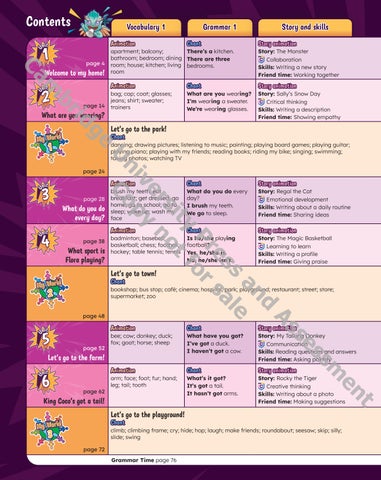
Contents
Chant
Story animation
Welcome to my home!
nit
Animation
Chant
Story animation
m
Ca
page 4
U
br
page 14
id
What are you wearing?
Chant
dancing; drawing pictures; listening to music; painting; playing board games; playing guitar; playing piano; playing with my friends; reading books; riding my bike; singing; swimming; taking photos; watching TV
As d an s le es sa Pr r y fo it t rs no ve y ni p
Animation
nit
brush my teeth; eat breakfast; get dressed; go home; go to school; go to sleep; wake up; wash my face
Co
page 28
What do you do every day?
Animation
nit
4
Story: Sally’s Snow Day Critical thinking Skills: Writing a description Friend time: Showing empathy
Let’s go to the park!
page 24
3
What are you wearing? I’m wearing a sweater. We’re wearing glasses.
U
1
bag; cap; coat; glasses; jeans; shirt; sweater; trainers
Story: The Monster Collaboration Skills: Writing a new story Friend time: Working together
ge
My World
U
Story and skills
apartment; balcony; There’s a kitchen. bathroom; bedroom; dining There are three room; house; kitchen; living bedrooms. room
2
U
Grammar 1
Animation
nit
1
U
Vocabulary 1
page 38
What sport is Flora playing?
badminton; baseball; basketball; chess; football; hockey; table tennis; tennis
Chant
Story animation
Chant
Story animation
What do you do every day? I brush my teeth. We go to sleep.
Is he/she playing football? Yes, he/she is. No, he/she isn’t.
Story: Regal the Cat Emotional development Skills: Writing about a daily routine Friend time: Sharing ideas
Story: The Magic Basketball Learning to learn Skills: Writing a profile Friend time: Giving praise
Let’s go to town! Chant
My World
bookshop; bus stop; café; cinema; hospital; park; playground; restaurant; street; store; supermarket; zoo
2
page 48
nit
page 52
U
Chant
Story animation
Animation
Chant
Story animation
bee; cow; donkey; duck; fox; goat; horse; sheep
Let’s go to the farm!
page 62
U
arm; face; foot; fur; hand; leg; tail; tooth
Story: Rocky the Tiger Creative thinking Skills: Writing about a photo Friend time: Making suggestions
Let’s go to the playground! Chant
My World
climb; climbing frame; cry; hide; hop; laugh; make friends; roundabout; seesaw; skip; silly; slide; swing
3
page 72 Grammar Time page 76
t
King Coco’s got a tail!
What’s it got? It’s got a tail. It hasn’t got arms.
en
6
Story: My Talking Donkey Communication Skills: Reading questions and answers Friend time: Asking politely
m
nit
What have you got? I’ve got a duck. I haven’t got a cow.
ss se
5
Animation
Vocabulary 2
Culture & Communication
Grammar 2
Song
Ca
bath; bed; bookcase; lamp; sofa; wardrobe
m
Song
Where’s the sofa? It’s in the living room. Where’s Emily? She’s on the bed.
Culture video
Design a bedroom for a friend Time to think: Why are homes important? Creative thinking
Are you wearing wellies? Yes, I am / we are. No, I’m not / we aren’t.
Culture video
Plan your school’s recycling day Time to think: Where do clothes go? Collaboration
id
br
flip flops; slippers; umbrella; wellies
Learning situation
Homes in Mongolia Plurilingual activity: A home in your country Phonics: /ae/ in cat Uniforms in South Korea Plurilingual activity: A class collage of uniforms Phonics: /k/ in sock
Song
ge
Let’s make new friends!
Do you like drawing? Yes, I/we do. No, I/we don’t.
U
Let’s talk about friends
Yes, he/she does. Yes, they do.
No, he/she doesn’t. No, they don’t.
As d an s le es sa Pr r y fo it t rs no ve y ni p
Does he/she like painting? Do they like painting
What does he/she do in the evening? He/She reads a book.
Culture video
Make a daily routines planner Time to think: Why is it important to organise your activities and routines? Learning to learn
Song
What’s he/she doing? He’s/She’s playing football.
Culture video
Create a poster for a school sports club Time to think: Why is it important to do sports? Communication
at night; in the afternoon; in the evening; in the morning
bounce; catch; hit; kick; throw
Co
Song
What’s in the town? Song
Daily routines in Germany Plurilingual activity: Daily routines Phonics: /ɪ/ /i:/ in sits and seat
A martial art from Japan Plurilingual activity: How to play a sport Phonics: /r/ in karate
There isn’t a hospital. There aren’t any restaurants.
Where’s the cinema?
It’s next to the zoo. It’s behind the bookshop. It’s in front of the playground. It’s between the restaurant and the zoo. Have you got a dog? Yes, I have. No, I haven’t.
Culture video
Make an animal rescue fact card Time to think: Why is it important to look after animals? Social responsibility
Song
Has it/he/she got a small head? Yes, it/he/she has. No, it/he/she hasn’t.
Culture video
Create a wild animals mind map Time to think: How are wild animals different from pets? Critical thinking
cat; chicken; dog; fish; kitten; puppy
Song
What’s Chen doing? He’s playing on the seesaw. Ana’s playing on the swing.
Let’s play!
Do you like playing on the climbing frame? Yes, I do. / No, I don’t. Let’s play on the seesaw!
t
What’s your friend doing?
en
Amazing animals in Madagascar Plurilingual activity: Animal language glossary Phonics: /m/ in chameleon
m
body; neck; smile; wings
A farm in India Plurilingual activity: Describing photos Phonics: /f/ in farmer
ss se
Song
Welcome ! e m o h y m o t
nit
m
Ca
a house
a kitchen
id
br
an apartment
ge
a bedroom
Vocabulary
av
U
1
Lesson 1
Co
As d an s le es sa Pr r y fo it t rs no ve y ni p
U
a dining room
a bathroom
a balcony
a living room
1
1
2
1 Watch again. Where are they? Say.
1 Watch. Where’s Mac the cat?
Dad’s in the
.
Emily’s in the
d
.
Grandpa’s in the .
en
Grandma’s in the .
c
m
b
ss se
a
t
3
Talk Time Draw three rooms. Guess with a friend. It’s a bathroom.
4
Vocabulary
Rooms in a home
No! It’s a kitchen.
Lesson 2 Grammar
2 Listen and
Ca
1
1
c h a n t . Count the rooms.
m
Here’s our home. What can you see? There’s a living room and there’s me!
id
br
Here’s our home. What can you see? There are two bedrooms and a small balcony.
ge
Here’s our home. What can you see? There are two chairs and a big TV!
As d an s le es sa Pr r y fo it t rs no ve y ni p
U
Language focus There’s a kitchen. There are three bedrooms.
Co
2 Look and say. a
c
b
kitchen.
3
two chairs.
balcony.
2 Talk Time Watch. Play True or False with a friend.
False!
m
ss se
In my home, there are three kitchens.
in my home.
en
I can say the rooms
t I can talk about
rooms in my home.
Grammar
5
Lesson 3 Our stories
1
3 Watch and point. Which rooms do they go into?
Ca id
br
m
by Mila aged 9 from Russia
Can we watch monster cartoons, please?
2
ge
Co
As d an s le es sa Pr r y fo it t rs no ve y ni p
U
1
Argh! There’s a monster!
Run!
Yes! And there’s some juice in the kitchen. The monster doesn’t like water.
3
There’s water in the cups.
4
We can do this together.
Let’s go to the bathroom. 5
It’s coming!
6 6
m
ss se en
One, two, three …
We can watch monster cartoons!
t
2
3 Watch again. Imagine you're the monster. What’s your favourite room? What do you like?
6
Story
Collaboration: Working towards task completion
Lesson 4 Story and skills
1
1
3 Listen and read again. Say yes or no.
Ca
1
The children are in John’s house.
m
2 There’s juice in the kitchen.
br
3 There are two monsters.
id
4 There are three cups in the bathroom.
ge
5 There’s a TV in the kitchen.
U
2
Co
As d an s le es sa Pr r y fo it t rs no ve y ni p
Imagine a different monster story. Choose your ideas. There are 1 three / four children. They’re in the 2
bedroom / dining room. They find a monster 3
3
on / under the 4 chair / table.
Talk Time Act out your monster
story with a friend.
There’s a monster on the table!
Work together to lift the ball. Stand in a circle and carry the imaginary ball. Can you do it together?
en
m
ss se
t Skills
7
Lesson 5 Song and vocabulary
4 Listen and s i n g . Choose the words.
1
b
a wardrobe
a bookcase
c
d
ge
id
br
m
Ca
Where’s Mo the mouse? ? No. On the sofa or the 1 ? No! In the bath or the 2 She’s on the lamp!
a
U
Where’s the lamp? , It’s on the 3 Where’s the bookcase? It’s in the living room. Oh, hello! It’s Grandpa Kamp! He’s on the sofa.
a sofa
As d an s le es sa Pr r y fo it t rs no ve y ni p
a bath
e
f
Co
a bed
2
a lamp
4 Listen again. Read and choose. 1
The lamp is on the bookcase / wardrobe.
2 The bookcase is in the bathroom / living room. 3 Grandpa Kamp is on the bed / sofa.
Talk Time Play the Chain Game with friends.
en
In my home, there’s a bath and a red sofa ...
m
In my home, there’s a bath.
ss se
3
t
8
Vocabulary
Xxxx Furniture
Lesson 6 Grammar
1
Language focus
4 Listen and sing again.
Ca
Where’s the mouse?
Where’s the sofa? It’s in the living room. Where’s Emily? She’s on the bed.
br
m
2 Read, look and match. Where’s the lamp?
id
Where’s Grandma?
Where’s Dad? c
b
ge
a
1
Co
3
As d an s le es sa Pr r y fo it t rs no ve y ni p
U 1
He’s on the sofa.
2
She’s on the balcony.
3
4 Talk Time Watch. Mime, ask and
answer with a friend.
Where’s Sara?
She’s in the kitchen.
It’s in the bedroom.
F un Time Let’s race! How many home words can you say in a minute? Say with a friend.
m
ss se things are.
en
I can say where
t I can ask about and say where things are. Grammar
9
Lesson 7 Culture
Homes in Mongolia
Ca 1
m
5 Watch.
What’s a ger?
id
br 5 Watch again. Order the photos.
ge
2 a
b
Co
As d an s le es sa Pr r y fo it t rs no ve y ni p
U There are gers in the city. c
Gers are big and round.
d
Nomadic families live in gers.
Culture
Homes in Mongolia
The top of a ger is called a crown!
t
10
There’s a table in my apartment, too. It’s big.
en
There’s a table in a ger. It’s round.
Fact Time
m
Talk Time Talk to a friend and compare.
ss se
3
Gers are warm.
Lesson 8 Communication
1
My home
Ca
Draw a home in your country. Write words in the languages you know.
ge
id
2
br
m
1 What’s your favourite room?
As d an s le es sa Pr r y fo it t rs no ve y ni p
balcony
Co
дах
U
techo
janela
Flying phonics
5 Listen and say.
ss se
3
en
m
I’m ha happy on the sofa with my ca cat and my fa family!
t
Communication
My home and /æ/
11
Lesson 9 Review
1
6 Look, listen and say true or false.
a
c
d
ge
id
br
m
Ca
b
U
2
As d an s le es sa Pr r y fo it t rs no ve y ni p
Look and read. Answer.
Co
bananas happy kitchen lamp
1
Dad's is in the
2 He’s very
.
!
3 In the room, there are three a
and
.
Review
t
12
en
m
ss se
Quiz
3
6 Watch and play.
Lesson 10 Learning situation
1
Time to Think
There’s a new family in your street.
Ca
1 How can you welcome a new
Why are homes important? Think about how homes can be different. Think about how you feel at home.
br
m
family to your street?
id
2 You want to help your new
ge
friend decorate their bedroom. Design a bedroom.
Is it big or small?
•
What colours are there?
•
What furniture is there?
Step 2: Find
What materials can you use?
Step 3: Create • Design a bedroom.
3
7 Watch and present.
en
m
t
This is my friend’s bedroom. There’s a big bed and a pink lamp.
ss se
3
2
Co
•
•
1
As d an s le es sa Pr r y fo it t rs no ve y ni p
U
Step 1: Plan
Learning situation
13
What are ? g n i r a e w u o y
nit
U
2
Lesson 1
Vocabulary
ge
id
av
br
m
Ca
jeans
As d an s le es sa Pr r y fo it t rs no ve y ni p
a bag
a sweater
Co
a shirt
glasses
U
a coat
a cap
trainers
1
1
2
1 Watch again. Look and choose.
1 Watch. What party is it?
2
jeans / a bag
3
glasses / trainers
a cap / a coat
Talk Time Look at the pictures. Say and answer. It’s red.
14
4
t
3
a shirt / a sweater
Vocabulary
Clothes
en
m
ss se
1
It’s a cap!
Lesson 2 Grammar
1
2 Listen and
2
Ca
c h a n t . Count the clothes.
m
What are you wearing Adam? I’m wearing a sweater and a shirt.
id
br
What are you wearing Hana? I’m wearing a cap and a skirt.
ge
What are you wearing Eva and Chen? We’re wearing jeans and trainers.
Language focus
Co
As d an s le es sa Pr r y fo it t rs no ve y ni p
U
And we’re wearing glasses. We’re all wearing glasses!
What are you wearing? I’m wearing a sweater. We’re wearing glasses.
2 What are you wearing? Look and say. a
c
b
wearing trainers and a coat.
2
Talk Time Watch. Play Guess Who.
Ask, answer and guess.
words.
en
I can ask and answer about what I’m wearing.
Grammar
t
You’re Maya!
I’m wearing a blue skirt and T-shirt.
I can say clothes
m
What are you wearing?
glasses and a sweater.
ss se
3
wearing jeans and a shirt.
15
Lesson 3 Our stories
1
3 Watch and point. What’s Sally’s favourite thing?
Ca id
br
m
by Lucia and Marta aged 11 from Italy
It’s cold today.
ge
Co
As d an s le es sa Pr r y fo it t rs no ve y ni p
U
1
2
Can I play in the snow?
What are you wearing, Sally? 3
Yes, but it’s very cold.
4
I’m wearing my sweater, my coat and my hat.
I’m wearing my favourite thing. 5
Oh, no!
Great!
6
m
ss se en
Sally, are you OK? You’re wearing my boots!
Look! It’s wearing my cap!
t
2 16
3 Watch again. Imagine you’re Sally.
It’s hot today. What are you wearing? Story
Critical thinking: Making decisions
Lesson 4 Story and skills
1
3 Listen to the story. Choose the correct picture. 2
Ca
1
2
a
b
b
a
b
ge
id
br
m
a
3
a
4
Co
As d an s le es sa Pr r y fo it t rs no ve y ni p
U
b
2
Look at Sally’s brother, Dev. Read and answer. cap jeans red T-shirt umbrella
I’m wearing a blue 1 and some 3
, some green 2
boots. I’ve got an orange 4
and a black bag, too. Oh, no! My 5 is very big!
Talk Time Play True or False with
Skills
t
False! Your T-shirt’s red.
Ask a friend. Sit in a circle and ask, ‘How are you today?’ Listen to a friend.
en
I’m wearing jeans, a shirt and a blue T-shirt.
m
a friend.
ss se
3
17 17
Lesson 5 Song and vocabulary
4 Listen and s i n g . Choose the words.
1
a
b
ge
id
br
m
Ca
Are you wearing wellies? Yes! Yes! Yes, I am. I’m wearing yellow wellies On this rainy day. ,too. I’ve got a red 1 Let’s go out and play!
flip flops
wellies
c
d
slippers
Co
As d an s le es sa Pr r y fo it t rs no ve y ni p
U
? Are you wearing 2 No! No! No, we aren’t. an umbrella We’re wearing pink flip flops On this sunny day. And we’ve got a ball. Let’s go out and play! What about you? What about you?
2 Read, look and choose.
flip flops slippers wellies
a
.
.
I’m wearing
.
en
m
Talk Time Play the Chain Game with a friend.
Vocabulary
Footwear
I’m wearing blue trousers and red flip flops.
t
I’m wearing blue trousers. 18
I’m wearing
ss se
I’m wearing
3
c
b
Lesson 6 Grammar
1
Language focus
4 Listen and sing again. What
Ca
colour’s the umbrella?
Are you wearing wellies? Yes, I am. / Yes, we are. No, I’m not. / No, we aren’t.
br
m
2 Read, look and choose.
ge
a
Are you wearing flip flops?
id
Are you wearing wellies?
2
b
As d an s le es sa Pr r y fo it t rs no ve y ni p
U Yes, I am. / No, I’m not.
Are you wearing slippers?
Are you wearing glasses?
c
Co
Yes, I am. / No, I’m not.
Look in the classroom and find: white trainers a blue shirt red socks black glasses
d
Yes, we are. / No, we aren’t.
3
4
F un Time
Yes, we are. / No, we aren’t.
Talk Time Watch. Draw, ask and answer. No, I’m not.
m
ss se
Are you wearing a coat?
t
Are you wearing a shirt?
Yes, I am.
wearing.
en
I can say what I’m
I can ask what my
friends are wearing.
Grammar
19
Lesson 7 Culture
Uniforms in South Korea
Ca
5 Watch. What’s a gyobok?
br
m
1
5 Watch again. Read and answer primary school
id
2
ge
or middle school.
a
b
Co
As d an s le es sa Pr r y fo it t rs no ve y ni p
U We start when we are 6 years old. c
d
My friends aren’t wearing school uniforms.
These students are wearing blazers.
Talk Time Imagine a new uniform for
Uniforms in South Korea
t
Culture
In South Korea, families can wear school uniforms to a theme park!
en
I’m wearing a blue blazer and trousers.
Fact Time
m
your school. Play Pass the Picture with a friend.
ss se
3
20
Some students wear a tie.
Lesson 8 Communication
2
School uniforms
Ca
m
1 Find pictures of school uniforms.
id
br
What are the children wearing?
2
ge
Make a class collage of different uniforms. Write words in the languages you know.
Co
As d an s le es sa Pr r y fo it t rs no ve y ni p
U
mavi elbis e
white shirt
giày đen
Flying phonics
5 Listen and say.
m
ss se
3
en
Jack and Vick Jack Vickyy thinkk pin thin pinkk so sock ckss are cool at sch school! ool!
t
Communication
School uniforms and /k/
21
Lesson 9 Review
1 Say the words. Which is the odd one out?
Ca 1
2
wellies
a shirt
slippers
jeans
a skirt
a sweater
br
m
flip flops
6 Listen. Choose the correct picture.
U
2
ge
id
glasses
Co
As d an s le es sa Pr r y fo it t rs no ve y ni p
2
3
a
b
c
1
d
e
f
Review
t
22
en
m
ss se
Quiz
3
6 Watch and play.
Lesson 10 Learning situation
2
It’s clothes recycling day at your school.
Ca
1 What do you do when you can’t
br
m
wear your clothes any more?
Step 1: Plan
Where do clothes go? Discuss what happens to clothes when you throw them away.
U
•
ge
id
2 Plan your school’s recycling day.
Time to Think
Think about clothes at home
As d an s le es sa Pr r y fo it t rs no ve y ni p
that can be recycled.
•
Co
Step 2: Find
What things can you make by recycling clothes?
•
Who can you help by recycling clothes?
•
What things can you donate?
Step 3: Create •
Make a plan for your school’s clothes recycling day.
7 Watch and present.
en
m
t
This is the plan for my school’s recycling day. You can recycle clothes or give them to a friend.
ss se
3
Learning situation
23
Let’s go to the park!
My World
br
m
Ca
1
id
Where am I?
playing with my friends
2
drawing pictures
3
listening to music
4
playing piano
5
reading books
6
playing board games
7
watching TV
8
swimming
9
taking photos
ge
1
Co
12 playing guitar 13 singing
2
10
2
2 Listen and find. Say.
3
Talk Time Mime and guess
t
1 Listen and
en
ch ant .
1
m
ss se
14 dancing
24
As d an s le es sa Pr r y fo it t rs no ve y ni p
U
10 riding my bike 4 11 painting
1
with a friend.
Lesson 1 Vocabulary
1
br
m
Ca 11
7
id
4
ge
12
3
U
As d an s le es sa Pr r y fo it t rs no ve y ni p
6
Co
2
13
14
Find
5 things
that are funny.
9
5
en
m
ss se
t
8
Vocabulary
Hobbies
25
Lesson 2 Let’s make new friends!
1
3 Listen and s i n g . Answer
Ca
for you.
Do you like drawing? Yes, I/we do. No, I/we don’t.
Yes, I do.
ge
id
br
m
Do you like reading books?
Language focus
Co
As d an s le es sa Pr r y fo it t rs no ve y ni p
U Do you like riding a bike?
Yes, we do.
Talk Time You’re in the playground. Ask and answer
5 questions with friends.
Grammar
No, I don’t. Do you like swimming?
t
26
Yes, I do.
en
Do you like playing board games?
m
3
3 Listen again and act out.
ss se
2
Lesson 3 Let’s talk about friends
1
4 Listen and choose. 2
a
a
b
b
ge
id
br
m
Ca
1
U
Lucy
a
Zak
As d an s le es sa Pr r y fo it t rs no ve y ni p
3
Language focus
Co
b
Does he/she like painting? Yes, he/she does. No, he/she doesn’t. Do they like painting? Yes, they do. / No, they don’t.
Mo and Rose
2
5 1
Listen and answer.
Does Hana like dancing? No, she ? Yes, he does.
3 Do Pat and Jess like watching TV? No, they .
Does Lucy like watching TV?
t
Talk Time Ask and answer about the children in activity 1.
en
3
? Yes, they
m
4 Do Sam and Ana like
.
ss se
2 Does Dev like
.
Yes, she does.
Grammar
27
What do you ? y a d y r e v e do
nit
U
3
Lesson 1
Vocabulary
ge
id
av
br
m
Ca
eat breakfast
U
brush my teeth
wake up
Co
As d an s le es sa Pr r y fo it t rs no ve y ni p
get dressed
wash my face
go to school
go to sleep
1
1
2
1 Watch again. Who says it? Answer Emily, Lukas
1 Watch. What does Grandpa do with friends?
I wake up and I get dressed.
4 I brush my teeth and go to sleep.
Talk Time What do you do every day?
Mime and guess with a friend.
Vocabulary
Daily routines
t
3
and play.
en
breakfast.
3 We go to school. We go home
m
2 I wash my face. Then I eat
ss se
or Grandpa. 1
28
go home
Wake up!
Lesson 2 Grammar
1
2 Listen and
3
Ca
c h a n t . What do you do every day?
m
What do you do every day? I wake up, I get dressed and I wash my face.
Language focus What do you do every day? I brush my teeth. We go to sleep.
id
br
Then what do you do every day? I eat breakfast and I brush my teeth.
ge
Then what do you do? Then what do you do? We go to school! We go to school!
As d an s le es sa Pr r y fo it t rs no ve y ni p
U Co
2 Look and say. a
I
3
c
b
my teeth.
2
I
up.
We
to sleep.
Talk Time Watch. Play the Chain Game with a friend.
m
ss se
I wake up.
I wake up and I wash my face.
daily routines.
en
I can say words for
t I can talk about
I wake up, I wash my face and I brush my teeth.
things I do every day.
Grammar
29
Lesson 3 Our stories
1
3 Watch and point. Who’s Elif?
Ca id
br
m
by Ömer aged 9 from Türkiye 2
ge
Hello! I’m Regal.
Co
As d an s le es sa Pr r y fo it t rs no ve y ni p
U
1
I wash my face in the big bathroom.
3
5
I wake up again and I eat breakfast.
4
I play in the dining room.
6
Then I go to sleep again!
When Elif is asleep, I play in the garden.
en
I wake up again and I play with Elif.
m
ss se
I don’t like sleeping at night!
t
2 30
3 Watch again. Imagine you’re Elif.
What do you do every day? Story
Emotional development: Positive relationships with others
Lesson 4 Story and skills
1
3
3 Listen to the story. Read and say yes or no for Regal.
Ca
1
I live at Elif’s house.
m
2 I wash my face in the big bathroom.
br
3 I eat fruit for breakfast.
id
4 I brush my teeth in the living room.
ge
5 I like playing with Elif.
U
Imagine a different animal. What does it do every day? Choose your ideas.
Co
brush my teeth go to sleep read a book
3
As d an s le es sa Pr r y fo it t rs no ve y ni p
2
eat breakfast
go to pet school
play with my friends
play with my toys
wash my face
watch TV
Talk Time Act out your animal’s day with a friend. What do you do every day?
I go to mouse school.
ss se en
m
Ask a friend. What do you like playing with me?
t Skills
31 31
Lesson 5 Song and vocabulary
4 Listen and s i n g . Choose the words.
1
Ca
? What does Flora do 2 She eats dinner. Then she plays a game.
What does Leo do 1 ? He eats lunch at school. Then he goes home.
What does Leo do 3 ? He brushes his teeth and reads. Then he goes to sleep.
ge
id
br
m
What does Flora do in the morning? She wakes up and gets dressed. Then she washes her face.
a
c
d
Co
As d an s le es sa Pr r y fo it t rs no ve y ni p
U
b
in the evening
in the morning
at night
in the afternoon
2 Look and answer for you. a
c
b
Talk Time Say and guess with a friend.
.
I eat dinner
en
t
I play a board game. … in the evening? 32
Vocabulary
Times of the day
.
m
3
I wash my face
ss se
.
I go home
Lesson 6 Grammar
1
Ca
When does Leo read?
What does he/she do in the evening? He/She reads a book.
with a friend.
id
br
m
Talk Time Follow. Ask and answer
ge
What does Hana do in the morning?
U
She plays piano.
a eats lunch
Hana / morning?
As d an s le es sa Pr r y fo it t rs no ve y ni p
1
b listens to music
2 Hana / afternoon?
Co
3
Language focus
4 Listen and sing again.
2
3 Yusef / evening?
c brushes his teeth
4 Yusef / night?
d plays piano
4
Talk Time Watch. Talk about a
friend.
My friend’s Eva.
3
Play Roll the Dice. Roll a dice and make a new routine with a friend.
ss se
What does Eva do in the morning?
F un Time
I can say what I do
en
m
at different times of the day.
t
I can ask and answer about what people do every day.
She goes to school.
Grammar
33
Lesson 7 Culture
Daily routines in Germany
Ca
5 Watch. What’s a ‘Grundschule’?
br
m
1
5 Watch again. Order the photos.
ge
id
2 a
b
Co
As d an s le es sa Pr r y fo it t rs no ve y ni p
U We have 5 lessons in the morning. c
d
We go to clubs in the afternoon.
I go home at lunchtime.
Talk Time Talk to a friend and compare.
In Germany, children have big school bags called ‘Schulranzen’.
t
Daily routines in Germany
en
Culture
We don’t start school early.
Fact Time
m
In Germany, children start school very early in the morning.
ss se
3
34
We start school at 8 in the morning.
Lesson 8 Communication
3
My routine
Ca
m
1 What do you do at home Ask a friend in the languages you know. Write words in English.
ge
2
id
br
on Saturdays?
As d an s le es sa Pr r y fo it t rs no ve y ni p
U Time
Routine
Co
In the morning,
In the afternoon, she eats lunch and … In the evening,
Flying phonics
5 Listen and say.
m
ss se
3
en
Finn si sits in hi his gree greenn sea eatt and lilistens to the tea teacher. cher.
t
Communication
My routine and /ɪ/ /i:/
35
Lesson 9 Review
1 Read, look and choose.
m
Ca
gets dressed goes home goes to sleep wakes up
a
c
b
d
ge
id
br He
at night.
6 Listen and choose.
Co
1
She in the morning.
As d an s le es sa Pr r y fo it t rs no ve y ni p
2
He in the afternoon.
U
She in the morning.
2
a
b
a
3
b
a
b
Review
t
36
en
m
ss se
Quiz
3
6 Watch and play.
Lesson 10 Learning situation
Ca
You need to organise your activities and routines for this school year.
br
m
1 What’s a typical day for you?
id
2 Design and complete a daily
Do you do the same thing every day?
Co
•
Why is it important to organise your activities and routines? Have all children got the same routines?
As d an s le es sa Pr r y fo it t rs no ve y ni p
•
Time to Think
U
Step 1: Plan
ge
routines planner.
3
What do you do in the morning / afternoon / evening?
•
What do you do at the weekend?
Step 2: Find •
What do you need to make a planner?
Step 3: Create •
7 Watch and present.
en
m
t
This is my daily planner. In the morning, I wash my face, I brush my teeth and I go to school.
ss se
3
Make your daily routines planner.
Learning situation
37
s i t r o p s t a h W ? g n i y a l p a r o Fl
nit
U
4
Lesson 1
Vocabulary
ge
id
av
br
m
Ca
plaY
plaY
plaY
plaY
As d an s le es sa Pr r y fo it t rs no ve y ni p
U football
tennis
baseball
chess
Co plaY
plaY
hockey
table tennis
badminton
basketball
1
1
2
1 Watch again and order. Say the sports.
ss se
a
1 Watch. What’s Flora’s favourite sport?
c
b
d
Vocabulary
Sports
t
Talk Time Play Activity Sculptures. Basketball?
38
en
m
3
No.
Table tennis!
Lesson 2 Grammar
1
2 Listen and
4
Ca
c h a n t . What does Meena like doing?
ge
id
br
m
Hey, look! Nico’s got a ball. Is he playing baseball at school? No, he isn’t. No, he isn’t. Is he playing table tennis? Yes, he is. That’s cool! Hey, look! Meena’s got a ball. Is she playing basketball at school? Yes, she is. She likes playing basketball. That’s cool!
As d an s le es sa Pr r y fo it t rs no ve y ni p
U
3
Co
2 Read and match. 1
Language focus
Is Nico playing football?
Is he/she playing football? Yes, he/she is. No, he/she isn’t.
a No, she isn’t.
2 Is Nico playing table tennis?
b Yes, he is.
3 Is Meena playing tennis?
c Yes, she is.
4 Is Meena playing basketball?
d No, he isn’t.
2
Talk Time Watch. Draw Nico or Meena. Ask and answer.
m
ss se sports.
en
I can say different
t
Is Meena playing tennis?
I can ask and answer
No, she isn’t.
about sports.
Grammar
39
Lesson 3 Our stories
1
3 Watch and point. What does Giannis give Julia?
Ca id
br
m
by Haris aged 11 from Greece
I like playing basketball, but I’m not good at it.
ge
Co
As d an s le es sa Pr r y fo it t rs no ve y ni p
U
1
Giannis is throwing the ball.
2
3
This is my favourite basketball.
Is Julia playing basketball?
4
Yes, she is.
Wow, thanks!
5
Is Julia having fun?
6
Thanks for the ball. Is it magic?
m
ss se No, it isn’t. You’re magic, Julia!
en
Yes, she is.
t
2 40
Talk Time Ask and answer about the
pictures in the story. Story
Learning to learn: Developing skills
Lesson 4 Story and skills
1
4
3 Listen, read and choose.
Ca
1
Julia is / isn’t good at playing basketball.
m
2 Giannis gives Julia his favourite baseball / basketball.
br
3 Julia’s playing basketball / football and having fun.
ge
id
4 The basketball is / isn’t magic, but Julia is!
2
Look at the photo. Imagine and answer.
As d an s le es sa Pr r y fo it t rs no ve y ni p
U This is
. She’s my
Co
She likes
.
and she’s good at
it. She plays every day in the . She’s wearing a pink
3
3
.
Talk Time Watch again. Act out the story. I like playing basketball.
ss se en
m
Play Pass the Ball. Say a sentence to a friend and throw the ball. Say, ‘Well done’.
t Skills
41 41
Lesson 5 Song and vocabulary
4 Listen and s i n g . Choose the words.
1
Ca
br
m
Dev’s bouncing a ball. That’s fun! What’s he playing? He’s playing basketball.
ge
id
Mila’s 1 ing a ball. That’s fun! What’s she playing? She’s playing football.
Yasmin’s 3 ing a ball. She’s catching a ball with friends. That’s fun! d
As d an s le es sa Pr r y fo it t rs no ve y ni p
U
Hana’s 2 ing a ball. That’s fun! What’s she playing? She’s playing baseball.
Jack’s hitting a ball. That’s fun! What’s he playing? He’s playing tennis.
c
throw
Co
b
a
e
bounce
kick
catch
hit
2 Look, read and choose. a
b
en
Talk Time Play Simon Says.
He’s throwing / kicking the ball.
m
3
She’s bouncing / throwing the ball.
ss se
He’s hitting / catching the ball.
c
t
Simon says bounce the ball! 42
Vocabulary
Action verbs for sports
Lesson 6 Grammar
1
4 Listen and sing again.
Ca
Who’s playing tennis?
a
br
m
2 Read and answer.
4
Language focus What’s he/she doing? He’s/She’s playing football. He’s/She’s kicking a ball. c
b
ge
id Co
As d an s le es sa Pr r y fo it t rs no ve y ni p
U ? What’s he He’s hitting a ball.
3
4
What’s she doing? She’s a ball.
Talk Time W atch. Work with
friends. Play True or False.
she doing? a ball.
F un Time
What can you see?
ss se
What’s he doing?
I can talk about
en
m
He’s bouncing a ball.
playing sports with a ball.
t
I can ask and answer
False! He’s ...
about what people are doing.
Grammar
43
Lesson 7 Culture
A martial art from Japan
Ca
5 Watch. What’s Himari wearing?
br
m
1
5 Watch again. Read, look and choose.
ge
id
2
bow dojo karate respect
U
a
b
As d an s le es sa Pr r y fo it t rs no ve y ni p
Co I’m learning to do c
We train in a
.
d
We
to our opponent.
Talk Time Talk to a friend and compare.
Fact Time
A martial art from Japan
There are many different colours of belts in karate!
t
Culture
We play badminton in the park.
en
We train in a dojo.
m
3
others.
ss se
We learn to
44
.
Lesson 8 Communication
4
My favourite sport
Ca
id
Draw your favourite sport and tell your friends how to play it. Write words in the languages you know.
ge
2
br
m
1 What’s your favourite sport?
Co
As d an s le es sa Pr r y fo it t rs no ve y ni p
U
raquete de tênis
pelota de tenis
tennis net
Flying phonics
5 Listen and say.
m
ss se
3
en
It’s wr wrong ong to run around the room in kar karate!
t
Communication
My favourite sport and /r/
45
Lesson 9 Review
1
Listen and order.
6
a
c
d
ge
id
br
m
Ca
b
2
What’s Nora doing?
As d an s le es sa Pr r y fo it t rs no ve y ni p
U
Look and read. Answer.
Nora’s kicking a football. Her mum’s on the balcony.
Co
She’s kicking a .
Who’s on the balcony?
Nora’s
.
Review
t
46
en
m
ss se
Quiz
3
6 Watch and play.
Lesson 10 Learning situation
4
You want to join your school’s sports club.
Time to Think
Ca
1 What after-school activities
br
m
do you do?
Why is it important to do sports? Discuss why sports are good for you.
id
2 Create a poster for your
ge
school sports club.
As d an s le es sa Pr r y fo it t rs no ve y ni p
U
Step 1: Plan
What sports do you like?
•
What do you do every day /
Co
•
at the weekend? Step 2: Find •
What sports do your friends like?
•
What do they do every day / at the weekend?
Step 3: Create •
Make a school sports club poster.
7 Watch and present.
en
m
t
This is my poster. I’m playing baseball. My friend’s kicking the ball. He likes football.
ss se
3
My sc hool sp or ts club
Learning situation
47
My World
m
Ca
2
Let’s go to town! 7
br id
Where am I?
a park
2
a street
3
a supermarket
4
a cinema
5
a store
6
a bus stop
7
a café
8
a bookshop
9
a restaurant
ge
1
Co
As d an s le es sa Pr r y fo it t rs no ve y ni p
U
10 a hospital 11 a zoo 12 a playground
5
2 Listen and find. Say.
Talk Time Look at the town. Say and find.
3! Let’s go to the playground!
t
2
Let’s go to the supermarket!
en
1 Listen and
3 48
ch ant .
1
m
ss se 12
Lesson 1 Vocabulary 3
2
4
m
Ca
2
10
6
ge
id
br Co
As d an s le es sa Pr r y fo it t rs no ve y ni p
U
8
Find
5 things
that are funny.
9
11
en
m
ss se
t
1
Vocabulary
Places in a town
49
Lesson 2 What’s in the town?
3 Listen and s i n g . How many bus stops are there?
1
There isn’t a cinema.
ge
id
br
m
Ca
There’s a café. There are stores.
Co
As d an s le es sa Pr r y fo it t rs no ve y ni p
U There aren’t aren’t any any There bookshops. bookshops.
3 Listen again and act out.
Talk Time Draw a map of your town with friends.
Talk about it.
Grammar
There isn’t a zoo.
t
50
There aren’t any cafés.
en
There’s a supermarket.
m
3
There isn’t a hospital. There aren’t any restaurants.
ss se
2
Language focus
Lesson 3 Where’s the cinema?
1
Listen and point to the places. What type of store is it?
4
ge
id
br
m
Ca
As d an s le es sa Pr r y fo it t rs no ve y ni p
U Co
Language focus
Where’s the cinema? It’s next to It’s behind It’s between
2
the zoo.
the bookshop.
It’s in front of
the restaurant and the zoo.
4 Listen again. Read and say. 1
Where’s the playground? It’s
.
3 Where’s the zoo? It’s
. .
m
4 Where’s the bus stop? It isn’t .
en
It’s
.
ss se
2 Where’s the bookshop? It’s
Talk Time Ask and answer about the town on the map. Where’s the café?
t
3
the playground.
It’s next to the bookshop. Grammar
51
Let’s go to the farm!
nit
U
5
Vocabulary
Lesson 1
id ge
a sheep
a cow
a goat
a donkey
Co
As d an s le es sa Pr r y fo it t rs no ve y ni p
U
a duck
av
br
m
Ca
a horse
a bee
a fox
1
1 Watch. What’s Emily’s favourite animal?
1
2 Look, choose and say.
a horse / a cow
a donkey / a sheep
a goat / a duck
52
Talk Time Play the
Chain Game.
Vocabulary
Farm animals
a bee / a fox
t
3
d
en
c
m
b
ss se
a
There’s a green cow on my funny farm.
There’s a green cow and a pink horse on my funny farm.
Lesson 2 Grammar
2 Listen and
c h a n t . What
animals are on the farm?
Ca
1
5
id
br
m
What have you got on the farm? I’ve got a horse and a donkey. I haven’t got a cow or a bee. What have you got on the farm? I’ve got a duck and a sheep. I haven’t got a goat or a fox.
ge
Language focus
U
2 Listen again. Say I’ve got or I haven’t got.
a
3
As d an s le es sa Pr r y fo it t rs no ve y ni p
Co
2
What have you got? I’ve got a duck. I haven’t got a cow.
b
2
c
Talk Time Watch. Draw a farm.
I can say different
en
animals.
m
I’ve got a duck. I haven’t got a cow or a goat.
ss se
Talk with a friend.
What have you got on your farm?
d
t
I can say what animals I’ve got and haven’t got.
Grammar
53
Lesson 3 Our stories
1
3 Watch and point. Which animals can’t talk?
Ca id
br
m
by Deepak aged 11 from India
Dad, can I have a donkey, please?
ge
As d an s le es sa Pr r y fo it t rs no ve y ni p
U
1
2
Can I have this donkey, please?
Co
This donkey costs 1,000 coins.
I haven’t got money for a donkey! 3
Can I give you 700 coins?
4
These apples are good!
Yes, you can.
5
What animals have you got? Oh no!
You can talk!
I’ve got a talking donkey!
6
ss se en
m
But we haven’t got a talking cow, sheep or goat!
t
2 54
3 W atch again. Who’s your favourite
character in the story? Story
Communication: Using appropriate language
Lesson 4 Story and skills
1
3 Listen to the story. Match to the pictures on page 54. a Picture
c Picture
e Picture
b Picture
d Picture
f
Read and match the questions to the answers.
ge
id
1
U
What’s your name?
a I’ve got an apple. b I’m Sunny.
3 What clothes have you got?
c
I’m ten.
4 What fruit have you got?
d
I’ve got a hat.
As d an s le es sa Pr r y fo it t rs no ve y ni p
2 How old are you?
Co
3
Picture
br
m
Ca 2
5
Talk Time L ook at activity 2 again. Choose a character.
Ask and answer the questions.
What’s your name?
I’m …
en
m
ss se
Say, ‘Please!’ Pass the ruler around the class. Ask, ‘Can I have it, please?’
t Skills
55
Lesson 5 Song and vocabulary
4 Listen and s i n g . Choose the words.
1
Ca
Have you got a 1 ? Yes, I have. I’ve got a little fish! He’s swimming in a big, big dish!
a
b
br
m
ge
id
Have you got a cat? No, I haven’t. I’ve got a 2 He’s playing with a ball, With my puppy, Paul!
a dog
.
c
U
Have you got a duck? . No, I haven’t. I’ve got a 3 She’s playing in the kitchen! And look – there’s my kitten!
a puppy d
a kitten
As d an s le es sa Pr r y fo it t rs no ve y ni p
a fish
Co
e
f
a chicken
a cat
2 Look and say It’s a ... a
c
d
ss se
Talk Time Mime the animal and guess with a friend.
No.
en
A dog?
m
3
b
t
A rabbit? 56
Vocabulary
Pets
Yes!
Lesson 6 Grammar
1
5
4 Listen and sing again. Mime
Ca
I’ve got
.
or I haven’t got
Language focus
2 Ask and answer about pets.
id
br
m
Have you got a dog? Yes, I have. No, I haven’t.
1
Have you got a cat?
ge
Yes,
.
As d an s le es sa Pr r y fo it t rs no ve y ni p
U 2 Have you got a puppy?
Co
No,
.
3
3
4
?
F un Time Let’s say! How many animal words can you say with a friend?
Talk Time Watch. Play Pass the Ball.
Ask and answer.
I can ask about
the animals someone has got.
en
m
No, I haven’t.
ss se
Have you got a chicken?
t
I can answer questions about the animals I’ve got. Grammar
57
Lesson 7 Culture
A farm in India
Ca
5 Watch. What animals can
you see? Watch again. Label the photos.
5
ge
2
id
br
m
1
They grow fruit.
We make cheese.
As d an s le es sa Pr r y fo it t rs no ve y ni p
U
We’ve got buffaloes.
We’ve got a tractor.
a
b
Co
c
d
Talk Time What farms are there near you?
Culture
A farm in India
About 40 different kinds of cow live in India!
t
58
There aren’t guava farms near me.
en
There are banana farms near me.
Fact Time
m
Talk to a friend and compare.
ss se
3
Lesson 8 Communication
5
Farmers’ markets
Ca
Look at the farmers’ markets. Describe in the languages you know.
ge
id
2
br
m
1 What are your favourite fruits and vegetables?
Co
As d an s le es sa Pr r y fo it t rs no ve y ni p
U There are two pineapples.
There are .
Flying phonics
5 Listen and say.
m
ss se
3
en
The farmer feeds the buff buffaloes aloes fresh fruit on Fridays.
t
Communication
Farmers’ markets and /f/
59
Lesson 9 Review
1
6 What have the children got? Listen and say.
Ca
.
a
I’ve got a
br
m
I’ve got a
I haven’t got a . I’ve got a .
.
b
id ge
c
As d an s le es sa Pr r y fo it t rs no ve y ni p
U Ana
Ivan
Eli
Co
2
Look at the pictures. Look at the letters. Complete the words.
1 s
2
y
h
b
en
ll
tt
ss
o
w
c
ki
3 g
at
j
u
60
Review
t
Quiz
en
m
ss se
eep
3
6 Watch and play.
Lesson 10 Learning situation
Ca
Your school’s planning a visit to an animal rescue centre.
m
1 What can you do to help
5
Time to Think
Why is it important to look after animals? Discuss how you can look after animals at home or in your town.
id
br
animals find a home?
ge
2 Choose an animal you want to Step 1: Plan
As d an s le es sa Pr r y fo it t rs no ve y ni p
U
rescue and create your animal rescue fact card.
Adopt a rescue cat
Are they farm animals or pets?
•
Do they live on a farm or in a
Co
•
family home? Step 2: Find •
What things do they need?
•
What things do they like?
Step 3: Create •
7 Watch and present.
en
m
t
This is my animal rescue fact card. I’ve got a dog. His name’s Logan. He’s three years old.
ss se
3
Make your animal rescue fact card.
Type of animal: Cat Kitten Name: Whiskers Age: 8 months old Likes: tuna, meowing, sleeping on the sofa Adopted by: Anna and Ben
Learning situation
61
King Coco’s got a tail!
U
6 br
m
Ca
a face
n An Make A
imal
an arm
ge
id
a hand
Co two feet
one tooth
two teeth
1
a tooth
As d an s le es sa Pr r y fo it t rs no ve y ni p
U
fur
a tail
a foot
one foot
1
Vocabulary
av
nit
Lesson 1
a leg
1 Watch. Why does Emily like King Coco’s face?
2 Look and say.
b
c
d
62
Talk Time Imagine you’re a
video game animal. Describe and draw.
Vocabulary
Animal body parts
I’ve got a blue tail and four red legs.
t
3
en
m
ss se
a
Lesson 2 Grammar
1
2 Listen and
6
ch ant .
Ca
Which animal has got a funny face?
id
br
m
What’s it got? It’s got four legs. It’s got black and white fur. It’s got a tail and it’s got teeth. What is it? It’s a cow!
ge
Language focus
What’s it got? It’s got a funny face! It hasn’t got feet. It hasn’t got arms or hands. What is it? It’s a bee!
Co
As d an s le es sa Pr r y fo it t rs no ve y ni p
U
What’s it got? It’s got a tail. It hasn’t got arms.
2 Look, read and say It’s got or It hasn’t got. 1
a tail.
2
brown fur.
3 hands.
2
fur.
5
a tail.
6
long legs.
It’s a donkey.
It’s a frog.
Talk Time Watch. Choose an animal.
Say and guess with a friend.
m
It hasn’t got a tail. It’s got eight legs.
ss se
3
4
I can say what an
en
animal has got.
t
I can say what an
animal hasn’t got.
It’s a spider!
Grammar
63
Lesson 3 Our stories
1
3 Watch and point. What animal is Rocky?
Ca id
br
m
by Danylo aged 7 from Ukraine
I’m not a cat. I’m a tiger!
ge
Co
As d an s le es sa Pr r y fo it t rs no ve y ni p
U
1
3
Hello Rocky. How are you?
2
Let’s play!
Good idea!
I’m a tiger! I’ve got big teeth!
4
Look! That dog’s got big teeth. I’m scared!
5
I’m not scared. I’m angry! Oh no!
6
m
ss se en
I’m not a cat. I’m a tiger!
64
about a character. Story
Creative thinking: Generating ideas
Rocky’s got green eyes and a long tail.
t
2
Talk Time Look. Tell a friend
Lesson 4 Story and skills
1
6
3 Watch again. Read and choose.
Ca
1
Rocky’s got orange and black / white fur.
m
2 Ajax has got black eyes / teeth.
br
3 Rocky isn’t scared of the dog.
Say something fun to do. Give some ideas like, ‘Let’s play football’. Say, ‘Good idea!’
id
He’s angry / tired.
ge
4 The dog’s got big feet / teeth and big claws. 5 The dog’s scared / happy. It runs away.
As d an s le es sa Pr r y fo it t rs no ve y ni p
U
2 a
Co
Read about Bertie and choose the correct picture. Look at the other picture and answer. Bertie’s got a black nose and white feet. He’s got black, brown and white fur and black ears. He’s got brown eyes. He’s got a long tail.
b
Bobbie’s got a black nose and 1 He’s got 2
and white fur and 3
ears. He’s got black 4 a long 5
.
Talk Time Look at the pictures in activity 2.
It’s picture b.
en
m
Say and guess with a friend.
t
He’s got brown ears.
. He hasn’t got
ss se
3
feet.
Skills
65
Lesson 5 Song and vocabulary
3 Listen and s i n g . Choose the words.
1
Ca
ge
id
br
m
There’s a monster, a monster on my bed! It’s got arms, but it hasn’t got legs. ? Has it got a small 1 No, it hasn’t. It’s got a big body and long fur! and a long, orange neck! It’s got two 2 It’s got a funny 3 and a small purple head. There’s a monster, a monster on my bed!
U
a
c
d
Co
As d an s le es sa Pr r y fo it t rs no ve y ni p
b
wings
a smile
a neck
a body
2 Look at the picture and answer. 1
It’s got a small
.
2 It hasn’t got yellow
o
i
w
n
g
s
i
l
m
e
s
c
k
n
e
Talk Time Guess the monster with a friend.
66
Vocabulary
Animal body parts
t
This monster’s got a big smile. It hasn’t got wings.
It’s monster c!
en
3
.
b
m
4 It’s got a long
.
y
ss se
3 It hasn’t got a big
.
d
Lesson 6 Grammar
1
3 Listen and sing again. Mime
Ca
It’s got
or It hasn’t got
.
br
m
2 Ask and answer about the animals. 1
Has it got a small body?
id
Yes, it
6
Language focus Has it/he/she got a small head? Yes, it/he/she has. No, it/he/she hasn’t.
.
ge
2 Has it got four legs?
As d an s le es sa Pr r y fo it t rs no ve y ni p
U 3 Has it got wings?
Co
4 Has it got a long neck?
5 Has it got wings?
F un Time Let’s mime! Mime animals for a friend to guess.
6 Has it got a tail?
3
4
No, it hasn’t.
ss se
Has it got wings?
Talk Time Watch. Ask and answer 5 questions. Guess.
m
I can ask what
en
something has got.
Grammar
t
I can say what something has or hasn’t got.
67
Lesson 7 Culture
Amazing animals in Madagascar
Ca
5 Watch. Are these animals in your country?
br
m
1
5
id
2
Watch again. Label the photos. It’s got green fingers. It’s got a very long tongue. It’s got a stripey tail.
ge
It’s got a big shell.
U
a
b
As d an s le es sa Pr r y fo it t rs no ve y ni p
Co
c
d
Talk Time Talk to a friend and compare.
Amazing animals in Madagascar
t
Culture
My cat’s got a stripey tail.
A chameleon’s tongue can be longer than its body!
en
68
Fact Time
m
A lemur’s got a stripey tail.
ss se
3
Lesson 8 Communication
6
Animals in my country
Ca
Make a language glossary about animals. Write words in the languages you know.
ge
id
2
br
m
1 What animals are there in your country?
As d an s le es sa Pr r y fo it t rs no ve y ni p
U Picture
English
Other languages
un gato
eine Katze
Co
My language
a cat
Flying phonics 3
4 Listen and say.
en
m
t
Communication
ss se
A cham chameleon makes me happy in the morning!
Animals in my country and /m/
69
Lesson 9 Review
1
5 Listen and choose.
Ca 1
2
3
a
a
ge
id
br
m
a
As d an s le es sa Pr r y fo it t rs no ve y ni p
U
b
b
b
Co
2
6 Read and match. Listen and check. 1
Good morning, Hugo.
a Yes, it is.
b Hello, Uncle Nick.
3 Is it your favourite toy?
c It’s got four legs, white fur and wellies!
4 What’s your toy sheep got?
d It’s my toy sheep.
70
Review
t
Quiz
en
m
ss se
2 What have you got?
3
6 Watch and play.
Lesson 10 Learning situation
There’s a new wildlife park in your town.
Ca
1 What animals do you find in
br
m
a wildlife park?
id
2 Tell your class about the
Time to Think
How are wild animals different from pets? Think about where these animals live and what they look like.
ge
animals in the wildlife park. Create a mind map with your ideas.
6
Animals
Co
•
As d an s le es sa Pr r y fo it t rs no ve y ni p
U
Step 1: Plan
My wild animals mind map
Which animals are there in the wildlife park?
Step 2: Find •
Are the animals big or small?
•
What features have they got?
monkey
features
(fur, wings, parts of the body) Step 3: Create •
Make your wild animals mind map.
brown fur, small
7 Watch and present.
big body, very long, no legs
en
m
t
This is my wild animals mind map. I’ve got a tiger. It’s got orange and black fur and a big body.
orange and black
ss se
3
snake
tiger
Learning situation
71
Let’s go to the playground!
My World
Ca
3
br
m
1
id
Where SBam I?
the swing
2
climb
3
hide
4
skip
5
hop
6
the slide
7
cry
8
be silly
9
laugh
ge
1
Co
As d an s le es sa Pr r y fo it t rs no ve y ni p
U
4
7
12
10 the seesaw
11 the climbing frame 12 the roundabout 13 make friends
2
2 Listen and find. Say.
3
Talk Time Talk about what
to play on with friends.
Let’s play on the swing!
t
1 Listen and
en
m
ss se
72
ch ant .
1
No. Let’s skip!
Lesson 1 Vocabulary
3
ge
id
br
m
Ca
11
2
Co
As d an s le es sa Pr r y fo it t rs no ve y ni p
U
3
Find
5 things
that are funny.
10
6
9
8
ss se
13
m en
5
t
Vocabulary
The playground
73
Lesson 2 What’s your friend doing?
3 Listen and s i n g . Who’s crying?
1
br
m
Ca ge
id
I’m playing on the climbing frame.
Co
As d an s le es sa Pr r y fo it t rs no ve y ni p
U
There’s Ana. What’s she doing?
Language focus What’s Chen doing? He’s playing on the seesaw. Ana’s playing on the swings.
Talk Time Draw a playground. Say what you and your
friends are doing.
Grammar
She’s playing on the swing!
t
74
What’s Emily doing?
en
There’s a roundabout, a slide and a swing in my playground.
m
3
3 Listen again and act out.
ss se
2
Lesson 3 Let’s play!
1
4 Listen and match.
a
b
c
ge
id
br
m
Ca U
As d an s le es sa Pr r y fo it t rs no ve y ni p
Language focus
Co
Do you like playing on the climbing frame? Yes, I do. / No, I don’t. Let’s play on the seesaw!
2
4 Listen again and answer. 1
OK. Come on, let’s
2 Well, let’s
on the slide!
3 The swings are
!
Talk Time Ask and answer with a friend.
No, I don’t. Let’s play on the climbing frame!
Grammar
t
Do you like playing on the roundabout?
en
m
ss se
3
!
75
Grammar time + There’s an apartment.
m
Unit 1
Ca
+ There’s a house.
br
+ There are two bedrooms.
ge
id
+ There are five apartments.
+ It’s in the dining room.
Where’s Emily? ? Where’s Lukas?
+ She’s in the living room.
?
Unit 2
Co ?
+ He’s on the balcony.
As d an s le es sa Pr r y fo it t rs no ve y ni p
U
?
Where’s the lamp?
What are you wearing?
+ I’m wearing a shirt.
+ I’m wearing trainers. + We’re wearing caps.
+ We’re wearing jeans.
+ Yes, I am.
?
Are you wearing flip flops?
− No, I’m not.
+ Yes, we are.
+ Yes, I do. ?
?
Do they like reading books?
+ Yes, he does.
− No, she doesn’t.
+ Yes, they do.
− No, they don’t.
t
Does he like swimming? ? Does she like swimming?
en
− No, we don’t.
?
76
+ Yes, we do.
m
Do you like painting?
− No, I don’t.
ss se
My World 1
− No, we’re not.
Grammar time
What do you do every day?
id
br
m
Unit 3
Ca
?
ge
What does he do in the evening? ? What does she do in the morning? ?
+ I wake up. + We eat breakfast.
+ He reads a book. + She brushes her teeth.
Unit 4
Co
As d an s le es sa Pr r y fo it t rs no ve y ni p
U Is he playing basketball? ? Is she playing baseball? ?
What’s he doing? ? What’s she doing?
− No, she isn’t.
+ He’s playing tennis.
+ She’s catching a ball.
+ There’s a zoo.
+ There are restaurants.
− There isn’t a bookshop. − There aren’t any cafés.
It’s next to
Where’s the cinema?
the restaurant. the zoo.
It’s between and the café.
the supermarket
t
It’s in front of
en
?
the bookshop.
m
It’s behind
ss se
My World 2
?
+ Yes, he is.
77
Grammar time
What have you got?
id
br
m
Unit 5
Ca
?
?
Have you got a kitten?
+ I’ve got a goat.
− I haven’t got a donkey.
+ Yes, I have.
ge
− No, I haven’t.
Unit 6
What’s it got?
Co
?
Has it got wings?
+ It’s got black fur.
− It hasn’t got a tail.
+ Yes, it has.
− No, it hasn’t.
?
What’s Leo doing?
+ He’s playing on the swings.
?
What’s Nora doing?
+ She’s playing on the roundabout.
?
Do you like playing on the swings?
Let’s play on the seesaw!
+ Yes, I do.
− No, I don’t.
en
m
ss se
My World 3
As d an s le es sa Pr r y fo it t rs no ve y ni p
U ?
t
78
Talk Time
1
Talking about friends and family
Ca
Ask and answer with a friend. Take turns. Student A: Does your
m
like
? drawing singing swimming
id
br
brother friend sister
Student B:
, he/she doesn’t. He/She likes
.
ge
Yes No
As d an s le es sa Pr r y fo it t rs no ve y ni p
U
2
dancing reading riding a bike
Asking for directions
Co
Ask and answer with a friend. Take turns. Student A: Hello, where’s the
, please?
bus stop café supermarket Student B: Oh, it’s
the
behind between in front of next to
.
bookshop playground resturant
Student A: Thank you!
Student B: You’re welcome.
Making new friends in the playground ?
en
Student A: Hello, do you like playing on the
I do I don’t
. Let’s play on the
t
climbing frame roundabout slide Student B: Hello! No, sorry,
m
Ask and answer with a friend. Take turns.
ss se
3
. That’s fun!
seesaw swings
Student A: OK. Let’s play!
79
Thanks and Acknowledgments The authors and publishers acknowledge the following sources of copyright material and are grateful for the permissions granted. While every effort has been made, it has not always been possible to identify the sources of all the material used, or to trace all copyright holders. If any omissions are brought to our notice, we will be happy to include the appropriate acknowledgments on reprinting and in the next update to the digital edition, as applicable.
Ca
Key: MW= My World, U= Unit.
DigitalVision Vectors; Hubei territory Network Technology Co., Ltd/500px/500px Asia; Marco Cristofori/Corbis Documentary; Buena Vista Images/Photodisc; hadynyah/E+; danm/Moment; Igor Alecsander/E+; Jacob Wackerhausen/iStock/ Getty Images Plus; ljubaphoto/E+; Mehmet Hilmi Barcin/E+; MW1: Christopher Robbins/The Image Bank; Marcia Straub/Moment; Westend61; JGI/Jamie Grill/ Tetra images; janiecbros/E+; Imgorthand/E+; ferrantraite/E+; Richard Hutchings/ Corbis Documentary; MW2: Imgorthand/E+;Tomekbudujedomek/Moment; MW3: Renata Angerami/E+; tunart/E+; TAW4/iStock/Getty Images Plus; AscentXmedia/E+; MesquitaFMS/E+; ruizluquepaz/E+; monkeybusinessimages/iStock/Getty Images Plus. The following photographs are sourced from other libraries:
U1: Giselleflissak/E+; AscentXmedia/E+; Jordan Lye/Moment; HappyKids/E+; Pixelimage/E+; Best View Stock; James Quigley/Photodisc; Mixmike/E+; Boris SV/ Moment; Chris Clor/Tetra images; aire images/Moment; Marcus Lindstrom/E+; CSA Images; momcilog/E+; Johner Images/Johner Images; svetikd/E+; Westend61; Timothy Allen/Stone; Aryo Hadi/iStock/Getty Images Plus; Tuul & Bruno Morandi/ The Image Bank; HECTOR RETAMAL/AFP; Peter Adams/Photodisc; Laurie Noble/Stone; Henn Photography/Cavan; abstractdesignlabs/DigitalVision Vectors; IndiaPix/IndiaPicture; imageBROKER/Wolfgang Weinhaeupl; ozgurdonmaz/E+; Manu Vega/Moment; da-kuk/E+; Kathrin Ziegler/DigitalVision; Sappington Todd/ BLOOMimage; U2: HRAUN/E+; Joe Schmelzer/Corbis Documentary; Dave & Les Jacobs/DigitalVision; Howard Shooter/Dorling Kindersley RF; Frazao Studio Latino/E+; AzmanL/E+; romrodinka/iStock/Getty Images Plus; StockPlanets/E+; FilippoBacci/E+; Adennysyahputra/E+; clubfoto/iStock/Getty Images Plus; Henglein and Steets/Connect Images; petrenkod/iStock/Getty Images Plus; Anastasiia Krivenok/ Moment; Andrii Silvus/500px/500Px Plus; Richard Drury/DigitalVision; mixetto/ E+; Fly View Productions/E+; LSOphoto/iStock/Getty Images Plus; kate_sept2004/ E+; real444/E+; mgstudyo/E+; SDI Productions/E+; cozyta/Moment; Plan Shooting 2/Imazins/ImaZinS; Plan Shoot/Imazins/ImaZinS; aldomurillo/E+; moodboard Mike Watson Images/Brand X Pictures; nattrass/E+; Ron Levine/Photographer’s Choice RF; xPACIFICA/Stone; Stephen Simpson/Stone; U3: FluxFactory/E+; Rockaa/E+; SDI Productions/E+; Hispanolistic/E+; Mariana Pryimachuk/iStock/ Getty Images Plus; StockPlanets/E+; Mystockimages/E+; zhen li/Moment; Oscar Sánchez Photography/Moment; AlxeyPnferov/iStock/Getty Images Plus; Kris Ubach and Quim Roser/Connect Images; Kelvin Murray/Photodisc; andreswd/E+; kali9/ E+; BLOOM image/BLOOM image; alxpin/E+; Maskot; Westend61; Lumi Images/ Alexandra Dost/Collection Mix: Subjects; Jose Luis Pelaez Inc/DigitalVision; Kypros/ Moment; Svetlana Repnitskaya/Moment; LeoPatrizi/E+; Westend61; Maskot/ DigitalVision; U4: 4x6/DigitalVision Vectors; SongSpeckels/DigitalVision Vectors; A-Digit/DigitalVision Vectors; sdart/DigitalVision Vectors; IndiaPix/IndiaPicture/ IndiaPicture; jmsilva/iStock/Getty Images Plus; Catherine Delahaye/DigitalVision; FatCamera/E+; Westersoe/E+; John Giustina/The Image Bank; SDI Productions/ E+; kali9/E+; Santiago Urquijo/Moment; MichaelSvoboda/iStock/Getty Images Plus; Thomas Barwick/DigitalVision; Mark Leibowitz/Corbis; mikimad/E+; Frazao Studio Latino/E+; Paul Calinescu/500px/500px; Viorika/iStock/Getty Images Plus; Layerform/ iStock/Getty Images Plus; NikolayN/iStock/Getty Images Plus; tiero/iStock/Getty Images Plus; EyeEm Mobile GmbH/iStock/Getty Images Plus; FG Trade Latin/E+; Photodisc/Photodisc; tororo/Stone; visualspace/E+; ULTRA.F/DigitalVision; Nikada/ E+; katleho Seisa/E+; Jon Schulte/Photographer’s Choice RF; Jecapix/E+; Alex Liew/ iStock/Getty Images Plus; supersizer/E+; pixdeluxe/E+; South_agency/E+; U5: George Pachantouris/Moment; Jacky Parker Photography/Moment; lucianojoaquim/Moment; Martyn Large/500px/500px; Chad Roberts/500px/500px; Photos by R A Kearton/ Moment; John Elk III/The Image Bank; James Warwick/The Image Bank; Switlana Sonyashna/Moment; LWA/Dann Tardif/DigitalVision; Riska/E+; Alan Currie/iStock/ Getty Images Plus; Images by Christina Kilgour/Moment; slowmotiongli/iStock/ Getty Images Plus; Westend61/Westend61; Erwin Bosman/iStock/Getty Images Plus; Naomi Rahim/Moment; Anna Tretyakova/iStock/Getty Images Plus; DragonTiger/ iStock/Getty Images Plus; Автор/iStock/Getty Images Plus; Liliia Polos/iStock/ Getty Images Plus; Alena Frolova/Moment; Witthaya Prasongsin/Moment; Kseniya Ovchinnikova/Moment; Ippei Naoi/Moment; Gary S Chapman/Photographer’s Choice RF; triloks/E+; CR Shelare/Moment; Mayur Kakade/E+; Kalyan Sen/500px; IndiaPix/IndiaPicture/IndiaPicture; Easy_Company/DigitalVision Vectors; Hubei territory Network Technology Co., Ltd/500px/500px Asia; Marco Cristofori/Corbis Documentary; Buena Vista Images/Photodisc; hadynyah/E+; danm/Moment; Igor Alecsander/E+; Jacob Wackerhausen/iStock/Getty Images Plus; ljubaphoto/E+; Mehmet Hilmi Barcin/E+; U6: ATANAS MAHLELIEV/500px; McDonald Wildlife Photography Inc./The Image Bank; kali9/E+; EyeEm Mobile GmbH/iStock/Getty Images Plus; Kevin Sawyer/500px; primeimages/E+; Lena Granefelt/Johner Images Royalty-Free; Klaus Vedfelt/DigitalVision; vinisouza128/500px/500Px Plus; Kit Houghton/Corbis Documentary; PixelCatchers/E+; Mekdet/Moment; Schafer & Hill/ Moment Mobile; Marco Pozzi Photographer/Moment; Francesco Riccardo Iacomino/ Moment; Tom Littlejohns/500px/500px; id-work/DigitalVision Vectors; Husam Cakaloglu/E+; sdominick/iStock/Getty Images Plus; Vicki Jauron, Babylon and Beyond Photography/Moment; Viktoriya_Podgornaya/iStock/Getty Images Plus; Christopher Laszlo Bonis/500px/500px; StockImages_AT/E+; TomasSereda/iStock/Getty Images Plus; Jamie Grill/Tetra images; PrinPrince/iStock/Getty Images Plus; Easy_Company/
Cover photography and illustrations by Deagreez/iStock/Getty Images Plus/Getty Images; Vivianty Hartono.
ge
id
br
m
Photography The following photographs are sourced from Getty Images.
U4: Chris Willson/Alamy Stock Photo; U6: Oleks Graphic/Shutterstock.
Illustration Alice Larsson (Beehive Illustration); Amanda Enright (Advocate); Anthony Rule; Collaborate Agency; Daniel Klein (Beehive Illustration); Daniel Limon (Beehive Illustration); Dave Williams (The Bright Agency); Denis Alonso (Beehive Illustration); Fran and David Brylewski (Beehive Illustration); Irina Golina Sagatelian (Beehive Illustration); Leo Trinidad; Pablo Gallego (Beehive Illustration); Pipi Sposito (Advocate Art); Sam Chapman (Beehive Illustration); Veronika Chaves Morales (Beehive Illustration); Wild Apple Design Ltd.
Co
As d an s le es sa Pr r y fo it t rs no ve y ni p
U
Video Story animation production by Collaborate Agency. Unit opener animation production by Collaborate Agency. Quiz animation by Antonio Cuesta. Project video production by RM Video.
Audio Audio production by CityVox. Songs and chants composed by Amy Webber, Jen Armstrong and Robert Lee, DibDibDub Studios. Design and Typeset EMC Design Ltd.
The Time to Fly team would like to thank all the writers, editors, designers, producers, artists, researchers, marketers, operations colleagues, and everyone else both in-house and out who brought this course to life. Your tenacity, creativity and collaboration are what give Artis her wings to fly! Thank you especially to all the children who helped make Time to Fly by starring in our speaking videos, writing creative stories, designing funny characters and suggesting cool names for our course mascot. A special mention to Dani Lyle McElligott from Spain for naming Artis! Naming Competition Entrants Brazil: Mateus Camara, Sarah Mettler Moura da Silva, Zaion Pommé, Esther Rodrigues, Stella Rossi, Mariana Senna, Sophia Souza Ecuador:
Eliza Gonzalez
Germany:
Laura Manke
Italy: Alessio Imiola, Sebastiano Lancini, Sofia Lancini, Alessandro Moretti, Lorenzo Moretti, Luca Moretti Isabella Castillo Arriaga, Ximena Guzmán Rodríguez
ss se
Mexico:
Spain: Emma Díaz Morante, Dani Lyle McElligott, Erik Ordóñez Jurek, Liam Ordóñez Jurek Additional writer Marla del Signore.
en
m
t