DIGITAL STARTER UNIT WELCOME BACK TO SCHOOL!
m Ca
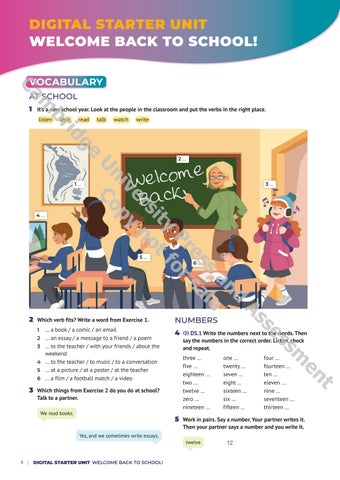
VOCABULARY AT SCHOOL 1 It’s a new school year. Look at the people in the classroom and put the verbs in the right place.
br
listen
look
read
talk
watch
write
ge
id 4…
As d an s le es sa Pr r y fo it t rs no ve y ni p U Co
1…
2…
3…
5…
2 Which verb fits? Write a word from Exercise 1. 2
4 6
Talk to a partner. We read books.
three … five … eighteen … two … twelve … zero … nineteen …
one … twenty … seven … eight … sixteen … six … fifteen …
four … fourteen … ten … eleven … nine … seventeen … thirteen …
5 Work in pairs. Say a number. Your partner writes it. Then your partner says a number and you write it.
Yes, and we sometimes write essays. twelve
1
|
Digital Starter unit WELCOME BACK TO SCHOOL!
12
t
3 Which things from Exercise 2 do you do at school?
DS.1 Write the numbers next to the words. Then say the numbers in the correct order. Listen, check and repeat.
en
5
4
sm
3
… a book / a comic / an email … an essay / a message to a friend / a poem … to the teacher / with your friends / about the weekend … to the teacher / to music / to a conversation … at a picture / at a poster / at the teacher … a film / a football match / a video
NUMBERS
s se
1
6…
READING 6 Do you like your school building? Why? / Why not? Tell a partner. 7 Read Martin’s blog post. Label the photos with the words from the text. canteen classroom library sports hall
m Ca
NEW SCHOOL YEAR, NEW SCHOOL BUILDING
br
by Martin Usman
ge
id
Look at this! It’s our new school. Well, the school is not new, but we’ve got a new school building and I love it! There are fourteen new classrooms, with two chairs at each desk, in different colours. I want a green one!
U
ss se As d an s le es sa Pr r y fo it t rs no ve y ni p
We eat our lunch in a big canteen. There are new colours on the walls there now. They are green and red, and there are white lamps on them. It looks cool.
1 ...
Co
The big new library is amazing. We can do our homework there or just read books. And we’ve got a new sports hall, too. I’m not sure about the colours in the sports hall. Look at the floor. There are four different colours. Is that a bit too much colour?
2 ...
So, the new school year starts today, and I feel good. Maybe a school building isn’t so important. Good teachers are important, and we’ve got three new ones this year. Friendly classmates are very important. But I think a nice school building is important, too.
3 ...
8 What do these numbers refer to? Complete the phrases with a word from the blog. 14 new … 2 2 … at each desk 3 4 … on the sports hall floor 4 3 new … 1
2 4 5 6 7 8
t
3
Martin is at a new school this year. The new chairs in the classrooms are all green. Martin and his classmates eat lunch at school. He likes the new canteen. You can read or do homework in the library. Martin’s favourite part of his school is the new sports hall. He is unhappy about the new school year. He is happy about the new school building.
en
m
9 Are the sentences true or false? 1
4 ...
10 Imagine you can have one new thing in your school this year (a new classroom / canteen / …). What do you want and why? Tell a partner.
Digital Starter unit WELCOME BACK TO SCHOOL!
|
2
m Ca br
GRAMMAR
3 Complete the sentences.
id
1
PREPOSITIONS
ge
2 3
1 Look at the photo. Put the words in the correct order to make sentences. Does this look like a classroom at your school?
4
The / school / are / students / at / . 2 in / classroom / They / a / are / . 3 walls / are / posters / There / the / on / .
6
Co
ss se As d an s le es sa Pr r y fo it t rs no ve y ni p
U
1
2 Choose the correct words to complete the grammar rules.
5
I have lunch at / on school. We have all our lessons at / in one classroom. There’s a computer at / on the teacher’s desk. There is a whiteboard on / in the wall. I do my homework at / in home. My school is in / at a small town.
4 Which sentences from Exercise 3 are true for you? Talk to a partner.
5 Look at the picture. Write answers to the questions.
We use the prepositions in, at and on to say where things are. We use 1… for places like a room or a building. We also use it for cities and countries. We use 2… for places like a table, a shelf or a wall. We use 3… in some phrases with words like school/work/home.
Use in, at or on and the words in the box. a city her bag home the kitchen the table work
1
Where is the girl?
2 Where is her bag?
3 Where is the table?
4 Where are the girl’s school books?
5 Where do you think the girl’s home is? 6 Where do you think her parents are?
She’s at … . It’s … . It’s … . They’re … . I think … . Maybe … .
t
en
m
3
|
Digital Starter unit WELCOME BACK TO SCHOOL!
m Ca ge
id
br Co
ss se As d an s le es sa Pr r y fo it t rs no ve y ni p
U LISTENING
6 Where do you do your homework? Tell a partner. 7
DS.2 Listen to three people talking about homework. Complete the sentences with the names. Bao Sofia Malick 1 … does homework at school. 2 … does homework at home. 3 … never does homework.
8
The desk in Bao’s bedroom is … .
2 The kitchen table is good, but the kitchen isn’t 3 4 5 6
3 Does homework help you?
4 What homework do you like?
5 Do you want to go to a school with no
homework?
STRETCH! Write sentences about your
afternoons and evenings after school. What do you do? You can use the ideas in the box and your own ideas. do homework do sports go home go to bed have lunch/dinner/a snack play … read … watch …
t
1
When do you do homework?
2 Have you got a desk at home?
en
afternoon homework house library quiet small
1
m
DS.2 Listen again. Complete the sentences with the words in the box.
9 Work in pairs. Ask and answer the questions.
always … . Sofia stays at school in the … . She can do her homework in a classroom or the … . At Malick’s school, students don’t get … . He sometimes does some work in his … . Digital Starter unit WELCOME BACK TO SCHOOL!
|
4
DIGITAL REVIEW 1 ALL THE THINGS WE DO!
m Ca
VOCABULARY REVIEW 1 Put the words in the correct box. aunt
car
dad
daughter
br
peas
plane
salad
soup
FOOD …
swimming
uncle
TRANSPORT …
D1.1 Listen to Mina, Timo and Suzan talking about their favourite things. What three categories does each person talk about?
ge
2
lorry
FAMILY MEMBERS …
id
ACTIVITIES …
hiking
3
U
D1.1 Listen again and complete the table. Favourite food
Favourite transport
…
…
…
…
…
…
…
…
…
…
ss se As d an s le es sa Pr r y fo it t rs no ve y ni p
Favourite family member
Co
Mina
Favourite activity
Timo
…
Suzan
…
4 Work in pairs. Tell each other about your favourite things. Talk about activities, family members, food and transport. Then add two more categories.
expensive
long
… person – short person
new
small
straight
tall
young
5 … – slow 6 short hair – … hair
3 … hair – curly hair
7 … – big
4 old woman – … woman
8 … bike – old bike
6 Work in pairs. Write sentences that are true for you with five of the adjectives in Exercise 5.
5
| Digital Review 1 ALL THE THINGS WE DO!
t
2 cheap – …
en
1
fast
m
5 Match the opposites.
7 Look at the picture of Hiromi’s room. Label the picture with the words. bottle
brother
camera
1…
chess
glass
guitar
roller skates
teeth
2…
m Ca
3…
4…
5…
br
6…
8…
ge
id 7…
U
10 Read the clues and complete the puzzle.
ss se As d an s le es sa Pr r y fo it t rs no ve y ni p
8 Choose the correct answers to complete the text.
1
2
Hi, my name’s Hiromi. I live in
Co
3
Tokyo, Japan. This is my room. Can you see my new
?
I usually get up early and 1 brush / practise / bounce my with my
.
4
5
6
7
, then I have breakfast
8
9
10
I’ve got a
in my room, but for breakfast I drink
2
bowl / beans / juice and eat my favourite fruit:
3
strawberries / milkshakes / sandwiches.
I love my
11
12
, but I go to school on the 4 bus /
mum / walk because it’s far from my house. After
ACROSS
school, I 5 go / do / meet my homework and then
5 You have this after doing sport.
I often look / have / watch a film.
6 A lot of people can travel in this together.
6
I play the
in a 7 band / board / comic with
some of my friends after school on Wednesdays. I sometimes play in
puzzles / competitions /
1 2 3 4 5 6
In a game of football, players k… the ball and try to s… goals. My grandma can s… a boat. Can you? No, but I can r… a horse! Tennis players know how to h… balls very hard! I can’t r… very fast. If I t… this ball, can you c… it? How high can you j…?
DOWN
You can win this if you play very well. 2 This fruit is white inside and brown outside. 3 This is usually red and often in salads. 4 This has got two wheels and can go very fast. 7 You can invite your friends to this – it’s fun! 9 This person is your aunt’s child. 10 Hair can be this if it isn’t blond. 1
Digital Review 1 ALL THE THINGS WE DO!
t
verbs. The first letter is given.
flowers. 12 This fruit is often yellow and it isn’t sweet!
en
9 Read the sentences about sports and write the
11 People often use this adjective to talk about
m
moves at the weekend.
8
8 This can fly high in the sky.
|
6
GRAMMAR REVIEW
m Ca ge
id
br Co
ss se As d an s le es sa Pr r y fo it t rs no ve y ni p
U Tanya
1 Put the words in the correct order to make Tanya and Logan’s questions. 1 2 3 4 5 6 7 8
are / How / you / old / ? usually / you / time / get up / do / What / ? go to bed / you / Do / late / ? go to school / How / usually / you / do / ? your school / Is / near your house / ? big / got / Have / family / you / a / ? chess / you / Can / play / ? sport / is / favourite / What / your / ?
D1.2 Listen to Tanya and Logan’s conversation. Do they know each other well?
3
D1.2 Listen again and check your answers to Exercise 1.
Question
Tanya
Logan
…
…
2 …
…
…
3 …
…
…
4 …
…
…
5 …
…
…
6 …
…
…
7 …
…
…
8 …
...
...
1
How old is she / he?
6 Complete the information about Logan. Write the correct verbs in gaps 1–8 and write the correct information from the table in gaps a–d.
Logan 1 … a … years old. He 2 … up at b … and he 3 … … to bed early. He 4 … to school by c … . His school 5 … near his house. He 6 … got a big family. He 7 … … chess. His favourite sport 8 … d … .
7 Now write about Tanya in your notebooks. Work in pairs and check each other’s writing.
Tanya … 7
|
Digital Review 1 ALL THE THINGS WE DO!
t
questions about Tanya / Logan. Copy the table in Exercise 5 and write the questions in the ‘Question’ column.
D1.2 Listen to Tanya and Logan’s conversation again, and complete the table.
en
4 Change the questions in Exercise 1 to
5
m
2
Logan
8 Choose the correct words to complete the sentences about Logan’s family’s fridge.
10 Tanya is in a big shop with her cousin Ipek. Choose the correct words to complete their conversation.
m Ca
that this these those 1
ge
id
br Look at … cameras! I’m sure they’re expensive!
U Co
ss se As d an s le es sa Pr r y fo it t rs no ve y ni p
2
I think … guitar is expensive, too! 3
1 2 3 4 5 6 7 8
There is / are some strawberries. There isn’t many / any water. There’s a lot of / much juice. There aren’t many / some lemons. There isn’t / aren’t any soup. There isn’t much / many milk. There are any / some pineapples. There isn’t / aren’t many eggs.
But … board game looks good and cheap! 4
9 Write the correct possessive adjective in each gap. 1 2 4 6 8
the sentences about Ipek and Tanya. 1 2 3 4 5 6 7 8
Ipek loves play / playing / plays sports. She can do / doing / does difficult puzzles, too. Ipek and Tanya don’t / doesn’t / can’t like online gaming. They both hate go / going / goes to bed early. Ipek doesn’t mind do / doing / does her homework. She hate / hating / hates spiders. Tanya and Ipek live / living / lives near a big swimming pool. They haven’t / hasn’t / don’t got roller skates. Digital Review 1 ALL THE THINGS WE DO!
t
7
11 Choose the correct form of the verbs to complete
en
5
And … comic books are cheap, too!
m
3
My mum and I have got a cat: it’s … cat. You have got a chair: it’s … chair. Tanya has got a bag: it’s … bag. I have got a book: it’s … book. My aunt and uncle have got a boat: it’s … boat. You and some friends are in a band: it’s … band. Logan has got a guitar: it’s … guitar. The cat has got a toy: it’s … toy.
|
8
LITERATURE 1 Work in pairs. Discuss the questions. 1
Are there any markets near where you live?
2 What do they sell?
4 Do you like going to markets? Why? / Why not? 5 Who do you go with?
3 When are they open?
m Ca
THE SUNDAY
br
MARKETS ge
id
(1865)
By Henry Mayhew
U
Co
ss se As d an s le es sa Pr r y fo it t rs no ve y ni p
Henry Mayhew (1812–1887) wrote about the people who lived and worked in London in the 19th century. This extract is from a chapter where he describes the markets and shops of London. He writes about a Sunday market called Brill Market.
2
D1.3 Imagine you’re walking in London in 1865, early on a Sunday morning. Read and listen to the first paragraph of the extract on page 10. Answer the questions. Where are you at the beginning of the paragraph? Is it noisy or quiet? Why? 2 Where are you at the end of the paragraph? Is it noisy or quiet? Why? 1
3 Read the rest of the extract. Match the sentences (a–c) to paragraphs 2–4.
Walking in the streets isn’t dangerous. 2 The men do all the shopping. 3 When the bells ring, everybody stops talking. 4 At 11.30, the market is quiet. 1
9
|
Digital Review 1 ALL THE THINGS WE DO!
his breakfast. What questions can you ask him? What … ? Where … ? How often … ? Have you got any … ? How many … ? Who … ? What time … ?
STRETCH!
Work in groups. Find out about the life of children in the 19th century in your country. Use books or look online. How was their life different from your life? Think about food, school, games, clothes.
t
4 Are the sentences true or false?
6 Imagine you can talk to one of the boys carrying
en
houses; people in the market are running around. b Everyone has to stop selling things; soon the market is closed. c Some people are chatting; lots of people are buying things.
market. Tell your partner what you can see, hear and smell.
m
a Some children are taking food back to their
5 Work in pairs. Imagine you are in the middle of the
Brill Market Brill Market
m Ca
The streets are quiet and empty. The shops are closed and the people you see are dressed in their shiny Sunday clothes. There are no taxis or buses and men walk safely in the road. As you enter the Brill, the market is quiet, but with each step it gets louder with noisy shouting until, at last, you hear a thousand voices talking at once.
id
br
ge
The road and pavement are crowded, the men stand in groups, smoking and talking, while the women run around shopping for vegetables and meat. Not many of the shops are closed and the butcher and baker are surrounded by customers.
The pavement is green with the leaves of vegetables, boys are running home with their breakfast in a piece of paper, suddenly the church bells ring. The shouts grow louder, the confusion greater. People run about and push because in half an hour the market will close. Soon the butcher closes his window but leaves the door open; the policemen in their clean gloves come round and make the street-sellers leave, and as the clock strikes eleven the market finishes, and the Sunday rest begins.
Co
ss se As d an s le es sa Pr r y fo it t rs no ve y ni p
U
m
Glossary
prepares and sells meat confusion (n) a situation that is confusing because there is a lot of noise and activity
shiny (adj) very bright or clean
t
en
pavement (n) a path bells (n) metal objects that make a ringing sound by the side of the road butcher (n) someone who people walk on
surrounded (adj) having a lot of people or things near you
crowded (adj) very full of people Digital Review 1 ALL THE THINGS WE DO!
|
10
m Ca ge
id
br Co
1 Work in pairs.
ss se As d an s le es sa Pr r y fo it t rs no ve y ni p
U LISTENING
ORACY
5 Complete these rules for talking about ideas with other people.
Are there any clubs at your school?
Yes
clarification ideas listen questions reasons show speak think
1
No
2 3
Think of ideas for new clubs.
3
D1.4 The students had five ideas for clubs. Listen again and write them down.
4 Work in pairs. Choose one idea for a club. Discuss Where can it be?
2 Who can be in it? 3 When is a good day for it? 4 When is a good time for it? 5 What is a good name for it? 6 Who can help organise it?
11
|
Digital Review 1 ALL THE THINGS WE DO!
7
8
6
D1.4 Listen to the students again. Do you think they follow the rules in Exercise 5? Discuss what you think with a partner.
t
these questions about the club.
6
en
D1.4 Listen to four students talking about ideas for clubs at their school. Are any of their ideas the same as yours?
5
m
2
1
4
Think of some good ideas for clubs.
We … to each other. We … about each other’s ideas. We … we are interested. We ask …. We give everyone a chance to … . When you say what you think, give your … . We ask other students what they think about our … . We ask for … when we don’t understand something.
7
D1.4 Listen again and complete the sentences and questions from the conversation. a Sorry, I … understand. b I like that idea … lots of people take photos with c d
m Ca
their phones. What do you …, Leah? I’m not … it’s a good idea because not everyone has got a phone. I … that those are good ideas because they are interesting for lots of people. Wow! …? Can you repeat that …, Gregor?
e f
br
g
8 Work in small groups. Discuss your ideas for clubs.
id
Remember the rules in Exercise 5.
INTONATION IN QUESTIONS 9
D1.5 Listen to the questions. For each question, is a or b correct? 1 2 3 4 5
What do you think? Is that a good idea? Do you agree? Can you repeat that, please? Have you got any ideas?
10 Practise asking the questions. Use the correct intonation.
11 Work in pairs. Write three questions each. Ask and answer the questions. Use the correct intonation.
Think of some different ideas for clubs.
U
1
ge
STRETCH! Work in small groups. Prepare a presentation about one idea for a club.
PRONUNCIATION
2 Discuss all the ideas and then choose one together.
5 6
7
at this club. Look at the questions in Exercise 4 and answer them together. Organise your ideas for the presentation and write notes. Decide if one person will give the presentation or if each person in the group will present a different part. Give your presentation to the class.
Co
4
ss se As d an s le es sa Pr r y fo it t rs no ve y ni p
3 Find out about this idea and what people could do
t
en
m Digital Review 1 ALL THE THINGS WE DO!
|
12
WRITING AN EMAIL 1 Work in pairs. Imagine you go and live in a
m Ca
different country with your family and go to school there. What do you think is good and bad about this? Make a list of three good things and three bad things.
2 Read the email to Dani and answer the questions. 1
Does Ariel like her new school?
br
2 Where is it?
3 How does Ariel go to school?
id
4 What time does Ariel get up?
ge
3 Choose the correct words to complete the email.
Inbox
Co
Hi Dani,
ss se As d an s le es sa Pr r y fo it t rs no ve y ni p
U
by bike by bus far from Ariel’s house half past seven near Ariel’s house no quarter past seven yes
How 1 am / is / are you? I 2 hate / love / want my new school, it’s great! It isn’t far from my house, so I can cycle there. I get up at 7.30.
A lot of my classmates go by bus. 3 They’re / You’re / She’s really cool and many of them like sport so I 4 don’t / can / can’t play football with 5 some / much / any of them after school. How 6 am / is / are Mr Green? 7 Tell / Ask / Say hello from me! 8
Write / Read / Look soon,
Ariel
EXAM TIP
Don’t make your email too short, but don’t make it too long! 30–40 words is enough.
4 Look at the exam task below. Make notes with ideas for the three points.
EXAM TRAINING WRITING PART 6
• tell Alex about your new classmates • ask about Alex’s family.
Write 25 words or more.
Does your email include the three points in the exam task? 2 Has your email got a good start and a good end? 3 Is the spelling and grammar correct? 1
7 Now work in pairs. Read each other’s emails and
give feedback. Use the questions in Exercise 6 to help you. Make a note of your partner’s feedback and write a second draft of your email. STRETCH! Imagine you are Alex. Write a reply
to your email.
13
|
Digital Review 1 ALL THE THINGS WE DO!
t
• say how you travel to your new school
Use these questions to help you.
en
In your email:
6 Read your email again and check your work.
m
You are living in a new country. You want to tell your friend Alex about your new school. Write an email to Alex.
5 Write your email.
LISTENING A CONVERSATION 8
D1.6 Listen to the first part of a conversation between Mei and Ivan. What does Mei want to find out? Why? Check your answers with a partner.
9
D1.6 Listen to the first part of Mei and Ivan’s conversation again. What does Mei like doing?
m Ca
10 Now look at the list of activities A–H in the exam task in Exercise 4. Answer the questions. Is the word that Mei uses in the list? 2 Which letter is the correct answer for Mei? Why? 1
br
EXAM TIP
ge
id
Never choose an answer just because you hear the word(s) in the recording. Always think about what the people say. Remember that you always hear the conversation twice.
EXAM TRAINING LISTENING PART 5
U
11
ss se As d an s le es sa Pr r y fo it t rs no ve y ni p
D1.7 Now listen to the whole conversation and do the exam task. Check your answers with a partner.
People 0 Mei 1 2 3 4 5
Ivan Paola Haruki Lucy Sandro
Co
You will hear a girl called Mei talking to her friend Ivan about the activities they and their friends like. Which activity does each person like?
B … … … … …
Activities
A cooking B hiking
C online gaming D playing chess E reading
F riding a horse G sailing
H swimming
12
D1.7 Listen again and check your answers.
STRETCH! Work in pairs. Prepare a questionnaire for your class.
It can be about activities, favourite books and films, anything! Ask everyone in your class the questions, then present the results to the class.
t
en
m Digital Review 1 ALL THE THINGS WE DO!
| 14
STEAM INVESTIGATIONS
2 ENGAGE
GREAT
SCIENCE, MATHS
ASTRONOMERS
m Ca
What did people in the past think about the stars and the solar system?
br
All over the world, people want to understand the stars and the solar system. This was true in the past and it is true today. Below are three fact files of famous historical astronomers.
id
1 THINK
ge
• Do you look at the stars? • How do you look at the stars? • What do you know about astronomy?
1
U
Name: Hypatia Born: Around
ss se As d an s le es sa Pr r y fo it t rs no ve y ni p
ad 360
Lived in: Egypt
Co
What did she do?
She used astrolabes to measure the position of the planets and the stars. She was a about maths great teacher and taught lots of people on this pass to and astronomy. She worked hard knowledge to future generations.
tem?
What did she think about the solar sys ted
That the sun and the other planets orbi the Earth. Fun fact: She drove her own chariot.
4 INVESTIGATE:
Who inspires me?
1.3
15
|
Make a list of three scientists who worked in this area in the past. Choose one of the scientists and find out about their life, including when and where they lived, and what they did.
DIGITAL REVIEW 1
|
STEAM INVESTIGATIONS
2.1
Design a fact file to present the information about your scientist.
2.2
Include a drawing of the scientist or something they worked on.
2.3
Say why this scientist is an inspiration.
t
1.2
Work individually. Choose an area of science you are interested in, e.g., medicine, geology and fossils, space.
en
1.1
CREATE
m
RESEARCH
3 EXPLORE
2
Using the information in the fact files, match the astronomers (1–3) to the diagrams (a–c).
Name: Nicolaus Copernicus
Born: 1473 Lived in: Poland
a
What did he do?
m Ca
He observed the movement of the stars and planets. He used his of the solar system observations to create a new model planets circling it, with the sun at the centre and all the re. instead of the Earth being at the cent
b
br
tem?
id
What did he think about the solar sys
ge
es. That the planets orbited the sun in circl es. Fun fact: He spoke lots of different languag
c
Co
Name: Johannes Kepler Born: 1571 Lived in: Germany
ss se As d an s le es sa Pr r y fo it t rs no ve y ni p
U
3
What did he do?
Draw a timeline and show when Hypatia, Copernicus and Kepler were born.
Glossary
He observed the movement of the planets to show that they go around the sun in an ellipse rather than a circle. This meant he could explain why Mars app eared to move backwards in the sky.
astronomy (n) the scientific study of the universe and of objects that exist naturally in space, such as the sun, moon, planets and stars
What did he think about the solar sys
tem?
That the planets orbited the sun in ellip
observe (v) to watch carefully the way something happens, especially in order to learn more about it
orbit (v) to follow a curved chariot (n) a two-wheeled path around a planet or vehicle that was used in star ancient times for racing telescope (n) a device for and fighting, and was making objects that are pulled by a horse or far away look closer and horses larger, using lenses
ses.
Fun fact: His design is now used in most refr acting telescopes.
ellipse (n) a regular oval shape
en
m
REFLECT
t
PRESENT 3.1
Get into a group of three or four.
4.1
What did you learn from your classmates’ fact files?
3.2
Read each other’s fact files.
4.2
In your opinion, what things can science change in your lifetime?
3.3
Choose which one you find most interesting and tell your group why.
4.3
Which area of science would you like to work in? DIGITAL REVIEW 1
|
STEAM INVESTIGATIONS |
16
DIGITAL REVIEW 2 THE HOLIDAYS ARE COMING!
m Ca
VOCABULARY REVIEW 1 Amina is going on holiday. Look at the picture and complete the sentence. She is having a holiday in a warm / cold and sunny / cloudy place.
br
2 Label the picture with the words. hat
jacket
jeans
ge
id
handbag
shoes
skirt
socks
1… 2…
3…
ss se As d an s le es sa Pr r y fo it t rs no ve y ni p
U 4…
T-shirt
5…
Co
8…
6…
7…
3 These people work with tourists. What are their jobs? 1 2 3 4 5
‘I take them from the airport to the hotel.’ ‘They love my pictures of fish in the sea.’ ‘They buy water and snacks for the beach here.’ ‘I make the kids at the hotel laugh a lot!’ ‘Most tourists really like my fish dishes.’
photographer / driver / clown film star / doctor / artist shop assistant / fire fighter / film star astronaut / clown / footballer cook / pop star / artist
4 Dan is staying at home in the summer holidays. He is thinking about a perfect relaxing day. Complete his ideas with these words. café sofa
early tired
late well
lazy
park
slowly
t
| Digital Review 2 THE HOLIDAYS ARE COMING!
en
17
m
I work hard at school. I’m not a 1 … person, but I don’t get up 2 … during the holidays. A perfect day begins 3 … – no need to hurry. I have breakfast and then read my book on the 4 … . Later, I meet my friends. Maybe we have a snack and a long chat in a 5 …, and then we play football in the 6 … or go to the swimming pool. We stay together for the whole evening and I go to bed 7 … . At the end of the day, I’m 8 … but not stressed and I sleep very 9 … .
5 Jo is with her family in a holiday house. Complete her messages to Amina.
beach bedroom countryside forest garden jellyfish lion river village waves
6 Do you like Amina’s holiday or Jo’s holiday best? Why? Discuss in pairs.
7 It is the end of the summer and Amina is chatting to Dan about the holidays. Write the words for animals. The first letter is given. Dan:
Amina Online
m Ca
Amina: Dan: Amina:
ge
id
br
Look at this! It’s my 1 … in the holiday house. Isn’t it cute?
Yes! Is the house big?
8 Match 1–5 to a–e to make sentences. 1
Not many people went on holiday one hundred A few people had holidays by the sea in the Dan stayed at home this summer, but he travelled Amina came back from her holiday on My best holiday was in
Co
ss se As d an s le es sa Pr r y fo it t rs no ve y ni p
U
No, but there’s a big 2… with an apple tree. We’re in a little 3 … with only one shop, but it’s not boring. I love the 4 … . Cities are too big and noisy for me. Where are you?
Dan: Amina: Dan: Amina:
What was the best thing about your holiday? We went out on a boat and saw a 1 w… ! Oh, wow! I once saw a 2 d… in the sea and that was cool, too. What was the best thing about your summer? We got a 3 p…! I’m so happy. I love dogs. Lucky you! But I prefer cats. I want a 4 k… . But you’ve got a bird. Is it a 5 p…? Yes, and we’ve got two 6 r…, so I don’t think we can have a cat.
2 3
4 5
a 19th century.
Here! Next to the 5 … . We swim every day. Are you near the sea?
No, but we can swim in a 6 … . It’s cold! The sea is better.
b 2023 in the USA. c years ago. d Saturday. e last year.
Yeah but today the 7 … were so big! And I saw a 8 … .
Be careful! What are you doing now? We’re going to a safari park. I want to see a 9 …! You?
t
en
m
We’re going to the 10… . I love trees.
Digital Review 2 THE HOLIDAYS ARE COMING! |
18
GRAMMAR
5 Match the verbs to the past simple forms. 1
1 Put the words in the correct order. 1 2 3 4
m Ca
5
I’m / beach / great / having / on / the / a / day / . My / is / sister / swimming / sea / the / in / . My / reading / parents / books / are / their / . My / not / little / is / brother / swimming / . Are / a / holiday / good / having / you / ? What / doing / today / you / are / ?
6
2 Choose the correct verb forms to complete the text.
br
ge
id
Co
5 6
6 7 8
b bought c had d ate e could
thought g went h saw f
6 Choose the correct form of the verbs to complete
Marie: Luc: Marie:
Did you 1 have / had a good summer holiday? Yes, I 2 had / did. We went to my grandma’s house in the countryside. Did your big sister 3 go / went too? No, she 4 did / didn’t. She started her job this summer so she 5 didn’t have / don’t had time. I know your grandma is a great cook. Did you 6 eat / ate a lot of good food? Of course! Did you 7 visit / visited your grandparents this summer? No, I 8 didn’t / didn’t visit. They went away for the whole summer so we 9 don’t saw / didn’t see them. Oh, that’s a pity.
ss se As d an s le es sa Pr r y fo it t rs no ve y ni p
U
4
5
Luc:
weren’t.
3
4
.1
3 Complete the sentences with was, wasn’t, were or
2
3
a told
the conversation.
This summer is a bit different for me. We usually go / We’re usually going away in the holidays, but this year 2 we stay / we’re staying at home. At first, I wasn’t happy about that, but 3 I enjoy / I’m enjoying the lazy days. Right now 4 I have / I’m having fun with my friend, Ferdi. 5 He never goes / He’s never going away in the summer because his parents 6 work / are working in a hotel in our town. There’s one good thing about that: we can use the hotel pool! 7 We don’t use / We’re not using it today because 8 it rains / it’s raining. We can swim again tomorrow. 9 I don’t play / I’m not playing computer games very often, but Ferdi has got some cool games and 10 we play / we’re playing them now.
1
2
buy can eat go have see tell think
Luc:
Marie:
Luc:
Marie:
7 Work in pairs. Ask and answer questions about what you did in the last school holidays.
Our last holiday … fantastic. … you on holiday last week? My grandpa loved his job: he … a hotel cook. The tourists … happy about the bad weather. Mum … on holiday with us. She was working. There … any shops near our campsite.
4 Complete the sentences with the past simple form of the verbs in the box.
arrive help love visit walk want
4 We … all over the city. 5 The friendly people … us. 6 I … an Italian ice cream. It was delicious!
19
|
Digital Review 2 THE HOLIDAYS ARE COMING!
t
3 We … the most famous sights.
en
I was in Rome last summer. I … it!
m
1
2 Our train … at half past nine.
8 Marie loves holidays in the countryside. Luc
prefers cities. Complete the sentences with the comparative or superlative form of the adjective in brackets. Marie: The countryside is … (beautiful) than the city. 2 Luc: Our city is … (beautiful) place in the world! 3 Marie: Big cities are … (dirty) than small villages. 4 Luc: But our city is … (clean) city in our country. 5 Marie: People in the countryside are … (nice) than people in the city. 6 Luc: The people in our city are … (friendly) people in our whole country. 7 Marie: Wild animals in nature are … (interesting) than animals in a zoo. 8 Luc: A good zoo in a city always has … (exciting) animals. 9 Marie: A house in a village is … (good) than a flat in the city. 10 Luc: A holiday house is nice, but it’s not … (cheap) option. 1
9 Choose the correct words to complete the conversation. Boy: Dad: Boy:
m Ca
Dad:
ge
id
br
Boy:
Dad:
10 Why do people go to these places on holiday?
Co
ss se As d an s le es sa Pr r y fo it t rs no ve y ni p
U
Boy: Dad:
I love the school holidays because I 1 must / mustn’t / don’t have to get up early. Yes, but you 2 must / mustn’t / have to lie in bed all day. Why not? The teacher said we 3 must / mustn’t / doesn’t have to take some time to be lazy. She says it’s really important! Yes, but you 4 has to / have to / mustn’t do something! You can do something fun, like sports. You can help me in the house. My friend Kjell 5 mustn’t / don’t have to / doesn’t have to do any work in the house. It’s not fair. I’m sure he 6 mustn’t / doesn’t have to / has to do something. No, nothing! Well, that’s not fair for his parents!
Complete the sentences with the infinitive of the verbs in the box. You don’t need all the verbs. do buy eat have learn play stay swim visit
1
Some people go to the beach … in the sea.
2 Others go there … volleyball.
3 They go to cafés … drinks or snacks. 4 People go to markets … fresh food.
5 They go to museums … about history and
places. 6 They go to cities … famous buildings.
((photo: SECR_PP_ES_L0_SB_U02_dig_ p004_i01))
t
en
m
To illustrate (if it fits), a photo of a tourist/ tourists at a famous building in a city,
Digital Review 2 THE HOLIDAYS ARE COMING!
|
20
LITERATURE
SPEAKING
1 When you go on holiday, do you ever sleep alone
7
in a room that is new for you? Do you sleep well or badly on your first night in a new room? Discuss with a partner.
2 Label the picture on page 22 with the correct words.
m Ca
candle cupboard curtains fire key lock
(1 = best, 5 = worst).
This story takes place around 1800. Catherine, the main character, loves stories about old castles and secrets. One day, some friends invite her to stay in an old abbey with them. After a long day, she goes to her bedroom. It’s dark and windy outside but there is a fire in the room …
B Go to the room at the top of the abbey.
Discuss with your partner.
A Do nothing. Go to bed.
ge
id
C Tell someone about the letter. D Wait until morning and decide then. E Go home now.
ss se As d an s le es sa Pr r y fo it t rs no ve y ni p
U
D2.1 Read and listen to the text on page 22. How does Catherine feel in the room?
Co
4
Please help me. I am in the room at the top of the abbey. I am a prisoner. I did nothing wrong. You are in danger. Help me and I can help you.
br
3 Would you be happy to sleep in this room alone?
In the drawer, Catherine finds this note with a key. Work in a group. Put these ideas in order from 1–5.
A Tired, and ready to go to bed
B A bit afraid, but also a bit excited
C Angry because she has to stay there alone
5 Complete the sentences with words from the text. 1 2 3 4 5
The light in the room comes from the … and a …. Catherine lets the fire die because she wants to be … . She doesn’t want to sleep before she opens the … . She finds it strange that the … doesn’t work. In the end, the door opens. She sees drawers and another … .
6 Are the sentences true or false? 1
There is a person behind the curtains.
2 Catherine sees the cupboard before she goes
21
|
Digital Review 2 THE HOLIDAYS ARE COMING!
t
opens the cupboard door. 5 She decides to open a drawer in the cupboard.
en
4 The rain and the wind stop when Catherine
m
to bed.
3 She keeps her candle in her hand.
NORTHANGER ABBEY JANE AUSTEN
m Ca
She looked round the room. The curtains seemed on a chair, she tried to turn the key, but it did not to move. She stepped forward … . She looked work. Surprised, she tried it another way … how behind each curtain but saw nothing on either low strange! The door still did not move. She waited window seat to make her afraid. She placed her for a moment, not breathing. She heard the wind hand against the window and she felt the wind’s blowing down the chimney, the rain beat against force … . But she would not make up her fire; the windows … . Again she used the key, and after wanting the protection of light after she went to moving it in every possible way for some moments, bed meant she wasn’t brave. The fire therefore the door suddenly opened. Small drawers died, and Catherine was beginning to think of appeared in view, with some larger drawers above getting into bed when, looking round the room, and below them; and in the centre, a small door, she saw a high, old-fashioned black and gold closed also with a lock and key. cupboard … . She took her candle and looked Catherine’s heart beat quickly, but she felt brave. closely at it … . The key was in the door, and she Her fingers seized the handle of a drawer and wanted to look into it … she could not sleep till she opened it … had studied it. So, placing the candle carefully
ge
id
br
Co
ss se As d an s le es sa Pr r y fo it t rs no ve y ni p
U
2…
1…
3…
4…
5…
6…
chimney (n) wide pipe that allows smoke from a fire to go out through the roof
beat (v) make a continuous or regular sound
old-fashioned (adj) not modern
brave (adj) showing no fear of dangerous or difficult situations
t
abbey (n) a religious building like a church – sometimes used as a house
en
m
Glossary
seize (v) take hold of something quickly
breathe (v) take air in and out of your body
Digital Review 2 THE HOLIDAYS ARE COMING! |
22
LISTENING 1 Read the sentences. Think of one reason to agree with each sentence and one reason to disagree. Tell a partner your two reasons. Your partner says which one is your real opinion. Our school day begins too early. 2 Homework helps us to learn. 1
m Ca
One: I agree that our school day begins too early because I’m always tired in the morning. Two: I don’t think our school day begins too early. I want to start early because then we can go home early too.
2
3 Our school holidays are too short. 4 The summer holidays are the best holidays.
Sentence one is your real opinion. That’s right!
Do the students all agree with the statement?
id
1
br
D2.2 Listen to a group of students preparing for a debate. Choose the correct answers.
2 In the debate, do the students have to agree with the statement?
yes / no yes / no
ge
U
CLASS
ss se As d an s le es sa Pr r y fo it t rs no ve y ni p
DEBATE
Co
‘The best holidays are holidays at home.’
Do you agree or disagree?
3 Match the people to the ideas.
Anton Caio Lizzy 1 You have to prepare a lot when you travel. 2 Car and plane travel are bad for nature. 3 Holidays at home give you more time for friends.
4 They also give you more time for family.
5 You can get to know your town better on holiday
at home.
PRONUNCIATION SENTENCE STRESS
D2.3 Read and listen to sentences from the conversation. One word is stressed more than the others to show that it is important. Which sentences show you the correct stress? 1
4 a You can be together just for fun.
b We have to find reasons for agreeing.
b You can be together just for fun.
2 a Staying at home is easy.
5 a Yes, and our town is very interesting.
b Staying at home is easy.
b Yes, and our town is very interesting.
3 a We have to show that holidays at home
are great! b We have to show that holidays at home are great!
5 Say the sentences in Exercise 4 with the correct sentence stress. 23
|
Digital Review 2 THE HOLIDAYS ARE COMING!
t
a We have to find reasons for agreeing.
en
m
4
ORACY
8
6 Complete the phrases with the words in the box. agree don’t good my point think sorry what 1
m Ca
2
… point. I … with you. In … opinion, … That’s a great … . That’s … I think. I … that … I’m … , I disagree with that. I … think so.
3
4 5
7
8
ge
7
id
br
6
D2.2 Listen to the conversation again. Which phrases from Exercise 6 do you hear?
D2.4 Listen to the three students having the debate. Complete the phrases that they use to structure their arguments. 1
We … that holidays at home …
2 We … believe that … 3 For …, you can have parties … 4 Finally, we … to say that …
9 Look at the topic. Before you talk about it, think about how you can show interest when other people in your group speak. Then, complete the sentence.
• A holiday full of activities is better than a lazy
holiday. To show interest, you can 1 l… at people’s eyes, 2 n… your head and say things like, ‘3 T… interesting’.
10 In groups, decide whether you want to agree or
ss se As d an s le es sa Pr r y fo it t rs no ve y ni p
U
disagree with the statement. Find arguments and decide together what you will say.
11 In your group, present your arguments to the class.
Co
t
en
m Digital Review 2 THE HOLIDAYS ARE COMING! |
24
READING 1 How long are your summer holidays? Are they too long, too short or just right? Discuss with a partner.
2 Read about two teenagers from two different countries. Who has the longest summer break?
Luisa
Our summer holidays are from June to September. My parents have to work, but we can usually go away together for two weeks. When they are working, I often go to a sports club, and I see my grandparents nearly every day. On some days I don’t know what to do. We also have Christmas and Easter holidays, and one week off in October. There isn’t a winter holiday, but that’s OK. It’s better to have free time in the summer.
Our summer holidays in Germany are only six weeks long. The time goes by so quickly! I can never find enough time to do all the things I want to do. I go on a trip away with Mum, I spend a few days with my grandparents, I meet friends … and then it’s back to school. We also have school holidays in autumn, at Christmas, in February and at Easter. I like the winter holidays best. I go skiing and snowboarding. I love snow!
m Ca
Cillian
ge
id
br
U
3 Do both the texts give you information about these things? Tick the name if
ss se As d an s le es sa Pr r y fo it t rs no ve y ni p
you can find information in their text about the topic. Summer holidays in my country
Cillian
Luisa
…
…
2 The exact dates of the holidays:
…
…
3 How much time they spend with grandparents in the summer holidays:
…
…
4 Whether they have enough to do:
…
…
5 How often they see their friends:
…
…
6 How many different school holidays they have in a year:
…
…
7 What sports they like doing:
…
…
How long the summer holidays are in their country:
Co
1
4 Think about Exercise 3. Which of these do the texts give you? A Exactly the same information about the two people B Similar information about the two people
C Completely different information about the two people
EXAM TIP
When you find useful information for a question in one text, check the other text too. Make sure it does not have exactly the right information for the question.
5 Read the text in Exercise 2 again. For each question, choose the correct answer.
6 Which do you think is best: one long summer holiday or a short summer holiday and more holidays at other times of year? In pairs, discuss the question.
STRETCH! Find out about school holidays in other countries. Write a short text about the holidays in a country that you think has a good system. 25
| Digital Review 2 THE HOLIDAYS ARE COMING!
t
Who spends the most time with grandparents in the summer holidays? 2 Who sometimes gets bored in the summer holidays? 3 Who has five school holidays in a year? 4 Who enjoys winter sports? 1
Cillian Luisa A B A B A B A B
en
m
EXAM TRAINING READING PART 2
SPEAKING
EXAM TIP
7 What is your favourite thing to do during the
Remember to say why you like or don’t like something. You can use adjectives to say what you think about activities.
summer holidays? In pairs, discuss the question.
8 Look at some adjectives you could use to describe holiday activities. Are they positive or negative? Put them in the correct category. Can you add any more adjectives?
m Ca
boring cool dangerous exciting expensive fun hard interesting
br
Negative
…
…
id
Positive
EXAM TRAINING SPEAKING PART 2
10 Work in pairs and talk for two minutes about the pictures.
Do you like these different activities? Why? / Why not?
ge
9 Complete the sentences with comparative or
superlative forms of the adjectives in brackets.
4 5 6
Co
3
ss se As d an s le es sa Pr r y fo it t rs no ve y ni p
2
I think skateboarding is … (cool) activity to do on long summer days. Mark doesn’t like volleyball because he thinks it’s … (hard) than other sports. Some people think chess is boring, but I think it’s … (exciting) game in the world! I love swimming in the sea, but it’s … (dangerous) than swimming in a pool. Pia loves riding horses, but that is … (expensive) than a lot of other activities. Lou thinks reading good books is … (interesting) thing you can do in the holidays.
U
1
Fun is a short adjective but we don’t make the comparative and superlative forms with -er or -est. We say something is more fun or the most fun.
t
en
m STRETCH! Think about something fun that
you only do during the holidays. Write a short text about it. Why do you like it and why don’t you do it during the school year?
Digital Review 2 THE HOLIDAYS ARE COMING! |
26
STEAM INVESTIGATIONS
2 ENGAGE
COOL ANIMALS and their habitats
SCIENCE, ARTS What do animals need to live?
m Ca
We can learn a lot about what animals need by looking at their natural habitat.
br
Wild cats are predators and live in Europe, Asia and Africa, often in forests or grassland. They hunt small animals and birds, and catch them with their claws. They like to hide in small spaces, such as gaps between tree roots. They are solitary and often live alone.
id
1 THINK
• What animals can be pets? What animals can’t? • What pets would you like to have? • Why would these animals be good pets for you?
ge
We find geckos all over the world, except in Antarctica. They eat insects and have cold blood. They have special feet to help them climb. They use their tail to store food for when they cannot hunt. They are also solitary and live alone.
U Co
ss se As d an s le es sa Pr r y fo it t rs no ve y ni p
In general, we can categorise fish as freshwater or saltwater. Tetra is one type of freshwater fish. They live in South America and Africa. The temperature and pH of the water they live in is very important because small changes can harm them. They eat small insects and crustaceans as well as plants. They live in groups and hide from predators in plant roots and leaves.
4 INVESTIGATE:
What do pets need?
1.3
27
|
Research important advice for owners of this pet: its food, habits and any special equipment it needs. Make a list of three pieces of advice that are the most important, in your opinion.
DIGITAL REVIEW 2
| STEAM INVESTIGATIONS
2.1
Design some special equipment for your pet. Think about what it needs to eat and sleep.
2.2
Design a toy for your pet. Think about its habits and what it likes.
2.3
Make a leaflet showing the equipment and toy you created. Write a sentence to say why you have designed the equipment and toy in this way.
t
1.2
Work in pairs or small groups. Choose a pet you want to learn more about.
en
1.1
CREATE
m
RESEARCH
3 EXPLORE Read the text. Are the sentences true or false? 1 2
m Ca
3 4
br
5
Wild cats, geckos and tetra live on more than one continent. Wild cats and geckos like to be alone. They all eat insects and small animals. Wild cats and tetra hide from predators. Tetra live in fresh and salt water.
ge
id
Write two more characteristics of wild cats, geckos and tetra.
Co
ss se As d an s le es sa Pr r y fo it t rs no ve y ni p
U Glossary
claw (n) one of the sharp curved nails at the end of each of the toes of some animals and birds freshwater (adj) living in or containing water that is not salty hunt (v) to chase and try to catch and kill an animal or bird for food, sport or profit pH (n) a number that shows how strongly acid or alkaline a substance is, in a range from 0 to 14 predator (n) an animal that hunts, kills and eats other animals saltwater (adj) connected with or found in sea water or water containing salt
3.2
Get together with another group. Present your leaflet to the other group. Try to convince them your equipment and toy are good for the pet.
REFLECT
t
3.1
en
m
PRESENT 4.1
Did your research help you design some good equipment and a good toy for your pet?
4.2
Was your presentation persuasive?
4.3
Would you want to keep another animal as a pet? DIGITAL REVIEW 2
|
STEAM INVESTIGATIONS
|
28