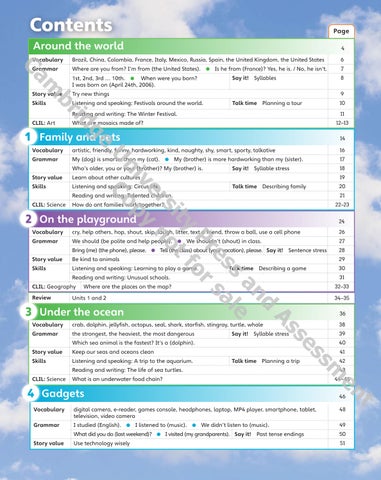
Contents
Page
Around the world Vocabulary
Ca
Grammar
4
Brazil, China, Colombia, France, Italy, Mexico, Russia, Spain, the United Kingdom, the United States
6
Where are you from? I’m from (the United States).
7
Is he from (France)? Yes, he is. / No, he isn’t. Say it!
1st, 2nd, 3rd … 10th.
m
When were you born? I was born on (April 24th, 2006).
Try new things
Skills
Listening and speaking: Festivals around the world.
Story value
Syllables
8
Talk time Planning a tour
10
9
br
Reading and writing: The Winter Festival.
id
11 12–13
Family and pets
14
CLIL: Art
What are mosaics made of?
ge
artistic, friendly, funny, hardworking, kind, naughty, shy, smart, sporty, talkative
Grammar
My (dog) is smarter than my (cat).
16
se As d an s le es sa Pr r y fo it t rs no ve y ni p U Co
Vocabulary
My (brother) is more hardworking than my (sister).
Who’s older, you or your (brother)? My (brother) is. Story value
Learn about other cultures
Skills
Listening and speaking: Circus life.
Say it! Syllable stress
18
Talk time Describing family
20
Reading and writing: Talented children. CLIL: Science
How do ant families work together?
2 On the playground Vocabulary
cry, help others, hop, shout, skip, laugh, litter, text a friend, throw a ball, use a cell phone
Grammar
We should (be polite and help people). Bring (me) (the phone), please.
We shouldn’t (shout) in class.
Tell (the class) about (your vacation), please. Say it! Sentence stress
Story value
Be kind to animals
Skills
Listening and speaking: Learning to play a game.
Talk time Describing a game
Reading and writing: Unusual schools. CLIL: Geography Review
17
Where are the places on the map?
Units 1 and 2
3 Under the ocean Vocabulary
crab, dolphin, jellyfish, octopus, seal, shark, starfish, stingray, turtle, whale
Grammar
the strongest, the heaviest, the most dangerous
Say it! Syllable stress
19 21 22–23 24 26 27 28 29 30 31 32–33 34–35 36 38 39 40
Story value
Keep our seas and oceans clean
41
Skills
Listening and speaking: A trip to the aquarium.
Talk time Planning a trip
Reading and writing: The life of sea turtles. CLIL: Science
m ss
Which sea animal is the fastest? It’s a (dolphin).
What is an underwater food chain?
44–45
en
4 Gadgets
46
digital camera, e-reader, games console, headphones, laptop, MP4 player, smartphone, tablet, television, video camera
Grammar
I studied (English).
I listened to (music).
What did you do (last weekend)? Use technology wisely
48
We didn’t listen to (music).
49
I visited (my grandparents). Say it! Past tense endings
50 51
t
Vocabulary
Story value
42
43
Page
4 Gadgets (continued) Skills
Talk time Discussing inventions
Listening and speaking: The first gadgets. Reading and writing: Making movies.
CLIL: Math
Ca Review
53
How do we read a line chart?
54–55
Units 3 and 4
56–57
m
5 The natural world
58
cave, desert, forest, island, jungle, lake, mountain, river, volcano, waterfall
Grammar
ate, caught, drank, had, saw, swam, went
br
Vocabulary
id
Did you see (statues)?
Skills
60
Say it! Sentence stress
61
Yes, I did. / No, I didn’t.
62
Encourage your friends
63
ge
Story value
52
Talk time Identifying animals and plants
Listening and speaking: Interesting animals.
CLIL: Geography
se As d an s le es sa Pr r y fo it t rs no ve y ni p U Co
Reading and writing: A vacation with gorillas. What happens when a volcano erupts?
6 Helping at home
64 65 66–67 68
Vocabulary
clean my bedroom, clean the bathroom, cook dinner, dry the dishes, make my bed, set the table, take the trash out, sweep the floor, wash my clothes, water the plants
Grammar
I have to (make my bed).
Story value
Help other people
Skills
Listening and speaking: Amazing homes.
CLIL: History
What were castle homes like?
76–77
Review
Units 5 and 6
78–79
I don’t have to (take the trash out).
What do you have to do? I have to (collect the books).
Say it! Plural endings
Who has to (feed the fish)? (Emma) does. Talk time Designing a home
Reading and writing: Life on a farm.
7 Feelings Vocabulary
angry, bored, excited, hungry, interested, scared, surprised, thirsty, tired, worried
Grammar
He’s (scared) because he doesn’t like (spiders).
Say it! Falling intonation in sentences
70 71 72 73 74 75
80 82 83
Why is she (tired)? She’s (tired) because she stayed up late.
84
Story value
Respect nature
85
Skills
Listening and speaking: Favorite books.
Talk time Discussing authors
Reading and writing: Jack and the Beanstalk. CLIL: Science
How do animals communicate?
87 88–89
m ss
8 Outdoor sports
86
90
bodyboarding, canoeing, go-carting, hiking, rock climbing, rowing, scuba diving, snorkeling, trampolining, windsurfing
92
Grammar
They didn’t go go-carting on (Saturday).
93
Story value
Be safe
Skills
Listening and speaking: At the windsurfing club.
CLIL: Sports
What makes our bodies move?
98–99
Review
Units 7 and 8
100–101
What did she do last (weekend)? She went canoeing.
When did you go skating? I went skating in (December).
Chants
94 95
Talk time Planning to play sports
96
t
Reading and writing: Interesting sports.
Say it! Rising intonation in questions
en
Vocabulary
97
102–103
ge id br m
Ca
Around the world
en m ss
se As d an s le es sa Pr r y fo it t rs no ve y ni p U Co
t
4
ge id br m
Ca
en m ss
se As d an s le es sa Pr r y fo it t rs no ve y ni p U Co
t
5
1
0.01
2
0.02
Listen and look. Listen and repeat. Then match.
Ca
3
ge
id
br
m
2
5
se As d an s le es sa Pr r y fo it t rs no ve y ni p U Co
4
6
7
6
8
0
m ss
a Brazil b China c Colombia d France e Italy f Mexico g Russia h Spain i the United Kingdom j the United States
Listen and answer the questions. Then practice with a friend. Which country has a yellow, blue, and red flag?
4 6 Vocabulary
t
0.03
en
3
Colombia!
Which countries do you want to visit? Ask and answer. ➞ Workbook page 4
Around the world
5
0.04
Read and listen.
ge
id
br
m
Ca Rosa: I’m from the United States, but my father’s from Spain.
Jules and Denis: We’re from France.
se As d an s le es sa Pr r y fo it t rs no ve y ni p U Co
Focus! Focus! Where Focus!are you from? I’m from the United States. ! Is he from France? Yes, he is. No, he isn’t.
Maria: I’m from Brazil.
6
Match the questions and answers. Then ask and answer.
He’s from Spain. No, he isn’t. He’s from Russia. They’re from France. She’s from the United States. Yes, she is.
t
Answer the questions. Then ask a friend.
Where are you from? Where are your friends from? 0.05
a b c d e
en
7
Where is Rosa from? Where are Jules and Denis from? Is Maria from Brazil? Is Anton from Italy? Where is Rosa’s father from?
m ss
2 3 4 5
8
Anton: I’m from Russia.
Where are your parents from? Where are your grandparents from?
Go to page 02. Listen and repeat the chant. Grammar
!
➞ Workbook page 5
ammar fun Gr
7
9
0.06
When is Carla’s birthday? Listen and choose. a in February
Ca
10
0.06
b in April
c in August
Listen again and practice.
ge
id
br
m
Alex: When’s your birthday, Carla? Carla: On April 24th. Alex: So is mine! When were you born? Carla: I was born in 2006. On April 24th, 2006. Alex: Oh! I was born in 2006, too! Carla: Where were you born? Alex: I was born in the United Focus!! Focus Kingdom. What about you? Focus! st, 2nd, 3rd, 4th, 5th, 6th, 7th, 8th, th, 0th Carla: I was born in Spain.
se As d an s le es sa Pr r y fo it t rs no ve y ni p U Co When were you born? ! I was born on April 24th, 2006.
11 Read about the children. Then ask and answer.
Emma Date of birth: June 2nd, 2005 Place of birth: the United States
Alex Date of birth: April 24th, 2006 Place of birth: the United Kingdom
He was born in the United Kingdom.
t
Say it!
en
Where was he born?
On April 24th, 2006.
Pedro Date of birth: January 31st, 2005 Place of birth: Brazil
m ss
When was Alex born?
Carla Date of birth: April 24th, 2006 Place of birth: Spain
12 How many syllables are there in each word? Listen, count, and repeat. 0.07
0.08
Spain birth-day Oc-to-ber !
8
ammar fun Gr
Grammar Pronunciation
➞ Workbook page 6
2
13
0.09
Around the world
Read and listen.
What’s the first question, Jack? Hey, Ruby, look at this!
id
br
m
Ca ge
Which city in Colombia has a flower festival?
It sounds fun! Let’s take the quiz together!
se As d an s le es sa Pr r y fo it t rs no ve y ni p U Co
3
5
4
My pen pal, Sofia, is from Colombia! We can email her.
Listen to this!
Where is everyone?
This isn’t the reading room!
OK, let’s go to the reading room.
6
What should we do?
7
8
en
m ss
What’s happening?
t
Let’s play the game. We want to win the quiz! ➞ Workbook page 7
Value: Try new things
9
Skills: Listening and speaking Let’s start!
What do people do at festivals?
Ca 14
0.10
Where are these festivals? Listen and match.
m
a Brazil b China c Spain d the United Kingdom e the United States 3
ge
id
br
2
se As d an s le es sa Pr r y fo it t rs no ve y ni p U Co
Bonfire Night, Lewes
Feria, Seville 5
4
Carnival, Rio de Janeiro
15
0.10
Listen again and say the missing words. Bonfire Night is on 5th. Feria is always in . Chinese New Year is in or The Carnival in Rio de Janeiro starts on a Independence Day is on 4th.
.
Plan a tour of some festivals. Which festivals would you like to go to? Where are they?
10 Skills Functional language
t
.
en
0.11
Independence Day, New York
m ss
2 3 4 5
16
New Year, Shanghai
I’d like to go to …
The … is in … ➞ Workbook page 8
Around the world
Skills: Reading and writing Look
What does Kiara want to be?
below!
Ca 17
0.12
Read and listen.
ge
id
br
m
Kiara is eleven years old, and she’s from Moscow in Russia. Kiara wants to be a dancer. She goes to dance classes every week. She wants to dance at the Russian Winter Festival.
se As d an s le es sa Pr r y fo it t rs no ve y ni p U Co
The Russian Winter Festival takes place every year in Moscow, in December and January.
Moscow is very cold in the winter, and there’s a lot of snow. There are a lot of fun activities at the festival. You can go on a troika ride through the snow. Or you can go ice-skating in the city. There are also lots of beautiful snow sculptures. At night, you can watch the fireworks. Or you can go and see a show with traditional singers and dancers. Look out for Kiara!
Read again and correct the sentences.
Moscow isn’t in China. ➞ Workbook page
Now write about it in your notebook.
t
4 5 6
en
2 3
Moscow is in China. Kiara wants to be an artist. The Winter Festival is in November and January. It’s hot in the winter in Russia. You can go swimming in the city. You can watch fireworks in the morning.
Think of a festival you enjoy. When is it? Which country is it in? What can you see there? What can you do there?
m ss
18
Your turn!
It’s in Russia. Skills 11
What are
ge id br m
Ca
en m ss
se As d an s le es sa Pr r y fo it t rs no ve y ni p U Co
t
12
mosaics made of?
Around the world
1
0.13
Listen and repeat. 2
3
4
glue
Watch the video.
0.14
Read and listen.
There are lots of different mosaics in countries around the world. Mosaics are made of many small tiles. These tiles are different shapes and colors, and are made of ceramic, glass, paper, or stones, like marble. Artists put glue on mosaic tiles and then make pictures or patterns with them. Sometimes artists glue the tiles onto cardboard first, then stick the cardboard with the mosaics onto walls, floors, and roofs. In the past, mosaics in Roman gardens and baths were made of round stones or shells. Today, artists make mosaics for places like train stations and shopping malls to make them look beautiful.
ENCYCLOPEDIA
en t
What kind of art has many small tiles? 2 What can the tiles be made of? 3 Where were there very old mosaic floors? 4 Why do artists make mosaics today?
OUR WORLD
m ss
4 Answer the questions.
In Spain, some artists used spoons, forks, and knives in mosaics.
cre ate bra inst orm compa re research t sugges nt e s pre
3
ceramic
marble
se As d an s le es sa Pr r y fo it t rs no ve y ni p U Co
2
ge
id
br
m
Ca tiles
5 Where would you put a mosaic in your school?
➞ Workbook page 0
CLIL: Art
13 13
ge id br m
Ca
en m ss
se As d an s le es sa Pr r y fo it t rs no ve y ni p U Co
t
14
Family and pets
ge id br m
Ca
en m ss
se As d an s le es sa Pr r y fo it t rs no ve y ni p U Co
t
15
1
1.01
2
1.02
Listen and look. Listen and repeat. Then match.
Ca ge
id
br
m
2
my grandparents
8
6
my uncle
my brother
my best friend
5
se As d an s le es sa Pr r y fo it t rs no ve y ni p U Co
my parents
my aunt
4
my sister
7
6
3
my cousin
0
my kitten
my puppy
1.03
Listen and guess who. Then practice with a friend.
t
They’re friendly.
4 16 Vocabulary
en
3
m ss
a artistic b smart c friendly d funny e hardworking f kind g naughty h shy i sporty j talkative
They’re Alex’s grandparents!
What is your family like? Ask and answer. ➞ Workbook page 2
Unit
5
1.04
Read and listen.
Ca
Focus! Focus! Focus! My dog is smarter than my cat. ! is more My brother hardworking than my sister.
m ge
id
br
I’m more talkative than my cousin, She’s shyer than me. And I’m friendlier than my cousin, But she’s kinder than me.
1.05
se As d an s le es sa Pr r y fo it t rs no ve y ni p U Co
6
Listen and choose the words.
I’m more artistic/more hardworking than my brother, He’s funnier/sportier than me. And I’m more hardworking/more talkative than my brother, But he’s smarter/kinder than me.
7
Make questions. Then ask a friend.
Are you friendlier than your sister? Yes, I am!
t
1.06
than your sister? than you? than your brother? than your cousin? than your friend?
en
8
more talkative friendlier more hardworking smarter more artistic
m ss
Are you Is your brother Is your sister Is your cousin Is your friend
Go to page 02. Listen and repeat the chant. Grammar
!
➞ Workbook page 3
ammar fun Gr
17
9
1.07
What are they talking about? Listen and choose. a friends
Ca
10
1.07
b height
c age
Listen again and practice.
ge
id
br
m
Teacher: Who’s taller, Carla – you or Emma? Emma: I am! Carla: Hmm. Let’s see … I am! Teacher: Wow! You’re taller than Emma now! Emma: But I’m still older than you, Carla! Teacher: And who’s smarter? Oh, I don’t know. We’re both smart! Carla:
se As d an s le es sa Pr r y fo it t rs no ve y ni p U Co
11 Read about Emma and Alex. Then ask and answer.
Focus! Focus! Focus! Who’s older, you or your brother? ! My brother is.
Name: Emma Born: June 2nd, 2005 Height: 1 m, 60 cm Personality: quiet, but friendly Likes: sports and homework
Name: Alex Born: April 24th, 2006 Height: 1 m, 52 cm Personality: loud and funny Likes: art and talking to my friends
m ss
artistic funny hardworking old quiet short sporty talkative tall young
Who is older?
Emma is!
en
12
1.08
1.09
t
Say it!
Which syllables sound the strongest? Listen and repeat.
pup-py !
18
ammar fun Gr
re-peat
tal -a-tive Grammar Pronunciation
hard-wor -ing ➞ Workbook page 4
13
1.10
Unit
Read and listen.
And look at this! It’s a message!
ge
id
br
m
Ca
Wow! I think we’re at the flower festival.
se As d an s le es sa Pr r y fo it t rs no ve y ni p U Co
2
4
3
Hmm, I think it’s from Sofia. She’s very smart, but she isn’t taller than us.
Look, Ruby!
Hi, Sofia! Can you help us?
It’s Sofia!
5
The first question is about the flower festival.
We’re taking a quiz. 7
6
Guess!
Of course.
We’re moving again.
Come with us, Sofia.
en
m ss t
Yes … ?
Where are we? ➞ Workbook page 5
Of course! We’re in Medellín.
Where to?
Value: Learn about other cultures
19
Skills: Listening and speaking Let’s start!
What can you see at a circus?
Ca 14
1.11
b
m
What’s life like in a circus family? Listen and say the letters.
a
ge
id
br se As d an s le es sa Pr r y fo it t rs no ve y ni p U Co
Show time in the circus. c
Sonia at home.
d
The circus at night.
1.11
Listen again and say true or false.
Sonia’s twelve years old. 3 Sonia’s family is hardworking. 5 Sonia doesn’t go to school.
Ask about a friend’s family. What’s your cousin like? What are your parents like?
20 Skills Functional language
t
1.12
2 Sonia’s older than her brothers and sisters. 4 Sonia’s grandparents are clowns.
en
16
m ss
15
Circus life is hard work!
He’s/She’s … They’re …
➞ Workbook page 6
Unit
Skills: Reading and writing Look
below!
What are these children good at?
Ca 17
1.13
Read and listen.
m ge
id
br
Hot shots
Brad Miller and his older sister, Casey, are from the United States. Brad is eleven, and Casey is thirteen. They’re both sporty, and they’re both very good at playing basketball.
se As d an s le es sa Pr r y fo it t rs no ve y ni p U Co
Brad and Casey play on basketball teams. The other players on their teams are older and taller than them, but Brad and Casey are the star players. They practice basketball every day. Someday they want to play for the Los Angeles Lakers.
Smart artists
Abby and Bianca Watson are twins. They’re twelve years old, and they’re from the United Kingdom. They’re very good at art, and they like painting with bright colors. The twins sell their paintings in stores and art galleries.
➞ Workbook page 7
Think of someone you know. How old are they? What are they good at? What do they work hard at?
t
2 3 4 5 6
Where are Brad and Casey from? Who is older, Brad or Casey? Are Brad and Casey hardworking? Are Abby and Bianca from France? Is Bianca older than Abby? Where do they sell their paintings?
Your turn!
en
Read again and answer the questions.
m ss
18
This painting is by Abby. It’s called “Nature.”
Now write about it in your notebook.
Skills 21
ge
id
br m
Ca
How do
ant families
en m ss
se As d an s le es sa Pr r y fo it t rs no ve y ni p U Co work together?
t
22
Unit
1
1.14
Listen and repeat. 2
3
4
5
ge
id
br
m
Ca worker ant
3
queen ant
drone
nest
se As d an s le es sa Pr r y fo it t rs no ve y ni p U Co
2
colony
Watch the video.
1.15
Some ants can live for up to 30 years!
Read and listen.
Ants live in families called colonies. In each colony, ants work together in groups and help one another. Most colonies of ants live in nests, and every colony has one queen ant. The queen’s job is to make lots and lots of eggs for the colony.
There are also drone ants and worker ants in colonies. The drones help the queen ant to make eggs, and the worker ants do all of the other jobs. There are always lots of worker ants. Some of them make the nest and keep it neat and clean. Other worker ants find food, like leaves, and bring it back to the nest.
OUR FAMILIES
A L BU M describe
m ss
interview
4 Answer the questions.
plan
t
think
prepare
en
What are ant families called? 2 What does the queen ant do? 3 What do the drone ants do? 4 What do the worker ants do?
decorate
5 What do you like about working in a group?
➞ Workbook page 8
CLIL: Science
23
ge id br m
Ca
2 On the playground
en m ss
se As d an s le es sa Pr r y fo it t rs no ve y ni p U Co
t
24
ge id br m
Ca
en m ss
se As d an s le es sa Pr r y fo it t rs no ve y ni p U Co
t
25
1
2.01
2
2.02
Listen and look. Listen and repeat. Then match.
Ca ge
id
br
m
2
3
5
4
se As d an s le es sa Pr r y fo it t rs no ve y ni p U Co
6
7
6
8
0
2.03
Listen and say the numbers. Then practice with a friend.
t
3
They’re skipping.
4 26 Vocabulary
en
m ss
a cry b litter c help others d hop e shout f skip g laugh h text a friend i throw a ball j use a cell phone
Number 2!
What do you do in school? Ask and answer. ➞ Workbook page 20
Unit 2
5
2.04
Read and listen.
Ca
ge
id
br
m
Our school rules
We should be hardworking and listen to the teachers.
se As d an s le es sa Pr r y fo it t rs no ve y ni p U Co
We shouldn’t shout in class. We shouldn’t be naughty or laugh at people.
We should be polite and help people.
We shouldn’t litter on the ground.
We should put litter in the trash cans.
6
Read and say should or shouldn’t.
We should play nicely with our friends.
8
2.06
t
Make school rules with a friend.
We should be polite and help people. We shouldn’t shout in class.
en
7
do our homework. eat and drink in the classroom. use cell phones in school. wash our hands before lunch. listen to music in the classroom. be quiet in the library.
m ss
2 3 4 5 6
We We We We We We
Focus!! Focus
We shouldn’t run in the classroom.
Go to page 02. Listen and repeat the chant. Grammar
!
➞ Workbook page 2
ammar fun Gr
27
9
2.06
What does Alex have in school? Listen and choose. a a computer game b a cell phone c a pencil case
Ca
10
2.06
Listen again and practice.
ge
id
br
m
Teacher: OK, Pedro. Read us the story, please. Alex: Uh-oh! Teacher: Alex! Do you have a cell phone? Alex: Yes, I do. Teacher: You shouldn’t use cell phones in school. Bring me the phone, please. Alex: Here you are. I’m sorry. Teacher: OK, now … Uh-oh! Pedro:
se As d an s le es sa Pr r y fo it t rs no ve y ni p U Co
11
3
Focus! Focus! Focus! Bring me the phone, please. Tell the class about your ! vacation, please.
Read and match. Then give instructions to your friend. Give Anna your book, please.
2
Bring me the ball, please.
Tell the class about your vacation, please.
4
Pass Max a ruler, please.
a
b
c
d
Here you are.
12
2.07
t
Say it! 2.08
Which words sound the strongest? Listen and repeat.
Give Anna your boo . ammar fun Gr
!
28
en
m ss
Bring me the ball, please.
Pass Max a ruler.
Grammar Pronunciation
➞ Workbook page 22
13
2 2.09
Read and listen. Where are we?
Look at this poor monkey. His name's Capu.
id
br
m
Ca We’re in a market.
ge
se As d an s le es sa Pr r y fo it t rs no ve y ni p U Co 4
3
Let’s give him some fruit.
It’s London in 1850.
Let’s hide in here.
5
Stop! You shouldn’t feed my monkey.
Phew!
Uh-oh! Run!
I think it’s a school.
6
We’re in a classroom!
7
He’s from South America. He's a capuchin monkey.
8
We can take Capu!
en
m ss t
And look! It’s the monkey!
He wants to go home! ➞ Workbook page 23
Yes, but we have to be quick! Value: Be kind to animals
29
Skills: Listening and speaking Let’s start!
What games do you like playing on your playground?
Ca
How do you play Queenie, Queenie? Listen and say the letters.
a
b
14
2.10
ge
id
br
m
se As d an s le es sa Pr r y fo it t rs no ve y ni p U Co
c
15
d
2.10
Put the rules in order. Listen again and check.
a You need more than two players.
c
The Queenie guesses who has the ball.
d One player is the Queenie. She takes the ball and turns around.
2.11
Invent or describe a game. You need … players. One player …
30 Skills Functional language
t
16
en
e Another player catches the ball.
m ss
b The Queenie throws the ball behind her. She doesn’t look.
You should … Another player … ➞ Workbook page 24
Unit 2
Skills: Reading and writing Look
below!
Where are these schools?
Ca 17
2.12
Read and listen. Then match.
m
a
ge
id
br
Kanta is from Bangladesh. Sometimes it is very rainy, and the children can’t go to school. So a school boat comes to Kanta’s village. The boat has a classroom and a small library with computers. Students study hard. Kanta studies for three hours every day. She learns math, reading, writing, English, and Bengali.
se As d an s le es sa Pr r y fo it t rs no ve y ni p U Co
2
Alfie is from the United Kingdom. He loves reading, and he often goes to the library at his school. The library is in a bus on the playground! The bus has two floors, and there are lots of books. Students can also go to the library before and after school with their parents.
don’t know.
t
➞ Workbook page 25
Design an unusual school. Where is it: on a boat, in a plane, in a treehouse? What subjects do the students study? What rules should they follow?
en
2 3 4 5 6
Kanta goes to school on a boat. Alfie studies for three hours a day. There isn’t a library in Kanta’s school boat. Alfie loves reading. There are computers in Alfie’s library. Kanta studies every day.
Your turn!
m ss
18 Read again and say true, false, or
b
Now write about it in your notebook.
Skills 31
Where are
ge id br m
en m ss
se As d an s le es sa Pr r y fo it t rs no ve y ni p U Co
t
32
on the map?
Ca
the places
Unit 2
1
2.13
north
Listen and repeat.
4 west
m
compass
br
Ca
5
2
east
ge
id 3
se As d an s le es sa Pr r y fo it t rs no ve y ni p U Co
2
Watch the video. 2.14
3
south
The very first maps showed the stars, not our world!
Read and listen.
A compass helps us find places on a map. This map of New York Central Park shows what is in and close to the park. To the southwest of the park, we can see a big shopping mall, and we can see a zoo in the southeast. To the west of the park, there is the Hudson River. It runs from the north to the south of New York State. In the east of the park, we can see a famous museum with art from around the world. To the northeast of the park, there’s a school.
This map has a compass. It shows N, E, S, and W. It’s easy to find places you want to visit.
SIGNS FOR OUR
SUSTAINABLE SCHOOL
sketch
discu
ss
t
display tour
en
What’s to the southwest of the park? 2 Where’s the Hudson River on the map? 3 Where’s the school on the map? 4 What do N, E, S and W mean?
m ss
match
4 Answer the questions.
write
5 When do you use a map with a compass?
➞ Workbook page 26
CLIL: Geography
33
Review Units and 2 Ca
1
2.15
Read, listen, and choose the words.
id
br
m ge
This is my pen pal, Lola. She’s from Brazil/Mexico. We’re both eleven/twelve, but she’s older/younger than me. She was born on October 2nd/4th, and I was born on October 22nd/24th.
se As d an s le es sa Pr r y fo it t rs no ve y ni p U Co
Lola and I are both sporty/artistic, and we love painting/soccer. I think she’s a little smarter/kinder than me, though.
Lola writes to me every month, and she sends me photographs – like this one. Sometimes we phone/ text each other. Lola is very funny/shy, and her letters always make me laugh/smile. Lola says I should/shouldn’t visit her one day. I’d love to! Nadia
2
Read again and correct the sentences.
Think of a friend or pen pal. Ask and answer.
4 34
t
Where’s he/she from? When was he/she born? What’s he/she like?
en
3
m ss
2 3 4 5
Nadia is eleven years old. Lola was born on November fourth. Nadia is older than Lola. Lola sends Nadia paintings. Lola isn’t very funny.
Write about your friend or pen pal in your notebook. ➞ Workbook page 28
5
P lay the game.
19
18
17
Ca
born? / friend / was / your / When
GO BACK TWO SQUARES!
15
14
person A likes running, hopping, and skipping!
aunt / Mexico? / from / your / Is
10
11
ge
16
id
br
m
You work hard in school.
20
9 A person talks a lot.
8
homework? / always / you / do / your / Do
THROW AGAIN!
7
START AGAIN!
You shouldn’t cell phones in school.
6 father / the /
5
States? / your / Is / from / United
2
born / Russia? / Were / in / you
12
artistic / parents / you? / more / than / Are / your
3
4
shyer, / you / your / Who / is / or / friend ?
en
A person often helps other people.
You shouldn’t on the playground.
m ss
1
You shouldn’t at other people.
se As d an s le es sa Pr r y fo it t rs no ve y ni p U Co
GO FORWARD ONE SQUARE!
13
t
Green
Blue
Purple
Orange
Make a question. Say the missing words. Answer the questions. Make true sentences using these words.
35
ge id br m
Ca
3 Under the ocean
en m ss
se As d an s le es sa Pr r y fo it t rs no ve y ni p U Co
t
36
ge id br m
Ca
en m ss
se As d an s le es sa Pr r y fo it t rs no ve y ni p U Co
t
37
1
3.01
2
3.02
Listen and look. Listen and repeat. Then match.
Ca 6
7
0
6
8
5
4
se As d an s le es sa Pr r y fo it t rs no ve y ni p U Co
3
ge
id
br
m
2
Listen and guess the animals. Then practice with a friend. It has gray fur. It’s smaller than a dolphin.
4 38 Vocabulary
t
3.03
en
3
m ss
a crab b dolphin c jellyfish d octopus e seal f shark g starfish h stingray i turtle j whale
It’s a seal!
What’s your favorite sea animal? Ask and answer. ➞ Workbook page 30
Unit 3
5
3.04
Read and listen.
br
m
Ca id
Dolphins are the most intelligent sea animals. They are the friendliest, too.
ge
Blue whales are the biggest sea animals. They are the heaviest and the strongest, too.
se As d an s le es sa Pr r y fo it t rs no ve y ni p U Co
Great white sharks are the most dangerous sharks, but they aren’t the most dangerous sea animals.
Box jellyfish are the most dangerous sea animals.
Focus! Focus! Focus! the strongest the heaviest ! the most dangerous
6
Read and say true or false.
Blue whales are the weakest sea animals. 3 Great white sharks are the most dangerous sharks.
7
2 Dolphins are the most dangerous sea animals. 4 Box jellyfish are the friendliest sea animals.
Make sentences about sea animals. Then talk to a friend. Yes, I agree.
m ss
Turtles are the most beautiful sea animals.
No, I don’t agree. I think dolphins are the most beautiful.
en
8
3.05
3.06
t
Say it! Which syllables sound the strongest? Listen and repeat.
Jellyfish are dangerous. Dolphins are intelligent.
Grammar Pronunciation
!
➞ Workbook page 3
ammar fun Gr
39
9
3.07
What are they talking about? Listen and choose. a land animals
Ca
10
3.07
b birds
c sea animals
Listen again and practice.
ge
id
br
m
Carla: Hi, Alex. What are you doing? Alex: I’m taking a quiz about animals. Carla: Can I help? Alex: OK. Question one. Which sea animal is the fastest? Is it a turtle, a dolphin, or a seal? Carla: Hmm. I think it’s a dolphin. Yes. A dolphin. Alex: Yes! Good job! Carla: OK. Question two …
Which sea animal is the fastest? It’s a dolphin.
se As d an s le es sa Pr r y fo it t rs no ve y ni p U Co
11
Focus!! Focus
Look at the quiz. Make questions and ask and answer. Then listen and check.
3.08
Which fish is the heaviest?
It’s a whale shark.
Are you an animal whiz? Try our animal quiz. 1 fish/heavy? a) blue shark b) whale shark c) great white shark
2 bird/strong? a) eagle b) penguin c) owl
3 land animal/strong? a) gorilla b) elephant c) bear
4 land animal/tall? a) kangaroo b) panda c) giraffe
5 sea animal/slow? a) crab b) seahorse c) starfish
6 land animal/dangerous? a) hippo b) lion c) tiger
en
m ss t
12
Go to page 02. Listen and repeat the chant.
ammar fun Gr
!
40
3.09
Grammar
➞ Workbook page 32
13
3.10
Read and listen.
2
What’s that? Is it trash?
3
We’re in Africa.
I think this is the Indian Ocean.
What? My feet are wet!
It’s beautiful.
br
m
Ca ge
id
Where are we now?
Let’s see.
Look! It’s a baby dolphin.
se As d an s le es sa Pr r y fo it t rs no ve y ni p U Co
4
I don’t know.
5
Quick! Help me find some shells.
Capu has the biggest shell.
6
Cut it like this …
Be careful, Jack!
Poor thing!
7
8
Look! It’s the dolphin’s pod.
They’re saying thank you!
en
m ss
It was a pleasure!
t
They’re very friendly. ➞ Workbook page 33
Value: Keep our seas and oceans clean
41
Skills: Listening and speaking Let’s start!
What can you see at an aquarium?
Ca 14
3.11
Which animals do they see? Listen and say the letters.
m a
c
ge
id
br
b
se As d an s le es sa Pr r y fo it t rs no ve y ni p U Co Touch a stingray.
See our baby dolphins.
e
d
Get close to our sharks.
Meet Otto.
15
3.11
Otto is the Ava and Paco see Ava thinks The time is They can feed the
octopus in the world. baby dolphins. are dangerous. . at a quarter after three.
en
P lan a trip for this weekend. Where would you like to go this weekend? How can you get there?
42 Skills Functional language
t
3.12
Listen again and say the missing words.
m ss
2 3 4 5
16
Feed our friendly seals.
I’d like to go to …
You can go by …
➞ Workbook page 34
Unit 3
Skills: Reading and writing Look
below!
What does the Sea Turtle Rescue Center do?
Ca 17
3.13
Read and listen.
m
ge
id
br
Save Our Sea Turtles se As d an s le es sa Pr r y fo it t rs no ve y ni p U Co
Turtles are one of the most beautiful animals in the ocean, but they are also in danger. How can we help them? We should keep our oceans clean. Turtles eat jellyfish, crabs, other sea animals, and plants. Dirty oceans are dangerous to turtles and the food they eat. We should protect turtle nests. Turtles lay their eggs in nests on the beach. Sometimes birds and other animals eat the eggs or baby turtles.
Sea Turtle Rescue Center The Sea Turtle Rescue Center has safe beaches for turtles and their nests. It helps sick turtles in its animal hospital. Then it puts the healthy turtles back CDX into the ocean. Turtles are happiest in the ocean. XX Listen and repeat.
17
➞ Workbook page 35
t
3 4 5 6
Think of a sea animal. Where does it live? What does it eat? Is it in danger?
en
coats in the snow. 2
Are turtles dangerous? How can we help turtles? What do turtles eat? Where do turtles lay their eggs? What does the Sea Turtle Rescue Center do? Where are turtles happiest?
Your turn!
m ss
need Read again and answerwarm the questions. 18 Stoats
Now write about it in your notebook.
Skills 43
What is an underwater
ge id br m
Ca
en m ss
se As d an s le es sa Pr r y fo it t rs no ve y ni p U Co
t
44
food chain?
Unit 3
1
3.14
Listen and repeat. 2
3
4
id
br
m
Ca ge
sunlight
2
primary consumer
secondary consumer
Watch the video. 3.15
e ss se A oo ch d an s le es sa Pr r y fo it t rs no ve y ni p U Co
3
producer
Read and listen.
Great white sharks can live for up to three months without food.
Many plants and animals live underwater. How does an underwater food chain work? It needs sunlight, producers, primary consumers, and secondary consumers.
Sunlight shines on the ocean, and some sunlight goes under the water. Plants use the sunlight to make, or produce, food inside their leaves. We call these plants “producers.” Fish and other sea animals can’t make their own food. They need to eat, or consume, plants and other fish. Some small sea animals or fish eat underwater plants. We call these fish “primary consumers.”
ar se
re
OUR
Then bigger sea animals or fish, like stingray, eat smaller fish and other sea animals. They are called “secondary consumers.” Big secondary consumers like sharks eat animals like seals!
ch
list
ENDANGERED SEA ANIMALS n io
at se nt
plan
pr e
What helps plants to make food inside their leaves? 2 Are producers plants or animals? 3 What do we call fish that eat plants? 4 What do secondary consumers eat?
t en m de ss deci
PROJECT
4 Answer the questions.
5 Which other food chains can you describe?
➞ Workbook page 36
CLIL: Science
45 45
ge id br m
Ca
4 Gadgets
en m ss
se As d an s le es sa Pr r y fo it t rs no ve y ni p U Co
t
46
ge id br m
Ca
en m ss
se As d an s le es sa Pr r y fo it t rs no ve y ni p U Co
t
47
1
4.01
2
4.02
Listen and look. Listen and repeat. Then match.
Ca ge
id
br
m
2
3
5
4
se As d an s le es sa Pr r y fo it t rs no ve y ni p U Co 6
7
6
8
0
m ss
a digital camera b e-reader c games console d headphones e laptop f MP4 player g smartphone h tablet i television j video camera
Listen and answer the questions. Then practice with a friend. Can you listen to music on an MP4 player?
4 48 Vocabulary
t
4.03
en
3
Yes, you can!
What gadgets do you have? Ask and answer. ➞ Workbook page 38
Unit 4
Our class visit to Technology Live
5
4.04
Read and listen.
br
m
Ca id
Tia: I didn’t play games or watch a movie. I studied English on an e-reader.
Luisa: I listened to music on an MP4 player in a watch!
ge se As d an s le es sa Pr r y fo it t rs no ve y ni p U Co
Max and Adam: We didn’t listen to music. We played great games on the consoles.
Lottie and Simon: We watched a movie on a tablet. We used some cool headphones.
6
Focus! Focus! IFocus! studied English. I listened to music on an MP4 player. ! We didn’t listen to music.
Read and say the names. 2 3 4 5
7
They played on the games consoles. She didn’t watch a movie. She used an e-reader. She listened to music on an MP4 player. They didn’t play on the games consoles. They watched a movie.
Make true and false sentences about you. Then talk to a friend.
yesterday evening last night last Saturday this morning before school
en
a games console my MP4 player television my laptop
m ss
listened to watched played on used
t
I watched television this morning before school.
8
4.05
False.
Go to page 02. Listen and repeat the chant. Grammar
!
➞ Workbook page 3
ammar fun Gr
49
9
4.06
Who did Emma visit last weekend? Listen and choose. a her cousins
Ca
10
4.06
b her friends
c her grandparents
Listen again and practice.
ge
id
br
m
Carla: Hi, Emma. What did you do last weekend? Emma: I visited my grandparents. Carla: Was it fun? Emma: Yes, it was great. Carla: What did you do? Emma: We watched television, and we played on their new games console. Carla: Do your grandparents have a games console? Emma: Yes, they do. They love playing games!
se As d an s le es sa Pr r y fo it t rs no ve y ni p U Co
11
Focus! Focus! Focus! What did you do last weekend? ! I visited my
Choose four activities you did last weekend. Then talk to some friends. What did you do last weekend? So did I.
listened to music
grandparents.
I played soccer.
I didn’t. I visited my cousins.
played with friends
played soccer
W
called a friend
used a laptop
played on a games console
cleaned my room
painted a picture
helped my parents
walked in the park
studied English
watched television
en
m ss
12
4.07
4.08
t
Say it! Can you hear the different endings? Listen and repeat. /d/
played !
50
ammar fun Gr
/t/
watched
Grammar Pronunciation
/id/
visited
➞ Workbook page 40
13
4.09
2
Read and listen.
I think we’re in Antarctica.
It’s cold. There’s nothing here!
m
Ca ge
id
br
It’s 50. Look at this diary.
Only snow! Let’s go in that hut.
Listen to this! this rived he hut r a T We ning. , and r d l o o m ery c ave any v h is don’t w e d. foo
6
Let’s use these blankets.
se As d an s le es sa Pr r y fo it t rs no ve y ni p U Co
4
3
Where are they now?
5
Over there!
We should help them!
What is it, Capu?
7
8
Thanks for helping us!
en
m ss t
I’ll ask for help. I can use the tablet. ➞ Workbook page 4
It’s thanks to our tablet!
Yes, what a wonderful gadget! Value: Use technology wisely
51
Skills: Listening and speaking Let’s start!
Which gadgets do you have?
Ca 14
4.10
What were the first gadgets? Listen and match.
m
Martin Cooper
br
Ralph Baer
b
ge
id
a
Adam Osborne
se As d an s le es sa Pr r y fo it t rs no ve y ni p U Co
c
1973
15
4.10
1981
1967–1968
Listen again and answer the questions.
What was the name of the first games console? 3 What was the name of the first laptop?
5 Where did Martin Cooper get the idea for a cell phone? 4.11
Decide which inventions are the most useful. Which invention is the most useful? What do you use it to do?
52 Skills Functional language
t
16
en
4 How long was the first cell phone?
m ss
2 How many games were there on the first games console?
I think it’s the …
I use it to … ➞ Workbook page 42
Unit 4
Skills: Reading and writing Look
below!
What does Max like using his smartphone for?
Ca 17
4.12
Read and listen.
m
id
br
Max is eleven years old, and he likes making movies with his smartphone. We asked him some questions.
ge
How do you make movies? I think of a story with my friends. Then they act out the story, and I film it.
se As d an s le es sa Pr r y fo it t rs no ve y ni p U Co
Where do you make your movies? We usually go to the park and make the movie outside. Then we go home and edit the movie on my laptop. Editing means choosing the best parts of the movie. I add music and special effects on my laptop, too. Where do you watch your movies? On the laptop. Sometimes our parents watch them. They think the movies are funny.
18
Read again and correct the sentences.
Now write about it in your notebook.
t
➞ Workbook page 43
Think of your favorite gadget. What is it? What do you like doing with it?
en
2 3 4 5 6
Max is twelve years old. He likes making movies with his digital camera. He makes movies with his cousins. He always makes movies in the park. He edits the movies on a games console. His parents think the movies are boring.
Your turn!
m ss
Is making movies difficult? No. It’s easy with a smartphone!
Skills 53
ge id br m
Ca
How do we read a line chart?
en m ss
se As d an s le es sa Pr r y fo it t rs no ve y ni p U Co
t
54
Unit 4
1
Listen and repeat.
4.13
The number of times we used the Internet to do our homework last week
peak rise
fall
ge
id
br
m
Number of children
Ca
12 11 10 9 8 7 6 5 4 3 2 1 0
Monday
Mon
Tues
Tuesday
Wednesday Thursday
Friday
Saturday
Sunday
se As d an s le es sa Pr r y fo it t rs no ve y ni p U Co
axis
Days of the week
Wed
Thurs
Fri
Sat
Sun
Different names for the number 0 include zero, nought, zilch, and zip.
data
2 3
Watch the video. 4.14
ook at activity 1. Listen and read L the data on the line chart.
4 Answer the questions.
list recor d
ask
t
conclude
nd recomme
en
5 What different data can you put in
SCREEN TIME SURVEY
m ss
How many children used the Internet to do their homework on Wednesday? 2 When was there a big rise in the number of children using the Internet? 3 When was there a bigger fall – between Tuesday and Wednesday or between Thursday and Friday? 4 Which day shows the peak number of children using the Internet?
OUR
bar char t
a line chart?
➞ Workbook page 44
CLIL: Math
55 55
Review Units 3 and 4 Ca
1
4.15
Read, listen, and choose the words.
br
m ge
id
On my eleventh birthday, I visit/visited my favorite art gallery/movie theater in London with my family. The movie theater has the biggest/smallest screen in the United Kingdom, and it was great. We watched a very dangerous/interesting movie. It was called Under the Ocean. The movie was in 3-D, and we need/needed special headphones/glasses. There were lots of beautiful sea animals and some funny ones, too. The strongest/funniest one was a crab with a jellyfish on its head! The most exciting/dangerous animals were the sea snakes. We also listened/learned about taking care of our oceans. We should keep them clean/dirty. It was my favorite birthday ever! Tom
Read again and answer the questions. How old was Tom? Where did he visit on his birthday? What movie did he watch? What was the funniest sea animal? What did Tom learn about oceans?
t
What movie did you watch? Was it in 3-D? What was it about?
en
Think of a visit to the movie theater. Ask and answer.
m ss
2 3 4 5
3
se As d an s le es sa Pr r y fo it t rs no ve y ni p U Co
2
4 Write about a movie theater visit in your notebook. 56
➞ Workbook page 46
5
1
lay the game. P
Ca
Free headphones! Miss a turn!
ge
id
br
m
4
Which sea animal has eight legs?
7
Visit grandparents/ last weekend
Play on the games consoles! Miss a turn!
9
10
Which is the most intelligent sea animal?
Which is th stronge e st land animal ?
6
Which is the most dangerous sea animal?
p/ Play on a lapto yesterday afternoon
e your You los one. h smar tp k Go bac to the star t.
o Listen t / music ay yesterd g evenin
13
14
16
17
15
Which is the tallest land animal?
Watch the digital jellyfish. Miss a turn!
en
Study English/ last Saturday
us Which dangero a sea animal has h? lot of teet
m ss
18
Watch television/ last night
Use an e-reader/ before school
12
11
2
se As d an s le es sa Pr r y fo it t rs no ve y ni p U Co
8
5
3
t
Green
Answer the the questions. questions. Answer
Purple Purple
Make Make true true sentences sentences using using these these words. words. Review 57 57
ge id br m
Ca
5 The natural world
en m ss
se As d an s le es sa Pr r y fo it t rs no ve y ni p U Co
t
58
ge id br m
Ca
en m ss
se As d an s le es sa Pr r y fo it t rs no ve y ni p U Co
t
59
1
5.01
2
5.02
Listen and look. Listen and repeat. Then match.
Ca ge
id
br
m
2
3
8
se As d an s le es sa Pr r y fo it t rs no ve y ni p U Co
6
5
4
7
0
6
5.03
You can climb a mountain.
4 60 Vocabulary
t
Listen and say true or false. Then practice with a friend.
en
3
m ss
a cave b desert c forest d island e jungle f lake g mountain h river i volcano j waterfall
True!
Which of these things would you like to see? Ask and answer. ➞ Workbook page 48
Unit 5
What did you do on vacation?
5
5.04
Read and listen.
br
m
Ca ge
id
My family went to Iceland. It was very beautiful. We saw mountains and high waterfalls.
We had lunch on a volcano! We drank hot chocolate with our lunch. We caught a big fish in a river. Then we ate the fish for dinner. It was delicious.
se As d an s le es sa Pr r y fo it t rs no ve y ni p U Co
We swam in a lake. The water was warm.
6
Focus! Focus! have – had Focus! go – went see – saw !
Read and correct the sentences. 2 3 4 5 6
The family went to Russia. They had lunch in a café. They drank orange juice. They swam in a river. They caught a seal in a river. They ate an octopus for dinner.
7
swim – swam eat – ate drink – drank catch – caught
Think about your vacation last summer. Then ask and answer.
m ss
I went to Baha in Mexico. We swam in the ocean, and we saw whales. We didn’t see any sharks.
en
Where did you go on vacation last summer? What did you do? What did you see? What did you eat and drink?
8
5.05
5.06
t
Say it! Which words sound the strongest? Listen and repeat.
We didn’t go to a mountain.
Grammar Pronunciation
ammar fun Gr
!
➞ Workbook page 4
We went to a la e. 61
9
5.07
Where did Emma go on vacation? Listen and choose. a a desert
Ca
10
5.07
b a jungle
c an island
Listen again and practice.
ge
id
br
m
Alex: Hi, Emma. What are you doing? Emma: I’m making an album about my vacation. Look, I went to Easter Island. Alex: Cool! Did you see these statues? Emma: Yes, I did. They were amazing. Alex: Did you climb the statues? Emma: No, I didn’t! You shouldn’t climb on statues, Alex. Alex: I know. It was a joke!
Focus!! Focus
se As d an s le es sa Pr r y fo it t rs no ve y ni p U Co
Did you see statues? Yes, I did. No, I didn’t.
11
Think about Alex’s vacation scrapbook. Then ask and answer.
see animals swim in a lake climb a mountain have a picnic drink coffee go on a boat trip see a cave catch a fish take photographs visit a museum Did he see animals?
Did he swim in a lake?
Yes, he did.
No, he didn’t.
penguins at the beach
my sister at our picnic
t
Go to page 03. Listen and repeat the chant.
ammar fun Gr
!
62
5.08
my grandpa and grandma at the market
en
12
boat trip
m ss
the mountain we climbed
WHITE SHARK
Grammar
➞ Workbook page 50
13
5.09
2
Read and listen.
3
We’re in a cave.
Help! I can’t see anything. I don’t like the dark!
Ca
Oh, no! I don’t like bats!
br
m
Don’t worry, Sofia.
ge
id
How do we get out?
Don’t worry, Ruby. We can use the tablet.
Let’s try the other path.
se As d an s le es sa Pr r y fo it t rs no ve y ni p U Co
4
Let’s try this path.
5
6
Oh, dear!
We’re very sorry!
Wow!
Cut!
7
Don’t worry! You can help us.
Oh, no! I’m not good at acting.
We’re in Hollywood, in the United States!
8
That was great!
And cut! Thank you, everyone.
en
m ss
You’re a great actor, Jack!
Four actors didn’t come this morning.
t
Action! ➞ Workbook page 51
Value: Encourage your friends
63
Skills: Listening and speaking Let’s start!
What is the most interesting animal you can think of?
Ca 14
5.10
Where can you find them? Listen and say rain forest or desert.
ge
id
br
m se As d an s le es sa Pr r y fo it t rs no ve y ni p U Co bilby
rafflesia
15
5.10
Listen again and choose the words.
Bilbys have long ears/legs. Armadillo lizards are big/small. The rafflesia is the oldest/biggest flower in the world. The parrot flower looks like a bird/bat. The baseball plant grows in the United States/China.
Identify animals and plants. What’s this animal called? What’s this plant called?
64 Skills Functional language
t
5.11
baseball plant
en
16
parrot flower
m ss
2 3 4 5
armadillo lizard
It’s called a … It’s called a …
➞ Workbook page 52
Unit 5
Skills: Reading and writing Look
below!
What did Billy do on vacation?
Ca 17
5.12
Read and listen.
m
id
br
My vacation in the Volcanoes National Park.
ge
We arrived yesterday. The park is very beautiful. There are mountains, volcanoes, and rain forests. There are also about 480 mountain gorillas in the park. We wanted to see them.
se As d an s le es sa Pr r y fo it t rs no ve y ni p U Co
You can only visit the gorillas with a guide. We got up very early this morning and walked through the forest for three hours. Then our guide pointed in front of us. We saw a gorilla family!
There was a mother gorilla with a baby and a father gorilla. Father gorillas are called silverbacks, and they’re very strong. The gorillas didn’t hide – they watched us, too! We stayed close to them for one hour. Then we went back to our hotel. It was the most exciting day of my life!
t
➞ Workbook page 53
Think of your favorite vacation. Where did you go? What did you do? What did you see?
en
2 3 4 5 6
Did Billy go to a desert? How many gorillas live in the park? Did Billy visit the gorillas at night? What are father gorillas called? Were the gorillas interested in Billy? Did he enjoy meeting the gorillas?
m ss
18 Read again and answer the questions.
Your turn!
Now write about it in your notebook. Skills 65
What happens when a
ge id br m
erupts?
Ca
en m ss
se As d an s le es sa Pr r y fo it t rs no ve y ni p U Co
t
66
volcano
Unit 5
1
Listen and repeat.
5.13
2
3
4
5
3
lava
crater
rock
ash
se As d an s le es sa Pr r y fo it t rs no ve y ni p U Co
2
ge
id
br
m
Ca vent
Watch the video. 5.14
The world’s largest active volcano is Mauna Loa in Hawaii. It is 4,169 m tall.
Read and listen.
Volcanoes look like mountains, but volcanoes have a vent inside and a crater at the top. Sometimes they erupt, and very hot, red material comes up the volcano’s vent and runs into the crater. This hot material is called lava, and it is very dangerous. Next, ash and rocks fly high into the air, and the lava runs down the sides of the volcano. After the eruption, the lava gets colder, and it turns to rock. Lava sometimes runs over plants, and then they stop growing. A volcano that erupts is called an active volcano. There are about 1,500 active volcanoes in the world.
NATURAL WORLD QUIZ R O UR OU
review
t
true
en
false
m ss
assign
4 Answer the questions. What does a volcano look like? 2 What is at the top of the volcano? 3 What happens to the very hot, red material when a volcano erupts? 4 How many active volcanoes are there?
decide
answer
5 Which volcano would you like to see? ➞ Workbook page 54
CLIL: Geography
67
ge id br m
Ca
6 Helping at home
en m ss
se As d an s le es sa Pr r y fo it t rs no ve y ni p U Co
t
68
ge id br m
Ca
en m ss
se As d an s le es sa Pr r y fo it t rs no ve y ni p U Co
t
69
1
6.01
2
6.02
Listen and look. Listen and repeat. Then match.
Ca ge
id
br
m
2
3
se As d an s le es sa Pr r y fo it t rs no ve y ni p U Co
6
5
4
7
6
8
0
6.03
Listen and guess the answers. Then practice with a friend.
t
3
What’s he doing?
4 70 Vocabulary
en
m ss
a clean the bathroom b cook dinner c dry the dishes d set the table e make my bed f take the trash out g sweep the floor h clean my bedroom i wash my clothes j water the plants
Hmm ... he’s taking the trash out!
How often do you help at home? Ask and answer. ➞ Workbook page 56
Unit 6
5
6.04
Read and listen. Then read and say the names.
ge
id
br
m
Ca TUESDAY
se As d an s le es sa Pr r y fo it t rs no ve y ni p U Co Ellen – please clean your room and set the table. Alfie – please make your bed and water the plants. Max – please take the trash out and sweep the floor. Thanks, Mom
I have to water the plants, and I have to make my bed. I don’t have to take the trash out.
My sister has to clean her room, and she has to set the table. She doesn’t have to make her bed.
2
My brother doesn’t have to clean his room. He has to sweep the floor, and he has to take the trash out.
3
6
Focus! Focus! IFocus! have to make my bed. I don’t have to take the ! trash out.
Read and answer the questions.
Does Ellen have to make her bed? 3 Does Alfie have to take the trash out? 5 Does Max have to sweep the floor?
Write an instruction for a friend. Then mime and guess. Do you have to clean the bathroom?
8
6.05
6.06
t
Say it!
Yes, I do.
en
Please clean the bathroom.
m ss
7
2 Does Max have to clean his room? 4 Does Ellen have to set the table?
Can you hear the different endings? Listen and repeat. /s/
plants
clothes
Grammar Pronunciation
/iz/
dishes
ammar fun Gr
!
➞ Workbook page 57
/z/
71
9
6.07
What does Pedro like doing? Listen and choose. a collecting the books c feeding the fish
Ca 10
6.07
b watering the plants
Listen again and practice.
ge
id
br
m
Alex: What do you have to do today, Pedro? Pedro: I have to collect the books. What about you? Alex: I have to water the plants. Pedro: Who has to feed the fish today? Alex: Emma does. Pedro: Lucky her – I love feeding the fish. Who has to feed the fish tomorrow? Alex: You do. Pedro: Oh, good!
se As d an s le es sa Pr r y fo it t rs no ve y ni p U Co
Focus!! Focus
11
What do you have to do? I have to collect the books. Who has to feed the fish? Luisa does.
Look at the classroom schedule. Then ask and answer.
Monday
Tuesday
Water the plants
Marta
Ellie
Collect the books
Jamie
Sophie
Erase the board
Nick
Lina
Clean the tables
Carlos
Emily
Feed the fish
Ellie
Nick
en
m ss Nick!
What does Nick have to do on Tuesday?
He has to feed the fish.
t
Who has to erase the board on Monday?
12
Go to page 03. Listen and repeat the chant.
ammar fun Gr
!
72
6.08
Grammar
➞ Workbook page 58
2
13
6.09
Read and listen. What’s wrong? The king wants to visit today. We have to finish the palace!
ge
id
br
m
Ca
It’s a palace in ancient Egypt!
This must be the River Nile.
We can help.
se As d an s le es sa Pr r y fo it t rs no ve y ni p U Co 4
3
5
It’s beautiful!
Look! The King is coming.
Thank you for your help!
6
Oh, no! Where’s the key to the palace?
7
8
Welcome, King!
It was the key!
en
m ss t
Capu! Stop!
Good job, Capu! No, it’s OK. He’s a smart monkey!
➞ Workbook page 5
Value: Help other people
73
Skills: Listening and speaking Let’s start!
What does your home look like?
Ca 14
6.10
Where do these families live? Listen and say the letters.
m
b
ge
id
br
a
se As d an s le es sa Pr r y fo it t rs no ve y ni p U Co
c
6.10
Listen again and say true or false.
6.11
t
16
Design your own home. It’s a cave house. It has … The living room is …
74 Skills Functional language
en
The transparent house is in Japan. 2 The cave house doesn’t have a bathroom. 3 The family with the houseboat lives in the United Kingdom. 4 Six giraffes live at the Giraffe Manor hotel.
m ss
15
d
There are … bedrooms. The garden has … ➞ Workbook page 60
Unit 6
Skills: Reading and writing Look
below!
What does Sasha do to help at home?
Ca 17
6.12
Read and listen.
m
id
br
Sasha Rudd lives on a farm. What does she have to do at home?
ge
I get up at six o’clock in the morning, and I help with the animals. We have cows, goats, and hens on our farm.
se As d an s le es sa Pr r y fo it t rs no ve y ni p U Co
I feed the hens every morning before school. I have to collect the eggs, too. This morning I found six eggs. We had them for breakfast.
On the weekend, I help with the goats. I have to feed them, and I milk them, too. We make cheese with the milk. I don’t have to help with the cows much, but sometimes I have to clean the cowshed after school. That isn’t my favorite job! Life on a farm is hard work, but it’s fun. Come and stay!
Say it! 17
XX
Listen and repeat.
Read again and say the missing words.
Sasha had eggs for Sasha helps with the Sasha’s family makes Sasha has to
➞ Workbook Activity page page 61XX Activity Book Book page XX
this morning. on the weekend. with goat’s milk. the cowshed after school.
t
3 4 5 6
Think about your day. What do you do before and after school? Do you have to help at home or school?
en
Sasha at six o’clock in Stoats need warm the morning. 2 There arein cows, , and goats on coats the snow. Sasha’s farm.
Your turn!
m ss
18
CDX
Now write about it in your notebook.
Function: Offering Grammar to Skills help 75
What were
ge id br m
Ca
en m ss
se As d an s le es sa Pr r y fo it t rs no ve y ni p U Co
t
76
castle homes like?
Unit 6
1
6.13
Listen and repeat. 2
3
4
ge
id
br
m
Ca 2 3
candle
fire
wall
se As d an s le es sa Pr r y fo it t rs no ve y ni p U Co
tower
Watch the video. 6.14
People used wood, not stone, to make the very first castles.
Read and listen.
In the past, some people lived in castles. Most castles had water and big walls around them. The castle walls had tall towers in them. People climbed the towers to see things far away. Inside the castle there was one very big hall. In this room, families had meals around a long wooden table and talked and listened to music.
Castles had very big kitchens, and people cooked food on open fires. People ate a lot of meat and also bread, fruits, and vegetables. Castles had big gardens, and people grew their own fruits and vegetables. It was very dark at night, and there were no lights. People used candles to see in the dark.
➞ Workbook page 62
CLIL: History
iew
HELP MORE AT HOME
commit
clean
t
5 Would you like to live in an old castle?
OUR PLAN TO
en
Where did families eat, talk, and listen to music? 2 How did people cook their food? 3 What did people grow in the garden? 4 How did people see in the dark?
sum
int erv
m ss
4 Answer the questions.
ze
ri a m
present
compare 77
Review ReviewUnits 5 and 6 Ca
1
6.15
Read, listen, and choose the words.
br
m To:
id
ge
Last month, I went to Loch Ness with my youth club. Loch Ness is a big island/lake in Russia/Scotland. Some people think a monster/whale lives in it. It was an exciting weekend. Some of my friends swam in the lake, but I didn’t. The water was very hot/cold. We all went on a boat trip, and we looked for the whale/monster, but we saw/didn’t see it.
se As d an s le es sa Pr r y fo it t rs no ve y ni p U Co
In the evening, we went for a walk/ had a picnic in the mountains/forest close to the lake. Our teacher caught a fish/monster, and I had to help cook it for lunch/ dinner. Then my friend had to dry/ wash the dishes, but we didn’t have to set the table/the bathroom. We didn’t have one! Becky
2
Read again and say true or false.
Think of an exciting trip. Ask and answer.
t
Where did you go? What did you do? What did you see?
en
3
m ss
2 3 4 5
Becky went to a lake. Becky swam in the lake. Becky didn’t see the Loch Ness monster. Becky had to help cook dinner. Her friend had to dry the dishes.
4 Write about your trip in your notebook. 78
➞ Workbook page 64
5
7
P lay the game. 7
You don’t like spiders! Miss a turn.
Ca
A is a tropical forest.
8
m
6
br
8
ge
id
sweep / before / Did / school? / you / floor / the
5
5
An is land with water around it.
You have to
se As d an s le es sa Pr r y fo it t rs no ve y ni p U Co
You don’t like bats! Miss a turn.
family? / has / Who / cook / to / dinner / your / in
vacation? / volcano / Did / climb / on / a / you
6
today? / Who / clean / to / has / classroom / the
a messy bedroom.
6
You have to plants sometimes.
4
chocolate / Did / drink / hot / you / night? / last
3
6
4
Good job!
eat / octopus / Did / breakfast? / for / you
3
You have to your bed in the morning.
is A a place under the ground.
2
2
You have to
Green
Purple
Say the missing words.
Make a question.
dirty clothes.
t
Find the hidden treasure!
en
A flows from a mountain to the ocean.
m ss
clean / bathroom? / you / have / Do / to / the
trash? / Do / out / have / you / take / to / the
79
ge id br m
Ca
7 Feelings
en m ss
se As d an s le es sa Pr r y fo it t rs no ve y ni p U Co
t
80
ge id br m
Ca
en m ss
se As d an s le es sa Pr r y fo it t rs no ve y ni p U Co
t
81
1
7.01
2
7.02
Listen and look. Listen and repeat. Then match.
Ca ge
id
br
m
2
se As d an s le es sa Pr r y fo it t rs no ve y ni p U Co
5
3
4
6
7
6
8
0
Listen and say true or false. Then practice with a friend. Look at picture ten. She’s scared.
4 82 Vocabulary
t
7.03
en
3
m ss
a angry b bored c excited d hungry e interested f scared g surprised h thirsty i tired j worried
False!
Mime a feeling. Ask and answer. ➞ Workbook page 66
Colour of tab to be determined once opening photo is chosen
5
7.04
Unit 7
Read, listen, and find. Then say the names.
Ca
Jim
Ben
Ali
ge
id
br
m
Focus! Focus! Focus! He’s scared because he doesn’t like spiders. !
se As d an s le es sa Pr r y fo it t rs no ve y ni p U Co Emily
Daisy
He’s scared because he doesn’t like spiders. 3 They’re smiling because they’re happy. 5 He’s laughing because it’s funny.
6
2 She’s eating because she’s hungry. 4 He’s surprised because there’s a spider.
Read and match.
Lucy is happy because … Ben is suprised because … Emily is hungry because … Ali is scared because … It’s funny because …
7
a b c d e
there’s a bird on Jim’s head. the spider is on his bananas. it’s breakfast time. he really doesn’t like spiders. she’s talking to her friend.
Make sentences with a friend. I’m happy because …
en
I’m hungry because …
m ss
2 3 4 5
7.05
7.06
t
Say it! 8
Lucy
Does the end of the sentence go up or down? Listen and repeat.
I’m surprised because this lesson is easy.
Grammar Pronunciation
ammar fun Gr
!
➞ Workbook page 67
He’s laughing because it’s funny. 83
9
7.07
Who’s scared of sharks? Listen and choose. a Emma
Ca
10
7.07
b Emma’s sister
c Pedro
Listen again and practice.
ge
id
br
m
Pedro: Hi, Emma. How are you today? Emma: I’m OK, but I’m a little tired. Pedro: Why are you tired? Emma: I’m tired because it was my sister’s birthday yesterday. We stayed up late and watched a movie. Pedro: That sounds like fun. Emma: Yes, but then my sister didn’t want to go to bed because she was scared. Pedro: Why was she scared? Emma: Because it was a movie about sharks. She’s scared of sharks. Pedro: Oh, no!
Why is she tired? She’s tired because she stayed up late.
se As d an s le es sa Pr r y fo it t rs no ve y ni p U Co
11
Focus!! Focus
Read and match. Then ask how your friends are feeling and why.
Why is he thirsty?
Why is she worried?
Why is he bored?
12
Go to page 03. Listen and repeat the chant.
ammar fun Gr
!
84
7.08
t
a Because there isn’t any juice. b Because he doesn’t like reading. c Because it’s her birthday. d Because she’s reading a good book. e Because the cookies aren’t on the plate.
en
m ss
Why is she excited?
Why is she interested?
Grammar
➞ Workbook page 68
13
7.09
2
Read and listen.
Let’s follow Capu!
Ca
Ow!
Why is Capu so excited?
ge
id
br
m
We’re in the rain forest in South America.
What’s the matter, Jack?
Because this is his home!
se As d an s le es sa Pr r y fo it t rs no ve y ni p U Co 4
3
5
Can you help us?
We need the annatto plant. It grows here.
It was a snake!
Don’t be scared.
We’ll help.
Can you show us, Capu?
7
6
Of course. What’s the matter?
Are you OK, Jack?
m ss
Yes! They made a medicine with the plant.
8
Goodbye, Capu!
en
➞ Workbook page 6
t
Thank you!
We’ll miss you!
Value: Respect nature 85
Skills: Listening and speaking Let’s start!
What is your favorite book and why?
Ca 14
7.10
What are their favorite books? Listen and match.
m a
b
Horrid Henry, Francesca Simon
ge
id
br
Goodnight, Mr. Tom, Michelle Magorian
se As d an s le es sa Pr r y fo it t rs no ve y ni p U Co Ben
c
Amber
George
d
Charlie and the Chocolate Factory, Roald Dahl
15
7.10
Zoe
Stay Out of the Basement, R.L. Stine
Listen again and choose the words.
7.11
Discuss your favorite author. Who’s your favorite author?
t
16
en
m ss
“Stay Out of the Basement” is about two children and their mother/father/uncle. 2 The “Horrid Henry” stories are exciting/funny/sad. 3 Four/Five/Six children visit the factory in “Charlie and the Chocolate Factory.” 4 “Goodnight, Mr. Tom” is about a boy and an old man/woman/horse.
My favorite author is …
What kind of stories does he/she write?
86 Skills Functional language
He/She writes … ➞ Workbook page 70
Unit 7
Skills: Reading and writing Look
below!
What is Jack climbing?
Ca 17
7.12
Read and listen.
m
id
br
Jack and the Beanstalk
ge
Jack and his mother lived in a village. His mother was often worried because they didn’t have any money. One day, Jack had to go to the market and sell their cow. Then he had to buy some food, but Jack only bought five beans.
se As d an s le es sa Pr r y fo it t rs no ve y ni p U Co
Jack’s mother was very angry. She threw the beans out the window. That night, they grew into a magic beanstalk. Jack and his mother were very surprised.
Jack climbed up the beanstalk. A giant lived in a castle at the top. Jack was scared, but the giant was friendly. He gave Jack a magic hen for his mother. The hen made gold eggs. Jack’s mother was very happy, and Jack and the giant were friends.
Read again and answer the questions.
t
➞ Workbook page 71
Think of a story you know. Who is in the story? What happens in the story? Is the story funny, exciting, sad, or scary?
en
2 3 4 5 6
Why was Jack’s mother often worried? Where did Jack have to sell the cow? How many beans did Jack buy? Who lived at the top of the beanstalk? Why was the hen magic? How did his mother feel at the end of the story?
Your turn!
m ss
18
Now write about it in your notebook.
Skills 87
How do animals
ge id br m
Ca
communicate?
en m ss
se As d an s le es sa Pr r y fo it t rs no ve y ni p U Co
t
88
Unit 7
1
7.13
Listen and repeat. 2
3
4
5
purr
change color
Watch the video. 7.14
Read and listen.
Whales jump out of the water to send messages to other whales.
Different animals communicate in different ways. Many animals use sounds to communicate with each other. Birds sing, lions, and tigers growl, and turtles can hiss. Chimpanzees touch hands to say “hello!” Some animals, like frogs and spiders, change color to send messages to each other.
Animals communicate how they feel with their bodies, heads, mouths, and ears. Animals show they are happy in different ways. Polar bears move their heads from side to side, some wild cats purr, and excited elephants flap their ears.
OUR
FEELINGS
Animals show they are angry in different ways, too. Elephants move very fast, bears growl, and snakes and crocodiles hiss.
COLLAGE
ask and answer excited
t
gather
e
en
How do chimpanzees say “hello”? 2 How do some frogs and spiders send messages to each other? 3 What body parts do animals use to communicate? 4 How do snakes and crocodiles show they’re angry?
descri b
m ss
anize g r o
4 Answer the questions.
events
3
hiss
flap
se As d an s le es sa Pr r y fo it t rs no ve y ni p U Co
2
ge
id
br
m
Ca growl
5 How do you communicate your feelings to your family?
➞ Workbook page 72
CLIL: Science
89
ge id br m
Ca
8 Outdoor sports
en m ss
se As d an s le es sa Pr r y fo it t rs no ve y ni p U Co
t
90
ge id br m
Ca
en m ss
se As d an s le es sa Pr r y fo it t rs no ve y ni p U Co
t
91
1
8.01
2
8.02
Listen and look. Listen and repeat. Then match.
Ca ge
id
br
m
2
3
se As d an s le es sa Pr r y fo it t rs no ve y ni p U Co
6
5
4
7
6
8
0
m ss
a bodyboarding b canoeing c go-carting d hiking e rock climbing f rowing g scuba diving h snorkeling i trampolining j windsurfing
8.03
Look at picture 5. Are they canoeing?
4 92 Vocabulary
t
Listen and answer the questions. Then practice with a friend.
en
3
No, they aren’t!
What activities would you like to do? Ask and answer. ➞ Workbook page 74
Unit 8
5
8.04
Read and listen.
br
m
Ca ge
id
Sally: I went to the country with my family. We didn’t go hiking. We went canoeing!
se As d an s le es sa Pr r y fo it t rs no ve y ni p U Co
Sam: It was my birthday on Saturday. I went go-carting with my friends. It was really exciting.
Mike: I visited my cousins last weekend. We went to the beach, and we went bodyboarding. The water was very cold.
Focus!! Focus
They didn’t go go-carting on Saturday. What did she do last weekend? Focus! She went canoeing.
Lola: I went trampolining with my friends at the sports center.
6
!
Match the questions and answers.
Ask and answer.
Did you go windsurfing? 8.05
I went hiking.
t
What did you do last weekend?
8
He went bodyboarding. Yes, she did. He went go-carting. No, she didn’t.
en
7
a b c d
m ss
What did Sam do on Saturday? 2 Did Sally go hiking? 3 Did Lola go trampolining? 4 What did Mike do?
No, I didn’t. I went swimming.
Go to page 03. Listen and repeat the chant. Grammar
!
➞ Workbook page 75
ammar fun Gr
93
9
8.06
What are they talking about? Listen and choose. a the weekend
Ca
10
8.06
b last month
c last year
Listen again and practice.
ge
id
br
m
Pedro: Can I see your photographs, Carla? Carla: Yes, of course – it’s an album of my year. Pedro: I like this photograph! Did you go windsurfing last year? Carla: Yes, I did. I went on an activity vacation with my school. Pedro: Great! When did you go? Carla: In March. We went rowing, too. Pedro: Cool! And when did you go skiing? Carla: In December. Pedro: Wow!
When did you go skating? I went skating in December.
se As d an s le es sa Pr r y fo it t rs no ve y ni p U Co
11
Focus!! Focus
Choose four activities you did last year. Then talk to a friend.
snorkeling sailing
canoeing
trampolining fishing
bodyboarding
rowing
swimming
windsurfing
go-carting
Did you go skiing last year?
rock climbing
ice-skating
hiking
biking
Yes, I did.
In February.
8.07
t
Say it! Does the end of the question go up or down? Listen and repeat. 12
en
Oh! I went in March.
m ss
So did I. When did you go (skiing)?
8.08
When did you go windsurfing? What did you do in March? !
94
ammar fun Gr
Grammar Pronunciation
➞ Workbook page 76
13
8.09
2
Read and listen.
Look! There’s a helicopter up there!
ge
id
br
m
Ca
Where can we find something to fly?
Yes, but how do we get there?
se As d an s le es sa Pr r y fo it t rs no ve y ni p U Co 4
3
We can go rock climbing.
5
It’s our town!
Come on, kids!
Hold on tight to the ropes.
OK, but we should be safe. Put on your helmets and follow me.
6
And there’s the library!
7
8
m ss
Thanks for your help, Sofia.
It’s a long story!
➞ Workbook page 77
t
Goodbye, Sofia!
en
Do you have to go home?
Yes, I do, but it was fun!
Good job! How did you find out the answers?
See you again soon! Value: Be safe Grammar 95
Skills: Listening and speaking Let’s start!
What new hobby would you like to try?
Ca 14
8.10
Which is Malia’s club? Listen and choose a picture.
m a
ge
id
br se As d an s le es sa Pr r y fo it t rs no ve y ni p U Co
b
15
8.10
Plan to join a new sports club. What sport should we play? What equipment do we need?
96 Skills Functional language
t
8.11
en
16
Malia thinks windsurfing is boring. Malia goes to a windsurfing club on Tuesdays. Malia has windsurfing lessons on a lake. Windsurfing can be dangerous. Malia gets scared sometimes.
m ss
2 3 4 5
Listen again and say true or false.
Let’s try … We need …
➞ Workbook page 78
Unit 8
Skills: Reading and writing Look
Why is this game of volleyball different?
below!
Ca 17
8.12
Read and listen.
m
id
br
Let’s try something different!
ge
Do you like trampolining? Try bossaball! Bossaball is like volleyball, but you play on a trampoline. There are two teams. The players hit or kick the ball over a net. The ball hits the floor, and the team gets a point.
se As d an s le es sa Pr r y fo it t rs no ve y ni p U Co
Can you swim underwater? What about playing hockey? Underwater hockey started in the United Kingdom. Now people play it all over the world. There are two teams. The players have to push a hockey puck at the bottom of a pool. It’s also called “Octopush.” Do you enjoy bodyboarding? Do you have a dog? How about a dog surfing competition? Dog surfing competitions are popular in California, in the United States. There are competitions every year.
5 6
➞ Workbook page 7
Think of an unusual sport. Where do you play it? How do you play? Now write about it in your notebook.
t
4
Your turn!
en
2 3
Bossaball is like . You play bossaball on a . You play underwater in a swimming pool. There are teams in underwater hockey. surfing is popular in the United States. There are competitions every
m ss
18 Read again and say the missing words.
.
Skills 97
What makes our
ge id br m
Ca
bodies move?
en m ss
se As d an s le es sa Pr r y fo it t rs no ve y ni p U Co
t
98
Unit 8
1
8.13
Listen and repeat. 2
3
4
5
3
knee
muscle
elbow
joint
se As d an s le es sa Pr r y fo it t rs no ve y ni p U Co
2
ge
id
br
m
Ca bone
Watch the video. 8.14
We use 7 muscles in our face to smile and 43 muscles to frown!
Read and listen.
We move our bodies a lot for sports because we run, jump, bend, and stretch. We use our bones, muscles, and joints.
Two or more bones meet at our joints. Elbows are joints in our arms, and knees are joints in our legs. We have lots of muscles in our body, from our faces to our feet. Muscles are connected to our bones. Muscles get longer or shorter to make our joints and bones move.
We need strong bones, muscles, and joints for sports. Some sports, like hiking, use our leg muscles. Some sports, like rowing, use our arm muscles. Some sports, like rock climbing, use leg, arm, and other muscles in our body.
strongest and the weakest?
➞ Workbook page 80
CLIL: Sports
VIDEO
think
meet
narrate
film
t
5 Which parts of your body are the
edit
en
What do we use to move our bodies? 2 Where are our knee and elbow joints? 3 How do our muscles help us to move? 4 Why should our bones, muscles, and joints be strong?
STAY HEALTHY
m ss
4 Answer the questions.
OUR
s
spor t
99
Review Units 7 and 8 Ca
1
8.15
Read, listen, and choose the words.
br
m ge
id
My scariest experience was last year. I was on vacation with my parents, and we went rock climbing/hiking in the mountains. I was a little bored/excited at first. I like hiking/rock climbing, but we climbed/walked for a long time, and we didn’t see anything. Then suddenly we saw a brown gorilla/bear. It was really close to/far away from us, but I was very excited/scared. We were lucky because/but the gorilla/bear didn’t see us. We turned around and walked/ran away. We didn’t shout/laugh or skip/run. The people at the hotel were interested in/ surprised by our story, but after that I didn’t want to go into the mountains again. I went rowing/ trampolining instead.
2
Read again and answer the questions.
Think of your most scary experience. Ask and answer.
4 100
t
When did it happen? What happened? How did you feel?
en
Why was Josh bored? Was the animal close to them? Was Josh scared? Did his family run away? Why did Josh go trampolining the next day?
m ss
2 3 4 5
3
se As d an s le es sa Pr r y fo it t rs no ve y ni p U Co
Josh
Write about your scary experience in your notebook. ➞ Workbook page 82
5
P lay the game.
1
3
Name six outdoor sports.
did
Name six feelings words.
ge
id
18
4
you go weekend?
br
m
Ca
2
you bodyboarding yesterday?
6
7
Name six gadgets.
17
5
se As d an s le es sa Pr r y fo it t rs no ve y ni p U Co
Why your friend worried?
do
8
Name six sea animals.
did you night?
You go back to the start because you’re scared.
16 Go forward
two spaces.
9
You stop because you’re tired. Miss a turn.
10
15
14
11
12 You
Green
Purple
Answer the questions.
Make true sentences using these words.
How many words can you remember?
t
stop because you’re hungry. Miss a turn.
are you tired?
en
When you rock climbing?
13
Name six countries.
m ss
Name six jobs around the house.
Blue
teacher trampolining on Saturday?
Did
Green
Say the missing words and ask a question.
101
Chants Welcome (page 7)
Ca
8
0.05
Listen and repeat the chant.
id
br
m
Where are you from? I’m from Russia. Are you from Russia? No, I’m not. I’m from Spain.
Content to be provided after unit opener photos are chosen.
(page 7)
8
Listen and repeat the chant.
ge
Unit 1.06
Where is he from? He’s from Russia. Is she from Russia? No, she isn’t. She’s from Spain.
se As d an s le es sa Pr r y fo it t rs no ve y ni p U Co
Are you shyer than your sister? Yes, I am. She’s more talkative than me. Are you smarter than your sister? No, I’m not. She’s smarter than me.
Is your friend sportier than you? No, he isn’t. in I’m sportier than him. Is your friend naughtier than you? Yes, he’s naughtier than me, My friend’s as naughty as can be!
Unit 2 (page 27)
8
2.05
Listen and repeat the chant.
We should be polite and hardworking. We shouldn’t be naughty in school! We shouldn’t laugh at others. We should be good in school!
We should listen to our teachers. We shouldn’t be naughty in school! We shouldn’t shout in the classroom. We should be good in school!
Unit 3 (page 40)
12
3.09
Listen and repeat the chant.
4.05
Listen and repeat the chant. I didn’t watch TV last night. I played a computer game. I used my laptop last night. She played a computer game.
102
I didn’t play on my tablet. I studied for a test. I used my new e-reader. He studied for a test.
t
8
en
Unit 4 (page 4 )
Which bird is the strongest? The strongest bird, the strongest bird? Which bird is the strongest? I think it’s the eagle!
m ss
Which fish is the biggest? The biggest fish, the biggest fish? Which fish is the biggest? I think it’s a whale shark!
Unit 5 (page 62)
Ca
12
5.08
Listen and repeat the chant.
ge
id
br
m
Did you have a nice time On your vacation? Yes, we did – a very nice time On our vacation.
Did you go on a boat trip On your vacation? No, we didn’t – we swam in a lake On our vacation.
Did you go on a picnic On your vacation? Yes, we did – we ate too much On our vacation!
12
6.08
se As d an s le es sa Pr r y fo it t rs no ve y ni p U Co
Unit 6 (page 72)
Listen and repeat the chant. Who has to collect the books? Max does, Max does. Who has to water the plants? Kim does, Kim does.
Who has to feed the fish? You do, you do! I do? OK. I’ll feed the fish today.
Unit 7 (page 84)
12
7.08
Listen and repeat the chant.
Why are you tired today? Why are you tired? I’m tired because I stayed up late. And now I’m very tired.
Why are you worried today? Why are you worried? I’m worried because the test is today. And now I’m very worried.
Unit 8 (page 3)
8
8.05
Listen and repeat the chant.
Where did he go on the weekend? He went to the beach with his friends. They didn’t go swimming or snorkeling. They went bodyboarding instead.
en
m ss
Where did you go on the weekend? I went to the beach with my friends. We didn’t go swimming or snorkeling. We went bodyboarding instead.
t 103
Acknowledgments Many thanks to everyone in the excellent team at Cambridge University Press & Assessment in Spain, the UK, and India.
ge
id
br
m
Ca
The authors and publishers would like to thank the following contributors: Blooberry Design: concept design, cover design, book design Hyphen: publishing management, page make-up Ann Thomson: art direction Gareth Boden: commissioned photography Jon Barlow: commissioned photography Ian Harker: audio recording John Marshall Media: “Grammar fun” recordings Robert Lee, Dib Dib Dub Studios: song and chant composition Vince Cross: theme tune composition James Richardson: arrangement of theme tune Phaebus: “CLIL” video production Kiki Foster: “Look!” video production Bill Smith Group: “Grammar fun” and story animations Sounds Like Mike Ltd: “Grammar Fun” video production
Key: U = Unit Photography
se As d an s le es sa Pr r y fo it t rs no ve y ni p U Co
The authors and publishers acknowledge the following sources of copyright material and are grateful for the permissions granted. While every effort has been made, it has not always been possible to identify the sources of all the material used, or to trace all copyright holders. If any omissions are brought to our notice, we will be happy to include the appropriate acknowledgements on reprinting and in the next update to the digital edition, as applicable.
Shutterstock; MJTH/Shutterstock; Peter Alvey/Alamy; Cultura Creative/Alamy; Tom Wang/Shutterstock; Werli Francois/Alamy; syaochka/Shutterstock; Jon Bower UK/ Alamy; David Bathgate/Corbis; Sergey Borisov/Alamy; billy bonns/Shutterstock; U3: Steve Noakes/Shutterstock; Kevin Schafer/Alamy; Stefan Pircher/Shutterstock; imageBROKER/Alamy; Nature Picture Library/Alamy; Christian Musat/Alamy; Nick Upton/Alamy; Zac Macaulay/Cultura RM/Alamy; Stefan Deutsch/Corbis; Carlos Villoch - MagicSea.com/Alamy; Artem Rudik/Shutterstock; U4: Dimple Bhati/ iStock/Getty Images Plus; FERNANDO BLANCO CALZADA/Shutterstock; Jiri Hera/ Shutterstock; K. Miri Photography/Shutterstock; keellla/Shutterstock; Valentina Razumova/Shutterstock; neelsky/Shutterstock; Maxx- Studio/Shutterstock; Tara Farquhar / EyeEm; Igor Lateci/Shutterstock; Julien_N/Shutterstock; dpa picture alliance/Alamy; Gordon Scammell/Alamy; Goodluz/Shutterstock; Blend Images/ Alamy; baranozdemir/iStock/Getty Images Plus; INTERFOTO/Alamy; Magnavox Corporation/Science and Society Picture Library; Chris Willson/Alamy; Darwin Wiggett/All Canada Photos/Alamy; Ale Ventura/Corbis; U5: Galyna Andrushko/ Shutterstock; Pablo Hidalgo - Fotos593/Shutterstock; Andrea Willmore/Shutterstock; Filip Fuxa/Shutterstock; Chris Gardiner/Shutterstock; Dr. Morley Read/Shutterstock; lenaer/Shutterstock; Janne Hamalainen/Shutterstock; VVO/Shutterstock; Drimi/ Shutterstock; javarman/Shutterstock; Robert Hoetink/Shutterstock; holbox/ Shutterstock; orangecrush/Shutterstock; Eugene Sergeev/Alamy; Four Oaks/ Shutterstock; Eric Nathan/Alamy; Rolf Nussbaumer Photography/Alamy; Martin Harvey/Alamy; Anthony Bannister/Avalon.red/Alamy; kkaplin/Shutterstock; WhyMePhoto/Shutterstock; Florapix/Alamy; Rolf Nussbaumer Photography/Alamy; Image Source/Alamy; Nordroden/Shutterstock; Tamara Kulikova/Shutterstock; wdeon/Shutterstock; luigi nifosi/Shutterstock; U6: John Birdsall/Rex; Arina P Habich/Shutterstock; Blend Images/Shutterstock; MBI/Alamy; Shotshop GmbH/ Alamy; Juice Images/Alamy; tmcphotos/Shutterstock; Monkey Business Images/ Shutterstock; The Photolibrary Wales/Alamy; Sergio Pitamitz/robertharding/Alamy; Aflo Co. Ltd./Alamy; Lukasz Janyst/Shutterstock; Andrey Starostin/Shutterstock; Aksenova Natalya/Shutterstock; Kletr/Shutterstock; Rob Swanson/Shutterstock; Bucchi Francesco/Shutterstock; U7: blickwinkel/Alamy; PathDoc/Shutterstock; Thinglass/Shutterstock; Scott E Read/Shutterstock; Martin Harvey/Alamy; Maria Dryfhout/Shutterstock; Muythaisong Pitakpong/Shutterstock; U8: Dimitar Kunev/ Shutterstock; Zero Creative/Image Source/Alamy; stephen brian/Alamy; Robin Weaver/Alamy; imageBROKER/Alamy; Catchlight Visual Services/Alamy; BlueOrange Studio/Shutterstock; Arterra Picture Library/Alamy; Max Topchii/Shutterstock; Charles Hood/Alamy; ALAN OLIVER/Alamy; Blend Images/Alamy; Brocreative/ Shutterstock; Radius Images/Alamy; RODRIGO OROPEZA/Corbis; Patryk Kosmider/ Shutterstock; Matyas Rehak/Shutterstock; RODRIGO OROPEZA/Corbis; Sebastian Kaulitzki/Shutterstock; leonello calvetti/Alamy; Image Source/Alamy; BlueRing_ Boumy/Shutterstock; All Canada Photos/Alamy.
The following photographs are sourced from Getty Images:
U0: Image Source; Peter Adams/The Image Bank Unreleased; Richard Sharrocks/ Moment; U1: Wilfried Martin; elenaleonova; VStock LLC/Tanya Constantine; Marcus LindstrAm; Sviatlana Lazarenka/iStock/Getty Images Plus; LordRunar/ iStock/Getty Images Plus; Fuse; TeguhSantosa/Moment; U2: MoreISO/iStock/ Getty Images Plus; altrendo images; Alistair Berg; KidStock; Rob Friedman; Digital Vision/Photodisc; clubfoto/E+; LWA/Dann Tardif/DigitalVision; U3: Stephen Frink/ Image Source; Rike_/E+; WaterFrame_eda; Westend61 - Gerald Nowak/Brand X Pictures; Bryce Flynn/Moment; Daniel Baumbach/EyeEm; Photo by Jocelyn Winwood, NZ. Specialist in nature shots/Moment Open; MR1805/iStock/Getty Images Plus; joebelanger; FredFroese/iStock/Getty Images Plus; paulafrench/iStock/ Getty Images Plus; Nichols801/iStock/Getty Images Plus; kali9/E+; Carol Yepes/ Moment Open; JulPo/iStock/Getty Images Plus; Csondy/iStock/Getty Images Plus; U4: Phimph Ma Yexa/EyeEm; Tara Farquhar/EyeEm; baranozdemir/iStock/ Getty Images Plus; U5: Photography by Byron Tanaphol Prukston/Moment; Fox3X; Renata Habibullina/EyeEm; Corey Ford/Stocktrek Images; Douglas Peebles/Corbis Documentary; O. Louis Mazzatenta; U6: Jupiterimages/The Image Bank; WLADIMIR BULGAR/Science Photo Library; Petri Oeschger/E+; Barry Austin Photography/ The Image Bank; MIXA; SolStock/E+; John Coletti/The Image Bank; SCStock/iStock Editorial; U7: DigitalVision/Getty;Peter Dazeley/The Image Bank; Jose Luis Pelaez Inc/DigitalVision; chuanchai/iStock/Getty Images Plus; I love nature/Moment; U8: mountainberryphoto/iStock/Getty Images Plus; Tom Werner/DigitalVision; Blend Images - Michael DeYoung/Tetra images; John P Kelly.
Illustrations
Graham Kennedy; Mark Duffin; Marcus Cutler (Sylvie Poggio); Pablo Gallego (Beehive Illustration).
en
m ss t
The following photographs are sourced from other libraries: U0: Tim Gainey/Alamy; Charnsit Ramyarupa/Shutterstock; Globe Turner/ Shutterstock; Paul Stringer/Shutterstock; Media Home/Shutterstock; Artgraphixel/ Shutterstock; Tanya Ustenko/Shutterstock; Sporrer/Rupp/Image Source/ Alamy; Radius Images/Design Pics/Alamy; RimDream/Shutterstock; Ekaterina Bykova/Shutterstock; Christine Whitehead/Alamy; SandiMako/Shutterstock; ANDRE DURAO/Shutterstock; Jose Luis Pelaez Inc/Tetra Images, LLC/Alamy; Ekaterina Bykova/Shutterstock; Norman Price/Alamy; marekuliasz/Shutterstock; Destinyweddingstudio/Shutterstock; dbimages/Alamy; BRYANT Nicolas/ SAGAPHOTO.COM/Alamy; U1: Menzl Guenter/Shutterstock; Amir Kaljikovic/ Shutterstock; Ian Allenden/Alamy; ZouZou/Shutterstock; Przemek Klos/Shutterstock; Shots Studio/Shutterstock; WEExp/Shutterstock; Vasilyev Alexandr/Shutterstock; Anneka/Shutterstock; Q-Images/Alamy; Nick Turner/Alamy; imageBROKER/Alamy; Philippe Degroote/Alamy; elic/Shutterstock; noolwlee/Shutterstock; Johner Images/ Corbis; pattara puttiwong/Shutterstock; EyeEm/Alamy; National Geographic Image Collection/Alamy; U2: J. McPhail/Shutterstock; Purestock/Alamy; iofoto/
Front Cover Photography by areeya_ann/500px Plus.