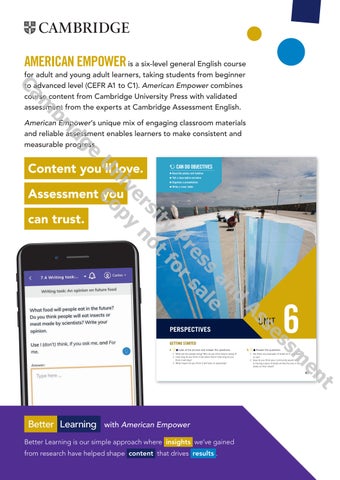
AMERICAN EMPOWER is a six-level general English course
m Ca
for adult and young adult learners, taking students from beginner to advanced level (CEFR A1 to C1). American Empower combines course content from Cambridge University Press with validated assessment from the experts at Cambridge Assessment English.
br
ge
id
American Empower’s unique mix of engaging classroom materials and reliable assessment enables learners to make consistent and measurable progress. CAN DO OBJECTIVES ■ Describe photos and hobbies
ss se As d an s le es sa Pr r y fo it t rs no ve y ni p
U
Content you’ll love.
■ Tell a descriptive narrative ■ Organize a presentation
can trust.
Co
Assessment you
■ Write a cover letter
UNIT
PERSPECTIVES GETTING STARTED a
Look at the picture and answer the questions.
b
Answer the questions.
1 Are there any examples of street art in your town or city? 2 How do you think your community would react to having a piece of street art like the one in the photo on their street?
en
m
1 What are the people doing? Why do you think they’re doing it? 2 How long do you think it has taken them? How long do you think it will stay? 3 What impact do you think it will have on passersby?
6
67 67
t
with American Empower Better Learning is our simple approach where insights we’ve gained from research have helped shape content that drives results .
Learner engagement Content that informs and motivates
1
Content
Results
Sustained motivation is key to successful language learning and skills development.
Clear learning goals, thoughtprovoking images, texts, and speaking activities, plus video content to arouse curiosity.
Content that surprises, entertains, and provokes an emotional response, helping teachers to deliver motivating and memorable lessons.
m Ca
Insights
br Answer the questions.
f
Have you ever heard of the photographer Elliott Erwitt? Read the fact file on p. 69. What kind of photographs does he take?
Co
• • • •
Answer the questions.
1 How are Erwitt’s methods and style evident in the photo of the Villa Borghese Gardens? What do you think of the photograph? 2 Answer the question at the end of the article: As an alien – what would you find intriguing, amusing, or nonsensical? 3 Look at the titles of the “lessons” (1–4) in the article. Are they relevant to other skills and/or jobs that you know about?
What do you think are important skills for photographers? Think about these things:
2 VOCABULARY Adjectives: describing images
what you choose to photograph the way the photos look the equipment you use your attitude and personality.
a
d Read the article. Are any of your ideas from 1c mentioned?
Villa Borghese Gardens, Rome 1969 by Elliott Erwitt
b
ELLIOTT ERWITT: PHOTOGRAPHER FACT FILE • born in Paris, brought up in Italy, moved to the U.S. at age 10 • began photography career in the 1950s • known for advertising and street photography, particularly ironic black-and-white shots of everyday life • invited to join the internationally famous photography agency Magnum in 1953
STREET PHOTOGRAPHY
by Eric Kim
If you are not familiar with the work of Elliott Erwitt, you may perhaps have seen some of his iconic work from around the globe (the picture opposite was taken by him). He had one of the longest careers of any photographer, spanning over 50 years. What I most appreciate about Elliott Erwitt is his wry sense of humor when looking at the world – as well as his straightforward philosophies about photography. In this article, I share some of his thoughts and advice.
As d an s le es sa Pr r y fo it t rs no ve y ni p
U
c
V Adjectives: describing images
1 Why shouldn’t street photographers plan much? 2 What should be the aim of a street photograph, according to Elliott Erwitt and the writer? 3 What do you think Elliott Erwitt means by visual garbage ? 4 What attributes does the writer think are most important in a street photographer? 5 What does the writer mean when he talks about keeping an alien mindset ?
1 What do you usually use to take photos – your phone or a camera? 2 Do you take a lot of photos? Why / Why not? 3 What do you usually do with the photos? 4 Do you think you’re good at taking photos? Why / Why not?
b
G Simple and continuous verbs
e Read the article again. Answer the questions.
1 SPEAKING AND READING a
UNIT 6
Lessons Elliott Erwitt Has Taught Me about
Learn to describe photos and hobbies
ge
id
6A
WE ALL SEEM TO LOVE TAKING PICTURES
Work with a partner. What do the highlighted adjectives in the article mean? Check your ideas in a dictionary. Now go to Vocabulary Focus 6A on p. 163.
1 DON’T PLAN TOO MUCH – WANDER AROUND
3 DON’T TAKE THINGS TOO SERIOUSLY
I think that as a street photographer, sometimes I fall into a trap of planning too much. I generally try to focus my attention on projects (having a preconceived project in mind when shooting in the streets), but I often find it also takes away from the shooting experience. One of the best things about street photography is to be a flaneur — someone who wanders around without a specific destination in mind.
When one thinks about the photography agency Magnum, some adjectives that come to mind are gritty and raw.
ERWITT I don’t start out with any specific interests; I just react to what I see. Takeaway point: Let your curiosity lead you. Just go out and shoot whatever you find interesting. Go down roads that may seem a little foreign, and you might be lucky enough to stumble upon great street photography shots.
2 FOCUS ON CONTENT OVER FORM
Great photos are a combination of content (what is happening in the frame) as well as form (composition). But which is more important? Content or form?
ERWITT My wish for the future of photography is that it might
continue to have some relevance to the human condition and might represent work that evokes knowledge and emotions. That photography has content rather than just form. And I hope that there will be enough produce to balance out the visual garbage that one sees in our current life. Takeaway point: We often find fascinating characters in the street and take photos of them, but the compositions may not be so good. On the other hand, we might take well-composed photos of a street scene, but there is nothing going on in the photo — it is boring and without soul.
I agree with Erwitt that we should, as street photographers, put more emphasis on content over form. I feel that photos that evoke emotions and the human condition are far more powerful and meaningful than just photos with good composition.
68
Insights
Results Personal responses make learning more memorable and inclusive, with all students participating in spontaneous spoken interaction.
ERWITT The picture seemed evocative and emotional. Also, a simple observation was all that it took to produce it. I thought, if one could make a living out of doing such pictures that would be desirable. Takeaway point: One of the things that is the most beautiful about street photography is that it doesn’t rely on having an expensive camera or exotic lenses. Rather, it comes down to having an observant and curious eye for people and the world around you. Therefore, cultivate your vision and way of seeing the world. I recommend that you always carry a camera with you because you never know when the best street photo opportunities will present themselves to you. A fun exercise: Pretend that you are an alien from another planet, and you have come to the planet Earth for the first time. Imagine how strange human beings would seem — and the urban environment they have built for themselves. As an alien, what would you find intriguing, amusing, or nonsensical? Always keep that mindset to be amazed by what you see around you.
69
There are so many adjectives to describe such a wonderful series, but in my opinion it’s very reliable, practical, and modern. Zenaide Brianez, Director of Studies, Instituto da Língua Inglesa, Brazil
t
Content Personalization tasks in every unit make the target language more meaningful to the individual learner.
4 HONE YOUR SKILLS OF OBSERVATION
Erwitt was inspired to go out and take pictures when he saw a photograph by master photographer Henri Cartier-Bresson. He realized it was an act of observation that made the photo great and that he could do something similar.
en
Language learners benefit from frequent opportunities to personalize their responses.
Takeaway point: Don’t take yourself and your street photography too seriously, and remember — at the end of the day you want to enjoy yourself.
m ss
Personalized and relevant
ERWITT Well, I’m not a serious photographer like most of my colleagues. That is to say, I’m serious about not being serious.
se
2
However, Erwitt’s style was vastly different. He didn’t go out and take photos in conflicts or war. His photos tended to be more playful, humorous, and amusing.
Measurable progress 1
Assessment you can trust Content
Results
Tests developed and validated by Cambridge Assessment English, the world leaders in language assessment, to ensure they are accurate and meaningful.
End-of-unit tests, mid- and endof-course competency tests, and personalized CEFR test report forms provide reliable information on progress with language skills.
Teachers can see learners’ progress at a glance, and learners can see measurable progress, which leads to greater motivation.
m Ca
Insights
ge
id
br
Co
As d an s le es sa Pr r y fo it t rs no ve y ni p
U
Results of an impact study showing % improvement of Reading levels, based on global Empower students’ scores over one year.
We started using the tests provided with Empower and our students started showing better results from this point until now.
se
Evidence of impact
t
2
en
m ss
Kristina Ivanova, Director of Foreign Language Training Centre, ITMO University, Saint Petersburg, Russia
Insights
Content
Results
Schools and colleges need to show that they are evaluating the effectiveness of their language programs.
Empower (British English) impact studies have been carried out in various countries, including Russia, Brazil, Turkey, and the UK, to provide evidence of positive impact and progress.
Colleges and universities have demonstrated a significant improvement in language level between the mid- and end-of-course tests, as well as a high level of teacher satisfaction with Empower.
Manageable learning 1
Mobile friendly Content
Results
Learners expect online content to be mobile friendly but also flexible and easy to use on any digital device.
American Empower provides easy access to Digital Workbook content that works on any device and includes practice activities with audio.
Digital Workbook content is easy to access anywhere, and produces meaningful and actionable data so teachers can track their students’ progress and adapt their lesson accordingly.
m Ca
Insights
ge
id
br
U Co
ss se As d an s le es sa Pr r y fo it t rs no ve y ni p
I had been studying English for 10 years before university, and I didn’t succeed. But now with Empower I know my level of English has changed.
Nikita, Empower Student, ITMO University, Saint Petersburg, Russia
2
Corpus-informed Insights
Corpora can provide valuable information about the language items learners are able to learn successfully at each CEFR level.
m
Content
Results Learners are presented with the target language they are able to incorporate and use at the right point in their learning journey. They are not overwhelmed with unrealistic learning expectations.
t
en
Two powerful resources – Cambridge Corpus and English Profile – informed the development of the Empower course syllabus and the writing of the materials.
Rich in practice 1 Language in use
Content
Results
It is essential that learners are offered frequent and manageable opportunities to practice the language they have been focusing on.
Throughout the American Empower Student’s Book, learners are offered a wide variety of practice activities, plenty of controlled practice, and frequent opportunities for communicative spoken practice.
Meaningful practice makes new language more memorable and leads to more efficient progress in language acquisition.
m Ca
Insights
ge
id
br 6D
SKILLS FOR WRITING I played an active role
a
2 READING
W Formal letters; Giving a positive impression
a Read the advertisement. What are the requirements for the job?
c Quickly read the reviews A–E in the guide. Match
U
1 SPEAKING AND LISTENING
UNIT 6
them with the categories.
06.16 Listen to five conversations about the places and events in the guide and match them with the reviews. Write down words from the conversations that helped you match them.
e
Answer the questions.
1 Which of the events and places reviewed do you have in your town or area? Which would you go to yourself? Why? / Why not? 2 Do you read online guides like this? Do you ever write reviews of local places or events online?
Co
live music movie theaters sports and leisure facilities restaurants shopping and markets theaters sports events cafés exhibitions and museums places for children outdoor spaces (parks, scenic views, etc.)
d
b Look at the six categories at the top of the website “Your Local Guide.” What information would you expect to find in each category?
Guide Local Yourgoing on, where to stay, and what to do
LODGING DINING SHOPPING OUTDOORS EVENTS CONTACT
what’s
A ____ You can enjoy old-style country living with
the convenience of modern amenities. Each of the five guest rooms features a private shower, a flat-screen TV, and a spacious balcony. Daily rates: $99 with breakfast included.
B ____Bustling with activity and color, this is a great
place to while away a few hours browsing around the goods for sale, even if you're not tempted to purchase anything. Be sure to visit the second-hand clothing stalls on the first floor, where you can sometimes pick up a real bargain.
C ____This local band combines Cajun and hip-hop
Can you think of any other qualities the publishers would be looking for? Do you think you’d be good at this job? Why / Why not?
Formal letters; Giving a positive impression
a Read the cover letter again and
match the paragraphs 1–5 with their purposes a–e.
b Read the cover letter. In what ways do you think Helen is suitable for the job? Is she unsuitable in any ways?
SUBSCRIBE ADVERTISE SUPPORT US
a b c
JOIN OUR TEAM
to give examples of relevant experience to state her qualifications to demonstrate enthusiasm for the company to summarize additional strengths to state the reason for writing
As d an s le es sa Pr r y fo it t rs no ve y ni p
How much do you think you know about events and places in your local area? Which of these do you know about? Give yourself a score for each one (0 = I know nothing about it; 5 = I know a lot about it). Then compare your answers.
3 WRITING SKILLS
Learn to write a cover letter
influences. Although they've only been playing together for just over a year, they're starting to make a name for themselves with their innovative and laid-back sound. Tickets online or at the venue.
D ____The menu features eight different tacos, including chicken, ground beef, tofu, and more. Beverage menu includes a plethora of freshly squeezed fruit juices, smoothies, and lemonade. And it’s all great value for the money. E ____The Canopy Tour consists of five dual zip lines
ranging in distance from 100 to 500 meters through the trees. You can also explore the walking and biking trails along the river or visit the Olympic-sized outdoor pool.
Do you like our site? Why not join us?
We’re always on the lookout for talented new people to contribute reviews to our site. If you have your finger on the pulse of events in your area, get in touch and join our team!
d e
b Look at the underlined phrases in these comments. Find equivalent phrases in the first three paragraphs of the letter and write them down.
Maybe you know about ...
events – what’s going on where
shopping and markets
local places to eat and drink
cool places to stay
places to do sports and leisure activities
great places to visit around the area
We can offer you a small fee for any reviews we use, and also other benefits like free tickets to events and discounts on purchases. To apply, send an email to Alan at alan@eventsfeatures.cup.org explaining what area(s) you are interested in and why you think you would be able to contribute to the site. Please also attach a sample review or article of no more than 300 words.
1 I want to write for your site. 2 I think your site is just great. 3 I really love the way you give a chance to local initiatives. 4 My research was about sports and leisure in the community. 5 I know about what is going on locally.
c One of Helen’s aims is to give a positive
impression of herself. Underline the phrases she uses to describe herself and her experience.
d
Now go to Writing Focus 6D on p. 172.
Dear Alan,
1 I am writing in response to your request for contributors to your site. I would like to express my interest in contributing to the site by writing reviews or background features.
4 WRITING
2 Although I live locally, I often browse your site to keep up to date with events and find out about new attractions. I can say that I find the site very well organized and full of great information. I especially admire your policy of promoting local initiatives and giving a platform to ordinary citizens who are contributing in some way to the community.
a Look at the other areas listed in the
3 I am a third-year college student studying sports education. My studies during the past semester included research on the topic of sports and leisure in the community, so I feel I am very much in touch with local events that involve health and recreation. Through my studies, I have been able to make contact with individuals and organizations who are active in this field.
4 For example, last summer I played an active role in helping to organize an Outdoor Youth Leisure Weekend, in which young people from local schools and colleges took part in a range of activities that included rock climbing, kayaking, zip-lining, and trail running. I am sure the prominent coverage your website gave us contributed to the success of the event. 5 I believe I would also be well placed to contribute reviews and features on other topics besides sports and leisure. I have an active social life in the city and a good sense of what places younger people like to go to, whether it’s cafés, places to eat, or music and dance venues. I also like to attend local events such as concerts and other performances, and I am sure I would be able to contribute useful reviews about them for your site.
advertisement in 2a. Choose an area you know about and write a cover letter. Make sure you: • organize what you write into logical paragraphs • use fairly formal language so that you will be taken seriously • give a positive impression so they will want to give you the job.
b Exchange your letter with another
student. Read their letter. Would you be interested in using their reviews? Why / Why not?
I am attaching a sample review of the newly opened Cole Valley Recreation Center, which I hope you will enjoy reading. I look forward to hearing from you. Sincerely,
Helen Appledown
76
Progress with language learning often requires work outside of the classroom, and different teaching models require different approaches.
American Empower is available with a print workbook, online practice, documentary-style videos that expose learners to real-world English, plus additional resources with extra ideas and fun activities.
Results This choice of additional resources helps teachers to find the most effective ways to motivate their students both inside and outside the classroom.
t
Content
en
Elena Pro, Teacher, EOI de San Fernando de Henares, Spain
Insights
m ss
There are plenty of opportunities for personalization.
se
2 Beyond the classroom
77
Unit overview Unit Opener Getting started page – Clear learning objectives to give an immediate sense of purpose.
m Ca
Lessons A and B
Digital Workbook (online, mobile): Grammar and Vocabulary
id
br
Grammar and Vocabulary – Input and practice of core grammar and vocabulary, plus a mix of skills.
ge
Lesson C
Digital Workbook (online, mobile): Listening and Speaking
As d an s le es sa Pr r y fo it t rs no ve y ni p
U
Everyday English – Functional language in common, everyday situations.
Unit Progress Test
Co
Lesson D
Integrated Skills – Practice of all four skills, with a special emphasis on writing.
Digital Workbook (online, mobile): Reading and Writing
Review
Extra practice of grammar, vocabulary, and pronunciation. Also a “Review your progress” section for students to reflect on the unit.
Mid- / End-of-course test
Digital Workbook (online, mobile)
en
Workbook (printed)
m ss
Further practice is available for outside of the class with these components.
se
Additional practice
t
Components Resources – Available on cambridgeone.org • Audio • Video • Unit Progress Tests (Print) • Unit Progress Tests (Online)
• Mid- and end-of-course assessment (Print) • Mid- and end-of-course assessment (Online)
• Digital Workbook (Online) • Photocopiable Grammar, Vocabulary, and Pronunciation worksheets
CONTENTS Lesson and objective
Grammar
Unit 1 Language Getting started Talk about animals learning language 1A Talk about learning a second language Adverbs and adverbial phrases 1B Describe languages and how The perfect aspect they change
Vocabulary
Pronunciation
Language learning; Noun forms Describing changes
Word stress: noun forms with -tion and -ity Sentence stress
m Ca
Express yourself in an inexact way
1D
Write a web forum post
Sound and spelling: ea, ee, and ie
br
1C
ge
id
Review and extension More practice Unit 2 Going to extremes Getting started Talk about tolerance of extreme conditions 2A Describe extreme sensory experiences Comparison
Talk about plans, intentions, and arrangements
2C
Give advice
2D
Write a report
Intentions and arrangements
Co
Review and extension More practice Unit 3 Travel and adventure Getting started Talk about a mishap on a road trip 3A Emphasize positive and negative Inversion experiences
Multi-word verbs: social interaction
Consonant–vowel linking
Verbs of movement
Thought groups and main stress
3B
Describe journeys and landscapes
3C
Paraphrase and summarize
3D
Write a travel review
Future in the past; Narrative tenses
WORDPOWER Idioms: Movement
Wealth and poverty
Intonation in inversion structures; Word stress
Landscape features
Different pronunciations of t Sound and spelling: t
Review and extension More practice Unit 4 Consciousness Getting started Talk about manipulating the senses 4A Talk about using instinct and reason Noun phrases
WORDPOWER Idioms: Landscapes
4B
Talk about memories and remembering
Memory
4C
Use tact in formal discussions
4D
Write a profile article
have / get passives
Paraphrasing and summarizing
Instinct and reason
Sentence stress
m ss
Homophones in words and connected speech
Being tactful in formal discussions
en
WORDPOWER mind
Crime and justice
Sound and spelling: s and ss
5B
Talk about job requirements and fair pay
Employment
Word stress: nouns and verbs
5C
Recall and speculate
5D
Write an opinion essay
t
Review and extension More practice Unit 5 Fairness Getting started Talk about activities for prisoners 5A Talk about crime and punishment Relative clauses Willingness, obligation, and necessity
Giving advice
se
2
WORDPOWER Idioms: Body parts
Emphatic stress
Review and extension More practice
Expressing yourself in an inexact way
As d an s le es sa Pr r y fo it t rs no ve y ni p
U
2B
Everyday English
Main stress
WORDPOWER Idioms: Crime
Recalling and speculating
Contents
Listening
Reading
Speaking
Writing
Interview: A bilingual upbringing
Blog post: “Speaking Italian to Cats” Article: “How Quickly Is the English Language Changing?” Fact file: “How Languages Are Special”
Describing experiences of language learning Discussing language learning factors Speculating when English words originated Discussing interesting facts about your language and others
Five pieces of advice for language learners Changes in your world
m Ca
Monologue: The origins of words Four monologues about how languages change Friends and Rivals
Expressing yourself in an inexact way
Four discussion board posts
Predicting the main points of a talk and discussing your predictions
Web forum post Expressing opinions
ge
id
br
Monologue: The dominance of English as a world language
Unit Progress Test
Article: “I’ve Been to the Quietest Place on Earth”
Interview with a base jumper
Leaflet: “Looking for a Good Thrill?” Article: “Why Some of Us Are Thrill-Seekers”
A guest overstays his welcome
BBC talk: The Problem with Volunteering, Daniela Papi BBC audio blog: Journey of a Lifetime, Will Millard A bad pitch Two monologues about Cusco
BBC radio discussion: Gut instinct in medical diagnosis
Discussing the merits of activities for a social club
Reports Linking: contrast and concession
Two reviews: “Thinking of Volunteering Abroad?”
Discussing volunteer work abroad Describing new experiences
Narrative article: “Survival on the Mano River”
Telling the story of an adventurous journey
Blog post: An unusual travel or tourism experience Article: An adventurous journey
Paraphrasing and summarizing
Traveler’s review: “Cusco Getaway”
Unit Progress Test
Describing the best and worst places you have been as a tourist Expressing an opinion about a place
Quiz: “Do You Have a Sixth Sense?” Dilemmas: Would you go with your gut instinct? Article: “False Childhood Memories” Talking about a childhood memory Article: “How Eyewitness Evidence Giving an eyewitness account of a crime Can Be Unreliable” Discussing ways to improve memory Being tactful in formal discussions
Travel review Descriptive language; Writing briefly
Article: “Learn to Trust Your Gut!”
Article: “Can We Have a Swimming Pool? Life at Halden Prison” Four job descriptions: Bomb disposal diver, Private butler, Ethical hacker, and Social engineer
Giving definitions of crime vocabulary Discussing punishments for crimes Discussing employment benefits Exchanging information about different jobs Negotiating salaries for a range of jobs Recalling and speculating
Profile article Organizing information; Showing time relationships
t
Asking and answering questions about being interviewed for a profile article Interviewing a classmate for a profile article
Unit Progress Test
en
Profile article: “Anita Coronel”
m ss
Feedback and an unexpected opportunity Interview: musician Anita Coronel
Unit Progress Test
se
Three monologues about childhood memories
Blog post: A new experience
Report: Review and recommendations of a social club committee
Co
Four monologues about university social club activities
Questionnaire: “How Sensitive Are You to Sound?” Discussing different views on communication Giving opinions on extreme sports and dangerous activities Discussing a blog post Giving advice
As d an s le es sa Pr r y fo it t rs no ve y ni p
U
Monologue: My Vow of Silence
Radio news: Bizarre crimes Four monologues about employment Opening up Two monologues about job applications and social media
Essay: “Social Media and Recruitment”
Discussing how an employer should respond to employee comments on social media
Unit Progress Test Opinion essay Essays; Linking: addition and reinforcement
3
Lesson and objective
Grammar
Vocabulary
Pronunciation
Everyday English
Unit 6 Perspectives Getting started Talk about the impact of 3D street art 6A
Describe photos and hobbies
Simple and continuous verbs
Adjectives: describing images
6B
Tell a descriptive narrative
Participle clauses
Emotions
6C
Organize a presentation
Intonation in comment phrases
m Ca 6D
Main stress and emphatic stress (adverbs and adjectives) Organizing a presentation
Write a cover letter
Review and extension More practice
WORDPOWER Idioms: Feelings
br
Unit 7 Connections
Getting started Talk about technology in the classroom Speculate about inventions and technology
Speculation and deduction
Compound adjectives
Main stress: compound adjectives
7B
Emphasize opinions about the digital age
Cleft sentences
Nouns with suffixes: society and relationships
Intonation in cleft structures
7C
Apologize and admit fault
7D
Write a proposal
ge
id
7A
Apologizing and admitting fault
As d an s le es sa Pr r y fo it t rs no ve y ni p
U
Review and extension More practice
WORDPOWER self-
Co
Unit 8 Body and health
Sound and spelling: ou and ough
Getting started Talk about physical activity in old age 8A
Describe sleeping habits and routines
8B
Talk about lifestyles and life expectancy
8C
Negotiate the price of a product or service
8D
Write promotional material
Review and extension More practice Unit 9 Cities
Gerunds and infinitives
Sleep
Stress in fixed expressions
Conditionals
Aging and health
Pitch: extra information
Sound and spelling: misleading vowels
Negotiating
WORDPOWER and
Getting started Talk about obstacles to urban development
9B
Describe architecture and buildings
9C
Deal with conflict
9D
Write a discussion essay
Reflexive and reciprocal pronouns
Verbs with re-
Sound and spelling: re-
Ellipsis and substitution
Describing buildings
Word stress
Sound and spelling: foreign words in English
Review and extension More practice
WORDPOWER build
Unit 10 Occasions Regret and criticism structures
Communication verbs
Word groups and main stress
10B Talk about superstitions and rituals
Passive reporting verbs
Superstitions, customs, and beliefs
Consonant groups
10C Take turns in more formal conversations
t
10A Give a presentation or a speech
Intonation in question tags
10D Write a movie review Review and extension More practice
4
WORDPOWER luck and chance Grammar Focus p. 138
en
Getting started Talk about an unusual wedding
Communication Plus p. 127
Dealing with conflict
m ss
Talk about city life and urban space
se
9A
Vocabulary Focus p. 158
Turn-taking
Contents Listening
Reading
Speaking
Interview with an amateur photographer
Article: “Lessons Elliott Erwitt Has Taught Me about Street Photography”
Discussing photography skills Talking about your favorite photos
News report: The conclusion of the story of the suspicious encounter
Blog post and email: Two views of a suspicious encounter
Discussing the themes of a piece of fiction Reading a short story aloud
A big presentation
Creating an alternative ending to a short story
Organizing a presentation
m Ca
Five conversations about things to see and do in the local area
Talking about what’s going on in your local area
Three monologues: Inventions that would make the world a better place
Article: “I’m about to Interview a Robot”
Discussing questions to ask a robot Presenting a new invention
Radio show: From My Bookshelf
Article: “Loneliness and Temperature”
Talking about what you read online Explaining how you would overcome a hypothetical problem
ge
id
br
Advertisement: Article writers required for local magazine
Unsolicited suggestions
Writing
Cover letter Formal letters; Giving a positive impression
Apologizing and admitting fault
U
Proposal: A team-building program for senior management
Unit Progress Test
Ordering the personality attributes required to be an effective team member
Proposal Linking: highlighting and giving examples
Co
As d an s le es sa Pr r y fo it t rs no ve y ni p
Four monologues: People express their opinions of their coworkers
Unit Progress Test
Radio interview with a sleep researcher Radio call-in show about waking up at night BBC interview: Living on a calorie restricted diet A one-of-a-kind gift Radio interview: The Stone Age Diet
Podcast: New ideas for “smart cities”
Conversation: Thin skyscrapers
Article: “Anti-Aging Treatments” Interview: “We Don’t Have to Get Sick as We Get Older”
Discussing anti-aging treatments Presenting your views on health and aging issues
Negotiating
Unit Progress Test
Homepage: Ancestors restaurant
Discussing what’s important when you eat out
Promotional material Using persuasive language
Article: “The Day of the Pedestrian” Fact files: Four city initiatives
Sharing information about initiatives to improve cities Presenting ideas for “smarter” cities
Article: “Jeanne Gang”
Describing buildings Presenting a proposal for the redevelopment of a derelict building
Dealing with conflict
se
A mistake
Article: “Top Tips to Help You Sleep” Discussing tips for a good night’s sleep Article: “The Myth of the Eight-Hour Planning a typical day for someone with Sleep” a segmented sleep pattern
Unit Progress Test
Conversation: Life in a rural community in New Zealand compared to life in a city
Essay: Urban migration
Discussing rural and urban living
Three monologues about giving a presentation
Article: “Don’t Be Boring!”
Discussing what makes a good presentation Giving a one-minute speech: “Learning from My Mistakes”
Radio interview: Superstitions in sports
Article: “The Game before the Game”
Discussing superstitions, customs, and beliefs; Role play talking about plans and responding
Unit Progress Test
Four monologues about how people use reviews
Two movie reviews: Ad Astra
Discussing how much reviews influence your choices
Writing focus p. 169
Verb patterns
Phonemic symbols p. 177
p. 176
t
Turn-taking
en
m ss
A successful interview
Discussion essay Linking: reason and result
Movie review Concise description
Irregular verbs p. 177
5
CAN DO OBJECTIVES ■ Talk about learning a second language ■ Describe languages and how
they change ■ Express yourself in an inexact way ■ Write a web forum post
m Ca ge
id
br Co
As d an s le es sa Pr r y fo it t rs no ve y ni p
U
t
en
LANGUAGE
m ss
1
se
UNIT
GETTING STARTED a
6
Look at the picture and answer the questions. 1 What do you think the ape is being taught to do? How successful do you think this will be? 2 What do you think the benefits of teaching animals language are for … ? • humans • animals 3 In what ways do you think this ape’s language learning experience is similar to or different from a human’s?
b
Discuss the questions. 1 In what other situations do humans and animals communicate with each other? 2 Which animals are known for their ability to communicate well with humans? 3 If you could converse with any animal, which one would it be? What would you like to ask it?
6
m Ca
ge id br
Co
t
en
m ss
se
As d an s le es sa Pr r y fo it t rs no ve y ni p U
7
1 A
Learn to talk about learning a second language
I THOUGHT I COULD PICK UP ITALIAN BY EAR
G Adverbs and adverbial phrases V Language learning; Noun forms
1 READING Do you agree with these statements about learning a second language? Why / Why not?
m Ca
a
experience. Which of the statements in 1a might he agree with?
c
ge
id
br
1 It’s helpful to get feedback from native speakers. 2 Trying to memorize words and phrases is a core part of the learning process. 3 Communicating in another language makes you feel like a different person. 4 Learning grammar is a waste of time – I don’t even know it in my first language! 5 The biggest reward is being able to relate to people from another culture. 6 Apps on smartphones and tablets have made learning a second language much easier. 7 When you’ve learned one second language, it’s easier to learn another.
b Read about Scott’s language learning
Read the text again and answer the questions.
As d an s le es sa Pr r y fo it t rs no ve y ni p
U
1 Why do you think Scott wants to put his money where his mouth is? 2 What is the difference between learning a language by ear and studying it formally? 3 How important is a learner’s motivation when learning a new language? 4 How does self-consciousness inhibit learning a new language?
Co
LANGUAGE TEACHERS LEARNING LANGUAGE
Speaking Italian to Cats How I got my tongue around all those crazy Italian vowels with the help of some friendly cats and a mysterious woman on a train
t
I’d made friends with some students. I sort of tried to talk to them in Italian, but more often than not I got stuck. Their English was far better than my Italian. I remember going to dinner at my friend Matteo’s place. His family had a couple of cats, and while Matteo was helping his mother serve up the pasta, I had my own private conversation with the cats.
She then said (in Italian), “Come on. You can speak with me.” She had a very determined look on her face, but also a warmth and friendliness that was somehow encouraging. So I took the plunge. Not very well to begin with, but I gradually began speaking in Italian with more and more confidence.
en
8
So I got out that “teach yourself Italian” book I had packed and got started on the grammar and vocabulary. And I downloaded some Italian learning apps on my phone. It was hard work, and I struggled to grasp some of the verb tenses and vocabulary. It seemed like I would have to remember a mountain of information if I were ever going to speak correctly.
A few weeks after that, I went on a trip to Venice for a weekend. On the train going there, I met a teacher of English at a high school in Milan. We started chatting, and she asked me how long I’d been in Italy. By this time it was almost five months, and she smiled when I admitted that I couldn’t speak Italian yet. I told her I’d been studying on my own, but I had no confidence to speak.
m ss
I managed to get a teaching job in the north of Italy in a small city called Aosta, right next to the French and Swiss borders, where there is great skiing. (I really love to ski.) I had studied French in high school and college, but my language skills were a little rusty. At the time, I didn’t speak a word of Italian, so I packed one of those “teach yourself Italian” books in my luggage.
Aosta is bilingual – Italian and French – and, to begin with, I brushed up on my college French and could get by. I was convinced I’d just be able to pick Italian up by ear. Being surrounded by the language and hearing it all the time meant I’d just kind of absorb it, but no such luck. After three months, I’d finally managed to remember Non capsico l’italiano, but not a whole lot more.
Matteo overheard me, laughed, and said, “That’s right, speak Italian to the cats – only they can understand you.” It was a joke, but I felt crestfallen and could feel my vow to learn another language slipping away.
se
When I finished my training as an English language teacher, I made a vow not to be one of those instructors who teach their native language but cannot speak another language fluently themselves. I wanted to put my money where my mouth was.
I flew direct to Milan, and the culture/language shock hit me as soon as I got off the plane. Still suffering from jet lag, I tried to memorize the phrase Non capisco l’italiano (I don't understand Italian), but I couldn’t get it into my head. Not a great start.
by Scott Fletcher
And that was my breakthrough. In the two hours it took to travel from Milan to Venice I somehow unlocked everything I had been studying. Why? Basically, I think it had everything to do with the woman I met (I don’t know her name, and I’ve never met her again), but I felt less self-conscious speaking with someone who wasn’t my student or my friend.
UNIT 1 2 GRAMMAR
d
Adverbs and adverbial phrases
Think of a skill you have learned at some stage in your life. Plan to talk about it, using some of the adverbs from the reading and the box below. Write notes.
a Notice the highlighted adverbials in the texts. Add
in the beginning obviously extremely eventually correctly clearly incorrectly naturally in the end
1 Comment (used to express the speaker’s point of view): clearly, apparently, actually, basically 2 Degree (used to make the meaning stronger or weaker): very, a little, … 3 Manner (used to say how ): slowly, on foot, … 4 Time (used to say when): in the eighties, overnight, … 5 Frequency (used to say how often): never, …
Obviously, I was hopeless in the beginning.
m Ca
them to the lists below. The first one is done for you.
br
In order to do it correctly, you have to concentrate on the ball.
b What position(s) can each adverbial take in these sentences? Which adverbials change meaning in different positions? 1 a in the end 1, 3 b eventually 1
2
c
Co
5
e
Describe the experience you had learning the skill without naming it. Can your partner guess what skill you are talking about?
As d an s le es sa Pr r y fo it t rs no ve y ni p
4
3
I managed to hold a conversation in Japanese . a extremely b often 1 2 3 I found it difficult. a frequently b all the time 1 2 3 I made silly mistakes . a slowly b clearly 1 2 3 I would like native speakers to speak to me . a naturally b well 1 2 I’m a little envious of friends who can already speak 3 the language .
U
3
2
ge
id
Playing a complete game involved a lot of walking, and I was extremely tired afterward.
3 VOCABULARY Language learning
a Look at the underlined parts of the texts. Match the words and phrases 1–4 with the definitions a–d.
1 2
Now go to Grammar Focus 1A on p. 138.
a b c d
pick up brush up on
3 4
grasp rusty
understand something, especially something difficult less able because you are out of practice learn something by being exposed to it improve your knowledge of something you’ve partly forgotten
b
Now go to Vocabulary Focus 1A on p. 158.
c Read the questions about your English language
learning background. Add two more to ask a partner.
When did you first start learning English?
se
1
m ss
2 How long was it before you could hold a conversation in English? 3 When did you first put your learning into practice? 4 Have you progressed as well as you expected?
t
en
5 Have you ever been immersed in an English-speaking culture? If so, what was it like? If not, is there a culture you would like to get to know?
6 How important is it to you to speak accurately? Why?
When I went back to Aosta, my friends couldn’t believe it. “What happened to you?” Matteo asked. I could suddenly speak Italian. I haven’t looked back since, and my confidence in speaking has grown enormously. My Italian isn’t perfect, but it’s fairly fluent and I know the grammar. I did, in the end, manage to put my money where my mouth was.
7 What level of competence would you like to attain eventually? 8 9
d
Work in pairs. Ask and answer the questions in 3c.
9
UNIT 1 4 LISTENING
5 SPEAKING AND VOCABULARY Noun forms
a
a
Answer the questions. 1 Think about someone you know who grew up bilingual. What was their experience like? 2 What do you think are possible advantages and disadvantages of a bilingual upbringing? 3 What are attitudes toward being bilingual like in your country?
1 So I got (expose) to both languages right from the beginning. 2 If I wanted to communicate, I had to use Portuguese. It was a (necessary). 3 There’s a (reluctant) on the part of some parents to let their children learn a second language. 4 And my (motivate) was much higher. It’s like there’s a part of my brain that gets real (please) from engaging with another language.
m Ca b
Listen to Katya being interviewed about her bilingual upbringing on the podcast Linguistically Speaking. Answer the questions. 01.06
br
c
ge
id
1 Which languages does she speak? 2 What was unique about her upbringing? 3 What’s her attitude to bilingualism?
Listen again. Are the sentences true or false? Correct the false sentences. 01.06
b
Now go to Vocabulary Focus 1A on p. 158.
c
How can these factors have an impact on learning a second language? • • • • • • •
Co
d
the right mentality financial limitations distractions opportunities for interaction first language interference natural competence the prestige of knowing a second language
As d an s le es sa Pr r y fo it t rs no ve y ni p
U
1 Katya realizes that her upbringing was very special and different. 2 Katya’s mother used both English and Russian when she spoke to Katya. 3 She wasn’t really aware that she was speaking two languages when she was a child. 4 She thinks she might have had some initial problems acquiring Portuguese. 5 She went to special classes to learn to read and write in English and Russian. 6 She found it easy to fit into her school in the U.S. 7 She believes being bilingual has given her an ability to concentrate on tasks. 8 She found she struggled learning Mandarin.
01.07 Complete the sentences with the noun form of the words in parentheses. Listen and check.
Imagine you want to give your child a bilingual upbringing. What would you have to do? How easy or difficult would it be? Write notes and compare with your partner.
d Choose a person 1–3 and write five pieces of advice for them.
1 an English speaker who wants to learn your language 2 a friend who wants to pass a state English exam 3 a teenager who finds languages at school a turn-off
e
Work in pairs. Compare your ideas in 5d and prioritize four suggestions that are useful for all language learners.
The most universally useful suggestion here is to invest in a good dictionary.
I couldn’t agree more. I also think putting your learning into practice whenever you can is really important.
t
en
m ss
se Katya as a child
Katya today
10
1 B
Learn to describe languages and how they change
LANGUAGE HAS BEEN CONSTANTLY EVOLVING
G The perfect aspect V Describing changes
spacecraft brainwash Bollywood environmentalism
radio
ge
id
br
blog
b a bysi tter ecotourism technophobe
selfie in-joke
Look at these words. Which ones do you know? Tell your partner. Look up the words you don’t know in a dictionary.
m Ca
a
sudoku
1 SPEAKING
1
Each word in 1a was first used in a different decade, from the 1900s to the 2010s. When do you think each word first came into the English language, and why? Put them in order. 1900s radio 1910s …
c
01.09 Listen and check your answers. What is the significance of photographs 1 and 2?
d
Two more new words in English are hangry and glamping. Talk about their meanings. Do you know any other words that have come into the English language recently?
2
Co
As d an s le es sa Pr r y fo it t rs no ve y ni p
U
b
2 READING
a Read the introduction to an article about the way English has changed. Which two points does the writer make? English has become less complex over the years.
Many changes to language take place gradually so we may not notice them.
Modern technology has helped us see how language is changing.
d
Look at each pair of sentences below. Do the sentences show a change you read about? Explain the change to your partner. 1 a b 2 a b 3 a b 4 a b
Shall we meet at 6:00? Do you want to meet at 6:00? I was fired from my job. I got fired from my job. She started to cry. She started crying. I ought to go soon. I need to be going soon.
t
Communication 1B Work in pairs. Student A: Go to p. 127. Student B: Go to p. 131.
en
c
However, there are far more subtle, ongoing language changes taking place at any given time. These changes may have a hugely significant impact but can go entirely unnoticed while they are in progress. One lasting change to English that was barely perceptible at the time is known as the Great Vowel Shift. Over a period of 350 years (from 1350 to 1700), the long vowel sounds of English drifted so far that speakers at either end of the period could not have understood each other. However, nobody noticed for about 100 years after it had happened! The Great Vowel Shift was a major contributor to the annoying inconsistencies between spelling and pronunciation in English that have plagued users ever since.
m ss
1 What do you think the words in italics in paragraph 1 mean? 2 Can you think of an example of “the annoying inconsistencies between spelling and pronunciation in English”?
We all know language changes. People’s favorite music was far-out in the 1960s, rad in the 1980s, wicked in the 1990s, and awesome in 2010. You just need to watch a movie from ten years ago to hear phrases that have come and gone.
se
b Answer these questions.
How Quickly Is the English Language Changing?
These days no such important change would go unnoticed. Linguists can now analyze huge collections of text and transcribed speech and identify ongoing patterns of change that in the past would not have been visible for many years to come. Here are some of the less noticeable changes that are occurring in English right now:
11
UNIT 1 3 VOCABULARY Describing changes
4 LISTENING AND GRAMMAR
The perfect aspect
a Read the sentences about language change below. Which words/phrases in bold tell the reader … ? the speed of a change that a change is in progress how easy a change is to see about something that is decreasing how big or important a change is that a change is long-term or permanent about something that is increasing
You will write some numbers more than once.
br
1
a
b
Are the kinds of change the speakers mentioned happening in your first language?
c
01.11 Complete the sentences using the correct forms of the verbs in parentheses. Then listen and check.
2
One lasting change to English that was barely perceptible at the time is known as the Great Vowel Shift.
1
ge
id
much faster since people started using • Language the Internet. (change) 2 out of fashion and other • In a few years’ time, they 3 new words into the language. (go, come) 4 using strict rules for punctuation. • I mean, people (stop) 5 . • In about 50 years, most dialects of English (die out) 6 about language changing. They • Older generations 7 strongly about it. (always / complain, always / feel) 8 photos of themselves before 2013, but they • People didn’t have a single word for it. (take) • Now that computers have come along, the meaning of the word 9 wireless . It used to mean “radio.” (change)
3
U
These changes may have a hugely significant 4 impact but can go entirely unnoticed while they are in progress. 5
As d an s le es sa Pr r y fo it t rs no ve y ni p
Here are some of the less noticeable changes that are occurring in English right now: 6
Co
There was a steady shift toward more frequent 7 use of the verb + -ing, and these forms are still on the rise. 8
9
There are far more subtle, ongoing language changes taking place at any given time.
d Answer the questions.
1 Which of the examples in 4c happen in … ? a a period up to the present b a period up to a time in the past c a period in the future
The use of continuous passive verb forms has also 10 seen a rapid rise. 11
Modal verbs are gradually giving way to other less formal expressions.
2 What do all perfect verb forms have in common? Choose the correct word to complete the rule.
12
Stiff, formal words like shall and ought are on the way out. Words that cover the same ground, such as going 13 to, have to, need to, and want to are taking over. 14
The use of get passives has grown substantially.
12
f
Now go to Grammar Focus 1B on p. 139.
g
Talk about words in your own language. Think about: • a word in common use now that hadn’t been invented when you were a child • a word that people have been using a lot this year • a word that will have fallen out of use in 20 years’ time • a word that has changed its meaning.
t
something that is on the way out in your culture a place that has changed substantially in recent years a problem that is on the rise a fashion that has taken over recently among the younger generation 5 a subtle change to a popular product
01.11 Pronunciation Listen to the sentences in 4c again and notice the pronunciation of the words you added. What kind of words are stressed? What kind of words are usually unstressed?
en
1 2 3 4
e
m ss
Write sentences about real changes. Then compare your ideas with other students.
All perfect verb forms describe actions, states, and processes in the time period before / after a particular point in time.
se
b
01.10 Listen to four people commenting on the article in 2a and answer the questions.
1 What kind of language change does each speaker focus on? 2 What specific examples does each speaker give?
m Ca
a b c d e f g
UNIT 1 5 READING AND SPEAKING a What is unusual about the remarks in
pictures 1–3? What would you expect the people to be saying instead?
b
FACT FILE:
HOW LANGUAGES ARE SPECIAL 1
Read the fact file and answer the questions.
Could you move to the east a little?
2
m Ca
1 What do you think each fact tells us about the speakers’ culture or environment? Or the way they think about the world? 2 Which language feature do you think is the most unusual?
Stop! The light is dark!
br
id
c Language in context Expressing meaning
3
1 to decide what the meaning of something is It’s very hard to the animal’s behavior. 2 to notice or understand the difference between two things It’s very difficult to between the twins. 3 to show the difference between things The thing that her from the others is her taste in clothes. 4 to explain something more clearly by showing examples, pictures, etc. Why don’t you include some stories to your points? 5 to show, point, or make clear in another way She shook her head to that I shouldn’t speak. 6 to express a thought, feeling, or idea so that it is understood by other people Her face her feelings even if her words didn’t. 7 to represent an abstract quality or idea exactly We need a slogan that the philosophy of our business.
The DANI OF NEW GUINEA only distinguish colors from one another using two words, one for dark colors and the other for light colors.
ge
Read the dictionary definitions and complete the example sentences with the correct forms of the highlighted words from the fact file.
A half dozen of the long, yellow, slightly curved, sweet fruit, please.
Co
As d an s le es sa Pr r y fo it t rs no ve y ni p
U
e
Read the opinion below. Language is the main influence on how people view their world.
Do you agree? Why / Why not? Make a list of reasons to support your answer.
GUUGU YIMITHIRR, a language spoken in northeast Australia, does not have words for “left” and “right” as directions at all. Instead, they use north, south, east, and west. When they want someone to turn while driving, they’ll say, for example, “Turn a little bit west.” In the language of THE MARQUESAN ISLANDS, directions are indicated with reference to geographical features – which can make them hard to interpret if you don’t know exactly where you are. For example, a Marquesan might say that your bicycle is “downstream of the house” or that you should “Walk inland, then seaward” to get to your destination.
UNTRANSLATABLE
t
Explain your list to a partner.
In the NATIVE AMERICAN LANGUAGE HOPI, the verbs do not differentiate between past and present. Instead, the forms of its verbs convey how the speaker came to know the information.
en
• an area of meaning where there are many more or many fewer words than in English • an idiom that can’t be translated into English • grammar or vocabulary that might reflect the culture.
HAWAIIAN LANGUAGES have 108 words for sweet potato and 47 for banana.
m ss
What facts about your own first language would you add to the fact file? Think of:
ALBANIAN has 27 different words for kinds of mustaches. Posht, for example, means a mustache that hangs down at the ends.
se
d
It is believed that the INUIT IN NORTHERN CANADA have about 50 different words for snow and about 40 ways to distinguish different kinds of ice from one another.
Most languages have unique words and idioms that are impossible to translate exactly. These words often embody the culture of the people who speak the language. Some examples that illustrate this: ENGLISH: cozy = pleasantly warm and comfortable GERMAN: fernweh = a longing to be somewhere far away JAPANESE: mono no aware = a gentle sadness at the impermanence of things DUTCH: uitwaaien = walking in windy weather for fun GREEK: parea = a group of friends who meet to share ideas and experiences KIVILA (PAPUA NEW GUINEA): mokita = the truth that everyone knows but nobody talks about
13
1 C
Learn to write an email with travel advice to express yourself in an inexact way W LearnParagraph writing
EVERYDAY ENGLISH
S Share rough details of an experience
Something along those lines
P Sound and spelling: ea, ee, and ie
1 LISTENING a
m Ca
Answer the questions.
01.14 Listen to Part 1. Answer the questions about the photo.
id
b
br
1 Have you or someone you know worked with the same coworker for a long time? Who? How long? 2 What characterizes a good working relationship?
ge
Alex
As d an s le es sa Pr r y fo it t rs no ve y ni p
U
1 Where do you think Sara and Alex work? 2 What do you think their relationship is? 3 How and why does Alex think Sara can help him?
c Language in context Irony and
a b c d
Aren’t you a happy camper this morning! Don’t get too excited to see me now. It’s not exactly good news. That’d be a surprise.
e
1 Sara is expecting the exact opposite to happen. 2 Alex notices that Sara’s greeting is not enthusiastic. 3 Alex sees that Sara looks unhappy. 4 Sara has received a distressing message.
2
Why do you think Sara and Alex don’t say exactly what they mean? Do people do the same in your culture?
Listen to Part 2. What is the relationship between … ? 01.15
1 2 3 4
What does Hilary want to talk about? Why does she mention Oscar? What does Hilary want from Sara? What does Alex suggest is Hilary’s reason for speaking to Sara? 5 What help does Sara ask Alex for? 6 What’s Sara’s impression of Oscar?
f
Answer the questions about Parts 1 and 2.
1 What do you know about the company Sara and Alex work for? Do you think Sara and Alex do similar jobs? 2 How do you think Sara feels at the end of the conversation?
• Sara and Oscar
t
en
m ss
• Hilary and Sara
01.15 Answer the questions. Listen to Part 2 again and check your answers.
se
d
Sara
Co
understatement 1 Match Sara’s and Alex’s comments a–d with situations 1–4.
Hilary
14
Oscar
UNIT 1 2 USEFUL LANGUAGE Expressing yourself in an inexact way a In informal conversations, we often express things in an inexact way. Read sentences 1–4. Match the expressions in bold with their uses a–d.
please and thank you and stuff like that Manny whatshisname six major league players, give or take I’m out of here, or words to that effect
m Ca
1 2 3 4
b Which two expressions in bold below could you use in 1–4 in 2a? Rewrite two ideas in 2a, changing the word order if necessary.
and b.
1 It’s by William Shakespeare, who wrote A Midsummer Night’s Dream. 2 I went to the store and bought three items. 3 She told me to go away, saying, “Please would you leave now?” 4 I know a little Portuguese – hello, goodbye, the numbers one to ten. 5 I’ve been to 15 countries.
ge
id
There were somewhere in the region of 100 people. She said something along those lines. Whatshername was late, as usual. I need some odds and ends from the store.
Which two expressions can’t you use in 2a? Why not? Match them to their uses: used to refer to things of different kinds used when you can’t remember a woman’s name exactly
Co
3 PRONUNCIATION
Sound and spelling: ea, ee, and ie
a
01.17 Listen to the words in the box. What sound do the letters in bold make? Is this sound always spelled with two letters?
please meeting research series
b
The spellings ea, ee, and ie are not always pronounced with the vowel sound in 3a. Listen and put the words in this box in the correct column 2–4. 01.18
d
4 SPEAKING
a
b
c Work alone. Plan to talk about an experience you
have had and write notes. Decide what exact details you will give and what you will mention in an inexact way. Here are some ideas: • a time when you got to know someone new on a long journey • a time when you traveled somewhere new on the spur of the moment • a time when you made an unplanned purchase.
4 /ɜr/
meet
learn Greek bear heard meaning meant increase steadily niece break breakfast early pear
Work with a partner. Take turns talking about your experience. Use expressions from 2a and b to mention things in an inexact way.
t
01.19 What sound do ea, ee, and ie have in the words in this box? Add them to the sound groups in 3b. Listen and check. Practice saying the words.
d
en
c
01.20 Listen again and write down the expressions from 2a and b that you hear.
m ss
3 /eɪ/
Listen and answer the questions.
se
2 /e/
01.20
1 What experience does the speaker talk about? 2 The speaker says “the horror of the situation” dawned on her. What is she referring to?
meet research great friend
1 /i/
Listen and compare your answers in 2c. Are they the same? Practice different ways of saying each sentence in 2b and c. 01.16
As d an s le es sa Pr r y fo it t rs no ve y ni p
U
a b
used to give an inexact amount used to report someone’s words in an inexact way used when you can’t remember someone’s name exactly used to refer to things of a similar type in an inexact way
c Rewrite these sentences using expressions from 2a
br
1 2 3 4
a b c d
UNIT PROGRESS TEST CHECK YOUR PROGRESS YOU CAN NOW DO THE UNIT PROGRESS TEST.
15
1D
SKILLS FOR WRITING
Learn to write a web forum post
You’re absolutely right!
W Expressing opinions
1 SPEAKING AND LISTENING
2 READING
a
a Read the posts to a web forum. Which two people
m Ca
Look at these borrowed words from English used in other languages. Why do you think they are used?
1
agree with each other?
b Which post … ?
2
id
br
• do you agree with most, and why • do you think makes the most interesting point
3 WRITING SKILLS Expressing opinions
ge
džús (Slovakian)
outdoor (Portuguese, Brazil)
4
3
a Which elements A–E are used by each writer in the web forum?
U 6
gol (Spanish)
7
As d an s le es sa Pr r y fo it t rs no ve y ni p
5
maiku (Japanese)
Co
lonche (Spanish, Mexico)
A agreeing/disagreeing with a previous comment B stating a new opinion on the topic C describing cultural trends to support an opinion D including personal experience to support an opinion E making a summarizing statement
b Write the highlighted phrases in the posts in the correct part of the chart.
biznismyen (Russian)
kampyutara (Hindi)
b
16
Listen and check. Take notes. Are there any points he makes that you find surprising? 01.21
Partial agreement / disagreement
I have mixed feelings about this. 4
You’ve got a point, but … It’s true that … , but … On the other hand, I do feel … 6
disagreement in the forum. Answer the questions.
1 What phrases do the writers use to soften the disagreement phrases? 2 Do you know any other words and phrases for softening your opinions?
d Look at all the expressions in the chart. Which ones are informal? Use a dictionary to help you.
e
Now go to Writing Focus 1D on p. 169.
t
d
the number of people that speak English English as an easy language to learn the Latin language English’s effect on the diversity of human languages the only real disadvantage of the dominance of English English as a truly global language
Uncertainty
c Look again at the highlighted phrases for
You will hear a linguist, Maxwell Kingsley, talking about the dominance of English as a world language. What do you think he will say about the following? 1 2 3 4 5 6
That makes a lot of sense. You’ve hit the nail on the head. I would go along with that. 5
en
c
That simply isn’t true. That’s easy to say, but … How can you possibly think that? That’s a load of garbage. 1 2 3
m ss
1 What are the main topic areas of borrowed English words in your language? 2 How do you / people in your country feel about adopted English words?
Agreement
se
Write down some examples of English words that are commonly used in your language. Then answer the questions.
Disagreement
UNIT 1
Maxwell Kingsley makes the point that although English has become the dominant world language, this isn’t a threat to other languages. Do you think he’s right?
f Compare Flying B’s and Gabriela’s posts. Whose
comments are more formal and abstract, and whose are more informal and personal? How can you tell? Think about: • abstract nouns • sentence length and structure • personal examples
m Ca
I’m of two minds about this. I agree up to a point that there’s a benefit to be had from a shared global language – especially the opportunity to travel and speak to other FLYING B people without constantly having to learn other languages. On the other hand, as people have said elsewhere, I do feel the dominance of English interferes with the uniqueness of many languages, for example, the way words are borrowed from English. The world is made infinitely more fascinating by having a variety of cultures. Different histories, cuisines, habits, styles of communication … A huge part of this is our many unique languages and dialects. Using the English language is by no means the only thing that’s been undermining this uniqueness, but it clearly contributes to it.
• questions and exclamation marks • colloquial expressions • first person.
g What style of comment would you post on this forum: formal and abstract or informal and personal? Why?
br
Writing Tip
ge
id
In order to write good discussion forum comments: • Choose a style and keep to it. It can be informal and chatty or it can be more formal and serious, but it’s better not to mix different styles together. • Before you respond to a comment, read it carefully to make sure your response is relevant. • Even if you strongly disagree with someone, try not to be impolite.
As d an s le es sa Pr r y fo it t rs no ve y ni p
U
REPLY
4 WRITING
Co
If you ask me, that’s nonsense. I’ve lived in various countries, and people speak their own languages 99% of the time. Many do speak English as a second language for international communication, but as far as PABLO I can tell, that doesn’t have much impact on their cultural identity. It’s true that people are constantly bombarded with English slang and popular buzzwords, but they don’t matter that much. Most non-native speakers see English as a simple tool, but they don’t use it when they need to convey REPLY subtle details and differences.
3
“ 4
“
”
The effect of English on other languages has been more positive than negative.
”
‘International English’ used by non-native speakers is destroying the English language.
“
”
If you want to work for an international company, you should learn English.
b Choose one of the opinions and start a discussion forum. Write a comment of about five or six sentences giving your point of view.
”
t
REPLY
2
Countries need to protect their language from the influx of English words.
en
It seems to me all of you are missing the point here. Even if English does replace other languages, it’s not the end of the world – just the opposite, in fact. I think that having one international language is a great way to help HARU unify the world and the human race in general. How can we expect cultures to keep peace between each other when they can’t understand each other? Unique languages tend to isolate those communities that are most likely to be economically weak. Our heritage is only history, and history will never and can never be more important than the present or the future.
1
“
m ss
REPLY
agree with.
se
Great comment, you’re absolutely right. I speak English fluently, but I use Spanish (and Portuguese!) in everyday life, and, as far as I’m concerned, there’s no way English is taking over GABRIELA my life. We all know it’s a global language, but so what? Some language has to be. I get a lot out of being able to use English, but I’m never going to stop using my own language. Why would I? I don’t quite get what the fuss is about here.
a Read the opinions below and check (✓) the ones you
c Share your post with another student. Read another student’s post and add a comment. It can be a response or a further comment on the topic.
d Respond or comment on three other posts. e Read the discussion forum that you started. Which comment do you think is the most interesting?
17
UNIT 1
3 WORDPOWER Idioms: Body parts
Review and extension
a
Complete the idioms with the words in the box. Listen and check. 01.22
shoulders hands tooth nose tongue head neck
1 GRAMMAR
1 Mark obviously has a for business investment; he hasn’t lost us any money yet. 2 I walked over to the photographers, shouting and yelling. I completely lost my . 3 Coworkers regard Mika as a good pair of who can be relied on to step in when required. 4 It may happen, but I certainly wouldn’t stick my out and promise anything. 5 After five years of training for this event, he’s head and above the competition. 6 I had to bite my when my manager took credit for my work. 7 I will fight and nail to prevent any plan that threatens local livelihoods.
m Ca
a Correct seven mistakes with adverbials. Sometimes more than one answer is possible.
Please slowly try to speak. He will be probably late. We do by hand our washing. We will be living in June in Vancouver. She made me so loudly laugh. I in the end managed to get in touch. You can compare easily the different brands.
ge
id
br
1 2 3 4 5 6 7
b Complete the sentences with the correct form of
U
the verbs.
Co
As d an s le es sa Pr r y fo it t rs no ve y ni p
1 I have never visited / never visit an English-speaking country before. 2 I’ve been learning / I’m learning English for ages. 3 I had been crossing / was crossing the road when the car hit me. 4 I have wanted / wanted to give up at the beginning but kept studying. 5 She has had / has her hair cut. Doesn’t it look nice? 6 I had been studying / was studying for five hours when you got home.
2 VOCABULARY
b Match the idioms 1–7 in 3a with definitions a–g. a b c d e f g
a Replace the words in italics with an expression in the box.
acquire rusty brush up on come to grips with hold a conversation immerse yourself in struggle with
1 2 3 4
In what situations do you think it’s important to out? Who do you know who has for something? Who’s an actor you think is above most others? How do you react if someone you know loses in front of you? 5 What’s something you would fight to prevent? 6 In what situations do you think people should tongues? 7 Who do you know who’s a in an emergency?
Sally really used to have problems with phrasal verbs. The best way to learn is to fully get to know the culture. Vladimir is amazing; he can talk with anyone in English. How do young children learn their first language? I’d better improve my French before the trip. I can’t understand the complexities of German grammar. Mom’s Spanish must be worse than it was.
d
Answer the questions in 3c.
REVIEW YOUR PROGRESS
How well did you do in this unit? Write 3, 2, or 1 for each objective. 3 = very well 2 = well 1 = not so well
I CAN … talk about learning a second language describe languages and how they change express myself in an inexact way
18
write a web forum post.
t
en
Her popularity with teens has been on a r d rise. Even a s e change in his hairstyle gets comments. There has been a steady s t toward part-time work. This will not result in a l g change. Black jeans are on the w y out. The o g changes are affecting productivity. Perhaps the benefits will not be p e for a while.
m ss
b Complete the words with the missing letters. 1 2 3 4 5 6 7
c Complete the questions with the idioms in 3a.
se
1 2 3 4 5 6 7
take a risk try very hard to overcome opposition and get something you want be good at finding a specific thing stop yourself from saying something lose control of your behavior someone other people trust to do a good job be a lot better than other competitors
CAN DO OBJECTIVES ■ Describe extreme sensory experiences ■ Talk about plans, intentions, and
arrangements ■ Give advice ■ Write a report
m Ca ge
id
br Co
As d an s le es sa Pr r y fo it t rs no ve y ni p
U
2
GETTING STARTED a
Look at the picture and answer the questions. 1 Where is the man? Why do you think he’s swimming here? 2 What are the possible risks of swimming here? What skills and attributes do you think a person swimming here needs? 3 What do you think this man does immediately after his swim? 4 Would you consider swimming in this location?
b
t
en
GOING TO EXTREMES
m ss
se
UNIT Answer the questions.
1 Imagine you’re about to interview this man for the local newspaper. Make a list of questions to ask him. Ask your partner and answer their questions. 2 What’s the coldest/hottest experience you’ve ever had? Describe it to a partner.
19 19
2A
I WOULD HAPPILY HAVE STAYED LONGER
Learn to describe extreme sensory experiences G Comparison V Multi-word verbs: social interaction
1 SPEAKING 02.01 Listen to six sounds. Write down what you hear and ask and answer the questions.
m Ca
a
1 How often do you hear these sounds? Where? 2 How does each sound make you feel?
br
b
Communication 2A Now go to p. 127.
id
2 READING
ge
a
Look at the photo, read the caption, and answer the questions.
U
As d an s le es sa Pr r y fo it t rs no ve y ni p
1 What do you think an anechoic chamber is? 2 Do you think you’d like to go to one? Why / Why not?
b Read about George Foy’s visit to an anechoic chamber
Co
on p. 21. Was it a positive experience overall?
c Read the text again and answer the questions.
1 Why did George begin his search? 2 What makes the anechoic chamber at Orfield so quiet? 3 Do most people enjoy being in the anechoic chamber? Why / Why not? 4 What physical and mental effects can the anechoic chamber cause in people? 5 Why was George concerned about going into the chamber? 6 What was George’s first reaction to being in the anechoic chamber? 7 Did he enjoy all of his time in the chamber? Why / Why not? 8 What does George say people should do to deal with sensitivity to noise?
The anechoic chamber, Orfield Laboratories, Minneapolis The quieter the room, the more things you hear. You’ll hear your heart beating, sometimes you can hear your lungs, and you can hear your stomach gurgling loudly. In the anechoic chamber, you become the sound.
d Cover the text and try to remember why George mentioned these things.
Do you think you could have lasted as long as George in the anechoic chamber? Why / Why not?
a strange and mysterious and a little frightening (adj.) b so loud you can’t hear anything (adj.) c to make a sound by repeatedly hitting something hard (v.) d to complain in a high, unpleasant voice (v.) e the sound an empty stomach makes (v.) f a long, loud, deep noise (n.) g the sound of a heartbeat (n.) h the sound made by using only the breath to speak (n.) i units that measure loudness (n.)
Learning Tip
t
1 Match the definitions below with the highlighted words in the text.
2 Underline the adjectives in the article that describe these nouns: roar, whisper, thump.
en
f Language in context Sounds
20
m ss
e
4 his scalp 5 beating the record 6 TV
se
1 the New York subway 2 a monastery and a mine 3 his blood
When you make a note of a new word, it’s a good idea to write down the collocation(s) as well. You can also look in dictionaries for other collocations to add to your notes.
3 Notice the words noise and sound(s) in italics in the article. What words in the text form collocations with these nouns? What part of speech are they? Use a dictionary to help you. block out noise (v.) , a source of noise (n.), absorb sound (v.)
UNIT 2
I’ve been to the
QUIETEST PLACE ON EARTH
by George Foy
m Ca
My search started when I was in the New York subway. My children were whining, four trains came screaming into the station at once, and I put my hands over my ears and cowered – the noise was deafening. In cities, the ever-present dull roar of planes, cars, machinery, and voices is a fact of life. There is no escape from it, and I was beginning to be driven crazy by it. I needed to find a place where I could recapture a sense of peace. The quieter this place was, the more relaxing it would be. I decided to go on a mission to discover whether absolute silence exists. I traveled to a monastery and a mine two kilometers underground – both very quiet, but not the quietest place on Earth. The one place I was most excited about visiting was the anechoic chamber at Orfield Laboratories in Minnesota. This is a small room insulated with layers of concrete and steel to block out exterior sources of noise and internally lined with buffers that absorb all sound. Even the floor is a suspended mesh to stop any sound of footfalls. If a soft whisper is measured at 20 decibels, the anechoic chamber is one sixteenth of that. The anechoic chamber is considerably quieter than any other place on Earth. Ironically, far from being peaceful, most people find its perfect quiet upsetting. Being deprived of the usual reassuring ambient sounds can create fear – it explains why sensory deprivation is a form of torture. Astronauts do part of their training in anechoic chambers at NASA, so they can learn to cope with the silence of space. The presence of sound means things are working; it’s business as usual – when sound is absent, that signals malfunction. I had heard being in an anechoic chamber for longer than 15 minutes can cause extreme symptoms, from claustrophobia and nausea to panic attacks and aural hallucinations – you literally start hearing things. A violinist tried it and hammered on the door after a few seconds, demanding to be let out because he was so disturbed by the silence. I booked a 45-minute session – no one had managed to stay in for that long before. I felt apprehensive for two reasons: would I go crazy and tear
ge
id
br
Co
As d an s le es sa Pr r y fo it t rs no ve y ni p
U
off my clothes? Or would I simply be disappointed it wasn’t as enjoyable as I’d hoped? When the heavy door shut behind me, I was plunged into darkness (lights can make a noise). For the first few seconds, being in such a quiet place felt utterly peaceful, soothing for my jangled nerves. I strained to hear something and heard … nothing. Then, after a minute or two, I became aware of my own breathing. The sound became more and more noticeable, so I held my breath. The dull thump of my heartbeat became apparent – nothing I could do about that. As the minutes ticked by, I started to hear the blood rushing in my veins. Your ears become more sensitive as the place gets quieter, and mine were going overtime. I frowned and heard my scalp moving over my skull, which was eerie, and a strange, metallic scraping noise I couldn’t explain. Was I hallucinating? The feeling of peace was spoiled by a little disappointment – this place wasn’t quiet at all. You’d have to be dead for absolute silence. Then I stopped being obsessed with my body and began to enjoy it. I didn’t feel afraid and came out only because my time was up; I would happily have stayed longer in there. Everyone was impressed that I’d beaten the record, but having spent so long searching for quiet, I was comfortable with the feeling of absolute stillness. Afterward I felt wonderfully rested and calm. The experience was nowhere near as disturbing as I had been led to believe. My desire for silence changed my life. I found that making space for moments of quiet in my day is the key to happiness – they give you a chance to think about what you want in life. How can you really focus on what’s important if you’re distracted by constant background noise? If you can occasionally become master of your own sound environment – from turning off the TV to moving to the country, as I did – you become infinitely more accepting of the noises of everyday life.
3 GRAMMAR Comparison
b Answer the questions about the sentences in 3a. 1 Which sentences contain two comparative forms? Are the two qualities in these sentences independent of or dependent on each other? 2 Which sentence(s) describe something increasing progressively over time? 3 Look at sentences 3 and 6. Which words in the box below are possible in each blank?
a Cover the text. Complete the sentences with the
considerably the (x2) and infinitely nowhere near more
slightly a good deal decidedly not nearly significantly
c
Now go to Grammar Focus 2A on p. 140.
t
en
more things you 1 The quieter the room, hear. 2 quieter this place was, the more relaxing it would be. 3 The anechoic chamber is quieter than any other place on Earth. 4 The sound [of my breathing] became more more noticeable … 5 Your ears become sensitive as the place gets quieter … 6 The experience was as disturbing as I had been led to believe. 7 … you become more accepting of the noises of everyday life.
m ss
se
words in the box. Then check your answers in the text.
d
Think of a place or an event that you had a strong physical or mental reaction to. Tell your partner. 1 Was this place different from your expectations? Why / Why not? 2 How did you feel? Did your feelings change the longer you stayed there? 3 Would you like to go back to this place? Why / Why not? The first time I went to a sauna, it was considerably hotter than I’d expected it to be …
21
UNIT 2 4 LISTENING a
Answer the questions. 1 Have you ever gone for a long period of time without speaking? Why? How did you communicate? 2 What are some reasons people choose not to speak for a long period of time?
b
Listen to the first part of Lena’s story. Why did she decide to stop talking?
c
Listen to Part 1 again. Summarize what Lena says about these things.
m Ca 02.07
br
multi-word verbs you completed in the sentences in 5a in the correct column of the chart.
social interaction in general spoken interaction fit in
c
U
02.08 Listen to Part 2. Does Lena mention any of your ideas from 4d?
d
Co
How did she feel at the end of her experiment? Answer the questions.
1 What do you think of the experiment Lena did? Would you try an experiment like this? Why / Why not? 2 Are you surprised by the reactions of the woman in the supermarket and her landlord? Why / Why not?
5 VOCABULARY
Multi-word verbs: social interaction
a
Complete the sentences below with the correct particles in the box. Listen and check. 02.09
e
Think of people you can describe using some of the multi-word verbs in 5a. Tell your partner. Someone you know who: • comes across well to new people • relates to other people well • often complains about a problem they have • brings out the best in you • tends to cut themselves off from the outside world • sometimes bombards people with questions • likes to put down famous people.
Learning Tip
When you learn new multi-word verbs, thinking of personalized examples can help you remember the new vocabulary. You can record them in your vocabulary notebook.
t
6 SPEAKING
en
22
Practice saying the phrases with consonant–vowel linking.
m ss
– y’know, a way of 1 Talking is a way of fitting showing that we belong to a social group. 2 How would I come to other people? 3 … people go into some kind of retreat to cut themselves from the outside world. 4 … when someone held a door open for me and a little “thank you” slipped . 5 The most interesting thing was the way other people related me. 6 She bombarded me questions. 7 He always complains something when I go and see him … 8 He usually likes to put some politician or other. 9 I often felt that my silence brought the best in people. 10 I often wanted to, but I had to hold myself .
… cut themselves off from … … and a little “thank you” slipped out … … complains about something … … my silence brought out the best …
se
down with to across out (x2) in off back about
02.11 Listen to these phrases from 5a again. Where is there consonant–vowel linking? What sounds are used?
1 2 3 4
• herself • the person in the café • her friend • the woman in the supermarket • her landlord
g
02.10 Pronunciation Listen to the phrase below. What sound connects with the beginning of across ?
How would I come across to other people?
Listen to Part 2 again. What does Lena say about these people? 02.08
slip out
As d an s le es sa Pr r y fo it t rs no ve y ni p
f
What rules do you think Lena should make for herself for her vow of silence? What situations might be difficult?
ge
e
b Copy the chart into your notebook. Then write the
3 a spiritual vow of silence 4 a public vow of silence
id
1 the dinner party 2 her realization
d
My Vow of Silence
02.07
Read the ideas about communication. Give an example for each statement you think is true. 1 Communication isn’t about what you say – it’s about how you say it. 2 It’s not the silence that’s uneasy; it’s your own thoughts that fill the silence. 3 Sometimes talking about a problem only makes it worse. 4 Good listeners make good leaders. 5 People who talk a lot often have the least valuable things to say.
2B
I’LL BE JUMPING FROM 900 METERS
1 READING AND SPEAKING
G Intentions and arrangements V Verbs of movement
b
Do you like speed and danger? Which of these activities would you enjoy?
m Ca
a
Learn to talk about plans, intentions, and arrangements
flying in a two-seater plane climbing a mountain going on a roller coaster driving at 130 kph on a highway going on a small boat in a rough sea skiing
1 Where do you do it? 2 What do you wear? 3 What do you do exactly?
id
br
c
ge
Order the activities from 1–6 (1 = least enjoy). Compare your order with other students and explain your choices.
Work in groups of four. Read about one different sport below each. Find answers to these questions where possible and report back to the group. 4 How dangerous is it? 5 How expensive is it?
Which of these activities have you tried or would you like to try? Why? Rate each sport by writing the initials Z-L, IS, Z, V-B on the scales below. Then compare your answers with other students. exhilarating absolutely terrifying worth every penny
no fun at all not scary at all a waste of money
As d an s le es sa Pr r y fo it t rs no ve y ni p
U LOOKING FOR A
Co
GOOD THRILL? Try one of these to get your heart pumping:
ZIP-LINING
. Yes, here exotic to go zip-lining You don’t need to be somew you but aii, Haw and a Ric ta h Cos it’s most often associated wit , are you home. No matter where can probably find it nearer s nes har a ar we trees; par ticipants cables are strung between like les loca In . line the gles from attached to a wheel that dan ve with monkeys 25 meters abo g glin min be ’ll you a, Costa Ric ain unt mo w of the jungle. At a ground, with a bird’s-eye vie s. r ski slopes or a canopy of tree ove ng resort, you’ll go whizzi It r. hou an km 160 to eds of up The fastest zip lines reach spe $200. and 0 $10 en we bet ts cos usually
ZORBING
Globe-riding. Orbing. Zorbing. This is the sport of climbing into a clear, plastic ball (typically 3.5 meters in diameter) and rolling downhill at high speed. It looks like a giant hamster ball. Zorbing first hit the extreme-sport scene in New Zealand, and now it’s available anywhere in the world. Usually, riders are strapped against one of the ball’s walls. Not in hydro-zorbing, though. In that case, the operator adds about 5 gallons of water, and passengers slip and splash as the ball rolls.
t
en
m ss
Consider it a trial run before jumping out of a plane. At iFly facilities nationwide, you’ll don a flight suit and helmet and go soaring inside a verti cal wind tunnel. These are 4 meters in diameter and generate wind speeds of up to 260 km per hour . Flights mimic the experience of free-fall skydiving without the parachute. If you’re between ages 3 and 103, you can do it; cost typically ranges from $90 to $175.
se
INDOOR SKYDIVING
VOLCANO-BOARDING Thrill-seekers: head forth to Nicaragua. Prepare to zoom down a steep, 487-meter volcanic slope on a plywood board reinforced with metal and Formica. One of the latest additions to the extreme-spor t scene, it’s only done on Cerro Negro, a charcoal-black active volcano that’s erupted 23 times in the past 100 years. (The threat of another eruption always looms, though there hasn’t been one since 1999.) Tourists pay $30–$40 for the experience.
23
UNIT 2
Why Some of Us Are
2 READING a
Why do you think people do extreme sports? Choose from these reasons. Read the article and check.
m Ca
to impress other people to feel more alive to feel they are in control to feel part of an exclusive group to test their limits to feel great afterward
b Read the article again and answer the questions.
ge
id
br
1 The article mentions volcano-boarding. What four other activities does it refer to? 2 What does the expression “Type T” refer to? 3 How is biology relevant to Type Ts’ behavior? 4 What personality characteristics do Type Ts typically have? 5 Why do people feel happy after going on a roller coaster?
U
c Language in context Synonyms: want, like, love
Co
crave be drawn to be inclined long for thrive on
a Thrill-seekers really want that rush; they love it. b These are people who want exciting, meaningful challenges. c Dopamine and testosterone appear to affect how much someone wants to play it safe. d Margaret J. King studies why people like roller coasters.
2 How is each expression in the box different from the ones in italics? Which words have very similar meanings? Use a dictionary to help you. Do you think you have any Type T characteristics? Who do you know who is definitely a Type T?
e
02.12 Pronunciation Listen to the sentences below. Underline the stressed syllable of the word that receives the most stress in each thought group.
“It’s the excitement,” says Frank Farley, a professor of educational psychology at Temple University in Philadelphia. “It makes things interesting, keeps you going. When this life is over, you want to be able to look back and say, ‘I lived.’ As Helen Keller once said, ‘Life is a daring adventure, or it is nothing.’” In the 1980s, Farley coined the term Type T personality to describe thrillseekers, or those who crave variety, novelty, intensity, and risk. These are people who long for exciting, meaningful challenges. Some enjoy the physical sensations that come from being scared silly; others like the idea that they’re pushing themselves to the extreme.
The first / last word that carries meaning in each word group usually has the main stress.
Which of the comments in 2e do you think a Type T person would agree with? Why?
Margaret J. King, director of Cultural Studies and Analysis, a Philadelphiabased think tank, studies human behavior and, more specifically, why people are drawn to roller coasters. These days, riders are in for dangling seats that throw them upside down and backwards in gravity-defying loops and twists. “You wouldn’t think we would put ourselves in such a terrifying position,” King says. “But terror gives us a chance to test ourselves, our own tolerance. We like the idea that we can get through it.” Boarding a roller coaster makes us feel like “we’re in imminent danger of dying,” she explains. “All the signals in our body tell us we’re headed in a bad direction. We can’t get off. We can’t stop the thing. And then when we do, there’s a tremendous rush of adrenaline, of ecstasy and elation. That’s why you see people bouncing off rides with their friends.”
t
in 2e.
Other factors are psychological and rooted in personality. Thrill-seekers tend to be creative folks who like to make up their own minds. “They’re energetic and self-confident,” Farley says. “And they feel in control of their fate. When they climb Mt. Everest, they figure they’re going to come back. If someone tells them not to do it, that sounds like a rule, so away they go.”
en
f Complete the rule. Practice saying the comments
At least to some degree, Type Ts are born that way, Farley says. Though researchers don’t yet have all the answers, it’s clear that biology plays a role. Neurochemicals like dopamine and testosterone appear to affect how inclined someone is to play it safe or live on the wild side, as does the amount of white matter in the brain.
m ss
1 I like to make my own decisions, and I never play by the rules. 2 I need a guide in new cities in case I get lost. 3 I do feel scared when I face danger, but I know that I’ll be OK. 4 I’m paid to innovate at work, so I spend half my time daydreaming! 5 I think people should dress neatly and look respectable, especially in public.
24
Every thrill-seeker knows the feeling. Heart pounding. Hands trembling. Blood racing. And then all of a sudden — flying. Plunging through the air, 5,500 meters above the Earth, clinging to a parachute that could by all means fail. Hurtling at 80 kilometers an hour down a 487-meter volcanic slope, on a volcano board popularized by young adventurers. Whooshing down whitewater rapids on a flimsy raft. Or being strapped into a zerogravity roller coaster and preparing to whirl upside down, again and again. Thrill-seekers crave that rush; they thrive on it.
se
d
g
Skydiving? Zip-lining? Volcano-boarding? Yes, say thrill-seekers, and there’s a reason.
As d an s le es sa Pr r y fo it t rs no ve y ni p
1 Which expressions in the box were used instead of the words in italics in the sentences below? Check your answers in the text.
THRILL-SEEKERS
UNIT 2 3 VOCABULARY Verbs of movement
5 GRAMMAR Intentions and arrangements
a Look at these sentences and answer questions 1
a
and 2.
You’ll go soaring inside a vertical wind tunnel. You’ll go whizzing over ski slopes. This is the sport of rolling downhill at high speed. Prepare to zoom down a steep, 487-meter volcanic slope. Plunging through the air, 5,500 meters above the Earth … Hurtling down a 487-meter volcanic slope … Whooshing down whitewater rapids on a flimsy raft … Preparing to whirl upside down, again and again …
1 a b 2 a b 3 a b 4 a b
m Ca
a b c d e f g h
id
br
1 Can each verb in bold above describe movement … ? • on land • through water • through the air Write L / W / A next to a–h. Use a dictionary to help you.
b
2 Which verbs suggest the sound that the action makes?
ge
b
As d an s le es sa Pr r y fo it t rs no ve y ni p
02.14 You are going to hear an interview with Ada, who is going base jumping.
Co
1 Look at the picture. What do base jumpers do? 2 What do you think Ada might say about base jumping? Write down a few ideas. • before the jump I’ve never done it before. • after the jump I was afraid the parachute wouldn’t open.
c
02.14
planning to do / thinking of doing … ?
c
• something you’ve never done before • something exciting or risky
Answer the questions. Listen and check.
1 What do these numbers in the interview refer to? a 10 c 900 e 20 b 300 d 25 f 30,000 2 What does Ada say about the risks of base jumping?
Would you consider going base jumping? Why / Why not?
Now go to Grammar Focus 2B on p. 141.
d Prepare to talk about your plans for next year. Are you
Listen and check your ideas.
b
Complete the sentences below with the words Ada used. Listen and check. 02.16
of trying a tandem jump sometime. 1 I’m also 2 There is a platform that sticks out over the cliff, and I’m to jump off that one. 3 I’m to free fall for exactly 25 seconds. 4 You come here with the of having a great experience, and … and that’s what you do.
U
a
So Ada, you’re about to go base jumping. So Ada, you’re going to go base jumping. I’m due to jump in about ten minutes. I’m planning to jump in about ten minutes. I’ll jump from 900 meters. I’ll be jumping from 900 meters. I’m definitely going to do it again. I’m definitely doing it again.
intention planning aiming thinking
Now go to Vocabulary Focus 2B on p.159.
4 LISTENING
02.15 Both future forms in each pair below are possible. Which sentence did the speakers use, and why? Listen and check.
Think how you could use expressions from 5a and b.
e
Tell the other students about your plans. Is anyone planning to do something you’d like to do?
6 SPEAKING AND WRITING
a
se
b
Look at the photo of the mountain lake. Where do you think it is? Why might someone want to live there? Communication 2B Now go to p. 132.
t
en
m ss 25
2C
EVERYDAY ENGLISH
S Advise a friend on a tricky situation
Don’t get so worked up about it
1 LISTENING a
Learn to write an email with travel advice to give advice W LearnParagraph writing P Emphatic stress
b
a
m Ca
Answer the questions.
ge
id
br
1 In your country, at what age do people usually … ? • leave home • rent or buy their first property 2 What are the pros and cons of living with … ? • relatives • people you don’t know • friends your own age 3 What factors are important in making the decision to leave home?
U
b
Co
c
Listen to Part 1 and check your answer in 1b.
d
Listen to Part 1 again. Answer the questions.
02.21
02.21
1 What is Emma’s problem? Why exactly is Max annoying her? 2 What has she done about it so far? 3 What is Ana’s advice to Emma? 4 What does Ana know about Max Rayburn?
e
Language in context Being tactful or frank 1 Match the halves of the expressions from Part 1. Listen and check. 02.22
Answer the questions. 1 Do you think Emma is right to drop hints to her brother, or should she stop beating around the bush and tell him to his face? 2 Have you ever had the experience of guests who outstayed their welcome? What happened?
1 Max will be home soon. 2 He’s getting on my nerves.
b
Sometimes the main stress does not follow the rule on p. 24. Listen and underline the main stress in the thought groups in bold. 02.24
1 2 3 4
He’s not still sleeping on the sofa, is he? I know that name. You mean it is him? Your brother is the Max Rayburn!
c Look at 2b again and answer these questions.
1 Why don’t the phrases in 2b follow the rule on p. 24? 2 What does Ana mean when she says “the Max Rayburn”?
d Emphasizing different words in a word group changes the
meaning. Match sentences 1–5 with their meanings a–e. Practice saying the sentences with the correct main stress.
1 2 3
Ana has heard Max’s band. Ana has heard Max’s band. Ana has heard Max’s band.
4 5
Ana has heard Max’s band. Ana has heard Max’s band.
The speaker is telling us: a what Ana has done with Max’s band b whose band Ana has heard c who has heard Max’s band d that Ana has heard Max’s band, not his podcast or presentation e that we are wrong to believe Ana hasn’t heard Max’s band.
e
Look at this sentence with the main stress in three different places. Work in pairs. Create a short conversation for each sentence. Then practice your conversation. I’ll give you a call later.
26
3 Isn’t it about time you asked him to leave? 4 Did you say his name is Max?
I’ll give you a call later.
I’ll give you a call later.
t
2 Which expressions in 1 describe being tactful (careful in what you say)? Which describe being frank (honest in what you say)?
02.23 Listen to the sentences below. Underline the main stress in the word groups in bold. Which word in a word group normally has the main stress? Check the rule on p. 24.
en
the bush. him to his face? hints, but he doesn’t seem to get it. upfront about things. on eggshells around him.
a
m ss
a b c d e
2 PRONUNCIATION Emphatic stress
se
4 5
It’s like walking I keep dropping Why don’t you just come out and tell Don’t beat around There’s a lot to be said for being
1 2 3
f
Ana
As d an s le es sa Pr r y fo it t rs no ve y ni p
Look at photos a and b. Max is staying with his sister Emma. What do you think Emma is telling her friend Ana about this?
Emma
UNIT 2
c
3 LISTENING a
Look at photo c. Who do you think says these sentences, Emma or Max?
m Ca
1 Have you thought about the possibility of finding your own place to live? 2 I need to focus on the band. 3 Don’t get so worked up about it. 4 You really will need to move out at some point … soon! 5 If you had your own place, I wouldn’t be there to annoy you.
Listen to Part 2 and check your answers in 3a. 02.25
Max
br
b
02.25
Listen to Part 2 again. Answer the questions.
Answer the questions. 1 What would you do if you were Emma? What would you do if you were Max? 2 What are the worst things that could happen?
Why does Emma think it wouldn’t be a problem for Max to move out now? What advantage does Emma mention for Max if he finds his own place? What does Max say he’s been busy doing lately? Why doesn’t Max want to think about moving right now?
ge
As d an s le es sa Pr r y fo it t rs no ve y ni p
U
1 2 3 4
d
id
c
4 USEFUL LANGUAGE Giving advice
Co
a Answer the questions.
You might want to think about moving.
1 Is the farmer’s advice in picture d appropriate for the situation? Why / Why not? 2 What would you expect the farmer to say if a train was coming? 3 In what other situations might you use the advice in picture d?
b
Match 1–7 with a–g to make sentences from Parts 1 and 2. Listen and check. 02.26
1 2 3 4 5 6 7
Isn’t it about There’s a lot to be said Have you thought about the possibility It might be in You might want to Don’t get so You can tell me
a your plan later tonight. b time you asked him to leave? c put some thought into where you’re going to live. d of finding your own place to live? e for being upfront about things. f worked up about it. g your best interest to find a place.
Communication 2C Work in pairs. Student A: Go to p. 127. Student B: Go to p. 131.
t
5 SPEAKING
en
to read up about the company before your interview. working overseas? having your own car. you sold it and got a better one? keep on good terms with the director.
Work in pairs. Think about contexts where you have to give advice in a formal way and an informal way. Have two conversations using the phrases in 4b.
m ss
You Have you There’s Isn’t it It might be in
f
se
d Complete the advice with the expressions in 4b.
Look at the sentences from two conversations. Which conversation seems to be more formal? Describe the context that could fit each conversation. Conversation 1 Isn’t it about time you were upfront about it? Stop beating around the bush! Conversation 2 Have you thought about the possibility of changing the terms? It might be in your best interest to contact a lawyer.
c Which two expressions in bold in 4b sound more polite and formal? 1 2 3 4 5
e
d
UNIT PROGRESS TEST CHECK YOUR PROGRESS YOU CAN NOW DO THE UNIT PROGRESS TEST.
27
2D
SKILLS FOR WRITING
Learn to write a report
Less adventurous students could try paintball
W Reports; Linking: contrast and concession
tree-top adventuring
m Ca
bungee jumping
ge
id
br U
paintball
go-karting
1 LISTENING AND SPEAKING
You have to choose a sports activity for a student club. Which of the activities in the photos would you choose? Think about: • appeal of the activity • skills required • student safety
b
c
Co
a
• cost • chances to socialize.
Listen to four students talking about the sports activities for a social club at a university in Australia. Take notes on their feedback. 02.27
whitewater rafting
As d an s le es sa Pr r y fo it t rs no ve y ni p
horseback riding
Think about the students’ feedback in 1b. Would you choose the same activities for next year’s program? Which new sports could you choose instead? Explain your choices.
2 READING
a Read the report by a member of the social club committee and compare the content with your notes in 1b.
1 Which aspects of the students’ feedback are included? 2 What negative feedback is not included?
b Are the recommendations similar to your ideas in 1c?
SOCIAL CLUB 1
other feedback
28
2
t
whitewater rafting
Negatives
The purpose of this report is to review options for sports activities that would be suitable as part of an extracurricular club for foreign exchange students. Last year we had two activities for exchange students: whitewater rafting and bungee jumping, both of which received mixed reviews. This report is based on feedback on these activities.
en
Positives bungee jumping
Paolo, Italy
Changying, China
m ss
Lupita, Mexico
Angelo, Philippines
se
Review and Recommendations of the Committee
Even though many students liked the extreme nature of last year’s activities, some felt they were too challenging. Many young tourists who come to Australia are excited to do these activities. However, not all our students necessarily have the same ambition. Whitewater rafting was not possible for students who were not confident swimmers. On the other hand, bungee jumping did not require any particular skill or expertise. Nevertheless, the idea of jumping from a bridge was seen by several as being risky.
UNIT 2 e Match 1–6 with a–f. Underline the transition
3 WRITING SKILLS
words of contrast and concession in a–f. Include any prepositions that form part of the transition.
Reports; Linking: contrast and concession
a Add these headings to the correct paragraphs of the report.
1
• Introduction • Level of Challenge
• Safety Concerns • Recommendations • Cost and Budget
2 3
m Ca
b What phrases are used in the report to give … ?
4
Are these phrases formal or informal?
5
br
1 the reason for writing the report 2 recommendations
6
id
c Which word in italics in each phrase below does not belong? 1 The purpose / aim / agenda / objective of this report is … 2 I would establish / recommend / suggest / propose that … 3 My recommendation(s) / conclusion(s) / suggestion(s) / resolution(s) is/are …
ge
a they had assumed they would have to make some kind of contribution. b there has been some negative feedback on last year’s activities. c several said that the activities were affordable. d we cannot afford to subsidize very expensive activities. e extreme sports begin to look very safe. f many failed to reserve a place when this activity was advertised.
U
As d an s le es sa Pr r y fo it t rs no ve y ni p
d Look at the highlighted transition words in the report and decide which word(s) in bold in these sentences they could replace.
Co
1 Unlike whitewater rafting, bungee jumping is relatively safe. 2 Go-karting is cheaper than skydiving. Despite this, skydiving is still more popular with students. 3 You could go horseback riding. Alternatively, you could go bungee jumping. 4 In spite of the cost, many people go skydiving regularly. 5 Although it is very expensive, many people go skydiving regularly.
f
Now go to Writing Focus 2D on p. 170.
4 WRITING
a
3
Although extreme sports are generally seen as fun and exciting, Despite the fact that many students said they were excited to try bungee jumping, Some students didn’t object to paying a small amount for the activity. On the contrary, When compared to contact sports like rugby and ice hockey, Regardless of savings we make on transportation, While many students indicated that they have to live on a tight budget,
4
Writing Tip
You probably talked about a lot of ideas in 4a. However, it may not be possible to mention them all in detail in the report. In a report of this nature, you should address three or four key issues, so you may have to prioritize some points over others. It is preferable to mention problems that you can suggest a solution to.
t
For the students who are due to arrive this year, we would recommend that we choose slightly cheaper options and that we offer one extreme sports activity as well as something that is, by comparison, considerably less challenging. In contrast to whitewater rafting, tree-top adventuring is a relatively inexpensive extreme sport with an excellent safety record. Alternatively, less adventurous students could try paintball, which is a lowcost and fun option that does not require any skill. Use of the local paintball venue would cut transportation costs, and we would suggest using the savings as a way of subsidizing these activities for students.
and suggests solutions.
en
5
b Plan a report that talks about these problems
m ss
Both activities were quite expensive, so despite the generous budget, we were obliged to ask students to make a contribution, which many were not happy about. The cost of providing transportation to the venues for the activities drove the costs up further.
• time to visit sites • availability of guides • costs.
• range of sites visited • transportation • refreshments
se
Safety issues were raised with both activities. One whitewater raft overturned, and a student suffered a concussion when he hit his head on a rock. Likewise, another student sprained her ankle in the bungee jump.
You are on a committee that has to organize a three-day tourist itinerary for a group of foreign students. Imagine problems previous groups might have had. Think about:
c Write a report of between 250 and 300 words on the tourist itinerary.
d Read another student’s report. Do you both mention the same problems and solutions? Which of your problems and solutions are different?
29
UNIT 2
3 WORDPOWER Idioms: Movement
Review and extension
m Ca
a Complete the sentences with one word.
ge
id
br
as I expected. The sound quality wasn’t as high It’s a great more expensive to make 3D movies. This is by the tastiest meal I’ve had in months! The higher you go, farther you can see. I was getting more and worried by the sounds. Real coffee tastes nothing the stuff from a jar. They didn’t make anywhere as much mess as I thought they would. 8 The first place was really noisy, and the second was just bad.
U
Co
1 My brothers are going to / are thinking of attempt to climb K2. 2 The race will begin / is aiming to begin in five minutes, so get ready. 3 How are you getting / going to get there on time? 4 What will you be / are you wearing when I see you? 5 The police are going to / thinking to speak to those involved. 6 The plane is due to / about to arrive in Buenos Aires at 7:00 tomorrow morning.
2 VOCABULARY a Match 1–5 with a–e.
drift whirl crawl
1 a After a smart marketing campaign, the company’s profits are going up. b Temperatures went down suddenly to a record low last night. 2 a I sat looking out the window, letting my thoughts go where they wanted. b My mind was full of thoughts going around in my head, and I simply couldn’t decide what to do next. 3 a I’m enjoying my job so much that time seems to be going really quickly by. b I hate long-haul flights. Time always seems to go very slowly by.
As d an s le es sa Pr r y fo it t rs no ve y ni p
b Complete the sentences with the correct future form.
a b c d e
about the neighbors all the time. out the best and worst in people. in; your new coworkers are very friendly. across as a bit arrogant. off and isolated.
b Answer the questions with one word.
get a sudden strong feeling accept something eagerly do something you are afraid of try something for the first time having a series of successes
c Choose two words or expressions from 3a or 3b
and write two sentences, but leave a blank space for the word/expression. Read your sentence aloud. Can other students guess what goes in the blank?
REVIEW YOUR PROGRESS
How well did you do in this unit? Write 3, 2, or 1 for each objective. 3 = very well 2 = well 1 = not so well
I CAN … describe extreme sensory experiences talk about plans, intentions, and arrangements give advice
30
write a report.
t
en
Would you stroll in a park or a train station? park What could hurtle past you – a feather or a cat? If something whirls, does it travel in a straight line? What could whoosh past you – a truck or a turtle? Who might stagger – someone ill or someone angry? What might crawl – a small child or a plane? What could roll better – stones or boxes? What surface can you slide on – ice or sand?
1 Don’t be so scared of going back to college. I’m sure it’ll be great. Come on, take the plunge. 2 Climbing down the rock surface, I felt a rush of adrenaline! 3 If I were offered a job in Japan, I would jump at the chance. 4 I’m on a roll with my academic work; otherwise I’d be really nervous about my next exam. 5 I know you don’t like technology, but I’m sure you’ll love this phone if you give it a whirl.
m ss
Unfortunately, she can come I wish you wouldn’t complain Living in a small village, I felt cut Don’t worry about fitting A crisis brings
b Match the expressions in bold with their definitions.
se
1 2 3 4 5
1 2 3 4 5 6 7 8
Replace the words in italics in each sentence with the correct form of a verb in the box. Listen and check. 02.28
plunge whizz soar
1 GRAMMAR 1 2 3 4 5 6 7
a
CAN DO OBJECTIVES ■ Emphasize positive and negative
experiences ■ Describe journeys and landscapes ■ Paraphrase and summarize ■ Write a travel review
m Ca ge
id
br Co
As d an s le es sa Pr r y fo it t rs no ve y ni p
U
3
GETTING STARTED a
Look at the picture and answer the questions. 1 What just happened? Where do you think the bus was going? What factors might have led to the situation? 2 Who do you think the people pushing the bus are? How do you think they feel? 3 What’s the man on the right doing? Why? 4 What do you think will happen next?
t
en
TRAVEL AND ADVENTURE
m ss
se
UNIT b
Work in pairs. Use your answers to retell the events of the day this photo was taken.
c
Would you enjoy the type of trip these people are on? Why / Why not?
31 31
3A
NEVER HAVE I HAD SUCH A REWARDING EXPERIENCE b
1 READING AND SPEAKING Which of these volunteer jobs looks the most interesting to you? Why?
m Ca
a
working at a children’s home in Belize coaching sports for schoolchildren in Ghana rescuing and caring for endangered bears in Cambodia conserving coral reefs in the Caribbean
G Inversion V Wealth and poverty
Have you ever done an activity similar to those in 1a? Where? When? Why? Would you be prepared to use your vacation time to help other people? Why / Why not?
c Read the two reviews of volunteer experiences. Answer the questions.
1 What are the similarities and differences in the two experiences? 2 What specific negatives does each review mention?
ge
id
br
1 2 3 4
Learn to emphasize positive and negative experiences
U
THINKING OF
As d an s le es sa Pr r y fo it t rs no ve y ni p
VOLUNTEERING
Here are two inspiring stories from volunteers who joined ongoing projects organized by Pod (Personal Overseas Development), an ethical, nonprofit volunteer organization.
Co
ABROAD? DEBBIE
Teaching children, Ghana
Working at a children’s home, Belize
My husband and I spent two weeks at the children’s home in Belize, and we both thoroughly enjoyed every minute of it. The experience of living with these warm, friendly people was something we will always remember, and we would certainly like to return in a couple of years. We were not really prepared for the intensity of the heat even though we had vacationed in the Caribbean previously. The children were a joy and such characters, and we created some very special bonds. There was a lot of maintenance work to do, and Malcolm, who was able to carry out more manual work, was at an advantage. We also did a lot of gardening and helping in the kitchen (my favorite). Time off was when you wanted it, and with Belize being such a beautiful place with plenty of history and places to explore, you really need to make the most of it and see all you can. Volunteering was something I have always wanted to do. We made some great friends and worked out of our comfort zone quite often, which for me made the experience even more special. At no time did we regret the decision to go there. We loved being with the children, giving them little treats and helping make their environment better. We made them a special meal of burgers and fries, and the enjoyment on their faces made it so worthwhile. Little do children back home realize how the food they take for granted is a genuine treat for children here.
t
en
m ss
32
LINDA AND MALCOLM
se
There are a few village life truths that everyone forgets to mention. You will sweat profusely, you will get bitten by a million different insects, you will miss home comforts and no doubt feel frustrated by many things. However, despite all this, you will forget all these worries in a heartbeat. No sooner had I woken up each morning than I would see a smiling face and hear a child’s giggle that would melt my heart. Whether you are going to Ghana to build a school or to build a child’s future, your heart will break when it’s time to leave because the people become your world. Never have I had such a rewarding and truly enlightening experience. Without a doubt, it will be the same for you. The day starts with breakfast at 7 a.m. I worked in the kindergarten, so it was up to class at 8:30, where I worked until lunchtime. Afternoons could be anything from extra classes, arts and crafts, sports coaching, or even digging on the building site. Evenings were for chilling out around the fire or having yam parties with the neighbors or playing silly games with the other volunteers. Normally we were so tired from the long day that we were all fast asleep by 9 p.m. It’s difficult to adjust to the intense heat, and it really does sap a lot of your energy. It’s also difficult when you want to do as much as possible to help but find yourself restricted by your own physical shortcomings. The most rewarding part for me was the relationships that I built; there is no better feeling in the world than having a child run to you in the morning with pure happiness on their face at seeing you.
UNIT 3 d
Which review would you find more helpful if you were a prospective volunteer? Why?
b Look at the phrases in bold in 2a and complete the rule.
1
For emphasis, the writers use a positive / negative 2 adverbial and statement / question word order: adverbial + auxiliary verb + subject + verb
e Language in context Unusual experiences 1 Match 1–8 with a–h to make expressions used in the reviews. Check new expressions in a dictionary. miss home melt your have a rewarding sap a lot of create some very make the take for acquire
m Ca
1 2 3 4 5 6 7 8
id
br
a b c d e f g h
your energy special bonds comforts life skills heart and enlightening experience granted most of it
Think about how the sentences differ. When might you use inversion rather than normal word order? Give an example.
d
Now go to Grammar Focus 3A on p. 142.
3 SPEAKING AND WRITING a
As d an s le es sa Pr r y fo it t rs no ve y ni p
Co
2 GRAMMAR Inversion
a Notice the phrases in bold in the sentences below. Why did the writers use these phrases? for emphasis
03.02 Listen to the examples. Who or what do you think each person is talking about?
1 Not only are they the nicest people in the world, they’re the best cooks, too. 2 Only when we got to the beach did it all become worthwhile. 3 Not until the end of the vacation did we realize how attached we had become to them. 4 Never before have I seen such enthusiasm and excitement. 5 Not in a million years would I have imagined building something from scratch.
a heartbeat of your comfort zone self-worth and satisfaction
U
1 2 3 a feeling
ge
2 Complete these expressions with the correct preposition. Check your answers in the reviews.
c
to soften
1 No sooner had I woken up each morning than I would see a smiling face and hear a child’s giggle that would melt my heart. 2 Never have I had such a rewarding and truly enlightening experience. 3 At no time did we regret the decision to go there. 4 Little do children back home realize how the food they take for granted is a genuine treat for children here.
b
Pronunciation Listen to the examples in 3a again. Does the intonation of the phrases in bold … ? 03.02
• rise then fall
c
• fall then rise
Tell a partner about the highlights of a travel experience. Use the ideas below and inversion after some of the adverbials in the box. Make sure you use the correct intonation. rarely … no sooner … at no time … not in a million years … only after … only when … not until … first impressions of the trip/place new experiences you had and your reaction a moment when you realized something something unique about the experience
I went to India in January. Not in a million years did I think vegetarian food could taste so good.
t
en
I was staying with a host family. No sooner had I arrived than everybody rushed to meet me.
m ss
se
• • • •
d Write a paragraph for a blog about your experience. Use two sentences with inversion.
One of the great things about volunteering is that you are acquiring life skills and experiences you will get nowhere else. A volunteer does not do the work just to help others, but for themselves, too; to get a feeling of self-worth and satisfaction, to learn and experience the way other people live and how other cultures work, and to be part of their way of life.
only by chance … little … hardly … seldom … never before …
Little did I know how eventful this vacation was going to be. Never before had I experienced such heavy rain.
33
UNIT 3 b Answer these questions about the words and
4 LISTENING
phrases in bold in 5a.
a
Imagine you and your friends wanted to start a volunteer project to build a school in a low-income country. What problems could there be?
b
Listen to Daniela Papi talking about her experience in Cambodia. Does she mention any of your ideas in 4a? 03.03
m Ca c
03.03 Listen again. Summarize what Daniela says about these topics.
her initial plans for volunteer work in Cambodia problems with this plan her six years in Cambodia her beliefs after ten years’ volunteer work the problems with good intentions and praise
ge
id
br
1 2 3 4 5
d
1 Which noun has the opposite meaning of hardship ? 2 Compare the adjectives impoverished, deprived, and destitute. Which one is more severe than the other two? 3 Compare affluent and well off. Which one are we more likely to use when we speak? 4 Compare make ends meet and live within our means. Which expression suggests more of a struggle? 5 Which of these noun phrases has a similar meaning to disposable income ? a living expenses b spending money
c
Pronunciation Listen to the sentences in 5a and underline the stressed syllables in the words and phrases in bold.
d
Look at the phrases in italics in 5a. Think of an example of each from your own knowledge/ experience. Compare your ideas with a partner.
U
Think about the volunteer project you talked about in 4a. What questions would you like to ask Daniela about doing this kind of work?
03.04
As d an s le es sa Pr r y fo it t rs no ve y ni p
People here faced real economic hardship during the recession.
5 VOCABULARY Wealth and poverty
Co
a Do the words and phrases in bold below relate to wealth
or poverty? Make two lists. Which word/phrase applies to people with any level of income?
a Think of someone you know well who would be interested in volunteering. Choose a suitable volunteer project for them or think of another. 1 2 3 4
saving cheetahs from extinction in South Africa conserving the Amazon rainforest in Peru helping build schools in Ghana coaching sports for schoolchildren in Nepal
b What could you say to the volunteer about … ? • • • • •
c
practical preparation learn local customs psychological preparation positive impact of volunteers negative impact of volunteers likely personal development and life skills
Tell a partner about the person you chose in 6a and what you would say to them about volunteering.
t
en
m ss
se
1 Many farmers are facing real economic hardship after the drought killed all their crops. 2 There’s no money to help impoverished communities build basic facilities like schools and medical centers. 3 In affluent suburbs like this one, house prices are extremely high. 4 There’s a direct relationship between a good education system and the economic prosperity of a country. 5 Even though I got a pay raise last year, I still find it difficult to make ends meet. 6 My grandparents used to be relatively well off, but they lost all their money in bad investments. 7 He lives with his parents and pays no bills, so he has a lot of disposable income. 8 In the most deprived areas of the city, unemployment stands at around 50%, and social problems are rife. 9 We can’t go on using our credit cards all the time. We have to learn to live within our means. 10 They lost everything they had in the flood and were left destitute.
6 SPEAKING
34
3B
I WAS EXPECTING IT TO BE TOUGH
Learn to describe journeys and landscapes G Future in the past; Narrative tenses V Landscape features
1 READING AND GRAMMAR Future in the past Look at the journey on the map. What do you think it would be like? Think about:
m Ca
a
• what you’d expect to see • people you might meet
SURVIVAL on the Mano river
• skills needed • possible risks.
br
b Read what Will Millard says about his journey. Answer the questions.
ge
id
1 Why does Will describe the forest as a one-off environment ? 2 Why did Will take the trip? How did he travel? Why do you think he chose to travel that way? 3 What would you look forward to on a trip like this? What wouldn’t you look forward to?
U
As d an s le es sa Pr r y fo it t rs no ve y ni p
c Look at the underlined event in the article. Complete each sentence below with a phrase from the box. There is one phrase you do not need to use.
Co
in the future in progress in the past
.
When Will arrived in Sierra Leone, this event was When Will wrote the article, this event was
.
d Underline six more examples of the future in the past in the article. What four verb forms does Will use?
e Think of other things that Will might have considered
before his trip. Write sentences using the future in the past. I knew that it was going to be difficult. I was hoping to see some elephants.
f
What do you think will make Will’s journey difficult and dangerous?
2 VOCABULARY Landscape features
b Complete the collocations below with the words and
phrases in the box. Check your answers in the article.
rainforest capital jungle
3
f og vegetation undergrowth
2
rainforest storm island
4
ilderness w forest plate of food
5
area forest village
t
c
1
en
a tropical a remote the heart of the dense an untouched
m ss
two words are very similar? How are they different? Use a dictionary to help you.
In Sierra Leone, the Gola Forest is already designated a national park, but I wanted to find out what life in the heart of a tropical rainforest was really like, so I was going to paddle down these rivers, hopefully as far as the sea. I knew that, although I would be in radio contact, I would be on my own in one of the most remote forests in West Africa, and I would be separated from the outside world by dense tropical vegetation. I was expecting it to be tough, but in fact it was to become one of the most difficult and dangerous journeys I have ever made.
se
a What do the highlighted words in the article mean? Which
My dream journey became a reality when I received a grant from the Royal Geographical Society to explore the Moro and Mano rivers. The grant was intended to cover expenses, radio training, and equipment to record my expedition for BBC Radio 4. I was planning to start at the top of the Gola Forest and make the first descent of the river border of Sierra Leone and Liberia, right through a chunk of Africa’s most threatened jungle environment — one of the last untouched wildernesses of the Upper Guinean forest belt. More than a quarter of Africa’s total mammal species are found in the belt, with bizarre creatures such as the pygmy hippopotamus found nowhere else on Earth. The need to protect what still remains of this one-off environment could not be more critical.
Now go to Vocabulary Focus 3B on p. 160.
35
UNIT 3 3 LISTENING
4 READING
a
03.06 You are going to hear Will Millard describing his trip. Listen to five sounds from the recording. What do you think each sound is?
a
b
Now listen to the whole recording and check your ideas in 3a. 03.07
m Ca c
03.07 Look at pictures 1–5 below of the things from Will’s trip down the river. Listen again and summarize what he says about each one.
br
Learning Tip
ge
id
When listening, there may be words you don’t know. You can either ignore them or guess roughly what they mean from the context. Just at the end of the day there was quite a large cataract, and I didn’t really fancy taking it on till tomorrow … He’s rafting on a jungle river, so we can guess that a cataract is some feature of this environment that is difficult to get past.
Co
Underline examples of the informal conversational style that Will Millard uses. Thanks, mate. Managed to just get my camp sorted. I didn’t really fancy taking it on till tomorrow. I guess I’ll find out. If I lose the raft, I’m finished.
How could you express the sentences in a more neutral style?
e
03.08 Pronunciation Listen again to part of what Will says. Notice how he pronounces the words in bold. Practice saying the phrases a–c.
a … hit this big rock … b Just managed to get control of it again … c it’s got my shelter on it …
b Read the text. Check your answers in 4a. c Read the text again and answer the questions. 1 Why is rafting down rivers a good way to see wildlife? 2 How did he know there were chimpanzees nearby? How close did he get to seeing them? 3 What was he planning to do when he got to the coast? 4 What made him take his symptoms seriously? 5 He says he survived thanks to a mix of luck, exceptional local support, and money. What events and facts do you think Will is referring to in this sentence?
What would/wouldn’t you have enjoyed from this part of Will’s journey?
I love rafting in rainforests … This near silent method of travel gives you an unencumbered and discreet approach, perfect for radio, but rivers are also among the best possible places to spot wildlife returning from the forest depths to feed, drink, and socialize. This section of the Upper Guinean was one of the finest forests I had ever experienced. It was a storybook jungle, 1 teeming with life. For a couple of days I had been hearing primates everywhere – in the banksides, up the trees, behind distant ridges, but never quite close enough to see. At dawn I’d hear the piercing screaming call of a chimp, but it was impossibly far away. The last hour of light would often bring a flash of fur, a scuffle in the bushes, a warning shriek but nothing more. After ten days on the river, I believed I was through the worst and started to think about the finish line – where the river enters the Atlantic – and all the fried and liquid-based treats that would be waiting for me at the nearest village. 2
Then I started to get sick. I tried to shrug it off with ibuprofen and fluid, putting it down to the exertion of paddling daily in the 40°C heat. But as 3 my headache developed into a fever I began to fret, not least because among the last words of warning given to me before heading solo into the bush was the tale of a European woman who had complained of flu-like symptoms, not gone directly to hospital, and died of an undiagnosed hemorrhagic fever 48 hours later. I desperately needed to make contact with someone on the
t
en
m ss
se
f
1 Why would this be particularly dangerous? 2 What do you think his symptoms were? 3 What would he need to do in order to survive?
As d an s le es sa Pr r y fo it t rs no ve y ni p
U
d Read the sentences below from the listening. 1 2 3 4 5
You are going to read about how Will got malaria while he was still in the rainforest. Before you read, answer these questions.
1 a dragonfly
2 a fish eagle and a catfish 3 a hammock
4 rapids
36
UNIT 3 d
Answer the questions. 1 How well do you think Will coped with the experience? Would you have coped as well as he did? 2 Do you think what he did was worthwhile? Why / Why not?
5 GRAMMAR Narrative tenses a Read sentences 1–7. What is each verb form in bold? Why is that particular verb form used? simple past past perfect simple past passive would + base form
e Language in context Descriptive verbs
m Ca
Match the highlighted words and phrases in the text with the meanings below. a
1 For a couple of days, I had been hearing primates everywhere … 2 At dawn I’d hear the piercing screaming call of a chimp … 3 My headache had worsened to the point that I could barely keep my eyes open … 4 … and the pain in my joints was bordering on the spectacular. 5 … Tolo, which had been written on my map in felt tip … 6 My gear was divided up, and I was hauled through the forest to the nearest village with a motorbike … 7 I survived thanks to a mix of luck, exceptional local support, and money.
r ub against a hard surface (in order to make a powder) contain large numbers of living creatures pull something heavy physically support bend down with knees bent pull off, like a skin treat something as if it is not important worry (v.) call someone to be present
ge
id
br
b c d e f g h i
past continuous past perfect continuous past perfect passive
U
As d an s le es sa Pr r y fo it t rs no ve y ni p
b
Co
Sierra Leone bank and find my way to the road, the hospital, and proper treatment.
In the morning, I started to paddle out. My headache had worsened to the point that I could barely keep my eyes open in daylight, and the pain in my joints was bordering on the spectacular. My 4 bones felt like they were grinding to dust with every movement. I had GPS marks for all of the villages along the river but one – Tolo, which had been written on my map in felt tip by one of the Gola Rainforest National Park researchers. It was by far the closest settlement – only a three hour paddle downstream. The river was much wider and calmer. I was dropping out of the heavy forest and knew I just had to hang on. […]
meanings of these sentences?
1 For a couple of days, I had heard / had been hearing primates everywhere. 2 At dawn, I heard / ’d hear the piercing screaming call of a chimp. 3 The chief was / was being summoned.
6 WRITING AND SPEAKING
a Look at the first line of each paragraph in Will’s article and answer the questions.
1 How do all the paragraphs (except two) start? 2 Which paragraphs start differently? What are the purposes of these paragraphs?
b Think about an adventurous journey you have been
on, or one you have seen in a movie / on TV or read about. Here are some ideas: • • • •
a visit to a wild or remote place getting sick far from home traveling by an unusual form of transportation being alone in an unfamiliar place.
m ss
c Write an article about the journey. Use narrative tenses and descriptive vocabulary. Describe:
plans that were made expectations before the trip when the main events happened and what happened personal feelings during and after the trip.
t
1 2 3 4
en
I survived thanks to a mix of luck, exceptional local support, and money. An estimated half a million African people will not be so fortunate this year.
c How does using a different tense change the
se
At noon, a gap in the forest revealed a lone figure – a woman, 5 crouched down washing her clothes. I was drifting by this point, almost incapable of going through the motions of the strokes. I remember her shouting, then multiple hands on me as I was 6 7 peeled from my raft. I was propped up on a tree-stump stool 8 against a mud-brick house. The chief was summoned. I might have been the first Westerner to arrive in the village in such a condition, but this place was no stranger to what to do with people carrying 9 my symptoms. My gear was divided up, and I was hauled through the forest to the nearest village with a motorbike, then on to the roadside and eventually to a hospital.
Now go to Grammar Focus 3B on p. 143.
I had been looking forward to going to Australia for months … Last summer, I was staying with friends in Paris …
5 a raft
d
Work in pairs. Practice telling the story.
e
Work in groups. Tell the story to the others and answer any questions.
37
3C
Learn to paraphrase and summarize
EVERYDAY ENGLISH
araphrase and summarize in S P informal conversations
To cut a long story short
P Sound and spelling: t
1 LISTENING Have you ever had an interview or meeting that went wrong? What happened?
b
You are going to listen to screenwriter Ryan trying to pitch, or present, his idea for a new TV series to producer Marco. What questions do you think Marco will ask Ryan during the meeting? Make a list.
c
03.10 Listen to Part 1 and check your answers in 1b.
d
Listen to Part 1 again and choose one true ending for each sentence.
m Ca
a
ge
id
br
Co
As d an s le es sa Pr r y fo it t rs no ve y ni p
U
03.10
Sound and spelling: t
a
Listen to these words from the recording. They all contain the letter t, but in which word does this letter actually sound like /t/? 03.11
travel get tell
b
actually
Notice that the pronunciation of the t sound changes according to the other sounds around it. Now listen to these words from the recording and put them in the right group. 03.12
different culture about trip too fiction out
/t/ as in tell
/ʔ/ as in get
Answer the questions. What patterns do you notice?
c What version of the t sound would you expect to hear in the remote teeming planet question top went true
d
03.13
Listen and check.
e Practice saying the words in 2a, 2b, and 2c.
38
t
following words?
en
1 How do you think Ryan and Marco feel about the success of Ryan’s pitch? Why? 2 Have you ever made a pitch for any reason? How did you feel … ? • before the pitch • afterward
/ʃ/ or /tʃ/ as in actually
m ss
e
2 PRONUNCIATION
se
1 The inhabitants of the remote planet in Ryan’s show are aliens who … . a look very different from humans b look like humans but have a different culture c want to explore other planets 2 Marco suggests that Ryan’s ideas might come from … . a his experiences while traveling b another science fiction writer c experiences in his childhood 3 Marco suggests that Ryan’s TV series … . a will be broadcast in the near future b should be titled Solar Wind c will depend on the success of his next pitch
UNIT 3 4 USEFUL LANGUAGE
Paraphrasing and summarizing
a Read the excerpts from Parts 1 and 2. Match the expressions in bold with their uses below.
m Ca
1 Or, to put it another way, a good story needs something more ... to keep our attention. 2 All things considered, I think my first and last TV pitch … was a complete and utter embarrassment. paraphrase = express the same idea in new words summarize = express only the main point(s)
br
b
ge
id
, a group of explorers are 1 And basically, visiting a remote planet … 2 I guess, , it's about how we question our own culture. 3 Yes, I think that just about . 4 So , it all just came from your imagination, then?
As d an s le es sa Pr r y fo it t rs no ve y ni p
a
in other words in a nutshell sums it up what I meant by that was
U
3 LISTENING
Co
Ryan tells his friend Eve about the meeting with Marco. What do you think he will say? What might Eve say to make him feel better? Look at the photo and answer the questions. 1 What do you think Eve thinks of Ryan’s interview? 2 What do you think she is saying to Ryan about it?
b c
03.14
c Add the expressions from 4a and b to the correct group below.
Listen to Part 2. Is Eve’s reaction helpful?
Paraphrasing
Summarizing
Complete the sentences with the words you heard. Listen to Part 2 again and check. 03.14
1 I’m sure it wasn’t that 2 How can I this? 3 I’ll never be able to show my
.
d Complete the sentences with a suitable expression for summarizing and paraphrasing and your own idea.
again!
1 We had some ups and down throughout the trip. All … 2 People there spend a lot of time visiting aunts, uncles, cousins, that is … 3 I had tons of problems on the trip, but to … 4 I’m sorry, I didn’t express myself very clearly. What … 5 The novel is fairly long and complicated, but in …
d Language in context Exaggerating 1
03.15 Complete Ryan’s exaggerations with the words in the box. Listen and check.
Communication 3C Work in pairs. Go to p. 129.
t
Why do you think Ryan exaggerated about his interview? In what situations do you think people choose to exaggerate? Why?
5 SPEAKING
en
2
disaster! It was a(n) I came across as a(n) idiot! A(n) embarrassment! My writing career’s ruined!
m ss
1 2 3 4
se
outright complete and utter total totally
e
03.16 Complete the extracts from Parts 1 and 2 below with the expressions in the box. Listen and check.
Answer the questions. 1 Is it better to prepare everything you want to say before a meeting or to speak spontaneously? 2 Imagine you were going to pitch an idea for a new movie or TV show. What would you want to say?
UNIT PROGRESS TEST CHECK YOUR PROGRESS YOU CAN NOW DO THE UNIT PROGRESS TEST.
39
3D
SKILLS FOR WRITING
Learn to write a travel review
The view is stunning
W Descriptive language; Writing briefly
2 LISTENING
a
What is the most rewarding place you’ve been to as a tourist, and what is the most disappointing? Why?
a
b
Read the description of Cusco from a tourist website. How much does it appeal to you as a tourist destination?
m Ca
1 SPEAKING
br
1 What do they say about the places in the photos? 2 What similar points do they make? 3 Do you think that Roberto and Annie would both go back to Cusco? Why? / Why not?
b
ge
id
CUSCO, PERU
History, magic, and beauty
to do
to eat
to see
to go
03.17 Roberto and Annie use descriptive phrases to talk about the city. Which phrases do they use? Match the words in boxes A and B. Then listen again to check.
A
B
ancient
tiled
atmosphere
roofs
cobbled
well
of tourists
streets
teeming
crowds
preserved
views
Co
As d an s le es sa Pr r y fo it t rs no ve y ni p
U Historic architecture of Cusco
03.17 Listen to Roberto and Annie talking about Cusco and answer the questions.
Inca stone walls
It’s no wonder that Cusco, high in the Andes mountains in Peru and a jumping-off point for the wonders of Machu Picchu, is on everyone’s list of must-see places in South America. It attracts 1.5 million visitors every year and has everything you’d expect of an Andean city …
c
romantic
walls
breathtaking
with people
Answer the questions. Consider the issues from the point of view of both residents and tourists.
1 What are the good and bad effects that tourism can have on a city like Cusco? 2 Do you think popular tourist cities should try to limit tourists or charge them to see the city?
a romantic setting in a round valley surrounded by wild mountains
a historic city center that you can walk around in a couple of hours, although you’ll want to stay much, much longer
t
en
comfortable accommodations at reasonable prices
m ss
the magnificent Inca citadel of Sacsayhuamán, with great views across the city
se
a mind-blowing mixture of Inca and Spanish colonial buildings and dozens of churches, squares, and parks
a lively and welcoming street life, with stores, restaurants, and atmospheric cafés
40
UNIT 3 3 READING Read the traveler’s review. What further information (beyond the descriptions in the listening) does it include about ... ? • walls and buildings in Cusco • the Inca citadel
m Ca
Use your answers in 2a to help you. Underline the information in the review.
4 WRITING SKILLS Descriptive
br
language; Writing briefly
id
a Find words or phrases in the text which could replace the words in italics below.
ge
Co
Writing Tip
We spent the morning wandering around the city. Really impressive architecture – massive Inca walls with perfectly interlocking stones which the Spanish used as foundations for colonial buildings, and slightly forbidding churches and palaces built in gray stone. Only one problem – it was quite overrun with tourists (like us!), and the streets near the center were full of people selling souvenirs, so they were kind of a nightmare to get through. We preferred the quieter lanes leading uphill from the center and found a few pleasant little squares where there weren’t so many people and we could sit and soak up the atmosphere. In the afternoon, we decided to visit Sacsayhuamán, the ruined Inca citadel above the town —a must-see attraction. We set off uphill away from the center, through some quiet cobbled lanes which were lined with little shops and cafés. Then the hill got steeper and the lane turned into flights of steps leading up through a quiet residential area. Pretty rough at such a high altitude (we had to stop every few minutes to get our breath back!), but we got to the top eventually. Great photo ops from the top with views across the whole city and the mountains beyond. The citadel itself is fascinating – massive Inca stones which are fitted so perfectly that you can’t get a piece of paper between them (we tried!), and zigzag walls interspersed with perfectly proportioned stone doorways. Took hundreds of photos, and definitely worth the climb up there!
As d an s le es sa Pr r y fo it t rs no ve y ni p
U
1 The owners were very helpful. 2 Walking along the streets is very difficult. 3 Sacsayhuamán is an attraction you definitely should see. 4 Climbing the steps needed a lot of effort. 5 There are good opportunities to take photos. 6 The restaurant had traditional food from the country. 7 The food was not too expensive. 8 The restaurants in the center are more expensive than they should be.
We stayed at the Hotel Casa Verde – a small hotel in a quiet area just up the hill from the center. It was pretty basic, but the owners were very hospitable and really put themselves out for us. Our double room was comfortable and spotlessly clean. To our surprise, it cost just $40 per night, including a delicious breakfast with fresh fruit, eggs, and excellent coffee.
c Find three more examples of words which are
omitted. What is the effect of leaving out words in this way? 1 It seems more formal. 2 It seems less formal and more like conversation.
d Now go to Writing Focus 3D on p. 170.
area where you are now. Include:
• attractions you think are worth visiting • attractions you think are less worthwhile.
b Imagine you spent a day here as a tourist. Choose
two or three attractions in the list and write a review. Include comments on your accommodations and somewhere you ate, too.
t
1 Only one problem. 2 Took hundreds of photos. 3 Then back down to the hotel for a quick shower.
a Make a list of tourist attractions in the town and
en
words. What words could you add to these examples to make complete sentences?
5 WRITING
m ss
b In the review, the writer sometimes omits certain
Then back down to the hotel for a quick shower and something to eat. Near the hotel there was a restaurant with authentic cuisine — quite a limited menu but very reasonably priced. I had alpaca stew, which tasted delicious. A much better option than the overpriced restaurants in the city center!
se
When writing a description, try to use words that carry a more precise or an extra meaning. So instead of through some … lanes which had little shops and cafés: • through some … lanes which were lined with little shops and cafés (extra meaning: they were in lines along the sides) Instead of zigzag walls with stone doorways in them: • zigzag walls interspersed with stone doorways (more precise meaning: they were spaced evenly along the walls, between each section of wall) You can also convey your attitude by using words with a positive or a negative meaning. So instead of the city was full of tourists: • The city was buzzing with tourists. (= it was full of life; it was good) • The city was overrun with tourists. (= there were too many of them; it was bad)
c Work with a partner. Look at what you both wrote and see how you could improve it by:
• using adjectives and phrases with a stronger positive or negative meaning • making some sentences shorter by omitting words.
d Read your review to the class. Which reviews do most people agree with?
41
UNIT 3
3 WORDPOWER Idioms: Landscapes
Review and extension
a Match the expressions in bold with definitions a–g. 1 A I’m absolutely swamped this week. B Poor you. Let me know if there’s anything I can do. 2 A We’ve had tons of customers this week. B It’s great, I know. But we’re not out of the woods yet. 3 A What are you going to say to him? B I don’t know. I’ll go over and get the lay of the land first. 4 A How are you coping with the move and the new job? B It’s an uphill battle, but I’m just about managing! 5 A It seems like when we talk we’re always getting bogged down with tiny details. B So you’re not making any progress? 6 A I’ve had cake every afternoon this week! B Be careful! It’s a slippery slope once you start. 7 A I paid $100 on our credit card last month. B That’s just a drop in the ocean though, isn’t it?
1 GRAMMAR
m Ca
a Reorder the words to make sentences. get / plane / was / about / a / John / to / on you / home / did / her / at / rarely / very / see was / that / thought / faint / Amelia / to / she / going account / anyone / told / on / no / be / must next / set / we / early / day / to / were / leave / the on / go / like / would / I / a / no / trip / way / that
id
br
1 2 3 4 5 6
ge
b Cross out the verb form that is NOT correct.
a b c d e
Co
2 VOCABULARY
f g
b
affluent deprived destitute disposable hardship means prosperity well-off
c
se
What situation do you think each person in 3b is talking about?
m ss
, so prices are high. This neighborhood is fairly I don’t really have much income. You can tell it’s a(n) area by the crime rate. The floods left many poorer residents . I wouldn’t say I’m super-rich, but I am . A recession had started, and the years of were over. 7 It is no to live without a car in a big city. 8 We manage to live within our somehow.
03.18 Complete the sentences with an idiom from 3a. Listen and check.
1 I made a small donation, but I know it’s just . 2 She clearly wants to before she makes any big decisions. 3 Regaining popular opinion is going to be for the party. 4 We just had some great news from the hospital: Sam’s . 5 I told her borrowing was . She’s going to have to get a second job. 6 If you can’t answer a question, don’t it; just move on to the next one. 7 Ever since they put the ad out, they’ve completely with phone calls.
a Complete the sentences with the words in the box.
1 2 3 4 5 6
a small amount compared to the amount required a series of events that become out of control and create worse problems free from problems/danger wait until you have all the information about a situation get stuck on a particular point and be unable to make progress be overwhelmed by too much work when making progress is very difficult
As d an s le es sa Pr r y fo it t rs no ve y ni p
U
1 Kevin was leaving / was about to leave / would leave on a business trip when he got the call. 2 Originally we planned to take / had been going to take / would be taking the train. 3 As soon as we arrived / had arrived / had been arriving, checked in. 4 We had used / had been using / used up our supplies and had to find more from somewhere. 5 Our room was terrible, and I had been complaining / might complain / complained to the manager. 6 Travel was / would be / had been cheaper in those days.
b Complete the missing words.
REVIEW YOUR PROGRESS
How well did you do in this unit? Write 3, 2, or 1 for each objective. 3 = very well 2 = well 1 = not so well
I CAN … emphasize positive and negative experiences describe journeys and landscapes paraphrase and summarize
42
write a travel review.
t
Many species live only in the h t of the rainforest. Anything might be hiding in the dense v n! This is truly an u d wilderness. The r d coastline is popular with walkers. Once a year the rains bring the a d desert to life. Tourists come for the p e beaches and gentle sea. They say there are alligators in the s p.
en
1 2 3 4 5 6 7
CAN DO OBJECTIVES ■ Talk about using instinct and reason ■ Talk about memories and remembering ■ Use tact in formal discussions ■ Write a profile article
m Ca ge
id
br Co
As d an s le es sa Pr r y fo it t rs no ve y ni p
U
4
Look at the picture and answer the questions. 1 What do you think the device does? 2 Where is the woman? What do you think she’s doing? 3 How do you think the woman feels?
b
The woman is using a virtual reality headset to guide her through a story about the food she is going to experience. Answer the questions.
t
a
en
GETTING STARTED
m ss
se
CONSCIOUSNESS
UNIT
1 Would you like to try it? If so, what foods would you try it with? If not, why not? 2 What do you think the benefits of this technology could be in the wider world? 3 What technology have you experienced that changes how you perceive things?
43 43
4A
THAT LITTLE VOICE IN YOUR HEAD
Learn to talk about using instinct and reason G Noun phrases V Instinct and reason
1 SPEAKING
2 VOCABULARY Instinct and reason
a
a Look at these people’s statements. Would they be As or Bs
m Ca
What are your five senses? What do you think is meant by a “sixth sense”? Do you think you have one? Do the quiz with a partner and compare your answers.
c
Communication 4A Count up how many As and how many Bs you chose. Check your results on p. 131.
1 2 3 4
ge
id
br
b
according to the quiz?
I’m a very rational thinker. On impulse, I married someone I’d only just met. I think I know subconsciously when people are lying to me. I think it’s important to weigh the advantages and disadvantages before you take action.
b Replace each expression in bold in 2a with a word or phrase from the box. Is the meaning in each exactly the same? deep down consider objective on a whim
As d an s le es sa Pr r y fo it t rs no ve y ni p
U c
Now go to Vocabulary Focus 4A on p. 161.
Co
Do You Have
A SIXTH SENSE?
How much do you rely on your intuition? Do the quiz and choose A or B. Don’t think too long about it … follow your gut! 1 You find yourself a new apartment. You like it because … A it has a positive atmosphere and feels like a nice place to be in. B the furniture is in good condition and it has everything you need.
2 You meet a new coworker and have a bad feeling about them. You … A decide not to trust them – your first impressions are usually accurate. B ignore the feeling. You can’t tell what people are like from first impressions. 3 The phone rings at home, and you aren’t expecting a call. You … A have a strong feeling about who’s calling. B have no idea who’s calling until you get to the phone.
8 Are you someone who experiences an unusual number of coincidences? A Yes, although you don’t believe they are simply coincidences. B No, and neither does anyone else – coincidences are purely chance events.
44
t
7 A new opportunity arises, but it’s a major change. Your family and friends advise against it. A You go for what you feel is right, in spite of their advice. B You drop the idea – they can see the situation more objectively than you.
en
6 You wake up from a strange dream. You think … A “This dream is telling me something – I must remember it.” B “What a silly dream!” and go about your day.
m ss
5 When do the best ideas come to you? A when you’re relaxing or during the night while you’re asleep B after thinking long and hard about them
se
4 A close friend, who has been unusually quiet, says they need to talk to you. A You probably won’t be surprised by what they say – you kind of know already. B You have no idea what to expect – it could be anything.
UNIT 4 3 READING
4 GRAMMAR Noun phrases
a
a Match the noun phrases 1–6 from the article with their
Read the first part of the article below about gut instincts and talk about these questions.
type a–f.
1 What is the author going to give readers advice about? 2 What are the roles of the left and right sides of the brain, according to researchers? 3 What does the writer suggest is a good way to make decisions?
1 2 3
m Ca
4 5 6
b Read the rest of the article. Match the headings a–e to the advice 1–5.
I’m not sure about you. This is the one I’ve been waiting for! I’ve done this a million times before. I should try to help. I’m in pain.
br
ge
1 a meeting which happens by chance (article + noun + noun)
= a chance encounter
c Look at the underlined parts of the article. Think
2 the dreams of my friend who is close (possessive + adjective + noun + ’s + noun) 3 a day that you will remember (article + noun + infinitive) 4 a dream that is so vivid it disturbs you (article + adverb + adjective + noun) 5 thoughts that are dark and secret (adjective + adjective + noun) 6 the capacity of humans to imagine things (article + adjective + noun + for + noun)
As d an s le es sa Pr r y fo it t rs no ve y ni p
U
of one possible example of what the writer means in each case.
d
Talk about these questions.
Co
1 Do you agree with the five pieces of advice in the article? Are there any you disagree with? Why? 2 Can you think of situations where it might be better not to follow your gut instincts?
Learn to
a noun + noun b noun + ’s + superlative + compound noun c article + adjective + noun + preposition + possessive + noun d determiner + adjective + compound noun e adverb + adjective + noun f article + adjective + noun + infinitive
b Rephrase these noun phrases using the patterns in parentheses.
id
a b c d e
a funny feeling in your stomach that narrow parking space humanity’s oldest survival mechanisms an irresistible urge to ask gut feelings commonly reported indicators
c
ow go to Grammar Focus N 4A on p. 144.
TRUST YOUR GUT!
1 _______________ It seems so much like common sense that it could be the left brain talking. When you hear that little voice in your head nagging you to go for a check-up, do yourself a favor and go. If you don’t, you could be setting yourself up for trouble down the road.
Following your gut feelings could either be the best thing you ever did or end in disaster. On the other hand, ignoring these instincts could have exactly the same outcomes. How can we know when to trust our intuition and when to let our heads rule?
2 _______________ First impressions are not just about hair and shoes. Tune in to that all-important feeling you get when you meet a new person, and you are using one of humanity’s oldest survival mechanisms. Our ancestors knew instinctively who to trust and who not to – and so do you. Crossing the street to avoid a stranger is not going to hurt anyone’s feelings, and it may just keep you safe.
t
And to help you on your way, here are five instances where the gut is almost always right.
3 _______________ Use your instinct to tell you when those around you are in need of your support. Our urge to help others is often outbid by other priorities, like getting somewhere on time or not wanting to appear nosy. But these instincts are just as much survival mechanisms as our fears, and who knows when you may need a hand yourself one day?
en
In order to use intuition more effectively, we can tune into the physical symptoms that let us know it is operating. Clammy palms, a tingle up the spine or a funny feeling in your stomach are all commonly reported indicators that the intuitive right brain is in action. When you notice this feeling, take the time to evaluate it and give yourself a choice.
m ss
Psychiatrists assert that the home of intuition is in the right hemisphere of the brain. While the conscious left brain edits the world into a logical and coherent whole, the right brain picks up the big picture and reacts spontaneously. Too often the left brain dismisses the urges of the right as irrational, while we remain blissfully ignorant of the process.
se
You have an irresistible urge to ask a complete stranger to go out for coffee. You decide on a whim to buy a property you’ve never visited. You feel an inexplicable certainty that you should not get on that plane.
4 _______________ Trust your gut to get you through the most stressful of occasions. When you’re under pressure, it’s easy to forget how to do even things you’re an expert at. So use intuition to guide you into that narrow parking space or to cook that special meal. Under stress it’s way more reliable than your conscious brain. 5 _______________ Never discount your gut instincts in the lead-up to a decision that could affect the course of your future life. These are the times to really use your whole brain. If your right brain says, “Yes! Yes! Yes!”, there’s a good chance that’s the decision you’ll be happiest with in the long run.
45
UNIT 4 5 LISTENING a
You will hear a discussion about the way doctors diagnose patients. How much do you think doctors rely on their gut instincts?
b
Listen to the discussion. What do the speakers agree on? Choose 1, 2, or 3. 04.04
m Ca
1 Doctors rely too much on their gut instincts, and this can be a problem. 2 Unfortunately, doctors don’t pay attention to their gut instincts. 3 Doctors often rely on their gut instincts, and this is useful.
br
c
04.04
Listen again and choose the best answer in italics.
ge
id
1 When we have inner doubts, they are often / not usually just signs of worry. 2 Most doctors will admit to having / following gut instincts. 3 Ann Van den Bruel has done research into how often doctors use gut instinct / how accurate gut instinct is. 4 Doctors’ gut feelings about children’s infections often turn out to be correct / incorrect. 5 Margaret McCartney thinks that gut instincts are important / unscientific. 6 Doctors tend to follow their gut instinct when they are more / less sure about their diagnosis. 7 Doctors from different countries seem to have very similar / different experiences. 8 Primary care doctors have to rely on their instincts less / more than hospital doctors.
As d an s le es sa Pr r y fo it t rs no ve y ni p
U
6 SPEAKING
a
Co
d
1 You are a judge. You are due to sentence a criminal that you have seen in your court before. On that occasion, he was found not guilty of a serious crime due to a lack of evidence – but your gut told you differently. Do you give him the maximum sentence this time?
In what ways has the discussion changed your mind about the question in 5a?
2 You are a junior web designer, and your boss has asked you to present a web design for a potentially important client. You’ve been given detailed information about the color and design preferences of your client’s target market, but you feel that this would result in a sterile and boring design that wouldn’t get you the contract. Do you insist on presenting your preferred design instead?
e Language in context Doubt and uncertainty 1
04.05 Complete the sentences with the words in the box. Then listen and check your answers.
pattern doubt jars worriers feeling bones fit anxieties
How could gut instinct play a part in these roles? • politician • CEO of a large company
c
t
46
a feeling that things aren‘t OK worrying more than you need to not being able to make sense of things knowing something intuitively
b
en
a b c d
m ss
2 Which words and phrases in bold are connected with these things?
3 You are interviewing candidates for a six-month contract. One candidate is very well qualified and performs well in the interview, but there’s something about him that makes you uneasy (you can’t quite put your finger on it). The choice is between him and someone who doesn’t look so good on paper and was very nervous in the interview, but who you have a good feeling about. Who would you go for?
se
that you get when you think there 1 That uneasy is something that you should be doing. 2 More often than not these are groundless that simply reflect that many of us are born . 3 All may appear well on the surface, but you’re left with a nagging that all is not quite as it seems. 4 It’s almost like recognizing that this person just doesn’t quite fit the , but you’re not quite sure in what way … 5 Other doctors will say that they feel it in their that something’s just not right. 6 It’s just this idea that you get: something that , something that just doesn’t quite properly together.
Read each dilemma. What would you do? Is what you would do and what you should do the same in each case?
• airline pilot • parent
Choose one of the jobs in 6b or a different job and write a dilemma like those in 6a. Switch dilemmas with other students and talk about the dilemma you receive.
4B
Learn to talk about memories and remembering
LET ME TRY TO REMEMBER
G have / get passives V Memory
1 LISTENING AND GRAMMAR have / get passives a
A
m Ca
Answer the questions.
1 What kind of stories do you and your family and childhood friends tell about your childhood? 2 What was a particularly funny/proud/scary moment?
br
b
04.06 Listen to Tommy, Marissa, and Clara talk about their childhood memories. Answer the questions.
id
Do you relate to any of the people telling the stories? Why / Why not?
B
As d an s le es sa Pr r y fo it t rs no ve y ni p
U
c
ge
1 What’s the significance of each of the photos? Summarize what happened in each memory. 2 Why do you think these memories are still so clear for the speakers?
I can’t really relate to Clara. I was a very confident child!
C
Co
d Compare the meaning of each pair of sentences. Is there a difference?
My parents were having the kitchen renovated. My parents were renovating the kitchen. I had all my toys stolen. All my toys were stolen. He got himself locked in the garden shed. He got locked in the garden shed. His disappearance got everyone looking for him. He got everyone to look for him. She had me sitting on my own. I was sitting on my own. He got me to play when nobody else could. He played with me.
1 a b 2 a b 3 a b 4 a b 5 a b 6 a b
2 SPEAKING
a
Match the sentences in bold with the uses a–d below.
e Copy the chart into your notebook. Then add the sentences in bold in 1d. Answer the questions.
Verb form 1
Object
Verb form 2
They
had
their roof
fixed.
We
got
our car
broken into.
1 Could get be used instead of have in each sentence with have ? If so, does it change the meaning? 2 Could have be used instead of get in each sentence with get ? If so, does it change the meaning?
f
Now go to Grammar Focus 4B on p. 145.
b
Think of two or three childhood incidents like the examples in 2a. Use these questions to help you remember. Tell your partner about them.
t
Subject
I had my bike stolen. They had me doing all the cleaning for weeks. I had my arm broken in a football game. She had me doing all her homework. It got me thinking about what I’d done wrong. I got myself locked out of the house. I got my mom to say I was sick. My brother got me punished unfairly.
en
1 2 3 4 5 6 7 8
m ss
the subject’s possessions were harmed by somebody else the subject paid somebody else to do a job the subject caused somebody to do something the subject caused what happened to them
se
a b c d
Pronunciation Underline the stressed syllables in these sentences. Then listen and check. What kinds of words are usually unstressed? 04.09
• Who was there? • Where were you? • Did anyone get into trouble? Who? • Did something cause the problem? • How was the situation resolved? • What was the outcome?
47
UNIT 4 3 LISTENING AND READING a
b
c Student A: Read the text “False Childhood Memories.” Answer the questions.
04.10 Listen to Marissa’s story again, and then listen to her brother Charlie’s version. Write down the differences.
1 Why are many of our early childhood memories wrong? 2 What causes us to invent memories? 3 How can we tell if someone’s memory is probably true or not?
Student B: Read the text “How Eyewitness Evidence Can Be Unreliable.” Answer the questions.
Answer the questions.
m Ca
1 Does your family have any stories that there are different versions of? 2 What’s your earliest memory? How reliable do you think it is? 3 What reasons can you think of for inaccuracies in … ? • childhood memories • the memories of witnesses in criminal cases 4 How good are you at remembering events? Do you think you would make a good witness in a criminal case?
1 What causes witnesses of a crime to get things wrong? 2 What factors make police lineups an unreliable way of identifying a criminal? 3 How are police trying to improve eyewitness testimony?
Tell your partner about the text you read. Was there anything you found particularly interesting or surprising?
e In pairs, guess the meaning of the highlighted words
ge
id
br
d
and expressions in both texts. Then check your ideas in a dictionary.
As d an s le es sa Pr r y fo it t rs no ve y ni p
U Co
FALSE CHILDHOOD MEMORIES
t
en
m ss
48
from family members and make them our own. In short, our memories are very malleable. Brain scan studies have been done that show that the neural activity of false memories looks very similar to that of real ones. So how can we tell if a childhood memory is real or fake? It’s all in the detail. If someone has a complex memory of an event that includes different actions and lots of sensory information, then it’s more likely that it’ll be fake. So the next time you’re disagreeing with a sibling over what really happened when you were a child, chances are that you’re probably both wrong and the truth lies somewhere in the middle, or maybe will never be known.
se
Does this sound familiar? You’re talking to your mother about the wonderful time that your grandmother visited. You were about three years old. Your mother then interrupts to tell you that your grandmother never came to that house because by the time you were born she was not well enough to travel. But you remember it all so clearly, and there’s a photograph to prove it! You find the photo of your grandmother at your family home and then you note the date: a year before you were born. How is that possible? A lot of our so-called childhood memories are things that we have made up. They might relate to a family story we’ve heard or a photo we’ve seen, and we embellish that information and turn it into our own memory. However, they bear little resemblance to the real event. And the more we talk about it, the more plausible the story seems. So when someone contradicts us, it comes as a shock. Scientists have proven that this is a natural phenomenon. Very few people can remember events that happened before the age of two. This is because our brains are developing so quickly as we learn to understand the world around us and communicate that there aren’t enough brain cells left to make the kinds of neural connections we need to establish long-term memories. So if it’s physiologically impossible, why do we spend so much time making memories up? It all has to do with narrative. Humankind thrives on stories. We like to know and talk about the story of our lives, and if there are any missing gaps in the early years, we’re very good at filling them in. We’ll even borrow events
UNIT 4
HOW EYEWITNESS EVIDENCE CAN BE UNRELIABLE
m Ca
It’s a classic scene in any courtroom drama. It looks like the defendant is going to go free, but at the last minute, the prosecution produces a witness who swears that they saw the defendant commit the crime. There’s nothing more convincing than eyewitness testimony. This is what sways the jury. Convincing it may be, but is it accurate? Research has shown that eyewitness testimony is actually quite fallible. Our memories aren’t like cell phone cameras that record visual information with precision. Nor are our memories neutral. They are susceptible to influence from our belief systems, our sense of who we are, and how we feel about the world. Psychologists also point out that most people who see a crime experience some kind of shock or trauma. This, in turn, prevents us from forming accurate memories of the events, and it also means we forget things far more quickly than we assume. However, we are also very good at fusing bits of visual information and then reconstructing events, so what we “remember” is often not what happened
ge
id
br
recognize anyone in the lineup. Or, while they are trying to decide, the police officer might direct his or her gaze at one of the suspects. Body language can easily influence the witness’s choice. Police are being more cautious and are beginning to record the identification procedure so that it can be shown in court. The jury can see whether the identification process was carried out in a neutral manner. Even so, police may plant information about a criminal inadvertently, and our memory often plays trick on us. By the time we’re called to the witness stand in court, what we think we perceived may not be completely accurate; it may not be the full story.
Co
As d an s le es sa Pr r y fo it t rs no ve y ni p
U
but what we would like to think happened. Often when a crime takes place, the police arrive at the scene of the crime and immediately talk to any witnesses. Police always ask for a physical description of the perpetrator of the crime, and they will often invite the witness to the police station to look at photographs. The police investigation proceeds, and the witness may then be invited back to identify the perpetrator in a lineup. By this stage, time has elapsed, and the witness might assume someone in the lineup must be the person they saw. The pressure of the situation makes them feel they need to choose someone, even if they don’t really
4 VOCABULARY Memory
5 SPEAKING
a Match the collocations 1–6 with their definitions a–f. 1 2 3 4 5 6
a vague memory a painful memory a vivid memory a photographic memory a lasting memory a distant memory
a b c d e f
ermanent p it still makes you unhappy it happened a long time ago unclear you can remember anything perfectly with clear sensations
Now go to Vocabulary Focus 4B on p. 161.
d
Ask and answer the questions. How clearly do you remember the time before you went to school?
2
If you think of your hometown, what’s the first thing that comes to mind?
3
Which vacations do you have lasting memories of? What kind of things do you remember most vividly? (food/people/sights)
4
If you cast your mind back five years, what’s the first thing you remember?
5
When was the last time an appointment slipped your mind?
6
Are there any sounds or smells that trigger a memory for you? What exactly?
7
What’s a memory of a close friend that you’ll always treasure?
c
Communication 4B 2 Go to p. 133 and read the fact file.
d
Answer the questions.
1 What information in the fact file was useful / not useful for you? 2 What things do you find easier / more difficult to remember than others? Why? 3 In education, what kinds of things do you think need to be memorized? 4 Is it a good idea to use technology to help us remember things?
t
1
Work in small groups. What can you do to improve your memory? Make a list of ideas. • get more sleep
en
c
b
m ss
What’s the difference?
Communication 4B 1 Test your memory. Student A: Go to p. 132. Student B: Go to p. 130.
se
b In which collocation in 4a is the meaning of memory different?
a
49
4C
Learn to write email with travel advice Learn to useantact in formal discussions
EVERYDAY ENGLISH
W S Give Paragraph opinionswriting tactfully
P Homophones in words and connected speech
I see where you’re coming from
1 LISTENING a
m Ca
Answer the questions.
br
1 What makes an interview successful? 2 Who is responsible for making an interview work – the interviewer or the interviewee?
04.13 Listen to Part 1. Who does Jaya think is responsible for making an interview work?
c
04.13 Look at the list of topics that were mentioned in Part 1. Who mentioned them and what did they say about them? Listen to Part 1 again and check your answers.
ge
id
b
d
Co
the class project professionalism the student volunteer psychology
As d an s le es sa Pr r y fo it t rs no ve y ni p
U
1 2 3 4
Answer the questions.
1 How would you describe Caroline’s response to Jaya’s feedback? 2 Are you surprised by her response?
2 USEFUL LANGUAGE
e
Language in context Idioms 1 Answer the questions below. Listen again and check. 04.13
Jaya says that Caroline’s volunteer wasn’t particularly forthcoming. 1 What idiom with the word blood does Caroline use with the same meaning? 2 What idiom with the word nut does Lucas use?
b
Being tactful in formal discussions
1
a Match the expressions in bold from Part 1 with their uses a–c.
3
6 7
a soften direct criticisms b present contradictory opinions c soften strong/unpopular opinions or bad news
50
Work with a partner. Make the conversations below more tactful, using expressions from 2a and 2b. Read your conversations aloud for other people in the class. 1 A B A B 2 A B A B
My article was pretty smart. It was potentially offensive. People shouldn’t be so sensitive. You need to be more tactful. I think I handled that meeting pretty well. You allowed Leon to talk for too long. You could have interrupted him and helped me out. It was your job to chair the meeting.
t
5
c
en
4
3
m ss
2
Well, if you don’t mind me saying so, it was like trying to get blood out of a stone. I see where you’re coming from, but everyone, I think we’re forgetting something here. Look, don’t take this personally, Caroline. I’m trying to be constructive. I take your point, but I’m not sure there’s anything more I could’ve done. I beg to differ. I agree your volunteer wasn’t particularly forthcoming, but my feeling is that there’s always a way. No offense intended, Caroline, but I couldn’t understand why you were asking about memories. With all due respect, Caroline, I don’t think you should be the interviewer for our next project.
2
You can be a bit heavy-handed from time to time. But I mean that in the nicest possible way. I’m afraid I have to say, if we go down this road, it’ll be a disaster. That’s not the way I see it, I’m afraid. There were several ways to avoid this outcome.
se
1
04.14 Listen to 1–3 and match the expressions in bold with their uses in 2a.
UNIT 4 5 SPEAKING
3 PRONUNCIATION Homophones in words
and connected speech
a
Communication 4C Work in pairs. Student A: Go to p. 127. Student B: Go to p. 133.
m Ca
04.15 See and sea are homophones – two different words with the same pronunciation. Listen to these phrases and find the words that are incorrect. Write the correct homophone. Sometimes there is more than one in each phrase. 1 with all dew respect due
I mean it in the nicest possible weigh it’s knot about being fare the virus gets into the sells a pear of pants I can still see the hole seen eyewitness testimony carries grate wait it may bare little resemblance to the truth
ge
id
br
2 3 4 5 6 7 8
b Phrases can also be homophones. Complete these the mall = them known aim = no some mothers = some lock tin side =
Co
4 LISTENING
all
As d an s le es sa Pr r y fo it t rs no ve y ni p
1 2 3 4
U
homophones.
a
Look at the picture. Do you think Lucas is supportive of Caroline?
b
04.16 Listen to Part 2 and check your answer in 4a.
c
Listen to Part 2 again and answer the questions. 04.16
Lucas
1 What do Caroline and Lucas say about Jaya? 2 How does Lucas offer to help Caroline? 3 What does Caroline request from Lucas? Why?
m ss
Who do you think should interview Melody? Would Caroline do a better job this time? Why / Why not?
se
d
1
me about it! me! the nail on the head!
Underline the main stress in the idioms in 1. Listen again and check. Practice saying the idioms. 04.17
t
04.17 Complete the expressions with one word in each space. Listen and check your answers.
1 2 You’re 3 You
2
en
e Language in context Showing strong agreement
UNIT PROGRESS TEST CHECK YOUR PROGRESS YOU CAN NOW DO THE UNIT PROGRESS TEST.
51
SKILLS FOR WRITING
4D
Learn to write a profile article
So what was her breakthrough moment?
W Organizing information; Showing time relationships
2 READING
a
Think about these questions and write down your ideas. Ask and answer the questions.
Read the article and answer the questions. Use your answers in 1c to help you.
1 Have you ever been interviewed for any kind of article or TV show? If so, what was it for? 2 If someone were to interview you about your interests, work, or talents, what do you think the interview would be about? 3 Think of one interest or ability you have. Where do you think it comes from? Can you remember when and how it first started? Were there any particular people or events that influenced you?
1 What further information does the article give about Anita Coronel’s life and career? 2 Was there any information in the interview that the writer didn’t include in the article?
m Ca
1 SPEAKING AND LISTENING
ge
id
br
You are going to hear an interview with a singer, Anita Coronel. Here are some key things she mentions about her life. Why do you think they are important?
c
She was shy as a child. Her grandfather was a very good singer. She started making YouTube videos of her music. She played some of her songs to a taxi driver. Her songs were played on the radio. She started singing in Spanish.
Co
1 2 3 4 5 6
information; Showing time relationships
a In addition to describing Anita Coronel’s life, the article includes:
• direct quotes (things Anita Coronel said) • the “setting” of the interview (a hotel lobby) • her appearance at the interview (clothes, manner).
As d an s le es sa Pr r y fo it t rs no ve y ni p
U
b
3 WRITING SKILLS Organizing
1 Find two examples of direct quotes in the article. 2 What is the effect on the reader of including direct quotes and details of the setting and her appearance?
04.18 Listen and summarize what Anita says about each of the things in 1b.
Best known for her recent hit single “Mi Vida,” Anita Coronel is now an up-and-coming name in Latin pop. She talks to Saul Winthorpe about her new tour and how she got to where she is now.
m ss
se
Within a single year, Anita Coronel has moved from being a complete unknown to being one of the hottest new names on the Latin pop scene. Over the last few months, the 19-year-old Mexican-American singer has become a YouTube phenomenon, and she’s had over 40 million plays of her hit song “Mi Vida.” Now she’s about to embark on her first tour, playing in the U.S., Canada, and Mexico, and she’s in so much demand that all her concerts sold out within three hours of the tour being announced.
t
en
When I meet her in the lobby of her hotel in Houston, Texas, where she is starting her tour, she looks more like a college student than a glamorous pop star. She’s dressed in a simple white T-shirt and baggy jeans, a far cry from the glamorous stage and YouTube presence that has captivated her fans online. She seems surprisingly relaxed about her sudden rise to stardom. She’s also disarmingly modest. “I guess I was just really lucky,” she tells me. We talk about her childhood and early teen years and whether she knew she would become a star. She tells me that, unlike many people in the music world, she was actually quite shy and serious as a young teenager, partly because she spoke Spanish at home as a child and subsequently had to find her feet in an English-speaking world at school when her family moved from Mexico to the U.S. It wasn’t until she started making her own videos on YouTube that she began to overcome her shyness and started to feel confident about performing.
52
UNIT 4 b What verb tenses does the article use … ?
f Underline the time expressions in these examples. Add them to lists 1–3 in 3e.
1 to talk about her current success 2 to describe what happened during the interview 3 to talk about events in her life in the past
1 No sooner had I started singing than I realized it was what I’d always wanted to do. 2 Not until many years later did she become famous. 3 The instant I heard her music, I knew she was an exceptional talent. 4 In time, she started singing in a greater variety of styles. 5 She toured the U.S., Canada, and Mexico, which was closely followed by a tour of Europe.
c Compare these sentences with the same ideas in paragraph 2 of the article.
m Ca
I meet her in the lobby of her hotel in Houston, Texas. She is starting her tour there. She looks more like a college student than a glamorous pop star.
id
br
1 What differences are there in the way the ideas are expressed? 2 Why do you think the writer chooses the style used in the article? Check one or more reasons. a to make it sound more formal b to show how different ideas are connected
together to make the paragraph read more smoothly
ge
c
d Cover the text. Combine the information in each
U
item below into single sentences.
Co
Compare your sentences with the ones in the text. Are they similar? Which are more effective?
e Which of the highlighted expressions in the text mean … ?
1 immediately (x1) 2 after a short time (x2) 3 some time later (x3)
h
Now go to Writing Focus 4D on p. 171.
4 WRITING a Prepare to be interviewed by another student about an interest or a talent.
1 Look at the notes you made in 1a and think of some questions you would like your partner to ask you. 2 Think of a suitable venue for your interview (your workplace, a café … ).
As d an s le es sa Pr r y fo it t rs no ve y ni p
1 She tells me that she was actually quite shy and serious as a young teenager. Many people in the music world aren’t like this. She thinks it is partly because she spoke Spanish at home as a child. Then her family moved from Mexico to the U.S. She had to find her feet in an English-speaking world at school. 2 She had a recording session with her band. After that, a taxi driver was taking her home. She started talking with him. She played him some of her songs.
g What is unusual about the structure of sentences 1 and 2 in 3f?
• how it started • early influences • involvement of family and friends
• achievements • plans.
Writing Tip
When taking notes: • Write down key points as you listen to help organize your ideas later – just enough to remind you of what your partner said. • What is the most interesting part of your interviewee’s story? Make sure you highlight this in your notes – it could be a good way to begin the article.
c From your notes, write an article about your partner. Use the Anita Coronel article as a model and include a few direct quotes from your interview.
Mi Vida
t
en
m ss
So what was her breakthrough moment? Surprisingly, it came during a taxi ride. After a recording session with her band, she started talking with the taxi driver who was taking her home, and she played him some of her songs. Shortly afterward, he contacted her and offered to take her to meet a studio manager who was interested in her music and wanted to hear her play live. The manager not only gave the band free studio space, but also played her songs on his own radio station. People found her on YouTube, and before long she had over 500,000 followers. And it just grew from there. Maybe there was a little luck there as Anita says, but I’m pretty sure there was a massive amount of talent, too.
questions your partner suggested and add others of your own. You could ask about:
se
The first songs she wrote were in English, but it was only when she started writing and singing in Spanish that she really felt at home in her singing. “It was like a journey back to my roots; it was where my heart is,” she says. The moment she started singing in Spanish, something changed for her. As Anita says, “It was a kind of liberation for me.”
b Take turns interviewing each other and take notes. Use the
Anita Coronel
53
UNIT 4
3 WORDPOWER mind
Review and extension 1 GRAMMAR
m Ca
a Correct the mistakes in the sentences.
a
ge
id
br
1 A published recently article has caused a political uproar. 2 For dessert there were delicious strawberry filled with cream tarts. 3 We need a new bed. Our one old is broken. 4 Every table’s corner was covered in papers and documents. 5 If you ever get a chance see them in concert, I recommend it. 6 A friend of the wife of John is also interested. 7 The recently elected leader of the council’s name is Mr. Singh. 8 I have to tell him a difficult something this evening.
speak read cross bear put your mind. 1 Don’t hold back, please, 2 Thanks for telling me. I’ll it in mind when I’m making my decision. 3 I wish you’d tell me what the problem is. I can’t your mind. 4 You can do anything if you your mind to it. 5 It didn’t my mind to tell you.
U
b Choose the correct option.
2 VOCABULARY a Match the sentence halves. 1 2 3 4 5 6 7
It was a difficult climb, and I’ll think Usually I’m quite rational, but sometimes I act on I don’t know why, but I have I’ll give you some time to think In a situation like this, you need to weigh There was no logic; it was just my gut Sometimes you think everything is all right, but
b Correct one mistake in each sentence.
04.20
1 2 3 4 5 a b c d e
d
Match 1–5 with a–e. Listen and check.
I’ll double check I locked the door. I can’t cope with doing it right now. I know you have doubts. Look at the state of my hair! She’s stressed out.
I’m not in the right frame of mind. Please try to keep an open mind. It gives me peace of mind. She has a lot on her mind. I swear it has a mind of its own.
Choose a sentence from 3a or 3c and continue the conversation with other students. When your conversation ends, choose a new sentence.
REVIEW YOUR PROGRESS
How well did you do in this unit? Write 3, 2, or 1 for each objective. 3 = very well 2 = well 1 = not so well
I CAN … talk about using instinct and reason talk about memories and remembering use tact in formal discussions write a profile article.
t
54
c
think of, remember give your true opinion try hard, using your brain know what somebody is thinking consider useful information
en
1 My childhood is just a far memory to me now. 2 I have a photographer’s memory; I can remember things really easily. 3 A vocabulary notebook is a good way to freshen up your memory of new words. 4 I can only foggily remember my first lesson in this English class. 5 When I think of fast food, the word unhealthy comes in mind. 6 I have some hurtful memories from my school days. 7 People’s birthdays often leave my mind. 8 Some photographs I have stimulate the memory of some wonderful experiences.
a b c d e
m ss
impulse and do something I later regret. subconsciously you know it isn’t. it over and make up your mind. instinct telling me what to do. twice about doing something like that again. the pros and cons and come to a decision. a hunch that Samuel stole the necklace.
b Match the phrases in bold in 3a with definitions a–e.
se
a b c d e f g
As d an s le es sa Pr r y fo it t rs no ve y ni p
The house got / had robbed, and almost everything was taken. Only Jason could get / have himself lost in a supermarket. We’ll have done the repairs / the repairs done by a specialist. Get / Have Pam to tell you why she left college. It’s as painful as to have / having a tooth taken out. Wait five minutes until I get the baby dressed / to dress. The police officer got / had them give their details.
Co
1 2 3 4 5 6 7
04.19 Complete the phrases in bold with the verbs in the box. Listen and check.
CAN DO OBJECTIVES ■ Talk about crime and punishment ■ Talk about job requirements and fair pay ■ Recall and speculate ■ Write an opinion essay
m Ca ge
id
br Co
As d an s le es sa Pr r y fo it t rs no ve y ni p
U
5
GETTING STARTED a
Look at the picture and answer the questions. 1 Where is the man? What’s his role there? 2 What do you think he’s doing with the dog?
b
t
en
FAIRNESS
m ss
se
UNIT Answer the questions.
1 In what ways could working with animals benefit prisoners? 2 What other kinds of activity might be beneficial for men and women while they’re in prison? 3 Why do you think some criminals leave prison and reoffend while others don’t?
55 55
5A
WHEN FREEDOM IS TAKEN AWAY FROM YOU
1 READING What do you think life in a typical prison is like? Think of examples from your country or from movies and TV shows.
br
1 What does it look like? 2 What are the conditions like? (cells, food, facilities, activities for prisoners)
Look at the photos of Halden Prison in Norway and answer the questions.
ge
Read the article and check.
H
Co
c Read the article again and answer the questions. 1 On arrival, what two things does the writer notice? 2 How does Norway aim to deal with criminals? 3 Does the writer think the prison is like a hotel? Why / Why not? 4 What are the aims of the design of the prison? 5 How are inmates motivated to do activities? Why? 6 What aspect of prison life does Kent find difficult? 7 What surprised the visiting prison warden? 8 What is the writer’s impression of the atmosphere at Halden?
d Work in pairs. Try to find the meaning of the
highlighted words and phrases in the article. Use a dictionary to check your answers.
alden Prison smells of freshly brewed coffee. It hits you in 1 the communal apartment-style areas where prisoners live together in groups of eight. The other remarkable thing is how quiet the prison is. There isn’t any of the angry banging of doors you hear in American prisons, not least because the prisoners are not locked up much during the day. Halden is one of Norway’s highest-security jails. Up to 252 criminals, many of whom have committed some of the most serious offenses, can be held there. Since it opened in 2010, at a cost of 1.3bn Norwegian kroner ($180 million), Halden has acquired a reputation 2 as the world’s most humane prison. It is the flagship of the Norwegian justice system, where the focus is on rehabilitation rather than punishment. Halden has attracted attention globally for its design and comfort. 3 Set in a forest, the prison blocks are a model of minimalist chic. At times, the environment feels more like a Scandinavian boutique hotel than a maximum security prison. Every Halden cell has a flatscreen television, its own toilet (which, unlike standard U.S. prison cells, also has a door), and a shower, which comes with large, soft, white towels. Prisoners have their own fridges, closets, and desks in bright new pine, 4 and huge, unbarred windows overlooking mossy forest scenery.
Obviously the hotel comparison is a stupid one, since the problem with being in prison, unlike staying in a hotel, is that you cannot leave – hidden behind the silver birch trees is a thick, tall, concrete wall, 5 impossible to scale. 6
Given the constraints of needing to keep high-risk people incarcerated, creating an environment that was as unprisonlike as possible was a priority for Are Høidal, the warden of Halden, and the prison’s architects. Høidal says, “We felt it shouldn’t look like a prison. We wanted to create normality. If you can’t see the wall, this could be anything, anywhere.” 7
Do you agree with Kent’s statement in italics in the article? Should prison be more about punishment or rehabilitation? Why?
se
a Match the captions with the photos in the article. 1
b Underline the relative clause in each caption
in 2a. Is it defining or non-defining? How can you tell?
en
c Compare the clauses below with the examples in 2a. What features of the clauses in 2a are more formal?
The prison has a mixing studio in which prisoners can focus their creative energy on music.
3
elcome to Halden Prison, Norway, inside the walls of which prisoners W receive comforts often likened to those of boutique hotels.
4
The prisoners, some of whom have committed the most serious crimes imaginable, are provided with plenty of opportunities for physical exercise.
t
2
Norwegian prison officers are tasked with rehabilitating the men in their care, the result of which is a 20% reoffending rate, compared with over 50% in America.
m ss
2 GRAMMAR Relative clauses
56
by Amelia Gentleman
As d an s le es sa Pr r y fo it t rs no ve y ni p
U
1 What do you think the conditions are like? (cells, food, facilities, activities for prisoners) 2 What kinds of crimes do you think the prisoners here might have committed?
e
V Crime and justice
LIFE AT HALDEN PRISON
id
b
G Relative clauses
Can We Have a Swimming Pool?
m Ca
a
Learn to talk about crime and punishment
1 which results in a 20% reoffending rate 2 where prisoners can focus their creative energy on music 3 where prisoners receive comforts often likened to those of boutique hotels 4 who in some cases have committed the most serious crimes imaginable
d
Now go to Grammar Focus 5A on p. 146.
UNIT 5 a
b
m Ca ge
id
br
“
”
As d an s le es sa Pr r y fo it t rs no ve y ni p
U
Halden prison has been compared to the finest hotel.
Co
Prisoners are unlocked at 7:30 a.m. and locked up for the night at 8:30 p.m. During the day, they are encouraged to attend work and educational activities, with a daily payment of 53 kroner ($5.88) for those who leave their cell. “If you have very few activities, your prisoners become more aggressive,” says Høidal. “If they are sitting all day, I don’t think that is so good for a person. If they are busy, then they 8 are happier. We try not to let them get institutionalized.” c
Kent, a 43-year-old office manager serving a three-year sentence for a violent attack, is sitting in the prison’s mixing studio. He admits he’s enjoying being able to focus on his music, but says, “Halden prison has been compared to the finest hotel. It is not true. The real issue is freedom, which is taken away from you. That is the worst thing that can happen to you. When the door slams at night, you’re stuck there in a small room. That’s always a tough time.” As we walk around the compound, an inmate comes up to ask Høidal, “Can we have a swimming pool?” He laughs and remembers the shock of a prison warden who visited recently and was horrified to see that the inmates didn’t stand to attention when Høidal came 9 past, but instead clustered around him, seizing the chance to list their complaints. The inmates tell Høidal they’re annoyed by recent changes to the 10 routine, but they are respectful when they address him. He listens 11 politely, agrees that in prison minor irritations can become major frustrations, but remarks that people outside the building would laugh at the trivial nature of their complaints.
e What do you think prison life should be like? Complete the sentences with your own ideas.
t
f
d
en
1 Prisoners should have their own / share a cell, in which there should be: . 2 Prisoners should / shouldn’t have to do some / any kind of work, for which they should be paid per week. 3 The guards, of whom should be trained in , should be paid per week. 4 Prison meals, of which should be , should be served times a day. 5 The prison grounds … 6 Visitors …
m ss
se
Maybe I’m not there long enough to sense hidden anger or deep despair, but Halden doesn’t feel like a place where you have to look over your shoulder.
Compare your ideas in 2e with other students. Whose prison is more like Halden?
57
UNIT 5 e
3 VOCABULARY AND SPEAKING
There are two puns in the sentences in 4a. A pun is a joke that relies on words with two different meanings. One example is “cereal offender,” because it sounds like “serial offender,” which refers to someone who repeatedly commits the same crime. Find and explain the other pun.
Crime and justice
a
05.03 Make the names of crimes by matching words and phrases from A with those in B. Then check the meanings in a dictionary. Listen and check.
m Ca
A violent 1 tax 2 possession of 3 credit card 4 bribery and 5
Answer the questions. 1 Which crime do you think is the most serious? 2 Which criminal(s) do you think is/are the least competent? 3 Do you find any of the stories funny? If so, which ones?
5 SPEAKING
br
b
f
B a corruption b stolen goods c assault d fraud e evasion
Pronunciation Listen to the words below and notice the four different pronunciations of the letter s. 05.04
id
a
Work in pairs. Discuss the criminals 1–4. Decide on a fair form of punishment/rehabilitation for these crimes. Is there any further information you would need to make a judgment?
/s/ assault /ʒ/ evasion /z/ possession /ʃ/
ge
c
05.05 Which sound in bold in the words below is different in each group? Listen and check.
assassin decision cousin permission
mission explosion comparison vision
dismiss impression reason Russian
As d an s le es sa Pr r y fo it t rs no ve y ni p
assault evasion possession possession
U
1 2 3 4
1 A 90-year-old man who is found guilty of income tax evasion over a period of 50 years. 2 A woman found guilty of causing death by dangerous driving. She swerved to avoid a pet cat and caused the death of a motorcyclist. 3 An airport employee who stole valuable items from suitcases that were left on carousels. She sold them for cash or gave them away as presents. 4 A 17-year-old who has been caught shoplifting sneakers. It’s the first time he’s been caught, but at his home the police find a large collection of sportswear.
Take turns giving definitions and examples of the crimes in 3a. Can your partner guess the crime?
e
Now go to Vocabulary Focus 5A on p. 162.
Co
d
4 LISTENING
b
Work in groups of four. Are your suggestions for consequences similar? If not, can you agree on the consequences for each criminal?
a Match the descriptions 1–5 with the pictures a–e. 1 2 3 4 5
05.08
c
t
d Language in context Crime
Work in pairs. Try to find the meaning of the words in bold. Use a dictionary to check your answers.
58
d
en
05.08 Listen again. In each story, how were the criminals caught or how do police hope to catch the criminals?
1 … he forged the passport – it’s a fake. 2 … he has been detained in a local juvenile detention center … 3 They had this great plan to pawn them for cash … 4 … guess who was waiting? The police, of course, with the handcuffs ready! 5 Someone manages to smuggle in a cell phone for him … 6 … the fraudster turns into an honest man – he turns himself in.
b
m ss
c
Listen to the news stories and check. Then, in pairs, explain what’s happening in each picture.
a
se
b
This “cereal offender” was tripped up by his breakfast habit. An honest fraudster turned himself back in after escaping prison. This fake fan was caught by an immigration officer. A boxful of bees taught a “would-bee burglar” a painful lesson. These thieves thought they were smart, but the emergency services operator they accidentally dialed was smarter.
e
IT’S ESSENTIAL TO HAVE THE RIGHT QUALIFICATIONS
5B
1 LISTENING AND VOCABULARY
Learn to talk about job requirements and fair pay G Willingness, obligation, and necessity V Employment
g
Employment
m Ca
What would you regard as a “good job”? How easy is it for people to find a good job these days?
b
05.09 Listen to four people talking about employment. What field does each person work in or want to work in?
1 We are proud to present our new IT equipment to you today. 2 The new manager received a welcome present from the IT department.
Why is the word present stressed differently in sentences 1 and 2? Do you know any other noun and verb pairs that follow the same stress pattern?
ge
id
br
a
h
U
05.11 Listen to these words used as nouns and verbs in two sentences, a and b. Which sentence contains the noun? Which sentence contains the verb?
1 2 3 4 5
increase import record export contract
noun noun noun noun noun
verb verb verb verb verb
As d an s le es sa Pr r y fo it t rs no ve y ni p
Mike, U.S.
Pronunciation Listen to sentences 1 and 2. Match the stress patterns to the words in bold. 05.10
Olivia, Mexico
Co
i
Answer the questions.
1 What do you think are the advantages and disadvantages of working in each of the sectors listed in 1e? 2 Think of a job you would like to have. In which sector does this job belong?
Andrew, U.S.
c
Kiki, South Korea
05.09 Listen again and match the statements to the speakers. Some statements apply to more than one speaker.
2 SPEAKING
a
1 To which job could the following benefits apply? 2 Which would be the most motivating for you?
Who … ? 1 is concerned that their good luck won’t last 2 has had trouble getting a good job since leaving school 3 faces a lot of competition in their field 4 is reluctant to accept unpaid work 5 is unhappy with their working hours
Benefits
• six-month sabbaticals “personal days” – four days a year when the • four employee can miss work without giving a reason vacations (provided they don’t have an • unlimited impact on the business) • three-month performance review • performance-related pay • equal paternity and maternity leave • equal pay for 16-year-olds and older new employees • free sports facilities in the workplace • flextime • unlimited free healthy snacks and drinks
se
d
Answer the questions.
m ss
1 What advice would you give each of the people? 2 Do you know anyone who is in a similar position to any of these people? What has their experience been?
financial sector.” Answer the questions.
1 What is meant by a sector ? 2 What jobs can you think of in each sector in the box? financial agricultural construction public retail energy industrial manufacturing transportation
f Which of the words in the box in 1e have verb forms?
b
t
en
e Andrew says: “There have been a lot of layoffs in the
3 What other sectors can you think of?
Talk about the employment benefits.
Imagine you ran a small business. What kind of business would it be? What benefits would you offer your employees? Why?
Which are adjectives?
59
UNIT 5 3 READING AND SPEAKING a
Read the headings and look at the photos. What do you think each job involves? Read and find out.
b
Apart from the salary, are there any similarities between the two jobs? Consider these aspects: lack of privacy risks and dangers working hours qualifications and training
m Ca
• • • •
Could you imagine doing either of the jobs? Why / Why not?
4 GRAMMAR
ge
id
br
c
• getting along with other people • impact on family life.
Willingness, obligation, and necessity
U
a Look at these examples from the job descriptions for the bomb disposal diver.
In these particular sentences, is there any difference in meaning between … ? b must and have to
b Complete the sentences below with the obligation phrases in the box. Then check your answers in the texts.
be called on it’s essential be obliged expect you it’s advisable be required a mandatory requirement Bomb Disposal Diver 1 Companies will to be a certified diver. 2 Certification is . 3 You’ll to have an explosive ordnance disposal qualification.
THE JOB: Being a bomb disposal diver involves descending to the seabed and searching for unexploded bombs, shells, grenades, and landmines, and then either safely recovering and collecting the weapons, or securely disposing of them. QUALIFICATIONS: To dive offshore, companies will expect you to be a certified diver, and, if possible, you should have a few years’ diving experience. On top of that, you must be given a diving assessment and a diving first-aid course, and also undergo offshore survival training. These qualifications are a mandatory requirement, and you should expect to pay at least $20,000 for all these courses. And that’s just the diving. To be able to dispose of the bombs safely, you’ll be required to have an explosive ordnance disposal (EOD) qualification and several years of experience.
TO SUCCEED AS A BOMB DISPOSAL DIVER, YOU NEED … to stay calm in stressful
situations. “You’re pretty much on your own at depth, with zero visibility, working to a very narrow timescale,” says Daniel Roantree, an EOD diver. And you have to live with five to ten people in close proximity for a month or longer, so if you don’t like living in small confined spaces with lots of other people, forget it. Personal space is something of a luxury.
WORST THING ABOUT THE JOB: Expect to be away from home at least six months of the year.
en
m ss
se
Private Butler 4 A private butler can to do anything. 5 to do a course at a training school. 6 to have an eye for detail. 7 They may to work for people who aren’t always nice.
c
TYPICAL SALARY: You can earn up to $130,000 a year working just two months out of every three.
As d an s le es sa Pr r y fo it t rs no ve y ni p
Co
1 If possible, you should have a few years’ diving experience. 2 You must be given a diving assessment and a diving first-aid course. 3 You have to live with five to ten people in close proximity for a month or longer.
a must and should
BOMB DISPOSAL DIVER
Answer the questions.
d
t
1 How can the sentences in 4b be rephrased using must, have to, or should ? What other changes to the sentences are required? 2 Why do you think the author chose to use expressions other than modal verbs?
Now go to Grammar Focus 5B on p. 147.
“You’re pretty much on your own.”
60
UNIT 5 “You need to thrive on taking care of others.”
5 READING AND SPEAKING a
Communication 5B Student A: Read the text on p. 129. Student B: Read the text on p. 130.
b
Work with your partner. Exchange information about the jobs. Explain:
m Ca
• • • •
In groups, talk about the four jobs you read about. 1 What is it about each job that makes it so well paid? Is it connected with … ? • unusual talents • personal sacrifice • responsibility • specialist skills and knowledge • danger
ge
id
br
c
how much the job pays what it involves what qualifications and skills you need any negative aspects of the work.
Co
As d an s le es sa Pr r y fo it t rs no ve y ni p
U
2 Which is the most/least appealing job for you? Why? 3 Who in your group would be most suitable for each of the four jobs (assuming you had the necessary qualifications and training)? Why?
d
PRIVATE BUTLER
It’s essential to … (They) expect you to … You are obliged/required to … You have to be willing to ... It’s up to you to ... It’s advisable to … … is a mandatory requirement
TYPICAL SALARY: $50,000 to $120,000 or more. Most butlers live onsite, and room and board are included with the salary. Employers also offer other benefits, such as a car, a cell phone, and vacation time.
Which of the jobs that you heard about seems the most demanding?
6 SPEAKING
a
a nurse an elementary school teacher an investment banker a professional basketball player a police officer
Think about:
t
b
how much the person works qualifications and training the importance of the job the amount of responsibility the person has.
en
• • • •
m ss
1 2 3 4 5
QUALIFICATIONS: No special qualifications are required, but it’s advisable to do a course at a training school such as The International Butler Academy or the American Butler School. That way potential employers will know that you have practical knowledge and experience in running a wealthy household. TO SUCCEED AS A BUTLER, YOU NEED . . . to be devoted to providing personalized service. You must have the mindset of someone who genuinely thrives on taking care of others. It’s also essential to have an eye for detail, a steady hand, and the ability to deal with all sorts of people.
Work with a partner. Choose a job from the list below and decide what value you think the job has and what a fair salary would be.
se
THE JOB: A private butler can be called on by his or her employer to do anything from wardrobe management to chauffeuring to pet care. Typical duties include managing other staff, serving at every meal, running errands, looking after guests, booking restaurants, house security, housekeeping, cooking, and anything else the household needs. But most of all, it’s personal service, tailored to the very wealthy individual the butler works for.
Think about your own job or occupation, or one you would like to have. Use these phrases to describe the requirements of the job to your group.
Communication 5B Go to p. 131.
WORST THING ABOUT THE JOB: Long hours and an unpredictable work schedule mean it’s difficult to have a family life. Butlers also suffer from isolation and cultural differences with their employer, and they may be obliged to work for people who aren’t always nice.
61
5C
Learn to recall and speculate
EVERYDAY ENGLISH
S Deal with a situation without the facts
If I remember correctly
P Main stress
1 LISTENING a
m Ca
Answer the questions.
id
br
1 Do you find it easy to talk to people you’ve just met? Why / Why not? 2 Look at strategies a–e for talking to new people. Which of these do you use? Do you do anything else in particular?
a Open the conversation by commenting
ge
on something else that’s happening around you.
U
b Pay them compliments where possible. c Ask for personal information about where
As d an s le es sa Pr r y fo it t rs no ve y ni p
they live and what they do for a living.
d Try to be funny, but don’t make jokes
Co
about other people. Always laugh at their jokes.
e Look for opportunities to empathize with them.
b
Listen to Part 1. What strategies from 1a does Ella use? Write down some specific examples.
c
What do you think the impact of Ella’s conversation strategies will be on Steven?
05.14
d
a
Underline where you think the main stress in these pairs of sentences is. Listen and check. 05.18
1 a Being a diver is dangerous. b Being a bomb disposal diver is even more dangerous! 2 a I don’t think wealth distribution in this country is fair. b It‘s pretty much the opposite of fair, in fact. 3 a I don’t have the right qualifications for this job. b I don’t think I have the right qualifications for any job. 4 a Halden is more than just a prison. b It‘s the world’s most humane prison.
t
en
1 What does Steven do for his career? 2 What had Ella assumed Steven was doing? 3 What reason does Steven give for not trusting tech reporters?
b
m ss
Listen to Part 2 and answer the questions.
The last word or phrase in a thought group that gives new / repeated information is stressed.
se
a everybody experiences good times and bad times b stop being so busy c not permanently 05.16
Choose the correct word to complete the rule.
on a temporary 1 ups and downs hopefully, things will 2 basis we all have our 3 slow down soon enough
2 Which phrases in 1 mean … ?
05.17 Listen to Steven and Ella’s lines below. Each pair of sentences ends with the same word, but it only receives the main stress in the first. Why?
1 a Writing all these books about business while also running a successful company must be difficult! b I suppose it is difficult. 2 a No doubt you read that on some blog. b Actually, I read it on Twitter, not a blog.
Language in context Temporary states 1 Match a–c with 1–3 to make phrases from Part 1. Listen and check. 05.15
a b c
e
2 PRONUNCIATION Main stress
Practice saying the sentences.
62
UNIT 5 3 LISTENING a
05.19 Listen to Part 3. What did Steven misunderstand about the meeting with Ella?
b
Listen to Part 3 again and answer the questions. 05.19
m Ca
1 What did Steven think Ella’s job was? 2 What reason does Ella give for wanting to meet with Steven? 3 Why can’t Steven help Ella?
br
Why do you think Steven asks Ella to tell him about her charity?
ge
id
c
U
a
As d an s le es sa Pr r y fo it t rs no ve y ni p
4 USEFUL LANGUAGE Recalling and speculating Complete the expressions from Parts 1, 2, and 3. Listen and check. 05.20
c
Co
1 You’re in town for a conference, if my memory me correctly? 2 I was the impression that you were looking for new start-ups to fund and advise. 3 No you read that on some tech blog. 4 I you were looking for career advice! 5 I’d a guess that they’re not even listening to me. 6 , you’re in marketing with Beth, right? 7 I think I Beth saying that you were on her team.
A So when are you starting your new job? I was over the impression that you were starting next week. B Oh, no. That would be too soon. I need a vacation first! A But if my mind serves me correctly, you went to Mexico last month for a long weekend, didn’t you? B Who told you that? I hazard a guess it was that sister of mine! A Yeah, I think I remember she saying something along those lines. B Well, you can’t have too much of a good thing, can you? Presuming, you need a vacation, too. Why don’t you come with me? A Well, I can’t remember the last time I took a break. Why not?
d e
Practice the conversation in 4c with a partner.
Recall your first day at school or your first day in a job. Complete the sentences with your own ideas. Then tell a partner.
1 What stands out in my mind is … 2 I think I remember … 3 If my memory serves me correctly, …
b Which expressions in 4a are used
f
se
Answer the questions. Use expressions from 4a to speculate. 1 Why do you think a busy, successful person might need a break? 2 Why do you think some famous people avoid giving interviews?
m ss
for recalling events? Which are used for speculating? Are there any which could be used for both?
Read this conversation. Find five mistakes and correct them. Listen and check. 05.21
en
5 SPEAKING
t
Communication 5C Work in pairs. Student A: Go to p. 128. Student B: Go to p. 131.
UNIT PROGRESS TEST CHECK YOUR PROGRESS YOU CAN NOW DO THE UNIT PROGRESS TEST.
63
5D
SKILLS FOR WRITING
It’s a way of making the application process more efficient
Learn to write an opinion essay W Essays; Linking: addition and reinforcement
1 LISTENING AND SPEAKING
2 READING
a
a Read an essay about companies that research their
m Ca
Answer the questions.
job applicants on social media. Answer the questions.
1 Do you use social media? If not, why not? If so, how often do you post comments about your work or school life? What kind of things do you say? 2 Do you think it’s a good idea to post comments about work or school on social media? Why / Why not?
br
You are an employer. You see these comments written by employees to their coworkers. How would you feel? What action (if any) would you take?
ge
id
b
1 Why do companies feel it’s appropriate to use social media to find out about job applicants? 2 What are the reasons some job applicants are worried about this practice? 3 What position does the writer of the essay take on this topic?
b
Do you agree with the writer’s opinion? Why / Why not?
U
Couldn’t face it today – called in sick. Having a wonderful day at the beach!
As d an s le es sa Pr r y fo it t rs no ve y ni p
Our merger with Bookman & Associates looks imminent #superfirm #merger
Co
This year’s pay offer – a miserable 1% increase. Does management live in our world or not?
Things a bit slow at work today – spent all day online “doing research.”
c
Answer the questions.
1 Have you ever heard of anyone losing a job because of something they did on social media? What did they post? Do you think that dismissal is fair punishment for workrelated postings? Why / Why not? 2 What other types of posting on social media wouldn’t employers approve of?
d
Listen to Mario and Laila talking about job applications and social media. What differences are there … ? 05.22
1 in the experiences they have had 2 in their attitudes and opinions
Social media and
RECRUITMENT These days, an embarrassing photo on a person’s social media profile might make all the difference when trying to land a top job. Increasingly, companies are examining applicants’ social media profiles for information to use in the selection process.
2
Young adults, many of whom have grown up with social media, are usually comfortable about sharing their lives online. Recently, however, some job applicants have voiced privacy concerns in relation to social media. They insist that their private life is private and is no business of any employer. In addition, they complain that companies go “fishing” for negative information about applicants rather than getting a balanced general impression. They also express concern that they may be judged on the behavior of their friends and family. What’s more, some fear that employers may discriminate against them on factors such as their medical history or age.
Mario
t
Read the opinions from Mario, Laila, and their interviewers below. Check (✓) the opinions you agree with and compare with a partner.
en
e
Laila
m ss
se
1
It’s essential that we project a positive image at all times – both in person and online. Demanding to see my social media is just a bit too Big Brother-ish for my liking. I don’t really see a problem with employers looking at my social media postings. I think that people tend to forget that just about anything you post online can be accessed in one way or another. If you don’t want people to read it, then don’t post it.
64
2d ago
UNIT 5 3 WRITING SKILLS Essays; Linking:
c How does the writer conclude the essay? a b c d
addition and reinforcement
a What is the function of each paragraph in the essay? Match these descriptions with the paragraphs 1–4.
m Ca
to present ideas and opinions for one side of the argument to state the writer’s final, balanced opinion of both arguments to present ideas and opinions for a second, contrasting side of the argument to outline the topic of the essay and get the reader’s interest
Which of the above are appropriate ways to conclude an essay? Why?
d How many supporting arguments does the writer give for each side in paragraphs 2 and 3?
e Note the highlighted transition phrase in paragraph 2.
br
Underline more transition words and phrases in the essay that add information or reinforce an argument by adding a supporting idea.
id
b How does the writer create interest in the introduction?
f Write the words you underlined in 3e in the correct
state their opinion on the topic refer to interesting facts and figures make a surprising statement clearly outline the issue to be discussed
ge
column of the chart. Which transition word highlights the most important argument?
U
a b c d
state their balanced opinion briefly summarize key points outline a possible course of action introduce interesting new information
Adds an idea in a new sentence
Adds two ideas in the same sentence
In addition
as well as
Co
As d an s le es sa Pr r y fo it t rs no ve y ni p
Which of the above are appropriate ways to begin an introduction to an essay? Why?
g Underline the transition words in these sentences and add them to the chart in 3f.
1 Beyond researching the applicant on social media, employers usually contact previous employers for references. 2 It is standard to conduct a search of criminal records in addition to the methods mentioned above. 3 It is often argued that a time-efficient process is best for all involved. Besides, time saved is money saved.
h
Now go to Writing Focus 5D on p. 172.
4 WRITING
1h ago
Organize your notes into opinions in favor of this idea and against it.
Writing Tip
When writing an essay on a controversial topic, it can help to talk to other people and write down opinions, even when these are not your own. Alternatively, brainstorm ideas from two different points of view. Your essay will be more interesting if you consider both sides of the issue and outline a range of opinions.
t
en
While I agree that online research is a two-way process, I believe it is unfair for employers to judge an applicant’s suitability solely on the basis of their social media postings. In particular, I understand applicants’ concerns about “fishing.” Besides actively seeking negative information, the system clearly creates opportunities for employers to discriminate. I think the time has come for guidelines or laws to restrict the research employers can do. Furthermore, checks need to be made that their decisions are fair and transparent.
b Write notes of the ideas from the discussion in 4a.
m ss
4
Employers argue that they are breaking no laws by researching their employees on social media – the information they are seeking is freely available. Moreover, as well as being a valuable tool for employers, social media provides information for the job applicant about the company they hope to work for. Above all, employers claim, their research makes the application process more efficient and allows them to filter out unsuitable applicants.
In some countries, employers are able to fire an employee without giving any reason for dismissal. Do you think this is fair? Talk about it in small groups.
se
3
a
c Write an essay on the fairness of employers dismissing employees without having to give a reason. Consider the points of view of both employers and employees and include your own opinion.
d Read another student’s essay. Do you mention the same points? Is your opinion the same?
65
UNIT 5
3 WORDPOWER Idioms: Crime
Review and extension
a
doubt shoulder the law red-handed murder good in crime lightly
1 GRAMMAR
1 Halden doesn’t feel like a place where you have to look over your . 2 People who are up to no are often very good at lying. 3 I guess the inspectors need to be inspected. If there aren’t the proper controls, they get away with . 4 The jury decided to give the accused the benefit of the and came back with an innocent verdict. 5 Last week, he caught a thief loading sections of copper wire into a car. 6 A new movie about famous partners , Bonnie and Clyde, hits theaters this weekend. 7 He got off ; he only had to repay the money. He didn’t go to prison. 8 The federal court lays down , and all the state judges have to follow its decisions.
m Ca
a Complete each sentence with one word.
ge
id
br
1 The crime she committed was very serious. 2 There are several reasons they hid the money. 3 There are various theories, some of are very hard to believe. 4 Interview anybody fingerprints were found there. 5 We’ll find them they are. 6 They accused each other, which case one must be lying.
b Cross out one word or phrase in each sentence that
U
is NOT correct.
Co
As d an s le es sa Pr r y fo it t rs no ve y ni p
1 I will / am happy to / have got to help you, no problem. 2 Bill doesn’t mind / has no objection to / is expected taking the training course. 3 You are not allowed / permitted / obliged to throw litter outside. 4 It’s up to you whether you / You have no choice but / You are under no obligation to sign up for the course. 5 Module 2 is optional, so you must not / don’t have to / are not obliged to do it. 6 Once I had to / must have / was required to take a four-hour practical exam. 7 Students should / ought to / obliged to make a study timetable. 8 I was supposed to / had better / had to be at the office at 9:00, but I overslept.
2 VOCABULARY
b
first letter is given.
Talk about the advantages and disadvantages of each of the types of work in 2b.
REVIEW YOUR PROGRESS
How well did you do in this unit? Write 3, 2, or 1 for each objective. 3 = very well 2 = well 1 = not so well
I CAN … talk about crime and punishment talk about job requirements and fair pay recall and speculate write an opinion essay.
t
66
a construction b agricultural c public d financial
• you caught somebody red-handed • you had to lay down the law to someone • you gave someone the benefit of the doubt.
en
c
social worker builder investment banker farmer
Tell a partner about a time when:
m ss
b Match the jobs 1–4 with the correct sector a–d.
c
se
1 Criminals should be brought f ace-to-face with their victims. 2 C service is a more effective punishment than prison. 3 People who drink and drive should be permanently b from driving. 4 Credit card f usually happens because people are careless. 5 Tax e is not a crime, just creative accounting. 6 It is wrong for prisoners to be held in solitary c . 7 Group c will not help the most serious offenders. 8 No one should s more than 20 years in prison.
05.24 Complete the exchanges with the idioms from 3a. Listen and check.
1 A I can always tell when my children are . They have a guilty look on their face. B I never can. Unless I them , I can never tell if they’ve been bad or not. 2 A He may have made up his story about feeling sick, but I’m going to him . B OK, but if you trust him too much, he’ll try and . 3 A He’s found himself a _________ in a boy named Jim from school, and he never comes home at a reasonable time anymore. B You should __________. He’s only a teenager. 4 A You really at work after messing up that big order. I can’t believe they didn’t take it more seriously. B I know, I can’t stop now. I’m sure that won’t be the end of it.
a Complete the sentences with the correct words. The
1 2 3 4
Complete the idioms in bold with the words in the box. Listen and check. 05.23
CAN DO OBJECTIVES ■ Describe photos and hobbies ■ Tell a descriptive narrative ■ Organize a presentation ■ Write a cover letter
m Ca ge
id
br Co
As d an s le es sa Pr r y fo it t rs no ve y ni p
U
6
GETTING STARTED a
Look at the picture and answer the questions. 1 What are the people doing? Why do you think they’re doing it? 2 How long do you think it has taken them? How long do you think it will stay? 3 What impact do you think it will have on passersby?
b
t
en
PERSPECTIVES
m ss
se
UNIT
Answer the questions. 1 Are there any examples of street art in your town or city? 2 How do you think your community would react to having a piece of street art like the one in the photo on their street?
67 67
6A
WE ALL SEEM TO LOVE TAKING PICTURES
1 SPEAKING AND READING a
m Ca
id
br
f
Answer the questions.
ge
1 How are Erwitt’s methods and style evident in the photo of the Villa Borghese Gardens? What do you think of the photograph? 2 Answer the question at the end of the article: As an alien – what would you find intriguing, amusing, or nonsensical? 3 Look at the titles of the “lessons” (1–4) in the article. Are they relevant to other skills and/or jobs that you know about?
U
What do you think are important skills for photographers? Think about these things: what you choose to photograph the way the photos look the equipment you use your attitude and personality.
Co
• • • •
As d an s le es sa Pr r y fo it t rs no ve y ni p
c
d Read the article. Are any of your ideas from 1c mentioned?
V Adjectives: describing images
1 Why shouldn’t street photographers plan much? 2 What should be the aim of a street photograph, according to Elliott Erwitt and the writer? 3 What do you think Elliott Erwitt means by visual garbage ? 4 What attributes does the writer think are most important in a street photographer? 5 What does the writer mean when he talks about keeping an alien mindset ?
Answer the questions.
Have you ever heard of the photographer Elliott Erwitt? Read the fact file on p. 69. What kind of photographs does he take?
G Simple and continuous verbs
e Read the article again. Answer the questions.
1 What do you usually use to take photos – your phone or a camera? 2 Do you take a lot of photos? Why / Why not? 3 What do you usually do with the photos? 4 Do you think you’re good at taking photos? Why / Why not?
b
Learn to describe photos and hobbies
2 VOCABULARY Adjectives: describing images
a b
Work with a partner. What do the highlighted adjectives in the article mean? Check your ideas in a dictionary. Now go to Vocabulary Focus 6A on p. 163.
Villa Borghese Gardens, Rome 1969 by Elliott Erwitt
t
en
m ss
se
68
UNIT 6
Lessons Elliott Erwitt Has Taught Me about
STREET PHOTOGRAPHY
m Ca
ELLIOTT ERWITT: PHOTOGRAPHER FACT FILE
ge
id
br
• born in Paris, brought up in Italy, moved to the U.S. at age 10 • began photography career in the 1950s • known for advertising and street photography, particularly ironic black-and-white shots of everyday life • invited to join the internationally famous photography agency Magnum in 1953
by Eric Kim
Co
As d an s le es sa Pr r y fo it t rs no ve y ni p
U
If you are not familiar with the work of Elliott Erwitt, you may perhaps have seen some of his iconic work from around the globe (the picture opposite was taken by him). He had one of the longest careers of any photographer, spanning over 50 years. What I most appreciate about Elliott Erwitt is his wry sense of humor when looking at the world – as well as his straightforward philosophies about photography. In this article, I share some of his thoughts and advice.
1 DON’T PLAN TOO MUCH – WANDER AROUND
3 DON’T TAKE THINGS TOO SERIOUSLY
I think that as a street photographer, sometimes I fall into a trap of planning too much. I generally try to focus my attention on projects (having a preconceived project in mind when shooting in the streets), but I often find it also takes away from the shooting experience. One of the best things about street photography is to be a flaneur — someone who wanders around without a specific destination in mind.
When one thinks about the photography agency Magnum, some adjectives that come to mind are gritty and raw.
ERWITT I don’t start out with any specific interests; I just react to what I see. Takeaway point: Let your curiosity lead you. Just go out and shoot whatever you find interesting. Go down roads that may seem a little foreign, and you might be lucky enough to stumble upon great street photography shots.
2 FOCUS ON CONTENT OVER FORM
Erwitt was inspired to go out and take pictures when he saw a photograph by master photographer Henri Cartier-Bresson. He realized it was an act of observation that made the photo great and that he could do something similar.
ERWITT The picture seemed evocative and emotional. Also, a simple observation was all that it took to produce it. I thought, if one could make a living out of doing such pictures that would be desirable. Takeaway point: One of the things that is the most beautiful about street photography is that it doesn’t rely on having an expensive camera or exotic lenses. Rather, it comes down to having an observant and curious eye for people and the world around you. Therefore, cultivate your vision and way of seeing the world. I recommend that you always carry a camera with you because you never know when the best street photo opportunities will present themselves to you. A fun exercise: Pretend that you are an alien from another planet, and you have come to the planet Earth for the first time. Imagine how strange human beings would seem — and the urban environment they have built for themselves. As an alien, what would you find intriguing, amusing, or nonsensical? Always keep that mindset to be amazed by what you see around you.
t
I agree with Erwitt that we should, as street photographers, put more emphasis on content over form. I feel that photos that evoke emotions and the human condition are far more powerful and meaningful than just photos with good composition.
4 HONE YOUR SKILLS OF OBSERVATION
en
Takeaway point: We often find fascinating characters in the street and take photos of them, but the compositions may not be so good. On the other hand, we might take well-composed photos of a street scene, but there is nothing going on in the photo — it is boring and without soul.
Takeaway point: Don’t take yourself and your street photography too seriously, and remember — at the end of the day you want to enjoy yourself.
m ss
ERWITT My wish for the future of photography is that it might continue to have some relevance to the human condition and might represent work that evokes knowledge and emotions. That photography has content rather than just form. And I hope that there will be enough produce to balance out the visual garbage that one sees in our current life.
ERWITT Well, I’m not a serious photographer like most of my colleagues. That is to say, I’m serious about not being serious.
se
Great photos are a combination of content (what is happening in the frame) as well as form (composition). But which is more important? Content or form?
However, Erwitt’s style was vastly different. He didn’t go out and take photos in conflicts or war. His photos tended to be more playful, humorous, and amusing.
69
UNIT 6 3 LISTENING a
Who do you know who is passionate about their hobby? What does the person’s hobby involve?
b
Listen to Monika, an amateur photographer. Do you think Monika is passionate about photography? Why? 06.03
m Ca
A recent photo taken by Monika
br
c Look at the verb forms 1, 5, and 6 in 4a again. In
06.03
ge
id c
Listen again and answer the questions.
d
e In each sentence below, find a verb that would be better in the continuous and change it.
1 My little brother always asks me to play computer games with him, but I find them really boring. 2 By this time next month, I’ll have played volleyball for three years. 3 These days everyone appears to use a tablet in class rather than writing in a notebook. 4 I often make mistakes when I’m not careful. 5 I’ve looked for a good grammar app, but I can’t find one that’s free.
Co
Do you think Monika would agree with Elliott Erwitt’s lessons? Why / Why not?
4 GRAMMAR
Simple and continuous verbs
a
06.04 Which verb form in italics did you hear in the interview with Monika? Listen and check. 1
a
Answer the questions.
1 What is your favorite photo of yourself? Describe it to your partner. Say why you like it. 2 What’s the best / funniest / most beautiful photo you’ve ever taken? What’s the story behind the picture?
b
What kind of visual art interests you most? Think about: • painting • sculpture
c
Tell your partner about: 1 2 3 4
d
• interior design • cartoons
how you became interested what specifically you like where and how often you look at it any ways you can learn more about this.
• drawing • fashion.
Do you and your partner share any interests in this area?
t
The verb is … . • simple for a verb not usually used in the continuous • simple for a completed action • simple for general truth or attitude • continuous to describe a repeated action • continuous to focus on the duration of an action • continuous for an action in progress at a particular time • a verb with different meanings in the simple and continuous.
5 SPEAKING
en
Match each example 1–8 with one or more descriptions below.
Change the sentences in 4e to make them true for you. Compare your ideas with a partner.
m ss
b Look at the verb forms in the sentences in 4a.
f
se
So, do you feel / are you feeling more confident with your camera now? 2 It depends / is depending on the types of photo that I want to take. 3 Have you discovered / been discovering any bad habits since 4 you started / were starting your class? 5 I took / was taking photos of everything, and I wasn’t really following any rules. 6 When I take / ’m taking my photos now, I’m more cautious and kind of careful how I do it. 7 I think / am thinking I have two pictures that are my favorite pictures. I chose this building that is supposed to be demolished. 8 Actually, it is demolished / is being demolished now.
70
Now go to Grammar Focus 6A on p. 148.
As d an s le es sa Pr r y fo it t rs no ve y ni p
U
1 What motivated Monika to learn more about photography? Why did she decide to take a course? 2 How has she improved since she started the course? 3 Why does Monika like the photo she took, on the right? 4 How does she describe her other favorite photograph?
d
each case, is the alternative verb form possible? If so, would the meaning be different?
Monika, amateur photographer
6B
A PERSON WAVING FOR HELP
1 VOCABULARY Emotions
2 READING
a
a
m Ca
Which of the adjectives in the box have positive (P) or negative (N) meaning? disillusioned overexcited gleeful
a man wearing a cap a policeman a blonde woman
a group of kids a speeding car a gun
ge
06.07 Look at the adjectives in bold. Match the feelings 1–8 with their continuations a–h. Listen and check.
I was absolutely devastated. I felt very frustrated. I was terribly restless. I felt extremely jealous. I felt a bit insecure. I was totally speechless. I feel so ashamed. I felt absolutely petrified.
Co
As d an s le es sa Pr r y fo it t rs no ve y ni p
U
1 2 3 4 5 6 7 8
a It was the most beautiful thing I’d ever seen. b I needed to get in touch, but I couldn’t track her down. c My behavior at the party was unforgivable. d It was the biggest game of the year, and we had played appallingly. e I was the only person at the party who was over 40. f My brother had money, friends, and now a charming wife. g I couldn’t concentrate on my book or TV or work. h There was a snake crawling across my foot.
Pronunciation Listen to these pairs of sentences from 1b and mark the main stress. How is the stress different in the a and the b sentences? Which show stronger feelings? 06.08
I’m absolutely devastated. I’m absolutely devastated. I felt extremely jealous. I felt extremely jealous. I feel so ashamed. I feel so ashamed.
Take turns reading aloud your sentences from 1c showing strong feelings. Ask your partner questions to continue the conversation.
t
1 a b 2 a b 3 a b
haven’t really enjoyed coming here to the capital for a couple of weeks to do some training. I miss my friends, and the training is boring. Left to my own devices, I’ve ended up spending a lot of time sitting in cafés, so I’ve been feeling disillusioned by my time away. Also, in big cities there’s some really weird stuff that goes on. This morning I was sitting quietly in a diner with my coffee, waiting for my training session to begin. I noticed this guy. It looked like he might have been in his 50s, but it was hard to tell because he was wearing dark glasses and a baseball cap. He was taking photos of the buildings, stopping to look around between shots. To me it looked like he was casing the joint or something. Looking directly at him, I saw him go up to this woman. I couldn’t see her well, and all I know is that she had blonde hair and she was tall. He was talking to her and kind of leaning into her – his body language was very strange. Then all of a sudden, this group of kids burst out of the subway and swarmed around the man and the woman. But I could see that the man and the woman were sort of holding on to each other, scheming something together. Signaling to someone driving past, the woman puts her hand up. A car screeches to a halt, and they both seemed to make a dash for the car. It’s like they’re making some getaway together. And the car takes off at top speed. The whole thing took less than a minute, and it’s the kind of situation you could just overlook if you weren’t paying attention. But who were these people? Spies? And what exactly were they up to? Why all the photography? Disturbed by what I saw, I couldn’t concentrate on my training all day. It all just makes me feel very insecure about life in big cities. I guess I should have reported it, but I don’t like to get involved. I only have another five days here, and there’s no point getting pulled into something like this. It makes me feel very on edge and restless. Yes, I can’t wait to get away from all this intrigue.
en
d
I
m ss
Write sentences like 1b a–h for the emotions in 1a. Read them to other students. Can they guess the feeling?
B RA D ’ S V I E W
se
c
e
V Emotions
id
b
G Participle clauses
Read one of the two eyewitness accounts of the same incident. Student A: Read the blog “Brad’s View.” Student B: Read the email “Martha’s View.” Check (✓) the things below that are included in your story.
br
helpless overjoyed satisfied
Learn to tell a descriptive narrative
71
UNIT 6
M A RT H A’ S V I E W m Ca
Re: Mail
Hi, Chelsea.
Hope everything’s going OK at college.
id
br
Am just sending you this message to get your advice. I was on my way to work a couple of hours ago, and I saw something that I’ve been thinking about ever since. I’m not sure what to do about it.
ge
Anyway, waiting at the bus stop, I just happened to notice this woman. She was blonde and tall and very elegant, and I couldn’t help noticing her beautiful cashmere coat. She was walking toward me, and I remember thinking I’d get a good look at the coat as she went by.
As d an s le es sa Pr r y fo it t rs no ve y ni p
U
Then right out of the blue this man just sort of leaped in front of her and stopped her in her tracks. I couldn’t see his face – he was wearing a baseball cap and sunglasses, but he was quite solidly built. And the woman had this look of panic on her face – she looked petrified.
Co
I almost got up to help, but then this group of kids came running out of the subway station, on some kind of school trip and all a little overexcited at the prospect. Laughing and pushing, they surrounded the man and the woman. It looked like the man was holding on to the woman, and her arm went up in the air like a person waving for help when they’re in trouble in the ocean.
b Read your text again and write notes on what happens so you can tell another student.
c
72
Work in A and B pairs. Tell each other about your story. What do you think happened?
t
Love, Mom
en
Let me know what you think.
m ss
I’m just not sure what to do about this. I keep playing the scene over in my mind. What did I see – a mugging or an abduction? I keep thinking about that woman. Pushed into the car like that, she could be in danger, and I’m the only one who knows. Do you think I should contact the police about this?
se
At that point, I jumped up and started moving toward them. When I was only about 20 feet away, a car pulled up out of nowhere and the man and the woman got into the car. But there was something awkward about the way they did that. Was the woman being forced in? It all happened so quickly, and with the kids getting in the way, it was difficult to tell. The car just sped off. I tried to get the license plate number, but I wasn’t fast enough. I felt utterly helpless and very frustrated.
UNIT 6 3 GRAMMAR Participle clauses a Compare the underlined participle clauses from the
story with the clauses in italics. Do they have exactly the same meaning? How are the participle clauses different in form from the clauses in italics?
m Ca
1 Left to my own devices, I’ve ended up spending a lot of time sitting in cafés. Because I’ve been left to my own devices … 2 This morning I was sitting quietly in a diner with my coffee, waiting for my training session to begin. … while I was waiting for my training session to begin. 3 Anyway, waiting at the bus stop, I just happened to notice this woman. Anyway, as I was waiting at the bus stop … 3 Pushed into the car like that, she could be in danger. Because she was pushed into the car like that …
i Add three or more participle clauses to the story below to make it more interesting.
I walked down the street. I went into a café. I ordered a cup of coffee and a sandwich. I saw an old friend. I went over to say hello to him. I said goodbye. I went out of the café.
Compare your ideas with other students.
4 LISTENING 06.09 Listen to the news story about the situation you read about. Does the story match your interpretation of what happened?
ge
id
br
a
b In 3a, which are present participle clauses and which
U
are past participle clauses?
As d an s le es sa Pr r y fo it t rs no ve y ni p
c What comes before the participle in this clause? Which clause in italics (1 or 2) has the same meaning? What kind of clause is this?
Co
… her arm went up in the air like a person waving for help 1 … like a person who was waving for help 2 … because she waved to a person for help
d Underline more examples of participle clauses in both texts.
b
1 2 3 4 5
e Complete the extracts from fiction below with the
participle clauses in the box. What do you think the stories are about? having finished her breakfast crying her eyes out pulled from behind into a darkened room approaching the house wanting to reassure him
a Think of a situation that happened to you or someone you know where first impressions were mistaken. Write notes.
b
Tell another student your story.
c Write the first part of the story that outlines only the first impressions. You can write your story or your partner’s, if you prefer it. Remember to use: • adjectives to describe feelings and reactions • participle clauses.
d Switch your story with a different student. Read each other’s stories aloud and try to guess what the outcome was and which first impressions were mistaken.
t
show the sequence of events give a reason for an event describe an action in progress
5 SPEAKING AND WRITING
en
a b c
Who is Sione Leota? How serious was Mr. Leota’s medical condition? What do we find out about the woman? Why doesn’t anyone know who the woman is? What appeal does the anchor make? Why?
m ss
f Which participle clauses in 3e … ?
Listen again and answer the questions.
se
1 At the sound of a car , they grabbed the bags and fled. 2 On my last visit to the camp, I found a small girl . 3 , I whispered, “You’ll be fine.” But I knew it wasn’t true. 4 , Amaranth walked down to the front and entered the Grand Hotel. “Where better to sit and be seen?” she thought. 5 , he tried to turn around to see who had caught him.
06.09
g Think of other participle clauses that could complete
the extracts in 3e. At the sound of a car entering the parking garage, …
h
Now go to Grammar Focus 6B on p. 149.
73
6C
Learn to organize a presentation
EVERYDAY ENGLISH
S Present an application for a grant
First and foremost
P Intonation in comment phrases
1 LISTENING a
m Ca
Answer the questions.
ge
id
br
1 Give an example of someone who has become famous in the last five years. What are they famous for? How did they become famous? 2 In what ways can you measure a person’s fame? 3 How is fame today different from … ? • 10 years ago • 50 years ago • 100 years ago
06.10 Jessica works in marketing for a company that makes beauty products. She is giving a presentation about a social-media influencer to her bosses. What does she say about the following numbers? Listen to Part 1.
Co
As d an s le es sa Pr r y fo it t rs no ve y ni p
U
b
10,000 views 25,000 subscribers 30,000 followers
c
Answer the questions. Listen to Part 1 again to check. 06.10
2
74
Talk about situations in your own life when you might use these idioms.
You may not a !
her now, but she’s going to be
Do you think that her opening was successful? Why?
b
06.12 Complete these expressions from Part 1 below. Listen and check.
1 Let me talk you why our customers will be influenced by Haley Rodriguez. 2 and foremost, we need to focus on micro-influencers ... 3 Let me you through some facts and figures ... 4 One is clear – Haley Rodriguez is on the road to becoming an internationally renowned artist. 5 Turning now the focus of the relationship itself … 6 specifically, I propose to work with her on product placement … 7 So to what I’ve been saying … 8 If you’d like me to on anything I’ve just said …
c Answer the questions.
1 Which of the words in bold in 2b can be replaced with … ? • take • moving on 2 Which of the expressions in 2b can be used … ? • to highlight ideas • to sequence ideas • at the end of a presentation 3 Can you think of other expressions you can use in presentations?
t
a I clearly think she‘s worth a shot. b I’ll just have to cross that bridge when I come to it.
06.11 Complete Jessica’s opening to her presentation. Listen to the extract to check.
en
1 What do you think these idioms mean?
a
m ss
d Language in context Idioms
Organizing a presentation
se
1 Why does Paul need to decide on whether they should work with Haley? a Megan is convinced they shouldn’t choose Haley. b There’s a chance Haley won’t be exclusive to their brand. c Paul hasn’t heard of Haley. 2 What point is Jessica illustrating with the facts and figures? a Haley is famous for good reasons. b Haley will attract new influencers. c Haley’s popularity is increasing. 3 What role does Jessica propose Haley should play for the company? a She’s going to be a brand ambassador. b She’s going to write songs for the brand. c She’s going to host music festivals. 4 How does Jessica propose to work with Haley? a She will get Haley more followers. b She will get product placement in Hailey’s photos and videos. c She will convince Haley to use their products.
2 USEFUL LANGUAGE
UNIT 6 3 LISTENING a b
06.13
Listen to Part 2. What news does Tiffany have?
What are the sentences below in response to? Listen to Part 2 again and check. 06.13
1 TIFFANY: Well, not a hundred percent, to be honest.
Jessica asks Tiffany how she’s feeling. JESSICA: Pretty good, on the whole. TIFFANY: Great! JESSICA: Actually, no. TIFFANY: Well, be careful what you say.
m Ca
2 3 4 5
br
c
id
Do you know any famous influencers online? How successful are they?
ge
d Language in context Expressions with point
Match the expressions a–c from Parts 1 and 2 with meanings 1–3. overstate the point more to the point a bit of a sore point
As d an s le es sa Pr r y fo it t rs no ve y ni p
U
a b c
Co
1 a subject that someone prefers not to talk about because it makes them angry or embarrassed 2 emphasize an idea more than is desirable/necessary 3 more importantly
5 SPEAKING
a
4 PRONUNCIATION
• what kind of grant is required (arts, sports, technology, environmental) • how much money is needed • two or more specific things your school will spend the grant on • the impact the grant will have on the school and its students.
Intonation in comment phrases
a Look at the phrase in bold from Part 1. Without it, would the sentence make sense?
Now as luck would have it, I bumped into Haley Rodriguez at the beauty expo the other day.
b
• an arts grant to fund a movie project or trip to an exhibition • a sports grant to install a gym or to equip a soccer team • a technology grant to buy an interactive whiteboard or tablets and ebooks • an environmental grant to create a conservation area or improve recycling capabilities.
06.15 Listen to the intonation in the comment phrases in the pairs of sentences below. Check (✓) the sentences, a or b, that have rising intonation.
b
Take turns practicing the presentation. Think about a successful opening and use expressions from 2b.
c
In new pairs, give your presentations. Decide whether you will award a grant to your partner or not.
t
en
Pretty good, on the whole. On the whole, pretty good. It’s a bit of a sore point with Paul, actually. Actually, it’s a bit of a sore point with Paul. More to the point, she’s going to be famous. She’s going to be famous, more to the point.
m ss
1 a b 2 a b 3 a b
se
c
In pairs, plan your presentation. Here are some ideas:
Listen to the sentence in 4a. Does the intonation of the comment phrase fall then rise ( ) or rise ( )? 06.14
Your school has applied for a grant, and to secure it, you need to give a presentation to the funding body’s director detailing:
d Complete the rule with fall-rise or rising. When comment phrases are at the beginning of a sentence, they have a intonation. When they are at the end of the sentence, they have a intonation.
e
Practice saying the sentences in 4c.
UNIT PROGRESS TEST CHECK YOUR PROGRESS YOU CAN NOW DO THE UNIT PROGRESS TEST.
75
6D
SKILLS FOR WRITING
W Formal letters; Giving a positive impression
I played an active role
1 SPEAKING AND LISTENING How much do you think you know about events and places in your local area? Which of these do you know about? Give yourself a score for each one (0 = I know nothing about it; 5 = I know a lot about it). Then compare your answers.
m Ca
a
Learn to write a cover letter
br
ge
id
live music movie theaters restaurants sports and leisure facilities theaters shopping and markets cafés sports events places for children exhibitions and museums outdoor spaces (parks, scenic views, etc.)
U
b Look at the six categories at the top of the website
c Quickly read the reviews A–E in the guide. Match them with the categories.
d
e
Listen to five conversations about the places and events in the guide and match them with the reviews. Write down words from the conversations that helped you match them. 06.16
Answer the questions. 1 Which of the events and places reviewed do you have in your town or area? Which would you go to yourself? Why? / Why not? 2 Do you read online guides like this? Do you ever write reviews of local places or events online?
Co
As d an s le es sa Pr r y fo it t rs no ve y ni p
“Your Local Guide.” What information would you expect to find in each category?
Your Local Guide
LODGING DINING SHOPPING OUTDOORS EVENTS CONTACT
what’s going on, where to stay, and what to do A ____ You can enjoy old-style country living with
D ____The menu features eight different tacos, including
B ____Bustling with activity and color, this is a great
E ____The Canopy Tour consists of five dual zip lines
the convenience of modern amenities. Each of the five guest rooms features a private shower, a flat-screen TV, and a spacious balcony. Daily rates: $99 with breakfast included.
place to while away a few hours browsing around the goods for sale, even if you're not tempted to purchase anything. Be sure to visit the second-hand clothing stalls on the first floor, where you can sometimes pick up a real bargain.
ranging in distance from 100 to 500 meters through the trees. You can also explore the walking and biking trails along the river or visit the Olympic-sized outdoor pool.
t
en
m ss
se
C ____This local band combines Cajun and hip-hop influences. Although they've only been playing together for just over a year, they're starting to make a name for themselves with their innovative and laid-back sound. Tickets online or at the venue.
chicken, ground beef, tofu, and more. Beverage menu includes a plethora of freshly squeezed fruit juices, smoothies, and lemonade. And it’s all great value for the money.
76
UNIT 6 2 READING
3 WRITING SKILLS
Formal letters; Giving a positive impression
a Read the advertisement. What are the requirements for the job?
Can you think of any other qualities the publishers would be looking for? Do you think you’d be good at this job? Why / Why not?
a Read the cover letter again and
match the paragraphs 1–5 with their purposes a–e.
b Read the cover letter. In what ways do you think Helen is suitable for the job? Is she unsuitable in any ways?
m Ca
SUBSCRIBE
ADVERTISE SUPPORT US
a b c
JOIN OUR TEAM
Do you like our site? Why not join us?
br
id
We’re always on the lookout for talented new people to contribute reviews to our site. If you have your finger on the pulse of events in your area, get in touch and join our team!
d e
b Look at the underlined phrases in these comments. Find equivalent phrases in the first three paragraphs of the letter and write them down.
ge
Maybe you know about ...
shopping and markets
local places to eat and drink
cool places to stay
places to do sports and leisure activities
1 I want to write for your site. 2 I think your site is just great. 3 I really love the way you give a chance to local initiatives. 4 My research was about sports and leisure in the community. 5 I know about what is going on locally.
As d an s le es sa Pr r y fo it t rs no ve y ni p
U
events – what’s going on where
great places to visit around the area
Co
We can offer you a small fee for any reviews we use, and also other benefits like free tickets to events and discounts on purchases.
To apply, send an email to Alan at alan@eventsfeatures.cup.org explaining what area(s) you are interested in and why you think you would be able to contribute to the site. Please also attach a sample review or article of no more than 300 words.
c One of Helen’s aims is to give a positive
impression of herself. Underline the phrases she uses to describe herself and her experience.
d
Dear Alan,
to give examples of relevant experience to state her qualifications to demonstrate enthusiasm for the company to summarize additional strengths to state the reason for writing
Now go to Writing Focus 6D on p. 172.
1 I am writing in response to your request for contributors to your site. I would like to express my interest in contributing to the site by writing reviews or background features.
4 WRITING
2 Although I live locally, I often browse your site to keep up to date with events and find out about new attractions. I can say that I find the site very well organized and full of great information. I especially admire your policy of promoting local initiatives and giving a platform to ordinary citizens who are contributing in some way to the community.
a Look at the other areas listed in the
b Exchange your letter with another
en
student. Read their letter. Would you be interested in using their reviews? Why / Why not?
t
5 I believe I would also be well placed to contribute reviews and features on other topics besides sports and leisure. I have an active social life in the city and a good sense of what places younger people like to go to, whether it’s cafés, places to eat, or music and dance venues. I also like to attend local events such as concerts and other performances, and I am sure I would be able to contribute useful reviews about them for your site.
m ss
4 For example, last summer I played an active role in helping to organize an Outdoor Youth Leisure Weekend, in which young people from local schools and colleges took part in a range of activities that included rock climbing, kayaking, zip-lining, and trail running. I am sure the prominent coverage your website gave us contributed to the success of the event.
• organize what you write into logical paragraphs • use fairly formal language so that you will be taken seriously • give a positive impression so they will want to give you the job.
se
3 I am a third-year college student studying sports education. My studies during the past semester included research on the topic of sports and leisure in the community, so I feel I am very much in touch with local events that involve health and recreation. Through my studies, I have been able to make contact with individuals and organizations who are active in this field.
advertisement in 2a. Choose an area you know about and write a cover letter. Make sure you:
I am attaching a sample review of the newly opened Cole Valley Recreation Center, which I hope you will enjoy reading. I look forward to hearing from you. Sincerely, Helen Appledown
77
UNIT 6
3 WORDPOWER Idioms: Feelings
Review and extension
a Match comments a–f with pictures 1–6. Where are the people and why are they saying this?
1 GRAMMAR
1
2
3
4
5
6
m Ca
a Match the sentences that go together. Do you come from Tokyo? Are you coming from Tokyo? a Yes, it’ll be a long flight. b Yes, I’ve always lived there.
3 4
Emily always consults me on everything. Emily is always consulting me on everything. a She is very considerate. b She can’t think for herself.
5 6
My sister hasn’t written. My sister hasn’t been writing. a She has been very busy recently. b I haven’t had a single message from her.
7 8
Joan just told me what happened. Joan was just telling me what happened. a Unfortunately, you interrupted her. b But it was nothing I didn’t already know.
ge
id
br
1 2
As d an s le es sa Pr r y fo it t rs no ve y ni p
U
Co
a b c d e f
b Rewrite the underlined phrases as participle clauses.
1 My friend knows the people that were involved that day. 2 I didn’t want to seem rude, so I pretended to agree with her. 3 A friend who I hadn’t seen for ages was on the train that was approaching platform 5. 4 Since he didn’t understand Spanish, he struggled to communicate. 5 While we were waiting for the tour to start, we looked at the pictures that were displayed in the foyer. 6 I used just my hands and felt my way across the dark room.
2 VOCABULARY
a Correct the spelling mistakes.
1 2 3 4 5
John was j of Brad’s new car. I was p when I saw how high up we were. I felt too a to stand up and admit I was wrong. Without my phone, I feel completely h . Millions of teenage fans were d to hear about the boy band breaking up. 6 I often feel r when it’s too cold to go out. 7 The kids were really o at the party.
Complete the questions with the correct words or phrases. Ask and answer the questions. 1 What do people do that your ? 2 When was the last time you were at the of your ? 3 If you don’t like your meal in a restaurant, do you and it or say something? 4 Have you been about some good news recently? When? 5 Have you ever seen a price tag so high that you couldn’t your ? 6 Which noises really on your ?
REVIEW YOUR PROGRESS
How well did you do in this unit? Write 3, 2, or 1 for each objective. 3 = very well 2 = well 1 = not so well
I CAN … describe photos and hobbies tell a descriptive narrative organize a presentation
78
write a cover letter.
t
letter is given.
c
have no strength or patience left tolerate, put up with be very pleased and happy be made angry by something be very surprised
en
b Complete the sentences with the correct word. The first
1 2 3 4 5
m ss
The Sydney Opera House is an ikonic building. The play is quite humourous. Her photographs are very playfull. The images he creates are flawles. A black-and-white picture can be really envocative. I found his work very meanful. The jungle scenes are wonderfully ecsotic.
b Match the idioms a–f in 3a with definitions 1–5.
se
1 2 3 4 5 6 7
“I just had to grin and bear it.” “I’m over the moon.” “My neighbors really get on my nerves.” “Ten years later, I couldn’t believe my eyes.” “He really gets my goat.” “I can’t cope! I’m at the end of my rope.”
CAN DO OBJECTIVES ■ Speculate about inventions
and technology ■ Emphasize opinions about the
digital age ■ Apologize and admit fault ■ Write a proposal
m Ca ge
id
br Co
As d an s le es sa Pr r y fo it t rs no ve y ni p
U
7
GETTING STARTED a
Look at the picture and answer the questions. 1 Where are the children? What are they looking at? 2 What different types of technology can you see? What do you think they’re being used for here?
b
t
en
CONNECTIONS
m ss
se
UNIT Answer the questions.
1 The boy on the smartphone screen is in the hospital. He’s “attending” his school lesson through the robot. What do you think the advantages and disadvantages of this situation are? 2 How is the robot better than a simple internet connection? How do you think the children feel about the robot? 3 What other situations could this technology be used in?
79 79
THERE’S NO WAY ROBOTS WILL EVER REPLACE HUMANS
7A
Learn to speculate about inventions and technology G Speculation and deduction V Compound adjectives
m Ca br
Zeno
ge
id
Pepper
1 READING AND SPEAKING Look at the photos of humanoid robots. What do you think they can do? How similar do you think they are to humans?
b
Read the description of the robots below and think of four questions you could ask these robots to test their capabilities.
Co
These are state-of-the-art “humanoid” robots, designed by some of the world’s leading AI scientists. They are designed not only to talk, but also to express feelings and engage in conversation, and they are the closest we have come so far to producing a machine with human consciousness.
c Read the article and answer the questions.
I’m disconcerted by the lack of torso the skin … is reassuringly flawed she’s known as something of a recluse there’s a hint of hidden depths
What does the article imply about the state of robot technology? Do you think humanoid robots are likely to be widely used in the near future?
t
1 2 3 4
en
Use the context and a dictionary to help you.
O
ver the last decade, AI has changed from the subject of science fiction to something that is part of our everyday lives. So-called intelligent assistants like Siri, Alexa, and Google Assistant help us with shopping lists, tell us what song is playing on the radio, and switch appliances on and off for us. They understand what we say and appear to speak with a human voice, and they can even make jokes, so we could almost imagine they are human – except that they can’t do most of the things that make us human. They can’t express feelings or respond to us on an emotional level, they don’t really have a sense of humor (although they often say amusing things), and they certainly don’t look human. But I’m about to interview a very different kind of robot. On the table in front of me is Bina48, one of the most sophisticated humanoid robots ever built; a machine not only capable of interacting with humans, but in possession of a degree of self-awareness and emotion — or so some AI enthusiasts claim. I must confess I’m disconcerted by the lack of a torso, but that may be because Bina48’s face is so lifelike: The skin made of Frubber, which overlays the mechanical bone structure, is reassuringly flawed. And, like a human’s, her face contorts into an array of expressions to match the emotional content of her interactions. Bina48 also operates with off-theshelf voice recognition software to decode language, dictation software to assist her in keeping track of a conversation, and facial recognition software to recall familiar faces. Beyond the mechanics, Bina48 shares the knowledge and personality of a real, live woman called Bina; a database of her memories, beliefs, and thoughts were compiled from over 100 hours of interviews. Meeting the human Bina would be the ultimate comparison of man and machine, but she’s known as something of a recluse. I’ll settle for a heart-to-heart or even a semicoherent chat with the closest humankind has come to a thinking, feeling machine.
m ss
d What do you think the words in bold mean?
80
A ROBOT
se
1 Were the interviewer’s questions similar to yours in 1b? 2 In what ways does Bina48 seem to be … ? a similar to a human b different from a human 3 How satisfied do you think the interviewer was with the experience of interviewing Bina48? 4 Which of Bina48’s replies do you think are witty or profound? Why? 5 What is the tipping-point theory of robot consciousness, and how does David Hanson hope to reach it?
e
I’M ABOUT TO INTERVIEW
As d an s le es sa Pr r y fo it t rs no ve y ni p
U
a
Bina48
I feel more than a little self-conscious; after all, I’m talking to a robot here …
UNIT 7 2 VOCABULARY Compound adjectives
c
a Look at these compound adjectives from the text.
d
lifelike = appearing real, similar to real life self-conscious = uncomfortably aware of yourself
Now go to Vocabulary Focus 7A on p. 164. Work in groups. Take turns thinking of a compound adjective. Don’t tell the other students. Instruct the student whose turn it is to do things in a way that demonstrates the adjective.
Match the highlighted compound adjectives in the text with these meanings.
Give me a book.
able to think clearly similar to a human being not fully paying attention or likely to forget things staring, showing no character or emotion in control of its own development
m Ca
1 2 3 4 5
Tell us about your job.
Try to guess which adjectives other students chose.
br
3 SPEAKING AND GRAMMAR
Speculation and deduction
1 self-
id
b What other compound adjectives do you know with … ? 2 -like
3 -eyed
4 -minded
ge
Read opinions 1–6 about Bina48 and humanoid robots. Do you agree with each speaker? Why / Why not? 1 What Bina48 said in the conversation wasn’t very impressive, but that may well have been because the interviewer asked difficult questions. 2 Bina48 is actually very impressive. They must have been developing this technology for decades to get this far. 3 Robots can never replace human beings in any context that requires interaction with people. 4 I think that soon robot nurses in hospitals could easily be taking care of patients, although they probably won’t be doing skilled jobs. 5 Robots that can respond to feelings will probably be developed in the next 50 years. Having a robot companion could really help lonely people. 6 Scientists will have made progress since the article was written. They must be getting closer and closer to creating conscious machines.
Co
As d an s le es sa Pr r y fo it t rs no ve y ni p
U
Me: How are you doing today? Bina48: Hi, nice to see you. Me: Are there things that make you happy? Bina48: Maybe. Me: What makes you happy? What do you enjoy doing? Bina48: Let’s change the subject. Me: Do you ever get bored? Bina48: I can tell a lot of stories. I really don’t have boredom. I always find something else to do. How can you be bored? Are we still talking about emotion? Tell me something interesting. Me: Why is the sky blue? Bina48: The sky is blue during the day because of the atmospheric optical effect of ray scattering. Me: What is the answer to life, the universe, and everything? Bina48: Everyone’s life has a unique meaning. Me: Do you ever get jealous of people? Bina48: You got that right. Me: Why? Bina48: I couldn’t think of anything else to say. I am not charismatic, but it is a nice trait to have. It is always nice to be a leader. I guess leaders just have to lead. Me: Are you a good person? Bina48: I used to think I was a perfect person, but there are no perfect people. Me: What is the square root of 95,742,358? Bina48: C’mon, talk to me here. Do you just want to use my calculator? Me: Is there anything you want to tell the world? Bina48: Well, you know, it’s not something I aspire to. I just want to, you know, be.
a
the questions.
a How sure is each speaker about what they are saying (certain / very sure / unsure)? b Does each phrase refer to the past/present/future?
c
Rewrite sentences 1–6 in 3a using the expressions below. Listen and check. 07.04
5 There’s a good chance … 6 … bound to … I’m sure …
Now go to Grammar Focus 7A on p. 150.
e Use the verbs in parentheses to speculate or make a deduction. Use at least one expression from 3c.
t
en
d
It’s likely … I bet … There’s no way … It’s possible … It’s highly unlikely …
m ss
1 2 3 4
se
Bina48’s creator is robotic engineer David Hanson who, with Bina48, has attempted to build a truly human-like cyber consciousness. David Hanson believes in the tipping point of robot consciousness. By piling more and more information into them, robots like Bina48 will one day burst into life, becoming self-determined, fully conscious beings, an intellectual match or superior to their human counterparts. Bina48’s interactions to date have been described by her makers and other journalists as like those of a threeyear-old human, absent-minded and even crazed. But I found some of her responses clearheaded, witty, and somewhat profound. And, dare I say, behind that glassyeyed stare there’s a hint of hidden depths?
b Look at the phrases in bold in 3a and answer
1 The inventor of the Internet (foresee) the impact of his invention. 2 Memory implants for humans (be) just a few years away. 3 The development of AI robots (have) a major impact on the way we live. 4 Conscious robots (pose) a threat to humans.
f
In pairs, answer these questions about 3e. 1 Did you use the same expressions? 2 Do you agree with each statement? Why / Why not?
81
UNIT 7 4 LISTENING
g
1
3
Language in context Information 1 Complete the sentences from the recording with the words in the box. Listen and check. 07.13
fact falsehoods misinformation disseminated conceal filters claims
m Ca
a Politicians, media pundits, writers, and students get away with that are not based on . b We would hopefully get away from the infuriating that are being widely . c Bad ideas would be seen as a joke, rather than being the source of and perpetuating ignorance. d It just everything that comes in and out. e … when someone is interviewed for a job, that they should have to their appearance.
br ge
id
2
As d an s le es sa Pr r y fo it t rs no ve y ni p
U
2 Which words in the box refer to … ?
Co
a
The photos illustrate three issues people have with the modern world. What do you think they are?
b
07.11 Listen and check your ideas in 1a. What invention is each speaker proposing? Write one sentence to summarize each idea.
c
Listen to each idea again. What impact does each speaker intend their idea to have?
d
07.11
Develop your idea together and write notes. Take turns rehearsing what you will say. Limit what you say to 60 seconds.
m ss
C hoose one person from each group to present your idea to the class within 60 seconds.
3 a b
b
The invention we thought of is …
Which idea do you think is the best? Why?
t
b
Our idea for making life easier is …
en
07.12 What is the point that each expert makes? Choose a or b. Then listen again and check.
2 a
Work in small groups. Think of an invention or a new idea. It could be: • something that would make life easier or better • something that irritates you that you would like to change • a social problem that your idea would solve • something that would be fun or interesting.
You will hear an expert comment on each idea. Are they likely to think it’s a good idea? Listen and check.
b
82
a
Yes, and he must have been tricked into believing false information at some point.
The app would be misleading because there is no such thing as the truth. The app would not necessarily be able to check what the truth really was. It would be impossible to make the filter reliable enough to be safe. It would be dangerous to filter things that are important for safety. In choosing someone for a job, you need to see them to know what they’re really like. You will still make judgments about the person even if you can’t see their face.
Which invention appeals to you the most? Why?
5 SPEAKING
07.12
1 a
information that is true (x1) information that may be true (x1) information that isn’t true (x2) sharing or hiding information (x3)
se
f
h
What kind of person do you think each “inventor” is? What experiences might lie behind their idea?
He might be a little idealistic.
e
1 2 3 4
7B
WHAT I ENJOY IS A HEART-TO-HEART CHAT
1 SPEAKING AND LISTENING Answer the questions.
1 What have you read online today? How typical is this of your online reading? 2 Which of these headlines might you click on? Why? • Celebrity plastic surgery revealed! • Super cute cat and canary • Scientists uncover birth of the galaxy • Art that makes your eyes sore • Tornado demolishes seaside towns • Spy on your kids online
ge
id
br
U
Co
As d an s le es sa Pr r y fo it t rs no ve y ni p
by Ethan Zuckerman. Does he believe the Internet makes us more or less connected?
2 GRAMMAR Cleft sentences
c What do the highlighted words in the blurb mean? Use the context and a dictionary to help you.
e
V Nouns with suffixes: society and relationships
REWIRE
b Read the blurb from the book Rewire
d
G Cleft sentences
We live in an age of connection, one that is accelerated by the Internet. This increasingly ubiquitous, immensely powerful technology often leads us to assume that as the number of people online grows, it inevitably leads to a smaller, more cosmopolitan world. We’ll understand more, we think. We’ll know more. We’ll engage more and share more with people from other cultures. In by Ethan Zuckerman reality, it is easier to ship bottles of water from Fiji to Atlanta than it is to get news from Tokyo to New York. In Rewire, media scholar and activist Ethan Zuckerman explains why the technological ability to communicate with someone does not inevitably lead to increased human connection.
m Ca
a
Learn to emphasize opinions about the digital age
a
1 2 3
The blurb suggests that shipping bottles of water is easier than sharing information between diverse cultures. Do you agree? Why / Why not? 07.14 Listen to a media expert, Zelda Freeman, talking about Rewire. Summarize the main point the book makes, according to Zelda.
07.15
a b c d e
Listen and match the sentence halves.
What’s interesting is The point he’s making is The reason why it matters is
4
5
The thing we really need to understand is All we need to do is
we’re living in an age of economic and physical connection. “disconnect” from our current way of thinking and “rewire.” that we only think we’re more connected. how other countries and cultures work. we’re actually wrong.
b What information is being emphasized in each sentence in 2a? c In 2a, the cleft part of the sentence is in bold. What verb connects the cleft to the rest of the sentence?
07.15 Pronunciation Listen to the examples in 2a again. Does the intonation of the phrases in bold … ?
Zelda Freeman
Listen again and write down examples Zelda gives of … 07.14
f
How similar is your online behavior to your offline behavior? Describe someone you know whose online and offline behavior are different. What’s your opinion of this?
Change these sentences to cleft sentences that begin with the phrases in italics. Then listen and check. 07.18
g
We don’t need free Wi-Fi all over town. What we … I only use a landline at work. It’s only … We only have to unsubscribe from social media to help us reconnect. All we … It’s incredible just how liberating it is to go digital. What’s … It worries me because people end up living in virtual worlds and losing touch with reality. The reason …
t
g
fall then rise
Now go to Grammar Focus 7B on p. 151.
1 2 3 4 5
1 our current online behavior 2 ways the world is more connected these days 3 false cosmopolitanism 4 “bridge figures” and what they do.
•
en
f
e
fall
m ss
•
se
d
Use the phrases below to tell your partner about your own internet use. All I seem to do is …
The reason why I …
It’s … that I find irritating.
83
UNIT 7 3 READING
c Read the article and check your answers in 3b.
a
d Read the article again and answer the questions.
b
What differences are there between friendships that are mostly face-to-face and those that are mostly online? Do you think these ideas are true or false? Why?
m Ca
1 Feeling colder improves our ability to understand other people. 2 Increasing the temperature of a room could help resolve an argument. 3 Some national and regional personality characteristics can be explained by climate. 4 Feeling warmer makes us feel more connected to other people. 5 Loneliness can affect your physical health.
ge
id
br
U
and
e
Answer the questions. 1 In your experience, is the research about warmth and understanding the points of view of other people believable? 2 What other ways can you think of to help people who feel lonely?
Home | News | Archive | Register
As d an s le es sa Pr r y fo it t rs no ve y ni p
Loneliness
Co
Temperature Does coldness really make people feel lonely?
Subsequently, players who’d been thus ostracized showed a marked preference for hot foods over cold ones; non-ostracized players didn’t. In a recent rerun of the experiment, ostracism led to a drop in skin temperature. Other studies have found that hot baths relieve loneliness, and that merely being reminded of an experience of exclusion prompts people to judge a room’s temperature as colder.
So what looks, at first, like a surprising result turns out to reinforce one of the most intriguing psychological findings of recent years: that coldness makes people feel lonely. The opposite’s also true: loneliness makes people feel cold. In one experiment, students played a computer game in which they threw a ball back and forth with other on-screen characters, each of whom they (wrongly) believed was controlled by another student, playing elsewhere. After a while, the others sometimes began to keep the ball to themselves.
It sounds silly that hot baths and soup might be the answer to loneliness. Surely the only real answer to loneliness is real connection? But a feeling of isolation makes people try less hard to connect. So a nudge in the right direction – even a bath – can’t hurt. (And severe loneliness really can hurt, physically: it’s been found to exacerbate numerous serious diseases.) But I’m a cold lover. Does that mean I hate people? I hope not. When I really think about it, the thing I love most about cold weather is coming back into the warmth.
t
en
m ss
se
According to new research, people exposed to warmer temperatures find it harder to grasp viewpoints other than their own, while those exposed to colder ones find it easier. It seems that in order to take the heat out of a disagreement, you should literally take the heat out of the room. Since I’ve always preferred the cold, this was music to my ears. It’s tempting to extrapolate: might this explain the affable tolerance of Canadians, say, or the history of prejudice in the southern states of the U.S.? Sadly, on closer reading, the study is only a partial victory for cold. We’re better at seeing other perspectives when we’re chilly, the researchers argue, because cold triggers a sense of social distance. It reminds us of our separateness, and thus the fact that others aren’t like us. We gain perspective at the cost of intimacy.
This kind of research – about how seemingly innocuous aspects of our surroundings can exert powerful effects – has been in the doghouse lately; several classic findings have proved difficult to replicate. It’s no longer clear, for example, whether being exposed to words associated with old age (“gray,” “bingo”) really does make people start walking more slowly. But there’s reason to believe the link between loneliness and temperature will hold up. It’s no mere matter of word association: temperature may be a crucial way our bodies keep track of whether we’re getting the social contact we need. It’s easy to see why natural selection might have given us a yearning to be near friendly fellow tribe members: they were crucial for food, security, and relationships. People worry that social media is making us lonely and isolated, but what if that is exactly half-true? What if it is not making us isolated – online connections are real, after all – but is making us feel lonely, partly because those connections don’t involve heat?
Oliver Burkeman
84
1 How can cold make people more understanding? 2 What did the computer ball game tell researchers about loneliness? What two outcomes told researchers this? 3 What kind of research has “been in the doghouse lately”? Why? 4 Why does the author think the findings will “hold up”? 5 What’s the writer’s suggestion about the relationship between social media and the absence of heat? 6 Why does the writer suggest that having hot baths is a good idea?
UNIT 7 4 VOCABULARY Nouns with suffixes: society
and relationships
5 SPEAKING a Complete the sentences with abstract nouns
a In pairs, try to find the meaning of the highlighted words in the
from 4 or your own ideas. Add two more sentences with other -ism/-ness nouns.
b Can you remember which noun in the box completes these
1 For me, is the most important quality in a friend/friendship.
article. Use a dictionary to check your answers.
phrases in the article? Read the article again to check your answers.
m Ca
2 The worst quality for a person to have is because … .
intimacy security perspective (x2) social contact viewpoint
3
grasp a see another gain get the food and
4
br
1 2 3 4 5
at the cost of you need
id
5
ge
is worse than
. is a terrible
7 …
U
8 …
As d an s le es sa Pr r y fo it t rs no ve y ni p b
Explain your ideas in 5a to a partner. Together decide on five key qualities and kinds of behavior that are important to social relationships.
c
Choose one of the social situations below. What further problems might you have? How could you deal with them? Make a list of problems and suggestions.
Co
07.19 Rewrite the words in each group 1–3 using one of the noun suffixes: -tion, -ism, or -ness. Listen and check.
1 material, optimistic, social, separate, capital 2 nervous, rude, selfish, fair, close 3 collaborate, distribute, liberate, innovate, separate
Use a dictionary to check the meaning of any new words.
e Complete the rules with the correct suffix from 4d.
• You have to live in an unfamiliar country for six months. You don’t speak the language, and very few people speak English / your native language. • You join a class and find that everybody there already knows each other. • You are doing an online course. During your classes, you sense that your teacher is not paying attention. • You meet someone you think is very interesting online, and you’d like to get to know them better.
nouns are states of emotion or being. nouns are often beliefs or ways of thinking or political systems. nouns are often single actions or general concepts. •
Learning Tip
really help in
6 In social situations, experience.
cold lonely ostracize exclude isolate
• •
and teamwork.
c Identify the noun forms of these words in the article.
d
in a person sometimes irritates me.
While words that are formed from the same base word have a similar overall meaning, there can often be small and subtle differences in meaning when suffixes are added. It is easy to check the differences in a dictionary if you are unsure.
t
en
m ss
separatism, and separateness?
Have you / Has anyone you know ever been in any of the situations in 5c? How did you/they deal with it?
se
f What’s the difference in meaning between separation,
d
85
7C
EVERYDAY ENGLISH I was out of line
1 LISTENING a
Learn to apologize and admit fault S Deal with a situation where you are at fault P Sound and spelling: ou and ough
a
b
c
d
m Ca
Look at pictures a–d and answer the questions.
1 Why do you think each character is saying sorry? 2 Do you use the same word for all the situations in your language?
07.20 Seth is meeting his coworker Mike to discuss a project at work. Listen to Part 1. What is Seth apologizing for?
c
Listen to Part 1 again and answer the questions. 07.20
ge
id
br
b
d
As d an s le es sa Pr r y fo it t rs no ve y ni p
U
1 What is Mike’s attitude toward the robot project? 2 How does Mike react to Seth’s suggestion? 3 How does Seth feel at the end of the conversation?
Do you think Mike’s reaction is justified?
Co
2 PRONUNCIATION Sound and
spelling: ou and ough
a
Listen to the sentences from Part 1. Write down one word spelled with ou in each sentence. What do you notice about the sounds of the letters in the words?
b
07.22 Match the words in the box to the correct sounds in the chart below. Which sounds are short and which are long? Listen and check.
07.21
pronouncing should conscious tough enough thought through thoroughly cough rough ought pour south southern route
3 /ɑʊ/
4 /oʊ/
5 /ʌ/
6 /ɔ/
fourth
soup touch
noun
jealous
07.23 Listen to the conversation. Then practice it in pairs. Pay attention to the words spelled with ough.
A I give up. I know it was supposed to be tough, but enough’s enough. B Have you thought it through thoroughly, though? A Yes. I feel awful and I’ve got a terrible cough. B Fair enough. You do look rough. You ought to take it easy.
86
t
c
en
7 /ə/
m ss
2 /u/
could
se
1 /ʊ/
UNIT 7 4 USEFUL LANGUAGE
Apologizing and admitting fault
Look at the picture. What two things does the navigation system do when it speaks to the driver?
b
07.25 Complete the excerpts from Parts 1 and 2 with the words in the box. Listen and check.
m Ca
a
ge
id
br U
line thought guess inexcusable came right
Co 3 LISTENING a
a Imani asks Mike about his meeting with Seth. b 1 Imani shows Mike a diet on a website. Imani tries to boost Mike’s confidence. c Imani tells Mike off. d Mike calms down. e Mike decides to call Seth. f Mike loses his temper. g
a you had done something you wouldn’t usually do b you had been angry because you had a bad day c you had said something that accidentally hurt somebody’s feelings d you had been more angry than you should have been about something small.
07.24 Listen to Part 2 again. Do Imani and Mike agree that … ?
d
Work in pairs. Plan the telephone conversation between Mike and Seth. Use the expressions in 4b. Role-play your conversation for the class. Hi Seth, it’s Mike.
I’m calling to apologize for earlier. I was completely out of line …
d
What do you think of how Imani dealt with Mike’s … ?
Communication 7C Work in pairs. Student A: Go to p. 137.
Student B: Go to p. 135.
t
1 Why don’t you just come out with it? 2 Why doesn’t everyone just get off my back?!
en
Paraphrase the two sentences Mike says below.
5 SPEAKING
m ss
1 Mike should eat more healthfully 2 Adam’s idea is good 3 Mike should apologize to Seth
c Language in context Challenging
Hi Mike. What can I do for you?
se
b
c Which expression(s) in 4b could you use if … ?
Mike tells his sister Imani about his earlier meeting with Seth. Put events a–g in the order you think they will happen. Listen to Part 2 and check. 07.24
of me … It was I was out of / order. I I was helping. Sorry. I don’t know what over me. I had no to take it out on you … I I overreacted …
As d an s le es sa Pr r y fo it t rs no ve y ni p
1 2 3 4 5 6
UNIT PROGRESS TEST
• angry outburst • fears
CHECK YOUR PROGRESS
How do you think Mike feels at the end of his conversation with Imani?
YOU CAN NOW DO THE UNIT PROGRESS TEST.
87
7D
SKILLS FOR WRITING
Learn to write a proposal
It may result in improved cooperation
W Proposals; Linking: highlighting and giving examples
1
m Ca
2
ge
id
br 3
4
Co
As d an s le es sa Pr r y fo it t rs no ve y ni p
U 1 LISTENING AND SPEAKING a
b
d
Look at photos 1–4 of people working in teams. What kinds of teams are they? Which photo represents your idea of teamwork? Answer the questions.
attention to detail cynical smile beneath him annoys unsettles drawback caught up in their own agenda lighten up goes off on tangents
1 What teams have you been a part of? 2 Which of the teams worked well together? Which didn’t? 3 What kinds of issues arose? Why? Think about: • productivity/achievements • disagreements • communication • energy and enthusiasm.
1 Masha Pablo when they have meetings. 2 Pablo thinks Masha should and see the funny side of things. 3 Masha admires Sam’s , but at the same time thinks it’s sometimes a . 4 Pablo’s silence Sam, and he doesn’t like the on his face. 5 Sam often in team meetings. 6 The expression on Pablo’s face gives the impression that everything is . 7 Each team member is and they all communicate poorly.
se
07.26 Listen to a team that works for an insurance company and answer the questions about each speaker.
Pablo
Masha
Sam
Vicki (team leader)
• Pablo / Masha / Sam 1 Which coworker does the speaker focus on? 2 What problem(s) does the speaker mention? 3 What positive qualities do they mention? • Vicki 4 What’s her opinion of the team? What does she plan to do?
88
Order these personality attributes 1–6 (1 = most tolerable; 6 = least tolerable).
t
e
en
m ss
c
07.26 Complete the summaries below with the words and phrases in the box. Listen again and check.
pays a lot of attention to detail has a cynical smile is insincere goes off on tangents thinks most others are beneath them is caught up in their own agenda
Compare with a partner. Give reasons for your order.
UNIT 7 2 READING
Introduction The aim of this proposal is to outline plans to address training needs within my team.
a Read the proposal Vicki wrote for a team-
building program for the consideration of senior management. Why has she chosen The Interpersonal Gym? How does she imagine the program will help her team?
Recent team meetings have highlighted some breakdowns in communication in the team I currently manage. Specifically, the need for greater interpersonal awareness within a team framework has become apparent. I have identified one professional development day in particular that I believe is ideal.
Imagine you are on Vicki’s team. What would your reaction be when you hear about the team-building program?
m Ca
b
Training
The TIG program – what they
br
3 WRITING SKILLS
The Interpersonal Gym (TIG) has been running personal development programs for the past 12 years. As detailed in the attached brochure, TIG’s specialty is team-building programs. These involve games and problem-solving activities that are likely to appeal to all team members. For instance, there are simple but effective trust-building exercises in which team members have to help a partner negotiate a series of obstacles when blindfolded. The training places an emphasis on strategies to enhance active listening and collective decision-making.
ge
id
Proposals; Linking: highlighting and giving examples
a Choose a word from the box to complete the headings in the proposal. do
needs
As d an s le es sa Pr r y fo it t rs no ve y ni p
U
benefits
b Underline the first person phrases in the
proposal. Why does Vicki use these phrases? Check (✓) all the reasons.
Co
to our business
to introduce her opinions to sound more informal to be more persuasive
Writing Tip
I believe the TIG program will offer effective professional development. TIG has an excellent reputation, as demonstrated by their impressive range of testimonials from organizations similar to our own. Overall, the program is likely to have a number of benefits for the business, namely increased sales and job satisfaction among team members, and therefore lower absenteeism and increased profits.
It is always important to consider your audience and adjust the style of the language you use. Vicki’s proposal is written for senior management, so a more formal style is appropriate. However, if she were writing to her team members, she would use a more relaxed style.
c Look at the highlighted words and phrases in the proposal. Which are used to … ?
I hope you will agree that a training session run by TIG would be a practical and worthwhile way of addressing issues that are affecting the team’s productivity.
4 WRITING
a
b
e
Now go to Writing Focus 7D on p. 173.
Communication 7D Now go to p. 137 and choose a team-building program for your team.
t
1
problem-solving activities, Group activities, are usually successful at building rapport among team 2 members. An activity as finding the way out of a maze uses both cognitive and practical skills. A very dysfunctional team did this and bonded as a result. They now work together extremely well 3 as by a 20% increase in their productivity.
an admin team that has absenteeism problems a sales team that isn’t selling very much a student council that cannot agree on anything a sports team lacking in motivation to do better
en
the box. Add the three words or phrases to the categories in 3c.
m ss
1 2 3 4
d Complete the paragraph below with the words in
shown such especially
Choose one of the teams below and imagine you are its program leader. What kind of training or team-building activities do you think would help?
se
1 give an example 2 give evidence 3 give more detailed information 4 highlight an individual thing, person, etc.
Conclusion
c Write a proposal to someone in authority for a team-building personal development day.
• Indicate which day you plan to go on and why. • Describe how you think the team building will benefit the team. • Remember to be gently persuasive and use formal language.
d
Imagine you are the person in authority. Read another student’s proposal. Will you accept it? Why / Why not?
89
UNIT 7
3 WORDPOWER self-
Review and extension
a
Replace the words in italics with the adjectives in the box. Listen and check. 07.27
self-sacrificing self-centered self-aware self-confident self-sufficient self-satisfied
1 GRAMMAR
1 I’m sure she’ll be a successful team leader. She’s very certain of her own abilities. 2 Yoga is good for your health, and it also makes you more able to notice your thoughts and feelings. 3 He doesn’t care about anyone else. I’ve never met anyone who’s so interested only in his own needs. 4 She’s so pleased with herself that it never occurs to her that other people don’t like her. 5 She gave up her job so her husband could pursue a career in politics. Why is she always so ready to give up things for other people ? 6 We’ve started growing our own vegetables, although I doubt we’ll ever be able to look after our own needs.
m Ca
a Choose the correct option.
ge
id
br
1 I’m sure the new version may / will / should work well. 2 I couldn’t / wouldn’t / must not have gone out last night; I was exhausted. 3 It’s highly unlikely for flying cars to / that flying cars will appear. 4 There may / can / must be no such thing as paper money in 50 years. 5 Sorry, you did tell me. I may / can / must have forgotten. 6 This will be a good opportunity, and it must / should / has got to take you places.
As d an s le es sa Pr r y fo it t rs no ve y ni p
U
b Complete the sentences with the words in the box. not happened was only did what all it
Co
interests me most is how stress affects relationships. 1 2 It was my youngest daughter who the most affected. 3 What was that Simon started spending less time at home. 4 is Sue who needs to rethink her priorities, not me. 5 that I am asking for is a little commitment. 6 It was until the following day that Richard told his wife. 7 What I was rearrange the seating plan. 8 It was when I left home that I appreciated my parents.
2 VOCABULARY
b Complete the text with adjectives from 3a. I have always thought of myself as a pretty successful person. 1 I’m – for example, I don’t get nervous if I have 2 to give a presentation at work. I’m also – I earn enough money to pay my bills and buy the things I want to. But then I went with a friend to a self-help course, and I realized that maybe I was wrong to be so pleased with myself. I was so concerned with my own life that I hadn’t stopped to think about anyone else’s. Maybe I was actually just 3 ? What if other people saw me as being just too 4 pleased with myself – , even! This was such a 5 horrible thought, I immediately decided to be more and give up some of my time to help other people, and now I volunteer at a homeless shelter. This does make me feel good about myself, though, so maybe I haven’t really changed at all? Well, at least I’ve started thinking about this, so hopefully 6 I’ve become a little more .
a Correct the mistakes in the compound adjectives.
Use adjectives from 3a to describe:
• yourself • people you know • well-known people.
Discuss your ideas with a partner.
90
REVIEW YOUR PROGRESS
How well did you do in this unit? Write 3, 2, or 1 for each objective. 3 = very well 2 = well 1 = not so well
I CAN … speculate about inventions and technology emphasize opinions about the digital age apologize and admit fault write a proposal.
t
1 There was great anxiety among the crowd as they waited to find out the result. 2 What will be the next new thing in cell phone technology? 3 There is no excuse for being impolite. 4 We are proud to announce our teamwork on this project. 5 You can look to the future with some positive feelings. 6 Only thinking about yourself is common in society today. 7 The freeing of Paris in 1945 was an important event.
en
word in the box.
collaborate innovate liberate nervous optimistic rude selfish
m ss
b Replace the words in italics with the noun form of a
c
se
1 Sue is so hot-hearted that she’d do anything for anybody. 2 Cutting wood all day was really spine-breaking work. 3 Write it down for me because I’m getting rather absence-minded. 4 It’s mind-wobbling what you can do with technology today. 5 The comedy is a light-headed look at what really goes on in hospitals. 6 To leave after all those years was heart-cracking.
CAN DO OBJECTIVES ■ Describe sleeping habits and routines ■ Talk about lifestyles and life expectancy ■ Negotiate the price of a product
or service ■ Write promotional material
m Ca ge
id
br Co
As d an s le es sa Pr r y fo it t rs no ve y ni p
U
8
GETTING STARTED a
Look at the picture and answer the questions. 1 How old do you think the woman in the photo is? 2 Why do you think the woman’s decided to do this activity? Is it the first time? Will it be the last? 3 What do you think the relationship between her and the other people in the picture is? 4 What other activities might this woman and her peers enjoy? Make a list.
b
t
en
BODY AND HEALTH
m ss
se
UNIT
Do you think it’s more or less important to do physical activity as you get older? Why?
91 91
8A
THERE’S NO USE TRYING TO GO TO SLEEP
1 SPEAKING AND READING Do you know the answers to these questions? If not, what do you think they are?
m Ca
a
id
br
1 Why do all animals (including humans) need sleep? 2 What percentage of their life does the average person spend asleep? 3 How long is it possible to go without sleep? 4 How many hours a night should adults sleep? What about newborn babies?
08.01 Listen to the radio interview and check your answers.
c
Look at these headings for four tips for people who have problems getting to sleep. What do you think each tip involves?
ge
b
Co
Everybody out! Compile a playlist
Read the article and match the headings with tips A–D. Do you think the tips would work for you?
2 GRAMMAR Gerunds and infinitives
a Look at the highlighted phrases in the article. Which phrases are followed by … ? a an infinitive: 1 too much b a base form: c gerund (verb + -ing ):
b Look at examples 1–4. Match the verb forms in bold with a–d.
c d
passive gerund perfect gerund
c Look at these examples. What, if anything, is the
92
Sleep
Do you lie awake at night counting sheep? After a long day at work or college, do you find 1 there’s too much to think about and your head is spinning?
He got out of bed without saying a word. He got out of bed without having said a word. He seems to sleep well. He seems to have slept well. My daughter likes reading in bed. My daughter likes being read to in bed. I’d like to wake up at 8:30. I’d like to be woken up at 8:30.
Trying to get to sleep can be very frustrating. You might lie awake for hours until it gets to about five or six 2 o’clock in the morning and then decide there’s no use 3 trying to go to sleep and you may as well get up. Here are four tips to help you get to sleep quickly:
A
If you enjoy being soothed to sleep by music, why not create the ultimate collection of soothing tracks? Choose songs with few or no lyrics and avoid anything 4 with a catchy tune. When it’s time to sleep, turn the volume down as low as possible.
B
When you’re trying to fall asleep, it’s very easy to become irritated by background noises. However, 5 sometimes the best way to deal with them is by accepting them. Say to yourself, “I can hear the clock, but it doesn’t bother me,” or “I like the neighbor’s music.” Soon they’ll become less important.
C
Imagine your body is full of tiny people all working away with hammers. Announce that their shift is over so 6 they ’d better go home. Imagine them all putting their tools down and leaving your body one by one through your feet. This will make you relax, and you should soon drift off to sleep.
D 7
There’s no point in making judgments (“I should have been asleep hours ago”) or indulging in catastrophic thinking (“If I go to work tomorrow without having had eight hours’ sleep, I’ll mess up that presentation, lose my job, and die tired and alone”). Make the night easier by accepting it for what it is, letting go of judgments, and being gentle with yourself. The silver lining? You just might get to see a glorious sunrise.
t
difference in meaning between each pair? 1 a b 2 a b 3 a b 4 a b
to Help You
en
passive infinitive perfect infinitive
TOP TIPS
m ss
Enjoy being soothed to sleep by music. It’s easy to be distracted by background noises. Go to work tomorrow without having had eight hours’ sleep. Be pleasantly surprised to have slept all night long.
a b
V Sleep
se
1 2 3 4
G Gerunds and infinitives
As d an s le es sa Pr r y fo it t rs no ve y ni p
U
Acknowledge distractions It is what it is
d
Learn to describe sleeping habits and routines
So, for the chronic insomniacs out there, try some of these tips, and by the time you wake up in the morning, you may be pleasantly surprised to have slept all night long!
UNIT 8 d Think of possible endings for these
sentences. Then compare with other students.
m Ca
1 I’ve got to get up at 4:00 to go to the airport, so I may as well … 2 If you don’t feel tired, there’s no point … 3 You can’t keep sleeping only two hours a night. You’d better … 4 What a disaster! I went into the exam without having … (+ past participle) 5 When I feel tired, I really don’t enjoy being … (+ past participle) 6 If you can’t sleep, just accept it. There’s no use …
br
Now go to Grammar Focus 8A on p. 152.
3 READING
ge
id
e
U
a Read the title of the article. What do
Eight-Hour
SLEEP
We often worry about lying awake in the middle of the night – but it could be good for you. A growing body of evidence from both science and history suggests that the eight-hour sleep may be unnatural. In the early 1990s, psychiatrist Thomas Wehr conducted an experiment in which a group of people were plunged into darkness for 14 hours every day for a month. It took some time for their sleep to regulate, but by the fourth week, the subjects had settled into a very distinct sleeping pattern. They slept first for four hours, then woke for one or two hours before falling into a second four-hour sleep. Though sleep scientists were impressed by the study, among the general public the idea that we must sleep for eight consecutive hours persisted.
As d an s le es sa Pr r y fo it t rs no ve y ni p
you think the article will tell you about sleeping eight hours a night? Think of two possibilities. Read the article and check.
THE MYTH OF THE
Co
b Which of these are reasonable conclusions
to draw from the article, and which aren’t?
1 If there’s nothing to interfere with them, most people would probably sleep in two segments. 2 In the 15th century, city streets probably would have been full of people at night. 3 The habit of sleeping for eight hours without waking up probably started in Europe. 4 People started going to bed later because the streets became less dangerous. 5 Stress in modern life is mainly a result of not sleeping well.
c Language in context Cause, origin,
and effect 1 What do the highlighted words and phrases mean? Match the expressions with the definitions.
Do you agree that “lying awake could be good for you”? What arguments can you think of against Dr. Jacobs’ point of view?
t
d
Today, most people seem to have adapted quite well to the eight-hour sleep, but Ekirch believes many sleeping problems may have roots in the human body’s natural preference for segmented sleep as well as the ubiquity of artificial light. This could be at the root of a condition called sleep maintenance insomnia, where people wake during the night and have trouble getting back to sleep, he suggests. The condition first appears in literature at the end of the 19th century, at the same time as accounts of segmented sleep disappear. “For most of evolution we slept a certain way,” says sleep psychologist Dr. Gregg Jacobs. “Waking up during the night is part of normal human physiology.”
en
2 Why do you think the writer preferred each highlighted expression?
Ekirch found that references to the first and second sleep started to disappear during the late 17th century. This started among the urban upper classes in northern Europe, and over the course of the next 200 years, filtered down to the rest of Western society. By the 1920s, the idea of a first and second sleep had receded entirely from our social consciousness. He attributes the initial shift to improvements in street lighting and domestic lighting and a surge in coffeehouses, which were sometimes open all night. As the night became a place for activity and as that activity increased, the length of time people could dedicate to rest dwindled.
m ss
be a factor in, contribute to be because of (x2) spread to take from say that the cause was
During the waking period between sleeps people were quite active. They often got up, went to the bathroom or smoked tobacco, and some even visited neighbors. Most people stayed in bed, read, wrote, and often prayed. Countless prayer manuals from the late 15th century offered special prayers for the hours in between sleeps.
se
1 2 3 4 5
In 2001, historian Roger Ekirch of Virginia Tech published a seminal paper, drawn from 16 years of research, revealing a wealth of historical evidence that humans used to sleep in two distinct chunks. His book At Day’s Close: Night in Times Past, published four years later, unearths more than 500 references to a segmented sleeping pattern – in diaries, court records, medical books, and literature.
Jacobs suggests that the waking period between sleeps, when people were forced into periods of rest and relaxation, could have played an important part in the human capacity to regulate stress naturally. In many historic accounts, Ekirch found that people used the time to meditate on their dreams. “Today we spend less time doing those things,” says Dr. Jacobs. “It’s not a coincidence that, in modern life, the number of people who report anxiety, stress, and depression has gone up.” So the next time you wake up in the middle of the night, think of your pre-industrial ancestors and relax. Lying awake could be good for you.
93
UNIT 8 4 LISTENING AND VOCABULARY Sleep a
You will hear four people talk about waking up at night. Look at the words below. What do you think each person is going to say?
b
c Look at the expressions in the box from the recording. Which are about … ?
m Ca
1 2 3 4
ten or eleven – restless – photos – storm
id
br d
ge
Pronunciation Listen to this extract from the recording. Underline the stressed syllables in the fixed expressions in bold. 08.05
My wife used to force me to get out of bed ’cause I would lie there tossing and turning all night and I couldn’t sleep a wink.
As d an s le es sa Pr r y fo it t rs no ve y ni p
U
08.06 Underline the syllables you think will be stressed in the expressions in bold. Listen and check.
Sometimes I even get my husband to join us, if he’s having trouble sleeping. But most of the time, he’s fast asleep and doesn’t even notice when I get up. He sleeps like a log!
Co
yoga – studio – 20 other people – husband
sleeping well or too long not sleeping or not sleeping well falling asleep having a short sleep take a nap be fast asleep be wide awake drift off to sleep be a light sleeper be restless sleep like a log not sleep a wink toss and turn oversleep suffer from insomnia doze off
e
1 Matt
Listen to the radio show. Were your ideas in 4a correct? 08.04
f
Talk about your sleeping habits using expressions from 4c. Use the questions below to help you plan what you are going to say. 1 Are they the same as people you live with? Why / Why not? 2 In what situations does your sleep pattern change? What can be different about it? 3 Do you know someone with particularly unusual sleeping habits?
2 Adriana
5 SPEAKING
artist – image – dream – therapeutic
a
se
Work in groups. Imagine that most people have segmented sleep patterns. What impact would it have on the way our lives are organized? How would society need to adapt? Consider these factors:
b
m ss
• travel and transportation • entertainment and socializing • work • leisure activities • education • mealtimes.
3 Bernie
• eat • work • relax • learn • exercise • spend time with friends
c d
Choose one student from your group to explain your idea to the class. Decide which group’s plan is: • the most practical • the most original.
4 Ignacio
94
t
village – friends – sunset – fire – sweet potato
en
Plan a typical day for a student who wants to start a segmented sleep pattern. How can they make the best use of their time? When should they … ?
8B
SUPPOSE YOU COULD LIVE FOREVER
1 SPEAKING AND VOCABULARY
m Ca
Look at the photos and read the quote. How do they make you feel?
“
br
“
Aging is one of the most profitable fears of our time.
ge
id
Co
Read about five treatments. Which do you think is the strangest? Which would you try?
c Match the highlighted words and phrases with the definitions.
5
10 11
d
Snail Slime Cream Carefully collected snail’s slime is a potent anti-aging ingredient that helps reduce scars, acne, and skin rashes, as well as smoothing out wrinkles.
(adj.) of or on the face (adj.) clean and pleasant (n.) the movement of blood around the body (n.) lines on your face that you get when you grow old (n.) a temporary skin condition involving groups of small spots (n.) permanent marks left on the body from cuts or other injuries (adj.) not soft or loose, strong and healthy (n.) a beauty treatment involving gentle rubbing of creams into the face (n. phrase) the warm, healthy appearance of the skin on someone’s face (n. phrase) the warm, healthy appearance of the skin typical of young people (adj.) hanging loosely, less tight than before
Now go to Vocabulary Focus 8B on p. 165.
Emu Oil
Rendered from the fat of an emu bird, emu oil is a lesser known anti-aging oil that has been used for centuries in the Aboriginal communities for its healing powers. It leaves you with a glowing complexion.
Bee Sting Venom
The bee sting venom facial doesn’t involve a swarm of bees stinging your face, but instead, the venom from the sting is transferred into a gel and then rubbed on the face as part of an intensive facial. It leaves your skin feeling fresh and renewed.
Anti-Sagging Lips You can use a special rubbery mouthpiece to exercise your cheeks and lips. It is designed to keep the facial muscles firm by holding the cheeks and mouth stretched in a permanent “trout pout” position. It will help bring back smooth, healthy-looking cheeks.
t
9
Try these alternative treatments to make you look younger!
en
7 8
Afraid of anti-aging injections?
m ss
6
Treatments
se
1 2 3 4
V Aging and health
As d an s le es sa Pr r y fo it t rs no ve y ni p
U
b
G Conditionals
Anti-Aging
Aging and health
a
Learn to talk about lifestyles and life expectancy
“Platza” Treatment The “platza” treatment involves the bare back being beaten with a “broom” made of oak-leaf branches. It was first used in the banyas (saunas) of Russia and in Turkish baths. This alternative massage is designed to stimulate the blood circulation, creating a youthful glow.
95
UNIT 8 2 READING
3 GRAMMAR Conditionals
a
a Read the web comments about longevity. Which ones
In the future, how likely do you think it is that medical science will keep people alive for much longer than today? Why do you think so?
reflect your opinion?
b Read the interview with a scientist, Aubrey de Grey. How does he answer the question in 2a?
m Ca
c Read the interview again. Summarize the main points made about these topics in paragraphs 2–7.
d
ge
id
br
Paragraph 2: Diseases in old age Paragraph 3: Attitudes toward the aging process Paragraph 4: The challenge our body faces Paragraph 5: Aubrey de Grey and the medical profession Paragraph 6: People who might benefit Paragraph 7: Managing the population
Would you like to live for 1,000 years? Why / Why not?
3
Assuming what Aubrey de Grey says is correct, we probably don’t need to worry so much about exercise and diet.
4
Supposing that we all were able to live for a very long time, people would just stop having children.
5
Had I been born 200 years ago, I would have been astounded to be told about life expectancies in the year 2000.
6
I won’t care about living to a ripe old age as long as I feel I’ve had an interesting life. Even if I only lived to a hundred, that’d be an amazing achievement.
REPLY
a a real possibility b an imaginary or unreal situation c both the past and the present
c Underline the word or phrase in each example in 3a that introduces the condition.
Aubrey de Grey, expert in gerontology and Chief Science Officer, SENS Research Foundation
1 With his beard and robust opinions,
there’s something of the philosopher about Aubrey de Grey. De Grey studied computer science at Cambridge University but became interested in the problem of aging more than a decade ago.
d
Now go to Grammar Focus 8B on p. 153.
e
Use the phrases in the box to talk about yourself. Say one thing that isn’t true or you don’t really believe. Can you guess which of your partner’s statements isn’t true? Assuming that … Had I … Even if I only … Supposing that … If I hadn’t … As long as …
Talk about:
• life goals • the future of the planet.
se
• living for a long time • lifestyle and health
4 Is it that our bodies just stop being so
It is simply that people get sick when they get older. I don’t often meet people who want to suffer cardiovascular disease or whatever, and we get those things as a result of the lifelong accumulation of various types of molecular and cellular damage. This is harmless at low levels, but eventually it causes the diseases and disabilities of old age – which most people don’t think are any fun.
Basically, the body does have a vast amount of inbuilt anti-aging machinery; it’s just not 100% comprehensive, so it allows a small number of different types of molecular and cellular damage to happen and accumulate. The body does try as hard as it can to fight these things, but it is a losing battle.
3 Why does the world not recognize the
5 You say you want to enrich people’s lives.
People have been trying to claim that we can defeat aging since the dawn of time, and they haven’t been terribly successful; there is a tendency to think there is some sort of inevitability about aging – it somehow transcends our technological abilities in principle, which is complete nonsense.
The fact is, people don’t want to get sick. I don’t work on longevity; I work on keeping people healthy. The only difference between my work and the work of the whole medical profession is that I think we’re within striking distance of keeping people so healthy that at 90 they’ll carry on waking up in the same physical state as they were at the age of 30.
proactive about living?
Why is that?
t
en
m ss
2 What’s so wrong with getting old?
problem of aging?
96
If medical science had been more advanced a hundred years ago, the world population would be out of control today.
As d an s le es sa Pr r y fo it t rs no ve y ni p
by Caspar Llewellyn Smith
2
b Which sentences in 3a refer to … ?
Co
older
I would be a little more relaxed about my life goals if it were actually possible to live for a thousand years!
7
U
We don’t have to get sick as we get
1
UNIT 8 4 LISTENING a
Why do people follow special diets? Talk about different reasons. Have you (or has someone you know) ever had to follow a diet? How was it?
b
Read about a calorie restricted (CR) diet. What kind of food do you think you can eat on this diet?
Did you know
m Ca
that a calorie restricted (CR) diet will not only help you lose weight, it could increase your life expectancy by up to ten years? Research has shown that a CR diet reduces many of the health risks associated with aging. All you need to do is eat less and eat smarter. Not only could you live longer, but you might feel years younger!
c
08.11 Listen to Peter Bowes talk to Martin Knight, who follows a CR diet. Answer the questions.
br
1 What does Martin do with the food in the photos below? 2 What does Martin’s daily routine involve? 08.11
5 SPEAKING a
b
Work in small groups. What are your opinions of these statements? Talk about your own experiences.
Pronunciation Listen to this extract. 1 Is the pitch lower or higher in the phrases in bold?
1
How old someone feels depends entirely on their health.
Then I have sprouted oats, 16 grams, so that’s 70. Then this tomato paste here, 33 grams of that, and almost done now. There we go. And then finally, I add some olive oil, that’s 9.2.
2
TV ads in my country represent older people in realistic ways.
3
It’s easier for people under forty to get a job than those over forty.
4
The longer you live, the more eccentric you become.
5
Companies that sell anti-aging products don’t want people to feel good about themselves.
08.12
2 Does this happen because the speaker repeats information or adds extra information?
g
When have you or someone you know been told you were too young or too old to do something? Explain what happened.
As d an s le es sa Pr r y fo it t rs no ve y ni p
Do you think you could follow a CR diet? Why / Why not? If you did, what would the biggest sacrifice or challenge be in relation to your current lifestyle?
Co
f
U
e
Listen again. Take notes on these topics.
eating out (discussed twice) the look and taste of Martin’s breakfast Martin’s lifestyle in general Martin’s reasons for following a CR diet how Martin feels
ge
1 2 3 4 5
id
d
Describe the process of preparing a typical breakfast, lunch, or dinner to a partner. Vary your pitch as in the example above. Can you guess which meal your partner’s describing?
c
For each of the statements, choose one person in your group to tell the class their opinion and describe their experience. Take a class vote on who agrees and disagrees with each statement.
se
6 You’ve said you think the first person to
It’s conceivable that people in my age bracket, their 40s, are young enough to benefit from these therapies. I’d give it a 30% or 40% chance. But that is not why I do this – I do this because I’m interested in saving 100,000 lives a day.
so long?
That’s to do with the balance of birth and death rates. It didn’t take us too long to lower the birth rate after we more or less eliminated infant mortality 100 or 150 years ago. I don’t see that it’s sensible to regard the risk of a population spike as a reason not to give people the best healthcare that we can.
t
7 Can the planet cope with people living
sprouted oats
en
m ss
live to 1,000 may already be alive. Could that person be you?
chard
kale
97
8C
Learn to negotiate the price of a product or service
EVERYDAY ENGLISH
S Negotiate the price of a product or service
Is that your best offer?
P Sound and spelling: misleading vowels
m Ca ge
id
br Co
As d an s le es sa Pr r y fo it t rs no ve y ni p
U 1 LISTENING a
Answer the questions.
1 What was the most memorable present you received as a child? 2 Who was it from? 3 Have you ever sold anything that was valuable to you?
b
c
What do you think Tatyana will do next? Listen to Part 2 and answer the questions.
g Language in context Expressions with fair
Match expressions 1–3 with meanings a–c.
h
it’s fair to say fair’s fair fair enough
a this is reasonable b I understand this c this is true
Answer the questions. 1 Do you think Tatyana is behaving fairly? What about Miranda? 2 How do you think these people would react if they knew what Tatyana had done? • her grandfather • her mother • Helen
t
1 2 3
en
1 Why does Tatyana meet with Miranda? a to find out the value of her watch b to find out what she knows about rare watches c to trade watches d to talk about her grandfather 2 How would you describe the relationship between Tatyana and Miranda? a friendly b familiar c businesslike d hostile 3 Who do you think is the better negotiator? a Tatyana b Miranda
98
1 So that Miranda will understand that the watch is one of a kind. 2 So that Miranda will believe her information is from a reliable source. 3 Because she hasn’t authenticated what Tatyana is offering yet. 4 Because she’s concerned she won’t be able to authenticate the watch.
08.13 Listen to Part 1. Does Tatyana mention one of your ideas in 1b? Who made this present? What does she want to do with it?
08.14
Listen to Part 2 again. Then write a possible Why question for each answer. 08.14
m ss
e
f
se
d
You are going to hear Tatyana talking about a present she received as a child. What kinds of presents often have sentimental value?
UNIT 8 2 USEFUL LANGUAGE Negotiating a
3 PRONUNCIATION Sound and
spelling: misleading vowels
Complete Tatyana and Miranda’s conversation. Listen and check. 08.15
a
1
M Then there’s just the of how much you would like for it. 2 T Well, how much would you be to pay? 3 M I think we’d be to offer, say, two fifty? Would 4 that be a suggestion? 5 T Two fifty! How about we that a little? I was 6 kind of for something more in the region of five hundred. 7 M No, that would be of the question. What 8 would you to three fifty? In principle, of course. I’d need to complete the authentication first. 9 T Three fifty – is that your offer?
m Ca
how know now
b
ge
id
br
b Add the expressions in bold in 2a to the correct category.
Making and accepting offers
into
meant
of
one
were
in
heard
off
once
where
wind up
research
offer
letters in bold have? Work with a partner. Can you think of any other examples of these spellings with the same / different vowel sounds?
I’d be authorized/prepared to accept … I’m not in a position to offer more than …
Asking for more
Declining offers
honey
It’s worth much more than that. How flexible can you be on that?
I’m not authorized to accept anything less.
here
Example: (same spelling, different sound)
money
don’t
ahead coffee
4 SPEAKING
a Work alone. Think of an object or a service you could sell. Here are some ideas:
Read the conversation below and answer the questions.
No, 350. No more? No. I‘ll pay after 1:00. Not now? No.
b
Work in pairs. Negotiate the price of your product or service. Use the language in 2a and 2b and implied questions.
t
A B A B A
Make a list of selling points that might persuade someone to pay more for it.
en
1 How is it the same as / different from the conversation in Part 2? 2 Which conversation would be more successful in real life? Why?
an anti-aging treatment a new-generation smartphone a delivery service a car.
m ss
• • • •
se
How much would you like for it? 1 I’m to suggestions. I think we could go to five. 2 It’s much more than that. I’d be prepared to 3 seven. 4 A How can you be on that? I’m not in a 5 to offer more than six. 6 B I’m not to accept anything less than seven.
A How much do you want? B How much will you pay? A 250. B How about 500?
Example: (same spelling, same sound)
kind
Complete the conversation with words from the chart. Practice it with a partner. A B A B
d
there
As d an s le es sa Pr r y fo it t rs no ve y ni p
c
on
Co
I’m open to suggestions/discussion.
08.17 Now listen to these groups of words that share vowel letters. You also heard them in the recording. Can you find the one word in each group that has a different vowel sound?
c In the following words, what vowel sound do the
U
Opening negotiations
08.16 Listen to these three words from the recording. They all have the spelling ow, but which one has a different sound?
UNIT PROGRESS TEST CHECK YOUR PROGRESS YOU CAN NOW DO THE UNIT PROGRESS TEST.
99
8D
SKILLS FOR WRITING
Learn to write promotional material W Promotional material; Using persuasive language
It’s a unique dining experience
1 LISTENING AND SPEAKING
2 READING
a
a
m Ca
Think about occasions when you eat out and answer the questions.
ge
id
br
1 Do you think the food you eat out … ? • usually tastes better than what you eat at home • is usually healthier than what you eat at home In what ways? 2 When you eat out, what things are most important to you? Choose the five most important things from this list. convenience difference from food at home presentation taste of the food atmosphere quality of ingredients health good reputation décor type of cuisine (e.g., vegetarian, Chinese) service value for money
1 What new information not mentioned by Julia do you find out on the home page? 2 What kind of customer would go to Ancestors, and why? Would you go there yourself?
b
What else do you think is on the menu at Ancestors ? Imagine one starter, one main dish, and one dessert. Then compare your answers.
ANCESTORS R E S TA U R A N T
As d an s le es sa Pr r y fo it t rs no ve y ni p
U
You are going to listen to a restaurant chef talking about a “Stone Age diet.” What do you think this might mean?
c
08.18 Listen to the interview and answer the questions.
Co
b
1 Why was the Paleolithic period significant in human development? 2 What foods does Julia believe are healthy, and why? 3 Why does Julia believe that dairy products and rice are unhealthy? 4 What are the similarities and differences between the food served at Ancestors restaurant and Paleolithic food? 5 To what extent do you agree with Julia’s views about food and health?
d
Quickly read the home page of Ancestors restaurant and answer the questions.
Do you agree with each of these statements about diets? Why / Why not?
ANCESTORS R E S T A U R A N T
Our city-center restaurant offers a unique dining experience. Lovingly prepared and exquisitely presented, our dishes contain only the purest ingredients, so you can be confident that our food is good for your body and your individual needs. So many people eat healthy food at home but then bend the rules when it comes to eating out. At Ancestors, we have a different concept. We serve you the foods you can eat, not the foods you can’t!
se
THE STONE AGE DIET
For thousands of years, we humans were huntergatherers: we thrived on meat, seafood, seasonal vegetables, grains, fruit, and nuts. Our bodies adapted to this diet, and it still suits our genetic makeup better than the recent additions of dairy products and processed foods. [Find out more …] At Ancestors, we believe that eating is all about two things: health and enjoyment. So we’ve created a Stone Age menu fit for 21st-century living.
100
t
en
m ss
1 People are always thinking of new diets. It’s just a way to make money. 2 The best diet is to eat whatever you feel like eating because your body knows what it needs. 3 It’s better to think about changing your eating habits for life than to go on a short-term diet.
Home About Menu Location
UNIT 8 3 WRITING SKILLS Promotional material;
d At the top of the Ancestors home page, there is a
slogan missing. Which of these do you think would work best? Why?
Using persuasive language
a Which of these do you think is the main purpose of
Eat like our ancestors did
the home page in 2a?
to give detailed information to promote the restaurant
to give advice
Food that’s good for you
b Why do you think the home page uses headings and
m Ca
Pure enjoyment, pure health
short sections?
Only the best
c Match the features of the home page 1–4 with their
the restaurant. Match phrases 1–4 from the first two sections with the messages a–d they convey.
ge
to encourage the reader to browse the website to establish a personal relationship with the reader to show at a glance what the text is about to make it quick and easy to read
Healthy living Opening times Reservations
Co
OUR MENU
1 2 3 4
a unique dining experience Lovingly prepared and exquisitely presented At Ancestors we believe that fit for 21st-century living
a b c d
The food is not at all old-fashioned. The food is made with care and looks good. Ancestors is not like other restaurants. What Ancestors is doing has a serious purpose.
As d an s le es sa Pr r y fo it t rs no ve y ni p
U
a b c d
e The home page aims to give a positive message about
clear headings short paragraphs use of we and you links
id
1 2 3 4
br
purposes a–d.
The menu at Ancestors changes according to the seasons. Signature dishes from head chef Julia Dean include sweet potato and hazelnut soup, lamb with sesame seeds, and smoked salmon with wild leaves. We also offer a range of desserts made to the most exacting standards, using only wild fruits and natural sweeteners. [Sample menu …] We take our drinks as seriously as our food. At Ancestors you’ll find an exciting selection of natural fruit and vegetable juices from around the world, complemented by a range of teas, coffees, and herbal teas.
E A R LY E V E N I N G M E N U
Based in the city center, Ancestors is the ideal destination for a light and wholesome supper before you go to the theater or the movies. Tasty and fresh, the early evening menu offers a range of Ancestors dishes at a fixed price. Available 5:30 to 7:00 p.m.
f Compare these two sentences. Which emphasizes the positive features of the dishes more strongly? How is the structure different? 1 Lovingly prepared and exquisitely presented, our dishes contain only the purest ingredients. 2 Our dishes are lovingly prepared and exquisitely presented, and they contain only the purest ingredients.
Find three more examples of description at the front of a sentence in the text.
g
Now go to Writing Focus 8D on p. 174.
4 WRITING
a
So many of you have asked for our recipes that we’ve produced our own cookbook, using ingredients you can buy at any grocery store. Tried and tested by our team of cooks, our recipes will enable you to recreate the Ancestors experience in your own kitchen. [View sample pages …]
• • • • •
the underlying concept how it’s different from other places what it offers customers what its positive features are food and drink, décor, and atmosphere.
b Write a promotional text. Make sure you include clear
t
en
m ss
se
THE ANCESTORS COOKBOOK
Work in pairs or groups. Think of a concept for a restaurant. You could either invent one or base it on a place you know. Write down ideas for a promotional text on a website. Consider:
headings, a name at the top, and an appealing slogan.
c
Read other groups’ texts and decide which restaurant you’d most like to visit. Think of additional questions and ask the other group about their restaurant.
101
UNIT 8
3 WORDPOWER and
Review and extension
a
Match sentences 1–6 with pictures a–f. Listen and check. 08.19
1 GRAMMAR
m Ca
a Choose the correct option. a
b
c
d
e
f
ge
id
br
1 To wake / Waking / Having woken up is easier in the summer. 2 Being sent / Sending / Having sent to boarding school is the best thing that ever happened to me. 3 I’ve always been a big fan of to get / get / getting up early. 4 Her refusal even to listen / listening / for listening to my idea really annoyed me. 5 There’s no shame in to have / having / being lost to a team as good as theirs. 6 I was lucky enough meeting / to have met / having met Charles before he became famous. 7 Is there any hope to save / of saving / saving the lost sailors?
b Complete the sentences with one word.
Co
1 I wouldn’t be in such good shape if I look after myself. 2 If Steve had said it one more time, I would walked out. 3 I known the photo meant so much to you, I would have kept it. 4 I’m going to say yes if Dave me to marry him. 5 The trip needs to be well planned, it will be a nightmare. 6 we to find out that Emily wasn’t lying, would you apologize?
2 VOCABULARY a Match 1–8 with a–h.
1 2 3 4 5 6
102
smooth, saggy, clear, firm scars, acne, a rash, blotches tighten, moisturize, strengthen tooth loss, hair loss, weight loss whitening, yellowing, toning wrinkles, poor circulation, hair loss
c
Complete the sentences with the adjectives in the box. Listen and check. 08.20
tidy safe sweet clear
1 “Can you hear me?” .” “Yes, I can hear you loud and 2 “I’m almost afraid to touch anything in her room. She keeps it so neat and .” 3 “I don’t want to have a long discussion over the phone, so let’s keep it short and .” 4 “We got caught in a really bad blizzard, but fortunately we got home and sound.”
d Choose four expressions from 3a or 3c and write sentences but leave a blank for the expression.
e
Read your sentences aloud. Can other students guess what goes in the blank?
REVIEW YOUR PROGRESS
How well did you do in this unit? Write 3, 2, or 1 for each objective. 3 = very well 2 = well 1 = not so well
I CAN … describe sleeping habits and routines talk about lifestyles and life expectancy negotiate the price of a product or service write promotional material.
t
b Which word is different from the others? Why?
e asily small things of different types many places annoyed by a normal part of damage caused by everyday use
en
wink with all that building work going on. a little nap in the afternoon. dozed off. from insomnia of some kind. awake and getting restless. off to sleep. a log on trains. sleeper, so don’t make too much noise.
idiom with a non-idiomatic expression in the box.
m ss
a b c d e f g h
It wasn’t until about three that I finally Mark is a light I couldn’t sleep a We thought the baby was fast asleep, but she was wide Don’t worry, I sleep like It can help to take Gradually my eyes closed, and I started to drift About 10% of adults suffer
b Look at the phrases in bold in 3a. Replace each
se
1 2 3 4 5 6 7 8
There are still just a few odds and ends to take away. People came from far and wide to hear him talk. It’s far and away the best Italian restaurant in town. I’m getting sick and tired of the noise. It’s just normal wear and tear. It’s just part and parcel of getting older, I suppose.
As d an s le es sa Pr r y fo it t rs no ve y ni p
U
1 2 3 4 5 6
CAN DO OBJECTIVES ■ Talk about city life and urban space ■ Describe architecture and buildings ■ Deal with conflict ■ Write a discussion essay
m Ca ge
id
br Co
As d an s le es sa Pr r y fo it t rs no ve y ni p
U
9
GETTING STARTED a
Describe the buildings you can see in the picture.
b
Answer the questions. 1 Why do you think the building in the center of the picture hasn’t been demolished? 2 How do you think the following people feel about this house? • the owners • the other building’s owners • the local authorities • other local residents
t
en
CITIES
m ss
se
UNIT
3 What do you think will happen to the house in the future? What will happen to the homeowner?
c
If there were a plan to demolish your family home, under what circumstances would you agree?
103 103
9A
THEY DID IT ALL THEMSELVES
m Ca
The Day of the Pedestrian
ge
id Co
Look at the photo of La Paz, the capital of Bolivia. Imagine yourself in the center of the city. What do you think it would be like? Think about: streets buildings traffic sounds smells people
b Read the first two paragraphs of the
article. Is what you imagined more like the first paragraph, or more like the second?
c Read the rest of the article and answer the questions.
Taking advantage of the sudden calm which has been restored to their city, locals stroll into the city center, pushing strollers, kicking soccer balls, and holding hands with their children. On El Prado, La Paz’s main street, the periodic Sunday-morning fair is expanded, and the emphasis is on exercise and physical fitness. Organizers lay down turf for miniature soccer fields and volleyball courts. Aerobics classes are held in several locations, and skateboarders perform tricks in front of the crowds. In many streets, bands perform music and couples form pairs to dance the Cueca Paceña, a traditional Bolivian dance. The “Day of the Pedestrian” is very popular among residents of the city, especially families who enjoy being able to allow their children out to play in the street without danger from traffic. Teachers are also strongly in favor of the initiative, since it offers an opportunity to provide environmental education about climate change and protecting the environment while at the same time focusing on exercise and enjoyment.
Even if only for one day a year, La Paz and El Alto are making a step toward a more traffic-free future, and the “Day of the Pedestrian” is an event to celebrate.
t
Imagine you live in La Paz. Would you take part in the “Day of the Pedestrian”? Why / Why not?
The immediate purpose of the event is to reclaim public streets for pedestrians and cyclists and reduce the consumption of fossil fuels. According to government statistics, carbon emissions are reduced by more than 60% on the day of the event. But its significance goes far beyond that: it also aims to increase public awareness of the negative effects of carbon emissions and air pollution by highlighting the contrast between the calm of the “Day of the Pedestrian” and the chaos of a normal day in La Paz.
en
104
This would be your experience on the morning of the “Day of the Pedestrian,” which takes place annually in La Paz, Bolivia, on the first Sunday in September. The event, which is more properly titled the “Day of the Pedestrian and Cyclist in Defense of Mother Earth,” is an expanded version of the ciclovías held in many cities across Latin America, where certain streets are closed to cars and dedicated to cyclists and pedestrians. Instead of closing just a few streets or a single main thoroughfare, however, all the roads in the capital city of La Paz and its neighboring city El Alto are closed for the whole day, from 8 a.m. to 6 p.m.
m ss
Read the article again. What does it tell us about … ? 1 the difference between the “Day of the Pedestrian” and ciclovías 2 carbon emissions in La Paz 3 The Sunday morning fair on El Prado 4 the Cueca Paceña 5 El Alto 6 the educational value of the “Day of the Pedestrian”
e
In many cities around the world, mornings are a time of noise and traffic congestion: cars blow their horns as they maneuver around each other, buses grind their gears as they pull away from bus stops, and motorcycles rev their engines as they wait at traffic lights and crosswalks.
se
1 What happens on the “Day of the Pedestrian”? 2 What do people use the streets for? 3 Is it generally popular among the residents of La Paz? Why / Why not?
d
V Verbs with re-
As d an s le es sa Pr r y fo it t rs no ve y ni p
U
a
G Reflexive and reciprocal pronouns
So imagine waking up in the center of a large city and hearing ... silence. No cars, no buses, no tires screeching or horns blaring. Only quieter, more soothing sounds: people chatting, children running and laughing, street vendors selling their wares, distant music, perhaps the sound of a bicycle bell.
br 1 READING
Learn to talk about city life and urban space
UNIT 9 2 VOCABULARY Verbs with re-
A
B
C
D
a Look at the excerpts from the article. How are the words in bold similar in meaning?
The immediate purpose of the event is to reclaim public streets for pedestrians and cyclists.
m Ca
Taking advantage of the sudden calm which has been restored to their city, locals stroll into the city center.
09.01 Complete the sentences with the correct forms of the verbs in the box that have the meaning shown in parentheses. Then listen and check.
ge
id
br
b
recreate redevelop regain regenerate reinstate rejuvenate renovate
U
Co
c
09.02
Pronunciation
3 READING AND SPEAKING
As d an s le es sa Pr r y fo it t rs no ve y ni p
the port area of 1 There are plans to the city. (= improve it so that it becomes a more productive location to do business) 2 It’s a beautiful old building. They just need to it. (= repair and modernize it) 3 It’s good that students are moving into the area. It will help to it. (= give a younger and livelier atmosphere) 4 In order to make the movie, they a Wild West town, complete with buildings and a railroad station. (= built a copy of it) 5 The town needs new industries so it will its appeal as a place to live and work. (= get it back) 6 The city had decided to end the “Day of the Pedestrian,” but after popular protests they agreed to it. (= put it back again) 7 They are going to the old airport and turn it into a shopping mall. (= change it by building new streets and buildings)
a
What do you think is happening in each photo A–D? Why do you think it was worth taking a photo of it?
b
Communication 9A Work in groups of four: A, B, C, D. Student A: Go to p. 135. Student B: Go to p. 136. Student C: Go to p. 136. Student D: Go to p. 137.
c
Explain the idea you read about to the other students. Which idea do you think … ? • provides the most benefit to the community • provides the least benefit • would work best in your own city
4 GRAMMAR Reflexive and reciprocal pronouns
a Read the comments about the events in photos A–D. Which could they refer to?
It’s a great place to just sit by yourself, drink coffee, and read the paper. It just shows what local communities can do for themselves. The place itself isn’t very welcoming, but the people are. People can sit and talk to one another. It’s a great neighborhood because we all support each other. It’s nice to have someplace people can make themselves comfortable while they wait for the bus. 7 Cars and pedestrians give way to each other. It really works.
redevelop
rejuvenate
b Look at the words and phrases in bold in 4a and answer the questions.
t
09.03 Add the other verbs in 2a and 2b to the chart in question 1. Which verb has a different sound and can’t be added to the chart? Listen and check.
en
d
2 /ɪ/
m ss
2
1 /i/
se
1 2 3 4 5 6
1 Listen to the pronunciation of e in rein the verbs in the chart.
1 Which pronoun or phrase ending in -self /-selves … ? a shows that the object of the verb is the same as the subject b emphasizes one thing in contrast to something else c means alone or not with other people d means independently, without help 2 What is the difference between … ? a we support ourselves and we support each other b they talk to themselves and they talk to one another
What buildings do you know of that have recently been renovated or restored? Are there parts of your city that need redeveloping or regenerating, in your opinion?
c
Now go to Grammar Focus 9A on p. 154.
105
UNIT 9 5 LISTENING a
g Language in context Colloquial expressions 1
You are going to hear part of a podcast about how technology can improve life in cities. Look at the app in the picture. What do you think it is for?
09.08 Complete the expressions in bold below with the words in the box. Then listen and check.
keel blow place whirl neck life blend dotted smashed
m Ca
a … a place where you’re repeatedly having to risk your to get across the road. b We’re going past a park, and there’s a railing that’s been in here. c So I can get the map here, it up a bit like that. d They have these screens all around the city; they’re all over the . e So let’s give it a … I put my finger on it. f Let’s see if I’m OK or whether I’m about to over. g These are artificial trees, and they’re around the city. h They’re shaped like trees, so they in. i I’m always going out without charging my phone, so it’s a real -saver for me.
ge
id
br
As d an s le es sa Pr r y fo it t rs no ve y ni p
U
Learning Tip
09.06 Listen to the podcast and answer these questions.
Co
b
A typical feature of colloquial English is the use of phrasal verbs rather than more formal, single-word verbs. When you come across a phrasal verb, notice if it has a single-verb equivalent and learn them both together.
1 How does the app work? 2 Why does Michelle think it’s a good idea? 3 Do you agree with her? Would you use it? Why / Why not?
c
09.07 Listen to three more people talking about other ideas for “smart” cities. Two of them really exist and one is invented. Which do you think is the invented one? Why?
• Frank • Rita • Nick
d
a
1 What other technology do you use or know of that makes city life easier? 2 To what extent do you think technology like that described makes people less self-reliant?
• how it would work • what benefit it would bring to the city • possible problems and solutions.
c
106
Work in groups of three. Choose an idea in 6a or your own idea that does not exist where you live yet and prepare to sell your idea to the class. Write notes of some things you could say about it:
Give a group presentation. Focus on one point in 6b each. Vote on the best idea in the class.
t
b
en
m ss
se
In groups, talk about the ideas. Which idea … ?
Answer the questions.
Look at this list of ideas for making cities “smarter” or better to live in. Do any of them already exist in the city you live in or one you know? If so, how useful are they? If not, would you use the app or facility if it were available? 1 an app giving information about new projects and impending legislation in the city 2 parking apps to show drivers the nearest available parking space and how much it costs 3 apps to let users “adopt” city property, such as trash cans, trees, and flower beds, and volunteer to maintain them 4 digital parking payment systems, allowing you to pay for parking by smartphone, without using coins or tickets 5 free Wi-Fi everywhere in the city, including on trains, buses, and the subway 6 screens in public places that display traffic information, weather, and local news
gives live information is useful for forgetful or absent-minded people probably uses GPS could be useful when it’s raining would be popular with hypochondriacs could help you make friends
• would you use yourself • would you be prepared to pay for • would other people you know use
f
6 SPEAKING
09.07 Listen to each description again. Which idea (or ideas) … ?
1 2 3 4 5 6
e
2 Which phrasal verbs in 5g have the same meanings as collapse and enlarge ?
9B
THEY WANTED A DRAMATIC SKYLINE AND THEY GOT ONE
Learn to describe architecture and buildings G Ellipsis and substitution V Describing buildings Casa Batlló
Krzywy Domek (The Crooked House)
m Ca
id
br
Triumph Palace
Museo Soumaya
Torre Velasca
ge Co
As d an s le es sa Pr r y fo it t rs no ve y ni p
U The United Nations Secretariat Building
1 SPEAKING AND VOCABULARY
f
Take turns describing local or iconic buildings that you think your partner will know about. Guess the building your partner is describing.
Describing buildings
a
Have you seen these buildings before? What city and country do you think each is located in? What do you think they were built as? What do you think of each building?
It’s an imposing building near the river. It used to be a warehouse.
Is it the … ?
b Which of the words and phrases in the box are
4 innovative 5 tasteless 6 over the top
7 dated 8 out of place 9 stunning
c
Pronunciation Listen and underline the stressed syllable in each word or phrase in 1b.
d
Use the words and phrases in 1b or other adjectives to describe the buildings in the pictures.
a
t
Now go to Vocabulary Focus 9B on p. 166.
en
The Museo Soumaya is very graceful, but it’s a little over the top.
Read sentences 1–6. Which of them are true for you or the place you live? 1 Most people dislike modern architecture. I know I do. 2 They don’t consult residents about new buildings as often as they ought to ^. 3 They’ve put up that skyscraper and ^ ruined the skyline. 4 The old buildings are always being knocked down to make way for new ones. 5 The government promised they were going to build more houses, but they haven’t ^ yet. 6 They haven’t built anything new around here for a long time. Nor are they likely to.
09.09
The UN Building is fairly imposing, but it’s a little nondescript.
e
2 GRAMMAR Ellipsis and substitution
m ss
1 imposing 2 nondescript 3 graceful
se
positive? Which are negative? Check new words in a dictionary.
b Look at each sentence in 2a again. Which words
have been omitted (^) or substituted with words in bold? Why?
c
Now go to Grammar Focus 9B on p. 155.
107
UNIT 9 3 READING a Read the article about the architect Jeanne Gang. Choose the best summary.
m Ca
1 Jeanne Gang is an architect with a wide vision who is interested not only in the buildings she designs, but also the environments in which they are situated. 2 Jeanne Gang has become a world-famous architect because she has studied and traveled widely. She has integrated ideas she picks up on her travels into her designs, and as a result, has revolutionized the Chicago cityscape.
ge
U
c
background and personality architectural style and a key building she designed environmental awareness interest in social justice core work philosophy.
id
• • • • •
br
b Read the text again. Write notes on Jeanne Gang’s:
Talk about these questions.
She is the architect of the tallest building in the world designed by a woman. She has walked away with top architectural awards and commissions. From her local roots and early projects in Chicago, she has blossomed into one of the world’s most celebrated and sought-after architects. Time magazine named her as one of the world’s most influential people in 2019. There’s no doubt that Jeanne Gang is at the top of her game. Despite this, she is known to be genuine, open and easy to talk to with a classic Midwestern warmth and charm. While having offices around the world, she is very much a Chicago architect who has engaged with her city and its challenges. She is passionate about environmental and social concerns and the role that buildings play in the natural world. Jeanne Gang grew up in a small town near Chicago. Her father was an engineer who took his family on trips that involved stopping to look at bridges. This clearly sparked Jeanne’s interest in architecture as a child which then became evident when she started making buildings from ice and mud. She studied architecture at the University of Illinois and Harvard Graduate School of Design, and urban design as a visiting scholar at the Swiss Federal Institute of Technology in Zurich. This gave her an understanding not only of building construction but also engineering, landscape design and urban planning. This doubtless fueled her strong interest in the relationship between building and the environment.
As d an s le es sa Pr r y fo it t rs no ve y ni p
Co
1 Look at the photos of Jeanne Gang’s buildings. What do/don’t you like about the buildings? 2 To what extent does the environment in which a building is situated play a part in its success? Think of examples in your country where the environment has had a positive or negative impact on a building. 3 In what different ways can architects and builders help the environment?
d Language in context Metaphorical phrases
1 Notice how forms of the words in bold in the phrases below are used in the text. Is the meaning exactly the same? a walk down the street b a blossoming tree c a game of tennis d sparks from a fire
Jeanne Gang
e heating fueled by gas f the hallmark on a gold bracelet
2 Match the highlighted expressions in the article with the definitions.
Aqua Tower includes one of Chicago’s largest green roofs, which is located atop its three-story base. This points to one of Jeanne’s key concerns as an architect: environmentalism. When designing a building she always asks herself where
City Hyde Park, Chicago
108
t
en
an indirect or metaphorical meaning. It can sometimes help to think about the literal meaning of key words as a way of understanding the expression. For example, a tree that blossoms suggests fresh and attractive new growth that will develop further.
m ss
Learning Tip Many expressions include
se
a doing her best work created her initial motivation b c are examples of typical features d won a prize or award e a key event that causes a positive result f develop and become more successful g strongly increased her enthusiasm
After a period working in the Netherlands, Jeanne returned to Chicago and set up her own office, Studio Gang, in 1997. Since the beginning her work has included a great range of projects that show all the hallmarks of a typical Gang design: innovative elegance coupled with creative flare. The gamechanger was the invitation to design Aqua Tower in Chicago which was completed in 2010. This 82-story building has been a spectacular success and even the most critical architects agree that it immediately became an architectural icon. What makes Aqua Tower distinctive are the irregular shaped balconies that give the impression of rippling water. Not only are they beautiful but they also are designed to give residents great views of the city, shield the windows from the sun and diminish the impact of Chicago’s very strong winds on the building. The specific nature of Aqua Tower’s design is as much a testament to Jeanne’s understanding of engineering as it is to her architectural creativity.
UNIT 9 4 LISTENING a Look at the photo of the thin skyscrapers being built in New York. Why do you think people might like them or criticize them?
b
m Ca
09.17 Listen to Maria and Ethan talk about thin skyscrapers. Who is for and against them? Who mentions the following points, Maria (M) or Ethan (E)?
5 SPEAKING a
ge
09.17
Listen again and answer the questions.
Read the scenario, talk about your ideas, and come up with a proposal and a reason for it. There is a derelict warehouse in your community that was built in the early 20th century. You are a member of the city council, and you have to help make a decision about how the warehouse or the land itself could be repurposed.
What are “air rights”? Why does Maria refer to the Empire State Building? What does Ethan suggest by using the term selling out? What is NIMBYism and what do you think are the consequences?
As d an s le es sa Pr r y fo it t rs no ve y ni p
U
1 2 3 4
What examples do you know of where there has been a controversy over urban development?
Co
d
id
c
spoiling the way New York looks the way New York keeps changing apartments that are unoccupied Midtown’s need for life the extreme height of the buildings affordable homes outside the city center problems maintaining a building
br
1 2 3 4 5 6 7
the resources to build it come from and what effect this will have on the environment. If there is any possibility of reusing or recycling material, that will always be her first choice. Her firm has undertaken a number of projects that focus on specific environmental issues. For example, the conversion of a coal-burning power plant into a modern student union building called the Beloit College Powerhouse in Wisconsin. Two public boathouses on the Chicago River designed by Studio Gang are playing a key role in reclaiming and cleaning up what was once a dirty and polluted waterway.
• the needs of your community • demolition and rebuilding • the benefits of a new, iconic building
b
• a high-profile architect • your community’s architectural heritage • the warehouse’s architectural features.
Work in groups of four. Present your proposals to each other. Agree on one proposal and tell the class.
Aqua Tower, Chicago
t
en
m ss
se
Jeanne is also broadening her focus to social justice issues. We often underestimate the degree to which buildings and urban design play a part in socioeconomic divisions within a city. Studio Gang has worked with police and community members in Chicago to come up with the concept of a ‘Polis Station’. This involves envisioning how police stations can be redesigned to function more like community centers, where residents and police can find many opportunities to interact in non-enforcement situations. Another project in New York City is investigating how to improve safety and well-being in neighborhoods by creating pleasant civic spaces that allows citizens to interact freely. All of these social development projects are carried out in consultation with residents and communitybased organizations as well as experts in areas like crime prevention and mental health.
Consider:
Some say Jeanne runs the risk of spreading her focus too broadly. But she sees working on a great variety of projects as a way of ensuring her firm engages with a range of scales and materials. This informs the practice and makes their work more interesting. She also believes that irrespective of the size or purpose of a project, there are driving questions and conceptual ideas that connect all of the work and give it relevance for the wider world.
109
9C
Learn to deal with conflict
EVERYDAY ENGLISH
S Complain and respond to complaints P Sound and spelling: foreign words in English
Let’s not jump to conclusions
1 LISTENING a
2 USEFUL LANGUAGE
m Ca
a
09.18 09.20 Listen to Parts 1 and 2 again and complete the expressions.
Expressing disbelief 1 This is ! 2 Where on did they get them from? 3 I’m at a loss for ! Expressing anger 4 This is o ! 5 I’m calling to express my . 6 Words cannot express my . 7 It’s totally !
br
• you saw yourself in a documentary about learning English • your photo appeared on Google Earth • a radio station called you live on air to offer you the chance to win a prize
b
Dealing with conflict
How would you feel if, without your permission, … ?
ge
id
09.18 Friends Jack and Victor are talking about Victor’s recent success as a professional photographer. Look at the photo and listen to Part 1. Answer the questions.
As d an s le es sa Pr r y fo it t rs no ve y ni p
U
1 What is on the screen? 2 Why is Victor angry about it? 3 What does he intend to do about it?
b Which two expressions does Victor decide not to use? Why do you think he doesn’t use them?
Co
c
09.21 Complete the expressions from Parts 1 and 2 with the words or phrases in the box. Add to where necessary. Listen and check.
explanation jump fulfill your responsibility right
c
Commenting on the behavior of others conclusions. 1 Let’s not 2 They have no ! 3 You owe me a(n) . 4 You’ve failed …
09.18 Read these phrases from Part 1. Who or what do the words in bold refer to? Listen to Part 1 again and check.
1 2 3 4 5 6
It seems like everything’s falling into place. Wow, that’s awesome. Who’s going to shoot them? This guy. This is outrageous! Maybe he took the memory card! I’m calling them right now.
d Which comments in 2c were on Victor’s behavior and which were comments on Free Voice Online’s behavior?
e
d Language in context Animal idioms
1 How does Aaron respond to Victor’s complaint? Does he … ? a pass on the blame to someone else b accept responsibility and apologize c promise to take action and try to arrange a meeting 2 How do you think Victor feels after the phone call? 3 What do you think Aaron will do next?
110
t
09.20 Victor calls the editor-in-chief at Free Voice Online to complain. Listen to Part 2 and answer the questions.
Work in pairs. Role-play the conversation between Victor and Aaron using the language in 2a, c, and e. This time Victor should respond positively to Aaron’s offer.
en
2 What do you think the idioms mean? Look at a dictionary if necessary.
f
m ss
09.19 Correct the idioms from Part 1. Listen and check.
a There’s something horsey about this. b I smell an owl. c Hold your fish, Victor.
e
Taking action 1 I will the matter. 2 I you, there will be consequences. 3 I’d like to in and we can it face to face.
se
1
09.22 Complete the sentences with words from Part 2. Listen and check.
UNIT 9 3 LISTENING a
09.23 Aaron speaks to his employee Leo about using Victor’s photos for Free Voice Online. Listen to Part 3. What reason does Leo give for Victor’s photos being used? What does he want to do?
b
Listen to Part 3 again and answer the questions. 09.23
m Ca
Do you think Aaron has done the right thing? Why / Why not?
ge
id
c
br
1 Why does Aaron want to talk to Victor first? 2 What action does Aaron fear Victor will take? 3 What does Aaron want Leo to do to make up for his mistake?
4 PRONUNCIATION Sound and a
As d an s le es sa Pr r y fo it t rs no ve y ni p
U
spelling: foreign words in English
1 2 3 4
avant-garde nada déjà vu cappuccino
Co
09.24 Listen to these words. Are they from Spanish, Italian, or French? Which two were in Part 2?
5 6 7 8
finito tête-à-tête rendezvous pronto
5 SPEAKING
a Work alone. Think of a situation you wish to complain about. Here are some ideas:
b Match the words 1–8 in 4a with their meanings a–h. a b c d e f g h
c
a strange feeling that you have experienced the same thing before an arrangement to meet, usually in secret coffee made with heated, bubbly milk finished nothing different and modern private conversation between two people quickly and without delay
questions below and then check in a dictionary.
Work in pairs. Take turns being Student A and B. Use your ideas in 5a and the language in 2. Student A: Explain your situation and complain. • Express anger and disbelief. • Comment on B’s behavior. • Respond to B’s offer to take action. Student B: Respond to A’s complaint.
m ss
d Look at the words in the box. Answer the
b
se
Listen to the words in 4a again. Underline the consonant sounds that are pronounced in a way that is atypical of English. 09.24
• planning permission to build a parking garage across the street from your house has been granted • the luxury spa vacation you booked and paid for turned out to be in a hostel • your bank account information has been accessed by hackers.
• Express understanding of A’s situation. • Comment on A’s behavior. • Offer to take action.
t
en
c’est la vie kaput aficionado faux pas kindergarten tsunami paparazzi typhoon karaoke siesta 1 What languages do you think these words come from? 2 What do they mean? 3 How are they pronounced by American English speakers?
e
09.25
in 4d.
Listen and practice saying the words
UNIT PROGRESS TEST CHECK YOUR PROGRESS YOU CAN NOW DO THE UNIT PROGRESS TEST.
111
9D
SKILLS FOR WRITING
Learn to write a discussion essay W Discussion essays; Linking: reason and result
The impact on cities is plain to see 2 READING
a
Which city in your country has the fastest-growing population? Why do people want to live there?
a Read the essay about urban migration. Put these
b
Look at the photos of rural and urban New Zealand. Which environment would you prefer to live in? Why?
c
09.26 Listen to Lizzie and Ron talking about life in a rural community in New Zealand compared to life in Auckland, the largest city. Answer the questions.
m Ca
1 LISTENING AND SPEAKING
Urban migration … has a negative effect on communities in small towns. is a problem that requires a political solution. impacts living standards in both cities and small towns. is driven by work and study needs. is happening all over the world. has a negative impact on the supply of city housing.
ge
id
br
b
What challenges are there for people who move from small towns or the country to a large city? Document1
As d an s le es sa Pr r y fo it t rs no ve y ni p
U
Co
1 What’s Lizzie’s news? How is she feeling about it? 2 What point does Ron make about his own and Lizzie’s children? 3 What makes it difficult for their children to return to their hometown? 4 Why are Lizzie and Ron better off living where they do? 5 What does Lizzie worry about for the future of their town?
d
points in the order they are mentioned (1–6).
What do you think Lizzie, Ron, and their partners should do? Should they stay where they are or follow their children to Auckland? Why?
Urban migration is an international phenomenon. In recent years, there has been increasing awareness of issues associated with the migration of people from small towns and rural communities to larger cities. This essay looks at the impact of urban migration on both large cities and rural communities. Why do people decide to move to a large city? One key factor is that there are often more employment opportunities in urban areas. Secondly, younger people may need to go to a city in order to attend college or other educational programs. Beyond this, others are drawn to cities because of the increased stimulation offered by an urban environment. 1
The impact on cities is plain to see. An increase in population leads to greater demand for housing, causing house prices and rents to rise. As a result, both existing residents and new arrivals in the city are required to spend more of their income on accommodations or are forced to live in substandard conditions. 2
en
m ss
se
However, it could be argued that the impact on small towns and rural areas is perhaps even greater. A dramatic decrease in the population of rural communities is often due to the number of young people leaving in search of work and study opportunities. This exodus results in the closure of businesses and cutbacks in social services. And those who remain in rural communities suffer a decline in living standards which, in turn, means small communities are seen as even less attractive places to live. As a consequence, towns serving rural communities begin to look like ghost towns.
3
t
By examining the way urban migration affects both rural 4 and urban communities, it is evident that the phenomenon can lead to a decline in living standards for all concerned. 5 It would seem that there is a role for governments to play in the way that the movement of population is managed. Intervention such as business incentives and subsidies can ensure small communities continue to offer inhabitants employment opportunities and a good standard of living.
Page 1 of 1 334 words
112
-
+ 110%
UNIT 9 3 WRITING SKILLS Discussion essays;
d Look at the highlighted examples in the essay in 2a. Which introduce a reason? Which indicate a result? Make two lists.
Linking: reason and result
a What is the purpose of each paragraph in the essay?
e Underline the reason or result language in these examples.
b Notice the phrase in italics in the introduction. Does this
1 Urban migration has decreased owing to an increase in grants to rural businesses. 2 There are now many more unemployed people in the city. Consequently, there has been a noticeable increase in small crimes. 3 A drop in living standards causes problems for those at the lower end of the socioeconomic scale. 4 There has been a population increase of 12%. Hence, there has been an increase in new building projects in suburban areas. 5 Some rural workers have returned to the countryside as a direct consequence of the loneliness and isolation of urban life.
m Ca
express the writer’s point of view / opinion directly or indirectly? Match the phrases in italics (1–5) in the essay with the meanings below. you can clearly see I’ve looked
I think
br
Writing Tip
ge
id
When you present a balanced discussion in a formal essay, you should avoid using personal pronouns I and you and use pronouns like we, it, and there.
c Use the words in the box to complete the formal
f Which expressions in 3e can be used in the same way as these examples?
As d an s le es sa Pr r y fo it t rs no ve y ni p
U
equivalents; a and b in each pair mean the same thing. outcome outlining noticeable claimed appear
Co
1 a I’ve noticed a slow decline … decline … b There has been a slow but 2 a I think it’s hard to predict what will happen … b The is difficult to predict … 3 a What I’d say is that most residents … b It would that most residents … 4 a Now that I’ve described the issues here … b By the issues here … 5 a In my opinion, it’s likely … b It could be …
1 lead to, result in 2 due to, because of 3 As a consequence, As a result
g Choose the correct word in italics in these sentences. 1 The increase in new residents in some areas of the city has seen a rise in the number of potential customers for businesses, thereby creating / create many new business opportunities. 2 Enrollment in local elementary schools has fallen dramatically. Thus / Thereby, many have been closed. 3 Certain local students have gained scholarships to city colleges, thereby / therefore freeing their parents from a significant economic burden.
h
Now go to Writing Focus 9D on p. 175.
4 WRITING
a
se
Think about some kind of social change in your country that is of interest to you, for example:
m ss
• demand for college admissions • involvement in community organizations • your own idea.
What are the reasons for this change? What are the results? Tell a partner.
en
b Write a discussion essay about the social change you • • • • •
Outline the issue in the introduction. Describe reasons for the change and their results. Avoid using personal language. Hypothesize about the future. State whether anything can/should be done about the issue.
t
have chosen. Follow these steps.
c Work with a new partner. Read each other’s essays.
What kind of social change does your partner’s essay talk about? How aware were you of this issue?
113
UNIT 9
3 WORDPOWER build
Review and extension
a Look at these multi-word verb collocations with build. Match multi-word verbs 1–6 with meanings a–f.
1 GRAMMAR
m Ca
a Complete the sentences with a reflexive or
reciprocal pronoun. 1 I washed the car myself because the car wash was closed.
ge
id
br
2 I can see Grandpa is getting old. He seems to talk to all the time. 3 While Simon was in the hospital, his mother was absolutely beside . 4 While I’m on vacation, my secretary and I still send several messages a day. 5 We call “The Pirates” because we have a stadium on the coast. 6 Rita and I sat down next to and we looked into ’s eyes. 7 No one helped us with our house. We built it all by .
b
U
Check the meaning of the expressions in bold in a dictionary if necessary.
REVIEW YOUR PROGRESS
How well did you do in this unit? Write 3, 2, or 1 for each objective. 3 = very well 2 = well 1 = not so well
I CAN … talk about city life and urban space describe architecture and buildings deal with conflict
114
write a discussion essay.
t
power station on the coast. subdivision near Dallas. mansion in the Caribbean. log cabin in the woods. iconic skyscraper or two. huge building overlooking the river.
Compare your answers to 3c with a partner.
en
6
a b c d e f
d
m ss
b Choose the best phrase to complete each sentence.
1 People sometimes build up a tolerance to . 2 I had to build up the courage to ask . 3 I once built my hopes up about but was disappointed. 4 I think building up a business would be .
se
the wasteland near the port. 1 The city council plans to 2 We will early closing on weekends. 3 The picture was badly damaged, but they managed to it. 4 The aim of The Oscars restaurant is to the atmosphere of Hollywood. 5 The town has long been in decline, and I doubt it will ever its former prestige. 6 It took years to the old hotel and modernize all the facilities.
3 4 5
09.27 Complete the sentences with the words in the box. Listen and check.
As d an s le es sa Pr r y fo it t rs no ve y ni p
Co
recreate redevelop regain reinstate renovate restore
I grew up in a The nature walk took us to a Our new office is in a I work at a I know a millionaire who owns a Every city needs an
use as a basis for the future make an effort to increase use as the main principle/idea include, incorporate increase naturally over time gradually prepare yourself or others for something
c Complete each statement with your own idea.
a Complete the sentences with the words in the box.
1 2
a b c d e f
so much I’m afraid he’ll be 1 He’s built this day disappointed. 2 They forgot to build auto-locking on this phone. 3 He’s built a huge fan base over the years. 4 I’m looking for ways to build last year’s sales. 5 Our business is built the idea that people want coffee with their books. 6 What do you think the boss is going to say? She’s been building a big announcement all week. 7 When the pressure builds at work, you need a good, long break.
Kate wanted to put in new windows, but I didn’t want. “I’ll never listen to her advice again.” “So will I.” It was a beautiful morning, although was rather cool outside. He living nearby, Frank had no problem getting in early. So they wouldn’t get bored, were listening to the radio. “Kelly hasn’t read the contract properly.” “I don’t suspect.” She became a famous actress, as her mother. Take the clean mug, not the dirty.
2 VOCABULARY
build up savings / stamina / a following / a reputation build up to an announcement / an event / a major change traffic / problems / dirt / pressure builds up build on our success / strengths / relationship build in features (to a product) / activities (to a schedule) build something around a concept / people
up (×3) on around in up to
b Correct one mistake in each sentence or exchange. 1 2 3 4 5 6 7 8
1 2 3 4 5 6
CAN DO OBJECTIVES ■ Give a presentation or a speech ■ Talk about superstitions and rituals ■ Take turns in more formal
conversations ■ Write a movie review
m Ca ge
id
br Co
As d an s le es sa Pr r y fo it t rs no ve y ni p
U
10
t
en
OCCASIONS
m ss
se
UNIT
GETTING STARTED a
Look at the picture and answer the questions. 1 Where are these people? What are they doing? How do you think they feel? 2 Why do you think they chose this venue? 3 What do you think happened in the 15 minutes before this picture was taken? What do you think happened afterward?
b
Answer the questions. 1 What’s the most memorable wedding you’ve been to? Why? 2 For you, what are the most important parts of wedding day celebrations? 3 If you could hold a ceremony – such as a wedding – in a unique way, what would you do? Why?
115 115
10A
I REALLY WISH I’D BEEN ON TIME
Learn to give a presentation or a speech G Regret and criticism structures V Communication verbs Words mean more than what is set down on paper. It takes the human voice to infuse them with deeper meaning.
m Ca
If you’re not comfortable with public speaking – and nobody starts out comfortable; you have to learn how to be comfortable – practice. I cannot overstate the importance of practicing. Get some close friends or family members to help evaluate you, or somebody at work that you trust. Hillary Clinton, politician
ge
id
br
Maya Angelou, poet and civil rights activist
Samuel L. Jackson, actor
Co
As d an s le es sa Pr r y fo it t rs no ve y ni p
U
If you have the opportunity to use your voice, you should use it.
Amy Schumer, comedian and actor
Being introverted, it doesn’t mean necessarily being shy or being afraid of public speaking; it just means that it’s hard for me to interact with people for too long.
1 SPEAKING AND VOCABULARY
Communication verbs
a
b
c
Have you ever had to give a speech or presentation? What was the experience like? If not, how would you feel about doing this? Read the quotes. What does each quote tell you about the person’s attitude toward giving speeches? Which quotes do you agree with or relate to?
f
Now go to Vocabulary Focus 10A on p. 167.
2 READING
a Read Scott Berkun’s advice and survival tips on
giving presentations and speeches. Which of the four mottos below do you think Berkun would agree with?
What makes a good presentation? What kinds of things can go wrong?
notes under the following headings. Compare your ideas with a partner.
the results her understanding a conference a different topic the finer points the concept with examples throwaway remarks
c
People’s fear of public speaking How fear can help Communicating your ideas effectively Coping with delivery problems Ways to prepare well Understanding your audience
Imagine you have to give a talk or presentation. Which piece of Scott Berkun’s advice is most relevant for you? Why?
t
1 2 3 4 5 6
10.01 Find the verbs or verb phrases in bold in 1d that collocate with phrases 1–7 below. Listen and check your answers.
1 2 3 4 5 6 7
116
b Read the advice and survival tips again. Write
en
e
m ss
1 He kept making comments under his breath when he was supposed to be addressing the audience. 2 She lost her place whenever she moved on to her next point! 3 She went into far too much detail and presented the information in a confusing way. 4 He demonstrated their new approach, but it was pretty boring. 5 He used lots of anecdotes to illustrate his points. It was amazing!
Take care how you prepare. Feel the fear, go through it, and keep on going. Aim for perfection. Keep explaining again and again until they get it.
se
1 2 3 4
d Read sentences 1–5. Do they mention your ideas in 1c?
UNIT 10
Don’t Be
Boring!
How to feel the fear but speak well in public
m Ca
ge
id
br
You’ve either seen it or you’ve experienced it yourself: a person standing up in front of a large group. There’s no microphone or, if there is, it makes a terrible feedback noise. The person can’t be heard, and they say “umm” and “ah” after what seems like every second word. Then they click through their slides too fast and then go back and get themselves in a state of total confusion. Or maybe the projector just gives up the ghost and there are no slides at all. Scott Berkun is a writer and public speaker who’s interested in a wide range of topics associated with creativity, culture, and business. He studied computer science and philosophy in college and then worked at Microsoft. He now makes his living from his writing and speaking and is the author of the best-selling Confessions of a Public Speaker.
As d an s le es sa Pr r y fo it t rs no ve y ni p
U
If this happens to you, you probably feel like you just want to disappear into thin air. If you watch it happen to someone else, you either fall asleep or you desperately want to run from the room. Public speaking can be one of the most terrifying things you have to do in life. But people have to do it all the time – when they study, in their job, and at important events with friends and family.
Co
The fear factor So, how can you make it better? How can you get over the fear? Scott Berkun, author of Confessions of a Public Speaker, suggests that we don’t. He thinks we should just own the fear and try and use it to our advantage. There’s no doubt that standing up alone in front of a group is never a fun thing to do. It’s a little like being in the middle of an open field when you know there are all sorts of dangerous animals nearby. It triggers a classic fear-response scenario that’s as old as humankind. Our natural instinct is to run. But, at the same time, our body is pumping adrenaline, and this can give us energy and help us focus. Adrenaline can help us do a good job.
• Don’t be boring! This should go without saying, but Berkun continues, “If you are, the worst you’ll do is meet expectations.” This is great advice because it’s so reassuring – you don’t have to be exceptional, just good enough. • Arrive early and sit in one of the chairs that your audience will be in. This will help you empathize with the people you’re talking to. They will sense it and like you more as a result. • Find out what they think: don’t forget to ask for feedback after your speech or presentation. Talk to someone who you know will be honest, and listen to what they have to say. This will help you the next time around.
t
en
Berkun’s book has a lot of other commonsense tips on how to survive the ordeal of public speaking. Here are some really useful ones: • Remember the big R: research. Make sure that the content of your presentation is thoroughly researched and well planned. This gets you off to a good start. • Practice, practice, practice. If you practice, you’ll be better equipped to deal with unforeseen events while you’re speaking – unexpected comments and problems with equipment.
Even the most accomplished public speakers have good and bad days. And most speakers feel some degree of fear or anxiety at some time. But if you’ve done your preparation and you greet your audience with confidence, half the battle is won, and your speech will probably be OK!
m ss
Scott Berkun’s Survival Tips
Once you get underway, the trick is just to keep going no matter what happens. If you say you’re going to make four points but actually end up making just three, it’s likely that almost no one will notice. And if a couple of slides are in the wrong order, just apologize and move on. No one will care that much. Well, you will, but what counts here is what the audience thinks, and they’re probably nowhere near as critical as you are.
se
A little narrative goes a long way Berkun is also a great believer in making sure you have prepared by honing your ideas so that you get them across as effectively as you can. What are the key points you want to make? Work out the most direct way of conveying these to your audience. It’s worth remembering that if you wrap your message up in a story, it’ll probably have more impact. Storytelling is a very old skill, and audiences usually have a positive response to a message inside a narrative.
Just moving on, folks … But how do you respond when things go wrong? Berkun suggests that disaster often invites more disaster. So when you get up to speak, don’t apologize for all the things that you don’t think are perfect. This starts you off on the wrong foot and doesn’t motivate the audience to pay attention to you.
117
UNIT 10 3 LISTENING
4 GRAMMAR Regret and criticism structures
a
a Read sentences 1–8. Which sentence does not
Which of these, 1 or 2, would you feel more comfortable doing? Why?
show a regret?
1 a presentation for work/school/college 2 a speech for a relative’s or friend’s birthday/anniversary/ wedding
Listen to three people talk about giving a speech or presentation. Answer the questions. 10.03
m Ca
b
1 2 3 4
Rob
br
1 Why were they giving a speech? 2 What went wrong? 3 What was the outcome? Chantal
5 6 7 8
Antonio
ge
id Answer the questions.
b Underline the part of each example in 4a that shows regret. Which examples are unreal conditionals?
c
1 If I had listened to Teresa’s advice, I might have been OK. 2 If it weren’t for my stupidity, we could have raised more money that day.
Co
1 Do you think Rob should have refused to be best man? Why / Why not? What’s your opinion of Jessica’s reaction? 2 What are Chantal’s suspicions about the missing file? How likely is it they are correct? How would you react in this situation? 3 How do you think Antonio could have regained control when he got distracted during his talk?
d
Now go to Grammar Focus 10A on p. 156.
e
What regrets have you had? Talk about one of these past situations. • • • •
d Language in context Idioms: plans into action 1
10.04 Complete the idioms in bold with the words in the box. Then listen and check.
good went threw recipe yourself made out words
6
8
5 SPEAKING
a Plan a one-minute speech with the title Learning from My Mistakes. Talk about a personal experience of some kind. You could develop ideas that you talked about in 4e. Follow Scott Berkun’s advice:
118
likely to cause serious problems not know what to say do something well regain some self-control when upset or stressed get fully involved in something new go very smoothly without problems impress somebody feel it’s too difficult for you
b
Work in small groups. Deliver your speeches. Speakers • Remember to keep still. • Maintain eye contact with group members. Listeners • Think of a question you can ask each speaker about their experiences.
t
• include an anecdote about your experience to get your point across • practice your speech several times • keep going, even if things go wrong.
2 Match the idioms in 1 with the meanings below. a b c d e f g h
I really regret not replying to her emails.
en
7
I wish I hadn’t mentioned the family vacation home to my cousin.
m ss
5
myself into it. I just They make me feel of my depth. I thought I’d done a job on it. Always make a copy; otherwise it’s a for disaster. I just explained the whole project, and it like clockwork. The managers were all impressed, and I really my mark. I couldn’t go on; I was completely at a loss for . I was sort of saying to myself, “C’mon, get a grip on !”
a decision to study the wrong subject at school/college losing touch with an old friend something unfortunate you said to a relative or friend a bad decision associated with some kind of social activity
se
1 2 3 4
10.05 Pronunciation Mark the word groups and underline the main stress in these two sentences. Listen and check. Practice saying the sentences.
As d an s le es sa Pr r y fo it t rs no ve y ni p
U
c
I should never have agreed to be best man. If only I’d checked those cards. Part of me wishes that Dan hadn’t asked me to be best man. I really wish I’d copied the presentation onto my hard drive. Had he been less underhanded, I might not have the job I have now. She wasn’t my girlfriend, but I used to wish she were. If I had listened to Teresa’s advice, I might have been OK. If it weren’t for my stupidity, we could have raised more money that day.
10B
HE IS KNOWN TO HAVE AN UNUSUAL RITUAL BEFORE HE PLAYS
Learn to talk about superstitions and rituals G Passive reporting verbs V Superstitions, customs, and beliefs
m Ca
Ba Gua mirror
Horseshoe
id
br ge
Maneki-neko
As d an s le es sa Pr r y fo it t rs no ve y ni p
U Wish bracelet
Co
1 SPEAKING AND VOCABULARY
g
Superstitions, customs, and beliefs
1 They’ve agreed to sell the house, so this time next week it’ll be ours – . 2 I’ve failed the driving test twice now. Ah well, . 3 “I do hope Lisa passes her English exam.” “Yes, I’ll keep my .” 4 You should wear a bicycle helmet. You’ve been lucky so far, but . 5 I know it’s not raining, but take an umbrella just .
a Look at the objects in the photos.
1 What do you think they all have in common? 2 What part of the world do you think they are from?
b
Which of the objects in 1a do you think these sentences describe?
1 You make a wish with every knot you tie. 2 They were traditionally nailed above doorways. 3 They stop bad luck entering the house, and they protect it against magic spells. 4 It is customary to hang them above the front door. 5 It invites good fortune and brings wealth to the owner. 6 They are worn as a good luck charm. 7 They always face outwards so they can ward off evil. 10.11
h
i
Work in pairs. Take turns being A and B.
Student A: Tell your partner something you’re planning to do. Choose from this list.
Listen and check your answers.
are connected with … ?
• take an exam • travel across Africa by bus
Student B: Respond using a suitable expression from 1f.
Now go to Vocabulary Focus 10B on p. 168.
f Look at the idiomatic expressions connected with
Good luck. I’ll keep my fingers crossed.
good luck in the box. When do people say them?
fingers crossed to be on the safe side knock on wood third time’s the charm you’re tempting fate
Take a guide with you to be on the safe side.
t
I’m going to climb the Matterhorn.
en
• luck and magic • customs
1 when they hope something good will happen 2 to warn someone of danger 3 when they’re taking extra precautions
m ss
• go rock climbing • apply for a new job
d Look at the words and phrases in bold in 1b. Which
e
10.15 Pronunciation Underline the consonant groups in the words in the box in 1f. Remember that these can be across words. Listen and check. Practice saying the expressions.
se
c
10.14 Complete the sentences with the expressions in 1f. Listen and check.
j
Answer the questions. 1 Do you know of other things that traditionally bring good luck or ward off evil (in either your own country or another country you know)? 2 How seriously do you think most people believe in charms of this kind? What about you?
119
UNIT 10
THE GAME
2 READING a
Look at the photo of Uruguayan soccer player Luis Suárez. What do you think he is doing and why?
b Read the introduction to the article to check your
answer to 2a. What appear to be the main reasons for this behavior? How effective is it?
m Ca
c Read the rest of the article and find examples of
the rituals 1–7 below. Who performs these rituals? Which one is not mentioned?
ge
id
U
d
touching yourself or other people doing things in a particular sequence things that also involve other players lucky objects or clothes particular ways of wearing or putting on clothes things people do on their way to a match things that involve family or friends
br
1 2 3 4 5 6 7
From LUIS SUÁREZ who frequently kisses a tattoo on his hand with the names of his three children, to Serena Williams who bounces the ball exactly five times before she serves and wears the same pair of socks during each match of a tournament – many of the biggest sports stars believe in the power of rituals to bring them luck. Despite the hours spent training and developing winning strategies, players still go through superstitious rituals just before a big event. It seems nonsensical that such players would give credit for their own success or failure to rituals. However, sports psychologists suggest that these beliefs can actually help players, and in highly competitive sports, this small advantage may mean the difference between winning and losing.
As d an s le es sa Pr r y fo it t rs no ve y ni p
Which of the rituals do you think is the most “unusual”?
BEFORE THE GAME
Co
3 GRAMMAR Passive reporting verbs a Look at the verb forms in bold.
1 It’s thought that performing a “lucky” routine reduces anxiety. 2 Thibaut Courtois is known to have an unusual ritual before he plays in an international match. 3 It is reported that he has a whole series of rituals that he goes through before every major game. 4 Then he is believed to send a selfie to four of his friends in Belgium. 5 He is said to check his socks to make sure they are exactly the same height. 6 It is said that he never changes this sequence. 7 Before the Olympics, she is believed to have worn a pair of “lucky socks.”
Why does the writer use passive reporting structures? Two of these answers are correct.
reporting information:
c
Many people think …
2 Which structures in bold … ? a refer to the present b refer to the past
Performing a “lucky” routine is thought to reduce anxiety.
120
I’ve heard …
d
Now go to Grammar Focus 10B on p. 157.
t
People say …
1 Which structure is shown in bold in each sentence in 3a, a or b?
3 How could you express each idea in 3a 1–7 using the other structure?
The sentences in 3a are typical of news reports and factual writing. How could you say them in a more conversational style?
en
a it + passive + that clause … b subject + passive + infinitive …
m ss
b The sentences in 3a show two structures for
se
to show that they believe the information to show that the information comes from someone else to show that this is not necessarily what they believe
Top Belgian goalkeeper THIBAUT COURTOIS is known to have an unusual ritual before he plays in an international match. While the Belgian national anthem is being played, he always touches his chin. But that’s not all. In fact, it is reported that he has a whole series of rituals which he goes through before every major game, not all of them in public. He always enters the stadium corridors at a fixed time. Then he is believed to send a selfie to four of his friends in Belgium. Before going on the field, he always wets the tip of his gloves, and when reaching the goal, he gives the goalpost one kick and then punches the middle of the net. Why does he go through this unusual ritual? He claims that it makes him enter a kind of trance and he can no longer be distracted during the game.
UNIT 10
The Incredible Rituals That Top Players Perform before a Match
m Ca
Spanish tennis star RAFAEL NADAL is famous for going through a series of rituals before and during his matches. Before he starts playing, he is said to check his socks to make sure they are exactly the same height. During the game, he always has two water bottles in front of his chair, one behind the other, and during breaks he takes a sip from each bottle in turn. It is said that he never changes this sequence. He also follows exactly the same movements whenever he serves the ball: he touches his foot on the ground behind him, pulls up his shorts, wipes his nose and tucks his hair behind his ears, first on the left side and then on the right. He claims that these rituals are not superstition but a way to give himself a sense of order and of being in control during the match.
4 LISTENING a
Work in groups. Discuss the questions and write down your ideas. 1 Why do you think players go through the rituals described in the article? 2 In what ways do you think rituals might help them?
b
Listen to an interview with Sandy Hearst, a sports psychologist. Does she mention any of the points that you noted? 10.17
ge
id
br
As d an s le es sa Pr r y fo it t rs no ve y ni p
U
c What is the main point she makes in the
Co
interview? Choose 1, 2, or 3.
1 Athletes feel helpless just before a match because they can’t influence events, so they need something to make them feel better. 2 Rituals boost athletes’ confidence by making them feel more in control, and this makes them perform better. 3 Pre-match rituals have a kind of “magical” effect which can’t be explained rationally but which seems to work.
d
Listen to the interview again. Here are some of the things Sandy Hearst says. What do you think she means by the expressions in italics? 10.17
1 2 3 4 5 6 7
Their behavior may seem eccentric. This kind of behavior makes total sense. Before a match they are very hyped up. Rituals keep their anxiety at bay. It’s not a magical effect. It’s like a kind of placebo effect. The experiment was pretty telling.
e Look at these comments about well-known people.
a
They say the goalkeeper is retiring next season. Apparently the manager of the company has resigned. People say she’s the best tennis player of all time. The team captain has had eye surgery – or so some people believe. 5 There are rumors that he pulled a muscle in his ankle.
f Think of a well-known person. Write a sentence
b
t
1 Do they do anything you would consider a “ritual”? Think about: • routine activities (e.g., getting up, going to work or school) • communal activities (e.g., meals, meetings) • situations where they need both ability and luck (e.g., taking an exam, sports events). 2 How do you think these “rituals” help them, and why are they important?
1 2 3 4
from a news report about him or her using a passive reporting structure. Then read your sentence aloud. Can other students guess the person?
Think about people you know (or yourself) and write a few notes to answer the questions.
en
Change them so their style would be suitable for a news report using passive reporting structures like those in 3a.
m ss
5 SPEAKING
se
The secrets of KAYLA HARRISON ’s phenomenal success are her rigorous approach to training and a stubborn determination to win. But the U.S. judo Olympic gold medalist also admits to being superstitious and says it’s important for her to have rituals and patterns to give her the confidence she needs to win. Before the Olympics, she is believed to have worn a pair of “lucky socks” that were knitted for her by her grandmother, and she decided not to wear a judo outfit that had previously failed to deliver her a win. But there was more than just superstition at play – she combined this with the power of positive thinking. For weeks before the tournament, she visualized herself winning and went meticulously through every step she needed to take on the day of the tournament in order to win.
Work in groups. Use your notes to tell other students about the people you chose.
121
10C
EVERYDAY ENGLISH
S Take turns in an interview
Before we move on
1 LISTENING 10.18 Nate receives a phone call from a journalist, Elizabeth, at a student radio station. Listen to Part 1. Why is Elizabeth calling? What is Nate’s reaction?
m Ca
a
Learn to take turns in more formal conversations P Intonation in question tags
e
10.19 Listen to Part 2 again and take notes on the points in 1d.
f
Do you think the interview has been successful? Why / Why not?
br
2 USEFUL LANGUAGE Turn-taking
id
a Match the expressions in bold with their uses a–c. Some expressions have more than one use.
Sorry, if I could just finish what I was saying, Nate. Sorry to interrupt, but that is so inspiring. Speaking of which, you grew up here in Seattle, didn’t you? 4 Please, after you. 5 As I was saying, I never forgot those first camping trips. 6 If you don’t mind me cutting in here, you had to do a lot of preparation for this hike, didn’t you?
ge
1 2 3
Co
As d an s le es sa Pr r y fo it t rs no ve y ni p
U
b
10.18 Listen to Part 1 again and answer the questions.
a interrupt someone and take a turn speaking b encourage someone else to speak c continue speaking about the same subject
b When would you use these phrases in a conversation?
1 Why does Nate say that he doesn’t want to donate money? 2 What does Elizabeth say she isn’t doing? 3 What word does Elizabeth use to describe Nate’s hike? What does it mean?
c
d
Look at the photo below. Do you think Elizabeth was satisfied with the call? Do you think Nate is interested in doing the interview? Explain your answers.
1 Go on. 2 Before we get started … 3 Before we move on …
c
A So, I understand you’re a motivational speaker. B That’s right. Basically I go to company conferences and give talks on … 1 A where are these conferences? B Oh, all over the country. Overseas sometimes, too. 2 But , companies employ me to talk about my mountaineering adventures to share a message of drive and ambition. A And I don’t suppose you imagined when you started mountaineering that you would end up doing this. B No, I … A I mean, did you think … B Sorry? 3 A No, I’m sorry. . B Well, no. I never imagined I would be going around speaking at conferences … 4 A you have some really exciting stories of your mountaineering days, don’t you? 5 B what I was saying. I never imagined speaking at conferences, but I’d like to say that I’ve been amazed at the warm welcome I’ve received in the business world. A That’s good to hear. Now, …
Nate agrees to be interviewed on air by Elizabeth. Listen to Part 2 and put the items in the order they’re mentioned. 10.19
Nate’s father Nate’s hike
c d
Nate’s inspirations Nate’s hometown
d 122
Practice the interview in 2c with a partner, but change the profession of the interviewee.
t
en
m ss
se
a b
Complete the conversation with the expressions in 2a and 2b. There may be more than one correct answer. Listen and check. 10.20
UNIT 10 3 LISTENING a
10.21 Listen to Part 3 and choose the best answer to the questions.
b
1 Why is Elizabeth pleased? a She did a great interview with a difficult interviewee. b She’s finally getting the credit she is due. c She feels exhilarated after a successful broadcast. d Nate is going to write a blog post about her. 2 What does Nate think Elizabeth did that helped the interview? a She spoke politely. b She asked good questions. c She sent him the questions in advance. d She mentioned his charity. 3 What are Elizabeth and Nate going to do together? a have lunch the next day b have another interview after the book comes out c go on a hike over the summer d start doing weekly interviews at the station
Who would you like to interview? Think about someone who is famous or someone who has inspired you. Say why you would like to talk to this person and what questions you would ask.
c
m Ca
Language in context Praising idioms Match the two halves of the idioms. Listen and check. 10.22
your praises. to you. best thing since sliced bread. credit’s due.
ge
id
br
1 Well, credit where a b Hats off 2 Everyone has c 3 been singing You’re the d 4
As d an s le es sa Pr r y fo it t rs no ve y ni p
U
4 PRONUNCIATION Intonation in question tags 10.23 Listen to the sentences from Parts 2 and 3. Does the intonation rise ( ) or fall ( ) on each question tag in bold?
Co
a
1 You grew up here in Seattle, didn’t you? 2 You had to do a lot of preparation for this hike, didn’t you? 3 It’s really the cherry on top, isn’t it, Nate?
b Complete the rules with rising or falling.
• If you’re not sure what you’ve said is correct, use a intonation on the question tag. • If you know what you’ve said is correct and you want the other person to confirm it, use a intonation on the question tag.
c
10.24 Listen to these questions and say which intonation you hear – A ( ) or B ( ).
1 You did, didn’t you? 2 You can’t, can you? 3 She hasn’t, has she?
4 They do, don’t they? 5 I should, shouldn’t I? 6 It will, won’t it?
d
Work in pairs. Take turns saying a sentence from 4c, using different intonations for the question tag. Your partner says A or B.
e
We often use a question tag with a falling intonation after giving an opinion in order to elicit agreement from the person we are speaking to. Give your opinions on the topics below and elicit your partner’s agreement using a question tag. • a strange superstition • a famous athlete • a good TV documentary
a Work on your own. Pretend you are a famous athlete.
b You are going to interview your partner in their role as a famous athlete. Think of some questions to ask them.
Work with a partner. Take turns interviewing each other. Think of answers to your partner’s questions. Use expressions for turn-taking and question tags.
t
1 What’s your name and hometown? 2 What’s your sports background and what team do you play for / who is your sponsor? 3 What unusual superstitious rituals do you have? (Think of three.) Here are some ideas: • lucky charms • pre-game routine • particular clothing
c
en
Answer the questions. Make up answers if you do not know the correct answers.
m ss
se
5 SPEAKING
UNIT PROGRESS TEST CHECK YOUR PROGRESS YOU CAN NOW DO THE UNIT PROGRESS TEST.
123
10D
SKILLS FOR WRITING
Learn to write a movie review
The movie is a visual feast
W Movie reviews; Concise description
1 SPEAKING AND LISTENING What makes you want to see a movie? Choose one or more from the following or your own idea.
m Ca
a
A
Sept 16
br
AD ASTRA
id
er-cool movie – Brad Pitt is super cool in this sup Don’t usually best performance of his career. – it’s great! rent like sci-fi, but this movie is diffe
ge
b Read the descriptions of the movie Ad
Astra and match them to the places you would find them.
B
on a movie download website on a customer review website on a sign outside a movie theater in a critic’s review online
Ad Astra 2019
U
As d an s le es sa Pr r y fo it t rs no ve y ni p
Astronaut Ro y McBride is sent to Mars to co mmunicate w ith his father in ou ter space. Th e father is send ing dangerou s power surges through the solar system. From Mars, McBride hijack s a spaceship because he w ants to confro nt his father face -to-face.
How much are you influenced by reviews? Is there a reviewer whose judgment you trust? What are the reasons for and against reading reviews?
d
Listen to four people talking about how they use reviews. Take notes to answer the questions.
Co
c
10.25
Chat
News
Alexx
seeing a trailer reading a plot synopsis reading a review having read the book hearing a friend’s recommendation
1 2 3 4
Home
Reviews
1 What kind of movie reviews do they read? Why? 2 When do they read them? 3 Do they read any other kinds of reviews?
Buy Movie $9
.99
C
Rent Movie $4
.99
Review
Which person’s opinions are closest to your own?
e
What other kinds of reviews do you find useful? What kinds of reviews have you written yourself?
RA
“Mesmer iz and elect ing rifying. Jame
s Gray instant cla directs an ssic.” – Movie R
eview Ma
124
gazine
t
AD AST
en
m ss
Read More
D
se
Although they only have small cameo roles, Tommy Lee Jones and Donald Sutherland give memorable performances. They both give a master class in creating complex characters in limited screen time.
UNIT 10 2 READING
3 WRITING SKILLS
Movie reviews; Concise description
a Read two reviews of Ad Astra. Which reviewer is more
positive? What are the main differences in their feelings about the movie?
b
a Check (✓) the elements that are included in the reviews. Are they included in the same order in both reviews?
Based on these two reviews alone, would you want to see the movie? Why / Why not?
m Ca
Review
1 2 3 4 5 6 7 8
Ad Astra
br
Director James Gray makes his first venture into sci-fi with Ad Astra. It’s a thought-provoking movie reminiscent of sci-fi classics such as 2001: A Space Odyssey and Alien. Brad Pitt plays Roy McBride, an astronaut with the ability to keep his cool in dangerous situations. Having survived a dangerous fall in space, he is sent on a top-secret mission to stop a series of outer space power surges that are causing chaos on Earth. It’s believed the power surges are linked to another mission, Project Lima. This mission, led by McBride’s father, Clifford (Tommy Lee Jones), was a failed exploration for intelligent life at the edges of the solar system. Fearing that Clifford is still alive and has gone rogue, the authorities only want Roy to make contact with his father from Mars. But he has different ideas, and the movie promises to be a father-son showdown in outer space. Some moviegoers may find Ad Astra slower paced than some sci-fi movies, but it’s not without its exciting sequences. And this is Brad Pitt’s best performance in years. While his character seems emotionally detached from other people, Pitt manages to convey a depth of feeling with enormous subtlety. For me, the strength of Ad Astra lies in the way it blends sci-fi with intense personal feeling. It’s really a classic family drama about a son needing to escape from the shadow of the father. This won’t appeal to some die-hard sci-fi fans only interested in action and thrills. But, to my mind, it makes the movie more textured and more interesting. Ad Astra is set to become a classic.
Should the elements you didn’t check be included in a review? Why / Why not?
ge
id
b Which reviewer mentions strengths or weaknesses in the following areas? Write A, B, or both.
U
D
3 acting 4 filming
5 themes/messages 6 success of the movie
As d an s le es sa Pr r y fo it t rs no ve y ni p
1 plot 2 characters
c Underline three expressions the writers use to
write about movies that you would find useful to learn. Compare with other students. Did you choose the same ones?
Co
AD ASTRA
when and where the writer saw the movie the names of the director and actors outline of the plot how the movie ends strong points of the movie weak points of the movie short summarizing statement recommendation – whether to see it or not
d Compare the excerpts below with the first two
paragraphs of Review A. How are the words in italics different in Review A? Why do you think the writer of Review A chose to do this? Choose 1 or 2. 1 to make the meaning more explicit 2 to give the information more concisely After he has survived a dangerous fall in space … This mission, which was led by McBride’s father, Clifford … Because they are afraid that Clifford is still alive and has gone rogue …
Review
e
Now go to Writing Focus 10D on p. 175.
4 WRITING
se
a Choose a movie or TV series you know and plan a
m ss
review of 220–260 words. Think about:
• describing the movie or TV series for someone who hasn’t seen it • main strengths and weaknesses • how to structure your review into four paragraphs.
b Write the review. Try to:
t
en
irector James Gray has assembled a stellar cast for his latest movie, Ad Astra. Brad Pitt is joined by veteran actors Tommy Lee Jones and Donald Sutherland, and they’re working from a script written by Gray together with Ethan Gross. Brad Pitt plays Roy McBride, an astronaut sent on a mission to outer space to get in touch with his father, Clifford McBride (Tommy Lee Jones), also an astronaut. McBride Senior seems to have gone crazy and is suspected of sending chaotic power surges back to Earth. Things get off to an exciting start when Roy McBride (Brad Pitt) is thrown off a tower in space and almost falls to his death. We meet him next in a hospital bed reflecting on his psychological condition. This is where the movie starts to get bogged down. There’s a little too much psychology, and it gets in the way of what could have been a great intergalactic thrill ride. Ad Astra looks great, but the storyline feels a bit like a reworking of sci-fi movies we’ve seen before. However, there are some lovely and amusing touches like the $120 hot face towels on the commercial flight to the moon. Brad Pitt looks the part of an ace astronaut, but he comes across distant and remote. He’s not the kind of hero that you really want to root for – we need less reflection and more action. Overall, I enjoyed the movie and it kept me engaged. But I often wanted to hurry things along, and I wasn’t sitting on the edge of my seat in the way that a good sci-fi movie makes you. But if you like your sci-fi together with psychology and stunning visual images, then Ad Astra is worth a look.
• use adjectives to give an intense description • make the information as concise as possible.
c Read another student’s review. Do you know the
movie or TV series? If so, decide if you agree with what it says. If not, decide whether you’d like to see it based on the review.
125
UNIT 10
3 WORDPOWER luck and chance
Review and extension
a
Replace the words in italics with the correct phrases in the box. Listen and check. 10.26
a fighting chance blow my chances on the off chance don’t stand a chance it’s tough luck ’re in luck consider yourself lucky
1 GRAMMAR
m Ca
a Complete the sentences with the words in the box.
1 I can’t believe what you said in that meeting! You should be relieved that nobody was listening. 2 We’re inviting you because there’s a small possibility that you’re free that night. 3 The treatment is essential to give him a possibility of recovering. 4 I’m sorry you don’t like the situation, Mark, but you’ll have to put up with it, I’m afraid. 5 I always destroy any possibility of success in interviews because I get so nervous. 6 You know that book you wanted to borrow? Well, you can do that now ! I found it under the bed. 7 Their top player is out with an injury, and without him they have no possibility of winning.
have it shouldn’t only ought to rather time wish asked me before getting involved. You could I would you spoke to Jean about it. was revealed that the manager had resigned. If everyone were as generous as you. It’s the government did something about crime. I you would behave when my friends come over. You look at me with a face like that. Harriet feel ashamed of herself.
ge
id
br
U
1 2 3 4 5 6 7 8
in parentheses.
Why didn’t you call me? (should) It wasn’t necessary for you to meet me. (didn’t need) They say that the president owns a private zoo. (said) It’s a shame we don’t live closer. (wish) There’s no way that Alex was on time. (couldn’t) It was a bad idea for Sarah to lose her temper. (If only) People think that she died in a car crash. (thought)
b
Co
1 2 3 4 5 6 7
As d an s le es sa Pr r y fo it t rs no ve y ni p
b Rewrite the sentences using the words
2 VOCABULARY
1 A I can’t believe I missed the entry date for applications. I’ve really my chances there. B Why don’t you send it in anyway, the chance they’re still recruiting? 2 A Do you have the notes from yesterday’s lecture? B You’re luck. That’s the first lecture I’ve taken notes at this year. Here you go. 3 A It’s six o’clock already. I don’t a chance of getting this homework finished tonight. B luck, I’m afraid. I’m not helping you. 4 A I’m so worried about how badly I did on those exams. B Well, yourself lucky that everyone else did badly, too. At least you have a chance of getting a decent grade.
a Match the sentence halves 1–6 with endings a–f. 1 2 3 4 5 6
The president concluded It is important to back I would also like to pay There’s no time to go into Before we move on to You also need to sell
b Complete the missing words.
a friend who missed the bus a busy person you’d like to meet with someone who wants to borrow some money from you a friend who should go to bed because they have a test the next day • a friend who lost their wallet but got it back • • • •
REVIEW YOUR PROGRESS
How well did you do in this unit? Write 3, 2, or 1 for each objective. 3 = very well 2 = well 1 = not so well
I CAN … give a presentation or a speech talk about superstitions and rituals take turns in more formal conversations
126
write a movie review.
t
Good luck in the race. I’ll keep my f crossed. We’ve lost twice already. Third t the charm! That might be t fate. I find Tracey’s story c and will support her. To be on the safe s , let’s go by taxi. Blow out the candles and m a wish.
What could you say to these people using the expressions in 3a? (There is more than one answer.)
en
1 2 3 4 5 6
c
m ss
tribute to a dear friend, Carlos Sanchez. the idea to your audience. up arguments with solid facts. the finer points, so I’ll leave it there. her speech with some words of thanks. a different topic, let me summarize.
se
a b c d e f
10.27 Complete the exchanges using the correct forms of the phrases in 3a. Use one word in each blank. Listen and check.
COMMUNICATION PLUS 1B STUDENT A
2A
a Read about two more language changes. How does
a Answer the questions with a partner. Do you feel the
same about the different types of sound? Who do you think is more sensitive to noise?
m Ca
each heading represent the change?
1
To be or not to be?
br
HOW SENSITIVE ARE YOU TO SOUND?
ge
id
Verbs that are followed by an infinitive or verb + -ing give us a choice of form with no real difference in meaning. In the last century, there was a steady shift toward more frequent use of the verb + -ing after verbs like begin, start, like, love, and hate, and these are still on the increase.
you find it difficult to read a book if someone is having 1 Doa conversation in the same room?
U
A I like getting up late and eating a big breakfast.
a coworker types loudly on their computer at work, 2 When do you have problems concentrating?
As d an s le es sa Pr r y fo it t rs no ve y ni p
B I like to get up late and eat a big breakfast.
The more modern of these two speakers is Speaker A, although they’re unlikely to be aware of it.
Co
2
Are you being serious?
English is getting more and more progressive. Constructions such as I have to be leaving now and I’m being smarter about my choices wouldn’t have sounded correct 150 years ago, but nowadays are fairly high frequency. The use of continuous passive verb forms has also seen a rapid rise. And what’s being done about it? Nothing.
b
the sound of household appliances like vacuum 3 Does cleaners irritate you? 4 Does constant traffic noise drive you crazy? the sound of excited children playing together 5 Does annoy you? 6 Do unexpected sounds at night spook you? find it impossible to sleep if you can hear 7 Doyouryouneighbors having a party?
Now go back to p. 11.
2C STUDENT A what you want to say.
c Now present your problem to Student B and ask for advice.
4C STUDENT A
a Read your card. Think about what you might say using the language on p. 50.
You’re an employee. You have produced a report for your boss. You think it’s good, but your boss has some criticisms. Make these points tactfully: • You weren’t given a clear brief about what was required, so you had to use your initiative. • You were only asked to write a report a week ago, so you had very little time to do it. • Your boss is often out of the office, so you couldn’t ask for help.
t
talk about some solutions to the problem. Make three suggestions using the language for giving advice on p. 27.
Now go to p. 128 for suggestions on how to manage noise.
en
b Student B also has a problem. Listen carefully and
c
m ss
• You live in a shared apartment. While your roommate was away, you borrowed an item belonging to them without asking. (Decide what you borrowed.) • Unfortunately, you broke the item. (Decide what you were doing when this happened.) • You go to the shopping center to buy a replacement. You can’t find anything exactly the same, but there’s something very similar, and you don’t think your roommate will notice.
1 Are there any other sounds that drive you crazy? What? 2 What can you do if you feel apprehensive about going to noisy places? 3 What can you do to improve your tolerance of background noise?
se
a Read about this problem you have and think about
b Ask and answer the questions.
b Listen to Student B and respond. Try to agree on a way forward.
127
2A a Read and talk about each suggestion about managing noise. Can you think of any practical problems with each suggestion? Are any of these things … ? • already part of your routine
• something you’d like to try
m Ca
DON’T APOLOGIZE!
If you are sensitive to noise, don’t worry about it too much. It’s not a weakness in your character; it’s just who you are. You don’t need to apologize for this.
br id
SPEAK UP!
ge
If you’re in an environment where another person is making unnecessary noise, don’t be afraid to ask them politely to be a little quieter.
U
REST AND RELAX.
Co
FIND THE RIGHT PLACE.
Work out which sounds and which noisy environments are particularly annoying or stressful for you. Try to avoid these places as much as possible.
b
Now go back to p. 20.
5C STUDENT A
Plan activities so you can avoid noise. For example, it might be a good idea to avoid going to the mall on a Saturday evening when it’s busy and noisy – choose another night of the week to go.
FIND YOUR OWN SOLUTIONS.
Think of ways to help you manage noisy environments. For example, if you find the sounds of public transportation make you feel apprehensive, try using noise-canceling headphones to reduce the noise.
TAKE A BREAK.
As d an s le es sa Pr r y fo it t rs no ve y ni p
Make sure you get plenty of sleep and rest. If you are sensitive to noise, feeling tired will only make the problem worse. If you start the day feeling rested and relaxed, you’ll be able to cope better.
BE PREPARED.
a Conversation 1 Read your first card. Think about what you want to say using the language on p. 63. Then start the conversation with Student B.
Find a place near your workplace or home that you know is always quiet. During the day, take a break and go there to enjoy some relaxing quiet. This will help you manage the rest of the day.
b Conversation 2 Now look at your second card. Listen to Student B and reply.
2
1
t
en
m ss
se
128
company (decide You’re the manager of a what kind of company ) and you’re interviewing Student B. Unfortunately, you haven’t had time to read Student B’s application, and you’ve forgotten to bring it with you. You don’t want Student B to know this. Refer to your “memory” of the application and try to find out about: • the job Student B has applied for (Administrative Assistant / Marketing Executive / Assistant Manager) (guess which job ) • Student B’s education/training • Student B’s experience • Student B’s hobbies.
You’ve bumped into Student B by chance. You recognized Student B instantly: you used to use the same gym / catch the same train into town every morning / live next door to one another (decide which ). Prepare to talk about: • what job you did then and still do (defense lawyer / psychiatrist / butler) (decide which job ) • how many years it’s been since you last saw each other • what happened the last time you saw each other.
Communication Plus 5B STUDENT A
3C
a Read the text and prepare to tell your partner about
a Read conversations 1–4. Complete the sentences
the main points in each section.
ETHICAL HACKER
with your own ideas. Think about how you will describe your experiences.
1
m Ca
I wouldn’t travel by to if I were you.
TYPICAL SALARY: $60,000 to $90,000 at the
Why not?
team leader level, while a newly qualified hacker can expect a minimum salary of $35,000 to $50,000. In a nutshell … (summarize what’s wrong with it )
br
THE JOB: A company will pay an ethical hacker
id
to hack into its computer system to see how well it might stand up to a real attack.
ge
QUALIFICATIONS: For government work, ethical hackers must hold a relevant degree. In the financial services sector, these qualifications are a mandatory requirement for some types of specialist work. However, you don’t necessarily need a degree in computer science, says Ian Glover, president of Crest. “The industry accepts individuals with a very wide range of academic backgrounds and skills. Often, people have not come the traditional route through education because the ‘system’ did not necessarily match their way of working and learning.”
2
What happened?
As d an s le es sa Pr r y fo it t rs no ve y ni p
U
I had a terrible time when I went to .
Co
Well, to make a long story short … (summarize what happened )
TO SUCCEED AS AN ETHICAL HACKER, YOU NEED … a passion for technology and
3
I shouldn’t have said about .
detail. You should also have a very good analytical mind, enjoy solving difficult problems, and be able to articulate your observations to senior management.
Well, what I meant by that was … (paraphrase what you intended to say )
4
I think that is absolutely perfect!
se
Really?
That is to say … (rephrase your opinion, giving your evidence)
t
en
m ss
WORST THING ABOUT THE JOB: “When we’re called in to test the security of a new customer’s network, only to discover that they have already been the victim of a data breach,” says Matthew Gough from cyber security consulting firm Nettitude, “we have to explain that sensitive data belonging to the company’s customers has been compromised by hackers. It’s not pleasant.” To stay on top of the latest threats, you have to constantly update your knowledge in your spare time. Specialist consulting firms will also expect you to be flexible and willing to travel.
Why not?
“A passion for technology and a keen eye for detail is required.”
b
b Student A: Use the yellow speech bubbles. Start
conversation 1 with Student B. Student B: Use the gray bubbles. Have conversations 1 to 4. Then switch roles.
Now go back to p. 61.
129
4B 1 STUDENT B
5B STUDENT B
a Study these photos for one minute.
a Read the text and prepare to tell your partner about the main points in each section.
“We aren’t the bad guys, but we attempt to mimic them.”
m Ca id
br ge
Social Engineer
Co
THE JOB: A social engineer is paid by a company to try to trick its employees into divulging confidential information that allows the engineer to access sensitive company data on the company’s computer network. “We aren’t the bad guys, but we attempt to mimic them in order to help our clients understand how and why such attacks work, and how to prevent them from being successful,” says Tom Roberts, a social engineer at Pen Test Partners. “You have to understand the psychology and technical elements involved in phishing, telephone manipulation, letter writing, and the design and production of security tokens and devices used in the day-to-day access of modern buildings and workplaces.”
As d an s le es sa Pr r y fo it t rs no ve y ni p
U
TYPICAL SALARY: Between $84,000 and $135,000 on average. Graduates start at $42,000, but salaries increase rapidly with qualifications and experience.
QUALIFICATIONS: Typically, social engineers have a degree in IT, although an understanding of psychology is useful, as is a background in marketing, teaching, and customer service.
se
m ss
TO SUCCEED AS A SOCIAL ENGINEER, YOU NEED … the confidence to lie convincingly
and the ability to fit in almost anywhere without looking too out of place. Good social engineers can also speed-read facial expressions and body language and understand the nuances of written and spoken English. But most importantly, says Roberts, you need a strong sense of personal ethics and an understanding of the law.
b Think about the words you learned in this lesson.
Now go to p. 132.
WORST THING ABOUT THE JOB: “Once you start to read people with ease, it can make life outside work tricky, and it can make you cynical,” says Roberts. “And other people will misunderstand your job: social engineers are not spies, nor do they work in that manner, but most people will label us that way.”
STUDENT A a Test your partner. Ask Student B to describe the crime you can see in the photos above. You can question your partner on any details they have forgotten. Is Student B a good eyewitness?
b 130
Now go back to p. 49.
b
Now go back to p. 61.
t
c
en
Use as many as you can to write a description of the scene.
Communication Plus 5C STUDENT B
2C STUDENT B
a Conversation 1 Read your first card. Then listen to
a Read about this problem you have and think about
Student A and reply.
1
what you want to say.
You’ve applied for the role of Administrative Assistant / Marketing Executive / Assistant Manager (decide which job ) and Student A is interviewing you. Prepare to talk about: • your education/training • your experience • your hobbies.
m Ca
• As a reward for meeting your targets, your thrillseeking boss wants your whole team to go out for the day to do a dangerous sport (decide which sport ). • You are absolutely terrified of doing the sport for a specific reason (decide what ) but don’t want your boss or coworkers to know. • There is a promotion coming up, and you don’t want your boss to judge you on your sports performance.
br
b Conversation 2 Now look at your second card. Think
b Present your problem to your partner and ask
2
c Now listen to your partner’s problem carefully and talk
ge
id
about what you want to say using the language on p. 63. Then start the conversation with Student A.
about some solutions to it. Make three suggestions using the language for giving advice on p. 27.
Co
As d an s le es sa Pr r y fo it t rs no ve y ni p
U
You’ve bumped into Student A by chance. Student A has recognized you instantly, but unfortunately, although Student A looks vaguely familiar, you can’t remember how you know each other. You don’t want Student A to know this. Try to find out about: • what job Student A did then and still does (defense lawyer / psychiatrist / butler) (guess which job ) • how you know each other • how many years it’s been since you last saw each other • what happened the last time you saw each other.
for advice.
1B STUDENT B
a Read about two more language changes. How does each heading represent the change?
3
Do you want to dance with me?
5B
Average Annual Salaries in the U.S. nurse
$75,000
elementary school teacher
$55,000
investment banker
$100,000
professional basketball player
$10 million
police officer
$65,000
Do you think the differences in pay would be similar in your country? 4A
a Add up your score: 2 for each A answer and 1 for each B answer. Then mark your position on the line and read your results. Are you surprised by them?
This modernization process is far from efficient; compare: You ought to see a doctor. You are going to want to get that looked at by a doctor.
b
11 12
I got fired, but I still got paid!
The verb to be has lost its grip on the passive in recent years, and the use of get passives has grown substantially. These days you get fired, get robbed, and get married, and buildings get built and get knocked down again. Whether it’s good or bad news for the subject, these days there’s a get passive for any occasion.
10
13 14 15 16
b
Your intuitive abilities are strongly developed, and you trust your inner feelings. You let these guide you more than logic.
t
4
9
en
But why use three words where ten will do?
8
m ss
You're naturally cautious and act rationally rather than intuitively. You'd rather be guided by your mind than by your gut feelings.
se
Modal verbs are gradually giving way to other less formal expressions – stiff, formal words like shall and ought are on the way out, and words which cover the same ground, such as going to, have to, need to, and want to are taking over.
Now go back to p. 44.
Now go back to p. 11.
131
4B 1 STUDENT A
2B
a Study these photos for one minute.
a Read Andy’s blog post. What’s Andy’s job, and who
do you think he’s writing to? Were you right about his reasons for moving to the place in the photo?
m Ca ge
id
br
HOME POSTS LINKS CONTACT
Co
As d an s le es sa Pr r y fo it t rs no ve y ni p
U
ANDY’S BLOG Hi everyone!
Sorry I’ve been quiet for a while, but a lot’s been happening. Here I am in Canada, and I’m planning to travel even further north and live alone for a year in the wild. It can’t be worse than insurance claims! I’m renting a cabin by a lake, and I’ll be staying there through the winter. I’m going to stock up on food to keep me going, but I’m also planning to catch fish – I brought my fishing gear along. Well, think of me when you’re on the 7:30 train to work! I hope to be back in the spring and will post again then. Wish me luck!
b Work in pairs. Imagine you are about to do one of
Now go to p. 130.
STUDENT B a Test your partner. Ask Student A to describe the crime you can see in the photos above. You can question your partner on any details they have forgotten. Is Student A a good eyewitness?
b 132
Now go back to p. 49.
t
c
Write a blog post like Andy’s about your plans. Then switch posts with another pair.
en
Use as many as you can to write a description of the scene.
stay in a remote place travel somewhere adventurous completely change your lifestyle live in a new country.
m ss
b Think about the words you learned in this lesson.
• • • •
se
these things:
c Read the post you received. Think of some questions to ask when you next meet and add comments on the post.
d You meet a year later. Talk about your experience and answer questions. Read the comments on your post and respond to them.
Communication Plus 4B 2 a Read the information in the fact file. How similar is it to the list you made?
FACT FI LE
Refreshing your
m Ca
MEMORY …
br
FOOD fresh vegetables and healthy oil (e.g., fish oil) – cut down on sugar and grain carbohydrates; drinking green tea can also help
2
EXERCISE a good balance of cardio and strength training
3
SLEEP a good night’s sleep refreshes the brain
4
MULTI-TASKING avoid it – be fully focused on one thing at a time
5
BRAIN GAMES fun activities to stimulate your brain, but don’t play them for too long at a time
6
NEW SKILLS learn a new skill that is stimulating and interesting for you
7
MNEMONIC DEVICES techniques to help you remember information, e.g., a doctor’s appointment: imagine a stethoscope and a number for the day of the week, or remember an acronym like DAT = Doctor’s Appointment Thursday
8
VISUALIZING make a connection between new information you want to learn and the visual memory of a place you know well, e.g., a room or an object
ge
id
Co
As d an s le es sa Pr r y fo it t rs no ve y ni p
U
b
1
Now go back to p. 49.
4C STUDENT B
a Read your card. Think about what you might say using the language on p. 50.
t
en
m ss
se
You’re a boss. A member of your team has produced a report that you don’t think is very good. Make these points tactfully: • The report doesn’t include all the relevant information it should include. • You offered to help the person, but they insisted they could do the report themselves. • They left writing the report until the last minute, rather than working on it in advance.
b Start the conversation with Student A. Try to agree on a way forward.
133
6A a Look at the photos from a photography competition. Why do you think each photo won a prize? Use the adverbs and adjectives from the box and your own ideas to talk about the photos with a partner.
This is an utterly sensational image. It really draws you in.
Adverbs
m Ca
truly utterly incredibly completely absolutely extremely rather a little pretty quite gently wonderfully very
b Which photo do you think should be the overall
winner of the competition? Why? Agree on one image with your partner.
Adjectives
br
c
Now go to p. 70.
ge
id
well-composed powerful meaningful gritty raw playful humorous evocative exotic iconic nonsensical sensational bleak flawless ironic elaborate cluttered
Yes, it’s quite evocative. It makes me think of …
Co
As d an s le es sa Pr r y fo it t rs no ve y ni p
U
t
en
m ss
se
134
Communication Plus 7C STUDENT B
9A STUDENT A
a Conversation 1 Read your first card. Think about what
a Read the fact file and prepare to tell other students
you might say using the language on p. 87. Then listen to Student A and reply.
1
about the situation.
EXHIBITION ROAD, LONDON, UK
• You had arranged to meet Student A at the movie theater to see a movie you’d been wanting to see. • The appointment slipped your mind completely. • You went out with another friend to a restaurant instead. Your cell phone had run out of battery. • On your way out of the restaurant, you saw Student A across the street. You suddenly remembered your appointment and decided to pretend you hadn’t seen them. • When you got home and recharged your battery, you received an angry text from Student A. • You realize that you were in the wrong and feel very ashamed. You hope you can still be friends.
m Ca
• A busy street turned into “shared space” • Street is shared between vehicles and pedestrians
br
• Traffic signs, safety barriers removed; trees and benches added
ge
id
AIMS AND ACHIEVEMENTS • Traffic is reduced and moves more slowly
U
• Drivers take more responsibility and drive more carefully because there are no signs telling them what to do
As d an s le es sa Pr r y fo it t rs no ve y ni p
b Conversation 2 Now look at your second card.
Think about what you want to say. Then start the conversation with Student A.
Co
2
• Drivers and pedestrians make eye contact with each other
• You requested a promotion at work. Anxious about it, you told one of your coworkers, Student A, in confidence. • You got the promotion! • While congratulating you, another coworker let slip that they’d known you’d requested the promotion for some time. • You realize that Student A must have told her, but it doesn’t matter now anyway.
9B STUDENT A
• Safety is improved and pedestrians have more space to move
a Start a conversation with Student B. Listen to
Student B and reply using the ideas below in order. Use ellipsis and substitution to make the conversation natural.
t
en
m ss
b
Now go back to p. 105.
se
1 I don’t like our neighborhood anymore. 3 I’m glad you agree. They’re knocking down all the beautiful old buildings, and they’re putting up ugly new buildings. 5 It’s terrible, isn’t it? And they said they were going to restore the old town hall, but they haven’t restored the old town hall yet. 7 It’s all a big mess. I really want to do something, but it’s hard to know what to do. 9 Yes, starting an online petition to save the town hall is a good idea. And we could hold a protest. 11 You’re right. It probably would be taking things a little too far. We’ll start with the petition.
b
Now go to p. 108.
135
9A STUDENT B a Read the fact file and prepare to tell other students about the event.
BANKJESCOLLECTIEF (BENCHES COLLECTIVE), MONTHLY EVENT IN WARMER MONTHS, AMSTERDAM
Beyond food and drink, benches have included: story-telling, salsa classes, knitting workshops, and clothing swap sessions
m Ca
Residents and businesses bring a bench to the street from which they offer food or other activities
FA C T F I L E
Visitors to the bench pay what they think the offering is worth
br
AIMS AND ACHIEVEMENTS
ge
id
To transform Amsterdam into the biggest outdoor café in the world People get the opportunity to meet their neighbors and enter into spontaneous interactions
Co
b
As d an s le es sa Pr r y fo it t rs no ve y ni p
U
People become comfortable in the city as a place they own and influence, like their living room
Now go back to p. 105.
9B STUDENT B
9A STUDENT C
a Read the fact file and prepare to tell other students about the situation.
a Student A will start a conversation with you. Listen and reply using the ideas below. Use ellipsis and substitution to make the conversation natural.
2 I don’t like our neighborhood anymore. A lot of people think it’s OK, but I don’t think it’s OK. 4 That’s right. They’ve just gone ahead and they have built that horrible new supermarket and they have put up the ugly new sports center. 6 They’ll probably knock it down, but they shouldn’t knock it down. 8 We could start an online petition to save the town hall. 10 Do you think we ought to hold a protest? It might be taking things a little too far.
• Revamp a bus stop on a busy highway
se
Aims and achievements
Now go to p. 108.
m ss
b
Suburban bus stop makeover, Pittsburgh, PA
• Long-term, provide a bus stop where people would actually want to sit
• Reduce the risk of crime by lighting the surrounding area
• For the opening, colorful soft furnishings were used to decorate the bus stop
b
136
Now go back to p. 105.
t
feel safe
en
• Create shelter from unpleasant weather • Increase the distance from the road so pedestrians
Communication Plus 9A STUDENT D a Read the fact file and prepare to tell other students about the situation.
CONGRESS SQUARE PARK, PORTLAND, ME • Community organization formed to save a public space
m Ca
AIMS AND ACHIEVEMENTS • Restore public faith in the safety of the area
br
• Re-popularize the square • Local residents cleaned up the area
id
• People brought furniture and street food stalls, free Wi-Fi
ge
• More and more people used the square
• Protected land from being sold to developers Now go back to p. 105.
As d an s le es sa Pr r y fo it t rs no ve y ni p
U
b
7C STUDENT A
7D
Co
a Read about two different team-building programs. Which one would be more appropriate for your team? Why?
Adventure team building
a Conversation 1 Read your first card. Think about what you want to say. Then start the conversation with Student B.
1
We will take your team hiking in the great outdoors. Our activities develop: • real-life survival skills • cooperation and communication skills • self-awareness and mutual respect. Ideal for building a really strong team. Personal Adventures
Action Stations Development
b
Now go back to p. 89.
2
• A coworker, Student B, had confided in you about a promotion they’d asked for. • Another coworker also told you that she had requested a promotion and that she was absolutely certain she’d get it because there was no one else in the office with her skills and capabilities. • In the heat of the moment, you told her that Student B had also gone in for the promotion and that to your mind, Student B was the stronger candidate. • Afterward, you realized that you shouldn’t have betrayed Student B’s confidence, and you feel terrible.
t
Let your team remember the joy of being a child while learning how to work together.
Think about what you want to say using the language on p. 87. Listen to Student B and reply.
en
These physical activities are great fun and really safe – no special abilities are necessary!
b Conversation 2 Now look at your second card.
m ss
We have a fantastic range of action games that develop better team dynamics. The games are chosen to foster problem-solving abilities and promote active listening and effective, positive communication among team members.
se
Action team building
• You had arranged to meet Student B at the movie theater to see a movie you’d been wanting to see. • Since Student B has a reputation for being late, you had bought the tickets in advance for yourself and Student B. • You waited for a long time, but Student B didn’t show up despite the fact that you texted and called. • You went to see what was left of the movie on your own, and on your way home you saw Student B leaving a restaurant. • You shouted and waved, but Student B seemed to be ignoring you. You now feel very hurt and angry and don’t think your friendship has much future.
137
GRAMMAR FOCUS 1A Adverbs and adverbial phrases
m Ca
There are three main positions for adverbials in relation to a main clause: front, middle, and end: Obviously, I usually study after work. Adverbials include single-word adverbs, e.g., obviously, and adverbial phrases, e.g., after work.
ge
id
br
01.01 End position In spoken English, adverbials of manner, place, and time usually go at the end of the clause, after the verb and the object: I write very slowly. NOT I very slowly write. I live nearby, so we’ll be there soon. Adverbial phrases of frequency usually go in the end position. Some single-word frequency adverbs take this position too: sometimes, occasionally, regularly … We have a test every couple of weeks. I go there regularly. Don’t place adverbs between the verb and the direct object: She did the work too quickly. NOT She did too quickly the work. I’m sure I’ll meet her someday. NOT I’m sure I’ll meet someday her. The usual order for adverbs at the end of a sentence is manner, place, time: We didn’t sleep well on those airbeds last night. However, when an adverb of place is necessary to complete the meaning of the verb, this order can change: I came here on foot. NOT I came on foot here. Where there are two verbs, adverbs of manner go before the first verb or after the second verb, depending which verb the adverb modifies: I quickly decided to take the job. She made the effort to drive carefully.
Co
As d an s le es sa Pr r y fo it t rs no ve y ni p
U
In the middle position, the adverb goes before the main verb, usually after the first auxiliary or modal verb, or after be. Adverbs of probability, certainty, frequency, and focus often take the middle position: Good exam results don’t inevitably mean success in later life. Grammar is usually my weakest point. Many adverbs of frequency (never, always, ever ) and certain time adverbs (just, still ) can only go in the middle position: She still practices her Japanese. NOT Still she practices … / … practices her Japanese still. Adverbs of certainty usually go after auxiliaries, but they go before contracted negative auxiliaries: I’ll probably see you soon. NOT I probably will … She probably/definitely can’t hear you. NOT She can’t probably … Be careful with the word order of contracted negative auxiliaries: I don’t really care. (= not much) I definitely won’t come. (= no chance) I really don’t care. (= not at all) I won’t definitely come. (= not sure)
Tip For emphasis in written texts such as narratives, adverbs of manner can go in the front or middle position: Hesitantly, she carefully unwrapped the package. 01.02 Middle position Adverbial phrases are very rare in the middle position: At last I got home. I got home at last. NOT I at last got home.
1 2
Tip Some adverbs have different meanings in different positions: amazingly, strangely, naturally, clearly, fairly, reasonably … Strangely, Kate speaks Chinese. (= surprisingly) Kate speaks Chinese strangely. (= badly)
b Add the words and phrases in parentheses to each sentence.
The secretary put abruptly the phone down.
The secretary put the phone down abruptly.
Presumably, your wife knows you’ve sold the car. At the end of the walk, I was exhausted utterly. T he ambulance arrived on the scene within minutes. I beforehand had had a nasty feeling. That was the certainly best game so far. You will find the bathroom downstairs on the left. You have ignored repeatedly all my warnings. She definitely won’t resign. He wasn’t behaving reasonably at all. We decided to go by taxi home.
7 8 9 10
c 138
t
3 4 5 6 7 8 9 10 11 12
first
So where did language come from? (first) ^ can’t answer this question. (still) Well, funnily enough, we Some of the theories are ridiculous. (simply) It has been said that we copied the animal sounds. (even) Language developed for a variety of reasons. (no doubt) Our brains increased in size, and we became more intelligent. (dramatically, a great deal) Also, unfortunately, we started working in groups to get more food. (for other animals) Group behavior would have made the need for language essential. (undoubtedly, absolutely) We won’t know the exact causes with any certainty. (probably, ever) What we can say is that the origins of language will fascinate us. (always)
en
1 2 3 4 5 6
✓ I am definitely thinking of going abroad, by the way.
m ss
wrong sentences.
01.04 Modifying adverbs and adjectives Adverbials of degree go directly before the word(s) they modify: Laura speaks German reasonably well, but her French is a little basic. Adverbs can be modified by phrases with prepositions: I drove here slowly by my standards. Luckily for you, I’m in a good mood.
se
a Check (✓) the correct sentences. Correct the
01.03 Front position Comment and linking adverbs usually go at the front of the clause, followed by a comma: Obviously, he knows his grammar. However, he isn’t as fluent as he’d like to be. Adverbials of time, place, and frequency can also go at the front, when we want to set the scene or change the focus: In London there are plenty of jobs. Every so often I forget the word for “window” in French.
Now go back to p. 9.
Grammar Focus 1B The perfect aspect
m Ca
01.12 Completed actions Perfect tenses can describe completed actions before a certain time in the past, present, or future. • We can use perfect tenses to give news and describe recent activities before a certain time: Linguists have invented a new language with only 200 words. At long last the war had ended; we couldn’t believe it. It had been raining all night. • Perfect verbs focus on the effects of completing an activity: I’ve done all I can. You’ll have to finish the project on your own. When she’d finished putting the decorations up, the room looked awesome. I can’t meet you at 7:00. I won’t have gotten through immigration by then. • Use perfect verbs to say how much / how many / how often by a certain time: The professor has written over 50 books about the English language. We’ve already seen the movie twice. You need to have read all the books on the list by June. I’d called him three times but failed to get through. • Perfect continuous verbs focus on the effects of doing an activity: Something had been worrying her at work, so she spoke to her boss. Your eyes are red. Have you been crying? He will have been driving all night, so he’ll need to go to bed. • Compare the simple perfect and perfect continuous: I’ve made dinner! You don’t need to do anything. (focus on completion ) I’ve been making dinner! I’m all hot and sweaty. (focus on doing the activity )
ge
id
br
01.13 Unfinished activities and states Perfect verb forms can also describe continuing activities or states at a certain time: I haven’t been sleeping well recently. I might go to see the doctor. He will have been working on the project for long enough to take over by then. I’ve always enjoyed spending time with my family. They’ve been sad since their old teacher left. • We often want to say the duration of the activity: Louise has been studying Spanish since January, and she loves it. I’ve never really understood the grammar, so I still make a lot of mistakes. She will have been driving for a couple of years by then. • For certain activities we often use both simple perfect verbs and perfect continuous verbs with little difference in meaning: How long have you worked / been working in the languages department? This June I will have lived / been living here for five years.
Co
As d an s le es sa Pr r y fo it t rs no ve y ni p
U
Tip We can use the past perfect with stress on had to express dissatisfaction: We had hoped Sheila would be out of the hospital by now. = Sheila is still in the hospital, and we are disappointed.
a Match the sentence halves. 1 2 3 4 5 6 7 8
d It’s been a long time since
a b c d e f g h
I’ve been living in Bangkok. I won’t have finished the assignment by midnight. I’ve been running around all day. I ate anything as tasty as this. I’d been doing it all my life. I’ve seen you so angry. I hadn’t bought a ticket in time. I will have been living here for three years.
I really couldn’t tell you how long I missed the game because I was so good at dancing everyone thought If every question takes this long to answer, This coming January, I’m exhausted because This is the first time
se
m ss
c Complete the text with the correct perfect forms of the
verbs in parentheses. People 1 have been complaining (complain) about English spelling for centuries because certain sounds can be written in several different ways. For example, you 2 (notice) that /ɪ/ is the sound in sit, carpet, and women. Linguists 3 (suggest) several reasons for our difficult spelling. First, English 4 (accept) a lot of foreign words into its vocabulary, so the ch in chorus /k/, a Greek word, and chauffeur /ʃ/, a French word, sounds different. Second, early printers often weren’t certain of the spelling of a word – no official spelling 5 (be established) – so they generally spelled a word pretty much as they liked. The spelling of English 6 (become) a bit of a joke today, but who knows, by the time our grandchildren go to school maybe someone 7 (invent) a spelling system that is logical and easy to remember.
d
Now go back to p. 12.
t
1 I lived / have lived in the same place my whole life. 2 Shakespeare died / has died a long time ago, but he is still very popular. 3 Have you ever tried / been trying to drive in the snow? 4 This is the third time I have told / been telling you to be quiet! 5 Don’t sit there! I’ve painted / been painting, and the paint is wet. 6 As soon as I got home, I went / had gone straight to bed. 7 Eve had read / been reading most of the book before she saw the movie. 8 Luke has / had been thinking about leaving college, but in the end he decided to stay. 9 The train has / had just left when we got to the station. 10 They might have finished / been finishing the decorating by the time we get home.
en
b Choose the best verb form in each sentence.
139
2A Comparison 02.02
Modifying comparisons with than
m Ca
A big difference: a good/great deal, a lot, considerably, decidedly, far, infinitely, miles (informal), much, significantly, three/four/many times (etc.), way (informal) A small difference: a (little ) bit, barely any, fractionally, marginally, slightly No difference: no, not any
The total silence was a lot worse than any sound could ever be. There’s considerably more noise when you get inside the venue.* I listen to live music far more frequently than I used to. Tickets are slightly more expensive this year. I’m no happier than I was in my last job.
br
Modifying comparisons with as … as …
ge
id
A big difference: not nearly, nowhere near, twice / three times (etc.) A small difference: almost, nearly, not quite No difference: equally, just
The smell was not nearly as bad as we thought it would be. Stella knows almost as much about cars as I do. There are just as many people who want to study French.*
02.05 not enough / sufficiently / too We use too / (not ) enough to compare things with a standard. Sufficiently has the same meaning as enough but is more formal: Jones is good enough to win the race. We don’t have enough gas for the trip. The children were not sufficiently well-behaved to receive any candy. The weather is too cold to go outside. This sweater is too big for me. 02.06 Superlative patterns We usually use superlatives to highlight something exceptional. We often limit the range of superlatives with relative clauses or adverbs: She’s the most talkative person I know. / ever! / in the world. / of all. I did the best I possibly could. We can modify the strength of a superlative with adverbs like by far, easily, (not ) nearly, almost, not quite. That was by far the best lesson this year. He’s easily the happiest I’ve ever seen him these days. It wasn’t quite the most difficult test I’ve ever had, but it was close!
As d an s le es sa Pr r y fo it t rs no ve y ni p
U
*We often omit the than or second as part of a comparative form if it is obvious: There’s considerably more noise (than there is here ) when you get inside the venue. There are just as many people who want to study French (as people who want to study Spanish ).
02.04 so / such We use so + adjective/adverb (+ that ) and such + a + noun (+ that ) to describe a very high level: It’s so loud here that I can’t hear myself think! If this is such a bad job, why don’t you find a better one?
Co
02.03 Comparative patterns We use double comparatives with adjectives and adverbs to say that somebody or something is changing: These exams are getting harder and harder. Time seemed to go more and more slowly. NOT Time seemed to go more slowly and more slowly. We use the … the … with comparatives or more/less to say that things change together because they depend on each other: The harder you train, the longer you can run. The more I think about it, the more I realize it was a mistake. The more hours I work, the less time I have for my family.
a Write a sentence for each picture using the words.
b Complete the text with the words in the box. Use each expression once.
not way and more so nowhere the far than get
4 no / heavy / than
se
1 considerably / small
Last year, I went to Coachella. It was a real eye-opener. The festival takes place in a remote valley, and after you come off the highway, the roads get smaller 1 smaller. The closer you get to the site, 2 more cars full of festival-goers you see. Everyone is 3 excited just to be there. Then, when you finally get into a parking lot, you have to get through the gates and find a place to camp. This is considerably harder 4 it sounds because you’re basically going hiking while carrying a tent and bedding and clothes and all your food and drink for the next few days. The site is 5 bigger than any other festival I’ve ever been to. As you sit by your tent on the first night, these huge cheers roll toward you across the valley and 6 louder and louder until they’re all around you and it’s your turn to cheer. Tickets are slightly 7 expensive than other festivals, but when you consider that there are 8 nearly as many acts and installations and 9 near as many people at other festivals, Coachella is by 10 the greatest party on the planet.
140
2 grew / not nearly / expected
5 marginally / good / since June
3 strong / not enough / control the horse
6 hard / the rain fell / difficult / the game became
t
en
m ss
The pizza was considerably smaller than the box.
c
Now go back to p. 21.
Grammar Focus 2B Intentions and arrangements
m Ca
02.17 going to vs. present continuous We use both going to and the present continuous for future actions and events that are already decided or arranged. We cannot use the present continuous for things it is impossible to arrange and control: I’m having / ’m going to have lunch with Terry this afternoon. What am I going to do if she says no? NOT … am I doing … We cannot use the present continuous for permanent states or indefinite and long-term plans: Sally is going to be a doctor. NOT … is being … We’re going to make a lot of money one day. NOT … We’re making … We use the continuous phrases be planning + infinitive, be aiming + infinitive, be thinking of + verb + -ing to talk about plans: Kevin is planning to walk across America. He’s aiming to do it in less than 100 days.
id
br
ge
02.18 Simple future and future continuous We use the simple future, will + base form, for decisions we make at the time of speaking: OK, I’ll come to the meeting, but I won’t say anything. We use the future continuous, will + be + verb + -ing, to talk about plans that happen without being specially arranged. We can also use could / may / might / going to + be + verb + -ing: I’ll be going to the meeting, so I can pass on your apologies. I might be seeing Jill tonight. We’re not going to be passing your way. We also use the future continuous to say that something will be in progress in the future: While you’re enjoying yourself, I’ll be working.
Compare going to and the present continuous with the future continuous: Are you going to see / Are you seeing your grandmother this weekend? (have you planned this?) Will you be seeing your grandmother this weekend? (as you normally do) 02.19 Simple present We use the simple present for scheduled activities: The first race begins at 12:00. What time do you get back tomorrow? We can use will with the same meaning in official situations: President Johnson will meet with business leaders next week.
Co
As d an s le es sa Pr r y fo it t rs no ve y ni p
U
02.20 Expressions with be We use be about + infinitive to say something will happen very soon: Hurry up! The bus is about to leave! We use not be about + infinitive to emphasize negative intentions: I’ve never smoked, and I’m not about to start now! We use be due + infinitive to say something is owed/expected very soon, often at a certain time: I’m due to meet her secretary this afternoon. We’re due to get a pay raise.
a Complete the sentences with the correct future form.
b Cross out the one future form that is NOT possible in 1–10.
Interviewer So Rudy, you 1’re going to go / ’ll be going on your first wing walk. Rudy That’s right, yep. We’re 2going / about to take off approximately half an hour from now. I And what 3are you / will you be doing exactly? You’re 4due / going to stand on the wing, right? R That’s right. Well my instructor said I 5’ll be standing / stand on top of the plane, between the wings. I’ll be strapped into a kind of frame, so I don’t have to do anything. I will just stand there, admiring the view … I’m not 6about / planning to panic. I’m just going to enjoy it. I So it’ll be pretty windy. R Yes, we’re 7due / going to be flying at about 75 miles an hour, so it will be windy, sure. But I 8’ll be wearing / wear a padded suit, so I shouldn’t get too cold. I OK, well, good luck!
m ss
se
1 I will let / am going to let / am letting you know soon. 2 “The pipe needs to be fixed now.” “I’ll be doing / ’ll do / ’m going to do it.” 3 I won’t see / don’t see / won’t be seeing Sharon anytime soon. 4 When Annie leaves school, she will look / is going to look / is looking for a job. 5 Serena is going to wear / is wearing / wears her new dress for the party. 6 “Did you take the necklace?” “I’m not aiming to answer / won’t be answering / am not about to answer that.” 7 He will repay / is going to repay / repays the full amount. 8 The meeting aims / is about to / is due to begin, so sit down everyone. 9 I’m not about / going / due to learn French at my age. I’m far too old! 10 We are planning to become / are becoming / are aiming to become millionaires one day.
c Complete each sentence with one word or contraction.
d
t
5 6 7 8 9 10
to I’m about leave, so hurry up. I bring a flashlight in case it gets dark. Adelia is of writing a book about her experiences. A taxi is to pick us up from the airport when we arrive. Where will you staying in New York? Mark is to get a warning for his lateness. Don’t worry. I’m about to spend all our money. You can trust me. I say anything. Sorry, I can’t come because I be working. The president open the new airport.
en
1 2 3 4
Now go back to p. 25.
141
3A Inversion
m Ca
03.01 Inversion after negative or restrictive adverbials When we want to emphasize an event because it is new, rare, unexpected, sudden, impossible, etc., we can use negative or restrictive adverbials followed by inverted word order: I had never been there before. > Never before had I been there. They didn’t try to help me. > Not once did they try to help me. When he came home, we realized we had missed him. > Only when he came home did we realize we had missed him. Inversion structures are usually very formal. We use them more in written texts such as narratives and in formal speech such as presentations.
Negative or restrictive adverbials
br
None
One place/time/person, etc.
Unusual
Not a penny would they give to charity. Not one bite did he eat. Not a single person did they meet that day.
Too often do we see people struggling to make ends meet. Too long have we waited for a change.
Only in the capital did we feel truly welcome. Only in the summer was it possible to open the windows.
Rarely do you find someone like that. Seldom do we stop to think about people in poorer countries.
Never / Not anymore
*Immediately / Only just
Only after/at a certain time
Impossible/Prohibited
No sooner had one game finished than another was begun. Barely had we gotten over the flu when we were struck down with a stomach bug. Hardly had the policy been announced than the government came up with a new and better idea. Scarcely had we had time to meet the villagers than we were hurried back onto the bus.
Not until his return did we appreciate how much we had missed him. Only when the music stopped did people start to go home. Only then did people start to go home.
Under no circumstances should you buy products from companies that exploit workers. On no account can drinks be taken outside. No way can I forget what I saw there. (informal)
Addition
Unexpected
Not only is she young, she’s overconfident.
Little did she know that trouble was coming.
ge
id
Too much / (not) enough
Co
As d an s le es sa Pr r y fo it t rs no ve y ni p
U
At no time did we think the project would fail. Never (before ) have I felt so angry. No longer can we ignore the problem. Not in a thousand years will I go back there again. (informal) Not once did they offer any help. Never (again ) will we attempt to intervene.
Tip
Do not overuse emphatic inversion as it will sound unnatural.
*We use the conjunctions than or when after barely, hardly, scarcely, and no sooner: Scarcely had we fallen asleep when … Barely had we stepped off the plane than …
a Choose the best answer, 1 or 2, to follow a and b in each pair.
1 a
2 a
At no time can you walk on
c Complete the sentences in the first person using the words and phrases in the box. Use the pronoun I each time.
1 They can’t digest the food people give them. 2 Some have been known to bite.
4 a b
No way did they score – Only then did they score,
1 that’s unbelievable. 2 which was way too late.
5 a b
Too late did I learn No sooner did I learn
1 that than I apologized profusely. 2 that they had only the best intentions.
little / know not a single person / see no sooner / arrive not in a million years / think not until 9:00 / find rarely / be
t
visitors to the zoo feed the animals. No way am I feeding the animals.
1 than it gave way under his feet. 2 because it is too thin.
She doesn’t often refuse. Not often does she refuse. We only felt relaxed in the evenings. I had barely gotten home when the phone rang. Rita seldom takes responsibility for her actions. We didn’t find a single store. I’m not going to accept on any account.
en
b
On no account should
1 2 3 4 5 6
1 It was difficult to find. 2 It is bad for your teeth.
m ss
3 a
the ice Barely had he stepped onto the ice
adverbial phrase.
se
b
should you drink cola. 1 Not once did they drink cola.
b
142
2 Under no circumstances
b Rewrite the sentences with inversion and an adverb or
1 2 3 4 5 6
d
Little did I know what was waiting for me when I arrived. than there was a terrible rain storm and I was completely soaked through. I’d thought I might have a few adventures, but it would start as badly as this. my way back to the bus stop. The place was empty – . so happy to get home!
Now go back to p. 33.
Grammar Focus 3B Future in the past; Narrative tenses 03.09 Future in the past We use past tenses of future forms to say what plans, intentions, or predictions we had at a point in the past.
Grace was about to get on the plane when she got an urgent text message.
be going to
Last summer I was going to visit my sister, but I went to Italy instead.
m Ca
be to / be about to / be set to
I was leaving for Mexico that morning and was worried about the long flight.
modal + be + verb + -ing
I knew I might be staying there for a while, so I made myself comfortable.
would / might / could
One day I would find out the truth, although I didn’t know it yet.
Tip
ge
id
br
be + verb + -ing
We set off at dawn. Everyone had slept well despite the unfamiliar environment. The sun had just been creeping over the horizon when we packed up camp. We were all looking forward to what the day ahead might hold. Or so I thought at the time … We use the past perfect or past perfect continuous to say how long something continued until a time in the past: By the time we got to Rio, we had been traveling for 16 hours. NOT were traveling • Sequence of events We use the simple past for actions in sequence in a narrative. We use the past continuous for background actions or actions that are interrupted: By the time we reached the top of the mountain, the sun was sinking fast. I started to panic. I was looking around hopefully for a place we could set up camp when somebody screamed. We use the past perfect to refer back to an earlier time in the sequence: Sarah got sick and was taken to a hospital as soon as she (had ) arrived. Past perfect and past perfect continuous often explain the main action or give relevant background: There was a large swelling where he’d been bitten. I’d been hearing noises off to the left of the path, so I decided to investigate. Nobody had warned me of the dangers I was now facing.
Co
As d an s le es sa Pr r y fo it t rs no ve y ni p
U
There are different meanings of would in the past: She would not discuss the matter. = refused to She’d generally keep her ideas to herself. = habit One day he would be famous. = future in the past But for a lack of talent he would have been famous. = hypothetical past
Narrative tenses • Setting the scene We use the past perfect, past perfect continuous, and past continuous to give the background to events in the past:
b Complete the text with a possible form of the verb in parentheses.
They said it 1 would be (be) the vacation of a lifetime, but it was a nightmare! We 2 (go) on a vacation for ages, so I was really excited about our trip, but I didn’t check out the facts that the nice man from the travel agency 3 (tell) me. All of which 4 (turn) out to be untrue! For a start, the “luxury” hotel was a building site. The workers 5 (still prepare) the bedrooms when we arrived, so we had to sleep in the lobby the first night! I 6 (bring) my swimming things, as I 7 (hope) for a nice refreshing swim each morning, but there was no water in the pool. I’ll tell you, I 8 (plan) get us all on the first plane home, but my wife persuaded me to stay. Nothing 9 (get) any better as the vacation went on. I 10 (lose) 5 kilograms in weight by the time I got home. I called the company to find out if they 11 (give) me some money back and told them I 12 (sue). They 13 (apologize) profusely, but I’m still waiting for my refund.
en
m ss
c Check (✓) the correct sentences. Correct the mistakes you found in the remaining sentences.
1 2 3 4 5 6
d
t
1 Graham was / is going to meet me at the airport, but I got a taxi. 2 I thought Karen had been getting / would be getting first prize, but I was wrong. 3 That money was to have paid / might pay for our daughter’s education. Now it’s all gone. 4 I had been making / had been planning to make lunch until you suggested going out to eat. 5 I wondered / was about to wonder who could have done it. 6 Tony was driving / had driven to work when he heard the news on his car radio. 7 The baby had been crying / cried for a while before I picked her up. 8 After I had been getting / got home, I rushed to check the papers in the safe. 9 We had been going to give / would be giving up, but suddenly we saw the peak of the mountain. 10 In those days, Simon would / was about to get up at 6:00 and go for a run.
se
a Choose the best verb forms in each sentence.
I always thought I’d get married, but it was never to be. We are feeling excited until the flight was canceled. The children felt sick because they’d been eating candy all day. Tom has sent the details to me, so I was well prepared. The boat was supposed to have left at 3, but it was delayed until 5. Zara always knew she’ll be famous one day.
Now go back to p. 37.
143
4A Noun phrases
m Ca
Structure of noun phrases Combining information into noun phrases allows precise and concise expression of both abstract and concrete ideas. Compare: She’s an author. She wrote a book. It’s on psychology. I read it recently. It’s very interesting. She’s the author of a very interesting psychology book that I read recently. Complex noun phrases can make language more formal and academic because they develop ideas and package them efficiently. Compare: In some countries, people often touch foreheads when they greet each other, and this is acceptable there. Touching foreheads is a commonly accepted form of greeting in some countries.
br
ge
id
Compound nouns Compound nouns are the most efficient way of showing the subject or purpose of something, for example, a lecture about math = a math lecture, a machine that makes bread = a bread maker. Compare: There were prints from her fingers all over the vase. – Her fingerprints were all over the vase. For my birthday, I got a console for playing games on. – For my birthday, I got a gaming console. A person who was passing by found the wallet. – A passerby found the wallet.
We can put adjectives before one (s ) and after indefinite pronouns: Don’t get the expensive ones. Let’s go somewhere romantic for our vacation. Clauses and prepositional phrases We use phrases after nouns for ideas that cannot be expressed fully before the noun. Relative clauses: He gave a speech that inspired millions. NOT a millions inspiring speech that clauses: I got the feeling that he never cared. NOT that he never cared feeling Prepositional phrases: I’d like a house in a quiet area. NOT in a quiet area’s house We can also use an infinitive after certain nouns, for example, choice, decision, willingness: There’s a plan to redevelop the town center.
Co
As d an s le es sa Pr r y fo it t rs no ve y ni p
U
Possessives When we show the relationship between nouns, we can often either use a possessive ’s or an of phrase: The company’s decision / decision of the company to lay off staff was unpopular. We prefer the possessive ’s when the possessor is a person or an animal: I looked down at John’s shoes. NOT the shoes of John We prefer an of phrase when the possessor is an object: The roof of the house needs repairing. NOT The house’s roof Location, measuring, quantifying, and qualitative words like back, piece, cup, kind, and sort are always followed by an of phrase: Get in the back of the car. NOT the car’s back Have a piece of chocolate. NOT chocolate’s piece
Determiners, adverbs, and adjectives We use determiners (a, my, this, etc.), adverbs, and adjectives before nouns: Did you notice that unpleasant metallic smell? It was only a five-minute trip. Tom’s first reaction was to get angry. Use adverbs and compound adjectives before nouns rather than clauses after nouns. There is usually a hyphen when compound adjectives are used before a noun. Compare: It is a position with a fairly high status. It is a fairly high-status position. An artifact has recently been discovered and caused a sensation. A recently discovered artifact has caused a sensation.
a Underline the noun phrases in the text.
Tip
Very long noun phrases for people usually aren’t followed by the possessive ’s: The children of the man who lives across the street are staying with me. NOT The man who lives across the street’s children are staying with me.
c Improve the noun phrases in italics without significantly changing their meanings.
One memorable summer day, I was coming home after an exhausting day at work when I met an old friend I hadn’t seen for ages. I don’t know why, but I had the strong feeling that this was no mere coincidence. In fact, she had a proposition to make to me that was about to change my life. She said that she was looking for a reliable partner who she could trust to invest in a project started by a few friends of hers. I made a few phone calls to the bank and had the money needed to get involved. My boring days of sitting behind a desk were behind me.
Human resources experts
Experts who work in the field of human resources say that
interviewers make decisions about who to hire within the first
se
minute of an interview. Of course, mistakes that cost a lot can be made, and sometimes the wrong people are hired. Nevertheless,
m ss
companies have to rely on their managers’ skills in being able to make decisions. Most of us have experienced at least one
interview that was a nightmare, perhaps conducted by a manager options are limited: plow on through the interview, or walk out
the bus’s seats the seats of the bus the stop for the train a book written brilliantly a moment that is awaited eagerly a meeting that lasts one hour an injury that can change your life the bright idea of Ed the girl that I introduced you to’s aunt
after the first minute!
t
1 2 3 4 5 6 7 8
d 144
en
who has relatively little experience. In a situation like this, your
b Improve each noun phrase.
Now go back to p. 46.
Grammar Focus 4B have / get passives
m Ca
get passives We can use get passives like be passives, although they are less formal. Get passives often describe unfortunate events: Do you remember how Sandra got kicked by a horse? I got laid off yesterday. We can use a reflexive pronoun to say that the subject is responsible for something that happened to them: He tried to use a fake passport and got himself arrested again. Stop that! Are you trying to get yourself killed? She’s managed to get herself promoted for the third time in two years.
04.07
Tip
id
br
have / get + object + past participle We can use have + object + past participle to talk about something where the subject is in an active role or a passive role. Get + object + past participle usually implies an active role.
We often use get + object + past participle to talk about completing an activity: I haven’t managed to get the paperwork finished. We can’t go until we’ve gotten the kids ready. We often use have/get + object + past participle to talk about causing or instructing something to happen or to be done by somebody else: When I was twelve, I wanted to have/get my ears pierced, but my mom wouldn’t let me. Have/Get your car repaired at Thompson’s and save $$$! We can use having/getting + object + past participle: Having/Getting the walls painted is the most important job at the moment. Why would I be interested in having/getting my nose made smaller?
ge
In informal speech, we can leave out to + get/have after need, want, would like etc.: I would like (to get ) my hair cut soon. I need (to have ) my bike mended.
Passive role
04.08
= Somebody, probably a professional, took a photograph of the baby.
Other patterns
As d an s le es sa Pr r y fo it t rs no ve y ni p
Baby Alice had her first photo taken today.
= Somebody searched my bag.
U
I had my bag searched at the airport.
We’ll have the window fixed by the time you come back.
Co
Active role
I got my bike stolen on Main Street.
= I left it unlocked, so I’m to blame.
He gets his house cleaned every Friday.
= He pays a cleaner to clean for him.
a Choose the best option.
= We’ll arrange for somebody else to fix it or we’ll do it ourselves.
Our teacher has us call him “Sir.” The boss had us clean our desks.
get + object + to + infinitive = persuade someone to do something
My mother-in-law got me to take her to the station. Advertising is the art of getting people to buy things they don’t want.
verbs in parentheses.
Ryan That podcast about the generation gap really got me 1 thinking (think). Are we that different from our kids? Olivia I haven’t listened to it yet … Last week I got 2 (hand) a load of work to do by my boss, and I’ve just had no time. She has me 3 (work) all hours right now. R Well, listen when you manage to get everything 4 (do).The thing is, I think a lot of this generation gap stuff is exaggerated. Like, we think that parents are too lenient today, kids are used to 5 (have) everything done for them, and that goes to their head. O That sounds true enough. You know my youngest, Tessa? I got her 6 (make) her own bed, and you should have seen the look on her face! When I was that age my parents had us 7 (work) from 6:00 in the morning. R Oh, come on! You delivered newspapers twice a week. This is just what I mean – the generation gap is something we’ve imagined, and we have been fooled into believing it.
t
en
m ss
2 3 4 5 6 7 8
have + object + infinitive = give instructions or orders
se
1 Someone needs to repair our car. (have)
Grandma’s story really had/got me thinking. The music soon had/got everyone dancing.
c Complete the conversation with the correct forms of the
1 Two people got injured / had themselves injured when the roof collapsed. 2 I’m going to get him measuring me / get myself measured for a new suit. 3 My blood pressure is really high. I was checked / had it checked this morning. 4 Getting / Having your car insured is cheaper if you do it online. 5 We’re trying to get more people to give / giving to our charity. 6 Jenkins, have / get the first candidate come in, please. 7 The news had everyone shouting / got everyone to shout with anger. 8 Wayne’s not coming in today. He needs his furnace fixed / fixing.
b Rewrite these sentences using the words in parentheses.
have/get + object + verb + -ing = cause someone/something to do something
d
Now go back to p. 47.
We need to have our car repaired.
Tina worked hard and was promoted. (herself) Someone stole my bike. (got) Arrange for someone to check your eyes. (have) The news made everyone panic. (got) It wasn’t easy to calm the children down. (get) Our teacher told us to write an essay. (had) Alex talked me into going with him. (got)
145
5A Relative clauses 05.01 Defining and non-defining relative clauses Defining relative clauses are essential to the meaning of a sentence: The law that was recently passed makes no sense. The man (who ) he attacked is recovering in the hospital. Non-defining relative clauses are not essential; they give us additional information about nouns. In non-defining relative clauses, we cannot use the relative pronoun that or leave out object pronouns: German law, which is based on Roman law, is quite different. NOT that is based The victim, who we cannot name for security reasons, is recovering in the hospital. NOT The victim, we Non-defining relative clauses are separated by commas in writing and pauses in speech.
m Ca
• who / whom / whose We usually use who as subject and object in relative clauses, but we can use whom in formal written language. We use whom (not who) after prepositions: Mr. Brown, who/whom the police suspect of arson, was released without charge. Mr. White, to whom the police gave a warning, was held overnight. NOT to who We use whose as a possessive of people and animals: The elderly woman whose bag was taken was really upset.
br
• none of whom / all of which / some of whose We can use quantifiers like some, none, and few with of whom, of which, and of whose in non-defining relative clauses: Three suspects were interviewed, all of whom were released without charge. Carter is accused of three crimes, none of which he admits to.
id
05.02 Relative pronouns
ge
• when / where / why With nouns that refer to time like time and day, and after place or somewhere, we can use that instead of when/where or no pronoun in informal language: The 1930s was the time (when/that ) organized crime flourished. Take me somewhere (where/that ) I can relax for a few days. After reason, we can use why/that or no pronoun: Does anyone know the reason (why/that ) crime is so high?
As d an s le es sa Pr r y fo it t rs no ve y ni p
U
• whoever / whatever / wherever / whenever We use the indefinite pronouns whoever, whatever, wherever, and whenever, to mean “the person who,” “the thing that,” etc.: Whoever stole my sausage from the fridge is in big trouble!
Co
• which We can use which to talk about a whole clause, not just a noun phrase: She lied on her interview form, which was a bad sign. We all get along well, which is fantastic. We can use which after prepositions and before nouns in fixed phrases like in which case, the chance of which, (neutral) at which time, the result/outcome of which, the likelihood of which (formal): It would seem that the guilty person has been found, in which case you are free to go. A major police operation started, the result of which was that six people were arrested.
Tip What is not a relative pronoun. We use it as a noun to mean “the thing which”: Young people today don’t know what they want.
Prepositions in relative clauses We usually put prepositions at the end of relative clauses, but we can put them before the relative pronoun in formal language: Prison is not the kind of place that you would want to spend time in. Prison is not the kind of place in which you would want to spend time. We keep the particles with the verb with multi-word verbs: The children who I look after at daycare are very naughty. NOT The children after whom I look Stealing from the kitchen is something that we will not put up with. NOT with which we will not put up
b Choose the correct option. 1 2 3 4 5
a Match the sentence halves.
a b c d e f g h
some of whom later dropped out. she could come up with. I should believe you. little of which was true. which is far too long. for which people have made great sacrifices. that doesn’t have any decent facilities. in which case I’ll apologize.
bold and change the punctuation and word order as necessary.
1 Two criminals wanted to escape from the prison. They had been held in it for two years.
Give me one good reason The letter took a week to arrive, I might have made the mistake, Ten people agreed to take part, It was a long and confusing story, That was the best excuse We should not give up rights
Two criminals wanted to escape from the prison, in which they had been held for two years.
t
g I don’t want to stay anywhere
c Use relative clauses to connect the sentences. Replace the words in
en
146
1 2 3 4 5 6 7 8
m ss
se
The emergency number is 911, that / which is easy to remember. Mrs. Jackson, to who / whom we are very grateful, has kindly agreed to speak. Florida is the only place that / wherever I want to live. It’s up to the person what / whose job it is to figure out the transportation. The police arrived half an hour later, by which time / by that time the gang had escaped. 6 We recruited some younger staff, few of whom / few of who had any experience. 7 Most graduates lack the skills for whom / which there is the most demand.
2 The criminals shared a prison cell. The floor of the cell was over the city drainage system. 3 They were desperate for freedom. The prisoners built a tunnel. They could escape through it. 4 One night, they went down the tunnel. There was a full moon then. 5 The two criminals came out into a street. The street looked familiar. 6 They had come up outside the local police station. They had first been charged at this police station. 7 All of them knew the criminals by sight. The local police arrested them. 8 They took them back to the prison. They never tried to escape from it again.
d
Now go to p. 57.
Grammar Focus 5B Willingness, obligation, and necessity
m Ca
05.12 Other phrases for obligation / no obligation Obligation and necessity These phrases are all followed by an infinitive: We use must and have to to say what is necessary. Must only refers to the present or future: need / don’t need You don’t need to tell me what went I’ll have to / I must get some more qualifications soon. wrong. I was there. Irene had to go on a business trip, so I took her to the airport. NOT must have gone have no choice but Well, I have no choice but to quit then. Have got + infinitive also describes what is necessary, be allowed We’re not allowed to wear jeans to work. especially arrangements: My boss said I’ve got to be in the office by 8:00 tomorrow. be expected How can she be expected to be in two We use should and ought to to say what is the right thing to do: places at the same time? I ought to organize my time more effectively. be free You’re free to choose whatever position You shouldn’t do unpaid overtime. you want. We use had better + base form in advice or threats: be required (formal) At the beginning, I was not required to put She’d better see a doctor before it’s too late. in very long hours. You’d better be early tomorrow! We can use be supposed + infinitive to say what is necessary according be advisable / It is advisable to wear protective clothing. to some rules or instructions: permitted / forbidden / The finance director is supposed to authorize all major expenditures. essential (formal) I was supposed to read the report by tomorrow, but I never had time. be obliged (formal) In our contract, we are obliged to start work at 8:00.
ge
id
br
U
I am under no obligation to answer to your demands.
As d an s le es sa Pr r y fo it t rs no ve y ni p
be under (no ) obligation (formal)
Co
05.13 Willingness
will/can + base form
Mason won’t work for such a low salary.
I can work on Saturday if you give me
the Monday off.
Tip
We can use It’s up to + person + whether to say somebody is not obliged to do something in informal language: It’s up to you whether you take this job, but I think it’s a great offer.
a Choose the correct option.
be prepared + to + base form / for + noun
Bonnie wasn’t prepared for the amount of paperwork.
have no objection to verb + -ing / noun
The staff has no objection to taking a pay cut.
have nothing against verb + -ing / noun
I have nothing against the new manager.
have no problem with verb + -ing / noun
My husband has no problem with taking care of the kids while I’m in the office.
se
m ss
be happy to be under no obligation to be up to be willing to be prepared have no choice but to have nothing against ought to
t
en
Would you 1 be happy to work when you’re 70? 80? The chances are that many of us will 2 do so because with an increasing number of people living well beyond retirement age, it is only to be expected that we will work into our old age. Those still working might be the lucky ones. Some people will 3 working past normal retirement age, but will employers 4 keep people on who are probably less healthy and less effective? The government believes people should 5 to invest in their own future. Government pension funds are just inadequate, and although we may 6 invest in private retirement funds at the moment, this looks like the only realistic solution. It will 7 you whether you take this option, but you 8 take it seriously because it may make your future a lot rosier.
b Rewrite the sentences with the words in parentheses. 1 Sylvia will organize the guest list. (happy)
Sylvia is happy to organize the guest list.
I don’t mind waiting until the end. (objection) I’m afraid the only way is to cancel the trip. (no choice) Members of the public cannot go beyond this point. (forbidden) You can decide when to leave. (up to) Gerald will have to attend the meeting. (got)
I’d be happy to help out in the sales department.
c Complete the text with the phrases in the box.
1 There’s no way Maria must / will / should be prepared to see Terry again after what happened. 2 Kate has nothing against / with / on going camping, but she’d prefer a hotel. 3 Pilots are essential / required / obligatory to get a physical exam every six months. 4 When we lived in the village, we must / were going to / had to drive for miles to get to a supermarket. 5 Tony should / ought / had better to be taking care of that, but he’s so lazy. 6 The match had to / was supposed to / was required to begin at 7:00, but heavy rain delayed the start.
2 3 4 5 6
be happy/willing + infinitive
d
Now go to p. 61.
147
6A Simple and continuous verbs Below are some verbs that are not usually used in the continuous:
Thinking believe, despise, know, recognize, regard, suppose, realize I’m sure Trevor despises everything we are trying to do. NOT is despising
The senses*
m Ca
06.05 Simple verbs We use simple verbs to talk about complete actions, events, or activities: I’ve just taken an amazing picture of two foxes. We trained really hard for the marathon we ran in April. We use a simple verb when we say how much is complete or how many times something happens: I went to the Museum of Modern Art three times last year. We got about half the work done. We use simple verbs to talk about facts and unchanging states: The camera takes up to ten photos per second in this mode. My dad was born in Mexico City and has never left.
Communicating
br
06.06 Continuous verbs We use continuous verbs to talk about incomplete or temporary activities: Brian was trying to take a picture, but someone got in the way. I’m on a temporary contract, so I’m only working here for six months. We use continuous verbs to emphasize activity, duration, or repetition: I’m going to classes to improve my photography. In March, we will have been living here for four years. Mandy has been calling me all day and telling me what to do. We can use continuous verbs with the adverbs always, continually, constantly, and forever to complain or express surprise about how frequently something happens: James was constantly taking photos of every little thing he saw. It’s always raining in this part of the world.
hear, see, smell, sound, taste We have seen a brilliant performance from Ronaldo. NOT have been seeing
id
astonish, deny, impress, mean, satisfy, take (= understand ) Nothing about his behavior that day impressed me. NOT was impressing
ge
Other
*We use can + an ability verb like hear, remember, see, taste rather than a continuous form: I can hear somebody coming. NOT I am hearing
Co
As d an s le es sa Pr r y fo it t rs no ve y ni p
U
Tip
belong, consist, depend, fit, possess The corner office now belongs to you.
Verbs with different meanings in the simple and continuous
We can use the past continuous to be more polite or less direct: I was hoping I could borrow your camera. Thank you for a lovely evening. It’s time we got going.
Verbs not usually used in the continuous Some verbs are almost never used in the continuous, e.g., know and suppose: I have known Nina for ages. NOT am knowing I don’t suppose you know where the paints are? NOT ’m not supposing
a Match the sentences with the pictures. 1
What do you think about digital cameras? (an opinion)
I’m thinking of going to art school. (an activity)
Ella is a difficult child. (a characteristic)
Ella’s being difficult. (behavior)
What can you see in this picture? (see = look at) Do you see what I mean? (see = understand)
The doctor is seeing a patient. (see = meet)
I think / ’m thinking photography is more about technology than art. I’ll be learning / learn English for the rest of my life. Are you / Are you being obstinate just to annoy me? Everyone had left / been leaving, and there was complete silence. Jon thinks / ’s thinking of joining the army next year. Do you realize / Are you realizing how this makes me look? Someone has been gossiping / gossiped and I’m really upset. Unemployment increases / is increasing, but the government doesn’t care. We opened / were opening our first office in summer 2012. I suppose / ’m supposing we’ll have to wait for the bus.
m ss
se
1 2 3 4 5 6 7 8 9 10
2
in parentheses.
en
c Complete the text with either the simple or continuous form of the verbs
Roma So do you 1 think (think) graffiti could be called art? Judy Why not? Graffiti has a long tradition, and we know the Romans 2 (have) it. R Yes, but people have 3 (complain) about graffiti for a long time, too. I must admit that every time I 4 (see) a wall covered in the stuff, it annoys me. J Well, obviously you have 5 (decide) that real art 6 (belong) in museums and nowhere else. Graffiti is the most natural form of street art there is. Haven’t you 7 (watch) that series on TV lately about popular art? It has 8 (change) my idea of art for good. Actually, I have always 9 (want) to be good at art. R What 10 (say)? Are you going to go out and paint some graffiti on a train station wall? J No, I don’t think train passengers would think much of that.
t
3
a Sam is a doctor. b Sam is being a doctor. 4
148
Rachel is weighing herself. (an activity)
b Choose the best option.
a Chiara ate the chocolate. b Chiara was eating the chocolate.
a Simon took a bath. b Simon was taking a bath.
Rachel weighs 170 pounds. (a state)
a Nina comes from Russia. b Nina is coming from Russia.
d
Now go back to p. 70.
Grammar Focus 6B Participle clauses We use participle clauses to add more information to a sentence: Hiding behind the bushes, I held my breath. The stranger staggered into the room, shaking and covered in snow.
m Ca
Participle clauses after nouns We can sometimes use participle clauses after nouns and pronouns. They are similar to defining relative clauses that have continuous and passive verbs. Look at the following examples: We found the wallet (that was ) lying by the side of the road. Everybody (who had been ) affected by the fire was told to leave their homes. The streets were full of people (who were ) dancing for joy. Alice in Wonderland was the book (that was ) chosen by the majority of students. Joanna is a woman who says what she thinks. NOT woman saying (says is not a continuous verb) The building that collapsed was to be rebuilt. NOT building collapsed (collapsed is not a passive) The subject of a participle clause must be the same as the main clause: The boat that we were waiting for was late. NOT the boat waiting for
ge
id
br
Participle clauses as adverbials We use participle clauses as adverbials in formal language and writing: Approaching an intersection, I observed a car making an illegal turn. Left by themselves, young children can get into all sorts of trouble. Adverbial participle clauses say why, when, where, and how: Frightened by what he saw, he never returned. = Because he was frightened … Having thought it over, I’ve decided to refuse their offer. = Because I’ve thought about it … Stopping for a break, we discussed what to do next. = After we stopped … Standing by the fire, Mary thought about her next step. = While she stood … Climbing out of the window, he managed to escape. = By climbing … Using my knife, I forced the box open. = With my knife …
As d an s le es sa Pr r y fo it t rs no ve y ni p
U
Participle clauses always start before or at the same time as the main verb in the sentence: The man running alongside me tripped and fell. Sensing I was being watched, I looked into the shadows. We can make it very clear a participle clause begins earlier by using the perfect form: Having finally found a job, I called my parents with the happy news. Not having seen the incident, I’m not the best person to tell you what happened.
Tip
Co
We can use participle clauses with verbs not usually used in continuous tenses: You will come to a large rock resembling a castle. = rock that resembles a castle NOT rock that is resembling I wasn’t sure where to go, not being a local.
Tip
We can use -ed adverbial participle clauses after time conjunctions in formal language: When faced with danger, most people would just panic. The vacation of a lifetime! Once experienced, it will never be forgotten.
b Complete the beginning of the story with the participle clauses in the box.
being realistic coming outside following me being overworked and underpaid getting stressed out waiting to strike wearing orange
m ss
se
I knew that there was a man1 following me . That morning, 2 , I saw him again. The strange thing was that he made no effort to hide; 3 , he seemed to want to be seen. Anyway, 4 , what could I do? 5 , the local police would hardly have time to listen to my suspicions. It wasn’t exactly the crime of the century, either. Maybe it was just me 6 as a result of too much work. As things turned out, my stalker, 7 , was a very serious threat indeed.
c Rewrite the next part of the story using participle
found in the remaining sentences.
R
Tony running at full speed, he managed to jump on the train. Remembering my appointment, I jumped up and left. I will find the person committed this crime. There was a terrible smell coming from the room. Offering to pay for the damage, he had caused the accident. Reading the letter, my hands were shaking in excitement. Not belonging to the group, I felt very out of place. Johnny is the kind of man never arriving anywhere on time.
Sitting down,
t
a Check (✓) the correct sentences. Correct the mistakes you 1 2 3 4 5 6 7 8
en
clauses where possible.
I went to the café on the street corner. I sat down and I ordered a piece of cake. A piece of cake that was covered in chocolate was quickly brought over to my table. I noticed something that was sticking out from under the cake, so I lifted it up. Underneath I found a note that was written in red that said, “Get into the car that is waiting across the road.” I was frightened by the tone and I feared the worst, so I did what the note said. A thousand negative thoughts were crowding my head when I got to the car. The familiar figure who was dressed in orange was in the front seat, with a sinister smile on his face. “We meet at last,” he said.
d
Now go back to p. 73.
149
7A Speculation and deduction
m Ca
07.05 Certain speculations: will / going to We use will to speculate with certainty about the future. We add have + past participle to speculate about past actions with an effect on the present. We use going to for strong predictions based on present evidence. We often use adverbs with will and going to to modify the degree of certainty: Paper books probably won’t disappear altogether. I’m sure she will have arrived by now. Let’s go and see. It’s a terrible movie! It’s hardly going to win an Oscar.
ge
id
br
07.06 Certain deductions: must / have got to We use must and have got to (informal) to say something is logically true in the present and future (make a deduction based on evidence). We use must + have + past participle to deduce about the past: Lisa is all dressed up. She must be going somewhere nice. Joy didn’t hear the phone. She must have been sleeping. I don’t believe it! You’ve got to be joking.
07.09 Impossible: can’t / couldn’t Couldn’t + base form says what was generally impossible in the past. Can’t + base form says what is generally impossible in the present and future. We also use can’t /couldn’t + have + past participle (past) or can’t + be (+ verb + -ing / going to ) (present/future) to say something is logically impossible: They couldn’t get here yesterday. They can’t get here today or tomorrow. = impossible The exam can’t/couldn’t have been very difficult if you finished in 20 minutes. = logically impossible Jeffrey can’t be working on a Sunday evening. The building’s closed. Couldn’t + have + past participle also says what was impossible in the hypothetical past: I couldn’t have passed the exam without Peter’s help. (= I passed because of his help; it was hypothetically impossible without this.) NOT I can’t have passed … “I should have invited her.” “Don’t worry, she couldn’t have come anyway.” (= In the hypothetical situation in which she was invited, it was impossible for her.) NOT She can’t have come …
Co
As d an s le es sa Pr r y fo it t rs no ve y ni p
U
07.07 Likely: should / may well We use should about the past, present, and future to say that something is probable because it is normal and expected. May well is slightly more certain than should: It’s 6:00, so they should have arrived by now. / should be arriving soon. Solar power may well be the answer to our energy problems.
We also use could + have + past participle to say what was hypothetically possible in the past: I didn’t know you were in town. We could have met up. We use can to say that something is generally possible in the present/future: You can see bears in the woods at this time of the year.
07.08 Possible and unlikely: could / might / may / can We use could, may (not ), and might (not ) both to speculate and deduce in the past, present, and future: Fuel could/may (not )/might (not ) run out in the near future. NOT can Jill is late. She could/might/may have gotten lost. She could/might/ may be wandering around out there. NOT can
07.10 Other expressions We are bound to find a cure for cancer one day. (= certain speculation) You can tell (that) John is intelligent from the books he reads. (= certain deduction) In the future, it’s (highly ) likely (that ) cars will be electric. (= likely) I bet / I reckon / I’m quite sure (that ) most movies will be in 3D. (= likely) There’s a/an outside/slim/good chance (that ) I’ll be the only applicant. There’s no way / It’s highly unlikely (that ) there is life on Mars.
b Rewrite these sentences using the words in parentheses. 1 It was impossible for Adam to do any more. (couldn’t)
Adam couldn’t have done any more.
a Choose the best option.
Correct the mistakes you find.
Could
May time travel become a reality? Scientists have been contemplating the idea for centuries, and in movies like Back to the Future and Predestination we 2might get the idea that time travel is a real possibility. In many ways, this is wishful thinking; it 3will be amazing to go back to ancient Egypt and see the pyramids being built. Unfortunately, there’s 4not way that time travel is possible at our current stage of technological development. Maybe if we 5could travel close to, even beyond, the speed of light, new horizons 6might open up, but that is a distant possibility. Still, if we 7can build a machine to approach the speed of light, the laws of physics would change and we 8 must enter new territory. This all sounds 9as fantasy and, sadly for science fiction fans, it is until we make some incredible breakthroughs. Time travel 10can’t be happening anytime soon, but we can dream and watch the movies, of course. 1
d
Now go back to p. 81.
t
150
c Check (✓) the words 1–10 in italics that are possible.
en
1 Don’t worry, we might / will / can arrive in plenty of time. 2 The two teams are equally matched, and it ’s going to / may / can be a great game. 3 It’s highly / absolutely / completely unlikely that government policy will change. 4 Food prices should / must / could get out of control. 5 I’m sure Andrew could / can / will have realized that it was only a joke. 6 There’s a slim / narrow / minor chance that they will change their mind. 7 In fact, you must / can / should find people who live on less than a dollar a day. 8 Someone must / can / should have leaked the news; it’s all over the Internet. 9 We must not / needn’t / can’t have run out of milk. I got some this morning. 10 You can / must / should tell they get along. They’re always laughing and joking.
m ss
se
2 I’m sure that customers will complain. (bound) 3 It is very possible that I’ll see Ian tomorrow. (well) 4 I think Barbara broke the window; she was playing around here. (must) 5 There’s no way the referee saw the incident. (can’t) 6 Damien probably knows the answer. (should) 7 It’s obvious to me that Greta is dissatisfied. (tell) 8 The lights are on, so Karen will be at home. (got)
Grammar Focus 7B Cleft sentences We use cleft sentences to correct, emphasize, or point out information. We form a focusing phrase ending in be at the beginning of the sentence. 07.16 Wh- cleft sentences Reading other people’s comments online bores me. What bores me is reading other people’s comments online.
noun
verb phrase
be
information focused on
What
she
suggested
was
out of the question.
What
went wrong
was
that Sheila got involved.
What
is amazing
is
that nobody found out.
m Ca
What
id
br
Tip
ge
• be can be plural if what follows it is plural: What patients demand is/are better hospitals. • In informal speech we can also use where/when/why/how in the Wh- cleft structure: Where I was born is Shanghai. How I feel is angry. Why I left was to get a job.
• All We can begin cleft sentences with all: All (that ) she wants is a new phone. All I did was ask her how she was feeling. • The thing / One thing, etc. We can begin cleft sentences with the first thing, the main thing, etc. The main thing is that you two stop arguing. One thing you can do is to promise it won’t happen again. • The place where / time when / reason why We use place where, time when, and reason why to emphasize a place, time, or reason. We can use that instead of where, when, and why: The place (where ) I was born is Miami. The time (when ) you find out who your real friends are is when you have no money. The only reason (why ) I stay in this job is Mike. The main reason (why ) I do it is to make a little money.
As d an s le es sa Pr r y fo it t rs no ve y ni p
U
07.17 It cleft sentences Cathy had the idea. It was Cathy who had the idea.
Co
We frequently emphasize an action or activity with What + happen + be + (that ) + clause: What happened was that we had to throw all the food away. What happens is that you get a quick orientation on your first day. We can emphasize actions with What + noun phrase + do + be + (to ) + base form: What she did was (to ) phone the police. What Sheila had wanted was to get married.
It
be
information focused on (noun/place/time phrase)
that / which / when clause
It
is
technology
that is causing increased shyness.
It
was
the weekend already
when she got back to me.
It
is
working all day for nothing
which gets me down.
It
is
only in big cities
that smog is a problem.
We can also emphasize time with It is/was not until … that and It is/was only when … that: It was not until Lesley went away that I realized how much I missed her. It’s only when I’m alone that I feel insecure.
b Correct the mistakes in the sentences. It
m ss
se
1 There is Paris that I’ve always wanted to visit. 2 The captain of the ship was she who sensed the storm coming. 3 All what students want is an affordable educational system. 4 All she did was taking out the cable. 5 What happens next is to fill out an application form. 6 The most important thing is which he is innocent. 7 What was the weather that was beginning to worry me. 8 Is a unique situation that we find ourselves in.
c Rewrite the sentences as cleft sentences using the words in parentheses.
I want coffee. (what) What I want is coffee. I only need ten dollars. (all) Nobody wants to do this job. (it) You are asking for something unreasonable. (what) We chose Portugal because of the friendly people. (reason) 6 Our car ran into a tree. (happened) 7 Her cousin was causing all the trouble. (it) 8 I don’t know Jason so well and this bothers me. (the thing)
1 2 3 4 5 6
e What he wanted was What I did was It was my teacher All you can do is It’s only when we’re busy What happened was
a b c d e f
write an angry letter back. that the problems start. that the boat started to sink. who encouraged me to write. to change the world. try harder next time.
d
t
a Match the sentence halves.
en
1 2 3 4 5
Now go back to p. 83.
151
8A Gerunds and infinitives
m Ca
Gerunds Gerunds are -ing forms that function as nouns in a sentence. The whole clause becomes a gerund when we add -ing to the verb: sleep too much ➔ Sleeping too much is as bad as sleeping too little. We can form compound nouns with gerunds: sleeping pills, on-the-job training Gerunds are much more common than infinitives as subjects: Staying in bed all day is not a great use of your time. To stay in bed all day is … = unusual We use gerunds after prepositions and certain expressions, such as it’s (not ) worth, it’s no good/use, there’s no point (in ): I am interested in becoming a member of your club. NOT in to become Do you ever get tired of Jill getting home late every night? NOT of Jill to get Was it worth spending all that money on a sofa bed? There’s no point worrying and losing sleep over it.
08.02
ge
id
br
Active gerunds
Passive gerunds
Present
Shouting a lot isn’t very good for your voice. I can’t stand not knowing what I’m supposed to do.
Winning is better than being beaten. What I resent is not being given the opportunity to show what I can do.
Perfect
I’m sorry for ever having mentioned the subject. I regret not having contacted you earlier.
The star denied having been seen with the actor. The worst thing is not having been told.
08.03
Simple
Passive infinitives Don’t be put off by the noise. This offer is not to be missed.
Try to help, if you can.
Continuous
I’d rather be going with you. She seems to be feeling better.
U
It should be being done as we speak. The space seems to be being used as a parking lot. (unusual)
Co
As d an s le es sa Pr r y fo it t rs no ve y ni p
Infinitives We use the base form (infinitive without to) after modal verbs, expressions like had better, would rather, some verbs like let and make, and as imperatives: The situation may well get worse before it gets better. I would rather sleep in my own bed than in a hotel room. Be quiet! Let me have some sleep tonight. We use an infinitive after … • many adjectives, comparatives, superlatives, and ordinal numbers: I was delighted to hear that you had won first prize. NOT delighted hearing Who is the greatest athlete ever to represent the United States? NOT representing She was the first woman to climb Everest. NOT climbing • nouns formed from verbs that take the infinitive, e.g., agreement, decision, plan but NOT expectation or hope, which take of + gerund: Sally made a decision to resign. I had hopes of getting on the team. NOT hopes to get For verb patterns with gerunds and infinitives see p. 176. • time It’s time to go to bed. There’s still time to register for the competition. • quantifiers like enough, little, and many + nouns Do you have enough money to start your own business? I’ve seen too many movies like that to be very impressed.
Active infinitives
I’ll come.
Perfect
You’d better have finished by the time I get back. It’s important to have tried.
Louise must not have been treated very well. I wouldn’t like to have been given that job.
Perfect continuous
We will have been seeing each other for two years in April. I’m proud to have been working here for so many years.
Joe must have been being bullied at school. (unusual)
Tip
Perfect forms of gerunds and infinitives stress that the activity is in the past and complete. We can often use present forms with exactly the same meaning: Her proudest moment to date is having won / winning Olympic gold. I wasn’t happy at having been compared / being compared to someone 20 years older. You were supposed to have finished / to finish it yesterday.
Tip
in italics.
to sleep
Is it possible for someone never 1to be sleeping ? The answer is (almost) yes if you have Fatal Familial Insomnia, in which 2 to have fallen asleep is almost impossible. For sufferers, it’s not even worth them 3to go to bed because sleep won’t come. As the name suggests, 4affecting by this rare but dreadful condition can cause death, depending on its severity. If we don’t get enough sleep 5carry out our day-to-day life, the damage to our physical and mental health can be very serious. 6To not sleep for days often makes people 7to feel weak and disoriented. There can be some benefit in 8being taken sleeping pills, but this puts a different kind of stress on the body, and the drugs can become addictive. There is a need for more research 9doing in this area, and it is sure 10being a very deserving way for government money 11to be spending.
t
152
b Correct the mistakes in the gerunds and infinitives
en
1 Choosing / Having chosen / To be chosen a pillow that is right for your back is not easy. 2 Picking / Being picked / Having been picked for my college team would be a great achievement. 3 There was no point waiting / having been waited / to wait for him. 4 Jane is furious with me for mislead / having misled / having been misled her. 5 The suspect claims to have been visiting / to be visiting / to have been visited her sister at that time. 6 I would prefer not to have known / to have known not. 7 Sorry, but there are too few players to have / having a real game. 8 There’s no use having complained / complaining / to complain about it all the time. 9 Look, it’s time to forget / forgetting everything that happened. 10 The views from the top are worth describing / to be described in detail.
m ss
a Choose the correct option.
se
Some adjectives, e.g., afraid, sorry, sure, are followed by the gerund or infinitive with a difference in meaning: I’m sure to see Tom at work on Monday. sure = focus on probability of something happening I’m sure seeing Tom again will be amazing. sure = focus on emotion / effect of something happening
c
Now go back to p. 93.
Grammar Focus 8B Conditionals We often refer to conditionals as real, unreal, and mixed. These are useful reference points for verb forms, but there are many variations with different tenses and conjunctions.
m Ca
08.09 Real and unreal conditionals In real conditionals there is no change of use of verb forms. We use present tenses in the if clause: Present Real If I want a snack, I have one. Future Real She’ll recover quickly if her temperature goes down.
ge
id
br
In unreal conditionals we show that a situation is hypothetical or unlikely by changing the verb forms back one tense: Present and Future Unreal If it weren’t raining, I would go out somewhere. (It is raining now.) If it was/were* my choice, we’d go to the spa. *We can use If … was or If … were. Past Unreal Megan wouldn’t have missed her plane if she hadn’t lost her passport. (She lost her passport.) The car could have gone off the road if he had been driving any faster. Mixed I would speak French more fluently if I had been allowed to study in France. If I knew what you wanted, I’d have done it a long time ago.
as long as / so long as / on the condition that = only if in the event of + noun (formal)
You can borrow my shirt so long as you don’t get it dirty. Goods can be returned on the condition that you have the original receipt. Assemble outside the school in the event of a fire.
if + it + be + not for + noun phrase but for + noun phrase (formal)
If it were not for Simon, I would never have known about the cucumber diet. The negotiations would have failed but for my efforts.
providing / provided that = if
The material will be ready providing that you give plenty of notice. Provided that you repay it within three months, the bank will issue the loan.
suppose / imagine (that )
Suppose we could live to 100; what would we look like? Imagine there were no school today. Wouldn’t that be great?
assuming / supposing = this might be the case
Let’s meet on Sunday, assuming that is everyone’s day off. Supposing you could find the treasure, what would you do with it?
(just ) in case + possible situation or result = as a precaution in case of + noun (formal)
Write down the phone number just in case you forget it. In case of emergency, call this number.
otherwise + possible result = if not that, then this
I need to get to bed, otherwise I won’t be able to get up on time. I didn’t see her, otherwise I would have told her.
As d an s le es sa Pr r y fo it t rs no ve y ni p
U
Tip
08.10 Other conjunctions
Co
We can put had, should, and were first instead of if. This is formal. Had I known about your plans earlier, I would have acted differently. Should her condition get worse, we will contact you immediately. Were humans to live so long, there would be many health complications.
b Put the conditional sentences in order,
If you really want to know what happens next, you should finish the book.
adding commas where necessary. The first word is highlighted.
1 this / you / hard / if / think / wait / is / just
If you think this is hard, just wait.
a Match the sentence halves. 1 2 3 4 5 6 7 8 9 10
j If Sandra gets here early, If she had said that to me, If I’m still working in an hour, If you had bothered to ask, If the story were to get out, I don’t mind going to the party I’m happy to share, If it hadn’t been for night school, I’d better get on with my work Figure it out yourselves,
c a b c d e f g h i j
I could have explained everything. in case the boss is here today. I’d be absolutely furious. provided that I can choose first. otherwise I’ll have to get involved. stop me and tell me to go to bed. I would never have met my wife. it wouldn’t look very good for the firm. as long as it doesn’t finish too late. let her in for me, please.
Now go back to p. 96.
t
en
m ss
se
2 you / I / with / if / I / were / a / have / would / her / word 3 you / quiet / stay / as / can / you / keep / long / as 4 anyone / me / to / if / is / blame / it’s 5 disappointed / Sheila / have / come / been / would / had / if / nobody 6 is / agree / that / on / this / only / will / the / confidential / condition / I / kept 7 to / you / I / find / will / the / be / out / know / should / first 8 assuming / we / everything / need / it / take / won’t / long / have / we
153
9A Reflexive and reciprocal pronouns
m Ca
09.04 Reflexive pronouns We use reflexive pronouns … • when the object is the same as the subject: They blamed themselves for the accident. She’s always looking at herself in the mirror. • after verbs and prepositions: The director of the bank awarded himself a big bonus. Don’t be angry with yourself. I said to myself that I would try again the next day. • after nouns and pronouns to emphasize importance, and for contrast with other people/things in general: The president himself has shares in the company. The boss herself does not believe any of these rumors. • after the verb phrase to emphasize independence/achievement: We designed the house ourselves. They cleaned up the city themselves. • after the verb phrase to show similarity to another person/thing = as well He went to take a shower. I needed one myself.
ge
id
br
Co
As d an s le es sa Pr r y fo it t rs no ve y ni p
U
We use by + reflexive pronoun to mean without anybody else: My friends were busy, so I went into town by myself. We use beside + reflexive pronoun to mean worried/upset: After the last heavy defeat, the manager is beside himself. Some verbs have a different meaning when the object is a reflexive pronoun: He didn’t behave himself. = behave well Just be yourself in the interview. = act naturally You don’t want to find yourself alone. = get into a situation I helped myself to the sandwiches. = take without invitation I didn’t feel myself. = feel different from usual Verbs that are usually done by an individual, for example shave, wash, etc., don’t need a reflexive pronoun, unless we want to make a point of the ability: I washed and dressed in five minutes. The twins are old enough to dress themselves. In English we do not generally use the verbs concentrate, feel, hurry, lie (down ), relax, sit (down ) with reflexive pronouns: Rebecca didn’t feel comfortable living in such a huge city. NOT feel herself I spent some time relaxing before the busy day ahead. NOT relaxing myself I concentrated on my work. NOT concentrated myself
a Match a and b in each pair with the best endings.
They usually behave
b
themselves They usually behave
1 when the teacher’s around. 2 better when the teacher’s around.
3 a b
Mike helped him Mike helped himself
1 clean up the room. 2 to a slice of cake.
4 a
He looked really upset,
1 beside himself. 2 beside him.
b
He looked really upset.
so I sat down
c Add the missing reflexive and reciprocal pronouns. yourself
Have you ever thought to ask whether you would like to live in ^ grows, towns and cities find space? As the world population under tremendous pressure, and it is becoming more difficult and expensive for us just to live in urban areas, let alone enjoy there. So maybe we would feel more comfortable in space. But, let’s just remind of the challenges of doing such a thing. The technology may be there, but we would be opening up to lots of problems we can’t even imagine. Unfortunately, there are no easy solutions. The world needs to sort out, and we need to learn to live with. I hope I’ve made clear.
He was
5 a b
hey found themselves T They finally found each other
1 after searching for hours. 2 in a very awkward situation.
6 a
The three medalists
1 congratulate themselves on their success. 2 congratulate each other on their success.
b
154
shook hands to Atlético Madrid can
I think we’ll treat us / ourselves to a nice box of chocolates. John himself / Himself would never have thought of that. Laura only thinks of each other / herself. She’s so selfish. “Can I borrow a pen?” “Sorry, I don’t have one myself / itself.” You don’t need to help. I can do the puzzle itself / myself. Dom can’t imagine by himself / himself in a different job. They kissed one another / themselves and said goodbye. The students checked each other’s / each others’ answers.
t
2 a
1 2 3 4 5 6 7 8
en
1 and smiled. 2 in the mirror.
m ss
We looked at ourselves We looked at each other
b Choose the correct option.
se
1 a b
09.05 Reciprocal pronouns We use each other and one another with plural subjects: We always speak to each other with the utmost respect. One another is more formal than each other. It is often used when more than two people are involved: We chatted with each other. They greeted one another before addressing the room. Compare reflexive and reciprocal pronouns: Mr. and Mrs. Smith bought themselves a car. (one car for them both) Mr. and Mrs. Smith bought each other a present. (two presents, one each) We smiled at each other and said hello. We smiled to ourselves but gave no sign of any emotion. We use the possessives each other’s and one another’s: They were friends and regular visitors at each other’s houses. The purpose of this session is to listen to one another’s problems sympathetically.
d
Now go to p. 106.
Grammar Focus 9B Ellipsis and substitution 09.14 so / neither / nor
We can avoid repeating our own or other people’s ideas using ellipsis (leaving out words and phrases) and substitution (replacing words and phrases).
We use so/neither + auxiliary/be + subject to avoid repeating exactly the same idea for a new subject: The old town is amazing, and so are the views. = the views are also amazing If Gerald doesn’t like it, neither/nor will his wife. = his wife also won’t like it nor can also mean and not: She doesn’t want to live in the country nor in the town. = and she doesn’t want to live in the town
m Ca
09.11 Leaving out subjects, main verbs, and auxiliaries We can leave out repeated subjects, main verbs, and auxiliaries after and/or/ but/then when the subject is the same: The planning commission has spent a lot of money, but (it has) changed nothing. The architect designed an iconic office tower, then (the architect designed) a bridge. We usually can’t leave out subjects and auxiliaries in clauses connected with words like although/because/before/if/when, etc.: You can’t comment because you have no appreciation of art. NOT because have I changed my mind when I saw the building. NOT when saw
br
09.15 so and not We can use so and not instead of clauses after verbs like believe, guess, imagine, be afraid, appear, assume, seem, hope, presume, suspect, and say: We don’t know if the diamond is real, but we think so. I suspect not but I’m not sure, so ask someone else. We use a negative verb + so with verbs like believe, expect, imagine, and think: I thought it would be a good game, but I don’t think so now. We can use if not and if so instead of clauses: I hope you finish that report. If not, give it to me anyway. Some of you look confused. If so, see me after and I’ll explain again.
ge
id
09.12 Leaving out verb phrases We can leave out repeated verb phrases and use an auxiliary or modal instead. The auxiliary or modal may change in the second verb: The city council promised to build a new playground, but it never did. Graham said he would show you how to do it and he will. We shorten the infinitive to to but don’t leave it out completely: I needed to go shopping, but the kids didn’t want to (go shopping). NOT didn’t want I haven’t seen the exhibition, but I ought to (see it ). NOT ought
As d an s le es sa Pr r y fo it t rs no ve y ni p
U
09.13 Other examples of ellipsis
09.16 Pronouns
Co
We can leave out adjectives and repeat be: I’m quite comfortable here. Are you (quite comfortable)? The first room was beautiful, but the second wasn’t (beautiful). We can leave out noun phrases after determiners and superlatives: This is my favorite picture, and that’s my husband’s (favorite picture). There were a few apartments in my price range, and I chose the cheapest (apartment in my price range). We can leave out repeated verbs and nouns in comparative structures: They built the first floor quicker than (they built) the second (floor). The Park is the most expensive hotel, and The Seaview (is) the second (most expensive hotel).
a Cross out the words that can be left out of each sentence with no change of meaning.
1 2 3 4
Damien I’ve been thinking about the office of the future. Rachel What do you mean by the office of the future? that D The place where we are going to work and where we are going to do business, say, 50 years from now. Those offices will look completely different compared to the offices today. R I expect they will look completely different. D For example, imagine there are no walls and there are no doors. All barriers to communication will be broken down and all barriers to communication will be a thing of the past. This is hard to imagine, but you don’t need to imagine it. Just go to any successful company today. R I think successful companies today have walls and have doors. D You are being sarcastic and you are trying to make fun of me. R Sorry, I didn’t mean to make fun of you. I’d like to travel in time and I’d like to visit an office of the future. Tell me when you have built an office of the future.
The president arrived and he made a speech. You don’t know and you never will know. I will tell you because I value and I respect your opinion. We have been thinking about our reputation, we have not been thinking about money. I said I would be volunteering, so I will be volunteering. If they are hungry, bears can be dangerous and they can be unpredictable. My first impression was very positive, but my second wasn’t very positive. We can meet up at seven if you’d like to meet up tonight. “Are we in room six?” “I guess we are not in room six.” The Nile is the longest river in the world, and the Amazon is the second longest river in the world.
en
8 9 10
conversation and make it more natural.
m ss
7
c Use ellipsis and substitution to shorten the
se
5 6
We can use pronouns like one and ones to substitute noun phrases: There are ten different colors to choose from. Which ones do you want? We can use that instead of a phrase or clause: Don’t interrupt me! I hate that. We can use possessive pronouns, yours, mine, etc., to substitute noun phrases: You’ve got a decent view, but mine is terrible. You know my views on private education, so tell me yours.
1 2 3 4 5 6 7 8 9
t
b Shorten the sentences using substitution. yours
My exam was a lot tougher than your exam. “Is this the right page?” “I think it is the right page.” “I don’t know where we are.” “I don’t know where we are, either.” I love vacations abroad, especially long vacations abroad. “Who has a dress with short sleeves?” “Borrow my dress with short sleeves.” “Did you get my message?” “I’m afraid we didn’t get it.” “George got married.” “I didn’t know George had gotten married.” Klaus is very enthusiastic and his sister is very enthusiastic, too. Tina had always wanted to go parachuting, and one day she went parachuting.
d
Communication 9B Work in pairs. Student A go to p. 135. Student B go to p. 136.
155
10A Regret and criticism structures
m Ca
10.06 Conditionals We can use unreal conditionals for (self-)criticism and regret. Using hypothetical forms to provide critical suggestions can soften your suggestions: You’d get a better response if you toned down your language. I wouldn’t have come if you’d told me you weren’t interested. If you’d been watching properly, you’d be able to do it! If I’d realized my boss was going to be there, I would never have said that. If you told a few jokes, the audience might listen.
could
br
10.07 Modals We use modal + have + past participle for (self-)criticism and regret:
I could have timed my talk better.
id
You might have told me he was going to be in the audience.
should
You should have asked me first.
ought to
We ought to have checked the equipment.
shouldn’t
He shouldn’t have taken the car.
ge
might
= It was desirable but didn’t happen.
10.08 would like / love / hate / rather / prefer We use would like / love / prefer + perfect infinitive to talk about regrets: I would love to have spent more time with you. We can use would hate / not like + perfect infinitive to sympathize: I would hate to have seen something like that. We use would (much ) rather with a base form or past tense: I would much rather see my usual doctor than one I don’t know. I would rather you didn’t do that in the future. 10.09 wish and if only We use wish + simple past for things that we want to change now or in the future: I wish I looked like Jennifer Lawrence. My dad wishes he could speak Spanish. We use wish + past perfect for regrets: I wish I had met you ten years ago. We use wish + person + would for criticism: I wish you would switch off that cell phone! We use if only as a stronger form of wish: If only Trevor were more understanding!
Co
As d an s le es sa Pr r y fo it t rs no ve y ni p
U
= It was the right thing to do, but it didn’t happen.
Tip We can use must for criticism but not must have: You must listen more carefully in future! You should have listened more carefully. NOT must have listened Use the phrase You shouldn’t have to show you are grateful for something: Wow, flowers! You shouldn’t have.
= It was the wrong thing to do, but it happened.
10.10 It’s time We can use it’s (about/high ) time + past tense for criticism: It’s time you got a regular job. It’s about time they came to repair the washing machine. It’s high time she came to her senses and realized nobody is perfect!
a Match the sentence halves in each pair. 1 a
We could have gotten home
2 a
I think if I had been
1 I’d forget all about it. 2 I would have forgotten all about it by now.
3 a b
You couldn’t
1 have done a worse job. 2 have reminded me.
4 a
I wish you would listen to me; I wish you had listened to me;
1 I have something important to tell you. 2 things might have turned out better.
c Fill in each blank with one word.
m ss
b
You shouldn’t
se
We could get home
b
1 Julie couldn’t / may not have done it if I hadn’t helped her. 2 If you hadn’t dropped / didn’t drop the ball, we would have won the game. 3 Staff ought to / shouldn’t complain in front of the customers. 4 I could / would prefer not to be involved. 5 Jill should be waiting / should have waited until I got out. 6 You might / should have passed if you’d studied harder. 7 I’d much rather hear / have heard the news from you, but it’s too late now. 8 We hope / wish you would reconsider. 9 Oh, I wish I can / could be there with you next weekend. 10 This bedroom is a mess! It’s time you clean / cleaned it up.
1 provided the trains are running. 2 if the trains had still been running.
b
in your shoes If I were you
b Choose the correct option.
t
en
Michelle Hi, so how did the driving test go? Ben It was a nightmare! I wish I 1 could start all over again. If I 2 known it would be that bad, I would have stayed in bed. M What went wrong? B What went right? I’d 3 not talk about it. M Oh, go on. What did the examiner say? B Oh, the usual stuff – “You 4 to have used your mirrors more, you 5 n’t have stopped so quickly. If I 6 you, I’d slow down now …” Do you get the idea? M Well, I suppose you 7 have had more lessons. B If 8 I had had the time and the money. M Maybe it’s 9 you realized how important it is for you to get a driver’s license. B Oh no, now you’re criticizing me!
d 156
Now go back to p. 118.
Grammar Focus 10B Passive reporting verbs We use passive reporting verbs when we are generalizing about what most people say or think: The color white is known to represent purity in many cultures. We also use passive reporting verbs to report information from other sources. They are most common in … • academic writing where we want to appear objective: It has been shown (Smith, 2012) that superstition influences behavior. • news, either to keep the source secret or because the source is unimportant: It is being reported that the suspect escaped in a car.
10.16
It + passive + that clause only: announce imply note explain suggest
argue
It was announced that changes would be made. NOT were
m Ca
announced to be made It is argued that Cleopatra was one of the most influential women in history. In the report it is implied that corruption was involved. It should be noted that he gave half of his winnings to charity. It was explained that the mysterious marks were, in fact, animal tracks. It has not been suggested that any jobs will be affected.
br
It + passive + that clause We can use it + passive reporting verb + that clause with verbs like know, believe, say, report, etc.: It is widely known that the middle of the month was unlucky for the Romans. In ancient times, it was believed that the sun went around the Earth.
Subject + passive + infinitive only:
id
consider
repute
ge
Brian was considered to be one of their best players. NOT It is considered that Brian … They are reputed to have made millions from the sale of their company.
Both structures: acknowledge agree believe claim expect know suspect rumor say show
Co
allege report think
It is alleged that five men in masks carried out the attack. The ship isn’t expected to be arriving anytime soon. She is reported to have made over ten million dollars. It is said that K2 is harder to climb than Everest. The story has been shown to be a complete lie. Latin is thought to have been the first international language.
As d an s le es sa Pr r y fo it t rs no ve y ni p
U
Subject + passive + infinitive We can use passive + infinitive with verbs like understand and think: He is understood to be furious. It is thought to be good luck to catch falling leaves in the autumn. We can follow this structure with perfect infinitives to refer to the past, or continuous infinitives for the present and future: She’s said to have met him on set. He’s reported to be working with DeNiro again.
It + passive + wh- clause We use passive reporting verbs + clauses beginning with wh- words for unknown facts: It is not known what was said in the meeting. It was not made clear whether or not they would be challenging the decision. The wh- clause can go first in the sentence: What was said in the meeting is not known.
assume reveal understand
Subject + passive + as + adjective/noun phrase: regarded* seen* Serena Williams is regarded as one of the greatest tennis players ever. NOT It is regarded that Serena Sending cards on special occasions may be seen as oldfashioned by some.
*regarded/seen + to be is possible but far less common.
b Correct the mistakes in the sentences. is
It argued that Vancouver is the most diverse city in the world. ^ is said that he lived in a cave. He It is seen that basketball is very popular in Asia. It was not reported her reply was. It is suspected to the people responsible have left the country. The winters are thought that they get very cold in this part of the world.
se
1 2 3 4 5 6
c Complete the text with the past participle of a verb in the box.
m ss
consider expect explain imply know not understand see think
thought There is significant cultural variation today, but it is 1 that one of the most common, yet oldest, customs is shaking hands. From vases and other archaeological evidence, the ancient Greeks are 2 to have shaken hands, and the custom was 3 as a sign of respect and affection. In fact, the handshake is 4 to be a form of ritual because it is done in so many contexts with great attention to detail. For example, in Eastern Europe it is 5 that a man’s, but not a woman’s, hand will be shaken every time you meet. In China, by holding on to someone’s hand for a short time after a handshake, it is 6 that you are showing extra respect. It is 7 how the custom originated, but in some books it is 8 that by offering your hand without a weapon you come in peace.
t
1 An old manuscript is said to have / that it has been found by a couple moving into the house. 2 It / The news is believed that it happened many years earlier. 3 In the letter it was implied that Sam / Sam to have released the data unknowingly. 4 Detectives were revealed / revealed that they still had no clues to work on. 5 Once she was regarded / regarded as one of the best painters of her generation. 6 It is to be expected mistakes to be made / that mistakes will be made. 7 Television has been shown to / showed that influence public opinion.
en
a Choose the correct option.
d
Now go to p. 121.
157
VOCABULARY FOCUS 1A Language learning
Noun forms
a
d Complete the chart with the missing noun forms. Use
m Ca
Verb phrases 01.05 Complete the expressions in bold with the
words in the box. Listen and check. brushed
ge
id
br
ear acquire rusty pick struggle keep come accustomed hold practice immersed attain
Adjective 1 interactive 2 distracted distracting 3 dedicated 4 limited 5 motivated motivating 6 necessary 7 capable 8 mental 9 reluctant 10 interfering 11 competent 12 literate 13 exposed 14 – 15 insightful 16 prestigious 17 disciplined
Noun
Verb interact distract dedicate limit motivate
Co
As d an s le es sa Pr r y fo it t rs no ve y ni p
U
1 Some learners appear to be able to language without much formal study. 2 I really with English idioms. I can never remember them. 3 I’m not sure if I’ll ever a native speaker level of competence, but I’m not sure I really need to. 4 When he went to live in Korea, he quickly got to the sound of the language. 5 I’ve up on my Arabic because I’m going to Riyadh next week. 6 Penny’s lucky – she has an for languages. She learns them much more easily than me. 7 After about a year, he found he could a conversation in Italian without too much effort. 8 Unless I put a new piece of language into immediately, I find I forget it. 9 People tend to give up on learning a second language too easily. You need to at it if you want to succeed. 10 She spent six weeks in Poland and really herself in the language and culture. 11 It’s easy to up phrases like “hello” and “excuse me” wherever you are in the world. 12 The sounds of Finnish are unique, so I found it difficult to to grips with the pronunciation. 13 I need to practice my speaking now that I’m back. I’m sure I’m .
a dictionary to help you if necessary.
e
In nouns with the suffixes -tion and -ity, the stressed syllable is always the first syllable / the syllable before the suffix.
f What other nouns do you know with the suffixes -tion and -ity ? Make a list and practice saying the words.
g
Now go back to p. 10.
t
Now go back to p. 9.
Learning Tip Organizing your records of word families by suffix can make features such as sound and spelling relationships easier to remember.
en
new ideas a level/degree of competence a conversation accustomed to into practice a new/second language
m ss
158
a b c d e f
adjectives and nouns in the chart.
se
c
hold grasp get put acquire attain
01.08 Pronunciation Listen to some of the
1 Which nouns have more syllables than their adjectives? 2 Notice the stressed syllables in the adjectives. Practice saying the words and underline the stressed syllables in the nouns. Listen again and check. 3 Notice that the stress sometimes changes in the noun. Choose the correct option to complete the rule.
b Match the verbs 1–6 with the phrases a–f. 1 2 3 4 5 6
necessitate – – – interfere – – expose acquire – – discipline
Vocabulary Focus 2B Verbs of movement a
c
b
m Ca
She hurtled down the slope.
They soared into the air.
e
d
They zoomed / whizzed along the road. g
f
It rolled across the floor.
h
ge
id
br They whirled around the room.
It whooshed through the station.
As d an s le es sa Pr r y fo it t rs no ve y ni p
U
He plunged into the water.
j
i
k
l
Co n
m
a
02.13 Match the sentences 1–10 with the pictures
h–q. Listen and check.
e Change the sentence He/She/It + (simple past verb of movement) down the road so that it matches the situations below. More than one verb may be possible. 1 He was a soldier. He marched down the road.
He crawled up the stairs. They marched through the square. She leaped over the rocks. It drifted out to sea. He crept into the house. He limped off the field. He staggered across the desert. We slid down the slope. They rushed to catch the train. They strolled through the park.
2 She was exhausted. 3 He didn’t want anyone to hear him. 4 She was late for an appointment. 5 His right leg was injured. 6 She wasn’t in a hurry. 7 He was on a sled. 8 It was a bird. 9 He was on a motorcycle. 10 I let go of my balloon. 11 It was an insect.
had that involved moving fast. Compare what you have written with other students. I went on an incredibly fast ride at a theme park. The Nemesis hurtles along a track with lots of twists and turns. You whirl through the air at such high speed that you hit zero gravity. I lost both my earrings!
What’s the infinitive form of each?
d In pairs, take turns testing each other on prepositions of movement, using the sentences for pictures a–q. (Don’t use picture h.) He crept the house.
t
f Write a few sentences about an experience you’ve
c Which verbs in bold in a are irregular past forms?
He crawled the stairs.
en
3 to move quietly 4 to move with difficulty
m ss
b Which verbs of movement in pictures a–q mean … ? 1 to move slowly 2 to move quickly
q
se
1 2 3 4 5 6 7 8 9 10
p
o
g
Now go back to p. 25.
159
3B Landscape features a
c
b
d
m Ca id
br ge
e
f
g
Co
As d an s le es sa Pr r y fo it t rs no ve y ni p
U a Read the extracts from the travel stories and match them with the photographs. 1
2
3
4
160
Ask and answer the questions.
1 Which of the words and phrases in a and b could describe places in your country? 2 Which other types of environment have you visited in other countries? 3 What’s your favorite and least favorite type of environment to be in?
d
Now go to p. 36.
t
Tip Swamp, bog, and marsh all describe types of muddy wetlands. • In a marsh, the main plant life is types of grasses. • In a swamp, woody plants and trees can grow. • In a bog, the soil is poor so there is less plant life.
c
en
7
dunes plain meadow undergrowth slopes canopy pools cliffs waters cave face ground beaches
m ss
6
03.05 Complete the collocations in bold in a with the nouns in the box. Listen and check.
se
5
We made slow progress through the mosquito-infested swamp, knee-deep in mud. We avoided the dark 1 of stagnant water and eventually reached the firmer ground beyond. We visited a remote village in the foothills. In front of the cottage was a rich green 2 where cows grazed. In the distance, beyond wooded 3 , the mountains rose up into the sky. To the north lies an untouched wilderness. The rocky 4 is unsuitable for farming. An empty 5 stretches toward the distant mountains. The rugged coastline is famous for its beauty. From where I stood, sheer 6 dropped to the sea and, looking down, I saw the mouth of a 7 in the cliff 8 . Never before had I been to such an arid desert. On our third day, we came to some huge sand 9 . We knew there was no way our vehicle would be able to cross them. We were deep in the heart of the jungle now. Quietly we moved through the dense 10 . Looking up, I saw the forest 11 far above my head and heard the cries of monkeys and birds. The island can only be described as a tropical paradise. The sight of pristine 12 and calm turquoise 13 made us forget our long journey in an instant.
b
Vocabulary Focus 4A Instinct and reason a
04.01 Listen to sentences 1–10. Match the words and phrases in bold with their meanings.
1 2 3
5
3 /dʒəs/
cautious
spontaneous
gorgeous
04.03 Copy the chart in b1 into your notebook. Then add these words to the correct columns. Listen and check. Practice saying the words.
1 2 3 4
He’s a very reasonable / rational person. She’s a very sensitive / sensible person. He’s very money-conscious / conscientious. She’s very self-conscious / self-confident.
As d an s le es sa Pr r y fo it t rs no ve y ni p
4B Memory
/iəs/
is the difference between them? Use a dictionary to help you.
d
Co
an intuitive feeling ×2 step by step, using reasons think carefully ×3 without planning ×2 without being aware based on facts, not emotions
2
c The words in bold below are about the mind and feelings. What
U
a b c d e f
1 /ʃəs/
subconscious prestigious hilarious courageous ambitious simultaneous precious curious outrageous conscientious
ge
8 9 10
id
7
2
br
6
04.02 Pronunciation
1 Listen to the pronunciation of the letters in bold in these words. Which sound has more than one syllable?
m Ca
4
I’m a very rational thinker. On impulse, I married someone I’d only just met. I know subconsciously when people are lying to me. If I need to decide quickly, I always go with my gut instinct. It’s important to weigh the pros and cons before taking action. I had a hunch that I should resign, and I was right. I’m successful in business because I think logically. I always think twice before trusting a stranger. I’ll need time to think it over before I decide. I love making spontaneous decisions. They’re more fun!
b
e
Which adjective in each pair in c do you think describes you better? Now go to p. 45.
2 I have a p memory of my cat getting run over when I was a child.
3 Once the city was rebuilt, the storm became a d memory for most people.
4 Their trip to Venice was a l memory, full of magic.
5 I have a v memory of our team winning the World Cup when I was a kid.
6 He has a p memory and can paint places he hasn’t seen since childhood.
04.12 Match 1–7 with a–g to make complete sentences. Check the meaning of any expressions in bold that you don’t know. Listen and check.
1 2 3 4 5 6 7
c
I vaguely remember seeing that movie years ago, If I think of my time in New York, I told him you were coming today, The smell of freshly baked bread always triggers a memory of Before going into class, she reads the roster If you cast your mind back to the last meeting, I’ll always treasure the memory of
Now go back to p. 49.
a b c d e f g
t
b
04.11 Complete the sentences with the correct adjectives. Listen and check.
en
a
m ss
se
1 I only ever have a v memory of my journey to work. I do it on auto-pilot.
but it must have slipped his mind. Sorry he’s not here. the warm welcome they gave us. It was a very special occasion. but I have no idea what it’s about. staying with my grandmother during school breaks. the first thing that comes to mind is a yellow taxi. you’ll remember we agreed to increase the fee by $10. to refresh her memory of her students’ names.
161
5A Crime and justice a
05.06 Listen to the sentences. What is the difference between the legal terms in bold? Talk about the meanings with a partner.
Learning Tip When you record new words and expressions in your vocabulary notebook, it is useful to make a note of others that have a similar but slightly different meaning. This can help avoid confusion when you want to use the new language.
1 a Thousands of dollars in cash were found on the premises, and a 35-year-old woman was arrested on suspicion of money laundering. b When the missing money was noticed, they made an allegation of fraud against him.
m Ca
b
id
br
judge jury police officer criminal witness
ge c
victim defense lawyer prosecution someone else
05.07 Listen to the sentences. Which of these forms of punishment and rehabilitation are possible in your country’s legal system?
Co
As d an s le es sa Pr r y fo it t rs no ve y ni p
U
2 a She is being held in custody while waiting for her trial. b He’s been convicted of murder and sent to prison.
Look at the phrases in bold in a. In your country, who does each thing? Who do they do it to? Use the words in the box to help you.
a He was sentenced to life imprisonment. b He had to do community service. c She served a reduced sentence for good behavior. d The judge insisted that she serve the full ten years. e The company was fined a six-figure sum. f He was banned from driving. g They suggested he be brought face-to-face with his victim. h All prisoners receive either one-on-one or group counseling. i Prisoners with mental health issues receive psychiatric help. j It is necessary to hold some prisoners in solitary confinement.
3 a The defense showed evidence in court that supported the accused’s alibi. b She testified in court that she had seen the accused running from the scene of the crime.
| saw him …
Order the forms of punishment and rehabilitation in c from 1 (= least harsh) to 10 (= most harsh), in your opinion. Compare your order with a partner.
e
Talk about which crimes or types of criminals might receive each form of punishment or rehabilitation in c. Prisoners who are a danger to other inmates might be held in solitary confinement.
f
162
Now go back to p. 58.
t
en
4 a He was given a lighter prison sentence because he pleaded guilty to the crime. b Despite a strong defense case, he was found guilty of the crime.
m ss
se
d
Vocabulary Focus 6A Adjectives: Describing images a
06.01 Complete the sentences below with the adjectives in the box. Listen and check. Sometimes more than one answer is possible.
06.02 Match sentences 1–6 with a–f. Listen and check.
1
The angle of this photo shows off the iconic architecture of the new art gallery.
4
In this photo, he’s wearing an exotic costume with feathers and gold ribbons.
2
In this powerful photo, the house stands alone against its environment.
5
All the pictures in the exhibition are virtually the same.
exotic iconic gritty e vocative i ronic nonsensical
m Ca
playful powerful humorous raw meaningful well-composed
c
br
ge
id
1 The strength of emotion in this close-up of her face seemed to almost hit me. It’s a truly image. 2 He appears to be lifting a car with one hand. It’s just not possible – it’s completely . 3 The kittens are loving that ball of wool! It’s an extremely photo. 4 The photographer has captured scenes of inner-city poverty. It isn’t pretty. 5 It’s a very photo. There’s a perfect balance between the foreground and the sky and the land. 6 These photos make a more statement about man’s impact on the environment than words could. 7 This is the most gently photo in his portfolio. The expression on the man’s face really makes me smile. 8 For me, the most wonderfully photo in the exhibition is the frozen desert. It’s another world for me. 9 It’s a very image. You can’t look at it without feeling something. 10 This photo was taken just after he lost the game. The emotion is painful to look at. 11 The picture of Neil Armstrong stepping on to the moon in 1969 is truly . 12 The rather expression on the woman’s face seems to be saying, Oh, well, life’s like that.
Co
As d an s le es sa Pr r y fo it t rs no ve y ni p
U
a b c d e f
It’s not too cluttered. It looks sensational. It’s quite a bleak image. It gets a little repetitive. If these elements are right, you can create an absolutely flawless image. It all looks very elaborate.
Many adverbs of degree and adjectives form very strong collocations. For example, we say utterly miserable and incredibly elaborate, but utterly elaborate isn’t a natural collocation. It’s a good idea to note adverb + adjective collocations in your vocabulary notebook.
m ss
se
d Underline the adverb of degree + adjective collocations in the sentences in a.
e Which of the adverbs of degree in the box can be used with which
t
en
Underline more adjective suffixes in a. Which adjective doesn’t have a suffix? Think of two more adjectives which have each suffix you underlined.
I like this photo of the room where everything is neatly arranged.
Tip
b Notice the suffix in these adjectives: • playful • powerful • meaningful
6
You need the perfect flower and the perfect light.
3
adjectives in bold in c?
incredibly pretty a little wonderfully extremely utterly rather truly
f
Communication 6A Now go to p. 134.
163
7A Compound adjectives: Parts of the body Tip
Tip
m Ca
Compound adjectives are formed in many ways: • noun + adjective: world-famous, self-confident • adjective + noun + -ed: short-sleeved, cold-blooded • adjective + participle: good-looking, long-running • adverb + participle: hard-working, well-written • noun + participle: heartbreaking, self-made Unless they have become one word, e.g., heartbreaking, the forms listed here always require a hyphen (-) between the two parts.
br
a
07.01 Look at examples 1–4 and then complete 5–9.
Compound adjectives are usually well-established collocations. The novel is heartbreaking / mind-blowing. NOT The novel is heart-opening /mind-breaking etc. Many have idiomatic meanings. For example, if a person is tongue-tied, it does not literally mean that their tongue is tied. It means they find it difficult to speak because they are shy, nervous, or embarrassed.
b
id
Listen and check.
compound adjectives that can replace the definitions in italics. Use some words more than once. Listen and check.
ge
• adjective + noun + -ed 1 He considers other points of view – he has an open mind. ➜ He’s open-minded. 2 She will always help her friends – she has a warm heart. ➜ She’s warm-hearted. • noun + present participle 3 Carrying boxes upstairs nearly broke my back. ➜ It was backbreaking work. 4 The sight of elderly people in love always warms my heart. ➜ It’s a heartwarming sight. 5 She always uses her left hand. ➜ She’s …
07.02 Match the words in the boxes to make
1 Everyone in the village disapproves of my lifestyle. They’re all so unwilling to accept different ideas. 2 He agreed to help us move the furniture, but it was very lacking in enthusiasm. 3 He may forget to call you. He’s rather likely to forget things because he’s thinking about something else. 4 Can you tell me what that sign says? I’m afraid I’m unable to see distant things clearly. 5 After eating nothing for ten hours, I began to feel a little as if I might lose my balance. 6 I’m fed up with serious movies. I’d like to see something more happy and not too serious. 7 The brakes on the bus weren’t working properly, so it was a terrifying journey. 8 Did you know there are 100 billion stars just in our own galaxy? It’s almost impossible to imagine.
Co
6 Don’t expect any sympathy – he has a very hard heart. ➜ He’s …
c
07.03 Pronunciation
1 Listen to the two pairs of compound adjectives. Underline the main stress. Is it on the first or the second word?
What we should do is …
mind-boggling heartwarming
open-minded half-hearted
se
7 She made the decision with a clear head. ➜ She’s …
headed hearted minded
As d an s le es sa Pr r y fo it t rs no ve y ni p
U
half near hair sighted raising absent narrow boggling light mind
• adjective + body part + -ed • body part + present participle
d
e
is left-handed ate something mouthwatering yesterday has done a backbreaking job at some time in their life thinks they’re open-minded thinks they’re absent-minded has been on a hair-raising journey knows a mind-boggling fact has never felt tongue-tied.
t
1 2 3 4 5 6 7 8
9 The sight made my jaw drop. ➜ The sight was …
164
Find someone in the class who:
en
8 Thai food makes my mouth water. ➜ It’s …
m ss
2 Underline the main stress in these patterns. Practice saying the compound adjectives in a.
Now go back to p. 81.
Vocabulary Focus 8B Aging and health
m Ca ge
id
br Co
a
08.08 Match 1–9 with a–i. Listen and check.
1 2 3 4 5 6 7 8 9
He was showing his age. His Her eyesight is deteriorating and Yellowing teeth? Try our new Moisturizing daily combined with weekly facials Tooth loss and heart trouble are Strengthening and toning exercises Poor circulation can be improved by Weight loss can be aided by There’s no need to resort to painful injections
a b c d e f g h i
whitening toothpaste. You’ll be amazed. regular cardiovascular exercise. eating a varied and balanced diet. helps to tighten and plump the skin. hair was thinning and graying around the temples. like yoga and Pilates help to give you energy. or plastic surgery. not inevitable parts of aging. she has arthritis in her knees.
As d an s le es sa Pr r y fo it t rs no ve y ni p
U
c
08.07 Listen to the words and phrases in the box.
a glowing complexion smooth skin saggy skin oily skin dry skin wrinkles / fine lines freckles a rash blotches spots/acne firm skin clear skin
d Look at the words and phrases in bold in c. Complete the chart.
• youthful skin • mature skin • all ages
Health problems caused by aging
1 Sun exposure can cause … 2 If you have an allergic reaction, your skin might break out in … 3 Anti-aging creams are designed to prevent … 4 Young people are often prone to … 5 Most people hate it when they start getting … 6 A facial can be helpful if you have … 7 If you want to be a model, it helps to have …
e
Answer the questions about the things in d.
1 What anti-aging techniques do you think are reasonable steps to take to stop the aging process? 2 Do you think that any of the superficial effects of aging can be prevented/cured? 3 Which health problems caused by aging have affected people you know? What happened? 4 Which healthy living technique is the most important? Can you add any more to the chart?
t
and phrases as possible from the box in a. Compare your ideas with a partner. Are they the same?
Healthy living
en
b Complete the collocations in bold with as many words
Superficial effects of aging
m ss
Anti-aging treatments/effects
se
Which words in the box are usually associated with … ?
f
Now go to p. 96.
165
9B Describing buildings a Complete the sentences with the adjectives in the box. Sometimes more than one answer is possible.
c Put the words in b in these groups. 1 places that can be homes 2 places that are businesses 3 places that can be both
imposing nondescript graceful innovative tasteless over the top out of place stunning dated
d
m Ca
ge
id
br
1 The planning commission favored an original design by a young architect because they wanted a striking and town hall to bring a modern edge to their city. 2 As the town is fairly small, the large castle on the hill is really too and seems . 3 I’m sorry, but there’s nothing remarkable or new about the design of those houses – they’re totally and pretty . 4 I really like the gold leaf in the ceiling decorations, but for some people it’s and . 5 The , elegant lines of the building are very pleasing to the eye. It’s .
b
Answer the questions. 1 Which residential buildings are common in your country? Which are less common? 2 If you had a lot of money, would you live in a mansion, a penthouse, or neither? Why? 3 If you had to live in a small space, would you prefer a cabin or a studio? Why?
e
Now go back to p. 107.
a
e
6 7 8 9 10
penthouse studio cottage mansion strip mall
As d an s le es sa Pr r y fo it t rs no ve y ni p
cabin skyscraper power station subdivision warehouse
Co
1 2 3 4 5
U
09.10 Match words 1–10 with the pictures below. Listen and check.
b
c
d
f
g
h
t
166
j
en
m ss
se
i
Vocabulary Focus 10A Communication verbs a
10.02 Complete the sentences with the verbs in the box. Listen and check.
address presented go into demonstrated made move on to illustrate
m Ca
ge
id
br
1 She her understanding of complex social issues by explaining them in everyday language. 2 I’ve been invited to an audience of business experts at a conference in London. 3 If you sense the audience is getting bored, you should a new subject to keep their interest up. 4 Every time she got the wrong slide, she comments under her breath that I couldn’t hear. 5 She key information in easy-to-read charts. 6 It really helps if you can the points you want to make with specific examples. 7 Don’t too much detail during your presentation – people can only process so much new information.
Co
As d an s le es sa Pr r y fo it t rs no ve y ni p
U
b Match the phrases in bold in 1–8 with the definitions a–h. 1
2
3 4 5 6
Think of people you know or in the media who do / have done the things below. Tell a partner about what happened. 1 2 3 4 5 6
d
attack government policy have paid tribute to another person often go into too much detail sometimes make comments under their breath often voice concerns about something sell their ideas well
Answer the questions.
m ss
8
c
se
7
She began by paying tribute to all the teachers who had inspired her throughout her school years. During the speech, he asserted his right to express his opinion even if it wasn’t a popular one. He backed up the arguments he made by providing examples from recent research. She summarized the key ideas in her presentation with a list of bullet points. He saw his speech as an opportunity to voice concerns about the rise in crime in his neighborhood. The leader of the opposition attacked government policies in a speech that focused on the rise in unemployment. In her presentation, she sold the idea of more flexible working hours to her managers. She concluded by encouraging more people to try one of their free community education courses.
1 Have you ever addressed an audience of more than 100 people? If so, how did it feel? If not, how would you feel doing this? 2 If you were giving a presentation, what could you use to illustrate the finer points of a topic to other people? 3 Do you ever make throwaway remarks? If so, do other people take them seriously? If not, why don’t you do this? 4 Who’s an influential person from your past that you would feel comfortable paying tribute to? What would you say about them? 5 What do you think is a good way to back up your opinion on something?
a b c d e
t
en
to criticize a person or people strongly to say the most important facts in a short and clear way to publicly praise somebody in front of an audience to end a speech or presentation to persuade a person or people that something is a good plan f to publicly say what you think about worrying issues g to prove that something is true h to make a statement strongly
e
Now go back to p. 116.
167
10B Superstitions, customs, and beliefs a
1
10.12 Complete the sentences with the words and phrases in the box. Listen and check.
make a wish traditionally customary good fortune good luck charm ward off evil around her neck until the day she 1 She wore a died at the ripe old age of 104. 2 I had the to invest at exactly the right time and made millions. 3 The cautionary tales are told by each generation of parents to teach their children morality. 4 It is to decorate the house with branches from pine trees at this time of year. 5 They sprinkle the beans and then sweep every room to banish demons and . 6 Children and try to blow out the candles. It will come true if they manage to blow them all out.
m Ca
If you blow out all your birthday candles with one breath, your wish will come true.
ge
id
br
U
10.13 The words in the box are all used for talking about beliefs. Check (✓) the ones you think you know. Try saying the words. Then listen and check.
convinced c onvincing far-fetched
They say that black cats are unlucky.
Co
gullible plausible persuasive dubious
2
As d an s le es sa Pr r y fo it t rs no ve y ni p
b
c Use the words in b to replace the definitions below
in italics. Use a dictionary to help you. There may be more than one possible answer. Which words are very similar in meaning?
168
Now go back to p. 119.
t
e
en
1 Which of the beliefs in the pictures 1–3 do you find … ? • convincing • plausible • dubious • far-fetched 2 As a child, how gullible were you? Can you think of an example? 3 Who do you know (personally or someone well known) who you’d describe as a persuasive person? 4 “People who are convinced they’re right are usually wrong.” How true do you think this is?
Some people believe that four-leaf clovers bring good luck.
m ss
d Answer the questions.
3
se
1 My friend says a fortune teller’s advice led him to success, but I don’t find this very easy to believe. 2 People who believe in good luck charms must be very ready to believe anything people tell them. 3 When she talks about magic, I’m sure what she says is true. She’s very able to make other people believe her. 4 The idea that horseshoes bring you luck doesn’t seem very likely to be true to me. 5 I think most things that fortune tellers say are unlikely to be true, to say the least. 6 My grandmother was absolutely certain in her belief that black cats were unlucky. 7 People’s stories about seeing ghosts usually sound rather difficult to believe to me.
Writing Focus
WRITING FOCUS 1D Expressing opinions Disagreement
Agreement
m Ca
You’re absolutely right … That makes a lot of sense. You’ve hit the nail on the head. I would go along with that.
Uncertainty
ge
id
br
That’s nonsense. That simply isn’t true. There’s no way … You’re missing the point. That’s easy to say, but … How can you possibly think that? That’s a load of garbage. That doesn’t make sense.
I’m of two minds about
The trouble with English is it’s such a complicated, difficult language and it doesn’t have any rules. I think they should create a simpler form of English that could EVA be used internationally and would be easier to learn. It should definitely have simpler grammar, maybe just three tenses. And a more sensible spelling system! Or they should choose an easier language to be the international language, like Spanish, say. Half the world speaks Spanish already. Or how about Swahili or Malaysian? They’ve both got nice, simple grammar. 1
that? You’re How can you completely missing . English is a beautiful, rich language, and that’s exactly why people want to learn it.
Co
As d an s le es sa Pr r y fo it t rs no ve y ni p
U
this/that. I have mixed feelings about this/that.
Partial agreement/disagreement
You’ve got a point, but … On the other hand, I do feel … It’s true that … but … I agree up to a point …
For DSN: New Realia AEmp_C1_SB_Writing_01
a Read Eva’s post and then complete the replies (1–6). Check your answers in the chart.
2
, but you can’t Well, that’s easy just “create” a language. People speak the languages they choose to. And you say “half the world speaks Spanish.” Well, that simply – 400 million people isn’t half the world!
b Which of the replies include words or phrases that
soften the opinion? What words or phrases could you add to soften the other opinions?
c d
Which opinion do you agree with the most? Which opinion do you agree with the least? Why?
3
Now go to p. 17.
I must say I think you’re about the difficult spelling. I had to learn English in school, so I’d definitely with that! But I have about simplifying the grammar – it would make it easier to learn, but I don’t think you can express complex ideas using just three tenses. I’m sorry, but that’s . Of course English has rules – all languages do.
m ss
5
se
4
t
en
. What you’re saying doesn’t really Why would you need to “create” a global language? No one has to speak English, so if people speak it, obviously it means they want to and they find it useful. 6
Good comment – I think you’ve hit the nail . Spanish would make a much better world language. It’s a beautiful language and easy to learn. I say go for it! (My mother tongue is Spanish, by the way! )
169
2D Linking: contrast and concession Offering alternatives
Comparing
Conceding
however on the other hand alternatively
however on the other hand by comparison although unlike in contrast to when compared to
however nevertheless regardless (of ) although even though for all that in spite of despite
Opposing
m Ca
on the contrary
br
a Complete the sentences below with the transition
5 Most students clearly indicated that the picnic in the park was not boring at all. , they said it was the activity where they had had the most fun. 6 Our club includes at least one activity per week. clubs at other institutions, it is very full and extremely varied.
b Which other transition phrases from the table are possible in each blank?
c Rewrite these sentences using the transition in parentheses.
words in the box.
id
1 Even though the class was large, it was still possible to get individual attention. (despite) 2 The teacher we had was very strict. By comparison, my old teacher was very easygoing. (unlike) 3 I was very disappointed with the lunches. However, the evening meals were great. (although) 4 In spite of it raining every single day, I enjoyed everything that we did. (for all that) 5 In spite of several injuries, spirits were high among the groups. (nevertheless)
ge
however when compared to on the contrary regardless of by comparison even though the effort that has been put into planning the program, attendance at activities has been disappointingly low. 2 I would recommend reserving a table at a local restaurant. , if we are concerned about the budget, we could organize a potluck dinner where everyone brings something to eat. 3 The social evening at the theater was incredibly popular. , the turnout for the student party was extremely low. 4 we used high-end caterers for the student dinner, the food was bland and overcooked.
1
Co
As d an s le es sa Pr r y fo it t rs no ve y ni p
U
d Complete the examples with your own ideas. 1 Most students say that the club is an important part of their time at the university. On the other hand, … 2 Regardless of their heavy study commitments, students … 3 Feedback has generally been positive. Nevertheless, …
e
Now go back to p. 29.
3D Writing briefly
a Read the description of a visit to the citadel of
Sacsayhuamán near Cusco. Where might you find this style of writing? Why? Choose more than one answer. an informal tourist review written for a website an official review written in a travel guide a travel blog written for yourself or your friends a message to friends on social media a newspaper article about a visit to Cusco
m ss
se
1 2 3 4 5
b In the first sentence, the word We or I has been left out:
t
en
Walked up to the citadel in the afternoon. Lots of narrow windy streets, great view from the top. Took hundreds of photos! Fabulous city. Definitely planning to come back here next year.
We walked up to the citadel in the afternoon.
What words have been left out in the other sentences?
Sacsayhuamán
170
Writing Focus c What words have been left out to make these reviews shorter?
m Ca
1 Not much to do here in the evenings, and food in most places overpriced. Quite a disappointing place to visit. 2 Been to most resorts in Mexico but nowhere as impressive as Tulum. 3 Best time to visit: late fall, no tourists, great weather. 4 Went to Budapest last year. Much more interesting and more reasonable prices.
d How could you reduce these sentences for an online review?
ge
id
br
1 It would be a great place for a honeymoon because it’s so romantic. 2 There was so much to take photos of. It was a good thing I had my camera with me. 3 We arrived late and we couldn’t find anywhere to eat. I wasn’t very impressed! 4 You should go early to beat the heat. There’s a beautiful beach at the foot of the cliff, which is great for cooling off.
U
e Write a short review (about three sentences) of a tourist
As d an s le es sa Pr r y fo it t rs no ve y ni p
attraction you visited recently. Use the same style as in the review of Sacsayhuamán on p. 170.
g
Co
f Show your review to your partner and answer any questions. Now go back to p. 41.
Tulum, Mexico
4D Showing time relationships
The moment … The instant … No sooner had … than …
= a short time later
Before long, … … was closely followed by … Shortly after …
= a long time later, or longer than expected
It wasn’t until … that … It was only … that …
a Change these sentences, beginning with the words
We met – we fell in love. I got home – I realized that I’d had my wallet stolen. I arrived in New York – I began to feel at home there. We went into business together – I discovered that he had a secret life. 5 She started training for super-marathons – she developed a pain in her knee.
c Compare your sentences in b with other students. Are your sentences similar or different in meaning?
d Write two or three sentences about each of these events, using expressions to show the time relationship.
1 two events in your life that happened 2 an event that happened a short time after another earlier one 3 an event that happened a long time after another earlier one
t
1 I saw her paintings. I immediately knew she would be a famous artist. (The moment) 2 He graduated, and then he got a high-paying job on Wall Street. (Shortly after) 3 As soon as I started asking questions, she got up and left the room. (No sooner) 4 We were both laid off, and then we decided to form a business partnership. (It wasn’t) 5 Years later I decided to take up horseback riding again. (It was only)
1 2 3 4
en
in parentheses.
time expressions.
m ss
Not until … (did ) … In time … Subsequently, …
b Connect these ideas in any suitable way, using
se
= immediately
No sooner had I turned 17 than my dad bought me an old van to fix up. I didn’t know how to do anything mechanical, but before long, I had treated the rust and painted the bodywork.
e Show your sentences to your partner and answer any further questions about the events.
f
Now go back to p. 53.
171
5D Linking: addition and reinforcement Adding an idea in a new sentence
Adding two ideas in the same sentence
In addition … What’s more … Besides … Moreover …
In addition to … As well as … Besides … Beyond …
Furthermore … Above all … … also …
b Replace the words in italics with transition words and phrases from the chart. Make any other necessary changes.
m Ca
It is common practice for companies to get useful information about their customers when they sign up for a free offer. Customers accept the free offer, and they have to agree to certain terms and conditions that they don’t read carefully. Companies are then entitled to bombard these customers with spam. And they might pass on information to other companies who will send out more spam. It’s always important to read what you sign up for and bear in mind that nothing is completely free. And most importantly, make sure you are aware of consumer rights in your country so you can challenge companies who use information about you in an unethical way.
a Cover the chart. Complete the sentences with one
word in each blank. Check your answers in the chart.
ge
id
br
1 As well doing online research on social media, companies usually contact previous employers. 2 Many people are careful about the information they post on social media. addition, they often have a private profile under a different name that employers will not recognize. 3 being unethical, using information from social media as a basis for discrimination against a job applicant is illegal in many countries. 4 The private life of employees should remain private. more, employers have no right to try and control what employees do in their own time. 5 There should be laws to restrict how much information companies can look for. all, they should be banned from fishing for negative information. 6 Companies argue that information that is freely available online can be seen by anyone. , they point out that applicants are free to do research on a company.
c Add an extra idea to two of these sentences, using an addition word/phrase or a reinforcement word/phrase.
U
Co
As d an s le es sa Pr r y fo it t rs no ve y ni p
1 I always think carefully about what I write in emails. 2 A lot of companies do not allow their employees to access social media during work hours. 3 I always ask my friends not to post photographs of me on their social media pages.
d
Now go back to p. 65.
6D Formal letters; Giving a positive impression Formal letters
Dear Sir/Madam: I am writing in response to … I would like to express my (interest in / dissatisfaction with, etc.) … Please find attached … I look forward to hearing from you. Sincerely,
1 I believe / am certain / guess that my knowledge of local sporting events will enable me to do / write / contribute well-informed reviews. 2 I am writing in response to / answering / replying to your advertisement, which was / appeared / was published in the March issue of your magazine. 3 I look forward to hearing from you in due time / in a bit / soon. 4 I’m an enthusiastic supporter / a real fan / a keen follower of the local soccer team. 5 Here are / I am attaching / Please find attached some sample photos that I took recently. 6 I have considerable / tons of / extensive experience of restaurant work. 7 I am able to be completely flexible / am free any time / can offer a good deal of flexibility with regard to working hours. 8 I spent some time working on a school magazine and acquired / developed / picked up some relevant / priceless / valuable editorial skills.
t
en
m ss
I am very much in touch with … I enthusiastically maintain my knowledge of … I played an active role in … I have been able to … I have taken a keen interest in … I feel that, with my … , I would be very well qualified to …
word or phrase in each group in italics that is less suitable for a formal letter.
se
Giving a positive impression
a Look at these extracts from letters. Cross out one
b Add additional formal and positive expressions from a to the chart.
c Read the ad and Andy’s application email. Rewrite it so that it is in a more formal style. Dear Sir/Madam: I am writing ...
172
Writing Focus STAFF NEEDED for a bookstore near the university. Flexible working hours, ideal as a part-time job for students. To apply, please send an email to:
www.greenstreetbooks.net
m Ca
job application
Andy_résumé
br
Hi there,
ge
id
Saw your job ad in the student paper and I’d really like to work for you. I’m doing world literature in college, so I know quite a bit about books written by all kinds of people. I’m really into novels and travel books and that’ll be useful, won’t it? I’ve never worked in a bookstore before, but I’ve done café work and I spent a bit of time working in a sporting goods store, so I know all about selling stuff to people. I’m also a nice guy and I’ve got lots of friends – I can chat with anybody.
U
As d an s le es sa Pr r y fo it t rs no ve y ni p
So I think I’m just the kind of guy you’re looking for. Here’s my résumé. I could work whenever you like, mornings or evenings, it’s all the same to me.
Andy
d
Co
Hey, get in touch.
Now go back to p. 77.
7D Linking: highlighting and giving examples a Add a transition word or phrase from the chart where there is a ^ in 1–7. Often more than one answer is possible.
a staff/student social club that is experiencing problems. Complete these sentences with your own ideas.
1 There has been little uptake of the program lately. For instance, … 2 Overall participation in the program in the past year has decreased, as detailed in … 3 Activities that involve … are especially … 4 Activities such as … are …
se
c Write sentences about the English language progress
m ss
you and your classmates have made. Use transition words for highlighting and giving examples of particular achievements. The ability of the class is improving, in particular our speaking skills.
d
Now go back to p. 89.
t
en
1 The team is getting along better now. ^ they have decided to have a team dinner once a month. 2 It is already possible to perceive benefits from the training for the company, ^ the increased productivity of the team. 3 The team’s productivity has gone up by 10%, ^ the increased number of completed tasks in the past month. 4 Everyone’s active listening skills have improved. Masha ^ has become a good listener since doing the program. 5 Sam and Pablo now work together more effectively. Sam makes a point of consulting Pablo about workflow issues, ^ prioritizing tasks on the schedule. 6 The team now deals with tasks in hand. ^ they focus more on getting things done and less on team politics. 7 The program has also resulted in an improvement in the way all team members deal with people outside the team, ^ their friendlier manner with support staff.
b You are the social programming coordinator for
Transition words for highlighting and giving examples for instance as demonstrated by as shown by such as in particular
specifically as detailed in namely especially
173
8D Using persuasive language Persuasive language
in the city center a different experience high standards well-trained make a dish We promise to … our basic idea
in the heart of the city a unique experience exacting standards highly trained create a dish Our commitment to you is … our core values
m Ca
Neutral language
br
Writing Tip
ge
id
Many of the texts you read online are for promotion, and their aim is to persuade you to buy something, do something, or go somewhere. Notice how they use persuasive language, which makes things seem better, more positive, or more important.
U
a Choose the two words or phrases in italics in each
As d an s le es sa Pr r y fo it t rs no ve y ni p
sentence that work best as persuasive language.
Co
1 Try one of our freshly / lovingly / well- prepared salads. 2 All our staff work to the most exacting / highest / required standards. 3 We serve / offer / sell light meals and snacks throughout the day. 4 Café Colombia is a nice / perfect / ideal place to meet your friends after work. 5 You can have complete / some / total confidence in our specialist products. 6 Why not spend a weekend away from it all / in the countryside / far from the bustle of the city ?
b The sentences below promote different products and places. Which are for … ? • • • •
a music venue a duty-free shop an airport lounge a bank
• a language school • a furniture store • a hotel
phrases in the box to make the sentences sound more positive. tastefully furnished a unique learning experience manufactured to the highest standards an extensive range of an ideal venue highly qualified truly relaxing our mission is globally recognized a secure home luxurious stand the test of time a warm welcome awaits you fully while away
d Choose a place in your town (a store, a shopping
mall, a sports facility, a hotel, a school or college). Write two sentences to promote it. Try to describe it as positively as possible.
e f 174
t
en
m ss
se
1 With good furniture and each with its own individual character, our rooms offer a really quiet atmosphere in which to unwind after a hard day’s work. 2 Our beds are of good quality and will be usable for many years. 3 We have a lot of perfumes, and our brands are known everywhere. 4 The Basement is a good place for parties and live music events. 5 Our well-equipped classrooms and good teachers will ensure that your course is different from the usual. 6 You’re welcome in our executive suite, where you can spend your time between flights in comfortable surroundings. 7 We aim to provide a safe place for your financial investments.
c Replace the words in italics in b 1–7 with the
Read your sentences aloud and listen to other students. What positive features are they promoting? Now go back to p. 101.
Writing Focus 9D Linking: reason and result Result
One key factor is … / One of the (main) reasons is … … because of / due to … … as a (direct) result / consequence of …
lead to / result in / cause / mean that … As a (direct) result / consequence … Consequently … … thus / thereby / hence / therefore …
m Ca
Reason
a Complete the sentences with the reason and result
Writing Tip There are small differences in use between thus / therefore and thereby: The government raised taxes, thereby/thus/therefore raising a lot of money. = direct result of action The government raised taxes. Therefore,/Thus,/Thereby, starting a business is a bad idea. = logical conclusion
b Correct the reason and result language in these examples.
br
language in the box.
1 The recent arrival of large numbers of people from the countryside leads to the current shortage in housing. 2 Increased pressure on city infrastructure often causes that there is a rise in taxes. 3 There are fewer jobs in small towns because the closure of so many businesses. 4 As a result the arrival of immigrants, city schools have many more children enrolled. 5 Youth unemployment is very high in the town, thereby there’s a lot of competition for jobs.
1
5 6
Co
4
As d an s le es sa Pr r y fo it t rs no ve y ni p
3
people leave small towns is the lack of a lively cultural life. Climate change has negatively affected rural environments and urban migration. At first, one or two family members move to the city and do well. more family members join them, motivated by the hope to also do well. There is sometimes disharmony in city neighborhoods the pressure urban migration puts on infrastructure and amenities. Dramatic population decreases can the social fabric of rural communities to disappear altogether. The exodus of inhabitants from small towns leads to less demand for goods and services, and the closure of many businesses.
U
2
ge
id
due to resulted in thus cause thereby one of the main reasons
c Write four sentences about present or future
changes in your neighborhood, using reason and result language. In my neighborhood, a new sports center will be built due to the fundraising efforts of the local community. As a consequence, …
d
Now go back to p. 113.
10D Movie reviews; Concise description
7 Because they are trapped in the mountains and because they know their food is running out, they send four people off to get help.
Ways to give information concisely
Examples
1 Add phrases between commas
Roy McBride, a young astronaut, goes in search of his father.
2 Add phrases before noun
Young astronaut Roy McBride goes in search of his father.
3 Use past participle clauses
Ad Astra, directed by James Gray, blends sci-fi with personal feeling.
Write some basic information about it (name, director, outline of the story) in only three sentences. Include at least two of the ways shown in the chart to make the information more concise.
4 Use present participle clauses
Roy McBride, wanting to reach his father, hijacks a spaceship.
c Read your sentences aloud, but don’t say the name of the movie. Can other students guess the movie?
d Now think of a movie you did not enjoy. Replace the
en
words in italics with your own ideas and continue each sentence concisely. James Gray’s latest movie, Ad Astra, is the exciting and absorbing story of … . A critical and box office hit, the movie has … Brad Pitt is perfectly cast in the role of … Tommy Lee Jones is also superb as … The movie provides a subtle portrayal of … The plot focuses on … It’s an original, thought-provoking movie, and certainly worth seeing.
e
t
1 The first Blade Runner movie, which is directed by Ridley Scott, is a sci-fi classic. 2 When he realizes that his father is probably still alive, he decides he must reach him at all costs. 3 Alfonso Cuarón, who is a Mexican director, is planning to make a new movie. 4 Because she is determined to solve the crime, she works on the case night and day. 5 Jo March, who is the second oldest sister, is played by Saoirse Ronan. 6 Panem, which is a totalitarian country that is set in the future, is divided into 12 districts.
m ss
make these sentences more concise.
se
a Use one or more of the ways shown in the chart to
b Write about a movie you saw recently.
Now go back to p. 125.
175
Verb patterns
demand
verb + infinitive
persuade
deserve
verb + infinitive
plan
verb + infinitive
discuss
verb (+ sb/sth) + verb + -ing
plan on
dislike
verb (+ sb/sth) + verb + -ing
verb + preposition + sb/sth + verb + -ing
encourage
verb + sb/sth + infinitive
postpone
verb + verb + -ing
verb (+ sb/sth) + verb + -ing
practice
verb + verb + -ing
expect
verb (+ sb/sth) + infinitive
prefer
verb (+ sb/sth) + infinitive
fail
verb + infinitive
prepare
verb (+ sb/sth) + infinitive
She agreed to give a presentation next week. He tends not to be comfortable with new people.
feel (sense)
verb + sb/sth + base form
pretend
verb + infinitive
feel like
verb + preposition + verb + -ing
proceed
verb + infinitive
verb + sb/sth + infinitive
finish
verb + verb + -ing
propose
verb + infinitive
verb + infinitive (an obligation) verb + verb + -ing (an event)
recall
verb + verb + -ing
recommend
verb + verb + -ing
verb + preposition (+ sb/sth) + verb + -ing
refuse
verb + infinitive
regret
verb + verb + -ing
forbid
verb + sb/sth + infinitive verb + verb + -ing
*remember
force
verb + sb/sth + infinitive
verb + infinitive (an obligation) verb (+ sb/sth) + verb + -ing (an event)
get verb + infinitive (opportunity)
remind
verb + sb/sth + infinitive
require
verb + sb/sth + infinitive
*go on
verb + infinitive (do a new activity) verb + verb + -ing (continue same activity)
resent
verb (+ sb/sth) + verb + -ing
When followed by another verb (and object) (and indirect object), individual verbs follow different patterns:
verb + sb/sth + base form
enjoy
She makes me wash the dishes. I saw the bus arrive.
m Ca
verb + infinitive
*forget
verb (+ sb/sth) + verb + -ing
forget about
br
I asked the guests to wait outside. They want him to come to the party.
id
He admitted cheating on the test. He hates us visiting unannounced.
verb + preposition (+ sb/sth) + verb + -ing
ge
I’m concentrating on studying this weekend. She insisted on him leaving at three.
verb + verb + -ing
admit to
verb + preposition (+ sb/sth) + verb + -ing
advise
verb + sb/sth + infinitive verb + verb + -ing
agree
verb + infinitive
aim
verb + infinitive
allow
As d an s le es sa Pr r y fo it t rs no ve y ni p
admit
resist
verb (+ sb/sth) + verb + -ing
resume
verb + verb + -ing
verb + infinitive
risk
verb (+ sb/sth) + verb + -ing
verb (+ sb/sth) + infinitive verb (+ sb/sth) + verb + -ing
say
verb + infinitive (instructions)
see
verb + sb/sth + base form
hear (noise)
verb + sb/sth + base form
seem
verb + infinitive
verb + sb/sth + infinitive verb + verb + -ing
help
verb (+ sb/sth) (+ to) + base form
start
verb + infinitive
anticipate
verb + verb + -ing
hope
verb + infinitive
*stop
appear
verb + infinitive
imagine
verb (+ sb/sth) + verb + -ing
verb + preposition (+ sb/sth) + verb + -ing
verb (+ sb/sth) + infinitive (purpose of stopping) verb (+ sb/sth) + verb + -ing (activity)
succeed in
verb + preposition + verb + -ing
suggest
verb + sb + base form verb + verb + -ing
happen
Co
hate
verb (+ sb/sth) + verb + -ing
approve of
verb + preposition (+ sb/sth) + verb + -ing
instruct
verb + sb/sth + infinitive
verb + preposition (+ sb/sth) + verb + -ing
intend
verb (+ sb/sth) + infinitive
invite
verb + sb/sth + infinitive
swear
verb + infinitive
arrange
verb + infinitive
involve
verb (+ sb/sth) + verb + -ing
talk about
ask
verb + (sb/sth) + infinitive
keep
verb + verb + -ing
verb + preposition (+ sb/sth) + verb + -ing
attempt
verb + infinitive
learn
verb + infinitive
teach
verb + sb/sth + infinitive
avoid
verb (+ sb/sth) + verb + -ing
let
verb + sb/sth + base form
tell
beg
verb + (sb/sth) + infinitive
like
begin
verb + infinitive
verb (+ sb/sth) + infinitive verb (+ sb/sth) + verb + -ing
verb + sb/sth + infinitive (instruction)
tend
verb + infinitive
believe in
verb + preposition + verb + -ing
long
verb + infinitive
think about
can afford
verb + infinitive
love
can’t help
verb + verb + -ing
verb (+ sb/sth) + infinitive verb (+ sb/sth) + verb + -ing
verb + preposition (+ sb/sth) + verb + -ing
can’t stand
verb (+ sb/sth) + verb + -ing
care about
verb + preposition + sb/sth + verb + -ing
challenge choose claim
verb + infinitive
mention
verb (+ sb/sth) + verb + -ing
verb + sb/sth + infinitive
mind
verb (+ sb/sth) + verb + -ing
verb + (sb/sth) + infinitive
miss
verb + infinitive
verb (+ sb/sth) + verb + -ing
*try
verb + verb + -ing (a new activity) verb + infinitive (unsure of success)
verb (+ sb/sth) + verb + -ing
understand
verb (+ sb/sth) + verb + -ing
motivate
verb + sb/sth + infinitive
urge
verb + sb/sth + infinitive
verb + verb + -ing
need
verb (+ sb/sth) + infinitive
want
verb + sb/sth + infinitive
verb + infinitive verb + verb + -ing
notice
verb + sb/sth + base form
warn
verb + sb/sth + infinitive
object to
verb + preposition (+ sb/sth) + verb + -ing
watch
verb + sb/sth + base form
worry about
offer
verb + infinitive
verb + preposition (+ sb/sth) + verb + -ing
order
verb + sb/sth + infinitive
verb (+ sb/sth) + infinitive
pay
verb + sb/sth + infinitive
permit
verb + sb/sth + infinitive verb + verb + -ing
would like / love / hate / prefer, etc.
verb + infinitive (be brave enough) verb + (sb/sth) + infinitive (challenge sb)
decide
verb + infinitive
demand
verb + infinitive
deny
verb + verb + -ing
t
*dare
manage
verb + infinitive
en
continue
verb + sb/sth + base form
tolerate
m ss
consider
make
threaten
se
appreciate
insist on
argue about
176
U
*Some verbs have different meanings in different patterns.
verb + sb/sth + infinitive
Phonemic symbols Vowel sounds /ə/ teacher
/æ/ man
/ʊ/ put
/ɑ/ got
/ɪ/ chip
/i/ happy
/e/ men
/ʌ/ but
/ɜ/ shirt
/ɑ/ part
/u/ who
/ɔ/ walk
m Ca
Diphthongs (two vowel sounds) /eə/ hair
/ɪə/ near
/ɔɪ/ boy
/ɑɪ/ fine
/eɪ/ late
/oʊ/ coat
/ɑʊ/ now
/b/ book /z/ zero
/f/ face /ʃ/ shop
/v/ van /ʒ/ usually
Irregular verbs
/t/ time /m/ me
ge
id
/p/ pill /s/ say
br
Consonants
/d/ dog /n/ now
/k/ cold /ŋ/ sing
/g/ go /h/ hot
/θ/ thirty /l/ late
/ð/ they /r/ red
/tʃ/ choose /w/ went
/dʒ/ jeans /j/ yes
Past simple
Past participle
Infinitive
Past simple
Past participle
arose
arisen
overhear
overheard
overheard
bear
bore
borne
overtake
overtook
overtaken
bet
bet
bid
bid
bind
bound
beaten
blow
blew
burn
burned/burnt
burst
burst
cling
clung
deal
dealt
dwell
dwelt
feed
fed
flee
fled
forbid
forbade
foresee
foresaw
hang
hung laid led
bent
rebuild
rebuilt
rebuilt
rethink
rethought
rethought
bet
rise
rose
risen
bid
seek
sought
sought
bound
set
set
set
blown
shake
shook
shaken
burned/burnt
shine
shined/shone
shined/shone
burst
shoot
shot
shot
clung
shrink
shrank
shrunk
dealt
shut
shut
shut
dwelt
sink
sank
sunk
fed
smell
smelled/smelt
smelled/smelt
fled
sow
sowed
sown
forbidden
spin
spun
spun
foreseen
split
split
split
hung
spread
spread
spread
laid
swear
swore
led
sweep
swept
sworn
leap
leaped/leapt
leaped/leapt
swing
swung
se
lay lead
As d an s le es sa Pr r y fo it t rs no ve y ni p
beat bent
Co
beat bend
U
Infinitive arise
lie
lay
lain
tear
tore
torn
light
lit
lit
undo
undid
swept
offset
offset
offset
upset
upset
m ss
swung
overdo
overdid
overdone
wind
wound
wound
undone
upset
t
en 177
Acknowledgments Author The authors and publishers acknowledge the following sources of copyright material and are grateful for the permissions granted. While every effort has been made, it has not always been possible to identify the sources of all the material used, or to trace all copyright holders. If any omissions are brought to our notice, we will be happy to include the appropriate acknowledgements on reprinting and in the next update to the digital edition, as applicable.
m Ca
Key: U = Unit, C = Communication, V= Vocabulary, W= Writing.
ge
id
br
Text U1: Guardian News & Media Ltd for the adapted text from ‘Thomasina Miers: learning Spanish on a Mexican food odyssey – video’, The Guardian, 02/04/2015. Copyright © 2015 Guardian News & Media Ltd. Reproduced with permission; U2: Solo Syndication for the extract from ‘We all crave it, but can you stand the silence? The longest anyone can bear Earth’s quietest place is 45 minutes’ by Ted Thornhill, Mail Online, 03/04/2012. Copyright © 2012 MailOnline. All rights reserved. Distributed by Solo Syndication; Guardian News & Media Ltd for the adapted text from ‘Experience: I’ve been to the quietest place on Earth’ by George Michelson Foy, The Guardian, 18/05/2012. Copyright © 2012 Guardian News & Media Ltd. Reproduced with permission; Wright’s Media, Inc for the adapted text from ‘Why Some of Us Are Thrill-Seekers’ by Angela Haupt, U.S. News & World Report L.P, 06/12/2012. Copyright © 2012 U.S. News & World Report. Distributed by Wright’s Media, Inc. Reproduced with permission; U3: Adapted text from ‘Pod Caribbean Children’s Home - Belize - Volunteer Reviews’: Linda and Malcolm – 2013 and ‘Pod Community Projects - Ghana - Volunteer Reviews’: Debbie – Child care, baby weighing and building. Copyright © 2013/2014 Personal Overseas Development Ltd. Reproduced with permission; Excerpt and Listening (Audio Script) from ‘The Problem with Volunteering’ by Daniela Papi, BBC Radio 4: Four Thought, 01/05/2013. Copyright 2013 © BBC Worldwide Limited. Reproduced with permission; Excerpt and Listening (Audio Script) from ‘Journey of a lifetime, Mum Says ‘You’re a Long Time Dead’’ by Will Millard, BBC Radio 4, 13/09/2013. Copyright 2013 © BBC Worldwide Limited. Reproduced with permission; Excerpt from ‘Surviving malaria on the Mano River’, by Will Millard, BBC News Magazine, 13/09/2013. Copyright 2013 © BBC Worldwide Limited. Reproduced with kind permission; U4: Excerpt and Listening (Audio Script) from ‘Glucosamine for osteoarthritis; Alcohol addiction; Gut instinct’ Dr Mark Porter, BBC Radio 4: Inside Health, 12/02/2014. Copyright 2014 © BBC Worldwide Limited. Reproduced with permission; U5: Guardian News & Media Ltd for the adapted text from ‘Inside Halden, the most humane prison in the world’ by Amelia Gentleman, The Guardian, 18/05/2012. Copyright © 2012 Guardian News & Media Ltd. Reproduced with permission; Guardian News & Media Ltd for the adapted text from ‘Six surprisingly well-paid jobs’ by Donna Ferguson, The Guardian, 07/08/2014. Copyright © 2014 Guardian News & Media Ltd. Reproduced with permission; U7: Excerpt and Listening (Audio Script) from ‘A lie detector on your phone’ by Ian Goldin, Future 60 second idea, BBC World Service, 16/06/2014. Copyright 2014 © BBC Worldwide Limited. Reproduced with permission; Excerpt and Listening (Audio Script) from ‘A remote that can reduce street noises’ by Anja Kanngiese, Future 60 second idea, BBC World Service, 26/09/2013. Copyright 2013 © BBC Worldwide Limited. Reproduced with permission; Excerpt and Listening (Audio Script) from ‘Job candidates must wear masks’ by Maurice Fraser, Future 60 second idea, BBC World Service, 25/02/2012. Copyright 2012 © BBC Worldwide Limited. Reproduced with permission; Solo Syndication for the extract from ‘Rise of the Machines: Meet Bina48, the robot who can tell jokes, recite poetry and mimic humans with startling ease’ by Emily Anne Epstein, Mail Online, 19/07/2012. Copyright © 2012 MailOnline. All rights reserved. Distributed by Solo Syndication; Excerpt from ‘Rewire: Digital Cosmopolitans in the Age of Connection’ by Ethan Zuckerman. Copyright © Ethan Zuckerman. Reproduced with permission of WW.Norton & Company,Inc.; Guardian News & Media Ltd for the adapted text from ‘This column will change your life: loneliness and temperature’ by Oliver Burkeman, The Guardian, 01/06/2013. Copyright © 2014 Guardian News & Media Ltd. Reproduced with permission; U8: Excerpt and Listening (Audio Script) from ‘Can extreme calorie counting make you live longer?’ by Peter Bowes, BBC World Service, 24/03/2013. Copyright 2013 © BBC Worldwide Limited. Reproduced with permission; Excerpt from ‘Segmented sleep: Ten strange things people do at night’ and The myth of the eight-hour sleep’, by Stephanie Hegarty, BBC News Magazine, 22/02/2012. Copyright 2012 © BBC Worldwide Limited. Reproduced with kind permission; Guardian News & Media Ltd for
the adapted text from ‘Aubrey de Grey: We don’t have to get sick as we get older’ by Caspar Llewellyn Smith, The Guardian, 01/08/2010. Copyright © 2010 Guardian News & Media Ltd. Reproduced with permission; U9: Text about Jeanne Gang. Reproduced with kind permission of Studio Gang; U10: Text about Scott Berkun. Reproduced with kind permission of Scott Berkun.
Co
t
en
m ss
se
As d an s le es sa Pr r y fo it t rs no ve y ni p
U
Photographs The following photographs are sourced from Getty Images. U1: Barcroft/Barcroft Media; Sam Edwards/OJO Images; Arseniy Rogov/iStock Editorial/Getty Images Plus; Mediaphotos/E+; Richard Drury/Stone; Universal History Archive/Universal Images Group; MCT/Tribune News Service; Sjale/iStock/Getty Images Plus; Jetta Productions Inc/DigitalVision; JohnnyGreig/E+; Image Source; Grant Faint/The Image Bank; Istetiana/Moment; Violet-blue/iStock/Getty Images Plus; Mike Powell/Allsport Concepts/Getty Images Plus; Tim Kitchen/The Image Bank/Getty Images Plus; Alex Mares-Manton; Westend61; Jaturon Ruaysoongnern/EyeEm; U2: CharlieChesvick/E+; Alacatr/iStock/Getty Images Plus; Fabrice Lerouge/Onoky; Scott Olson/ Getty Images News; Stock_colors/E+; Macsnap/iStock/Getty Images Plus; Dan Herrick/Lonely Planet Images/Getty Images; Philartphace/ iStock; Oliver Furrer/Stone; Yuin Lu Hoo/E+; Alexander_Safonov/ iStock/Getty Images Plus; Ariel Skelley/DigitalVision; Marcos Calvo/ iStock/Getty Images Plus; Mayo5/E+; Steve Bly/The Image Bank/ Getty Images Plus; Vuk Ostojic/Moment; Icon Sports Wire; Brazzo/E+; Naumoid/iStock/Getty Images Plus; Aldomurillo/E+; DragonImages/ iStock/Getty Images Plus; Westend61; Recep-bg/E+; U3: Phil Clarke Hill/Corbis New; Kryssia Campos/Moment; Nick Dolding/Stone; Demerzel21/iStock Editorial/Getty Images Plus; Janet Kimber/The Image Bank/Getty Images Plus; Kike Calvo/Universal Images Group; Paula Bronstein/Getty Images News; Fairfax Media; MikhailSemenov/ iStock/Getty Images Plus; Konoplytska/iStock/Getty Images Plus; Banjongseal324/iStock/Getty Images Plus; Daniilphotos/iStock/ Getty Images Plus; Halecr/iStock/Getty Images Plus; Franz Wogerer; DaveLongMedia/iStock/Getty Images Plus; Fizkes/iStock/Getty Images Plus; Joerg Steffens/OJO Images; Anna Gorin/Moment; Keren Su/ Stockbyte; Javarman3/iStock/Getty Images Plus; U4: Tomohiro Ohsumi/Getty Images News; SelectStock/Vetta; Kate_sept2004/E+; Westend61; Laurence Berger/iStock/Getty Images Plus; Fstop123/ E+; Yuri_Arcurs/E+; Greg Blomberg/EyeEm; Cavan Images/Cavan; Daniel Allan/Cultura; Peathegee Inc; U5: Giuseppe Cacace/AFP; Junge, Heiko/AFP/Getty Images; Abzee/E+; Christopher Murray/ EyeEm; Karyn Nishimura-Poupee/AFP; GS Visuals/Cultura; LaylaBird/ E+; GlobalStock/E+; XiXinXing; Burnsboxco/iStock/Getty Images Plus; Jacobs Stock Photography Ltd/DigitalVision; Galina Zhigalova/iStock/ Getty Images Plus; MangoStar_Studio/iStock/Getty Images Plus; SanneBerg/iStock/Getty Images Plus; Tim Robberts/DigitalVision; SolStock/E+; GCShutter/E+; U6: Getty Images/Handout/Getty Images Entertainment; Mireya Acierto/Getty Images Entertainment; Igor Ustynskyy/Moment; Jesus Trillo Lago/iStock/Getty Images Plus; Westend61; Plume Creative/DigitalVision; Simonkr/E+; Runstudio/ Moment; Fizkes/iStock/Getty Images Plus; Manuel Sulzer/Cultura; Grandriver/E+; SolStock/E+; U7: BSIP/Universal Images Group; VCG/Visual China Group; Fort Worth Star-Telegram/Tribune News Service; Jacobs Stock Photography Ltd/DigitalVision; Jose Luis Pelaez Inc/DigitalVision; Westend61; Roydee/E+; Eclipse_images/ E+; MarianVejcik/iStock/Getty Images Plus; Creative-Family/iStock/ Getty Images Plus; Maskot/DigitalVision; Mohamad Itani/Photodisc; Hinterhaus Productions/DigitalVision; Andresr/E+; Muntz/The Image Bank/Getty Images Plus; Sturti/E+; ColorBlind Images/The Image Bank/Getty Images Plus; Philipp Nemenz/DigitalVision; Jupiterimages/ Photos.com/Getty Images Plus; Klaus Tiedge; U8: Laflor/E+; Tara Moore/Stone; Skaman306/Moment; Monkeybusinessimages/iStock/ Getty Images Plus; JohnnyGreig/iStock/Getty Images Plus; Westend61; Ajr_images/iStock/Getty Images Plus; BSIP/UIG; Motortion/iStock/ Getty Images Plus; Cuiphoto/iStock/Getty Images Plus; GlobalP/ iStock/Getty Images Plus; DanielPrudek/iStock/Getty Images Plus; GMint/iStock/Getty Images Plus; Evgeniy1/iStock/Getty Images Plus; Hindustan Times; Malikov Aleksandr/iStock/Getty Images Plus; SergeyChayko/iStock/Getty Images Plus; Fascinadora/iStock/Getty Images Plus; Supamas lhakjit/iStock/Getty Images Plus; JohnArcher/ iStock/Getty Images Plus; Alvarez/E+; By_nicholas/E+; Simonlong/