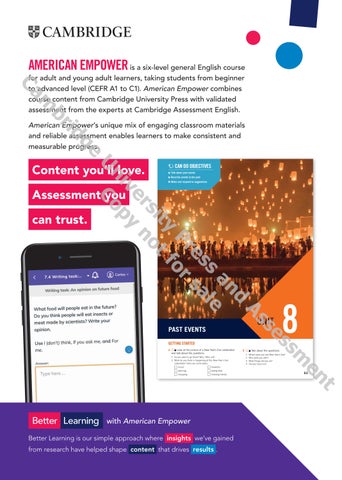
AMERICAN EMPOWER is a six-level general English course
br
m
Ca
for adult and young adult learners, taking students from beginner to advanced level (CEFR A1 to C1). American Empower combines course content from Cambridge University Press with validated assessment from the experts at Cambridge Assessment English.
ge
id
American Empower’s unique mix of engaging classroom materials and reliable assessment enables learners to make consistent and measurable progress. CAN DO OBJECTIVES ■ Talk about past events
As d an s le es sa Pr r y fo it t rs no ve y ni p Co
U
Content you’ll love.
■ Describe events in the past
■ Make and respond to suggestions
Assessment you can trust.
Look at the picture of a New Year’s Eve celebration and talk about the questions. 1 Do you want to go there? Why / Why not? 2 What do you think is happening at this New Year’s Eve celebration? Here are some ideas: fireworks
dancing
eating food
shopping
meeting friends
Talk about the questions. 1 2 3 4
Where were you last New Year’s Eve? Who were you with? What things did you do? Did you have fun?
en
music
b
sm
s se
GETTING STARTED a
8
UNIT
PAST EVENTS
63 63
t
with American Empower Better Learning is our simple approach where insights we’ve gained from research have helped shape content that drives results .
Learner engagement Content that informs and motivates
1
Content
Results
Sustained motivation is key to successful language learning and skills development.
Clear learning goals, thoughtprovoking images, texts, and speaking activities, plus video content to arouse curiosity.
Content that surprises, entertains, and provokes an emotional response, helping teachers to deliver motivating and memorable lessons.
br
m
Ca
Insights
id
1 READING a
Learn to talk about past events G Simple past: be V Past time expressions
ge
8A
UNIT 8
I WAS ON TOUR WITH MY BAND
Look at the events in pictures a–d. Choose one you like and one you don’t like. Tell a partner. Say why. b
a sports game
c
d
a concert
a meeting
of be in the texts about Cara, Antonio, and Ava.
My name’s Cara. I’m a photographer. I was in New York three days ago for work, and then I was in Chicago yesterday at a meeting about newspaper photography. Life’s busy right now!
I1 you were he/she/it 2
b
“Yesterday I was in Chicago.”
c Read the texts again. Which cities does each person talk about?
d
a
we 3 you were they were
08.01 Pronunciation Listen to sentences 1–4. Are was and were stressed? Practice saying the sentences.
1 We were in Seattle. 2 I was in Los Angeles.
c
Conversation 1 Conversation 2 Conversation 3
b
“I was at a game in Los Angeles. It was the Finals!”
1 the meeting 2 the game 3 the concert
3 We were in Miami. 4 I was in New York.
Now go to Grammar Focus 8A Part 1 on p. 128.
c
• this morning
e
• last night
Compare your sentences in 2d with a partner. Were you in the same places?
08.07 Listen to Conversation 1 again. Complete the conversation with the words in the box.
• yesterday afternoon
Juan and I were at the supermarket yesterday.
was (x2) were (x2)
sentences 1–4 in the correct place on the timeline. week 1
week 2
week 3
Ava on the road …
We were in Seattle on Wednesday. We were in Miami two weeks ago. … we were in Cleveland last week. I was in Chicago yesterday.
b Look at the underlined words in 3a. Replace them
d
Now go to Grammar Focus 8A Part 2 on p. 128.
e
Complete the conversation with was, were, wasn’t, or weren’t. Listen and check.
with words in the box. months
this morning
Saturday
Now go to Vocabulary Focus 8A on p. 149.
d
Work in pairs.
Student A: Say a past time expression. Student B: Say where a person you know was.
Change some of the information. I was at a baseball game in the morning and then at the movies last night.
My parents were in London last weekend.
Results Personal responses make learning more memorable and inclusive, with all students participating in spontaneous spoken interaction.
65
There are so many adjectives to describe such a wonderful series, but in my opinion it’s very reliable, practical, and modern. Zenaide Brianez, Director of Studies, Instituto da Língua Inglesa, Brazil
t
Personalization tasks in every unit make the target language more meaningful to the individual learner.
Communication 8A Student A go to p. 113. Student B go to p. 111. Student C go to p. 115.
en
Content
5 SPEAKING
a
sm
Insights Language learners benefit from frequent opportunities to personalize their responses.
Was the movie good?
s se
Personalized and relevant
My friend Marco was in Ecuador two years ago.
at work yesterday. off yesterday. you at home all day? .I in town in the morning, and at a party last night. the party good? a lot of fun.
f Practice the conversation in 4e with a partner.
Then switch roles.
two years ago
You No, I Nice. No, I then I
A B Yes, it
last weekend
My name’s Antonio Marotto. I’m the doctor for our team. It’s a great job – I really like helping our players. I often go away with the team. We were in Miami two weeks ago for a game, and we were in Cleveland last week. It’s fun to travel with the team.
08.11
A B A B
year
c
wasn’t
you at work yesterday? WILL CARA Yes, I , but I here in the office. WILL Where you? CARA I was at a meeting in Chicago. WILL Oh, it interesting? CARA Yes, it was really interesting.
Monday Tuesday Wednesday Thursday Friday
1 2 3 4
“In this photo, we were in San Francisco.”
2
a exciting b interesting c fun
3 VOCABULARY Past time expressions
Hi everyone, it’s Ava. Last week I was on tour with my band in the U.S. – three cities in five days. We were in Seattle on Wednesday, and then we were in Portland on Thursday. But Saturday was the best night. We were in San Francisco, and about 1,000 people were at our concert.
64
08.06 Match events 1–3 with adjectives a–c. Listen again and check.
a Today is Friday of week 3. Put the number of
Talk about Cara, Antonio, and Ava’s lives with a partner. Who would you like to meet? Why?
The people on our team …
08.06 Review the texts about Cara, Antonio, and Ava again. Then listen to them talking to friends. Write the correct name for each conversation.
d Write sentences about where you were:
b Read about Cara, Antonio, and Ava. Which events in 1a do they talk about?
Simple past: be negative and questions
a Complete the chart. Find examples of the simple past
As d an s le es sa Pr r y fo it t rs no ve y ni p Co
a party
4 LISTENING AND GRAMMAR
+
U
a
2 GRAMMAR Simple past: be affirmative
10
EVIDENCE OF ACHIEVEMENT Measurable progress COMPETENCY TESTS
1
Assessment you can trust
How did students perform in the Competency Tests?
Insights
Content
Results
As this assessment measures improvement between the mid-course and end-of-course points, this improvement is in line with the learning goal of improving by a whole CEFR level across one whole level of the Empower course.
their performance between the mid-course and end-of-course skills-based competency tests.
End-of-unit tests, mid- and endTeachers can see learners’ of-course competency tests, and progress at a glance, and 10% of learners were on courses without Online personalized CEFR test report learners can see measurable Workbooks. These learners tended to have forms provide reliable informationlower mean gains,progress, which suggesting that the Online leads to Workbooks were contributing to learning gains. on progress with language skills. greater motivation.
Ca
Tests developed and validated by Cambridge Assessment English, the world leaders in language assessment, to ensure they are accurate and meaningful.
id
br
m
The average learner tended to improve by ten points, which represents half of a CEFR band as measured by the Empower assessments.
All global Empower users
ge
100
U
80 70
As d an s le es sa Pr r y fo it t rs no ve y ni p Co
Results of an impact study showing % improvement of Reading levels, based on global Empower students’ scores over one year.
90
60 50 40 30 20 10 0
A1
A2
B1
B1+
B2
C1
A1
A2
Listening
Mid-course test
B1
B1+
B2
C1
Reading
A1
A2
B1
B1+
B2
C1
Writing
End-of-course test
Average score for listening, reading, and writing in the mid-course test and end-of-course test. Based on global students’ scores from August 2016 to July 2017.
We started using the tests provided with Empower and our students started showing better results from this point until now.
s se
Evidence of impact
t
2
en
sm
Kristina Ivanova, Director of Foreign Language Training Centre, ITMO University, Saint Petersburg, Russia
Insights
Content
Results
Schools and colleges need to show that they are evaluating the effectiveness of their language programs.
Empower (British English) impact studies have been carried out in various countries, including Russia, Brazil, Turkey, and the UK, to provide evidence of positive impact and progress.
Colleges and universities have demonstrated a significant improvement in language level between the mid- and end-of-course tests, as well as a high level of teacher satisfaction with Empower.
Manageable learning 1
Mobile friendly Content
Results
Learners expect online content to be mobile friendly but also flexible and easy to use on any digital device.
American Empower provides easy access to Digital Workbook content that works on any device and includes practice activities with audio.
Digital Workbook content is easy to access anywhere, and produces meaningful and actionable data so teachers can track their students’ progress and adapt their lesson accordingly.
ge
id
br
m
Ca
Insights
U
As d an s le es sa Pr r y fo it t rs no ve y ni p Co
I had been studying English for 10 years before university, and I didn’t succeed. But now with Empower I know my level of English has changed.
Nikita, Empower Student, ITMO University, Saint Petersburg, Russia
2
Corpus-informed Insights
Content
sm
s se
Corpora can provide valuable information about the language items learners are able to learn successfully at each CEFR level.
Results Learners are presented with the target language they are able to incorporate and use at the right point in their learning journey. They are not overwhelmed with unrealistic learning expectations.
t
en
Two powerful resources – Cambridge Corpus and English Profile – informed the development of the Empower course syllabus and the writing of the materials.
Rich in practice 1
Language in use Content
Results
It is essential that learners are offered frequent and manageable opportunities to practice the language they have been focusing on.
Throughout the American Empower Student’s Book, learners are offered a wide variety of practice activities, plenty of controlled practice, and frequent opportunities for communicative spoken practice.
Meaningful practice makes new language more memorable and leads to more efficient progress in language acquisition.
8B
ge
id
br
m
Ca
Insights
G Simple past: affirmative
HE SAW A BEAR
bear
Talk about the questions.
1 Which story do you like? 2 Which animals sometimes come into houses in your country?
dog
cat
snake
bird
Where?
When?
Verb
Past form
look
looked
have
had
watch
hear
call
eat
jump
see
walk
go
try
come
Animal activity?
3 What do you do if a wild animal comes to your house?
to make more simple past phrases.
a book to my parents home dinner a movie for a walk breakfast a song on the radio to my friend
1 went 2 had 3 read
2
W I LD S TOR IES ! 3
3
08.13 Listen and practice these sounds. 2 /d/ lived 1 /t/ talked 08.14 Listen to the past forms in the box. Which -ed endings sound … ? • more like /d/ • more like /t/
a
b
d
e
08.19 Complete what Emily says with phrases from 3c. Then listen again and check.
e
Student A: Say a verb. Student B: Say the past form.
at about 9:00, and then I went to Yesterday I 1 a café and had coffee with my friend Karen. After that, 2 I went to work and was there all day. I 3 and called with my brother, and then I Rosie in Brazil on Skype. my parents. I 4 online, and then I went to bed and After, I 5 6 before going to sleep.
Then switch roles.
Now go to Grammar Focus 8B on p. 128.
f Complete the sentences so they are true for you.
CURIOUS CREATURE Andrew Singer from Utah was at home in his house on a farm. One evening he was in the kitchen, and he heard something strange in the backyard, so he looked out the window. He saw a bear in the backyard. The bear walked around the backyard and looked in the windows of the house. It tried to open the kitchen door, and the man was really scared. It wasn’t possible for the bear to get in, so it went away. The man thinks the bear was hungry, but it’s not a good idea to give bears food.
66
SURPRISE VISITORS
READY TO PLAY
A woman from Indiana had an apartment with a yard. In the evening, she went into her living room and watched TV. She heard something in her bedroom, so she went to look. She saw three deer near her bed. They came into the living room and jumped on her sofa, then they went into the bathroom. The woman called 911, and the police came to catch the deer. She had an exciting night with her three new friends!
Ben Kruger from South Africa loves playing rugby. He has a business in Limpopo, a city in the north of South Africa. One night after work, he went to a rugby field nearby. It was dark, and he saw something on the field. It was large, but it wasn’t a person – it was a hippopotamus (hippo)! Then he saw another hippo and then another – there were a lot of them. The hippos ate some grass and then went away. Ben thinks the hippos were from a river near the rugby field.
g Complete the sentences about free time activities.
Tell your partner about your sentences.
3 LISTENING AND VOCABULARY
Free time activities
.
1 When I was a child, I 2 After work / school, I often 3 On weekends, I like to
h
08.17 Listen to three conversations about the three stories. In each conversation, some information is incorrect. What is the wrong information?
.
.
Tell other students your sentences in 3g. What free time activities were/are popular … ? a when everyone was a child b after work / school c on weekends
1 2 3
4 SPEAKING
a
Beyond the classroom
Insights
Communication 8B Student A go to p. 113. Student B go to p. 111.
67
Progress with language learning often requires work outside of the classroom, and different teaching models require different approaches.
American Empower is available with a print workbook, online practice, documentary-style videos that expose learners to real-world English, plus additional resources with extra ideas and fun activities.
Results This choice of additional resources helps teachers to find the most effective ways to motivate their students both inside and outside the classroom.
t
Content
en
Elena Pro, Teacher, EOI de San Fernando de Henares, Spain
Now go to Vocabulary Focus 8B on p. 150.
f
sm
There are plenty of opportunities for personalization.
. (food)
s se
2
. (a person) . (a TV show) . (a place)
1 Yesterday I called 2 Last month I saw 3 Last weekend I went to 4 Last night I ate
a
c
Practice saying the words.
Cover the chart in 2a. Test a partner.
e
,
08.19
looked watched called tried walked played finished
d
4 heard 5 talked 6 watched
,
,
Listen to Emily talk about the things she did yesterday. Put pictures a–e in the correct order.
d
c Sound and spelling /t/ and /d/
jump
2
to a café. a large coffee. the newspaper. this funny story. this story on a podcast. to my friend Katie last night. the video online.
c Match verbs 1 to 6 with a word or phrase in the box
1 What do we add to the verbs in A to make the past form? 2 Do the verbs in B all change in the same way or in different ways?
evening
A woman from Indiana
1
Past form
1
at home
Ben from South Africa
Verb
b Answer the questions about the chart in 2a.
c Read the stories again. Complete the information.
Andrew from Utah
read (x2) talked went had watched heard 1 I just 2 I 3 And I 4 I 5 I 6 I 7 She
B
A
hippo
1 Hippos were on a rugby field. 2 Three deer were in a woman’s apartment. 3 A bear was in a man’s backyard.
08.18
08.12 Read the stories again and find the simple past forms of the verbs in the chart. Listen and check.
a
b Read the stories below. Write the story titles next to the sentences.
Listen to the sentences from the conversations. Use the correct verb in the box.
b
As d an s le es sa Pr r y fo it t rs no ve y ni p Co
Look at pictures 1–3 below. Match the pictures to the animal names. Where do they usually live? What do you know about them? deer
V Free time activities
2 GRAMMAR Simple past: affirmative
U d
1 READING a
UNIT 8 Learn to describe events in the past
Unit overview Unit Opener
m
Ca
Getting started page – Clear learning objectives to give an immediate sense of purpose.
br
Lessons A and B
ge
id
Grammar and Vocabulary – Input and practice of core grammar and vocabulary, plus a mix of skills.
Everyday English – Functional language in common, everyday situations.
Digital Workbook (online, mobile): Listening, Speaking, Reading, and Writing
As d an s le es sa Pr r y fo it t rs no ve y ni p Co
U
Lesson C
Digital Workbook (online, mobile): Grammar and Vocabulary.
Unit Progress Test Review
Extra practice of grammar, vocabulary, and pronunciation. Also a “Review your progress” section for students to reflect on the unit.
Mid- / End-of-course test Additional practice
Workbook (printed)
en
sm
Digital Workbook (online, mobile)
s se
Further practice is available for outside of the class with these components.
t
Components Resources – Available on cambridgeone.org • Audio • Video • Unit Progress Tests (Print) • Unit Progress Tests (Online)
• Mid- and end-of-course assessment (Print) • Mid- and end-of-course assessment (Online)
• Digital Workbook (Online) • Photocopiable Grammar, Vocabulary, and Pronunciation worksheets
CONTENTS Lesson and objective
Grammar
Vocabulary
Pronunciation
Everyday English
be: I / you / we
Countries
Sound and spelling: I’m, we’re
be: he / she / they
Nationalities; this / these
Syllables and word stress
Unit 1 Hello! Getting started Talk about countries and flags 1A
Say your name and country
Ca
Talk about people you know
1C
Meet and greet new people
Syllables and word stress; Stressed words; Intonation
Greeting people; Meeting new people
br
m
1B
Unit 2 All about me
id
Getting started Talk about objects Talk about your hometown
be: it’s / it’s not; Possessive adjectives
Common adjectives; in / near
Sound and spelling: /h/ and /w/
2B
Talk about possessions and common objects
Plural nouns; I have / you have; a / an
Common objects 1; Numbers 1
Sound and spelling: /s/, /z/, /ɪz/; Do you … ?
2C
Ask for and give personal information
ge
2A
U
Asking for and giving personal information
As d an s le es sa Pr r y fo it t rs no ve y ni p Co
Unit 3 Food and drink
Stressed parts in questions; Intonation in questions
Getting started Talk about the food in a shopping cart 3A
Say what you eat and drink
Simple present: I / you / we / they
Food 1
Syllables and word stress; Sound and spelling: /i/, /ɪ/, and /ɑɪ/
3B
Talk about food and meals
Adverbs of frequency
Food 2; Time; What time / When … ?
Sound and spelling: /æ/ and /ɔ/
3C
Order and pay in a café
Unit 4 My life and my family
Syllable stress; Stressed and unstressed words
Ordering and paying in a café
Getting started Talk about who people are and what they do 4A
Talk about your life and ask about others’
Simple present: Wh- questions
Common verbs; study
Stressed words
4B
Talk about your family
Simple present: he / she / it affirmative
Family and people; Numbers 2; How old … ?
Sound and spelling: /ð/
4C
Ask and talk about photos
Asking and talking about photos
Getting started Talk about an unusual museum 5A
Describe a town
there is / there are: affirmative
Places in a town; a few, a lot of
there’s / there are; Sound and spelling: /u/ and /ʌ/
5B
Talk about hotels and hostels
there is / there are: negative and questions
Hotels
Sound and spelling: /ʃ/; Stressed syllables
5C
Ask about and say where places are
Emphasizing what you say 1
sm
s se
Unit 5 Places
Sound and spelling: /ʧ/ and /ʤ/
en
Asking and saying where places are
t
Unit 6 Work and routines Getting started Talk about a job
2
6A
Talk about people’s jobs
Simple present: he / she / it negative
Jobs; work / job
Main stress in compound nouns; Sound and spelling: /ʃ/ and /ʧ/
6B
Talk about daily routines and habits
Simple present: he / she / it questions
Daily routine; for, from … to … , until
Consonant clusters; Sentence stress
6C
Make and accept offers
would; Emphasizing what you say 2
Making and accepting offers
Contents
Reading
Speaking
A conversation about who you are
Three conversations meeting other students
Who you are and where you’re from
Ca
Listening
A conversation about people in pictures
People in a picture An online profile
m
First day at work
Greeting and meeting new people
A personal profile; Capital letters and periods
id
br
Unit Progress Test
Three posts: Our Homes
ge
Three conversations about hometowns A conversation at the airport
U
Finding a new apartment
Writing
A personal information form
Homes and hometowns
My hometown; A friend’s home
Possessions; What’s in the bag? A personal information form; Spelling
As d an s le es sa Pr r y fo it t rs no ve y ni p Co
Asking for and giving personal information
Unit Progress Test
A conversation about food likes and dislikes
Three families’ weekly food: Food for One Week
Food likes and dislikes
Three conversations about dinner
An article: The Number One Breakfast in ...
Saying the time; Meal times and what you eat
In a café
A text message
Ordering and paying in a café
A text message; Contractions
Unit Progress Test
A conversation about work and travel to work
A blog: Breakfast in Málaga and Lunch in London
Work, home, and study
Photos of famous people and their families
Photo captions; An International Family
Your family
A photo caption
Photos
Talking about family photos
About you
Photo captions; Word order
Unit Progress Test
s se
An article: Very hot! Very cold!
A street in your town
On my street
A conversation at a hostel reception
A hostel review
Hotels and hostels
Questions about a town
Looking for a café
An email
Places in a town
About your town; and and but
en
sm
A conversation about places in a town
Unit Progress Test
t
Four people talk about their jobs
A website: Jobs International
People’s jobs
Questions about jobs
A conversation about taking photos at night
An article: A Good Night’s Sleep
People’s daily routines and habits
Questions about daily routines
A friend’s birthday
An email about daily life
Offering to pay for food and drink
An email about daily life; because and also
Unit Progress Test
3
Lesson and objective
Grammar
Vocabulary
Pronunciation
Everyday English
Unit 7 Shopping and fashion Getting started Talk about the clothes in a market stall Talk about things you want to buy
this, that, these, those
Common objects 2; Prices
Sound and spelling: /b/, /p/, /g/, and /k/ Sound and spelling: this, that, these, and those
7B
Talk about the clothes that people wear
Possessive ’s; Review of adverbs
Clothes; Colors; dark / light
Sound and spelling: /ʃ/ and /dʒ/
Ca
7A
7C
Ask about and pay for things in a store
Connecting sounds
Going shopping
br
m Unit 8 Past events
id
Getting started Talk about your last New Year’s Eve Talk about past events
Simple past: be
Past time expressions
was / were
8B
Describe events in the past
Simple past: affirmative
Free time activities
Sound and spelling: /t/ and /d/
8C
Make and respond to suggestions
ge
8A
Sentence stress and intonation
As d an s le es sa Pr r y fo it t rs no ve y ni p Co
U Unit 9 Vacations
Making and responding to suggestions
Getting started Talk about an interesting vacation 9A
Talk about travel and vacation experiences
Simple past: negative
Transportation; go
Sound and spelling: the letter a; Sentence stress
9B
Talk about past vacations
Simple past: questions
The seasons; The weather; like
Sound and spelling: the letter o
9C
Make and respond to requests
Unit 10 Here and now
Syllables and spelling
Making and responding to requests
Getting started Talk about communicating online 10A Talk about your home
10B Ask where people are and what they’re doing 10C Ask for travel information
Unit 11 Achievers
Present continuous: affirmative
The home; in / on
Sound and spelling: /tʃ/ and /θ/; Sentence stress
Present continuous: negative and questions
Place phrases with prepositions
Sound and spelling: /ə/; Main stress in questions
Sound and spelling: /ɪə/ and /eə/
Asking for travel information
Getting started Talk about a climber’s experience
11B Talk about things you know how to do
Object pronouns
Life events; Years
Sound and spelling: Numbers
can for ability
Abilities; (very / pretty) well
can / can’t Stressed words; Consonant clusters
Getting started Talk about a family vacation be going to: affirmative and negative
Months and future time expressions; Ordinal numbers; The date
Sentence stress; be going to
12B Ask and answer about future plans
be going to: questions
Common verbs and collocations
Sound and spelling: /v/ and /w/
12C Make and accept invitations
Phonemic symbols and Irregular verbs p. 103
4
Sound and spelling: oo
Communication Plus p. 104
Grammar Focus p. 116
t
12A Talk about future plans
Talking about opinions
en
Unit 12 Plans
sm
11C Talk about opinions
s se
11A Talk about people’s lives
Making and accepting invitations
Vocabulary Focus p. 136
Contents Reading
Speaking
A conversation at a home store
Places to go shopping
At a home store
A conversation about old clothes
An article: They Make Colorful Clothes ...
The clothes you wear
A question about clothes
An advertisement and an email
Going shopping
An email reply to an advertisement; Commas, exclamation points, and question marks
Ca
Listening
In a store
Writing
m id
br
Unit Progress Test
People who travel for work
Past events
Sentences about past events
Conversations about animal stories
A website: WILD Stories!
Yesterday’s activities
Sentences about free time activities
Monday morning at work
A thank you note
Making plans
A thank you note; Writing short emails, notes, and texts
ge
Three conversations about past events
U
As d an s le es sa Pr r y fo it t rs no ve y ni p Co
A conversation about a trip to Colombia
Unit Progress Test
A website: Backyard Camping
A past travel experience
Sentences about your last vacation
A conversation about summer vacations A blog post: New Year’s Fun in the Big Apple
A past vacation
Questions about a past vacation
A trip to Mexico
Asking for help and responding
An online post about a trip; Making the order clear
An online post
Unit Progress Test
A monologue about an apartment
Text messages
Present activities
A text message to a friend
Five phone conversations about present activities
A message board: How much do you use your phone?
A phone conversation to make plans
A message board comment
A message to a friend
A conversation about travel information
A message asking for information; Word order in questions
At the train station
Unit Progress Test
An article: They Were the First!
Past life events
Sentences about past life events
A conversation about a job description
An article: Amazing Humans
Your abilities
Questions about abilities
Out for dinner
An email to a friend
Interesting places to visit in a town / city
An email to a friend; Pronouns
sm
s se
A conversation about Valentina Tereshkova
Unit Progress Test
A TV show review: Danger Zone
Your next vacation
Notes about vacation plans and everyday activities
Two conversations about weekend plans
An article: Only 4,000 Weekends in Your Life!
Your future plans
Questions about future plans
Making plans with a friend
Invitations and replies
Inviting a friend
An invitation and a reply; Paragraphs
t
en
Three conversations about summer vacation plans
Unit Progress Test Writing Plus p. 158
5
CLASSROOM LANGUAGE 00.02
Listen and read.
ge
id
br
m
Ca As d an s le es sa Pr r y fo it t rs no ve y ni p Co
U Listen.
Read.
Teacher
Write.
Watch.
Work in pairs.
t
en
sm
s se
Look at the pictures.
6
CAN DO OBJECTIVES ■ Say your name and country ■ Talk about people you know ■ Meet and greet new people
ge
id
br
m
Ca As d an s le es sa Pr r y fo it t rs no ve y ni p Co
U
1
Look at the picture. What country flags do you see?
b
What other countries do you know in English?
t
a
en
GETTING STARTED
sm
s se
HELLO!
UNIT
77
1 A
I’M FROM MEXICO
Ca
be: I / you / we affirmative and questions
m
br
01.01 Listen. Then say Hi, I’m … or Hello, I’m … and say your name.
I/we
you
I Camila. (= I am …) We from Ecuador. (= we are …)
How
you from the U.S.? you?
Now go to Grammar Focus 1A Part 1 on p. 116.
id
e Sound and spelling I’m, we’re
ge
01.06 Listen to the sound of I’m and we’re. a I am b I’m c we are d we’re 2 Practice saying I’m and we’re.
1
As d an s le es sa Pr r y fo it t rs no ve y ni p Co
U f
Hello, I’m Harumi.
1 V Hi, I’m Vilma. What’s your name? C I’m Camila. V Hi, Camila. Nice to meet you.
Practice the conversations in 1b.
1 Work in pairs. Practice Conversation 1. 2 Work in groups of three. Practice Conversation 2. 3 Work with a new partner. Practice Conversation 3.
Read and listen to conversations 1–3. Match the conversations with groups of people a–c in the picture below. 01.02
V Countries
d
Hi, I’m Rubén.
b
G be: I / you / we
c Complete the sentences in the chart.
1 READING AND GRAMMAR
a
Learn to say your name and country
g
Practice the conversations in 1b again. Use your own name.
2 H Hello, I’m Harumi. K Hi. I’m Katia. P And I’m Pablo. Hi. H Are you from the U.S.? P No, we’re from Ecuador.
3 L Hi, Rubén. How are you? R Hi, Li. I’m fine. How are you? L Fine, thanks.
c
b
Michael
t
en
sm
Kelly
s se
a
8
UNIT 1 2 LISTENING AND GRAMMAR be: I / you / we negative a
b Complete the sentences in the chart.
01.07 Read and listen to the conversation. Choose the correct answers.
Ca
KELLY Are you Rubén? RUBÉN Yes, I am. KELLY Hi, I’m Kelly. RUBÉN Oh, hi. Are you a student here? KELLY No, I’m not a student. I’m your teacher! RUBÉN Oh … sorry.
c
Affirmative (+)
Negative (–)
I ’m We
a student. (= I am not) I’m We ’re not from England. (= we are not)
a student. (= I am) from England. (= we are)
Now go to Grammar Focus 1A Part 2 on p. 116.
m
d Read the sentences. Make them true for you. 4 I’m Laura. 5 We’re from Tokyo.
br
1 I’m a student. 2 We’re teachers. 3 I’m from the U.S.
id
1 Rubén is: a a student. b a teacher. 2 Kelly is: a a student. b a teacher.
ge
e
Tell a partner your sentences in 2d. Are they the same?
01.09
Match the countries in the box with maps 1–8. Listen and check.
As d an s le es sa Pr r y fo it t rs no ve y ni p Co
a
U
3 VOCABULARY AND READING Countries
the United Kingdom / the U.K. China 1
5
b
the United States / the U.S. Spain Japan
2
3
6
, and my name’s Camila.
e
Give your piece of paper to the teacher and take a new one. Try to find the student with the information on your piece of paper. Are you from Puebla? No, I’m not. I’m from Mexico City.
.
Michael 17:03 6 I’m Michael. I’m from
. I’m a teacher in London.
Rubén 17:03 7 I’m from Barcelona, in
, and my name’s Rubén.
Kelly 17:03 Hello. I’m a teacher, and my name’s Kelly. 8 I’m from New York, in .
on a piece of paper. Puebla, Mexico
t
Li 17:03 4 Hi, I’m Li. I’m from Beijing, in . But I’m not in Beijing now. I’m a student in Shanghai. Harumi 17:03 5 My name’s Harumi. I’m from Tokyo, in
d Choose a city and a country in 3a. Write it
.
. I’m from Cuenca.
Now go to Vocabulary Focus 1A on p. 136.
en
Camila 17:03 3 Hello. I’m from Puebla, in
c
sm
Vilma 17:02 1 I’m Vilma. I’m from Rio de Janeiro, in
8
s se
OUR GROUP
Mexico
4
7
01.10 Complete the sentences with the correct country. Listen and check.
Pablo 17:02 2 Hi, I’m Pablo. I’m from
Ecuador Brazil
4 SPEAKING Communication 1A Student A go to p. 104. Student B go to p. 106.
9
1 B
HE’S ECUADORIAN
1 VOCABULARY Nationalities Do you know the people in pictures a–h? Ask your partner. Do you know Serena and Venus Williams?
id
br
m
Ca
a
Learn to talk about people you know
b Match the nationalities with pictures a–h.
G be: he / she / they V Nationalities
c
d
Pronunciation Listen to the words in 1b. How many syllables are in each word? A | mer | i | can = 4 syllables 01.12
01.13
Listen and notice the stressed syllable.
e
Listen to the words in 1b again. Underline the stressed syllables. Then listen and repeat.
f
Now go to Vocabulary Focus 1B on p. 136.
01.12
ge
A | mer | i | can Chi | nese Mex | i | can Ec | ua | do | ri | an Span | ish Brit | ish Jap | a | nese Bra | zil | ian e
As d an s le es sa Pr r y fo it t rs no ve y ni p Co
U
a
Ricky Rubio – basketball player
Neymar - soccer player
b
f
Shohei Ohtani — baseball player
Heather Watson – tennis player
c
g
d
h
Antonio Valencia – soccer player
Javier Hernández and Guillermo Ochoa – soccer players
t
Zhu Ting – volleyball player
en
sm
s se
10
Serena and Venus Williams – tennis players
UNIT 1 2 GRAMMAR be: he / she / they affirmative a
01.15
4 GRAMMAR
be: he / she / they negative and questions
Match 1–3 with a–c. Listen and check.
1 Heather Watson is a tennis player. 2 Shohei Ohtani is a baseball player. 3 Serena and Venus Williams are tennis players.
a Complete the charts with the words in the box.
a He’s Japanese. b They’re American. c She’s British.
they ’s not is
Ca +
br
m
b Complete the chart. she’s …
id
she is … he is … they are …
2
U
a
3 Javier Hernández and Guillermo Ochoa
Look at the photo below. Read and listen to Mia talk about the people on her vacation. Complete 1–6 with the words in the box. 01.17
American
Luis Lucía 1
Colombian
Mexican
Spanish. Chinese.
Now go to Grammar Focus 1B Part 2 on p. 116.
c
01.21
1 A he Mexican? B No, . 2 A they American? B Yes, .
d
3 A B No, 4 A B No, 5 A B Yes,
she Chinese? . they Brazilian? . he British? .
Practice saying 1–5 in 4c with a partner.
Language Plus this / these
This is Anna. this = one person These are my friends Lucía and Mateo. these = two or more people
5 SPEAKING
Communication 1B Student A go to p. 104. Student B go to p. 106.
t
en
sm
s se
Tell a partner about two of your friends. What nationality are they?
Complete the sentences. Listen and check.
Anna
. She’s my friend from Chicago. MIA This is 2 She’s ______. NOAH OK. And who’s this? 3 MIA This is ______. He’s a teacher in Brazil. NOAH Is he Brazilian? 4 MIA No, he’s not Brazilian. He’s ______. NOAH Oh, really. 5 MIA And these are my friends ______ and Mateo. They’re married. NOAH Are they American? 6 MIA No, they’re not American. They’re ______ – from Veracruz.
b
She They
b
Tell a partner your sentences in 2d. Are they the same?
3 LISTENING
She’s Spanish. They’re Chinese.
As d an s le es sa Pr r y fo it t rs no ve y ni p Co
d Write two sentences about the people below.
e
–
Spanish? Chinese?
Now go to Grammar Focus 1B Part 1 on p. 116.
1 Ricky Rubio 2 Zhu Ting
+
?
… …
ge
c
1
are ’re not she
11
1 C
Learn to write an email with travel advice to meet and greet new people W LearnParagraph writing
EVERYDAY ENGLISH
P Intonation
Nice to meet you
W A personal profile
a
ge
id
br
m
Ca 1 LISTENING
Meeting new people 1
U
a
Look at picture a. Is she in an office? 01.22
As d an s le es sa Pr r y fo it t rs no ve y ni p Co
b c
3 LISTENING AND USEFUL LANGUAGE
Listen to Part 1 and check your answer in 1a.
a
Daniel
Listen to Part 1 again. Complete the sentences with words in the box. 01.22
Hi
Good morning
01.24 Listen to Part 2. Sophia meets the manager of Blue Web Technology. What’s his name?
Darren
David
, welcome to Blue Web Technology. RECEPTIONIST SOPHIA , my name’s Sophia Taylor. It’s my first day.
2 USEFUL LANGUAGE Greeting people a Complete 1–3 with the words in the box. evening
morning afternoon 1
7 a.m.–12 p.m. = 2 12 p.m.–5 p.m. = 3 5 p.m.–10 p.m. =
1 I’m / My name’s Sophia Taylor. 2 I’m / My name’s David.
c
01.23 Pronunciation Listen. How many syllables are in the words and expressions? hi (1) good | mor | ning good | eve | ning
d Practice the conversation in 3c with a partner. e
1 A How are you? 1 B I’m fine, . 2 A Hi! How are you? 2 B Oh, thanks.
5 6 a.m. 6 1 p.m.
Good morning. Good afternoon.
f 12
thank you
,
3 A My name’s Jack. 3 B Chloe. 4 4 A Good . How are you? B I’m OK, thank you.
Practice the conversations in 3e with a partner.
t
not bad I’m morning
Look at the times with a partner. Use the correct expression. 3 11 a.m. 4 10 p.m.
01.27 Listen to the expressions. Complete them with the words in the box.
en
Listen to the words and expressions in 2b again. Underline the stressed syllables. 01.23
1 8 p.m. 2 3 p.m.
Pronunciation Listen and notice the stressed
A How are you? B I’m good, thank you. And you? A I’m fine, thanks.
hello
d
01.26
words.
sm
hel | lo good | af | ter | noon
c
Listen to the sentences. Underline the words you hear. Are both options in 1–2 possible? 01.25
s se
b
b
UNIT 1 4 LISTENING AND USEFUL LANGUAGE Meeting new people 2 a
01.28
b
01.28
conversation in 4c. Use your names.
Listen to Part 3 again. Underline the correct answer.
Ca
1 ISAAC 2 DAVID 3 ISAAC 01.29
m
c
d Work in groups of three. Practice the
Listen to Part 3. Are Sophia and Isaac friends?
This is Hassan.
Nice to meet / see you too, Sophia. So, this is your home / office. OK. So, ... this is your desk / chair.
Nice to meet you, Hassan.
Put the conversation in the correct order. Listen and check. Nice to meet you, too, Sophia. Nice to meet you, Isaac. This is Isaac Jackson.
id
br
ISAAC SOPHIA DAVID
ge
7 WRITING
5 PRONUNCIATION Intonation Listen to phrases 1–5. Does the intonation change or stay the same ? 01.30
1 Hello. 2 How are you?
b
01.30
3 I’m good. 4 Nice to meet you.
5 Thank you.
Listen to the phrases in 5a again and
repeat.
a Read Sophia’s profile. What information about her is new?
As d an s le es sa Pr r y fo it t rs no ve y ni p Co
U
a
B LU E W EB TECHNOLOGY Our people in Atlanta
Hi, my name’s Sophia Taylor. I’m from Toronto in Canada. I’m in an office with Isaac Jackson.
b Now go to Writing Plus 1C on p. 158 for Capital letters and periods.
c Write a profile about you and your English class. Here
01.31
Complete the conversation. Listen and check.
sm
a
s se
6 SPEAKING
are some ideas: Hi/Hello, my … I’m from … in … I’m in a class with … in room …
d Read other students’ profiles. Is everyone from the same place?
t
Hi. Good afternoon. Hello. 1 I’m Michelle, and this Lee. Nice to meet you. I’m Jorge. 2 Nice to you, too. How are you? 3 I’m good. And ? I’m good. 4 I’m , too.
en
MICHELLE LEE JORGE MICHELLE JORGE LEE JORGE LEE MICHELLE
UNIT PROGRESS TEST CHECK YOUR PROGRESS
b Work in groups of three. Practice the conversation in 6a. Use your names.
YOU CAN NOW DO THE UNIT PROGRESS TEST.
13
UNIT 1
b Complete the nationalities.
Review
> Spa nish
1 GRAMMAR
Ca
a Underline the correct answer. Hello. I’m / are Anna. “Are you students?” “Yes, we’re / we are.” You am not / ’re not a teacher. “Am I / I am right?” “Yes, you are.” Where are you / you are? We’re / am at home.
1 Canad
4 Jap
2 Brazil
5 Brit
id
br
m
1 2 3 4 5 6
ge
b Add is, ’s not, are, or ’re not.
c
As d an s le es sa Pr r y fo it t rs no ve y ni p Co
U
1 “Is your name Sandy?” “No, it .” 2 “Are Javier Hernández and Guillermo Ochoa from Mexico?” “Yes, they .” 3 “Is Ricky Rubio Spanish?” “Yes, he .” 4 “ New York and Washington in the U.S.?” “Yes, they are.” 5 “Are your friends soccer players?” “No, they .” 6 “ your teacher English?” “No, she .”
> They’s Spanish.
They’re Spanish.
1 No, he ’re not from China. 2 You are OK? 3 Yes, I’m.
2 VOCABULARY
3 SOUND AND SPELLING
4 She is Colombian? 5 I not am Brazilian. 6 They are from the U.S.?
b
a Write the names of the countries.
c
3 3
22
He
01.32
Listen and practice saying the short forms.
not
Good morning. How are you? They’re American. We’re teachers. Nice to meet you.
Listen again to check. Practice saying the sentences. 01.33
REVIEW YOUR PROGRESS How well did you do in this unit? Write 3, 2, or 1 for each objective. 3 = very well 2 = well 1 = not so well
I CAN … say my name and country talk about people I know
14
meet and greet new people
t
endiUt sSatte eixMco ipSan hiCan anaJp larBiz
I’m They’re
en
1 2 3 4 5 6
d
I am They are She is We are It is I am not He is not
01.33 Listen to these phrases. Underline the stressed word or syllable.
1 2 3 4 5
55
Short forms
sm
66
44
Full forms
s se
11
6 Ital
a Write the short forms in the chart.
Ask and answer the questions in 1b.
d Correct the sentences.
3 Amer
CAN DO OBJECTIVES ■ Talk about your hometown ■ Talk about possessions and common
objects ■ Ask for and give personal information
ge
id
br
m
Ca As d an s le es sa Pr r y fo it t rs no ve y ni p Co
U
2
GETTING STARTED a
Look at the picture and answer the questions. 1 Is it a … ? • hot country • big city • new house 2 What country do you think it is?
t
en
ALL ABOUT ME
sm
s se
UNIT
3 Count (1, 2, 3, … ): • the windows on the house • the people in the picture
b
What colors do you see on the house?
15 15
2A
Learn to talk about your hometown
IT’S A BIG CITY
G be: it’s / it’s not; Possessive adjectives V Common adjectives
1 LISTENING
2 GRAMMAR be: it’s / it’s not
a
a Complete the chart with it or it’s.
m
Ca
02.01 Match the words in the box with pictures a–b. Listen and check.
town
city
br
Which are you from?
id
b
Rocío
Carlo
1 2 3 4 5
U
c
it
it’s
it’s not
Conversation 1 a big city? A Is 1 B No, no. 2 a city. Conversation 2 A 3 it a city? 4 B Yes, it is. a big city. a
in Italy.
–
Ravello’s not in Mexico.
not in Mexico.
?
Is Ravello in Italy?
Is
in Italy?
Giovanna’s from Ravello in Italy. a town near Naples. Aaron’s from Blue Bell, Pennsylvania. American. Ricardo’s Spanish. from Madrid. Akira’s from Soka in Japan. a city near Tokyo. Vanessa’s from Zapopan in Mexico. a big city near Guadalajara.
As d an s le es sa Pr r y fo it t rs no ve y ni p Co
02.02 Listen again. Complete the sentences with the words in the box.
is
Ravello is in Italy.
b Complete the sentences with he’s, she’s, or it’s.
ge
02.02 Listen and match pictures a–b with the names in the box.
+
c
02.03
d
Now go to Grammar Focus 2A Part 1 on p. 118.
Listen and check.
Language Plus in / near Naples is in Italy.
Ravello is near Naples.
e Write sentences about you.
I’m from … It’s a (town / city) (in / near) …
f
Tell a partner your sentences.
t
en
sm
s se
b
16
UNIT 2
Our Homes
3 READING AND VOCABULARY
Common adjectives
a
02.06 Read and listen to Our Homes. Complete the chart.
home
home
Ca
big apartment Miguel
Aaron
Sophia
Rocío
Carlo
My apartment is in a new part of Quito. It’s very big. My friend Miguel is from Otavalo. It’s a beautiful town near Quito. This is his home – it’s a small house. Rocío
br
m
Pietro and Susanna
02.07 Listen to the words. Which words have a /h/ sound? Which words have a /w/ sound?
how hotel
where
As d an s le es sa Pr r y fo it t rs no ve y ni p Co My apartment in Ravello is big, old, and beautiful. My friends Pietro and Susanna are from Naples. This is their home. It’s a big apartment in a nice part of town. Carlo
Complete the sentences with the words in the box. Listen and check. 02.08
big
small
old
new
1 It’s a
house.
3 It’s a
city.
2 It’s a
apartment.
4 It’s an
house.
My home is a small house in Blue Bell. It’s an old town. My friend Sophia is from Philadelphia. This is her home. It’s a small apartment, and it’s new and beautiful. Aaron
b Complete the sentences. 1 2 3 4 5
Now go to Vocabulary Focus 2A on p. 137.
4 GRAMMAR
a Read Our Homes again. Complete the chart.
d Complete the sentences about a friend. My friend
is from
. His / Her home is
.
t
I you he she we they
Possessive adjective
Now go to Grammar Focus 2A Part 2 on p. 118.
en
Pronoun
c
sm
Possessive adjectives
Javier is from Barcelona. home is in a nice part of the city. Are you from Berlin? Where’s apartment? We’re from Bogotá. home is near a big hotel. Sarah is from England. town is near Hastings. Pedro and Eva are from Mexico City. apartment is very big.
s se
d
what
Practice saying the words.
2
c
hi who
U
home
ge
1
id
b Sound and spelling /h/ and /w/
your
e
her our
5 SPEAKING
Tell a partner about your friend’s home.
Communication 2A Student A go to p. 104. Student B go to p. 106. Student C go to p. 108.
17
2B
Learn to talk about possessions and common objects
DO YOU HAVE A PHONE?
G Plural nouns; have V Common objects 1; Numbers 1
1 VOCABULARY Common objects 1
2 LISTENING AND GRAMMAR Plural nouns
a
a
02.13 Listen to the conversation with an airport customs official. Check (✓) the words you hear.
books computers phones watches umbrellas bottles newspapers knives
m
Ca
02.11 Match 1–10 in picture a with the words in the box. Listen and check.
Two objects in 1a are not OK at an airport. What are they?
ge
id
b
br
a computer a newspaper a knife a phone a key a watch an umbrella a ticket a book a bottle of water
Language Plus a / an
Cover the words in the box in 1a. Ask a partner questions about the objects in the picture. What’s this?
d
b Complete the chart.
It’s a watch.
Now go to Vocabulary Focus 2B Common objects 1 on p. 138.
a
Singular (= 1)
Plural (= 2+)
a key a newspaper a watch a knife
keys
As d an s le es sa Pr r y fo it t rs no ve y ni p Co
c
• a key • a book • an apple • an umbrella
U
We use a before most nouns. We use an before a, e, i, o, u.
c Most nouns add -s in the plural. How are the plurals of watch and knife different?
5
2
6 3
7
4 8
t
9 10
18
en
sm
s se
1
UNIT 2 d
4 VOCABULARY Numbers 1
Sound and spelling /s/, /z/, and / z/ 1
02.14 Listen and practice these sounds. Which word has an extra syllable in the plural? 1 /s/ books 2 /z/ keys 3 / z/ watches
2
02.15 Listen to these words. Which word has an extra syllable in the plural? Listen again and repeat.
Ca
knives
apples
houses phones
br
Student A: Say a singular word. Student B: Say the plural.
id
Then switch roles.
ge
Now go to Grammar Focus 2B on p. 118.
3 GRAMMAR I have / you have
, and my 2k
s, and an
9
b Match the words in the box with numbers 1–12 in 4a.
? of w
. Sorry!
seven two nine four eight eleven three six one ten twelve five
c
Work in pairs.
Student A: Say a number. Student B: Say the next number.
3
1
3 6
As d an s le es sa Pr r y fo it t rs no ve y ni p Co
02.16 Look at the X-ray picture and complete the conversation. Listen and check.
A What’s in your bag? B Mm, I have a 1b 3 u . A Do you have a 4p B Yes. Oh, and a 5b
2 5 8
10 11 12
U
a
Listen and repeat the numbers.
4 7
Work in pairs.
f
02.18
1
m
e
bottles tickets
a
2
Then switch roles.
5
4
+
?
I have a book.
Do you have a book?
Now go to Vocabulary Focus 2B Numbers 1 on p. 141.
5 SPEAKING
a Write three things you have in your bag.
a bottle of water
Pronunciation Listen again. Practice saying the sentences. 02.17
1 here (in class) 2 at home
b Do you have an umbrella here?
Do you have an umbrella at home?
Yes.
No.
a computer
t
an apple
Ask a partner about objects 1–5 in 3a. Ask about:
en
d
Listen to the forms of have.
e
sm
c
02.17
Communication 2B Student A go to p. 104. Student B go to p. 106.
s se
b
d
Guess what is in your partner’s bag. Do you have a phone?
Yes.
Do you have a knife?
No!
19
2 C
Learn to write an email with travel advice to ask forwriting and give personal information W LearnParagraph
EVERYDAY ENGLISH
p Intonation in questions
What’s your address?
w A form
1 LISTENING
Ca
a Think about a good home for you. Check (✓) four boxes. 1
3
m
a house an apartment in a small town in a city
2
4
br
b
big small near a park near stores
id
Tell a partner about your home in 1a.
ge
A good home for me is …
02.21
Listen to Part 1. Answer the questions.
U
c
d
As d an s le es sa Pr r y fo it t rs no ve y ni p Co
1 Who asks questions, Juan or the woman? 2 What kind of home does Juan need, an apartment or a house? 02.21 Listen to Part 1 again. Check (✓) the correct answer.
1 Juan’s last name: a Hays 2 His address in Seattle: a 55 Park Street 3 His phone number: a 760 264 7893
b
Hayes
b
5 Park Street
b
760 264 7389
2 USEFUL LANGUAGE Asking for and giving personal information a
02.22
check.
four-two-one-five-oh-five-two-seven-three-eight four-two-fifteen-oh-five-two-seven-three-eight
2 a b
chris-robinson-from-travelmail-point-com chris-robinson-at-travelmail-dot-com
Underline the correct word. Listen and check your answer. 02.24
AGENT Juan Hayes. What / How do you spell that? JUAN J-U-A-N.
20
02.25
Listen again and repeat.
e
Now go to Writing Plus 2C Part 1 on p. 158 for The alphabet.
f
Ask a partner his/her last name. Then ask how to spell it.
g
Communication 2C Student A go to p. 105. Student B go to p. 108.
t
1 a b
1 How do you spell that? 2 Can you spell that? 3 Sorry, what’s the spelling?
en
c
Listen to the answers to questions 3 and 4 in 2a again. Check (✓) the correct answer. 02.23
02.25 Pronunciation Listen to the questions. Notice the stressed part in each question.
sm
b
What’s your last name? It’s / I’m Robinson. What’s your address? It’s / It’s on 7 King Street. What’s your phone number? They’re / It’s 421 505 2738. What’s your email address? He’s / It’s chrisrobinson@travelmail.com.
d
s se
1 A B 2 A B 3 A B 4 A B
Underline the correct answer. Listen and
UNIT 2 3 LISTENING a
02.27 Listen to Part 2. What does Juan think? Check (✓) the correct sentence.
1 2
b
02.27 Listen to Part 2 again. Check (✓) the correct information about the apartment.
1 2 3
The apartment’s really nice. The apartment’s not very nice.
small good for one person near a supermarket
big good for two people near a park
ge
id
br
m
Ca As d an s le es sa Pr r y fo it t rs no ve y ni p Co
U 4 PRONUNCIATION Intonation in
questions
a
6 WRITING
a Read about Juan. What’s the new information?
Local Rentals: Customer Information
02.28 Listen to the questions. Does the intonation go up or down at the end?
First name: Last name: Address: Phone number: Email:
1 What’s your last name? 2 What’s your phone number?
b c
02.28
Listen again and repeat the questions.
02.29 Practice asking the questions with a partner. Then listen and check the intonation.
3 What’s the spelling?
b
Now go to Writing Plus 2C Part 2 on p. 158 for Spelling.
s se
1 What’s your address? 2 Where are you from?
Juan Hayes 55 Park Street 760 264 7893 juanh@travelmail.com
c Complete the form with your information.
a
Talk to different students. Ask about: • address • email address
What’s your last name? Can you spell that, please?
It’s Mishkin.
M-I-S-H-K-I-N.
t
Write down the information. Ask about the spelling.
en
• names (first name and last name) • phone number
First name: Last name: Address: Phone number: Email:
sm
Local Rentals: Customer Information
5 SPEAKING
UNIT PROGRESS TEST CHECK YOUR PROGRESS YOU CAN NOW DO THE UNIT PROGRESS TEST.
21
UNIT 2
b Complete the crossword with the objects in pictures 1–8.
Review
2
3
1
1 GRAMMAR
Ca
a Correct the underlined word.
4
m
> It’s big houses. They’re 1 This is Katia, and this is she house. 2 “Excuse me! Is this you bag?” “Yes, it is! Thank you.” 3 Hiro’s from Soka. She’s a city in Japan. 4 It not a big apartment. 5 They live in Madrid. This is they home. 6 “Hi, we’re from New York. We city is big!”
5
br
id
1
2
3
ge
4
5
U
b Complete the sentences with the plural form of the nouns in parentheses.
6
They’re my . (key) Are they your ? (knife) I have two . (watch) Are they your ? (bottle of water) 5 San Francisco and Seattle are in the U.S. (city) 6 Where are the ? (book)
As d an s le es sa Pr r y fo it t rs no ve y ni p Co
1 2 3 4
6
7
7
8
8
c Complete the sentences with the words in the box.
3 SOUND AND SPELLING
are his is they they’re it’s it’s not
a Match 1–6 with the opposite adjectives
> big 1 easy 2 bad 3 right 4 sad 5 interesting 6 new
small
/z/
/ɪz/
phones
b
02.32 Check (✓) the words with a /h/ sound. Practice saying the words.
hello her our his
is home house where
how who she phone
REVIEW YOUR PROGRESS How well did you do in this unit? Write 3, 2, or 1 for each objective. 3 = very well 2 = well 1 = not so well
I CAN … talk about my hometown talk about possessions and common objects
22
ask for and give personal information
watch happy right
t
boring difficult good happy old small wrong
/s/
en
in the box.
phones watches keys addresses houses apartments umbrellas tickets books computers
sm
2 VOCABULARY
Look at the words in the box. Is the final sound /s/, /z/, or /ɪz/? Complete the chart. Practice saying the words. 02.31
s se
a town 1 I’m from Ravello. in Italy. 2 The men at home. 3 “Are they big houses?” “Yes, are.” 4 my books. 5 it a city? 6 This is John and this is apartment. 7 “Is Madrid in Italy?” “No, .”
a
CAN DO OBJECTIVES ■ Say what you eat and drink ■ Talk about food and meals ■ Order and pay in a café
ge
id
br
m
Ca As d an s le es sa Pr r y fo it t rs no ve y ni p Co
U
3
GETTING STARTED a
Look at the picture and answer the questions. 1 What food can you see in the shopping cart? 2 Which food in the shopping cart do you like?
t
en
FOOD AND DRINK
sm
s se
UNIT
3 Which food in the shopping cart don’t you like? 4 What food do you buy?
b
What other food do you know in English?
23 23
3A
DO YOU LIKE FISH?
1 VOCABULARY Food 1
G Simple present: I / you / we / they V Food 1
2 READING AND GRAMMAR
Simple present: I / you / we / they affirmative and negative
Match pictures 1–7 with the words in the box. Then listen and check.
Ca
a
Learn to say what you eat and drink
03.01
m fruit
meat
bread
vegetables eggs
br
1
rice
fish
2
id
Read and listen to texts a–c. Match them with the families in pictures 1–3. 03.06
ge
FOOD
As d an s le es sa Pr r y fo it t rs no ve y ni p Co
U 6
5
Which word isn’t in the pictures?
b
4
3
a Which words in 1a can you see in pictures 1–3?
FOR ONE WEEK
7
b
a They eat a lot of fruit and vegetables every day. And they eat meat with rice. They like eggs, but they don’t eat bread or fish. They don’t like fish. They drink a lot of water.
03.01 Pronunciation Listen to the words in 1a again. Which word has more than one syllable? Underline the stressed syllable.
c
Say two things you like
b They eat meat and eggs every day, but they don’t eat fish. And they don’t eat vegetables, but they eat fruit. They really like bread.
c They eat a lot of rice and vegetables. They like
fruit, and they eat bread. They don’t eat fish or meat. They are vegetarians.
.
1
I like fruit, and I like fish.
2
03.02 Listen and practice these sounds. 1 /i/ meat 2 /ɪ/ fish 3 /ɑɪ/ I’m
sm
1
s se
d Sound and spelling /i/, /ɪ/, and /ɑɪ/
03.03 Look at the words in the box. What sounds
en
do the letters in bold have? Listen and add the words to the sound groups below.
t
big eat nine sister it’s me milk China five his teacher hi cheese
3
Sound 1 /i/
Sound 2 /ɪ/
Sound 3 /ɑɪ/
meat
fish
I’m
Practice saying the words. Tang family, China
e Now go to Vocabulary Focus 3A on p. 139. 24
UNIT 3 c Complete the chart.
3 LISTENING AND GRAMMAR Simple present:
+
I / you / we / they questions
–
I We They
eat like
I We They
meat. fish.
eat like
meat. fish.
Ca
d Underline the correct words. The Tangs eat / don’t eat fish. The Delgados eat / don’t eat bread. The Donatis like / don’t like meat. The Tangs eat / don’t eat a lot of eggs. The Donatis like / don’t like vegetables.
b
id
ge
Which family’s food would you like to have for a week? Why? 2
vegetables rice
meat fruit
Listen again. Complete the conversation. 03.07
Rajit
A Rajit, what do you eat in a week? B Oh, a lot of things. I eat rice every day, and bread. I eat a lot of fruit. I eat fish … A 1 you eat meat? B No, I don’t like meat. A Do you 2 vegetables? B Oh yes, I like vegetables. I eat a lot of vegetables. A Do you 3 them every day? B Yes. They’re very good for me.
br
e
03.07 Listen to a conversation with Rajit. Check (✓) the different food he eats.
✓ bread fish
m
1 2 3 4 5
a
03.08 Complete the questions in the chart. Then listen and check.
As d an s le es sa Pr r y fo it t rs no ve y ni p Co
U
c
+
–
?
I eat fish. We like fruit.
I don’t eat fish. We don’t like fruit.
you you
fish? fruit?
d
Now go to Grammar Focus 3A on p. 118.
e
Practice the conversation in 3b with a partner.
4 SPEAKING
a
Ask and answer questions with a partner. Complete the chart with their answers. Do you eat meat?
Donati family, Italy
3
Yes, (I do).
Do you eat bread every day?
No, not every day.
s se
Do you like fish?
No, I don’t like fish.
meat
every day?
sm
yes / no?
like?
en
fish rice
t
bread vegetables fruit eggs
b
Write three words for drinks. Then ask your partner questions.
Delgado family, Guatemala
Do you drink soda?
Do you like milk?
25
3B
Learn to talk about food and meals
I USUALLY HAVE DINNER EARLY
G Adverbs of frequency V Food 2; Time
For my breakfast, I have ...
1 READING
Ca
a Check (✓) the boxes about your breakfast. Talk about your answers in 1a with a partner.
br
m
b
c
ge
id
I have coffee – I don’t have ice cream.
NO
YES tea
bread
fruit
ice cream
fish
cold pizza
nothing
NO
As d an s le es sa Pr r y fo it t rs no ve y ni p Co
U
Look at the pictures. What’s the number one breakfast in the U.S.? Make a guess below.
YES coffee
2 VOCABULARY Food 2; Time
a Match sentences 1–3 with pictures a–c.
fruit
cereal
1 I have lunch at twelve / one o’clock. 2 They have dinner at six / seven o’clock. 3 In my family, we have breakfast at seven / eight o’clock. a
toast
eggs
d Read the text and find the answer to 1c.
THE NUMBER ONE BREAKFAST
in the morning
b
in the afternoon
e
c
I think is the number one breakfast food in my country.
in the evening
26
t
What’s the number one breakfast food in your country? What’s the number one drink?
en
sm
s se
In the U.S., people like different food for breakfast. They sometimes eat cereal with cold milk, but eggs are the number one breakfast food. They also like fruit with toast and bacon or sausage.
UNIT 3 b
Now go to Vocabulary Focus 3B Food 2 on p. 140.
b
03.18
c 03.13 Listen to sentences 1–3 in 2a. Underline
Name
the correct words.
d
03.14
Monica
Ca
2
3
4
c
br
m (a) quarter to five four thirty
id
(a) quarter after four four o’clock
Point to a clock in 2d for a partner to say the time.
f
Now go to Vocabulary Focus 3B Time on p. 141.
a
1 2 3 4
U
03.17 Look at the words in the box. What sounds
Sound 1 /æ/ after 3
a
afternoon
c
water orange
3 sometimes (50%) (0%) 4
Now go to Grammar Focus 3B on p. 120.
1 2 3 4
e
I have breakfast at 9:00 on the weekends. (sometimes) I have a sandwich for lunch. (usually) I have breakfast. (never) In the evening, I have dinner at about 7:00. (always)
Which sentences in 4d are true for you?
Language Plus What time … ? / When … ? What time do you have dinner? = When do you have dinner?
the U.S.
Brazil Mexico
China
5 SPEAKING
a Answer questions 1–4. Write another question with
2
3
Monica
Ask and answer the questions in 5a with other students. Who has the same answers as you?
t
b
In the morning, do you eat breakfast? In the evening, do you eat a big dinner? What time do you have lunch? What do you eat for lunch?
en
1 2 3 4
Lucas
sm
your own idea.
Julie
s se
03.18 Listen to three people talk about dinner. Match 1–3 with a country in the box.
1
have dinner early. have fish for dinner. have dinner early in Spain. have bread and cheese.
the sentences.
Practice saying the words.
Spain
never
d Put the words in parentheses in the correct place in
Sound 2 /ɔ/
Communication 3B Student A go to p. 105. Student B go to p. 107.
Ecuador
We I People I
1 always (100%) 2 (80%)
four
3 LISTENING
JULIE LUCAS MONICA MONICA
sometimes
b Complete 2 and 4 with words in the box in 4a.
do the letters in bold have? Listen and add the words to the sound groups below. apple
usually
As d an s le es sa Pr r y fo it t rs no ve y ni p Co
03.16 Listen and practice these sounds. 1 /æ/ after family 2 /ɔ/ four quarter
all
03.19 Listen and complete the sentences with the words in the box.
always
g Sound and spelling /æ/ and /ɔ/
class
Do you like the same food as Julie, Lucas, and Monica?
4 GRAMMAR Adverbs of frequency
ge
e
h
Food
Lucas
Match the clocks with the times. Listen and
1
2
Dinner time
Julie
check.
1
Listen again. Complete the chart.
Jaime and I never eat breakfast.
27
3 C
EVERYDAY ENGLISH
P Stressed and unstressed words W A text message
I’d like a large coffee, please
1 LISTENING
2 PRONUNCIATION Stressed and
What food and drinks on the menu do you like? Tell a partner.
m
Ca
a
Learn to write an email with travel advice to order and pay in a café W LearnParagraph writing
unstressed words
a
03.24 Listen to 1–4. Is the pronunciation of of the same?
id
br
1 of 3 a bottle of water
b
2 a piece of cake 4 a slice of pizza
ge
Listen to these phrases. Which word isn’t stressed? 03.25
a large coffee a large tea a small orange juice
Practice saying the phrases in 2b.
As d an s le es sa Pr r y fo it t rs no ve y ni p Co
U
c d
Work in pairs. Practice more phrases with a large / a small / a piece of … . Use the menu in 1a or your own ideas.
a
b
03.21
Pronunciation Listen. This word has two
syllables: cof | fee 03.22
Which words have two syllables? Listen and
check. sandwich
c
banana
orange
vegetable
Listen to the words in 1b again. Underline the stressed syllable. 03.22
coffee
d
b
s se
Practice saying the words in 1b with a partner.
e Find 1–3 in pictures a–c. f
Listen. Put pictures a–c in the correct order.
03.23
Listen again. Are the sentences true or
Tracy has a new watch. They order two large coffees. Tracy likes her watch. Hannah never has coffee at lunch.
c
t
28
03.23
false? 1 2 3 4
3 money
en
g
2 a watch
sm
1 a piece of chocolate cake
UNIT 3 4 SPEAKING a
Work with a partner. Student A: You work in a café. Student B: You’re a customer. Use the menu on p. 28 and the conversation map below. A
Ca
Hello
m
And something to eat?
Can I … ?
br
Thank you.
ge
id paying in a café
U
03.26
b
b
Here you go.
Switch roles and repeat the conversation.
5 WRITING a Read the text message
Hi, Brian. I’m at a café with Hannah. She’s my friend from work. This message is from my new smartwatch. I love it! Talk to you later!
As d an s le es sa Pr r y fo it t rs no ve y ni p Co
Listen and complete the sentences.
1 HANNAH I’d a large coffee, please. 2 TRACY Can we two pieces of chocolate cake, please? 03.26
Hello. I’d like … (a drink)
Of course. That’s …
3 USEFUL LANGUAGE Ordering and a
B
Tracy sends from her new smartwatch. Who is it for?
Listen again and repeat.
Delivered
Put the words in the correct order. Listen and check. 03.27
1 have / I / a small / can / coffee, / please ? 2 please / a vegetable sandwich, / I’d like . 3 two / can / have / we / banana cake / pieces of ?
c
Practice saying the sentences in 3b with a partner.
d
03.28 Put the conversation in the correct order. Listen and check.
e
c Write a text message to a friend. Here are some ideas:
Hi, … I’m … (at school / at work / at a café / at a restaurant) with … He’s / She’s … (Spanish / a student / very nice) Talk (to you) / See you soon / later.
d Read a partner’s text message. Who does he/she write about?
t
en
Can I have a small orange juice, please?
Now go to Writing Plus 3C on p. 159 for Contractions.
sm
Practice the conversation in 3d with a partner. Change the drink, food, and price.
b
s se
A slice of cheese pizza, please. Of course. That’s five dollars, please. Sure. And to eat? Here you go. Can I have a bottle of water, please? Thank you.
UNIT PROGRESS TEST CHECK YOUR PROGRESS YOU CAN NOW DO THE UNIT PROGRESS TEST.
29
UNIT 3
c Look at 1–6 in the picture and complete the food words.
Review
1 b 2 r 3 m
1 GRAMMAR
4
4 a 5 o 6 e
s s s
5
Ca
2
a Write simple present sentences and questions with
m
the words and phrases.
> (–) I / have / lunch at home.
br
I don’t have lunch at home. (?) you / like / eggs (+) we / eat / bread every day. (–) I / drink / juice. (–) we / eat / meat. (+) you / like / fruit. (?) they / eat / fish
6
id
3
Always I / I always have a sandwich for lunch. I drink sometimes / sometimes drink soda. I eat usually / usually eat lunch at home. I never / never don’t drink milk. Never I have / I never have dinner at 9:00. I don’t sometimes / sometimes don’t have breakfast.
3 SOUND AND SPELLING
As d an s le es sa Pr r y fo it t rs no ve y ni p Co
c
U
b Underline the correct answer. 1 2 3 4 5 6
a
d Correct the sentences. > I not like rice.
I don’t like rice.
No, we not do. Always I have breakfast. We not eat fish. I drink usually water. You like tea? Yes, do I.
2 VOCABULARY
b
coffee
cakes
juice banana
1 2 3 4
water after glass morning
apple orange quarter all
REVIEW YOUR PROGRESS How well did you do in this unit? Write 3, 2, or 1 for each objective. 3 = very well 2 = well 1 = not so well
I CAN … say what I eat and drink talk about food and meals
30
order and pay in a café
t
en
water, milk, tea, orange, apple, breakfast, lunch, meat, eggs, ice cream, cookies,
b Which is your favorite group in 2a?
5 6 7 8
sm
1 2 3 4 5 6
dinner fish
03.30 Listen to the words. Check (✓) the words with the /ɔ/ sound. Practice saying the words.
s se
a Complete the groups with words in the box.
Listen to the sentences. Check (✓) the sentence with the same vowel sounds in bold. 03.29
> Tea, please. a I like rice. b ✓ He eats meat. 1 It’s a fish sandwich. a His big sister is six. b I’d like ice cream. 2 She eats cheese. a Hi from China! b He teaches me. 3 Rice is nice. a His big sister is six. b I’d like ice cream. 4 Hi from China! a From nine to five. b It’s a fish sandwich.
Are the sentences in 1b true or false for you? Tell a partner.
1 2 3 4 5 6
1
ge
1 2 3 4 5 6
CAN DO OBJECTIVES ■ Talk about your life and ask about others’ ■ Talk about your family ■ Ask and talk about photos
ge
id
br
m
Ca U
a
As d an s le es sa Pr r y fo it t rs no ve y ni p Co
4
GETTING STARTED a
Look at the picture and answer the questions. 1 Look at person a. Can you see … ? • her mother • her father • her grandparents 2 Do you think this family all lives together in one house?
t
en
MY LIFE AND MY FAMILY
sm
s se
UNIT
3 Who in the picture … ? • works • studies 4 What do you think the people in the picture do next?
b
Who lives in your home?
31 31
4A
WHAT DO YOU STUDY?
a
b
Learn to ask and talk about your life G Simple present: Wh- questions V Common verbs
こんにちは c
d
e
ge
id
br
m
Ca Match sentences 1–5 with pictures a–e. Listen and check. 04.01
1 I study in college. 2 I work in an office. 3 I speak Japanese.
4 We live in Los Angeles. 5 We go to the gym every day.
b
Which sentences in 1a are true for you?
c
Now go to Vocabulary Focus 4A on p. 142.
2 READING
a Read Matt’s blog. Which sentence is true? 1 “I live and I work in London.” 2 “I live in Málaga, and I work in London.” 3 “I speak Spanish very well.”
b Read Matt’s blog again. What does he say about these things?
4 number of days at work (in Málaga) 5 Spanish classes 6 Málaga
What do you think of Matt’s life?
I live …
e
32
I work / study …
I study English …
Tell a partner your sentences in 2d.
t
d Write sentences about you.
Apartments are very expensive there. In Málaga, Spain, apartments aren’t very expensive, and the beaches are beautiful. So I work in London, but I live in Málaga! I fly from Málaga to London on Monday. I work there for three days, and I stay with my sister. Then I fly to Málaga again, and I work from home two days a week. I don’t speak Spanish very well, so I study Spanish at a language school and I go to classes on Saturdays. I love Málaga – it’s a beautiful city, and it’s great to live here!
en
… in college … at school / at an English language school study … English / Spanish / Arabic … a subject (art, math)
I work in London.
sm
Language Plus study
JUST A NORMAL DAY!
s se
1 apartments in London 2 beaches in Málaga 3 number of days at work (in London)
c
Breakfast in MÁLAGA and Lunch in LONDON
As d an s le es sa Pr r y fo it t rs no ve y ni p Co
a
U
1 VOCABULARY Common verbs
Canada 3 LISTENING a
Quebec City
04.03 Listen to Justin and Fernanda. Who lives in Ottawa, but works in Québec City?
b
04.03
Ottawa
Listen again. Underline the correct answers.
Fernanda is Brazilian / Canadian. Her home’s in Brazil / Canada. Her job is / isn’t near her home. She is / isn’t married. Fernanda and Bernardo speak English / Portuguese together.
ge
id
br
m
Ca
1 2 3 4 5
UNIT 4
U
4 GRAMMAR
As d an s le es sa Pr r y fo it t rs no ve y ni p Co
Simple present: Wh- questions
a
04.04
Complete the questions in the chart. Listen and
check.
Yes/No questions
you work from home?
Yes, I work two days from home. No, I work in an office.
Wh- questions
Where When What college?
b c
you live? you have dinner? you study in
I live in Ottawa. I have dinner at 8:00. I study Italian.
Now go to Grammar Focus 4A on p. 120.
Put the words in the correct order to make questions. Listen and check. 04.07
1 you work / do / in an office ? 2 do / where / you work ? 3 where / you live / do ?
4 college / study in / do you / what ? 5 do / speak Spanish / you ?
s se
04.07 Pronunciation Listen to the questions in 4c again. Notice the stressed words and syllables. 1 Do you work in an office?
e
04.07 Check (✓) the words we stress. Then listen to the questions in 4c again and repeat.
1 2
3 4
main verb (e.g., work) preposition (e.g., in)
t
f
question word (e.g., where) do
en
sm
d
Ask and answer the questions in 4c with a partner.
5 SPEAKING Communication 4A Student A go to p. 105. Student B go to p. 108.
33
4B
SHE HAS A SISTER AND A BROTHER
1 READING AND LISTENING
Learn to talk about your family G Simple present: he / she / it affirmative V Family and people; Numbers 2
a
b
e
f
Ca
a Match 1–6 with pictures a–f.
ge
id
br
m
1 Soccer player Lionel Messi with his children. 2 Pop star Beyoncé with her husband, Jay-Z, and her sister Solange. 3 Movie star Kate Hudson with her parents. 4 Movie director Alejandro González Iñárritu with his wife, his son, and his daughter. 5 Actor Colin Hanks and his father, Tom Hanks. 6 Singer Camila Cabello with her mother.
c
04.08
As d an s le es sa Pr r y fo it t rs no ve y ni p Co
U
b
Listen and check.
What other things do you know about the people in the pictures?
2 VOCABULARY Family and people a Complete the chart. Use words from 1a.
e
Now go to Vocabulary Focus 4B Family and people on p. 143.
f Sound and spelling /ð/
mother
father son
wife brother
1
04.11 Listen and practice this sound.
/ð/ mother
2
04.12
this
b Which word in the sentences in 1a means … ? 2 boys and girls
that father
they
brother then
Practice saying the words.
3
c Look at the family tree. Which people … ? Ron
Mary
Work in pairs.
en
d
3 have a sister 4 have a child / children
sm
1 are married 2 have a brother
s se
1 mother and father
/ð/ is usually spelled th. Listen to the words and repeat.
Diana
Then switch roles. Are you married?
Do you have children?
34
t
Student A: Choose a person from the family tree. Student B: Ask questions to guess who Student A is. Michael
Jane
Laura
Natalie
James
Yes. Oliver
Yes.
c
UNIT 4
d
b Where do they live? Write the names of the countries. 4 María 5 Mehmet
1 Daniela 2 Carlos 3 Alex
c Daniela is forty-six. How old is … ? (Write the numbers in words.)
Ca
1 Carlos
3 María
Language Plus How old … ?
br
m
How old is she? She’s 25. How old are her children? They’re three and five.
id
Note: We use be, not have, to talk about age.
ge
3 READING AND VOCABULARY Numbers 2 a Read An International Family. Are the sentences true
U
or false?
2 Alex
Now go to Vocabulary Focus 4B Numbers 2 on p. 141.
e
Write the names of three famous people. How old are they? If you don’t know, guess! Read out the names. What do other students think?
As d an s le es sa Pr r y fo it t rs no ve y ni p Co
1 Pablo and Alicia have two small children. 2 María is married and lives in Turkey. 3 Pablo and Alicia live in Mexico.
d
Lady Gaga
An
International Family
I think she’s 38.
4 GRAMMAR
Simple present: he / she / it affirmative
a Look at the verbs in the chart and answer the questions. 1 How are the verbs in A different from the verbs in B? 2 How is has different?
Pablo and Alicia Moreno are married. Pablo is from Spain, and
I / we / you / they
he / she / it
Alicia is from Buenos Aires, in Argentina, but they live in New York. Their family is very international!
A I work in an office. We have two children.
Alicia has a sister and a brother. Her sister, Daniela, is 46. She lives in Buenos Aires, and her mother lives there, too. Her brother, Carlos, is 37. He lives in Brazil, and he works in São Paulo.
They live in New York.
B He works in São Paulo. She has a sister and a brother. She lives in Buenos Aires.
s se
1 He in an office. 2 He at home with his parents. 3 Her mother an apartment in New York.
sm
c Now go to Grammar Focus 4B on p. 120. d
Communication 4B Student A go to p. 105. Student B go to p. 109.
t
en
Alicia and Pablo have two children. Their son, Alex, is 19. He’s in college in Mexico, and he lives there, too. Their daughter, María, is 24. She lives in Istanbul with her Turkish husband, Mehmet.
b Complete the sentences with verbs from 4a.
5 SPEAKING a
Tell your partner about your family. Use the verbs in the box. Listen, but don’t write notes. have
b
go
study
live
work
My brother has two children – a boy and a girl.
Say what you remember about your partner’s family. Are you correct?
35
4 C
Learn to write an email with travel advice to ask and talk about photos W LearnParagraph writing
EVERYDAY ENGLISH
P Sound and spelling: /tʃ/ and /dʒ/
This is my father
W Photo captions
1 LISTENING
a
Ca
a
1 Do you have photos of family and friends with you? 2 Where do you have them, on your phone or in your wallet? 3 How often do you look at them?
br
m b
ge
id
Listen to Part 1 and answer the questions. 04.15
1 Who writes Hector an email? 2 Where is he/she?
c
04.16 Listen to Part 2. Answer the questions.
As d an s le es sa Pr r y fo it t rs no ve y ni p Co
b
U
Hector
Ask and answer the questions.
1 How many people does Hector talk about? 2 How many people does Toby talk about?
d
Complete the information about Hector’s and Toby’s families with the words in the box. Then listen to Part 2 again and check your answers. 04.16
sister cousin teacher supermarket
hotel
computers
1
Toby
, and his father’s the Hector’s mother’s a 2 3 manager of a . He has a , Isa. Isa has two girls, Yasmin and Gabriela. 4 Toby has a brother, Mike. He works with and is married to Kara. She’s the manager of a 5 6 . Troy also has a , James.
e
c
Talk about a favorite photo of your family. Who’s in it?
t
en
sm
s se
36
UNIT 4 2 USEFUL LANGUAGE Asking
3 PRONUNCIATION
and talking about photos
Sound and spelling: /tʃ/ and /dʒ/
a Look at expressions 1–7 from Part 2.
a
Do we use them to … ?
1 /tʃ/
a ask about photos b talk about your photos c talk about another person’s photos
b
Ca
br
ge
Look at expressions 1–4. Are they in group a, b, or c in 2a? Listen and check your answers in 2a and 2b. 04.17
Pronunciation Listen to the sentence. Answer the questions. Listen again and repeat. 04.18
Practice saying the words in 3b.
Communication 4C Student A go to p. 105. Student B go to p. 108.
5 WRITING
a Read Hector’s information about his sister. What information is new?
This is my sister, Isa, with her two beautiful daughters, Yasmin and Gabriela. They live in a new house in Rio de Janeiro – it’s very nice. Her husband, Pablo, isn’t here, because it’s his photo! They’re a great family.
This is my mother.
1 Do the first two words connect? 2 Is the pronunciation of s the same in this and is?
d
chips jeans question large job choose orange cheap match page cheese Germany
As d an s le es sa Pr r y fo it t rs no ve y ni p Co
This is a picture of my town. It’s really nice. Do you have any pictures of your home? These are my friends Rob and Mona.
2 /dʒ/ manager James
4 SPEAKING
U
1 2 3 4
c
id
b
c
Listen and practice these sounds.
teacher picture
04.21 Listen to the words. Look at the sounds in bold. Which one is different in each group?
1 2 3 4
This is my mother. Do you have photos of your family? Nice picture! Can I see them? Who’s this? They’re cute. This is my sister, Isa.
m
1 2 3 4 5 6 7
04.20
04.19 Complete the conversation with expressions in the box. Listen and check.
Great photo! Can I see them? He’s funny. Do you have any photos of your friends?
Yes, I do.
2
Sure. This is a photo of my friend Marco.
b
And this is me with my friend Emilio. 4 Yes, I know Emilio. You’re right – he’s really funny.
c Write about your photo from 1e. Here are some ideas:
3
Now go to Writing Plus 4C on p. 159 for Word order.
This is my … with … They live … It’s nice / great!
He’s / She’s / They’re …
d Read about your partner’s photo. How many people does
t
en
Practice the conversation in 2d. Take turns being A and B.
+
sm
e
1
s se
A B A B A B A B
he/she write about?
UNIT PROGRESS TEST CHECK YOUR PROGRESS YOU CAN NOW DO THE UNIT PROGRESS TEST.
37
UNIT 4
d Match 1–6 with the words in the box. baby
Review
boy
girl
men
1
woman women 2
1 GRAMMAR
Ca
a Look at the words and write simple present questions.
m
> where / you / live Where do you live? 1 what / your name 2 when / you / have lunch 3 what time / you / go to work 4 where / your friends / from 5 what / you / study 6 where / your school
br
3 6
5
ge
id
b
4
Ask and answer the questions in 1a.
U
c Correct the underlined words.
3 SOUND AND SPELLING
As d an s le es sa Pr r y fo it t rs no ve y ni p Co
> My son like basketball. likes 1 Yolanda work in Boston. 2 Our daughter eat rice every day. 3 My city haves two universities. 4 Nacho go to school at 8:30. 5 My dad teachs Spanish. 6 My brother studys Chinese.
a
1 2 3 4
d Underline the correct answer. 1 2 3 4 5 6
b
When are / ’s / do you work? María is live / live / lives in Sydney. Where are / is / do you from? What are / is / do you have for breakfast? What are / is / do their names? What time do you gos / go / goes to school?
2 VOCABULARY a Cross out the answer
that is NOT possible.
c
six three eight seven
Are the sounds in bold the same (S) or different (D)? Practice saying the sentences. > We’re on page seventy-two. D > He’s a manager at the gym. S 04.24
1 2 3 4 5
Gary is a manager. John speaks German. It’s a picture of the gym. She teaches the grammar on page three. It’s a question about children.
REVIEW YOUR PROGRESS How well did you do in this unit? Write 3, 2, or 1 for each objective. 3 = very well 2 = well 1 = not so well
I CAN … talk about my life and ask about others talk about my family
38
manager gym Julia
ask and talk about photos
t
96 53 48 67 100 a
/dʒ/
en
5 6 7 8 9
Look at the information in the chart.
sm
one four five two
5 They teach at the university. 6 She’s their daughter.
s se
c Complete the numbers. twenty- nine
04.23
teach picture child
Which information in 2a is true for you? Tell a partner.
> 29 1 31 2 24 3 75 4 82
These are my friends. I study there. This is my father. They’re at the movies.
/tʃ/
> I work in a factory / in an office / tennis. 1 I meet my friends for coffee / to the gym / people at work every day. 2 I play home / baseball / the guitar. 3 I live in Italian / a small house / a big city. 4 I teach at a university / to the movies / young children. 5 I study English / in college / to school. 6 I speak Spanish / Japan / Chinese.
b
04.22 Underline ONE or TWO /ð/ sounds in each sentence. Practice saying the sentences.
CAN DO OBJECTIVES ■ Describe a town ■ Talk about hotels and hostels ■ Ask about and say where places are
ge
id
br
m
Ca As d an s le es sa Pr r y fo it t rs no ve y ni p Co
U
5
GETTING STARTED a
Look at the picture and check (✓) the things you think are in the museum. art
a phone
photos
tickets
a restaurant
a store
b
t
en
PLACES
sm
s se
UNIT
Talk about the questions. 1 Who do you think visits this museum? 2 What other buildings do you think are near this museum? 3 Would you like to visit this museum?
39 39
5A
THERE ARE A FEW STORES
Ca
VERY HOT!
Stovepipe Wells, Death Valley, California
G there is / there are: affirmative V Places in a town
1 READING a
Look at the pictures of Resolute Bay and Stovepipe Wells. Which place is … ? • in a desert
• on the ocean
• a good place for tourists
b Read about the two places and check your answers in 1a.
c Are the sentences about Resolute Bay (RB) or Stovepipe Wells (SW)?
ge
id
br
m
Stovepipe Wells is a small town in Death Valley in California. It’s in the desert, so it’s very dry, and it’s also very hot during the day – it’s sometimes 50°C in the summer. Only a few people live there, but there’s a good road through the town, so there are a lot of tourists. In the town, there’s a restaurant, there’s a store, and there’s a gas station. There are also two big hotels near the town. One of the hotels even has a golf course!
Learn to describe a town
“We often come here by car.” “It’s always dark here in the winter.” “The school is small. There’s only one teacher.” “There’s a golf course at our hotel.” “Boats come here in the summer.”
As d an s le es sa Pr r y fo it t rs no ve y ni p Co
U
1 2 3 4 5
d
Do you think Resolute Bay and Stovepipe Wells are ... ? • nice places to live?
• nice places for a vacation?
Why / Why not?
Language Plus a few, a lot of
VERY COLD! Resolute Bay, Canada
a few stores a lot of stores
2 GRAMMAR
s se
Resolute Bay is in the far north of Canada. It’s cold in summer (4°C), and it’s very cold in winter (–35°C). Also, because it’s so far north, it’s night from September to April. It’s a very small place. Only about 200 people live there, but there’s an airport, there are a few stores, there’s a school for the children, and there are three small hotels. There are even a few cars, but there’s only one good road in Resolute Bay. It goes from the town to the airport!
a few cars a lot of cars
there is / there are: affirmative
sm
a Complete the sentences. Check your answers in the texts in 1b.
05.01 Pronunciation Listen and write the sentences. Tell the sentences to your partner.
c Now go to Grammar Focus 5A on p. 122. d Cover the texts. Make sentences about the two places: • hotels
e 40
• cars
• an airport
• stores
• schools
Write two true sentences about your street. Use there is or there are. Check your partner’s sentences.
t
b
is a school / a good road. three small hotels / a lot of tourists.
en
Singular: 1 Plural: There 2
UNIT 5 3 VOCABULARY Places in a town a
b Which places in 3a are these? 1 2 3 4 5 6
Match the words in the box with the places in pictures a–f. Listen and check. 05.03
café store restaurant school bank hotel
“My daughter goes there every day.” “We go there for dinner every Saturday night.” “I often drink coffee there with my friends.” “You’re in room 305. Here’s your key.” “They have fruit and vegetables and also newspapers and magazines.” “I’d like $500, please.”
Ca
c
Now go to Vocabulary Focus 5A on p. 144.
d Sound and spelling /u/ and /ʌ/
m
a
id
br
1 2
05.06 Look at the words in the box. What sounds do the
letters in bold have? Listen and add the words to the sound groups below.
ge
summer food new two who mother umbrella beautiful sometimes pool
As d an s le es sa Pr r y fo it t rs no ve y ni p Co
U
b
05.05 Listen and practice these sounds. 1 /u/ school 2 /ʌ/ lunch
3
Sound 1 /u/
Sound 2 /ʌ/
school
lunch
Practice saying the words.
4 LISTENING
c
a
05.07 Listen to a conversation about places in a town. Look at the map and match 1–5 with the words in the box.
bookstore
b
d
bank
restaurant
supermarket
05.07 Listen again. Are the sentences true or false?
1 There are a lot of stores on 14th Street. 2 Nice people work in the bookstore. 3 The café is Italian. 4 The coffee in the café isn’t very good. 5 The restaurant on Main Street has Chinese food. 6 The restaurant is cheap.
sm
What is the same about the town on the map and your town?
t
en
c
s se
e
café
5 SPEAKING a Think of a street in the town where you are now. Write notes. Use words from this lesson. There’s a … There are …
f
b
It’s in …
It’s near …
Describe your street, but don’t say its name. Do other students know the name of the street?
41
5B
Learn to talk about hotels and hostels
IS THERE A HOSTEL IN YOUR TOWN?
G there is / there are: negative and questions V Hotels
1 VOCABULARY Hotels
2 READING
a
a
m
Ca
05.08 Match the words in the box with pictures 1–5. Listen and check.
bathtub
room bed
TV
• beautiful • exciting
shower
br
1
Look at pictures 1–3 of Turkey. Choose adjectives to talk about them. Compare your ideas with your partner. • boring • big
like the hostel?
id
c Read the review again. Check (✓) what’s in the hostel.
ge
third floor
small rooms
big rooms
café
second floor
restaurant
TV room
small rooms
As d an s le es sa Pr r y fo it t rs no ve y ni p Co
U 4
• nice • old
b Read Sandra’s review of a hostel in Turkey. Does Sandra
2
first floor
3
• great • interesting
5
d
café
kitchen
TV room
Would you like to stay at the hostel? Why / Why not?
HO S T E L RE V I E WS
b Sound and spelling /ʃ/ 1
05.09 Listen and practice this sound.
/ʃ/ shower 2
1
05.10 Listen to the words in the box. Underline the
/ʃ/ sound in each word. station
Now go to Vocabulary Focus 5B on p. 138.
05.12 Pronunciation Listen to the words. Notice the stressed syllables. Practice saying them.
hostel hotel
e
Which things in pictures 1–5 in 1a aren’t in a hostel room?
t
42
This is a great hostel in Göreme, in Turkey. It’s in Cappadocia, a very old part of the country. You can do a lot of things here. My favorite thing is going in a hot air balloon. You can see really beautiful places from the air. The hostel has different rooms with different prices. On the second floor, there are small rooms for two people with bathtubs. On the third floor, there are big rooms with six beds in them. They’re very cheap, but there isn’t a shower or a bathtub in the big rooms. There aren’t any blankets or pillows – you pay for those. There isn’t a restaurant or café in the hostel, but there’s a kitchen on the first floor. There aren’t any TVs in the rooms, but there’s free Wi-Fi. It’s a very simple place to stay, and it’s clean. And the people are very friendly. Faruk, the manager, sings karaoke really well! Sandra
en
hostel room
The Cave Hostel
sm
s se
d
ocean
Practice saying the words.
3
c
fish sure
UNIT 5 3 GRAMMAR there is / there are: negative
5 GRAMMAR there is / there are: questions
a
a
05.13 Complete the sentences with isn’t or aren’t. Listen and check.
1 There 2 There
Ca
Sandra’s review.
m
c Think about the town or city you’re in now. Check (✓)
the sentences that are true. Correct the false sentences. There’s a big museum in this town / city. There are a lot of stores here. There aren’t any hostels. There are two bus stations. There aren’t any parks.
ge
id
d
4 LISTENING
b
05.14
about your partner’s town, city, or street. Here are some ideas: • cafés • supermarket
d
• swimming pool • hospital
• movie theater • restaurants
Ask your partner about their town, city, or street. Are there any cafés in your town?
Yes, there are two cafés.
Is there a supermarket on your street?
No, but there are two stores.
6 SPEAKING
Listen again. Check (✓) the things in the
hostel. available rooms parking
c
c Write questions using Is there … ? and Are there … ?
Yes, there is a museum in this town – on Cromwell Road.
Listen to a hostel receptionist and George, a guest. Is George happy with the hostel? 05.14
Now go to Grammar Focus 5B on p. 122.
As d an s le es sa Pr r y fo it t rs no ve y ni p Co
U
Read your sentences and listen to your partner’s sentences. Are they the same? There aren’t any museums in this town.
a
b
br
1 2 3 4 5
Complete the questions. Listen and check.
1 Singular: a restaurant here? Yes, there’s a restaurant here. 2 Plural: any cafés near here? Yes, there are cafés near here.
any blankets. a restaurant.
b Find more examples of there isn’t and there aren’t in
05.15
café kitchen
Communication 5B Student A go to p. 109. Student B go to p. 107.
3
Wi-Fi showers
Why do people like hostels? Why do people like hotels?
2
t
en
sm
s se 43
5C
Learn to write an email with travel advice to ask about and say where places are W LearnParagraph writing
EVERYDAY ENGLISH
P Emphasizing what you say 1
Is there a café near here?
W An email about a place
1 LISTENING a
Ca
Ask and answer the questions.
br
m
1 What stores or supermarkets are there near your home? 2 Do you go to these stores or supermarkets? How often? 3 Is the food good / expensive?
b
05.18
Listen to Part 1. Answer the questions.
ge
id
1 Does Anya like the hotel room? 2 What do Anya and Lily want to drink? 3 Do they know the area near their hotel?
a
05.19
ANYA
As d an s le es sa Pr r y fo it t rs no ve y ni p Co
U
2 PRONUNCIATION Emphasizing what you say 1 Listen to the sentence.
c
It’s really small, but it’s OK.
1 My country is very hot in the summer. 2 James’s new car is really fast. 3 This movie is so boring.
Listen to the sentence again. Is really more or less stressed the second time? 05.20
b Check (✓) the correct rule.
05.21 Listen to the sentences. Underline one word with strong stress in each sentence.
d
05.21
Listen again and repeat.
We say really with a strong stress to: 1 2
speak loudly make the meaning stronger
3 LISTENING a
05.22
Listen to Part 2. Answer the questions.
1 Do Lily and Anya find a café near their hotel? 2 Who do they see on the street?
b
05.22 Listen to Part 2 again. Are the sentences true or false?
Lily thinks a store is a café. Sebastien sees Lily and Anya first. Sebastien works in Paris. There’s a café near their hotel. There’s a café near Sebastien’s apartment.
t
en
sm
s se
1 2 3 4 5
44
UNIT 5 4 USEFUL LANGUAGE Asking and
saying where places are
a
Complete the questions with words in the box. Listen and check. 05.23
Ca
near
where there
b
br
m
’s our hotel? 1 2 Is a supermarket near here? 3 Are there any stores here?
Match the two possible answers in a–c with questions 1–3 in 4a. Listen and check. 05.24
id
ge
a Yes, there are. There’s one on this street. / No, sorry, there aren’t. b Yes, there’s one near the bank. / No, sorry, there isn’t. c It’s on the next street. / It’s on this street.
U
05.25 Put the conversation in the correct order. Listen and check.
A A A A B B B B
d
As d an s le es sa Pr r y fo it t rs no ve y ni p Co
c
Great, thank you. And is there a good restaurant in this part of town? 1 Excuse me, can you help me? OK, thanks for your help. Are there any good cafés near here? Yes, there’s one on the next street – Park Café. No, I’m sorry, there are no restaurants near here. But there’s one near the bus station. Yes, of course. No problem.
6 WRITING
a Read part of an email from Lily to her parents. She writes about her trip to Paris. Does she only write about the good things?
Practice the conversation in 4c with a partner.
5 SPEAKING
Paris is great! Our hotel is in a nice part of the city, but it’s really small. There’s a beautiful park near the hotel, and there are stores on the next street. And guess what! I’m at a café with Sebastien! He is really good! His apartment is nice, but it’s not near our hotel.
Communication 5C Student A look at the information below. Student B go to p. 106.
Student B about: • a hotel
• cafés
the information to answer Student B’s questions.
c Write about your part of town. Use there’s / there isn’t / there are / there aren’t. Use and and but.
en
• a bank: on the next street • stores: not near here – near the hospital
Go to Writing Plus 5C on p. 160 for and and but.
sm
b Conversation 2. Now you’re on a street you know. Use
b
s se
a Conversation 1. You’re on a street you don’t know. Ask
d Read about your partner’s part of town. Is it the same?
t UNIT PROGRESS TEST CHECK YOUR PROGRESS YOU CAN NOW DO THE UNIT PROGRESS TEST.
45
UNIT 5
b Write the words.
Review
1 deb
5 orom
2 werhos
6 wotel
3 ipowll
7 i W-i F
4 thtaubb
8 kanblet
1 GRAMMAR
Ca
a Correct the sentences.
ge
id
br
m
> There an Italian restaurant. There’s an Italian restaurant. 1 There is a hotel on this street? 2 Yes, there’s. 3 There are a shower. 4 There aren’t a available rooms. 5 Is there swimming pool at the hotel? 6 No, there not is.
b Complete the sentences.
a bank near here? bottles of water in the room? there a supermarket on this street? TV in the room? there any cafés near here? teacher in the room?
Is there Is there
As d an s le es sa Pr r y fo it t rs no ve y ni p Co
c
Is Are there
U
1 2 3 4 5 6
Ask and answer the questions in 1b.
2 VOCABULARY
3 SOUND AND SPELLING
a
05.26 Complete the chart with the words in the box. Practice saying the words.
up you umbrella lunch summer beautiful new brother school mother food pool
a What are these places? Use the words to complete the crossword.
/u/
you
1
2
4
up
3
b
5
05.27
Look at the information in the chart.
/ɑ/
6
lot hospital hot
7
pillow know hotel
shower flower towel
05.28 Are the sounds in bold the same (S) or different (D)? Practice saying the words. > town – a lot D
1 hot – hotel 2 shower – how 3 OK – know
4 go – pillow 5 hot – towel 6 flower – hospital
REVIEW YOUR PROGRESS 6
7
8
How well did you do in this unit? Write 3, 2, or 1 for each objective. 3 = very well 2 = well 1 = not so well
I CAN … describe a town talk about hotels and hostels
46
ask about and say where places are
t
5
en
4
3
/oʊ/
sm
2
/ɑʊ/
s se
c
8
1
/ʌ/
CAN DO OBJECTIVES ■ Talk about people’s jobs ■ Talk about daily routines and habits ■ Make and accept offers
ge
id
br
m
Ca As d an s le es sa Pr r y fo it t rs no ve y ni p Co
U
6
GETTING STARTED a
Look at the picture and answer the questions. 1 What do the people do? 2 Where do the people work? 3 Would you like to do this job?
b
t
en
WORK AND ROUTINES
sm
s se
UNIT
Think of two questions to ask the people in the picture.
47 47
6A
Learn to talk about people’s jobs
I DON’T WORK AT NIGHT
G Simple present: he / she / it negative V Jobs
JOBS INTERNATIONAL
HOME NEWS
br
m
Ca
a
ABOUT
HELP AROUND THE WORLD …
ge
id
Welcome to Jobs International. Our people go around the world and help others. Meet two of them.
As d an s le es sa Pr r y fo it t rs no ve y ni p Co
U
I’m a doctor from Brazil, and I work in a small hospital in Ghana. I love the work here because it’s very interesting. I do different things every day. And the people are so friendly. Life isn’t always easy here, but it’s great to help people.
b
LUIZA
I’m a teacher at a school in Samoa, but I’m from Australia. I teach English here and after school, I play sports with the children. They love rugby and volleyball. The children are really happy – a lot of fun. This is a really good job.
FRED
1 READING
Look at pictures a and b. What places are in the pictures? What jobs do people do there?
d Write questions for Luiza and Fred. What … do? ➔ What do you do?
website. Are your ideas in 1a correct?
48
You are Luiza or Fred. Ask and answer the questions in 1d. What do you do?
t
1 Jobs International people don’t work in their home countries. 2 Luiza works in a big hospital. 3 Her work is sometimes boring. 4 She likes the people in Ghana. 5 Fred goes home after classes. 6 His students like playing sports.
e
en
false?
sm
1 Where … work? 2 … like the people? 3 … like the job?
b Read about Luiza and Fred on the Jobs International c Read the website again. Are the sentences true or
s se
a
I’m a teacher.
Language Plus work / job I work in a hospital.
work = verb
I like my work.
work = noun
It’s a good job.
job = noun (doctor, teacher)
UNIT 6 2 LISTENING AND VOCABULARY Jobs a Match the words in the box with pictures a–h. soccer player student receptionist server taxi driver factory worker office worker sales assistant a
c
d
f
g
h
e
ge
id
br
m
Ca
b
As d an s le es sa Pr r y fo it t rs no ve y ni p Co
U
b
d
06.01 Pronunciation Listen to the two-word jobs in 2a. Which word is stressed?
1 the first word 2 the second word
all day, but I some interesting people and go to 1 ANNA I a lot of different places. I don’t work at night. 2 FELIPE I on a team, and the weekend is the most important time of the week in my job. I don’t games during the week – well, sometimes on Wednesdays. 3 MARIA I business at college. It’s really interesting. 4 JESSICA I work in a store and a lot of different people.
06.02 Listen to four people talk about their jobs. What do they do?
1 2
Listen again. Complete the sentences with the words in
study play (x2) sit meet (x2)
Practice saying the words.
c
06.02
the box.
3 4
e
Which job do you like in 2c? Which job don’t you like? Say why.
f
Now go to Vocabulary Focus 6A on p. 145.
3 GRAMMAR Simple present: he / she / it negative 06.04 Complete the sentences with does or doesn’t. Listen and check.
06.06 Listen to the words. Do the letters in bold have the same sound? she children receptionist teach
2
06.07 Listen to the words in the box. Which words have sound 1 /ʃ/ and which have sound 2 /tʃ/?
Now go to Grammar Focus 6A on p. 124.
verbs in parentheses.
1 Alex is a taxi driver. He (not work) 2 Sam is a bank teller. He 3 Lucy is a sales assistant. She the day. (not sit) 4 Matteo is a server. He
cheap watch
finish
station
kitchen
t
short
c Complete the sentences with the correct form of the
en
b
1
sm
ANNA I don’t work at night. 1 She work at night. FELIPE I don’t play games during the week. 2 He play games during the week.
d Sound and spelling /ʃ/ and /tʃ/
s se
a
3 Which two letters often make sound 2? in the morning. his job. (not like) much during on Monday. (not work)
4
Practice saying the words in 2.
4 SPEAKING Communication 6A Student A go to p. 109. Student B go to p. 107.
49
6B
Learn to talk about daily routine and habits
I WAKE UP AT 4:00
G Simple present: he / she / it questions V Daily routine
Ca
A Good Night’s Sleep
b
ge
id
br
m
People say it’s good to sleep for eight hours every night … but is it true? Some people sleep for only five or six hours, and they feel fine in the morning. And some people sleep twice every night …
a
Beatriz Romero, 32, U.S.
I always wake up at about 4:00 in the morning. I don’t want to sleep, so I get up, and I do yoga. Then I go to bed again. Then I get up at 8:00 in the morning, and I go to work. I feel fine – I never feel tired.
I finish work at 6:00 in the evening, and I arrive home at 6:30. I read the news or text a friend. Then I go to bed for three hours. My husband works at a restaurant, and he gets home at about 12:00 at night. So I get up, we have dinner, and then we watch TV until about 3:00. Then I sleep until 7:00.
As d an s le es sa Pr r y fo it t rs no ve y ni p Co
U
Anneli Hanka, 24, Finland
1 READING AND VOCABULARY Daily routine a
Talk about when you do these things. Use the phrases in the box.
in the morning in the afternoon in the evening at night 1 have dinner 2 go to English class 3 work
e
Now go to Vocabulary Focus 6B on p. 146.
f
Ask and answer the questions with a partner.
1 Do you sleep … ? • for eight hours • for five or six hours • twice every night 2 When do you usually … ? • wake up • get up • go to bed 3 When do you usually … ? • go to work or school • finish work or school • get home in the evening
4 have coffee 5 read the news 6 sleep
b Read the text above. Match what Beatriz and Anneli say with pictures a and b.
c Match the underlined words from the text with pictures 1–3.
8 hours
2
3
11:00 p.m.
d Complete the verb phrases with the words in the box. Then read the text again to check your answers.
2
06.10 These words start with two consonant sounds together. Listen and practice saying them. sleep breakfast twelve
06.11 Listen to the words in the box. Underline the two
consonant sounds that are together. have watch go arrive / get finish 1 2 3
50
to work home dinner
4 5
play small bread fruit driver study speak TV work
3
Practice saying the words.
t
1
en
g Sound and spelling Consonant clusters
7:00 a.m.
sm
I sleep for eight hours. I sleep from 11:00 to 7:00. I sleep until 7:00.
s se
1
Language Plus for, from … to … , until
UNIT 6 I take photos at night.
2 LISTENING a
06.12 Listen to an interview with Paul. What are his answers to the questions?
Do you go to bed early? When do you wake up? What do you do then? What about your wife? Does she wake up then?
Ca
1 2 3 4
b
Talk about the questions with a partner.
m
1 What do you think about Paul’s daily routine? 2 What do you think about his photos? Think of adjectives to talk about them.
Paul
br
id
3 GRAMMAR Simple present:
ge
he / she / it questions
a Complete the questions in the chart with do or does.
U
he/she/it
Do When
b c
As d an s le es sa Pr r y fo it t rs no ve y ni p Co
you
you go to bed early? you wake up?
When
she wake up? he get up?
Now go to Grammar Focus 6B on p. 124.
Ask about your partner’s routine.
• the morning • meals • work / school / college
Pronunciation Listen to the questions with when in 3a and notice the stressed words. Check (✓) the words we stress. 06.15
1 2 3
question word (when) do up
d Write questions about Beatriz and Anneli on page 50.
1 What time / Beatriz / finish work? 2 Where / her husband / work? 3 What time / he / get home? 4 When / Anneli / wake up? 5 What / she / do then? 6 How / she / feel in the morning?
Ask and answer the questions in 3d with a partner.
When do you get up?
g
• the evening • sleep
I get up at 7:30.
Work with a new partner. Ask questions about their first partner’s routine. When does Emma get up?
Emma gets up at 7:30.
4 SPEAKING
Communication 6B Student A go to p. 109. Student B go to p. 107.
t
en
sm
s se
e
f
51
6 C
Learn to write an email with travel advice to make and accept offers W LearnParagraph writing
EVERYDAY ENGLISH
P Emphasizing what you say 2
I’ll come with you
W An email about your day
1 LISTENING
Ca
a You want to have a birthday party
m
for your friend. Check (✓) four things you need. a cake pizza cups
4 5 6
ice cream soda plates
id
br
1 2 3
Tell a partner your ideas in 1a. Do you need the same things?
c
06.16 Listen to Part 1. Answer the questions.
ge
b
U
d
As d an s le es sa Pr r y fo it t rs no ve y ni p Co
1 Who does Zoey see on the street? 2 When does Ariana want to go shopping?
Listen to Part 1 again. Underline the correct word. 06.16
1 2 3 4
The flowers are for Zoey / Ariana. Zoey / Evan wants coffee. Ariana / Zoey loves to cook. Ariana wants / doesn’t want a birthday party.
2 USEFUL LANGUAGE Making and accepting offers 1 a
06.17 Complete the conversation with the words in the box. Listen and check.
b
Would you No, that’s OK, Yes, !
A B A B
some coffee? .
Practice the conversation in 2c with a partner. Ask about different food and drinks. Would you like a glass of orange juice? Yes, please. Would you like a sandwich? No, thanks.
52
t
en
06.17 Pronunciation Listen to the miniconversation in 2a again. What sounds do would and you make together? Listen again and repeat.
d
like / would you / some coffee ? Yes, please. piece of cake / you like a / and would ? No, that’s OK, thanks.
sm
ARIANA EVAN ZOEY
06.18 Put A’s questions in the correct order in the conversation. Listen and check.
s se
thanks please like
c
UNIT 6 3 LISTENING AND USEFUL LANGUAGE
Making and accepting offers 2
a
06.19
5 SPEAKING a
Listen to Part 2. Answer the questions.
A
1 What does Evan want to do? 2 Do Ariana and Zoey accept his help?
Complete the sentences with words in the box. Listen and check. 06.20
m
go with you. you buy things. come with you.
id
ge
06.21 Do these replies answer yes or no? Listen and check.
6 WRITING a Read part of an email from Ariana to her sister. She
As d an s le es sa Pr r y fo it t rs no ve y ni p Co
U
writes about a day in her life in Los Angeles. Where do Ariana and Zoey have coffee? Why?
06.22 Complete the conversation with the words in the box. Listen and check.
I walk to work every day because my apartment is near the office. I start work at 8:30, and I finish at 5:30. I work with Zoey. We go out to a café for coffee every day because the coffee machine in the office isn’t very good. We also have lunch there. They have great pizza and chocolate cake – my favorite! Zoey always says, “I’ll pay.” She’s really nice.
great can help right supermarket A B A B A
e f
Say no and offer to pay.
Say yes.
That’s great, thanks. Don’t worry, that’s OK. Thanks, but I’m fine. Thank you, that’s very nice of you.
d
Say no.
Offer to pay. (I’ll pay)
br
c
Say yes.
Offer something to eat.
can help I’ll
1 I 2 I’ll 3
B
Offer something to drink.
Ca
b
You’re at a café with your partner. Use the ideas below to make a conversation.
. I need to go to the 1 I2 come with you. That’s 3 ! And I need to make dinner. I’ll 4 you. All 5 , thank you so much.
Practice the conversation in 3d with a partner. Use different words and expressions to make a new conversation. I need to go shopping.
b
Now go to Writing Plus 6C on p. 160 for because and also.
c Write about a day in your life. Use because and also. d Read about your partner’s day. Do you do the same?
I’ll go with you.
Emphasizing what you say 2
06.23 Listen to the sentences and notice the strong stress. Then listen again and repeat.
1 I can go with you.
2 I’ll come with you.
Listen to the mini-conversations. Underline the strong stress. 06.24
Practice the mini-conversations in 4b with a partner.
t
Conversation 1 A I can’t do this exercise. B José can help you. Conversation 2 C I need to get to the bus station this afternoon. D I’ll drive you.
c
en
b
sm
a
s se
4 PRONUNCIATION
UNIT PROGRESS TEST CHECK YOUR PROGRESS YOU CAN NOW DO THE UNIT PROGRESS TEST.
53
UNIT 6
b Complete the chart with the words and phrases in the box.
Review
arrive get start to bed lunch shower to school take
1 GRAMMAR
go
to school
wake
m
Ca
a Check (✓) the sentences that are correct. Correct the
3
> My sister doesn’t lives at home.
work
finish
br
My sister doesn’t live at home. > ✓ I don’t study Chinese.
breakfast / 4 a coffee
have
She don’t like cake. Marcus doesn’t meets many people. This town doesn’t have a university. I work not on Fridays. We don’t talk much at work. Isabella speaks not Italian.
id
5
/
get
ge
6
c
U
1 2 3 4 5 6
up
2
mistakes.
/ dinner
home a shower
What do you do every day? Tell a partner.
As d an s le es sa Pr r y fo it t rs no ve y ni p Co
b Complete the sentences with do, don’t, does, or
/ to work
1
doesn’t.
1
3 SOUND AND SPELLING
your sister work in a bank? .
No, she 2 3
a
you meet people at work? .
Yes, I 4 5
06.25 Listen to the sounds in bold and put the words in the correct box.
chair information special chicken check machine
you and your friends play basketball? .
No, we 6
/ʃ/
/tʃ/
c Write simple present questions with the words and phrases.
> what time / you / get up
b
What time do you get up? 1 2 3 4 5 6
what / you / eat in the morning where / your brother / work you / speak / English your teacher / speak / Spanish what time / the class / start when / it / end
d
sound 1 /ʃ/ sound 2 /tʃ/ ship – chip
choose cash wash cheap cheese watch sheep catch she’s shoes
Ask and answer the questions in 1c.
c
bread class drink player sport start twenty
r
3 d
r
4 clock – 5 breakfast – 6 spoon –
REVIEW YOUR PROGRESS How well did you do in this unit? Write 3, 2, or 1 for each objective. 3 = very well 2 = well 1 = not so well
4 r
t
5 t
r
6 c
f
I CAN … talk about people’s jobs talk about daily routines and habits
54
make and accept offers
t
id
drink
en
2 t
> driver – 1 twelve – 2 study – 3 plate –
sm
a Complete the job words.
r
06.27 Match the words that start with the same consonant group. Practice saying the words.
s se
2 VOCABULARY
1 s
06.26 Look at the pair of words. Put the words in the box into similar pairs.
CAN DO OBJECTIVES ■ Talk about things you want to buy ■ Talk about the clothes that people wear ■ Ask about and pay for things in a store
ge
id
br
m
Ca As d an s le es sa Pr r y fo it t rs no ve y ni p Co
U
7
Look at the picture and answer the questions. 1 Are the people in the boat … ? on vacation friends shopping for food family shopping for clothes 2 What question does the woman in the boat ask? 3 What clothes can you see in the picture?
b
t
en
GETTING STARTED a
sm
s se
SHOPPING AND FASHION
UNIT Talk about the questions.
1 What do you like to buy when you go shopping? 2 What clothes do you have? 3 What color clothes do you like?
55 55
7A
Learn to talk about things you want to buy
I LIKE THIS LAMP
G this, that, these, those V Common objects 2; Prices
1 READING AND VOCABULARY Common objects 2
Ca
a Read about three places to shop. Which place is in the pictures?
f Sound and spelling /b/, /p/, /g/, and /k/
m
1 Complete the words in the chart. They are all common objects.
b Which place is good for these people? “I want a new bed for my apartment.” “I love old books and magazines.” “I always finish work at 7:00 p.m.” “I think old lamps are beautiful.”
id
br
1 2 3 4
ge
e
guitar
picture chair
Sound 3 /g/
ag all
lant late icture
lass uitar
Sound 4 /k/ up suit
ase lo
g
Work in pairs.
As d an s le es sa Pr r y fo it t rs no ve y ni p Co
d
clock
U
Sunday Flea Market again. Match the objects a–f with the words in the box. lamp
Sound 2 /p/
07.02 Listen and check. 2 3 Which sound is spelled in different ways in the chart? 4 Practice saying the words.
c Look at the pictures and read about The
suitcase
Sound 1 /b/
Talk with other students about which object you would like to buy in the pictures. Say why. Which object do most people want? Now go to Vocabulary Focus 7A on p. 147.
Student A: You have a stall at the flea market. Write five things you sell. Don’t show Student B. Student B: What does Student A sell? No, sorry.
Do you sell guitars?
Yes, I do. Here you go.
Do you have glasses?
a
SHOPPING PLACES TO GO MEGA HOME STORE
Open 8 a.m.–8 p.m.
b
THE SUNDAY FLEA MARKET Open 6 a.m.–4 p.m.
d
Open 9 a.m.–6 p.m. A very interesting bookstore. They sell old and new books, and they also have magazines, pictures, old photographs, and music. If you like old books and pictures, this is the place for you.
56
t
BOOKS & CO.
e
en
Here you can buy something for your home, or you can just look around. They sell a lot of old things. You can buy clocks, guitars, suitcases, lamps, pictures, chairs … anything! Just look at these pictures from our readers!
sm
s se
A great place to buy things for your home. They sell beds, pillows, tables, chairs, and lamps. Everything is new, but it isn’t expensive. There’s also a good café with drinks, pizza, and sandwiches.
c
f
UNIT 7 2 LISTENING AND GRAMMAR
3 VOCABULARY Prices
this, that, these, those
a
a
07.03 Kate and Edward are at Mega Home Store. Listen to their conversation and answer the questions.
Who likes the plant and the chairs? Who likes the phone, Kate or Edward? How much is the speaker? Does Kate think it’s a good price?
Listen to Kate and Edward. Complete the sentences with this, that, these, or those.
m
b
07.04
br
“I like “Or “Oh, look. “Look at
plant. What do you think?” chairs. They’re really nice.” plates are beautiful.” speaker. That’s so cool.”
b
id
1 2 3 4
ge
c
Which words mean … ? 1 here, near me
2 there, not near me
d Sound and spelling this, that, these, and those
07.05 Listen to this, that, these, and those. Which words … ? • end in a /s/ sound • end in a /z/ sound 2 Practice saying the words.
1
e
Now go to Grammar Focus 7A on p. 126.
f
You and your partner are in the store below. Talk about the objects in the box with this, that, these, or those. glasses
plates
Listen. Then complete the conversation. is that clock?
As d an s le es sa Pr r y fo it t rs no ve y ni p Co
Plural
07.09
3 $4.50 4 $100
A Excuse me. 1 B 2 $13.50. A Hmm. And 3 B 4 $5 each.
U
this
Practice saying the prices below. Listen and check. 07.08
1 $5.99 2 $16.50
c Complete the chart with the words in 2b. Singular
Listen to the prices. Check (✓) the phrase
1 $3.80 three dollar eighty a three dollars eighty cents b three dollars and eighty cents c 2 $25 twenty-five dollar a twenty-five dollars b twenty-five of dollars c
Ca
1 2 3 4
07.07
you hear.
speaker
chairs
phone
d
Practice the conversation in 3c with a partner. Change the words in bold and the prices.
e
How much are these things in your country?
• a cup of coffee in a café • a phone
• a pizza • a bottle of water
4 SPEAKING
Communication 7A Student A go to p. 113. Student B go to p. 111.
lamp
I like this lamp – it’s a great color!
t
en
sm
s se
Look at those glasses. Those are really nice.
plant
are these cups?
57
7B
Learn to talk about clothes that people wear
IT’S OSCAR’S T-SHIRT
G Possessive ’s; Review of adverbs V Clothes; Colors
They make
br
m
Ca
colorful clothes, but do they
a
?
ge
id
wear them
As d an s le es sa Pr r y fo it t rs no ve y ni p Co
U
F
e
ashion designers often make very different and interesting clothes for people, but they don’t usually wear colorful clothes. They often wear the same clothes and the same colors.
TOM FORD makes beautiful clothes for men and for women, but he often wears a white shirt and a black or dark gray jacket.
1 VOCABULARY Clothes
2 READING
a
Look at the pictures of the models and the fashion designers. Which clothes do you like?
a Read about the fashion designers.
b
07.10 Match the words in the box with a–h in the pictures. Listen and check.
b Read the text again. Are the
jacket
c
coat
shirt
skirt
pants
T-shirt
dress
What is the same about them?
sentences true or false? Correct the false sentences.
blouse
1 Fashion designers sometimes wear boring clothes. 2 Tom Ford never wears a black jacket. 3 Carolina Herrera often wears a white skirt. 4 Michael Kors usually wears a jacket.
Which clothes do you often wear together?
1
07.11 Listen and practice these sounds.
1 /ʃ/ shirt 2
large
Sound 1 /ʃ/
Sound 2 /dʒ/
shirt
jacket
language gym
sugar
Practice saying the words.
3 VOCABULARY Colors
a Look at the picture of Tom Ford.
Complete the sentence about him with colors in the box. black
e
58
Communication 7B Student A go to p. 110. Student B go to p. 114.
gray
white
Tom Ford often wears a a or dark
shirt and jacket.
t
international fashion
Is it a good idea for fashion designers to wear their clothes? Why / Why not?
en
07.12 Look at the words in the box. What sounds do the letters in bold have? Listen and add the words to the sound groups below.
German
3
c
2 /dʒ/ jacket
sm
s se
d Sound and spelling /ʃ/ and /dʒ/
UNIT 7 d
b
5 GRAMMAR Possessive’s; Review
of adverbs
a
c
1 GONZALO ISABELLA 2 GONZALO ISABELLA
b
c Look at the picture of Oscar, Sara, Gonzalo, and Isabella. Ask and answer questions about the López family. Who’s Gonzalo?
ge
f
g
d
He’s Isabella’s husband.
07.18 Isabella talks about the people in her office. Put the word in parentheses in the correct place in the sentences. Listen and check.
As d an s le es sa Pr r y fo it t rs no ve y ni p Co
U h
Is this my old T-shirt? No, it’s ’s T-shirt. (= It’s his T-shirt.) Are these your jeans? No, they’re ’s jeans. (= They’re her jeans.)
Now go to Grammar Focus 7B on p. 126.
id
br
m
Ca
CAROLINA HERRERA makes clothes with a lot of different colors, but she usually wears a black skirt and a white blouse.
07.16 Complete the sentences with a name from 4b. Listen and check.
Everyone wears different clothes at work. 1My boss wears a blouse and pants (always). 2She wears a skirt (never) – she doesn’t like them. 3John wears jeans and a white shirt (usually), 4but he wears black pants (sometimes). 5And Lindsay wears a dress (often), 6but on Fridays she wears jeans (usually).
MICHAEL KORS designs colorful clothes, but he often wears a black T-shirt, black jeans, and a black jacket.
e Think of people you work or study with. What do they usually wear? Tell a partner.
Language Plus dark/light dark blue dark green
light blue
6 SPEAKING
light green
b Now go to Vocabulary Focus 7B on p. 148. c Work with a partner.
a Put the words and phrases in the correct order to make questions. Write another question with your own idea. 1 2 3 4
b
Then switch roles.
07.15 Listen to Isabella and Gonzalo López. Check (✓) the clothes you hear.
07.15
Who?
skirt pants
shoes shirt
I usually wear a blue or black dress and dark shoes. I like dark colors.
t
T-shirt jeans
b
What do you wear to work?
en
a
Ask and answer the questions in 6a. Add extra information to your answers.
sm
4 LISTENING
s se
Student A: Choose a picture in 1a. Don’t tell your partner! Talk about the colors and the clothes. Student B: Guess the picture your partner talks about.
wear / at work (or school) / do you / what ? wear / do you / what color clothes ? your brother’s (or sister’s, father’s, mother’s) clothes / do you / wear ? at home / do you / wear shoes ?
Listen again and complete the information.
What clothes?
Why?
Oscar
doesn’t wear / doesn’t like
Sara
doesn’t wear / doesn’t like
Gonzalo
doesn’t wear / doesn’t like
The López family
59
7C
Learn to ask about and pay for things in a store
EVERYDAY ENGLISH
P Connecting sounds
Can I help you?
W An email request for information
1 LISTENING
3 PRONUNCIATION Connecting sounds
Ca
a Number the things you can buy from 1 to 4.
m
1 = I like going shopping for this/these very much. 4 = I really don’t like going shopping for this/these. food
things for the home
07.22 Listen and notice the extra sounds in these sentences.
‿
1 We /j/ only have three. 2 I’d like two /w/of these glasses.
electronics
br
b
clothes
a
07.19
Listen to Part 1. Answer the questions.
ge
c
id
Talk with a partner about your ideas in 1a. Do you like shopping for the same things?
Practice saying the sentences.
b Complete the rules with the sounds in the box.
1 Who do Alexis and Mia go shopping for? 2 What does Mia buy?
/w/
U
We add a sound between words ending with /i/ and words starting with a vowel. We add a sound between words ending with /u/ and words starting with a vowel.
Listen to Part 1 again. Complete the information about the things in the store. 07.19
Umbrellas price: $ colors:
Bags
price: $ colors:
c
Going shopping 1
07.20 Who says each expression – the customer (C) or the sales assistant (S)? Listen and check.
1 2 3 4 5 6 7
b
Practice the sentences in 3c with a partner.
Put the conversation in the correct order. Listen and check.
d
Practice the conversation in 2b again, but ask about glasses. Change the prices.
t
Practice the conversation in 2b with a partner.
en
c
sm
It’s fifteen dollars. Of course. It’s ten dollars for the small one. Can I help you? And how much is the small bowl? OK, then I’d like the large bowl, please. Yes, thank you. How much is this large bowl?
s se
60
d
Would you like two‿ or three? These are for me‿ and you. Would you like three‿ or four? Are they for you‿ or me?
How much are these umbrellas? I’d like four of these plates, please. They’re fifteen dollars each. Sure. Can I look around? Can I help you? Of course. 07.21
1
07.23 Listen to these sentences. Which extra /j/ or /w/ sound can you hear? Listen again and repeat.
1 2 3 4
2 USEFUL LANGUAGE a
/j/
As d an s le es sa Pr r y fo it t rs no ve y ni p Co
d
‿
UNIT 7 6 WRITING a Alexis saw an online advertisement.
FOR SALE
Ca
Designer women’s coats, blouses, jeans, bags – all in good condition. Not expensive!
br
m
Email me for more information
Read her email. What information does she want to know?
id ge
Dear Carolina, You have an online ad for things you want to sell. I’d like a bag, a coat, and a blouse. Can I see photos of these things? How much are they? Can I pay by credit card? Thank you! Alexis
U
As d an s le es sa Pr r y fo it t rs no ve y ni p Co
4 LISTENING AND USEFUL LANGUAGE
Going shopping 2
a
07.24 Listen to Part 2. Are the sentences true or false?
1 Mia pays ten dollars. 2 She uses a card to pay. 3 Alexis doesn’t buy anything.
b
your S C S C S
c
that’s
OK, Here Enter OK,
here’s
exclamation points, and question marks.
c You see these online advertisements.
you
FOR SALE
Sports T-shirts and balls – lots of different sports – signed by professional players: soccer, basketball, baseball, and more. Great prices!
no
eight dollars, please. go. PIN, please. problem. your receipt.
Email me for more information ilovesports@travelmail.com
FOR SALE
Beautiful things for your home – chairs, lamps, small tables. All in good condition.
Complete a conversation between a sales assistant and customer. Use phrases in 4b. Listen and check. 07.26
Email me for more information melissa@travelmail.com
How much … ? (shoes) Thirty dollars. Here … Enter … OK … And … receipt.
d
How much … ? Can I pay … ?
Read a partner’s email. What objects does your partner ask about? Do you ask about the same things?
t
Communication 7C Student A go to p. 111. Student B go to p. 112.
You have a / an / some … I need … How old … ?
en
5 SPEAKING
Write an email to ask about one of the advertisements. Here are some ideas:
sm
Practice the conversation in 4c with a partner. Change the things you buy and the price.
s se
C S C S C S
d
b Now go to Writing Plus 7C on p. 161 for Commas,
Complete the sentences with words in the box. Listen and check. 07.25
stylecarolina@travelmail.com
UNIT PROGRESS TEST CHECK YOUR PROGRESS YOU CAN NOW DO THE UNIT PROGRESS TEST.
61
UNIT 7
b Complete the descriptions using the colors and clothes.
Review
1 GRAMMAR
white
light blue
light brown
shirt
coat
jeans
1
skirt
2
red
green
dark blue
shoes
3
4
5
6
Ca
a Complete the sentences with the phrases in the box.
m these
this
those
that’s
br ge
id
1 2 3 4 5 6
1
is my dad’s car.
2 I love
flowers.
U an expensive car.
4
jacket hat T-shirt
How many hats/coats/jackets/shoes do you have? What color are they? Tell a partner.
3 SOUND AND SPELLING
flowers in the windows are nice!
a
b Underline the correct answers to complete the conversation.
Hi, Lee. Do you know Kate? This / That / These are Kate’s / Kates / Kates’ daughters, Amy and Anna. LEE Hello! Nice to meet you, girls. Who’s who? ZOE This 3is / are Amy. ANNA And I’m Anna. LEE I like your bag, Anna. ANNA Oh, thanks. It’s 4Amys / Amys’ / Amy’s. Amy and I have a swimming lesson today. ZOE Yes, the 5girl’s / girls / girls’ lesson starts at nine. ANNA And then we go to our favorite restaurant! 2
Practice the conversation in 1b in groups of three.
2 VOCABULARY
07.27 Answer the questions. Practice saying the words.
1 Which words have the /k/ sound? Underline them.
1
ZOE
c
dress pants and black a gray and a a light green and a a blouse and a red dark blue and a
As d an s le es sa Pr r y fo it t rs no ve y ni p Co
3
c
a
suitcase clock place chair cup jacket coat dark
2 Which words have the /p/ sound? Underline them. pink
lamp photograph
magazine
b
bag
light
gray
green
international jeans jacket Germany
REVIEW YOUR PROGRESS r
4 ag
s
How well did you do in this unit? Write 3, 2, or 1 for each objective. 3 = very well 2 = well 1 = not so well
I CAN … 5 al
62
talk about things I want to buy p
6 ap
t
talk about the clothes that people wear ask about and pay for things in a store
t
en
r
3 ac
/dʒ/
sm
2 ag
large
s se
sugar T-shirt
shoes e
thing
07.28 Complete the chart with the words in the box. Practice saying the words.
/∫/
1 ap
plate plant
3 Which words have the /g/ sound? Underline them.
shoes fashion
a Complete the names of these common objects.
picture
CAN DO OBJECTIVES ■ Talk about past events ■ Describe events in the past ■ Make and respond to suggestions
ge
id
br
m
Ca As d an s le es sa Pr r y fo it t rs no ve y ni p Co
U
8
GETTING STARTED a
Look at the picture of a New Year’s Eve celebration and talk about the questions. 1 Do you want to go there? Why / Why not? 2 What do you think is happening at this New Year’s Eve celebration? Here are some ideas: music
fireworks
dancing
eating food
shopping
meeting friends
b
t
en
PAST EVENTS
sm
s se
UNIT
Talk about the questions. 1 2 3 4
Where were you last New Year’s Eve? Who were you with? What things did you do? Did you have fun?
63 63
8A
I WAS ON TOUR WITH MY BAND
Learn to talk about past events G Simple past: be V Past time expressions
1 READING Look at the events in pictures a–d. Choose one you like and one you don’t like. Tell a partner. Say why.
m
Ca
a
a
b
c
a sports game
ge
id
br a party
My name’s Cara. I’m a photographer. I was in New York three days ago for work, and then I was in Chicago yesterday at a meeting about newspaper photography. Life’s busy right now!
d
As d an s le es sa Pr r y fo it t rs no ve y ni p Co
U a concert
“Yesterday I was in Chicago.”
a meeting
b Read about Cara, Antonio, and Ava. Which events in 1a do they talk about?
c Read the texts again. Which cities does each person talk about?
d
Talk about Cara, Antonio, and Ava’s lives with a partner. Who would you like to meet? Why?
“I was at a game in Los Angeles. It was the Finals!”
Ava on the road …
My name’s Antonio Marotto. I’m the doctor for our team. It’s a great job – I really like helping our players. I often go away with the team. We were in Miami two weeks ago for a game, and we were in Cleveland last week. It’s fun to travel with the team.
64
t
The people on our team …
en
“In this photo, we were in San Francisco.”
sm
s se
Hi everyone, it’s Ava. Last week I was on tour with my band in the U.S. – three cities in five days. We were in Seattle on Wednesday, and then we were in Portland on Thursday. But Saturday was the best night. We were in San Francisco, and about 1,000 people were at our concert.
UNIT 8 2 GRAMMAR Simple past: be affirmative
4 LISTENING AND GRAMMAR
Simple past: be negative and questions
a Complete the chart. Find examples of the simple past of be in the texts about Cara, Antonio, and Ava.
a
+ we 3 you were they were
m
Ca
I1 you were he/she/it 2
b
Pronunciation Listen to sentences 1–4. Are was and were stressed? Practice saying the sentences. 08.01
br
ge
c
Conversation 1 Conversation 2 Conversation 3
b
Now go to Grammar Focus 8A Part 1 on p. 128.
08.06 Match events 1–3 with adjectives a–c. Listen again and check.
1 the meeting 2 the game 3 the concert
3 We were in Miami. 4 I was in New York.
id
1 We were in Seattle. 2 I was in Los Angeles.
Review the texts about Cara, Antonio, and Ava again. Then listen to them talking to friends. Write the correct name for each conversation. 08.06
c
a exciting b interesting c fun
Listen to Conversation 1 again. Complete the conversation with the words in the box. 08.07
e
• last night
Compare your sentences in 2d with a partner. Were you in the same places?
• yesterday afternoon
As d an s le es sa Pr r y fo it t rs no ve y ni p Co
• this morning
U
d Write sentences about where you were:
Juan and I were at the supermarket yesterday.
3 VOCABULARY Past time expressions
was (x2) were (x2)
a Today is Friday of week 3. Put the number of
sentences 1–4 in the correct place on the timeline. week 1
week 2
week 3
you at work yesterday? WILL CARA Yes, I , but I here in the office. WILL Where you? CARA I was at a meeting in Chicago. WILL Oh, it interesting? CARA Yes, it was really interesting.
Monday Tuesday Wednesday Thursday Friday
1 2 3 4
We were in Seattle on Wednesday. We were in Miami two weeks ago. … we were in Cleveland last week. I was in Chicago yesterday.
b Look at the underlined words in 3a. Replace them with words in the box. this morning
Saturday
d
Now go to Grammar Focus 8A Part 2 on p. 128.
e
08.11 Complete the conversation with was, were, wasn’t, or weren’t. Listen and check.
A B A B
year
Now go to Vocabulary Focus 8A on p. 149.
d
Work in pairs.
f Practice the conversation in 4e with a partner. Change some of the information.
t
Then switch roles.
en
Student A: Say a past time expression. Student B: Say where a person you know was.
A B Yes, it
at work yesterday. off yesterday. you at home all day? .I in town in the morning, and at a party last night. the party good? a lot of fun.
sm
c
You No, I Nice. No, I then I
s se
months
wasn’t
I was at a baseball game in the morning and then at the movies last night.
last weekend My parents were in London last weekend. two years ago My friend Marco was in Ecuador two years ago.
Was the movie good?
5 SPEAKING a
Communication 8A Student A go to p. 113. Student B go to p. 111. Student C go to p. 115.
65
8B
Learn to describe events in the past
HE SAW A BEAR
1 READING
V Free time activities
d
Look at pictures 1–3 below. Match the pictures to the animal names. Where do they usually live? What do you know about them?
m
Ca
a
G Simple past: affirmative
bear
br
deer
Talk about the questions. 1 Which story do you like? 2 Which animals sometimes come into houses in your country? cat
dog
bird
snake
hippo
id
b Read the stories below. Write the story titles next to the sentences.
ge
1 Hippos were on a rugby field. 2 Three deer were in a woman’s apartment. 3 A bear was in a man’s backyard.
U
c Read the stories again. Complete the information.
As d an s le es sa Pr r y fo it t rs no ve y ni p Co Where?
Andrew from Utah Ben from South Africa A woman from Indiana
When?
Animal activity?
3 What do you do if a wild animal comes to your house?
at home
evening
jump
W I LD S TOR I ES ! 2
1
3
s se
SURPRISE VISITORS
READY TO PLAY
Andrew Singer from Utah was at home in his house on a farm. One evening he was in the kitchen, and he heard something strange in the backyard, so he looked out the window. He saw a bear in the backyard. The bear walked around the backyard and looked in the windows of the house. It tried to open the kitchen door, and the man was really scared. It wasn’t possible for the bear to get in, so it went away. The man thinks the bear was hungry, but it’s not a good idea to give bears food.
A woman from Indiana had an apartment with a yard. In the evening, she went into her living room and watched TV. She heard something in her bedroom, so she went to look. She saw three deer near her bed. They came into the living room and jumped on her sofa, then they went into the bathroom. The woman called 911, and the police came to catch the deer. She had an exciting night with her three new friends!
Ben Kruger from South Africa loves playing rugby. He has a business in Limpopo, a city in the north of South Africa. One night after work, he went to a rugby field nearby. It was dark, and he saw something on the field. It was large, but it wasn’t a person – it was a hippopotamus (hippo)! Then he saw another hippo and then another – there were a lot of them. The hippos ate some grass and then went away. Ben thinks the hippos were from a river near the rugby field.
t
en
66
sm
CURIOUS CREATURE
UNIT 8 2 GRAMMAR Simple past: affirmative a
b
08.18 Listen to the sentences from the conversations. Use the correct verb in the box.
08.12 Read the stories again and find the simple past forms of the verbs in the chart. Listen and check.
A
read (x2) 1 2 3 4 5 6 7
B
Verb
Ca look
Past form
Verb
Past form
looked
have
had
talked
went had
watched heard
to a café. a large coffee. the newspaper. this funny story. this story on a podcast. to my friend Katie last night. the video online.
hear
call
eat
jump
see
walk
go
to make more simple past phrases.
come
a book to my parents home dinner a movie for a walk breakfast a song on the radio to my friend
try
c Match verbs 1 to 6 with a word or phrase in the box
ge
id
br
watch
m
I just I And I I I I She
b Answer the questions about the chart in 2a.
1 went 2 had 3 read
d
c Sound and spelling /t/ and /d/ 1 2
d
08.14 Listen to the past forms in the box. Which -ed endings sound … ? • more like /t/ • more like /d/
Then switch roles.
d
e
Now go to Grammar Focus 8B on p. 128.
e
f
Now go to Vocabulary Focus 8B on p. 150.
g Complete the sentences about free time activities.
3 LISTENING AND VOCABULARY h
08.17 Listen to three conversations about the three stories. In each conversation, some information is incorrect. What is the wrong information?
. .
Tell other students your sentences in 3g. What free time activities were/are popular … ?
t
Free time activities
.
en
1 When I was a child, I 2 After work / school, I often 3 On weekends, I like to
sm
. (a person) . (a TV show) . (a place) . (food)
08.19 Complete what Emily says with phrases from 3c. Then listen again and check.
s se
Yesterday I called Last month I saw Last weekend I went to Last night I ate
Tell your partner about your sentences.
1 2 3
c
Yesterday I 1 at about 9:00, and then I went to a café and had coffee with my friend Karen. After that, I went to work and was there all day. I 2 with my brother, and then I 3 and called my parents. I 4 Rosie in Brazil on Skype. After, I 5 online, and then I went to bed and 6 before going to sleep.
f Complete the sentences so they are true for you.
a
b
Student A: Say a verb. Student B: Say the past form.
1 2 3 4
Listen to Emily talk about the things she did yesterday. Put pictures a–e in the correct order.
Practice saying the words.
Cover the chart in 2a. Test a partner.
e
,
/d/ lived
looked watched called tried walked played finished 3
4 heard 5 talked 6 watched
08.19
a
08.13 Listen and practice these sounds.
1 /t/ talked 2
, ,
As d an s le es sa Pr r y fo it t rs no ve y ni p Co
U
1 What do we add to the verbs in A to make the past form? 2 Do the verbs in B all change in the same way or in different ways?
a when everyone was a child b after work / school c on weekends
4 SPEAKING a
Communication 8B Student A go to p. 113. Student B go to p. 111.
67
8 C
Learn to write an email with travel advice to make and respond to suggestions W LearnParagraph writing
EVERYDAY ENGLISH
Let’s go somewhere this weekend c
Ca ge
id
br
m Logan
What do you like about the town or city where you live? What don’t you like?
e
Listen to Part 2. Who went to a party? Who watched TV?
f
08.23 Listen to Part 2 again and answer the questions.
As d an s le es sa Pr r y fo it t rs no ve y ni p Co
Listen to Part 1. Logan and Daniel are at work on Monday morning. Check (✓) the things they talk about: a b c d e
08.23
1 What’s difficult for Logan? Is it hard for Daniel, too? 2 What’s Daniel’s idea for next weekend? 3 Does Logan feel happy or sad at the end of the conversation? Why?
Ask and answer the questions.
1 On the first day at work / school after the weekend, how do you feel? 2 What do you usually talk to your friends about on that day? 08.22
Listen to Part 1 again. Are the sentences true or false? 08.22
d
U
1 LISTENING
b
W Thank you note
1 Daniel was busy with friends all weekend. 2 Logan likes the city, but he doesn’t like the weather. 3 Logan sees his family often.
Daniel
a
P Sentence stress and intonation
g
Talk about the questions.
1 Is it difficult to meet new people in your town / city? Why / Why not? 2 What are good ways to meet new people?
the weekend Boston (the city where they live) work family baseball
t
en
sm
s se
68
Boston, Massachusetts
UNIT 8 2 USEFUL LANGUAGE Making and
responding to suggestions
a
c
Practice the conversation in 2b with a partner.
d Complete the conversation with words or
expressions in 2a and 2b. There is sometimes more than one answer.
Listen to the conversations. Underline the word you hear. Are both options possible? 08.24
A B A B OK,
m
Ca
1 DANIEL Let’s / We could go to Newport. LOGAN That sounds nice / good. 2 DANIEL So, do you want to / let’s go there on Saturday? LOGAN Yeah, that’s a nice / great idea.
b
Complete the conversation with the words in the box. Listen and check. 08.25
e
go to the movies tonight. , I’m busy. I have a work dinner. go tomorrow night. .
br
Practice the conversation in 2d with a partner. Take turns being A and B.
want
ge
id
A Let’s for dinner on Saturday. B Saturday? I’m , I can’t. I’m out of town on Saturday. A Do you to go on Sunday? B Yes, that’s a great . idea go
sorry
As d an s le es sa Pr r y fo it t rs no ve y ni p Co
U 3 PRONUNCIATION Sentence stress
and intonation
a
c
2 Yes, that’s a nice idea.
Listen to the expressions in 3a again. Does the intonation rise or fall after the main stress? 08.26
Work with a partner.
Then switch roles.
Now go to Writing Plus 8C on p. 161 for Writing short emails, notes, and texts.
B
Say yes. Suggest an Italian restaurant. You went to an Italian restaurant last weekend. Suggest a Mexican restaurant.
Say yes. Suggest a time.
Agree with Student B. Say goodbye.
Thank Student A and say goodbye.
d Read another
student’s note. What do they say thank you for?
t
Suggest Saturday.
I want to say thank you for … It was … I hope …
Hi Daniel! Thank you for the tour of Newport yesterday. It was great to see a new town and meet your friends. I had a lot of fun! Here is a picture I took at lunch. I hope we can do it again sometime soon. See you soon!
en
You’re busy on Friday. You have a work dinner.
friend to thank them for something. Here are some ideas:
Logan M.
sm
what you want to say. Suggest going to a restaurant on Friday.
Read Logan’s text to Daniel. Why did Logan write it?
c Write a note to a
a Work in pairs. Read the ideas below and think about A
a
s se
4 SPEAKING
I’m sorry, I’m busy that night. I have a work dinner.
5 WRITING
b
Student A: Say sentences 1 and 2. Student B: Answer with phrases in 3a. 1 Let’s have some coffee. 2 Do you want to go for a walk?
Have a phone conversation with your partner. Then switch roles. Do you want to go to a restaurant on Friday?
Listen to the expressions. Notice the main stress. 08.26
1 Yes, that’s a great idea.
b
b
UNIT PROGRESS TEST CHECK YOUR PROGRESS YOU CAN NOW DO THE UNIT PROGRESS TEST.
69
UNIT 8
c Complete the chart with the words and phrases in the box.
Review
a video game a soccer game (x2) a magazine a pizza a podcast a shower
1 GRAMMAR
Ca
a Write simple past sentences and questions with be and the words and phrases.
m
br
ge
id
1 2 3 4 5 6
a Check (✓) the correct answer.
Today is WEDNESDAY, OCTOBER 21. It’s 7:30 p.m.
a book,
, a movie 4
the guitar,
, the newspaper 5
, soccer
go to
the movies, a party,
take
7
6
, a café
I was in Atlanta before two weeks ago. We were in Quito last the weekend. I had coffee with Lily at Friday. We went a party yesterday. I listened music last night. We played the baseball this morning.
a
Look at the words in the box. Is the final sound /t/ or /d/? Complete the chart. Practice saying the words. 08.27
called talked lived watched listened played finished
/t/
/d/
called
b
Listen to the sentences. Underline the word with the main stress. 08.28
1 That’s a great idea. 2 It’s a beautiful place.
3 It was good. 4 How was your weekend?
c Complete the conversation with the phrases from 3b. Then practice with a partner.
A Good morning! 1 B 2 I stayed at home and watched movies. What about you? A On Saturday, I went to a new park in my city. 3 . B 4 Saturday was a beautiful day. A Yes, it was.
REVIEW YOUR PROGRESS How well did you do in this unit? Write 3, 2, or 1 for each objective. 3 = very well 2 = well 1 = not so well
I CAN … talk about past events describe events in the past make and respond to suggestions
t
en
Ask and answer questions with Where were you … ? and a past time expression.
3 SOUND AND SPELLING
sm
70
3
s se
1 Wednesday, October 7 a two weeks ago b yesterday 2 2:30 p.m. on Wednesday, October 21 a last night b this afternoon 3 August 21 a two months ago b last month 4 Tuesday, October 20 a yesterday b a few days ago 5 Saturday, October 17 a this morning b last Saturday 6 Sunday, October 18 a six months ago b on Sunday
b
watch
As d an s le es sa Pr r y fo it t rs no ve y ni p Co
U
Last week my family and I 1 (be) in Miami. We 2 (arrive) on Wednesday morning. First, we 3 (visit) my dad’s family. My dad and his brothers 4 (talk) for a long time. Then we 5 (go) to a big museum in downtown Miami. We 6 (see) a lot of interesting things there. In the evening, we 7 (watch) a movie. We 8 (stay) at the Dylan Hotel. The rooms 9 (not / be) very big, but I 10 (like) the bathroom and the food 11 (be) great! Every morning I 12 (have) toast, eggs, fruit, and coffee for breakfast.
2 VOCABULARY
music, 2
d Correct the sentences.
b Complete the text with the simple past form of the verb in parentheses.
listen to
play
Where were you yesterday? (+) I / in a meeting. (?) / you OK (–) James / at work this morning. (?) where / he (+) Yasmin and Kylie / in New York two weeks ago. (–) we / in Paris six years ago
a drink, coffee, 1
read
> (?) where / you yesterday
1 2 3 4 5 6
have
CAN DO OBJECTIVES ■ Talk about travel and vacation
experiences ■ Talk about past vacations ■ Make and respond to requests
ge
id
br
m
Ca As d an s le es sa Pr r y fo it t rs no ve y ni p Co
U
9
GETTING STARTED a
Look at the picture and answer the questions. 1 2 3 4
What country do you think this is? What transportation can you see? What time of year is it? What is the weather like in this place?
b
t
en
VACATIONS
sm
s se
UNIT Talk about the questions.
1 Where did you go on your last vacation? 2 What weather do you like while on vacation? Why?
c
Ask your partner one question about their last vacation.
71 71
9 A
I DIDN’T STAY IN A HOTEL
Learn to talk about travel and vacation experiences G Simple past: negative V Transportation
Ca
BACKYARD CAMPING
HOME | FIND A BACKYARD | REVIEWS | CONTACT US
Home |
Find A Backyard |
Reviews | Contact Us
m
How Does It Work?
ge
id
br
Do you want a cheap vacation in a beautiful place? Why not camp in someone’s backyard? It’s cheap, and you can make new friends. We have more than 1,000 backyards in 70 countries, and you can camp in all of them! Old house with a big backyard on a lake. 20 minutes from the Salt Lake City airport.
U
42 big tents with beds and showers inside. 40 minutes from the city of Marrakesh.
As d an s le es sa Pr r y fo it t rs no ve y ni p Co
COST $15 a night
COST $30 a night
HOW TO GET THERE Go to Stansbury Park by bus or tram. Then take a taxi or drive a car to the house (5 minutes).
HOW TO GET THERE Fly to Marrakesh and then take a taxi or drive a car.
ROBERT’S PLACE, STANSBURY PARK, UTAH, U.S.
1 READING a
2 VOCABULARY Transportation
Where do you usually stay on vacation? Here are some ideas: • at a hotel • at a hostel
b
YOUSSEF’S PLACE, MARRAKESH, MOROCCO
a
09.01 Find words on the Backyard Camping website to match pictures 1–7. Listen and check.
• at a campsite • with friends or family
It’s a great idea!
2
the charts.
bus plane tram
go
c in Salt Lake City d near the bus station c not in Marrakesh d not very cheap c near some restaurants d expensive
7
a bus a taxi
c Find verbs in the texts that mean: a go by car
b go by plane
d
Now go to Vocabulary Focus 9A on p. 151.
e
How do you … ? 1 2 3 4 5
go to work or school go to a big town or city nearby go home late at night go to a party I usually take a bus to work. go on vacation
t
Camping website. Which answers (a–d) are incorrect? Correct the wrong answers.
6
en
c Read about three backyards on the Backyard
5
sm
No, thanks!
7272
4
b Find words on the Backyard Camping website to complete
Hmm, interesting.
1 Robert’s place: a old house b big backyard 2 Youssef’s place: a small tents b showers 3 Guadalupe’s place: a big backyard b pool
3
s se
Read How Does It Work? on the Backyard Camping website. What do you think of the idea?
1
UNIT 9 WEEK 3
Through the Country by Bus We didn’t go to big cities. We went by bus, and we stayed in small places in the country. In one place, we stayed with a family. We didn’t stay in their house – we camped in their backyard. We bought food in the town, and we cooked meals in the house. And we went swimming every morning in their pool. It was very cheap, and the family was very friendly. We stayed for four days!
Julian
br
m
Ca
House with a big backyard and swimming pool. Free bikes. Near restaurants, a river, and a zoo.
15
COST: $4 a night
b Read the blog post again. Check (✓) the correct sentences.
ge
id
HOW TO GET THERE: Go to Villavicencio by plane or bus. Then take a taxi or another bus to our house.
1 a b
U
2 a b
3 a They stayed in the They went to small places. house. They didn’t stay in They didn’t go to b small places. the house. 4 a They used the kitchen. They had a car. They didn’t use the They didn’t have b a car. kitchen.
As d an s le es sa Pr r y fo it t rs no ve y ni p Co
GUADALUPE’S PLACE, CUMARAL, COLOMBIA
7
c Look at the b sentences in 3b. Complete the rule.
Language Plus go
Simple past negative (–): I/you/he/she/it/we/they +
go to the movies
go to work not to the work
go home not to home
go on vacation
f Sound and spelling the letter a 1
09.04 The letter a can have different sounds. Listen and practice the words. 1 /æ/ taxi 2 /ɑ/ car 3 /eɪ/ plane
want
camp
train
d
Now go to Grammar Focus 9A on p. 130.
e
09.08 Pronunciation Listen to the sentences. Is didn’t stressed or unstressed?
1 We didn’t stay in their house. 2 We didn’t have a car.
f
• emails
g
What do you like about Julian’s vacation? What don’t you like?
1 2 3 4
I stayed in a hotel. I visited museums. I bought a lot of clothes. I had my computer with me.
5 6 7 8
I went to bed early. I cooked my own food. I watched TV. I read a lot of books.
1 I didn’t stay in a hotel. I stayed in a hostel.
i
Tell a partner your sentences in 3h.
t
en
place from the Backyard Camping website does he write about?
• photos
sm
a Read the post from Julian’s travel blog. Which
• bikes
true? If they aren’t true, make them negative. Then write a true affirmative sentence.
3 09.06 Listen to these words. Which one in each group has a different a sound? 1 tram want man 2 have lake vacation 3 party bag backyard 4 plant glass want 4 Practice saying the words.
Simple past: negative
• money
h Think about your last vacation. Which sentences are
father
3 GRAMMAR AND LISTENING
Listen to Julian. He says more things about his trip. What does he say about … ? 09.09
s se
2 09.05 Listen to these words. Are the letters in bold Sound 1, 2, or 3?
+ verb
I didn’t visit museums. I went to the zoo.
4 SPEAKING Communication 9A Student A go to p. 114. Student B go to p. 110.
73
9 B
HOW DID YOU GET THERE?
1 VOCABULARY The seasons
G Simple past: questions V The seasons; The weather
a
b
c
d
09.10 Match the words in the box with pictures a–d. Listen and check.
m
Ca
a
Learn to talk about past vacations
winter
autumn / fall
br
b
summer spring
Ask and answer the questions.
id
2 READING
ge
1 Do you have four seasons in your country? 2 Which seasons do you like? Which seasons don’t you like?
U
different about this New Year’s Eve and New Year’s Day for them?
b Complete Michael’s notes with the words in the box. party
shopping watched 1
cold
Thursday:Notes with family in Union Square Done 2 New Year’s Eve: 1 in Times Square – great Thursday: with family in fireworks! 3Union Square Friday: and snowy weather; 2 New Year’s Eve: in 4 everyoneTimes stayed inside–and a movie. Square great fireworks! 3
The Ortega family from Puerto Rico went to New York City for New Year’s Eve. Read Michael Ortega’s blog post.
As d an s le es sa Pr r y fo it t rs no ve y ni p Co
a Read about the Ortega family’s vacation. What was
MY BLOG
MICHAEL ORTEGA
New Year’s Fun in the
BIG APPLE
Friday: and snowy weather; everyone stayed inside and 4 a movie.
We went shopping in Union Square – it has a lot of big stores, restaurants, and cafés. The weather is cold and windy in December, but we enjoyed it! We went to a big New Year’s Eve party in Times Square in the evening and watched the ball drop. My sister and I loved the fireworks!
Friday, January 1
74
It’s winter here, and it’s very different to have our New Year’s in the cold. I like the hot, sunny weather in Puerto Rico on New Year’s Day, but in New York it was very cold and snowy. It didn’t feel like New Year’s Day. Everyone stayed inside and watched a movie!
t
en
Thursday, December 31
sm
s se Times Square ball drop
UNIT 9 3 VOCABULARY The weather a
c
09.11 What does Michael say about the weather in New York City and Puerto Rico? Complete the sentences with hot or cold. Listen and check.
do
m
Ca
br
d
Now go to Grammar Focus 9B on p. 130.
e
Complete the two conversations about last weekend. Listen and check your answers.
ge
id
As d an s le es sa Pr r y fo it t rs no ve y ni p Co
U
I like sunny weather. = I think sunny weather is good. What’s the weather like? = How’s the weather?
f
Now go to Vocabulary Focus 9B on p. 152.
Tell a partner about last weekend. Use the conversations in 4e and your own ideas.
c Sound and spelling the letter o 1
09.21
Conversation 1 Conversation 2 A go / movies C go / restaurant last weekend? last night? B Yes, I did. D Yes, I did. C Where / go? A What / see? B The new James Bond D A new Thai restaurant. movie.
Language Plus like
b
did
you get there? Eric How Angie By bus. And, you know, the weather was really warm. Eric you enjoy it there? Angie Yes, I did. I had a great time, and I didn’t want to leave!
1 The weather is and windy in December.
2 I like the , sunny weather in Puerto Rico on New Year’s Day.
09.18 Listen to the end of the conversation. Choose one word from the box to complete the two questions.
Did you see your friends last weekend?
09.14 The letter o can have different sounds. Listen
and repeat the words. 1 /oʊ/ snow 2 /ɑʊ/ cloudy 3 /ɑ/ hot
Who did you see?
2 09.15 Listen to these words. Are the letters in bold Sound 1, 2, or 3? shopping
town
g
cold
3 09.16 Listen to these words. Which one in each group has a different o sound? Listen again and repeat. job go 1 got not slow 2 know 3 phone now down
d
b Write questions to ask about your partner’s vacation.
Angie
1 2 3 4 5 6
09.17
Listen again. Match 1–3 with a–c.
1 Eric last year 2 Angie last year 3 Angie two years ago
a San Andrés Island b Uruguay c São Paulo
c
Ask and answer the questions in 5b about your vacation. When was the vacation? Where did you go? What was the weather like?
t
They’re on vacation now. They talk about past and future vacations. They only talk about past vacations.
en
b
Eric
When … the vacation? When was the vacation? Where … go? What … the weather like? What … eat? What … do? (your idea for a question)
sm
1 2 3
• food • things you did
s se
Listen to Eric and Angie talk about summer vacations. Check (✓) the correct sentence. 09.17
Jacob saw his friend Daniele last weekend.
a Think about a past vacation. Write notes about the:
Simple past: questions
a
I saw Daniele.
5 SPEAKING • place • weather
Communication 9B Student A go to p. 111. Student B go to p. 113.
4 LISTENING AND GRAMMAR
Work in new pairs. Tell your new partner about your first partner.
Yes, I did.
It was last spring. We went to Lombok, in Indonesia. It was hot and sunny.
75
9C
EVERYDAY ENGLISH
P Syllables
Can you do something for me?
1 LISTENING
W An online post
a
Talk about a place near your town or city with a partner. Ask and answer the questions.
Ca
a
Learn to write an email with travel advice to make and respond to requests W LearnParagraph writing
Look at pictures a and b and talk about the questions. Listen to Part 1 and check your answers. 09.22
id
b
br
m
1 Where’s a nice place to visit for a day? Why? 2 What can you see and do there? 3 Do you go there often?
09.22
Listen to Part 1 again. Are the sentences true
or false?
As d an s le es sa Pr r y fo it t rs no ve y ni p Co
U
c
ge
1 Do you think Isabel and Sara like Mexico? 2 What is the first thing Sara buys at the market?
1 Isabel doesn’t like the food. 2 Sara buys a hat, blankets, and bowls. 3 Sara’s bag is heavy and difficult to carry.
d
What do you buy when you visit another place?
b
2 PRONUNCIATION Syllables and spelling a
09.23 Listen to the word in bold in the sentence. Do you hear all the letters? It’s very different from Baltimore. 09.23
b
Listen again and repeat the word in bold.
09.24 Listen to these words. Underline the letters you don’t hear.
restaurant interesting favorite business every family vegetable camera
Practice saying the words in 2b.
a
b
09.25
Listen to Part 2 again. Underline the correct
answer. 1 Isabel wants to buy something at the hotel / airport. 2 Isabel puts Sara’s new blankets / bowls in her suitcase. 3 Sara asks / doesn’t ask Isabel for help with her bags.
c 76
Who do you usually ask for help – a friend or someone in your family? Why?
t
1 What does Sara do on her phone? 2 Why can’t they take the bus or the subway?
en
09.25 Sara and Isabel are now at the hotel. Listen to Part 2 and check your answers.
sm
3 LISTENING
c
s se
c
UNIT 9 4 USEFUL LANGUAGE Making and responding to requests a
09.26 Listen to the questions. Underline the word you hear. Then answer the question below.
Can / Could you take it for a minute? Can / Could you do something for me? Can / Could you put these blankets in your suitcase? Can / Could you help me with these bags, please?
1 A B A 2 C D C
Is it OK to use can and could in all the sentences?
m
09.27 Put the possible replies to the questions in 4a into the chart. Listen and check your answers.
br
b
No, I can’t. Sure, no problem.
id
Of course. I’m sorry, I can’t.
d
ge
Yes
09.28 Complete mini-conversations 1 and 2 with the phrases in the box. Listen and check.
Oh, that’s OK. I can do it. Thanks, that’s really nice of you.
Ca
1 2 3 4
c
Work in pairs. Take turns making requests and replying. Use the ideas below and can/could. 1 help me with my homework 2 give me your book
No
U on the phone. Look at the ideas below and think about what you want to say. Say hello and who you are. Answer. Ask for help with something. Ask Student B to come shopping with you today.
Last week I went to Mexico with Isabel. The last day was my favorite day. First, we went for a walk to the old part of the city. It was beautiful. Next, we had lunch at a small restaurant. The food was great! Then, we went shopping at a market, and I saw some beautiful things. I bought blankets, bowls, and a big hat. Isabel helped me with my bags because they were very heavy! Mexico is a great country – it’s very different from Baltimore.
B
Say hello and ask how Student A is.
Say yes.
12
3
Say no – you’re busy today.
Say yes. Say goodbye.
Have a phone conversation with your partner. Then switch roles.
b
Now go to Writing Plus 9C on p. 162 for Making the order clear.
c Write an online post about a trip to another place. Here are some ideas:
Last weekend, / month, / summer, I went to … with … First, we … It was … Next, we … Then, we … … is a nice / beautiful / great city / town / place.
d Read another student’s online post. Do you like the activities he/she did?
t
en
b
is new?
sm
Say thanks and goodbye.
a Read about Sara’s trip. What information about her trip to Mexico
s se
Ask about tomorrow.
I’m sorry, I can’t. I’m busy.
6 WRITING
a Work in pairs. You and your partner are A
Could you meet me after class?
3 meet me after class 4 call me tonight
As d an s le es sa Pr r y fo it t rs no ve y ni p Co
5 SPEAKING
Could you help me with dinner? Sure, no problem. . Can you drive my sister to the train station? I’m sorry, I can’t. I have a lot of work to finish. .
UNIT PROGRESS TEST CHECK YOUR PROGRESS YOU CAN NOW DO THE UNIT PROGRESS TEST.
77
UNIT 9 Review
b Underline the correct answers.
1 GRAMMAR
1
Ca
A Was it cold / wet / warm? B Yes! It was –10°C! There was a lot 2 of snow / snowy. 3 A Wow! It never snows / snowy in my country.
a Underline the correct answer. We didn’t stay / stayed in a hotel last year. I didn’t take / took any photos this morning. She doesn’t / didn’t buy a book yesterday. They didn’t have / had fish for dinner last night. We don’t watched / didn’t watch a movie last week. He didn’t took / didn’t take a taxi to the airport.
br
m
1 2 3 4 5 6
id
C Do I need an umbrella? 4 D I don’t know. It’s rainy / rain – but 5 it’s very wind / windy, too! 6
E Was it wet / hot ? F Yes, very! It was about 35°C! But it 7 was cloud / cloudy all the time. We didn’t see the sun.
ge
b Look at the answers and complete the questions.
c
As d an s le es sa Pr r y fo it t rs no ve y ni p Co
U
> ‘‘ Did it rain yesterday?” “Yes, it did. It rained in the morning.” 1 “ basketball last week?” “No, I didn’t – but I played tennis!” 2 “What time yesterday?” “I got up at six o’clock.” 3 “ any photos on New Year’s Eve?” “Yes, I did. I took some photos at the party.” 4 “Where yesterday?” “I went to the park.” 5 “ your phone yesterday?” “Yes, of course! I use my phone every day!” 6 “What for breakfast today?” “I had cereal and coffee.”
3 SOUND AND SPELLING
a
1 2 3 4 5 6
Work in pairs. Ask and answer the questions in 1b.
b
d Correct the simple past sentences.
> Where they did stay? Where did they stay? 6 What you cooked? 1 Do you arrived last night? 7 We don’t visit Pedro 2 Yes, I do arrived. yesterday. 3 No, I not. 8 Saw you the backyard? 4 What did you bought? 5 I didn’t watched TV.
train car plane rain camp want hot not go boat snow town man camp take tram cloud home cold no cloud now drove down 09.30
Complete the chart with words in the box.
yesterday beautiful different expensive interesting camera every difficult restaurant business favorite museum
We always say all the letters
We don’t always say all the letters
yesterday
different
a Write the words. 3
4
5
6
REVIEW YOUR PROGRESS How well did you do in this unit? Write 3, 2, or 1 for each objective. 3 = very well 2 = well 1 = not so well
78
1 ritan 2 atix 3 bysauw
4 mart 5 elnap 6 pish
I CAN … talk about travel and vacation experiences talk about past vacations make and respond to requests
t
en
2
sm
1
s se
2 VOCABULARY
09.29 Which of the letters in bold in each group has a different sound? Underline the word. Practice saying the words.
CAN DO OBJECTIVES ■ Talk about your home ■ Ask where people are and what
they’re doing ■ Ask for travel information
ge
id
br
m
Ca As d an s le es sa Pr r y fo it t rs no ve y ni p Co
U
10
t
en
HERE AND NOW
sm
s se
UNIT
GETTING STARTED a
Look at the picture and answer the questions. 1 2 3 4 5
What is the boy doing? Who is the woman? Where is she? What do you think they’re saying? How often do you think they do this? How do they feel? Why?
b
Talk about the questions. 1 Do you speak to family and friends online? How often? Who do you speak to? 2 What programs or apps do you use to talk to people online? 3 What are the good things and bad things about using the Internet to speak to people?
79 79
10A
WE’RE WATCHING THE GAME
a
Learn to talk about your home G Present continuous: affirmative V The home
c
e
f
ge
id
br
m
Ca
b
d
As d an s le es sa Pr r y fo it t rs no ve y ni p Co
U 1 VOCABULARY The home
2 LISTENING AND SPEAKING
a
a
10.01 Match the words in the box with pictures a–f. Listen and check.
bedroom yard living room dining room kitchen bathroom
10.05 Listen to Grace talk about her apartment. Put pictures a–c on page 81 in the order Grace talks about them.
b
b
1 2 3 4 5
Now go to Vocabulary Focus 10A on p. 153.
c Sound and spelling /tʃ/ and /θ/ 1
10.03 Listen and practice these sounds. 1 /tʃ/ kitchen 2 /θ/ bathroom
c
10.04 What sound do you hear in the words in the box,
2
d
Ask and answer the questions with a partner. 1 2 3 4 5
80
Practice saying the words.
How many bedrooms are there in your home? Where do you eat your dinner? Is there a TV in your home? Where? Do you have a yard? If yes, is it big or small? Which room is your favorite?
e
Choose a room in your home and write the names of some objects in that room. Then tell your partner about them. In my bedroom, there’s a bed, a chair, and a small desk.
t
In my home, there are four bedrooms and a big bathroom.
3 Which letters usually spell /tʃ/ and which spell /θ/? 4
Think about your home and the rooms it has. Tell a partner about your home.
en
d
sm
bathroom
Do you like Grace’s apartment? Why / Why not?
s se
kitchen
Grace’s apartment isn’t big. The light in her apartment is good. There isn’t a TV in the living room. There’s a dining room in her apartment. She uses her computer in her living room.
in + room on + floor, wall There’s a desk in my bedroom. The books are on the floor. Put the cake in the kitchen. There are pictures on the wall.
cheese month birthday thanks change both March question three watch
Sound 2 /θ/
Listen again. Are the sentences true or false?
Language Plus in / on
Sound 1 or Sound 2? Listen and add the words to the sound groups below.
Sound 1 /tʃ/
10.05
UNIT 10 3 READING
b Read the texts again. Where are the writers?
a Read the texts. Are they for people who are near
c
or far away?
4 GRAMMAR
2
1
Do you sometimes send a text to someone when you’re in the same place? Why / Why not?
Present continuous: affirmative
Ca
a Look at the sentence from text 1. Does it mean Mom, I’m studying really hard for my exam. Can I have some coffee, please?
now or usually?
We’re watching the game.
b Complete the rule with -ing and be.
id
br
m
Come in here! We’re watching the game. It’s Germany and Brazil.
ge
Present continuous affirmative (+): I/you/he/she/it/we/they + + verb +
4
U
3
c
10.06 Pronunciation Listen to the sentence in 4a. Underline the stressed words.
As d an s le es sa Pr r y fo it t rs no ve y ni p Co
d Underline four more examples of the present continuous in texts 2–5 in 3a.
Steve’s talking too much – I can’t hear the TV. Tell him to be quiet!
5
I’m sitting in the car outside the house. Can you come and help me with my suitcase? It’s really heavy! Thanks!
e
Now go to Grammar Focus 10A on p. 130.
f It’s 2 p.m. on Sunday. What are you doing? Write a text to a friend. Hi! I’m having lunch at a new restaurant downtown with my sister. It’s really good! We’re eating a lot of food.
g
Read your text to the class. Listen to the other students. Is anyone doing the same thing?
5 SPEAKING
I’m cooking your dinner and there’s no butter – can you stop watching TV and go to the supermarket for me?
b
c
t
en
sm
s se
a
Communication 10A Student A go to p. 115. Student B go to p. 112.
81
Learn to ask where people are and what they’re doing
10B
ARE YOU WORKING?
G Present continuous: negative and questions V Place phrases with prepositions
?
Some people always have their phone on, and they use it all the time — in a café, in the car, even in bed! Is this a good idea? Tell us what you think! And do you use your phone all the time?
m
Ca
How much do you use your phone
SAM I use my phone all the time, but not at the movies, and not on a plane. I have it on at night by the bed. You never know – maybe someone needs to call you.
id
br
RAOUL My phone’s always on, day and night, and I use it all the time – I talk on it, play games on it, send messages. When I wake up, I sit in bed, check my messages, and read the news on my phone. It’s a great way to start the day!
JENNY My phone is usually off and I don’t use it much. I use it to call people at the airport or on a bus – sometimes I need to say I’m late. But I don’t like sending text messages.
ge
YASMIN I never talk on the phone when I’m with people in a restaurant. I have it on “silent” and put it in my bag – I don’t want to talk while I’m eating. But I often take photos of the food with it. It’s always by my bed at night, so I can wake up in the morning. I don’t like talking on the phone much – I usually send text messages.
U
a
b
As d an s le es sa Pr r y fo it t rs no ve y ni p Co
MIGUEL I always have my phone with me – when I’m at home and when I’m at work, and I use it on the way to work to talk and check my emails. But I don’t have it by the bed at night – I put it on “silent” and leave it in the kitchen. I want to sleep!
1 READING
a Match the phrases in the box with pictures a–e.
b
2 VOCABULARY Place phrases with prepositions
a Find phrases in the message board with in, on, or at and the nouns in the box. Add them to the chart.
at the movies in bed in the car in a restaurant on a mountain
café airport car work bed plane movies bus restaurant home
Look at pictures a–e again. Answer the questions.
in a café
1 What object is in all the pictures? 2 Which are … ? • a good idea • pretty normal • a bad idea
in
b
You’re in a place in 2a and your partner calls you. Tell your partner what you’re doing. Your partner guesses the place.
answer the questions.
Which person do you think ... ?
e Write a comment about you and your phone for the message board.
f
c
Now go to Vocabulary Focus 10B on p. 147.
d Sound and spelling /ə/ 1
10.09 Listen to the sound /ə/ in these words. Is it stressed or unstressed? correct idea apartment station
2
10.10 Listen to these words. Underline the /ə/ sound in each word.
Read your comment to your partner. Are you the same?
about banana woman television problem breakfast company information 3
82
Practice saying the words.
t
a has good ideas b has a problem
Are you in the car?
en
d
I’m going to work.
sm
1 You call the five people. They’re in a restaurant. Who answers? 2 You call the five people at 3 a.m. Who answers?
at
s se
c Read the message board comments and
on
UNIT 10 c
d
br
m
Ca e
c
ge
id
Complete the chart. Listen and check.
+
–
I’m working.
I’m
.
I’m having dinner.
I’m
dinner.
10.13
Complete Jack’s questions. Listen and check.
As d an s le es sa Pr r y fo it t rs no ve y ni p Co
U
d
10.12
1 JACK What doing? ELLIE I’m at the bus stop. I’m going home. 2 JACK working? ELLIE No, I’m not working. 3 ELLIE I’m watching a movie. JACK Oh, what watching?
3 LISTENING AND GRAMMAR Present
continuous: negative and questions
a
10.11 Listen and match conversations 1–5 with pictures a–e.
b
a
f
Now go to Grammar Focus 10B on p. 132.
g
Communication 10B Student A go to p. 114. Student B go to p. 112.
4 SPEAKING
a You and a partner are in different places. You want to meet. Before you speak on the phone, write notes. Think about these questions:
• Where are you? (Choose a place from Vocabulary Focus 10B on page 147.) • What are you doing? (Think of two or more activities.) • When do you want to meet? (Think of a day, a time, and a place.)
sm
d
Pronunciation Listen to the questions in 3d again. Which word gets the most stress in each question? 10.14
s se
c
e
b Call your partner and have a conversation.
t
en
• Ask where your partner is and what he/she is doing. • Plan when and where to meet your partner.
b
Do you think … ? 1 Jack likes Ellie 2 Ellie likes Jack
How do you know?
e
Hi, Tom. What are you doing?
I’m writing a report.
Are you free this evening? Do you want to go to Café Cabana?
83
10C
Learn to write an email with travel advice to ask forwriting travel information W LearnParagraph
EVERYDAY ENGLISH
P Sound and spelling: /ɪə/ and /eə/
What time’s the train?
W A text asking for information
1 LISTENING
a
Ca
a Look at pictures a and b and talk about the questions.
m
1 Where are Javier and Owen going? 2 Where do you think they go before? 10.18
Listen to Part 1. Check your ideas in 1a.
10.18
Listen to Part 1 again. Answer the questions.
c
id
br
b
ge
1 What does Javier say about Jim? 2 Do they know what time the train leaves?
U
/ɪə/ and /eə/
a
here
b
a
Listen to these words. Which word has a different sound? 10.19
yeah
really
Listen and complete the chart with the words in the box. 10.20
3 LISTENING
As d an s le es sa Pr r y fo it t rs no ve y ni p Co
2 PRONUNCIATION Sound and spelling:
b c
here
c
yeah
Listen to Part 2. Check your ideas in 3a.
10.21 Listen to Part 2 again. Complete the information.
d
In your country, what is an easy way to travel – train, bus, car?
Listen again and repeat.
t
en
sm
s se
b
10.20
Sound 2 /eə/
10.21
1 Time of next train: 2 Time now: 3 Platform:
chair care year dear hair near there clear pair zero
Sound 1 /ɪə/
Look at picture b. What questions does Owen ask the ticket agent at the train station?
84
UNIT 10
ge
id
br
m
Ca 4 USEFUL LANGUAGE Asking for
5 SPEAKING
travel information
U
Communication 10C Student A go to p. 110. Student B go to p. 112.
As d an s le es sa Pr r y fo it t rs no ve y ni p Co
a Who says these expressions – a passenger (P) or the ticket agent (TA)? 1 2 3 4 5 6 7 8 9
The next train is at 2:15. Which platform is it? Excuse me. The train leaves in ten minutes. No, you change at Penn Station. Yes? How can I help you? What time’s the next train to Philadelphia? Is it a direct train? It’s Platform 4.
b
10.22 Listen and check your answers in 4a. Then listen again and repeat.
c
Complete the sentences with at or in. Listen and check. 10.23
1 The next train leaves 2 The next train leaves
d
half an hour. five o’clock.
10.24 Put the conversation in the correct order. Then listen and check.
6 WRITING
a Owen helped his friend Anthony plan a vacation to
Washington, D.C. Anthony sends Owen a message. Read it and answer the questions. 1 Where’s Anthony now? 2 What two questions does he ask?
Hi, Owen. I’m traveling to Washington, D.C. right now on the train. Sorry, I can’t remember two things. First, where can I find a taxi at the train station? And how much is it from the station to the hotel? Thanks! Anthony
b
c Write a message to a friend. Ask two questions in
Read another student’s message. Try to answer the questions.
t
Practice the conversation in 4d with a partner. Take turns being the ticket agent and the passenger. Change the times, kind of transportation, and the platforms / bus stops.
d
en
The next bus leaves in 20 minutes. It’s stop 7, near the ticket office. No problem. Yes? How can I help you? No, you change at Austin.
sm
B
e
Hi … I’m going / doing / having … Sorry, I can’t remember … Where / How / When … ? Thanks …
So, at 5:15. And is it a direct bus? Great! Thanks for your help. What time’s the next bus to Dallas? Excuse me. OK, and which bus stop is it?
s se
your message. Here are some ideas:
A
1
Now go to Writing Plus 10C on p. 162 for Word order in questions.
UNIT PROGRESS TEST CHECK YOUR PROGRESS YOU CAN NOW DO THE UNIT PROGRESS TEST.
85
UNIT 10 Review
b Complete the questions with in, on, or at.
1 GRAMMAR
Ca
1 2 3 4 5 6 7 8
a Correct the present continuous sentences.
m
> Carmen be wearing a yellow T-shirt.
Carmen’s wearing a yellow T-shirt. 4 The class starting. 5 She’s haveing lunch. 6 We waiting.
id
br
1 You wearing my shoes! 2 They’re geting a taxi. 3 I’m writeing to Kelly.
b Write present continuous questions with the words 5 why / you / study / English ? 6 what / your friends / do ?
3 SOUND AND SPELLING a Notice the two sounds and the letters in bold. 1 /tʃ/ choose 2 /θ/ three
Ask and answer the questions in 1b.
d Complete the phone conversation with the verbs in parentheses.
b
GABY Hi, it’s me. JUAN Oh, hi. What 1 (you / do)? GABY I2 (talk) to you, of course. I’m on the train. JUAN Oh, very funny. Well, I 3 (cook) dinner. So, 4 (you / listen to) music? GABY Mm, no. I 5 (read) a book. JUAN Oh, great. What’s the weather like there? GABY Not good. It 6 (rain) outside. JUAN Well, it 7 (not / rain) here – it 8 (snow)! But Gwen and Carla are in the yard. GABY The yard? Why? What 9 (they / do)? JUAN They 10 (make) a snowman!
2 VOCABULARY a Write the rooms.
Ask and answer the questions in 2b.
As d an s le es sa Pr r y fo it t rs no ve y ni p Co
c
where / you / sit ? you / wear / black shoes ? it / rain ? you / use / a computer ?
U
1 2 3 4
c
ge
and phrases.
Do you listen to music the car? Do you sleep trains / buses / planes? Do you read bed? Do you eat the movies? Were you home yesterday for lunch? Did you play volleyball school? What’s the floor in this room? Are there any pictures the walls?
Complete the chart with the words in the box. Practice saying the words. 10.25
bathroom birthday change choose kitchen question thanks three
/tʃ/
choose
c
/θ/
three
Are the two sounds in bold in each sentence the same (S) or different (D)? Practice saying the sentences. 10.26
1 The meal is here. 2 Wear a pair of shoes. 3 Their house is near.
4 It’s real hair. 5 Yeah, it’s there. 6 Where’s the chair?
m
m
3 k
n
REVIEW YOUR PROGRESS 4 d r
How well did you do in this unit? Write 3, 2, or 1 for each objective. 3 = very well 2 = well 1 = not so well
g m
I CAN … 5 y
talk about my home
d 6 l
86
gr
m
ask where people are and what they’re doing ask for travel information
t
2 b
en
sm
s se
1 b
CAN DO OBJECTIVES ■ Talk about people’s lives ■ Talk about things you know how to do ■ Talk about opinions
ge
id
br
m
Ca As d an s le es sa Pr r y fo it t rs no ve y ni p Co
U
11
t
en
ACHIEVERS
sm
s se
UNIT
GETTING STARTED a
Look at the picture and answer the questions. 1 What did this man do before he went into his tent? What are his plans tomorrow? 2 Check (✓) the things the man can do in his tent tonight. Why can’t he do some things? listen to music cook dinner read a magazine do yoga play the guitar sleep well
3 What do you think he is writing in his book? 4 What questions do you want to ask him? Write down three.
b
Would you like to be where this man is? Why / Why not?
87 87
11A
SHE WENT AROUND THE EARTH
1 READING
Ca
a
m
Think of two famous people from your country (present or past). Ask and answer the questions with a partner. 1 Why are / were they famous? 2 What do you know about them? 3 Do you think people from other countries know about them? Why / Why not?
br
V Life events
THEY WERE THE FIRST! #1 THE FIRST WOMAN IN SPACE Valentina Tereshkova (born 1937) A Russian cosmonaut
id
What did she do?
ge
died over 15 years ago had new ideas for computers studied and worked at the same time came from a poor family lived in a few different places had one child
In 1963, she flew in Vostok 6. She went around the Earth 48 times, and she was in space for almost three days.
Her life
She was born in 1937 in a small town in Russia. Her father was a tractor driver, and her mother worked in a factory. She finished school at 16 and started work in a factory. In her free time, she studied and she also went parachute jumping.
As d an s le es sa Pr r y fo it t rs no ve y ni p Co
U
c
G Object pronouns
Who is she?
b Read They Were the First! Who … ? 1 2 3 4 5 6
Learn to talk about people’s lives
Read They Were the First! again. Choose one thing about each person you think is interesting and say why.
In 1963, she got married, and the next year she had a daughter, Elena. After that, Valentina never flew into space again.
2 VOCABULARY Life events a
11.01
Look at these events in a person’s life. Match events 1–6 with pictures a–f. Listen and check.
1 die 2 grow up 3 finish college
c
e
Compare your lists with other students. Are they the same?
Read They Were the First! again. Write simple past sentences about the years below. Valentina Tereshkova • 1937 • 1953 • 1963 • 1964
William Higinbotham • 1910 • 1928 • 1932 • 1949
1937 – Valentina was born. Language Plus Years To say a year, we usually say the numbers in pairs: 1937 ➔ 19 37 nineteen thirty-seven 2021 ➔ 20 21 twenty twenty-one We sometimes say the complete number for years after 2000: 2019 = two thousand nineteen 2021 = two thousand twenty-one Note: 1900 = nineteen hundred 2000 = two thousand 2005 = two thousand five
t
1 everyone does this 2 most people do this 3 only some people do this
d
en
b Write the events in three lists.
sm
6 be born
88
f
b
5 go to school
c
d
s se
4 get married
a
UNIT 11 3 LISTENING AND GRAMMAR
Object pronouns
a
11.06 Listen to two friends talking about Valentina Tereshkova. Check (✓) the questions you can answer after listening to their conversation.
Ca
1 2 3 4 5
m
#2 THE GRANDFATHER OF VIDEO GAMES William Higinbotham (1910–1994)
Where did she go to school? Why did she get the job? How did she meet her husband? Where does she live now? What does she want to do in the future?
br
Who was he?
An American scientist
id
What did he do?
ge
In 1958, he made a video game called “Tennis for Two.” It was the first video game in the world, and people waited in line all day to play it.
U
His life
As d an s le es sa Pr r y fo it t rs no ve y ni p Co
He was born in 1910, and he grew up in Caledonia, New York. When he was 18, he went to college, and four years later he studied at Cornell University.
When he was 39, he got married and moved to Bellport, New York, where he worked at a science lab. William wanted to make a fun game for people to play at his science lab, so he made “Tennis for Two,” and he showed it during Visitor Day. It was a big success – but he didn’t make any money from it!
b
Listen again and answer the questions you checked in 3a.
c
11.07 Complete the sentences from the conversation with the words in the box. Listen and check.
11.06
he
e Sound and spelling Numbers
him she
her
’s a Russian cosmonaut. Do you know about ? 2 She married a cosmonaut. She met in 1963. was in the same space program.
1
1
11.02 Listen to the words. thirty thirteen
In each word ...
a Underline the main stress. Is it in the first part of the word or the second part? b Does the letter t sound like /t/ or more like /d/? 2
1 We use he and she before / after a verb. 2 We use him and her before / after a verb or preposition.
11.03 Listen to eight numbers. Write the number
Work with a partner. Student A: Say one of the numbers in the box. Then switch roles.
4 SPEAKING
a Write four or five events in your life and the years.
b
Work in pairs. Read your partner’s sentences and ask some questions.
t
Now go to Vocabulary Focus 11A on p. 154.
en
2005–2019 – I lived in Panama City. 2019 – I started college.
14 40 18 80 16 60 15 50 13 30
f
Now go to Grammar Focus 11A on p. 132.
sm
Student B: Point to the number.
e
s se
you hear. 3
d Underline the correct words to complete the rules.
Where did you …? When did you …? Why did you …?
c
Tell the class two things about your partner’s life.
89
11B
SHE CAN PULL A PLANE
Learn to talk about things you know how to do G can for ability V Abilities
1 READING
2 GRAMMAR can: affirmative and negative
a
a Complete the chart. Check your answers in the text. Affirmative I can You can He/She
Negative
br
1 be cold for a long time 2 swim underwater 3 pull or carry big objects
id
m
Ca
Look at 1–3 below. What’s difficult for you to do? Why / Why not?
b Read Amazing Humans. Are the amazing humans real
I can’t You can’t He/She
ge
or not?
c Read Amazing Humans again. Answer the questions.
d
We can They
swim underwater.
make ice.
We can’t They
make ice.
b Underline examples of can/can’t in Amazing Humans. What is after can/can’t, a noun or a verb?
As d an s le es sa Pr r y fo it t rs no ve y ni p Co
U
1 How long can Wim Hof stay in a cold bath? 2 How long can the Bajau Laut people stay underwater? 3 How does Seema Bhadoria pull things?
swim underwater.
Which real person/people in Amazing Humans can do something useful?
c
Now go to Grammar Focus 11B Part 1 on p. 134.
AMAZING
HUMANS
Do you sometimes do things that are different and interesting? Do you make videos of these things? Maybe you’re not Superman or Superwoman, but you can do something amazing. Here are some stories about people who can do amazing things!
THE ICEMAN
Wim Hof is from the Netherlands, and he’s often called “The Iceman.” He can’t make ice, but he can sit in a bath of ice for one hour, 52 minutes, and two seconds. He doesn’t feel cold. In 2009, he ran more than 40 kilometers in −20°C wearing only shorts!
s se
THE FISHMEN
t
en
sm
The Bajau Laut people in Southeast Asia can swim underwater for a long time. Sometimes they can go underwater for more than five minutes. They can also see very well in the water – it helps them to see the fish!
THE STRONG WOMAN Seema Bhadoria is an amazing young woman from India – she can pull really big objects with only her teeth. When she was only 18 years old, she pulled a plane with her teeth! She can also pull a ship or a big truck.
90
UNIT 11 3 VOCABULARY Abilities
5 GRAMMAR can: questions
a Match the verbs in the box with pictures a–d.
a
cook
sing
swim
paint
a
1 CLAIRE And ANDY Yes, 2 CLAIRE ANDY No,
b
m
Ca c
b
Now go to Grammar Focus 11B Part 2 on p. 134.
c
11.15 Pronunciation Listen to the sentences. Check (✓) when can/can’t is stressed.
id
1 2
ge
Now go to Vocabulary Focus 11B on p. 155.
d
Language Plus (very / pretty) well
3 4
Can you sing? Yes, I can.
U
As d an s le es sa Pr r y fo it t rs no ve y ni p Co
Can is / isn’t stressed in affirmative sentences and questions. Can is / isn’t stressed in negative sentences and short answers.
Talk about people you know and what they can or can’t do.
e
4 LISTENING
a Read the job description. Does the school want someone who can do one thing or a lot of things?
JOB ALERT
f
Practice the conversation in 5e with a partner.
6 SPEAKING
a
Listen again. What can Andy do? Complete sentences 1–4 with the words and phrases in the box. 11.12
teach ride a horse play the guitar sing 3 He can’t 4 He can’t
dance
Can you play tennis?
No, I can’t play tennis at all.
c very well. at all.
t
c
Work with a new partner. Ask and answer your questions in 6a.
en
Listen to Claire, the principal at the school, talk to Andy. Is he a good person for the job? 11.12
sm
• language • music / art
b b
Work in pairs. Write one question with can for each topic. Can you play tennis? • sports Can you make a cake? • food
s se
We want people who can do a lot of different things – sing, dance, play the guitar, draw, ride a horse, but we also want good teachers! If you’re interested, please send us an email or give us a call …
very well.
Andy play the guitar? . he ride a horse? ride a horse very well. he teach? No, he teach at all.
Yes, he And Yes, he
CLOSE
We need people to work at our summer school in Chapel Hill.
and
11.16 Complete the conversation with the correct form of can. Listen and check.
A B A B A B
My brother can’t dance very well.
1 He can pretty well. 2 He can
I can sing pretty well. I can’t dance very well.
Practice saying the sentences. Underline the correct words to complete the rules.
I can swim very well. = I’m very good. I can swim well. = I’m good. I can swim pretty well. = I’m OK. I can’t swim at all. = It’s impossible for me.
c
sing? . dance well? .
d
br b
11.13 Complete the conversations. Listen and check your answers.
Work with your first partner again. Tell them about your second partner. Lola can speak Portuguese pretty well, but she can’t speak Italian.
91
11C
EVERYDAY ENGLISH
P Consonant clusters
What do you think?
W An email to a friend
1 LISTENING a
Learn to write an email with travel advice to talk about opinions W LearnParagraph writing
a
Ca
Ask and answer the questions.
Leah
Carter
m
1 What’s your favorite restaurant in your town or city? 2 What food do you usually eat there?
Look at pictures a–c. What do you think happens in the story, idea 1 or 2?
br
b
ge
id
1 Leah and Carter are brother and sister. They’re at a restaurant. Their mom calls and invites them for dinner. They leave the restaurant and go to her house. 2 Carter and Leah are brother and sister. They’re at a restaurant. They talk about what restaurants their mom would like. They can’t decide what restaurant to take her to.
U
d
11.17
Listen again. Read the sentences. Write Leah (L), Carter (C), or both (B). Who … ? 11.17
1 2 3 4 5 6
e
b
Listen. Check your answer in 1b.
As d an s le es sa Pr r y fo it t rs no ve y ni p Co
c
loves Indian food talked to their mom on the phone wants to visit their mom next weekend wants to take their mom to an Indian restaurant doesn’t think an Italian restaurant is a good idea for their mom is hungry
Are there any interesting places to visit in/near your town or city?
2 USEFUL LANGUAGE Talking about opinions a Look at the expressions. Do we use them to ... ?
11.18
1 2 3 4 5
A YOU A YOU A YOU A YOU
Listen and check your
Pronunciation Listen to sentences 1–8 in 2a again. Underline the words with the most stress. Listen again and repeat. 11.18
f 92
visit her / we can go / next weekend . you think / what do / new restaurant / of the ? you’re / I think / right . so / think / I don’t . idea / good / that’s / a .
e Complete the conversation with your ideas.
answers.
b
Put the words in the correct order to make expressions. Listen and check. 11.20
What do you think of English? Yes, maybe you’re right. What about the grammar? Really? I don’t think so. I think your language is very hard. Well, all languages are a little hard.
Practice the conversation in 2e with a partner. Take turns being A.
t
Where’s a good place to take Mom? No, that’s not my favorite. Maybe you’re right. I don’t think the Italian place is a good idea. It looks good. How about that new restaurant near here? I think you’re right. What do you think?
d
3 What about the Italian restaurant near you? 4 I’m not so sure.
en
1 2 3 4 5 6 7 8
1 Me, too. 2 What’s good here?
sm
ask for an opinion give an opinion have the same opinion have a different opinion
11.19 Look at expressions 1–4. Are they in group a, b, c, or d in 2a? Listen and check.
s se
a b c d
c
UNIT 11 5 WRITING
c
a Read Leah’s email to an old friend. What does she like about her life in Ann Arbor?
Ca
Ann Arbor
ge
id
br
m
Hi Hailey, Thanks for your email – it was really good to hear from you. Things here at school are going well. Ann Arbor is a great city, and there are a lot of things I can do. I’m making some new friends in my classes. I study with a girl named Megan. She’s from Ann Arbor, and she’s really nice. She and her boyfriend, Chris, helped me a lot when I arrived. I often see them at the library. I also know my brother, of course! He’s really busy with school and work, but we sometimes meet for coffee or dinner. It’s good to have him in the same city. My apartment is pretty small, but it’s comfortable. I live with three other girls, but we have a good time. It’s near my classes, so I can walk to class every day. I like that! I miss my friends from home. How are things at school for you? Write again soon. Love, Leah
As d an s le es sa Pr r y fo it t rs no ve y ni p Co
U 3 PRONUNCIATION Consonant
clusters
a
b
b
1 /t/ right 2 /ŋk/ think 3 /st/ tourist
c Write an email to a friend. Tell them about your life
Listen and match the letters in bold in 1–6 with a–f. 11.22
1 ask 2 dance
3 find 4 difficult
5 restaurant 6 six
a /nt/ b /lt/
c /sk/ d /ks/
e /nd/ f /ns/
Practice saying the words.
Now go to Writing Plus 11C on p. 163 for Pronouns.
now. Here are some ideas:
• Say hi and thank the person for his/her email. (Hi … Thanks … ) • Write about your life – your job or studies. (I’m working/studying … ) • Write about family and/or friends. (My parents are well … I see my friend Luisa every … ) • Say goodbye and ask the person to write to you. (Goodbye for now … Love / See you soon … )
s se
c
Listen to the words. Notice how the letters in bold are pronounced. Listen again and repeat. 11.21
4 SPEAKING
about their life?
en
sm
d Read another student’s email. What’s interesting
t
Communication 11C Student A go to p. 113. Student B go to p. 114.
UNIT PROGRESS TEST CHECK YOUR PROGRESS YOU CAN NOW DO THE UNIT PROGRESS TEST.
93
UNIT 11
b Complete the verb phrases with the words in the box.
Review
1 GRAMMAR
Ca
a Complete the sentences with the correct pronoun. I like Rob, but I don’t think he likes . Those shoes are beautiful. Can I buy , please? Sarah’s a good friend. I met at college. My husband and I live in the city, but my parents live in a small town. They sometimes visit on weekends. 5 They had a baby boy, and they named Antonio. 6 Happy birthday! I got a present! 7 Your car is dirty. You need to clean .
basketball a motorcycle
play
cards, 1
sing
2
paint
a picture, 3
ride
a horse, 4
drive
a car, 5
cook
6
songs
to work
walls
, volleyball
, a bike
ge
id
br
m
1 2 3 4
dinner
U
b Look at the chart. Then complete the conversation with the words and phrases in the box.
As d an s le es sa Pr r y fo it t rs no ve y ni p Co
dance Beto
✗
Melanie
✓
play tennis
ride a horse
✓✓
✓
✗
✓✓
c
can (x4) can’t can she he can’t I can she can A 1 B No, 2 A B A B
c
can you
Beto dance? . But he 3 play tennis very well, and he 4 ride a horse. What about Melanie? 5 ride a horse? Yes, 6 . She can ride a horse very well, and she 7 dance, but she 8 play tennis. What about you? 9 play tennis? Yes, 10 .
Ask a partner about the activities in 1b. Use Can you … ?
2 VOCABULARY phrases in the box.
3 SOUND AND SPELLING
a
11.23 Underline the main stress in these words. Practice saying the words.
thirteen nineteen fifteen twenty sixty fourteen forty seventy ninety thirty eighteen eighty
b
11.24 Are the sounds in bold the same (S) or different (D)? Practice saying the words.
1 six – thanks 2 dance – answer 3 right – white
REVIEW YOUR PROGRESS How well did you do in this unit? Write 3, 2, or 1 for each objective. 3 = very well 2 = well 1 = not so well
I CAN … talk about people’s lives talk about things I know how to do
94
talk about opinions
t
en
in England, but My parents met in London, and I 1 my family came here to Michigan when I was three. I 2 here, and I don’t remember anything about England. I 3 when I was eighteen. I got a job at a hotel, but it wasn’t very interesting. Then I 4 in Atlanta. I studied engineering, and I met Daniela – she’s now my wife! Daniela and I 5 five years ago. We both got good jobs in Atlanta, but then my father 6 , so we came back here to Michigan to be near my mom. We 7 last year. Life is good!
sm
have a baby boy finish school be born go to college die grow up get married
4 tourist – danced 5 ask – school 6 sing – sang
s se
a Complete the text with the correct form of the verb
Which of the things in 2b do you do every day? Which do you sometimes do? Which do you never do?
CAN DO OBJECTIVES ■ Talk about future plans ■ Ask and answer about future plans ■ Make and accept invitations
ge
id
br
m
Ca As d an s le es sa Pr r y fo it t rs no ve y ni p Co
U
12
t
en
sm
s se
PLANS
UNIT
GETTING STARTED a
Look at the picture and answer the questions. 1 Do you think this family is going to … ? • go on a long or short vacation • go somewhere near or far • go somewhere hot or cold • go by car or drive to the airport Why?
2 What did the man do … ? • the day before the trip • the morning of the trip • a month before the trip 3 What do you think this family is going to do on the trip? Why?
b
Talk about the questions. 1 When you go on vacation, do you pack too much or not enough? 2 What do you sometimes forget to take when you go on vacation?
95 95
Learn to talk about future plans
12A
I’M GOING TO TAKE A LONG HOT BATH
Ca
Talk about everyday objects and activities that are important to you. Think about:
br
m
• food and drink (my morning coffee …) • your things (my sofa …) • things you do (listen to music …)
Every day I play video games – I really like them.
id
b Read about Danger Zone. Is it about … ? 1 a fun vacation
2 a dangerous competition
ge
c Read about the TV show again. Answer the questions.
Read the people’s ideas for after the TV show. Which is the best idea? Tell a partner.
2 GRAMMAR be going to: affirmative a
12.01 Complete Mason’s sentences with the words in the box. Listen and check.
to
are
going
We use be + going to to talk about now / the future.
c
12.01 Pronunciation Listen to the sentences in 2a again. Notice the sentence stress and the pronunciation of going to. Answer the questions.
1 Do we stress going, the main verb, or both? 2 Can we hear the words going to clearly?
Practice saying the sentences.
d Now go to Grammar Focus 12A Part 1 on p. 134.
As d an s le es sa Pr r y fo it t rs no ve y ni p Co
U
1 Where do people on the TV show go? 2 Do they have an easy time? Why / Why not? 3 What do the two best people get?
d
V Months and future time expressions; Ordinal numbers
b Underline the correct answer in the rule.
1 READING a
G be going to: affirmative and negative
e Write three sentences about something
you’re going to do after class. After class, I’m going to meet my friend Diego.
f Tell other students your sentences in 2e. I’m going to study in the Learning Center. What about you?
I’m going to get some coffee.
to sleep for a long time. 1 I’m 2 Abby’s going take a long hot bath. 3 Santiago and Manuela going to have their favorite food and drink.
DANGER ZONE
DANGER ZONE
sm
It starts on Channel Six next Tuesday at 8:30 p.m.
s se
In this exciting new TV show, ten people go and live in the mountains for ten days. Every day they do something difficult and sometimes dangerous. It’s usually cold and wet, and they don’t have a lot of food. They need to stay safe and comfortable (if possible!), but it’s not easy. The two people who do the best win a prize of $25,000!
It’s Day 5 on Danger Zone, and everyone is thinking about the first thing they’re going to do after the show ends.
en
SANTIAGO
I’m going to eat a big burger and fries.
t
ABBY
I’m going to take a long hot bath. MASON
I’m going to sleep for a long time. MANUELA
I’m going to have a big cup of coffee.
96
UNIT 12 3 VOCABULARY Months and future time expressions; Ordinal numbers a It’s Monday morning. Put time expressions 1–6 in the correct place on the timeline. 1 tonight 2 tomorrow 3 this Wednesday 4 on Friday 5 on the weekend 6 next Monday
MONDAY
TUESDAY
WEDNESDAY
THURSDAY
FRIDAY
SATURDAY
SUNDAY
MONDAY
a.m. p.m. a.m. p.m. a.m. p.m. a.m. p.m. a.m. p.m. a.m. p.m. a.m. p.m. a.m. p.m.
Ca
c
m
Language Plus The date What’s the date today? It’s August fifth. When’s your birthday? It’s on March twentieth. Note: With dates we use ordinal numbers: first, second, third, fourth …
1 When’s your next English class? 2 When’s your next English test? 3 When’s your birthday?
id
br
ge
b
12.06
5 GRAMMAR be going to: negative
As d an s le es sa Pr r y fo it t rs no ve y ni p Co
U
12.06 Listen to Paola (P), Azra (A), and Gabe (G) talk about their vacation plans this summer. Match them with pictures a–c.
b
Listen again. Are the sentences true or false?
1 Paola often goes to a cooking school for vacation. 2 The trip to Italy is a different kind of vacation for Azra. 3 Gabe doesn’t want to make money on the farm.
c
It’s on November fifteenth.
Now go to Vocabulary Focus 12A on p. 156.
4 LISTENING a
Ask and answer the questions with a partner. Use time expressions in your answers.
a
Listen and complete the sentences.
1 PAOLA I 2 AZRA We
b c
d
going going
have a normal vacation. do that this year.
Now go to Grammar Focus 12A Part 2 on p. 134.
12.09
Complete the conversations. Listen and
check.
1 A B A 2 C D C
Which vacation plan do you like? Which don’t you like? Why? a
12.07
After class, I’ not to do my homework. Why not? I’m tired. I’m going do it tomorrow. After class, I’ not to go home. Why not? I’m going meet friends at a café.
Practice the conversations in 5c. Use your own ideas to have similar conversations.
6 SPEAKING
a Write two things you’re going to do on your next • places • things to buy
b
• activities • sports
s se
vacation. Think about:
• places to stay • people
going to do on your vacation.
Talk to other students about your ideas in 6a and 6b. Do you all have the same ideas?
t
c
en
• things you do at school / work • things you do at home
sm
b Write two things from your everyday life you aren’t
I’m going to go to the beach. c I’m not going to read work emails.
97
12B
Learn to ask and answer about future plans
WHAT ARE YOU GOING TO DO THIS WEEKEND?
G be going to: questions V Common verbs and collocations
ONLY 4,000 WEEKENDS IN YOUR LIFE!
Ca
So, What Are You Going To Do With Them?
d
id
br
m
What’s your answer to this question? Perhaps it’s “I don’t know” or “Not a lot.” In her new book, What the Most Successful People Do on the Weekend, Laura Vanderkam says these are bad answers. She says the weekend is a time to relax, but also a time to do interesting things. With only 4,000 weekends in our life, each one is important. So don’t just sit on the sofa and watch TV. It’s a good idea to plan the weekend – then you can use the time well. Here are some of her ideas:
ge
1 Plan three to five activities to do on the weekend and write them down. Be sure you do these things. 2 Plan to read a book. Buy a book for the weekend and then plan a time to read it. 3 Write a list of 100 “big” things you’d like to do in your life. Choose one to do this weekend.
U
As d an s le es sa Pr r y fo it t rs no ve y ni p Co
4 Get up early. Between 6:00 and 8:00 in the morning is the best time to do things. Plan to wake up early and do something before breakfast!
5 Turn off your phone and don’t use your computer. You can read your emails on Monday. On Sunday evening, go for a run, play some music, or do yoga so you relax and don’t think about work.
e
6 Don’t clean your house or apartment on the weekend. It’s a time to do things you like! a
1 READING a
c
b
Talk about sentences 1–3 in small groups. Which are true for you?
b Read about Laura Vanderkam’s new book. Which sentence in 1a is her main idea?
Look at pictures a–e. Which does Laura say are good things to do on the weekend? Which aren’t good?
e
What do you think of Laura’s ideas? Which do you like? Which don’t you like? Why / Why not? Great ideas! I’d like to try them. That’s not my idea of a good weekend.
98
Interesting ideas, but …
SUN DAY
10:00 11:00 12:00 1:00 2:00
Sit in the park and read my new book. Play basketball with friends.
Rachel’s weekend to-do list
This weekend I’m going to: 1 go for a long run (10 km or more!). 2 invite some friends for din ner. 3 take my first tennis lesson.
t
weekend. Match them with ideas 1–3 in the text.
DA VID ’S SC HE DU LE
en
d Look at Wendy’s, David’s, and Rachel’s plans for the
as
sm
c
I’d like to … - make a chee secake - visit Paris - paint my room - learn Chines e - read a book by Stephen King - start a blog - go skydiving
s se
1 Weekends are too short, and we don’t have many of them. 2 It’s not a good idea to do a lot on the weekend. 3 It’s important to use the time well on the weekend.
Wendy’s big id e
UNIT 12 2 VOCABULARY Common verbs and collocations a
12.10 Match the verbs in the box with the words and phrases in 1–8. Listen and check.
paint
use
make
invite visit
go
do
play
laundry / your homework someone to a party a friend a list / lunch a picture / a wall your apartment / your windows your phone / the Internet for a walk / shopping / to a museum sports
I always … I often … I sometimes … I never …
e Sound and spelling /v/ and /w/ 12.12 Listen and practice these sounds.
1
1 /v/ visit 2 /w/ weekend 12.13 Listen to these words and practice saying
2
id
them. invite
ge
b Find examples of each verb on page 98. Add them to 1–9 in 2a.
Tell a partner which activities in 2a and 2b you do on the weekend.
d Now go to Vocabulary Focus 12B on p. 157.
br
m
Ca
1 2 3 4 5 6 7 8 9
clean
c
verb
watch with
evening
well
never
U
a
12.14
Listen to Lee and Marcus talk to a friend about their weekend plans. Write their names on the line.
NO PLAN
b
12.14 Listen again. Check (✓) the things you know after listening to the conversations.
1 2 3 4 5
c
As d an s le es sa Pr r y fo it t rs no ve y ni p Co
3 LISTENING AND GRAMMAR be going to: questions
the name of the movie Lee’s going to see Lee’s plans for Sunday Marcus’s shopping plans the name of the restaurant Marcus is going to go to Marcus’s plans for Sunday
Check (✓) the correct questions in 1–2. Listen and check. 12.15
1 a b 2 a b
What are you going to do on Saturday? What you are going to do on Saturday? You going to go shopping? Are you going to go shopping?
e
12.18 Put the words in the correct order to make questions. Listen and check.
• this evening • on your next birthday
• the weekend
b
Ask your partner your questions in 4a. Listen to the answers and write your partner’s name on the line in 3a.
c
Compare your line with other students. Who has clear plans for the future?
t
f
what / you / this weekend / do / going to / are ? go out / you / are / going to ? what / going to / movie / see / are / you ? you / are / buy / going to / what ? go / going to / where / you / are ?
Use the ideas below and be going to.
en
1 2 3 4 5
a Write questions to ask your partner about their plans.
sm
Now go to Grammar Focus 12B on p. 134.
4 SPEAKING
s se
d
CLEAR PLAN
Have two conversations with a partner. 1 Student A: You’re Lee. Student B: Ask questions 1, 2, and 3 in 3e. 2 Student B: You’re Marcus. Student A: Ask questions 1, 4, and 5 in 3e.
99
12C
Learn to write an email with travel advice to make and accept invitations W LearnParagraph writing
EVERYDAY ENGLISH
P Sound and spelling: oo
Do you want to watch the game?
W An invitation
1 LISTENING
a
Ca
a You invite friends to your house. Which of these things
Ryan
do you do? Write Yes, No, or Sometimes.
• cook with your friends • listen to music • watch a show or movie
br
m
• make special food • do homework • play video games
b
Carlos
id
Talk about your ideas in 1a with a partner.
ge
c Look at pictures a and b. What do you think Ryan invites Carlos to do?
Listen to Part 1. Check your answer in 1c.
12.19
Listen to Part 1 again. Underline the correct
answer.
As d an s le es sa Pr r y fo it t rs no ve y ni p Co
e
12.19
U
d
b
1 Carlos invites Ryan to the movies / watch a football game. 2 Ryan has / doesn’t have plans for tonight. 3 Carlos accepts / doesn’t accept Ryan’s invitation.
2 USEFUL LANGUAGE Making and
accepting invitations
a Look at the expressions. Do we use them to ... ? a make an invitation b accept an invitation 1 2 3 4 5 6
Do you want to go see a movie? I’d like to, but … OK, sure. That sounds like fun. Are you free tonight? Sorry. Next time! Great. See you then! 12.20
3 LISTENING
a
Listen and check your answers.
want
OK free
busy
12.22
answers. 1 2 3 4 5 6
Listen to Part 2 again. Check (✓) the correct
Carlos meets Ryan’s friends for the first time. Carlos knows Ryan’s friends from before. The football game is going to start soon. The football game started before Carlos arrived. Carlos doesn’t understand football. Carlos understands football.
d Why was Carlos confused about the football game?
t
100
Practice the conversation in 2b with a partner.
c
en
to go to dinner? Do you 1 Yes, I’d 2 to. 3 you. 4 Are you on Saturday? No, 5 , I’m 6 on Saturday. But 7 Sunday’s . A OK, we can go on Sunday.
Listen to Part 2. Answer the questions.
sm
thank love
12.22
1 Where do they watch the game? 2 When did Carlos move there?
Complete the conversation with the words in the box. Listen and check.
A B A B
c
b
12.21
sorry
Do you often meet people from other countries? Where do you meet them?
s se
b
c say no to an invitation
UNIT 12 4 PRONUNCIATION Sound and
spelling: oo
a
Birthday on Saturday
Hi guys, It’s my birthday on Saturday. Do you want to come to my party? It’s at my apartment at 2:00. We’re going to watch my favorite soccer team play on TV at 3:00. I hope to see you then! Carlos
Listen to these sentences. Notice the different oo sounds. 12.23
Ca
1 Good – now you’re both here. 2 I’ll bring the food.
b
m
12.24 Listen to these words. Put them in the correct place in the chart.
br
cool cook spoon look book soon football
id
RE: Birthday on Saturday
Sound 1 /ʊ/
food
Practice saying the words in 2b with a partner.
As d an s le es sa Pr r y fo it t rs no ve y ni p Co
5 SPEAKING
U
c
ge
good
Hi Carlos, Thanks for the invitation! Sorry, but I’m working until 4:00 on Saturday. I can come late at 4:30. Is that OK with you? Maybe I can still see part of the soccer game! Ryan
Sound 2 /u/
RE: Birthday on Saturday
Communication 12C Student A go to p. 110. Student B go to p. 115.
Hi Carlos, I’d love to come, but I’m at my parents’ house until Sunday. Do you want to watch a game next week? I’m free after 2:00. Soccer or football sounds good to me! Hope you have a great time! Steve
RE: Birthday on Saturday
Hi Carlos, Thanks for the invitation. Adriana and I can come! What can we bring? We can make some cookies if you’d like! See you Saturday! Hayley
s se
b
Now go to Writing Plus 12C on p. 163 for Paragraphs.
sm
c You want to meet a friend. Think of a place and time. Write an invitation. Here are some ideas:
invitations and the replies. Do they say yes or no? Why?
d Read another student’s invitation. Write a reply.
t
a Carlos wrote invitations to his new friends. Read the
We could … Is that OK with you?
en
6 WRITING
Do you want to … ? I’m free at … See you …
UNIT PROGRESS TEST CHECK YOUR PROGRESS YOU CAN NOW DO THE UNIT PROGRESS TEST.
101
UNIT 12
b Complete the ordinal numbers.
Review
1 GRAMMAR
Ca
a Complete Emily’s email with be going to and the
clean
br
ge
id
I have so many plans for this week! This afternoon I 1 (study), and then I 2 (work) from Tuesday to Thursday. On Wednesday evening, (cook) for my parents, and then on I3 (cook) dinner Thursday evening, Marco 4 for me!
U
It’s a busy week for me! So I 9 (not / do) any work or housework this weekend, and we 10 (not / go) to a lot of different places! I hope that’s OK.
d
No, she’s not.
a
“You are going to watch TV this evening?” “No, I’m not.” Are your mom going to cook your dinner this evening? “Are you going to clean your bedroom?” “Yes, I’m going.” What do you going to wear tomorrow? “Are your friends going to visit you today?” “Yes, they’re.” What you going to do next summer?
Ask and answer the questions in 1b. Use be going to.
make
use
go
Ask and answer the questions in 2c.
12.25 Circle the /v/ sounds in the phrases and underline the /w/ sounds. Practice saying the phrases and sentences.
1 2 3 4 5 6
b
visit in the evening We never invite Wendy. I love weekends in the winter. win video games every week watch TV with Valeria and William on Wednesday, November twelfth
Complete the chart with the words in the box. Practice saying the words. 12.26
good book football boots cool look school soon
/ʊ/ 5 6 7 8
next / at weekend on / in Sunday in / on three weeks this / at afternoon
spoon
REVIEW YOUR PROGRESS How well did you do in this unit? Write 3, 2, or 1 for each objective. 3 = very well 2 = well 1 = not so well
I CAN … talk about future plans ask and answer about future plans
102
make and accept invitations
t
tomorrow / on tomorrow this / in / next / on Friday on / in the weekend on / this / in / next June
cooking
/u/
en
a Cross out the answers that are NOT possible.
sm
2 VOCABULARY 1 2 3 4
invite
s se
c
play
3 SOUND AND SPELLING
> “Is your friend going to have lunch with us?” “No, she not.” 1 2 3 4 5 6
h
As d an s le es sa Pr r y fo it t rs no ve y ni p Co
(not / work) on Friday morning I5 (arrive) at lunchtime! because you 6 (have) a party on Friday evening. James 7 (not / invite) a Do you want to go? He 8 lot of people.
b Correct the sentences.
t
1 Do you often to museums? 2 Are you going to a cake this weekend? 3 Did you any sports yesterday? 4 Are you going to your bedroom today? 5 Do you your computer every day? 6 Are you going to someone for lunch next week?
Hi Mia,
Emily
h
c Complete the questions with the words in the box.
m
verbs in parentheses.
See you on Friday!
s i x t h s d t t y-f t d f n h
> 6th 1 2nd 2 30th 3 21st 4 3rd 5 15th 6 9th
Phonemic symbols Vowel sounds /ə/ breakfast
/æ/ man
/ʊ/ put
/ɪ/ chip
/ɑ/ got
/i/ happy
/e/ men
/ʌ/ up
/ɜ/ shirt
/u/ who
/ɔ/ walk
Ca
Diphthongs (two vowel sounds) /ɪə/ near
/ɔɪ/ boy
/ɑɪ/ nine
/eɪ/ eight
/oʊ/ window
/ɑʊ/ now
/f/ face /tʃ/ chair /ŋ/ sing
/v/ very /dʒ/ job /h/ hot
/t/ time /s/ sea /l/ late
/d/ dog /z/ zoo /r/ red
/k/ cold /ʃ/ shoe /w/ went
br
m
/eə/ hair
Consonants
id /b/ book /ð/ the /n/ now
ge
/g/ go /ʒ/ television /j/ yes
As d an s le es sa Pr r y fo it t rs no ve y ni p Co
U
/p/ picnic /θ/ think /m/ me
Irregular verbs
Infinitive
Simple past
meet
met
began
pay
paid
bought
put
put
caught
read
read
chose
ride
rode
came
run
ran
did
say
said
drank
see
saw
drove
sell
sold
ate
send
sent
felt
sing
sang
found
sit
sat
flew
sleep
slept
forgot
speak
spoke
got
swim
swam
give
gave
take
took
go
went
teach
taught
grow up
grew up
tell
told
have
had
think
thought
hear
heard
understand
understood
know
knew
wake up
woke up
leave
left
wear
wore
lose
lost
write
wrote
begin buy catch choose come do drink drive eat feel find fly forget get
t
en
sm
s se
Simple past
was
Infinitive be
103
COMMUNICATION PLUS 2A STUDENT A
a You’re Yoshi from Japan. You’re a student. Complete
a Read the information about Kate.
Ca
1A STUDENT A the conversation.
Name: Kate Town/city: Beaverton – small city near Portland, Oregon, in the U.S. Home: beautiful, old house
Hello, I’m . Hi, I’m Bella. Nice to meet you. Are you from the U.K.? No, I’m not. I’m from the U.S. And you? I’m from . Are you a teacher? No, I’m a . And you? I’m a teacher.
br
m
A B A B A B A B
id
b Tell Students B and C about Kate.
ge
Her name’s … She’s from …
b Have a conversation with Student B.
U
Her home is …
conversation.
1B STUDENT A
As d an s le es sa Pr r y fo it t rs no ve y ni p Co
c Choose a name and a country and have another
c Listen to Students B and C talk about two people. What information is the same about all three people?
2B STUDENT A
a Look at the picture. Student B has a similar picture.
Jenna
Ask and answer questions to find seven differences.
Diego
Sandra
Jenna = British Diego = Ecuadorian Sandra = Italian
cover the box.
b Tell Student B the names of the people and answer Student B’s questions.
This is …
c Listen to Student B talk about the people in the
Are they Spanish?
104
No, they’re not. They’re Brazilian.
I have two phones.
b
Now go back to p. 19.
t
picture. Then ask Student B about the nationalities of the people.
en
Do you have a phone in your picture?
sm
s se
a Look at the picture and the information box. Then
Communication Plus 4C STUDENT A
2C STUDENT A
a Look at the pictures. The two people are your friends.
a Ask Student B about his/her:
You want to show the pictures to Student B. Think about what you want to say.
• last name • address
• phone number • email address What’s your last name?
Ca
b Read the information on your card. Answer Student B’s
m
questions.
Rob, teacher, interesting
Carla, hotel manager, happy
br
Last name: Ramirez
b Cover the information under
ge
id
c Ask Student B about
Do you have photos of your friends?
a Read the information. • You live in Montreal, Canada, but you work three days a week in Essex, Vermont, in the U.S. • You work two days a week from home. • You study French and you go to class on Friday.
a Ask Student B the time in these cities: • Paris • Rio de Janeiro
these cities.
12 12 12 12 11 11 11 11 1 1 1 1 10 10 10 10 2 2 2 2
12 12 12 12 11 11 11 11 1 1 1 1 10 10 10 10 2 2 2 2
9 9 9 9
9 9 9 9
3 3 3 3
8 8 8 8 7 7 7 7 5 5 5 5 6 6 6 6
Tokyo
Use the questions below to help you.
c
3 3 3 3
8 8 8 8 7 7 7 7 5 5 5 5 6 6 6 6
New York
Mexico City
Berlin
Now go back to p. 27.
4B STUDENT A
a Read the information about Omar on your card.
s se
Do you work in …?
“I’m a student. I’m 19, and I study English at Cairo University, in Egypt. I live at home with my parents. My mother is a teacher, and my father works at the Bank of Cairo. He’s a bank manager. I have one brother. He’s married, and he lives in Dubai. He works at Dubai Airport.”
Do you speak …?
I speak a little …
b Tell Student B about
He’s a student. He studies English …
t
Omar .
en
sm
c Listen to Student B and reply. I live in …
• Beijing • Los Angeles
b Answer Student B’s questions about the time in
b Start a conversation with Student B about their life. Where do you live?
Now go back to p. 20.
3B STUDENT A
Now go back to p. 37.
4A STUDENT A
c
As d an s le es sa Pr r y fo it t rs no ve y ni p Co
d
Phone number: (714) 555-4321 Email address: toniramirez@travelmail.com
U
his/her two friends.
Address: 5 High Street
These are my friends Rob and Carla.
the pictures. Show them to Student B and talk about your friends.
c Listen to Student B talk about Monica. Find six
things that are the same about Omar and Monica. 1 They’re both students.
d
Now go back to p. 35.
105
1A STUDENT B
2A STUDENT B
a You’re Bella from the U.S. You’re a teacher.
a Read the information about Carla.
Complete the conversation.
Name: Carla Town/city: Hamilton – small city near Toronto, in Canada Home: nice, new apartment
Hello, I’m Yoshi. Hi, I’m . Nice to meet you. Are you from England? No, I’m not. I’m from . And you? I’m from Japan. Are you a ? No, I’m a student. And you? I’m a .
b Listen to Student A.
Ca
A B A B A B A B
c Tell Students A and C about Carla.
m
br
Her name’s … She’s from …
b Have a conversation with Student A.
id
Her home is …
c Choose a name and a country and have another
ge
conversation.
same about all three people?
U
1B STUDENT B
d Listen to Student C talk. What information is the
As d an s le es sa Pr r y fo it t rs no ve y ni p Co
2B STUDENT B
a Look at the picture. Student A has a similar picture. Ask and answer questions to find seven differences.
Sara
Luis and Marta
Tony
Sara = Spanish Luis and Marta = Brazilian Tony = American
a Look at the picture and the information in the box. Then cover the box.
b Listen to Student A talk about the people in the
Is he British?
Do you have keys in your picture?
No, he’s not. He’s American.
c Tell Student A the names of the people This is …
5C STUDENT B
a Conversation 1. You’re on a street you know. Use the information to answer Student A’s questions. a hotel: not near here – near the train station cafés: Black Cat Café on this street
b Conversation 2. Now you’re on a street you don’t know. Ask Student A about: • a bank • stores
c 106
Now go back to p. 45.
t
en
and answer Student A’s questions.
Now go back to p. 19.
I have one key.
sm
b
s se
picture. Then ask Student A about the nationalities of the people.
Communication Plus 5B STUDENT B
3B STUDENT B
a Read the information about a hotel on your card.
a Answer Student A’s questions about the time in these cities.
Hotel Helena
12
6
Paris
8 7
6
6
44 4 848 8 5 7 76 76 5 6 5
5
Rio de Janeiro
br
• Tokyo • New York
id
b Student A has information about a hostel. Ask and
ge
answer questions to find what things are the same and what things are different in the hotel and the hostel.
Beijing
Los Angeles
c
• Mexico City • Berlin
Now go back to p. 27.
6B STUDENT B a Peter and Gamal live
Yes, there is.
in the same apartment. Read about Peter’s daily routine.
As d an s le es sa Pr r y fo it t rs no ve y ni p Co
U
Is there free Wi-Fi in the hostel?
a Look at the information about Sarah and Hassan. Make affirmative (+) and negative (–) sentences. – work in the morning – sit a lot
Sarah
+ meet a lot of people + like his job ➔ a taxi driver
9
b Ask Student A the time in these cities:
Note: There isn’t free Wi-Fi in the hotel. You pay for it.
+ meet a lot of people + work in a restaurant ➔ a server
1211 12112 11 11 1 1 22 2 102 10 10 33 3 9 93 9
11 12 1 10
8 8 4 4 8 48 4 7 7 6 5 7 5 7 65 5
m
Ca
• Rooms with showers and TVs • Restaurant • Swimming pool • Parking
6A STUDENT B
12
11 1 111 11 12 1 1 11 12 2 2 10 2 10 2 10 10 9 9 3 3 3 9 93
Peter works at a bank. He always wakes up at 6:30. He gets up at 7:00, has coffee, and goes to work. He starts work at 8:30, and he finishes at 5:30. He gets home at 6:00, has dinner, and watches TV. Sometimes he goes out, but he always goes to bed at 10:30.
Peter
b Answer Student A’s questions about Peter.
– work during the day – work very hard
c Ask Student A questions about Gamal. Then write the answers.
Hassan
When does he go to class?
b Ask Student A about Rosa and Franco. Say: Tell me about … . Can you guess their jobs?
What does he do in the afternoon?
Franco
their jobs.
t
en
d When does Peter see Gamal? Sarah meets a lot of people.
• What / do in the evening? • When / start work? • When / finish work? • When / go to bed?
sm
c Tell Student A about Sarah and Hassan. Don’t say
• When / get up? 9:00 • When / go to class? • What / do in the afternoon? • When / get home?
s se
Rosa
107
4A STUDENT B
2A STUDENT C
a Read the information.
a Read the information about Dave. Name: Dave Town/city: Newcastle – small city near Sydney, in Australia Home: big, new apartment
• You live in Monterrey, Mexico, but you work four days a week in Austin, Texas, in the U.S. • You work one day a week from home. • You study Spanish and you go to class on Saturday.
Ca
b Listen to Students A and B talk about two people. c Tell Students A and B about Dave. What information
br
m
is the same about all three people? His name’s … He’s from …
id
b Listen to Student A and reply.
ge
I live in …
His home is … I speak a little …
2C STUDENT B
U
c Start a conversation with Student A about their life. Where do you live?
a Read the information on your card. Answer Student A’s
As d an s le es sa Pr r y fo it t rs no ve y ni p Co
Use the questions below to help you.
questions.
Last name: Adams Address: 8 Park Road Phone number: (714) 555-9876 Email address: alexadams@travelmail.com
Do you work in …?
Do you speak …?
4C STUDENT B
b Ask Student A about his/her: • last name • address
a Look at the pictures. The two people are your friends.
What’s your last name?
You want to show the pictures to Student A. Think about what you want to say.
c
Haley, student, kind
his/her two friends.
108
Now go back to p. 37.
These are my friends Haley and Will.
t
d
Do you have photos of your friends?
en
under the pictures. Show them to Student A and talk about your friends.
Will, bank manager, funny
sm
c Cover the information
Now go back to p. 20.
s se
b Ask Student A about
• phone number • email address
Communication Plus 4B STUDENT B
6B STUDENT A
a Read the information about Monica on your card.
a Gamal and Peter
“I’m Peruvian. I’m 20. I live in Lima, and I study English in college. I live at home with my parents. I have a brother and two sisters. My brother works at the airport. He’s married and he has two children.”
Ca
b Listen to Student A talk about Omar.
m
br
c Tell Student A about Monica. Find six things that are the same about Omar and Monica.
d
1 They’re both students.
ge
id
She’s a student. She studies English …
Now go back to p. 35.
U
Gamal is a student. He usually gets up at 9:00 and has breakfast. Then he goes to class at 10:00. In the afternoon, he studies in the library, and he gets home at 5:00. In the evening, he works in a café near their apartment. He starts work at 7:00 and finishes at 11:00. He goes to bed at 12:00.
b Ask Student B questions about Peter. Then write the
As d an s le es sa Pr r y fo it t rs no ve y ni p Co
5B STUDENT A
live in the same apartment. Read about Gamal’s daily routine.
a Read the information about a hostel on your card.
HARRY’S HOSTEL • Big rooms with no shower • Small rooms with a shower • Free Wi-Fi • A small café
answers.
When does he get up?
What does he do then?
• When / wake up? 6:30 • When / get up? • What / do then? • When / start work?
Note: There isn’t a swimming pool or parking.
• When / finish work? • When / get home? • What / do in the evening? • When / go to bed?
c Answer Student B’s questions about Gamal. d When does Gamal see Peter?
b Student B has information about a hotel. Ask and
answer questions to find what things are the same and what things are different in the hotel and the hostel. Is there a swimming pool in the hotel?
6A STUDENT A
a Look at the information about Rosa and Franco.
Make affirmative (+) and negative (–) sentences.
Yes, there is.
– have a lot of free time – sit a lot
s se
+ work very hard + work at a hospital ➔ a doctor
Rosa
– sit a lot – work in the summer
Franco
b Tell Student B about Rosa and Franco. Don’t say their jobs.
t
en
sm
+ work long hours + like his job ➔ a teacher
Rosa works very hard.
c Ask Student B about
Sarah and Hassan. Say: Tell me about … . Can you guess their jobs?
Sarah
Hassan
109
7B STUDENT A
12C STUDENT A
1
a You want to invite Student B to: 1 go for a walk this weekend. 2 meet for coffee.
m
Ca
Think about what you want to say. Start the conversation with Student B. Try to find times when you’re both free.
br
2
Do you want to go for a walk this weekend?
ge
id
YOUR SCHEDULE
James
Celia
visiting parents 12:00–5:00
THURS
work 8:00–6:00
MON
work 8:00–6:00
FRI
work 8:00–6:00 yoga 7:00–8:30
As d an s le es sa Pr r y fo it t rs no ve y ni p Co
U
Lucía
SUN
TUES
work 8:00–6:00
a Look at picture 1. Write notes about their clothes.
b Tell Student B about the clothes the people in picture 1 are wearing. Find out their names and write them under each picture. This person has a blouse and a skirt. What’s this person’s name?
concert 7:00 p.m.
SAT
WED
b
Now go back to p. 101.
10C STUDENT A
a Conversation 1. Read your first card. Think about what you want to say. Then start the conversation with Student B with Excuse me.
c Listen to Student B talk about the clothes in picture 2. Tell him/her the people’s names.
d
1
Now go back to p. 58.
9A STUDENT B
a Read notes about your trip to Dubai, in the UAE.
Make sentences from the notes. Use the simple past.
You want to go to Chicago. • Time now: 11:15 a.m. • Ask about the next train. • Ask about the platform. • You have a big suitcase – it’s difficult to run.
b Conversation 2. Now read your second card. Think
2
You’re a ticket agent at a bus station. • Time now: 2:45 p.m. Time
Bus stop
Price
Phoenix
3:00 p.m.
4
$16
Phoenix
4:00 p.m.
3
$11
t
en
sm
• in the north of the UAE • plane to Dubai … • didn’t stay in a hotel … • … my brother’s apartment (he lives in Dubai) • … then taxi around the city • a lot of photos • shopping – a lot of clothes • restaurants – very good food
s se
about what you want to say. Listen to Student B and reply.
b Listen to Student A talk about a trip to Seville. c Tell Student A about your trip. Find four things you both did on your trips.
110
c
Now go back to p. 85.
Communication Plus 7A STUDENT B
8B STUDENT B
a You have a stall at a flea market. You sell the objects in
a Look at the pictures of Charlotte’s day yesterday.
the box.
Write notes about what she did.
pictures clocks lamps chairs old books
Write a price for each object.
Ca
b At Student A’s stall, you see three things you like:
m
• some beautiful plates • an interesting plant • a good knife for your kitchen
morning
br
Try to buy them for a good price.
id
They’re expensive. Is $2 OK?
ge
U
c Try to sell things to Student A.
8A STUDENT B
As d an s le es sa Pr r y fo it t rs no ve y ni p Co
They’re $10 each. They’re very old.
afternoon
It’s only $5 – it’s very cheap.
a Answer Student A’s questions about Morgan. 1 year ago in Atlanta, Georgia
last weekend at a party at her home
on Monday in class
b Listen to Student A talk about what Leo did yesterday.
Morgan
b Ask Student C about Marcella. Where was she a year ago?
evening
Where was she last weekend?
c Tell Student A what Charlotte did yesterday. What activities are the same?
9B STUDENT A
a Read the information about the weather in Mumbai, in India. Listen to Student B and reply. Weather in Mumbai
d What is the same for all three people?
hot, sunny
Today
cloudy, warm
Summer
a lot of rain, hot
sm
c Listen to Students A and C talk about Jaime.
Yesterday
s se
Was she at work on Monday?
b Ask Student B these questions about the weather in
7C STUDENT A Student B is your customer. You have six glasses, and they are $2.00 each. Your customer can pay by card. Start a conversation with Hello, can I help you?
What’s the weather like today?
t
What was the weather like yesterday?
a Conversation 1. You’re a sales assistant at a store.
en
Berlin, in Germany.
What’s the weather like in winter?
b Conversation 2. You’re a customer at a store.
Student B is a sales assistant. You want to buy four plates. Ask how much they are.
c
c
Now go back to p. 75.
Now go back to p. 61.
111
10A STUDENT B
7C STUDENT B
1
a Conversation 1. You’re a customer at a store. Student A
2
is a sales assistant. You want to buy four glasses. Ask how much they are. You’d like to pay by card.
b Conversation 2. You’re a sales assistant at a store.
m
Ca
Student A is your customer. You have four plates, and they are $3 each. Your customer can pay by card. Start a conversation with Hello, can I help you?
c
4
br
3
Now go back to p. 61.
id
10C STUDENT B
ge
a Conversation 1. Read your first card. Think about what you want to say. Listen to Student A and reply.
U
1
6
As d an s le es sa Pr r y fo it t rs no ve y ni p Co
5
You’re a ticket agent at a train station. • Time now: 11:15 a.m. • Platform 6 is a two-minute walk. Time
Platform
Chicago
11:17 a.m.
6
Chicago
11:35 a.m.
6
b Conversation 2. Now read your second card.
Think about what you want to say. Then start the conversation with Student A with Excuse me.
a Listen to Student A. Are they talking about picture 1, 2, or 3?
2
b Carlos is in picture 6. Tell Student A:
• where he is (He’s sitting in … ) • what’s in the next room (There’s a … next door.) • what he’s doing (He’s … )
c Listen to Student A again. Which picture are they talking about now?
c
You want to go to Phoenix. • Time now: 2:45 p.m. • Ask about the next bus. • Ask about the bus stop. • Ask about the price. (You only have $15 with you.)
Now go back to p. 85.
d Choose picture 1 or 3. Describe it to Student A.
a Look at the picture. What are the people doing? Write notes.
Raquel
Jacob
en
b Student A has a similar picture.
Ask and answer questions to find five differences. Student A starts.
t
Ali
Is Ali in the kitchen?
Dani
Yes, he is. Is he eating? No, he’s not. He’s …
Aiko Ben
112
c
Now go back to p. 83.
sm
s se
10B STUDENT B
Communication Plus 7A STUDENT A
9B STUDENT B
a You have a stall at a flea market. You sell the objects in
a Ask Student A these questions about the weather
the box.
in Mumbai, in India.
cups glasses plates plants knives
What was the weather like yesterday?
Write a price for each object.
Ca
What’s the weather like today?
b Try to sell things to Student B.
m
It’s only $5 – it’s very cheap.
id
br
They’re $3 each. They’re very beautiful.
c At Student B’s stall, you see three things you like:
ge
• a beautiful old picture • a lamp • some interesting old books
in Germany. Listen to Student A and reply. Weather in Berlin
It’s very expensive. Is $10 OK?
Yesterday
a Ask Student B about Morgan. Where was she a year ago?
wet, windy
As d an s le es sa Pr r y fo it t rs no ve y ni p Co
8A STUDENT A
b Read the information about the weather in Berlin,
U
Try to buy them for a good price.
What’s the weather like in summer?
c
Where was she last weekend?
Today
sunny, cold
Winter
snows, cold
Now go back to p. 75.
8B STUDENT A
a Look at the pictures of Leo’s day yesterday. Write notes
Was she at work on Monday?
about what he did.
b Listen to Students B and C talk about Marcella. c Answer Student C’s questions about Jaime. 1 year ago in Chile
last weekend on Monday at a party at work in in Medellín Bogotá
Jaime
morning
d What is the same for all three people?
good places for tourists to visit. This is what you think of the four main places to visit:
afternoon
Really? I don’t think so.
b
Now go back to p. 93.
I think Central Park is OK.
t
What do you think of Central Park?
en
the Museum of History – very interesting Central Park – OK, nice Old Town – a little boring Mega Department Store – very expensive
sm
a You and Student B live in the same city. Talk about
s se
11C STUDENT A
evening
b Tell Student B what Leo did yesterday. c Listen to Student B talk about what Charlotte did yesterday. What activities are the same?
113
7B STUDENT B
9A STUDENT A
1
a Read notes about your trip to Seville, in Spain.
Make sentences from the notes. Use the simple past.
Ca
Maria
Gavin
• in the south of Spain • plane to Madrid … • … then train to Seville • small hotel – downtown • a lot of photos • shopping – didn’t buy anything • restaurants – very good food • a concert – you liked it!
David
br
m 2
id
b Tell Student B about your trip.
ge
c Listen to Student B talk about a trip to Dubai. Find four things you both did on your trips.
U
As d an s le es sa Pr r y fo it t rs no ve y ni p Co
11C STUDENT B
a Look at picture 2. Write notes about their clothes.
a You and Student A live in the same city. Talk about
good places for tourists to visit. This is what you think of the four main places to visit:
b Listen to Student A talk about the clothes in picture 1. Tell him/her the people’s names.
the Museum of History – OK Central Park – boring Old Town – beautiful Mega Department Store – a lot of fun
c Tell Student A about the clothes the people in picture 2
are wearing. Find out their names and write them under each picture.
What do you think of the Museum of History?
This person has a coat and pants. What’s the person’s name?
d
Now go back to p. 58.
b
10B STUDENT A
I think the museum is OK.
Really? I don’t think so.
Now go back to p. 93.
a Look at the picture. What are the people doing? Write notes.
Jacob
Ask and answer questions to find five differences. You start. Ask about Ali.
Ali
t
Is he eating? Aiko
No, he’s not. He’s …
Now go back to p. 83.
en
Ben
Yes, he is.
114
sm
Dani
Is Ali in the kitchen?
c
s se
Raquel
b Student B has a similar picture.
Communication Plus 8A STUDENT C
10A STUDENT A
a Listen to Students A and B talk about Morgan.
1
2
3
4
5
6
b Answer Student B’s questions about Marcella. on Monday in a meeting at work
last weekend at a party in Orlando
m
Ca
1 year ago in Canada
c Ask Student A about Jaime.
br
Where was he last weekend?
ge
id
Where was he a year ago?
Marcella
Was he at work on Monday?
U
d What is the same for all three people?
As d an s le es sa Pr r y fo it t rs no ve y ni p Co
12C STUDENT B
a You want to invite Student A to: 1 go out for dinner one evening. 2 go shopping for clothes.
Think about what you want to say. Listen to Student A and reply. Try to find times when you’re both free. Do you want to go out for dinner?
a Carlos is in picture 2. Tell Student B:
• where he is (He’s sitting in … ) • what’s in the next room (There’s a … next door.) • what he’s doing (He’s … )
MON TUES
5, or 6?
work 8:00–6:00 theater 8:00 p.m.
c Choose picture 4 or 5. Describe it to Student B. d Listen to Student B again. Which picture are they talking about now?
work 8:00–6:00 Spanish class 7:00–8:30
THURS
on vacation – not here
FRI
on vacation – not here
SAT
soccer 9:00–2:00
t
Now go back to p. 101.
en
WED
sm
b
SUN
s se
YOUR SCHEDULE
b Listen to Student B. Are they talking about picture 4,
115
GRAMMAR FOCUS 1A be: I / you / we
Ca
Part 1: Affirmative and questions
I’m from New York.
01.03
m
Affirmative (+)
id
br
I’m fine.
you
You’re right.
we
We’re from the U.S.
you
You’re John and Hannah.
ge
Are you from New York?
I
U
Tip
Are you from Yes, we’re from the U.S. the U.S.?
Yes/No questions (?)
Short answers
Am I
at home?
Yes, you are. No, you’re not.
Are you
OK?
Yes, I am.
Are we
in Los Angeles? Yes, you are. No, you’re not.
Are you
students?
No, I’m not.
Yes, we are.
No, we’re not.
Are you from Spain? NOT You are from Spain? Yes, I am. NOT Yes, I’m.
Part 2: Negative 01.08
As d an s le es sa Pr r y fo it t rs no ve y ni p Co
I am ➔ I’m You are ➔ You’re We are ➔ We’re
01.04
Tip
Negative (–)
01.05
I am not ➔ I’m not You are not ➔ You’re not / You aren’t We are not ➔ We’re not / We aren’t
I
I’m not from Italy.
Wh- questions (?)
you
You’re not a teacher.
I
Where am I?
we
you
How are you?
We’re not from the U.S.
we
Where are we?
you
You’re not teachers.
you
Where are you?
I’m not from Brazil. NOT I amn’t from Brazil.
1B be: he / she / they Part 1: Affirmative 01.16
+ He’s Japanese.
she
She’s Mexican.
they
They’re American.
He is ➔ He’s She is ➔ She’s They are ➔ They’re
Part 2: Negative and questions 01.18
– she
She’s not Mexican.
they
They’re not American.
he/she
Where’s he/she from? Who’s he/she?
they
Where are they from? Who are they?
Is he Japanese? NOT Is Japanese? OR He is Japanese? Are they American? NOT Are American? OR They are American? Yes, he is. NOT Yes, he’s.
01.19
116
Wh- questions (?)
Yes/No questions (?)
Short answers
he
Is he Japanese?
Yes, he is.
No, he’s not.
she
Is she Mexican?
Yes, she is.
No, she’s not.
they
Are they American?
Yes, they are.
No, they’re not.
Tip Where is he from? ➔ Where’s he from? Who is she? ➔ Who’s she?
t
He’s not Japanese.
He is not ➔ He’s not / He isn’t She is not ➔ She’s not / She isn’t They are not ➔ They’re not / They aren’t
en
he
01.20
Tip
sm
s se
he
Tip
Grammar Focus 1A be: I / you / we Part 1: Affirmative and questions
Part 2: Negative
a Write sentences with ’re or ’m.
a Write one affirmative (+) and one negative (–) sentence for 1–5.
I am from New York. I’m from New York. We are students. You are Roberto. I am fine, thanks. We are from Mexico.
1 We / from Brazil
We’re from Brazil. We’re not from Brazil. 2 3 4 5
Ca
1 2 3 4 5
m
b Put the words in the correct order to make questions.
b Write short answers. 1 A Are you from the U.S.? 3 A Are we in Spain? I’m not B No, . B No, . 2 A Are you Eric? 4 A Are you students? B Yes, . B Yes, .
ge
id
c
you / are / how ? How are you? are / from / the U.S. / you ? we / in / Ecuador / are ? OK / I / am ? name / your / what’s ?
br
1 2 3 4 5
You / Rebecca I / a teacher We / in Paris I / OK
Now go back to p. 8.
Now go back to p. 9.
As d an s le es sa Pr r y fo it t rs no ve y ni p Co
U
c
1B be: he / she / they
Part 1: Affirmative a Complete the sentences with he’s, she’s, or they’re.
Part 2: Negative and questions a Complete the sentences with ’s not or ’re not. 1 2 3 4 5 6
1
Italian.
2
Chinese.
She They He They He She
Italian. She’s Brazilian. American. They’re English. Chinese. He’s American. Colombian. They’re English. Spanish. He’s Italian. Brazilian. She’s Ecuadorian.
b Check (✓) the correct questions. Correct the wrong questions.
He is Colombian? Is she Brazilian? Are English they?
4 5 6
Are he Italian? She is Chinese? Are they Japanese?
s se
1 2 3
’re not, or ’re.
b
Spanish.
4
6
Mexican.
British.
d
A Who is this? B He 1 A 2 B No, he 3
my friend Lee. he Chinese? . He 4
A Who are they? B They 5 A 6 B No, they 7
my friends Nick and Anna. they from England? . They 8 Brazilian.
from the U.S.
t
5
Brazilian.
en
3
sm
c Complete the conversations with is, ’s not, ’s, are,
Now go back to p. 11.
Now go back to p. 11.
117
2A be: it’s / it’s not; Possessive adjectives Part 1: it’s / it’s not it = a place/thing
they = 2+ places/things
Tip
Ca
It is in Ecuador. ➔ It’s in Ecuador. It is not in Italy. ➔ It’s not in Italy. / It isn’t in Italy.
Part 2: Possessive adjectives
m 02.04
–
It’s an old hotel.
It’s not a new hotel.
it
id
br
+
they
They’re not big houses.
They’re small houses.
ge
02.05
Short answers
it
Is it a big hotel?
Yes, it is.
they
Are they new houses?
U
Yes/No questions
No, it’s not.
Possessive adjective
I you he she we they
my your his her our their
02.10
My apartment is small. Is this your book? His home is old and beautiful. She’s here with her friend. This is our home in Quito. Is that their home?
your bag NOT you’re bag their house NOT they’re house
As d an s le es sa Pr r y fo it t rs no ve y ni p Co
Yes, they are. No, they’re not.
Pronoun
Is it in Japan? NOT Is in Japan? OR It is in Japan? Yes, it is. NOT Yes, it’s.
2B Plural nouns SPELLING: Plural nouns most words ➔ add -s
book ➔ books boy ➔ boys house ➔ houses
consonant + -y ➔ -y add -ies
city ➔ cities baby ➔ babies
ends in -o, -ch, -ss, -s, -sh, and -x ➔ add -es Exception: For some -o words, add -s.
watch ➔ watches glass ➔ glasses photo ➔ photos
irregular
knife ➔ knives
books NOT a books
a book
a ticket
an apple
books
two tickets
apples
03.09
03.10
+
–
Short answers
I like
fish.
I don’t like
fish.
Do I like fish?
Yes, you do.
No, you don’t.
you
You eat
meat.
You don’t eat
meat.
Do you eat meat?
Yes, I do.
No, I don’t.
we
We eat
a lot of We don’t eat vegetables.
a lot of vegetables.
Do we eat a lot of vegetables?
Yes, we do.
No, we don’t.
they
They like
eggs.
eggs.
Do they like eggs?
Yes, they do.
No, they don’t.
Tip I do not like rice. ➔ I don’t like rice.
Do you eat meat? NOT You eat meat? Yes, I do. NOT Yes, I like. No, we don’t. NOT No, we don’t like.
t
They don’t like
en
I
I don’t like fish. NOT I not like fish.
118
Yes/No questions
sm
s se
3A Simple present: I / you / we / they
Grammar Focus 2A be: it’s / it’s not; Possessive adjectives Part 1: it’s / it’s not a Complete the sentences with it’s or they’re.
Part 2: Possessive adjectives a Complete the sentences. 1 “Hi, I’m Jack. What’s name?” “I’m Selim.” 2 She’s from Brazil and name’s Maria. 3 They’re from the U.S., and names are Sam and Erica. 4 We live in Cartagena. apartment is in an old part of town. 5 “Is this book?” “Yes, it is. Thank you.” 6 They’re from London, but parents are from Mumbai.
br
m
Ca
1 a beautiful town near Barcelona. 2 São Paulo and Rio de Janeiro are big cities. in Brazil. 3 My apartment is small. in a new part of town. 4 Our homes are old. in a nice part of town. 5 The apartments are in an old part of town. big and beautiful. 6 They’re from a small town in China. near Beijing.
b
Now go back to p. 17.
in Idaho. .” small. a big country. from Vancouver. in a new
As d an s le es sa Pr r y fo it t rs no ve y ni p Co
U
c
The houses are in Montana. “Is this your apartment?” “No, Mumbai is a big city. They are from Costa Rica. They are from Ottawa. Their apartments are very old. part of town.
ge
1 2 3 4 5 6
id
b Complete the sentences with it’s not or they’re not.
Now go back to p. 16.
2B Plural nouns a Write the plurals. 1 2 3 4
an egg a knife a girl a country
b Underline the correct words.
5 6 7 8
1 2 3 4 5 6 7 8
a town a phone a house a city
c
Bogotá is big city / a big city. Villajoyosa is a town / towns in Spain. It’s small / a small house. They’re new apartment / apartments. Two bottle / bottles of water, please. He’s a big baby / babies. New York and Washington are cities / citys in the U.S. Two tickets / ticketes to London, please.
Now go back to p. 19.
3A Simple present: I / you / we / they
b Look at the information about the Brown family. Write five sentences about them.
do (x2) don’t (x3) eat I like rice, but I
fish vegetables
.
rice bread
✓ ✗ ✓ ✓ ✗
They eat … They don’t eat …
t
en
like bread. you like fruit? A Do they eat meat? B Yes, they We fruit every day. I eat rice, but I like it. A Do you like fish? B No, I .
meat
sm
1 2 3 4 5 6
s se
a Complete the sentences with the words in the box.
c Write sentences about things you eat and drink. I eat rice. I eat vegetables every day. I don’t like coffee …
d
Now go back to p. 25.
119
3B Adverbs of frequency 03.20
br
m
Ca I usually have a sandwich for lunch.
We sometimes eat fish for dinner.
I never eat cake. NOT I never don’t eat cake.
ge
id
We always have breakfast at 7:00.
Tip
As d an s le es sa Pr r y fo it t rs no ve y ni p Co
U
Adverbs of frequency go before the verb. NOT Always we have breakfast at 7:00. OR We have always breakfast at 7:00. The adverb of frequency sometimes can go at the beginning of the sentence, too. We sometimes eat fish for dinner. OR Sometimes we eat fish for dinner.
4A Simple present: Wh- questions
04.05
04.06
Wh- questions with be What’s your name? When are you home? Where are they from?
Wh- questions with other verbs
My name’s Lucia.
Where do you live?
I live in La Paz.
We’re home this evening.
What do you study?
We study Chinese.
They’re from Brazil.
When do they go to school?
They go to school at 8:00.
NOT What your name is? OR Where you are from?
Tip
Wh- word + is/are + person (you, they, etc.)?
s se
Tip
NOT Where you live? OR Where live you?
Wh- word + do + person (you, they, etc.) + verb?
SPELLING: verb + -s
04.14
+ My brother works He lives
in a hotel. in a small house.
she
Ingrid lives She works
in Boston. in an office.
it
My room has It has
a big window. a big table.
Tip
120
I/You/We/They work in a hotel. He/She works in a hotel.
work ➔ works live ➔ lives
consonant + -y ➔ -y add -ies
study ➔ studies
ends in -o, -ch, -ss, -s, -sh and -x ➔ add -es
go ➔ goes do ➔ does teach ➔ teaches
irregular
have ➔ has
He studies NOT He studys She has NOT She haves
t
he
most verbs ➔ add -s
en
sm
4B Simple present: he / she / it affirmative
Grammar Focus 3B Adverbs of frequency a Put the words in the correct order to make sentences. sometimes / at 10:00 / have dinner / we I / in the evening / have coffee / never have a sandwich / I / for lunch / usually we / at home / always / have dinner at lunchtime / always / eat fruit / I usually / in a café / I / have lunch
Sunday 1
b Look at Monica’s schedule. Complete her sentences with
Tuesday
2
3
m
12:30 lunch at work
adverbs of frequency.
“I have coffee in a small café.” “I eat breakfast.” “My friends and I have lunch at work.” “We have dinner at home.”
id
br
1 2 3 4
Monday 8:00 coffee at Café Blanc
Ca
1 2 3 4 5 6
Wednesday Thursday 4
Friday
Saturd
5
6
7
12:30 lunch at work
12:30 lunch at work
8:00 coffee at Café Blanc
12:30 lunch at work
12:30 lunch at work
7:00 dinner 7:00 dinner 7:00 dinner with family with family with family
7:00 dinner 7:00 dinner with family with family
ge
c
Now go back to p. 27.
U
As d an s le es sa Pr r y fo it t rs no ve y ni p Co
4A Simple present: Wh- questions a Complete the questions with ’s, are, or do. 1 2 3 4 5 6 7 8
Where What Where When Where Where What time When
b Write questions for the sentences. Use the question word in parentheses.
they work? you eat for breakfast? your home? you in class? you study English? you from? you go to class every day? he at home?
1 I work in Tokyo. (where)
Where do you work?
2 3 4 5 6
c
We go to work at 7:00 in the morning. (when) I eat a sandwich for lunch. (what) We study at a big language school in Quito. (where) I study business at school. (what) I go to my class at 6:00 in the evening. (when)
Now go back to p. 33.
4B Simple present: he / she / it affirmative a Underline the correct words.
She always drink / drinks tea for breakfast. My son studies / studys Spanish in college. He works / workes in a supermarket. The car have / has new lights. She has breakfast and then she gos / goes to school. The dog play / plays in the backyard.
b Look at the picture. Complete the sentences about Carmen with the verbs in the box.
have drink eat live study 4 She 5 She
coffee. a computer.
t
c
in Madrid. English. bananas.
en
1 She 2 She 3 She
sm
s se
1 2 3 4 5 6
Now go back to p. 35.
121
5A there is / there are: affirmative
ge
id
br
m
Ca +
As d an s le es sa Pr r y fo it t rs no ve y ni p Co
05.02
There’s = There is There’s a café. NOT There a café. There are three cafés. NOT There’s three cafés.
U
On Regent Street, … … there’s a movie theater. … there are two cafés. … there are a lot of people.
Singular
There’s
a café. one café.
Plural
There are
cafés. three cafés.
5B there is / there are: negative and questions 05.16
– Singular
There isn’t
Plural
There aren’t
–
a shower. a blanket.
There’s no
shower. blanket.
any pillows. any rooms.
There are no
pillows. rooms.
NOT There’s isn’t shower. OR There’s no a shower. NOT There are no any pillows.
Tip
Short answers
Singular
Is there
a café?
Yes, there is.
No, there isn’t.
Plural
Are there
any small rooms?
Yes, there are.
No, there aren’t.
Tip Use any after Are there … ?
122
t
Yes/No questions
en
sm
05.17
NOT There is a café? OR There are small rooms? NOT Yes, there’s. OR No, there not.
s se
There is not a hotel. ➔ There isn’t a hotel. ➔ There’s no hotel. There are not any cafés. ➔ There aren’t any cafés. ➔ There are no cafés. Use any after there are not and there aren't.
Grammar Focus 5A there is / there are: affirmative a Write three more sentences about Regent Street on page 122. Use there’s or there are and the words in the box. apartment car
supermarket
m
Ca
1 2 3
br
b Look at the picture. Change the sentences to make them true.
5 There are three girls. 6 There’s a boy. 7 There are two schools.
ge
c
There’s a taxi. There are two restaurants. There’s one store. There are three women.
id
1 2 3 4
As d an s le es sa Pr r y fo it t rs no ve y ni p Co
U
Now go back to p. 40.
5B there is / there are: negative and questions a Complete the sentences with a negative (–) or question (?) form of there is or there are. 1 2 3 4 5 6 7 8
any cafés on my street. a movie theater in this part of town. a hotel near the subway station? any stores near the hotel? any restaurants on High Street. a café near here? a restaurant near the movie theater. any supermarkets near the hostel?
b Add any to the sentences if possible. 1 2 3 4 5 6
There aren’t good restaurants in this town. Are there stores near the hotel? Is there a TV in the room? Sorry, there aren’t available rooms. There’s a café on the first floor. There are two movie theaters near here.
c Complete the conversation with the correct form of there is / there are.
A Excuse me, here? B No, near the train station. nd AA hotel? B Yes,
any hotels near
. But
one
a restaurant near the
. It’s a very good one.
d Rewrite the sentences using there’s no or there are no. 1 2 3 4 5 6
e
There isn’t a TV in the room. There’s no TV in the room. There aren’t hotels on this street. There aren’t any pillows in the room. There isn’t a swimming pool. There isn’t a school in the town. There aren’t gas stations on this road.
Now go back to p. 43.
t
en
sm
s se 123
6A Simple present: he / she / it negative 06.05
He doesn’t work on Monday. NOT He doesn’t works on Monday. OR He don’t works on Monday. OR He not works on Monday.
– He doesn’t work
on Monday.
she
She doesn’t study
Spanish.
it
The town doesn’t have
a bank.
Tip I do not work at night. ➔ I don’t work at night. He does not work at night. ➔ He doesn’t work at night.
m
Ca
he
6B Simple present: he / she / it questions
br
06.13
Short answers
id
Yes/No questions
Does he
work at a bank?
she
Does she
it
Does the party
Yes, he does.
No, he doesn’t.
get up early?
Yes, she does.
No, she doesn’t.
start at 9:00?
Yes, it does.
No, it doesn’t.
ge
he
Wh- questions
NOT Does he works … ? NOT Yes, she works. NOT No, she doesn’t work.
As d an s le es sa Pr r y fo it t rs no ve y ni p Co
06.14
U
Does he work in a bank? Yes, she does. No, she doesn’t.
he
Where
does he
work?
she
When
does she
get up?
it
What time
does it
start?
Where does she work?
NOT Where she does work? OR Where she works?
t
en
sm
s se
124
Grammar Focus 6A Simple present: he / she / it negative a Complete the sentences with don’t or doesn’t. don’t They speak French. He like chocolate cake. She eat eggs for breakfast. We go to work early. Eva and Ben like their jobs. Penelope and her sister live in Spain. Her brother work in a bank. My sister, Lucia, and I eat fish.
1 2 3 4 5 6 7 8
m
Ca
1 2 3 4 5 6 7 8
b Make the sentences negative.
br
c
Pia works in a store. Pia doesn’t work in a store. My brother works in a car factory. My parents like coffee. We live near the subway station. He studies Italian. They go to work early. Akira lives in Tokyo. Their son works in a bank.
Now go back to p. 49.
ge
id
6B Simple present: he / she / it questions a Complete the questions.
1 A Does your daughter like school? B Yes, she likes / does. She thinks it’s great. 2 A Do you like ice cream? B Yes / No, I don’t. I never eat it. 3 A Does he watch baseball? B No, he don’t / doesn’t. He only likes tennis. 4 A Do you start work early? B Yes, we are / do. We start at 5:00 in the morning! 5 A Does your wife work in a restaurant? B No, she doesn’t work / doesn’t. She’s a hotel receptionist.
He works in a restaurant. he like it? I’m a taxi driver. you meet interesting people? My brother’s in London. he live there? My children go to school at 7:30. What time they get up? She often works in the evenings. When she get home?
As d an s le es sa Pr r y fo it t rs no ve y ni p Co
U
1 A B 2 A B 3 A B 4 A B 5 A B
b Underline the correct words.
c
Now go back to p. 51.
t
en
sm
s se 125
7A this, that, these, those 07.06
this, these = here, near me
that, those = there, not near me
br
m
Ca “My brother wants this car.”
“I love those flowers.”
this car
that car
this/that/these/those + be
this/that/these/those + noun
these flowers
those flowers
That’s my car. These are your flowers. Those are my books. Is this your bag?
I like that car. These flowers are beautiful. Those books are big. This bag is red.
ge
Plural
“My sister wants that car.”
id
Singular
“I love these flowers.”
As d an s le es sa Pr r y fo it t rs no ve y ni p Co
07.17
U
7B Possessive ’s
Kristina’s Zane’s sister. ➔ Kristina is Zane’s sister. Millie's Kristina’s friend. ➔ Millie is Kristina’s friend. KRISTINA My brother’s jeans are light blue. NOT The jeans of my brother are light blue. The girls’ dresses are beautiful.
Tip
We use ’ after the -s for plural nouns ending in -s. ➔ The girls’ dresses are beautiful. (2+ girls)
Zane and Kristina’s parents are Lara and Jim.
We use ’s after a singular noun: ➔ The girl’s dresses are beautiful. (1 girl)
t
en
sm
s se
126
Grammar Focus 7A this, that, these, those a Underline the correct words. Excuse me, is this / these your coat? Who’s this / that man in the next room? How much are those / that watches? This is / are my wife, Tammy. Are this / these your glasses?
Ca
1 2 3 4 5
b Complete the sentences with this, that, these, or those.
ge
id
br
m are our
3 “Who are people?”
4 “Is phone?”
your
As d an s le es sa Pr r y fo it t rs no ve y ni p Co
c
2 “ tickets.”
U
1 “Look at beautiful house.”
Now go back to p. 57.
7B Possessive ’s
a Complete the sentences with the words in parentheses. 1 2 3 4 5 6
b Write new sentences. Use the names in parentheses.
It’s Mara’s skirt . (Mara / skirt) It’s . (Esteban / shirt) It’s . (Beth / dress) They’re . (Luke / jeans) They’re . (Sara / shoes) It’s . (Matthew / jacket)
1 His new jeans are dark blue. (Sam)
Sam’s new jeans are dark blue.
2 3 4 5 6 7 8
c
His house is near the train station. (Jacob) Her shoes are brown. (Vanessa) I like her new coat. (my friend) Their new car is blue. (Rob and Emma) Her new dress is pretty. (Penelope) He’s his best friend. (Ryan) Their room is on the first floor. (the boys)
Now go back to p. 59.
t
en
sm
s se 127
8A Simple past: be Part 1: Affirmative 08.02
+ I/you/he/she/it
Ca
in Seattle yesterday. in Los Angeles yesterday. in Houston yesterday. fun.
We were You were They were
in Cartagena last weekend. in São Paulo last weekend. in Paris last weekend.
br
m
we/you/they
Tip
I was You were He/She was It was
We often use past forms of be with past time expressions like yesterday, last night, two days ago, on Saturday, this morning. (See Vocabulary Focus 8A on p. 149.)
id
She was in Houston yesterday. NOT She is in Houston yesterday. OR She were in Houston yesterday.
08.09
ge
Part 2: Negative and questions 08.08
we/you/they
I wasn’t You weren’t He/She wasn’t It wasn’t
in Seattle yesterday. in Los Angeles yesterday. in Houston yesterday. fun.
We weren’t You weren’t They weren’t
in Cartagena last weekend. in São Paulo last weekend. in Paris last weekend.
I wasn’t at home yesterday.
Tip
Were you
in Los Angeles yesterday?
Yes, I was.
Was she
in Houston yesterday?
Yes, she was.
No, she wasn’t.
Were they
in Paris yesterday?
Yes, they were.
No, they weren’t.
As d an s le es sa Pr r y fo it t rs no ve y ni p Co
I/you/he/she/it
Short answers
U
–
Yes/No questions
08.10
Wh- questions
NOT I’m not at home yesterday. OR I not was home yesterday.
I was not in Seattle yesterday. ➔ I wasn’t in Seattle yesterday. You were not in Los Angeles yesterday. ➔ You weren’t in Los Angeles yesterday.
No, I wasn’t.
Where
was she
yesterday?
When
was
the meeting?
Where
were you
yesterday?
When
were they
in San Francisco?
Where were you yesterday? NOT Where you were yesterday?
8B Simple past: affirmative 08.15
08.16
Irregular verbs
+
to her yesterday.
go
I went
to a party on Friday.
They played
tennis on Saturday.
have
We had
like
He was nice – I liked
him.
see
I saw
arrive
They arrived
last night.
s se
Regular verbs
+
talk
I talked
play
I went to a party. NOT I goed to a party. We had sandwiches. NOT We did have sandwiches.
talk ➔ talked play ➔ played
verb ends in -e ➔ add -d
like ➔ liked
Tip
The simple past form is the same for all persons, e.g., I played tennis., He played tennis., We played tennis., etc.
t
128
most verbs ➔ add -ed
See Irregular verbs on p. 103.
en
SPELLING: -ed endings
Peter yesterday.
sm
I talked to her. NOT I was talk to her.
sandwiches for lunch.
Grammar Focus 8A Simple past: be Part 1: Affirmative a Complete the sentences with was or were. 6 The movie 7 You 8 Ben and Jorge on Saturday. 9 The concert 10 This morning I
m
Ca
1 I at home yesterday. 2 He in the office in the morning, but not in the afternoon. 3 We at the movies last night. 4 They in Buenos Aires last month. 5 Two nights ago you at your sister’s house.
b
Now go back to p. 65.
really great. at school last week. at the basketball game
br
Was the movie interesting?
Part 2: Negative and questions
very good. at a café. No, it wasn’t interesting. It was really boring!
ge
id As d an s le es sa Pr r y fo it t rs no ve y ni p Co
U The next day
b Put the words in the correct order to make questions.
Last night
1 last night / were you / at the movies?
Were you at the movies last night?
a Complete the text with was, were, wasn’t, or weren’t. “It 1 Saturday yesterday, but I 2 at work all morning. I 3 (not) at my desk – I4 in a meeting. It 5 very boring. In the afternoon, I 6 at home with a book – it 7 great. In the evening, my friend Michelle and I 8 at the movies, but the movie 9 (not) very good. We 10 tired, so I 11 (not) out late.”
2 3 4 5 6 7 8
c
basketball game / was / on Saturday / he at the ? were / the supermarket / they at / yesterday ? you three / where were / years ago ? interesting / movie / was the ? China / you in / when were ? was the / concert / where ? a boring / was it / meeting ?
Now go back to p. 65.
8B Simple past: affirmative
a Match verbs 1–6 with the past forms in the box.
c Complete the text with the past form of the verbs in
s se
the box.
arrived had watched saw stayed went
have (x2) go (x2) stay read talk watch get 4 see 5 watch 6 arrive
got Last Saturday, Mr. Jones 1 up late, and he 2 a big breakfast. Then he 3 shopping. He 4 a pizza for lunch, and in the afternoon, he 5 to his mother on the phone for an hour. In the evening, he 6 at home, and he 7 baseball on TV. He 8 to bed at 10:30 and 9 a book until 11:00.
sm
1 go 2 have 3 stay
t
1 She goed / went to Spain last week. 2 I was sees / saw my sister last weekend. 3 It wasn’t a very interesting evening. Everyone talkd / talked about work. 4 I staied / stayed in a cheap hotel near the train station. 5 We watch / watched Germany vs. Uruguay last night. 6 She read / readed a magazine in the backyard.
en
b Underline the correct words.
d Complete the sentences about you or your friends. Use the simple past.
1 2 3 4
e
Last weekend, Yesterday, This morning, Last Monday,
. . . .
Now go back to p. 67.
129
9A Simple past: negative 09.07
–
Ca
stay
We didn’t stay
at a hostel.
finish
They didn’t finish
work early.
see
I didn’t see
them at the party.
take
She didn’t take
a taxi to the airport.
br
m
I didn’t see them. NOT I don’t saw them. We didn’t stay. NOT We didn’t stayed.
Tip
ge
id
In the negative: • add didn’t before the verb • the verb doesn’t change
09.19
Yes/No questions
Short answers
Did you
see the movie?
Did she
work in a café?
Did they
go to the party?
Did you work … ? Did she go … ? Yes, she did. No, she didn’t. 09.20
Wh- questions
As d an s le es sa Pr r y fo it t rs no ve y ni p Co
U
9B Simple past: questions
Yes, I/we did.
No, I/we didn’t.
Yes, she did.
No, she didn’t.
Yes, they did.
No, they didn’t.
NOT Did you worked … ? NOT Did she went … ? NOT Yes, she worked. NOT No, she didn’t work.
Where
did you
work?
Where
did she
go?
When
did they
arrive?
Where did you work? Where did she go?
NOT Where you worked? OR Where did you worked? NOT Where did she went?
s se
10A Present continuous: affirmative We use the present continuous to talk about now.
sm
10.07
+ you
You’re working a lot.
he/she
He’s/She’s studying.
it
It’s raining.
we
We’re watching TV.
they
They’re eating a big dinner.
I’m working hard. NOT I working hard. OR I’m work hard. I’m having breakfast. NOT I’m haveing breakfast. I’m sitting in the car. NOT I’m siting in the car.
130
t
I’m writing an email.
en
I
Tip I’m writing an email. ➔ I am writing an email. We’re watching TV. ➔ We are watching TV. He’s studying. ➔ He is studying.
Grammar Focus 9A Simple past: negative a Complete the sentences with the simple past negative form of the verbs in parentheses. I didn’t play I I I I
Ca
1 2 3 4 5
baseball. (play) early. (get up) cereal for breakfast. (have) my phone. (use) my emails. (read)
6 7 8 9
a friend. (visit) shopping. (go) any photos. (take) to the radio. (listen)
I I I I
b Look at the pictures. Complete the sentences with the verbs in the box.
arrive
play go (x2)
have
get up
ge
id
br
m
Make one affirmative and one negative sentence.
1 Last week, John didn’t get up at got up 6:00. He at 7:00.
4 He He
c
to work by bus. to work by train.
at work at 9:00. at work at 10:00.
3 He He
As d an s le es sa Pr r y fo it t rs no ve y ni p Co
U
2 He He
pizza for lunch. spaghetti.
5 After work, he baseball. He
tennis.
to to a
6 In the evening, he the movies. He restaurant.
Now go back to p. 73.
9B Simple past: questions
a Put the words in the correct order to make questions. 1 you go / where did / on vacation? 2 see / what did / you ? 3 you have / did / a good time ?
c Complete the answers to the questions. 1 A Did you go home early? I did . I left at 4:00. B Yes, 2 A Did they enjoy their vacation? B No, . It was boring. 3 A Did he watch the soccer game? B No, . He was at the movies. 4 A Did you go to the supermarket? B Yes, . We got some bread and cheese. 5 A Did your sister work in a restaurant? B No, . She worked in a café.
4 you / meet / who did ? 5 you / what did / eat ? 6 like it / you / did ?
b Complete the questions with did or do/does.
Now go back to p. 75.
a Write the -ing forms of the verbs. 1 2 3 4 5 6 7 8
eat cook talk listen get have wear go
b Complete the sentences with the present continuous form of the verbs in
t
10A Present continuous: affirmative
en
d
sm
5 What you do after class last week? 6 What time their classes usually start? 7 What time she start work yesterday? 8 Who you see at the party last night?
s se
1 Where you go last night? 2 you see Jim yesterday? 3 What time he go to work every day? 4 they go to the movies every Saturday?
parentheses. 1 2 3 4
c
I (wear) jeans and a T-shirt. We (listen) to Drake’s new song. Lee (study) in her bedroom. They (have) dinner at the moment.
5 6 7 8
Rob and Ben (play) soccer in the park. He (watch) a movie in the living room. Our children (cook) dinner for us. I (write) this email at work.
Now go back to p. 81.
131
10B Present continuous: negative and questions 10.15
– I’m not waiting for the bus.
you
You’re not listening!
he/she
She’s not reading a book.
it
It’s not raining.
we
We’re not staying in a hostel.
they
They’re not working.
br
m
Ca
I
She’s not reading.
id
10.16
NOT She not reading. OR She’s not read.
ge
Yes/No questions
10.17
Wh- questions
Short answers
waiting for the bus?
Yes, I am.
No, I’m not.
you
What
are you
doing?
Is she
reading a book?
Yes, she is.
No, she’s not.
he/she
Where
is he
going?
Is it
raining?
Yes, it is.
No, it’s not.
it
Why
is it
raining?
Are they
working?
Yes, they are.
No, they’re not.
they
What
are they
watching?
As d an s le es sa Pr r y fo it t rs no ve y ni p Co
Are you waiting?
U
Are you
NOT You waiting? You are waiting?
What are you doing?
NOT What you are doing?
11A Object pronouns Subject pronouns
Object pronouns
I
me
I talked to Mark last night. He called me.
you
you
You were in town yesterday. I saw you.
he
him
He’s a great singer. I like him.
she
her
She lives nearby. I often visit her.
it
it
I live near Greenport. It’s a nice town. I like it.
we
us
We were at the party. Did you see us?
they
them
These shoes are nice, but they’re expensive. I can’t buy them.
11.08
Tip
We use it and them to talk about things and places. It isn’t a very interesting book. I don’t want to finish it. NOT She isn’t an interesting book. I don’t want to finish her. It’s a nice town. I like it. NOT He’s a nice town. I like him.
He called me. NOT He called I.
t
en
sm
s se
132
Grammar Focus 10B Present continuous: negative and questions a Complete the sentences using the negative form of the present continuous. 1 She’s not studying (study). She’s watching TV.
They (have) lunch. They’re having breakfast. I (work). I’m at home. He (play) baseball. He’s watching the game. We (stay) in a hotel. We’re camping. Are you OK? You (eat).
m
Ca
2 3 4 5 6
b Put the words in the correct order to make questions. 1 2 3 4 5 6
wearing / a coat / you / why / are ? working / she / is ? you / doing / are / what ? are / where / going / you ? she / is / texting / who ? a computer game / playing / he / is ?
c Write two questions to ask your partner about now.
br
Use the present continuous. Ask and answer your questions. Now go back to p. 83.
ge
id
d
11A Object pronouns
U
a Underline the correct words.
b Complete the text with the words in the box. he she it we me him her us
c Write sentences about your favorite things and people. Use pronouns in your sentences.
d
JULIE THOMPSON, ACTOR
As d an s le es sa Pr r y fo it t rs no ve y ni p Co
1 We’re waiting at the train station. Please come and meet we / us. 2 She was in town. We saw her / him there. 3 My parents live in London. I love to visit them / they on weekends. 4 I bought a pizza. Do you want to have it / her for dinner? 5 Where are my keys? Do you have they / them in your bag? 6 Here’s a photo of my new boyfriend. I met it / him two months ago at a party.
Now go back to p. 89.
MY FAVORITE THINGS AND PEOPLE …
1 My car
It’s a very old Volkswagen, but I use 1 every day.
2 My brother 2
see 3 stays with 4
works in Japan, so we don’t very often, but he always on New Year’s Eve.
3 The singer Lana del Rey
’s a I think 5 wonderful singer. I can listen for hours. to 6
4 My husband, Paul
We got married 30 years ago and 7 ’re very happy. He always when I have listens to 8 problems.
t
en
sm
s se 133
11B can for ability Tip I cannot swim. ➔ I can’t swim. For all persons (I/you/he/she/it/we/they), can/can’t and the verb don’t change.
Ca
Part 2: Questions
Part 1: Affirmative and negative
Yes/No questions
+
–
We use can to talk about things we know how to do.
Can you swim?
Yes, I can.
No, I can’t.
Can she swim?
Yes, she can.
No, she can’t.
Can they swim?
Yes, they can.
No, they can’t.
br
m
11.14
+
id
11.09
can
swim. fly.
can’t
NOT I can to swim well. NOT She cans swim well. NOT He not can swim well.
Can you swim? Yes, I can. No, I can’t.
NOT You can swim? NOT Yes, I swim. NOT No, I not swim.
As d an s le es sa Pr r y fo it t rs no ve y ni p Co
U
I can swim well. She can swim well. He can’t swim well.
ge
I/You/He/She/It/We/They
–
12A be going to: affirmative and negative Part 1: Affirmative
Part 2: Negative
We use be + going to to talk about things we plan to do in the future. 12.02
+ I
I’m
you/we/they
You’re
he/she/it
She’s
going to
get some coffee. go shopping. have chicken tonight.
12.08
–
I
I’m not
you/we/they
You’re not
he/she/it
She’s not
go on vacation.
going to
read a book. visit her sister.
We’re not going to take a bath. NOT We’re going not to take a bath.
I’m going to take a bath. NOT I going to take a bath. OR I’m going take a bath. OR I’m go to take a bath.
12B be going to: questions 12.16
Short answers
Am I going to
Is he
Yes, you are.
No, you’re not.
go out?
Yes, I am.
No, I’m not.
leave home?
Yes, he is.
No, he’s not.
NOT You are going to … ? NOT Yes, I’m going.
t
12.17
Wh- questions I
When
am I
you/we/they
What
are you
he/she/it
Where
is he
see you? going to
do? live?
What are you going to do? NOT What you going to do? OR What you are going to do?
134
en
Are you going to … ? Yes, I am.
sm
Are you
see you soon?
s se
Yes/No questions
Grammar Focus 11B can for ability Part 2: Questions a Put the words in the correct order to make questions.
Part 1: Affirmative and negative a Complete the sentences with can or can’t.
1 2 3 4 5 6
b
you ride / can / a horse ? well / cook / can he ? sing and / can / play the guitar / they ? can / draw pictures / she ? speak / both Japanese / can you / and Mandarin ? he drive / a car and / can / a bus ?
Now go back to p. 91.
br
m
Ca
1 I studied Spanish at college for three years. I speak with Spanish people. 2 Her meals are terrible. She cook! 3 My brother and I don’t like the ocean or swimming pools. We swim. 4 I went to guitar lessons. Now I play some easy songs. 5 I don’t have a bicycle, but I ride one. 6 I don’t like that band. They sing.
b
ge
id
Now go to p. 91.
12A be going to: affirmative and negative
As d an s le es sa Pr r y fo it t rs no ve y ni p Co
U
Part 1: Affirmative a Complete the sentences with going to and the verb in parentheses. 1 I’m hungry. I’m 2 The house is dirty. He’s 3 We’re bored. We’re
b
4 It’s very cold today. I’m 5 She’s tired. She’s
(eat) a sandwich. (clean) it today. (watch) a movie.
(wear) a coat. (go) to bed.
Now go back to p. 96.
Part 2: Negative
b Complete the conversation with the correct form of be going to and the verb in parentheses.
a Put the words in the correct order to make sentences. 1 2 3 4 5 6
A B A B A B
What are your plans for this evening? I1 (stay) home. That’s not very interesting. Maybe not. But I 2 (cook) a nice dinner. OK, and then maybe watch a movie? No, I 3 (not / watch) a movie. I 4 (read) a book. And you? A Well, I 5 (not / cook) dinner. I 6 (get) a pizza and then I 7 (go) to a party. Do you want to come? B No, thanks. I 8 (have) a quiet evening.
his homework on / he’s going / the weekend / to do visit my parents / not / next week / we’re / going to going to / Friday night / I’m / party on / have a they’re not / to play soccer / going / on Saturday not / cook dinner / she’s / going to / this evening to meet / tomorrow evening / we’re going / some friends
c
Now go back to p. 97.
s se
12B be going to: questions
b Complete the questions with be going to and the words in parentheses.
Are you going to see a movie tonight? 2 3 4 5 6
what / you / do / this evening? they / go / Italy / next summer? when / you / have / lunch? how / she / get to / the airport? when / we / clean / the apartment?
c
t
1 A home tonight? (you / stay) B No, we’re not. We’re going to go out. 2 A What ? (she / buy) B A new coat. 3 A shopping? (you / go) B Yes, I am. Do you want to come with me? 4 A Who ? (they / invite) B Oh, just a few friends. They don’t want to have a big party. 5 A TV? (he / watch) B No, he’s not. He’s going to work.
1 you / see / a movie / tonight?
en
sm
a Make questions with be going to.
Now go back to p. 99.
135
VOCABULARY FOCUS 1A Countries
Ca
a
01.11
Listen and write the countries on
a
c
b
the map.
m
br
the U.S. Brazil the U.K. / Britain Ecuador Spain Mexico Colombia China Japan
d
id
Tip
e
f
ge
the U.S. = the United States of America the U.K. = the United Kingdom
U
01.11 Listen again and practice saying the countries.
c
Add the name of your country in English to the list in a. Practice saying it.
h
As d an s le es sa Pr r y fo it t rs no ve y ni p Co
b
g
i
d
Now go back to p. 9.
1B Nationalities
a Complete the charts with countries from page 9. Country
Nationality
Country
Nationality
-ian
Australia 1
-an
Australian
3
Mexican
Brazilian
4
American -ish
Canada
Canadian
5
Ecuador
Ecuadorian
Italy
Italian
6
Britain
British
7
Chinese
8
Japanese
t
d
Work in pairs. Student A: Say a country. Student B: Say the nationality.
.
Then switch roles.
e
136
en
Listen and repeat the countries and nationalities.
I’m
/ -ese
01.14
c Write your nationality.
Spanish
sm
Colombian
s se
b
2
Now go back to p. 10.
Canada
Canadian
Vocabulary Focus 2A Common adjectives a
02.09
Listen and repeat the adjectives.
id
br
m
Ca 1 small
2 old
big
new
ge 5 interesting
As d an s le es sa Pr r y fo it t rs no ve y ni p Co
U 3 good
4 happy
sad
boring
6 easy
difficult
wrong
8 beautiful
9 funny
b
c Complete the sentences with an adjective. There is no correct answer.
Work in pairs.
1 New York is a 2 Harry Potter books are 3 My house is very
Student A: Say an adjective. Student B: Say the opposite. happy
t
7 right
en
sm
s se
bad
city. . .
4 The English language is for me. 5 My best friend is
.
Tell a partner your sentences. Are the adjectives the same?
sad
d
Now go back to p. 17.
137
2B Common objects 1
Ca
a bottle of water (bottles of water)
a computer (computers)
a key (keys)
a newspaper (newspapers)
a ticket (tickets)
a watch (watches)
an umbrella (umbrellas)
ge
id
br
m
a book (books)
U
a knife (knives)
bathtub
As d an s le es sa Pr r y fo it t rs no ve y ni p Co
a
a phone (phones)
room
bed
pillow
Wi-Fi
blanket
parking
TV
02.12
c
Listen and repeat the objects.
b Write three objects on three pieces of paper.
Guess your partner’s words.
Is it a watch?
Don’t show your partner!
a phone
a
05.11
Yes.
No.
an umbrella
5B Hotels
Is it a book?
a book
d
Now go back to p. 18.
Listen and repeat the words.
shower
Which word is different in each group? Compare your answers with your partner. 1 shower 2 TV 3 shower
c
138
pillow Wi-Fi blanket
bathtub room pillow
Now go back to p. 42.
4 parking 5 bed
towel room
blanket bathtub
t
b
en
There’s Wi-Fi in the room. NOT There’s a Wi-Fi in the room. OR There are Wi-Fi in the room.
sm
s se There’s parking at the hotel. NOT There’s a parking at the hotel. OR There are parking at the hotel.
towel
Vocabulary Focus 3A Food 1 a
03.04
Listen and repeat the words.
vegetables
meat
fish
ge
id
br
m
Ca
fruit
eggs
b
bread
rice
1
4
As d an s le es sa Pr r y fo it t rs no ve y ni p Co
U
Talk to a partner. What food is in the pictures? 2
3
5
6
c Match pictures 1–6 with the words in the box. coffee
3
5
6
d
03.05
t
4
en
sm
2
s se
1
soda juice milk tea water
Listen and check your answers in c. Practice saying the words.
139
e
Talk to your partner. Which drinks are in the pictures?
ge
id
br
m
Ca I think it’s tea.
U
Maybe it’s juice.
f
3B Food 2 a
03.11
As d an s le es sa Pr r y fo it t rs no ve y ni p Co
Now go back to p. 24.
Listen and repeat the words.
breakfast lunch I have breakfast at 7:30. NOT I have a breakfast at 7:30. She has lunch at 12:30. NOT She has a lunch at 12:30. We have dinner at 7:00. NOT We have a dinner at 7:00.
b
dinner
Match the words in the box with pictures 1–12. Listen and check your answers. Then listen and repeat. 03.12
orange sandwich butter
cookie banana pizza potato tomato apple ice cream cheese cake
s se
2
3
4
5
6
7
8
9
10
11
12
t
en
sm
1
c
Which food in b do you eat for … ? • breakfast • lunch • dinner
140
d
Now go back to p. 27.
Vocabulary Focus 2B Numbers 1 a
02.19
Listen and repeat the numbers.
one
two
three
four
five
six
seven
eight
nine
Ca
1 2 3 4 5 6 7 8 9 10 11 12 13 14 15 16 17 18 19 twelve
thirteen
fourteen
fifteen
sixteen
seventeen
eighteen
nineteen
eleven
ten
m
thirteen NOT threeteen, fifteen NOT fiveteen
br
20 30 40 50 60 70 80 90 twenty
thirty
forty
fifty
sixty
seventy
eighty
ninety
id
thirty NOT threety, forty NOT fourty, fifty NOT fivety 02.20
ge
b
Listen to a–g. Underline the number you hear. g 19 / 90
Now go back to p. 19.
3B Time a
e 17 / 70 f 18 / 80
As d an s le es sa Pr r y fo it t rs no ve y ni p Co
c
c 15 / 50 d 16 / 60
U
a 13 / 30 b 14 / 40
Match the clocks with the times in the box. Listen and check. 03.15
1
2
3
1 :40
two o’clock twenty after two (a) quarter after two two thirty (a) quarter to two twenty to two
4
b
03.15
5
6
Listen again and repeat the times.
c Complete the sentences. 1 My English class is at 2 My favorite TV show is at 3 My school / job starts at
.
.
.
d
Now go back to p. 27.
Tell a partner your sentences.
a
04.13
Listen and repeat the numbers.
thirty-four
42 57 forty-two
fifty-seven
63
79
sixty-three
seventy-nine
85
eighty-five
thirty-four NOT thirty and four OR four and thirty
Work with a partner.
c
Now go back to p. 35.
a/one hundred
t
b
99 100
ninety-nine
en
21 34
twenty-one
sm
s se
4B Numbers 2
Student A: Say a number in the box. Student B: Say the next two numbers. 52 41 29 68 98 36 82 75 59 fifty-two fifty-three, fifty-four
141
4A Common verbs a
04.02
Listen to the sentences. Repeat the verbs.
Hola!
!
id
br
m
Ca ge
1 We live in a big house.
2 I work in a factory.
3 I speak Spanish.
As d an s le es sa Pr r y fo it t rs no ve y ni p Co
U 4 We study at school.
4 7 8 9
142
in an office / in a bank soccer / the guitar in an apartment / in New York ,5 and 6 in college people / a friend to the gym / home
I study English. I play soccer. Tell a partner your sentences. Italian
d
Now go back to p. 32.
t
3
work
c Write two sentences about you with phrases in a and b.
en
2
sm
8 I meet my friends for coffee every day.
b Complete the phrases with verbs in a. 1
6 I teach young children.
s se
7 We play tennis on Saturdays.
5 I go to the movies every weekend.
Vocabulary Focus 4B Family and people a
04.09
b Look at the words in a. Complete 1–10.
Listen and repeat the words. parents
3
1
4 2
Ca
husband
wife mother
br
m
father
7
id
5 6
ge
7
8
As d an s le es sa Pr r y fo it t rs no ve y ni p Co
U son
daughter
brother
sister
9
children
10
c
04.10
Listen and repeat the words.
women
men
woman
s se
girl
people
boy
sm
baby
en
man
children
t
d Complete the sentences with words from a and c. 1 2 3 4 5
e
They have three c n, a b y and two g s. I’m Olivia and this is David. He’s my h d. That w n is my s r. They have a new b y. It’s a g l. Her name’s Lucia. My yoga class has ten p e: nine w n and only one m
Now go back to p. 34.
n!
143
5A Places in a town a
05.04
Listen and repeat the places.
Ca
supermarket
school
hospital
movie theater
ge
id
br
m
subway station
hotel
café
store
swimming pool
park
beach
bus stop
I think 1 is at a swimming pool, or maybe a beach.
Talk to your partner. Where are these signs? 3
5
6
7
4
100
t
2
en
1
sm
b
bank
s se
museum
As d an s le es sa Pr r y fo it t rs no ve y ni p Co
U restaurant
c 144
Now go back to p. 41.
8
Vocabulary Focus 6A Jobs a
Listen and repeat the jobs.
06.03
m
Ca soccer player
student
receptionist
ge
id
br bank teller
chef
As d an s le es sa Pr r y fo it t rs no ve y ni p Co
U server
taxi driver
factory worker
sales assistant
businessman / businesswoman
office worker
IT worker
doctor
spelling in each job. Then check your answers. 1 2 3 4 5
studint servar factery worker sales asistant taxi drivar
6 7 8 9
c
socer player receptonist bank tellr ofice worker
Do you know people who do the jobs in a? Tell your partner.
t
b Cover the words and pictures in a. Correct the
en
sm
s se
teacher
My father is a taxi driver. My friend Kumiko is a chef.
d
Now go back to p. 49.
145
6B Daily routine a
06.08
Listen to Danny’s daily routine and complete the times.
br
m
Ca 1 Danny wakes up at .
2 He gets up at
3 He has breakfast at .
4 He goes to work at .
ge
id
.
b
06.09
6 He has lunch at .
7 He finishes work at .
9 He has dinner at .
10 He goes to bed at .
8 He gets home at .
Listen and repeat the verb phrases.
up
have
breakfast lunch dinner coffee
go
to school to work to bed
start finish
work
home
take
a shower
c Read about Pablo’s daily routine. Then complete the sentences about him with words in a and b.
d
146
Now go back to p. 50.
1 2 3 4 5 6 7
He He He He He He He
at 7:00. at 7:30. at 8:00. at 8:30. at 12:30. at 4:00. at 11:00 at night.
t
I sleep from 11:00 to 7:00 every night. In the morning, I get up and have breakfast. I finish at 7:30. It’s 30 minutes by bus to go to work. I work from 8:30 until 12:30, then I have lunch for half an hour. Then I work for three hours until I go home.
en
sm
have breakfast/lunch/dinner NOT have the breakfast, have a lunch go to work NOT go to the work go to bed NOT go in the bed
get arrive
s se
wake get
As d an s le es sa Pr r y fo it t rs no ve y ni p Co
U 5 He starts work at .
Vocabulary Focus 7A Common objects 2 a
07.01
Listen and repeat the objects.
Ca
a chair (chairs)
a clock (clocks)
a cup (cups)
a glass (glasses)
a picture (pictures)
a plant (plants)
a plate (plates)
ge
id
br
m
a bag (bags)
a guitar (guitars)
a lamp (lamps)
b
As d an s le es sa Pr r y fo it t rs no ve y ni p Co
U a soccer ball (soccer balls)
a speaker (speakers)
a suitcase (suitcases)
Work in groups of three. Cover the pictures and make sentences. Add one more object each time.
c
At home, I have a guitar.
At home, I have a guitar and ten plates.
At home, I have a guitar, ten plates, and three big plants.
Now go back to p. 56.
10B Place phrases with prepositions a
10.08
Listen and repeat the phrases.
in the car
in a taxi
in a hotel
in bed
in/at a restaurant
in/at a café
at the airport
at the bus stop
at the movies
at a party
at home
at work
sm
s se
at the subway station
at school
t
en
on a bus
on a train
on a plane
b Correct the phrases with prepositions. 1 2 3 4 5 6
It’s 10:00, but he’s still at the bed. I’m waiting for the plane on the airport. I can’t talk now. I’m on the car. I’m driving home. Are you in home or are you at the work? I’m having coffee on a café. John’s not here. He’s still in the vacation.
on vacation
c
Think about people you know. Where are they now? I think my sister is on a plane. My husband is at work.
d
Now go back to p. 82.
147
7B Clothes and colors a
Listen and repeat the clothes.
07.13
1
2
3
glasses
blouse
Ca
skirt
dress
shirt jacket
m 4
5
6
br
hat
T-shirt pants
id
coat
ge
shoes
jeans
07.14
U
b
Listen and repeat the colors. dark blue
As d an s le es sa Pr r y fo it t rs no ve y ni p Co
light blue
light brown
dark brown
light green
dark green
light gray
dark gray
red
black
white
yellow
c What do the people usually wear? Write sentences.
Enrico
1 Enrico usually wears a dark gray
Sunyin
2
Ali
3
t
en
sm
s se
jacket and a light blue shirt.
Shinji
Carmen
4
d 148
5
Now go back to p. 59.
Michelle
6
Vocabulary Focus 8A Past time expressions a
08.03
Listen and repeat the days of the week.
JUNE SUNDAY
4
b Complete the sentences. 1 Today is 2 Yesterday was 3 My favorite day is
MONDAY
.
5
.
Back to work
TUESDAY
Ca
, because
6
.
WEDNESDAY
7
m
Tell a partner your answer in 3.
Two days and it’s the weekend!
THURSDAY
br
8
My favorite day is …
FRIDAY
id
9
SATURDAY
ge
10
Last day @ work! Weekend!
SUNDAY
11
08.04
As d an s le es sa Pr r y fo it t rs no ve y ni p Co
U
c
Listen and repeat the past time expressions.
d
Complete the chart with words in the box. Listen and check. 08.05
2019
ago last on this
S AT U R DAY SU N DAY M ON DAY
yesterday
SATURDAY SUNDAY MONDAY TUESDAY WEDNESDAY THURSDAY FRI DAY
1
a week two months ten years
a year ago
8 9
10 11 12
SUND AY
10
MOND AY
11
TUES DAY
12
WEDN ESDAY
today
14
13
FRID AY
14
SATU RDAY
15 16
2
3
morning afternoon
4
Monday Friday
two months ago NOT before two months ago on Monday NOT at Monday
13
THUR SDAY
night Sunday month weekend
e Complete the sentences with words from c and d.
Now go back to p. 65.
weekend. year ago. morning? . Friday. night.
t
en
f
I was in Barcelona They were at the World Cup Were you at home I was at a meeting two days We were at work He was at his friend’s house
sm
1 2 3 4 5 6
two days ago or on Monday
s se
last weekend
2020
last night
this morning
149
8B Free time activities a
08.20
Listen to five people talk about free time activities. Put their activities in the correct order.
1 go (simple past: went)
m
Ca I went to the movies.
I went to a party.
I went shopping.
I went to a café.
I had coffee.
I took a shower.
I watched a soccer game.
I listened to music.
I watched a movie on TV.
I read a magazine.
I read the newspaper.
I played a video game.
I played soccer.
ge
id
br
2 have (simple past: had); take (simple past: took)
U
I had a glass of water.
As d an s le es sa Pr r y fo it t rs no ve y ni p Co
I had a pizza.
3 listen (simple past: listened); watch (simple past: watched)
I listened to a podcast.
4 read (simple past: read (/red/)
I read a book.
5 play (simple past: played)
08.21
Listen and repeat the present and past verbs
e
in a.
Read the first part of your sentences in d. Stop at the verb! Your partner guesses the second part of the sentence.
t
en
b
sm
s se
I played the guitar.
c Complete the sentences with the correct simple past verb. 1 2 3 4 5
We basketball on TV last night. He had breakfast and the newspaper. I to a party last night until 2:00. I to music on the bus this morning. We went to a café and a pizza.
d Write two true sentences about a free time activity in a. On Friday, I went to a party.
150
On Friday, I went … … to the movies … ? No, try again!
f
Now go back to p. 67.
Vocabulary Focus 9A Transportation a
09.02
Listen and repeat the words.
Ca
bike
train
car
taxi
tram
metro/subway
id
br
m
bus
plane
boat/ship
ge
b Cover the transportation pictures in a. What do these signs show? 2
3
4
Which kind of transportation do you prefer? Why?
d Notice how we use go by and take
As d an s le es sa Pr r y fo it t rs no ve y ni p Co
U
1
c
with different kinds of transportation.
5
6
7
go by
8
bus train plane tram
take
a bus a train a taxi a tram
go by bus NOT go with bus, go by the bus We can also use take the bus, take the train, or take the tram. NOT take the taxi
e
09.03
1
I go to work by train. I drive to work.
4
She takes the subway to see her parents. She goes by plane to see her parents.
He takes a taxi to school. He takes a bus to school.
5
They always walk to school. They take the subway to school.
She drives to work. She takes a tram to work.
f Think of three places you went to in the last year.
t
3
en
sm
s se
2
Check (✓) the activity you see. Then listen and check.
Write how you got there.
I drove to a friend’s house yesterday. I flew to Turkey last summer. Tell a partner your sentences.
g
Now go back to p. 72.
151
9B The seasons and the weather a
09.12
Listen and repeat the seasons.
ge
id
br
m
Ca c
summer
autumn/fall
winter
As d an s le es sa Pr r y fo it t rs no ve y ni p Co
b
U
spring
Look at pictures 1–5 below. Which season do you think it is in each picture? 09.13
Complete the sentences with the words in the box. Listen and check.
windy sunny snowy rainy cloudy
Today
4 It’s very sunny and hot today. (adjectives) It was and warm yesterday. (adjectives)
1 It often rains in Vancouver. (verb) There’s a lot of rain in Vancouver. (noun) It’s often in Vancouver. (adjective)
s se
5 There are a lot of clouds today. (noun) It’s and cold today. (adjectives)
d Underline the correct words.
152
t
3 There’s a lot of wind in my town. (noun) It’s often in my town. (adjective)
Do you like hot and sun / sunny weather? Is the weather cloudy / cloud today? Is winter cold and snow / snowy in your country? Is summer hot and sunny / sun in your country? Does it rainy / rain in the fall in your country?
en
1 2 3 4 5
sm
2 It often snows in Antarctica. (verb) There’s always snow in Antarctica. (noun) It’s always in Antarctica. (adjective)
Yesterday
e
Ask and answer the questions in d with a partner.
f
Now go back to p. 75.
Vocabulary Focus 10A The home
a
br
m
Ca b
c
ge
id As d an s le es sa Pr r y fo it t rs no ve y ni p Co
U d
Look at the picture. Where are objects 1–6? Ask and answer questions with a partner. 3 the book 4 the soccer ball
c Complete the sentences with the correct words.
1 My family has dinner in the d r every evening. 2 We have a small y behind our house. We often sit there on summer evenings. 3 My bedroom has a large w , and I can see the mountains. 4 I don’t need a chair – I can sit on the f . 5 There are a lot of pictures on the w in the dining room. 6 After dinner I like to read in the l r . 7 My brother is always in the b – he likes long showers. 8 There are two d s in the dining room – one goes to the kitchen, the other to the living room.
5 the guitar 6 the plate
sm
1 the glass 2 the bag
s se
a
It’s in the living room.
b
Match the words in the box with a–d in the picture. Listen and check. 10.02
wall window floor door
d
t
en
Where’s the glass?
Now go back to p. 80.
153
11A Life events a Put the life events in the order you think is correct.
id
br
m
Ca ge
be born (simple past: was born)
finish college (simple past: finished)
grow up (simple past: grew up)
get married (simple past: got)
finish school (simple past: finished)
stop working (simple past: stopped)
go to college (simple past: went)
die (simple past: died)
Listen and repeat the verb phrases in a.
d
3 4 5 6
154
e f
Ask and answer the questions in d with a partner. Say answers that are true for you. Now go back to p. 89.
t
1 Q go to school? A In New York. 2 Q finish? A In 2016. 3 Q do after that? A I went to Canada. 4 Q go there? A My brother lives there. 5 Q like it? A Yes, I had a great time.
1 I 2
Look at the answers and complete the questions. Listen and check. 11.05
en
c Complete the sentences with the verbs in parentheses. (go to) college when I was 18, and I (finish) college when I was 24. Nelson Mandela (be born) in 1918, and he (die) in 2013. My father (stop) working when he was 68. She (get married) when she was 25, and she (have) a baby two years later. I (finish) school when I was 16, and I (get) a job in a car factory. Michelle Obama (be born) in 1964, and she (grow up) in Chicago.
sm
11.04
have a baby (simple past: had)
s se
b
As d an s le es sa Pr r y fo it t rs no ve y ni p Co
U go to school (simple past: went)
Vocabulary Focus 11B Abilities a
11.10
Listen and repeat the verbs.
br
m
Ca cook (simple past: cooked)
paint (simple past: painted)
sing (simple past: sang)
ge
id
swim (simple past: swam)
ride a horse
As d an s le es sa Pr r y fo it t rs no ve y ni p Co
U dance (simple past: danced)
drive a car (simple past: drove)
play volleyball
ride a bike
run (simple past: ran)
(simple past: rode)
b
11.11
play cards
(simple past: played)
Complete the phrases with verbs in a. Listen and check.
c Write four sentences about what you did:
• last night • last Monday
s se
• yesterday • last weekend
1
a picture
2
sm
Yesterday I drove my car to work. I danced at a party last weekend. a motorcycle
Tell a partner your sentences.
3
a song
4
dinner
5
basketball
6
to work
Now go back to p. 91.
t
d
en
Last night …
155
12A Months and future time expressions a
12.03
Listen and repeat the months.
1 December, January, February 2 March, April, May
b
3 June, July, August 4 September, October, November
Which seasons are 1–4 in a in your country?
Ca c
12.04
Listen and repeat the time expressions.
br
m
Monda y Tue sda y
SU N D AY
ge
id
M O N D AY
tomorrow
on Monday
U
this Friday
S UN M O N T U E W E D T H R
4
5
8
9
10 11 12 13 14
next Tuesday
in two weeks
e Complete the sentences with a time expression. 1 2 3 4
on Monday, Tuesday, Wednesday … this afternoon, Monday, week, March, month, summer … in March, the summer, two weeks … next Monday, week, March, month, summer …
Ordinal numbers
first
3
third
b
eleventh
twelfth
Student A: Say a number. Student B: Say the ordinal number.
156
13
14 20
6
fifth
teenth
sixth
fourteenth
fifteenth
seventh
twentieth
21
twentyfirst
thir
c
Work with a partner.
fifteen
5
7
Now go back to p. 97.
8
9
eighth
ninth
22
twen t seco ynd
30 thirtieth
31 thirtyfirst
t
tenth
I’m going to visit a friend tomorrow.
en
10 11 12
. . .
Tell a partner your sentences.
4
fourth
.
sm
second
I’m going to have (meal) I’m going to go on vacation I’m going to visit a friend I’m going to buy a new (object)
s se
Listen and repeat the ordinal numbers.
2
1
7
3
Thursday three months June winter year the winter
12.05
6
2
box. Some of them can go in more than one group.
a
S AT
1
d Complete groups 1–4 with words and phrases in the
1 2 3 4
FRI
As d an s le es sa Pr r y fo it t rs no ve y ni p Co
on the weekend
We dne sda y Thursda y Frida y Sa turda y Sunda y Monda y
3 4 5 6 7 8
Wed nes d ay T hurs day F rid ay S aturd ay S und ay Mond ay
1 2 3 4 5 6 7 8
Vocabulary Focus 12B Common verbs and collocations a
12.11
Listen and repeat the phrases.
clean (simple past: cleaned)
exercise (simple past: exercised) go (simple past: went)
br
m
Ca exercise at the gym
go to the beach
make (simple past: made)
play (simple past: played)
visit (simple past: visited)
go to a museum
ge
id
clean a room / your apartment
As d an s le es sa Pr r y fo it t rs no ve y ni p Co
U make a cake
play sports
invite (simple past: invited)
invite someone to a party do (simple past: did)
use (simple past: used)
invite someone for a meal
use a computer
do your homework
do laundry
t
en
He eats a lot and he never plays / makes sports. It’s my birthday next week. I’m going to visit / invite some friends to my apartment for dinner. She’s going to paint / draw the walls of her room dark green. Don’t ask me why! We were in Mexico and we visited / went Palenque. I’m going to do / make some coffee. A woman comes on Wednesday. She cleans and does / makes laundry for us. Excuse me, can I clean / use your phone? I need to call my sister.
use the Internet
sm
b Underline the correct words. 1 2 3 4 5 6 7
visit Paris
s se
do yoga
visit a friend
c Write three sentences with the phrases in a. I’m going to clean my bedroom tomorrow. Tell a partner your sentences.
d
Now go back to p. 99.
157
WRITING PLUS 1C Capital letters and periods c Add capital letters and periods to each sentence.
Ca
a Look at the sentence. Read the information about capital letters and periods.
T
> they’re married. 1 we’re from brazil 2 he’s a student 3 this is ruben 4 i’m in a class with amy lee 5 my name is sandro 6 their apartment is in mexico city it’s small
m
My name’s Sophia Taylor.
ge
id
br
Capital letters We use capital letters (A, B, C, D … ): • for names (Sophia Taylor, Ben Wilson, Maria González) • names of places (Toronto, Canada, High Street) • for nationalities (Italian, British, Chinese) • at the beginning of a sentence (My name’s … )
d
Now go back to p. 13.
U
Periods . = period We usually use periods at the end of sentences.
As d an s le es sa Pr r y fo it t rs no ve y ni p Co
My name’s Sophia Taylor.
b Write the capital letters. 1 a A 2 b 3 d
7 q 8 r 9 t
4 e 5 g 6 h
2C The alphabet and spelling Part 1: The alphabet
a
02.26
Listen to how we say the letters of the alphabet. /i/ (we)
Aa Hh Jj Kk
Bb Cc Dd Ee Gg Pp Tt Vv Zz
/e/ (ten)
/ɑɪ/ (hi)
/oʊ/ (no)
/u/ (you)
/ɑ/ (car)
Ff Ll Mm Nn Ss Xx
Ii Yy
Oo
Qq Uu Ww (“double u”)
Rr
b Add the letters to the group with similar sounds.
Part 2: Spelling
Say the letters.
sm
Some words in English have double letters in their written form. umbrella Other words in English have letters in their written form that might seem different from what you hear. city
R H Q O Z Y C F 5 (ten) N, L, 6 (car) 7 (no)
, M, S, X
d
Now go back to p. 20.
02.30 Correct the spelling. Listen and check. Then practice spelling the words.
1 2 3 4
e 158
adress bok umbrela hapy
5 6 7 8
smal dificult intresting rite
Now go back to p. 21.
9 rong 10 nife
t
c
(you) U, Q , W (day) J, , A, K (hi) I, (we) T, , B, D, E, G, P, V,
en
1 2 3 4
s se
/eɪ/ (day)
Writing Plus 3C Contractions a Look at the sentences and read about contractions.
I’m (contraction) = I am She’s (contraction) = She is We use contractions in speaking and writing, usually in informal situations.
I’m at a café with Hannah. She’s my friend from work. be: affirmative and negative – Contraction
Full form
Contraction
I am
I’m
I am not
I’m not
you are
you’re
you are not
you’re not / you aren’t
we are
we’re
we are not
we’re not / we aren’t
he is
he’s
he is not
he’s not / he isn’t
she’s
she is not
she’s not / she isn’t
it’s
it is not
it’s not / it isn’t
they’re
they are not
they’re not / they aren’t
she is
It is a pizza.
It’s a pizza.
it is
Full form
Contraction
I/you/we do not I do not eat fish.
As d an s le es sa Pr r y fo it t rs no ve y ni p Co
Simple present: negative
U
they are
ge
id
br
Full form
m
Ca
+
c Add the words in parentheses to each sentence. Use contractions.
I/you/we don’t
1 2 3 4 I 5 6 7 We 8
I don’t eat fish.
b Match the contractions in the box with 1–8.
we’re not it’s not don’t I’m you’re she’s they’re we’re 1 2 3 4
you are she is I am do not
4C Word order
5 6 7 8
they are we are not we are it is not
a Look at the examples and the word order.
b Check (✓) the correct sentences.
Tennis we play. We play tennis. I don’t teach children. Don’t teach children I. They there don’t study. They don’t study there. My sister in Japan lives. My sister lives in Japan. These are my friends. These my friends are. I have an apartment in New York. I in New York have an apartment.
c Put the words in the correct order to make sentences.
t
en
1 a b 2 a b 3 a b 4 a b 5 a b 6 a b
sm
We can use here or there after a verb. I live there. You don’t work here.
Now go back to p. 29. Try to use contractions in your text message.
s se
Word order • subject + verb I work. You don’t work. • subject + verb + object Emma and Charlotte don’t have a brother. They speak Spanish. • subject + verb + preposition + noun My daughters are in college. They don’t live in an apartment. • subject + verb + object + preposition + noun I don’t have a phone in my bag. I like milk in my coffee.
d
from Sweden. (He is) tomatoes. (They are) five o’clock. (It is not) have a big meal in the evening. (do not) a teacher. (You are not) OK. (I am) eat meat. (do not) Spanish. (I am not)
Remember to use capital letters and periods. 1 2 3 4 5 6
d
don’t speak / they / German there / have coffee / you we / in a factory / don’t work teaches / at the university / my dad / Italian the computer / I / at the office / don’t like have / in Canada / a nice house / they
Now go back to p. 37.
159
5C and and but a Look at the sentences and read about and and but.
b Underline the correct words.
There’s a beautiful park near the hotel, and there are stores on the next street. Our hotel is in a nice part of town, but it’s really small.
1 I love New York City, but it’s very expensive / nice. 2 The hotel has free Wi-Fi, and there’s / it doesn’t have a TV in every room. 3 Libya is a very hot country, but the old houses are always cool / it’s sometimes 55°C. 4 There are a lot of expensive hotels, but there are a lot of / there aren’t any cheap hostels. 5 There are a lot of good books in the bookstore, and they are very boring / the sales assistants are very friendly. 6 The Maris Hotel is beautiful, and it’s near the ocean / the restaurant isn’t very good.
and
Ca
There’s a beautiful park near the hotel,
and
m
and
br
and
c Add and or but to each sentence. 1 2 3 4 5
I live in Spain, I don’t speak Spanish. The food is good, it’s very expensive! Their house is nice, it’s near the bus station. This hotel room is small, the shower is cold. The city has a good university, I’d like to study there. 6 There isn’t a supermarket here, there is a market on the next street.
but
it’s in in a nice part of town.
As d an s le es sa Pr r y fo it t rs no ve y ni p Co
U
The hotel is really small,
it’s not near Sebastien’s apartment.
but
ge
id
The hotel’s not very big,
there are stores on the next street.
but
His apartment is nice,
but
it’s not near our hotel.
d
Now go back to p. 45. Try to use and and but in your writing.
6C because and also
a Look at the sentences and read about because and also.
b Underline the correct answers.
1 She plays basketball also she teaches basketball. / . She also teaches basketball. 2 I feel good in the morning because I sleep for seven hours at night. / . Because I sleep for seven hours at night. 3 I speak English. I also speak Italian because my parents Italian / are Italian. 4 Michael works at night. His wife also works / works also at night. 5 We always eat at home because like / we like cooking. 6 He’s a student. He also is / ’s also a waiter.
I walk to work every day because my apartment is near the office. We go out to a café for coffee every day. We also have lunch there.
We use because and also to join ideas. • Because joins two ideas in one sentence. We use because to give a reason. It answers the question Why? Why do you like your job?
I want to go shopping because I need some cups.
> She teaches English at the school. She teaches Turkish. (also)
She teaches English at the school. She also teaches Turkish.
1 I don’t like my job. It’s boring. (because) 2 She doesn’t have breakfast. She isn’t hungry in the morning. (because) 3 I need to make lunch. I need to go to the supermarket. (also) 4 The children are nice. They’re very funny. (also)
d
Now go back to p. 53. Try to use because and also in your writing.
t
en
160
> I want to go shopping. I need some cups. (because)
sm
I like my job because it’s interesting. He sleeps in the morning because he works at night. • Also joins two ideas in two sentences. It means and. He plays baseball and tennis. He plays soccer. He plays baseball and tennis. He also plays soccer. (= He plays baseball, tennis, and soccer.) • We use also before the verb: He sleeps in the morning. He also sleeps in the afternoon. • We use also after be: I’m a doctor. I’m also a teacher.
c Use because and also to join the ideas.
s se
It’s interesting.
Writing Plus 7C Commas, exclamation points, and question marks a Look at the sentences and read about commas, exclamation points, and question marks.
b Add commas to each list. 1 For sale: old books newspapers magazines. 2 I love old cups plates and glasses. 3 She’s wearing black pants a white shirt a gray jacket and black shoes. 4 They sell radios clocks pictures lamps tables chairs … 5 For sale: coats jackets hats shoes shirts dresses … 6 We need bread milk cheese and apples.
Ca
Women’s coats, blouses, jeans, bags – all in good condition. Not expensive! How much are they? , = comma ! = exclamation point ? = question mark
c Add a question mark (?) or an exclamation point (!) to each sentence.
br
m
Commas • We use commas in lists of nouns (things or people). Beautiful things for your home – chairs , lamps , small tables • We often finish a list with and + noun. We use a comma before and in lists. I’d like a bag , a coat , and a blouse.
id
1 2 3 4 5 6
ge
Exclamation points • We use exclamation points to mean Look at this or This is important. Not expensive !
U
d
Now go back to p. 61. Try to use commas, exclamation points, and question marks in your email.
As d an s le es sa Pr r y fo it t rs no ve y ni p Co
Question marks • We use question marks at the end of questions. How much are they ?
How old are these things Thank you Write soon New bookstore Can I pay by credit card How much are they
8C Writing short emails, notes, and texts
a Look at the text and read about writing short emails, notes, and texts.
b Put a–e in the correct order to make a note. a
b
LOGAN
Hi Daniel! Thank you for the tour of Newport yesterday. It was great to see a new town and meet your friends. I had a lot of fun! Here is a picture of all of us at lunch. I hope we can do it again some time soon. See you soon!
I hope we can go to the concert on Friday.
c
Hi Laura,
d
See you soon, Matt
e
I want to say thank you very much for lunch yesterday.
c Complete the email with the words and phrases in the box.
s se
hope sorry It was Here are Dear talked
sm
Reply Forward 1
Allie, some photos of the party on Saturday night. I’m 3 I was late! 4 good to meet your friends. I 5 to Emma and Marco – they’re really nice! I6 we can meet for coffee next week. Best, Janelle 2
d
t
en
1 We start emails and notes like this: • Dear (name), • Hi (name), We are usually less formal in texts: • Hi (name)! • Hey (name). 2 In the main part, we use phrases like these: • I want to say … • Thanks for your email/note/text. • Thank you for … • Here is/are … • I was … • It was … • I hope … We often use the simple past, e.g., I had a lot of fun. I stayed at home. I went into town. 3 We finish emails and notes like this: • Best, • Thanks, • See you soon, (name) (name) (name) We don’t usually finish a text with our name. • See you soon. • Talk to you later!
The food was great, and it was good to talk! I went home and watched a movie in the afternoon.
Now go back to p. 69.
161
9C Making the order clear a Look at part of Sara’s online post and read about
Last summer I went to Canada with Veronica and Elijah. 6 First, / Then, we went to Toronto. It was great. 7Next, / First, we went to Thunder Bay for three days. 8After this, / After that, we stayed with Elijah’s family in Vancouver.
making the order clear with first, next, then.
Ca
First, we went for a walk to the old part of the city. Next, we had lunch at a small restaurant. Then, we went shopping at a market, and I saw some beautiful things.
c Add the words and phrases in parentheses in the correct place to make the order clear.
m
When we write about events in the past, it’s good to make the order clear. We use phrases like: • First, … First, we flew to Istanbul. • Next, … Then, … After that, … After that, we took a bus to Claudia’s town. Then, we went shopping. We usually use Next for the middle event, not the last event. First, we went to the zoo. Next, we had lunch. Then, we went shopping.
br
> We visited Emma’s family in the country. We went to the city. (then, first,)
id
First, we visited Emma’s family in the country. Then, we went to the city.
ge
1 I went to a café. I went to the park. (first, after that,) 2 It was sunny and warm. It was sunny and cold. (then, first,) 3 We went to a restaurant. We saw a movie. We went home. (next, first, then,) 4 I finished work. I went for a walk by the river. I met her at the bus station. (first, after that, next,)
U
As d an s le es sa Pr r y fo it t rs no ve y ni p Co
b Underline the correct words.
The weather was very bad! 1Then, / First, it rained. 2 First, / Next, it was very windy. 3Then, / After, it snowed! 4 5
d
Now go back to p. 77. Try to make the order clear in your online post.
First, / Next, we camped in Anton’s backyard. First, / After that, we stayed in a hotel.
10C Word order in questions
a Look at part of Anthony’s message to Owen and read
Wh- questions with be
about word order in questions.
First, where can I find a taxi at the train station? And how much is it from the station to the hotel? Yes/No questions they
have a yard?
Did
Eduardo
visit you?
Can
you
call me, please?
Is
she
Where
can
I
find a taxi?
When
did
the train
leave?
What
is
Selma
doing?
Where are you / you are going? Who is that / that is? Did you use / You did use your phone on the plane? You can / Can you help me? How many taxis there were / were there? What movie is your sister watching / is watching your sister? 7 There is / Is there a yard? 8 How you do often / often do you watch TV?
c Put the words in the correct order to make questions. Add capital letters and question marks. Is there a café at the station? 1 2 3 4 5 6
Yes/No questions with be Grace’s apartment big?
Were
you at work today?
d 162
where / the bus stop / is do / when / start / work / you you / the tickets / buy / did some bread / you / buy / can doing / what / you / are the movie / is / what time
Now go back to p. 85.
t
there / at the station / a café / is
Questions with be are different.
Is
it from the station to the hotel?
en
have?
is
sm
your house
How much
1 2 3 4 5 6
Wh- questions does
your phone?
b Underline the correct words.
working?
How many rooms
was
s se
Do
Where
Writing Plus 11C Pronouns a Look at part of Leah’s email to Hailey and read about
William Higinbotham was a scientist. 5It / He lived from 1910 to 1994. At a science lab, 6it / he invented a machine called “Tennis for Two.” 7It / You could play tennis! 8It / He was the first video game in the world, but he didn’t make any money from 9it / them.
subject and object pronouns.
… I study with a girl named Megan. She’s from Ann Arbor … She and her boyfriend Chris helped me a lot … I often see them at the library … I also know my brother, of course! … It’s good to have him in the same city.
Ca
We use subject and object pronouns so that we don’t repeat nouns and names.
c Switch the underlined words with the subject and object pronouns in the box.
m
he her him him it it me us she she they they we
br
I study with a girl named Megan. She’s from Ann Arbor and she’s really nice.
> I met a doctor and an IT worker. The doctor and the IT
I also know my brother, of course! He’s really busy …
id
worker live in Madrid.
They live in Madrid.
I study with a girl named Megan … She and her boyfriend Chris helped me a lot … I often see them at the library.
ge
1 Why is my sister eating that sandwich? My sister made that sandwich for me! 2 Do you like this picture of my wife and me? Valerie gave this picture to my wife and me. 3 My friends have a baby boy named Luke. My friends talk about the baby boy named Luke all the time! 4 Neil and Andy are students. Neil, Andy, and I met in college. 5 I’m Tony Smith, from school. Do you remember Tony Smith? 6 That’s Ellie, and that’s Jack. Jack likes Ellie, but Ellie doesn’t like Jack!
As d an s le es sa Pr r y fo it t rs no ve y ni p Co
U
Read more about pronouns in Grammar Focus 11A on p. 132. We often use you to mean “people in general / everyone.” You can study English online.
b Underline the correct words.
Seema Bhadoria is a young woman from India. People call 1 she / her “The Strong Woman.” 2She / Her can pull a truck with her teeth. The Bajau Laut people can swim underwater for a long time. 3 They / Them are amazing humans. Did you read about 4 they / them?
12C Paragraphs
a Look at Carlos’s email to his friends and read about paragraphs.
Reply
We could meet tomorrow. I’m free in the afternoon. What do you think?
Paragraph 1 = invitation
Paragraph 2 = making plans for the time and place
a
Reply
Thanks for the lunch invitation, but I can’t come today. I’m busy.
There’s a new restaurant in town. It looks really good. 2
b
Reply
Do you want to go there on Saturday?
c Rewrite the emails with two paragraphs.
d
t
1 Do you have any plans for the weekend? I’d like to see a movie. We could meet at the movie theater at 6:30. Is that OK with you? 2 It’s my birthday next Friday. I’m going to be 25! Do you want to come here for dinner on Saturday? I’m going to invite a few friends.
AEmp_A1_SB_ Reply Writing_09
I’m sorry, I can’t go. I have to work. Do you want to meet on Tuesday?
Reply
en
Do you want to meet on Tuesday?
Reply
1
sm
I’m sorry, I can’t go. I have to work.
b Match paragraphs a–b with 1–2.
Forward
Paragraphs divide writing into groups of ideas. We use them to make our writing clear. In Carlos’s email, he uses two paragraphs – one for the invitation and the other for making plans. To start a new paragraph, write the next sentence on a new line, like this: Realia Reply
Now go back to p. 93. Try to use pronouns in your email.
s se
Hi guys, It’s my birthday on Saturday. Do you want to come to my party? It’s at my apartment at 2:00. We’re going to watch my favorite soccer team play on TV at 3:00. I hope to see you then! Carlos
d
Now go back to p. 101. Try to use paragraphs in your invitations.
163
Acknowledgments The authors and publishers acknowledge the following sources of copyright material and are grateful for the permissions granted. While every effort has been made, it has not always been possible to identify the sources of all the material used, or to trace all copyright holders. If any omissions are brought to our notice, we will be happy to include the appropriate acknowledgments on reprinting and in the next update to the digital edition, as applicable.
Ca
Key: U = Unit, CL = Classroom Language, C = Communication Plus, G = Grammar Focus, V = Vocabulary Focus
ge
id
br
m
Photographs All the photographs are sourced from Getty Images. Front cover photography by Don Mason/Getty Images. CL: Alexis84/iStock/Getty Images Plus; Witthaya Prasongsin/Moment; Eric Audras/PhotoAlto; Image Source; Farknot_Architect/iStock/Getty Images Plus; SDI Productions/E+; F. Lukasseck/Radius Images; U1: Oliver Burston/Ikon Images/Getty Images Plus; Alex Goodlett/Getty Images Sport; Sean M. Haffey/Getty Images Sport; Clive Brunskill/Getty Images Sport; Chris Brunskill/Fantasista/Getty Images Sport; Lucas Uebel/Getty Images Sport; Jordan Mansfield/Getty Images Sport; Visual China Group; Clasos/LatinContent Editorial; Franckreporter/E+; Phillip Waterman/Cultura; Jacoblund/iStock/Getty Images Plus; U2: Jeff Kowalsky/AFP; Janoka82/iStock/Getty Images Plus; Chiyacat/ iStock/Getty Images Plus; Karol Kozlowski/robertharding/Getty Images Plus; Charlie Dean/Caiaimage; Fuse/Corbis; Thinkstock/Stockbyte; Tassii/iStock/Getty Images Plus; ER Productions Limited/DigitalVision; Tulcarion/E+; U3: Caiaimage; Mphillips007/iStock/Getty Images Plus; AlexPro9500/iStock/Getty Images Plus; Anilakkus/iStock/Getty Images Plus; Baibaz/iStock/Getty Images Plus; pidjoe/iStock/Getty Images Plus; Stockcam/E+; Dszc/iStock/Getty Images Plus; Lane Oatey; Gurpal Singh Datta; Eli_asenova/E+; Vitalina/iStock/Getty Images Plus; JohnGollop/E+; JoeGough/iStock/Getty Images Plus; VvoeVale/iStock/Getty Images Plus; Hispanolistic/E+; Skynesher/E+; Monkeybusinessimages/iStock/Getty Images Plus; XiXinXing; Ridofranz/iStock/Getty Images Plus; Nadofotos/ iStock/Getty Images Plus; Vinnstock/iStock/Getty Images Plus; Creacart/iStock/Getty Images Plus; Erstudiostok/iStock/Getty Images Plus; Portra/E+; Bim/E+; U4: Michael Cogliantry/Taxi/Getty Images Plus; Compassionate Eye Foundation/Robert Kent/; PeopleImages/E+; Kali9/E+; Efenzi/iStock/Gett; Henryk Sadura/Moment; Sergio Monti/ EyeEm; Bojan89iStock/Getty Images Plus; Sambrogio/E+; Albert L. Ortega/Getty Images Entertainment; Mike Coppola/WireImage; Christopher Polk/Getty Images Entertainment; Kevork Djansezian/Getty Images Entertainment; Quality Sport Images/Getty Images Sport; Dimitrios Kambouris/WireImage; Aldomurillo/E+; Westend61; Kathleen Finlay/Cultura; Ariel Skelley/DigitalVision; Morsa Images/E+; U5: Pierre Dunnigan/500px; Miroslav_1/iStock Editorial/Getty Images Plus; IPGGutenbergUKLtd/iStock/Getty Images Plus; Andreka/iStock/ Getty Images Plus; Monkeybusinessimages/Getty Images Plus; YinYang/E+; JackF/iStock/Getty Images Plus; Hispanolistic/E+; MangoStar_Studio/iStock/Getty Images Plus; Jupiterimages/Goodshoot/ Gett; Yogenyogeny/iStock/Getty Images Plus; northlightimages/iStock/ Getty Images Plus; Jupiterimages/Stockbyte; Micah Wright/First Light/ Getty Images Plus; Kitti Boonnitrod/Moment; Tpopova/iStock/Getty Images Plus; Anadolu Agency; Lorado/E+; Chalffy/iStock; U6: Westend61; Hugh Sitton/Corbis/Getty Images Plus; Klaus Vedfelt/ DigitalVision; FG Trade/E+; Philipp Nemenz/Cultura; Andresr/E+; Commercial Eye/Stone/Gett; TAGSTOCK1/iStock/Getty Images Plus; DragonImages/iStock/Getty Images Plus; Peopleimages/E+; Skynesher/ E+; Jetta Productions Inc/DigitalVision; Rowan Jordan/iStock/Getty Images Plus; Kurt Budiarto Photography/Moment Open; Niqin/E+; Adamkaz/E+; Mediaphotos/iStock/Getty Images Plus; Robert Daly/ Caiaimage; U7: Cristina Arias/Cover; Danita Delimont; Dial-a-view/E+; Victor VIRGILE/Gamma-Rapho; Stefania D’Alessandro/WireImage; JP Yim/Getty Images Entertainment; Michael Loccisano/Getty Images Entertainment; Jamie McCarthy/WireImage; Aldomurillo/E+; Mint Images; Neustockimages/iStock/Getty Images Plus; Kettaphoto/iStock/ Getty Images Plus; U8: FEBRUARY/Moment; Doble.d/Moment Open; Bay Area News/MediaNews Group; KeithBinns/E+; Tier Und Naturfotografie J und C Sohns/Photographer’s Choice RF; UrosPoteko/ iStock/Getty Images Plus; Mauriliers Schoenmaekers/500px; GK Hart/ Vikki Hart/Photodisc; Andrew_Howe/E+; Geoff Scott-Simpson/Moment Open; Westend61; Mark Hunt; Pixelfit/E+; U9: Jeremy Maude/ Photodisc; Nelsonarts/iStock/Getty Images Plus; Tatsiana Volskaya/ Moment; StockstudioX/E+; GM Visuals/Royalty-free; Pigphoto/iStock/ Getty Images Plus; Czekma13/iStock/Getty Images Plus; Allou/iStock/
As d an s le es sa Pr r y fo it t rs no ve y ni p Co
U
Getty Images Plus; J-wildman/Getty Images Plus; Jose Luis Pelaez Inc/ DigitalVision; Simon Dux/iStock Editorial/Gett; Michael Lee/Moment; AntonioGuillem/iStock/Getty Images Plus; PRImageFactory/iStock/ Getty Images Plus; Billnoll/E+; Danita Delimont; Floortje/E+; U10: Zero Creatives/Cultura; Cavan Images; KatarzynaBialasiewicz/ iStock/Getty Images Plus; Gerenme/E+; Russwitherington1/iStock/Gett; Jacek Kadaj/Moment; John Keeble/Moment; JohnnyGreig/E+; Ppa5/ iStock/Getty Images Plus; ExcellentPhoto/iStock/Getty Images Plus; FotoTravel/iStock/Getty Images Plus; Kohei Hara/DigitalVision; Flashpop/DigitalVision; PhotoAlto/Frederic Cirou; Luis Alvarez/ DigitalVision; Jamie Squire/Getty Images Sport; David Madison/ Photographer’s Choice/Getty Images Plus; Baona/iStock/Getty Images Plus; U11: Sovfoto/Universal Images Group; Sven Creutzmann/Mambo Photo/Hulton Archive; Hill Street Studios/DigitalVision; Timothy Allen/ Photolibrary/Getty Images Plus; OSTILL/iStock/Getty Images Plus; Kupicoo/E+; Vadimguzhva/iStock/Getty Images Plus; Artem Ermilov/ iStock/Getty Images Plus; Hispanolistic/E+; Roy Mehta/The Image Bank/Getty Images Plus; Steve Cohen/Photolibrary; Greg Epperson/ Photolibrary/Getty Images Plus; U12: Peter Cade/The Image Bank/ Getty Images Plus; Westend61; DavidCallan/iStock; Simonkr/E+; Mint Images; AJ_Watt/E+; Cavan Images; Tim Kitchen/The Image Bank/ Getty Images Plus; Synergee/E+; Wavebreakmedia/iStock/Getty Images Plus; Santypan/iStock/Getty Images Plus; Paul Bradbury/OJO Images; Vm/E+; Martin-dm/E+; C: Monkeybusinessimages/iStock; Vadimguzhva/iStock/Getty Images Plus; Ajr_images/iStock/Getty Images Plus; Adamkaz/iStock/Getty Images Plus; Juanmonino/E+; Drbimages/E+; Stevecoleimages/E+; Juanmonino/iStock/Getty Images Plus; Maskot; Leland Bobbe/Image Source; G: Eugenesergeev/iStock Editorial/Getty Images Plus; Chelsea Lauren/WireImage; V: Bravo1954/ E+; Hyrma/iStock/Getty Images Plus; Sohel Parvez Haque/EyeEm; Devonyu/iStock/Getty Images Plus; Vofpalabra/iStock/Getty Images Plus; Eskymaks/iStock/Getty Images Plus; Guvendemir/iStock; MicroStockHub/iStock/Getty Images Plus; L_Mirror/iStock/Getty Images Plus; Carlosalvarez/E+; Steve@Colorado/E+; Christina Lease/ Lonely Planet Images/Getty Images Plus; Judd Pilossof/Photolibrary/ Getty Images Plus; Andrea Bricco/StockFood Creative/Getty Images Plus; Gbh007/iStock/Getty Images Plus; Twomeows/Moment Open; Ma-k/E+; Pjohnson1/E+; Seregam/iStock/Getty Images Plus; Subjug/ iStock/Getty Images Plus; Juanmonino/E+; Animaflora/iStock/Getty Images Plus; Kirin_photo/E+; LindasPhotography/iStock/Getty Images Plus; Akepong Srichaichana/EyeEm; Chee Siong Teh/EyeEm; Ligorko/ iStock/Getty Images Plus; Caziopeia/E+; Dimitris66/iStock/Getty Images Plus; Kutaytanir/E+; Hidesy/iStock/Getty Images Plus; Unpict/iStock/ Getty Images Plus; RedHelga/iStock/Getty Images Plus; Bestfotostudio/ iStock/Getty Images Plus; Gannet77/iStock/Getty Images Plus; Radionphoto/iStock/Getty Images Plus; Ariel Skelley/DigitalVision; Monty Rakusen/Cultura; Alvarez/E+; Monkeybusinessimages/iStock/Getty Images Plus; Image Source/DigitalVision; FatCamera/E+; PeopleImages/ iStock/Getty Images Plus; Hoxton/Tom Merton; Wavebreakmedia/iStock/ Getty Images Plus; Vav63/iStock/Getty Images Plus; Skrow/iStock/Getty Images Plus; Monticelllo/iStock/Getty Images Plus; Classen Rafael/ EyeEm; Dan Thornberg/EyeEm; CostinT/E+; MortenBjerregaard/iStock/ Getty Images Plus; Danielsbfoto/iStock/Getty Images Plus; Rosemary Calvert/The Image Bank/Getty Images Plus; Hudiemm/iStock/Getty Images Plus; Suradech14/iStock/Getty Images Plus; Golibtolibov/iStock/ Getty Images Plus; Yevgen Romanenko/Moment; MDHayes/iStock/Getty Images Plus; John Seaton Callahan/Moment; Tramino/iStock; Oliver Strewe/Lonely Planet Images/Getty Images Plus; FotografiaBasica/ iStock/Getty Images Plus; Marin Tomas/Moment; Rainer Grosskopf/ Photolibrary/Getty Images Plus; John & Lisa Merrill/Photolibrary/Getty Images Plus; Jodie Wallis/Moment; Photographer Nick Measures/ Moment; Fuse/Corbis; Real444/E+; IB/iStock/Getty Images Plus; Iliana Mestari/Moment; Vanessa Davies/Dorling Kindersley/Getty Images Plus; Skynesher/E+; Mark Williamson/Photodisc; Mlenny/Stock/Getty Images Plus; Prasit photo/Moment; Eli_asenova/E+; Quim Llenas/Getty Images Entertainment; PeTer_Lau; RUSS ROHDE/Cultura; Image Source; Shapecharge/E+; Lukasz Olek/Caiaimage; Jupiterimages/Stockbyte; UntitledImages/E+.
t
en
sm
s se
164
Acknowledgments The following images are sourced from other Sourced/libraries. U3: Danita Delimont/Alamy; U5: © Gehry Partners, LLP, © Frank O. Gehry and © Iwan Baan 2014; U7: Alamy/LOOK Die Bildagentur der Fotografen GmbH; Bennyartist/Shutterstock; StudioSmart/ Shutterstock; Raulin/Shutterstock; PodPad/Shutterstock; Ruslan Semichev/Shutterstock; U11: Emilio Segre Visual Archives/American Institute of Physics/Science Photo Library; Courtesy Brookhaven National Laboratory; CB2/ZOB/Wenn/Newscom; Sanjeev Gupta/EPA/ Shutterstock. Commissioned photography by Gareth Boden:U1; U2; U8
Ca
We are grateful to The Stephen Perse 6th Form College, Cambridge, for their help with the commissioned photography.
id
br
m
Illustrations Illustrations by QBS Learning; Mark Bird; Mark Duffin; Sally Elford; John Goodwin (Eye Candy Illustration); Dusan Lakicevic (Beehive Illustration); Roger Penwill; Gavin Reece (New Division); Martin Sanders (Beehive Illustration); Sean 290 (KJA Artists); David Semple; Marie-Eve Tremblay (Colagene); Andrea Turvey (Eye Candy Illustration); Gary Venn (Lemonade Illustration).
English Profile This product is informed by English Vocabulary Profile, built as part of English Profile, a collaborative program designed to enhance the learning, teaching and assessment of English worldwide. Its main funding partners are Cambridge University Press and Cambridge Assessment English and its aim is to create a “profile” for English, linked to the Common European Framework of Reference for Languages (CEFR). English Profile outcomes, such as the English Vocabulary Profile, will provide detailed information about the language that learners can be expected to demonstrate at each CEFR level, offering a clear benchmark for learners’ proficiency. For more information, please visit www.englishprofile.org. CALD The Cambridge Advanced Learner’s Dictionary is the world’s most widely used dictionary for learners of English. Including all the words and phrases that learners are likely to come across, it also has easy-tounderstand definitions and example sentences to show how the word is used in context. The Cambridge Advanced Learner’s Dictionary is available online at dictionary.cambridge.org.
ge
Typeset by QBS Learning.
Audio by John Marshall Media.
As d an s le es sa Pr r y fo it t rs no ve y ni p Co
U
Corpus Development of this publication has made use of the Cambridge English Corpus(CEC). The CEC is a computer database of contemporary spoken and written English, which currently stands at over one billion words. It includes British English, American English and other varieties of English. It also includes the Cambridge Learner Corpus, developed in collaboration with the University of Cambridge ESOL Examinations. Cambridge University Press has built up the CEC to provide evidence about language use that helps us to produce better language teaching materials.
t
en
sm
s se 165