VQ -04

Page 1


VQ

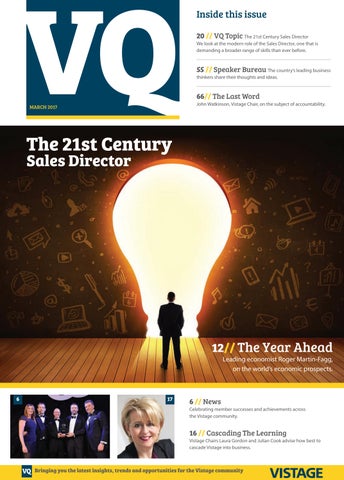
The 21st Century Sales Director

20 // VQ Topic The 21st Century Sales Director

We look at the modern role of the Sales Director, one that is demanding a broader range of skills than ever before.

55 // Speaker Bureau The country’s leading business thinkers share their thoughts and ideas.

66// The Last Word

John Watkinson, Vistage Chair, on the subject of accountability.

12// The Year Ahead

Leading economist Roger Martin-Fagg, on the world’s economic prospects.

6 // News

Celebrating member successes and achievements across the Vistage community.

16 // Cascading The Learning

Vistage Chairs Laura Gordon and Julian Cook advise how best to cascade Vistage into business.

March 2017

VISTAGE TEAM

Jan Chmiel

Managing Director

jan.chmiel@vistage.co.uk

Geo Lawrence

Marketing Director geo .lawrence@vistage.co.uk

Sam Oddie

Speaker Bureau & Events Director sam.oddie@vistage.co.uk

PUBLISHING TEAM

EDITOR

Colin Bradbury

PRODUCTION EDITOR

Hannah Tapping hannah.tapping@enginehousemedia.co.uk

DESIGN DIRECTOR

Jamie Crocker

PUBLISHER

Andrew Forster andy.forster@enginehousemedia.co.uk 07711 160590

From Vistage W

elcome to the opening issue of VQ for 2017. The last year has seen some dramatic changes in the political landscape which are likely to impact on the business environment in which we operate. The UK has a new Prime Minister and we watched as the country was divided at the decision to leave the EU, while America has seen a new President ascend the steps of the White House. With change comes the opportunity for readjustment and here at Vistage we are working hard to ensure that our ever-expanding knowledge base continues to grow and adapt. We have a unique opportunity to draw on the experience of our Chairs, speakers, fellow members and Vistage staff. Through VQ we hope to extend the peer group benefit and provide resources that enable you to respond more effectively to the changing environment.

In this issue of VQ, we address the theme of the 21st Century Sales Director. Sales is a key function in any business as it carries with it the ability to grow and shape the company by generating revenue and building relationships with customers. Therefore, this issue will look at how you can ensure your sales department is running at its full potential by being responsive to the evolving and rapidly changing business environment.

Your new look VQ magazine is published on behalf of Vistage by:

From the Editor

Red Flag Media is part of:

www.levenmediagroup.co.uk

Copyright © 2017 Vistage International (UK) Ltd.

All rights reserved.

Vistage provides the information contained in this document to stimulate thought and discussion. We work hard to ensure that the information presented is accurate at the time of publishing, but you should take independent advice before acting on any information presented.

No part of this document can be reproduced in any form without the written permission of Vistage International (UK) Ltd. All material is acted upon at the reader’s risk and, whilst every care is taken, Vistage and the publisher will not accept liability for loss or damage.

This issue marks a year since the launch of the new-look VQ Magazine. We’ve had some great feedback from the Vistage community, which will help us to continue delivering high-quality, relevant and thought-provoking content in the future.

This quarter’s VQ Topic (page 20) – The 21st Century Sales Director – is a look at one of the most important, yet often neglected, board level roles in any company. Our book review section (page 64) offers further reading on the topic featuring, amongst others, publications from Jack Daly and Grant Leboff who contributed valuable insights. It’s the start of a new year, so economist Roger Martin-Fagg looks ahead to the prospects for the world economy and also considers the impact of the Internet of Things in 2017 and beyond (page 10).

Elsewhere, Rob May of IT services provider ramsac take a different but very timely look at cyber-security (page 18), pointing out that the most sophisticated firewalls in the world are useless if your staff aren’t risk aware. And in a feature that could hardly be more relevant to all Vistage members, in The Power of Peers (page 12) keynote speaker Leo Bottary focuses on the five factors that drive high-performing executive peer advisory groups. We hope you enjoy these and all the other features in this first VQ of 2017.

Colin Bradbury is a business writer with more than 20 years’ experience as a financial analyst at global investment banks in Hong Kong and London. He has also set up and run his own businesses.

Colin Bradbury
Jan Chmiel - Managing Director

Looking to scale new heights?

Group Chair and Executive Coach

• Challenge - Could you bring together a group of business leaders and inspire them to even greater growth?

• Contribution - Do you want to see other business leaders improve their businesses and their lives?

• Learning - Are you looking to further develop skills including facilitation and coaching and be part of a world class learning environment?

• Earning - Are you looking to build a great income?

If you’ve been a senior director or business owner and have the drive and passion to inspire others to even greater success then the role of Vistage Group Chair could be for you. Since 1957, Vistage has been bringing together successful CEOs, executives and business owners into private peer advisory groups. From the beginning, Chairs have been at the heart of what makes the Vistage experience so powerful for so many members.

Find out more about our community and the role of a Vistage Group Chair visit www.vistage.co.uk/chair/

VQ News

■ CIPD 2016 PEOPLE MANAGEMENT AWARD WINNERS

Congratulations to Alice Jordan of V237 and InnerStrengths, who are delighted to announce (and a little in a daze) that in conjunction with Delta Financial Systems Ltd, they have won the category for Best SME People Management Initiative in the CIPD People Management Awards 2016.

■ MULTIPLE WINS AT THE BRICK AWARDS 2016

In a room of 600 delegates, including architects, designers, peers and industry leaders, V15 member Tom McGuire and his team at Grangewood Brickwork were acknowledged for and presented with the Craftsmanship Award and Specialist Brickwork Contractor of The Year Award amongst a number of other recognitions. Tom commented: “Great achievements made by great people, and this is only the start.”

■ ROYAL VISIT FOR QUEEN’S AWARD WINNER

His Royal Highness the Duke of Kent visited Bristol to see first-hand the operations of leading online supermarket and V316 member British Corner Shop, and to formally present the company with its Queen’s Award for Enterprise for International Trade.

Back in April 2016 British Corner Shop, which supplies British food brands via e-commerce platforms to consumers worldwide, learned it was to receive the Queen’s Award in recognition of its outstanding export performance. Dame Janet Trotter DBE said: “The Queen’s Award for Enterprise is very much the Oscars of the UK business world and only awarded to those companies that demonstrate excellence throughout their operations.

■ RESULTS ARE IN AT THE CIPR NORTH EAST PRIDE AWARDS 2016

Congratulations Stefan Lepkowski (a founder member of CE330) and his team at Karol Marketing who were awarded 3 Golds and 2 Silvers at the Chartered Institute of Public Relations North East PRide Awards 2016, including winning both Gold and Silver in the Best Event category.

■ RECOGNITION IN EUROPE’S LARGEST BUSINESS COMPETITION

Advanex Europe has been named a National Champion for the United Kingdom in The European Business Awards, sponsored by RSM; Europe’s largest business competition set up to celebrate business excellence and best practice in the European business community.

Ian Beardsmore, Managing Director and V229 member commented, “We’re very proud to be selected to represent the United Kingdom as a National Champion. The European Business Awards is widely recognised as the showcase for Europe’s most dynamic companies and we are proud to be recognised at this level.”

The Awards, now in its 10th year, is supported by business leaders, academics and political representatives from across Europe, and this year engaged with over 33,000 businesses from 34 countries.

■ UK PROPERTY AWARD FOR INFLUENTIAL EAST MIDLANDS’ CHARTERED SURVEYORS

Trevor Wells, V314 member and Director at Wells McFarlane is proud to be named a Five Star Property Award winner in the Best Property Consultancy Leicestershire category at this most prestigious awards ceremony in London recently.

“We have worked hard and invested in our team and the business over the past twelve years, never losing sight of the importance of client care at every stage,” said Trevor. “This distinction demonstrates this and will help move the practice onto an even higher playing field, assuring existing and potential clients alike they are working with one of the best.”

■ UNIVERSAL TYRES CHELMSFORD NAMED ‘BRITAIN’S BEST DEALERSHIP’

Chelmsford’s motorists can get their new tyres fitted at what is officially the “best tyre dealership in Britain,” after the town’s Universal Tyres (V15) dealership was named the National Tyre Distributors Association’s (NTDA) Tyre Retail Centre of the Year.

Simon Wright, Sales and Marketing Director at Universal Tyres, said: “Our Chelmsford branch is the ‘new kid on the block’ in the retail tyre market, but one truly deserving of recognition for the impact the team is making. Winning the NTDA award is like taking home the ‘Michelin Star’ for tyre dealerships – we’re over the moon.”

■ RNLI VISTAGE GROUP RETREAT

On an un-seasonally warm afternoon the members of Vistage group V9 met with the RNLI CEO and a former Navy Vice-Admiral, Paul Boissier who gave the Group a real insight into the culture and goals of the organisation. “What’s remarkable about the RNLI is that of the 40,000 people who are actively involved, 95% of them are unpaid volunteers” commented V9 member Tony Shields.

The group experienced the RNLI simulator and crewed a virtual £2.2million Shannon lifeboat; unfortunately V9 cox Stuart Seddon, was not that skilled and they (virtually) collided with a leisure cruiser and likely all drowned in the process!

■ SUBMIT YOUR STORIES

We love to hear your good news stories, we love to shout about our member successes even more! If you’ve recently won an award, been recognised within your sector or community, or even achieved something special, let us know. You can submit your stories via pages.vistage.co.uk/success or email lee.bradshaw@vistage.co.uk.

Meet Our Members

Stephen Brown Managing Director Euro Projects Recruitment

VISTAGE IS LIKE A SPA BREAK FOR YOUR BUSINESS. IT’S A GREAT GYM WHERE YOU CAN GET FITTER AND FASTER, IT’S A CHANCE TO RELAX AND REFLECT AND THERE’S THE CAPABILITY AND SKILL OF A PERSONAL TRAINER TO GET YOU WHERE YOU WANT TO GO.

Challenge

In its early days, Euro Projects grew incredibly quickly, expanding its services to not only recruit engineers but also technical staff, management staff and more. Having established a position in the recruitment market, keeping business growth consistent was a challenge for Stephen. “Like a lot of businesses that had gone through a very rapid growth phase, we hit a plateau.”

Solution

Having initially met Vistage Chair, Adam Harris, at a business event, Stephen sampled a Vistage Peer Advisory group and found the strategies and ideas presented were just what he was looking for. “I don’t think I’m unique in saying I’m fairly impatient. When I see what good looks like, I want it for my company immediately. That’s where Vistage really works as when you set your sights on something, they’ll help you identify where the roadblocks could be.” Now a Vistage member of 4 years, Stephen gets immense value out of his peer group, sharing ideas and helping his other group members to think clearly, in a confidential secure setting. As well as his monthly peer group meetings, Stephen

has also found Vistage Open Days around the UK to be a great source of inspiration and challenge. Each event brings together hundreds of business leaders and a keynote speaker, allowing for effective networking as well as an opportunity to invite colleagues.

“It’s not just me as a leader who has seen the benefits, they have been felt at every level in the company in our efficiencies, our culture and how we run. Really, our whole business is an advocate of Vistage!”

Results

■ Vistage has greatly aided Stephen’s strategic planning, particularly in regards to the diversification of the business and the direction of a new company within the group. Stephen has been able to take a step back and focus on the business rather than being in it.

■ In 2015, Euro Projects Recruitment achieved double-digit growth, a goal which Stephen said his Vistage group held him accountable to and supported him in achieving.

■ Euro Projects Recruitment has seen staff engagement increase across the business, staff turnover drop below 3%and absenteeism at an all-time low as a consequence of the changes Vistage encouraged Stephen to make.

Euro Projects Recruitment

Euro Projects Recruitment was founded by Stephen Brown 20 years ago, initially as an engineering consultancy firm. With a unique background in finding and hiring skilled people, Stephen saw a gap in the market for a specialist recruitment firm.

Craig Fletcher Managing Director Multiplay

Challenge

After successfully running a handful of gaming leagues for friends in a hotel, Craig saw the potential to turn his hobby into a viable business.

Since it’s conception, Multiplay has continued to grow, requiring larger venues and more staff. In 2012 as the business began to ramp up, Craig was starting to struggle with juggling the many aspects of running a business.

“It was a particularly rough time, I was doing 43 hours of finance each week, as well as trying to run and grow the business.”

Solution

Whilst working with The FD Centre for parttime financial support, Craig was referred to an Experience Vistage session at a Vistage Open Day. “Every single person in the group voted to process my issue and I got properly grilled!” With Craig aware that something needed to change. He joined his local Vistage group, chaired by Neil Wilkie. Neil and the other Vistage group members were able to share ideas and process issues whilst holding Craig to account.

“It’s a great confidential environment where you can open up and talk about things you don’t talk about with anyone else, especially in a family business.” Using the knowledge shared from his Vistage group and the expert speakers, Craig began to have more time to focus fully on growing the business. “I’ve never had a speaker session where I didn’t gain at least one great thing to take away and learn from.”

Results

Since forming in 1997, Multiplay has grown to have over 100 employees running a variety of events including Insomnia, the biggest gaming festival in the UK with a footfall of 35,000 people. “It’s very easy to keep a culture when you have 30 employees, that gets a lot harder when you have 50, 100, 150 people.”

Craig’s Vistage group has continued to support and hold him to account even as the company has developed. The culmination of Multiplay’s growth came in 2015 when the company was acquired by GAME for £20m. “There was a lot of stress and learning that went on in the process and the help of Vistage was needed more than ever.” Looking to the future, Craig is confident about how Multiplay can continue to grow with the support of Vistage. “We doubled turnover and headcount last year but we want to throw rocket fuel at the company and push it even further!”

Multiplay

Multiplay isw the UK’s biggest gaming services company, specialising in large scale gaming events and online games hosting. Since hosting his first gaming event for just 20 people, Craig Fletcher has grown Multiplay to become a £20 million business.

www.multiplay.com

VISTAGE FORCES YOU TO TAKE TIME OUT OF THE BUSINESS EVERY MONTH, TO WORK ON THE BUSINESS RATHER THAN JUST IN IT

Meet Our Members

Lorraine Tomlinson Managing Director John Laing Training

I CAME OUT OF MY FIRST VISTAGE MEETING FEELING ENERGISED AND INSPIRED. I FELT THE GROUP WAS SUPPORTIVE YET CHALLENGING.

Challenge

Following a successful management buy out in 2008 led by Lorraine, the company went through a number of changes. As a provider of apprenticeships, JLT were heavily reliant on government funding. “We’d gone through a period of a lot of government change and austerity which had a real impact on the business.” During this time of uncertainty, Lorraine worked hard to diversify the business, pushing into new sectors and new areas with new training. All of this helped the business to survive but had very little effect on the bottom line. “It was the right strategy but it felt like one step forward and two steps back. I wasn’t able to grow the revenue streams of the business as much as I would have liked.”

Solution

What Lorraine was looking for was clarity around her strategic vision for JLT. “We were working in the same way with the same board and we needed fresh ideas and fresh impetus”. It was around this time that Lorraine met Helen Stenhouse, a Vistage member at a networking event. Having discussed each other’s respective businesses,

Helen introduced Lorraine to Vistage and shortly after Lorraine met with local Vistage Chair, John Watkinson. “I came out of my first Vistage meeting feeling energised and inspired. I felt the group was supportive yet challenging. Just listening to the questioning and probing of other businesses made me realise I had to challenge myself more!”

Results

Having been a Vistage member since June 2015, Lorraine already has a clearer focus of the emerging markets where new opportunities lie. As a result, Lorraine is confident JLT will generate the revenue needed to hit their ambitious growth targets. As well as the group meeting, the executive coaching gives Lorraine focused ‘time out’ of the business, spent with someone with a wealth of practical business experience. “That time, spent looking at your business is invaluable. We work on clear goals and my Chair then holds me accountable, to ensure I have achieved what I set out to do.”

Support and guidance has created space for fresh thinking. This has resulted in a move from reliance on revenue growth, to a resetting of fixed costs and a focus on a narrower offer in emerging markets. “I have real confidence in delivering the business plan for 2016-17 and feel we have a lean and sustainable business with a stable platform for future growth!”

John Laing Training
John Laing Training (JLT) offer a wide range of apprenticeships, skills development and health and safety training, working in partnership with businesses to fill skills gaps, develop talent and motivate teams. Lorraine joined JLT in 2005 as Managing Director.

Ignite Brilliance In Your Leadership

The former executive of a billion dollar global consumer products company and awarded the Vistage UK, International Speaker of the Year, AmyK Hutchens is a catalyst for producing sustainable solutions to a leader’s most pressing challenges. Here are 11 thought-provoking ‘AmyK-isms’ for being a good leader.

1. Always have an agenda based on questions

Questions provoke critical thinking and promote engagement. Meetings centred on question-based agendas yield greater productivity, creativity and performance. They keep people awake too.

2. Balance is a myth – prioritisation aligns everything.

Pursuing “balance” is distracting at best; futile more often than not. Thoughtfully setting and living your priorities produces alignment, and with that, an energy that’s sustainable.

3. Stop talking. Start doing.

Over-analysis leads to paralysis. Newton’s Law of Motion is a law for a reason – take a step, even a small step is often revealing enough to guide your next step. And by the time you take your next, you’ve already created momentum. Step forward…now!

4. Celebrate. Often. Bubbly optional.

Stop waiting to celebrate. Acknowledging the mini-wins along the way increases motivation. Sometimes, even a week of small measurable progress is worth a toast.

5. Accountability is not a dirty word.

A-Players crave clarity and will out-perform when expectations and deliverables are well-defined. C-Players…not so much. For them, accountability exposes performance gaps and it’s hard to hide in a gap.

6. Choose your thoughts. Wisely. Thoughts always precede feelings. Can’t help the way you feel?! Think again. Literally. Your thoughts (perspective) determine your feelings, which will cause you to react in a certain way. Your actions then lead to a result that will always go back and prove your original thought “true”. Break the negative self-fulfilling process –choose a better thought!

7. Just because you’re sure, doesn’t mean you’re right.

We think we know facts. What we really know is simply our version, our perspective of reality. It’s a truth, our truth, but is it a shared truth beyond our unique perspective?!

8. Smart leaders know things. Brilliant leaders question what they know.

Great leaders own their own ignorance. Ask, “what am I missing?” prior to answering a question and your final response will be a great deal more reflective, evaluative and predictive. With that, your value to those you lead will increase.

9. You can’t force your customers to drink, but you sure can make ‘em thirsty!

We can’t make prospects buy anything and we can’t force those we lead to follow. With the right communication tools, however, we can make them thirsty. The best tools used well will make them thirsty for what we offer and request.

10. Start your day with water.

Like it or not, you wake up dehydrated. Your brain craves and needs water. Before you down a cup of caffeine, drink a glass of water. Your cognitive capability improves and your physical and mental energy increases. A great ROI for such a simple act –drink up!

11. Leadership happens one conversation at a time.

You are responsible for the quality of this conversation. Prepare for each critical conversation. What’s the right focus and framework? How do you structure your messaging for the best outcome? Take responsibility for the conversation. Lead the conversation. Own the Conversation.

AmyK Hutchens

AmyK Hutchens is a Vistage Speaker. She is Founder and CEO of AKI Inc. Her expertise includes organisational infrastructure (strategy, execution, accountability); leadership development; executive coaching; leadership and sales team training; pedagogical programs (i.e. train the trainers); and creative concept development. W: www.amyk.com W: www.vistage. co.uk/speakers/ amyk-hutchens

Contact

THE UK WILL CON T IN U E TO EXPAND T HRO U GHOUT T HIS YEAR: INFLAT ION WILL BE 3% BY T HE END B UT I J U DGE T HIS WILL NOT CHANGE CONS U MER BEHAVIO U R UNT IL 2018, AND EVEN T HEN IT WILL DEPEND ON WAGE INCREASE S.

2017, the year of transition

Roger Martin-Fagg shares his thoughts on the year ahead, with particular focus on the world’s economic prospects and the Internet of Things.

■ A YEAR OF UNCERTAINTY

As an economist, I must make it clear that there is a difference between risk, which is assigning probabilities to known unknowns and uncertainty, to which no probabilities can be assigned because of unknown unknowns. 2017 is a year of uncertainty. As such there are a huge range of scenarios that can be created, none of which will turn out to be correct. For example, the value of sterling could be as low as $1 and as high as $1.40, a case can be made for both! Economists, like all humans, are subject to Confirmation Bias. This means we only select data that will support our beliefs.

However, some things we can be sure of. Money supply is growing strongly in the USA, China, the UK and Canada and it has also begun to grow in the Eurozone. This is the consequence of a return to lending by commercial banks. The velocity of money has stopped falling too (a sign of consumer confidence based on rising house prices and real incomes). In combination, this suggests growth for this year will be stronger than forecast, and inflationary expectations will increase long-run interest rates in the main economies, although central bank rate increases may well lag behind. We cannot be sure this monetary expansion will continue.

■ THE GROWTH OF THE USA

The USA will grow above forecast as Trump presses the infrastructure spend button. I expect 3% growth in 2017. I do not expect him to raise tariffs

on Chinese Imports because these are brought in by US companies. He will reduce Corporate taxes. The ensuing growth will ensure tax receipts remain strong. US interest rates will rise twice in 2017 and the dollar will continue to strengthen.

■ THE EXPANSION OF THE UK

The UK will continue to expand throughout this year: inflation will be 3% by the end but I judge this will not change consumer behaviour until 2018, and even then it will depend on wage increases. Clearly, in parts of the economy, wages will be rising by more than 4% per annum due to labour shortages. The Bank of England will at some stage have to reign in the growth of unsecured credit but they will do so behind the curve. Meanwhile, long run interest rates, and the mortgage rate, will rise with inflationary expectations, probably up 1.5% by the end of 2017.

■ THE OVERSEAS INFLUENCE

The big monetary stimulus by the Chinese authorities has taken longer to work this time but it is working and China is back demanding high volumes of commodities from the world. China will be patient with Trump but only up to point. I suspect for this year they will tolerate his outbursts whilst continuing to build their military might. The first of three new aircraft carriers have just entered service. The OPEC agreement to limit production is holding so far, which will keep oil in the range of $50-$60. But a stronger dollar against sterling will continue to increase the sterling price.

■ THE FUTURE OF EUROPE

At last Europe has begun to expand, financed by a recovery in commercial bank lending, and the expansion of global demand. Even the European consumer has regained an appetite for credit! We should expect the ECB to wind down its QE programme earlier than planned as EU inflation begins to rise towards the end of the year. This is the year of elections in Europe. The Dutch in March, the French in April and the Germans in October. There will be clear shifts to the right: demand for immigration controls, for a radical reworking of the EU, a questioning of the single currency, and a rise in nationalism. It is an open question, as whether or not the rightward shift will make post Brexit negotiations easier or more difficult.

In summary economic prospects for 2017 look encouraging.

The Internet of Things (IoT)

The Internet of Things de ned:

The clustering of separate technologies into a system of connected machines, which signi cantly increases added value through greater e ciency and e ectiveness.

This is one of the step changes in the application of technology, which will grow added value per person per hour. It will be instrumental in increasing living standards for those businesses and countries that fully embrace it. It is a significant opportunity for the wealthy West to keep ahead of the rising East. Particularly as the lack of young skilled workers limits growth and the rise of the aged continues to stress Government budgets.

■ THE THREE WAVES

1960s-1970s - The first wave of IT enabled automated activities such as order processing, payroll, bill paying and resource planning. Data was captured and organised more quickly and accurately than by a human.

1990s-2015 - The second wave is the growth of the Internet, which allowed co-ordination and integration heedless of geography and further increased productivity throughout the value chain. However, both waves left products themselves largely unaffected.

2017-onwards - The third wave is the most significant advance. It is changing the functionality of products. We are at the early stages of what will prove to be a major shake-up in the way value is added.

There will be implications for job type, skill level and the distribution of incomes. The big pay-off will be a step change in the functionality and performance of machines as they perform more effectively with less human intervention.

■ HOW THE INTERNET OF THINGS WILL CHANGE THE RULES AND FORCES OF COMPETITION

All customers wish to obtain Value for Money (VFM). The definition of VFM is unique to each customer. It can be captured in this simple equation:

VFM = Satisfaction minus Price

For B2C the drivers of satisfaction are many and varied while for B2B the equation is more straightforward:

VFM = Performance minus lifetime cost

The IoT will transform lifetime costs. It will, in the majority of cases, move maintenance from a time-based activity to a need-based activity. It allows the user to track the performance of a machine in real time, and show immediately when running costs are moving out of normal or desired range. It is estimated that by 2020 there will be 30 billion examples of IoT in use. Currently, the early adopters are pushing the technology forwards. Over the next three years there will be significant clusters of application across all sectors. Those companies that ignore the trend will be left behind and quickly experience a steady loss in net margin, market share and free cash generation, eventually becoming extinct.

So the fundamental questions are: to what extent can I automate my business? Where can I reduce head count? How can I raise productivity through the application of smart technology?

The new wave of technology and its application will continue regardless of trade negotiations. If I have understood the British character correctly then the decision to leave may be the catalyst for a step change in UK business performance. Or it may not.

Contact Roger is an economist turned strategist. He speaks at conferences across the globe on the economic outlook and its impact on business. He is a practical researcher, focusing on how the economy really works and on the links between FT100 reward systems, the behaviour of banks and economic instability.

W: www.vistage.co.uk/speakers/roger-martin-fagg

Profile – Roger Martin-Fagg

Profile

Leo Bottary

Leo Bottary, former CEO of Vistage, is a thought leader, keynote speaker, and co-author of The Power of Peers: How the Company

You Keep Drives Leadership, Growth & Success. He also serves as an adjunct professor for Rutgers University.

Contact

W: www.leobottary.com

The Power of Peers: How the Company

You Keep Drives Leadership, Growth & Success

Leon Shapiro & Leo Bottary (10th edition)

ISBN 978162956w1202

Bibliomotion April 2016, $27.95

The Power of Peers

Five factors that drive peak performance from your Vistage group.

In March 2016, my co-author Leon Shapiro and I released a book titled The Power of Peers: How the Company You Keep Drives Leadership Growth & Success; “who you surround yourself with matters” was the simple premise on which the book was based. We thought to ourselves, while there are thousands of books on leadership and hundreds more on followership, there are very few about the value of those who stand beside us – our peers. So we decided to write one.

We also believed, and it was reaffirmed during our research for the book, that peer advisory groups are incredibly effective, yet too few business leaders are members of one. Our charge was to look at how and why these groups work so well and to shine a light on their effectiveness in the hope more leaders would avail themselves of their benefits. During this process, we also learned that the factors that make a peer advisory group work so well, and what separates the very best teams on the planet from all the rest, were largely the same.

After studying peer advisory groups led by numerous organisations throughout the world, along with high-performing sports teams and special military units in the U.S. – namely the Navy Seals and the Blue Angels – we discovered two things:

1. There are five factors that are consistently evident in all high-performing executive peer advisory groups. And while each of the five factors stands alone, they also reinforce one another in the same fashion as a musical jazz ensemble. The music and the interrelationship of the five factors are alive – constantly shifting and changing.

2. The top teams that we examined had the same five factors at work, which has since inspired me to think about how MDs, CEOs and business leaders can take what they learn from being members of

a peer advisory group and translate that learning back to the teams in their own organisations.

Before examining the five factors, it may be helpful to look at the four ways we typically engage with our peers.

l We connect with our peers in person and online. Think in terms of attending business gatherings in your local community, reading blogs or whitepapers online, or connecting at the most basic levels on LinkedIn.

l We network online, at conferences, or at local business events and socials in a more selective and more purposeful attempt to advance personal and professional interests. (Looking for a job, a business partner, financing etc.) Connecting and networking tend to be individual pursuits and are by far the most common ways we reach out to our peers.*

l We optimise when we work together in teams to bring a high level of excellence to achieving a common goal. Leaders often form organisational “tiger teams” to tackle special projects. The Blue Angels, the U.S. Navy’s flight demonstration squadron, conducts debriefs following every (what we see as perfect) flight to talk about how they can do better the next time. Top sports teams participate in practices that are often more rigorous than the games to ensure top performance when it truly counts.

l We define accelerate as the ultimate means of gaining peer advantage. It’s what top CEOs and business leaders do when they step outside of their company and industry sector to engage peers from different businesses and walks of life. The objectives are to help one another meet tough challenges, achieve lofty organisational goals, make better decisions, and grow as leaders. Moreover, they provide each other with the confidence and courage to act.

Now, here are the five factors that provide the framework and discipline that help define both highperforming peer advisory groups and top-notch teams:

1. Have the right peers – This involves more than surrounding yourself with the right people. Based on personal and professional goals, it requires reflection on whether a person is well suited for a group/team experience. Are they there just for themselves or are they willing to give, even sacrifice, for the group or team?

2. Create a safe environment – Deep conversations about critical intellectual and emotional issues requires an environment in which confidentiality is sacrosanct and where the members never feel as if they are being judged. In a team setting it’s about trust and mutual respect.

she wants to do, and by doing so, owns the action items. “Do what you said you would do” is now the simple expectation of the group. This level of group/team accountability gives peer advantage its punctuation. In a strong accountability culture, team members would rather confess a failure to their boss than disappoint a colleague.

5. Utilise a smart guide – Whether a group is led by one of the members or a professional facilitator, maximising the potential of any team/group depends on great leaders to create the environment that gets the most from the team and serve as the steward of the other four factors.

l Have the right peers – Surround yourself with the right people, who are willing to give, even sacri ce, for the group or team

l Create a safe environment – Con dentiality is sacrosanct; members should never feel they are being judged; foster trust and mutual respect

l Foster valuable interaction – Interactions should lead to better decision-making and actionable strategies

l Be accountable – “Do what you said you would do” is the simple expectation of the group

As Vistage group members you understand these factors all too well; you live them during each and every meeting. The questions you may want to ask yourself are: How well are these five factors operating within teams in my organisation? Are my teams as high performing as they could be? If not, then how will I work with my senior leaders to bring the same five factors that make my group work so well into my own organisation?

l Utilise a smart guide – Create the environment that gets the most from the team and serves as the steward of the other four factors.

3. Foster valuable interaction – While having a safe environment provides important emotional safety, intellectually, group/ team members need to believe that their interactions will lead to better decisionmaking and actionable strategies. Issue processing in your Vistage group is one such example. As for the teams at your respective companies, what would your employees say about the value and effectiveness of team meetings?

4. Be accountable – As a member of a group that optimises and accelerates well, the group members don’t tell other members what to do. The member expresses what he/

While as a Vistage group member you’re currently engaging your peers in a manner that provides you great value, there is much more you can leverage here. Take what you learn from your peer group – your ideas and your understanding about how high-performing groups collaborate – and show your people how to lead groups that optimise inside your organisation.

But don’t stop there. Networking involves purposeful interaction with select individuals who can help you and your organisation grow. What you gain from accelerating and optimising will help you and your employees be more purposeful and more successful networkers. Finally, be sure to keep connecting. Connecting helps extend your reach and provides you and your organisation with the kind of essential knowledge channels that will fuel everyone’s growth.

AS WE CONTEMPLATE THE CHALLENGES AND OPPORTUNITIES A FUTURE MOST OF US CAN BARELY IMAGINE, WE’LL HAVE TO RELY ON ONE ANOTHER MORE THAN EVER. WHO YOU SURROUND YOURSELF WITH MATTERS. IN 2017, MAKE PEER ADVANTAGE YOUR COMPETITIVE ADVANTAGE.

* NB There’s a di erence between the peer in uence most organisational leaders experience when they connect and network and the peer advantage that can be realised when leaders work with others in a group setting. Peer advantage occurs most powerfully in a group or team setting, where the members are selective, strategic and structured about their engagement. There’s a certain discipline that frames the interaction, which manifests in the ve factors.

Vistage group V65

Julian Cook, Vistage Chair, has many years of experience running and working in a wide range of businesses – large corporate, the public sector and family owned enterprises. Julian now brings together CEOs, MDs and private business owners, helping them to grow personally and professionally in his Vistage group.

Contact

E: julian.cook@ vistagechair.co.uk

How can members best cascade Vistage insights into their own organisations?

The Endowment Effect

We all search for that perfect Vistage day: everyone arrives on time and fully prepared, engages in the meeting, gives lots of feedback, holds everyone accountable, and scores 9+ on feedback. They then cascade their learning, new ideas and fresh thinking back into their lives and teams, endowing a lasting effect upon their businesses.

In reality, though, is “Oh heck, they’ve been on the Vistage again – heads down, it usually passes” a more likely comment from the home team? What a poor testament that would be to the investment in time, skill and money that our members make. Our aim is to create an endowment effect which brings lasting legacies that weave themselves into the personal and business lives of the member and their teams. Well, we know that won’t happen in an environment of ‘sit and get’, where – aside from a few thoughts that might stick – it’s back to business as usual. “Hey, it was an enjoyable day; I kept up to date with my messages, scored 8 on the feedback because we helped ‘Joe’ with his problem and by the way, remind me, when is the next meeting?”

It is of course the individual member who joins a Group, not the company and most join with a clear intention of developing themselves through personal and business growth. Growth can be defined as improvement of self and beyond that the company and that’s not just simply growing the bottom line. It should also be about boosting the member’s confidence to share their Vistage experiences and knowledge back at base.

So, how can we as Chairs, members and speakers support that intention, and get the best from our meetings?

1.

Run effective meetings

A common complaint of meetings is that they’re too long, they drift from the agenda or pander to

the strongest, achieving unsatisfactory outcomes. Thankfully, in Vistage we have an opportunity to hone, practice and critique those skills at our Group meetings and one-on-ones; and guess what, it involves us all: Chairs, members and speakers alike. Get these right and we have a lasting legacy from which every company would benefit. All Vistage meetings should be an exemplar of what “good” really looks like. Through our members’ experiences their teams will learn by example.

2. Feed back knowledge effectively

Transmitting speaker content back to others is a skill that few can achieve and in our busy lives its headlines only, which often limits the value out of context. So encouraging staff into the speaker sessions and selecting the appropriate Vistage Open Days for them to attend widens the endowment of our Vistage speakers right into the member’s businesses.

3. Understand what’s really getting through

And a final thought to understand what’s really getting through. Try introducing a regular ‘carry back’ session into your Group meeting programme. Challenge each other to report on a regular basis, what gets carried back home. So ask, what did you hear last month, what have you worked on, who knows about this in your business and what is the effect you’re seeing?

But don’t expect a fanfare of trumpets for endowments and legacies of this kind take time. Vistage meetings of all types provide the platform to show and learn by example. Whilst it is the individual who is the Vistage member, ensuring that the business is also a consistent beneficiary is surely a most worthwhile endowment and lasting legacy of membership.

Julian Cook
Profile

Cascading the Learning

Working with 35 business leaders across three Vistage Groups over a two-year period, you start to see some trends emerge. What I’ve discovered is that the members who take the most value from Vistage are clearly the ones who learn not only for themselves but also for the benefit of their colleagues and the business as a whole.

There are so many aspects to Vistage that can feed into this. Here are several ways my members ensure the learning cascades through the organisation, from them to their senior leadership team, to the middle management and beyond.

1. Vistage Open Days

There are around 25 a year across the UK and Ireland, and 3-4 in Scotland alone. Members should identify colleagues to come along and hear the speakers for themselves for several reasons:

■ Observe firsthand, not through the perspective of the member who may or may not share what they’ve heard in the way it needs to be communicated

■ Learn alongside colleagues which is great for team cohesion and encourages mutual support in implementing actions

■ Feel part of the wider Vistage community and recognise the value of the leader’s time away from the business (perhaps aspiring to become a member too)

■ Meet and network with other like-minded leaders, often forming lucrative new business relationships

2. Scheduling time to absorb

Put time aside after the Group meetings to reflect, absorb, relay and discuss ideas and learnings with your teams; perhaps deliver a short presentation of the workshop, extrapolating the key ideas and discussing the actions to be implemented.

3. Vistage Bulletins online and Vistage Quarterly

Excellent sources of knowledge and best practice that can be distributed around the business along with The Vistage Best Practice Guides, which are often simple, straightforward and short eBooks. The Vistage Blog

is also worth subscribing to and all members of an organisation can access it.

4. Hosting the meeting

If you’re hosting you should always take the opportunity to invite a few colleagues whose roles are relevant to the topic of the speaker sessions to that part of the meeting.

5. Personal Action Summary

Bring copies of these to each one-to-one – that’s where the accountability starts. There is a column for what needs to be done and by when. Members should also consider “who” should undertake to perform the actions. By keeping members accountable they in turn recognise the benefit in keeping their direct reports accountable.

6. Using Vistage tools and techniques for internal meetings

Members who have used issue processing techniques such as the Box Exercise to process issues with their teams have reported great success. Some do the “sign in” at the start of meetings and even create “meeting roles”, such as Historian, Quotician, Timekeeper and Energiser, and use other Vistage “tricks” to keep their teams inspired and motivated during meetings.

7. Key Groups

Having a senior colleague in a key group can be a real advantage and regular updates with these colleagues are invaluable to share their insights, ideas and learning. Joint one-to-ones every few months between colleagues can be a real opportunity to ensure learning is being shared effectively.

Carol Dweck from Stanford University explained that when entire companies embrace what she calls a “Growth Mindset”, their employees report feeling far more empowered and committed and there is far greater organisational support for collaboration and innovation. Investing in development from the top down and ensuring everyone who wants to learn and benefit from it can go a long way to enhancing not just the culture but the effectiveness and profitability of a business.

V80, V40 and K260, Scotland

Laura Gordon, Vistage Chair, has had a varied and wide-ranging career, from studying psychology as a first degree and running her own small businesses to becoming an awardwinning corporate lawyer specialising in IT and media law with a diverse range of clients across all sectors.

E: laura.gordon@ vistagechair.co.uk

Laura Gordon

Rob May Managing Director of ramsac who have a mission to make IT simple. He is a founding member of Vistage group V79 and he is the ambassador for cyber security for the Institute of Directors.

Contact

W: www.ramsac.com

E: rob.may@ramsac.com

Did you know you’ve had a cyber-attack?

There are two types of business according to the FBI: those that have suffered a data breach and those that don’t know they have. Sobering thought isn’t it? The thinking used to be that you quickly became aware of cyber-attack, but in reality, we really don’t know most of the time when a breach happens. What we do know is that every business is a game target and if you’re not aware of a breach as yet, it is only a matter of time.

The UK is hugely reliant on digital technology in business, with 23% of our transactions taking place online (the G20 average is just 6%). With this advantage comes a great deal of risk. Cybercrime is estimated to be worth $3trn per year, making it the number one crime in the world. The people attacking your business are slick business operations. One company that suffered a ransomware attack was provided a phone number by the attackers and asked what language they wanted technical support in, to help them pay the ransom. These guys were running a huge helpdesk in order to support their “business”.

The heart of the problem and the path to improved security are the people we employ. Invariably, when a client becomes aware of a breach, the CEO will call me up, bemoaning the fact that they’ve invested in lots of IT security and yet now they’re suffering the pain of an attack. I always explain that yes, they’ve got the very best firewall technology, they’re paying for email and web filtering, they’ve got the industry leading antivirus software on their PCs, and so on. This is akin to them buying a state-of-the-art alarm system for the office premises, installing 5-lever mortice locks on all doors and fitting bars to all the windows; in most cyber-attacks, the crook simply walks up to the front door, presses the buzzer and a member of staff lets them in.

Every other year the IT security world descends on London for an event called InfoSec. During the last one a survey of commuters was conducted at rushhour. Commuters were stopped and asked for

their employer name, network login and password. 34% of people stopped gave the requested information! What’s more, those who declined were then offered a Mars bar in exchange for the info. The number of respondents then rose to a shocking 70%. I’m sure like me you’d like to think that none of your staff would be so foolish. However, the stats suggest that someone in your business would happily give that information away in exchange for a chocolate bar. The worrying thing is that it only takes one employee to do something foolish to get a leak in your data security pipe.

CYBER-ATTACKS, THE

It really is essential to discuss the human firewall in your business. Cyber-crime is an ever-changing, complex and sophisticated minefield and training your staff is essential. What training do you give your staff? How aware are the board of directors of the risk, and what is your corporate response? How comprehensive is thinking around cyber in your business continuity plan? I speak to lots of business owners who have great plans for flood or fire, but most haven’t accepted the far more likely reality of damage and disruption caused by a cyber-attack.

Please don’t deal with this issue through the use of policies either – the truth is these don’t protect you. In most cases they make the director given responsibility for cyber feel they’ve dealt with the issue, right up to the moment the breach surfaces and then reality bites.

Cyber-security and current risk awareness needs to be a recurring item on your board agenda, if you’ve not already taken professional advice I urge you to do so quickly. Consider the on-going training of your ‘human firewall’ and sanity check the level of awareness within your directors.

Rob May
IN MOST
CROOK SIMPLY WALKS UP TO THE FRONT DOOR, PRESSES THE BUZZER AND A MEMBER OF STAFF LETS THEM IN

2017, the year of cyber attacks: How you can increase your cyber security by 80%

By the end of 2017, the vast majority of companies will require some form of certification demonstrating cyber resilience, from large corporates through to small companies in the supply chain. The case for having all businesses certified through Cyber Essentials is compelling. When statistics demonstrate that businesses can be up to 80% more cyber resilient, why wouldn’t you?

The basic fundamentals of running a business are integrity, efficiency, people, build a brand and making a profit. The 34 questions of Cyber Essentials address every fundamental element of a good business.

Properly implementing cyber security has the additional advantage of driving business efficiency throughout the organisation, saving money and improving productivity.

Cyber Essentials are the distilled recommendations from GCHQ and implementing these five Cyber Essentials controls will help your business stay secure:

1. SECURE CONFIGURATION

By ensuring your computers and network devices are configured properly, you can identify systems or databases that you no longer need or use. You will have the opportunity to reduce your overall storage and bandwidth consumption, as well as reducing the level of inherent security vulnerabilities.

2. BOUNDARY FIREWALLS AND INTERNET GATEWAYS

Using boundary firewalls to monitor traffic to your server(s) enables you to better understand and manage your bandwidth requirements, potentially allowing you to renegotiate your hosting costs, as well as blocking attackers and external threats.

3. ACCESS CONTROL AND ADMINISTRATIVE PRIVILEGE MANAGEMENT

Managing access control and administrative privileges erodes the opportunity for staff to install time-wasting software on to their computers, as well as removing the insider threat.

A TYPICAL ATTACK

One popular current attack works on the use of macros in Excel. The spreadsheet being sent itself is virus-free, thus it will get through that stage of your network protection. However, it contains a macro with an instruction to unleash problems from a secure website if run. The scam works on a spoofed email sent usually from one director to another, and says something like “ahead of our board meeting please nd attached a spreadsheet detailing proposed pay rises for all sta ”. The email is ‘accidentally’ copied into all sta and, of course, the spreadsheet needs the macros to be enabled to see what pay rise the recipient and their colleagues will get. Alas human nature is such that someone in your business is likely to open this.

4. PATCH MANAGEMENT

Keeping on top of software patching and licensing makes your company more productive, as well as more secure. Patches often improve the performance of the products they apply to, and remove issues that slow down employees, such as crashes and poor performance caused by congested networks.

5. MALWARE PROTECTION

Implementing appropriate malware protection has its obvious security advantages, but an oftenoverlooked hidden benefit is the time and cost savings that result from avoiding devices being out of action.

Costs of a cyber attack include: business disruption, lost sales, recovery of assets, possible fines and compensation. In 2014 the most severe breach for an SME was as high as £115,000. In 2015 the figure was up to £310,000, an almost threefold increase. What can we expect for the final figures for 2016? Will we be better prepared for 2017?

While people are your biggest asset, they can also be your biggest threat, whether intentionally or by accident. Training and raising awareness can reduce the threat considerably.

We cannot ignore the pace of technological innovation. A large part of this innovation is cyber. Cyber should be seen as a business enabler and should be embraced. In order to fully maximise the opportunities, the very serious threat of a cyber attack should be minimised. Making Cyber Essentials a requirement for businesses will make supply chain management more cyber resilient, drive efficiencies and add significantly to the British economy.

VQ Topic – The 21st Century Sales Director

The 21st Century Sales Director

Introduction

It hardly needs saying that the sales function is at the heart of every business, regardless of size or industry sector. Yet while most companies acknowledge this by having a sales representative at board level, there are still those, particularly in the SME world, that have not yet appointed a Sales Director to sit alongside colleagues in Finance, HR, Operations and other key functions at the top table. And even for those that have taken the step to elevate sales to the ‘C’ suite, there is a lingering view that it is somewhat different to those other functions.

For one thing, unlike in finance and other disciplines, there are no widely accepted professional sales qualifications, which can undermine its claim for a seat at the top table. Linked to that is a lingering suspicion that sales is still more of an art than a science, depending on individual skills rather than a well-defined set of procedures. And there is also an assumption, understandably, that for a business function to justify a board seat, it needs to have a significant strategic element. Too often the role of those overseeing sales is seen as being predominantly administrative; isn’t sales, after all, a ‘numbers game’?

In the pages that follow, we will make the case that the position of Sales Director is truly a strategic role and one that now demands a broader range of skills than ever before. Sales is a genuine discipline, with practices, techniques and procedures that must be trained into the front line salespeople. Moreover, the disciplines of sales and marketing now overlap significantly, not least because of the huge increase in availability of information and opinion driven by the Internet and social media networks. The Sales Director must be on top of all these developments and needs to understand how they affect the targets

and goals of their individual salespeople. Finally, the modern Sales Director must have a strong grasp of the size of the market for their company’s products and the competitive landscape in which they operate if the targets they set for their salespeople are to be meaningful.

There is also a pressing need for the senior representative of sales to work ever more closely with the other functional heads within the business. The changing nature of the customer journey means that the Sales Director must collaborate with the Marketing Director as their salespeople need different types of marketing collateral. Investment in CRMs and other technology makes cooperation with the Finance Director critical while the need for constant training demands a close working relationship with the HR Director. And since salespeople are a vital source of customer and market intelligence in an increasingly competitive marketplace, the Sales Director should also be providing feedback to the Operations Director.

In other words, overseeing the sales function is now about much more than making sure that salespeople hit their monthly quotas. CEOs need a Sales Director who can bring all the aspects of the job together and articulate the key trends and developments affecting the company’s revenue growth. This is a very demanding role and requires an individual to be far more than simply a good salesperson in their own right. Indeed, given the variety of skills required, promoting the biggest hitter in the sales team to the job of Sales Director will rarely be the optimal strategy. Finding a true 21st Century Sales Director is a demanding task and they don’t come cheaply. But given the pivotal nature of the role, it will be an investment well made.

SECTION 1

The Salesman in the 21st Century: A History of Selling

We can’t consider the role of the Sales Director in 2017 without addressing the subject of what ‘modern’ sales looks like and how the art (or science – we’ll get to that question later) of sales has developed over the last few decades. This is a very complex and even controversial question, which explains why a search on Amazon for the word ‘sales’ returns a list of nearly 309,000 books. So there’s no point attempting to set out a comprehensive view of the landscape of sales here. However, there have been some very significant changes in the way that companies sell in the last few decades and a convincing case can be made that, thanks to technological innovations, the pace of change has accelerated since the start of the 21st Century.

It’s worth pausing here to take a big-picture view of how sales has evolved in the last 100 years, what has driven the changes and what factors have remained constant.

1893 National Cash Register (NCR) Corporation founder, John Henry Pa erson, established the first sales training school in Ohio and developed the first systematic sales primers covering product features and benefits and compiled lists of common customer objections and responses. Pa erson stressed the importance of identifying customer needs rather than just talking about the product.

1908HenryFord introducedthe ModelTautomobile, usheringintheera ofmassproduction.

1916

World Sales Congress: “Building trust with customers is the most effective way to sell.”

1925

E.K. Strong publishes ‘ThePsychologyofSelling’ and introduces influential sales principles such as features and benefits, objection handling, and question type. Demonstrated that sales was a hard skill that could be taught, learned, and studied.

ofThe1930sbeginnings selling.modern

The History of Sales

1936

Dale Carnegie’s ‘How to Win Friends and Influence People’ urged salespeople to understand customer thinking and befriend them.

1950-60s

Salespeople utilising ‘features and benefits techniques and formula selling based on processes like AIDA (A ention, Interest, Desire, Action).

1980s Solution Selling. Align a solution with a customer need and demonstrate why your solution is be er than a competitor’s. Selling becomes more consultative. Era of SPIN (Situation, Problem, Implication, Need). Selling taking tactical concepts, like open-ended questions, to the next level.

1985

1970s

Strategic selling by targeting key decision makers in the organisation. Customers become more involved in the sales process.

2000s

Power shifting from the salesperson to the customer. Increasing percentage of the buying decision completed before contacting a sales rep.

Robert Miller and Stephen Heiman publish ‘Strategic Selling’ emphasising the need to understand the customer’s buying process and managing the multiple decision makers involved. The approach of achieving multi-level commitment to the decision is appropriate for high value sales to large accounts.

1990s Strategic Selling, Power Base Selling, Target Account Selling, The Complex Sale.

startsOnline1995selling with establishmentthe ofeBay.

1999 Marketing Salesforce.comautomation. founded.

2004 Customer Centric Selling (Mike Bosworth).

Age2010s of Informedthe Customer - Rise of intelligent sales automation.

2011

Ma hew Dixon, Brent Adamson of CEB Inc publish ‘The Challenger Sale’, arguing that relationship-building is no longer at the heart of the successful sales strategy. Instead, customers value salespeople who challenge their perceptions of their industry and business, provide new insights and find creative and innovative ways to help them.

In broad terms, the bigger trends within selling can be summarised as follows:

1. Sell the bene ts not the features – a world with limited information and lack of knowledge meant that customers had few preconceived ideas.

2. Consultancy selling – Products became less differentiated so the focus shifted to services.

3. Online – You are meeting the criteria of purchase already set by the customer. You have to disrupt that and facilitate the buying process.

Before we leave the history lesson, a note on the dangers of generalisation. While the outline above is a good description of the broad trend in the ways that sales has been conducted in the last 100 years, there are several caveats.

l This is not a binary situation - old and new sales methods co-exist alongside one-another. To take the most obvious example, while the Internet has revolutionised the way in which products are bought, digital selling has by no means entirely replaced the face to face element. There’s a reason why thousands of old-fashioned sales reps can still be found on Britain’s motorways, travelling from appointment to appointment.

l Companies aren’t all at the same level of development. Some will have a complex and multi-layered approach to selling and will likely utlise the tools of digital selling, others may be stuck in the past.

l B2B and B2C are different. We might happily order groceries online without interacting with a salesperson, but it’s unlikely that we’d purchase a software system costing hundreds of thousands of pounds for our business without meeting anybody from the vendor. To declare that ‘old’ ways of selling are dead would be to ignore the reality that in many sectors, those methods live on, in many cases for good reasons. For one thing, the plethora of information and opinion means there is still a role for a salesman who can cut through the noise.

It goes without saying that if ‘sales’ is not a homogenous activity then the role of the Sales Director will also vary depending on the size, complexity and business segment of the company in which they work. But generalisations do give a starting point. And many of the core roles of the modern Sales Director are common across all types and sizes of business.

■ HOW HAS THE SALES PROCESS CHANGED?

So let’s pick up on a few of the critical developments in the world of selling, see how they affect the sales process and consider what they mean for a Sales Director whose job is to create an effective sales function in their business.

Technology is the unifying feature. It has changed the way companies communicate with customers, the channels they use, the nature of the communication, the types of information they communicate, and how both the sales and marketing functions work. What are the key features?

1. Information and opinion is more widely available

Salespeople used to be the gatekeepers of basic market and product information. While some may have disparaged them as ‘walking brochures’, customers did get value from having a salesperson run through the features and benefits of a product since there was no alternative way for them to access that information. Now of course, almost all of that is available instantly online. It’s also about opinion. In the past, unless a customer bumped into somebody who had already bought the product, it was difficult for them to get an independent opinion on its performance, value etc. Social media has changed all that, with views and opinions freely available.

2. Sales and marketing channels have changed

This is also technology driven. Instead of receiving information from meetings with salespeople at their office or perhaps at a trade fair, customers acquire it independently from a range of online sources in the comfort of their own offices. Some, such as corporate websites, are owned by the vendor while others like industry forums, user groups, LinkedIn, or trade publications are third party sources, albeit where there is potential for the company to participate in the discussion.

There is also an increasing intolerance for what is termed push or interruption marketing - TV and radio commercials, advertisements in print media, website pop-ups and, at its most extreme, cold-calling and email spam. In other words, any channel where the vendor is interrupting whatever the potential customer is doing at the time by shouting for attention.

Those two factors mean that companies now have to market to customers in a different, more subtle way. In the B2B world, this comes under the heading of ‘content marketing’. Just as medieval philosophers came to blows about how many angels could dance on the head of a pin, specialists argue endlessly about the exact definition and meaning of content marketing. But the essential characteristics are clear enough.

Content marketing

Content marketing is also called pull marketing, because rather than pushing a message at potential customers, it’s about drawing them in with valuable content. If the traditional approach was akin to hunting, this is more like fishing. In his book Digital Selling, Vistage speaker Grant Lebo sums up how old-fashioned push marketing differed: “Whether it was a salesperson cold calling, or a marketing department sending out direct mail to thousands,

the point is that the companies were choosing the target prospects. Individuals were not volunteering.” With content marketing, the customer themself chooses to engage.

3. The shape of the sales funnel has changed

The buying process has been visualised as a journey down a ‘funnel’ – so described because it is wide at the top and narrow towards the bottom. That shape reflected the assumption that it required a large volume of prospects to be be poured in for a trickle of actual customers to drip out of the bottom: it was a numbers game. The approach to finding the necesary large number of prospects can best be categorised as ‘spray and pray’ via relatively indiscriminate advertising such as print advertising, cold calling, mailshots and, where appropriate, radio and TV advertising. All that would have fallen under the heading of ‘marketing’ with the salesperson’s job being to close or convert the hot leads.

Sales Funnel

THE BUYING PROCESS HAS BEEN VISUALISED AS A JOURNEY DOWN A ‘FUNNEL’ – SO DESCRIBED BECAUSE IT IS WIDE AT THE TOP AND NARROW TOWARDS THE BOTTOM.

Awareness Phase. Prospects become aware of the existence of a solution.

Interest Phase. Prospects conduct product research. At Levels 1 & 2, prospects are looking for information and that’s the opportunity to a ract them.

Evaluation Phase. Prospects compare different companies’ solutions.

Level 1 Level 2 Level 3 Level 4

Decision Phase. A decision is reachedand negotiation begins. At Levels 3 & 4 customers have to be nurtured.

Level 5

Purchase Phase. Prospects pull the trigger and make the purchase. At this level they have to finally be converted.

Content Marketing Explained

Characteristics

• Brands telling stories to a ract and retain customers

• Engage customers by providing relevant, compelling, useful content (pull) rather than interrupting them with generic marketing messages (push)

• Customer makes the initial choice to engage with the company

Who uses Content Marketing?

88% 25%

UK content marketing spend is c.

£1bn of all brands use content marketing of marketing budgets spent on content marketing

Source: Content Marketing Institute

What does Content Marketing look like?

All aimed at engaging potential customers and bringing them into the sales funnel Case Studies • White Papers Customer Magazines Podcasts • eBooks Blogs • Videos

Where does it happen?

Online Search: The customer’s buying journey now starts with online search so companies need to be there

Online Social: Content gives you relevant material when you venture into the social media realm e.g. participating in industry

LinkedIn groups

Print: Remains relevant. Ritz Carlton and Lego among others produce highly effective publications

Definition:

“Content marketing is a strategic marketing approach focused on creating and distributing valuable, relevant, and consistent content to a ract and retain a clearly-defined audience and, ultimately, to drive profitable customer action.” The Content Marketing Institute

How did it evolve?

1895: John Deere’s Furrow magazine, providing useful information for farmers

1900: Michelin Guide launched to help motorists find accommodation

1930s: Proctor and Gamble move into radio with ‘soap operas’.

1987: Lego launches Brick Kicks magazine

2004: Microsoft launches first major corporate blog

2006: Nike and Apple partner to launch Nike+iPod to map joggers’ runs

2012: Coca Cola launches Content 2020, pu ing branded storytelling at the centre of its marketing

What are the key elements?

• Content needs to be relevant and authoritative

• A regular flow of compelling content is critical

• SEO depends on regular new content and generating a high level of engagement

How does it translate into sales?

1. Establishes your company’s expertise and credibility in the sector

2. Starts a conversation with potential customers

Grant Lebo points out that the concept for the sales funnel originated as long ago as 1898 with the improbably named Elias St. Elmo Lewis. Then, in 1924, William W. Townsend combined the idea of the sales funnel with the concept of AIDA (Awareness, Interest, Desire, Action) that had been invented three years earlier to describe the buyer’s journey.

But can a century old model accurately reflect the vendor-customer dynamic in 2017? It assumes that customers start with a broad awareness of a company and its products, gained from exposure to its marketing materials and that the knowledge is then deepened by contact with the salespeople once they come into their orbit. But now, thanks to online resources, potential buyers have much more than just a broad awareness and if salespeople are coming into the process at all, it’s at a much later stage.

The

new sales funnel

Now although the underlying journey remains (establishment of a need, discovery of the product, research, consideration of alternatives, purchase) the process itself is more complicated. Buyers jump around a lot more and consult multiple, different channels.

Grant Lebo proposes a new version of the buyer journey; the Digital Sales Funnel.

The most striking aspects of the new style funnel is that it is narrower at the top and fatter in the middle. Which means, of course, that it’s not a funnel at all –more of an hourglass.

Why is it narrower at the top?

The ‘spray and pray marketing’ that was used to generate the large number of leads to be fed into the top of the funnel is falling out of fashion. There are many reasons for this. Customers are much more mobile these days so many will no longer be at their desks to receive a cold call. And in any case, ‘interruption marketing’ is becoming less effective and, crucially, less tolerated by its intended targets. Of course, sales (and marketing) will always remain a numbers game to some extent. Since not all potential customers will turn into actual sources of revenue, businesses still need a critical mass of prospects. It’s just that the game has become more sophisticated and multi-layered.

Why is it fatter in the middle?

Because the decision making process is both longer and more complex. Potential customers are likely to

Profile – Grant Leboff

Grant Leboff is one of the U.K’s leading sales and marketing experts. A thought leader in his field, Leboff’s main focus is to address the massive changes that are taking place in a world that is constantly being introduced to new technologies and an evolving World Wide Web. He is a highly sought after consultant and speaker, and constantly makes presentations at conferences and events all over the world.

W: www.stickymarketing.com

W: www.vistage.co.uk/speakers/grant-lebo

New Digital Sales Funnel

THE MOST STRIKING ASPECTS OF THE NEW ST YLE FUNNEL IS THAT IT IS NARROWER AT THE TOP AND FATTER IN THE MIDDLE. WHICH MEANS, OF COURSE, THAT IT’S NOT A FUNNEL AT ALL – MORE OF AN HOURGLASS.

Grant Lebo , Sticky Marketing

Source: Grant Leboff, Sticky Marketing

be in that zone for much longer than they would have been previously as they are still gathering information and opinions.

Leboff nicely summarises this new world: “It is no longer the salesperson or marketing department that intrusively chooses to communicate with an individual. Rather, in the new model, prospects determine to engage with them. They are, therefore, self-selecting.”

THE WIDESPREAD AVAILABILIT Y OF INFORMATION AND OPINION MEANS THAT THE CUSTOMER HAS MORE FIRMLY ENTRENCHED PURCHASE CRITERIA BEFORE A SALESPERSON GE TS INVOLVED.

■ HOW HAS THE JOB OF THE SALESPERSON CHANGED?

What are the implications of the new sales funnel (the explosion of information and opinion availability and the change in the sales channels) for the activity of sales and for the job of the salesperson?

changed the customer’s criteria of purchase – the radio’s reception becomes the key feature in their mind. In those days, information was scarce so the criteria were more susceptible to being changed.

The widespread availability of information and opinion means that the customer has more firmly entrenched purchase criteria before a salesperson gets involved. They understand the issues and usually have a shopping list of their requirements. If the salesperson can’t change the criteria of purchase, then all that’s left is price and that’s not a healthy starting point for a vendor.

1. Salespeople are coming into the decisionmaking process later

Because customers can access vast amounts of information without ever speaking to anybody from the vendor side, typically salespeople are getting involved at a much later stage than in the past. The customer’s discovery phase is carried out independent of them.

This is absolutely critical. It’s much more difficult for the ‘walking brochure’ type salesperson to add value. If we go back to the potted history of sales, we can see it had long ago moved beyond the basic process of selling features and benefits to a more consultative approach. By the 1970s, the move was more or less complete. Now the information provision part of the role is almost entirely redundant.

2. Customer opinions and impressions are set before they get to speak to a salesperson.

Because the salesperson is coming into the process much later than before, the customer is increasingly arriving with preconceived ideas. That makes the process of influencing their buying decisions – the most critical part of a salesperson’s job - more complex.

We already discussed the fact that the customer journey model has changed – more sales hourglass than funnel.

The customers’ preconceived ideas mean that the salesperson’s job is to change the criteria of purchase so that their own products or services present themselves as the obvious solution to a customer’s needs. This in itself is not new. A mid20th century salesperson dealing with a customer shopping for a radio might well have pointed out that one model had better reception. They had thus

“The only way to change the criteria of purchase when they’ve already made up their mind is to disrupt them – give them a piece of information, an idea, ask a question that creates an ‘aha’ moment to make them question their own process. The point at which they are questioning their conclusions because of something they did is where they become more malleable and the salesman can have an impact. It’s always been about changing the criteria of purchase, it’s just that now you have to do it in a different way.”

3. The opportunity to in uence is still there but it’s di erent.

The marketing goalposts have shifted:

l During their search for a solution, buyers jump around more, consulting multiple information channels.

l Buyers have much more information and opinion to digest than previously and they look for greater buy-in from colleagues now.

l The rise of content marketing means that information is being disseminated in different ways.

l The new ‘digital’ sales funnel, represents a much less linear customer journey.

l Consequently, both the sales journey and the nurturing of potential customers are longer, more complex processes.

So, if customers are arriving at the sales part of the process with more information and most likely more entrenched views, salespeople have to find new ways to influence and disrupt. They can only do this by being active in the places where customers are finding their information. Vistage speaker, and MD of SBR Consulting, Lars Tewes says that: “The customer journey now starts, and continues for some way, in a different place; online. Which means

Profile – Lars Tewes

Lars Tewes is the Managing Director of SBR Consulting. He has over 25 years’ experience in sales and sales leadership as Sales Manager and then Managing Director, responsible for establishing three successful and currently profitable companies on behalf of the Southwestern Company. In 2002 his passion for professional selling and sales performance improvement led him to set up SBR Consulting, to directly tackle the issues of business development, from strategic viewpoint, through to implementing tailored Business Development Programmes.

Contact

W: www.sbrconsulting.com

W: www.

W: www.vistage.co.uk/speakers/lars-tewes

that companies have to get to customers when they are setting their criteria of purchase – in the digital realm.” One advantage of this, says Grant Lebo is that by participating in an industry forum, a LinkedIn discussion group or writing a blog is that “You can alter customers’ criteria of purchase without being there in person.”

Sales and Marketing need to work much more closely together

These developments are further blurring the distinction between marketing and sales. Salespeople need to be involved in areas they might previously have left to their marketing colleagues (or which might not have been done at all). In the old days, the marketers’ job was to create awareness of the company and its products by producing brochures, advertisements etc. and salesmen then went in to seal the deal with individual customers. Relating that to the sales funnel, under the old model, marketing worked at the top to create awareness with sales coming in lower down to close. Now salesmen have to be involved at all levels.

There will be inevitable resistance from some salespeople to the idea of participating in industry forums or writing a blog – surely that’s the job of marketing? No, salespeople have to go where their customers are (online) and interact with them on a personal level. This is not generally something that is suited to the marketing function which is concerned with communicating the brand message. With very few exceptions – for example football clubs and a limited number of corporate entities such as lApple – people don’t want to be communicated to by the brand. As Grant Lebo says, “Social media is a terrible

brand to person communication tool but brilliant for person to person. People want to deal with people, not a corporate brand. So since salespeople have always been good at person to person communication, they should be the ones getting their hands dirty in social media, not the marketers.”

One reason for the blurring is that the customer really doesn’t care about functional divisions within companies, they just want to receive the best possible experience. That will only happen if the salespeople, who are entering the conversation at a point when the customer already has a lot of information, are telling the same story that the buyer has heard from the marketing side. The Marketing Centre’s Malcolm Johnston stresses the importance of all functions singing from the same hymn sheet and stresses the importance of the 3 ‘Cs’:

l Consistency:

The messages from sales must line up with that from marketing. How many salespeople, for example, know what content marketing has put on the company website? Not many, suggests Malcolm, so there is a risk of an inconsistent message going out.

l Co-creation:

One key way to win customers in 2017 is to tailor the proposition as much as possible. Even if the product itself can’t be customised, the experience around it – delivery, payment terms etc – can. If marketing talks about customised solutions but the salespeople say “here’s the product, take it or leave it” the messages don’t match up.

l Congruence:

This is about the shared values of the business. If a salesperson is projecting values that are at odds with those coming out of the branding/marketing side, that’s incongruent.

Malcolm sums it up thus: “Cracks between sales and marketing just can’t be tolerated.”

That’s not to say that there are no distinctions between the two functions at all. Marketing remains more ‘macro’ oriented (managing the company website, producing brochures, writing white papers and case studies, placing advertisements) and will not be on the phone directly to clients.

4. Salespeople have to be active on social media

Back in 2012, a study titled,The Impact of Social Media on Sales Quota and Corporate Revenue Salespeople by Jim Keenan, CEO of sales consultancy A Sales

Guy Inc, demonstrated that social media usage by salespeople was having a positive impact.

With 78.6% of salespeople using social media to sell outperforming those who weren’t using social media, that’s a clear demonstration that there is a measurable impact from salespeople using social channels. Moreover, in an interview with Forbes magazine, Keenan said that no matter how you sliced the data, social media users came out on top. In terms of specific channels, the top social selling sites were, in order: LinkedIn, Twitter, Facebook, blogging and Google.

l 78.6% of salespeople using social media to sell out-performed those who weren’t using it

l Social media users were 23% more successful than their non-social media using peers in exceeding their sales quota by more than 10%

l 54% of respondents who used social media tracked their social media usage back to at least one closed deal

l More than 40% said they’ve closed between two and ve deals as a result of social media

l More than 10% of the respondents said; “Yes, it directly contributes to my closes”

l In 2012 non-social media users missed quota (by 10% or more) 15% more often than social media users

l 50.1% of salespeople who report using social media state that they spend less than 10% of their selling time using social media

l Almost 75% of the salespeople surveyed said they have not received formal training from their company on how to use social media at all

Moreover, the ROI on social media activity is pretty good if half of those using (and reaping the benefits from) social media spend less than 10% of their selling time on it. Which makes the last item in the list, showing that three quarters of salespeople reported that they had received no social media training from their companies, all the more surprising. Of course, things may have changed in the four years since the study, but probably not as much as they should. There’s a strong message there for companies that see social as a passing fad with little relevance for ‘serious’ businesses.

■ IS THERE STILL A DISTINCT ROLE FOR THE SALESPERSON?

With so much of the sales process going online and an increasing overlap between sales and marketing, is the traditional salesperson still needed? The answer to that is very much a ‘yes’.

1. ‘Traditional’ selling is far from dead

Aside from dedicated online retailers like Amazon and Ocado, B2C selling remains somewhat more traditional than B2B. The selling techniques employed by the half a million Direct Sales Association UK members are likely to be somewhat old-fashioned to many eyes. Yet they are obviously still highly effective.

It points to the fact that it’s easy to get caught up in the hype around digital marketing, with all its shiny new toys. But even in the B2B context, particularly at the SME end of the size scale, many salespeople still fill a vital trusted adviser role for their customers. That’s probably secure for some time yet, paradoxically because of the greater availability of information and opinion. Many buyers will look to a salesperson they have known for a long time to guide them through what can be a bewildering variety of options. As Lars Tewes puts it: “In the past, the buyer was generally blissfully ignorant. Today they are more confused because there’s so much often conflicting information out there. But confused customers don’t buy.”

2. The salesperson in uences the purchasing criteria

Grant Lebo describes the salesperson’s primary role as being to ‘influence the purchasing criteria’. They need to disrupt established views and give moments of insight. Otherwise they are just order-takers and the purchase decision will be mainly price based.

Rob Whittaker, Vistage speaker, Vistage Chair and founder of Real World Associates, says that the good salesperson goes beyond needs and wants to a higher level of discussion where they try to understand what the business is trying to achieve and how their product fits into that. It’s a collaborative partnership type relationship. Some will argue that this is already the

default approach, but Rob disagrees. He feels that even those who have moved beyond walking-brochure information-provider mode to a more consultative approach are not doing it effectively. He describes the latter as often being in a “tepid consultative mode which involves asking some questions, but not necessarily the most effective ones. They’re basically prodding around a need so they can quickly reach for their brochure and push their company’s solution.” It’s not an intelligent stepping back to really review what a customer is trying to achieve and why that’s important to them. But that’s what B2B customers now expect and having that form of dialogue will move you into a different league and win the business because so many people are still doing it the old way.

As Rob says: “Consultative selling isn’t dead; but what’s needed is a much higher level of genuine consultancy rather than an approach that is, fairly transparently aimed just at finding the best thing they can sell you.”

services they are selling.” And those are valuable traits. “But often they are not reflective, strategic or analytical.” Merely being a ‘doer’ who bashes the phones or jumps in the car to do the rounds of the customers is no longer enough.

That new complexity within the sales function is reflected in the role of the Sales Director who oversees the whole process.

Profile – Rob Whittaker

Rob Whittaker is the founder of Real World Associates Limited, a specialist business development consultancy. He has worked extensively with clients across a wide range of business sectors including banking, accountancy, legal services, telecommunications, IT, security, engineering and construction. Within the context of overall sales improvement initiatives, he has led intensive workshops and is an accredited Vistage speaker and Vistage Chair.

Contact

W: www.real-world-associates.com W: www.vistage.co.uk/speakers/rob-whittaker

3. The key to sucess

We’ve established that sales and marketing need to work more closely together. But there are still some distinctive elements of sales. The right sales behaviour, mind-set and performance are key.

Grant Lebo says; “Marketing generates the awareness and opportunities and sales bring them to fruition.” Sometimes you can do the whole thing with marketing, but somebody is unlikely to buy a high end consultancy platform without meeting or speaking to a real person.

Perhaps some companies today don’t need salespeople as much as they did. But you still need a real person to convert prospects into customers, and that’s the salesperson’s job. What happens before they get to that point has changed though. Many of the old sales techniques – bashing down doors – are dying as customers don’t want that.

In summary, sales has become a more complex discipline. Many of the old skills are still relevant. As Grant Lebo says; “Salesmen are usually personable and friendly people who understand the products and

CONSULTANC Y SELLING ISN’ T DEAD; BUT WHAT’S NEEDED IS A MUCH HIGHER LEVEL OF GENUINE CONSULTANC Y RATHER THAN AN APPROACH THAT IS, FAIRLY TRANSPARENTLY AIMED JUST AT FINDING THE BEST THING I C AN SELL YOU.

Rob Whittaker

INSIGHT

How a leading tech provider for the global foreign

exchange

markets sells to a highly sophisticated customer base

Some products are relatively easy to explain, while others perform important but mundane tasks. Neither of those descriptions applies to Gold-i, one of whose customers used the company’s software to trade an almost incomprehensible US$50 billion per month in the highly complex foreign exchange (forex) markets last year.

Gold-i is a global market leader in trading systems integration, providing critical bridging software, plug-ins and bolt-ons for the widely used Metatrader MT4 forex trading platform. What they do, in a nutshell, is to enable forex brokers to manage their risk, allowing them to decide on the level of exposure they want to take, either to a client or a particular currency. A pretty critical application when billions of dollars are being traded daily.

Profile – Chris Rowe

Chris Rowe heads up Gold-i’s global sales team. With a career in sales spanning over 17 years in the telecoms sector, he joined Gold-i over three years ago with a wealth of experience and ideas from outside the industry to help the company with its ambitious growth plans. Chris’ focus is on identifying sales opportunities, both with new contacts and existing clients, as well as forging partnerships with companies from within the industry which have compatible portfolios.

Contact

Chris Rowe, Global Head of Sales and Marketing for the growing ntech business, admits that when he joined the company four years ago, it took him a while to get his mind around the business and its products. “I used to go home every night with a headache!” he recalls. Hardly surprising given the complexity of the markets in which they operate.

■ THE SALES APPROACHEDUCATION

Unsurprisingly, the approach to sales and marketing in a business like this is di erent to many others. In 2017, selling has become more about education and nurturing the prospect rather than providing basic information and then going into hard-sell mode. Gold-i’s business epitomises that, selling a technical product to a client base that is educated but still requires a lot of guidance and handholding. Chris says that: “A lot of clients aren’t actually as well educated as you might think. You have to be the expert in the eld as there is a real shortage of knowledge in the area.”

One consequence of the need to educate the customer is that a salesperson might sometimes have to bring in others in the business to assist in the sales process. Chris says that: “We have a technical account manager who also helps sell. Salespeople nd the opportunities and then they might hand it over to someone in technical support. You have to know when you need to bring in specialist expertise.”

Chris sums up the changes that he has seen in the 20 plus years he has been doing sales. “Previously you would tell customers what you wanted them to hear, then spend quite a lot of time trying to close that business. Now it’s more about education and information provision based on the same questioning skills salespeople have always used. Then hopefully they’ll work out that you’ve got the right solution and sign for it.”

■ SO DO YOU STILL NEED A SALESPERSON AT ALL?

If it’s all about education in a business like Gold-i, the obvious question is whether you still need a traditional salesperson at all. Chris rmly believes the answer to that is ‘yes’. “The role of a modern salesperson is certainly more educational, but you still have to close. Solutions are now complex and a salesperson needs to be able to talk to the clients about their requirements. But if they do a good job, the client will close themselves. By the time you’ve nished they’ve hopefully worked out that your product is the right one for their company.” Chris also feels that sales is about more than following a process, it’s about the personality and aptitude of the individual. “We’ve had some people coming in and trying to de-mystify sales, saying you don’t need any real skills, it’s just about following a process. I don’t believe that.”

■ HIRE THE RIGHT PEOPLE

Chris also believes that not all salespeople are suited to all businesses. For example, Gold-i is a very technical, engineering-led company and the wrong salesperson, even if they had a good track record, could be very disruptive. “There’s a risk that they’ll start pushing products you don’t yet have. The have to be prepared to say ‘we can’t do that but how about this’? The salesman’s role is to manage the conversation to sell what you do have.” He recognises that, of course, salesmen are money driven and their remuneration depends on what they bring in, so they want to sell. But in their business: ”We need people who don’t kick o when something’s not ready. Software isn’t an exact science.” Quite simply, he says: “You have to have the right salespeople for the organisation they’re working in.”

■ OUTSOURCE THE MARKETING

Chris also has an interesting take on the Sales/ Marketing relationship. Gold-i de nitely sees the two disciplines as being very di erent. As a relatively small company – 35 employees in total – they realised that they didn’t have all the necessary skills in-house. So they took the decision to outsource the marketing side to experts rather than try to do it themselves. They found a local marketing company that knew the sector well and could take the initiative with print and other collateral.

■ KPIs AND MONITORING

Chris’ task here is complicated by the fact that of the four active salespeople, two are overseas (in Turkey and China). With that in mind, he recognises the importance of regular reviews and of clear KPIs. The latter are still in the early stages of development and Chris is working towards a process that captures what he wants to see completed every week.

Chris’ views on performance targets and associated technology are coloured by his experiences in other companies. “A CRM system should be there to enable people to sell, but in some big organisations it can just become a tool to monitor everything.” It’s a similar story with KPIs. “It’s important not to become a slave to KPIs. We have to be able to monitor what we need to without it taking over. At the moment I’m trying to improve what we do without it becoming onerous.”

■ VISION AND STRATEGY ARE THE MARK OF A GOOD SALES DIRECTOR

And nally, Chris strongly believes that a good Sales Director must have a vision of how they move the business forward, where they want to go and how they’re going to get there. This is something they have worked on with a number of Vistage speakers and the chairs of the Vistage groups they belong to.

For him, salespeople are ‘brand ambassadors’, for the business and the CEO, and every salesperson they recruit has to represent what Gold-i stands for. “Recruitment is the most di cult thing we do and we keep our eyes open all the time for potential recruits. New recruits need a moral compass and have to embody the ethics and values of the business.”

PREVIOUSLY YOU WOULD TELL CUSTOMERS WHAT YOU WANTED THEM TO HEAR, THEN SPEND QUITE A LOT OF TIME TRYING TO CLOSE THAT BUSINESS NOW IT’S MORE ABOUT EDUCATION AND INFORMATION PROVISION BASED ON THE SAME QUESTIONING SKILLS SALESPEOPLE HAVE ALWAYS USED.

IN REALIT Y, THE SALES ROLE IS AS STRATEGIC AS ANY OTHER IN THE BUSINESS AND DOING IT IN A HALF-HEAR TED WAY, AS SO MANY DO NOW, IS SE TTING THE BUSINESS UP FOR FAILURE.

SECTION 2

The Role of the 21st Century Sales Director

Who needs a Sales Director anyway?

The job description of the Sales Director in the 21st Century has to encompass all the aspects of the new world of sales. But before that, there’s a higher level question to address, namely, whether businesses need somebody in the Sales Director role at all. Because in a good number of companies, the sales function is still not represented at board level.

In some businesses, the CEO might be managing sales as well as performing their leadership role meaning that one of those jobs will likely not be done as well as it should be. Alternatively they might have given the top salesperson a managerial role, but without the training to do the job. So why the reluctance to appoint a Sales Director?

l Sales is often seen as being merely an organisational process. It’s about recruiting people, managing them, reviewing performance, monitoring the sales pipeline etc. And if it’s basically managerial, it can be done by Sales Managers rather than a Sales Director.

l It could also be because people just don’t understand sales very well, seeing it as something of a ‘black art’ which just sort of happens if you get the right people to do it. In that case, it’s not really something that can be planned in the same way as other disciplines, it’s not as ‘scientific’ or amenable to having a process put around it. In a nutshell, it’s not a proper profession. If that’s the case, once again, you don’t really need a Sales Director.

l Positions in the ‘C’ Suite are seen as different from the rest because they have a strategic element.

But if they don’t believe it’s a real profession, CEOs might feel that sales lacks that strategic element. It’s just a numbers game; hit the phones, pound the pavements and knock on enough doors and the results will come.

l Compounding all this is the expense of making director level appointments. If there’s any question over the justification for the position, it’s likely to fall by the wayside.

But companies that deem the sales function as unworthy of a board level position are giving the lowest priority to the very people responsible for growing the revenue line. Let’s face it, if a business can’t actually sell its products, everything else is irrelevant. And is it really credible that such an important function would have no strategic element to it? In reality, the sales role is as strategic as any other in the business and doing it in a half-hearted way, as so many do now, is setting the business up for failure. As for the idea that sales simply relies on the ability of the individual and cannot have a trainable, repeatable process wrapped around it, we will debunk that myth later in the piece.

The reluctance to commit to the cost of employing a Sales Director is understandable. But while a growing SME may feel they can’t afford a full time dedicated Sales Director, Vistage speaker, Jack Daly is adamant that not hiring one is a mistake. “I often hear from businesses that they plan to get the Sales Director when they get big enough to afford them. That’s a vicious circle because they’re the person who is going to make you bigger. Get your guy now and they will accelerate the growth process.” He also has

Profile – Jack Daly

Jack has over 20 years of field proven experience from a starting base with the CPA firm Arthur Andersen to the CEO level of several national companies.

Jack has participated at the senior executive level on six de novo businesses, two of which he has subsequently sold to the Wall Street firms of Solomon Brothers and First Boston.

Contact

W: www.jackdaly.net

W: www.vistage.co.uk/speakers/jack-daly

some advice for making the position more financially viable in the near term. “The right person with the ability to ramp sales up will be happy to accept compensation strongly tied to their success. If they’re not, it means they don’t have confidence in the company, its products or themselves, which tells you everything. Get the right person and they will pay for themselves through increased revenue.”

The bottom line? Businesses have people at board level running every other critical function - finance, operations, HR and so on - so why would they NOT have an equivalent sales role?

■ SALES DIRECTOR ROLES AND RESPONSIBILITIES

As discussed in the first part of this piece, sales has become a more complex, multi-faceted role and so naturally has the role of the Sales Director. That all needs to be factored in to the role of the Sales Director.

1. Big picture stu : strategy and planning

The strategic role is perhaps the defining characteristic of the Sales Director, the thing that distinguishes the job from that of the Sales Manager (in charge of a geographic patch or a product line) and the salesperson at the coalface. The practical aspects of strategic planning will differ depending on whether the Sales Director works for a multinational company with hundreds of salespeople or an SME with a smaller team. But strategy and planning in the sales function are central to the success of both types of business.

Sales has become much more of a strategic discipline than it ever was. It used to be all about effort. If we knock on so many doors, make so many calls per day, that will bring in the revenue we need. ‘Strategy’ in the past was really just sales forecasting and much planning rested on hunches or anecdotes

from salespeople. Now there is more hard data and the onus is on the Sales Director to analyse it thoroughly.

Sales Directors are having to address much higher level questions than previously. It’s not just a case of making sure that their salespeople are banging out enough calls and getting enough appointments. Winning customers in 2017 is about disruptive thinking and to be successful in that they need a much broader awareness of the market place in which they operate and of the strategic goals of their own business and those of the customers they serve.

Corporate Strategic Goals

The Sales Director needs a high level understanding of their own company if they are to create a sales strategy that will help the business to reach its goals. Also the sales and marketing functions need to be aware of what each is saying to ensure a consistent message. Unless the Sales Director understands the proposition that the marketing side has built around the product, their salespeople won’t understand the customers’ perception of what it is they are selling.

THE DAYS OF ATTEMPTING TO HIT THE SALES NUMBERS THROUGH AN UNDIFFERENTIATED CARPET-BOMBING APPROACH TO CUSTOMERS ARE OVER.

From an internal corporate perspective, the Sales Director needs to understand the company’s strategy to support the sales function and what they are prepared to spend on it. How much, for example, is available to be invested in a CRM system and in IT tools and support generally.

The market place

Historically, salespeople have had a relatively poor grasp of the size and extent of their potential client universe. The old model was based around hitting calling targets and securing a given number of meetings in the belief that would enable them to hit their sales targets.

However, the strategic view demands that the Sales Director has a clear grasp of the size and scope of the addressable market. How many client businesses does that represent and approximately how many individuals are there within those businesses that need to be on the sales radar? Once that data is nailed down, the Sales Director can take a more strategic approach to staffing (divide the potential customers by the number an individual salesperson can be expected to cover) and to performance analysis (how is the salesperson doing given the size of the pond they’re fishing in?) Without that data, the company is shooting in the dark when trying to optimise the size of the salesforce.

It’s also impossible to carry out meaningful performance analysis without knowing the size of the target market and how fast it is growing. A given revenue figure could either be satisfactory or disappointing depending on the overall size of the market. Yet for too many companies, the main criteria for assessing the competence of a salesperson is how large a gap there is between what they cost to employ and what they bring in by way of sales. That takes no account of how much the salesperson SHOULD be producing given the size of the market in which they operate. And it’s the same story with regard to market growth. A sales team generating a 10% annual

What should Sales Directors be concerned about?

Vision – What’s the sales vision?

Competitors, market positioning, size and scope of the addressable market, how are we going to a ack the market. What are the key trends in the market etc.?

Process – Is there a consistent process – if 2 different salespeople arrived at the same prospect, would they be using the same terminology, approach etc. “Consistency is key for scale and it’s the SD’s role to piece together the process.”

increase in revenues would deserve a big pat on the back if they are operating in a stagnant overall market. But if the market (and your competitors) are growing at 25%, that same 10% growth rate means you are losing market share hand over fist and have a real problem.

This breadth of understanding, about the overall market, the place of your product within it, its future growth and direction and the likely actions of competitors, is a key differentiator between the roles of the Sales Manager and the Sales Director.

Customers

Continuing the theme of the need for a more strategic approach to selling, it’s essential that sales teams take a much more sophisticated view of individual customers. The days of attempting to hit the sales numbers through an undifferentiated carpet-bombing approach to customers are over. Of course, companies have always had a somewhat granular approach to their customers but the modern Sales Director needs to take responsibility for making that the policy across the entire prospect universe.

Customers should be segmented by what they actually want from a product or service, not by

People – What resources do we have to deliver the company strategy. What are the remuneration packages, how do we incentivise salespeople, how do we educate them, how do we collaborate, share knowledge within the teams?

Management –Involves not just numbers but inspiration. Need to know how to motivate salespeople with different personalities.

some arbitrary category such as size. One buyer might prioritise product excellence, another operational efficiency while a third might require a long term relationship with a vendor. The way a company sells should change depending on what the customer wants. How can you find out what a customer wants? Well, you have to ask them, or rather your salespeople do. But unless the leadership comes from the Sale Director at the top, that’s unlikely to happen because the individual salesperson probably doesn’t feel that they have the authority or ability to change what the company is currently delivering.

That segmentation goes down to the level of individuals within the customer business as well.

It’s a salesperson’s job to find out who the decision makers are so that they can work with marketing and tailor their approach accordingly. And salespeople should also be using resources such as LinkedIn to track those decision makers. If somebody moves from one customer to another, a salesperson needs to know about it.

All these are jobs that fall to the salespeople on the ground, but unless there is an over-arching plan that includes these strategic jobs, they won’t happen.

2. Understanding the nature of the sales process

The previous discussion has largely been at a strategic level, as it relates to the company’s products, to the marketplace and the relationship between the two. But the Sales Director’s role is also inward looking, taking responsibility for how the individual salespeople go about their job. Here is where we run into an issue that has been implicit in all the previous discussion but which hasn’t been explicitly addressed. Namely, that if direction in this area is going to come from the top, there has to be an acceptance that ‘sales’ is a discipline as much as finance, operations, HR or any other key function within a modern business.

This might seem to be a straightforward proposition, but in reality sales has been treated differently to those other functions, often seen as a black art rather than as a repeatable process. This frequently comes from the top. As Rob Whittaker says; “A lot of CEOs are afraid to lift the lid on sales because they don’t really understand it. As long as the salespeople bring in the business they leave them alone.” Almost as if interfering with the process will

Vistage speaker Lars Tewes’ company SBR Consulting has held three Sales Leadership Forums in partnership with Vistage in the last four years. Participants were asked a series of questions and the results were as follows:

l “We have a clearly de ned end-to-end sales process, with discrete steps/activities that have been proven to generate sales reliably:

l Average score over the 3 years: 59%

l “My sales team fully understand and use a sales activity report that clearly shows each salesperson’s activity for each stage of the sale:

l Average score over the 3 years: 42%

l We have an e ective on boarding process in place that is used consistently for all sales recruitment.

l Average score over the 3 years: 52%

l We build an environment that is conducive to self-motivation.

l Average score over the 3 years: 73%

Clearly, on these numbers at least, clear sales processes and procedures are lacking in many businesses. As Lars says: “If increasing revenue is so important, and boardroom discussions are lled with trying to nd ways to achieve sales growth, perhaps the answer has been under our noses all along! The answer is not always to recruit more salespeople but rather to help make your existing people more e ective.”

somehow break the magic spell that salespeople use to convert prospects into customers.

And many salesmen have an interest in keeping sales mysterious, perpetuating the idea that sales success is about the innate abilities of the individual rather than any clear process that can be replicated by others with the same base level skill sets. That supports the value of the individual salesmen. If it’s about them rather than the process, it raises their perceived value to the organisation. But like any other discipline, sales can be taught, methods can be learnt, processes can be reproduced and best practice spread.

That all has to translate into a plan. In particular, the strategy has to ultimately lead to an action plan and, in turn, into KPIs to track how successfully that plan is turning into reality.

they go along. The idea of the sales funnel implies that selling is akin to the manufacturing process. You wouldn’t throw a bunch of metal, plastic, rubber and glass into a production line and just hope that a finished car pops out at the other end. No, there are a series of very carefully designed and implemented steps to ensure that the process produces the desired end-product.

And yet, in the sales process, the leads are thrown in at the top of the funnel but too often there is no clear set of guidelines for the activities that go on at each stage to create the finished product – in this case, sales. There is an assumption that a given percentage of prospects will be converted into customers. But if in one of the key steps, a faceto-face customer meeting, a salesman doesn’t do certain critical things, it won’t turn into a sale.

Jack Daly puts it like this: “It’s nonsense to put sales in this ‘mystery’ box when it’s actually about proven systems and processes. You might have 200 salesmen, but there aren’t 200 best ways to sell your stuff. So figure out the best way, build the system and processes, teach it to your people and then spread it throughout the organisation.” Sales is a repeatable activity that has clear drivers and markers of success and so lends itself to having strong direction from above.

3. Practical steps: create the processes and playbook for your company

Jack Daly says that when he is engaged to look at a business’ sales process, the first thing he does is to ask to see their existing sales ‘playbook’. He reckons that about 98% of companies can’t produce that document which, when you stop to think about it, is astonishing. It is inconceivable that finance, operations, HR or any other key business function would lack a set of procedures outlining how employees in that area should go about their jobs, so why should it be missing from sales?

It is partly driven by the pervasive ‘black box’ view of sales we talked about earlier. If sales is an art rather than a science, it can’t be captured in a playbook and replicated. But if we accept that sales is a discipline, there will be systems, processes, approaches, skills and all the other standard, repeatable things that go with it. And those are things that can be taught (we will be discussing the part the Sales Director plays in training and constantly reinforcing these systems and processes later).

If you don’t have a playbook, every salesman is out there doing their own thing, making it up as

It stands to reason then that creating this playbook should be one of the Sales Director’s top priorities. The starting point is not difficult; find your best people and create a playbook around what they are doing. It can cover everything from the big picture to the small details. For example, take the issue of customer objections. Whatever the specific objection, work out the best answer and the chances are that it will be valid whichever customer raises it. The issues brought up by prospects will be repeated over and over, so put the best response into the playbook for all to use.

Once you have a proven system and process, you just need to hire salespeople with the right basic personality types and train them up using the playbook. This has the added advantage of making the organisation less dependent on individual salespeople. As Jack Daly says;

“In sales, once the process is nailed down the players are interchangeable. Without that, companies are being held hostage by hotshot ‘black arts’ salespeople that think their special sauce is the key to their success. You need the personality basics and then beyond that it’s down to process.”

4. Targets, goals and KPIs

With a clear sales process tailored to their individual business, a Sales Director should be able to identify relevant and effective KPIs for their teams. Few things are more fundamental than ensuring that salespeople know what is expected of them and checking that they are actually doing it. In high performing sales organisatons, Sales Directors review individuals’ sales pipelines regularly and check that they are delivering on high payoff sales activities. They need to hold salespeople accountable, and salespeople should welcome that. Lars Tewes points out that professional sportsmen actively want to be tracked and monitored and the same should apply in the sales function. “A salesperson who doesn’t want to be measured isn’t a professional salesperson.”

Anybody hiring a Sales Director needs to look for an individual prepared to do the hard graft of performance management. It is not the most glamorous activity and monitoring and managing a sales team requires a particular mindset. In the words of Matt Garman: “Systems and process – that’s what it’s all about. If it doesn’t get done, it’s because it’s hard work, it’s boring and time-consuming.” This is another reason why the best salesperson may not make the best Sales Director. Many top salespeople are more instinctive than process oriented, the type of character unlikely to warm to the relentless work of performance management.

But for tracking to be effective, KPIs have to be used appropriately. This is particularly important when an increasing proportion of the workforce is drawn from the so-called ‘Millennial’ generation. We discussed the attitudes that characterise those born between 1990 and 2000 in the last issue of VQ (‘The Future of Work’,

December 2016) but suffice it to say that they will not respond well to the old-fashioned sales manager approach of using KPIs as a stick with which to beat salespeople who don’t meet their numbers. The use of targets and other measures of performance has to be constructive and go hand-in-hand with coaching, training and development.

KPI principles

Most companies will already have a set of sales KPIs and if they don’t there’s no shortage of resources to help create some generic indicators. This is not the place to try and reinvent the wheel but below are some general principles around sales KPIs, including some thoughts on areas that are relatively new with the advent of the digital sales model. Much of this might be ‘Sales 101’ to many CEOs but it’s a critical part of the role of the Sales Director in itself, and also because it links directly into some of the key principles underpinning the job.

Strategic KPIs

Historically, few KPIs were directly linked to the strategic plan. But they are important because they place salespeople’s activities into a broader context, looking at their performance relative to the size of the overall market rather than just in absolute sales value terms. Without that, it’s impossible to properly assess a salesperson’s abilities.

Prospects in the Sales Funnel

The definition of prospects in the sales funnel is that they are people that you have in some way engaged with. It could be because they have had a phone or email conversation or met with a

Profile – Matt Garman

Matt Garman is founder and CEO of Sales Plus Profit. Matt successfully built and exited two IT businesses and has since cultivated a network of influential Director/ Senior Management contacts from all over the UK. As founder of Sales Plus Profit, he turns his passion and experience towards helping businesses achieve their real potential. With his trademark passion, expertise, and roll-up-the-sleeves work ethic, Matt enables owner-led businesses find, and leverage, their own adventures and opportunities.

W: www.salespluspro t.com

psalesperson at a conference and said they’d like to keep in touch.

When potential customers have undertaken one or more of those actions, you can say that they are ‘engaged’. It’s all about the lead nurturing which is essential today because buying processes are longer and because there are more decision makers involved. Logically then, the Sales Director should be setting KPIs targeting an increase in the percentage of engaged prospects within the client universe. Above all that, of course, should be the context of how many potential customers there are in the market as a whole. A high engagement rate means little if in absolute terms you are only touching a small fraction of the total buyers.

Rate of Contact

This is simply the percentage of calls, emails or other means of communication that result in a meaningful conversation with a qualified (readyto-buy) customer. A 2013 study by AG Salesworks said that for every 1,000 attempted contacts, salespeople should be reaching 362 prospects and adding 32 opportunities to the pipeline. Of course, the actual experience of individual companies, for both this and other measures like engagement, will vary and it’s important that the Sales Director sets

expectations appropriately. The best starting point is benchmarking within the existing team. Calculate a salesperson’s average engagement percentage or rate of contact and compare it to the best in the team. The Sales Director should be instructing sales managers to offer training and guidance to salespeople who fall below the average

Social Media KPIs

An additional group of KPIs is needed to capture the growing importance of areas like social media and other digital activities. We talked earlier about the rise of content or pull marketing and the shift to a digital sales funnel and that means that Sales Directors have to go beyond measures that look just at the numbers of phone calls a salesperson makes.

The de nition of engagement is particularly important when it comes to the digital arena. It’s easy to hide behind an impressive tally of followers on social media, but many of those will be irrelevant. What matters is whether they have:

l Signed up to a newsletter

l Downloaded a white paper

l Signed up to a Webinar

l Watched one of your videos

l Re-Tweeted something

l Participated in a conversation on LinkedIn

But Sales Directors must not make the mistake of simply adding a crude measure of social media activity to the list, alongside the volume of phone calls. Matt Garman stresses the need for more subtle KPIs here. It’s meaningless to count social media hits or measure the volume of online content being produced without digging deeper into the nature of the resulting engagements. This is a huge subject and there isn’t enough room here to go into detail. But here are two examples as a starting point.

buying guides only for much of it to go completely unused by the sales function. This is not only a waste of resources, it also constitutes a wasted opportunity. Customers are increasingly willing to be engaged by valuable content, presenting the perfect opening for the salesperson to begin a conversation.

Conversion

All this engagement means nothing unless it turns prospects into real customers. So measuring how many of those that have engaged are actually buying is essential, but it needs to go beyond that to look at the costs involved. That’s why it’s essential to measure the Return on Investment or ROI. Obvious, maybe, but too often businesses are not capturing the whole of the ‘investment’ part of the equation, which is a problem as the extended sales cycle increases the cost of nurturing leads.

So it’s all well and good counting a lead that has turned into a sale, but if you can’t say how much time and effort was spent nurturing the customer you are not accurately measuring the total investment. Jack Daly says that: “Top producers call on fewer people but they do much more with the right people and build deep and ingrained relationships. You have to be very careful to spend time with the right people.” Another way to look at this is through the measure of the level of engagement. It’s not prudent to set the engagement target too high if the effort and cost involved beyond a certain point is not economically worthwhile.

THE BEST SALESPEOPLE ARE BECOMING INCREASINGLY ADEPT AT USING SOCIAL MEDIA. WHE THER IT’S LINKEDIN, INDUSTRY FORUMS OR OTHER FOCUSED CHANNELS, IT’S WIDELY ACKNOWLEDGED THAT THESE ARE EFFECTIVE ROUTES TO NUR TURING AND CONVER TING PROSPECTS

First, the best salespeople are becoming increasingly adept at using social media. Whether it’s LinkedIn, industry forums or other focused channels, it’s widely acknowledged that these are effective routes to nurturing and converting prospects. Companies need to find a way of measuring how active their salespeople are on social media and they also need to dig into the techniques adopted by their most successful reps so that others can use them as well. Knowing how much and what types of social media contact are making the difference is hugely valuable to a Sales Director.

A second example; as ‘content’ is now a key weapon in the new digital sales funnel, many organisations are monitoring the usage rate of marketing collateral. Marketing departments invest heavily in tools like white papers, case studies and

Thinking in those terms also focuses attention on the effectiveness of different channels. Longer closing periods are required for cold calls vs. referrals so getting more of the latter would reduce the cost of sales. So why are so many companies in the UK so bad at asking for referrals? Data is all well and good, but worse than useless if it’s not acted on.

Final thoughts on KPIs

We have, of course, only scratched the surface on KPIs. But standing back from the detail, there are a couple of bigger picture points to be made.

First, absolute numbers – whether contact targets or conversion rate goals – are important but not the end of the story. Realistic, useful numbers can only be drawn from experience, from observing what is actually going on in the business. By benchmarking against the top performers, salespeople can be given realistic

IF USED BADLY, KPIS C AN OBSCURE RATHER THAN ILLUMINATE. ‘TOUCH POINTS’ COVER MANY DIFFERENT THINGS AND ITS VITAL TO KNOW WHE THER A CONTACT RECORDED ON A CRM SYSTEM MEANS AN UN-OPENED EMAIL (USELESS) OR A HALF HOUR FACE-TO-FACE MEE TING (PRICELESS).

targets, based on empirical evidence, that they have far more chance of reaching.

Secondly, the numbers are only of value if they are acted on and that is down to the Sales Director. Unless best practice is trained in to the sales force, the opportunities provided by the numbers will be lost.

Thirdly, there’s a risk that amid all the talk of digital selling, some of the core sales skills are being neglected. Technology can be an excuse for the salesperson to shortcut the human interactions and avoid talking directly to a prospect. Its much easier to send an email than to pick up the phone, even though a phone conversation is very much more effective than an electronic interaction. And that’s leaving aside the question of whether an email was even opened and read.

If used badly, KPIs can obscure rather than illuminate. ‘Touch points’ cover many different things and its vital to know whether a contact recorded on a CRM system means an un-opened email (useless) or a half hour face-to-face meeting (priceless). It’s up to the Sales Director to establish a process that allows them and the sales managers to go deeper into the information on the CRM system.

This all further reinforces the idea that the Sales Director’s primary role is a strategic one. That strategy has to be based on an examination of real data and observation of what’s happening on the ground. If the Sales Director doesn’t have the numbers for average engagement or an idea of the results their best salesperson is achieving, they are shooting in the dark. They need to be examining the data constantly and feeding it back to the team with clear indications of expected action.

If, for example, the data indicates that when a certain number of touch points with a prospect take place in a given time period a salesman should be on the phone to them, that needs to be clearly stated as an absolute requirement of the sales team. Statistics are only useful if the actions they suggest are enforced.

This mix of high-level thinking and a willingness to get their hands dirty is what characterises the modern Sales Director. Once they get strategic with the data, they can start to manage the entire sales process better.

KPIs are not the only measures of performance

KPIs and other statistical measures are the bedrock of performance management. But the good Sales Director will not rely on them alone because not all the elements of the sales process can be easily captured in a datapoint. Data can tell you about the number of interactions your salespeople are having with prospects but they can’t tell you about the quality of those interactions.

If they’re not hitting their targets, salespeople will often tell you that the problem lies with the product (‘it’s not as good as our competitors’) or with marketing (‘they’re giving us lousy leads’). The only way to find out whether that’s true or whether it’s the salespeople themselves who are failing, is to get out into the field. Rob Whittaker says that too many Sales Directors see their job as being about flying a desk. They will have one-to-ones with salespeople and discuss their pipeline but that’s of limited value if they never go out to watch those interactions and see for themselves how they actually run their day. “Salespeople will say what they think you need to hear. A good Sales Director has their finger on the pulse and will be out with their people, watching them in action. A Sales Director who only listens to what people say they do doesn’t know whether that’s what they are really doing.” There’s little point providing a playbook for the salespeople if you never go out into the field to make sure that they are actually using it!

Providing appropriate tools for the sales force so they can meet their goals

We can’t leave the subject of KPIs without mentioning the Sales Director’s responsibility for providing their salespeople with the tools needed to effectively plan their activities. Many organisations conclude that a better CRM system is the answer and so invest a fortune in high-end systems like Salesforce. Six months on, the Sales Director wonders why nobody is using the system and why the sales performance hasn’t improved.

R ob Whittaker believes that the most common reason is that nobody explained the ways In which the system could help to improve their performance, so they see the CRM as a mere box ticking exercise for the benefit of the boss. Doing more would be a waste of time they could be spending with customers bringing in business. And chances are they often didn’t receive much training in the system so would be unable to

pAS WELL AS REPORTING ACROSS AND UPWARDS IN THE ORGANISATION, THE SALES DIRECTOR WILL SPEND A LOT OF TIME MANAGING DOWN.

exploit it fully even if they wanted to. A CRM can be an extremely useful tool, but it won’t change salespeople’s behaviour unless it’s sold in to them. They have to buy into the value – it will help them be more effective in planning their activity and make them better.

Another problem is that too many CEOs don’t investigate what the salespeople really need before selecting a CRM system. They might ask the Sales Director’s opinion, but what’s really needed is for somebody to look at how the salespeople actually spend their days and then come back with the solution that will help them do their jobs better. Salespeople will be much more prepared to adopt the system if they have had a part in choosing and perhaps even customising it.

5. The people stu : getting the right people and keeping them on track

Sales is very much a people business. For the organisation to have any prospect of hitting its KPIs, the Sales Director has to be focused on managing their team’s performance, providing initial training, ongoing coaching and opportunities to practice skills and, of course, making sure that the right people are in the team in the first place.

As well as reporting across and upwards in the organisation, the Sales Director will spend a lot of time managing down. How this translates in practice depends very much on the size of the organisation. In smaller businesses they will have greater contact with the individual salespeople. As the business gets larger, Sales Directors will increasingly work with Sales

Managers who will be responsible for different territories, product lines or customer types (larger or smaller clients for example) and who act as intermediaries between them and the troops on the ground.

l Performance Management

Whatever the size of the organisation, it is the Sales Director’s job to communicate the business’ sales strategy to the individuals on the ground. Assuming that the organisation is one in which the Sales Director is working directly with the salespeople, monthly (at a minimum) KPI reviews are needed to ensure that they are doing what they are meant to be and that the business is on track to meet its goals.

Rob Whittaker says that: “Having a framework for a salesperson’s Personal Sales Plan (PSP) is the single most important thing. A good PSP will contain a plan for what quantity, direction and quality of activity they’re going to engage in. For example, how many leads, contacts, meetings, proposals they are planning, with which target customers or introducers, and what conversion ratios they are assuming at each stage.”

Monthly PSP reviews will allow the Sales Director and salesperson to discuss what worked and what didn’t and give them a chance to share their progress. The format of these meetings is important obviously, but equally so is that they force the salespeople to regularly step out of their daily activities, take stock and hear another opinion. One practical example is that many salespeople carry around what Rob Whittaker calls “a briefcase full of maybes.” These are leads which are probably stale or even dead but which they can’t bring themselves to let go. The Sales Director can use the PSP review to discuss and agree with the salesperson which of those opportunities should be pursued and which should be abandoned to free up time to focus on the most productive sales activities.

l Training, coaching and practice

As well as regular performance reviews, the Sales Director needs to embrace the notion that sales is a skill that can be taught in the same way as any other in business. If it’s a skill, it stands to reason that training

and ongoing practice is needed, but in far too many organisations they are conducted in an ad hoc fashion, if at all.

Matt Garman reports that when he asks groups of CEOs and MDs which of them have conducted sales training in their companies within the last few months, almost nobody raises their hand. This is pretty startling. As Matt says: “They spend vast amounts on marketing and generating leads but where are salespeople learning and polishing their lead conversion skills? In reality, they are practicing on leads that you’ve spent thousands of pounds to create which makes no sense. We spend vast amounts on marketing and very little on creating operational excellence in sales.” While marketing is absolutely critical, it is of no use if it can’t be turned into sales. “There’s so much noise and razzamatazz around marketing and the critical nature of sales has been repeatedly undervalued. We lose sight of the fact that we’re trying to sell more product. But if we don’t have the skills, education and people to make the sale, you can spend as much money on marketing as you want and it won’t turn into revenue if you don’t know what to do when people do show interest.”

Why is that? Could it be that there’s still a stubborn residual belief that sales is a black art rather than a trainable, repeatable process? Rob Whittaker believes that; “There’s still a belief that it’s all down to the gift of the gab so let them get on with it. But it is a profession with a structure to it. Every conversation has a structure to it, even if the content is different.”

Yet many CEOs and MDs struggle to grasp how sales works. That’s partly because other aspects of the business – financial accounts, production etc. – have facts associated with them and clear visibility. You can learn how a balance sheet works or know with certainty how many finished products will pop out of the end of a production line and in what timescale.

Not so with sales. If it is a factory, it’s a very complex and unpredictable one. For a given quantity of leads and opportunities dropped into the hopper, thanks to the human factor, market changes and competitor actions, it’s impossible to predict with certainty how

many revenue generating pieces of business will fall out of the other end. The best salesperson in the world won’t win them all because sometimes customers make dumb decisions or the competition swoops in and does something to snatch the deal. You will never be in control of all aspects of the sales process.

better at qualifying leads at the front end by asking good questions early in the process, leading to a better conversion ratio. It could be about how they interact with a customer in the meeting. A single phrase might turn the whole sales meeting and shift the customer mentality but nobody else in the sales team uses that phrase because they haven’t seen its effectiveness.

Rob Whittaker says, with devastating simplicity, that when looking to improve the sales function; “Some analysis of what’s already working is a good starting point!” But it’s up to the Sales Director to descend from their ivory tower and get out into the field to do this because nobody else in the organisation is going to tackle the job. Equally, unless the Sales Director then establishes a framework for passing on the successful behaviours and activities, the benefits will not be felt across the salesforce.

That causes a lot of organisations to throw their hands in the air, say it’s way too complicated and fall back on the idea that it’s just about innate sales ability. Instead they should be saying that because the sales process is inherently unpredictable, the least we can do is to make sure that our side of it is consistent. Implementing processes and best practice gives organisations some measure of control. Visibility of what Rob Whittaker calls “the quantity, direction and quality of activity” offers the best chance of success. “It won’t be 100% because it’s a market out there with competitors, so there will be variability month by month. But over a year, if I set a certain target, as long as I’m consistently engaging in the right kind of activity every month, we should end up with a result close to what we are aiming at.”

It’s the job of the Sales Director to identify those processes and best practice and make sure they are disseminated throughout the sales force. They need to analyse and deconstruct what their best people are doing, then package and structure it to allow it to be replicated. One problem is that very often, the best salespeople don’t always know exactly why they are successful. They are good at engaging with the client, building rapport in a structured way, asking questions to open up debate, handling concerns that come up in a structured way, using tonality, creating the scarcity principle and so on. But it’s often passive knowledge and they will ascribe it to gut feel.

So the Sales Director needs to get out from behind the desk and go into the field to observe the top salespeople in action. They need to see how they do it at a day to day, granular level to find out what makes them better than the average salesperson in the team. It could be that the top salespeople are

l Practice, practice, practice…

There’s a reason that coaching and practice are a core part of every sportsperson’s regime. They need to prepare to deal with the scenarios they will face on the field of play, consider what the opposing team is likely to do and how to react and how they will interact with those on their own side. That’s why more of a professional sportsperson’s time is spent practicing than actually playing.

Yet very few companies have a process for regularly practicing selling. There may be some sales coaching included in the training a salesperson receives on joining a company, but after that many salespeople never again practice their sales techniques. So Jack Daly believes that it is a core job of the Sales Director to schedule sales practice. “They have to believe in, mandate and enforce the concept of practice.”

l Recruitment

It might seem strange to discuss recruitment AFTER talking about development and training - you have to hire people before you can train them, right? Yes, but until you know what you’re looking for, how can you hire the right people?

Recognising that there is a teachable process behind good sales practice doesn’t mean that natural aptitude, ability and attitude are not important. Rob Whittaker says that: “Certain people do have more talent towards sales. You can teach process, but if someone doesn’t get a buzz out of influencing and persuading people they won’t make good salespeople. So some people do have a natural talent for it and some will more easily receive the training than others. That’s the character part.”

Matt Garman puts it like this: “In terms of hiring, not much has changed. You still need clever, articulate, well-presented individuals with energy and an appetite to learn. If there’s one magic ingredient, it’s attitude. Hire for attitude and teach skills.” Jack Daly agrees and adds a further point. “Take a proven system and process and hire people with the right grit. Grit is the most important single characteristic of a salesperson. Find people who have that, train them on systems and processes and you’re there.” He also advises assessing the willingness of potential hires to adopt the sales playbook. Any salesperson should be excited that a company actually has a playbook and if they are not, don’t hire them.

And those personality traits are important because there is still a need for a human being in sales; social media and digital marketing have an important place but at the end of the process you need a real human being to turn it from a marketing opportunity into a sales conversation and a sale. A computer will never be able to understand another human being. So to stand a chance of hitting strategic goals, the Sales Director, even in a large

organisation, must personally ensure that the right individuals are being hired.

Hiring well is a particular challenge in sales. Lars Tewes points out that when hiring an accountant or a lawyer you know they are qualified and that they can be trusted to produce a balance sheet or a contract. When you hire a salesperson, there are no qualifications to fall back on and you have nothing to prove that they can do what they said they can do other than their CV (and who is to say whether their success in a previous job was more attributable to the team they worked with or just the fact that they had a hot product?)

So as well as conducting a thorough interview, and using assessment and profiling tools, Sales Directors also need to ensure that there is a proper onboarding programme. That will allow the company to quickly work out whether the salesman is what they say they are and whether they are likely to succeed. Give them a chance to learn and then test them to see if they are able absorb the training. If not, at least they can be moved on quickly before they have wasted the company’s time and squandered valuable leads.

ESTABLISHING THE SALES FUNCTION AT BOARD LEVEL REFLECTS ITS NEED TO HAVE A VOICE AT THE TOP LEVEL AS ITS STRATEGIC INPUT TO THE REST OF THE BUSINESS IS INVALUABLE.

Sales skills are different these days and the Sales Director’s role is to find people who can operate in this new environment. Customer attention is a scarce commodity today and salespeople have to find imaginative ways to nurture potential buyers. Salespeople have to be analytical, strategic and capable of understanding data. A company that doesn’t understand how the world of sales has changed will continue to recruit and retain the wrong people. The magic formula, if there is one, is to find the right personality and combine it with training in the skills, systems and processes that have been proven to work in your business.

l Firing is as important as hiring

The flip-side of hiring is, of course, firing. It’s obviously necessary to let people go if they aren’t doing the right things in the business, but too often it doesn’t happen.

Partly it’s because in sales, managers worry about losing the revenue, however inadequate, that the individual brings in. But in reality poor performers are doing more harm than good because they are consistently leaving money on the table in terms of missed sales.

The other reason for the reluctance to fire is that most Sales Directors don’t have a constantly refreshed list of people that they would like to recruit when a vacancy opens up. Jack Daly says that: “One of the Sales Director’s most important jobs is always to be on the lookout for top producers. If you don’t have a list you aren’t serious about recruiting and you won’t get rid of the poor performers because you don’t have a back up. 25% of a Sales Director’s job should be about recruitment.”

6. Reporting and collaborating

Establishing the sales function at board level reflects its need to have a voice at the top level as its strategic input to the rest of the business is invaluable. Previously there was very little feedback from sales to the business as a whole, other than reporting back how many units they had shifted. That’s all changed now.

Being a board level position, the Sales Director’s role involves a great deal of collaboration and communication. The ‘managing down’ aspect of the role is almost a given, but collaboration with peers in

other business functions and reporting upwards are equally important. Lars Tewes puts it like this: “The Sales Director now has to be able to look up, across and down where previously it was just about telling salesmen that they should be hitting their numbers.”

Lars Tewes explains how in one way or another, the Sales Director will be working with all the following:

CEO: Occupying a board seat means that the Sales Director reports directly to the CEO. They will be expected to deliver results but within a strategic context, so the ability to link macro and micro level thinking and create a coherent story is a core skill.

Finance Director: The Sales Director will work with the FD to agree on a budget for the whole sales department. So as well as having a high level strategic view, the Sales Director will need to produce a more detailed plan for departmental activities together with associated costs.

Chief Technology O cer: IT is a critical weapon of the modern salesperson’s armoury. Sales Directors need a deep understanding of CRMs and other key systems and should be aware of the different options to ensure that the sales force is provided with the tools they need to succeed.

Chief Marketing O cer: Sales and Marketing have to work more closely together than ever before to be effective. The Sales Director needs to understand the new marketing approaches and equally be able to let the CMO know what his people need to win customers.

HR Head: As well as obvious interaction points, such as when the sales department is hiring or firing, the Sales Director should be working with the HR function on an ongoing basis to devise and deliver training and to manage the career development of the individual salespeople.

7. What makes a good sales director?

An understanding of finance and budgeting, of marketing, IT and HR. The ability to think at a strategic level one minute and then at a practical, nitty-gritty level the next. The personality to manage down and up, while collaborating and influencing those on the same level. A broad knowledge of several different business functions as well as their own. That’s quite a list of

responsibilities for a Sales Director to undertake so it’s no wonder that the default setting of promoting the best salesperson to the role of Sales Director is almost always a mistake!

But that brings us to the one role we haven’t addressed, the elephant in the room; selling. Should the Sales Director also have a direct selling role in the organisation? And by extension, is being a great salesperson a pre-requisite for being a good Sales Director? The answer to both of those questions is a qualified ‘no’.

Adding day to day sales responsibilities to the Sales Director’s tasks would mean that some other critical tasks would inevitably suffer. Matt Garman argues that companies can’t have their cake and eat it. “Businesses have to decide whether they want a genuinely strategic individual or whether they really want a ‘big game hunter’ to bag the prime customers. Too many companies say they want a Sales Director but really they want a top sales person.”

THE SALES DIRECTOR NOW HAS TO BE ABLE TO LOOK UP, ACROSS AND DOWN WHERE PREVIOUSLY IT WAS JUST ABOUT TELLING SALESMEN THAT THEY SHOULD BE HITTING THEIR NUMBERS.

Lars Tewes

For a genuine Sales Director, the primary focus should be on strategy, not selling. Matt says that: “The key feature of the Sales Director position is that it’s a strategic role. You wouldn’t ask your Finance Director to input the purchase ledger invoices, but many companies seem to have different expectations of Sales Directors than of others in parallel disciplines. They want them to carry on selling.”

As for the question of whether the Sales Director has to be the top salesperson, again it’s a ‘no’. Most obviously because the skills that make a great salesperson are quite different to those required to be a Sales Director. It would be rare to find a top salesperson who was also an excellent planner, manager and strategic thinker.

That means, from a practical perspective, that the Sales Director job is not a natural progression for the best salespeople. As Lars Tewes points out, the Peter Principle - the notion that people are promoted on the basis of their performance in one role rather than on the possession of the abilities required in the higher role (‘managers rise to the level of their incompetence’)

p- is rife in sales. Making this mistake is a double loss; you’re losing your best salesman and putting them into an important job that they can’t actually do.

Lars feels that the tendency to promote the best salespeople into managerial jobs for which they are ill suited results from lingering negative attitude to sales. He says that it needs to be seen as “acceptable to remain as a salesperson for your whole career. You don’t have to go into management to become ‘successful’ and a salesperson shouldn’t feel slighted if a Sales Director is brought in. “The best salespeople should be left to carry on closing deals and should be amply rewarded without having to put them in charge of people. Not all great footballers are destined to become managers (fewer still become great managers) and it doesn’t diminish the importance of the goals they score and matches they win.

Having said all that, we did state that the answer to the question of whether a Sales Director needed to be a hot-shot salesperson who would continue to sell was a qualified ‘no’.

Rightly or wrongly, in smaller and/or earlier stage businesses, the CEO may just not be able to justify the cost of a full time Sales Director. If the sales force is limited to a handful of individuals, the managerial demands may not be quite so onerous, freeing up

time for a Sales Director to take on a limited sales role, perhaps to larger customers who would benefit from senior level attention. Providing that it doesn’t edge out the Sales Director’s more strategic activities, having them help to win larger deals, stepping in later in the process, can be justified. Nevertheless, the principle of hiring a dedicated, strategic Sales Director as early as possible in the life of the business still stands.

We also said that the Sales Director doesn’t have to be chosen from the ranks of the best salespeople. However, it’s unlikely that a Sales Director could do an effective job if they had no background in sales. For one thing, it would be tough for them to grasp exactly what their salespeople are facing if they have never done the job themselves. For another, they would struggle to gain the respect of the frontline salespeople if they had never been out in the field themselves. Rob Whittaker puts it this way. “Does the Sales Director need to have been the best salesman? No, but they must have been a pretty good salesman.” Otherwise, how are they going to be able to coach their salespeople? As in sport, the coach doesn’t have to go out and win the game themselves but they do have know, structurally, what it takes to win the game and to be able to step up and demonstrate occasionally.

In 2014, US consultancy Software Advice, a company that evaluates sales enablement tools, analysed 200 Sales Director job listings across 50 states from online sales boards such as Glassdoor and LinkedIn. Following were the key attributes cited by employers:

l Industry Experience. 72% of the companies wanted speci c industry sales experience

l Management Experience. 55% wanted candidates with sales management experience.

l CRM Experience. 29% requested experience with CRM software.

l Business Acumen. Being able to bring a business and economic perspective to everyday activities.

l Adaptive Thinking. Coming up with creative and innovative solutions that are not rule-based.

l Computational Thinking. Being able to translate vast amounts of data into useful information.

l Political Savvy. Understanding the political environment and culture within which ou are working.

l Transdisciplinary Competency. Knowing how to integrate knowledge and concepts across disciplines and areas of expertise.

l Collaboration. Knowing and being able to leverage institutional resources and working with others.

l Critical Thinking. Being able to identify and challenge the assumptions underlying actions and inactions.

THE BEST SALESPEOPLE SHOULD BE LEFT TO C ARRY ON CLOSING DEALS AND SHOULD BE AMPLY REWARDED WITHOUT HAVING TO PUT THEM IN CHARGE OF PEOPLE.

Sales Director Responsibilities & Skills

Responsibilities

l Strategic and tactical planning: - analyzing market trends, identifying new market opportunities, understanding competitive landscapes, forecasting annual sales numbers by region and product

l Create short and long term sales plans with goal benchmarks

l Develop online and offline strategies to achieve goals

l Demonstrate expert-level knowledge of company process, product, and customer. Maintain technical knowledge by attending educational workshops and reviewing professional publications. Understand the impact of technological developments.

l Adjust selling prices by monitoring costs, competition, relevant economic trends, and supply and demand.

l Establish personal networks and participate in professional societies.

l Represent the business at conferences, trade fairs and networking events

l Establish personal relationships with key accounts

l Monitor all top-level KPIs for the sales function on a weekly basis

l Personnel management: Hire and manage sales department staff, oversee hiring processes, establish effective training programmes

l Motivate and retain talent, devise bonus and other incentive programmes

l Budget management for the sales function

l Work with all other key departments including Marketing, Finance, HR and Operations

Skills

Strategic Thinking

View of the marketplace, the business and its products

Analytical

To identify what is or is not working

Process Oriented

To instill best practices and create a ‘playbook’.

Strength of Character

Problems could lie with the product, marketing or sales so the SD will need the grit to ask tough questions across all areas

Business savvy

Needs to understand all other key business functions (Finance, IT, HR, Marketing)

Collaborative

Work with peers in the ‘C’ Suite to get what the salesforce needs to be successful

Communication

Ability to get the point across to those below, on the same level and above in the corporate hierarchy

Managerial

To get the best out of the team

Inspirational

To motivate sales team to improve

Hands On

Needs to get out from behind the desk to see what’s really happening in the field

Conclusion

In 2017, CEOs need to consider whether they have the sales leadership they need to survive and prosper. These and more questions should be at the forefront of the minds of leaders because the only constant in business right now is change. They should be asking themselves:

l If I don’t have a Sales Director, why not? It’s not a question of whether I can a ord to hire one, but rather, whether I can a ord NOT to.

l Should I be looking outside the organisation to nd the talent I need to lead the sales team? Unless I’m absolutely convinced that they have the particular range of talents required to be a Sales Director, promoting my top salesperson is probably a mistake.

l Does my lack of documented sales process make me a hostage to fortune and the whims of my salesforce? Why don’t I have a sales playbook that can be trained in to the sales teams to allow me to spread best practice and reduce my reliance on individual ‘rock-stars’ in the sales team?

l Do we have e ective coaching and training structures to reinforce the activities and behaviours that make a sales team successful?

l Do we have meaningful KPIs to ensure that salespeople are doing the right things?

l Is my sales team social media aware? Are they using all the modern avenues of communication to clients and are we constantly a presence in the online realms frequented by our potential customers? If not, our competition will be stealing a march on us.

l Is my marketing team producing the type of content that will establish us as experts in our eld and cement our credibility with customers? Are they doing enough to prepare the ground for the salespeople to go in and close the deals?

New technology will continue to change how customers find their information and therefore how they interact with salespeople. The value of raw information will continue to erode, but the importance of helping customers overwhelmed by all that information will only increase.

Technology could also herald a change in the balance of power in the B2B world. Large companies will still have an advantage when it comes to deploying teams of salespeople on the ground. But as more communication channels open up, giving a wider range of ways for companies to reach potential customers, the importance of huge advertising budgets for conventional channels such as print and broadcast media will continue to decline. SMEs can compete for attention in online industry forums and in other areas such as blogs on a much more level playing field with their larger rivals. A comprehensive Content Marketing strategy is certainly not cheap,

but smaller companies are certainly at less of a disadvantage now. The biggest names might still come out top in a Google search for suppliers, but at least the smaller companies will get a look in where once potential customers might not have been aware of their existence.

The changing demographic profile of the customer base is also critical. In the last issue of VQ (‘The Future of Work’, December 2016) we highlighted the growing importance of Millennials – those born between 1980 and 2000. There are 18 million Millennials in the UK compared to total workforce of 31 million. And everyone under the age of 36 joining that workforce is a Millennial. They are your new customers and their influence on buying decisions is only going to grow from here. They interact with the world in a different way. They are very comfortable in the online world and tend to regard face-to-face interaction as less essential. So you will need employees who are completely at home in the online environment and any salesperson who regards social networks as just a nuisance has no place in the modern sales team.

It should be clear by now that the role of the Sales Director in the 21st Century Sales is both critical to the business and highly demanding of the individual. 10 or 20 years ago, things were somewhat more straightforward because the role of the salesperson was simpler and technology had not rocked the boat anywhere to the extent it has now. Then the job could almost have been summarised as: Plan, Recruit, Coach, Performance Manage. Now there is so much more to it.

Which means that anybody stepping up for it needs a rare combination of skills and personality traits, as well as the ability to keep on learning in an area of business that, along with marketing, is changing faster than almost any other. Amongst their other duties, the Sales Director must be on top of those changes and has to be an evangelist for the new world of sales. The world has shifted and a lot of the old assumptions, the old principles by which sales operated don’t work any more. Unless a business has a Sales Director who understands the ongoing revolution in sales and can translate that into practical action on the part of the salesforce, businesses will fall behind their competitors and perhaps even fail altogether.

“Vistage is the door to many opportunities, if you choose to open it”
Lesslie Young Managing Director Epilepsy Scotland

Vistage Speaker Bureau

Artificial Intelligence: The Opportunities for SMEs

Rohit Talwar is a global futurist, keynote speaker and the CEO of Fast Future Publishing where he is applying the principles of exponential thinking to create a new model for publishing.

Rohit works with the automotive, travel and transport sectors around the world to help them understand, anticipate and respond to the forces of change reshaping business and the global economy.

He is the editor and contributing author for a recently published book The Future of Business, editor of Technology vs. Humanity and co-editor of a forthcoming book The Future of AI in Business

Artificial Intelligence is a field of computer science that aims to replicate the critical functions of the human mind. In the last few years, the technology has improved dramatically in terms of functionality, power and cost. As a result, SMEs are now in a position to utilise the technology to help increase productivity and efficiency and drive revenues. Drawing key insights from their book, The Future of Business , and upcoming release on The Future of AI in Business , Rohit Talwar and Katharine Barnett highlight how SMEs can embrace the AI opportunity to best effect.

Artificial Intelligence

The promise of artificial intelligence (AI) is beginning to pay off. Advances in the technology mean the stakes are getting higher. There is strong consensus that AI will change the philosophy, practice and management of businesses –large and small alike. From smarter production management, to customer targeting, and broad-based decision-making including HR, AI is having an impact. It is beginning to transform businesses and replace even senior management and leadership roles. It is time for SMEs to pay attention.

So, what is it? Artificial intelligence is a computer science discipline that seeks to create intelligent machines that can replicate critical human mental faculties. Key applications include speech recognition, language translation, visual perception, learning, reasoning, inference, strategising, planning, decision-making, and intuition.

Applications

The key breakthrough for SMEs is that there are now many AI based services available to trial on the web using a Software as a Service (SaaS) rental model, which means you don’t have to make a big outlay up front, and can trial a range of different potential applications that an SME can harness. The tools now enable firms to deploy chatbots, customer service can be improved, time management systems introduced, marketing strategies enhanced, and tasks automated.

The range of AI tools is diverse and growing, with examples including 6sense which analyses customer and prospect information to help companies predict sales. Similarly, Infer helps B2B companies read sales data to figure out which leads are real, and claims to be able to deliver a 300% increase in conversion rates and double the average size of deals. Mintigo goes a

l 6sense – provides marketers with omni-channel connectivity and visibility from brand to demand to revenue. www.6sense.com

l Infer – brings innovation and expertise from consumer search giants to help scale your business to new heights. www.infer.com

l Mintigo – helps marketers drive better marketing and nd the fastest route to revenue. www.mintigo.com

l ReFUEL – sources creatives, tracks performance and optimises and automates your Facebook and Instagram ad campaigns. www.refuel4.com

l Arria – the leader in real-time data storytelling, turning your numbers into valuable insights in seconds. www.arria.com

Katharine Barnett works on creating, developing and editing a variety of content for Fast Future Publishing. She has a broad range of futurist interests including future societal and behavioural norms, digital and information ethics, future biomedical ethics, future genomics and pharmacology, and the future economies of the developing world.

stage further – mining data from millions of companies – looking at their financials, staffing and hiring trends, the technologies they have installed, the marketing channels used, and their purchase intentions. It then creates a ‘customer DNA fingerprint’ to score prospects better and help refine targetting.

In marketing, ReFUEL Spark lets organisations create targeted online adverts and marketing campaigns for as little as US$99. For business management, Arria reads, analyses and writes easy-to-read reports on complex data, such as financial statements. Taking this a step further, Automated Insights turns spreadsheets into stories that can be understood by non-specialists. Similarly, MindMeld is designed to deliver high-speed computer-human communications by upgrading text interfaces to voice.

The best-case examples at present come from larger corporates but they highlight what the technology can do and the benefits AI can bring to SMEs. For example, more than half of the FTSE are now said to be using a

customer engagement chatbot known as Rant & Rave to power their customer service. The tool can analyse customer feedback and ‘sentiment’ in real time and learn over time to refine its responses based on guidance from its human trainers and the customers’responses. Similarly, Swedbank uses Nuance’s Nina to provide human-like conversational service. As a result, 78% of queries are resolved on first contact, 80% of customer questions can be answered, and 89% of consumers prefer to use these virtual assistants – rather than humans – when they want to find information quickly.

l Automated Insights – a natural language generation platform that lets you produce human-sounding narratives from data. www.automatedinsights.com

l MindMeld – the industry’s most advanced Deep-Domain Conversational AI platform that provides end-to-end support from prototype to production. www.mindmeld.com

l Rant & Rave – provides customer engagement solutions with a di erence to help bring you and your customers closer together. www.rantandrave.com

l Swedbank – leading bank in Sweden, Estonia, Latvia and Lithuania, who utilise intelligent virtual assistants. www.swedbank.com

l Nuance’s Nina – delivers engaging self-service platforms with which your customers can transact, navigate, ask questions, and get exactly what they need. www.nuance.com

So in an SME context, once trained using the experience of your best staff, AI powered chatbots can function as highly skilled customer service assistants – allowing your people to focus on more complex enquiries and value adding tasks. Using AI and big data analytics, the chatbot will have a wealth of information to draw on to deliver answers and provide support to your customer base. As they can analyse and interpret all past interactions between your business and your customer base, they will rapidly be able to know your customers better than you.

Profile – Katharine Barnett

As AI grows in power and comes down in price it can be used to enhance existing services at low cost. For example, AI can be applied to your social media platforms to create highly sophisticated marketing strategies. An AI programme can analyse interactions on social media, responses to newsletters and blog posts to assess the most influential factors, such as topics, phrases and words. It can determine which headlines work best, which trigger words prompt a response, and what times of day people are interacting and responding. All this insight can be gleaned by these very low-cost tools. Thereafter the insight can be used to deliver differentiated and bespoke marketing campaigns. Each interaction can be uniquely tailored to the recipient, using the language and form they are most likely to respond well to.

A big potential benefit for SMEs lies in the time management opportunities that AI can offer. For example, Google has already applied AI to generate inbox replies, as well as offering email management platforms that promise to consistently return your inbox to zero. These applications can cut down on time consuming and simple administrative tasks allowing freedom to develop more in-depth customer relationships.

Equally, AI can be taken further to increase consistency of execution and accelerate the process, assisting or even replacing entire jobs. Routine tasks can be automated by an AI. One sector that is seeing ever-deeper use of AI automation is the legal sector; firms of all sizes are automating the everyday work of legal sector employees such as paralegals and higher end tasks such as contract creation, and determining whether to take a case to court.

Many AI applications are available as open source code, or as software as a service (SaaS). As these tools are configured from the ground up, they can be customised to your individual business’s needs. It allows an application to be built without any unnecessary extra features. Renting software to run a service, such as an AI powered marketing tool, is a low-cost and easy-to-use option. It can especially benefit SMEs that may be looking to make a small investment with a relatively high-value return.

Strategies for uptake

While there is remarkable transformative potential, SMEs must establish internal processes to assess what technologies to adopt and how to implement them. Not every technology will be appropriate for every business. SMEs need to spend time deciding where

Key considerations

There are some key questions to consider when deciding where and how to deploy artificial intelligence:

n How deep to take it?

AI can have many levels of impact. It can be used narrowly for simple rulebased applications, such as processing back-end data. Equally, it can be used in a specific task such as running a marketing campaign. For other businesses, a broader approach can have benefit, such as using AI across much of the HR department. How deep to take AI applications will be based on your company and desired outcomes.

n What would success look like?

This is an especially pertinent question for SMEs, who should be conscious of not getting overwhelmed by the potential applications. Having a realistic picture as to the desired outcomes for your AI application will help you decide what to use and how to use it.

n Who should lead?

Depending on your business, the responsibility could come from the CEO, COO or heads of department in leading the way to incorporate AI into the business.

to direct resources in order to avoid investment being wasted in unnecessary technologies. Importantly, time must be spent researching your industry sector. Talk to colleagues, open up dialogue between past business partners and collaborators. Encourage your IT department to network in person and online to stay abreast of what other similar departments are doing. An industry association can be a great resource for such networking opportunities, as well as providing information on your industry developments.

Additional investment may be appropriate for some; if your business is data intensive and has the bandwidth, perhaps an AI specialist could be brought in to give a perspective on potential applications.

AI has great potential to improve many aspects of small and medium businesses; it can be used very narrowly for a single campaign, or in a wider application to take over a whole task, even a whole department. SMEs have a wide variety of possibilities before them; deciding what to invest in and how deep to take the technology are critical decisions to be made as we seek to harness the power and potential of this transformative technology.

Fast Future Publishing publishes the ideas of future thinkers around the world using a fast track process that takes a book from concept to publication in around 24 weeks. Its books explore how developments such as AI and robotics could transform existing industries, create new trilliondollar sectors, reinvent businesses and reshape society over the next decade. www.fastfuturepublishing.com

David Smith’s latest book, Culture Trumps Strategy, examines the success of Virgin and many other UK and international businesses that are exemplars in building a high performance culture. His latest masterclass of the same title ‘Culture Trumps Strategy’ is available for those wishing to discover more about the important ingredients which help to build cultural enhancement and commercial success.

CCulture Trumps Strategy

ulture is an issue for all CEOs and business leaders to work to improve in their organisations. ‘Savvy’ leaders know that, although innovations and technical achievements can keep a business ahead of the competition for a period of time, ultimately, these elements can be copied by others.

The only thing that is extremely hard to replicate over time is the culture of a business, and the relationship a leader has with their people. Peter Drucker, the earliest business guru, said “culture eats strategy for breakfast”. How right he was. Statistics, in a variety of engagement surveys (of which there are a plethora), have shown that fully engaged employees are 86% better than the average at giving outstanding service to customers/clients, and 95% better at coming up with the ideas and innovations which keep the business ahead of the competition.

Culture, then, is something that leaders need to constantly be working at. Most CEOs seem to feel that their business culture is OK. How true is this in reality? Are you a CEO who feels your culture is good enough? Statistics have regularly shown a concerning contrast to that ‘comfortable’ view. Gallup, the international survey organisation, is constantly producing data to illustrate the fact that only 30% of employees are fully engaged with their employers’ business. Some global data goes so far as to suggest that only 13% of people are fully engaged at work, and that only 20% trust their leaders to tell them the truth about difficult issues in the workplace.

Only very recently (January 2017) the ILM (Institute of Leadership and Management) published a study, which found that more than half (53%) of employees would consider leaving their job if the structure and culture of the organisation didn’t change. The research suggested that lack of empowerment was the root cause of this significant cultural dissatisfaction in the workforce of today. Such results should give leaders cause to re-examine their view of their own cultures.

People employed today are looking for flexible, fun and friendly organisations, and these are the cultures that the very best talent will graduate towards. Richard Branson has long had this orientation in his Virgin businesses. He says: “Colleagues should take care of each other, have fun, celebrate success, learn by failure, look for reasons to praise not criticise, communicate freely and respect each other.”

Culture Trumps Strategy by David Smith

978-1786239341

November 2016 Grosvenor House Publishing £10.00

This is David Smith’s much requested second business book, which utilises his seven principles of building a high performance culture. David has interviewed numerous CEOs and discusses how they have developed high performance cultures. There is a body of evidence to suggest that ‘switched on’ leaders are producing great results from cultural stimuli. David has made his book deliberately shorter than his first - since he recognises that busy people, in the age of Twitter, have limited time to read.

Why not book a speaker into your orgnaisation for training –visit www.vistagespeakerbureau. co.uk or email victoria.cotton@ vistage.co.uk

If you thought that authoritarian command and control styles of leadership were a thing of the past, then 64% of employees in the ILM survey said they wanted more autonomy at work, and only 24% said that their line manager fostered a sense of collaboration. Those statistics should give leaders cause for concern.

Paul McGee is a much sought-after motivational speaker, and key advocate of the SUMO approach to life and business (Shut Up, Move On / Stop, Understand, Move On). Paul has worked with some of the world’s largest and most successful organisations. He has published several bestselling books, and released both CDs and DVD, on the subjects of success and leadership, engagement, change and resilience, communication and building strong relationships.

How to Speak so People Really Listen

Ever had to give a talk or speech or make a presentation? If so, you’re probably aware of the following challenge. We can all talk. The problem? Getting people to listen. If engaging others is something you find a challenge, it may be because you’re committing one or more of the following sins.

#1 Failure to make your message sticky or memorable

The challenge you face when communicating with others is not that the attention span of your audience is short – it’s that their attention is constantly being bombarded by messages and distractions. That’s why you need to work hard to make your message stick. Using the right story makes your message both memorable and meaningful. Ultimately your goal is to learn how to cover your content in Velcro rather than coat it in Teflon... So make sure you include sticky stories.

#2 Drowning people in detail

It’s a common mistake – the belief that the more content I give you the more value you will receive. Drowning people in detail results in you overloading your audience’s brains. You literally bury the treasure within your message in an ocean of content, and your key point is lost at sea. It’s not that we shouldn’t include detail – it’s that we shouldn’t overwhelm people with it. Use the SLIM approach: Say Less, Impact More.

#3 A failure to consider or understand your audience’s needs

Many communicators make the following mistake – they obsess about what they’re going to say, but give little thought to who they’re saying it to. Not knowing about your audience’s needs, concerns, or challenges is like throwing a fire extinguisher to a drowning man and hoping it will help. Put quite simply, if you don’t tailor your message you’ll fail with your message.

#4 Focusing on features rather than selling benefits

Whilst you’re talking, your audience are probably thinking at a subconscious level: Why should I care? Why is this important? And how does this affect me?

The reality is, sometimes we fail to spell out the answer to these questions and therefore fail to make an impact. Because we often don’t see ourselves as selling a message, we fall into the trap of focusing on the features rather than the benefits of what we’re saying.

# 5 Winging it

The enemy of excellence is not mediocrity, but being ‘fairly good’. Because when you’re fairly good you don’t feel the need to improve. If you want to excel and better yourself and improve the impact you make on others, then remember this: ‘If you care, you prepare.’

# 6 Showing slides that suck the life out of your audience

Why do some people think using small fonts and crammed content on each slide is compulsory? It’s a presentation, not an eye test. So, be big and bold in your use of font size, and think headlines, not scripts. And remember, images increase impact – provided they’re relevant. And here’s a point worth reflecting on: some of the greatest talks ever given never used slides. Martin Luther King had a dream, not a PowerPoint presentation. Having technology doesn’t necessarily mean you have to use it.

# 7 Taking people on a pointless ramble

Some people are so comfortable speaking in front of others that they’ve failed to notice others slipping into a coma. The reality is a message that lacks clarity and a clear destination is likely to cure insomnia, not cause it. Imagine your audience is holding up a huge banner that says: ‘So what’s your point?’ Make sure you’ve answered that question in your own mind before you open your mouth. Never forget that communicating with others is both a privilege and a responsibility.

THE VISTAGE SPEAKER BUREAU IS THE RESOURCE FOR OUR MEMBERS TO GAIN ACCESS TO ESTABLISHED FIRSTCLASS BUSINESS SPEAKERS. OUR SPEAKERS ARE SUBJECT MATTER EXPERTS, DELIVERING INTERACTIVE WORKSHOPS TO OVER 1,000 ORGANISATIONS EACH MONTH, YEAR ON YEAR

Five Reasons Why Continuous Training is Important to You and Your Company

As a member of the Vistage community you are already aware of the benefits in developing yourself to better run your company and lead your employees, but are you ensuring that your learnings are represented throughout your organisation? Training your employees can bring lots of benefits to your business and set your organisation up for success.

#1

Inspire buy-in

Having access to a selection of engaging, motivational and innovative speakers through Vistage gives you valuable insights into a variety of topics, tools and processes.

In many circumstances these new insights and processes need to be shared with your senior leadership team and cascaded through your business. To ensure full uptake of a new process it is important to get buy-in from your employees, making sure that they are on-board with the ideas you have to move forward and that they have been included in the plan. What better way to guarantee your team’s support and understanding than to give them access to the expert that first convinced and guided you.

#2

Increase productivity, job satisfaction and retention

Why not book a speaker into your orgnaisation for training –visit www.vistagespeakerbureau. co.uk or email victoria.cotton@ vistage.co.uk

If your employees know what is expected of them and are trained properly on how to do it, they will be more productive. Giving your employees access to training, that will not only develop them for their current role but for future roles, will make them feel

valued and they are more likely to stay. Personal development increases the wellbeing of your employees, it reduces absenteeism, errors and stress in the workplace.

The 2016 Deloitte Millennial Survey revealed that in the UK 71% of Millennials expect to have left their current employer within the next five years, with 63% saying that their “leadership skills are not being developed” in their current role. This is not only true of Millennials, evidence shows that supporting leadership ambitions and development goals will build loyalty and employees are likely to stay longer.

#3

Help employees meet new responsibilities

When employees are promoted to new positions without being given the necessary skills to perform their new role effectively, they aren’t being set up to succeed.

Those selected for promotion will have certain skills and knowledge required for areas of the role, but if they haven’t managed a team before they may lack the expertise required to obtain employee engagement. Vistage speaker Michael Nicholas provides a clear understanding of why the ability to establish trusting relationships is a critical leadership capability and how to achieve it.

#4

Prepare for change or growth

Habitually, most companies pay close attention to the strategic side of growth and underestimate the importance of the personnel aspects effected by growth or change. This oversight can stunt growth or initiate a rejection to change from your employees if they do not feel prepared for the adjustments. It is important to ensure that your employees understand what new requirements the company will have of them and then provide them with training to develop their skills; this will make the process more efficient and more likely to succeed.

#5 Reduce the need for supervision

Untrained employees can be a drain on your company and divert the resources of your best people away from important tasks, reducing their output. If your managers don’t have the confidence in their direct reports to successfully carry out their role and are being distracted by undertrained staff, the company is suffering. Implementing a training programme for under skilled staff will increase the productivity of both the individual and those that have been unnecessarily supporting them.

So, who can you turn to?

The Vistage Speaker Bureau is the resource for our members to gain access to established first-class business speakers. Our speakers are subject matter experts, delivering interactive workshops to over 1,000 organisations each month, year on year. Due to ongoing and constant assessment by our members, Vistage accredited speakers have proven credibility and a passion to constantly refine and update their material.

The Bureau team works to build an in-depth knowledge and strong working relationship with all of our speakers, helping to guarantee the right booking for each occasion, ensuring both the client and speaker gain the most from events. The aim of the Vistage Speaker Bureau is to streamline the booking process and remove the hassle and administration when finding and booking a speaker.

As we work so closely with our speakers on such a regular basis, we are able to offer our community preferential rates for Vistage accredited speakers.

If you would like to nd out more, discuss your requirements in detail or book a Vistage speaker for your company or team, please contact Victoria Cotton on 01489 770200 or victoria.cotton@vistage.co.uk

February Tuesday 28th Jim Collins LIVE

Events Diary

Auditorium, ExCel, London

March Thursday 2nd Dundee Open Day Apex City Quay Hotel and Spa

Friday 10th London Open Day+ etc.venues, 155 Bishopsgate

Tuesday 14th Belfast Open Day Titanic Belfast

April Friday 7th Manchester Open Day+

May Thursday 11th Edinburgh Open Day

Friday 12th

ExCel, London
The Balmoral

SPEAKER

SESSION

Jim Collins Lead your Business to Greatness

David Smith

Roger Martin-Fagg and Marcus Child

The 7 Principles of Building a High Performance Culture

The Year Ahead and How to Succeed Regardless

David Avrin It’s Not Who You Know, It’s Who Knows You!

Greg Bustin Accountability: The Key to Driving a High Performance Culture

Roger Martin-Fagg and Phil Hesketh

Gair Maxwell

The Year Ahead and Navigating Through Uncertainty

The Branding Highway

Michael Canic Making Strategy Happen

Gair Maxwell The Branding Highway

The Titanic, Belfast
Crowne Plaza, Newcastle Celtic Manor

Vistage: Book Reviews

This edition our focus is on titles that address the subject of sales and strategy in the digital age. Food for thought from some of the world’s leading thinkers.

Hyper Sales Growth: StreetProven Systems and Processes. How to Grow Quickly and Profitably.

Jack Daly

ISBN 978-1599324388

April 2014,

Advantage Media Group

£19.83

Jack Daly brings us this comprehensive and enthusiastic look into creating the best possible version of your business. This includes in-depth looks into building a winning culture throughout your business, growing your sales team and in turn growing your sales. He approaches these topics with the energy and experience he emanates when coaching in person, which results in a captivating and interesting read. He spends the first part of the book detailing the importance of creating and maintaining a positive work environment, one that encourages workers to feel enthusiastic about work rather than begrudging. He then moves on to highlight the importance of focusing on the growth of your sales team, in quantity and quality, rather than the growth of your sales. In this section he shows true understanding that businesses and sales begin and end with people, so by employing talented and motivated individuals, you will ensure you maintain a competitive and sustainable advantage. In the final section, he then relays his copious knowledge of sales, of both techniques and tactics, and discusses the importance of giving your sales team the tools and playbooks from which to work. Overall, this book offers an insightful and continuously valuable look into the realm of sales growth.

Check-In Strategy Journal

Robert Craven and Adam Harris

ISBN 978-1-119-31807-1

December 2016, John Wiley & Sons

£15.77

Organising your priorities in order to reach your goals is a time-honoured tradition. However, knowing where to start, how best to continue and when you have truly reached your goals can be surprisingly difficult. This, in no small part, is often due to accountability, especially when dealing with those who run the company, as they often will have no one higher to hold them to the goals they have set. This planner is, therefore, essential for anyone wishing to take control of their business and personal life in order to reach the goals they have set themselves as it provides the accountability you have probably been lacking. With thorough planning and immaculate design, Craven and Harris have created the perfect tool for outlining and achieving your desired targets; both in business and in your personal life. They approach this through detailed exercises, checklists and explanations; they never tell you what to do without first explaining what it will achieve and why it will help. Indeed, you will not only find this book ideal for keeping track of where you are and where you are going, you will find it broadening your understanding of what it is to be productive, organised and achieving your goals with full momentum and purpose.

Scale Up: How to Take Your Business To the Next Level Without Losing Control and Running Out of Cash

Colin Mills

ISBN 978-1988179117

November 2016, BrightFlame

£16.99

Offering a fresh, pragmatic angle on scale-ups, Mills’ book provides an in-depth look at how companies can navigate this tricky period and avoid loosing control and money while trying to keep up with the newly increased demand. With a wealth of experience acting as CFO, both full and part-time, Mills is the ideal candidate for leading you and your company through this change and to help ensure you grow with the correct infrastructure in place. Whether you are an entrepreneur new to the business or you are helping a company expand their growth and need a fresh take, this book can offer truly inspiring insights in a way that is not only easy to understand but easy to employ. Utilising personal experience and all knowledge at his disposal, Mills tries to ensure that the strategies and points he outlines are applicable to a range of companies and not just the technology companies one would usually associate with scale-ups; the various case studies Mills includes help to visualise this and demonstrate the different situations and approaches they require. Indeed, whatever position you hold at the top of your company, and whatever area your company specialises in, this book could prove irreplaceable during the process of your scale up.

The Sales Playbook: For Hyper Sales Growth

Jack Daly and Dan Larson

ISBN 978-1599326412

October 2016, Advantage Media Group

£24.24

Digital Selling: How to Use Social Media and the Web to Generate Leads and Sell More

ISBN 978-0749475079

September 2016, Kogan Page

£19.99

We live in a digital era, one that continues to change and evolve almost faster than we can learn and adapt. As such, we need to ensure that our marketing strategies are as up-to-date as they can possibly be, and with integrated scope for change when necessary. Leboff ’s book is the place to start if you want to gain a practical understanding of using social media and the web to its full potential within your marketing schemes. Leboff shows a brilliant awareness of the current social market, as well as the changes surrounding the sales process, and he utilises this knowledge to great effect. Not only does he outline the problems and areas we need to change but offers why and how we should instigate these changes so that you are left with a complete understanding with which to act upon. The book can be used by people of any level of understanding, from digital novices to self-proclaimed social media experts. In short, this book is ideal for those that want to learn how to make the most of the digital world around us, and to use social media to channel sales to your business. As Leboff states, “everyone has a channel”, so read this book and master yours.

EDITOR’S CHOICE

The ideal companion to Daly’s previous book Hyper Sales Growth, The Sales Playbook offers the tools and templates from which you can work to achieve the results you want. Covering the sales process from start to finish, this book discusses and outlines the essential tools any sales team should be working from. It is often the case that sales teams are set to work without any real system in place, and while they will still achieve results, implementing well-thought out strategies will help ensure your whole sales team are working to their full potential; after all, if you wouldn’t send a football team onto the pitch without a play why would you set your sales team to work without a playbook? Working to the adage of ‘work smarter, earn more’, Daly and Larson detail streamlined methods that will help see your team work efficiently and enthusiastically towards better outcomes. In short, this book is not just a keepsake for your bookshelf; read it, share it, implement the strategies and benefit from the practical and enthusiastic wisdom Daly and Larson provide on every page. Hopefully, this will help bring forth a future of prepared and prosperous sales that drive a company forward rather than just keeping it afloat.

Profile

The Last Word Accountability – driving value by John Watkinson

AJohn has been a twice private equitybacked CEO of major UK retail companies and first became a non-executive director in 2005 for Anglian Water and later was the Lead NED for the Crown Commercial Service. Alongside running three full Vistage groups (CEO, Key, BSG), John is currently a nonexecutive Chairman, NED and board advisor to several businesses – both in the UK and internationally.

John Watkinson Contact

john.watkinson

ccountability is often cited as the primary driver of value in Vistage and indeed it is, both for members and equally for Chairs. As business leaders, when it matters most, members tend to work in isolation, surrounded by colleagues, friends and associates but alone with their own thoughts when key moments arrive. Likewise, Vistage Chairs operate in close proximity to their members but must plan and execute their Chairmanship as ‘sole practitioners’. Both members and Chairs need that sense of accountability to maintain peak performance.

Regardless of the dictionary definition, accountability is an indeterminate feeling we all get when deciding whether to persist or desist, whether to speed up or slow down. It is so often easier to do the latter. But Vistage members held accountable by their group can be sure that their Vistage colleagues will notice, will comment and will be disappointed for them. It compels the member to think again, to be bolder, more energetic or more determined. Accountability created by the power of the group transfers seamlessly over time to the member who increasingly holds themselves to account before the group have to. Of course, some members arrive into a group with high levels of personal accountability already established. The Personal Action Summary is immediately put to ‘good use’; they are the best of ‘critical friends’ to the group and easily extract great value from their Vistage member experience.

Chairs create accountability for their members but also feel a similar sense of accountability to their groups. Being a Vistage Chair encompasses a lot of routine – with the monthly cycle of meetings and 1-to-1s being at the heart of Vistage membership and Chairing. Knowing that members expect to be surprised and challenged every month compels the Chair to be well prepared, to experiment with new formats and concepts and to bring the energy and inspiration to ensure the best member experience possible – every time. Accountability for Chairs depends on providing clarity, transparency

and consistency for members. There are many approaches and in my Vistage groups an annual review by each member at the end of a year establishes the achievements, disappointments and learning – both personally and professionally. This leads on to goal-setting for the year ahead including specific goals for their business, leadership development and personal life – each with measures and deadlines. A summary of these goals is shared with the whole group and reviewed routinely throughout the year.

Likewise, the performance of my groups as a whole are reviewed annually in a group meeting and areas for improvement by both the members and myself are identified and agreed for the year. It enables concerns to be aired positively and is a great way for me and my members to refocus on creating more value for each other. By way of example, both my groups are taking a fresh approach to issue processing in 2017, to add more flexibility and relevance to the process. Issue processing is at the heart of creating accountability for members. Every member commits time and effort to assist colleagues with issues and this support demands action from that colleague as a result. After every full issue processing session, members commit to actions that are shared with the group, noted for future review with actions circulated at every monthly meeting until completed.

Beyond these routines, accountability builds with the right behaviours ‘in the moment’. A member, during the tense group processing of a difficult issue, having asked the awkward question, and hearing that is wasn’t answered, chooses to gently but firmly ask it again. A Chair, in a one-to-one, allows silence to provoke a member into deeper thought and firmer action. A member finds a few well-chosen words of encouragement over a coffee to a colleague whose courage is failing. If accountability is, as many believe, the key to Vistage value, then let us all be more accountable in 2017.

“How can I generate more

“How can I make my

...AIM, FIRE AND GROW

“How can I increase my market share?”

“How can I grow my business?”

Vistage is the driving force behind all of my major decisions

Vistage is my route to business growth and innovation

Vistage is where I go to get my answers questioned

16 Business Leaders. 1 boardroom. Endless possibilities.

Since 1957, Vistage has been bringing together successful MDs, CEOs, executives and business owners into private advisory groups. Each group is purpose-built to help members help each other improve the performance and outcomes of their business.

In our con dential roups, about a dozen executives meet once a month to solve problems, evaluate opportunities and work on an assortment of strategic and operational issues. Our 2 ,000 members around the world represent a wide range of industries and a variety of backgrounds.

nd out more about how you can develop and grow your business contact Tim Ponsford on 01489 770237, email tim.ponsford@vistage.co.uk or visit vistage.co.uk

Turn static files into dynamic content formats.

Create a flipbook