VQ-03

Page 1


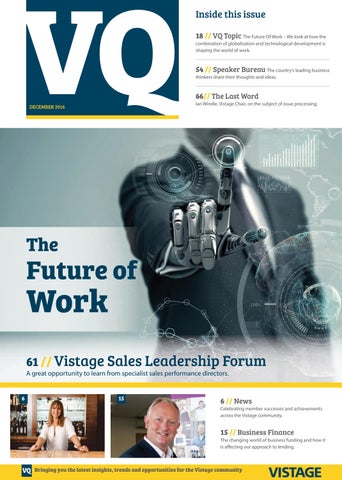
18 // VQ Topic The Future Of Work – We look at how the combination of globalisation and technological development is shaping the world of work.

.........................................................................................................

54 // Speaker Bureau The country’s leading business thinkers share their thoughts and ideas.

.........................................................................................................

66// The Last Word

Ian Windle, Vistage Chair, on the subject of issue processing.

The Future of Work

61 // Vistage Sales Leadership Forum

A great opportunity to learn from specialist sales performance directors.

6 // News

Celebrating member successes and achievements across the Vistage community.

15 // Business Finance

The changing world of business funding and how it is a ecting our approach to lending.

December 2016

VISTAGE TEAM

Steve Gilroy

CEO steve.gilroy@vistage.co.uk

Geo Lawrence

Marketing Director geo .lawrence@vistage.co.uk

Sam Oddie

Speaker Bureau & Events Director sam.oddie@vistage.co.uk

PUBLISHING TEAM

EDITOR

Colin Bradbury

PRODUCTION EDITOR

Hannah Tapping hannah.tapping@enginehousemedia.co.uk

DESIGN DIRECTOR

Jamie Crocker

PUBLISHER

Andrew Forster andy.forster@enginehousemedia.co.uk 07711 160590

From Vistage W

ithin the Vistage community, we have an advantage over many business leaders in that we are constantly learning new skills from an amazing collection of Chairs, speakers, fellow members and Vistage staff. As the world continues to change at pace, and puts fresh opportunities and challenges in front of us, there are times when we need to take specific notice of how things are changing, and reflect on how the changes might affect the very nature of what we do. Brexit aside, there are fundamental forces and trends in play that will radically change the environment that we work in; our ‘field of play’, the ‘rules of the game’, our teams, our goals – everything may change.

So this VQ is rather special. We take a look at The Future of Work and three key drivers that will affect the years ahead. Whatever your industry sector is, your size of business, your goals – I challenge you to not only read this content, but to work with your fellow members, your Chair and your colleagues to consider the potential effects on your organisation. Welcome to the future.

Your new look VQ magazine is published on behalf of Vistage by:

From the Editor

Red Flag Media is part of:

www.levenmediagroup.co.uk

Copyright © 2016 Vistage International (UK) Ltd.

All rights reserved.

Vistage provides the information contained in this document to stimulate thought and discussion. We work hard to ensure that the information presented is accurate at the time of publishing, but you should take independent advice before acting on any information presented. No part of this document can be reproduced in any form without the written permission of Vistage International (UK) Ltd. All material is acted upon at the reader’s risk and, whilst every care is taken, Vistage and the publisher will not accept liability for loss or damage.

I’m delighted to introduce the third issue of the new look VQ. This quarter’s VQ Topic – The Future of Work – is fundamental for businesses large and small across every industry. And the Book Reviews section gives some pointers to publications that cover aspects of the topic in more detail. The Vistage Referral Programme is a way to bring new members into your group and with them, the skills, knowledge and experience that will enrich your meetings. We look at how it works. Elsewhere, Vistage Chair and Speaker, Kate Marshall looks at the value and impact of 1-1 Coaching Sessions and suggests how members can get the most out of them.

In Speaker Bureau, Susan Hallam offers some advice on succeeding in the new mobile centric world, Lars Tewes challenges you to consider whether your company needs a Chief Sales Officer while Glen Daley and Carole Spiers take a look at different aspects of leadership. Finally, in The Last Word, Chair Ian Windle gives his perspective on the Vistage ‘secret sauce’, Issue Processing within groups. All this, and more, means there is plenty to chew on! I hope you are enjoying the depth and variety of the new VQ and look forward to bringing more quality content in the future.

Colin Bradbury is a business writer with more than 20 years’ experience as a financial analyst at global investment banks in Hong Kong and London. He has also set up and run his own businesses.

Colin Bradbury
Steve Gilroy – CEO Vistage UK
Vistage is...
“My route to strategic clarity and focus”

VQ News

LOVE DRINKS’ KIRSTY LOVEDAY AWARDED QUEEN’S MEDAL

Entrepreneurial businesswoman and Vistage member

Kirsty Loveday (V39) has been recognised in the Queen’s Birthday Honours for her innovative, high impact work in Services to the Drinks Industry.

Kirsty who set up Love Drinks, a fully independent sales and distribution agency in 2007, has seen the business develop year on year achieving a turnover circa £6m accompanied by exponential profit growth, has been awarded the impressive British Empire Medal placing her amongst the elite of the industry in recognition of their contribution to the sector.

■ DOUBLE WHAMMY FOR MIDLANDS PROFESSIONAL

SERVICES ADVISER

Congratulations to Chris Taylor (V1) of Smith Cooper who has been shortlisted for two upcoming honours in the Midlands Dealmakers Awards and the Birmingham Post Awards, for their presence in the market and demonstrating quality.

Their recent run of success has been put down to offering clients a full service business advisory service, which has also resulted in double digit growth over the last three years.

■ TWO SCOTTISH COMPANIES FEATURED IN THE SUNDAY TIMES TOP EMPLOYER LIST

Search Consultancy (Simone Lockhart) and Buzzworks (Kenny Blair), both members of V40, are the only Scottish registered companies to be featured in the Sunday Times Top Employer list.

■ NO LION AROUND FOR LONGLEAT ENCLOSURE REFURB

Fencing specialists, Zaun Ltd, MD Alastair Henman (V1), and Binns Fencing Ltd designed, manufactured and installed the perimeter fencing around the new lion enclosure at Longleat Safari Park, Warminster.

Featured on Animal Park, BBC, the project was part of a £1.5m upgrade to the lion paddock and enclosures – meaning that the 28 strong ‘super pride’ can now choose whether they want to sleep indoors or outside.

■ TOP AWARD FOR YOUNG FIRM

The title of European Tax Innovator of the Year was won at this year’s highly-regarded European Tax Awards of International Tax Review by Innovate Tax, the company set up by CEO Andrew Bohnet (V329) in 2012, to provide the most complete end-to-end indirect tax solution on any Oracle platform. ‘It is a huge achievement for Innovate Tax to gain this important award,’ says Bohnet. ‘We are a small but growing company and it shows that we are making a measurable difference in terms of tax innovation.’

The awards are designed to recognise excellence in tax practice. Innovate Tax, which specialises in Oracle ERP platforms from R12 eBTax to Fusion (Oracle Cloud), has developed eBTax Rapid Install®, an automated system it calls a route to ‘100% indirect tax compliance.’

Submit your stories

We love to hear your good news stories, we love to shout about our member successes even more! If you’ve recently won an award, been recognised within your sector or community, or even achieved something special, let us know. You can submit your stories via vistage.co.uk/success or email lee.bradshaw@vistage.co.uk.

Meet Our Members

Lyndon Ward

Managing Director

Forward Waste Management

I’VE GOT THE BUSINESS THAT I’VE ALWAYS WANTED. IT’S ALL VERY WELL HAVING AN ASPIRATION BUT VISTAGE HAS GIVEN ME THE ROADMAP TO SUCCESS. WE WON’T BE SUCCESSFUL BY ACCIDENTWE’RE BECOMING SUCCESSFUL BY DESIGN

Lyndon Ward doesn’t pull any punches when describing the importance of Vistage to his business since he joined V51 in South Wales in 2009. Having set up Forward Waste Management in 2007, Lyndon’s new business ran headlong into the Global Financial Crisis.

“Quite simply, joining Vistage saved my bacon. Without it I can honestly say there’s no way the business would be in the shape it is now and it’s questionable whether I’d still be doing this at all.”

Lyndon came to Vistage after recognising that his skills didn’t match his ambitions. “I had a vision for what the company could be but didn’t have the tools to get there.”The introduction to his new group was something of a baptism of fire. After three months he presented his business plan to the group and “I got a bit of a beating from the V51 team. That’s when I realised I was in the best place because they were prepared to give me a lot of home truths. That was good for me because I realised that the quality of my group members was very high and I was definitely on the bottom rung.”

Support from the group has been constant throughout the last seven years. In the depths of the financial crisis, Lyndon’s business “nearly got wiped out by being too heavily geared. But the group’s

advice and encouragement to keep putting one foot in front of the other and doing the core business stuff has made all the difference. It’s never been anything but absolute encouragement.”

Lyndon has also valued the personal element within the Vistage group. CEOs always have to ‘wear the king’s mask’, maintaining the pretence of always being in control. But within Vistage “You can unwind with a group of like-minded individuals who feel exactly the same as you do. I know more about my Vistage team members than many of their families do in terms of their own personal hopes and fears.”

This has all been reflected in the performance of the business, which has grown at 40% a year since 2013. Turnover, around £6.5m now, should hit £8m by the end of this year compared to about £1.2m when Lyndon joined Vistage.

Lyndon is confident about the future, including any Brexit related downturn. “The business is now in a shape to weather the storm. In some ways I’m looking forward to the next cyclical recession because we have a very good chance of prospering while others in our industry are failing.”

“For me, Vistage has been the MBA that I never took.”

Forward Waste Management

Forward Waste Management are leaders in managing waste specifically within the manufacturing sector.

As experts in waste management, they understand its implications throughout an organisation.

They work in partnership with clients within all manufacturing sectors to prevent waste production, to mitigate and minimise the effect of wastes produced and to reuse and recycle redundant resources across the whole spectrum of waste from recyclables to hazardous materials. Contact

W: www.forwardwastemanagement.co.uk

Diane joined Vistage at a time when Staffordshire Housing Group was growing dramatically and diversifying its services. A colleague who had been a Vistage member for one year discussed the Vistage formula with Diane and she knew right away that it was the professional opportunity she had been looking for, to support her to achieve a new vision.

The Group had just acquired Arch, an accommodation and support services charity, and Diane wanted to harness this growth to transform the business as a whole. “We were looking to merge two companies with different staff structures, different business structures and different governance structures. We wanted to take the best of each and set a new direction for the future.”

Diane worked with her team to wrestle with the logistics of managing a growing company in an environment of austerity and government cuts, focusing less on money and more on being able to help as many people as possible. “The charity world is different but the principles are exactly the same – it’s got to be well run, well managed and deliver really good quality services at the other side.”

Being part of a Vistage group, Diane was able to discuss the growth of the business with other

CEOs and help her team to solve issues differently. “I think Vistage was absolutely right for me and for Staffordshire Housing. We’re a public-private type organisation, and we need to be strongly businessminded to enable us to afford to achieve our social purpose. Working with so many private sector members in Vistage helped give a new angle to how we thought through business decisions and how we continue to develop and transform.”

By integrating two head offices into one and merging central service functions, expenditure was reduced and greater capacity was created. At the same time, new ways of working were brought in and continue to be introduced. Right now, the organisation is on a journey of digital transformation, enabling both staff and customers to channel-shift and increase efficiency through new skills and technology.

“Through the acquisition of Arch we were able to drive many inefficiencies out of the business and turn a deficit into a profit. Four years down the line, we continue to transform our thinking and practises to deliver growth and transformation. I think that this is significantly down to using the brains in Vistage”.

Staffordshire Housing Group

Staffordshire Housing Group was formed in 1984 to provide social housing and related services to local people. With a turnover approaching £20 million and over 300 staff and volunteers, Diane Lea works with commissioners and partners to grow Staffordshire Housing and make a social and environmental difference in Staffordshire.

Diane has great passion for providing outstanding services which can make a real difference to people’s lives. She has an MBA in Housing and is chair of the Stoke-on-Trent Health and Wellbeing Board. Contact W: www.sta shousinggroup.org.uk

WE’VE BEEN ABLE TO DRIVE DEFICIENCIES OUT OF THE BUSINESS WHICH HAS MEANT THAT WE’VE TURNED A DEFICIT INTO A PROFIT. I THINK THAT THIS IS SIGNIFICANTLY DOWN TO USING THE BRAINS IN VISTAGE

REFERRED MEMBERS

JOIN FASTER AND STAY FOR LONGER.

The Vistage Referral Programme

Referrals are the life-blood of any service based organisation and Vistage is no different. Referrals are by far and away the strongest source of new members to Vistage: in any one year, 30-40% of new members come from referrals. Referred members join faster and stay for longer.

Not surprisingly, the majority of new referrals to the Vistage community come from our members, because you know what Vistage is and how it can deliver real impact to a fellow business leader. It’s a source of pride at Vistage that over 92% of UK members would recommend Vistage to other MDs, CEOs, executives or business owners. *

Last financial year more than 70% of Vistage groups made at least one referral and 92 new Vistage members joined as a result. A massive thank you from everyone at Vistage!

■ WHY MAKE REFERRALS?

By making referrals you help build a stronger Vistage community where everybody wins:

l Your own Vistage group will benefit from new members with a diversity of skills, knowledge and experiences, who can contribute to and enrich your group experience.

l The wider Vistage community becomes stronger and so the organisation can invest more as the community grows.

l You have more opportunities to network with members outside of your own Vistage group.

l If you make referrals you can receive referral reward payments of up to £1,000 for every person that joins Vistage – referral reward payments can

be made directly to you, the original referrer, or you can request that the amount is donated to a charity supported by you or your group. You can also opt to use the referral reward towards payment for a Vistage speaker to run a workshop in your organisation or towards your group’s annual retreat. Many Vistage members make a significant contribution towards their own membership fees by making referrals.

■ MAKING A REFERRAL IS SIMPLE

It is important that you log your referral correctly if you want to receive a reward payment. Once you have identified a fellow business leader who you think could benefit from Vistage membership, and you have discussed the benefits of Vistage with them, simply fill in one of the online forms. You can access these either via My Vistage or the public website (www.vistage.co.uk/refer-and-nominate); it’s the same form in either case. If you want to give us some specific instructions, add these in the ‘Additional Comments’ box. You can use this to suggest a specific Chair/group for your referral, or to tell us more about the individual you are referring.

* 2015 anonymous survey based on members who scored at least 7 or more out of 10 on likelihood to recommend Vistage; 62% scored 9 or more)

Alternatively, you can simply pass the relevant details of your referral to your Vistage Chair and they will log the referral for you.

Within the mailing pack of this edition of VQ you will find your new Vistage Ambassador Card. This is designed to help you when discussing Vistage with a fellow business leader and embraces NFC technology (Near Field Communication - the same as contactless payment cards). Full instructions on how to use this are included in the special insert.

There are a few checks that Head Office will make once you have submitted a referral but be assured that your nominees’ data isn’t shared, it’s securely stored and not passed onto third parties. Confidentiality is at the very heart of what we do. Please note, if you bring a guest along to a VOD they will only be treated as a referral if they have been correctly logged using the process above prior to the event.

■ PASSING ON THE GIFT OF VISTAGE

The Gift of Vistage is an exclusive offer to pass on to a potential member when referring them to Vistage - it enables them to claim their first month’s membership free. Gift of Vistage cards, along with Vistage z-cards, are issued to Chairs to pass on to their members. If you would like some more Gift of Vistage collateral to pass on to people you refer to Vistage please speak to your Chair.

■ CHALLENGE YOUR VISTAGE GROUP

A strong referral from an existing member helps to convince someone that investment in Vistage is a wise choice. If you haven’t yet discussed referrals with your fellow members why not bring it up at your next group meeting? Set yourself a target: if you agree to support a charity creating a pro-active referral culture in your Vistage group it can benefit the whole community.

Vistage Coaching

The Value and Impact of One-to-one

sessions

Coaching is recognised today as one of the most powerful vehicles for personal development. The higher people fly in an organisation, the more essential it is to have an ‘Objective Outsider” a good “sounding board” offering a non-biased, global and expansive view. Coaching develops the four essential elements of growth: generating clarity of thought, enabling discipline and focus, challenge of thought/beliefs/ assumptions and robust accountability.

I fundamentally believe that for the majority of the decisions we face, we intuitively know the right course to take, the right way to lead ourselves, teams and the business. Great One-to-one Coaching works from that foundation to create exquisite levels of awareness and confidence to make right decisions. Coaching aims to draw out more of what is already known and align thinking and behaviour in a way that is consistent with achievement!

Coaching often gets labelled as “Soft Skills” – Let me assure you there is nothing soft about Coaching. It involves challenging and supporting to achieve results and sustain new behaviours. Ultimately, the aim is to create more choices, make better decisions and deliver better results for you personally and for your business. This is why Coaching is an integral part of the Vistage offering.

Coaching enables an individual to approach problems with new thinking, discover new opportunity and find solutions through fresh perspective. By drawing on past experience, identifying and removing blockages and learning new skills and techniques, coaching increases both the competence and confidence of a leader. The

Vistage Chair also offers wisdom and advice gained from years of experience and at times, that is exactly what’s needed, but that kind of directive intervention will only be offered after we have explored what the leader already knows.

■ HOW TO PREPARE FOR YOUR ONE-TO-ONE

Make sure the dates are in your diary and ring fenced as non negotiable. Unless it’s a crisis hold that space! Good preparation is essential. (And If you have been in a coaching reIationship for some time, I suggest doing an annual stock take of your coaching sessions) Ask yourself questions like:

l What does successful coaching relationship look like for me? Is this working?

l What goals do I wish to achieve/am I achieving through Coaching?

l Where am I stuck or not making the progress the way I want or need to?

l What areas would be most helpful for me to discuss with my Chair? (Obviously business performance is one area, but also think about your relationships in the business, future business growth, and help to fulfil your personal goals in the longer term as well as your impact as a leader)

l What am I tolerating/procrastinating on or simply not getting quality time to think about?

l What are the opportunities ahead of me that need more thought or focus?

l What do I need to change or let go of in order to add more value to my business?

■ HOW TO LEVERAGE

At your first session discuss your objectives with your Chair agreeing high-level personal and business objectives. Set check in mechanisms to ensure progress is as desired. Make the most of the session by creating the right time and space, do not allow interruptions either physical or mental. Clear your desk, turn your phone off, even better – have the meeting off site where there will be less chance of interruptions. Give yourself the best chance to be there in body and in mind! Make time to think. Walking into a coaching session from back to back meetings with no space for thinking will seldom produce a great result. Write down things that are top of your mind and then prioritise. Thinking is often seen as not working – IT IS!! Henry Ford once said “thinking is the hardest thing of all, that’s why so few choose to do it.”

I suggest keeping a note through the month of ideas/questions/topics for discussion with your Chair. If you don’t do this your session tends to get hijacked by the most pressing or urgent issue instead of the most important issue. I start my coaching sessions by asking my member, “What’s the most important thing you and I should be discussing today?”

■ SITUATIONS WHERE COACHING CAN HELP

Every member and each organisational culture is unique, so the goals in One-to-one Coaching vary widely. However, some common themes for coaching include:

l Transition to new role/creating an exit strategy or succession plan

l Refocusing on strategic growth

l Working on the business instead of in the business

l Increasing impact and contribution

l Leadership/Developing your team/ people issues

l New opportunity

l A personal issue that needs attention.

■ WHY MEMBERS SHOULD VALUE THE ONE-TO-ONE MODEL

Statistically, the more senior the role in an organisation, (especially CEO/Owner) the less likely you are to have someone who will give you candid, robust feedback or challenge your thinking. Unlike others around you, your Chair has no agenda or bias other than to see you and your business succeed. I’ve been a leadership coach for over 20 years and it is a

tremendous privilege to journey with people to their inner world and watch them discover new horizons, new thinking and fresh energy to Lead. Being a leader will ask all of you and more. Your Chair is an amazing resource who will help you rediscover your internal wisdom, be a safe haven, a mentor and a source of support and understanding. In my time as a Chair I have seen amazing results with members because their commitment to Coaching enables them to think out loud, be vulnerable, be encouraged, be challenged, be inspired and build confidence to be the best version of themselves. Quite simply, Coaching increases your ability to lead and live well.

A good coaching relationship delivers results that have high impact. However, It only works when both parties are willing and able to trust the process and each other. Confidentiality between Chair and member is paramount for building trust and for success of the coaching relationship. Two further factors are important to ensure success:

Implementing – you’ve got to do stuff and follow through! A Chair’s role is to help you close the gap between knowing and doing. You need to make time to do the things you agree will help you and your business grow. Accountability is paramount in a Coaching relationship, otherwise why bother?

Commitment to sustain your focus – create a sustainable way of working and being that develops the behaviour and activity that enables clear focus on the right things to deliver success. Working regularly with your Chair will help you to keep your focus on what matters most for you and your business.

Remember - Your Chair is not there to provide the answers! They are there to help you think better, make better decisions, to hold a mirror to you as a leader, to help you grow and get better results and to bring out your brilliance – not theirs.

MAKE TIME TO THINK. WALKING INTO A COACHING SESSION FROM BACK TO BACK MEETINGS WITH NO SPACE FOR THINKING WILL SELDOM PRODUCE A GREAT RESULT.

Kate is a Vistage Chair and award winning speaker, experienced CEO coach and facilitator with over 24 years of working at executive level in a variety of industries and organisations globally. Along side Vistage, Kate founded Kate Marshall Ltd to offer a fresh approach to working with executives, boards and leadership teams globally. In 2015 she extended her business to became a founding Director of Core Leadership, offering Leadership and Talent Development along with Executive Coaching to a wider client base. Her passion is to help others achieve extraordinary results through developing robust and sustainable leadership capabilities from top down.

Contact

W: www.kate.marshall@vistage.co.uk

Looking to scale new heights?

Group Chair and Executive Coach

• Challenge - Could you bring together a group of business leaders and inspire them to even greater growth?

• Contribution - Do you want to see other business leaders improve their businesses and their lives?

• Learning - Are you looking to further develop skills including facilitation and coaching and be part of a world class learning environment?

• Earning - Are you looking to build a great income?

If you’ve been a senior director or business owner and have the drive and passion to inspire others to even greater success then the role of Vistage Group Chair could be for you. Since 1957, Vistage has been bringing together successful CEOs, executives and business owners into private peer advisory groups. From the beginning, Chairs have been at the heart of what makes the Vistage experience so powerful for so many members.

Find out more about our community and the role of a Vistage Group Chair visit www.vistage.co.uk/chair/

Peer to Peer is the Future of Business Finance

Imagine a world where businesses no longer depend on banks.

In business, sometimes you need more than a crystal ball to accurately predict future outcomes. However, when it comes to business finance, we have already seen more than just a glimpse of what the future holds.

Wrapped up under the ‘AltFi’ (Alternative Finance) banner, peer-to-peer (P2P) finance has gone from humble beginnings to one of the most viable options British small and medium sized businesses (SME’s) have to finance their organisations.

While P2P is a relatively new concept in the field of lending and borrowing, because of its relatively quick decision process and flexibility for business borrowers, it has become a preferred way to borrow money for many companies. In fact, the P2P industry has now provided UK businesses with more than £4 billion in funding since its inception just a few years ago.

When a huge finance gap emerged from the credit crunch, traditional lenders were often unable to provide businesses with the required funding. Those of you who follow Vistage speaker Roger Martin-Fagg will probably know that this is due to the funding structure of banks making it relatively expensive for them to lend to SME’s versus say home mortgages with this situation continuing today. This left many organisations at risk of either stagnation or a battle for survival. However, out of the ashes of the creditcrisis, P2P lending emerged.

There are many advantages to obtaining funding through a P2P lender, and without doubt the speed of the application can be one of them. Leading business P2P funding platforms, such as Assetz Capital, don’t match loans to rigid profiles, but instead take their time to understand the business and its future income generation opportunities helping

create a workable and affordable loan solution to any good business.

The flexibility of lending is also important, and by offering interest-only periods, partial amortisation only over loan term (bullet), ad hoc facility repayments and early repayment (usually without Early Redemption Charges), these options are all structured to meet specific needs of a business. Over 95% of Assetz Capital’s loans are not standard amortising loans.

P2P also brings transparency to new levels – a stark contrast to traditional banking. Stuart Law, founder and CEO of Assetz Capital explains, “All fees and costs are very clearly outlined in our ‘Decision in Principle’ letter and Offer Letter, and we work very hard to be transparent across all of our processes.”

Law also explains how P2P has been instrumental in helping a wide variety of businesses. “We have huge amounts of capital available from private and institutional investors who are keen to lend to good businesses whether it’s a £100k or a £7m loan required. We lend to both young and well established businesses and also sometimes those that have been in difficulty in the past as we understand the whole lifecycle of a business. Over 10% of our loans were made to businesses under three years old, or those that had some form of past adverse information. We also appreciate that there are many highly credit worthy businesses out there that still find it difficult to obtain the right funding when they actually need it. In many cases respectable and stable businesses looking for funding are turned away simply because of the sector they operate in. At Assetz Capital, we assess each application for a loan based on its individual merits – there’s absolutely no sector bias and it is based upon hundreds of man years of active lending and credit experience in the team.”

IT’S LIKE BANKING AS IT USED TO BE BEFORE SALES OF CREDIT CARDS AND THE LIKE GOT IN THE WAY, WITH HIGHLY EXPERIENCED BUSINESS BANK MANAGERS ABLE TO WORK FACE TO FACE WITH A BORROWER ON THEIR FUNDING REQUIREMENT AND A CUSTOM SOLUTION PROPOSED. A BREATH OF FRESH AIR.

Contact

Stuart Law is the founder and owner of Assetz, one of the largest and most successful property investment agencies for the private investor community, based in the UK W: www. assetzcapital.co.uk

Profile
Stuart Law

Alison Loveday is a partner and Chief Executive at nationally recognised law

firm berg, SHE has been instrumental in setting up the firm’s employment department and has been at the forefront of berg’s drive to recover compensation for SMEs and independent businesses affected by financial litigation issues.

All Change

Alison Loveday (V10) explores the funding landscape and the challenges facing businesses today.

Access to finance remains one of the most pressing challenges facing businesses today. Britain slipped down the world competitiveness league last year to tenth, with The World Economic Forum ‘think tank’ citing the difficulty in businesses obtaining funding as one of the key reasons.

In the traditional model, business owners relied on bank lending to grow their businesses. With the financial crisis in the global market there has been significant change. Suddenly, businesses found that the long-standing relationships they thought they had with their bank, counted for little. Furthermore, they found that facilities that had been put in place and products that had been sold to them, apparently to help them, were “millstones around their neck” - designed to maximise the bank’s profitability, frequently at significant cost to the business.

■ WHY DID THIS HAPPEN?

Research by the University of Leicester and Newcastle University Business School conducted in 2012 concluded that a style of leadership based on threatening employees with redundancy and forcing them to meet aggressive sales targets, was to blame. They described this behaviour as ‘economic violence’.

This is not something consigned to the past but is very current. The recent Wells Fargo scandal involving the creation of thousands of unauthorised accounts appears to have been caused by exactly this type of behaviour. The reputations of our high street banks have been significantly damaged with wideranging claims including the mis-selling of interest rate hedging products, Forex, Libor, fixed-rate loans and the activities of specialised lending divisions such as the Global Restructuring Group.

This has had a significant impact on the economy as many business owners are stuck in a banking relationship that isn’t working for them any longer. Set this against a backdrop of economic uncertainty and we have an economy where SME’s appetite for

external finance showed a marked decline in the second quarter of this year according to data from BDRC (quarterly bank funded research). Almost half of businesses described themselves as “permanent nonborrowers”, with many SMEs reporting a preference to self-fund, through retained profits, credit balances or trade credit.

This is unsatisfactory for all concerned. It is important for the prospects of the UK economy as a whole that we unlock the cycle, as if we do not, viable businesses with the potential for growth will fail to do so.

■ WHAT HAVE WE LEARNT FROM THIS?

l Many business owners enter into financial arrangements without really understanding what they have agreed.

l Business owners didn’t question the bank covenants and why they were being sought - for example loan to value covenants, profitability targets, EBITDA ratios.

l They didn’t consider that changes in the property market might make a seemingly benign covenant suddenly very difficult to achieve. This is particularly relevant in a relatively volatile property market.

l Business owners often don’t understand that the bank has reserved to itself the right to assign the loan to a third party, meaning their loan could be transferred without their knowledge or permission to an American vulture fund - such as Cerberus.

l Many business owners, particularly entrepreneurs, consider the business to be an extension of themselves. As such, they assume that the protection they have as individuals extends to their business banking. It does not.

l The systems applicable to consumer banking and commercial banking are fundamentally different. Consumer banking is governed by a plethora of rules, notably the Consumer Credit Act 1974. Commercial banking in contrast, is subject to

Alison Loveday

relatively limited statutory control and regulatory intervention.

l Personal guarantees - many business owners gave unlimited personal guarantees, without any real expectation of the guarantees being called in. We have seen many cases where the bank has taken steps to enforce a personal guarantee by forcing the business owner to sell assets, including the family home and/or made them personally bankrupt. Consequences can therefore be wideranging, but are not typically considered at the time a Personal Guarantee is sought or given.

■ WHAT DOES THE FUTURE HOLD?

What is clear, is that for the foreseeable future, banks are not going to go back to funding SMEs to the extent that they did in the past. It is not economic for them to do so, given the significant capital they need to hold to satisfy the new risk weighting and capital requirement rules.

The combination of a lack of lending and an unwillingness to lend from traditional sources has brought about a paradigm shift in how small and medium-sized businesses access funding to grow.

To address the situation, the UK market is now changing to meet the demands of business lending, with new challenger banks and the emergence of alternative finance options such as crowd funding, peer-to-peer lending, virtual currencies and invoice trading. The alternative finance models are growing quickly and predictions are that the market will have grown to 20 billion by 2020.

It is important to note that whilst the new opportunities are a welcome “disruption”, we must be mindful that the problems caused through previous and existing banking models are not repeated.

■ ALTERNATIVE FINANCE

Former financial services authority chairman Adair Turner grabbed headlines earlier this year when he took a swipe at the peer-to-peer lending industry stating that “the losses which will emerge from peer-to-peer lending over the next 5 to 10 years will make the bankers look like lending geniuses”. More specifically, he expressed his concern at the credit checking peer-to-peer and debt base crowd funding platforms perform.

Concerns have also been expressed following the high profile failure of certain ventures. In February this year the claims management business, Rebus, went into administration, in one of the largest failures of a crowd funded company in the UK.

■ IMPACT ON BUSINESS OWNERS

There are therefore significant issues for investors but what of the business owner? It is clear that going forward many businesses will be able to grow if they can understand the opportunities offered to them by the alternative finance market. It is likely that business owners will have a portfolio of lending, ranging from traditional bank lending, asset-based finance, alternative finance and also lending against new asset classes – such as intellectual property, something which previously would have been regarded as far too intangible.

It is important that business owners “proceed with caution”. We have seen a number of business owners who have been turned down by traditional lenders, but who have then been offered a loan through one of the crowd funding platforms. This type of lending typically requires a personal guarantee and if the business fails, then all of the issues outlined above come into play. The crowd funder typically has no relationship with the business owner and enforcement action is swiftly taken.

The pace of change is rapid and the financial markets and regulator cannot afford to be left behind. Technology is a driver and a disruptor. There appears to be a reluctance to introduce regulation and a preference to wait and see if the market can “selfregulate”. This may, however, come at a significant cost to the business owners and investors.

The important consideration in my view is transparency and business owners should only ever enter into any funding relationship with their “eyes open”, whether that be traditional bank lending or alternative finance. We need growing entrepreneurial businesses to drive the economy forward and if business owners are to move away from self-funding, and see this opportunity to realise their potential, then they will need support in exploring all of the new and emerging funding options available to them. If they do, the potential prize is rich. In this year’s Tech Track 100, on average the companies achieved 88% sales growth a year, over three years, to a combined total of £2.2 billion. They employ 11,000 staff, having added 8,200 employees to their combined workforce over this period. Nearly a third of the companies in the league table were founded by serial entrepreneurs, and there is a keen interest in the alternative finance space in the tech sector. Maybe the speed of growth and the access to finance are linked? Time will tell.

The Future of Work

The Future of Work Introduction

There are few clichés quite so well worn as the one that says the world is changing faster than ever before. But the fact that it is a cliché doesn’t make it any less true. In fact, the changes we are experiencing now really are exponential. The combination of globalisation and the dizzying rate of technological development means that we are on the brink of nothing less than a fourth Industrial Revolution.

It’s not difficult to see that these enormous global shifts will have significant implications for businesses of all sizes in every country of the world. They are challenging established business models and will change the way companies do business in the most fundamental ways. That includes the nature of work itself. But the perception of work and how it is carried out seems to be stuck firmly in the 20th century mould that believes that:

l ‘Work’ is a physical place that employees go to for a set number of hours and days per week, allowing management to monitor and control the workforce.

l Young adults leave education, join a company and progress by climbing the corporate ladder, only leaving if another employer offers more money or perhaps an opportunity to get up that ladder more quickly.

l People have one job at a time and only a limited number during their working lives.

l Employees are trained on the job in a specific way to carry out their work functions.

All of these old certainties are now being swept away. The future of work is one that embraces the idea that employees will demand greatly increased

flexibility, where new skills are learned in new ways and where the career structures that have served business for so long will no longer satisfy the Millennial workforce.

Above all, the notion of a job-for-life has already died. The idea of secure employment, that if you are loyal to a company they will be loyal to you, has gone. That’s partly down to the speed of change, the globalisation that has decimated so many traditional industries and throwing workers who thought they would be with a company for life, out onto the streets.

As Robin Chase, co-founder of vehicle-hire platform, Zipcar said:

“The number of people doing multiple jobs at once will explode. My father had one job in his lifetime, I will have six jobs in my lifetime, and my children will have six jobs at the same time.”

Profile – Robin Chase

Robin Chase is a transportation entrepreneur. She is co-founder and former CEO of Zipcar, the largest car sharing company in the world. She is also author of the newly released book Peers Inc: How People and Platforms are Inventing the Collaborative Economy and Reinventing Capitalism. Robin lectures widely and has received many awards in the areas of innovation, design and environment. W: www.robinchase.org www.zipcar.co.uk

The report is divided into two sections: Challenges and Responses

In the first, we look at three factors that are changing the very nature of work itself. These are:

l Globalisation and the Fourth Industrial Revolution

l Demographics: The rise of the Millennials

l Technology

In the second, we look at some of the ways in which companies need to respond, under the following headings:

l The Flexible Workforce

l Rethinking the Corporate Structure

l The New Learning Environment

Underpinning all this is the notion that companies have to be more nimble and agile than ever before. Paul Allsopp of The Agile Organisation put it very succinctly:

“Unpredictable change is the defining characteristic of the current decade. Organisations that simply cut costs or make minor adjustments to static business models may well be able to realise short-term gains to sustain and survive. But in the current dynamic world the only certainty is change, where status quo is not an option. The future is a place where only the agile will survive and thrive.”

Profile – Paul Allsopp

Paul Allsopp is MD at the Agile Organisation, a niche consultancy dedicated to agility in work and place, focusing on people, occupation, workstyles and use of space as a catalyst for culture change, business value and cost transformation. He has considerable practical experience in property rationalisation, workplace change project and programme delivery.

Contact

W: www.agile.org.uk

THE NUMBER OF PEOPLE DOING MULTIPLE JOBS AT ONCE WILL EXPLODE. MY FATHER HAD ONE JOB IN HIS LIFETIME, I WILL HAVE SIX JOBS IN MY LIFETIME, AND MY CHILDREN WILL HAVE SIX JOBS AT THE SAME TIME

Robin Chase cofounder of vehicle-hire platform Zipcar

Driver 1: Globalisation

Globalisation and the Fourth

Industrial Revolution

Work in the future will look very different to work in the past. This shift has myriad drivers, but we can’t understand them without looking at the broader context in which businesses operate.

Recent events have started to shift the ground under the feet of businesses. The Global Financial Crisis of 2008-09 saw long-established companies going to the wall (Northern Rock, Lehman Brothers) and the economies of whole countries staring into the abyss (Greece, Ireland, Iceland). Meanwhile, commodity prices and currency values have seen unprecedented volatility. And this year, of course, more than 43 years after joining what was then the EEC, the Brexit vote has pitched British businesses into a new world of uncertainty.

But it’s worth taking a step back and thinking even longer term. Ask a businessman to name a single factor that has changed the playing field in the late 20th and early 21st centuries and ‘globalisation’ would very likely be the most popular choice. That we live in a time when the world is more interconnected than ever is undeniable. Massively increased volumes of international trade and cultural exchange mean that goods, services and ideas flow across borders like never before. Companies are increasingly global rather than national in scale and events in one part of the world affect businesses thousands of miles away.

In an environment where competition can come from anywhere and the market for a product or service can change almost overnight, businesses have to be more adaptable, nimble and responsive

than ever. Amongst many other things, that changes the types of workers a business requires and the way in which they are organised.

■ THE FOURTH INDUSTRIAL REVOLUTION

Alongside globalisation, technological developments have been taking place which herald a seismic shift so significant that many are calling it the next Industrial Revolution.

There have been three Industrial Revolutions so far:

l 1st Industrial Revolution: Started in 1760, was based on the evolution of steam power. This allowed the mechanisation of tasks traditionally carried out by hand – textile manufacturing for example – and brought workers out of the home and into large factories.

l 2nd Industrial Revolution: Started around the end of the 19th century. Based on the transition from steam to electric power and the rise of mass production. Henry Ford’s automobile assembly line is the classic image of this revolution.

l 3rd Industrial Revolution: Started around 1970 with the use of electronics and Information Technology to automate production.

l 4th Industrial Revolution: We now stand on the brink of the next revolution that, according to the World Economic Forum, “is characterized by a fusion of technologies that is blurring the lines between the physical, digital, and biological spheres.”

Juergen Brixel of Salesforce describes the process as follows:

“The premise is to take all the individual processes and computing that factory machines perform in their siloed systems and import them into the cloud, meaning the workflow, upkeep, and management of each individual machine and series of machines can be done remotely.”

The future, then, will be about ‘smart factories’ that are able to self-manage issues and internal processes, replacing current production processes that are centralised, offline and not interconnected. This Fourth Industrial Revolution will mainly be driven by advances in cloud computing and the development of the Internet of Things (IoT). The former will store the data and processes while the IoT – essentially physical objects with embedded software – will allow machines to self-diagnose and make decisions autonomously.

The process will also rest on other technological breakthroughs in fields such as artificial intelligence (AI), robotics, 3-D printing, biotechnology, nanotechnology and quantum computing. And underpinning all this are the possibilities thrown up by the fact that the billions of people across the globe are connected by mobile devices with processing power undreamt of even one or two decades ago.

Klaus Schwab, Founder and Executive Chairman of the World Economic Forum, summed up the transition from the third to the fourth industrial revolutions thus:

“Overall, the inexorable shift from simple digitization (the Third Industrial Revolution) to innovation based on combinations of technologies (the Fourth Industrial Revolution) is forcing companies to re-examine the way they do business.” In simple terms, manufacturing is going digital. The implications for business are huge, but it’s worth looking at one example to get a sense of how significant these developments could be.

In the past, the need to re-tool a production line, making new dies or moulds to accommodate a change in the design of a product, made customisation difficult and expensive. Now, advances in 3-D printing technology make it possible to manufacture customised products without the need to invest hundreds of thousands of pounds in machinery and tooling. Where economies of scale were the driver in the past, in theory it’s now just as easy to produce a one-off version of a product as to produce a thousand identical items.

This technology will destroy barriers to entry in many industries. Where a company would previously have needed a production line, an individual with a 3-D printer can download the designs for a product and make it in their bedroom.

■ INDUSTRY 4.0 RULES OF THE GAME

So, good news for customers and, potentially for businesses. But only if they recognise how the rules of the game have changed and react accordingly. And what are those new rules? Well the main ones are:

1. Companies with inflexible structures will struggle to compete

Globalisation and the advent of Industry 4.0 means greater competition and a growing demand for individualised products. The explosion of innovative business technologies enables new companies to be set up more quickly than ever before. These new competitors aren’t burdened by the cost of historic organisational structures or legacy office, IT and other infrastructure. That makes adaptability, flexibility and responsiveness essential; companies that demonstrate those characteristics will wither and die.

2. Location is becoming less important

In the decades since the end of the Second World War, the UK, along with most other developed countries, has been transformed from a manufacturing to a service based economy. Back in the manufacturing days, companies needed large industrial complexes to house machinery and production lines, making it essential for workers to congregate there on a fixed schedule to carry out their tasks. The advent of the service economy, accompanied by an exponential development of information technology and of transport infrastructure has made location and routine much less important.

3. Thriving in the Fourth Industrial Revolution requires different skills

In a manufacturing economy, access to raw materials and proximity to customers, economies of scale and a workforce with traditional manual skills were the keys to success. In a service economy knowledge, relationships, flexibility and, of course, service are the prized attributes. And they will become even more important as the Fourth Industrial Revolution gathers pace.

Juergen Brixel

Juergen Brixel is Senior Director, EMEA Manufacturing Industry, Salesforce. He is a cloud computing expert with 15 years professional expertise in various industries (Hi-Tech, Telco, Management / ITConsulting, CPG). He is currently the Industry 4.0 and IoT Lead enabling Salesforce customers to monetise on IoT/ Big Data Investments.

W: www.salesforce.com

Klaus Schwab

Professor Klaus Schwab is Founder and Executive Chairman of the World Economic Forum, the International Organization for PublicPrivate Cooperation. He founded the Forum in 1971, and has championed the multistakeholder concept since the Forum’s inception, and it has become the world’s foremost platform for public and private cooperation.

W: www.weforum.org

Driver 2: Demographics

Finding the right funding source for a growing SME is an increasingly complex exercise. But some of the core principles remain the same, regardless of the funding channel chosen.

The advent of Industry 4.0 is colliding with two important changes in the UK demographic structure.

First, the growing proportion of the workforce accounted for by people born between 1980 and 2000, known as Generation Y or Millennials, have very different views and expectations of work to their Gen X and Baby Boomer bosses. And close behind Gen Y is Gen Z, consisting of those born since 2000. That generation, the first true ‘digital natives’, will start to hit the workforce in significant numbers in two or three years time.

Secondly, the tendency for older workers to delay retirement – either completely or partially (working part-time).

GENERATION GAME

The di erent generations by age group: Demographic Born

Baby Boomers 1946 to 1964

Gen X 1964 to 1980

Gen Y / Millennials 1980 to 2000

Gen Z After 2000

There are key differences in experiences, attitudes and expectations between the different generations. And right now, the important distinction is between the Baby Boomers and Gen Xers who dominate corporate management ranks and the 16-36 year-old Millennials who make up the rest of the workforce.

According to the UK Office of National Statistics, there are around 18 million Millennials in the country, a significant proportion of the 31 million people in the UK in employment. So, since everyone under the age of 36 who is now joining your business is a Millennial, understanding how they think and what they demand from their working life is critical.

CHARACTERISTICS OF THE MILLENNIALS

Although attempting to summarise the attitudes of an entire generation risks slipping into gross generalisations, it is possible to identify some broad features that characterise this new generation.

TECHNOLOGY

The first ‘true’ digital natives are Gen Z, but shaped by the technological revolution that defined their youth, Gen Y grew up with technology and also expect to be connected 24 hours a day via mobile devices. They are used to finding information online and communicating with friends and acquaintances via social media.

MOTIVATION

While the need for money remains an inevitable fact of life, Millennials are somewhat less motivated by it than the previous generation. More to the point, they are not prepared to sacrifice everything else in its pursuit. Gustavo Grodnitzky, author of ‘Culture Trumps Everything’, sums it up well when he says that for Gen Y, “money is a threshold, not a scorecard”.

■ WORK-LIFE BALANCE

Since money is not the be-all and end-all, Millennials care more about the work-life balance (partly as a result of growing up watching their parents doing stressful corporate jobs). In a hyper-connected social environment, they care deeply about relationships with friends and will not sacrifice those for the sake of their work.

■ EXPERIENCE

They care about experiences more than ‘stuff’. To put it another way, experience trumps ownership. Millennials would rather spend their money on restaurant meals with friends than save up to buy the

latest model car. They are happy to rent a home rather than scrimping to put together a deposit to buy their own property. This makes them very different animals to Baby Boomers and to most Gen Xers.

■ CAUSE

Millennials care about and are motivated by cause. They want to know why companies are doing the things they do, what they are contributing to society and whether the products they make and the manner in which they make them have a negative impact on the environment. In a nutshell, they want to know how the companies they work for are changing the world for the better.

■ CHARACTERISTICS OF THE GENERATIONS

Veterans / Traditionalists

70 year olds – 80+

Want opinions and ideas to be valued. Want to be rewarded for loyalty and experience. Want clarity about roles and responsibilities and authority to make decisions. Need more explicit direction. Will work beyond retirement if they have flexible hours. Desire to coach and advise others.

50 year olds – late 60s

Want to be rewarded for long hours. Want authority to make decisions. Work / life balance is important. Value social responsibility, and personal development opportunities in organisations.

Highest priority on work / life balance. Value flat organisations, matrixed responsibilities, challenging work, responsibility for own personal development, flexible work, collaboration and teamwork. Want authority to make decisions. Loyal to people, not organisations. Most stay at least 5 years with current employer.

Profile – Gustavo Grodnitzky

Dr Gustavo Grodnitzky is a speaker, author, consultant, and psychologist whose diverse background brings a unique and multidimensional perspective to his global clients. After obtaining his Ph.D. in clinical and school psychology, he completed post-docs in both cognitive therapy and forensic psychology. He has worked with Global 1000 companies around the world, as well as with smaller, often family-run, businesses.

Contact

W: www.vistage.co.uk/speakers/dr-gustavo-grodnitzky

Gen Y / Millennials

20 year olds – early 30s

Value empowerment to get things done, challenging work, collaboration, teamwork and fun, responsibility for own personal development. Work / life is blurred. Feel benefits packages don’t meet their needs. Like to participate in and contribute to talent communities. Don’t understand the concept of a career ladder. Most have been with current employer less than 3 years. Want to start their own businesses.

Gen Z / Digital Natives born now –late teens

Value remote work options, personal development, continual feedback, rapid career progression and flexibility. Results driven. Less face-to-face communication, more through social media. Most socially networked in history. Able to instantly access, consume and digest large quantities of information. Expect immediate responses to questions and will go directly to decision makers. Likely to change jobs frequently and be interested in starting their own business.

Baby Boomers
Gen X late 30s – late 40s

IN RESPECT TO WORKLIFE BALANCE ONE THING WAS CLEAR: THE SINGLE MOST IMPORTANT ELEMENT IN RELATION TO WORK-LIFE BALANCE IS THAT [MILLENNIALS] WANT AUTONOMY OVER WHEN AND HOW TO WORK

The London Business School: The Re exive Generation

■ WHAT DO THE CHARACTERISTICS OF MILLENNNIALS MEAN FOR THE FUTURE OF WORK?

They don’t see a job as being for life

Numerous surveys demonstrate the willingness of Gen Y employees to job-hop:

l According to LinkedIn, US graduates who leave college at 21 will have 4 jobs by the time they are 32.

l In 2014 the Chartered Institute of Personnel & Development quoted research by London Business School showing that high potential employees born in the 1980s and 1990s don’t feel bound to a single employer. 37% will stay only 2 years in one company and 40% said they are already planning their next career move when they start a new job.

l The Future Workplace organisation said that 91% of Gen Y will stay in a job for just 2.2 years when an average worker is likely to stay for an average of 4.4 years.

l Culture Amp’s survey of tech companies showed 33% of employees aged from 25-32 were most likely to leave within 6 and 12 months, 31% were likely to leave after 1 to 2 years and 45% were likely to leave after 2 to 4 years.

Since it is still as expensive as ever (in terms of both money and time) to attract and recruit new employees, the willingness of Millennials to jump ship regularly means that companies have to work harder to retain valuable staff members. So they need to really understand, and respond to, what motivates their younger employees.

l They want to be in control of their lives – they value flexibility.

Millennials want more control over when and where they work. They don’t understand why, in an age of portable devices and 24/7 connectivity, work has to be carried out in a set location between set hours. And many of them don’t necessarily want to be tied

to one company, preferring to freelance, focusing on doing the specific part of a job that they enjoy most for several different clients at once. The message to businesses is clear. If you don’t offer the flexibility that Millennials require, they will leave and join a company that does.

l They want to constantly be learning and bettering themselves

Millennials recognise that the world is changing rapidly and that in order to do their job properly and to remain attractive in the employment market, they need to be constantly learning. They will look to their employers to satisfy the hunger for continual personal development.

■ DON’T FORGET THE OTHER WORKERS

It’s easy to get caught up with the challenges posed by the younger generations but Millennials don’t work in isolation. At the other end of the life scale we are seeing older Boomer employees staying in the workplace longer so businesses are having to work out how to meet their expectations in order to benefit from their skills and experience. And in the middle are the late Gen Xers.

It turns out that one thing unites all the generations and that is the desire for flexibility.

l Fathers are increasingly wanting to be more hands-on with their children and therefore seek flexible and part-time employment opportunities.

l Mothers want to be able to re-enter the workforce at the level of commitment and intensity that suits them.

l Having seen their Boomer parents sacrifice all for career advancement, Gen X is increasingly focused on the work/life balance. Again, flexibility is at the top of their list of requirements.

l Older workers are retiring later and want flexibility during those additional work years to work the hours that suit them.

So, unsurprisingly, flexibility in the workplace is a topic that we will be returning to in some depth, as that is undoubtedly one of the defining characteristics of the future of work.

Driver 3: Technology Technology is shaping the future of work in two ways.

First, technology has changed the nature of work, as the factory system declined and gave way to the ‘information age’. That was the essence of the third Industrial Revolution. The next step will be the automation of a range of jobs and workplace functions that will displace another layer of the human workforce. This could be seen as the darker side of the technological revolution (although from another perspective it is freeing human workers from the drudgery of repetitive tasks). It will certainly reshape the company as we know it today since machines will take over the jobs of many workers.

Secondly, technology provides the tools to enable workers to engage with their employers in an entirely different way. This could be seen as the more positive aspect of the technological revolution, releasing workers from the tyranny of the office and the clock, allowing them to work from anywhere and at any time.

■ MACHINES WILL REPLACE HUMANS IN A GROWING RANGE OF EMPLOYMENT FIELDS

We’ve grown used to automation in many areas of life. In the manufacturing sector, whether in car factories or silicon chip plants, robots have been the primary workers for a couple of decades. And in our everyday life, as we self-scan our groceries in the supermarket and draw cash from an ATM, the human element in many financial transactions has been eliminated almost without us noticing.

The robots will continue to make inroads. Any

manual work requiring hand-to-eye coordination and repetitive tasks – think bricklaying for example –could eventually be automated. As the sophistication of robots continues to rise and the cost of building them falls, human workers will be displaced from ever more areas of manual labour.

But replacing human workers in the manufacturing / manual labour sectors and in basic financial transactions is only the tip of the iceberg. Technological developments mean that many white-collar jobs, hitherto the preserve of the human worker, are just as susceptible to automation This next revolution will be driven by the combination of two factors. First, a surge in the availability of data and secondly, the ability of machines to interpret it. This technology has a name: Robotic Process Automation (RPA).

As the article on page 30, from Vistage member Barry Matthews shows, RPA will allow a machine to take over many routine based tasks currently carried out by human operators. Barry outlines the advantages of RPA and gives a glimpse of the range of areas in which these ‘robots’ could do the work more efficiently and in a more cost-effective manner.

Computers are very good at picking up trends and patterns in data and then using it to make predictions. A simple example would be the technology employed by Amazon.com to make recommendations on the basis of previously purchased items both by the purchaser and others like them.

Essentially, the more that data becomes available, the better the conclusions that computers can draw. Give them enough data on consumer credit scores,

for example, and they will spot trends that can be used by financial services organisations for making lending decisions. And the conclusions they draw will be free of the underlying bias that humans often bring to bear.

Combine this data analysis with the growing ability of machines to deal with linguistic concepts and things start to become very interesting. Instead of just manual jobs and the more mundane whitecollar work, suddenly computers are challenging at a much higher level.

Martin Ford, a Silicon Valley software entrepreneur, whose 2015 bestseller The Rise of the Robots looked at the social impact of robots and artificial intelligence, warns that it is “becoming clear that smart software automation applications are rapidly climbing the skills ladder and threatening jobs taken by university graduates”. Here are a few examples:

l Quill, a program developed by US company Narrative Science, analyses data and generates reports in a journalistic style and is capable of writing stories about company financial reports – potentially taking the job of a junior financial journalist or an analyst at an investment bank.

l IBM’s Watson computer is being used to diagnose cancer patients in the US.

l Palo Alto based start-up Ross Intelligence has developed a legal research system that can be queried about case law in the same way that a lawyer would speak to a human colleague. Marketed by Ross Intelligence as ‘Your brand new AI lawyer’, the system is capable of keeping abreast of the avalanche of legal cases to provide feedback on precedent faster than any human researcher could do.

What could this mean for employment in the affected industries? Here’s the view of two experts on the financial and legal sectors:

Profile – Narrative Science

Narrative Science has developed an advanced natural language generation platform; Quill. It transforms data into meaningful and insightful narratives people can simply read, enabling organisations to spend less time crunching numbers and more time providing their employees & customers with actionable information that, ultimately, makes them smarter.

Contact

W: www.narrativescience.com

l Anthony Jenkins, former CEO of the Barclays Group, gave a timely warning in 2015 that there was a very real possibility that 20-50% of jobs in the financial services sector could be lost in the next 10 years. Technology is, he said, an “unstoppable force”.

Profile – Martin Ford

Martin Ford is the founder of a Silicon Valley-based software development firm. He has over 25 years experience in the fields of computer design and software development. A futurist and author of the bestselling Rise of the Robots Martin is a frequent keynote speaker on the subject of accelerating progress in robotics and artificial intelligence.

Contact

W: http://econfuture.wordpress.com/about

l In 2016, Deloitte predicted that 114,000 UK legal sector jobs (39% of the total) stand to be automated. The consultancy firm’s Peter Saunders said: “Advances in technology mean that an ever greater number of traditional, routine tasks within the legal sector can be automated by smart and self-learning algorithms. Some firms are already making use of virtual assistants or e-discovery tools.”

■ WHAT DOES THIS MEAN FOR THE GLOBAL (HUMAN) WORKFORCE?

So it’s clear that the impact of automation reaches into every level and type of employment. Jerry Kaplan, a Silicon Valley entrepreneur who teaches a class in artificial intelligence at Stanford said in the Guardian newspaper: “There’s going to be a huge change, comparable to the industrial revolution.” Robots and intelligent computer systems “are going to have a far more dramatic impact on the workplace than the Internet has”.

Putting that into the context of the global employment market:

l A study by the McKinsey Global Institute predicted that, by 2025, robots could jeopardise between 40m and 75m jobs worldwide.

l A 2013 study by the Oxford Martin School estimated that 47% of jobs in the US could be susceptible to computerisation over the next two decades.

While precise predictions are always difficult it’s clear that automation will change the employment landscape dramatically in the coming decades and companies, as well as workers, had better start preparing. Employees in particular need to focus on acquiring the skills that are likely to remain beyond the capabilities of computers. This is a theme to which we will return later.

■ TECHNOLOGY AS A LIBERATOR

While automation can be seen as a threat to the human worker, the second set of technological innovations shaping the future of work are somewhat more benign, offering to liberate employees from the shackles of the traditional workplace

Let’s think of it in terms of the three basic activities that could previously only be carried out when employees were physically present in the same office as one another.

l Verbal communication

l Social interaction

l Collaboration

Technology now means that all of those can now be achieved regardless of where the employees are based.

Verbal communication: Remote communication used to be complicated, unreliable and expensive. Now, Skype, Face Time and other applications mean that people can speak to one another (and see each other) from anywhere in the world. And with the hand-held personal devices that most people now own, there is no barrier to the remote employee participating in the conversations. Oh yes, and this can all be done at low or no cost.

Profile – Peter Saunders

Peter Saunders leads the UK Professional Practices sector group at Deloitte and acts as audit and advisory partner for some of the largest legal practices. Deloitte is the brand under which tens of thousands of dedicated professionals in independent firms throughout the world collaborate to provide audit, consulting, financial advisory, risk management, tax, and related services to select clients.

Contact

W: www.deloitte.com

Profile – Ross Intelligence

The Palo Alto based company Ross Intelligence has developed an A.I. lawyer that helps lawyers research faster and focus on advising clients. The system is cloudbased and returns answers to law questions in seconds, taking the legwork out of legal research.

Contact

W: www.rossintelligence.com

Social interaction: Instant messaging, via many different platforms, means that employees can communicate with colleagues as easily as if they were in the same room. And while some would argue that something is lost with this remote form of communication, the reality is that for the Millennial generation, interacting in this way is the norm.

Collaboration: Thanks to file sharing applications such as Google Drive, DropBox, Microsoft Sharepoint and many others, employees can now work on documents together in a way that is completely independent of location.

Essentially, technology has made it easier than ever for teams to work together without being in the same room.

Profile – Jerry Kaplan

Jerry Kaplan is widely known in the computer industry as a serial entrepreneur, inventor, scientist, and author. He is currently a Fellow at CodeX, The Stanford Center for Legal Informatics. He also teaches Philosophy, Ethics, and Impact of Artificial Intelligence in the Computer Science Department, Stanford University.

Contact

W: www.law.stanford.edu/codex-the-stanfordcenter-for-legal-informatics/

TECHNOLOGY HAS ENABLED NEW POSSIBILITIES FOR THE WHERE, WHEN AND HOW OF WORK. GLOBALIZATION, VIRTUALIZATION, MODULAR JOB AND PROCESS DESIGNS, AND TEAM-BASED PROJECT WORK, AMONG OTHER WORKPLACE ADVANCES, LEVERAGE UBIQUITOUS AND EXPANSIVE TECHNOLOGIES FROM BROADBAND TO WEB 2.0 IN INNOVATIVE WAYS. THESE TECHNOLOGIES BOTH RESPOND TO AND DRIVE THE CHANGING WORLD OF WORK… INDIVIDUALS GAIN TOO WITH INCREASED FLEXIBILITY AND MORE CHOICES FOR WHEN AND WHERE THEY DO THEIR WORK Deloitte: Rethinking Careers in the Changing World of Work

INSIGHT

Barry Ma hews on Robotic Process Automation –brilliantly simple, simply brilliant

Whether we like it or not, technology is playing an increasingly important role in our daily lives; whether it’s using our smart phones to check the weather report or to read the news, using contactless payment to pay for our morning co ee, updating a status on social media or using GPS to guide us to a new destination, we are all increasingly reliant on technology.

And this technological transformation is also dramatically changing the way we work. The advent of the PC, e-mail, server based computer systems, cloud, apps and everything as a service has led to a working environment that would be unrecognisable to that which existed only 25 or 30 years ago and it is continuing to change at a dramatic and increasingly rapid pace.

Profile – Barry Matthews Vistage Member V5

Many predict that arti cial intelligence or cognitive computing will completely transform the way we work, with intelligent machines communicating directly with each other and bypassing the need for human processing or intervention. According to a recent Oxford University study 47% of US jobs are at risk of being automated over the next 20 years.

Barry Matthews, Managing Director of Alsbridge Europe, is an influential outsourcing expert and leader inspiring global businesses to deliver positive sourcing outcomes. In 2010 Barry recognized that leading businesses were demanding a more agile, expert and relationship based approach to sourcing advice and he co-founded Source to address that need. In 2015, Alsbridge acquired Source.

This digital transformation or revolution has started; quietly and with small steps back o ces are gradually migrating away from being predominantly people based to increasingly machine based and automated environments, and in

many instances the catalyst or enabler of this brave new world is a very simple yet powerful technology often referred to as Robotic Process Automation or RPA.

RPA is the application of technology that allows employees in a company to use computer software or a “robot” to interact with existing applications for processing a transaction, manipulating data, triggering responses and communicating with other digital systems.

RPA uses “digital robots” to execute processes in the same way that a person manipulates existing applications and systems. The robot logs on to existing applications as a user would and carries out tasks as a user would but does so rapidly, consistently and continually, escalating exceptions to human managers as required.

As the diagram (opposite) demonstrates RPA is suited to the “long tail of process automation” processes that are not automated by ERP or BPM solutions and that live within business functions often requiring manipulation of multiple systems or applications to complete an end-to-end process.

Any company that uses labour on a large scale for general knowledge process work, where people are performing high-volume, highly transactional process functions is likely to be able to bene t from automation using RPA.

It’s very a ordable and cost e ective, depending on the type and volume of robots purchased, the license fees typically range from £8 – 10k per year per robot and implementation time is weeks or months, there’s no heavy weight IT or systems integration required as the robots access existing systems and follow existing process steps.

It’s incredibly e cient and productive; robots work much faster than humans, only constrained by the speed of the underlying applications and

Procedural Automation

Previously uneconomic processes

Short-term regulatory requirements Rapid response

RPA

network and they work 24 hours per day, 7 days per week without taking breaks, holidays or sick leave, with knock on bene ts to HR.

There are other e ciency bene ts too. In the event a process change is required driven by a new system, a regulatory change or business imperative, then the robot is updated once centrally, compared to retraining a team of people on a new process or change. A single robot can be trained and deployed against a variety of processes enabling multi-use robots and variability as business needs change or as demand peaks and troughs.

Unlike (some) humans, robots are also reliable, dependable and predicable in that they process transactions with 100% accuracy reducing the need for quality control processes, mitigating compliance risks and leaving a robust audit trail, enabling access to “big data” and predictive analytics, trend analysis and valuable management information.

RPA really is simple, yet incredibly e ective and e cient software. The bene ts are very real and the technology is proven, scalable, secure and enterprise ready. This brilliantly simple software is quietly starting an automation revolution and if it’s not happened already then it will be coming to an o ce near you very soon!

THE ROBOT ACTS AS A “VIRTUAL USER”, LOGGING ON TO MULTIPLE SYSTEMS, CARRYING OUT RULES BASED TASKS, COLLECTING DATA, E-MAILING STATUS UPDATES OR RUNNING REPORTS – MANY OF THE DAY TO DAY PROCESSES CARRIED OUT IN EVERY ORGANISATION THE WORLD OVER

The Response

Globalisation / Industry 4.0, demographics and technology. Three powerful forces re-shaping businesses and the very future of work itself. Nobody can predict precisely how these forces will affect industries and the companies that operate within them but it’s clear that businesses need to prepare for the future (and they need to do it now, because the future is here!).

Companies need to be more nimble to respond to the changing demands of the modern marketplace. We highlighted earlier the fact that the business environment is shifting more quickly than ever and that the companies that are able to react to this the fastest and with the most imagination will reap the benefits. They will be the game changers.

Putting some kind of framework around everything that needs to be done would be an ideal first step. Fortunately such a framework exists: it’s called ‘agile working’.

In its 2009 report, The Royal Institute of Chartered Surveyors (RICS) summarised agile working as follows:

“Successful organisations have many admirable characteristics but the most consistent one is –agility. Agility is the ability to change routines without resistance. These routines are business routines, ways of working, adopting new processes, focusing on new markets etc. The bottom line is we need it to enhance profitability and growth.”

The UK based Employers Network for Equality & Inclusion (the UK’s leading employer network covering all aspects of equality and inclusion in the workplace) provides some more meat on the bones, particularly as the concept relates to work itself:

l Agile working is a way of working in which an organisation empowers its people to work where, when and how they choose – with maximum flexibility and minimum constraints – to optimise

their performance and deliver “best in class” value and customer service.

l It uses communications and information technology to enable people to work in ways which best suit their needs without the traditional limitations of where and when tasks must be performed.

l It is based on the concept that work is an activity we do, rather than a place we go. With the technology available to modern business, there are numerous tools to help us work in new and different ways, to meet customer needs, reduce costs, increase productivity and improve sustainability.

l Agile working is a transformational tool to allow organisations to work smarter by eliminating all barriers to working efficiently.

■ WHAT DOES ‘AGILITY’ MEAN FOR THE FUTURE OF WORK?

To become more agile, businesses need to undertake a wholesale re-evaluation of the type of workers they need and how those workers participate in the life of the business. Companies aiming to be competitive in the world of Industry 4.0 require three things:

1. A more exible workforce

2. New corporate and career structures

3. A new learning environment to provide workers with the necessary skills

The good news is that the demographic trends and technological developments we discussed earlier can facilitate this transition to the more agile business model required in this new environment.

1. A More Flexible Workforce

It is perhaps in the area of work itself that companies are most wedded to old models that are not agile. Too many businesses regard being physically present in the workplace within a fixed timescale and on a full time basis as a prerequisite for their employees.

It’s true, however, that UK businesses have somewhat relaxed their criteria in recent years and flexibility is starting to creep in. The chart below shows the popularity of the different types of flexible working options currently on offer:

And yet, something is still clearly amiss. For one thing, employee retention is becoming an increasing concern. The Gen Y workforce is characterised by rapid job switching and employees are moving from company to company more frequently now. And that’s a problem for businesses as employees are not with them long enough for the company to recoup their investment in recruitment and training.

Group-level Management/ Manager at Board or Directorial level

Senior Management/Executive (not at board level) Middle manager Intermediate professional/

THE ADOPTION OF MOBILE WORKING FOR BOTH MANAGERS AND ORGANISATIONS (IN THE UK) WAS ANTICIPATED TO REACH A LEVEL OF OVER 70 PER CENT BY 2020

Working Anywhere (The Work Foundation, 2016)

In addition to the challenges of job-hopping, another indication that the patterns of work being offered by companies does not suit a good proportion of the labour force is the number of people who do not wish to, or cannot, work full time.

There is clearly a substantial proportion of the labour force that does not want to take a ‘traditional’ full time job. As it stands at the moment, that means that their options are severely limited since figures from Timewise and the Joseph Rowntree Foundation show that only 6.2% of advertised roles have any mention of flexibility.

Amanda Seabrook, founder and MD of Resourcing and Recruitment consultancy Workpond, says that employers have been slow to recognise the changing nature of the labour force. “The labour market has shifted but the employment market hasn’t moved to the same extent. The market isn’t efficient… companies simply default to full time employment.”

The failure of the old work model to meet the needs of the modern workforce has a number of negative consequences:

It makes businesses in exible

As the chart shows:

l Less than half the labour market - only 48% of workers - are now full-time employed.

l Around 20% (8.2m people) work part-time.

l Another 5.6% of the labour force (2.3m) people are economically inactive but ‘keen to work’.

It’s a reasonable assumption that what is keeping many of the latter out of the workforce is the lack of part-time or otherwise flexible employment opportunities.

Another perspective comes from a survey carried out by the Equal Opportunities Commission in 2007. It shows that:

l 4.8 million people are not fully using their skills in their current jobs, and say they would have made different job choices had flexible work been available.

l 1.7 million say the availability of flexible work would encourage them back into employment.

l 60% of people had not seen any information about jobs where flexible working was available.

l 50% of adults say they would like to work more flexible hours (52% men, 48% women).

Source: ‘Working Outside the Box’: Equal Opportunities Commission (January 2007)

To compete in the rapidly changing, highly competitive commercial landscape, businesses need to be nimble. This is difficult for businesses that are staffed by full time contract employees. Every business has core functions to which fixed employees are ideally suited, but in many other areas the ability to adjust the workforce mix to match the changing requirements of the business is becoming increasingly important. This is difficult under the traditional employment model.

It is wasteful

The traditional office environment is expensive and often results in under occupancy. Companies cannot easily adjust their fixed overheads to the needs of the business.

It is ine cient for the employee

In the UK, workers spend seven hours a week commuting, which is longer than anywhere else in Europe and is

Amanda Seabrook is the owner of Workpond, a resourcing and recruitment consultancy. It helps business leaders visualise how their workforce will look in the future, so that they can make the right resourcing decisions now. With deep insights into the ‘future of work’ this enables Workpond to design roles to ensure their clients achieve their business goals as efficiently as possible.

Source: O ce of National Statistics (chart courtesy of Workpond)
Profile – Amanda Seabrook

equivalent to working 47 extra days a year. Some 25 million commuters go to a fixed place of work every day and of these 18 million go by car, all compressed into a few hours in the morning and evening rush hours.

In exibility does not suit the individual

It doesn’t meet the requirements and desired work model of Millennials. They want to be in control of their schedules. They don’t want to be tied to a five days a week 9-5 job or, in many cases, to a single job – they want portfolio careers.

So a clear message emerges, namely that employers need to be more flexible in their attitude to employees. Fortunately, that’s a concept that the Millennial workforce will gladly embrace as typically:

l They don’t see a job as being for life.

l They don’t see why they can’t have more than one job at a time.

l They want to be in control of their lives.

l They don’t understand why work has to be a 9-5 affair.

l They don’t understand why working and being ‘at work’ have to be one and the same.

■ WHAT DOES FLEXIBLE WORKING LOOK LIKE?

There is more to true flexible working than allowing employees to work from home for a couple of days a week or introducing flexi-time. To truly engage with the Millennial workforce, companies need to think beyond those traditional strategies that, to some extent, are just tinkering at the margins. Because these approaches are still based on the old model that prioritises inputs - the number of hours and employee is at their desk - over outputs - results.

There are other options, however, and these go under a number of names: freelancers, consultants, outsourced, interim and part-time employees. But they have several things in common. They are people who wish to have control over how many hours they work, where they work, whether they work for one or more companies at a time and for how long they want to work for a company.

When a company takes on a truly ‘flexible’ worker, the emphasis shifts from hours worked to results achieved.

■ WHY FLEXIBLE?

There are several reasons for companies to go down the flexible worker route.

1. It allows companies to bring in the right people

Hiring outsourced, project based or freelance workers who are not full-time employees enables a company to more accurately and efficiently match people to functions. The agile organisation recognises that each business function does not necessarily need someone doing a full time job on a permanent basis.

Take the example of the Sales and Marketing role. Because organisations traditionally think in terms of full time roles, these two disciplines are commonly put together into a single job to create that five-day a week position. The problem is that whoever is hired will likely prefer, and be better at, one of the two disciplines. So instead of looking for the mythical allrounder who is equally good at both, why not split the job and find the best sales executive and the best marketing specialist to work on a part time basis?

The outsourced, part-time route can work particularly well for younger businesses. Rather than hiring a junior in a full time role it might make more sense to hire a more senior person for the same money but have them only working for a limited number of hours per week. It’s entirely possible that you’ll get better value and a more appropriate skillset that way. Thinking outside the normal parameters of full time, employed roles means you can afford to have specialists in each area.

2. It aids exibility

Some businesses are highly seasonal. All businesses to a greater or lesser extent experience surges and troughs in demand for their product. So all companies would benefit from being able to tailor staffing levels to the business cycle and that is much easier with an element of non-permanent employees on the books.

One industry that has taken this a long way is the film and independent TV production sector. Typically, bespoke teams of producers, directors, camera and sound specialists etc. are put together according to the requirements of each project and when the work is completed they all go their separate ways.

3. It makes nancial sense

Many companies see ‘non-conventional’ employees - outsourced staff for example – as being more expensive than permanent workers because they look at the bare per-hour figures. However, the add-on costs of permanent employees – National Insurance, holiday pay, pension contributions, holidays etc. are often ignored. And then there’s the management time, the cost of training and development and the

THE NATURE OF WORK IN THE UK HAS CHANGED DRAMATICALLY OVER TIME AND YET MANY STILL ADHERE TO THE WORKING PATTERNS ESTABLISHED IN THE FACTORY AGE OF THE INDUSTRIAL REVOLUTION. COMMUTE INTO ANY CITY OR TOWN AND THE STRESSES AND STRAINS ON INDIVIDUALS AND TRANSPORT SYSTEMS ARE ALL TOO VISIBLE The Work Foundation: Working Anywhere

pIN THE PAST DECADE CLOUD COMPUTING HAS RADICALLY ALTERED THE WAY WE WORK, BUT IT’S THE GROWTH OF THE “HUMAN CLOUD” – A VAST GLOBAL POOL OF FREELANCERS WHO ARE AVAILABLE TO WORK ON DEMAND FROM REMOTE LOCATIONS ON A MIND-BOGGLING ARRAY OF DIGITAL TASKS – WHICH IS REALLY SET TO SHAKE UP THE WORLD OF WORK

The Guardian: Five ways work will change (Nov. 2015)

need for office space. Add those costs back in and suddenly, employees contracted to deliver a specific task start to look like very good value.

There’s one other factor to consider as well: efficiency. With outsourced workers, operating remotely, there is none of the ‘socialising’ time that workers in an office engage in (water-cooler chat in the vernacular). Because of this, and because outsourced workers eliminate the problems of personality clashes in the workplace, Workpond’s Amanda Seabrook is convinced that using outsourced employees can be more efficient and straightforward than using full-timers. ““When you go outside and take professionals on in a B2B relationship that goes away – everyone behaves. The person doing the work finds out how to do the job, goes away and does it.”

4. It widens the talent pool in which you are shing

There’s a hunger for flexible working – provide it and you’ll vastly increase the talent pool at your disposal.

We’ve talked a lot about Millennials, and they certainly do value flexibility. Surveys show that 94% of them expect some flexibility when applying for a role and that means many will choose a company that is flexible over one that is rigid. But it’s worth focusing on two other key components of the labour force that will appear in your pool of potential employees if you are prepared to go down the part time and outsourced route: women and older workers.

The reality is that most childcare duties are still undertaken by women and they need to tailor their working life around their family commitments. So literally millions of women will be excluded from the labour force if the terms of employment are too restrictive. Amanda Seabrook says that 20 hours a week is the sweet spot in terms of generating the peak number of applicants for a job. Hardly surprising, since 20 hours is ideal for working mothers. “In so many cases, reducing the hours significantly increases the demand for a job.” And the ability to choose from so many more candidates can only be good for a company.

And workers at the other end of the age range also value flexibility. Older workers will frequently be happy to continue in employment beyond the usual retirement age if they are offered the chance to tailor the volume of work and the hours to their needs.

The potential talent pool is also increased from a geographic perspective once you move away from the idea that employees have to be officebased. You’re now fishing in a global rather than a

local talent pool. Many sectors have already taken advantage of this, for example web developers, who are totally location-independent, meaning that tech companies can take advantage of the global developer community. There is a whole range of jobs that, particularly if they are routine-based, can be outsourced to anywhere in the world. Financial functions – bookkeepers for example, are an obvious candidate for outsourcing.

In a nutshell, an organisation that offers a more flexible approach will be able to fish in a much deeper talent pool when looking for new employees.

■ CHALLENGES OF FLEXIBLE WORKING

One of the barriers to a broader acceptance of flexible working relates to management and control. It’s difficult for managers who are used to being able to literally look over the shoulder of their employees to adapt to being responsible for employees who are not present in the business. There are two arguments that suggest that this reluctance is unfounded.

First, freelance or remote workers tend to be very self-motivated. They recognise that their ability to win work depends on them delivering a quality result within an agreed timescale. As Vassili van der Mersch, founder of Sevendays, a platform which specialises in matching established freelancers with start-ups says: “Typically these remote freelancers are very entrepreneurial, which is one of the mindsets that start-ups are looking for. They are self-starters and they don’t need someone looking over their shoulder.”

Secondly, we are moving increasingly in the direction of a world where managers will think in terms of what an employee has achieved rather than how long they have spent working on a project. In the old model, presence was seen as one measure of how hard an employee was working. But if one worker can get a project done in half the time it would take another, would it be fair to pay them half as much? With a freelance employee, you agree a price and a delivery schedule. Providing they deliver what was promised within the agreed timescale, you don’t care how long it took them to do it.

What’s needed is a wholesale change in the mindset, encapsulated in the phrase “work is an activity, not a place”. But as Paul Allsopp of The Agile Organisation says: “agile working is about more than working remotely…new ways of working these days must be multi dimensional – not just limited to doing

the same work in the same way at a different time and place.” So “agile working practices can equally be applied to fixed roles within the workplace.”

Where employees are given the autonomy and empowerment to choose where and when they

Flexible working gets results for the employers:

work, as long as their job can be done, a culture is created that removes the artificial measures of success, such as time and attendance, and focuses on results and performance.

Two large companies – BT and accountancy rm PriceWaterhouseCoopers – introduced exible working. The results were highly encouraging.

BT found that:

l Absenteeism fell 63% when employees worked exibly.

l Flexible employees were on average 20% more productive than their o ce-based counterparts, where productivity was measured using metrics such as absenteeism, sick leave and maternity return rates .

l Sta travelled 178 miles per week less, totalling 150,000,000 miles per annum.

l Teleconferencing eliminated over 300,000 face-to-face meetings, saving almost £39 million a year.

l This eliminated over 1.5 million return journeys saving BT sta the equivalent of 1,800 years commuting.

l Property costs were reduced by 30% (£104m per annum).

PriceWaterhouseCoopers (PwC) implemented exible working in their Birmingham o ce and found:

l Desk sharing enabled 1,900 sta in four o ces to be consolidated into one regional o ce resulting in a property saving of approx £30m over the next 10 years. Costs per person have fallen by 41% from £5,780 to £3,400.

l Capital investment costs of £7.5m were paid back within three years .

l PwC believe their exible working strategy and the co-location of di erent teams has boosted pro t by 15% due to cross selling of services between teams.

l Employee retention improved - just 12% of sta left in one year, the lowest gure on record.

l PwC was voted “UK No 1 graduate employer of choice”.

l 95% of sta say they are happy with the new building and services, with 87% agreeing that it is a great place to work.

Source: The Agile Organisation Flexible Working Bene ts: Collated Evidence and Case Studies 12/09/12

INSIGHT

Jitesh Patel on Why the workplace needs to adapt to meet the needs of future workers

We can’t talk about the future of work without also thinking about the future of the workplace. O ce spaces need to accommodate the modern, agile workforce, helping to attract the right employees and making it easier for them to carry out their daily tasks.

Profile – Jitesh Patel Vistage Member : V79

With over 20 years of experience in the industry, CEO of Peldon Rose, Jitesh Patel, knows how to create the perfect office environment. In that time, he’s gained experience as a business advisor, a financial director, and a commercial director. Most recently, he was a sales director before taking on the position of CEO in the construction and design and build markets. Contact W: www.peldonrose.com

Jitesh Patel, CEO of o ce design company, Peldon Rose, believes that the modern o ce environment is changing radically as Millennials come to dominate the workforce. When everyone has a hand-held device and is connected 24/7, jobs are no longer 9-5. Millennials are happy to work late at night or early in the morning, whenever suits them. Old-fashioned notions of presenteeism are dying.

“That’s why you’re seeing a lot of the home coming into the o ce environment. Lounge areas, casual areas, collaboration areas. You could go into a lot of places and think you were in somebody’s home or perhaps a hotel lobby,” says Jitesh. “Millennials don’t want to be shackled to set hours. They need an environment where they can switch o for an hour to do other things. Put workers in a comfortable environment and they will be more productive.”

The design of the workplace needs to re ect the way in which employees actually carry out their

roles. The days of just putting people into banks of desks and chairs are gone.

“We need to look at the type of work people do and the kind of environment they need to do it.”

■ DIFFERENT TASKS REQUIRE DIFFERENT SPACES

An employee undertakes di erent tasks during each day and will be more productive if they have access to working environments that suit each task. “They might need a quiet area to review a document in the morning, where they won’t be disturbed. In the afternoon, the same person might be preparing for a pitch and need to be in a space where they can collaborate with others to collect ideas.”

So modern o ce design should t around tasks but it should also t around people, and people are not a homogenous mass. While open plan o ces have become the norm, it’s easy to forget that around one third of the workforce are introverts and they don’t always want to feel like they are on display. So to get the best out of them you’ll need to provide areas with a bit more privacy.

At the other end of the scale, in the Industry 4.0 era, collaboration and teamwork is critical. You want people from nance to be bumping into colleagues from production and marketing since that’s how true collaboration happens. So it’s essential to provide a space conducive to that.

■ THE

RIGHT WORKSPACE CAN HELP TO ATTRACT THE BEST EMPLOYEES

Surveys show that collaboration with social peers is important to people and a big in uence on where

they choose to work. This highlights another critical role for o ce design: attracting and retaining employees. There’s a lot of competition for the best talent these days and the o ce environment can be a key di erentiator when people weight the merits of di erent employers. And since Millennials value job satisfaction highly, they may even take a lower salary to work in an attractive environment. As Jitesh says: “People used to be happy just to have a job. Now people want a job that they are happy in. That’s the di erence.”

Businesses should also consider employee wellbeing when designing o ce space. As well as ensuring that desks and chairs are ergonomically sound, this can mean providing showers for employees who choose to run or cycle to work. That small investment can go a long way, and what business wouldn’t bene t from having a happier, healthier workforce?

■ EVERY BUSINESS NEEDS TO CONSIDER THEIR WORK ENVIRONMENT

Jitesh points out that forward thinking o ce design is not just for ‘trendy’ businesses like graphic designers of app developers. Companies in more traditional industries are competing with more socially mobile, forward-looking businesses so they need to keep pace. And if you are in a more prosaic sector, providing a more conducive work environment will actually make you stand out more. The principles can also be applied to other sectors that are less o ce-centric. Think about the retail and hotel sectors, for example. Historically, there was a sharp contrast between the smart shop oor or the ‘above stairs’ areas in a hotel and the sta areas behind the scenes. Employees will no longer tolerate having to eat or change in squalid conditions and, indeed, there is no reason for them to when it is relatively cheap for companies to provide clean and welcoming spaces. The nancial bene ts from lower sta turnover will more than cover the expenditure of smartening up the ‘below stairs’ environment.

■ GOOD WORKSPACE DESIGN DOESN’T HAVE TO BE EXPENSIVE

But what about the cost of all this? Isn’t this investment in more customised workspaces expensive? Jitesh points out that a lot of the changes needed to attract and engage people can be done in a very cost e ective way. An agile working environment – with more open space –might involve fewer internal partitions. It’s also much more exible. With an agile environment, you can ex the business much more easily to accommodate changes.

Flexible thinking around o ce space can also bring direct nancial bene ts. Peldon Rose believes that in the average business, only around 68% of the workforce is in the o ce at any one time. And if, as seems likely, the trend towards more use of freelancers and remote workers continues, that gure is only going to fall further. So why are most businesses wasting resources by providing desks and workspaces for 100% of their sta ?

If businesses grasped the nettle and tailored their o ce space towards the actual number of employees who are on-site at any one time, real estate costs could be slashed by at least 30%. In London and other major cities, that translates into hundreds of thousands of pounds in annual savings.

So, whether you are an established company or a new start-up, gearing up for the future of work means changing your thinking on the physical environment and adapting to the new way of doing business. Your workplace can either help or hinder the quest for agility, so can you a ord not to invest in it?

2. Rethinking Corporate Structures

The case for innovations such as flexible working is strong, but owners and CEOs will recognise that they have implications for the way the business is run. Moving to an agile employment model requires a change of management mindset and corporate structure. There are two key areas that companies need to address:

1. Corporate structure: from ladder to lattice

2. Building a sense of purpose

■ FROM CORPORATE LADDER TO LATTICE

As Peter Thomson, co-author of the book ‘Future Work’ says: “Many organisations are having a stab at introducing some form of flexible working. Unfortunately they are in danger of creating as many problems as they solve if they simply add it to their existing work practices…there is a need to have a fundamental review of the organisational culture.”

That old corporate culture where, according to Thomson, “staff are expected to work with frameworks and guidelines designed to control the workforce and minimise risk” has to change “to one where people are seen as genuinely valuable assets, for the individuals that they are and the difference they can bring.”

The most pervasive example of the old structure is the idea of the corporate ladder. The phrase entered the business lexicon many years ago and came to typify the Baby Boomer workplace. Individuals entered the workforce at a particular level and, after paying their dues in terms of time served would climb the ladder in a series of predictable promotions. And, of course, pay, perks and influence were tied directly to the rung of the ladder occupied by the worker. That ladder concept is now seriously outdated,

suiting neither a Millennial workforce which is much less hierarchical in its thinking, nor an environment where flexible working does not fit neatly into a linear model.

For better or worse, the Millennial generation no longer accepts that status and longevity of tenure automatically confers the right to lead and to monopolise information. In the world of ladders, information flowed down from the top and the ability of those lower down to influence the decisions of their seniors was strictly limited. But in the age of Google, when Millennials are used to finding and sharing information, the notion that senior managers can control knowledge is woefully outdated.

The other assumption on which the ladder model rested was that all employees aspired to climb it, that career progression was a simple one-way process. That simply is not the case any more in a world of flexible working, portfolio careers and freelance workers serving multiple customers. And since the ladder model arose in an era that took it for granted that work would be done in the office or factory, it is ill-suited to a world where employees could be working from home or from another country entirely.

These days organisations are much flatter and leaders need to think of their corporate structure in terms of a lattice or matrix rather than a ladder. According to ‘The Corporate Lattice’ from consultancy Deloitte: “The corporate lattice metaphor signals a shift in mindset and outlook as we cross the chasm from the Industrial Age to the knowledge economy. It represents the multidirectional, flexible and expansive nature of how successful organizations work today. And it marks an inflection point in the ways careers are built, work is done and participation in organizations is fostered.”

The key feature of a lattice is that, in contrast to the uni-directional ladder, it is a 3-D structure, extending in all directions. The Millennial employee knows that in today’s fast-changing environment, it is critical to keep building new skills and gaining experience in new fields. So for organisations to keep them, employees need to be given the opportunity to move laterally across the organisation to help them expand that skill set. It also means that progression doesn’t necessarily have to mean a pay rise or a promotion.

It works for the organisation as well. Senior executives that have made a series of lateral moves within a company will have a much better grasp of how the overall business works than somebody who has progressed up the traditional ladder within a single part of the organisation.

The lattice approach works because:

l It ts the expectations of the Millennial generation much more closely than the old hierarchical model

l It takes advantage of innovations in technology and communications

l It creates a more engaged workforce who will feel that they are learning and progressing

l It allows employees to t their working lives to their personal situations

l It taps into the insights and skills of employees at all levels of the business

l It promotes advancement on the basis of contribution rather than tenure

l It accommodates the exible working model that will increasingly become the norm, retaining valuable employers who might otherwise be lost to the business

l It produces more rounded leaders with a better understanding of the whole organisation

■ BUILDING A SENSE OF PURPOSE

Millennials expect to be paid a fair wage for a fair day’s work. But, perhaps as a result of watching parents slogging their way through their working lives, they care about much more than the monthly paycheck.

The organisation Net Impact (www.netimpact. org) published a survey in 2012 called ‘Talent Report: What Workers Want’ which showed that students and

young workers highly value “the opportunity to make a direct social and environmental impact through their job.”

A group of students were asked whether they agreed with the statement “all other things being equal, I would take a 15% pay cut” and their answers were as follows:

l 35% said they would to work for a company committed to CSR

l 45% said they would for a job that makes a social or environmental impact

l 58% said they would to work for an organisation with values like my own.

The study also looked at job satisfaction and the numbers there are equally striking:

l 55% of professionals say they are currently in a job where they can make a social or environmental impact on the world. These respondents are more satisfied with their job by a 2:1 ratio (49% report high satisfaction levels, compared to just 24% of those who do not have impact opportunities at work).

l 45% of employees who say they worked directly on a product or service that makes a positive social impact report being very satisfied with their jobs, compared to 29% of those who don’t.

l The research finds similar numbers for people who provide input on sustainability or corporate responsibility issues at work, or volunteer alongside their co-workers.

More than any previous generation, Millennials are asking hard questions of the companies they work for. They care about the aims and values of their employers and want to feel that they are in alignment with their own. They want to feel that the company they work for is having a positive social and environmental impact. In a nutshell, they care about purpose.

Profile – Peter Thomson

Peter Thomson is an acknowledged authority on the changing world of work and it’s impact on organisation culture and management practices. He is a regular speaker on the future of work and, as a director of Wisework Ltd, advises clients on creating a corporate culture which supports new working practices.

Contact

W: www.peterthomson.uk.com

CSR CONSCIOUS VS. CAPITALISM

CSR CONSCIOUS CAPITALISM

Shareholders must sacri ce for safety

Independent of corporate purpose / culture

Adds an ethical burdon to business goals

Re ects a mechanistic view of business

Often grafted onto traditional business model, usually

Integrates interests of all stakeholders

Incorporates higher purpose and caring culture

Reconciles caring and pro tability through higher synergies

Views business as a complex, adoptive system

Social responsibility is at the core of the business through the as a separate department or as part of PR higher purpose and viewing the community and environment as key stakeholders

Sees limited overlap between business and between

Easy to meet as a charitable gesture; often

Recognises that business is a subset of society and that society is a subset of the planet

Requires genuine transformation through commitment of four seen as ‘green washing’ principles– higher purpose, stakeholder orientation, conscious leadership and conscious culture

Assumes all good deeds are desirable

Implications for business perfomance unclear

Compatible with traditional leadership

pRequires that good deeds also advance the company’s core purpose and create value for the whole system

Signi cantly outperforms traditional business model on nancial and other criteria

Requires concious leadership

FROM: John Mackey & Raj Sisodia,

Some companies might respond that they already have a Corporate Social Responsibility (CSR) programme and that should suffice. But purpose goes further than many CSR initiatives that can alltoo-often be tokenistic.

For many companies, this might appear to be a daunting challenge. But at the very least, since Millennials are driven by strong values, leaders need to create a story around their business’ values and purpose.

For companies operating in the charitable sector that might seem easy enough. But what about a business manufacturing a basic, un-glamorous product that does not easily lend itself to a morally uplifting story? Well the first point to consider is that the company would not be in business if there were no demand for its product. The fact that customers buy it means that it is fulfilling some purpose. It’s a short step from that to putting the product into the broader social and economic context to show how it meets an important need. And it might be that companies can focus on the environmentally friendly materials used in its construction or the role it plays in limiting the impact of other activities on the environment. The important thing is that apparently ‘boring’ companies can create great stories around their products and that means they can certainly

have great values. And there’s the company’s purpose right there.

The message for businesses is clear. If you want to attract, recruit and retain the best young Millennial employees, you had better be prepared to explain how your company is having a positive impact on the world. If you don’t know what your company’s purpose is or you can’t articulate it, you are unlikely to be an employer of choice for the new generation of workers.

ADAPTED
Conscious Capitalism: Liberating The Heroic Spirit Of Business, (Boston: Harvard Business Review Press, 2013).)

3. A New Learning Environment

Astandout characteristic of the Millennial worker is that they want to better themselves through continuous learning.

Here the interests of employee and employer coincide exactly, as in the era of Industry 4.0, to remain competitive businesses need a workforce that is constantly up-skilling.

However, many companies are stuck with outdated attitudes towards learning. There are two common misconceptions.

1. Learning is a narrowly de ned activitycompanies should only train employees in the speci c skills required to carry out their role within the business.

That makes some sense on the face of it. After all, why should a company spend time, money and other resources on providing training that isn’t going to give an immediate payback? The word ‘training’ is part of the problem, suggesting a very utilitarian approach to transferring knowledge and skills to employees.

But that won’t satisfy the millennials and it also misses the potential benefits from a much broader learning environment in which skills are taught that may not be directly related to the specific role but will nevertheless make them better at their jobs. We will look in more detail below at the types of skills needed in the Industry 4.0 era.

2. Training employees will only result in making them more attractive targets for other employers.

In 2016, companies need to switch their mindset to recognise that the risk lies in NOT training employees: fail to offer them the opportunity for self-improvement and you pretty much guarantee they will leave. Provide an environment in which the

learning opportunities are ongoing and they will probably stick around.

Companies need to grasp that learning is no longer an add-on. Workplace training used to be primarily utilitarian, aimed at making sure workers could do their jobs and ‘fixing’ inadequacies. This has changed significantly, however. As the Institute for Employment Studies puts it:

“Learning and development activities are not seen as purely remedial for fixing people’s weaknesses but [need to be] regarded as an integral part of people’s ongoing growth and contribution.”

Learning is a critical part of the new employeremployee relationship, which has to move away from the idea of control to one of empowering employees by giving them the tools that they need. So instead of feeling threatened by a more educated workforce companies need to embrace it.

■ THE ESSENTIAL SKILLS FOR THE MILLENNIAL WORKFORCE

In an ‘Industry 4.0’ environment, many highly specific skills rapidly become obsolete. Robotic Process Automation and other developments will remove human involvement in mundane tasks. So workers need to acquire other skills that are outside the narrow scope of much on-the-job training today.

These skills are myriad, but two in particular stand out: creativity and social intelligence.

1. Creativity

The good news for the human workforce is that there are some skills that most experts believe machines will struggle to master. The most obvious one is creativity. In their 2014 book The Second Machine Age, Massachusetts Institute of Technology

academics Erik Brynjolfsson and Andrew McAfee write: “As we look across examples of things we haven’t seen computers do yet, this idea of the ‘new idea’ keeps recurring…We’ve never seen a truly creative machine, or an entrepreneurial one, or an innovative one.”

The critical distinction is that machines are very good at working towards specific goals that have been set for them. While conquering the mysteries of chess was seen as a landmark of artificial intelligence, the fact is that it was the brute application of massive amounts of processing power that enabled the computer to achieve a clearly defined goal. But as Dan Schwartz, dean of the Graduate School of Education at Stanford University, points out it is “hard for them [computers] to redefine what the goal should be.” This is an area where humans remain superior and creativity is therefore something that needs to be consciously nurtured.

2. Social Intelligence

This is another human trait that machines are unlikely to be able to emulate, in the near future at least. Oxford University academics Carl Frey and Michael Osborne wrote in 2013 that: “While algorithms and robots can now reproduce some aspects of human social interaction, the real-time recognition of natural human emotion remains a challenging problem, and the ability to respond intelligently to such inputs is even more difficult. ”

Empathy and sympathy, it seems, are uniquely human qualities. So while an automated service at an insurance company might be able to process a call from a person reporting that their house has burned down, it will not be able to express the sympathy that might prevent the distressed human on the other end of the line from switching to another provider. These are just two examples of the human traits that learning and development programmes within companies will need to focus on in the future. However sophisticated the machines become, there will always be a need for these qualities.

■ WHAT SHOULD 21ST CENTURY LEARNING LOOK LIKE?

If learning is central to the future of work, then the way in which companies deliver it is critical. Unfortunately, the typical corporate learning model is seriously outdated and ill-suited to the modern workforce. Learning in the workplace has historically been delivered utilising a ‘push’ model whereby employees are periodically taken out of their normal work routine, given training in a classroom situation and then sent back to continue their jobs. There are two issues with this.

First, in the Internet age, the ‘push’ model no longer fits with the way people learn. Secondly, continuous learning, not ‘training’ delivered in large chunks with long gaps between each session is the most effective way to spread knowledge across the company.

Yet, according to Steve Dineen of modern learning, knowledge and communications platform Fuse, in Europe and the US, for 90% of employees learning still means stepping out of their day jobs to do a formal training course. And even where training has moved online, he says that the technology available from big vendors like Oracle and SAP is based on the pre-Facebook and YouTube era. Which probably goes a long way to explain why corporate Learning Management Systems (LMS) are used by most employees only as a last resort. All too often, established e-learning tools are simply a computerised version of the old classroom ‘syllabus’.

■ FROM PUSH TO PULL

The push model of learning is ill suited to the Millennial temperament. They learn by going online to find the information and education they need and their first stops are Google, YouTube, podcasts, webinars and other online resources. This is a ‘pull’ model, with users pro-actively grabbing the information they need, when they need it.

Profile – Steve Dineen

Steve Dineen is the CEO and founder of Fuse and works with some of the biggest brands and organisations in the world. He believes these progressive organisations share a common goal to push the boundaries of learning technology and find the best integration or blend with ‘face to face’ delivery, for the desired goal of increasing people performance and individual opportunity. Fuse is an award-winning global learning solutions company revolutionising learning, knowledge sharing and communication in the workplace.

Contact

W: www.fuseuniversal.com

How do they get to those resources? Since mobile devices are the Millennials’ go-to means of accessing the Web in their private and social lives, it’s no great surprise that they are the primary tools in their work lives as well.

One of the key characteristics of online resources like YouTube is that it is made up of huge amounts of micro content. It’s no coincidence that ‘Howto’ videos are the largest content sub-set on YouTube and much of that material is generated by individuals. This model of low-cost, spontaneous content production is one that businesses can, and should, emulate. Why not encourage employees to make and post their own short videos with ideas and tips relevant to their peers? In their non-work lives, people are used to searching on their phones and tablets for quick solutions to their problems so why should it be any different in their jobs?

It’s all about delivering a quick, bite-sized, easily digestible insight in a format that people are used to. Doing it that way, rather than dropping big blocks of information on employees in a classroom environment will have much more impact on a Millennial workforce. As Steve Dineen says: “All macro type learning has to be redesigned to be built up of micro components. Learning has to be as natural as opening up Facebook.”

■ ‘SOCIAL’ IS THE OTHER ESSENTIAL PIECE OF THE PUZZLE

The first version of learning in the workplace was based on face-to-face instruction and that was then supplemented by e-learning (which, as we said, often consisted of little more than putting that same content into the computer environment). We

are now in an era of what might be called ‘curated content, in which information is assembled in a more bespoke manner.

But if we stop here, there is still a key ingredient missing. The phrase that defines Millennials more than any other is probably ‘social media’; online interaction, exchange of ideas, collaboration and everything else that comes with a WhatsApp, SnapChat and Twittering world. Adding the social element to the learning environment brings a whole new dimension.

Older managers tempted to dismiss social media as little more than a vehicle for endless selfies and cat photographs are missing the point. Because what it is really about is a highly democratic method of sharing. Whereas the old model of training was essentially top-down, the social media model is about knowledge being shared top-down, laterally and bottom-up – from all levels of the organisation in other words.

Social breaks down the barriers to content creation. Companies should encourage everyone to publish their knowledge, whether it’s from a colleague on the other side of the office or from the other side of the world. Employees can get their nascent ideas out into the company community early on and wait for feedback. The ability to tap into insights from people at all levels of the business is priceless.

In business, people learn as much – if not more –from their peers as they do from their bosses. Google says that in its own business 80% of learning comes from peer-to-peer interactions. It took them four years to get to that point and one would expect them to be able to move quicker than most. So the imperative for the majority of businesses who haven’t even started on that journey yet is to get moving as soon as possible.

And while peers are a major source of learning, the role of the expert coach remains important and social media can greatly increase his or her reach. The problem with many training sessions is that if they are one-offs, attendees often forget much of the content almost as soon as it’s over. But with social media, many coaches are now making themselves available for ongoing discussion, meaning they are no longer just the person in the classroom. Being accessible beyond the training itself and making questions and answers available to all via an Internet platform vastly increases the impact of the course.

ONE WAY IN WHICH AN ORGANISATION CAN BRING LEARNING AND DEVELOPMENT INTO THE HEART OF THE BUSINESS IN ORDER TO DRIVE BUSINESS PERFORMANCE, IS THROUGH SOCIAL TOOLS. WE BELIEVE THAT SOCIAL IS THE BEDROCK UPON WHICH SCALABLE AND SUSTAINABLE BUSINESS CHANGE CAN BE CATALYSED AND SUPPORTED, AND OUR CUSTOMERS CONTINUE TO SHOW THAT THIS IS THE CASE. NEW, VALUABLE KNOWLEDGE IS BEING CREATED WITHIN YOUR ORGANISATION EVERYDAY. ARE YOU CAPTURING AND SHARING THIS FOR THE BENEFIT OF THE WIDER COMMUNITY?

Steve Dineen, Fuse

■ SOCIAL INTERACTION ENCOURAGES EMPLOYEE ENGAGEMENT

Data clearly shows that if people are engaged, they will perform better in their job. As we discussed earlier, Millennials seek a sense of community within a company, they want to feel connected to their peers and they want to understand the values that underpin the business. A successful online content strategy that includes a large element of social interaction can go a long way towards achieving this.

Authenticity is another value prized by the Millennial workforce and it is a value that social networks can highlight like nothing else. Most people above a certain age will have seen at least one cringe inducing ‘Queen’s Speech’ type video from a CEO or company Chairman. But these highly scripted big productions just don’t cut it with the modern workforce. Today, corporate leaders have the ability to communicate with their employees via blogs that they have actually written themselves, and via videos recorded on their computer web-cams. These lo-fi communication channels convey a far greater sense of authenticity and are much more likely to be listened to and acted on because of that.

And social media also helps to create a bond with two other important groups; new joiners and remote/freelance workers. Workers taking up a job at a new employer can get a sense of the organisation they are joining from day one by checking out the social media chat. As for remote workers and freelancers, a strong online presence, particularly if chat groups have capable community managers, will enable them to build much better relationships with colleagues they have never met and may never meet. Again, they will gain a sense of the values of the business and a grasp of the bigger picture that would otherwise be missing for those who are not physically based in the company’s offices. This helps

to make employees who are not physically present feel part of the business and to learn and grow as if they were working in the office.

■ SOCIAL IS IMPORTANT OFFLINE AS WELL AS ONLINE

Before leaving the subject of social interaction, it’s important to remember that Millennials value real-world as much as online. Acknowledging and fostering this is an important part of cracking the employee retention conundrum.

Henry Rose Lee, of new generation leadership development company Talenttio, suggests that this should start right from the moment that new employees join a company. She points out that in the past, much more time was spent on the whole onboarding process and that induction was more than just a few days training. She says: “Employers need to spend time winning hearts and minds through onboarding and induction process. If people believe the why and how they are likely to stay much longer.”

This is even more so when there are a group of people joining at the same time. The bonding that takes place during an extended induction process creates the sense of community that is so valued by the Millennial generation. Many of those who go through that process will become friends for life and it can give them a much stronger attachment to their employer. Henry quotes a 2014 report from the Pew Research Centre which said: “Millennials are detached from institutions and networked with friends.”

■ LEARNING IS A CONTINUOUS PROCESS

All of this points to learning becoming a continuing process rather than a periodic interruption to ‘normal’ office life. When people are picking up

knowledge in small chunks on a daily basis, learning becomes a continuous snacking process, not something delivered as a three-course meal in a formal setting.

And the world of work is changing so quickly that employees will not wait for their companies to put together an old-fashioned training course to cover important new issues. They will take the initiative and find the answers themselves on a daily basis. By the time a traditional-style training session has been arranged, the world will probably already have moved on.

Profile – Henry Rose Lee

Henry Rose Lee is founder and CEO at Talenttio, a company dedicated to helping great leaders harness talent across the generations. She is author of the widely acclaimed book The Code For New Leaders born out of fifteen years’ experience as an executive coach and a supportive confidante to a range of global CxOs. Contact

W: www.talenttio.com

The Future of Work Synopsis

Globalisation 1

Challenges

Demographics 2

The world is becoming increasingly interconnected and many more companies are now operating on an international scale. This globalisation changes the type of employee a business is looking for and also the way in which such companies are organised. Structures need to be more exible, location is less important and attributes such as exibility and service are at the forefront.

The rapidly changing demographic structure in the UK means that there is a greater proportion of the workforce that was born between 1980 and 2000. Termed Generation Y or Millennials, this new workforce has a very different way of working to their older counterparts. This di erent approach to technology, motivation, experience and work-life balance is critical to businesses and should be recognised in order to understand how they think and what they demand from their working life.

Technology 3

As jobs are automated a layer of the human workforce will be displaced. It is certain that machines will take over the jobs of many workers and we need to prepare for this. Technological advances also mean that the way we communicate and engage with our colleagues and employers will be very di erent, allowing us to work from anywhere and at any time.

1

Responses

A More Flexible Workforce

Businesses must move away from the old-fashioned model of full-time, nine to ve employment at a speci c workplace. In order to attract the highest calibre employees from the new generation of workers a more exible approach is needed to compete in this rapidly changing world of work.

A New Learning Environment 3

A thirst for learning will set the Millenial worker apart from his predecessor. To remain competitive, businesses must provide their workforce with the opportunity for self-improvement and up-skilling. Enabling the Millenial worker to improve their creativity and social intelligence will mean the di erence between them staying and leaving.

Rethinking Corporate Structures 2

A sense of purpose is more important to the Millenial worker than climbing any corporate ladder. The structure of businesses in the future will need to be more lattice than ladder to serve the increasing number of those wanting exible working, portfolio careers and freelance contracts.

The Future of Work = LEARNING

Welcome to the future…

Learning is a key function of the business of the future; for your sta , your customers, your suppliers and partners.

There’s a new cloud-based learning solution available to smallmedium businesses, with a simple implementation method and a UK support team.

Welcome to the Future of Learning.

Conclusion

‘The Future of Work’ is a huge topic and we have only really been able to scratch the surface in the last few pages. But hopefully we have provided some food for thought for the business leaders who are going to have to navigate their companies through a future that presents both challenges and opportunities.

The table below encapsulates some of the ways in which the transition from the industrial to the knowledge will impact the core characteristics of today’s corporations.

Industrial Economy Knowledge Economy

Command & Control Matrix organization

Hierarchical Decentralized

Citadel mentality Work anywhere

Rigid work hours Work anytime

Importance of titles Importance of results

Information selectively Information freely shared shared

ress code No dress code

Learning is work Work is learning

Formal classes

Informal classes

Corporate silos Corporate web

Bricks & mortar Clicks & virtual

Primarily national Absolutely global

Source: Brandon Hall Group, 2014

It is fitting that we should conclude with a few thoughts on what these changes mean for the way in which companies are led. Just as the workforce and the very idea of work itself is becoming more flexible, the same will be demanded of the leaders of the next generation corporation.

Vistage speaker Peter Fisk provides a very neat summary of how the role of the leader will have to change in the future. We talked earlier about the shift from a ladder model to a lattice or matrix career model. Peter identifies the different leadership characteristics of the two thus:

Ladder = 2 ‘C’s model: Command and Control

Lattice = 4 ‘C’s model: Communicator, Connector, Catalyst, Coach

The old leadership approach was a much more autocratic one, when authority came by virtue of an individual’s place on the corporate ladder. But in the new world, the leader’s role is more that of the conductor of an orchestra, bringing together the skills of the different generations within the business, identifying talent regardless of age and seniority and coaching employees to draw out the best from them.

Leaders also need to recognise that the Millennial workforce is much less deferential than their predecessors and expects to be recognised and rewarded on merit rather than length of tenure. They are big on respect and trust; if they feel that the senior management cannot be trusted, they will have no hesitation in walking away and going to work for somebody else.

Above all, leaders in the new world of work will have to learn to let go. In the hyper-connected age, the monopoly of information that bolstered the power of senior management has been blown away. In an age when the skills of a 24-year old might be more valuable than those of a 60-year-old company veteran, the boss needs to be comfortable acknowledging that. And when a good proportion of employees might be freelance or remote workers, a CEO has to be comfortable relying on the skills of people he may never actually meet.

Only one thing is certain. The future of work will look very different to the past.

Peter is a business and brand innovation expert. He is a strategic advisor to business leaders on winning strategies and bolder brands, smarter innovation and better marketing, making sense of fast-changing markets, learning from the next generation of brands, digital and physical, large and small, west and east, new ideas and practical solutions. He inspires and enables you to innovate and win in the exciting new world of business. He was recently described by Business Strategy Review as: “one of the best new business thinkers” and is in demand around the world as a strategic consultant and energising speaker.

Contact

W: https://vistage.co.uk/speakers/peter- sk

Profile – Peter Fisk

Vistage Speaker Bureau

Profile – Carole Spiers

https://vistage.co.uk/speakers/carole-spiers

Carole Spiers is an International Motivational Speaker and CEO of Carole Spiers Group. She delivers mastermind programmes and keynote presentations to leaders who need to communicate effectively and inspire their teams through times of change.

Carole is a sought after BBC GuestBroadcaster and best-selling author of Show Stress Who’s Boss!

WChanging Times Demand Positive Leadership!

e are now living in a world in which change is endemic. There is, consequently, an imperative for leaders to be visible, available and able to communicate openly with their workforce, at every level throughout the organisation. Organisational change can range from a simple process to a major strategic policy review. Whatever it is, there will be a need for strong leadership that is an exemplar of determined action to motivate and inspire the workforce because individuals and teams will seek direction, purpose, reassurance and confidence. Change brings uncertainty. The challenge facing leaders and managers is that different people take dissimilar timescales to arrive at the acceptance point of change.

For some, change can be an opportunity whilst for others it can appear to be a restriction on career advancement or an increased workload with no commensurate increase in pay. The latter may actively resist the actual change proposed or just accept it with extreme reluctance. However, it is important to remember that not everyone has to embrace change in order for it to be effective. Under pressure, the need for resilience grows and it is important that pressure is managed so that there is no opportunity for it to turn into stress. Work stress can include changes in mood; irritability; poor time-keeping and reduced productivity; absenteeism; negative comments and low morale.

It is essential that everyone concentrates on aspects that are within their control and do not expend energy and time on matters that are not within their remit to change. Team members need to be taught how to build their own personal resilience.

■ Before you talk, start by listening

Why not book a speaker into your orgnaisation for training –visit www.vistagespeakerbureau. co.uk or email Victoria.cotton@ vistage.co.uk

The best communicators are invariably the best listeners. Set aside regular times to talk to your team. Ask focused, open questions and wait long enough to listen and evaluate the answers. Establishing rapport with your employees on a one-to-one basis is a skill that creates the foundation for successful management. Always try to involve everyone affected by the proposed changes, through consultation wherever possible. Then,

hopefully, the design and implementation of revised methods of working will incorporate the concerns of those impacted. How change impacts both individuals and the organisation is critical information that needs to be taken into account throughout the change management process. Particularly in times of uncertainty, employees need reassurance, stability and focus and to feel that they are valued. Therefore, you need to sell your message and your sales pitch needs to be persuasive.

■ Communicating change

During periods of change, challenges may multiply and decisions need to be made as to who will become the key differentiators to deliver results. Encourage flexible attitudes and appreciate that some behaviours will need modifying and/or accentuating in order to achieve successful outcomes. However, be careful, as the temptation to manipulate facts to prove your case can sometimes be compulsive. At the other end of the scale, don’t just assume that everyone is already aware of all of the facts. Delivering a clear message and focusing on the positive is an imperative because failure to do so can result in misinformation.

Integrity is paramount during times of change and this is the time to demonstrate both it and your passion for the way forward and as passion is infectious, the chances are that it will be passed on down the line of command. Be proactive and speak to your customers or clients to provide solutions to their current challenges – remembering to focus on their agenda - not on your own!

The adaptation of existing skills and utilisation of new skills and ways of working may be needed in order to meet revised circumstances. Managing uncertainty is a skilled art, but once control measures are successfully introduced, you will then be in a better position to achieve the required results. Change affects everyone and it is for the senior team to lead by example. To achieve a successful outcome, they must be authentic, believable and strong in order to implement the required new agenda.

https://vistage.co.uk/speakers/glen-daley

Following a 20 year career in the financial services industry which embraced sales, sales management, project and change management experience, Glen Daley has spent more than a decade working as an independent consultant in the areas of leadership and organisational development. He is passionate about enhancing the leadership capability within the organisations with which he works and fulfills this through developing and delivering a range of management development and leadership programmes.

Why not book a speaker into your orgnaisation for training –visit www.vistagespeakerbureau. co.uk or email Victoria.cotton@ vistage.co.uk

ILeading For Growth

n October 2015 TalkTalk, the £2bn telecoms provider, suffered a massive cyber-attack triggering fears that the bank account details of all its four million customers may have been accessed. The incident brought unwelcome publicity, the loss of 250,000 customers, calls for its CEO to resign and the loss of £300m from the company’s value. Ultimately, it turned out that approximately 157,000 customer accounts had been accessed with TalkTalk confirming that the scale of the attack was ‘much more limited that originally suspected.’

Fast forward to March 2016 and CEO Baroness Harding is responding to an internally commissioned investigation and report into the incident by PwC.

‘TalkTalk’s culture is one of a start-up…new services, desire to innovate, move fast.’

All good stuff, nothing wrong with that. She continues…

‘The company has fewer people focused on established systems. The business needs to mature in the way it operates. We are running a much/ bigger established business.’

So, here we get an insight into the real reason TalkTalk’s systems were not secure enough. Harding does not hide, she acknowledges that it was not technology, but the mind-set, focus and behaviours of the organisation that were out of synch with its obligations and its reality.

The point of sharing the story is not to harangue Baroness Harding - who has been courageous, open and dignified throughout - but to bring into focus the leader’s responsibility for recognising and managing organisational transitions as the business grows. If it’s not the leader’s responsibility to realise the business has moved from initial growth/start-up, through fast growth, to early maturity, to stabilisation and so on, whose is it? Not every organisation will grow to

£1.8bn in revenue, acquire four million customers and be fortunate enough to get a second chance. Nevertheless, in today’s fast moving environment, the requirement to become professional and mature can surface very quickly and failure to recognise and to adapt, can have serious consequences. It is therefore a part of every leader’s role to look out for and acknowledge the shifts, and then to lead the transition.

In my leadership sessions we explore this challenge in more detail. We surface the tension between, control and delegation, individual flair versus standardisation, spontaneity versus process. These tensions are not easy to resolve - it is difficult to let go of those things that we believe brought the business its current success. However, writer and executive coach Marshall Goldsmith said it well in the title of one of his books ‘What Got You Here Won’t Get You There’.

Strategic risks are usually considered to be located outside the business and to be found in the environment. However, we need to be aware that sometimes, as we negotiate growth, some of the biggest risks may well reside within the business. Those risks include failing to evolve the way we operate, failing to delegate sufficiently, and failing to professionalise our business as we pursue growth. Effectively negotiating the transition is essential for ensuring the longevity of the business and for also releasing its full potential for value creation and growth.

Profile – Lars Tewes https://vistage.co.uk/speakers/lars-tewes

Lars Tewes has over 25 years’ experience in sales and sales leadership as Sales Manager and then Managing Director, responsible for establishing three successful and currently profitable companies on behalf of the Southwestern Company. Over the past 10 years he has worked directly with over 250 firms from entrepreneurial startups to global financial and engineering and consultancy practices, helping improve their sales potential.

IChief Sales Officer (CSO) –Does Your Business Need One?

f you were to google ‘CSO’, you would find many different definitions from, Central Statistics Office, Chief Scientist Office, Chief Security Officer to Chicago Symphony Orchestra, however ‘Chief Sales Officer’ will appear quite low down your search page. The sad reality is that most company boardrooms are equally deficient of a CSO! Of course, all businesses have a Sales Director or Head of Sales but it is really interesting how common titles such as CEO, CFO, CIO, COO are, in comparison to CSO. The question is, should we make this addition to the ‘C’ team?

Recent research in the HBR showed that 44% of firms’ No. 1 objective was to increase their revenue, and if not first it was in their Top 3. Simply put, increasing revenue is the same as ‘increasing sales’, so if it is so important for businesses, why then would there not be a custodian in the boardroom whose sole responsibility is to ensure there is sales structure and sales rigour that starts with the board. I have heard clients in defence say, “Well, that is the responsibility of the MD.” I agree, that it is definitely one of their key objectives, however how many MDs have a background in sales and understand the true subtleties of sales? The CFO will come from Finance, the COO will have an Operations background, the CTO / CIO will have a Technical background and a CSO role is no different, there should be someone representing sales at board level.

SBR Consulting have held three Sales Leadership Forums in partnership with Vistage over the past four years and participants are asked to fill in a Benchmark Assessment Questionnaire before the event, rating themselves on a scale of 0-100 in 16 core sales capability areas. Let me share with you a snapshot of the results (I’ve purposefully shown the averages for the three events separately to show how there has been no dramatic change over the last four years).

1. We have a clearly defined end-to-end sales process, with discrete steps/activities that have been proven to generate sales reliability.

l The average scores from the 3 events: 55%, 58%, 63%

3. We have an effective on-boarding process in place that is used consistently for all sales recruitment.

l The average scores from the 3 events: 54%, 50%, 53%

4. We build an environment that is conducive to selfmotivation (intrinsic as opposed to extrinsic motivation).

l The average scores from the 3 events; 76%, 73%, 70% (Highest Scoring Average of all 16 areas)

So what can we take from the results? Well, they show that Vistage Leaders feel they have created a motivational environment for their sales staff but that tracking sales activity was less than 50% at each event. If increasing revenue is so important and boardroom discussions are filled with trying to find ways to achieve sales growth, perhaps the answer has been right under our noses all along! The answer is not always to recruit more salespeople but rather to help make your existing people more effective. The role of a Head of Sales has evolved over the past 20 years and I believe they must now be allowed at the ‘C’ table with their main responsibility being to deliver the number. What skillsets would a CSO need in order to perform to such a high level and challenging position? The list is long but can be broken down into five core areas:

1. Capable of creating a Sales Culture where everybody across the organisation understands that they are part of the Sales Process.

2. Obsessed with measuring the right activities so that each Sales Function is functional, not dysfunctional. Inspirational Performance Management must be at the heart of the Sales Strategy.

3. Technologically astute due to the huge recent impact of CRM, apps, data integration etc. Technology and sales are friends and need to work as one.

4. Financially competent so that the business’ commercial needs are core to every sales transaction.

5. People-orientated so that they attract the best hires and retain them.

Why not book a speaker into your orgnaisation for training –visit www.vistagespeakerbureau. co.uk or email Victoria.cotton@ vistage.co.uk

2. My sales team fully understand and use a sales activity report that clearly shows each salesperson’s activity for each stage of the sale.

l The average scores from the 3 events: 38%, 41%, 47% (Lowest Scoring Average of all 16 areas)

Had we called The Sales Leadership Forum, The Chief Sales Officer Forum instead, we would probably have had very few takers because not many exist yet, but a goal of ours is to do just that. Why not add a CSO to your board? It could be the game-changer you have been looking for.

Profile – Susan Hallam https://vistage.co.uk/speakers/susan-hallam

Susan Hallam is Managing Director of Hallam Internet Ltd, a specialist Internet agency that helps businesses to grow and develop their business using Internet technologies. Susan is a senior influencer in the internet marketing world, and is a regular speaker at industry conferences, and she contributes her views to the Sunday Times, BBC Radio 4, as well as publishing a range of articles in the internet press. She is a Google Accredited Partner, qualified in both Google AdWords and Google Analytics, and is an award winning Vistage speaker.

Why not book a speaker into your orgnaisation for training –visit www.vistagespeakerbureau. co.uk or email Victoria.cotton@ vistage.co.uk

WHeads Up: The Mobile Revolution

How to win in a changing digital landscape

hat’s the first thing you do when you wake up in the morning? For a third of the population it’s to check their smartphone within those first five minutes. Whether it’s to scan emails, catch up on social media, or even just to find out what time it is, mobile devices are by our side 24 hours a day.

Google reports that more searches take place on mobiles than desktops. And more than 80% of the 35-54 age demographic are multi-device searchers in this multiplatform world, with fully 20% of users up to the age 34 now only accessing the internet on a mobile device.

■ Keeping up with technology

So what steps should your business take to dominate the competition in this mobile centric world?

Start with an audit of your current mobile performance, for example how well do you rank in the mobile search results? How visible on mobile is your business relative to your competitors? How effective is your mobile web experience in terms of generating leads for your business?

Then create your mobile execution roadmap to prioritise activities that will support your business planning. This could mean building faster and better mobile web pages or creating highly targeted mobile advertising campaigns. You could consider building Messenger into your communications protocols or creating specifically tailored mobile experiences.

Your focus is on how your business will gain competitive advantage as a result of your well refined mobile tactics.

■ The personalisation powerhouse

There’s been a huge leap forward in terms of personalisation technology that means you can tailor messages specifically to your target market. Has a visitor looked at a specific product or service on your website? Then show them relevant messaging as they use their mobile for everyday tasks.

Do you have a database of prospective customers email addresses? Then upload that list of information to services like Twitter or LinkedIn or Google AdWords and

drive specific messages to these custom audiences. More interestingly, take advantage of the new data analysis tools that will identify “similar audiences” to reach new people who share characteristics with your existing customer base.

It’s a whole new world in terms of personalisation on mobile devices, providing your business with more highly targeted marketing tactics to give you even higher ROI.

■ Google keeps changing the mobile rules

Google identifies the mobile revolution as one its top business priorities, and the search engine giant has a clear focus on giving its users the best possible mobile experience.

As a result Google is constantly improving (and by that I mean changing) the sets of rules for ranking sites in the search engine results, for providing company information in mobile maps and for displaying advertising across mobile devices.

Google is one of your key strategic partners for customer acquisition, for reaching new prospects, and to help potential clients to discover the services your business offers. You need a well defined path for aligning your business with the breadth of Google’s mobile business service offerings.

■ It’s time to focus on mobile

The question for you as a digital leader is how to take advantage of these innovative new mobile technologies, whilst also optimising for your current execution. It’s a powerful business opportunity, and the mobile revolution is your current “digital sprint” which will deliver immediate results, as well as adding long term value.

Crowne Plaza, Newcastle Harrogate

SPEAKER SESSION

Adam Long The Future is Predatory Marketing

Adam Long The Future is Predatory Marketing

Professor Steve Peters Optimising the Performance of the Human Mind

Professor Steve Peters Optimising the Performance of the Human Mind - SOLD OUT

Glen Daley Is Your Business Scalable: Is it ready for your growth ambitions?

Mark Robb Service Excellence: Be clear on why customers leave and how you can keep them

SBR Consulting Sales leadership health check, full day workshop and toolkit

SBR Consulting Sales leadership health check, full day workshop and toolkit

Professor Steve Peters Optimising the Performance of the Human Mind

Jim Collins Lead your Business to Greatness

Wyboston Lakes, Bedfordshire The Belfry, Birmingham

01 February 2017

Radisson Blu Edwardian Bloomsbury Street Hotel, 9-13 Bloomsbury Street, London, WC1B 3QD

02 February 2017

The Belfry Hotel and Resort, Wishaw, Sutton Coldfield, West Midlands, B76 9PR Information and registration: https:// vistage.co.uk/events

Vistage Sales Leadership Forum

With Lars Tewes, Stuart Lotherington and Dan Moore Agenda

Whether you are the CEO, business leader, Sales Director or Sales Manager, if you want a very practical roadmap to world-class sales management within your business, the Vistage Sales Leadership Forum will show you the way. This event provides a great opportunity for you and your team to learn from specialist sales performance directors who bring a new, business focused and real-world view of the role of sales management.

Registration for the Vistage Sales Leadership Forum includes:

1. Sales Leadership Health Check

A self-assessment of your current position in 16 key areas and benchmark of your operation against the best practice. A link to this online assessment will be emailed to you prior to the event.

2. One Day Sales Leadership Forum Workshop

The full day workshop is a step-by-step and highly practical look at how to achieve success in each of the 16 key areas. The day will include analysis of your current situation, real-world case study examples and illustrations from high-calibre sales professionals.

3. Sales Leadership Forum Toolkit

Attendees will leave the Sales Leadership Forum with a selection of tools, templates and business guides to allow you to quickly implement what you have learned, plus follow-up activities to continue your route to world-class sales management.

8.15am - Registration and Breakfast

9.00am - Introduction to the Vistage Sales Leadership Forum and Agenda

9.20am - Introduction to SBR Consulting and the Benchmark Assessment Results

9.30am - The Role of the Sales Director/ Manager

10.00am - Session One: Building a Sales Culture in Your Organisation

11.00am - Break

11.15am - Session Two: Performance Management

12.30pm - Hot Lunch and Networking

1.30pm - Session Three: Performance Coaching

2.45pm - Break

3.00pm - Session Four: Sales Motivation

4.15pm - Sales Leadership Forum Toolkit, Next Steps and Close (4.30pm)

Prices

Vistage members, colleagues and alumni - £350 +VAT

When booking for three or more, this is reduced to £295 +VAT each

Non-Vistage members - £495 +VAT

SBR Consulting

SBR Consulting is a specialist sales performance consultancy. We focus exclusively on sales and creating successful sales habits. Our aim is to liberate sales potential within individuals and organisations and as a result create improved, sustainable revenue increases.

Dan Moore

President, Southwestern Company

Parent company of SBR Consulting and 17 businesses, totalling $750m revenue. Dan is responsible for product development, sales training, public relations, business statistics, forecasting and the development of new profit centres.

Lars Tewes

Managing Director, SBR Consulting

Lars have over 25 years’ experience in sales and sales leadership as Sales Manager and then Managing Director, responsible for establishing three successful and currently profitable companies on behalf of Southwestern Company.

Stuart Lotherington Director, SBR Consulting

Stuart has spent over 25 years understanding the complexities of sales, making it his mission to demystify it in order to help individuals, teams and companies achieve their goals.

Vistage: Book Reviews

In the words of Italo Calvino: “A classic is a book that has never nished saying what it has to say…” This month’s bookshelf brings a collection of titles that are set to be modern classics for the new millennium.

The 100 Year Life: Living and working in an age of longevity

Lynda Gratton and Andrew Scott

ISBN 9781472930156

June 2016, Bloomsbury

£18.99

The traditional notion of a three-stage approach to working life, education, work and retirement, is set to become a thing of the past. The future of work is such that working on into our 60s and 70s will become the norm not the exception and more of us will be alive in excess of a century. As a nation we are living longer, final salary pensions are becoming a rarity and increasing numbers are juggling multiple careers or working on a freelance basis.

With this in mind we should all be asking ourselves what does a 100-year life look like as the prop of a traditional retirement package cannot be relied upon? Whatever our age now we will need to structure our lives in completely different ways to those of our ancestors. With backgrounds in psychology and economics, authors Lynda Gratton and Andrew Scott have tackled this very question, analysing how we can manage our finances, education, career and relationships in order to create both a stimulating and fulfilling 100-year life. At once fascinating, thought-provoking and timely, Gratton and Scott write with clarity resulting in an easy-toread commentary on how our future will look with the potential of so much extra time.

Art of Thinking Clearly: Be er Thinking, Be er Decisions

Rolf Dobelli

ISBN 9781444759563

May 2014, Sceptre

£9.99

Our days, whether they be at work, travelling or at home with the family, are full of decisions. Some of those decisions will be more important than others granted, but whether you are dealing with a personal problem or a business negotiation, avoiding an error of judgement will have a huge impact on what happens next. Split into 100 short chapters, Swiss writer, novelist and entrepreneur Rolf Dobelli, sets out the most common errors of judgement and how to avoid them.

This international bestseller combines behavioral economics, psychology, and neuroscience into a clever guide for anyone who’s ever wanted to be wiser and make better decisions. Dobelli, shows that in order to lead happier, more prosperous lives, we don’t need extra cunning, new ideas, shiny gadgets, or more frantic hyperactivity – all we need is less irrationality. He pinpoints the assumptions, cognitive biases and illusions that shape our thinking. Simple, clear and always surprising, this indispensable book will change the way you think and transform your decision-making – at work, at home, every day. His comments are often surprising but always invaluable and this book will transform the way you make decisions in every aspect of your life.

Culture Trumps Everything

Gustavo Grodnitzky

ISBN 9780990727903

October 2014, Gustavo Grodnitzky, PLLC

£12.48

vistage.co.uk/speakers/gustavo-grodnitsky

This book investigates the powerful ways in which a variety of factors, from behavioral norms, alternative corporate models and habit patterns to connectedness, trust and time perspective, impact the creation of “quintessence” in organisations. As Grodnitzky explains: “It is this quintessence, or lack thereof, that ultimately determines the success and sustainability of organisations. As leaders, we get the organisations we deserve, as a direct result of the cultures we nourish (or neglect). If we want to ensure the best possible outcomes for ourselves and our organisations, we must focus on developing the cultures that foster success for all stakeholders, because... culture trumps everything.”

Although we might think that it’s our personality, intelligence or upbringing that guides our decisions, increasing evidence suggests that culture trumps everything. We respond appropriately to cultural expectations of behaviour; we talk in hushed tones in a library. It seems obvious in this case, but the truth is that culture has a similar impact on virtually everything we do. As a result, leaders of organisations both large and small have the opportunity to shape their cultures in ways that foster positive outcomes.

The Rise Of The Robots: Technology and the Threat of Mass Unemployment

ISBN 9781780748481

June 2016,

Oneworld Publications

£6.99

The Future Of Work

Jacob Morgan

ISBN 9781118877241

October 2014,

John Wiley & Sons

£16.99

EDITOR’S CHOICE

Today’s world of work is changing, with dramatic differences occurring in less than a generation. In the past the onus was on the employee to adapt to the organisation, adhering to rigid working hours and a static place of work. The future looks very different, businesses and managers will have to adapt to the employee in order to survive. Demographics, values, attitudes and styles of working are altering rapidly meaning that conventional models are being turned on their head. Morgan looks at the five key trends that are affecting the way in which we work. Firstly, that the modern behavior of employees is centered around building communities, connecting with people and living a more public life. Due, in part, to the fact that the world has become more mobile, the second key trend. Access to online information, the third trend, is now the same wherever you are and this new age brings with it a very new and different set of expectations. Trend four is technology and how it impacts on work and finally the ability for organisations to be able to work without boundaries is the key to trend five. Morgan demystifies the future with easy to understand concepts that will challenge and inspire you to work differently.

Not so long ago robots were only the subject of sci-fi movies. Today they have become more of a reality than any of us could possibly have imagined. The question on everyone’s lips are: what are the jobs of the future? How many robots will there be? And who will have them? If Industry 4.0 unfolds like the last, as some jobs are eliminated, more will be created to deal with the new innovations of a new era.

However in Rise of the Robots, Ford argues that this is absolutely not the case: “As technology continues to accelerate and machines begin taking care of themselves, fewer people will be necessary. Artificial intelligence is already well on its way to making ‘good jobs’ obsolete: many paralegals, journalists, office workers and even computer programmers are poised to be replaced by robots and smart software. As progress continues, blue and white collar jobs alike will evaporate, squeezing working and middle class families ever further.” Rise of the Robots is essential reading for anyone who wants to understand what accelerating technology means for their own economic prospects as well as for society as a whole.

My Vistage

New online feedback surveys Say goodbye to the paper forms

Vistage members will be familiar with the Member Evaluation Form, used to submit feedback at the end of each group meeting. From 26th September, that paper form has been retired in favour of new, online surveys. “Hooray!” we hear you cry.

The online surveys are mobile-friendly, so display equally well on a smartphone, iPad, desktop PC, etc.

Once you’ve used the new surveys for the first time, the expectation is that you’ll then be able to complete the survey in less than three minutes dependent on the extent of comments made.

What are the key changes?

l A link to access your survey will now be emailed to you on the day of your group meeting.

l The questions use a 1 to 5 scoring scale, rather than the previous 0 to 10 scale.

l If you didn’t attend a particular group meeting, you’re now still asked to complete the survey. A quick question about why you were unable to attend, along with the rating of your most recent one-to-one (if applicable), value of your

Vistage membership and any feedback that you’d like to provide to your Chair are all still relevant and valuable.

What do I need to know?

l Please bring a smartphone, tablet computer, iPad or similar to your group meetings via which you can access your email.

l If a question on the survey is not relevant for you, please leave it unanswered and continue on with the rest of the survey.

l If you don’t receive a survey email on the day of your group meeting, please let your Chair know.

Scoring scale

With a view to making feedback scores as consistent as possible there’s important information you need to know about the 1 to 5 scale:

Scores of 4 or 5 are considered positive. A score of 3 or below is considered negative.

Many people consider a score of 5 out of 5 as equating to 100%. As things are rarely considered perfect, people may avoid awarding a 5 out of 5 on that basis. That means that the maximum those individuals would award would now be a 4 out of 5.

It’s important to be aware though that on a 5 point

scale, when divided into percentage groups, a score of 5 actually covers the 81% - 100% range. A score of 4 awards a 61% - 80% rating.

If you’d rate your speaker, Chair or Vistage experience as 81% or higher, please award a 5 out of 5.

Member value

Feedback surveys benefit members because they provide a mechanism for telling your Chair and Vistage HQ what is and isn’t working well, with a view to influencing and improving group meetings, oneto-ones and your overall Vistage experience.

This move from paper to online surveys is a timesaver for Vistage HQ and the time saved will be re-invested focussing on members. The Member Services team will be undertaking welcome calls to new members, attending VODs in order to meet existing members face to face and being a direct contact for any member queries.

Additional information

More information about these new surveys is available to members via this My Vistage URL: https://my.vistage.com/docs/DOC-61815

Member Evaluation Form

Profile – Kerry Douglas

Kerry Douglas is Business Systems Manager at Vistage. She takes satisfaction from a job well done, making a positive difference, continuous learning and working with a friendly, knowledgeable and engaged bunch of people. Contact W: https://vistage.co.uk/meet-the-team

The Last Word Issue Processing in your Vistage group; what does good look like?

Each month over 700+ confidential issues are shared across the Vistage groups in the UK and Ireland. Vistage Issue Processing is our ‘secret sauce’. It is what a group is built around and it shows all the values of both the group and of Vistage in action. Great groups run great Issue Processing sessions. At a recent group meeting I ran, the speaker asked what it was that members valued most from Vistage. The answers were: being challenged, learning, achieving their goals, getting new ideas and being held accountable. All these things can be seen in action in a great Issue Processing session.

Having great Issue Processing takes a while though. In my four and a half years as a Chair, I believe they have got better and better - but why is this? I was trained from the start in the various tools and techniques. It is clear that as a Chair you need to know a number of ways of processing issues, because if you just keep trotting out the same one, your members may well lose the will to live. Issue Processing, like other parts of the group meeting, need to be run in different ways, not just to liven up the session, but also because different types of issue can respond well to different ways of being processed. However, it is not just about knowing the different ways you can process issues, in fact that’s the easy part, it is about creating the right culture in your group. A culture based on what Pat Lencioni calls ‘vulnerability based trust’. This is a deep level of trust, where members feel totally comfortable in showing their vulnerability to other group members, because they trust them completely and know whatever happens in the group, stays in the group. With this level of trust, the group can do anything; challenge is frequent, support is a constant, accountability is accepted and learning and growth are the inevitable outcome.

So what does good look like? Well, there are a number of indicators that tell me that I have processed an issue well.

l The issue is presented in a succinct way coupled with the member showing a good dose of honesty and vulnerability.

l The questions are well thought through, are clear and challenging. The member in the hot seat needs to have to think about the answer and often feels a little uncomfortable.

l The ideas the other members offer are diverse, they are said with passion and sincerity and are from the heart.

l The issue holder has their thinking stretched and comes away with new ideas and commits to actions that they will take.

l The process is followed! Issue processing is not a nice chat around the table. Following the process gets to great results consistently.

Great member issue sessions, don’t just provide support and challenge for the member in the hot seat, but for the whole group. Everyone should be thinking “what would I do?” And with so many of the issues I have facilitated over the last 4.5 years other members have faced similar in the past, or are likely to in the future.

There are numerous ways to run issue processing, too many to mention here, so I’ll just mention the two I use the most:

1. The ‘standard’ format. The first thing to say is that to get the most out of a session the issue has been considered by the member and discussed with the Chair beforehand. This often occurs at a confidential one-to-one, either when the member and I discuss an issue that they would like to bring to the group or where the member raises a challenge they have and I realise that more value would be gained by the group working with it, rather than just the two of us.

At the group meeting the member presents the issue, why it is important, what they’ve done so far, what it is worth to their business to solve and the help they’d like from the group. I then paraphrase what they have said and make sure that everyone in the room understands the issue and the help that is required. Next, members raise their hands and I ask them to pose their questions one at a time. When the questions have been exhausted it is back to the hot seat where the member decides if it is the same issue or if it has changed. If it has changed then it goes back to another round of questions, if not we are then into our suggestions.

One at a time members give their ideas. Finally, the member says what they’ve learnt, what they are going to do and how they feel. I’ve added the last one because this is the emotional stickiness that supports the action the member will take. At the next meeting the member will report during the sign-in what action they have taken and what the outcome was. Here are a few pointers about where it can fall over. Firstly, the questioning can go on for too long and go over the same ground. Secondly the questions don’t get to the point and lack focus. Thirdly, the question is actually a suggestion! In all three cases the Chair needs to step in. Finally, if you have introverts in your group don’t ask them to go first with their suggestions, give them time to think and their input will be much better.

2. The Box Issue. This is high energy, speed issue processing and everyone can have a chance to put an issue in. I usually run this in triads, but it can be run with a group of four. Each member has a chance to put an issue to their sub group. In total 30 mins for each member (if there are only two in a group who have an issue then give them 45 mins and divide the time accordingly). I time it centrally and call out when to change. The timing goes as follows: 10 minutes for the member to state the issue with the other two asking questions, then the member with the issue turns their chair to face away and the two others debate the issue between them and what should be done. The issue holder takes notes and says nothing. For the final 10 minutes, the member turns their chair back, says what they heard and what actions they will take. I then ask everyone to tell me the actions they will take in plenary so that I can follow up in the next one-to-one. One note of caution: this

process should not be used for the really big issues, which need more time and the focus of the whole group as in no 1.

To sum up, issue processing is the heart beat of a Vistage group. It reinforces the values, builds and supports the group culture and gives members what they seek: a high trust, confidential meeting place, a supportive yet challenging peer group and a chance to learn and grow.

Profile – Ian Windle

Vistage Chair Ian Windle works with business leaders and their teams in Surrey and the Thames Valley, helping them to grow personally and professionally. He also runs leadership and change programmes with both large corporates and SMEs and speaks on a variety of leadership topics. E: ian.windle@vistagechair.co.uk

Contact

Vistage is the driving force behind all of my major decisions

Vistage is my route to business growth and innovation

Vistage is where I go to get my answers questioned

16 Business Leaders. 1 boardroom. Endless possibilities.

Since 1957, Vistage has been bringing together successful MDs, CEOs, executives and business owners into private advisory groups. Each group is purpose-built to help members help each other improve the performance and outcomes of their business.

In our con dential roups, about a dozen executives meet once a month to solve problems, evaluate opportunities and work on an assortment of strategic and operational issues. Our 2 ,000 members around the world represent a wide range of industries and a variety of backgrounds.

nd out more about how you can develop and grow your business contact Tim Ponsford on 01489 770237, email tim.ponsford@vistage.co.uk or visit vistage.co.uk

Turn static files into dynamic content formats.

Create a flipbook
VQ-03 by Leven Media Group - Issuu