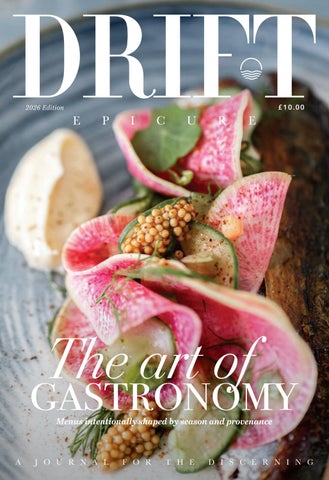
DRIFT Epicure 2026

Page 1


Menus intentionally shaped by season and provenance

A JOURNAL FOR THE DISCERNING

Drift drift noun

1. the act of driving something along . the flow or the velocity of the current of a river or ocean stream

verb

. to become driven or carried along, as by a current of water, wind, or air

. to move or float smoothly and effortlessly

We invite you to continue your lifestyle voyage online. Find inspiring stories and uncover more luxury content on Instagram dri ournaluk. oin our e clusi e e ournal communit at dri ournal.co.uk to recei e recipes, re iews and insider knowledge of some of the South est’s most lo ed lu ur destinations.

A JOURNAL FOR THE DISCERNING dri ournal.co.uk dri ournaluk

The Nare’s head chef, André Lima, anchors a culinary o ering within a Cornish conte t, as featured from page .

narehotel.co.uk

Head of Client Management es lover des.glover levenmediagroup.co.uk

Partnership Executives

Shannon itter shannon.witter levenmediagroup.co.uk

Elly Burnard elly.burnard levenmediagroup.co.uk

Chairman & Founder

Andy orster andy.forster levenmediagroup.co.uk

CEO

Ben ratchett ben.pratchett levenmediagroup.co.uk

DRIFT is published by:

Leven Media Group LTD

olbrook, The oors, orthleven, Cornwall T www.levenmediagroup.co.uk

ISSN 2632-9891

All rights reserved. aterial may not be re-produced without the permission of Leven edia roup Ltd. hile DRIFT will take every care to help readers with reports on properties and features, neither Leven edia roup Ltd nor its contributors can accept any liability for reader dissatisfaction arising from editorial features, editorial or advertising featured in these pages. Leven edia roup Ltd strongly advises viewing any property prior to purchasing or considerations over any financial decisions. Engine ouse edia reserves the right to accept or reject any article or material supplied for publication or to edit such material prior to publication. Leven edia roup Ltd cannot take responsibility for loss or damage of supplied materials. The opinions e pressed or advice given in the publication are the views of the individual authors and do not necessarily represent the views or policies of

Editor annah Tapping hannah.tapping levenmediagroup.co.uk

Assistant Editor

amie Crocker

jamie.crocker levenmediagroup.co.uk

Creative Designer

Spencer awes spencer.hawes levenmediagroup.co.uk

Finance & HR Manager

Charlotte orster charlotte.forster levenmediagroup.co.uk

Leven edia roup Ltd. It is suggested that further advice is taken over any actions resulting from reading any part of this maga ine. Leven edia roup Ltd is a multi-platform media business with a passion for everything Cornish. isit www.levenmediagroup. co.uk to find out more. Our mission is to create EA - ATCE E IE CE media opportunities marrying together consumers with the fabulous businesses across Cornwall. Our publishing and marketing teams are specialists in creating print and online communications, devised to achieve a range of marketing objectives. ith over years of marketing, brand management and maga ine e perience we develop e ective communications that deliver your message in a credible and creative way. e operate across all media channels, including print, online and video.

TEAM

Foreword

Across the South est, a growing culinary conversation is taking place about what it means to source with intention and cook with restraint. The uestion being asked is how can we allow the integrity of an ingredient to lead Comple ity, for its own sake, is giving way to a considered approach, giving rise to food that reflects the landscape it comes from, and prepared by people who understand that landscape intimately. Over the coming pages, growers, producers, chefs are united by a shared seriousness of purpose as they form close relationships across the supply chain, championing provenance and crafting food that feels contemporary while being deeply rooted in place. e begin at Cornwall’s southernmost tip, at the ichelin-listed allowfields ( , where land meets sea and serious cuisine morphs with poetic resonance at the finest of tables. Onward to almouth ( , we find nature-inspired cuisine with a focus on the landscapes, flora and fauna of the uchy

as husband-and-wife team, ylton and etronella Espey are proud to know their ultra-local suppliers by name. Across the Tamar, we visit cl af ( , a IC ELI -Starred and AA osette restaurant whose style is truth with elegance cooked honestly with the best produce they can get, then served with refinement of a culinary oil painting. The Chagford Inn ( has uickly become one of artmoor’s most talked-about dining pubs with an ethos built around the rela ed service they provide and pride themselves on, and their belief that everyone should leave happy. aught onna ( , aka ade Berry, is a flavour-obsessed foodie whose long-table feasts echo this sentiment. ade serves up our final course in the form of indulgent, unpretentious dishes inspired by flavours from every corner of the world. or the reader who believes that where food comes from is as important as how it is cooked, DRIFT Epicure is your record of a region doing this e ceptionally well.

Our contributors

our team

e have an e ceptional and loyal team here at Leven edia roup but as a fast-growth business we’re always interested in talking to outstanding individuals. If you’re a superstar of e traordinary talent then we would love to hear from you.

Call us on 01326 574842 or email enquiries@levenmediagroup.co.uk isit driftjournal.co.uk to read more about our writers.

Proudly supporting DIVE PROJECT CORNWALL

Providing life changing opportunities for young people across the UK www.diveprojectcornwall.co.uk

Rosie Cattrell
Hannah Tapping
Jamie Crocker

8 FINDING THE EDGE

At

a glance

Where land meets sea, serious cuisine morphs h oe resonan e a he nes of a es

14 FROM BOAT TO PLATE

Fresh landings guide a kitchen that draws fro e n s har our a h

16 ON A JOURNEY

a ure ns red u s ne h a fo us on he ands a e flora and fauna

24 BLENDING WORLDS

eef eef serves u a a an ed enu of flavour and freshness 26

ROOTED IN RENEWAL

af s a arred and ose e res auran n evon

34 TEMPERATE SOPHISTICATION

udo ean o e a s a four s ar re rea se h n a a re oun r s de es a e

42 WATER’S EDGE

here he nes sh o es s ra h o he oa and he ne s s n e er hands

44 FIND THE SALT IN YOUR SOUL

o d re a ned e ness ro os on eans he or ho e has never fe ore a ve 52 ROADSIDE RENDEZVOUS

a e for he d s ern n rave er o ause for rea food and ons ous re a 56 PERFECT COMFORT FOOD

ro unsh ne af and o a o es h s ever o u ar round n da

58 BEYOND EXPECTATION

a no on er ans er o s or na na e e s a a o ada has never fa ered

62 SEASONAL RESONANCE

he uar erde a he are sn an ad un o he ho e s a des na on n s o n r h

68 ON THE HARBOURSIDE

fa run de and hen sha ed sour n and o un es

70 AFTER EIGHT rand orn sh ho e roves rad on an s have en of uan

76 ENTENTE CORDIALE

o a su o ned h ren h ra n n fuses n he hea of he hen

78 A SEAT WITH A VIEW

he reen an and he a ou h s food e o er n s a a s a red h a v e of he a er

84 THE HEART OF THE MATTER

a n he nes u ur hen a an es a he en re of he ho es ha a er os

86 PITCH TO PITCHER

ore ree s ne oas s o ers a refresh n end of ne food and non onfor s ersona

92 ROOTED IN THE LAND

o o o a re u fora n on orse s and oo n over ren h ar e ues

96 ARRIVE HUNGRY, LEAVE HAPPY

head on o on of flavour and ndu en e

FindingEDGE the

WORDS BY HANNAH TAPPING
Where land meets sea, serious cuisine morphs with poetic resonance at the nest of ta les.

There are evenings that arrive as a gift, where the light does something e traordinary and the world seems to e hale. This was one of those rare evenings in April that delivered a sky of impossible blue and a sea whipped by the bree e revealing white horses chasing each other to the hori on. As we swept down the final lane towards ousel Bay, something in us shifted. The crunch of gravel beneath the tyres heralded our arrival and as we stepped out onto the drive the view revealed itself as nothing short of breathtaking. The panorama here is uni ue, as the hotel takes its position above the bay, while the coast curves gently, demarcated to the east by Bass oint and to the west, Li ard Lighthouse standing sentinel and casting a watchful ga e over the waters beyond for more than years.

ousel Bay occupies a position so dramatic, so unapologetically beautiful, that the building itself almost becomes secondary. Almost. The welcoming doors opened with the easy confidence of a place that has been doing this rather well for a very long time. Shown to our room, the panoramic view hit with the force of something elemental. Our shoulders dropped and cares dissolved as the room rendered the pressures of everyday life momentarily irrelevant. ressing for dinner, I feel a wave of nostalgic glamour, fitting as ousel Bay has hosted the rich and famous, the discerning and the dignified here since its opening in .

It’s mild enough for us to take pre-dinner drinks on the terrace, our glasses catching the last of the golden light, the Atlantic wind gentle enough to be companionable

rather than intrusive. I continue the reinvention of myself as leading lady in this glamorous tableau as with scarf swathed around my shoulders, I sit for just a moment longer drinking in the setting. It is the perfect prologue, a moment suspended in time before we turn our attention to what awaits allowfields. ichelinlisted and with three AA rosettes to its name, allowfield’s reputation precedes it and with e pectations high even first impressions don’t disappoint.

Shown to our table, in a dining room that is intimate without pretention, it’s hard to draw attention away from the Atlantic vista, but with the arrival of our attentive waiter we do and await with anticipation the first course. ecognised by the ichelin guide as one of the best restaurants in Cornwall ead Chef oe allowfield’s tasting menu is inspired by wind, salt and time. Seasonality is the thread which binds the dishes and there is something deeply poetic in the way they are described and presented. The current tasting menu, named After the ain’ e presses the evening perfectly. It conjures a kaleidoscope the emerald green of grass newly watered, the nodding white heads of wild garlic and the deep a ure of bluebells set against a clear sky as clouds scud away.

A gentle welcome to our culinary journey of discovery comes in the form of a warm brioche, sprinkled with smoked sea salt and served with a whipped butter as soft as the clouds beyond the window. e sip on a glass of perfectly chilled apagiannakos Assyrtiko, reece the first tasting of the ooted wine flight

recommended by sommelier Olly as our attentive waiter places an amuse bouche’ before us. This is oreshore oyster, cucumber and lime served with poetic e planation The sea unsoftened. Cold taste before thought. All of the elements are e uisitely presented and enliven our tastebuds.

Aftermath comes ne t, with scallop, dashi and sea beet The sea withdraws its temper, leaving salt upon the stone, followed by Clearing a uail egg ravioli in an asparagus broth with wild garlic described as Steam rises from darkened earth, green pushing through the hush. These lines are so perfectly in tune with ousel Bay’s natural surroundings that it’s easy to see where the inspiration for oe’s dishes come from.

The ripe and mouth filling palate of the Casa arin Sauvignon ris Estero ineyard, Chile , whose touch of smoky rench oak complements these dishes e ortlessly, while the earthy undertone, black cherries and spice of a Larry Cherubino, Laisse aire, Syrah, Australia heralds the arrival of elief Spring lamb paired with pearl barley, chard and baby onion. The dish is unctuous yet without heaviness, each element cooked by a chef whose culinary mastery knows that ingredients need little more than a gentle touch to be elevated to the state that each small mouthful re uires a moment of reverence.

allowfields o ers two sittings on ridays and Saturday evenings in low season, with the addition of Thursdays during the summer months. This evening sees a full restaurant by the later sitting, testament

to the uality and reputation of the food. ousel Bay’s position at Britain’s most southerly point means this is destination dining and so our fellow guests have made a discerning choice over happenstance.

alates are refreshed with Breathe gooseberry and sorrel that is both cool and sharp, o ering a fleeting moment before dessert settles into Stillness a delicate pannacotta of Treleague airy milk with green strawberry and almond that captures an essence of calm and the reassurance of tiny echoes of nostalgia drawn from the milk puddings of my youth.

Talking of my youth, I am no stranger to ousel Bay, having grown up in Cadgwith just along the coast. I have fond memories of being sat on a bench on the terrace with my grandparents, sandy feet swinging in delight as we devoured ice creams and cold drinks after the hot walk up the steps from the beach below. I delighted in watching the guests, imagined as film stars by my

si -year-old self, such was the elegance of the setting. hile guests remain discerning, ousel Bay has evolved steadily over recent years, its progress measured by a conscious and steadfast application to detail. The e terior of the building is bound by historic charm such that I would never want it to be any other but sensitively refurbished rooms, contemporary calm interiors and updated decor have elevated this grand dame of the Li ard eninsula into a natureinspired hotel for the modern age, where all our welcomed in its rela ed environment.

At the land’s edge, it would be easy to lean on drama. Instead, ousel Bay has chosen discipline and attention to detail. As we rest our heads on soft pillows the ocean remains in sight, the lighthouse intermittently coruscates beyond the glass, whilst we drift o with dreams of what has been a genuinely e ceptional evening at table.

housel ay.com

From boat TO PLATE

WORDS

Fresh landings guide a kitchen that draws from Newlyn’s harbour catch.

In Newlyn, the working harbour sets the terms and Mackerel Sky Seafood Bar keeps close to it. The kitchen follows the pattern of daily landings, building its menu around what comes ashore rather than sticking blindly to an intransigent list. The result is something that has provenance, supports the local economy and is shaped by the people who fish the waters of ount’s Bay.

Lobster and crab arrive through Patch Harvey, coxswain of the Penlee lifeboat, whose pots are set between Newlyn and Mousehole. His recent silver medal for gallantry, presented by the Princess Royal at Buckingham Palace, rewarded a life spent at sea. is catch often reaches the restaurant by hand, a straightforward exchange that carries through to the plate. In recent months, octopus have begun entering crab and lobster pots in greater numbers, prompting a shift that is already shaping menus, with this cephalopod mollusc starting to appear among the day’s specials.

uch of the fish passes through resh Cornish ish, run by Craig Tonkin, based on the harbour. Hake, a regular feature, is frequently landed by the Silver Dawn, skippered by Tristan Trenerry. His son Louis works as sous chef, linking boat and

kitchen in a way that reflects the scale and structure of the business.

The food keeps to that same line. Half lobster with garlic butter and samphire is served without being overly messed around with’, allowing the quality of the catch to carry the dish. Hake with capers follows a similar approach. The menu also includes plates designed to draw in those less familiar with seafood, o ering a straightforward way into the range of flavours coming o the boats.

In 2024, Nina and Jamie added a Cornish delicatessen alongside the restaurant, extending their network of suppliers into a retail space. Shelves hold locally produced food, drink, skincare and gifts, with a clear preference for small, independent makers. It mirrors the sourcing behind the kitchen, giving customers access to the same regional produce in a di erent form.

Mackerel Sky has developed through these connections, building a business that reflects its setting and its supply. Each service begins with the harbour and carries through to the table, shaped by the day’s catch and the people who bring it in.

mackerelskycafe.co.uk

On a JOURNEY

WORDS BY HANNAH TAPPING | IMAGES BY LINDA HERMANS
Nature-inspired cuisine with a focus on the landscapes, flora and fauna.

South African-born, Chef Patron

Hylton Espey, along with wife Petronella, run Culture, a farm-totable restaurant on Custom House Quay in Falmouth, with a tasting menu that changes almost daily. Ingredients are central to Culture in a way that is rarely so detailed or intentional. Whether that be foraging for seaweed and wild garlic on nearby cli ops, milling flour daily or ageing beef on site for up to 95 days, Hylton and Petronella pay homage to both the produce and its growers. In conversation with Hylton, we talk about their trusted suppliers and the part they play in the story behind every dish.

as we feel that the phrase can sometimes be misused as a cover-up for sourcing some things close by, but then others from far afield. We choose to be very restricted in how we do things at Culture. We opened the restaurant in July 2022 and, four years on, I am now able to create a full year’s menu ust using local suppliers. The first year wasn’t easy as when you get to November and December, a lot of the guys have stopped growing. So, I thought, I’ll forage and see what I can get, and we managed to scrape through keeping to our ultra-local ethos.

How would you describe Culture?

We have a focus on using suppliers who we are proud to know by name. We don’t really think about it in terms of food miles

We’ve met more suppliers since we opened the doors four years ago and now buy from farmers who still have produce in the ground right through the winter months, as well as those who stagger their growth throughout the year. I can now get beetroot from three different people, at three different times a year!

Hylton and Petronella Espey

Can you walk me through the Culture experience and what a guest can expect?

ur lunch menu is five courses and our dinner menu seven, but with nine items. The first we call a flurry of snacks’, which is essentially a relaxed version of a traditional amuse-bouche, but for sharing. Then each course on the menu is told as a chapter within the story, which might either be an experience we’ve had in Cornwall, or a tale of a producer and their approach. For example, last night we had monkfish that was caught by a Scottish langoustine boat that’s down fishing on the Isles of Scilly, so the fish course was named oving South’.

Do the menus change daily?

Footes Farm and Saturday dinner was lamb from Tresemple Farm.

How far in advance do you have to plan?

Almost daily… We keep the structure and the base story the same, but the flavour profile changes. or example, in the flurry of snacks’ we have a cheese and onion churro, which last night had the first of the wild garlic in there for the onion flavour. The fish, one of the meat courses and the dessert can change quite often. We don’t follow the rules of a four season menu change; rather we see what is available week on week and decide from there. Last week we had pork belly from Amelia and Chloe at Real Food Garden, Saturday lunch was beef from James at

For beef, I have to order six months before the animal’s even left the field and then I age it myself for three months. So, that’s nine months in the planning. At the moment I’ve got Dexter beef, which we’ve aged for 95 days. The sirloin is so good at the moment. I remove the fat, render it down, then cook the sirloin in the beef fat, then finish it on the grill outside. And then with the bones, I create a beef jus for what we call our café au lait sauce. The stock is cooked down and finished with dried shiitake mushrooms, Alexander seeds and some cream before being served with the sirloin.

I know bread is very important to you, can you tell me more about this?

We buy our wheat whole from William’ at Cornish Golden Grains and I then stonemill it fresh on the days I bake. The wheat is still very much alive when we buy it, so we’re baking bread with a living grain, which makes it special. We serve it after the flurry of snacks with a smoked butter on the side, and a drizzle of honey over the top from a single beehive on the Lizard.

The flavour profile of the honey is incredible, every time you open a new ar, it’s ever so slightly different. The beekeeper can actually tell me exactly which plants the bees have gone to looking at the pollen they bring in. For our latest one, I get the feeling they’d been on some gorse flowers, because it’s got a real tropical flavour to it. It’s this attention to detail that makes our dishes so unique.

Can you talk me through the rest of the dishes, course by course?

ollowing the flurry of snacks and bread course we do an egg dish, either a hen’s egg or a duck egg. I try to use duck eggs as much as possible and I’ve been working with Roger and Tanya at Terras Farm for many years. The version we have on the menu at the moment is a duck egg yolk poached in a wild garlic butter, topped with puffed wheat and wood sorrel. When we get asparagus in the next couple of weeks we’ll add that with it too, but it will only appear on the menu for three out of four weeks, because we just use one farm. fter the egg course comes oastal Fields, which showcases potatoes. Where possible I get Cornish potatoes, and serve them with rock samphire, which I forage

for, and then I make a baked potato foam that goes over the top, dusted with beurre noisette. This changes a little bit depending on the time of year; sometimes we’ll do Jerusalem artichoke, or make it more familiar with sage or rosemary. The rock samphire is coming back now, which is good and so are the nettles.

Then we have the fish course. t the moment it’s oving South the monkfish, poached in a little butter is finished on the braai’ which is a South African barbecue. The charcoal I’m using at the moment is made from trees blown over during Storm Goretti, all from St ichael’s ount, and as the buttery monkfish goes on the grill and the butter uices and fish caramelise, it has this quality that reminds me of a South African Saturday in ape Town, barbecuing fish. The sauce is a seaweed butter, for which I forage three types of seaweed, dry them out, and then rehydrate them inside the fish stock.

The meat course is the sirloin from James’ Dexter beef, which are raised on a diet of field herbs. ames’ chickens live in the field, happily scratching around, then he moves them to the next field and brings in

ABOVE
For chefs Hylton and Petronella, visiting suppliers is hugely important

his herd of Dexters. They eat all the weeds and the herbs that have grown there, and once they’ve moved through, the chickens come back and scratch away again, bringing life into the soil. When you work with the beef, there’s no yellowing of the fat, no corn substitute. It’s ready to use almost straight away really, but by ageing it we develop more of those amino acids and savoury notes, and it breaks down to be much more tender. We serve it with purple sprouting broccoli from hys, and mushrooms lion’s mane or shiitake all grown by hae at Taste of the Good Life in St Agnes.

How do your supplier relationships work?

I would say our supplier relationships are more like friendships as we know exactly what’s going on in everyone’s lives. In the four years we’ve been open, we’ve seen everything from engagements, marriages, births and everything in between. It really is like having a whole extra family and we visit the farms and growers as much as we can throughout the year. Even our plates, were all made less than a stone’s throw from the restaurant by Sam arks eramics.

And so, to dessert…?

y wife etronella makes all of our desserts. Tonight, we’re serving the last of the Cornish lemons from Simon at Curgurrell Farm near Caerhays. And then tomorrow, she’ll be making her version of a tiramisu, but using locally roasted coffee from ich at Forty Five who’s just around the corner from us and chocolate from ike and his team at Chocolarder. I went to collect a big bag of chocolate last week after picking up my daughter from school. Everything really is so close.

nd finally, why Culture?

We wanted a name that allowed us to be flexible in our style and so it represents not only the culture of our travels, our music, our religion, our love of wine, but also the culture of where we live, who we are and actually, the very culture of dining itself.

In recognition of their efforts, Culture was awarded Falmouth’s first MICHELIN Green Star in 2023.

culturerestaurant.co.uk

Blending

WORLDS

Melding two separate sources of ingredients, Reef & Beef serves up a balanced menu of flavour and freshness.

Reef & Beef is a culinary experience built on the twin pillars of excellence and respect for the finest ingredients. Under the vision and leadership of Head Chef and Owner Vasile Efros, the restaurant has forged a path that has already made it a gastronomic landmark in Cornwall, celebrated for its perfect mix of premium dry-aged meats and fresh seafood. This contrast defines the restaurant’s identity: a refined, contemporary menu that highlights both the tradition of classic steakhouses and the modern influences of coastal cuisine.

Its core strengths lie in adhering to standards of excellence that are daily touchstones: from the insistence on carefully matured beef to develop rich flavour and perfect tenderness, fresh seafood delivered daily straight off the boat, to premium oysters and lobsters. There are signature à la carte dishes too, crafted to define the Reef & Beef experience – filet of beef, trio of lamb and duck breast. It is a place that relies upon informed judgement and experience to create mouth-watering dishes for its patrons rather than compromising by accepting easy pickings.

For Vasile, cooking is a form of personal expression, with each plate telling a story through his intervention as culinary

narrator. He intertwines ingredients, seasonality, and a desire to beguile the diner with flavour and originality. As a consequence, Reef & Beef has been recognised with accolades such as Steakhouse of the Year 2025-2026 (Southwest) and a Business Excellence Award, which reflect not only culinary excellence but also a dedicated team focused on delivering an outstanding guest experience.

It’s not only the professional bodies that acknowledge Vasile’s achievements, but the diners who have passed through the doors as well. Generous reviews on TripAdvisor point in the same direction: ‘Lovely restaurant and straight-up food. We had a tasty prawn starter and fish for main. All were fabulous, decent portions and a nice selection of desserts. Well-staffed and managed. We enjoyed our evening,’ and ‘Our booking was for eight people. We had a lovely table by the window. Service was fantastic, and the food was delicious with perfect cocktails to finish the evening, including Irish coffees especially made for us. Highly recommend this restaurant if you are visiting St Ives.’

Nothing more needs to be said; the proof is obviously in the eating.

reefandbeefstives.co.uk

Rooted RENEWAL in

Àclèaf is a MICHELIN-Starred and 4 AA Rosette restaurant in Devon.

Situated within the five-star Boringdon all otel and Spa, near lymouth in evon, it is presided over by acclaimed ead Chef Scott aton. It o ers an unforgettable gastronomic journey built around seasonally inspired, locally sourced ingredients. Since first being awarded a IC ELI Star in , cl af has retained its IC ELI status each consecutive year, establishing itself as a cornerstone of the South est’s fine dining scene. uests can enjoy a signature four-course menu or seven-course tasting menu, where e ceptional flavours aligned with artistic presentation take centre stage. e delve deeper with Scott.

Our style is truth with elegance the best produce we can get, cooked honestly and served with refinement. e have taken this philosophy into the dining room, reevaluating everything from the d cor to table presentation.

Our elegance must be transmitted through every angle, and table settings are key to that we want minimal. e stripped back any unnecessary items to ensure guests felt at ease, had space and were comfortable whilst dining. All the senses must play in harmony with one another to help guests rela so they can fully immerse themselves in the e perience.

Àclèaf holds a MICHELIN Star. How would you describe the ethos in the kitchen, and how has it evolved under your current leadership?

eople will always remember how you made them feel. uest e perience is at the centre of what we do and we want to use food and drink to complement that.

In the kitchen, culture matters collaboration, ownership and pride. Creatively, there are no boundaries, but we’re clear on our identity. I’d like to think you could recognise an cl af dish in a photo.

The chefs in cl af are all trained in the classics, but I’m not one to let rules get in the way of creativity and I make sure that the kitchen is an environment where the team comes together to share ideas without the fear of rejection or failure. e learn together and make mistakes together. e talk everything through as a team and come up with new ideas together. Everything is uestioned, the dish is stripped back to individual ingredients, to then find a clear purpose.

The journey a dish undergoes takes indepth planning, dedication and ultimately passion. ith a project, our chefs take on the complete evolution of their dish from the initial planning and liaising with the producers and suppliers, to the tasting and styling of ingredients all in preparation to add that finishing touch before serving. e want our chefs to have an outlet for their creativity, which we encourage. Bimonthly, we gather as chefs to stop, taste, talk, teach, learn and inspire. e ask ourselves and each other uestions that need to be asked to create great food.

How does the relationship between the kitchen and local producers work in practice, particularly when it comes to shaping menus around what is available at any given time?

It starts with relationships and trust. reat suppliers are the only way to consistently

serve great produce, and we take that seriously. As we’ve evolved, we’ve leaned harder into sourcing the best ingredients we can.

or e ample, our crab dish has become symbolic over recent years and undoubtedly one of the best places to land brown crab is the small South evon harbour town of Bri ham, home to the renowned Bri ham ish arket. I’ve worked with our supplier ingfisher Bri ham for over years at times, we’ll even take deliveries twice a day so we can cook what’s best right then.

Our venison and game are from evon, supplied by our friend Curtis itts, one of Britain’s finest deer stalkers and wild fowlers.

ith a focus on the best produce, the sourcing of each dish element is a heavy task and there is a story to how each dish component found its way onto the menu at cl af. The decision of choosing a supplier is influenced by a company’s ethos and location. The hand-picked meat presented on a menu is that which has undergone vast research, ensuring that what is served is of the highest uality.

To what extent do you prioritise sourcing from Devon and the wider South West, and how does that influence menu development across the seasons?

A fundamental part of cl af is the focus and championing of individual ingredients. ood uality and consistent ingredients allow us to deliver a uni ue e perience, although we source locally where we can there are certain ingredients whose uality

is unmistakable, such as the ighland agyu that we use, or our scallops from Orkney.

evon and the South est give us a huge amount, and we want the menu to reflect where we are. Seasonality is the constant. As ingredients change, the menu evolves with them and the style naturally shifts across the year.

How do you approach menu development across the year? Are there particular seasonal moments that drive creativity more than others?

I see menu development as seasonal evolution, keeping the food responsive rather than forcing change. Every dish needs a sense of season and purpose, and the climate genuinely a ects ingredients, so dishes can look di erent year to year.

Spring is my favourite for big, vivid, fresh flavours with wild garlic, morels and asparagus, where the menus can almost write themselves if you let the produce shine. Summer brings stone fruits like peaches, plums, cherries and apricots and brighter, ingy notes autumn allows deeper, more robust flavours and in winter, the challenge is finding elegance and a lightness of touch within richer ingredients.

Tasting menus can sometimes feel a bit pretentious. How do you ensure the

dining experience at Àclèaf remains engaging and grounded rather than overly theatrical?

or us, it comes back to hospitality and using food and drink to look after people. I’ve never uite understood the rigid threecourse rule, because it can feel abrupt, so we prefer a longer journey to properly showcase what’s available and give guests time to settle in.

e aim for a formality of service without feeling sti . e take what we do seriously, but the e perience should still be fun, with warm hospitality, conversation, and small surprises that create talking points. And we want it to feel personal and memorable, something guests can take a piece of with them, even if it’s as simple as leaving with the menu as a memento.

Even in the details, like the oak-stump print on our menus, where every tree ring is uni ue, we want each e perience to feel singular, never copy-and-paste and never read from a script.

Can you talk through the balance between technical precision and flavour when developing dishes? Where does one take precedence over the other?

The fundamentals of our food are flavour, produce, technical ability (and knowing when to use it , conte t, finishing touches and seasoning.

Over the years, I’ve realised this is where of a dish can come to life it stems from the love of the product, the passion for the industry, and the respect for yourself. That’s what gives cl af our S , it’s full of people who love what they do.

cl af serves dishes where ma imum focus is on one individual element everything on the plate builds together to highlight the main ingredient, whilst keeping a playful, nostalgic influence.

And the food needs to have soul. It’s not just a recipe on a page, it’s not just understanding the structure of fish, the protein build-up of meat, the earth that vegetables are grown in. It’s the understanding of how to treat all of those things harmoniously, with sympathy. Soul happens when you gather a group of people who obsess over food.

as simple as tasting it and deciding that it works. e taste as a team and talk through structure and flavour (tannin, aromatics, alcohol , but the ultimate uestion is always the same is it delicious with that plate of food

e aim to introduce guests to a world of wine that they may not know. It’s so diverse. I think most wine drinkers know what they like, but we can help you discover something new.

How does the wine programme complement the food offering, and what role does pairing play in shaping the overall dining experience?

The wine pairing is there to complete the e perience, elevating the dish, the pace of the meal and the overall sense of being looked after. airing can be opinionated there’s a science to it, but sometimes it’s

Looking ahead, how do you see the food offering at Boringdon Hall developing over the next few years, particularly in response to changing guest expectations and wider industry pressures?

The main aim never changes to be better than yesterday. That means refining what we do, building skills as a team, and staying honest about what guests value uality, consistency and a sense of care. Of course, we also have ambitious targets, and it’s normal to talk about them pushing towards five osettes and, in time, a second IC ELI Star. But the way we get there is the day-to-day work, by learning and improving, and maintaining standards moving forward.

boringdonhall.co.uk

Temperate SOPHISTICATION

Budock Vean Hotel & Spa is a four-star retreat set within a 65-acre countryside estate.

Situated just above the Helford River in Cornwall, its facilities include a 9-hole/18-tee golf course designed by James Braid, indoor pool, sauna, outdoor hot tub, tennis courts, acres of subtropical gardens, and a private foreshore with water sports and boat trips. Accommodation ranges from hotel rooms to self-catering cottages and lodges, with easy access to the gardens and nearby coastal walks. We find out what draws visitors and why the dining experience is a key factor.

The menus place a clear emphasis on seasonality and locality. How does the kitchen team decide what makes the cut at any given point in the year, and how flexible is that process day-to-day?

Cornwall’s mild maritime climate influences the farming cycle. The temperate weather protects crops from extreme frosts in winter and allows an extended growing season compared to many parts of the UK, so the starting point is always what’s genuinely at its best locally.

At Budock Vean, seasonal, locally sourced ingredients shape dishes across breakfast, lunch and dinner, Sunday lunch, and afternoon tea (from a Cornish cream tea of fresh scones, jam and Cornish clotted cream to a full afternoon tea with sandwiches, scones and cakes). As we welcome both residents and non-residents throughout the year, we plan by the season but stay flexible.

We also use themed weekends and setmenu evenings as a way to focus the kitchen on a particular slice of Cornwall’s larder, for example, around St Piran’s Day, we’ve previously put on a Cornish Celebration Weekend built around produce-led menus and regional wine pairings.

Cornwall is rich in produce, but also highly competitive when it comes to sourcing. Which suppliers and producers are most important to you, and how do those relationships influence what appears on the plate?

Cornwall’s produce is strong, but it’s also seasonal and in demand, so relationships matter as much as the ingredient. Because we serve all year, we need suppliers we can plan with through the full calendar, whether we’re looking for spring greens and early new potatoes, summer fruit, autumn squash and orchard produce, or hardy winter brassicas and roots.

good, Cornish crab, for instance, we’ll build a dish around it. The aim is to keep standards high while staying realistic about what Cornwall can provide at that moment.

Can you talk through the philosophy behind your core dining offer? What are you trying to achieve for the guest beyond simply providing a good meal?

At Budock Vean, the food is part of a bigger reason people come here: to slow down, and often to mark an occasion too, such as birthdays, anniversaries and family celebrations. Being tucked away in calm countryside surroundings on the Helford River creates a genuinely tranquil atmosphere, and we want the dining offer to feel like an extension of that: warm, unhurried and restorative, rather than something rushed.

Those partnerships shape what appears on the plate because we prefer to design dishes around what’s at its peak locally, rather than writing a fixed menu and forcing ingredients to fit. When growers or fishers have something particularly

Beyond simply providing a good meal, we’re trying to offer a change of rhythm: time for breakfast without rushing, a long lunch, afternoon tea, or an evening supper club where the conversation is part of the visit. The thread that ties it together is straightforward, well-made food that follows the seasons, alongside service that feels attentive.

Sustainability is often discussed, but less often evidenced. What specific changes have you made in the kitchen and across your food operations to reduce waste and environmental impact, and where do you feel there is still work to do?

For us, sustainability starts with seasonality. Cooking according to the Cornish growing calendar improves flavour and quality, but it also allows us to buy closer to the source, supporting local farms and fisheries. It’s a more resilient model too: rather than insisting on the same ingredients year-round, we build menus that move with what the land and sea can realistically provide.

How does the setting, particularly the Helford River and surrounding gardens, inform the food offering, if at all? Does it shape flavour profiles, presentation, or even the pacing of a meal?

brighter; autumn/winter becomes more earthy and warming. Guests often make a day of their visit, perhaps an afternoon tea in the fireside lounge or an unhurried Sunday lunch, followed by a walk down to the private river foreshore, along the riverside trails, or through the subtropical gardens.

We also host intimate supper clubs, where guests come for an experience as much as for the food. A guest speaker shares stories and insights about the local landscape and wildlife, emphasising our close connection with the area.

The setting does influence the experience. In the restaurant and on the terrace, the gardens are always in view, which gives meals a clear connection to where you are and encourages a slower pace.

In terms of flavour, presentation and pacing, spring/summer plates lean lighter and

The Terrace and bar offer a more relaxed experience alongside the main restaurant. How do you ensure consistency in quality and identity across these different dining spaces?

It helps that the menus are built from the same idea wherever you sit: seasonal cooking that makes good use of what’s available locally. Whether guests are in the main restaurant, the bar, or outside on the terrace, the offer is aligned so it feels cohesive rather than like separate concepts.

The terrace is simply a more informal setting. When the weather allows, it’s ideal for lunches outdoors, with the gardens and golf course as the backdrop.

Operationally, we focus on consistency of sourcing, prep and finishing across all sections, so the food feels recognisably ours whether it’s served indoors or out.

What role does the wine list and drinks programme play in the overall experience, particularly in terms of championing Cornish producers or lesser-known vineyards?

The drinks list is intended to sit alongside the food rather than compete with it. Alongside established favourites, we include Budock Vean cider and Budock Vean Coastal Gin, as well as a range of Cornish ales, ciders and spirits.

On the wine side, we make space for English producers, including vineyards from Cornwall. Current examples include Camel Valley Brut and Camel Valley Pinot Noir Rosé Brut, Wild Life Botanicals Nude as a low-alcohol sparkling option, and Knightor’s Carpe Diem White and Carpe Diem Red.

around a four-course seasonal menu and paired with still and sparkling wines from Cornwall and the wider region. The pairings are introduced through the evening, with background on the wines and the producers.

How do you cater to returning guests who may dine with you multiple times over the course of a stay? How do you keep the experience fresh without losing your core identity?

Because we’re open year-round to residents and non-residents, we see plenty of returning guests. Some come back for a familiar favourite; others are looking for a calm setting, seasonal cooking and time to properly switch off.

English Wine Week in June is one point in the calendar where we put those producers front and centre, with a South West Wine Tasting & Dinner built

We keep the core identity consistent, with seasonal dishes and a relaxed welcome. The setting is key: terrace lunches, garden walks and riverside routes mean repeat visits feel different as the landscape changes through the year. In spring and summer, that might mean eating outdoors, then heading off for a walk. In autumn and winter, it may be a roast followed by a brisk stroll along the Helford River.

budockvean.co.uk

At the

WATER’S EDGE

here the nest sh comes straight o the oat the ine list is in e ert hands and the har our is al ays in vie .

At Am lie in orthleven, you’ll find Cornish hospitality at its most generous. There are restaurants that happen to have a view and then there are restaurants where the view is inseparable from everything else. Amélie, sitting right on the water’s edge in the harbour village of Porthleven, is such a place. ith its generous double doors thrown open to the harbour in summer, a covered terrace that feels more like the ed than the uchy and candles that burn warmly against winter storms, this is a restaurant that earns its place in every season.

The team here are as local as it gets. Kate and ack have been part of the fabric of the village since they were 18, growing up alongside the restaurant, learning its rhythms and its regulars. ead chef oe, born in Spain and shaped by two decades of cooking across Cornwall, brings a editerranean sensibility to a kitchen that is otherwise rooted entirely in place. The trio are now at Am lie’s helm and the future looks very bright. ack’s brother oby, who

began his career as a kitchen porter in this very building and worked his way up to sous chef, completes a team that feels less like a brigade and more like a family which, in many ways, it is.

Provenance is everything here. The menu is small, seasonal and deliberately uncluttered, an la carte supplemented by a specials board that changes with whatever comes o the local boats. ollock, hake, scallops and plaice appear and disappear with the tides, cooked simply and with great confidence. The Spanish influence surfaces in the lightness of touch and the sense that the best ingredients, treated with respect rather than complexity, are always enough. Sharing plates invite an early evening pause, while comforting favourites include our fish pie’ and a succulent steak burger. A shoulder season menu ensures that when the pace of the village quietens, the welcome at Amélie never does.

The wine list, curated by ate who holds a Level SET ualification is thoughtful

and precise. Come five o’clock, settle onto the terrace with a glass and a few things to share, and let the harbour do the rest. The irada os organically grown from Castilla-La ancha is a particular delight with notes of wild strawberry, white peach and citrus with a mineral finish.

Am lie is also a fully-licensed wedding venue for those seeking the most intimate

of backdrops. Imagine saying I do’ under the harbour canopy, and then celebrating to the glint of the evening light on the water. idweek celebrations for smaller groups are a particular speciality, with the kitchen o ering beautifully considered menus for those who prefer food and an intimate atmosphere to fuss and fanfare.

amelies orthleven.co.uk

Find the salt YOUR SOUL in

A boldly reimagined wellness proposition means the St Moritz hotel has never felt more alive.

St Moritz Hotel on the north Cornish coast has always been one of the great escapes. This season, the introduction of Salt in Your Soul combines adventurous activities, mindful practices, a new active programme and a food o ering rooted in place, to create the ultimate north-coast escape.

It begins, as all great retreats do, with the sea. Drive between the hedgerows of north Cornwall, where the Atlantic rolls in with metronomic grace and the land falls away in soft cli s and secret coves, and you will find the white silhouette of the St Moritz Hotel standing sentinel above Greenaway Beach. The art deco-inspired building has presided over this stretch of the Cornish coastline since the 1930s, when it drew the rich and the famous to

one of Britain’s most dramatic shores. Today, it draws a di erent kind of pilgrim seeking not only a beautiful place to stay, but a place in which to genuinely restore themselves. St Moritz, it turns out, has become rather good at that.

The hotel’s new Salt in Your Soul wellness proposition is not a rebrand so much as a clarification. It’s more a distillation of what St Moritz has always instinctively o ered, now given shape and language. To have salt in your soul, the thinking goes, is to be drawn to the sea, to feel its pull in the bones. Whether you are a returning guest, drawn back to this stretch of coast year on year by something deeper than habit, or a first-time visitor still to discover what the Atlantic can do for a tired mind, St Moritz meets you where you are. The invitation is simple and open come and find the salt

in yours. What distinguishes St Moritz from its contemporaries is the remarkable fle ibility of its accommodation o ering, a uality that has been thoughtfully refined over recent years. This is much more than a hotel. It’s collection of coastal villas, sea view apartments, garden retreats and interconnected room pods, combine the ease of hotel living with the freedom of independent escape.

The pod concept is particularly inspired: a suite, a king room and a cosy room connected by a private hallway, combining to create something closer to a private apartment than a conventional hotel stay. Ideal for families and groups who want both togetherness and space, the pods o er a contemporary villa ambiance without sacrificing an ounce of the hotel’s legendary service.

it is, without question, one of the great views in British hospitality.

The genius of the Salt in Your Soul framework lies in its understanding that no two guests arrive in the same state, and no two days unfold the same way. St orit speaks of the ebb and the flow, a natural oscillation between a desire for adventure and a need for stillness, and structures its o ering accordingly. The hotel’s new active timetable is the high tide e pression of this idea a weekly timetable of classes and e periences designed to invigorate, challenge and connect guests to the remarkable landscape to be found on their doorstep.

The coastal villas and apartments take the o ering further still. loorplans are open, sightlines unobstructed and every space feels calm and considered. atural fibres, neutral palettes and raw te tures speak of their surroundings and are the kind of interiors that ask nothing of you e cept that you slow down. On a clear day, the Atlantic is visible from almost everywhere;

You might begin your stay with a ua fit in the indoor pool, the week’s first energetic note. Then perhaps circuits in the gym or a morning yoga class in the Seaside space, with views that make the practice feel more like meditation. ot Pilates, conducted in the warmth of the indoor pool area, appears twice weekly, bringing an inspired collision of heat therapy and core conditioning. The St orit walking club sets o from reception, a gentle invitation to e plore the coastal paths that weave between Daymer Bay and ol eath. S ilates sessions take to the

outdoor pool throughout the spring and summer season, bringing balance training onto the water itself, while Soundbath evenings, held monthly in the indoor pool area as the light fades, bring the week to a close in the most elemental way, o ering an immersive, restorative practice. The message is clear: whether you arrive in your flow state, hungry for coastal adventure, or in your ebb, craving only stillness and warmth, there is a rhythm here for you.

A wellness o ering is only as good as what it feeds you. At St Moritz, Provisions, the hotel’s all-day food philosophy is the nutritional backbone of the Salt in our Soul e perience, and it has been constructed with real intelligence and care. The day begins with a breakfast that earns its place at the high tide table. resh juices such as a reen eset of kale, cucumber, lemon and ginger a Berry Balance of blueberries, cherries and banana or a Cacao rotein Shake for those heading straight to the gym line up alongside artisan breads and Cornish butter, overnight oats with plum and chia seeds, and a revolving menu of hot dishes. Steamed hen’s eggs with sliced avocado and back bacon, banana and date porridge, granola with stewed fruits and yogurt: this is breakfast designed to fuel rather than merely to satisfy, though it manages to do both with considerable charm.

Through the day, the Cowshed Active menu takes over, a daytime o ering of nourish pots, wraps, bagels and bowls that are as beautiful to look at as they are to eat. think

green goddess Caesar salad with golden kimchi and roasted almonds chicken and avocado protein wrap with lemon tahini dressing smoked salmon and cream cheese bagel with fresh dill. Each dish is built around the idea of nourishment rather than indulgence, though the two are not mutually e clusive here.

Date and tahini energy squares and almond butter protein balls bridge the gap between sessions with the kind of considered snacking that feels like selfcare rather than compromise. Stonebaked pi as margherita, pepperoni with hot honey, somerset prosciutto with rocket and parmesan are available to take away, perfect for a cosy night in after a long day on the water. Bar snacks of smoked almonds, sourdough with Cornish butter and marinated olives make for the kind of unhurried aperitivo hour the hotel’s terrace was designed to accommodate.

The evening brings the Shorecrest estaurant into its own. enus do not dictate to ingredients here, they form around them, anchored in what the local growers, foragers and fishermen are o ering that week. egetables arrive from estharrow arm, barely a stone’s throw from the hotel. Asparagus from St Enodoc, bass and mackerel from local boats o ock, whole Cornish lamb from ittows Butchers in owey. The evening menu leans into the produce with confident simplicity, where you can e pect to enjoy pan-roasted hake with harissa, olives and

chickpeas, chicken schnitzel with frisée and pancetta or ricotta dumplings with heritage tomato and British pesto.

The Cowshed Spa remains the low tide heart of the St orit e perience, to this day the only Cowshed outside of Soho House properties in the world and a destination in its own right. Its rustic-lu e sensibility perfectly mirrors the hotel’s broader aesthetic. Treatments that speak directly to the Salt in Your Soul philosophy are particularly worth noting. The sun and sea treatment draws on healing ingredients sourced from the sea itself; the lava shell massage uses tiger clam shells for a deep, warming rela ation a body scrub with sea salt o ers natural e foliation before the Atlantic does it for you; and the deep tissue massage is the ideal companion to a hightide week of S ilates, run club and coastal adventure.

biomass and surrounded by manicured gardens and hammocks, provides idyllic Cornish summer afternoons. The concierge team can arrange everything from watersports with Wavehunters and Camel Ski School to restaurant bookings and private chef e periences, while the hotel’s complimentary electric minibus connects guests to ock and ol eath with ease.

Beyond the Cowshed, the broader leisure o ering of indoor and outdoor pools, sauna and steam room, gym and outdoor spaces forms the infrastructure of a stay that can be calibrated entirely to your needs. The outdoor pool, heated by

There is a certain kind of lu ury that St orit has always understood and that the Salt in Your Soul proposition now articulates with clarity. In essence, it’s the lu ury of a day that belongs entirely to you, shaped by your own rhythms, nourished at every turn and held within one of the most e traordinary natural settings on the British coastline. You come for the view. You stay for the food, the stillness and the uncommon sense that here, at the edge of the land and the beginning of the Atlantic, something in you has been restored.

ake your pilgrimage to the sea and leave with salt in your soul.

stmoritzhotel.co.uk

Roadside

RENDEZVOUS

A place for the discerning traveller to pause for real food and conscious retail.

Set just o the A near Sparkford (/// span.bulk.expressed , with easy access in both directions, Teals has earned a reputation among those travelling between London and the South est as a stop that feels a world away from the frenetic, noisy roadside establishments we have come to e pect. or those in-theknow from Cornwall and evon (and London, for that matter , making the long drive east or returning home, it has become a place to break a journey, o ering something more than a tasteless cappuccino or a nutritionally absent meat patty in a bun.

As far as businesses go, it is a bit of a maverick, refusing easy definition. Inspired by owners Ash and ick Sinfield’s travels in Africa, the business presents itself as a farm shop, though it o ers so much more, with this description only going so far. Inside, the food market carries a breadth that is closer to a wellcurated deli, ambient goods and gifts sit alongside fresh produce, a strong British cheese counter, and a butchery o ering with shelves given over to smaller producers who would struggle to find space in a conventional supermarket. The emphasis is on interest and uality rather than volume.

or those who care about what they buy and where it comes from, it is a place that rewards time spent browsing.

Alongside the retail space sits a restaurant serving breakfast and lunch throughout the week. It has uickly become a draw in its own right, to the point that tables are rarely available for those who arrive unannounced. The advice from those behind the business is straightforward book ahead via teals.co.uk book-a-table book-a-table if you intend to eat. It is a practical note, but one that suggests this is not a uick stop for an uninspiring sandwich in a paper bag this is real food, such as wild farmed flatbread, confit garlic houmous, pickled vegetables to start, wood-roasted fish of the day, ueen Chickpeas, smoked orset nduja and aioli as a main. or comparative pricing, the restaurant is very good value for money.

There is parking immediately outside, as well as electric vehicle charging points, but notably no fuel pumps. The decision is deliberate, part of a broader approach that places environmental considerations alongside commercial ones. The building runs without gas, drawing on a large solar

installation on the roof, with additional energy sourced from renewables. It is one of several measures that sit under Teals’ status as a certified B Corporation, a designation that remains less widely understood than it perhaps should be.

In simple terms, B Corp certification formalises a commitment to run a business for more than profit alone. It re uires companies to account for their impact on sta , suppliers, community and the environment, embedding those responsibilities into their governing documents. or Teals, that translates into practical choices but made with heart paying the real living wage, prioritising sustainable energy, and working closely with producers whose own practices align with that outlook.

It shapes the mi of products on the shelves, the way sta are treated and the investment in infrastructure that visitors may not immediately notice. or a discerning public, increasingly attentive to how and where money is spent, it provides a useful lens through which to view the o er. Buying here is framed not just as a transaction but as a set of choices about the kind of businesses one wishes to support.

et Teals is more than a stop for those simply passing by. hile its position makes it an obvious break for those heading to holiday lets or returning from them with a car full of luggage, it functions e ually as a local hub. Customers travel from the surrounding area to shop for meat, cheese and vegetables that are not easily found elsewhere in one place. There are regular events, fitness classes held in the orchard, and a steady programme that gives the site a life beyond the road that runs past it. or travellers, the

appeal is more immediate. It is possible to pull o the A , park within moments, and move from car to co ee without the usual friction. The co ee itself is sourced from Origin, a Cornish roaster with its own B Corp credentials, which will matter to those who have grown used to better standards at home and are reluctant to compromise en route. amilies can stretch their legs, dogs can be let loose in a secure field below the main building, and there is space to sit under apple trees when the weather allows.

There is also a practical advantage in timing. any who drive to the South est will recognise the pattern of setting o with good intentions, only to find that options for stopping deteriorate as the miles pass. Teals sits at a point in the journey where a proper break is both welcome and well judged, roughly two hours from London and within reach of the final stretch west. Some use it as a place to pick up provisions for the week ahead meat for the barbecue, wine, storecupboard essentials and the small things that turn a rental kitchen into something more personal.

The business continues to grow and adapt. lans are in place to e pand the site, increasing the si e of the restaurant and easing pressure on parking. The intention remains to o er a place where people can stop, eat well, shop with some discernment, and continue their journey without the sense of having settled for less than what they really need. It could be branded as a movement, a reclaiming of something that we have lost, o ering itself as an integral part of the holiday rather than just a place to uickly refuel before hitting the blacktop once more.

teals.co.uk

TOP
Shopping at Teals and catch up with the locals
ABOVE
Sam Christian and the famous Teals sausage roll
MIDDLE
Shop floor

PerfectCOMFORT FOOD

From Sunshine Café and Yoga comes this ever-popular grounding dal.

For over five millennia, dal has simmered at the heart of the subcontinent’s story, its name drawn from the Sanskrit dal to split echoing the humble lentil at its core. rom the ritual te ts of the edic age to the prescriptions of Ayurveda, it was as much nourishment for the body as

SERVES:

2-4 (DEPENDING ON PORTION SIZE)

INGREDIENTS:

cup of red lentils

tbsp olive vegetable oil

small onion

cloves of garlic

A thumb of fresh ginger

tsp ground turmeric

METHOD

Chop onion, garlic and ginger into small chunks, fry in a deep saucepan in the oil. Stir regularly until cooked softly through.

ash the lentils and add them to the pan along with the ground spices. Cover the lentils with boiling water and pop a lid on the saucepan for minutes. eep an eye on them whilst they cook and add a little more water if needed.

it was a marker of cultural continuity. Empires rose and fell, yet dal endured, evolving from everyday sustenance to courtly indulgence under the ughals, its richness deepened with spice, butter and time. Today, it remains a dish that bridges history, geography and the enduring pull of the everyday table.

tsp ground coriander

tsp ground fenugreek

tin of coconut milk

a roasted sweet potato cut into small chunks

(prepped and roasted previously)

A handful of spinach

Add in the coconut milk, roasted sweet potato chunks and spinach. Stir regularly and cook for another minutes.

late up and enjoy e recommend serving with a slice of sourdough, naan bread or flat bread and topped with some roasted tamari seeds and homemade pesto.

sunshinecafeandyoga.co

Beyond

EXPECTATION

It may no longer answer to its original name, yet its capacity to adapt has never faltered.

On Mill Street in this small Devon market town, the pub now known as the Chagford Inn has been pouring pints in one form or another for over 200 years, shifting identities from The Bakers Arms to the Buller’s Arms as the town itself evolved around it. Since taking it on in 2020, Ollie and Jordan have pulled its long history into the present, sharpening the food, softening the edges, and opening up the space into something brighter and more welcoming. e find out how it successfully balances Dartmoor heritage with modern expectations.

The Chagford Inn has quickly become one of Dartmoor’s most talked-about dining pubs. When you and Ollie took it on, what was the original idea of what it should be and how has that shi ed in reality

If I’m honest, we’ve already achieved everything we set out to do – and then some. hat’s changed is that we still feel there’s so much more it can become. The pub has exceeded every expectation we had for it, and we simply want to keep refining it, pushing things forward and improving what we o er year on year.

Your role is front of house, but also deeply tied to shaping the guest experience. What do you think most people misunderstand about what “good hospitality actually means

We have always believed that good hospitality isn’t about linen napkins, waistcoats and white gloves. It’s about leaving somewhere happy. We want every interaction with our guests to be positive, and the one thing that we can’t ever say enough is that the customer should feel heard. A solid, friendly greeting on arrival and a hearty wave and thanks when people leave is a must.

The menu is built around local sourcing and seasonal change ow di cult is it to maintain consistency for returning guests when the dishes are constantly evolving

The one thing that will always stay consistent, despite the menu constantly evolving, is the level of thought and care that we put into everything we do. The quality is the underpinning draw for returning customers, no matter what the dishes on o er are.

Dartmoor is full of traditional pubs. What do you think The Chagford Inn is doing differently that ma es it so successful without giving the game away

We are proud to be amongst many other great pubs here on Dartmoor, but what I think really makes us stand out from the others is our genuine commitment to running the business as a force for good. Directly trading and participating within our local community, while having a holistic approach and understanding the impact our business has.

What’s been the most unexpected reaction from locals since you’ve elevated the food offer id you encounter any resistance early on

I wouldn’t say resistance is the word, but maybe the words would be ‘dubious intrigue’. e have been here si years now, but we are still blow-ins’ to some people. But we still feel so loved and valued in the town and hope that The Chagford Inn is an asset to our local economy.

There’s a growing perception that “gastropub” standards can sometimes alienate the very local pub crowd they’re meant to serve. Have you had to strike a compromise between accessibility and ambition

It’s a balancing act, but we make sure that there is a well-executed pub classics menu on o er all the time, one that is still underpinned by the same commitment as the rest of our menus. Our bar is always open for quick drinks, and the relaxed, welcoming atmosphere is exactly what a local pub should provide.

Service-wise, what’s the hardest line to walk between relaxed rural hospitality and the expectations that come with an rosette and national recognition

Our ethos is built around the relaxed service we provide and pride ourselves on; national recognition has come naturally without us ever moving away from what our vision was. I think too many places can get caught up in making changes to please the inspectors and judges, rather than pleasing the other 99% of people who come through the doors.

Ollie is in the kitchen whilst you’re front of house. How do you navigate disagreements when the food and the guest experience pull in slightly different directions

I don’t want to sound too cheesy, but we are mostly on the same page when it comes to what we want the pub guest e perience to be. There are always odd little things, but it’s always easy to come to a rational compromise.

The inn has a long history under different names and identities o you feel pressure to honour that legacy, or is reinvention the point

Some people still refer to the pub by its old name, The Bullers Arms and that’s absolutely fine. I like to imagine there was a time when the locals still called it The Bakers Arms for longer than they should have after a previous name change. e are proud to be called The Chagford Inn there are thousands of pubs all over the country that share names, but only one of us.

Even if the latest name is under 20 years old, we would like to cement it in Chagford’s history and make it a legacy in its own right.

With so many destination pubs now competing for attention in Devon, do you worry that rural dining is becoming more about reputation and awards than about serving the community that actually lives there

Reputation is obviously hugely important for the discerning travelling diner, but serving the local community is just as much of a priority for us. Not only do we serve our local community directly, but we also actively bring people into the town that generates income for the wider local economy.

thechagfordinn.co.uk

Seasonal RESONANCE

The Quarterdeck at The Nare isn’t an adjunct to the hotel; it stands as a destination in its own right.

Set above Carne Beach with Gerrans Bay stretching out beyond, The Quarterdeck occupies a position defined as much by its immediate shoreline setting as by its role within The are. The approach from the winding lane down from eryan prepares the ground: hedgerows close in, the road swings east, and then the view opens suddenly to sea and sky. The restaurant sits above the curve of Carne Beach, the horizon pulling the eye outward before a table is even reached.

That sense of arrival is important. The Quarterdeck is deliberately positioned as a destination in its own right, as well as a place to come to during a stay at The are. Its beachfront location is central to that identity: uninterrupted views of sea and shifting light, with the terrace e ectively

extending the shoreline into the dining space itself during warmer months.

Crucially, it is open to non-residents throughout the day, a point that now sits at the core of its o er. It is not an adjunct to the hotel but a reason to visit it. This openness allows The Quarterdeck to function as a coastal dining room for walkers, families and day visitors, as well as hotel guests – an accessible point of connection with the broader landscape. The main dining room at The Nare continues to serve residents, with Sunday dining as its wider portal, but The Quarterdeck is where the door is fully open.

That sense of accessibility is reinforced by the practicalities. Parking is on site, dogs are welcome throughout, and there is a children’s menu alongside the main o ering,

positioning the restaurant firmly as a place for the whole family. It is as suited to a postwalk lunch as it is to a planned evening visit, with coastal walks around Carne Beach and nearby are ead forming part of the natural rhythm of a day spent here.

Inside, the design continues to draw from its surroundings without overstating them. Blues and greens are held in a controlled palette, and sight lines are kept deliberately open so that the view remains the focal point. Tables are arranged to ma imise the aspect, allowing the movement of weather and light across errans Bay to become part of the dining experience as opposed to a backdrop to it.

Through the day, The uarterdeck moves at a measured pace. Co ee, tea and cake are served from am, followed by lunch from midday and afternoon tea between pm and pm. In the evening, dinner from pm to pm shifts the tone, introducing a greater sense of occasion while retaining the same ease of setting.

A strengthened wine programme now runs more deliberately through this e perience. ines are selected to complement the seasonal menu, with scope for curated flights and guided pairings that encourage exploration, acting as a thread throughout the meal.

The seasonal, Cornish-led menu remains central. Sourcing is tightly defined, with seafood from nearby waters playing

a leading role. Relationships such as that with Wings of St Mawes ensure provenance is clear and immediate. Cured monkfish with radish and sorrel, Cornish crab with kohlrabi and brown crab butter, and almouth Bay s uid with fennel and caper emulsion all reflect a restrained approach that allows flavours and te tures to remain distinctive.

Elsewhere, asparagus appears with brown butter and hazelnut or alongside Cornish cheese and hen’s egg, while dishes such as seafood chowder and monkfish tacos o er more rela ed points within the menu. The aim is for consistency, with a menu shaped by seasonality and pro imity rather than one that adheres blindly to prescriptive rules.

In the kitchen, head chef Andr Lima continues to anchor the o er within that Cornish context. Cornish hake with St Austell Bay mussels and sa ron, monkfish saltimbocca with preserved lemon, and whole lobster thermidor all point toward a considered menu.

Sustainability remains embedded in the restaurant’s operation through its work with the National Lobster Hatchery, contributing to the release of juvenile lobsters back into local waters. It is not presented as a separate initiative but as part of how seafood is understood and handled.

As the seasons shift, so too does the character of the room. In spring and

summer, the terrace opens fully to the coast, while winter brings a more enclosed but still visually dominant relationship with the sea beyond. Storms, low light and shifting skies become an integral part of the dining experience.

The Quarterdeck sits within the wider fabric of The Nare, which itself is shaped by a sense of continuity. Under the stewardship of the Ashworth family since , the hotel has developed in a way that feels cumulative and organic. ooms, corridors and shared spaces are maintained with consistency, and the same attention to detail carries through into the restaurant.

Service reflects that ethos. Sta are knowledgeable without coming across as austere automatons, able to speak to provenance and preparation in a way that enhances the experience. There is an ease to the interaction that matches the informality of the setting, whether for a passing lunch or a longer evening meal.

the sea, and seasonal use of indoor and outdoor pools all support a visit that extends beyond the restaurant itself. The e perience is not isolated to a single meal but shaped by time spent in and around the coast.

Importantly, this is also evolving. A programme of seasonal events is being introduced, including supper clubs, musical evenings, wine-led experiences and curated collaborations with local producers and businesses. These additions reinforce The Quarterdeck’s position as a place to return to, not just visit once. It is a setting where food, drink, landscape and community intersect.

Taken together, The Quarterdeck is not simply an e tension of the hotel, but a coastal dining room with an allure all of its own. It is defined by its beachfront position, its openness to non-residents, and its clear alignment with Cornwall’s seasonal produce.

Beyond the dining spaces, The Nare’s wider o ering strengthens the sense of destination. Coastal walks, access to the shoreline, gardens descending towards

ore than anything, it o ers a reason to come here in its own right to walk the coastline, sit above Carne Beach, and eat with the sea in constant view.

narehotel.co.uk

On the HARBOURSIDE

A family-run deli and kitchen shaped by sourcing and community ties.

In one of Cornwall’s most picturesque coastal destinations, Mousehole Deli and Kitchen is something special. Taken on by Caleb in 2012 and developed with his wife Terri, the business has grown from a straightforward deli into a two-floor operation that skilfully juggles retail, caf and restaurant. The shift came in , when the flat above was converted into a dining room, allowing Caleb’s cooking to take centre stage.

His background informs much of what appears on the plate. Time spent working with Whole Foods Market shaped an early interest in produce, while later experience in kitchens and overseas study refined his technical approach. There is a method to the cooking here, grounded in temperature, timing carefully aligned with nutritional balance. Dishes are built with a clear understanding of how ingredients behave, rather than relying on just presentation alone.

Seafood forms the backbone of the menu, reflecting both geography and supply. ish arrives through ewlyn, often with the boat named on the menu, and changes daily according to what has been landed. Hake is a regular fi ture, alongside scallops and

seasonal crab or lobster when available. The approach avoids fi ed e pectations fish and chips, for instance, depend entirely on the day’s catch. It is a model that supports local boats while keeping the kitchen on its toes.

Meat is sourced with similar diligence. Beef comes from Higher Keigwin Organic Farm in nearby Pendeen, where Dexter cattle are reared for full-bodied taste. The deli buys in quantity and uses the whole animal, from prime cuts to slower-cooked dishes and burgers. Sta visits to both farm and harbour form part of the working culture, ensuring that those serving the food understand its origins.

The kitchen’s style carries through to its vegetable dishes, where flavour and nutrition are honoured equally. Even familiar sides are reworked greens are layered with additional ingredients to bring depth and substance. This same thinking underpins a menu that includes plantbased options alongside its seafood focus.

Around this, Terri oversees a front-ofhouse operation that doubles as a training ground. Apprenticeships run in partnership with local initiatives, o ering structured

CUISINE

routes into hospitality for younger sta . Several have progressed through formal ualifications, with award nominations and distinctions reflecting the programme’s reach. Sustaining this, the business remains open all year, apart from Christmas Day, maintaining hours that allow trainees to complete their placements.

Mousehole Deli and Kitchen also acts as a meeting point. Regulars arrive for breakfast or co ee, while winter events and informal gatherings keep trade steady beyond the summer months. Deliveries

to older residents continue as a matter of routine, reinforcing the sense that this is a place tied closely to its community.

What has developed is a business shaped by practical decisions: how to source well, how to train sta , and how to cook with a desire to provide the best. In a village long defined by its harbour, ousehole eli and Kitchen adds another layer to that identity, providing food that communicates where it comes from.

mouseholedelikitchen.co.uk

Terri and Caleb

After EIGHT

A grand Cornish hotel proves tradition can still have plenty of piquancy.

The Dining Galleries Restaurant resides within one of Cornwall’s more distinctive hotels, a place that has been part country house, part gathering point for decades. There is nothing minimal about its décor. Portraits watch from the walls while careful detailing hints at the county’s past. Upholstery favours richness rather than restraint, contributing to an atmosphere that sits somewhere between a traditional hotel dining room and a slightly mischievous stage set. It feels designed for a leisurely dinner, where lo uaciousness is discouraged in favour of conversation, as well as consumption, at a more considered pace.

By 8pm, on an unusually rainless evening in early March, my wife and I are being ushered into this space by a member of Penventon Hotel’s cadre of experienced sta . e are seated and ready to be indulged. Menus appeared as smoothly as cards dealt at the start of a familiar game. They were reassuringly clear with

recognisable dishes, sound ingredients and combinations that didn’t suggest that they’d been concocted in a fever dream. Increasingly, restaurant menus read like metrical compositions in the style of a romantic poet, but here, the list enunciated itself straightforwardly.

My wife decided to go with a classic king prawn cocktail. The dish has had a peculiar journey through British food culture. It began life as a symbol of aspiration, became a cliché and is now returning as a menu stalwart that suggests it never really deserved to be ostracised because of the company it was forced to keep. The version here arrived exactly as one would wish: generous prawns resting in Marie Rose sauce, accompanied by boiled egg and slices of brown bread with butter.

The prawns themselves were plump and cool, the sauce properly balanced between sweetness, acidity and that faint whisper of paprika that gives the whole thing its character.

CUISINE

My own starter was chicken liver and cognac pâté with red onion and ale chutney served alongside toasted brioche. If the prawn cocktail was about nostalgia treated with a newfound reverence, the pâté was about richness, glorifying in its unwavering tradition as the starter of choice. The texture was pleasingly smooth without becoming paste-like, the liver flavour deepened by the cognac. The chutney brought a necessary sharpness, its sweetness edged with the faint and hoppy bitterness of ale. Brioche can sometimes push dishes into unnecessary sweet-laden indulgence, but here it played the correct role: warm, lightly toasted and acting as a buttery platform for the pâté.

One of the enduring pleasures of hotel dining rooms such as this is the cast of characters that they draw in. A little discreet observation and guarded comment feels almost obligatory – rather as in Hotel du Lac – and we found it hard to resist. Couples celebrating anniversaries and families enjoying an evening that feels just a shade more special, naturally catch the eye, while regulars, on easy terms with the sta , invite a moment’s attention of their own. In the Dining Galleries, all of this unfolds against a gentle hum of conversation in an atmosphere that carries both a sense of occasion and a hint of guilty pleasure.

Our entre s arrived with su cient space to allow our first courses to be appreciated in their own right. My wife had chosen the eight-ounce fillet steak served with peppercorn sauce, roasted tomato, a

portobello mushroom, fries and dressed rocket. A fillet steak can sometimes feel like a test of a kitchen’s nerve. Cook it properly and it becomes an indulgence worth the price. Miss the mark and it quickly reveals its leathery faults.

Cooked to the requested medium rare, it arrived with a properly seared exterior giving way to a tender interior. The peppercorn sauce was robust with no fiery temper, carrying just enough heat to remind you of its presence without smothering the beef.

The supporting cast did their job without fuss. Fries were crisp and golden. The mushroom had absorbed enough heat from the grill to become almost meaty in te ture. ocket provided a necessary flash of bitterness against the richness of the steak and sauce.

My own main dish was char-grilled chicken supreme served with a bubble and squeak croquette, corn purée and pancetta. Chicken can often be the most cautious option on a menu, chosen when diners feel uncertain. Here, it proved anything but dull.

The chicken itself was moist with a skin that had caught just enough char from the grill to bring a smoky depth. The bubble and squeak croquette was perhaps the most enjoyable element on the plate. Crisp on the outside and soft within, it carried that familiarity of potato and cabbage cooked together until they form something far greater than the sum of their parts.

CUISINE

Corn purée added sweetness while pancetta introduced salty crunch. The e ect was carefully judged and felt like a dish constructed by someone who understands that comfort food still benefits from precision rather than being slathered onto the plate like a school dinner.

By this point, the room had settled fully into its rhythm. lasses were refilled, plates cleared, and small conversations built across the room, all underpinned by service that deserves a mention. It was attentive without being overbearing, the young sta showing skills beyond their years, with no one imploring you to ‘enjoy’ as they headed back to the kitchen

Dessert menus appeared. Resistance felt unnecessary. My wife ordered Mrs P’s tiramisu, described as an indulgent original Venetian family recipe. Tiramisu is one of those desserts that can easily become heavy-handed if misjudged. Too

much mascarpone and it cloys. Too much co ee and it sharpens unpleasantly.

This version leaned toward generosity but remained balanced. Layers of co ee-soaked sponge alternated with mascarpone cream that was rich yet airy. A cocoa dusting provided the final bitterness needed to prevent the whole thing from drifting into sweetness overload. It was, and always will be, a dessert designed for enjoyment.

I opted for the warm rhubarb almond frangipane tart accompanied by spiced rhubarb compote and clotted cream. Rhubarb remains one of Britain’s (and my) most reliable dessert companions, its sharpness capable of cutting through sugar and butter with consistent determination. It arrived warm enough to release the scent of almonds. The frangipane was soft and nutty, o ering a layer of support to the rhubarb. The compote carried gentle spice, which lifted the fruit without

overwhelming it. A spoonful of clotted cream added that inevitable Cornish indulgence, bringing the whole plate home.

Drinks had been simple. My wife chose a glass of Rioja with her meal. I stayed with elderflower cordial during dinner before finishing with a double espresso alongside dessert.

Establishments such as the Dining Galleries do not attempt the anxious reinvention of themselves every sixmonths, as seen in many city restaurants. Instead, they rely on consistency, hospitality and a menu that is the right side of the disturbingly experimental.

There is a tendency in modern restaurant dining to search for novelty for its own sake. Yet evenings like this remind us that novelty is not always the point. Sometimes the point is to be conventional by ordering

a prawn cocktail that tastes exactly as we want it to, a steak cooked to a point where it can’t be improved upon or a pudding that leaves you feeling happy.

As we left the hotel, the night air carried the faint smell of rain. Inside, the restaurant continued its steady work of courting guests who had come for the same reason we had: the pleasure of an unrushed dinner in a place that is comfortable with o ering hospitality that acknowledges a past but has an eye on the future too.

Not every restaurant needs to shout for attention – although the Dining Galleries has just been awarded its first AA osette – some simply keep the dining room full and the plates real. At the Penventon, on a Saturday evening in March, that seemed entirely su cient.

penventon.co.uk

CORDIALE Entente

WORDS

Local supply, combined with French training, fuses in the heat of the kitchen.

At The Barley Sheaf in Gorran Churchtown, Dan Hyams runs the kitchen and the day-to-day business in a way that adheres to first principles buy local and cook it in a way that is rich, sophisticated and techni uedriven. It stands to reason. His background is classical French, learned in Britain and sharpened by time working across rance, something that has stayed with him and formed the backbone of his culinary career.

Vegetables and herbs arrive from growers within the village, part of an ongoing exchange that sees kitchen waste returned for compost. eat comes from surrounding fields, fish is landed minutes away and the menu moves in step with what is available, reflecting a wider shift within the industry towards shorter supply chains and a stricter regard for seasonality.

lates are composed with a conscious degree of constraint, a principle widely associated with modern cooking, where the emphasis is on allowing individual ingredients to register

rather than being obscured by excess. Sauces follow classical methods – built, reduced and finished in line with established techni ues, while more recent approaches, such as low-temperature cooking, are used where they o er measurable gains in te ture or consistency. Anything without a clear function is left aside. The aim is to arrive at a flavour that is delineated yet complete.

A current e ample is roasted est Country lamb rump with wild garlic pur e, lamb shoulder and mint cro uettes, whipped crème fraîche and house bread. The elements are familiar, but the emphasis is on getting each part right and letting them sit together in balanced contentment. From the coast, a day boat catch is served with brown butter beurre blanc, torched grape, spring onion, herb pur e, morel and shellfish oil, the fish cooked in butter and finished on the turn.

The Barley Sheaf operates as a free house, so the drinks list is put together without ties, meaning wines can be selected to work with

the food rather than to follow a set range. Trade shifts with the seasons locals fill the room outside the holidays, visitors take their place in summer, with much of the business arriving through recommendation. Dan recounts a recent booking made by guests who travelled from Norfolk for a short stay on a neighbour’s advice and returned twice over the weekend, leaving a favourable

review. After nearly si years, the aim is to widen that reach without changing how the place works. The team is small, the week is structured to be manageable, and the focus stays on sourcing nearby and cooking in a way that performs well on the plate and palate.

thebarleysheafgorran.co.uk

A seat A VIEW with

Perched at each end of one of Cornwall’s most vibrant foodie towns, The Greenbank and he almouth s e ce tional foodie o ering is always paired with a view of the water.

Cornwall is no stranger to exceptional cuisine, and it’s no secret that the county is home to a vast array of producers, chefs and venues that can only be described as remarkable. However, amongst the many foodie faces and places to celebrate in this small corner of the world, I find my ga e fre uently drawn to a uietly thriving maritime town on the coast.

nlike the uaint seaside villages that come alive each summer before slipping back into a uiet winter hibernation, Falmouth stays awake all year. With an historic high street set just in from the coast, and two iconic waterside hotels

perched at each end, you only need to take a stroll from one end of town to the other to experience the most enticing seasonal local o ering.

Just over the hill at the top of the Old High Street, and with Falmouth’s famous harbour wrapped around it’s front, The Greenbank, as always, o ers a seat with a view. Headed up by renowned Head Chef Bobby Southworth, the two AARosette awarded Water’s Edge invites curious diners to sample seasonal menus shaped by the man himself, served with a side of impeccable hospitality by a Trencherman’s finalist front-ofhouse team.

TOP Seaonal food with a harbour view
roasts and sea shanty weekends

For those seeking an opportunity to sample that first delicate combination of flavours, a three-course lunch for £24 allows a perfect introductory insight into the hotel’s relaxed yet refined dining e perience. Think fresh seafood plucked from nearby waters, topuality cuts and indulgent desserts with a panoramic view of the River Fal.

When it comes to a personal tour of the season’s very best o ering, Bobby’s sellout Taste of Cornwall events are uni ue in the sense that each of the six courses served throughout the evening arrives with Bobby’s expert insight and professional guidance, not to mention the added option of a carefully selected accompanying wine flight. ith the ne t events taking place on 20th August and 29th October in the restaurant’s private Sun Deck, there are only so many seats at the table.

Downstairs, with Head Chef Adam Brandreth at the helm, The Working Boat o ers more of a rela ed pub atmosphere without compromising on the food o ering. rom fresh mussels and delicious curries to succulent burgers, steaks and unbeatable Sunday roasts, the pubs weekly specials make space for the kind of evenings that have customers coming back time and time again.

hen summer finally finds its way to Falmouth, weekends like the Falmouth International Sea Shanty Festival bring revellers from near and far to celebrate

in this cheerful maritime town. As a key sponsor and a main stage to the events once again from 12th to 14th June, The reenbank’s own uayside mar uee will welcome shanty goers with celebratory sips and a delicious bite to eat, accompanied by uplifting live music to raise a pint to.

At the other end of town, with Pendennis Castle perched in its peripheries, another iconic hotel will also o er a main stage by the sea following last year’s success. As the town around it comes alive, The Falmouth’s gardens and grounds will play host to the nautical sounds of shanty bands from far and wide, all with an endless ocean backdrop. With the clink of glasses and the hum of music muddling the air, this is a weekend for everyone’s diary.

On the weekends when pirates and stripeyshirted sailors aren’t fre uenting the streets of Falmouth, this historic seaside hotel remains a famed local foodie focus.

Joining The Cornwall Hotel Collection alongside The Greenbank in May 2024, this local icon has undergone some careful restorations, including the Castle View lounge, bar and restaurant.

Now a warm, welcoming space with an astonishing view of the sea, a seat at the table means a culinary experience in good company. With Executive Chef Nick Hodges and Head Chef Tim Pile in the kitchen, a new era for food at The Falmouth has arrived.

resh fish and chips comes paired with a chilled glass of fi every riday, Sunday roasts with all the trimmings make for cosy afternoons by the sea, and a decadent three-course lunch for finds its place here too. elicate afternoon teas are always cause for celebration, and the hotel’s cocktail club every Thursday makes a long weekend ever so hard to resist.

For curious culinary minds, tasting evenings are often held in the restaurant, not to mention the ever popular comedy nights that are always accompanied by a carefully curated three-course evening meal. This month’s event takes place on 25th April, an unmissable night for fans of ‘Allo ‘Allo and Fawlty Towers.

Whether seated with the calming movement of Falmouth’s harbour just outside, or led by the allure of the sweeping seafront for a backdrop as you dine, each end of this forever-evolving foodie town promises an e uisite experience through the doors of two of its most iconic hotels.

Head to the hotel websites for more information and to secure your seat at the ta le hether you re ooking in for one of the culinary events taking lace throughout the year or making a reservation for lunch dinner or a ernoon tea.

green ank-hotel.co.uk falmouthhotel.co.uk

TOP
Take a seat in the Castle View restaurant ABOVE
The Falmouth’s famed foodie events

The heart MATTER the of

WORDS

lacing the nest lu ury kitchen a liances at the centre of the homes that matter most.

With a bold new chapter underway this year, Garton King Appliances Ltd’s commitment to exceptional service has never been stronger. There is a reason the kitchen has always been the heart of the home. It is where the day begins and where it winds down, where families gather and where the best conversations happen… usually over something wonderful on the stove. At Garton King, this truth has been the company’s guiding principle since its inception in 1661, when it traded under the hanging sign of a golden hammer, signifying it as an ironmongers. That very hammer forms the brand logo for Garton King today and those centuries of experience shapes the brands they choose to represent and the care they bring to every installation.

The Garton King portfolio reads like a roll call of the world’s most covetable kitchen appliances. AGA cookers, the most iconic of British institutions which they have been selling since 1928, sit alongside Lacanche, the storied French atelier whose ranges are as much sculpture as they are cooking instrument. Bertazzoni brings Italian

elegance and precision to the range, as well as adding another layer of continental craftsmanship. La Cornue, alcon, Rangemaster, Novy and Stone complete a collection that spans every style and sensibility, from the classically rustic to the coolly contemporary. What unites them all is an uncompromising commitment to quality and the understanding that a truly exceptional cooker is not an appliance but an investment, as beautiful to look at as it is a pleasure to cook with.

What sets Garton King apart, however, is not what they sell but how they sell it. Theirs is a genuinely end-to-end service, from that first conversation in the showroom through to supply, installation, ongoing maintenance and warranty support, predominantly across the South West. For AGA customers in particular, Garton King handle everything: the engineering, the aftercare, the long relationship that these extraordinary machines tend to inspire in their owners. Garton King can sell and deliver most brands UK-wide making them the go-to supplier for discerning customers. It is the kind of expertise that only decades of dedicated specialism can produce.

This year, Garton King enters an exciting new phase as they consolidate into a single o ce, warehouse and showroom built by ot Stu etal orks at air Oak Court near E eter Airport. After years at Dart’s Farm, this means that the business is sharper and more focused than ever. New partnerships are also taking shape with bespoke kitchen design specialists Cycen itchens and interiors, lighting, flooring, furniture and bathrooms company Indigenous both arriving at arts arm this

spring. This creates a choice of destinations for anyone embarking on a serious kitchen and renovation project, where appliances, cabinetry and interior design can all be considered in one beautifully curated space.

You and your kitchen have always deserved the best and Garton King has spent generations making sure that happens.

vo el.out ost. alls gartonking.com

Pitch to PITCHER

ore treet s ne oasis o ers a refreshing blend of wine, food and non-conformist personality.

Mention Newport to most people in this land, and they’ll invariably stall, pretend to look thoughtful and then reply with, ‘It’s that town in Wales, isn’t it? On the south coast?’ or ‘It’s that service station on the M1 – Newport Pagnall.’ Even a search on Google Maps suggests the Isle of Wight. However, there are a few enlightened souls out there who will smile and o er a nuanced and altogether more elaborate response shaded in reverie. For them, it is the small settlement in Essex that straddles the B1383; a collection of halftimbered dwellings that collectively are summed up by that trite phrase – ‘a quintessential English village’. It is just that, though. And, as is common in this part of the world, dotted around are other similar villages and hamlets that can also lay claim to this rustic conceit; one of which is Clavering. Here, at the

Cricketers public house, a young lad learnt his craft before nakedly’ e ploding onto our screens in 1999 as the 23-year-old sous chef from London’s River Café. As with most e ponents of a given craft, he’d put in the long hours in his parents’ kitchen, feeding his passion, mixing it with attendance at Newport Free Grammar School just down the road.

So, it’s exactly here, in Newport, that our story really begins. It makes you wonder if something is going on inside those wattle & daub cottages and public houses that makes for culinary excellence. It’s where the enigmatic Rupert Cooper, proprietor of the Philleigh Way Cookery School and owner of Cooper’s Wine Bar in Redruth, hails from.

Built like a man-mountain, his unexpectedly seraphic features and taciturn manner give little hint that he is both a regular with the

ABOVE Baharat lamb shoulder

Cornish irates and a master of finely honed, delicate dishes. Like Mr Oliver, upert built his craft in the domestic kitchen, again putting in the hours until he felt confident enough to make a living from the bounty hefted from land and sea. As he says, “I love food and everything that comes with it, talking about it, eating it and cooking it.”

One evening in late March, I made my way to the venue for his latest venture – an enterprise that, at first glance, feels like a bold e ercise in hope over adversity. The first of its kind in this corner of Cornwall, it has, however, since opening in early December, already begun to justify Rupert’s instinct.

Cooper’s Wine Bar sits anachronistically on Fore Street in Redruth, as though parachuted in from somewhere else. When I arrived early on a Thursday evening, it was already beginning to fill with e pectant customers; a clear sign that it is answering a long-standing gap between the traditional pub and the hotel dining room.

The atmosphere was instantly recognisable as a space that lacked the intimidation of a gritty pub, where you must navigate a gauntlet of hardcore regulars to get in, or an haute cuisine restaurant that would be better suited to somewhere in Oxfordshire. Here, I was greeted by an eclectic mix of decor – lit candles in de rigueur wine bottles, an upturned barrel serving as a table, chairs that looked as if they had been liberated from a French bistro and, as mysterious as the man himself, a rampant (in the heraldic sense) taxidermized fox, gazing out of the window; all fuelling the

idea that the normal rules don’t apply here. Within this mise-en-scène and against the warmth of cardinal-coloured walls, the culinary spectacle was getting ready to take shape. It was ‘Origin Night’, a monthly dining event that consists of an array of small plates arriving from the kitchen following a brief introduction from the big man himself. On this occasion, the journey carried those gathered, on a small cultural exploration of Lebanon, told through its food.

I really did try to engage Rupert in conversation at this point, but he was a man on a mission, mixing drinks at the bar whilst popping back to the kitchen to keep everything on song in the oven and on the hot plate. He managed to make it look energetic and e ortless at the same time without breaking a sweat, but then seasoned professionals have a habit of fooling the seated observer. I got the odd passing sentence, but I felt like a bit of a gate crasher, which I was really, one aware of his position as interviewer rather than part of the unfolding scene. So, I retreated, relaxed, detached and watched the event evolve from a safe distance at the back of the room.

Tucked in my corner, next to the serving counter, I became mesmerised by the cool e ciency with which upert went about lining up the first dishes of the evening it generated the same feeling that watching a well drilled rugby team does, when passing the ball along the line. Nothing was fumbled, nothing was dropped. This opening mezze consisted of a trio of Lebanese-inspired dips served with warm

CUISINE

flatbreads for scooping. Each brought its own character: one smooth and earthy, another bright with citrus and a gentle hit of garlic, the third carrying a slow-building warmth of spice. These three dishes formed the ideal launch pad for engagement, their tactile nature demanding a visceral, and vocal response. The simple act of scooping, rather than introducing any awkwardness, quickly worked its magic, dispelling any lingering sense of being judged for the mildly radical act of setting aside knives and forks. I’m sure some of the diners felt almost exotic. Paired with a bottle of Muscar Jeune, an unoaked, vibrantly fruity wine, made from young vines in the Bekaa Valley in Lebanon, or a Cuvée Pierre Brun from the country’s oldest winery, the evening dived into a distinctly near eastern embrace.

“This is so good,” said Martin. I’d already gone through the usual pleasantries with him and his wife Rita, so it wasn’t surprising to hear him confirm a mutually acknowledged truth about the starter. Residents of Redruth, they’d walked down to Cooper’s having become loyal fre uenters after the first Origin ight’ back in ecember. e often come down at lunchtime too, it’s so welcoming and informal. There aren’t any of the traditional modes of behaviour that you must adopt here, unlike a pub or restaurant. It’s relaxed and Rupert’s food is great. You leave feeling satisfied rather than stu ed.

As one of Rupert’s two young helpers cleared the plates, attention turned to the main event: a choice between steamed catch of the day pollock, gently confit with a bright lemon dressing – or smoked

Baharat lamb shoulder with chermoula relish, bulgur wheat and pickled chillies, finished with mint yoghurt. nder the warm glow of the overhead lights, both dishes looked irresistibly inviting; to choose one felt almost like a slight to the other. In the end, the three of us were drawn, unanimously, to the lamb.

It arrived mounted upon its throne of bulgur wheat exhibiting all the tenderness of a benign Emir, a subtle smokiness carrying the desert warmth of the baharat without overpowering it. Each forkful broke away with ease, the richness of the meat lifted by the brightness of the chermoula and the occasional sharpness of the pickled chillies. The bulgur added a pleasing nuttiness and texture, while the mint yoghurt brought everything back into balance, cooling and softening each bite. If you closed your eyes you could almost imagine yourself beside the eastern Mediterranean.

Finally, the evening wouldn’t have been complete without an Ottoman inspired baklava, served with egg and nutmeg custard and poached rhubarb. Again, the considered combination worked well, finishing o what had been a delightful evening.

In Rupert’s hands, this wine bar, this oasis of unconscious unconventionality has brought to Redruth a cultural twist that it’s been needing for a while. Making my goodbyes to Martin and Rita I made a promise that we’d meet again, here, at Cooper’s Wine Bar. I meant it. See you there too?

cooperswinebar.co.uk

ABOVE Baklava

Rooted in

THE LAND

Tom Holloway grew up foraging on Dorset cli s and cooking over rench ar ecues.
Now, one of Britain’s most exciting young chefs is taking everything he has learned and foraging his o n culinary ath.

There are chefs who fall into food by accident, and there are those for whom it was never really a choice. Tom olloway is firmly in the second category. Growing up in Dorset, summers were spent at his grandparents’ house in France, with each day’s repast built around the barbecue, every meal an occasion. Back home, his grandfather would forage the cli ops and hedgerows for razor clams, wild mushrooms and wild garlic, returning with ingredients that found their way into meals shared around a table that always felt like the centre of everything. Food, for the Holloway family, involved culture, memory, taste and connection rolled all into one.

groups, The Pig. A revolutionary collection of hotels whose food philosophy is built around sourcing within 25-mile radius took Tom under their wing as one of its earliest apprentices. What followed was a decadelong education unlike any other: working across the group’s hotels, absorbing its ethos of provenance and place, progressing through the ranks from apprentice to senior sous chef, before being appointed head chef, first at The ig at Harlyn Bay, then at The Pig near Bath, where he has spent the last three and a half years.

It was this foundation that pointed Tom, on finishing school, through the doors of one of Britain’s most celebrated restaurant

The ig’s influence on Tom’s cooking is profound, though the relationship has always been one of creative dialogue rather than imitation. Each head chef within the group brings their own distinct voice to the kitchen, and Tom’s is immediately recognisable: provenance-led, elegant but

Tom Holloway

unshowy, built on British ingredients treated with deep respect and a light touch. A Tom Holloway menu is very much a conversation between exceptional ingredients and a chef who knows when to step back and let them speak. our or five elements on the plate, nothing unnecessary, everything singing in harmony. A simple boil of perfectly seasoned water transforms asparagus from a vegetable into an event. A dish might summon a memory, or create an entirely new one. That, he believes, is what cooking is for.

Last year, Tom was named in the Cornwall Business Awards’ 30 Under 30 for hospitality in recognition, perhaps, of something that those who have eaten his food have known for some time: that here is a chef with both the talent and the values to shape the next chapter of British food culture. That chapter is already being written. Alongside his kitchen work, Tom has become an informal ambassador for the British Asparagus Association, making the case for why British produce, picked in season, sourced locally and prepared simply, is always worth choosing over the convenient alternative. It is, he freely admits, a cause that aligns perfectly with everything he believes. The disconnect between what is grown on British soil and what ends up in the supermarket basket troubles him deeply. His advice to home cooks is characteristically generous and entirely without dogma: you don’t have to commit to everything at once. Start at 25 per cent local and build from there. The small step matters more to the people growing your food than you will ever fully know.

More exciting still is his recent collaboration with Allett Dairy, a small family-run farm just o the A in Cornwall, run by Steven Hughes; a man who has weathered considerable hardship, including the loss of his entire goat herd, to reach a point where cheese-making is once again possible. Tom approached him with the kind of directness that defines his cooking I’ve got a platform, let’s do something together. The result is a new fresh, goat cheese compote named for a local spot near the farm, curated by Allett Dairy in collaboration with Tom. Launching in May and distributed by the Cornwallbased Greet Cheese Delivery Company, whose refrigerated van supplies farm shops and hotels across the county, it is exactly the kind of project that makes sense of Tom’s career. Taking a great, overlooked ingredient, connecting it to a wider audience and telling a story worth telling.

And then there is the next great chapter… Tom is joining the Beckford Group as opening head chef of Te ont ouse, a stunning 18th-century property just south of Salisbury, being carefully restored with 17 bedrooms, a 45-cover restaurant, a kitchen garden and an open-fire cooking area set within an orchard. It is, by any measure, the perfect canvas for a chef of Tom Holloway’s temperament: ingredientled, farm-to-fork, rooted in place. A kitchen garden, a fire, the best local produce and a menu built around what is at its absolute peak.

Arrive hungry,

LEAVE HAPPY

A heady concoction of flavour and indulgence invokes all the senses.

On an unseasonably warm weekend, Porthleven played host to its annual food festival, a three-day long celebration of food and producers. I arrive early evening and the festival is doing what food festivals do: there’s the smell of woodsmoke and frying in the air, the press of happy bodies enjoying cold drinks in the sunshine on the restaurant’s terraces, while a sound track of live music accompanies the quayside revelry.

Leaving the hubbub of festival goers behind, I step through the door of The Shipyard Market and the noise drops away. In its place, gentle tunes and soft candlelight set the mood, while wafts of garlicky, herbed, roasted and deeply savoury smells invite us to the table. And what a table is waiting… It stretches the length of the market, set for feasting with a scape as eclectic as the menu. This is a Naughty Nonnas’ supper club and Jade Berry is in the kitchen. “I grew up surrounded by strong female influences, and with a Scouse mum it didn’t take long before I was pulled into the kitchen. That naturally turned into being the go-to host for my friends – I was always overfeeding everyone, which is where “Nonna” (and eventually “Naughty Nonna”) came from. They pushed me to host my first pop-up at Basket (my friend’s

café in Newquay, now closed), which sold out and it’s grown from there,” says Jade.

I’ve been to my fair share of supper clubs as a journalist, but have never experienced anything quite like this. I love its eccentricity and the fact that it’s not trying hard to be something it’s not. The food is served with confidence, bold and unapologetically generous. The format is communal, as we pass plates hand to hand down these long tables. We sit down as strangers, but I get the feeling that this won’t be the case by the time dessert arrives.

The Friday menu for Porthleven Food Festival 2026 is a love letter to the Italian table, rewritten with a Cornish postscript. It begins as all great Italian meals should with things to pass around that we can tear and, of course, share. Heritage tomatoes arrive tumbled with olives, slivers of orange and fennel and crispy gigante beans make for a salad that tastes simultaneously of summer and the sea. Alongside it, we are served charred leeks, their edges blackened and sweet, draped in clouds of stracciatella and scattered with nduja pangratatto. I’m obsessed with how this spiced, oily breadcrumb provides exactly the textural counterpoint that the soft, yielding leeks demand. Then come the arancini, a dish

CUISINE

Jade has become famous for. Fried until the shell is crisp and golden, they give way to a yielding, fragrant interior of wild garlic and parmigiana, the aioli served cool and sharp against the warm and rich interior. These orbs of oozing deliciousness are decadent in a way I wasn’t prepared for. Further down the table, someone reaches for the last one without apology and nobody blames them!

The pasta course arrives in the form of mezzaluna, half-moon parcels, plump and perfectly sealed, filled with ricotta and paired with asparagus, courgettes and peas. Mouthfulls of mezzaluna feel at once restrained and lush, the spring vegetables at the peak of their brief Cornish season, coaxed into something that tastes like the countryside on a warm afternoon.

By the time the main courses reach us, the table has settled into gentle conversation and new-found companions. Wine glasses are refilled by the lovely Elly, and I hear someone two seats down explaining, with great animation, the precise conditions required to grow a decent courgette in west

Cornwall. Nobody is looking at their phone. The roast chicken served with white beans, confit tomatoes, oregano and a white wine is a warm hug in a bowl, each element working perfectly with the next and as for the smoky roasted cauliflower with Aji Verde, almonds, chilli and pickled shallot… Well, Jade is known for not doing things by half and this is no vegetable afterthought. The cauliflower is treated with the respect that charring bestows, creating a nuttiness deepened by the heat, the Peruvian green sauce cutting through with fresh herb brightness and the pickled shallot pulling everything together.

Finally, there’s the tiramisu that arrives as the triumphant finale to what has been an evening of Italian-inspired culinary theatre. We are reluctant to leave, lingering over the last of the wine expertly curated by Elly Owen, as we remain in the spell that the best meals cast, residing in a world that for a few hours has been contracted to the length of a table.

naughty-nonnas.com

Picture Thinking.

Accountancy + Tax Advice + Audit + Inheritance

Turn static files into dynamic content formats.

Create a flipbook
DRIFT Epicure 2026 by Leven Media Group - Issuu