![]()


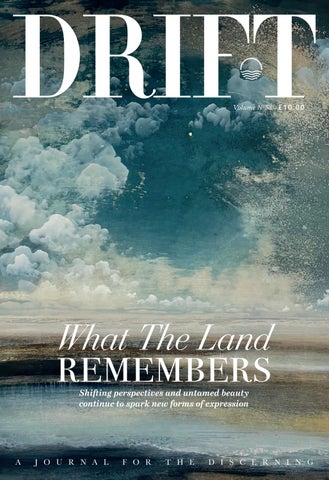
Shifting perspectives and untamed beauty continue to spark new forms of expression


1. the act of driving something along
2. the flow or the velocity of the current of a river or ocean stream
1. to become driven or carried along, as by a current of water, wind, or air
2. to move or float smoothly and effortlessly
We invite you to continue your lifestyle voyage online. Find inspiring stories and uncover more luxury content on Instagram @driftcornwall. Join our exclusive e-journal community at drift-cornwall.co.uk to receive recipes, reviews and insider knowledge of some of Cornwall’s most-loved luxury destinations.
driftjournal.co.uk
driftjournaluk
A JOURNAL FOR THE DISCERNING


On the cover


Night Song by Sophie Carter, as featured from page 85. cornwallmuseum.org


Head of Client Management
Des Glover – 07535 585613 des.glover@levenmediagroup.co.uk
Partnership Executives
Shannon Whitter – 01326 369429 shannon.whitter@levenmediagroup.co.uk
Elly Burnard – 01326 574842 elly.burnard@levenmediagroup.co.uk
Chairman & Founder
Andy Forster – 07711 160590 andy.forster@levenmediagroup.co.uk
CEO
Ben Pratchett – 01326 574842 ben.pratchett@levenmediagroup.co.uk
PROUD TO BE PART OF

DRIFT is published by:
Engine House Media LTD
Holbrook, The Moors, Porthleven, Cornwall TR13 9JX
www.enginehousemedia.co.uk
www.levenmediagroup.co.uk

Editor
Hannah Tapping hannah.tapping@levenmediagroup.co.uk
Assistant Editor Jamie Crocker jamie.crocker@levenmediagroup.co.uk
Creative Designer Spencer Hawes spencer.hawes@levenmediagroup.co.uk
Finance & HR Manager
Charlotte Forster charlotte.forster@levenmediagroup.co.uk
Credit Control
Tracy Dart – 01326 574842 tracy.dart@levenmediagroup.co.uk
ISSN 2632-9891
© All rights reserved. Material may not be re-produced without the permission of Engine House Media Ltd. While DRIFT will take every care to help readers with reports on properties and features, neither Engine House Media Ltd nor its contributors can accept any liability for reader dissatisfaction arising from editorial features, editorial or advertising featured in these pages. Engine House Media Ltd strongly advises viewing any property prior to purchasing or considerations over any financial decisions. Engine House Media reserves the right to accept or reject any article or material supplied for publication or to edit such material prior to publication. Engine House Media Ltd cannot take responsibility for loss or damage of supplied materials. The opinions expressed or advice given in the publication are the views of the individual authors and do not necessarily represent the views or policies of
Engine House Media Ltd. It is suggested that further advice is taken over any actions resulting from reading any part of this magazine.
Engine House Media Ltd is a multi-platform media business with a passion for everything Cornish. Visit www.enginehousemedia. co.uk to find out more. Our mission is to create READ-WATCHEXPERIENCE media opportunities marrying together consumers with the fabulous businesses across Cornwall. Our publishing and marketing teams are specialists in creating print and online communications, devised to achieve a range of marketing objectives. With over 20 years of marketing, brand management and magazine experience we develop effective communications that deliver your message in a credible and creative way. We operate across all media channels, including: print, online and video.
In a culture so often preoccupied with the new and the next, we explore something more enduring. Longevity is found in the beauty of roots that run deep and the confidence of growth that is thoughtfully considered. This is not growth for its own sake, nor heritage preserved under glass, more a living dialogue between past and future. Landscape appears as both backdrop and protagonist, with stories shaped by patience, places defined by provenance and people building futures that honour where they began. We begin on the shoreline, where Lucy Bentley’s poetic exploration of Cornwall (13) reframes familiar coves and caves through folklore and light, her images steeped in place. This sense of elemental belonging continues at Trevince (58), where centuries of custodianship meet progressive horticulture and tradition and experimentation coexist. Craftsmanship, too, runs as a current. At Barton Automation (26), technology is conceived as part of a home’s very fabric, integrated early and
invisibly enhancing rather than intruding, while at Michael Spiers (52), Rolex timepieces are serviced with meticulous care, reinforcing the idea that true luxury is measured in decades. Food returns us to first principles. Darts Farm (33) marks 55 years of field-to-fork integrity, relationships between farmer and customer forming the backbone of its continued evolution. On the edge of Dartmoor, Hippo Naturopathic Bistro (43) reframes nourishment as both pleasure and intelligence. There is also beauty to be found in the rituals of daily life. In conversation with artist Mary Marbutt (67), the seemingly ordinary is elevated through attention and intention, reminding us that a life well lived is rarely hurried. Balance takes on a more literal edge in Jamie Mills’ exploration of risk and resilience (97). Teetering on the boundary between control and surrender, his story examines what it means to hold steady when conditions shift beneath your feet. To find balance is not to stand still, but to adjust constantly, subtly and with awareness.


£975,000 guide
Estuary View is a newly completed, exquisitely designed detached home of exceptional quality, set on the outskirts of Padstow just minutes from the famous beaches of the Seven Bays. Finished in October 2025 and ready for immediate occupation, the property offers over 3,600 sq ft of contemporary living space.
The standout first-floor open-plan living, kitchen and dining area features a vaulted ceiling, striking architectural windows and access to generous front and rear balconies. The high-spec kitchen includes premium integrated appliances, quartz worktops and a walk-in pantry. The first-floor master suite boasts a dressing room, luxurious en suite and Juliette balcony, while additional bedrooms offer built-in wardrobes, two further en suites and a family bathroom.
A dramatic galleried entrance hall showcases the home’s craftsmanship, complemented by air source underfloor heating throughout, oak doors, PIR lighting and automated skylights. Outside, a sweeping blockpaved driveway provides ample parking, alongside an integral garage and a generous lawned garden with sunken patios.

01841 532555
sales@jackie-stanley.co.uk
Jackie-stanley.co.uk
1 North Quay | Padstow | Cornwall | PL28 8AF


THE HIGHERTOWN HOUSE | TRURO | ASKING PRICE £1,195,000


A STATEMENT OF CONTEMPORARY LUXURY, THIS EXCEPTIONAL FOUR-BEDROOM RESIDENCE OFFERS OVER 2,350 SQ FT OF IMPECCABLY DESIGNED SINGLE-LEVEL LIVING. SET ON ONE OF TRURO’S MOST PRESTIGIOUS ADDRESSES, IT BLENDS EXPANSIVE, LIGHT-FILLED INTERIORS WITH ZERO ENERGY BILL, ENERGY-EFFICIENT PERFORMANCE, DELIVERING AN EFFORTLESS BALANCE OF ARCHITECTURAL ELEGANCE, SPACE AND SUSTAINABILITY.
3 WOODLANDS | NEWQUAY | OIEO £900,000


SET GRACEFULLY ON THE BANKS OF THE GANNEL ESTUARY, THIS EXCEPTIONAL FIVE-BEDROOM RIVERSIDE RESIDENCE BLENDS CONTEMPORARY DESIGN WITH REFINED LUXURY. BATHED IN LIGHT AND FRAMED BY WATER VIEWS, IT OFFERS SEAMLESS INDOOR-OUTDOOR LIVING, CUTTING-EDGE TECHNOLOGY, AND AN ENVIABLE SENSE OF PRIVACY MOMENTS FROM THE COAST.


OIEO £300,000

A RARE AND COMPELLING DEVELOPMENT OPPORTUNITY IN A PRIME WEST CORNWALL COASTAL SETTING. WITH FULL APPROVAL FOR A CONTEMPORARY FOURBEDROOM BARN CONVERSION AND SUSTAINABLE FEATURES THROUGHOUT, THIS PROJECT OFFERS EXCELLENT POTENTIAL AS A MAIN RESIDENCE, SECOND HOME, OR HIGH-QUALITY LIFESTYLE INVESTMENT.
CHY AN VRE | TRURO | OIEO £1,650,000


SET WITHIN HALF AN ACRE IN FEOCK, CHY-AN-VRE IS A BEAUTIFULLY REIMAGINED COASTAL HOME, JUST A SHORT STROLL FROM THE SHELTERED WATERS OF LOE BEACH. ELEVATED SOUTHERLY VIEWS STRETCH ACROSS THE CARRICK ROADS, WHILE LIGHT-FILLED INTERIORS AND LANDSCAPED GARDENS CREATE A CALM, REFINED RETREAT THAT FEELS EFFORTLESSLY CONNECTED TO THE CORNISH COAST.


a
T IDAL REVERIE
A poetic exploration of landscape and a deeply sensual sense of place 24 P ROPERLY PACED
The 911 GTS blends momentum realistically aligned with daily usability
WITHIN THE FABRIC
Intelligent home technology – integrated early and supported fully 33 5 5 YEARS OF FIELD TO FORK
Three generations shaping Britain’s most dynamic farm shop 43 T HE WAY BACK
On the edge of Dartmoor, Hippo illuminates the path for that return
50 I NSPIRED BY GENERATIONS
The treat you need to carry you through the rainy months of winter
TIME IS OF THE ESSENCE
A Rolex timepiece is shaped by a singular, uncompromising principle: absolute quality
A LIVING LEGACY
Trevince: growing towards the future
DAILY LIFE
Moments of recognition revealed by qualities of light and relationships of colour
77 WHEN THE NOISE FALLS AWAY
Pushing mind and body beyond the limits 85 W HAT THE LAND REMEMBERS
A new exhibition, revealing how the peninsula’s shifting light and untamed beauty continue to spark new forms of expression
97 T EETERING ON THE BALANCE
Jamie Mills’s mute constructions suggest use but defy explanation


WORDS BY HANNAH TAPPING


A poetic exploration of landscape and a deeply sensual sense of place.
Lucy Bentley is a nationally and internationally exhibited photographer based in the South West. Her visual language draws on the folklore of her native county, Cornwall, combined with a historical and environmental awareness to evoke a lingering sense of magic, and present the county in a fresh and altered light.
Her body of work Morvoren, Cornish for mermaid, reflects Lucy’s interest in local folklore, which originated from a childhood spent playing on Bodmin Moor near the site of the Hurlers stone circle, and the wonderfully strange geological formation of the Cheesewring, together with a current passion for wild swimming. Embarking on long unseasonal walks along some of the wilder stretches of the north and west Cornish coastlines, Lucy searched out mermaid pools, colour-drenched caves and abandoned mines to create an imaginatively resonant documentation of a Cornwall where a morvoren might still be fleetingly glimpsed through the play of light on water and fabled Cornish knockers sound in mineshafts.
Counterpointing a stark use of monochrome with vivid and unexpected splashes of
colour, the images of Morvoren evince a fascination with the near-surreal and expressionistic possibilities of landscape and the natural world, unveiling hidden secrets. The land is imbued with personal significance, which the viewer is invited to share. Alternating between landscape and the use of tactile close-ups, the images offer an intimate and immersive experience. As well as making up Lucy’s first solo exhibition, the series has also been collated in a limited-edition handmade photobook.
A recent graduate in Photography at the University of the West of England, Lucy’s work has since been exhibited across the UK, including Swansea, Bristol, and London, as well as internationally, including as part of the Hungry Eye Fair in Amsterdam as a GUP Magazine Fresh Eyes Talent. 2025 also saw her debut solo exhibition closer to home with Toner Gallery, Penzance.
More of Lucy’s images can be viewed on her website, with prints available on request. The Morvoren photobook is available for purchase from Toner Gallery.
tonerpz.com lucybentley.com


ABOVE Swimmers, 2024


WORDS BY JAMIE CROCKER
The 911 GTS blends momentum realistically aligned with daily usability.
For people who think a Porsche should be driven rather than discussed over a glass of Château Mouton Rothschild, the 911 GTS makes a compelling case for itself. A modern iteration of the iconic 911, that’s been in production since 1964, it exists for buyers who want something sharper than a Carrera, but who have no interest in the mind-blowing heroics of a GT3. It is, in essence, the thinking person’s fast 911, a bridge between two equally relevant concepts of sophisticated automation.
The GTS badge first appeared long before marketing departments committed to over-explain themselves, but its modern relevance dates from 2010, when Porsche realised there was a sizeable group of customers who wanted more bite without sacrificing sanity. The formula was simple and effective: introduce more power, firmer suspension, wider hips and darker trim. It looked tougher, sounded angrier, and felt as though someone with an intuitive grasp of what potential buyers wanted had signed it off without having the idea neutered by a committee.
That character has survived intact through successive generations. The current 992-based 911 GTS is quicker than most drivers will ever fully exploit, yet never feels it’s itching to twist out of shape and send you down the black top like a snake on amphetamines. It remains a car you can drive to Exeter on a wet Tuesday and still
feel mildly heroic by the time you arrive. The steering has weight and clarity, the brakes are reassuringly unflappable, and the whole thing cocoons the driver once it’s moving without making you feel claustrophobic.
In 2024, Porsche added hybrid assistance, a phrase that may cause some traditionalists to reach for their copies of The Oldie. In practice, it simply makes the GTS faster and more responsive, without the penalty of distancing the sensation from a true driver experience. There’s extra grunt when you want it, sharper reactions when you require them and no sense that the car has sacrificed its pedigree to play rounders for the benefit of the less competent driver.
Inside, the GTS avoids the easy trap of feeling overdesigned, a penchant that seems to have infected competing manufacturers who should know better. The seating position remains low and purposeful, the driving controls are close at hand, and the digital displays, while extensive, don’t nag the driver for attention. There’s enough tactile material to remind you this is a sports car, not a soft and rolling phone upgrade. In this sense, it still really feels like a 911.
At Porsche Centre Exeter, the 911 GTS will appeal to buyers who understand that restraint is the crowning accolade of confidence. It is quick enough to thrill but civilised enough to share a life with.
porscheexeter.co.uk


WORDS BY JAMIE CROCKER


Intelligent home technology – integrated early and supported fully.
At some point during the build of a house, someone will stand in an immaculate, newly plastered room and ask where the cables are meant to go. It is usually at that moment that the cost of leaving technology until the end becomes painfully clear. Walls are chased, ceilings opened, and that dream home is never the same again. Barton Automation prefers never to attend that meeting.
The company, led by brothers Joe and Josh Harvey, operates from Kingsbridge in South Devon, serving clients across the South West and in London. Founded by Joe in 2008, just as the financial crisis tightened its grip, the business grew from early residential audio and visual installations into a specialist in custom electronic design and integration. Josh joined in 2013 after completing a business degree, and the firm now employs a team of ten. What began with televisions and speakers has developed into something
more embedded: technology conceived as part of the building rather than applied to it.


The distinction matters. In high-value new builds and substantial renovations, Barton Automation is often engaged alongside architects and interior designers at the earliest stages. That shift has not happened by accident. The brothers are members of CEDIA, the Custom Electronic Design and Installation Association, whose recent industry focus has been on closer collaboration with design professionals. Through continuing professional development presentations, Barton Automation elucidates to architects and interior designers the practical implications of smart home systems: cabling routes, ceiling voids, plant room space, structural supports for large displays, and recesses for motorised blinds. These are construction details, not contrary afterthoughts, and they demand addressing from the get-go.
Joe and Josh Harvey


ABOVE
Discreet technology integration enhances every room with intuitive, hidden control systems
In Devon, much of their work is driven by private clients building primary or second homes. And, somewhat against the usual flow, what happens in the West Country segues into London, where Barton Automation are picking up business through a reputation honed in Devon. A common factor is that the starting point of conversations begins much earlier than they once did. A modern house of scale cannot function on a single broadband router tucked under the stairs. Distributed Wi-Fi, lighting control, automated shading, door entry, whole-home audio and media systems require coordinated planning. Increasingly, so too does energy management.
One of the more significant developments in Barton Automation’s portfolio is the integration of building management systems. Rather than simply allowing a client to adjust heating schedules from a tablet or smartphone, the company is working with data from solar panels, battery storage, ground source heat pumps and conventional boilers to influence how a property consumes and stores energy. If the forecast is favourable and battery levels are high, the house may draw primarily on solar generation. In colder conditions, it may switch to a gas boiler, informed by prevailing energy prices. The aim is certainly not complexity for its own sake, but a more efficient response to conditions beyond the front door.
That principle runs through the company’s approach. Technology must simplify life, not complicate it. Josh Harvey is candid about the industry’s earlier missteps,
when systems were over-engineered and unreliable. Clients would return home, attempt a straightforward task and find themselves wrestling with a wall-mounted control panel. Barton Automation now works to a model of intuitive interaction for the user. Systems are selected and configured to follow the path of least resistance, avoiding convoluted chains of triggers and commands. If an operation cannot be made obvious, it is reconsidered.
The aesthetic dimension is equally important. Interior designers are tasked with creating rooms that feel composed and personal; a black rectangle dominating a fireplace can undermine that effort. Concealment has therefore become a recurring theme. Artwork that parts to reveal a television, screens that rise from cabinetry or arise from floors, projectors paired with discreetly housed screens: these solutions allow a space to serve multiple functions without permanent visual intrusion. Motorised blinds can be recessed into ceiling pockets so that, when raised, only a narrow slot remains visible. Such details require decisions to be taken before windows are even ordered.
Behind the finishes, infrastructure is paramount. Cabling is installed with an eye to future demands, acknowledging that families and technologies evolve. A playroom may one day become a cinema room; a child’s bedroom may require data provision for study or gaming. Display standards change, bandwidth requirements increase, and equipment is replaced. By ensuring that appropriate conduits and cable specifications are in
place from the outset, the company allows properties to adapt without repeated disruption and defacement.
The work does not conclude at handover. In larger projects, installation may occupy only the final weeks of a build that has spanned months. Once the keys are passed over, Barton Automation’s involvement often continues through maintenance packages. Connected homes are subject to software updates, hardware failures and network changes. The company monitors systems remotely, receiving alerts if an amplifier drops offline or a network device stops communicating. For clients, this offers reassurance; for the business, it provides recurring revenue that underpins long-term service.
Security features are handled with similar pragmatism. Holiday properties can be placed into occupancy simulation modes that replicate lighting and shading patterns based on recorded behaviour rather than fixed timers. The effect is subtle but mirrors real-time living, deterring any would-be intruder. Activation and deactivation are managed through straightforward controls, designed so that owners need not concern themselves with technical processes.
Professional standards underpin the operation. Through CEDIA accreditation and City & Guilds qualifications, the industry is moving towards clearer benchmarks of competence. While not a statutory requirement, affiliation signals adherence to recognised practices and
ongoing training. For architects and interior designers navigating increasingly complex projects, that assurance carries weight.
What emerges from a conversation with Josh is less a fascination with gadgets than an insistence on planning. Budgets illustrate the point. A provisional allowance for “AV” in a building schedule may bear little resemblance to a client’s eventual aspirations once whole-home integration, lighting control and energy management are discussed. Early engagement prevents financial surprises and allows for realistic expectations.
For those commissioning significant residential projects, the lesson is plain. Intelligent home systems are no longer decorative add-ons; they influence structure along with spatial planning. When addressed at the correct moment, they recede into the background, supporting daily life without clamour.
Barton Automation has built its reputation on ensuring professional and seamless integration of AV installations through engagement with all parties. It is a disciplined approach in a field that, up until recently, has seemed fragmented. In properties where views are prized and interiors carefully designed, that discipline, like a soundtrack to a great film, is allowed to disappear into the background. Without it, however, there would be a notable absence.
bartonautomation.co.uk


BY JAMIE CROCKER


Three generations shaping Britain’s most dynamic farm shop.
It begins with a dung heap. Not a metaphorical one, nor a discreet nod to rustic charm, but the real thing, visible if you wander far enough across the yard. There are tractors parked where tractors ought to be parked, cattle moving across fields and mud where you would expect mud. Darts Farm makes no attempt to disguise that it is, at heart, an agricultural enterprise. For all the shine that has accrued over five decades, it remains grounded in the practical business of growing food and rearing livestock.
The business was begun in 1971 by Ronald Dart, at a time when small farmers were increasingly squeezed by the wholesale system. He was growing vegetables for supermarkets and competing on price with larger, intensive operations. The quality of his offering, he believed, was superior, but the return rarely reflected that. The route to market available to most growers provided little room for distinction; produce was a commodity, and margins were thin. Galvanised by this knowledge, Ronald’s response was direct: if the system undervalued what he grew, he would simply bypass it. He began selling straight to the public, establishing one of the country’s earliest pick-your-own
enterprises. Customers could walk into the fields, select their own produce and pay the farmer rather than the middleman. Sadly, in 1982 Ronald passed away aged just 49, with newspapers reporting ‘Death of a Pioneer’. While he didn’t get to finish what he started, the seeds he sowed were in his sons; Michael, James & Paul.
The principle and common-sense underpinning that move were straightforward: local food should be eaten by local people. Yet that common sense has proved durable. More than half a century on, the language surrounding food has changed – sustainability, transparency, wellness, but the conviction that proximity matters remains central to Darts Farm’s identity.
George Dart, Michael’s son, speaks about the business as a network of relationships. They believe that the farm has always operated in the relationship business rather than merely retail or hospitality. The bonds with producers, many of whom have worked alongside the family for decades, are as important as the transactions taking place across a counter. Suppliers grow with the farm rather than being replaced at the first sign of cheaper alternatives, with staff
PREVIOUS


retention being unusually strong for the sector; ten, fifteen and twenty-year tenures are not exceptional.
That culture has shaped the customer experience. Some regulars visit several times a week, drawn not only by what is on offer but by the familiarity of faces behind the tills and counters. It is a transactional community that is locally based and relies upon personal relationships. Come summer, a different rhythm sets in, with visitors heading to Devon and Cornwall peeling off the motorway and incorporating Darts Farm into their annual ritual. At Christmas, families return for particular cheeses, joints of beef or provisions for a festive table. The clientele is a blend of the habitual and the occasional, which creates a steady base alongside seasonal peaks.
Location has undoubtedly helped. A few minutes from the M5, near Topsham, the farm is accessible. Yet accessibility alone does not account for its success and its evolution. The Dart family has been prepared to take calculated risks, informed not by a profit motive but as a continuation of the ethos set out decades before.
The most conspicuous of these is The Farm Table restaurant. Housed in what was once a potato shed, then a greenhouse and later a low-ceilinged children’s toy shop, the space has lived several lives. During the pandemic, when restaurants across the country were closing and uncertainty prevailed, the Dart family decided to build another one. George admits, with hindsight, that it was
a bold decision bordering on the naïve. There was no elaborate business plan, no tightly defined return-on-investment target. Instead, there was time, an unusual commodity, and a sense that the moment allowed for experimentation.
The build unfolded in an organic manner. Without the pressure of normal trading, the whole team shaped the restaurant as ideas emerged. There were no high-profile interior designers imposing a house style. Local carpenters and joiners contributed their skills; a plumber designed and fashioned elements of the copper bar and wine rack. Details were resolved through conversation and craft rather than through conventional mood boards.
Even the acoustics owe their quality to an impromptu intervention. When corrugated tin was proposed for the ceiling, a local musician (of national fame) happened to be shopping. Invited to inspect the halffinished structure, he retrieved a guitar from his car and played within the space to demonstrate how the hard surfaces would affect sound. His suggestion to use cider cloth, hessian traditionally associated with pressing apples, was taken seriously. The cloth was installed overhead, and the result is a dining room in which conversation can be heard without strain, even when the tables are full. In an era when many restaurants suffer from a cacophony of competing noises due to a lack of wisdom, the attention paid to how a room sounds rather than simply how it looks has proved beneficial.

Within three years of opening, The Farm Table secured two AA rosettes. For a business whose previous restaurant offering had been more informal, the recognition was significant. George attributes the accolade to several factors, though he resists reducing it to a formula. The kitchen is led by Tom Chivers, who has been involved from the outset and whose approach aligns with the farm’s values. Fire-led cooking is central. Ingredients are often treated with restraint: grilled over flames, seasoned carefully, allowed to speak for themselves.

The emphasis on fire reflects both an aesthetic preference and a practical logic. When produce is at its peak, excessive manipulation can be counterproductive. A whole turbot placed over the grill, oil catching light and flame, carries a certain theatre. Yet the theatre is incidental to the method. The open fire also alters how a room feels; there is a primal draw to flame that no induction hob can replicate. The pizza oven and grill sit visibly within the restaurant, reinforcing the connection between cooking and eating.


Seasonality dictates much of the menu. Each week, the kitchen receives a list of what is available from the farm, with the contents shaping the dishes. Beef often comes from the Dart family’s own herd of native Ruby Red cattle and fish is sourced from
Brixham through established contacts. At certain times of year, when produce from further afield is at its best and cannot be found locally, blood oranges from Italy, for instance, it appears without apology. The aim is not to impose arbitrary limits but to serve food at its most compelling.
George is clear that food alone does not guarantee success. Atmosphere and service matter as much. He speaks about the energy generated when the food hall beyond the restaurant is busy, when the dining room hums and staff move with purpose. The meal becomes part of a wider experience rather than an isolated event.


That thinking extends beyond the restaurant to the wider site. The farm shop encompasses butchery, the vineyard, cider pressing and chocolate production. There is a sense of drama in seeing these processes unfold. Customers can watch chocolate being made or cider being pressed. The sights and sounds reinforce the reality that food originates from the land and sea rather than packaging from a supermarket shelf.
Underlying this is a broader concern about the contemporary food system. George speaks frankly about the pressures on farmers and the industrial supply chains that reduce produce to anonymous commodities. In his view, such systems
disadvantage growers at one end and consumers at the other, delivering lower returns to the former and less nourishing food to the latter. Darts Farm believes in a different food system. One where value is shared fairly and consumers can choose real, natural food from people they know and trust.
Growth, however, presents its own challenges. Darts Farm is no longer small in scale, yet the family is cautious about expanding too quickly, with the approach being organic rather than contrived. Suppliers are encouraged to grow alongside the business rather than being stretched beyond capacity, with collaboration being seen as the way forward.
The communication that emerges from the farm has historically been understated. It has not relied heavily on slogans or overt declarations of principle. George acknowledges that a visitor arriving with no prior knowledge might not immediately grasp the depth of the family history or the thinking behind certain decisions. Recently, however, the business has begun publishing a printed journal in newspaper format. Combining seasonal recipes with editorial content, it offers a tactile way of telling the story, one that sits comfortably on a kitchen table rather than disappearing into an inbox or internet landfill.
As Darts Farm celebrates its 55th anniversary, there is little suggestion of settling into routine. The Farm Table, once the bold new venture, now functions as a launch pad for further ideas. Plans are underway for a tulip festival, with
hundreds of thousands of bulbs planted across the farm. The event will include live music and food, drawing visitors outdoors and into the fields. A larger summer festival is also in development, conceived as a gathering that brings together music, farm feasts and elements of wellness. George admits that the project carries some of the same uncertainty that accompanied the restaurant build: a clear vision of the atmosphere they hope to create, though not every detail is yet in place.
That willingness to proceed without exhaustive guarantees has characterised the business from its inception. Ronald Dart did not know, in 1971, that selling direct would reshape the trajectory of his family’s farm and future. The decision was grounded in dissatisfaction with the status quo and belief in the quality of what he grew. The same instincts have guided Michael & his brothers to create the Darts Farm of today.
For customers increasingly attentive to where their food originates, that visibility carries weight. Darts Farm has expanded into hospitality and events, earned accolades and attracted national attention, yet it has not detached itself from the fields that made it possible. The dung heap remains. So does the conviction that food tastes better when its origins are neither obscure nor abstract. After fifty-five years, that combination of a willingness to go with gut instinct and honesty continues to define Darts Farm, as it looks ahead to whatever the next chapter may bring.
dartsfarm.co.uk


WORDS BY JAMIE CROCKER
On the edge of Dartmoor, Hippo illuminates the path for that return.
Somewhere between convenience and consumption, between the pharmacy counter and the supermarket aisle, we stopped trusting the ancient intelligence of real food. We traded forests and fields for factories, nourishment for novelty and in doing so, surrendered something far more precious than flavour: our sovereignty.
And yet we have normalised a different story. Medication from birth with prescriptions as punctuation marks across a lifetime. Symptoms are managed and silenced while the root causes remain untouched. We have been persuaded that healthy lives are to be obtained from a box with a beautifully designed ‘serving suggestion’ on the front.

24 hours, our gut microbiome can shift. Hormones falter. Neurotransmitters misfire while inflammation simmers, ready to inflict chronic illness and pain, and yet we are told this is just modern life. We are sicker than we should be, more medicated than we need to be, and further from the source of our sustenance than ever before. But the way back is not complicated. It is earthy and colourful and honest. It is vegetables pulled from soil, pulses, roots (cassava, konjac) and fats that have not been tampered with beyond recognition.
Meanwhile, the food industry has mastered addiction, exerting its hegemony wherever it can. Ultra-processed products are engineered to make us cry out for more whilst maximising profit. In as little as
Whole foods carry wisdom. Their phytochemicals do not work in isolation but in harmony, a complex, elegant symphony designed to support the body when eaten daily. At Hippo Naturopathic Bistro, to give it its full name, you’ll find that eating this way is not about denial or dogma. It is about remembering and relearning that food is information and connection, whilst exalting in the knowledge that it’s also jolly tasty.


Walk through the door at 1 Cross Street, Moretonhampstead and colour arrives first. Plants, paintings and plates that draw you toward a culinary experience that is shaped by evidence rather than fad. This is what Ione Rucquoi has built since opening in May. During Cancer Awareness Week, the specials leant into anti-inflammatory ingredients. For Chinese New Year, Ione and her chef Claudia worked out how to honour the cuisine whilst keeping everything within naturopathic principles. Taking what people already love to eat and rebuilding it from better ingredients.
Naturopathy itself remains misunderstood. People hear the word and picture wishful thinking rather than nutrition science, peer-reviewed research and biochemistry that requires dedicated rigour. The College of Naturopathic Medicine, where Ione trained, teaches a food-first approach to optimal health. It examines how the body functions at a cellular level and why treating symptoms without addressing causes achieves nothing that will last.
The premise is straightforward: food is information. What you eat tells your body how to behave. Feed it engineered products designed to trigger cravings and it all goes out of sync. Feed it whole foods that still look like food, and your body recognises what it is being given and responds positively.
Ione spent time in clinical practice after qualifying, designing therapeutic nutrition programmes tailored to individual needs. The science was sound, but the psychology proved brutal. People arrived saying they wanted to change, then discovered they were not ready. Others found the financial burden
prohibitive. The very people who might benefit most were often priced out entirely.
Hippo is her answer. A place where anyone can walk through the door and eat food that supports their health without needing a consultation or a second mortgage. The kitchen is fully gluten-free apart from sourdough bread. The dishes are balanced with plant and animal protein, complex carbohydrates, and healthy fats, with everything cooked in organic pomace, coconut or olive oil.
Local suppliers are prioritised where possible. Some of them barely operate as wholesalers. One even delivers by cob horse or bicycle. Goat and hogget come from a couple of miles up the road, whilst venison arrives from the deer park that borders the town. It is about working with farmers who share a similar ethos, who understand land stewardship, who are doing regenerative work on a small scale.
The space feels like an extension of Ione’s other life as a visual artist. Books available for customers to browse cover nutrition science, fermentation and gut health, whilst a piano squeezes under the shelves. Someone will come in and play at lunchtime soon. This lateral thinking keeps Hippo from being too earnest and preachy, so that you don’t feel obliged to don a sackcloth outfit to attend. Those Maitake tempura mushrooms, battered in gluten-free vegan batter, are one of the most popular dishes. They sit alongside raw cakes that contain no dairy, no refined sugar, no oven time and yet taste like something worth ordering twice.
Moretonhampstead is not the obvious location. A small rural town on Dartmoor’s


edge that, like most English villages, is emerging from an idea of itself that is now evolving into something else with the help of people like Ione. An old pub turned naturopathic bistro is not an obvious fit. But people are coming. Some travel considerable distances. The Chinese New Year event sold out. Fermentation workshops draw interest, with Ione reporting that the people who do walk through the door are genuinely lovely and curious rather than hostile.
What she is trying to do is offer an alternative to the binary choice between convenience and cost. The rise of weight-loss drugs has only sharpened this argument. People are taking medication to suppress appetite without considering what they are eating in the reduced amounts they can manage. The focus, Ione argues, should be on nutrient density.
twenties. She knows the area, knows that trends take longer to arrive this far west. But Dartmoor attracts a particular kind of person. People who care about land, about their relationship with the natural world and who are more likely to understand why the quality of the soil matters.

Hospitality in Britain is starting to shift. Not everywhere, not quickly, but it is happening. People are tired of feeling stuffed, with many wanting to feel restored rather than simply full. Hippo represents one version of what that shift might look like. Not a wholesale rejection of pleasure but a recalibration and conscious recognition that eating well does not require monkish self-denial.
Brought up in South Hams, Ione has lived around Drewsteignton for over two decades, having moved out from London in her
She is not a fist-shaking evangelist. The tone at Hippo is welcoming, with the information there if you want it. Little handwritten annotations pointing out the antiinflammatory properties of certain ingredients set the educational process as one by osmosis rather than instruction. Running a restaurant that refuses to compromise on ingredient quality while keeping prices accessible is challenging, with Ione developing new recipes, waitressing and handling the managerial side. But every time someone orders the raw cakes and cannot quite believe they have not been near an oven, every time a customer with multiple food intolerances finds they can eat almost everything on the menu, the point is being made.
Food is information. It talks to your cells, influences how you feel, not just in the next hour but over the coming months. Hippocrates understood it 2,500 years ago. In Moretonhampstead, Ione Rucquoi is doing her part to bring that understanding back into the mainstream.
hippodartmoor.co.uk
Courtesy of Philleigh Way cookery school comes this tasty and rustic dish, just the treat you need to carry you through the rainy months of winter and into the fullness of spring. Best served with lots of crusty bread to mop up all the delicious gravy.
SERVES: 4 to 6
INGREDIENTS:
1 large octopus, weighing approx. 2kg, defrosted (if frozen)
2 tbsp of olive oil
2 onions, diced
1 carrot diced
5 garlic cloves, sliced
1 tbsp of smoked paprika
1 tsp cumin
2 tins chopped toms
2 bay leaves
A handful of rosemary
150ml of white wine
A handful of dill and lemons to serve
METHOD
Bring a large pan of water to the boil, then carefully add the octopus with the onion and bay leaves. Simmer for 45–60 minutes, or until the octopus is tender.
Drain the octopus, reserving a bit of the cooking liquid.
To make the stew
In a large pan gently sweat the onions, carrot and garlic. Season. Then add the cumin seeds.
Add the paprika and tomatoes and cook for another 7 minutes, stirring occasionally to avoid sticking.
Add the white wine and bay leaves and reduce the liquid in the pan by two-thirds.
While that is simmering, chop the octopus into 3cm pieces (you can BBQ them for extra flavour as well).
When the stew has been cooking for 30 minutes, add the octopus pieces and cook for a further10 minutes.
Taste and season the stew with salt and a few drops of Tabasco, if desired, and serve warm with chopped dill, lemon & crusty bread.
philleighway.co.uk


WORDS
BY HANNAH TAPPING
From the first spark of conception to the moment it leaves the workshops, every Rolex timepiece is shaped by a singular, uncompromising principle: absolute quality.
Created to be handed down through generations and to accompany many chapters of life, Rolex watches are meticulously designed and engineered for longevity. To ensure continued performance and reliability, periodic servicing is recommended so that each timepiece continues to meet Rolex’s exacting standards.
Michael Spiers is proud to be part of the global network of Rolex-trained watchmakers, entrusted with the care and maintenance of these extraordinary timepieces. By adhering to the Rolex Service Procedure, using genuine Rolex parts and specialised tools, every watch entrusted to their care returns to its original state, maintaining both its functional and aesthetic standards, thereby safeguarding both performance and heritage.
Over the last year, Michael Spiers has continued to grow as a business,
which includes the expansion of a primary Rolex Authorised Service Centre in Plymouth, alongside the ones in Exeter and Taunton. From these workshops, highly skilled Rolex-trained watchmakers provide a comprehensive professional service for Rolex timepieces, from ensuring optimal performance to expertly polishing the components. No matter which Michael Spiers showroom you entrust with your Rolex, including the one in Truro, you can be assured of the same level of service. Your timepiece will receive meticulous care and attention, ensuring it remains in exceptional condition for years to come.
“A Rolex timepiece is designed to be treasured for a lifetime. That is why, when we service a watch, we hold ourselves to the highest standards, ensuring exceptional care and keeping our customers fully informed at every stage of the process,” explains Lee Treliving, Rolex Service Centre Manager.


United by a shared passion for horology, all our Rolex-trained watchmakers bring a wealth of expertise and in-depth knowledge of Rolex timepieces. “The intricate mechanical workings of a watch have always fascinated me. Each Rolex that enters our workshop presents a unique challenge and an opportunity to ensure it continues to perform exactly as it did when it was first created,” says Alex Elston, Watchmaker, Plymouth.
The dedicated workshops are equipped with state-of-the-art tools and facilities and are exclusively devoted to the servicing of Rolex watches. From the precise
adjustment of a bracelet to a complete overhaul, every service operation required for a watch is carried out in-house by the expert team, ensuring its precision, reliability and appearance are maintained. Timekeeping accuracy and waterproofness are rigorously tested to guarantee the level of quality and reliability one would naturally expect from a Rolex timepiece and after a complete service, each Rolex is covered by a two-year Service Guarantee. No matter the model, Michael Spiers ensures that your beloved timepiece is in safe hands.
michaelspiers.co.uk
ABOVE
Michael Spiers’ Rolex team and state-of-the-art workshop
Grade II listed property offering versatile accommodation in Padstow.
The Cross House is a distinguished Grade II listed residence occupying a prominent corner in Padstow’s old town, just a short walk from the harbour, cafés, and restaurants. Spanning three storeys and 3,275 square feet, it retains many original features, including tall sash windows, wooden floors, and high ceilings, which complement the property’s historic character.
The ground floor offers two generous reception rooms filled with natural light, while the kitchen and utility spaces provide practical functionality. Seven double bedrooms, six with en-suite facilities, are arranged across the upper floors, alongside an additional bedroom with its own shower room.
Outside, a front garden overlooks the town and two off-road parking spaces are a welcome addition. Large sections of renovation have been completed, inviting prospective owners to view and appreciate its potential.

THE CROSS HOUSE Guide price: £995,000
JACKIE STANLEY 01841 532555
sales@jackie-stanley.co.uk
jackie-stanley.co.uk


An elevated family home above Maenporth with space and captivating views.
Avalon is a carefully presented coastal house arranged over three floors, set above Maenporth Beach with accompanying sea views. The entrance hall opens to a sitting room with French doors leading onto a front terrace, while a snug to the rear provides a contained retreat overlooking the garden. Beyond, an open-plan kitchen and dining space suits daily life and entertaining, fitted with Shaker cabinetry, a freestanding cooker and ample storage, and extended by a glazed conservatory opening to the patio.
Two ground-floor double bedrooms each have en suite shower rooms and outlooks toward the water, alongside a separate WC. A utility room links directly to the integral garage. Upstairs, two further en suite doubles include a dualaspect principal suite with a generous bathroom. Landscaped gardens offer various seating spots, with a patio area adjoining the kitchen – perfect for al fresco dining, with steps rising to a lawned upper garden. A timber summer house offers a flexible additional space – ideal for use as a gym, studio, or home office. The property also benefits from parking for multiple vehicles.
AVALON Guide price: £1.3M
JACKSON-STOPS 01872 261160
cornwall@jackson-stops.co.uk

jackson-stops.co.uk


WORDS BY JILLY EASTERBY


Trevince: growing towards the future.
The owners of a country estate at the heart of Cornwall’s historic mining district, with a lineage that can be traced back to medieval times, are opening their gardens to the public to share how a new kind of horticultural legacy is being created.
As soon as you enter the gateway to Trevince, its deep-rooted sense of history is palpable. The estate’s mature woodland and atmospheric Walled Garden have developed over many centuries, and its imposing parkland continues to evolve under the guardianship of Trish and Richard Stone, who are welcoming visitors to experience the joys of this heritage landscape as it undergoes a period of change.

Beauchamp. His dynasty descended through a further 13 generations in Cornwall from Hugh Beauchamp who was lord of Binnerton, between Helston and Camborne, in 1195. Although the house dates from the late 17th century, its front aspect was redesigned for Richard’s greatgreat-grandfather, Edmund Beauchamp Beauchamp (EBB), in the 1860s by renowned architect, James Piers St Aubyn. It was built by the Olver family, who were farming tenants at the time and remain so to this day. The importance of continuity, respect for the past and always looking to the future are unbreakable threads at Trevince.
Trevince was first recorded as a dwelling in 1281 and Richard’s ancestors have resided here ever since. In the reign of Henry VIII, Margaret Trevyns, the daughter and heiress of Henry Trefyns, married Martin
The Walled Garden was established in the 18th century, not only to provide essential edibles for the house and wider estate community, but also to showcase the area’s mild climate and potential for growing exotics in its mineral-rich earth. Pineapples and grapes were plentiful here and in 1835, The Gardener’s Magazine
noted that “handsome oranges were grown in the open air without protection.”
Citrus fruits have been grown continuously and the lemon and mandarin orange hybrid – the Meyer lemon – that was planted in a glasshouse in the 1980s by Richard’s mother, Vanessa, is still hugely productive, in flower or fruit for ten months of the year. Some species will be transferred outdoors in 2026 to assess how they might fare in today’s Cornish climate with its floods, droughts and gale-force winds.
When you step into the Walled Garden, it feels different. The air is warmer and a state of calm pervades the exuberant growth of the cutting garden and herb bed. Head Gardener, Colin Skelly, utilises nodig system beds, feeding the ground with compost created on site, and cultivation, using green manures to maintain soil health in larger areas. “Alongside the traditional crops that you might expect to see, we are growing perennial vegetables and fruits, such as Mexican tomatillos, Mediterranean cardoons, Japanese wineberries, Chinese kumquats, Chilean guava and physalis from the Americas, not only to expand the range of crops we grow but also the ways in which we grow them,” explains Colin.
In the 1930s, EBB’s son, Charles Beauchamp, established a commercial market garden in the Walled Garden, from which flowers and vegetables were dispatched to London’s Covent Garden by train, even during World War II. Traces of this horticultural heritage can still be
seen in the surviving rows of Amaryllis belladonna that flower abundantly in late summer. “We have moved away from the intensive production of the past, which relied on the routine spraying of pesticides and copious use of chemical fertilisers, and are now growing crops by focusing on soil health and creating a thriving garden ecosystem,” Colin adds.
Today, Trevince employs a smaller workforce to tend its Walled Garden, ably supplemented by a valued group of greenfingered volunteers and a trainee, Tamsyn, from the Work and Retrain as a Gardener Scheme (WRAGS) that provides paid, parttime practical training under instruction. “We take delight in helping the gardeners of the future to gain the valuable experience they need to embark on horticultural careers,” says Colin.
The Walled Garden follows an age-old rhythm as the seasons progress. Winter is the time for harvesting the last leeks and Brussels sprouts of the year. A quiet sense of expectancy heralds the preparation of the beds for the coming season. Crops sown in early spring and the cut flowers that provide a vibrant pop of colour are soon joined by the exquisite blossom of the fruit trees, when the risk of a late frost is past. The luxuriant growth of June simultaneously gladdens the heart and keeps many hands busy – a feast for the eyes as well as the appetite. Summer heat contrasts with the coolness of the shade and promises a plentiful harvest. The mellowness of autumn then descends, the weather turns and the cycle begins anew.


“The Walled Garden already hums with pollinators visiting the cut flower beds, trained fruit trees and ornamental displays but we are taking a further step in revamping these beds to pack an even greater punch,” adds Colin. “From its beginnings at the Eden Project, I have supported Pollinator Pathmaker, an artwork by Alexandra Daisy Ginsberg Studios that explores the question of what people would see if pollinators designed gardens. In 2026, we plan to devote one of the beds to this project, which uses an algorithmically-generated planting design to support a wide range of pollinating species.”
Below the Walled Garden is the Wilderness, the backbone of which comprises venerable oaks. Richard’s grandfather, Howard Beauchamp, planted a collection of large-leaved rhododendrons here in the 1960s and 1970s, adding to the azaleas and camellias of the midVictorian period. This century’s removal of invasive Rhododendron ponticum has created new opportunities. “With a nod to Cornwall’s plant-hunting past, we are adding many more shrubs from around the world as we explore the boundaries of what a conventional Cornish spring garden could evolve into for the future,” explains Richard. “The Shrubbery is no longer dominated by the evergreen aucuba – the spotted laurel that was so admired by the Victorians. We are digging into new possibilities and experimenting with our planting to find new species
that will not only endure but enhance the estate by adding elements of playfulness and surprise.”
Trials include Temu cruckshanksii, a type of myrtle that is native to Chile, which has smooth, cinnamon-coloured bark, dark green leaves and scented white flowers, and Schefflara taiwaniana from East Asia, with its glossy, evergreen foliage and purple berries for winter interest. Gunnera killipiana from Mexico forms an upright, trunk-like structure, unlike the familiar spreading variety that traditionally grows in Cornwall. This global outlook underpins Trevince’s story, situated as it is at the heart of the historic tin and copper mining area of Gwennap, which is a designated Cornish Mining World Heritage Site.
In the early 19th century, part of the parish was described as “the richest square mile in the Old World”. As owners of both land and minerals, Richard’s forebears played an important role in the mining industry of the area. An echo of this industrial past is the leat, a ditch that borders one side of the Wilderness, the remnant of a bygone watercourse that began at Carn Marth, ran for several miles and powered the tin stamps at Bissoe, which crushed the mined ore. A 19th-century photograph shows that, as this leat traversed the Wilderness, it was reimagined as an ornamental stream. Whilst the opportunity to revive a running water feature for its full length may have passed, the potential to reinstate a small section remains.
As professional archaeologists prior to taking on the custodianship of Trevince 20 years ago, excavating and preserving the treasures of the past run deep within Trish and Richard’s DNA, but like previous generations before them, they also recognise and embrace the need for reinvention as well as the inexorable inevitability of change. The work begun by Vanessa to enhance the Wilderness with the planting of conifers as part of the International Conifer Conservation Programme (ICCP), founded by Richard’s uncle, Chris Page, and run by him at the Royal Botanic Garden Edinburgh (RBGE) continues to yield results.
The Chinese native Pinus armandii, which is classed as a threatened species, has grown to maturity and been successfully propagated at Trevince to form a living seed bank for future generations. The King Billy Pine, or Athrotaxis selaginoides, a vulnerable species from Tasmania, is thriving as part of this conservation programme too. “Further additions will be planted over the coming years, and we have recently taken delivery of some very interesting specimens including podocarpus species, to add to the Chilean native P. salignus already here, as well as a rare Legrandia concinna with its attractive reddish-brown bark and delicate white flowers,” explains Richard. “We are also supplementing our ageing oaks and beeches with a richer variety of genus and species, adapting to the challenges of a changing climate and the increasing threats of pests and diseases by diversifying our trees. A century and more into the future,
these new plantings will mature to become our horticultural legacy.”
As well as new introductions, a timeless understory of spring bulbs provides a changing colour palette – the pristine white of snowdrops, the yolky yellows of Cornish daffodils, the hazy blue of native English bluebells and the pink perfection of abundant apple blossom. In autumn, the focus shifts to the first camellias, like C. japonica ‘Nobilissima’, to flower from November when, depending on the weather, there may even be a few blooms on Rhododendron arboreum ‘Cornish Red’. Winter may adopt a slower tempo, but in Trevince’s mild microclimate, roses and raspberries can be gathered into December, memorably once on Christmas Day.
“We welcome everyone to experience Trevince as the promise of spring turns to the bloom of summer, and where we garden for food, fun and the future,” adds Richard. “Bring your friends, bring your dog, take a stroll and just enjoy it. Be part of our unfolding story and share our vision for the future of this enduring place.”
Trevince Estate Gardens and Cart Shed Café will be open from 27th March to 27th September on Fridays, Saturdays, Sundays and Bank Holiday Mondays between 10am and 4pm. Regular talks and demonstrations, as well as occasional music and theatre events, will take place throughout the season.
trevince.co.uk


WORDS BY MERCEDES SMITH
Moments of recognition revealed by qualities of light and relationships of colour.
Mary Mabbutt’s paintings are inspired by colour, space and form in the everyday. Her new collection begins with the classic still life convention of flowers placed in a pot, positioned centrally in the picture plane and painted directly from life. As the collection develops, we follow the artist’s focus as it moves outwards into the depth and detail of interior spaces, taking in views of her art studio and her work table with its array of painter’s tools, all bathed in the warm light of summer. Other works are drawn from Mary’s sewing room or kitchen, reflecting the domestic objects and spaces that are central to daily life.
along with the velvet tones and flattened perspectives of ancient Italian frescoes.

Mary studied Fine Art at Loughborough College of Art and Design and at the Royal Academy Schools in London. In 2002 she received the South West Arts Major Award and has received awards from the John Moores painting Prize Liverpool, Walker Art Gallery, and the National Open Art Exhibition at Plymouth City Museum. Her work is held in collections at Arts Council London, the Metropolitan Museum of Art New York, and private collections in the UK, Europe and USA. She lives and works in Falmouth and exhibits internationally.
Mary’s exploration of shape, composition and the relationships between various colours is inspired by her interest in the studio paintings of Henri Matisse. European still life painters Henri Fantin-Latour and Giorgio Morandi are also influences,
See Mary Mabbutt’s new solo exhibition from 4th to 28th April at Whitewater Contemporary, The Parade, Polzeath, PL27 6SR.
wwcg.co.uk


Pushing mind and body beyond the limits.
Widely regarded as one of the toughest winter ultramarathons in the UK, the Arc of Attrition 100 follows a gruelling route along the South West Coast Path from Coverack to Portreath. Testing athletes to their limits as they cover difficult terrain in tough and unpredictable winter conditions, the race sees runners battling with the elements, the darkness, body and mind. Mike Samuels ran his first Arc 100 in 2023, finishing in the top 50 within an elite field of 332 runners with a time of 27hrs 31mins and 16 seconds. Some endurance feats announce themselves loudly. Others arrive almost by accident, stitched together from curiosity and stubbornness. Refusing to let go of an idea once it had taken hold, Mike Samuels decided to return to Cornwall and run the Arc 100 again, breaking the 24-hour barrier. However, the story doesn’t end there, what follows is a tale of building a life that supports extreme ideas and about why, sometimes, the most radical thing you can do is simply keep going.
Before we get into the Arc itself, can you take me back a bit. Where does your story begin?

I was born and raised in Southampton and lived there most of my life. I’m an only child, and had what I would call a very normal childhood really. I followed the traditional route, school then college, but I knew pretty early on I didn’t want a conventional job. I’ve always described myself as a very mildmannered rebel. I wasn’t disruptive, I didn’t cause trouble, but I also didn’t really like following rules or taking direction from other people. So instead of going to university, I signed up to become a personal trainer and moved to London at the age of 18. I had this idea that if you qualified as a PT in London, people would queue up to pay you £100 an hour just to chat while they worked out. In reality, I was shy, introverted, and terrible at walking up to strangers in a gym to sell myself and so, after 18 months, I moved back to Southampton.


That sounds like an early lesson in self-awareness…
Definitely. Back in Southampton, I built a mobile personal training business instead and that’s actually where writing came into my life. I realised I wasn’t good at networking or cold conversations, so I thought, I’ll learn a bit of SEO, build a website, write some blogs. It worked and within a year I was fully booked, doing 50–55 PT sessions a week. Which is great, until you realise that a 4:30am alarm and getting home at 9pm every night isn’t sustainable. So I started writing more. Fitness articles, ebooks, online products, coaching tips. Then other people in the fitness industry started asking if I could help them build an online presence. That slowly turned into copywriting and by around 2016 I went all-in on that instead. Looking back, a lot of what I do now – running included – comes from that same place: finding ways to work with my nature rather than fighting it.
And running enters the picture during lockdown?
Yes, like a lot of people, I just got bored of doing burpees in the garden. I’d run a few 10Ks years earlier, but I realised pretty quickly that while I wasn’t fast, I liked going further. The idea of distance over speed really stuck, and it felt more honest somehow, less performative. My first ultrarace was Race to the King in 2021, an epic ultramarathon taking in the South coast, South Downs Way, and Monarch’s Way. I’d run a half marathon and was planning a marathon, but I heard Ross Edgley on a podcast saying that an ultra is ‘only a bit longer’ than a marathon and, let’s face it, an ultra just sounds cooler. Race to the
King was about 53 miles and at the time it was the hardest thing I’d ever done. But the feeling at the end was unlike anything else and that was the hook. From there it just escalated: 100 milers, then 200-mile races such as Race Across Scotland. I learned pretty quickly that my strength wasn’t speed it was being able to break things into chunks and keep moving, even when it felt awful.
How do you even beging to train for distances up to 200 miles?
You can’t train the full distance, you would destroy yourself. The goal is to simulate fatigue without breaking down. So, instead of one huge long run, you stack tiredness. You might do two hours of hard running on a Friday, then five hours on Saturday, then another three on Sunday, all on already tired legs. Before Scotland, my biggest training weekend was maybe 70 miles total. That’s a small percentage of the race distance, but it teaches your body and your head what fatigue feels like.
Speaking of your head, ultra-running is deeply solitary. What are you coping strategies?
I think being an only child helped. I’m naturally introverted and comfortable in my own head so I like travelling alone, I like the quiet. Mentally, I break everything down. You’re never running 200 miles, you’re running to the next checkpoint and then the next, resetting each time. Importantly, you have to accept that low points will come, but know that they also go. You might have six terrible hours and then the sun comes up, you eat something and suddenly you feel human again. It becomes really quite
simple: your job is simply to get to the end. You can moan about it afterwards, but for now, you have to silence your inner demons and just do the work.
Tell me about the Arc of Attrition. Why that race in particular?
I first did the Arc 100 in 2023 because my cousin lives in Cornwall and her husband’s an ultra-runner. He suggested it as something “a bit different.” It certainly was and I massively underestimated quite how different it was. The South West Coast Path is brutal, steep, technical, relentless. Navigation is harder than people think and winter conditions mean long hours of darkness, slick rocks and a lot of mud! I was genuinely terrified before that first race. But I enjoyed it. Then in 2024 I went back to try and break 24 hours mainly because you get a black buckle if you do. I finished in just over 23 hours and thought I was done…but then I started wondering if anyone had ever run it out and back. A little research told me they hadn’t and so the idea lodged itself. I couldn’t let it go.
So, the Arc 100 out and back was born?
Exactly. The plan was simple in theory: run the Arc 100, turn around at the finish and run it again. In reality, it took 67 hours and 3 minutes; about 26 hours on the way out, and a much slower return. The terrain doesn’t soften just because you’re tired. If anything, it feels sharper. Physically, I got through mostly unscathed, My ankles were fine but my feet were destroyed. Waterproof socks turned out to be a mistake in dry, warm
conditions and I ended up with infected blisters and on antibiotics afterwards. But that’s all part of it. You prepare as best you can, but some things just happen.
How did the resultant film come about?
I posted in a Facebook group just in case anyone wanted to come out and help crew or run a section and a guy called Tom Wharton messaged me. He’s both an ultrarunner and a filmmaker with a television background. He had always wanted to make an ultra-documentary and asked if he could follow the run. I assumed he was about to tell me it would cost a fortune, but instead, he said he couldn’t pay me, he just wanted to make something honest. His team were incredible, with the four of them out on the trail at 2am, filming, running sections, leapfrogging checkpoints. Far from being a distraction, they were an absolute lift. Fuelled by grit, caffeine and a brilliant support crew, what unfolded was a test of physical endurance and a raw, intimate look at friendship, suffering and the unrelenting pursuit of something extraordinary. The film is a story of pain, of persistence and of unbreakable will: run to the end, turn around and see what’s left when the noise falls away.
Fastest Known Time: Arc of Attrition premiered at The Cornwall Running Show in late 2025 and is available to rent at fktfilm.com.
copywithmike.com fktfilm.com tomwharton.co.uk


WORDS BY HANNAH TAPPING
A new exhibition, revealing how the peninsula’s shifting light and untamed beauty continue to spark new forms of expression.
Cornwall's dramatic landscape is no mere backdrop for the artists who call this place home. It's a living, breathing presence. For its major new art exhibition, What The Land Remembers, Cornwall Museum and Art Gallery has gathered together ten contemporary women artists who carry Cornwall's wildness within themselves.
The awe-inspiring landscape of Cornwall – with its jagged cliffs, restless seas, and untamed moors – holds an allure that seeps into the soul of those who encounter it. For many contemporary artists regardless of their medium, to work here is to enter into an ongoing conversation with the land.
long shaped the imaginations of those who move with its rhythms, offering meaning, connection, and a creativity inseparable from place.

This exhibition brings together ten contemporary women artists whose practices reflect the unyielding pull of the Cornish landscape. Dotted across Cornwall, working from studios nestled in bustling harbours or perched on the edges of rugged moorland, each lets Cornwall’s landscape move through their work, shaped by salt air, stone, myth and memory.
These highly attuned observers who walk among us find beauty in storms and stillness. They chase the shifting light, and trace the contours of stone and shore with paint and clay. They are the latest in a long line of artists who have found endless inspiration here, for Cornwall has
Each piece chosen for this major new show reflects the enduring relationship between place and the people who inhabit it.
What The Land Remembers is at Cornwall Museum and Art Gallery until 30th August 2026.
cornwallmuseum.org


ABOVE


WORDS BY MARTIN HOLMAN
Jamie Mills’s mute constructions suggest use but defy explanation. From neutral tones and varied textures emerge deep feeling and solitude, and a different sense of time – slow and archaic.
Jamie Mills talks about the sculptures he constructs as “teetering on the balance”. That is not meant as a physical description: his sculptures exert a quiet but electric presence when installed, lit and exhibited, as now at St Ives’ Anima Mundi gallery.
Their fragility, however, is also apparent. That is an example of their balance, sensitively calibrated to draw out qualities that surface in the viewer’s imagination with time. Like a relic from another epoch or culture placed mutely on display in a place of veneration or research, the metaphorical door to possibilities opens slowly.
they are engines for looking and reflecting.
As Mills adds cryptically, “things become things and then evaporate.” If the forms they acquire become too evocative, the audience loses space for invention. That is another kind of balance. For Mills wants to suspend certainty, so that a question remains open: “what are these objects?”

Disconnected from the world of recognisable implements or articles from the onlooker’s daily life, these artworks possess an elusive familiarity onto which the imagination latches. Achingly beautiful in their almost abstract, cream-coloured selves, “they speak of potential purpose,” the artist says. Enigmatic in their stillness,
PREVIOUS
A key factor in judging where the line runs between the curious encounter and the threshold to a putative narrative is scale. Mills holds back from going too large, from becoming too obvious. His motives and his audience’s ideas do not have to converge.
So engrossing an arrangement like Generator is no more than a foot long in any direction. Its height is set by a vertical line of three adjacent uprights which converge at one point near its base. The delicate grouping fits into a foot-like block anchored to an almost square tray, the rim of which is raised slightly into a shallow lip. No angle is precise, and every
A Firework for Vincent, 2026, stitched & dyed cotton sacks, spent firework rockets, thread, beeswax, resin, linen, hemp rope, industrial steel trays, cotton, blankets, chalk, Alexander seeds, feathers & two channel audio. INSET


LEFT

ABOVE RIGHT
edge appears intuited as if felt into position and handled into shape. And every shape appears improvised, as if negotiating some problem or other of structure by instinct rather than design.
For instance, how to make the slender, branching mast-like post stand up? After all, it is top heavy. So four strings draw diagonals through open space to where they attach inside the tray’s rim. That is where the upright shares a space with a coarse sphere, as if a silent conversation is taking place. And at each corner, the tray opens into spouts from where, conceivably, some liquid was drawn in the past.
No evidence exists to explain this meeting of lines, circle and square in three dimensions. They presume representation but do not answer the question: of what? Instead, they hold onto a discrete abstract geometry, one roughened by experience. Construction is inventive and built up from unremarkable materials. An element that looks like a stick actually is a stick. A quill and barb-like shape derives from a feather, and a bent arc is bone. All are rendered more raw by handling - coating in beeswax, chalk and clay, twisting tightly into thread or binding wool into a ball, darkening with graphite and fixing with resin.
These solitary and deliberate actions show how craft makes one thing into another, investing the result with its material and conceptual vigour. Once again, meaning (a word necessarily applied loosely) comes through metaphor. “This work explores a notion of time passing,” Mills says. “States of flow and stagnation, as in memories and experiences carried, inherited and shed. I think about weight, too, and fluidity, especially in forms. They can be amorphous.”
Everyday objects have fascinated human beings since well before recorded history. Archaeological finds suggest that natural forms like a particular pattern of shells, or a piece of coral or fossil, were noticed by ancient peoples and safeguarded for their visual and tactile appeal. These fragments were not conceived as art or even artefacts, but were kept for their aesthetic value. Lifted out of use, abstract thoughts were applied to them, which transformed how they were looked at. By the middle of the last century, however, the definition of art had begun to widen and found a place for that type of response to everyday things.
The most radical development occurred when the “ready-made”, objects brought in whole from the real world was accepted as a legitimate genre. Its pioneer was Frenchman Marcel Duchamp. Machineproduced articles became artworks when the artist chose them to be regarded as such. Most famously, he exhibited a factoryproduced porcelain urinal in 1917, which he signed into posterity with a false name, “R. Mutt”.
Mills does not enter that territory: there is no social commentary in his approach, as there is in Duchamp or prominent post-war successors like Jasper Johns and Andy Warhol. By simulating ready-made merchandise like beer cans or soap boxes in bronze and print, they made the process an art form. Hardly any contemporary progressive artwork lacks its ready-made ingredients.
The everyday objects in Mills’s output have no commercial value or overtone. They are, he says, “finds that I was not looking for”. He adopts detritus of organic and human existence at a basic level. He collects sticks
snapped, shed and fallen to the ground in town or the landscape. Walking the shores of the Lizard peninsula, near the area where he grew up, he selects from items the tide washed in. Shape or colour may be the key, or it may be length and texture. The coast is not the only source: he visits charity shops and car-boot sales, and surplus stores. In just such places, he picks out pieces of textile, finding in one the old army wash bags that assume a prominent role in his large-scale installation, A Firework for Vincent, which also gives its title to the current show at Anima Mundi.
“I recognise properties that appeal to me,” he adds. “On the one hand, there is the durability of these things and the signs they bear of use and age. Then, on the other, I see latency in them that I can work with.” Flotsam has included small, metal machine remnants or, once, a block of wood that perhaps a boat had lost at sea. Steeped in layers of paint and oil that suggested years of dowsing, he saw it jammed against gravel and rocks, and imagined the marks it could make on paper or fabric.
As he picks out these items, they are beginning their transformation in his mind. The end result will not have been formulated yet, however, unless a find fits like the missing piece in a puzzle he is already assembling. More often, objects sit about in his Penzance studio for weeks, months or longer until they fit with an idea or bring to life a new one.
This artist creates by combining. The process invites the term “bricolage”; in sculpture, that implies improvisation with diverse, unlikely materials. Their inclusion injects the metaphoric dimension,
permitting simultaneous allusions to past and present. And mixing and reusing castoff materials can unlock subconscious insights, which made the technique popular with the surrealists.
Mills does not work with lost or unneeded things that have been battered by time and used solely in order to project abject qualities. The “poverty” of his finds is not their strongest recommendation. In recent months, he has been using lead. The metal is abundant and inexpensive, but he likes its softness and malleability. It responds to handling and holds new shapes, quite unlike how metal is supposed to be. So he might combine lead with wool and cotton, as in Reliquary. One brings colour; another texture; both suggest shape. They will take marking with pigment or chalk distemper. A needle and thread can be pushed through some; others can be bent, creased, folded.
The canister-like forms in the body of Reliquary are cast from a vintage barquette mould Mills discovered while browsing in a shop. The object pleased him: how it felt in the palm. The boat shape had potential for transformation through metaphor. So he lifted it out of its culinary context and placed it in a poetic vacuum linked to shape, size, touch and that intangible “potential purpose”.
He mentions seeing at the Leach Pottery in St Ives some yunomi, a tall form of ceramic teacup from Japan, made by a resident artist from that country. With no handle, the cup is held, crude and heavy, in two hands. Mills picked up an example and felt how right it was. “Right” is only definable in aesthetic terms. “It showed what can be held in a material and a process,” he recalls.


ABOVE
Reliquary, 2026, lead, wool, cotton, chalk distemper, thread, filler in cast from vintage barquette mould, 10.5 x 21 x 24.5 cm

The yunomi are for daily, informal use: they are not part of the tea ritual, a fact Mills registered. His art is similarly secular and unexalted. But it stretches towards the exceptional and memorable.
The framed image titled The Valley is Deep & Its Walls Tall flips a collage of several sheets of tracing paper stitched together and coated with pigment in broad gestures into a suggestion of limitless night skies. Mystics in the Dark Ages sometimes divined spiritual guidance from contemplating the “heavens”, while others interpreted shapes in clouds. And in Forest Floor Study, a scatter of feathers barbs tethered with thread to a scrim mesh onto old found paper nonetheless imitate the sensation of aerial movement.
Being attuned now to how Mills invests ordinary materials with allusions to deeper expression, details like stitching can lead the mind in new directions. Brought together in one room are four pieces constructed from cotton and linen canvas coverings, which enclose natural fibres of cotton and wool.
One is The Hermit, an almost square cushioned surface in Mills’s almost signature tones of neutral off-white. It comprises seven rectangles of different dimensions stitched together. By its nature, sewing connects separate elements and thread repairs for reuse things that were broken and divided. Stitching is also used in surgery and healing. It is hard not to detect in this piece and in two of its three companions, The Runner and The Watchful, evocations of the body’s pliable tissue and muscle mass. “The body is implicated, “Mills confirms. “Its movement and stillness inform the folds: compression
and release, ingestion and expulsion find their way into the curves and texture.”
Those qualities especially evoke in soft fabrics and sewn coverings of Untitled (Eloquence), the heads-down and limbs-tucked outline of a figure. Could it be cowering or sleeping, performing or sheltering? To whose time does it belong – to now, the past or an indefinable future condition? Unavoidable are the brambles that emanate from its form or pierce it from outside.
Cloth and stone often co-exist in these sculptures. Their relationship is built on colour and composition, since the principal element of soft chalk is the mineral calcite in the skeletons of marine plankton. The rock is built of bodies, therefore, which are repositories of memory and experience. Mills might girdle chalk in lead, or mix it on meshed trays with healing Alexander seeds, as he does under the folded sacks hanging from loops of cord that draw linear arcs above head height in A Firework for Vincent. Here, diverse materials coalesce into a memory of hurt relieved in life or a dream. The echoing whine that wraps the piece audibly was also found, then processed into a soundtrack.
Mills has emerged well-fledged in recent years as a believer in the mystery of the object. His remarkable and subtle creations open doors to unexpected encounters. Those can easily be meetings with ourselves.
Jamie Mills: A Firework for Vincent continues at Anima Mundi, St Ives, until 22nd March. All images © Jamie Mills. Courtesy the artist and Anima Mundi.
jamiemills.co.uk animamundigallery.com
WORDS BY LEE STANBURY
My brother Ed was a highly creative artist and musician whose work reflected how he saw the world. He was especially well known for his sand art, created along the Cornish coastline, where he used simple materials to make thoughtful, carefully considered pieces. His work was temporary by nature, but the impact it had on those who saw it was lasting.
Creativity played a central role in Ed’s life. He lived with chronic anxiety and long-term mental health challenges, and creative expression helped him manage those struggles. Making art and music gave him focus and relief during difficult periods. Despite this, his anxiety eventually became overwhelming and he took his life in October 2025. This reality speaks of how serious and complex mental health conditions can be, even for people who appear outwardly capable and creative.
and personality and even simple concepts became memorable through his creative approach. Ed inspired others through his ideas, his imagination and the way he thought about the world. Creativity was fundamental to who he was and his influence continues beyond his lifetime.

Ed’s Ride has been created from a place of love and loss and is a way for us to honour Ed and keep his spirit present. This summer, myself and some friend will be taking on a gruelling 60-mile Penny Farthing charity ride to raise awareness. Many people in Cornwall struggle quietly, without the support they need and mental health issues often go unnoticed until it is too late. We hope that Ed’s Ride will help highlight these hidden struggles.


Ed was known for his empathy, kindness, generosity and sense of humour. He was deeply compassionate and thoughtful toward others, often putting people before himself. Creativity shaped everything he did. He had a natural ability to take an idea and turn it into something distinctive. He approached projects with curiosity and enthusiasm and was willing to experiment with new styles and materials. His work consistently showed originality
Lee Stanbury and friends
I chose to support Sunrise Cornwall (CIC) because of the vital role it plays in offering support for loss through suicide. The organisation offers safe, welcoming spaces where people can talk openly without judgement. Founded following a similar personal loss – cofounder and director Serena also lost her brother to suicide, who, like Ed, was a talented artist and musician – this shared experience really resonated with me.
To donate, follow Ed’s Ride - 60 Mile Penny Farthing Ride on Facebook or search Ed’s Ride at www.crowdfunder.co.uk
sunrisecornwall.org.uk