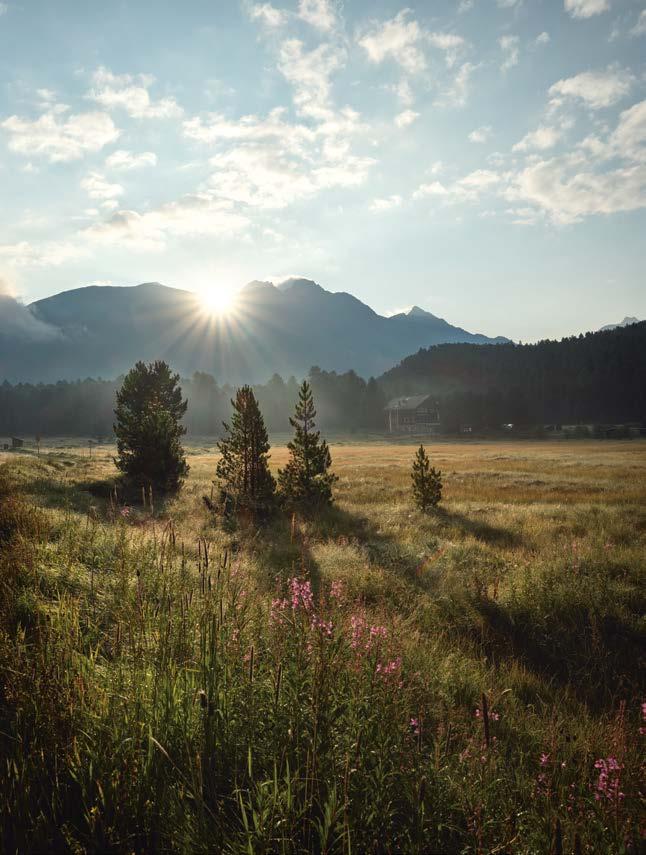
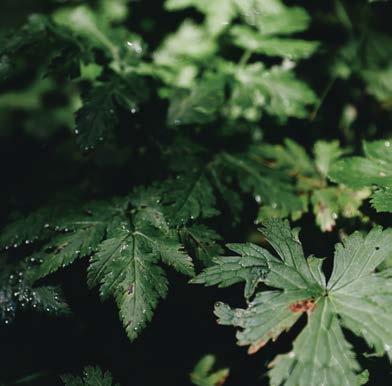
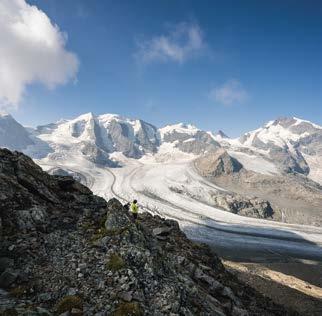
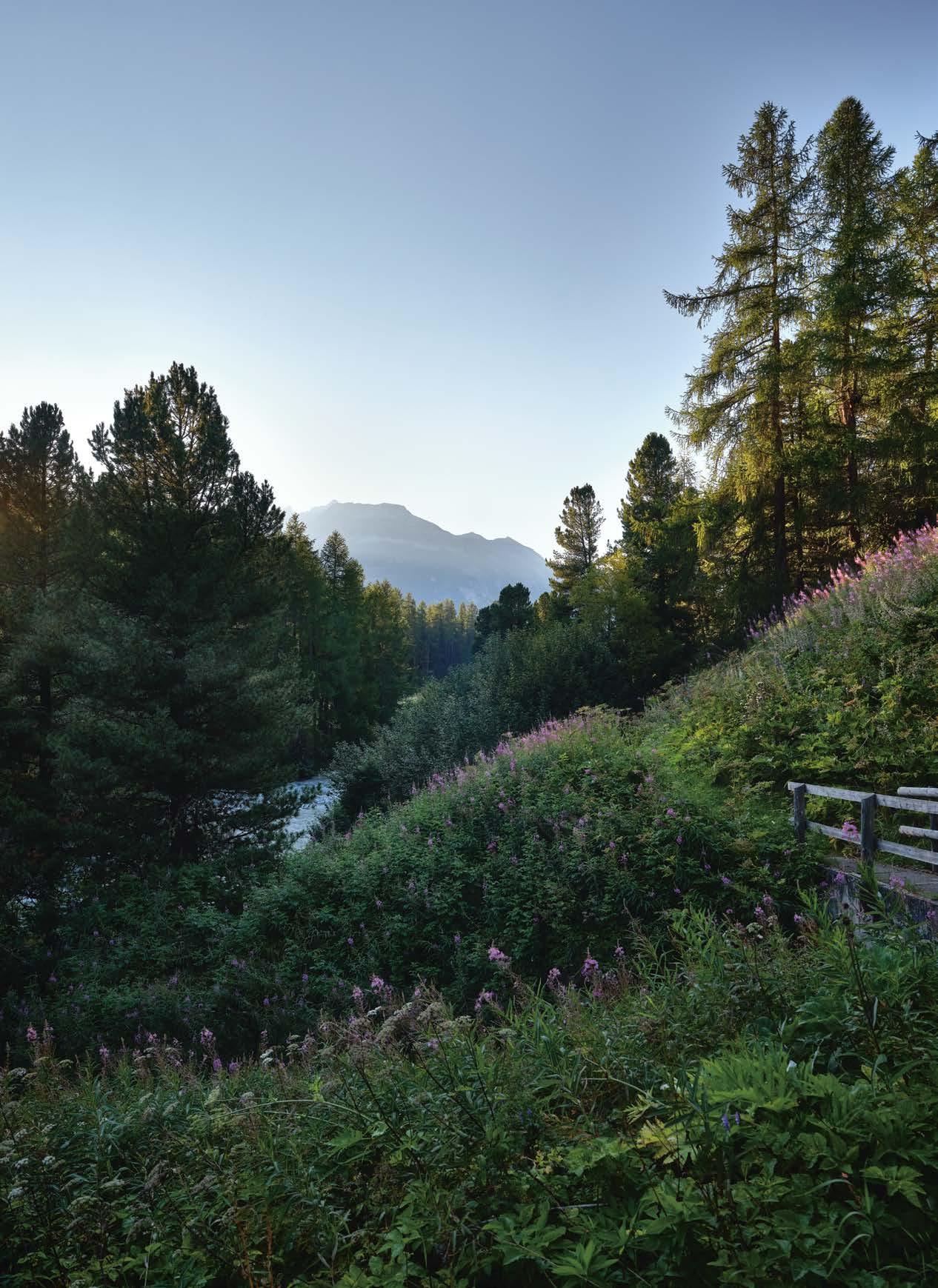
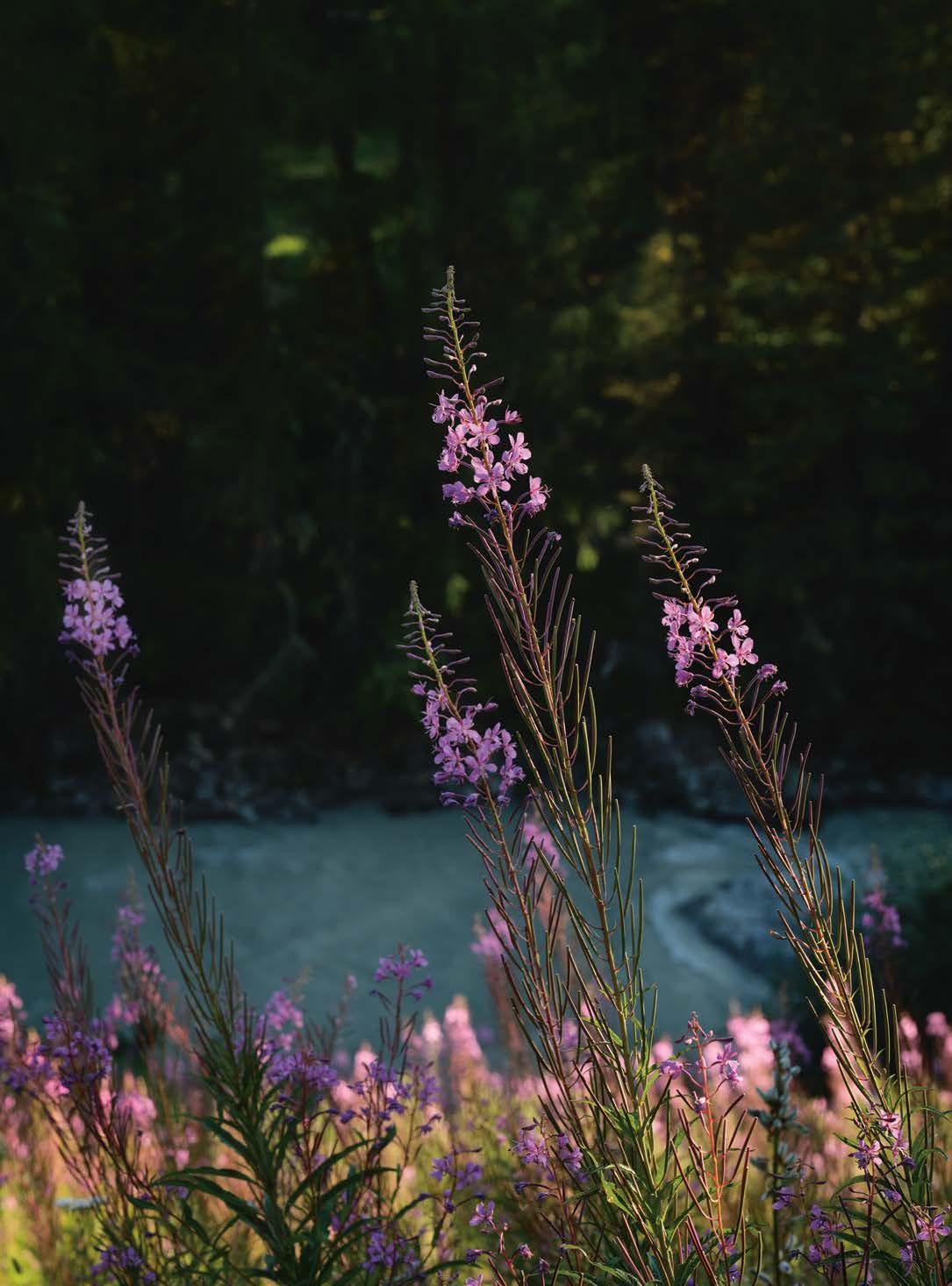
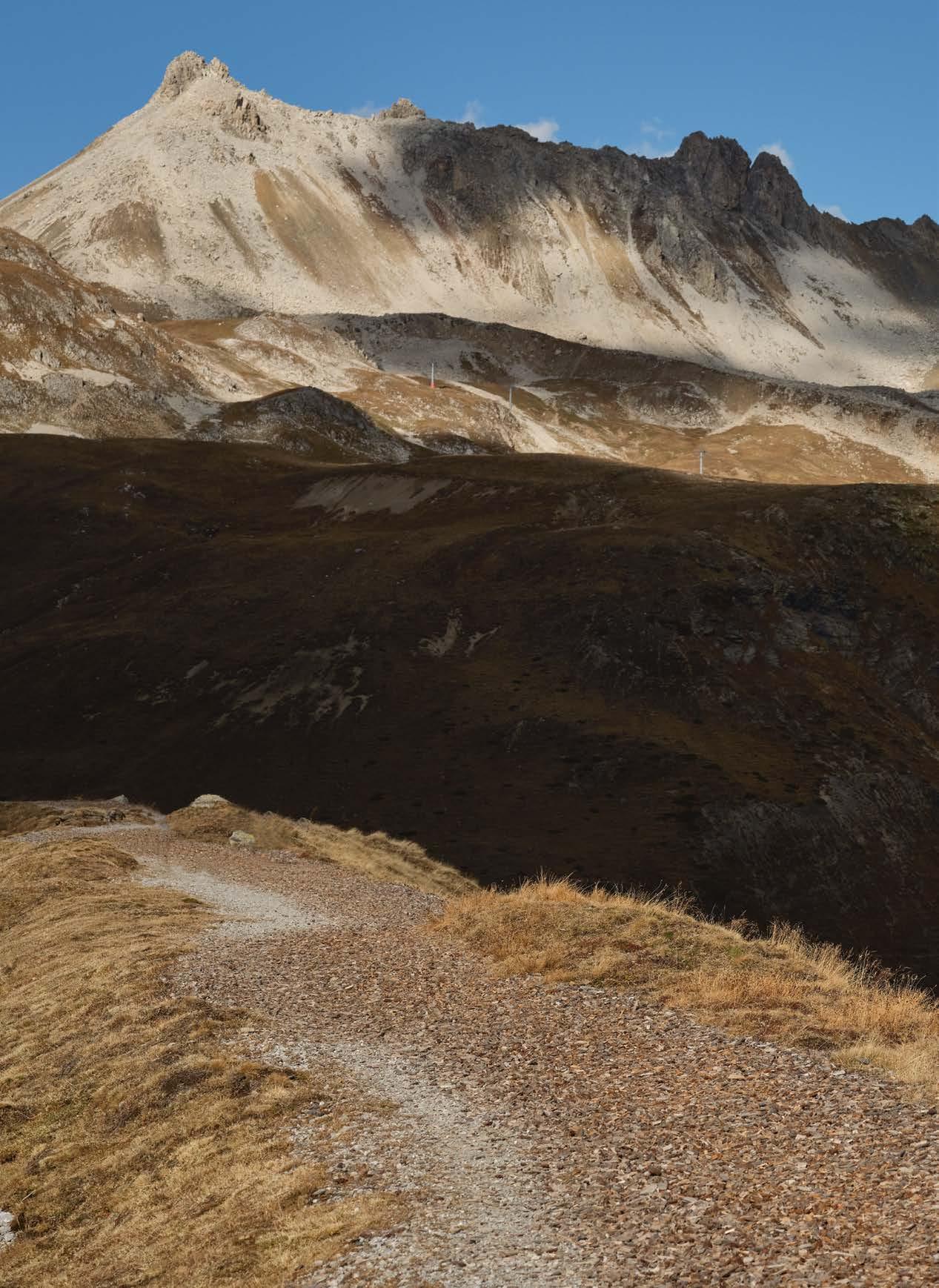
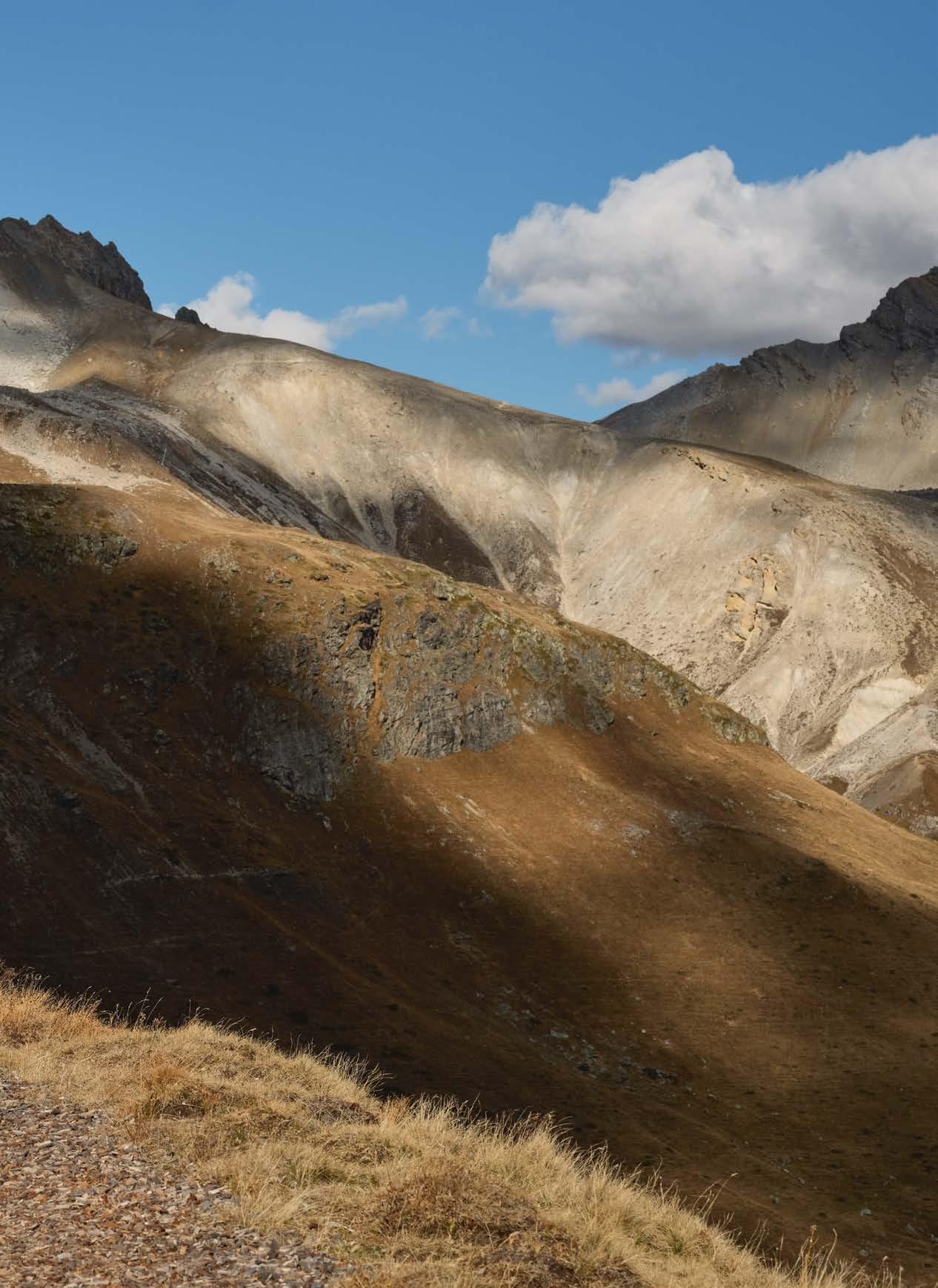
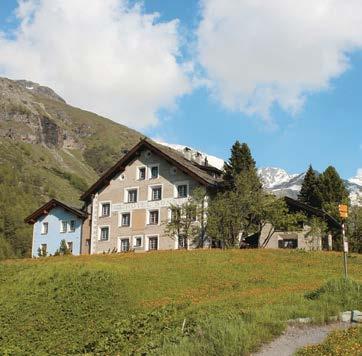
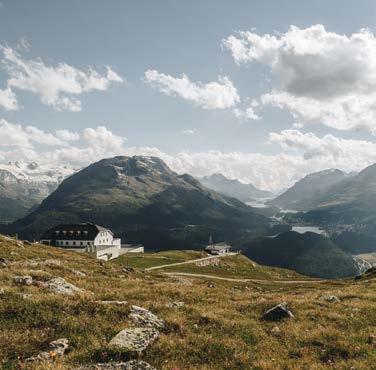
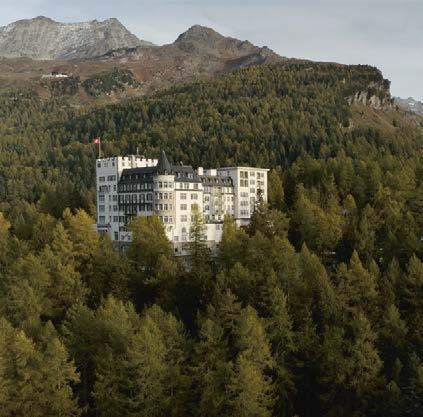
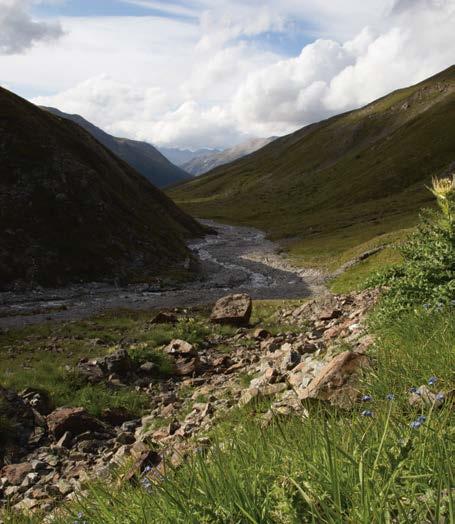
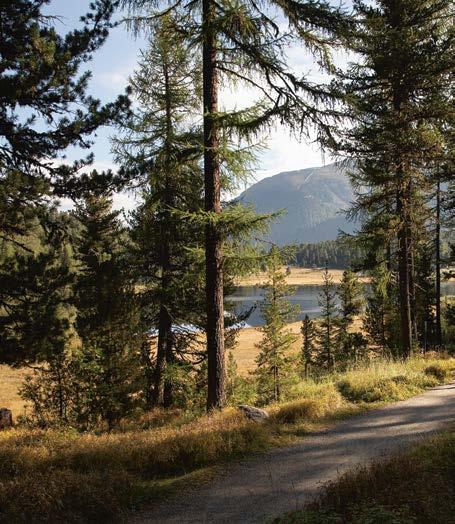
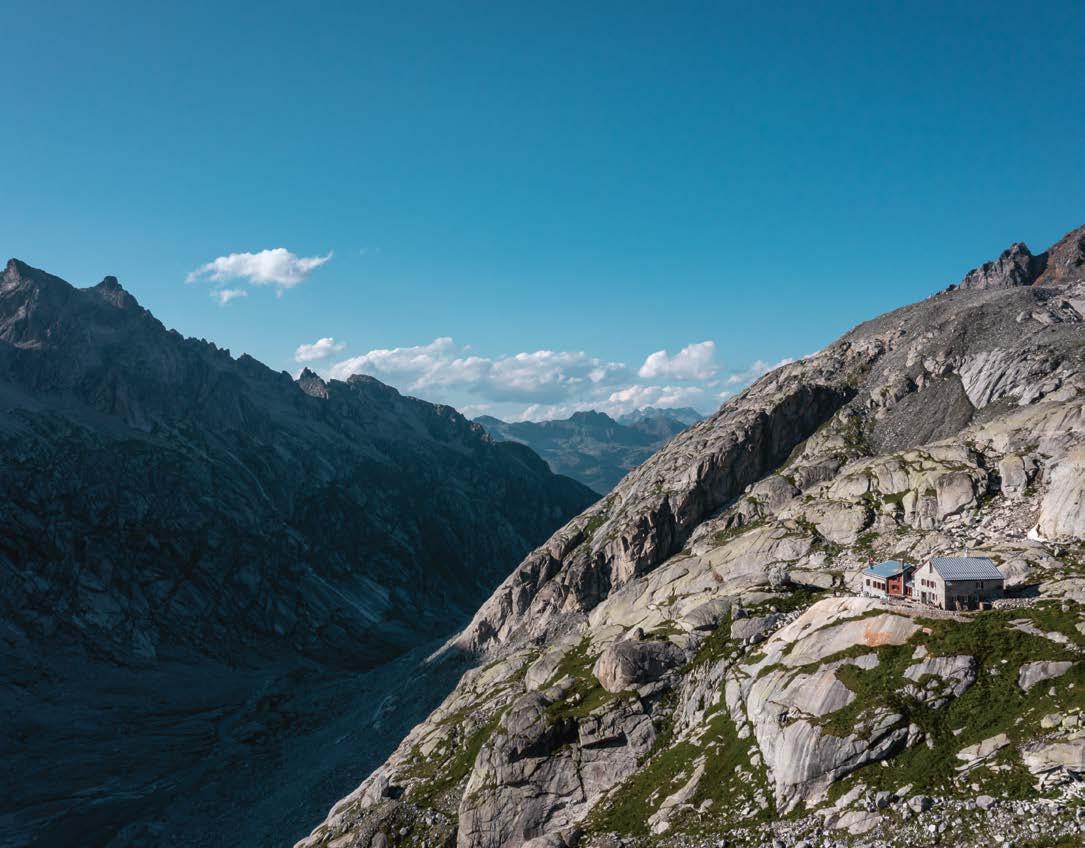
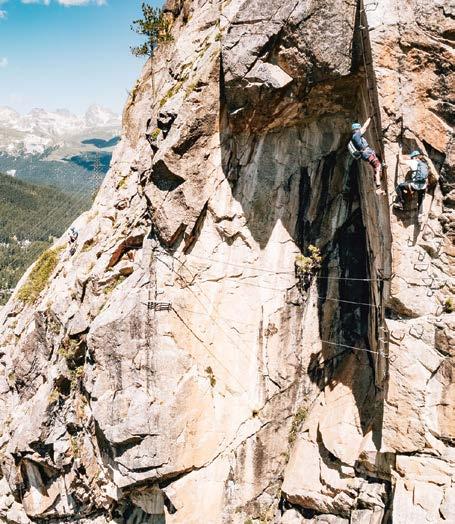
There is so much we can each do to have a positive impact on our own health, happiness, and well-being. This is precisely where the Deep Health Engadin philosophy comes into play. The Engadin is the first destination to champion this approach, developing a wide range of inspiring offerings around the concept.
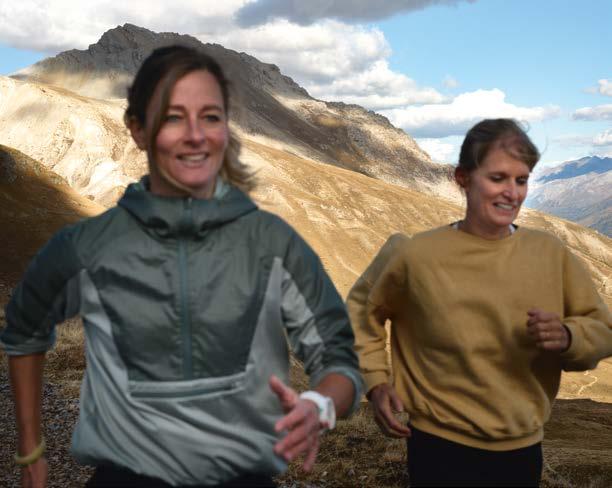
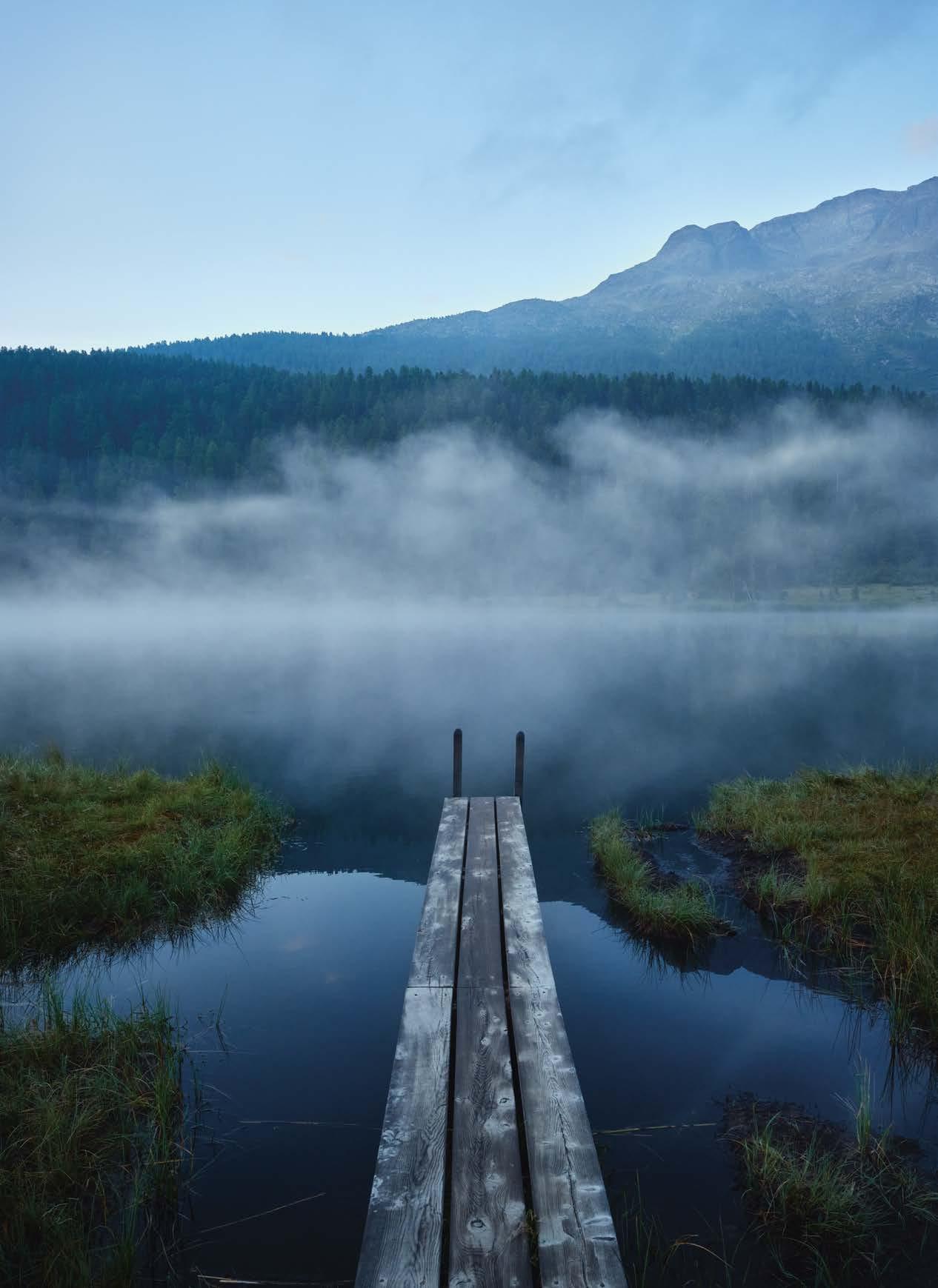
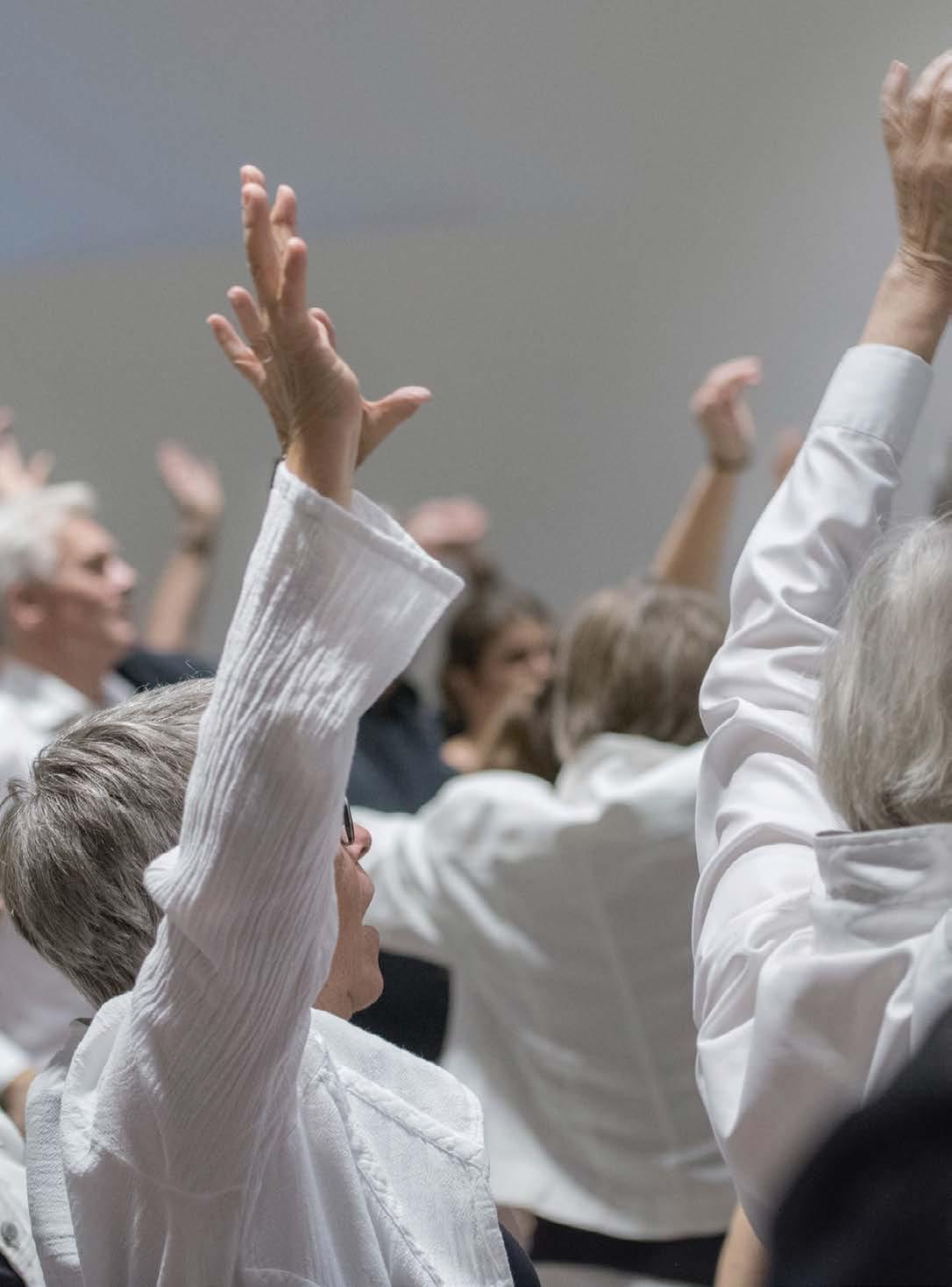
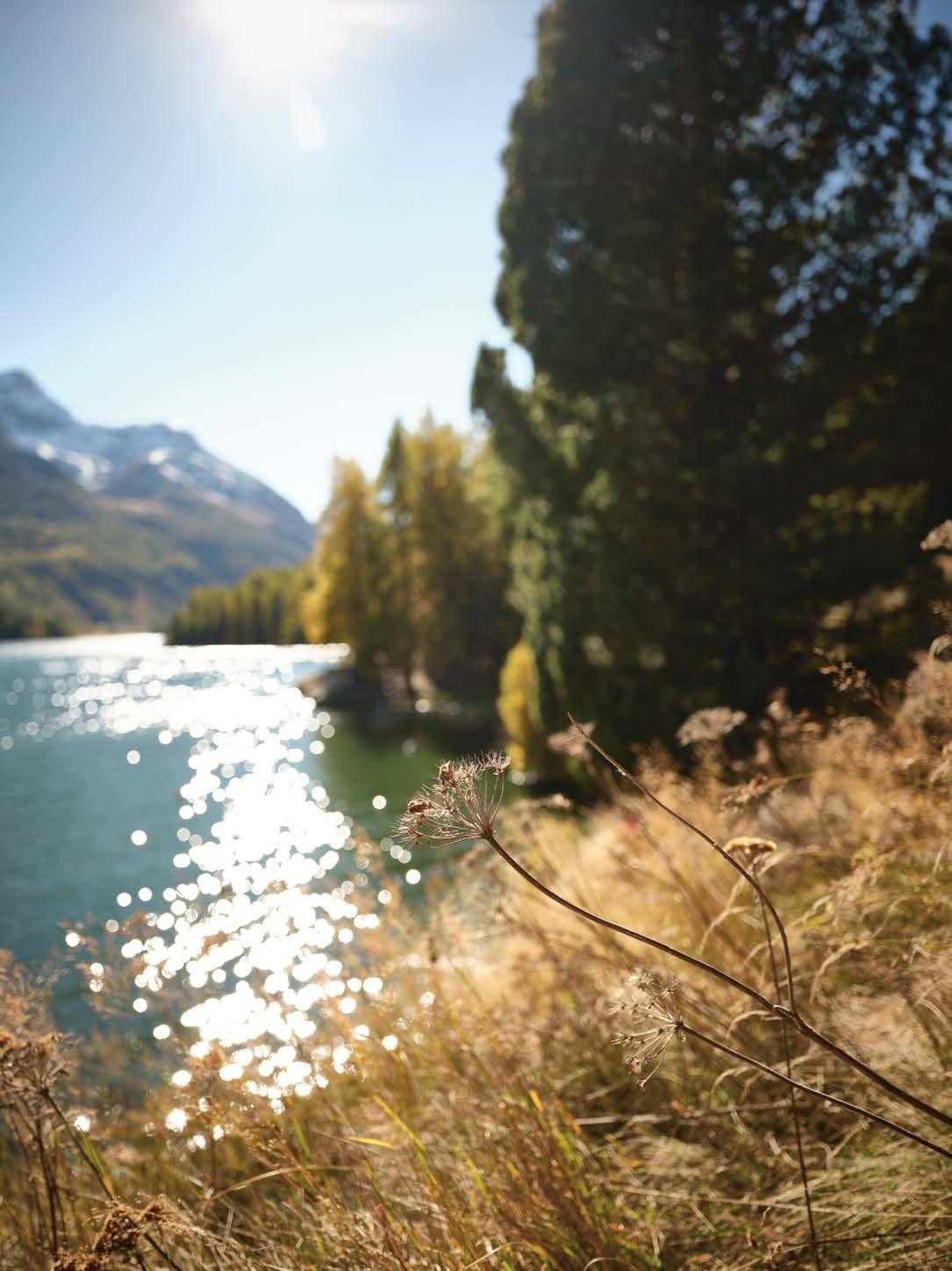
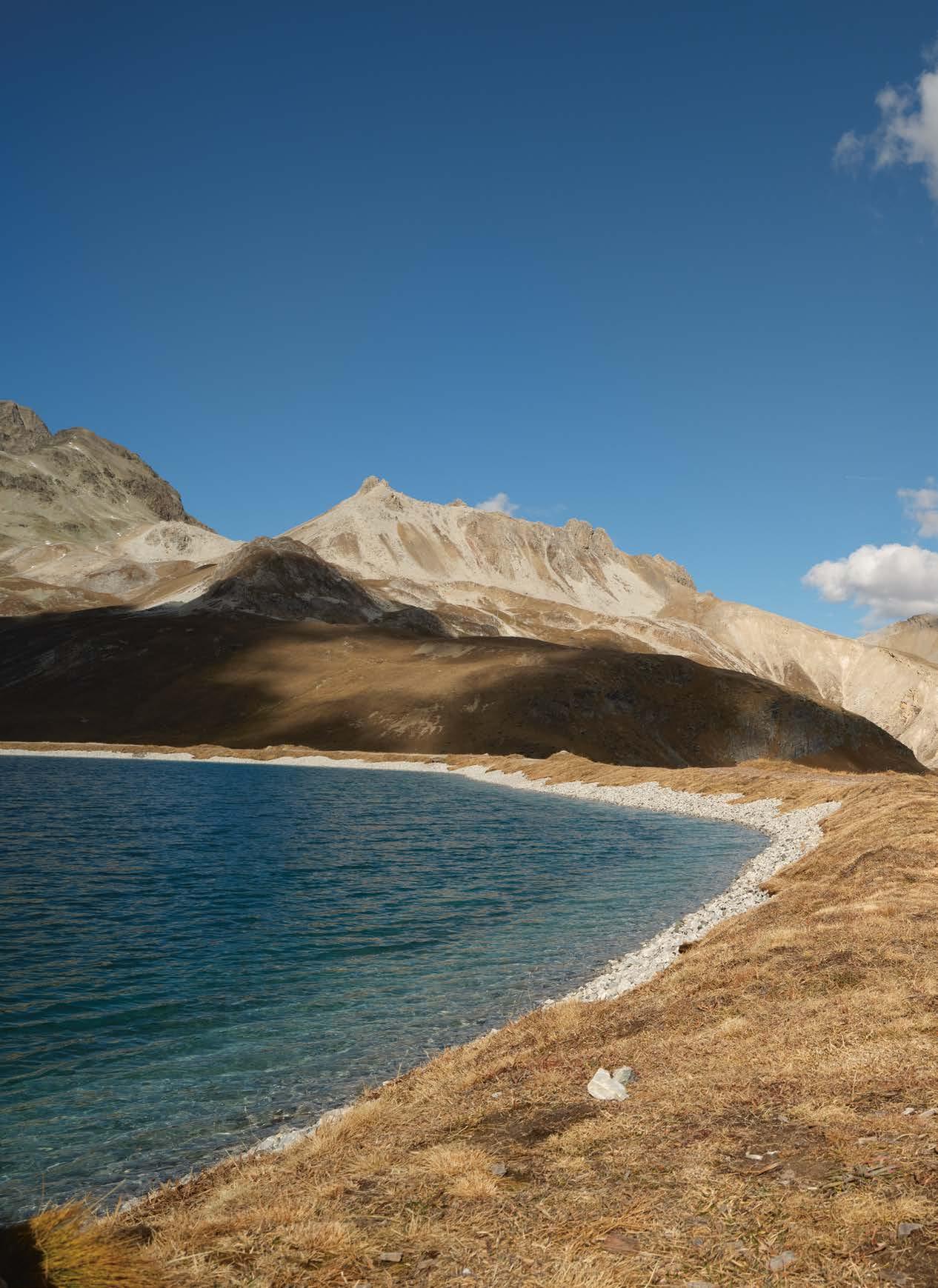
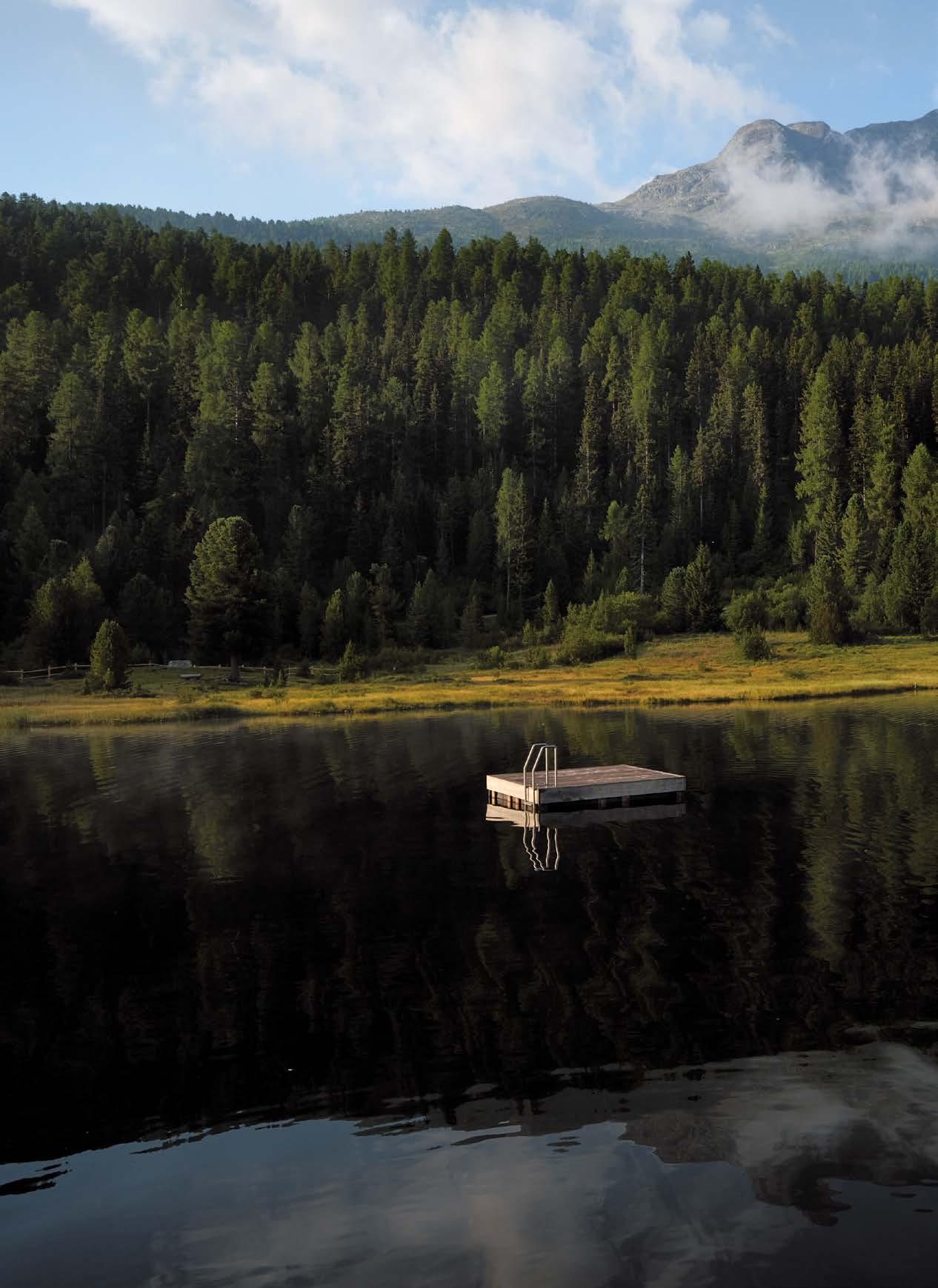
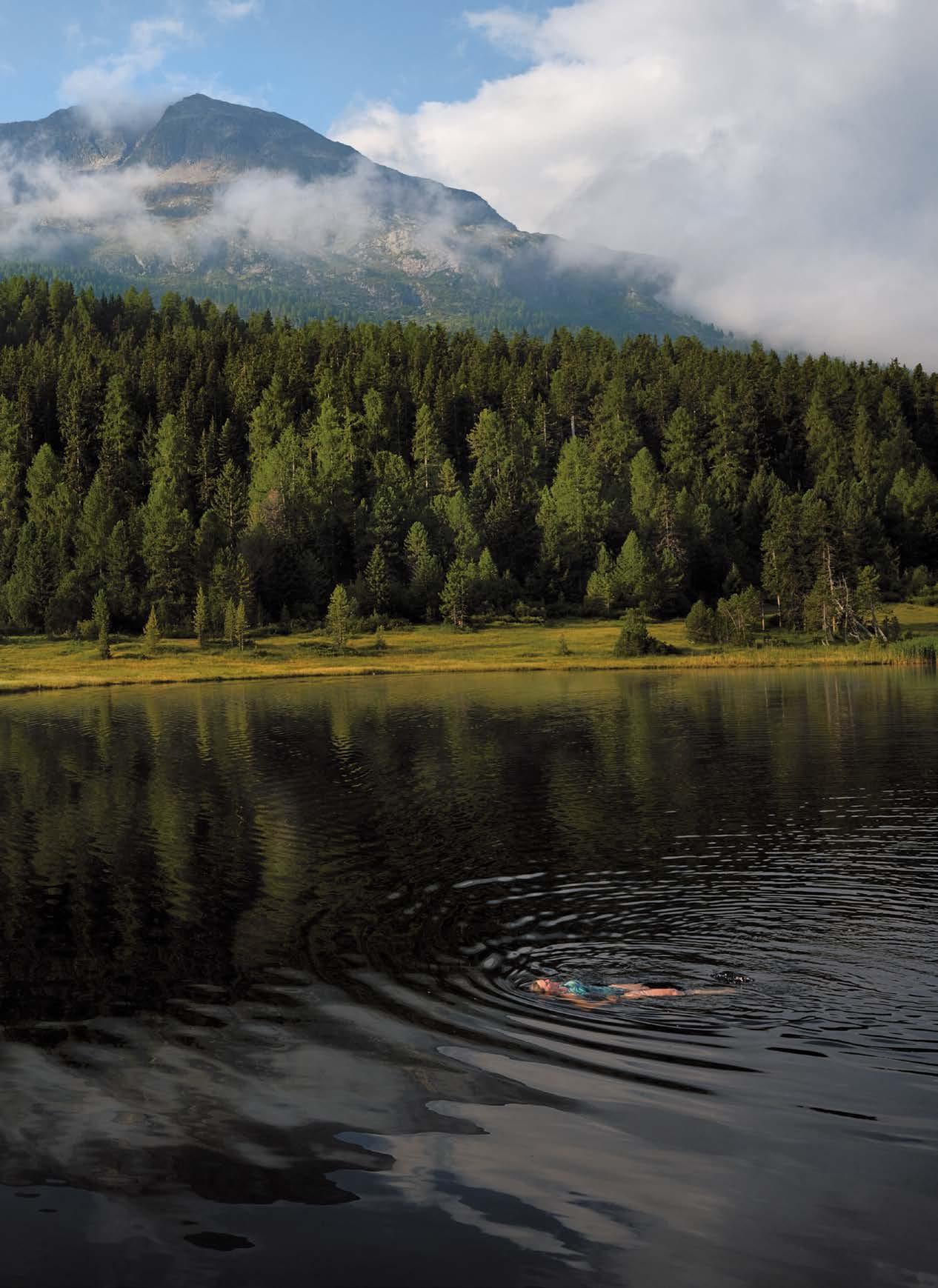
Make the most of comprehensive running training with a personal coach, energising and empowering singing weeks in Sils, forest bathing, or morning swims in the cool water of Lej da Staz. Our glorious nature provides the perfect backdrop for anyone looking to calmly and consciously dedicate time to themselves in the Engadin.
Come here and see for yourself. A warm welcome is waiting for you!
Wishing you all the best from the Engadin
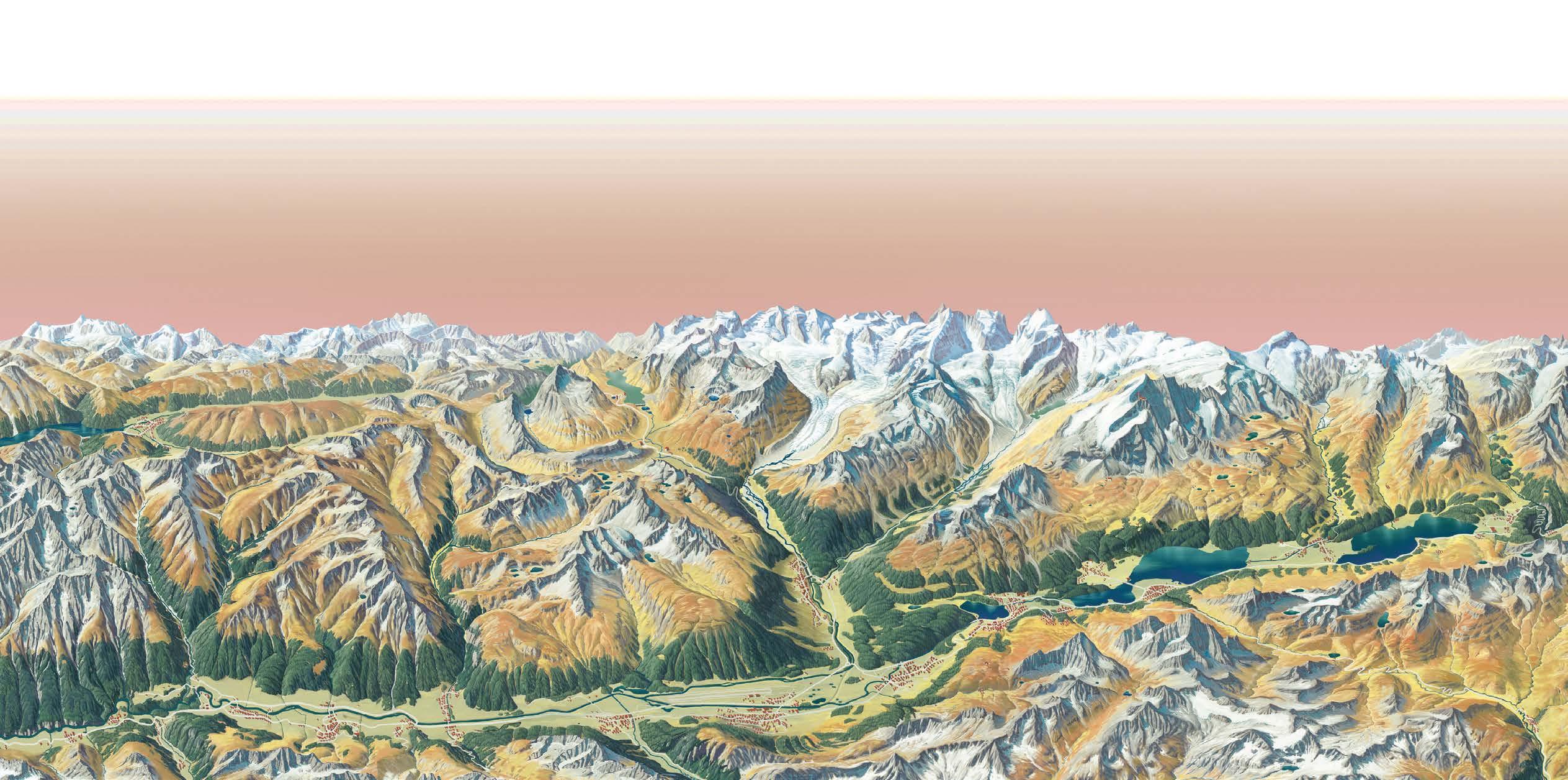
Maloja Pass Corviglia Corvatsch
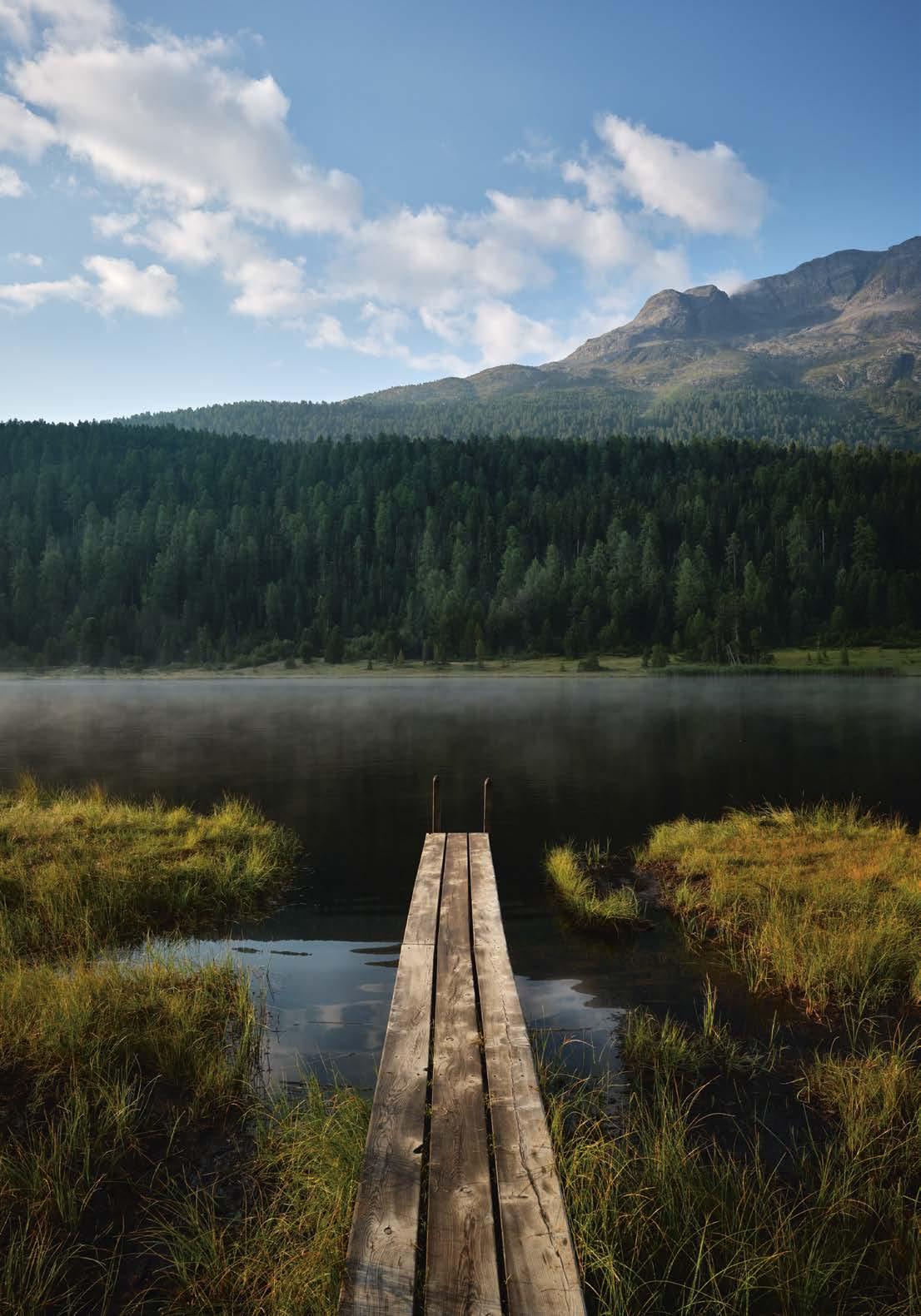
Photo: Lea Meienberg Cover: Lej da Staz
Lej da Silvaplauna
Lej da Segl
Karte: Rohweder
p. 64
p. 36
p. 60
p. 84
NATURE
Back to the Roots Where a connection to nature comes naturally in the Engadin.
Healthy Body, Healthy Mind
BREATHING
The Power of Breathing Why it’s well worth learning to breathe properly.
Singing In and Out What happens when you sing against an alpine backdrop.
Deep Breaths Take a break in the region.
NUTRITION
Green, Yellow, Purple – Vibrant Vitality
Vegetables from a garden at 1,721 metres a.s.l.
Natural Goodness Smells good, tastes good. Hidden Gems The gardens of the Engadin.
EXERCISE
Power in Nature Kick-start a fitness regime with professional help.
High Energy Keep an active body and mind.
SLEEP
The Secrets to a Good Night’s Sleep What it takes to wake up in the morning feeling refreshed. King-Size Beds and Pillow Menus Psssst! Tips for a deep sleep.
SELF-CARE
Happy Harmony Treat yourself well. Ageing Well A heart-warming visit to four of the oldest Engadin locals.
GUIDA (FLIP MAGAZINE OVER)
Introducing the regions of the Engadin –complete with top tips on activities, local attractions, and cultural highlights to ensure a magical stay in the Upper Engadin.
Illustration: Atelier Cartographik / Image based on: Witt, C. M., Ruegg, S., & Hausmann, D. (2025). Whole Person Health-Mind Body Medicine. digital-health-space.ch/mind-body-medicine
others, animals, digital tools … and emotion
House of Health
Personality, Mindset,
Living Conditions Mind and Body (Health
Body and Mind in Harmony
A Mind Body Medicine Congress in Pontresina and lots of new related initiatives across the Engadin –the person behind this development explains what it’s all about.
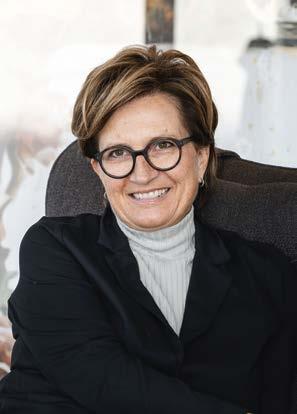
Going for regular swims in a cool mountain lake, practising mindful breathing in the woods, and lovingly making jam out of seasonal fresh fruit. All of these activities and more fall under the concept of Mind Body Medicine. This little-known form of complementary and integrative medicine based on the “Temple of Health” concept (see diagram on pages 6–7) is taught, for example, at universities in the United States, Germany, and Switzerland. The first-ever Swiss Mind Body Medicine Congress took place in Pontresina in the autumn of 2024 –and the second edition is scheduled for 5 and 6 November 2026. Entrepreneur and hotelier Bettina Plattner-Gerber brought the specialist event to the Engadin and turned it into a tourism opportunity. Now, the Engadin is home to the world’s first tourist destination that is committed to Mind Body Medicine – Pontresina.
Ms Plattner, can you explain Mind Body Medicine to us in one sentence?
Mind Body Medicine, or MBM for short, is a holistic healthcare concept focusing on the interactions between the body and mind to promote health.
Which methods are used in MBM?
Strategies include mindfulness, meditation, healthy eating, regular exercise, relaxation, breathing, short pauses, and a daily routine. These methods help people to improve their well-being and find health from within.
So is MBM more focused on treatment or prevention?
Both. MBM can be used for prevention or treatment depending on a person’s health condition. It alleviates symptoms and builds resilience. MBM is useful whenever someone needs to strengthen their own
Text CLAUDIUS WIRZ
resources so they can take a more relaxed approach to handling the stresses and strains everyday life throws at them. In a tourism context, the concept is all about preventive techniques for healthy people to draw on.
Can you give us an example?
Practising mindfulness is one good example. This connects us with our breathing, our senses, our body, and the freedoms and opportunities we have in the here and now. And this helps us to become calmer, more focused, and thus more efficient.
Meditation is a big part of mindfulness training. For a long time, research has shown us that regular meditation changes our brain so that we can cope better with stress and pressure.
and mental health, inspiring them and ultimately establishing tourism in the local area.
Is the congress only aimed at health professionals? Or can anyone attend?
The congress itself is aimed at health professionals working in the specialist fields of psychology, care, psychotherapy, and so on. In 2024, there was also a public event to bring together everyone in the local area with an interest in the topic. From 2026, MBM will be right at the heart of a campaign promoting the Engadin as a destination. This means that partner organisations across the Upper Engadin will have offers, covering everything from burnout prevention and yoga to meditative singing week.
Why is the Engadin such a good setting for MBM?
Nature is a key resource in MBM and a core element of the Temple of Health.
And this is how tourism originated here... The sun in the high mountain region, the high-altitude climate, the health spas, the forests and lakes, the beauty of nature – all of this has always worked wonders on people’s physical
MBM Congress partners:
→ Chair of Complementary and Integrative Digital Health, University of Zurich, digital-health-space.ch
→ Swiss Association for Mind Body Medicine, sfmbm.org
Nature
Spending time in the great outdoors has been proven to reduce stress hormone levels and blood pressure. Natural stimuli, such as sunlight, wind, birdsong, and the sound of a flowing river, calm the nervous system. Moving your body in the fresh air boosts your physical health, grounds your mind, and creates a sense of connection with the wider world.
The barefoot path in Celerina takes you over soft ground.
46°30'44.9"N 9°52'07.8"E Back to the roots
A sensory barefoot trail ? Circular walk starting from Celerina San Gian â 45 minutes (2.6 km)
Walking barefoot strengthens the muscles in your feet, supports circulation, and improves your sense of balance. If our feet could express emotion, they would be beaming after a shoeless stroll across the soft ground around Celerina, over damp moss, and through cool streams.
Photo: Lea Meienberg
The
are a treat for the senses.
woods around Celerina
Walking barefoot across the forest floor can strengthen your immune system.
Photo: Lea Meienberg
The splashing sound of the Ova da Bernina water calms the mind.
Spectacular waterfalls ? Morteratsch near Pontresina â 15 minutes 46°27'07.8"N
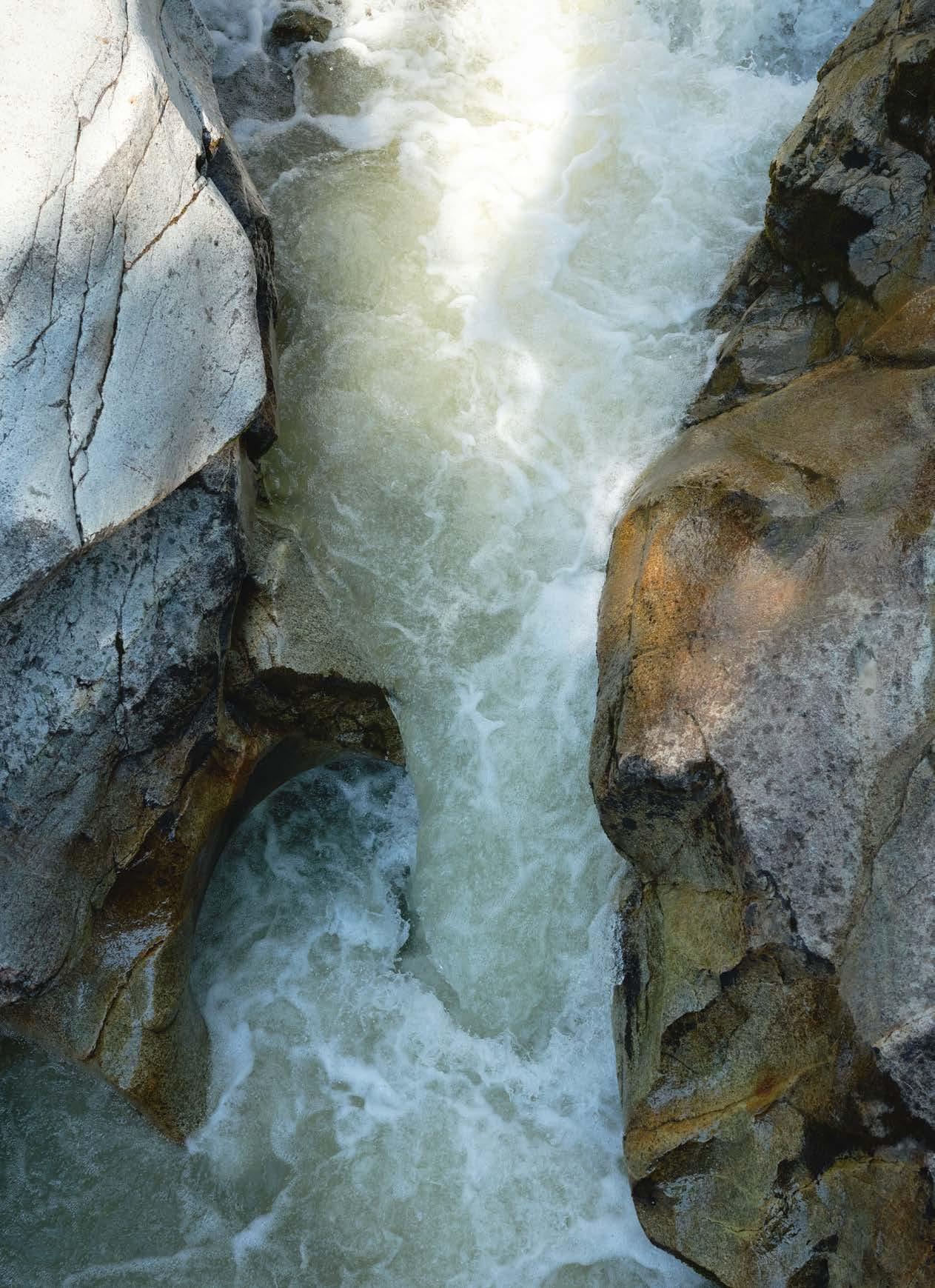
The “Cascada da Bernina” waterfall trail in Morteratsch takes you to several platforms, where you can see the Ova da Bernina mountain stream plunging down into the valley. Further down, towards Pontresina, the river meanders calmly in its wide bed, keeping pace with your thoughts.
Photo: Lea Meienberg
46°29'14.2"N 9°54'01.7"E
Forest bathing
Mind Body Nature Experience Trail ? Concert venue in the Taiswald forest, Pontresina â Audio tracks lasting around 10 minutes each
If you’ve ever wanted to give forest bathing a go but you’ve not been sure how and where to begin, the easy-access audio exercises on the Mind Body Nature Experience Trail will introduce you to the principle, surrounded by the magical Taiswald forest and supported by the power of nature in the Engadin.
Photo: Lea Meienberg
The Taiswald forest in Pontresina sets the scene for an enchanting fairy tale.
The smell of Swiss stone pines has a calming effect.
Photo: Lea Meienberg
46°29'47.6"N 9°52'11.8"E
Fresh feeling
Swimming in Switzerland’s most beautiful moor lake ? Starting in Celerina (2 km) or Pontresina (3 km)
â Around 45 minutes each
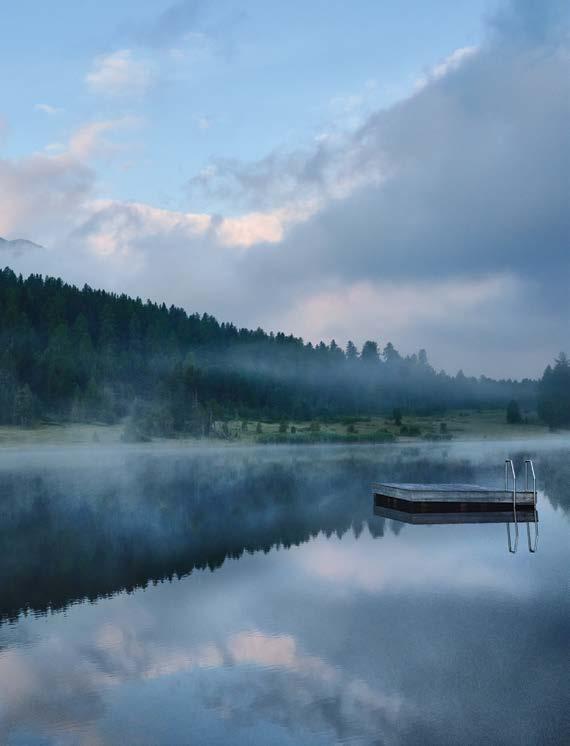
Nestled in the Stazerwald forest, Lej da Staz is a hidden gem. Enjoy a peaceful swim in the moor lake with a magical, mystical feel early in the morning or dive right in for a refreshing dip in the afternoon. If you’re there as the sun is setting, dangle your feet into the water from the jetty. You won’t regret it.
Photo: Lea Meienberg
A morning dip in Lej
is one of the highlights of summer in the Engadin.
da Staz
Secluded Val Chamuera is also known as the Valley of Vultures.
46°32'13.1"N 9°59'24.5"E Pure nature
Wonderfully wild mountain valley
? Chamues-ch to Alp Serlas (6.7 km)
â Around 2 hours
The light in this perfectly pristine Upper Engadin side valley is almost transparent. When the wind blows over from the Bernina area, it carries the scent of warm rocks and freedom. Stop to admire the breathtaking backdrop, listen as you gaze out into the distance, and, if you’re in luck, spot a bearded vulture.
Photo: Lea Meienberg
46°25'45.3"N 9°45'08.6"E
Quiet contemplation
Gorgeous greenery by Lake Sils ? Sils–Chastè loop (4.4 km) â 1 hour and 15 minutes
Chastè is a wooded peninsula that sticks out into Lake Sils like a green finger. It’s no wonder that this picturesque setting has been a source of inspiration for poets and philosophers, including Friedrich Nietzsche. Stop for a moment at his memorial stone, process your thoughts, and speak softly into the wind.
Photo: Lea Meienberg
Big thinkers like
Friedrich Nietzsche have been inspired by the serene beauty of the Chastè peninsula.
Healthy Body, Healthy Mind
The Engadin is a story written by multiple authors. Specialists in science, alpinism, art, and philosophy have all contributed, fuelled by the light and fresh air of an Engadin summer.
Text FIOREL GLOOR
Our story starts with the spring that bubbles up out of the mountain near St. Moritz. The doctor Paracelsus declared that the water had healing powers back in the 16th century, but it would be a long while before the town would become famous for its spa resort. On the “Grand Tour” – the obligatory continental trip for European aristocrats – the Swiss Alps were just an arduous stretch on the way to culture-rich Italy.
But that attitude changed when the scientific desire to explore started to entice people to the Engadin mountains during the 18th century. By mapping out the entire country in intricate detail, Henri Dufour made the alpine valleys
accessible to less adventurous visitors. Drawn by the minimal impact of industrialisation on the Alps, writers, romanticists, and impressionists took inspiration from the glaciers and mountain flowers for their works of art. With the invention of photography and the development of the railway network, pictures made their way out into the world – and people headed to the Engadin.
The English aristocracy appreciated the mountain air most of all and founded the British Alpine Club in 1857, making it the world’s first mountaineering club. Conscious efforts to transmit culture in Victorian Britain and the increasing
demand for mountain guides, guest houses, and means of transport boosted the economy in the Engadin despite how remote the region was at the time. Tour operators and transport companies set standards, guest houses were transformed into hotels, and tunnels made the journey to the Alps more enjoyable as well as less expensive and more efficient. Trips to Switzerland were no longer educational visits for aristocrats on their “Grand Tour” – they became a popular holiday choice for tourists. Grand hotels promised the growing European middle classes urban luxury combined with picturesque scenery away from the dirt and grime of the cities. Friedrich Nietzsche and Giovanni Segantini made the magnifi-
cent mountain landscape famous all around the world through their work. Meanwhile, alpinists like Elizabeth Main discovered new mountain routes, and dedicated hoteliers in the Engadin worked hard on their own innovations.
With tuberculosis spreading through Europe’s cities in and around 1900, people turned to the healing water of St. Moritz and explored the sunlight treatment called heliotherapy. The Engadin’s particular atmosphere was already imbued with philosophy, science, and art, but now it was also said to have a restorative effect. The high alpine valley became known as the go-to place for a healthy body, sound mind, and untouched nature.
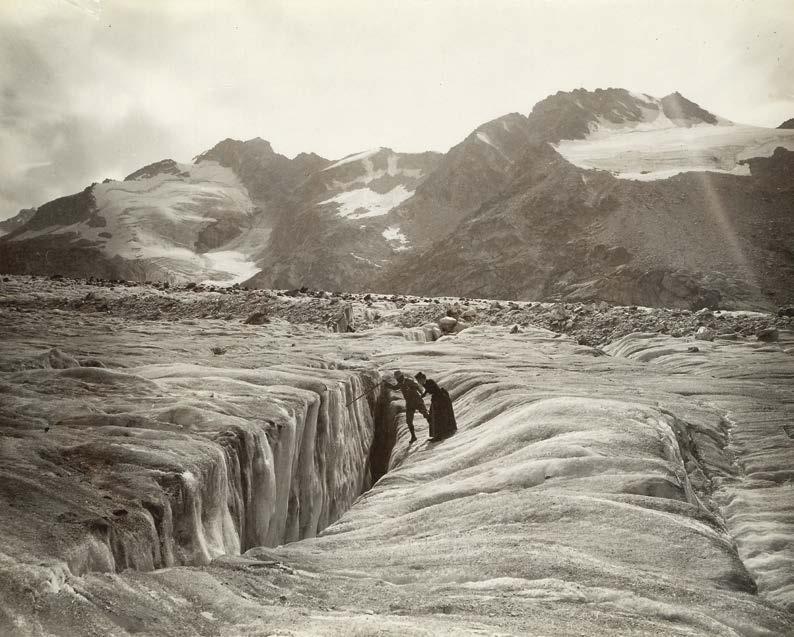
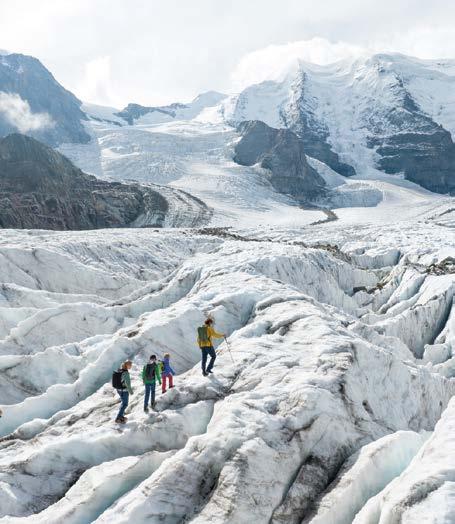
Alpinist Elizabeth Main gazes into the depths of a crevasse on the Forno glacier.
Breathing
Working on our breathing is one of the most efficient ways to boost our sense of well-being. With the proper technique, our breath can give us more energy, help us think more clearly, strengthen our heart, calm our nervous system, alleviate pain, and reduce anxiety. It has even been scientifically proven that high lung capacity is one of the most important indicators of a long lifespan. In other words, our breathing can help us to hold onto our health as we age.
“Healing happens in the pause between breaths.”
PARACELSUS (1493–1541), SWISS PHYSICIAN
Photo: Lea Meienberg
External respiration
The gas exchange we need to live happens in our lungs with every breath we take.
Oxygen (O2) enters our lungs with the air.
Carbon dioxide (CO2) flows out of our bloodstream and into the air through our airways.
Internal respiration
Our cells absorb oxygen from the blood to produce energy and release carbon dioxide – the metabolic waste product – into the blood. In other words, every cell depends on our breathing properly. Bridge between body and mind Our emotions affect our breathing. So you might find that your breathing becomes faster and shallower when you feel angry. But if you can manage to keep breathing properly during a heated discussion, you can keep your anger in check because breathing mindfully calms our nervous system. How to breathe when angry: Breathe in through your nose for four seconds and then breathe out through your mouth slowly and gently. Repeat.
Left and right lung
Bronchi
Alveoli
Diaphragm
The Power of Breathing
Breathing is life. From our first cry to our last breath. If we run out of air to breathe, we die in a matter of minutes. And yet we don’t give much thought to breathing. Much too often, we make our way through life with short, irregular gasps instead. It’s well worth learning to breathe properly. The benefits will be felt in every last cell in your body – and you won’t have to practise for long before that happens.
Learning to breathe properly
Recent studies have shown that our breathing is getting faster and faster. “Take a deep breath” is more than empty advice – it’s a scientifically backed health hack that’s always available to us all for free no matter where we are.
Breathe through your nose
If you breathe in through your nose rather than your mouth, the air will be filtered, warm, and humidified. Slow down!
Breathing slowly improves blood circulation in our brain and has positive effects on our cardiovascular and nervous systems.
Take your time to exhale
Breathing out more slowly improves our lung capacity. We often don’t breathe out fully, which leaves residual air behind in our lungs and stops us taking in as much oxygen with our next breath.
Sing
Singers learn how to breathe deeply and evenly into their stomach and how to control their breathing. This enables them to make better use of their lungs’ potential. The sound of their singing voice gives them direct feedback so they can be sure that they’re breathing correctly. Not to mention that singing with other people gives them social contact and a sense of belonging as positive knock-on effects (see p. 36–41).
The Church of San Michael in Sils is a space filled with sound.
Photo: Roland Zumbühl
Singing In and Out
The Choir Weeks have been a recurring event on the calendar in Sils Maria for 11 years. Songs are performed against the alpine backdrop, strengthening the lungs and bringing plenty of other benefits for the singers.
Text JANA AVANZINI
Out in the street, you can hear the sound of singing through the wooden door to the Church of San Michael in Sils. But it’s not the choral music you might expect. Instead, the people inside are giving “Homeward Bound” by Simon & Garfunkel a go as a group. They’re huddled together in the front rows of this cosy little church, concentrating on the music books in their hands. Walking boots sit under the chairs, while red woollen blankets lie on top. It’s a sunny day. The church is nice and warm, even though it’s slowly turning colder outside. With all the wood and traditional Engadin paintings on the wall, you’d be forgiven for thinking you’d walked into a big living room rather than a church. But the acoustics? Spot on.
The annual Sils Choir Weeks started here earlier today. Well, it would be more accurate to say one of the many Sils Choir Weeks. After all, the event has grown steadily since choir director Patric Ricklin started it off 11 years ago. “Eighteen people were involved when I organised the first week back in 2014. And this time, in 2025, we’ve had 400 people across 12 different weeks.” Jazz, pop, rock, classical, gospel... You might hear the Carmina Burana cantata. But you might also hear classics from the ’60s, ’70s, and ’80s.
Finding the balance
The rehearsal sounds spectacular even just a few minutes in. It becomes clear why at the welcome drinks reception
Choir Week is all about singing but also involves moving, stretching, and swinging.
“You pick up new songs and get to know new people. You make progress and open your heart and mind. It all helps you build confidence.”
PATRIC RICKLIN
early in the evening. Some people aren’t here for the first time. And lots of them sing in choirs at home – in Zurich, Eastern Switzerland, or Bern. There’s a relaxed atmosphere as everyone chats and gets to know each other. Annelies took part for the first time last year and loved it from the word go, while Marlyse left the annual Choir Weeks with a new group of friends. Jaqueline joins the conversation. For her, singing speaks to the soul: “It helps me to find – or keep – my balance in life. This is so important given the state of the world right now.”
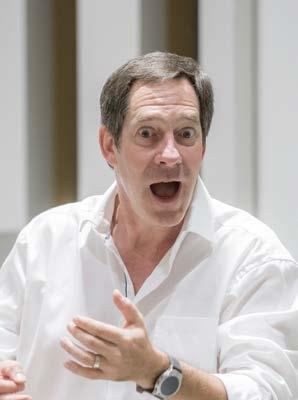
Choir director Patric Ricklin explains that there’s a lot more to singing than just making the right sounds at the right time. “Singing is a way to find yourself. On the outside and the inside. And it centres you.” You can certainly feel that at this particular location here in the Engadin. It’s as beautiful as can be and yet not all that practical. “There’s no denying that the beauty of nature here and the sweet sound of singing are a match made in heaven,” says Patric. And
yet there weren’t really many rehearsal spaces to choose from, so the church was a lucky find.
Patric Ricklin knew that he wanted to be a singer when he was just 10 years old. An opera singer, to be precise. “My plan to become a singer was very much driven by my ego at the time,” says Patric. But that all changed when he hit his 50s. He gave up being a solo artist to become a choir director and create courses. “These days, singing is a way for me to let go. I want to celebrate music. And I want to sing with people instead of for them,” he says.
Perfecting the skill
Patric says that the good and bad thing about singing is that everyone can do it to a certain extent. He goes on to say, “It doesn’t take a lot to warble along to a song you already know. But how many people actually use their voice as an instrument and know how to control it and use it in different ways?” It’s the same with breathing, which is vastly improved when
“The beauty of nature here and the sweet sound of singing are a match made in heaven,” says choir director Patric Ricklin, referring to Sils.
Photo: Lea Meienberg
you sing properly. “Most people don’t give a lot of thought to breathing. We just breathe automatically, so many of us don’t see the point in working on it. This ultimately means that lots of people don’t actually breathe properly.” Breathing is what keeps us alive. And breathing properly – take note – builds our sense of inner peace, strengthens our respiratory muscles, and keeps our lungs healthy. But that’s not all. Singing also supports your verbal fluency and your episodic memory. A number of studies have also shown that singing reduces your cortisol levels. And it has been proven that singing regularly boosts your immune system too.
Patric also emphasises the added benefits to be gained by singing in a group. “Sure, it’s good to sing to yourself in the shower whenever you can,” he says. But singing in a choir comes with a three-stage learning process. First, you have the musical element – you learn rhythms and melodies. Next comes the content. So you find out about the history behind the words and learn a bit about the life of the composer. And you can connect this background information to yourself and see what impact it has on you. “Finally, you have the chance to learn as a group and grow together,” says Patric. This last aspect can have a hugely positive impact on your mental health and your sense of well-being. “You learn new things. You
pick up new songs and get to know new people. You make progress and open your heart and mind. It all helps you build confidence.” People also overcome their inhibitions. “Now, it obviously takes courage to show up on your own, let go, stand up in front of people, perform, and be heard.” And to feel like you belong at the end.
It’s raining in Sils the next morning, but that does nothing to dampen the choir singers’ high spirits. The church smells of beeswax. The chairs have been pushed apart so there’s more space to move around. To warm up, stretch, and swing. To sing from within. Patric Ricklin guides the men and women, encouraging them to open up, move around, and dig deep. “And then the notes will simply follow.”
The Sils Choir Weeks run several times a year as holiday courses with a focus on different genres of music. silser-chorwochen.ch
TAKE A BREAK IN THE REGION Deep Breaths
Forest bathing
S-chanf – Starting in Chapella, follow the short “Senda botanica” trail through the Tulaitwald forest. Along the way, you’ll encounter more than 30 types of trees and shrubs – and nowhere near that many people. Listen to the sound of nature breathing in the peace and quiet between the trees. engadin.ch/en/senda-botanica-tulait
Breathe, move, and be
Sils – The Parkhotel Margna runs mindfulness retreats over multiple days and weekend courses, each with its own specific theme. All of the packages centre on purposeful movement, stress relief, and deep relaxation.
engadin.ch/en/deep-health
Brass Week
Samedan – Brass Week in Samedan is a celebration of long breaths. For an entire week, the sound of brass bands fills the Engadin air. Plenty of concerts are performed indoors and outdoors, while renowned musicians deliver courses to groups and individuals. brassweek.com
Endless sky
Pontresina – The sky stretches up above your head on the viewing platform on the Diavolezza, giving you plenty of space to breathe. Piz Bernina –the highest mountain in the Eastern Alps – is the peak of this alpine view. corvatsch-diavolezza.ch
Riding the wind
Silvaplana – Taking to the water of Lake Silvaplana for wing foiling and filling those wings with air feels like taking one big deep breath. Various sports centres have the equipment and courses you need to glide over the lake as if you had wings. engadin.ch/water-sports
Nutrition
Eating regular meals and avoiding distractions when we eat allows us to be in tune with our bodies when we are hungry or full. We can also look out for emotional triggers that might be the cause of unhealthy eating habits. Following Mind-Body Medicine principles, a healthy wholefood diet prioritises fresh, unprocessed foods, plenty of vegetables, fruit, and pulses, as well as wholegrain products.
“The key to good health lies in the kitchen, not the pharmacy.”
SEBASTIAN KNEIPP (1821–1897), GERMAN PRIEST
Photo: Lea Meienberg
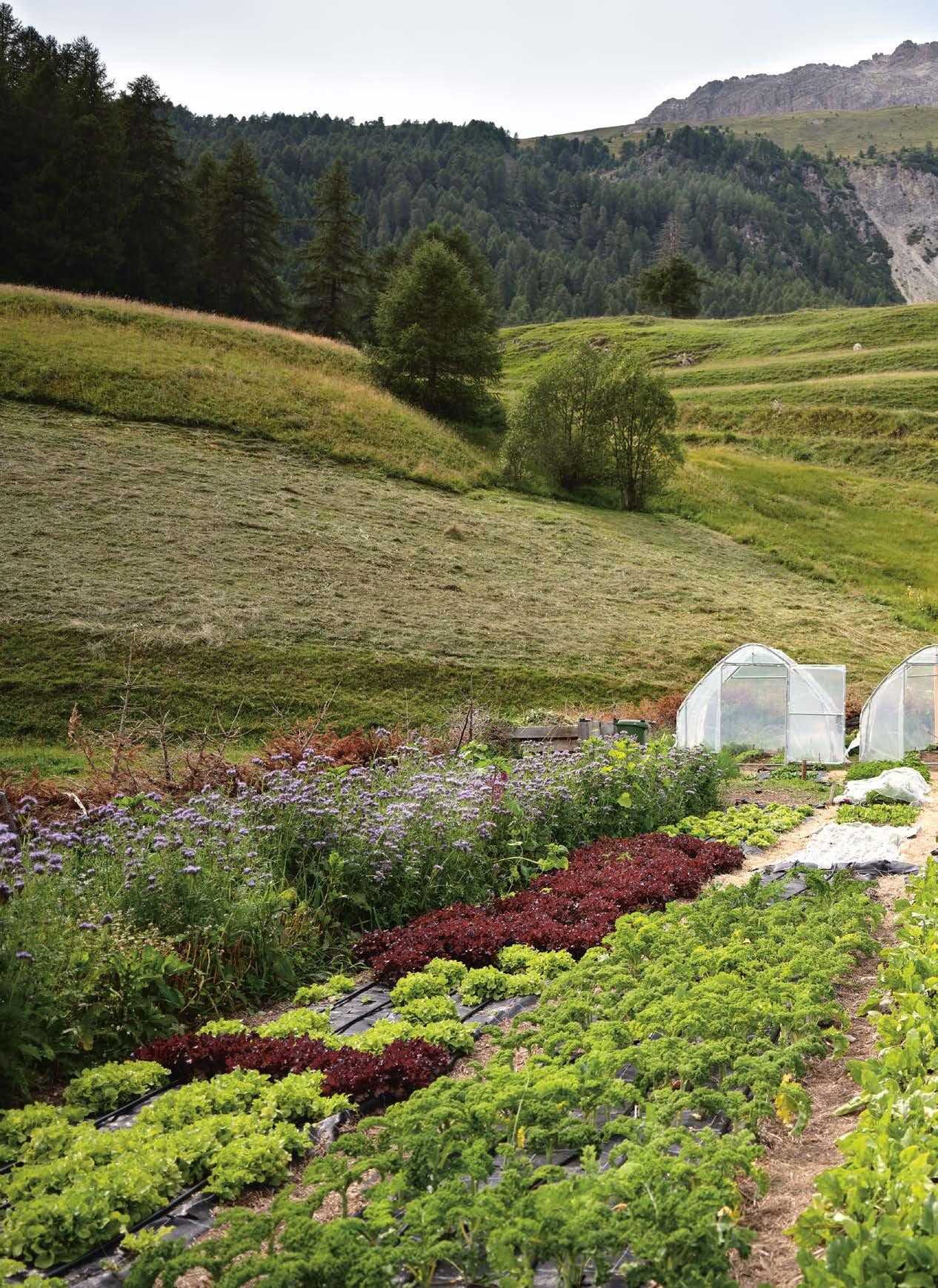
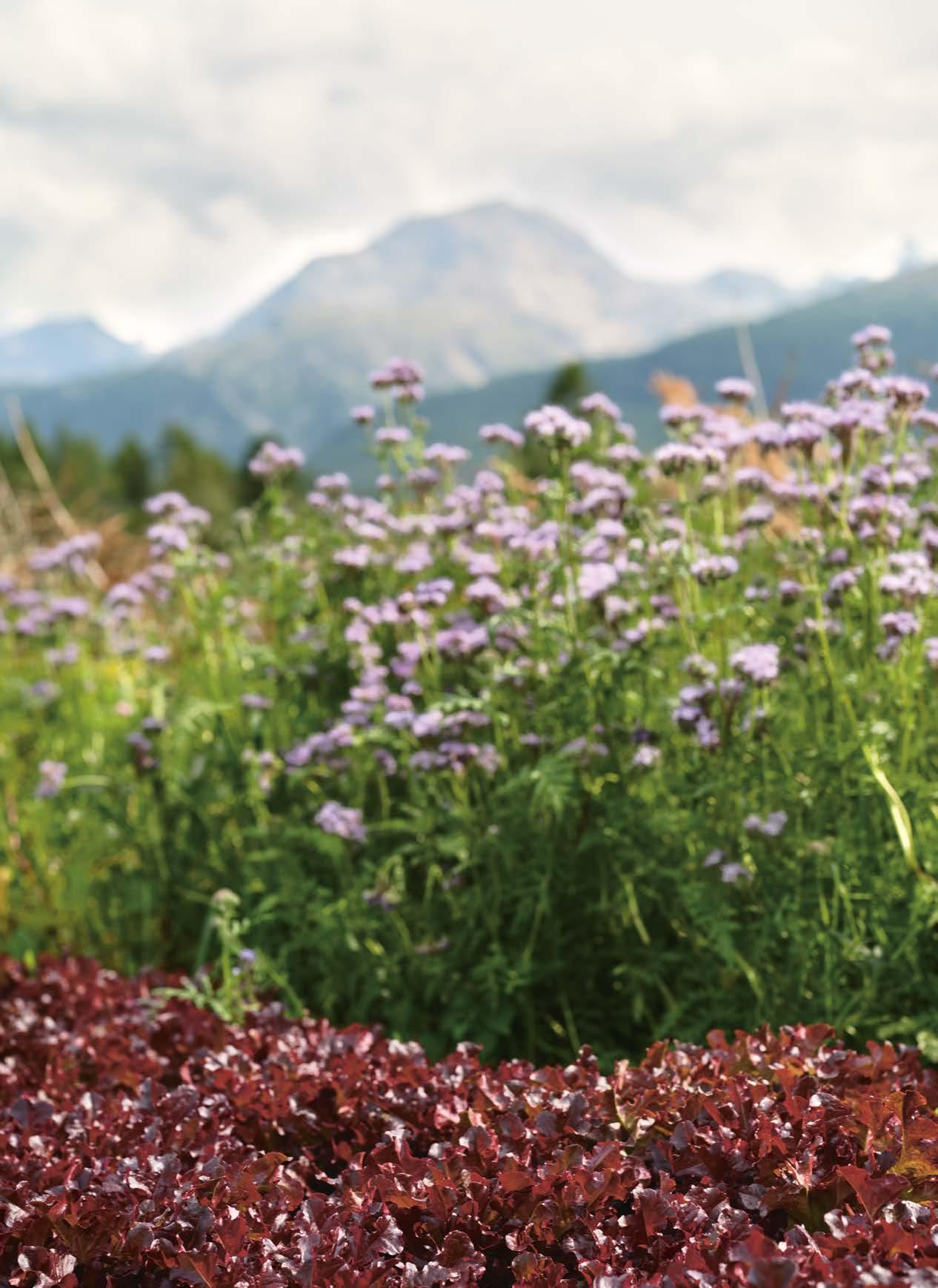
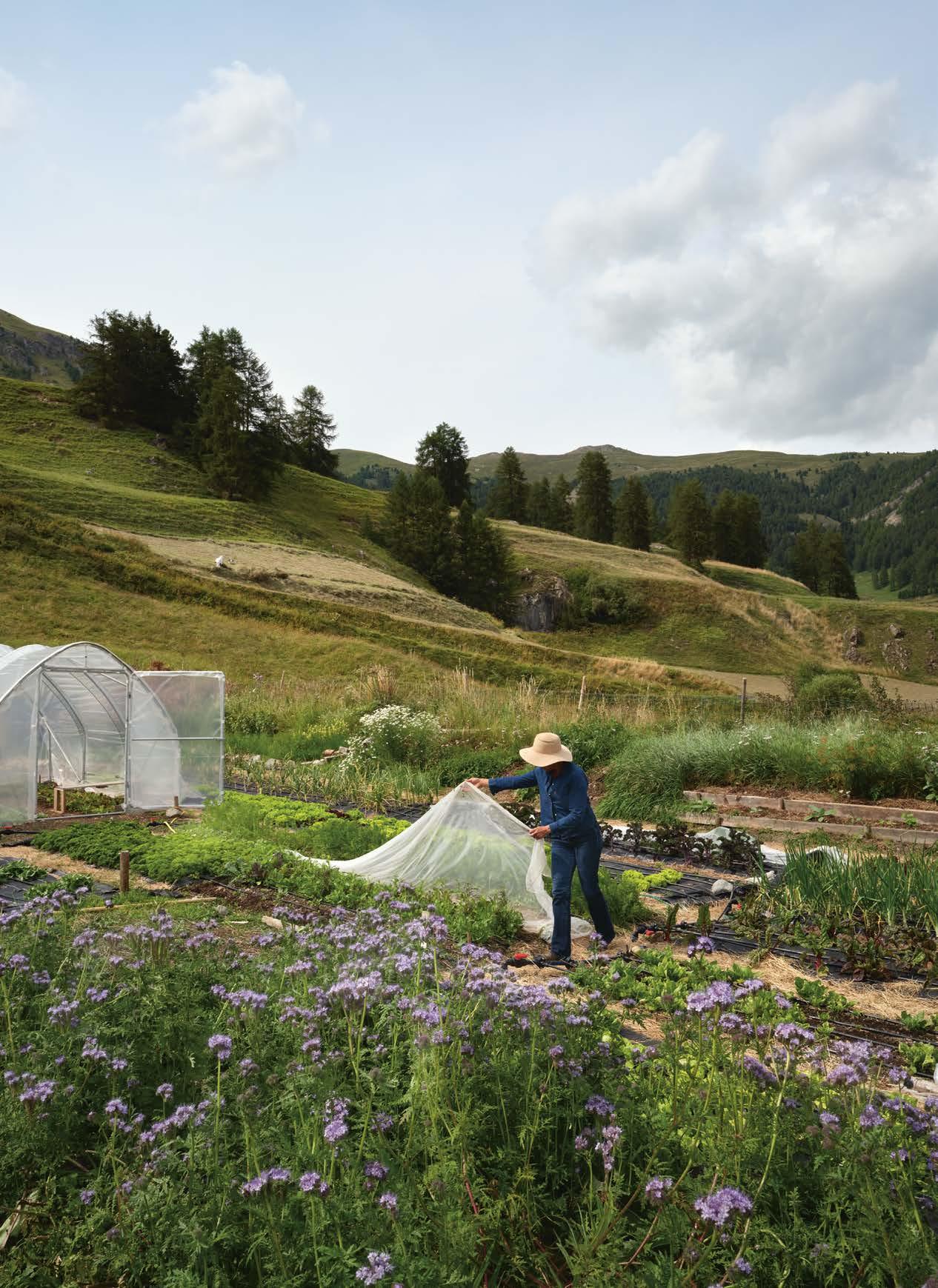
Red lettuce leaves and purple phacelia add splashes of colour to the organic garden.
Green, Yellow, Purple – Vibrant Vitality
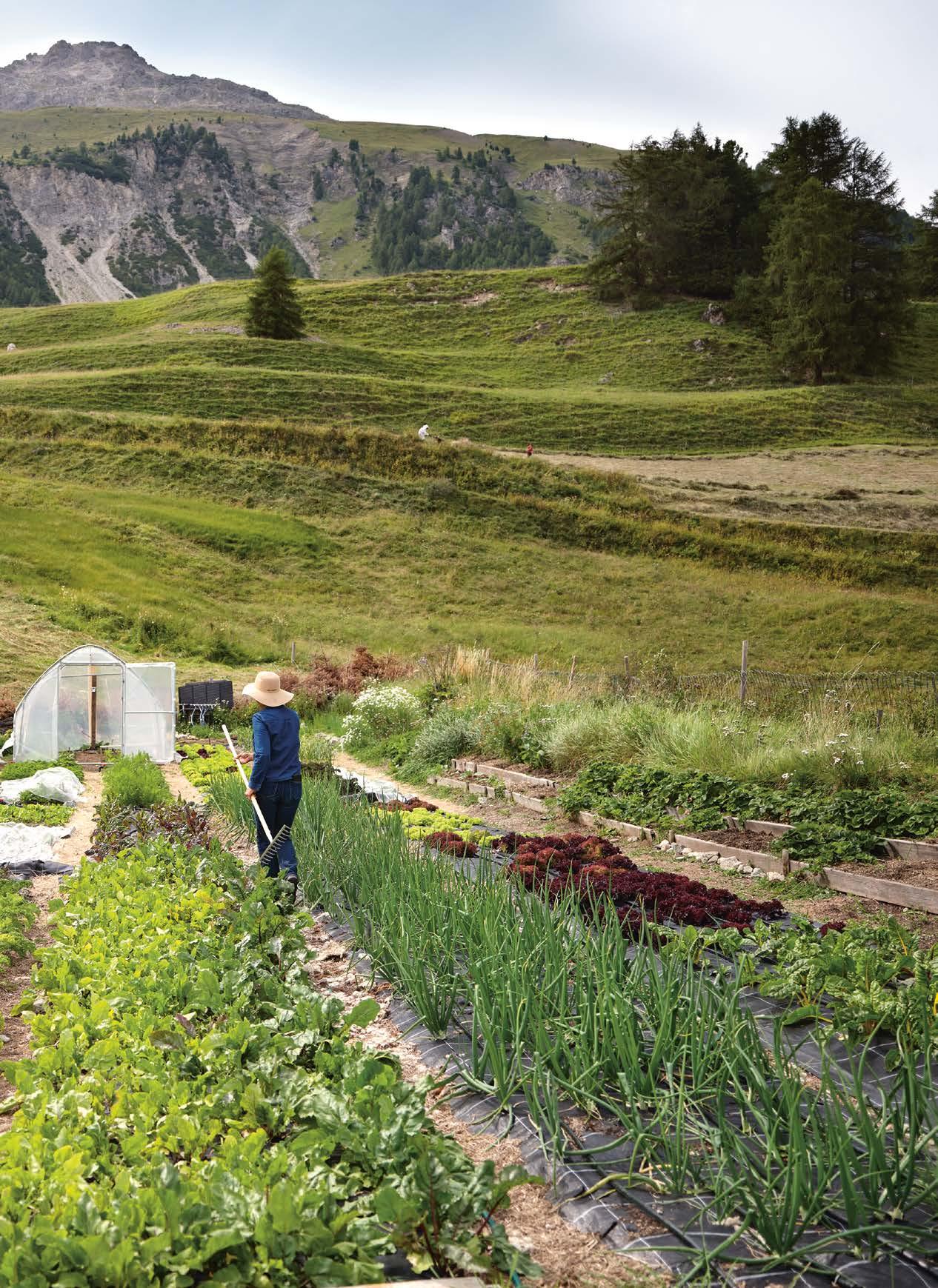
You might think that a garden is just a garden. But there’s one garden that’s so much more than your average garden. Over 35 types of organic vegetables grow 1,721 metres above sea level in the Hauser Garden in Samedan, between Piz Padella and Muottas Muragl.
Text MARTIN HOCH Photo LEA MEIENBERG
There’s a busy buzz around the Phacelia tanacetifolia flowers.
Bees – too many to count – are circling the plants, coming in for landing, and drinking up the nectar. The pollinators are drawn to the clusters of pretty purple petals over a stretch of 20 metres with one plant after another in a row. What an absolutely gorgeous sight to behold. Phacelia looks good while doing good for the garden.
“The bed where the phacelia plants are growing is what we call our fallow
bed,” explains Yael Ehrenberg. She tends to the Hauser Garden, which belongs to the Hauser Hotel in St. Moritz. Every year, one bed is planted with these flowers instead of being used to grow vegetables. The plants are grown as green manure, which improves the soil structure for the vegetables in the following years. It’s official – the soil in the Engadin is given the same chance to rest and recuperate as the guests who visit the area.
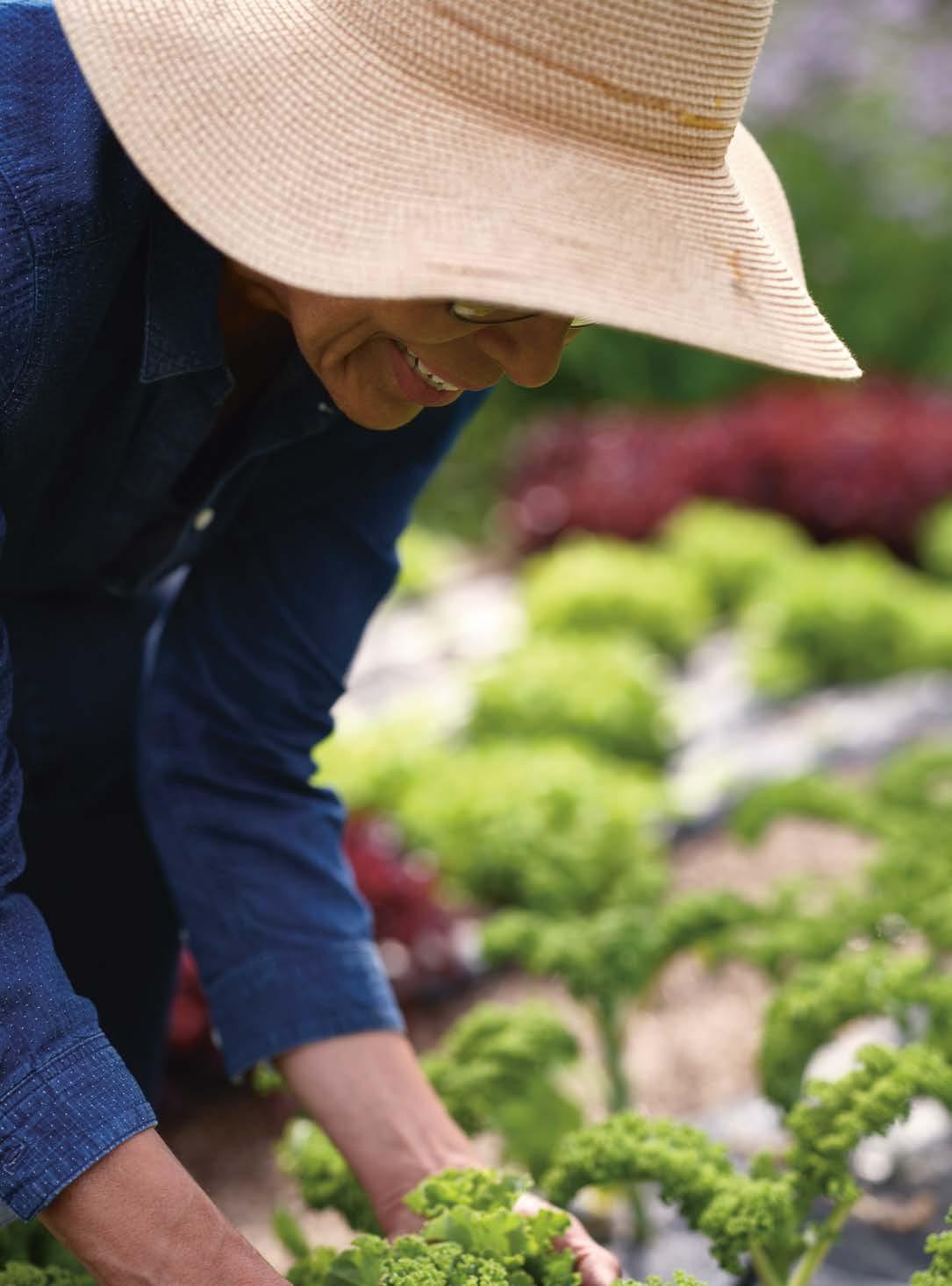
Yael Ehrenberg looks after the Hauser Garden in Samedan during the summer months.
Around the world to the Engadin “Healthy soil is more important than anything else,” reiterates Ehrenberg. Without it, it wouldn’t be possible to grow vegetables rich in nutrients or guarantee a sustainable harvest. “The earth needs to be like a sponge. It should be soft and crumbly with air pockets that can absorb water.” This keeps the ground nice and moist. And this soil structure allows worms, insects, and other organisms in the soil to move around via an intricate network of mini tunnels. “Healthy soil is like a town or city,” so Ehrenberg avoids walking over the beds. As she explains, “I don’t want to destroy any homes.”
The 61-year-old knows what she’s talking about. Having grown up in Mexico and England, she studied agricultural science and landscape architecture in both countries. She put everything she learned into practice over the decades that followed “in eight countries across three continents”. Besides Mexico and England, she has also lived in Kenya, the Netherlands,
Engadin Garden Goodness
Ricola herb garden
Pontresina – Try all 13 herbs used in the popular Swiss cough drops made by Ricola in this pristinely designed herb garden. The best time to visit is during the flowering season between May and September. engadin.ch/ricola-herb-garden
Honey from home
You just know that the bees buzzing over the alpine meadows in the Engadin, diving into the gardens, and breathing in the healthy air have to be happy. If you still need proof, taste the honey produced by local beekeepers. engadin.ch/alpinefarms
Regional vegetables from the Upper Engadin, grown at 1,721 metres above sea level.
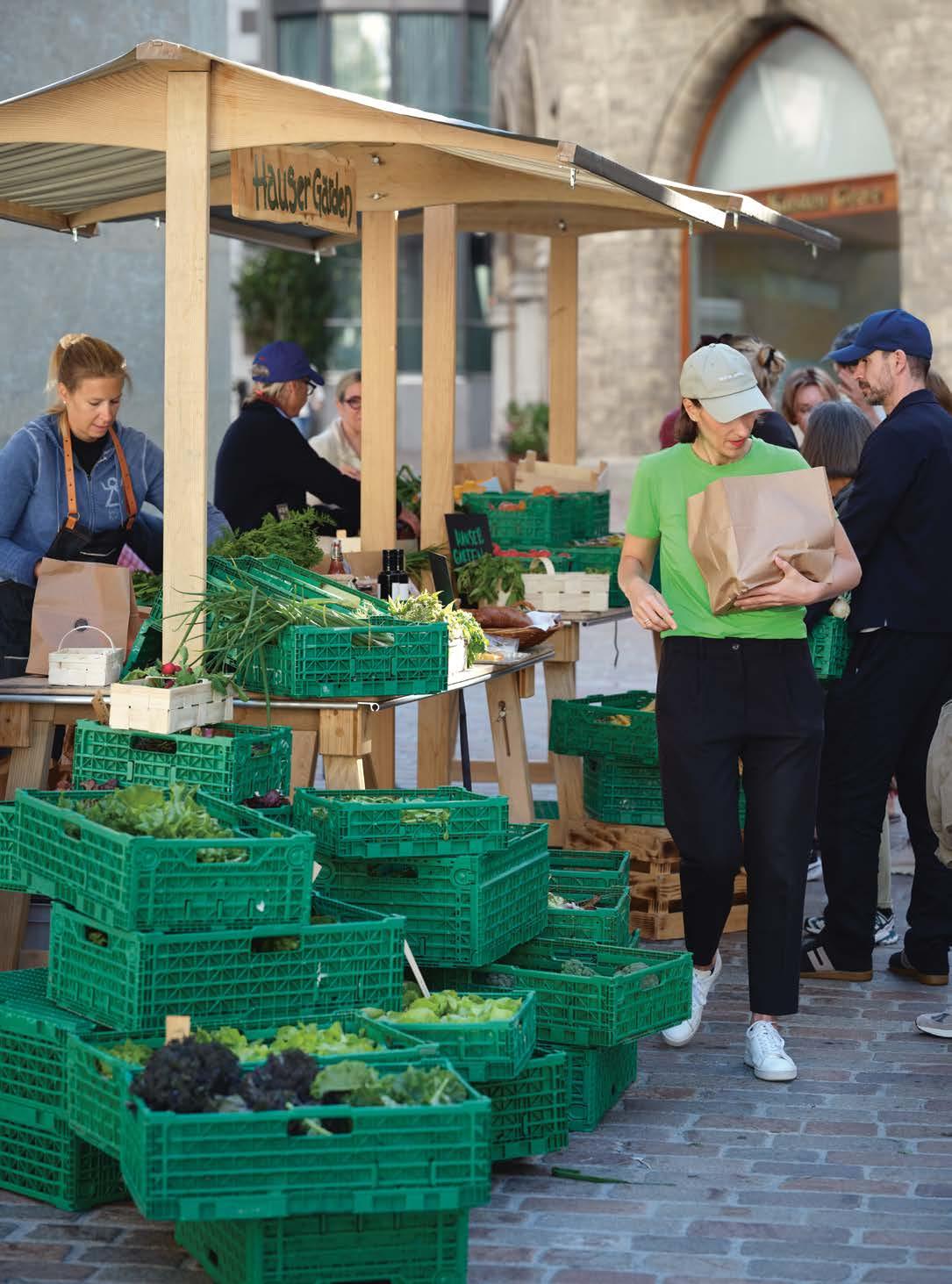
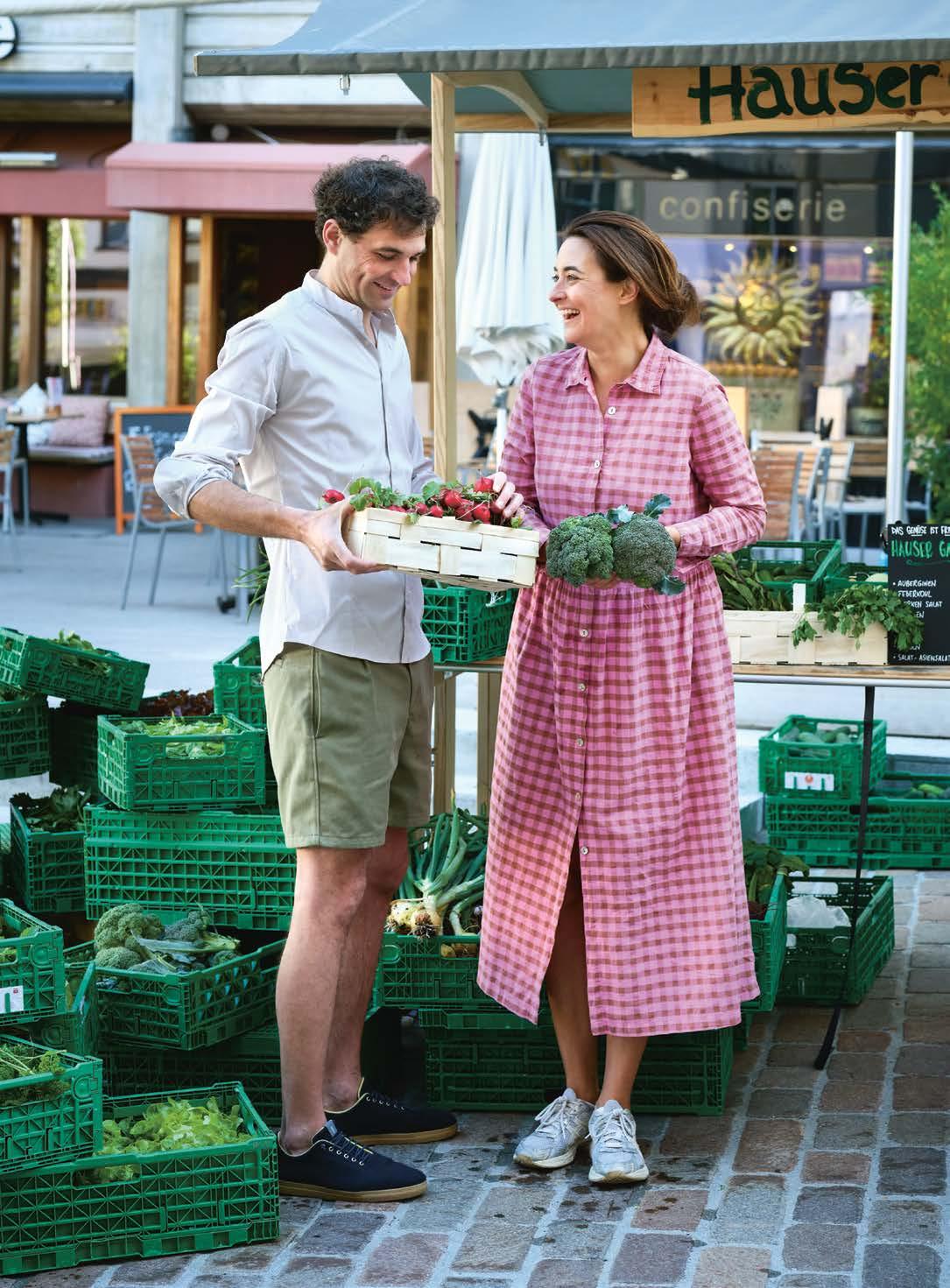
Every Friday morning, Hauser Garden sells its fresh produce at a market stall in St. Moritz.
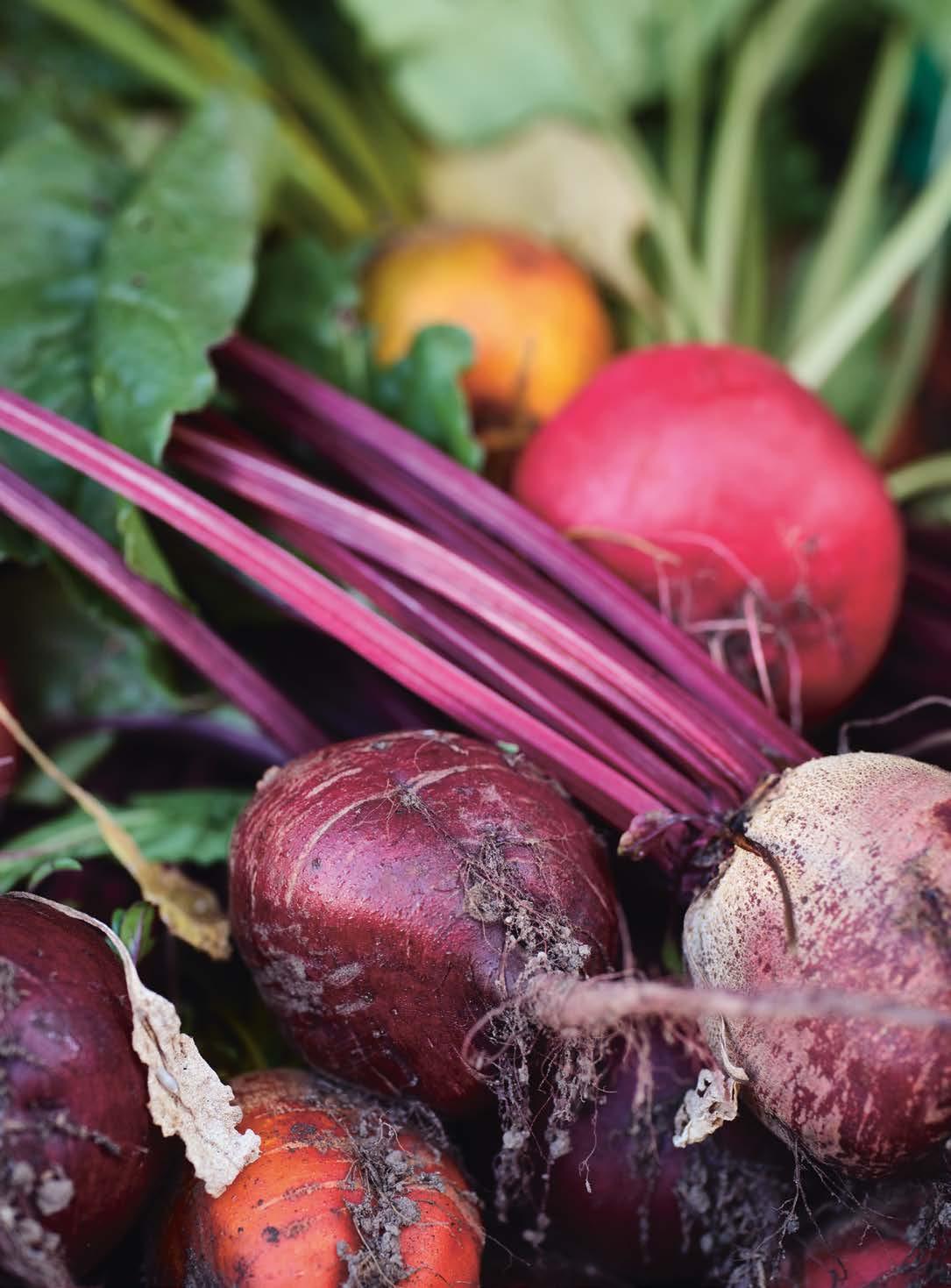
France, the United States, Denmark, and now Switzerland. When hotelier Nina Hauser asked her to look after the relatively new Hauser Garden two years ago, Ehrenberg entered a new era in her life. These days, she commutes between her home in Zurich and her new place of work in the Engadin. During the summer period, she stays up here from Tuesday to Friday and works in the Hauser Garden come rain or shine. She devotes her time and energy to all the varied and vibrant vegetables growing here – red and green kale, rainbow chard, beetroot, carrots, and more.
The Hauser Garden – a novel approach
The Hauser Garden project was born in the spring of 2022, “when a friend suggested the idea of growing vegetables for our hotel after she’d completed a course in permaculture,” recalls Nina Hauser. She runs the Hauser Hotel with her brother Nik. Lorenzo Polin, a farmer from Samedan, provided the land and plenty of support to bring the idea to life. And the friend with the original idea, Simona Degiacomi, also helped with the garden as a graphic designer who “wanted to replace screen time with
nature time”. “But then she fell in love with a beekeeper, moved away, and now makes honey,” says Nina, laughing. “I was amazed at how well Simona had designed the garden,” says Ehrenberg, with a gesture that encompasses the entire space. This meant she could get going with what Simona had created, while also bringing in her own insights. It’s no mean feat to grow vegetables at this high altitude. “Just to give you an idea, we still had frost on 8 July last summer.” And the growing season is limited to just 120 to 150 days up in the high valley region. While gardeners in other parts of Switzerland have happily planted away, the ground is still frozen here in the Engadin.
Network of regional producers
This also explains why Nina could never buy locally grown vegetables for her hotel in the Engadin before. And why she decided to take matters into her own hands as someone who enjoys eating deliciously fresh vegetables herself. Alongside the Hauser Garden in Samedan, she and her brother also created a second site in Madulain “in partnership with the farmer Ruet Ratti,
who also grows potatoes for us”. Anything that doesn’t grow at this altitude – such as tomatoes, cucumbers, and courgettes – is cultivated by Hannes Mark, a thousand metres below at the Gärtnerei Fasolini plant nursery in Sils im Domleschg. Fruit, including quinces, plums, and apples, comes from gardens in nearby Valtellina and is provided by Piero Polinelli, the long-standing head pastry chef at the Hauser Hotel. Every autumn, he also provides a seemingly never-ending supply of pumpkins, “which allows us to offer a delicious pumpkin soup on our menu for more or less the whole winter.” But all of this fresh, locally grown produce isn’t just reserved for guests dining at the restaurant and staying at the hotel during the summer. Every Friday morning, Nina sets up her own market stall on the terrace and sells radishes, carrots, lettuce, and lots of other lovely vegetables. “We want to provide a valuable service to our guests and locals at our vegetable stall.” All while doing their bit for environmental sustainability. “This approach is nothing new to us here at the Hauser Hotel,” she says, representing the fourth generation of
her family to run the business. “My father was the pioneer who first built a heat recovery system in a hotel.” This meant that heat from the kitchen and laundry room was used to heat the bedrooms.
Mutually beneficial ecosystem
“Besides healthy soil, diversity is my other priority in the Hauser Garden,” explains Ehrenberg. She grows all different kinds of lettuce, carrots, and chard. One important reason for this approach is that “they all help each other to grow”. One plant can have a positive impact on another by providing it with shade or keeping various (often unwanted) garden visitors at bay.
The entire Hauser Garden project is built on this concept of mutual benefit. “We’re already supplying locally grown vegetables to one other business and we have the potential to extend this offering to two more culinary establishments in the Engadin,” says Nina with confidence. And this is all being achieved in a location where people used to say nothing much other than potatoes could be grown.
Nik and Nina Hauser are the sibling duo behind the family-run Hauser Hotel in St. Moritz.
SMELLS GOOD, TASTES GOOD Natural Goodness
Healthy eating
Pontresina – The Ayurvedic concept of nutrition is based on individual needs, digestion over restriction, and eating as a vital act of self-care. In 2026, Hotel Walther is offering insightful courses for beginners looking to explore Ayurveda and nutrition. engadin.ch/en/deep-health
Mindfulness for all the senses
Pontresina – Hotel Maistra 160 offers a varied and well-structured “Deep Health” programme featuring various packages dedicated to mindfulness, self-care, nutrition, and exercise. The courses on offer are suitable for people at all levels, from beginner to advanced as well as health professionals. engadin.ch/en/deep-health
Veggie delights
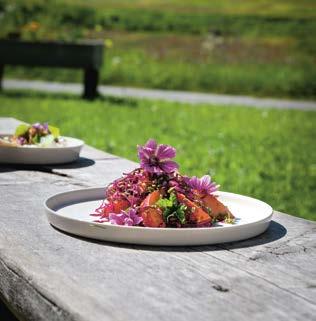
Val Fex – Indulge in lovingly prepared dishes garnished with herbs and edible flowers from the neighbouring garden on the terrace at the Chesa Pool vegetarian restaurant and soak up the view of the serene, green Fex Valley around you. chesapool.ch
Mushroom foraging
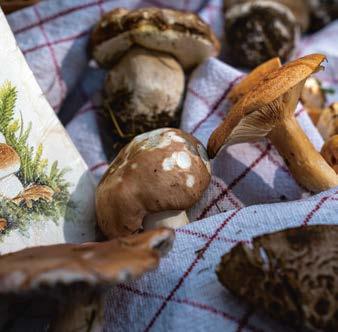
S-chanf – Meet at Restaurant Prasüras on 29 August 2026 to pick and identify mushrooms as a group. The whole family can join in, enjoy a tasting, and then cook lunch together over an open fire. engadin.ch/mushroom-day
Cooking up a storm
Sils – You can step inside the sacred space that is the hotel kitchen at Hotel Waldhaus on 13 July, 10 August, and 31 August 2026 to whip up something spectacular with expert guidance on a cooking or patisserie course. waldhaus-sils.ch/en/ cooking-seminar
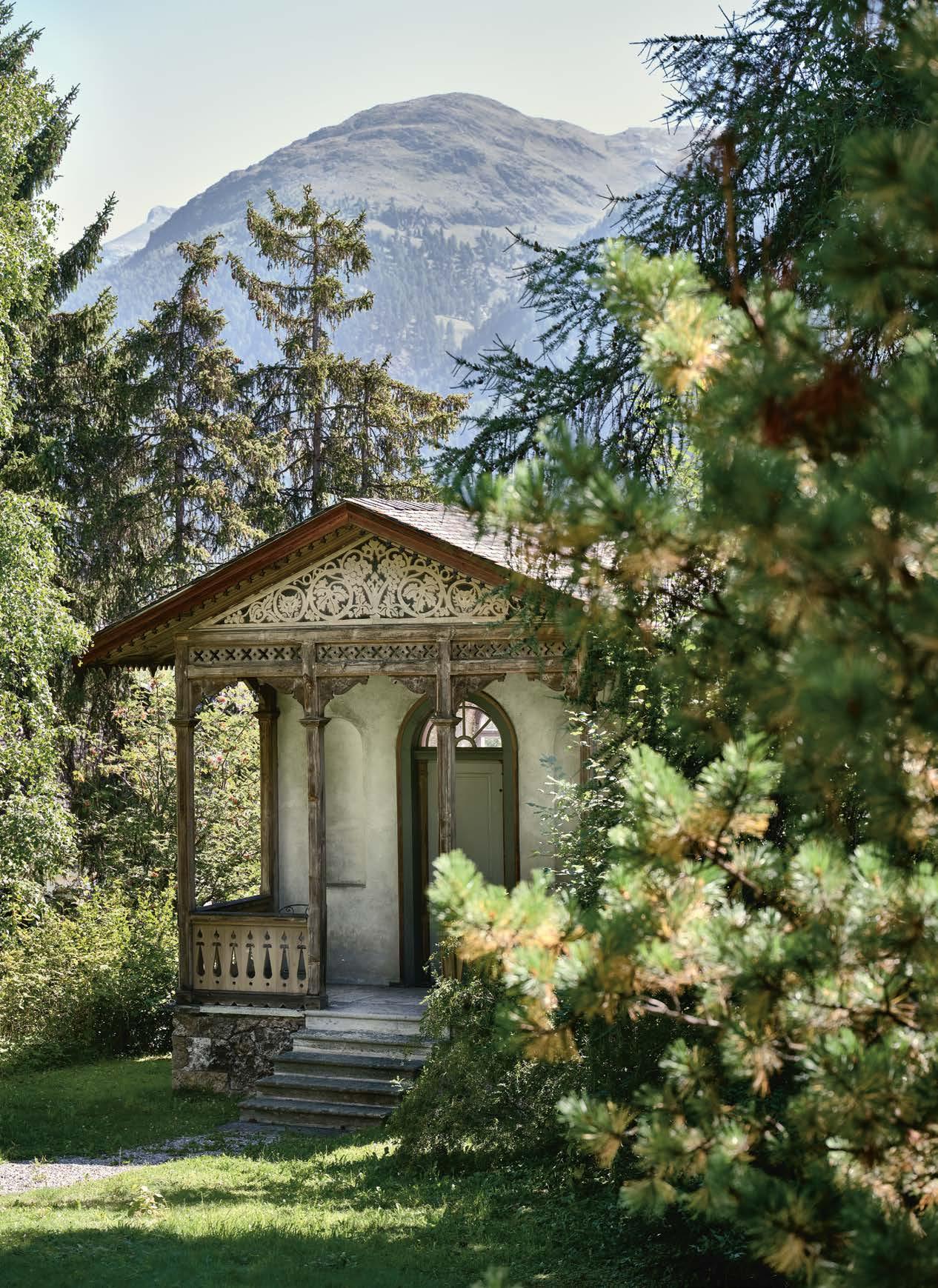
← The historic garden pavilion in the enchanting Chesa Planta park invites you to stop for a moment of contemplation.
Hidden Gems
Enchanting gardens await in the Engadin. You just have to know where to find them. But when you do, you’ll soon understand the meaning behind the Romansh name Engiadina – the Garden
Text CLAUDIUS WIRZ
Photo LEA MEIENBERG
Dof the Inn.
elicate larch branches swaying in the wind, delightful birdsong, and blossom in every colour you can imagine. The beauty of nature right in the heart of the village – where you’d least expect to find it. The most gorgeous gardens in the Engadin often go unnoticed because they’re hidden away behind the magnificent houses. But it’s well worth keeping your eyes open as you wander through the village streets. And you might even like to be so bold as to ask if you can take a quick peek at one of the pretty slices of paradise.
Exquisite examples of gardens that are open to the public include the one at the Chesa Planta Romansh cultural centre in the middle of Samedan, home to a lovely wooden pavilion dating back to 1850, and the Hotel Saratz park offering 35,000 square metres of nature in Pontresina right next to the sublime depths of the Punt Ota gorge. This park is also home to the Bagnera, the highest outdoor swimming pool in the Upper Engadin, which, depending on the weather, is heated from the end of June until the end of September and open to hotel guests.
The sprawling garden at Hotel Saratz in Pontresina is beautifully wild.
The soft evening light spotlights the captivating colours in the largest hotel park in the Engadin.
Exercise
The benefits of playing sports, stretching our muscles, and raising our heart rate extend way beyond losing weight and keeping fit. Just think – the phrase “healthy body, healthy mind” goes all the way back to the Romans. When we move our bodies, our inner tension is released and stress fades away. Regular exercise also helps us stay in sync with our own bodies, so we can be more aware and mindful of the signals they send us.
“The first half hour of my run is for my body. The last half hour, for my soul.”
GEORGE SHEEHAN (1918–1993), US ATHLETE
Photo: Lea Meienberg
Power in Nature
Where in the world would it be easier to dust off your neglected fitness routine than in the crisp and clear Engadin air, surrounded by the Swiss stone pine forests or up by the mountain lakes? Even better if you have an expert by your side, of course.
Text KARIN DEHMER
Photo LEA MEIENBERG
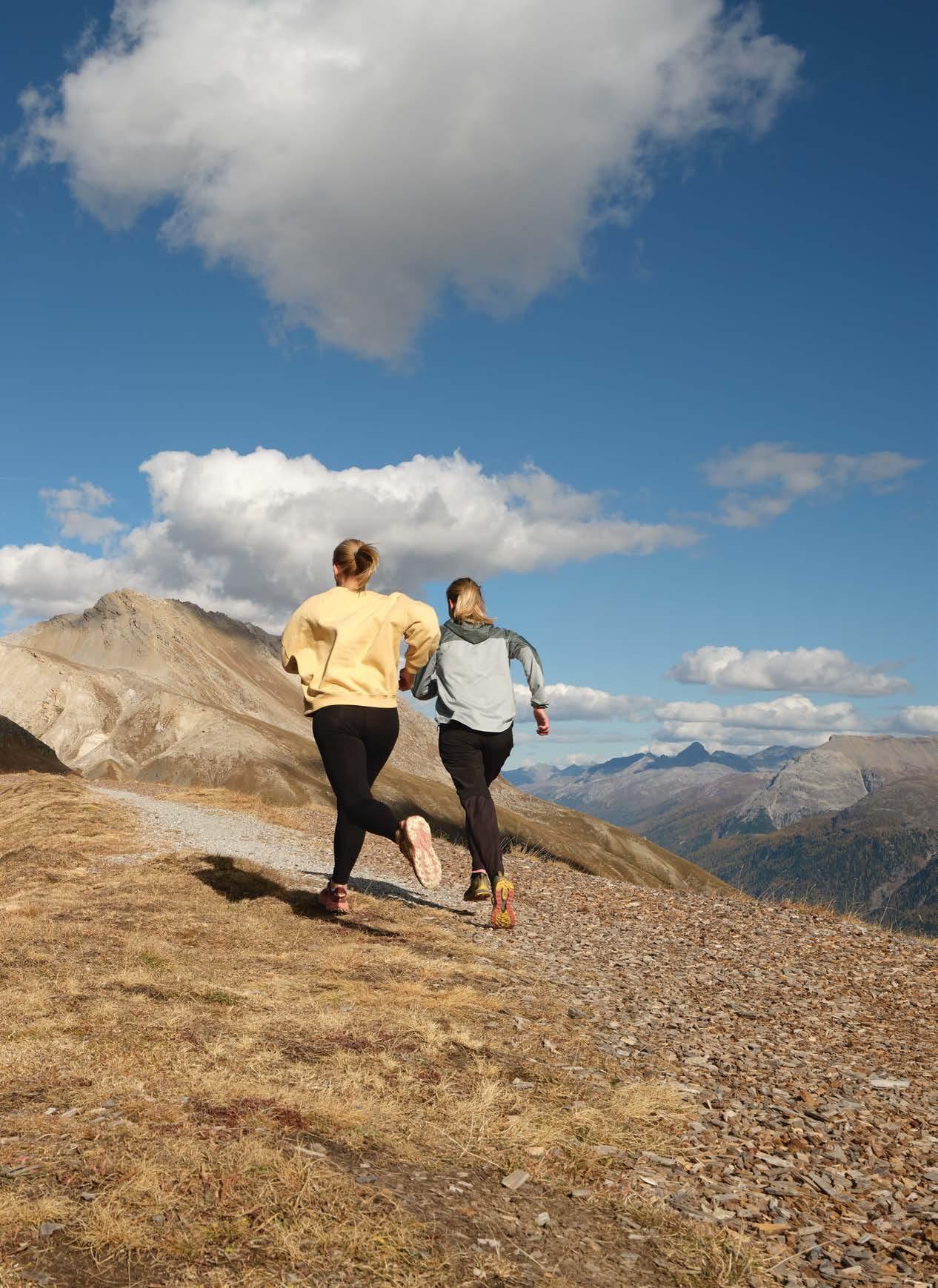
You can count yourself lucky if you have the opportunity to spend splendid summer days in the Engadin towards the end of the summer season. This is the time when the green needles on the larch trees start to darken, the air turns crisp and cool but the sun is still glowing with the warmth of summer, and every living creature with legs – men, women, children, and dogs included – is on the move, out and about, breathing in their surroundings. And who knows? Perhaps following a long break from training, after a short pause, or maybe even for the first time ever, you’ll feel the urge to swap your walking boots for running shoes and get going. Feel your pulse quicken, hear the sound of your breath, process your thoughts to the beat of your footsteps as they get faster and faster. Surrounded by such beautiful nature, can you imagine a more tempting place to push your inner couch potato out the door?
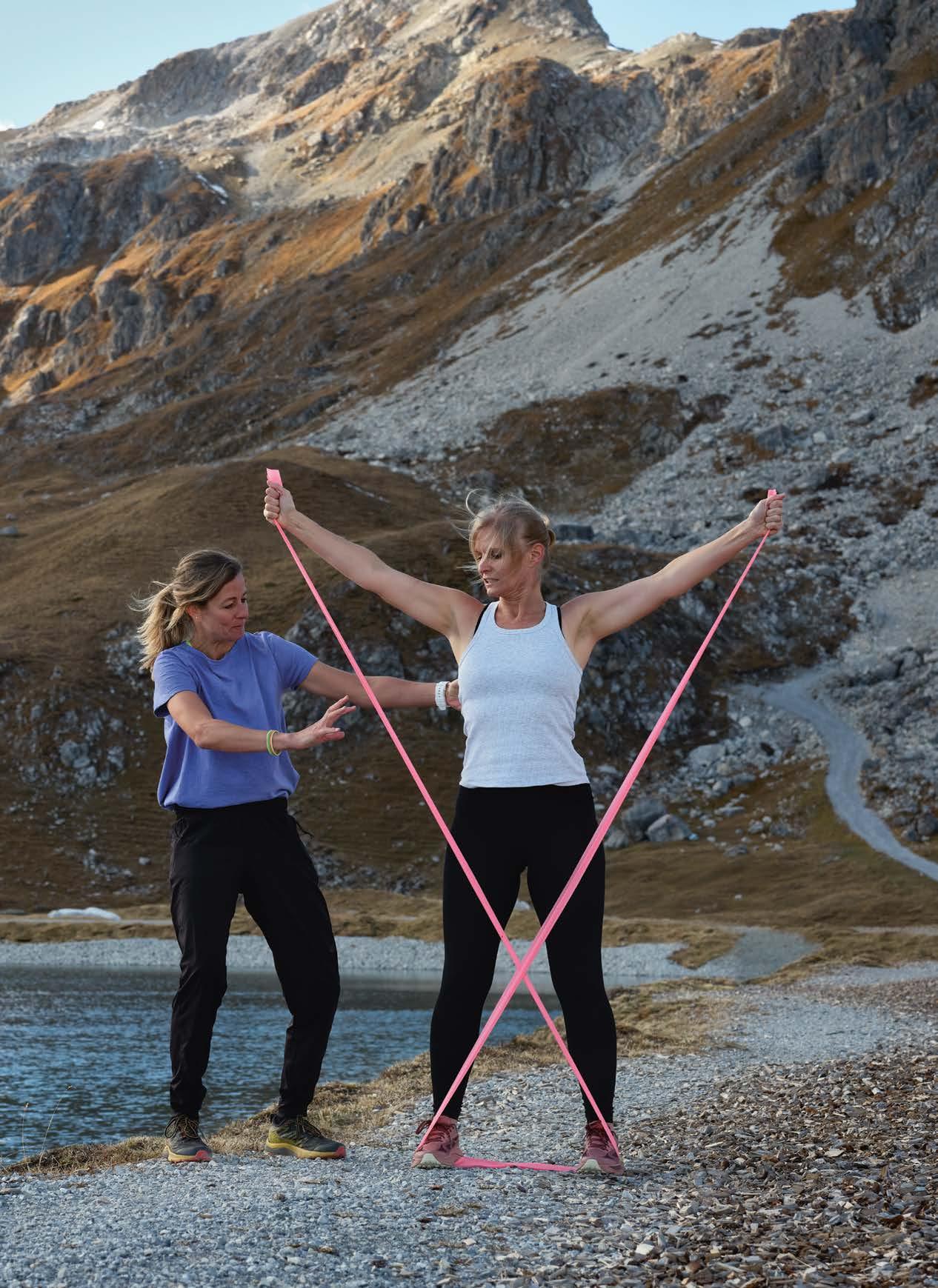
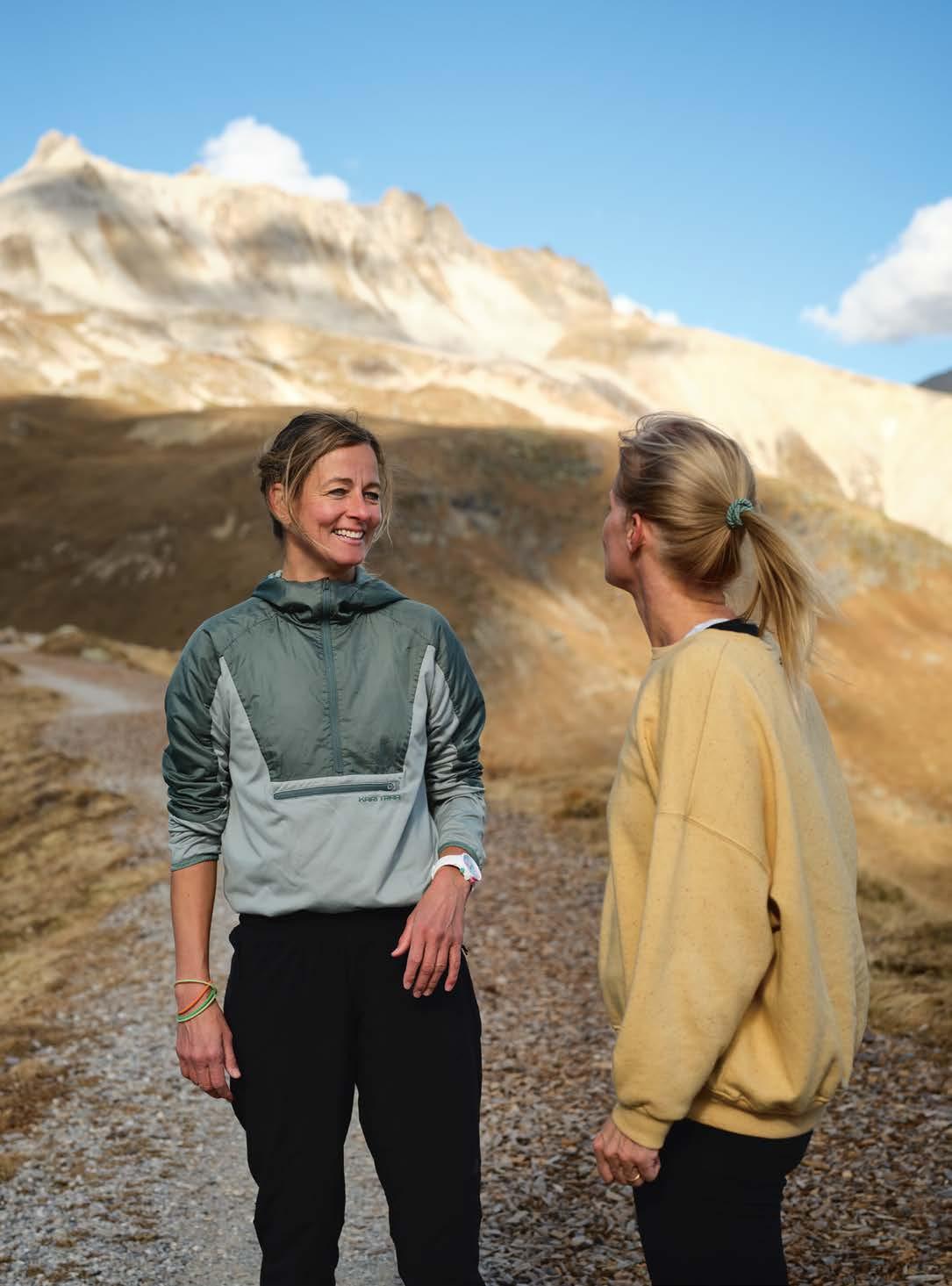
The scenery and friendly chat with the coach will take your mind off the exertion.
Puts you through your paces with a smile and professionalism: personal coach Anne-Marie Flammersfeld.
And if that voice inside your head tries to tell you to turn back even when you’re up here, help is on hand in the form of a nimble, empathetic, ponytailed sportswoman who never leaves anyone behind if they show even the faintest interest in moving their body.
This qualified sports scientist, former athlete, and future psychologist, Anne-Marie Flammersfeld, is the personal training equivalent to a Swiss Army Knife. She knows an awful lot about an awful lot when it comes to sport and fitness. She can adapt to make things easier or more challenging. And she always carries the equipment needed for a successful workout with her. Almost 90% of her clients are locals – men and women of all ages who train with her from several times a week to just once a month. She’s been training with some of them for over a decade. And they don’t just head to the nearest gym for their workouts together. Instead, they always embrace the fresh air – even during the cold Engadin winters – deep in the forests or up high in the mountains.
“It’s a deliberate decision that I made 15 or so years ago. For me, being at one with nature while exercising addresses physical and mental health in one.”
Anne-Marie carries resistance bands, mats, and balls in her backpack. Her workout programmes are based on body weight with fresh air as an important factor. It goes without saying that she has her favourite spots to take her clients, but she doesn’t want to reveal exactly where they are. She is happy to vouch for Lej Marsch near St. Moritz Bad, but that’s not exactly an insider secret given how many people you find exercising there early in the morning during the summer months. And that’s no surprise considering what a delightfully charming place it is.
On rainy days, Anne-Marie sometimes takes her clients under the dense cover of the woods to stretch and cool down. Benches along the paths double up as weight benches and can be used for support during some exercises. Just try attaching a resistance band to the back of a bench, for example.
“I’m committed to showing people that there are actually very few barriers to exercise. You don’t need a gym membership, and regular workouts don’t have to eat into your precious downtime too much either. Most of us have a gym right on our doorsteps – it’s called the great outdoors.” Exactly – and the outdoor gym in the Engadin is as impressive as they come.
When Anne-Marie first talks to a prospective client, she asks them about their health, their goals, and their favourite ways to exercise. After that initial chat, it’s time for the first training session. And then Anne-Marie draws up a custom workout plan for her new client. The client decides how often they’d like to train with Anne-Marie, but they can always expect her to check in regularly for progress updates. She’s on hand to make sure they don’t fall off the bandwagon. Plus, she’s always happy to write a new plan so there’s no risk of anyone getting bored with their workouts. “In-person sessions with me are key to accountability. Nobody likes cancelling an appointment they’ve arranged, do they?” says Anne-Marie with a smile. Knowing that she’ll be on their doorstep at the agreed time stops clients from backing out at the last minute.
But, in reality, clients don’t want to cancel their sessions. After all, jogging next to Anne-Marie or having her guide you through your exercises is more than just a physical workout – it also has benefits for your mental health. The psychologist-in-training is interested in more
The soft-surface trail around Lej Alv is a superb spot for training.
than just the muscle growth and stamina of the clients she works with. And that’s exactly why she has been offering mental health coaching for a while now too. As you might have guessed, nature provides the setting for these sessions as well. She calls them “Walk the Talk”.
Anne-Marie isn’t a fan of being asked whether the physical or mental side of her work is more important. “For me, physical and mental health are not separate.”
Anne-Marie has been working closely with Pontresina-based hotelier Bettina Plattner on rolling out the Mind Body Medicine congress in Pontresina (see page 8). She feels a close connection to this work. As a research associate at the Institute for Complementary and Integrative Medicine at the University of Zurich, she also works on this topic from an academic perspective. And she helped to develop the Mind Body Nature Experience in Pontresina, which has been free of charge to all participants in the Taiswald forest since last autumn. Participants scan a QR code with their smartphone to access 10 short exercises that will help them connect with themselves and the natural world around them in no time.
As I ask for further details about the pilot project in Pontresina, the personal trainer’s replies suddenly get shorter and shorter.
“I like to chat with clients while we’re jogging to distract them from the physical effort,” she says with a grin. “But enough is enough when they start to use the conversation as a way to slow down the pace.”
I see. Message received. Oh, wait. Maybe I do have one last question. How does Anne-Marie motivate her clients when they seem as though they’re struggling? “I always try to remind them of that feeling they’ll have after their workout. Because it’s always incredible. Every single time.”
Physical effort gives way to mental stillness.
Engadin
Built to adapt
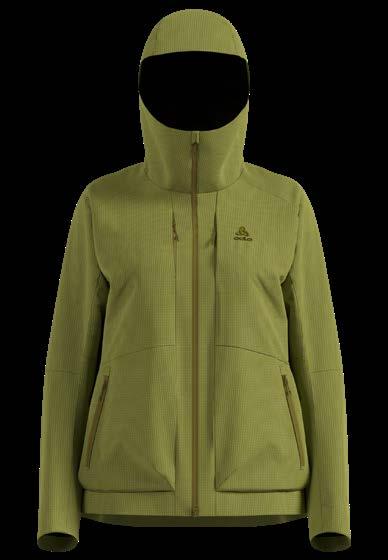
1 Hardshell jacket A sealed jacket with three layers that’s still lightweight and breathable – perfect for damp days on the trails. CHF 390
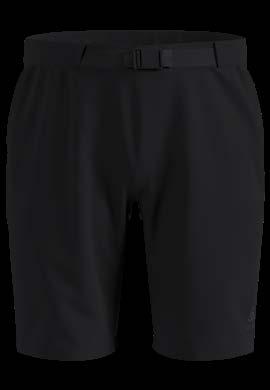
Hiking shorts Functional shorts made from 50% recycled stretch jersey with extra reinforcement in all the right places. CHF 130
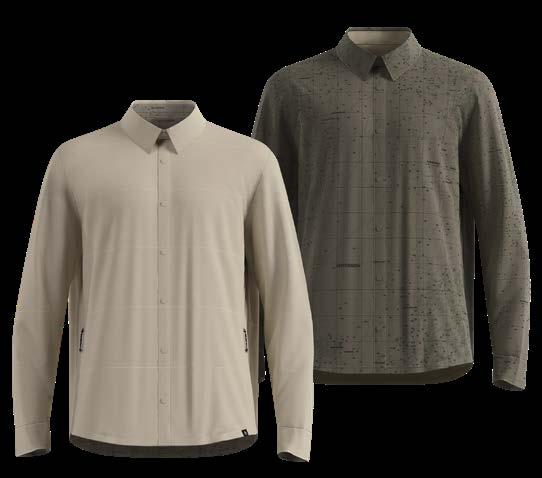
Reversible long-sleeved shirt
shirt with the perfect amount of lightweight insulation to stop the chill without causing you to overheat. CHF 180
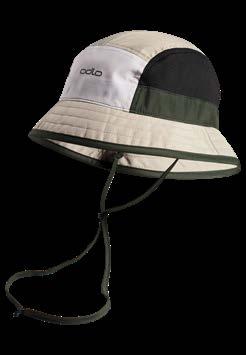
Performance Light bucket hat
lightweight hat made from recycled polyester to keep you protected when you’re out and about in the sun. CHF 40
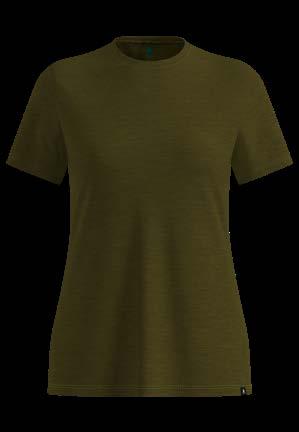
Merino blend T-shirt A blend with cooling properties that’s ideal for hiking, biking, and active summer days. CHF 80
KEEP AN ACTIVE BODY AND MIND High Energy
Head for the fitness trail!
The six Vita Parcours routes in the Upper Engadin are an ideal option if you’re looking to give your training direction without relying on a coach. The trails run alongside streams, through cool stone pine forests, or moorland, varying in gradient and distance. There’s a route to suit everyone. engadin.ch/en/vitaparcours
Ready, steady, goat
Madulain – Here’s a unique outdoor adventure for the whole family to enjoy together. “Mini Geiss, dini Geiss” offers fun goat trekking experiences, stable and meadow visits, and yoga sessions to a bleat-based soundtrack in the goat enclosure. engadin.ch/goat-yoga
Yoga and meditation in the woods
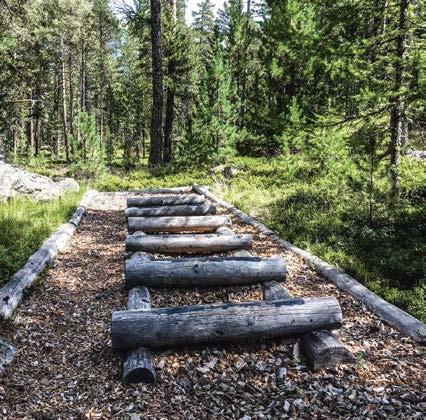
Celerina – Head to the wooden yoga platforms in the Stazerwald forest to ground yourself, meditate, and find peace and strength as you breathe in the fresh air. Since they’re on the Vita Parcours route, your best option is to go there on foot. engadin.ch/yoga-platforms
Slow and steady
Celerina – Mindful cycling, running with a conscious focus on body awareness, and tennis camps, are currently on offer at the Cresta Palace along with plenty of other enjoyable sporting activities. engadin.ch/en/deep-health
Steinbock Trail
Pontresina – Where else could you expect to spot so many ibex on a running trail? This route starts at Pontresina Rondo and takes you along stunning sun-soaked slopes.
engadin.ch/en/steinbock-trail
Engadin Summer Run
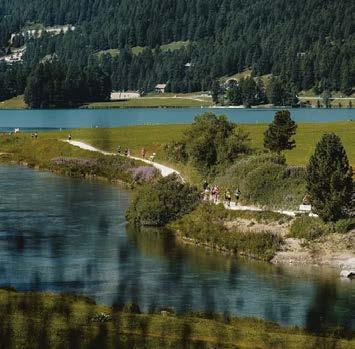
The St. Moritz Running Festival is hosting a number of events for runners at all levels at various locations between 7 and 9 August 2026. A popular choice, the Engadin Summer Run covers 22.9 km from Sils to St. Moritz. engadin.ch/en/running-festival
Multi-use games area
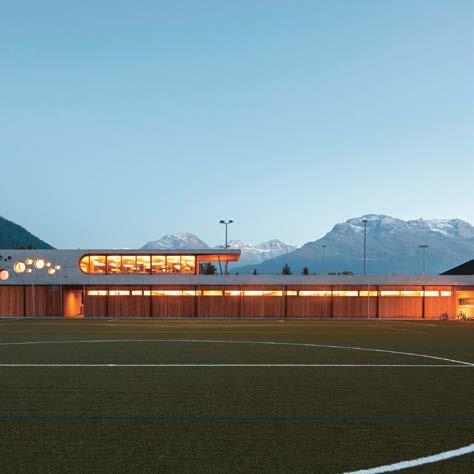
Samedan – Promulins Arena has the infrastructure for all sorts of sports, including bouldering, skateboarding (with bowl), beach volleyball, tennis, football, strength training, and more. There’s no chance of getting bored around here! engadin.ch/en/promulins-arena
Community endurance sport
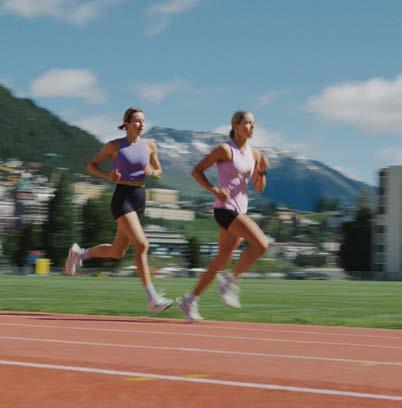
St. Moritz – If you like to train in a group but don’t want to join a club, the MAUN.TEN St. Moritz running group could be the answer. They meet at 6.00 pm every Thursday by the athletics track in St. Moritz. The training sessions last about an hour and you don’t have to worry about registering in advance. maun-ten.com
→ Find other trail running meetups in Samedan and Maloja.
Fun mini golf
Sils – If you can still feel your competitive streak coming out after a busy day of sporting activities, head to the lovely course at Hotel Waldhaus for an evening game of mini golf. engadin.ch/mini-golf-waldhaus-sils
Panoramic route
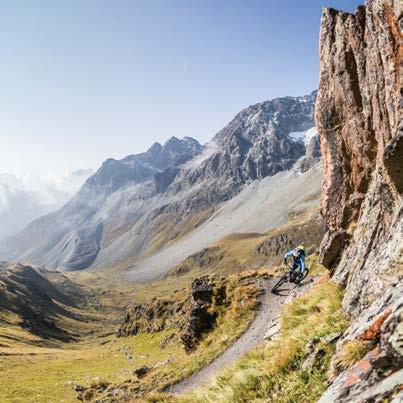
Bever – This easy and varied mountain bike route takes you from Bever through the picturesque Val Bever and up to Alp Suvretta, where you’ll be met with spectacular views. engadin.ch/en/bever-alp-suvretta
Active accommodation
Pontresina – Cyclists, runners, and other active adventurers will feel right at home when they stay at the Sporthotel in the middle of the village during the summer months. A bike workshop, advice on running routes, a sports gear laundry service, and a fitness and wellness area await sporty guests, who can also enjoy the magnificent view. sporthotel.ch
Sail away ...
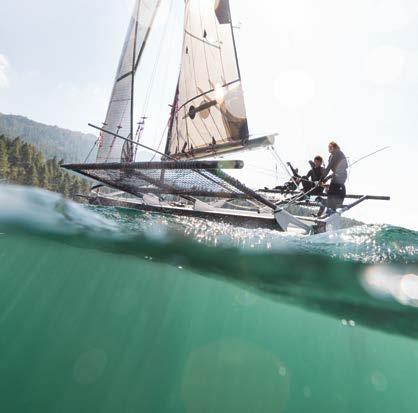
Have you been longing to give sailing a go for a while? Now’s your chance to make it happen on the Engadin lakes. engadin.ch/water-sports
High-altitude training base
St. Moritz – The altitude training centre in St. Moritz-Bad has been the training base of Swiss Olympic since 2022. During the summer, you can spot top athletes from all around the world training for competitions here. engadin.ch/high-altitudetraining
Sleep
Sleep is essential for our health. When we sleep, our body and brain carry out important repair and clean-up processes. The levels of stress hormones in the body fall, organs remove harmful substances, and the immune system works flat out to help our bodies regenerate and fend off infections. Meanwhile, the brain consolidates memories and processes experiences and emotions, laying the foundations for the mental clarity and resilience we need every day.
Photo: Agostina Schenone
“We are such stuff as dreams are made on.”
WILLIAM SHAKESPEARE (1564–1616), ENGLISH PLAYWRIGHT AND POET
The Secrets to a Good Night’s Sleep
You need more than a comfy bed with a duvet and a pillow for a night of restorative sleep. There are a number of factors at play, determining whether we wake up feeling refreshed and ready for the new day ahead.
Consistency
Do you always go to sleep and wake up at the same time?
Research suggests that having a consistent bed time is the key to sleeping well.
Timing
Do you go to bed when you feel tired? Finding your ideal sleep window will help you fall asleep and enjoy a restful night.
Do you sleep through the night? You should spend 80% of your night fast asleep.
Preparation
What does your wind-down routine look like? The process of sleeping actually starts 90 minutes before you go to bed.
Duration
How long do you sleep for?
A healthy range for adults is seven to nine hours a night.
«Sweet dreams are made of this»
A good night’s sleep is a gift that doesn’t always come easily. But these simple tips and tricks might help you to settle down at night...
2 1
Turn down the lights before you go to sleep
Start to slowly reduce the light about an hour before you go to bed. If you can’t dim your lights gradually, try switching them off one by one. Our body’s functions – and especially our brain’s functions – are strongly regulated by light, so darkness is a key marker for sleep. Our bodies and minds only fully switch off when it’s dark. A brightness level of 15 lux is ideal before sleep, which is roughly equivalent to 15 candles burning. Why not try a little experiment? Turn down the light for seven days and then go back to full brightness for seven days. Will you sleep better in one week over the other?
Save your bed for sleeping
You shouldn’t work, watch films, or eat in bed. Reserve your bed for sleeping – and nothing else. And don’t lie in bed for ages trying to fall asleep. Instead, get up for a little while and try again when you feel tired. Basically, you are conditioning your body. Your body gets used to clear signals. And you want it to know that bed means sleep.
3
Let your thoughts wander
Going for a “mental walk” can help you fall asleep. Imagine a specific place you want to explore down to the last detail. Concentrating on something positive will distract your brain from worries or negative thoughts. If you wake up in the night, letting your thoughts wander in this way works wonders for falling back asleep too.
4
Introduce a wind-down
routine
Repeating the same ritual every night can help you transition into sleep mode. You might choose to drink a cup of tea or read a book. Make sure you do something nice and don’t put any pressure on yourself. And remember it has to be something you
5
Write down your thoughts
It might help to get your thoughts down on paper before you go to sleep. You could try writing in a diary or creating a to-do list for the next day. Processing your thoughts in writing will ease your mind, leaving you to fall fast asleep without worrying about things overnight. The act of writing will signal to your brain that a task has been completed or a thought has been processed. Not to mention that writing in a diary or creating a to-do list draws a clear line between daytime tasks and relaxation at night.
can do every day. The science behind this tip is simple – and it comes down to conditioning your body again. The same signal is always followed by the same reaction. So if sleep comes after your bedtime routine every night without fail, your body will get used to this series of events. Performing your routine will be almost like flicking the sleep switch.
6
Try natural remedies
Natural remedies might help if you struggle to fall asleep. Plants like valerian, hops, lemon balm, and lavender have a calming effect – as does ashwagandha (also known as Indian ginseng). These different herbs are readily available in tablet, tea, capsule, or oil form.
7
Take a midday nap
As a rule, you should only sleep when you need to sleep. And you might find that you need to sleep to get through a stressful day or to recover from a lack of sleep the night before. A 20-minute power nap will boost your energy and help you feel better when you’re tired. Taking a short break can also give you the dedicated time you need to yourself to process your own thoughts during the working day.
8
Stick to a regular bedtime
You should always aim to go to sleep and wake up at the same time each day. It’s a good idea to even stick to the same timings at the weekends. Given that our bodies are strictly regulated by an internal clock, we should aim for as much consistency in our daily routines as possible. This body clock is a precise system that is closely connected to hormones, such as cortisol and melatonin, and should not be artificially influenced. The timings might shift a little in line with the seasons, but your body clock ultimately speaks for itself. You should go to sleep when you’re tired and start your day when you’ve had enough sleep to feel refreshed.
10
Keep devices out of your bedroom
We shouldn’t take our electronic devices into the bedroom with us because they make it harder for us to sleep. So make sure you leave your smartphone, tablet, and laptop somewhere else. These devices remind us of work and stress. Scrolling on a phone also keeps demanding that we pay attention at a time when we should be switching off. The blue light emitted by screens works against our body clock and keeps us awake. Studies have
9
Create the right sleep environment
Your surroundings need to be right if you’re going to get a good night’s sleep. Your bedroom should be cool, quiet, and dark. Let in fresh air by leaving the window ajar in the summer or by ventilating in the evening. Curtains or blinds keep light and noise at bay. Pillows filled with Swiss stone pine shavings or chips smell good and can have a calming effect thanks to the essential oils.
shown that screens make it harder for us to fall asleep in the first place and then stay asleep through the night. Falling asleep is a slow process that doesn’t just happen at the flick of a switch, so it starts way before your usual bedtime. This is why the recommendation is to turn off devices an hour before going to sleep. Even the numbers on your alarm clock can be enough to disrupt your sleep. Waking up in the night and checking the time causes stress, which releases cortisol and makes it harder for you to fall back asleep. As you can see, it’s a good idea to keep those devices out of your bedroom.
King-Size Beds and Pillow Menus
Thomas Walther runs Hotel Walther in Pontresina, where guests have been sleeping soundly for over a century. In this interview, he spills the secrets to a good night’s sleep.
Text FIOREL GLOOR
Mr Walther, the rooms in your hotel are over 1,800 metres above sea level. What do you suggest to your guests if they have trouble sleeping at such an altitude?
I advise that they don’t venture any higher during their first few days. Instead, I recommend that they explore the valley and drink plenty of water. But we’ve also been told by families that their children have slept like a rock.
Guests come to you from all over the world. What have you learned about sleep habits in different countries?
To be honest, there aren’t any major sleep differences between all the different nationalities we welcome here.
We can safely say that our American guests prefer king- and queen-size mattresses, though. Most people really
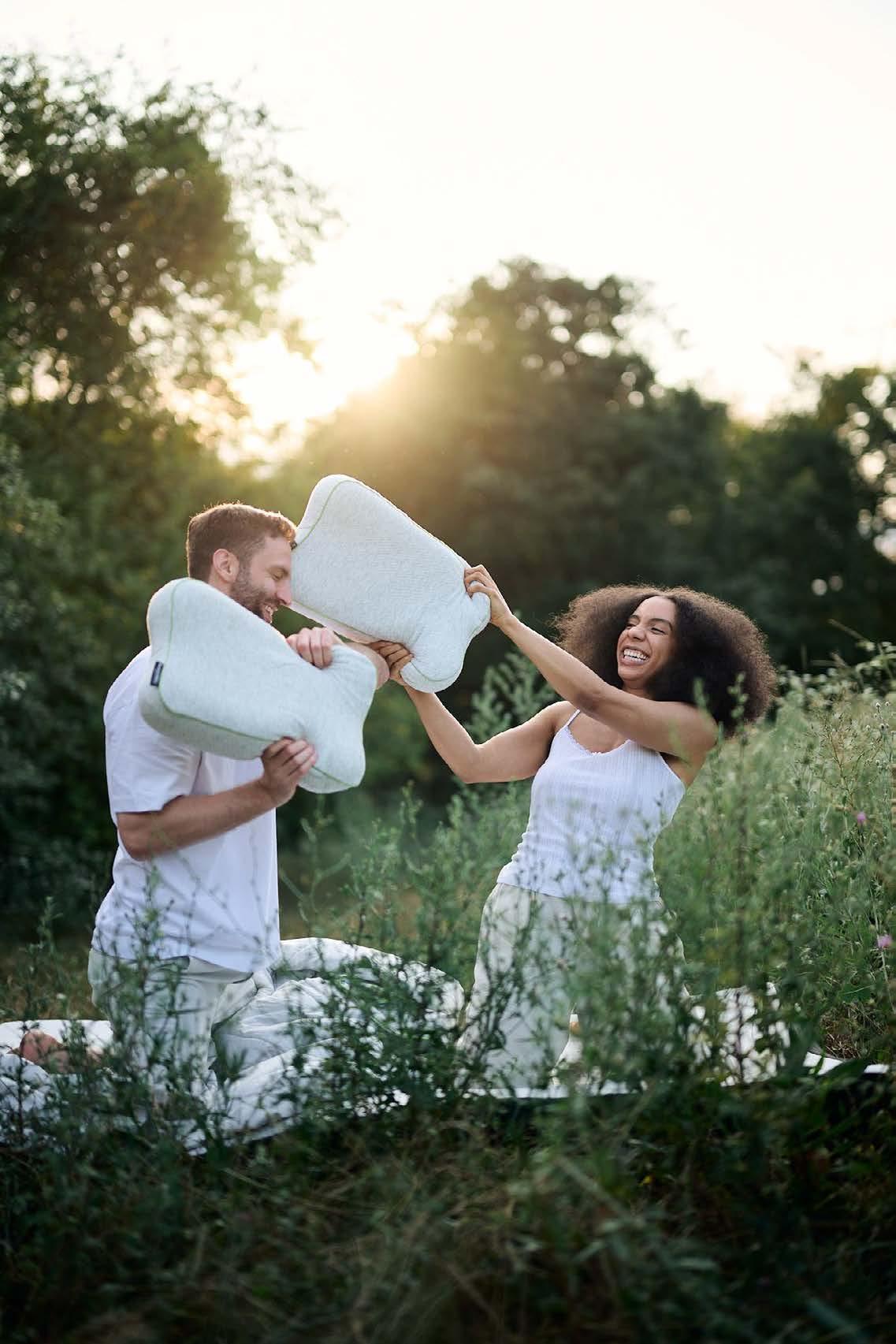
appreciate our pillow menu, which offers a selection of pillows with different firmness levels and fillings, including Swiss stone pine and millet.
The bright sun in the Engadin might be a problem for people who like to sleep in. How do you make sure your hotel rooms are dark enough? Some rooms on the top floor have shutters on the inside. When choosing curtains for all our rooms, we don’t just focus on the look and feel. We’re careful to opt for an opaque fabric with a blackout lining.
After a long hike, there’s nothing better than resting on a good mattress. But what makes a mattress good? How do you cater for different preferences when it comes to firmness, texture, and size? We decided on a medium-firm mattress
for our hotel. This gives us the option of adding a topper for guests who prefer a softer mattress. Some mattresses can also be flipped over, so one side is hard and the other side is soft. I would say that two thirds of our guests prefer a soft mattress.
Let’s channel the princess and the pea... What is the largest number of pillows and duvets you’ve ever been asked to take to one room?
Each guest is provided with one duvet and two pillows in different sizes as standard. We often get asked for more duvets during the winter. And some guests end up trying out four or five pillows before they settle on the perfect one for them.
records and anecdotes told by my parents, bed sizes have changed considerably. There is certainly a demand for bigger beds – especially in single rooms. And noise control is important too, so windows and doors need to be soundproof. Guests also really appreciate good bedside lamps, which never used to be the case. Twenty years ago, people cared much more about the bathroom facilities than they do now.
Do you have any of your own routines that help you sleep better?
Guests have been staying at your hotel in Pontresina since 1907. How have the rooms changed over time? What new preferences and expectations have you had to accommodate?
Sleep comfort has climbed to the top of the list of priorities. According to old
Luckily for me, I sleep well and don’t usually have any trouble switching off. I have back problems, so I’ve been sleeping on a water bed for years now. That might also explain why I remove all the pillows from the bed before I go to sleep in any hotel room. I have absolutely no need for a pillow menu myself!
TIPS FOR A DEEP SLEEP Psssst!
Nature’s soundtrack
Calming cups
Pontresina – A hot cup of tea is an important part of any extended evening ritual. The Maistra Concept Store has four herbal blends of its own for you to choose from – sea buckthorn, blackberry, wild rose, and barberry. maistra160.ch
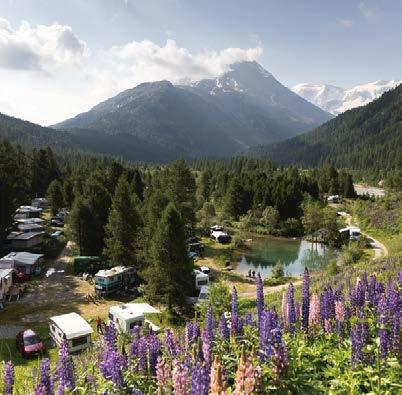
When you stay at any of the campsites in the Upper Engadin, you can expect the sounds of nature to soothe you to sleep. Listen to the babble of brooks in the mountains, the rustle of wind through the larch branches, the splash of water lapping against the lake shore... and you’ll be dozing off before you know it. engadin.ch/campsites
Starry sky
With light pollution at a minimum, the stars shine bright and light up the night sky in the Engadin. If you seriously struggle to fall asleep, an evening stroll in the fresh air with your eyes on the sky above you will work wonders.
Silent sleep
Val Fex – We need a peaceful environment to fall into a deep sleep. And you’ll struggle to find anywhere more serene and silent than the remote natural paradise that is Val Fex. Hotel Sonne at the entrance to the valley is the perfect place to embrace the relaxing vibes of nature, with a range of courses covering the likes of forest bathing, fasting hiking, and intermittent fasting. engadin.ch/en/deep-health
Soothing scent
La Punt – The smell of Swiss stone pines has been proven to have a calming effect and could even help you drift off to sleep. The Arven Atelier sells pillows filled with Swiss stone pine shavings or chips and lots of other gifts made from the same trees, such as soap and small items of furniture. arvenatelier.ch
Self-Care
Complementary therapies like autogenic training, breathwork, aromatherapy, meditation, and yoga are a great way to support conventional medical treatment. These alternative approaches empower patients to take an active role in their own recovery and build self-confidence. This kind of self-care also includes maintaining a positive mindset and staying socially connected – both of which foster a sense of purpose and belonging.
“Be patient toward all that is unsolved in your heart and try to love the questions themselves.”
RAINER MARIA RILKE (1875–1925), AUSTRIAN POET
Photo: Lea Meienberg
Happy Harmony
TREAT YOURSELF WELL
Following philosophers
Samedan – The Philosophers’ Path is a themed trail on Muottas Muragl that gets you moving and thinking surrounded by nature. Quotes from some of the greatest thinkers in history invite you to stop at points along the way and enjoy the magnificent view. engadin.ch/ summer-philosopher-path
Temple for the senses
Sils – Hotel Waldhaus has been giving guests a warm welcome for almost 120 years now. This traditionally elegant hotel with a modern, minimalist spa and a penchant for fine art delivers deep-health activities with passion and purpose, including yoga weeks, daily forest bathing, and stress therapy. engadin.ch/en/deep-health
Dolce far niente
Deep relaxation
You don’t have to be a guest at many of the hotels in the Upper Engadin to soothe your aching muscles in their spa and wellness areas. engadin.ch/en/wellness
Pontresina – Soak up the southern summer holiday vibes at the Laret Market every two weeks. Join the local community and browse market stalls, listen to concerts, and sip drinks from the bar. engadin.ch/laret-market
Plant power
– Soglio in Val Bregaglia has been making premium cosmetics with local alpine herbs since 1979, always showing the utmost respect for nature. One place where you can buy their products, and enjoy their delightful fragrance, is a shop called Bottega Maloja. soglio-produkte.ch
Mud treatment
St. Moritz – Local natural mud treatments and carbonated mineral baths are available on the health spa menu. Both options boast benefits for physical and mental well-being by supporting deep relaxation. engadin.ch/en/deep-health
Carefree calm
Sils – Whether you’re paddling solo or part of a guided tour, your thoughts will drift away as you glide across the smooth surface of Lake Sils in a kayak early in the morning. engadin.ch/water-sports
Holistic
Pontresina – On 5 and 6 November, Pontresina will host the second Mind Body Medicine Congress for healthcare professionals. engadin.ch/en/deep-health
Horse happiness
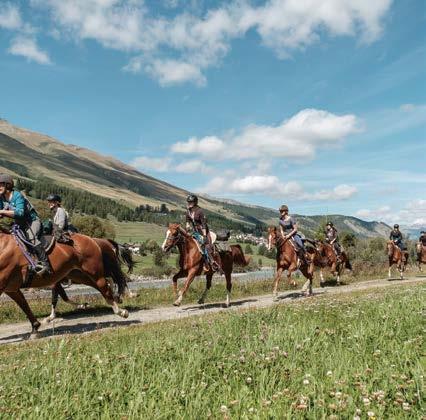
Madulain – Some people would say that their happy place is on the back of a horse. And it’s true, riding through the golden glow of the local landscape can be a source of immense joy. The Engadin River Ranch offers day-long horse rides and shorter alternatives for beginners and more experienced riders. engadin.ch/riverranch
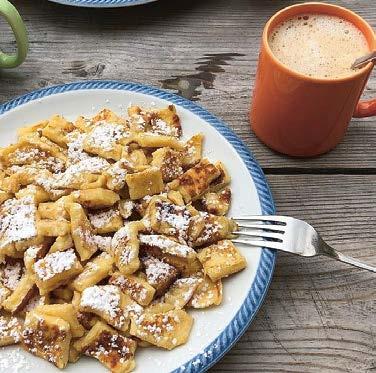
Samedan – Alp Muntatsch promises a view of the Bernina massif from its stunning sun-soaked terrace. You can walk there from Samedan in around an hour and a half. The team at the hut welcomes hikers warmly with their homemade Kaiserschmarrn. engadin.ch/muntatsch-alp
Made with love
Plenty of farm shops sell locally produced delicacies, such as cheese and dried meat, as well as little trinkets you can take home to delight your loved ones. engadin.ch/alpinefarms
Wellness on the menu
Zuoz – You can follow different routes to walk to Alp Arpiglia from Zuoz in around an hour and a half. The team at the hut serves up homemade specialities to diners on the glorious garden terrace. You’ll need to book ahead if you want to tuck into the special alpine breakfast that’s served on Wednesdays in July and August. alparpiglia.ch
Evening swing
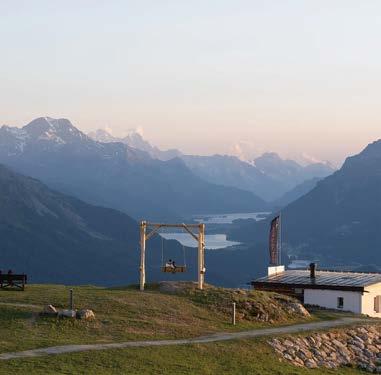
Samedan – There’s no more romantic spot to watch the sun set than the panoramic swing on Muottas Muragl. And you can take your time to savour your supper in the restaurant afterwards, knowing that the train runs until 11.00 pm. engadin.ch/panoramic-swingmuottas-muragl
Crackling fire
Enjoy the experience of barbecuing as a family at one of the many hidden grill points in the area. You can reach them all easily on foot and cook together surrounded by nature in the great outdoors. engadin.ch/ hidden-barbecue-spots
Water rich in minerals
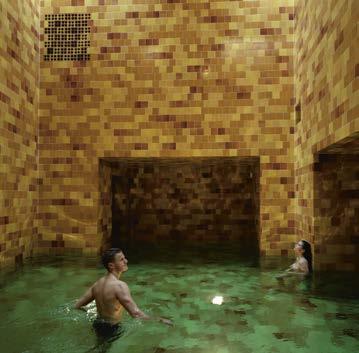
Samedan – You’re guaranteed a special wellness experience at the mineral bath and spa. Make the most of the extensive bath, sauna, and steam facilities spread across multiple levels before indulging in the ultimate relaxation in the rooftop pool. The spring water at the spa is rich in minerals and believed to have a revitalising effect on the body and mind. engadin.ch/mineral-bath
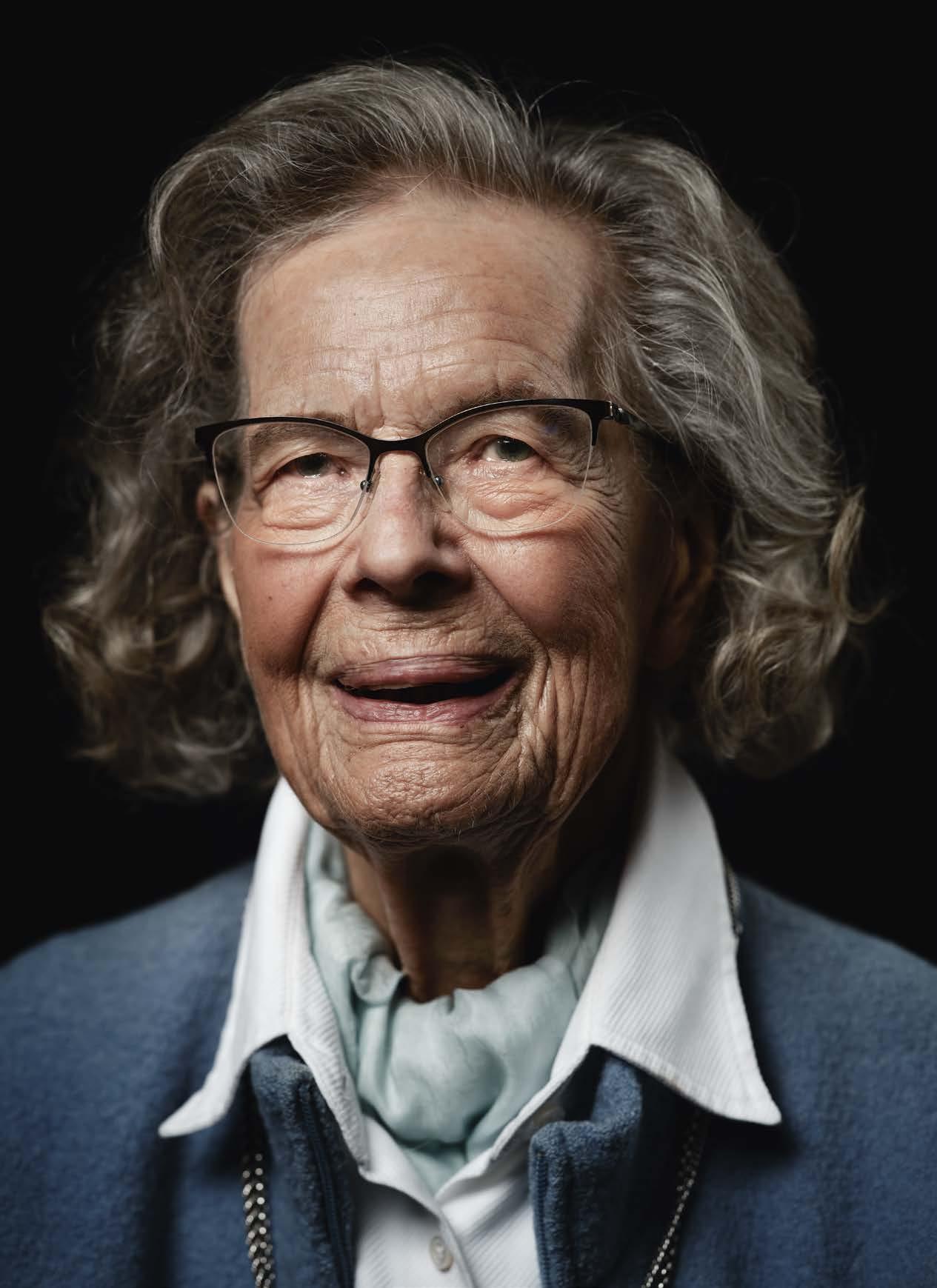
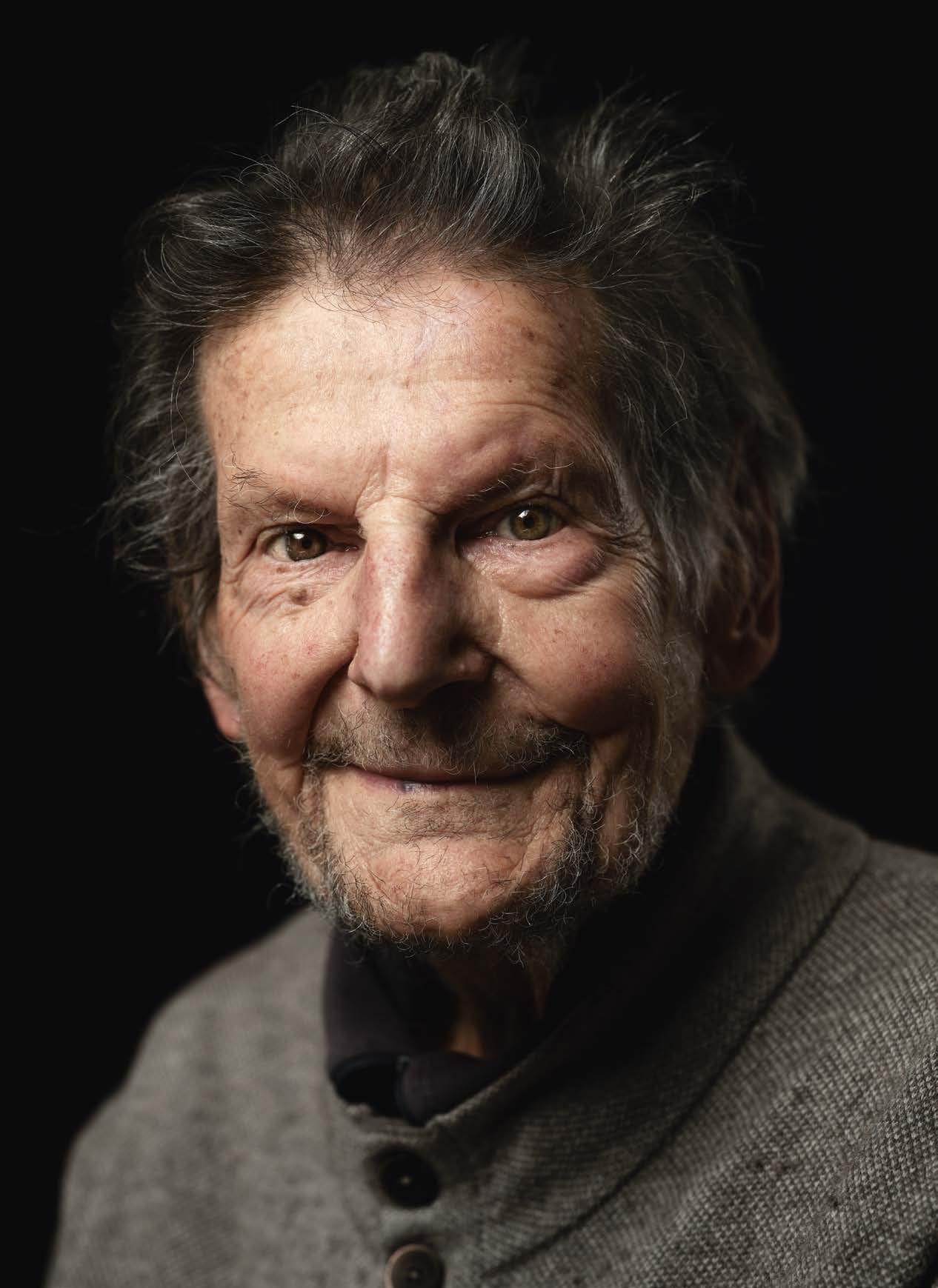
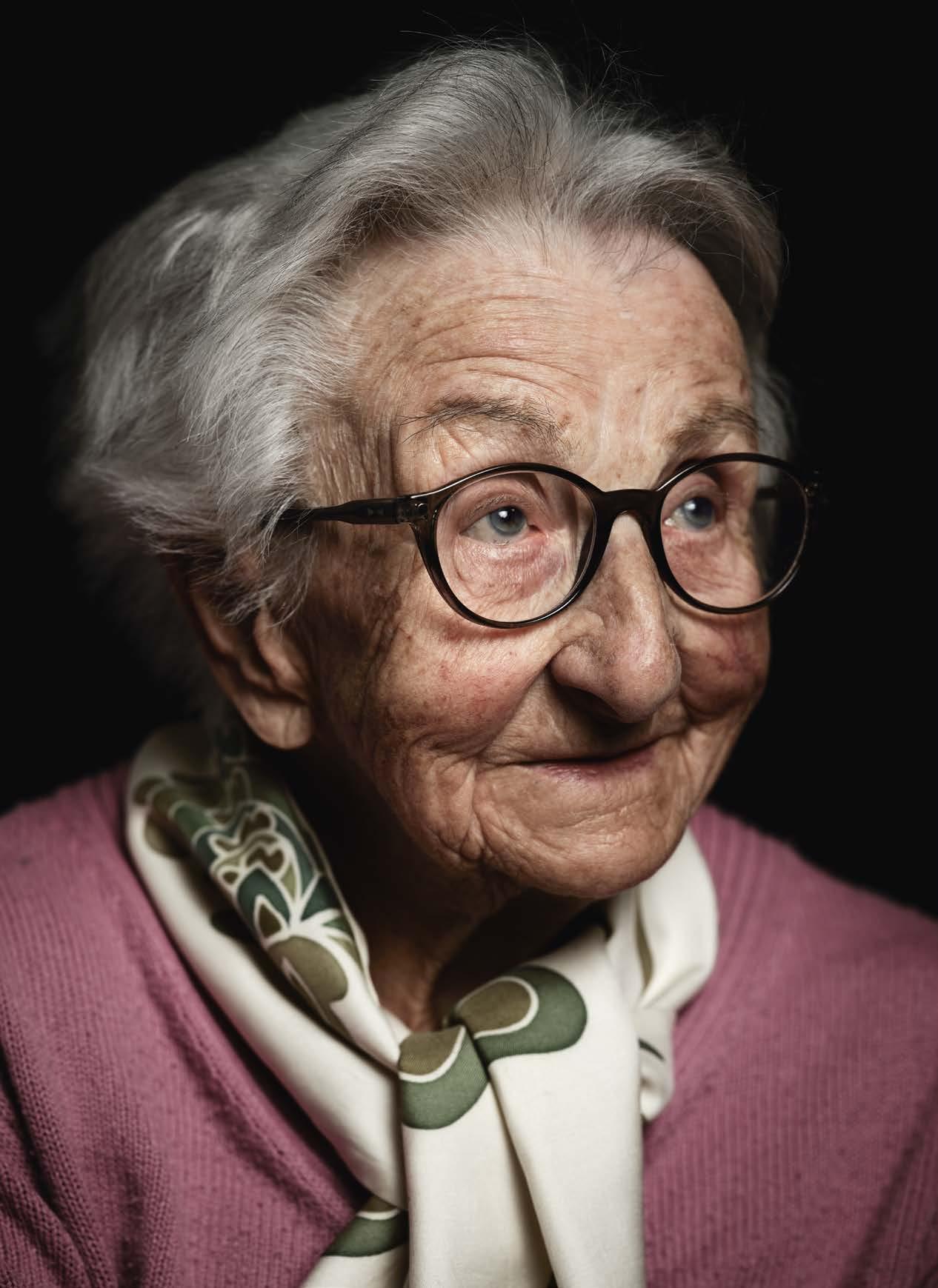
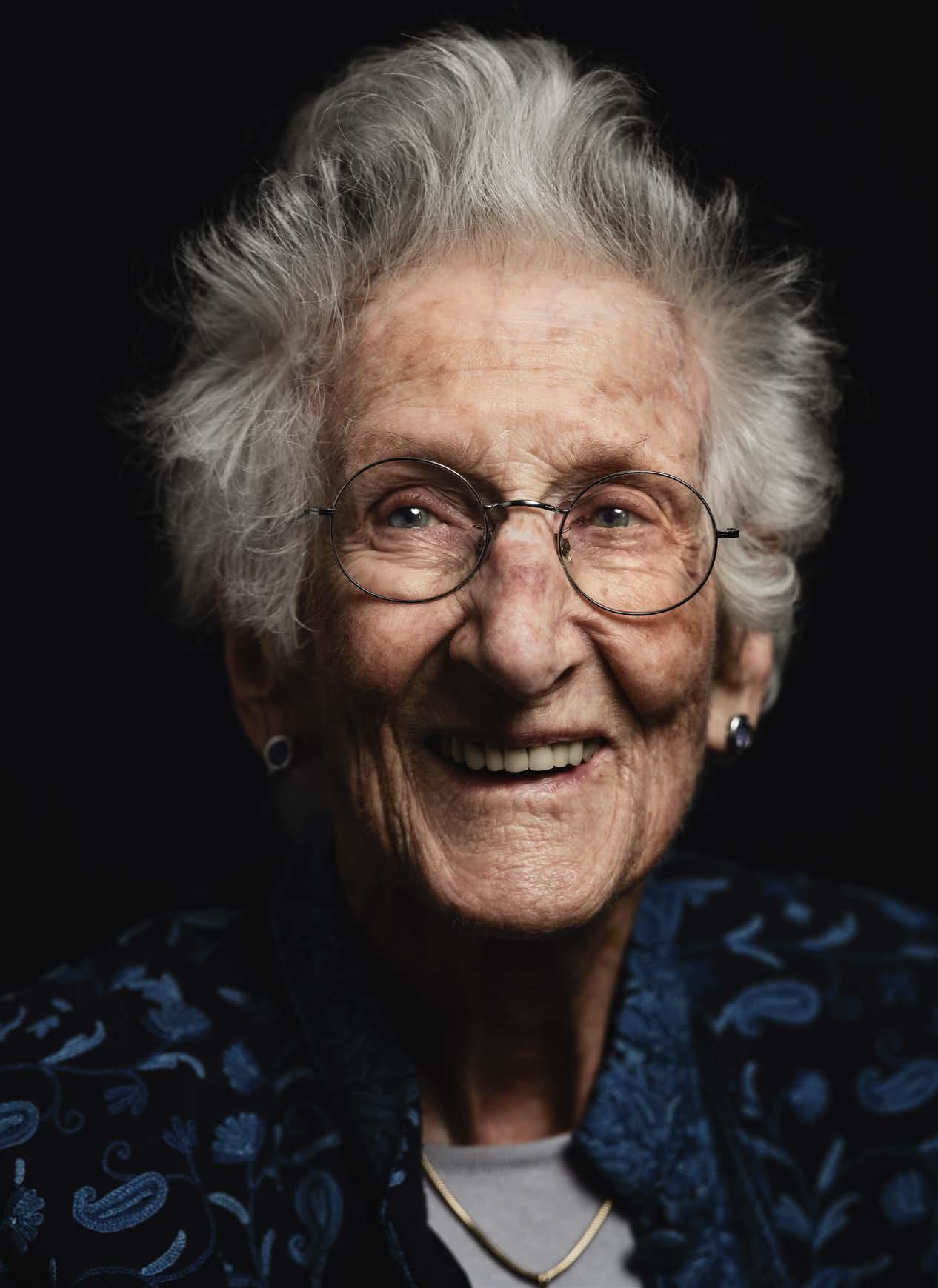
Ageing Well
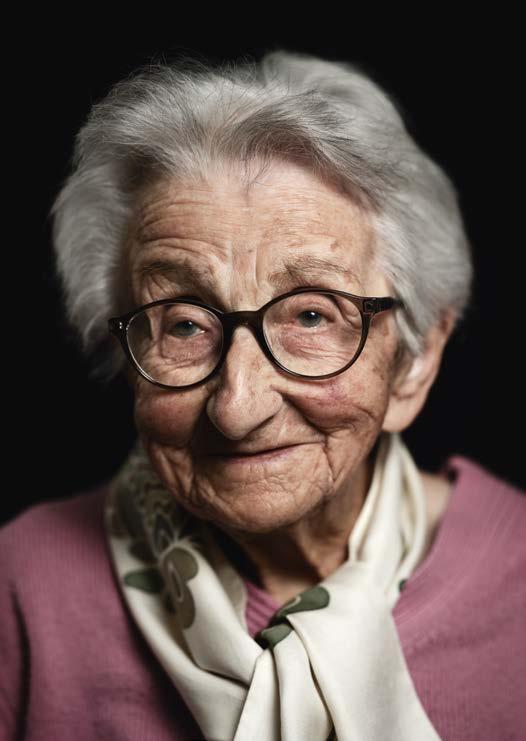
Four Engadin residents have practised self-care throughout their long lives – perhaps more by instinct than by design – with their positive mindset, gratitude, and curiosity. Let’s hear from our local experts in ageing well.
Text MARTIN HOCH
Photo LEA MEIENBERG
Photo: Filip Zuan
Photo: Lea Meienberg
“I’ve just always been very lucky,”
Curious
“It has been good” – Silvia Nicol doesn’t need much more than these four words to sum up her life. She’s lived an adventurous life with stints in the United Kingdom, Qatar, Australia, and Iran. And now the 94-year-old lives in a cosy apartment in La Punt-Chamues-ch. She repeats those same four words several times during our conversation.
So what made it good? Can she let us in on any secrets to living a good life? “I’ve just always been very lucky,” she says with a modest smile. But many of the things she says suggest there has been more to it than just luck. You can choose how you approach life. And Silvia has always embraced it. World War II broke out when she was just six years old, but “I was never scared.” When she didn’t have the right to vote as a Swiss woman, “I still always felt like an equal.” She couldn’t have children of her own, but that didn’t stop her living “a wonderfully full life”. And she never lost her optimism – even when she was widowed at the age of 42 after a happy but short marriage. “I still haven’t lost my curiosity and desire to experience new things to this day.”
— Silvia Nicol, 94
Modest
“You slow down a lot with older age,” says Constant Könz as he makes his way from his front door to his living room one small step at a time. “And that doesn’t leave you much time to play with.” He enjoys spending the time he does have at home in his yellow house in Zuoz. “I’m a happy man,” he says with a big smile on his face, “because I have a roof over my head and glorious nature all around me.”
Even though no end of houses in the Engadin feature his work as a sgraffito artist and painter, Constant is never anything but modest. “We’re not talking about masterpieces here – it’s just folk art.” His secret to a happy life won’t come as any surprise... Be humble in all that you do. And always be content with what life gives you. One thing that life did give Constant, he tells us with a chuckle, was a twin brother who still comes to visit him regularly. “He’s a kind and intelligent man, whom I’ve always admired.” How have the pair of them lived to such a grand old age? It might have something to do with “living in moderation, never smoking, and maintaining a sensible relationship with alcohol”.
— Constant Könz, 97
Photo: Lea Meienberg
“... because I have a roof over my head and glorious nature all around me.”
Photo: Lea Meienberg
“I love being surprised.”
Grateful
“I don’t make plans anymore,” says Emmi Robbi. The 99-year-old is sitting at the dining room table in her house in S-chanf. She has lived here since 1949, and her husband used to work in his blacksmith’s workshop on the ground floor. With a mischievous look on her face, she describes herself as a “non-local” from Lucerne. Her job at the Varusch Park Hut in the national park brought her to the Engadin when she was a young woman. And it was here that she fell in love, got married, and raised two daughters, “who now take wonderful care of me”.
“I love being surprised.” She has a twinkle in her eye behind her stylish glasses. For example, she’s always happy when one of her daughters shows up for a spontaneous walk. Her natural workout over all these years seems to have revolved around her stairs at home. She lives up on the top floor, after all. “I’m so grateful that I can still live here in my own home.” This gratitude is something she always carries in her heart. “You should never forget to thank the Lord.” Every so often, she likes to close her eyes and drift off into her memories. She calls this recalling her thoughts. And the other habit that’s still important to her after all these years is “always being content with myself”.
—
Emmi Robbi, 99 (turning 100 in April)
Optimistic
“Nothing comes for free in this life,” says Maria Godly with a contented smile. She’s been given lots of time and joy in her life so far. But she clarifies that it hasn’t always been plain sailing with her health. Her sharp mind is something she has managed to hold onto for all this time, though. She’s hardly given her brain a rest, which helps to keep her feeling young. “At the age of 87, I was still working full time as the host at Pension Andreola and Restaurant Marchetta in Sils-Maria and running Pensiun Chastè.” Her responsibilities included bookkeeping and she recalls: “Back in the beginning, a night with full board used to cost CHF 13.”
Her sister Christina, with whom she ran the business for 70 years, “was my complete opposite, so we complemented each other well”. Neither of the sisters ever ended up getting married because “we just didn’t have time for it”. Christina Godly, who has sadly since passed away, made sure that guests kept coming. And there was a steady stream of them. They even welcomed some famous faces, including Austrian conductor Herbert von Karajan and Swiss author Friedrich Dürrenmatt. Two of Maria Godly’s core values that have held true along the way? “Doing things properly and insisting on quality.” Plus, she’s always had a penchant for the finer things in life –“from music to fashion”.
— Maria Godly, 97
Photo: Lea Meienberg
“At the age of 87, I was still working full time as the host at Pension Andreola ...”
Experience Shop
From hotels and holiday homes to outdoor adventures – and from ski passes and event tickets to restaurant bookings – we’ve got you covered. Whether you’re looking for snowsports lessons, merchandise, or gift vouchers, everything you need for your stay can be booked directly online via the Experience Shop. Why not take a look?
Maloja Sils
St. Moritz
Celerina
Samedan
Champfèr
Surlej
Maloja Pass, Val Bregaglia Beverin
Lake
St. Moritz
Lake
Champfèr
Lake Silvaplana
Lake Sils
Julier Pass
Albula Pass
Chamues-ch
Silvaplana
Celerina
Samedan Bever
Madulain
Zuoz
Pontresina
Zernez Inn
Beverin
Flaz
Lake
St. Moritz Champfèr
Chapella Cinuos-chel
Bernina Pass, Valposchiavo
La Punt Chamues-ch S-chanf
ITALY
booking.engadin.ch
Lake Region
Maloja – Sils – Silvaplana – St. Moritz
Silvaplana – The first written record to mention Silvaplana dates back to 1288, and the merger with “Surleich” (now Surlej) and “Chiamfer” (now Champfèr) was also reported at the time. The Suvrettabach stream was established as the border between the municipalities of St. Moritz and Silvaplana – as a result, Champfèr remains politically divided into two parts to this day.
Maloja – Piz Lunghin (2,780 metres) is Maloja’s local mountain. The nearby Lunghin Pass is a mountain pass renowned for being the only triple watershed in Europe. From here, the water flows in three directions – into the Black Sea, the North Sea, and the Mediterranean Sea. Just below the watershed sits Lake Lunghin, which the River Inn flows into.
Maloja Pass, Val Bregaglia
Maloja
Lägh dal Lunghin
Lake Sils
Lägh da Cavloc
Lägh da Bitabergh
Julier Pass
Corviglia
St. Moritz
Hearts Region
Lake St. Moritz
Silvaplana
Lake Silvaplana
St. Moritz – The history of this remarkable holiday resort began in the early 19th century as a popular summer destination, but St. Moritz owes its reputation as a dazzling winter paradise to hotelier Johannes Badrutt. In 1864, this resourceful Engadin native made a legendary bet with some English guests: he promised them that the St. Moritz winter was just as beautiful as the summer. If he failed to keep his promise, he would pay all their travel expenses. The enthusiastic English guests stayed for the whole winter until Easter – and winter tourism was born.
Corvatsch
Furtschellas
Sils Maria and Sils Baselgia – Sils Maria and Sils Baselgia: the village has two names because it encompasses two localities. The Val Fex side valley, Plaun da Lej, and three alpine hamlets – Grevasalvas, Blaunca, and Buaira – also fall within the area covered by this municipality. Sils Baselgia is located near the Church of San Lurench, with the name “Baselgia” coming from the word “basilica” (church). And Sils Maria used to be home to a dairy or “Meierei”, which is the origin of “Maria” in its name.
Nos tips Regional highlights
Special souvenirs
1
Stony symbol
Maloja – One of Maloja’s landmarks, Belvedere Tower, is surrounded by mountain pines, moorland, and impressive glacial mills in a nature reserve. The view all the way down into Val Bregaglia from the top of the tower is spectacular. Exhibitions inside shine a spotlight on biodiversity and an educational trail offers fascinating insights into the glacial mills. engadin.ch/belvedere-tower
3
Tempting terrace
Sils – Café Grond is located at the heart of the village, just a stone’s throw from picturesque Lake Sils. Treat yourself and take your pick from freshly baked bread, homemade local chocolate delicacies, delicious cakes, and hot savoury snacks. Soak up the serene village vibes on the sun-soaked terrace and enjoy a quiet moment to yourself. grond-engadin.ch/sils-maria
2
Maloja – Bottega Maloja is a shop filled with an exquisite selection of locally produced goods, from chestnut products from Val Bregaglia to soothing, nourishing, and revitalising cosmetics by the local organic brand Soglio, which are made from alpine ingredients and harness the power of the mountains for the benefit of your body and mind. engadin.ch/en/bottega-maloja
Insight into Cheva Plattas da Fex
4
Sils – You can learn about the old “Ganda” quarry, which has been disused since 1965, at a small interactive museum. A guided tour is on offer every Tuesday during the summer and you can also explore the adventure trail on your own.
engadin.ch/en/plattas-da-fex
Boat trip on the lake
7
St. Moritz – A boat trip on the glistening waters of Lake St. Moritz is a great way to discover the beauty of the Engadin. engadin.ch/sailing-club-st-moritz
5
Culinary hotspot
Silvaplana – By the time you’ve walked to Restaurant Alpetta, you’ll have earned a break out on the sunny terrace. Alpine pasta specials and delicious dishes from the grill and smoker are served here against the beautiful backdrop of Lake Silvaplana’s turquoise water, the mountains, and the kitesurfers. alpetta.ch/en
It’s Tea Time
St. Moritz – The Suvretta House has been pampering its guests with its famous afternoon tea for over a hundred years. suvrettahouse.ch/en 8
6
Spot with a view
Silvaplana – If you’re longing for peace and quiet, this is the place for you. A short walk through the peaceful forest brings you to a bench at the Crest’Alta viewpoint. Enjoy the stunning scenery as you tuck into a picnic or make the most of your tranquil surroundings to just sit and think. You can always carry on to one of the local lakes – Lej Marsch or Lej Nair – if you fancy a longer walk. engadin.ch/en/surlej-lej-marsch
Guided village tours
Explore the recent and ancient history of these three municipalities on a guided village tour of Silvaplana, Sils, Maloja or St. Moritz. Who knows what you’ll discover?
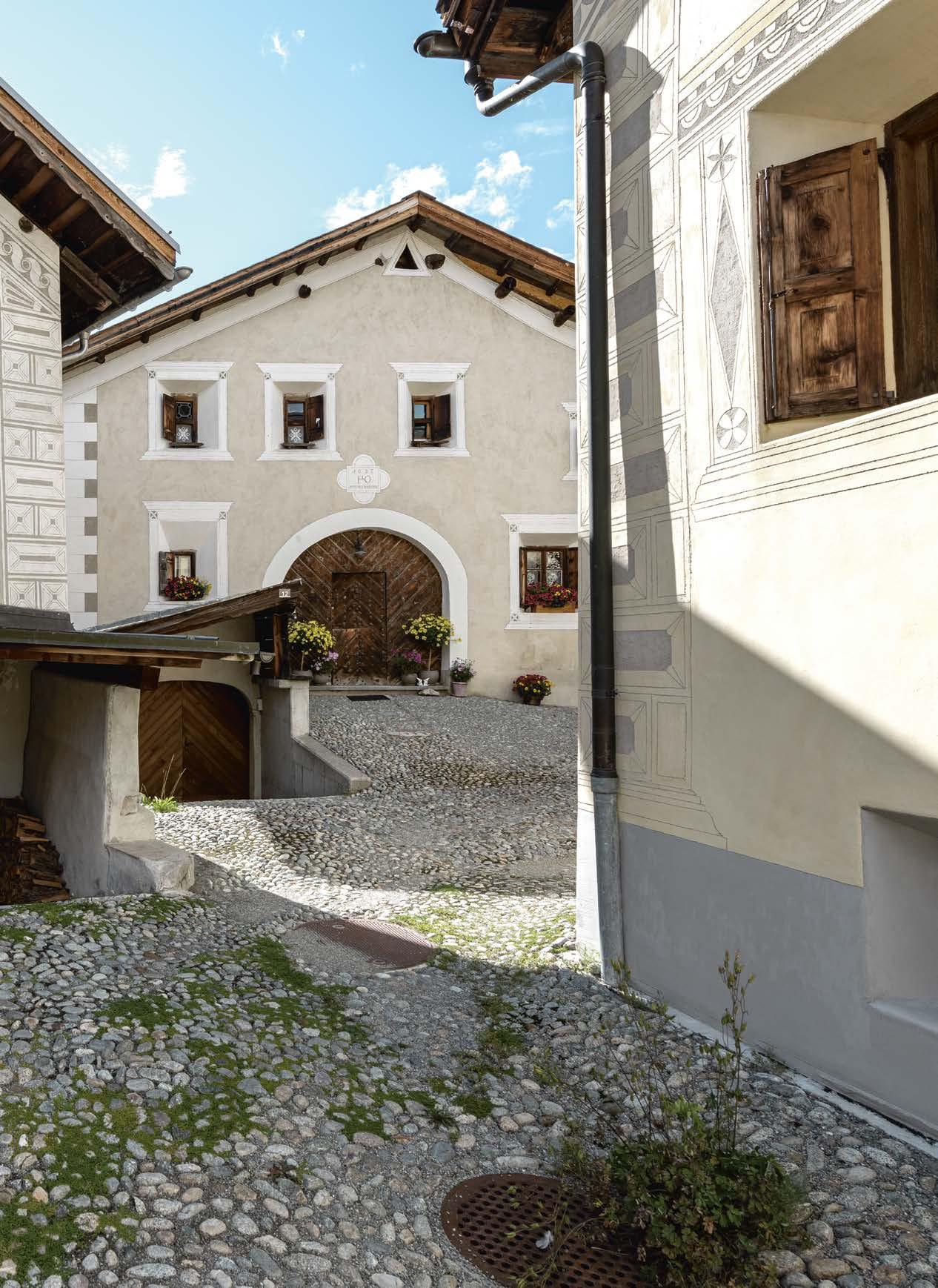
Samedan – The capital of the Upper Engadin is the region’s political and financial hub, but Samedan still stays true to the authentic Engadin way of life. As you look around the village, the old traditions shine through. Just look at the signature sgraffito on the photogenic building fronts down the little streets and alleyways. And there’s plenty of culture in the heart of the village too, with one highlight after another.
Celerina – The landscape is gorgeously green and visitors to the area are bathed in stunning sunshine. And that’s because Celerina (or Schlarigna) is officially the sunniest municipality in the Upper Engadin. With 300 days of sunshine a year, there’s a good chance you’ll be able to see for yourself that the sun shines for longer over the mountain peaks here than in other parts of the country.
Hearts Region
Celerina – Samedan – Bever – Pontresina
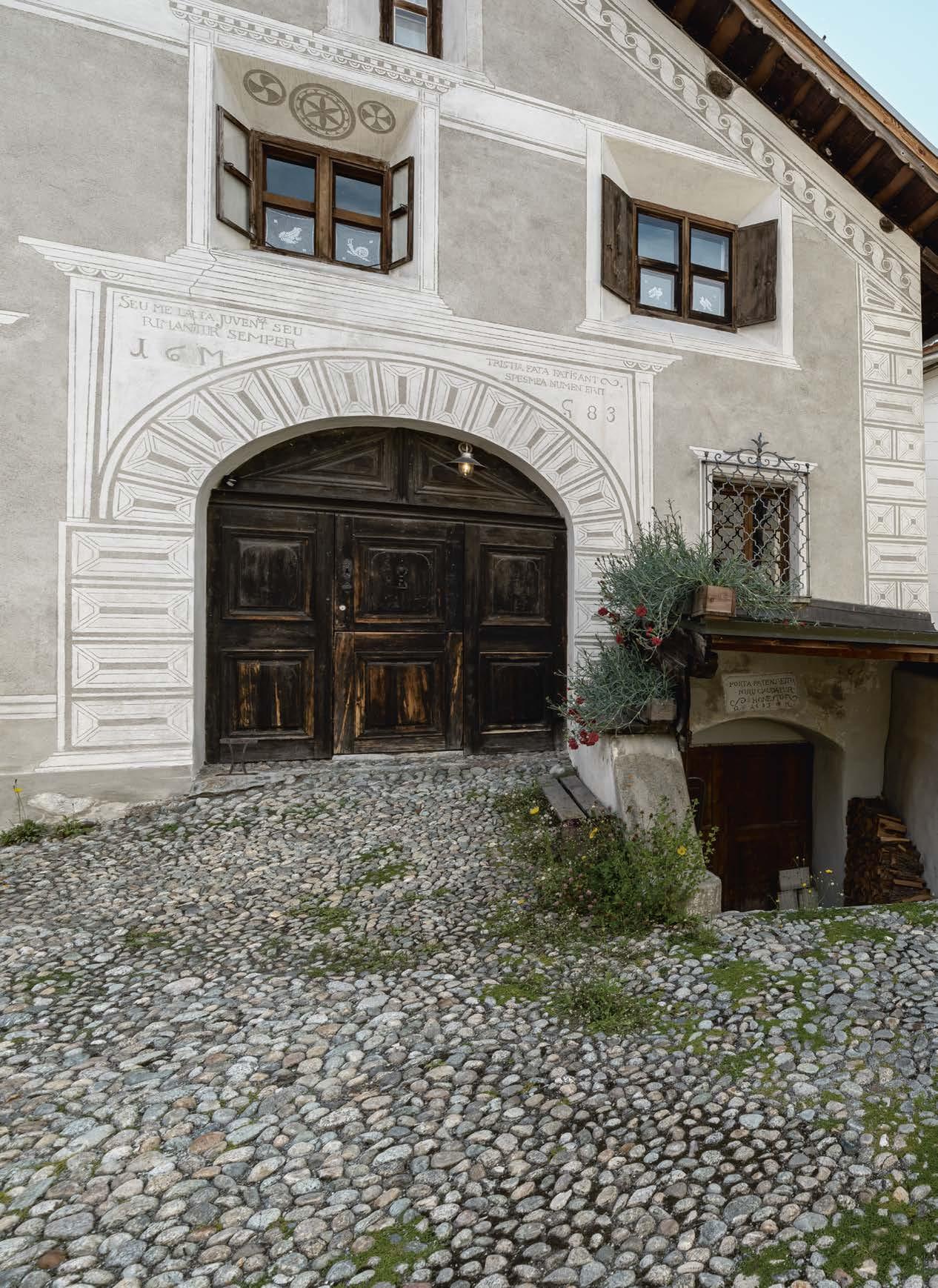
Bever – The classic colourful Engadin houses in Bever feature artistic white decorative elements created using the sgraffito scratching style, including rosettes, animals, wave patterns, and words of wisdom. This traditional technique is still used to this day when renovating old buildings or constructing new ones.
Pontresina – Thanks to its location on the Bernina Pass, Pontresina was one of the most important municipalities in the area in the Middle Ages. The alpine crossing was a crucial trade link to the south for the local farmers, who made their living by breeding cattle, hunting, fishing, and growing grains.
Nos tips Regional highlights
Sweet treat in the garden
Celerina – The delightful garden at Chesa Rosatsch is the perfect spot for a little break. Admire the view of the River Inn as you sip slowly on a coffee or try the homemade soft vanilla ice cream that has a secret recipe behind it. rosatsch.ch
Wild water
Pontresina – You’ll want to look down into the depths when you’re on the floating steel structure over the Ova da Bernina whitewater gorge. The rushing roar of the water and the power of nature are enough to stimulate all your senses. engadin.ch/whitewater-ova-da-bernina
Riverside rest
Celerina – There are lots of lovely benches where you can stop for a rest along the section of the River Inn between Celerina and Samedan that was revitalised in 2025. It’s particularly peaceful here first thing in the morning. The river flows by gently and the landscape is revealed in the light of the day. This is the perfect opportunity to breathe deeply and watch as nature wakes up around you. engadin.ch/ochsenbrueggli-bench
Guided village tours
Explore the recent and ancient history of these four municipalities on a guided village tour of Pontresina, Celerina, Samedan, or Bever. Who knows what you’ll discover?
Welcome to cheese heaven
4
Pontresina – Over 300 cheese varieties are just waiting to be discovered at the Sennerei dairy shop in Pontresina. The five different types of homemade glacier fondue are always a popular choice. If you’re keen to try regional specialities, this shop is for you! engadin.ch/ alpine-dairy-pontresina
5
Meal with a view
Samedan – Alp Muottas is the perfect place to stop for a bite to eat. The restaurant serves traditional Swiss dried sausage, cheese produced in the Engadin, and homemade fruit cake. Located just a five-minute walk from the Muottas Muragl summit station, it offers a breathtaking view of the surrounding lakes and mountains. You should also head here if you’re hoping to explore the local area on foot. alpmuottas.ch
6
Home of culture and language
Samedan – The Chesa Planta in Samedan has been open to the public as a cultural centre for almost 80 years. It’s the central hub for Romansh language and culture in the Upper Engadin. Located in an example of an old aristocratic house, the museum, library, and archive hold one of the largest collections of Romansh manuscripts. Language courses and event-filled cultural weeks are also hosted at the Chesa Planta. engadin.ch/ museum-chesa-planta
Gourmet guest house
7
On UNESCO World Heritage tracks
Bever – The train station in Bever was built at the start of the 20th century when the Albula Line was being created. And now it’s a popular starting point for people looking to explore the Rhaetian Railway in the Albula/ Bernina Landscapes, which is listed as a UNESCO World Heritage Site. engadin.ch/ panoramic-train-rides
8
Bever – Homemade meals made with locally sourced, seasonal produce are served fresh at Gasthaus Spinas alongside traditional dishes from South Tyrol. Set against the wild and idyllic backdrop of Val Bever, the cosy guest house is accessible on foot, by bike, in a horse-drawn carriage, or on a Rhaetian Railway train. spinasbever.ch
BEVER
La Plaiv
La Punt Chamues-ch – Madulain – Zuoz – S-chanf
Madulain – There are just under 200 people living in Madulain at the moment, which makes it the smallest municipality in the Engadin. But the village has plenty to offer. And that includes sheep. There are around 450 of them altogether, including 250 ewes, in Madulain.
La Punt Chamues-ch – Home to churches, fountains, memorials, and a river right at its centre, La Punt Chamues-ch has many different faces. The village fountain by the old community hall, for example, bears an image of Adam da Chamues-ch, the liberator of the Upper Engadin from the bailiffs of Guardaval Castle. The village church in Chamues-ch is one of the most significant Gothic buildings in the Engadin. It is worth noting, however, that the lower floors of the tower and the northern wall date back to the Romanesque era.
Val Susauna
Chapella 8
Cinuos-chel
Zernez
S-chanf – S-chanf is the western gateway to the Swiss National Park, which also encompasses Val Trupchun. This side valley of the Engadin is known as one of the most wildlife-rich areas in Europe. See if you can spot deer, chamois, hares, marmots, golden eagles, and bearded vultures among all the fabulous flora.
7
S-chanf Inn
Zuoz – The former capital of the Upper Engadin brings together the past, present, and future like nowhere else in Switzerland. The authentic village landscape with splendid stately homes and flourishing Romansh culture contrasts magnificently with the dynamic contemporary art scene and the young people who come from all around the world to study at the Lyceum Alpinum.
Val Trupchun
Val Chamuera
Nos tips Regional highlights
Art in nature
La Punt Chamues-ch – The forest gallery in La Punt Chamues-ch is a unique art space surrounded by pines and larches in the sparse “God Fainchs” forest. Follow a short loop through the woods and stop to marvel at temporary exhibitions telling stories of light, colour, and perspective. The starting point is signposted from the Chamues-ch village square and you’ll be able to enjoy stunning views and captivating little details along the way. engadin.ch/forest-gallery-exhibition 1
2
Book benches
La Punt Chamues-ch – The five “Lö da Ler” benches in La Plaiv invite you to sit and read for a while. Pick a book to match your mood from the little wooden hut next to each bench. Head to the “Arschaida” book bench for a stunning view of La Punt Chamues-ch. This is your call to take a seat, soak up your surroundings, breathe in the fresh mountain air, and forget your troubles as you immerse yourself in a good story. engadin.ch/reading-bench
Historic walls
3
Madulain – Guardaval Castle once towered over the village. But now only the ruins remain. You won’t regret the short climb up to take a look. An information board tells you all about the history, and the view of the Upper Engadin is breathtaking. Take a seat on the bench and soak it all in with the rustling of the trees surrounding you as the soundtrack. Above the ruins, you can set off on a walk with stunning views by following the trail from Zuoz towards the Albula Pass. engadin.ch/guardaval-ruins
Guided village tours
Explore the recent and ancient history of these four municipalities on a guided village tour of La Punt Chamues-ch, Madulain, Zuoz, or S-chanf. Who knows what you’ll discover?
Fresh from the farm
4
Madulain – The Lenz family have been running the Stalla Lenz organic farm near the train station since 1957. The farm shop stocks lamb and lambskins, vegetables from the garden in summer, and homemade delights like syrup and nut cakes all year round. engadin.ch/en/stalla-lenz
Home
from home
7
Cosy café
Zuoz – The Crusch Alva restaurant on the historic village square in Zuoz provides a warm and inviting setting with a pine interior. Tuck into tasty traditional Engadin dishes, including Capuns, Pizzoccheri, and barley soup, as you admire the view of the charming buildings on the village square from the window in this cosy eatery that feels like home. cruschalva.swiss
5 Local archive
6
Zuoz – The Upper Engadin Cultural Archive preserves the history and traditions of the region right at the heart of Zuoz. Explore the lovingly curated collections and exhibitions and immerse yourself in the life, work, and activities of the past. You can browse, learn, and reflect as you get a feel for the rich culture of the Upper Engadin. Guided tours run on a weekly basis. engadin.ch/cultural-archive
S-chanf – Serlas Viva is a delightful café with a view of the national park. Enjoy freshly baked delicacies from Furnaria Grond bakery and an exquisite selection of local produce and regional specialities. They also serve local beer from the neighbouring Engadiner Bier brewery.
engadin.ch/en/serlas-viva
8
Serene side valley
S-chanf – Val Susauna may be a lesser-known side valley in the Engadin now, but it was frequently used as a passage over the Scaletta Pass during the days of pack animal drivers. Find peace and quiet right here.
engadin.ch/en/chapella-val-susauna
Nos tips Events
1
14 June–13 September 2026
Engadin spa orchestra
Pontresina & Sils – The spa concerts were first performed by the Camerata Pontresina ensemble all the way back in 1910. The orchestra recreates salon music from the past every day in the Taiswald forest in Pontresina and then on Sundays in Sils from the middle of August.
2
15–26 June & 17–28 August 2026
Engadinwing & Engadinwind
Silvaplana – The surfing marathon has been held on Lake Silvaplana since 1977. There is no older windsurfing event in the world. It has been part of the ‘Engadinwind’ event for 25 years. For several years now, the ‘Engadinwing’ Wingfoil Word Cup has been providing even more excitement on the water.
3
27 & 28 June 2026
open doors
Explore architecture and building culture as you take a sneak peek behind doors that are normally closed to the public during the open doors event. Over 80 buildings in the Upper Engadin representing different eras will be waiting to be discovered.
4
engadin.ch/en/events
2–26 July 2026
Festival da Jazz
The legendary jazz festival has been bringing music lovers and Engadin enthusiasts together to listen to extraordinarily talented musicians in unique locations for many years – from the iconic Dracula Club in St. Moritz to the mystical shores of Lej da Staz at dawn.
3 & 4 July 2026
5
Bernina Ultraks
Pontresina – Bernina Ultraks is a trail running event at the heart of the Engadin. Routes of varying difficulty take runners on a tour of magnificent mountain landscapes, offering options for everyone from beginners to pros.
19–23 August 2026
6
Swiss Epic
The Swiss Epic is a five-day mountain bike race that covers the Engadin’s incredible singletrack trails and more in multiple stages. Riders enter in pairs, with their endurance, technique, and teamwork being put to the test.
Top Tips for Every Season
Early summer scenes
As the meadows are covered in bright and beautiful blankets of mountain flowers in June, you won’t want to miss out on an early summer’s walk through the fragrant flora of the Engadin. If you’re in luck, you might even spot rare blooms like Swiss rock-jasmine, martagon lily, and red and black vanilla orchid alongside edelweiss, gentian, arnica, and various types of bluebells.
Alpine adventures this way
Can you think of a tastier addition to your summer stroll than a pit stop at an alpine farm, where you can sample the likes of freshly handmade cheese and yoghurt? Lots of local establishments offer a small selection of tasty treats for visitors to enjoy: engadin.ch/alpinefarms
Autumn by the lakes
When the needles from the golden larches around the Engadin lakes drop into the water in autumn, the wind and waves form them into funny-looking balls. As you take a leisurely stroll around the lake at this time of year, you might spot some of these “Silserkugeln” in their natural form. Failing that, make sure you try the sweet treat version at the nearest Grond bakery.
A bird in the hand
Head to the bird feeding station in the Taiswald forest to enjoy a fun family activity. In return for a donation to the Vogelschutz Engadin bird protection association, you’ll get bird food that tits, finches, and their feathered friends will gratefully eat out of your hand. At specific times, a bird expert will be on hand to answer all your questions about bird identification and more.
Inspiraziun Running
Arpiglia route
Zuoz – The Arpiglia route provides an ideal training run, especially if you’re entering an event like the Engadin Ultra Trail. Starting at the Engadin Arena in Resgia near Zuoz, you’ll head up towards Munt Seja, on to the pretty little Lej da Prastinaun mountain lake, over Alp Arpiglia, and back to the starting point.
Around Piz Lagalb
Pontresina – The trails on this delightful route take runners through the wild Val Minor, around Piz Lagalb, and along Lago Bianco lake before heading back to Lagalb. You can extend it by taking a detour to Forcola di Livigno, passing the impressive Lago Bianco at the summit of the Bernina Pass as well as several charming little mountain lakes.
Resgia
Resgia
Bernina Lagalb
Bernina Lagalb
Lej da Prastinaun
Motta Bianca
Trailrun Sils
Sils – Look down and admire the stunning view of Lake Sils on this loop that climbs up to Lägh da Lunghin at 2,484 metres above sea level. The circular route starts at Sils Baselgia with a flat stretch beside the beautiful blue water. You start climbing from Maloja, following stony paths up to Lägh da Lunghin. This is an excellent time to stop and take a quick breather as you admire the spectacular scenery complete with snow-topped peaks. On the way back, take another break in the idyllic village of Grevasalvas before following sections of the Via Engiadina back down to the gorgeously glistening Lake Sils.
Sils Maria Isola
Lägh dal Lunghin
Sils Maria
Photo: PatitucciPhoto
Inspiraziun Family
1
Aventüra illa natüra
S-chanf – In the Swiss National Park, the oldest national park in the Alps, wild animals thrive in a protected habitat where they can find plenty of food and shelter. Given their comfortable living conditions, they’re happy to be observed from afar by visitors. Head to Val Trupchun for a fun family adventure. Hop onto the little train and arrive at the Varusch stop at the entrance to the park in style. From there, you can explore the pretty pathways all the way up to Alp Trupchun with your eyes peeled and your binoculars at the ready. You’ll find plenty of benches along the way if you need
to stop for a break. Make sure you leave enough time to enjoy Parc Alpin near the car park in Prasüras on the way back. This high-rope park has courses with five different levels of difficulty so everyone can have fun high up in the sky.
Photo: Colin Frei
2
Alpine adventure trail
Celerina – Mevina and Neves are spending the summer up in the mountains again like they do every year. They help herd the cows towards Alp Laret and make friends with Grischa, a calf with no life experience but plenty of curiosity. On the Marguns adventure trail, children can learn all about life in the Alps with the help of the terrific trio – Mevina, Neves, and Grischa – following them up into the mountains to Marguns and back down to Celerina.
3
Smugglers’ Trail, Maloja
Maloja – The whole family works together to find hidden smuggled items on the Smugglers’ Trail near Maloja. They learn how to find their way using a compass and the sun, and administer first aid for minor injuries as they go, experiencing the smugglers’ old way of life for themselves. The walk takes about 90 minutes and ends at Lägh da Bitabergh, a mountain lake with plenty of opportunities to relax and play. You also have the option of taking a short detour to another stunning lake – Lägh da Cavloc.
Photo top: Filip Zuan
Celerina
Maloja
Marguns
Lägh
Inspiraziun Bike
Follow the flow
Maloja – S-chanf – The cross-border Inn Cycle Path follows the river from its source in Maloja until it meets the Danube in Passau in Germany, covering an incredible 520 kilometres in total. The stretch through the Engadin takes cyclists from Maloja to St. Moritz, passing the lakes along the way. Along the right side of the Inn, the route then descends gently to the end of the first stage in La Punt. The second stage continues through the La Plaiv region and on to Zernez in the Lower Engadin, following the river as it becomes wilder.
Difficulty
Hut to hut
From Celerina – This hut-to-hut route with four stages takes mountain bikers and e-bikers from Celerina across the Bernina Pass, down into Val Poschiavo all the way to Italy, and through the wild national park back to the Engadin for even more highlights. Nights are spent in mountain huts in dreamy locations.
Difficulty
Photo top: Florence Gross
Ideal for gravel bikes
Ideal for mountain bikes
kulTOUR
Cyclists can learn fascinating facts about architectural and cultural highlights, discover the Romansh language, and gain insights into the evolution of the Engadin from an agricultural valley to an international tourist destination on two different routes. You can select your preferred route on a web app and automatically access background
information on the cultural points of interest you’ll find along the way. Both kulTOUR routes are signposted, so you can focus on riding without worrying about getting lost. Stop off at one of the many Energybänkli stations en route, where you can charge your bike battery and have a rest.
Photo: Filip Zuan Ideal for electric bikes
Inspiraziun Water
Information
1
Back to nature
Bever – Bever is home to one of Switzerland’s most wonderful river restoration projects of recent times. Once restricted by dams at this point, the River Inn can now flow freely again. The river shapes its own bed for a solid two kilometres, making it a genuine joy to stroll along the meandering flow of the water. The floodplains are home to no end of mammals, reptiles, insects, and plants.
Read the information boards while you’re here to learn about the restoration project and the local fauna and flora.
Top tip
Guided hikes: on specific dates between June and October, you can join guided hikes through the alpine floodplain landscape. engadin.ch/en/innauen
Kite Surf Runners Golf
Photo: Andrea Furger
.ch/water-sports
River rafting fun
Here’s a sightseeing tour with a difference – it’s not on dry land! Whether you’re looking for a leisurely rafting experience for the whole family or whitewater action, the River Inn won’t leave you disappointed. The experienced guides from the Engadin Outdoor Center are on hand to deliver a calm or crazy adventure on the water to suit your requirements.
Information
Engadin Outdoor Center T. +41 76 748 86 68
Top tip
Explore Pontresina on a fantastic family rafting tour on the River Flaz.
A day on the lake
Engadin lakes – The Maloja wind divides summer days on the Engadin lakes into phases with and without wind. SUP fans prefer the early mornings because there’s no wind to speak of then. When the lake is smooth and still, with the sun shining low over the slopes, they paddle calmly over the water in an almost meditative state. As the wind comes blowing in at around midday, the sails come out. Swimmers are spoilt for choice in the lake region too – just as long as they don’t mind the cold. The best places to visit if you fancy taking a dip? Lej Nair in Silvaplana, Chastè peninsula in Lake Sils, and Lägh da Cavloc in Maloja.
Information
Find out everything you need to know about courses and equipment rental, and read guidance to help you enjoy the mountain lakes here: engadin.ch/water-sports
Equipment rental
Swiss Kitesurf Silvaplana
Windsurfing Silvaplana
Restaurant Murtaröl Plaun da Lej
Camping Maloja
Inspiraziun Hiking
1
Wild valley
Samedan – La Punt – Take the funicular railway from Punt Muragl up to the top of Muottas Muragl, where you can enjoy a panoramic view of the Upper Engadin lake plateau. Your six-hour hike from there will have you exploring the hidden secrets of Val Chamuera and discovering the majestic alpine hut with a difference on Alp Serlas.
Difficulty: Length: 17.7 km
2
Ancient Swiss stone pine
Celerina – Spot some of the oldest Swiss stone pine trees in the world on an energetic walk from the Stazerwald forest up to Muottas da Schlarigna (2,305 metres above sea level). You’ll explore some ancient woodland areas on the way up, but the most special tree of all will be waiting for you during your descent. On the way to Alp Staz, just below the junction, you’ll see a gnarly old pine tree that dates back to the 15th century and has an impressive trunk circumference of 6.7 metres.
Difficulty: Length: 14.1
St. Moritz Pontresina
Photo bottom: Filip Zuan
Panoramic path to Forno hut
Maloja – For an adventure on the panoramic route through Val Forno and a visit to the Forno hut, turn left at the Plan Canin signpost and cross the bridge into Val Muretto. The walk through Val Forno to the SAC hut takes you via all the vegetation varieties you would expect of a magnificent mountain landscape – from the forests of Maloja
through the alpine rose fields and meadows above Lägh da Cavloc, and into a glacier forefield teeming with marmots. The spectacular views of the valley on this route will remain imprinted on your memory long after you’ve finished sitting on the terrace at the Forno hut, admiring the glacier and the surrounding mountains.
Photo: Filip Zuan
Inspiraziun Climbing
1
La Resgia via ferrata
Pontresina – This via ferrata on the southern edge of Pontresina isn’t too extreme but does require strength and stamina, making it perfect for fit climbers and experienced youngsters aged around 12 and above. The climb takes you up along a waterfall, winds its way via vertical ladders and suspended rope bridges, and overhangs briefly when you reach the Eagle’s Nest. The end point is around 15 minutes below the Alp Languard restaurant and chair lift, which will take you back to Pontresina. Prefer to have an expert with you on the via ferrata? The Pontresina Mountaineering School offers guided tours.
Information
Pontresina Mountaineering School
T. +41 81 842 82 82
Top tip
La Resgia via ferrata is suitable for children who are aged 12+ and at least 1.4 metres tall.
2
Glacier tour
Pontresina – Seeing the Morteratsch Glacier tongue up close has to be one of the most extraordinary experiences on offer in the Engadin mountains. One of the routes leading there takes you via another glacier – the Pers Glacier. From the Berghaus Diavolezza, you head to its lateral moraine first and then go straight across it. The Pontresina Mountaineering School offers guided glacier tours.
Information
Pontresina Mountaineering School
T. +41 81 842 82 82
Top tip
It is recommended that you only traverse the Morteratsch Glacier if you are accompanied by a mountain guide and have all the right equipment with you.
Photo top: Moritz Hübner / bottom: Bergsteigerschule
Inspiraziun Golf
1
Samedan golf course
Samedan – The golf course in Samedan is the oldest one in Switzerland. When it first opened back in 1893, the annual membership fee was CHF 25. The course is open and flat with plenty of water hazards and the added challenge of the legendary Maloja wind.
Information
Golf Engadin St. Moritz AG Samedan course
T. +41 81 851 04 66
2
Top tip
The Engadine Amateur Championship will be played on 26–28 June 2026. Find out more at engadin-golf.ch
Zuoz-Madulain golf course
Zuoz – Madulain – The 18-hole course in Zuoz-Madulain was opened in 2003, offering exciting and varied holes for players at every level. Children can take their first swings in a game of family golf, and dogs are even welcome to join you on the course during special sessions.
Information
Golf Engadin St. Moritz AG Zuoz-Madulain course
T. +41 81 851 35 80
Top tip
Rent equipment and buy golf clothing and accessories at the Willy Sport pro shop. willy-sport-ch
Inspiraziun Winter sports
Enchanting ice trail
Madulain – Zuoz – The ice trail between Madulain and Zuoz takes you through the winter wonderland that is the floodplains along the River Inn. Gaze at the light reflecting off the river, admire the views of traditional houses in charming villages, and soak up the peace and quiet in the valley as you skate along. Stop for a short break at the Engadin River Ranch and enjoy a hot drink and a slice of cake in the cosy lounge. If the weather is good, the ice trail stays open later than normal on full-moon nights, promising a magical experience.
a hot drink and a slice of cake
Ice skate rental Willy Sport, Zuoz Colani Sport, La Punt Chamues-ch
Top tip
Enjoy
at the Engadin River Ranch lounge.
Photo: Filip Zuan
2
Gourmet cross-country trail
Celerina – Zuoz – Cross-country skiing is even more fun than normal when you combine the winter activity with delicious culinary delights. The gourmet cross-country trail is an easy route between Celerina and Zuoz that crosses paths with the famous ski marathon route. You stop off at several restaurants for something to eat and drink along the way. What better way to keep up your strength for your skiing adventure?
Sils – Admire the breathtaking view and experience the beauty of nature up close on this medium route through the snowy mountain forest via Muotta da Güvè and back again. As you marvel at the Fex Valley and Lake Sils, breathe in the air that inspired poets and philosophers a century ago. This route is suitable for snowshoe hikers with average to good fitness.
Information
Sils has four waymarked snowshoe trails – one easy route to Suot Ovas, the route described above to Muotta da Güvè, the Corvatsch Lake Trail, and the snowshoe trail Isloa – Sils.
Equipment rental
Intersport La Fainera, Sils Giovanoli Sport, Sils
Inspiraziun Winter sports
4
Toboggan fun
La Punt Chamues-ch – When the road is closed to traffic in the winter, the Albula Pass above La Punt is transformed into a speedy toboggan run like no other. The fun starts at the upper barrier near Alp Proliebas. You’ll have to pull your toboggan up there on foot, but you get to enjoy all the fresh air and the sunny views along the way. Your effort will be rewarded with an exciting toboggan ride covering 2.35 km. You can enjoy this experience – provided snow conditions are good –every day from around the middle or end of December and in February and March (closed in January).
Equipment rental
Willy Sport, Zuoz
Colani Sport, La Punt Chamues-ch
5
Tobogganing by night
The toboggan run is lit up on one evening a week throughout February.
Diavolezza descent
Pontresina – Skiing on the Diavolezza is a high-altitude alpine glacier adventure on two boards. The unique glacier descent is an eight-kilometre ungroomed run, taking skiers and snowboarders into the wilderness of the Pers and Morteratsch Glaciers. And the winter fun carries on after dark when there’s a full moon. “Glüna Plaina” means full moon in Romansh – and also an unforgettable skiing adventure on the Diavolezza at night.
Information
Berghaus Diavolezza
T. +41 81 839 39 00
Corvatsch AG cable cars
T. +41 81 838 73 73
Top tip
The traditional Diavolezza Glacier Race has been back on the events calendar since 2024. glacier-race.ch
Guida
Photo bottom: Andrea Furger
St. Moritz-Sils-Maloja lakeside trail
St.Moritz – Maloja – The Upper Engadin is home to an impressive network of well-maintained winter hiking trails at this time of year. One of the classic routes is the trail across and along the frozen lakes from St. Moritz to Maloja. As you walk, the sun beams down on you and you can’t help but stare at the ubiquitous views of the Engadin mountain landscape. Stop for a bite to eat in the picturesque village of Sils and make a point of refuelling again when you reach idyllic Weiler Isola further south. Once you’ve arrived in Maloja, you can take the PostBus back to the start.
Information
Starting point: St. Moritz-Bad, next to the Signalbahn
End: Maloja, village
Duration: 5 hours
Top tip
The route can also be reversed depending on which way the wind is blowing.
“I’m happy here”
Famous poets on the Engadin
“He gave me the Engadin. I love it to this day.”
FROM “MONTAUK” (1975)
MAX FRISCH (1911–1991), SWISS WRITER
“The combination of the southern light and northern ruggedness gives it (the Engadin) a unique charm that’s hard to put into words.”
FROM “WHAT YOU WON’T FIND IN BAEDEKER”, 1932
ANNEMARIE SCHWARZENBACH (1908–1942), SWISS PHOTOGRAPHER AND AUTHOR
“I’ve seen a lot of landscapes (...) but the most beautiful of them all, and the one that left the greatest impression on me, is the Upper Engadin.”
FROM A LETTER
HERMANN HESSE (1877–1962), GERMAN WRITER
“This region is a blood relation, and more indeed than that.”
FROM “THE WANDERER AND HIS SHADOW” (1880)
FRIEDRICH NIETZSCHE (1844–1900), GERMAN WRITER
“This Engadin is the most beautiful place in the world. (...) I almost believe that I’m happy here.”
FROM A LETTER
THOMAS MANN (1875–1955), GERMAN WRITER
Publisher: Engadin Tourismus AG, engadin.ch — Contact: Sereina Jost, sereina.jost@engadin.ch — Production / Concept / Text / Editing / Copyediting : Transhelvetica/Passaport AG, transhelvetica.ch; Jon & Pia Bollmann, Claudius Wirz, Karin Dehmer, Fiorel Gloor, Martin Hoch, Claudia Walder, Jana Avanzini — Layout: Transhelvetica/Passaport AG; Franca Sidler — Photographs: Lea Meienberg, leameienberg.ch; unless specifically mentioned, provided by Engadin Tourismus AG and partners — Illustrations: Atelier Cartographik — Translation & proofreading: Supertext — Printer: Multicolor Print AG, Baar — Copyright: All rights reserved. Reprint of all or part of this magazine only by express permission of the tourism organisation Engadin Tourismus AG and with acknowledgement. Retail price: CHF 20