Laura Malmivaara
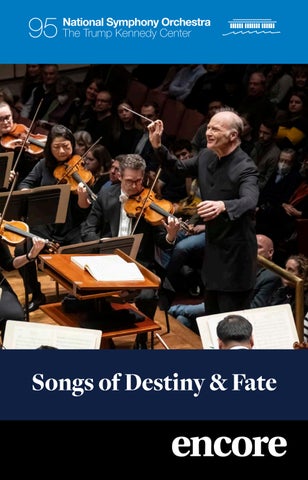
Songs of Destiny & Fate
Vibrant Senior Living
Learn about an Erickson Senior Living®-managed community near you. We have five locations in the D.C. Metro area. Call 1-800-652-6407 to learn more about the community that interests you.
• Ashby Ponds® Ashburn, VA • Greenspring® Springfield, VA • Riderwood® Silver Spring, MD • The Grandview℠ Bethesda, MD
EricksonSeniorLiving.com
2309850
• Woodleigh Chase® Fairfax, VA
T H E D ONALD J. T RUMP AND T HE J O HN F. K ENNE DY M E M O RIAL CENT ER FO R T HE PERFO RMING A RTS,
J ANUARY 22, 2026 AT 7 P. M . ; JA N UA RY 2 3 & 2 4 , 2 0 2 6 AT 8 P. M. | CON C E RT HAL L
Gianandrea Noseda, conductor The Washington Chorus
JOHANNES BRAHMS Schicksalslied (Song of Destiny), Op. 54 (1868–71) (1833–1897) i. Adagio: Ihr wandelt droben im Licht (EL major) ii. Allegro: Doch uns ist gegeben (C minor) iii. Adagio: Orchestral postlude (C major) ANTONIO VIVALDI Sinfonia “Al Santo Sepolcro” in B minor, RV 169 (1678–1741) (circa 1730) i. Adagio molto ii. Adagio ma poco JOHANNES BRAHMS Nänie, Op. 82 (1881) JOHANN SEBASTIAN BACH Sinfonia from Ich hatte viel Bekümmernis, (1685–1750) BWV 21 (1714) JOHANNES BRAHMS Gesang der Parzen (Song of the Fates), Op. 89 (1882) INTERMISSION ROBERT SCHUMANN Symphony No. 2 in C major, Op. 61 (1845–46) (1810–1856) i. Sostenuto assai — Allegro, ma non troppo ii. Scherzo: Allegro vivace iii. Adagio espressivo iv. Allegro molto vivace
THANK YOU TO OUR SEASON SPONSORS
The NSO Music Director Chair is generously endowed by Roger Sant and Congresswoman Doris Matsui Noseda Era Fund Supporters
The Amici di Gianandrea
Patrons are requested to turn off cell phones and other electronic devices during the performance. Any video and/or audio recording of this production is strictly prohibited.
Welcome Dear Friends, As we celebrate the National Symphony Orchestra’s 95th season, I want to take a moment to express my heartfelt thanks to you—our devoted patrons, supporters, and friends. Your presence this evening, and your unwavering support throughout the year, mean more than words can convey. It is your love of music, your generosity, and your steadfast belief in the arts that delight this remarkable orchestra. In 1931, Hans Kindler founded the NSO with a bold vision: to build a world-class symphony orchestra in the heart of our nation’s capital. Nearly a century later, that vision continues to be our driving force. Today, under the dynamic artistic leadership of Gianandrea Noseda, we are more inspired than ever to share powerful performances with our audiences. The NSO is not simply an orchestra; it is a family of artists joined together through a shared love of music, unity of purpose, and commitment to something greater than us. The NSO is more than what you see on stage—it is a living, breathing institution devoted to enriching lives. Our robust education and community engagement programs reach thousands of students, educators, and families each year. Between our Youth Fellowship Program and Summer Music Institute, to Young People’s Concerts, we strive to make music accessible to everyone—especially the next generation. This commitment to connect with broader audiences is also seen through our vibrant, genre-defying series, led by the remarkable Steven Reineke, our Principal Conductor and Artistic Advisor. Steven brings a wide-reaching musical vision to the NSO, bridging genres and generations. His programming has opened the door for new audiences to discover a love for orchestral music, while continuing to captivate longtime fans with the highest levels of artistry. As we embark on this milestone season, we are reminded that our journey would not be possible without you. Thank you for being an essential part of this vibrant and enduring musical community. With deepest gratitude and warmest regards,
Jean Davidson Executive Director National Symphony Orchestra
4
From the Music Director Stefano Pasqualetti
Cari amici,
Cari amici,
It is with immense joy and anticipation that I welcome you to the National Symphony Orchestra’s 95th anniversary season. This moment is more than a milestone—it is a celebration of our deep musical legacy and a renewed commitment to bringing powerful, moving performances to our community and beyond. This is only the beginning. The 95th season is filled with musical discovery, celebrated artists, and unforgettable experiences.
This season features iconic works that have stood the test of time, from classic It is with immense joy and anticipation that I welcome you to the National Symphony masterpieces to thrilling contemporary music. The NSO also has the opportunity to Orchestra’s 95th anniversary season. This moment is more than a milestone—it is a share the stage with an exceptional lineup of guest artists and conductors—beloved celebration of our deep musical legacy and a renewed commitment to bringing powerful, icons and rising stars alike. Performing new music is something the NSO truly believes moving performances to our community and beyond. This is only the beginning. The in. Make history with us as we present innovative new works, including five world 95th season is filled with musical discovery, celebrated artists, and unforgettable premieres. experiences. I am deeply grateful to share this journey with you. Your presence in the Concert Hall is I am deeply grateful to share this journey with you. Your presence in the Concert Hall what brings our music fully to life. Thank you for being a part of the NSO family—for is what brings our music fully to life. Thank you for being a part of the NSO family—for your passion, your applause, and your unwavering support. your passion, your applause, and your unwavering support. Con tutto il cuore, Con tutto il cuore, Gianandrea Noseda Gianandrea Noseda Music Director, National Symphony Orchestra Music Director, National Symphony Orchestra Che la musica vi porti gioia e ispirazione—may music bring you joy and inspiration. Che la musica vi porti gioia e ispirazione—may music bring you joy and inspiration.
5
Notes on the Program
© 2026 Susan Youens
Schicksalslied (Song of Destiny), Op. 54 JOHANNES BRAHMS Born May 7, 1833, in Hamburg, Germany Died April 3, 1897, in Vienna, Austria Tonight, we revel in gorgeous gloom for a concert that keeps circling back to Brahms’ secular elegies for orchestra and chorus. Brahms, according to sociologist Wolf Lepenies, was one of the 19th century’s “great melancholic lone wolves,” although he did have cherished friends whose deaths he mourned. Astonishingly well-read, he knew both the literature of antiquity and classical myth as filtered through the likes of Schiller, Hölderlin, and Goethe. From 1802 to 1805, the great poet Friedrich Hölderlin succumbed in stages to a mental illness diagnosed as schizophrenia (but calomel poisoning may have been the real cause), and his work was regarded for much of the century as the fruits of madness. The text of Schicksalslied comes from his epistolary novel Hyperion, or the Hermit in Greece, an elegiac story of the youth Hyperion (meaning “the one above,” the Titan who fathered the sun and the moon), who recounts his maturation through war, art, and love as he wanders a Greece bereft of its antique glory. At his lowest ebb, he takes out “my long-forgotten lute to sing myself a song of fate that I had once, in blithe, innocent youth, repeated after my Adamas [his tutor].” The first stanza directly addresses the gods, the second reflects on their condition of blessed simplicity, and the third tells of suffering mortals, hurled downward through the years into the “Ungewisse,” the abyss of the unknown. Brahms’ setting—he was perhaps the first composer to set Hölderlin to music— consists of two choral-orchestral passages, one for the gods’ two stanzas, another for suffering humanity, framed on either side by an orchestral prelude/postlude. At the start, an exquisite melody in EL major, darkened by touches of the flatted sixth degree, is underlaid by softly ominous drumbeats. In the gods’ music, much of the choral part is chordal, including the mostly unaccompanied last phrase (“blicken in stiller, ewiger Klarheit”), just before eerie chords in the winds and brasses usher in a moto perpetuo, dissonance-fraught Allegro section for suffering humanity. The word “jahrlang” (for years) impels musical shrieks of horror, “ins Ungewisse hinab” hushed terror. And there the poem ends—but Brahms’ postlude brings back the prelude as consolation, not in the opening key but in C major. The composer knew that for Hölderlin’s Hyperion, catastrophe generates renewal and resolution: “Like nightingale voices in the dark, the world’s song of life first sounds divinely for us in deep affliction” (letter LX, book two). In the wordless ending, we hear the music of heightened consciousness and gentle comfort.
6
Sinfonia “Al Santo Sepolcro” in B minor, RV 169 ANTONIO VIVALDI Born March 4, 1678, in Venice, Italy Died July 28, 1741, in Vienna, Austria Antonio Vivaldi, the red-haired priest of Venice, is best-known for irresistibly exuberant concerti, but in the Sinfonia “Al Santo Sepolcro” [“sinfonia” denotes instrumental music], we hear a different side of him: an anguished meditation on Christ’s suffering in two brief movements for five string players without continuo. This work was possibly intended for some extra-liturgical service between Maundy Thursday and Holy Saturday in the chapel at the Pietà. The Adagio molto begins with a single tone, joined in piercing dissonance by the first violin; already, we hear pain beyond bearing. In the Allegro fugue, chromatic scales both ascending and descending fill the air with their already traditional connotations of grief, and dramatic octave leaps permeate the texture. Nänie, Op. 82 JOHANNES BRAHMS The death of the artist Anselm Feuerbach on January 4, 1880, was the impetus for Brahms to set to music Schiller’s last elegy “Auch das Schöne muß sterben” (Even Beauty must die), based on a passage in the Odyssey about the gods and goddesses who lament Achilles’ death. Brahms met Feuerbach in 1865 and cherished his works—their melding of Italian Renaissance inspiration (Brahms made eight trips to Italy to see its art and ancient monuments) and Germany’s fascination with ancient Greece and Rome. Brahms’ title Nänie is from the Latin naenia (funeral song, lament). The poem is couched in distiches (couplets); distich 1 alludes to Zeus’s implacability, distich two to Eurydice’s death, distich three to Adonis gored by a boar, and distich four to the dead Achilles, son of Thetis, goddess of the sea. In the final distich, we are told that art’s elegies become immortality: that which is commonplace is unsung, but Beauty is forever. Brahms paid special attention to that closing summation. This elegy for beauty gone down to the Underworld becomes, in Brahms’ hands, an elegy for the musical “Schöne.” He begins with a blatant quotation of the “Lebewohl” [Farewell] motto from the beginning of Beethoven’s Piano Sonata no. 26 in EL, but with an altered “-wohl” chord. There is a less obvious citation of Beethoven’s final song “Nimm sie hin denn diese Lieder” (Take them, these songs) in the cycle An die ferne Geliebte—again, it is music that ensures immortality—when the sopranos sing “um den verherrlichten Sohn.” Brahms even cites his own Ein deutsches Requiem, whose fifth movement (inserted as an homage to his deceased mother) includes a tenderly curving melody at the words “Ich will euch trösten” (I will comfort you). We hear a version of it when Thetis rises from the sea to mourn her son. Schiller’s final line about the common folk going down to Orcus unsung is not the last phrase we hear; it matters that Brahms repeats the next-to-last line, “To be a lament in the beloved’s mouth is glorious” at the end, both with fervor and then softly, reverently.
7
Notes on the Program Sinfonia from Ich hatte viel Bekümmernis, BWV 21 JOHANN SEBASTIAN BACH Born approx. March 21, 1685, in Thuringia, Germany Died July 28, 1750, in Leipzig, Germany One of Bach’s most plangent (also one of the largest) cantatas is “Ich hatte viel Bekümmernis,” BWV 21, in two parts, performed before and after the sermon. Its history is hazy; nine movements may have been performed in 1713 in Halle, the full eleven movements possibly in December 1713. When Bach took up his post as Kapellmeister at the Thomaskirche in Leipzig in 1723, he both composed new cantatas and performed works, often revised, from his Weimar years (1708–1717). The instrumental Sinfonia—common in Bach’s early cantatas—at the beginning of Part I is a marvelously poignant work in C minor shot through with chromatic complexity. “Bekümmernis” (affliction) is heavy in the air, with the oboe and first violin exchanging and echoing fluid melodies over a somber walking bass. Near the end, the music pauses on a sustained diminished seventh chord, followed by two other pauses on different diminished sevenths; all three possible such chords appear here—quietly dramatic gestures of great intensity. Gesang der Parzen (Song of the Fates), Op. 89 JOHANNES BRAHMS The last of the Brahms one-movement secular elegies is Gesang der Parzen, composed at Bad Ischl in the summer of 1882. Its text is taken from the fourth act of Goethe’s play Iphigenie auf Tauris, when Iphigenie recalls their childhood nurse singing “the song that the Parcae sang when Tantalus was hurled from the golden throne;” the Parcae are the Fates, and Tantalus, condemned by Zeus to stand in a pool of water beneath a fruit tree with both eluding his grasp, was the progenitor of the House of Atreus. In this poem, six stanzas of blank verse and mixed lengths, Goethe warns humanity that even those exalted by the gods, as Tantalus was, are in constant danger of eternal torment should the gods go against them. Composer and musicologist Anton Webern pointed out the “remarkable harmonies” that already take this work very far away from conventional tonality. The dissonances that spike the texture throughout, the lack of resolution, and the harshness of this musical landscape are present from the first statement of the orchestral ritornello. Just listen to Brahms’ setting of lines 6-10 of the fourth stanza (“... from the abysses of the deep / steams the breath of suffocating Titans, / like a burnt offering”), in which surety of tonal footing is not to be found until the stanza’s end. After stanza four, Brahms brings back the setting of Goethe’s first stanza, but this time the mood is one of weary lament, gentler than the intense first statement. This leads into stanza five, Goethe’s most despairing verse, as the gods turn their gaze from entire races of humanity in condemnation—but Brahms swiftly changes meter and key to consolatory major mode. If this seems at odds with the text (as Brahms was criticized upon the premiere), it is not. Brahms himself pointed out that “at the mere entry of the major key, the unsuspecting listener’s heart must soften and his eyes become wet, [for] only then does the whole misery of humanity take hold of him.”
8
Symphony No. 2 in C major, Op. 61 ROBERT SCHUMANN Born June 8, 1810, in Zwickau, Germany Died July 29, 1856, in Endenich, Germany The year 1845, when the Schumanns moved from Leipzig to Dresden, marked the inception of what Robert Schumann called his “completely new manner of composing,” in which he worked out his musical ideas in his head rather than at the piano and sketched in combinatory ideas rather than single motives. Inspired by a performance of Schubert’s “Great” C major Symphony in December 1845, he planned a return to symphonic composition. However, the psychological and physical ailments that had beset him during his and Clara Schumann’s 1844 trip to Russia lingered, and he could not complete the draft until October 1846. Like Schubert’s “Great,” Schumann begins with a chorale theme Sostenuto assai, whose initial gesture of a rising fifth is made unforgettable in the brasses, while a winding, twisting theme in the strings and winds joins in. Both ideas are made more dynamic in the Un poco più vivace passage that leads into the Allegro ma non troppo body of the movement, which concludes with an emphatic return of the chorale. The Scherzo, marked by chromatic acrobatics in the strings, has two trios, the first filled with light-footed triplet figures at the start and the second more lyrical, built on Schumann’s favorite BACH motif. The firstmovement chorale theme makes a triumphant reappearance in the boisterous conclusion. The Adagio begins in a melancholy mood—rare for this work— in C minor but turns almost immediately to the relative major EL and ends with the chromaticism-infused C major. The finale (Allegro molto vivace) starts off with a rousing march theme in the ‘wrong’ key at first for strings and winds, soon to be ‘corrected’ to the true key of C major in the full orchestra. After a tremendous half-cadence in the full orchestra and a fermata-sustained pause, there is a quiet interlude on Beethoven’s “Nimm sie hin denn, diese Lieder”—our link to Nänie and a reverent homage to Clara—before an immensely satisfying, fiery close. The critics were pleased as well with what they rightly dubbed “a watershed work.”
9
Libretti Schicksalslied (Song of Destiny) Ihr wandelt droben im Licht Auf weichem Boden, selige Genien! Glänzende Götterlüfte Rühren Euch leicht, Wie die Finger der Künstlerin Heilige Saiten.
You wander above in the light on soft ground, blessed genies! Blazing, divine breezes brush by you as lightly as the fingers of the player on her holy strings.
Schicksallos, wie der schlafende Säugling, atmen die Himmlischen; Keusch bewahrt In bescheidner Knospe Blühet ewig Ihnen der Geist, Und die seligen Augen Blicken in stiller, Ewiger Klarheit.
Fateless, like sleeping infants, the divine beings breathe, chastely protected in modest buds, blooming eternally their spirits, and their blissful eyes gazing in mute, eternal clarity.
Doch uns ist gegeben Auf keiner Stätte zu ruhn; Es schwinded, es fallen Die leidenden Menschen Blindlings von einer Stunde zur andern, Wie Wasser von Klippe Zu Klippe geworfen, Jahrlang ins Ungewisse hinab.
Yet there is granted us no place to rest; we vanish, we fall the suffering humans blind from one hour to another, like water thrown from cliff to cliff, for years into the unknown depths.
10
Translations © by Emily Ezust, reprinted with permission from the LiederNet Archive.
Nänie Auch das Schöne muß sterben! Das Menschen und Götter bezwinget, Nicht die eherne Brust rührt es des stygischen Zeus. Einmal nur erweichte die Liebe den Schattenbeherrscher, Und an der Schwelle noch, streng, rief er zurück sein Geschenk. Nicht stillt Aphrodite dem schönen Knaben die Wunde, Die in den zierlichen Leib grausam der Eber geritzt. Nicht errettet den göttlichen Held die unsterbliche Mutter, Wann er, am skäischen Tor fallend, sein Schicksal erfüllt. Aber sie steigt aus dem Meer mit allen Töchtern des Nereus, Und die Klage hebt an um den verherrlichten Sohn. Siehe! Da weinen die Götter, es weinen die Göttinnen alle, Daß das Schöne vergeht, daß das Vollkommene stirbt. Auch ein Klaglied zu sein im Mund der Geliebten, ist herrlich; Denn das Gemeine geht klanglos zum Orkus hinab.
The beautiful, too, must die! That which subjugates men and gods does not stir the brazen heart of the stygian Zeus. Only once did love melt the Lord of Shadows, and just at the threshhold, he strictly yanked back his gift. Aphrodite does not heal the beautiful boy's wound, which the boar ripped cruelly in that delicate body. Neither does the immortal mother save the divine hero when, falling at the Scaean Gate, he fulfills his fate. She ascends from the sea with all the daughters of Nereus, and lifts up a lament for her glorious son. Behold! the gods weep; all the goddesses weep, that the beautiful perish, that perfection dies. But to be a dirge on the lips of loved ones can be a marvellous thing; for that which is common goes down to Orcus in silence.
11
Libretti Gesang der Parzen (Song of the Fates) Es fürchte die Götter Das Menschengeschlecht! Sie halten die Herrschaft In ewigen Händen, Und können sie brauchen, Wie’s ihnen gefällt.
Let the race of mankind fear the gods! For they hold dominion over them in their eternal hands, and can demand what they please of us.
Der fürchte sie doppelt Den je sie erheben! Auf Klippen und Wolken Sind Stühle bereitet Um goldene Tische.
Doubly so should those fear them who have been exalted by them! On cliffs and clouds stools stand ready around golden tables.
Erhebet ein Zwist sich: So stürzen die Gäste Geschmäht und geschändet In nächtliche Tiefen, Und harren vergebens, Im Finstern gebunden, Gerechten Gerichtes.
If a dispute arises, the guests are pitched down, abused and shamed, into the deep dark of night; and they wait futilely, bound in the dark, for justice to be served.
Sie aber, sie bleiben In ewigen Festen An goldenen Tischen. Sie schreiten vom Berge Zu Bergen hinüber: Aus Schlünden der Tiefe Dampft ihnen der Atem Erstickter Titanen, Gleich Opfergerüchen, Ein leichtes Gewölke.
But they [the gods] remain at their eternal feast at the golden tables. They step from mountain to mountain, up above: from the abysses of the deep steams the breath of suffocating Titans, like a burnt offering, a light mist.
Es wenden die Herrscher Ihr segnendes Auge Von ganzen Geschlechtern, Und meiden, im Enkel Die eh’mals geliebten Still redenden Züge Des Ahnherrn zu sehn.
The rulers turn away their blessed eyes from entire races of people, shunning the sight in their descendants of those formerly beloved and silently-speaking features of our ancestors.
So sangen die Parzen; Es horcht der Verbannte, In nächtlichen Höhlen Der Alte die Lieder, Denkt Kinder und Enkel Und schüttelt das Haupt.
So sang the Fates; the banished one listens in his night-dark lair to the songs of the ancient ones, thinks of his children and grandchildren and shakes his head.
12
Meet the Artists Gianandrea Noseda, conductor Gianandrea Noseda is one of the world’s most soughtafter conductors, equally recognized for his artistry in both the concert hall and opera house. The 2025–2026 season marks his ninth as music director of the National Symphony Orchestra. Noseda’s leadership has inspired and reinvigorated the National Symphony Orchestra, which makes its home at the Kennedy Center. The renewed artistic recognition and critical acclaim have led to invitations to Carnegie Hall and international concert halls, as well as digital streaming and a record label distributed by LSO Live, for which Noseda also records as principal guest conductor of the London Symphony Orchestra. Noseda’s discography of over 80 recordings includes dozens of critically acclaimed albums with a wide range of orchestras and repertoire for various labels, including Deutsche Grammophon and Chandos. Noseda became General Music Director of the Zurich Opera House in September 2021 and reached an important milestone in May 2024, conducting two highly praised complete Ring Cycles. He was recognized as “Best Conductor” by the jury of the German OPER! AWARDS, specifically for his Wagner interpretations. From 2007 to 2018, Noseda served as Music Director of the Teatro Regio Torino, where his leadership marked the opera house’s golden era. Noseda has conducted the most important international orchestras, opera houses, and festivals, and had significant roles at the BBC
Philharmonic (chief conductor), Israel Philharmonic Orchestra (principal guest conductor), Mariinsky Theatre (principal guest conductor), Orchestra Sinfonica Nazionale della RAI (principal guest conductor), Pittsburgh Symphony Orchestra (Victor de Sabata Chair), Rotterdam Philharmonic (principal guest conductor), and Stresa Festival (artistic director). Working with the next generation of musicians is important to Noseda, and in the summer of 2025, he led a tour of major concert halls in China, Korea, and Japan with Carnegie Hall’s National Youth Orchestra of the USA. In 2019, he was appointed the founding Music Director of the Tsinandali Festival and Pan-Caucasian Youth Orchestra in the village of Tsinandali, Georgia. A native of Milan, Noseda is Commendatore al Merito della Repubblica Italiana, marking his contribution to the artistic life of Italy. He has been honored as Conductor of the Year by both Musical America and the International Opera Awards. He is also a recipient of the Puccini Award, whose past recipients include legendary opera stars Maria Callas, Birgit Nilsson, and Luciano Pavarotti. The Washington Chorus The Washington Chorus (TWC) is one of the foremost symphonic choruses in the nation and a cultural leader in our nation’s capital, creating transformative choral music since 1961. TWC is noted for the superb artistry of its performances and recordings of the entire range of the choral repertoire. A three-time nominated and twotime Grammy Award® winner, the 220-voice Chorus presents performances annually at the Donald J. Trump and John F. Kennedy Center 13
Meet the Artists for the Performing Arts, the Music Center at Strathmore, and National Presbyterian Church. These programs, including the Chorus’ beloved annual production of A Candlelight Christmas, are dedicated to reimagining beloved classics, commissioning new works, and uncovering lost or overlooked masterpieces. Since 2022, TWC has also partnered with National Philharmonic to present an annual collaboration at Strathmore to further those efforts. TWC also regularly performs at the invitation of the National Symphony Orchestra and Baltimore Symphony Orchestra, and appears frequently at Wolf Trap National Park for the Performing Arts, both in standalone productions and at the invitation of other arts partners. National Symphony Orchestra The 2025–2026 season is the National Symphony Orchestra’s 95th and Music Director Gianandrea Noseda’s ninth season. Gianandrea Noseda serves as the orchestra’s seventh music director, joining the NSO’s legacy of distinguished leaders: Christoph Eschenbach, Leonard Slatkin, Mstislav Rostropovich, Antal Doráti, Howard Mitchell, and Hans Kindler. Its artistic leadership also includes Principal Conductor and Artistic Advisor Steven Reineke. Since its founding in 1931, the NSO has been committed to performances that enrich the lives of its audience and community members. In 1986, the National Symphony became an artistic affiliate of the John F. Kennedy Center for the Performing Arts, where it has performed since the Center opened in 1971. The 96-member NSO participates in events of national and international importance, including the annual nationally televised 14
concerts on the lawn of the U.S. Capitol,live-streamed performances on medici.tv, and local radio broadcasts on WETA Classical 90.9 FM. Since launching its eponymous recording label in 2020, the NSO has embarked on ambitious recording projects, including its first complete Beethoven Symphony cycle and the release of the first-ever cycle of George Walker’s Sinfonias, both led by Noseda. Recent projects include Four Symphonic Works by Kennedy Center Composerin-Residence Carlos Simon conducted by Noseda, and William Shatner’s So Fragile, So Blue, recorded live in the Concert Hall with the NSO under Steven Reineke. Forthcoming releases with Gianandrea Noseda include music by Gustav Mahler and William Grant Still, as well as Samuel Barber’s opera Vanessa. The NSO’s community engagement and education projects are nationally recognized, and career development opportunities for young musicians include the NSO Youth Fellowship Program and its acclaimed, tuitionfree Summer Music Institute.
Loud and Clear Terms to know in the Concert Hall, loosely defined. Symphony An extended work with multiple sections—typically four movements. A “symphonic” piece is a long piece with multiple interpretations of a musical idea. A repeated, transformed musical idea is called a theme. Orchestra A group of musicians who play together. In the Western European tradition, an orchestra often includes the four major instrument families—brass, woodwinds, strings, and percussion. An especially large orchestra is called a symphony orchestra. A smaller orchestra is called a chamber orchestra. Movement A section of a musical work. Movements are often separated by silences, and they typically differ in tempo—speed. Sonata Originally, a musical composition played on instruments. In modern usage, “sonata” can mean a piece for a soloist or an ensemble, often with two to four movements. If a work or a movement is written in sonata form, it is structured in three sections: exposition, development, and recapitulation. Concerto A piece pairing a technically advanced soloist with the support of an orchestra, usually in three movements. Though there may be multiple soloists, the contrast between a larger ensemble and a soloing group defines a concerto. Romantic music Works associated with the 19th-century Romantic Period. Building off the intellectual innovation of the Romanticism movement, Romantic music emphasizes self-expression, emotion, and experimentation. Uppercase “C” Classical music Works associated with the 18th-century Classical Period. Characteristics include an emphasis on formal structures, balance, and clear-cut melodies. Lowercase “c” classical music refers to formal compositions invested in technical depth, usually derived from the European tradition. Chorale A congregational piece sung by a chorus, especially in the Lutheran tradition. The term can also refer to the chorus itself. Sinfonia Italian for “symphony,” though often used to refer to an overture or shorter symphonic work. Tempo Markings Adagio - slow, at ease Andante - moderately slow, walking pace Allegro - fast, bright Vivace - fast, lively
Additional Markings Poco - a little Ma non troppo - but not too much Molto - very Assai - very Sostenuto - sustained Espressivo - expressively Maestoso - majestically 15
National Symphony Orchestra GIANANDREA NOSEDA, MUSIC DIRECTOR
The Roger Sant and Congresswoman Doris Matsui Chair
STEVEN REINEKE, PRINCIPAL CONDUCTOR AND ARTISTIC ADVISOR VIOLINS Nurit Bar-Josef, Concertmaster Ying Fu, Associate Concertmaster, The Jeanne Weaver Ruesch Chair Ricardo Cyncynates, Assistant Concertmaster Xiaoxuan Shi, Second Assistant Concertmaster Jane Bowyer Stewart Heather LeDoux Green Lisa-Beth Lambert Jing Qiao Marina Aikawa Peiming Lin Derek Powell Regino Madrid** Meredith Riley** Marissa Regni, Principal Dayna Hepler, Assistant Principal Cynthia R. Finks Deanna Lee Bien Glenn Donnellan Natasha Bogachek Carole Tafoya Evans Jae-Yeon Kim Wanzhen Li Hanna Lee Benjamin Scott Malorie Blake Shin Angelia Cho Kei Sugiyama** VIOLAS Daniel Foster, Principal, The Mrs. John Dimick Chair Dana Kelley, Assistant Principal Denise Wilkinson Nancy Thomas Jennifer Mondie Tsuna Sakamoto Ruth Wicker Mahoko Eguchi Abigail Evans Kreuzer Rebecca Epperson Chiara Dieguez** Jacob Shack** CELLOS David Hardy, Principal, The Hans Kindler Chair, The Strong Family and the Hattie M. Strong Foundation Raymond Tsai, Assistant Principal David Teie James Lee
16
Rachel Young Mark Evans Eugena Chang Riley Loewi Lin Britton Riley Noah Krauss BASSES Robert Oppelt, Principal Richard Barber, Assistant Principal Jeffrey Weisner Ira Gold Paul DeNola Charles Nilles Alexander Jacobsen Michael Marks HARP Adriana Horne, Principal FLUTES Aaron Goldman, Principal Leah Arsenault Barrick, Assistant Principal Matthew Ross Carole Bean, Piccolo OBOES Nicholas Stovall, Principal, The Volunteer Council Chair Jamie Roberts, Assistant Principal Harrison Linsey*** Kathryn Meany Wilson***, English Horn CLARINETS Lin Ma, Principal Eugene Mondie, Assistant Principal Paul Cigan Peter Cain, Bass Clarinet BASSOONS Sue Heineman, Principal David Young, Assistant Principal Steven Wilson Sean Gordon, Contrabassoon HORNS Abel Pereira, Principal, The National Trustees’ Chair James Nickel, Acting Associate Principal Markus Osterlund*** Scott Fearing Robert Rearden Geoffrey Pilkington**
TRUMPETS William Gerlach, Principal, The Howard Mitchell Chair, The Strong Family and the Hattie M. Strong Foundation Michael Harper, Assistant Principal Michail Thompson Tom Cupples TROMBONES Craig Mulcahy, Principal Evan Williams, Assistant Principal David Murray Matthew Guilford, Bass Trombone TUBA Stephen Dumaine, Principal, The James V. Kimsey Chair TIMPANI Jauvon Gilliam, Principal, The Marion E. Glover Chair Scott Christian, Assistant Principal PERCUSSION Eric Shin, Principal, The Hechinger Foundation Chair Erin Dowrey, Assistant Principal Scott Christian Jason Niehoff* KEYBOARD Lambert Orkis, Principal Lisa Emenheiser* ORGAN William Neil* LIBRARIANS Elizabeth Cusato Schnobrick, Principal Zen Stokdyk, Associate Karen Lee, Assistant PERSONNEL Karyn Garvin, Director Sufyan Naaman**, Coordinator STAGE MANAGERS David Langrell, Manager N. Christian Bottorff, Assistant Manager The National Symphony Orchestra uses a system of revolving strings. In each string section, untitled members are listed in order of length of service. *Regularly Engaged Extra Musician ** Temporary Position ***Leave of Absence
National Symphony Orchestra Staff ADMINISTRATION Jean Davidson, Executive Director Sabryn McDonald, Executive Assistant EXECUTIVE TEAM Kasama Apfelbaum, Vice President, Financial Planning & Analysis Nigel Boon, Vice President, Artistic Planning John Roloff, Vice President, Orchestra Operations ARTISTIC PLANNING Justin Ellis, Senior Producing Director Emily Graham, Assistant Artistic Administrator Ana Vashakmadze, Assistant Artistic Administrator DEVELOPMENT Laney Pleasanton, Manager, NSO Individual Giving Pamela Wardell, Senior Director of Development EDUCATION Vanessa Thomas, Director of Education Activation & Engagements FINANCE AND ADMINISTRATION Eric Rubio, Director of Finance & Administration
HUMAN RESOURCES Tony Amato, Director, Total Rewards Chanel Kemp, Talent Acquisition Manager Patrice McNeill, Director, HR Operations Lisa Motti, HRIS Coordinator Ericka Parham, Benefits Analyst John Sanford, Senior Business Partner MARKETING & ADVERTISING Scott Bushnell, Senior Director, Creative and Brand Strategy Lily Maroni, Senior Manager, Advertising Communications Elizabeth Stoltz, Advertising Production & Special Projects Assistant Manager Kaila Willard, Marketing Manager, Analytics and CRM Strategy Derek Younger, Director, Sales & Ticketing Service ORCHESTRA OPERATIONS & CONCERT PRODUCTION Brooke Bartolome, Orchestra Personnel and Operations Manager Joseph Benitez, Media & OPAS Support Coordinator N. Christian Bottorff, Assistant Stage Manager Cayley Carroll, Director, Production & Orchestra Operations Karyn Garvin, Director of Orchestra Personnel David Langrell, Stage Manager Sufyan Naaman, Personnel and Auditions Coordinator Ava Yap, Operations Assistant PUBLIC RELATIONS Amanda Fischer, Deputy Director of Public Relations
17
Kennedy Center Kennedy Center Staff Staff Staff Trump Kennedy Center TRUMP KENNEDY EXECUTIVE LEADER KENNEDY CENTER EXECUTIVE LEADER SHIP KENNEDY CENTERCENTER EXECUTIVE LEADERSHIP SHIP SHIP KENNEDY CENTER EXECUTIVE LEADER President, John F. Kennedy Center for the Performing Arts ����������������������������������������������������������� Ambassador Richard Grenell President,John JohnTrump Kennedy Center forthe PerformingArts Arts����������������������������������������������������������� �����������������������������������������������������������Ambassador AmbassadorRichard RichardGrenell Grenell President, The Kennedy Center �the �������������������������������������������������������������������������������������������Ambassador Richard Grenell President, F.F.Kennedy Center for Performing Chief Financial Officer �������������������������������������������������������������������������������������������������������������������������������������������������Donna Arduin Chief Financial Officer �������������������������������������������������������������������������������������������������������������������������������������������������Donna Arduin ChiefFinancial FinancialOfficer Officer�������������������������������������������������������������������������������������������������������������������������������������������������Donna �������������������������������������������������������������������������������������������������������������������������������������������������DonnaArduin Arduin Chief General Counsel ��������������������������������������������������������������������������������������������������������������������������������������������������������������� Elliot Berke General Counsel ��������������������������������������������������������������������������������������������������������������������������������������������������������������� Elliot Berke General Counsel ��������������������������������������������������������������������������������������������������������������������������������������������������������������� Elliot Berke General Counsel ��������������������������������������������������������������������������������������������������������������������������������������������������������������� Elliot Berke Senior Vice President, Development ������������������������������������������������������������������������������������������������������������������������������������Lisa Dale Senior Vice President, Development ������������������������������������������������������������������������������������������������������������������������������������Lisa Dale Vice President of Human Resources ���������������������������������������������������������������������������������������������������������������� LaTa’sha M. Bowens Senior Vice President, Development ������������������������������������������������������������������������������������������������������������������������������������Lisa Dale Senior Vice President, Marketing ������������������������������������������������������������������������������������������������������������������������������Robin Osborne Senior Vice President, Marketing ������������������������������������������������������������������������������������������������������������������������������Robin Osborne SeniorVice VicePresident, President,Marketing Marketing������������������������������������������������������������������������������������������������������������������������������Robin ������������������������������������������������������������������������������������������������������������������������������RobinOsborne Osborne Senior Senior Vice President, Special Events ���������������������������������������������������������������������������������������������������������������������Bronagh Donlon SeniorVice VicePresident, President,Special SpecialEvents Events ���������������������������������������������������������������������������������������������������������������������BronaghDonlon Donlon Senior Vice President, Development ������������������������������������������������������������������������������������������������������������������������������������Lisa Dale Senior ���������������������������������������������������������������������������������������������������������������������Bronagh Vice President, Human Resources������������������������������������������������������������������������������������������������������������������������������ Ta’Sha Bowens Vice President, Human Resources������������������������������������������������������������������������������������������������������������������������������ Ta’Sha Bowens Vice President, Public Relations �������������������������������������������������������������������������������������������������������������������������������������Roma Daravi Vice President, Human Resources������������������������������������������������������������������������������������������������������������������������������ Ta’Sha Bowens Vice President, Operations �������������������������������������������������������������������������������������������������������������������������������������������������Matt Floca VicePresident, President, Operations �������������������������������������������������������������������������������������������������������������������������������������������������Matt Floca Executive Director, National Symphony Orchestra ������������������������������������������������������������������������������������������������� Jean Davidson Vice Operations �������������������������������������������������������������������������������������������������������������������������������������������������Matt Floca Vice President, Education ��������������������������������������������������������������������������������������������������������������������������������������������Jordan LaSalle Vice President, Education ��������������������������������������������������������������������������������������������������������������������������������������������Jordan LaSalle VicePresident, President,Education Special Events ���������������������������������������������������������������������������������������������������������������������������������Bronagh LaSalle Donlon Vice ��������������������������������������������������������������������������������������������������������������������������������������������Jordan Vice President, Public Relations �������������������������������������������������������������������������������������������������������������������������������������Roma Daravi VicePresident, President,Public PublicRelations Relations �������������������������������������������������������������������������������������������������������������������������������������RomaDaravi Daravi Vice President, Facilities �����������������������������������������������������������������������������������������������������������������������������������������������������Matt Floca Vice �������������������������������������������������������������������������������������������������������������������������������������Roma Chief Information Officer ���������������������������������������������������������������������������������������������������������������������������������������������Bob Sellappan Chief Information Officer ���������������������������������������������������������������������������������������������������������������������������������������������Bob Sellappan Vice President, Education ��������������������������������������������������������������������������������������������������������������������������������������������Jordan LaSalle Chief Information Officer ���������������������������������������������������������������������������������������������������������������������������������������������Bob Sellappan Executive Director, National Symphony Orchestra ������������������������������������������������������������������������������������������������� Jean Davidson Executive Director, NationalSymphony Symphony Orchestra ������������������������������������������������������������������������������������������������� JeanDavidson Davidson General Director, Washington NationalOrchestra Opera ��������������������������������������������������������������������������������������������������� Timothy O’Leary Executive Director, National ������������������������������������������������������������������������������������������������� Jean General Director, Washington National Opera ��������������������������������������������������������������������������������������������������� Timothy O’Leary General Director, Washington National Opera ��������������������������������������������������������������������������������������������������� Timothy O’Leary Chief Information Officer ���������������������������������������������������������������������������������������������������������������������������������������������Bob General Director, Washington National Opera ��������������������������������������������������������������������������������������������������� TimothySellappan O’Leary
Concert Concert Hall Hall Staff Staff Theater Manager ����������������������������������������������������������������������������������������������������������������������������������������������������Allen V.V.McCallum Jr.Jr. TheaterManager Manager ����������������������������������������������������������������������������������������������������������������������������������������������������AllenV. McCallumJr. Theater Manager ����������������������������������������������������������������������������������������������������������������������������������������������������Allen V.McCallum McCallum Jr. Theater ����������������������������������������������������������������������������������������������������������������������������������������������������Allen Box Office Treasurer �������������������������������������������������������������������������������������������������������������������������������������������������������� Deborah Glover Box Office Treasurer �������������������������������������������������������������������������������������������������������������������������������������������������������� Deborah Glover BoxOffice OfficeTreasurer Treasurer�������������������������������������������������������������������������������������������������������������������������������������������������������� ��������������������������������������������������������������������������������������������������������������������������������������������������������Deborah DeborahGlover Glover Box Head Usher ��������������������������������������������������������������������������������������������������������������������������������������������������������������������������Cathy Crocker HeadUsher Usher��������������������������������������������������������������������������������������������������������������������������������������������������������������������������Cathy ��������������������������������������������������������������������������������������������������������������������������������������������������������������������������CathyCrocker Crocker Head Usher ��������������������������������������������������������������������������������������������������������������������������������������������������������������������������Cathy Crocker Head Stage Crew ����������������������������������������������������������������������������������������������������������� Zach Boutilier, Michael Buchman, Paul Johannes, Stage Crew ����������������������������������������������������������������������������������������������������������� Zach Boutilier, Michael Buchman, Paul Johannes, StageCrew Crew����������������������������������������������������������������������������������������������������������� �����������������������������������������������������������������������������������������������������������Zach ZachBoutilier, Boutilier,Michael MichaelBuchman, Buchman,Paul PaulJohannes, Johannes, Stage April King, John Ottaviano, and Arielle Qorb AprilKing, King,John JohnOttaviano, Ottaviano,and andArielle ArielleQorb Qorb April King, John Ottaviano, and Arielle Qorb April
*Represented by the *Represented bybyATPAM, ATPAM, the *Representedby ATPAM,the the *Represented ATPAM, Association of Press Association ofofTheatrical Theatrical Press Associationof TheatricalPress Press Association Theatrical Agents and Managers. Agents and Managers. Agents and Managers. Agents and Managers.
The technicians the Trump The technicians atat the Kennedy Thetechnicians techniciansat atthe theKennedy Kennedy The Kennedy Center are represented by Center are represented bybyLocal #22, Centerare are represented Local#22, #22, Center represented by Local Local#772, #22,and Local #772, and Local Local Local #798 I.A.T.S.E. Local #772, and Local #798 I.A.T.S.E. Local #772,#798 and Local #798 I.A.T.S.E. I.A.T.S.E. AFL-CIO-CLC, the union AFL-CIO-CLC,the theprofessional professionalunion union AFL-CIO-CLC, AFL-CIO-CLC, the professional professional ofoftheatrical technicians. theatrical technicians.union of of theatrical theatrical technicians. technicians.
1 1118
Steinway Piano Gallery isisthe exclusive SteinwayPiano PianoGallery Galleryis theexclusive exclusive Steinway the area representative ofofSteinway &&Sons arearepresentative representativeof Steinway& Sons area Steinway Sons and Boston pianos, the official pianos and Boston pianos, the official pianos and Boston pianos, the official pianos of the Kennedy Center. theKennedy KennedyCenter. Center. ofofthe of the Trump Kennedy Center.
The American Guild ofofMusical Artists, TheAmerican AmericanGuild Guildof MusicalArtists, Artists, The Musical the union ofofprofessional singers, theunion unionof professionalsingers, singers, the professional dancers and production personnel inin dancersand andproduction productionpersonnel personnelin dancers opera, ballet and concert, affiliated opera,ballet balletand andconcert, concert,affiliated affiliated opera, with the AFL-CIO, represents the withthe theAFL-CIO, AFL-CIO,represents representsthe the with Artists and Staging Staff for the Artistsand andStaging StagingStaff Stafffor forthe the Artists purposes of collective bargaining. purposesofofcollective collectivebargaining. bargaining. purposes
The box office atat the Kennedy The box office the Trump Thebox boxoffice officeat atthe theKennedy Kennedy The Center by I.A. TT .S.E, Kennedy is represented by CenterisisCenter isrepresented represented I.A. .S.E, Center bybyI.A. T.S.E, Local #868. I.A.Trepresented .S.E, Local #868. Local#868. #868. Local
National Symphony Orchestra NationalSymphony SymphonyOrchestra Orchestra National musicians are represented bybythe musiciansare arerepresented representedby the musicians the Metropolitan Washington, D.C. MetropolitanWashington, Washington,D.C. D.C. Metropolitan Federation of Musicians, AFM FederationofofMusicians, Musicians,AFM AFM Federation Local 161-710. Local161-710. 161-710. Local
Orchestrated Lives Each month, the National Symphony Orchestra (NSO) spotlights a different staff member. For this program, Stage Manager David Langrell discusses backstage mishaps, his family connection to the Orchestra, and the real terrors of The Rite of Spring.
Name: David Langrell Hometown: Wilmington, Delaware Role: Stage Manager Years with the NSO: 25 How did you find your way into stage work? I loved theater, but I didn’t think it was going to be a very good career. I went to school for agriculture—I wanted to be a forest ranger when I grew up—but I always kept my hand in the arts in college. In 1983, I moved to D.C. to work at Folger Theatre. My first union job at the Kennedy Center was in 2000 for Honors. I became a full-time stagehand in July 2011, and I became stage manager in 2018. What does an average day of work look like for you? Let’s call it a rehearsal day. The strings, woodwinds, and brass bring their own instruments, but we have to go down to the store rooms and pull all the big percussion pieces—the marimba, xylophone, glockenspiel, bass drums, timpani…. It’s usually a couple of large freight elevators of gear. If there’s a piano soloist, we’ll bring both pianos out during a break, and they’ll play them to see which one they want to use for the concert. Gianandrea Noseda loves his strings very tight to him. Sometimes he’ll come in and say, “Can you move everybody 2.5 centimeters?” He constantly thanks the crew for how well the stage is set up, because he can’t do his best if we don’t do our best. What else do the musicians need? We have what we call “accessories,” something like 140 pieces—seat cushions, trays for the winds, pencil trays for violins, bassoon stands, contrabassoon stands, and personal stools. I keep cough drops and little sewing kits backstage in case somebody pops a button. Which pieces are particularly problematic to set up? In January, we’re doing The Rite of Spring, and we’re putting up a six-foot stage extension. It doesn’t sound like a lot, but there are two tubas and double timpani, and each timpanist has five drums. That’s 8 feet by 16 feet right there. The piece also has nine (eight plus an assistant) French horns; typically, we only have around four. What’s a memorable time that things have gone wrong backstage? Several years ago, a very famous pianist was playing a concerto on Thursday night at seven o’clock, and on Friday and Saturday night at eight o’clock. (He always deals with his own transportation. I don’t think he wants people to know where he is.) The pianist doesn’t show up for the seven o’clock show, and we can’t get a hold of him. Typically, we have the soloist in the concerto before intermission, but they had to do the second piece first. When he finally showed up, he was so apologetic. He’s been here since, and we always joke, “Seven o’clock Thursday, right?” Can you speak a bit about your son’s involvement with the NSO Youth Fellowship Program? My son’s always been around the symphony, and he’s been playing the tuba since fourth grade. Our tuba player Stephen [Dumaine] gave us the name of someone in the Army Band for lessons, and by his senior year, he was a full-fledged Youth Fellow. He ended up taking lessons with Seth Cook, the tuba player from the Opera House. He’s a junior at Eastman now, which is pretty cool. The musicians who helped coach him still ask how my son’s doing in school. This interview has been edited for length and clarity. 19
Support your
ORCHESTRA
The mission of the National Symphony Orchestra is to engage audiences locally, across the country, and around the world through excellence in performance and education. Each year, the NSO offers approximately 150 concerts as well as some of the country’s most extensive community and educational programming. It regularly participates in events of national and international importance, including performances for state occasions, highlevel government events, and regularly televised holiday appearances for Capitol Concerts and local radio broadcasts on WETA, making the NSO one of the most-heard orchestras in the country.
Give your support in this 95th season by becoming a Member, joining the NSO Circles, or pledging a Legacy Gift. Visit tkc.co/SupportNSO or scan the QR code. 20
Thank You to Our Supporters The Trump Kennedy Center Board of Trustees National Symphony Orchestra Board of Directors The Trump Kennedy Center President’s Council The Trump Kennedy Center International Committee on the Arts President’s Advisory Committee on the Arts National Committee for the Performing Arts National Symphony Orchestra National Trustees The Trump Kennedy Center Circles Board The Trump Kennedy Center Community Advisory Board The Trump Kennedy Center Corporate Fund Board The Trump Kennedy Center 50th Anniversary Committee Corporate Donors Individual and Foundation Donors Endowment Gifts, Bequests, and Legacy Donors Building the Future Campaign Donors
Andrew Geraci
Visit tkc.co/Support for a full listing of donors and to learn how you can join us by becoming a Member.
21
More Concerts this Season! Le Poème Divin Brahms’ Double Concerto Noseda conducts a program that moves from the rich interplay of Brahms’ Double Concerto— featuring Concertmaster Nurit Bar-Josef and Principal Cello David Hardy—to the cosmic vision of Scriabin’s Symphony No. 3.
January 29, 2026 at 7 p.m. January 30, 2026 at 11:30 a.m. January 31, 2026 at 8 p.m.
Shostakovich’s Eighth Abduraimov plays Tchaikovsky Behzod Abduraimov makes his NSO debut in Tchaikovsky’s thundering Piano Concerto No. 1. Gianandrea Noseda closes the concert with Shostakovich’s Symphony No. 8, an unflinching response to war.
February 5, 2026 at 7 p.m. February 6, 2026 at 11:30 a.m. February 7, 2026 at 8 p.m.
Brahms x Radiohead Created and conducted by visionary composer Steve Hackman, Brahms x Radiohead fuses elements of Brahms’ lush Symphony No. 1 with Radiohead’s landmark album OK Computer. Composed for full orchestra and three solo vocalists, this symphonic synthesis offers a reconceptualized experience of each track. Note: Radiohead does not appear in this concert.
February 10 & 11, 2026 at 8 p.m.
To purchase tickets, visit nationalsymphony.org or call 202-467-4600
22
2025–2026 CLASSICAL SEASON PERFORMANCE CALENDAR Songs of Destiny & Fate
Thu., Jan. 22, 2026 at 7 p.m. Fri., Jan. 23, 2026 at 8 p.m. Sat., Jan. 24, 2026 at 8 p.m.
Le Poème Divin Brahms’ Double Concerto
Thu., Jan. 29, 2026 at 7 p.m. Fri., Jan. 30, 2026 at 11:30 a.m. Sat., Jan. 31, 2026 at 8 p.m.
Shostakovich’s Eighth Abduraimov plays Tchaikovsky
Thu., Feb. 5, 2026 at 7 p.m. Fri., Feb. 6, 2026 at 11:30 a.m. Sat., Feb. 7, 2026 at 8 p.m.
American Mosaic
Thu., Feb. 19, 2026 at 7 p.m. Sat., Feb. 21, 2026 at 8 p.m. Sun., Feb. 22, 2026 at 3 p.m.
Shaham & Shaham play Reena Esmail Robertson conducts Sibelius’ Fifth
Thu., Feb. 26, 2026 at 7 p.m. Fri., Feb. 27, 2026 at 11:30 a.m. Sat., Feb. 28, 2026 at 8 p.m.
Winter Daydreams: Noseda conducts Tchaikovsky’s First Trpčeski plays Saint-Saëns Fri., Mar. 6 at 11:30 a.m. Sat., Mar. 7 at 8 p.m.
Hahn & Woods play Carlos Simon Brahms’ Third
Thu., Mar. 12, 2026 at 7 p.m. Fri., Mar. 13, 2026 at 8 p.m. Sat., Mar. 14, 2026 at 8 p.m. NSO Presents*
Alexandra Dovgan
Sat., Mar. 14, 2026 at 3 p.m.
Death and Transfiguration Khachatryan plays Sibelius
Thu., Apr. 2, 2026 at 7 p.m. Fri., Apr. 3, 2026 at 11:30 a.m. Sat., Apr. 4, 2026 at 8 p.m.
NSO Presents*
Khatia Buniatishvili
Fri., Apr. 24, 2026 at 8 p.m. Opera in Concert
Puccini’s Il trittico
Wed., Apr. 29, 2026 at 7 p.m. Fri., May 1, 2026 at 7 p.m.
Renée Fleming’s Voice of Nature: The Anthropocene Fri., May 29, 2026 at 8 p.m. Sat., May 30, 2026 at 8 p.m.
Cann plays Coleman
Fri., June 5, 2026 at 8 p.m. Sat., June 6, 2026 at 8 p.m.
Philip Glass’ “Lincoln” Dalene plays Barber
Fri., June 12, 2026 at 8 p.m. Sat., June 13, 2026 at 8 p.m.
Bruckner’s Seventh Gerlach plays Haydn
Fri., Apr. 10, 2026 at 8 p.m. Sat., Apr. 11, 2026 at 8 p.m.
Mozart’s “Jupiter” & Bach’s Brandenburg No. 1
Wed., Apr. 15, 2026 at 7 p.m. Thu., Apr. 16, 2026 at 7 p.m. Fri., Apr. 17, 2026 at 8 p.m.
*Please note: The National Symphony Orchestra does not perform in these concerts.
23
A look back at our history
1939
NSO Music Director Hans Kindler leads the Orchestra in a summer outdoor concert on a floating barge anchored at the foot of the stone steps below the Lincoln Memorial. Harris & Ewing Collection, Library of Congress
24
A look back at our history
1958
Music Director Howard Mitchell conducts the NSO at Constitution Hall. Photographer unknown, Courtesy of the Kennedy Center Archives
25
A look back at our history
1970s
NSO Music Director Antal Doráti conducts the NSO. Photo by Richard Braaten, Courtesy of the Kennedy Center Archives
26
A look back at our history
1987
NSO Music Director Mstislav Rostropovich conducts the NSO with guest soloist soprano Galina Vishnevskaya, his wife. Photo by Joan Marcus, Courtesy of the Kennedy Center Archives
27
A look back at our history
1996
Music man Bobby McFerrin wowed Washingtonians when he conducted the National Symphony Orchestra concerts for families and school children. Photo by Carol Pratt, Courtesy of the Kennedy Center Archives
28
A look back at our history
2000
Pianists John Browning, Sara Davis Buechner, Brian Ganz, Joseph Kalichstein, Lambert Orkis, and Jeffrey Siegel play Franz Liszt’s Hexameron with the National Symphony Orchestra conducted by Music Director Leonard Slatkin for the Piano 2000 festival. Photo by Carol Pratt, Courtesy of the Kennedy Center Archives 29
A look back at our history
2015
Kendrick Lamar and the NSO led by Principal Pops Conductor Steven Reineke delivered a one-night-only performance featuring some of Lamar’s biggest hits and the first-ever live performances of music from his lyrical masterpiece “To Pimp a Butterfly.” Photo by Elman Studio, Courtesy of the Kennedy Center Archives 30
A look back at our history
2022
As the concluding event of Kennedy Center’s 50th Anniversary celebration, Leonard Bernstein’s MASS returned 51 years after its world premiere at the Center in a dynamic staging featuring the NSO, guest conductor James Gaffigan, and baritone Will Liverman in the role of Celebrant. Photo by Scott Suchman, Courtesy of the Kennedy Center Archives 31
Daily live performances.
The Keys give you a show above and below the surface. From art galleries to museums and live music, no place inspires more freedom of expression. In The Keys, you’re part of the performance. VisitFloridaKeys.com/arts-culture 1.800.Fla.Keys