Laura Malmivaara
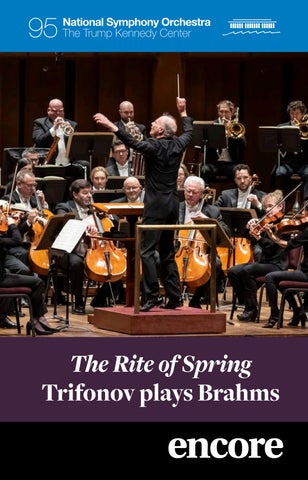
The Rite of Spring Trifonov plays Brahms
Daily live performances.
The Keys give you a show above and below the surface. From art galleries to museums and live music, no place inspires more freedom of expression. In The Keys, you’re part of the performance. VisitFloridaKeys.com/arts-culture 1.800.Fla.Keys
T H E D ONALD J. T RUMP AND T HE J O HN F. K ENNE DY M E M O RIAL CENT ER FO R T HE PERFO RMING A RTS,
JA NUA RY 1 5 , 2 0 2 6 AT 7 P. M . ; JA N UA RY 1 6 & 1 7 , 2 0 2 6 AT 8 P. M . | CO N C ERT H A LL
Gianandrea Noseda, conductor Daniil Trifonov, piano JOHANNES BRAHMS Piano Concerto No. 1 in D minor, Op. 15 (1858) (1833–1897) i. Maestoso ii. Adagio iii. Rondo. Allegro non troppo INTERMISSION IGOR STRAVINSKY Le Sacre du printemps (The Rite of Spring) (1913) (1882–1971) I. Adoration of the Earth i. Introduction ii. Augurs of Spring iii. Ritual of Abduction iv. Spring Rounds v. Ritual of the Rival Tribes vi. Procession of the Sage vii. The Sage viii. Dance of the Earth II. The Sacrifice i. Introduction ii. Mystic Circles of the Young Girls iii. Glorification of the Chosen One iv. Evocation of the Ancestors v. Ritual Action of the Ancestors vi. Sacrificial Dance (The Chosen One)
THANK YOU TO OUR SEASON SPONSORS
The NSO Music Director Chair is generously endowed by Roger Sant and Congresswoman Doris Matsui Noseda Era Fund Supporters
The Amici di Gianandrea
Patrons are requested to turn off cell phones and other electronic devices during the performance. Any video and/or audio recording of this production is strictly prohibited.
Welcome Dear Friends, As we open the National Symphony Orchestra’s 95th season, I want to take a moment to express my heartfelt thanks to you—our devoted patrons, supporters, and friends. Your presence this evening, and your unwavering support throughout the year, mean more than words can convey. It is your love of music, your generosity, and your steadfast belief in the arts that delight this remarkable orchestra. In 1931, Hans Kindler founded the NSO with a bold vision: to build a world-class symphony orchestra in the heart of our nation’s capital. Nearly a century later, that vision continues to be our driving force. Today, under the dynamic artistic leadership of Gianandrea Noseda, we are more inspired than ever to share powerful performances with our audiences. The NSO is not simply an orchestra; it is a family of artists joined together through a shared love of music, unity of purpose, and commitment to something greater than us. The NSO is more than what you see on stage—it is a living, breathing institution devoted to enriching lives. Our robust education and community engagement programs reach thousands of students, educators, and families each year. Between our Youth Fellowship Program and Summer Music Institute, to Young People’s Concerts, we strive to make music accessible to everyone—especially the next generation. This commitment to connect with broader audiences is also seen through our vibrant, genre-defying series, led by the remarkable Steven Reineke, our Principal Conductor and Artistic Advisor. Steven brings a wide-reaching musical vision to the NSO, bridging genres and generations. His programming has opened the door for new audiences to discover a love for orchestral music, while continuing to captivate longtime fans with the highest levels of artistry. As we embark on this milestone season, we are reminded that our journey would not be possible without you. Thank you for being an essential part of this vibrant and enduring musical community. With deepest gratitude and warmest regards,
Jean Davidson Executive Director National Symphony Orchestra
4
From the Music Director Stefano Pasqualetti
Cari amici,
Cari amici,
It is with immense joy and anticipation that I welcome you to the National Symphony Orchestra’s 95th anniversary season. This moment is more than a milestone—it is a celebration of our deep musical legacy and a renewed commitment to bringing powerful, moving performances to our community and beyond. This is only the beginning. The 95th season is filled with musical discovery, celebrated artists, and unforgettable experiences.
This season features iconic works that have stood the test of time, from classic It is with immense joy and anticipation that I welcome you to the National Symphony masterpieces to thrilling contemporary music. The NSO also has the opportunity to Orchestra’s 95th anniversary season. This moment is more than a milestone—it is a share the stage with an exceptional lineup of guest artists and conductors—beloved celebration of our deep musical legacy and a renewed commitment to bringing powerful, icons and rising stars alike. Performing new music is something the NSO truly believes moving performances to our community and beyond. This is only the beginning. The in. Make history with us as we present innovative new works, including five world 95th season is filled with musical discovery, celebrated artists, and unforgettable premieres. experiences. I am deeply grateful to share this journey with you. Your presence in the Concert Hall is I am deeply grateful to share this journey with you. Your presence in the Concert Hall what brings our music fully to life. Thank you for being a part of the NSO family—for is what brings our music fully to life. Thank you for being a part of the NSO family—for your passion, your applause, and your unwavering support. your passion, your applause, and your unwavering support. Con tutto il cuore, Con tutto il cuore, Gianandrea Noseda Gianandrea Noseda Music Director, National Symphony Orchestra Music Director, National Symphony Orchestra Che la musica vi porti gioia e ispirazione—may music bring you joy and inspiration. Che la musica vi porti gioia e ispirazione—may music bring you joy and inspiration.
5
Notes on the Program
© 2025 Sarina Benezra Bell
Piano Concerto No. 1 in D minor, Op. 15 JOHANNES BRAHMS Born May 7, 1833, in Hamburg, Germany Died April 3, 1897, in Vienna, Austria-Hungary Like The Rite of Spring, Johannes Brahms’ 1858 Piano Concerto in D minor was not initially well received, neither at its premiere in Hanover, nor five days later in Leipzig. As Brahms wrote to a friend about the poor response, “It forces you to collect your thoughts, and it raises your courage, … but the hissing was really too much, wasn’t it?” Despite this rough reception, the Concerto came to ignite much public interest and scholarly debate due to its virtuosity, a related tragedy, and Brahms’ increasingly contradictory position as both a traditionalist and a progressive. In fact, Brahms was generally a curious, contradictory character. A portrait of Bach hung over his bed, and a copy of the King James Bible was always in reach, yet he was an ardent agnostic. He obsessively burned many of his early works, yet he was known to take long, peaceful walks through the morning. He was, by most accounts, a sober, modest character. Towards the end of his life, he reflected, “Even if people don’t love me, they respect me, and that is the main thing. I don’t ask for more.” But the boy from Hamburg would become one of the most beloved composers of the Romantic era, owing much to the tendency of audiences to hear, within his Classical forms, a pounding emotional depth and harmonic innovation—a “Classical Romanticism.” With a father in the Hamburg Philharmonic State Orchestra, Brahms’s musical education was deeply grounded in tradition. At 20, he earned the close friendship of Robert and Clara Schumann, two of the most prominent figures of the early Romantic era—one a declining but brilliant composer, the other a renowned concert pianist. The two took Brahms under their wing, encouraging him to write the symphony that his orchestral tendencies so demanded. As Brahms’ admiration of Clara grew, Robert’s mental health faltered. In the winter of 1854, the elder composer threw himself into the Rhine. He survived, but was moved to a sanatorium, where he died two years later. Against this backdrop—hiding his love for his mentor’s distraught wife, inheriting the moth-eaten mantle of German Classicism, and attempting to live up to the wishes of a dying man—Brahms got to work on Opus 15, in essence the first truly symphonic piano concerto. The first section of the work to be composed, the first movement, speaks most explicitly to Brahms’ turmoil in the aftermath of Robert’s suicide attempt. Warring keys—D and B flat—teeter into the melancholia of D minor. At the piano, the soloist articulates the intensity of the opening passages with a bit more optimism, leading to a lush recapitulation shared among the orchestra. Brahms wrote the second movement as a “tender portrait” of Clara herself, vulnerable and resigned. The third movement takes after Beethoven in its rondo structure. As Brahms wrote to a friend about the late composer, “You have no idea how the likes of us feel when we keep hearing such a giant behind us.” Yet, landing in a major key, the piece seems to have successfully outrun the giant, or at least to have made peace with a predecessor of such overshadowing repute. Though audiences initially scorned the Concerto’s length, complexity, and lack of an ornamental cadenza section, the emotional focus of the work became its saving grace. As an early work, the First Piano Concerto necessarily reads as a coming of age. Certainly, the piece invokes all that might be expected of late adolescence—unrequited love, unexpected grief, idolization, and a fair amount of rule-bending. Like Brahms himself, especially concerning his relationship with Clara, the solo part of the Concerto is a sympathetic colleague alongside the orchestra—a modest character, content with mutual respect if not loving devotion.
6
Le Sacre du printemps (The Rite of Spring) IGOR STRAVINSKY Born June 5, 1882, in Oranienbaum, Russia Died April 6, 1971, in New York, New York Those in attendance at the premiere of Igor Stravinsky’s 1913 ballet and orchestral work The Rite of Spring have given conflicting—but always colorful—accounts. The word ‘riot’ is forever enshrined in the event’s rehashing, despite some contemporary attempts to excise the term. Supposedly, over an approximately 35-minute runtime, old-school Parisians and more open-minded bohemians turned on each other, then turned on the orchestra. Roughly 40 patrons were thrown out, insults were hurled—then fists, at least one duel was set for the following morning, and the composer himself fled through a back window. Onstage, as the esteemed members of the Ballets Russes contorted in frenzied imitation of pagan springtime rituals—something of a mockery of French elitism about perceived Russian primitivism—the audience fell into a frenzy of their own. Over the roar, choreographer Vaslav Nijinsky yelled the counts from the wings as the Chosen One performed the ultimate sacrifice: dancing herself to death. It was a scandal. The origin of The Rite surrounds four Russians—composer Stravinsky, choreographer Nijinsky, patron Sergei Diaghilev, and designer Nicholas Roerich—increasingly alienated from their home country. Both Diaghilev and Stravinsky hailed from the upper crust of Imperial Russia, but only a few years after The Rite’s premiere, the Bolshevik coup left them both effectively stateless. The composer spent his life in exile, returning only briefly to his home country in 1962. Similarly, the Ballets Russes never even performed in Russia; political turmoil and artistic traditionalism made the concept impossible. Thus, in the years following the October Revolution, Stravinsky began to downplay the influence of Russian folk music on The Rite. He insisted that only the opening bassoon melody, lifted from a Lithuanian folk song, could claim such inspiration. “If any of these pieces sounds like aboriginal folk music,” Stravinsky argued, “It may be because my powers of fabrication were able to tap some unconscious ‘folk’ memory.” In fact, the composer publicly condemned this style of patchwork Slavic influence in his peers, drawing an—albeit thin—line between folk music, communism, and corruption. (By this point, Stravinsky was publicly known as a fascist sympathizer.) In a 1939 lecture at Harvard, Stravinsky compared folk-loving Slavophiles, including his mentor Nikolai Rimsky-Korsakov, to a “milieu of false intellectuals, morally disinherited and socially uprooted… from the centers of atheistic seminarists and flunked-out students” with a “devotion to the people’s cause,” soon to develop the “vast proportions” of Soviet Russia. Over the past several decades, scholars have repeatedly disputed Stravinsky’s claim, attributing his changing tune to political convenience. Beyond the plot’s Russian inspiration, additional folk themes can be found in “Augurs of Spring,” “The Ritual of Abduction,” and “Spring Rounds”—themes that, as Stravinsky’s writings show, often correspond with the very folk anthologies that he was studying during the period of composition. And, while several passages are original, the construction of The Rite at large—relying on brief, repeated motives—recalls the circling structure of Hungarian woodwind music. What happens after the biggest night in musical history? The Rite was no hidden masterpiece, cursed to the shadows until long after its composer’s death. After the premiere, French musicologist Léon Vallas asserted that the Parisians had given “striking proof of their stupidity and their reactionary spirit.” He guessed that the public would not be ready for such a work until around 1940. This was an astute observation as, come 1940, Disney’s Fantasia brought The Rite to younger audiences with a desolate, dinosaurfilled scene. By his eighties, Stravinsky was attending anniversary performances of the piece, waving a handkerchief from his box seat. Today, The Rite lives on as a concert piece, occasionally choreographed for full staging.
7
Meet the Artists Gianandrea Noseda, conductor Gianandrea Noseda is one of the world’s most sought-after conductors, equally recognized for his artistry in both the concert hall and opera house. The 2025–2026 season marks his ninth as music director of the National Symphony Orchestra. Noseda’s leadership has inspired and reinvigorated the National Symphony Orchestra, which makes its home at the Kennedy Center. The renewed artistic recognition and critical acclaim have led to invitations to Carnegie Hall and international concert halls, as well as digital streaming and a record label distributed by LSO Live, for which Noseda also records as principal guest conductor of the London Symphony Orchestra. Noseda’s discography of over 80 recordings includes dozens of critically acclaimed albums with a wide range of orchestras and repertoire for various labels, including Deutsche Grammophon and Chandos. Noseda became General Music Director of the Zurich Opera House in September 2021 and reached an important milestone in May 2024, conducting two highly praised complete Ring Cycles. He was recognized as “Best Conductor” by the jury of the German OPER! AWARDS, specifically for his Wagner interpretations. From 2007 to 2018, Noseda served as Music Director of the Teatro Regio Torino, where his leadership marked the opera house’s golden era. Noseda has conducted the most important international orchestras, opera houses, and festivals, and had significant roles at the BBC Philharmonic (chief conductor), Israel Philharmonic Orchestra (principal guest conductor), Mariinsky Theatre (principal guest conductor), Orchestra Sinfonica Nazionale della RAI (principal guest conductor), Pittsburgh Symphony Orchestra (Victor de Sabata Chair), Rotterdam Philharmonic (principal guest conductor), and Stresa Festival (artistic director). Working with the next generation of musicians is important to Noseda, and in the summer of 2025, he led a tour of major concert halls in China, Korea, and Japan with Carnegie Hall’s National Youth Orchestra of the USA. In 2019, he was appointed the founding Music Director of the Tsinandali Festival and Pan-Caucasian Youth Orchestra in the village of Tsinandali, Georgia. A native of Milan, Noseda is Commendatore al Merito della Repubblica Italiana, marking his contribution to the artistic life of Italy. He has 8
been honored as Conductor of the Year by both Musical America and the International Opera Awards. He is also a recipient of the Puccini Award, whose past recipients include legendary opera stars Maria Callas, Birgit Nilsson, and Luciano Pavarotti.
Daniil Trifonov, piano Grammy Award®– winning pianist Daniil Trifonov has made a spectacular ascent of the classical music world as a solo artist, champion of the concerto repertoire, chamber and vocal collaborator, and composer. Combining consummate technique with rare sensitivity and depth, his performances are a perpetual source of awe. “He has everything and more, … tenderness and also the demonic element. I never heard anything like that,” marveled pianist Martha Argerich. With Transcendental, the Liszt collection that marked his third title as an exclusive Deutsche Grammophon artist, Trifonov won the Grammy Award® for Best Instrumental Solo Album of 2018. Named Gramophone’s 2016 Artist of the Year and Musical America’s 2019 Artist of the Year, he was made a Chevalier de l’Ordre des Arts et des Lettres by the French government in 2021. As The Times of London notes, he is “without question the most astounding pianist of our age.” Trifonov’s 2025–2026 season includes three performances at Carnegie Hall. He first reunites with German baritone Matthias Goerne for a performance of Schubert’s Die schöne Müllerin, as the culmination of their North American tour of Schubert’s great song cycles that also sees them perform Schwanengesang in Québec City and Boston, and Winterreise in Toronto, Washington, D.C., and Dallas. After the North American performances, Trifonov and Goerne tour the cycles to multiple German and Austrian cities, as well as to Paris in the spring. In November, Trifonov returns to Carnegie Hall in the company of Cristian Măcelaru and the Orchestre National de France for two great French piano concertos: Saint-Saëns’s Second and Ravel’s jazz-inflected Piano Concerto in G. Finally, in December, Trifonov’s third Carnegie Hall appearance of the season is a mainstage solo recital, with the same program performed throughout the season in both the U.S. and Europe. Other season highlights for Trifonov include a short duo tour in Sweden and Austria with violinist Nikolaj Szeps-Znaider; a reprise of Brahms’s Second Piano Concerto with the
Cleveland Orchestra and Music Director Franz Welser-Möst, as well as three performances of the same work with the Orchestra dell’Accademia Nazionale di Santa Cecilia under the baton of Daniel Harding; and Beethoven’s Second Piano Concerto with both the Cincinnati Symphony led by Măcelaru and the Chicago Symphony Orchestra—where Trifonov served as 2024–2025 artist-in-residence—led by Esa-Pekka Salonen. It was during the 2010–2011 season that Trifonov won medals at three of the music world’s most prestigious competitions, taking Third Prize in Warsaw’s Chopin Competition, First Prize in Tel Aviv’s Rubinstein Competition, and both First Prize and Grand Prix—an additional honor bestowed on the best overall competitor in any category—in Moscow’s Tchaikovsky Competition. In 2013, he was awarded the prestigious Franco Abbiati Prize for Best Instrumental Soloist by Italy’s foremost music critics. Born in Nizhny Novgorod, Russia, in 1991, Trifonov began his musical training at the age of five, and went on to attend Moscow’s Gnessin School of Music as a student of Tatiana Zelikman, before pursuing his piano studies with Sergei Babayan at the Cleveland Institute of Music. He has also studied compositio, and continues to write for piano, chamber ensemble, and orchestra. When he premiered his own Piano Concerto, the Cleveland Plain Dealer marveled, “Even having seen it, one cannot quite believe it. Such is the artistry of pianistcomposer Daniil Trifonov.”
Since launching its eponymous recording label in 2020, the NSO has embarked on ambitious recording projects, including its first complete Beethoven Symphony cycle and the release of the first-ever cycle of George Walker’s Sinfonias, both led by Noseda. Recent projects include Four Symphonic Works by Kennedy Center Composerin-Residence Carlos Simon conducted by Noseda, and William Shatner’s So Fragile, So Blue, recorded live in the Concert Hall with the NSO under Steven Reineke. Forthcoming releases with Gianandrea Noseda include music by Gustav Mahler and William Grant Still, as well as Samuel Barber’s opera Vanessa. The NSO’s community engagement and education projects are nationally recognized, and career development opportunities for young musicians include the NSO Youth Fellowship Program and its acclaimed, tuition-free Summer Music Institute.
National Symphony Orchestra The 2025–2026 season is the National Symphony Orchestra’s 95th and Music Director Gianandrea Noseda’s ninth season. Gianandrea Noseda serves as the orchestra’s seventh music director, joining the NSO’s legacy of distinguished leaders: Christoph Eschenbach, Leonard Slatkin, Mstislav Rostropovich, Antal Doráti, Howard Mitchell, and Hans Kindler. Its artistic leadership also includes Principal Conductor and Artistic Advisor Steven Reineke. Since its founding in 1931, the NSO has been committed to performances that enrich the lives of its audience and community members. In 1986, the National Symphony became an artistic affiliate of the John F. Kennedy Center for the Performing Arts, where it has performed since the Center opened in 1971. The 96-member NSO participates in events of national and international importance, including the annual nationally televised concerts on the lawn of the U.S. Capitol,live-streamed performances on medici.tv, and local radio broadcasts on WETA Classical 90.9 FM. 9
Loud and Clear Terms to know in the Concert Hall, loosely defined. Symphony An extended work with multiple sections—typically four movements. A “symphonic” piece is a long piece with multiple interpretations of a musical idea. A repeated, transformed musical idea is called a theme. Orchestra A group of musicians who play together. In the Western European tradition, an orchestra often includes the four major instrument families—brass, woodwinds, strings, and percussion. An especially large orchestra is called a symphony orchestra. A smaller orchestra is called a chamber orchestra. Movement A section of a musical work. Movements are often separated by silences, and they typically differ in tempo—speed. Sonata Originally, a musical composition played on instruments. In modern usage, “sonata” can mean a piece for a soloist or an ensemble, often with two to four movements. If a work or a movement is written in sonata form, it is structured in three sections: exposition, development, and recapitulation. Concerto A piece pairing a technically advanced soloist with the support of an orchestra, usually in three movements. Though there may be multiple soloists, the contrast between a larger ensemble and a soloing group defines a concerto. Romantic music Works associated with the 19th-century Romantic Period. Building off the intellectual innovation of the Romanticism movement, Romantic music emphasizes self-expression, emotion, and experimentation. Uppercase “C” Classical music Works associated with the 18th-century Classical Period. Characteristics include an emphasis on formal structures, balance, and clear-cut melodies. Lowercase “c” classical music refers to formal compositions invested in technical depth, usually derived from the European tradition. Chorale A congregational piece sung by a chorus, especially in the Lutheran tradition. The term can also refer to the chorus itself. Sinfonia Italian for “symphony,” though often used to refer to an overture or shorter symphonic work. Tempo Markings Adagio - slow, at ease Andante - moderately slow, walking pace Allegro - fast, bright Vivace - fast, lively
10
Additional Markings Poco - a little Ma non troppo - but not too much Molto - very Assai - very Sostenuto - sustained Espressivo - expressively Maestoso - majestically
National Symphony Orchestra GIANANDREA NOSEDA, MUSIC DIRECTOR The Roger Sant and Congresswoman Doris Matsui Chair
STEVEN REINEKE, PRINCIPAL CONDUCTOR AND ARTISTIC ADVISOR VIOLINS Nurit Bar-Josef, Concertmaster Ying Fu, Associate Concertmaster, The Jeanne Weaver Ruesch Chair Ricardo Cyncynates, Assistant Concertmaster Xiaoxuan Shi, Second Assistant Concertmaster Jane Bowyer Stewart Heather LeDoux Green Lisa-Beth Lambert Jing Qiao Marina Aikawa Peiming Lin Derek Powell Regino Madrid** Meredith Riley** Marissa Regni, Principal Dayna Hepler, Assistant Principal Cynthia R. Finks Deanna Lee Bien Glenn Donnellan Natasha Bogachek Carole Tafoya Evans Jae-Yeon Kim Wanzhen Li Hanna Lee Benjamin Scott Malorie Blake Shin Angelia Cho Kei Sugiyama** VIOLAS Daniel Foster, Principal, The Mrs. John Dimick Chair Dana Kelley, Assistant Principal Denise Wilkinson Nancy Thomas Jennifer Mondie Tsuna Sakamoto Ruth Wicker Mahoko Eguchi Abigail Evans Kreuzer Rebecca Epperson Chiara Dieguez** Jacob Shack** CELLOS David Hardy, Principal, The Hans Kindler Chair, The Strong Family and the Hattie M. Strong Foundation Raymond Tsai, Assistant Principal David Teie James Lee
Rachel Young Mark Evans Eugena Chang Riley Loewi Lin Britton Riley Noah Krauss BASSES Robert Oppelt, Principal Richard Barber, Assistant Principal Jeffrey Weisner Ira Gold Paul DeNola Charles Nilles Alexander Jacobsen Michael Marks HARP Adriana Horne, Principal FLUTES Aaron Goldman, Principal Leah Arsenault Barrick, Assistant Principal Matthew Ross Carole Bean, Piccolo OBOES Nicholas Stovall, Principal, The Volunteer Council Chair Jamie Roberts, Assistant Principal Harrison Linsey*** Kathryn Meany Wilson***, English Horn CLARINETS Lin Ma, Principal Eugene Mondie, Assistant Principal Paul Cigan Peter Cain, Bass Clarinet BASSOONS Sue Heineman, Principal David Young, Assistant Principal Steven Wilson Sean Gordon, Contrabassoon HORNS Abel Pereira, Principal, The National Trustees’ Chair James Nickel, Acting Associate Principal Markus Osterlund*** Scott Fearing Robert Rearden Geoffrey Pilkington**
TRUMPETS William Gerlach, Principal, The Howard Mitchell Chair, The Strong Family and the Hattie M. Strong Foundation Michael Harper, Assistant Principal Michail Thompson Tom Cupples TROMBONES Craig Mulcahy, Principal Evan Williams, Assistant Principal David Murray Matthew Guilford, Bass Trombone TUBA Stephen Dumaine, Principal, The James V. Kimsey Chair TIMPANI Jauvon Gilliam, Principal, The Marion E. Glover Chair Scott Christian, Assistant Principal PERCUSSION Eric Shin, Principal, The Hechinger Foundation Chair Erin Dowrey, Assistant Principal Scott Christian Jason Niehoff* KEYBOARD Lambert Orkis, Principal Lisa Emenheiser* ORGAN William Neil* LIBRARIANS Elizabeth Cusato Schnobrick, Principal Zen Stokdyk, Associate Karen Lee, Assistant PERSONNEL Karyn Garvin, Director Sufyan Naaman**, Coordinator STAGE MANAGERS David Langrell, Manager N. Christian Bottorff, Assistant Manager The National Symphony Orchestra uses a system of revolving strings. In each string section, untitled members are listed in order of length of service. *Regularly Engaged Extra Musician ** Temporary Position ***Leave of Absence
11
National Symphony Orchestra Staff ADMINISTRATION Jean Davidson, Executive Director Sabryn McDonald, Executive Assistant EXECUTIVE TEAM Kasama Apfelbaum, Vice President, Financial Planning & Analysis Nigel Boon, Vice President, Artistic Planning John Roloff, Vice President, Orchestra Operations ARTISTIC PLANNING Justin Ellis, Senior Producing Director Emily Graham, Assistant Artistic Administrator Ana Vashakmadze, Assistant Artistic Administrator DEVELOPMENT Laney Pleasanton, Manager, NSO Individual Giving Pamela Wardell, Senior Director of Development EDUCATION Vanessa Thomas, Director of Education Activation & Engagements FINANCE AND ADMINISTRATION Eric Rubio, Director of Finance & Administration HUMAN RESOURCES Tony Amato, Director, Total Rewards Chanel Kemp, Talent Acquisition Manager Patrice McNeill, Director, HR Operations Lisa Motti, HRIS Coordinator Ericka Parham, Benefits Analyst John Sanford, Senior Business Partner
12
MARKETING & ADVERTISING Scott Bushnell, Senior Director, Creative and Brand Strategy Lily Maroni, Senior Manager, Advertising Communications Elizabeth Stoltz, Advertising Production & Special Projects Assistant Manager Kaila Willard, Marketing Manager, Analytics and CRM Strategy Derek Younger, Director, Sales & Ticketing Service ORCHESTRA OPERATIONS & CONCERT PRODUCTION Brooke Bartolome, Assistant Manager, Orchestra Operations Joseph Benitez, Media & OPAS Support Coordinator N. Christian Bottorff, Assistant Stage Manager Cayley Carroll, Director, Production & Orchestra Operations Karyn Garvin, Director of Orchestra Personnel David Langrell, Stage Manager Sufyan Naaman, Personnel and Auditions Coordinator Ava Yap, Operations Assistant PUBLIC RELATIONS Amanda Fischer, Deputy Director of Public Relations
Kennedy Center Kennedy Center Staff Staff Staff Trump Kennedy Center TRUMP KENNEDY EXECUTIVE LEADER KENNEDY CENTER EXECUTIVE LEADER SHIP KENNEDY CENTERCENTER EXECUTIVE LEADERSHIP SHIP SHIP KENNEDY CENTER EXECUTIVE LEADER President, John F. Kennedy Center for the Performing Arts ����������������������������������������������������������� Ambassador Richard Grenell President,John JohnTrump Kennedy Center forthe PerformingArts Arts����������������������������������������������������������� �����������������������������������������������������������Ambassador AmbassadorRichard RichardGrenell Grenell President, The Kennedy Center �the �������������������������������������������������������������������������������������������Ambassador Richard Grenell President, F.F.Kennedy Center for Performing Chief Financial Officer �������������������������������������������������������������������������������������������������������������������������������������������������Donna Arduin Chief Financial Officer �������������������������������������������������������������������������������������������������������������������������������������������������Donna Arduin ChiefFinancial FinancialOfficer Officer�������������������������������������������������������������������������������������������������������������������������������������������������Donna �������������������������������������������������������������������������������������������������������������������������������������������������DonnaArduin Arduin Chief General Counsel ��������������������������������������������������������������������������������������������������������������������������������������������������������������� Elliot Berke General Counsel ��������������������������������������������������������������������������������������������������������������������������������������������������������������� Elliot Berke General Counsel ��������������������������������������������������������������������������������������������������������������������������������������������������������������� Elliot Berke General Counsel ��������������������������������������������������������������������������������������������������������������������������������������������������������������� Elliot Berke Senior Vice President, Development ������������������������������������������������������������������������������������������������������������������������������������Lisa Dale Senior Vice President, Development ������������������������������������������������������������������������������������������������������������������������������������Lisa Dale Vice President of Human Resources ���������������������������������������������������������������������������������������������������������������� LaTa’sha M. Bowens Senior Vice President, Development ������������������������������������������������������������������������������������������������������������������������������������Lisa Dale Senior Vice President, Marketing ������������������������������������������������������������������������������������������������������������������������������Robin Osborne Senior Vice President, Marketing ������������������������������������������������������������������������������������������������������������������������������Robin Osborne SeniorVice VicePresident, President,Marketing Marketing������������������������������������������������������������������������������������������������������������������������������Robin ���������������������������������������������������������������������������������������������������������������������� Kimberly J. Cooper Senior Osborne Senior Vice President, Special Events ���������������������������������������������������������������������������������������������������������������������Bronagh Donlon SeniorVice VicePresident, President,Special SpecialEvents Events ���������������������������������������������������������������������������������������������������������������������BronaghDonlon Donlon Senior Vice President, Development ������������������������������������������������������������������������������������������������������������������������������������Lisa Dale Senior ���������������������������������������������������������������������������������������������������������������������Bronagh Vice President, Human Resources������������������������������������������������������������������������������������������������������������������������������ Ta’Sha Bowens Vice President, Human Resources������������������������������������������������������������������������������������������������������������������������������ Ta’Sha Bowens Vice President, Public Relations �������������������������������������������������������������������������������������������������������������������������������������Roma Daravi Vice President, Human Resources������������������������������������������������������������������������������������������������������������������������������ Ta’Sha Bowens Vice President, Operations �������������������������������������������������������������������������������������������������������������������������������������������������Matt Floca VicePresident, President, Operations �������������������������������������������������������������������������������������������������������������������������������������������������Matt Floca Executive Director, National Symphony Orchestra ������������������������������������������������������������������������������������������������� Jean Davidson Vice Operations �������������������������������������������������������������������������������������������������������������������������������������������������Matt Floca Vice President, Education ��������������������������������������������������������������������������������������������������������������������������������������������Jordan LaSalle Vice President, Education ��������������������������������������������������������������������������������������������������������������������������������������������Jordan LaSalle VicePresident, President,Education Special Events ���������������������������������������������������������������������������������������������������������������������������������Bronagh LaSalle Donlon Vice ��������������������������������������������������������������������������������������������������������������������������������������������Jordan Vice President, Public Relations �������������������������������������������������������������������������������������������������������������������������������������Roma Daravi VicePresident, President,Public PublicRelations Relations �������������������������������������������������������������������������������������������������������������������������������������RomaDaravi Daravi Vice President, Facilities �����������������������������������������������������������������������������������������������������������������������������������������������������Matt Floca Vice �������������������������������������������������������������������������������������������������������������������������������������Roma Chief Information Officer ���������������������������������������������������������������������������������������������������������������������������������������������Bob Sellappan Chief Information Officer ���������������������������������������������������������������������������������������������������������������������������������������������Bob Sellappan Director, Office of the President ���������������������������������������������������������������������������������������������������������������������������������������� Rick James Chief Information Officer ���������������������������������������������������������������������������������������������������������������������������������������������Bob Sellappan Executive Director, National Symphony Orchestra ������������������������������������������������������������������������������������������������� Jean Davidson Executive Director, National SymphonyOrchestra Orchestra������������������������������������������������������������������������������������������������� �������������������������������������������������������������������������������������������������Jean JeanDavidson Davidson Vice President, Education ��������������������������������������������������������������������������������������������������������������������������������������������Jordan LaSalle Executive Director, National Symphony General Director, Washington National Opera ��������������������������������������������������������������������������������������������������� Timothy O’Leary General Director, Washington National Opera ��������������������������������������������������������������������������������������������������� Timothy O’Leary GeneralDirector, Director,Washington WashingtonNational NationalOpera Opera��������������������������������������������������������������������������������������������������� ���������������������������������������������������������������������������������������������������Timothy TimothyO’Leary O’Leary General Chief Information Officer ���������������������������������������������������������������������������������������������������������������������������������������������Bob Sellappan
Concert Concert Hall Hall Staff Staff Theater Manager ����������������������������������������������������������������������������������������������������������������������������������������������������Allen V.V.McCallum Jr.Jr. TheaterManager Manager ����������������������������������������������������������������������������������������������������������������������������������������������������AllenV. McCallumJr. Theater Manager ����������������������������������������������������������������������������������������������������������������������������������������������������Allen V.McCallum McCallum Jr. Theater ����������������������������������������������������������������������������������������������������������������������������������������������������Allen Box Office Treasurer �������������������������������������������������������������������������������������������������������������������������������������������������������� Deborah Glover Box Office Treasurer �������������������������������������������������������������������������������������������������������������������������������������������������������� Deborah Glover BoxOffice OfficeTreasurer Treasurer�������������������������������������������������������������������������������������������������������������������������������������������������������� ��������������������������������������������������������������������������������������������������������������������������������������������������������Deborah DeborahGlover Glover Box Head Usher ��������������������������������������������������������������������������������������������������������������������������������������������������������������������������Cathy Crocker HeadUsher Usher��������������������������������������������������������������������������������������������������������������������������������������������������������������������������Cathy ��������������������������������������������������������������������������������������������������������������������������������������������������������������������������CathyCrocker Crocker Head Usher ��������������������������������������������������������������������������������������������������������������������������������������������������������������������������Cathy Crocker Head Stage Crew ����������������������������������������������������������������������������������������������������������� Zach Boutilier, Michael Buchman, Paul Johannes, Stage Crew ����������������������������������������������������������������������������������������������������������� Zach Boutilier, Michael Buchman, Paul Johannes, StageCrew Crew����������������������������������������������������������������������������������������������������������� �����������������������������������������������������������������������������������������������������������Zach ZachBoutilier, Boutilier,Michael MichaelBuchman, Buchman,Paul PaulJohannes, Johannes, Stage April King, John Ottaviano, and Arielle Qorb AprilKing, King,John JohnOttaviano, Ottaviano,and andArielle ArielleQorb Qorb April King, John Ottaviano, and Arielle Qorb April
*Represented by the *Represented bybyATPAM, ATPAM, the *Representedby ATPAM,the the *Represented ATPAM, Association of Press Association ofofTheatrical Theatrical Press Associationof TheatricalPress Press Association Theatrical Agents and Managers. Agents and Managers. Agents and Managers. Agents and Managers.
The technicians the Trump The technicians atat the Kennedy Thetechnicians techniciansat atthe theKennedy Kennedy The Kennedy Center are represented by Center are represented bybyLocal #22, Centerare are represented Local#22, #22, Center represented by Local Local#772, #22,and Local #772, and Local Local Local #798 I.A.T.S.E. Local #772, and Local #798 I.A.T.S.E. Local #772,#798 and Local #798 I.A.T.S.E. I.A.T.S.E. AFL-CIO-CLC, the union AFL-CIO-CLC,the theprofessional professionalunion union AFL-CIO-CLC, AFL-CIO-CLC, the professional professional ofoftheatrical technicians. theatrical technicians.union of of theatrical theatrical technicians. technicians.
111
Steinway Piano Gallery isisthe exclusive SteinwayPiano PianoGallery Galleryis theexclusive exclusive Steinway the area representative ofofSteinway &&Sons arearepresentative representativeof Steinway& Sons area Steinway Sons and Boston pianos, the official pianos and Boston pianos, the official pianos and Boston pianos, the official pianos of the Kennedy Center. theKennedy KennedyCenter. Center. ofofthe of the Trump Kennedy Center.
The American Guild ofofMusical Artists, TheAmerican AmericanGuild Guildof MusicalArtists, Artists, The Musical the union ofofprofessional singers, theunion unionof professionalsingers, singers, the professional dancers and production personnel inin dancersand andproduction productionpersonnel personnelin dancers opera, ballet and concert, affiliated opera,ballet balletand andconcert, concert,affiliated affiliated opera, with the AFL-CIO, represents the withthe theAFL-CIO, AFL-CIO,represents representsthe the with Artists and Staging Staff for the Artistsand andStaging StagingStaff Stafffor forthe the Artists purposes of collective bargaining. purposesofofcollective collectivebargaining. bargaining. purposes
The box office atat the Kennedy The box office the Trump Thebox boxoffice officeat atthe theKennedy Kennedy The Center by I.A. TT .S.E, Kennedy is represented by CenterisisCenter isrepresented represented I.A. .S.E, Center bybyI.A. T.S.E, Local #868. I.A.Trepresented .S.E, Local #868. Local#868. #868. Local
National Symphony Orchestra NationalSymphony SymphonyOrchestra Orchestra National musicians are represented bybythe musiciansare arerepresented representedby the musicians the Metropolitan Washington, D.C. MetropolitanWashington, Washington,D.C. D.C. Metropolitan Federation of Musicians, AFM FederationofofMusicians, Musicians,AFM AFM Federation Local 161-710. Local161-710. 161-710. Local
13
Orchestrated Lives Each month, the National Symphony Orchestra (NSO) spotlights a different staff member. For this program, Stage Manager David Langrell discusses backstage mishaps, his family connection to the Orchestra, and the real terrors of The Rite of Spring.
Name: David Langrell Hometown: Wilmington, Delaware Role: Stage Manager Years with the NSO: 25 How did you find your way into stage work? I loved theater, but I didn’t think it was going to be a very good career. I went to school for agriculture—I wanted to be a forest ranger when I grew up—but I always kept my hand in the arts in college. In 1983, I moved to D.C. to work at Folger Theatre. My first union job at the Kennedy Center was in 2000 for Honors. I became a full-time stagehand in July 2011, and I became stage manager in 2018. What does an average day of work look like for you? Let’s call it a rehearsal day. The strings, woodwinds, and brass bring their own instruments, but we have to go down and pull all the big percussion pieces—the marimba, xylo[phone], glockenspiel, bass drums, timpani…. It’s usually a couple of large freight elevators of gear. If there’s a piano soloist, we’ll bring both pianos out during a break, and they’ll play them to see which one they want to use for the concert. Gianandrea [Noseda] loves his strings very tight to him. Sometimes he’ll come in and say, “Can you move everybody 2.5 centimeters?” He constantly thanks the crew for how well the stage is set up, because he can’t do his best if we don’t do our best. What else do the musicians need? We have what we call “accessories,” something like 140 pieces—seat cushions, trays for the winds, pencil trays for violins, bassoon stands, contrabassoon stands, and personal stools. I keep cough drops and little sewing kits backstage in case somebody pops a button. Which pieces are particularly problematic to set up? In January, we’re doing The Rite of Spring, and we’re putting up a six-foot stage extension. It doesn’t sound like a lot, but there are two tubas and double timpani, and each timpanist has five drums. That’s 8 feet by 16 feet right there. The piece also has 11 French horns; typically, we only have around four. What’s a memorable time that things have gone wrong backstage? Several years ago, a very famous pianist was playing a solo piece on Thursday night at seven o’clock, and on Friday and Saturday night at eight o’clock. (He always deals with his own transportation because of his following. I don’t think he wants people to know where he is.) The pianist doesn’t show up for the seven o’clock show, and we can’t get a hold of him. Typically, we have the soloist before intermission, but they had to do the second piece first. When he finally showed up, he was so apologetic. He’s been here since, and we always joke, “Seven o’clock Thursday, right?” Can you speak a bit about your son’s involvement with the NSO Youth Fellowship Program? My son’s always been around the symphony, and he’s been playing the tuba since fourth grade. Our tuba player Stephen [Dumaine] gave us the name of someone in the Army Band for lessons, and by his senior year, he was a full-fledged Youth Fellow. He ended up taking lessons with Seth Cook, the tuba player from the Opera House. He’s a junior at Eastman now, which is pretty cool. The musicians who helped coach him still ask about how my son’s doing in school. This interview has been edited for length and clarity.
14
Support your
ORCHESTRA
The mission of the National Symphony Orchestra is to engage audiences locally, across the country, and around the world through excellence in performance and education. Each year, the NSO offers approximately 150 concerts as well as some of the country’s most extensive community and educational programming. It regularly participates in events of national and international importance, including performances for state occasions, highlevel government events, and regularly televised holiday appearances for Capitol Concerts and local radio broadcasts on WETA, making the NSO one of the most-heard orchestras in the country.
Give your support in this 95th season by becoming a Member, joining the NSO Circles, or pledging a Legacy Gift. Visit tkc.co/SupportNSO or scan the QR code. 15
Thank You to Our Supporters The Kennedy Center Board of Trustees National Symphony Orchestra Board of Directors Washington National Opera Board of Trustees The Kennedy Center President’s Council The Kennedy Center International Committee on the Arts President’s Advisory Committee on the Arts National Committee for the Performing Arts National Symphony Orchestra National Trustees The Kennedy Center Circles Board The Kennedy Center Community Advisory Board The Kennedy Center Corporate Fund Board The Kennedy Center 50th Anniversary Committee Corporate Donors Individual and Foundation Donors Endowment Gifts, Bequests, and Legacy Donors Building the Future Campaign Donors
Andrew Geraci
Visit tkc.co/Support for a full listing of donors and to learn how you can join us by becoming a Member.
16
More Concerts this Season! Songs of Destiny and Fate The Washington Chorus joins the NSO for three choral masterpieces by Brahms. These mesmeric works set the stage for Schumann’s Symphony No. 2, a testament to humanity’s resilience.
January 22, 2026 at 7 p.m. January 23 & 24, 2026 at 8 p.m.
Le Poème Divin Brahms’ Double Concerto Noseda conducts a program that moves from the rich interplay of Brahms’ Double Concerto— featuring Concertmaster Nurit Bar-Josef and Principal Cello David Hardy—to the cosmic vision of Scriabin’s Symphony No. 3.
January 29, 2026 at 7 p.m. January 30, 2026 at 11:30 a.m. January 31, 2026 at 8 p.m.
Shostakovich’s Eighth Abduraimov plays Tchaikovsky Behzod Abduraimov makes his NSO debut in Tchaikovsky’s thundering Piano Concerto No. 1. Gianandrea Noseda closes the concert with Shostakovich’s Symphony No. 8, an unflinching response to war.
February 5, 2026 at 7 p.m. February 6, 2026 at 11:30 a.m. February 7, 2026 at 8 p.m.
To purchase tickets, visit nationalsymphony.org or call 202-467-4600
17
2025–2026 CLASSICAL SEASON PERFORMANCE CALENDAR Songs of Destiny & Fate
Thu., Jan. 22, 2026 at 7 p.m. Fri., Jan. 23, 2026 at 8 p.m. Sat., Jan. 24, 2026 at 8 p.m.
Le Poème Divin Brahms’ Double Concerto
Thu., Jan. 29, 2026 at 7 p.m. Fri., Jan. 30, 2026 at 11:30 a.m. Sat., Jan. 31, 2026 at 8 p.m.
Shostakovich’s Eighth Abduraimov plays Tchaikovsky
Thu., Feb. 5, 2026 at 7 p.m. Fri., Feb. 6, 2026 at 11:30 a.m. Sat., Feb. 7, 2026 at 8 p.m.
American Mosaic
Thu., Feb. 19, 2026 at 7 p.m. Sat., Feb. 21, 2026 at 8 p.m. Sun., Feb. 22, 2026 at 3 p.m.
Shaham & Shaham play Reena Esmail Robertson conducts Sibelius’ Fifth
Hahn & Woods play Carlos Simon Brahms’ Third
Thu., Mar. 12, 2026 at 7 p.m. Fri., Mar. 13, 2026 at 8 p.m. Sat., Mar. 14, 2026 at 8 p.m. NSO Presents*
Alexandra Dovgan
Sat., Mar. 14, 2026 at 3 p.m.
Death and Transfiguration Khachatryan plays Sibelius
Thu., Apr. 2, 2026 at 7 p.m. Fri., Apr. 3, 2026 at 11:30 a.m. Sat., Apr. 4, 2026 at 8 p.m.
Bruckner’s Seventh Gerlach plays Haydn
Fri., Apr. 10, 2026 at 8 p.m. Sat., Apr. 11, 2026 at 8 p.m.
Mozart’s “Jupiter” & Bach’s Brandenburg No. 1
Wed., Apr. 15, 2026 at 7 p.m. Thu., Apr. 16, 2026 at 7 p.m. Fri., Apr. 17, 2026 at 8 p.m.
Thu., Feb. 26, 2026 at 7 p.m. Fri., Feb. 27, 2026 at 11:30 a.m. Sat., Feb. 28, 2026 at 8 p.m.
Winter Daydreams: Noseda conducts Tchaikovsky’s First Trpčeski plays Saint-Saëns Fri., Mar. 6 at 11:30 a.m. Sat., Mar. 7 at 8 p.m.
*Please note: The National Symphony Orchestra does not perform in these concerts.
18
NSO Presents*
Khatia Buniatishvili
Fri., Apr. 24, 2026 at 8 p.m. Opera in Concert
Puccini’s Il trittico
Wed., Apr. 29, 2026 at 7 p.m. Fri., May 1, 2026 at 7 p.m.
Renée Fleming’s Voice of Nature: The Anthropocene Fri., May 29, 2026 at 8 p.m. Sat., May 30, 2026 at 8 p.m.
Cann plays Coleman
Fri., June 5, 2026 at 8 p.m. Sat., June 6, 2026 at 8 p.m.
Philip Glass’ “Lincoln” Dalene plays Barber
Fri., June 12, 2026 at 8 p.m. Sat., June 13, 2026 at 8 p.m.
A look back at our history
1939
NSO Music Director Hans Kindler leads the Orchestra in a summer outdoor concert on a floating barge anchored at the foot of the stone steps below the Lincoln Memorial. Harris & Ewing Collection, Library of Congress
19
A look back at our history
1958
Music Director Howard Mitchell conducts the NSO at Constitution Hall. Photographer unknown, Courtesy of the Kennedy Center Archives
20
A look back at our history
1970s
NSO Music Director Antal Doráti conducts the NSO. Photo by Richard Braaten, Courtesy of the Kennedy Center Archives
21
A look back at our history
1987
NSO Music Director Mstislav Rostropovich conducts the NSO with guest soloist soprano Galina Vishnevskaya, his wife. Photo by Joan Marcus, Courtesy of the Kennedy Center Archives
22
A look back at our history
1996
Music man Bobby McFerrin wowed Washingtonians when he conducted the National Symphony Orchestra concerts for families and school children. Photo by Carol Pratt, Courtesy of the Kennedy Center Archives
23
A look back at our history
2000
Pianists John Browning, Sara Davis Buechner, Brian Ganz, Joseph Kalichstein, Lambert Orkis, and Jeffrey Siegel play Franz Liszt’s Hexameron with the National Symphony Orchestra conducted by Music Director Leonard Slatkin for the Piano 2000 festival. Photo by Carol Pratt, Courtesy of the Kennedy Center Archives 24
A look back at our history
2015
Kendrick Lamar and the NSO led by Principal Pops Conductor Steven Reineke delivered a one-night-only performance featuring some of Lamar’s biggest hits and the first-ever live performances of music from his lyrical masterpiece “To Pimp a Butterfly.” Photo by Elman Studio, Courtesy of the Kennedy Center Archives 25
A look back at our history
2022
As the concluding event of Kennedy Center’s 50th Anniversary celebration, Leonard Bernstein’s MASS returned 51 years after its world premiere at the Center in a dynamic staging featuring the NSO, guest conductor James Gaffigan, and baritone Will Liverman in the role of Celebrant. Photo by Scott Suchman, Courtesy of the Kennedy Center Archives 26
G I A N A ND R E A NOS EDA
LISTE N N OW!
FOUR SYMPHO NIC WOR KS
NOW AVA ILA BL E O N A L L ST R E A MIN G PLATFORM S
Take home... a musical memory.
NSO Cap and T-shirt
Our new National Symphony Orchestra cap and tee let you show your pride in our world-class symphony. $30 each
Mozart Magic Flute Earrings These exquisite earrings bring Mozart’s masterpiece to life with fluteinspired details that create a visual symphony. $42
Make Your Own Music Mug
No better way to start your day than with a coffee mug imprinted with blank sheet music and sticker notes so you can compose your own melody. $20
Visit our two gift shops on Level A and in the Hall of States. Shop online 24/7 at tkc.co/shop
Kennedy Center Chamber Players:
WINTER CONCERT Comprising titled musicians of the NSO, this acclaimed ensemble presents classics from four centuries of chamber music.
David Hardy, cello Lambert Orkis, piano Ludwig van Beethoven: Sonata No. 5 for piano and cello in D major Op. 102 No. 2 Sergei Prokofiev: Sonata for cello and piano in C major Op. 119 Edvard Grieg: Sonata for cello and piano in A minor Op. 36
SUN., JAN. 18, 2026 | TERRACE THEATER THANKS TO OUR SPONSORS The NSO Music Director Chair is generously endowed by Roger Sant and Congresswoman Doris Matsui Noseda Era Fund Supporters The Amici di Gianandrea
Most enjoyed by ages 5+
NSO Music for Young Audiences
Musical Tails Featuring a piano quintet from the National Symphony Orchestra
Jae-Yeon Kim, violin; Andrew Eng, viola; Eugena Chang Riley, cello; Charles Nilles, double bass; and Natalia Kazaryan, piano The young and young-at-heart are invited to listen and experience the timeless tales of the Mother Goose Suite by Maurice Ravel and the magical world of Camille Saint-Saëns’ The Carnival of the Animals, narrated in English and Spanish and performed through chamber music.
Jan. 24 & 25, 2026 Family Theater
THANKS TO OUR SPONSORS The Dr. Gary Mather and Christina Co Mather Fund for Under-Resourced Youth
Vibrant Senior Living
Learn about an Erickson Senior Living®-managed community near you. We have five locations in the D.C. Metro area. Call 1-800-652-6407 to learn more about the community that interests you.
• Ashby Ponds® Ashburn, VA • Greenspring® Springfield, VA • Riderwood® Silver Spring, MD • The Grandview℠ Bethesda, MD
EricksonSeniorLiving.com
2309850
• Woodleigh Chase® Fairfax, VA