
2026 March Enchantment

Page 1


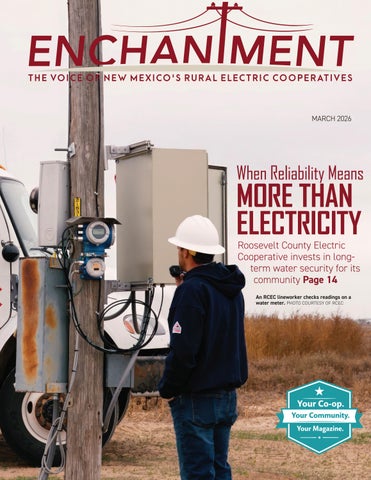
When Reliability Means MORE THAN ELECTRICITY

Roosevelt County Electric Cooperative invests in longterm water security for its community Page 14

An RCEC lineworker checks readings on a water meter. PHOTO COURTESY OF RCEC
Mar. 1, 2026 • Vol. 78, No. 3

USPS 175-880 • ISSN 0046-1946

Enchantment (ISSN 0046-1946) is published 10 times a year—every month except June and December—by the New Mexico Rural Electric Cooperative Association, 614 Don Gaspar Ave., Santa Fe, NM 87505. Enchantment provides reliable, helpful information on rural living and energy use to electric cooperative members and customers.

More than 113,000 families and businesses receive Enchantment magazine as electric cooperative members. Nonmember subscriptions are available at $12 a year or $18 for two years, payable to NMRECA. Allow four to eight weeks for first delivery.

PERIODICAL POSTAGE paid at Santa Fe, NM 87501-9998 and additional mailing offices.

CHANGE OF ADDRESS: Postmaster, please send address changes to 614 Don Gaspar Ave., Santa Fe, NM 87505-4428. Readers who receive the publication through their electric cooperative membership should report address changes to their local electric cooperative office.

THE NEW MEXICO RURAL ELECTRIC COOPERATIVE ASSOCIATION provides legislative and educational services to the cooperatives that are members of the association and deliver electric power to New Mexico’s rural areas and small communities. The mission of the New Mexico Rural Electric Cooperative Association is to strengthen, support, unify and represent cooperative member interests at the local, state and national levels. Each cooperative has a representative on the association’s board of directors, which controls the editorial content and advertising policy of Enchantment through its Publications Committee.

OFFICERS OF THE BOARD OF DIRECTORS

Tim Morrow, President, Springer Electric Co-op, Springer; Charles G. Wagner, Vice President, Western Farmers’ Electric Co-op, Anadarko, Oklahoma; Preston Stone, Secretary-Treasurer, Otero County Electric Co-op, Cloudcroft.

BOARD OF DIRECTORS

Rusty Gwynne, Central Valley Electric Co-op, Artesia; Bill King, Central NM Electric Co-op, Mountainair; Chris Martinez, Columbus Electric Co-op, Deming; Keith Gottlieb, Continental Divide Electric Co-op, Grants; Antonio Sanchez, Farmers’ Electric Co-op, Clovis; Manny Bustos, Jemez Mountains Electric, Española; Bobby Ferris, Lea County Electric Co-op, Lovington; James Ortiz, Mora-San Miguel Electric Cooperative, Mora; Thomas G. Rivas, Northern Río Arriba Electric Co-op, Chama; Eric Segovia, Roosevelt County Electric Co-op, Portales; Raymond Ruffini, Sierra Electric Co-op, Elephant Butte; Manny Gonzales, Socorro Electric Cooperative; Joe Reeser, Southwestern Electric Co-op, Clayton; Wayne Connell, Tri-State G&T Association, Westminster, Colorado.

NEW MEXICO RURAL ELECTRIC COOPERATIVE ASSOCIATION

614 Don Gaspar Ave. Phone: 505-982-4671 Santa Fe, NM 87505 Fax: 505-982-0153 nmelectric.coop Enchantment.coop

Vince Martinez, CEO

Tom Condit, Editor & Director of Communications

DISPLAY ADVERTISING: Rates available upon request. Co-op members and New Mexico display advertisers, email Ryan Ferguson at Enchantmentads@nmelectric. coop or call 409-313-3142. National representative: American MainStreet Publications, 800-626-1181. Advertisements in Enchantment are paid solicitations and are not endorsed by the publisher or the electric cooperatives that are members of the New Mexico Rural Electric Cooperative Association. PRODUCT SATISFACTION, COMPLAINCE WITH APPLICABLE ADVERTISING RULES AND REGULATIONS, AND DELIVERY RESPONSIBILITY LIE SOLELY WITH THE ADVERTISER. © 2026 New Mexico Rural Electric Cooperative Association, in partnership with Pioneer Utility Resources. Reproduction prohibited without written permission of the publisher.

Stories That Matter

Dear Members,

As early spring arrives across New Mexico, March’s issue of Enchantment reflects both renewal and recognition—celebrating the people, projects and achievements that make our cooperative communities strong.

This month, we’re proud to highlight Susan Valdez, formerly Susan Espinoza, our longtime editor whose dedication and leadership helped shape Enchantment for more than two decades. Her story reflects a deep commitment to cooperative principles and storytelling, and it’s an honor to recognize the lasting impact she has had on the magazine and the association.

You’ll also be introduced to a feature on Roosevelt County Electric Cooperative’s water storage project, led by CEO Eric Segovia. This forward-thinking effort highlights how cooperatives are investing in innovative infrastructure to support long-term reliability and sustainability for their members.

We’re also launching a new feature in Enchantment titled ReEnergizing Rural New Mexico. This section spotlights new businesses opening or expanding within cooperative communities across the state. Beyond recognizing new storefronts and facilities, the goal is to highlight the broader economic growth—job creation, local investment and renewed vitality in rural areas.

Electric cooperatives have long played a foundational role in economic development by providing reliable, affordable power that allows businesses to operate and grow. When a new business invests in a rural community, it represents more than commerce—it represents confidence in our towns and the people who call them home.

Our ReEnergizing feature is on Pearson Ranch Jerky, which plans to open a meat processing and packaging facility in a large vacant building in Socorro.

If you know of a recently opened or soon-to-open business in your co-op area, I encourage you to reach out. By sharing these stories, we not only celebrate local success—we help build momentum and visibility for continued growth across rural New Mexico.

March’s issue also celebrates achievement across our communities. We’re recognizing New Mexico’s high school state champions across a variety of sports, congratulating students and teams whose hard work and determination brought pride to their schools and hometowns.

Looking ahead, we’re inviting members to help shape future issues of Enchantment. We’re currently seeking:

• High school student features highlighting accomplishments in academics, athletics, leadership, service and the arts.

• Elementary student spotlights where younger members can share a photo and tell us about their school, hobbies, pets and what they like about their electric cooperative—because their voices matter, too.

• Member-submitted recipes celebrating family traditions and the flavors of rural New Mexico.

Enchantment belongs to you. Your stories, ideas and photos help bring this magazine to life, and your participation ensures it reflects the communities we serve.

As always, I’m here to listen. If you have ideas, stories, or content you’d like to share—or if you know someone who should be featured—I encourage you to reach out. Thank you for reading, and I hope you enjoy the March issue as we welcome a new season.

New Mexico Rural Electric Cooperative Association

Your Co-op’s Page

Your Co-op’s Page

Bringing It Back Home

Introducing ReEnergizing Rural New Mexico

I am happy to announce a new recurring column in Enchantment called ReEnergizing Rural New Mexico. This feature will highlight new business starting up in co-op service territories. Please reach out to us if you know of a recently opened or about to open new business in your area.

Our first new business will be Pearson Ranch Jerky, which plans to open a meat processing and packaging facility in a large vacant building in Socorro. We hope this new column helps new business gain a foothold in their community and will help reenergize rural New Mexico.

Vince Martinez

NMRECA CEO

BACKGROUND: Mountains rise above Bosque del Apache National Wildlife Refuge near Socorro. ADOBE STOCK PHOTO BY

Pearson Ranch Jerky plans to build a meat processing and packaging facility in Socorro

Pearson Ranch began in 1959, when Ken Pearson founded the ranch in Horse Springs, New Mexico, running cattle on a grazing allotment that defines much of rural New Mexico.

Today, that legacy continues under his grand-nephew, Marvin Cromwell Pearson—but with a modern twist.

“I started going down to the ranch in 1981,” Marvin says. “My great uncle retired in 1994, and I started running it.”

In 2000, Marvin expanded into raising elk—a highly regulated operation overseen by the State Game and Fish Department.

“With elk, you’ve got to have them tagged,” Marvin says. “You’ve got to have high fencing. All the newborns have to be tagged too. There’s a lot of regulation.”

With a growing herd they needed to find a way to market the meat. So, they started hauling elk to McPhearson, Kansas, the closest place to have them slaughtered under USDA inspection.

The meat would then go to a USDA inspected co-packer (also out of state) that would smoke, package

and label their Jerky, Summer Sausages and Snack Sticks. With hard work and God’s blessing the big break came. Pearson landed Bass Pro and Cabela’s as retailers for their products.

But the real turning point came in 2012. Marvin’s son Matt, a fourth generation rancher who now runs the meat company, said they could sell elk meat snacks anywhere, including convenience stores and travel centers.

“I told him it was more of a niche market,” Marvin recalls. “He proved me wrong.”

That year, Pearson Ranch Jerky became the company’s primary focus. Today, its products are sold in Bass Pro Shops, Cabela’s, Tractor Supply, Loves Travel Centers, Albertsons, Walmart, and roughly 3,500 convenience stores nationwide.

What began as a traditional ranching operation has evolved into a growing food manufacturing business rooted in New Mexico agriculture.

Despite its New Mexico identity, Pearson Ranch Jerky products currently complete part of their journey out of state. Meat is shipped to a USDA processing plant in Montana before being sent back to New Mexico as finished product.

“I don’t think that’s ideal,” Marvin says. “We want to stop that process of having somebody else make it. We want to make it ourselves.”

That vision has led to a proposed $4.2 million project in Socorro: converting a long-vacant building into a meat processing and packaging facility.

NINA

AMERICAN ENCORE

With its innovative design, modern comforts, and guest-focused philosophy, American Encore is not just a riverboat, it’s the finest expression of American river cruising ever built. Designed to host just 180 guests, American Encore features more square feet per guest than any other small cruise ship with the largest staterooms globally.

Ship

Adding weatherstripping on windows can help prevent drafts.

ADOBE STOCK PHOTO BY NEW AFRICA

The Brightest Stars in Our Skies

Following its emergence into evening twilight last month, our sister world, Venus, continues its gradual climb into our western sky. By the end of the month, it sets around the end of dusk.

Early in the month, it is joined by Saturn. The two worlds are visible close to each other on the evenings of March 7 and 8 as they head in opposite directions. Within another week, Saturn will have disappeared into the twilight.

Jupiter continues to be bright and easily observable during March, being close to overhead as darkness falls and later setting in the west during the midmorning hours. Toward the latter part of the month, Mercury appears during dawn, but it remains close to the horizon during twilight and will not be easy to see.

New Mexico will see a total lunar eclipse on the morning of March 3. The partial phase begins shortly before 3 a.m., with totality starting just after 4 a.m. and lasting for the next hour. The moon will remain low in the western sky throughout the eclipse and will set during the outgoing partial phase.

Six months later, on Aug. 27, we will see another lunar

eclipse—not total, but rather a deep partial eclipse—during the early evening hours.

The brightest star in our entire nighttime sky is Sirius, which shines in our southwestern sky during the evening. The secondbrightest star, Canopus, is also visible during the evening hours and rides just above our southern horizon.

Not too far south of Canopus—and thus not visible from our latitudes—is a star known as Eta Carinae. Normally, this star appears as nondescript and dimly visible to the unaided eye. About two centuries ago, it underwent a massive eruption and, for a brief period of time in the mid-1840s, was brighter then Canopus and almost as bright as Sirius. It faded dramatically shortly thereafter, but during the past few decades, it has again brightened. It is possible it could erupt again.

Eta Carinae is embedded within a large cloud of glowing gas known as the Eta Carinae Nebula. This is the largest and brightest nebula of its type anywhere in the sky, and it can easily be seen with the unaided eye from the Southern Hemisphere.

A photograph of the Eta Carinae Nebula is shown from the Kalahari Desert in Namibia in May 2013. Eta Carinae is the bright star slightly to the left of center. PHOTO COURTESY OF HAREL BOREN, LICENSED VIA CREATIVE COMMONS 4.0

Urgent: Special Summer Driving Notice

But When Driving, These Sunglasses May Save Your Life!

The sun rises and sets at peak travel periods, during the early morning and afternoon rush hours and many drivers find themselves temporarily blinded while driving directly into the glare of the sun. Deadly accidents are regularly caused by such blinding glare with danger arising from reflected light off another vehicle, the pavement, or even from waxed and oily windshields that can make matters worse. Early morning dew can exacerbate this situation. Yet, motorists struggle on despite being blinded by the sun’s glare that can cause countless accidents every year.

Not all sunglasses are created equal. Protecting your eyes is serious business. With all the fancy fashion frames out there it can be easy to overlook what really matters––the lenses. So we did our research and looked to the very best in optic innovation and technology.

Sometimes it does take a rocket scientist.

A NASA rocket scientist. Some ordinary sunglasses can obscure your vision by exposing your eyes to harmful UV rays, blue light, and reflective glare. They can also darken useful vision-enhancing light. But now, independent research conducted by scientists from NASA’s Jet Propulsion Laboratory has brought forth ground-breaking technology to help protect human eyesight from the harmful effects of solar radiation light. This superior

lens technology was first discovered when NASA scientists looked to nature for a means to superior eye protection— specifically, by studying the eyes of eagles, known for their extreme visual acuity. This discovery resulted in what is now known as Eagle Eyes

The Only Sunglass Technology Certified by the Space Foundation for UV and BlueLight Eye Protection. the most advanced eye protection technology ever created. The TriLenium ® Lens Technology offers triple-filter polarization to block 99.9% UVA and UVB—plus the added benefit of blue-light eye protection. Eagle Eyes® is the only optic technology that has earned official recognition from the Space Certification Program for this remarkable technology. Now, that’s proven science-based protection.

The finest optics: And buy one, get one FREE! Eagle Eyes® has the highest customer satisfaction of any item in our 20 year history. We are so excited for you to try the Eagle Eyes® breakthrough technology that we will give you a second pair of Eagle Eyes® Navigator™ Sunglasses FREE––a $59.95 value!

That’s two pairs to protect your eyes with the best technology available for less than the price of one pair of traditional sunglasses. You get a pair of Navigators with stainless steel black frames and the other with stainless steel gold, plus one hard zipper case and one micro-fiber drawstring cleaning pouch are included. Keep one pair in your pocket and one in your car.

confidence, knowing your eyes are protected with technology that was born in space for the human race.

Your satisfaction is 100% guaranteed. If you are not astounded with the Eagle Eyes® technology, enjoying clearer, sharper and more glare-free vision, simply return one pair within 30 days for a full refund of the purchase price. The other pair is yours to keep. No one else has such confidence in their optic technology. Don’t leave your eyes in the hands of fashion designers, entrust them to the best scientific minds on earth. Wear your Eagle Eyes®

with absolute

Bringing It Back Home

Continues from Page 6

“The building’s been vacant for almost six years,” Marvin says. “It’s an eyesore. When you’re trying to get kids to come to New Mexico Tech and they drive past vacant buildings, it sends the wrong message.”

The new facility would allow the company to process and package its products entirely in New Mexico—start to finish. Pearson Ranch Jerky currently employs 11 people in New Mexico. The proposed facility would create 22 additional jobs.

“It will help the whole state,” Marvin says.

The company produces elk as well as green and red chile meat sticks made with Hatch green chile. However, because processing occurs out of state, the products cannot qualify under the New Mexico True certification program.

“That’s the purpose of getting the facility here,” Marvin says. “So, everything can be start to finish in New Mexico.”

Pearson has also discussed potential partnerships with New Mexico State University to support value-added agriculture education.

“They asked if they could bring students up there to teach if we get this going,” Marvin says. “I said absolutely.”

He sees the effort as part of a broader opportunity for rural economic growth.

“We’re trying to attract top management for the plant from states where they get 22 weeks of winter,” he says. “They can come here, buy property, build a house, and live more economically.”

He believes revitalizing communities begins with local investment.

“It starts with people like us—employing locals and creating opportunities,” Marvin says.

Manufacturing costs in smaller communities like Socorro can be significantly lower than in larger metro areas. In Rio Rancho, Marvin notes, property taxes alone run about $24,000 per year on a comparable building.

“You can manufacture down there a lot cheaper,” he says.

For Pearson Ranch Jerky, the goal is straightforward: bring the process home, create jobs, and turn a vacant building into an economic hub.

“You’ve got to start somewhere,” Marvin says.

For more information on Pearson Ranch Jerky visit https://www.pearsonranchjerky.com.

Marvin Cromwell Pearson, left, founder of Pearson Ranch Jerky, meets with Rep. Meredith Dixon at the New Mexico Roundhouse. PHOTO BY MARCY L. HACKETT

More Than a Game

Mike Chambers enters NMAA Hall of Fame

Congratulations to Mike Chambers—a Continental Divide board member—on his induction into the New Mexico Activities Association Hall of Fame.

Mike is the 120th inductee into the NMAA Hall of Fame. This recognition comes after his more than four decades of service as an educator, administrator, coach, official and committee member supporting high school athletics across New Mexico.

Dana Pappas was also inducted to the Hall of Fame. Dana, the 121st inductee, was honored for her longtime leadership and service within the association.

The formal induction ceremony is March 12. The luncheon is at the Albuquerque Marriott Pyramid hotel during the state basketball tournament.

Congratulations, Mike! This recognition reflects a lifetime commitment to education, mentorship and service, and is a well-deserved honor.

To watch the Hall of Fame Class of 2026 induction ceremony, visit bit.ly/4cyWjNF or scan the QR code at left.

www.nmact.org/2026/01/nmaaannounces-hall-of-fame-class-of-2026

Mike Chambers, back row third from left, has more than 40 years of service in New Mexico high school athletics. PHOTO COURTESY OF MIKE CHAMBERS

WHEN RELIABILITY MEANS MORE THAN ELECTRICITY

Roosevelt County Electric Cooperative invests in long-term water security for its community

For Roosevelt County Electric Cooperative, reliability has always meant delivering safe, affordable electricity to its members. But in recent years, cooperative leadership began to see another critical issue affecting that same mission—water security.

“As an electric cooperative, we strive to serve safe, reliable, affordable electricity,” Roosevelt County Electric Cooperative CEO Eric Segova says. “To keep electric rates affordable, we need to have steady sales that—at a minimum—keep up with inflation.”

In recent years, water concerns in the Portales and Roosevelt County areas were beginning to slow economic development, which in turn led to declining electric sales. Concerns about water availability had become widespread.

“There was a growing sentiment in the area that Portales and Roosevelt County were out of water,” Eric says.

In response, RCEC’s board of directors made an important decision.

“Our board of directors decided to get involved in wholesale water for two reasons: to relieve the community of water concerns, and to help stabilize electric

sales by providing the water necessary to allow the community to continue to grow economic development and residential projects,” Eric says.

To address those concerns, Roosevelt County Electric hired a water expert and bought 31 water wells. Those wells can produce more than double the water required by the local municipal water system.

The project also supports conservation efforts by converting water rights from agricultural use to municipal use. New Mexico state law sets different levels of allowable water consumption for agricultural and municipal use, with the municipal levels just one-third of the allowed agricultural draw.

“We will now only consume roughly a third of the water from these wells compared to the agricultural use beforehand,” Eric says. “This is good for conservation of the aquifer.”

Eric’s connection with the cooperative runs deep. A professional engineer, he earned his electrical engineering degree at New Mexico State University and began working for Roosevelt County Electric as an intern while still in college.

Over three summers and winters, he worked primarily

in the field with the metering department.

“It was a great experience and really opened my eyes to all the things that an electric cooperative does,” he says. “Before my internship, I had no idea what happened in that old brick building downtown.”

The experience left a lasting impression.

“I fell in love with the cooperative and its member-focused mindset, and I was super impressed with all of the behind-thescenes work that goes on,” he says.

After briefly working for Lea County Electric Cooperative, Eric returned to Roosevelt County Electric, where he served as engineering analyst, operations engineer, engineering manager and now general manager. He says working in the field helped shape his leadership approach.

“Seeing how hard our crews work in all types of weather and how much they care about our members is a humbling experience,” Eric says.

He wishes everyone could see that

commitment come together during the organized chaos of the co-op’s responses to major storm damage.

“Each department plays their part, and the team shows its true colors as they all selflessly coordinate to get the lights back on for our members,” Eric says.

As CEO, Eric evaluates projects through the cooperative’s mission. RCEC initially worked to support other water entities to solidify local water access, but after more than a year of stalled efforts, the cooperative stepped forward.

“That’s when we knew we needed to step up and put our engineering and procurement expertise to work,” Eric says. “Our mission is to serve safe, reliable, affordable electricity to our members. Sometimes you have to step outside of

These pump controls integrate with RCEC’s SCADA system, letting co-op staff monitor and control water production and flow rates from the co-op’s command center.

the box to ensure you can fulfill the mission.”

The project brings advanced technology into water operations.

The well field will be integrated with RCEC’s SCADA system, allowing staff to control water production, flow rates and individual wells from the cooperative’s command center.

Some co-op members initially questioned why an electric cooperative was involved with water. RCEC addressed those concerns through five public meetings, explaining how the project supports economic development, residential growth and electric rate stability.

“I believe we have eased the concerns of our members and have overwhelming support for our project,” Eric says.

He sees the project as innovative and necessary. The cooperative believes the project will support Portales and Roosevelt County for decades while conserving the aquifer.

Eric says Roosevelt County Electric is not alone in expanding beyond traditional electric services.

“Many cooperatives have started projects outside of electricity to help their communities and members’ needs,” he says. “I would have never dreamed we would have hired a water expert and be working on such an impactful water project. It is exciting to be able to help a community in need.”

For Roosevelt County Electric, water is only the first step.

“Step two is to promote commercial and residential growth,” Eric says.

The cooperative works closely with partners such as the Roosevelt County Community Development Corp., Eastern New Mexico University and the city of Portales to ensure the community is positioned to benefit from the increased water supply.

Ultimately, Eric hopes members understand the cooperative’s goal is to provide real benefits for their community.

“I hope our members know that we are working hard to ensure electric and water security so that we all can continue to live in the place that we call home,” he says.

CLOCKWISE FROM TOP LEFT: Roosevelt County Electric Cooperative water operations manager Kendall Mudgett, engineering manager Jeremy Neal, and warehouse manager Chris Valdez review well designs. The wells have SCADA-enabled pump controls.
PHOTOS COURTESY OF ROOSEVELT COUNTY ELECTRIC COOPERATIVE

A Chapter of Service, a Story of Love

Susan Valdez, former Enchantment editor, reflects on caregiving, cooperative principles and two decades at NMRECA

“Stella! Stella! Where are you?”

“I’m right here, Mamacita.”

Susan Valdez pauses when she tells the story. Even now, the moment still carries weight.

Her name isn’t Stella. It’s Susan. But sometime in October 2024, Stella became her name—at least to her mother.

At first, Susan thought her mother was calling out for her baby sister—Susan’s Aunt Stella. After all, Stella had been on the phone often and visiting frequently. But the questions continued. The calls didn’t stop.

Then it became clear.

Her mother wasn’t asking for her sister. She was asking for her.

That realization marked the beginning of a new chapter—one defined by caregiving, sacrifice, love and responsibility.

Susan has been caring for her mother for nearly six years, as dementia continues its steady progression year after year. Before becoming her mother’s full-time caregiver, Susan spent more than two decades building a career with New Mexico Rural Electric Cooperative Association in Santa Fe.

But one evening, a phone call from her brothers changed everything. Their concerns were mounting: the stove left on, items misplaced, frequent falls, sleeping at odd hours.

Susan visited every weekend and noticed changes, but her brothers lived next door. They saw the day-to-day reality.

One Friday evening after work, Susan

arrived for a visit and found her mother making tortillas on an electric griddle— placed directly on a stove with open flames underneath. The smell of melting plastic filled the room. She turned off the burners immediately and rushed her mother outside for fresh air.

That night, Susan called her brothers. It was time to come home.

Soon after, her mother was diagnosed with dementia. The decision was clear but not easy.

Susan loved her job, and she loved the people she worked with. For more than 20 years, she served as editor of Enchantment—the voice of New Mexico’s rural electric cooperatives. Like many who work in the cooperative world, Susan describes NMRECA not just as a workplace but as a family.

Publishing Enchantment required patience, perseverance and collaboration. Behind every issue were countless moving parts: story development, editing, design, advertising, budgeting, printing, labeling and mailing more than 100,000 copies across the state.

For Susan, one moment never lost its significance. When the magazine went to press, knowing it would soon arrive in homes, schools, libraries and legislative offices across New Mexico was always a moment of relief and pride. A team effort, completed.

To Susan, Enchantment was far more than a magazine. It was an avenue of information about electrical safety, energy efficiency and legislative issues at the state and national levels. It was a place

to tell the stories of vecinos (neighbors) and businesses, to celebrate heritage and culture, and, yes, to share recipes and astronomy columns.

Most importantly, the magazine is a direct connection between electric cooperatives and the members they serve. Through Enchantment, CEOs and general managers communicate with their members, address concerns and share updates about their cooperatives.

The publication evolved over the years—from newspaper tabloid to the magazine readers know today—but its purpose never changed: to inform, engage and connect.

One cooperative principle always resonated deeply with Susan: Democratic Member Control. Month after month, she attended NMRECA board meetings, listening as trustees—elected by their members—discussed issues affecting cooperatives and communities across the state.

Outside the meeting room, conversations centered on families, ranching, farming, hobbies and grandchildren. But once the gavel struck, the focus was clear. Board members, general managers and staff were there to protect the interests of cooperative members.

Susan attended countless annual meetings hosted by member cooperatives throughout New Mexico. Each meeting reflected the cooperative model in action—members engaging with boards and employees, youth being recognized for scholarships and contests, and communities coming together.

From the audience, Susan witnessed gratitude expressed openly—members thanking employees and trustees for keeping the lights on and supporting their

communities. Those moments reinforced why cooperative governance mattered.

Susan’s final day at NMRECA was filled with emotion. As she gathered her belongings, she felt the weight of leaving behind a professional family that weathered challenges, celebrated successes and built something meaningful together.

Before walking out, she paused to say farewell to Carl Turner, a former CEO and longtime supporter of electric cooperatives.

As she closed the door, she caught the familiar scent of his cigar pipe. In that moment, she knew he was saying goodbye in his own way.

Susan’s story is one of service—both public and deeply personal. For more than 20 years, she helped tell the stories of New Mexico’s rural electric cooperatives, ensuring members stayed informed, connected and engaged.

Today, she tells a different kind of

story—one shaped by caregiving, love and devotion to family.

Though she stepped away from her role at NMRECA, the cooperative principles she lived by—responsibility, community and service to others—remain woven into her life.

Some chapters close. Others continue.

The most meaningful stories, Susan reminds us, are often the ones written quietly, behind the scenes.

Susan Valdez retired from the New Mexico Rural Electric Cooperative Association to care for her mother.
PHOTO BY RENEE ESPINOZA

Congratulations, Champions

From football fields to gym floors to baseball diamonds, student-athletes across rural New Mexico delivered exceptional performances during the 2025 season.

Spring 2025

Baseball & Softball

X 4A Baseball: Artesia High School

X 2A Baseball: Santa Rosa High School

X 1A Baseball: Magdalena High School

We’re proud to recognize the following teams from NMRECA member service territories who earned NMAA state championship titles.

Fall 2025

Football

X 5A: Artesia High School

X 2A: Texico High School

X 8-Man: Fort Sumner/House

X 6-Man: Logan High School

Volleyball

X 1A: Quemado High School

Winter 2025

Basketball

X 2A Boys: Texico High School

X 2A Girls: Tatum High School

X A Boys: Logan High School

X A Girls: Roy/Mosquero

High School Student Spotlight

Our High School Student Spotlight highlights students in grades 9–12 from cooperative communities by sharing a photo and a brief introduction about their school, activities and extracurriculars, hobbies, what they enjoy about their local electric cooperative and their goals for the future.

To nominate a student for an upcoming High School Student Spotlight, send their name, contact information, school, activities, achievements and interests to tcondit@nmelectric.coop.

Simple, Steady Meals for Spring

March in rural New Mexico is a pause. Snow still lingers in the shade, but the ground begins to soften. Crews are back out checking lines, ranchers are watching the weather closely and kitchens turn toward lighter meals that still offer warmth.

Early Spring Green Chile Lentil Pot was created for those in-between days—simple, nourishing and built to stretch without waste. This dish is a quiet-season meal for when winter loosens its grip.

This month, mornings start earlier and days grow longer. Ranch Morning Skillet Eggs with Potatoes and Red Chile offers a steady start before the long day. This skillet is crafted to share and easy to prepare before heading out. It’s the kind of breakfast that sits in the center of the table, where everyone takes what they need before the day pulls them in different directions.

Early Spring Green Chile Lentil Pot

1 cup dried green or brown lentils, rinsed

1 tablespoon oil

1 small onion, diced

2 cloves garlic, minced

1 cup roasted New Mexico green chiles, chopped

1 small carrot, finely diced

1 teaspoon ground cumin

1/2 teaspoon dried oregano

4 cups water or light vegetable broth

Salt and black pepper, to taste

• Heat oil in a medium pot over medium heat. Add onion and carrot, and cook until softened.

• Add garlic and cook briefly, just until fragrant.

• Stir in green chiles, cumin and oregano.

• Add lentils and liquid. Bring to a gentle boil, then reduce to a simmer.

• Cook uncovered for 30-35 minutes, stirring occasionally, until lentils are tender but intact.

• Season to taste, and serve warm with tortillas or crusty bread.

Ranch Morning Skillet Eggs with Potatoes and Red Chile

2 tablespoons oil or butter

2 medium potatoes, diced small (skin on)

1/2 small onion, finely chopped

1 teaspoon New Mexico red chile powder

4 eggs

Salt and black pepper, to taste

• Heat oil in a cast iron skillet over medium heat.

• Add potatoes and cook, stirring occasionally, until golden and tender, about 12-15 minutes.

• Add onion and cook until soft.

• Sprinkle red chile powder, salt and pepper evenly over the potatoes.

• Create small wells and crack eggs into them.

• Cover and cook until whites are set but yolks remain soft, or cook to preference.

• Serve directly from the skillet.

THE MARKET PLACE

Animals

MEAT RAMS AND EWES FOR SALE. Raise your own meat! This breed, called ‘Rocky Mountain Big’ are very large cross bred Rambouillet/Suffolk sheep specifically bred for raising meat instead of wool. Rams are quite gentle weighing about 350+ pound and with right nutition produce single 7-8 pound lamb at birth, also twins. Lincoln, NM 575808-2711 (text only).

CHAROLAIS BULLS FOR SALE. Yearlings at $3,000. 2 yr olds at $3,500. Good Bulls for a reasonable price. Call 575-815-8155. If no answer send text. Tucumcari Area.

Business

SANTA FE LATH & PLASTER. New construction, Re-stucco, specializing in Diamond Finish. Serving the East Mountains for 10 years. Licensed, Bonded and Insured. Free Estimates (505) 577-2272.

ATTENTION BUSINESSES! We now offer advertising space available at Theresa’s RV Park and Beauty Shop. 6253 N. HWY 550. Cuba, NM 87013. Billboards or sign space available. Call 575-289-3244.

Equipment

IRRIGATION PIPE FOR SALE. Used PVC and Aluminum gated and non gated pipe for half price of new. Butterfly Valves, T’s, Elbows, plugs, Bonnets, ETC. Delivery Available. Call Sierra (575)770-8441

SUPERIOR WATER STORAGE TANKS FOR PEOPLE, CATTLE, RAINWATER, FIRE PREVENTION. Many sizes. Best Prices. 575-682-2308

3/4 TON ALFALFA BALES FOR SALE. Call 505-681-8545.

2, 4 FT. X 5FT6IN STALL GATES. $50 EACH. 575-849-2844.

Great Finds

BUYING OLD GAS PUMPS, PUMP PARTS, OIL CANS, GLOBES, ADVERTISING SIGNS THERMOMETERS CLOCKS, OLD LICENSE PLATES, OLD NEON SIGNS. Call the Gas Guy in Embudo 505-852-2995. Have TruckWill Travel.

EZWELL REMEDY MASSAGE SYSTEM WITH SHIATSU AND HEATH THERAPY. Improve your blood circulation. Reduce pain and muscle soreness. Decrease stess and promote relaxation. $100. Call Patricia at 505-373-7531.

HUNTERS * STARGAZERS * MOONBEAM

CABIN AIR BNB IN THE VILLAGE OF DATIL, NM. Hunting units. 12.16E. 13. 15.17. Block from store, gas restaurant. Light restricted skies. 15mi to Very Large Array. Airbnb.com for photos, questions, bookings. Pet considered.

Real Estate

TUCUMCARI-1120 S SARATOGA, (Also next to US 54/Mountain Road) $20,000. City water close by. Big Mesa Realty, 575-4562000, Paul Stout, Broker 17843, 575-760-5461. www.bigmesarealty.com.

DATIL/PIE TOWN AREA- 0000 4 HERRINGTON CANYON ROAD, 20+/ACRES EAST OF HERRINGTON CANYON ROAD. North of Sawtooth Mountains and Cibola National Forest. $12,000. Big Mesa Realty, 575-456-2000, Paul Stout, Broker 17843, 575-760-5461. www.bigmesarealty.com.

PIE TOWN- 78 E SAWTOOTH DRIVE, SAWTOOTH MOUNTAIN SUBDIVISION

LOT 41. 14.43 acres vacant land. Views of Sawtooth Mountains. Close to Pie Town. $35,000. Big Mesa Realty, 575-456-2000, Paul Stout, Broker 17843, 575-760-5461. www.bigmesarealty.com.

TUCUMCARI-1516 S SECOND STREET, Three bedroom, two bathroom home with garage and carport. $70,000. Big Mesa Realty, 575-456-2000, Paul Stout, Broker 17843, 575760-5461. www.bigmesarealty.com.

CANADIAN RIVER-WEST UTE LAKESIX 40 ACRE +/- PARCELS. LAKE AND MESALANDS VIEW. Call for showing and pricing. Owner Financing Available. Big Mesa Realty, 575-456-2000, Paul Stout, Broker 17843, 575-760-5461. www.bigmesarealty.com.

MILAGRO- 0000 PECOS SPUR, PORTILLO CREEK RANCH SUBDIVISION. Tract 6, 164 acres. Partial fencing. Wide open space. $80,000. Big Mesa Realty, 575-456-2000, Paul Stout, Broker 17843, 575-760-5461. www.bigmesarealty.com.

MAGDALENA-0000 TBD STATE ROAD 169, 1.28 ACRES. Great mountain views 15 miles from Magdalena. Borders Cibola National Forest. Hunting potential. $15,000. Big Mesa Realty, 575-456-2000, Paul Stout, Broker 17843, 575-760-5461. www.bigmesarealty.com.

DATIL/PIE TOWN AREA- 0000 3 HERRINGTON CANYON ROAD. 40+/- acres west of Herrington Canyon Road. North of Sawtooth Mountains and Cibola National Forest. $19,000. Big Mesa Realty, 575-456-2000, Paul Stout, Broker 17843, 575-760-5461. www.bigmesarealty.com.

EASTERN NEW MEXICO- LET US SELL YOUR LARGE ACREAGE WORKING FARM OR RANCH. Broker is farm owner/operator and lifetime New Mexico resident. Big Mesa Realty, 575-456-2000, Paul Stout, Broker 17843, 575-760-5461. www.bigmesarealty.com.

10 ACRE LOTS WITH POWER AND WATER, GOOD ACCESS, SECURITY GATE. Beautiful views. 3 miles north of Villanueva, NM. Owner financed. Contact Doug Baltzley @505-690-0308.

88 ACRES OF TREES AND MEADOW WITH NICE 2 STORY HOME 2500 SQFT, 4 BEDROOM 3 BATH 3 CAR GARAGE. 36x36 4 stall Barn Master barn. Large arena in Tijeras,NM $965,000. Moonlight Realty 505 281 4425 MLS 1095185.

To Place a Classified Ad

1. Visit www.enchantment.coop/classifieds and complete form. You will be contacted by email with price and deadline to submit check or money order.

2. Ads will not be accepted over the phone.

3. Or, complete form and select category.

4. Write ad on another sheet of paper.

5. Price: $1.25 per word. For example: 40 word ads are $50 80 word ads are $100

To Send and Pay Your Classified Ad

1. Mail ad and payment (Payable to NMRECA)

NMRECA • enchantment 614 Don Gaspar Ave. Santa Fe, NM 87505

1/4 ACRE LOT IN ELEPHANT BUTTE,109 NAMBE LOOP. All utilities included. 14ft RV canopy. 4 minutes from the Lake. $65,000. Call 575-449-9954.

SOCORRO, SAN MARCIAL-SOUTH OF SAN ANTONIO-WILLOW SPRINGS SUBDIVISION- 16A WINCHESTER, 161 ACRES. Great views in the Chupadera Mountain foothills. $105,000. Big Mesa Realty, 575-456-2000, Paul Stout, Broker 17843, 575760-5461. www.bigmesarealty.com.

Vehicles

2007 CHEV SILVERADO 3500 CREW CAB LT4WD SRW 8 FT FLAT BED,6.6L V8 T-DIESEL 240,OOO MILES. Sale Price $9200.00. 575-849-2844.

1997 CHEVY EXT CAB 4X4 5.7L FLATBED 1 ton Power everything Cold AC New Tires Tow Pk 250K miles $8K BO !996 Chevy Blazer 4x4 120K Miles Power everything New Tires 4K BO 505-302-8052 Both run Very Good.

Deadline

1. Due the 7th, one month prior. Ads due Mar. 7 for the April issue. Good to Know

1. Only members of New Mexico electric cooperatives may place ads.

2. We reserve the right to reject any ad.

4. Advertisements in enchantment are paid solicitations and are not endorsed by the publisher or the electric cooperatives of New Mexico.

5. PRODUCT SATISFACTION, COMPLAINCE WITH APPLICABLE ADVERTISING RULES AND REGULATIONS, AND DELIVERY RESPONSIBILITY LIE SOLELY WITH THE ADVERTISER.

6. Enchantment prints monthly, except for June and December. Questions? Call: 505-982-4671. Name: Address:

Cooperative:

Select Category Below

Animals Great Finds

AROUND NEW MEXICO

New Mexico’s rural communities, served by electric cooperatives across the state, are surrounded by breathtaking deserts, mountain ranges, and more than 50 national and state parks. From quiet villages to historic cities such as Santa Fe and Taos, the Land of Enchantment blends Native American, Mexican and Spanish cultures into something truly unique. Here are upcoming local events happening in the co-op areas and beyond:

Las Cruces Farmers & Crafts Market

When: 8:30 a.m. to 1 p.m., Saturdays

Where: Downtown Main Street, Las Cruces

This year-round market spans seven blocks of downtown Main Street and features nearly 300 rotating vendors. Browse local goods, arts and jewelry, tasty bites and live music. visitlascruces.com/things-to-do/shopping/farmerscrafts-markets

Indoor Farmers and Vendors Market

When: 8:30 a.m. to 1 p.m., Saturdays

Where: Farm and Ranch Candle Co., Roswell Shop local and browse sourdough, awardwinning jams, hand-poured candles, tallow soaps, farm-fresh eggs and more. facebook.com/farmandranchcandles

Riverblitz

When: 7-11 a.m., March 7

Where: Pecos River, Eddy County

Join in this annual event aimed at cleaning up littered areas along the Pecos River. carlsbadchamber.com/copy-of-events

Teen Ski Week

When: March 8-21

Where: Taos Ski Valley

More turns, less talk, high-energy skiing for those 14 and up. This ski week includes 21/2 hours of coaching for six days. To book, call 800-776-1111 or visit skitaos.com/lessons. skitaos.com/events

RockHound RoundUp

When: March 12-15

Where: Deming

Rock collectors join fossil fans, jewelry makers,

lapidaries, quartz traders, beaders and people who simply admire rocks for three days in Deming. The schedule includes a buyer’s market, silent and live auctions, displays, demonstrations and guided field trips for rock collecting and sampling. demingnmtrue.com/event/rockhound-roundup-2

Battle of Blue vs. Red

When: 6 p.m., March 14

Where: Encanto Event Center, Roswell

Get ready for a knockout night of boxing headlined by the Roswell fire and police departments, joined by fellow agencies from across the region. tinyurl.com/blue-vs-red

Dancing with the Eddy County Stars

When: March 20

Where: Walter Gerrells Performing Arts and Exhibition Center, Carlsbad

Join United Way of Eddy County for a glamorous charity fundraiser in the style of “Dancing with the Stars.” Local celebrity “stars” pair with dancers for performances, audience voting and entertainment to support community programs. facebook.com/carlsbadlive

Cardboard Derby

When: 8 a.m. to 1 p.m., March 21

Where: Sipapu Ski & Summer Resort, Vadito Build your own vessel using only cardboard,

Include Your Upcoming Event

duct tape, string or twine, and paint at this family-friendly event. Race individually or with a team down the mountain for your chance to win a prize. sipapu.ski/event/cardboard-derby

Rally in the Valley

When: March 21-22

Where: Base of Lift 1, Taos Ski Valley

Support the Field Institute of Taos at this event hosted by Taos Ski Valley and New Belgium. This on-mountain scavenger hunt is for all ages. skitaos.com/events

Spring Family Carnival

When: 7-9 p.m., March 27

Where: Martinez Flea Market, Roswell

This year’s spring carnival features new games, prizes, face painting, light up golf and more for the whole family. roswell-nm.gov/calendar.aspx?CID=33

4th Annual 5k Road to Recovery

When: 10 a.m. to noon, March 28

Where: Wool Bowl Track, Roswell

This community event is focused on raising awareness, honoring lives lost, supporting recovery and reminding everyone they are worth recovery. This event is open to runners, walkers, families and supporters of all ages and abilities. tinyurl.com/5k-road-to-recovery

Chokecherry Scramble

When: 7:30 a.m. to 3 p.m., March 28

Where: Glade Run Recreation area, Farmington Ride with the New Mexico Race Collective in the Chokecherry Scramble II, part of the 2026 Desert Championship Race Series. This is an epic opportunity to take part in off-road motorcycle racing in the Glade Run Recreation area. farmingtonnm.org/events/chokecherry-scramble

Send your event details to eventcalendar@nmelectric.coop. Include the event title, date, town and a summary of the event. Include the event website address so readers can get additional event information. Submit the event notification at least 60 days before the event to meet our press deadline. Space is limited, and events are published at the discretion of the editor.

ADOBE

How Energy-Efficiency Rebates and Incentives Work

A common question I get about energyefficiency rebate programs is, “Why would the company that sells me energy want me to use less of their product?”

It’s a good question.

Rebates provide financial incentives for people to use less energy in their homes by reducing the costs of energy-efficient upgrades, such as insulation, new HVAC systems, water heaters or other appliances. This helps your electric utility save money by eliminating or delaying the need to buy additional power or build new power generation facilities.

Using less energy also helps lighten the load on existing generation and transmission infrastructure that delivers power to your home through your electric utility.

Helping consumers save energy is a powerful tool for electric utilities. Instead of building or paying for more power generation to meet rising needs in the local community, electric utilities create programs that help people save energy in their homes and businesses.

Some utilities and local organizations have energy-efficiency programs with special incentives for home upgrades, such as rebates paid after a project is completed. State and federal tax credits may allow you to reduce the amount of taxes you owe for completing eligible home purchases or upgrades. Federal energy-efficiency tax credits ended Dec. 31, 2025. If you completed any upgrades

before that date, apply for credits on your 2025 federal filings.

Some utilities also offer low-interest or on-bill financing that lets you pay for upgrades over time—through a financial institution or on your monthly electric bill.

Energy-efficiency programs are funded through a variety of sources, including surcharges on customer utility bills, grants, and state and federal funding. Some states and regions are required by law to provide energy-efficiency programs.

If you plan to buy new appliances or equipment, or complete an efficiency upgrade, do your research first. I recommend starting with your electric utility to see if it offers energy-efficiency programs. Also check with your state energy office, which might have additional programs to help.

The Inflation Reduction Act allocated federal funds to state-administered programs, including home-efficiency, electrification and appliance rebates, to help residents with retrofits, such as windows, insulation, air sealing, HVAC equipment and appliance upgrades.

There are also income-eligible programs for energy assistance and weatherization, such as the U.S. Department of Energy Weatherization Assistance Program, which is typically administered by a local community action agency.

Once you identify a rebate, tax credit or financing option you’re interested in, check the criteria carefully. Criteria can vary by program, so make sure you know the eligibility requirements before buying

to avoid missing out on energy-saving opportunities.

Some programs require preapproval before you begin a project. Proof of existing equipment or conditions may be required, such as insulation levels or window types. You may need an audit by a program representative or photo documentation.

Once you know your project meets the requirements of any available programs, you can proceed with installation. You will likely need to complete an application and submit a final invoice to confirm the project is complete. You may also need to submit pictures or have an inspection from a program representative.

Once approved, your rebate will typically be issued as a bill credit or check.

Participating in a rebate program can help you lower your energy use, save money and improve comfort in your home. It can also help your energy provider and the electric grid. Contact

Miranda Boutelle has more than 20 years of experience helping people save
She has worked on energyefficiency projects from the Midwest to the West Coast.
Today, Miranda is chief operating officer at Efficiency Services Group in Oregon, a cooperatively owned energy-efficiency company.

Co-op Coloring

Electricity can come from all sorts of friendly places. Pick your colors, draw away and bring this scene to life!

Beyond

The blue star is the standard, but how else can consumers make efficient

If you’re in the market for major appliances, you’ve probably noticed the Energy Star logo. It may appear on the bright yellow EnergyGuide labels that make it easy to compare one

choices?

federal rebates, looking for the Energy Star label is still the best way to be sure you’re investing in an efficient appliance that will lower your energy bill without sacrificing performance. But it isn’t the only way to keep track of how much energy your new purchase uses.

Following are ways you can ensure you’re choosing the best new appliances and equipment for your home.

By the Numbers

Many appliances in your home or on the market have efficiency benchmarks you

cooling accounts for nearly half of the energy used in most homes, making it an area where greater efficiency can have the most noticeable impact. Much like cars have a miles-per-gallon rating, air conditioners and heat pumps have a seasonal energy-efficiency ratio. A higher SEER rating means a unit is more efficient and uses less energy over the course of a typical season.

You may also run into energy-efficiency ratios. While similar, SEER ratings measure average efficiency over an entire season, whereas EER ratings judge cooling capacity performance during peak periods of extreme hot temperatures.

Clothes washers. Similarly, the modified energy factor accounts for energy and hot water consumed during each wash cycle. It also accounts for how much moisture the washer leaves on clothes for a dryer to remove. The higher the MEF, the more efficient it is.

If you’re concerned about water use, the water factor is also worth keeping an eye on. Windows. As one of the largest sources of heat gain and loss in a home, the efficiency of windows can’t be overlooked.

If you’re in the market to upgrade, keep an eye on the U-factor, which measures how well a window insulates, and the solar heat gain coefficient, which tells you how much heat the window lets through. Whether you prioritize U-factor or SHGC largely depends on your area’s climate and which direction the windows are facing.

In the market for something specific? Most major household products and appliances have efficiency ratings just like these. Visit the Department of Energy or Environmental Protection Agency’s websites for more information on which ones to look to as a guide for making your own energy-efficient purchase.

Ways to Save

Rebates through Energy Star may be a thing of the past, but there are still ways to get help with energy-efficient investments. Rebates established under the Inflation Reduction Act on the state level are still options, but availability depends on where you live. Some states have started offering their own point-of-sale or mail-in rebates, so be sure to check what is available in your area.

In addition, your local electric utility may offer rebates of its own. Many have rebate pages on their websites where you can find forms to save on smart thermostats, efficient HVAC units, heat pumps and more.

Even if direct rebates aren’t available, you may still be able to save by including efficient appliance purchases as part of a qualifying home improvement deductionwhen filing taxes.

The Energy Efficient Home Improvement Credit and Residential Clean Energy Credit expired Dec. 31, 2025, but there is still time to apply the credit to purchases made before that deadline. Some states continue to offer their own tax credits for energy-efficient investments, so be sure to check what is available where you live.

While buying an Energy Star-certified appliance may still be the easiest way to make efficient purchases for your home, it isn’t the only option. By paying extra attention to efficiency ratings for specific appliances and staying on top of rebates and tax incentives in your area, you can cut back on your upfront costs and energy bills over time.

What’s Behind the Star?

Whether it’s a label on your new appliance or a logo on the EnergyGuide label, Energy Star certification gives buyers confidence they’re investing in long-term savings. But what does that blue star actually mean?

Energy Star is a program established by the U.S. Department of Energy and the Environmental Protection Agency to help consumers find energyefficient products and reduce their impact on the environment.

To earn the certification, products must perform more efficiently than the average model while providing the same level of performance. But that isn’t where the process ends.

Each product is tested in EPA-recognized labs using standardized procedures to make sure it meets Energy Star requirements. Once testing is complete, a third-party certification group reviews and verifies it before a product gets the Energy Star label.

Earning that certification still isn’t the end. The EPA conducts random, off-the-shelf testing of Energy Star products to make sure they still meet those high standards. If a product fails one of these verification tests, it may ultimately be disqualified and lose Energy Star certification.

Cooperative Youth Art

Congratulations to the winning artists who drew a garden blooming with their favorite flowers and critters.

Jose Ponce de Leon • Age 12

Jemez Mountains Electric Cooperative La Puebla

Harris • Age 9

Central New Mexico Electric Cooperative Stanley

Lauren Gardner • Age 5

Otero County Electric Cooperative La Luz

Jemez Mountains Electric Cooperative Española

Sorin Bailey • Age 7

Mora-San Miguel Electric Cooperative San Jose

April topic: Happy Earth Day! Take a walk in nature and choose a small item you find—such as a leaf, flower or stone—and bring it back to draw.

Send your drawing to:

By mail: Youth Editor 614 Don Gaspar Ave.

Santa Fe, NM 87505

By email: tcondit@nmelectric.coop

Deadline: Submit by the 9th, one month prior to publication. Winners receive a $15 gift card and are featured in the magazine.

Have a Youth Art topic?

Email or mail to the addresses at left or call 505-982-4671.

Checklist

Include the following five items on the back of your drawing, otherwise you are disqualified:

First and last name

Age

Mailing address

Phone number

Electric co-op

Artwork accepted up to age 13.

Lydia
Javier Gallegos • Age 8
Camila Povencio • Age 5 Columbus Electric Cooperative Las Cruces

Turn static files into dynamic content formats.

Create a flipbook