variety of high-achieving students; Texas is one of the largest, if not the largest chapter, so when students go to state, they’re competing against thousands of students, which is very valuable.”
Early exposure to professional environments can make future career paths feel more accessible, particularly for young women interested in business-related fields Blanton gave her biggest piece of advice to DECA members:
“Network,” Blanton said. ”You never know the connections you will make. This could look like talking with upperclassmen or students from other schools Anytime you get a chance to
meet someone, do not be afraid to take it. People will really want to share their knowledge with you especially because they value your passion for the competition.”
DECA gives students early exposure to leadership and professional expectations, helping them see business as something tangible. For many students, international competition becomes an opportunity for growth.
“DECA helps many young women see that they belong in business,” Blanton said “That
sense of belonging builds confidence and changes the way they approach leadership, opportunity and their future ”
While the Hockaday Bookstore has always offered snacks to keep students energized throughout the day, student-run businesses bring something more meaningful to campus. These businesses don’t just fuel students; they also help the owners gain entrepreneurship experience By choosing to support student entrepreneurs, Hockaday students are both enjoying homemade treats and investing in their peers and their local causes. Among these entrepreneurs are senior Emily
McLeroy and junior Lina Kessaissia who have each used their passions for baking to create and manage their successful student businesses. McLeroy took over Eva’s Cookies from Eva Spak ‘24 after she graduated, hoping to continue the business as a success The two originally worked together in Baking Club, where McLeroy developed her baking skills.
“We have a spreadsheet with average pricing for all of our ingredients and recipes, and we check it often to make sure our values still reflect current prices for supplies,” McLeroy said. She uses this data, along with the time she spent baking to determine prices that keep the business affordable and sustainable for students In addition to in-person sales at the Hockaday Bookstore, the cookies
are also available through the company‘s website Promotion has largely relied on word of mouth, though Eva’s Cookies also advertises on Instagram at @evascookiesdfw
“The most rewarding part of managing Eva’s Cookies is hearing people tell me that they like the cookies and watching people enjoy them throughout school,” McLeroy said
However, running a business has not come without challenges Through Eva’s Cookies, McLeroy has learned the importance of trial and error and strong problemsolving skills, especially when ensuring orders are completed on time despite setbacks
“I’ve learned a lot about finding creative solutions to unexpected problems,” McLeroy said Adjusting recipes when they do not turn out as expected or adapting to uncontrollable circumstances has proven difficult, but these experiences have ultimately strengthened her resilience and business skills
Kirumaki with fellow 2024 DECA
ICDC qualifiers in Anaheim, California
PHOTOS COURTESY OF KIRUMAKI
PHOTO COURTESY OF MOSS
Kessaissia launched her baking business, Lina’s Kookies, in May 2024 Her business idea began to take shape when a neighbor welcomed her family with homemade chocolate chip cookies after they moved to Dallas in 2020.
“I wanted to recreate that same generosity and sense of community through my business,”
Kessaissia said.
Like McLeroy, Kessaissia tracks her expenses in a spreadsheet She plans recipes ahead of time and orders ingredients in advance to ensure she has enough inventory to meet demand. This preparation allows her to stay organized and avoid last-minute stress.
FEATURES
Kessaissia said “Each batch teaches me something new, and I constantly find ways to improve them.”
Lina’s Kookies are sold in the Hockaday Bookstore, and Kessaissia is also in the process of creating a website
“I want to be able to expand delivery and orders across Dallas and help the business grow,” Kessaissia said. “To get my cookies sold in the Bookstore, I had to reach out to [Hockaday’s] Chief Financial Officer and work with her to price the cookies affordably for customers while ensuring I covered costs, [paid for] supplies and made a reasonable profit ”
To advertise, Kessaissia mainly relies on word-of-mouth from customers. She also plans to promote her business on Instagram @linaskookies, where she will share new flavors, upcoming launches, behind-thescenes baking photos and ordering information
“The most rewarding part of owning Lina’s Kookies is receiving both positive and constructive feedback on my cookies,”
Through running her business, Kessaissia has learned the the importance of cleanliness in food preparation and how to keep her kitchen and supplies as sanitary as possible. She has also developed stronger time-managemen skills as she balances school responsibilities with baking while learning how to avoid becoming overwhelmed. One of the biggest challenge she has faced is staying motivated during slower weeks when she doesn’t sell as much. Rather than feeling discourage Kessaissia views these momen as opportunities to reflect on what could be improved Overcoming these challenges h helped Kessaissia build her confidence and resilience as a young entrepreneur.
Through Eva’s Cookies and Lina’s Kookies, McLeroy and Kessaissia have proven that student-run businesses can be both successful and meaningfu What began as a love for bakin has transformed into opportunities to develop leadership and entrepreneursh skills. By supporting these businesses in the Bookstore an beyond, students are not only enjoying homemade treats but also encouraging innovation a entrepreneurship in the Hockaday community
Launched Lala’s Cupcakery in 2024. Her business offers custom floral cupcakes with fresh fillings made to order. The business is rooted in a larger mission, with all profits going toward monthly personalized birthday cakes for unhoused children at a local shelter in Dallas, Texas.
L A L A ’
FOLLOW HER INSTAGRAM TOLEARN MORE!
Freakonomics
A review of Freakonomics, the book and podcast
Many people are under the unfortunate misconception that economics is a dull subject regarding supply and demand curves and stiff suits talking about Gross Domestic Product (GDP). However, economist Steven Levitt and journalist Stephen J. Dubner, authors of Freakonomics and its long-running podcast, have a different, much more chaotic and exciting definition of economics
For them, economics is not just about studying money: it is the study of incentives, the unseen forces that shape lives and society.
BOOK OVERVIEW
The Core Concept: Incentive
At the heart of the book is a simple, maybe a little cynical, truth; the world is governed by incentives, and people respond to them There are specifically three different types of incentives: economic, social and moral. Economic incentives have to do with money or tangible rewards, influencing decisions through financial gain and material benefits.
Audrey Lee, Staff Writer
Social incentives are related to how one portrays or wants to be portrayed, in their communities and societies.
Moral incentives concern one's conscience: doing the right thing.
Levitt and Dubner demonstrate how these incentives often interact in peculiar ways that defy “conventional wisdom,” a term that the authors dismiss as commonly accepted and comforting beliefs that cater to self-interest and convenience rather than accuracy.
For example, when looking into the effects of incentives at a daycare, their experiment showed that charging a fine actually increased the number of parents who picked up their kids late They attributed this to the fact that the small fine turned a heartwrenching moral “fine” (the guilt of being late) into an inexpensive fee of $3.
As a student, understanding incentives helps to decode and break down one’s environment, community and society Through these lenses, human behavior suddenly stops being so arbitrarily random and starts being more predictable.
Top Takeaways
While reading through the book, I enjoyed reading the numerous lessons and concepts explained through surprising, unexpected real-world examples Among the numerous lessons, here are some of my personal takeaways:
Correlation does not equal causation: Just because two things occur together does not necessarily mean that one was the cause of the other. For example, a question that helps to articulate this idea is: do books at home make kids smart or do smart kids have books at home? Or is there another completely unexpected factor influencing both? Information asymmetry: experts, such as real estate agents, often leverage their knowledge to their own personal benefit when they are supposed to aid their clients.
PODCAST OVERVIEW
If you prefer deep dives into modern, unconventional topics such as “Why is the IQ of the World Rising?” subscribe to their podcast.
The Freakonomics Radio, run by co-author Stephen J. Dubner, works to further break down almost-arbitrary topics using a unique viewpoint rooted in economics Designed to challenge conventional wisdom, the podcast truly helps listeners to think about the world in a different way.
THE VERDICT
If you seek “mind-blowing” moments, reading the book first is a must. With chapters dedicated to strange, unimaginable questions, Freakonomics, the book, takes seemingly common events and shines light upon the true, hidden workings behind them.
Established in 1912, Girl Scouts was created for the purpose of cultivating an empowering and encouraging environment to enable girls to unlock their potential as leaders. Founded by Juliette Gordon Low in Savannah, Georgia, the organization first began with a single troop of just 18 girls but quickly evolved into a movement that spread across the nation A variety of opportunities, such as badge programs, outdoor adventures and service projects encouraged girls to explore their interests and develop their character. This movement established a lasting legacy of preparing young women to contribute meaningfully to their communities and beyond
Girl Scout Personal Experiences
Hockaday junior Anusha Chowdhary has been a Girl Scout since she was in first grade.
“I loved going to camp when I was little every year with my friends and meeting new people,” Chowdhary said “People who I wouldn’t have known if I didn’t join Girl Scouts are really close to me now that we’re all older, and it feels like a great community.”
Hockaday junior Kora Thomas joined in kindergarten, since her mom was a Girl Scout and her brother was a Boy Scout.
“It felt natural for me to be involved,” Thomas said “I loved all the arts and crafts we did and spending time with friends As I have gotten older, my favorite activities have switched to camping, leadership opportunities and mentoring younger Scouts.”
Entrepreneurial Skills
Girl Scout cookies might seem like just a simple seasonal treat, but their success can be credited to the uniqueness of their business model Each year, the cookies are only available for a limited time, which incentivizes individuals to purchase. At the same time, the wide range of flavors, encompassing a total of 18 different types, from Thin Mints to Samoas, allows the brand to appeal to different tastes and a wider scope of consumers. What makes it even more compelling is the strength and presence of the brand itself. With its long history, it has become something people recognize and trust With young girls tasked to
sell as many boxes of cookies as possible, Girl Scout cookies represent a foundational introduction to entrepreneurship. Each Girl Scout acts as a small business owner. They have to manage everything from advertising to customers, managing inventory and learning how to be persuasive all while trying to sell as many boxes of cookies as they can. They have to learn how to be strategic with attracting customers, whether by going door-to-door or setting up stands in public places with high influxes of traffic.
A central tenet of Girl Scouts is figuring out how to smartly manage money. Troops plan and finance their own activities and troop leaders coach Girl Scouts on how to manage troop funds. Troop activities use money from councilsponsored product program activities and other dues. Girl Scouts also has financial literacy badges that encourage their scouts to practice skills like creating a budget, setting goals and making smart decisions.
Managing their Girl Scout cookie sales provides opportunities to practice these skills.
“It taught me how to manage money because one time I lost 10 dollars of sales, and when I was little, 10 dollars was a lot,”
Chowdhary said. “I had to pay that out of my own money That’s taught me to be careful and do t like set a budge keep track of things and be organi ed ”
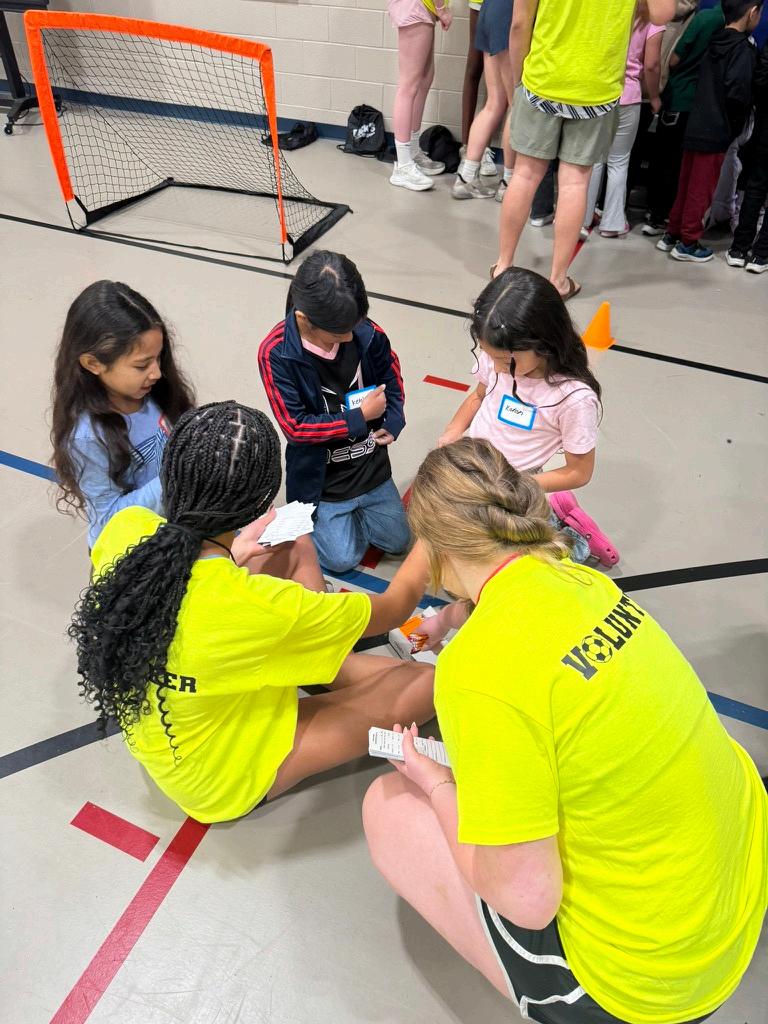
Thomas leads a sports activity for students to learn about teamwork and athletic skills
PHOTO COURTESY OF KORA THOMAS
or success
ess
skills to young girls
Vivian Zhou, Chief Operations Officer
Additionally, developing skills in budgeting, saving and goal setting to fund troop activities and support personal projects are essential.
“Girl Scouts taught me money management through cookie [sales] and fall product sales, where we learn entrepreneurship firsthand,” Thomas said “Through this experience, I also became more aware of financial inequality and was surprised by how many people in our community live at or below the poverty level. That perspective motivated me to be more intentional about using what I earned to give back.”
served as the basis of her interactions with customers.
“In middle school, I used to go knocking on my neighbor’s doors,” Chowdhary said. “[I would] go door to door, interact[ing] with new people who didn’t know the flavors and didn’t know anything about Girl Scout Cookies ”
Evident in Chowdhary’s experience, selling Girl Scout cookies is inherently beneficial in developing communication and persuasive skills.
Girl Scouts champions the growth and development of interpersonal skills, and for Chowdhary, those lessons are imperative for meeting her goals when selling cookies. Through her many years of experience, she has learned how to approach conversations with strangers with confidence. As a part of the nature of selling Girl Scout cookies, it’s erative for Chowdhary to gain oad consumer base to make most sales have to interact with strangers ecause if I just try to sell to my close friends, I won’t get too many sales, since they will y a few boxes,” ry said.
hing out means more just asking for a rchase As a child, face-face communication
As Chowdhary engaged with more and more people, not only did she increase her sales, but she grew as a person.
“This helped me come out of my shell, meet new people and try to find new places to sell my cookies,” Chowdhary said.
Girl Scouts also develops leadership skills, encouraging older scouts to lead activities and troops.
“Over time I have transitioned from participating in activities to leading them and mentoring younger girls,” Thomas said. “It taught me to take initiative, overcome challenges and stay committed to goals ”
Girl Scout Competition
Advertising, especially with many Girl Scouts in one area, is incredibly important. Girl Scouts learn how to get more customers, appeal to them and ultimately sell the most cookies. They often employ different techniques to be more popular both with immediate acquaintances and with strangers Speed and promptness are some of
GIRL SCOUTS STATS:
200,000,000 boxes of cookies sold yearly
≈$1,000,000,000 in yearly revenue ≈300 average boxes sold by an individual scout
109 years since the first Girl Scout cookie was sold
“I’m also coordinating and talking to a lot of different teams to get the project up and running ”
Furthermore, Thomas’s Gold Project has already made substantial progress within the community. Her initiative, titled “Breaking Barriers: Making Sports Accessible for Kids in Underserved Communities” features free clinics and mentorship opportunities to make youth sports more accessible Thomas organizes coaching partnerships between studentathletes and young kids, helping them build the confidence to engage in sports in the long-term.
“I’ve partnered with Dick’s, Sam’s Club, Jimmy John’s and a local business to sponsor a soccer clinic and created soccer skill videos that kids could access from different mediums,” Thomas said. “The goal was to create a sustainable model that expands access, builds confidence and strengthens community connections, not just for soccer.”
SISTERHOODACROSSDIVIDES
The Complex Legacy of Diversity in Girl Scouts
When Juliette Gordon Low founded Girl Scouts, she envisioned a space where girls could build confidence, develop leadership skills and explore opportunities beyond traditional gender roles, including outdoor adventure and community service. However, its commitment to inclusion was challenged by a segregated society. While it promoted “sisterhood,” many early troops were segregated, and Black girls often faced barriers to participation.
At the same time, Girl Scouts became a powerful force for expanding opportunities for girls from underrepresented communities. Across the country, Black women worked tirelessly to establish troops for their daughters despite discrimination. Leaders such as Josephine
Holloway organized troops for Black girls in Tennessee during the 1930s, creating opportunities where none previously existed. Their efforts not only increased access to Girl Scouting but also challenged the exclusionary norms of the era. For many young women, particularly those from marginalized communities, Girl Scouts provided a pathway to leadership and civic engagement. Over time, the organization took more active steps toward integration and inclusion. By the late 20th century, diversity had become a central component of the Girl Scout mission. Today, Girl Scouts serves girls from a wide range of racial, cultural, religious and socioeconomic backgrounds, continuing to emphasize belonging and representation.
An African American Girl Scout troop photographed in Tallahassee, Florida, March 1960
PHOTO COURTESY OF THE HARVARD GAZETTE
Makes no cents
As the penny loses its financial value, its elimination is reshaping the nation
Audrey Lee, Staff Writer
In 1792, the first U.S. penny was coined. After over 230 years of continued history, the American penny has finally met its “end.” In a 2025 executive directive, the production of the penny was suspended due to its no longer apparent necessity in the United States. Although pennies may still be used for transactions, the suspension of pennies has acted as a catalyst for change, impacting businesses and customers nationwide.
Nearest Five Cent Incremental Rounding
Businesses are now encouraged to round cash transactions to the nearest nickel, as cash registers can no longer easily dispense pennies.
HOW TO ROUND DOWN:
If the total ends in 01 or 02, businesses round down to .00. If the total ends in .06, or .07, businesses round down to .05.
HOW TO ROUND UP:
If the total ends in .03 or .04, businesses round up to .05. If the total ends in .08, or .09, businesses round up to .00.
The Reason for
Change
Digital Paywall Impacts
This does not impact electronic payments. The termination of the penny will not have any rounding impacts to payments with credit cards, debit cards or digital wallets
However, for consumers paying with cash, this new incremental rounding system may affect psychological spending habits. According to the Federal Reserve, in terms of the number of payments, cash accounts for approximately 14% of all purchases in the United States. Additionally, a report by the Atlanta Federal Reserve Bank found that 83% of adults used cash to pay for at least one purchase in the previous month Charm pricing is a psychological pricing technique often used by businesses in order to give the illusion that prices are cheaper due to the left-digit bias. For example, a product costing $4.99 may seem significantly cheaper from a product costing $5.00, despite having only a single cent difference, as people often only focus on the four and considerably underestimate the true cost.
However, the termination of the penny effectively diminishes the effect of the left-digit bias with its incremental rounding system, at least for those paying with cash
The decision, according to the United States Mint, was due to the increased costs of penny production: from 1.42 cents to 3.69 cents per penny.
In simpler terms, producing a singular penny was costing the government almost a whopping four cents With the suspension of the penny, approximately $56 million are expected to be saved per year Beyond immense savings, this termination will also help to alleviate the environmental damage and pollution that was previously caused by penny production.
Challenges for Small Businesses
Small businesses have been influenced more severely relative to larger businesses Due to the termination of the penny, many small businesses are unable to provide exact change As a result, these businesses are often rounding down in order to satisfy consumers, resulting in significant losses in the long run
The attention deficit
The
struggle to monetize journalism in an attention economy
Aria Knepler-Pearl, Staff Writer
For more than a decade, digital paywalls have been hailed as the answer to journalism’s financial woes. Paywalls charge for readership among users, making them a promising source of revenue for digital media publications. Yet today, many news organizations are abandoning those same paywalls.
In today’s attention economy, information is no longer hard to come by; however, time, loyalty and trust are scarce. Hockaday junior Jenny Chu, Features Editor of the Hockaday newspaper, The Fourcast, provides insight into how teens view paywalls.
“Paywalls are kind of this eponymous symbol of things being blocked off by money,” Chu said
According to Pew Research Center, quality journalism is more important than ever in a world where 72% of adults across 25 nations say the spread of false information online is a major threat to their country, but paywalls often clash with how audiences discover, value and access information online
Hockaday Upper School journalism teacher Kristy Rodgers received her journalism education degree from University of North Texas and has taught the subject since 1995. She describes herself as a lifelong consumer of news and said that she has always been skeptical about the paywall model
“Anything that slows down your reader from clicking right into a story and engaging immediately is a deterrent,” Rodgers said.
Now that audiences encounter journalism through search engines and social media feeds, information is only ever a click
away, and paywalls interrupt this frictionless experience When a reader hits a paywall, the easiest reaction often isn’t to pay but to find a cheaper alternative.
“If I clicked and hit a paywall, and I really wanted to read about that topic, I would go find another source that was free,” Rodgers said.
According to a 2025 Pew Research Center survey, 74% of Americans run into paywalls when they are looking for news online, but only 1% pay to access it. This low conversion rate reflects consumers’ perception that news as a product is not worth paying for in the same way as other services, especially in an era of digital information overload While elite outlets with strong brands have managed to make subscriptions work, most news organizations lack that level of differentiation.
“I’ll only subscribe to something that I know I'm going to use over and over,” Chu said. “So I don't know if those loyalty-based monetization systems are that helpful ”
The attention economy, a system that treats human attention as a rare commodity, rewards quantity over quality, especially in an abundant online landscape. Platforms like Google and Meta dominate digital advertising, together expected to account for over half of global digital ad spending in 2025 to 2027, according to Axios Meanwhile, news sites shoulder the costly work of producing journalism.
“You can't get the whole picture of news in just five seconds with a clickbaity reel,” Chu said. “With
the transactional nature of the economy right now, it's really hard to get to the heart of journalism.”
To keep up with the attention economy, many news outlets are now experimenting with alternatives like metered paywalls, memberships, donations, events, branded content and platform partnerships Rather than charging for access alone, these models monetize belonging, identity and added value
“Shifting away from the constant paywalls and providing at least even a limited amount of news for free, which a lot of publications do now, will continue to help,” Rodgers said Ultimately, the fall of paywalls is not because journalism lacks worth, but because of the difficulty of monetizing news in an attentiondriven economy According to the Bureau of Labor Statistics, newspapers lost 77% of their jobs between 2004 and 2019, a decrease in profitability amplified by the internet With the dynamic nature of 21st-century news, print papers struggle to keep up with the constant changes
“The future of journalism is definitely online,” Rodgers said Online, where attention is scarce and competition is infinite, the true challenge is not producing news but convincing consumers it is worth supporting
“It must be really hard for [news organizations] to figure out other ways to keep their journalism alive,” Chu said “In this day and age, you have to fight for people’s attention ”
Sold out in seconds
How scarcity, seasonal drops and limited editions uniquely drive profit
Vivian Zhou, Chief Operations Officer
Lines snake across the local Starbucks as students rush in, eager to taste test their latest seasonal drop before it disappears from the menu. Fueled by the fear that the item will sell out within minutes, shoppers wait across the nation to purchase a limited stock of sweatshirts from clothing brand Parke.
Regardless of what the product is, this phenomenon is quite common A limited edition product is one that is available only for a restricted period of time or in a restricted quality Unlike permanent menu staples or regularly stocked items, limited edition goods are intentionally temporary By being marketed as temporary on purpose, the product’s longevity, or the lack thereof, drives consumers to want to purchase it before it’s gone forever.
Scarcity as an Economic Tool
At the core of this phenomenon is a basic principle: supply and demand. When supply decreases while demand remains high, the perceived value of the product rises As a result, its price rises but so does consumers’ willingness to pay Scarcity increases the perceived worth of an item because consumers interpret limited availability as increased desirability. Therefore, if an item is likely to sell out, it must be valuable.
Businesses intentionally leverage this phenomenon. They recognize that limited availability creates a feeling of urgency among consumers, and this urgency directly mobilizes consumers to take action Instead of postponing their purchase and thinking about it, buyers feel pressured to act immediately because they are unable to delay the purchase any further
Fear of Missing out
Fear of Missing Out (FOMO) amplifies this effect When consumers see others lining up or posting their purchases online, they are influenced to purchase the products themselves. This scarcity directly plays into emotional appeal In the end, the economic benefit flows to corporations, who make money as a result.
Drop Culture
Outside the food industry, brands like Parke rely on “drop culture,” a strategy in which products are released in intentionally limited quantities at specific times, often selling out before demand is fully met. By restricting supply, the brand ensures that not everyone who wants a sweatshirt can obtain one. Consumers who were unable to snag a product the first time are left waiting and anticipating for the next drop This deliberately creates an illusion of exclusivity Owning a limited sweatshirt is tied to a special status; the fact that not everyone can have it increases its appeal. Across industries, limited edition products demonstrate how businesses manipulate supply and follow trends to influence consumer behavior. Whether through rotating menus, seasonal drinks, nostalgic returns or exclusive drops, companies chase an influx of sales through a carefully planned model.
Limited Editions
Scarcity also thrives on nostalgia. Taco Bell frequently reintroduces discontinued menu items as limited edition items. Driven by nostalgia and the fear that it will disappear again, this strategy ensures that consumers who once loved the item are guaranteed to purchase it again because of the connection they already had with the item
Starbucks operates similarly through seasonal menus: Pumpkin Spice is a fall staple, and holiday drinks match the festive spirit in the wintertime When Starbucks confines certain beverages to specific times of the year, it creates a connection that compels consumers to purchase them during that season. Limited edition items also tend to be more expensive, though not by much. Because demand surges within a short timeframe while supply is deliberately restricted, companies justify an increase in price.
This is not just a marketing ploy; it creates a strategic testing ground. Companies can gauge consumer demand and receive feedback on limited products before committing to long-term production If sales spike, brands are likely to continue the momentum But when the product fails, they do not have to suffer losses from long-term inventory commitments
ECONOMY
A ROTATIONAL MODEL
No company has perfected novelty quite like Crumbl Cookies What differentiates Crumbl from other cookie businesses, and even from many companies across industries, is its weekly rotating menu. At the start of each week, a new lineup of flavors is revealed. While a few classics remain constant, other flavors rotate in and out periodically, and some disappear entirely once the week is over. This model creates a cycle of anticipation. It guarantees consumer engagement as they eagerly try this week’s flavors or wait for a new batch next week.
The inherent novelty of Crumbl’s menu is also tied to social media trends. In 2025, flavors like Dubai chocolate skyrocketed in popularity online Crumbl quickly capitalized on its influence and adapted quickly by introducing its own takes on this trend, including a Dubai chocolate cookie and Dubai chocolate brownie
With the rise of mukbangs, online videos in which creators film themselves eating large quantities of food, consumers feel more compelled to document their limited edition purchases. Posting about these exclusive drops often generates significant views, which motivates them to keep up with each new menu release. At the same time, audiences who repeatedly encounter these videos are encouraged to join the trend themselves.
Free at a price
Companies profit from forgotten subscriptions
Lauren Haas, Chief Education Content Manager
Free. One of our favorite words as a society. Free shipping, free apps, free trials and free samples all turn heads and tempt consumers. Getting benefits or goods without assuming the cost that comes with them is tantalizing, and marketing knows it But nothing truly comes for free, so what do “free” things really cost?
To trace this development, look at the evolution of a product and trace its journey through the supply chain. Everything starts as raw material, some unprocessed resource that is harvested or collected in some way and bought by a supplier The raw materials bought by the supplier are then turned and sold to factories for assembly and production. From there, factories sell products to distributors, who accumulate goods and transport them to retail, who then sell the products to consumers. By the time an item is accessible, it has reached the culmination of its transformation and transportation, constantly getting marked up at every stage to account for things like transportation fees and ensure each business along the way makes a profit.
Following suit, retail stores mark up items on sale to ensure they make a healthy profit, and for every product they don’t sell, they lose that profit margin in addition to their original payment. So clearly, every time a store offers a “free” sample, it costs them Every time a streaming platform offers a “free” trial and access to their content, they are paying for it Why would they assume this cost? Spoiler: it is not out of the kindness of their hearts. It feeds into the growing marketing strategy of subscription trapping. The art of subscription trapping has been carefully studied and perfected by companies across the nation They make signing up seamless but canceling difficult and convoluted to boost the retention rate of customers from their trial subscriptions. On average, according to a PYMNTS.com survey, Americans let $450 drain from their accounts every year to forgotten subscriptions with 42% of all consumers continuing to pay for unused subscriptions Companies acquire these forgotten sums through efficient and effective use of auto-renewal payment services, counting on consumers to simply
enter their credit card information and quietly forget about it.
According to a Gadget Review article, over $30 billion of the $492 billion subscription economy comes from accidental, uncancelled subscriptions. Business Insider reported that many people remain subscribed to unused services simply because navigating the complex cancellation process is “too annoying.” An entire industry is thriving off of the human tendency to get distracted and forget. Out of sight, out of mind. There are multiple preventative steps that can be taken to protect you from traps like these. The first step is to recognize the areas where you currently spend unnecessarily. Make time to cancel those subscriptions, take time to find resources to help navigate the process and most importantly, stay organized and alert going forward when dealing with “free” anything. If an interesting service offers a trial that feels useful, read their cancellation policy, set reminders to actually follow through and stop your hard-earned revenue from falling silently into the laps of the subscription economy.
Lessons with Leah
Scaling the business ladder while staying true to yourself
Claire Gicheru, Staff Writer
Leah Frazier, founder of Think Three Media, has worked in fashion, media and public relations for years in Dallas. After a career as an attorney, Frazier pivoted to work in fashion and media full time.
“[While I was an attorney], I started a part time business in fashion,” Frazier said “It was really just personal shopping for women just like me: busy women who have busy lives.”
When Frazier decided to start her own fashion blog and quickly amassed success from it, she realized that her heart was no longer only in practicing law.
“I was going to New York Fashion Week, meeting designers and covering fashion and trends,” Frazier said. “When I moved back to Dallas in 2010, I started [doing] the same things, but Dallas’s fashion industry was on a much larger scale, [which] forced me to leave my full-time job as an attorney in 2015.”
Frazier made observations of the needs of those around her as she created Think Three Media
“I noticed that a lot of the businesses I was interviewing needed help with marketing, media, storytelling, news and press,” Frazier said. “That is when Think Three Media was born.”
With years of experience, Frazier has been able to see firsthand that the factors that make a company “influential” are actually very simple: authenticity and relatability.
“I think that an influential brand really has its hands on the pulse of their customers,” Frazier said. “They know their audience, and they speak to the heart of their audience I teach people that brands need to feel like a living and breathing thing ”
As both a creative marketing and communications agency, Think Three Media helps businesses maximize their potential financially and provides them with the ‘microphone’ they need for their voices to be heard.
“There was an organization that was trying to alert the public about what was going on at the juvenile justice detention center in Dallas,” Frazier said. “They were trying to protect the kids. Nobody was listening, so they got us involved.”
After holding a press conference, Frazier and her team were able to raise awareness for the detention center like never before
“We released the results of a report that validated everything that they were saying,”
Frazier said “And before you know it, they're calling me [saying that], ‘this is more coverage, press and media than we've gotten on this issue in over a decade.’”
Among her numerous other pursuits, Frazier also owns a yoga studio. With the pressure and demands that come with her job, practicing meditation helps her feel centered and in control
“My stress [and blood sugar] had gotten so bad that my doctor told me if I didn't get it under control, I was going to have a stroke,” Frazier said. “Being mindful allows you to really cement yourself in the present moment, so you don't get stressed out about what's happened or what's coming ”
Frazier realized the importance of listening to her heart and pursuing her passions. She turned her dreams into reality and refused to let fear or ‘what-if’s’ hold her back.
“[There was a study where] somebody went into a senior care facility and asked a majority of the folks that lived there what their one regret in life was,” Frazier said “A lot of them said they didn't do the things that they wanted to do; they allowed fear to hold them back. I'm 43, and I can say that I'm good. I have done everything, most of everything that I've wanted to do.”
Frazier highlights that the key to remaining fulfilled and obtaining the success she always wanted is introspection
“When you don't have anybody cheering you on, you're still going to do it because you're staying true to who you are,” Frazier said. “[Introspection] is your internal compass and your GPS. It will dictate who you are, where you go and how you lead for the rest of your life ”
Making room at the table
Representing the next women in finance
Anya Hegde, Staff Writer
Finance shapes markets, industries and everyday life, from mortgage rates to medical research funding Yet, women remain underrepresented in leadership While they hold about half of entry-level financial service roles, their presence drops sharply at senior levels, especially in investment banking and private equity. That gap is not lost on college students preparing to enter the field.
At Columbia University, students like sophomore Diya Hegde, majoring in Economics, and sophomore Mali Gilbert, majoring in Biomedical Engineering, see finance not just as a career path but as a platform for influence. For Hegde, founder and president of Women of Wall Street (WOWS) at Columbia, the turning point came during the Texas freeze in 2021
“While I was volunteering and helping distribute supplies to families who had lost power, I watched how failures in energy infrastructure were playing out in the public markets,” Hegde said. “That moment made me realize how deeply interconnected realworld events and capital markets have become ”
When she arrived in New York, proximity to Wall Street made that realization even sharper. But she also noticed how intimidating the space could feel for women entering it. That awareness led her to launch WOWS, an organization focused on mentorship, professional development and building confidence among young women interested in finance
“Visiting banks and speaking with alumnae helped me understand what I wanted in a career,” Hegde said. “I realized how important it was to create spaces where women feel
supported as they navigate the process.”
Gilbert, Vice President of WOWS, started her path inside a biotech startup, where she observed venture capital meetings and fundraising strategy sessions.
“I realized I wanted to be the one allocating capital to bright founders to help fund the future of healthcare,” Gilbert said.
Both describe the industry as powerful and demanding.
“Finance affects businesses, employees and entire communities,” Hegde said “That impact comes with responsibility ”
“You make decisions that can shape industries,” Gilbert said. “That opportunity is exciting, but it also requires careful thought.”
For women entering the field, that responsibility often includes navigating unspoken expectations
“Finance is a relationship-driven industry,” Hegde said “Many of the most valuable lessons I've learned have come from upperclassmen and professionals who were willing to share their experiences.”
Both students emphasize that finance is more accessible than it appears from the outside.
“My biggest advice would be to stay curious and learn the why behin techn
Thr and c Gilbe how indus step i helpi persp and c
“I d finan see it to ke every decision with purpose.”
Passion meets pointe
Local female entrepreneur Alina Khoo uses her platform to empower young dancers
By Ally Liew, Allen Chapter Head
Starting a business is a goal many young girls dream of. But as these girls get older, many give up for reasons like a lack of confidence or support.
A 2019 study of 1,200 people by Forbes magazine found that 73% of female versus 59% of male participants cited fear of failure as the main demotivator of starting a business and 64% of females versus 50% of males said that not knowing how to fund start-up costs was another barrier. While males often feel more ready to start a business, women may feel less inclined due to persistent gender imbalances
Alina Khoo, owner of AK Dancewear in Lewisville, Texas, began her business in 2018 with a similar sense of uncertainty. She lacked the financial background and experience many believe are necessary to start a business, but that didn’t deter her from pursuing her passion
“I learned a lot along the way ” Khoo said. “I did my research, asked questions, made mistakes sometimes costly, and kept improving. Running a business teaches you very quickly how important it is to understand numbers, planning and long-term strategy.”
Even though she began witho feeling fully ready, Khoo built h brand little by little, focusing on the goal that kept her driven throughout the process.
“I wanted AK Dancewear to become a trusted name for aspiring dancers, professionals, parents and studios, while build a community that supports and uplifts the next generation of dancers,” Khoo explained.
Her journey was not always easy, especially in the early stag
“In the early stages, everything feels uncertain, from production to cash flow to brand awareness,” Khoo said “There were definitely moments that felt overwhelming What kept me going was staying focused on our dancers and our mission. I learned to take challenges one step at a time and to treat problems as things to solve, not signs to quit.”
Now, AK Dancewear serves thousands through its online platform and hundreds more through pop-ups across the United States at Youth America Grand Prix (YAGP), the world’s largest scholarship ballet competition. PHOTO COURTESY OF HANNAH FANG
Khoo realized that entrepreneurship isn’t easy, but the results proved to be rewarding. Through her work, she has connected with young artists and studio owners, as well as mentored others, sponsored events and built
gained priceless financial experience throughout the process.
“The biggest lesson is to respect cash flow,” Khoo said “Revenue is exciting, but managing expenses and planning ahead is what keeps a business healthy. I also learned the importance of growing sustainably rather than too quickly. Smart, steady growth builds a much stronger foundation.”
Today, AK Dancewear has reached dancers around the world with a cumulative following of over 20,000 across social media platforms Khoo has also built a close-knit but global community, connecting with dancers from New York, all the way to Singapore.
As Khoo continued developing her business, she found that achieving financial independence also gave her greater freedom of choice and the ability to make an impact
“When you have resources and stability, you can support scholarships, community programs
AK Dancewear flagship store
Liew speaks with Khoo in the AK Dancewear store.
PHOTO COURTESY OF ALLY LIEW
and causes that matter to you,” Khoo said. “It turns good intentions into real action.”
WOMEN IN LEADERSHIP
like autism awareness felt very aligned with who we are as a brand and as people.”
Khoo said this led to a growing sense of responsibility to support young dancers and promote inclusivity using her platform. One way she has done this is by autism, particularly in the dance community.
“Our brand has always been community driven,” Khoo said. “As we grew, I felt a responsibility to use our platform for something meaningful beyond products. Dance is about expression and inclusion, so supporting causes
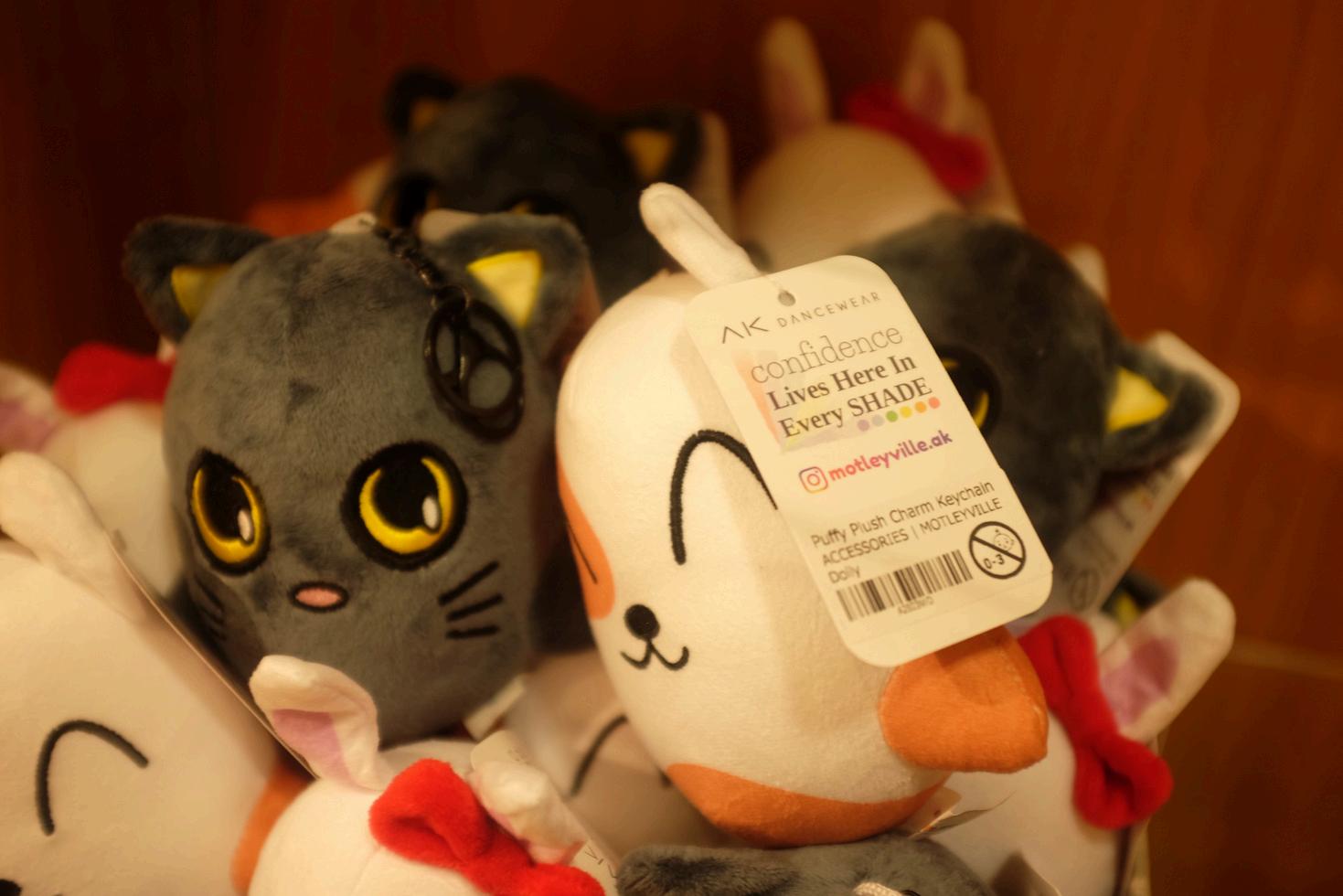
Khoo later created Motleyville, an initiative within AK Dancewear, devoted to creating a space where people feel inspired to express themselves individually
“Motleyville’s mission is to bring joy, comfort and emotional connection to the world through thoughtful, character-driven creations,” Khoo said. “We wanted to build something that feels warm, imaginative and supportive, especially for someone who may need a little extra encouragement or reassurance.”
Through Motleyville, Khoo has seen real impact in the way young dancers connect with the friendly characters.
“It reminds me that a brand can create happiness and comfort, not just products,” Khoo said.
For her, owning a business has been both rewarding and liberating. Through AK Dancewear, Khoo has connected with dancers around the world while building a platform that supports others. She also said the experience has taught her valuabl lessons in finance and leadership.
“[AK Dancewear] has definitely strengthened my confidence, but more importantly, it built resilience,” Khoo said. “You lear to make decisions, stand behind
them and keep moving forward even when things are uncertain. That kind of growth changes you in the best way.”
Khoo’s experience shows that starting a business does not require an extensive background in leadership or large amounts of funding Although women may still feel less confident than their male counterparts in professional spaces, stories like Khoo’s highlight how entrepreneurship can empower the next generation. She encourages young women who want to start a
INTERESTED IN JOINING EMPORIO?
Hear from Ally Liew, founder of the Emporio chapter at Allen High School. Over the past year, Liew has spearheaded the chapter’s contributions to Emporio. Read the Allen High School chapter’s articles in this issue and on our blog!
Being a part of Emporio has given me the opportunity to connect with so many inspiring female leaders throughout our community. It’s truly a gift to be able to share knowledge and support the next generation of female leaders.