by our passion for business, we created a publication covering
and inspirational stories about women leaders in the global world of business and nonprofit organizations. With this inclusive publication platform, we continue to build a community that explores
EDITORS’LETTER
In our summer newsletter, we examined the harmful stereotypes surrounding the “finance bro.” After spending months immersed in financial literacy while building Emporio, we began to notice a parallel misrepresentation in the media: the “finance girl ”
Across platforms like TikTok and Pinterest, the same image appears repeatedly She is thin, impeccably styled and effortlessly aesthetic Why, exactly, should financial literacy resemble a Vogue spread? This prioritization of trendiness over substance is more than superficial; it is a distraction that places appearance above knowledge. When financial literacy is packaged as a lifestyle rather than a skill, it risks alienating those who do not see themselves reflected in that image.
When we searched “finance girl” on Pinterest, the results were revealing: a collage featuring a Chanel bag, a sports car and a woman in sunglasses; a woman with perfectly manicured nails holding matcha beneath the words “Financially Independent”; a dated graphic of a woman clutching cash with the caption “Girls just want to have funds.” None of these images suggested analysis, discipline or precision. Instead, they projected a carefully curated fantasy where financial literacy exists primarily to support an expensive and extravagant lifestyle.
According to social media, the finance girl is ultra-wealthy, works in investment banking or another glamorous field and dispenses bite-sized financial advice to a massive online audience. For some, this archetype may serve as inspiration. For others, it creates an unspoken barrier, implying that financial literacy is reserved for a very specific, and quite frankly unattainable, kind of woman When the path feels narrow, many are discouraged from taking the first step at all
At Emporio, we are working to redefine that narrative at a local level For teens and elementary students in Dallas, financial literacy should feel attainable: not aspirational in the abstract but achievable in real life. By learning from peers only a few steps ahead of them, students can see themselves reflected in the journey toward financial confidence. Financial literacy begins with curiosity, discipline and willingness to learn, exactly where our readers are today.
Inspiration fuels innovation, which is why this issue features local entrepreneurs alongside financial literacy topics. Each featured entrepreneur defies the online blueprint of what success is supposed to look like: one sells honey from her own beehive, another launched an online soap business and another created a local clothing-trading app. Their work proves that financial literacy is not about fitting a mold.
It is about using knowledge as a tool to build something meaningful, sustainable and uniquely one’s own.
We extend our gratitude to our staff writers for their thoughtful, well-researched articles and to our leadership team, whose dedication keeps Emporio moving forward.
We hope you enjoy the first edition of 2026: Volume 4
– Aneeka Tansen and Siena Ebert
Texas mandates money skills
A statewide shift raises questions for private schools. Audrey
Starting with the Class of 2030, every public high school student in Texas will be required to pass a half-credit course in personal financial literacy to graduate. Enacted by Texas House Bill 27 (HB 27), this new rule will be a part of schools’ social studies graduation requirements and will officially take effect in 2026 for students entering the 9th grade
For years, financial education policy has been gaining momentum in the state of Texas. In the 2016 to 2017 academic school year, Texas law required districts to offer a financial literacy course as a social studies elective. In 2021, Texas passed Senate Bill 1063, creating a new one-half credit course: Personal Financial Literacy and Economics.
Signed into law on June 20, 2025, House Bill 27 (HB 27) officially made personal financial literacy a requirement.
Representative Ken King authored HB 27, seeking to ensure that Texas students are financially educated when they graduate high school This progression reflects bipartisan concern regarding students’ preparedness for realworld financial decisions. For students, this law requires them to take a semester course that covers various topics such as saving, budgeting, credit, debt, loans, interest, investing and retirement accounts
To understand what this policy means to students, public school sophomore Sneha Rajbonshi and private school freshman Radha Raghunarayanan shared how they view financial literacy. Rajbonshi expressed strong support for the new financial literacy requirement.
Lee, Staff Writer
“I think that it’s a good idea that the government is educating kids from a young age on financial literacy and making it mandatory,” Rajbonshi said. “It could spark a habit for some kids to start managing their expenses while gaining basic knowledge on the flow of money and common methods of purchase ”
Rajbonshi noted how the subject of financial literacy rarely came up amongst teachers and students before the bill.
“It goes both ways but probably leans toward the side of overlooked a little bit more,” Rajbonshi said. “[Although] many students in high school already are employed, and many receive parental encouragement to save, invest and budget their money, [there are] some people [who] either don’t engage in concepts like these or spend more than they earn.”
This gap is exactly what HB 27 seeks to address. Many students are already interacting with money, yet, at the same time, many lack essential financial knowledge Rajbonshi’s comments emphasize the necessity of financial literacy in today’s society.
Rajbonshi exposure and interest to financial literacy stemmed from both school and home.
“My dad randomly tells me financial tips and makes me watch these videos,” Rajbonshi said Rajbonshi looks upon the new law favorably, excited for the new opportunities it will give students.
“It’ll be a beneficial impact whether people like it or not,” Rajbonshi said. “It’s important to know what happens to your money and the extent to which you can
lose or gain money Overall, it would be very helpful for everyone’s future.”
Students in private schools are not required to follow HB 27. Radha Raghunarayanan, who attends a private school in Texas, shared her insights.
“I think financial literacy is an essential topic, especially in today’s society,” Raghunarayan said “I think that it’s good for everyone to know the skill, but I’m not sure if it should be forced as it often depends on course scheduling.”
Raghunarayan shared her predictions of how financialliteracy education could help students prepare for adulthood
“It would help students understand how life works once they are no longer living under their parents’ roof,” Raghunarayan said. “Learning money management early can better prepare students for independence and help prevent financial problems in the future.”
The right retirement route
Smart planning for long-term retirement wealth
Retirement might seem like a distant dream, but in reality, retirement is a chance to create a future of freedom and fulfillment. But to achieve this financial peace of mind, you need to master the art of retirement funds. Starting early in the saving process is one of the most important key components of achieving your retirement goals Not only is it a rewarding habit, but saving a small portion of your income each month for retirement gives your money more time to grow. Choosing the right retirement fund might not always be easy, as each fund comes with its own benefits, rewards and constrictions
Workplace Retirement and 401(k) Funds
Start your retirement savings journey by contributing to a workplace retirement plan such as a 401(k). Essentially, you receive money for your retirement fund by contributing at least the amount your company is willing to match you By contributing to a workplace retirement plan, your taxes will decrease, and you will earn compound interest, which will make a big difference in the amount you accumulate
Siena Ebert, Co-Editor-in-Chief
over time Every six to twelve months, try to boost your contribution by 1%. If you are not eligible for or offered a workplace retirement plan, there are many other ways to save for retirement, like an IRA or Roth IRA.
IRA and Roth IRA
IRAs and Roth IRAs are both good retirement accounts to consider but there are several key differences to keep in mind when determining which account is the most beneficial for your personal needs.
Traditional IRAs allow you to make pre- and after-tax contributions and benefit those who expect to be in the same or lower tax bracket when taking withdrawals. With a traditional IRA, your contributions are taxdeferred until you withdraw funds in retirement, allowing your investment gain to grow faster. However, your withdrawn funds are taxed as income.
On the other hand, Roth IRAs allow you to make after-tax contributions and are most advantageous for those who expect to be in a higher tax bracket when taking withdrawals. Since you must make after-tax contributions, you don’t receive an initial tax break. Nevertheless, your earnings and withdrawals are generally tax-free, and you can also make penalty and tax-free withdrawals after the age of 59 with a minimum
account holding period of five years.
Health Savings Account (HSA)
As you get older, health becomes a more prevalent concern, and having savings designated to health care costs can benefit not only your ability to pay medical bills but also your retirement plans
Although Health Savings Accounts (HSA) are highdeductible health care plans that may not align with everyone’s financial needs, they allow you to contribute tax-free, have the assets grow tax-deferred and allow you to make withdrawals for qualified expenses tax-free. If you avoid withdrawing from your HSA account during your working years, the remaining savings can be used in retirement to qualify for health needs.
When you start saving for retirement, it is crucial to remember to stay consistent in your savings. It may be tempting to withdraw a sum from your retirement fund for a large purchase, but remember that the longer your assets are invested, the more potential there is for growth. By starting early, choosing the most beneficial retirement plan for your needs and staying consistent you can enjoy a financially secure retirement filled with freedom and reassurance.
Mastering your money
The art of spending, budgeting and saving for a secure financial future
Siena Ebert, Co-Editor-in-Chief
In a world where financial responsibility is becoming increasingly crucial, learning the dynamics of spending, budgeting and saving can lead to a more secure and stress-free financial future.
Spending
Spending is an inevitable part of daily life. From necessities to luxuries, how we spend our money defines our financial stability. Mindless spending can lead to financial distress and can undermine long-term financial goals
Differentiating between needs and wants is essential to manage your spending. Needs like food, water, shelter and healthcare are essential to live a healthy and safe life. On the other hand, wants are non-essential like dining out and luxury items or services
As you practice mindful spending, continuously consider the long-term impact each
purchase has on your finances. Try to avoid impulse buying which could damage financial goals.
Budgeting
Budgeting is an essential part of financial management, allowing you to set and follow a path to reaching your financial goals. This budgeting plan includes how you will spend your money over a period of time, ensuring that you will not exceed your spending limit. Creating a well-crafted budgeting plan will also allow you to allocate funds for saving and investing.
(YNAB) can provide insights into your spending patterns and help you stick to your budget If you prefer avoiding third-party assistance, using a spreadsheet can be a beneficial practice for tracking income and expenses, organizing financial data and gaining a clear understanding of spending patterns to maintain a budget.
Importance of Saving
A budget plan can be simple and take only a few moments, but it can have an everlasting effect on your financial future. Start by listing income sources and monthly expenses which you can categorize into fixed costs and variable costs. Fixed costs can include rent, insurance and utilities. Variable costs can include groceries, transportation and medical expenses.
As you follow your budgeting plan, prioritize essential expenses and savings to stay financially disciplined to ensure longterm stability. Various tools are also available to help you with your budgeting plan. For example, budgeting applications like Mint and You Need A Budget
Life is full of surprises and uncertainties. Having savings ensures you are prepared for unexpected events like car repairs and medical emergencies, preventing you from falling into debt Saving also provides peace of mind and financial freedom. By saving, you are preparing yourself for a bright financial future where you can achieve your long-term financial goals. Whether your goals entail buying a home, starting a business or pursuing a higher education, consistent saving allows you to build a solid financial foundation to pursue your dreams
A good rule of thumb for balancing spending and saving is the 50/30/20 rule, where 50% of your income goes to needs, 30% to wants and 20% to savings. Following this principle rule allows you to enjoy your earnings while also setting aside a significant portion for unexpected expenses and future goals
Worth the risk?
A guide to an entrepreneurial career
Mimi Davison, Chief Programming Officer
Entrepreneurs tend to stand at the forefront of career success: Bill Gates, the co-founder of the Microsoft Corporation, Oprah Winfrey, the founder of Harpo Productions and Jeff Bezos, the founder of Amazon. In addition to their multi-billion-dollar earnings, these entrepreneurs have the independence and freedom to pursue a career that aligns with their personal interests and values.
When determining a career path, the opportunity to launch one’s own business can be highly appealing, especially in comparison to joining 133.4 million other employees in America. It is essential, however, to understand the challenges of being an entrepreneur
Technically, anyone can become an entrepreneur. Unlike being employed, an entrepreneur does not submit a resume or complete interviews with companies in order to start a business. Nevertheless, just like any job, being an entrepreneur is not suited for everyone
The comfort of set working hours does not apply when someone becomes their own boss. Although allowing for a more flexible schedule, self-determined working hours can also lead entrepreneurs to be consumed by their work since there is no distinct boundary between “work” and “life ”
Many feel compelled to work around the clock in order to prove the viability and success of their business especially in the early stages. New startups face a 90% failure rate, whilst businesses in their first ten years face a 65% failure rate.
Launching a successful business also requires planning, connections and funding This may include
borrowing capital from family, friends, lenders and investors, which can become incredibly costly for entrepreneurs to pay back.
Ultimately, one of the most important considerations in determining a suitable career is understanding what one is passionate about It may certainly be easier to personalize a career on an entrepreneurial path, as one can shape the values, aims and operations of the business, whereas an employee would not have that margin of control working under a boss.
Entrepreneurs also play a vital role in society, by acting as innovators that solve issues within a community and addressing major gaps in the market. The independence of an entrepreneurial career allows for greater freedom of expression and drive, which can often translate into greater happiness.
Despite earning less on average than an employee and working longer hours, entrepreneurs are happier and have lower rates of physical and mental illnesses, according to collaborative research studies conducted by Baylor University and Louisiana State University.
Therefore, assessing the risks and rewards of entrepreneurship are often heavily dependent on one’s strengths and career goals It is evident that being an entrepreneur requires significantly more risktaking than working under a boss, as an entrepreneur’s choices may greatly impact their personal life. Nevertheless, being an employee and being your own boss present their challenges, as neither are easy, and both can be rewarding in their own ways
Business conversations today are packed with catchy phrases that can sound impressive but often feel unclear Understanding what these terms actually mean can make navigating workplace and classroom discussions much easier.
Using existing resources, skills or assets to maximize results and create a greater impact. In business, leveraging might involve using capital, technology or relationships to amplify outcomes beyond what could be achieved individually.
The phenomenon where combined efforts, teams or systems produce a greater result than the sum of their separate contributions. Synergy emphasizes collaboration and alignment to enhance efficiency, innovation and overall performance.
The unique combination of benefits and features that makes a product, service or company attractive to its customers. It defines why consumers should choose it over competitors and forms the foundation of a company’s marketing strategy.
Individuals, groups or entities with a vested interest in the success, decisions or performance of a business Stakeholders can include employees, investors, customers, suppliers, regulators and the wider community.
Anika Shah, Staff Writer
Gen Z’s caffeine culture
How societal pressures influence Gen Z’s energy drink consumption
Cynthia Hu, Staff Writer
When walking through a high school hallway, popular energy drink brands like Celsius and Alani are spotted in the hands of students more often than not.
Accepted as the norm, the widespread culture of caffeine consumption remains uncertain
The influence of energy drinks has spread far beyond the sports community, becoming a lifestyle staple for Gen Z Initially, brands like Red Bull targeted marketing towards extreme sports. However, in the past decade, the internet has propelled energy drinks into the mainstream lifestyle of influencers Hundreds of videos about energy drinks are uploaded everyday, often utilizing sleek branding and the aesthetic of a “healthy” lifestyle. What was previously associated with higher sports performance is now seen as a symbol of productivity and even social status Seeing the constant activity and achievements promoted by others who consume energy drinks on the internet, students may view these drinks as a tool for success.
Hockaday freshman Laurel Cody recognizes how social media
influencers use branding and aestheticization of energy drinks to diminish the inherent risks of consuming them
“I see many people that I look up to on the internet drinking energy drinks, and it really makes me want to try what they advertise,” Cody said. “I have been influenced to try brands like Alani, just because I saw influencers online promoting it Part of the appeal is to participate in a popular trend that my friends and classmates all seem to be a part of.”
Now, more than ever, high school students are experiencing high stress levels. According to the Youth Risk Behavior Survey conducted by the CDC, four in ten students have persistent feelings of sadness or stress that affect their ability to perform daily activities
The difficulty of balancing school, social life and extracurriculars can easily lead high school students, like Hockaday freshman Hannah Park, to resort to caffeine, which allows her to stay energized and alert for long periods of time.
“Because of sports morning practice, I drank a can of Celsius nearly everyday as a routine until I built up the tolerance for it,” Park said. “It helps me stay focused during the school day, but I also crash faster due to the amount of caffeine I intake.”
The ambition to achieve higher results and turnout may cultivate the use of “healthy energy” as a coping mechanism Once following that pattern, it could be a struggle to divert from it
Additionally, energy drinks add to the normalization of quick fixes and desensitization. Energy drink brands consistently advertise their products to be fast-working remedies able to “cure” fatigue.
Easily influenced students commonly see this as an incredible opportunity for increased productivity
Although a moderate amount is not harmful, consistent and concentrated intakes can cause health complications. In The Dark Side of Energy Drinks, a study conducted by the University of Pisa, data has proven that a constant and high energy drink intake can increase chances of cardiovascular issues, nervous system disorders and heavy potential for addictions.
Gen Z’s growing dependence on energy drinks and caffeine demons heavy influenc of social media on society, the growing stress levels an commo tempora solution have ad effects i long run This rel reveals a generati by socie academ pressure views ca as an in stress re
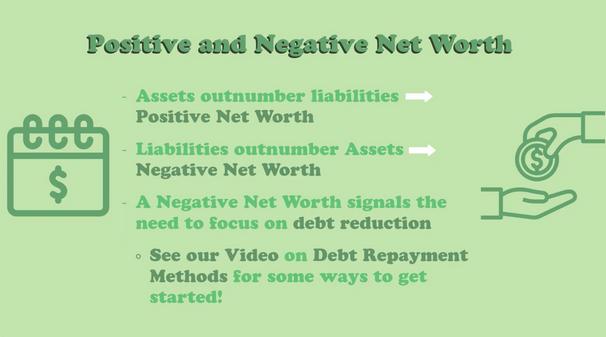
FINANCIAL LITERACY VIDEO SERIES
The “meme”-ification of business
How trends shape branding and consumer behavior
Audrey Lee, Staff Writer
In today’s society, trends are not merely just fleeting fashions: they are seismic shifts in society’s technology and culture that force businesses to adapt and reshape how we, the consumers, decide what to buy.
The meme-ification of business is a common practice used today, in which businesses turn brand concepts into memes to draw the attention of online audiences. This practice leverages trends to appeal to audiences and promote products and services, highlighting the interconnected relationship of trends, businesses and consumers.
To a brand, a trend serves as a guide, providing direction in a rapidly changing cultural environment. Aligning with these major shifts helps brands become more credible and connected with consumers.
In terms of trends, there are three main types: social trends, macro trends and technological trends
Social Trends
Social trends reflect shifts in society values, such as authenticity and transparency Consumers associate brands with the lifestyles they represent. For example, when minimalism became the “new-in,” brands moved towards clean design and simplicity to symbolize sophistication.
Trends affect consumer buying behavior in two ways: social expectations and self-expression When a product goes viral, it suddenly becomes a social norm, which pressures consumers to participate in the trend or feel a fear of missing out. To a certain extent, participating in these viral sensations serves as a means of belonging. However, these sensations also demonstrate how cultural validation fuels purchase intent, which can have potential consequences for not only one’s wallet but also one’s self-identity. On the contrary, trends can also serve for the complete opposite purpose: individuality. Consumers can utilize brands as tools for selfexpression, aligning with companies that reflect their personal values
Macro Trends
Macro trends lead to long-term shifts, often moving towards lifestyle changes like sustainability, health and wellness For example, sustainability trends have encouraged companies to adopt eco-friendly packaging and highlight ethical sourcing. Doing so not only emphasizes a missiondriven message but also strengthens emotional connections with consumers who share these values
Technological Trends
Technological trends are new tools for brands to utilize: innovations in technology that drive changes in marketing execution and customer experience. Brands leverage innovations like artificial intelligence to increase personalization. The rise of social commerce has also blended social media marketing with direct product purchasing, driving sales for brands
Student Entrepreneur
Spotlight:
Hockaday senior Sasha Kitson runs Herbal Kiwi, a successful ecommerce business that sells soaps and personalized gifts.
Inspired by a jar of old coconut oil that she had in her pantry, Kitson instantly fell in love with making soaps. Her curiosity and inspiration turned into a full business. For Kitson, trends are not merely background noise: they are essential for visibility in the online marketplace.
“E-commerce is literally all about following the trends in what people are searching for,” Kitson said
Like major brands, small businesses must react quickly to customers’ needs.
“During COVID, ‘get well soon’ gifts and ‘nurse appreciation’ gifts were really popular, so we sold gift boxes aimed towards those buyers and put products such as lotion bars and comfortable, adjustable face masks in the gifts,” Kitson said
To keep up with shifting consumer expectations, Sasha Kitson relies on search engine optimization (SEO) software that tracks online trends and the most frequent searches As an Etsy seller, this tool has been invaluabl in analyzing market trends. For Kitson, however, her strategy is not solely about following trends but is also about experimentation.
“Honestly, I have found that the best method is just to take a product I think has even a little potential to market and see how it does,” Kitson said “A lot of my best sellers were listings that I would have never thought would be popular.”
Kitson’s view on authenticity also offers an honest, valuable perspective on the realities of running a business for student entrepreneurs
“Business is solely about what the customer wants, not you. For example, I personally hate pumpkin spice candles, but my buyers love them, so I still make them ”
time and resources, you're never going to be able to outcompete full-time businesses in chasing trends,” Kitson said. “I believe that the best way to avoid this pressure is to read the market for current trends for yourself and start creating new trends based on what people are looking for. Original ideas will sell the best.”
“In business, it's not really about your own style,” Kitson said
Even as she adapts to what the market wants, Kitson is able to express her own style through branding and presentation. For students who feel pressured to constantly chase trends, she offers simple, practical advice
“As a small business with limited
In an age where trends can rise and fall within the span of a week, the challenge for both brands and consumers is to distinguish between just noise and true authenticity. The “meme-ification” of business shows the interconnectedness of culture and commerce in today’s society. Brands that act and adapt to trends with purpose and consumers who buy with purpose ultimately shape the global marketplace, the economy and society today.
Monopoly on ticket$
An examination of monopolies’ ramifications on markets
Kaitlyn Ouyang, Chapters Manager
November 18, 2022 was a day of fractured emotions. Everybody sat in front of their computer, nervously refreshing every 30 seconds to click "Add to Cart" and hopefully be successful.
However, while some were victorious, others were not, and people were not quiet in their disgust The next day, Taylor Swift released a statement apologizing for the Ticketmaster crash and sympathizing with thousands of loyal Swifties unable to catch the pricey tickets. That's the reality millions live in trapped outside of markets dominated by business monopolies
Monopolies are devastating to markets for key reasons First, lack of accountability. Businesses lose accountability in their operations, like Meta lobbying politicians to decrease data safety regulations,
but more importantly, they lose accountability to their consumers. They often raise prices so high and essentially force constituents into buying them anyway because they have no other option. Thus, consumers lose accessibility and privacy.
The second reason monopolies destroy business is because no other body can effectively check back against them. In recent years, trust busting, or dismantling these monopolies through regulations, has been at the forefront of government conversation. For example, the 2020 Department of Justice case condemned Google's monopoly over search, recognizing Google's deals with Apple, making Google the default browser on iOS, to be extremely abusive to other search engines However, because of the sheer size of these
companies that keep getting larger, these check backs fail the majority of the time
Let's examine Ticketmaster First on accountability: Ticketmaster faced backlashed against on social media for failing to maintain servers and making even the cheapest tickets at least $100. Many people couldn't attend Swift’s concert, because they couldn't afford resale tickets. Second, even though the criticism sparked massive social movement, Ticketmaster still thrived because some constituents were willing to pay, and others had to because there is no other credible option. In conclusion, monopolies damage markets and consumers. It is imperative to act against these companies to foster a more accessible place for consumerism to thrive
Navigating the rise of business scams
Insights from an industry insider
Maya Menon, Design Editor
Over the past decade, the fraud industry has grown to be more prevalent in both consumer and business sectors Earning billions of dollars every year, modern scammers have become more sophisticated, making them harder to detect and fight against.
“There are two categories of scam that I have seen: one that targets consumers directly, and the other targeted at businesses and their infrastructures,” Shar Dubey, former Match Group CEO, said Having worked in the business world for over 25 years, Dubey has seen scamming grow at an alarming rate. While running Match Group, which owns the largest global portfolio of online dating apps, she became wellversed in fraud prevention strategies to help protect the company
“The biggest scams we’ve had to deal with are usually phishing attacks,” Dubey said.
“This is where scammers try to get into systems, steal a bunch of data and then get companies to pay ransom. It’s basically a form of hacking ”
snippet, asking employees to transfer money to an account,” Dubey said. “This makes them think it’s a legitimate request AI is making fraud very dangerous It is much more likely for us to fall for these phishing scams now because we can't tell the difference between fraud and reality.”
To combat these emerging threats, many businesses have had to significantly ramp up their cybersecurity efforts.
“We’ve had to increase our investment in trust and safety meaningfully,” Dubey said “Our efforts are easily 20 to 30 times more than they were 15 years ago. This is essentially using a combination of tools as well as people that are constantly monitoring and making sure there are no vulnerabilities in the system ”
their defenses. This arms race between scammers and businesses drives up the cost of cybersecurity.
These attacks can have serious consequences, including data breaches and immense financial losses. To combat these threats, businesses have to prioritize cybersecurity and educate their employees about the risks of phishing.
However, with the recent rise of artificial intelligence, phishing attacks have reached a new extremity
“Some scammers are now using the CEO’s voice to create a video
The cybersecurity space has developed a wide range of tools and services to protect businesses from cyber threats. These include network security software, identity management solutions and human monitoring teams
“It's a whole, big space of both technology services as well as human beings just actively monitoring attacks happening to the system and trying to prevent it,” Dubey said.
Cybersecurity is becoming increasingly expensive as companies invest in new technologies and personnel to protect themselves from scams As scams become more sophisticated, companies must constantly update
“The reason [scamming] has increased is because it is profitable,” Dubey said. “There are literally offices with people trained to do this stuff, and AI is making it more dangerous.”
Though the danger of fraud is prevalent, there are many measures that can be taken to protect yourself. The most important thing is to be aware of the risks and to be careful about who you share personal information with.
“Be skeptical of every unknown email or phone message that you don’t understand,” Dubey said. “Don’t click on anything unexpected or that looks even a little bit out of whack.”
Though scamming is a pervasive threat to both individuals and businesses, it can be combated with vigilance, education and strong security measures.
Scammers are evolving, but so can we. Stay vigilant, stay informed and stay ahead.
Former Match Group CEO Shar Dubey
Building a buzz
How young entrepreneur Gigi Boyd turned a passion into profit
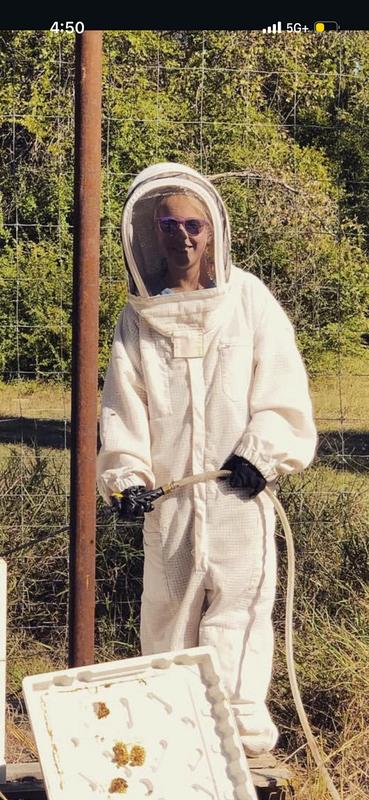
When she was just 13 years old, Hockaday junior Gigi Boyd found an unexpected passion for taking care of bees. Her first experience was through the Trinity Valley Beekeepers Association, a local club that became the start to her soon-to-be business. The club taught her how to care for her bees and supplied her with all the right tools to build a successful hive. Just a year later, Boyd had a good start to her hive. She finally had enough honey to bottle, while still being able to prioritize the wellbeing of her bees
Some of her friends were interested in trying the honey, so she started selling it within her community. Soon after, she pitched the idea of selling her honey to a restaurant that had just opened near her house. This restaurant became a gateway to expanding her business. Her passion for taking care of bees slowly morphed into a local business through a shared interest in honey in her community. Although it might not have been her initial goal to run a business, she let her passion grow into a profit.
When facing the challenge of marketing, Boyd relies on word of mouth. Friends told friends, and soon her honey jars were selling all across the neighborhood. This keeps her advertising impactful within her community She even has her customers put her
Abigail
Pinto, Staff Writer
company logo stickers on water bottles and laptops, which turned into a form of advertising that allowed her business to increase visibility.
Boyd created an Instagram and Facebook page to share updates about her bees honey harvests. This enables her business to reach a broader audience in a way that is easier to access.
One of her smartest moves was joining Real Texas Honey, a statewide directory of certified local beekeepers, which helped her attract new customers and added extra credibility to her honey. More than that, Boyd is not afraid to contact larger restaurants and stores directly through cold emails.
“Get out there. Send tons and tons of cold emails. You never know who might say yes,” Boyd said.
Boyd’s honey business is built off of the fact that it is local, and she plans to keep it that way. She mentions that raw and unprocessed honey offers specific health benefits and preserves more nutrients.
“I don’t plan to expand out of the local community,” Boyd said. “The point of my honey business is that it’s local. There are more health benefits from having local honey, and I wouldn’t be able to keep that if I were to expand beyond Dallas. It would require more hives, which would mean buying from
setbacks because pushing herself through these problems helped her become a more confident beekeeper and entrepreneur.
“You’d be surprised how willing people are to help,”Boyd says.
“Don’t be afraid to invest in yourself. Reaching out to different grocery stores meant facing rejection, and that was often really hard. As a small business, many sellers will see you as a liability.”
While Boyd’s goal may not be to expand in size, she has a long-term goal to maintain a business that grows in impact.
“It stems from a passion, which is why I want to keep my values of staying a local business while still putting myself out there as an entrepreneur,”Boyd said.
PHOTOS COURTESY OF GIGI BOYD
Boyd pictured caring for her bees
FEATURES
The Clos
How a Dallas-based app is chang Kaitlyn Ouyang, Chapters Manager & V
What is thrifting?
Thrifting is shopping for secondhand goods, generally clothing. Although it started as a necessitydriven method for lower-income individuals to sustainably buy clothes, over the past decade, it has shifted into a trend amongst highincome consumers. Largely due to social media, thrifting has also turned into a method for Gen-Zers or millennials to fit into “vintage” styles.
According to ThredUp, an American online resale platform, the United States second-hand apparel market grew by 14% in 2024, which is five times faster than the entire clothing market. Now, the resale market value is projected to double over the next decade. This trend can be attributed to three elements: affordability, sustainability and uniqueness.
Over the past decade, thrifting has transformed from a niche hobby into a cultural movement. What once carried the stigma of secondhand shopping has become a creative, ecoconscious alternative to fast fashion Across social media, young people proudly share their thrifting hauls and upcycling projects. Yet, even as thrifting grows in popularity, accessibility and safety, there remains barriers, especially for students looking to exchange clothes within their own communities.
In Dallas, a new student-led
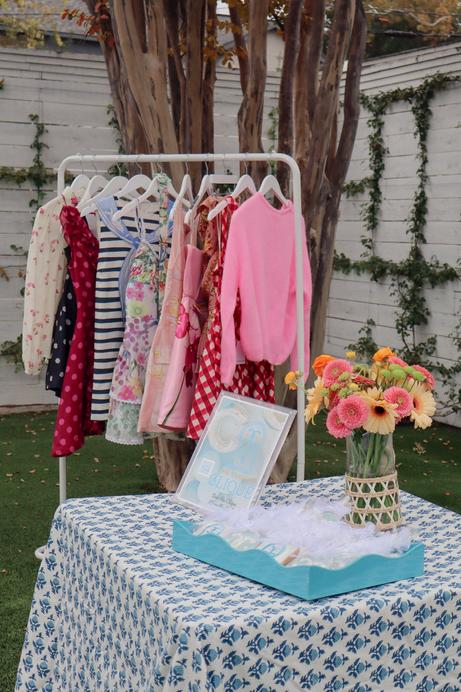
project is offering a refreshing alternative to fast fashion. The Closet Clique, a digital platform built for local students, lets users rent, borrow and trade outfits directly from other people in Dallas This provides a safer, more personal and sustainable way to enjoy fashion by keeping clothes in circulation and reducing waste while offering a trustworthy platform
Unlike most apps, The Closet Clique was shaped by the very people who use it. Inspired by her daughters and close friends, founder Mia Taraszki, recruited a team of ambassadors connected with the Dallas area to work on this project.
“The Closet Clique didn’t spark from one moment,” Taraszki said “It ignited from a lot of pieces that aligned at the right time ”
She and cofounder Andrea Nayfa floated the concept to their daughters, who instantly understood the vision.
“Their friends were already listing their closets on Instagram, and they thought it was genius bringing all the closets into one platform,” Taraszki said.
“Once I had their commitment to start this journey [we began] working ”
Hockaday junior Sadie Small, one of the app’s ambassadors, spoke about her role in this exciting project.
“[I helped] give feedback on the app and gave [my] opinion on everything they did to [develop] the app [and] create the design, [providing input on] how to format things, how to sell things [and] what is shown on the renting page,” Small said.
Designed to represent the values of students around similar ages, The Closet Clique was created with intent to ensure it was navigable and relevant.
“[It connects] everyone on a shared app where you can borrow clothes from people you actually know,” Small said
On most resale platforms, you don’t know who’s on the other side of the exchange. Users typically take a chance on the quality of the product and the safety of the communication. The Closet Clique
Co-founders Taraszki and Nayfa pose with family.
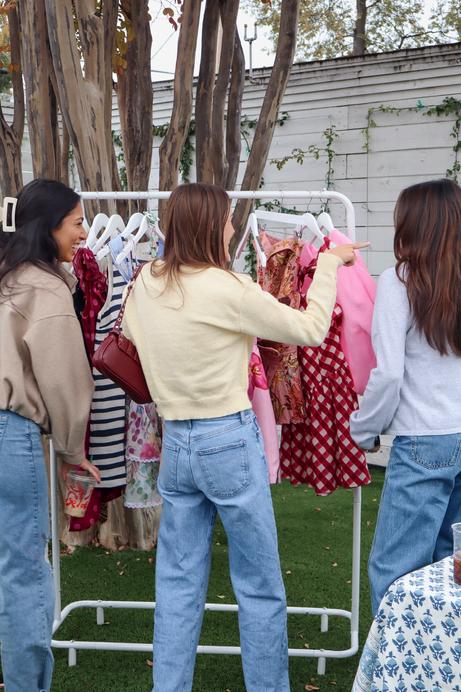
Members browse through clothes
et Clique
ing the resale and thrifting game
Vivian Zhou, Chief Operations Officer
wanted to eliminate that uncertainty By requiring school verification, the app creates a community where every user is connected by something tangible.
“[It] guarantees safety within your community,” Small said. “You have to verify you [go to a] Dallas school, which helps people feel more safe renting and giving out their clothes whereas [on] other platforms, you do not know who is renting them ”
Like any new venture, The Closet Clique’s early days were a mix of excitement, success and, of course, challenges. Taraszki had to learn business logistics and leaned heavily on her daughters and their friends to shape what the app needed for students.
“The early stages were a blend of excitement and an overwhelming feeling,” Taraszki said “I was learning everything at once and relied heavily on my instinct and constant feedback from my daughters, turned partners, and their friends to help shape what the app should look and feel like.”
pieces it takes to start a business ” Taraszki realized her vision could become a reality when she reconnected with a software developer she’d worked with years before.
“I remembered a developer I had worked with when I served on the board for Junior Assembly of North Dallas,” Taraszki said. “When we reconnected, and I explained The Closet Clique, he understood the concept immediately and said his team could build both the app and the website.
Knowing he was part of our community and [was] genuinely excited about the vision was the moment everything clicked.”
While The Closet Clique is undeniably convenient, it also upholds sustainability by keeping clothing in circulation for longer. Instead of buying something new for each event, students can simply browse available items from peers who have what they need.
GOING GREEN
Fashion is one of the most polluting industries in the world. According to the United Nations Environment Programme, the fashion industry accounted for up to 10% of global carbon emissions in 2023 and is projected to increase to over 50% by 2030. This number is more than the amount emitted by international flights and maritime shipping combined. By encouraging the purchase of second-hand items rather than completely new ones, consumers can reduce demand for production and extend the lifecycle of clothing, which reduces landfill burdens.
With increased environmental awareness, thrifting can be seen as a more green option. As overconsumption trends and fastfashion companies like Shein generate massive textile waste, many customers are looking for options that let them wear something new while remaining environmentally friendly. Thus, environmentconscious consumers view resale shopping as a way to reduce carbon footprints.
Hockaday junior Lily Vollbrecht attests to the environmental harms of fast fashion, a factor that caused her to steer away from fast fashion.
“Fast fashion is often low quality and therefore more likely to be thrown out quickly, which leads clothes to just build up in landfills,” Vollbrecht said.
Taraszki additionally recounts the multiple elements she had to juggle to start the business
“At the same time, I was forming the LLC, opening the business account, securing funding, hiring a graphic designer and mapping out the bigger plan while looking for a software company,” Taraszki said. “To me, the biggest challenge was simply figuring out all the moving
“Sustainability is a core value in The Closet Clique,” Taraszki said. Each borrowed dress or traded sweater means that one less item is produced, shipped and then ultimately discarded. As a mom, Taraszki has seen how quickly girls cycle through outfits for events and photos. She wanted the app to truly reflect what students wanted to wear: current, on trend and
As climate change concerns rise, fashion stands at the intersection of sustainability, accessibility and innovation. The global thrifting movement and student-led initiatives like The Closet Clique represent two converging paths with this new era of conscious consumption. While thrifting has become more popular in recent years due to the looming issue of climate change, The Closet Clique is reshaping accessible fashion while staying ethical and inclusive.
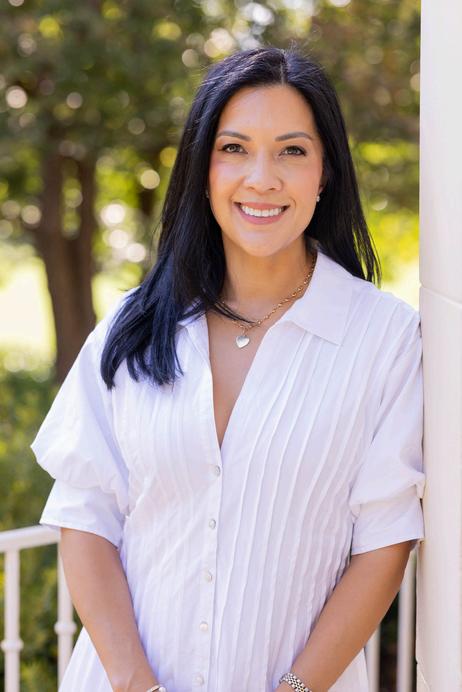
Cofounder Mia Taraszki
FEATURES
Thrift Talk
Because of the popularization of thrifting, the infrastructure around it has evolved. Physical, in-person thrift stores like Goodwill are still prominent and important, but online consignment platforms and “curated” vintage resellers have also gained prominence. These platforms offer premium second-hand items and have brought many higher-income customers into the world of thrifting. Since higher-income consumers are willing to pay more for certain items, overall price levels are heightened. The growth of the resale market, although it can be positive as more customers means more donations, has dramatically changed the access and distribution of second-hand goods.
Charitable thrift stores still play two roles. First, they provide affordable clothing options to low or moderate income individuals. Second, by making sales, they can generate revenue to run operations or expand charity missions like housing or education. These stores largely rely on donations and a high volume of budget-friendly sales. Therefore, when higher-income consumers enter this market, fewer items are available to the people who use thrifting as a necessity-driven practice.
A 2022 study done by the California Academy for Mathematics and Science found that in some communities, higher-income individuals reduced the available clothing stock for low-income shoppers as the same discount racks are being browsed by more affluent individuals. Items that would have been sold at a lower price might be priced higher or pulled for online resale so companies can make more profit off of higher-income shoppers. Further, donations may not even stay consistent, especially to local stores or stores in rural areas, as people looking to resale try to make more profit by targeting a more affluent audience.
curated by girls with incredible taste.
“Our girls attend so many events, and their closets are full of beautiful clothing, many only worn once,”
Taraszki said “The app gives them a smarter way to shop by borrowing pieces for a small fee instead of buying something new every time. It normalizes what we call ‘closet sharing,’ where girls open their closets to others in their school community to share clothing and earn from what they already own.”
Sustainability doesn’t always require radical lifestyle changes. Sometimes it’s about making better use of what’s already there “Being fully local is another major part of our sustainability story,” Taraszki said. “There is no shipping, no packaging and no waste. Every exchange happens within the same school community, which we call a ‘Clique,’ and that naturally reduces the carbon footprint ”
The team recently launched the first version of the app, and while Taraszki is proud of how far it has
come, she is even more excited about where its going. Improvements are already in the pipeline, and the team of Taraszki, Nayfa, fifteen founding brand ambassadors and four partners are focused on strengthening and refining the the features as the user base grows.
“It’s our starting point with so much room for growth,” Taraszki said.
But the app’s impact reaches beyond fashion. For many ambassadors, The Closet Clique is a crash course in entrepreneurship Students set their own prices, manage exchanges, handle payments and learn to take initiative.
“It is a launchpad for young women to develop business skills, practice leadership and experience what it feels like to build something of their own,” Taraszki said “Our hope is that the platform continues to grow with them from high school into college And the vision is for them to represent the rand on ampus and ke ownership launching the pp at their spective hool ”
Taraszki’s oal is for it to present a true usiness model ith longevity. he Closet lique has fered lfillment to
Closet Clique clothes are displayed
Closet Clique’s team poses at the launch party.
the creators who work tirelessly behind the scenes
“A pleasant and unexpected lesson has been realizing what a business can actually look like,” Taraszki said. “It doesn’t have to be people in suits sitting in a corporate office It can be a mom returning to work, building something meaningful with her daughters and friends, surrounded by a community of smart young women That has been the biggest surprise and the biggest gift ” Many young women aspire to start their own ventures. Taraszki believes today’s young women are already brimming with creativity and initiative.
FEATURES
don’t be afraid to start
“You will not have all the answers in one day, and you don’t need to.”
Taraszki said. “If you believe in your idea, create a plan and be willing to learn as you go and grow ”
Taraszki encourages young entrepreneurs to trust their passions and embrace the reality that building something meaningful takes effort and persistence She also highlighted the importance of going for their ideas, no matter what.
“So many of these girls run their own small business: embroidery, custom banners, fashion styling and more,” Taraszki said “It has been inspiring to feature them and watch them lead.”
Taraszki’s advice for aspiring founders is straightforward:
“You have to be all in,” Taraszki said. “If you truly want something to work, you have to be willing to put in the effort. When you start a business, there is no real start or end time to the day It becomes part of your life ”
“It has been inspiring to feature them and watch them lead,” Taraszki said
“thrifty”
One of the major appeals of thrifting is the lower price tags. As inflation continues to rise and quality clothing becomes increasingly expensive, many see thrifting as an option to save money.
Hockaday junior Sadie Small is one of the founding brand ambassadors of Closet Clique, a platform and app that allows Dallas students to trade and resell clothes in a more safe and trustworthy manner. Small asserts that thrifting is still a great way for all individuals to save.
“I think [thrifting] became so popular recently because clothes have become so expensive,” Small said. “Not everyone can buy a new outfit for everything, so sharing your clothes is a great way to wear something new while not spending so much money. Just because you are high-income doesn’t mean you have to buy the most expensive things when trying to find an outfit.”
Reducing stigma around secondhand consumption can break down class-based boundaries associated with used goods. This could lead to an indirect benefit where second-hand donations increase as more people become attuned to the idea of second-hand shopping.
“Things are getting very expensive, and thrifting can be for everyone,” Small said.
Check out The Closet Clique website here!
Nayfa and Taraszki’s daughters pose
Closet Clique brand ambassadors
Art history meets s
How Sloane the Brand is making a Annika Moss, St
In a world where fashion trends change faster than the seasons, two students prove there environmental
designs for this launch, and piece reflects the spirit and scape of the American West. t for Chen and Hohenshelt, ion is just one part of their ion. With the profits from their , they have been donating to hion Revolution, a nonprofit ac es Te in th Sc be ev ar wa pr ge kn in co su gr to y practical, everyday ways to reduce environmental impact
“I think the main thing that we as consumers can do is to not rely on businesses to be sustainable,” Chen said. “We have to be responsible and conscious of what we buy, because it is also our responsibility to take care of the environment.”
Instead of expecting brands to fix the problem alone, the two
Art Deco design modeled after Tsuda Shinobu.
Hohenshelt models for Springsteen-inspired hoodie
Chen created
sustainable fashion
difference in fashion and taff Writer
emphasize the power that individual consumers hold. They encourage people to research the companies they purchase from and to look closely at how those brands define their sustainability
“If a company is vague about what they are doing or where their materials come from, that usually means the company is not very sustainable,” Hohenshelt said.
their extra supply into landfills,” Chen said “Textile recycling is the best option when you want to get rid of clothes because it ensures the materials are repurposed.”
For Chen and Hohenshelt, Sloane the Brand is more than just a
It is our sibility to are of the onment
One of the easiest ways to make a positive impact, they say, is through secondhand shopping. Buying from thrift stores or online resale platforms reduces the demand for new production of clothes and keeps clothing out of landfills. The two also advocate for repurposing old clothes. Simple alterations can expand the lifespan of a garment and lessens the constant need to buy new ones
Lastly, Chen and Hohenshelt emphasize the importance of being mindful of where and how you dispose of clothing. They advise researching where you donate and finding options to textile recycle whenever possible.
“Lots of the time, secondhand and thrift stores end up throwing
ecilia Chen
clothing line, it is also a platform for change. Through their designs, they demonstrate that fashion can be both stylish and responsible, and that style does not need to come at the expense of the environment or ethical labor practices.
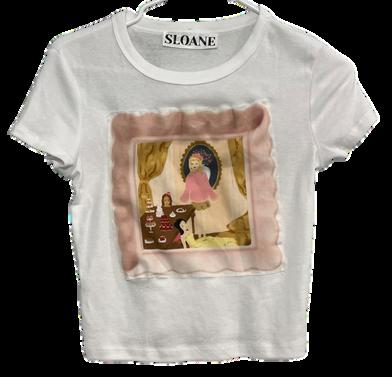
Impressionism-inspired fitted tee
and action, can leave a lasting mark on both your wardrobe and the world
PHOTOS COURTESY OF MARGARET HOHENSHELT AND CECILIA CHEN
Beyond sustainability, the duo’s dedication to art education shows their belief that fashion can cause community impact. By creating opportunities to help students engage with art and art history, Chen and Hohenshelt hope to inspire the next generation of fashionistas who value both style and responsibility. As they continue to design, donate and advocate, Chen and Hohenshelt are setting an example for young consumers: thoughtful fashion choices, along with creativity
Check out the Sloane website!
Chen models for Love in Layers tote bag.
Cancel culture in the business world
The rise of cancelling and its effects on business
Yolanda Pan, Managing Editor
These are five brands YOU should be boycotting! Fashion brands I am cancelling before 2026! Brands that deserve to be SHUT DOWN!
As we scroll through social media, countless headlines like these can be seen— endless voices urge consumers to stop buying from certain brands. Cancel culture is a widespread force in society today: anything can be canceled anytime by anyone and anywhere.
For some context, the roots of business cancel culture originates back to boycotts and activism as a beneficial mechanism to advocate for societal change. Historically, the 1984 Nestle boycotts against their unethical practices successfully led to reforms in their baby formula, saving an untold am lives. Toda of social m only fed th turning ca culture int mainstream phenomen Businesses now held t higher stan than ever a spend mor time onlin
speak out or is just mass criticism perpetuated by echo chambers, the topic of cancel culture remains highly polarized. Supporters of cancel culture view it as a vital mechanism to access social change. Social media has created platforms for traditionally marginalized
Cancel culture is a social boycott the practice of customers revoking their support for a business due to perceived beliefs and actions made by the company or its leadership that are deemed unacceptable This pressures companies to respond
“It only takes one tweet from 10 years ago to cancel a public figure or brand on social media,” CEO of Ruby Media Group Kris Ruby said. “Brands are being canceled left and right.”
Whether cancel culture allows marginalized communities to
to have a voice. Backlash from these voices can bring necessary reforms within a company. The 2020 canceling of Quaker Oats for the stereotypical branding of Aunt Jemima was initiated by the callout of one popular singer’s TikTok. This soon gained millions of views, and Aunt Jemima began trending on Twitter. The brand faced not only verbal retaliations but also boycotts, petitions and even lawsuits, causing the brand’s market share to fall 24% in 2020.
In response, Quaker Oats recognized the branding as derogatory and rebranded to Pearl Milling Company. They also pledged a $5 million commitment to continue support for the Black community. The canceling of Quaker Oats proved primarily successful addressing previously ces nge. cancel however, e it as e a hat open hat are nal for The grate s’ perspectives and ideas can allow for social progress. Cancel culture dulls out opposing viewpoints without giving them proper voice or context. In 2023, Budlight sales plummeted due to conservative backlash of a campaign with a transgender influencer. Liberals, in turn, criticized the brand for inaction and minimal support for the creator as she faced bullying and transphobia. Although the beer giant’s sales decreased significantly and continues to, no real change resulted. The controversy only
Quaker Oats’ original vs current logo
further polarized debates amongst liberals and conservatives, causing companies, who feared the same backlash, to shift marketing practices and pull-out of inclusivity as a whole.
The effects of cancel culture on companies can be detrimental as their brand reputation becomes destroyed and silenced through boycotts and withdrawn public support. Any brand can be canceled, no matter the size of the corporation. The criteria for cancellation is fluid and a moving target. Companies must consider
CULTURE AND CONSUMPTION
their actions more carefully now than ever they are taking steps to readdress their branding tactics. According to firm Porter Novelli, 88% of consumers report they are more willing to forgive a company if it shows a genuine attempt to change. Thus, companies must have proper crisis management plans. Through proactively addressing potential risks, highlighting transparency, engaging with social media and developing a strong brand identity, companies can minimize the risks of cancel culture.
The rippling impacts of cancel culture should not be underestimated. Despite its benefits and harms still remaining widely debated, canceling is undoubtedly a wide-spread phenomenon in our modern age. As brands race to keep up with the ever-changing values of media, they must become more reactive.
out
PHOTOS COURTESY OF PEARL MILLING COMPANY
Check
Emporio’s Let Get Down to Business Podcast!
Shop ‘till you drop
The impact of holiday overconsumption
Aria Knepler-Pearl, Staff Writer
Every year, the holiday season seems to arrive a little earlier, and its appearance is jarring, like seeing Santa Claus at your Thanksgiving dinner. By late October, store shelves sparkle with Christmas tree ornaments, streaming services cue up Hallmark movies and inboxes fill with irresistible “early bird” sales This phenomenon, known as the “Christmas creep,” has subtly transformed the season of giving into a season of endless, wasteful consumption –and it’s costing us more than just money.
trying to tap into this nostalgia that when you grow up, you have a certain [holiday] experience," Grau said “There is some use of deadlines and communication that make consumers get artificially worried that they’re going to be left out.”
“[Overconsumption] is driven by this artificial angst of 'if I don't get on this, I'm going to lose out somehow.'"
- Stacy Landreth Grau
The impact of holiday spending on the economy is undeniable. Increased consumer demand for products requires businesses to hire additional workers
“They want to make sure that they are capturing shoppers' attention ”
Along with the “Christmas creep,” retailers use promotional strategies and marketing tactics, such as exclusive offers, personalized messaging, influencer collaboration and festive content to increase holiday revenues
Overblown holiday materialism wreaks havoc on both the environment and our mental health. A 2024 SpendingTree survey found that 47% of respondents have gone into debt from holiday spending, and with this financial burden comes harmful emotional effects on consumers.
Dr Stacy Landreth Grau, Associate Dean of the John V Roach Honors College at Texan Christian University, worked in marketing before turning to teach business, and she offers insight into how businesses approach the holidays “A lot of marketers are
during the holidays to manage the surge in activity; though seasonal hiring usually boosts the labor market, the National Retail Foundation (NRF) expects retailers to hire fewer workers this winter given the tariff uncertainty and government shutdown. Nonetheless, the NRF forecasts that holiday spending in the U.S. will exceed $1 trillion for the first time this year
However, this economic stimulus comes at a price by taking a significant toll on consumers’ stress levels and finances. Grau notes that the “gamification” of shopping makes consumers feel as though they always need to “get the best price,” an intentional move on retailers’ parts. For the sake of maximizing profits, retailers promote a version of winter magic that fuels materialism and anxiety
“For retail, the margins have gotten so small that, honestly, this is when they make most of their money,” Grau said, highlighting how retailers’ revenue rises in the fourth quarter thanks to the holidays.
“I don’t think that anyone draws up exploitive tactics in their marketing plans, [but] sometimes it just happens,” Grau said Holiday overconsumption turns a time of celebration and joy into a spending marathon with no finish line The focus on materialism creates a sense of obligation to spend excessively, distracting from the true meaning of the holidays And now, with the explosion of ecommerce, consumers can purchase anything with the click of a button “It's a lot easier now to buy a lot because of online shopping,” Grau said “I also think it's driven by this artificial angst of ‘if I don't get on this, I'm going to lose out somehow’”
This consumerist mindset around the holidays causes significant environmental harm from waste, carbon emissions and depletion of natural resources.
According to the Center for Biological Diversity, household wa in the U.S. raises by abo 23% in December comp to other months.
Holiday waste includes an estimated 4.6 million pounds of wrapping paper annually in the U.S., much of which is not recyclable.
Dr. Stacy Landreth Dean of the John V College at Texan Ch
“I don’t think people have a really clear understanding of [what happens] when you don't want stuff anymore,” Grau said.
Many businesses have taken steps to combat wasteful overconsumption, like the popular outdoor clothing brand Patagonia, which runs a “Worn Wear” program to encourage sustainability and product longevity The program allows customers to trade in used gear for merchandise credit and makes secondhand items available for purchase at their online marketplace.
Grau,
Associate
Roach Honors
In addition to Worn Wear, Patagonia works to extend the lifespan of its products by offering repair services and recycling damaged items.
“There are some brands that can essage responsible umption a little bit more than others,” Grau said “Consumers have to be ready to hear it.”
hristian University
Placing more value on quality may lessen the anxiety surrounding giftgiving, which the American Psychological Association
identifies as a major source of holiday-related stress American social norms surrounding the holidays build up cultural pressure to outdo your neighbors with overthe-top decorations, serve mouthwatering meals for each holiday and purchase the perfect gift for every beloved family member. According to a 2022 Center for Biological Diversity survey, 90% of Americans agree that they wish the holidays were less materialistic.
This holiday season, some consumers report that concerns about price increases due to tariffs will affect their spending. To cut back on your spending this year, Grau recommends sticking to a holiday list, keeping track of your purchases and most of all, being mindful about what you buy and why you’re buying it Though the culture of overconsumption is strong, Grau is optimistic that consumer behavior around the holidays may change.
“I think you're going to see, hopefully, a sort of renewal of that authenticity of time and memories as opposed to things and stuff,” Grau said
PHOTOS COURTESY OF STACY LANDRETH GRAU
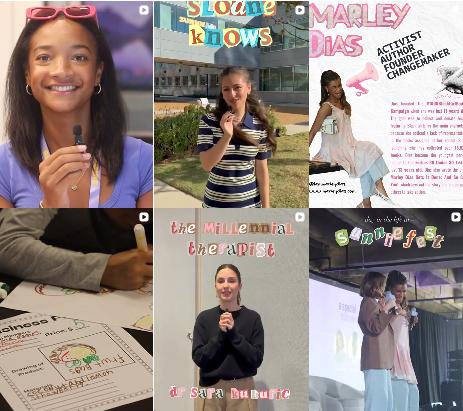
Celebrity Spotlight:
In November, the Emporio team attended Sunniefest at Pegasus Park in Dallas, Texas. Hosted by Hello Sunshine, Reese Witherspoon’s media company, the festival brought Gen Z girls together for STEM exploration, hands-on workshops, interactive labs and panels with young creators and leaders. One of the speakers we heard from was 16-year-old author and activist Marley Dias.
Dias launched the #1000BlackGirlsBooks campaign at age 11 to collect books with Black girls as main characters after noticing the lack of representation at her school. She has since gathered over 15,000 books and became the youngest person ever named to Forbes 30 Under 30 at age 13. She also wrote Marley Dias Gets It Done: And So Can You! to share her story and inspire others to take action.
PHOTOS COURTESY OF SIENA EBERT
Shoppers enjoy the holiday season
Dias poses with Coach Bag
Real or reel?
Ranking the most accurate finance movies
Aneeka Tansen, Co-Editor in Chief
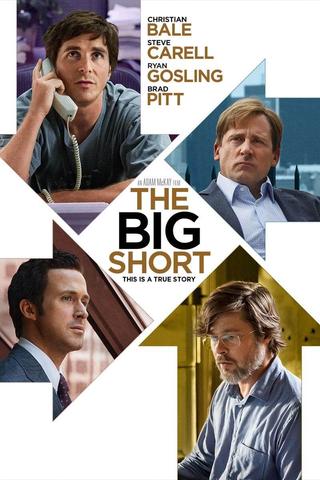
The Big Short: 4.5/5
“The Big Short,” a 2015 film directed by Adam McKay and based on Michael Lewis’s 2010 book, depicts the 2008 financial crisis and the collapse of the U.S. housing market. Although the film changes some names and includes minor inaccuracies, it remains relatively accurate to the real events
Housing bonds, a finance tool used to fund affordable housing projects, were created to offer lowinterest mortgages for moderateto low-income homebuyers. When some of these weaker bonds didn’t sell, they were moved into collateralized debt obligations and repackaged to look more diversified, leaving buyers unaware of the real risks Many were issued with no income verification or adjustable rates, making them extremely fragile.
Right before the crisis, a handful of investors noticed this weakness and attempted to short the bonds using a credit default swap. Essentially, these investors went into banks and asked to borrow millions of dollars believing the bonds would eventually depreciate, followed by the collapse of the housing market. If the investors bets were wrong, the buyers would profit, which served as insurance for both sides.
With no one expecting what was considered one of the safest investment areas to collapse, many Wall Street agencies took advantage of investor “foolishness” and ultimately lost millions when banks couldn’t recover their returns. When the default rate, the percentage of people who couldn’t pay back their mortgage, reached 8%, the
housing market collapsed. By 2008, 8 million people lost their jobs and the housing prices rocketed.
In reality, the investors who recognized the pattern and shorted the bonds made up to $100 million in profit while much of America fell into debt. Although the movie includes small character-related inaccuracies, its portrayal of the housing crisis and the massive profits earned by the few who shorted the bonds is largely accurate.
The main inconsistency with “The Big Short”is in its oversimplifications of Wall Street’s role compared to government regulators. The omission of government policies, specifically the regulatory frameworks that enabled risky practices, creates somewhat of an incomplete narrative. However, “The Big Short”is highly accurate in its portrayal of the events that led up to the crisis on the financial side.
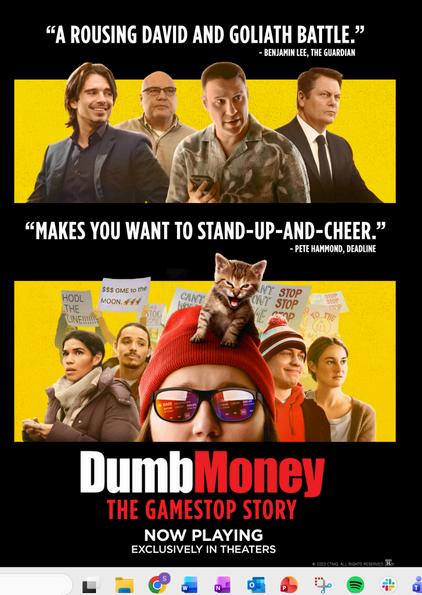
Dumb Money:
4.0/5
“Dumb Money,” a film made in 2023, details the historical investing war between Wall Street and retail investors over the GameStop Stock in 2020 and 2021.
Keith Gill (known online as Roaring Kitty), the protagonist, initially invested $53,000 dollars in the GameStop stock. As a youtuber, he was a financial marketer and educator who told his subscribers on YouTube that GameStop was an extremely valuable stock that hedge funds didn’t care about due to the lack of appeal in a commercial company
Much of Wall Street placed a shorting bet that GameStop would fail which, if it happened, would give the investors returns in millions of dollars. Millions of retail investors invested in the GameStop stock to succeed while many institutional investors took a shorting position in the company, betting the stocks would fall Using comedic elements to unravel a complicated event, “Dumb Money” portrayed the ultimate short squeeze of the decade. With a class warfare between the rich and middle class, the GameStop stock rose so much that the institutional investors, who shorted the stock, had to buy it back, causing it to skyrocket, making the retail investors profit even more
Though many lost their money from not selling their stock at its peak, many common people made large amounts of money, and the incident went down in history. The movie itself is not completely accurate; however, the story as a whole sticks fairly close to Keith Gill’s plot line The major difference that some of the people
shown to follow along Keith’s journey were a culmination of many followers, rather than one specific person that existed.
The film takes creative liberties and dramatizes the experiences of everyday investors. The characters shown in the movie are designed to represent the community of retail investors, rather than specific individuals Though this approach broadens the story’s appeal, it does veer away from strict accuracy.
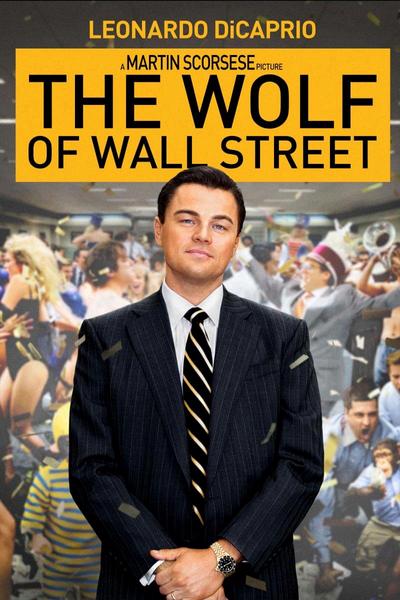
The Wolf of Wall Street: 3.5/5
Based on Jordan Belfort’s memoir, “The Wolf of Wall Street” is a highly acclaimed film exploring the excesses and corruption of finance.
Though many moments are exaggerated, the film tells the story from Belfort’s perspective, played by Leonardo DiCaprio Because it follows his viewpoint as a convicted financial criminal, some argue that the depiction of Wall Street is not fully accurate.
The film follows Belfort from his entry-level job at a brokerage firm to him founding his own firm in the early 90s. By defrauding wealthy investors, he made huge profits, and eventually went to jail for securities fraud and money laundering
“The Wolf on Wall Street” is very extravagant in all areas, from illegal activities to the racy lifestyle led by many of the characters. The film’s depiction is surprisingly close to the true story, which many viewers find hard to believe.
However, some also argue that the story was over-exaggerated as some scenes were contrived to serve the narrative of the movie.
Specifically, Belfort’s “pump-anddump” schemes, drug use and excessive spending, the FBI crackdown, his prison time and his later pivot to motivational speaking are all depicted accurately. Most inconsistencies come from character consolidation and fictionalized scenes. Moments like the chimpanzee in the office and the dwarf tossing were invented for dramatic effect, blending real events with creative liberties and lowering the film’s historical accuracy
MEDIA ACCOUNTS!!!
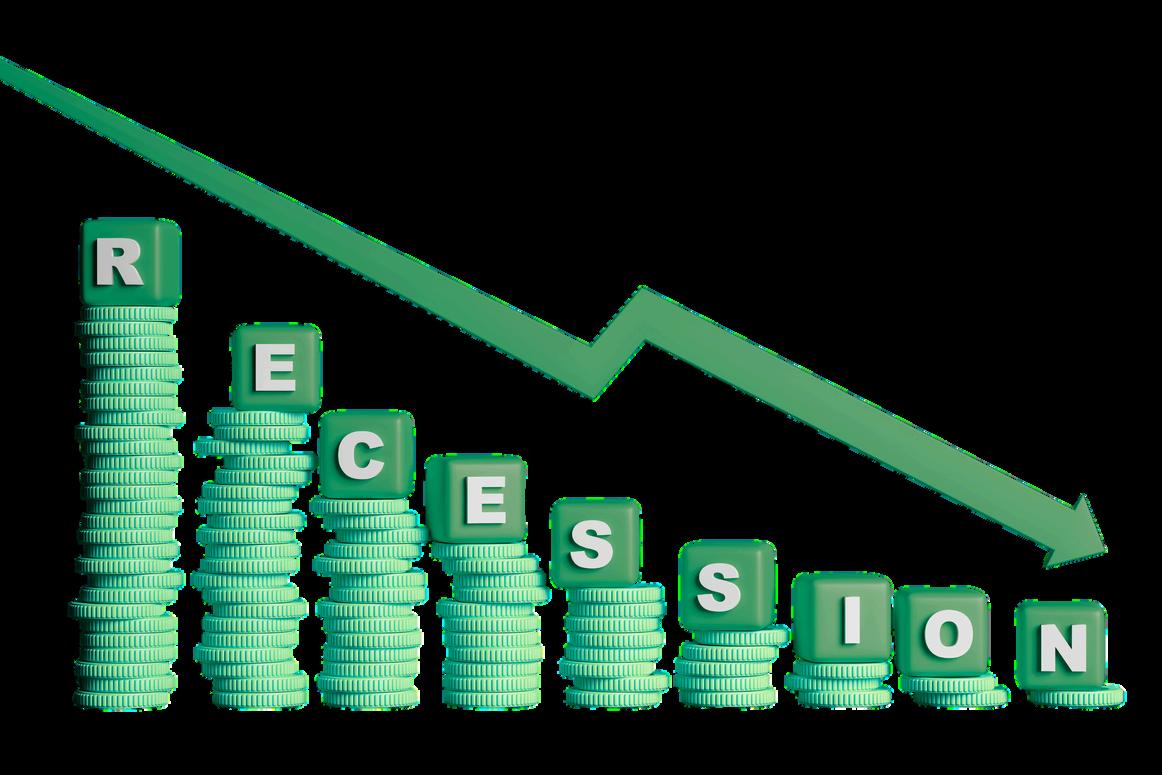
In 2008, a global financial crisis due to the declining housing market wreaked havoc on the entire world. Inflation rose at previously unprecedented rates, the stock market crashed, home values collapsed and millions of jobs were lost as businesses downsized or shut down. Today, this economic destitution has left a lasting impact, now regarded as one of the worst recessions and economic crashes in recent history. In the midst of this chaos, one demographic of people suffered the most: families.
Intense economic stress often correlates with declining fertility rates, and 2008 was no different. According to Pew Research Center, in the United States, the recession resulted in a steep drop in births in several subsequent years after 2008. Birth rates fell by 9% between 2007 and 2010. Even now, birth rates have yet to rebound to pre-recession levels.
Today, children born during and after the crisis are reaching college age as the graduating classes of 2026 and 2027 The long-term demographic effects are beginning to manifest in the admissions process, as experts predict that college admissions for these
classes will become noticeably “less competitive ”
The competitiveness of college admissions depends on the ratio between the number of applicants and number of spots. For example 1000 people competing for ten spots is more competitive than 100 people competing for the same ten spots
In the past decade, when children born pre-2008 were reaching adulthood, colleges experienced rising application numbers because of expanding recruitment efforts, test-optional policies, a collective shift to using the CommonApp platform, a centralized place to apply to multiple colleges, and a cultural trend that elevated the importance of attending a prestigious university These factors combined resulted in record-low acceptance rates.
However, the population cliff caused by the 2008 recession will cause the number of applicants to decrease. Therefore, in the 2025-26 and 2026-27 admission cycles, admissions officers, especially in less-competitive schools, will likely experience difficulty filling class sizes.
Notoriously “elite” universities such as Princeton, Harvard, MIT and Yale will likely continue to attract many applicants, including international students, and maintain comparatively competitive admissions
The recess
Analyzing
the affect of the 2008
Kaitlyn Ouyang, C
recognition, prowess and hefty financial resources will insulate them from the enrollment difficulties less-selective schools will face. Although rates may increase slightly, it will not dramatically alter the difficulty level for applicants to be accepted. Conversely, the most significant impact will be in small liberal arts institutions and lesser-known regional state universities that already struggled with enrollment declines before the downturn of birth rates.
Hoc reaso institu are an unden entici factor many applic “I t bigge instit have a of the that I a coll colleg On junior Julianne Myhre finds smaller colleges appealing because of their communities and academic variability.
“Smaller, liberal arts schools really appeal to me for their small, close communities and curriculums that allow their students to explore a wide range of subjects,” Myhre said.
Even then, Myhre recognizes some of the obstacles preventing students from applying to small schools.
“Societal pressures that limit the research [that] students do on colleges combined with the stigma
9
sion ripple
recession’s on college admissions
Chapters Manager
surrounding liberal arts degrees create a stigma against considering these institutions,” Myhre said. Signs of the pending trend have already emerged. Over the last few years, many small private colleges have either downsized, merged with other schools or closed entirely due to financial struggles For example, Pennsylvania State University (Penn State) New Kensington and other Penn State Commonwealth campuses will be shut down after Spring 2027 because of dropping revenues. pear heri f ty of y or e align mands e the value es. itment xpand c and p y g pp p esses or reducing barriers for students.
One of the most tangible benefits of the lack of applicant competition will be an increase in financial aid availability When colleges struggle to meet enrollment targets, they offer more merit aid based on academic adeptness to encourage more academically strong students to enroll. Thus, families who previously would not have received aid from some institutions might get substantial offers, which can be appealing based on future career choices
Sangapu attests that financial aid
could be a factor in where she ultimately ends up enrolling.
“I want to pursue medical school and that career path does take a lot of time and money,” Sangapu said. “Getting aid wherever I can would be helpful ”
Additionally, the test-optional movement which gained momentum during the COVID-19 pandemic coexists with the demographic decline. Test optional policies have increased applications at numerous competitive institutions and might become a strategy to remove socioeconomic barriers Generally, more flexible admission requirements like reducing essays and simplifying supplementals could encourage more students to apply, leading to higher application rates.
Universities could also expand early decision or early action admissions to secure applicants earlier, increasing the percentage of admitted students who choose to enroll For students, this could result in a more favorable admissions cycle with less pressure to apply to an excessive number of schools and more opportunities for acceptance at difficult institutions.
While there may be short-term benefits to a less-competitive admissions environment, there could be long-term downsides Shrinking student populations could pose sustainability challenges for institutions that rely on tuition revenue to operate. This could lead to budget cuts, program reductions and staff layoffs. In the
future, this could look like a lack of diversity in options available, especially in population-declining regions that already face reduced state funding because of decreasing enrollment numbers It could also reduce affordability in the long run or lessen capacity in certain programs
Ultimately, the declining birth rates triggered by the 2008 recession will significantly alter the admissions landscape. Students in the classes of 2026 and 2027 that are entering the admissions season will operate in a unique situation, where demographic lows will soften competition and create higher chances for acceptance and financial support. In fact, according to the Harvard Gazette, regions of the US will have about 12-13% fewer high school graduates than previous classes. Although most elite universities will still remain highly selective and probably will not be impacted, many students will find processes to be less stressful and more accessible. Furthermore, families will benefit from increased scholarship opportunities. At the same time, colleges themselves may face challenges as they adapt to a shrinking pool of applicants. The next decade will revolutionize the structure, culture and priorities of the American higher education system
Artificial intelligence (AI), or computer systems designed to perform tasks that normally require human intelligence, is no longer a concept of the future but an integral part of our present lives. AI has already drastically transformed global markets and driven innovation across nearly every sector and continues to expand
Economically, AI will serve as both an equalizer and a disruptor Businesses are already integrating AI into workflows to optimize logistics, marketing and customer support. By 2030, according to McKinsey & Company, a global management consulting firm, AI could contribute up to $15.7 trillion to the global economy, with productivity gains accounting for nearly half that growth
However, as automation expands, short-term displacement will be unavoidable. White-collar workers, particularly in data-heavy fields will face pressure to adapt to AI-augmented tools that handle routine cognitive tasks. Examples include finance, software, medical, customer service and even the legal sector
In education, the next five years will witness the normalization of AI as a teaching aid. Tools like ChatGPT, Copilot, Google Gemini and Duolingo Max already demonstrate how generative AI can personalize learning These apps function rather similarly: students receive tailored feedback instantly based on their skills and comprehension. Instead of being replaced, teachers can integrate AI to aid them in identifying how to best help their students when they struggle. Director of Innovation and Collaboration at The Hockaday
The future of arti
How artificial intelligence will tran
Vivian Zhou, Chief
School, Laura Day, believes AI’s growth could reshape the future of education
“With ChatGPT-5, AI has the capability of doing basically everything you ask it,” Day said “That changes how we as educators have to think about teaching.”
Her reflection captures a shift that is already underway in education, where students are forced to learn how ideas are developed in comparison to rote memorization
In the economic sphere, the AI industry is experiencing a sharp rise in investment as many believe the field holds immense potential. However, experts warn that this rapid influx of capital echoes the conditions of the dot-com bubble, which ultimately resulted in the 2001 recession.
During the dot-com era, investors poured money into emerging tech companies based on potential rather than proven stability. When confidence faltered, investors withdrew abruptly, triggering a collapse in funding that let to company failures, mass layoffs, and an eventual recession that wiped out many tech firms.
Similarly to the dot-com bubble, many believe that there is an AI bubble, characterized by the current rise in AI popularity and innovation. Based on the effects of the dot-com bubble, many also speculate that the AI bubble will also burst.
Recently, a spokesperson from Open AI admitted in a recent press conference that they are in search of funding, potentially from the government, to sustain their innovations. This concession openly revealed that this industry lacks longevity without adequate funding Moreover, this revelation is backed by Microsoft’s most recent quarterly earnings released in mid October, where it was shown that the company made close to zero profits from their AI innovations, proving that corporations across the board cannot keep up with this sector if they do not have the money to continue funding innovation.
However, the Chief Executive Officer and Chief Financial Officer of Nvidia, a global leader in accelerated computing, have downplayed these concerns, suggesting that if a bubble does form, it is unlikely to burst for at least one to two years. They also emphasized that strong AI companies are wellpositioned to withstand an economic downturn,
Director of Innovation and Collaboration Laura Day
ificial intelligence
nsform education and the economy
Operations Officer
much like how the major tech firms survived the dotcom recession
When asked about long-term impacts of AI, Day took an optimistic view.
“Initially, people think [AI is] going to be doom and gloom especially [as the current generation] worries about the climate impact,” Day said. “I think AI has the ability to solve some major problems that can change the future ”
Education will continue to necessitate the shift from simply remembering knowledge to mastering how to generate meaningful ideas. According to the Organization for Economic Cooperation and Development, by 2035, both the economy and education will have undergone visible transformation They will become more efficient and more data-driven, but also more dependent on digital infrastructure than ever before.
Right now, AI-driven efficiency is already shifting and reducing the demand for human labor in many sectors, an issue that affects many present-day workers, as well as young employees freshly entering the workforce. This shift will only continue to reduce demand for human labor. Because human contribution and skillsets are losing value, instead of evaluating the skill level of employees, corporations may strategically prioritize evaluating the innately “humanistic” skills of employees, or qualities that are irreplaceable by machines.
Half a century from now, the line between human and artificial intelligence may blur beyond recognition as it becomes more and more integrated in society. While AI may seem to bring immense risks, it can also be very transformative. If humanity can harness AI responsibly, it may be able to accelerate solutions to the greatest global challenges.
Many younger individuals fear the climate impacts of AI Training and running large AI models require massive electricity use that is often generated from non-renewable sources. Cooling data centers also demand immense amounts of water, which diverts water away from local needs.
“I do think there’s going to be a climate problem, but I think it can be solved,” Day said “There’s a concept called fusion, a power that is not far off, and if we can solve that, that can actually change everything, and I think AI has the power to do that much faster than humans.”
Moreover, as humans continue to learn how to best harness AI, there could be infrastructure developments in the future that can easily resolve these issues
The evolution of AI is vast and promising. In the next five years, we will see AI as a helpful assistant; in ten, as an essential collaborator; in thirty, as a coarchitect of society; and in fifty, perhaps as an equal partner. The challenge lies in guiding it wisely to ensure that technology enhances and does not erase the values that define humanity.