The Emory Wheel Since 1919
Emory University’s Independent Student Newspaper
Volume 106, Issue 10
Printed every other Wednesday
Wednesday, September 24, 2025
Sears addresses University Senate for first time
Jack Rutherford/Managing Editor
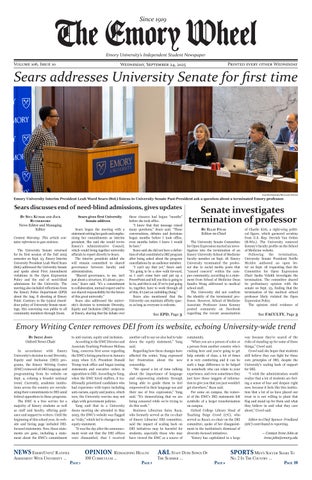
Emory University Interim President Leah Ward Sears (80L) listens to University Senate Past-President ask a question about a terminated Emory professor.
Sears discusses end of need-blind admissions, gives updates By Siya Kumar and Jack Rutherford News Editor and Managing Editor
Sears gives first University Senate address Sears began the meeting with a statement setting her goals and emphasizing her commitments as interim president. She said she would revive Emory’s Administrative Council, which would bring together university officials to report directly to Sears. The interim president added she will remain committed to shared governance between faculty and administration. “Shared governance, to me, isn’t just about a structure, it’s about a process,” Sears said. “It’s a commitment to collaboration, mutual respect and to our shared responsibility for the future of this great university.” Sears also addressed the university’s decision to terminate Diversity, Equity and Inclusion (DEI) programs at Emory, sharing that the debate over
Content Warning: This article contains references to gun violence. The University Senate returned for its first session of the Fall 2025 semester on Sept. 23. Emory Interim University President Leah Ward Sears (80L) addressed the University Senate and spoke about First Amendment violations in the Open Expression Policy and the end of need-blind admissions for the University. The meeting also included reflections from the Emory Police Department (EPD) about the Aug. 8 shooting at Emory Point. Contrary to the typical closeddoor policy of University Senate meetings, this convening was public to all community members through Zoom.
these closures had begun “months” before she took office. “I know that that message raised many questions,” Sears said. “These conversations, debates and decisions began months before I took office, even months before I knew I would be here.” Sears said she did not have a definition of what constituted a DEI program after being asked about the program cancellations by an audience member. “I can’t say that yet,” Sears said. “It’s going to be a slow walk forward, so I can’t come here and put up a PowerPoint and tell you this is going to be in, and this is out. If we’re just going to, together, have to work through all of this, it’s just an unfolding thing.” Sears also mentioned that the University can maintain affinity spaces as long as everyone is welcome.
See EPD, Page 3
Senate investigates termination of professor By Ellie Fivas Editor-in-Chief The University Senate Committee for Open Expression started an investigation into the termination of an Emory University School of Medicine faculty member on Sept. 18. Emory University terminated the professor due to social media posts that “caused concern” within the campus community, according to a statement from School of Medicine Dean Sandra Wong addressed to medical school staff. The University did not confirm the identity of the terminated professor. However, School of Medicine Associate Professor Anna Kenney posted comments on Facebook regarding the recent assassination
of Charlie Kirk, a right-wing political figure, which garnered scrutiny from U.S. Rep. Derrick Van Orden (R-Wis.). The University removed Kenney’s faculty profile on the School of Medicine website. Following the termination, University Senate President Noëlle McAfee authored an open letter on Sept. 18 requesting that the Committee for Open Expression Chair Sasha Volokh investigate the termination. The committee shared its preliminary opinion with the senate on Sept. 23, finding that the termination of the medical school professor likely violated the Open Expression Policy. The opinion cited evidence of
See FACULTY, Page 3
Emory Writing Center removes DEI from its website, echoing University-wide trend to anti-racism, equity and inclusion. According to the EWC Director and Associate Teaching Professor Melissa Yang, concerns first arose regarding the EWC’s hiring practices in January 2025 when U.S. President Donald Trump took office and began issuing statements and executive orders in opposition to DEI. According to Yang, when the EWC hired staffers, it traditionally prioritized candidates who had experience with topics including anti-racism, equity and justice, which now, the University worries may not align with government policies. Yang said that in a University deans meeting she attended in May 2025, the EWC’s website was flagged as “risky,” which led to changes in the equity statement. “It was the day after the announcement went out that the DEI offices were dismantled, that I received
By Irene John Oxford News Chair In accordance with Emory University’s decision to end Diversity, Equity and Inclusion (DEI) programs, the Emory Writing Center (EWC) removed all DEI language and programming from its website on Sept. 4, echoing a broader national trend. Currently, academic institutions across the country are reevaluating their commitments to DEI amid federal opposition to these programs. The EWC is a free service for a majority of Emory students as well as staff and faculty, offering guidance and support to writers. Until the beginning of this school year, its website and hiring page included DEIfocused statements. Now, those statements are gone, including a statement about the EWC’s commitment
NEWS EmoryUnite! Ratifies Agreement With University ... P
PAGE 2
another call to say we also had to take down the equity statement,” Yang said. Regarding how these changes have affected the center, Yang expressed her frustration about the new censorship. “We spend a lot of time talking about the importance of language and empowering students through being able to guide them to feel empowered in their language use and their use of free expression,” Yang said. “It’s demoralizing that we are being censored while we’re trying to do this work.” Business Librarian Saira Raza, who formerly served as the co-chair of Emory Libraries’ DEI committee, said the impact of scaling back on DEI initiatives may be harmful for students, especially those who may have viewed the EWC as a source of
OPINION Reimagining Health 100 Curriculum ... PAGE 5 P
community. “When you are a person of color or a person from another country who’s visiting here and you’re going to get help outside of class, a lot of times it is very comforting and it can be such a huge difference to be helped by somebody who can relate to your experience, and even sometimes they just have those nuggets of information to give you that you just wouldn’t get elsewhere,” Raza said. For some on campus, the removal of the EWC’s DEI statements felt symbolic of a larger transformation on campus. Oxford College Library Head of Teaching Paige Crowl (17C), who served as Raza’s co-chair on the DEI committee, spoke of her disappointment in the institution’s dismissal of diversity-focused initiatives. “Emory has capitulated in a large
A&L Staff Dubs Songs Of The Summer ...
PAGE 6
way because they’re scared of the risks of standing up for some of these things,” Crowl said. Crowl said she hopes that students still believe they can fight for these core principles of DEI, despite the University’s scaling back of support for DEI. “I wish the administration would realize that a lot of students are feeling a sense of fear and despair right now, because it feels like this institution that a lot of us have placed our trust in is not willing to plant that flag and stand up for them and what they believe in and what they care about,” Crowl said. Editor-in-Chief Spencer Friedland (26C) contributed to reporting.
— Contact Irene John at irene.john@emory.edu
SPORTS Men's Soccer Soars To No. 2 In The Country ... Page 10