#
1
S M A T R G OR O R EP P R EE LD R OR EG W D & ’S S ER EW ST N A S. M U.
—
A
G
A
IN
!
NURSING
SPRING/ SUMMER 2026
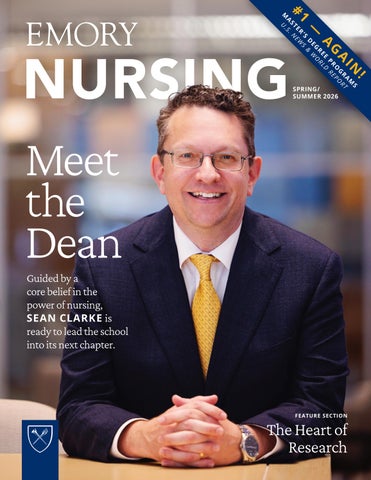
Meet the Dean Guided by a core belief in the power of nursing,
SEAN CLARKE is
ready to lead the school into its next chapter.
FEATURE SECTION
The Heart of Research
Ready.
Give today to the Nursing School Scholarship Fund. bit.ly/nursing-scholarship-fund
FROM THE DEAN This issue of Emory Nursing arrives in the first weeks of my tenure as dean of this historic and celebrated school. I am beyond grateful for the confidence placed in me and the opportunity to join such an exceptional community. As we anticipate our future together, I want to take a moment to look back with appreciation for the incredible foundation on which we stand. For generations, giants of the profession have worked together to create a school that is second to none in education, research and service to individuals and communities. The work continues today — carried out by people who bring a deep sense of purpose to all they do. The stories in this magazine reflect that commitment. Under the exemplary leadership of Interim Dean Lisa Muirhead, the school has accomplished much in recent months, and the impact of this work is lasting — as evidenced in the feature section about our research enterprise and the countless ways it improves people’s lives. As you read this issue, we hope you not only see what the school has accomplished but also feel the momentum building for what comes next. There is so much to be proud of, and so much to look forward to. I cannot wait to work alongside you. With appreciation,
Sean Clarke PhD, RN, FAAN Dean and Professor Nell Hodgson Woodruff School of Nursing
AIVA GABRIELA
NURSING SPRING/SUMMER 2026
Dean, Nell Hodgson Woodruff School of Nursing Sean Clarke, PhD, RN, FAAN Senior Director of Communications and Marketing/Editor Melanie Kieve Senior Director of Communications and Marketing Lauren Powers Communications Specialist Kennedy Gooden
M U .S
! S I N AM A GR ORT G RO EP A R E E PR L D R — D E G& W O 1 R ’S S # ASTE . NEW
NURSING
SPRING/ SUMMER 2026
Art and Creative Director Erica Endicott Photography Contributors Paul Beezley Aiva Gabriela Jenni Girtman Kennedy Gooden Ted Pio Roda Becky Stein
On the cover: Dean Sean Clarke at the Emory Nursing Learning Center. Photo by Aiva Gabriela.
Meet the Dean
Guided by a core belief in the power of nursing, SEAN CLARKE is ready to lead the school into its next chapter.
FEATURE SECTION
The Heart of Research
EMORY NURSING is published by the Nell Hodgson Woodruff School of Nursing (nursing.emory.edu), a component of the Woodruff Health Sciences Center of Emory University. ©2026 Emory is an equal opportunity employer, and qualified applicants will receive consideration for employment without regard to race, color, religion, sex, national origin, disability, protected veteran status or other characteristics protected by state or federal law. Inquiries regarding this policy should be directed to the Emory University Department of Equity and Civil Rights Compliance, 201 Dowman Drive, Administration Building, Atlanta, GA 30322. Telephone: 404-727-9867 (V) | 404-712-2049 (TDD).
2
E M O R Y N U R S I N G | emorynursingmagazine.emory.edu
24
In this issue FEATURE SECTION
4 The Heart of Research When it comes to our research enterprise, human impact is everything.
14 Unsung Heroes Research excellence begins with the staff who support it.
16 Making Sense of Science Researchers take their expertise to the public square.
COVER STORY
18 Meet the Dean Sean Clarke, the school’s seventh dean, is ready to lead the school into its next chapter.
PULSE
4
24 U.S. News taps master’s program No. 1 again, DNP rises to No. 2 25 School launches master’s programs in clinical nutrition, health care analytics 26 Unexpected transformations: The power of servicelearning immersion trips 28 Bruner named American Association for the Advancement of Science Fellow
ALUMNI + ADVANCEMENT
32 Six honored with Nurses’ Alumni Association Awards 33 School establishes Linda McCauley Research Excellence Endowment
34 TOP AND BOTTOM LEFT: TED PIO RODA, BOTTOM RIGHT: PAUL BEEZLEY
34 Healing forward: How leukemia shaped alumna’s student years, career path
SPRING/SUMMER 2026 | EMORY NURSING
3
THE HEART OF RESEARCH BY MELANIE KIEVE
Human impact isn’t just part of our research enterprise. It’s everything.
HomePal team member Harsit Upadhya demonstrates smart speaker features to Maggie McCullom as researcher Jane Chung (center left) and research project coordinator Chiquita Cade look on. PHOTO BY TED PIO RODA
SPRING/SUMMER 2026 | EMORY NURSING
5
FEATURE SECTION
EVERY INCH OF MAGGIE MCCULLOM’S SOUTHEAST ATLANTA HOME REFLECTS A FULL LIFE.
HomePal team member Harsit Upadhya (left) and project coordinator Chiquita Cade (right) visit with research participant Maggie McCullom.
IMPACT:
Detecting Loneliness in Older Adults
6
Family photos line the walls and tabletops. Dozens of potted plants burst with life. Her eyes shine as she talks about church and the nearby recreation center, where she trains for senior Olympic competitions in powerlifting, Tai Chi, basketball and cornhole. But McCullom understands that not all seniors share her experience. “I know many seniors who are alone in their homes and don’t have anyone to talk to, visit, or go places with them,” she says. “Some people just don’t know how to say what is going on, but you can look at them and see the sadness within them.” That’s why she participates in HomePal, a research study led by Associate Professor Jane Chung, PhD, RN, FGSA, that uses smart-speaker technology and AI to assess loneliness among older adults living alone. Smart speakers and motion sensors track participants like McCullom as they go about their daily routines, collecting data on speech patterns, mobility, sleep habits, and smart speaker usage. Using this data and machine-learning algorithms, Chung’s team can identify individuals at risk for or experiencing loneliness, a condition shown to be as harmful as smoking 15 cigarettes a day. Chung aims to identify loneliness without requiring seniors to disclose it — a topic often avoided due to stigma or embarrassment, as McCullom
E M O R Y N U R S I N G | emorynursingmagazine.emory.edu
observed — and seeks to find interventions that improve social well-being and overall health. “My goal is to find a way to help people age in place and live independently for as long as possible in their own choice of living environment, like a home or community,” Chung says. At the Nell Hodgson Woodruff School of Nursing, research is published in academic journals and presented around the world. But it also lives in homes like McCullom’s, as well as in hospitals, clinics, and community organizations — anywhere people are served. “We do this work because we’re trying to change the course of human health, whether we’re doing that one individual at a time or with families and communities,” says Kim Dupree Jones 89MN, PhD, RN, FNP, FAAN, a fibromyalgia and nociplastic pain researcher and the senior associate dean for academic advancement and innovation at the School of Nursing.
TED PIO RODA
FEATURE SECTION
Dykes displays the bedside poster that has helped transform fall prevention in hundreds of hospitals.
RESEARCH IMPACT Q&A
F A C E S B E H I N D THE FINDINGS
IMPACT:
Preventing Hospital Falls
Sharon Vanairsdale Carrasco 18DNP, APRN, ACNS-BC, ANP-C, CEN, FAEN, FAAN, FNAP Clinical Professor
‘SO WHAT’ RESEARCH For Drenna Waldrop, PhD, the school’s associate dean for research, impact serves as the primary filter when junior faculty approach her with a research idea. When they share their question, she responds with a simple prompt: “So what?” The question isn’t contrarian; it’s foundational, ensuring that real-world impact is considered from the very beginning of the research process. “I ask, ‘How does (the research) matter? How will it help the community, the partner, or whoever you’re working with?” Waldrop says. For 11 consecutive years, the school has ranked in the top five for National Institutes of Health funding, receiving nearly $16.9 million last year. Still, she emphasizes that the true measure of success isn’t the size or number of grants. “Grants help us get there, but they aren’t an end in themselves,” she says. “What matters is being intentional about doing work that is meaningful and brings about change.”
TED PIO RODA
Patti Dykes, PhD, MA, RN, FAAN, FACMI, FIAHSI, Independence Foundation Chair in Nursing Research and executive director of the school’s Center for Data Science, has driven significant change in fall prevention. Patient falls are a leading cause of death and disability, and hospitalization itself increases risk. About 3% of patients fall in the hospital. Nearly 30% of those who fall are injured, leading to longer stays and higher costs for hospitals and patients. Some costs are harder to measure. “Even if patients don’t get physically hurt, it’s a traumatizing experience for them,” Dykes says. “It’s terrible for the patient, it’s terrible for the family, and it’s terrible for the nurse.” Dykes understood the reality of falls but couldn’t find any clinical trials testing solutions, so she started one. This led to Fall TIPS (Tailoring Interventions for Patient Safety), a toolkit that allows care team members to tailor fall-prevention interventions and display them in the electronic health record and at the bedside for reference and patient engagement and education.
What research questions are you trying to answer? I study how we can safely and effectively provide patient care to individuals with a suspected or confirmed high-consequence infectious disease (like Ebola) while keeping health care workers safe. I also explore how we can improve patient outcomes while enhancing infection prevention and control. What is the impact of your research? My work enhances clinical workflows and improves infectious disease surveillance, screening, identification, and care initiation while ensuring patient and workforce safety. What drives you as a researcher? Generating and implementing evidence to improve patient care.
SPRING/SUMMER 2026 | EMORY NURSING
7
FEATURE SECTION
IMPACT:
Fighting Cellular Aging and Heart Disease
FACES BEHIND T H E FINDINGS
Sarah Febres-Cordero 17BSN 21PhD, RN Assistant Professor What research questions are you trying to answer? I advance harm reduction for people who use drugs through community-engaged public health nursing, including developing and evaluating overdose education and naloxone distribution programs, and studying how occupational groups like service industry workers encounter and respond to opioid overdoses. What is the impact of your research? I translate my research into practical interventions that reduce overdose injuries and deaths, address stigma, and strengthen community capacity and policies. What drives you as a researcher? Listening to communities and co-creating solutions — aiming to save lives and improve the health and dignity of people who use drugs.
8
E M O R Y N U R S I N G | emorynursingmagazine.emory.edu
Falls declined 20% in the first clinical trial, and subsequent studies consistently showed reductions in both falls and injuries. Over five years, the program was associated with $22 million in savings. Fall TIPS is now used in over 500 hospitals. Building on this success, Dykes is now expanding her work to skilled nursing facilities across the U.S.
NURSES AS SCIENTISTS Associate Professor Brittany Butts 16PhD, RN, FAHA, FAAN, and Assistant Professor Telisa Spikes 19PhD, PhD, RN, FAHA, were nurses before becoming investigators. For Butts, nursing school and two years as an ER nurse were invaluable additions to her doctoral studies, providing the clinical insight she
wanted as a scientist. Spikes spent 10 years as a cardiac care nurse and unit director, where she saw too many young Black women with heart failure. She pursued a PhD to change that reality. Both Spikes and Butts found in nursing the skills they needed to build their research impact. “Nurses always have to multitask,” Butts says. “We have to be a ‘MacGyver,’ adjusting as we go along. So, I think that ability informs our approach to research — we make things work because people’s lives depend on it.” Butts and Spikes followed different paths from nursing to research, but they both study biological aging — specifically, how psychosocial stressors affect cellular aging and heart health. Spikes’ current study examines whether socially derived
TED PIO RODA
FEATURE SECTION
Butts and Spikes share a moment as they examine lab samples.
IMPACT:
Minimizing Pressure Injuries
stressors — such as racism, sexism, social isolation, life events, and occupational and financial strain — are linked to accelerated biological aging and early cardiovascular risk in early and midlife Black women. Her prior research found that childhood trauma predicted poorer vascular function in Black women, while Black men showed the opposite pattern. Butts has discovered that chronic caregiving stress accelerates cellular aging. Her research shows that caregivers who report more stress have shorter telomeres, the “caps” protecting the ends of DNA. Shortened telomeres are recognized as biomarkers of cellular aging and increased cardiovascular disease risk. For both researchers, understanding the “why” behind these conditions is necessary to finding appropriate, workable solutions. “We really have to think critically about what types of interventions are going to be sustainable in the presence of difficult social stressors,” Spikes says. “We should not have 29 or young 30-something-year-olds dying of heart disease.”
BIG PROBLEMS, BROAD PERSPECTIVES While the school has a robust group of nurse scientists, more than a third of the school’s research faculty — 28 out of 74 — are from non-nursing fields. “We study best methods for delivery of nursing care, but we also have a broader lens,” says Waldrop, herself a psychologist and HIV/ AIDS researcher. “It’s very easy for interdisciplinary, cross-disciplinary work to be done at our school because we have people literally next door.” One of those neighbors is Sharon Sonenblum, PhD, ScM, ScB, a mechanical and biomechanical engineer and associate professor who studies pressure injuries. Her latest project explores how thermal imaging can read subtle heat changes at the skin’s surface. Early findings suggest these signals can reveal pressure injuries before they are visible, especially in patients whose skin tone, age, or other factors might mask early cues. Sonenblum (third from left) meets with her research team.
CONTRIBUTED
SPRING/SUMMER 2026 | EMORY NURSING
9
FEATURE SECTION
FACES BEHIND T H E FINDINGS
Stephanie Griggs, PhD, RN, FAAN Associate Professor What research questions are you trying to answer? I study whether sleep and circadian synchronization enhance cognitive, emotional and glycemic health, and how hypothalamic circuit function contributes to variability in treatment response. What is the impact of your research? Brain and metabolic health improve when people can regulate their sleep and circadian patterns. My research seeks to uncover early mechanistic insights that could guide future precision approaches to strengthening cognitive, emotional and metabolic resilience. What drives you as a researcher? Improving lifelong brain and metabolic health by helping people build healthy, sustainable sleep and circadian habits early in adulthood, and supporting future scientists to advance this work.
10
Bai (left) examines MRI images with Emory colleagues as part of a study investigating changes in patients’ brains during cancer treatment.
Sonenblum collaborates with computer scientists, radiologists, and biomedical engineers, as well as nurses who help ensure the technologies and protocols can be implemented successfully. “The last thing we want is a great piece of equipment that’s never going to be practical to use,” she says.
MULTIPLYING IMPACT
IMPACT:
Reducing Toxicity in Cancer Treatment
E M O R Y N U R S I N G | emorynursingmagazine.emory.edu
Our researchers also collaborate across Emory and within its Woodruff Health Sciences Center, which includes the schools of medicine, public health, and nursing, along with Emory Healthcare, Winship Cancer Institute, and various centers. Associate Professor Jinbing Bai, PhD, MSN, RN, FAAN, works with Emory experts in radiology and imaging, neurology, psychology and biostatistics to determine how cancer treatments such as chemotherapy disturb gut and brain function so they can develop precise interventions that reduce treatment-related toxicity and help patients feel stronger. He focuses his work on children and young adults with cancer. The team is developing and testing brain-informed interventions such as diet, exercise, behavioral coaching, and survivorship navigation, Bai says — approaches strengthened by the collaboration among Emory colleagues. “People bring different perspectives to the same idea, which refines our ideas and insights,” Bai says. Nonprofit and professional organizations, peer universities, and governmental partners also play a vital role in helping School of Nursing researchers find solutions to vexing health issues. Associate Professor Jessica Wells 12PhD, RN, WHNP-BC, FAAN, works with community partners to address an emerging public health problem: an aging HIV population who survives the virus only to face preventable human papillomavirus (HPV)related cancers.
PAUL BEEZLEY
FEATURE SECTION
People with HIV are at higher risk of acquiring HPV and developing cervical, anal and oropharyngeal cancers. But Wells found that their awareness of the risk and the primary prevention, HPV vaccination, was low for many reasons, including a gap in discussing cancer screening and prevention in HIV settings. To close the gap, Wells partners with community-based HIV clinics in metro Atlanta and Albany, Ga., to bring HPV vaccination awareness directly into the settings where HIV patients receive care and feel most comfortable — their HIV clinics. She trains HIV clinic staff and clinicians to explain HPV risks and offer a high-quality recommendation for the HPV vaccine. Preliminary findings are promising, with participating clinics incorporating HPV vaccination into their services. To Wells, the community partnership is key to the project’s early success. “It’s important to understand the lived experience of people where they are,” she says. “We couldn’t do this work without them.”
IMPACT:
Improving Cancer Outcomes for HIV Patients
Wells staffs a booth at a community fair as part of her outreach to HIV patients about HPV vaccination and cancer prevention.
The school also scans for opportunities that strengthen interprofessionalism and center individuals and communities in need, understanding that the future of health care depends on collaborative solutions that help everyone.
WHAT’S NEXT Waldrop is proud of the school’s strong research portfolio, but she recognizes that there is no time for pause. Health care is evolving at a breakneck pace, as are AI and other technological forces. The school is well-positioned to meet the moment, she adds. More than a decade ago, the school invested in the Center for Data Science, which supports the use of big data to address health care challenges. Initiatives include mentorship, professional development, and support for the AI-focused PhD track and the upcoming master’s program in health care analytics. “We have in-house expertise to inform any research that has a big data or AI technology component,” Waldrop says. “That puts us at the cutting edge of research.” To help faculty collaborate on emerging research priorities, the school organizes its research enterprise into a variety of signature areas: aging studies and caregiving; AI and data science; cardiovascular, brain and biomarkers; natural disaster and environmental science; oncology; pediatrics; violence and injury prevention and treatment; and women’s health.
CONTRIBUTED
MEASURING IMPACT: THE CHALLENGE AND THE PROMISE Impact is essential to health research, but it is sometimes difficult to measure, Jones acknowledges. “It’s often like being an organizational champion. You know it when you see it.” Real influence rarely happens quickly or arrives neatly wrapped at the end of a grant cycle. Instead, it happens incrementally through awareness, behavior change, and improved quality of life. “You start where you can,” Waldrop says. “You keep reaching out, partnering, following populations, and sharing your findings. And then you get feedback, make adjustments, and learn how it’s changing patients’ lives.”
IMPACT:
Improving Health Through Technology and Collaboration
Melanie Kieve is senior director of communications and marketing and editor of Emory Nursing. Some of the research in this article was supported by federal funding. For more information, please visit nursing.emory.edu/research/disclosures. SPRING/SUMMER 2026 | EMORY NURSING
11
FEATURE SECTION
Emerging Leaders
PHD STUDENTS HELP SHAPE THE SCHOOL’S RESEARCH TRAJECTORY In the delivery room, Certified Registered Nurse Anesthetist (CRNA) Sheena Warner, MS, CRNA, APN, often stood with patients during hard moments. She learned to read the subtle signs of a patient in trouble, but she also saw how easily maternal risks could go unrecognized or unshared among care teams. Those moments drove home the reality that maternal safety depends too much on individual intuition and not enough on evidence-driven systems, leading to an important and career-shifting question: “What if we had tools to see risks sooner, and communicate them better?” Determined to find answers, Warner entered the School of Nursing’s PhD program. With guidance from advisor Rasheeta Chandler, PhD, RN, FNP-BC, FAANP, FAAN, and support from the American Association of Anesthesiologists Foundation, she now studies how AI can complement clinical judgment and help obstetric anesthesia teams identify and share risk earlier. She
plans to continue her research after graduation while continuing to practice as an obstetric CRNA. Warner’s story reflects the vision Associate Professor Nicholas Giordano, PhD, RN, FAAN, has for the PhD program as its co-director. “Our vision is simple but ambitious,” he says. “We aim to prepare nurse researchers to build careers capable of revolutionizing health care and improving health outcomes through novel research methodologies and advanced technologies.” Professor Emerita Sandi Dunbar, PhD, RN, FPCNA, FAHA, FAAN, helped start the PhD program in 1999 and has delighted in its role in the school’s research enterprise. She highlights the valuable assistance and expertise PhD students bring to faculty research,
FACES BEHIND THE FINDINGS
Irene Njuguna, MBChB, MSc, MPH, PhD Associate Professor What research question are you trying to answer? My research seeks to build and test interventions to improve child and adolescent outcomes in communities affected by HIV,
12
E M O R Y N U R S I N G | emorynursingmagazine.emory.edu
with a focus on interventions to improve neurodevelopment and transition to adult care for youth living with HIV. What is the impact of your research? My research brings evidencebased interventions to communities that need them, in ways that are feasible to implement and scale.
Advisor Rasheeta Chandler and PhD student Sheena Warner chat in the nursing school hallway.
What drives you as a researcher? Moving beyond treating individuals to addressing population-level questions, especially those producing practical solutions for communities that need them.
TED PIO RODA
FEATURE SECTION
My Journey as a BSN Researcher By Caroline Rubin 27BSN
their visibility at professional conferences, and the external funding they attract. To date, 35 students have earned support from the National Institutes of Health, bringing in more than $2.5 million. Now home to more than 30 students and 100 alumni, the program continues to grow — a welcome reality in the face of a national nursing faculty shortage, Giordano says. With the recent addition of a PhD track in nursing and AI, the first of its kind in the U.S., the school is also preparing emerging scholar-leaders for what’s next in research. Dunbar says the synergy between the research and PhD programs has strengthened both, but the greatest impact is felt elsewhere. “It has addressed many of health care’s most pressing problems and, in doing so, improved patient outcomes and quality of life,” she says.
JENNI GIRTMAN
Every so often, Roxana Chicas 16BSN 20PhD, RN, FAAN, our BSN Honors Program director, will say, “You are the future of nursing.” The first time she said it, I’m not sure I believed her. Once a week, 20 of us sit in a room — not scribbling notes but facing one another. It feels smaller. Quieter. More exposed. We defend our research questions, challenge one another’s assumptions, and refine them until they are precise enough to matter. I remember revising my first research question again and again — too broad, too narrow, unintentionally biased. The hardest part? There is no exam blueprint or answer key, only iteration and growth. Somewhere in that process, Dr. Chicas’ words began to feel less like encouragement and more like expectation. The Honors Program is shaping me into the kind of leader she describes, not simply by telling me I am one, but by training me to think like one. It is teaching me to ask sharper questions, design research with intention, and examine whose voices are represented in our data. We are prepared not only to conduct research, but to present it clearly and confidently, because science only makes an impact when it is shared the right way. Now, when she says those words, I do not look around the room. I know she means us, I understand what that requires, and I am part of a program that will make it a reality. Rubin is a senior from Lake Norman, N.C. Her BSN Honors research involves dietary diversity among lactating women living with and without HIV in sub-Saharan Africa.
What is the BSN Honors Program? The BSN Honors Program is a competitive, two-year researchfocused track in which students engage in intensive research, complete a thesis under faculty mentorship, and present their findings at scientific conferences. The program also offers specialized coursework and leadership development.
BSN Honors Program student Caroline Rubin with program director Roxana Chicas.
SPRING/SUMMER 2026 | EMORY NURSING
13
FEATURE SECTION
Unsung Heroes
THE STAFF WHO MAKE RESEARCH HAPPEN
With more than 70 researchers and 110-plus projects in a typical year, it takes a large, coordinated effort to keep everything running smoothly. At the center of this effort is the school’s research staff, who manage everything from grant submissions to participant interactions. Some work directly with specific research teams, while others reside in the Office of Nursing Research, which provides support for data and statistical analysis, laboratory work, pre- and post-award services, and a host of other research development and compliance needs. “These people are the engine of our research enterprise, keeping everything moving,” says Assistant Dean of Research Operations Nate Mutic. “They fill the gaps, solve problems before most of us even notice them, and create the trusted environment that allows participants to engage fully. Their skill, compassion, and steady presence form the foundation of our research success.” The school’s 68 staff members include ( front row, l-r) Riley Daminao, Molly Brown, Riya Khadgi, Jongwon Kim, Rachel Ramdinthari, Heran Biza, (middle row, l-r) Monica Hollman, Tiffany Harrigan, Stephany Medina-Molina, (back row, l-r) Nate Mutic, Jasmine Irish, and Nikolay Patrushev.
14
E M O R Y N U R S I N G | emorynursingmagazine.emory.edu
TED PIO RODA
FEATURE SECTION
Laying the Groundwork EVIDENCEBASED PRACTICE CLASSES ESTABLISH RESEARCH FOUNDATION Hello, Dr. Cofield, I hope all is well! I’ve been working as an RN in the ER, and I thought about you today during my nurse residency course. We are working on a project and had to form a PICO question. Nobody in my group knew what it was. I knew automatically because of you! Best, Kennedy Assistant Clinical Professor Cherie Cofield, PhD, MSN, RN, was touched by the thoughtfulness of this email, sent from a former student in her Evidence-Based
Practice class. But she also found encouragement that her students are getting the research foundation they need. Cofield and guest lecturers from the research faculty teach Emory’s BSN, MN and DNP students how to ask good clinical questions, find and interpret reliable studies, and apply what they learn to patient care. Students learn tools such as the PICO question, a formula clinicians and researchers use to create clear, searchable, answerable questions. “It’s important for all nurses to have a research mindset because they will encounter situations in real life where they have to use those same principles of critical thinking,” adds Cofield, herself a 35-year nursing veteran and a sickle cell disease researcher. Her students go on to careers across clinical practice, research, education and policy. No matter where they land, Cofield knows the research foundation built early in their Emory nursing education will serve them well. “Everything we do in nursing is based on research,” Cofield says. “It’s the cornerstone of our profession.”
F A C E S B E H IND THE FINDINGS
Sangmi Kim, PhD, MPH, RN Assistant Professor What research question are you trying to answer? I seek to understand how to design traumainformed digital tools that help people experiencing intimate partner violence (IPV) connect with personalized resources. What is the impact of your research? My research aims to develop digital tools for IPV survivors that acknowledge trauma, prevent re-traumatization, and promote healing, including an AI-powered tool that recommends resources based on survivors’ social media narratives. What drives you as a researcher? Improving access to resources through innovative, survivorcentered solutions, understanding first-hand the critical need for remote support systems for IPV survivors.
Cofield presents a lecture during her Evidence-Based Practice class.
JENNI GIRTMAN
SPRING/SUMMER 2026 | EMORY NURSING
15
FEATURE SECTION
Making Sense of Science
RESEARCHERS TAKE THEIR EXPERTISE TO THE PUBLIC SQUARE As our researchers share their findings at conferences and in publications, many also translate those insights into clear, practical guidance for the public — showing up in the places where people get their health information. Through podcasts, media appearances, op-eds, and advocacy, they help communities make sense of the science that shapes their health.
MEDIA APPEARANCES
Liliana Aguayo, PhD, MPH Assistant Professor Aguayo’s research on heart-healthy habits has been featured in media outlets, including CNN Health, the New York Times, Al Jazeera, and Spanish-language platforms such as Reforma, La Raza, and Exa Radio in Mexico. Understanding that people often hear health advice as a list of overwhelming demands, she emphasizes in every appearance that meaningful improvement doesn’t require perfection but small, steady shifts — an approach that reduces shame and builds confidence.
“Science should not live only behind journal paywalls or conference podiums. The public helps fund our work, and we have a responsibility to make our findings useful and relevant to the communities we hope to serve.”
16
E M O R Y N U R S I N G | emorynursingmagazine.emory.edu
PODCASTS
Shawana Moore, PhD, DNP, APRN, WHNP-BC, FNAP, FAAN, FNPWH Associate Clinical Professor, Assistant Dean for Post-Licensure Programs Moore is a consistent guest on podcasts hosted by maternal health advocates, university-based public health platforms, media outlets, and national women’s health organizations. There, she addresses topics such as maternal health equity, reproductive justice, community-based research, and the role of nurse practitioners in women’s health — sharing her scholarship in ways that make complex issues more understandable and actionable.
“Podcasts create accessible spaces for education and dialogue. By sharing evidence and lived experiences, we can inform individuals, amplify community voices, and encourage policies and practices that improve health outcomes.”
FEATURE SECTION
ADVOCACY
Desireé Clement, DNP, APRN, CNM, FNP-BC, FACNM, FAANP, FAAN Associate Clinical Professor and Assistant Dean for Academic Operations Clement briefs Georgia legislators on bills affecting Advanced Practice Registered Nurse (APRN) authority and practice protocols, and testifies before legislative committees on the need for expanded APRN authority, stronger nursing workforce data, and a separate APRN state licensure. She is also a frequent resource for legal counsel, lobbyists, policy consultants, and professional boards on APRN-related regulatory issues.
“I engage in advocacy work to help increase the visibility of the APRN role within health care and help people understand how APRNs strengthen the health care workforce.”
OPINION PIECES
Stacy Buchanan 04MSN, DNP, APRN, CPNP-PC Assistant Clinical Professor; Nurse Scientist, Children’s Healthcare of Atlanta
F A C E S B E H I ND THE FINDINGS
Huiwen Xu, PhD, MHA Associate Professor What research questions are you trying to answer? I seek to understand how federal and state policies affect nursing home operations and how, in turn, this interaction may improve or unintentionally compromise quality of care or health equity. What is the impact of your research? My work addresses pressing issues in nursing homes such as staffing, visitation bans, and health disparities that inform federal and state policies. What drives you as a researcher? My first-hand experience with limited access to health care and my love and respect for seniors.
Buchanan writes opinion pieces about vaccines and vaccine hesitancy, the potential impacts of policy changes on health care access, and ways parents can support their children during school breaks. She writes because policy decisions profoundly shape children’s health, often in ways that go unnoticed, and she sees sharing her perspective as a professional responsibility and a duty to the families affected by these policies.
“When families have accurate information, they are better equipped to make informed decisions that keep children safe and healthy.”
Learn more about our latest discoveries at nursing.emory.edu/ research.
SPRING/SUMMER 2026 | EMORY NURSING
17
COVER STORY
Meet the Dean GUIDED BY A CORE BELIEF IN THE POWER OF NUR SING,
SEAN CL ARKE IS RE ADY TO LE AD THE
NELL HODGSON WOODRUFF SCHOOL OF NUR SING INTO ITS NE X T CHAP TER .
By Melanie Kieve
PHOTO BY AIVA GABRIELA
SPRING/SUMMER 2026 | EMORY NURSING
19
COVER STORY
When Sean Clarke volunteered in hospitals as a teenager, it wasn’t the technology or fast pace that left the strongest impression — it was the nurses. “I loved their pragmatism and how they were ready to do what needed to be done at any given moment,” he says. “They were such cool human beings; they expressed compassion, found humor, and had a sense of balance about what’s really important in life.” That early admiration evolved into a career devoted to nursing and the people who practice it. As a clinician, researcher, educator, and academic leader, Clarke has spent more than three decades working to strengthen the nursing profession and improve the health of patients. “Over time, I came to understand that nurses have this privileged space where they come into patients’ and families’ lives,” he says. “It is important
THIS SCHOOL IS LEGENDARY — FIRST IN CLASS.
It has always been known for educating outstanding clinicians, and it’s also recognized for excellence in research, policy, and community partnerships. Not many places in the country attempt to do all of this, let alone succeed at it. to understand this work and what we can do to make nursing workplaces better, which can only improve patient care.” Clarke brings this perspective as the seventh dean of the Nell Hodgson Woodruff School of Nursing. He comes to Emory from the New York University Rory Meyers College of Nursing, where he served as the Ursula Springer Professor in Nursing Leadership following his tenure as executive vice dean. He also held senior academic and research appointments at Boston College, McGill University, the University of Toronto, and the University of Pennsylvania, and he serves as editor-in-chief of Nursing Outlook, the official journal of the American Academy of Nursing. Clarke, who began his tenure on Aug. 1, sat down to talk about his path to Emory, his passion for improving the lives of nurses and their patients, his 20
E M O R Y N U R S I N G | emorynursingmagazine.emory.edu
dreams for the School of Nursing, and the people and activities that make his life outside work meaningful. EMORY NURSING: To start, where did you grow up,
and what is your educational background? SEAN CLARKE: I was raised in Ottawa, the capital of Canada, and did undergraduate degrees in psychology and biochemistry there. I got a master’s degree in nursing at McGill University in Montreal. After graduation, I worked as a coronary care unit nurse and pursued a PhD in nursing. I went to the University of Pennsylvania and studied as an acute care nurse practitioner and then completed a postdoc in nursing outcomes research, which was a turning point in my scholarship. EN: Tell us more about your research. SC: At its core, it’s about the reality that not every
setting in which nurses practice is equally wellpositioned to achieve the best patient outcomes, so we need to be intentional about having enough nurses, making sure they’re well prepared, and creating work environments where they are supported even in the midst of operational, societal and political shifts. Ultimately, the goal is to put this information in the hands of policymakers, managers and administrators so they can make the best choices possible for nurses and their patients. EN: What piqued your interest in becoming dean here? SC: This school is legendary — first in class. It has
always been known for educating outstanding clinicians, and it’s also recognized for excellence in research, policy, and community partnerships. Not many places in the country attempt to do all of this, let alone succeed at it. I remember entering the profession and reading papers and books by Emory professors, so I always knew how important the school was. EN: How do your interests and experience position
you well for this role? SC: Over the last 10 years, I have made a shift to serving in administrative roles. I ran the undergraduate program at Boston College and then spent six years as executive vice dean at NYU, where my major responsibility was faculty hiring and development. I also come from institutions similar to Emory in scale and position within academic health systems. EN: What is your leadership philosophy? SC: I believe the job of a leader is to capitalize on the
gifts people bring to their work, help them find the right opportunities, and draw on the wisdom present
COVER STORY
THE PATH TO EMORY EXPERIENCE New York University Rory Meyers College of Nursing y Ursula Springer Professor in Nursing Leadership y Executive Vice Dean and Professor Boston College Connell School of Nursing y Associate Dean, Undergraduate Program, and Professor McGill University Ingram School of Nursing y Susan French Chair and Professor y Director, McGill Nursing Collaborative University of Toronto Lawrence S. Bloomberg Faculty of Nursing y RBC Chair in Cardiovascular Nursing Research and Associate Professor University of Pennsylvania School of Nursing y Associate Director, Center for Health Outcomes and Policy Research, and Assistant/Associate Professor
EDUCATION
in the community to move things forward. In my view, a lot of it comes down to showing respect and taking every opportunity to ensure people walk away from conversations — even challenging ones — feeling that they were treated fairly. EN: Who were the leaders who influenced you? SC: The ones who saw me and what I might be able to contribute
by showing that they cared about me and my connection to the larger mission. I have tried to emulate them and pay that attention and kindness forward. I was also influenced by leaders who found themselves in crises and saw ways to pull people together — for example, my dean at NYU during COVID-19. She understood how unprecedented the circumstances were and that everyone had something going on in their lives, but at the same time, she delivered a clear message that we needed to keep going because patients’ health depended on it. EN: What does it mean to you to join one of the top-ranked
y Postdoctoral Fellowship in Nursing Outcomes Research – University of Pennsylvania School of Nursing y PhD in Nursing – McGill University Ingram School of Nursing y Master of Science in Nursing – McGill University Ingram School of Nursing y Bachelor of Arts in Psychology – Carleton University y Bachelor of Science in Biochemistry – University of Ottawa
HONORS y Fellow, American Academy of Nursing y Civitas Award Recipient, American Academy of Nursing y Editor-in-Chief, Nursing Outlook, the official journal of the American Academy of Nursing y Member, Sigma Theta Tau International Honor Society of Nursing
nursing schools in the nation, and how do you plan to build on that legacy? SC: It means that you don’t rest on your laurels. It means seizing opportunities to bring new people into the community, refining the educational programs you offer, identifying new places where research and education can serve the public, and continually
AIVA GABRIELA
SPRING/SUMMER 2026 | EMORY NURSING
21
COVER STORY
EN: What excites you about coming to the role? SC: A whole host of things. I’m a city guy, and I love
big cities and getting a sense of what makes them tick. Atlanta is an amazing city whose history is still being written — it bubbles with diversity and vibrancy. I’m excited about seeing how the school fits into health care delivery and the broader nursing community in Atlanta and across Georgia. I’m also thrilled about the level of talent at the school — getting the opportunity to work with exceptional individuals who are doing such great work and who are committed to pushing it even further. And I’m excited about our efforts to prepare students for practice and help students and faculty take their research to the next level and expand their influence. EN: Tell us about your family. SC: My wife, Beth, and I met at nursing school on
Clarke speaks at a nursing leadership development fellowship symposium at the University of Hong Kong last fall.
Editor’s Note: The interview has been edited for length and readability.
22
building on our strengths. With such a great community, the ideas we need to move forward are right here. EN: What do you envision as your early priorities in
the role? SC: Emory is, without question, one of the few nursing schools in the nation ideally positioned to sustain its preeminence in research, so we’re going to make sure that we have the resources and structures in place to do that. We’re also going to look for the next steps to keep our academic programs among the best in the nation. The school does incredible work preparing nurses for RN practice as well as advanced practice roles, and we want to keep that momentum going. I understand clinical education and research go hand in hand. Both can be excellent in the same place, and that is certainly the case at Emory. Another priority will be supporting the work to build on our strong partnership with Emory Healthcare and draw the ties between the school and health system even closer — crossing the street between practice and academics, in some cases literally — to get even better outcomes on all sides for our students, faculty, health system staff, and ultimately the patients our health care network serves.
E M O R Y N U R S I N G | emorynursingmagazine.emory.edu
registration day. She has had a clinical career as a wound care specialist and home health generalist, and today she maintains a practice while leading the direct-entry master’s program at Boston College. She focuses on clinical education and loves it. We have two kids in their 20s who have lived in many places and are excited about spending some time in Atlanta — especially our daughter, Julianna, who is a self-described foodie. She is a mental health counselor who practices in eastern Massachusetts, and our son, Cameron, is on active duty in the U.S. Navy as a hospital corpsman and combat medic and trainer. Our family also includes a cat, Patches, a rescue from the streets of Toronto who made the move with us to the U.S. EN: What do you enjoy doing outside of work? SC: I love traveling and exploring cities, but honestly,
my favorite thing to do is to spend time with friends and family — enjoying a good meal, hanging out together, and having time to reconnect. Reading is also a favorite. I enjoy biographies and books on current affairs, and I’ve gotten into history books because I appreciate how they help us understand the world today. But I also love a good page-turner or police procedural! EN: What would people be surprised to find out
about you? SC: My mother’s side of the family is from France, and I lived in French Canada for a good stretch of my life, so I’m a heritage speaker of French and still use it regularly in my work and personal life. Today, it is part of who I am and shows that I’ve lived in many places — and I’m grateful for all those experiences.
COVER STORY GET TO KNOW
DEAN SEAN CLARKE
OTTAWA
Clarke grew up in French Canada, has extended family in France, and is a heritage speaker of French.
Clarke at his childhood home in Ottawa.
He studied occupational health issues such as needlestick injuries during his time at the University of Pennsylvania.
He loves big cities — living in them and traveling to them. Here he is with Julianna (above) in New York City, and Cameron (right) in Bordeaux, France.
He and his wife, Beth, met in nursing school. She maintains a practice while leading the directentry master’s program at Boston College. They have two adult children: Julianna and Cameron. Julianna is a mental health counselor, and Cameron is on active duty in the U.S. Navy.
The family cat, Patches, is a native of Canada (and an avid reader).
😺
✈
SPRING/SUMMER 2026 | EMORY NURSING
23
Pulse
NEWS BRIEFS FROM THE NELL HODGSON WOODRUFF SCHOOL OF NURSING
Multiple graduate specialties also earned high rankings:
MASTER’S SPECIALTIES
No. 2
Best Adult Primary Care Nurse Practitioner Programs
No. 3
Best Psychiatric Nurse Practitioner Programs
No. 4
Best Acute Care Nurse Practitioner Programs
No. 6
Best Family Nurse Practitioner Programs
U.S. News taps master’s program No. 1 again
DNP SPECIALTIES
No. 2
Best Gerontology, Primary Care Programs
DNP RISES TO NO. 2, JOINING BSN PROGRAM For the fourth consecutive year, our master’s degree programs have earned the nation’s top ranking from U.S. News & World Report. In the publication’s 2026 graduate school rankings, released April 7, the Master of Science in Nursing and Master of Nursing programs were named No. 1. The Doctor of Nursing Practice program rose to its highest ranking at No. 2 nationally, matching the standing of our Bachelor of Science in Nursing program, which earned the same distinction in the U.S. News Best Colleges rankings last fall. Together, these results place all three of our major degree programs among the top two in the United States. U.S. News & World Report assesses nursing master’s programs and Doctor of Nursing Practice programs on research activity, faculty resources, student excellence, and qualitative ratings from experts.
No. 1
Master of Science in Nursing (MSN) and Master of Nursing (MN)
No. 5
Best Gerontology, Acute Care Programs
No. 6
Best Family Nurse Practitioner Programs
No. 6
Best Nurse Practitioner: Pediatric, Primary Care Programs
No. 6
No. 2
Doctor of Nursing Practice (DNP)
Best Nurse Practitioner: Psychiatric / Mental Health, Across the Lifespan Programs
No. 20
Best Nurse Anesthesia Programs
24
E M O R Y N U R S I N G | emorynursingmagazine.emory.edu
TED PIO RODA
PULSE
School launches programs in clinical nutrition, health care analytics
MN Enrichment Program gives edge in AI, quality improvement
MN Enrichment Program participants celebrate their presentations at The Hatchery in April.
The School of Nursing has launched a professional development program for Master of Nursing (MN) students to help them grow skills in AI and nurseled quality improvement. Students in the MN Enrichment Program work with Emory nurse scientists and practitioners and Georgia Tech engineers to co-design and evaluate AI tools that support nurses and improve patient care. At the end of the program, they present their findings at The Hatchery, Emory’s hub for student entrepreneurs. The tools have addressed such issues as nursing burnout, diabetic foot health monitoring, and enhancing clinical simulations. Assistant Clinical Professor Miranda Hawks, PhD, RN, CNL, who started the program, believes that it’s important for nurses — and nursing students — to get involved in AI and digital health so they can lead ethically in this critical space. “Whether these graduate students choose to work with teams to use AI in health care settings, shape policy for nurses, or improve clinical and care delivery, they are gaining expansive knowledge to strengthen nursing systems,” she says. — Kennedy Gooden
NIH funding is tops for 11th year
KENNEDY GOODEN
For the 11th year, the School of Nursing stands among the top five nursing programs for total research funding from the National Institutes of Health (NIH). With nearly $16.9 million in awards, the school ranked third among nursing schools nationwide. The annual rankings are compiled by the Blue Ridge Institute for Medical Research, an independent nonprofit that analyzes NIH funding.
The School of Nursing is expanding its academic offerings with new Master of Science programs in clinical nutrition and health care analytics. The clinical nutrition program will cultivate the next generation of registered dietitian nutritionists through advanced education, innovative research, supervised clinical practice, and next-generation simulation resources. The online, four-semester, 50 credithour program will prepare professionals for careers in hospitals, private practice, public health, corporate wellness, the food industry, and sports/wellness and community-based organizations. The health care analytics program will combine health care knowledge, data science, and advanced analytical techniques to improve care delivery, patient outcomes, and organizational efficiency. This interdisciplinary, 30-credit degree program will be offered entirely in an asynchronous online format. Full-time and part-time options are available. The new offerings join a growing list of health profession programs at the school designed to prepare students for careers in a variety of health care fields.
For more information, visit nursing.emory.edu/ degrees-and-programs.
SPRING/SUMMER 2026 | EMORY NURSING
25
PULSE
Faculty and students gather for a group photo with partner organization International Medical Relief during their spring immersion experience in Peru.
Unexpected transformations THE POWER OF SERVICELEARNING IMMERSION TRIPS Each semester, students go on service-learning immersions, traveling domestically and internationally to serve communities alongside partner organizations. Through these clinical learning experiences, organized by the Lillian Carter Center for Global Health & Social Responsibility, students gain new skills for their budding careers — and find themselves transformed in unexpected ways. Kristin Hall 26MN and Regina Thompson 26MN are two such students. In March, they did immersions in the Dominican Republic and Peru, respectively, during their last semester in the Master of Nursing program. For Thompson, one of the lessons she learned was the importance of adaptability. “Providers had to make clinical decisions with limited supplies, which emphasized the value of assessment skills,” she says. “I also gained an appreciation for cultural humility and learned that effective communication does not always rely on language fluency, but rather on compassion, patience, and nonverbal cues.” Compassionate care and flexibility were central to both students’ experiences as they provided care in churches, homes and schools. “Privacy didn’t come from hospital walls or closed doors, but from sheets and softened voices,” Hall says. 26
E M O R Y N U R S I N G | emorynursingmagazine.emory.edu
“We worked outdoors, often in intense heat, and some days it even rained, but no matter the conditions, we still showed up. Our patients were waiting for us, and that alone was enough reason to keep going.” Despite their different clinical specialties, both Hall and Thompson gained profound insights by caring for communities with limited resources. Hall focused on pediatric and family-centered care, while Thompson learned about global health and how factors such as access, economics and culture affect health outcomes. No matter their location or specialty, teamwork, trust, and human connection were central to their ability to serve. “It’s our responsibility as nurses to meet people where they are,” Hall says. — Kennedy Gooden
MN Spring Start Director Elizabeth Woods with MN students (now alumnae) Kristin Hall and Kaitlyn Jackson during their clinical experience in the Dominican Republic in March.
PULSE
Lillian Carter Center strengthens global nursing research
Global Nursing Research Lecturer Yvonne CommodoreMensah (second from right) with PhD student Ibrahim Mashoud, Lillian Carter Center Assistant Director for Global Health Research Jacob Kariuki, and Assistant Professor Foster Osei Baah.
The Lillian Carter Center for Global Health & Social Responsibility is expanding its global health influence with new research investments. A key initiative is the center’s grantwriting and mentorship program, which paired 10 Emory faculty with 12 PhD nursing scholars from four African countries. This collaboration has produced five co-published manuscripts; five mentees will submit K43 applications by the end of the year. The center also launched a pilot grant program to support early-stage projects, funding three proposals — all from Global South partners. Global North efforts include a quarterly webinar series with the University of Sydney to boost research collaboration.
In its second year, the center’s Global Nursing Research Lecture Series brings top researchers to Emory. On Feb. 26, Yvonne Commodore-Mensah, PhD, MHS, BSN, RN, FAAN, FAHA, FPCNA, professor and associate dean for research at the Johns Hopkins School of Nursing, spoke on “Advancing Global Cardiometabolic Health Equity in African-Descent Populations.” “While many nursing schools cut global health budgets, the Lillian Carter Center has added resources to grow our global research footprint,” says Jacob Kariuki, PhD, RN, AGNP-BC, FAHA, the center’s assistant director for global health research. “We are grateful for this commitment.”
CONTINUING EDUCATION FOR PRACTICING NURSES
World-class faculty Evidence-based coursework State-of-the-art learning facility Online and In-Person at the Emory Nursing Learning Center A partnership between Emory Healthcare Nursing Education and the Nell Hodgson Woodruff School of Nursing. Classes take place online and at the Emory Nursing Learning Center.
Emory Nursing Experience
ce.emorynursingexperience.com Get 10% off with the code ENE2026.
SPRING/SUMMER 2026 | EMORY NURSING
27
PULSE
Chung tapped for National Academy of Medicine program
OUR PEOPLE
Bruner named American Association for the Advancement of Science Fellow Professor and Robert W. Woodruff Chair in Nursing Deborah Bruner, RN, PhD, FAAN, has been named to the American Association for the Advancement of Science (AAAS) Class of 2025 Fellows. She is the first nurse at Emory to receive this honor from AAAS, the publisher of the Science family of journals. Election as an AAAS Fellow is a lifetime honor awarded to individuals whose work shapes scientific progress and informs public policy. Bruner is a renowned leader in cancer research. As the only nurse to lead a national clinical trials cooperative group, she has advanced patient-centered care by shifting focus to patient-reported outcomes. Ranked among the top 5% of investigators in National Institutes of Health funding, she is an important figure in symptom management and radiation oncology. As Emory’s senior vice president for research from 2018 to 2025, she helped the university surpass $1 billion in annual funding and achieve a No. 3 global ranking for new drug discoveries. She also led Emory’s participation in the Science Gallery Network, an international university consortium that creates programs blending science, art, technology and design. 28
E M O R Y N U R S I N G | emorynursingmagazine.emory.edu
The National Academy of Medicine (NAM) has named Associate Professor Jane Chung, PhD, RN, FGSA, to its newest class of Emerging Leaders in Health and Medicine. Chung is among the 10 earlyto mid-career professionals from various disciplines selected for the program, which provides a platform for collaboration with NAM to advance science and address challenges in health and medicine. Chung’s research program involves the use of communityembedded sensing and AI-driven analytic systems to monitor and improve the well-being of older adults. Her latest projects include HomePal, an NIH-funded study using in-home smart speakers and AI to detect loneliness and manage health in older adults living alone. Another project, Voice2Manage, investigates whether an interactive, voice-assisted system can help lowincome older adults with cognitive impairment manage daily health tasks.
Simpson named to the 2026 Georgia Nursing Hall of Fame Roy L. Simpson, DNP, RN, FAAN, FACMI, professor and assistant dean for data science education, has been inducted into the 2026 Georgia Nursing Hall of Fame, awarded by the Georgia Nurses Foundation. Simpson is recognized for his leadership in nursing informatics, AI, and the integration of technology to improve patient safety. The author of more than 600 publications, three books, and numerous patents, he established clinical informatics as a specialty recognized by the American Nurses Association. He has also expanded opportunities for men in nursing through work in clinical practice, academia, and multi-hospital systems. At the School of Nursing, he is co-director of the Center for Data Science. Simpson was among 10 nurses selected for the Hall of Fame, which also included alumna Michelle A. Nelson 09PhD, MS, MBA, APRN, FNP-BC, FAANP, FAAN, FNAP, FADLN, director of graduate programs at the Clayton State University School of Nursing.
PULSE
Faculty members earn national fellowships
Terri “T” Rebmann
Paula Tucker
Rebmann, Tucker appointed to associate dean posts The School of Nursing welcomes Terri “T” Rebmann, PhD, RN, CIC, FAPIC, as associate dean of education, and Paula Tucker 10MSN 24PhD, DNP, FNP-BC, ENP-C, FAANP, FAAN, as associate dean for clinical practice operations. Rebmann comes from George Mason University, where she served as divisional dean of the School of Nursing. A national leader in nursing, public health, infection prevention, and global health security, she brings 25 years of experience in higher education. She previously led the Institute for Biosecurity and was associate dean for academic and faculty affairs at Saint Louis University’s College for Public Health and Social Justice. Rebmann studies disaster preparedness, infectious disease countermeasures, and family reunification during disasters. Part of the faculty since 2015, Tucker is an associate clinical professor and has served as specialty director of the emergency nurse practitioner program. She is also a board-certified family and emergency nurse practitioner, serving as an advanced practice provider in Grady Memorial Hospital’s Department of Emergency Medicine. Tucker’s research focuses on implementation science in emergency care settings, and she holds leadership roles with the American Academy of Emergency Nurse Practitioners and the American Association of Nurse Practitioners.
Assistant Dean for Post-Licensure Programs Shawana S. Moore, PhD, DNP, APRN, WHNP-BC, FNAP, FAAN, FNPWH, became a Distinguished Scholar Fellow of the National Academies of Practice Nursing Academy in March. A women’s health NP, she is director of the school’s DNP program and was the first Black president of the National Association of Nurse Practitioners in Women’s Health. Assistant Professor Jennifer Frediani 14PhD, RD, ACSMCES, FSBM, was inducted as a Fellow of the Society of Behavioral Medicine in April. Her research focuses on developing weight-neutral diet and exercise interventions for cardiometabolic health, and she directs clinical studies on the effectiveness of novel diagnostic devices. She also leads the school’s new clinical nutrition program. Assistant Professor Telisa Spikes 19PhD, RN, FAHA, was inducted as a Fellow of the American Heart Association in April. She studies how chronic stress and psychosocial factors contribute to accelerated aging and cardiovascular disease risk in Black women. Her work has been featured in national media outlets and professional journals.
Associate Clinical Professor Jeannie Rodriguez 20MSN, PhD, RN, CPNP-PC, CHSE, FAANP, was inducted as a Fellow of the American Association of Nurse Practitioners in June. She studies how environmental exposures affect children’s health and leads the school’s pediatric primary care NP program. As an NP, she works with local schools to provide community-based care. Assistant Clinical Professor Katie Cole, DNP, CRNA, CHSE-A, FAANA, and Senior Clinical Instructor Leslie Jeter 17DNP, CRNA, MS, FAANA, were inducted as Fellows of the American Association of Nurse Anesthesiology in August. The school’s assistant dean for simulation-based learning, Cole studies simulation best practices, VR and simulation, and learner outcomes associated with emerging technologies. She is president-elect of the Georgia Association of Nurse Anesthetists and a CRNA at Emory Healthcare. A CRNA in Georgia for 30 years, Jeter teaches cardiovascular perfusion and DNP students and studies infection prevention and control in health care. She also served three terms as president of the Georgia Association of Nurse Anesthetists.
SPRING/SUMMER 2026 | EMORY NURSING
29
PULSE
Faculty Awards and Appointments Clinical Professor Sharon Vanairsdale Carrasco 18DNP, APRN, ACNS-BC, ANP-C, CEN, FAEN, FAAN, FNAP Clinical Researcher Award, Southern Nursing Research Society This award honors individuals whose research strengthens nursing science across the Southern U.S. Associate Clinical Professor Calli Cook 11MSN, DNP, APRN, FNP-C, FAANP, FAAN, DAAN Distinguished Colleague, American Academy of Neurology (AAN) The honor is given to non-physician AAN members who have made exceptional contributions to the field of neurology. Associate Professor Erin Ferranti 96Ox 98BSN 01MSN 01MPH 13PhD, RN, FAHA, FPCNA, FAAN Georgia Maternal Health Task Force Member, HOPE for Georgia Moms Funded by the Health Resources and Services Administration, this task force advances maternal health policy, care coordination, and community engagement.
Assistant Clinical Professor Miranda Hawks, PhD, RN, CNL Eva Tupman Nurse Researcher Award, Georgia Association for Nursing Education This award recognizes a researcher with statewide impact in scholarship, service and mentorship. Associate Clinical Professor Heather Meissen, DNP, ACNP, FCCM, FAANP, FAAN Outstanding Scholar, National Organization of Nurse Practitioner Faculties This honor recognizes work in health equity, interdisciplinary collaboration, and evidence-based practice. Senior Associate Dean for Enrollment, Student Affairs, and Organizational Engagement Lisa Muirhead, DNP, APRN, ANP-BC, FAANP, FAAN Appointee, Committee of the Epidemiologic Study on the Health of Veterans at Fort McClellan, National Academies of Sciences, Engineering and Medicine The committee is assessing the health conditions of veterans serving at the U.S. Army post from 1979-1999.
Congratulations, Promoted Faculty Associate Research Professor
Nicholas Giordano, PhD, RN, FAAN
Independence Foundation Chair in Nursing Research
Jennifer Frediani 14PhD, RD, ACSM-CES, FSBM
Nadine Matthie, PhD, RN, CNL
Associate Professor with Tenure
Professor with Tenure
Ikseon Choi, PhD, Charles F. and Peggy Evans Endowed Chair
Susan Brasher, PhD, MSN, CPNP, RN, FAAN Glenna Brewster, PhD, MA, MBA, RN, FNP-BC, FAAN, FGSA Brittany Butts 16PhD, RN, FAHA, FAAN Roxana Chicas 16BSN 20PhD, RN, FAAN
Professor Emerita
Rasheeta Chandler, PhD, RN, FNP-BC, FAANP, FAAN
Kathryn Wood, PhD, RN, FAHA, FAAN, Associate Research Professor Emerita
Jeannie Cimiotti, PhD, RN, FAAN Whitney Wharton, PhD Distinguished/Endowed Professor Patricia C. Dykes, PhD, MA, RN, FAAN, FACMI, FIAHSI,
Brasher
Brewster
Butts
Chandler
Chicas
Choi
Cimiotti
Dykes
Frediani
Giordano
Matthie
Wharton
30
E M O R Y N U R S I N G | emorynursingmagazine.emory.edu
PhD student John Fuller and Professor Jill Hamilton share in the excitement of being honored by Emory’s chapter of the Edward Alexander Bouchet Graduate Honor Society. Fuller was inducted into the society, and Hamilton was named an honorary member and was the keynote speaker for the April induction ceremony.
PhD Student Honors La-Urshalar Brock 08MSN, FNP-BC, CNM, presented research at the San Antonio Breast Cancer Symposium on treatment outcomes for patients receiving KEYNOTE-522, a pre-surgery treatment for early-stage, triple-negative breast cancer. A nurse practitioner at Emory’s Winship Cancer Institute, she also wrote in Oncology Nursing News about using a multidisciplinary approach to manage the dermatological side effects of breast cancer treatment, and she was accepted into the Equity and Diversity Leader cohort of Academy Health’s Interdisciplinary Research Group on Nursing Issues (IRGNI) Emerging Diversity Leaders. John Fuller 26MS was selected for the NIHfunded Georgia Clinical and Translational Science Alliance TL1 Predoctoral Fellowship and the Association of Black Nursing Faculty’s Dr. Patricia Humbles-Pegues Dissertation Grant Award. He has also been inducted into Emory’s chapter of the Edward Alexander Bouchet Graduate Honor Society, a national network of preeminent doctoral scholars. Hyein Kim, MSN, RN, received the Oncology Nursing Foundation (ONF) Doctoral Scholarship, presented to RNs who demonstrate promise in oncology nursing research and practice. Kim was also one of 10 oncology nursing professionals chosen for the American Association for Cancer Research (AACR)/Oncology Nursing Foundation (ONF) Oncology Nurse Scholars program, and she received the Global Korean Nursing FoundationUSA Scientific Scholarship Award for Korean American nursing PhD students.
PULSE
AROUND CAMPUS
Ada Fort, Davis lectures spotlight world-class research The annual Ada Fort and Hugh P. Davis lectures continued their tradition of bringing top researchers, clinicians and academicians to share their expertise with the school community. Paule Joseph, PhD, MBA, CRNP, FAAN, delivered the 2026 Ada Fort Lecture on Feb. 23, speaking on “Taste and Smell: Critical Sensory Pathways Shaping Health and Disease.” A senior investigator with the National Institutes of Health and co-director of the National Smell and Taste Center, Joseph studies taste and smell as early disease indicators. Her findings have shaped screening practices in 40 countries and drawn attention from Time, NPR, and the New York Times. The 2026 Hugh P. Davis Lecturer was Kim Dupree Jones 89MN, PhD, RN, FNP, FAAN, the school’s senior associate dean for academic advancement and innovation. An expert on fibromyalgia and nociplastic pain, she spoke on “The Pain We Could Not Explain” at the April 20 lecture, which was followed by the annual Scholars Day Awards. She is a co-developer of the Revised Fibromyalgia Impact Questionnaire.
Top: 2026 Ada Fort Lecturer Paule Joseph participates virtually in a post-lecture roundtable with BSN Honors Program student Coco Lu and Associate Professor Roxana Chicas. Left: Davis Lecturer Kim Jones (second from left) with Associate Dean for Research Drenna Waldrop, then-Interim Dean Lisa Muirhead, and Scholars Day Award recipients Emily Tso, Rajib Biswas, Molly Szczech, and Bridget Hamilton.
Students on the Go AACN Student Policy Summit Davon Crawford 26BSN, then-Interim Dean Lisa Muirhead, and PhD student Raul Ruiz-Perez 25MN, RN, participated in the 2026 American Association of Colleges of Nursing (AACN) Student Policy Summit and Deans Annual Meeting in March. The concurrent meetings brought together 240 students and 400 deans to Washington, D.C., to advocate for nursing education and research, as well as the nursing workforce.
TOP RIGHT: JENNI GIRTMAN, CENTER RIGHT: BECKY STEIN, BOTTOM: CONTRIBUTED
NSNA Annual Convention Emory Nursing was well represented at the National Student Nurses’ Association annual convention in April. Delegates accepted a resolution by Rain Chang 26BSN, “In Support of Standardized Education on Medical Error Disclosure for Nursing Students,” which reflected a meaningful step toward strengthening patient safety and nursing education nationwide. Emory delegates also attended specialty-focused sessions and enjoyed networking opportunities with fellow student nurses.
SPRING/SUMMER 2026 | EMORY NURSING
31
Alumni + Advancement EMERGING NURSING PROFESSIONAL AWARD
Jasmine Ofodu 24MN, RN A dynamic early-career nurse, Ofodu is a pediatric registered nurse in the Tech-Dependent Intensive Care Unit at Children’s Healthcare of Atlanta. She is also a content creator who shares insights on nursing, wellness and lifestyle for newly licensed and aspiring nurses. EXCELLENCE IN NURSING PRACTICE AWARD
Ariel Esteves 10MSN, APRN, FNP-BC
Jasmine Ofodu (center) receives the Emerging Nursing Professional Award from previous recipient Mark Lee and then-Interim Dean Lisa Muirhead.
Six honored with Nurses’ Alumni Association Awards The School of Nursing recognized six alumni for outstanding contributions to the school, profession and community during its annual Nurses’ Alumni Association Awards dinner on Feb. 26.
32
E M O R Y N U R S I N G | emorynursingmagazine.emory.edu
With more than two decades of clinical and leadership experience, Esteves is the founder of WestsideMed, a community-focused urgent and primary care practice in Atlanta. A graduate of the school’s MSN in emergency nursing program, she previously served as a clinic practice manager and regional director of operations. EXCELLENCE IN NURSING LEADERSHIP AWARD
Breanna Lathrop 08MSN 08MPH, DNP, FNP-BC Lathrop is the CEO and nurse practitioner at the Good Samaritan Health Center in Atlanta, which provides patient care to those facing barriers to health services. A double Emory graduate in nursing and public health, she is also a consultant, educator,
national speaker, and co-author of the book How Neighborhoods Make Us Sick: Restoring Health and Wellness to Our Communities. EXCELLENCE IN NURSING EDUCATION AWARD
Curry Bordelon 07MSN, DNP, MBA, CRNP, NNP-BC, CPNP-AC, CNE, ANEF, FNAP, FAAN As an associate professor and interim department chair at the University of Alabama at Birmingham School of Nursing, Bordelon is recognized for his work in leadership, clinical practice, curricular development, and interprofessional education. He is president-elect of the American Association for Men in Nursing and a founding member of the American Men’s Health Nursing Alliance. EXCELLENCE IN SOCIAL RESPONSIBILITY AWARD
Augustina Delaney 12BSN 16PhD, RN, CNM Delaney is a research scientist for the CDC Foundation who works in global health, maternal and child health, infectious disease surveillance, and implementation science. With a clinical foundation as a certified nurse midwife at the Atlanta Birth Center, she has also served as a CDC senior nurse consultant and a leader in training, data analysis, and program implementation.
JENNI GIRTMAN
ALUMNI + ADVANCEMENT
School establishes Linda McCauley Research Excellence Endowment
Linda McCauley, recipient of the school’s Distinguished Nursing Lifetime Achievement Award, spends time with colleagues at the ceremony.
DISTINGUISHED NURSING LIFETIME ACHIEVEMENT AWARD
Linda A. McCauley 79MN, PhD, RN, FAAN, FRCN From 2009-2025, McCauley served as dean of the Emory School of Nursing. During her tenure, the school earned No. 1 rankings in U.S. News & World Report’s master’s degree and BSN program rankings. She also expanded the school’s academic offerings, grew its research capacity, increased enrollment to over 1,500 students, and spearheaded initiatives such as the Emory Nursing Learning Center, Center for Data Science, and Emory Nursing Experience professional development program. She also built a distinguished career as a nurse scientist studying environmental and occupational health.
The evening also included a recognition of alumni celebrating 30 or more years of service with Emory Healthcare: • Wendy Braswell 95BSN, RN, Nurse Clinician, Emory University Hospital Midtown 71 ICU • Gloria A. Thompson 96BSN, Advanced RN Clinician, Emory University Hospital Midtown Nuclear Cardiology • Amy B. Knight 95BSN, WEO, Advanced Scholar RN, Emory University Hospital Midtown CCU Unit 41 • Lisbeth Higgins 09MSN, Advanced Practice Provider, Emory Heart & Vascular Center at Decatur
The School of Nursing has established the Linda McCauley Research Excellence Endowment to honor the retired dean’s leadership and dedication to nursing science. The fund will strengthen the school’s capacity to advance nursing science and develop new standards in patient care. During her 16-year tenure as dean, McCauley led the school to unprecedented national prominence in all areas, including research. Under her leadership, the school rose from No. 38 to No. 3 among nursing schools in National Institutes of Health funding and has maintained a top 5 ranking for 11 consecutive years. A distinguished researcher in her own right, McCauley has spent her career examining the effect of toxic environmental exposures and heatrelated risks on vulnerable populations. Her work has received more than $58 million in funding since 1985 and produced over 200 peer-reviewed publications. Her work includes collaborations on heat stress illness among farmworkers and support for a national initiative on the impact of environmental racism on children’s health. “This endowment is a powerful tribute to Dean McCauley’s legacy,” says Philip Brooks, managing senior director of development at the School of Nursing. “This support ensures that our researchers have the resources to pursue bold ideas that will shape nursing science. We are grateful to the donors who have given and those who will join them, and to Dean McCauley for her extraordinary leadership.” To give to the fund or learn more, visit giving. emory.edu/products/ linda-mccauley-researchexcellence-endowment or contact Brooks at philip. brooks@emory.edu.
Friends celebrate Ariel Esteves (second from left), who received the Excellence in Nursing Practice Award.
JENNI GIRTMAN
SPRING/SUMMER 2026 | EMORY NURSING
33
ALUMNI + ADVANCEMENT
Healing forward How leukemia shaped alumna’s student years, career path In the spring of 2022, Adrienne Teal 25MSN, RN, was ready for the next chapter. The Canton, Ga., native had earned a bachelor’s degree in biology and spent a gap year working as a hospital patient care tech. Inspired by the nurses who cared for her grandfather during his cancer treatment, she applied to Emory’s MN Pathway program and was accepted for a May 2022 start. But while she looked ahead with excitement, something else tugged at her attention: a nagging back pain, likely the result of workouts at the gym. Then an odd fever came out of nowhere, and the back pain intensified — leading her to two ER visits and an upending diagnosis: B-cell Acute Lymphoblastic Leukemia. “It was definitely a very surreal moment, especially in your young 20s, to be diagnosed with something so life-threatening,” she says. Adrienne’s next chapter would have to wait. With one call to the School of Nursing, she was able to defer her enrollment. She then began treatment: a 28-day hospital stay for intensive chemotherapy, followed by eight months of daily, seven- to eight-hour outpatient infusions. Afterward, she transitioned to monthly chemo infusions and a daily oral chemo regimen — treatment she continued when she began the nursing program in May 2023. Supported by Community, Fueled by Resolve The Emory nursing program is demanding — and so is chemotherapy. But Adrienne persisted through both, drawing on a mix of external support and internal resilience. Professors were supportive and compassionate. Clinical instructors helped protect her compromised immune system during clinical rotations by having her wear a mask and steering her away from high-risk environments. Fellow students became study partners turned treasured friends, forming a community that 34
E M O R Y N U R S I N G | emorynursingmagazine.emory.edu
“Experiencing [cancer] myself gives me a good understanding of how to be compassionate towards patients and how to anticipate their pain.”
Teal and her dog reunite after her initial monthlong hospital treatment in 2022.
carried her through the challenging days. Her family and faith provided a firm foundation for it all. “Emory is a very rigorous school, and chemotherapy is famous for creating brain fog and making learning difficult,” she says. “But everyone was just very kind and understanding about my situation — and at the end of my program, I ended up doing really well.” Coming Full Circle: From Patient to Practitioner Adrienne graduated in December 2025. After passing the American Academy of Nurse Practitioners board
CONTRIBUTED
ALUMNI + ADVANCEMENT
exam in February of this year, she stepped into her first role at the Bone Marrow Transplant Group of Georgia — the clinic that oversees her care. During those long months of treatment, the clinic staff often joked that Adrienne needed to work with them once she finished school, compliments she saw as lighthearted encouragement. But just after graduation, she received a call from a physician’s assistant from her treatment team: A nurse practitioner position was opening at the practice, and would she like to interview? She gave the offer serious thought, making sure that she could separate being a patient from being a provider. In the end, the opportunity felt right. She interviewed and accepted the position. She began work in March as a bone marrow transplant NP, where she reviews care plans, guides patients through treatment, and helps them navigate chemotherapy side effects. In this role, she says, her
PAUL BEEZLEY
personal experience with leukemia will no doubt shape her approach to patient care. “Even with my grandfather going through what he did, that was barely scratching the surface of understanding for me of what cancer treatment is like,” she says. “Experiencing it myself gives me a good understanding of how to be compassionate towards patients and how to anticipate their pain, which is something that, as health care providers, we can’t fully do unless we’ve been through something similar.”
Teal is all smiles with her family after the December 2025 commencement exercises.
Hope for the Future Adrienne’s leukemia is in remission and has a low risk of return. If bone marrow biopsies remain clear for another year, she will be considered cured. And she is excited about contributing to the future of the profession that has given so much to her. “It’s such a full-circle moment,” she says. — Melanie Kieve SPRING/SUMMER 2026 | EMORY NURSING
35
ALUMNI + ADVANCEMENT
Staying connected, staying invested: My journey in alumni leadership LATRONDA DAVIS 16BSN, RN, MPH President-Elect, Nurses’ Alumni Association Board Nurse Program Manager, Office of Prevention and Management of Chronic Conditions, Georgia Department of Public Health
I became involved with the Nurses’ Alumni Association because I believe that staying connected means staying invested. After graduating, I completed a volunteer interest form, hoping to give back to students and strengthen alumni engagement. Shortly after, the Office of Advancement and Alumni Engagement invited me to join, and I said “yes” — a decision that has become a defining leadership journey. Today, I serve as president-elect of the Nurses’ Alumni Association Board and co-chair of the Engagement Committee. I have participated in a public health virtual career panel, spoken at two graduation ceremonies, and volunteered at the Farm Worker Family Health Program packing party. Each experience has deepened my commitment to supporting our community. What inspires me most is being intentional about creating spaces where alumni and students can connect. I am proud to help cultivate those connections and serve an institution that continues to inspire excellence, professionalism, collegiality and philanthropy. My vision is to strengthen lifelong engagement and ensure every nurse feels connected to a vibrant, supportive network. I encourage alumni who are seeking ways to make an impact to consider lending their voices to this important work.
Get Involved: Nurses’ Alumni Association The Nurses’ Alumni Association is now accepting applications for open board and committee positions for the 2026-2027 academic year. Learn More or Apply: Email alumni@nursing.emory.edu
Welcome, New Alumni! The School of Nursing celebrated 722 graduates during the December 2025, May 2026, and August 2026 commencement ceremonies — sending off new professionals to advance nursing and the broader health care landscape. Congratulations to our graduates as they step into their next chapter!
36
E M O R Y N U R S I N G | emorynursingmagazine.emory.edu
TOP: CONTRIBUTED, BOTTOM: JENNI GIRTMAN
A Lifetime of Nursing Is Now a Legacy of Care
“Inspired by my educational experience at Emory, I’m doing my part to give back. I have firsthand knowledge of the caliber and potential of our students, and the future is indeed bright!” TURN YOUR PASSION INTO A LEGACY GIFT
Leslie Jeter 17DNP made a bequest to invest in the next generation of nurses. The passion that sparked her decades-long career as a nurse anesthetist began with a visit to the local hospital for career week when she was in high school. She will establish the Leslie Ann Jeter Nursing Scholarship and the Elizabeth Burt Jeter Nursing Scholarship to support future nurse anesthesia students. Her gift will empower a new generation of nurses to become highly skilled, confident, and deeply committed to patient care.
To learn how to include Emory in your estate plans, visit giftplanning.emory.edu | 404.727.8875
1 8 3 6 SOCI ET Y
Emory University Alumni Records Office 1762 Clifton Road NE Atlanta, GA 30322
WE HAVE A NEW WEBSITE!
The School of Nursing has a brand new website filled with information about our academic programs, research impact, and much more. Check it out!
nursing.emory.edu