'Ct
EVANGELICAL
MENNONITE CONFERENCE
J IN THIS ISSUE:
Lid
MWC Keynote Address
3
Japan is Different
4
Groundbreaking
7
EDIT
lAL
Si
WORRIES What do people worry about? One woman wrote down all her worries and classified them, making out what she called a "Worry Table". What she learned was most revealing. Forty percent of what she worried about probably never would happen. She had projected herself into the future and built up figments of the imagination as to what might happen and then she was spending much of her time and energy being anxious about these unreal things. Thirty percent of her worries were over old deci sions and old actions of the past which she could in no way alter, no matter how hard she tried. She was letting the past haunt her. and keep her from being her best in the present. She was dragging out old ghost and letting them spoil her life. Twelve percent of her worries were over the cri ticisms that other people made of her. Much of this was untrue but it disturbed her nonetheless. Ten percent of what she worried about was her health. Worry never improved anyone's health. The more we worry, the worse it gets. Only eight percent of her worries were about the real problems of daily existence. These could not be solved by worry but only by facing up to them and meeting them in a realistic manner. As she solved these problems, she would become a better person. Your "Worry Table" might not be the same as that of someone else, but it probably would include most of the above classifications in some percentage, un less you have truly learned to put your complete trust in the Lord. —Selected
Letters to the Editor: Burnaby, B.C. Editor, The Messenger, Box 1268, Steinbach, Man. Dear Sir: As an ardent reader of The Messenger, I am re sponding to the guest editorial which appeared in the August 4th issue. With due respect to Brother Dueck's views, I question whether the article might not be better have appeared in a "Reader's Com ment" column than as an editorial (unless it is clear ly indicated that the editorial expresses individual
ppinon and is not necessarily representative). In a personal conversation questions can be raised and viewpoints clarified, but in the editorial comment of a paper this is well-nigh impossible. Consequently, precision and clarity become of utmost importance within the framework of the editorial itself—I had a difficult time deciphering the last paragraph, but this seems, at least partially, to be the fault of the editor and / or the printer. I encourage both to greater zeal in avoiding embarrassment to contributors. As to the views expressed by Brother Dueck, I feel it my right and privilege to respond with my own, without any personal affront intended. It is true that we live in a pleasure and entertain ment oriented society. It is also true that we live in a highly developed technological society. The two however, are not necessarily synonyms. Entertain ment, radio and TV, are not wrong per se (in them selves), it is how they are used which is the crucial question. As Christians we must determine God's standard (unfortunately I can't generalize it here) and cling to that standard. At the same time we must recognize the ever-changing characteristics of our social environment and determine how we can best utilize the means at our disposal for the furtherance of the gospel. Thanks to literature, radio and TV, millions are hearing the Good News who would otherwise never be reached. Man is still the primary tool of course, but technology can be a very useful servant—even to Christianity. Entertainment and good fun also have a place in the Christian's life. When they become central and of primary importance, they are certainly foolish and wrong. As I mentioned at the outset I have due respect for Brother Dueck's views, though I cannot share them in totality. I feel that it is through inter changes such as this which ■ have been sadly lack ing in The Messenger), that people of differing views can learn to understand, appreciate and tolerate one another in all Christian charity. Lest I should have sounded merely critical and negativistic, I thought it essential to present my own views positively. In conclusion, let me reiterate that I thoroughly enjoy The Messenger in general, and usually read it from cover to cover immediately upon receiving it. Yours in Christ, Dennis Fast, Burnaby, B.C.
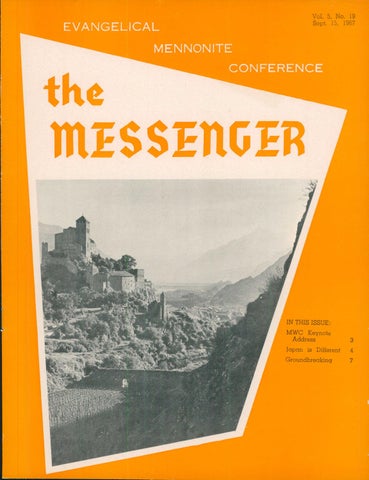
COVER PHOTO: It has been stated that Europe is a land of castles. Some of them date back to the middle ages and the days of feudalism. Many have been preserved as landmarks. The castle on our cover pic ture is Schloss Valeria, Wallis, Schweiz. Courtesy Swiss National Tourist Office.
The Messenger is the publication of the Evangelical Mennonite Conference. Its purpose is to inform, instruct and inspire. Inform as to what is going on in the Conference. Instruct in Godliness and victorious living. Inspire to earnestly contend for the faith. All correspondence should be addressed to the Editor, D. K. Schellenberg. Change of address and new subscription should be sent to the Board of Education and Publication, Box 1268 Steinbach, Man. Subscription: Members pay through their church. Non-members $1.00 per year. Authorized as second class mail by the Post Office Department, Ottawa, and for payment of postage in cash. Printed by Deluxe Printing, Steinbach, Manitoba, Canada. Views expressed in Leflers Io Editor, are not necessarily those of the editor nor of the paper. Unpublished letters are not returned except by request.
KYNOTE ADDRESS AT MENNQNITE WORLD CONFERENCE
The Fellowship of the Holy Spirit Message given at the Eighth Mennonite World Conference by Erland Waltner, Elkhart, Ind., the conference president. Nearly four decades ago the es teemed British Bible scholar, H. Wheeler Robinson wrote, "If we ask what is the most char acteristic and comprehensive work of the Holy Spirit according to the New Testament, there can be little doubt that we should answer in one word 'fellowship'." (The Christ ian Experience of the Holy Spirit, P. 141) Neither the English word "fellow ship" nor the much better German word "Gemeinschaft," however is capable of communicating clearly all that is meant by the word koin onia which is used in our Greek New Testament. Here it meant a depth of relationship involving a high degree of mutual commitment, participation, sharing and solidarity which is seldom found in the church of today. The phrase "the koinonia of the Holy Spirit" which is the theme of our message appears in exactly this form only once in the New 'Testa ment, namely, in the familiar PauJine benediction in II Corinthians 13:14. "The grace of the Lord Jesus Christ and the Love of God, and the fellowship of the Holy Spirit be with you all." This text, though we have heard it hundreds of times, does not tell us a great deal either about the nature of this koinonia nor about the identity of the Holy Spirit,' ex cept that these are intimately and inextricably related to the grace of September 15, 1967
our Lord Jesus Christ and to the love of God our Father. To the Christians of Philippi, Paul wrote using a similar phrase, "If there be any encouragement in Christ, any incentive of love, any participation (koinonia) in the Spirit, any affection and sympathy, complete my joy by being of the same mind, having the same love, being in full accord, and of one mind." In either of these passages, it would be possible, to understand that they may refer (1) to fellow ship with the Holy Spirit, or (2) to fellowship with one another because of the presence and creative power of the Holy Spirit in the human com munity. Henrikus Berkhof, a disting uished professor of the University of Leiden, is right, I believe, when he observes that we need not choose in these passages between the ver tical and the horizontal dimensions of koinonia. Here, as is so often the case in the New Testament, "am biguity is a sign of multi-dimension ality" that, a mark of the manysidedness of a truth or reality. The New Testament understanding of this fellowship of the Holy Spirit is orecisely that it involves both the Holy Spirit .Himself and the com munity of men. it sees this fellowship, which we call the church, as created by the Holy Spirit through the historical work of Jesus Christ in His life, death, and resurrection. This reality is expressed in a community of his torically visible persons among whom God is really present and ac tive through His Spirit. This is the historical phenomenon
of which we read in Acts 2 in the account of Pentecost when it is said of the early Christians that "They were all filled with the Holy Spirit," (Acts 2:4). Later it is said of the growing circle of those who through them were converted to Jesus Christ, that "they continued in the apostles' teaching and in the fellowship, and in the breaking of bread, and in the prayers" (Acts 2:42). This visible historical reality is not only a new beginning in the life of the people of God in the world but is for Christ ians the touchstone of all subse quent fellowship which claims to be in continuity with early Christianity. We ask, however, who is this Ho ly Spirit? Who is this One of whom we speak so profusely at this con ference? We may reply quickly in the language of tradition theology that He is "the third person of the trinity," yet volumes cannot express adequately what this means. Nei ther is this our basic theme this eve ning. More recent interpretations of the identity of the Holy Spirit, while maintaining the trinitarian under standing and distinctions, neverthe less tend to emphasize the unity of God. To speak of the Holy Spirit it is said to speak of God as Spirit. The term "Spirit" which originally means "breath' or "wind," biblically comes to signify vitality, power, and activity. F. W. Dillistone thus de fines the Holy Spirit very simply as "God in action in human life." Alan Richardson says with equal simpli city "God's Spirit is God acting." From the New Testament perspec tive the Holy Spirit is always seen in relationship to Jesus Christ and thus after His death remains insep(Contd. on page 8) 3
BEGINNING LANGUAGE STUDIES
event-
these folks have assisted us with a lot of our business transactions. This Monday, Sept. 11 we begin our language studies. There are to be around 25 students. We are look ing forward to these studies - and to use this knowledge to God's hon our and glory. Fighting
Farewell "Farewell, farewell," were words we heard frequently from many friends during last week. On Fri day morning. August 25 we left Kleefeld. We were grateful that Dan's parents were able to drive us to Seattle and that we could have some short visits with friends on the way. Again and again we heard the encouraging words: "We'll be praying for you." This made every 'goodbye' easier. Truly friends, we felt unworthy of being the objects of your prayers and gifts. We sense the responsibility under God to be faithful. "Farewell," we have said in body but not in spirit. Our thoughts and prayers will be direct ed to you also, especially to those who will take the time to write.
as if here was a spirited army fly ing to a new battle front. Tokyo
We arrived in Tokyo airport about 3:30 Aug. 31. It was a won derful smooth ride. It took us about an hour to clear customs and there we met Bob Spaulding our Field director and also Mary Koop, my aunt. It was good to see some fam iliar faces. We spent the night in Tokyo. The next day Bob took us here to Karuizawa where weTl be in language school for the better part of two years. This is a beautiful place up in the mountains. Due to the high altitude it is cooler during the hot summer. This will make it easier to study. We have found many things dif ferent. Because of the many sharp Flyinq curves you see many concave mir This is August 30 and we are in rors erected so as to see traffic com mid-air between Seattle and Tokyo. ing around the blind corner. You At 1:30 p.m. we said 'goodbye' to drive on the left side of the road. Dad, Mom, and Mission represen Trucks ahd cars are in abundance, tatives. On this flight we are eight always clean and polished and missionaries with the Japan Evan with radios. Driving is quite daring gelical Mission. Then there are at times. The open markets are another sixty-one missionaries as clean and attractive. sociated with various Mission or We were surprised with similar ganizations. Only a few are going ities, majority of people go in west elsewhere than to Japan. It was a ern clothes, in vegetables we can real blessng to hear one group of get corn on the cob, potatoes, cu Christians praying in this part of cumbers, carrots, beans and so also the Seattle terminal. Then another for fruit. We have been here five days group sang, "I'll go where you want and have found the Japanese very me to go," and still another, "On friendly. We are living cn the camp ward Christian Soldiers." It seemed us of Karuizawa Bible Institute and
MISSI 4
None of us would dare to boast of skill and success in this spirit ual battle. We are going to face various ones for which we ask your prayer support. We are aliens, bringing new reli gious concepts. We must learn this difficult lang uage. The Japanese customs will be to tally strange to us. There will be a battle for health in a damp climate and strange foods. So it seems our battle before us is spiritual, mental and physical, but we are encouraged from Paul "FIGHT the good fight of FAITH." The Dan Koops 2163 Karuizawa Machi Nagano Ken, Japan
COMING EVENTS Sept. 17, 2:30 p.m. Installation services at Arden for the John Toewses who are taking up the minstry there. Sept. 17, 11:00 a.m.. Reception of new members at the Por tage la Prairie EMC. Sept. 22-24, Regional Missions conference at Mafeking, Hud son Bay and Creighton. Speakers: B. D. Remer, B. Eidse, Clifford Reimer, Ellen Brell, plus Board of Missions representation. Sept. 29 - Oct. 1. Regional mis sionary conference at Stein bach. Speakers, Ben Eidse, Clifford Reimer, Gilbert Rei mer, B. D, Reimer, Ellen Brell, Larry McNeill. Oct. 6, EMC Board of Missions meets at Wymark. Oct. 7, EMC ministerial meets at Wymark. THE MESSENGER
CHRISTIAN SERVICE WORKER LEAVES
•“I
Agatha Fast is a missionary under the Bible Christian Union, serving the Lord in Germany. Her home church is Blumenort.
Doreen Reimer Leaving lor a one year assign ment under the EMC Christian Ser vice Committee is Miss Doreen Rei mer, Steinbach, Man. Sister Reimer will be teaching in the fanz Team Private school in Basel, Swizterland. This is a school lor missionary child ren. Miss Reimer vrill be leaving from the Winnipeg International Airport on Monday, Sept. 11. Doreen has taught at the Stein bach Bible Institute since 1959 with a one year intermission at Beaver lodge, Alta. We commend sister Reimer to our Messenger readers lor prayer support.
Awake, Our Souls! Awake, our souls! away, our fears! Let every trembling thought be gone! Awake, and run the heavenly race! And put a cheerful courage on.
True, ’tis a strait and thorny road. And mortal spirits tire and faint; But they forget the mighty Cod, That feeds the strength of every saint. From Thee, the overflowing Spring, Our souls shall drink a fresh supply; While such as trus-t their native strength Shall melt away and droop and die. Swift as the eagle cuts the air, We’ll mount aloft to Thine abode; On wings of love our souls shall fiy,. Nor tire along the heavenly road. —Isaac Watts.
September 15, 1967
John 16:16-23: " In a little while and you will not see me any longer, and again, in a little while you will see me . ." Why is our Lord so vague? The disciples are troubled. "We simply do not know what he means" they say to each other. There was probably little sense in Jesus' saying any more at the time. After Jesus' prophesy was fulfilled, the dis ciples probably stood in awe at the words that had sounded so obscure before and had sud denly become so clear. It was just as Jesus had said, "and on that day you will not ask me any questions." I have found this to be a principle which our Lord uses to teach practical truths of great value. I stand before a very difficult situation: What decision shall I make? I am too confused ev en to know what decisions there are to choose from. Why doesn't God speak clearly? It is not for me to choose a road when there is no pos sibility of choosing one at the moment. It is for me to walk into my situation with my eyes open and expectant, my heart humble toward God. being and doing wholeheartedly what I know pleases him. I may also come out, not needing to "ask an^ more questions." Aug. 27 - John 15:10-13. "If you keep my command ments you will live in my love
—just as I., have kept my Fa ther's commandments and live in His love." For Jesus to live in His Fa ther's love, then, meant Geth semane: "Take away this cup from me nevertheless not what . I will, but what thou wilt." It also meant Calvary: "Except a com of wheat fall into the ground and die . . ." (John 12:24) "I have told you this," Je sus said, "so that you can shore my joy, and that your happiness may be complete." Joy without this pre-requisite is superficial. The more we share in the depth of Christ, complete yieldedness to the will of the Father, the more our joy will be of the character of the joy of our Lord. Jesus ends by saying, "There is no greater love than this, that a man lay down his life for his friends." I see a corollary here in our horizontal relationships. Love for our "friends", in Jesus' words, means commitment. The more I humbly committ my self to my fellow-believer, the deeper and more rewarding will be the joy of such a re lationship. This does not mean only those to whom I have a nature (inclination). But such a relationship is not only de sirable, it is also a command. I believe this is not a stretched comparison. Jesus himself says in verse 12, "This is my cornmandment, that ye love one another, as I have loved you." Agatha Fast
5
JOHN D. LOEWEN 19054967
1N NEWS EWS I|l FELLY V.B.S.
In every home where there are young sters final "back to school" preparations are being made and so we realize time is marching on and you are wondering what is going on at Pelly. Here changes have taken place, but first let us tell you about our V.B.S. classes. They were held Aug. 14-18. A number of teachers came from Steinbach and taught in several rural areas. Attendance at all schools was good. Instead of the usual Friday evening program in Pelly we had our closing on Sun. eve ning. A large group attended and the children presented an interesting program on the things they had learned during the week.
Farewell Sun., Aug. 27 friends of the Giesbrechts gathered in the church to bid farewell to our pastor and wife who have served us so capably for the past five years. They have left to make their home in Steinbach for the next year, where Abe will be doing the work of a maintainance man at the Bible school and also taking some subjects to further his education. Loretta will be cooking at the school. We look forward to having them back with us some weekends in September as these were their plans when they left. As of now there is no one to fill the vacancy left by the Giesbrechts.
Revelation 14:13 - In His wisdom the Lord has seen fit to take from us, my beloved husband and father of our children, to be with Him in Whom he has believed. John D. Loewen was born to his parents Mr. and Mrs. Cornelius B. Loewen on June 1, 1905 at Steinbach and passed away at the Bethesda Hospital on Aug. 8, 1967, reaching the age of 62 years , 2 months, and 7 days. He was 21 years of age when he yielded to the voice of the Holy Spirit and accepted Jesus as his Redeemer and Lord for his life. Upon confession of faith he was bap tised on May 26, 1926 and received into fello(wship of the Evangelical Mennoni'te Church (then Kleingemeinde) at Steinbach In the year 1926 on July 25 he was united in matrimony with Anna Reimer. In this union five children were bom. Marian, Mrs. Stanley Houghton, Ecuador, South America; Lloyd who died when he was nearly 15 years of age; Ramona, Mrs. Henry Klassen, British Honduras; Jack, (married to Helen Hiebert), Steinbach; Corinne, Mrs. Alfred Warkentin, Landmark. His wife, Anna predeceased in Aug. 20, 1942, after they were married 16 years, and left him and five young children to mourn her early departure. The next year he took me, Helen Unger, as his wife to share our joys and sorrows. We were united in marriage on May 2, 1943. Five children were born to us. Barry (married to Judy Malanik) living at Langley, B.C. and Leander 21; Loris 19; Kelvin 16: Priscilla 14, all at home.
Mr. Loewen resided in Steinbach except for the years 1933 to 1936 when they lived in St. Anne. There they lost all their be longings in a fire when their house burned. He was a skilled mechanic and has for many years worked for Loewen Garage Ltd. In 1952 he started the Loewen Auto Wrecking business which he owned and op erated for the past 15 years, serving the public as much as his health permitted to the end. His health began to fail him in 1963, when he was hospitalized one week be cause of diabetes. In 1965 he suffered a heart attack which kept him in hospital for three weeks. He had another heart attack on Friday, Aug. 4 to which he finally suc cumbed in the hospital. He leaves to mourn his passing me, his wife, five daughters, four sons and 16 grand children. He is also survived by three brothers: Abraham and Henry of Steinbach; Ben of Kamloops, B.C., and four sisters, Mary, Mrs. John C. Reimer; Katherine, Mrs. Jac. H. W. Reimer; Helen, Mrs. Leo Smith, Keremios, B.C. and Margaret, Mrs. Henry K. Reimer, Lincoln, Neb. We are in sorrow, but we rejoice in the hope that he is now with the Lord- which is for better. We thank each one who has manifested sympathy in our bereavement either by letter, visits or prayers. The Family The funeral was held on Aug. 11 at 2 p.m. Rev. Arnold Fast had the English message. Rev. Jacob P. Dueck read the obituary and served with scripture and prayer at the graveside ceremony.
Baptism at Rosenort
1
The Vacancy to Fill As we look ahead to the time when clubs and various other activities should be taken where they left off last spring we won der if the Lord has someone to send to Pelly to be the leader of this group. While we wait upon the Lord to send this "Someone" may we be found faithful in doing what HE would have us do right in our own area.
Sunday, September 3, we were privileged to have the senior choir from Blumenort. They presented a program "The Greatness of God". This was a real treat and thor oughly enjoyed by everyone present.
5
L. to R.: Rev. Nick Friesen, Emily Friesen, Susan Friesen, Harry Brandt Randall Dueck, Ernie Barkman, Gerry Dueck, Rev. P. L. Friesen
THE MESSENGER
Ground-Breaking For New Church
Taking part in ground-breaking ceremonies ior a new EMC church in Winnipeg are Ben F. Klassen, Lee Toews and the pastor, C. R. Plett.
Wednesday, September 6 was a red letter day for the Aberdeen EMC chuch in Winnipeg when they broke ground for a new church. A goodly number of the congregation had gathered on the site at Munro and Luellda in East Kildonan to take part in this historic moment. A brief ground-breaking program had been prepared, with the pastor Rev. C. R. Plett in charge of proceedings. His opening invocation was based on Isaiah 66:1, 2 Samuel 7:5; I Chronicles 28:20. After this the congregation sang, "How Firm a Foundation." The statement of purpose was given by deacon Ben F. Klassen, while deacon Lee Toews read scripture and prayed. This was followed by an address by the pastor, Mr. Plett. Upon this there followed the breaking of ground for the new building. Taking part were the deacons' and the pastor. This was followed by the prayer of dedication, A prepared responsive reading by pastor and people gave thanks and praise to God. The service closed with the hymn, "Our Helper September 15, 1967
An energetic building committee is ready to begin 'he structure oi the new Aberdeen EMC church. Seen here L. to fl. Bill Plett, Jake Kroeker, Harry Harder, and Ben Wiebe. The latter being chairman.
God, We Bless Thy Name" and prayer. The church when completed will seat some 360 people. The overall size is 46x110 with the estimated cost $65,000. It is hoped for a completion by Christmas. The history of the Aberdeen church dates back to 1951 when the EMC began with services in the city of Winnipeg. At that time in a rented auditorium. By 1954 when these facilities no longer met the need a church building was purchased on Redwood Ave. After some two years the facilities again proved inadequate and the present church was purchased. For some time now the congregation had again very seriously tried to make more room, either by enlarging the present structure or in building a new building. This was suddenly brought to a head when on Aug. — fire partially destroyed the building, making immediate action necessary. Since the old church was now almost beyond repair, the decision was reached to re-locate and build new.
ANNUAL
EMC NURSES
FELLOWSHIP The annual EMC Nurses Fellowship will take place on
SEPT. 29, 7:30 P.M,
at the STEINBACH BIBLE INSTITUTE
All nurses and sudent nurses
in the Conference are invited. EMC NURSES FELLOWSHIP
7
of Ole Spirit. Likewise the creation of the church as "the new Israel" erable from the resurrected and ex which marks the down of a new alted Christ, The Spirit as sent forth day, finds its focal beginning in from Christ is therefore also to be the Pentecost experience. imderstood as the vitality, power, Beyond giving light and'life, how and activity of the living Christ as ever, the Spirit also empowers men he dwells and works in and through for mission and ministry. "Ye shall men in the world. Karl Barth thus receive power after the Holy Spirit soys that the Spirit is "no other is come upon you." (Acts 1:8). Emil than the presence and action of Brunner notes that "the fellowship Jesus Christ Himself: His stretched- of Jesus lives under the inspiration out arm; He himself in the power of the Holy Spirit; that is the secret of .His resurrection." of life, of its communion, and of its While Anabaptist theology has power. To use a blunt, modern word, correctly emphasized a trinitarian the Spirit supplies 'dynamism' of understanding of the Godhead, as the Ecclesia ^Misunderstanding of over against anti-trinitorions, Peter the Church p. 47) Where this pow Reidemann noted concerning the er exists, as we see. in Acts, things Father, Son, and Holy Spirit that happen—conversions, healings, op "where one is there ore all three, position, growth, and persecution. and where one is lacking, none is That men can say in our time that present." This is already a recogni "God is dead" or that "the church tion of the xmity of the Godhead is dead" is as much a commentary which is being stressed today. Suf on the church's failure to become fice it to say that in our heritage we the habitation of the Holy Spirit as affirm the reality and personhood it is on the so-called secularism of of the Holy Spirit in trinitarian terms the age in which we live. but that we may also properly Today there is much talk of the speak of the Holy Spirit as God need for renewal in the church Himself present and active among throughout the world. Formulas for us and in us. renewal are many and varied. We Probably the greatest tragedy too at this conference ore concerned which could occur in these days is about renewal. Let us be clear how that we would speak thousands of ever, that renewal comes to men words concerning the witness of and communities ultimately only as the Holy Spirit yet would ourselves the work of the Renewer, the Holy corporately and individually avoid Soirit, who is God acting in the ere His own eager work in us and' in ction of new men and n^w com our churches and in our world munities. Renewal ultimately is not wide brotherhood. a result of what men do so much By looking at the church in the as it is of what God's Holy Spirit New Testament, however, we may does. see certain characteristics of the fel Unity and Diversity lowship of the Holy Spirit which Moreover, the koinonia of the we too, by the grace of God, may Spirit is a fellowship of unity emexperience and manifest. bracing and employing diversity. Vitality and Power Paul in I Corinthians affirms "Now there are varieties of gifts The koinonia of the Spirit in the New Testament was a fellowship but the same Spirit, and there are marked by vitality and power. The varieties of service, but the same work of the Holy Spirit throughout Lord, and there are varieties of work scripture is life-giving, light-giving, ing, but it is the same God who in and energizing. Creation and regen spires them all in everyone. To eration are fundamental expres each is given the manifestation of sions or the work of the Spirit in the Spirit for the common good" (I the world. The Holy Spirit creates. Cor. 12:4-7). He gives light and life (2 Cor. 3:6). Likewise, Ephesians 4, speaks of As Jesus said to Nicodeimrs, the the "unity of the Spirit in the bond new life without which no man will of peace" and then goes on to speak see the kingdom comes as a work of the diversity of gifts which have FELLOWSHIP . . . Contd.
8
been entrusted to the church so that it may be equipped to fulfill its one ministry in the world. (Eph. 4:11, 12). This unity is therefore no uniformity but the Spirit gives indi viduality to members in the plurality of gifts and functions (Werner Weisner). Precisely this unity which em braces and employs diversity is of great significance for the church and for the world today, also for us in this Mennonite World Con ference. Where both church and world suffer deeply from broken ness and division, it is important to see that where the Holy Spirit dwells and controls, both unity and diver sity are found side by side and in dynamic and harmonious relation ship to each other. The fact that the diversity and not only the unity is a gift of the Spirit means that such diversity among individuals who make up the body of Christ is not only to be accepted. It is rather to be welcomed with joy and developed and used in the fel lowship for the edification and en richment of the whole community. For us as a world brotherhood, representing such diverse racial, cultural, and national background, this has tremendous significance. We represent here not only conti nental and national groups but a variety of denominational groups within the brotherhood. We repre sent congregations with long historic Mennonite traditions and congrega tions which are new and young and vigorous. In fact, as we experience this oneness of the Spirit in this ga thering across all the human lines that separate us, we have a fore taste of that which John sow on the island of Patmos as he describes it in Revelation 7:9, "After this I looked, and behold a great multi tude which no man could number, from every nation, from all tribe.s and nations and peonies and tongues, standing before the throne and before the lamb." Just because of the tremendous diversity which we represent here, it is possible that this world con ference may bring us closer to a true experience which we may have had up to this time, (Contd. on page 12)
THE MESSENGER
s.
Some Vacation Bible Schools and Camps Many children again responded to the call to Vacation Bible School this year. Others went to Camp. The summer months are ideal for reaching children fgr Christ. Many also responded to go and teach. Seen on this page are a few representative scenes of worthwhile summer acti vity along these lines.
M-
f I
Lineup at Steeprock children's camp before entering diningroom (also serves as chapel.^
I
n t
-1
These youngsters came to Canora VBS.
the
Tetherball is exciting (Sfeeprock).
The lucky girls went to Camp (Camp Jubilee, Portage^.
a; G I I I 1 «
(Le/t) Here we see the group that was present at Endeavour VBS the day the photographer was there. There were 79 children in attendonce. Teachers came from Blumenort and Endeavour area. Seen on picture are also Mr. and Mrs. Pete Friesen, in charge of the Endeavour work. (Peter Friesen extreme right and Mrs. Friesen on porch right). 9
The boy who escaped By Rita Couldridge
Chapter VII
MATU ESCAPES AGAIN A week passed by, and Motu lived in solitary splendour. Water, firewood, and meals were provid ed for him. The villagers greeted him each morning, then the women went off to their gardens and the men were busy with their own tasks. Wistfully he watched the children playing together and wished that he could join them. Sometimes in the evening he walked through the village, but he dare not let his leo pard pet out of the house as the village dogs were always ready to attack. Occasionally on his solitary walks Matu joined the groups of men as they sat under the big tree telling stories and discussing village af fairs. The men were polite and made room for him in their midst, but con versation flagged, and soon the men made excuses and went to their own houses. One evening Matu was sitting by himself at the door of his house when the Chief, accompanied by some of the elders of the village, came to him. "Great Spirit of the Forest, the protector ,of our village," he said. "We bring you two maidens who will be your wives. Then Buya's husband came, lead ing Losanda and another young girl. "See," said the Chief. "Here are
10
your wives, they are ready to do your bidding." "But," stammered Matu in great surprise, "I don't want any wives." "We are your servants, great Spir it," said the Chief. "We thought you would want wives whilst you are in our village, but now we see our foolishness. Forgive us for even dar ing to think that our women could be good enough to dwell with a spir it god. "Forgive us," said the others, kneeling humbly before Matu. "You are forgiven," answered Matu grandly. Losanda and the other girl stood waiting to be dismissed and, in the pause which followed at Matu's words, Losanda summoned up her courage and came to him. "Great one," she said, "We, who are not worthy to be your wives, bring our thanks to you for your
protection. Since you came to guard our village no one has dared to steal from our garden." Matu smiled at Losanda. "That is indeed good news," he said. The interview thus ended, Matu withdrew into the safe sanctuary of his own little house There in the dim light he went over to the cor ner where his pet was lying. The leopard's strength was nearly spent and he lay there quietly and made no attempt to eat the food which Matu offered to him. The little boy felt very sad and he lay down be side the leopard and began to cry softly. "You are languishing for the for est, my friend," he said. "And I too am losing my strength in this small house. Tonight, when all are sleep ing, we will go back to our free dom." He lifted his pet into his arms, but its head fell back heavily, and Matu burst into tears once again, as he hugged his lifeless compan ion. Lonely and sad, he went out into the village. The men were in a group, talking excitedly beneath a large mango tree. Matu wandered over and immediately the men gave place to him and he took a seat of honour in their midst. Then, to his surprise, he saw a stranger amongst the villagers. "Behold, great Spirit," said the Chief. "Here is Mondoko who has travelled far and has brought to our village stories of the many wonder ful things which he has seen." A sudden fear swept into Matu's heart as he looked at Mondoko.
THE MESSENGER
"Perhaps he has brought tidings from my own village," he thought. "Now they will hear the truth and I shall be killed." "What is your news?" he asked. Mondoko knelt at Matu's feet. "My news is of a mighty river which has no beginning and no ending. It is wider than our village, and on its banks dwell people who speak as we do." "How many days have you walked since you left these peo ple?" asked Matu. "For a whole moon. Ahl great Spirit, I walked through forest and plain, forest and plain, with my back towards the setting sun and the mighty river always behind me." "For what reason did you leave the safety of your village and the companionship of the men here?" "I was ever adventurous," said Mondoko. "And during a tribal fight I was captured, but, as you see, I escaped and hid in the forest. Alas! I was far from home and I lost my way in the forest. Many days I wandered and came suddenly upon the great river. Now I have strength and a store of wisdom which I bring back to my own village. I have learned to weave nets and I have skill to catch fish." "There shall be feasting and re joicing for one who returns," said Matu. "True," answered the Chief, "and tonight the moon is full. Bring out the drums, fill up the gourds, and let us make merry. We will kill two sheep and the women shall prepare a great feast." "Yes, yes!" cried the men. "Let us kill them without delay, and let us also prepare a gift for our great God of the Forest who has brought Mondoko in safety through the dan gerous places." Mondoko rose to his feet. "I give thanks to the Spirit of the Forest," he said. Then the men hastened away to kill the sheep, the women made big. fires, and soon all was ready. The drummers were beating out a steady rythm, and dancers were tirelessly stamping their feet in time with the notes. The feasting .contin ued, and the moon had begun to pale before the young folk gave up
September 15, 1967
their dances and sank down to sleep beside the smouldering fires. Some of the older men were drunk with palm-wine and were snoring noisily. Matu had crept away unnoticed at an early hour, and now, as the sounds of revelry died away, he cau tiously opened the door of his house and peeped out upon the scene. Satisfying himself that all the vil lages were asleep, he picked up a bundle containing his treasures, which included bracelets and other adornments which he had received from the people. Then, adding a small supply of food and carying his spear, he stepped softly out of his
house and disappeared into the dark ness of the forest. Once, more alone in the forest, he hurried along the path, but until morning dawned his progess was slow. At last darkness changed to daybeak and then the sun began to peep through the trees. Matu left the narrow track and plunged into the jungle, pushing his way laboriously through the thick growth. To reach the great river was his aim now, and remembering Mondoko's words he made his way in the direction of the sunset.
(To be continued)
FROM
HOUSE
TO YO
HOUSE
a while. How refreshing to see someone so eager and enthralled with God's Word! Yearningly I ask mysef, "Do I read it that way or is it old mater ial? How easy to read some familiar passage and not even concentrate on it. Wherp and how do I find "such newness," even living water or should I say bread? Where can I find the answer? Let me see, may be in Psalm 119 (that psalm so rich in praises of God's law!) Oh, yes, first I must pray, "Open 'Thou mine eyes that I may behold won drous things of Thy law. (v. 18) Next to quote the Psalmist "I will meditate in Thy precepts (v. 16) That will take time and not a mere skimming over a chaptetr. 'Then I am THE BIBLE—"SO OLD AND expect results like David when he YET SO NEW." says, "I will delight myslef in 'Thy Joyce Dyck statutes." (117) In whom can we A mother and her daughter were have a delight? In the person, words seated together on the big chair. or thoughts of someone we love? All around was peace and quiet, So maybe we should put the words and both were intent on their books. '"Thy" in big letters because God's Suddenly the eight-year-old girl ex word is the contact we have with the claimed enthusiastically, "Oh, does One whom we love because He n't Jesus say it just right!" She was first loved us. So let me always reading in the Gospel of John for keep in mind to seek his face, to the very first time. "If I don't under meditate and find "delight" or new stand it, I read it again until I know ness in the Book that is old but ever what it means," she explained after new to our hearts and lives.
11
FELLOWSHIP . . . Contd.
Witness and ServiceMoreover, the koinonia of the Spiri! is a fellowship of witness and ser vice, of mission and ministry. PLeslie Newbigin has o’-' and properly said, not participation (k Christ without particip in the mission of Christ." The work of the Holy Spirit in us and among us is not only to reconcile but it is also to motivate, to equip and to mobilize for witness and service. As Hendrik Kramer puts it, "The Holy Spirit is the baptizer of the church into wit ness-bearing." (Theology ot the Laity, p. 132). Whatever else we may observe about the fellowship of the Spirit in the New Testament, it is clear that the early church was "a witnessing community." (Suzanne de Dietrich). As portrayed in the book of Acts, this included a spontaneous and contagious evangelistic thrust, both in the local community (Jerusa lem), in the neighboring community (Samaria), and to the uttermost parts of the earth (Corinth, Rome). The eager telling of "the good news" was but one facet of the church's ministry. Another was diakonia, the common term for hum ble loving service to meet the need of a fellow human being. The fel lowship of the Holy Spirit came to be a ministetring community doing good to men in need, such as for service by an imposed code of duty, or to gain some commonly desired reward, men filled with the Holy Spirit were persons driven by agape which is nothing other than God's love "poured into our hearts through the Holy Spirit which he has given us" (Romans 5:5). Freedom and Order Again, the koinonia of the Holy Spirit is a fellowship of both free dom and order. It embraces both liberty and obedience, loosing and binding, emancipation and disci pline. The Gospel writer, John, observes that the Holy Spirit in His work is totally unpredictable and that he thus cannot be manipulated or con trolled. Like the wind. He blows where He wills (John 3:8). Likewise
12
Paul writes,.''Where the Spirit of the Lord is, there is freedom"" (2 Cor. 4:17). In a world in which men are ofto’" hound by traditions, by legald by their own sinful habits, ■ great importance that we jiiize that the Holy Spirit makes men free. This is one dimension. The other dimension, however, is that the Holy Spirit is also the au thor of order. In fact as (Eduard Schweizer puts it, church order is also a manifestation of the Spirit (Church Order in the New Testa ment, p. 194 ff) This is already im plicit in the doctrine of charismatic gifts, in the appointment' of the sev en in Acts 6, and in the develop ment of ordered ministries as de scribed in the Lukan and Pauline writings. Paul needs to remind the Corinthians that God is not a God of confusion but a God of peace. (1 Cor. 14:33), and that this peace calls for having things "done de cently and in order" (1 Cor. 14:40). The community of the Holy Spirit is by no means a community of chaos.
We begin to see then that it is precisely in the koinonia of the Holy Spirit that freedom and order come to be seen in proper relationship to each other. The freedom of the Spirit which the New Testament talks about is the freedom to serve one another in love (I Peter 2:16). While the Holy Spirit makes men free from sin and the law as well as from tradition or from the world, it nevertheless binds them to a com munity life which is controlled by divine love and which is expressed in the service of God and men.
As Harold S. Bender, the former president of the Mennonite World Conference has pointed out, how ever, there are two great dangers which threaten the full develop ment of the potential of fellowship and brotherhood and its proper ex pression in the life of the church. The one is individualism, the other institutionalism. (These Are My People, p. 52). Individualism arises out of an undue emphasis upon the freedom of the Spirit. Institutional ism arises out of an undue attempt to order, organize, and control the life of the community. Only as the
community remains humbly open to the presence and obedient to the leading of the Holy Spirit can it avoid these perils and pitfalls. As a Mennonite brotherhood we have not escaped completely either one of these distortions of koinonia. We must ever be on our guard not only against the one or the other of these dangers, but against both.
Conclusion To be in reality the koinonia of the Holy Spirit, then, means to have vitality and power, unity and di versity, witness and service, free dom and obedience. Of the church in the book of Acts it is said again and again that "they were filled with the Holy Spirit" (Acts 2:4, 4:32) The em phasis is on the "all" 'This was new at Pentecost that the gift of the Spir it was not the possession of an in dividual or a few, but that He was in a profound sense the possession of the whole community. It was the whole body of believers which con stituted the habitation of God in the Spirit. To put ourselves in the way of being filled by the Spirit, we need not travel anywhere. We who have traveled many thousands of miles need not have come to Amsterdam for this nor need we now leave Am sterdam to experience this. We have but to recognize that wherever men are, there God is also, and wher ever God is, there the Spirit is pre sent and ready to manifest Himself and to work We have but to open our minds and hearts to him in re pentant and obedient faith. We must ask. To ask means to pray. Jesus said that if we who are evil know how to give good gifts to our children, how much more will the Father give the Holy Spirit to those who ask him (Luke 11:13). We have prayed and God's Spirit is here. Even now we may exper ience his creating, regenerating, re conciling, illuminating, energizing, and disciplining power if we^ will but let him have His way, (In terpretation, January, 1950 p. 38). "He that hath ears to hear, let him hear what the Spirit says to the Churches." (Rev. 3:22).
—Mennonite Weekly Review THE MESSENGER