MENU
—
TRACKLIST ENGLISH FRANÇAIS DEUTSCH
P. 4 P. 8 P. 20 P. 32
This recording has been made with the support of the Fédération Wallonie-Bruxelles (Direction générale de la Culture, Service de la Musique)
2
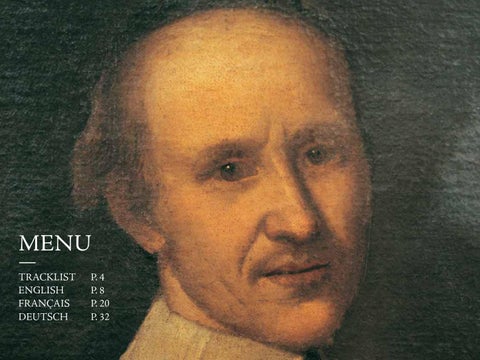
Recordings Molfetta, Chiesa di San Bernardino & église Notre-Dame de Centeilles, June 2014 & September 2015 Artistic direction, recording & editing: Jérôme Lejeune Cover: Anonymous, Bologna, c. 1700, Allegory of Music © Sotheby’s / akg-images Booklet cover: Anonymous, Portrait of Giovanni Legrenzi Bologna, Museo Bibliografico Musicale © De Agostini Picture Library / Scala Florence
GIOVANNI LEGRENZI
16261690
SONATE & BALLETTI
CLEMATIS Stéphanie de Failly, Lathika Vithanage, Juliette Roumailhac, Amandine Solano, Benjamin Scherer: violins Lathika Vithanage: viola Dmitry Badiarov: viola da spalla François Joubert-Caillet: bass viol Sarah Van Oudenhove: bass viol & violone Jérôme Lejeune: bass viol Cyril Poulet: violoncello Jérémie Papasergio: bassoon Marie Bournisien: harp Quito Gato, Bernard Zonderman: theorbo & guitar Lionel Desmeules: organ & harpsichord Philippe Grisvard: harpsichord
3
—
FR
02. Sonata terza a 2 violoni (op. 10) 1, 3
03. Balletto primo [Alemanda] (op. 16) 04. Corrente terza (op. 16)
MENU
5’28
10
4 violins , basso continuo (positive organ, theorbo , fagotto)
EN
DE
01. Sonata prima a 4 violini (op. 10) 1-4
9
5’33
6
2 violins , basso continuo (harpsichord, harp, guitar , bass viol )
2’03 1’50
2 violins1, 3, viola, viola da spalla, basso continuo (harpsichord / positive organ, theorbo10 / guitar10, violoncello)
05. Sonata [da chiesa] La Pezzoli a 3 (op. 4)
4’01
1, 3
4
2 violins , viola da spalla, basso continuo (great organ, Molfetta, chiesa di San Bernardino)
06. La Foscari a 2 (op. 2)
2’50
1
violin , bassoon, basso continuo (great organ, Molfetta, chiesa di San Bernardino)
07. Sonata da Camera La Forni a 3 (op. 4)
2’57
1, 2
2 violins , violone, basso continuo (positive organ)
08. La Marinona a 5 (op. 8)6 1, 3
3’11
9
2 violins , viola, bass viol , violone, basso continuo (harp, theorbo , harpsichord)
09. La Frangipana a due violini (op. 2) 1, 2
3’51 9
2 violins , basso continuo (harpsichord, guitar , harp)
10. La Basadonna a 6 (op. 8) 1, 2
3’08 6, 7
9
2 violins , viola, 2 bass viols , violone, basso continuo (harpsichord,theorbo )
11. La Cremona a 5 (op. 8)
4’03
1-4
10
4 violins , violoncello, basso continuo (positive organ, theorbo )
12. L’Obizza a 2 (op. 8) 1
3’57
6
9
violin , bass viol , basso continuo (harpsichord, guitar , violone)
13. Sonata seconda a 4 (op. 10) 1, 3
4’37
6
9
14. Balletto quarto (op. 4) 15. Corrente terza (op. 4) 16. Sarabanda prima (op. 4) 17. Alemanda terza La Piloni (op. 4)
1’19 1’29 2’03 1’09
2 violins101, 2, viola da spalla, basso continuo (harpischord / positive organ, 10 theorbo / guitar , violoncello)
18. La Zabarella a 3 (op. 2) 1, 2
3’09 6
9
2 violins , basso continuo (harpsichord, bass viol , guitar )
19. La Squarzona a 5 (op. 8) 4 violins
3’18
1, 2, 3, 5
, fagotto, basso continuo (great organ, Molfetta, chiesa di San Bernardino)
20. La Cornara a due Violini (op. 2)
2’55
1, 3
2 violins , basso continuo (great organ, Molfetta, chiesa di San Bernardino)
21. Balletto secondo (op. 16)
0’57
5
2 violins , viola, bass viol , basso continuo (harp, theorbo , violone)
DE FR
22. Corrente 1,nona [Ciaconna] (op. 16) 3
2’46
2 violins , viola, viola da spalla, basso continuo (harpsichord / positive organ, theorbo10/ guitar10, violoncello)
23. Sonata quarta a 2 (op. 10)
4’52
EN
10
violin, viola da spalla, basso continuo (violoncello, positive organ, theorbo )
24. Sonata sesta a quattroViole da gamba o come piace (op. 10) 6, 8
5’58
9
violin , viola, 2 viola da gamba , basso continuo (theorbo )
6
MENU
1
Sonate a due et tre, Opera seconda (Venetia 1655) Sonate da Chiesa e da Camera, Opera quarta (Venetia 1656) Sonate a due, trè, cinque e sei Stromenti, Opera ottava (Bologna 1671) La Cetra, Libro Quarto Di Sonate a Due, Tre e Quattro Stromenti (Venetia 1673) Balletti e Correnti, A cinque Stromenti (Venetia 1691)
Great organ Giuseppe Rubino, 1767, Molfetta (Bari), Chiesa di S. Bernardino Organ specification: Principale, Ottava, Quintadecima, Decimanona, Vigesimaseconda, Vigesimasesta, Vigesimanona, Voce Umana, Flauto in XII, Contrabasso 16’. Accessori: Tiratutti, Zampogna, Uccelliera
7
CLEMATIS Stéphanie de Failly1: violine Lathika Vithanage2 : violine & viola 3 Juliette Roumailhac : violine 4 Amandine Solano : violine Benjamin Scherer5: violine Dmitry Badiarov: viola da spalla François Joubert Caillet6: bass viol 7 Jérôme Lejeune : bass viol Sarah Van Oudenhove8: bass viol & violone Cyril Poulet: violoncello Jérémie Papasergio: bassoon Marie Bournisien: harp 9 Quito Gato : theorbo & guitar 10 Bernard Zonderman : theorbo & guitar Lionel Desmeules: organ & harpsichord
DE FR MENU 8
GIOVANNI LEGRENZI, SONATE & BALLETTI Giovanni Legrenzi was one of the most important of the great number of Italian composers active th during the second half of the 17 century; it is interesting to note that a career that was marked by appointments to important positions also contained a number of resounding failures. He received his initial musical training from his father Giovanni Maria Legrenzi in Clusone, the town of his birth and was appointed organist to the church of Santa Maria Maggiore in Bergamo, a city with an extremely active musical life in 1645; he was then twenty years old. His two first volumes of sacred music were composed during his time there, as was his first volume of sonatas (opus 2) in 1655. In 1656 his second volume of sonatas (opus 4) was published and he was appointed to his first important position, that of maestro di cappella at the Accademia dello Spirito Santo in Ferrara. He remained there until 1665, during which time he composed several oratorios as well as three operas; the first of these, Nino il giusto, was first performed in 1662. He received the patronage of several important men of the city, the most important of these being Ippolito Bentivoglio, who also wrote the libretti of some of his oratorios. It was Bentivoglio who made it possible for Legrenzi to perform his Oratorio del giuditio in the Imperial chapel in Vienna in 1665. The years that followed were in many ways his galley years. For another fifteen years, until 1681, his career led him from position to position, with many applications for different positions and a large number of unfortunate rejections; he applied to the cathedral of Modena and again to Santa Maria
9
Maggiore in Bergamo; he sought help from the Duke Gonzaga of Mantua so that he could present himself at the Viennese Imperial court. His search for a permanent position led him as far as Versailles, where he succeeded Thomas Gobert in 1668 as one of the four sous-maîtres of the Chapelle royale, although illness prevented him from continuing in his position there. His presence in Versailles is, however, confirmed by a manuscript copy of several motets by him in the Philidor Collection. He applied for the post of maestro di cappella at the Duomo of Milan in 1669 and followed this with applications to the court of Parma and to San Petronio in Bologna. Several volumes of sacred works by him were published in Venice and Bologna during this time. He finally obtained employment in various capacities in Venice: he entered the service of the Conservatorio dei Mendicanti as maestro di coro in 1671 and later became maestro of the Oratorio di Santa Maria della Fava in 1677. Even though neither of these posts was particularly prestigious, he had begun to make his reputation in the city of the Doges and soon succeeded in arranging regular performances of his operas and oratorios. After Francesco Cavalli’s death in 1676 Legrenzi applied for the post of maestro di cappella in the Basilica di San Marco. In this too he was to be unsuccessful, for the position was awarded to Natale Monferrato. Legrenzi did, however, obtain the position of vice-maestro in 1681 and, after Monferrato’s death in 1685, he was finally appointed to the highly-coveted position of maestro di cappella. He was now at the head of one of the most prestigious musical establishments in Italy, although only for a short time; he died five years later in 1690. There are areas of Legrenzi’s work that are still completely unknown. Ricercar released a selection of his sacred works in 2000, including the Dies Irae for eight voices and viols; its autograph score had been
10
discovered in the Bibliothèque nationale de Paris. We now present another recording devoted to Legrenzi, this time of his instrumental music. We have noted that his first two volumes of instrumental works were published in 1655 and 1656 respectively; the closeness of these two dates allows us to suppose that Legrenzi was particularly interested in this genre at that time. We may also suppose that his reputation was firmly enough established for the Venetian publishers Gardano (opus 2) and Magni (opus 4) to publish these two volumes in successive years. Legrenzi seems to have done everything possible to get himself known in Bologna during 16701671; he was applying for a position at the church of San Petronio at that time and brought out a volume of motets entitled Acclamationi divote and a third volume of sonatas, his opus 8. His Venetian career was in full flight some two years later when he published his fourth volume of sonatas, La Cetra opus 10, in 1673. These four volumes contain the essence of Legrenzi’s instrumental music. Although they have much in common, the four volumes of 1655, 1656, 1671 and 1673 each have their own particularities and personality. We should first of all note that, except for La Buscha of opus 8 that suggest the use of two cornetts as an alternative to the two violins, all the works contained in these volumes are intended for the instruments of the violin family, with the exception of a bassoon that provides the bass line from time to time. Whoever looks at these volumes is also immediately struck by their structure: the sonatas in each volume are ordered according to the different instrumental groups employed. Legrenzi’s opus 2 (1655) is entitled Sonate a due, e tre and is signed Di Giovanni Legrenzi, primo organista in S. Maria Maggiore di Bergamo & Accademico Eccitato. The volume contains eighteen sonatas: six for two violins, three for violin and obbligato bass instrument (violone or bassoon) and nine for two
11
violins and violone; all of these are supported by a continuo line. This immediately raises the question of instrumentation, for the use of a bass instrument is requested only in the sonatas that have a part written out specifically for it. In these cases, this individual bass line for the violone or bassoon is for the most part identical with the continuo line, although it does contain several variants that highlight the musical dialogue with the violin parts; this is even more obvious in the three sonatas for violin and obbligato bass. It seems therefore clear that, following the tradition laid down by previous generations, the continuo line should be realised only by instruments capable of realising the figured bass: the organ, harpsichord, theorbo, guitar and harp; the addition of a bass melody instrument was to be avoided. Formally speaking, these works are a continuation and extension of the sonata as it was composed by the musicians of the first part of the 17th century. The successive movements that alternate slow with fast passages and ternary with binary rhythms are arranged freely with slow movements that are generally marked adagio and that are most often simple transitional passages between two fast sections. This being said, the sonatas’ layout is not fixed and they can begin with either fast or slow movements, whilst the final movement, often quite brief, can be either flamboyant or meditative in character. Each sonata is made up of either four or five movements, some of which will be linked together; the final chord of one section will also be the starting point for the following. The first movement of the sonata is generally the most developed. Several sonatas take advantage of a form that will also be found in later volumes: in this case, the final movement is a new but briefer development of thematic material from the first movement. This is the case with some of the sonatas recorded here, La Cornara and La Frangipana... All of the sonatas are given a name that identifies them either with a town (La Porcia, La Valvasona,
12
La Cremona) or, more frequently, with the name of a person who can therefore be considered almost as the dedicatee of the sonata. This is clearly the case with the final sonata of opus 2: its title of La Savorgnana is a clear reference to the volume’s dedicatee, the Ill.mo & Ecc.mo Signore Marchese Giovanni Carlo Savorgnano, Podestà di Bergamo, Signore de Castelli Di Pinzano, Buia, Flagogna, Folgaria, Predemano, Zuins, Fornelli etc. Also, given that this was his first collection of instrumental music, Legrenzi also takes the opportunity to pay homage to his father by including a sonata by him: La Iustiniana, di Gio. Maria Legrenzi, Padre dell’Autore. Could the dedication of Legrenzi’s opus 4 — All. A.A. S.Sme DE SIGNORI Giorgio Givlielmo & Arnestro Augusto Dvchi di Branfuich, Luneburgo, &c — be an example of his unending attempts to win a permanent position? This time he set his sights on Germany, as can be seen from the completely different presentation of his opus 4. Although he had made no particular comments in either his earlier or his later volumes, this could well have been with the intention of informing his German dedicatees as to the exact purpose of these works, such distinctions clearly being unknown in Germany at that time. The difference in musical style between sonatas intended for religious and those intended for secular use continued to grow during the following decades; two separate genres had developed by the time of Corelli: the sonata da chiesa and the sonata da camera. The same problem of destination also applies to the works of Legrenzi’s other three volumes: we shall return to this topic below. Opus 4 seems to claim an identity firmly divided between the two genres. It contains twelve sonatas and a series of dances grouped by type: three Sarabande, three Allemande, six Corrente and six Balletti. There is no question of imagining that the dances could have been grouped into suites according to tonality: the Balletti are in B flat major, G major, C major, A minor, F major and A major, whilst the
13
Corrente are in D minor, C major, D major, A major, G major and C minor. Of the twelve sonatas of opus 4, the first six are described simply as Sonata a 2 violini e violone, while the second six are clearly entitled Sonata da camera a 2 violini e violone. The logical deduction to be made from this is that the first six sonatas are Sonate da chiesa and that the dance movements that conclude the volume should eventually be associated with the sonate da camera. Each work contained in this volume is scored for the same grouping: two violins, obbligato violone and continuo. Clematis have allowed themselves to perform the violin parts of the Sarabanda prima on the viola da spalla and the cello; these two instruments therefore play these lines one octave lower than written. As in opus 2, the sonatas of opus 4 are all named: La Brembata, la Pezzoli, La Terzi, La Strozzi, etc. The six church sonatas follow the same formal layout as the sonatas of opus 2, although certain of them employ a particularity not to be found in the opus 2 works: solo passages were reserved for three instruments, as they had been in works of composers of the previous generations such as Marini or Castello. Such is the case here with La Pezzoli, which has a solo for the first violin, a solo for the second violin and a solo for the violone. The chamber sonatas are unusual in that they are all quite short and, with one exception, consist simply of one movement in a fast tempo. The exception is the sonata recorded here, La Forni, a superb adagio in 3/2. Published 15 years after opus 4, Legrenzi’s opus 8 has not only many similarities with his opus 2 but also many new features; these are evident from the title page, where we see the announcement of sonatas for more than three instruments: Sonate a due, trè, cinque e sei Stromenti. Its link with Bologna, the city of its publication, is reinforced still further by its dedication Al Molto
14
Illus. E Molto Rver. Sig. D. Lorenzo Perti, Mansionnario dell’ Insigne Collegiata di S. Petronio. As in the opus 2, the sonatas in opus 8 are set out according to their instrumentation: there are three sonatas for two violins; three sonatas for violin and obbligato bass instrument, the possibilities being viola da brazzo, fagotto and violone; four sonatas for two violins and obbligato bass instrument with one of the above instruments being suggested according to the sonata; six sonatas designed for larger instrumental forces. These six sonatas are laid out as follows: two sonatas for the unusual combination of four violins; two sonatas for two violins, alto viol, tenor viol and viola da brazzo; a sonata for the same forces plus a violone; a sonata a doppio coro for two trios with the first trio of two violins and viola da brazzo and the second of two cornetts or violins and bassoon. We have used these original groupings in our recording. We should note that the various voices in the polyphonic sonatas in this final section of the volume are still laid out as if they were polyphonic vocal lines: soprano, alto, tenor and bass, all with their appropriate clefs including the old soprano clef with C on the bottom line for certain sections of Violin II. We may also wonder whether we should link the presence of the sonatas for four violins, of the polyphonic sonatas and the sonata a doppio coro to the composer’s search for a musical identity through the elements that had created Bologna’s fine musical reputation at that time. It is true that cities such as Ferrara and Bologna in particular had become important centres for the development of the violin and its music and that they had to a certain extent appropriated the leading role that Venice had first played in this field at the start of the 17th century. Certain violinist-composers such as Giovanni Maria Bononcini (1642-1678) had traced extremely clearly the development of the genre of the sonata up to the point where it reached its apogee with Arcangelo Corelli — who, we should remember, had himself been trained in Bologna.
15
Formally speaking, all that has been said already about opus 2 is still valid for opus 8 although certain sonatas are somewhat more developed than others and particular characteristics such as gigue rhythms occur more frequently. One of the true novelties of this volume is the appearance of the viola da brazzo amongst the bass obbligato instruments. Even though the word violone may appear more frequently on the contents page, the viola da brazzo is clearly mentioned in the individual part-book. It is a low-pitched instrument of the violin family — its music is unequivocally written in the bass clef — and it is supported by the player’s left arm as he plays and not between the legs. This can only be the instrument we know today as the viola da spalla, another of whose names was the viola di fagotto: it owed this name to the similarity of its timbre to that of the bassoon. Here too we see another link with Bologna: Giovanni Battista Vitali had been active in that city and in the Basilica di San Petronio in particular from 1658 onwards; he played not only violin but also violone, which he names in several of his compositions as the violone da brazzo. We should also note that the first sonata of this opus 8, La Bentivoglia, is an homage to Ippolito Bentivoglio, Legrenzi’s patron for several years beforehand in Ferrara. Legrenzi’s opus 10, entitled La Cetra, appeared two short years later in Venice. Could it be mere coincidence that Antonio Vivaldi was to use the same title some fifty years later for the last of his great volumes of violin concertos? Was it also a coincidence that Vivaldi too dedicated his opus 9 to the Emperor, at that time Charles VI? Once again, opus 10 not only contains much of the legacy of its preceding volumes but also a goodly number of innovations. The title informs us immediately what it contains: Libro quarto di Sonate a Due, Tre e Quatro Stromenti. This time the volume’s dedicatee is extremely important indeed: La Cetra,
16
Consecrata al nome immortale della Sacra Cesarea Real Maesta di LEOPOLDO PRIMI, sempre Augusto. We know that the Emperor of Austria at that time was a passionate amateur musician, both as composer and performer; we should also not forget that Legrenzi had not yet, at that time, been awarded any truly important musical position. Could he have hoped that this dedication could advance his career? We will see later that this volume contains a clear hint in this direction. The volume is once again well laid out: six sonatas for two violins, six sonatas for two violins and viola da brazzo, six sonatas for four instruments. What is new in this volume is that the individual sonatas no longer have titles but are simply listed as Sonata prima, Sonata seconda etc. With the exception of the two final sonatas in four parts, the forms of the works remain the same as in previous volumes; nonetheless, the presence of more developed movements and the style and use of dissonance in a movement such as the adagio of the Sonata Terza a 2 violini also evokes the first sonatas being composed in the new Bolognese style described earlier. Legrenzi embarks upon what are clearly the most original works of this volume with the sonatas in four parts. For the first of these sonatas he returns to the group of four violins in a more concertante style with the individual movements also being well developed. The three other sonatas use what truly resembles quartet writing with two violins, viola and bass. In contrast with the flamboyant exchanges of the four violins, the ideal of imitative writing now holds the upper hand; this is proof enough of the skill and talent of a composer of sacred polyphonic music and of an organist — although no work of his for organ has survived. The two final sonatas are clearly intended as a reinforcement of his dedication of the volume as a whole to the Emperor: these two sonatas are composed for quatro viole da gamba. We know how highly valued the viola da gamba continued to be in Vienna, and that they were used together with
17
violins in many chamber works, following the traditions laid down by the former Kapellmeister Antonio Berthali and by his pupil Johann Heinrich Schmelzer. In comparison with the preceding sonatas in four parts for two violins, viola and bass, these two final sonatas have indeed been composed in accordance with the four vocal ranges of soprano, alto, tenor and bass that is also highly characteristic of compositions written for viol ensemble. Legrenzi, however, did not want to lose the chance of having these two marvellous sonatas being played by other instrumentalists, so described them as being a quatro viole da gamba o come piace. If the chiavette technique is employed, the sonatas can be read one third higher and thereby made more suitable for performance on the violin. The instrumental works of Giovanni Legrenzi include two other volumes that were published posthumously: the Balletti e correnti a 5 opus. 16 (1691) and the Sonate […] con trombe e senza overo flauti (1695). The second of these volumes, with its announcement of sonatas for two to seven instruments with trumpets and flutes, has unfortunately not survived. The volume of Balletti e Correnti, however, presents us with a completely different aspect of Legrenzi’s output: his music for the dance. His opus 4, as we have seen, contains several dances for three instruments which can be linked to the Sonate da Camera in the same volume. The 1695 works, on the other hand, are composed for 5 instruments; there are nine paired works, each consisting of a Balletto and a Corrente. It is interesting to note that both the Balletti and the Corrente appear in different guises, as if they were generic terms for works in binary and ternary rhythm respectively. This is particularly striking in the Corrente, which assume many different characters: not simply the courante with varying moods, but also the gigue, the minuet and even, for the last piece, a chaconne. We should also note the different characters of the Balletti, these displaying various
18
levels between the stately style of an allemande and the majestic dotted style that recalls the style of the French overture. Could this be a memory of the time Legrenzi spent at the French court? In any case, this volume was not the only work of its type at that time; others have been found in certain European courts where French culture was much prized, one such being in Modena, where the Vitali family were active. We have made some of our recordings in Molfetta in Puglia, using a fine Italian organ dating from th the beginning of the 18 century that had a particularly beautiful Principale stop. Church musicians of the 17th century would have been required to perform with such an instrument; they did not hesitate to take their instrument to its limits so as to dialogue with the organ on an equal footing. Also, the church in Molfetta has a double organ gallery; below the gallery where the organist sits there is a narrower gallery that can hold up to just under a dozen musicians and singers. They therefore have perfect contact with the organist but are also a little further away from the organ and can judge the acoustic better as a result. In these conditions, there is no room for chairs or even for a violone; the only low instruments that can be used are those that can be played by musicians standing up: the bassoon and the viola da spalla. The church in Molfetta also has a generous reverberation time that gives the sonatas recorded there a particularly resonant acoustic. We recorded the other pieces in a smaller church, as we sought to bring the instruments closer to the listener to create a more chamber-like sonority. This recording of this compositions from the five surviving volumes of Legrenzi’s sonatas and Balletti provides us with an idea of how varied his works in this genre actually were, and of how little-known this composer still is. It would of course be wonderful if we could explore the contents of his lost final volume, published some twenty years later, and see how he had incorporated the trumpet. Such a volume could
JÉRÔME LEJEUNE
DE FR MENU
well provide the link between the music recorded here and the music of the generation of Antonio Vivaldi; it is interesting to remember that Giovanni Battista Vivaldi, the father of Antonio Vivaldi, had joined the cappella of San Marco as a violinist in 1685, when Legrenzi was maestro di cappella there. Giovanni Battista could well have taken his young son along with him to concerts and services, given that Antonio Vivaldi was seven years old in 1685 and twelve years old at Legrenzi’s death in 1690.
19
TRANSLATION: PETER LOCKWOOD
EN DE MENU 20
GIOVANNI LEGRENZI, SONATE & BALLETTI Parmi les très nombreux compositeurs italiens de la deuxième moitié du XVIIe siècle, Giovanni Legrenzi occupe une place de première importance, liée à une carrière jalonnée par l’obtention de places importantes, mais aussi, paradoxalement, par des échecs cuisants. C’est de son père Giovanni Maria qu’il reçoit, dans sa ville natale de Clusone, les bases de sa formation de musicien. Il a une vingtaine d’années lorsqu’il devient, en 1645, organiste à Santa Maria Maggiore de Bergame, ville dont l’activité musicale est alors très importante. De cette époque datent ses deux premiers recueils de musique religieuse, mais aussi, en 1655, son premier recueil de sonates (opus 2). En 1656, année de l’édition de son deuxième recueil de sonates (opus 4), il obtient son premier poste important, celui de maestro di capella de l’Accademia dello Spirito Santo de Ferrare. Il y reste une dizaine d’années, jusqu’en 1665, et cette période est marquée par la composition de plusieurs oratorios ainsi que de trois opéras dont le premier, Nino il giusto, est créé en 1662. Il est soutenu par plusieurs notables de la ville, et principalement par Hippolito Bentivoglio, auteur à ses heures de quelques livrets d’oratorios. C’est ce dernier qui lui donnera l’occasion de faire jouer en 1665, à la chapelle de l’Impératrice à Vienne, son Oratorio del giuditio. Les années suivantes peuvent être considérées comme des années de galère. Jusqu’en 1681, soit pendant près de 15 ans, il va connaître une carrière très itinérante, marquée par de nombreuses
21
candidatures et autant de déplorables refus ; c’est ainsi qu’il postule à la cathédrale de Modène. Il sollicite d’aide du duc Gonzague de Mantoue pour se présenter à la chapelle impériale de Vienne… Sa recherche d’une place fixe le conduit jusqu’à Versailles, où, en 1668, il succède à Thomas Gobert à l’un des quatre postes de sous-maître de la Chapelle royale. Mais un état de santé précaire l’empêche d’exercer ces fonctions. Néanmoins, ce séjour versaillais est attesté par la copie manuscrite de quelques motets conservés dans la Collection Philidor. En 1669, il postule pour l’emploi de maestro di capella à la cathédrale de Milan. Suivent des tentatives à la cour de Parme et à San Petronio de Bologne. Malgré tout, durant cette période, plusieurs recueils de musique sacrée sont édités à Venise et à Bologne. C’est finalement à Venise qu’il obtient diverses fonctions ; en 1671, il entre au service du Conservatorio dei Mendicanti comme maestro di coro, puis, en 1677, comme maestro à l’Oratorio di Santa Maria della Fava. Même s’il ne bénéficie pas d’un poste de grand prestige, sa réputation dans la ville des Doges s’installe et les représentations d’opéras et d’oratorios se suivent assez régulièrement. En 1676, suite au décès de Francesco Cavalli, il est candidat à sa succession en tant que maestro di capella à la basilique San Marco. La série noire est-elle enfin achevée ? Hélas non, le poste est attribué à Natale Monferrato. L’obtention du poste de vice-maestro en 1681 sera sa consolation, avant sa nomination, après le décès de Monferrato en 1685, au poste tant convoité de maestro di capella. Le voici donc enfin arrivé et, cette fois, à la tête de l’une des chapelles les plus prestigieuses d’Italie. Hélas, ce ne sera que pour cinq ans, puisqu’il décède en 1690. L’œuvre de Legrenzi contient encore des pans entiers complètement méconnus. Ricercar avait révélé une partie de ses œuvres religieuses avec l’édition en 2000 du Dies Irae à huit voix et violes, dont la source
22
manuscrite est conservée à la Bibliothèque nationale de France. Voici donc un autre enregistrement consacré à ce compositeur, qui présente une facette bien particulière : celle de la musique instrumentale. Nous avons déjà évoqué plus haut les dates de publication des deux premiers recueils, l’opus 2 en 1655 et l’opus 4 en 1656. La proximité des dates d’édition permet de supposer que ce genre intéresse particulièrement le compositeur à cette époque. On peut supposer également que sa réputation est suffisamment bonne pour que les éditeurs vénitiens Gardano pour l’opus 2 et Magni pour l’opus 4, deux années consécutives, publient les deux recueils. En 1670-1671, il semble qu’il fait tout ce qui est en son pouvoir pour se faire connaître à Bologne, puisque c’est dans ces années, où il postule à San Petronio, que sont édités dans cette ville un recueil de motets, Acclamatione divote, et le troisième recueil de sonates, l’opus 8. Deux ans plus tard, en 1673, alors que sa carrière vénitienne prend enfin son essor, est édité le quatrième recueil opus 10, sous le titre de La Cetra. Ces quatre publications représentent donc l’essentiel de la musique instrumentale de Legrenzi ; elles seront suivies en 1691 par un recueil tout à fait différent, celui des Balletti e correnti a 5, et en 1695, par l’édition posthume des Sonate con trombe e senza, des sonates avec trompette qui nous feraient probablement percevoir un nouveau style d’écriture, sans doute lié aux fastes de la basilique San Marco, si tous les exemplaires n’avaient été perdus. Bien que comportant des points communs évidents, les quatre recueils de 1655, 1656, 1671 et 1673 apportent chacun leurs particularités et leur personnalité. Signalons tout d’abord que mis à part La Buscha de l’opus 8 qui propose l’usage de deux cornets en alternative aux violons, tous ces recueils sont bel et bien destinés aux violons et aux autres instruments de cette famille, en plus du basson qui est plusieurs fois requis comme instrument de basse. Ce qui frappe également à la lecture de ces partitions, c’est que dans chaque opus, les sonates sont ordonnées en fonction des différentes formations instrumentales.
23
L’opus 2 de 1655 porte le titre de Sonate a due, e tre et est signé « Di Giovanni Legrenzi, primo organista in S. Maria Maggiore di Bergamo & Accademico Eccitato ». Cet opus contient 18 sonates : six pour deux violons, trois pour violon et instrument de basse obligé (violone ou basson), neuf pour deux violons et violone, toutes bénéficiant évidemment du soutien de la basse continue. Ceci nous conduit déjà à une première remarque concernant l’instrumentation : l’usage d’un instrument de basse n’est donc spécifiquement requis que dans les sonates où sa partie est écrite. Dans ce cas, cette partie de basse, spécifiée ici pour le violone ou le basson, correspond évidemment globalement à la partie de la basse continue ; elle comporte aussi forcément quelques variantes qui accentuent le dialogue mélodique avec les parties de violons, ce qui est plus nettement marqué dans les trois sonates pour un violon et une basse instrumentale. Il apparaît donc clairement que, dans l’héritage de la tradition des générations précédentes, le jeu de la basse continue est réservé exclusivement aux instruments capables de réaliser les chiffrages, donc aux instruments polyphoniques : orgue, clavecin, théorbe, guitare ou harpe, en évitant donc de souligner systématiquement la ligne de basse par l’ajout d’un instrument mélodique grave. En ce qui concerne la forme, nous sommes encore dans la prolongation des sonates telles qu’elles étaient composées par les musiciens de la première moitié du XVIIe siècle. La succession des mouvements alternant passages lents et rapides, ternaires et binaires se fait d’une façon très libre avec des mouvements lents (indiqués majoritairement adagio), qui apparaissent fréquemment comme de simples passages de transition entre deux sections rapides. Ceci dit, l’ordonnance n’est pas fixe et les sonates peuvent commencer indifféremment par un mouvement rapide ou lent, de même que le mouvement de fin, souvent assez concis, peut être flamboyant ou méditatif. Ceci dit, chaque sonate contient quatre ou parfois cinq sections dont certaines s’enchaînent, l’accord final d’une section étant le point de départ de la suivante.
24
En général, le premier mouvement est toujours le plus développé. Plusieurs sonates présentent une forme que l’on retrouvera d’ailleurs dans les recueils ultérieurs ; dans ce cas, le dernier mouvement est, sous une forme plus courte, un nouveau développement du matériel thématique du premier mouvement. C’est ainsi le cas de plusieurs des sonates de ce recueil qui ont été sélectionnées : La Cornara et La Frangipana... Enfin, toutes les sonates de ce recueil sont désignées par un nom, qui fait parfois référence à une ville (La Porcia, La Valvasona, La Cremona), mais plus fréquemment à une personne, que l’on peut donc considérer comme le dédicataire. C’est clairement le cas de la dernière sonate de l’opus 2, La Savorgnana, qui évoque de toute évidence le dédicataire du recueil, « Ill.mo & Ecc.mo Signore Marchese Giovanni Carlo Savorgnano, Podestà di Bergamo, Signore de Castelli Di Pinzano, Buia, Flagogna, Folgaria, Predemano, Zuins, Fornelli etc… ». À l’occasion de la parution de son premier recueil de musique instrumentale, Legrenzi rend hommage à son père en y insérant la sonate La Iustiniana « di Gio. Maria Legrenzi, Padre dell’Autore ». Avec sa dédicace « All. A.A. S.Sme DE SIGNORI Giorgio Givlielmo & Arnestro Augusto Dvchi di Branfuich, Luneburgo, &c », l’opus 4 serait-il déjà le témoignage des incessantes démarches menées par Legrenzi pour obtenir un poste stable ? Cette fois, c’est vers l’Allemagne qu’il se tourne. D’ailleurs, l’opus 4 se présente tout à fait différemment. Est-ce dans le but d’informer ses dédicataires germaniques que Legrenzi évoque la destination de ces compositions pour l’église ou la chambre, alors qu’il ne la mentionne dans aucun autre recueil passé ou futur et qu’il s’agit d’une pratique qui n’est sans doute pas connue dans ce pays ? Celle-ci ne cessera de s’amplifier dans les décennies suivantes pour arriver, à la génération de Corelli, à deux genres bien distincts : la Sonata da chiesa et la Sonata da camera. Il est évident
25
que pour les trois autres recueils de Legrenzi, cette question se pose ; nous y reviendrons plus tard. En attendant, l’opus 4 nous suggère une identification bien étonnante entre les deux genres. Il contient 12 sonates et une série de danses toutes groupées par caractères : trois Sarabanda, trois Allemanda, six Corrente et six Balletti. Il n’est nullement question d’imaginer un quelconque choix de tonalités qui aurait permis de constituer des suites. Ainsi les Balletti sont-ils en si bémol majeur, sol majeur, do majeur, la mineur, fa majeur et la majeur et les Corrente en ré mineur, do majeur, ré majeur, la majeur, sol majeur et do mineur. En ce qui concerne les sonates de l’opus 4, les six premières sont simplement mentionnées « Sonata a 2 violini e violone », alors que les six suivantes sont intitulées très clairement « Sonata da camera a 2 violini e violone ». On en déduit donc logiquement que les six premières sont les Sonate da chiesa et que les mouvements de danses qui terminent le recueil doivent être associés éventuellement aux sonates de chambre. Toutes les pièces de ce recueil sont écrites pour la même formation de deux violons, violone (donc basse instrumentale obligée) et basse continue. Les musiciens de Clematis se sont permis de confier les parties de violons de la Sarabanda prima à la viola da spalla et au violoncelle, ces deux instruments jouant alors une octave plus bas que ce qui est écrit. Comme dans l’opus 2, les sonates portent un nom : La Brembata, La Pezzoli, La Terzi, La Strozzi, etc. Les six sonates d’église correspondent aux schémas formels des sonates de l’opus 2. Certaines d’entre elles présentent une particularité qui ne se trouvait pas dans l’opus 2 : il s’agit d’une pratique qui était fréquente dans les compositions de la génération précédente, par exemple chez Marini ou Castello, et qui consistait à réserver des solos aux trois instruments. C’est le cas ici de La Pezzoli, qui contient un solo pour le premier violon, un solo pour le second violon et un dernier solo pour la basse instrumentale.
26
En ce qui concerne les sonates de chambre, elles ont toutes la particularité d’être très courtes et de ne posséder qu’un seul mouvement rapide, à l’exception de celle que nous avons retenue, La Forni, qui est un très bel adagio en 3/2. Publié 15 ans plus tard, l’opus 8 présente pas mal d’analogies avec l’opus 2, mais apporte aussi son lot d’originalité, ce qui apparaît dès la page de titre où l’on découvre des sonates à plus de trois instruments : Sonate a due, trè, cinque e sei Stromenti. Le lien avec la ville de Bologne où il est édité est encore renforcé par la dédicace : « Al Molto Illus. E Molto Rver. Sig. D. Lorenzo Perti, Mansionnario dell’ Insigne Collegiata di S. Petronio ». Comme dans l’opus 2, les sonates sont ordonnées par type d’instrumentation : trois sonates à deux violons, trois sonates pour violon et basse instrumentale (avec mention de trois instruments différents, viola da brazzo, fagotto et violone), quatre sonates pour deux violons et basse instrumentale obligée (avec à nouveau, selon les cas, mention de l’un des trois instruments cités plus haut) et enfin six sonates destinées à des effectifs plus larges. Dans cette catégorie, on trouve différentes instrumentations : d’abord deux sonates pour une formation originale et rare de quatre violons, ensuite les deux sonates à 5 (deux violons, alto viola, tenore viola et viola da brazzo), une sonate à 6 (où est ajoutée une partie de violone) et enfin une sonate à double chœur, associant deux trios (deux violons et viola da brazzo, deux cornets ou violons et basson). Ces formations originales sont utilisées dans notre enregistrement. On remarquera donc dans cette dernière partie du recueil la présence de ces sonates polyphoniques où les différentes voix sont encore réparties comme les voix de la polyphonie, soprano, alto, ténor et basse, avec l’usage des clés spécifiques à ces tessitures, y compris la clé d’ut première ligne pour certaines parties de second violon. Faut-il associer à la présence des sonates à quatre violons, à celle des sonates polyphoniques et à
27
celle de la sonate à double chœur la recherche d’une identification avec certains éléments qui faisaient à cette époque la réputation de la vie musicale de Bologne ? À vrai dire, à cette époque, certaines villes comme Ferrare et surtout Bologne étaient devenues des centres très importants de la musique de violon ; elles avaient, en quelque sorte, supplanté le rôle primordial que Venise avait eu dans ce domaine au début du XVIIe siècle. C’est ainsi que certains compositeurs (violonistes) comme Giovanni Maria Bononcini (1642-1678) avaient très nettement tracé le chemin des formes accomplies de la sonate telles qu’elles atteindraient leur apogée avec Arcangelo Corelli, qui, faut-il le rappeler, reçut sa formation à Bologne. Sur le plan des formes, tout ce qui a été décrit pour l’opus 2 reste valable. Tout au plus certaines sonates sont-elles un peu plus développées, certains caractères comme les rythmes de gigue sont-ils plus fréquents… L’une des grandes originalités de ce recueil est l’apparition, dans la mention des instruments de basse, d’une viola da brazzo. Si, dans l’intitulé des sonates, le terme de « violone » est le plus fréquent, la mention de cette viola da brazzo apparaît dans le fascicule spécifique à cette partie. Il s’agit donc bien évidemment d’un instrument de la famille du violon de tessiture basse (ses parties sont écrites en clé de fa), joué da brazzo, donc tenue au bras en non pas entre les jambes ; nous voici donc en présence incontestable de l’instrument connu de nos jours sous le nom de viola da spalla, dont il existe plusieurs descriptions, plusieurs appellations, y compris celle de viola di fagotto tant son timbre peut parfois se confondre avec celui du basson. Et dans ce domaine apparaît un autre lien avec Bologne : c’est effectivement dans cette ville, et plus précisément en la basilique San Petronio, que Giovanni Battista Vitali est actif depuis 1658. Il joue du violon mais aussi du violone, instrument mentionné dans certaines de ses compositions sous le nom de violone da brazzo. Il convient enfin de noter que la première sonate de cet opus 8, La Bentivoglia, est un hommage à
28
Hippolito Bentivoglio, qui fut son protecteur quelques années auparavant à Ferrare. C’est seulement deux ans plus tard que paraît à Venise l’opus 10 qui, ici, porte un titre, La Cetra (la lyre). Est-ce une coïncidence si, plus de 50 ans plus tard, Antonio Vivaldi utilise ce même titre pour le dernier de ses grands recueils édités de concertos pour violon ? Est-ce une coïncidence si ce même Vivaldi dédie son opus 9 à l’Empereur, en l’occurrence Charles VI ? À nouveau, ce recueil contient l’héritage des précédents mais apporte aussi pas mal de nouveautés. Le titre nous informe immédiatement sur son contenu : Libro quarto di Sonate a Due, Tre e Quatro Stromenti. Cette fois, le dédicataire est un personnage très important : « La Cetra, Consecrata al nome immortale della Sacra Cesarea Real Maesta di LEOPOLDO PRIMI, sempre Augusto ». Il s’agit donc bien de l’empereur d’Autriche que l’on sait passionné par la musique, étant lui-même à ses heures compositeur et instrumentiste. N’oublions pas qu’à cette époque, Legrenzi est encore dans une situation où il ne bénéficie pas de la reconnaissance d’un poste important. Imagine-t-il que cette dédicace pourrait servir son ambition ? Nous verrons plus tard que ce recueil contient un appel du pied assez évident ! À nouveau, le recueil est bien ordonné : six sonates à deux violons, six sonates à deux violons et basse instrumentale obligée, toujours nommée viola da brazzo, six sonates à quatre instruments. Fait entièrement nouveau, les titres ont disparu, et dans chaque catégorie, les sonates sont simplement nommées par leur numéro : Sonata prima, Sonata seconda, etc. Mis à part les deux dernières sonates à 4, les formes restent bien celles des recueils précédents, si ce n’est parfois la présence de mouvements plus développés, notamment certains adagios (comme celui de la Sonata Terza a 2 violini) dont l’écriture et les dissonances font penser aux premières sonates de la nouvelle tradition de Bologne, évoquée plus haut. Avec les sonates à 4, Legrenzi aborde sans doute la partie la plus originale de cet opus. Pour
29
la première, il revient à la formation des quatre violons dans un style plus concertant, avec des mouvements plus développés. Les trois autres sonates abordent une véritable écriture de quatuor pour deux violons, alto et basse. En contraste avec les échanges flamboyants des quatre violons, c’est ici le principe de l’écriture imitative qui domine et qui nous confirme le métier d’un compositeur de musique polyphonique religieuse et aussi sans doute celui d’un organiste dont, hélas, nous n’avons pas conservé la moindre partition destinée à son instrument. Enfin, les deux dernières sonates sont de toute évidence la concrétisation musicale de la dédicace à l’Empereur ; elles sont destinées à quatro viole da gamba. On sait à quel point les violes de gambe restent très prisées à Vienne, y étant associées aux violons pour bon nombre d’œuvres de musique de chambre, dans la tradition de l’ancien maître de chapelle d’origine italienne Antonio Bertali et de son disciple Johann Heinrich Schmelzer. En comparaison avec les précédentes sonates à 4 pour deux violons, alto et basse, ces deux dernières sont véritablement écrites dans le respect des quatre tessitures vocales (soprano, alto, ténor et basse), ce qui est également caractéristique de l’écriture pour les ensembles de violes. Néanmoins, Legrenzi, afin de ne pas perdre l’occasion de proposer ces deux merveilleuses sonates à d’autres instrumentistes, mentionne « a quatro viole da gamba o come piace ». C’est la raison pour laquelle, en utilisant le système des chiavette, on peut lire ces sonates une tierce plus haut et les rendre plus propices aux tessitures des violons. L’œuvre instrumentale de Giovanni Legrenzi comporte encore deux autres recueils publiés après son décès : il s’agit des Balletti e correnti a 5 op. 16 (1691) et de Sonate […] con trombe e senza overo flauti (1695). Le deuxième avec l’annonce de sonates de deux à sept instruments avec usage des trompettes et des flûtes est hélas perdu. Par contre le livre de Balletti e Correnti nous permet de découvrir un tout autre aspect de la musique instrumentale de Legrenzi : la musique de danse. L’opus
30
4, nous l’avons vu, contient quelques danses en trio qui, en quelque sorte, peuvent être associées aux Sonate da Camera que contient ce recueil. Par contre, les compositions de 1695 sont écrites à 5 parties ; il s’agit de neuf couples de pièces nommées « Balletto » et « Corrente ». Ce qui est passionnant c’est que, tant les Balletti que les Corrente, apparaissent sous de formes diverses, un peu comme si les appellations correspondaient à des indications génériques de compositions de rythme binaire et de compositions de rythme ternaire. Cela est particulièrement frappant dans les Corrente qui épousent divers caractères de danse : la courante évidemment, mais avec des affects variés, mais aussi, la gigue, le menuet et même, pour la dernière pièce, une chaconne. En ce qui concerne les Balletti , on constate également des caractères différents qui proposent plusieurs gradations entre le langage posé d’une allemande et le style pointé et majestueux qui fait évidemment penser au style des ouvertures françaises. Serait-ce là un souvenir de son séjour à la cour de France ? Quoiqu’il en soit, ce recueil n’est pas isolé à cette époque ; on en rencontre d’autres, entre-autre, dans certaines cours où la culture française était prisée, ce qui est le cas par exemple de celle de Modène où étaient actifs les Vitali. Si l’opus 4 définit la destination de ces sonates pour la chambre ou l’église, les autres recueils n’y font aucune allusion. Cette double destination est évidemment logique. C’est pour cela que nous Nous avons imaginé de chosir deux lieux d›enregistrement. Ainsi, certaines pièces ont été enregistrées à Molfetta, dans les Pouilles, sur un très bel orgue italien du début du XVIIIe siècle possédant un registre de Principale très sonore. C’est bel et bien avec ce type d’instrument que les musiciens d’église du XVIIe siècle devaient jouer, n’hésitant pas à faire sonner leur instrument de façon très pleine pour dialoguer de façon équilibrée avec l’orgue. De plus, l’église de Molfetta bénéficie d’une double tribune avec, en contrebas de celle où se trouve le banc de l’organiste,
JÉRÔME LEJEUNE
DE EN MENU 31
une tribune plus étroite qui peut accueillir une petite dizaine de musiciens et de chanteurs. Ils y sont en contact proche avec l’organiste, mais sont un peu plus distants de l’orgue, ce qui facilite leur écoute. Dans ces conditions, faute de place pour mettre une chaise ou même pour placer un violone, les seuls instruments graves possibles sont ceux qui sont joués par des musiciens qui jouent debout, donc le basson ou la viola da spalla. L’église de Molfetta bénéficie d’une réverbération assez importante qui confère aux sonates qui y sont jouées une dimension sonore très ample. En ce qui concerne les autres sonates, elles ont été enregistrées dans une église plus petite permettant une plus grande proximité des instruments, privilégiant ainsi une sonorité « de chambre ». Avec cette sélection de compositions tirées des cinq recueils de sonates et Balletti conservés de Legrenzi, nous pouvons disposer d’une image variée de ce genre tel qu’il apparaît dans l’œuvre de ce compositeur encore trop peu connu. Il serait certainement passionnant de pouvoir découvrir ce que contient l’ultime recueil édité près de 20 ans plus tard, dans lequel Legrenzi ajoute la trompette. Ce recueil serait-il le véritable lien entre la musique que nous venons de découvrir et celle de la génération d’Antonio Vivaldi ? Ce lien serait sans doute intéressant à faire si l’on imagine que le père du prêtre roux, Giovanni Battista Vivaldi, fut violoniste à San Marco dès 1685, au temps où Legrenzi y était maître de chapelle. Serait-il venu exercer son métier accompagné de son jeune fils Antonio, qui avait 7 ans en 1685 et donc 12 au moment du décès du maestro di capella ?
FR EN MENU 32
GIOVANNI LEGRENZI, SONATE & BALLETTI Unter den sehr zahlreichen italienischen Komponisten der zweiten Hälfte des 17. Jh. nimmt Giovanni Legrenzi eine Vorrangstellung ein, die mit den bedeutenden Funktionen im Laufe seiner Karriere, aber paradoxerweise auch mit bitteren Misserfolgen in Zusammenhang steht. Von seinem Vater Giovanni Maria erhält er in seiner Geburtsstadt Clusone die Grundlagen seiner musikalischen Ausbildung. Als er etwa zwanzig Jahre als ist, wird er im Jahre 1645 Organist an der Kirche Santa Maria Maggiore in Bergamo, einer Stadt mit einem sehr regen Musikleben. Aus dieser Zeit stammen seine ersten zwei Sammlungen religiöser Musik sowie sein erster Sonatenband (Opus 2) aus dem Jahre 1655. 1656, im Jahr der Veröffentlichung seines zweiten Sonatenbands (Opus 4), erhält er seinen ersten bedeutenden Posten, nämlich den eines Maestro di capella an der Academia della Spirito Santo in Ferrara. Dort bleibt er fast zehn Jahre bis 1665 und komponiert in dieser Zeit mehrere Oratorien sowie drei Opern, deren erste, Nino il guisto, 1662 uraufgeführt wird. Er genießt die Unterstützung mehrerer Honoratioren der Stadt, vor allem die von Hippolito Bentivoglio, der in seinen Mußestunden einige Oratorientextbücher schreibt und ihm die Gelegenheit verschafft, im Jahre 1665 sein Oratorio del giuditio an der Kapelle der Kaiserin von Wien aufzuführen. Die darauffolgenden Jahre können als schwierig bezeichnet werden. Bis 1681, also fast fünfzehn Jahre lang verläuft seine Karriere an den verschiedensten Orten, er bewirbt sich zwar um viele
33
Posten, erhält aber ebenso viele bedauernswerte Absagen, so etwa an der Kathedrale von Modena oder in Santa Maria Maggiore in Bergamo. Er bittet auch um die Hilfe des Herzogs von Mantua, um sich an der kaiserlichen Kapelle von Wien vorstellen zu können ... Seine Suche nach einer festen Anstellung führt ihn bis nach Versailles, wo er 1668 als Nachfolger von Thomas Gobert einen der vier Unterkapellmeisterposten an der Chapelle Royal erhält. Aber seine labile Gesundheit hindert ihn daran, seine Funktionen auszuüben. Dennoch ist die Erinnerung an diesen Aufenthalt in Versailles durch die handschriftliche Kopie einiger Motetten bezeugt, die in der Philidor-Sammlung aufbewahrt werden. 1669 bewirbt er sich um die Stelle des Maestro di cappella am Mailänder Dom. Darauf folgen Versuche am Hof von Parma und in San Petronio von Bologna. Trotz allem werden in dieser Zeit mehrere Sammlungen seiner geistlichen Musik in Venedig und Bologna veröffentlicht. Schließlich erhält er in Venedig mehrere Anstellungen: 1671 tritt er als Maestro di coro in den Dienst des Conservatorio die Mendicanti, danach wird er 1677 Maestro des Oratorio di Santa Maria della Fava. Auch wenn er keinen sehr angesehenen Posten innehat, festigt er seinen Ruf in der Dogenstadt, umso mehr als seine Opern, aber auch seine Oratorien dort regelmäßig aufgeführt werden. 1676 bewirbt er sich nach dem Tod Francesco Cavallis um dessen Nachfolge als Maestro di cappella der Markuskirche. Ist seine Pechsträhne nun endlich zu Ende? Leider nicht: Der Posten wird an Natale Monferrato vergeben. Zu Legrenzis Trost erhält er allerdings 1681 die Vice-maestro-Stelle und nach Monferratos Tod im Jahre 1785 schließlich die so begehrte des Maestro di capella. So hat er nun endlich die Leitung einer der renommiertesten Kapellen Italiens inne, allerdings leider nur für fünf Jahre, da er 1690 stirbt. Ganze Bereiche von Legrenzis Werk sind noch völlig unbekannt. Ricercar veröffentlichte einen Teil seines geistlichen Schaffens im Jahre 2000 mit seinem Dies Irae für acht Stimmen und Gamben,
34
dessen handschriftliche Quelle in der Pariser Nationalbibliothek aufbewahrt wird! Hier ist eine weitere Aufnahme, die diesem Komponisten gewidmet ist und die besondere Fassette seiner Instrumentalmusik vorstellt. Wir nannten die Daten seiner ersten beiden Bände bereits weiter oben: Opus 2 im Jahre 1655 und Opus 4 1656. Der kurze Abstand zwischen den Erscheinungsdaten lässt annehmen, dass diese Gattung den Komponisten damals besonders interessierte. Es ist auch vorstellbar, dass sein Ruf ausreichte, um die venezianischen Verleger Gardano in Hinblick auf das Opus 2 und Magni, was das Opus 4 betrifft, zu veranlassen, diese beiden Bände in zwei aufeinanderfolgenden Jahren zu veröffentlichen. 1670-1671 scheint Legrenzi alles Mögliche zu unternehmen, um in Bologna bekannt zu werden, denn in diesen Jahren, in denen er sich in San Petronio bewirbt, erscheint in Bologna ein Motettenband, Acclamatione divote sowie Opus 8, sein dritter Sonatenband. Zwei Jahre später, als seine venezianische Karriere einen echten Aufschwung erlebt, erscheint 1673 der vierte Band unter dem Titel La Cetra Opus 10. Diese vier Veröffentlichungen enthalten das Wesentliche von Legrenzis Instrumentalmusik. Obwohl die vier Bände von 1655, 1656, 1671 und 1673 eindeutig Gemeinsamkeiten aufweisen, hat jeder seine Besonderheiten und seinen eigenen Charakter. Zunächst soll darauf hingewiesen werden, dass abgesehen von der Buscha des Opus 8, das als Alternative zu den Geigen zwei Zinken vorschlägt, all diese Bände für die Geigen und die anderen Instrumente dieser Familie bestimmt sind, wobei allerdings das Fagott mehrmals als Bassinstrument erforderlich ist. Beim Lesen dieser Partituren fällt auch auf, dass die Sonaten in jedem Opus nach den verschiedenen Instrumentalbesetzungen geordnet sind. Das Opus 2 aus dem Jahre 1655 hat den Titel Sonate a due, e tre und ist mit „Di Giovanni Legrenzi, primo organista in S. Maria Maggiore di Bergamo & Accademico Eccitato“ signiert. Dieses Opus enthält 18
35
Sonaten: 6 für zwei Violinen, 3 für Violine und ein obligates Bassinstrument (Violone oder Fagott), 9 für 2 Violinen und Violone, die natürlich alle von einem Basso continuo unterstützt werden. Das veranlasst uns bereits zu einer ersten Bemerkung über die Instrumentation: Der Einsatz eines Bassinstrumentes ist demnach nur in jenen Sonaten ausdrücklich erforderlich, in denen diese Stimme ausgeschrieben ist. In diesen Fällen entspricht die Bassstimme, die hier ausdrücklich für Violone oder Fagott bestimmt ist, natürlich größtenteils dem Part des Basso continuo. Sie enthält jedoch zwangsläufig einige Varianten, die den melodischen Dialog mit den Violinstimmen betonen, was in den drei Sonaten für Violine und Instrumentalbass besonders deutlich ist. Daraus geht klar hervor, dass das Spiel des Basso continuo im Sinn der Tradition der vorangegangenen Generationen ausschließlich den Instrumenten vorbehalten ist, die nach einem bezifferten Bass spielen können, also den polyphonen Instrumenten: Orgel, Cembalo, Theorbe, Gitarre oder Harfe, wobei zu vermeiden ist, dass die Basslinie durch ein zusätzliches tiefes Melodieinstrument verstärkt wird. Was die Formen betrifft, so werden die Sonaten noch in der Art und Weise fortgesetzt, in der sie die Musiker der ersten Hälfte des 17. Jh. komponierten. Die Aufeinanderfolge der Sätze, durch die langsame mit schnellen, ternäre mit binären Stellen abwechseln, geht mit den langsamen (größtenteils als „adagio“ bezeichneten) Sätzen sehr frei um, die oft einfache Übergangspassagen zwischen zwei schnellen Teilen sind. Abgesehen davon steht die Anordnung nicht fest, d.h. dass die Sonaten sowohl mit schnellen als auch mit langsamen Sätzen beginnen können, und der oft ziemlich knappe Schlusssatz ebenso feurig wie meditativ sein kann. Im Großen und Ganzen enthält aber jede Sonate vier, manchmal auch fünf Teile, von denen einige ineinander übergehen, wobei der Schlussakkord eines Teils der Ausgangspunkt des nächsten ist.
36
Im Allgemeinen ist der erste Satz der am meisten ausgearbeitete. Mehreren Sonaten kommt eine Form zugute, die übrigens auch in den früheren Bänden zu finden ist. In diesem Fall ist der kürzere letzte Satz eine neue Ausarbeitung des Themenmaterials des ersten Satzes. Das ist zum Beispiel bei einige der hier ausgewählten Sonaten dieses Bandes der Fall: La Cornara und La Frangipana... Im Übrigen sind alle Sonaten dieser Sammlung durch einen Namen gekennzeichnet, den man manchmal mit einer Stadt in Zusammenhang bringen kann (La Porcia, La Valvasona, La Cremona), doch häufiger mit dem Namen einer Person, von der man in gewisser Hinsicht sagen kann, ihr sei die Sonate gewidmet. Das ist eindeutig der Fall der letzten Sonate von Opus 2, La Savorgnana, die deutlich auf den Widmungsempfänger dieses Bandes hinweist: „Ill.mo & Ecc.mo Signore Marchese Giovanni Carlo Savorgnano, Podestà di Bergamo, Signore de Castelli Di Pinzano, Buia, Flagogna, Folgaria, Predemano, Zuins, Fornelli etc…“ Anlässlich seines ersten Instrumentalmusikbandes ehrt Legrenzi übrigens seinen Vater, indem er darin die Sonate La Iustiniana „di Gio. Maria Legrenzi, Padre dell’Autore“ einfügt. Sollte das Opus 4 mit seiner Widmung „All. A.A. S.Sme DE SIGNORI Giorgio Givlielmo & Arnestro Augusto Dvchi di Branfuich, Luneburgo, &c“ bereits ein Zeugnis für die von Legrenzi unaufhörlich unternommenen Versuche sein, eine feste Anstellung zu erhalten? Diesmal wendet er sich nach Deutschland. Übrigens präsentiert Legrenzi dieses Opus 4 ganz anders als die anderen. Während er in keinem anderen früheren oder späteren Band die Bestimmung seiner Kompositionen erwähnt, besteht die Frage, ob er seine deutschen Widmungsempfänger informieren will, wenn er angibt, ob es sich um geistliche oder Kammermusik handelt, eine Vorgehensweise die in diesem Land zweifellos unbekannt ist. Sie setzt sich aber in den kommenden Jahrzehnten immer mehr durch, bis es in der
37
Generation Corellis zwei deutlich zu unterscheidende Gattungen gibt: die Sonata da chiesa und die Sonata da camera. Für die drei anderen Bände Legrenzis besteht die Frage nach der Bestimmung ganz eindeutig. Wir kommen später noch darauf zurück. Das Opus 4 bietet jedoch eine sehr erstaunliche Unterscheidung zwischen den beiden Gattungen. Es enthält 12 Sonaten und eine Reihe von Tänzen, die alle ihrem Charakter nach in Gruppen eingeteilt sind: 3 Sarabanda, 3 Allemanda, 6 Corrente und 6 Balletti. Dabei darf man sich absolut nicht vorstellen, dass irgendeine Wahl bestimmter Tonarten es erlaubt hätte, Suiten zu bilden. So sind die Balletti in B-Dur, G-Dur, C-Dur, a-Moll, F-Dur und A-Dur, und die Corrente in d-Moll, C-Dur, D-Dur, A-Dur, G-Dur und c-Moll ... Was die Sonaten des Opus 4 betrifft, so werden die ersten sechs einfach als „Sonata a 2 violini et violone“ bezeichnet, während die sechs darauffolgenden sehr klar den Titel „Sonata da camera a 2 violini e violone“ tragen. Daraus ist logischerweise zu schließen, dass die ersten sechs Sonate da chiesa sind und die Tanzsätze, mit denen der Band endet, eventuell mit den Kammersonaten zu kombinieren sind. Alle Stücke dieses Bandes sind für die gleiche Besetzung von 2 Violinen, Violone (also obligatem Instrumentalbass) und Basso continuo geschrieben. Die Musiker von Clematis haben sich erlaubt, die Geigenstimmen der Sarabanda prima der Viola da spalla und dem Cello anzuvertrauen. Die beiden Instrumente spielen eine Oktave tiefer als in der Originalfassung. Wie beim Opus 2 sind die Sonaten mit Namen betitelt: La Brembata, La Pezzoli, La Terzi, La Strozzi, usw. Die sechs Kirchensonaten entsprechen den formalen Schemen der Sonaten des Opus 2. Einige davon weisen eine Besonderheit auf, die im Opus 2 nicht zu finden ist: Es handelt sich darum, den drei Instrumenten Soli anzuvertrauen, was in den Kompositionen der vorangegangenen Generation,
38
zum Beispiel bei Marini oder Castello, häufig vorkam. So enthält La Pezzoli ein Solo für die erste Geige, eines für die zweite und ein letztes für den Instrumentalbass. Was die Kammersonaten betrifft, so sind sie alle sehr kurz und haben mit Ausnahme der von uns gewählten La Forni, die ein sehr schönes Adagio im 3/2-Takt ist, nur einen schnellen Satz. Das 15 Jahre nach dem Opus 4 veröffentlichte Opus 8 enthält recht viele Analogien zum Opus 2, aber auch eine Menge Originelles, was gleich am Titelblatt aufscheint, auf dem man entdeckt, dass hier Sonaten für mehr als drei Instrumente enthalten sind: Sonate a due, trè, cinque et sei Stromenti. Die Verbindung zur Stadt Bologna, wo der Band herauskam, wird durch die Widmung Al Molto Illus. E Molto Rver. Sig. D. Lorenzo Perti, Mansionnario dell’ Insigne Collegiata di S. Petronio besonders hervorgehoben. Wie in Opus 2 sind die Sonaten nach der Art der Instrumentation geordnet: 3 Sonaten für zwei Violinen, 3 Sonaten für Violine und Instrumentalbass (hier mit der Nennung von drei verschiedenen Instrumenten: Viola da brazzo, Fagotto und Violone), 4 Sonaten für zwei Violinen und obligaten Instrumentalbass (je nachdem wieder mit der Angabe eines der drei oben genannten Instrumente) und schließlich 6 Sonaten, die für eine größere Besetzung geschrieben sind. In dieser Kategorie sind verschiedene Instrumentierungen zu finden: zunächst zwei Sonaten für 5 Instrumente (2 Violinen, Alto viola, Tenore viola und Viola da brazzo), eine Sonate für 6 (bei der eine Violonstimme hinzukommt) und schließlich eine doppelchörige Sonate, die zwei Trios kombiniert (2 Violinen und Viola da brazzo, 2 Zinken oder Violoni und Fagotte). Diese Originalbesetzungen finden in unserer Aufnahme Verwendung. Im letzten Teil des Bandes finden sich somit diese polyphonen Sonaten, in denen die verschiedenen Stimmen noch wie die der Polyphonie in Sopran, Alt, Tenor und Bass
39
aufgeteilt sind, wobei für diese Stimmlagen spezifische Notenschlüssel verwendet werden, darunter der C-Schlüssel auf der ersten Linie für bestimmte Stellen der 2. Violine. Sollte man bei den Sonaten für vier Violinen, den polyphonen Sonaten und der doppelchörigen Sonate nach einer Übereinstimmung mit bestimmten Elementen suchen, die in dieser Zeit den Ruf des Musiklebens von Bologne ausmachten? Offen gesagt waren in dieser Zeit bestimmte Städte wie Ferrara und vor allem Bologna sehr bedeutende Zentren der Entwicklung der Musik für Violine geworden. Sie hatten in gewisser Hinsicht die Vorrangstellung erobert, die Venedig auf diesem Gebiet zu Beginn des 17. Jh. eingenommen hatte. So hatten bestimmte Komponisten (Geiger) wie Giovanni Maria Bononcini (1642-1678) deutlich den Weg zur vollendeten Form der Sonate vorgegeben, so wie sie mit Arcangelo Correlli ihren Höhepunkt erreichen sollte. Und Corelli erhielt seine Ausbildung bekanntlich in Bologna. Was die Formen betrifft, so bleibt hier alles gültig, was für das Opus 2 erläutert wurde. Höchstens sind bestimmte Sonaten etwas mehr ausgearbeitet, manche Merkmals wie etwa die Gigue-Rhythmen sind häufiger usw. Zu den besonders originellen Merkmalen dieses Bandes gehört die Erwähnung einer „Viola da brazzo“ unter den Bassinstrumenten. Zwar kommt in den Titeln der Sonaten der Ausdruck „Violone“ häufiger vor, doch die Nennung dieser Viola da brazzo scheint in dem für diese Stimme spezifischen Heft auf. Sie gehört selbstverständlich in die Familie der Violinen und wird, obwohl sie ein Bassinstrument ist (ihre Stimmen sind im F-Schlüssel notiert) „da brazzo“, also auf dem Arm und nicht zwischen den Beinen gehalten. Es handelt sich also unbestreitbar um das Instrument, das wir heute unter dem Namne Viola de spalla kennen und von dem es mehrere Beschreibungen und mehrere Benennungen gibt, darunter Viola di fagotto, da sein Timbre manchmal dem des Fagotts sehr ähnlich sein kann.Und auf diesem Gebiet zeigt
40
sich eine weitere Verbindung zu Bologna: In dieser Stadt, genauer gesagt in der Basilika San Petronio, wirkte Giovanni Battista Vitali seit 1659. Er spielte Violine aber auch Violone, ein Instrument, das in einigen seiner Kompositionen unter dem Namen „Violone da brazzo“ aufscheint. Schließlich soll hier auch erwähnt werden, dass die erste Sonate des Opus 8, La Bentivoglia eine Hommage auf Hippolyte Bentivoglio ist, der einige Jahr zuvor in Ferrara Legrenzis Gönner war. Erst zwei Jahr später erscheint in Venedig das Opus 10, das hier den Titel La Cetra (die Lyra) trägt. Ist es ein Zufall, dass Antonia Vivaldi mehr als fünfzig Jahre später denselben Titel für den letzten seiner veröffentlichten großen Bände von Violinkonzerten wählt? Ist es ein Zufall, dass Vivaldi sein Opus 9 ebenfalls dem Kaiser widmet, und zwar in diesem Fall Karl VI.? Wieder enthält dieser Band das Erbe der vorangegangenen und bringt gleichzeitig ziemlich viel Neues. Der Titel verrät uns sofort seinen Inhalt: Libro quarto di Sonate a Due, Tre e Quatro Stromenti. Diesmal ist der Widmungsempfänger eine sehr bedeutende Persönlichkeit: La Cetra, Consecrata al nome immortale della Sacra Cesarea Real Maesta di LEOPOLDO PRIMI, sempre Augusto. Es handelt sich tatsächlich um den Kaiser von Österreich, der bekanntlich sehr musikbegeistert ist, da er sich in Mußestunden als Komponist und Musiker betätigt. Vergessen wir nicht, dass sich Legrenzi in dieser Zeit noch in einer Situation befindet, in der er nicht die Anerkennung einer bedeutenden Stellung genießt. Denkt er, dass diese Widmung seinem Ehrgeiz zugutekommen könnte? Wie wir später noch sehen werden, enthält dieser Band einen recht deutlichen Wink mit dem Zaunpfahl! Wieder folgt der Band einer genauen Ordnung: 6 Sonaten für zwei Violinen, 6 Sonaten für zwei Violinen und obligaten Instrumentalbass, der immer Viola de brazzo genannt wird, 6 Sonaten für vier Instrumente. Ganz neu in dieser Sammlung ist allerdings die Tatsache, dass die Titel verschwunden
41
sind und die Sonaten in jeder Kategorie einfach mit ihrer Nummer genannt werden: Sonata prima, Sonata seconda usw. Mit Ausnahme der letzten beiden Sonaten für 4 Instrumente, bleiben die Formen die gleichen wie in den vorangegangenen Bänden, abgesehen davon, dass manchmal Sätze weiter ausgearbeitet sind, u.a. einige Adagios (wie das der Sonata Terza a 2 violini), dessen Kompositionsweise und Dissonanzen an die ersten Sonaten der weiter oben erwähnten neuen Tradition aus Bologna erinnern. Mit den Sonaten für 4 Instrumente geht Legrenzi zweifellos an den originellsten Teil dieses Opus heran. Bei der ersten kommt er in einem konzertanteren Stil und mit weiter ausgearbeiteten Sätzen auf die Besetzung von vier Violinen zurück. Die anderen drei Sonaten kommen an die Kompositionsweise echter Quartette für 2 Violinen, Bratsche und Bass heran. Im Gegensatz zu den funkelnden Wechselreden der vier Violinen dominiert hier das Prinzip der imitativen Kompositionsweise, das uns das Können eines Komponisten der geistlichen polyphonen Musik bestätigt sowie zweifellos das eines Organisten, von dem uns leider nicht die geringste Komposition für sein Instrument erhalten ist. Die letzten beiden Sonaten schließlich sind offensichtlich die musikalische Konkretisierung der Widmung an den Kaiser. Sie sind für Quatro viole da gamba geschrieben. Bekanntlich waren die Gamben in Wien immer noch sehr beliebt und wurden dort in vielen kammermusikalischen Werken gemeinsam mit Violinen eingesetzt, wie es der Tradition des ehemaligen Kapellmeisters italienischer Herkunft, Antonio Berthali, und seines Schülers Johann Heinrich Schmelzer entsprach. Im Vergleich zu den vorigen Sonaten a Quatro für 2 Violinen, Bratsche und Bass sind die letzten beiden wirklich unter Beachtung der vier Stimmhöhen Sopran, Alt, Tenor und Bass geschrieben, was auch für die Kompositionsweise für Gambenensembles charakteristisch ist. Um jedoch nicht die
42
Gelegenheit zu versäumen, diese beiden wunderbaren Sonaten auch anderen Musikern anzubieten, schreibt Legrenzi: „a quatro viole da gamba o come piace“. Daher kann man diese Sonaten, wenn man das System der Chiavette benutzt, eine Terz höher lesen, so dass sie für die Tonhöhe der Violinen geeigneter werden. Das Instrumentalwerk Giovanni Legrenzis umfasst zwei weitere Sammlungen, die erst nach seinem Tod veröffentlicht wurden: Es handelt sich um Balletti e correnti a 5 op. 16 (1691) und um Sonate [...] con trombe e senza overo flauti (1695). Die zweite, die Sonaten für zwei bis sieben Instrumente ankündet, unter denen sich Trompeten und Flöten befinden, ging leider verloren. Dagegen entdecken wir dank der Balletti e Correnti einen ganz anderen Aspekt der Instrumentalmusik Legrenzis: die Tanzmusik. Sein Opus 4 enthält, wie wir gesehen haben, einige Tänze für 3 Instrumente, die gewissermaßen den Kammersonaten dieses Bandes zugeordnet werden können. Dagegen sind die Kompositionen aus dem Jahre 1695 fünfstimmig; es handelt sich um neun Zweierkombinationen von Stücken, die „Balletto“ und „Corrente“ genannt sind. Hochinteressant ist dabei, dass sowohl die Balletti als auch die Corrente in verschiedenen Formen aufscheinen, fast als würden diese Bezeichnungen Oberbegriffen für Kompositionen im binären und andere im ternären Rhythmus entsprechen. Das ist bei den Corrente ganz besonders frappant, die verschiedene Tanzcharaktere annehmen u.zw. selbstverständlich die der Courante, jedoch mit verschiedenen Affekten, aber auch die der Gigue, des Menuetts und sogar, was das letzte Stück betrifft, die einer Chaconne. Auch bei den Balletti sind verschiedene Charaktere festzustellen, die mehrere Abstufungen zwischen der gesetzten Sprache einer Allemande und dem punktierten, majestätischen Stil aufweisen, der selbstverständlich an den der französischen Ouvertüren erinnert. Sollte es sich dabei um eine Erinnerung an Legrenzis Aufenthalt am französischen Hof
43
handeln? Wie dem auch sei, eine solche Sammlung ist zu dieser Zeit kein Einzelfall; andere gibt es zum Beispiel an bestimmten Höfen, an denen die französische Kultur hoch im Kurs stand, was etwa in Modena der Fall war, wo die Vitalis tätig waren. Die Aufnahme von einigen Sonaten fand in Molfetta in Apulien auf einer sehr schönen italienischen Orgel des beginnenden 18. Jh. statt, die über ein äußerst klangvolles Principale-Register verfügt. Mit dieser Art von Instrument mussten die Kirchenmusiker des 17. Jh. spielen und dabei nicht zögern, ihr eigenes Instrument mit sehr vollem Klang ertönen zu lassen, um in ausgeglichener Weise mit der Orgel Zwiesprache zu halten. Außerdem hat die Kirche von Molfetta eine doppelte Empore: Unterhalb der Empore, auf der die Bank des Organisten steht, befindet sich eine schmälere, auf der knapp zehn Musiker und Sänger Platz finden. Sie sind dort in engem Kontakt mit dem Organisten und gleichzeitig in gewissem Abstand zu ihm, was für alle das Hören der anderen erleichtert. Unter diesen Umständen, unter denen man keinen Stuhl und auch keinen Violone dort unterbringt, sind die einzig möglichen tiefen Instrumente solche, die im Stehen gespielt werden können, d.h. das Fagott oder die Viola da spalla. Der Widerhall ist in der Kirche von Molfetta ziemlich stark, was den dort gespielten Sonaten eine sehr klangvolle Dimension verschafft. Was die andere Sonaten betrifft, so nahmen wir sie in einer kleineren Kirche auf, wobei wir unter den Instrumenten eine größere Nähe herstellen wollten, um einen „Kammerklang“ anzustreben. Mit dieser Auswahl von Sonaten und Balletti aus den fünf erhaltenen Sammlungen von Legrenzi verfügen wir über ein vielfältiges Bild dieser Gattung, so wie sie im Werk dieses noch zu wenig bekannten Komponisten aufscheint. Sicher wäre es hochinteressant, wenn man entdecken könnte, was der letzte, fast zwanzig Jahre später veröffentlichte Band enthält, in dem Legrenzi eine Trompete hinzufügte.
FR EN MENU
Sollte dieser Band die wahre Verbindung zwischen der Musik, die wir eben entdeckt haben, und der der Generation Antonio Vivaldis sein? Die Verbindung herzustellen, wäre sicher interessant, wenn man bedenkt, dass der Vater des „roten Priesters“, Giovanni Battista Vivaldi, ab 1685 Geiger an der Markuskirche war, also in einer Zeit, in der Legrenzi dort Kapellmeister war. Übte er vielleicht seinen Beruf in Begleitung seines kleinen Sohns Antonio aus, der 1685 sieben Jahre alt war und somit zwölf, als der Maestro di capella starb? JÉRÔME LEJEUNE ÜBERSETZUNG: SILVIA BERUTTI RONELT
45
46
RIC 356