Vol. 71 Issue 6
www.elpaisanomedia.com
Wednesday Dec. 3, 2025
The Invention Sprint Experience: A Hands-On Workshop An Opportunity of Learning, Innovation, Teamwork, and Invention By: Brooklyn Hunter
T
he Communities Uniting to Model and Bridge Regional Entrepreneurial Success (CUMBRES) program hosted the Invention Sprint Experience on Nov. 19th from 3:30 p.m. to 6:00 p.m. in Room B 118. The workshop aimed to allow students to create their own inventions while working as a small group. The CUMBRES program is an initiative that provides opportunities for students to create innovative ideas. Students are encouraged to use those ideas as inventors and entrepreneurs to make a positive impact in the community. CUMBRES Title V Grant Program Manager, Natali Robles oversees this program. “This Invention Sprint Workshop and Hands On Opportunity is actually part of a grant. So it’s not only part of the initiative, but it’s also very empowering to see students come through and engage in different activities that are meant to solve a problem in the community, to, you know, collaborate, to talk to each other, to work with different supplies and come up with that solution to later present.” Robles said. About 20 participants showed up to the Invention Sprint workshop. The participants were in teams of 4 to 5 participants. The workshop started with Professor of Business Management Professor, Marissa Young, presenting to the participants. Professor Young explained the concept of patenting an idea, the statistics of the demographics of inventors, and that each participant in the room has a unique set of experiences and are capable of developing an invention. “The biggest inspiration for me is to see that this type of education gives students the opportunity to be creative. I feel like we live in a time right now where people are really big into design, invention, creation, innovation. And so this gives them a space to be as innovative and creative as they possibly can.” Professor Young said.
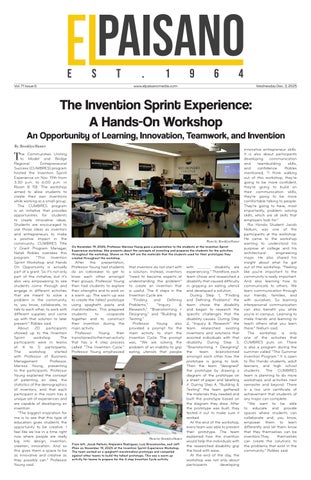
Photo by: Brooklyn Hunter On November 19, 2025, Professor Marissa Young gave a presentation to the students at the Invention Sprint Experience workshop. She presents about the concepts of inventing and prepares the students for the activities throughout the workshop. Shown on the left are the materials that the students used for their prototypes they created throughout the workshop.
After the presentation, Professor Young had students do an icebreaker to get to know each other amongst their groups. Professor Young then had students to explore their strengths and to work on a warm up. The warm up was to create the tallest prototype using spaghetti pasta and marshmallows. This prepared students to cooperate together and to construct their invention during the main activity. Professor Young then transitioned to the main activity that has a 4 step process called “The Invention Cycle.” Professor Young emphasized
that inventors do not start with a solution. Instead, inventors “need to become experts at understanding the problem” to create an invention that is useful. The 4 steps in the Invention Cycle are: “Finding and Defining Problems,” “Inquiry & Research,” “Brainstorming + Designing,” and “Building & Testing.” Professor Young also provided a prompt for the main activity to start the Invention Cycle. The prompt was, “We are solving the problem of an inability to grip eating utensils that people
Photo by: Brooklyn Hunter From left, Jacob Nellum, Alejandro Rodriguez, Luis Bracamontes, and Jeff Phan on November 19, 2025 at the Invention Sprint Experience Workshop. The team worked on a spaghetti marshmallow prototype and competed against other teams to build the tallest prototype. This was a warm up activity for teams to prepare for the 4 step Invention Cycle activity.
with _______ disability are experiencing.” Therefore, each team chose and researched a disability that caused difficulty in gripping an eating utensil and developed a solution. During Step 1, “Finding and Defining Problems” the team chose the disability and began to research the specific challenges that the disability causes. During Step 2, “Inquiry & Research” the team researched existing inventions and solutions that assisted individuals with that disability. During Step 3, “Brainstorming + Designing” the team brainstormed amongst each other how the prototype is going to look. Then the team “designed” the prototype by drawing a diagram of the prototype on a sheet of paper and labelling it. During Step 4, “Building & Testing” the team gathered the materials they needed and built the prototype based on the diagram they drew. After the prototype was built, they tested it out to make sure it worked. At the end of the workshop, every team was able to present their prototype. The team explained how the invention would help the individuals with the researched disability grip the food with ease. At the end of the day, the workshop was not only about participants developing
innovative entrepreneur skills. It is also about participants developing communication and teambuilding skills, and confidence. Robles mentioned, “I think walking out of this workshop, they’re going to be more confident, they’re going to build on their communication skills, they’re going to be more comfortable talking to people. They’re going to have, most importantly, problem solving skills, which are all skills that employers look for.” Rio Hondo Student Jacob Nellum, was one of the participants at the workshop. He came to the workshop wanting to understand his purpose at college and his architectural engineering major. He also shared his insight about what he got out of the workshop. “Feeling like you’re important to the community is really important. And also learning how to communicate to others. We learn communication through our friends, families, and with ourselves. So learning interpersonal communication can also benefit you while you’re in campus. Learning to make friends and learning to teach others what you learn there.” Nellum said. The workshop is only one of the activities that CUMBRES puts on. There is also a program during the summer called “The Summer Invention Program.” It is open to Rio Hondo students, adult learners, and high school students. The CUMBRES team is planning to do more workshops and activities next semester and beyond. There is a low unit certificate of achievement that students of any major can complete. “We want to be able to educate and provide spaces where students can collaborate and, you know, empower them to learn differently and let them know that they themselves can be inventors.They themselves can create the solutions to the problems that exist in the community.” Robles said.
NEWS
2
Fighting Finals Fatigue with Furry Friends
Second-year student Kayla Flores holds Frijol, a year-old cow cat. He remained calm in his swaddle as a series of students took their turn holding him and speaking to him softly.
Uriel De Leon and Leilani Lopez worked the sign-in table for the Associated Students’ event.
Third-year student, Bridget Castillo gets to know Aubree, a Jack Russell-Pit Bull mix who abides wearing a winter hat and sweater.
Story and photos by: Donna Walsh
T Student Isis Ouzounian shares a calm moment with Mia, a Shetland Sheepdog. Mia entertained students with her love of playing fetch. Her owner, Paws to Share founder, Jaime Goldfarb, Ph.D., describes Mia as “indefatigable.”
he Rio Hondo College (RHC) community was invited to de-stress by spending time with therapy animals on Tuesday, November 18th. The encounter with eight dogs and one cat was organized by the Associated Students of Rio Hondo College (ASRHC) Task Force for Student Success and took place inside the tent in the Upper Quad. Makayla Shao, the event’s student organizer, said that bringing therapy animals on campus was an effort to help students to reduce their stress levels as they prepare for finals. The event was well-attended, with students visiting a sign-in table before entering the tent to meet and play with the animals. Particularly popular were Frijol, the swaddled cat, Mia, an enthusiastic Shetland Sheepdog who loved playing catch, and Nakuja, a Rottweiler who rolled on her back and invited everyone that she met to give her a belly rub. The canine and feline companions were provided by Paws-toShare, a pet therapy group that visits senior centers, hospitals, and schools throughout California.
Students Diana Enriquez, Hannah Chavez, and Robbie Garcia take a break from studying to spend some quality time with Mac, a black Labrador.
Students Enter Finals With Deadlines and Determination By Bryce Bohorquez
S
tudents at Rio Hondo Community College are turning their attention from their regular coursework to the increasing stress of finals week as the autumn semester comes to an end. As students are ready to finish strong, the campus, which is typically bustling with casual chat and club activity, has become a center of study sessions, lastminute tutoring appointments, and silent determination. Many people experience a combination of tension and introspection during the last few weeks. First-year student Alyssa Mahlow, who juggles a full course load with a parttime job, claims that the end of the semester feels like a test of both academic aptitude and stamina. Mahlow remarked, “I’ve been trying to stay organized all semester, but finals always feel like a marathon.” “I keep telling myself that the work I put in now will pay off, even though it’s a lot.” Students are crammed into study areas throughout campus, particularly the Learning Resource Center,
where they are meeting with instructors, going over their notes, and organizing study groups. The library’s hours have been extended, and math, writing, and science tutors are seeing some of their biggest enrollment of the year. The additional assistance has proven vital for many students, particularly those who are unfamiliar with college-level finals. The last stretch feels different this time, according to Madison Becerra, a secondyear student getting ready to transfer. Becerra remarked, “Last year I was stressed and didn’t really know what to expect.” “I feel more assured now. I’ve discovered the best study techniques for me, and I’m making an effort to avoid becoming overwhelmed. As she completes her transfer applications, Becerra stated that she wants to end the semester with good grades. Teachers are also trying to help students deal with the difficulties of the season. Teachers are encouraging pupils to pace themselves, providing review sessions, and
Photo by Bryce Bohorquez Students Study Quietly in theon Monday Nov.25, as finals week approaches and class deadlines come to a close. Focused on laptops, notes amd lastminute assignments, students fill the space as they prepare for the end of the fall semester.
sharing resources. Students have been encouraged by counseling services to learn stress-reduction strategies and to have a healthy balance by getting enough sleep, eating well, and taking breaks. There is a feeling of achievement in the air despite the pressure. Many students claim that the end of the semester provides
an opportunity to reflect on their academic development. Some see it as a step closer to their graduation or transfer objectives, while others see it as just another stage in their educational process. Rio Hondo’s campus depicts a community of students persevering despite exhaustion, supporting one
another, and maintaining focus on the finish line as finals week draws near. Students like Mahlow and Becerra are prepared to wrap out the semester and look forward to a well-earned break with perseverance, planning, and support.
NEWS
3
Opening Doors Through TRIO Student Support Services: A Legacy of Opportunity
By: Brooklyn Hunter
T
RIO SSS (Student Support Services) at Rio Hondo College aims to increase student college retention and graduation rates. It does this through providing individualized support, including counseling and advice, workshops, and financial aid information. The program provides support to low-income students, firstgeneration students, and/or students with disabilities. TRIO SSS student participants meet regularly with their assigned advisor to create a Personal Success Plan that maps out their individualized academic milestones each semester. These plans include scheduling all required appointments in advance. This consists of counseling appointments, grade checkins, academic success workshops, assistance with the Free Application for Federal Student Aid (FAFSA), transfer applications and graduation petitions. Students are required to meet with their counselor once per semester and with their advisor at least twice per semester. The TRIO SSS Team includes TRIO SSS Advisor Cynthia Pallini, TRIO SSS Program Manager Brenda Beza, and the assigned TRIO SSS Counselor. For decades, Rio Hondo College has proudly served as a home for a vibrant network of TRIO Pre-College and College Programs, including Upward Bound, Talent Search, Student Support Services, and Student Support Services STEM—continuing its longstanding commitment to educational access and
Photo by: Brooklyn Hunter From left, TRIO SSS Educational Advisor Cynthia Pallini, and TRIO SSS Program Manager Brenda Beza in TRIO SSS Office on November 13, 2025. Pallini meets with students to schedule and advise check ins and workshops. Beza meets with students who who planning to transfer to a 4-year college or university in the following year.
student success. Beza reflects on the origins of these programs: B“In the 1960s, President Lyndon B. Johnson declared a national ‘War on Poverty,’ aiming to give every American a fair shot at success. He believed that education was the most powerful way to break the cycle of poverty—and that belief sparked the creation of the TRIO Programs.” She continues: “TRIO began as one of the first major federal efforts to make college more accessible for everyone. The first three programs—Upward Bound (1964), Talent Search (1965), and Student Support Services (1968)—formed what became known as “TRIO.” Over the years, the TRIO family grew to include programs like the Educational Opportunity Centers, Ronald E. McNair Postbaccalaureate Program, Upward Bound Math and Science, and Veterans Upward
Bound—all designed to open doors to higher education.” Since the year 2002 at Rio Hondo College, the TRIO SSS Program has assisted students with their college journeys and future plans. For example, TRIO SSS has helped alumni siblings, Maria Martinez and Jorge Martinez, achieve their higher education goals and dreams. Both siblings were low-income, first-generation students, and their parents came from Jalisco and Michoacan, Mexico. The siblings have not accessed any other support services prior to joining TRIO SSS. “TRIO SSS was the first and only program they approached, and it quickly became a lifeline for their academic journey,” Beza said. Maria was the first of the siblings to apply for the program. She decided to do so after hearing Pallini present at an in-class presentation about
the program. At that point, she discovered how TRIO’s personalized counseling and academic advisement could be helpful. This is when she encouraged her brother Jorge to join. Beza recalls a defining moment in Jorge’s journey: “Flor Sandoval, a TRIO SSS Counselor, told him, ‘Stop looking at other people’s grass; focus on your own and water it.’” Years later, Jorge reflected on the impact of those words, telling Beza, “That was truly a turning point for me. I realized I needed to focus on the present—not the past—and appreciate what was right in front of me.” With the guidance of the TRIO SSS Program, the siblings navigated college life with confidence. At Rio Hondo College, Maria and Jorge each earned an associate’s degree. Maria in Social Work and Human Services, and Jorge in Business Administration, laying the foundation for the next chapter of their academic and professional journeys.
Photo courtesy of: Brenda Beza TRIO SSS participants from the Class of 2019 stand in front of the science building wearing caps and gowns, including Maria Martinez, Jorge Martinez, and Jonathan Nguyen.
The Helpfulness The KA Complex Brings to Rio Hondo By: Edwin Ramos
T
he Helpfulness The KA Complex Brings to Rio Hondo Rio Hondo College offers many different courses around campus for students to continue their education. One of those places that has plenty of great resources and courses is the Kinesiology & Athletics Complex. Located at the lower part of the school, it may look like it is small, but it’s not at all. Entering the complex, there’s already many things students can learn and use starting with the indoor gym for them to use. Students enrolled in a workout class will be able to use the indoor gym that has a variety of equipment. The equipment the gym has was upgraded in order for students to feel at home. The gym equipment ranges
from treadmills to dumbbells and a stretching area to use before and after a workout. Some of the classes the complex also has is a dance class. It’s one of the more popular areas for students as they are able to show their skills with other students who have a love for dance. Next to the gym and dance class are where the Kinesiology majors have their classes located.
Down the hallway is where Kinesiology majors are able to continue their studies for the career path they want to pursue. Exiting the inside of the complex to the outside, students are met with the outdoor pool. Students who do not know how to swim, and want to learn to swim are able to take a swim course. The pool is also the place where the men’s and women’s water polo team play their
Maria transferred to Cal State University Los Angeles (CSULA) and earned her Bachelor’s Degree in Social Work in the year 2021. Maria currently works as a Lead Case Manager and earns $72,000 a year while making an impact in her community. Jorge transferred to Cal Poly Pomona and graduated in the year 2021 with a Bachelor of Science in Accounting. Jorge currently works for the Internal Revenue Service as a Revenue Agent and earns over $100,000 a year. Their story exemplifies the transformative impact of TRIO SSS. For students like Maria and Jorge, TRIO SSS provided the support and guidance needed to overcome challenges, stay on track, and turn their educational dreams into reality. The TRIO SSS Program is located in the Student Services Building, Room 140 next to Financial Aid. The office is open Monday through Friday 8 a.m. to 5 p.m. and Friday 8 a.m. to 2 p.m.
home games throughout the season. Next to the pool, is where the gymnasium is located. An interesting thing about the gymnasium is being the oldest part of the complex and still being used. Students are able to take a basketball course if they are interested. The gymnasium is where men’s and women’s basketball host their home games for the season.
The KA Complex welcomes students with motivational words and the mindset they need to achieve their goals at Rio Hondo.
Photo By: Edwin Ramos
The season for both teams has just started. Dean of Kinesiology and Athletics, Dr. Joe Cascio, gave his thoughts about how the complex helps both students and student athletes. “To be able to give students majoring in Kinesiology an area where they can learn and grow their skills is important… for student athletes, it’s important to have them play and learn in order for them to succeed,” Cascio said. The Kinesiology & Athletics Complex will continue to play a vital role in student life at Rio Hondo, offering a space where students can get the best academic experience while also providing the fitness they can have. As more students on campus discover what the complex gives, it is expected to remain a crucial part of a students success.
NEWS
Support for Community College Students with Special Needs
El Paisano Staff Marissa Chavez Editor-in-Chief
Omar Lopez
By Brooklyn Hunter
S
tudents with developmental or neurological disabilities (special needs) usually have needs that are beyond what the general disability services provide. Developmental and neurological disabilities include Attention-Deficit/ Hyperactivity Disorder (ADHD), Autism, Cerebral Palsy, Down Syndrome, Epilepsy, Intellectual Developmental Disabilities (IDD), and more. Their needs are not only limited to academic and classroom needs. There are also needs including navigation on campus, sense of belonging, sense of community, social skills, speech skills, and life skills. In many cases, there needs to be more outreach to the high schools and transition programs. Unfortunately, these needs do not get emphasized enough and in a lot of cases services do not focus on those needs enough. I am a student on the Autism Spectrum with Visual and Auditory Processing Disorders. I also have a younger sibling with Autism and I grew up alongside peers with Autism and other special needs. The reason I bring that up, I would like to give my point of view as an individual in
the special needs community about support that is primarily lacking in California Community Colleges (CCC). I not only want to point out the challenges, but also provide ideas and solutions. I would like to start with the fact that community colleges need to provide more outreach. There are students and their parents, guardians, and caregivers that have no idea what is offered at the colleges. It is important for the disability programs, especially the administrators to ensure that every school and transition program within the local area is well informed. It is also important to initiate and maintain effective and positive communication. Now the outreach should not only cover academic support. It should also cover services currently offered that will take care of needs including navigation, social, sense of belonging, and sense of community. There are ways to provide additional support on campuses for the needs that are not emphasized enough. Every college should provide a summer program with a counseling class or orientation
process specifically for individuals with disabilities. This should continue into continuously providing a program that helps students with navigation, confidence, connecting with resources, and socializing. There should also be additional classes that get students used to being in college, possibly noncredit. Some classes can include adaptive art, adaptive sports or fitness, adaptive recreation, adaptive cooking, social skills, and life skills. Eventually some of these students may consider classes for certificates and degrees. Even if they do not, at least they are going to college. And it is a “community” college. So we should all work together to emphasize that. What would be greatly beneficial as well is if every community college provided speech therapy and social groups for students with special needs. It would help the students not only with their speech and social skills. It would also help them feel more comfortable and welcome on campus. They find peers to connect with that have similar challenges and experiences. It would even
help with students coming out of their shells and with trying new things within the campus at large. For the past 2 years, Rio Hondo College has done a great job in increasing discussion and collaboration. I would like to give a shout out to Disabled Students Program & Services (DSPS) department. Thank you for increasing services, providing a new space for us to relax in, and for being open to new ideas and collaboration. I would also like to give other departments on campus a shout out for supporting the disabilities community on campus and for being a part of the conversation and collaboration. This is a message to DSPS and Rio Hondo to continue the good work and what to focus more on in the near future. This is a message to the entire CCC district that there needs to be much more discussion on the needs that are not emphasized enough. Most importantly, students, parents, guardians, caregivers, and K-12 special education departments should be included in the discussion and the planning process.
Reporter
Bryce Bohorquez Reporter
Bella Fortney Reporter
Edwin Ramos Reporter
Donna Walsh Reporter
Brooklyn Hunter Reporter
Eric Gonzales Reporter
Aaron Martinez Instructor
W. Carrera Advisor
Photo by: Devun Hunter From left, DSPS Director Sean Osborn and Writer Brooklyn Hunter on September 4, 2025 represent the Disabled Students Program and Services (DSPS) and DSPS Student Council during Club Rush. They answered students’ questions and provided information about DSPS.
Next Stop: Dominic Segura Levels Up to College Baseball
By: Marissa Chavez
D
ominic Segura is a freshman and Rio Hondo College and currently plays for the men’s baseball team. Segura has been playing baseball 15 years now since he was three years old. He is a first baseman and a designated hitter for our roadrunners. “I wanted to come to Rio because the coaches told me they wanted to create a winning culture here and I thought that was really cool and wanted to be apart of that” Segura says. Since being at
Rio Hondo, the roadrunners have won three games out of the five games played. “My experience here has been pretty great, the team’s looking really good right now and hopefully we are able to win a championship this year” Segura says. A little over 40 players play for our baseball team. The fall games have already been completed for baseball season, but the roadrunners are currently participating in a black and white series, which is a three game set.
All players are split up into two teams and play three games. Opening day for the baseball team is set for the end of January. Rio Hondo’s baseball team played against Irvine Valley College, Saddleback College, and Santa Ana College during the fall season. The team is coached by head coach Mike Salazar. Segura also played baseball in high school, two years at La Habra high school and the remaining two years at La Serna high school. “High
school is not as serious” Segura says “In college, everybody’s into the game, nobody’s sitting on the bench everybody’s on the rails cheering, and it’s more intense in college” Segura says. Segura also states that being a college athlete, he has more time to focus on his studies then he did in highschool. “I have one class everyday, then I have baseball, I just go home and do homework.” Segura says.
www.elpaisanoonline.com
FOLLOW US!
@elpaisanomedia
4