Vol. 71 Issue 5
www.elpaisanomedia.com
Wednesday Nov. 19, 2025
Encore Students, Employment, and Internships: How Can the Center for Career and Re-Entry Help You? By Donna Walsh
employment, job search, age from 23 to those in their he Center for Career and and career information for 60s or 70s. Adjunct counselor Re-Entry Services, located students and alums both on Prieto, who is also an RHC in the Student Services and off campus. In addition professor of counseling 101, room SS 350, is the one- to counseling and job listings, said that she understands her stop destination for students the center offers help with students. seeking a job or internship, as résumé and cover letter Sympathetic Counselors well as for students enrolling development, as well as career “I am an alumn of Rio Hondo at Rio Hondo College (RHC) assessment testing. Much of and a former re-entry student who are older than 23 years the career, interest, personality, myself,” said Prieto. “I have four old. The center’s staff and and strengths testing is free; kids and went to community counselors are dedicated however, some tests have a fee college for 17 years.” to helping adult learners associated with them. Prieto encourages her succeed. Students can schedule an students and her counselees Career Counseling appointment with a counselor not to give up. After stops and The center is a subset of online by filling out a request starts at several community the RHC colleges, she Counseling “Are you currently looking for a job? We can was identified division. with a learning S a m u e l help you with résumé writing, interviewing disability. She Nieto, the sought the skills, and job search strategies.” Director for - Samuel Nieto support that Tr a n s f e r she needed and Career and found Services, suggested that the form or in person by visiting SS success. She transferred to counselors’ and staff’s goal 350. There are two full-time Cal State University, Fullerton is to provide educational counselors, Troy Flores-Olson (CSUF), and earned her counseling, career guidance, and Claudia Romo, and two bachelor’s degree in human and support services. He adjunct counselors, Christina services. She then obtained sees their role as helping Anchondo and Vanessa Prieto. a master’s degree at Cal students discern their path by Re-Entry Students State University, Long Beach, demystifying the process of Each Fall, approximately and is currently working on a career preparation. 25% of all new Rio Hondo doctorate at CSUF. “We can help students College students are reIn addition to center-based think about their plan here entry students. The students and online support, the Center at Rio,” said Nieto. “What are receive wrap-around support for Career and Re-Entry your goals? Are you currently at the center, which includes Services also offers an average looking for a job? We can counseling appointments, of two monthly workshops help you with résumé writing, academic guidance, and a and events, such as the oninterviewing skills, and job dedicated staff member who campus Fall and Spring Job search strategies.” provides them with information and Internship Fairs. The Job Wall about campus events and The Center for Career and A wall and a half of the activities. The purpose of Re-Entry is open Monday center’s reception area is the re-entry program is to through Thursday from 8 a.m. decorated with hundreds of facilitate a smooth transition to 7 p.m. and on Fridays from flyers advertising jobs and into college life for individuals 8 a.m. to 2 p.m. internships. The center also who may have been out of Student Services offers access to the College school for five years or more. SS 350, Central Network. This national Nieto reported that recent re- (562) 908-3407 online job board provides entry students have ranged in
T
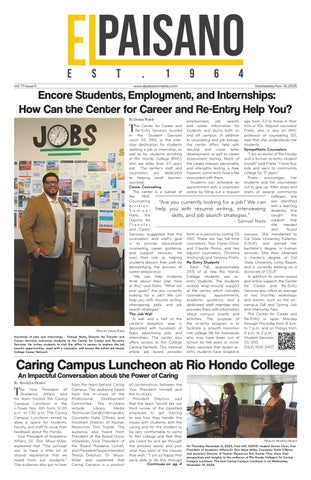
Photo by: Donna Walsh Hundreds of jobs and internships - Samuel Nieto, Director for Transfer and Career Services, welcomes students to the Center for Career and Re-entry Services. He invites students to visit the office in person to explore the job board’s opportunities, meet with a counselor, and access the online job board, College Career Network.
Caring Campus Luncheon at Rio Hondo College An Impactful Conversation about the Power of Caring
By: Brooklyn Hunter
T
he Vice President of Academic Affairs and his team hosted the Caring Campus Luncheon in the L-Tower Nov. 6th from 12:30 p.m. to 1:30 p.m. The Caring Campus Luncheon aimed to allow a space for students, faculty, and staff to voice their feedback about Rio Hondo. Vice President of Academic Affairs, Dr. Don Moya-Miller, explained that “The concept was to have a little bit of shared experience that we heard from our students.” The audience also got to hear
from the team behind Caring Campus. The audience heard from the tri-chairs of the Professional Development Committee. The tri-chairs include Library Media Technician Sandra Hernandez, Counselor Katie O’Brien, and Assistant Director of Human Resources Toni Traster. The audience also heard from President of the Board Oscar Valladares, Vice President of the Board Rosaelva Lomeli, and President/Superintendent Teresa Dreyfuss. Dr. MoyaMiller also explained that Caring Campus is a product
of conversations between the Vice President himself and the tri-chairs. President Dreyfuss said that the team “would like our front runner of the classified employee to get training to see how they handle the issues with students, with the caring and for the student to be very comfortable to come to this college and feel they are cared for and go through the process easily and pick what they want of the classes they wish.” “I am so happy that we’re able to do this through Continues on pg. 4
Photo by: Brooklyn Hunter On Thursday, November 6, 2025, from left, ASRHC student Donna Chun, Vice President of Academic Affairs,Dr. Don Moya-Miller, Counselor Katie O’Brien, and Assistant Director of Human Resources Toni Traster. They share their perspectives and insights to the audience at Rio Hondo College’s 1st Caring Campus Luncheon. The next Caring Campus Luncheon is on Wednesday, November 19, 2025.
NEWS
2
Donation Drive: Someone’s Preloved Items Getting New Love
El Paisano Staff Marissa Chavez Editor-in-Chief
Omar Lopez Reporter
Bryce Bohorquez Reporter
Bella Fortney Reporter
Edwin Ramos Reporter
Donna Walsh Reporter
Brooklyn Hunter Reporter Photo By: Marissa Chavez
Rio Source room student worker Orlando Garcia Median hangs up donations on the donation racks at Rio Hondo’s upper quad for the Donation Drive event. The event was held on Nov. 3 through the 6 from 10:00 a.m. to 6:00 p.m.
Eric Gonzales Reporter
By: Marissa Chavez
T
he Rio Source room had their donation drive from Nov. 3 -6, the event took place at the upper quad. Students were able to donate many clothing items that were gently used, such as baby clothes, men’s clothing, women’s dresses, t-shirts, blouses, bottoms, and shoes of all kinds. The event was free for all students and staff. “They are able to just grab anything they want anything they see here just as much as they can carry” student worker Aaron Luna says.
The Rio Source room located at SS-305 also carries many resources for students on campus. Not only did they have this event, but they also provide students and community members to access to their computer lab and also provide CalFresh applications for those who may need one. The event had three full racks of clothing that were free for students to grab. They were also accepting donations until Nov. 6 For the donation process
they asked if all donations were washed before donating. They also recommended that the clothes were still in good condition so that their items could be used in the donation drive. The event had many people searching the racks and donation tables for hours. Student Cindy Toledo was one of the many students who attended the event. “I’m very thankful to whoever donated to the racks behind me” Toledo says. The student workers who work at the Rio Source room
were also there at the event organizing and helping students with their donations and the process of getting their donations. Rio Source student workers working the event can also use the hours spent at the event towards volunteering hours to transfer to other Universities. If you or someone you know is interested in the next donation drive, visit the Rio Source room at the student services at Rio Hondo College.
Aaron Martinez Instructor
W. Carrera Advisor
Fueling Success: The RioSource Room is Rio Hondo’s Essential Student Support Hub By: Eric Gonzales re you in need of basic necessities? The RioSource room has what you’re looking for. The RioSource Room is a basic needs resource center that is open to students and the local community as well. For example, students are free to walk in once a day for free snacks and/or groceries to those in need. Students just have to sign in on an ipad and that’s it. A simple process for those who are in need of food for the day. You are also able to apply for SNAP and Calfresh benefits at the RioSource Room. Luis Cortez, a Student Success coach and RioSource room volunteer, encourages all students and people to come up to the center and use the benefits to their advantage. “If you’re interested in Calfresh and SNAP benefits, it’s open to apply for them right here. It’s definitely really helpful right now and I encourage people to come because SNAP is expected to run out this month due to the
A
Photo by: Eric Gonzales Photo inside the RioSource Room. All the produce is on display. Taken on November 5th, 2025
government shutdown and it might be a challenging time for some people.” The center also does housing referrals to help those who are also in need of stable housing. Cortez states, “We also do housing referrals to those who are facing housing insecurities. You would be able to get referrals from us here in the center as
well.” In addition to those two very important outlets, the RioSource room also gives out free academic supplies and hygiene products if your in need of those type of resources as well. Students play an active role, using their outreach to educate their classmates about available resources and break down the stigma often
associated with seeking help. By creating an environment where immediate solutions and referrals are readily available, the RioSource Room removes nonacademic obstacles, empowering students to stay focused on their learning goals and realize their full potential. It stands as a powerful testament to Rio Hondo College’s commitment to holistic student support. Cortez added, “This is a really great resource center for everyone and i highly encourage everybody to come here and speak to me or someone else because we are here to help you we want everyone to feel great during these times.” The RioSource room is located in room SS-305 on the third floor of the Student Services building. It is open Monday through Thursday, from 8:30 AM to 12:30 PM, and 1:00 PM to 5 PM, and on Fridays from 8:00 AM to 2:00 PM.
www.elpaisanoonline.com
FOLLOW US!
@elpaisanomedia
NEWS
3
Opening Doors Through TRIO Student Support Services: A Legacy of Opportunity By: Brooklyn Hunter
T
he Vice President of Academic Affairs and his team hosted the Caring Campus Luncheon in the L-Tower Nov. 6th from 12:30 p.m. to 1:30 p.m. The Caring Campus Luncheon aimed to allow a space for students, faculty, and staff to voice their feedback about Rio Hondo. Vice President of Academic Affairs, Dr. Don Moya-Miller, explained that “The concept was to have a little bit of shared experience that we heard from our students.” The audience also got to hear from the team behind Caring Campus. The audience heard from the tri-chairs of the Professional Development Committee. The tri-chairs include Library Media Technician Sandra Hernandez, Counselor Katie O’Brien, and Assistant Director of Human Resources Toni Traster. The audience also heard from President of the Board Oscar Valladares, Vice President of the Board Rosaelva Lomeli, and President/Superintendent Teresa Dreyfuss. Dr. MoyaMiller also explained that Caring Campus is a product of conversations between the Vice President himself and the tri-chairs. President Dreyfuss said that the team “would like our front runner of the classified employee to get training to see how they handle the issues with students, with the caring and for the student to be very comfortable to come to this college and feel they are cared for and go through the process easily and pick what they want of the classes they wish.” “I am so happy that we’re able to do this through a grant, and I appreciate Dr. Don Miller for initiating this one,” President Dreyfuss said.
Photo by: Brooklyn Hunter From left, TRIO SSS Educational Advisor Cynthia Pallini, and TRIO SSS Program Manager Brenda Beza in TRIO SSS Office on November 13, 2025. Pallini meets with students to schedule and advise check ins and workshops. Beza meets with students who who planning to transfer to a 4-year college or university in the following year.
ASRHC student Donna Chun shared her perspective with the audience. She explained that this is her first semester as a college student at Rio Hondo. She needed assistance in registering for classes because she did not fully understand the process. “Then I met up with a counselor and she guided me through everything,” Chun said. Chen then described what it means for her to be cared for as a student. “For me, at least, it’s answering like even the smallest questions and explaining everything. I feel like that would get me to understand more.” O’Brien and Traster shared their perspectives at the Caring Campus Luncheon. O’Brien shared one of the things that struck her was when Dr. Moya-Miller shared the idea with his team. “I think the beauty of this program is building on what we’re already doing. You may be familiar with the appreciative inquiry, but this is really very much
related to this because the whole purpose is to tap into those folks who are already doing a really good job of showing students that they care.” O’Brien said. Traster told her story to the audience about how Caring Campus can make a difference for students. Traster explained that Dr. Moya-Miller had an idea that a person (O’Brien) presented to him. Traster immediately realized that it is important for the students at Rio Hondo. An example given was what a school noticed and how they helped their students. Traster explains that the example described seeing “students in the parking lot, and they went out with water bottles and a cooler just to hand it to them. It’s a new place for them. They feel unsure and confused. And immediately it made me think of my daughter. I remember my daughter told me multiple times that she would just sit in her car and wait for her next class.”
Traster told her that the Caring Campus idea gave her “a little personal touch.” She summarized her perspective with, “I didn’t expect to get emotional about that. But for her, that would have made a difference for her on the campus. And so anything like that, I think we should do that. We should make sure our kids feel good, our students feel welcome. So sorry for that part that just happened right there. It’s near and dear, so thank you for making your part.” The Caring Campus Luncheon was to, “also just to give employees and student leaders the opportunity to just share a meal with each other, talk to each other, share time together and really reconnect and know that we support and take care of each other,” Dr. Moya-Miller said. Speech and Communications Professor, Libby Curiel said the Caring Campus Luncheon, “gets us talking and it gives us the opportunity to exchange ideas we might have and learn about things that we might
not know about.” At the luncheon, Lascaris’ Italian food was provided, as well as pastries for dessert. For the participants who attended, there was a fact sheet, created by Dr. MoyaMiller, provided quick facts about Caring Campus. Another Caring Campus Luncheon is scheduled for Wednesday, November 19, from 12:30 p.m. to 1:30 p.m. In the future, Dr. Moya-Miller plans to launch the full Caring Campus Campaign during the Spring of 2026. He said there will be“multiple professional development training opportunities for employees of the district throughout the spring semester, into summer, and then in the fall.” In addition to the team “looking at opportunity for student leadership to participate.” There is a website called “Institute for Evidence Based Change” (IBEC). The website explains more about Caring Campus. It includes the framework and perspectives from other colleges and universities that implement the Caring Campus.
Photo Courtesy by: Brenda Beza TRIO SSS participants from the Class of 2019 stand in front of the science building wearing caps and gowns, including Maria Martinez, Jorge Martinez, and Jonathan Nguyen.
First Gen Week Features: Legacie+ Shop Talk By; Bella Fortney
n November 5, O 2025, Rio Hondo College featured the
“Legacie+Shop Talk” during First Gen week in the L tower. The name ‘Legacie’ holds significance as it stands for ‘Latinos Empowered Guided and Cultivated in Education.’ This event was aimed to share male success initiatives for traditional and nontraditional students who identif y as Latino, other men of color, or those who self-identif y
as men. The t wo speakers at this event were the Board of Trustees President Oscar Valladares and Vice President and Assistant Superintendent Dr. Earic Dixon Pet ters. When asked to share what inspired this event, Oscar Valladares says “I myself am a former undocumented student, I am the first in my family to at tend and complete a higher education journey and this is something we tr y to encourage our
students so they can feel recognized and valued despite any stories or struggles they may have experienced.” While the event took place, free food and haircuts were of fered to share more suppor t for any students or other par ticipants who may need it. Recognizing first generation students not only at Rio Hondo, but other communit y colleges across our countr y. Vice President/ Assistant
Superintendent Dr. Earic Dixon Pet ters along with the hardworking facult y and staf f that work to suppor t communit y college grow th and success. “It is an honor and privilege to ser ve my communit y as a Trustee at Rio Hondo College, we transform students and generations.’’ Said by Oscar Valladares. Giving oppor tunities and welcoming spaces which can lead to engaging in honest conversations that
impact men’s lives and communities; along with, opening a space that provides assistance and encouragement for men of color. Students who join LEGACIE+ are able to benefit from counselor suppor t, mentorship, net working oppor tunities, field trips, conferences and more. The oppor tunities are endless and are always welcome for those who need it.
NEWS Continued from Pg 1 a grant, and I appreciate Dr. Don Miller for initiating this one,” President Dreyfuss said. ASRHC student Donna Chun shared her perspective with the audience. She explained that this is her first semester as a college student at Rio Hondo. She needed assistance in registering for classes because she did not fully understand the process. “Then I met up with a counselor and she guided me through everything,” Chun said. Chen then described what it means for her to be cared for as a student. “For me, at least, it’s answering like even the smallest questions and explaining everything. I feel like that would get me to understand more.” O’Brien and Traster shared their perspectives at the Caring Campus Luncheon.
O’Brien shared one of the things that struck her was when Dr. Moya-Miller shared the idea with his team. “I think the beauty of this program is building on what we’re already doing. You may be familiar with the appreciative inquiry, but this is really very much related to this because the whole purpose is to tap into those folks who are already doing a really good job of showing students that they care.” O’Brien said. Traster told her story to the audience about how Caring Campus can make a difference for students. Traster explained that Dr. Moya-Miller had an idea that a person (O’Brien) presented to him. Traster immediately realized that it is important for the students at Rio Hondo. An example given was what a school noticed and how they helped their students. Traster
explains that the example described seeing “students in the parking lot, and they went out with water bottles and a cooler just to hand it to them. It’s a new place for them. They feel unsure and confused. And immediately it made me think of my daughter. I remember my daughter told me multiple times that she would just sit in her car and wait for her next class.” Traster told her that the Caring Campus idea gave her “a little personal touch.” She summarized her perspective with, “I didn’t expect to get emotional about that. But for her, that would have made a difference for her on the campus. And so anything like that, I think we should do that. We should make sure our kids feel good, our students feel welcome. So sorry for that part that just happened right there. It’s near and dear, so
thank you for making your part.” The Caring Campus Luncheon was to, “also just to give employees and student leaders the opportunity to just share a meal with each other, talk to each other, share time together and really reconnect and know that we support and take care of each other,” Dr. Moya-Miller said. Speech and Communications Professor, Libby Curiel said the Caring Campus Luncheon, “gets us talking and it gives us the opportunity to exchange ideas we might have and learn about things that we might not know about.” At the luncheon, Lascaris’ Italian food was provided, as well as pastries for dessert. For the participants who attended, there was a fact sheet, created by Dr. MoyaMiller, provided quick facts
4
about Caring Campus. Another Caring Campus Luncheon is scheduled for Wednesday, November 19, from 12:30 p.m. to 1:30 p.m. In the future, Dr. Moya-Miller plans to launch the full Caring Campus Campaign during the Spring of 2026. He said there will be“multiple professional development training opportunities for employees of the district throughout the spring semester, into summer, and then in the fall.” In addition to the team “looking at opportunity for student leadership to participate.” There is a website called “Institute for Evidence Based Change” (IBEC). The website explains more about Caring Campus. It includes the framework and perspectives from other colleges and universities that implement the Caring Campus.
Metro’s New Security Measures the Right Way to Go?
By: Eric Gonzales
M
etro stations around Los Angeles have been getting updated with new security features, but not everyone is “on board” with them Los Angeles, in a decisive effort to bolster rider confidence and combat persistent crime concerns, LA Metro has rolled out a sweeping, multi-layered security plan across its rail and busway stations. Moving beyond traditional policing, the agency is leveraging an array of innovative technology and a specialized workforce to redefine safety on one of the nation’s busiest transit systems. The core of Metro’s strategy involves increasing the visible presence of personnel and implementing advanced access control measures. The deployment includes a blended team of Law Enforcement Partners like the LAPD, uniformed Metro Transit Security Officers, and the customer-focused Transit Ambassadors, the folks in green ready to help or direct you in any way. To physically deter crime and fare evasion, Metro is
investing heavily in station infrastructure upgrades. A significant move is the expansion of taller, more secure fare gates at hightraffic stations. These improved gates are designed to physically prevent “piggybacking” and “jumpovers,” ensuring that those on the system are legitimate, paying customers. Moreover, Metro has expanded its “Tap-to-Exit” program at select end-of-line stations. By requiring riders to tap their fare card upon exit, the system not only improves fare compliance but also ensures all individuals in the paid area have a valid ticket, which security officials have noted correlates strongly with crime reduction. Despite LA Metro’s commitment to improving safety, the aggressive rollout of new security measures has faced significant opposition from civil rights advocates, community groups, and segments of the riding public. Critics argue that the strategies disproportionately target vulnerable communities and fail to address the root causes of disorder. The primary opposition
centers on the continued reliance on a large and costly police presence. Organizations like the ACLU of Southern California and groups representing lowincome riders argue for a “care-first” approach, emphasizing that heavily armed law enforcement often leads to discriminatory enforcement. The introduction of new technology has also generated substantial public scrutiny. The expansion of the weapons detection pilot program has been likened to “TSA-style” security. The ACLU and other privacy advocates oppose the technology, questioning its effectiveness in a highvolume, open system like public transit and raising concerns about unwarranted searches and the potential for increased racial profiling by the officers tasked with following up on alerts. Critics and Riders express concerns that the systems will cause bottlenecks during rush hour, especially when people are rushing to catch a train, and that they introduce significant delays.note that the burden of paying-toexit, and the consequences
Photo by: Eric Gonzales Security faregates at Wilshire / Vermont station in Koreatown. Photo taken on August 10th, 2025
of strict enforcement, fall hardest on low-income riders who may struggle to afford a fare in the first place. “If I have to start paying twice now to get out, I’ll have to take the bus during the busy hour. That tapping system will fail if that’s the case.” Says Franky Lopez, a frequent Metro rider. Ultimately, the success of Metro’s new security strategy will not only be measured by a reduction in crime statistics but by its ability to navigate
this deep societal tension. The question remains: can LA Metro achieve a truly safer transit system without sacrificing the principles of accessibility and equity that public transportation is meant to uphold? As the new policies are implemented and scrutinized, the debate between a “police-first” approach and a “care-first” approach will continue to shape the future of public transit in Los Angeles.
Road Runners Open the Season With Overtime Loss R
io Hondo Men’s Basketball opened the season with an overtime loss, falling 10195 against Los Angeles Southwestern on Wednesday Nov. 5. Despite a great effort from the road runners, they were not able to hold on for the lead in the second half, leading into the overtime loss. Rio Hondo started off the game strong as they were doing everything right including ball movement from all players on the court. Top scorers from the road runners, Freshmans Matthew Rodriguez and Ryan Osborne both had 18 points in the
game shooting efficiently from the field. The first half of the game was evenly matched on both sides as they looked to get on a roll on both ends of the court. It was LA Southwestern having a 44-36 lead to end the first half. One of the main problems the road runners had throughout the game were the turnovers and the amount of second chance points they gave up which led to unanswered points from the Cougars. The road runners did well on the other end on defense but
it was during the final minutes of regulation where it all began to slow down. With just seven seconds left in the second half, the road runners were up by two when the Cougars got possession and scored with only two seconds remaining. The road runners threw up a shot but it did not fall and the game headed to overtime after a close final seconds of regulation. At the end of regulation, the score was 83-83. It was here in overtime where the road runners’ chances went away as it seemed that the entirety of overtime was
all LA Southwestern as they could not be stopped on offense and were getting the stops they needed on the road runners. The game ended by a score of 101-95 with the Cougars coming out with a close win. Women’s Basketball player, Freshman Tyler Jackson reflected on what the road runners did well and what to work on next game. “I think they did well offensively and what could’ve won them the game… but if they had better defense they definitely could’ve won if their defense was a little better,” Jackson said.
Despite the loss, the game showed that Rio Hondo has a lot of promise in many areas, but they will need to clean up on the turnovers and second chance points as the season moves forward.
Photo By: Edwin Ramos Freshman guard, Bode Karunwi goes up for the layup during the Road Runners and Cougars overtime thriller on Wednesday Nov. 5.