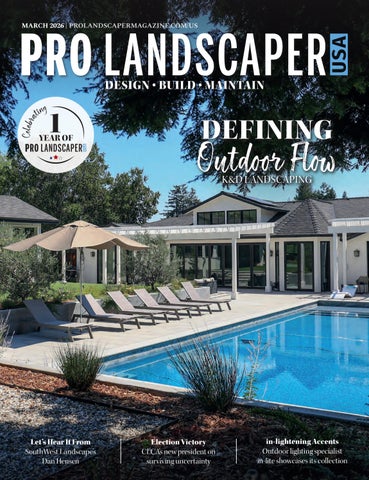
Pro Landscaper USA March 2026

Page 1


DESIGN • BUILD • MAINTAIN

Mow Like a Pro with Honda ProZision

Honda ProZision is Coming Soon!

Almost 50 years ago, Honda revolutionized lawn care with our very first walk-behind mower. And now it’s time for a change just as momentous: our new ProZision™ battery-powered ZTR (Zero Turn Radius) models. Premium power. Best-in-class cut quality. Maximum comfort. And the trusted reliability that’s made Honda mowers the benchmark of the industry. They’ll be available this spring in 54-inch and 60-inch versions. And coming soon, the biggest news of all--our groundbreaking ProZision ZTR Autonomous mower. The future is here, and once again, it’s powered by Honda!

Learn more at https://powerequipment.honda.com/zero-turn-mowers

March 2026 CONTENTS

One-Year Milestone

Pro Landscaper USA hits a milestone—looking back and ahead

CLCA’s New President Speaks

Newly-elected CLCA president, Alex Salazar, shares his market insights

Automation in Practice

Sean Laux on K&D Landscaping’s rollout of the new Kress Voyager mowers

Breaking Down Social Media

Marketing specialist Kelly Dowell on targeting the right audience on social media

Lets Hear It From: Dan Hensen

Founder of SouthWest Landscape reflects on his forty-year career

Rich Residence

Seamless indoor-outdoor design by K&D Landscaping

Wildlife Wonder

Inside Out Landscape Design’s vibrant, immersive and biodiverse portfolio

Luna Park

An award-winning project blending public and residential space

Meet the Supplier: in-lite

The technology powering today’s most striking lighting aesthetics

Product: Outdoor lighting

Two of the biggest outdoor lighting brands showcase their product range

Product: Railing

TimberTech and Deckorators platform some of their most eye-catching railing solutions

Product: Decking

From composite to PVC: a look at some of the sleekest decking solutions

Top Tips Installing Composite Decking

Composite decking installation tips from James Hardie’s Patrick Barnds

Planting for Spring

Sustainable spring gardens without losing color, by Rose Morrison

Firescaping and Community

Educator and author Douglas Kent uses a single Altadena street to illustrate the vital role of community in firescaping

Cetane helps sellers reach their goals. We bring interested, qualified buyers into a customized auction process providing you more choice, strong offers, and smooth transactions. Business owners reach their goals when Cetane navigates. Visit us at www.Cetane.com or call 860-592-0089 for a confidential, FREE business value range estimate.

WELCOME

CONTACT

Eljays44 Ltd, Village Workspaces, 11845 W Olympic Blvd, Los Angeles, CA, 90064

EDITORIAL

Deputy editor - Edward Brown edward.brown@eljays44.com

+1 213 2740 645

Senior subeditor - Katrina Roy katrina.roy@eljays44.com

Senior designer - Kirsty Turek kirsty.turek@eljays44.com

ADVERTISING

Sales manager - Dan Green dan.green@eljays44.com

+1 210 8194 761

Sales executive - Ollie Finch ollie.finch@eljays44.com

+44 (0) 1903 777579

Event director - Tom Glasby tom.glasby@eljays44.com

+1 210 4481 252

MANAGEMENT

Managing director - Jamie Wilkinson jamie.wilkinson@eljays44.com

+44 (0) 1903 777570

Content director - Nina Mason nina.mason@eljays44.com

+44 (0) 1903 959393

Commercial director - Luke Chaplin luke.chaplin@eljays44.com

+44 (0) 1903 777580

CIRCULATION

Subscription enquiries - Dan Green dan.green@eljays44.com

+1 210 8194 761

Printed by Southwest Offset Printing Published by Eljays44 Ltd – Connecting Horticulture. Pro Landscaper’s content is available for licensing overseas. Contact jamie.wilkinson@eljays44.com

Pro Landscaper USA is published 12 times per year by Eljays44 Ltd. The 2026 subscription price is $160. Subscription records are maintained at Eljays44 Ltd, Village Workspaces, 11845 W Olympic Blvd, Los Angeles, CA, 90064. Articles and information containe d in this publication are the copyright of Eljays44 Ltd and may not be reproduced in any form without the written permission of the publishers. The publishers cannot accept responsibility for loss of, or damage to, uncommissioned photographs or m anuscripts.

Whilst every effort has been made to maintain the integrity of our advertisers, we accept no responsibility for any problem, complaints, or subsequent litigation arising from readers’ responses to advertisements in the magazine. We also wish to emphasize that views expressed by editorial contributors are not necessarily those of the publishers. Reproduction of any part of this magazine is strictly forbidden.

One year—what a milestone for the team at Pro Landscaper USA! It’s been a full year since we launched our print magazine and digital platform, and what an incredible journey it’s been. We want to extend a heartfelt thank you to the talented contributors and industry experts who have shared their knowledge and insights with us along the way. As we look ahead to another exciting year, we’re eager to continue connecting with leading voices in the industry and bringing you the expertise that inspires and informs.

In this issue, Dan Hensen of SouthWest Landscape shares insights on building a legacy rooted in trust and family (page 19). Also featuring another California green industry legend, Douglas Kent examines how a single street can illustrate the vital role of green spaces—as both community assets and essential components of firescaping protection (page 50).

Turn to page 12 for an interview with Alex Salazar, the new president of the California Landscape Contractors Association, who discusses how the organization is supporting landscapers through a challenging market. Then, on the following page, Sean Laux of K&D Landscaping details his company’s rollout of Level 5 autonomous robotic mowers and explores what developments in this technology could mean for the industry as a whole.

We hope you find this issue informative and walk away with valuable insights from the impressive range of industry leaders featured within these pages. Here’s to many more years of Pro Landscaper USA!

ASSOCIATION NEWS

Jody Ash named APLD’s leader for championing environmental stewardship in landscape design

The Association of Professional Landscape Designers (APLD) congratulates Jody Ash for receiving the 2025 Award for Leadership in Landscape Sustainability. This award recognizes commitment to environmental sustainability through outstanding leadership, advocacy, projects, initiatives, writing and/or education.

As a leader and expert in sustainable landscaping, Ash passionately advocates for sustainable and ecosystem-based landscaping design at every opportunity. Her company, Wild Heritage Gardens & Design, was built to disrupt the common landscaping industry standards of practice. Ash is committed to providing earth conscious, sustainable options to her clients and every design and project is focused on sustainable landscape solutions.

Outside of her practice, Ash promotes sustainable landscaping as the chair of the parks and public landscaping for Louisville, Colorado, while also serving on the Louisville Bee City Committee. She is also engaged in critical community initiatives, including advocating alternatives to pesticide spraying. Ash addressed the Boulder City Council regarding aerial spraying of chemicals to control Cheatgrass in open spaces, recommending more sustainable management strategies.

“I am proud to present this award to Jody,” says APLD president Katie Weber, CPLD. “Her commitment to sustainability has benefited both the environment and the practice of landscape design.”

For more information about APLD’s sustainability initiatives, visit their website at apld.org

PHTA launches comprehensive insurance program designed for pool and hot tub industry

The Pool & Hot Tub Alliance (PHTA), the trade association representing the swimming pool, hot tub and spa industry, is proud to announce the official launch of ProAdvantage by PHTA. Developed in partnership with HUB International, ProAdvantage provides PHTA members of any size, from any sector—including outdoor living firms—access to affordable, high-quality health benefits and Property & Casualty (P&C) insurance solutions.

ProAdvantage by PHTA was designed to address a critical need in the industry: providing viable, affordable healthcare while adequately reducing operational risk for business owners. By leveraging the collective strength of the association, HUB International, BBSI and carrier partners, including Aetna, Kaiser and Blue Cross, members can now offer their employees competitive health benefits packages that were previously too difficult and costly for smaller firms to secure.

Standard business policies often contain exclusions for aquaticspecific risks, leaving outdoor living contractors exposed. The ProAdvantage by PHTA P&C protection, underwritten by The Hartford, includes industry-specific endorsements critical for anyone constructing pools, spas or water features. Key inclusions often overlooked in standard policies include pool pop-up coverage, installation floaters, contractor’s limited pollution coverage and VGBA inspection E&O.

Outdoor living professionals can learn more and request a quote at phta.org/ProAdvantage

NALP announces field trip event at Timberline Landscaping in Colorado Springs

On June 17 -18, the National Association of Landscape Professionals will host its annual Field Trip at Timberline Landscaping in Colorado Springs, Colorado. The event is presented in partnership with the Associated Landscape Contractors of Colorado.

Designed for owners and leadership teams, the Field Trip moves beyond classroom education. Attendees walk the shop floors, tour the facility and see systems in action. The two-day program includes guided tours, small group discussions with Timberline’s leadership team, and focused sessions on workforce strategy, complex project management and growing multiple business lines.

Timberline operates across residential and commercial landscape construction and maintenance, tree care, irrigation and snow services. With more than 320 team members, the company has built a diversified service model that balances culture, accountability and operational discipline.

For contractors looking to sharpen systems, strengthen leadership teams, and understand how a multi-division firm executes at scale, the Field Trip offers direct access to real-world practices and candid conversations with the people behind them.

For more information, visit landscapeprofessionals.org/FieldTrip.

AGZA makes the case for electric landscape equipment

In a recent editorial, Dan Mabe, founder of the American Green Zone Alliance (AGZA), examined the issues raised by a viral video showing a confrontation between two local residents. The footage highlights a growing conflict in communities nationwide: noise pollution from power equipment.

While some may view the video as simply capturing a public dispute, Mabe writes, it underscores a complex issue at the intersection of public health and community relations. Environmental health experts note that persistent exposure to elevated noise levels can trigger a physiological stress response. This includes the release of hormones like cortisol and adrenaline, an increased heart rate and a shift in brain function to a heightened state of alert. Over time, chronic noise exposure has been linked to diminished cognitive abilities and can contribute to uncharacteristic emotional responses and behavior.

Mabe, whose own years of operating gas-powered leaf blowers led to numerous encounters with frustrated residents, argues that acknowledging both the worker’s need to perform their job and the resident’s experience of the noise is a crucial first step toward sustainable solutions.

While it is unconfirmed whether the equipment in the video was gas or battery-powered, the distinction is significant. Though some individuals report sensitivity to noise from any source, data consistently show that electricpowered alternatives offer a substantial reduction in noise output. This is particularly noticeable indoors, where the lower-frequency sounds from electric equipment are less penetrating.

Through certification programs, AGZA works with municipal governments, academic institutions and industry partners to promote quieter land-care operations. The goal is to reduce noise and air pollution while fostering healthier working conditions for landscape professionals and a better quality of life for residents.

Find out more: agza.net.

IFrom a successful launch to FutureScape USA’s debut, Pro Landscaper USA reflects on year one—and looks ahead

t’s official Pro Landscaper USA is one year old. Pro Landscaper was launched in 2011 as a UK-based publication, with the objective of unifying a fragmented national industry. It sought to bridge the professional silos separating garden designers, landscape architects, contractors and grounds maintenance operatives through a shared media platform and conference events. In March 2025, Pro Landscaper expanded into the US market, bringing its model of industry unification and shared learning in a new publication, Pro Landscaper USA.

A first year of impact

Over just one-year, Pro Landscaper USA has established a robust and engaged readership. Our print edition now reaches 6,000 professionals across the landscaping spectrum, from architects and designers to contractors. Similarly, in the digital realm, our weekly newsletter, The Scoop, keeps another 12,000 industry members informed. Growth is also reflected in our LinkedIn social media profile, where we have generated over 40,000 impressions and cultivated an active community of nearly 400 followers who consistently engage with

our content. Across our website, 250 features and articles have been published, while in print, 13 issues have now brought together a multitude of leading voices and expertise from across the country.

Mike Garcia, founder of Envirospace LA, says being featured in these pages is a career highlight. In an era where online information is often misleading, Garcia values the trust factor that comes with a professionally curated publication. “The writers are award-winning professionals with decades of experience,” he notes, “who keep up with current trends and emerging smart technologies.” He also appreciates how the magazine makes complex methodologies accessible, ensuring “there is something for everybody, regardless of where they are in their career.”

Chris Major of CM Images echoes that sentiment, emphasizing the value of peer-to-peer

ONE YEAR IN

insight. Reflecting on a recent feature, he praised the article for capturing the right tone while underscoring a critical industry lesson: the need for strong visuals and clear messaging to drive business growth. “Relevant information, shared from one industry pro to another, will always be valuable,” Major says. “Keep leaning into that, and the publication will continue to gain traction.”

Major also offers a thoughtful challenge to his fellow professionals. He observes that many landscapers hesitate to engage with the press, either because they underestimate the worth of their own expertise or because they view “talking” as a distraction from fieldwork. His response is a compelling call to action: “If landscapers want to be viewed and valued for their professionalism, then we have to be willing to share our experiences.

Engaging with publications elevates your status as a leader, and that recognition inevitably strengthens the trust clients place in you.”

It is this exchange of honest, expert insight that has fueled our first year— and it is exactly what will propel us into the next.

More than an expo

Moving into live events, the company behind Pro Landscaper USA also hosted the inaugural FutureScape USA in December 2025. The expo energized the Los Angeles Convention Center into the temporary epicenter of the green industry in California. Uniting the landscaping community, the landmark event was a dynamic mix of thought-provoking seminars, visionary innovations and a showcase of toptier exhibitors.

Beyond the exhibition floor, the event served as a stage for excellence. Pro Landscaper USA honored the next generation of talent at the Rising Stars ceremony. For the winners, the recognition carried profound personal and professional weight. Laurel Milton of Evoscapes described being named a Rising Star as a pivotal moment in her budding design-build career. “The design world is huge, with so many different perspectives and interpretations of what ‘good’ design looks like,” she reflects. “Receiving this recognition felt like reassurance that I am where I need to be on my path.” The accolade, she adds, has already shaped her creative approach: “It gave me a deeper sense of confidence to keep refining the details, exploring new material combinations and pushing layouts in thoughtful ways. It felt like a nudge to continue

CONTEMPLATING

expanding creatively while still honoring traditional foundations.”

For Amanda Figueroa, the award took on a different, but equally significant, meaning. As director of sales at Elite Team Offices, she sees the recognition as validation of a leadership philosophy that extends beyond revenue targets. “Sales leadership in landscaping isn’t just about revenue,” Figueroa explains. “It’s about building trust, creating long-term partnerships and helping elevate the standard of service. This recognition reinforces the work my team and I are doing to drive growth and lead with both accountability and heart.”

Both winners are already anticipating the next event. Milton intends to return for the connections and “always forward-thinking” products, while Figueroa calls FutureScape USA “a powerful space for collaboration, innovation and growth.” She adds: “I’m proud to be part of a community that’s shaping the future of our industry.”

FutureScape USA will return later this year: September 1-2 at The Barker Hangar, Santa Monica.

Looking ahead

As we turn the page on our first year, one thing is clear: this is just the beginning. With a growing readership, an expanding live events platform and a community of professionals willing to share their expertise, Pro Landscaper USA is poised to champion the green industry for years to come.

THE JOURNEY, LUKE CHAPLIN, COMMERCIAL DIRECTOR AT 44GROUP, THE COMPANY BEHIND PRO LANDSCAPER USA AND FUTURESCAPE USA, COMMENTS:

“Launching Pro Landscaper USA was an exciting and strategic move. The US market is innovative, ambitious and growing fast—it deserves a platform that champions its best work.

“Our aim is simple: showcase excellence, share insight and become the go-to publication for landscaping professionals nationwide.

“The industry’s response has been the biggest highlight— the quality of projects, contractor enthusiasm and brand support confirm we made the right decision. Building relationships and establishing credibility so quickly has been incredibly rewarding.

“Looking ahead to 2026, we’re focused on expanding our reach, strengthening partnerships, and building more connections through editorial, digital content and FutureScape USA. We’ll continue championing the businesses shaping the future

CLCA’S NEW PRESIDENT

New CLCA president Alex Salazar speaks with Pro Landscaper USA about supporting contractors in a changing California market

The California Landscape Contractors Association (CLCA) announced in January that Alex Salazar, part-owner of California landscaping firm Groundscare, had been elected as its 2026 president. Salazar reports that the new role still feels like a dream. When he started his family-owned business in 2012, attending CLCA chapter meetings meant learning from industry veterans he deeply admired. “So, it feels surreal to think that I have now been chosen as the CLCA’s president,” he says. Joining him in steering the organization through the coming year is executive director Sandra Giarde, and together they are focusing on the complex realities facing California’s landscape contractors.

out that problems arise when homeowners ask those workers to take on larger projects.

“That’s where you start to see people working outside of licensure, which is mandated not only for the protection of the consumer, but for the protection of those who are doing the work as they lack many protections afforded to workers of licensed landscape contractors.” The risks for homeowners could be significant, she adds, if they are held liable due to injury.

“It feels surreal to think that I have now been chosen as the CLCA’s president”

According to Salazar and Giarde, a key priority for the CLCA in 2026 will be raising awareness of the association with consumers, especially when it comes to California’s licensure requirement. For any landscaping job over $1,000, a contractor must be licensed under state law. While weekly maintenance workers don’t need a license, Giarde points

Recognizing the financial, bureaucratic and logistical complications in taking the proper steps to become a legitimate business, Salazar underscores the value of CLCA membership as a critical resource, particularly for newer businesses. The association provides members with an HR hotline and publishes employee handbooks tailored specifically to the landscape trade, as well as lawyer-reviewed contracts updated annually. On the value of the contract, he remarks, “As a new contractor, you have access to contracts for maintenance and construction projects. They’re created by a lawyer and revised annually to ensure members have solid contracts that protect

both the business and the customer. If you hired a lawyer to create contracts on your own, you could easily spend over $1,000.”

Forecasting another challenge on the horizon, the labor market remains a pressing concern. Salazar points to the impact of shifting immigration policies and a wave of retirements across the trades. “There are a lot of tradesmen who have already retired and are retiring. So, there are a lot of people exiting the trade.” This contraction, however, is shifting dynamics. “There are less options for the consumer. Finding a good contractor is more desirable—because it’s less common.”

As Salazar prepares to lead the CLCA through 2026, his focus remains clear: leveraging his association’s resources to help members navigate challenges and seize opportunities in a changing industry.

Alex Salazar is a coowner and operator of Groundscare, the family-run California landscaping firm he built with his father and brothers. The company has earned over 20 CLCA awards. groundcareco.com

Instagram @groundcarelandscape

UNCHARTERED Autonomy

Level 5 autonomy has arrived in landscaping. K&D’s technology lead on why the industry stands at an “uncharted stage”

In January, K&D Landscaping announced that it had unboxed its first Voyager, an autonomous mower from Kress Outdoor Power Equipment. The commercial and residential landscapers becoming the first company in California to deploy what it describes as a “Level 5 Autonomy” machine. According to Sean Laux, technology and innovation manager at K&D, the move places the company at what he calls an “uncharted stage” in the industry’s automation evolution. As automated processes seep into blue- and white-collar jobs alike, Laux argues the question is no longer whether the green industries will be increasingly more affected, but when— and who will take the pioneering steps and capitalize on the rapid innovations in the technology.

systems that slow or stop when people or animals cross its path. These features have proven significant in shifting customer perception. “Initially, the concern is always around safety,” Laux says. “But after a live demonstration, you feel the shift from their concern to their excitement.”

“It isn’t an average remote-control or

robotic

mower. It is a mower that is fully unsupervised and stores an unlimited number of site maps”

Breaking down Voyager’s capabilities, he explains that it “isn’t an average remotecontrol or robotic mower. It is a mower that is fully unsupervised and stores an unlimited number of site maps, with satellite precision, zero emissions and 24/7 capability.” For Laux, the implications extend far beyond the novelty of a driverless machine, hinting at broader shifts in how landscaping work is performed and valued.

K&D’s Voyager’s deployment began on smaller sites, with the firm working closely with Kress to refine the technology. The mower is equipped with obstacle-avoidance

Despite K&D’s early lead, the broader industry rollout of machines with Voyagerlevel autonomy will require significant confidence building. Drawing from his experience, Laux notes that industry reluctance remains high, largely due to persistent safety concerns—similar to those voiced by customers—and the unique complexities of landscaping work. “It’s really hard to look at landscaping or anything that requires hands in the field doing the hard work” as an easy target for automation, he observes. Yet within that challenge lies a clear opportunity: by automating repetitive tasks like mowing, companies can reallocate labor to more skilled, detail-oriented work, ultimately enhancing service quality.

Laux further points to labor savings, improved site quality and data collection as early automation advantages. In the future, he envisions mowers also being capable of

mapping properties and cataloging assets, such as trees and sprinkler heads. That data could then feed directly into reserve studies and community budgets. “If you know your turf square footage and sprinkler head count, that saves communities manual labor,” he remarks, noting automation could replace hand-tallied site walks.

As new Voyagers hum along California properties, the industry watches closely.

The robotic revolution, it seems, is not just coming—it’s already mowing the lawn. The question now turns to the future: how will automation integrate into the workforce, and what new services will it enable?

Sean Laux is technology and innovation manager at K&D Landscaping, where he leads the company’s adoption of autonomous systems and digital workflows. With a background in tech startups and property management, he bridges the gap between emerging technology and field operations.

kndlandscaping.com

Facebook: kndlandscapinginc

Lyon Financial’s Jessie Wood explains how starting the sales conversation with financing helps builders boost trust, project size and customer satisfaction

THE EDGE FINANCING

Why should builders make financing part of every sales conversation?

Financing helps close more deals, increase project size, and build trust by giving homeowners a clearer picture of what is possible. When discussed early, it encourages customers to think about the full backyard experience, not just individual features. It allows them to explore upgrades, make confident decisions and move forward without immediately cutting scope. This positions builders as problemsolvers who help bring a complete outdoor space to life, not just salespeople.

Why should builders talk about financing early?

Leading with financing keeps the focus on possibilities instead of limitations. Many homeowners begin with a vision for a complete backyard but scale back once the full project cost becomes real. Even buyers with healthy budgets

can hesitate when faced with a large investment. When homeowners see the monthly cost, they are more likely to move forward with cohesive designs and the features that will shape how they actually use and enjoy their space.

How does introducing financing early help speed up the sales process?

Introducing financing early typically speeds up the sales process by removing uncertainty before it can stall a deal. When homeowners understand their options upfront, they can make confident decisions instead of hitting pause once they see the total project cost. Builders who lead with financing often experience shorter sales cycles because customers are less

likely to delay commitments, go quiet or come back later to renegotiate scope.

But what if a homeowner plans to pay cash?

“Even buyers with healthy budgets can hesitate when faced with a large investment”

Even cash buyers benefit from hearing about financing. Many homeowners say they plan to pay cash, but once real project costs come into focus, they often hesitate, scale back or phase their plans. Financing gives them flexibility to protect their savings, start sooner and include more of what they actually want in their backyard design. When builders present both cash and financing options, they expand the customer’s choices and often unlock larger, more complete projects instead of downgrading their plans.

What’s the best way to introduce financing in a sales conversation?

• Start early: Bring up financing before quoting costs so the conversation stays focused on solutions and overall project goals.

• Normalize it: Present financing as a standard part of the process, not a last-minute fix.

• Use tools: Offer calculators, visuals and examples to make the process simple and professional.

• Focus on benefits: Frame the conversation around affordability, flexibility and the value of creating a fully realized backyard design.

PLAN, BUILD, PROFIT

CUSTOMER SCROLLING

Clarified

From Facebook homeowners to LinkedIn commercial clients, landscaping marketing pro Kelly Dowell explains how to tailor your content to connect with the right audience

In an industry where the final product is inherently visual, it’s easy to assume that a strong social media presence is simply about posting high-quality photos of recent projects. However, according to Kelly Dowell, a digital marketing expert for the green industry and founder of Onlawn, an effective social media strategy for landscapers requires far more depth and intentionality than many business owners realize.

Consistency and targeting content

When asked about the most common pitfalls landscapers face with social media, Dowell is quick to point out that it’s less about a specific mistake and more about a chronic lack of follow-through. She explains that ambitious plans to post daily or weekly are

often the first casualty of a busy season or unexpected business crisis.

“Business happens, life happens— your kid gets sick, a busy season starts, your office manager quits. Stuff happens, right?” Dowell says. “And then all of a sudden, you’re filling different holes and you think, ‘The first thing that has to go is social media because of the lack of tangible ROI.’”

This inconsistency, she warns, can erode a company’s credibility over time. The role of social media is often plainly material—it validates your company, showcases your culture and proves you are who you say you are. When posting stops, that validation fades. “Once you say I’m going to do a weekly post, you skip a week,

Facebook

For many younger professionals, Facebook may seem like a platform of a previous decade, but Dowell argues it remains a pivotal platform for reaching homeowners. From her experience, she comments that the profile of Facebook users is typically “35 to 65 plus, dual-income families, heavy suburban population.” These users are active in local community groups and frequently seek recommendations for services.

“The gold mine on Facebook is local community groups where people are posting questions like, ‘Hey, who do you recommend for lawn care?’ Being in those conversations can help you build your local dominance without paid advertising,” Dowell advises. Beyond new client acquisition, Facebook is also an apt tool for relationship maintenance, allowing past clients to tag your company in photos of their yards and leave reviews, reinforcing trust at scale.

next thing you know, you’ve skipped a month, then you’ve skipped a quarter.”

A solution to this problem, Dowell suggests, is not necessarily more time, but a shift in mindset about what constitutes effective content. Landscapers often feel pressure to produce professional-grade photos and drone footage. Her advice? Be proactive.

“The crews have iPhones and Androids too, right? Everyone does,” she notes. “And that works great for social media. In fact, it’s better than those professional and polished pictures because people can see that you’re real. You don’t need pictures to be perfect. You just need them to be real and to be representative of your company.”

While authenticity is a universal goal, Dowell adds that the way it’s packaged must change depending on the platform. She emphasizes that Facebook, Instagram and LinkedIn serve distinct purposes—and reach distinct audiences—within the landscaping market. A one-size-fits-all approach, she warns, is therefore not conducive to a successful marketing strategy.

LinkedIn

For landscapers targeting commercial clients, HOAs or property managers, LinkedIn is the platform of choice. However, Dowell stresses a critical nuance: the power of LinkedIn lies in the personal brand, not just the company page.

“People buy from people, they don’t buy from companies,” she states clearly. Commercial decision-makers on LinkedIn are thinking about growth, profitability and systems. They are not looking for project photos, but for proof of operational maturity and stability. Sharing insights, lessons learned and even thoughts on pricing transparency signals confidence and reduces perceived risk for a potential buyer. Dowell remarks: “Putting your actual physical self out there—represents authority and differentiation.” An active personal presence from an owner or sales leader can be far more effective than a company page simply posting about a recent mulching job.

Instagram

If Facebook is for the logical, community-oriented homeowner, Instagram is for the emotionally driven, aspirational client. Dowell sees the platform as a way to target a younger demographic, typically first-time homeowners aged 28 to 45. “This audience cares about aesthetics,” she says. “They’re going to screenshot your posts for ideas. In essence, they’re buying a lifestyle, not just hiring a landscaper.”

On Instagram, a company’s feed acts as a visual search engine. Before a potential client calls or fills out a form, they will scroll your grid and judge your quality instantly. For landscapers specializing in high-end design, pools or outdoor living, a strong Instagram presence is non-negotiable. It serves as a “living lookbook” that supports a higher price point. Dowell also points out that Instagram is crucial for recruitment; a 22-year-old potential crew member is far more likely to be on Instagram than Facebook, evaluating your company culture through behind-the-scenes content and reels.

One platform to rule them all?

For the busy landscape business owner who only has time to focus on one channel, the choice, according to Dowell, is entirely dependent on their business goals. There is no one-size-fits-all answer.

“It depends on what you’re trying to sell,” she concludes. “If you are high-end outdoor luxury living, a pool builder, Instagram’s going to be great for you. If you are more focused on commercial maintenance and trying to scale, LinkedIn’s going to look a lot more approachable.” Ultimately, the most effective strategy is not about being on every platform, but about being consistently present on the right one, with content that builds trust and speaks directly to the audience you are trying to reach.

Kelly Dowell, founder of Onlawn, is a digital marketing strategist serving the green industry. With roots in landscaping and years embedded in the field, she understands how contractors think, sell and scale. She partners with landscape companies globally to build marketing systems through her signature Flourish Framework: aligning websites, email and social media to accelerate revenue and strengthen brand authority. onlawn.io ABOUT

LinkedIn: linkedin.com/in/kelly-dowell

“IT ALL BOILS DOWN TO TRUST. IF YOU BUILD THAT CULTURE IN YOUR BUSINESS, IT BECOMES PART OF YOUR NORMAL DAY-TO-DAY ”

Forty-four years growing the American Dream: SouthWest Landscape’s Dan Hansen on building a legacy of trust, family and mutual partnerships

Since 2005, the Green Industry Hall of Fame has annually recognized key individuals in the green industries, with the Californian non-profit seeking to honor and preserve the contributions of exceptional people in the landscaping and environmental sectors. In late 2025, one of the inductees was Dan Hansen, founder and president of Southern California’s SouthWest Landscape.

He states that the accolade was as unexpected as it was heartfelt. After four decades of driving at building a business from a one-man operation into a multi-branch, family-run landscape management firm, Hansen had never sought the spotlight or the recognition of his peers.

“I never really imagined getting that acknowledgement,” Hansen admits. “I’ve never been one that’s generally out in the spotlight anyway. I was not expecting it. It wasn’t something that was a goal.”

When the news of his appointment arrived, his mind did not race forward to the inductee banquet or after-dinner speeches. Instead, it reeled backward. The first images that flashed were not of a trophy property or a revenue milestone, but the vertigo of the early days. It was 1982, he was 22 years old, with three children under five, a fledgling

landscape maintenance business and a singular, consuming focus: “making enough money to pay the rent and feed the family.”

“The flashback was to the early days of forming a business,” he reflects, “never really knowing where that road’s going to take you 40-plus years later. That meant a lot.”

Forty-four years on, that road has led somewhere significant. SouthWest Landscape has grown into a premier Southern Californian commercial landscape management company. The Hall of Fame induction serves as formal recognition of a career spent not just shaping landscapes but cultivating a particular kind of business. One where longevity, family and dedication to partnership have proven to be a successful competitive strategy.

“We really consider ourselves a partner to our customers, not a vendor. We’re partnering in their landscape and their property”

has dominated for decades and changed how we operate. But the landscape itself? It’s the same. We’re still mowing lawns and maintaining landscapes.” He pauses, then adds an underlining corollary: “And even within client relationships, it’s basically the same. Everybody’s driving for that same thing—to have good customer service, which really just relates to having a good relationship and building trust with your customer. That’s really what it all boils down to.”

The ‘family feel’ Ask Hansen how SouthWest has changed the landscaping market in California, and he will give you a characteristically humble answer. “Gosh, I can’t really say that we changed it. I think we just try to do it better than the rest.”

with some of the larger folks. We really consider ourselves a partner to our customers, not a vendor. We’re partnering in their landscape and their property. That resonates with a lot of people—that we’re out for their best interests. We’re spending their dollars like it’s our dollars.”

This philosophy of stewardship is a daily, practiced discipline. His teams are trained to be extra eyes on a property, reporting on blownout lighting, damage caused by others, trash accumulation or homeless encampments. These issues are far removed from mowing and pruning, but critically important to property managers and owners who may not visit their sites frequently.

For the small business owner looking to build that same level of trust and rapport, Hansen’s advice is fundamentally simple yet operationally profound. “If you build that culture in your business and it becomes part of just your normal day-today operations, it becomes easier and easier. The customer really respects that.”

In an industry reshaped by technology, labor shortages and economic cycles, Hansen’s journey also offers a tutorial in sustainable growth. The tools have evolved—from paper spreadsheets to GPS fleet tracking and enterprise software. The core principles, he insists, have remained constant.

“Landscaping has changed in some ways and not in others,” Hansen ponders. “Technology

But press on the source of the company’s reputation, and the answer coalesces around culture and a specific kind of intentional relationship. SouthWest has always competed for—and won—business from the industry’s largest players. The key differentiator, Hansen believes, is not price or technology alone.

“Maybe that family feel,” he says. “People always come back to that, especially after they’ve worked

Scaling the soul of the business

The great challenge for any founder-led service business is scaling the founder’s ethos. How does the intimate, handshake-level trust of a small operation survive growth into a multi-branch organization with dozens of managers and hundreds of field staff? How does “spending their dollars like it’s our dollars” translate when you are

no longer the one spending them? For Hansen, the answer lies in a combination of foundational hires, empowered management and a pivotal technological investment made a decade ago.

“We went to Aspire software program about 10 years ago,” he explains. “Before that, when we were just using spreadsheets, sometimes that was difficult. But that program allows us to really have a lot of insight into not only our scheduling but the financial ends of the business. Also, a means of putting in work orders—internal work orders— with photos and so on.”

Nonetheless for all his embrace of operational software, Hansen is quick to note that the human element—the “feel”—remains paramount, especially in quality control. While financially data-driven, quality assessments at SouthWest blend objective standards with deeply personalized client knowledge.

The baseline is universal: “Green grass, nice flowers, clean appearance, no trash— those are the basics,” Hansen says. “And then it gets deeper into irrigation management, enhancement improvements, those kinds of things. When we go out for a quality control inspection, those are the top-line items. The property always looks presentable.”

But layered atop that baseline is a nuanced understanding of each client’s individual priorities. Hansen describes a scorecard system that attempts to understand subjective preference from inspections—a one-to-three scale with visual reference points, almost like a color chart. A client might care obsessively about the monument sign at the entrance, or the front door planting bed, while the back parking lot barely registers. Another might be fixated on even the smallest piece of litter. “So, we try to incorporate the quality standards that that customer expects—their pet peeves—into that quality control inspection.”

The Organic Legacy: Family as foundation and future

“We collectively take all that information and try to come up with something that’s going to be best for the company”

Perhaps the most distinctive—and most closely watched—chapter of the SouthWest story is the seamless integration of Hansen’s children into the company. His eldest son, Bryan, serves as vice president of operations. Another son, Paul, is vice president of client services. His daughter, Kim, works as a client representative. A sister-in-law has been his business partner throughout the journey and a niece has served as office manager for 25 years.

Each child started, as he did, at the very bottom. “Mowing lawns, working in the tree crew.” In the early years, when they were in the lower ranks, he deliberately stepped back. “I kind of let them learn from others—not so much Dad guiding them.” They took initiative, kept learning and advanced on merit. Bryan has now been with the company for 25 years; Paul, approximately 15. Kim joined more recently, three years ago.

Hansen notes that this integration is now seamless: “Now it just seems like in a lot of ways, they’re just another good employee while we’re here at work. Obviously there are still those ties of having family, but they definitely earned their stripes. They’re a good part of the reason for our organic growth over the last 15 years.”

This commitment to inclusivity extends beyond just the family. Hansen actively encourages his leadership team to broaden their circle of consultation. “I encourage them—and I do it myself—to go around and get opinions from a variety of our other employees. Then we collectively take all that information and try to come up with something that’s going to be best for the company and for the group on the whole.”

Empowerment and the art of the hire

This ethos of collective decision-making and trust is not an accident; it is instilled in the company’s

non-family management from day one. New client representatives spend their first 90 days shadowing a superior—a branch manager or other leader— to learn the clientele, the processes, and the boundaries of their authority. Upon completing this period, they are fully empowered to make decisions that build client relationships, even if it means giving away labor or services to secure long-term loyalty. This structured approach to onboarding ensures the company’s collaborative culture is understood and enacted at every level.

“They’re empowered to make whatever decisions they need to make on the properties and with their clients that’s going to build the relationship,” Hansen says. “No matter what that is. If they’re gonna give something away free, it doesn’t matter. Put in some more labor, doesn’t matter.”

Financial decisions—how to price work, how to structure annual renewals—remain collective. But on-the-ground relationship management is entrusted to the individual manager.

“When you empower people to make decisions, they’ll learn through either ‘it turned out great’ or ‘it didn’t turn out so great’,” Hansen says, drawing a direct parallel to his own early trial-and-error. “Very similar to the way I learned. What was a good decision? Did I pause and say the right thing or do the right thing? Or do I just react out of just nature? Sometimes when you just react, you might

not react in the right way. We always encourage them to pause. And then make a decision.”

Building this culture of thoughtful, empowered decision-making starts at the hiring gate—a process Hansen admits is “not a perfect science.” He has learned, over decades, to avoid the trap of desperate, rapid hiring and focus on a series of interviews to establish values.

Retention, he argues, follows organically from this careful, values-based front end. “It starts with the foundation and built internal culture. When you bring in a new individual, with training and so on, they can either thrive or not. Then obviously you move on if it’s someone that doesn’t seem to have your same values and core principles.”

A legacy of perseverance

Reflecting on a career that now bears the formal imprimatur of the Green Industry Hall of Fame, Hansen’s pride is rooted not in any single trophy client or revenue record, but in resilience. In simply enduring.

“I don’t know if there’s any one thing I’m most proud of,” he muses. “I guess proud to persevere through all the hardships of the early years— and those lasted a while. I think just proud that we were able to make it in

a competitive market and become who we are.”

His vision for the future is inextricably linked to the family he raised and the business he built around them. The transition is already underway.

“What I’d like to see for the company—it’s already starting to develop,” he says, a note of quiet satisfaction breaking through. “Just to be able to turn over the legacy to my sons and daughters. I’m excited to see where it goes for them.”

For Dan Hansen, the Hall of Fame induction is not an endpoint, but a milestone on a well-tended path. It validates a simple, powerful idea: that in a business of living, growing things, the most important landscape to cultivate is the human one. Built on trust, nurtured by family, sustained by the unwavering belief that a partner, not a vendor, is what clients truly need and remember.

DEFINING Outdoor Flow

Even among luxury residences, a disconnect frequently exists between architectural intent and outdoor execution. One recent project, however, demonstrates how a considered design-build approach can achieve seamless integration, uniting interior refinement with exterior functionality.

The Rich Residence project began with an ambitious brief: transforming a disjointed outdoor area into a high-end living environment that not only complemented the home’s modern coastal architecture but also enhanced daily functionality. The homeowners sought a refined aesthetic aligned with California living, with outdoor “rooms” for entertaining, dining and relaxation.

Before the renovation, the property lacked cohesion. Circulation patterns were unclear, and the outdoor spaces failed to reflect the

residence’s quality or scale. To address this, K&D Landscaping was engaged in a full design-build capacity, allowing the project to move smoothly from concept development through to construction administration under a single, unified team.

K&D states that the design strategy began with a fundamental reorganization of the property. Rather than treating the yard as a singular expanse, the team established clearly defined outdoor zones while maintaining visual continuity with the home’s architecture. Circulation paths were clarified, and strong geometric alignment was established between the residence and new hardscape installations.

The program introduced several distinct zones: a primary entertainment terrace, secondary lounge areas and defined transition corridors. Layered planting buffers were utilized to create privacy and

frame spatial boundaries without compromising the open, coastal character. This approach fulfilled the client’s desire for intentionally defined spaces without creating hard boundaries.

Material selection played a critical role in achieving the desired modern tone. Finishes were chosen to complement the residence’s existing palette, with clean lines and precise layout geometry reinforcing architectural symmetry. The installation demanded white-glove standards, with particular attention to tight joint alignment, proper drainage planning and hidden infrastructure for lighting and irrigation.

It was found that site grading presented significant challenges. The property’s topography limited usable flat areas and raised concerns regarding water management. The team reengineered portions of the site to optimize surface

Landscaping supplier Techo Bloc techo-bloc.com

Building supplies Big Creek Lumber bigcreeklumber.com

Irrigation

Ewing Outdoor Supply ewingoutdoorsupply.com

Roofing contractor Bill Hamilton Roofing billhamiltonroofing.com

Plumbing contractor Sunra Plumbing sunraplumbing.com

Electrician Benjamin Electric benjaminelectricsc.com

Plastering contractor A Better Plaster Co abetterplasteringco.com

flow while maximizing functional outdoor space. Subsurface drainage systems were integrated discreetly, ensuring long-term protection for both the new hardscape and the existing structure.

The planting strategy was intentionally restrained yet layered, drawing from native California coastal and drought-resistant Mediterranean-inspired palettes. Rather than scattered placement, the approach relied on massing to provide year-round structure, emphasizing texture contrast over excessive color. The resulting palette combined structural

evergreen shrubs, sculptural accent plants, ornamental grasses, drought-tolerant perennials and select canopy trees for scale and shade. Sustainability was addressed holistically through climate-appropriate plant selections, reduced turf dependency and durable hardscape materials chosen for longevity.

Installation followed a layered drift pattern to create depth and movement, with root preparation and soil amendments incorporated to ensure longterm plant health. An irrigation system was zoned specifically to match plant water requirements, reducing overwatering and increasing plant

resilience. Integrated lighting was positioned to highlight architectural specimens and provide evening ambiance without glare.

K&D report that the design-build model proved central to the project’s success. Early involvement from construction leadership ensured budget predictability, constructability alignment and efficient phasing. Detailed pre-construction coordination minimized friction during production, while clear documentation supported a smooth handoff from design to field operations. This approach resulted in a controlled construction process with nominal disruption to the clients’

daily lives and increased efficiency by minimizing material waste and rework during construction. The completed Rich Residence now reflects the scale and quality of the home itself. Over a year, the property has been transformed into a cohesive outdoor living environment that supports entertainment and outdoor living, demonstrating refined craftsmanship and functionality. Through careful planning, disciplined installation and an integrated approach, the project exemplifies how intentional landscape architecture can enhance daily lifestyles and deliver long-term property value.

In 1986, K&D Landscaping was just getting its wheels on the ground. With a pickup truck and a lawn mower, there was a steep journey ahead of this husband-and-wife team. K&D has now grown into a successful landscape company on the Central Coast. Covering Carmel Valley to the Silicon Valley, K&D has reached the lives of many happy and satisfied individuals across the area. kndlandscaping.com ABOUT Facebook: kndlandscapinginc

Biodiversity BY DESIGN

What began as a nearly blank canvas of challenging conditions has been transformed into a thriving, ecologically-rich habitat. This residential project by Inside Out Landscape Design demonstrates how thoughtful planning can turn site limitations into a foundation for a vibrant, sustainable landscape.

The property, bordered by forest and community greenspace, presented a complex set of considerations. Designers confronted heavy clay soil, significant deer pressure, dramatic grade changes and full sun exposure. A creek along the rear of the site linked the yard to a broader natural corridor, while rooftop solar panels necessitated careful tree placement to preserve sunlight access.

Rather than viewing these as impediments, the design team treated them as parameters to shape a resilient, functional ecosystem. The homeowners’ vision was clear: a landscape grounded in native plants, bird-friendly design and layered habitat, installed in phases for long-term success.

An early design change set the tone and form for the entire project. The initial concept to expand a rear driveway was reimagined as a circular front drive. This improved accessibility, reduced steps to the entrance, and created a welcoming approach that integrates seamlessly with lush planting.

Current page: Circular driveway with perennials, grasses, shrubs, and redbud tree; Fall tones of hydrangea, aster, joe pye, and foliage of spicebush, and focal weeping hemlock; View from the center circle planting; The forest edge planting

REFERENCES

Pavers Site One siteone.com

Boulders Ohio Stone ohiostone.net

Flagstone steppers Semco semcostone.com

Gravels and concrete Harrod Concrete & Stone Company harrodco.com

PLANTING

• Baby Joe Pye Weed

• Bevan’s Geranium

• Clustered Mountain Mint

• Colrain Red Bee Balm

• Dark Towers Beard Tongue

• Heartleaf Bergenia

• Henry Eilers Sweet Coneflower

• Jeana Garden Phlox

• Little Henry Sweet Coneflower

• Millennium Allium

• Miss Manners Obedient Plant

• October Skies Aromatic Aster

• Purple Coneflower

• Red Cardinal Flower

• Swamp Milkweed

• Threadleaf Blue Star

• Tickseed

• Vivid’ Obedient Plant

• Wild Columbine

• Cape Breeze’ Switchgrass

• ‘Northwind’ Switchgrass

• Pennsylvania Sedge

• Silk Tassel Sedge

The resulting living landscape, Inside Out Landscape Design states, is a celebration of biodiversity and seasonal interest. Layered communities of native perennials, flowering shrubs, small trees and native prairie species ensure continual bloom and ecological value from spring through winter. These plantings provide vital resources for pollinators and songbirds while creating visual depth through varied heights, textures and colors.

For the design team, facilitating a garden that was focused on its ecological functions was paramount. Invasive species were removed from the front yard and adjacent woodland edge, replaced with multi-tiered native plant communities. A few select non-native ornamentals, such as allium and panicle hydrangea, provide striking accents at the entry without compromising the habitat’s overall integrity. The garden now attracts a diverse array of visitors, from wild turkeys and deer to butterflies, moths and numerous bird species.

Hardscape elements provide essential structure and enhance accessibility. The circular driveway and gently curved pathways guide intuitive movement through the site, balancing the softness of the layered plantings. Drystone retaining walls stabilize the sloped front yard, doubling as habitat

with crevices that shelter salamanders and other small creatures. Elsewhere, a portion of traditional lawn was replaced with a front prairie meadow—a change that increases biodiversity and provides another resource for pollinators.

The project stands as a case study in connecting residential life with ecological function. Once a simple, uninspired yard, the site now flourishes as a self-sustaining landscape that evolves with the seasons. It improves stormwater absorption, builds soil health and seamlessly blends into the surrounding wooded context.

Ultimately, the Wildlife Wonder project is a landscape that moves beyond conventional gardening. It serves as a living example of how residential design can actively contribute to habitat restoration and biodiversity, proving that even a single property can foster a meaningful balance between people and the natural world.

Inside Out Landscape Design is a turnkey firm specializing in landscape and hardscape design and installation for Central Kentucky. With extensive experience, the company focuses on creating customized, sustainable outdoor spaces that emphasize innovative design and construction quality. Its approach is grounded in developing client relationships through consistent performance, reliability and professional dedication. kentuckylandscapedesign.com

Top to bottom: Burgundy & purple foliage contrast with yellow & chartreuse planting; Layers of fall foliage

COMMUNITYEcosystem

In planning large-scale Californian developments, integrating multipurpose public spaces into residential planning is a focal concern for designers. Developers address this through master-planned communities blending housing, commercial districts, green spaces and amenities. Within Orange County’s Great Park Neighborhoods, Luna Park epitomizes that design ethos, demonstrating how public open space can function as both a social anchor and an ecological asset. The park serves as a model for contemporary community planning, illustrating how thoughtful design can shape how residents interact with their environment and each other.

Luna Park was conceived not as a standalone recreational facility but as a connective element within a broader network of nine interconnected parks. The design responds to a broader objective of creating environments where daily life— including work, recreation and education—occurs within walking distance. By positioning the park within proximity to surrounding homes and linking it via trails and pathways, the project aims to reduce reliance on vehicles and encourage residents to move through the community on foot or by bicycle.

At the outset the project advanced through a period of industry disruption. Luna Park’s design began during the Covid-19 pandemic, and the work transitioned to a new firm during the agency submittal phase. The original design was awarded to principal in charge, Jerico Farfan, while he was working at BrightView Design Group in 2023. Following the dissolution of that entity, the project continued under Landscape Craft Studio, the independent practice founded by Farfan, which served as the project’s landscaper. Glen Sharrar continued as the landscape architect of record. The transition was structured to maintain continuity in design intent and agency coordination.

Deliberately devised by Landscape Craft Studio to accommodate a wide demographic range, amenities include a beach-entry family pool formulated for accessibility across ages and abilities—a dedicated lap pool for structured fitness and a large family spa oriented towards relaxation. To support extended use, shaded poolside seating and picnic areas with charcoal grills are distributed throughout the site. The half-acre playground is divided into zones tailored to toddlers, young children and older children, incorporating features such as challenge courses and zip lines. For active recreation, the park includes sunken pickleball courts—positioned to mitigate sound impact on adjacent residences— along with a handball court and three half-court

REFERENCES

Irrigation design

Arroya Irrigation Inc irrigationauditors.com

General contractor

KPRS Construction Services

kprsinc.com

Structural engineer

KPFF Consulting Engineers kpff.com

Architectural design and structures

AO Architects aoarchitects.com

Previous page: Full 13-acre site, capturing the layout and relationship between program elements

Current page: Beach-entry family pool and adjacent lap pool facility; Accessible beach-entry design with integrated ramp; Birds-eye view of the playground and surrounding recreational areas; Park entry sequence featuring signage and preserved heritage tree, relocated and reused as a defining element

basketball courts. Additionally, an eight-acre turf area provides flexible space for casual sports and seasonal community events.

Sustainability considerations informed both the park’s resource management and its planting strategy. All irrigation relies on 100% reclaimed water, a measure intended to reduce potable water demand while supporting a climate-appropriate landscape. The planting palette emphasizes native and regionally appropriate introducednative species, selected to support pollinator populations and ground-dwelling habitat. Seasonal floral successions were also incorporated to encourage migratory patterns for birds and insects, positioning the park as a functional component of the regional habitat network.

Luna Park contributes to a broader community planning framework that prioritizes connectivity and community functionality. A network of parks and trails within the Great Park Neighborhoods is devised to allow residents to “park once” and access amenities throughout the community without relying on cars. In this context, Luna Park functions as both a destination and a thoroughfare, linking neighborhoods through shared green space.

Founded by Jerico Farfan, Landscape Craft Studio is a design-driven landscape design firm that creates meaningful, context-responsive environments. The studio specializes in public parks, urban spaces, and community-focused landscapes that blend ecological stewardship with thoughtful user experience. It delivers projects that foster connection between people and place while reinforcing environmental resilience. landscapecraftstudio.com ABOUT

Instagram @landscape_craft_studio

Through its combination of recreational amenities, ecological planting and integration into the larger open-space network, Luna Park illustrates an approach to public landscape design that seeks to channel both the local environment and community behavior. The project offers a model for how parks can be embedded within master-planned communities to support active lifestyles, social interaction and sustainable resource use.

Top to bottom: Sunken pickleball courts embedded into the landscape to minimize sound impact and preserve visual continuity; Handball courts as flexible recreational spaces that support everyday gathering

“The inaugural USA FutureScape was one of the best shows I’ve ever been to, in fact, I can say it was the best show I have ever been to. The personal connections that I made here both professional and friendly were amazing and the best I’ve ever done at any show ever.”

Michael Bernier, Michael Bernier Design

“FutureScape is one of the most amazing events I’ve been to in a long time.

A lot of networking, a lot of friendly faces, new faces and educational components to this event makes it really exciting.”

Edward Wallace, Mid West Landscaping

“The best landscape show on the west coast!”

Mike Garcia, Enviroscape LA

NEWVENUE FOR2026

SEPTEMBER

1 - 2

THE BARKER HANGAR

in-lightening

ACCENTS

in-lite is on a mission to show as many professionals as possible that lighting belongs in every outdoor space

Light by day frames a garden in life’s vibrancy—color, touch and sound feeding off each other in whirring activity. But when night falls and that busy sensory world recedes, a series of questions linger: must all those sensory experiences end, or can they simply be reframed? What if light itself could be repurposed to reveal the garden’s hidden, nocturnal identity? This belief—that an outdoor space can hold a second life after dark—is what has driven the outdoor lighting brand ‘in-lite’ for 25 years, creating gardens that continue to enchant and inspire long after sunset.

another significant focus is on partnering with the contractor to bring that vision to life.”

Engineering for ease

“Another significant focus is on partnering with the contractor to bring that vision to life”

in-lite’s professional partnership starts by eliminating barriers with its product lineup. The foundation of which being a low-voltage (12V) system. “For contractors, the benefit from this system is clear: no electrician’s license is required for installation,” Vilera states. This alone enables landscapers, hardscapers and deck builders to handle lighting directly, avoiding the need for a subcontractor.

According to Michelle Vilera, North America brand lead for in-lite, this transition from day to night is more than poetic—it’s a significant professional opportunity. The company has built its strategy not merely on selling high-quality fixtures, but on forging what Vilera terms a “grow your business” partnership with landscape professionals.

“Transforming outdoor spaces with the magic of light is our mission,” says Vilera, “but

Efficiency on site is an additional key focus, addressed through in-lite’s patented EASY-LOCK quick-connection system. “Usually, contractors cut cable, splice wires and handle wire nuts,” notes Vilera. “We remove all of that. Time is money.”

The EASY-LOCK plug-and-play approach is built for simplicity. “You only need a drill for the most complex installations,” she emphasizes.

Beyond installation speed, Vilera says that the product is engineered for long-term durability. It is backed by a comprehensive five-year warranty, high IP-rated weatherproofing and the highest Color Rendering Index (CRI 90+) in the market. “It’s a premium product,” she asserts, “but you get beyond what you pay for.”

The partnership pillars Where in-lite diverges from a typical supplier is in its commitment to contractor success

beyond the point of sale. Vilera identifies two core pillars of this partnership: immersive education and sophisticated design support.

To build confidence and competence, the company offers the ‘in-lite Academy’, a program of free online courses and webinars. For hands-on learning, it conducts “Lunch and Learn” sessions and creates experiential booths at trade shows. “At our event booths, we focus on live demos,” Vilera says. “We want professionals to physically make connections themselves with the products and see, firsthand, how simple it is.” This hands-on approach is key to allaying a common installation hurdle. “If you’re not an electrician, the simplicity of a 12-volt system isn’t obvious until you actually try it,” she observes.

Complementing the academy program is a free 2D and 3D lighting design service for contractors, complete with cable plan and material lists. “We have found that 2D and 3D lighting designs are a fantastic sales tool for the contractor to ensure that they actually sell the outdoor lighting pitch to the homeowner,” Vilera explains. This service helps contractors visualize and communicate the transformative potential of a lighting plan, turning a technical add-on into an irresistible project enhancement.

These support services further extend into an ongoing relationship, Vilera continues.

“Contractors who buy in-lite products are signing up for a partner. They’re not just buying a product,” she stresses. The company provides installation advice on demand and even collaborates on marketing, filming exceptional projects to create success story content for their partners.

“We want to create success stories for people, and we want to create content for them to also promote their business”

“We want to create success stories for people, and we want to create content for them to also promote their business.”

Alignment with market demand in-lite’s product development, in its Netherlands headquarters, is focused on two key market trends: contractor demand for customizable solutions and homeowner desire for app-controlled systems.

For professionals, flexibility is paramount.

“Contractors want to be able to customize their lighting as much as they can,” Vilera remarks. She points to products like flexible, cuttable light strips and a wide array of mounting accessories designed for innovative integration into any project.

For the end-user, smart technology is nonnegotiable. “Our focus is on smart, modern technological solutions,” Vilera confirms, highlighting the proprietary in-lite app for control, scheduling and color customization. This focus culminates in new products like the Smart Hubs-75 transformer, which centralizes appbased control for entire lighting zones.

The company also pursues pure aesthetic innovation. A flagship example is the new ‘BREEZE’ path light, featuring a patented ‘BREATHE’ technology. “It uses a new type of LED that dims up and down on its own. So, it looks like the light itself is breathing—like fireflies,” Vilera describes.

Practical 2024 product launches also tackle installation efficiency. New cable-splitting accessories enable a single line to serve multiple areas, reducing the need for transformers and cable costs. A novel “smiley face” ring for recessed deck lights cuts the light beam to prevent glare on stair risers, a small but thoughtful detail that solves a common problem.

Illuminating an opportunity

Ultimately, in-lite’s goal is to shift the contractor’s mindset. Vilera positions lighting not as a complex specialty, but as a natural, high-margin extension of every landscaping or hardscaping project.

“The value proposition is clear,” she says.

“You can achieve stunning, transformative results and increase your project’s profit margin with minimal effort.”

By combining meticulously engineered, easyto-install products with an unparalleled ecosystem of training, design and marketing support, in-lite is working to demystify outdoor lighting installation.

For landscapers looking to differentiate their services, increase project value, and capture the aesthetic value of nightscapes, the message is clear: lighting should not be a niche afterthought, but a core opportunity for growth. An opportunity where the right partnership can illuminate the path to grasping it.

in-lite is a specialist in outdoor lighting developing premium, weatherproof systems with professionals in mind. Its smart, low-voltage products are designed for easy installation and personalized control via an app. in-lite.com/en-US ABOUT

BREEZE

The BREEZE is a versatile, low voltage path light featuring a 360-degree light effect, designed to illuminate borders, shrubs and grasses. Its light is produced by a new COB LED strip within a ribbed, smoked-glass lens, providing a diffuse, all-black aesthetic. A notable feature is its “BREATHE” technology, where each fixture’s intensity varies in a natural, random rhythm, creating dynamic light while maintaining overall garden brightness.

SMART EVO FLEX TONE

in-lite’s SMART EVO FLEX TONE is a flexible LED strip light designed to produce a seamless, uniform light line without visible diodes. It offers dimming and color-changing features as well as a standard warm white setting. Its defining feature is its physical flexibility, allowing it to be shaped into straight lines or organic curves with a minimal bending radius. Control is managed through the app. This versatility aims to facilitate customized lighting layouts.

EASY-LOCK

Designed to simplify installation, the in-lite EASY-LOCK connector is a standard component included with every fixture. It allows a fixture to be connected to a main cable at any point along its length, offering flexible placement. The connector permits fixtures to be repositioned after initial installation. It is made to be weatherproof, ensuring reliable outdoor performance. This system aims to provide a versatile and user-friendly method for creating and modifying custom outdoor lighting layouts.

LIGHTSCAPING Brilliance

TRU-SCAPES

tru-scapes.com

Structure lighting

Landscape lighting

Tru-Scapes offers low-voltage LED landscape lighting designed for integration into outdoor living spaces. The collection includes path lights, accent lights and in-ground well lights, with models such as the Traditional Path Light and Adjustable Walkway Wash Light. Tru-Scapes positions its products as a professional-grade alternative to solar lighting, focused on durability and ease of use for both residential and commercial projects.

Structure lighting designed for integration into walls, posts, ceilings and covered outdoor areas is also provided by Tru-Scapes. Its collection includes wall and post sconces, ceiling and soffit lights, pendant fixtures and hanging bistro lights.

A look at how modern, flexible lighting systems use intelligent design to transform outdoor spaces after dark with subtle, dynamic effects

Deck lighting

Tru-Scapes provides deck lighting made for integration into railings, stairs and posts. The product line includes post cap lights available in aluminum, vinyl and composite finishes—compatible with Trex and Timbertech—alongside step riser lights, dot lights, puck lights and Tru-Post fixtures with accessories such as planter baskets and torches.

Hardscape lighting

The lighting manufacturer has a range of hardscape lighting engineered for integration into pavers, pillars, walls and other structural elements. The collection includes fixed and color-changing paver lights in multiple sizes, pillar lights, hardscape lights and dot lights. Developed by hardscape professionals, the systems are designed for straightforward installation without separate electrical contractors.

Sleek Railing

SOLUTIONS

A brief on new composite railings which focus on faster contractor installation, while steel, glass and cable systems expand design options

Fulton Rail

Impression Privacy Screen

TimberTech’s Impression Privacy Screen combines decorative screening and functional railing in one system. An expansion of TimberTech’s existing award-winning railing line, Impression Rail Express, Impression Privacy Screen is engineered to work together as a unified system and has been wind-load tested for durability. TimberTech states that the sleek aluminum design complements a range of outdoor styles and is non-combustible which is increasingly important in wildfire-prone regions.

Contemporary Cable Rail

The Contemporary Cable Rail system, designed to provide unobstructed views while maintaining safety, is available in Textured Black, Textured White, and Bronze finishes. It features powder-coated cable spacers. Constructed with 316 stainless-steel cable, it includes pre-drilled posts for 36-inch and 42-inch heights. Top rails are offered in 6-foot and 8-foot on-center lengths.

The Fulton Rail is now available nationwide following its successful regional release. This steel railing system expands the TimberTech metal railing line, offering a non-combustible, fire-resistant solution. Constructed from durable galvanized steel, the panelized system features a sleek, low-maintenance black finish with narrow balusters for unobstructed views. Designed for quick installation, it provides an economical alternative to other materials.

Glass Rail Post Kit

The Glass Rail Post Kit is a component for integrating and securing glass panels into aluminum railing systems. Available in a Textured Black finish, the kit includes a durable aluminum post, base trim and cap. It is designed to create an unobstructed view and is compatible with 6mm and 13mm glass panels. Options for line, corner and end posts accommodate various layouts.

Advantage Rail

Advantage Rail from TimberTech is a new composite railing option that offers contractors an efficient installation with its patent-pending SPEEDLoc Technology. A snap-on bottom rail and side-loading balusters allow for faster installation while maintaining optimal baluster spacing. TimberTech reports that Advantage Rail requires 25% fewer fasteners than competitors, streamlining installation. Its design features a premium woodlook with hidden hardware, rattle-free construction and color-matched fasteners, plus a 25-year limited product warranty and 25-year fade & stain warranty.

©Richard Barlow
©Deckorators

HARDSCAPE, Soft Grains

From fire-resistant composites to acetylated wood, today's decking materials offer enhanced performance without compromising on aesthetics

TimberTech

Reserve Collection

TimberTech’s Reserve Collection offers the character of reclaimed wood without the associated maintenance. The premium polymer-capped composite boards replicate the aesthetics of aged wood through advanced color blending and textured grain, eliminating the need for sanding, staining or sealing. Manufactured in the US from approximately 85% recycled materials, the capped construction resists fading, staining, moisture and mould. Patented Mould Guard technology protects even the underside of boards from organic growth. The material will not splinter, crack or peel, and is backed by product warranties. timbertech.com

Deckorators

Summit Decking

Deckorators’ Summit Decking is a mineral-based composite board engineered with patented Surestone technology. The line is 35% lighter than traditional composites and carries a strength-to-weight ratio the brand cites as best in class. Produced in the US and available in three colors, it features a low-gloss, low-maintenance surface that resists splintering, sagging and chalking. Minimal thermal movement and near-zero moisture absorption allow for ground-contact installation. A textured topcoat is applied to improve wet traction too.

deckorators.com

Deckorators

Altitude Decking

The Altitude Decking combines a fire-resistant core with a natural wood-grain finish. The boards carry a Class B flame spread rating per ASTM E84 standards and are Wildland Urban Interface approved. A capped composite line is made with 95% recycled plastic and renewable sawdust. A scratch- and fade-resistant cap covers three sides, including the groove, for moisture protection. Available in various sizes and finishes. deckorators.com

Accoya wood is modified through a patented acetylation process that alters cellular structure for enhanced performance. This reduces swelling by up to 75% compared to untreated wood, resulting in exceptional dimensional stability. It has high resistance to fungal decay and is certified for use in termite zones, with real-world testing indicating a 60-year service life. accoya.com

TimberTech

Advanced PVC

TimberTech’s Advanced PVC Vintage Collection replicates exotic hardwoods without the maintenance. The collection carries an Ignition Resistant designation with a Class A flame spread rating and is Wildland Urban Interface compliant. Boards feature a cooltouch surface that stays up to 30 degrees cooler and offers 40% better traction, wet or dry. Available in multiple colorways. timbertech.com

Accoya Accoya
©Shmiy Treger
©TimberTech
©Deckorators
©Accoya
©TimberTech

TOP TIPS

INSTALLING COMPOSITE DECKING

experienced

What are the top mistakes pros make on their first composite jobs?

“Most of the issues arise when people—especially experienced pros—assume that because they have built a number of wood decks, they can just install composite decking exactly the same as wood,” Barnds explains.

His remedy is straightforward: read the instructions. “Just like any new product or material that you use, it’s absolutely critical to take just a bit of time before starting the installation and read the installation instructions and/or watch our installation videos.”

When pressed for specific pitfalls, Barnds identifies two. First, temperature management. Wood expands and contracts with moisture; composites respond to heat. “You do want to prevent them from getting hot before and during installation, or you will experience excess gapping, particularly on board ends and butt joints.”

Second, substructure prep. “Composite decking will tend to follow any surface undulations or irregularities. Making sure everything is flat and level to start and has the recommended blocking will help prevent most of the issues that pros see.”

How should pros manage long runs and handle gapping?

On long runs, Barnds advises managing expectations. “Installers and homeowners

should expect some degree of gapping or movement in the deck boards, regardless of the materials used and even if you do everything correctly. That’s just the nature of wood, composite and PVC decking materials.

With that said, when dealing with longer runs, as I mentioned, it’s very important to make sure the deck boards stay as cool as possible before and during installation and that the frame is flat, level and has the recommended blocking in place.

We recommend keeping them out of the sun and covering them before installing. Ideally, that means installing them early in the morning, when the air is cool and the sun has not had time to warm the boards’ surface. Also important is that boards should be installed as soon as possible after cutting.”

Gapping protocols differ by material. Wood-plastic composite requires spacing based on temperature charts. PVC decking installs tightly. “That sounds counter-intuitive,” Barnds acknowledges, “but that’s typically the recommendation for best results.”

Which tools and practices deliver clean results?

“Composite and PVC decking are pretty forgiving in terms of cutting,” however, for clean cuts, Barnds emphasizes sharp blades. “Use a high-quality miter saw with a fresh, clean and sharp carbide tooth, fine finish saw blade.” On sliding saws, he suggests pulling the blade into the cut with the board’s top face up. Handling is largely common sense.

“Don’t dump the deck boards when unloading. Carry longer boards on edge with two people. Do not slide boards against each other. Do not use composite decking as a work surface.” He adds that light scratches can often be heat-repaired.

Patrick Barnds is SVP/GM Deck & Accessories at James Hardie, following the company’s 2025 acquisition of AZEK. He leads product strategy for outdoor living, previously spent 14 years at Armstrong and began his career at GE Capital. jameshardie.com

Even
contractors can struggle switching from wood to composite decking. Patrick Barnds explains why—and how to avoid the pitfalls

Native SPRING EPHEMERALS

Rose Morrison details how native spring ephemerals create sustainable, lowmaintenance commercial landscapes with stunning seasonal impact

Commercial landscaping has become more expensive over the years. Clients are either reluctant to invest as much as before or are seeking more sustainable commercial landscaping. Additionally, many want more for their greenery, a wow factor that can make people stop in their tracks. Native spring ephemerals are the solution for this, with their native woodland bloom and easy maintenance. Discover what makes native spring ephemerals great candidates for commercial landscape ecological design.

What are spring ephemerals? A primer for the landscape professional

Spring ephemerals are deciduous flowers that develop early in the spring, ahead of every other plant and tree. They bloom and produce seed in a short span of time. After that, they disappear as trees sprout leaves and block the sun from them. They store their energy in underground rhizomes, waiting to bloom again next spring.

Traditional imported bulbs, such as tulips and hyacinths, are mainly ornamental. Imported bulbs also require a lot of maintenance— resources such as water, fertilizer and annual replacement labor. On the other hand, spring ephemerals provide nectar and pollen to pollinators in early spring and enrich the soil. After commercial installation, these native plants are self-sustaining, making them low-maintenance landscaping options.

“Spring

A perfect example is the wood anemone, which grows 2-10 inches from the ground1 and has charming white petals. Its whorled leaves with toothed edges provide an interesting detail for clients’ landscape storytelling.

Business benefits of biodiversity in commercial landscaping

a lot of fertilizer and mulch. They also require less water, as they thrive on rainwater. This creates a significant savings opportunity, as 30% of US household water consumption

ephemerals provide nectar and pollen to pollinators in early spring and enrich the

soil”

Another economic benefit is the elimination of replanting costs. This can be especially enticing for clients who want lowmaintenance foliage for their places. In general, perennials take three years to establish3 a strong root system. Fortunately, spring ephemerals are incredibly resilient and can withstand replanting with minimal concern.

Spring ephemerals are investments. The single best reason for them is that they require less cost than imported bulbs. Aside from shipping costs, ephemerals don’t need

Additionally, spring ephemerals provide a unique and striking look that many polished, common landscapes lack. They provide a sense of continuity and unity with outside nature, which can help liven up the mood of employees and clientele. Besides, corporate clients are now more cognizant of reporting Environmental, Social, and Governance (ESG) metrics. Native plant commercial installation can boost ESG scores, providing an instant return on investment.

spring ephemeral planting guide for commercial

installation, landscape gardeners need to go beyond filling a bed. The goal is to build a strong, long-lasting system that supports local ecology and client goals. Here are the steps to get started in sustainable commercial landscaping.

Strategic site assessment and soil amending Commercial properties typically will have perfect spots where spring ephemerals can thrive. As a tip, these areas are usually where traditional bulbs are harder to grow, such as shaded sites and the understories of mature trees.

Companion planting for a four-season landscape Clients’ biggest concern is the disappearance of these native plants from the landscape after spring. If they are concerned about the area looking barren, explain successional planting, where a second layer of plants like native ferns or shade-loving perennials emerge to take the place of spring ephemerals. Discuss the potential of a lush, multi-layered and season-long display by doing this process.

“A true expert in commercial landscaping is someone who cares for a local community’s biodiversity”

For example, bluebells provide an early-spring bloom that enchants everyone who sees them. After they fade, ostrich ferns take their place, lasting until frost. The variety gives the landscape a sense of life and a reminder of the changing of seasons, all with minimal maintenance required.

Make sure to frame spring ephemerals as investments that will save clients maintenance costs in the coming years. Additionally, emphasize it as a way to restore a regional landscape to the property, giving it a unique edge over other places.

Designing the future of commercial Landscapes

Spring ephemerals are a great way to boost ESG goals of clients, contribute to local ecology and provide a beautiful and unique landscape. It’s especially relevant as sustainability and water conservation are trends shaping the landscape industry at the moment. Supplement native plants when they vanish through successional planting, which provides a stunning and layered foliage all throughout the year. These tips will help landscape professionals become trusted ecological design consultants, creating high-value natural and resilient systems.

References

The best place to figure out where to plant them is to observe the area during early spring. Check areas where snow melts first. These are the perfect habitats for the native plants. Amend the soil by adding leaf mold or composted pine instead of using standard landscape topsoil.

Sourcing, staging and installation protocol

The most important part is to do due diligence. Make sure to ask native plant nurseries crucial questions, such as propagation methods. Avoid ones that collect these native flowers in the wild.

Commercial landscapes in lounge areas are typically 64-100 sq ft, perfect for four to eight people gathering. This leaves plenty of room for planting in communities or drifts rather than in traditional and formal rows when installing these native plants. These will give a more natural overall appearance.

How to apply regional considerations in client communication

A true expert in commercial landscaping is someone who cares for a local community’s biodiversity. Here are concrete examples of native flowers5 in specific regions:

● Northeast/Mid-Atlantic: Mayapple, Jack-inthe-Pulpit

● Midwest: Prairie Trillium, Dutchman’s Breeches

● Pacific Northwest: Pacific Bleeding Heart, Western Trillium

1. Massachusetts State Government ‘Spring ephemeral flowers.’ mass.gov/info-details/spring-ephemeralflowers

2. Renovated.com, 6 Reasons to Use Native Plants in Your Landscaping, Rose Morrison, 8 June 2018. renovated.com/native-plants-landscaping-plans

3. Greenscape Inc., ‘The Ultimate Guide to Choosing the Ideal Perennials and Annual Flowers for Your Commercial Property,’ greenscape.us.com/ perennials-and-annuals-for-commercial-property

4. University of Delaware, ‘Designing a Sustainable Landscape to Serve Your Needs’, Rebecca Pineo, Reviewed March 2025.

5. U.S. Fish & Wildlife Service, ‘Highlighting spring ephemerals.’ fws.gov/story/ highlighting-spring-ephemerals

Rose Morrison is a landscaping and home improvements expert with a decade of experience in the industry. As managing editor of Renovate Magazine, she stays on top of the latest trends in outdoor design and sustainable practices. With a passion for creating beautiful and functional outdoor spaces, Morrison offers insights and inspiration for landscape professionals looking to elevate their projects and businesses. roseamorrison.com ABOUT

What’s up next for

Get involved in our April 2026 Green Issue Special

Our fourth edition of the year will highlight ‘Green’ Products, Finance and Software—there are lots of ways to get involved. You’ll find business advice and opinion pieces from industry experts, too, as well as three inspiring portfolios.

Our ‘Meet the Supplier’ and ‘Let’s Hear It From’ features will focus on ecology and the environment. There will also be updates from leading associations.

For editorial inquiries:

edward.brown@eljays44.com

Want to see yourself in Pro Landscaper USA? Reach out today!

For sales inquiries:

dan.green@eljays44.com

Eaton Fire SURVIVING THE

One year after the Eaton Fire, how can one street show us that a community’s bond with its land is its best protection?

In early January 2025, the catastrophic Eaton Fire erupted in Los Angeles County, beginning a nearly month-long blaze that would place it among Southern California’s most destructive and expensive wildfires on record. By the time it was contained, it had ravaged thousands of acres and nearly 10,000 structures.

Yet, amidst the sweeping devastation, an Altadena landmark emerged from the ashes largely unscathed: Christmas Tree Lane. This boulevard of deodar cedars, famous for its century-old seasonal light displays, survived largely intact while swathes of the surrounding town smouldered.

In conversation with Pro Landscaper USA, firescaping expert Douglas Kent describes why the lane’s survival was no coincidence. It stands as an illustrative case study of the critical role of community landscaping in wildfire defense—a collective resilience born from a fundamental, reciprocal relationship with the land.

“If you move onto that street, you’re committed to nurturing, irrigating and caring for that landscape,” Kent explains. The community’s annual ritual of decorating the trees, he notes, fosters a deep “ethic of care” for the cedars that extends far beyond festive lights.

“Ceremony and care bonded the people to the land, and when push came to shove, the plants showed up for the people. Not one house was lost on that street.”

Kent contrasts this with a modern landscaping ethos that often treats outdoor spaces as low-

maintenance burdens. “As landscapers, we’ve forgotten the genesis of our profession, which is to care for people in relation to the land,” he states. “By devaluing the human element, we erode the personal connection that motivates the diligent stewardship essential for fire safety.”

The practical application of this partnership, he adds, is straightforward. Effective defense begins at the home itself: a fire-hardened structure with just five feet of clear defensible space has a 70% chance of survival. Extending that zone to 30ft increases the odds to over 90%. This strategy

“As landscapers, we’ve forgotten the genesis of our profession, which is to care for people in relation to the land”

prioritizes distancing what he calls “big fuel objects”—wooden decks, sheds or flammable hedges—over minor ground cover. “The goal is intelligent, focused interventions, not scorchedearth clearing.”

Nevertheless, Kent identifies that the greatest barrier to achieving property fire resilience is not technique, but psychology. Because wildfire threat is often seasonally intermittent, preparation is easily shelved for more immediate concerns. Overcoming this, he argues, requires reframing a client’s entire relationship with their landscape. Consequently, he is an advocate for designs that offer tangible, personal benefits to homeowners— such as hedges that clean the air for children’s health or gardens of medicinal plants—forging a direct psychological link between the land’s care and self-care.

For Kent, the lesson of Christmas Tree Lane is stark. True resilience is more than checking boxes on a regulatory list. It is about cultivating a conscious partnership, seeing the land not as a burden to be managed, but as a partner to be nurtured in good times and bad.

Douglas Kent is an educator and author with over 40 years of experience in horticulture and landscape design. His work focuses on creating urban landscapes that provide essential ecological services and promote human well-being. anfractus.com

Enviroscape LA enviroponds.com

Other than the US, which country’s landscape inspires you the most?

I love Rome. I’ve visited many times and I love the ancient with the new.

You’re on vacation—lounge on the beach or explore a city?

On vacation, I’m definitely an explorer. I was in Turkey earlier this year and went air ballooning. It was so much fun. A real thrill from the air.

Best piece of advice?

Your success in life is in direct proportion to the expectation of your peer group—so choose wisely!

Dream project?

I would love to rebuild the waterfall at the famed architect Frank Lloyd Wright home entitled “Falling Water”.

One thing that you think would make the industry better?

I would love to see a more ‘partner with nature’ approach. This includes a return to native gardens, for the pollinators, and building more fountains. The hardest things for pollinators to find is a fresh water source. Saving the pollinators is the most life-saving work in which we can engage in our century!

INTERVIEWS THE LITTLE

SouthWest Landscaping southwestlandscapeinc.com

Other than the US, which country’s landscape inspires you the most?

Italy—the way history, agriculture and community all live together in the landscape feels timeless and intentional.

You’re on vacation—lounge on the beach or explore a city?

Explore a new city. I can sit still for about 20 minutes before I need to wander.

Best piece of advice?

Play the long game. With people, with business and with landscapes.

Karaoke song?

Don’t Stop Believin’—I wish I had a cooler answer, but I don’t.

Dream project?

Reimagining an aging community landscape into something sustainable, beautiful, and loved by people who live there.

Trend you’re tired of?

Greenwashing without real stewardship behind it.

Couldn’t get through the week without…

Bayto Pools piscinesbayto.com

Other than the US, which country’s landscape inspires you the most?

Iceland. They have an amazing, lush green landscape, incredible mountains, and waterfalls. Moreover, sitting in one of our Bayto Pools looking up at the Northern Lights would be an incredible experience.

You’re on vacation—lounge on the beach or explore a city?

What’s a vacation? If I ever had the time for one, it would be relaxing on the beach for sure.

Best piece of advice?

Live by the Golden Rule—treating others as you want to be treated. We’d all be a lot better off if we lived this way.

Family, good coffee, and working with my SouthWest Landscape team.

Karaoke song?

Sounds of Silence because no one wants to hear me sing.

Dream project?

Putting our 7’X7’ hot tub/spa on the sideline for this year’s Super Bowl!

One thing that you think would make the industry better?

Quality over quantity. Providing the best possible quality product/service will help grow our industry substantially.

Mike Garcia
Paul Hansen
Bob Rollins

Turn static files into dynamic content formats.

Create a flipbook